
Sylvan Lake City Zoning Code
ARTICLE V
- OFF-STREET PARKING AND OFF-STREET LOADING16
Cross reference— Traffic and vehicles, ch. 66.
Sec. 78-531. - Off-street loading and unloading.
(a)
On the same premises with every building, structure or part thereof, erected or occupied for storage, retail sales, warehouse of goods, display, a department store, a wholesale store, a market, a hotel, a hospital, a mortuary, a laundry, a dry cleaning establishment or other such similar use involving the receipt or distribution of vehicles or materials or merchandise, there shall be provided and maintained on the lot adequate space for standing, loading and unloading services adjacent to the opening used for loading and unloading in order to avoid undue interference with public use of the streets or alleys.
(b)
All such loading and unloading areas, including all access drives, shall be paved and shall be in addition to the required off-street parking area requirements.
(c)
Such loading and unloading space, unless otherwise adequately provided for, shall be an area ten feet by 40 feet with a 14-foot height clearance and shall be provided according to the following table:
(d)
No loading space may be on any street frontage and provision for handling all freight shall be on those sides of any building which do not face on any street or proposed street, except where such areas are obscured, from such street, with a solid masonry wall not less than six feet in height. At its discretion, the planning commission may require a solid masonry wall up to eight feet in height.
(Ord. No. 54A, § 15.05, 11-11-1987)
Sec. 78-561. - Required generally.
For every use, activity or structure permitted by this chapter and for all buildings or structures erected in accordance therewith, there shall be provided sufficient space for access and off-street standing, parking, circulation, unloading and loading for motor vehicles that may be expected to transport their users or occupants, whether as patrons, residents, customers, employees, guests or otherwise, to an establishment, activity or place of residence at any time under normal conditions for any purpose. When a use is expanded, accessory off-street parking and loading shall be provided in accordance with the regulations in this article for the area or capacity of such expansion in combination with the previously existing uses, structure or activity. Existing off-street parking facilities actually being used on the effective date of the ordinance from which this chapter is derived for the parking of automobiles in connection with the operation of an existing building or use shall not be reduced to an amount less than that required in this article for a similar new building or use unless additional parking facilities of the same amount are provided as described in this article.
(Ord. No. 54A, § 15.01(a), 11-11-1987)
Sec. 78-562. - Single-family residential districts.
Every building intended for single-family residential occupancy shall provide, on the same lot with such building, a minimum of two off-street parking spaces for each dwelling unit, provided that such minimum required parking spaces shall not be located in the required front yard setback area. One driveway curb cut or street access point is allowed for lots less than 75 feet wide. A maximum of two curb cuts or street access points is permitted for lots with a minimum of 75 feet width. Any parking area in the required front yard setback area shall not exceed 42 percent of that area. All parking within the required front yard of any lot shall be within the paved area for access and parking (i.e., not on the lawn area or other unimproved area). No paved area for access and parking shall be wider than 21 feet.
(Ord. No. 54A, § 15.01(b), 11-11-1987; Ord. No. 319, § 1, 3-12-2014)
Sec. 78-563. - Nonresidential uses of residential buildings.
In any district a residential building being used for nonresidential purposes, except places of public assembly as provided in this article, shall provide in addition to the off-street parking spaces for the dwelling units required under section 78-562, off-street parking in the same amounts set forth in section 78-571, for that portion of the floor area which is being utilized for nonresidential purposes.
(Ord. No. 54A, § 15.01(c), 11-11-1987)
Cross reference— Businesses, ch. 18.
Sec. 78-564. - Methods of providing parking facilities.
The required off-street parking facilities for buildings used for other than residential purposes may be provided by any one, or any combination, of the following methods:
(1)
By providing the required off-street parking on the same lot as the building served.
(2)
By providing the required off-street parking within 300 feet of the building being served, measured without crossing a major thoroughfare, from the nearest point of the lot to the nearest point of the off-street facility.
(3)
By the collective provisions of the required off-street parking for two or more buildings or uses, provided that the total of such off-street parking area shall not be less than the sum of the requirements of the various buildings or uses computed separately and such parking areas are within 300 feet of the buildings being served, measured without crossing a major thoroughfare, from the nearest point of the building or use to the nearest point of the off-street parking facility.
(Ord. No. 54A, § 15.01(d), 11-11-1987)
Sec. 78-565. - Uses not specifically mentioned.
For those uses not specifically mentioned in this division, the requirements for off-street parking facilities shall be in accord with a use which the zoning board of appeals determines as being most similar in nature.
(Ord. No. 54A, § 15.01(e), 11-11-1987)
Sec. 78-566. - Change in use of parking.
Any area once designated as required accessory off-street parking shall never be changed to any other use unless and until off-street parking facilities are provided elsewhere in accordance with this division or in the case of a P parking district, until a change in zoning occurs.
(Ord. No. 54A, § 15.01(f), 11-11-1987)
Sec. 78-567. - Zoning of accessory parking.
All accessory parking facilities, whether provided in fulfillment of or in excess of the requirements of this division, and whether located on the same or on a different lot from the principal use as provided in this division, shall be located on property zoned within the same zoning district as the principal use served by the parking.
(Ord. No. 54A, § 15.01(g), 11-11-1987)
Sec. 78-568. - Joint parking facilities.
Off-street parking facilities for different buildings, structures or uses, or for mixed uses, may be provided and used collectively or jointly in any zoning district in which separate off-street parking facilities for each constituent use would be permitted, subject to the following provisions:
(1)
A written agreement assuring the perpetual joint usage of such common parking for the combination of uses or buildings is properly drawn and executed by the parties concerned, approved as to form and execution by the planning commission and city attorney and filed with and made part of the application for a building permit.
(2)
The parking spaces required for a theater or other place of evening entertainment, for a church, for multifamily dwelling units or for a school, may be provided and used jointly by banks, offices, retail stores, repair shops, service establishments and similar uses not normally open, used or operated during evening hours if specifically approved by the planning commission; provided, however, that written agreement assuring the retention for such purpose shall be properly drawn and executed by the parties concerned.
(Ord. No. 54A, § 15.01(h), 11-11-1987)
Sec. 78-569. - Mixed uses.
For building or land containing more than one use, the total parking requirement shall be determined to be the sum of the requirements for each use, unless joint parking facilities shall be provided, subject to planning commission approval.
(Ord. No. 54A, § 15.01(i), 11-11-1987)
Sec. 78-570. - Duty of continuing compliance.
Notwithstanding any transfer of the title to the real estate on which building or buildings are located, the transferees and occupants shall continue to maintain the offstreet parking and loading area requirements of this chapter. It shall be unlawful for the owner or occupants of any building to discontinue or change, or cause the discontinuance or change of the required off-street parking without establishing, prior to such discontinuance or change, alternative off-street parking which meets the requirements of and is in compliance with this chapter.
(Ord. No. 54A, § 15.01(j), 11-11-1987)
_____
Sec. 78-571. - Schedule.
The minimum number of off-street parking spaces by use shall be determined in accordance with the following schedule:
(Ord. No. 54A, § 15.02, 11-11-1987; Ord. No. 363, § 4, 6-28-2023; Ord. No. 375, § 4, 3-12-2025)
_____
Sec. 78-572. - Space layout, standards, construction and maintenance.
(a)
Whenever the off-street parking requirements require the building of an off-street parking facility or where the P vehicular parking district is used for parking purposes, such off-street parking lots shall be designed, constructed and maintained in accordance with the standards and regulations set forth in this section.
(b)
No building, structure or land shall be erected or used for parking or driveway purposes of more than three required parking spaces unless a site plan therefor has been approved by the planning commission.
(c)
No parking lot shall be constructed without a proper permit issued by the building official. Application for a permit shall be submitted to the building department in such form as may be determined by the department and shall be accompanied by not less than two sets of site plans for the development of the parking lot, showing that the provisions of this section will be fully complied with.
_____
(d)
The parking facilities shall not be less than the following minimum requirements:
_____
(e)
Except for parallel parking, all parking spaces shall be clearly striped with a minimum of four-inch-wide double lines, 24 inches apart, centered nine feet apart, to facilitate movement and to help maintain an orderly and efficient parking arrangement.
(f)
Parking space standards.
(1)
All parking spaces shall be nine feet in width, center to center, and 20 feet in length.
(2)
Off-street parking reserved for the handicapped shall be provided in accordance with the following table and identified by signs bearing the international symbol for the handicapped as being reserved for physically handicapped persons. A maximum of two spaces may be designated by a single sign when the sign displays arrows specifically delineating each space. Signs shall be installed approximately seven feet above grade. Each reserved parking space shall not be less than 12 feet in width. Where a curb exists between a parking lot surface and a sidewalk surface, an inclined approach or a curb cut with a gradient of not more than one foot in 12 feet and a width of not less than four feet shall be provided for wheelchair access. Parking spaces for the physically handicapped shall be located as close as possible to walkways and entrances. Signs shall be provided when necessary, indicating the direction of travel to an accessible entrance.
(g)
Stacking spaces shall be a minimum of nine feet wide and 20 feet in length, shall not extend into any public street right-of-way and shall be distinctly separated from on-site parking so as not to interfere with ingress and egress to parking spaces.
(h)
Parallel parking spaces shall be 20 feet in length with a six-foot maneuvering space for each two parking spaces.
(i)
All parking lots shall have clearly limited and defined access from roadways, and such access shall not be less than 24 feet in width at the right-of-way line. Interior driveways shall also be clearly defined and not less than 12 feet wide for one-way and 20 feet wide for two-way traffic.
(j)
All parking spaces shall have access from an aisle on the site. Backing directly onto a street shall be prohibited.
(k)
The city may require the posting of such traffic control signs as it deems necessary to promote vehicular and pedestrian safety.
(l)
Bumper stops, curbing or wheel chocks shall be provided to prevent any vehicle from damaging or encroaching upon any required wall, berm, pedestrian or bike path or buffer strips, upon any building adjacent to the parking lot, or upon any adjacent property. Freeway-type guard rails shall be prohibited.
(m)
All lighting used to illuminate any off-street parking area shall be limited to 14 feet in height and so installed, maintained and directed as to have no adverse effect upon adjacent properties.
(n)
The off-street parking facilities in all nonsingle-family residential districts shall be provided with asphalt or concrete surfacing in accordance with city standards. Drainage of all off-street parking facilities shall be provided to collect and dispose of surface water so that water will not flow on to abutting properties or otherwise become a nuisance or a health hazard.
(o)
In order to ensure pedestrian safety, sidewalks, of not less than five feet in width, may be required to separate any driveway or parking area from a building.
(p)
On all lots, except those zoned and used for single-family dwellings, sidewalks, not less than five feet in width, shall be constructed along the right-of-way line of all abutting streets.
(q)
All interior circulation routes shall have rights-of-way of a sufficient width to accommodate the vehicular traffic generated by the uses permitted in the district or adequate provision shall be made at the time of the approval of the plan for such sufficient width of rights-of-way. The right-of-way provided to satisfy this condition shall conform with the right-of-way as provided in the city master plan.
(Ord. No. 54A, § 15.03, 11-11-1987)
Sec. 78-573. - Parking lot landscaping.
(a)
For those uses requiring greater than 20 parking spaces, there shall be a minimum of 25 square feet of landscaping for each space in excess of 20 spaces required, and a minimum of 200 square feet of landscaping must be provided. This parking lot requirement is exclusive of any yard and other landscaping requirement within a given zone.
(b)
Parking lot landscaping shall be no less than five feet in any single dimension and no less than 150 square feet in any single area and shall be protected from parking areas with curbing, or other permanent means to prevent vehicular encroachment onto the landscaped areas. Areas less than these minimum requirements shall not be considered as meeting part of the landscaping requirements.
(c)
For all off-street parking lots, a landscaping plan shall be submitted to the planning commission. The landscape plan shall include an itemized plant materials schedule with botanical and common names of materials, their locations, sizes and quantities. The arrangement of this landscaping shall be done in such a manner as to contribute significantly to safe circulation, visual orientation and other positive environmental factors.
(Ord. No. 54A, § 15.04, 11-11-1987)
Sec. 78-574. - Parking layouts.
All off-street parking shall be designed in conformity with the following layouts.
Parking Layouts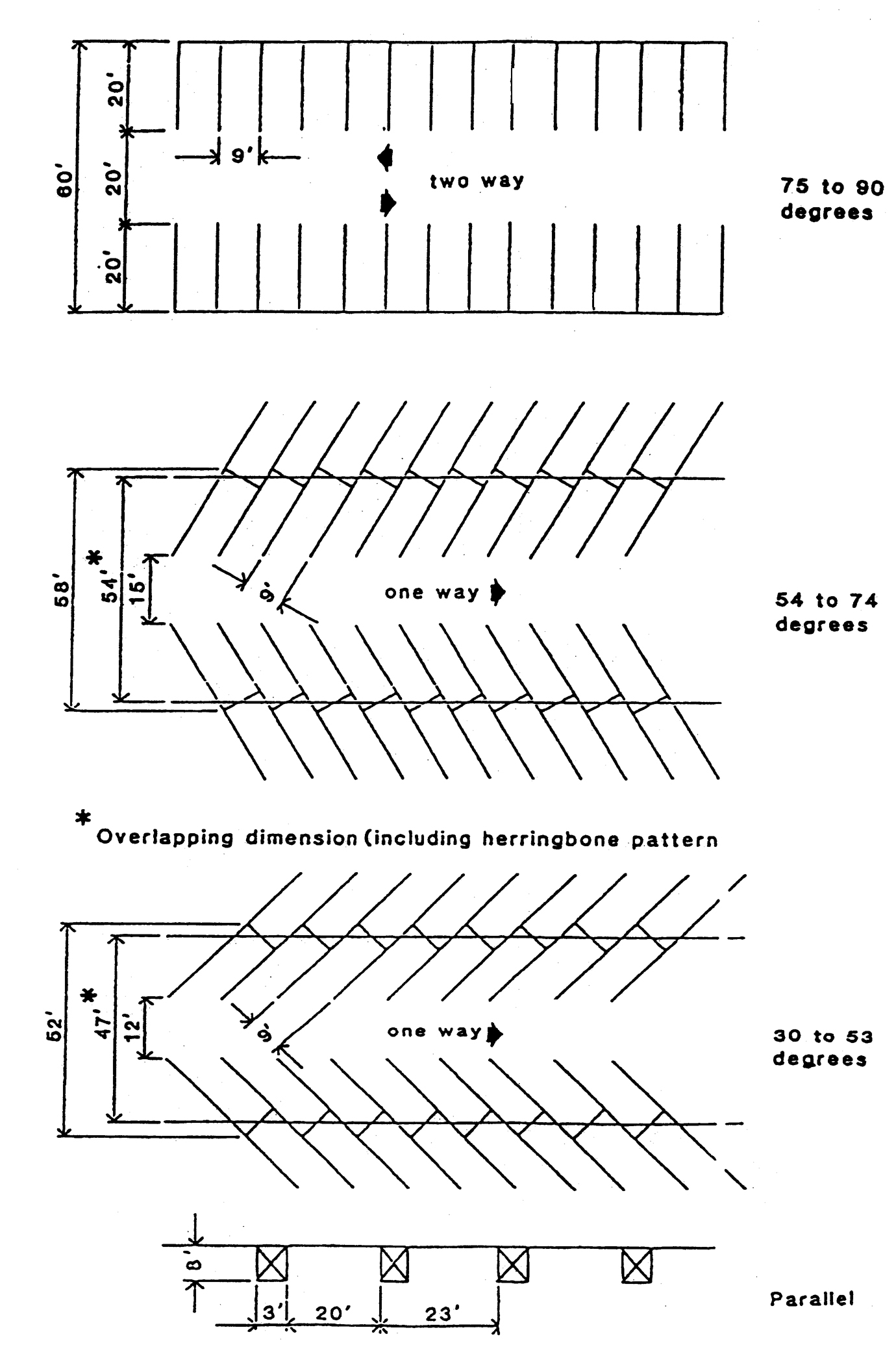
(Ord. No. 54A, § 15.06, 11-11-1987)

