
Sylvan Lake City Zoning Code
ARTICLE VII
SIGNS17
Editor's note—Ord. No. 362, § 1, adopted June 28, 2023, amended article VII in its entirety to read as herein set out. Former article VII, §§ 78-676—78-683, 78-706, 78-707, and 78-731—78-745, pertained to similar subject matter, and derived from Ord. No. 54A, adopted November 11, 1987; Ord. No. 197, adopted October 11, 1989; Ord. No. 201, adopted May 9, 1990; Ord. No. 218, adopted June 12, 1991; Ord. No. 251, adopted March 8, 2000; Ord. No. 257, adopted May 9, 2001; Ord. No. 290, adopted June 11, 2008; Ord. No. 291, adopted June 11, 2008 and Ord. No. 304, adopted May 18, 2011.
Sec. 78-676.- Purpose and intent.
Signs may be erected or maintained in the City of Sylvan Lake only as permitted by this article and subject to other restrictions contained in this Code. The sign regulations in this article are intended to balance the public and private interests and to promote a safe, well-maintained, vibrant, and attractive community while accommodating the need for signs to inform, direct, identify, advertise, advocate, promote, endorse, and otherwise communicate information. The sign regulations of this article are intended to ensure that signs are located, designed, sized, constructed, installed, and maintained in a way that protects and promotes safety, health, aesthetics, and the public welfare while allowing adequate communication.
The following municipal interests are considered by the city to be compelling government interests. Each interest is intended to be achieved in a manner that represents the least restrictive means of accomplishing the stated interest, and in all events are intended to promote an important government interest that would not be effectively achieved absent the regulation. Regulating the size and location of signage in the most narrowly tailored manner represents the least restrictive means of addressing the targeted government interests of avoiding nuisance-like conditions while maintaining and improving pedestrian and vehicular safety and efficiency; character and quality of life; economic development and property values; and property identification for emergency response and wayfinding purposes:
(1)
Pedestrian and vehicular safety. Maintaining pedestrian and vehicular safety are predominant and compelling government interests throughout the city, with particular emphasis on the safety of pedestrians. The sidewalk network provides facilities for pedestrians in the city, even in automobile-oriented commercial areas. The city recognizes that pedestrian traffic in the commercial areas leads to retail sales and it serves a variety of business, entertainment, government, and residential uses in the districts. In addition, the city also accommodates automobile-oriented businesses and other land uses that generate motor vehicle trips.
Since most signage is intended and designed to attract the attention of operators of motor vehicles, thereby creating distractions from vigilance for traffic and pedestrian safety, this article is intended to regulate signs such as to reduce such distractions and, in turn, reduce the risk for crashes, property damage, injuries, and fatalities, particularly considering the rate of speed at which the vehicles are traveling in these districts.
a.
The city encourages signage that will inform pedestrians regarding their desired locations without conflicting with other structures and improvements in these districts, while concurrently allowing effective signage for motorists. These interests are legitimately supported by limiting the maximum size of signage, providing setbacks where relevant, and specifying minimum-sized characters for efficient perception by motorists and pedestrians, while minimizing distractions that could put pedestrians at risk.
b.
In some circumstances, adjusting the size, setback, and other regulations applicable to signage may be important to avoid confusion and promote clarity where vehicular speeds vary on busy thoroughfares.
c.
In multi-tenant buildings and centers, it is compelling and important to provide distinct treatment with a gradation of regulation for individual identification depending on base sign size, amount of road frontage, and the like, all intending to provide clarity to alleviate confusion and thus additional traffic maneuvers, provide a minimum size of characters to allow identification, and maintain maximum-sized overall signage to prevent line-of-sight issues.
d.
Maximum size and minimum setback of signage is compelling and important to maintain clear views for both traffic and pedestrian purposes.
(2)
Character and quality of life. Achieving and maintaining attractive, orderly, and desirable places to conduct business, celebrate civic events, entertain people, and provide for housing opportunities is directly related to the stability of property values needed to provide and finance quality public services and facilities within the city. This article intends to allow signs that are of sufficient, but not excessive, size to perform their intended function as necessary to provide and maintain the city's character and support neighborhood stability. Signs that promote potential vehicular and pedestrian conflict, hinder sight distance, and distract from the pedestrian experience will be prohibited in efforts to preserve the character and unique experience within the city. Also, the intent of this article is that signs will reflect the character of unique districts as may be established by the city's master plan, other adopted plans or the zoning ordinance.
(3)
Economic development and property values. It is found and determined that there is a clear relationship between the promotion of a set of specifications and restrictions for signage and the promotion of economic development, recognizing that unregulated and haphazard determinations concerning the size, location, and other characteristics of signs has a realistic tendency to result in an appearance that reduces economic development, and, in the long-term, property values. In addition, the establishment of the restrictions in this article has a direct relationship to creating stability and predictability, allowing each private interest to secure reasonable exposure of signage, and thus promote business success. The application of the restrictions in this article allows businesses to reasonably command attention to the content and substance of their messages while concurrently allowing the promotion of other visuals, including types of business, landscaping, and architecture, all promoting economic development and property value enhancement.
(4)
Avoidance of nuisance-like conditions. Due to the concentration of people and activities, there is a potential for, and it is a compelling interest to avoid, blight, physical clutter, and visual clutter in the city, recognizing that such conditions tend to create nuisance-like conditions contrary to the public welfare. The result of these conditions leads to diminished property values, reduced attractiveness of the community, and reduced quality of life within the districts. Minimum regulations that substantially relate to signage are compelling and important and are necessary for the maintenance and well-being of positive conditions, good character, and quality of life in the city. Ultimately, these regulations are compelling and important for the protection of all police power values.
a.
An excessive number of signs in one location creates visual blight and clutter, as well as confusion of the public. Thus, limiting the number of signs on properties and establishing setbacks from property lines are compelling interests that can be directed with minimum regulation.
b.
Signs that are too large and not properly spaced can lead to confusion, undermine the purposes of the signs, and ultimately lead to physical and visual clutter. Establishing maximum sizes and locations can be the subject of clear and effective regulations that address this compelling and important interest.
c.
Requiring minimum construction and maintenance specifications for signs can minimize the creation of blight and clutter due to the deterioration of signs that are not durable or otherwise well-constructed, and such regulations would be consistent with construction codes for other structures. These requirements can be enforced with efficient and low discretion application and review.
d.
The Sign Ordinance is designed to prevent blight and protect aesthetic qualities by preventing visual clutter and protecting views. There is a compelling governmental interest that signs avoid glare, light trespass, safety, and skyglow. A framework that enables the selection of proper fixture types and location, use of supportive lighting technology, and control of light levels in a reasonable fashion is consistent with regulations that are narrowly tailored to achieve the city's interests.
(5)
Property identification for emergency response and wayfinding purposes. Locating a business or residence by emergency police, fire, and other emergency responders can be a matter of life and death, and thus it is a compelling interest to ensure that proper, understandable, unambiguous, and coordinated signage be permitted and required, and specifications for such purposes can be accomplished in a simple and narrow manner. Wayfinding for vehicular and pedestrian purposes is also a compelling interest to avoid confusion in public rights-of-way, and unnecessary intrusions on private property, and sign specifications for such wayfinding can be coordinated with property identification for emergency purposes.
(6)
Protection of the right to receive and convey messages. The important governmental interests contained herein are not intended to target the content of messages to be displayed on signs, but instead seek to achieve non-speech objectives. In no respect do the regulations of signage prohibit a property owner or occupant from an effective means of conveying the desired message. Nothing in this article is intended to prohibit the right to convey and receive messages, particularly noncommercial messages such as religious, political, economic, social, philosophical, or other types of speech protected by the First Amendment of the United States Constitution.
(7)
Ease of administration. To have standards and administrative review procedures that are simple for property owners, tenants, and sign installers to understand and follow.
(8)
Consideration of Orchard Lake Road. Studies in the city have concluded that there are significant factors related to Orchard Lake Road that must be considered in determining the appropriate placement, type and size of signs. These concerns include, but are not limited to: (1) the significant amount of traffic on Orchard Lake Road; (2) the fact that Orchard Lake Road is a commercial corridor; (3) commercial development has occurred on Orchard Lake Road with minimum setbacks from the road and multiple curb cuts resulting in confusing and dangerous traffic situations; (4) large signs are out of proportion with the small scale of the city and detract from the predominately residential character of the city; (5) large signs hinder visibility to driveways, intersections and streets, particularly along Orchard Lake Road; (6) signs of a size greater than permitted in this article would have a negative impact on aesthetics and property values; and (7) the challenge of providing adequate parking and signage on small lots, particularly those that directly abut Orchard Lake Road without an easement.
(Ord. No. 362, § 1, 6-28-2023)
Sec. 78-677. - Definitions.
The following words and phrases shall have the meanings set forth in this article when they are used in this article:
(1)
Sign definitions, sign types. The following definitions apply to types of signs based on the characteristics of the sign without respect to the content of the message:
a.
Air-activated signs. A sign that is inflated by air or uses air flow to induce movement. Inflatable objects used for signs are often made of flexible fabric and are equipped with a motor to blow air into the object. Air-activated signs are typically temporary and are restrained, attached, or held in place by a cord, rope, cable, or similar method, but can be permanent.
b.
Animated sign. A sign that has any visible moving part either constantly or at intervals; flashing, scintillating, intermittent, or oscillating lights; visible mechanical movement of any description; or other apparent visible movement achieved by any means that move, change, flash, oscillate or visibly alters in appearance to depict action, create an image of a living creature or person, or create a special effect or scene.
c.
Awning. A non-permanent roof-like structure supported by a frame that projects out from a façade over windows and doors. Awnings shall be made of canvas, glass, or metal and shall have straight sheds that are flat (perpendicular to the façade) or angled down away from the facade.
d.
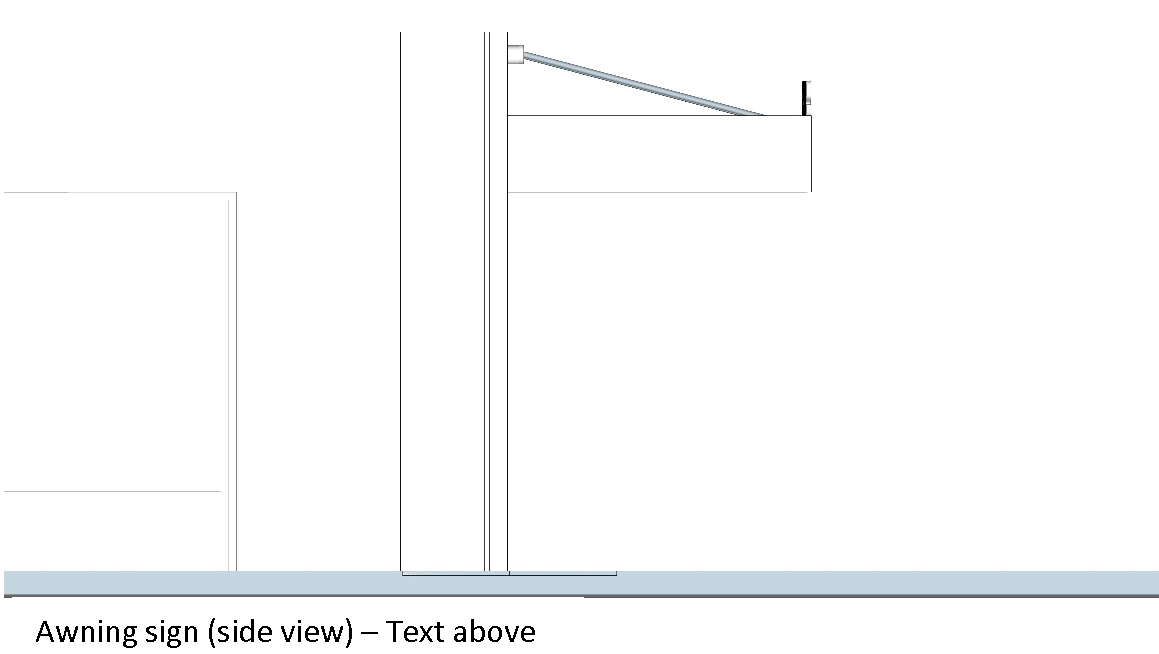
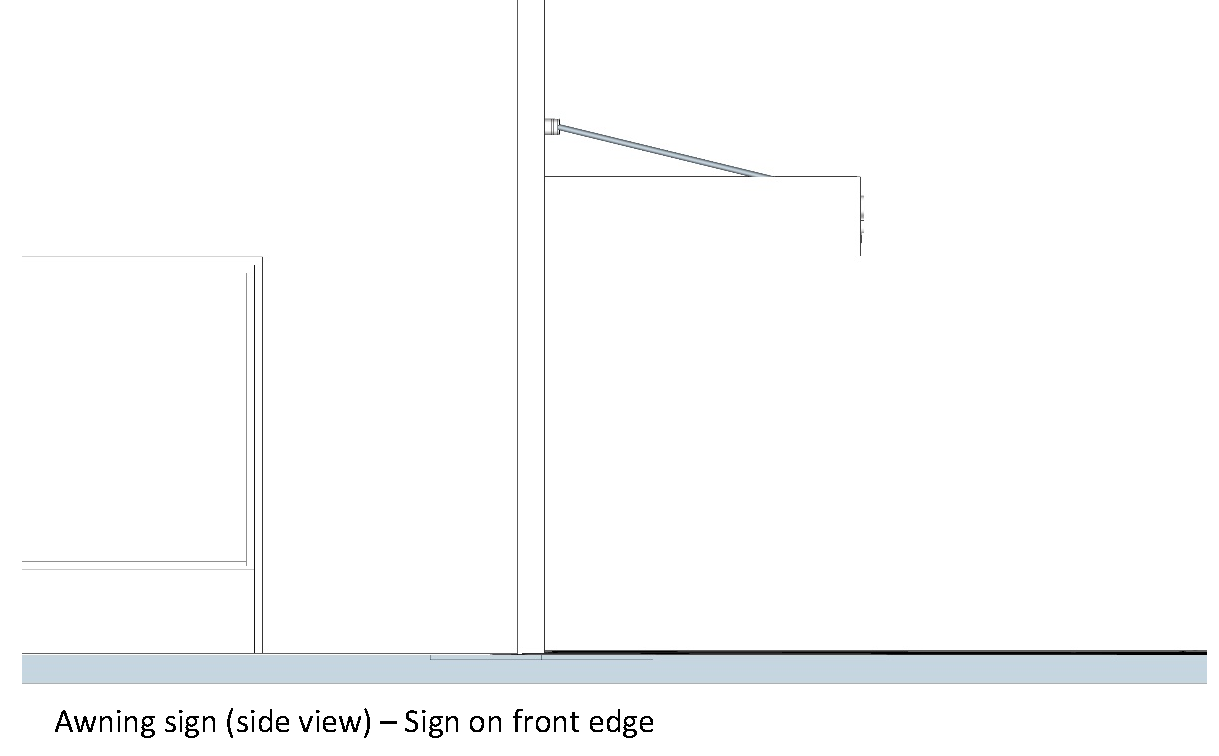
Awning or canopy sign. Either: 1) a sign that is printed or painted on the drip edge of a straight shed awning above a business door or window; or 2) a sign comprised of individual letters that are attached to the top front edge of a flat awning or canopy above a business door or window.
e.
Banner sign. A temporary sign on paper, cloth, fabric, or other flexible or combustible material of any kind that is attached flat against a permanent sign face or strung between two poles or structures.
f.
Bench sign. A sign applied to or affixed to the seat or back of a bench.
G.
billboard sign. a large sign erected, maintained, and used for the purpose of displaying messages that can be seen from a long distance or read from a vehicle traveling at high speeds. A billboard sign differs from a freestanding sign based on its size.
h.
Changeable-copy sign. A permanent sign or portion thereof on which the copy or symbols change either automatically through electrical or electronic means or manually through placement of copy and symbols on a panel mounted in or on a track system.
i.
Costume sign. Clothing that is integral to the conveyance of a message. Logos and other identification on shirts, hats, and other aspects of personal appearance are not costume signs.
j.
Display board. An accessory sign displayed near a public building entrance either on the building or on a freestanding podium. Display boards are intended to be viewed at close proximity by pedestrians. Examples include displaying menus, special sales, and descriptions of goods or services provided within the building.
k.
Electronic message center (EMC) sign. An electrically activated changeable-copy sign whose variable message and/or graphic presentation capability can be electronically programmed.
l.
Festoons. A string of ribbons, pennants, spinners, streamers, tinsel, small flags, pinwheels, or lights typically strung overhead and/or in loops.
m.
Flag. A sign on paper, cloth, fabric, or other flexible or combustible material of any kind that is attached to a permanent conforming pole. Flags are typically supported on one side of the sign. Flags are not considered air-activated signs for the purposes of this article.
n.
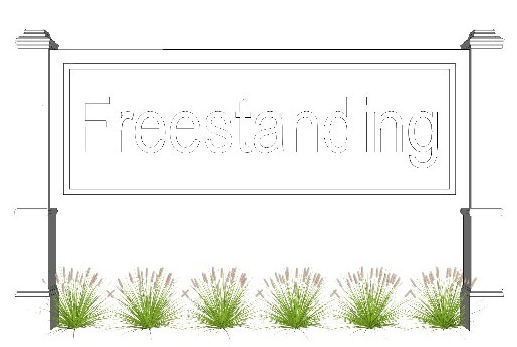
Freestanding sign. A sign supported by one or more uprights, poles, pylons, monuments, or braces placed in the ground and not attached to any building or other structure. Freestanding signs include monument signs, but do not include billboards.
o.
Incidental sign. A small sign designed and located to be viewed by persons on a property and are generally not visible or legible from the right-of-way or adjacent properties. Examples of incidental signs include, but are not limited to, credit card signs, signs indicating hours of business, no smoking signs, signs used to designate bathrooms, handicapped signs, traffic control signs that conform to the requirements of the Michigan Manual of Uniform Traffic Control Devices, and other signs providing information to be read at close proximity.
p.
Interior sign. A sign placed within a building, but not including a window sign as defined by this article, that is not visible from any public street, sidewalk, alley, park or public property.
q.
Marquee sign. A type of projecting sign typically mounted parallel to the building façade in a vertical manner. Marquee signs often include a changeable copy component in addition to the display of a permanent message but are not required to have changeable copy.
r.
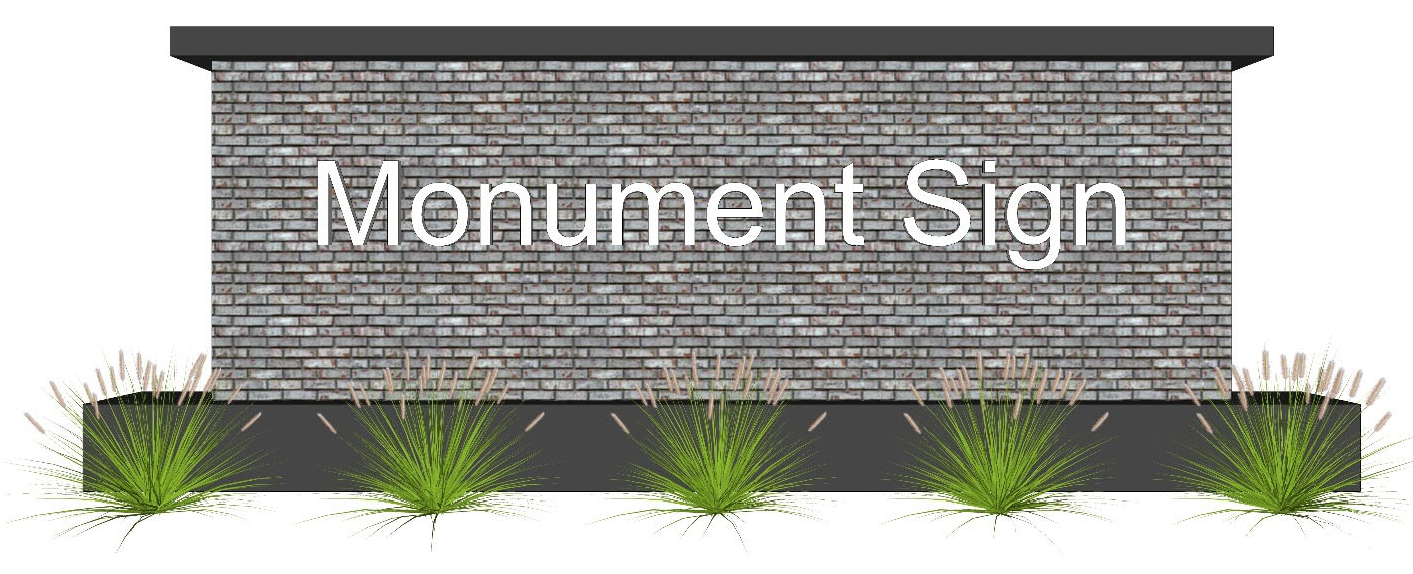
Monument sign. A base-mounted, freestanding sign placed on the ground and not attached to any building or other structure. A monument sign includes a solid supporting base and a width equal to or greater than the width of the sign face. Monument signs are constructed of a decorative and durable material (e.g., masonry), and shall have no separations between the sign face and the base.
s.
Nonconforming sign. A sign that was lawfully permitted at the time it was erected but is not permitted under current law.
t.
Permanent sign. A sign constructed of durable materials intended to withstand prolonged exposure to exterior elements. Permanent signs are affixed to the ground or a structure by means of footings beneath the ground surface, bolts or screws into a structure, or other method intended to ensure the sign is displayed for an extended period of time with minimal maintenance or replacement of parts.
u.
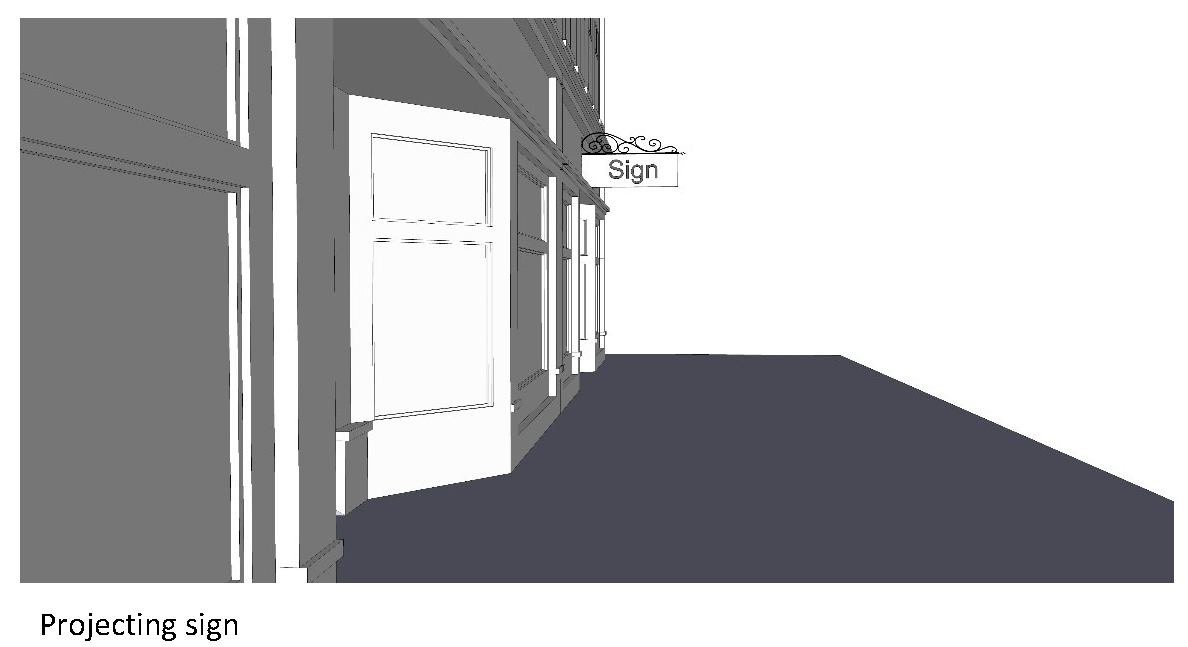
Projecting sign. A sign attached to a building or other structure and extending beyond the attachment surface by more than 18 inches. A projecting sign is differentiated from a wall sign based on the distance the sign projects from the surface of the building.
v.
Roof sign. A sign that is erected, constructed, and maintained upon, against, or above the roof or parapet of a building or any portion thereof. A sign mounted upon a mansard fascia that does not project above the highest point of the roof or parapet is considered a wall sign.
w.
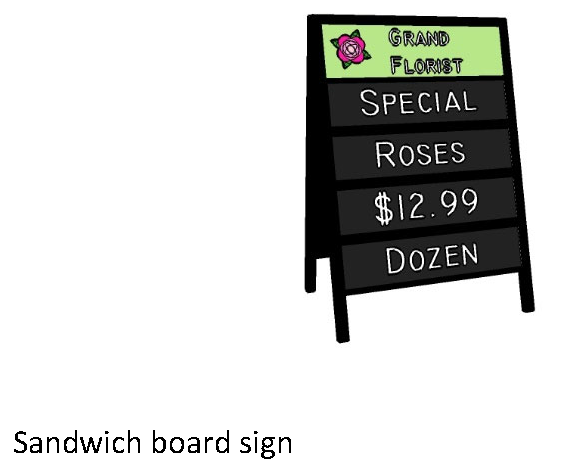
Sandwich board sign. A temporary sign that is not permanently anchored or secured to either a building, structure, or the ground. Often referred to as "sidewalk signs," sandwich board signs include, but are not limited to, "A" frame, "T" shaped, or inverted "T" shaped stands.
x.
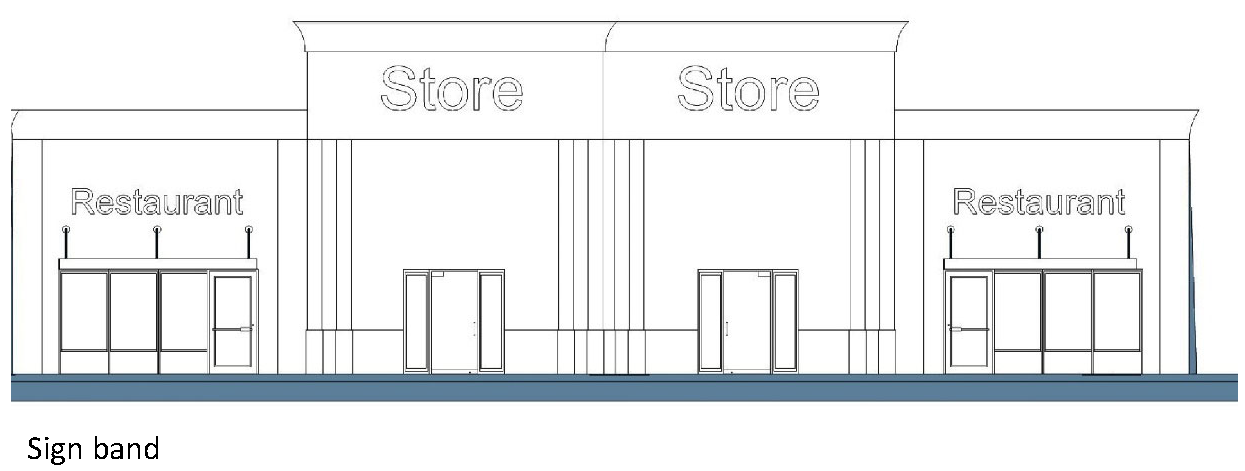
Sign band. An integral horizontal part of the building design, as illustrated on an approved site plan, located between the highest point of windows or door openings on the first floor and the bottom of the eave line or cornice on a one-story building, or up to the lowest point of window or door openings of a second floor for a multi-story building.
y.
Temporary sign. A display sign, banner or other device constructed of cloth, canvas, fabric, plastic or other light temporary materials, with or without a structural frame, or any other sign intended for a limited period of display that is not permanently anchored to the ground or a building.
z.
Transported sign. A sign attached to or pulled by a vehicle that may be displayed or affixed to a movable object such as but not limited to a car, truck, trailer, or similar transportation device. A portable sign does not constitute a vehicle sign.
aa.
Vehicle sign. A sign, painted or otherwise, attached to an operable vehicle that is regularly used and moved, including signs on a truck trailer. A vehicle sign does not constitute a transported sign.
ab.
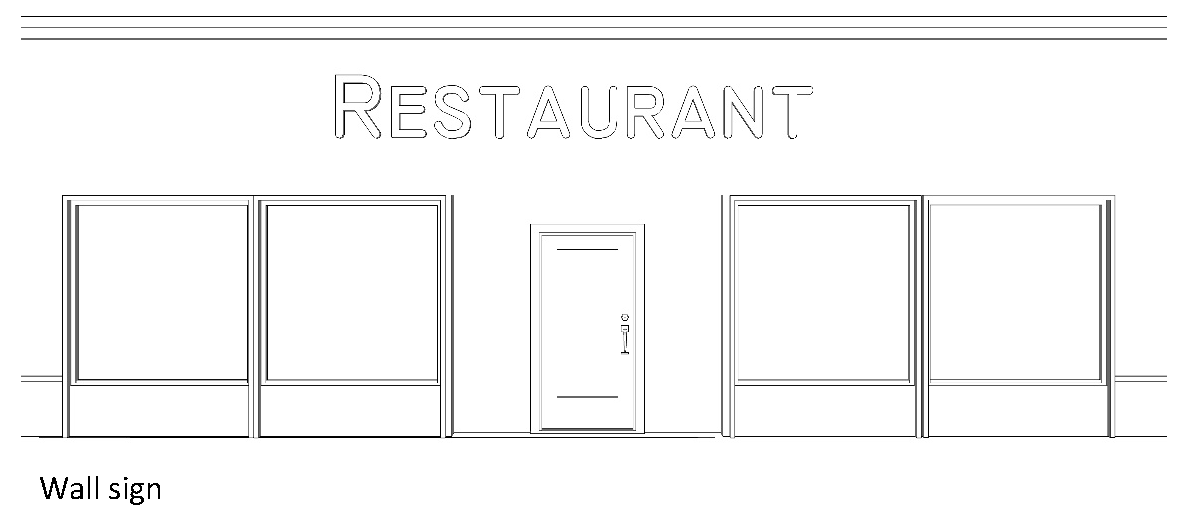
Wall sign. A sign attached to, painted on, inscribed, or otherwise set upon the exterior wall or surface of any building, no portion of which projects more than 18 inches from the wall and which does not project above the roof or parapet line. A wall sign shall also include a sign mounted upon a mansard fascia that does not project above the highest point of the roof or parapet. Any other sign upon, against, or above the roof or parapet of a building or any portion thereof is defined as a roof sign.
ac.
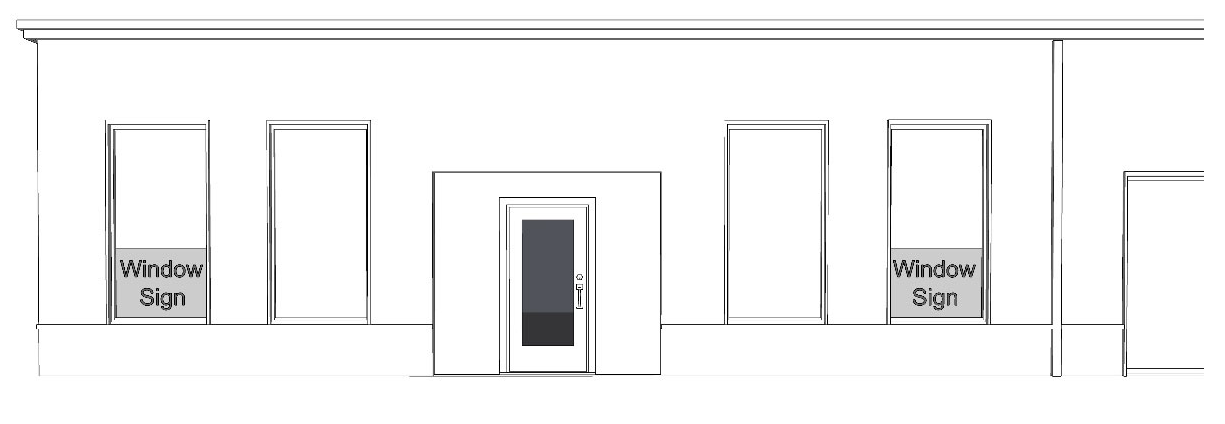
Window sign. A sign that is painted on or attached to a window or glass door that is intended to be viewed from the exterior, including signs located inside a building but visible primarily from the outside of the building.
ad.
Yard sign. A small temporary sign. Yard signs are characterized by a wire frame, non-durable message surface such as cardboard or paper, and are often inserted into a lawn with wire posts. Although variations exist to the materials of the frame and message board, a consistent physical characteristic is its temporary and disposable nature.
(2)
Definitions, general.
a.
Alteration. Any change in size, shape, height, or type which changes the appearance of a sign or its structure, or a change in position, location, construction, or supporting structure of a sign.
b.
Business frontage. The portion of a building operating under single ownership or single tenancy that faces or is visible from the front lot line or an exterior side (street-facing) lot line. For a multi-tenant building, the portion of the building facing or is visible from the front lot line or exterior lot line that is dedicated to a tenant and contains the customer entrance is the business frontage. If a building has more than one business frontage with a customer/visitor entrance, the property owner must designate one of them as the primary business frontage; in this case, the other street-facing frontage is the secondary business frontage.
c.
Glare. Light emitting from a luminaire with intensity high enough to reduce a viewer's ability to see, and in extreme cases, causing momentary blindness.
d.
Grade. The average elevation of an area within a radius (of the sign base) equal to two times the height of the sign, based on the highest and lowest measurements.
e.
Height, maximum. Shall be measured from grade to the highest edge of the sign surface or its projecting structure.
f.
Height, minimum. Shall be measured from grade to the lowest edge of the sign surface or its projecting structure.
g.
Lot, zoning. A single tract of land, located within a single block, which at the time of filing for a sign permit is designated by its owner or developer as a tract to be used, developed or built upon as a unit, under single ownership or control.
h.
Luminaire. A luminaire is a complete lighting system, which includes a lamp or lamps and a fixture.
i.
Nit. A measure of luminance equal to one candela per square meter.
j.
Owner. A person, firm, partnership, association, company, or corporation, or any other legal entity, and/or its legal successors, heirs, and assigns.
k.
Premises. The contiguous land in the same ownership or control which is not divided by a public street.
l.
Sign. Any display or object which is primarily used to identify or display information or direct or attract attention by any means which is visible from any public street, sidewalk, alley, park, or public property and is otherwise located or set upon or in a building, structure or piece of land. The definition does not include goods displayed in a window.
m.
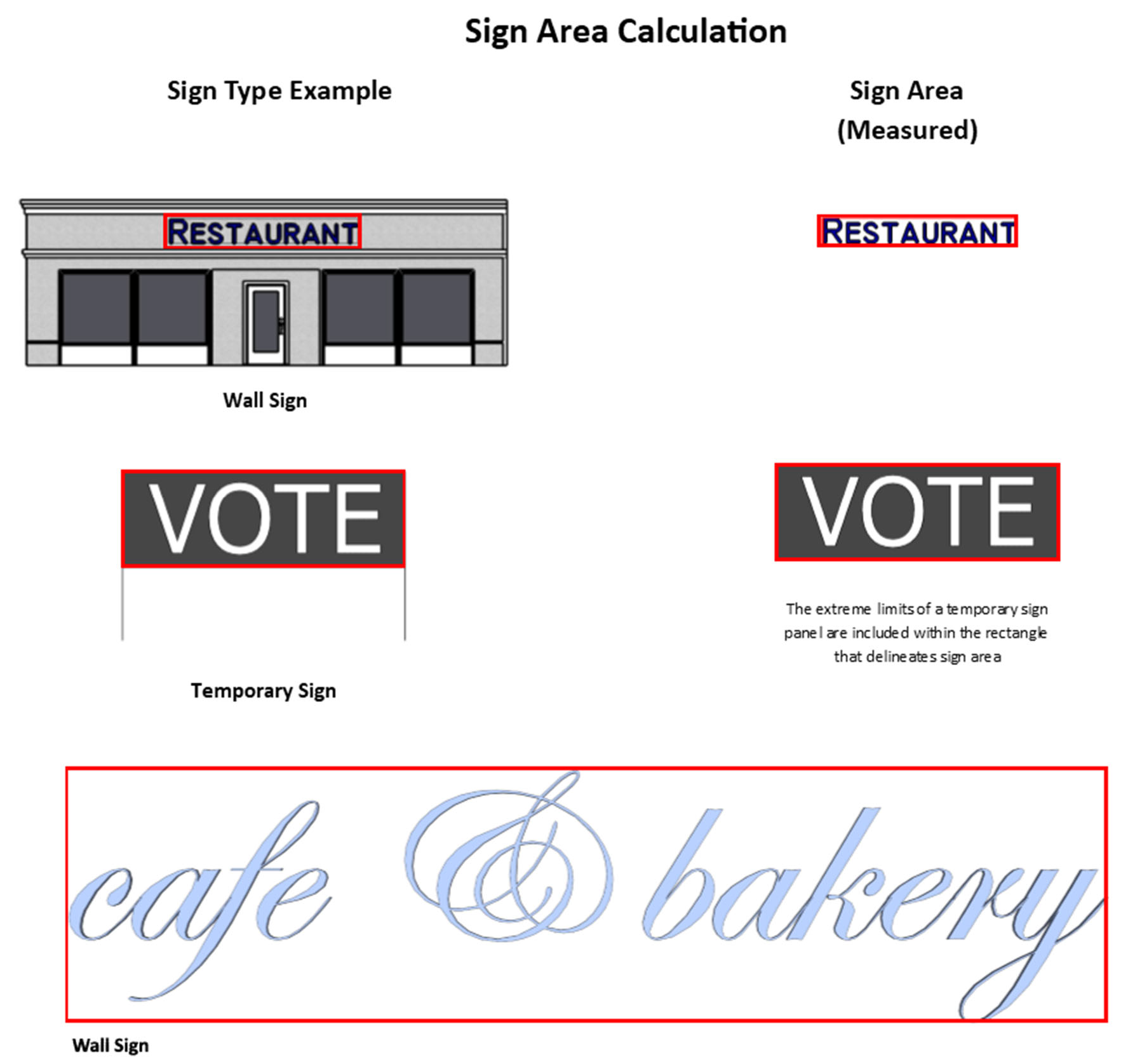
Sign area. The entire area within a rectangle or the sum of rectangles enclosing the extreme limits of writing, representation, emblem or any figure of similar character, together with any frame or other material or element forming an integral part of the display or used to differentiate the sign from the background against which it is placed, excluding the necessary supports or uprights on which such sign is placed. Any single row of text shall be grouped into one continuous rectangle.
n.
Sign erector. Any person engaged in the business of erecting, constructing, altering, or removing signs on a contractual or hourly basis.
(Ord. No. 362, § 1, 6-28-2023)
Sec. 78-678. - Sign design standards in all zoning districts.
(a)
Construction standards.
(1)
General requirements. All signs shall be designed and constructed in a safe and stable manner in accordance with the city's adopted building code and electrical code. All electrical wiring associated with a freestanding sign shall be installed underground.
(2)
Framework. All signs shall be designed so that the supporting framework, other than the supporting poles on a freestanding sign, is contained within or behind the face of the sign or within the building to which it is attached to be totally screened from view.
(b)
Illumination.
(1)
General requirements. Signs shall be illuminated only by steady, stationary, shielded light sources directed solely at the sign, from behind the sign, or internal to it. Temporary signs shall not be illuminated. Permanent signs may be internally or externally illuminated, except where prohibited in this article.
(2)
Illumination. Glare shall be reduced/minimized in such a manner as to maintain an appropriate level of contrast during the day. An automatic dimmer shall be required to control brightness at night, and to reduce driver distraction and light trespass into residential areas. A photometric plan which identifies the proposed illumination levels (in foot candles) shall be provided. Illumination levels shall not exceed 0.5-foot candles at the property line, measured five feet from the ground. In cases where the property line extends into the right-of-way, illumination shall be measured at the right-of-way line.
(3)
Non-glare, shielded lighting. Use of glaring undiffused lights or bulbs is expressly prohibited. The source of illumination shall not be visible, shall be fully shielded, and shall cause no glare hazardous to pedestrians, motorists or adjacent residential uses or districts.
(4)
Bare bulb illumination. Illumination by bare bulbs or flames is prohibited, except that bare bulbs are permitted on electronic changeable copy signs and theatre marquees.
(c)
Electronic message signs. Electronic message signs may serve as a component of monument signs, where permitted in non-residential zoning districts, up to a maximum of 25 percent of the total permanent sign area per sign face. Such signs are subject to the standards of this section and the following regulations:
(1)
Frequency of change. Signs with the ability to change displays shall not change more frequently than one time per ten seconds. Animated signs are expressly prohibited.
(2)
Manner of change. Signs with the ability to change displays must be designed to change the display instantaneously. Flashing, scrolling, fading, dissolving, osculating, spinning, twirling, video display, or other type of motion are expressly prohibited.
(3)
Internal illumination. Electronic message signs shall not emit more than 5,000 nits in full daylight and 100 nits during night hours, which commence no later than one hour after sunset and extend through no earlier than sunrise. The displays shall transition smoothly at a consistent rate from the permitted daytime brightness to the permitted nighttime brightness levels. All electronic message signs shall have functioning ambient light monitors and automatic dimming equipment which shall always be set to automatically reduce the brightness level of the sign proportionally to any reduction in the ambient light. In order to verify compliance with City Code or other applicable law, the interface that programs an electronic message sign shall be made available to city staff for inspection upon request. If the interface is not or cannot be made available upon the city's request, the sign shall cease operation until the city has been provided proof of compliance with City Code.
(4)
Rendering. A color rendering of the display shall be provided for consideration by the planning commission during site plan review, and the planner and building official during an administrative review.
(5)
Integration into sign. The electronic changeable copy or electronic graphic display areas on monument and billboard signs shall be part of the same sign face as a monument or billboard sign without electronic display technology and shall be integrated into the face of such sign by use of a border or similar design treatment that provides a visual linkage to the remainder of the sign.
(6)
Default. All electronic message signs shall default to an unlit black screen if 50 percent or more of the light source fails or if the light source otherwise is not displaying properly.
(d)
Sign measurement. The total sign area is to be expressed in square feet and shall be computed as herein set forth.
(1)
Double-faced signs having two faces of equal size arranged and/or positioned back to back and parallel, or with the faces at an included angle of not more than 30 degrees in the plain or vertical views [of] the area of the sign, shall be computed as one-half of the total area of the two faces. When the faces of such a sign are not of equal area, then the area of the sign shall be computed as the total area of the largest face. When signs have three to four faces of equal size arranged and/or positioned with the faces at an angle of more than 30 degrees in the plain or vertical view, the area of the sign shall be computed as the total area of the largest two faces. The area of three-dimensional signs shall be measured by computing the total area of the largest two faces measured at a two-dimensional view.
(2)
When two single-face wall signs are arranged and/or positioned within 36 inches of each other, the area of the two signs shall be computed as one single-face sign and total area shall include the open space between the two separate faces.
(3)
For temporary signs and all projecting, window and hanging signs, the extreme limits of the sign including all background elements¸ regardless of opacity, are included in the calculation of sign area.
(4)
The necessary uprights, or structures used to support or serve as a design feature of a freestanding sign, shall be excluded from the calculation of sign area, provided that the surface is not, by definition, a sign.
(e)
Sign location.
(1)
Right-of-way prohibited. No sign, except those established and maintained by the city, county, state, or federal governments shall be located in, project into, or overhang, public property, a public right-of-way or dedicated public easement, unless otherwise authorized in this article. The city council may permit such projection or overhang, after considering the need for the specific location of the proposed sign and public safety factors; provided, however, that no such sign shall project over the actual roadway or exceed 100 square feet.
(2)
Clear vision triangle area prohibited. No sign shall interfere with sight lines as defined in section 58-3 of the City Code.
(3)
Projections. Unless otherwise stated, no sign shall project beyond or overhang the wall or any permanent architectural feature (e.g., awning, canopy, or marquee) by more than one foot and shall not project above or beyond the highest point in the roof or parapet.
(4)
Safety. No sign shall be permitted at any location that, in the discretion of the building official, creates any type of safety hazard or visual impediment to pedestrian or vehicular traffic. In making this determination, the building official shall cite any relevant building or electrical codes, provisions of this article or other city ordinances, and/or findings or studies of the public safety department and/or a traffic engineer.
(5)
Liability insurance. If any wall, projecting pole, or roof sign is suspended over a public street, or property or if the vertical distance of such sign above the street is greater than the horizontal distance from the sign to the street property line or parapet wall and so located as to be able to fall or be pushed onto public property, then the owner of such sign shall keep in force a commercial general liability insurance policy in the amount of $1,000,000.00. The commercial general liability insurance policy shall include an endorsement, or policy language, naming the city as an additional insured.
(6)
Parking of vehicles displaying signs. Mobile signs are prohibited. Commercial vehicles and trucks: 1) displaying signs that are typically found on said vehicles, and 2) that have a primary function of carrying goods or people, not advertising, may be permitted to park on the site of the principal use, provided parking shall be in a rear or interior side yard. Otherwise, vehicle signs are not permitted.
(f)
Landscaping. The area surrounding signs shall be landscaped to match the design characteristics of the site. The landscaping shall be maintained such that the sign remains visible to passing motorists.
(Ord. No. 362, § 1, 6-28-2023)
Sec. 78-679. - Signs exempt from permits.
The following signs shall be permitted in all zoning districts according to the regulations of this article and subject to the following provisions. No permit shall be required for signs enumerated below unless otherwise stated. Such exemptions, however, shall not be construed to relieve the owner of the sign from responsibility for its proper location, erection, maintenance, and removal:
(1)
Address numbers, being essential for public safety and emergency response, with a numeral height no greater than six inches for each dwelling unit and 18 inches for any other use, including multiple-family buildings.
(2)
Incidental signs, not to exceed two per parcel, up to two square feet each. Markers and plaques on designated historic structures, up to six square feet.
(3)
Temporary signage unless otherwise stated in this article (see section 78-681(b)).
(4)
Any sign required by the city to notice a required public hearing, to be erected, displayed, and removed according to the requirements of the city.
(5)
Signs erected on a city, county, state, or federal building or land by the authorized public agency.
(6)
Interior signs.
(7)
Private traffic control signs that conform to the requirements of the Michigan Manual of Uniform Traffic Control Devices.
(8)
Flags, not to exceed 48 square feet (see section 78-618(b)).
(9)
Window signs, not to exceed 25 percent of the total window area of the façade facing a road.
(10)
Signs displaying noncommercial messages such as religious, political, economic, social, philosophical or other types of speech protected by the First Amendment of the United States Constitution; provided, however, said signs shall comply with the number and size regulations in the applicable zoning district.
(Ord. No. 362, § 1, 6-28-2023)
Sec. 78-680. - Prohibited signs in all zoning districts.
The following signs are prohibited in all zoning districts, notwithstanding anything to the contrary in this article.
(1)
Any sign not expressly permitted.
(2)
Animated signs (including revolving signs and rotating signs) and signs that incorporate moving features, except for changeable-copy signs explicitly permitted in this article.
(3)
Festoons, air-activated signs, and animated signs, except those approved in conjunction with a temporary use approved by the zoning board of appeals.
(4)
Any sign that is deemed structurally or electrically unsafe by the building official.
(5)
Support pole signs, including signs attached to light poles, utility poles, street signposts, and trees. Prohibited support pole signs shall not include support pole signs lawfully installed by an authorized public entity.
(6)
Transported signs unless the vehicle with the transported sign is operating lawfully in a public or private road.
(7)
Roof signs.
(8)
Bench signs, not including permanently mounted plaques, less than one square foot, intended to be read at close proximity.
(9)
Signs projected onto buildings or structures.
(10)
Costume signs. The basis of prohibiting costume signs is that the movement and proliferation of costume signs would degrade traffic safety through the creation of visual distractions.
(11)
Any sign located in a public or private right-of-way that is not otherwise exempt from this article.
(12)
Neon, LED, or other light types permanently outlining windows or doors.
(13)
Signs intended to mimic traffic control or emergency services signage. These signs are considered hazards detrimental to pedestrian and vehicular travel and to the public safety and welfare.
(14)
Any sign structure or frame no longer supporting or containing a sign.
(15)
No sign shall be erected so that any part, including cables, guys, etc., will be within ten feet of any electrical conductor, electric light pole, streetlamp, traffic light or other public utility pole.
(16)
No signs of any kind shall be attached to or placed upon a structure in a manner as to obstruct any fire exit.
(Ord. No. 362, § 1, 6-28-2023)
Sec. 78-681. - Zoning district regulations.
(a)
Permanent sign regulations applicable to the R-1, R-2, R-3, and lakefront setback districts.
Table 78-681(a) Permitted Sign Types in R-1, R-2, R-3, and Lakefront Setback Districts
*Permit not required for residential wall sign.
(b)
Permanent sign regulations applicable to the O-1, C-1, C-2, P, and I-1 districts, and planned technology and research development overlay district.
Table 78-681(b) Permitted Sign Types in O-1, C-1, C-2, P, and I-1 Districts, and Planned Technology and Research Development Overlay District
(1)
Awning and canopy signs
a.
Awning and canopy signs shall be permitted in all non-residential districts.
b.
The design of awnings shall be of two types: Shed awnings or flat awnings, as defined in this article.
c.
Awnings and canopies shall not be illuminated in such a way that they appear to glow from within.
d.
Shed awning signs shall not exceed eight inches in height and shall be located on the drip edge of a shed awning or canopy. Such signage shall not exceed 80 percent of the awning or canopy width.
e.
Flat (horizontal) awning signs shall not exceed eight inches in height and may extend or be placed above the awning or canopy, provided that the letters are attached to the awning or canopy and shall not exceed 80 percent of the awning or canopy width.
(c)
Temporary sign regulations applicable to the R-1, R-2, R-3, and lakefront setback districts. The following signs are permitted without a permit, subject to compliance with the standards below.
Table 78-681(c) Temporary Sign Regulations Applicable in the R-1, R-2, R-3 and Lakefront Setback Districts
(d)
Temporary sign regulations applicable to the O-1, C-1, C-2, I-1, and I-2 districts, and planned technology and research development overlay district.
Table 78-681(d) Temporary Sign Regulations Applicable in the O-1, C-1, C-2, I-1, and I-2 Districts, and Planned Technology and Research Development Overlay District
(e)
Temporary sign regulations in all districts. In recognition that there is a need for additional expression of speech prior to a scheduled election, the following applies for a period of 60 days prior to until three days after a city-designated election day on which there is at least one ballot item. The maximum allowable area of temporary signs shall be increased to 64 square feet in all districts. The maximum area of an individual sign remains as stated in the table above during this period.
(f)
Other types of signs in the O-1, C-1, C-2, I-1, and I-2 districts, and planned technology and research development overlay districts.
(1)
Sandwich board signs. Such signs are permitted in the O-1, C-1 and C-2 districts.
a.
One sandwich board sign is permitted per each business with direct access to a sidewalk.
b.
Sandwich board signs shall be placed within ten feet of the primary entrance. Five feet of pedestrian clearance shall be provided.
c.
A sidewalk/sandwich board sign must be of A-frame construction with a minimum base spread of two feet and a maximum height of four feet. A sidewalk/sandwich board sign may not exceed eight square feet per side.
d.
Sidewalk/sandwich board signs shall be a quality design that is heavy enough to withstand normal wind and weather conditions.
e.
A sidewalk/sandwich board sign may not be illuminated by any means and may not have any moving parts.
f.
A sidewalk/sandwich board sign must be properly maintained and must not be allowed to become unsightly.
g.
A sidewalk/sandwich board sign may only be in place during the commercial establishment's business hours and shall be stored inside the establishment when the business is closed.
h.
A sidewalk/sandwich board sign shall have a frame that is black, gray, or white, or is comprised of exposed metal or wood. The sign shall be professionally constructed, and shall have no moving parts, balloons, streamers, or similar attachments.
(2)
Temporary and permanent window signs.
a.
Window signs shall not exceed 25 percent of the total window area of any given façade.
b.
Applied lettering or designs that are within the lower eight inches of any ground floor window shall be permitted and shall not be considered part of the total area of window or wall signs, provided that they do not exceed 80 percent of the width of any ground floor window to or on which they are placed. Additionally, the total area of etched or applied lettering shall not exceed 0.5 square feet per lineal foot of building frontage.
c.
Window signs may be illuminated subject to section 78-678(b) and shall contain a static message and shall not flash, scroll or otherwise give the appearance of movement or intermittent change.
(Ord. No. 362, § 1, 6-28-2023)
Sec. 78-681.1. - Construction and maintenance requirements.
(a)
Material and design. All signs shall be designed, constructed, and maintained in conformity with the provisions for materials, loads and stresses of the latest adopted edition of [the] building code and requirements of this article.
(b)
Fastenings. All signs must be erected in such a manner and with such materials to remain safe and secure during the period of use and all bolts, cables, and other parts of such signs shall be kept painted and free from corrosion. Any defect due to the fault of the erector shall be repaired by the erector.
(c)
Fire escapes. No signs of any kind shall be attached to or placed upon a building in such a manner as to obstruct any fire escape.
(d)
Support location. No pole, cable, or support of any nature shall be placed on any publicly owned property, street, right-of-way, or proposed street rights-of-way without written authorization from the owner of said right-of-way.
(e)
Proximity to electrical conductors. No sign shall be erected so that any part including cables and guys will be within ten feet of any electrical conductor, streetlamp, traffic light or other public utility pole standard, or ten feet of a high voltage wire.
(f)
Sanitation. Property surrounding any ground or monument sign shall be kept clean, sanitary, and free from obnoxious and offensive substances, free from weeds, rubbish and inflammable material.
(g)
Traffic interference. No sign shall be erected or maintained which simulates or imitates in size, color, letter, or design any traffic sign or signal or other word, phrase, symbol or character in such a manner as to interfere with, mislead, or confuse traffic.
(h)
Maintenance. All signs shall be maintained in a condition of good repair. Peeling or missing paint, holes, broken, cracked, bent, warped, rotted, discolored, sagging, out-of-plumb, rusted, or missing material or parts shall be repaired within 60 days of written notification by the building official.
(i)
Compliance with building code. The building code adopted by the city shall regulate the construction and maintenance of signs unless the provisions of this article are more stringent.
(Ord. No. 362, § 1, 6-28-2023)
Sec. 78-682. - Nonconforming signs.
(a)
Intent. It is the intent of this article to avoid any unreasonable invasion of established private property. It is further the intent to encourage eventual elimination of signs that:
(1)
As a result of the adoption of this article, become nonconforming;
(2)
Are recognized as illegal nonconforming signs.
(b)
Lawful existing signs. Any sign lawfully existing at the time of adoption of this article which does not fully comply with all provisions shall be considered a legal nonconforming sign and may be permitted to remain as long as the sign is properly maintained, there is no increase in nonconformity, and the sign is not detrimental to the health, safety, and welfare of the community except as hereafter provided. Signs on which an enforcement action have been initiated by the city are not considered lawful signs for the purposes of this section.
(c)
Alteration. No nonconforming sign shall be altered or reconstructed, unless the alteration or reconstruction complies with the provisions of this article. For the purpose of this article only, the term "altered" or "reconstructed" shall not include normal maintenance or replacement of sign copy when no changes are made to the frame or structure of the sign. Nonconforming signs and sign structures shall be removed or made to conform within 90 days of the termination of the use to which they are accessory.
(d)
Continuance. A nonconforming sign shall not be:
(1)
Relocated, expanded, or structurally altered to prolong the life of the sign or to change the shape, size, type, placement or design of the sign.
(2)
Repaired or re-erected after being damaged if the repair or re-erection of the sign would cost more than 50 percent of the cost of a similar new sign.
(e)
Removal of nonconforming signs. If the owner of a sign or the premises on which a sign is located changes the location of a building, property line or sign, or changes the use of the land or building so that any sign on the premises is rendered nonconforming, such sign must be removed or made to conform to this article.
(Ord. No. 362, § 1, 6-28-2023)
Sec. 78-683. - Administration, permits, inspections and enforcement.
(a)
Permits and applications. It shall be unlawful for any person to erect, re-erect, alter or relocate any sign without first obtaining a permit in accordance with the provisions set forth in this article. A zoning permit shall require the payment of a fee in accordance with the schedule adopted by resolution of the city council. Any sign that makes use of electricity shall, in addition to a sign permit, require a building permit and an electrical permit, regardless of size.
(1)
Applications. Applications for sign permits shall be made upon forms provided by the building department for this purpose and shall contain the following information:
a.
Name, address, and phone number of applicants.
b.
Location of the building, structure, or lot on which the sign is to be attached or erected.
c.
Position of the sign on the building, structure, or lot on which the sign is to be attached or erected.
d.
Position of the sign in relation to nearby buildings, structures, property lines, and rights-of-way, existing or proposed.
e.
Two copies of the plans and specifications and method of construction and attachment to the building or the ground.
f.
Copies of sheets and calculations, if deemed necessary, which show the structure is designed for dead load and wind pressure in accordance with the regulations adopted by the city.
g.
Name and address of the sign erector.
h.
Insurance policy and/or performance guarantee as required in the Code.
i.
Such other information as the building official may be required to show full compliance with this and all other applicable laws of the city and the State of Michigan.
j.
When public safety so requires, the application containing the aforesaid material shall, in addition, bear the certificate or seal of a registered structural or civil engineer as a condition to the issuance of a permit.
k.
Indicate the zoning district in which the sign is to be located.
l.
A landscaping plan for the area surrounding the sign base, if applicable.
(2)
Review of application; issuance of permit.
a.
Planning commission review. Sign permit applications submitted in conjunction with the proposed construction of a new development, building or addition to an existing building shall be reviewed by the planning commission as a part of the required site plan review. Proposed signs must be shown on the site plan.
b.
Zoning official review. The zoning official shall review the sign permit application for any sign proposed on a site or existing building where no other new construction is proposed.
c.
Issuance of a permit. Following review and approval of a sign application by the planning commission or zoning official, as appropriate, and the approval of required building and electrical permits, the building official shall issue a sign permit for signs that meet all the requirements of this article.
(3)
Permit expiration. A sign permit shall become null and void if the work for which the permit was issued is not completed within six months of the date of issue.
(4)
Sign maintenance and message change. No permit shall be required for ordinary servicing, repainting of existing sign message, or cleaning of a sign. No permit is required for change of message of a sign designed to allow for message change without a change of structure, such as a bulletin board or billboard. Structural changes to a sign frame or support shall require a permit.
(b)
Inspection and maintenance.
(1)
Inspection of new signs. All signs for which a permit has been issued shall be inspected by the zoning official and building official when erected. Approval shall be granted only if the sign has been constructed in compliance with the approved plans and applicable zoning ordinance and building code standards and has obtained approval of the planning commission where required.
(2)
Inspection of existing signs. The building official shall have the authority to routinely enter onto property to inspect existing signs. In conducting such inspections, the building official shall determine whether the sign is located in the permitted area, adequately supported, painted to prevent corrosion, and so secured to the building or other support as to safely bear the weight of the sign and pressure created by the wind.
(3)
Correction of defects. If the building official finds that any sign is unsafe, insecure, improperly constructed, or poorly maintained, the sign erector, owner of the sign, or owner of the land shall make the sign safe and secure by completing any necessary re-construction or repairs, or entirely remove the sign in accordance with the timetable established by the building official.
(c)
Compliance certificate required.
(1)
Compliance certification. All signs shall be inspected at original installation and if found to be in full compliance with the provisions of this article, shall be issued a certificate of compliance.
(2)
Inspections. The building official may cause existing signs to be inspected on a periodic basis, at least once every two years to determine continuation of compliance with the provisions of this article.
(3)
Inspection fee. An inspection fee may be established by the city council. Such fee shall be charged to the owner of each sign inspected, at the time of inspection, provided that such fee shall not be imposed more than once in any year.
(4)
Concealed work. In cases where fastenings are to be installed and enclosed in such a manner that the building official cannot easily remove material to see the fastenings and material used, the building department may advise the sign erector so that the inspection may be made before concealment, if such inspection is deemed necessary by the building official.
(5)
Removal of signs. Should any sign be found unsafe, insecure, improperly maintained or constructed, or not in accordance with the requirements of this section, the erector and/or owner shall be required to make any such sign safe, secure, and otherwise in compliance with the requirements of this article within 30 days of written notice. Failure to comply shall result in an order to remove the sign within 48 hours from the time of notification in writing of the same from the building department.
(6)
Exception. Existing signs determined to be unsafe and an immediate hazard to health or safety shall be removed, repaired, or secured within 24 hours of notification.
(7)
Exemptions. Signs exempt from obtaining permits as provided in section 78-679 shall not be required to obtain a certificate of compliance.
(8)
Responsibility of compliance. The owner of any property on which a sign is placed, and the owner of the sign are declared to be equally responsible for the erection, safety, and condition of the sign and the area in the vicinity thereof subject to provisions of this article.
(d)
Sign erector requirements. Permits may be issued only to licensed persons in compliance with the following provisions:
(1)
License application. Any person before engaging or continuing in the business of erecting or repairing signs in the city shall apply for a sign erector's license.
(2)
Insurance certificates. To obtain said license he shall first furnish the city a commercial general liability insurance policy in the amount of $1,000,000.00. The commercial general liability insurance policy shall include an endorsement, or policy language, naming the city as an additional insured. Said license shall automatically terminate upon the expiration of the insurance policy unless evidence of renewal is filed with the city clerk. All persons erecting, installing, repairing, replacing or otherwise engaging in such activities with respect to an electric sign or outline lighting must also be appropriately licensed as required by the Michigan Electrical Administrative Act 217 of 1956, as amended.
(3)
Lapsing of insurance. If at any time, the insurance of any sign erector is permitted to lapse, his/her/its license and right to obtain permits shall automatically be revoked until a current certificate of insurance is filed with the building department.
(4)
Notification of change. A sign erector shall notify the building department of any change in address and if a firm or corporation, any change in ownership or management if other than that indicated on the insurance.
(5)
Rehanging. In case of rehanging or re-erection of any sign, the new sign erector shall place its identification, address and the date on the sign.
(6)
Revocation. The license of a sign erector may be suspended or revoked as otherwise provided in this Code.
(Ord. No. 362, § 1, 6-28-2023)
Sec. 78-684. - Appeals.
Any party who has been refused a sign permit for a proposed sign may file an appeal with the zoning board of appeals, in accordance with [article II,] division 3 of the zoning ordinance. In determining whether a variance is appropriate, the zoning board of appeals shall study the sign proposal, considering any extraordinary circumstances, such as those listed below, that would cause practical difficulty in complying with the sign standards. The presence of any of the circumstances listed may be enough to justify granting a variance. However, the zoning board of appeals may decline to grant a variance even if some circumstances are present.
(a)
Permitted signage could not be easily seen by passing motorists due to the configuration of existing buildings, trees, or other obstructions, which cannot be legally and/or practically removed.
(b)
Permitted signage could not be seen by passing motorists in enough time to permit safe deceleration and exit. In determining whether such circumstances exist, the zoning board of appeals shall consider the width of the road, the number of moving lanes, the volume of traffic and speed limits.
(c)
Existing signs on nearby parcels would substantially reduce the visibility or advertising impact of a conforming sign on the subject parcel.
(d)
Construction of a conforming sign would require removal or severe alteration to natural features on the parcel, such as but not limited to removal of trees, alteration of the natural topography, filling of wetlands, or obstruction of a natural drainage course.
(e)
Construction of a conforming sign would obstruct the vision of motorists or otherwise endanger the health or safety of passersby.
(f)
Variance from certain sign regulations would be offset by [an] increased building setback, increased landscaping, or other such enhancements, so that the net effect is an improvement in appearance of the parcel, compared to the result that would be otherwise achieved with construction of a conforming sign.
(g)
A sign which exceeds the permitted height or area standards of the ordinance would be more appropriate in scale because of the large size or frontage of the parcel or building, or within a building setback significantly greater than required by ordinance.
(Ord. No. 362, § 1, 6-28-2023)
Sec. 78-685. - Violations; removal of signs.
(a)
A violation of any provision or requirement of this article is a municipal civil infraction, subject to enforcement and the fines and penalties for civil infraction violations as set forth in the City of Sylvan Lake Code of Ordinances, in addition to the penalties set forth herein.
(b)
In addition to the remedies set forth in paragraph (a), above, the enforcement officer or his/her designee shall have the right to revoke any permit issued hereunder for a violation of this article. Any of the grounds upon which the initial permit application may be denied shall also constitute grounds for such revocation. In addition, the failure of the sign erector and property owner to comply with the provisions of this article or other provisions of this Code or other law shall also constitute grounds for revocation of the permit. The sign erector and property owner shall be notified in writing by the enforcement officer or his/her/its designee of the specific grounds for a revocation and demand for correction and abatement. Such notice may be served personally or by registered mail, return receipt requested. The notice shall allow a maximum of ten business days after service of the notice to correct or abate the violation. Additional time may be granted by the enforcement officer or his/her designee when bona fide efforts to remove or eliminate the offending condition are in progress. The notice shall provide that the sign erector and property owner may request a hearing on the notice and permit revocation by filing an appeal with the zoning board of appeals.
(c)
If a violation is neither remedied nor appealed within the given time period set forth by the written notice, the enforcement officer or his/her designee shall have the right to revoke the sign permit. Upon revocation of a permit issued pursuant to this article, the sign erector or property owner of the parcel on which the sign has been placed shall remove the sign from the property within ten calendar days from the date of the notice and, if not so removed within the time period, the city or city's contractor may initiate removal of the sign. All costs associated with the removal of the sign and correction of the offense incurred by the city, or the city's contractor, shall be the joint and several responsibilities of the permittee and property owner. If such obligation is not paid within 30 days after mailing of a billing of costs to the property owner, the city may place a lien upon such real property enforceable as a tax lien in the manner prescribed by the general laws of this state against the property and collected as in the case of general property tax. If the same is not paid prior to the preparation of the next assessment roll of the city, the amount shall be assessed as a special tax against such premises on the next assessment roll and collected thereunder.
(Ord. No. 362, § 1, 6-28-2023)
Sec. 78-686. - Severability.
If any section, clause or provision of this article shall be declared to be unconstitutional, void, illegal or ineffective by any court of competent jurisdiction, the validity of the ordinance as a whole, or in part, shall not be affected other than the part invalidated, and such section, clause or provision declared to be unconstitutional, void or illegal shall thereby cease to be a part of this article, but the remainder of this article shall stand and be in full force and effect.
(Ord. No. 362, § 1, 6-28-2023)
Sec. 78-687. - Substitution clause.
Noncommercial messages shall be permitted on any sign constructed or erected in compliance with this article.
(Ord. No. 362, § 1, 6-28-2023)

