
Sylvan Lake City Zoning Code
ARTICLE VI
SUPPLEMENTARY DISTRICT REGULATIONS
Sec. 78-606.- Exceptions to height limits.
(a)
The height limits of this chapter may be modified by the zoning board of appeals in its application to radio transmitting and receiving or television antennae, chimneys or flagpoles, church spires, belfries, cupolas, domes, water towers, observation towers, power transmission towers, radio towers, mass, aerials, smokestacks, ventilators, skylights, derricks, conveyors, cooling towers and other similar and necessary mechanical appurtenance pertaining to the permitted uses of the districts in which they are located.
(b)
The maximum height set forth in the schedule of regulations in article IV, division 2 of this article shall not apply to radio or television antennae that do not exceed the maximum permitted height of the building by more than ten feet.
(Ord. No. 54A, § 16.06, 11-11-1987)
Sec. 78-607. - Corner lot setback on side street in residential districts.
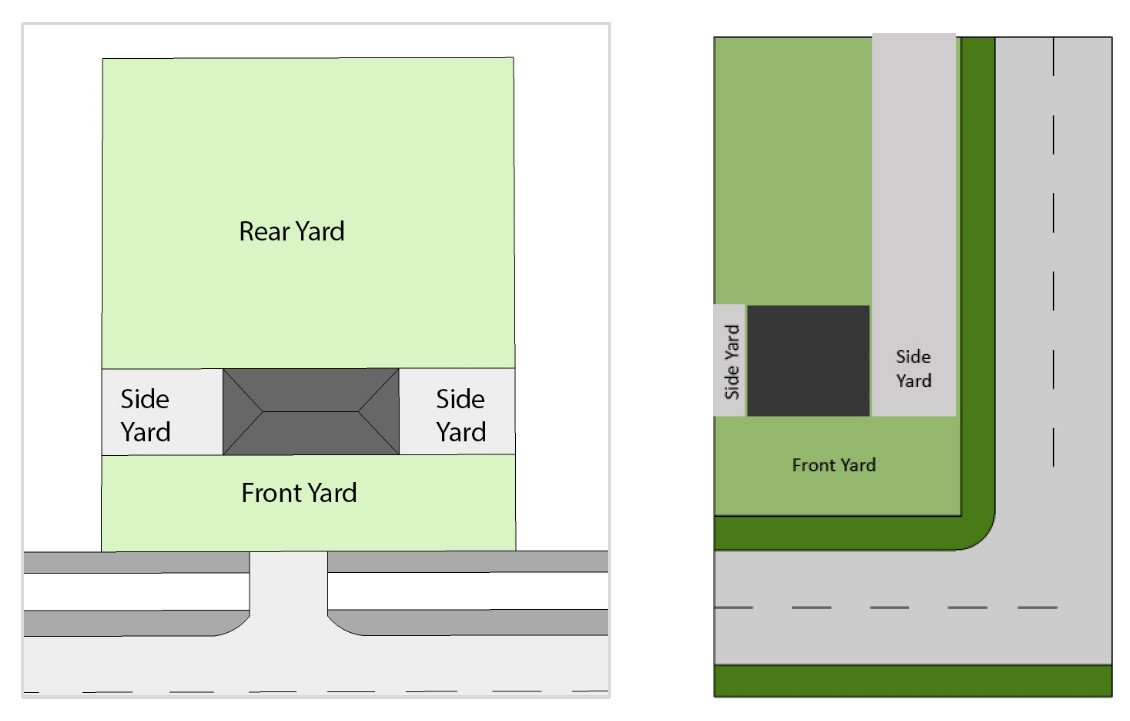
Every corner lot in any residential district shall have a minimum setback from the side street equal to the minimum front setback for the district in which such building is located. An encroachment into the side street setback will be permitted to obtain a 30-foot building width; provided, however, a minimum 12-foot setback from the side street lot line shall be maintained.
(Ord. No. 54A, § 16.07, 11-11-1987; Ord. No. 226, § 3, 2-9-1994)
Sec. 78-608. - Obstructions to vision on corner lots.
No structure, wall, fence, shrubbery or trees shall be erected, maintained or planted on any lot which will obstruct the view of the driver of a vehicle approaching an intersection, excepting that shrubbery and low retaining walls not exceeding 2½ feet in height above the curb level and trees where all branches are not less than eight feet above the street level will be permitted. In the case of corner lots, this shall also mean that there shall be provided an unobstructed triangular area formed by the street property lines and a line connecting them at points formed by the street property lines and a line connecting them at points 25 feet from the intersection of the pavement edge lines, or in the case of a rounded corner, from the intersection of the street property lines extended.
(Ord. No. 54A, § 16.08, 11-11-1987)
Cross reference— Traffic and vehicles, ch. 66.
Sec. 78-609. - Minimum distance between residential buildings.
The sum of the minimum required side yards for single-family residential buildings on two lots which abut each other along a common side lot line shall be not less than the total of the two required side yards of either of the lots.
(Ord. No. 54A, § 16.09, 11-11-1987)
Sec. 78-610. - Accessory buildings, structures and uses in single-family residential districts.
(a)
Covered and/or enclosed accessory buildings, structures and uses shall be permitted subject to the following conditions:
(1)
No detached accessory building, structure or use shall be within permanent easements.
(2)
Accessory buildings or structures shall only be placed in a rear yard, or portions of a side yard outside of the required setback (i.e., a non-required side yard), and shall be at least three feet from all adjoining lot lines and shall not exceed 15 feet in height, except as otherwise provided in this chapter. In no instance shall any portion of an accessory structure be located in a front yard or street-facing (exterior) side yard.
(3)
On corner lots where a rear yard abuts a side yard, accessory buildings on the corner lot shall have a minimum setback from the rear lot line a distance equal to the least side setback required from the lot abutting the corner lot.
(4)
No more than two accessory buildings shall be located on a single-family residential lot, and the floor area of all accessory buildings shall be limited to 45 percent of the required rear yard area.
(5)
On double frontage lots, no accessory buildings, structures or uses shall be permitted in the required front yard setback portion of the designated rear yard of the double frontage lot.
(6)
On corner lots, no accessory structure shall be located in the front yard or street-facing (exterior) side yard.
(7)
Accessory structures shall include tree houses, playhouses, shed or other similar structures, which are permanently anchored to a surface, with a maximum floor area for such structures not to exceed 100 square feet. Such structures shall require a permit and are subject to all height and setback requirements applicable to accessory buildings and structures. Plastic, modular or pre-fabricated play structures which are not anchored to the ground or any surface and can be moved around the yard without the need for removing any anchors or other means of attachment, shall not be included in this regulation.
Examples of tree houses (regulated).
Examples of play houses (regulated).
Examples of plastic/modular play structures (not regulated).
(8)
Garages shall be permitted as accessory structures and shall not be limited to the 100 square feet floor area limit noted above. All accessory structures shall conform to the lot coverage standards as established in the ordinance.
(b)
Attached, uncovered and unenclosed structures shall be permitted subject to the following conditions:
(1)
Decks, open steps and patios will be allowed to encroach into the required rear or front yard setback a maximum distance of ten feet, provided the maximum area of the encroachment shall be no greater than ten percent of the required front or rear yard setback area, and provided further that the average height of a deck, excluding open railings, shall not be more than three feet as defined in this section.
(2)
The average deck height shall be no higher than the sum of the minimum and maximum distance between the surface of the deck and grade, divided by two. The yard grades used for measurement will be those existing prior to any grading for landscaping purposes.
(3)
The area of decks, patios and open steps will be considered in the maximum lot coverage computation.
(4)
A lot survey and ground elevations must accompany the permit for deck, patio and open stem construction so that setbacks may be accurately determined.
(5)
Storage under decks is not permitted unless the storage area is completely obscured from view.
(c)
Decks and patios that are not attached to the principal building must be located to meet the required front, rear and side yard setbacks.
(d)
A roof overhang may be constructed over an existing open deck, patio or steps that encroaches into the front yard setback, subject to the following conditions:
(1)
The roof may not extend into the required front yard setback more than five feet and the total area of the encroachment may not exceed 25 square feet.
(2)
A roof may not be constructed over an existing open deck, patio or steps that encroaches into the front yard setback if the deck, patio or steps were constructed after January 1, 1994.
(3)
The porch encroachment may not be enclosed partially or entirely in any way, by either permanent or temporary means, with the exception of a railing with open balusters, as required by applicable construction codes. Prohibited temporary enclosures include, but are not limited to, canvas, plastic, wood or any other type of screening material which could be hung, rolled or temporarily fastened into place.
(e)
In and adjacent to all residential lots, freestanding air conditioners and/or air conditioning units, permanently mounted or freestanding generators, or other mechanical devices generating a continuous sound, may be placed in the side and rear yards (including the required side and rear yard setback area as restricted below) of the lot but shall not be permitted within the front yard. These units permitted in the side and rear yards shall be screened with landscaping so as not to be visible from the street. (Fencing, lattice, or other fence-type materials used for screening must follow the restrictions outlined in section 78-613 of this Code). The units must be set back at least three and one-half feet from the side lot line and at least 20 feet from the rear lot line. In the case of a double frontage lot, freestanding air conditioning units will be allowed in the designated rear yard. In the case of a lake lot, air conditioning units will be allowed in the yard adjacent to the water, but may not be located in the required front yard setback of said yard. However, any unit must be at least ten feet from the living area of adjacent residential homes at all times (excluding garages). This provision pertains to first-time installations only. An existing unit may be replaced with a new unit in the exact same location, even if it does not meet the requirements of this section.
(Ord. No. 54A, § 16.10, 11-11-1987; Ord. No. 201, § 2, 5-9-1990; Ord. No. 226, § 4, 2-9-1994; Ord. No. 287, § 1, 10-10-2007; Ord. No. 294, § 3, 11-12-2008; Ord. No. 295, 12-12-2008; Ord. No. 338, Pt. I, 6-13-2018)
Sec. 78-611. - Accessory buildings other than single-family residential districts.
No accessory structure shall be erected in the front yard. In the case of lots with two front yards, no accessory structure shall be located in the required minimum setback of either front yard.
(Ord. No. 54A, § 16.11, 11-11-1987)
Sec. 78-612. - Grades, elevation differentials and retaining walls.
(a)
The grading of all building lots shall be such to divert water away from buildings and prevent standing water and soil saturation detrimental to structures and lot use and surrounding property.
(b)
The elevation differential is defined as the difference between the elevation of the final ground level, after landscaping at the front building line, equidistant from the side building lines, and the elevations of the crown of the road, at a point equidistant from the side building lines, abutting the double lot front property line or lines in the case of lots with two front lot lines. If a sidewalk is in place, the elevation differential shall be based on the sidewalk elevation in lieu of the crown of road elevation.
(c)
The elevation differential for all buildings shall not be less than 15 inches nor more than 24 inches except as provided in subsection (e) of this section. A building under construction which has foundations in place shall be considered an existing building.
(d)
All applicants for building permits shall submit with the permit application, plans showing:
(1)
The proposed grading plan for the entire lot.
(2)
The direction of flow of surface water off the lot.
(3)
The gradient of all protective slopes around proposed buildings.
(4)
The elevation differential of all proposed buildings and the elevation differential of all existing buildings within 100 feet.
(e)
Variances may be granted from the requirement of subsection (c) of this section by the zoning board of appeals if adequate provisions are made and approved by the city engineer to prevent runoff water from flowing onto adjacent property.
(f)
Retaining walls in excess of one foot in height shall require a building permit. All retaining walls shall be designed and built so as to safely resist lateral pressures of soil behind them and be safely supported by soil beneath them. Additionally, retaining walls shall be maintained in structurally sound, good and safe repair and shall not impair drainage or create negative impacts on any other lot.
(Ord. No. 54A, § 16.12, 11-11-1987)
Sec. 78-613. - Fences and screening.
(a)
General requirements.
(1)
Construction and maintenance. Fences shall be securely constructed in conformance with this section and all applicable building codes and shall consist of materials that are found by the building official to be durable and weather-resistant. Masonry piers may be used as part of a fence installation with the approval of the building official. Fences shall be maintained in good order, painted, rust-proofed or otherwise protected against damage and decay, so as to present an orderly appearance. It shall be unlawful to erect a fence consisting of tires, vehicle parts, pallets, trash or any material capable of providing habitat for pests or vermin.
(2)
Hazards. Fences shall not be erected within public rights-of-way, or any corner clearance area as described in section 78-608 (obstruction to vision on corner lots).
(3)
Location. Fences shall be located completely within the boundaries of the lot to which they are associated.
(4)
Site drainage and utilities. Fences shall not be erected in a manner that obstructs the free flow of surface water or causes damage to underground utilities.
(5)
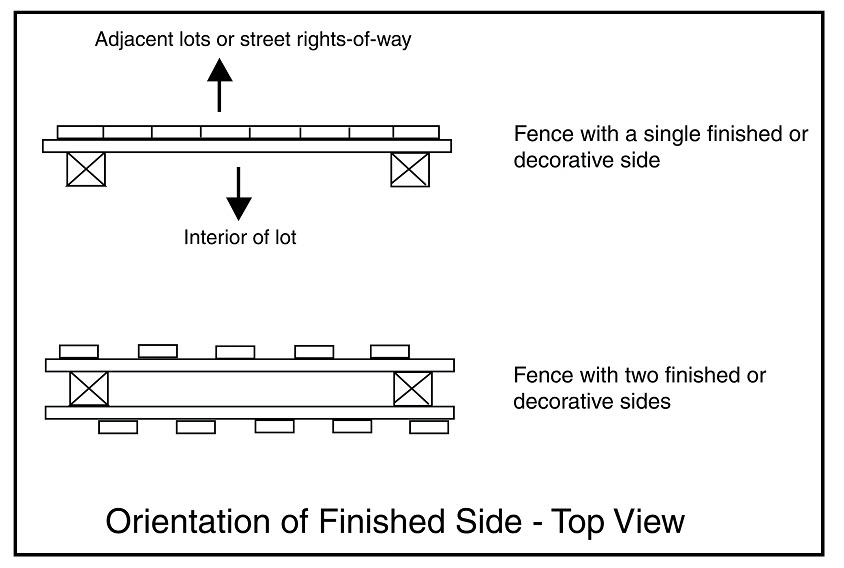
Orientation of finished side. Where a fence has a single finished or decorative side, it shall be oriented to face outward towards adjacent parcels or street rights-of-way (away from the interior of the lot to which the fence is associated). Finished side being the side of the fence opposite to the side that contains or from which can be seen supporting posts and/or rails and beams. If a fence is erected that the posts can be seen from both sides with the fence in between, both sides shall be considered to be finished. In case of a privacy fence being installed immediately adjacent to (in front of) a neighboring fence, the fence may be installed with the finished side facing inwards or towards the subject property except for those sections that will be in public view. Both of the examples given below are considered "privacy" fences and would not be allowed in side yard applications.
(6)
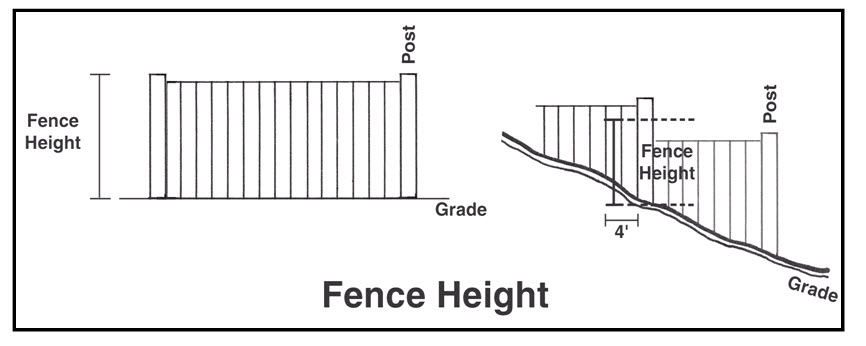
Height. Fence height shall be measured from the natural grade level to the highest point of the fence. Where the grade is not level, the maximum fence height shall be equal to the average fence height within four feet of any fence-post.
(b)
Single-family residential districts.
(1)
In general.
a.
All fences in side yards shall be decorative in nature. Examples of a decorative fence include ornamental aluminum, wrought iron, wood, composite wood, or similar durable materials. All fences shall be of open design and shall not obscure more than 50 percent of the fence area, excluding posts.
b.
Where one side of a fence has more finished or decorative appearance than the other, the side with the more finished or decorative appearance shall face the road or adjacent lots.
c.
For purposes of this section, a rear yard fence may extend into the side yard only when no portion of the fence is located closer to the front lot line than the outermost rear corners of the principal building on each side, as visible from the public right-of-way, as determined by the building official.
(2)
Fences on non-lakefront properties.
a.
Location. Fences may be constructed within a rear yard or side yard but are prohibited within the front yard. On a comer lot, the front yard or side yard abutting a street shall be considered as one continuous front yard for the purpose of this section.
b.
Height. A fence in a rear yard may be a maximum of six feet in height, even when extending into the side yard as permitted in subsection (1)e., above. A fence in the side yard may be a maximum of four feet.
c.
Setback. No fence shall be placed within three feet of a principal dwelling on an adjacent property or within two feet of a driveway on an adjacent property without written consent of said adjacent property owner.
(3)
Fences on lakefront properties.
a.
Location. On lots bordering upon a lake, river, or canal, fences are permitted in a side yard only.
b.
Height. The maximum height shall be four feet.
(4)
Double-frontage lots. For purposes of this section, all lot lines of double frontage lots shall be considered front lot lines when adjacent to streets where existing buildings in the same block have frontage, and front yards shall be provided as required. Fences on such lots shall therefore be located only in a side yard.
(5)
Non-conforming fences. Existing non-conforming fences in single-family residential districts that extend into a front yard shall not be permitted to be replaced with a new fence. If such a fence is found to be a hazard, as determined by the building official, it shall be removed by the property owner within 30 days of notice.
(c)
Multiple family residential district. Fences in the R-3 multiple family residential district shall not exceed five feet in height above grade, and shall not be located in the front yard or in front of the front building line of the building(s).
(d)
Public and institutional property. Fences which enclose public or institutional property shall not exceed seven feet in height above grade, and shall not obstruct vision to an extent greater than 25 percent of their total areas. However, fences exceeding seven feet in height may be permitted if required for public safety and security purposes for an essential service facility, or as may be otherwise required by this section.
(e)
Swimming pool fences. Fences for swimming pools shall comply with all applicable swimming pool regulations, requirements of the State Construction Code, and as required per section 78-641(b) and (c). Swimming pool fences, including the gate, lock and fence, are subject to the approval of the building official.
(f)
Storage area fences. Fences are required in non-residential zoning districts for enclosing outside storage of goods, materials or equipment that are permitted by this chapter. Such fences shall not exceed six feet in height, shall be constructed of a decorative material in areas visible from public rights-of-way and are subject to review and approval by the building official.
(g)
Prohibited fences. The following fences are prohibited:
(1)
Barbed-wire. Barbed-wire, razor-wire or electrified fences, except where, for the purpose of ensuring public safety, the planning commission may approve such fences as part of an approved site plan.
(2)
Wire fences. Wire fences, except where such fences are associated with a farm animal or agricultural use.
(3)
Wire woven (chain link) fences are prohibited in single-family residential districts.
(h)
Permit required. No person, firm or corporation shall construct or erect any fence, privacy screen or wall upon any land within the city without first having applied for and obtained a permit therefore from the city offices. A permit shall not be required for the following activities:
(1)
Repairs to an existing conforming fence with no structural changes.
(2)
The installation of gates or a new section of fence up to eight feet in length, when an existing conforming fence has been damaged due to natural or other causes, provided that such work is in compliance with the provisions of this section and all applicable building codes.
(3)
Planting of continuous hedgerows or similar landscape features.
(i)
Application. The following information shall be provided with any permit application for a fence:
(1)
Plot plan and construction drawings. A plot plan or lot survey shall be provided that includes the location of all existing and proposed fences, structures, easements and setback dimensions. An elevation sketch or photograph of the proposed fence shall also be provided, with appropriate dimensions noted.
(2)
Written consent of all adjacent property owners if a fence or wall is proposed to be installed on a lot line.
(j)
Removal of illegal or damaged fences. Damaged or illegal fences shall be immediately repaired or removed by the property owner. Upon identification of a damaged or illegal fence, the building official shall order the property owner to remove such fences or make necessary repairs within 30 days. Upon failure of the property owner to take such actions within 30 days, the city may act to remove such fences at the expense of the property owner. The city may then place a lien on the property, adding necessary removal expenses to the tax bill for the property.
(k)
Appeals. Any appeals from the provisions of this section or a decision of the building official can be made to the zoning board of appeals and is subject to the standards listed in section 78-89.
(Ord. No. 54A, § 16-13, 11-11-87; Ord. of 12-26-89; Ord. No. 273, § 1, 5-10-2006; Ord. No. 298, § 1, 8-12-2009; Ord. No. 348, § 1, 2-12-2020)
Sec. 78-614. - Walls required on nonresidentially zoned or used property abutting public or residentially zoned or used lots.
Control bumpers, setbacks and appropriate landscaping are required for off-street parking areas which abut upon a street, alley, CS community service district or residential property. Lots which are utilized for nonresidential purposes, and not subject to the regulations of article V of this chapter, shall provide and maintain screening in accordance with the following regulations:
(1)
Side. Where the side lot line of property utilized for nonresidential purposes abuts public property or a single-family or multiple-family residential zone district in the same block, a decorative masonry or brick screen wall shall be provided at a height of six feet above the parking area surface grade along such side lot line; provided, however, such wall shall be reduced in height to three feet above grade within 25 feet of any street line. This subsection shall not apply to those portions of property along the side lot line which are occupied by the building wall of the permitted buildings.
(2)
Rear. Where the rear lot line of property utilized for nonresidential purposes abuts CS or a single-family or multiple-family residential district in the same block and wherein there is no alley, a decorative masonry or brick screen wall shall be provided at a height of six feet above the parking area surface grade along such rear lot line; provided, however, that such wall shall be reduced in height of three feet above grade within 25 feet of any street line. In the case where the rear lot line of property utilized for nonresidential purposes abuts a CS district or a residential zone district in the same block across an alley, a wall shall be provided at a height of six feet along such rear lot line. This subsection shall not apply to those portions of the rear lot line abutting an alley which is occupied by the building wall of the permitted buildings.
(3)
Properties abutting the Clinton River Trail. Where any lot line of the property utilized for nonresidential purposes abuts the Clinton River Trail, the planning commission may permit a berm, in lieu of a wall, for screening purposes. The applicant shall demonstrate that a berm will sufficiently screen and buffer the proposed parking area from the trail. The following standards apply:
a.
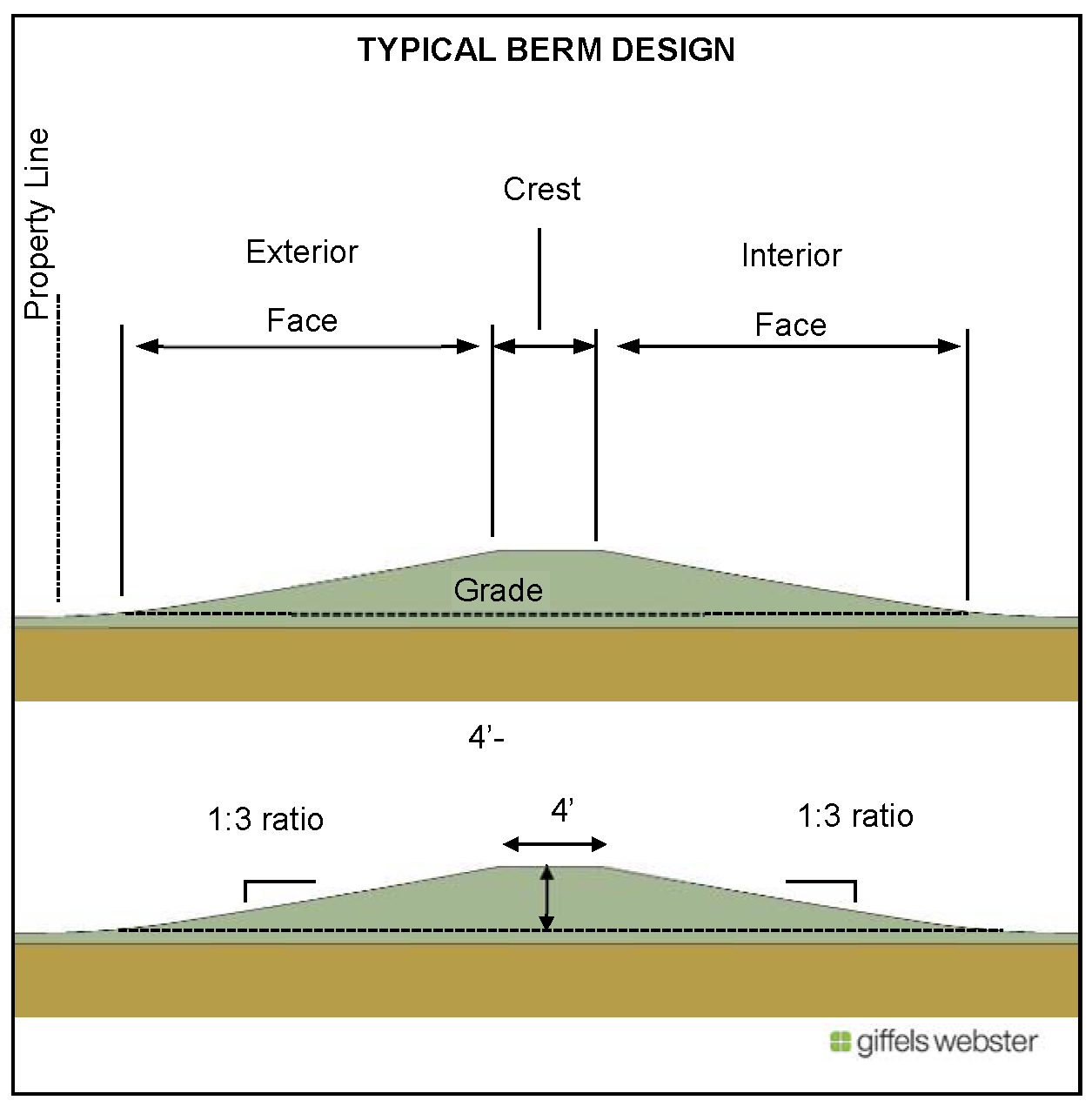
Berm standards. Required berms shall be constructed as landscaped earth mounds with a crest area at least four feet in width. All faces of the berm may be constructed as an earthen slope or retained by means of a wall, terrace or other means acceptable to the building department. Whenever an earthen slope is provided, it shall be constructed with a slope not to exceed one foot of vertical rise to three feet of horizontal distance (1:3); the ratio shall be one foot of vertical rise to three feet of horizontal distance (1:3) for any side facing single-family residential.
b.
Berm slopes shall be protected from erosion by sodding or seeding, as noted in subsection c., below. If slopes are seeded, they shall be protected, until the seed germinates, and a permanent lawn is established by a straw mulch, hydro-seeding or netting specifically designed to control erosion. The berm area shall be kept free from refuse and debris and shall be planted with shrubs, trees or lawn and shall be maintained in a healthy, growing condition.
c.
The top of the berm shall be landscaped with two rows of evergreen trees, which shall be a minimum of six feet tall and provide a range of heights to create a natural appearance. Planting in each row shall be staggered so that an uninterrupted vegetative screen is created. For each 60 feet of buffer strip planting, at least two flowering shrubs shall be planted. The remaining ground surface area shall be seeded, sodded or planted with ground cover. Innovation and design of landscaping and berm placement is encouraged.
(Ord. No. 54A, § 16.14, 11-11-1987; Ord. No. 336, Pt. I, 3-21-2018)
Sec. 78-615. - Wall height.
Wherever in this chapter a wall is required, the wall shall be erected to a height not less than six feet and, in the case of screening a loading area, not more than eight feet as measured from grade.
(Ord. No. 54A, § 16.15, 11-11-1987)
Sec. 78-616. - Wall, stone or brick facing.
(a)
Wherever in this chapter a wall is required, the wall shall be stone, brick, faced with brick or precast concrete of an ornamental design.
(b)
Whenever a wall is required to be constructed, such wall shall be constructed prior to the backfilling of any foundation or prior to any construction that extends above the foundation wall, whichever first occurs, in order to preserve the residential character and livability of the adjacent residential properties during the time of construction.
(Ord. No. 54A, § 16.16, 11-11-1987)
Sec. 78-617. - Frontage.
No dwelling or building shall be erected on a lot which does not have continuous frontage for its full width upon a street or road either currently certified by the city or the county road commission or designated on a recorded subdivision existing on or prior to the effective date of the ordinance from which this chapter is derived. Where lots exist on curved streets or culs-de-sac (turnaround, dead-end streets), the required lot frontage shall not be less than two-thirds of the average lot width, provided that the side lot lines are straight. Multifamily developments or developments for offices, industries or commercial uses need not front each such structure upon such street or roads, provided that adequate vehicular access can be assured in the site plan submitted for approval by the planning commission.
(Ord. No. 54A, § 16.17, 11-11-1987)
Sec. 78-618. - Dwelling in accessory building.
In all zoning districts, the use of any accessory building for the overnight housing of persons is expressly prohibited.
(Ord. No. 54A, § 16.18, 11-11-1987)
Sec. 78-619. - Essential services.
Essential services shall be permitted as authorized and regulated by law and other ordinances of the city, it being the intention of this section to exempt such essential services from the application of this chapter, except that all above-grade buildings pursuant to this chapter shall be subject to site plan review in accordance with this chapter.
(Ord. No. 54A, § 16.19, 11-11-1987)
Sec. 78-620. - Reserved.
Editor's note— Ord. No. 375, § 5, adopted March 12, 2025, repealed § 78-620, which pertained to automotive trailer camps or tourist cabins and derived from Ord. No. 54A, § 16.20, adopted Nov. 11, 1987.
Sec. 78-621. - Temporary and portable buildings, uses, structures and special events.
The zoning board of appeals may permit temporary buildings, structures and uses for a period not to exceed six months, provided that all requirements and conditions relative to the type of structure and use, and timing and arrangements for termination and removal are met. The board of appeals may require safeguards related to setbacks, screening, off-street parking considered necessary to protect the health, safety, welfare and comfort of inhabitants of the city. Further, the zoning board of appeals may require site plan approval by the planning commission and performance guarantee as conditions of approval. Mobile homes, mobile or temporary offices, trucks, truck trailers, vans or other passenger vehicles or trailers shall not be used for storage, warehousing, retail sales, service or offices, except by approval of the zoning board of appeals and subject to conditions imposed by the zoning board of appeals.
(Ord. No. 54A, § 16.21, 11-11-1987)
Sec. 78-622. - Storage of obnoxious matter in open containers.
No garbage, filth, refuse or other obnoxious matter shall be kept in open containers, piled or laid on the open ground; and all containers shall be stored in such a way so as not to be visible from any street.
(Ord. No. 54A, § 16.22, 11-11-1987; Ord. No. 199, § 1, 1-10-1990)
Sec. 78-623. - Soil removal or filling.
The use of land for quarry excavation, the removal or billing of topsoil, sand, gravel or other material from or on the land is not permitted in any zoning district, except under a building permit from the building official, who shall determine that such removal of material will not be above or below the normal grade as established from the nearest existing or proposed street, when such building grade has been established and approved by the building official and for which a temporary certificate may be issued in appropriate cases upon the filing of an application and a site plan, accompanied by a suitable agreement or bond under article II, division 7 of this chapter that such removal will not cause stagnant water to collect or leave the surface of the land at the expiration date of such permit, in an unsuitable condition or unfit for the growing of turf or for other land uses permitted in the district in which the removal or filling occurs. This regulation shall not prohibit the normal removal or filling of soil for the construction of an approved building or structure when such plans have been approved by the building official, and a building permit has been issued for such building development.
(Ord. No. 54A, § 16.23, 11-11-1987)
Sec. 78-624. - Open storage or dumping on land.
The use of land for the open storage or collection or accumulation of lumber, excluding firewood less than two feet long, or human-made materials, or for the dumping or disposal of scrap metal, junk, junk cars, parts of automobiles, trucks and boats, tires, garbage, rubbish or other refuse or of ashes, slag or other wastes or by-products shall not be permitted in any zoning district.
(Ord. No. 54A, § 16.24, 11-11-1987)
Sec. 78-625. - Governmental functions.
The city shall have the right to construct and maintain any building or structure required for the performance of its governmental or proprietary functions, provided that such building, structure or function shall conform to the use and procedural regulations, including site plan review, of the district in which it is located and of this chapter, and be constructed so as conform with the surrounding uses.
(Ord. No. 54A, § 16.25, 11-11-1987)
Sec. 78-626. - Easements.
It shall be unlawful for any person to install, erect or cause or permit the installation of a permanent structure (garage, building or large tree) on or across an easement of record which will prevent or interfere with the free right or opportunity to use or make accessible such easement for its proper use.
(Ord. No. 54A, § 16.26, 11-11-1987)
Sec. 78-627. - Nuisance activities.
No activity or use shall be permitted on any property which by reason of the emission of odor, fumes, smoke, vibration, radiation, noise or disposal of waste is deleterious to other permitted activities in the zone district or is obnoxious or offensive to uses permitted in neighboring districts, or is harmful to the general health, safety or welfare of the community.
(Ord. No. 54A, § 16.27, 11-11-1987)
Cross reference— Environment, ch. 30.
Sec. 78-628. - Commercial vehicles in residential areas.
(a)
Purpose. The purpose of restrictions on commercial vehicles is to preserve the health, safety and general welfare of persons and property in residential areas designed and utilized for single-family residential development by regulating the parking of certain large commercial vehicles which frequently are impediments to the ingress and egress of emergency and fire protection vehicles and equipment, which are frequently unsafe when operated on residential streets and the noise, exhaust emissions and appearance of which tend to impair the health, safety and general welfare of the people of the city.
(b)
Residential parking prohibited. No commercial vehicle of any kind shall be parked in a residentially-zoned or used area. Provided, however, this subsection shall not apply to commercial vehicles temporarily parked (less than eight hours) in a residential area in conjunction with maintenance or service to a residential property.
(c)
Presumption of ownership. In any proceeding for violation of any parking provision of this section, the person to whom a commercial vehicle is registered, as determined from the registration plate displayed on such motor vehicle, shall be presumed in evidence to be the person who committed the violation charged.
(Ord. No. 54A, § 16.31, 11-11-1987)
Cross reference— Businesses, ch. 18; traffic and vehicles, ch. 66.
Sec. 78-629. - Regulated uses.
(a)
Intent and rationale.
(1)
In the development and execution of this chapter and this section, it is recognized that there are some uses which, because of their very nature, are recognized as having serious objectionable, operations characteristics, particularly when several of them are concentrated under certain circumstances, thereby having deleterious effect upon adjacent areas. Special regulations of these uses is necessary to insure that these adverse effects will not contribute to the blighting, deteriorating and/or down-grading of the area, and that area adjacent thereto. These special regulations are itemized in this section. The city believes that control or regulation is for the purpose of preventing a concentration of these uses in any one area, i.e., not more than one such use within 1,000 feet of another such use.
(b)
Itemization of regulated uses. Uses subject to the controls set forth in this section shall be as follows, and are referred to herein as "regulated uses":
(1)
Businesses which provide massage as a primary or accessory use including health clubs, tanning salons, gyms, and spas.
(2)
Motorcycle sales and services;
(3)
Pawnshops;
(4)
Pool and billiard halls;
(5)
Sexually oriented businesses (as defined in this section);
(6)
Tattoo establishments;
(c)
Prohibition. Unless and until approval is first sought and obtained hereunder, it shall be unlawful to hereafter establish any regulated use (as defined herein).
(d)
Locational requirements for regulated uses: The city council must find that there is not presently more than one such regulated use within 1,000 feet of the boundaries of the site of the proposed regulated uses, except that the planning commission may waive this locational provision for: tattoo establishments, pawnshops, pool or billiard halls, or massage businesses if the following findings are made:
(1)
That the proposed use will not be contrary to the public interest or injurious to nearby properties and that the spirit and intent of the Section will be observed.
(2)
That the proposed use will not enlarge or encourage the development of a skid-row area in which the homeless, unemployed, transient or others may loiter or congregate for no general purpose.
(3)
That the establishment of an additional regulated use in the area will not be contrary to any program of neighborhood conservation nor will it interfere with any plans for future development of the area.
(4)
That all applicable regulations of this section will be observed.
The city council may not waive this location provision for sexually oriented businesses as defined by this chapter.
(e)
Conditions of approval: The planning commission may recommend that the city council impose such conditions or limitations upon the establishment, location, construction, maintenance or operation of the regulated use, as shall, in its judgment, be necessary for the protection of the public interest, except that any conditions imposed on sexually oriented business as defined in this section shall be limited to those conditions necessary to assure compliance with the standards and requirement in subsection (j) of this section. Any evidence and guarantee may be required as proof that the conditions stipulated in the connection therewith will be fulfilled.
(f)
Time limits for review: The following time limits shall apply to the review of an application by the planning commission and city council for special approval of a sexually oriented business as defined in this section.
(1)
The city shall publish notice of public hearing as required by section 78-173 of this chapter within 60 days of receiving a completed special approval and site plan application as required by section 78-176 of this chapter for a sexually oriented business as defined in this section.
(2)
The planning commission shall rule on its recommendation regarding the special approval application for sexually oriented business at the next regularly scheduled meeting of the planning commission following the public hearing held to review the application.
(3)
The recommendation of the planning commission shall be forwarded to the city council within 60 days of the meeting at which the planning commission issues its recommendation. The city council shall render its decision to grant or deny special approval of the sexually oriented business or to grant approval with conditions, as stipulated by the zoning ordinance [included in this volume as chapter 78] at this meeting.
(4)
Failure of the city to act within the above specified time limits shall be deemed to constitute granting of special approval to the sexually oriented business.
(g)
Effect of denial: No applicant for a regulated use which has been denied wholly or in part shall be resubmitted for a period of one year from the date of said order of denial, except on the grounds of new evidence or proof of changed conditions.
(h)
Revocations: In any case where a building permit for a regulated use is required and has not been obtained within six months after the granting of special approval by the city, the grant of special approval shall become null and void.
(i)
Reconstruction of damaged regulated uses: Nothing in this sections shall prevent the reconstruction, repairing or rebuilding and continued use of any building or structure, the use of which makes it subject to the contents of this Section, which is damaged by fire, collapse, explosion or act of God, provided that the expense of such reconstruction does not exceed 60 percent of the reconstruction cost of the building or structure at the time such damage occurred, provided that where the reconstruction repair or rebuilding exceeds the above-stated expense, the re-establishment of the use shall be subject to all provision of this section and further provided, that the re-established use complies with the off-street parking requirements of Division 6.
(j)
Requirements for sexually oriented businesses:
(1)
Purpose and intent: It is the purpose of this ordinance to regulate sexually oriented businesses to promote and protect the health, safety, morals, and general welfare of the citizens of the city, and to establish reasonable and uniform regulations to prevent a concentration of sexually oriented businesses within the city. These regulations are intended to control the negative secondary impacts such businesses have been documented to have on the surrounding area and the community. The provisions of this section have neither the purpose nor effect of imposing a limitation or restriction on the content of any communicative materials, including sexually oriented materials. Similarly, it is not the intent nor effect of this Section to restrict or deny access by adults to sexually oriented materials protected by the First Amendment, or to deny access by the distributors and exhibitors of sexually oriented entertainment to their intended market.
(2)
Definitions: The following definitions shall apply to sexually oriented businesses in this section:
a.
Achromatic means colorless or lacking in saturation or hue. The term includes but is not limited to grays, tans and light earth tones. The term does not include white, black or any bold coloration that attracts attention.
b.
Adult arcade means any place to which the public is permitted or invited wherein coin-operated or slug-operated or electronically, electrically, internet, or mechanically controlled still or motion picture machines, projectors, or other image-producing devices are maintained to show images and where the images so displayed are distinguished or characterized by the depicting or describing of sexually explicit activities or specified anatomical areas.
c.
Adult bookstore or adult video store means a commercial establishment which offers for sale or rental for any form of consideration, occupying 15 percent or more of the floor area of the establishment, any one or more of the following:
1.
Books, magazines, periodicals or other printed matter, or photographs, films, motion pictures, video matter, or photographs, cassettes or video reproductions slides, or other visual representation which depict or describe sexually explicit activities or specified anatomical areas; or
2.
Instruments, devices, or paraphernalia which are designed for use in connection with sexually explicit activities.
d.
Adult cabaret means a nightclub, bar, restaurant, or similar commercial establishment which regularly features:
1.
Persons who appear in a state of restricted nudity; or
2.
Live performances which are characterized by the partial exposure of specified anatomical areas; or
3.
Films, motion pictures, video cassettes, slides, or other photographic reproductions which are characterized by the depiction or description of sexually explicit activities or specified anatomical areas.
e.
Adult motel means a hotel, motel or similar commercial establishment which:
1.
Offer accommodations to the public for any form of consideration; provide patrons with closed-circuit television transmissions, films, motion pictures, video cassettes, slides, or other photographic reproductions which are characterized by the depiction or description of sexually explicit activities or specified anatomical areas; and has a sign visible from the public right-of- way which advertises the availability of this adult type of photographic reproductions; or
2.
Permit patrons to be filmed or photographed performing sexually explicit activities or displaying specified anatomical areas for electronic transmission over the World Wide Web or similar types of distribution media; or
3.
Offer a sleeping room for rent for a period of time that is less than ten hours; or
4.
Allow a tenant or occupant of a sleeping room to subrent the room for a period of time that is less than ten hours.
f.
Adult motion picture theater means a commercial establishment where, for any form of consideration, films, motion pictures, video cassettes, slides, or similar photographic reproductions are regularly shown which are characterized by the depiction or description of sexually explicit activities or specified anatomical areas.
g.
Adult theater means a theater, concert hall, auditorium, or similar commercial establishment which regularly features persons who appear in a state of nudity or live performances which are characterized by the exposure of specified anatomical areas or by the performance of sexually explicit activities.
h.
Escort means a person who, for consideration, agrees or offers to act as a companion, guide, or date for another person, or who agrees or offers to privately model lingerie or to privately perform a striptease for another person.
i.
Escort agency means a person or business association who furnishes, offers to furnish, or advertises to furnish escorts as one of its primary business purposes, for a fee, tip, or other consideration.
j.
Establishment means and includes any of the following:
1.
The opening or commencement of any sexually oriented business as a new business;
2.
The conversion of an existing business, whether or not a sexually oriented business, to any sexually oriented business;
3.
The addition of any sexually oriented business to any other existing sexually oriented business; or
4.
The location or relocation of any sexually oriented business.
k.
Massage business means any business which provide massage as a primary or accessory use including health clubs, tanning salons, gyms and spas.
l.
Nude model studio means any place where a person who appears in a state of nudity or displays specified anatomical areas is provided to be observed, sketched, drawn, painted, sculptured, photographed, or similarly depicted by other persons who pay money or any form of consideration.
m.
Nudity or a state of nudity means the appearance of a human bare buttock, anus, male genitals, female genitals, or female breast, as defined by MCL 41.181(3).
n.
Seminude means a state of dress in which clothing covers no more than the genitals, pubic region, and areola of the female breast, as well as portions of the body covered by supporting straps or devices.
o.
Sexual encounter center means a business or commercial enterprise that, as one of its primary business purposes, offers for any form of consideration: Physical contact in the form of wrestling or tumbling between persons of the opposite sex; or activities between male and female persons and/or persons of the same sex when one or more of the persons is in a state of nudity or seminude or permits patrons to display or to be filmed or photographed performing sexually explicit activities or displaying specified anatomical areas for electronic transmission over the World Wide Web or other similar types of distribution media.
p.
Sexually explicit activities means and includes any of the following:
1.
The fondling or other erotic touching of human genitals, pubic region, buttocks, anus, or female breasts;
2.
Sex acts, normal or perverted, actual or simulated, including intercourse, oral copulation, or sodomy;
3.
Masturbation, actual or simulated; or excretory functions as part of or in connection with any of the activities set forth in 1. through 3. above;
4.
Any activity intended to arouse, appeal to or gratify a person's lust, passions or sexual desires.
q.
Sexually oriented business means an adult arcade, adult bookstore or adult video store, adult cabaret, adult motel, adult motion picture theater, adult theater, escort agency, nude model studio, sexual encounter center, or similar establishment, or any place that permits patrons to be filmed or photographed performing sexually explicit activities or displaying specified anatomical areas for electronic transmission over the World Wide Web, or other similar types of distribution media.
r.
Specified anatomical areas means and includes any of the following:
1.
Less than completely and opaquely covered human genitals, pubic region or pubic hair; buttock; or female breast or breasts or any portion thereof that is situated below a point immediately above the top of the areola; or any combination of the foregoing; or
2.
Human genitals in a state of sexual arousal, even if opaquely and completely covered.
s.
Substantial enlargement of a sexually oriented business means the increase in floor area occupied by the business by more than 10 percent, as the floor area exists on January 1, 2004.
t.
Transfer of ownership or control of a sexually oriented business means and includes any of the following:
1.
The sale, lease, or sublease of the business;
2.
The transfer of securities which constitute a controlling interest in the business, whether by sale, exchange, or similar means; or
3.
The establishment of a trust, gift, or other similar legal device which transfers the ownership or control of the business, except for transfer by bequest or other operation of law upon the death of the person possessing the ownership or control.
(3)
Classification: Sexually oriented businesses are classified as follows:
a.
Adult arcades;
b.
Adult bookstores or adult video stores;
c.
Adult cabarets;
d.
Adult motels;
e.
Adult motion picture theaters;
f.
Adult theaters;
g.
Escort and escort agencies;
h.
Massage business;
i.
Nude model studios;
j.
Sexual encounter centers; and
k.
Other sexually oriented businesses, as determined by the city council.
(4)
Location of sexually oriented business.
a.
A sexually oriented business site shall not be located closer than 1,000 feet to the property line of an existing sexually oriented business.
b.
A sexually oriented business site shall not be located closer than 250 feet from any of the following:
1.
Church;
2.
A public or private elementary or secondary school;
3.
A residential zoning district;
4.
A lot or parcel in residential use;
5.
A public park;
6.
A child care facility, nursery, or preschool;
c.
A person is in violation of this section if he/she causes or permits the operation, establishment, substantial enlargement, or transfer of ownership or control of a sexually oriented business within 1,000 feet of another sexually oriented business.
d.
A person is in violation of this section if he/she causes or permits the operation, establishment, or maintenance of more than one sexually oriented business in the same building, structure, or portion thereof, or the substantial enlargement of any sexually oriented business in any building, structure, or portion thereof containing another sexually oriented business.
e.
For purposes of subsection (j)(4)a above, the distance between any two sexually oriented businesses shall be measured in a straight line, without regard to intervening structures or objects, from the site or property boundary in which each business is located.
f.
For the purposes of subsection (j)(4)b above, measurement shall be made in a straight line, without regard to intervening structures or objects, from the nearest portion of the property site boundary of a sexually oriented business to the nearest property line of the premises of any use, district or right-of-way listed in subsection (j)(4)b above.
g.
For the purposes of measuring the required distances and separations in subsection (j)(4)a above, access easements or portions of the parcel that are exclusively used to provide access to the site of the sexually oriented business shall be excluded from the parcel boundary in determining whether the site complies with the required separation. The intent of this exclusion is to allow sexually oriented businesses to comply with the separation requirement from major thoroughfares by means of an access easement or access strip of land from the site to the thoroughfare.
h.
Any business now classified as a sexually oriented business lawfully operating on January 1, 2004, that is in violation of subsections (j)(4)a or (j)(4)b above, shall be deemed a nonconforming use.
i.
A sexually oriented business lawfully operating as a conforming use is not rendered a nonconforming use by the location, subsequent to special approval and site plan approval of the sexually oriented business, of any use listed in subsection (j)(4)a above, within 1,000 feet of the sexually oriented business.
(5)
Exterior display and signs. A sexually oriented business is in violation of this section if:
a.
The merchandise or activities of the establishment are visible from any point outside the establishment; or
b.
The exterior portions of the establishment or signs have any words, lettering, photographs, silhouettes, drawings or pictorial representations of any specified anatomical area or sexually explicit activity as defined in this section.
(6)
License required to operate a sexually oriented business. Special approval and site plan approval shall be granted on the condition that the operator or owner of a sexually oriented business obtains a license to operate the business as required by chapter 18, sections 18-31 through 18-111.
(k)
Penalties and remedies
(1)
Enforcement: A violation of the provisions of this section shall result, in addition to the remedies provided herein, in possible criminal violations consisting of a fine of $500.00 or a jail term of 90 days, or both.
(2)
Injunction: In addition to the provisions of this section, the city at its option may commence proceedings in the circuit court under the appropriate court rule or statute to enjoin any activity conducted by a sexually oriented business that is deemed to be in violation of these provisions.
(Ord. No. 54A, § 16.32, 11-11-1987; Ord. No. 266, § 7, 3-10-2004)
Cross reference— Businesses, ch. 18.
Sec. 78-630. - Home occupations.
Home occupations, as defined in this chapter, shall be permitted in all residential districts.
(Ord. No. 54A, § 16.33, 11-11-1987; Ord. No. 200, § 1, 3-14-1990)
Cross reference— Businesses, ch. 18.
Sec. 78-631. - Enclosure of roof appliances or accessories.
In all zone districts, roof appliances such as, but not limited to, cooling towers, air conditioners, heating apparatus, dust collectors, filters, transformers and any other such appliance or apparatus, other than flagpoles, chimneys for carrying products of combustion and radio antenna towers shall be enclosed with opaque screens not less in height than the height of the highest appliance, as measured from the plane of the roof surface upon which the screen device is mounted to the top of the highest appliance. However, if the screening device is mounted on the top of the parapet or other part of the building facade which extends above the roof surface, the height of the parapet or other part of the building facade extending above the roof surface and the screening device is equal to the height of the highest appliance, such walls may be lowered to permit passage of air for cross ventilation, but shall be adequate to totally screen such equipment from view. The design of the screening device shall be compatible with the architectural design of the building upon which it is located.
(Ord. No. 54A, § 16.34, 11-11-1987)
Sec. 78-632. - Time limit for landscape requirements and plant materials, buffer strip standards and right-of-way planting.
(a)
Generally. Whenever landscaping treatment is required, it shall be in accordance with the specific use as mentioned in this section. All plant materials shall be installed within six months of the date of issuance of a temporary certificate of occupancy. In the instance where such completion is not possible, a cash bond, letter of credit or corporate surety bond in an amount equal to the estimated cost of the landscape plan or portion thereof will be deposited in accordance with article II, division 7 of this chapter.
(b)
Buffer strip planting. Whenever a buffer strip is required by this chapter or as a requirement of site plan or special approval, or permitted, it shall be installed so as to provide, within a reasonable time, an effective barrier to vision, light, physical encroachment and sound. Maintenance shall be required to ensure its permanent effectiveness. Specific planting requirements are:
(1)
The planting area will be no less then 7.5 feet in width.
(2)
A minimum of one evergreen tree shall be planted at 20-foot intervals, and shall have a minimum height of six feet at planting.
(3)
A minimum of five grouped evergreen shrubs shall be placed between or around the spaced evergreens, at four-foot intervals with a minimum of three feet in height.
(4)
Berms required shall be at least two feet in height and shall have a slope no greater than 1:2.5, i.e., one foot of vertical rise for each 2.5 feet of horizontal distance. The top of the berm shall be landscaped with two rows of evergreen trees. See subsection (b)(3) of this section. Planting in each row shall be staggered so that an uninterrupted vegetative screen is created.
(5)
For each 60 feet of buffer strip planting, at least two spring flowering trees shall be planted. Each such tree shall be substituted for a required evergreen tree. The remaining ground surface area shall be seeded, sodded or planted with ground cover. Innovation and design of landscaping and berm placement is encouraged.
(6)
The owner of landscaping required by this section shall perpetually maintain such landscaping in good condition so as to present a healthy, neat and orderly appearance, free from refuse and debris. All diseased and/or dead material shall be removed within 30 days following city notification and shall be replaced within the next appropriate planting season or within one year, whichever comes first.
If the owner fails to maintain the landscape area in a neat and orderly manner, free from debris, the building official shall mail to the owner a written notice setting forth the manner in which there has been failure to maintain such landscaping and require that the deficiencies of maintenance be cured within 30 days from the date of such notice. If the deficiencies set forth in the notice shall not be cured within 30 days, or any extensions thereof granted by the city planning commission, the city shall have a right to enter upon such property and correct such deficiencies and the costs thereof shall be charged, assessed and collected pursuant to this Code.
(7)
In instances where healthy plant materials exist on a site prior to its development, the planning commission may adjust the application of the standards of this section to allow credit for such plant material if such an adjustment is in keeping with, and will preserve, the intent of this chapter.
(c)
Plantings, soil and drainage requirements. Whenever landscaping is required, the plant materials will be installed in fertile soil with good surface drainage and provided maintenance as required to ensure their health and permanence.
(Ord. No. 54A, § 16.35, 11-11-1987)
Cross reference— Vegetation, ch. 74.
Sec. 78-633. - Sidewalks and bikeways.
For all developments requiring site plan approval, either a new public sidewalk or bikeway, or the reconstruction of existing sidewalks or bikeways, shall be required to be constructed to city standards for the perimeter of the lot which abuts a major, intermediate or collector street as defined in the city master plan. New or reconstructed sidewalks or bikeways shall be aligned with existing or proposed sidewalks or bikeways.
(Ord. No. 54A, § 16.36, 11-11-1987)
Sec. 78-634. - One single-family dwelling per lot.
Except in the instance of cluster developments or condominium developments where a site plan is approved by the planning commission and except for lots used for education or religious institutions, not more than one single-family dwelling shall be located on a lot as defined in this chapter, nor shall a single-family dwelling be located on the same lot with another principal building. This provision shall not prohibit the lawful division of land.
(Ord. No. 54A, § 16.37, 11-11-1987)
Sec. 78-635. - Keeping of farm animals and other animals.
The keeping, raising, or breeding of animals, poultry, or livestock, including farm animals and nondomestic animals and reptiles (except domesticated cats, dogs, canaries, parakeets, parrots, gerbils, hamsters, guinea pigs, turtles, fish, rabbits, and similar animals commonly kept as pets), shall be prohibited.
(Ord. No. 54A, § 16.38, 11-11-1987; Ord. No. 358, § 1, 6-8-2022)
Cross reference— Animals generally, ch. 10.
Sec. 78-636. - Dumpsters or outdoor trash receptacles.
(a)
Outdoor trash containers shall be permitted in all districts, except single-family residential, provided that they comply with the following requirements:
(1)
Adequate vehicular access shall be provided to such containers for truck pickup, either via a public alley or vehicular access aisle which does not conflict with the use of off-street parking areas or entrances to or exits from principal buildings nearby.
(2)
A solid ornamental wall or screening fence shall be provided around all sides or trash containers which shall be provided with a gate for access and be of such height as to completely screen such containers, the maximum height of which shall not exceed six feet.
(3)
The trash containers, the screening wall or fence and the surrounding ground area shall be maintained in a neat and orderly appearance, free from rubbish, wastepaper or other debris. This maintenance shall be the responsibility of the owner of the premises on which the containers are placed.
(4)
All dumpsters shall be constructed in compliance with all city, county and state health ordinances and statutes.
(b)
Temporary outdoor trash containers may be permitted in all districts as needed during construction in accordance with a validly issued building permit, provided that the building permit shall specify the type of trash containers to be used during construction, their proposed location and when they are proposed to be removed.
(Ord. No. 54A, § 16.39, 11-11-1987)
Cross reference— Solid waste, ch. 54.
Sec. 78-637. - Satellite antennas.
(a)
Satellite antennas shall be permitted as accessory structures in accordance with the provisions of this section.
(b)
No person shall install a satellite antenna greater than three feet in diameter, whether permanently mounted or portable, without having obtained a building and electrical permit.
(c)
Satellite antennas may be erected in any R-1 and R-2 zoning district if the following standards are met:
(1)
It shall be ground mounted.
(2)
The diameter shall not exceed ten feet.
(3)
The height shall not exceed 12 feet.
(4)
The satellite antenna shall be located only in the area between the rear of the principal structure and the rear property line. In the case of corner lots, it shall not be located in the exterior side setback. On lake lots, it shall be located in the front yard that is on the lake side.
(5)
It shall not be placed closer to any lot line than its height.
(6)
It shall be screened by evergreen plantings so as to be obscured, as much as possible, from off the lot on which it is located.
(d)
Satellite antennas may be erected in any R-3 zoning district in accordance with the standards of subsection (c) of this section, but they may be roof-mounted if they do not exceed the height limit of the district.
(e)
In all zoning districts other than R-1, R-2 and R-3, satellite antennas may be erected if the following standards are met:
(1)
The diameter shall not exceed 12 feet.
(2)
A ground-mounted satellite antenna shall comply with the setback requirements established for its zoning district, but shall not be located in the front yard.
(3)
The height for a ground-mounted satellite antenna shall not exceed 25 feet.
(4)
The height for a roof-mounted satellite antenna shall not exceed 15 feet, nor shall it exceed the height limit established within its zoning district.
(f)
Satellite antennas in any zoning district shall be installed and maintained in compliance with applicable building and electrical codes, and shall be subject to the following standards:
(1)
Not more than one satellite antenna greater than three feet in diameter shall be allowed on any lot unless shown on an approved site plan.
(2)
Satellite antennas must be solid in color.
(3)
Satellite antennas must be permanently mounted, except under the following circumstances:
a.
The satellite antenna has been designed and sold as a portable antenna not intended for permanent installation, and the diameter of the satellite antenna does not exceed six feet. Portable satellite antennas shall meet the requirements of subsections (c)(3), (4) and (5) of this section.
b.
Portable satellite antennas may be installed for not more than seven days in any 30-day period.
(g)
A variance may be granted by the zoning board of appeals from the provisions of this section in cases involving practical difficulties, where the evidence supports that the topographic features or special characteristics of the site create special conditions such that the strict application of this section will prevent the reception of usable satellite signals.
(Ord. No. 54A, § 16.40, 11-11-1987)
Sec. 78-638. - Public utility facilities.
In all zoning districts, public utility facilities and uses, without storage yards, when operating requirements necessitate the locating of such facilities within the district in order to serve the immediate vicinity, shall be permitted subject to special approval by the planning commission (see article II, division 6 of this chapter) and after review and approval of the site plan and upon a finding by the planning commission that the use is compatible to the surrounding area and will not be injurious to the surrounding neighborhood and is not contrary to the spirit and purpose of this chapter.
(Ord. No. 54A, § 16.41, 11-11-1987)
Cross reference— Utilities, ch. 70.
Sec. 78-639. - Basement residences.
No certificate of occupancy shall be issued for a basement dwelling unit, and no residential occupant shall occupy a basement.
(Ord. No. 54A, § 16.43, 11-11-1987)
Sec. 78-640. - Outdoor storage of recreation and other vehicles and equipment in single-family residential districts.
The outdoor storage or parking of any airplane, antique or racing automobile, boat, boat hoist or dock, float, trailer, trailer coach, camping trailer, motorized home, demountable travel equipment of the type adaptable to light duty trucks, and other equipment or vehicles of a similar nature, shall be prohibited for a period greater than forty-eight (48) hours in all single-family residential districts, except where expressly permitted by other provisions of this chapter, and unless the following minimum conditions are met:
(1)
All such vehicles or equipment shall be placed within a completely enclosed building or located behind the required front yard setback of the principal building, but no closer than three feet to any side or rear lot line.
(2)
Storage or parking shall be limited to a lot or parcel of land upon which is located an inhabited dwelling unit and the vehicle or equipment is owned by the occupant.
(3)
Trailer coaches, mobile homes and other vehicles or equipment designed or adaptable for sleeping purposes shall remain unoccupied and shall not be connected to sanitary sewer facilities, or electricity, water or gas.
(4)
When placed on single-family residential lots, boat hoists and boat docks shall be placed only in the rear yard or behind the required front yard setback of the principle building. On lake lots, boat hoists and boat docks may be stored on the lake side without front yard setback restrictions.
(5)
Not more than two recreation vehicles per dwelling unit may be kept or stored outdoors at one time. Recreation vehicle size for recreation vehicles kept or stored outdoors may not exceed eight feet in width, ten feet in height or 32 feet in length.
(6)
Such vehicles so kept or stored shall be in good repair. Open storage of partially or disassembled component parts of such uses is prohibited.
(7)
On double frontage lots, no recreation or other vehicles or equipment shall be permitted in the required front yard setback portion of the designated rear yard of the double frontage lot.
(8)
The provisions of subsections (1) and (7) of this section notwithstanding, the storage of boats and boat trailers will be permitted on the driveway in the front yard setback from April 1 to October 31.
(Ord. No. 54A, § 16.44, 11-11-1987; Ord. No. 208, § 1, 9-12-1990; Ord. No. 276, § 1, 7-12-2006)
Cross reference— Traffic and vehicles, ch. 66.
Sec. 78-641. - Swimming pools.
(a)
Permit application. It shall be unlawful for any person to construct or maintain an outdoor swimming pool without first making application to the city clerk and obtaining a permit thereof. Application for such permit shall show the name of the owner, a plot plan of the property showing the location or such swimming pool thereon and a detailed plan and specification for such swimming pool, which shall contain full information as to the type, height and location of fence surrounding such swimming pool and the number of gates therein.
(b)
Location. Out-of-door swimming pools may be erected in the rear yard, provided no part thereof shall approach nearer than ten feet from the side or rear lot lines. No such pool or part thereof shall be installed within 25 feet of a side street. On lake lots, such pools and required fencing may be erected in either front yard, but must be located behind the required minimum front yard setback as defined in section 78-296. The provisions of subsection (c) of this section notwithstanding, the required pool fence in the front yard must be no more than six feet from the edge of the pool and not located within the minimum front or side yard setback. Permanent and portable swimming pools will be considered in the total lot coverage computation.
(c)
Fencing. The swimming pool shall be completely enclosed by a fence not less than four feet in height. The gates shall be of the self-closing, self-latching type, with a latch on the inside of the gate, not readily available for children to open. A fence which encloses the yard, as a whole, of the type referred to in this subsection, may be considered as complying with the requirements of this section. All gates must be locked when the residents are away from the house or when the pool is not in use. A pool cover or other protective devise approved by the city manager with not less than the protection afforded by the enclosure, gate and latch described in this subsection may be used.
(d)
Inspection. The health department and the building official have the right, at any reasonable hour, to inspect any swimming pool for the purpose of determining that all provisions of this section are fulfilled and complied with. Before any swimming pool shall be used, a final inspection and approval must be had from both the building official and plumbing inspector.
(e)
Conflict with other provisions. This section, in no way, is intended to amend or alter any existing city ordinance, or state statute, provisions of which are covered in this section.
(f)
Nuisance. Any such outdoor swimming pool installed, operated or maintained in violation of provisions of this section shall constitute a nuisance, and the city may, in addition to penalties set forth in section 78-3, maintain any proper action for the abatement of such nuisance.
(Ord. No. 54A, § 16.45, 11-11-1987; Ord. No. 198, § 2, 12-13-1989; Ord. No. 251, § 2, 3-8-2000)
Charter reference— Authority relative to fences, § 4.2(11).
Sec. 78-642. - Driveways.
Any driveway, parking lot or parking pavement shall require a building permit and shall be constructed in accordance with city construction standards and specifications.
(Ord. No. 54A, § 16.46, 11-11-1987)
Sec. 78-643. - Building permit for accessory buildings.
In all zoning districts, accessory buildings, structures and uses shall require a building permit, and shall be constructed in accordance with city construction standards and specifications.
(Ord. No. 54A, § 16.47, 11-11-1987)
Sec. 78-644. - Architectural design guidelines.
Design standards to encourage and facilitate "eco-friendly building design" and a table to qualify the amount allowed for the various type of building materials, as hereinafter provided.
ORCHARD LAKE ROAD CORRIDOR OVERLAY DISTRICT
ARCHITECTURAL DESIGN CHECKLIST
Introduction. The architectural design guidelines are in the form of a point rating system. The applicant or representative should assess the front facade of the proposed building using this form.
Method of evaluation. The design standards are not intended to promote buildings that appear uniform and similar. Variety and creativity in design are encouraged. The standards are structured in a point rating system, with desirable architectural elements given positive points and undesirable elements given negative points.
The points assigned for each category are weighted according to its importance. The standards apply to all nonresidential building facades with the facade facing a public road, private road, or water body being more heavily weighted.
Buildings shall be judged by the following scale:
59 points or less = Unacceptable
60—69 = Passing
70—79 = Satisfactory
80—89 = Good
90—99 = Very good
100 or points = Excellent
The minimum acceptable score is:
60 points for M-1 district
80 points for C-2 district
90 points for C-1 and O-1 districts
In the case of remodeled buildings, the planning commission will receive recommendations from the city staff, and have the discretion to modify the minimum acceptable scores. A determination will be made on the acceptability of the proposed architectural improvements with due consideration given to existing building materials, layout and limitations imposed by them.
(1)
Building material.
Objective: Select materials possessing durability and aesthetic appeal. Building materials - scoring method: For primary exterior material composing more than 60 percent of the facade (including window area), the point allocation for that material should be doubled. For example, for a building consisting primarily of brick (+ 16 points × 2 = +32 points) with split face block accents (+4 points), the total score would be 36 points. The score for each facade shall be averaged with the facade facing a public road, private road, or water body being double weighted.
(2)
Windows.
Objective: Windows are the main element contributing to an inviting facade. They give visual interest to a facade. Provide a large quantity of attractive windows on a facade that fronts a street.
(3)
Architectural features.
Objective: Include architectural features on the building facade that provide texture, rhythm, and ornament to a wall.
Description: There are two categories of architectural features. The first category consists of compositional elements, that is, architectural features that contribute to dividing the elevation into interesting parts. Horizontal compositional elements include a cornice and a base, which give the facade a top and a bottom. Vertical compositional elements include pilasters and columns, which give the facade a sense of rhythm. The second category includes decorative elements, which contribute to the visual appeal of the facade.
(4)
Colors.
Objective: Select natural and neutral colors that are harmonious with both the natural and manmade environment. Stronger colors can be used as accents to provide visual interest to the facade.
(5)
Building form.
Objective: Provide an interesting form to a building through manipulation of the building massing. This can be achieved through certain roof types, rooflines, and massing elements such as towers, cupolas, and stepping of the building form.
(6)
Composition.
Objective: It is not sufficient to include the desired architectural elements on a facade, but to arrange them in a harmonious and balanced manner. The following category provides weight to the architectural composition of the building.
(7)
Eco-friendly building design.
Objective: To encourage the use of eco-friendly or "green" building materials and design, which contribute to sustainable development and environmental preservation such as reduced ozone depletion, energy conservation, water conservation, reduced toxic waste emissions etc. The points in the following category will not count toward the total score, but will be considered towards the overall rating of the building. Use of eco-friendly design and materials will provide weight in determining the overall architectural standard of the building, even if the points in some other criteria are not adequately met.
TOTAL SCORE:__________
TABLE A:
The following schedule regulating exterior building materials shall apply to all structures. Some materials are more suited for commercial and office developments while others work better in an industrial setting in terms of durability and functionality. Therefore, the percentages listed below are intended as a guideline while designing building architecture and not strict requirement. The schedule will work in conjunction with subsection (1) building materials of the architectural point rating system.
(Ord. No. 292, § 1, 6-11-2008)
Sec. 78-645. - Wireless communication facilities regulated.
(a)
Purpose and intent. It is the general purpose and intent of the city to carry out the will of the United States Congress by authorizing communication facilities needed to operate wireless communication systems. It is the further purpose and intent of the city to provide for such authorization in a manner which will retain the integrity of neighborhoods and the character, property values and aesthetic quality of the city at large. In fashioning and administering the provisions of this section, attempt has been made to balance these potentially competing interests and uphold the values of public health, safety and welfare.
(b)
Definitions. The following definitions shall apply in the interpretation of this section:
(1)
Wireless communication facilities shall mean and include all structures and accessory facilities relating to the use of the radio frequency spectrum for the purpose of transmitting or receiving radio signals. This may include, but shall not be limited to, radio towers, television towers, telephone devices and exchanges, antennas, microwave relay towers, telephone transmission equipment, building and commercial mobile radio service facilities. Not included within this definition are: citizen band radio facilities; short wave facilities, ham, amateur radio facilities; satellite dishes; and governmental facilities which are subject to state or federal law or regulations which preempt municipal regulatory authority.
(2)
Attached wireless communications facilities shall mean wireless communication facilities (antennas and panels) that are affixed to existing structures, such as existing buildings, towers, water tanks, utility poles, and the like. A wireless communication support structure proposed to be newly established shall not be included within this definition.
(3)
Wireless communication support structures shall mean any and all structures erected or modified to support wireless communication antennas. Support structures within this definition include, but shall not be limited to, monopoles, lattice towers, light poles, wood poles and guyed towers, or other structures which are not defined in subsection (b)(2) above as attached wireless communication facilities.
(4)
Collocation shall mean the location by two or more wireless communication providers of wireless communication facilities on a common structure, tower, or building, with the view toward reducing the overall number of structures required to support wireless communication antennas within the community.
(5)
Planning official shall mean the city manager or his or her designee.
(6)
Building official shall mean the chief building official.
(7)
Backhaul network shall mean the lines that connect a wireless communication provider's wireless communication facilities to one or more cellular telephone switching offices, and/or long distance providers, or the public switched telephone network.
(c)
Placement on city property. Every effort must be made to locate wireless communication facilities on city hall and adjoining city owned property including the water tower.
(1)
Wireless communication facilities may be placed on city property following the guidelines set forth below.
(2)
Engineering proof must be submitted proving that adequate signal coverage cannot be achieved by placing a facility on city owned property prior to a facility being proposed in another location.
(3)
If after a review by the city's engineer, it is determined that a facility cannot be placed on city owned property, a proposal to place a facility on other property in the city may be submitted.
(d)
Authorization.
(1)
The planning official may permit an attached wireless communication facility as a permitted use in the C-1, C-2 and O-1 districts under any one of the following circumstances:
a.
The facility and any accessory equipment shall be located within an existing building or structure of a principal permitted use, or attached to an existing building or structure of the principal permitted use.
b.
The planning official finds that the facility is designed in such a manner that it is compatible with the character of existing building or structure. Any accessory building necessary for the enclosure of equipment shall be covered with the same or compatible building material as the principal building. The facility shall be attached to or be part of the structure in such a manner as to minimize its identity.
c.
The facility is proposed to be collocated upon a wireless communication support structure which had been pre-approved for such collocation as part of an earlier approval by the city.
d.
The facility is proposed to be attached to an existing utility pole or tower.
(2)
Wireless communication facilities subject to the standards and conditions set forth below shall be authorized as special land uses to be approved by the city council following public hearing and recommendation by the planning commission, within the I-1 district or on land owned by the city located within the Clinton River Trail subject to the following conditions:
a.
The base of the wireless communication facility shall have a minimum setback of 30 feet to any lot line located in a residential district
b.
The base of the wireless communication facilities and any other structures connected therewith shall provide the minimum setback required by the district to any abutting C-1, C-2 or residential district; provided that the setback of the wireless communication facilities shall be not less than the height of the facility.
c.
If located on the same zoning lot with another permitted use, such wireless communication facilities and any other structures connected therewith shall not be located in a front yard.
d.
Exceptions to these conditions may be permitted by the city council where the council finds that circumstances of the site and in the surrounding area warrant different conditions.
e.
Such wireless communications facilities shall further be subject to the conditions set forth in subsections (5), (6), (7), (8) and (9) below.
(5)
General regulations;standards and conditions applicable to all facilities. All applications for wireless communication facilities shall be reviewed in accordance with the following standards and conditions, and, if approved, shall be constructed and maintained in accordance with such standards and conditions. In addition, if the facility is approved, and is other than a permitted use, it shall be constructed and maintained with any additional conditions imposed by the findings of the planning commission and approved by the city council in its discretion:
(1)
Wireless communication facilities shall not be demonstrably injurious to neighborhoods or otherwise detrimental to the public safety and welfare.
(2)
Wireless communication facilities shall be located and designed to be harmonious with the surrounding areas, and if it is a new wireless communication support structure, shall be located no less than ½ mile from existing wireless communication support structures. The distance requirements shall not apply to applicants who have demonstrated that collocation is not feasible.
(3)
Wireless communication facilities shall comply with applicable federal and state standards relative to the environmental effects of radio frequency emissions.
(4)
Applicants shall demonstrate a justification for the proposed height of the structures and an evaluation of alternative designs which might result in lower heights.
(5)
The applicant shall demonstrate options for a creative wireless tower facility design such as a steeple, flagpole, etc. The proposed design shall be subject to review and recommendation by the planning commission and approval by the city council.
(6)
The following additional standards shall be met:
a.
The maximum height of the new or modified wireless communication support structure and antenna shall be the minimum height demonstrated to be necessary for reasonable communication by the applicant (and by other entities to collocate on the structure), but in no event shall the wireless communication support structure exceed 150 feet in height.
b.
The accessory building contemplated to enclose such things as switching equipment shall be limited to the maximum height for accessory structures within the respective district.
c.
The setback of the new or proposed wireless communication support structure from any existing or proposed rights-of-way or other publicly traveled roads shall be no less than the height of the structure, unless the structure is placed within the right-of-way itself.
d.
There shall be unobstructed access to the wireless communication support structure, for operation, maintenance, repair and inspection purposes, which may be provided through or over an easement. This access shall have a width and location determined by such factors as: the location of adjacent thoroughfares and traffic and circulation within the site; utilities needed to service the tower and any attendant facilities; the location of buildings and parking facilities; proximity to residential districts and minimizing disturbance to the natural landscape; and the type of equipment which will need to access the site.
e.
The division of property (lot splits or subdividing) for the purpose of locating a wireless communication facility is prohibited.
f.
Where an attached wireless communication facility is proposed on the roof of a building, if the equipment enclosure is proposed as a roof appliance or penthouse on the building, it shall be designed, constructed and maintained to be architecturally compatible with the principal building. The equipment enclosure may be located within the principal building or may be an accessory building. If proposed as an accessory building, it shall conform with all district requirements for principal buildings, including yard setbacks.
g.
Before installing wireless communication support structures, the support system shall be constructed in accordance with all applicable building codes and shall include the submission of a soils report from a geotechnical engineer, licensed in the State of Michigan. This soils report shall include soil borings and statements confirming the suitability of soil conditions for the proposed use. The requirements of the Federal Aviation Administration, Federal Communication Commission, and Michigan Aeronautics Commission shall be noted. All applicants shall apply for and receive a permit from the building official prior to commencement of construction.
h.
A maintenance plan, and any applicable maintenance agreement, shall be presented and approved as part of the site plan for the proposed facility. Such plan shall be designed to ensure long term, continuous maintenance to a reasonably prudent standard.
i.
The use of high intensity (strobe) lighting on a wireless communication facility shall be prohibited, and the use of other lighting shall be prohibited absent a demonstrated need or required by state and/or federal authorities.
j.
Fencing shall be installed enclosing the accessory support structures such as battery units. Such fence shall be six to eight feet high and constructed of decorative material. The planning commission may allow the use of chain link fence based upon the location, visibility and existing screening for the tower and equipment.
k.
The application shall include a description of security to be posted at the time of receiving a building permit for the facility to ensure removal of the wireless communication facility when it has been abandoned or is no longer needed, as provided in subsection (h) below. The type of security required shall be determined by the city council in its discretion in the form of a cash bond, irrevocable bank letter of credit, or a recordable agreement as hereinafter described. The amount of the cash bond or irrevocable bank letter of credit shall be an amount of no less of 125 percent of the estimated costs of removal. The irrevocable bank letter of credit shall be a banking institution which has an office within 50 miles of the city. The recordable agreement shall establish the obligations of the applicant and owner of the property to remove the facility in a timely manner as required under this section of the ordinance, with further provision that the applicant and owner shall be responsible for the payment of any and all costs and attorneys fees incurred by the city in securing removal, and that any removal costs and/or attorney fees incurred by the city will become a lien on the owner's property and enforceable against said landowner in a court of law of appropriate jurisdiction. If the applicant and/or owner refuses to pay said removal costs, said amount maybe placed on the tax roll of property and collected in the same manner as property taxes are collected for said property.
(f)
Application requirements.
(1)
A site plan prepared in accordance with section 78-144 shall be submitted, showing the location, size, screening and design of all buildings and structures, including fences, and the location and size of outdoor equipment, and the location, number, and species of proposed landscaping.
(2)
The site plan shall also include a detailed landscaping plan where the support structure is being placed at a location which is not otherwise developed, or where a developed area will be disturbed. The purpose of landscaping is to provide screening and aesthetic enhancement for the structure base, accessory buildings and enclosure. In all cases, there shall be shown on the plan fencing which is required for protection of the support structure and security from children and other unauthorized persons who may otherwise access facilities.
(3)
The application shall include a signed certification by a state licensed professional engineer with regard to the manner in which the proposed structure will fall, which certification will be utilized, along with other criteria such as applicable regulations for the district in question, in determining the appropriate setback to be required for the structure and other facilities.
(4)
The application shall include a map showing existing and known proposed wireless communication facilities within the city, and further showing existing and known proposed wireless communication facilities within areas surrounding the borders of the city in the location, and in the areas, which are relevant in terms of potential colocation or in demonstrating the need for the proposed facility. Any such information which is trade secret and/or other confidential commercial information which, if released would result in commercial disadvantage to the applicant, may be submitted with a request for confidentiality in connection with the development of governmental policy. MCL 15.243(1)(g). This chapter shall serve as the promise to maintain confidentiality to the extent permitted by law. The request for confidentiality must be prominently stated in order to bring it to the attention of the city.
(5)
The name, address and phone number of the person to contact for engineering, maintenance and other notice purposes. This information shall be continuously updated during all times the facility is on the premises.
(6)
A fee, established by resolution of the city council shall be paid with each application presented for approval of a wireless communication facility.
(7)
The owner or duly authorized representative of all ownership interest in the land on which the wireless communication facility is proposed to be located shall sign the application.
(8)
A copy of the application submitted to the FCC detailing technical parameters and/or a copy of the FCC authorization for the proposed facilities along with any notification submitted to the FAA.
(g)
Collocation. It is the city's policy to minimize the proliferation of new wireless telecommunication facility support structures in favor of collocation of such facilities on existing structures. No new wireless telecommunication facility support structures shall be constructed unless the applicant for the new structure demonstrates, and the planning commission finds, that collocation on an existing structure is not adequate or is not reasonably feasible. If a provider fails or refuses to permit colocation on a facility owned or otherwise controlled by it, where colocation is feasible, the result will be that a new and unnecessary additional structure will be compelled, in direct violation of and in direct contradiction to the basic policy, intent and purpose of the city. The provisions of this subsection are designed to carry out and encourage conformity with the policy of the city.
(h)
Removal. A condition of every approval of a wireless communication facility shall be adequate provision for removal of all or part of the facility by users and owners upon the occurrence of one or more of the following events:
(1)
When the facility has not been used for 180 days or more. For purposes of this section, the removal of antennas or other equipment from the facility, or the cessation of operations (transmission and/or reception of radio signals) shall be considered as the beginning of a period of non-use.
(2)
Six months after new technology is available at reasonable cost as determined by the municipal legislative body, which permits the operation of the communication system without the requirement of the support structure.
(3)
The situations in which removal of a facility is required, as set forth in subsection (h)(1) above, may be applied and limited to portions of a facility.
(4)
Upon the occurrence of one or more of the events requiring removal, specified in sub-section a and b above, the property owner or persons who had used the facility shall immediately apply or secure the application for any required demolition or removal permits, and immediately proceed with and complete the demolition/removal, restoring the premises to an acceptable condition as reasonably determined by the planning official.
(5)
If the required removal of a facility or a portion thereof has not been lawfully completed within 60 days of the applicable deadline, and after at least 30 days' written notice, the city may remove or secure the removal of the facility or required portions thereof, with its actual cost and reasonable administrative charge to be drawn, collected and/or enforced from or under the security posted at the time application was made for establishing the facility.
(i)
Signs on towers/antennas/wireless communication support structures. No signs shall be displayed on any cellular tower antennas or wireless communication support structure or facility without a submission of findings of the city planning commission and approval of the city council.
(Ord. No. 297, § 2, 5-13-2009)

