
Taylor County Unincorporated
City Zoning Code
City Zoning Code
ARTICLE V
- LAND USE8
State Law reference— Land use regulations required, F.S. § 163.3202(1)(b).
DIVISION 5. - SIGNS[9]
State Law reference— Provisions regulating signage, F.S. § 163.3202(2)(f); local sign ordinances, F.S. § 125.0102; outdoor advertising, F.S. ch. 479.
Sec. 42-356. - Definitions.
The following words, terms and phrases, when used in this article, shall have the meanings ascribed to them in this section, except where the context clearly indicates a different meaning:
Abut means to physically touch or border upon, or to share a common property line.
Accessory use means a use of land or structure, or portion thereof, customary, incidental and subordinate to the principal use of the land or structure and located on the same parcel with the principal use.
Adult congregate living facility (ACLF) means a type of residential care facility defined in F.S. ch. 400, pt. II (F.S. § 400.011 et seq.).
Agricultural activity means any farming and forestry or silvicultural operation affecting land or waters such as site preparation, clearing, fencing, contouring, soil preparation, plowing, planting, harvesting, construction of access roads, extraction of stumps and submerged logs and placement of bridges and culverts.
Density and gross density mean the total number of dwelling units divided by the total site area.
Duplex means a structure containing two separate dwelling units.
Dwelling unit means single housing unit providing complete, independent living facilities for one housekeeping unit, including permanent provisions for living, sleeping, eating, cooking and sanitation.
Junkyard means premises, or portions thereof, used for the storage for sale of used and discarded materials, including, but not limited to, paper, rags, metal, building materials, appliances, household furnishings, machinery, vehicles, equipment or parts thereof. The storage for a period of two or more months of more than two wrecked or partly dismantled motor vehicles, parts of dismantled motor vehicles or the sale of parts thereof, not reasonably capable of or not intended to be restored to highway operating condition shall also constitute a junkyard. For the purposes of this chapter, such uses as automobile reclaiming businesses, automotive wrecking businesses, automotive salvage businesses and recycling centers shall be considered junkyards.
Lot means a designated parcel, tract or area of land established by plat, subdivision or as otherwise allowed by law.
Manufactured housing has the following features or characteristics:
(1)
Mass produced in a factory;
(2)
Designed and constructed for transportation to a site for installation and use when connected to required utilities; and
(3)
Either an independent, individual building or a module for combination with other elements to form a building on the site.
The term "manufactured housing" is not intended to apply to the use of the prefabricated panels, trusses, plumbing subsystems or other prefabricated subelements incorporated in the course of construction of buildings on the site, but only to major elements requiring minor and incidental on-site combination or installation.
Multifamily dwelling means any residential structure containing three or more separate dwelling units.
Parcel means a unit of land within legally established property lines.
Recreation vehicle means a vehicular-type portable structure without permanent foundation, which can be towed, hauled or driven and primarily designed as a temporary living accommodation for recreation, camping and travel use and including, but not limited to, travel trailers, truck campers, camping trailers and self-propelled motor homes.
Single-family dwelling means a structure containing one dwelling unit, and not attached to any other dwelling unit by any means. A single-family unit may contain an accessory apartment pursuant to this chapter.
(LDC § 2.00.02; Ord. No. 2001-3, § 2(c), 3-20-2001)
Cross reference— Definitions generally, § 1-2.
Sec. 42-357. - Purpose.
The purpose of this article is to describe the specific uses and restrictions that apply to land use districts in the future land use element of the county comprehensive plan. These regulations are intended to allow development and use of property only in compliance with the goals, objectives and policies of the county as expressed in the county comprehensive plan.
(LDC § 2.00.01)
Sec. 42-381. - Generally.
Land use districts for the county are established in the future land use element of the comprehensive plan. The land use districts and classifications defined in the future land use element and delineated on the future land use map shall be the determinants of permissible activities on any parcel in the unincorporated area of the county. Notwithstanding any other provisions of this chapter to the contrary, dwelling unit density within the coastal high hazard area (seaward of the most landward Federal Emergency Management Agency velocity zone line) shall be limited to one unit per five acres in rural areas.
(LDC § 2.01.01)
Sec. 42-382. - Enumerated; general character.
All land within the unincorporated area of the county has a designated land use district described in the county comprehensive plan. Refer to the future land use element of the county comprehensive plan for the definitions of each land use district. Allowable uses are shown in section 42-409 to correlate individual land uses with land use districts. The land use districts are:
(1)
Agricultural 1—AG1. This category of land use is intended for areas now used and appropriate for continued use primarily in very large scale agricultural activities, primarily timber producing lands. Agricultural uses may include, but are not limited to, crop production, pasture lands, silviculture, orchards and groves, and forestry. Dwellings and associated accessory farm buildings are allowable. New residential development is allowable, not to exceed one unit per 20 acres; however, transfer of property to members of the principal owner's immediate family is allowable without regard to the density limitations, provided that all other applicable requirements are met during development. Density is calculated on a gross basis. In order to preserve the working landscape, residential units could be clustered on one portion of the property (minimum lot size of one acre), leaving the balance of the property to continue to operate as a working farm. Cluster development is allowed subject to the requirements set forth in the objectives and policies of the comprehensive plan and provided that the maximum gross density is not exceeded. The open space ratio shall be 75 percent. Public uses may be allowed, subject to appropriate land development regulations to ensure compatibility and harmony of scale and character. Intensity, as measured by land coverage, shall not exceed 25 percent.
(2)
Agricultural 2—AG2. This category of land use is intended for areas now used and appropriate for continued use primarily in medium to large scale agricultural activities. This includes areas appropriate for a variety of agricultural uses, including, but not limited to, crop lands, pasture lands, silviculture, orchards and groves, and forestry. Dwellings and associated accessory farm buildings are allowable. Density for residential use shall not exceed one unit per ten acres, except that transfer of property to members of the principal owner's immediate family is allowable without regard to the density limitation, provided that all other applicable requirements are met. Density is calculated on a gross basis. In order to preserve the working landscape, residential units could be clustered on one portion of the property, leaving the balance of the property to continue to operate as a working farm. Cluster development is allowed subject to the requirements set forth in the objectives and policies of the comprehensive plan and provided that the maximum gross density is not exceeded. The open space ratio shall be 75 percent. Very limited neighborhood commercial and public use may be allowed, subject to appropriate land development regulations to ensure compatibility and harmony of scale and character. Intensity, as measured by land coverage, shall not exceed 25 percent. Rural neighborhoods are allowed to continue and infill within such areas is allowed. These neighborhoods are usually found at rural crossroads and typically include at least two of the following elements within a one-half-mile radius:
a.
A cluster of ten or more homes;
b.
A church;
c.
A cemetery;
d.
An old school house; and/or
e.
A general store. The term "general store" is intended to include convenience stores and other similar businesses.
(3)
Agricultural/rural residential—AGR. This category of land use is intended for areas now used and appropriate for continued use primarily in small to medium scale agricultural activities. This includes areas appropriate for a variety of agricultural uses, including, but not limited to, crop lands, pasture lands, silviculture, orchards and groves, and forestry. Dwellings and associated accessory farm buildings are allowable. Density for residential use shall not exceed one unit per five acres, except that transfer of property to members of the principal owner's immediate family is allowable without regard to the density limitation, provided that all other applicable requirements are met. Density is calculated on a gross basis. In order to preserve the working landscape, residential units could be clustered on one portion of the property, leaving the balance of the property to continue to operate as a working farm. Cluster development is allowed subject to the requirements set forth in the objectives and policies of the comprehensive plan and provided that the maximum gross density is not exceeded. The open space ratio shall be 60 percent. Very limited neighborhood commercial or public use may be allowed, subject to appropriate land development regulations to ensure compatibility and harmony of scale and character. Intensity, as measured by land coverage, shall not exceed 40 percent. Rural neighborhoods are allowed to continue and infill within such areas is allowed. These neighborhoods are usually found at a rural crossroads and typically include at least two of the following elements within a one-half-mile radius:
a.
A cluster of ten or more homes;
b.
A church;
c.
A cemetery;
d.
An old school house; and/or
e.
A general store. The term "general store" is intended to include convenience stores and other similar businesses.
(4)
Mixed use rural residential—MUR. The rural residential classification is intended for rural areas which are undergoing transition from primary agricultural to a mixed use and eventually will be predominantly residential; associated business activity is also appropriate. Residential uses will account for approximately 75 percent of the total land use in these areas, while the remaining use may consist of a mix of commercial, small scale industrial and public uses. To ensure a compatible mix of uses, landscaped buffer areas will be required between residential and nonresidential uses. This chapter will also have standards for building placement. Density ranges up to one unit per two acres. The intensity, as measured by land coverage, shall not exceed 50 percent of all uses.
(5)
Mixed use urban development—MUD. This land use category is intended for a mix of residential and business uses generally adjacent to existing urbanizing areas. It is designed to accommodate the needs of residents in the unincorporated area of the county and the adjacent incorporated municipalities. This is a more intense mixed use category than the rural residential classification, allowing more business use and somewhat higher density residential development. To ensure the compatibility of land uses, the land development regulations will include standards for land coverage, building placement and landscaped buffers. Densities up to two units per acre are allowable. If either or both central water and sewer are provided, units may be clustered for greater density on a parcel, but shall not exceed gross density as outlined in policy I.1.2.B—I.1.2.D. of the comprehensive plan. Public uses are also permissible. The intensity of development, as measured by land coverage, shall not exceed 60 percent of all uses.
(6)
Industrial—I. This category of land use is intended for industry such as wood product processing, warehousing, storage, manufacturing and airport and aviation-related uses. Limited commercial uses are also permissible consistent with the industrial character of the area. One dwelling unit for use by either the owner, an employee, lessee, custodian or watchman, including immediate family, may be permitted as an accessory use as part of an approved site plan where such dwelling unit is located on the same lot or parcel. Public uses are also permissible. The intensity of nonresidential development, as measured by land coverage, shall not exceed 75 percent. Where an accessory use for a single residential unit has been approved pursuant to the limitations set forth in this subsection, the land coverage shall not exceed 80 percent. The floor area ratio (FAR) shall not exceed 1.0.
(7)
Aviation-related commercial—CAR. Permissible uses in this land use category are limited to those uses which are characterized by the aviation industry or provide necessary services to aviation-related uses. Such uses may be of industrial, commercial, institutional or office character if related to aviation. Government uses, other public uses and essential services such as utilities and communications are also permissible.
(8)
Water-oriented commercial—CWO. This land use category is primarily designed for commercial uses related to water-oriented activities, including, but not limited to, tourism-oriented hotels and motels, restaurants, recreational vehicle parks, boat ramps, bait and tackle shops, campgrounds and marine-related specialty retail shops. Docking space, accessory to a permitted use and limited to transient use except for the owner, employee, lessee, custodian or watchman living in a permitted accessory dwelling unit, may be permitted by special exception subject to approval of all applicable outside agency permits by all such agencies. One dwelling unit for use by either the owner, an employee, lessee, custodian or watchman, including immediate family, may be permitted as an accessory use as part of an approved site plan where such dwelling unit is located on the same lot or parcel. Public uses are also permissible. The intensity of nonresidential development, as measured by land coverage, shall not exceed 50 percent. Where an accessory use for a single residential unit has been approved pursuant to the limitations of this subsection, the land coverage shall not exceed 60 percent.
(9)
Public—P. This land use category provides for educational uses, recreational uses, conservation and public facilities. Uses in this category include only institutional, recreational, conservation and public service/utility.
(10)
Conservation—CON. This land use category includes areas with extremely limited development potential due to environmental sensitivity, publicly-owned natural reservations or other lands identified for such protective treatment. Limited use for passive recreation is appropriate only as may be consistent with protection of the area; existing silviculture is also allowable subject to best management practices. Residential use may be allowable not to exceed one unit per 40 acres.
(LDC § 2.01.02)
_____
Sec. 42-383. - Density and dwelling unit types for residential use.
(a)
The following is a table of dwelling unit types:
"A" means allowed. "P" means prohibited.
1 This column indicates the gross density allowable subject to minimum requirements.
2 This part of the table indicates where certain housing types are allowed. The abbreviations for and certain requirements relating to these housing types are as follows:
"S-F" means single-family.
"DUP" means duplex.
"M-F" means multifamily.
3 One dwelling unit for use by owner, employee, lessee, custodian or watchman, including immediate family.
_____
(b)
Manufactured housing.
(1)
Manufactured homes built in compliance with the department of housing and urban development mobile home construction and safety standards (HUD code) or built under the Florida Manufactured Building Act and certified by the state department of community affairs as complying with the structural requirements of the Standard Building Code shall be allowed to locate in all residential land use districts. All manufactured homes that are not located in a mobile home park designed exclusively for manufactured housing shall comply with section 42-797.
(2)
Manufactured homes not meeting the standards of the Florida Manufactured Building Act or HUD code are allowed only if in a mobile home park designed exclusively for such houses.
(LDC § 2.02.04)
Sec. 42-384. - Floor area ratio.
(a)
Generally. A floor area ratio is a measurement of the intensity of development on a site. For purposes of this article, floor area ratios (FAR) are provided only for development in the industrial land use category.
(b)
Calculating floor area ratio. The floor area ratio is the relationship between the total floor area on a site and the gross site area. The floor area ratio is calculated by adding together all floor areas of all floors and dividing this total by the gross site area. See the diagram in this section for a graphic illustration of this concept.
(c)
Table of floor area ratios.
1 Maximum floor area ratio subject to minimum requirements.
2 Applies to all uses permitted within the industrial land use category. The combined floor areas of all permitted uses shall not result in a floor area ratio that exceeds 1.0.
(Ord. No. 87-9, § 2.02.05, 12-15-1987)
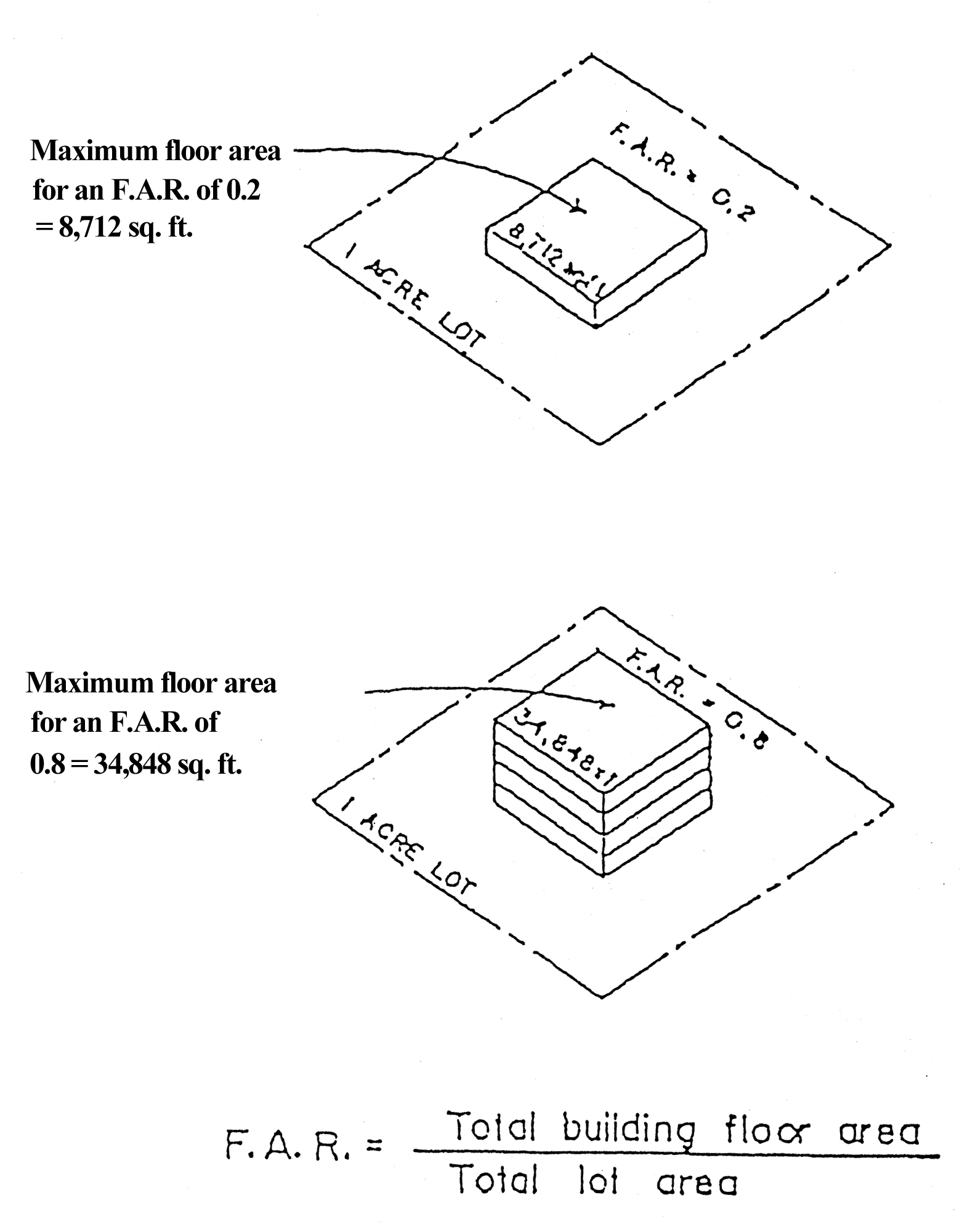
Total Building Floor Area
Sec. 42-406. - Generally.
This division defines and prescribes the specific uses allowed within each land use district described in the comprehensive plan and section 42-382.
(LDC § 2.02.01(A))
Sec. 42-407. - Accessory structures and uses.
Accessory structures and uses are allowed in any land use district in connection with any principal lawfully existing use, subject to the requirements of section 42-432. All accessory structures or uses shall meet the requirements for the land use district in which the structure or use is located, as provided in section 42-409.
(LDC § 2.02.01(B))
Sec. 42-408. - Use groups.
Whenever a use is not specifically mentioned in this section, the planning director shall make a determination as to whether the proposed use is of the same general type as the uses specifically allowed in the land use district. In making such a determination, the planning director shall be guided by the goals, objectives and policies of the county comprehensive plan and this section, specifically including the intent to protect private property rights to the maximum extent possible consistent with F.S. ch. 163. Certain uses are allowed only if special supplemental site design standards are met. These supplemental standards are contained in article VIII of this chapter. For example, recreational vehicle parks are listed as a commercial use in this section. Because of their special characteristics, however, recreational vehicle parks are controlled by standards in addition to the minimum requirements for all commercial uses (see section 42-799). This provides for uses that have traditionally been handled as conditional uses or special exceptions. The advantage of the supplemental standard approach used here is that as long as the supplemental standards are adhered to, no additional administrative or governing body action is required.
(1)
Residential.
a.
The category of residential uses includes single-family dwellings, accessory apartments, multifamily dwellings in a variety of housing types, foster care facilities, group homes, modular and manufactured housing, mobile homes, but specifically excludes recreational vehicles as recreational vehicle parks are considered commercial uses.
b.
While districts may be designated for residential use, it does not follow that any housing type (single-family, apartment, townhouse, etc.) is allowed. Certain areas are limited to one or more housing types in order to preserve the established character of the area. Refer to the table of density and dwelling unit types in section 42-383 for regulations on housing types.
(2)
Institutional. This type of use includes public or private educational facilities, public or private preschool and day care facilities, churches, church cemeteries, other noncommercial cemeteries, residential care facilities, halfway housing, nursing home facilities and all other similar institutional uses.
(3)
Outdoor recreational. These uses include areas for outdoor recreational activities such as picnicking, jogging, cycling, arboretums, hiking, golf courses, playgrounds, ball fields, outdoor ball courts, stables, outdoor swimming pools and water-related or water-dependent uses such as boat ramps, fishing docks and piers, and all similar outdoor recreational uses, whether public or private. Specifically excluded from this group of uses are firing ranges, marinas, race tracks and similar recreational or quasi-recreational activities inconsistent with the allowable outdoor recreational uses described in this subsection.
(4)
Professional services and offices. This group of uses includes business and professional offices, medical offices or clinics, governmental offices, financial institutions without drive-up facilities and personal service businesses where the service is performed on an individual-to-individual basis as opposed to services which are performed on objects or personal property. Examples of personal service businesses are barbershops, beauty shops or photography studios. This group of uses may include a dispatching/communications/office center of the distribution of goods, but specifically excludes the warehousing or actual distribution of goods.
(5)
Neighborhood commercial. Uses in this category are limited to small retail, service and commercial recreational activities and similar uses located to serve within convenient traveling distances from one or several neighborhoods. Such uses do not include major or large scale commercial or service establishments, but may include neighborhood serving professional service and office uses. Compatibility with the neighborhood to be served is critical. Examples of neighborhood commercial uses include those professional and office uses listed in subsection (4) of this section with a neighborhood market orientation, as well as the following specific uses, and all substantially similar types of uses:
a.
Neighborhood convenience stores.
b.
Small limited item shops and stores restricted to retail sales of convenience items and services including barber, beauty care and other personal services.
c.
Small scale drug stores.
d.
Laundry and dry cleaning services.
e.
Florist shops and other specialty shops.
f.
Small scale tourist-oriented activities.
(6)
General commercial. A wide variety of general commercial, commercial recreational, entertainment and related activities is included in this group of uses. Examples of general commercial uses include professional and office uses listed in subsection (4) of this section, as well as the following specific uses, and all substantially similar types of uses:
a.
Arcades, billiards/pool parlors, bowling alleys, indoor recreation centers and gymnasiums/spas/health clubs.
b.
Community centers and fraternal lodges.
c.
Commercial or trade schools such as dance and martial arts studios.
d.
Department stores and other retail sales stores, such as shoe stores, clothing stores, pharmacies, florists and book stores.
e.
Funeral homes, commercial cemeteries and mortuaries.
f.
Farm and garden supply, building supply and vehicle parts and accessories, but specifically excluding vehicle sales/service/repair.
g.
Grocery stores, supermarkets, excluding convenience stores, and specialty food stores such as meat markets and bakeries.
h.
Hospitals.
i.
Hotels and motels.
j.
Service businesses such as blueprint, printing, catering, tailoring, travel agencies, upholstery shops, laundries/dry cleaners and light mechanical repair stores such as camera, TV or bicycle repair shops.
k.
Restaurants (standard sit-down and high-turnover sit-down, but excluding all restaurants with drive-up facilities), including open air cafes.
l.
Shopping centers, but not regional malls or centers.
m.
Theaters and auditoriums.
n.
Marinas.
o.
Plant nurseries.
p.
Veterinary offices and animal hospitals, provided the facility has no outside kennels.
(7)
High intensity commercial. The uses in this group include those activities which require outdoor storage, have higher trip generations than general commercial uses set forth in subsection (6) of this section, or have the potential for greater nuisance to adjacent properties due to noise, light and glare or typical hours of operation. This group of uses includes the following list of specific uses and all substantially similar activities based upon similarity of characteristics:
a.
Vehicle sales, rental, service and repair, including truck stops, body shops, road services, car wash facilities and the sales, rental, repair and service of new or used automobiles, boats, buses, farm equipment, motorcycles, trucks, recreational vehicles and mobile homes.
b.
Gasoline sales and service, combination gasoline sales and food marts and similar facilities.
c.
Recreational vehicle and travel trailer parks.
d.
Taverns, bars, lounges, nightclubs and dancehalls.
e.
Financial institutions with drive-up facilities.
f.
Restaurants with drive-up facilities.
g.
Outdoor arenas, rodeo grounds, livestock auction facilities, race tracks (auto, dog, go-kart, horse, motorcycle, shooting and firing ranges) and similar activities.
h.
Veterinary offices and animal hospitals with outside kennels.
i.
Storage yards for equipment, machinery and supplies for building and trade contractors and garbage haulers.
j.
Flea markets or similar outdoor or indoor/outdoor sales complexes.
(8)
Aviation-related commercial. Permissible uses in this land use category are limited to those uses which are characterized by the aviation industry or provide necessary services to aviation-related uses. Government uses, other public uses and essential services such as utilities and communications are also permissible. All uses shall be subject to Federal Aviation Administration restrictions. Such otherwise permissible uses shall include, but are not necessarily limited to:
a.
Airport terminals.
b.
Offices for aviation-related businesses.
c.
Rental car agencies and fleet services.
d.
Fixed base operators.
e.
Fire/rescue services and operations.
f.
Tourist and travel-related retail services.
g.
Restaurants, lounges and snack bars.
h.
Fuel service.
i.
Aviation hangars and maintenance facilities.
j.
Vending services.
k.
Security services and offices.
l.
Ground transportation-related uses and services.
m.
Hotels or motels.
n.
Automated teller machines.
o.
Aviation schools.
p.
Delivery services.
(9)
Public service/utility. This group of activities includes those uses which provide essential or important public services, and which may have characteristics of outdoor storage, or potential nuisance to adjacent properties due to noise, light and glare or appearance. Government offices or government agency offices specifically are not included in this group of uses. Uses include the following, and substantially similar activities, based upon similarity of characteristics:
a.
Emergency service activities such as buildings, garages, parking and/or dispatch centers of ambulances, fire, police and rescue.
b.
Broadcasting and transmission stations/towers, except in mixed use urban development, mixed use rural residential and agricultural/rural residential districts.
c.
Utility facility such as water plants, wastewater treatment plants, railroad right-of-way and tracks, electricity substations and power lines.
d.
Maintenance facilities and storage yards for schools, governmental agencies and telephone and cable companies.
e.
LP gas storage and/or distribution facilities for up to 2,000 gallons. This shall not be construed to prevent retail sales of LP gas in canisters or similar prefilled containers.
f.
Airports, air fields and truck or bus terminals.
A natural gas transmission pipeline or similar pipeline is industrial in use unless it provides public utilities to existing or future land use, as authorized by other plan elements.
(10)
Agricultural. Agricultural uses include crop lands, pastures, forestry, aquaculture, feed lots, orchards and groves and any use qualifying for agricultural classification and assessment under F.S. § 193.461, and buildings which are an accessory to these agricultural uses. This category of uses does not include processing or distribution plants for agricultural products and supplies. Residential uses are permissible (refer to section 42-383).
(11)
Small scale industrial. Uses in this category include those wholesale and retail businesses for manufacturing, processing, storing or distributing goods. General commercial uses including commercial uses related to automotive and heavy equipment sales and repair are also permissible, but this category shall not be deemed commercial in character. Permissible uses shall include:
a.
Wholesaling, warehousing, storage or distribution establishments and similar uses.
b.
Light manufacturing, processing, including food processing, but not slaughterhouses, packaging or fabricating in completely enclosed buildings.
c.
Printing, lithographing, publishing or similar establishments.
d.
Outdoor storage yards and lots provided that this provision shall not permit wrecking yards, including automobile wrecking yards, junkyards or yards used in whole or in part for scrap or salvage operations or for processing, storage, display or sale of any scrap, salvage or secondhand automotive parts.
e.
Retail and retail establishments for sale and repair of new and used automobiles, motorcycles, trucks and tractors, mobile homes, boats, automotive vehicle parts and accessories, heavy machinery and equipment, farm supplies, lumber and building supplies, monuments, home furnishings and appliances, office equipment or furniture, hardware, dairy supplies, feed, fertilizer and similar uses.
f.
Service establishments catering to commerce and industry.
g.
Vocational, technical, trade or industrial schools and similar uses.
h.
Medical clinics.
i.
Miscellaneous uses such as express offices, telephone exchanges, commercial parking lots and parking garages, motor bus or truck, or other transportation terminals.
j.
Radio and television transmitters.
k.
Building trades contractors, but not manufacturing of concrete or asphalt.
l.
Railroad sidings, yards, areas for car storage and switching facilities.
m.
Off-site advertising signs.
n.
Commercial recreational facilities.
o.
Business, professional and governmental offices.
p.
Urgent care centers.
(12)
Industrial. This type of use includes those wholesale and retail businesses for manufacturing, processing, storing or distributing goods. Included in this category are uses which require primarily outdoor storage or the industrial activity itself if conducted outdoors. Such uses include, for example, LP gas storage and/or distribution exceeding 2,000 gallons, junkyards or salvage yards, recycling centers, landfills, hazardous or medical waste collection and handling centers and borrow pits, but not excavation which requires blasting. A natural gas pipeline or similar pipelines are industrial in use unless they provide public utilities to existing or future land uses, as are authorized by other plan elements.
(13)
Mining. The types of uses in this group include surface mining, rock quarries, strip mining and any extraction activities. Buildings and businesses for the refinement, processing, packaging and transportation of extracted materials are included in this group of uses.
(14)
Conservation. Uses permitted in this category include state and national parks, wildlife management areas, other publicly-owned natural reservations, existing and future silviculture subject to department of forestry best management practices, or other management practices consistent with conservation use, residential use not to exceed one unit per 40 acres, passive recreational uses, public boat ramps and similar uses.
(LDC §§ 2.02.01(C), 2.02.02; Ord. No. 2001-3, § 2(G), 3-20-2001; Ord. No. 2006-16, § 1, 10-17-2006)
Sec. 42-409. - Allowable uses within each district.
(a)
Agricultural 1. The following uses are allowed in the agricultural 1 land use district. All other uses are prohibited.
(1)
Residential.
(2)
Outdoor recreational.
(3)
Public service/utility.
(4)
Agricultural, including, but not limited to, crop production, pasture lands, silviculture, orchards and groves, and forestry.
(5)
Mining.
(6)
Conservation.
(b)
Agricultural 2. The following uses are allowed in the agricultural 2 land use district. All other uses allowed in land classifications of lower intensity shall also be allowed.
(1)
Residential.
(2)
Outdoor recreational.
(3)
Public service/utility.
(4)
Agricultural, including, but not limited to, crop lands, pasture lands, silviculture, orchards and groves, and forestry.
(5)
Neighborhood commercial (small scale convenience retail and service establishments, each not to exceed 5,000 square feet in floor space).
(6)
Mining.
(7)
Conservation.
(c)
Agricultural/rural residential. The following uses are allowed in the agricultural/rural residential land use district. All other uses allowed in land classifications of lower intensity shall also be allowed, except mining.
(1)
Residential.
(2)
Outdoor recreational.
(3)
Public service/utility.
(4)
Agricultural, including, but not limited to, crop lands, pasture lands, silviculture, orchards and groves, or forestry.
(5)
Neighborhood commercial (small scale convenience retail and service establishments, each not to exceed 5,000 square feet in floor space).
(6)
Conservation.
(d)
Mixed use rural residential. The following uses are allowed in the mixed use rural residential land use district. All other uses allowed in land classifications of lower intensity shall also be allowed, except mining.
(1)
Residential.
(2)
Outdoor recreational.
(3)
Public service/utility.
(4)
General commercial (each establishment not exceeding 10,000 square feet of floor space).
(5)
Neighborhood commercial (small scale retail and service establishments, each not to exceed 5,000 square feet in floor space).
(6)
Professional office and service.
(7)
Small scale industrial.
(8)
Agricultural, including, but not limited to, crop lands, pasture lands, silviculture, orchards and groves, or forestry.
(9)
Conservation.
(e)
Mixed use urban development. The following uses are allowed in the mixed use urban development land use district. All other uses allowed in land classifications of lower intensity shall also be allowed, except mining.
(1)
Residential.
(2)
Outdoor recreational.
(3)
Public service/utility.
(4)
High intensity commercial.
(5)
General commercial.
(6)
Neighborhood commercial (small scale retail and service establishments each not to exceed 5,000 square feet in floor space).
(7)
Professional service and office.
(8)
Small scale industrial.
(f)
Industrial. The following uses are allowed in the industrial land use district. All other uses are prohibited, except that all other uses allowed in land classifications of lower intensity shall be allowed prior to development of the site for industrial use.
(1)
Public service/utility.
(2)
Industrial.
(3)
Small scale industrial.
(4)
High intensity commercial, consistent with the industrial character of the area.
(5)
General commercial, consistent with the industrial character of the area.
(6)
Aviation-related commercial.
(7)
Residential (accessory use as part of an approved site plan where such dwelling unit is located on the same lot or parcel).
(g)
Aviation-related commercial. The following uses are allowed in the aviation-related commercial land use district. All other uses are prohibited.
(1)
Aviation-related commercial.
(2)
Aviation-related professional service and office.
(3)
Residential, limited to upper floors above ground floor commercial and office uses for occupancy by owner, lessee, custodian or watchman, including immediate family.
(4)
Public service/utility.
(h)
Water-oriented commercial. The following uses are allowed in the water-oriented commercial land use district. All other uses are prohibited.
(1)
Marinas.
(2)
Hotels and motels.
(3)
Restaurants.
(4)
Recreational vehicle parks.
(5)
Boat ramps.
(6)
Bait and tackle shops.
(7)
Campgrounds.
(8)
Fish camps.
(9)
Marine-related specialty shops.
(10)
Accessory residential dwellings occupied by the owner, lessee, custodian or watchman, including immediate family.
(11)
Public service/utility.
(i)
Public. The following uses are allowed in the public land use district. All other uses are prohibited.
(1)
Institutional.
(2)
Recreational.
(3)
Public service/utility.
(j)
Conservation. The following uses are allowed in the conservation land use district. All other uses are prohibited.
(1)
Residential.
(2)
Outdoor recreational (passive).
(3)
Public service/utility.
(4)
Agricultural (forestry or silviculture and native range land only subject to best management practices and consistent with the conservation purpose).
(LDC § 2.02.03)
Sec. 42-431. - Purpose.
It is the purpose of this division to provide standards for the installation, configuration and use of accessory structures in the mixed use urban development land use district to ensure that they are not harmful either aesthetically or physically to residents and surrounding areas. Accessory structure permits are not required in other land use districts.
(LDC § 8.00.00)
Sec. 42-432. - General standards and requirements.
Any number of different accessory structures in the mixed use urban development land use district may be located on a parcel, provided that the following requirements are met:
(1)
No person shall construct an accessory structure within any land use district without first having obtained a permit for such construction from the county building official.
(2)
All accessory structures shall comply with standards pertaining to the principal use, unless exempted or superseded elsewhere in this chapter.
(3)
Accessory structures shall not be located in a required buffer, landscape area or minimum building setback area unless exempted or superseded elsewhere in this chapter.
(4)
Accessory structures shall be included in all calculations of impervious surface water and stormwater runoff.
(5)
Accessory structures shall be shown on a development plan.
(LDC § 8.01.01; Ord. No. 2001-3, § 2(D), 3-20-2001)
Sec. 42-433. - Storage buildings, private garages, carports, greenhouses, gazebos.
In the mixed use urban development land use district the following shall apply:
(1)
No accessory buildings used for industrial storage of hazardous, incendiary, noxious or pernicious materials shall be located closer than 100 feet from any property line.
(2)
Storage buildings, gazebos, greenhouses, utility buildings and the like shall be permitted only in compliance with standards for distance between buildings and setbacks, if any, from property lines.
(3)
Storage and all other buildings regulated by this section shall be permitted only in side and rear yards, and shall not encroach into any required building setback.
(4)
Storage and other buildings regulated by this section shall be included in calculations for impervious surface, floor area ratio or any other site design requirements applying to the principal use of the lot.
(5)
Vehicles and motor homes shall not be used for any facility authorized for an accessory use.
(LDC § 8.01.02)
Sec. 42-434. - Swimming pools, hot tubs, screened pool enclosures and similar structures.
In the mixed use urban development land use district the following shall apply:
(1)
Swimming pools shall be permitted in rear and side yards and shall not encroach into any required building setback except as otherwise set forth in this section.
(2)
Screen enclosures shall be considered a part of the principal structure and shall comply with standards for minimum distance between buildings, yard requirements and other building location requirements of this chapter, except that a swimming pool and its screened enclosure may be constructed to within eight feet of the rear property line.
(3)
Swimming pools constructed on corner lots shall maintain rear yard setback (see subsection (2) of this section) standards along property boundaries not associated with street rights-of-way.
(4)
No overhead electric power lines shall pass over any pool, nor shall any power line be nearer than ten feet horizontally from the pool's water edge.
(5)
Excavations for pools to be installed for existing dwellings shall not exceed a 2:1 slope from the foundation of the house, unless a trench wall is provided and a shoring-up plan is submitted and approved by the building official. A steeper slope may be permitted upon certification of adequacy by a state-licensed professional engineer.
(LDC § 8.01.03)
Sec. 42-435. - Fences.
In the mixed use urban development land use district the following shall apply:
(1)
All fences shall comply with the Standard Building Code. Wooden posts must be pressure-treated for strength and endurance and be resistant to decay and termite infestation.
(2)
Fences may be located in side and rear yard setback areas and shall not exceed the height of six feet, except as provided in subsection (4) of this section, exclusive of decorative supporting posts which may extend no more than nine inches above the maximum six-foot height of the fence.
(3)
In areas where the property faces two roadways or is located in any other area construed to be a corner lot, no fence shall be constructed which obstructs the view in the vision triangle. (See section 42-888(c).)
(4)
No fence shall be constructed or installed in such a manner as to adversely affect drainage on or adjacent to the site. To provide adequate drainage or to prevent the obstruction of drainage on or adjacent to the site a fence or fence wall may be constructed so as to allow the bottom of the fence or fence wall to begin no more than two inches above the ground without being in violation of the maximum height restrictions set forth in subsection (2) of this section.
(5)
Electrically charged and barbed wire fences are prohibited in residential areas.
(LDC § 8.01.04)
Sec. 42-436. - Docks and piers.
In the mixed use urban development land use district the following shall apply:
(1)
All docks and piers shall comply with the Standard Building Code and shall have a permit from the county and/or the Suwannee River Water Management District, department of natural resources, department of environmental regulation and the Corps of Engineers, whichever is applicable.
(2)
Live aboard facilities shall not be permitted.
(3)
All docks must be consistent in use with the adjacent upland riparian property.
(4)
A hurricane plan for any commercial dock shall be established by the applicant.
(5)
No dock, boardwalk or pier shall be permitted to be constructed parallel to the shoreline or seawall within the littoral zone between the mean high water line and mean low water line.
(6)
Docks and piers may be located in side or rear yard setbacks and buffer areas.
(7)
No boat dock, covered boat dock or pier, together with the watercraft being moored at the structure, shall project into a manmade waterway more than 20 percent of the width of the waterway or 30 feet, whichever is less, including pilings.
(8)
The deck of the dock, pier, boat lift or covered dock, including the platform and any walkways attached to the dock, pier, boat lift or covered dock which extend over the water, shall not exceed 400 square feet in size. When a covered boat dock or covered boat lift is constructed, the area under roof shall not exceed 500 square feet, and in no case shall the area defined by the deck, together with the roofed area, exceed 600 square feet.
(9)
A boat dock, covered boat dock or pier, including pilings, shall extend no closer than 7.5 feet to the side property line, as projected in a straight line into the waterway.
(LDC § 8.01.05)
Sec. 42-437. - Seawalls, riprap.
In the mixed use urban development land use district the following shall apply:
(1)
All seawalls shall have a permit from the county and/or the Suwannee River Water Management District, state department of environmental regulation, department of natural resources and the Corps of Engineers, whichever is applicable.
(2)
Replacement seawalls can be placed no further than one foot in front of the seaward face of an existing seawall as a repair or replacement of the existing seawall.
(3)
Seawalls shall not be placed upon a shoreline which generally supports wetland vegetation.
(4)
Riprap shall be encouraged instead of seawalls, where possible, as a protection to existing upland properties.
(5)
The use of seawalls or riprap to increase the usable upland area of properties shall not be allowed.
(6)
Seawalls and riprap may be located in side and rear yard setbacks and buffer areas.
(7)
Stabilization by the use of vegetation shall be required in lieu of shoreline hardening wherever possible.
(LDC § 8.01.06)
Sec. 42-438. - Hard court recreational facilities.
In the mixed use urban development land use district the following shall apply:
(1)
Hard court recreational facilities shall be permitted only in side and rear yards and shall not encroach into required building setbacks.
(2)
Backstops, side stops and enclosures for hard court recreational facilities shall not exceed 14 feet in height.
(LDC § 8.01.07)
Sec. 42-461. - Definitions.
The following words, terms and phrases, when used in this division, shall have the meanings ascribed to them in this section, except where the context clearly indicates a different meaning:
Sign means any writing, pictorial presentation, number, illustration or decoration, flag, banner or pennant, or other device which is used to announce, direct attention to, identify, advertise or otherwise make anything known. The term "sign" shall not be deemed to include the term "building" or "landscaping," or any architectural embellishment of a building not intended to communicate information.
Sign, animated, means a sign with externally moving parts or messages, or so operating as to give a viewer the illusion of moving parts or messages.
Sign, attached, means a sign painted on the exterior face of a building or attached to a building. Attached signs, including canopy signs, marquee signs, wall signs, roof signs and projecting or hanging signs supported or attached to a canopy, awning, marquee or building.
Sign, flashing, means a sign designed to attract attention by the inclusion of a flashing, changing, revolving or flickering light source or a change of light intensity.
Sign, freestanding, means a sign that is supported by one or more columns, upright poles or braces extended from the ground or from an object on the ground, or that is erected on the ground, where not part of the sign is attached to any part of the building. Free standing signs include ground signs, pole signs and portable signs.
Sign, identification, means a sign which depicts the name and/or address of a building or establishment on the premises where the sign is located as a means of identifying the building or establishment.
Sign, nonflashing, means a sign which does not have a flashing, changing, revolving or flickering light source or which does not change light intensity.
Sign, off-site, means a sign other than an on-site sign.
Sign, on-site, means a sign relating in its subject matter to the premises on which it is located or to products, accommodations, services or activities on the premises. On-site signs do not include signs erected by the outdoor advertising industry in the conduct of outdoor advertising business.
Sign, pole, means a permanent ground sign supported by a single metallic pole attached to which is a sign face the bottom of which is at least 20 feet above the ground and which is at least 200 square feet in size.
Sign, surface area, means the entire area within the periphery of a regular geometric form, or combinations of regular geometric forms, comprising all of the display area of the sign, and including all of the elements of the matter displayed, but not including blank masking, frames or structural elements of the sign and bearing no advertising matter. In the case of double-face signs, each sign face shall be measured as surface area and the combined surface area of both faces shall not exceed the maximum permitted for the building or use.
(LDC § 9.03.00; Ord. No. 2006-15, § 1, 10-17-2006)
Cross reference— Definitions generally, § 1-2.
Sec. 42-462. - Scope.
The provisions of this division shall govern the size, location and character of signs which may be permitted as a principal or accessory use. No signs shall be permitted in any location except in conformity with this division.
(LDC § 9.00.00)
Sec. 42-463. - Intent.
The provisions of this division are intended to provide for the regulation of types, sizes and locations of signs in relation to the various uses and activities on premises, and to provide for certain types and locations of off-site signs.
(LDC § 9.01.00)
Sec. 42-464. - Applicability of other codes or regulatory requirements.
Signs or other advertising structures shall be constructed and maintained in accordance with the building and electrical codes of the county, and all other applicable ordinances and regulations of the county, as well as other state and federal rules and regulations regarding signs.
(LDC § 9.02.00)
Sec. 42-465. - Permit; exemptions.
(a)
Within areas subject to this chapter, it shall be unlawful for any person to erect, maintain or replace any off-site sign not specifically exempted by this chapter without first securing a permit to do so.
(b)
Except as otherwise provided in this section, the following signs may be erected without a permit, subject, however, to all remaining requirements of this chapter. Signs set forth in subsection (b)(3) of this section may be located on or may overhang or infringe upon the right-of-way of streets, roads or public ways.
(1)
Signs not exceeding one square foot in area and bearing only property numbers, mailbox numbers, names of occupants of the premises or other identification of the premises not having commercial connotations.
(2)
Flags and insignia of any government except when displayed in connection with commercial promotion.
(3)
Traffic or other municipal, county, state or federal signs, legal notices, railroad crossing signs, danger signs and such temporary, emergency or non-advertising signs as may be approved by the board of county commissioners. Small portable signs are allowed on the non-mowed portion of the county right-of-ways provided that the sign has relevance to the adjoining property.
(4)
Integral decorative or architectural features of buildings, except moving parts, flashing or moving lights.
(5)
Signs directing and guiding traffic and parking on private property, but bearing no advertising matter.
(6)
Signs within buildings.
(7)
Occupation signs denoting only the name, street number and business of an occupant, which do not exceed two square feet in surface area.
(8)
All signs which require a state or federal permit.
(LDC §§ 9.04.00, 9.05.00; Ord. No. 2006-15, § 4, 10-17-2006)
Sec. 42-466. - Prohibited signs.
It shall be unlawful to erect or maintain:
(1)
Any sign which constitutes a traffic hazard or a detriment to traffic safety by reason of its size, location, movement, content, coloring or method of illumination, or by obstructing the vision of drivers, or by distracting from the visibility of any traffic control device by diverting or tending to divert the attention of moving vehicles from the traffic movement on streets, roads or access facilities; nor shall any sign be erected in such a manner as to obstruct the vision of pedestrians. The use of flashing or revolving red, green, blue or amber lights is prohibited in any sign as constituting a hazard to traffic. Any sign which by glare or method of illumination constitutes a hazard to traffic is prohibited. No sign may use the words "stop," "look," "drive-in," "danger," or any other word, phrase, symbol or character in such a manner as to interfere with, mislead or confuse traffic.
(2)
Signs which are declared to be obscene, indecent or immoral by county ordinance or law.
(3)
Signs erected on the right-of-way of any street, road or public way, except as specifically provided by this chapter.
(4)
Signs erected on public property, other than signs erected or approved by a public authority for public purposes.
(5)
Signs so located as to prevent free ingress or egress from any door, window or fire escape.
(6)
Illuminated signs which result in glare or reflection of light on residential property in the surrounding area.
(7)
Canopy, marquee, projecting or hanging signs with less than a nine-foot minimum clearance between the bottom of the sign and the ground surface.
(LDC § 9.03.00; Ord. No. 2006-15, § 2, 10-17-2006)
Sec. 42-467. - On-site signs.
Unless otherwise specified in this chapter, the following regulations shall govern on-site signs:
(1)
May be erected in any zone district.
(2)
May be located in the required front yard; provided, however, that any such sign shall not obstruct visibility at intersections and curb breaks.
(LDC § 9.06.00)
Sec. 42-468. - Off-site signs.
Unless otherwise specified in this chapter, the following regulations shall govern off-site signs:
(1)
Off-site signs are prohibited, except where specifically permitted by this chapter.
(2)
Off-site signs may be erected in the required front yard, provided they:
a.
Shall not be nearer the street right-of-way line than 12 feet.
b.
Shall not be erected so as to obstruct visibility at intersections and curb breaks.
c.
Shall not exceed 32 square feet in size.
d.
Shall be limited to one (1) sign per parcel or lot.
(3)
Off-site signs may not be erected within 100 feet of any church, school, cemetery, public park, public reservation, public playground, state or national forest or railroad intersection.
(LDC § 9.07.00; Ord. No. 2006-15, § 3, 10-17-2006)

