
Tequesta City Zoning Code
ARTICLE X
- OFF-STREET AND ON-STREET PARKING AND LOADING REGULATIONS8
Cross reference— Motor vehicles and traffic, ch. 46.
Sec. 78-691.- Minimum standards.
(a)
For the purpose of this chapter, an existing off-street parking space shall consist of a parking space having minimum dimensions of nine feet in width by 18 feet in length for the parking of each motor vehicle, excluding access drives or aisles thereto, sidewalks, and interior pedestrian walkways.
(b)
However, for new development occurring after the effective date of the ordinance adopting this code provision, an off-street parking space shall consist of a parking space marked with double striping and having minimum dimensions of nine feet in width when measured from between the interior of the parking space lines and ten feet in width when measured from the center of the double striping area, by 18 feet in length for the parking of each motor vehicle, excluding access drives or aisles thereto, sidewalks, and interior pedestrian walkways.
(c)
New development, for purposes of this section, shall not include an existing development that re-configures parking spaces due to accessibility requirements, or that performs parking lot maintenance without otherwise re-configuring parking spaces. An existing development that expands and adds additional, new parking spaces shall be required to make the additional, new parking spaces comply with (b); however, existing parking spaces need only comply with (a).
Off-Street Parking Schematic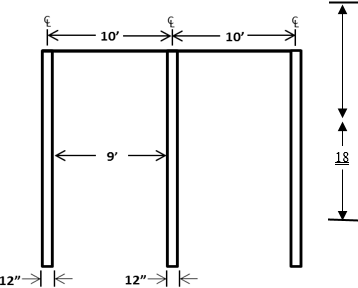
(d)
Overhang areas. Vehicle parking areas designed to permit vehicles to overhang curbing may not be counted as part of a sidewalk or interior walkway. Such overhang shall be in addition to the required dimensions of sidewalks and interior walkways.
Overhang Schematic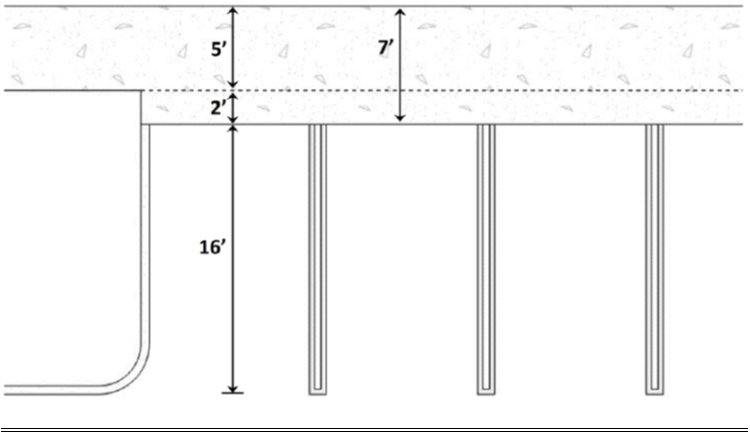
(e)
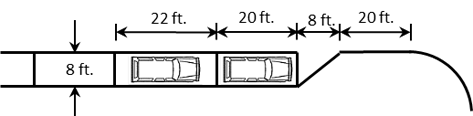
An on-street parking space shall consist of a curbside parking space having minimum dimensions as shown in the schematic below.
On-Street Parking Schematic
(f)
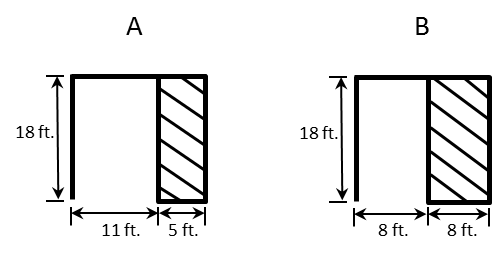
Accessible parking spaces for passenger cars, as required by the American with Disabilities Act (ADA), shall be a minimum of 12 feet wide by 18 feet in length and a five-foot-wide access aisle. The access aisle must be part of an accessible route to the building or facility entrance. Two accessible spaces may share a common access aisle. The access aisle shall be striped diagonally to designate it as a no-parking zone. All ADA accessible spaces shall provide required signage and markings. All new developments or major redevelopment shall provide the required number of ADA parking spaces. When there is a minor redevelopment that includes restriping of the parking lot, compliance with the required number of ADA parking spaces shall be met, where, in the determination of the building official, it is feasible to do so.
Van Accessible Parking Schematic
(g)
Minimum width of an access drive shall be ten feet for R-1 and R-1A districts. For all other districts, the minimum width of each aisle designed and intended for the maneuvering of a motor vehicle into a parking space shall be determined by the angle of parking as shown in the parking lot dimension table of this division. The parking plan shall be so arranged that each motor vehicle may be placed and removed from the parking space assigned thereto and taken to and from the property without necessity of moving any other motor vehicle to complete the maneuver. Each lot, parcel, or property subject to a development or redevelopment proposal shall be allowed to design its off-street parking space areas utilizing a maximum of 25 percent of the minimum required parking spaces to be identified as "compact spaces" with minimum dimensions of eight feet in width by 16 feet in length, subject to the review and approval of the village consulting engineers, the village development review staff and the village council.
(Code 1977, app. A, § VIII(A)(1); Ord. No. 38-13, § 1, 3-13-2014; Ord. No. 02-22, § 2, 3-10-2022; Ord. No. 11-24, § 2, 12-12-2024)
Sec. 78-692. - Location of parking areas in required yards.
Required yards and setbacks may be used for off-street parking, provided that access drives or aisles and turning spaces shall be located within the lot lines. In computing off-street requirements, street or sidewalk areas shall not be used for off-street parking purposes. However, all such parking spaces shall be paved with asphalt, concrete, paver block or similar impervious surface. Parking in grass, or on gravel, or other non-living landscape material in any zoning district is prohibited. Parking areas for boats, recreational vehicles and similar vehicles are regulated in chapter 46, article III.
(Code 1977, app. A, § VIII(A)(2); Ord. No. 38-13, § 1, 3-13-2014)
Sec. 78-693. - Paving of parking spaces; obstructions in parking area.
Where parking space is provided in open areas adjacent to or beneath any building, structure or portion thereof, such parking spaces shall be paved with asphalt, concrete (pervious or impervious), paver block (pervious or impervious) or similar surface. Parking in grass, or on gravel, or other non-living landscape material in any zoning district is prohibited. It shall be unlawful for the owners or occupants of such building or structure to place on such parking area any furniture or other property that will obstruct or hinder the free use of such parking area.
(Code 1977, app. A, § VIII(A)(1)(3); Ord. No. 38-13, § 1, 3-13-2014; Ord. No. 07-22, § 5, 4-14-2022)
Sec. 78-694. - Parking spaces for the handicapped.
For other than single-family uses, duplexes or two-family dwellings, parking spaces for the handicapped shall be provided in all required parking lots, garages or other similar facilities, as required by applicable state, county and municipal handicapped parking regulations.
(Code 1977, app. A, § VIII(A)(4); Ord. No. 38-13, § 1, 3-13-2014)
Sec. 78-695. - Location of off-street parking facilities.
Except for off-site parking as regulated by section 78-707 below, all off-street parking facilities shall be located on the same site as or contiguous to the use for which the parking is provided. Any contiguous site must be maintained under unity of title to the site on which the primary use is located.
(Code 1977, app. A, § VIII(A)(5); Ord. No. 38-13, § 1, 3-13-2014; Ord. No. 27-19, § 1, 11-4-2019)
Sec. 78-696. - Off-street loading spaces.
(a)
In any district, in connection with every building or building group or part thereof having a gross floor area of 10,000 square feet or more which is to be occupied by commercial uses or other uses similarly requiring the receipt or distribution by vehicles of materials or merchandise, there shall be provided and maintained, on the same lot with such building, off-street loading space or unloading space as follows:
(b)
The loading or unloading spaces required in each instance shall be not less than 12 feet in width, 40 feet in length and 14 feet in vertical clearance, and may occupy all or any part of any required yard except for a required front yard. The loading or unloading spaces shall be screened from the street or public way and shall be exclusive of all driveways, aisles, or drives provided for other off-street parking areas.
(c)
Any request for a variance from the terms of this section shall require an applicant to submit a "loading demand statement" from a licensed engineer, establishing the need for less loading space that required by this section.
(d)
The village council may at its discretion require additional loading spaces in multi-family residential developments during the site plan review process when it determines, based on staff analysis, that a site does not have sufficient area for moving trucks, delivery vehicles, and service vehicles.
(e)
The village council may at its discretion require additional loading spaces in mixed- use projects when it determines, based on staff analysis that a site does not have a sufficient number of loading spaces to accommodate the individual uses within the project.
(Code 1977, app. A, § VIII(A)(6); Ord. No. 38-13, § 1, 3-13-2014; Ord. No. 11-24, § 2, 12-12-2024)
Sec. 78-697. - Reserved parking spaces.
Designated parking and permanent signs that indicate that the parking is designated for short term use and subject to towing is permitted pursuant to the following regulations:
(a)
No more than five percent (5%) of the total number of required off-street parking spaces for any site may be designated for short term use.
(b)
Parking spaces shall be so designated on an approved site plan for review and approval. The site plan shall clearly depict the number and location of such designated parking spaces. For approved site plans on file with the Village as of the effective date of this ordinance (August 11, 2016), designation of parking spaces for short term use and associated signs may be approved administratively prior to December 31, 2016. Thereafter, any site plan modification shall comply with the requirements of Chapter 78, Article IX, Division 2 (Site Plan Review).
(c)
Sign copy shall be depicted on the site plan for review and approval. Signage for designated parking spaces shall not exceed 1.5 square feet of sign copy area. Copy may be placed on parking stops, or on separate signs erected in front of the subject parking space. Such signage may not include advertising content (e.g. signs shall say, for example, "15 minute parking" or "take out pick-up only"; signs shall not say, for example, "reserved parking for Village Dry Cleaner only").
(d)
In the event that the site exhibits a continued lack of adequate parking, the Village Manager may reduce or revoke the approval for designated parking spaces with notice to the property owner, upon recommendation from the Village Community Development Department. The Village may enforce the provisions of this section (e.g. placement and number of designated spaces, and signage) through the code compliance process; however, the Village will not enforce actual parking violations that may occur in any given parking space. Rather, parking enforcement will be the responsibility of the property owner.
(e)
This section shall not apply to those parking spaces designated to meet the requirements of state, county and municipal handicapped parking regulations.
(Code 1977, app. A, § VIII(A)(7); Ord. No. 38-13, § 1, 3-13-2014; Ord. No. 8-16, § 1, 8-11-2016)
Sec. 78-698. - On-street parking.
On-street parking may, upon review and approval by the village council, be allowed within all zoning districts within the village, and the minimum number of required parking spaces to be provided may include a combination of on-street and off-street spaces. When using on-street parking to meet a portion of the required parking for a proposed project, only those spaces that lie within the street frontage areas of the property proposed for development or redevelopment may be included in the total calculations for meeting the minimum required parking requirements. On-street parking can only be provided on those streets that utilize curb and gutter drainage systems in lieu of swale systems and where the total right-of-way width is sufficient to provide for approved paved roadway traffic lanes, on-street parking and curb and gutter drainage systems.
(Code 1977, app. A, § VIII(A)(8); Ord. No. 38-13, § 1, 3-13-2014)
Sec. 78-699. - Screening and landscaping of off-street parking areas.
All off-street parking areas shall be screened and landscaped in accordance with article IX, division 4 of this chapter.
(Code 1977, app. A, § VIII(B); Ord. No. 38-13, § 1, 3-13-2014)
Sec. 78-700. - Drainage and maintenance of off-street parking areas.
Off-street parking facilities shall be drained to prevent adverse impacts to abutting property and/or public streets and alleys and surfaced with asphalt, concrete, paver block, or similar surface in accordance with applicable village specifications. Off-street parking areas shall be maintained in a manner as to not create a traffic or pedestrian hazard or nuisance, as well as in a clean, orderly, and dust-free condition, at the expense of the owner or lessee, and not used for the sale, repair, dismantling, or servicing of any vehicles, equipment, materials, or supplies.
(Code 1977, app. A, § VIII(C); Ord. No. 38-13, § 1, 3-13-2014)
Sec. 78-701. - Marking, lighting and calming of parking areas.
(a)
Existing off -street parking spaces shall be marked by double parallel painted lines, curbs or other acceptable means to indicate individual spaces. Off-street parking spaces for new development as described in section 78-691 shall be marked by double parallel painted lines only. On-street parking spaces shall be marked by single painted lines or other acceptable means, or as may be required by the state department of transportation, to indicate individual spaces. Compact parking spaces shall be so identified by painting "compact vehicle only" on the surface of each space so designated. Handicap accessibility parking spaces shall be identified and marked per current federal, state and county requirements. Signs, markers and/or directional arrows shall be used as necessary to ensure the efficient and safe operation of the parking lot or area. Each off-street parking space shall be providedwith a permanently affixed car stop or continuous raised curb made of concrete or other acceptable material approved by the building official.
(b)
The internal traffic operation within the parking lot shall be established by the use of FDOT approved signs and directional arrows. Traffic calming devices such as speed humps, speed bumps or similar features shall be prohibited.
(c)
Parking facilities shall be provided with appropriate site lighting.
(Code 1977, app. A, § VIII(D); Ord. No. 38-13, § 1, 3-13-2014)
Sec. 78-702. - Reserved.
Editor's note— Ord. No. 38-13, § 1, adopted March 13, 2014, repealed § 78-702, which pertained to landscaping of parking areas. See Code Comparative Table for complete derivation.
Sec. 78-703. - Aisles and driveways.
(a)
Each parking stall shall have appropriate access to a street or alley and maneuvering and access aisle areas shall be sufficient to permit vehicles to enter and leave the parking area in a forward motion, with the exception of a single-family and duplex areas. Driveways shall be paved and meet the requirements in subsection (b) of this section unless very high volumes or other special circumstances warrant variation by the village consulting engineer.
(b)
Minimum width of an access drive shall be ten feet for R-1 and R-1A districts. For all other districts, access dimension guidelines are as follows:
(1)
Access Dimension:
*Measured along the right-of-way line at the inner limit of the curbed radius seep or between the radius and the near edge of a curbed island at least 50 square feet in area. The minimum width applies principally to one-way driveways.
(2)
Right turn radius:
**On side of driveway exposed to entry or exit by right-turning vehicles.
(Code 1977, app. A, § VIII(F); Ord. No. 38-13, § 1, 3-13-2014)
Sec. 78-704. - Control of access to streets.
(a)
Intent. It is the intent of this section to provide control of access to streets in order to facilitate safe and efficient movements of traffic while affording reasonable access to abutting properties.
(b)
Standards for access driveways. Access driveways shall be permitted by the village in accordance with the following guidelines:
(1)
Corner lots.
a.
Along local streets, access driveways to corner lots shall be located a minimum of 35 feet from the intersection of the projection of the right-of-way lines to the centerline of the driveway, except as provided in this section.
b.
Along arterial and collector streets, access driveways to corner lots shall be located a minimum of 50 feet from the intersection of the projection of the right-of-way lines to the centerline of the driveway, except as provided in this section.
(2)
Interior lots.
a.
Except in townhouse clusters and planned unit developments, access driveways along local streets at interior locations shall be permitted not closer than four feet from a side or rear property line to the edge of the driveway. There shall be no more than two driveways per lot.
b.
Along arterial and collector streets, the first access driveway for interior lots shall be located a minimum of 150 feet from the intersection of the projection of the right-of-way lines to the centerline of the driveway. Thereafter, access driveways shall be spaced a minimum of 100 feet apart.
(c)
Construction standards. Access driveways which intersect or abut rights-of-way under the control or jurisdiction of the village shall be constructed in accordance with the construction standards and details as available from the village building department and public works department.
(1)
Portion on the owner's property. The portion of an access driveway located on the owner's private property may be constructed in compliance with either of the following two methods:
a.
Minimum four-inch thick concrete slab with wire mesh or fiber on a stabilized subgrade; or
b.
Minimum six-inch thick lime rock or coquina base with a one-inch thick asphaltic concrete surface, all on a compacted base or pavers.
(2)
Portion in the adjacent public right-of-way. The portion of an access driveway located in the adjacent public right-of-way shall be constructed with a minimum six-inch thick concrete slab at 3,000 psi with wire mesh or fiber on stabilized subgrade. The use of pavers or asphalt to construct the portion of an access driveway located in the adjacent public right-of-way is prohibited.
(Code 1977, app. A, § VIII(G); Ord. No. 38-13, § 1, 3-13-2014; Ord. No. 03-20, § 1, 8-13-2020)
Sec. 78-705. - Required number of parking spaces.
Certain of these requirements may be in conflict with the special parking requirements set forth in the property development standards for use within the MU mixed-use district. Where a conflict exists, the property development standards of the MU district shall apply. There shall be provided at the time of the erection of any main building or structure, or at the time that any main building or structure is enlarged by more than 25 percent of the square footage of the existing building or structure, or increased in capacity by adding dwelling units, guestrooms, floor area or seats, minimum off-street motor vehicle parking space with adequate provisions for ingress and egress by a motor vehicle, in accordance with the following:
(1)
Adult congregate living facilities:
a.
Independent living component: One and one-half spaces for each dwelling unit.
b.
Assisted care component: One space per dwelling unit or equivalent.
c.
Extended care component: Two spaces per four patient beds.
(2)
Assembly uses, places of assembly: One space per 50 square feet of floor area. Shared parking can be applied to a maximum of 30 percent of the total parking requirement.
(3)
Automotive repair: Three spaces per service bay, if any, or one space per 100 square feet of gross floor area, whichever is greater.
(4)
Bar, lounge, microbrewery: One space for each two seats provided for patron use as established by the fire occupancy rating for the size and capacity of the establishment.
(5)
Beauty shop, barbershop, laundry and other personal service: One space per 200 square feet of gross floor area, or two spaces per barber chair or three spaces per beautician station, based on the design capacity of the establishment.
(6)
Business and professional service, except for financial institutions: One space per 300 square feet of gross leasable area.
(7)
Carwash (other than manual application or self-service carwashes): Four spaces per 1,000 square feet of gross floor area, plus a 10 by 20 foot area adjacent to each vacuum or detailing area.
(8)
Dwellings, including foster care and group homes:
a.
Single-family: Two spaces per dwelling unit.
b.
Two-family (duplex): Two spaces per dwelling unit.
c.
Multiple-family: Two spaces per dwelling unit and one-quarter guest spaces per dwelling unit that shall be open to the public and shall not be located inside of an area with restricted access to the public.
d.
In the R-1 zoning district, a minimum of one required parking space must be enclosed in a garage or carport. In the R-1A zoning district, a minimum of two required parking spaces must be enclosed in a garage or carport.
(9)
Financial institutions: One space per 200 square feet of gross floor area, plus five tandem waiting or loading spaces per drive-in lane.
(10)
Full-service fuel station: Three spaces per service bay, or one space per 100 square feet of gross floor area, whichever is greater.
(11)
General service and repair: One space per 200 square feet of gross floor area.
(12)
Governmental use (other than post office): One space per 300 square feet of gross floor area.
(13)
Hotel, bed and breakfast: One space for each room or suite and one space for each employee on the shift of greatest employment. See subsection (2) of this section (assembly use) for conference facilities, and see subsection (28) of this section (restaurants, standard) for those accessory use parking space requirements.
(14)
Indoor amusement; adult arcade: One space for each 200 square feet of gross floor area, except for bowling alleys, which shall provide parking at the rate of five spaces for each bowling lane, and adult arcades, the parking requirements for which shall be prescribed in the development order granting the special exception.
(15)
Laundromat, manual application carwash and other self-service activity: One space for every 50 square feet of gross floor area. For manual application carwashes, a ten by 20 foot area adjacent to each vacuum or detailing area may be counted as one space.
(16)
Marina facilities: One space for every two wet slips for the first 30 slips; one and one-half spaces per wet slip for every wet slip in excess of 30 slips; in addition, wet slips used for charter boats (including, but not limited to, those used for fishing, diving, and sight-seeing purposes) and water taxis shall also provide one space per every two passengers based on the maximum number of passengers allowed on the charter boat or water taxi as determined by a U.S. Coast Guard certificate of inspection. In addition to the foregoing, marinas shall provide one space per each 500 square feet of crew amenities; and for live aboard, rental, or boat club uses: two spaces for each wet slip; All other uses at the marina facility shall provide parking in accordance with the parking space requirements for the individual use(s).
(17)
Medical and dental office or clinic, health care facility and other professional offices: One space per 200 square feet of gross floor area.
(18)
Motor vehicle dealer: One parking space for each 200 square feet of floor area devoted to sales, rentals, customer use, or employee office use, plus one parking space for each 500 square feet of gross floor area within the service department.
(19)
Museum, art gallery, theatre: One space per four seats in rooms for public assembly or for each 200 square feet of gross floor area for use by the public, whichever is greater.
(20)
Police and fire stations: One space per 200 square feet of gross floor area.
(21)
Post office: One space per 100 square feet of gross floor area.
(22)
Private museum: one space for each 500 square feet of display area, plus one space per 250 square feet of business office/ancillary area.
(23)
Public library: One space per 300 square feet of gross floor area for public use.
(24)
Public utility buildings: One space per 1,000 square feet of gross floor area plus one space per 200 square feet of office or attendant area.
(25)
Rehabilitation facilities: One space per patient bed. In addition, rehabilitation facilities that provide outpatient treatment to non-residential patients shall provide an additional number of parking spaces equivalent to five percent of the parking spaces required to be provided based on patient beds.
(26)
Retail sales and service: One space per 250 square feet of gross floor area which is devoted to sales, display and customer service.
(27)
Restaurant (carryout or drive-in): One space per 100 square feet of that portion of the gross floor area which is devoted to sales and customer service, including permitted outdoor seating areas.
(28)
Restaurants (fast food): One space per 50 square feet of gross floor area, or one space per three seating accommodations, whichever is greater, including permitted outdoor seating areas.
(29)
Restaurant (specialty): One space per three seating accommodations, or one space per 100 square feet of gross floor area, whichever is greater, including permitted outdoor seating areas.
(30)
Restaurants (standard): One space per three seating accommodations, or one space per 100 square feet of gross floor area, whichever is greater, including permitted outdoor seating areas.
(31)
Schools:
a.
Senior high, college and university: Two spaces per three teachers and employees normally engaged in or about the building or grounds, plus one space per five students, or one space for each 150 square feet of seating area, including aisles, in any auditorium, gymnasium or cafeteria intended to be used as an auditorium, whichever is greater.
b.
Elementary and junior high: Three spaces per room used for administrative offices, plus one space per room used for class instruction, plus one space for each six seats in the auditorium and other places of assembly or facilities available to the public.
c.
Trade and vocational: Five spaces per room used for administrative offices, plus one space per room used for class instruction, plus one space for each five seats in the auditorium and other places of assembly or facilities available to the public.
d.
Day nursery, kindergarten, preschool, and day care center: Two parking spaces per three teachers and employees normally engaged in or about the building or grounds, plus one off-street loading space per eight pupils.
(32)
Shopping centers: One space per 250 square feet of gross leasable area (GLA).
(33)
Veterinary office: One space per 300 square feet of gross floor area.
(34)
Wholesale establishments: One space per 100 square feet of customer area plus one space per 400 square feet of noncustomer area.
(35)
Uses not specifically mentioned: For any use not specifically mentioned, off-street parking requirements for a use which is mentioned and to which the such use is similar shall apply.
(36)
Mixed uses: In the case of mixed uses (exclusive of shopping centers), the total requirement for off-street parking shall be the sum of the requirements of the various uses computed separately.
(Code 1977, app. A, § VIII(H); Ord. No. 7-08, § 6, 4-10-2008; Ord. No. 1-11, § 3, 3-10-2011; Ord. No. 2-12, § 11, 4-12-2012; Ord. No. 22-13, § 3, 8-8-2013; Ord. No. 38-13, § 1, 3-13-2014; Ord. No. 7-16, § 1, 5-12-2016; Ord. No. 03-21, § 6, 3-11-2021; Ord. No. 05-24, § 3, 8-8-2024; Ord. No. 11-24, § 2, 12-12-2024; Ord. No. 07-25, § 1, 11-13-2025)
Sec. 78-706. - Parking lot schematic.
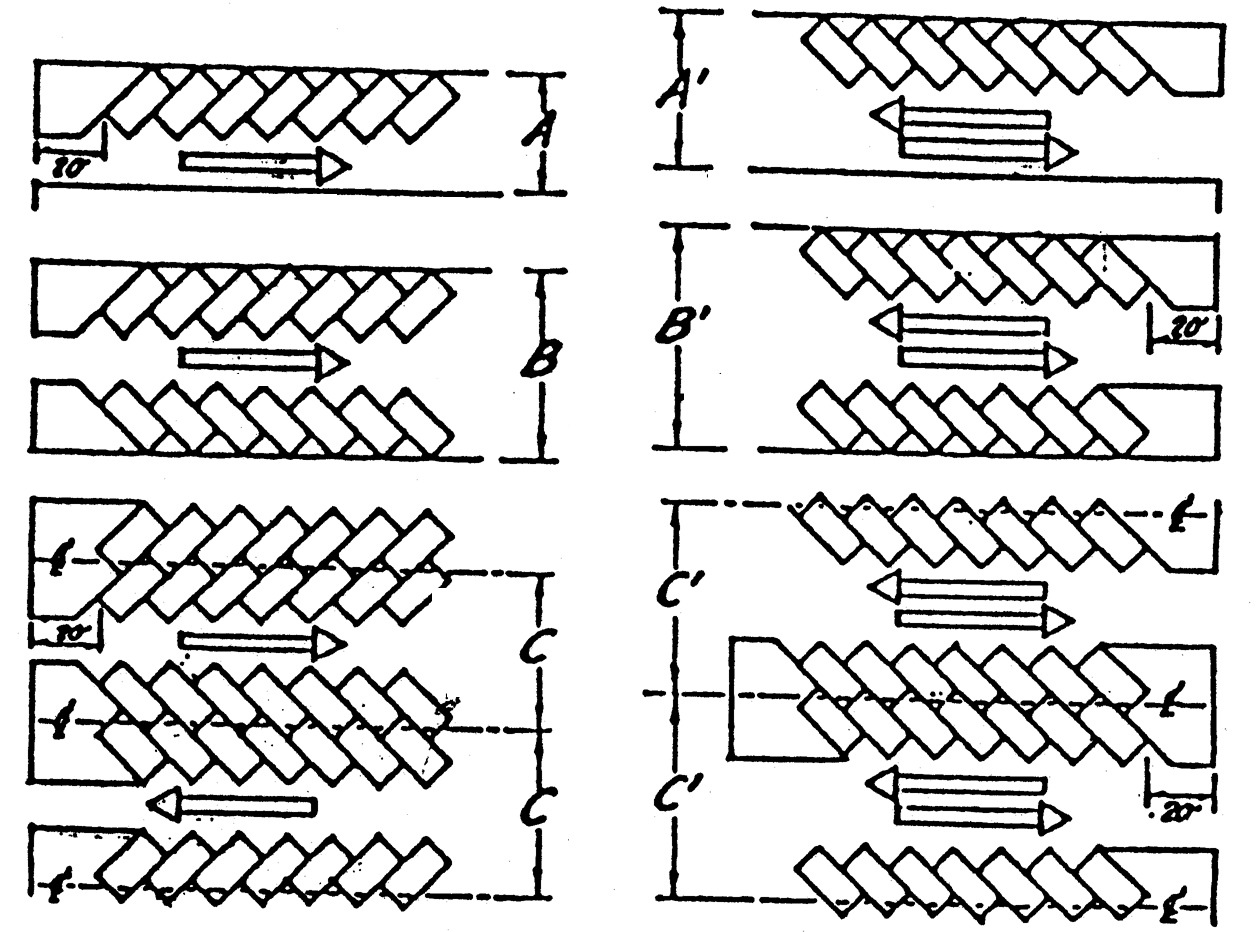
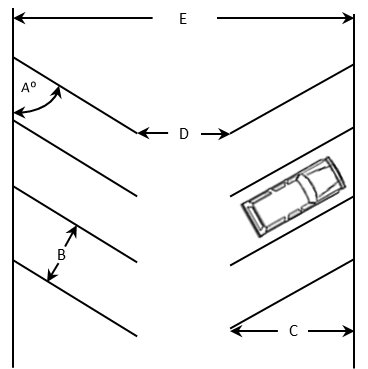
The following schematic is made a part of this chapter and is designed solely to illustrate the requirements for aisles in off-street parking areas as regulated in this division. For additional regulations governing setbacks, minimum dimensions for parking spaces, and other requirements, see the other sections in this division.
Parking Lot Dimensions
* All width and depth dimensions are in feet
Parking Lot Schematic
(Code 1977, app. A, § VIII(H); Ord. No. 38-13, § 1, 3-13-2014)
Sec. 78-707. - Alternatives for meeting required number of parking spaces.
(a)
Intent. The intent of this section is to provide reasonable and meaningful alternatives for meeting the requirements of section 78-705, required number of parking spaces.
(b)
Types of available alternatives for meeting required number of parking spaces. Available alternatives for meeting the requirements of section 78-705, required number of parking spaces, which cannot otherwise meet the village's required off-street parking requirements include the following options. The options listed below are not mutually exclusive, and any one, or any combination of any or all options may be available, given the specific proposed development:
(1)
Off-site parking.
(2)
Shared parking.
(3)
On-street parking.
(4)
Reduction of required on-site, off-street parking spaces.
(c)
Off-site parking. Parking located off of the same lot or parcel as the use for which the required off-street parking spaces should be provided is permissible, subject to the following requirements:
(1)
Off-site parking is not available for handicapped parking regulated by F.S. ch. 553, Part II. All handicapped parking shall be contained on the site of the development. See also, Village Code section 78-694.
(2)
Off-site parking shall be approved by the Village Council as part of the site plan approval process or as a modification to an existing site plan approval.
(3)
The location for all off-site parking must be within a radius of 500 feet of the parcel or lot containing the use that proposes to utilize off-site parking. The maximum number of off-site parking spaces for any particular use shall not exceed 25 percent of the total number of off-street parking spaces required by Village Code for said use(s). See Village Code, section 78-705 for the required number of parking spaces from which the reduction is to be made.
(4)
A paved, concrete, paver, etc. pedestrian walkway shall be provided between the off-site parking area and the site containing the use that proposes to utilize off-site parking.
(5)
Signage that complies with the village's sign regulations shall be provided to indicate the location of the off-site parking area. See Village Code Chapter 78, Article XI.
(6)
A written agreement shall memorialize the off-site parking arrangement. The agreement shall guarantee continuation of the off-site parking via ownership, lease, or other binding mechanism for as long as the off-site parking is needed, and shall specify the terms and conditions agreed upon between the owner of the site containing the use that proposes to utilize off-site parking and the off-site parking site owner. At a minimum, the agreement shall:
a.
List the names and ownership interest of all parties to the off-site parking arrangement and contain the signatures of those parties.
b.
Provide a survey and legal description of the off-site parking area property.
c.
Include a site plan showing the off-site parking area.
d.
Describe the off-site parking area, reserve it for such use, and leave it unencumbered by any conditions which would interfere with that use.
e.
Expressly declare the intent of the agreement to be a covenant that runs with the land and that binds all successors in interest thereto.
f.
Ensure the continued availability of the parking spaces for off-site use.
g.
Describe the obligations of each party.
h.
Be made part of the site plan approval for the re-development site.
i.
Describe the manner in which the agreement may be revised.
j.
Provide that the agreement may not be released except by the village.
(7)
The agreement shall be in the form of a legally binding mechanism acceptable to the village attorney, and shall be recorded in the public records of Palm Beach County by the owner of the site containing the use that proposes to utilize off-site parking. The agreement shall remain in place and recorded until released by the village.
(d)
Shared Parking. Shared parking among multiple uses at the same site may be permissible subject to compliance with the following conditions:
(1)
Two or more uses located in the same structure, or on the same site with complementary peak hours of parking usage may share parking spaces.
(2)
Shared parking is not available for handicapped parking regulated by F.S. ch. 553, Part II. All uses shall provide for the required number of handicapped parking spaces individually. See also, Village Code section 78-694.
(3)
Shared parking shall be approved by the village council as part of the site plan approval process or as a modification to an existing site plan approval.
(4)
The parking area proposed for shared parking must be accessible to all participating uses and shared parking spaces may not be reserved for a particular use or otherwise restricted, except as provided by Village Code section 78-697.
(5)
The number of off-street parking spaces that can be utilized as shared parking among the participating uses shall be based upon by a shared parking study following the urban land institute's (ULI) methodology, or other professionally accepted methodology as approved in advance by the village's community development director. The shared parking study must be prepared, at the applicant's expense, in a professionally-accepted manner, by a licensed professional engineer.
(6)
A written shared parking agreement shall memorialize the shared parking arrangement. The shared parking agreement shall specify the terms and conditions agreed upon between the site owner and the village. At a minimum, the agreement shall:
a.
List the names and ownership interest of all parties to the agreement and contain the signature of those parties.
b.
Provide a survey and legal description of the site utilizing shared parking.
c.
Include a site plan showing the shared parking area(s).
d.
Describe the shared parking area, reserve it for such use, and leave it unencumbered by any conditions which would interfere with that use.
e.
Expressly declare the intent of the agreement to be a covenant that runs with the land and that binds all successors in interest thereto.
f.
Ensure the continued availability of the parking spaces for shared parking use.
g.
Describe the obligations of each party.
h.
Be made part of the site plan approval for the site utilizing shared parking.
i.
Describe the manner in which the agreement may be revised.
j.
Provide that the agreement may not be released except by the village.
(7)
The shared parking agreement may limit the hours of operation of any existing or future use or uses on the site utilizing shared parking so that the intent of limiting any potential overlap in peak parking demand is achieved.
(8)
The shared parking agreement shall be in the form of a legally binding mechanism acceptable to the village attorney, and shall be recorded in the public records of Palm Beach County by the owner of the site utilizing shared parking. The shared parking agreement shall remain in place and recorded until released by the village.
(9)
Changes in uses or other conditions. In order to maintain compliance with a shared parking agreement, the owner of the site utilizing shared parking shall take the actions indicated below to address any change in the uses identified in the agreement which would cause an increase in peak parking demand or to address a finding of any other related change in conditions:
a.
Submit new shared parking calculations following the Urban Land Institute's (ULI) methodology, or other professionally accepted methodology as approved in advance by the village's community development director with an application to officially amend the shared parking plan approval for the property, as appropriate; or
b.
Provide the required number of parking spaces separately for each use to negate the need for shared parking, submit an application to officially amend the site plan approval for the property, and revise or nullify the shared parking agreement, as appropriate.
Until such action is taken, no development order shall be approved for any proposed modification to the site that is the subject of the previously approved shared parking agreement.
(10)
In order to maximize the amount of parking located on the site utilizing shared parking, a shared parking agreement may not result in a reduction of the village's standard off-street parking space requirements for the uses on the site in excess of 25 percent. See Village Code, section 78-705 for the required number of parking spaces from which the reduction is to be made.
(e)
On-street parking. On-street parking spaces that lie within the street frontage areas of the site containing the use which desires to utilize on-street parking may be permissible in accordance with the requirements of Village Code section 78-698.
(f)
Reduction of required number of parking spaces.
(1)
The village council may reduce the number of off-street parking spaces for any particular use required by Village Code section 78-705 when said use desires to undergo re-development activities or expansion and cannot otherwise meet the off-street parking requirements as required outright or with the use of off-site, shared, or on-street parking. In such cases, the owner of the site requesting a reduction shall provide a parking accumulation study completed by a licensed professional engineer which provides data and establishes the actual number of vehicles parked in the study area during specific periods of time. The study should address both peak and off-peak parking times. The village council shall utilize the study in making a decision to approve, approve with conditions, or deny the request for reduction in of required parking spaces. In no case shall the number of parking spaces be reduced more than the amount supported by the study.
(2)
Changes in uses or other conditions. In order to maintain compliance with the approved reduction based on the parking accumulation study, the owner of the site shall take the actions indicated below to address any change in the uses as they existed at the time of the study and the grant of the reduction in required parking spaces which would cause an increase in peak parking demand or to address a finding of any other related change in conditions:
a.
Submit a new parking accumulation study completed by a licensed professional engineer with an application to officially amend the request for a reduction of the required number of parking spaces for the property, as appropriate; and
b.
Obtain new village council approval for the revised request for a reduction in required parking spaces.
Until such action is taken, no development order shall be approved for any proposed modification to the site that is the subject of the previously approved reduction to the required number of parking spaces.
(Ord. No. 27-19, § 1, 11-4-2019)

