
Tequesta City Zoning Code
ARTICLE VI
SCHEDULE OF DISTRICT REGULATIONS
DIVISION 2. - SCHEDULE OF USE REGULATIONS[4]
Editor's note— Ord. No. 14-14, § 1, adopted October 9, 2014, amended division 2 in its entirety to read as herein set out. Former division 2, §§ 78-171—78-180, pertained to similar subject matter. See Code Comparative Table for complete derivation.
DIVISION 4. - OVERLAY DISTRICTS[5]
Editor's note— Ord. No. 01-24, § 4, adopted Oct. 16, 2024, set out provisions intended for use as Div. 3, §§ 78-201—78-204. Inasmuch as there were already provisions so designated, said sections have been codified herein as Div. 4, §§ 78-211—78-214 at the discretion of the editor.
Sec. 78-141. - Scope.
The restrictions and controls intended to regulate development in each district are set forth in the schedules in this article, which are supplemented by other sections of this chapter.
(Code 1977, app. A, § VII(A))
Sec. 78-142. - Applicability.
Except as provided in this chapter:
(1)
No building shall be erected, added on to, reconstructed or structurally altered, nor shall any building or land be used, which does not comply with all the district regulations established by this chapter for the district in which the building or land is located.
(2)
The minimum yards and other open spaces, including the intensity of use provisions contained in this chapter, for each building erected, added on to, reconstructed or structurally altered subsequent to the enactment of the ordinance from which this chapter is derived shall not be encroached upon or considered as a compliance with yard or open space requirements or intensity of use requirements for any other building or adjoining building. No lot or yard existing at the effective date of the ordinance from which this chapter is derived shall thereafter be reduced in dimension or area below the minimum requirements set forth in this chapter. Lots or yards created after such effective date shall meet the minimum requirements established by this chapter.
(3)
Every building erected, added on to, reconstructed or structurally altered subsequent to the enactment of the ordinance from which this chapter is derived shall be located on a lot fronting on either a private or public street.
(4)
Land areas of a proposed development site required to be included in computations for meeting requirements on percentage of lot coverage, and on open yard areas of a lot, must be land having the same zoning classification as that zoning in which the principal building or use is located.
(Code 1977, app. A, § VII(B))
Sec. 78-143. - Schedule of site requirements.
The following schedule establishes the minimum property and building regulations for development within the village:
SCHEDULE OF SITE REQUIREMENTS
(Code 1977, app. A, § VII(C); Ord. No. 605, § 3, 5-18-2006; Ord. No. 6-14, § 1, 3-13-2014; Ord. No. 02-23, § 2, 2-9-2023)
Sec. 78-171. - Scope.
This division establishes the use regulations for development within the village. For other more specific requirements, see the supplemental district regulations in article IX of this chapter.
(Ord. No. 14-14, § 1, 10-9-2014)
Sec. 78-172. - R-1A single-family dwelling district.
(a)
Purpose. It is the purpose and intent of the R-1A single-family dwelling district to provide lands within the village for single-family residential uses of the lowest population density, consisting of no more than one dwelling unit per any platted lot. Density shall not exceed 3.6 dwelling units per gross acre based on a minimum 12,000-square-foot lot size. This district recognizes the need to provide areas within which the traditional single-family residence can thrive and can be protected from the more intense activities of other land uses.
(b)
Permitted uses. Permitted uses in the R-1A district are as follows:
Single-family dwellings.
(c)
Accessory uses. Accessory uses allowed in the R-1A district are as follows:
Private garages, swimming pools, spas and hot tubs, cabanas and saunas, greenhouses, tennis courts, private docks, utility buildings, gazebos and any other similar uses deemed appropriate by the director of community development.
(d)
Special exception uses. Special exception uses in the R-1A district are as follows:
(1)
Schools and publicly owned and operated community buildings.
(2)
Public utility buildings such as water pumping plants and electric substations; police and fire stations.
(3)
Places of assembly (any size), subject to the following conditions:
a.
All presentations and events shall be conducted entirely within a building.
b.
Allowed accessory uses are: preschool and school facilities; assembly halls, sanctuaries or similar meeting rooms; community centers or fellowship halls; administrative offices related to the facility; gift shops for merchandise related to the facility; playgrounds and athletic fields; and rectory or similar residence for facility officials or on-site caretakers, limited to one dwelling unit.
(4)
Parks and recreation facilities owned and operated by the village.
(5)
Day care facilities, as may be required, regulated and licensed by applicable state statutes and agencies.
(6)
Foster care facilities, as may be required, regulated and licensed by applicable state statutes and agencies.
(7)
Group homes, as may be required, regulated and licensed by applicable state statutes and agencies.
(e)
Prohibited uses and structures. The following uses and structures are prohibited in the R-1A district:
Any use or structure not specifically or by reasonable implication permitted in this section as a permitted use, accessory use or permissible by special exception.
(Ord. No. 14-14, § 1, 10-9-2014)
Sec. 78-173. - R-1 single-family dwelling district.
(a)
Purpose. It is the purpose and intent of the R-1 single-family dwelling district to provide lands within the village for single-family residential uses, consisting of no more than one dwelling unit per any platted lot. Density shall not exceed 5.4 dwelling units/gross acre based on a minimum 8,000-square-foot lot size. As in the R-1A district, this district also recognizes the need for traditional single-family areas, however, at a slightly higher density.
(b)
Permitted uses. Permitted uses in the R-1 district are as follows:
Single-family dwellings.
(c)
Accessory uses. Accessory uses allowed in the R-1 district are as follows:
Private garages, swimming pools, spas and hot tubs, cabanas and saunas, greenhouses, tennis courts, private docks, utility buildings, gazebos and any other similar use deemed appropriate by the director of community development.
(d)
Special exception uses. Special exception uses in the R-1 district are as follows:
(1)
Schools and publicly owned and operated community buildings.
(2)
Public utility buildings such as water pumping plants and electric substations; police and fire stations.
(3)
Parks and recreation facilities owned and operated by the village.
(4)
Day care facilities, as may be required, regulated and licensed by applicable state statutes and agencies.
(5)
Foster care facilities, as may be required, regulated and licensed by applicable state statutes and agencies.
(6)
Group homes, as may be required, regulated and licensed by applicable state statutes and agencies.
(7)
Places of assembly (any size), subject to the following conditions:
a.
All presentations and events shall be conducted entirely within a building.
b.
Allowed accessory uses are: preschool and school facilities; assembly halls, sanctuaries or similar meeting rooms; community centers or fellowship halls; administrative offices related to the facility; gift shops for merchandise related to the facility; playgrounds and athletic fields; and rectory or similar residence for facility officials or on-site caretakers, limited to one dwelling unit.
(e)
Prohibited uses and structures. The following uses and structures are prohibited in the R-1 district:
Any use or structure not specifically or by reasonable implication permitted in this section as a permitted use, accessory use or permissible by special exception.
(Ord. No. 14-14, § 1, 10-9-2014)
Sec. 78-174. - R-2 multiple-family dwelling district.
(a)
Purpose. It is the purpose and intent of the R-2 multiple-family dwelling district to provide lands within the village for a range of residential multiple-family uses that should be applied within the medium density designated areas of the village comprehensive development plan. In no event shall density exceed 12 dwelling units per gross acre.
(b)
Permitted uses. Permitted uses in the R-2 district are as follows:
(1)
Single-family dwellings.
(2)
Two-family dwellings.
(3)
Multiple-family dwellings.
(4)
Places of assembly (750 square feet or less), subject to the following conditions:
a.
All presentations and events shall be conducted entirely within a building.
b.
Allowed accessory uses are: preschool and school facilities; assembly halls, sanctuaries or similar meeting rooms; community centers or fellowship halls; administrative offices related to the facility; gift shops for merchandise related to the facility; playgrounds and athletic fields; and rectory or similar residence for facility officials or on-site caretakers, limited to one dwelling unit.
(c)
Accessory uses. Accessory uses allowed in the R-2 district are as follows:
Private garages, swimming pools, spas and hot tubs, cabanas and saunas, greenhouses, tennis courts, clubhouses, private docks, utility buildings, gazebos and any other similar use deemed appropriate by the director of community development.
(d)
Special exception uses. Special exception uses in the R-2 district are as follows:
(1)
Marina facilities.
(2)
Public utility buildings such as water pumping plants and electric substations; police and fire stations.
(3)
Nurseries.
(4)
Private kindergartens, day care centers and schools.
(5)
Publicly owned and operated community buildings.
(6)
Two-family or multiple-family dwellings in excess of two stories or 30 feet in height to a maximum of three stories or 35 feet.
(7)
Planned residential developments (PRD) (subject to the provisions of article VII of this chapter).
(8)
Community antenna systems.
(9)
Parks and recreation facilities owned and operated by the village.
(10)
Foster care facilities, as may be required, regulated and licensed by applicable state statutes and agencies.
(11)
Group homes, as may be required, regulated and licensed by applicable state statutes and agencies.
(12)
Adult congregate living facility (includes assisted living facilities as defined at F.S. ch. 429). Evidence that all regulations set forth in the state law concerning such facilities have been met must be submitted to the village prior to the issuance of a certificate of occupancy:
a.
An adult congregate living facility shall contain either an assisted care facility or an extended care facility as a component of the development, and may also contain an independent living facility as a component, in order to be deemed an adult congregate living facility.
b.
The minimum site for an adult congregate living facility shall be two acres.
c.
All adult congregate living facilities with assisted living and/or extended care facilities shall provide sufficient staff to operate the facility in a proper manner as required by the minimum standards of the state department of health and rehabilitative services, and shall provide facilities which meet the physical, recreational, emotional, and social life needs of the residents of the facility.
d.
All facilities containing more than one story shall have an elevator large enough to carry a stretcher.
e.
No portable heaters or other dangerous appliances shall be used in such facilities.
f.
All facilities shall conform to applicable village codes and ordinances, including building, electric, plumbing, fire prevention and state department of insurance minimum fire safety standards for adult congregate living facilities.
g.
The applicant shall provide transportation to the facility in a form and manner acceptable to the village council.
h.
The residence may have individual kitchen facilities in addition to the central kitchen and/or facility which shall be provided for the residents of the entire adult congregate living facility. Such central kitchen dining shall provide at least two meals per day to the residents of the facility.
i.
An application for special exception for each such facility shall contain a market analysis which demonstrates the viability and need for the facility to be built or established at the proposed location set forth within the application. For these purposes, the market analysis shall contain, but not be limited to, the following determinations:
1.
Determination of the service area of the proposed facility.
2.
Determination of the service area population, present and future.
3.
Statement of need for all proposed levels of care.
j.
Maximum residential density for the adult congregate living facility is 12 units per acre, calculated as follows:
1.
Independent living: Facilities comprised of residences intended for use by one individual or family. Each such residence shall be equal to one dwelling unit for purposes of calculating density.
2.
Assisted care: Facilities wherein beds are provided for residents in a less intensive care setting than extended care, but that requires assistance where independent living is not possible, since these residents are less mobile and less active than those in an independent living dwelling unit. Two point Three Nine (2.39) persons in the assisted care component shall equal one dwelling unit for purposes of calculating density.
3.
Extended care: Facilities wherein beds are provided for residents in the nature of a nursing, memory care or convalescent home. Four (4) persons in the extended care component shall equal one dwelling unit for purposes of calculating density.
k.
The adult congregate living facility shall, by separate agreement, guarantee payment to the primary fire rescue provider for patient ambulance transport service.
l.
All facilities shall be equipped with an emergency backup generator system. The system shall be of sufficient size and power for the facility's maximum occupancy load and shall have a fuel source sufficient to operate the facility for a minimum of seven days.
(13)
Places of assembly (765 square feet or more), subject to the following conditions:
a.
All presentations and events shall be conducted entirely within a building.
b.
Allowed accessory uses are: preschool and school facilities; assembly halls, sanctuaries or similar meeting rooms; community centers or fellowship halls; administrative offices related to the facility; gift shops for merchandise related to the facility; playgrounds and athletic fields; and rectory or similar residence for facility officials or on-site caretakers, limited to one dwelling unit.
(e)
Prohibited uses and structures. The following uses and structures are prohibited in the R-2 district:
Any use or structure not specifically or by reasonable implication permitted in this section as a permitted use, accessory use or permissible by special exception.
(Ord. No. 14-14, § 1, 10-9-2014; Ord. No. 7-16, § 2, 5-12-2016)
Sec. 78-175. - R-3 multiple-family dwelling district.
(a)
Purpose. It is the purpose and intent of the R-3 multiple-family dwelling district to provide lands within the village for a higher density range of multiple-family residential uses. In no event shall density exceed 12 dwelling units per gross acre. This district is further intended for development of concentrated residential populations and should be applied only within the high density designated areas as depicted by the comprehensive development plan.
(b)
Design guidelines. Applications for development and re-development in the R-3 Zoning District shall utilize the village's design guidelines including the design guidelines checklist in order to achieve compliance with the general requirements relative to site plan review set forth in chapter 22, article II, section 22-82. The design guidelines are not in and of themselves approval criteria in any quasi-judicial proceeding. The design guidelines are found at Appendix E of the Village Code of Ordinances, and are kept on file with both the village clerk's office and the village's community development office.
(c)
Permitted uses. Permitted uses in the R-3 district are as follows:
(1)
Multifamily dwellings.
(2)
Places of assembly (750 square feet or less), subject to the following conditions:
a.
All presentations and events shall be conducted entirely within a building;
b.
Allowed accessory uses are: preschool and school facilities; assembly halls, sanctuaries or similar meeting rooms; community centers or fellowship halls; administrative offices related to the facility; gift shops for merchandise related to the facility; playgrounds and athletic fields; and rectory or similar residence for facility officials or on-site caretakers, limited to one dwelling unit.
(d)
Accessory uses. Accessory uses allowed in the R-3 district are as follows:
Private garages, swimming pools, spas and hot tubs, cabanas and saunas, greenhouses, tennis courts, clubhouses, private docks, dune crossovers, utility buildings, gazebos and any other similar uses deemed appropriate by the director of community development.
(e)
Special exception uses. Special exception uses in the R-3 district are as follows:
(1)
Schools and publicly owned and operated community buildings.
(2)
Public utility buildings such as water pumping plants and electric substations; police and fire stations.
(3)
Marina facilities.
(4)
Community antenna systems.
(5)
Parks and recreation facilities owned and operated by the village.
(6)
Foster care facilities, as may be required, regulated and licensed by applicable state statutes and agencies.
(7)
Group homes, as may be required, regulated and licensed by applicable state statutes and agencies.
(8)
Places of assembly (765 square feet or more), subject to the following conditions:
a.
All presentations and events shall be conducted entirely within a building.
b.
Allowed accessory uses are: preschool and school facilities; assembly halls, sanctuaries or similar meeting rooms; community centers or fellowship halls; administrative offices related to the facility; gift shops for merchandise related to the facility; playgrounds and athletic fields; and rectory or similar residence for facility officials or on-site caretakers, limited to one dwelling unit.
(f)
Prohibited uses and structures. The following uses and structures are prohibited in the R-3 district:
Any use or structure not specifically or by reasonable implication permitted in this section as a permitted use, accessory use or permissible by special exception.
(Ord. No. 14-14, § 1, 10-9-2014; Ord. No. 02-23, § 3, 2-9-2023)
Sec. 78-176. - C-1 neighborhood commercial district.
(a)
Purpose. It is the purpose and intent of the C-1 neighborhood commercial district to provide lands within the village as depicted on the official zoning map for limited retail sales and business service activities primarily designed to serve residential neighborhoods of the village. The district is not intended for use by major or large scale commercial or service concerns. Professional and business offices and service establishments and uses that specifically address the needs of surrounding residents are encouraged. Orientation to and compatibility with neighborhoods to be served are critical.
(b)
Permitted uses. Permitted uses in the C-1 district are as follows, except as regulated by the Tequesta Drive Overlay, the U.S. Highway 1 Overlay, and the Village Center Overlay:
(1)
Retail sales and services, excluding retail package liquors.
(2)
Business services.
(3)
Health care facility or medical or dental office; professional office; professional services.
(4)
Personal services.
(5)
Restaurants, excluding fast food restaurants, drive-in restaurants, and carryout restaurants.
(6)
Restaurant, specialty.
(7)
Libraries, art galleries and museums.
(8)
Wireless telecommunication towers and antennas located on village owned property, pursuant to article IX, division 5.
(9)
Places of assembly (750 square feet or less), subject to the following conditions:
a.
All presentations and events shall be conducted entirely within a building.
b.
Allowed accessory uses are: preschool and school facilities; assembly halls, sanctuaries or similar meeting rooms; community centers or fellowship halls; administrative offices related to the facility; gift shops for merchandise related to the facility; playgrounds and athletic fields.
(c)
Accessory uses. Accessory uses allowed in the C-1 district are as follows:
Any accessory use customarily incidental to a permitted use.
(d)
Special exception uses. Special exception uses in the C-1 district are as follows, except as regulated by the Tequesta Drive Overlay, the U.S. Highway 1 Overlay, and the Village Center Overlay:
(1)
Public utility buildings such as water pumping plants, water treatment plants, sewage plant lift stations and electric substations; police and fire stations and any other use normally appurtenant thereto; governmental uses.
(2)
Shopping centers.
(3)
Convenience store without fuel sales and dispensing facilities, provided:
a.
The proposed site shall meet or exceed the landscaping found in article IX, division 4 of this chapter.
b.
The proposed store shall be free of all obstructions of view from the adjacent street to the main store windows giving a clear and unobstructed view of the cashier's station.
c.
The proposed store shall incorporate into its construction and operation fire protection devices as required by the village fire-rescue department.
d.
The proposed store shall have adequate on-site lighting that illuminates all parking and loading areas.
e.
No convenience store shall be located within 1,500 feet of any other convenience store. For the purposes of this subsection, all measurements of distances shall be along a straight airline route from the nearest point on any property line to the nearest point on any property line of any property used as a convenience store.
f.
The proposed convenience store shall have appropriate security systems to include, but not be limited to, the following:
1.
Convenience store uses shall be equipped with cameras with video retrieval capabilities.
i.
This requirement shall be exempted if the convenience store employs two or more employees at the same time between the hours of 11:00 p.m. and 7:00 a.m.
ii.
This requirement shall also be exempted if the convenience store closes on a permanent basis by 11:00 p.m. or does not sell alcoholic beverages for consumption off-premises.
2.
The convenience store may be equipped with a silent alarm connected to the police department.
g.
The proposed convenience store shall not have as a part of its operation coin-operated amusement devices.
(4)
Restaurants, carryout.
(5)
Wireless telecommunication towers and antennas located on property that is not village owned, pursuant to article IX, division 5.
(6)
Places of assembly (765 square feet or more), subject to the following conditions:
a.
All presentations and events shall be conducted entirely within a building.
b.
Allowed accessory uses are: preschool and school facilities; assembly halls, sanctuaries or similar meeting rooms; community centers or fellowship halls; administrative offices related to the facility; gift shops for merchandise related to the facility; playgrounds and athletic fields.
(e)
Prohibited uses and structures. The following uses and structures are prohibited in the C-1 district, except as regulated by the Tequesta Drive Overlay, the U.S. Highway 1 Overlay, and the Village Center Overlay:
Any use or structure not specifically or by reasonable implication permitted in this section as a permitted use, accessory use or permissible by special exception.
(Ord. No. 14-14, § 1, 10-9-2014; Ord. No. 03-21, § 2, 3-11-2021; Ord. No. 01-24, § 3, 10-16-2024)
Sec. 78-177. - C-2 community commercial district.
(a)
Purpose. It is the purpose and intent of the C-2 community commercial district to provide lands within the village as depicted on the official zoning map for the development of commercial activities with a location convenient to U.S. Highway 1 automotive traffic. This district will serve the community at large and provide a mixture of convenience goods and services that offers a greater variety of uses than permitted at neighborhood level.
(b)
Permitted uses. Permitted uses in the C-2 district are as follows, except as regulated by the Tequesta Drive Overlay, the U.S. Highway 1 Overlay, and the Village Center Overlay:
(1)
Retail sales and services, excluding retail package liquors.
(2)
Business services.
(3)
Health care facility or medical or dental office; professional office; professional services.
(4)
Personal services.
(5)
Restaurants, excluding fast food restaurants, drive-in restaurants, and carryout restaurants.
(6)
Restaurant, specialty.
(7)
Bakery.
(8)
Dry cleaning and laundry establishments, including laundromats.
(9)
Places of assembly (1,500 square feet or less), subject to the following conditions:
a.
All presentations and events shall be conducted entirely within a building.
b.
Allowed accessory uses are: preschool and school facilities; assembly halls, sanctuaries or similar meeting rooms; community centers or fellowship halls; administrative offices related to the facility; gift shops for merchandise related to the facility; playgrounds and athletic fields.
(10)
Retail package liquors. However, such uses must be located in accordance with the following regulations:
a.
No retail package liquor use may be located within a 2,000 foot radius of another retail package liquor use. The 2,000 feet shall be measured in a straight line from main entrance door to main entrance door.
b.
No more than one retail package liquor use may be located in any one shopping center in this zoning district.
c.
Hours of operation for retail package liquor uses shall conform to hours of operation for alcoholic beverage establishments as set forth in section 6-1 of the code of ordinances.
(11)
Wireless telecommunication towers and antennas located on village owned property, pursuant to article IX, division 5.
(c)
Accessory uses. Accessory uses allowed in the C-2 district are as follows:
Any accessory use customarily incidental to a permitted use.
(d)
Special exception uses. Special exception uses in the C-2 district are as follows, except as regulated by the Tequesta Drive Overlay, the U.S. Highway 1 Overlay, and the Village Center Overlay:
(1)
Public utility buildings such as water pumping plants, water treatment plants, sewage plant lift stations and electric substations; police and fire stations and any other use normally appurtenant thereto; libraries and governmental uses.
(2)
Wireless telecommunication towers and antennas located on property that is not village owned, pursuant to article IX, division 5.
(3)
Planned commercial development (PCD) (subject to the provisions of article VIII of this chapter).
(4)
Adult congregate living facility (ACLF), provided:
a.
An adult congregate living facility shall contain an extended care facility as a component of the development in order to be deemed an adult congregate living facility.
b.
The minimum site for an adult congregate living facility life care and extended care shall be two acres.
c.
All adult congregate living facilities and extended care facilities shall provide sufficient staff to operate the facility in a proper manner as required by the minimum standards of the state department of health and rehabilitative services, and shall provide facilities which meet the physical, recreational, emotional, and social life needs of the residents of the facility.
d.
All facilities containing more than one story shall have an elevator large enough to carry a stretcher.
e.
No portable heaters or other dangerous appliances shall be used in such facilities.
f.
All facilities shall conform to applicable village codes and ordinances, including building, electric, plumbing, fire prevention and state department of insurance minimum fire safety standards for adult congregate living facilities.
g.
No building permits shall be issued unless a license has first been obtained from the Florida Agency for Health Care Administration (AHCA) and any other permitting agency as required by law, including the provisions of this chapter.
h.
The applicant shall provide transportation to the facility in a form and manner acceptable to the village council.
i.
The residence may have individual kitchen facilities in addition to the central kitchen and/or facility which shall be provided for the residents of the entire ACLF. Such central kitchen dining shall provide at least two meals per day to the residents of the facility.
j.
An application for special exception for each such facility shall contain a market analysis which demonstrates the viability and need for the facility to be built or established at the proposed location set forth within the application. For these purposes, the market analysis shall contain, but not be limited to, the following determinations:
1.
Determination of the service area of the proposed facility.
2.
Determination of the service area population, present and future.
3.
Statement of need.
k.
Maximum residential density is as follows:
1.
Adult congregate living facilities: Facilities wherein each separate room or group of rooms is designed or intended for use as a residence by an individual or family. The maximum allow-able density for such facilities may be up to, but not exceeding, 18 units per net acre.
2.
Extended care facilities: Facilities wherein beds are provided for residents in the nature of a nursing or convalescent home. Each bed shall be equal to one-quarter dwelling unit.
l.
The adult congregate living facility shall, by separate agreement, guarantee payment to the primary fire rescue provider for patient ambulance transport service.
m.
All facilities shall be equipped with an emergency backup generator system. The system shall be of sufficient size and power for the facility's maximum occupancy load and shall have a fuel source sufficient to operate the facility for a minimum of seven days.
(5)
Theaters.
a.
All presentations, shows and events shall be conducted entirely within a building.
b.
No presentations, shows or events shall be started after 11:00 p.m.
(6)
Indoor amusements (bowling, pool, billiards, video game arcade and similar amusements).
(7)
Restaurant, carryout.
(8)
Convenience store without fuel sales and dispensing facilities, provided:
a.
The proposed site shall meet or exceed the landscaping requirements found in the article IX, division 4 of this chapter.
b.
The proposed store shall be free of all obstructions of view from the adjacent street to the main store windows giving a clear and unobstructed view of the cashier's station.
c.
The proposed store shall incorporate into its construction and operation fire protection devices as required by the village fire-rescue department.
d.
The proposed store shall have adequate on-site lighting that illuminates all parking and loading areas.
e.
No convenience store shall be located within 1,500 feet of any other convenience store. For the purposes of this subsection, all measurements of distance shall be along a straight airline route from the nearest point on any property line of any property used as a convenience store.
f.
The proposed convenience store shall have appropriate security systems to include, but not be limited to, the following:
1.
Convenience store uses shall be equipped with cameras with video retrieval capabilities.
i.
This requirement shall be exempted if the convenience store employs two or more employees at the same time between the hours of 11:00 p.m. and 7:00 a.m.
ii.
This requirement shall also be exempted if the convenience store closes on a permanent basis by 11:00 p.m. or does not sell alcoholic beverages for consumption off-premises.
2.
The convenience store may be equipped with a silent alarm connected to the police department.
g.
The proposed convenience store shall not have as a part of its operation coin-operated amusement devices.
(9)
Reserved.
(10)
Libraries, art galleries and museums.
(11)
Full-service fuel station or gasoline service station, provided:
a.
Full-service fuel stations or gasoline service stations shall be located fronting along U.S. Highway 1.
b.
Full-service fuel stations or gasoline service stations shall be located a minimum of 500 lineal feet from existing or previously approved stations.
c.
There shall be a main building setback from all right-of-way lines of 40 feet.
d.
Main and accessory buildings shall be located a minimum of 50 feet from any residential district.
e.
A minimum six inches in height raised curb shall be required at all right-of-way lines, except at approved access driveway openings.
f.
Curb openings and access driveway widths and locations shall meet the requirements of article X of this chapter, except as provided for in subsection (d)(11)g of this section. Curb openings shall be limited to two per street frontage.
g.
Where two curb openings are providing access to a single street, they shall be separated by an approved landscape island, ten feet in width and 25 feet in length at the right-of-way line. Curb cuts for access driveways shall be located a minimum of ten feet from any adjoining property line.
h.
To ensure that sufficient room be provided on either side of the fuel pumps without intruding upon sidewalks or upon adjoining property, fuel pumps shall be located a minimum of 50 feet from any adjoining property and a minimum of 25 feet from any street property line.
i.
All tanks, vents, pump islands and pump island or main and accessory building canopies shall provide a minimum setback of 25 feet from any adjoining property or right-of-way.
j.
Off-street loading spaces for the delivery of materials, merchandise, fuel or any similar product shall be located in such a manner that they are completely separate from required customer parking spaces and access drives and aisles thereto.
k.
The selling, renting or leasing of new and/or used motor vehicles, trailers or recreational vehicles is prohibited.
l.
Automotive repair work and/or servicing must be performed within an enclosed building or structure.
m.
All full-service fuel stations and gasoline service stations shall be equipped with an emergency backup generator system of sufficient size and power to operate the fuel pumping systems for a minimum of seven days.
(12)
Hotels, subject to the following conditions:
a.
All rooms shall be designed to be entered from enclosed interior corridors.
b.
All rooms providing glass sliding doors at first-floor grade level shall face an interior courtyard.
c.
Accessory uses shall be allowed, such as swimming pools, spas, cabanas, saunas, tennis courts, clubhouses, gazebos, utility buildings, restaurants and any other similar use deemed appropriate by the building official.
d.
Accessory uses shall be allowed, such as shops for the retail sale of flowers, sundries, newspapers and books, jewelry, gifts, sportswear and clothing, art and similar items, and barbershops or beauty shops, subject to these uses being located within a main building. The primary customer entry shall be from within a main building with no exterior entry, except a secondary entry may be allowed from an interior courtyard.
e.
All recreational accessory uses, such as a swimming pool, spa, tennis court, clubhouse, sauna and exercise room, shall be located within a main building or within an interior courtyard. The primary customer entry shall be from within a main building with no exterior entry, except a secondary entry may be allowed from an interior courtyard.
f.
Hotels shall be subject to the requirements of section 78-291 and all other applicable sections of this chapter.
(13)
Motor vehicle dealers, subject to the following conditions:
a.
Size shall be regulated with a minimum of two acres and a maximum of eight acres. Motor vehicle dealer establishments shall be prohibited from locating within 1,000 lineal feet of an existing or previously approved motor vehicle dealer establishment within the village.
b.
Hours and days of operation shall be restricted as follows:
1.
Twenty-four-hour operation is prohibited.
2.
Specific closing no later than 9:00 p.m.
3.
Sunday operating hours limited to 11:00 a.m. to 6:00 p.m.
4.
No opening for business on Monday through Saturday before 7:00 a.m.
c.
The use of banners, streamers, balloons or any similar device shall be prohibited. The use of flags and flagpoles shall be pursuant to article XI of this chapter.
d.
All customer servicing, including washing, waxing and cleaning, and repair of motor vehicles, shall be conducted within completely enclosed buildings.
e.
All parts, supplies and materials shall be located or stored within completely enclosed buildings. Except for the parking of motor vehicles to be sold, rented, or serviced, there shall be no outside storage of any kind.
f.
The business of the sale, brokerage, and rental of vehicles is only to be conducted within an enclosed showroom. Outdoor vehicular parking is for customers, display and storage purposes only. The dealership must maintain a valid license with the state department of motor vehicles at all times.
g.
The site plan for proposed motor vehicle dealer establishments shall include, but not be limited to, the following:
1.
Delineation of the customer parking area and the configuration of the parking spaces for the customer parking area.
2.
Delineation of an employee parking area and the configuration of the parking spaces for the employee parking area.
3.
Delineation of the required enclosed vehicle showroom building.
4.
Delineation of an acceptable outdoor vehicle display area and the configuration of the parking spaces for the display area.
5.
Delineation of any proposed vehicle storage area.
h.
Motor vehicle dealers shall be required to provide a vehicle showroom building of no less than 3,000 gross square feet in area.
i.
Major and minor repair activities shall only be accessory uses to the principal use. Major and minor repair activities are as defined in this chapter. Paint and body shop activities or facilities shall be prohibited.
j.
All "tent" sales, as well as all "telethon," "marathon," "24 hours," etc., sales efforts or campaigns of any type, shall be prohibited.
k.
The use of spotlights, skylights, searchlights, or other similar high intensity illumination lighting shall be prohibited.
l.
All artificial lighting used to illuminate the premises shall be directed away from adjacent or abutting properties, streets, alleys, or roadways, illuminating only the subject site.
m.
All radio, television, or other similar media broadcast from anywhere on the premises shall be prohibited.
n.
Any use of animated or mechanical animal, clown, etc., devices, also, anyone carrying sales signs, advertising, or placards of any kind, from anywhere on or adjacent to the premises shall be prohibited.
o.
All writing, lettering, pricing, advertising, or signage of any type being placed directly upon or within any motor vehicle or part thereof (i.e., windshield, window, roof, hood, trunk, side panels, etc.) shall be prohibited. However, nothing in this subsection shall be construed to prohibit provision of required vehicular information stickers or labels as may be required by federal, state or other law.
p.
All motor vehicle sales establishments shall be restricted to U.S. Highway 1 frontage. However, this shall not preclude frontage on additional rights-of-way, provided that ingress and egress within the additional frontage shall be prohibited. Additionally, frontage along additional rights-of-way shall have a 15-foot buffered landscaped area separating the property from the right-of-way. Required frontage along U.S. Highway 1 shall be required to have a 15-foot landscaped buffered area separating the property from the U.S. Highway 1 right-of-way.
q.
Motor vehicle dealers shall be subject to the requirements of article IX, division 2 of this chapter and all other applicable sections of this chapter.
r.
All vehicle storage areas shall be fenced or walled off. Designated vehicle storage areas shall be contained within the rear yard of the subject property.
s.
All applicable sign regulations of the village as provided in article XI of this chapter shall be applied and met.
t.
The use shall strictly conform with the village landscape regulations, article IX, division 4 of this chapter. Additionally, 15 percent minimum of the entire site shall be devoted to living landscaping.
u.
The entire site shall be hedged, landscaped, buffered and irrigated in accordance with village landscape regulations, article IX, division 4 of this chapter.
v.
The use of raised or open hoods, trunks and doors for advertisement or attention seeking purposes shall be prohibited. Utilization of unusual parking alignments such as "back end first" configurations for advertisement or attention seeking purposes shall also be prohibited.
w.
Stormwater runoff must be retained on-site in accordance with South Florida Water Management District guidelines. All motor vehicle sales establishments must provide on-site waste retention facilities for chemical and petroleum products.
x.
No outdoor public address or paging system of any kind shall be permitted at any motor vehicle sales establishment.
y.
All vehicles for sale, rental or display, not located within an enclosed structure, must be parked at grade.
(14)
Shopping centers.
(15)
Places of assembly (1,515 square feet or more), subject to the following conditions:
a.
All presentations and events shall be conducted entirely within a building.
b.
Allowed accessory uses are: preschool and school facilities; assembly halls, sanctuaries or similar meeting rooms; community centers or fellowship halls; administrative offices related to the facility; gift shops for merchandise related to the facility; playgrounds and athletic fields.
(16)
Publicly owned and operated community buildings.
(17)
Restaurants, fast food, subject to the following conditions:
a.
Each drive-up window stacking lane must be clearly designed and marked so as not to conflict or interfere with other vehicle or pedestrian traffic utilizing the site.
b.
A bypass traffic lane shall be provided if a one-way traffic flow pattern is utilized in the parking lot design.
c.
All restaurants, fast food, shall be restricted to U.S. Highway 1 frontage.
d.
A minimum 15-foot landscape buffer shall be provided at all public road rights-of-way, in addition to the requirements set forth in article IX, division 4 of this chapter.
(18)
Adult arcade amusement centers ("adult arcades") upon a determination by the village council that the proposed use is consistent with the provisions of F.S. § 849.161, and subject to the following additional standards. This regulation shall not apply to bona fide charitable organizations that have been awarded Section 501(c)(3), status under the Internal Revenue Code of the United States, and which may operate five or fewer games of amusement, chance or skill on their premises.
a.
Definition. An adult arcade is defined herein as an amusement center, game room, or other enterprise, at which electronic, mechanical, coin, ticket, token, card, or other similarly operated, computer, video or other similar games of amusement, chance or skill are played, whether for consideration or not. The presence of games or gaming devices that are similar to, or in the nature of, slot machines shall result in a rebuttable presumption that the establishment at which such machine is located is an adult arcade as defined herein.
b.
Location. No special exception shall be granted for a new adult arcade or to permit the substantial enlargement or transfer of ownership or control of an adult arcade, to be located within 2,500 feet of the property line of a property assigned a land use designation or zoning classification that permits residential uses, another adult arcade, a public or private school, a day care facility, a church or house of worship, a public library, an alcoholic beverage establishment, or a public park. The required 2,500 feet minimum separation shall be measured by drawing a straight line between the nearest point on the perimeter of the property line of the proposed adult arcade use, to the nearest property line of the other existing use. An adult arcade shall not be located within the same development, planned unit development, plaza, shopping center, retail office or industrial park, as any other adult arcade regardless of the separation distances.
c.
Operational requirements.
1.
Adult arcades shall not be open to the public before 9:00 a.m. or after 9:00 p.m.
2.
An employee of the adult arcade who is 21 years of age or older, shall be on the premises of the adult arcade to supervise the operation thereof during all hours of operations.
3.
No alcoholic beverages, including beer or wine, may be brought to, sold, distributed, or consumed on the premises of any adult arcade.
4.
No person under the age of 18 years shall be permitted on the premises of an adult arcade unless such person is accompanied by a parent or legal guardian.
5.
An adult arcade shall not discriminate based upon race, creed, gender, national origin, religion, or physical handicap.
6.
The use of gift certificates, gift cards, and/or other similar items of value or cash substitutes are strictly prohibited.
7.
Prizes shall be limited to $5.00 retail value per day, and shall be confined to use on the premises.
8.
All machines and devices must comply with state laws, rules, regulations and prohibitions, pertaining to slot machines, and shall be in full compliance with F.S. § 849.161, as amended.
9.
Law enforcement and village code enforcement officers shall have full access to enter and inspect any machine at any time to ensure compliance with the provisions of this section, and the requirements of the Florida Statutes.
10.
The use, operation, or provision of any machine, computer, server, cellular telephone, or wireless, electronic, or other equipment or device, in or upon the premises of any adult arcade, for the purpose of gambling, gaming, wagering, betting, accessing cyber or virtual casinos, Internet gambling websites, lotteries, bingo games, or participating in any way in any other gaming or gambling activities (whether making, transmitting, or receiving bets, wagers, etc.) is strictly prohibited. No owner or operator of any adult arcade shall provide or make available any such equipment for use by its patrons and other persons on the premises, nor shall the owner or operator permit the use of any such device by any person while on the premises. All state of Florida and Federal Internet gaming laws, prohibitions, and statutes, as are adopted and may be amended from time to time, are hereby incorporated by reference into this section.
11.
The violation of any of the provisions of this section shall constitute sufficient grounds for the village council's revocation of the special exception for the adult arcade.
d.
Signage. The use of any imagery or graphics on a sign referencing gambling or games of chance including, but not limited to, slot machines, poker wheels, or any other similar machine or device is prohibited and unlawful, when visible from the exterior of the adult arcade, including, but not limited to, wall signage and window signage. The use of strip, neon or flashing lighting is prohibited and unlawful. All signs shall comply with article XI of this chapter.
e.
Parking. The parking requirements for an adult arcade shall be prescribed in the development order granting the special exception.
f.
Supplemental special exception requirements. The following supplemental requirements shall apply to all adult arcades, and shall be set forth as conditions of approvals, in all development orders granting a special exception for an adult arcade.
1.
The property owner and/or the person or entity operating or conducting the adult arcade shall regularly inform the village manager, or designee, of any changes in the information required in this section.
2.
No person or entity shall operate or conduct an adult arcade in the village without first paying the appropriate business tax and obtaining a business tax receipt from both the village and Palm Beach County.
3.
A business tax receipt for an adult arcade use shall not be issued by the village, if any person with an interest in the enterprise or business operating the adult arcade, or an employee of the business, has been convicted of a violation of a federal or state law or statute, or any local ordinance pertaining to gambling or any other crime involving moral turpitude within seven years preceding the application for the special exception.
g.
Supplemental business tax receipt requirements. These supplemental requirements shall apply to each subsequent owner and operator of an adult arcade operating under a special exception approval. As a prerequisite to the issuance of a business tax receipt for an adult arcade by the village, an inspection shall be made of the premises by the village manager, or designee, building official, fire chief, chief of police, or their designee, each of whom must consent to the issuance of such business tax receipt. In addition to the requirements of chapter 70 of this Code, the applicant for a business tax receipt for an adult arcade, must provide the following information to the satisfaction of the village:
1.
Proof that the applicant for a business tax receipt for an adult arcade is at least 21 years of age.
2.
The name under which the enterprise or business is to be conducted.
3.
The location at which the enterprise or business is to be operated.
4.
The name, address, telephone numbers, date of birth, driver's license number, and principle occupation of every person with an interest in the enterprise or business of the adult arcade.
5.
The number (quantity) of the machines and other such equipment to be located on the premises of the adult arcade.
6.
A complete description of each machine to be located on the premises of the adult arcade, including at a minimum the name of the manufacturer(s), serial numbers, name, type, or description of each machine, name of the actual owner(s) of each machine with address(s) and phone number(s), including any person or entity with a financial or an equitable interest, and all UCC financing statements.
7.
Whether the applicant has ever been engaged in operating a gaming or gambling house, card room, games of chance, an amusement arcade, of any type or nature, and when, where, and how long in each place within the five years preceding the date of the application.
h.
Machine registration requirements. Registration of each amusement device however operated, is required at the time the application for a business tax receipt is submitted and the machine registration must be renewed annually at the time the business tax receipt is renewed. For each machine registered in the village, a numbered metal or plastic decal shall be issued by the village to the applicant for each machine and must be prominently displayed by the applicant of where the machine is to be operated in the premises, the manufacturer of the machine, the manufacturer's serial number, and the software version if any. Registration decals are not transferable from person to person, business to business, location to location, or machine to machine. The registration decal for each machine shall be attached thereto and in plain view at all times. The failure of any machine to display a current registration decal shall be a violation of this section and subject to enforcement action by the village. No machine will be eligible for a registration decal if its operation involves any material elements of chance unless:
1.
The applicant submits with the application, satisfactory proof that the applicant has registered with the United States Department of Justice pursuant to 15 United States Code 1171, and
2.
The applicant submits with the application, all records required by Federal law to be maintained by those who register under 15 United States Code 1171, and certifies the machine bears the permanent marking required by Federal law.
3.
The applicant shall keep the registered machines, the records of acquisition, location and disposition required by Federal Law, and records of prize awards open to law/code enforcement inspection at any time.
i.
Peace disturbances, gambling, intoxicated persons, minors. No tenant, lessee, licensee or owner of any adult arcade, or any servant, agent, or employee of such a licensee or owner, shall permit upon the premises of an adult arcade, any of the following:
1.
Disorderly persons.
2.
Gambling or the use of, possession, or presence of gambling paraphernalia, as defined in F.S. Chapter 849, or wagering, betting, gambling and/or gaming via the internet, such as in virtual or cyberspace casinos or otherwise, as more specifically prohibited herein.
3.
Intoxicated or substance impaired persons.
4.
Loud noise, sounds or music to emanate from the adult arcade, which noise, sounds, or music is disturbing to the surrounding properties, as prohibited by chapter 30 article X.
5.
Any tenant, lessee, licensee or owner, or any servant, agent, or employee of an adult arcade, shall be presumed to have permitted the conduct enumerated in this section if it occurs on premises housing an adult arcade.
(19)
Microbrewery.
(20)
Veterinary office, subject to the following condition:
a.
Veterinary office must be located within a freestanding building.
(e)
Prohibited uses and structures. The following uses and structures are prohibited in the C-2 district, except as regulated by the Tequesta Drive Overlay, the U.S. Highway 1 Overlay, and the Village Center Overlay:
Any use or structure not specifically or by reasonable implication permitted in this section as a permitted use, accessory use or permissible by special exception.
(f)
Property development regulations.
(1)
Building height. The allowable height for buildings in the C-2 zoning district shall be a maximum of four stories or 50 feet above the average finished grade.
(2)
Setbacks. The minimum setback for principal and accessory structures in the C-2 district shall be as follows:
Front yard setback: 25 feet, provided however, that four- and five-story buildings shall provide an additional five feet of setback for each story above 50 feet;
Rear yard setback: Ten feet, provided however, that no rear yard setback shall be required if the property abuts a railroad right-of-way or spur track;
Side yard setback: Ten feet except a 20-foot side yard setback shall be required at any intersecting street and where a property is contiguous with any non-commercial zoning district.
(3)
Minimum site area, lot width, and coverage requirements. The minimum site area shall not be less than 7,500 square feet. The minimum lot width shall not be less than 75 feet. The maximum lot coverage shall not exceed 40 percent.
(4)
Open space. The minimum percentage of landscaped open space is 25 percent.
(Ord. No. 6-14, § 2, 3-13-2014; Ord. No. 14-14, § 1, 10-9-2014; Ord. No. 03-21, § 3, 3-11-2021; Ord. No. 05-23, § 1, 4-13-2023; Ord. No. 01-24, § 3, 10-16-2024)
Sec. 78-178. - C-3 general commercial district.
(a)
Purpose. It is the purpose and intent of the C-3 general commercial district to provide lands within the village as depicted on the official zoning map and thereby encourage the development of a general variety of commercial uses which provide a wide range of goods and services.
(b)
Permitted uses. Permitted uses in the C-3 district are as follows, except as regulated by the Tequesta Drive Overlay, the U.S. Highway 1 Overlay, and the Village Center Overlay:
(1)
Retail sales and services.
(2)
Business services.
(3)
Health care facility or medical or dental office; professional office; professional services.
(4)
Personal services.
(5)
Retail package liquors, lounges and bars.
(6)
Restaurants, excluding fast food restaurants, drive-in restaurants and carryout restaurants.
(7)
Restaurant, specialty.
(8)
Nurseries.
(9)
Florists.
(10)
Printing establishments.
(11)
Carwash.
(12)
Bakery.
(13)
Automotive repair establishments.
(14)
Dry cleaning and laundry establishments, including laundromats.
(15)
Wholesale establishments.
(16)
General service and repair establishments.
(17)
Wireless telecommunication towers and antennas located on village owned property, pursuant to article IX, division 5.
(18)
Motor vehicle dealers, subject to the following conditions:
a.
Size shall be regulated with a minimum of two acres and a maximum of five acres. Motor vehicle dealer establishments shall be prohibited from locating within 1,000 lineal feet of an existing or previously approved motor vehicle dealer establishment within the jurisdictional boundaries of the village.
b.
Hours and days of operation shall be restricted as follows:
1.
24-hour operation is prohibited.
2.
Specific closing no later than 9:00 p.m.
3.
Must remain closed on Sundays.
4.
No opening for business before 7:00 a.m.
c.
The use of banners, streamers, balloons or any similar device shall be prohibited. The use of flags and flagpoles shall be pursuant to article XI of this chapter.
d.
All customer servicing, including washing, waxing and cleaning, and repair of motor vehicles, shall be conducted within completely enclosed buildings.
e.
All parts, supplies and materials shall be located or stored within completely enclosed buildings. Except for the parking of the motor vehicles to be sold, rented, or serviced, there shall be no outside storage of any kind.
f.
The sale or rental of used motor vehicles shall only be an accessory to the principal use of the building, land area or premises. The sale or rental of used motor vehicles as the principal primary purpose or function for which any building, land area or premises is utilized shall be prohibited. The motor vehicle dealer must be in possession of a state department of motor vehicles franchised dealer license prior to the opening of the facility. The certificate of occupancy for the motor vehicle dealer establishment shall be conditioned by the requirement that the motor vehicle dealer establishment ownership be in possession of a state department of motor vehicles franchised motor vehicle dealer license for the site of the motor vehicle dealer establishment prior to opening for business.
g.
The site plan for proposed motor vehicle dealer establishments shall include, but not be limited to, the following:
1.
Delineation of the customer parking area and the configuration of the parking spaces for the customer parking area.
2.
Delineation of an employee parking area and the configuration of the parking spaces for the employee parking area.
3.
Delineation of the required enclosed new vehicle showroom building.
4.
Delineation of an acceptable outdoor vehicle display area and the configuration of the parking spaces for the display area.
5.
Delineation of any proposed vehicle storage area.
h.
No more than 50 percent of the required designated outdoor vehicle display area may be utilized for the display of used motor vehicles.
i.
Motor vehicle dealers shall be required to provide a new vehicle showroom building of no less than 3,000 gross square feet in area.
j.
All "tent" sales, as well as all "telethon," "marathon," "24 hours," etc., sales efforts or campaigns of any type, shall be prohibited.
k.
The use of spotlights, skylights, searchlights, or other similar high intensity illumination lighting shall be prohibited.
l.
All artificial lighting used to illuminate the premises shall be directed away from adjacent or abutting properties, streets, alleys, or roadways, illuminating only the subject site.
m.
All radio, television, or other similar media broadcast from anywhere on the premises shall be prohibited.
n.
Any use of animated or mechanical animal, clown, etc., devices, also, anyone carrying sales signs, advertising, or placards of any kind, from anywhere on or adjacent to the premises shall be prohibited.
o.
All writing, lettering, pricing, advertising, or signage of any type being placed directly upon or within any motor vehicle or part thereof (i.e., windshield, window, roof, hood, trunk, side panels, etc.) shall be prohibited. However, nothing in this subsection shall be construed to prohibit provision of required vehicular information stickers or labels as may be required by federal, state or other law.
p.
Motor vehicle dealers shall be subject to the requirements of article IX, division 2 of this chapter and all other applicable sections of this chapter.
q.
All vehicle storage areas shall be fenced or walled off. Designated vehicle storage areas shall be contained within the rear yard of the subject property.
r.
All applicable sign regulations of the village as provided in article IX of this chapter shall be applied and met.
s.
The use shall strictly conform with the village landscape regulations, article IX, division 4 of this chapter. Additionally, 15 percent minimum of the entire site shall be devoted to living landscaping.
t.
The entire site shall be hedged, landscaped, buffered and irrigated in accordance with village landscape regulations, article IX, division 4 of this chapter. Additionally, a 15-foot buffered landscaped area separating the front yard of the property from abutting right-of-way shall be required.
u.
The use of raised or open hoods, trunks and doors for advertisement or attention seeking purposes shall be prohibited. Utilization of unusual parking alignments such as "back end first" configurations for advertisement or attention seeking purposes shall also be prohibited.
v.
Stormwater runoff must be retained on-site in accordance with South Florida Water Management District guidelines. All motor vehicle sales establishments must provide on-site waste retention facilities for chemical and petroleum products.
w.
No outdoor public address or paging system of any kind shall be permitted at any motor vehicle sales establishment.
x.
All vehicles for sale, rental or display, not located within an enclosed structure, must be parked at grade.
(19)
Places of assembly (1,500 square feet or less), subject to the following conditions:
a.
All presentations and events shall be conducted entirely within a building.
b.
Allowed accessory uses are: preschool and school facilities; assembly halls, sanctuaries or similar meeting rooms; community centers or fellowship halls; administrative offices related to the facility; gift shops for merchandise related to the facility; playgrounds and athletic fields.
(20)
Veterinary office.
(21)
Medical marijuana treatment centers, subject to the following requirements:
a)
Survey. Medical marijuana treatment center applicants and those entities or persons seeking a zoning confirmation letter for medical marijuana treatment centers shall be required to provide a survey sealed by a Florida-registered land surveyor who is licensed by the State of Florida. The survey shall indicate the distance between the proposed medical marijuana treatment center and any real property that comprises a public or private elementary school, middle school, or secondary school.
b)
Location requirements. No medical marijuana treatment center cultivating or processing facility shall be located closer than five hundred (500) feet from the real property that comprises a public or private elementary school, middle school, or secondary school. All distances shall be measured from property line to property line in a straight path without regard to intervening structures or objects. Location requirements may not be varied.
c)
License or permit fees. Medical marijuana treatment centers shall be charged all license or permit fees in an amount equal to the license or permit fees charged to pharmacies pursuant to F.S. § 381.986. Any person or entity applying for or renewing a business tax receipt for a medical marijuana treatment center within the village shall exhibit an active state license, or proof of same, before such business tax receipt may be issued.
d)
Compliance with State Codes. Medical marijuana treatment centers must comply with the Florida Building Code, the Florida Fire Prevention Code, or any local amendments thereto.
e)
Statutory compliance. Medical marijuana treatment centers shall establish compliance with all applicable provisions of F.S. § 381.986, as that section may be amended from time to time.
(c)
Accessory uses. Accessory uses allowed in the C-3 district are as follows:
Any accessory use customarily incidental to a permitted use.
(d)
Special exception uses. Special exception uses in the C-3 district are as follows, except as regulated by the Tequesta Drive Overlay, the U.S. Highway 1 Overlay, and the Village Center Overlay:
(1)
Public utility buildings such as water pumping plants, water treatment plants, sewage plant lift stations and electric substations; police and fire stations and any other use normally appurtenant thereto; libraries and governmental uses.
(2)
Places of assembly (1,515 square feet or more), subject to the following conditions:
a.
All presentations and events shall be conducted entirely within a building.
b.
Allowed accessory uses are: preschool and school facilities; assembly halls, sanctuaries or similar meeting rooms; community centers or fellowship halls; administrative offices related to the facility; gift shops for merchandise related to the facility; playgrounds and athletic fields.
(3)
Theaters.
a.
All presentations, shows and events shall be conducted entirely within a building.
b.
No presentations, shows or events shall be started after 11:00 p.m.
(4)
Full-service fuel station or gasoline service station, provided:
a.
There shall be a main building setback from all right-of-way lines of 40 feet.
b.
Main and accessory buildings shall be located a minimum of 50 feet from any residential district.
c.
A minimum six inches in height raised curb shall be required at all right-of-way lines, except at approved access driveway openings.
d.
Curb openings and access driveway widths and locations shall meet the requirements of article X of this chapter, except as provided for in subsection (d)(4)e of this section. Curb openings shall be limited to two per street frontage.
e.
Where two curb openings are providing access to a single street, they shall be separated by an approved landscape island, ten feet in width and 25 feet in length at the right-of-way line. Curb cuts for access driveways shall be located a minimum of ten feet from any adjoining property line.
f.
To ensure that sufficient room be provided on either side of the fuel pumps without intruding upon sidewalks or upon adjoining property, fuel pumps shall be located a minimum of 50 feet from any adjoining property and a minimum of 25 feet from any street property line.
g.
All tanks, vents, pump islands and pump island or main and accessory building canopies shall provide a minimum setback of 25 feet from any adjoining property or right-of-way.
h.
Off-street loading spaces for the delivery of materials, merchandise, fuel or any similar product shall be located in such a manner that they are completely separate from required customer parking spaces and access drives and aisles thereto.
i.
The selling, renting or leasing of new and/or used motor vehicles, trailers or recreational vehicles is prohibited.
j.
All oil drainage pits, hydraulic lifts and mechanical repair work shall be located and conducted within an enclosed building or structure.
k.
No body damaged vehicle or vehicle components of any kind or condition shall be exposed to view from a public road right-of-way.
l.
All full-service fuel stations and gasoline service stations shall be equipped with an emergency backup generator system of sufficient size and power to operate the fuel pumping systems for a minimum of seven days.
(5)
Convenience store, provided:
a.
The proposed convenience store shall be subject to all special requirements for fuel dispensing businesses (full service fuel stations and gasoline service stations) if the proposed store is to include such use.
b.
The proposed site shall meet or exceed the landscaping requirements found in article IX, division 4 of this chapter.
c.
The proposed store shall be free of all obstructions of view from the adjacent street to the main store windows giving a clear and unobstructed view of the cashier's station, including obstructions of landscaping and fuel service islands.
d.
The proposed store shall incorporate into its construction and operation fire protection devices as required by the village fire-rescue department.
e.
The proposed store shall have adequate on-site lighting that illuminates all parking, loading and fuel service islands.
f.
No convenience store shall be located within 1,500 feet of any other convenience store. For the purposes of this subsection, all measurements of distances shall be along a straight airline route from the nearest point on any property line to the nearest point on any property line of any property used as a convenience store.
g.
The proposed convenience store shall have appropriate security systems to include, but not be limited to, the following:
1.
Convenience store uses shall be equipped with cameras with video retrieval capabilities.
i.
This requirement shall be exempted if the convenience store employs two or more employees at the same time between the hours of 11:00 p.m. and 7:00 a.m.
ii.
This requirement shall also be exempted if the convenience store closes on a permanent basis by 11:00 p.m. or does not sell alcoholic beverages for consumption off-premises.
2.
The convenience store may be equipped with a silent alarm connected to the police department.
h.
The proposed convenience store shall not have as a part of its operation coin-operated amusement devices.
i.
All convenience stores that include fuel dispensing services shall be equipped with an emergency backup generator system of sufficient size and power to operate the fuel pumping systems for a minimum of seven days.
(6)
Wireless telecommunication towers and antennas located on property that is not village owned, pursuant to article IX, division 5.
(7)
Indoor amusements (bowling, pool, billiards, video game arcade and similar amusements).
(8)
Drive-in/fast food/carryout restaurants.
a.
Each drive-in stacking lane must be clearly defined and designed so as not to conflict or interfere with other vehicle or pedestrian traffic utilizing the site.
b.
A bypass lane shall be provided if a one-way traffic flow pattern is utilized in the parking lot.
(9)
Automotive repair establishments (major or minor).
(10)
Shopping centers.
(11)
Adult entertainment, pursuant to article XIII of this chapter.
(12)
Private museum. Private museums shall, in addition to complying with all special exception criteria set forth at Village Code section 78-363, and all findings required pursuant to Village Code section 78-364, be located a minimum of 500 feet from any other private museum. Distance is to be measured from property line to property line in a straight path without regard to intervening structures or objects. Location requirements may not be varied.
(e)
Prohibited uses and structures. The following uses and structures are prohibited in the C-3 district, except as regulated by the Tequesta Drive Overlay, the U.S. Highway 1 Overlay, and the Village Center Overlay:
Any use or structure not specifically or by reasonable implication permitted in this section as a permitted use, accessory use or permissible by special exception.
(Ord. No. 14-14, § 1, 10-9-2014; Ord. No. 16-17, § 2, 11-9-2017; Ord. No. 03-21, § 4, 3-11-2021; Ord. No. 05-24, § 2, 8-8-2024; Ord. No. 01-24, § 3, 10-16-2024)
Sec. 78-179. - R/OP recreation/open space district.
(a)
Purpose. The purpose and intent of the R/OP recreation/open space district is to establish and protect certain areas which meet the recreational needs of village residents which conserve certain environmentally sensitive areas, and which permit limited recreational uses while conserving the environment and natural features of those areas.
(b)
Permitted uses. Permitted uses in the R/OP district are as follows:
(1)
Golf courses.
(2)
Neighborhood and community public recreational facilities.
(3)
Places of assembly (any size), subject to the following conditions:
a.
All presentations and events shall be conducted entirely within a building.
b.
Allowed accessory uses are: preschool and school facilities; assembly halls, sanctuaries or similar meeting rooms; community centers or fellowship halls; administrative offices related to the facility; gift shops for merchandise related to the facility; playgrounds and athletic fields.
(4)
Conservation areas.
(5)
Access easements.
(6)
Other similar recreational uses.
(c)
Accessory uses. Accessory uses allowed in the R/OP district are as follows:
Any accessory use customarily incidental to a permitted use.
(d)
Special exception process required. All permitted and accessory uses in the R/OP district shall undergo special exception review as provided in article IX, division 3 of this chapter.
(e)
Prohibited uses and structures. The following uses and structures are prohibited in the R/OP district:
Any use or structure not specifically or by reasonable implication permitted in this section as a permitted use, accessory use or permissible by special exception.
(Ord. No. 14-14, § 1, 10-9-2014)
Sec. 78-180. - MU mixed-use district.
(a)
Purpose. The purpose and intent of the MU mixed-use district is to establish a village center which creates a vital, diverse core for the principles which utilize mixed-use development concepts and which permit a combination of usually separated uses within a unified development district area. Natural features should be enhanced and environmental conditions carefully assessed. Commercial uses are intended to be limited to specialty small scale retail sales and services, business services and professional services primarily designed to serve residential neighborhoods of the village. Orientation to and compatibility with neighborhoods to be served are essential. Residential uses are intended to encourage the accomplishment of a more complete residential living environment through the application of imaginative approaches to development which establish neighborhood identity and community focus. It is further the purpose and intent of this area to provide lands for a range of residential uses from lower density single-family to higher density residential uses. Traffic circulation should not only accommodate vehicular traffic, but provide for the efficient movement of pedestrian and bicycle traffic.
(b)
Applicability of development regulations to mixed-use development. Although mixed-use development produced in compliance with the provisions and requirements of this section and other regulations as set forth and detailed in this chapter may depart from the strict application of property development regulations expressed in this chapter, such developments are to be in compliance with the village comprehensive development plan and platted of record in accordance with the procedures for approval of subdivision plats in chapter 66. The mixed-use development provisions set forth in this section shall be utilized in the review of all future development proposals for the special planning area as identified in Policy 1.12.1 of the future land use element, as designated on the future land use map contained in the village comprehensive development plan and as identified on the village comprehensive zoning map as district MU.
(c)
Conflicts with other regulations. Where conflicts exist between the mixed-use district special regulations in this section and general zoning, subdivision and other applicable ordinance provisions, the special regulations in this section shall apply. Where conflicts exist between the mixed-use district special regulations in this section and an overlay district regulations, the overlay regulations supersede the mixed-use zoning district special regulations.
(d)
General requirements and special regulations. The following general requirements and special regulations shall apply to planned mixed-use development within the mixed-use district:
(1)
Location. A planned mixed-use development is permitted only in the special planning district identified by Policy 1.12.1 of the future land use element, as designated on the future land use map contained within the village comprehensive development plan and as identified on the village comprehensive zoning map as district MU.
(2)
Configuration of site. Any tract of land for which a planned mixed-use development application is made shall contain sufficient width, depth, and frontage on a publicly dedicated arterial or major street or appropriate access thereto to adequately accommodate its proposed use and design.
(3)
Unity of title. All land included for purpose of development within a planned mixed-use development shall be under unity of title of the petitioner for such zoning designation, whether that petitioner be an individual, partnership or corporation, or a group of individuals, partnerships or corporations. The petitioner shall present firm evidence of the unity of title of the entire area within the proposed planned mixed-use development and shall state agreement that, if he proceeds with the proposed development, he will:
a.
Do so in accord with the officially approved site plan of the development, and such other conditions or modifications as may be attached to the approval.
b.
Provide agreements, covenants, contracts, deed restrictions or sureties acceptable to the village for completion of the undertaking in accordance with the approved site plan as well as for the continuing operation and maintenance of such areas, functions, and facilities as are not to be provided, operated or maintained at general public expense.
c.
Bind his development successors in title to any commitments made under subsections (d)(3)a. and b. of this section.
(4)
Density. For the purpose of this section, if dwelling units are to be developed as part of a proposed development within the mixed-use district, the total number of dwelling units permitted in the mixed-use district shall be computed on the basis of 18 dwelling units per gross acre for all residential uses, with the following exceptions: ACLFs shall be computed on the basis of 18 dwelling units per gross acre; and rehabilitation facilities shall be computed on the basis of eight dwelling units per gross acre.
(5)
Building height. The maximum building height allowed shall be four stories or 50 feet above average finish grade.
(6)
Mix of uses. New development and redevelopment in the MU Zoning District shall comply with the requirements of Table FLU-1 of the future land use element of the Village of Tequesta Comprehensive Plan by integrating a mix of uses such that residential uses shall comprise no less than 20 percent and no more than 80 percent of the development or redevelopment. The village council may relax this requirement on a case-by-case basis when the development or redevelopment project parcel(s) are too small to comply, or when other circumstances necessitate the need to provide a solely commercial or residential development project.
(e)
Site plan review. In adherence to Policy 1.12.1 of the village comprehensive development plan future land use element, all proposed development plans for the mixed-use district shall be subject to review and approval by the village council.
(f)
Urban design principles. The following urban design principles shall be considered as guidelines in all development proposals of the mixed-use district:
(1)
That mixed use promotes economic and social well-being.
(2)
That streets serve the needs of the pedestrian and the automobile.
(3)
That proposed squares and plazas provide collective identity and a place for social activity and recreation.
(4)
That public buildings, facilities, and spaces are symbols of the community and convey identity and pride through their architectural clarity and civic functions.
(5)
That carefully placed buildings delineate and define public spaces and lots and blocks.
(6)
That streets are designed and act as amenities to the development and as quality public space.
(g)
Urban design objectives. The following urban design objectives shall be considered as guidelines in all development proposals of the mixed-use district:
(1)
To bring many of the activities of daily living, including dwelling, shopping and other activities, within walking distance.
(2)
To reduce the number and length of automobile trips to relieve traffic congestion.
(3)
To provide internal vehicular circulation to relieve traffic impact on arterial roads.
(4)
To provide defined public spaces and streets that allow the citizens to observe and watch over the collective security.
(5)
To provide sites for civic buildings.
(6)
To provide flexibility for the development strategies that evolve over time.
(h)
Permitted uses. Permitted uses in the mixed-use district are as follows, except as regulated by the Tequesta Drive Overlay, the U.S. Highway 1 Overlay, and the Village Center Overlay:
(1)
Single-family dwellings.
(2)
Two-family dwellings.
(3)
Multiple-family dwellings.
(4)
Small-scale retail sales and service, excluding retail package liquors. A maximum 5,000 square feet of gross leasable area is allowed for each tenant area or individually owned unit.
(5)
Business services. A maximum 5,000 square feet of gross leasable area is allowed for each tenant area or individually owned unit.
(6)
Health care facility or medical or dental office; professional office; professional services. A maximum 5,000 square feet of gross leasable area is allowed for each tenant area or individually owned unit.
(7)
Personal services. A maximum 5,000 square feet of gross leasable area is allowed for each tenant area or individually owned unit.
(8)
Bakeries. A maximum 5,000 square feet of gross leasable area is allowed for each tenant area or individually owned unit.
(9)
Recreation/open space.
(10)
Restaurants (including carryout and specialty), A maximum 5,000 square feet of gross leasable area is allowed for each tenant area or individually owned unit.
(11)
Places of assembly (1,500 square feet or less), subject to the following conditions:
a.
All presentations and events shall be conducted entirely within a building.
b.
Allowed accessory uses are: preschool and school facilities; assembly halls, sanctuaries or similar meeting rooms; community centers or fellowship halls; administrative offices related to the facility; gift shops for merchandise related to the facility; playgrounds and athletic fields; and rectory or similar residence for facility officials or on-site caretakers, limited to one dwelling unit.
(i)
Special exception uses. Special exception uses in the mixed-use district are as follows, except as regulated by the Tequesta Drive Overlay, the U.S. Highway 1 Overlay, and the Village Center Overlay:
(1)
Reserved.
(2)
Public buildings and facilities.
(3)
Reserved.
(4)
Places of assembly (1,515 square feet or more), subject to the following conditions:
a.
All presentations and events shall be conducted entirely within a building.
b.
Allowed accessory uses are: preschool and school facilities; assembly halls, sanctuaries or similar meeting rooms; community centers or fellowship halls; administrative offices related to the facility; gift shops for merchandise related to the facility; playgrounds and athletic fields; and rectory or similar residence for facility officials or on-site caretakers, limited to one dwelling unit.
(5)
Schools.
(6)
Bed and breakfast.
(7)
Hotel.
(8)
Adult congregate living facility (ACLF) subject to the provisions of section 78-177(d)(4).
(9)
Gasoline service station (only fronting on U.S. Highway 1).
(10)
Reserved.
(11)
Railway station.
(12)
Planned residential development (PRD) (subject to the provisions of article VII of this chapter).
(13)
Planned commercial development (PCD) (subject to the provisions of article VIII of this chapter).
(14)
Permitted uses under subsections (h)(4), (5), (6), (7), (8) and (10) of this section in excess of 5,000 square feet (including large scale retail sales and service) which are in conformity with the intent and integrity of the district.
(15)
Restaurants, fast food, subject to the following conditions:
a.
Each drive-up window stacking lane must be clearly designed and marked so as not to conflict or interfere with other vehicle or pedestrian traffic utilizing the site.
b.
A bypass traffic lane shall be provided if a one-way traffic flow pattern is utilized in the parking lot design.
c.
All restaurants, fast food, shall be restricted to U.S. Highway 1 frontage.
d.
A minimum 15-foot landscape buffer shall be provided at all public road rights-of-way, in addition to the requirements set forth in article IX, division 4 of this chapter.
(16)
Rehabilitation facilities, subject to the following conditions:
a.
Rehabilitation facilities shall be prohibited from being located within a one-half mile radius of another rehabilitation facility.
b.
Ninety percent of the dwelling units shall have a minimum of 575 square feet. The remaining ten percent of the dwelling units may have a minimum of 500 square feet.
c.
A maximum of 45 percent of the dwelling units shall be permitted to have two bedrooms. In no case shall a dwelling unit have more than two bedrooms. Two bedroom dwelling units shall have a minimum of 750 square feet.
d.
Occupant load for individuals receiving treatment shall not exceed the number of bedrooms. Bedrooms and studio dwelling units shall be for single occupancy only. Overall density for a rehabilitation facility shall not exceed eight dwelling units per gross acre.
e.
Dwelling units shall be configured as follows:
1.
Studio units, if provided, shall have a one combination bedroom/living area/ kitchen, and a private bathroom.
2.
One-bedroom units, if provided, shall have one private bedroom, one private bathroom, private living areas and a private kitchen.
3.
Two-bedroom units, if provided, shall have two private bedrooms, two private bathrooms, common living areas and a common kitchen.
f.
Dwelling units shall not have separate individual mailing addresses. Rather, the rehabilitation facility shall maintain one master address which all residents shall reside under during their stay at the rehabilitation facility.
g.
Rehabilitation facilities must be equipped with a controlled space, effectively screened from public view, for arrivals and departures of patients. This space shall be large enough to accommodate an ambulance for transporting patients in and out of the facility.
h.
Rehabilitation facilities shall be surrounded on all sides by a fence or wall located as close to the property lines as is practical. The fence or wall shall be a minimum of six feet in height but may be as high as ten feet, measured from finished grade, in order to ensure privacy for both rehabilitation facility patients and for village residents. The fence or wall shall be constructed in such a manner as to complement and accentuate the principal structures of the rehabilitation facility. Both the interior and exterior sides of the fence or wall shall be landscaped in accordance with the principles set forth at section 22-84 of the Village Code of Ordinances. If a fence, wall or hedge is located on a corner lot or a double frontage lot, a vehicular and pedestrian visibility triangle of a size and dimension which complies with current traffic engineering standards of the American Association of State Highway and Transportation Officials (AASHTO) and the county shall be provided in both directions from the intersection point of the property lines.
i.
The rehabilitation facility shall include a backup generator system. The system shall be sized for the building occupancy load and have a fuel source sufficient to operate the facility for a minimum of seven days.
j.
The rehabilitation facility shall by separate agreement guarantee payment to the primary fire rescue provider for patient ambulance transport service.
k.
In conjunction with the application for special exception use, the rehabilitation facility shall submit a security plan that includes patient off-site visits. The security plan shall be approved by the village council with input from the chief of police.
l.
Reserved.
m.
In conjunction with the application for special exception use, the village may, at its discretion, secure an impact analysis study, performed by an independent entity, detailing the proposed rehabilitation facility's projected community wide impacts. This study, if prepared, shall specifically address the rehabilitation facility's potential economic impact to the village, the creation and continuation of jobs, the potential impact on law enforcement and criminal activity, and the potential impact on the village's emergency medical resources. In addition, the study should address the proposed rehabilitation facility's impact on the quality of life for neighboring properties and the village as a whole.
n.
In conjunction with the application for a business tax receipt and the annual renewal thereof, a rehabilitation facility shall submit to the village, in the form of a sworn affidavit by the rehabilitation facility's legal representative who is authorized to do so, written documentation that the rehabilitation facility is in compliance with all requirements of this section as well as the definitional requirements of section 78-4. Should the rehabilitation facility's business tax receipt be issued based upon a false affidavit, the village may seek to impose all penalties allowed by law, pursuant to chapter 70, article II of the village code of ordinances.
o.
Should the rehabilitation facility at any time violate any of the requirements of this section or any of the definitional requirements of section 78-4, the village may obtain relief through the code enforcement special magistrate process pursuant to chapter 2, article IV of the village code of ordinances. For purposes of the code enforcement special magistrate process, each day that the rehabilitation facility is found to be in violation shall be considered a separate offense. In addition to the code enforcement special magistrate process, the village may seek any and all relief available to it by law or in equity, including, but not limited to injunctive relief, recovery of money damages, or both.
(17)
Shopping center.
(j)
Accessory uses. Accessory uses allowed in the mixed-use district are as follows:
(1)
Any accessory use customarily incidental to a permitted use.
(2)
Private garages, swimming pools, spas and hot tubs, cabanas and saunas, greenhouses, tennis courts, clubhouses, utility buildings, gazebos, and any other similar use deemed appropriate by the building official.
(k)
Planned mixed-use development review process required. Use of the planned mixed-use development (PMUD) review process is required for all permitted, special exception, and accessory uses within the mixed-use district except for the development or re-development of lots or parcels of less than three acres.
(l)
Prohibited uses. The following uses are prohibited in the mixed-use district:
(1)
Wholesale.
(2)
Warehouses.
(3)
Carwash (that is not an accessory use).
(4)
Motel.
(5)
Motor vehicle dealer.
(6)
Pawnshop.
(7)
Full-service fuel station/gasoline service station (not fronting U.S. Highway 1).
(8)
Flea markets, indoor or outdoor.
(9)
Automobile repair establishments, including garages and body shops.
(10)
Kennels or veterinary offices.
(11)
Any other use or structure not specifically or by reasonable implication permitted in this section as a permitted use, special exception use or accessory use.
(m)
Property development standards. Property development standards for the mixed-use district shall be as set forth in this subsection. However, as part of the review and approval process by the village, the village council may modify the property development standards, at its discretion, provided the spirit and intent of the regulations and standards are complied with in the development of the mixed-use district.
(1)
Parking requirements. On-street and off-street parking shall be allowed within the mixed-use district. The minimum number of required parking spaces to be provided shall be determined from section 78-705, and may include a combination of on-street and off-street spaces. When using on-street parking to meet a portion of the required parking for a proposed project, only those spaces that lie within the street frontage areas of the property may be included in the total calculations for meeting the minimum required parking requirements.
(2)
Right-of-way width. The minimum width of rights-of-way within the MU district is as follows:
a.
Major street (collector): 50 feet.
b.
Minor street (collector):
1.
Two-way street: 50 feet.
2.
One-way street: 42 feet.
(3)
Drainage of streets and rights-of-way. Raised curb and gutter drainage systems shall be the preferred method utilized within the MU district. Alternate drainage systems shall be approved at the discretion of the village council during the site plan review process for a proposed planned mixed-use development (PMUD).
(4)
Schedule of site regulations. Site regulations in the MU district are as follows:
(5)
Landscaping requirements. Off-street parking facilities and all properties within the MU district shall be landscaped in accordance with article IX, division 4 of this chapter.
(6)
Signs. All wall, freestanding, monument, ceiling-mounted walkway, project identification, composite, changeable letter and similar signs and/or signage shall be in keeping with the purpose and intent of the mixed-use district and shall be subject to review and approval by the village. Sections 78-731, 78-733, 78-734, 78-735, 78-736, 78-737, and 78-738 shall apply within the MU mixed-use district.
(Ord. No. 14-14, § 1, 10-9-2014; Ord. No. 11-16, § 1, 10-31-2016; Ord. No. 1-19, § 2, 3-14-2019; Ord. No. 03-21, § 5, 3-11-2021; Ord. No. 01-24, § 3, 10-16-2024)
Sec. 78-200. - Title, applicability.
This division shall be known as the Village of Tequesta Affordable Housing and Live Local Act. The provisions of this division shall apply to any application for the development of land authorized under F.S. § 166.04151(7). Except as otherwise provided herein, any application for the development of land shall comply with all applicable procedures and requirements of the Village Code. Only properties within the Commercial (C-1, C-2, and C-3) and Mixed Use (MU) zoning districts are eligible to use the provisions of F.S. § 166.04151(7).
(Ord. No. 07-24, § 2, 8-8-2024)
Sec. 78-201. - Site plan review.
(a)
Site plan review. Site plan review is required prior to any development of land as further provided at section 78-331 herein-below except that all referenced public hearing recommendations and approvals before the planning and zoning board or village council shall be conducted via administrative review. The requirement to make a conceptual presentation to the village council as contemplated by section 78-332 of the Village Code of Ordinances shall likewise be conducted via administrative review.
(b)
Administrative review. A site plan that complies with F.S. § 166.0451(7) and the applicable Village Code provisions shall be subject to administrative approval by the director of community development and the village manager, in lieu of any public hearings before the planning and zoning board or village council.
(Ord. No. 07-24, § 2, 8-8-2024)
Sec. 78-202. - Density.
Any development of land pursuant to this division and F.S. § 166.0451(7) shall not exceed the highest allowed density permitted by village comprehensive plan and Village Code, under F.S. § 166.04151(7).
(Ord. No. 07-24, § 2, 8-8-2024)
Sec. 78-203. - Height.
Any development of land pursuant to this division and F.S. § 166.0451(7) shall not exceed the maximum height permitted by village comprehensive plan and Village Code under F.S. § 166.04151(7).
(Ord. No. 07-24, § 2, 8-8-2024)
Sec. 78-204. - Development standards and criteria.
(a)
General requirements. In order to be eligible for administrative review, the development of land pursuant to this division and F.S. § 166.0451(7) shall comply with the land development regulations for the multi-family zoning district which sets the height for the proposed development; provided however, a development that is three stories or less shall comply with the land development regulations for the MU zoning district.
(b)
Equivalent treatment of all dwelling unit requirements. All affordable dwelling units and market rate dwelling units shall be located within the same structure. All common areas and amenities shall be accessible and available to all residents of both affordable and market rate dwelling units. Access to the required affordable dwelling units shall be provided through the same principal entrance(s) utilized by all other dwelling units in the development. In addition, the sizes and number of bedrooms in the affordable dwelling units shall be proportional to the square footage and number of bedrooms in the market rate dwelling units (e.g., for number of bedrooms, if 25 percent of the market rate dwelling units consist of two bedrooms, then 25 percent of the affordable dwelling units shall also have two bedrooms.
(c)
Mixed-use residential. Any site plan that is administratively approved pursuant to this division shall consist of a mixed-use residential project in accordance with the provisions of F.S. § 166.04151(7). For purposes of this division, a "mixed-use residential project" shall be comprised of no less that 20 percent and no more than 80 percent residential uses, shall comply with all height and density limitations set forth in this division, and shall otherwise comply with the village's comprehensive development plan and all other applicable development criteria set forth in this division and in the Village's Code of Ordinances.
(d)
Unified lot. All residential and non-residential components of the site plan shall be located on the same or unified lot.
(e)
Criteria. No site plan shall be administratively approved unless and until the community development director and the village manager have determined that the site plan complies with the applicable provisions of the village's zoning ordinances, the applicable provisions of the village's building codes, all other ordinances affecting the development of land in the village, and the applicable provisions of the Village of Tequesta Comprehensive Development Plan.
(f)
Single-family adjacency. If the proposed development is adjacent to, on two or more sides, a parcel zoned for single-family residential development with at least 25 contiguous single-family homes, the municipality may restrict the height of the proposed development to 150 percent of the tallest building on any property adjacent to the proposed development, the highest currently allowed height for the property provided in the municipalities land development regulations, or three stories, whichever is higher. For the purposes of this paragraph, the term "adjacent to" means those properties sharing more than on point of a property line, but does not include properties separated by a public road.
(Ord. No. 07-24, § 2, 8-8-2024)
Sec. 78-205. - Requirements for advertising and notice.
In addition to all other applicable advertising and notice requirements of Florida Statutes, the advertising and notice requirements of section 78-334 of the Village Code shall apply to all applications that are submitted for approval pursuant to this division and F.S. § 166.0451(7).
(Ord. No. 07-24, § 2, 8-8-2024)
Sec. 78-206. - Affordability commitment.
Pursuant to F.S. § 166.04151(7), at least 40 percent of the multi-family residential dwelling units shall remain affordable, as defined in F.S. § 420.0004, for a period of at least 30 years. This requirement shall be incorporated as a condition into any administrative approval. Furthermore, as a prerequisite to the issuance of a building permit, the owner shall execute and deliver to the village for recordation in the public records, in a form approved by the village attorney, a covenant, declaration of restriction, or other deed restriction in favor of the village ensuring compliance with this affordability requirement. Also, compliance with this requirement, in a form that is acceptable to the village attorney, shall be provided to the village manager on an annual basis no later than October 1 of each year covering the preceding 12-month period.
(Ord. No. 07-24, § 2, 8-8-2024)
Sec. 78-207. - Appeal.
Any applicant or other aggrieved person may appeal, pursuant to chapter 78, article III of the Village Code, an administrative order, decision, approval, or interpretation in the enforcement of the regulations of this division.
(Ord. No. 07-24, § 2, 8-8-2024)
Sec. 78-208. - Violations, enforcement.
Any development of land pursuant to this division and F.S. § 166.0451(7) which fails to comply with all requirements of this division shall be a violation of Village Code, enforceable through the code enforcement special magistrate process as set forth in chapter 2, article IV of the Village Code of Ordinances. Each separate requirement that is violated shall constitute a separate violation. Each day that any such violations continue to exist shall constitute a separate violation. Each separate address that contains the same violation shall be considered a separate offense. It shall be the policy of the village to seek the maximum daily fines allowed by law for each such violation of any requirement of this division, and any development order that is issues pursuant to this division. It shall be the further policy of the village to record the imposition of such daily fines as liens against the property in the public records of Palm Beach County, and to seek foreclosure of such liens when deemed appropriate and advantageous to do so by the village council, upon advice from the village manager and the village attorney.
(Ord. No. 07-24, § 2, 8-8-2024)
Sec. 78-211. - Tequesta Drive Overlay.
(a)
Purpose and intent. The Tequesta Drive Overlay is established to preserve and protect the local "hometown" village character and aesthetics, by limiting uses permitted within the corridor in a manner that balances convenience with the delivery of limited services in a way that is not disruptive to residential areas.
(b)
Conflicts with other regulations. In the event that overlay district regulations conflict with general zoning or special district regulations, the overlay district regulations supersede and control over the general zoning or special district regulations.
(c)
Design. Aesthetic considerations within the Tequesta Drive Overlay as set forth in the November 10, 2022 Commercial Corridor Master Plan should be incorporated into all new development and re-development in this overlay zone. Specific architectural styles are neither mandated nor banned; however, new development and re-development should strive to reflect the architectural styles listed in appendix D (architectural design guidelines) of the Commercial Corridor Master Plan.
(d)
Streets. Streets within the Tequesta Drive Overlay shall be designated as primary and secondary streets. Tequesta Drive, Seabrook Road, and Cypress Drive are the only designated primary streets. All other streets are designated as secondary streets.
(e)
Location of building and off-street parking.
(1)
Building location.
a.
Front setbacks; encroachments. The maximum front setback is 20 feet and the minimum landscape buffer is 15 feet; however, the following frontage types as detailed in appendix C of the Village of Tequesta Commercial Corridor Master Plan may encroach a maximum of four feet into the minimum 15 foot landscape buffer as set forth in table 1 and depicted in figure 1 below:
Table 1: Tequesta Drive Overlay
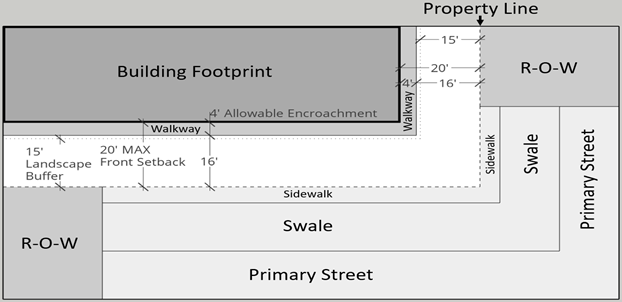
Fig. 1: Tequesta Drive Overlay
b.
Front facades on any third story and above must have front setback of eight to 12 feet in addition to the first floor setback, as depicted in figure 2 below:
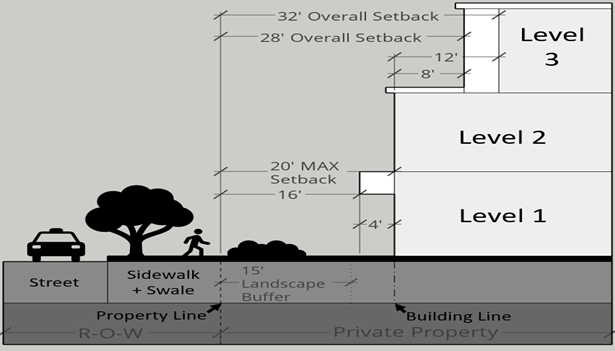
Fig. 2: Tequesta Drive Overlay
c.
Building facades along a street frontage shall provide the appropriate facade transparent elements such as glass windows or other approved openings to eliminate the creation of blank and stark walls along street frontages.
d.
Buildings fronting on two streets must have a pedestrian entrance on both streets.
(2)
Location of off-street parking.
a.
Parking is not permitted in the front setbacks or in the side setbacks facing streets, parks, or civic open spaces. Figures 3, 4, and 5 below are guidelines for illustrative purposes and depict minimum requirements.
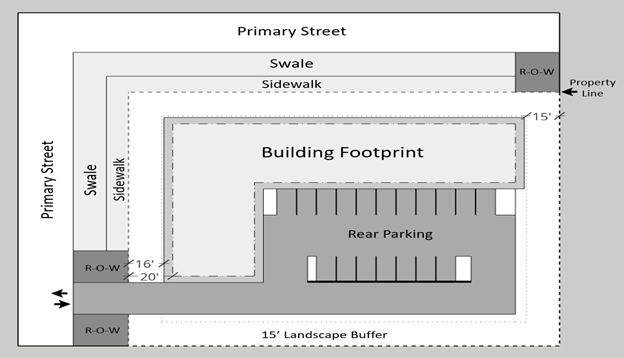
Fig. 3: Tequesta Drive Overlay
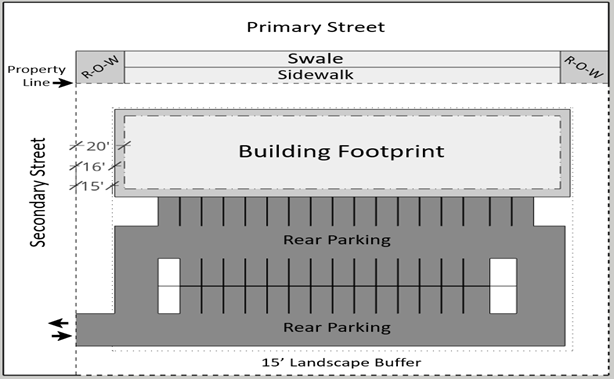
Fig. 4: Tequesta Drive Overlay
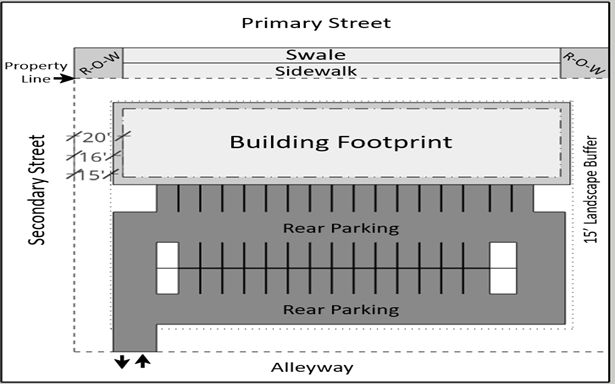
Fig. 5: Tequesta Drive Overlay
b.
Surface parking lots shall be screened from public view, when possible, by either buildings or landscaping.
c.
Shared parking in compliance with the requirement of section 78-706 of the Village Code of Ordinances is encouraged.
(f)
Formula businesses, restaurants, retail and drive through facilities.
(1)
Formula restaurants, formula retail, and drive through facilities are prohibited in the Tequesta Drive Overlay. However, existing drive through facilities may be used for the same use the building was constructed for.
(2)
Formula business. Formula businesses that conform with the intent and integrity of the district are permitted in the Tequesta Drive Overlay as a special exception use, subject to the following conditions:
a.
The proposed formula business shall comply with the special exception requirements of Village Code sections 78-363 and 78-364. New formula businesses within existing developments shall qualify for expedited special exception review by village council, provided there is no expansion to the existing development. Special exception applications that are submitted at least 30 days in advance of a village council meeting, and are deemed sufficient, shall be brought forward to that village council meeting for review.
b.
The proposed formula business will not alter the identity of the zoning district in a way which detracts from its local uniqueness.
c.
The proposed formula business will contribute to a diverse and appropriate blend of businesses in the district.
d.
The proposed formula business will complement the existing businesses in the district and help promote and foster the local economic base.
e.
The proposed formula business will be compatible with existing surrounding uses.
f.
The proposed formula business has been designed and will be operated in a nonobtrusive manner to preserve the local neighborhood character and ambiance and the proposed intensity of uses on the site is appropriate given the uses permitted on the site and on adjoining sites.
g.
Architectural style, design, exterior facade colors shall be compatible with the surrounding neighborhood.
h.
The proposed formula business' corporate structural elements and signage will be designed to be in harmony with architectural features and elements of the building and neighborhood as approved by the village council.
i.
Drive through facilities are prohibited, except that existing drive through facilities may be used for the same use the building was constructed for.
(g)
Civic open space.
(1)
Amount required. New development or re-development which adds gross floor area of 20 percent or more to the existing development is required to provide civic open space equal to five percent of the total site's square footage. Civic open space shall be counted towards the required minimum landscaped open space.
(2)
Types of civic open spaces. Civic open space shall be designed as one of the following types, and shall be identified on the site plan:
a.
Green. A green is at least 1,000 square feet in size and adjoins streets on at least two sides or a street and a pedestrian passageway or main building entry. Greens are designed primarily for passive uses, consisting primarily of lawn with either formally or informally arranged landscaping.
b.
Plaza. A plaza is at least 1,000 square feet in size and adjoins streets on at least two sides or a street and a pedestrian passageway or main building entry. Plazas are mostly hardscaped with formally arranged landscaping and a water feature.
c.
Playground. A playground is at least 2,500 square feet in size. Playgrounds provide children's play equipment and shaded seating. Playgrounds adjoin a street on at least one side and the configuration should ensure easy surveillance of the area from adjacent buildings and streets.
d.
Square. A square is at least 10,000 square feet and adjoins streets on at least three sides. Squares may be up to 50 percent hardscaped, with formal landscaping. Squares accommodate both passive uses and community gatherings.
e.
Attached green. An attached green is generally 2,000 to 6,000 square feet and spans the entire length of a block. Attached greens shall be at least 30 feet wide and are appropriate on the short end of a block. Attached greens are primarily lawns with formally arranged landscaping.
f.
Forecourt. A forecourt is an open area in front of the main building entrance(s) designed as a small garden or plaza. Low walls or balustrades no higher than three feet six inches in height may enclose the forecourt. Forecourt walls are constructed of similar material as the principal building or are composed of a continuous, maintained hedge. A forecourt may afford access to one or more first floor residential dwelling units or incorporate storefronts for commercial uses. The forecourt is suitable for outdoor seating for residents or restaurants. Forecourts are typically associated with multifamily, mixed-use, and commercial buildings.
g.
Pedestrian passageway. A pedestrian passageway is open to the sky connecting the front of the property to the rear, at least ten feet in width, and containing a minimum of 50 percent pervious, landscaped area, with decorative elements of interest, such as benches, trellises, sculptures, and water features which complement the design style of the building. Outdoor use areas may be provided adjacent to but not within the minimum required pedestrian passageway area.
h.
For civic open space requirements less than 250 square feet, the space may incorporate elements such as: fountain, living wall, mural, or sculpture facing a street or a pedestrian passageway.
(3)
Maintenance and operation of civic open space. Civic open space areas may be dedicated to the village for maintenance and operations purposes. The village council shall not be obligated to accept the dedication of civic open space if it is not in the best interest of the village. Otherwise, maintenance and operations shall be the responsibility of the owner. If a civic open space is dedicated to the village, the village shall assume all liability and responsibility for the property. The assumption of liability and responsibility shall be included in the dedication and shall be recorded in the public records of Palm Beach County.
(4)
Payment in lieu. In lieu of dedication of land for civic open space, the village council at its discretion may accept a fee in lieu of land for properties consisting of two acres or less. Such fee shall be equal to the appraised value of the amount of land that would otherwise be dedicated for civic open space purposes. Appraised value shall be based upon the market value of the land in its present state, prior to the proposed subdivision and/or development, as determined by the county tax assessor's appraised value.
a.
A fee in lieu of land dedication may be accepted by the village council when the location, size, natural condition, or other similar condition exists where the dedication of land would not be in the best interest of the village. An example of such a condition is when there is existing land available for recreational use within the immediate area of the proposed subdivision and/or land development or re-development.
b.
In determining whether to accept a fee in lieu of land the village council shall consider the age groups of residents to be served, the availability and service capabilities of existing recreational facilities in the village, and the general physical characteristics of the proposed civic open space.
c.
Fees in lieu shall be used for the acquisition, enhancement, expansion and/or development of the village's existing parks, recreation, land systems, or streetscapes.
d.
Fees paid in lieu may be used in conjunction with waivers. If an applicant is granted a partial waiver regarding the provision of civic open space, the applicant is required to pay the fee lieu for the remaining un-waived portion.
(h)
Landscape buffers and waivers.
(1)
Landscape buffers on the front and side may be reduced by no greater than 25 percent of each area to accommodate civic open space, as depicted in figure 6 below.
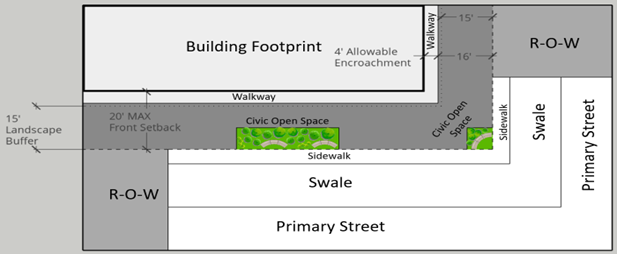
Fig. 6: Tequesta Drive Overlay
(2)
Waivers. Waivers from site or landscape requirements may be requested from certain overlay zone regulations. All waivers must be granted by the village council in conjunction with a site plan review application. Waivers cannot be used to:
a.
Add uses that are not permitted in the overlay or zoning district.
b.
Increase the maximum allowed density/intensity.
c.
Increase the maximum allowed building height.
(Ord. No. 01-24, § 4, 10-16-2024)
Sec. 78-212. - Us Highway One Overlay.
(a)
Purpose and intent. The US Highway 1 Overlay is established to encourage and provide for a pedestrian friendly commercial corridor with enhanced physical appearance through increased landscaping of public and private property; clustering of complementary uses throughout various locations within the corridor; and construction of pedestrian oriented facilities in both public and private realms along US Highway 1.
(b)
Conflicts with other regulations. In event that the overlay district regulations conflict with general zoning or special district regulations, the overlay regulations supersede the general zoning or special district regulations.
(c)
Design. Aesthetic considerations within the US Highway 1 Overlay as set forth in the November 10, 2022 Commercial Corridor Master Plan should be incorporated into all new development and re-development in this Overlay Zone. Specific architectural styles are neither mandated nor banned; however, new development and re-development should strive to reflect the architectural styles listed in appendix D (Architectural Design Guidelines) of the Commercial Corridor Master Plan.
(d)
Streets. Streets within the US Highway 1 Overlay shall be designated as primary and secondary streets. Tequesta Drive and US Highway 1 are the only designated primary streets. All other streets are designated as secondary streets.
(e)
Location of building and off-street parking.
(1)
Building location.
a.
Front setbacks; encroachments. The maximum front setback is 20 feet and the minimum landscape buffer is 15 feet; however, the following frontage types as detailed in appendix C of the Village of Tequesta Commercial Corridor Master Plan may encroach a maximum of four feet into the minimum 15 foot landscape buffer as set forth in table 1 and depicted in figure 1 below:
Table 1: US Highway One Overlay
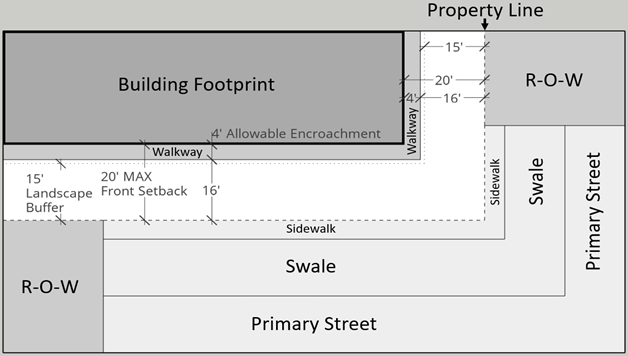
Fig. 1: US Highway One Overlay
b.
Front facades on any third story and above must have front setback of eight to 12 feet in addition to the first floor setback, as depicted in figure 2 below:
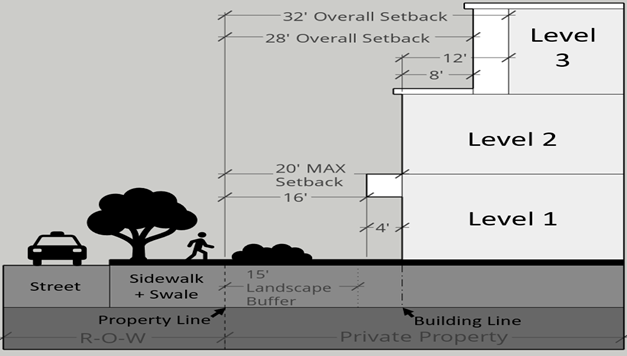
Fig. 2: US Highway One Overlay
c.
Building facades along a street frontage shall provide the appropriate facade transparent elements such as glass windows or other approved openings to eliminate the creation of blank and stark walls along street frontages.
d.
Buildings fronting on two streets must have a pedestrian entrance on both streets.
(2)
Location of off-street parking.
a.
Parking is not permitted in the front setbacks or in the side setbacks facing streets, parks, or civic open spaces. Figures 3, 4, and 5 below are guidelines for illustrative purposes and depict minimum requirements.
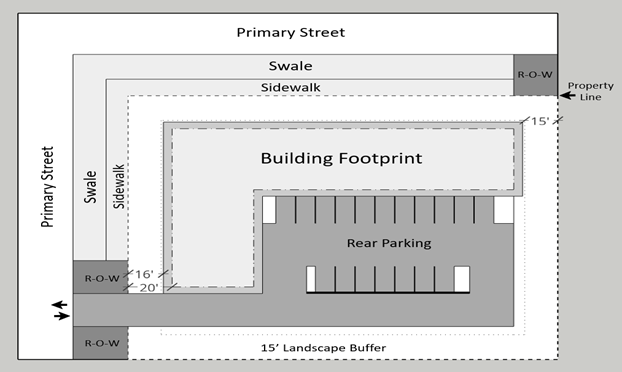
Fig. 3: US Highway One Overlay
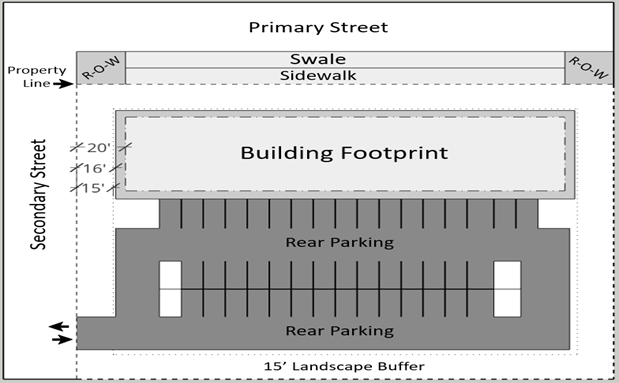
Fig. 4: US Highway One Overlay
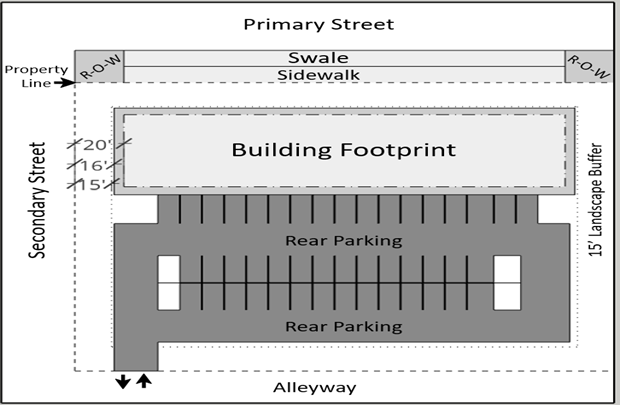
Fig. 5: US Highway One Overlay
b.
Surface parking lots shall be screened from public view, when possible, by either buildings or landscaping.
c.
Shared parking in compliance with the requirement of section 78-707 of the Village Code of Ordinances is encouraged.
(f)
Formula businesses, restaurants, retail, and drive through facilities.
(1)
New drive through facilities are permitted on the side and rear of the building and shall be screened from public view by landscaping.
(2)
Full-service fuel stations or gasoline service stations shall only be located within the US Highway 1 Overlay. Full-service fuel stations or gasoline service stations shall be located a minimum of 500 lineal feet from existing or previously approved stations; however, full-service fuel stations are not permitted in those portions of the US Highway One Overlay Zone with an underlying zoning designation of mixed use.
(3)
New drive through facilities shall not be located on a building facade that faces a public right-of-way, except for full-service fuel stations, which must be screened from public view.
(4)
Formula restaurants. Formula restaurants are permitted in the US Highway 1 Overlay as a special exception use subject to the following conditions:
a.
The proposed formula restaurant shall comply with the special exception requirements of village code sections 78-363 and 78-364. New formula restaurants within existing developments shall qualify for expedited special exception review by village council, provided there is no expansion to the existing development. Special exception applications that are submitted at least 30 days in advance of a village council meeting, and are deemed sufficient, shall be brought forward to that village council meeting for review.
b.
The proposed formula restaurant will not alter the identity of the zoning district in a way which detracts from its uniqueness.
c.
The proposed formula restaurant will contribute to a diverse and appropriate blend of businesses in the district.
d.
The proposed formula restaurant will complement the existing businesses in the district and help promote and foster the local economic base.
e.
The proposed formula restaurant will be compatible with existing surrounding uses.
f.
The proposed formula restaurant has been designed and will be operated in a nonobtrusive manner to preserve the community's character and ambiance and the proposed intensity of uses on the site is appropriate given the uses permitted on the site and on adjoining sites.
g.
Architectural style, design, exterior facade colors shall be compatible with the surrounding neighborhood.
h.
The proposed formula restaurant corporate structural elements and signage will be designed to be in harmony with architectural features and elements of the building and neighborhood as approved by the village council.
i.
Drive through facilities must comply with paragraphs (f)(1) and (f)(3) of this subsection.
(5)
Formula business and formula retail are permitted in the US Highway 1 Overlay in the same manner that non-formula business and non-formula retail are permitted.
(g)
Civic open space.
(1)
Amount required. New development or re-development which adds gross floor area of 20 percent or more to the existing development is required to provide civic open space equal to five percent of the total site's square footage. Civic open space shall be counted towards the required minimum landscaped open space.
(2)
Types of civic open spaces. Civic open space shall be designed as one of the following types, and shall be identified on the site plan:
a.
Green. A green is at least 1,000 square feet in size and adjoins streets on at least two sides or a street and a pedestrian passageway or main building entry. Greens are designed primarily for passive uses, consisting primarily of lawn with either formally or informally arranged landscaping.
b.
Plaza. A plaza is at least 1,000 square feet in size and adjoins streets on at least two sides or a street and a pedestrian passageway or main building entry. Plazas are mostly hardscaped with formally arranged landscaping and a water feature.
c.
Playground. A playground is at least 2,500 square feet in size. Playgrounds provide children's play equipment and shaded seating. Playgrounds adjoin a street on at least one side and the configuration should ensure easy surveillance of the area from adjacent buildings and streets.
d.
Square. A square is at least 10,000 square feet and adjoins streets on at least three sides. Squares may be up to 50 percent hardscaped, with formal landscaping. Squares accommodate both passive uses and community gatherings.
e.
Attached green. An attached green is generally 2,000 to 6,000 square feet and spans the entire length of a block. Attached greens shall be at least 30 feet wide and are appropriate on the short end of a block. Attached greens are primarily lawns with formally arranged landscaping.
f.
Forecourt. A forecourt is an open area in front of the main building entrance(s) designed as a small garden or plaza. Low walls or balustrades no higher than three feet six inches in height may enclose the forecourt. Forecourt walls are constructed of similar material as the principal building or are composed of a continuous, maintained hedge. A forecourt may afford access to one or more first floor residential dwelling units or incorporate storefronts for commercial uses. The forecourt is suitable for outdoor seating for residents or restaurants. Forecourts are typically associated with multifamily, mixed-use, and commercial buildings.
g.
Pedestrian passageway. A pedestrian passageway is open to the sky connecting the front of the property to the rear, at least ten feet in width, and containing a minimum of 50 percent pervious, landscaped area, with decorative elements of interest, such as benches, trellises, sculptures, and water features which complement the design style of the building. Outdoor use areas may be provided adjacent to but not within the minimum required pedestrian passageway area.
h.
For civic open space requirements less than 250 square feet, the space may incorporate elements such as: fountain, living wall, mural, or sculpture facing a street or a pedestrian passageway.
(3)
Maintenance and operation of civic open space. Civic open space areas may be dedicated to the village for maintenance and operations purposes. The village council shall not be obligated to accept the dedication of civic open space if it is not in the best interest of the village. Otherwise, maintenance and operations shall be the responsibility of the owner. If a civic open space is dedicated to the village, the village shall assume all liability and responsibility for the property. The assumption of liability and responsibility shall be included in the dedication and shall be recorded in the public records of Palm Beach County.
(4)
Payment in lieu. In lieu of dedication of land for civic open space, the village council at its discretion may accept a fee in lieu of land for properties consisting of two acres of less. Such fee shall be equal to the appraised value of the amount of land that would otherwise be dedicated for civic open space purposes. Appraised value shall be based upon the market value of the land in its present state, prior to the proposed subdivision and/or development, as determined by the county tax assessor's appraised value.
a.
A fee in lieu of land dedication may be accepted by the village council when the location, size, natural condition, or other similar condition exists where the dedication of land would not be in the best interest of the village. An example of such a condition is when there is existing land available for recreational use within the immediate area of the proposed subdivision and/or land development or re-development.
b.
In determining whether to accept a fee in lieu of land the village council shall consider the age groups of residents to be served, the availability and service capabilities of existing recreational facilities in the village, and the general physical characteristics of the proposed civic open space.
c.
Fees in lieu shall be used for the acquisition, enhancement, expansion and/or development of the village's existing parks, recreation, land systems, or streetscapes.
d.
Fees paid in lieu may be used in conjunction with waivers. If an applicant is granted a partial waiver regarding the provision of civic open space, the applicant is required to pay the fee lieu for the remaining un-waived portion.
(h)
Landscape buffers and waivers.
(1)
Landscape buffers on the front and side may be reduced by no greater than 25 percent of each area to accommodate civic open space, as depicted in figure 6 below.
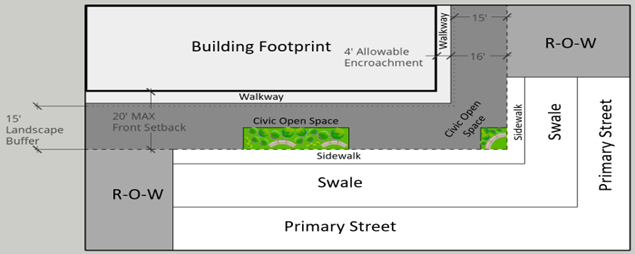
Fig. 6: US Highway One Overlay
(2)
Waivers. Waivers from site or landscape requirements may be requested from certain overlay zone regulations. All waivers must be granted by the village council in conjunction with a site plan review application. Waivers cannot be used to:
a.
Add uses that are not permitted in the overlay or zoning district.
b.
Increase the maximum allowed density/intensity.
c.
Increase the maximum allowed building height.
(Ord. No. 01-24, § 4, 10-16-2024)
Sec. 78-213. - Village Center Overlay.
(a)
Purpose and intent. The Village Center Overlay is established to encourage architectural character and a diversity of uses such as residential, commercial, and civic spaces while providing a pedestrian connectivity between Tequesta Drive, Bridge Road, Old Dixie Highway, and Village Boulevard. The Village Center Overlay is an appropriate location for traditional mixed-use development that provides opportunities for residents to live, work, shop, and recreate in a walkable area as contemplated by objective 1.11.0 and policy 1.11.2 of the Village of Tequesta Comprehensive Plan.
(b)
Conflicts with other regulations. In event that the overlay district regulations conflict with general zoning or special district regulations, the overlay regulations supersede the general zoning or special district regulations.
(c)
Design. Aesthetic considerations within the Village Center Overlay as set forth in the November 10, 2022 Commercial Corridor Master Plan should be incorporated into all new development and re-development in this overlay zone. Specific architectural styles are neither mandated nor banned; however, new development and re-development should strive to reflect the architectural styles listed in appendix D (architectural design guidelines) of the Commercial Corridor Master Plan.
(d)
Streets. Streets within the Village Center Overlay shall be designated as primary and secondary streets. Tequesta Drive, Bridge Road, Old Dixie Highway, Main Street, and Village Boulevard are the only designated primary streets. All other streets are designated as secondary streets.
(e)
Location of building and off-street parking.
(1)
Building location.
a.
Front setbacks; encroachments. The maximum front setback is 20 feet and the minimum landscape buffer is 15 feet; however, the following frontage types as detailed in appendix C of the Village of Tequesta Commercial Corridor Master Plan may encroach a maximum of four feet into the minimum 15 foot landscape buffer as set forth in table 1 and depicted in figure 1 below:
Table 1: Village Center Overlay
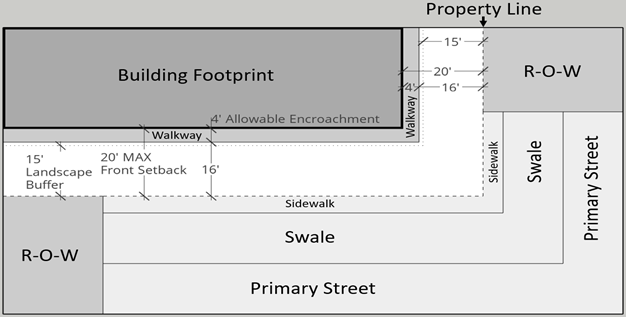
Fig. 1: Village Center Overlay
b.
Front facades on any third story and above must have front setback of eight to 12 feet in addition to the first floor setback, as depicted in figure 2 below:
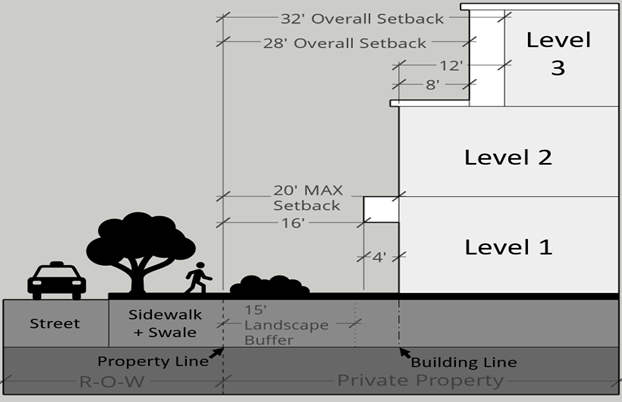
Fig. 2: Village Center Overlay
c.
Building facades along a street frontage shall provide the appropriate facade transparent elements such as glass windows or other approved openings to eliminate the creation of blank and stark walls along street frontages.
d.
Buildings fronting on two streets must have a pedestrian entrance on both streets.
(2)
Location of off-street parking.
a.
Parking is not permitted in the front setbacks or in the side setbacks facing streets, parks, or civic open spaces. Figures 3, 4, and 5 below are guidelines for illustrative purposes and depict minimum requirements.
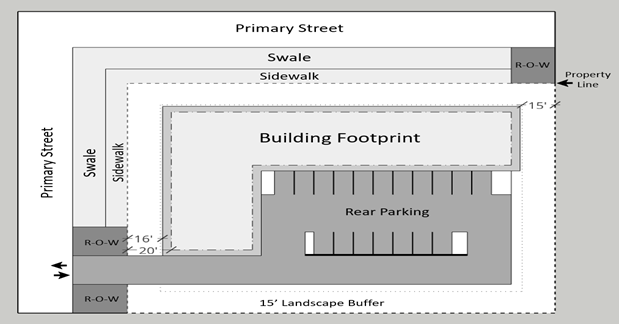
Fig. 3: Village Center Overlay
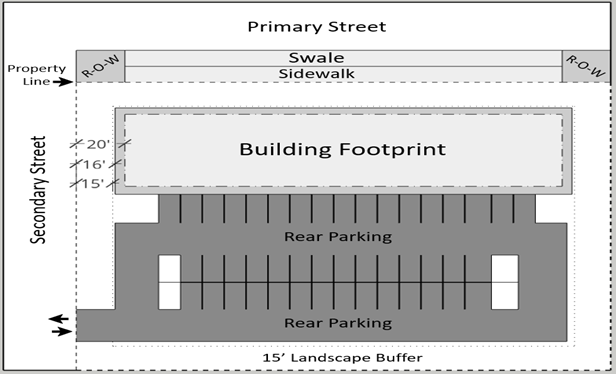
Fig. 4: Village Center Overlay
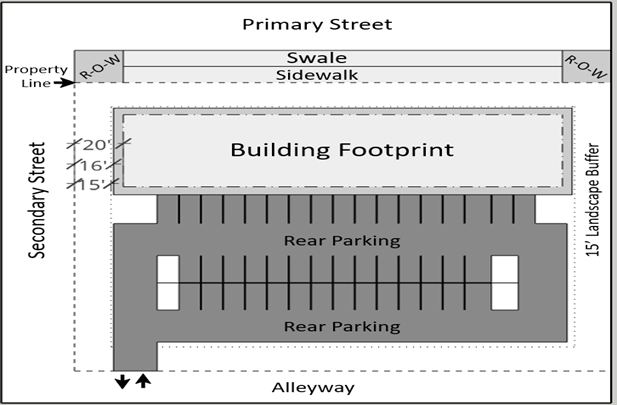
Fig. 5: Village Center Overlay
b.
Surface parking lots shall be screened from public view, when possible, by either buildings or landscaping.
c.
Shared parking in compliance with the requirement of section 78-707 of the Village Code of Ordinances is encouraged.
(f)
Formula businesses, restaurants, retail, and drive through facilities.
(1)
Drive-through facilities are prohibited in the Village Center Overlay; however, existing drive-through facilities may be used for the same use the building was constructed for.
(2)
Formula restaurants and formula retail. Formula restaurants and formula retail are permitted in the Village Center Overlay as a special exception use, subject to the following conditions:
a.
The proposed formula restaurant or formula retail use shall comply with the special exception requirements of Village Code sections 78-363 and 78-364. New formula restaurants and formula retail within existing developments shall qualify for expedited special exception review by village council, provided there is no expansion to the existing development. Special exception applications that are submitted at least 30 days in advance of a village council meeting, and are deemed sufficient, shall be brought forward to that village council meeting for approval.
b.
The proposed formula restaurant or formula retail use will not alter the identity of the zoning district in a way which detracts from its local uniqueness.
c.
The proposed formula restaurant or formula retail use will contribute to a diverse and appropriate blend of businesses in the district.
d.
The proposed formula restaurant or formula retail use will complement the existing businesses in the district and help promote and foster the local economic base.
e.
The proposed formula restaurant or formula retail use will be compatible with existing surrounding uses.
f.
The proposed formula restaurant or formula retail use has been designed and will be operated in a nonobtrusive manner to preserve the local community's character and ambiance and the proposed intensity of uses on the site is appropriate given the uses permitted on the site and on adjoining sites.
g.
Architectural style, design, exterior facade colors shall be compatible with the surrounding neighborhood.
h.
The proposed formula restaurant or formula retail use's corporate structural elements and signage will be designed to be in harmony with architectural features and elements of the building and neighborhood as approved by the village council.
i.
Drive through facilities are prohibited, except that existing drive through facilities may be used for the same use the building was constructed for.
(3)
Formula business is permitted in the Village Center Overlay in the same manner that non-formula business is permitted.
(g)
Civic open space.
(1)
Amount required. New development or re-development which adds gross floor area of 20 percent or more to the existing development is required to provide civic open space equal to five percent of the total site's square footage. Civic open space shall be counted towards the required minimum landscaped open space.
(2)
Types of civic open spaces. Civic open space shall be designed as one of the following types, and shall be identified on the site plan:
a.
Green. A green is at least 1,000 square feet in size and adjoins streets on at least two sides or a street and a pedestrian passageway or main building entry. Greens are designed primarily for passive uses, consisting primarily of lawn with either formally or informally arranged landscaping.
b.
Plaza. A plaza is at least 1,000 square feet in size and adjoins streets on at least two sides or a street and a pedestrian passageway or main building entry. Plazas are mostly hardscaped with formally arranged landscaping and a water feature.
c.
Playground. A playground is at least 2,500 square feet in size. Playgrounds provide children's play equipment and shaded seating. Playgrounds adjoin a street on at least one side and the configuration should ensure easy surveillance of the area from adjacent buildings and streets.
d.
Square. A square is at least 10,000 square feet and adjoins streets on at least three sides. Squares may be up to 50 percent hardscaped, with formal landscaping. Squares accommodate both passive uses and community gatherings.
e.
Attached green. An attached green is generally 2,000 to 6,000 square feet and spans the entire length of a block. Attached greens shall be at least 30 feet wide and are appropriate on the short end of a block. Attached greens are primarily lawns with formally arranged landscaping.
f.
Forecourt. A forecourt is an open area in front of the main building entrance(s) designed as a small garden or plaza. Low walls or balustrades no higher than three feet six inches in height may enclose the forecourt. Forecourt walls are constructed of similar material as the principal building or are composed of a continuous, maintained hedge. A forecourt may afford access to one or more first floor residential dwelling units or incorporate storefronts for commercial uses. The forecourt is suitable for outdoor seating for residents or restaurants. Forecourts are typically associated with multifamily, mixed-use, and commercial buildings.
g.
Pedestrian passageway. A pedestrian passageway is open to the sky connecting the front of the property to the rear, at least ten feet in width, and containing a minimum of 50 percent pervious, landscaped area, with decorative elements of interest, such as benches, trellises, sculptures, and water features which complement the design style of the building. Outdoor use areas may be provided adjacent to but not within the minimum required pedestrian passageway area.
h.
For civic open space requirements less than 250 square feet, the space may incorporate elements such as: fountain, living wall, mural, or sculpture facing a street or a pedestrian passageway.
(3)
Maintenance and operation of civic open space. Civic open space areas may be dedicated to the village for maintenance and operations purposes. The village council shall not be obligated to accept the dedication of civic open space if it is not in the best interest of the village. Otherwise, maintenance and operations shall be the responsibility of the owner.
If a civic open space is dedicated to the village, the village shall assume all liability and responsibility for the property. The assumption of liability and responsibility shall be included in the dedication and shall be recorded in the public records of Palm Beach County.
(4)
Payment in lieu. In lieu of dedication of land for civic open space, the village council at its discretion may accept a fee in lieu of land for properties consisting of two acres of less. Such fee shall be equal to the appraised value of the amount of land that would otherwise be dedicated for civic open space purposes. Appraised value shall be based upon the market value of the land in its present state, prior to the proposed subdivision and/or development, as determined by the county tax assessor's appraised value.
a.
A fee in lieu of land dedication may be accepted by the village council when the location, size, natural condition, or other similar condition exists where the dedication of land would not be in the best interest of the village. An example of such a condition is when there is existing land available for recreational use within the immediate area of the proposed subdivision and/or land development or re-development.
b.
In determining whether to accept a fee in lieu of land the village council shall consider the age groups of residents to be served, the availability and service capabilities of existing recreational facilities in the village, and the general physical characteristics of the proposed civic open space.
c.
Fees in lieu shall be used for the acquisition, enhancement, expansion and/or development of the village's existing parks, recreation, land systems, or streetscapes.
d.
Fees paid in lieu may be used in conjunction with waivers. If an applicant is granted a partial waiver regarding the provision of civic open space, the applicant is required to pay the fee lieu for the remaining un-waived portion.
(h)
Landscape buffers and waivers.
(1)
Landscape buffers on the front and side may be reduced by no greater than 25 percent of each area to accommodate civic open space, as depicted in figure 6 below.
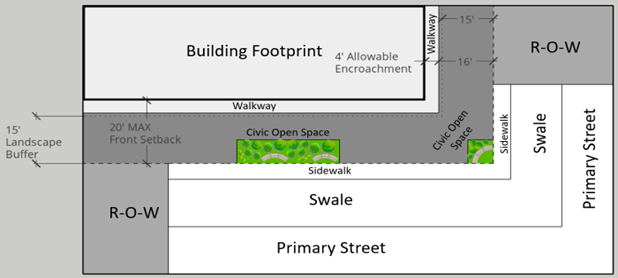
Fig. 6: Village Center Overlay
(2)
Waivers. Waivers from site or landscape requirements may be requested from certain overlay zone regulations. All waivers must be granted by the village council in conjunction with a site plan review application. Waivers cannot be used to:
a.
Add uses that are not permitted in the overlay or zoning district.
b.
Increase the maximum allowed density/intensity.
c.
Increase the maximum allowed building height.
(Ord. No. 01-24, § 4, 10-16-2024)
Sec. 78-214. - Waivers.
(a)
In the Tequesta Drive, US Highway One, or Village Center Overlay Districts, waivers may be requested from certain regulations in this Code. An applicant requesting a waiver shall demonstrate that the waiver provides a public benefit, including, by way of example, high-quality architectural design, pedestrian amenities, no-cost dedication of rights-of-way, construction of public parking, public art, or other improvements adjacent to the property, preservation of environmentally sensitive lands, provision of public parks and/or open spaces, or mixed uses which reduce impacts on village services.
(b)
An application for a waiver may be made by any property owner or tenant or by a governmental office, department, board, or bureau. Such applications shall be filed with the department of community development in conjunction with a site plan review application. As part of the review process, the applicant shall identify the waiver request, explain the nature of the request, the extent to which it deviates from the overlay regulations, and the basis for which it is sought.
(c)
As part of the site plan approval process, the planning and zoning board shall review and make a recommendation to the village council on any waiver that is requested. The village council will hold a public hearing to review the waiver request. When evaluating waiver requests, the village council shall consider the following factors and any additional criteria set forth in the relevant zoning district:
(1)
The extent to which the alternate standard proposed by the applicant differs from the code's standard that would be waived;
(2)
Whether the granting of the waiver will lead to innovative design in which other minimum standards are exceeded;
(3)
Whether the request clearly demonstrates the public benefits to be derived;
(4)
Whether the request furthers the goals of the Village Commercial Corridor Master Plan, and exemplifies the architectural, building, and site design techniques desired;
(5)
Whether the requested waiver is otherwise prohibited by Village Code;
(6)
Any unusual circumstances regarding the property or immediate area, including the location of power lines, specimen trees, or shade trees;
(7)
The effect of approving or denying the waiver on the development project and on the surrounding area;
(8)
Consistency with the Village of Tequesta Comprehensive Plan;
(9)
Testimony from the applicant; and
(10)
Testimony from the public.
(d)
At the conclusion of the public hearing, the village council shall make a decision on each requested waiver. Approval is contingent on the village council making these findings and any additional findings relevant to the applicable zoning district:
(1)
The alternate standard proposed by the applicant is acceptable for the specific site and building;
(2)
The proposed waiver does not detract from the design principles supporting these zoning districts and the broader intent of this code;
(3)
The proposed waiver will not be injurious to surrounding properties or nearby neighborhoods; and
(4)
The proposed waiver is not inconsistent with the Village of Tequesta Comprehensive Plan.
(e)
Public notice of all waiver hearings shall be provided as required by section 78-370 of the Village Code.
(Ord. No. 01-24, § 4, 10-16-2024)

