
Tewksbury Township City Zoning Code
APPENDIX A
DESIGN GUIDELINES WITHIN HISTORIC DISTRICTS
Prepared by: Tewksbury Township Historic Preservation Commission Tewksbury Township
Development Regulations Ordinance
DESIGN GUIDELINES WITHIN HISTORIC DISTRICTS
TOWNSHIP OF TEWKSBURY
FORWARD
The Tewksbury Township Historic Preservation Commission shall administer appropriate state and local legislation for the designation and protection of historic properties and shall comply with Section 106 of the National Historic Preservation Act, as amended, in order to preserve, protect and maintain the historic character of Tewksbury for future generations.
INTRODUCTION
In 1989 the Tewksbury Township Committee voted to disband the Historic/Architecture Committee, which was an advisory body to the Planning Board on matters related to development within the Township's three historic districts, Oldwick, Pottersville, and Mountainville. The current Historic Preservation Commission replaced the WA Committee. This new Commission would act on development issues with the locally designated historic districts as well as locally designated historic sites according to state and federal guidelines. In organizing the information contained in these Guidelines information was taken from the sources listed below with the intent to provide a balanced and relevant perspective on the historic qualities ofTewksbury Township.
The Secretary of the Interior's Standards for Historic Preservation Projects.
The Secretary of the Interior's Standards for Rehabilitation.
Historic Preservation Guidelines for Bridgeton, New Jersey.
Historic Preservation Guidelines for Neptune, New Jersey.
Historic Preservation Guidelines for Westfield, New Jersey.
Identifying Amerrican Architecture, A Pictorial Guide to Styles and Terms.
By John J.G. Blumenson
Legacy Through The Lens — A Study of Mendham Architecture.
By Janet W. Foster
The New Jersey House.
By Helen Schwartz
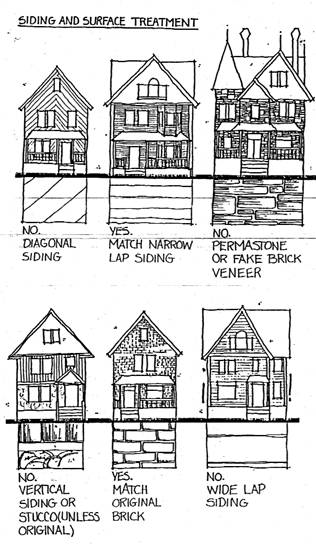
SIDING AND SURFACE TREATMENT
Deteriorated siding material should be replaced with material used in original construction, or with materials that resemble the appearance of the old as closely as possible.
Resurfacing frame buildings with new material which is inappropriate, such as artificial stone, artificial brick veneer, or asbestos and asphalt shingles, should not be done. Four-inch metal siding may be used in some cases to resurface clapboard structures iif well-detailed, well-designed, and in keeping with the historical character of the structure.
ROOF SHAPES
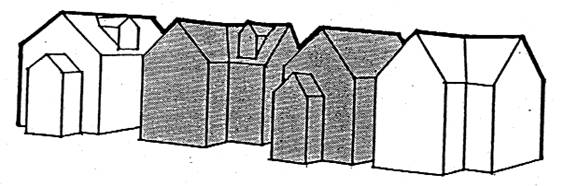
Consider.
Relating the roof forms of the new buildings to those found in the area. Although not entirely necessary, duplication of the existing or traditional roof shapes, pitches and materials on new constuction is one way of making new structures more visually compatible.
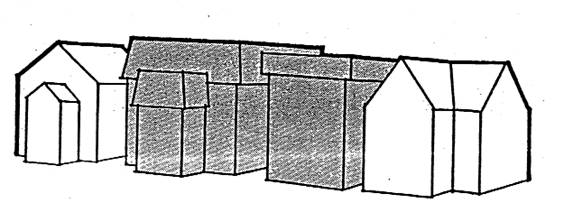
Avoid.
Introducing new roof shapes, pitches, or materials not traditionally used in the area.
SETBACK
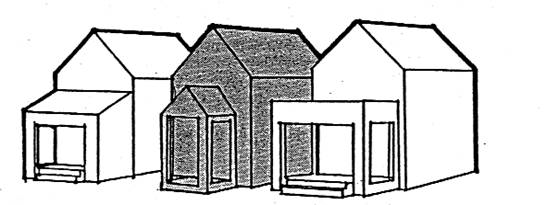
Consider.
Maintaining the historic facade lines of streetscapes by locating front walls of new buildings in the same plane as the facades of adjacent buildings. If exceptions are made, buildings should be set back into the lot rather than closer to the street. If existing setbacks vary, new buildings should conform to historic siting patterns.
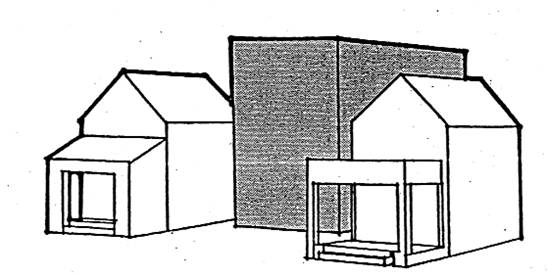
Avoid.
Violating the existing setback pattern by placing new buildings in front of or behind the historic facade line. Avoid placing buildings at odd angles to the street, unless in an area where diverse siting already exists, even if proper setback is maintained.
PLATFORMS
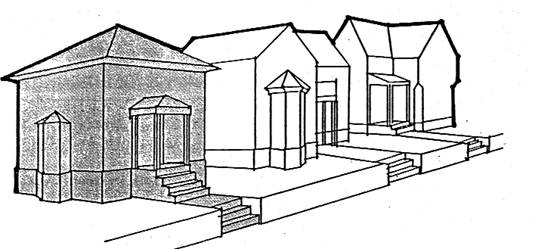
Consider.
The use of a raised platform is a traditional siting characteristic of most of the older buildings in Salt Lake City. This visual "pedestal" is created by retaining walls and terracing up to the building or by high foundation walls and stepped entries.
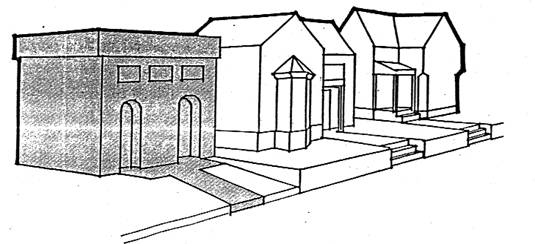
Avoid.
Bringing walls of new buildings straight out of the ground without a sense of platform, i.e., without maintaining the same entry height as neighboring buildings. Such structures seem squat, visually incomplete and do not relate well to their elevated neighbors. Also avoid levelling off terraced slopes or removing retained platforms.
SCALE
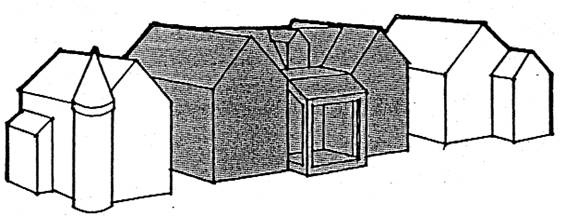
Consider.
Relating the size and proportions of new structures to the scale of adjacent buildings. Although much larger than its neighbors in terms of square footage, the building shown maintains the same scale and rhythm as the existing buildings.
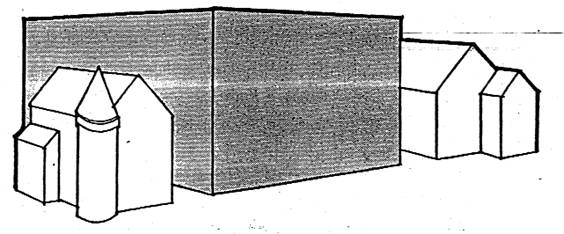
Avoid.
Buildings which in height, width or massing violate the existing scale of the area. The new building shown here disrupts the scale and rhythm of the streetscape although it might be appropriate in a different location.
IMITATIONS
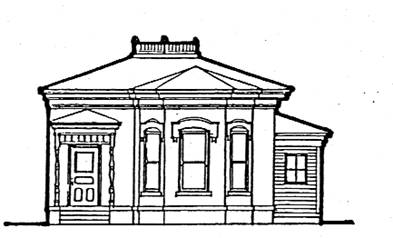
Consider.
Accurate representation of or visually compatible additions to existing buildings, and for new construction, contemporary architecture which well represents our own time, yet enhances the nature and character of the historic district.
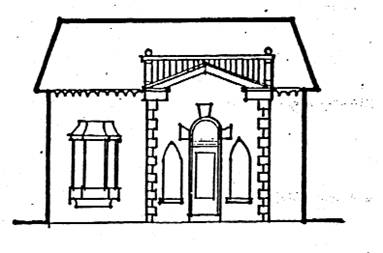
Avoid.
Replicating or imitating the styles, motifs or details of older periods. Such attempts are rarely successful and, even if done well, present a confusing picture of the true character of the historical area.
GLOSSARY OF TERMS
Baluster.
A spindle or post supporting a railing.
Bay.
The vertical divisions of the facade of a building, usually defined by window placement.
Bay Window.
A window projecting at an angle from the plane of a wall.
Board and Batten.
Siding consisting of vertical boards, the joints of which are covered by narrow strips of wood.
Bracket.
A projecting element, often sawn or carved, that supports a horizontal member, such as a cornice, window or roof overhang.
Capital.
The upper element, usually projecting, of a column or pilaster.
Chamfered.
A square or rectangular wooden member on which the edges are beveled.
Clapboard.
Siding consisting of overlapping horizontal boards usually thicker at the lower edge.
Classical.
Pertaining to the architecture of Greece or Rome, or to styles inspired by this architecture.
Column.
A vertical support, usually round and generally consisting of base, shaft and capital.
Cornerboard.
A vertical strip of wood at the corner of a building, into which the siding butts.
Cornice.
A projecting molding at the top of a wall surface, often used to describe the horizontal feature below the eaves of a roof.
Crown Molding.
A projecting decorative molding, such as those found above windows and doors.
Dormer.
A window with its own roof, projecting from the slope of the main roof.
Double Hung Window.
A window with two sashes, one sliding vertically over the other.
Eave.
The edge of a roof.
Facade.
The front face or elevation of a building.
Fenestration.
The arrangement of windows in a building.
Finial.
An ornament terminating the point of a spire or peak of a pediment or gable.
Gable.
Term applied to roof with triangular pitch; also the triangular top section of a wall carrying such a roof.
Head.
The top of a door or window.
Hip Roof.
A roof with uniform slopes on all four sides.
Intersecting Gable.
A sloping roof projecting at right angles from the slope of a main roof.
Jigsaw Work.
Machine sawn woodwork on boards with scrolls, irregular lines and openwork.
Lattice.
An openwork grill of interlacing wood strips.
Light.
Individual pane of a window or door surround. Divisions of sash windows into lights are often expressed in terms of 1/1 (one light over one light ), 2/2, 6/1, etc.
Lintel.
The top horizontal member of a window or door.
Mansard Roof.
Roof with two slopes on all four sides (although upper slope may be flat; usually steeply pitched; lower slope may be convex, concave or straight).
Molding.
Contoured projecting elements.
Mullion.
Vertical post dividing window into two or more lights.
Muntins.
Narrow elements separating the lights of a window.
Palladian Window.
Arched window flanked by two smaller rectangular windows.
Pediment.
Triangular space forming the end of a roof; also triangular head to window or door.
Pier.
An upright supporting member, square or rectangular in section.
Pilaster.
A square or rectangular upright member, attached to, but projecting from a wall.
Pinnacle.
Small spire or turret.
Pitch.
The degree of slope of a roof.
Plinth.
A square or rectangular base for a column, pier or post.
Rail.
A horizontal member, often used to describe such members, in a door or window; the top or bottom member of a railing.
Railing.
A system consisting of balusters with one or more rails.
Rake Board.
A decorative board attached to the edge of a pitched end of a gable roof.
Ridge.
The line where two slopes of a roof meet.
Riser.
The vertical face of a stair step.
Sash.
The framework holding the glass in a window or door.
Siding.
The exterior wall covering of a building.
Sill.
The horizontal member at the bottom of a window on door frame.
Soffit.
The exposed undersurface of any overhead component, such as a lintel or cornice.
Spandrel.
An area, roughly triangular in shape, between two arches or between a post and beam.
Stile.
A vertical framing member of a door or window.
Transom.
The opening, filled with glass or a panel, over a door or window.
Tread.
The horizontal surface of a step.
Turned Work.
Woodwork shaped on a lathe.
Turret.
A small, slender tower.
Vernacular.
Simplified version of high-style architecture; often reflects local preferences or customs.
HISTORY OF THE LOCALLY DESIGNATED HISTORIC DISTRICTS
Mountainville.
The village of Mountainville, the smallest of the three Historic Preservation Districts, is made up of a few more than a dozen houses. Mountainville, named so because it is situated at the base of Hell Mountain, has five streams coming together in the village center. The abundance of flowing water helped this community to service the surrounding farmland in the early to mid 1800's. It retains much of its original character with only three modern buildings. A mixture of Victorian and vernacular style houses exist in the village, including Greek Revival, Queen Anne, gable roof frame "I" houses and simple stucco over stone mill houses.
Some of the most notable buildings are the Farley's General Store, the Mountainville Hotel, Mail Pouch Farm, the Stucco Mill house and Number 217 Main Street. The store is located in the center of the village and is a striking example of a country store architecture dating back to the 1850's. It is a two and one half story three bay building with a gable front, center door, and full Italianate porch. The hotel is a four bay two story "I" house with clapboard siding and a simple Greek Revival wrap-around porch. The hotel was run for more than two hundred years by the Potter family and has also served as a polling center, a saloon, and dance hall in the second floor ballroom. This building dates back to the 1820's. Nail Pouch Farm as it is called because of the recent (1960) painting of "Chew Mail Pouch" on the rear barn, is at the western end of Main Street. This Victorian house dates back to the 1850's with a Queen Anne front porch. It once housed the ministers of the Methodist and Episcopal churches in Cokesbury and its barn was used as a carriage factory. The Wandsome stone homes across from and west of the General Store are mill houses. Both are "I" houses and one is made of stucco over stone. They date back to the 1820's. At the eastern end of the village stands a Greek Revival residence, with touches of Baroque Victorian influences dating back to 1854. This house has a wagon wheel window in the center of the gable roof, two front doors, (one was used as the business entrance for a milliners shop), and a gingerbread front porch across all four bays. In addition, the original stone hitching posts and mounting block along the front lawn are still standing.
Oldwick.
A place called "Tewksbury" first appeared on New Jersey's map and land Title records in 1755. That was the year that Tewksbury Township was set off from Lebanon Township; a time when today's village of Oldwick was known as New Germantown.
It would take another century and a half for the place name, "Oldwick" to appear on the map. As "New Germantown," the village was a hub of activity in Tewksbury from its earliest days. The history of the territory now embraced by Tewksbury goes back to pre-recorded times—to settlements by Native Americans, whose traces can still be found today along stream beds and in newly plowed fields.
Its recorded history began in 1709 with two purchases made from the Indians by The West Jersey Society, a group of London investors. At that time the entire area was in Amwell Township, Burlington County.
When Hunterdon County was set off from Burlington in 1714, Amwell Township went with Hunterdon. Amwell was further subdivided in 1730 with the setting off of a new township, known as Lebanon. Then in 1755, came the partition of Tewksbury from Lebanon.
Potterstown in the late 1720's was the earliest hamlet in the township. It was called Racheway by the German settlers who built a church there. By 1748 the name had become Potterstown, possibly for the Daniel Potter family living there, but equally possibly for a man plying the potter's trade.
The village became the principal settlement after 1749, the year the Zion Lutheran Church was built. The village underwent several name changes in those early years.
In 1752, in writing to the Governor, the Lutheran pastor referred to the village as "Bethlehem."
In 1753, Ralph Smith, a mill owner and land developer, began dividing and leasing lots on Church Street for home sites. The builder of Zion Lutheran Church in 1749, Smith referred to the town as "Smithfield" in his leasing agreements.
In 1754 the name Germantown and sometimes New Germantown first appears. Speculation by some historians link the name to the nationality of Lutheran church members—although most of the early villagers were not German. Another theory is that New Germantown derived from Germantown, Pennsylvania, the home of James Logan from whom all the land around the village was leased.
World War I, with America's antipathy to anyone "German" brought about the change of name to Oldwick, meaning "old village."
From its earliest days, New Gerrnantown/Oldwick began to grow into an agricultural community. Many farms outlined the village and surrounding countryside. Everything from peaches to wheat was grown and sold.
It was during this time period that many homes were built, most of which still stand today. Within the village is a mixture of Queen Anne, Greek Revival, Georgian/Federal, Colonial Revival, and some Italianate. The homes date mainly from 1820-1870, with some having been built earlier, some later.
Among the most notable buildings in Oldwick are Zion Lutheran Church, Barnet Hall Academy, (later the Oldwick Community Center) and the Oldwick General Store.
The Zion Lutheran Church was built in 1749. The church building is outlined in Greek Revival style. Established in 1714, the congregation is New Jersey's oldest Lutheran body in continuous service.
Barnet Hall Academy was built in 1807 in a vernacular Victorian style. Named after its original owner, Dr. Oliver Barnet, a Revolutionary War figure and the town's first physician, Barnet Hall was one of the first schoolhouses in the area.
The Oldwick General Store dates to the 18th century and has served many purposes, including a blacksmithy, milkhouse depot, general store, antique shop, and eating place.
There are approximately 88 principal buildings in Oldwick that are listed on the state/national register. While most of the buildings have had minor renovations over the years, most have been maintained to preserve their historic character.
Sources:
History of Hunterdon and Somerset Counties; James P. Snell, 1881.
Oldwick Historic District—National Register Nomination; November, 1979.
Sites of Historic Interest—Hunterdon County Master Plan.
Tewksbury Place Names; Norman C. Wittmer, 1976.
Pottersvi1le.
The abundant water power from the Lamington River was the single most important factor in the initial settlement and subsequent development of Pottersville.
By the time of the American Revolution, a feed and flower mill (lower mill ) and filling mill (upper mill ) and possibly a sawmill were in operation on the west side of the river. The mills became the property of the Serring Potter family in 1783, whence the village was known as Potter's Mills, until 1840 and the establishment of "Pottersville's" first Post Office.
By the mid-19th through the early 20th century, use of water power was expanded. The lower mill was rebuilt in 1840, the foundry was established in 1852, the hydrosystem was rebuilt around 1865, and the machine shop and pattern shop were in place by 1878. All elements of the manufacturing complex were complete by 1900. By this time the village proper also contained its Romanesque Revival Church (built in the 1850's), school, store, blacksmith shop and some fifteen houses, and there was corresponding development in the surrounding region.
The Rockaway Valley Railroad reached Pottersville in 1889. The line handled raw materials and finished products for the foundry complex, grain for the mills, peaches, coal, lime, milk and other products from the area, leading to further development at the village.
It also opened the village to tourism, with special excursion trains to Black River Falls Park, also known as "The Glen," which drew visitors to Pottersville from throughout New Jersey and prompted construction of the Parkside Hotel and Bar to handle the trade.
Pottersville continued to grow in the early 20th century with a new Post Office, Prairie style school and more houses.
Historic Pottersville of today is essentially a product of the mid 19th through the 20th century and its buildings reflect that time span. There are forty four major contributing buildings including the following "key" buildings: the upper mill and its hydrosystem, the church, the school, stores, and a hotel. All of them were constructed by local builders and carpenters.
The district includes examples of formal styles and vernacular types, but all of the buildings are similar in terms of their siting, mass, scale, and/or material. Typically, buildings are of wood frame construction, 2 1/2 stories in height, three to five bays in width, with gable-form roofs and center hall or L-shaped plans.
Also, in its landscape and plant material, configurations of streets and roads, and density of development, the district retains its historic character.
Sources:
(Condensed from National Register of Historic Places.
Application prepared by Heritage Studies.)
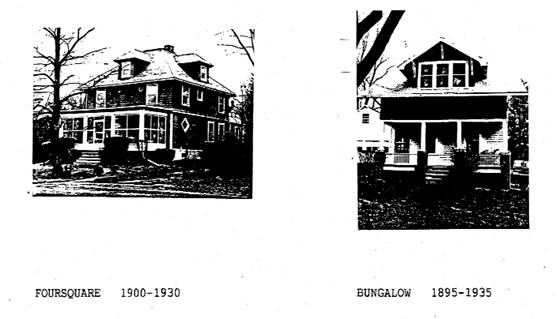
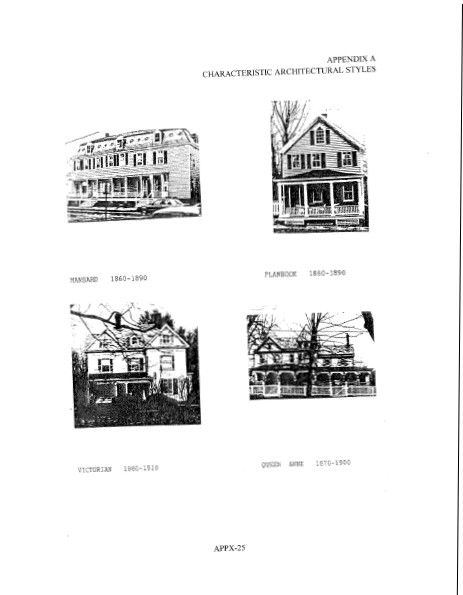
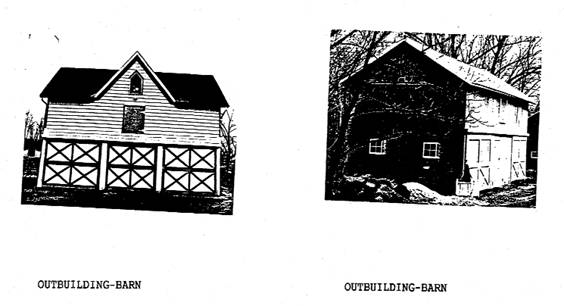
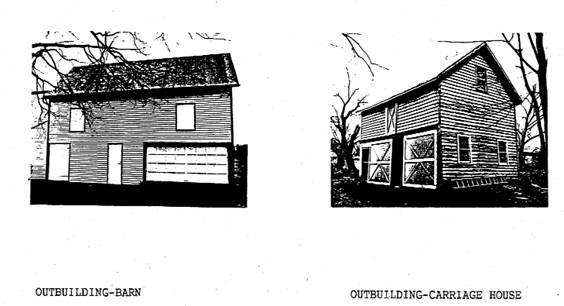
CHARACTERISTIC ARCHITECTURAL STYLES
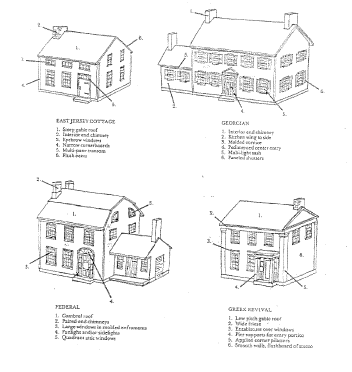
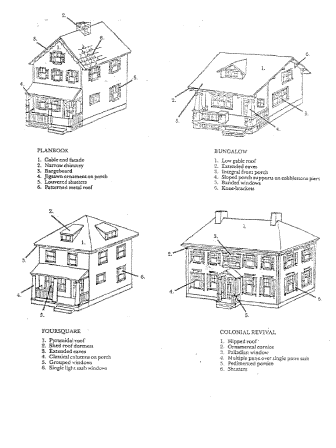
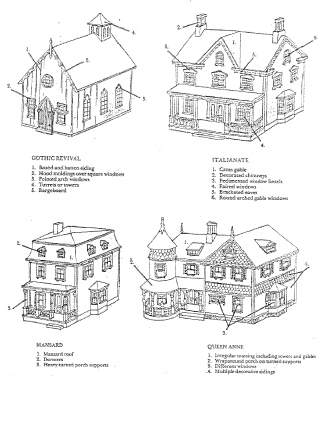
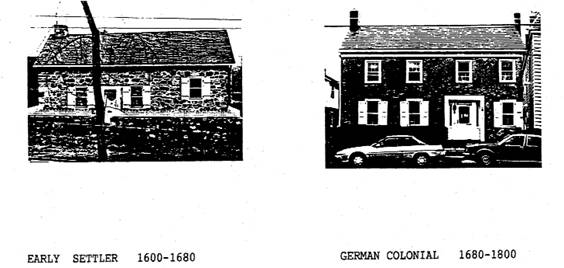
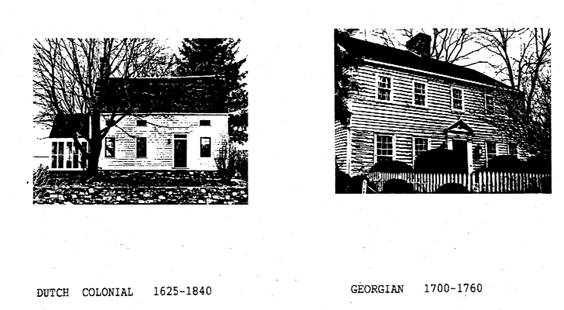
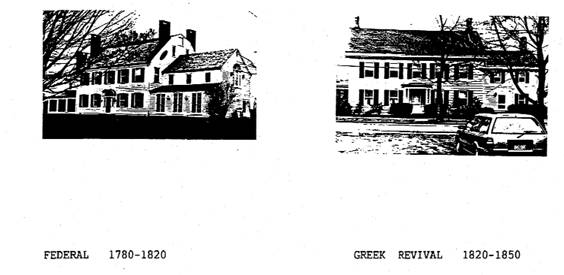
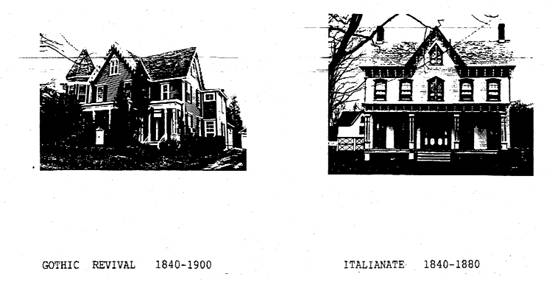
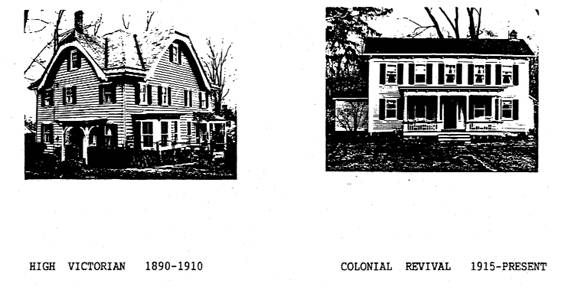
The following pages contain line drawings and photographs which illustrate the specific periods and styles of regional architecture.
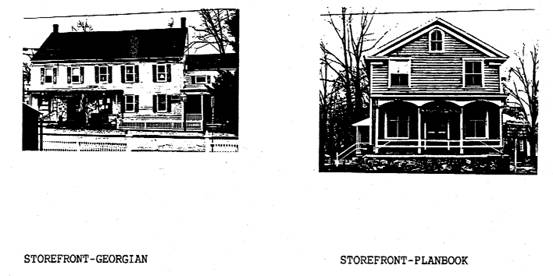
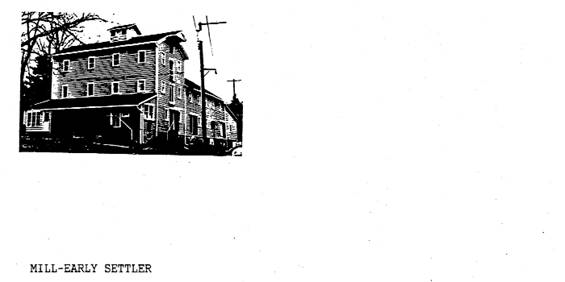
PHOTOGRAPHIC DETAILS OF HISTORIC BUILDINGS AND LANDSCAPES
WITHIN TEWKSBURY TOWNSHIP HISTORIC DISTRICTS
In an effort to enhance the level of awareness of Historic District Residents and Historic Preservation Commission Applicants, photographs of specific construction details were taken and assembled for the reference of all those considering construction within the Districts. Please note that the intent is not to limit the Applicant's creativity, but to remind him or her of what already exists and is historically correct.
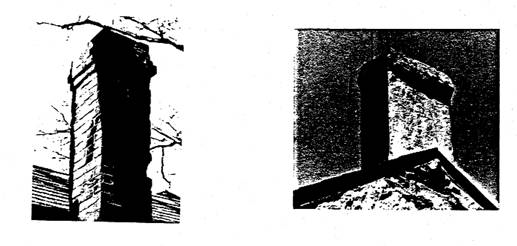
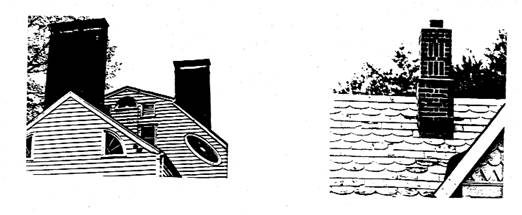
Chimneys.
Always constructed of masonry, early chimneys were sized for cooking fireplaces. After the introduction of fossil fuel heating systems, chimneys took on different shapes for either fireplace or furnace flues. Houses constructed of stone usually had stone chimneys. Later houses of masonry or wood framing used brick.
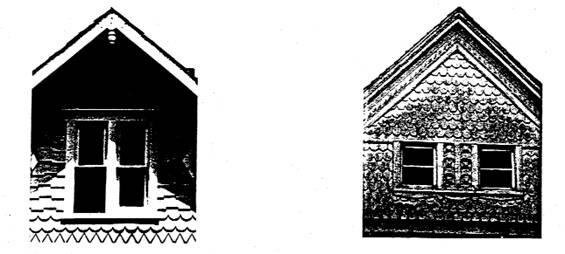
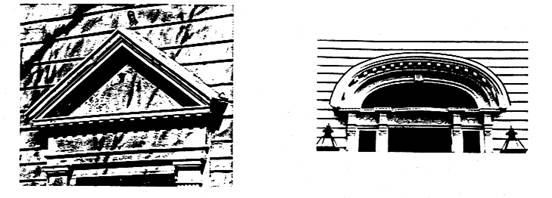
Decorations.
Each period of architecture employed decorations popular at that time. In each case a decoration would be a nonstructural surface treatment.
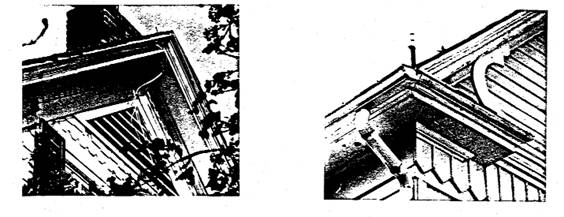
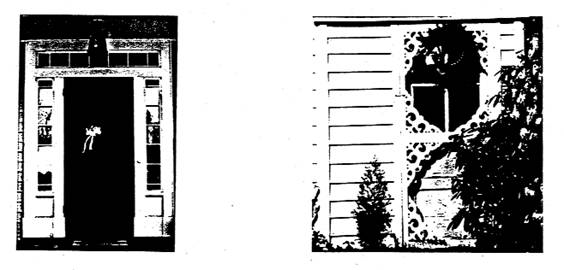
Decorations.
(continued)
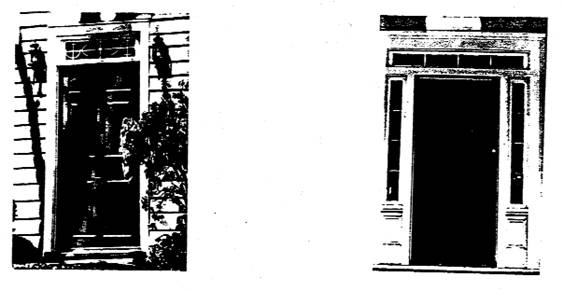
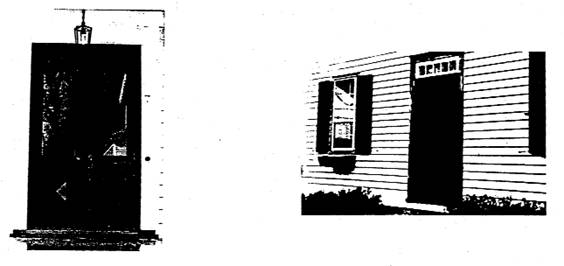
Doors.
Doors can be either very simple or very formal, panels, raised panels, solid, or fitted with glass. Doors can be singles, pairs, screens, or sliders. In all cases doors are constructed of wood.
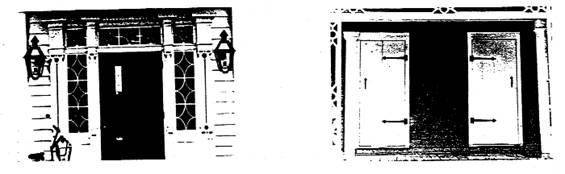
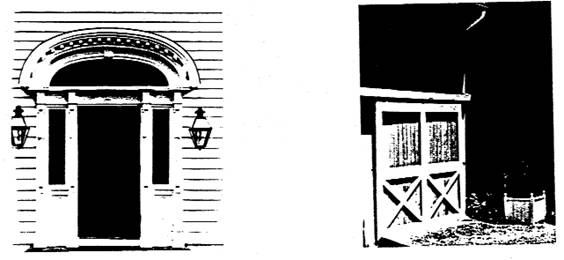
Doors.
(continued)
Exterior Surroundings.
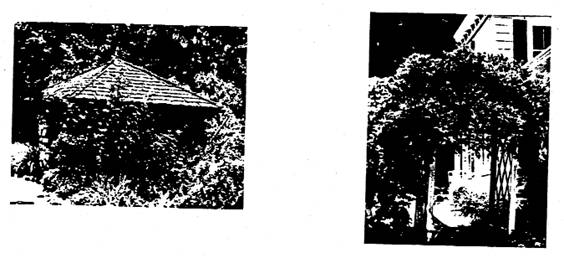
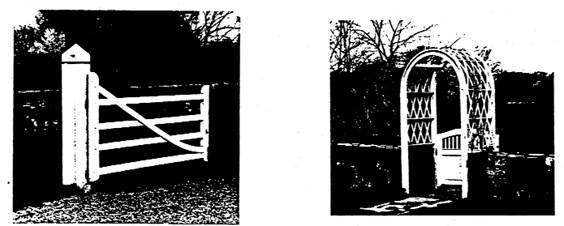
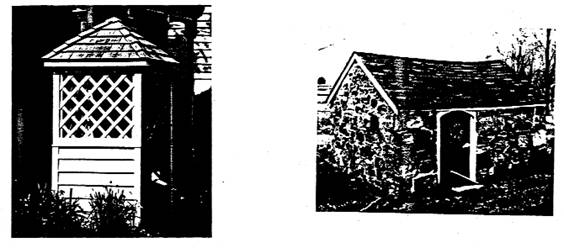
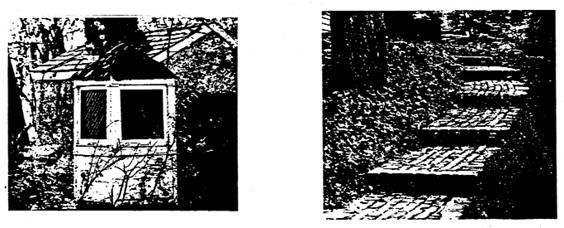
The area immediately surrounding a house can be designed to integrate the landscape with the building. Examples include well houses, outhouses, pergolas, gazebos, trellises, gates, fences, smoke houses, root cellars, walkways and driveways.
Exterior Surroundings.
(continued)
Metal Work.
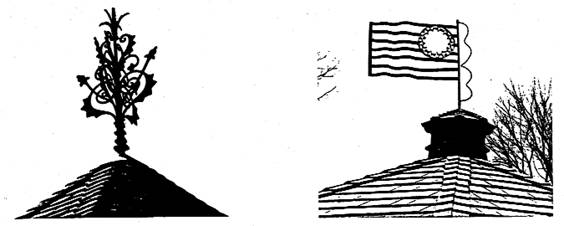
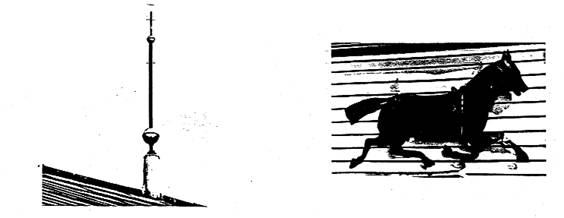
Hinges and latches are the first examples of metal work that come to mind, but the use of metal also extends to lighting fixtures, lightning rods, weather vane, signs, hitches and well pumps.
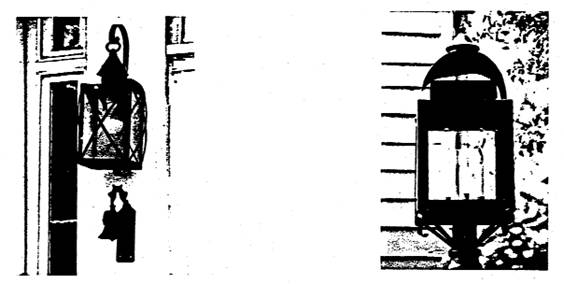
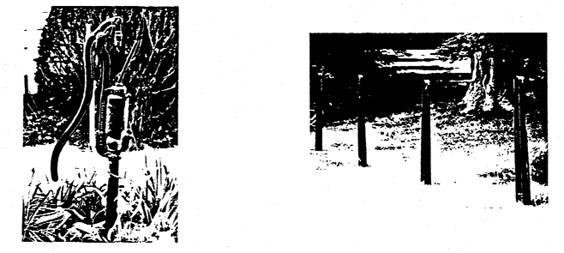
Metal Work.
(continued)
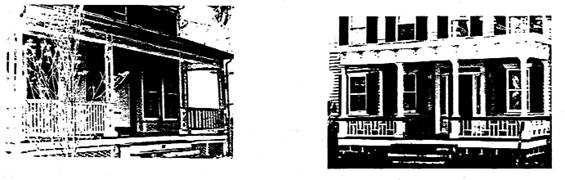
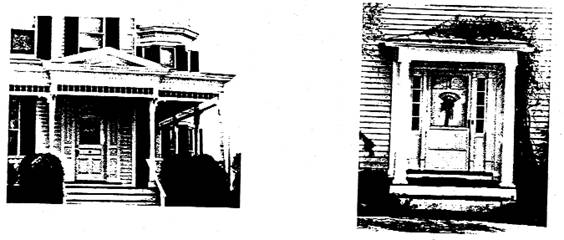
Porches.
Porches are a natural extension of the house and take on varying degrees of importance with different periods of architecture. Porches are commonly added to almost any building style and can be left open, screened, or partially closed.
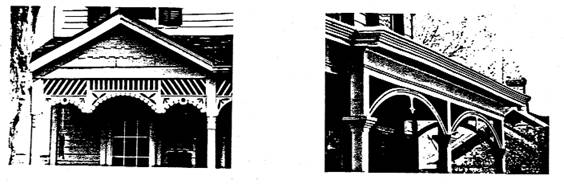
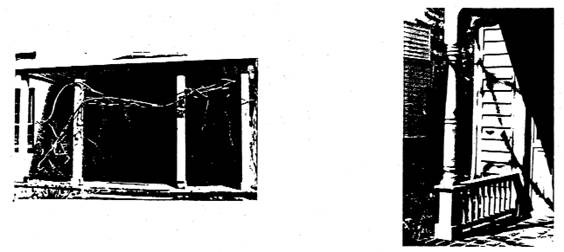
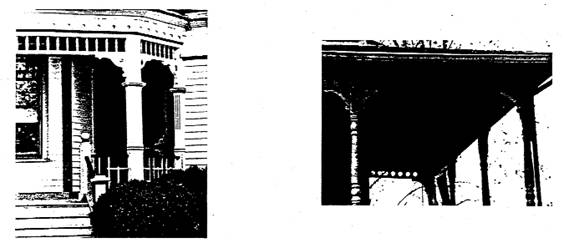
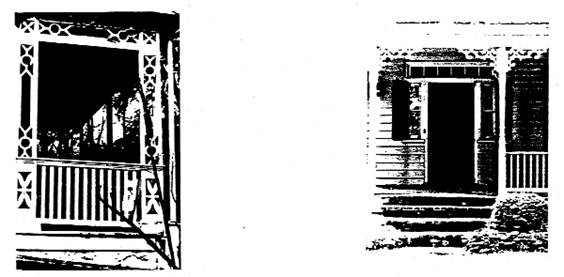
Porch Details.
Besides the actual walking surface, porches can be expressive of style in their use of posts, rails, steps, brackets and roof decorations.
Porch Details.
(continued)
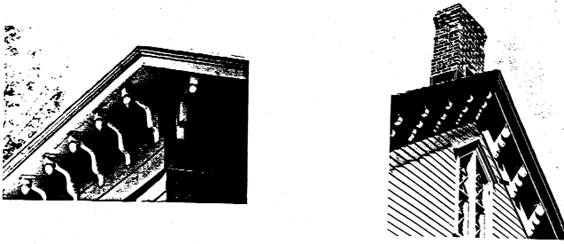
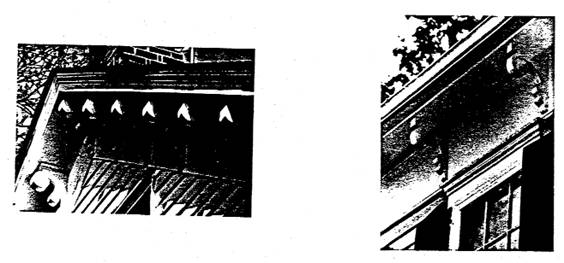
Roof Details: Brackets.
Located under the eave, these wooden components are usually sculpted into a decorative profile and spaced at the same intervals as the rafters.
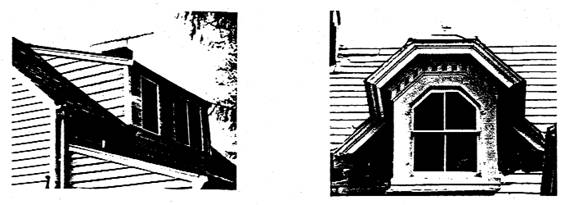
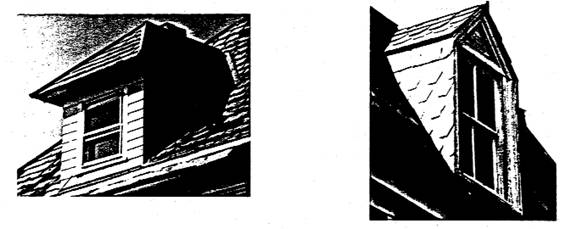
Roof Details: Dormers.
Built for the purpose of allowing light and ventilation into attics, they usually have gable or shed-like shapes. Later styles of houses which rely on a usable third floor area rely on dormers to make those spaces habitable.
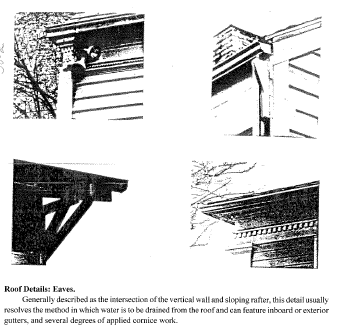
Roof Details: Eaves.
Generally described as the intersection of the vertical wall and sloping rafter, this detail usually resolves the method in which water is to be drained from the roof and can feature inboard or exterior gutters, and several degrees of applied cornice work.
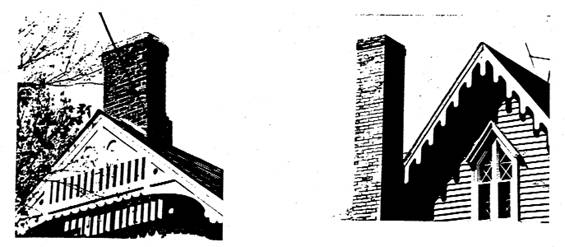
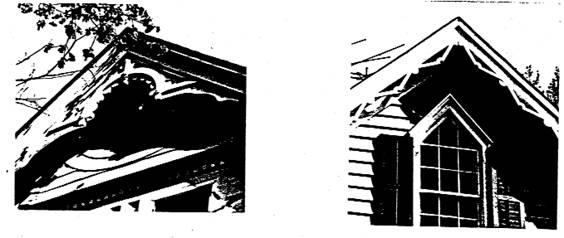
Roof Details: Gable Decoration.
Exterior trim that follows the line of the roof up and down the endwall of the gable; the degree of detailed decoration varies with each period of architecture.
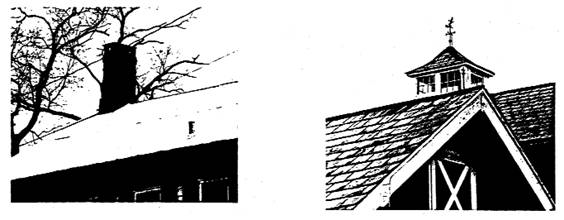
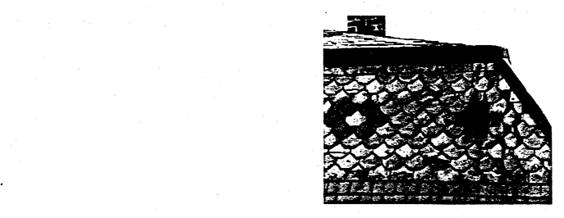
Roof Details: Materials.
Historically correct materials for this part of the country would include slate, cedar shakes, and particularly among outbuildings; standing seam metal, usually lead-coated tin and sometimes copper.
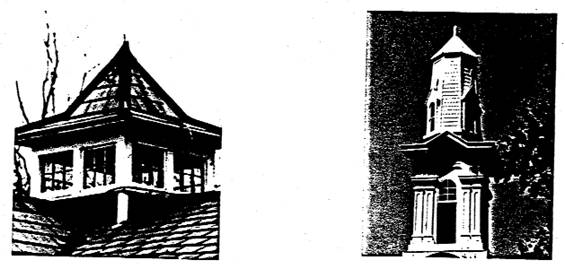
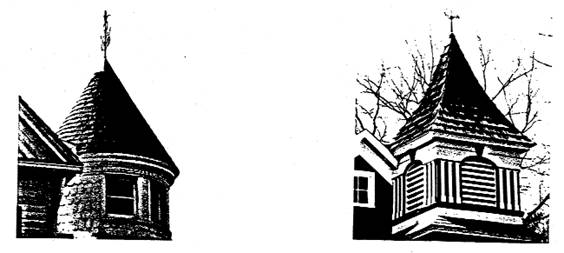
Roof Details: Turrets and Cupolas.
These can be either functional devices for allowing in natural light or ventilators, or decorative/symbolic assemblies of windows and louvers.
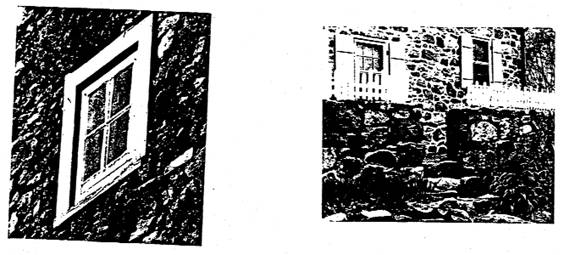
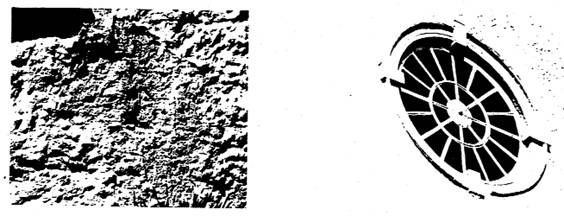
Siding.
The exterior walls of a building require a finished material. Walls constructed of masonry are finished in most cases with a stucco coating or left rough, or finished with brick. Wood frame structures can be finished with a stone or brick veneer, or with clapboard wood siding, cedar shake shingles, or a vertical wood siding. In most cases, wood siding would be painted.
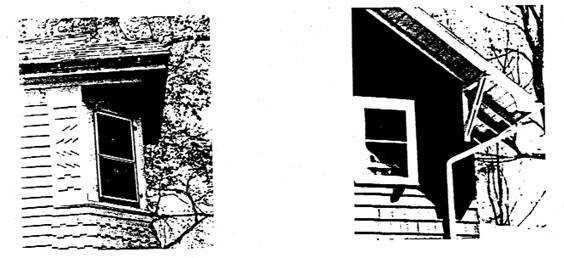
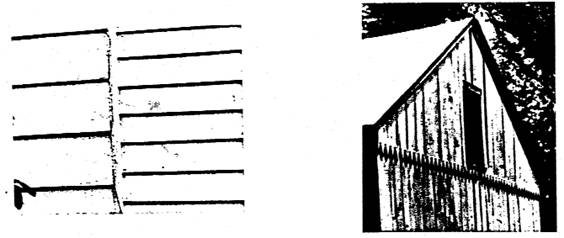
Siding.
(continued)
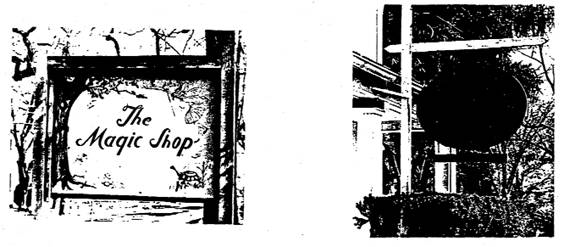
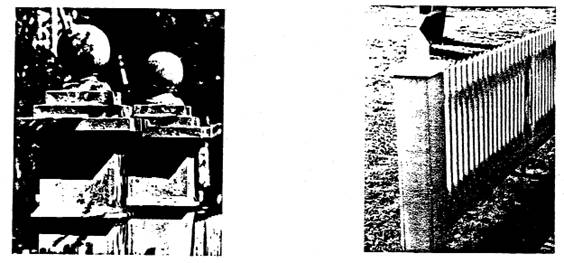
Signs, Walls and Fences.
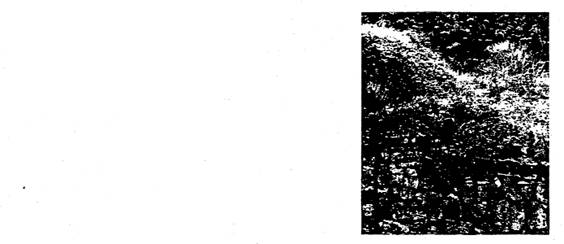
Exterior features that usually define the boundary or the purpose of the property.
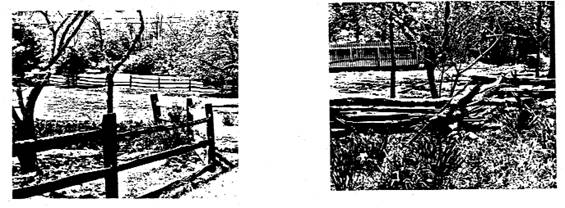
Signs, Walls and Fences.
(continued)
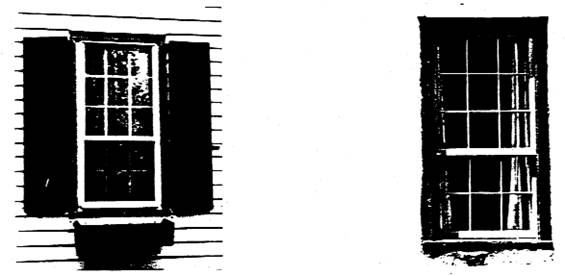
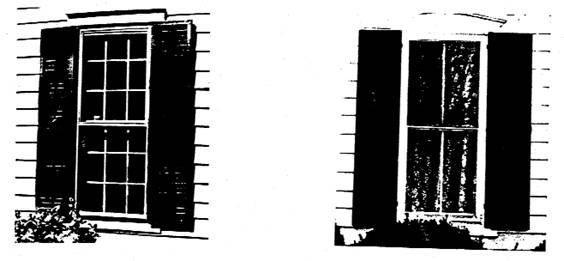
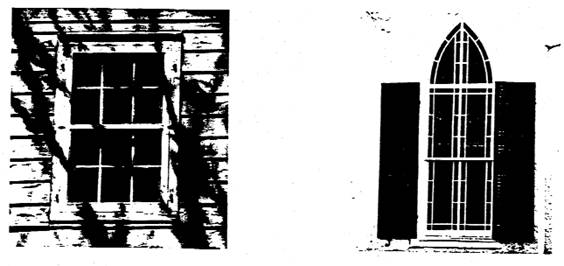
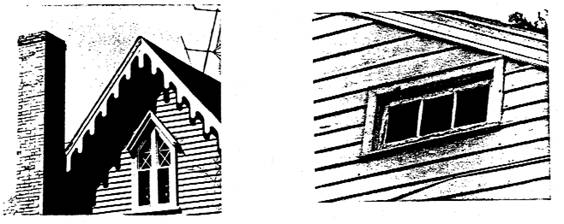
Windows.
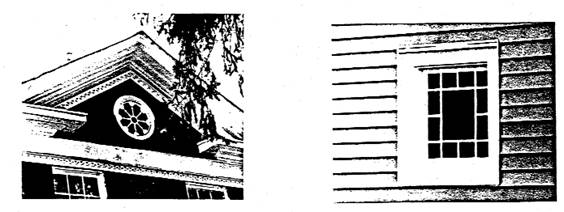
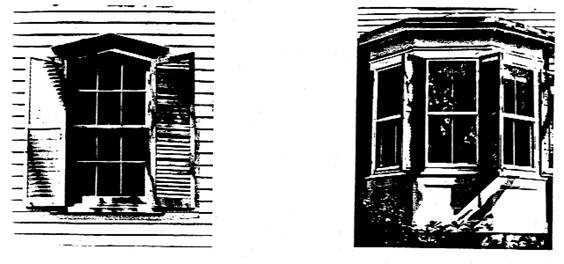
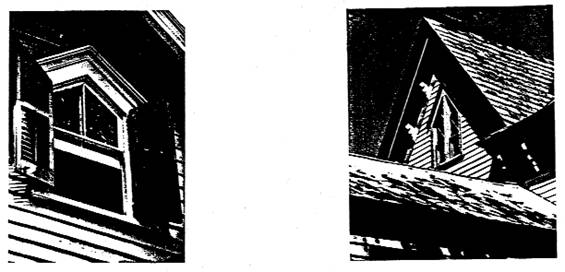
The early houses had few windows as they were expensive and difficult to make. Buildings with stone walls limited the size of windows for structural reasons. Wood frame houses of later periods employed greater numbers of factory built windows of larger dimension. Most windows for this part of the country are variations of a double-hung window known as six-over-six or number of panes per sash.
Windows.
(continued)
Windows.
(continued)
Details of Historic Buildings and Landscapes
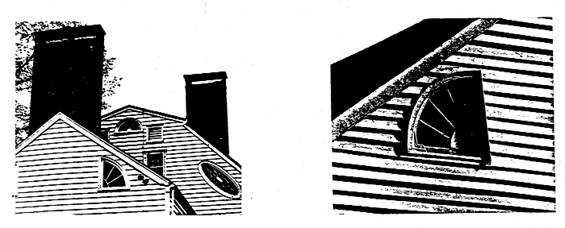
Windows.
(continued)
SECRETARY OF THE INTERIOR'S STANDARDS
SECRETARY OF THE INTERIOR'S STANDARDS
Please refer to the following documents for additional design guidelines applicable to all buildings and structures within Historic Districts throughout the U.S.
The Secretary of the Interior's Standards and Guidelines for Archeology and Historic Preservation.
The Secretary of the Interior's Standards for Rehabilitation.
The Secretary of the Interior's Standards for the Treatment of Historic Properties.

