
Thomasville City Zoning Code
ARTICLE XIII
- DEVELOPMENT AGREEMENTS
A.
Purpose. The purpose of this article is to establish standards and procedures for the city to enter into development agreements for long-term, large-scale developments in recognition of the following findings and statements of intent:
1.
Large-scale development projects and long-term commitment of resources. Large-scale development projects often occur in multiple phases extending over a period of years requiring a long-term commitment of both public and private resources.
2.
Potential community impacts. Such large-scale developments often create potential community impacts and potential opportunities that are difficult or impossible to accommodate within traditional zoning processes.
3.
Careful integration between public capital facilities planning, financing schedules. Because of their scale and duration, such large-scale projects often require careful integration between public capital facilities planning, financing and construction schedules and the phasing of the private development.
4.
Stable development standards. Because of their scale and duration, such large-scale projects involve substantial commitments of private capital by private developers, which private developers are unwilling to risk without sufficient assurances that development standards will remain stable through the extended period of the development.
5.
Nontraditional development types. Because of their size and duration, such developments often permit communities and developers to experiment with different or nontraditional types of development concepts and standards, while still managing the impacts on the surrounding areas.
6.
Negotiating flexibility. To better structure and manage development approvals for such large-scale developments and ensure their proper integration into local capital facilities programs, local governments need the flexibility in negotiating such developments.
7.
Plan consistency. In negotiating for such developments, it is the intent of the city to remain consistent with the adopted plans, policies and goals of the city as they relate to land use and capital improvements.
B.
Authority. The city may enter into a development agreement with a developer, subject to the procedures and standards of this article. In entering into such a development agreement, the city may not exercise any authority or make any commitment not authorized by general or local act and may not impose any tax or fee not authorized by otherwise applicable law. If more than one local government is made party to an agreement, the agreement must specify which local government is responsible for the overall administration of the development agreement.
C.
Relationship to prior development approvals. Although an application for a development agreement generally is submitted and reviewed before or in conjunction with the first development approval required for the proposed development (e.g., a mixed use development), such an application may be submitted and decided at any stage of the development. If the application is submitted after development approvals have been granted, either the development agreement should incorporate the terms and conditions of those prior approvals or any approval of the development agreement shall be contingent upon any amendments to those prior approvals necessary to ensure conformance between the development agreement and applicable development approvals.
D.
Initiation. An application for a development agreement may be initiated by any person who may submit applications in accordance with the provisions of this article.
E.
Procedures.
1.
Application contents. An application for a development agreement shall include a proposed development agreement that shall, at a minimum, include all of the following:
a.
A legal description of the property subject to the agreement and the names of its legal and equitable property owners.
b.
The duration of the agreement.
c.
A development schedule, including commencement dates and interim completion dates at no greater than five-year intervals.
d.
The development uses permitted on the property, including population densities and building types, intensities, placement on the site, and design.
e.
A description of public facilities that will service the development, including who provides the facilities, the date any new public facilities, if needed, will be constructed, and a schedule to assure public facilities are available concurrent with the impacts of the development.
f.
If the development agreement provides that the city shall provide certain public facilities, the development agreement shall provide that the delivery date of such public facilities will be tied to successful performance by the developer in implementing the proposed development (such as meeting defined completion percentages or other performance standards).
g.
A description, where appropriate, of any reservation or dedication of land for public purposes and any provisions to protect environmentally sensitive property.
h.
A description of all local development permits approved or needed to be approved for the development of the property together with a statement indicating that the failure of the agreement to address a particular permit, condition, term, or restriction does not relieve the developer of the necessity of complying with the law governing their permitting requirements, conditions terms, or restrictions.
i.
A description of any conditions terms, restrictions, or other requirements determined to be necessary by the City for the public health, safety, or welfare of its citizens.
j.
A description, where appropriate, of any provisions for the preservation and restoration of historic structures.
k.
An indemnification and "hold harmless" clause whereby the developer/property owner holds the city and its agents harmless from liability for damages, injury or death that may arise from the direct or indirect operations of the owner, developers contractors, and subcontractors that relate to the project.
The proposed development agreement may include the following:
1.
A provision that the entire development or any phase of it be commenced or completed within a specified period of time.
2.
Other defined performance standards to be met by the developer.
3.
Other matters not inconsistent with law.
The application shall include a master plan that depicts the general configuration and relationship of the principal elements of the proposed development including major uses general building types, pedestrian and vehicular circulation open space public facilities and phasing.
2.
Review and report by city manager or administrator As part of the staff review of the application, the manager or the designee may negotiate revisions to the proposed development agreement consistent with the provisions of subsection H development agreement standards.
3.
Review and recommendation by planning board. Following staff review, preparation of a staff report, and provision of public notification in accordance with subsection G. Development agreement standards, the staff shall recommend that:
• The city enter into the development agreement as submitted;
• The city enter into the development agreement application subject to modifications agreed to by the applicant, in writing; or
• The city not enter into the development agreement.
4.
Review and action by governing board. Following planning board review, the governing body shall conduct a legislative public hearing on the application in accordance with public hearing guidance. Thereafter the board may vote:
• To enter into the development agreement as submitted;
• To enter into the development agreement subject to modifications agreed to by the applicant, in writing;
• Not to enter into the development agreement; or
• Remand the application to the planning board for further consideration.
DEVELOPMENT AGREEMENT PROCEDURES DIAGRAM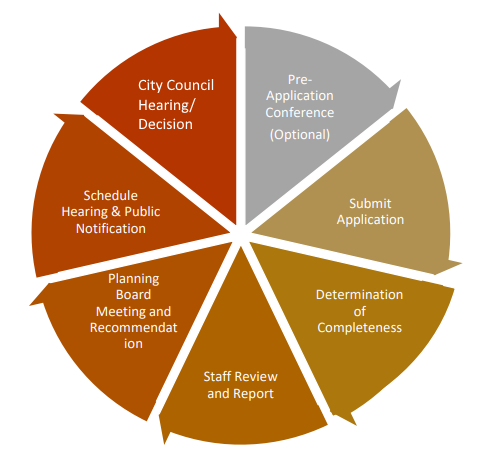
F.
Recording the agreement. Within 14 days after entering into a development agreement the city shall record the agreement with the Davidson County Register of Deeds.
G.
Development agreement standards. In consideration of the city's participation in a development agreement, a development subject to the agreement must meet the following criteria:
1.
Planned development. The information regarding the property subject to the development agreement shall contain details of the property and the planned development in accordance with G.S. ch. 160D Article 10 Development Agreements.
2.
Phasing and duration of development. The development shall demonstrate phasing and participation in the proposed agreement shall be of reasonable terms that shall be specified in the agreement.
3.
Impact on capital improvements. The development shall demonstrate the impact on existing and future provisions of capital improvements by the city including at least one of the following: transportation, potable water, sanitary sewer, solid waste, stormwater management educational, parks and recreational, and health systems and facilities.
H.
Effect of development agreement.
1.
Burdens and benefits. The burdens of the development agreement are binding upon, and the benefits of the agreement shall inure to, all successors in interest to the parties to the agreement.
2.
Rights and obligations. Rights and obligations established by a development agreement shall not preclude or supersede rights and obligations established pursuant to other law regarding building permits, site specific development plans, phased development plans or other provisions of law.
3.
Building Code. A development agreement shall not exempt the property owner or developer from compliance with the State Building Code.
4.
Subsequently enacted laws. Unless the development agreement specifically provides for the application of subsequently enacted laws, the laws applicable to development of the property subject to a development agreement are those in force at the time of execution of the agreement.
5.
Application of subsequently adopted laws. Except for grounds specified in G.S. § 160D-108(e), the city may not apply subsequently adopted ordinances or development policies to a development that is subject to a development agreement.
6.
Change in state or federal law. If state or federal law is changed after a development agreement has been entered into and the change prevents or precludes compliance with one or more provisions of the development agreement, the city, by ordinance after notice and a hearing, may modify the affected provisions, upon a finding that the change in state or federal law has a fundamental effect on the development agreement.
7.
Vested rights. This ordinance does not abrogate any rights preserved by G.S. § 160D-108.1, or that may vest pursuant to common law or otherwise in the absence of a development agreement.
I.
Approval of debt. If any of the obligations of the city in the development agreement constitute debt the city shall comply, at the time of the obligation to incur the debt and before the debt becomes enforceable against the city with any applicable constitutional and statutory procedures for the approval of this debt. The agreement shall be signed by the city attorney, finance director and city manager.
J.
Periodic review and breach of agreement.
1.
Annual review. During any period of time in which a development permit is active, the city shall review the development at least once every 12 months for compliance with the agreement. The developer shall be required to demonstrate good faith compliance with the terms of the development agreement. The failure to meet a commencement or completion date specified in the development agreement shall not in and of itself constitute a material breach of the agreement, but must be judged based upon the totality of the circumstances.
2.
Material breach. If the city finds and determines that the developer has committed a material breach of the terms or conditions of the development agreement, the city shall serve written notice of the breach upon the developer within a reasonable time after the periodic review. Such notice shall set forth with reasonable particularity the nature of the breach and the evidence supporting the finding and determination and shall provide the developer a reasonable time in which to cure the material breach.
3.
Failure to cure material breach. If the developer fails to cure the material breach within the time given, then the city unilaterally may terminate or modify the development agreement.
4.
Appeal. The notice of termination or modification may be appealed to the board of adjustment for review and decision in accordance with section 7-13(D) Appeals.
K.
Amendments to development agreement.
1.
Mutual consent. A development agreement may be amended or canceled by mutual consent of the parties to the agreement or by their successors in interest.
2.
Major modification. Consideration of a proposed major modification of a development agreement shall follow the same procedures as required for initial approval of the agreement.
3.
Minor modification. The planning director may approve minor modifications of the development agreement with the mutual consent of the other parties to the agreement, without following the same procedures as required for initial approval of the agreement, upon making written findings that the proposed modifications would not significantly change the use, intensity, or design of the development, would be consistent with the purposes and goals of the agreement, would comply with this ordinance and would not adversely affect the public health, safety, or general welfare.
L.
Assumption of jurisdiction over development agreements.
1.
City assumes planning jurisdiction. If the city assumes planning jurisdiction over property subject to a development agreement established by another jurisdiction, such development agreement shall be valid for the duration of the agreement, or eight years from the effective date of the city's assumption of planning jurisdiction over the subject property, whichever is earlier.
2.
Rights and obligations. The parties to the development agreement and the city shall have the same rights and obligations with respect to each other regarding matters addressed in the development agreement as if the property had remained in the previous jurisdiction.
3.
Modification or suspension. The city may modify or suspend the provisions of the development agreement if the city determines that the failure to do so would place the residents of the area subject to the development agreement or the residents of the city's planning jurisdiction, or both, in a condition dangerous to their health or safety, or both.
(Ord. No. 06-2021-ORD12, § 1(Exh. 1), 6-21-21)

