
Townsend City Zoning Code
24.12 Establishment
Of Zoning Districts
24.12.010 Generally
- Zoning Districts Divided. The town is hereby divided into zoning districts of such number and character as are necessary to achieve compatibility of uses within each district, to promote the comprehensive plan for the town, and to serve the other purposes of this chapter described in TMC 24.04.040. The town is hereby divided in to the following districts: Preservation (P), Residential (R), Residential 1 (R-1), Residential 1A (R-1A), Residential 2 (R-2), Residential 3 (R-3), Residential Active Adult (R-AA), Suburban Reserve (SR), Commercial (C) and Industrial (I).
- Map Of Zoning Districts. Zoning districts established by this article are bounded and defined as shown on the official map of the town, which together with all explanatory materials thereon is hereby made a part of this Code. The location and boundaries of zoning districts are set forth and indicated on said map or maps, entitled "Official Zoning District Map of Townsend."
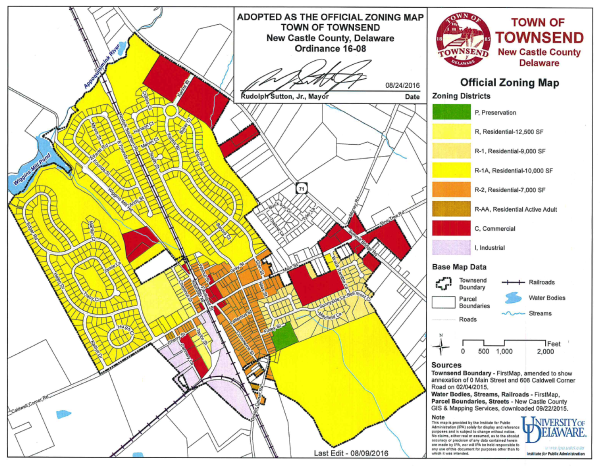
- Interpretation Of Zoning District Map. In interpreting the official zoning map of the town, the following shall apply:
- A district name or letter on the zoning map indicates that the regulations pertaining to that district designated by the name or letter extend throughout the entire area of the town bounded by the district boundary lines within which the name or letter is indicated, except as otherwise provided by this article.
- Where uncertainty exists with respect to the boundaries of various districts as shown on the zoning map, the following rules shall apply:
- Boundaries shown following, or approximately following, streets, alleys, or right-of-way easements shall be construed to follow the centerline of such street or right-of-way easements.
- Boundary lines shown as following, or approximately following, lot lines, section lines, survey or other property lines, or municipal boundaries shall be construed as co-terminus to said lines.
- Where a zoning boundary divides a property and less than 50 feet of that property is in a different zoning district, the entire property shall be considered to be within the district containing the largest area of the parcel.
- Boundaries shown as following or approximately following the centerline of streams, rivers, or other continuously flowing watercourses shall be construed as following the channel centerline of such watercourses. In the event of a natural change in the location of such streams, rivers or other watercourses, the zoning boundary shall be construed as moving with the channel centerline.
(UDC 2002, §§ 300–302)
24.12.020 Preservation District (P)
- Purpose. The purpose of this district is to preserve undeveloped areas including but not limited to open space, natural areas and woodlands, agricultural lands and areas of special environmental, historic, cultural importance or potential recreational value. It is the intention of this district to preserve such areas to conserve and protect the natural beauty of the town and to enhance the local quality of life and the health and welfare of residents by providing access to natural vistas, open space and the natural environment and opportunities for active and passive recreation.
- Permitted Uses.
- In a Preservation (P) District no building, structure or land shall be used for any purpose except for one of the following:
- General agricultural, including the cultivation of field crops, orchard groves or nurseries for the propagation of plants, turf, trees and shrubs.
- Passive recreational uses, whether public or private.
- The following uses may be permitted as when authorized by a special exception by the board of adjustment:
- Accessory farm buildings, including barns, stables, sheds, tool rooms, ships, bins, tanks and silos.
- Active public and private recreational uses, including unlighted ball parks, parks, playing fields, and playgrounds. This paragraph shall not be interpreted to permit commercial theme parks, carnivals or similar activities.
- Swimming pools or game courts, including structures for keeping and storing of recreational and related maintenance equipment, and those structures necessary for proper operation of recreational lands, parks and open spaces, including concession stands.
- Single-family detached dwelling unit provided such dwelling unit is used as a residence in conjunction with a farm or the cultivation of field crops.
- The uses permitted in paragraph B,2 may be approved only when the following requirements are met:
- The proposed use will result in no negative impacts nor materially reduce the quality of any adjoining open spaces, passive recreation areas or lands zoned preservation.
- When applicable a land development plan, as herein defined, shall be submitted.
- The proposed use does not violate any town ordinances and otherwise conforms to the requirements of this section.
- Area and bulk regulations and requirements for buffer yards, offstreet parking, loading and signs are contained in 24 Appendix A and other sections of this chapter.
- In a Preservation (P) District no building, structure or land shall be used for any purpose except for one of the following:
(UDC 2002, §§ 401, 402)
24.12.030 Residential District (R)
- Purpose. The purpose of this district is to establish and maintain residential areas together with residentially compatible neighborhood uses, such as schools, churches, community centers, recreational areas and accessory uses incidental to and compatible with residential neighborhoods.
- Permitted Uses And Regulations.
- In a Residential (R) District, no building, structure or lands may be used except for one of the following purposes:
- Single-family detached dwelling unit.
- Garden, orchard or nursery, but not commercial greenhouse.
- Public utility uses except electrical substations, relay stations, treatment plants and pumping stations.
- Public and private elementary, junior and senior high schools.
- Park, playground and athletic field, recreation building and community center when operated on a noncommercial basis for public recreation purposes.
- In a Residential (R) District the following uses are permitted when accessory to a principal use permitted in paragraph B,1:
- Garden houses, tool houses, playhouses, or greenhouses incidental to a residential use.
- Private, noncommercial swimming pools and game courts for the use of occupants and guests.
- Private garages and detached workshops.
- Storage of boats trailers, motor homes and recreational vehicles when not stored in a front yard, when owned by the occupant.
- The keeping of not more than six domestic animals, or nonvenomous insects and reptiles outdoors and only for noncommercial use.
- In a Residential (R) District the following uses are permitted when approved as a special exception by the board of adjustments pursuant to the following requirements:
- Home occupations when the following conditions are met:
- A member of the family residing in the dwelling will carry out the occupation or profession contained in the home.
- The occupation or profession shall be carried out wholly within the principal building or a structure accessory thereto already existing on the property.
- Not more than one non-family member is employed.
- Not more than 25 percent of the dwelling may be utilized for the home occupation.
- No customers visit the subject property.
- No signs of any kind identifying the home occupation may be displayed.
- Deliveries are provided by vehicles no larger than a step van or panel type truck.
- No offensive noise, vibration, smoke, dust, odors, heat or glare shall be produced by the home occupation.
- The proposed occupation or profession does not violate any town ordinances and otherwise conforms to the requirements of this section.
- Residential professional offices when the following conditions are met:
- A residential professional office shall be permitted for a recognized professional occupation.
- A land development application and plan must be submitted.
- The proposed residential professional office shall result in no negative impacts upon the local community, especially with regard to on-street parking, traffic congestion, refuse, noise, vibration, dust, odor, heat or glare.
- The proposed occupation or profession does not violate any town ordinances and otherwise conforms to the requirements of this section.
- Home daycare when the following conditions are met:
- The maximum number of children (exclusive of children living in the home and related to the caregiver by blood, marriage or legal adoption) permitted to be cared for in any single home day care facility shall be six, unless further restrictions by other codes.
- The caregiver shall be registered or licensed by the state.
- There shall be no structural change to the exterior of the dwelling to accommodate the day care use unless normal revisions to a typical dwelling.
- There shall be a minimum of 40 square feet of floor space per child, inclusive of space occupied by furniture and equipment but exclusive of closets, halls, bathrooms, kitchens and related areas, which shall be on the first floor of the single-family dwelling.
- A minimum of 100 square feet of outdoor space per child shall be available on the same lot.
- A driveway shall be available to provide safe and convenient offstreet drop-off and pick-up.
- Churches when the following conditions are met:
- A land development application and plan must be submitted.
- The proposed church shall result in no negative impacts upon the local community, especially with regard to on-street parking, traffic congestion, refuse, noise, vibration, dust, odor, heat or glare.
- The proposed church does not violate any town ordinances and otherwise conforms to the requirements of this section.
- Home occupations when the following conditions are met:
- When subdivision and/or land development process is considered, pursuant to the requirements of TMC 24.20.100 in a Residential (R) District a minimum of ten percent of the gross tract area shall be dedicated to public use as open space for the purpose of active and passive recreation.
- Area and bulk regulations and requirements for buffer yards, offstreet parking, loading and signs are contained in 24 Appendix A and other sections of this chapter.
- In a Residential (R) District, no building, structure or lands may be used except for one of the following purposes:
(UDC 2002, §§ 405, 406)
24.12.040 Residential District (R-1)
- Purpose. The purpose of this district is to establish and maintain a single family district with modestly sized lots, together with compatible neighborhood uses such as schools, churches, community centers, recreational areas and accessory uses incidental and compatible with residential neighborhoods.
- Permitted Uses And Regulations. In Residential (R-1) Districts the permitted uses and regulations shall be same as those contained in TMC 24.12.030 paragraph B.
(UDC 2002, §§ 408, 409)
24.12.050 Residential District (R-1A)
- Purpose. The purpose of this district is to establish and maintain a single family district, together with compatible neighborhood uses such as schools, churches, community centers, recreational areas and accessory uses incidental and compatible with residential neighborhoods.
- Permitted Uses And Regulations. In Residential (R-1A) Districts the permitted uses and regulations shall be same as those contained in TMC 24.12.030 paragraph B.
(UDC 2002, §§ 411, 412)
24.12.060 Residential District (R-2)
- Purpose. The purpose of this district is to establish and maintain a single-family residential district with lot sizes reflecting the average lot in the section of the town existing at the time of the original adoption of the zoning ordinance for the town, together with compatible neighborhood uses such as schools, churches, community centers, recreational areas and accessory uses incidental to and compatible with residential neighborhoods.
- Permitted Uses And Regulations. In Residential (R-2) Districts the permitted uses and regulations shall be same as those contained in TMC 24.12.030 paragraph B.
(UDC 2002, §§ 414, 415)
24.12.065 Residential District (R-3)
- Purpose. The purpose of this district is to accomplish the same objectives as in the R, R-1, R1-A and R2 districts while affording a greater variety of dwelling and lot types. The purpose of this district is to establish and maintain a multi-family residential district with lot sizes reflecting the average lot in the section of the town existing at the time of the original adoption of the zoning ordinance for the town, together with compatible neighborhood uses such as schools, churches, community centers, recreational areas and accessory uses incidental to and compatible with residential neighborhoods.
- Permitted Uses And Regulations.
- In Residential (R-3) Districts the permitted uses and regulations shall be same as those contained in TMC 24.12.030 paragraph B.
- Townhomes meeting the following requirements.
- Minimum Yard Requirements:
- Minimum lot area: 2,200 sq. ft.
- Minimum lot width: 20 ft.
- Minimum lot depth: 110 ft.
- Maximum height: 40 ft.
- Minimum front yard setback, principal dwelling 20 ft.
- Minimum front yard setback, open front porch, steps 6 ft.
- Minimum side yard setback: 12 ft. (20 ft for corner lot)
- Minimum rear yard setback: 20 ft.
- Maximum lot coverage: N/A
- Maximum of 7 units within a building footprint
- Minimum Yard Requirements:
- Building scale and character standards:
- To maintain Townsend's small-town character through building design guidelines that address the overall appearance of townhouse dwellings through facade design elements, all exterior design elements shall form an integrated development and ensure that large buildings reduce their apparent mass and bulk on elevations visible from the street or pedestrian routes to ensure that buildings are based on human scale (i.e., the relationship of the size of the building's features to the people that use the building).
- The following requirements shall apply to all townhouse dwellings:
- Building length of individual building facades defined as the continuous horizontal distance, measured from end-wall to end-wall, shall not exceed 180 feet.
- Primary pedestrian entrances shall be facing and visible from the primary street and a porch, covered stoop, or similar entry feature shall be located at the ground floor exterior entrance of each townhouse dwelling unit to offer overhead protection and provide shelter from inclement weather. Entrance doors are encouraged to include architectural detailing such as contrasting paint color(s) and decorative trim.
- All townhouse buildings shall incorporate design elements that will break up large expanses of uninterrupted building surfaces (blank walls). Along the facade of all townhouse buildings, design elements shall occur at a minimum interval of 20 feet.
- The following design elements shall be included:
- Varying roof lines and forms:
- Roof lines shall be varied through combinations of roof heights and styles that create variation and visual interest.
- Guidelines:
- Provide offsets or breaks in roof elevations of two (2) feet or greater in height.
- Incorporate the roof pitch and materials of adjacent buildings into carport or garage roofs.
- Building facade colors and materials:
- At least two variations in color and materials shall be used in the treatment of the building facade.
- Guidelines:
- Decorative patterns on exterior materials may include scales/shingles, wainscoting, ornamentation, and similar features.
- Bays, porches or balconies:
- Guidelines:
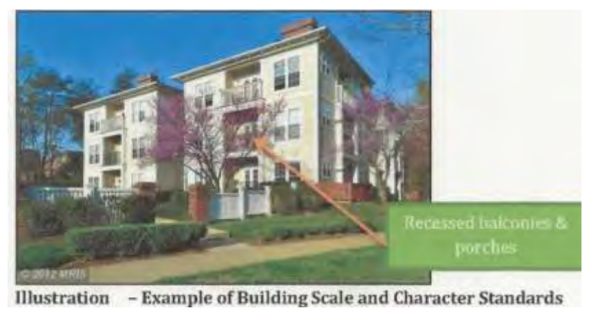
- Incorporate smaller-scale forms such as bays, recessed or projecting balconies or porches and dormers into the design to visually reduce the height and scale of the building and to emphasize the definition of individual units.
- Guidelines:
- Wall offsets.
- A wall offset is defined as a projection or recess of a facade wall of at least two feet in depth. Wall offsets shall be incorporated onto those building facades having a length of at least 20 feet or greater. Wall offsets shall be a minimum of six feet in length.
- Windows.
- Decorative window features, such as arched windows, transoms, decorative pediments, and/or window shutters that are sized appropriately and proportionally to the window shall be required on those facades fronting on streets.
- Guidelines:
- Windows of varied shape, size, and placement are encouraged.
- The use of recessed windows, moldings, decorative trim and wood frames to add three-dimensional quality and shadow lines to the facade.
- Front yards.
- Landscaped front yards offer a welcoming and safe transition from public to private space, define property lines, create a unique identity, buffer noise and provide visual screening. A minimum of 50 percent of the open areas in the front yard shall be landscaped with flowering or evergreens shrubs and shall not exceed a maximum of three feet in height at maturity. All grassed areas shall be sodded with a drought-resistant grass.
- A four-foot wide walkway constructed of concrete or decorative pavers shall extend from the sidewalk to the exterior entrance of each townhouse dwelling unit.
- Off-street parking required minimum 2 spaces per unit. Ref to Division 3 guidelines. Additional parking in the amount 0.25 per unit must be provided for overflow parking in the development.
Illustration 1
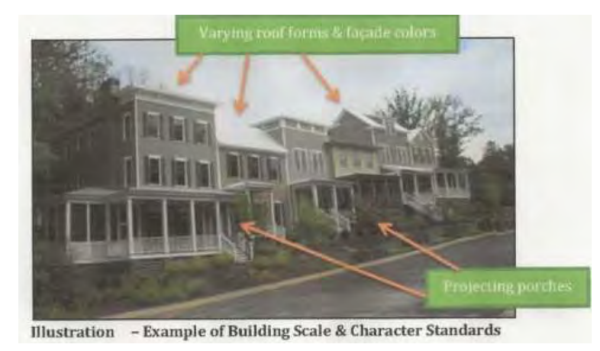
Illustration 2
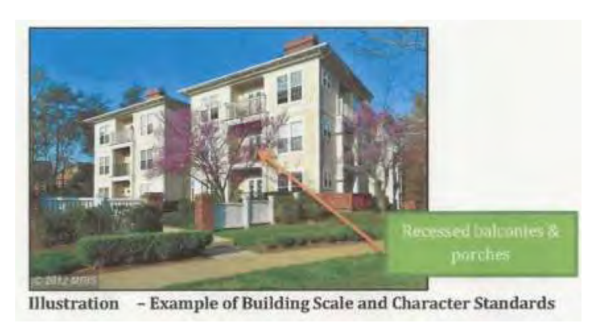
Illustration 3
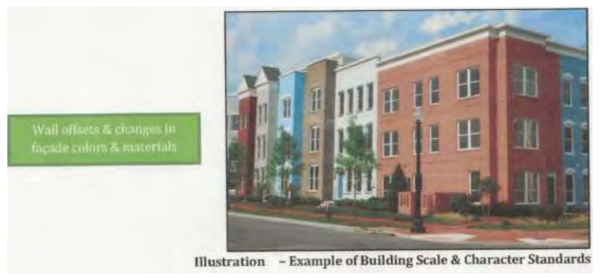
Illustration 4
- Varying roof lines and forms:
- Parking for Apartments and Townhomes.
- No on-street parking permitted.
- All parking spaces, aisles, and turning areas shall be located entirely within the served property's lot lines and shall not encroach on any road, driveway, or other public right-of-way. No parked vehicle shall overhang any road, sidewalk, access driveway, or public right-of-way.
- When the number of required off-street parking spaces results in a fractional space, the fractional space shall be counted as one (1) parking space. If several uses occupy a single parcel or building, the off-street parking and loading requirement shall be the additive total for all these parcel's or building's uses;
- In regard to parking requirement for apartments the following shall mandate available spaces: 1.5 per 1 bedroom dwelling unit, 2 per 2 or 3 bedroom dwelling unit, 3.25 per 4 bedroom dwelling unit, 4.5 per 5+ bedroom dwelling unit; 1 additional guest parking space per 5 dwelling units.
(UDC 2002, § 414)
24.12.070 Commercial District (C)
- Purpose. The purpose of this district is to provide sufficient land area in appropriate locations for a variety of commercial activities providing a diversity of goods and services to meet both the needs of the local community as well as adjacent areas of the county. These areas should be concentrated primarily along certain existing thoroughfares where a general mixture of commercial and service activities already exist. The Commercial (C) Districts of the town are not to be characterized by extensive warehousing, frequent or heavy truck traffic, open storage of materials or other nuisances such as excessive noise, odor and dust normally associated with manufacturing and heavy industry. Land uses, businesses and buildings and structures constructed to support the permitted use in the Commercial (C) Districts should be developed to preserve, conserve and enhance the small town, pedestrian-oriented character of the town's center areas.
- Permitted Uses And Regulations.
- In a Commercial (C) District, no building or premises shall be used and no building erected or altered which is to be arranged, intended or designed to be used except for one or more of the following uses:
- Churches or other places of worship.
- Public and private elementary, junior and senior high schools.
- Park, playground, athletic field, recreation buildings and community centers operated on a noncommercial basis.
- Child and daycare centers, nursing homes, convalescent homes and rest homes.
- Medical or health clinic, medical office building, doctors' office and dentists' office.
- Public and private lodges and organizations, public and governmental buildings or uses including town offices, fire stations and police stations.
- Public utility structures and uses, such as electrical substations, relay stations, sewage treatment plants and pumping stations.
- Undertaker and funeral parlors.
- A single-family detached dwelling unit, when such unit is associated with a permitted office or business or commercial use and occupied by the proprietor or an employee of the said business.
- A multifamily dwelling is permitted on any floor above the first floor in accordance with the regulations of this section pertaining to required area and bulk regulations and other requirements of a residential district, provided that the first floor is used in its entirety for a permitted office, business, or commercial use.
- Offices for professional services and administrative functions.
- Financial institutions, banks and loan companies.
- Barbershops and beauty parlors.
- Retail food stores such as bakeries, restaurants, coffee shops, candy, convenience grocery stores, meat market, and delicatessens, excluding the preparation of goods for sale off the premises.
- Drive-in restaurants and fast food establishments.
- Retail stores, which shall be limited to the sale of gifts, antiques, flowers, jewelry, newspapers, hobbies, stationary, art supplies, consumer electronics, hardware, clothing, drug stores, beverage or liquor stores, and books, excluding adult bookstores and adult entertainment centers.
- Repair and servicing, indoors or off-site, of any article for sale which is permitted in this district.
- Hotels, motels, bed and breakfasts, and motor lodges and tourist homes.
- Animal hospital, veterinary office, or enclosed kennel, provided that such facility is at least 300 feet from a residential district boundary.
- Painting shop, upholstering shop (but not furniture manufacturing), furniture sales, tire sales and service.
- Automobile, truck, motorcycle or bus sales, service storage and repairs (but not junk or salvage yards) and provided that major repair or storage of damaged vehicles shall be inside a completely enclosed building.
- Wholesale establishments.
- In a Commercial (C) District the following uses are permitted when accessory to a principal use permitted in TMC 24.12.060 paragraph B:
- Any accessory use permitted in a residential district.
- Storage of merchandise, equipment or office supplies normally carried in stock in connection with a permitted business establishment.
- Area and bulk regulations and requirements for buffer yards, offstreet parking, loading and signs are contained in 24 Appendix A and other sections of this chapter.
- Buffer Yards.
- Whenever a commercial building, land use or district adjoins a residential dwelling, land use or district a planted landscaped buffer shall be provided along all property lines which adjoin the residential dwelling, land use or district.
- The depth of the buffer yard shall be no less than 25 feet.
- The buffer yard shall contain a combination of native plant material and, at a minimum, contain the following:
- Deciduous canopy trees, not less than 3 1/2 inches in caliper at the time of planting, at a maximum spacing of 30 feet on center.
- Evergreen trees, not less than six feet in height at the time of planting, planted in a double staggered row of ten feet on center between plantings in the same row and five feet on center between plantings in adjacent staggered rows.
- Groupings of appropriate understory plantings in the form of deciduous and evergreen ornamental and flowering shrub plantings, not less than 36 inches in height and planted at a maximum spacing of three feet on center. Shrub plantings may be provided in the form of a hedge row or in informal groupings, however, in either case, the total number of plantings may not be less than the length of the buffer yard divided by the required spacing.
- In a Commercial (C) District, no building or premises shall be used and no building erected or altered which is to be arranged, intended or designed to be used except for one or more of the following uses:
(UDC 2002, §§ 417, 418)
24.12.080 Industrial District (I)
- Purpose. The purpose of this district is to provide sufficient land area in appropriate locations for certain types of businesses and manufacturing uses that must be separated from other land uses because of negative impacts and externalities that cannot be made compatible with other uses. Industrial parks, which contain modern and well-maintained buildings that are extensively landscaped, are the type of development which is encouraged by Industrial (I) District zoning. In order to reserve lands for appropriate future industrial development and to avoid conflicts with other uses, residential uses in this district are proscribed.
- Permitted Uses And Regulations.
- Permitted Principal Uses. In an Industrial (I) Zoned District no building or premises shall be used and no building shall be erected or altered which is arranged, intended or designed to be used except for one or more of the following purposes:
- Manufacturing, assembling, converting, finishing, cleaning, cooking, baking, or any other manufacturing or industrial processing of goods, and devices provided that fuel used for such processing or manufacturing shall be oil, gas, or electricity.
- Any process involving cleaning, distribution, manufacturing, processing, production, warehousing, or testing, except for the following: Manufacture of concrete asphalt materials, corrosive acids, pigments, dyes, abattoir, storage of oil, fuel such as coke, coal or petroleum products, storage in bulk of illuminating or natural gas, freight terminal, radio broadcasting towers, ice manufacture or storage, agricultural uses, raising of minks or foxes, airport facilities, automobile service stations or public garage, paint or body shop, auction, automobile reclamation, salvage yard, explosives including dynamite, fireworks or explosive powder, gelatin, paint, oils, fertilizer, linoleum, cork products, alcohol, bleaching compounds or soap, tanning or curing of hides, crude oil refining, rubber treatment or manufacture, ore smelting, blast furnace, garbage or offal reduction or dumping, asphalt manufacturing or refining, junk storage, toxic water or radioactive waste storage or dumping, automobile wrecking or animal rendering.
- Printing, publishing, binding, packaging, storage, warehousing, transshipment and distribution and trucking of material, subject to other provisions of this section.
- Business, professional or administrative offices.
- Public utility uses and structures including electrical substations, relay stations, sewage treatment plants and pumping stations.
- Bottling works, cleaning works or commercial laundry.
- Research, design, testing and development laboratories, except those involving infectious and hazardous substances (as defined by the EPA or state and local officials).
- Building materials, sales and storage yards provided they are stored inside a fully enclosed building.
- Permitted Accessory Uses. In an Industrial (I) District the following uses are permitted when accessory to a principal use permitted in TMC 24.12.070 paragraph A,1:
- Food service facilities incidental to, and located within any of the permitted uses within this district, primarily for service to employees of such permitted uses, provided:
- There shall be no entrance directly from the street to such facility.
- No sign relating to such facility shall be visible from outside the building.
- Facilities shall be so located and constructed to protect occupants of such buildings from noise, traffic, odors, and interference with privacy.
- Recreation facilities intended primarily for the use of the employees of such uses permitted in this district.
- Food service facilities incidental to, and located within any of the permitted uses within this district, primarily for service to employees of such permitted uses, provided:
- Area And Bulk Regulations. Area and bulk regulations and requirements for buffer yards, offstreet parking, loading and signs are contained in 24 Appendix A and other sections of this chapter.
- Buffer Yards.
- Whenever an industrial building, land use or district adjoins a residential dwelling, land use or district, a planted landscaped buffer shall be provided along all property lines which adjoin the residential dwelling, land use or district.
- The depth of the buffer yard shall be no less than 50 feet.
- The buffer yard shall contain a combination of native materials and, at a minimum, contain the following:
- Deciduous canopy trees, not less than 3 1/2 inches in caliper at the time of planting, at a maximum spacing of 30 feet on center.
- Evergreen trees, not less than six feet in height at the time of planting, planted in a double staggered row of ten feet on center between plantings in the same row and five feet on center between plantings in adjacent staggered rows.
- Appropriate understory plantings in the form of deciduous and evergreen ornamental and flowering shrub plantings, not less than 36 inches in height and planted at a maximum spacing of three feet on center. Shrub plantings may be provided in the form of a hedge row or in informal groupings, however, in either case, the total number of plantings may not be less than the length of the buffer yard divided by the required spacing.
- A permanent opaque screening fence or wall to be erected behind the required plantings in the buffer yard on the industrially zoned side of the buffer yard.
- Special Regulations. Notwithstanding any other subsequent requirements pertaining to this district the following special regulations shall also apply:
- The parking of motor vehicles associated with the industry within 75 feet of a residential district is prohibited.
- No building in which manufacturing or processing operations take place shall be located closer than 150 feet to a residential district boundary line. This requirement shall not apply to administrative or office buildings, or other buildings which do not include processing or manufacturing operations.
- All uses permitted within this district shall comply with the limitations and requirements set forth by the following performance standards including expansion of existing industrial uses:
- Humidity, Glare Or Heat. Any operation producing excessive humidity in the form of steam or moist air, or producing intensive glare or heat, shall be performed within an enclosure and in such manner as not to be perceptible at or beyond any lot line. Exposed sources of light shall be shielded so as not to create a nuisance across lot lines.
- Vibration. Any industrial operation or activity, which shall cause, at any time and at any point, perceptible earth borne vibration along the nearest adjacent property line, is prohibited. Vibrations shall be measured using the most current methods and techniques available.
- Radioactivity Or Electromagnetic Disturbance. No activities shall be permitted which emit dangerous radioactivity at any point, or electromagnetic disturbance affecting the operation at any point of any equipment other than that of the creator of such disturbance.
- Liquid Or Solid Wastes. No discharge shall be permitted at any point into any public sewer, private sewage disposal system or stream, or into the ground except in accord with standards approved by the State Department of Natural Resources and Environmental Control or standards equivalent to those approved by such department for similar uses, or any materials of such nature or temperature as to contaminate any other supply or otherwise cause the emission of dangerous or offensive elements.
- Performance Standards Procedures. An application for a building permit or a certificate of zoning compliance for a use subject to performance standards shall be submitted to the board of adjustment in duplicate and shall be referred by the board of adjustment to the town council. The applicant shall submit in duplicate a plan of the proposed machinery operations and products in accordance with rules prescribed by the town council specifying the type of information required in such plans and an affidavit by the applicant acknowledging the understanding of the applicable performance standards and agreement to conform with same at all times. No applicant will be required to reveal any secret processes and any information requested will be treated as confidential. The fee for such application shall include the cost of special reports required to process the applications as described below.
- Expert Consultation. If there is any reasonable doubt as to the conformance with performance standards, the board of adjustment shall refer the application for investigation and report to the town council for one or more expert consultants qualified to advise whether such proposal will conform to the applicable performance standards specified herein. Such consultant shall make such report to the town council within 30 days after the receipt of said application. A copy of the report shall be furnished to the applicant.
- Decision Of The Board Of Adjustment. At the next regular meeting of the town council, but in no event more than 30 days after submission of the consultants report, the board of adjustment shall decide to authorize or deny the issuance of a building permit or certificate of zoning compliance based upon the report concerning compliance with performance standards of this section. Such decision shall be in the form of a written report. The issuance of a building permit or certificate of zoning compliance shall be conditioned on the applicant's installation and operations conforming to the applicable performance standards and the applicant's payment of fees for service of the consultant deemed reasonable and necessary by the town council.
- Permitted Principal Uses. In an Industrial (I) Zoned District no building or premises shall be used and no building shall be erected or altered which is arranged, intended or designed to be used except for one or more of the following purposes:
(UDC 2002, §§ 420, 421)
24.12.090 Residential Active Adult District (R-AA)
- Purpose. The purpose of this district is to establish and maintain a residential district that would permit townhouses and condominiums, as well as single family homes, for active adult and assisted living facilities. All property in a Residential Active Adult (R-AA) District shall be subject to deed restrictions that comply with applicable federal law.
- Permitted Uses.
- In a Residential Active Adult (R-AA) District, no building, structure or land may be used except for one of the following purposes:
- Detached single-family dwelling units.
- Condominiums.
- General-purpose community centers, recreation areas, clubhouses and related facilities.
- Assisted living facilities.
- Open spaces, conservation areas and facilities.
- All provisions of the Federal Fair Housing Act (42 USC 3601 et seq.) shall be complied with by the applicant to the satisfaction of the town.
- The form and wording of the proposed deed restrictions shall be submitted to the town for review, as part of the application for preliminary site plan and/or subdivision approval. The wording shall be reviewed, modified as necessary, and finally approved by the town and incorporated within a developer's agreement between the developer and the town as a condition of any approval granted by the town for an active adult, age restricted housing development.
- All dwelling units that are to be part of the age restricted community shall be deed-restricted to contain all necessary living arrangements on the first floor. This shall include at least one bedroom and full sanitary facilities, including shower/tub installation, on the first floor of the dwelling.
- Notwithstanding the minimum lot size requirements set forth in other provisions of this Code, an active adult community shall be permitted a density of up to six dwelling units per acre.
- Area and bulk regulations and requirements for buffer yards, off-street parking, loading and signs are contained in 24 Appendix A and other sections of this chapter.
- In a Residential Active Adult (R-AA) District, no building, structure or land may be used except for one of the following purposes:
(UDC 2002, §§ 423, 424)
24.12.100 Suburban Reserve (SR)
- Purpose.
- This district is intended to be served with sewer and water in the future and rezoned when the sewer construction is imminent. The district is also designed to permit limited development that does not foreclose ultimate sewering of the area. The preservation of large amounts of open space and agricultural land is encouraged in this district and such land may be used for spray irrigation as permitted by this Chapter.
- The countryside character of this district is designed to facilitate residential and agricultural use. Should land develop before sewers are provided, it should be accomplished in a manner which preserves available farmland and consolidates development in such a way as to minimize the impact on the land.
- Incentives shall be developed for open space development to preserve land that can be farmed.
- A number of special provisions apply to this district that are intended to be an incentive for agriculture to continue, even as residential development occurs, by maximizing the contiguous farmland and providing farm operators additional revenue sources.

