
Townsend City Zoning Code
24.36 Environmental
Protection Regulations
24.36.010 Intent
The intent of this section is to provide clarification on the environmental constraints and requirements for development in environmentally sensitive areas.
(UDC 2002, § 1100)
24.36.020 Definitions - Environmental Protection Regulations
The following words, terms and phrases, when used in this article, shall have the meanings ascribed to them in this section, except where the context clearly indicates a different meaning:
"Applicant" means a person, firm or government agency who executes the necessary forms to obtain approval or a permit for any zoning, subdivision, land development, building, land disturbance, or other activity regulated by this Code.
"Aquifer" means a body of rock (crystalline, sand or gravel) that contains sufficient saturated permeable material to conduct groundwater springs or to yield economically significant quantities of groundwater to wells.
"Best management practices" means that combination of conservation measures, structures, vegetation or management practices, that reduces or avoids adverse impacts of development on adjoining site's land, water, or waterways and waterbodies.
"Buffer" means a designated area between two uses deemed incompatible with each other, or along the perimeter of a natural feature to be protected from an incompatible use, or along the perimeter of that use, which will absorb otherwise preclude such incompatibility by some combination of construction design, vegetative plantings, fences, and/or maintenance practices which shall be permanently maintained.
"Buffer, riparian" see riparian buffer area.
"Caliper" means the diameter of new landscape plantings measured six inches aboveground.
"Canopy tree" see tree, canopy.
"Clean fill" means a nondecomposable, environmentally inert solid, such as rock, soil, gravel.
"Clearcutting" means the practices of wholesale complete removal of all trees, disturbing shrubs, or other vegetation in the process. This definition does not include the selective removal of trees on a building pad or normal maintenance of vegetation.
"Critical natural area (CNA)" means any site listed in the state natural areas inventory, as administered by the State Office of Nature Preserves, Division of Parks and Recreation, or the Delaware Department of Natural Resources and Environmental Control.
"Critical natural areas report" means a report analyzing the impact of a development or subdivision proposal on a CNA located on the site, which shall include the following elements:
- A statement that an entire lot or parcel is included in the critical natural areas investigation or a description of a smaller area which is subject to the critical natural areas investigation;
- A scaled plan of the site accurately depicting critical natural area boundaries. The CNA boundary lines shall be identified with a metes and bounds description prepared by and bearing the seal of a professional land surveyor registered in the state, or a professional engineer with a background in civil engineering registered in the state. Where many survey traverses are necessary to accurately describe the CNA boundary, the developer may have the surveyor or engineer identify and prepare a metes and bounds description for the smallest polygon that contains all the critical natural areas identified on the site. In such instances, however, the limits of the polygon will be considered the CNA boundaries for plan review purposes;
- A narrative description of the extent to which the subdivider or developer proposes land disturbing activities within any critical natural areas which are shown on the scaled plan; and
- Any measures that will be taken to minimize or mitigate the disturbance of critical natural areas.
"Detention/retention basin" means a natural or manmade structure designed as a temporary holding basin for water. Water may be detained to minimize flooding downstream, or retained to increase aquifer recharge.
"Drainage" means the process by which surface water (usually from rainfall) moves across the land surface. See stormwater management.
"Drainage areas" means the delineated areas that currently contribute or are proposed to contribute runoff to a specific location or point.
"Drainage facility" means any system of artificially constructed drains, including open channels and separate stormwater sewers, used to convey stormwater, surface water, or groundwater, either continuously or intermittently, to natural watercourses.
"Drainageway" means a minor watercourse, seasonally or continually available for the passage of water, of which functions include, but are not limited to: flood control, groundwater recharge, drainage, and sedimentation and erosion control. The presence of a drainageway is determined by one or more of the following three conditions:
- The presence of certain specific soil types, (such as Codorus silt loam (Co), Comus silt loam (Cu), Hatboro silt loam (Ha), Johnston loam (Jo), or Mixed alluvial land (Mv));
- The land on either side of and within 50 feet of the centerline of any intermittent or perennial stream shown on the United States Geological Survey (U.S.G.S.) 7.5 minute quadrangle sheets;
- The land on either side of and within 25 feet of the centerline of any swale identified by the U.S.G.S. 7.5 minute quadrangle sheet as having an upstream drainage area of five or more acres.
"Environmental report" means any study, report or application required by this Code, such as critical natural areas, floodplains, riparian buffers, steep slopes, water resource protection areas and wetlands.
"Filling" means the depositing on land, whether submerged or not, of sand, gravel, earth or other materials. Biodegradable materials and other materials subject to decomposition or significant settling (such as garbage and other organic matter) shall not be considered filling.
"Flood fringe" means those portions of the floodplain, outside the floodway, subject to inundation by the 100 year recurrence interval flood and generally associated with standing or slowly moving water, rather than rapidly flowing water. Flood fringe is determined by detailed study data and profiles found in the FEMA flood insurance study.
"Flood protection elevation" means a point two feet above the water surface elevation of the 100-year flood.
"Floodplain" means a relatively flat or low-lying land area adjoining a river, stream, or watercourse which is subject to periodic partial or complete inundation. Specifically, those areas identified by the Federal Emergency Management Agency's (FEMA) flood insurance rate maps (FIRM) as being subject to periodic inundation by a 100-year storm, including the floodway, flood fringe and areas for which no base flood elevations area available as depicted in the FEMA flood insurance rate maps (community no. 10585) dated April 17, 1996 or as later amended.
"Floodway means the portion of the floodplain district required to carry and discharge the waters of the 100-year flood without increasing the water surface elevation at any point more than one foot above existing conditions as demonstrated in a flood insurance study.
"Forest" means an area covered by a canopy of woody plants (trees) that qualifies as mature and/or young. It may also be a woodland, woodlot, grove, or stand of trees meeting the specifications of the forest type.
"Forest, mature" means an area or stand of trees whose total combined canopy covers an area of one acre or more composed of canopies of trees having a DBH of at least 18 inches or greater covering at least 75 percent of that area. Also, any stand or grove consisting of eight or more individual trees having a DBH of at least 18 inches whose combined canopies cover at least 50 percent of the area encompassed by the grove.
"Forest, young" means an area or stand of trees whose total combined canopy covers an extra of one acre or more, with canopy trees having a DBH of six inches and covering at least 60 percent of the area. However, no trees kept or grown for commercial purposes shall be considered a young forest.
"Forest management practices" means that combination of generally accepted methods for preserving, promoting and protecting silviculture, which may include selective cutting, burning and removal of trees.
"Grading" means the excavating, filing (including hydraulic fill) or stockpiling of earth materials, or any combination thereof, including the land in its excavated or filled condition.
"Groundwater" means a portion of the subsurface water that occurs beneath the water table in soils and geologic formations that are fully saturated.
"Hydric soils" means soils which in their natural, undrained state are wet frequently enough at or near the surface to periodically produce anaerobic conditions, thereby influencing plant species composition and/or growth.
"Infiltration" means the passage or movement of water through the soil profile.
"Land grading" see grading.
"Landscape plan" means a plan associated with a subdivision, land development or parking facility plan indicating the placement of trees, shrubs, growth cover and affiliated structures and improvements, including specifications, species, quantities and installation as prepared by a state registered landscape architect.
"Landscaping" means the design and installation of plant material such as lawns, groundcover, trees, bushes, etc.
"Mitigation" means any action taken to lessen the specified undesirable impacts of a proposed land use or land disturbance activity, including those which would adversely affect the health or longevity of a natural feature, pose a visual intrusion or conflict, or otherwise be deemed incompatible with surrounding properties.
"National geodetic vertical datum (NGVD)" means elevations referenced to mean sea level datum of the 1929 or 1988 U.S. Geological Survey.
"Nondelineated floodplain" means an area subject to a 100-year flood, adjacent to a watercourse that is identified by a blue line on the current U.S. Geological Survey (U.S.G.S.) topographic maps of the county or in the detailed maps of the N.C.C. Soil Survey for which FEMA has delineated a floodplain.
"Public water supply well" means a well from which the water is used to serve a community water system by section 22.146 (public water systems) in the Delaware State Regulations Governing Public Drinking Water Systems.
"Recharge areas" means the recharge water resource protection areas are designated as having the best potential for groundwater recharge. They were delineated using methodology described in a report prepared by the Delaware Geological Survey entitled "Delineation of Ground-Water Recharge Resources Protection Areas in the Coastal Plain of New Castle County, Delaware," dated January 1993 ("recharge resource area").
"Reforestation" means the replanting or planting of forest plant materials.
"Restoration" means the reasonable rehabilitation of the affected land for useful purposes and the protection of the natural resources of the surrounding area, including surface water and groundwater.
"Riparian buffer area (RBA)" means where a parcel of land is adjacent to a perennial, lake, tidal wetland or area draining greater than ten acres forming a transition zone between the aquatic and the terrestrial environments is proposed for development or redevelopment, a RBA shall be designated. The RBA shall include the waterbody and the adjacent area within at least 100 feet from the top of bank of the waterbody. The RBA shall also include the floodplain or nontidal wetland plus the adjacent area within a minimum of 50 feet of the resource.
Identification and calculation.
- Streams (perennial, intermittent, mapped, and unmapped) with identifiable banks and beds, lakes, and tidal wetlands or areas which drain greater than ten acres are subject to the regulations of this section.
- Initial identification of the watercourses/waterbodies shall be made using the U.S. Geological Survey quadrangle maps or more accurate information, as available. Field verification to determine evidence and location of channelized flow is required for a specific determination.
- The width of existing impervious area such roadways, parking lots, structures, sidewalks, etc., shall not count towards the RBA measurements.
Exceptions. An RBA shall not be designated along industrial ponds, sewage lagoons, manmade irrigation ditches, stormwater management basins and other artificial features with a similar water quality or storage function.
One hundred (100) feet on either side of perennial and intermittent streams, lakes, and tidal wetlands;
- All of a nontidal wetland greater than twenty thousand (20,000) square feet in area, plus an additional one hundred (100) feet of adjacent land;
- A riparian buffer area shall not be designated along industrial ponds, sewage lagoons, manmade irrigation ditches, stormwater management basins and other artificial features with a similar water quality or storage function.
"Runoff" means that portion of precipitation or snow melt that has not evaporated or infiltrated into the soil, but flows on land surface.
"Sanitary sewage disposal, on-lot" means a system in which sanitary sewage and wastewater is collected from a single use or dwelling unit, by a system of pipes, and carried to a septic tank and tile disposal field located within the boundaries of an individual lot.
"Septic system, individual" see sanitary sewage disposal, on-lot.
"Septic tank" means a multiple compartment, watertight receptacle which receives sewage from a building and is designed and constructed so as to permit settling of solids from the sewage, digestion of the organic matter and discharge of the liquid portion into a disposal area.
"Slope, steep" means the vertical change in elevation divided by the horizontal distance over which that vertical change occurs. The steep slope area consists of two areas which are delineated and defined as follows:
- "Prohibitive slope" means prohibitive slopes of greater than 25 percent slope as based on a site survey, where such slope exists in any continuous horizontal increment of 50 feet or more.
- "Precautionary slope" means precautionary slopes of 15 to 25 percent slope as based on a site survey, where such slope exists in any continuous horizontal increment of 50 feet or more.
These definitions do not include manmade steep slopes resulting from the implementation of an approved plan.
"Stormwater management" means the mitigation of the hydrologic impacts of lost natural runoff storage by the use of constructed storage facilities.
- For water quantity control, a system of vegetative, structural, and other measures that may control the volume and rate of stormwater runoff which may be caused by land disturbing activities or activities upon the land; and
- For water quality control, a system of vegetative, structural, and other measures that control adverse effects on water quality that may be caused by land disturbing activities or activities upon the land.
"Surface water" means natural or artificial bodies of water greater than one acre in extent at the normal annual water level, as depicted on U.S.G.S. topographic quadrangles and/or as determined by on-site surveys by a registered surveyor, landscape architect or engineer. Excluded from this definition are retention basins or other stormwater management facilities, farm ponds or other facilities associated with agricultural operations, sewage lagoons and other facilities for which normal maintenance and repair is necessary.
"Top of bank" means a point above the mean water surface of a watercourse that defines the maximum depth of channel flow in the watercourse. It is either determined visually or computed as an elevation using the peak rate of runoff from a two year storm event.
"Townsend Greenbelt" means the tracts of land located around the perimeter of Townsend Proper consisting of undeveloped properties and agricultural land. Refer to figure 11-11.1 in TMC 24.36.120 for the exact mapped boundary designation.
"Townsend Proper" means the area of the town that is considered the downtown or center of town that consists of the businesses, commercial facilities, industrial areas, and residential housing developments previously constructed and in existence in the town prior to January 2000. Refer to figure 11-11.1 in TMC 24.36.120 for the exact mapped boundary designation.
"Tree, canopy" means a tree whose leaves would occupy the upper level of a forest in a natural ecological situation. These trees are also called shade trees, and typically reach heights of 50--100 feet at maturity.
"Tree, understory" means a tree whose leaves would occupy the intermediate level of a forest in a natural ecological situation. They are also found as dominant species in old field succession. These trees are also called ornamental trees.
"Variance" means relief from the standards of this section.
"Water resource protection area" means water resource protection areas are wellheads class A and recharge areas. All such areas are as depicted on the three-map series "Water Resource Protections areas for the City of Newark, City of Wilmington, New Castle County, Delaware," prepared by the water resources agency for the county that is dated 1993, or as amended.
"Water table" means the level below the surface at which the ground is saturated by water.
"Waterbody" means any watercourse, tidal wetland or lake defined by a bank or shore in which water can be found.
"Watercourse" means a stream channel (perennial, intermittent, mapped or unmapped) with banks and a bed within which concentrated water flows.
"Wellhead" means the wellhead water resource protection areas are surface and subsurface areas surrounding public water supply wells or wellfields where the quantity or quality of groundwater moving toward such wells or wellfields may be adversely affected by land use activity. Such activity may result in a reduction of recharge or may lead to introduction of contaminants to groundwater used for public supply ("wellhead"). Class A: The wellhead zone shall include the area within a 300 foot radius circle around all public water supply wells which are classified as community water systems, as defined by section 22.157 (public water systems), in the State of Delaware Regulations Governing Public Drinking Water Systems.
"Wetland" means those areas inundated or saturated by surface water or groundwater at a frequency and duration sufficient to support, and that under normal circumstances do support, a prevalence of vegetation typically adapted for life in saturated soil conditions; or areas that are defined and delineated in accordance with the "Federal Manual for Identifying and Delineating Jurisdictional Wetlands" dated January 10, 1989, and as may be amended from time to time; or as further defined and delineated by the U.S. Army Corps of Engineers, the U.S. Environmental Protection Agency, or the Delaware Department of Natural Resources and Environmental Control.
"Wetland Delineation and Report" means an on-site method or process for identifying wetlands as described in the Corps of Engineers Wetland Delineation Manual, Technical Report: Y-87-1, from 1987 and as amended. The report shall be prepared by a person with professional experience and knowledge in wetlands identification and shall analyze a site for the existence and extent of wetlands.
(UDC 2002, § 1101)
24.36.030 Open Space Regulations And Allowable Uses
Table 11-2.1 lists uses that may be permitted in open space. Any use not listed shall be considered prohibited.
(UDC 2002, § 1102)
24.36.040 Floodplains And Floodways
- Intent. This section shall detail the requirements, allowable disturbances, and permitted construction practices within all floodplains and floodways within the town.
- Boundary Interpretation. Where there appears to be a conflict between a mapped boundary and actual field conditions, a determination of the exact boundary of the area subject to inundation by the base flood shall be made using the 100-year flood elevation information provided in the flood insurance study for the flood fringe portions of the floodplain and using the best 100-year floodplain elevation information available for general floodplain areas. For the floodway portion of the floodplain the exact boundaries shall be determined by scaling the distances shown on the floodway map and by utilizing the data in the applicable flood insurance study (FIS) for the area. Where the boundary of the floodplain is disputed, the burden of proof shall be on the applicant.
- Floodway; Flood Fringe. There are two areas within the floodplain, the floodway and the flood fringe.
- No structure shall intrude into the floodway or floodplain except for piers needed to support bridges, erosion control structures, dams for flood control or water supply, and utility crossings.
- No filling is permitted in floodways or floodplains.
- No structures designed for human habitation are permitted.
- Standards For Beneficial Uses In Floodplains. All new construction, reconstruction, subdivision proposals, substantial improvements or repairs, prefabricated structures and other developments shall be prohibited except where approved as essential to the beneficial use of property. Refer to table 11-2.1 for permitted beneficial uses. Approval shall be at the discretion of the town.
Table 11-2.1
USES IN REQUIRED OPEN SPACE
| Y = Permitted N = Prohibited L = Limited Use I = Environmental Impact Assessment Report (see TMC 24.36.150) | |||||||||
| Use | General Open Space | Floodway | Floodplain | Wetland | Riparian Buffer | Drainageways | Wellhead/Recharge Areas | Steep Slopes | Forests |
| Agricultural | |||||||||
| Apiaries | Y | N | N | N | Y | Y | Y | Y | Y |
| Clearing | L | N | N | N | N | L | L | L | L |
| Game farms/fish hatcheries | Y | L | L | I | L | L | N | N | N |
| Field crops | Y | L | L | N | L | Y | L | N | N |
| Orchards | Y | N | Y | N | L | Y | L | Y | N |
| Pasture | Y | L | L | N | L | N | N | Y | N |
| Stables | Y | N | N | N | N | N | N | N | L |
| Nursery | Y | N | L | N | L | Y | Y | Y | N |
| Recreation and Amusement: Outdoor Recreation | |||||||||
| Ball fields | Y | N | L | N | N | Y | Y | N | L |
| Day camps | N | N | L | N | L | Y | L | N | L |
| Fishing areas | Y | Y | Y | Y | Y | Y | L | L | L |
| Hunting areas | L | L | L | L | L | L | L | L | L |
| Natural area | Y | Y | Y | Y | Y | Y | Y | Y | Y |
| Nature center | Y | N | N | N | N | Y | Y | Y | Y |
| Picnic area/playground | Y | N | L | N | L | Y | Y | Y | Y |
| Pools/courts | Y | N | N | N | N | Y | Y | N | L |
| Shooting and Archery ranges | L | L | L | N | L | L | L | N | L |
| Trails | Y | Y | Y | Y | Y | Y | Y | Y | Y |
| Water dependent Use | N | L | L | L | L | Y | N | N | N |
| Industrial Uses: Utilities, Community/Region | |||||||||
| Public/private roads | Y | N | N | L | I | Y | L | L | L |
| Parking lots | L | N | N | N | N | L | N | N | N |
| Essential access | Y | I | I | L | I | L | L | L | L |
| Sewer/water/Utilities | Y | I | I | L | I | Y | Y | Y | L |
| Sewage and water Treatment Plants/pumping Stations/dams | N | I | I | N | I | N | N | N | N |
| Detention/retention basins | Y | N | N | N | L | Y | L | N | N |
| Temporary Uses | |||||||||
| Public interest Event | Y | N | N | N | N | Y | Y | N | L |
(UDC 2002, § 1103)
24.36.050 Wetlands
- Wetland mitigation shall be that for which a permit has been issued by the United States Army Corps of Engineers. Permits from the state may also be required.
- It is permissible to construct utility and access crossings within wetlands where no other recourse is available. The proposed use must be authorized by the town and meet the requirements of this Code, Army Corps of Engineers regulations, and the DNREC. No other forms of construction are permitted in areas designated as wetlands.
- Any work in buffer areas shall meet the requirements of this Code, Army Corps of Engineers regulations, and the DNREC.
(UDC 2002, § 1104)
24.36.060 Riparian Buffer Areas (RBA)
- Intent. This section shall detail the requirements, allowable disturbances, and permitted construction practices within all riparian buffer areas within the town.
- Waterbody Buffers. The waterbody buffers shall meet the following standards which are intended to preserve and enhance existing vegetation and to re-vegetate disturbed areas. All riparian buffer shall be mapped to delineate the resource. No vegetation shall be removed in the RBA and existing native vegetation shall be preserved to the maximum extent possible. RBA shall extend a minimum of 100 feet past each top of bank for all waterbodies or 50 feet past the floodplain or nontidal wetland line (whichever is greater). All RBA areas shall be classified as old field, disturbed land, or meadow, and planted in accordance with this section where native vegetation is not present. The mapping of RBA's shall be supplied with an exploratory plan and at subsequent plan submissions to meet the standards of this section.
- Surface Waterbodies.
- No septic systems shall be allowed within an RBA.
- All developments shall maximize the drainage amount conducted in natural swales rather than storm sewers. A stormwater system's discharge to streams or watercourses shall be by sheet flow through grassland or discharged from a stormwater management facility having a wetland or aquatic bench.
- Stormwater runoff from all parking areas shall be directed to a stormwater management facility before it is discharged into an RBA.
(UDC 2002, § 1105)
24.36.070 Steep Slope Protection
- Intent. The intent of this section is to protect hillsides and their related soil and vegetative resources, thereby minimizing adverse environmental effects (refer to TMC 24.36.020 for all applicable definitions). Specific objectives include the following:
- Conservation and protection of precautionary and prohibitive slopes from inappropriate development such as excessive grading, land-form alteration and extensive vegetation removal.
- Avoidance of potential hazards to life and property and the disruption of ecological balance that may be caused by increased runoff, flooding, soil, erosion and sedimentation, blasting and ripping of rock and landslide and soil failure.
- Protection of the entire town from uses of land that may result in subsequent expenditures for public works and disaster relief and adversely affect the economic well-being of the town.
- Encouragement of the use of precautionary and prohibitive slopes for open space and other uses that are compatible with the conservation and protection of natural resources.
- Applicability And Scope. This regulates the circumstances in which any use may occur on areas of precautionary and prohibitive slopes.
- Permitted Uses In Areas Of Precautionary And Prohibitive Slopes. The following uses and no other are permitted in areas of precautionary and prohibitive slopes:
- Agricultural uses not requiring cultivation or structures.
- Game preserve, wildlife sanctuary, woodland preserve or similar conservation uses not requiring structures.
- Passive recreation.
- Water supply wells with the approval of the town engineer and consistent with the DNREC regulations.
- Other uses within these areas may be permissible upon approval of the town via a conditional use or variance application.
- Prohibited Uses In Areas Of Precautionary And Prohibitive Slopes. The following uses and activities are specifically prohibited and shall not be subject to variance:
- Structures.
- Cut and fill.
- Soil, rock or mineral extraction.
- Removal of topsoil.
- On-site sewage disposal systems.
- Roads, driveways and parking lots.
- Conditional Uses In Areas Of Prohibitive Slopes. The town is authorized to grant conditional uses in the form of variances for the following uses, subject to recommendations of the town engineer.
- Agricultural cultivation and agricultural uses requiring structures.
- Conservation uses requiring structures.
- Passive recreation uses requiring structures.
- Utility easements and rights-of-way.
- Accessory structures.
- Individual driveways accessory to single-family detached dwellings only if the town determines that no practicable alternative alignments exist.
- Conditional Uses In Areas Of Precautionary Slopes. The town is authorized to grant conditional uses in the form of variances for the following uses, subject to recommendations of the town engineer.
- District in which the property is located.
- Recreation use, whether open to the public or restricted to private membership, such as parks, camps, picnic areas and golf courses, when permitted in the district in which the property is located. Not to include enclosed structures except toilet facilities, but permitting small shelters usually found in developed outdoor recreational areas. Any toilet facilities provided shall be connected to central water and sewage systems.
- Stormwater management facilities.
- Roads, driveways and parking lots.
- Central sanitary sewer systems.
- Accessory uses and structures.
- Standards For Variances. The town, in considering a variance, shall consider the following:
- Degree of modification proposed to the topographic, soil and vegetation resources.
- Techniques and extent of mitigation proposed to offset potential adverse environmental effects.
- Effects on adjacent and neighboring properties.
- Additional Standards For Variances. An affirmative decision shall not be issued by the town for a variance unless there is evidence that:
- Development is being proposed on areas of precautionary or prohibitive slopes only because no other alternative location is practicable.
- Earthmoving activities and vegetation removal will be conducted only to the extent necessary to accommodate the proposed uses and structures and in a manner that will not cause excessive surface water runoff, erosion, sedimentation and unstable soil conditions.
- Mitigation techniques will be utilized, including but not limited to retaining walls, tree wells, the establishment of ground covers and/or low spreading shrubs and the use of erosion control fabric.
- Proposed structures will be of sound engineering design and footings will be designed in response to the site's slope, soil and bedrock characteristics.
- Application Procedures For Variances. An application for a permit shall be filed with the town who shall make an initial determination on the application. For a use other than those permitted in this section, an application seeking approval for a variance shall be forwarded to the town, as appropriate, along with required studies or information. The application for a variance shall be accompanied by the following:
- Plans drawn to a scale of at least one inch equals 50 feet depicting the following:
- Location, dimensions and elevation of the property.
- Existing and proposed uses and development.
- Existing and proposed contours at two-foot intervals.
- Location and boundaries of steep slopes and very steep structures.
- Cross-sections and elevations of the property and proposed structures.
- Existing and proposed land cover characteristics of that portion of the property within the area of precautionary or prohibitive slopes, indicating wooded areas, open areas, groundcover types, any areas with impervious surfaces and subsurface soil types.
- Photographs showing existing uses, vegetation and topography of areas of precautionary and prohibitive slopes.
- Narrative report describing the slope, soil and vegetation characteristics of that portion of the property within the area of the precautionary or prohibitive slopes. Such report shall also describe:
- Proposed types of structures and methods of construction, types of foundation system to be employed and proposed landscaping, sewage disposal and water supply.
- Sediment and erosion control measures.
- Engineering and conservation techniques intended to alleviate adverse environmental effects that may be created by the proposed use.
- Plans drawn to a scale of at least one inch equals 50 feet depicting the following:
(UDC 2002, § 1106)
24.36.080 Drainageways
- In addition to the open space protection, the drainageway area protected shall be kept open to provide continuous drainage corridors. Positive surface drainage in these areas shall be preserved. The protected area may be regraded and reshaped to provide for stormwater management and drainage.
- The following standards shall govern the design of stormwater management or surface drainage systems in drainageways in conjunction with the Delaware Department of Natural Resources and Environmental Control (DNREC):
- The drainage shall be designed to slow the time of concentration on the site and retain maximum ground infiltration.
- Where flows permit, the channels shall be designed as grassed swales, wetlands, or mesic grasslands encouraging sheet flow, except in forests.
- All permanent pool stormwater management ponds shall be designed to have aquatic benches planted approved plant materials.
(UDC 2002, § 1107)
24.36.090 Critical Natural Areas (CNA)
The applicant is required to contact the DNREC for the determination of all potential CNA and shall follow the state guidelines for developmental procedures.
(UDC 2002, § 1108)
24.36.100 Water Resources Protection Areas (WRPA)
Water resource protection areas are wellheads class A and recharge areas. All such areas are as depicted on the three-map series "Water Resource Protections Areas for the City of Newark, City of Wilmington, New Castle County, Delaware," prepared by the water resources agency for the county that is dated 1993, or as amended. These areas shall be protected as required by the following sections to protect the town's water resources from contamination and pollution.
(UDC 2002, § 1109)
24.36.110 Wellheads Class A
- Areas within 300 feet of the well shall be 100 percent open space.
- The protection area around the well may be reduced to a 150 foot radius provided a hydrogeolocial report, prepared by a state registered geologist and submitted to the satisfaction of the Delaware Geological Survey and the DNREC, is prepared. The report must certify that:
- The minimum 60-day time of travel from a point to the public water supply well is maintained; and
- The well draws from a confined aquifer.
- The natural runoff flowing into wellhead areas shall be allowed and all new stormwater run-off shall be diverted around the wellhead protection areas wherever practical.
- The stormwater system's discharge to wellhead WRPA's shall be by sheet through grassland or discharge from a stormwater management facility having a wetland or aquatic bench. Stormwater runoff from all parking areas shall be directed to a stormwater management facility before it is discharged into a wellhead WRPA.
- Within the wellhead area, impervious surfaces shall be limited to the buildings and access associated with the well and distribution and treatment facilities and their maintenance.
- The minimum lot area for a proposed public water supply well and related facility drawing from a confined aquifer shall be one acre and the minimum lot area for a public well drawing from an unconfined aquifer shall be two acres.
- This section does not apply to wellheads constructed prior to August 2001. All existing wellheads constructed prior to this date are considered as being "grandfathered" and the regulations of the section do not apply.
(UDC 2002, § 1110)
24.36.120 Recharge Areas
Recharge areas are those areas with high percentages of sand and gravel that have "excellent" potential for recharge as determined through a stack unit mapping analysis performed originally by the Delaware Geological Survey.
- Within Townsend Proper. Development within the environs of downtown (Townsend Proper, as defined in TMC 24.36.020) may occur provided the gross percent impervious cover of the parcel within the recharge area is either 50 percent or as dictated under 24 Appendix A of this Chapter for maximum lot coverage (whichever is most stringent). In situations where the existing impervious cover of a property is over 50 percent and the applicant desires to re-develop the property, the gross impervious cover shall be equal to or less than the original impervious cover percentage of the original site. In areas zoned as either Commercial (C) or Industrial (I) within Townsend Proper, the applicant can seek relief by submitting an environmental study and report certified by a state registered professional geologist or professional engineer with a background in hydrogeology that indicates that additional development would not endanger the public or the environment.
- Within Townsend Greenbelt. New development within the environs outside of Townsend Proper (Townsend Greenbelt, as defined in TMC 24.36.020) may occur provided the gross percent impervious cover of the entire parcel and/or development within the recharge area to be constructed is 30 percent or less.
- Underground Storage Tanks. No underground storage tanks containing petroleum or any chemicals shall be permitted in a designated recharge area.
- Underground Recharge Systems. For all new construction, all structures shall be required to discharge all roof drains into underground recharge systems. No aboveground discharge is permitted in recharge areas by roof drains.
- Figure 11-11.1. Refer to figure 11-11.1 for the town boundaries of the areas designated as "Townsend Proper" and "Townsend Greenbelt."
Figure 11-11.1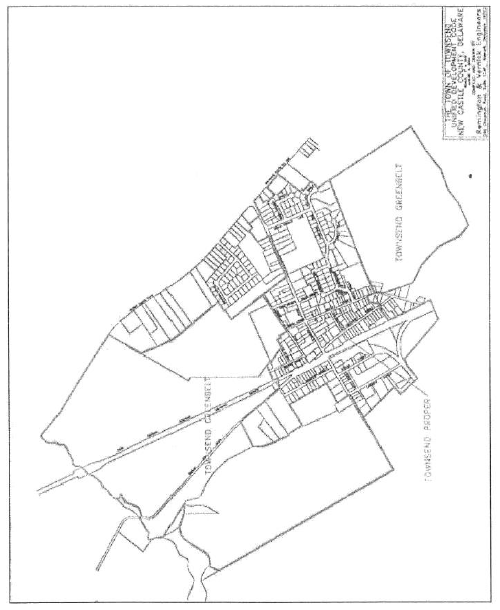
(UDC 2002, § 1111)
24.36.130 Boundary Determination For WRPA
- All subdivision and land development plans depicting development or land disturbance submitted for town review shall be evaluated for the existence of water resource protection areas by scaling for distances shown on the water resource protection area map. If existing, the boundaries of the areas shall be delineated on the plan by the applicant's engineer.
- When there appears to be a conflict between the mapped boundary and actual site conditions, the applicant may engage the services of professional practitioners set forth in this section to prepare a report intended to determine more accurately the precise boundary of the water resource protection area, which report shall be submitted to the town with the detailed findings necessary to indicate the location of the boundary.
- The plan showing the boundary conflict should indicate the following:
- A detailed topographic layout of the subdivision and/or area to be developed prepared by a land surveyor or engineer;
- For floodplain and erosion-prone slopes boundary determinations, a revised surface soils map of the subdivision and/or area prepared by a DNREC-licensed soil scientist including a written report of the on-site field inspection and test boring data;
- For reservoir watershed, wellhead and recharge boundary determinations, a site-specific geological and hydrogeological analysis shall be performed by a state-registered professional geologist or engineer with a background in hydrogeology and shall be based upon through site investigation and testing; and
- Evidence derived from a site-specific investigation which may include aquifer testing, test borings, test pits, observation wells, groundwater elevations and topography surveys as appropriate for the type of water resource protection area to clearly demonstrate that the area in question does not meet the definition of a water resource protection area as defined in this section.
- The applicant is permitted to make a submission to the county with the advice of the Delaware Geological Survey and the water resources agency, to adjust the boundary or area designation based thereon. Such adjustments shall have the effect of exempting the subject parcel from the use regulations of this section and shall have the effect of amending the limits of the water resource protection area. The applicant will then be required to provide a notification sent by the county indicating that they concur with the amended boundary location in order to be exempted from the requirements of this section.
(UDC 2002, § 1112)
24.36.140 Uniform Standards And Criteria
The following standards and criteria shall be applicable to any limited use, special use or other use requiring an environmental impact assessment permitted pursuant to this division. stormwater management facilities shall be designed and constructed in accordance with DNREC "Delaware Sediment and Stormwater Regulations," dated January 23, 1991 or as later revised.
(UDC 2002, § 1113)
24.36.150 Environmental Impact Assessment Report
If a proposed use requires an environmental impact assessment report, the applicant shall have such a report certified by a professional engineer, geologist or other certified professional in the applicable environmental discipline. Mitigation cannot be used where the conflict can be avoided or minimized. The report shall contain the following criteria, given in order of preference:
- Site Character. The report shall identify all potential on-site sensitive environmental concerns.
- Avoidance. Alternative sites or routes shall be identified that would not damage the resource or result in less resource damage. Reasons shall be provided explaining why using these sites is impossible or infeasible versus that proposed.
- Minimization. The applicant shall demonstrate that the plan minimizes the impact of the activity, route, or use on the resource. The applicant shall also demonstrate that the areas impacted shall be lowest quality and result in the least damage to the resource.
- Mitigation. A mitigation plan shall be submitted indicating mitigation activities. On-site replacement is the most acceptable form of mitigation. However, mitigation can include restoration and enhancement after the use is abandoned. Mitigation by replacement on another site shall be at a ratio of 2:1. Mitigation may also include enhancement; this ratio shall be 4:1. Final town approval is required for all other forms of mitigation not consistent with this section.
(UDC 2002, § 1114)
24.36.160 Clearing
With all natural resources, clearing shall be permitted only under the following conditions:
- To prepare land for a use permitted by this chapter;
- As a reforestation measure, or to enhance to improve the quality of existing vegetation or as a means to eliminate dead, diseased, or hazardous tree stands;
- Where a clearcutting operation is deemed permissible for one of the reasons stated in this paragraph, it shall be consistent with the terms of TMC 24.36.170 and in accordance with the State Department of Agriculture Division of Forest Services.
(UDC 2002, § 1115)
24.36.170 Reforestation Requirements
All open spaces to be reforested shall be planted according to the plant species listed in Table 11-16. The area around each tree shall be mulched. The entire area may be mulched or seeded in a perennial grass mix with a minimum 30 percent indigenous herbaceous forest, or grassland species. Canopy trees shall be selected to provide a diversity of native plants. Plantings shall include a minimum of four species. Where more than 100 canopy trees are required, a minimum of six species shall be provided; no one species shall have less than five or more than 30 percent of the total trees.
- Protected Resources. Protected resources shall not be disturbed with roadways, parking lots or utility lines. The applicant must demonstrate no possible alternative to crossing the resource exists and the route selected must be the least disruptive.
- Riparian Buffer Areas. Stormwater outfall shall be permitted, provided that the discharge velocity from the terminal end of the pipe or the associated energy dissipation practice does not exceed two feet per second (fps) for the two year frequency storm event. In addition, best management practices methods shall be used to convert concentrated flow to uniform, shallow sheet flow, filter sediments, and control erosion.
Table 11-16
REFORESTATON REQUIREMENTS PER ACRE
| No. of Plants | Types of Plants |
| 1 | 4" caliper canopy |
| 4 | 3" caliper canopy |
| 10 | 1 1/2" caliper canopy |
| 6 | 1 1/2" caliper or 5–6 ft. understory trees |
| 50 | 6 ft. whip canopy |
| 30 | bare root shrubs or 1 gallon pots |
(UDC 2002, § 1116)
24.36.180 Roads, Parking Lots And Utilities
- Protected Areas. Protected resources shall not be disturbed with roadways, parking lots or utility lines. The applicant must demonstrate no possible alternate to crossing the resource exists and the route selected must be the least disruptive.
- Riparian Buffer Areas. Stormwater outfall shall be permitted, provided that the discharge velocity from the terminal end of the pipe or the associated energy dissipation practice does not exceed two feet per second (fps) for the two year frequency storm event. In addition, best management practice methods shall be used to convert concentrated flow to uniform, shallow sheet flow, filter sediments, and control erosion.
(UDC 2002, § 1117)

