
Trenton City Zoning Code
ARTICLE II
GENERAL STANDARDS
Sec. 110-21.- Construction of language.
The following rules of construction apply to the text of this chapter
(1)
The particular shall control the general.
(2)
In the case of any difference of meaning or implication between the text of this chapter and any caption or illustration, the text shall control.
(3)
The word "shall" is always mandatory and not discretionary. The word "may" is permissive.
(4)
The words used in the present tense shall include the future; and words used in the singular shall include the plural, and the plural the singular, unless the context clearly indicates the contrary.
(5)
A "building" or "structure" includes the whole or any part thereof.
(6)
The phrase "used for" includes "arranged for," "designed for," "intended for," "maintained for," or "occupied for."
(7)
The word "person" includes an individual, a corporation, a partnership, an incorporated association, or any other similar entity.
(8)
Unless the context clearly indicates the contrary, where a regulation involves two or more items, conditions, provisions, or events connected by the conjunctions "and," "or," "either … or," the conjunction shall be interpreted as follows:
a.
"And" indicates that all the connected items, conditions, provisions, or events shall apply.
b.
"Or" indicates that the connected items, conditions, provisions, or events shall apply singly or, in any combination.
c.
"Either…or" indicates that the connected items, conditions, provisions, or events shall apply singly, but not in combination.
(9)
Terms not herein defined shall have the meaning assigned to them in the Webster's Standard Dictionary.
(Ord. No. 802, § 1, 12-14-2021)
Sec. 110-22. - Compliance required.
No building or structure, or part thereof, shall hereafter be erected, constructed, altered or maintained, and no new use or change of any building, structure or land, or part thereof, shall be made or maintained except in conformity with this chapter.
(Ord. No. 802, § 1, 12-14-2021)
Sec. 110-23. - Interpretation.
In its interpretation and application, the provisions of this chapter shall be held to be the minimum requirement, or in some instances, the maximum permitted limitation adopted for the promotion of the public health, morals, safety, comfort, convenience, or general welfare. This chapter is not intended to repeal, abrogate, annul or in any way impair or interfere with any existing provision of law or ordinance, or with any rule, regulation or permit previously adopted or issued, or which shall be adopted or issued pursuant to law relating to the use of buildings or premises. However, where this chapter imposes a greater restriction than is required by an existing ordinance, code or law, or by a rule, regulation or permit, the standards of this chapter shall prevail and control.
(Ord. No. 802, § 1, 12-14-2021)
Sec. 110-24. - Vested rights.
Nothing in this chapter shall be interpreted or construed to give rise to any permanent vested right in the continuation of any particular use, use district or zoning classification, or any permissible activity therein, and such use, use district or zoning classification or activity is hereby declared to be subject to subsequent amendment, change or modification as may be necessary to the preservation or protection of the public health, safety and welfare.
(Ord. No. 802, § 1, 12-14-2021)
Sec. 110-25. - Changes and amendments.
The Trenton City Council may, from time to time, and on the recommendation of the Trenton Planning Commission, or on its own initiation or on petition, amend, supplement, change or modify the zoning district boundaries or the provisions of this chapter pursuant to the authority and procedure set forth in the Michigan Zoning Enabling Act, Act 110 of the Michigan Public Acts of 2006.
(Ord. No. 802, § 1, 12-14-2021)
State Law reference— Amendment procedure, MCL 125.584.
Sec. 110-26. - Submittal limitation.
When a petition to change or modify a zoning district boundary, or to change or modify any provision of this chapter, shall have been denied by city council, one year, commencing on the date of denial, shall pass before the same petition may again be presented for consideration.
(Ord. No. 802, § 1, 12-14-2021)
Sec. 110-27. - Conflict of laws.
Whenever this chapter imposes more stringent requirements, regulations, restrictions, or limitations than are imposed or required by any other law or ordinance, the standards of this chapter shall govern. Whenever any other law, code or ordinance shall impose more stringent requirements than are imposed or required by this chapter, such other law, code, or ordinance shall govern.
(Ord. No. 802, § 1, 12-14-2021)
State Law reference— Conflicts between zoning and other ordinances, MCL 125.586.
Sec. 110-28. - Definitions.
The following words and phrases, when used in this chapter, shall have the meanings respectively ascribed to them.
Access management: The process of providing and managing access to land development while preserving regional flow of traffic in terms of safety, capacity, and speed.
Accessory use: A use which is clearly incidental to, customarily found in connection with, and (except in the case of accessory off-street parking or loading spaces) located on the same zoning lot with the principal use to which it is related.
Accessory: A use, activity, building, structure, or part of a structure that is subordinate and incidental to the main activity or structure on the site
When "accessory" is used in this text, it shall have the same meaning as "accessory use." An accessory use includes, but is not limited to, the following:
(1)
Residential accommodations for servants and/or caretakers and private vehicle garages;
(2)
Swimming pools and tennis courts for the use of the occupants of a residence, and their guests;
(3)
Domestic or agricultural storage in a barn, shed, tool room, or similar accessory building or other structure;
(4)
A newsstand primarily for the use of the occupants of a building, when the newsstand is located on the same premises with the building;
(5)
Storage of merchandise normally carried in stock and which is directly used in connection with a business use on the premises, unless such accessory storage is specifically prohibited as set forth in the regulations of the zoning lot on which the principal use is located;
(6)
Storage of goods and materials used in the manufacture of a product made on the same premises, unless such storage is specifically prohibited as set forth in the regulations of the zoning lot on which the principal use is located;
(7)
Accessory off-street parking spaces, open or enclosed, on the same premises as the use it is intended to serve, except as otherwise permitted in the P-1 Vehicle Parking District as set forth in this chapter;
(8)
Uses clearly incidental to a main use such as but not limited to: offices of an industrial or commercial use located on the same premises with the principal use;
(9)
Accessory off-street loading and unloading on the same premises as the principal use; and
(10)
Accessory signs located on the same premises as the principal use.
Accessory apartment (granny flat): A permitted independent, subordinated dwelling unit contained within a single-family detached dwelling or its accessory detached garage.
Accessory building: A subordinate building or a part of the main building, the use of which is clearly incidental to that of the main building or to the main use of the land.
Acid rain: Air pollution produced when acid chemicals are incorporated into rain, snow, fog, or mist.
Adolescent: For the purpose of this chapter shall mean a human being less than 18 years of age and shall have the same meaning as a "minor child" as defined in 722.111, section 1.(k), of the Child Care Organizations Act 116 of the Michigan Public Acts of 1973, as amended.
Adult: For the purposes of this chapter, shall mean a human being 18 years of age or older, as defined in 400.703, section 3.(1), (a) of the Adult Foster Care Licensing Act 218 of the Michigan Public Acts of 1979, as amended.
Adult oriented use: Adult oriented use shall include the following uses as herein defined:
(1)
Adult arcade means any place to which the public is permitted or invited wherein coin-operated, slug-operated, internet accessed, or electronically, electrically, or mechanically controlled still or motion picture machines, projectors, or other image-producing devices are maintained to show images to five or fewer persons per machine at any one time, and where the images so displayed are distinguished or characterized by the depicting or describing specified sexual activities or specified anatomical areas.
(2)
Adult bookstore or adult video store means a commercial establishment which, as one of its principal business purposes, offers for sale or rental for any form of consideration any one or more of the following:
a.
Books, magazines, periodicals or other printed matter, or photographs, films, motion picture, video cassettes or video reproductions, slides, or other audio visual representations which depict or describe specified sexual activities or specified anatomical areas, and
b.
Instruments, devices, or paraphernalia which are designed for use in connection with specified sexual activities. A commercial establishment may have other principal business purposes that do not involve the offering for sale or rental of material depicting or describing specified sexual activities or specified anatomical areas and still be categorized as adult bookstore or adult video store.
Such other business purposes will not serve to exempt such commercial establishment from being categorized as an adult bookstore or adult video store so long as one of its principal business purposes is the offering for sale or rental for consideration the specified materials which depict or describe specified sexual activities or specified anatomical areas.
(3)
Adult cabaret means a nightclub, bar, restaurant, or similar commercial establishment which regularly features:
a.
Persons who appear in a state of nudity;
b.
Live performances which are characterized by the exposure of specified anatomical areas or by specified sexual activities; and
c.
Films, motion pictures, video cassettes, slides, or other photographic reproductions which are characterized by the depiction or description of specified sexual activities or specified anatomical areas.
(4)
Adult motel means a hotel, motel, or similar commercial establishment which:
a.
Offers accommodations to the public for any form of consideration; provides patrons with closed-circuit television transmissions, films, motion pictures, video cassettes, slides, or other photographic reproductions which are characterized by the depiction or description of specified sexual activities or specified anatomical areas, and has a sign visible from the public right-of-way which advertises the availability of this adult type of photographic reproductions; and
b.
Offers a sleeping room for rent for a period of time that is less than ten hours; and
c.
Allows a tenant or occupant of a sleeping room to sub rent the room for a period of time that is less than ten hours.
(5)
Adult motion picture theater means a commercial establishment where, for any form of consideration, films, motion pictures, video cassettes, slides, or similar photographic reproductions are regularly shown which are characterized by the depiction or description of specified sexual activities or specified anatomical areas.
(6)
Adult theater means a theater, concert hall, auditorium, or similar commercial establishment which regularly features persons who appear in a state of nudity or live performances which are characterized by the exposure of specified anatomical areas or by specified sexual activities.
(7)
Escort means a person who, for consideration, agrees or offers to act as a companion, guide, or date for another person, or who agrees or offers to privately model lingerie or to privately perform a striptease for another person.
(8)
Escort agency means a person or business association who furnishes, offers to furnish, or advertises to furnish escorts as one of its primary business purposes for a fee, tip, or other consideration.
(9)
Establishment means and includes any of the following:
a.
The opening or commencement of any sexually oriented business as a new business.
b.
The conversion of an existing business, whether or not a sexually oriented business, to any sexually oriented business.
c.
The additions of any sexually oriented business to any other existing sexually oriented business.
d.
The relocation of any sexually oriented business.
(10)
Permittee and/or licensee means a person in whose name a permit and/or license to operate a sexually oriented business has been issued, as well as the individual listed as an applicant on the application for a permit and/or license.
(11)
Nude model studio means any place where a person who appears in a state of nudity or displays specified anatomical areas is provided to be observed, sketched, drawn, painted, sculptured, photographed, or similarly depicted by other persons who pay money or any form of consideration.
(12)
Nudity or a state of nudity means the appearance of a human bare buttocks, anus, male genitals, female genitals, or full female breast.
(13)
Person means an individual, proprietorship, partnership, corporation, association, or other legal entity.
(14)
Seminude means a state of dress in which clothing covers no more than the genitals, pubic region, and areolae of the female breast, as well as portions of the body covered by supporting straps or devices.
(15)
Sexual encounter center means a business or commercial enterprise that, as one of its primary business purposes, offers for any form of consideration:
a.
Physical contact in the form of wrestling or tumbling between persons of the opposite or the same sex; and
b.
Activities between male and female persons and/or persons of the same sex when one or more of the persons is in a state of nudity or seminude.
(16)
Sexually oriented business means an adult arcade, adult bookstore or adult video store, adult cabaret, adult motel, adult motion picture theater, adult theater, escort agency, nude model studio, or sexual encounter center.
(17)
Specified anatomical areas means the male genitals in a state of sexual arousal and/or the vulva or more intimate parts of the female genitals.
(18)
Specified sexual activities means and includes any of the following:
a.
The fondling or other erotic touching of human genitals, pubic region, buttocks, anus, or female breasts.
b.
Sex acts, normal or perverted, actual or simulated, including intercourse, oral copulation, and sodomy.
c.
Masturbation, actual or simulated.
d.
Excretory functions as part of or in connection with any of the activities set forth in subsections a. through c. above.
(19)
Substantial enlargement of a sexually oriented business means the increase in floor areas occupied by the business by more than 25 percent, as the floor areas exist on the date of enactment.
(20)
Transfer of ownership or control of a sexually oriented business means and includes any of the following:
a.
The sale, lease, or sublease of the business.
b.
The transfer of securities which constitute a controlling interest in the business, whether by sale, exchange, or similar means.
c.
The establishment of a trust, gift or other similar legal device which transfers the ownership or control of the business, except for transfer by bequest or other operation of law upon the death of the person possessing the ownership or control.
Agricultural animals: Animals considered accessory to an agricultural use, whether used for personal enjoyment or for commercial purposed, including horses, mules, burros, sheep, cattle, rabbits, chickens, ducks, geese, pigs, goats, ostrich, emu, or rhea.
Agricultural use: The employment of land for the primary purpose of obtaining a profit in money by raising harvesting, and selling crops, or feeding (including grazing) breeding, managing, selling or producing livestock, poultry, fur-bearing animals or honeybees, or by dairying and the sale of dairy products, by any other horticultural, floricultural or viticultural use, by animal husbandry, or by any combination thereof. It also includes the current employment of land for the primary purpose of obtaining a profit by stabling or training equines including, but not limited to, providing raiding lesson, training, clinics, and schooling shows.
Agriculture, home: The production, principally for use or consumption of the property owner, of plants, animals, or their products and for sale to others where such sales are incidental, including gardening and fruit production, but not poultry and livestock products.
Alley: Any dedicated public way affording a secondary means of access to abutting property and not intended for general traffic circulation.
Alterations: Any change, addition, or modification in construction or type of occupancy, any change in the structural members of a building, such as walls or partitions, columns, beams or girders, the consummated act of which may be referred to herein as "altered" or "reconstructed."
Ambient: Surrounding on all sides; used to describe measurements of existing conditions with respect to traffic, noise, air, and other environments.
Animal, domestic (pet): An animal that is tame or domesticated and not normally found in the wild state. Hybrids of animals normally found in the wild state are not including within the meaning of domestic animal.
Apartment: A room or suite of rooms used as a dwelling for one or more families which has cooking facilities and sanitary facilities located therein.
Apartments: The dwelling units in a multiple dwelling building as defined herein:
(1)
Efficiency apartment means a dwelling unit containing not less than 450 square feet of floor area and consisting of not more than one room in addition to the kitchen-dining and necessary sanitary facilities.
(2)
One-bedroom unit means a dwelling unit containing a minimum floor area of at least 600 square feet per unit and containing not more than one bedroom in addition to kitchen, dining, and living room, and necessary sanitary facilities.
(3)
Two-bedroom unit means a dwelling unit containing a minimum floor area of at least 800 square feet per unit and containing not more than two bedrooms in addition to kitchen, dining, and living room, and necessary sanitary facilities.
(4)
Three- or more bedroom unit means a dwelling unit wherein each bedroom in addition to the two-bedroom unit, shall provide an additional area of 200 square feet to the minimum floor area of 800 square feet for each additional bedroom.
Apartment building: A building or a portion thereof, designed exclusively for occupancy by three or more families living independently of each other.
Apartment garden: See garden apartment.
Apartment hotel: A building designed for or containing both dwelling units and individual guest rooms or suites of rooms, which building may include accessory uses such as cigar store, coffee shop, etc., when such uses are accessible only from the lobby.
Arcade: Any establishment or place of business containing five or more mechanical amusement devices. See definition of a mechanical amusement device.
Arcade, adult: See Adult oriented use.
Automobile: Every vehicle, except motorcycles, designed for carrying ten passengers or less and used for the transportation of persons.
Automobile repair garage: See Motor vehicle repair.
Automobile repair services, major: An establishment primarily engaged in the repair or maintenance of motor vehicles, trailers, and similar large mechanical equipment, including paint, body and fender, and major engine and engine part overhaul, provided it is conducted within a completely enclosed building.
Automobile repair services, minor: An establishment primarily engaged in the repair or maintenance of motor vehicles, trailers, and similar large mechanical equipment, including brake, muffler, upholstery work, tire repair and change, lubrication, and tune ups provided it is conducted within a completely enclosed building.
Basement: That portion of a building between the floor and ceiling which is partly below and
partly above ground level, but so located that the vertical distance from grade to
the floor below is more than a vertical distance from grade to ceiling. A basement
shall not be considered as a story except in an approved soil sheltered structure.
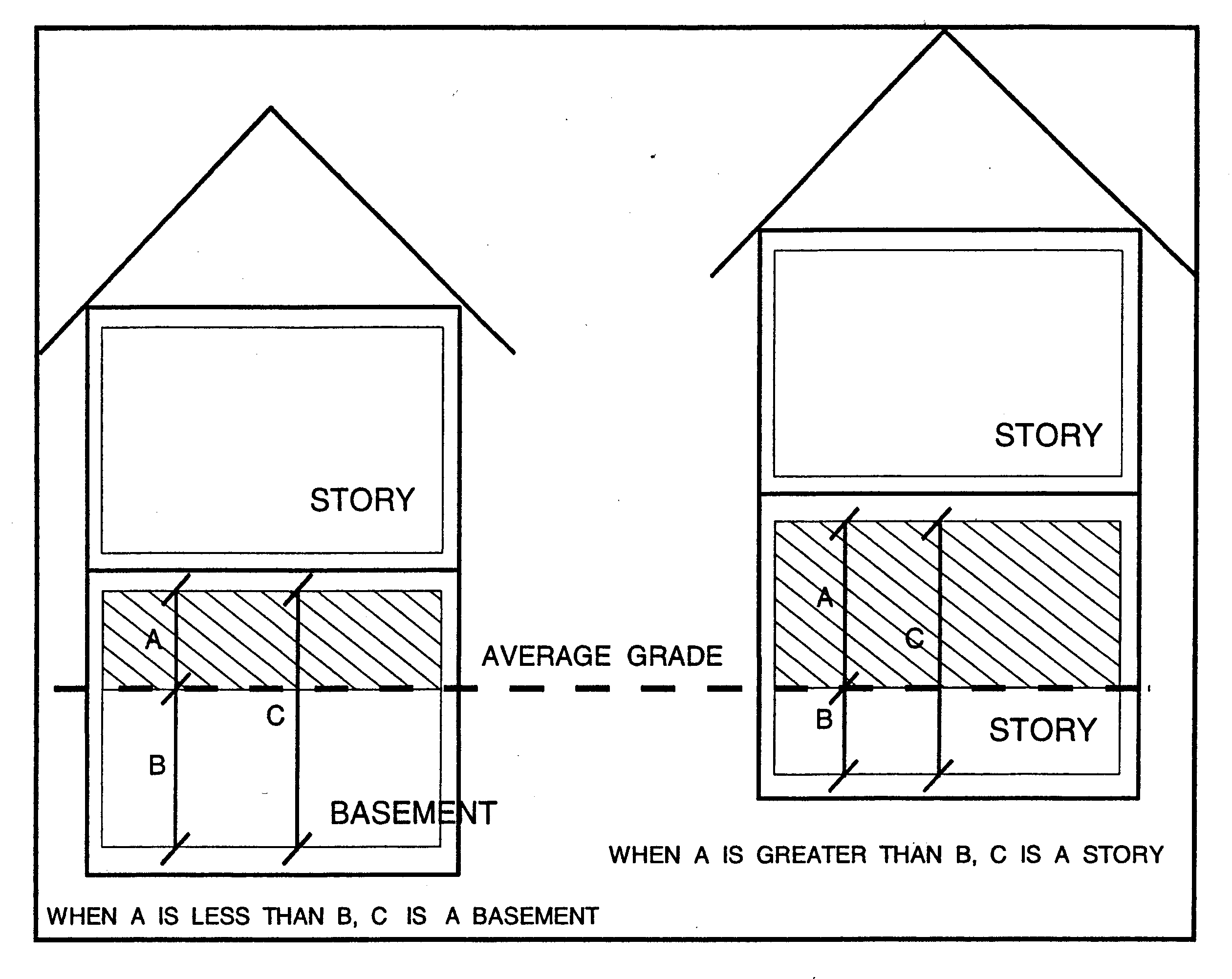
Cellar, Basement and Story
Bed and breakfast: An owner-occupied building at least 50 years old designed for and used as a single family or two family dwelling that provides four of fewer lodging rooms or accommodating no more than eight adults in which meals are provided to overnight guests, and that is open to the traveling public for a stay not to exceed 20 days.
Bicycle facilities, commuter: Shower(s) and changing room(s) provided in commercial and public buildings employing at least 20 people. Such facilities may be part of regular bathroom facilities.
Blight: Unsightly condition including the accumulation of debris, litter, rubbish, or rubble; fences characterized by holes, breaks, rot, crumbling, cracking, peeling, or rusting; landscaping that is dead, characterized by uncontrolled growth or lack of maintenance, or damaged; and any other similar conditions of disrepair and deterioration regardless of the condition of other properties in the neighborhood.
Block: The property abutting one side of a street and lying between the two nearest such streets or railroad right-of-way, unsubdivided acreage, river or live stream; or between any of the foregoing and any other barrier to the continuity of development, or corporate boundary lines of the city.
Boarding house: See Rooming house.
Brewpub: See Microbrewery
Brick: See Face brick.
Building: Any structure either temporary or permanent, having a roof supported by columns or walls, and intended for the shelter or enclosure of persons, animals, chattels, or property of any kind. Also, a structure erected on site, including a manufactured building brought to the site.
Building, accessory: See accessory.
Building area: The space remaining on a property for building purposes after compliance with minimum building setback requirements and any applicable lot area coverage limitations.
Building height: For a principal use, the vertical distance measured from the established grade to
the highest point of the roof surface for flat roofs; to the deck line of mansard
roofs; and to the average height between eaves and ridge for gable, hip, and gambrel
roofs. For an accessory building, the vertical distance measured from the established
grade to the highest point of the roof surface for flat roofs and to the ridge line
for mansard, gable, hip and gambrel roofs. Where a building is located on sloping
terrain, the height may be measured from the average ground level of the grade at
the building wall.
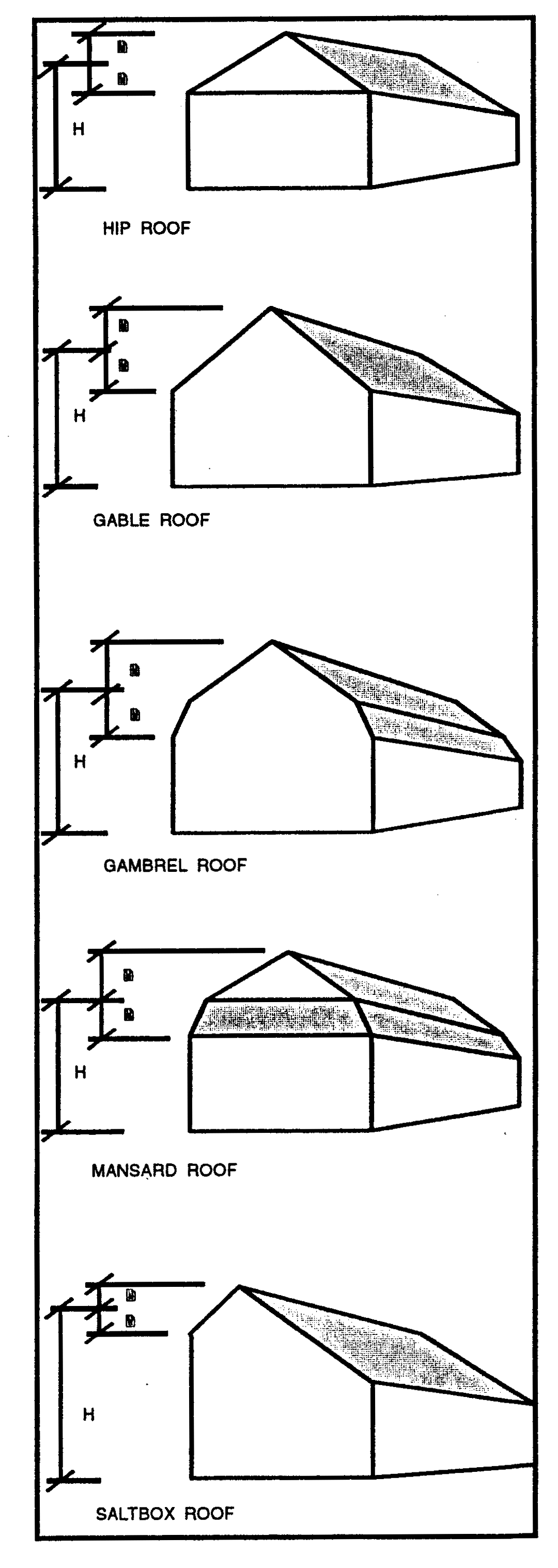
Building Height
Building line: A line formed by the face of the buildings, and for the purposes of this chapter,
a minimum building line is the same as a front setback line.
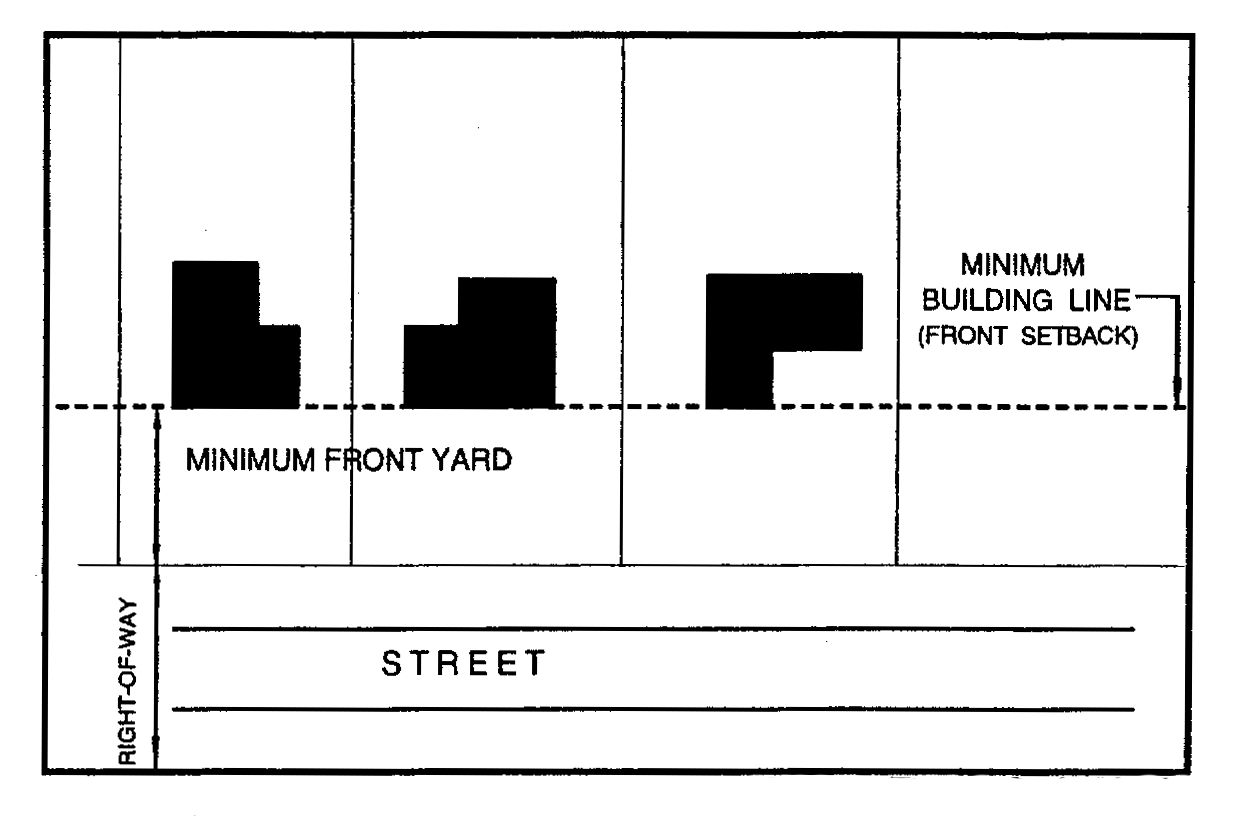
Building Line
Building, main or principal: A building in which is conducted the principal purpose of the land on which it is situated.
Building, one-family: See dwelling, single-family.
Building, two-family: See dwelling, two-family.
Building, multiple-family: See apartment building.
Bylaws: Rules adopted by a board which govern its procedures.
Cellar: See basement.
Cemetery: Land used or intended to be used solely for burial of the human dead and dedicated for such purpose.
Cemetery, pet: Land use or intended to be used solely for burial of nonhuman dead and dedicated to such purpose.
Child: See adolescent.
Child care center: A facility, other than a private residence, receiving one or more preschool- or school-age children for care for periods of less than 24 hours a day and where the parents, guardians, family member, or court-appointed fiduciary or caregiver is not immediately available to the child or adult. Child-care center or day-care center includes a facility that provides care for not less than two consecutive weeks, regardless of the number of hours of care per day. The facility is generally described as a child-care center, day-care center, day nursery, nursery school, parent cooperative preschool, play group, before- or after-school program, or drop-in center. Child-care center or day-care center does not include any of the following:
(1)
Sunday school, a vacation bible school, or a religious instructional class that is conducted by a religious organization where children are attending for not more than three hours per day for an indefinite period or for not more than eight hours per day for a period not to exceed four weeks during a twelve-month period.
(2)
A facility operated by a religious organization where children are in the religious organization's care for not more than three hours while persons responsible for the children are attending religious service.
(3)
A program that is primarily supervised, school-age-child-focused training in a specific subject, including, but not limited to, dancing, drama, music, or religion. This exclusion applies only to the time a child is involved in supervised, school-age-child-focused training.
(4)
A program that is primarily an incident of group athletic or social activities for school-age children sponsored by or under the supervision of an organized club or hobby group, including, but not limited to, youth clubs, scouting, and school-age recreational or supplementary education programs. This exclusion applies only to the time the school-age child is engaged in the group athletic or social activities and if the school-age child can come and go at will.
City: The City of Trenton, Wayne County, Michigan.
Clinic: An establishment where human patients, who are not lodged overnight, are admitted for examination and treatment by a group of physicians, dentists, or similar professions.
Club, lodge or fraternity: An organization of persons for special purposes or for the promulgation of sports, arts, sciences, literature, public and private service, patriotic, or the like.
Commercial, retail: An establishment primarily engaged in the sale of goods or materials to the general public for personal or household consumption and rendering services incidental to the sale of such goods.
Commercial, wholesale: An establishment or place of business primarily engaged in selling merchandise to retail commercial establishments, to industrial, institutional, or professional business uses, or to other wholesalers; or acting as agents or brokers and buying merchandise for or selling merchandise to such individuals or establishments.
Commission: See planning commission.
Condominium: A form of ownership, which, for the purposes of this chapter, is applied to the following
terms as defined herein:
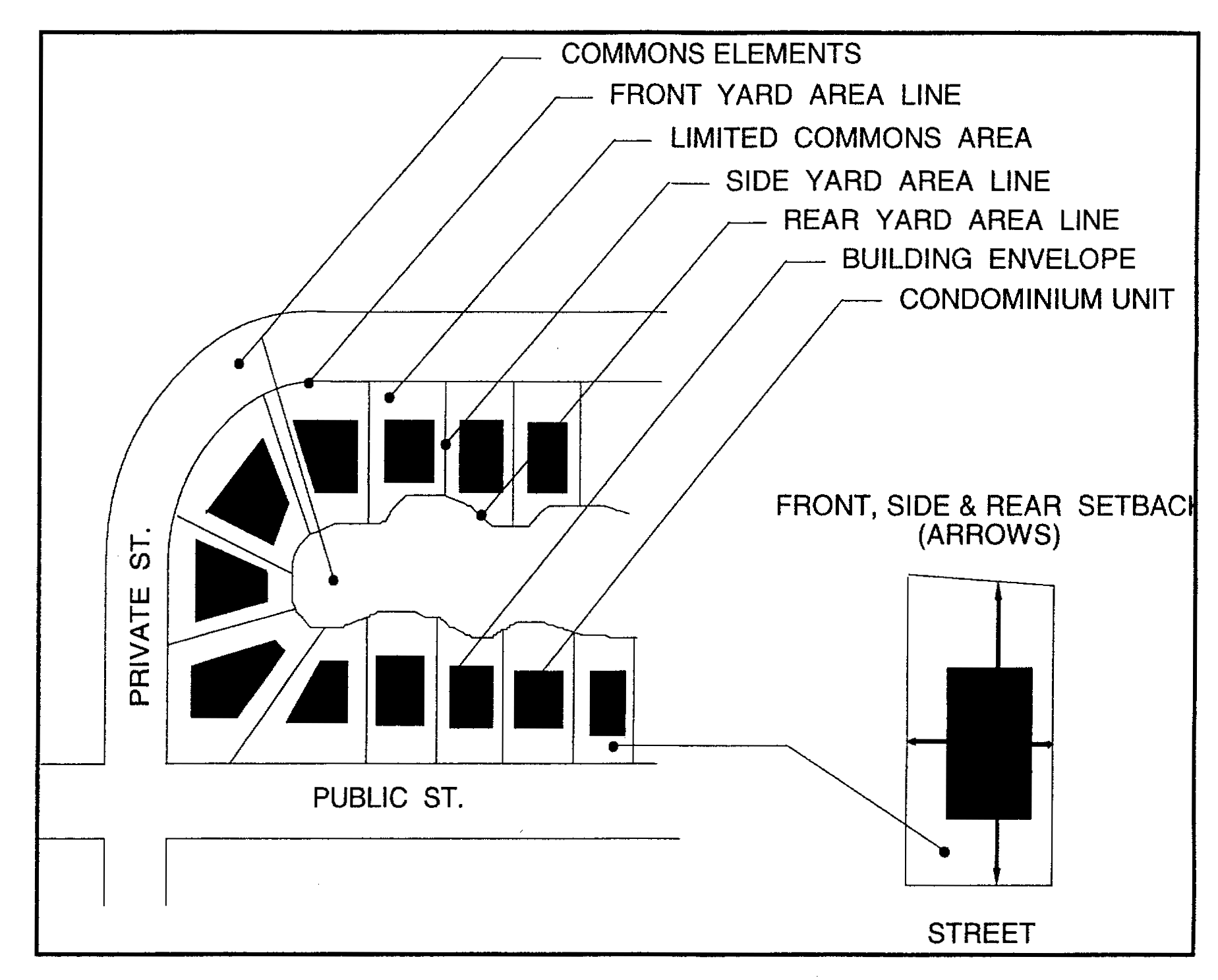
Condominium Terminology
(1)
Condominium Act means Act 59 of the Michigan Public Acts of 1978, as amended.
(2)
Common elements mean the portions of the condominium project other than the condominium.
(3)
Condominium bylaws mean the required set of bylaws for the condominium project attached to the master deed.
(4)
Condominium site plan means a scale drawing of a site, including a survey, utility layouts, floor plans and elevation sections, as appropriate, showing existing and proposed structures, improvements, parking, etc., as it is to be erected on the site.
(5)
Condominium unit means that portion of the project designed and intended for separate ownership and use, as described in the master deed.
(6)
Consolidating master deed means the final amended master deed for a contractible condominium project and expandable condominium project, or a condominium project containing convertible land, or convertible space which final amended master deed fully describes the condominium project as completed.
(7)
Contractible condominium means a condominium project from which any portion of the submitted land or buildings may be withdrawn pursuant to express provisions in the condominium documents and in accordance with this chapter and the Condominium Act.
(8)
Conversion condominium means a condominium project containing condominium units, some or all of which were occupied before the establishment of the condominium project.
(9)
Convertible area means a unit or a portion of the common elements of the condominium project referred to in the condominium documents within which additional condominium units, or general or limited common elements may be created pursuant to express provision in the condominium documents and in accordance with this chapter and the Condominium Act.
(10)
Co-owner means a person, firm, corporation, partnership, association, trust, or other legal entity or combination thereof, who owns a condominium unit within the condominium project. Co-owner may include a land contract lender if the condominium documents or the land contract so provides.
(11)
Expandable condominium means a condominium project to which additional land may be added pursuant to express provision in the condominium documents and in accordance with this chapter and the Condominium Act.
(12)
Limited common elements means a portion of the common elements reserved in the master deed for the exclusive use of less than all of the co-owners.
(13)
Master deed means the condominium document recording the condominium project as approved by the city, to which is attached as exhibits and incorporated by reference, the approved bylaws for the project and the approved condominium subdivision plan for the project.
Convalescent or nursing home: A home for the care of children or the aged or infirm, or a place of rest for those suffering bodily disorders, wherein two or more persons are cared for. Said home shall conform and qualify for license under state law even though state law has different size regulations.
Density: The number of families residing on, or dwelling units developed on, an acre of land. As used in this chapter, all densities are stated in families per net acre, that is, per acre of land devoted to residential use, exclusive of land in streets, alleys, parks, playgrounds, schoolyards, or other public lands and open spaces.
Density bonus: The granting of the allowance of additional density in a development in exchange for the provision by the developer of other desirable amenities from a pubic perspective (e.g., public open spaces, plazas, art, landscaping, etc.).
Design standards: A set of guidelines defining parameters to be followed in a site or building design and development.
Derrick: Any portable framework, tower mast, and/or structure which is required or used in connection with drilling or re-working a well for the production of oil or gas.
Development: The construction of a new building or other structure on a lot, the relocation of an existing building on another lot, or the use of open land for a new use.
Distance between buildings: The shortest horizontal distance between the vertical walls of two structures.
District: The various portions of the City of Trenton within which certain regulations and requirements or various combinations thereof apply under the provisions of this chapter.
Diversity: Differences among otherwise similar elements that give them unique forms and qualities.
Dog day care facility: Any premises containing four or more dogs, which are five months or older, where these domestic animals are dropped off and picked up daily between the hours of 7:00 AM and 7:00 PM for temporary care on site and where they may be groomed, trained, exercised, and socialized, but are not kept or boarded overnight, bred, sold, or let for hire.
Domestic violence shelter: A temporary shelter for individuals affected by domestic violence. Such use shall be operated by a public or nonprofit entity and may provide temporary boarding, lodging, counseling, and support services.
Donation collection bin: A receptacle designed with a door, slot, or other opening that is intended to accept and store donated items; provide however, that the definition of donation collection bins shall not include trailers where personnel are present to accept donations.
Drilling pad: The area of surface operations surrounding the surface location of a well or wells. Such area shall not include an access road to the drilling pad.
Drive-in: See restaurant, drive-in.
Drive-through: A business establishment designed and intended to provide a driveway approach and temporary motor vehicle standing space or stacking space where customers receive service while in their motor vehicles.
Dumpster: A container that has a hooking mechanism that permits it to be raised and dumped into a sanitation truck.
Dwelling: A place or unit of residence, an abode, a place of continued living. A single unit providing complete, independent living facilities for one or more persons, including permanent provisions for living, sleeping, eating, cooking and sanitation.
Dwelling, efficiency: See apartments.
Dwelling, manufactured: A dwelling unit which is substantially built, constructed, assembled, and finished off the premises upon which it is intended to be located.
Dwelling, multiple-family: See apartments.
Dwelling, one-family: A building designed exclusively for and occupied exclusively by one family.
Dwelling, site-built: A dwelling unit which is substantially built, constructed, assembled, and finished on the premises which are intended to serve as its final location. Site-built dwelling units shall include dwelling units constructed of pre-cut materials, and panel walls, roof and floor sections when such sections require substantial assembly and finishing on the premises which are intended to serve as its final location.
Dwelling, two-family: A building designed exclusively for occupancy by two families living independently of each other.
Earth berm: See landscaping.
Earth berm, obscuring: See landscaping.
Earth tone colors: Whenever the term, earth tone colors, is applied to any standard or standards in this chapter, such colors shall be limited to various muted shades of brown, beige, orange, and red color tones. Other possible earth tone colors such as brighter shades of red, orange, and any shade of blue or green shall not be considered as earth tone colors for the purposes of their application to the earth tone color requirements of this code.
Easement or corridor: For the purposes of this chapter, an easement or corridor shall mean the area within which a public transmission line is located, either above or below ground. The term corridor shall apply when the designated area within which the transmission line is located is owned in fee interest by a utility company.
Egress: An exit.
Elderly housing: A housing unit specifically designed for the needs of an elderly person or persons and conforming to the requirements of state and federal programs providing housing for the elderly.
Elderly housing, assisted living facility: A special combination of housing, supportive services, personalized assistance, and health care designed to respond to the individual needs of those who need help with activities of daily living. A facility with a central or private kitchen, dining, recreational, and other facilities, with separate bedrooms or living quarters, where the emphasis of the facility remains residential.
Elderly housing, congregate care facility: Any building or portion thereof which contains facilities for living, sleeping, and sanitation as required by code, and may include facilities for eating and cooking, for occupancy by other than a family. A congregate residence may be a shelter, convert, monastery, dormitory, fraternity, or sorority house, but does not include jails, hospitals, nursing homes, hotels or lodging facilities.
Elderly housing, lifecare or continuing care services: Nursing homes, rest homes, and convalescent houses which include individual dwelling units for the elderly as an integral part of the facility where the total floor area devoted to individual dwelling units does not exceed 70 percent of the total floor area of the entire facility.
Elderly housing, residential care facility: Housing that provides residents with a program of assisted living services to deal with the activities and instrumental activities of daily living.
Elderly housing, retirement housing: Any age restricted development which may be in any housing form, offering private and semiprivate rooms.
Engineer: The city engineer for the City of Trenton or the city engineer's authorized representative.
Erected: Built, constructed, altered, reconstructed, moved upon or any physical operations on the premises which are required for construction. Excavation, fill, drainage, and the like shall be considered a part of erection.
Essential services: The erection, construction, alteration or maintenance by public utilities or municipal departments of underground, surface, or overhead gas, electrical, steam, fuel or water transmission or distribution systems, collections, communication, supply or disposal systems, including towers, poles, wires, mains, drains, sewers, pipes, conduits, cables, fire alarm and police call boxes, traffic signals, hydrants and similar equipment in connection therewith, but not including buildings which are necessary for the furnishing of adequate service to the city such utilities or municipal departments for the general health, safety or welfare. Essential services shall be permitted as authorized and regulated by law and the applicable standards of this chapter and other ordinances of the City of Trenton.
Excavation: Any breaking of ground, except common household gardening and ground care.
Exception: A use permitted only after review of an application by the board of zoning appeals or legislative body or a modification in the standards of this chapter specifically permitted after review by the board of zoning appeals, planning commission or legislative body; such review being necessary because the provisions of this chapter covering conditions precedent or subsequent are not precise enough to cover all applications without interpretation and such review and exception is provided for by this chapter. An exception is not a variance.
Face brick: Face brick means whenever face brick is called for as an exterior building wall material for a building, the brick shall consist of kiln-baked clay or shale masonry units the thickness of which shall not be less than three inches deep, measured from the front face of the unit to the rear face of the unit (necessary if city wishes to regulate building materials).
Family: A single individual or a number of individuals domiciled together whose relationship is of a continuing, nontransient, domestic character and who are cooking and living together as a single, nonprofit housekeeping unit. This shall not include any society, club, fraternity, sorority, association, lodge, coterie, organization, or group of students or other individuals whose relationship is of a transitory or seasonal nature or for anticipated limited duration of school terms or other similar determinable period.
Fast food restaurant: See Restaurant (fast food).
Fence: See Chapter 9, Article V, Fences, section 9-86, Definitions, definition (e), Fences, in the City Code of Ordinances, as amended.
Fence height: The vertical distance between the ground, either natural or filled, directly under the fence and the highest point of the fence, excluding ornamental projections at no closer than five-foot intervals.
Floor area, gross: The area of a building measured to the exterior face of all exterior walls.
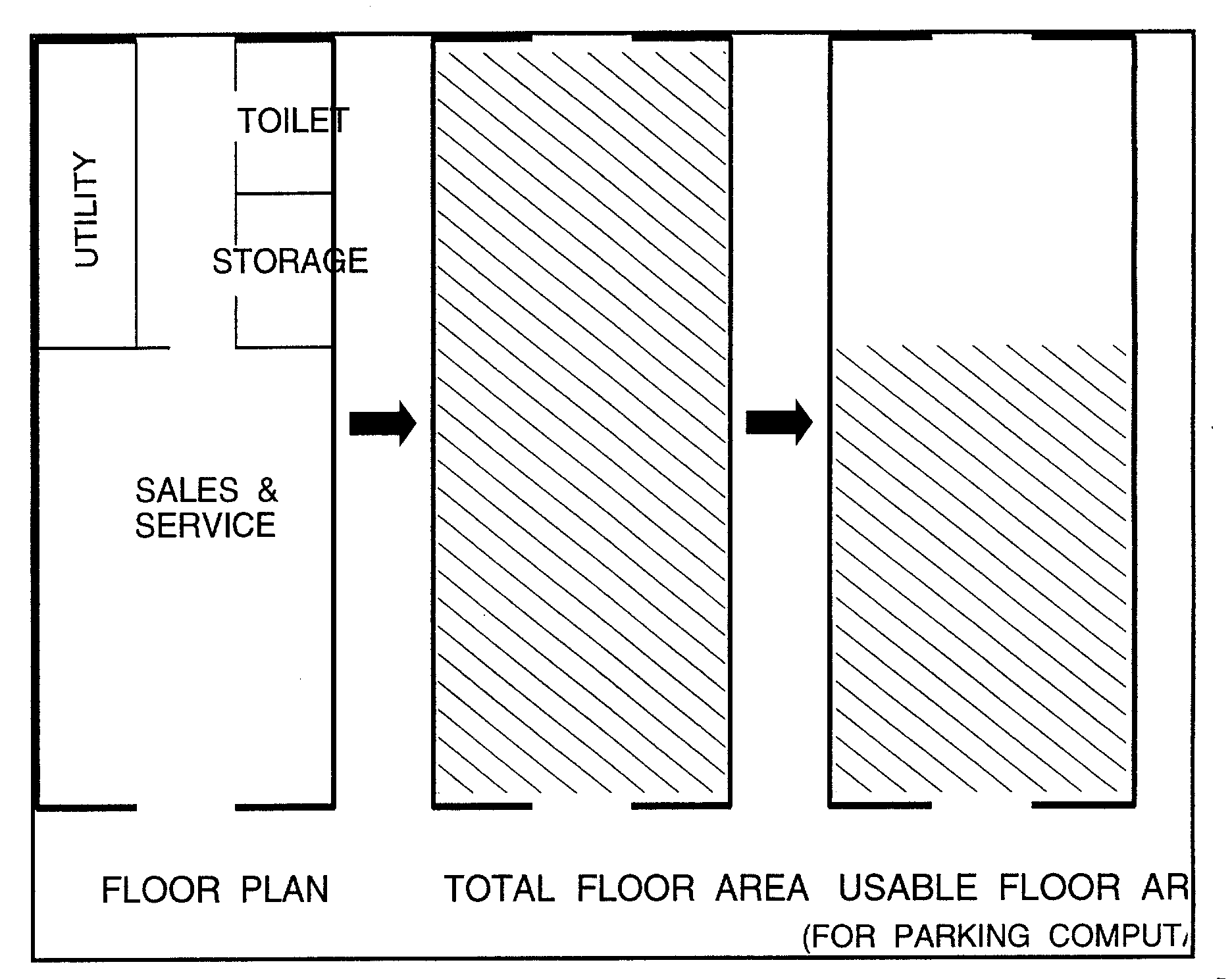
Usable Floor Area
Floor area, useable, residential: The sum of the horizontal area of the first story measured to the interior face of exterior walls; plus, similarly measured, that area of all other stories having more than 84 inches of headroom which may be made useable for human habitation; but excluding the floor area of basements, attics, attached or unattached garages, breeze ways, unenclosed porches and accessory buildings (also, see Story and Story, half, and Basement.)
Floor area, usable, nonresidential: The sum of the horizontal area of the first story measured to the interior face of exterior walls; plus, similarly measured, that area of all other stories, including mezzanines, which may be made fit for occupancy, including the floor area of all accessory buildings measured similarly and the floor area of basements when used or activities related to the principal use, but excluding storage, furnace and utility rooms. Parking space located within a building shall not be considered useable floor space.
Floor, ground: That portion of a building which is partly below grade, but so located that the vertical distance from the average grade to the ceiling is greater than the vertical distance from the average grade to the floor. A ground floor shall be counted as a story.
Foot-candle: A unit of illumination produced on a surface, all points of which are one foot from a uniform point of one candle.
Fulfillment center: A building in which inventory is stored for distribution to customers, typically operated by a third party logistics provider and hosting a combination of functions such as freight transportation, cross-docking, order picking and shipping, and customer service.
Gasoline service station: See motor vehicle service station.
Garage, repair: See motor vehicle repair.
Garage, commercial parking: A building or structure which is used by the public for the parking of motor vehicles and for the purposes of this chapter may be the principal use of the property or may be accessory to a principal use.
Garage, private: An accessory building or integral portion of a main building designed or used solely for the storage of motor-driven vehicles, boats, and similar vehicles owned and used by the occupants of the building.
Garden apartment: An apartment building located on a lot, either singly or together with other similar apartment buildings, generally having a low density of population and having substantial landscaped open space adjacent to the dwelling units.
Grade: The ground elevation established by the city engineer for the purpose of regulating
the number of stories and the height of the building. The building grade shall be
the level of the ground adjacent to the walls of the building if the finished grade
is level. If the ground is not entirely level, the grade shall be determined by computing
the average elevation of the ground for each face of the building, and averaging the
totals.
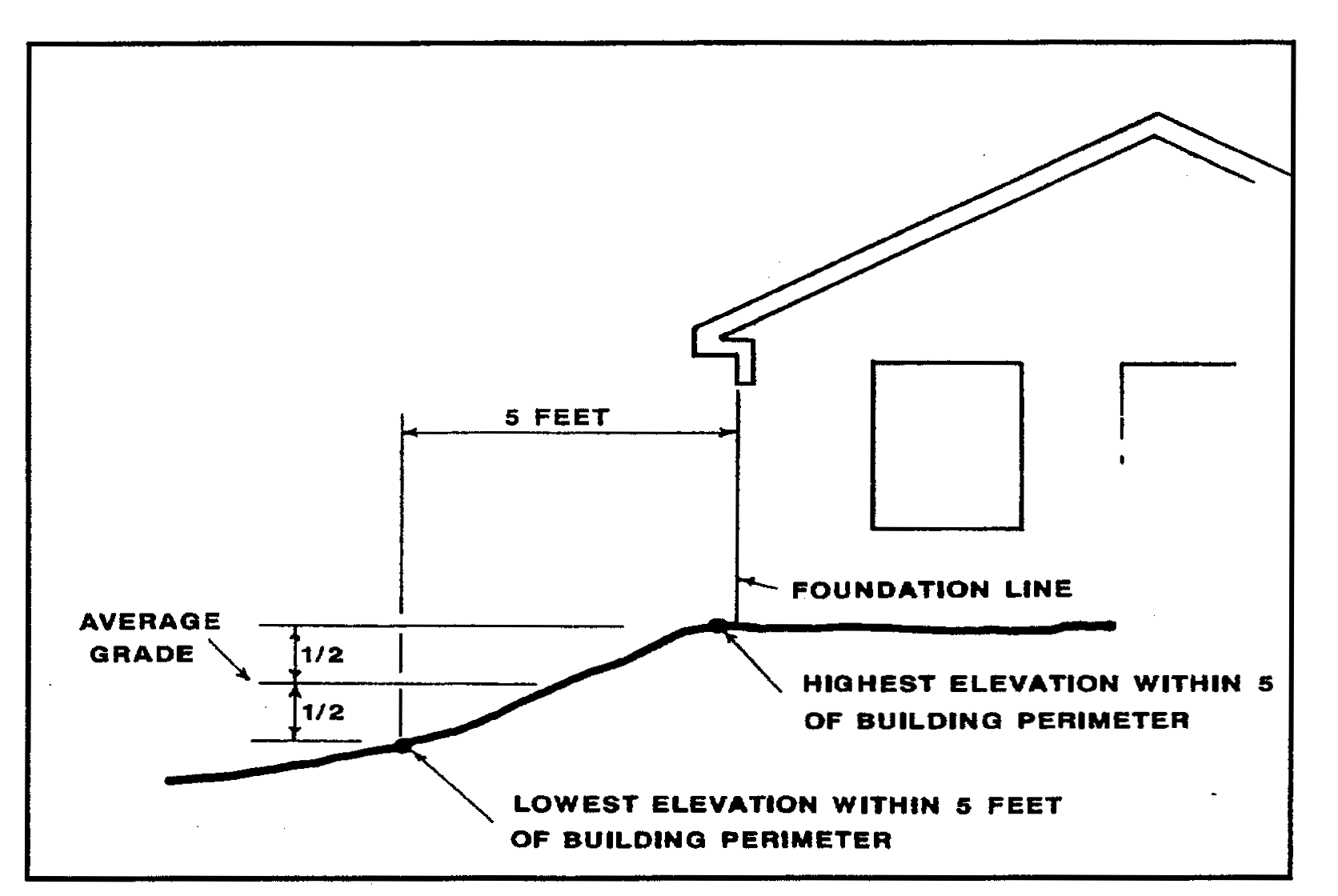
Average Grade
Greenbelt, aesthetic: See landscaping.
Greenbelt, obscuring: See landscaping.
Historic building: Any building that is historically or architecturally significant.
Homeless shelter: A structure used as a day facility or temporary dwelling for transient or homeless individual but not including orphanages or foster homes, operated by a non-profit religious, educational, or philanthropic institution.
Home occupation: A gainful occupation, activity, hobby or profession that is traditionally or customarily carried on entirely within the walls of a residential dwelling and which is carried on by the inhabitants thereof, which use is incidental and secondary to the use of the dwelling for dwelling purposes and does not change the character thereof.
Horizontal drilling: The drilling of an oil or natural gas well at an angle so that the well runs parallel to the formation containing the oil or gas.
Hospital: A building, structure or institution in which sick or injured persons are given medical or surgical treatment and operating under license by the health department and the State of Michigan, and is used for primarily in-patient services, and including such related facilities as laboratories, out-patient departments, central service facilities, and staff offices.
Hotel: A building or part of a building, with a common entrance or entrances, in which the dwelling units or rooming units are used primarily for transient occupancy and within which one or more of the following services are offered: maid service, furnishing of linen, telephone, secretarial or desk service and bell boy service. A hotel may include a restaurant in cocktail lounge, banquet halls, ballrooms, or meeting rooms.
House trailers: For the purpose of this chapter, the term "house trailer" shall mean any vehicle used or intended for use as a dwelling, regardless of whether such vehicle is self-propelling or is moved by other agencies. The following restrictions shall be applicable to house trailers:
(1)
No person shall park overnight or permit the parking overnight of any house trailer upon any public highway, street, alley, park, or other public place within the city.
(2)
No person shall park or permit the parking of a house trailer for occupancy on any private property within the city, except in an authorized trailer camp licensed under the provisions of Act 143, Public Acts of 1939, State of Michigan, as amended.
Hydraulic fracturing or fracking: The process of injecting water, customized fluids, sand, steam, or gas into a gas well under pressure to improve gas recovery.
Impervious cover: Impervious cover refers only to strictly impervious surfaces including roofs of buildings, specifically impervious asphalt and concrete pavements, and other specifically impervious pavement materials such as mortared masonry and gravel.
Impervious surface: An impervious surface area includes and hard-surfaced, manmade area that does not readily absorb or retain water, including but not limited to building roofs, parking and driveway areas, sidewalks, and paved recreational facilities. The Impervious Surface Ratio (ISR) equals the total area of impervious surfaces divided by the net area (excluding right-of-way) of the lot.
Ingress: Access or entry point of entrance.
Irrigation system: A permanent artificial watering system designed to transport and distribute water to plants.
Junk: For the purpose of this chapter, the term junk shall mean any motor vehicles, machinery, appliances, signs, product, merchandise with parts missing or scrap metals or other scrap materials that are damaged, deteriorated, or are in a condition which cannot be used for the purpose that the product was manufactured.
Junk yard: The term junk yard includes automobile wrecking yards, any area where junk vehicles are stored, keeping or abandonment of junk, including scrap metal or other scrap materials, or for the dismantling, demolition or abandonment of automobiles or other vehicles or machinery or parts thereof except for the normal household refuse which is stored only between regular pickup and disposal of household refuse, provided the same is not left for a period of over 30 days in which case it shall be considered as junk. This definition does not pertain to uses conducted entirely within an enclosed building.
Kennel, commercial: Any lot or premises on which three or more dogs, and/or cats, or other household pets, over six months of age are either permanently or temporarily boarded. Kennel shall also include any lot or premises where household pets are bred or sold.
Landscaping: The art or science of placing live planting materials in specific or in specified areas with the intent of improving the appearance of an area, or for the purpose of creating a screen to obscure vision beyond the screen. For the purpose of this chapter, landscaping shall also include the following terms:
(1)
Buffers for conflicting land use: A device or an area that is used for the purpose of shielding the view of one use of land from another, and for the protection of an adjoining property. A buffering device could include a wall, fence earth berm or landscape planting screen, or an area containing sufficient natural tree cover to serve as a buffer, or an area of sufficient distance to effectuate a buffer, or land containing sufficiently abrupt changes in topography to serve as a buffer.
(2)
Caliper: The diameter of a tree measured six inches above the root ball up to trees four inches and larger in caliper, and measured 12 inches above the root ball for larger caliper trees.
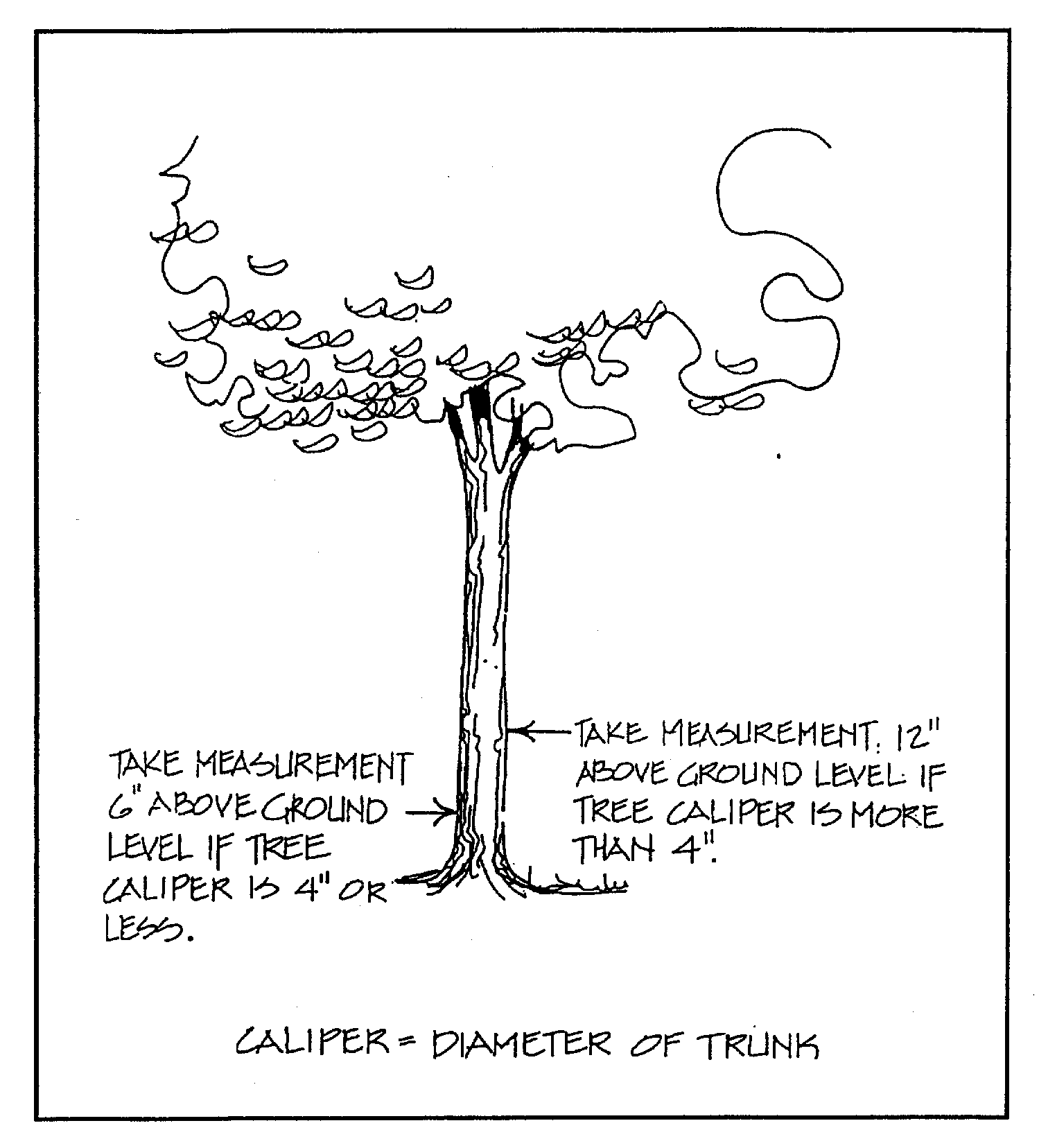
Tree Caliper Measurement
(3)
Earth berm, artistic: An aesthetically designed landscaping feature, which may also serve to create a landscaped swale for the purpose of temporarily detaining stormwater run-off.
(4)
Earth berm, obscuring: An earthen mound of definite height, length, location, and appearance, which is designed and intended to serve as an obscuring device.
(5)
Greenbelt, aesthetic: A landscaped area or lawn panel in which live landscape planting materials are placed for aesthetic purposes and not for the purpose of screening.
(6)
Greenbelt, obscuring: A landscaped area of definite width, height and location containing live planting materials of definite spacing or grouping which is designed to serve as an obscuring device.
(7)
Interior landscaped areas: Includes all landscaped areas between the walls of a building and any off-street parking spaces, service drives or vehicle maneuvering lanes, or loading and unloading areas, that comply with the minimum applicable size (planting area) requirements of this section and which are contained within an imaginary line that squares off the outer limits of an off-street parking lot.
(8)
Obscure: To make not readily visible, to hide or screen from view. For the purpose of this chapter, obscure shall mean to obscure the view of one use of land from another (see definition of buffers for conflicting land use).
(9)
Parking lot tree: A large deciduous tree placed within an off-street parking area.
(10)
Peripheral landscaped areas: Includes all landscaping that lies between any off-street parking spaces, service drives and vehicle maneuvering lanes, or loading and unloading area, and any peripheral property line, or where no parking, service drives and vehicle maneuvering lanes, or loading and unloading areas exist, any landscaped areas lying between any minimum required building setback line and a peripheral property line.
(11)
Shrubs, large: Shrubs which will be four feet six inches in height or greater at maturity.
(12)
Shrubs, small: Shrubs that will be less than four feet six inches in height at maturity.
(13)
Tree, large deciduous: Shall be a minimum of two and one-half inches in caliper measured six inches up the tree from the ground.
(14)
Tree, small deciduous: Shall be a minimum of one and one-half inches in caliper measured six inches up the tree from the ground.
(15)
Vehicle use area: Includes all off-street parking lots, drive aisles, loading, unloading areas, service drives and landscaped islands.
Land, vacant: Lands or buildings that are not actively used for any purpose.
Loading space: See Off-street loading space.
Local street: A street of limited continuity which is to be used to gain immediate access to abutting residential properties.
Logistics park: A defined area for activities relating to the intermodal transport and distribution
of goods, carried out by various operators on a regional, national, and/or international
scale.
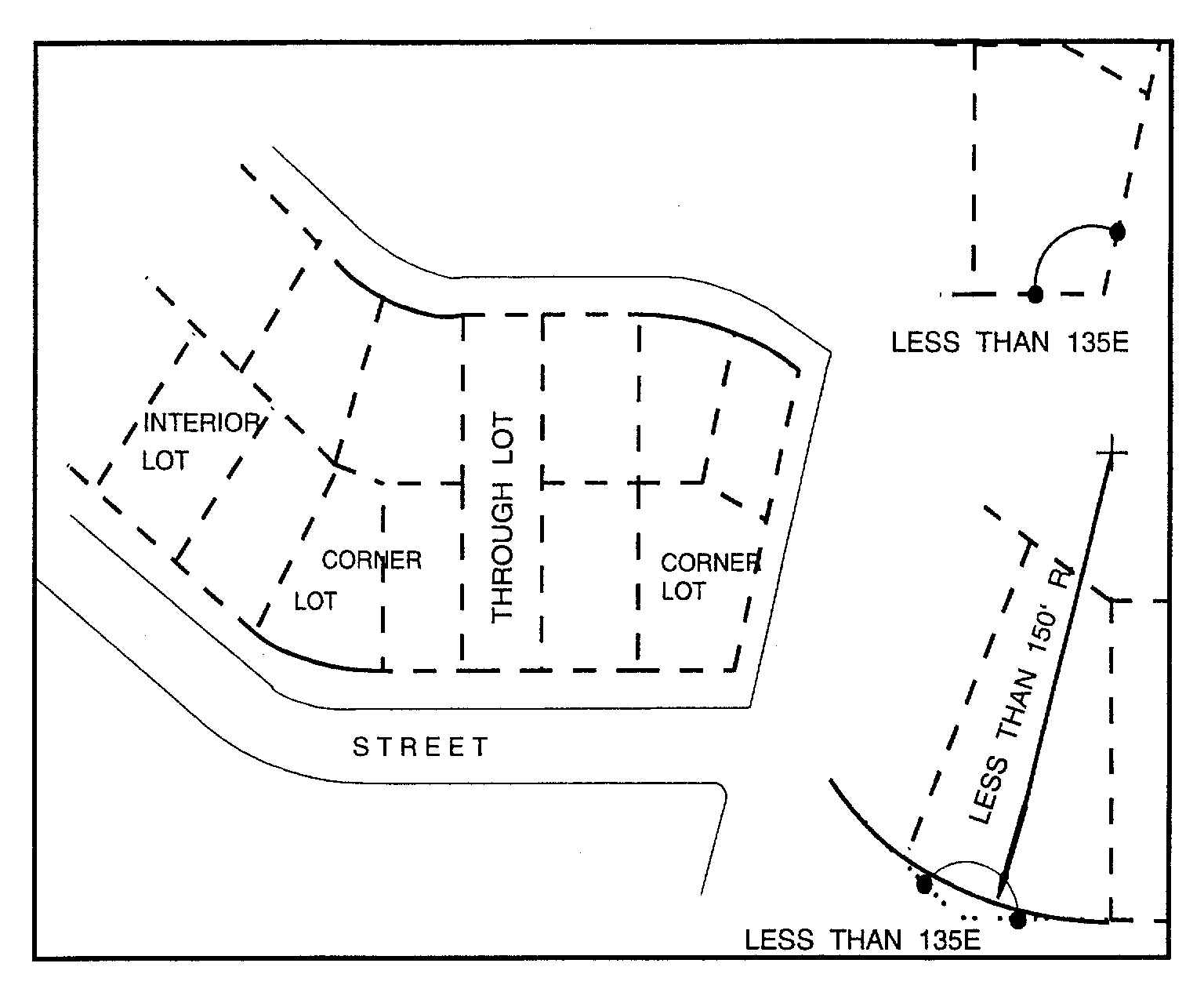
Interior, Through and Corner Lots
Lot: A parcel of land occupied or intended to be occupied, by a main building or a group of such buildings and accessory buildings, or utilized for the principal use and uses accessory thereto, together with such yards and open spaces as are required under the provisions of this chapter. A lot may or may not be specifically designated as such on public records.
Lot area: The total horizontal area within the lot lines of the lot.
Lot, corner: A lot where the interior angle of two adjacent sides at the intersection of two streets is less than 135 degrees. A lot abutting upon a curved street or streets shall be considered a corner lot for the purposes of this chapter if the arc is of less radius than 150 feet and the tangents to the curve, at the two points where the lot lines meet the curve or the straight street line extended, form an interior angle of less than 135 degrees.
Lot coverage: The part or percent of the lot occupied by buildings including accessory buildings.
Lot, depth: The horizontal distance between the front and rear lot lines measured along the median between the side lot lines.
Lot, interior: Any lot other than a corner lot.
Lot, through (double frontage): Any interior lot having frontage on two more or less parallel streets as distinguished from a corner lot. In case of a row of double frontage lots, all yards of said lots adjacent to streets shall be considered frontage, and front yards shall be provided as required.
Lot lines: The property lines bounding the lot as defined herein.
(1)
Front lot line means in the case of an interior lot abutting upon one public or private street, the front lot line shall mean the line separating such lot from such street right-of-way. In the case of a corner lot the front lot line shall be the narrower of the two frontage lines, except in the case where both street frontages are at equal dimension, the front shall be the one assigned a street address. In the case of a double frontage lot, the front lot line shall be that line separating said lot from that street which is designated as the front street by the owner, with city approval, or the city's board of zoning appeals shall designate the front lot line.
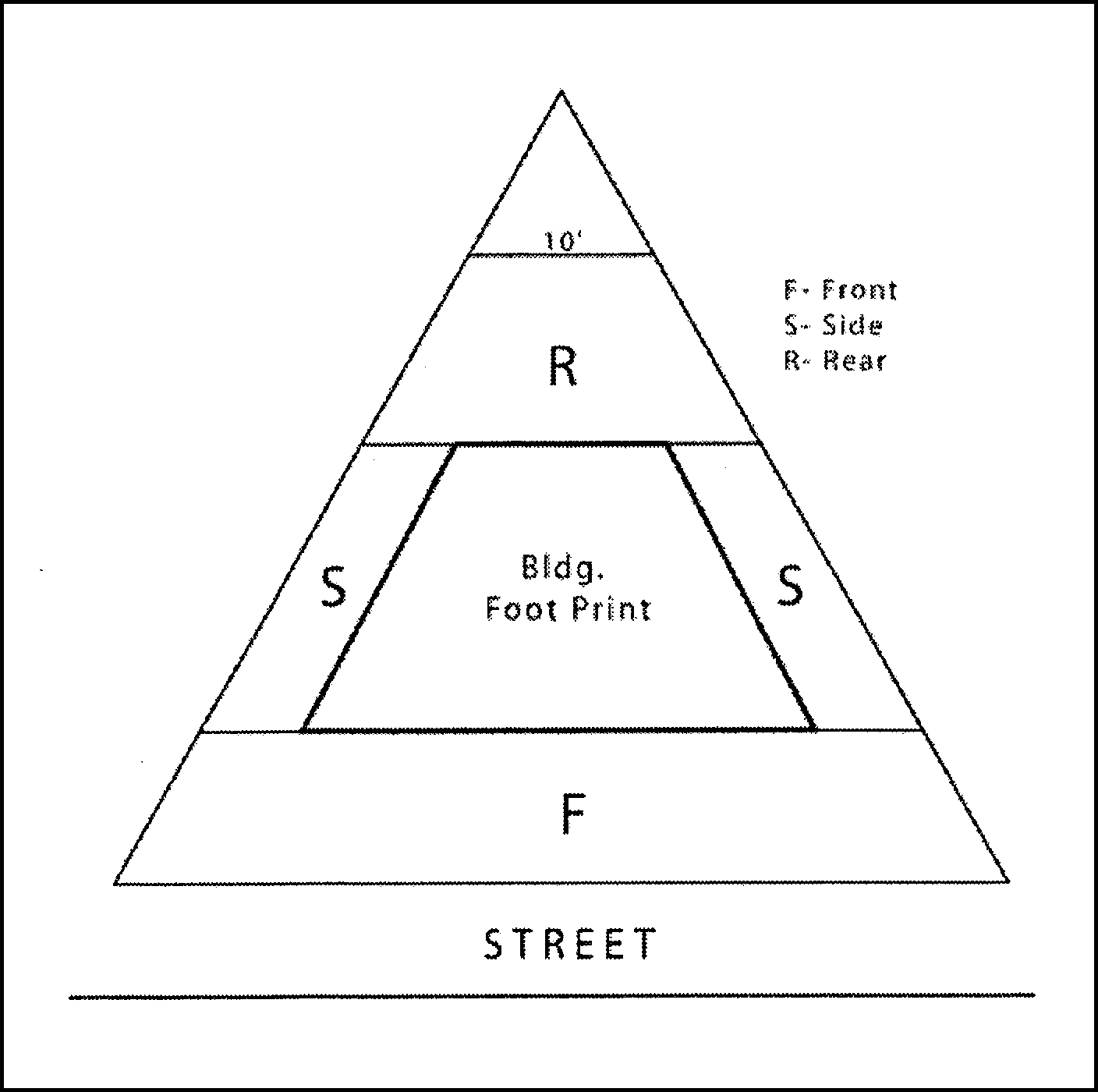
Rear Lot Line
(2)
Rear lot line means the lot line that is opposite and most distant from the front lot line of the lot. In the case of a lot that is pointed at the rear, the rear lot line shall be an imaginary line not less than ten feet in length extending across the full width of the lot, with the minimum required rear yard setback being measured from the rear wall of the principal building to said imaginary line. In cases where none of these definitions are applicable the property owner, with city approval, may designate the rear lot line, or the Trenton Zoning Board of Appeals and Adjustments shall designate the rear lot line.
(3)
Side lot line means any lot line that is not a front lot line or a rear lot line. A side lot line separating a lot from a street is an exterior side lot line. A side lot line separating a lot from another lot or lots is an interior side lot line.
Lot of record: A parcel of land, the dimensions of which are shown on a document or map on file with the county register of deeds or in common use by municipal or county officials and which actually exists as so shown, or any part of such parcel held in record ownership separate from that of the remainder thereof.
Lot width: The horizontal straight line distance between the side lot lines.
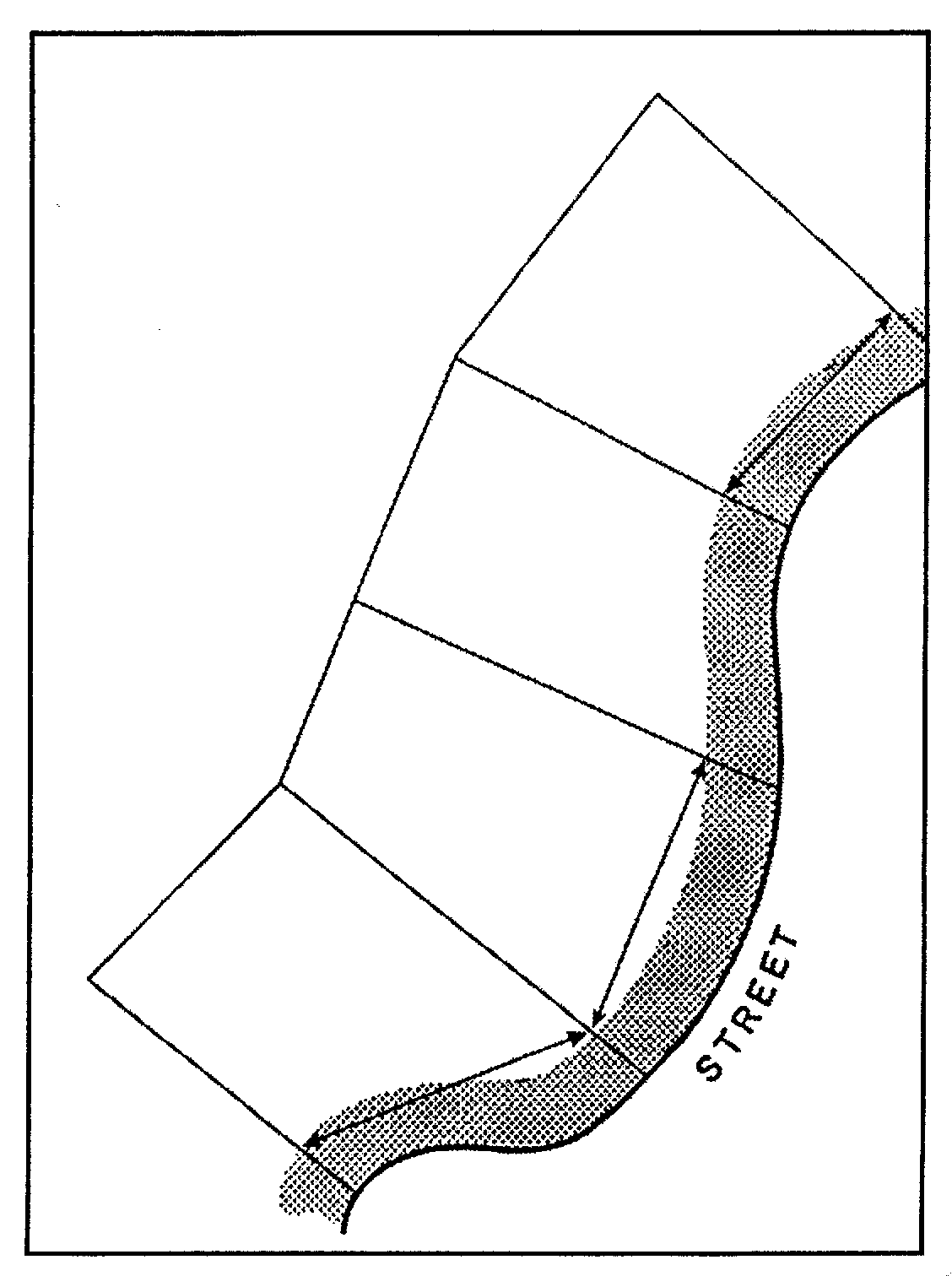
Lot Width
Lot width, required: For the purpose of this chapter shall be the minimum required horizontal straight line distance between the side lot lines, measured between the two points where the minimum required front setback line intersects the side lot lines.
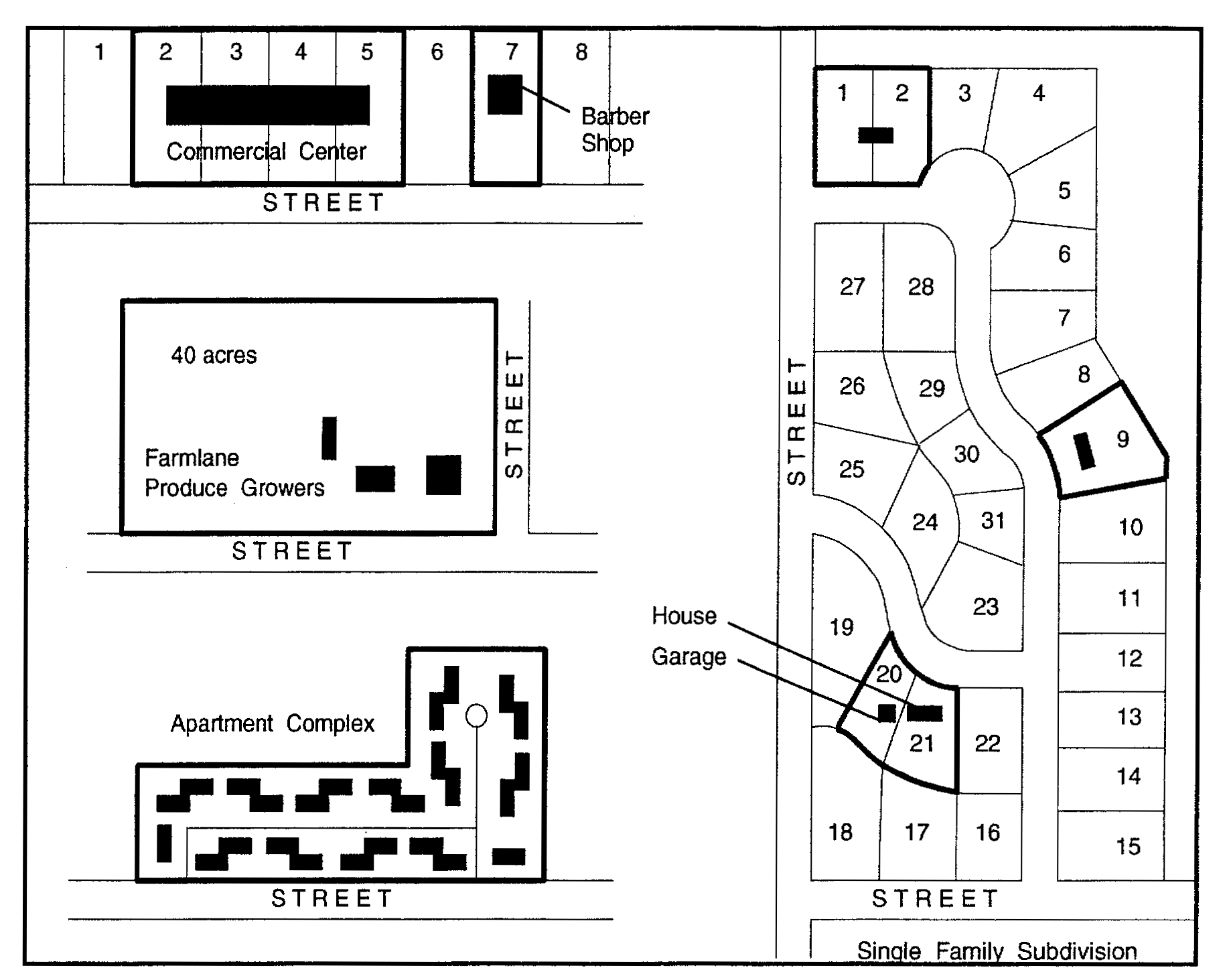
Lot, zoning: A single tract of land which at the time of filing for a building permit is designated
by its owner or developer as a tract to be used, developed or built upon as a unit
under single ownership or control. A zoning lot shall satisfy this chapter with respect
to area, size, dimensions, and frontage as required in the zoning district in which
the zoning lot is located. A zoning lot, therefore, may not coincide with a lot of
record as filed in the Wayne County Register of Deeds but may include one or more
lots of record. A zoning district line of the zoning lot shall serve as though it
is a lot line for the purposes of establishing building setbacks and percent of lot
coverage.
Zoning Lot
Main building: A building in which is conducted the principal use of the lot upon which it is situated.
Main use: The principal use to which the premises are devoted and the principal purpose for which the premises exist.
Major thoroughfare: An arterial street which is intended to serve as a large volume trafficway for both the immediate area and the region beyond, and may be designated as a major thoroughfare, parkway freeway, expressway, or equivalent terms on the major thoroughfare plan to identify those streets comprising the basic structure of the major thoroughfare plan.
Marihuana establishment:
(1)
Administrator shall mean the Administrator of Trenton or his/her designee. The city council may authorize another individual to exercise the duties given to the administrator under this ordinance. If there is no administrator and no other boar authorized individual, then the administrator shall exercise the duties of this ordinance.
(2)
Application means an application for a permit under this ordinance and includes all supplemental documentation attached or required to be attached thereto; the person filing the application shall be known as the "applicant."
(3)
Co-location means the operation of separate establishments or separate MMFLA Facilities at the same location, permitted premises, or permitted property.
(4)
Clerk means the Trenton Clerk or his/her designee.
(5)
Cultivate means as that term is defined in Initiated Act 1 of 2018, MCL 333.27951, et seq, Michigan Regulation and Taxation of Marihuana Act ("MRTMA").
(6)
Marihuana establishment or establishment means a marihuana grower and/or marihuana processor. This definition does not include marihuana retail or provisioning.
(7)
Marihuana grower, as that term is defined in the MRTMA.
a.
Class A grower, which is a maximum of 500 plants under the MMFLA and 100 plants under the MRTMA.
b.
Class B grower, which is a maximum of 1,000 plants under the MMFLA and 500 plants under the MRTMA.
c.
Class C grower, which is a maximum of 1,500 plants under the MMFLA and 2,000 plants under the MRTMA.
(8)
Marihuana processor, as that term is defined in the MRTMA.
(9)
Department means the Michigan State Department of Licensing and Regulatory Affairs or any designated Michigan agency authorized to regulate, issue or administer a Michigan License for a Marihuana Establishment.
(10)
License means a current and valid license for a marihuana establishment issued by the State of Michigan.
(11)
Licensee means a person holding a current and valid michigan license for a marihuana establishment.
(12)
Permit holder means the person that holds a current and valid permit issued under this ordinance.
(13)
Permitted premises means the particular building or buildings within which the permit holder will be authorized to conduct the establishment's activities pursuant to the permit.
(14)
Permitted property means the real property comprised of a lot, parcel, or other designated unit of real property upon which the permitted premises is situated.
(15)
Marihuana means that term as defined Section 7106 of the Michigan Public Health Code, 1978 PA 368, MCL 333.7106 and as defined in the MRTMA.
(16)
Permit means an approval issued by the city pursuant to the MRTMA that allows a person to operate an establishment in the city under this ordinance, which permit may be granted to a permit holder only for and limited to a specific permitted premises and a specific permitted property.
(17)
Person means a natural person, company, partnership, trust, profit or non-profit corporation, limited liability company, or any joint venture for a common purpose.
(18)
Process or processing means to separate or otherwise prepare parts of the marihuana plant and to compound, blend, extract, infuse, or otherwise make or prepare marihuana concentrate or marihuana-infused products.
(19)
Public place means any area to which the public is invited or generally permitted in the usual course of business.
Marina, private: A water basin providing boat slips for docking or mooring boats and other watercraft with no other boat or boat related facilities or services.
Marina, public: A water basin providing boat slips for docking or mooring boats and other watercraft and which may provide boat and boat-related services that may be available by membership only or which may be available to the general public.
Master plan: A comprehensive plan including graphic and written proposals indicating the general location for streets, parks, schools, public building and all physical development of the city and includes any unit or part of such plan, and any amendment to such plan or parts thereof.
Marquee: A roof-like structure of a permanent nature projecting out horizontally from the wall of a building.
Mechanical amusement device: See Chapter 5, Article VII, Mechanical Amusement Devices, section 5-127, Definitions,
definition (e), Mechanical amusement device, the Trenton Code of Ordinances.
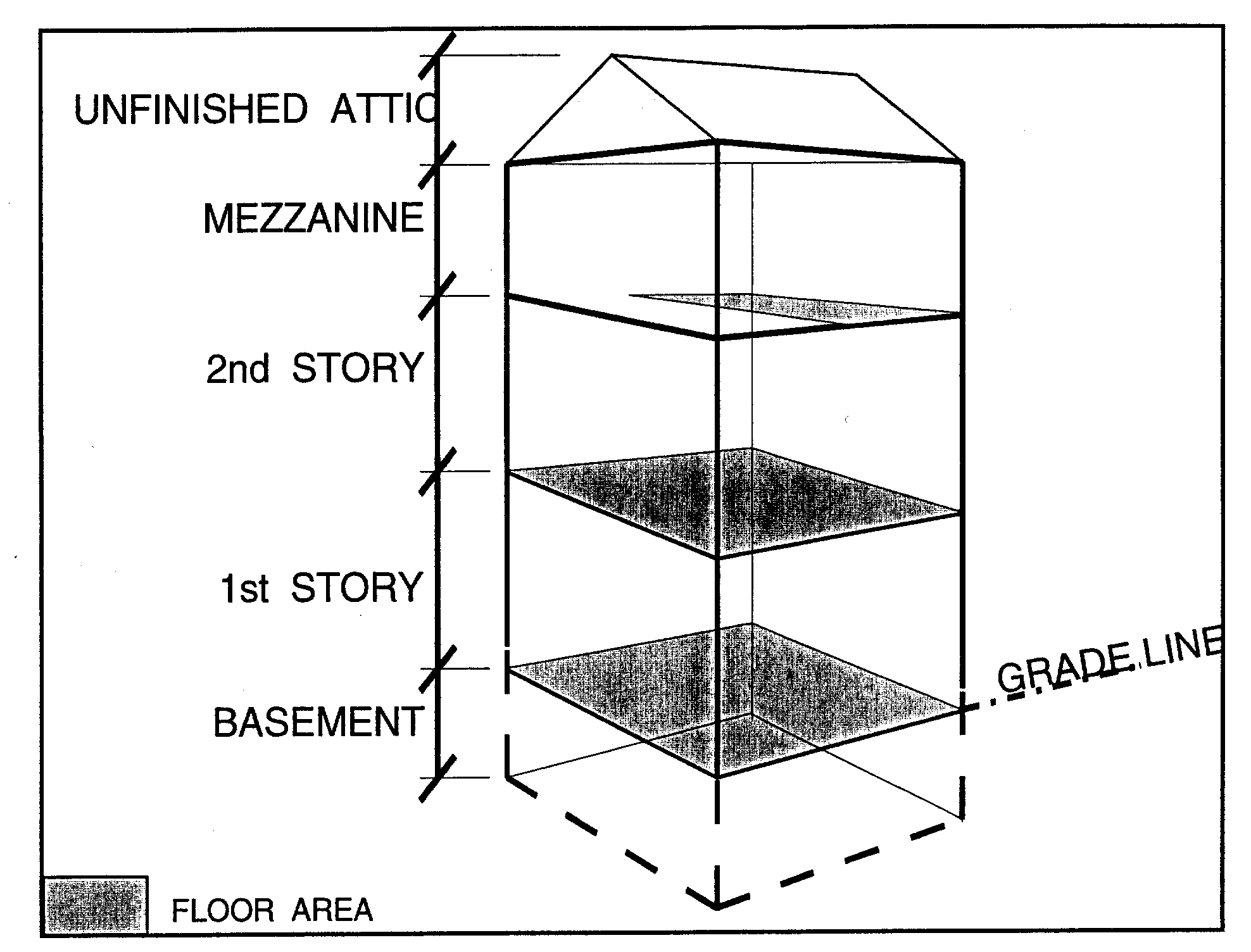
Basic Structural Terms
Medical marihuana, caregiver: As defined in MCL 333.26423(h).
Mezzanine: An intermediate or fractional story between the floor and ceiling of a full story and occupying not more than one-third of the floor area of the full story.
Microbrewery: An establishment where beer, ale, etc. are brewed, typically in conjunction with a bar, tavern, or restaurant use. The maximum brewing capacity shall not exceed 60,000 gallons per year.
Mixed use: A single building containing more than one type of use, or a single development of more than one building and use, where different land use types are in close proximity, and which are planned of shared vehicle and pedestrian access and parking areas.
Mobile home: A structure, transportable in one or more sections, which is built on a chassis and designed to be used as a dwelling without permanent foundation, when connected to the required utilities, and includes the plumbing, heating, air-conditioning, and electrical systems contained in the structure. Mobile home does not include a recreational vehicle.
Mobile home park: Any plot of ground upon which two or more mobile homes, occupied for dwelling or sleeping purposes, are located.
Motel: A series of attached, semi-detached or detached rental units containing a bedroom, bathroom, and closet space. Units shall provide for overnight lodging and are offered to the public for compensation, and shall cater primarily to the public traveling by motor vehicle.
Motor vehicle, commercial: Commercial vehicle as defined in the 1995 Michigan Uniform Traffic Code for Cities, Villages and Townships means every vehicle which is used for the transportation of passengers for hire or which is constructed or used for the transportation of goods, wares or merchandise. The term also means a motor vehicle which is designated and used for drawing other vehicles and which is not constructed to carry any load thereon, either independently or as any part of the weight of a vehicle or load so drawn.
Motor vehicle service center: A use which is accessory to a designated retail commercial outlet located within a shopping center or which is within a building composed of the same construction material and of the same design as the shopping center, wherein automobile products such as motor oils, lubricants and various automobile mechanical parts that are retailed directly to the public by said retail commercial outlet are installed.
Motor vehicle service station (gasoline station): A place where gasoline or other motor fuel and lubricants for operating motor vehicles are offered for sale at retail to the public including sale of accessories, lubricating and light motor service on the premises, but not including collision services such as body, frame or fender straightening or repair, painting or undercoating.
Motor vehicle repair (general): The general mechanical repair, including overhaul and reconditioning of motor vehicle engines, transmissions, and other mechanical repairs, but not including collision services such as body, frame or fender straightening and repair, painting or undercoating.
Motor vehicle repair (major): The general repair, engine rebuilding, rebuilding, or reconditioning of motor vehicles, collision services such as body, frame or fender straightening and repair, painting, or undercoating.
Mulch: Any material such as leaves, bark, straw, or other materials left loose and applied to the soil surface to reduce evaporation.
Multiplex: A building designed exclusively for occupancy by two, three or four families, living independently of each other with at least one main entrance directly from the outside for each living unit.
Municipality: See city.
Natural gas compressor station: A facility designed and constructed to compress natural gas originating from a gas well, or collection of such wells operating as a midstream facility for delivery of gas to a transmission pipeline, distribution pipeline, natural gas processing plant, or underground storage field, including one or more natural gas compressors, associated buildings, pipes, valves, tanks and other equipment.
Natural gas processing plant: A facility designed and constructed to remove materials such as ethane, propane,
butane, methane and other constituents or similar substances from natural gas to allow
such natural gas to be of such quality as is required or appropriate for transmission
or distribution to commercial markets, but not including facilities or equipment that
is designed and constructed primarily to remove water, water vapor, oil or naturally
occurring liquids from the natural gas.
Basic Structural Terms
Node: An identifiable grouping of uses subsidiary and dependent upon a large urban grouping of similar or related uses.
Nonconforming building: A building or structure, or portion thereof lawfully existing at the effective date of this chapter, or amendments thereto and that does not conform to the provisions of the ordinance in the district in which it is located.
Nonconforming use: A use which lawfully occupied a building or land at the effective date of this chapter or amendments thereto, and that does not conform to the use regulations of the district in which it is located.
Nonconforming use or structure—Class A: A nonconforming use or structure that has been designated to be allowed to be perpetuated and improved under the provisions of this chapter.
Nonconforming use or structure—Class B: A nonconforming use or structure that has been designated to be allowed to be perpetuated
within the restricted provisions of this chapter.
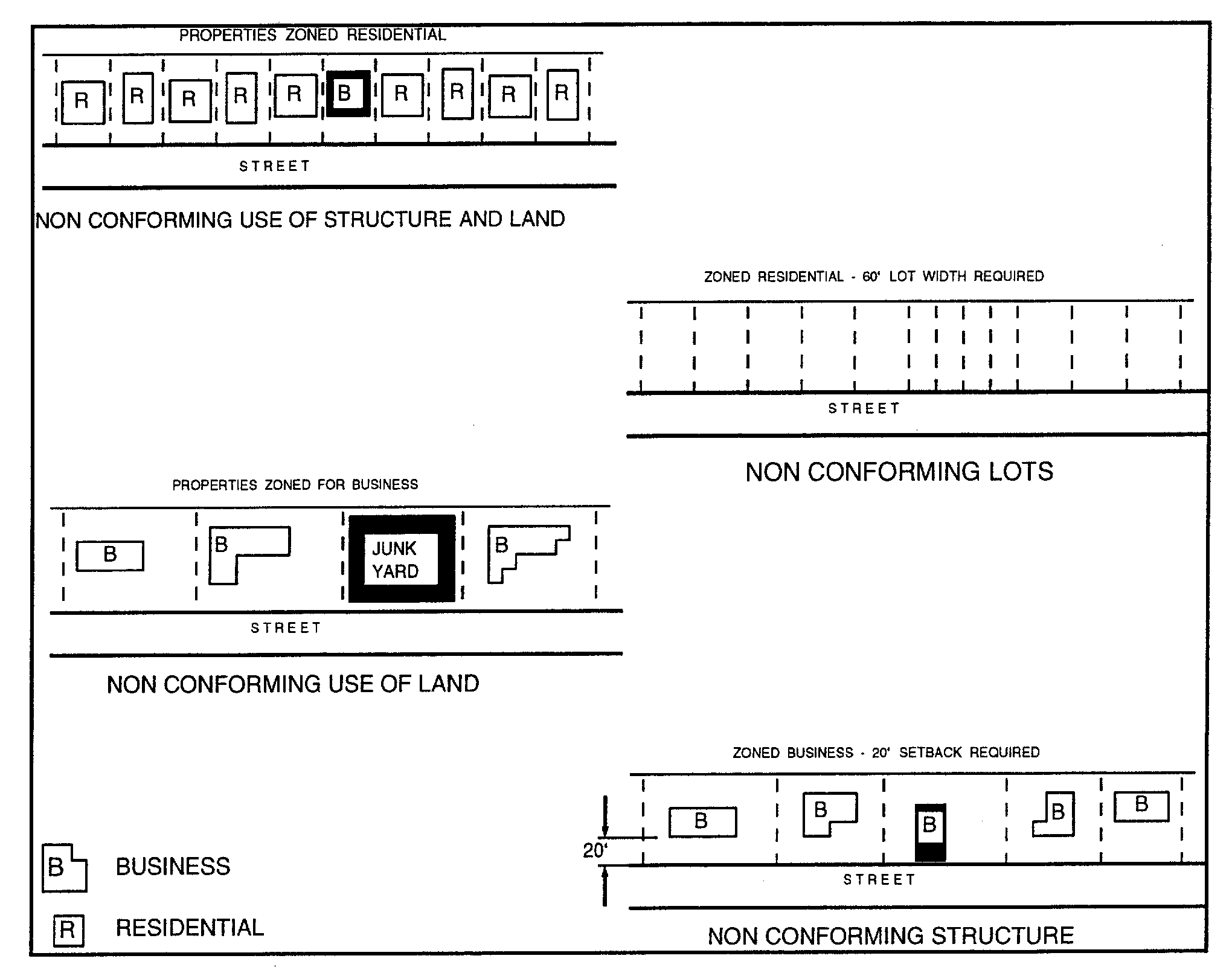
Nonconformities
Nonconforming use and building: A use and a building lawfully existing at the time of adoption of this chapter or subsequent amendment thereto which does not conform to the use and height, bulk, placement or/and provisions for the zoning district in which it is located.
Nuisance factors: An offensive, annoying, unpleasant, or obnoxious thing or practice, a cause or source of annoyance, especially a continuing or repeating invasion of any physical characteristics of activity or use across a property line which can be perceived by or affects a human being, or the generation of an excessive or concentrated movement of people or things, such as but not limited to: (a) noise, (b) dust, (c) smoke, (d) odor, (e) glare, (f) fumes, (g) flashes, (h) vibration, (i) shock waves, (j) heat, (k) electronic or atomic radiation, (l) objectionable effluent, (m) noise of congregation of people, particularly at night, (n) passenger traffic, (o) invasion of nonabutting street frontage by traffic.
Nursery: An area for the growing of plant materials, not offered for sale on the premises.
Nursery, commercial: A space, building or structure, or combination thereof, for the growing and storage of live trees, shrubs, or plants offered for sale on the premises including products used for gardening or landscaping.
Nursery school: See child-care institution.
Nursing home: See convalescent care.
Occupancy load: The number of individuals normally occupying a building or part thereof, or for which the existing facilities have been designed.
Occupied: Used in any way at the time in question.
Off-street loading space: A facility or space specifically intended to permit the standing, loading or unloading of trucks and other vehicles outside of a public right-of-way.
Off-street parking lot: A facility providing vehicular parking spaces along with adequate drives and aisles for maneuvering, so as to provide access for entrance and exit for the parking of motor vehicles out of a public street right-of-way.
Oil and gas: Crude oil, natural gas, methane gas, coal bed methane gas, propane, butane and/or any other products or similar substances that are produced by drilling an oil or gas well.
Oil and gas development: The well site preparation, construction, drilling, redrilling, hydraulic fracturing, and/or site restoration associated with an oil or gas well of any depth; water and other fluid storage, impoundment and transportation used for such activities; and the installation and use of all associated equipment, including tanks, meters, and other equipment and structures whether permanent or temporary; and the site preparation, construction, installation, maintenance and repair of oil and gas pipelines and associated equipment and other equipment and activities associated with the exploration for, production and transportation of oil and gas. The definition does not include natural gas compressor stations and natural gas processing plants or facilities performing the equivalent functions.
Oil or gas well: A pierced or bored hole drilled or being drilled in the ground for the purpose of, or to be used for, producing, extracting or injecting gas, oil, petroleum or another liquid related to oil or gas production or storage, including brine disposal or being drilled for an exploration for such purposes.
Oil or gas well site: The location of facilities, structures, materials and equipment whether temporary or permanent, that are used for or incidental to the preparation, construction, drilling, production or operation of an oil or gas well, or exploration for a potential oil or gas well.
Open air business uses: Open air business uses not conducted from a wholly enclosed building, if operated for profit, shall include the following uses:
(1)
Bicycle, trailer, mobile home, motor vehicle, farm implements, boats or home equipment sale or rental services.
(2)
Outdoor display and sale of garages, swimming pools, and similar uses.
(3)
Retail sale of fruit, vegetables, and perishable foods.
(4)
Retail sale of trees, shrubbery, plants, flowers, seed, topsoil, humus, fertilizer, trellises, lawn furniture, playground equipment, and other home garden supplies and equipment.
(5)
Tennis courts, archery courts, shuffleboard, horseshoe courts, miniature golf, golf driving range, children's amusement park or similar recreation uses.
Open front store: A business establishment so developed that service to the patron may be extended beyond the walls of the structure, not requiring the patron to enter the structure. The term open front store shall not include automobile repair stations or automobile service stations.
Open space: An area of land that remains primarily undeveloped and in its natural state. For the purpose of this chapter, open space may include park lands and park facilities so long as they are provided as a part of an open space area.
Open storage (motor vehicle): The outdoor standing or placement of motor vehicles including truck trailers for more than 18 hours, including new or used motor vehicles on display for lease or sale.
Open storage (nonresidential): The outdoor standing or placement of any material which is man-made, assembled, fabricated or treated in any manner and which may or may not be used directly in the processing or fabrication of a product manufactured on the premises.
Open storage (residential): The outdoor placement or keeping of material which is owned and possessed by the resident occupying the dwelling unit on the premises or by the owner of the premises where open storage is to take place.
Out lot: A lot in a subdivision which is restricted from use for building purpose, whether or not deeded to the city, but which is not dedicated as a street or public reservation or public park.
Park and ride facility: A publicly owned, short-term, parking facility for commuters.
Parking: The parking of a motor vehicle for short duration and possessing the element of a vehicle in use, being temporarily parked until it is shortly to be again put into service. The terms temporarily or shortly for the purpose of this definition shall mean and be measured by hours, or at most, up to a maximum of 18 hours.
Parking lot: See off-street parking lot.
Parking space: An area of definite length and width, said area shall be exclusive of drives, aisles or entrances giving access thereto, and shall be fully accessible for the parking of vehicles.
Pet: See animal, domestic.
Place of worship: A building used primarily for religious worship or services.
Planned commercial center: A retail commercial center the size and design of which is generally characterized by more than one use in a group of buildings served by a common parking area, and whose architecture is of a uniform design and appearance.
Planning commission: The Trenton Planning Commission.
Planned development: A proposed use of the land which requires the submission of a site plan for more than one building or structure to be approved as to requirements of this chapter including special relationships and vehicular and pedestrian circulation.
Principal use: See main use.
Property line: The boundary lines that define and identify the extent of a lot, parcel, or property by ownership.
Public utility: A person, firm or corporation, municipal department, board, or commission duly authorized to furnish and furnishing under governmental regulations to the public: gas, steam, electricity, sewage disposal, communication, telegraph, transportation or water.
Quasi-public use: Essentially a public use, although under private ownership or control.
Recreation land: Any public or private owned property that is utilized for recreation activities including such active recreation as camping, swimming, picnicking, hiking, walking, nature study and various organized or unorganized sports, and inactive recreation such as reading, sitting and table games.
Recreation vehicles or equipment: For the purpose of this chapter shall include the following:
(1)
Travel trailer is a vehicular, portable structure built on a chassis, designed to be used as a temporary dwelling for travel, recreational and vacation uses, permanently identified travel trailer by the manufacturer.
(2)
Pickup camper is a structure designed primarily to be mounted on a pickup or truck chassis and with sufficient equipment to render it suitable for use as a temporary dwelling for travel, recreational, and vacation uses.
(3)
Motorized home is a portable dwelling designed and constructed as an integral part of a self-propelled vehicle.
(4)
Folding tent trailer is a folding structure, mounted on wheels and designed for travel and vacation use.
(5)
Boats and boat trailers shall include boats, floats, ski jets and rafts, plus the normal equipment to transport the same on the highway.
(6)
Snowmobile and all-terrain vehicle plus the normal equipment to transport the same on the highway.
(7)
Utility trailer for the purpose of this chapter, a utility trailer shall mean any wheeled vehicle designed and intended to be towed behind another vehicle.
Recycling: The process by which waste products are reduced to raw materials and transformed into new and often different products.
Recycling plant: A facility where previously used products or materials are transformed into new and often different products. For the purposes of this chapter, a recycling center shall be other than a junk yard as defined herein.
Recycling processing facility (materials recovery facility): A facility designed and operated solely for receiving, storing, processing, or transferring source separated recyclables materials. Processing shall mean the preparation of material for efficient shipment by such means a baling, compacting, flattering, grinding, crushing, mechanical sorting, or cleaning.
Restaurant, drive-in: A business establishment designed to provide a motor vehicle driveway approach, standing space, or parking space where patrons receive food and beverages while in motor vehicles for consumption in motor vehicles while on premises.
Restaurant, fast food carry out: A business establishment wherein food is prepared or cooked on the premises to be sold in disposable containers or wrappers to patrons and which is not intended to be consumed on the premises or within a motor vehicle parked or standing on the premises.
Restaurant, fast food drive-through: A business establishment designed and intended to provide a driveway approach and temporary motor vehicle standing space or stacking space where customers shall receive food or nonalcoholic beverage service from a window or booth while in their motor vehicles.
Restaurant, fast food sit-down: A business establishment in which a patron purchases food or beverages, which may have been previously prepared, and which is served in disposable containers or wrappers and which the patron consumes while seated in the restaurant.
Restaurant, sit-down: A business establishment in which a patron purchases food or beverages, which is then prepared after the patrons order, on the premises and which is thereafter served to the patron and is consumed by the patron while seated in the restaurant.
Retail commercial: See commercial, retail.
Right-of-way: The right-of-way line shall be the line established by the Road Commission of Wayne County (RCWC), Michigan Department of Transportation (MDOT), or the City of Trenton in their right-of-way requirements established for Trenton in the city's adopted master plan.
Roadside stands: A roadside stand is a temporary or existing permanent building operated for the purpose of selling only produce raised or produced by the proprietor of the stand or his family on the premises, and its use shall not make into a commercial district land which would otherwise be an agricultural or residential district, nor shall its use be deemed an approved commercial activity.
Rooming house: A building other than a hotel where for compensation, meals, or lodging and meals are provided for not more than ten persons in addition to the members of the family occupying the premises.
Rooming unit: A room or group of rooms forming a single habitable unit used for living and sleeping but not containing kitchen or eating facilities.
Salvage yards: An open area where used or secondhand materials are bought and sold, exchanged, stored, baled, packed, disassembled, or handled including but not limited to: scrap iron and other metals.
Screen: See landscaping.
Secondary thoroughfare: A street of limited continuity designed and intended to collect and distribute traffic to and from local streets and to and from major thoroughfares.
Service establishment: An establishment primarily engaged in providing services to individuals, business, industry, institutions and government establishments; other organizations, including hotels and other lodging places; establishments providing personal business, repair and amusements services; health, legal, engineering, design, communication and other professional services; educational institutions, membership organizations and other like or similar services.
Setback: The minimum horizontal distance between any side of the main building and any adjoining property boundaries, such as the front of the building, excluding only the steps, and the front lot line or street right-of-way line.
Shoreline: The zone of contact of a body of water with the land or with a man-made barrier.
Sign: Any display or object which is primarily used to identify or display information or direct or attract attention by any means which is visible from any public street, sidewalk, alley, park, or public property and is otherwise located or set upon in a building, structure, or piece of land. The definition does not include goods displayed in a window.
Sign area: The entire area within a circle, triangle, rectangle, oval, or other geometric shape enclosing the extreme limits of writing, representation, emblem, or any figure of similar character, together with any frame or other material or element forming an integral part of the display or used to differentiate the sign from the background against which it is placed, excluding the necessary supports or uprights on which such sign is placed.
Site plan: A plan showing all salient features of a proposed development so that it may be evaluated in order to determine compliance with the applicable requirements of the Trenton Code of Ordinances, including this chapter.
Soil sheltered: The design and creation of living space by means of cut-and-cover construction in the near-surface or shallow soil environment. Such approved construction is exempt from the definition of a basement.
Special land use: A use of land which requires compliance with certain development or location conditions as set forth for the use in the various zoning districts of the ordinance.
Stacking space: An off-street space in which a motor vehicle may temporarily stand.
State licensed residential facility: Any structure constructed for residential purposes that is licensed by the State of Michigan pursuant to Public Act 287 of 1972, Public Act 11 of 1973, Public Act 116 of 1973, or Public Act 218 of 1979. These Acts provide for the following types of residential structures:
(1)
Adult foster care facility. A home or facility that provides foster care to adults. Subject to section 26a(1) of Public Act 218 of 1979, an adult foster care facility includes facilities and foster care family homes for adults who are aged, mentally ill, developmentally disabled, or physically disabled who require supervision on an ongoing basis but who do not require continuous nursing care. Adult foster care facility does not include any of the following:
a.
A nursing home licensed under part 217 of the public health code, 1978 PA 368, MCL 333.21701 to 333.21799e.
b.
A home for the aged licensed under part 213 of the public health code, 1978 PA 368, MCL 333.21301 to 333.21335.
c.
A hospital licensed under part 215 of the public health code, 1978 PA 368, MCL 333-21501 to 333.21571.
d.
A hospital for the mentally ill or a facility for the developmentally disabled operated by the department of health and human services under the mental health code, 1974 PA 258, MCL 330.1001 to 330.2106
e.
A county infirmary operated by a county department of health and human services under section 55 of the social welfare act, 1939 PA 280, MCL 400.55.
f.
A child caring institution, children's camp, foster family home, or foster family group home licensed or approved under 1973 PA 116, MCL 722.111 to 722.128, if the number of residents who become 18 years of age while residing in the institution, camp, or home does not exceed the following:
1.
Two, if the total number of residents is ten or fewer.
2.
Three, if the total number of residents is not less than 11 and not more than 14.
3.
Four, if the total number of residents is not less than 15 and not more than 20.
4.
Five, if the total number of residents is 21 or more.
g.
A foster family home licensed or approved under 1973 PA 116, MCL 722.111 to 722.128, that has a person who is 18 years of age or older placed in the foster family home under section 5(7) of 1973 PA 116, MCL 722.115.
h.
An establishment commonly described as an alcohol or a substance use disorder rehabilitation center, except if licensed as both a substance use disorder program and an adult foster care facility and approved as a co-occurring enhanced crisis residential program, a residential facility for persons released from or assigned to adult correctional institutions, a maternity home, or a hotel or rooming house that does not provide or offer to provide foster care.
i.
A facility created by 1885 PA 152, MCL 36.1 to 36.12.
j.
An area excluded from the definition of adult foster care facility under section 17(3) of the continuing care community disclosure act, 2014 PA 448, MCL 554.917.
k.
A private residence with the capacity to receive at least one but not more than four adults who all receive benefits from a community mental health services program if the local community mental health services program monitors the services being delivered in the residential setting.
(2)
Adult foster care family home. A private residence with the approved capacity to receive at least three but not more than six adults to be provided with foster care. The adult foster care family home licensee must be a member of the household and an occupant of the residence. Under Public Act 116 of 1973, a foster family home does not require local zoning approval before being licensed by the department of social services.
(3)
Adult foster care large group home. An adult foster care facility with the approved capacity to receive at least 13 but not more than 20 adults to be provided with foster care.
(4)
Adult foster care small group home. An adult foster care facility with the approved capacity to receive at least three but not more than 12 adults to be provided with foster care.
(5)
Foster care. The provision of supervision, personal care, and protection in addition to room and board, for 24 hours a day, five or more days a week, and for two or more consecutive weeks for compensation.
(6)
Foster family home. A private home in which one but not more than four minor children, who are not related to an adult member of the household by blood or marriage, or who are not placed in the household under the Michigan adoption code, chapter X of the probate code of 1939, 1939 PA 288, MCL 710.21 to 710.70, are given care and supervision for 24 hours a day, for four or more days a week, for two or more consecutive weeks, unattended by a parent, legal guardian, or legal custodian.
(7)
Foster family group home. A private residence that houses more than four but less than seven minor children, up to age 19, under constant care and supervision. Under Public Act 116 of 1973, a foster family group home requires local zoning approval before being licensed by the department of social services.
(8)
Family child care home. A private home in which one but fewer than seven minor children are received for care and supervision for compensation for periods of less than 24 hours a day, unattended by a parent or legal guardian, except children related to an adult member of the household by blood, marriage, or adoption. Family child care home includes a home in which care is given to an unrelated minor child for more than four weeks during a calendar year. A family child care home does not include an individual providing babysitting services for another individual. As used in this subparagraph, "providing babysitting services" means caring for a child on behalf of the child's parent or guardian when the annual compensation for providing those services does not equal or exceed $600.00 or an amount that would according to the internal revenue code of 1986 obligate the child's parent or guardian to provide a form 1099-MISC to the individual for compensation paid during the calendar year for those services
(9)
Group child care home. A private home in which more than six but not more than 12 minor children are given care and supervision for periods of less than 24 hours a day unattended by a parent or legal guardian, except children related to an adult member of the household by blood, marriage, or adoption. Group child care home includes a home in which care is given to an unrelated minor child for more than four weeks during a calendar year.
Storage: See open storage.
Storage well: A well used for and in connection with the underground storage of natural gas, including injection into or withdrawal from an underground storage reservoir for monitoring or observation of reservoir pressure.
Story: That part of a building, except a mezzanine as defined herein, included between the surface of one floor and the surface of the next floor, or if there is no floor above, then the ceiling next above. A story thus defined shall not be counted as a story when more than 50 percent, by cubic content, is below the height level of the adjoining ground.
Story, half: An uppermost story lying under a sloping roof having an area of at least 200 square feet with a clear height of seven feet six inches. For the purpose of this chapter, the usable floor area is only that area having at least four feet clear height between floor and ceiling.
Street, public: A dedicated public right-of-way, other than an alley, which affords the principal means of access to abutting property.
Street, private: A street which provides the principal means of access to abutting land use, portions of which may be owned and controlled by the abutting property owners and which may or may not be open to public use.
Structure: Anything constructed or erected, the use of which requires location on the ground or attachment to something having location on the ground, including parking lots, access drives and parking spaces.
Structural alteration: Any change in the supporting members of a building or structure, such as bearing walls or partitions, columns, beams or girders, stairways, or any change in the width or number of exits, or any substantial change in the roof.
Swimming pool: Any structure located above or below grade designed to hold water to a depth greater than 24 inches to be used for swimming.
Telecommunications: (See wireless telecommunications )
Temporary use: The use of land or building or structure permitted with approval from the planning commission to exist for a limited period of time as set forth and regulated in the chapter.
Textile recycling and donation bins (bins): A publicly accessible bin or container placed on private property by a private company or on-profit organization with permission of the property owner, for the purpose of collecting donation of items such as textiles, shoes, toys, books, and other non-perishables in order to reuse or recycle these items.
Thrift store: A shop that deals primarily in second hand wearing apparel. All such merchandise shall be displayed and stored in an enclosed building.
Townhouse: A building occupied by three or more families, where each dwelling unit is divided from the one adjacent to it by a party wall extending the full height of the building. Each dwelling unit is capable of individual use and maintenance without trespassing upon adjoining properties and utilities and service facilities are independent for each property.
Traffic calming: Reducing motorist speed, decreasing motor vehicle volumes, and increasing safety for pedestrians and nonmotorized vehicles.
Trailer coach: See mobile home.
Trailer court or park: See mobile home park.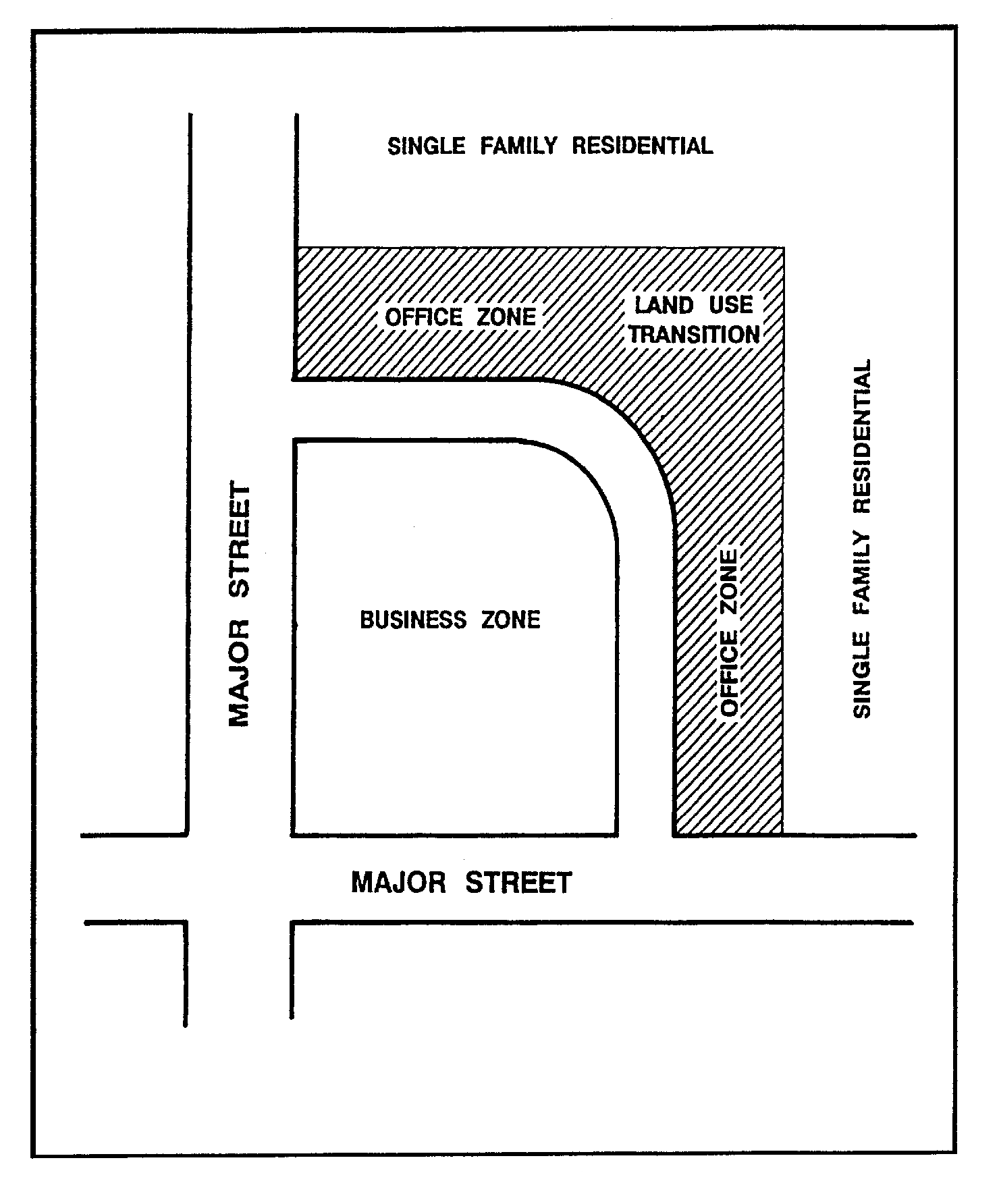
Transition Through Zoning
Transition: For the purposes of this chapter, the word or term transition, or transitional, shall mean a zoning district, a landscaped area, arrangement of lots, wall or other means which may serve as a district or area of transition, i.e., a buffer zone between various land use districts and/or land use and thoroughfares.
Travel trailer park (overnight camping facility): A place utilized for the temporary storage of travel trailers, for camping purposes, where there is no permanent storage of mobile homes for year-round occupancy, and where commercial activity is limited to service the needs of the temporary occupants of the travel trailer park.
Use: The principal purpose for which land, or a building is arranged, designed, or intended, or for which land or a building is or may be occupied.
Variance: See zoning variance.
Vehicle dealer: A person, firm, corporation, etc., licensed by the state to sell cars, trucks, motorcycles, recreational vehicles, boats, and related parts, supplies and services.
Vehicle mixing center: An establishment where finished vehicles are received from the manufacturer and sorted for shipment to distribution and retail establishments.
Veterinary clinic: A place for the care, diagnosis, and treatment of sick or injured animals, and those in need of medical or minor surgical attention. A veterinary clinic may include customary pens or cages. A veterinary clinic may also be known as veterinary hospital.
Video store: A commercial establishment whose principal function is the renting or sale of video materials such as tapes, electronic video disks and any other format capable of transmitting a picture, except those materials that would categorize the use as an adult video store as defined in this chapter.
Viewshed: A visually sensitive area that is visible from a defined observation point.
Wall: For the purposes of this chapter, shall mean an outdoor structure consisting of solid masonry, stone, or like materials, but not including wood, and which is designed to retain, screen and/or partition land. A wall so defined is not a fence.
Wall, obscuring: A structure of definite height and location to serve as an obscuring screen in carrying out the requirements of this chapter. For the purposes of this chapter, a wall is not a fence.
Wholesale commercial: See commercial, wholesale.
Wireless telecommunications:
(1)
Wireless communication facilities: shall mean and include all structures and accessory facilities relating to the use of the radio frequency spectrum for the purpose of transmitting or receiving radio signals. This may include, but shall not be limited to, radio towers, television towers, telephone devices and exchanges, microwave relay towers, telephone transmission equipment buildings and commercial mobile radio service facilities. Not included within this definition are: citizen band radio facilities; short wave facilities; ham: amateur radio facilities; satellite dishes; and, governmental facilities which are subject to state or federal law or regulations which preempt municipal regulatory authority.
(2)
Attached wireless communications facilities: shall mean wireless communication facilities that are affixed to existing structures, such as existing buildings, towers, water tanks, utility poles and the like. A wireless communication support structure proposed to be newly established shall not be included within this definition.
(3)
Wireless communication support structures: shall mean structures erected or modified to support wireless communication antennas. Support structures within this definition include, but shall not be limited to, monopole, lattice towers, light poles, wood poles and guyed towers, or other structures which appear to be something other than a mere support structure.
(4)
Collocation: shall mean the location by two or more wireless communication providers of wireless communication facilities on a common structure, tower, or building, with the view toward reducing the overall number of structures required to support wireless communication antennas within the community.
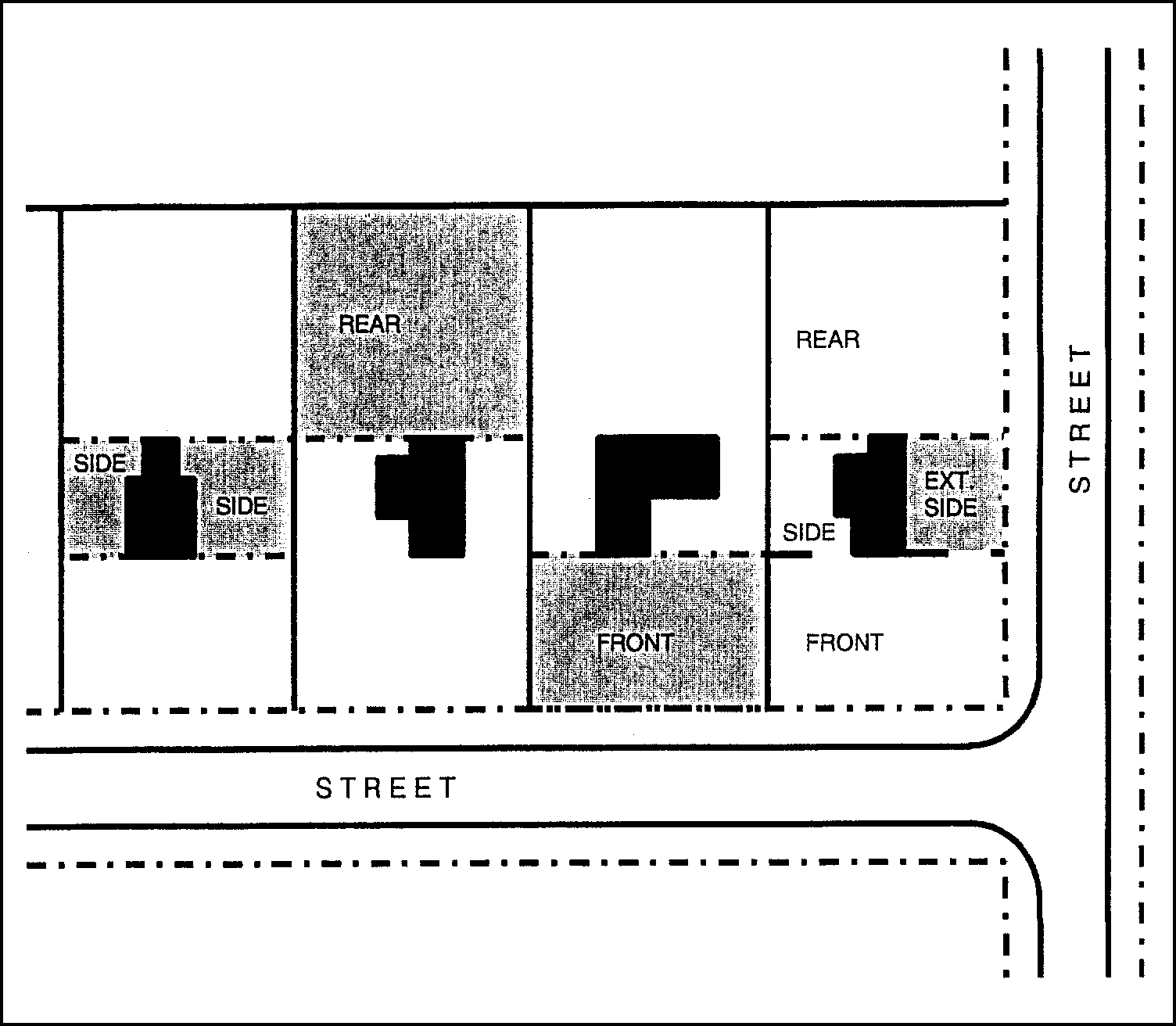
Yards
Yards: The open spaces on the same lot with a main building, unoccupied and unobstructed from the ground upward except as otherwise provided in this chapter, and as defined herein:
(1)
Front yard: An open space extending the full width of the lot, the depth of which is the minimum horizontal distance between the front lot line and the nearest point of the main building.
(2)
Rear yard: An open space extending the full width of the lot the depth of which is the minimum horizontal distance between the rear lot line and the nearest point of the main building. In the case of a corner lot, the rear yard shall be opposite the assigned street frontage.
(3)
Side yard, exterior: An open space between a main building and the street right-of-way line extending from the front yard to the rear yard, the width of which is the minimum horizontal distance between the street right-of-way line and the nearest point of the main building.
(4)
Side yard, interior: An open space between a main building and the interior side lot line, extending from the front yard to the rear yard, the width of which is the horizontal distance from the nearest point on the interior side lot line to the nearest point of the main building.
Zoning: See title and preamble.
Zoning board of appeals: The board of zoning appeals of the City of Trenton, which is also known as the ZBA.
Zoning code: Means ordinance officially adopted and codified herein as of their codified ordinances.
Zoning district: See district.
Zoning lot: See lot, zoning.
Zoning map: An official map of the City of Trenton which visually depicts by area and identifies by name, various zoning districts throughout the city.
Zoning variance: A modification of the literal provisions of the chapter granted when strict enforcement of the chapter would cause undue hardship owing to circumstances unique to the individual property on which the variance is granted.
The crucial points of variance are undue hardship and unique circumstances applying to the property. A variance is not justified unless both elements are present in the case. The exception differs from the variance in several respects. An exception does not require undue hardship in order to be allowable. The exceptions that are found in this chapter appear as special approval or review by planning commission, legislative body, or board of appeals. These land uses could not be conveniently allocated to one zone or another, or the effects of such uses could not be definitely foreseen as of a given time. The general characteristics of these uses include one or more of the following:
(1)
They require large areas.
(2)
They are infrequent.
(3)
They sometimes create an unusual amount of traffic.
(4)
They are sometimes obnoxious or hazardous.
(5)
They are required for public safety and convenience.
(Ord. No. 802, § 1, 12-14-2020; Ord. No. 802-1, § 1, 9-20-2021; Ord. No. 802-2, § 1, 4-18-2022)
Cross reference— Definitions generally, § 1-2.

