GENERAL PROVISIONS
(a)
Intent and applicability. It is the intent of this section to establish and provide procedures and standards for uses identified in this chapter as special land uses in a particular zoning district, subject to review and approval by the planning commission, and where so required, by the city council. All special land uses shall be subject, unless otherwise required by the planning commission, to all of the minimum, general, and special conditions standards and procedures of this section regarding each use.
(b)
Notice of request for special land use approval. Upon receipt of an application for a special land use, a public hearing to be held by the planning commission shall be duly advertised in the manner set forth and regulated in Article XXX in this chapter. The hearing may be called at the initiative of the planning commission, or upon receipt of a request by the applicant for approval of a special land use, or by a property owner or by the occupant of a structure located within 300 feet of the boundary of the property being considered for the special land use. In either case, notice of a public hearing shall be advertised in the manner set forth and regulated in Article XXX in this chapter before a decision or a recommendation shall be made by the planning commission.
(c)
Decision. The planning commission or, when specified elsewhere in this chapter, the city council, shall deny, approve, or approve with conditions request for approval of a special land use. The decision on a special land use shall be incorporated in a statement of conclusions relative to the use under consideration. The decision shall specify the basis for the decision, and any conditions imposed thereon by the planning commission or the city council.
(d)
Site plan required and duration of approval. For all special land uses as set forth in the various zoning districts, a site plan shall be required. The site plan shall be prepared and submitted in accordance with the applicable requirements of Article XXVIII in this chapter. An approved site plan with or without conditions shall remain valid for the specific time period or periods set forth and regulated in Article XXVIII.
(e)
Performance guarantees. Performance guarantees may be required by the planning commission or by the city council to ensure compliance with the applicable requirements of this code pertaining to any special land use approval, including any conditions that may be attached to an approval.
(f)
Standards. In addition to or in conjunction with any specific standards which may be applicable to a special land use, the following standards shall also serve the planning commission and the city council as the basis for decisions involving the review of any special land use, and any discretionary decisions that may be involved in the review of a special land use in this chapter. Each such use or activity shall:
(1)
Be compatible with adjacent uses and the zoning of the land around it.
(2)
Be consistent with and promote the intent and purpose of this code.
(3)
Be compatible with the natural environment and conserve natural resources and energy.
(4)
Be consistent with existing and future capabilities of public services and facilities that will be affected by the proposed use.
(5)
Protect and promote the public health, safety and welfare as well as the social and economic well-being of those who will use the land use or activity, residents, businesses and landowners immediately adjacent to the proposed land use or activity and the city as a whole.
(Ord. No. 802, § 1, 12-14-2020)
State Law reference— Performance guarantees, MCL 125.584e.
It is recognized that there exists within the districts established by this chapter or amendments that may later be adopted, lots, structures, and uses of land and structures which were lawful before this chapter was passed or amended, but which would be prohibited, regulated, or restricted under the terms of this chapter.
It is the intent of this chapter to permit these nonconformities to continue until they are removed, but not to encourage their survival. Such uses are declared by this chapter to be incompatible with permitted uses in the districts involved. It is further the intent of this chapter that nonconformities shall not be enlarged upon, expanded, or extended, nor be used as grounds for adding other structures or uses prohibited elsewhere in the same district.
It is further recognized that certain nonconforming uses and structures do not significantly depress the value of nearby properties and are not contrary to the public health, safety and welfare and that such use or structure was lawful at the time of its inception and that no useful purpose would be served by the strict application of requirements for nonconformities under this chapter and, therefore, two classes of nonconforming use and structure are designated, being class A and class B. All nonconforming uses and structures are classified as class B nonconforming uses or structures unless designated class A nonconforming uses or structures.
(Ord. No. 802, § 1, 12-14-2020)
State Law reference— Nonconforming uses and structures, MCL 125.583a.
All nonconforming uses or structures not designated class A shall be class B nonconforming uses or structures. Class B nonconforming uses and structures shall comply with all the provisions of this article relative to nonconforming uses and structures.
(Ord. No. 802, § 1, 12-14-2020)
State Law reference— Nonconforming uses and structures, MCL 125.583a.
Nonconforming uses or structures shall be designated class A providing that the planning commission finds all the following exists with respect to the use or structure:
(1)
The use or structure was lawful at its inception.
(2)
Continuance of the use or structure is not likely to significantly depress property values of nearby properties.
(3)
Continuance of the use or structure would not be contrary to the public health, safety or welfare or the spirit of the chapter.
(4)
No useful purpose would be served by strict application of the provisions of this chapter with which the use or structure does not conform.
(Ord. No. 802, § 1, 12-14-2020)
State Law reference— Nonconforming uses and structures, MCL 125.583a.
The decision to grant a class A designation shall be made in writing setting forth its findings of fact and basis for the designation. For changes or improvements to a class A use or structure, site plans shall be required and the planning commission may condition its approval on the following, and by the following procedure to assure the public health, safety or welfare or the spirit and purpose of this chapter:
(1)
Conditions.
a.
Screening and landscaping in keeping with community standards to provide compatibility with adjacent uses.
b.
Restrictions on lighting, noise, or visual impact.
c.
Prohibition of curbside parking to an extent greater than the immediate property frontage of the nonconforming use, where such use is in close proximity to homes.
d.
Signage in compliance with zoning district requirements. Existing nonconforming signs may be required to be eliminated or reduced in size and number.
e.
Exterior building materials utilized in any alteration or rebuilding of the building shall be harmonious with materials on abutting properties whenever practical.
f.
Enlargement or replacement of a building that does not create a more nonconforming yard setback condition which would impact on conforming properties in the immediate vicinity.
g.
Other reasonable safeguards and improvements imposed to protect conforming uses in the surrounding area.
(2)
Procedure.
a.
A class A designation shall be deemed temporary until the planning commission has received written verification from the building official that the party requesting the class A designation has complied with all of the conditions set forth by the planning commission.
b.
Once the planning commission has received written verification from the building director that the party requesting the class A designation has complied with said conditions, the class A designation shall become final, subject to other provisions of this chapter as hereafter prescribed.
c.
No class A nonconforming use or structure shall be resumed if it has been discontinued for six consecutive months, or 18 months total in any three-year period. No class A nonconforming use or structure shall be used, altered, or enlarged in violation of any conditions imposed in its designation.
d.
A temporary class A nonconforming use or structure designation shall be void after six months if any conditions imposed by the designation remain unmet, unless the planning commission grants a written request for an extension of six months. No more than two extensions may be granted.
(Ord. No. 802, § 1, 12-14-2020)
State Law reference— Nonconforming uses and structures, MCL 125.583a.
On any building devoted in whole or in part to any nonconforming use, work may be done in any period of 12 consecutive months on ordinary repairs, or on repair or replacement of nonbearing walls, fixtures, wiring or plumbing to an extent not exceeding 50 percent of the assessed value of the building, provided that the cubic content of the building as it existed at the time of passage or amendment of this code shall not be increased.
(Ord. No. 802, § 1, 12-14-2020)
Any use for which a special exception is permitted as provided in this chapter shall not be deemed a nonconforming use but shall, without further action, be deemed a conforming use in such district.
(Ord. No. 802, § 1, 12-14-2020)
There may be a change of tenancy, ownership, or management of any existing nonconforming uses of land, structures and land in combination.
(Ord. No. 802, § 1, 12-14-2020)
(a)
Accessory buildings. Except as otherwise permitted in this chapter, shall be subject to the following regulations:
(1)
Where the accessory building is structurally attached to a main building, it shall be subject to, and must conform to, all regulations of this code applicable to the main building.
(2)
Accessory buildings shall not be erected in any minimum side yard setback or in any front yard.
(3)
Any accessory building shall not occupy more than 25 percent of a required rear yard, plus 40 percent of any nonrequired rear yard, provided that in a residential district, the accessory building shall not exceed the ground floor area of the main building.
(4)
No detached accessory building shall be located closer than ten feet to any main building nor shall it be located closer than three feet to any side or rear lot line. In those instances where the rear lot line is coterminous with an alley right-of-way, the accessory building shall not be closer than three feet to such rear lot line. In no instance shall an accessory building be located within a dedicated easement right-of-way.
(5)
No accessory building in R-1 through R-4, RT, RM-1, B-1 and P-1 districts shall exceed 15 feet in height if a flat roof building and may only be a flat roof building if the principal building it is intended to serve is a flat roof building. An accessory building with a sloping or pitched roof shall not exceed a height of 20 feet, or the maximum building height of the principal building it is intended to serve, whichever results in the lesser height. For an accessory building over 144 square feet, the slope of the roof shall be the same in pitch and appearance as that of the principal building it is intended to serve. Accessory buildings in all other districts may be constructed to a height equal the permitted maximum height of the principal building it is intended to serve, except when an accessory building in the other districts will exceed 20 feet in height, they shall require review and approval by the planning commission.
For the purpose of this subsection, building height shall be measured from the finish grade at the base of the building, or from the average grade, as defined in this chapter, to the top, or ridgeline of the roof.
(f)
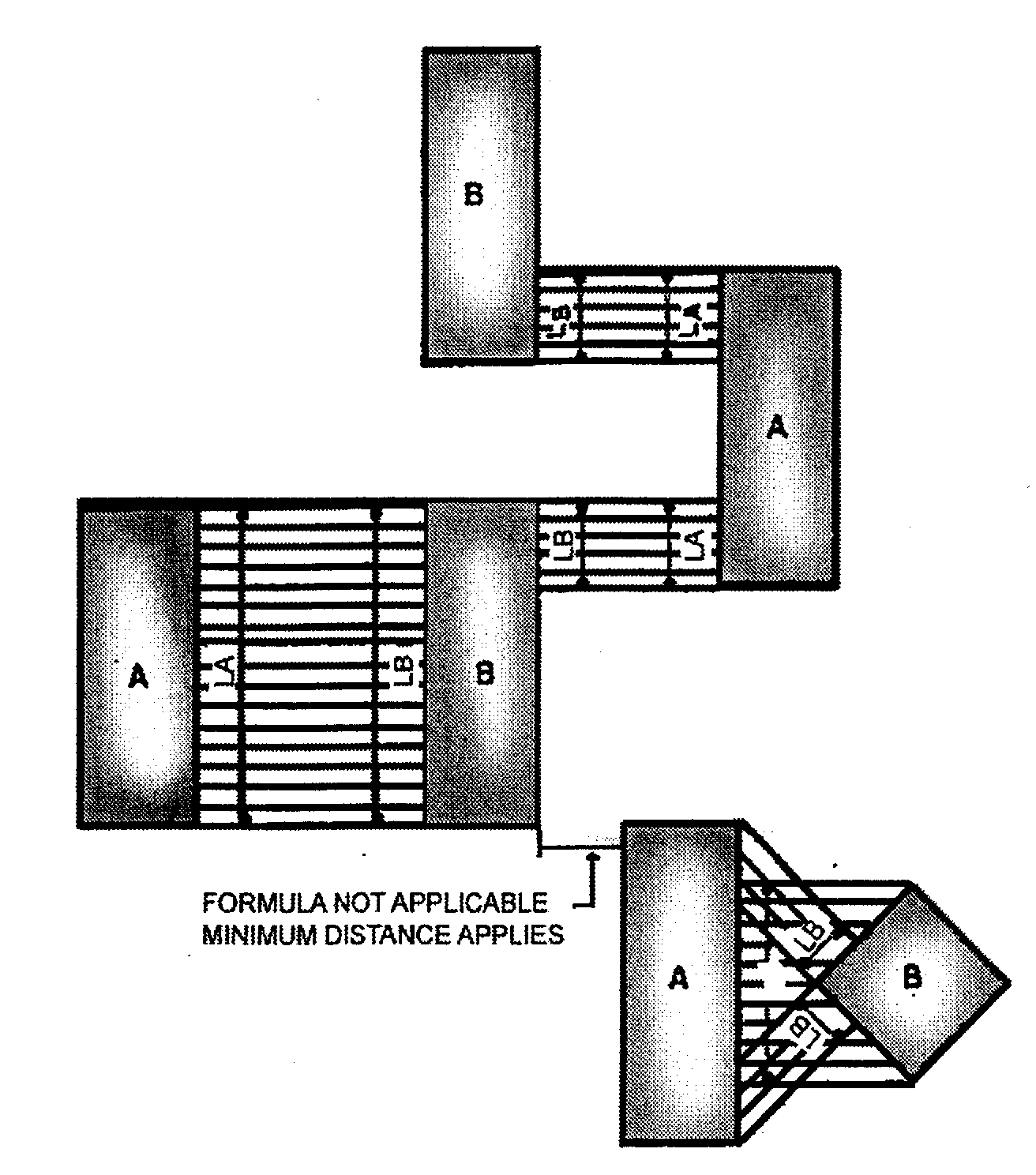
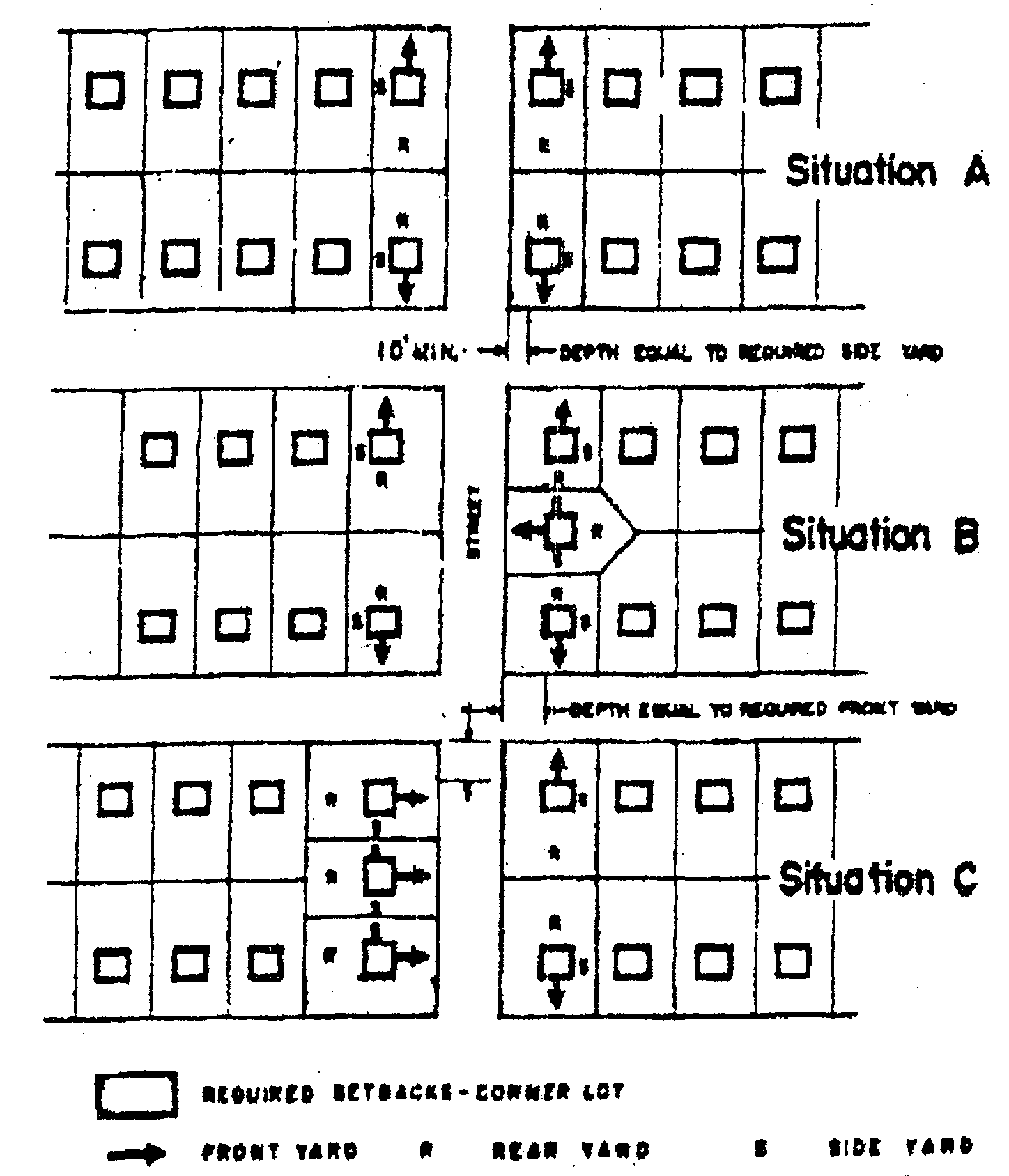
When an accessory building is located on a corner lot, the side lot line of which is substantially a continuation of the front lot line of the lot to its rear, said building shall not project beyond the front yard setback required on the lot to the rear of such corner lot. In no instance shall an accessory building be located nearer than ten feet to a street right-of-way line.
(b)
Accessory structures. Except as otherwise permitted in this chapter, accessory structures shall be subject to the following regulations:
(1)
Accessory structures shall not be erected in any minimum side yard nor in any front yard.
a.
Flagpoles may be located in any minimum required front or exterior side yard.
b.
Canopy or canopies covering gasoline pump islands may extend into the required front or exterior side yard to a point not less than ten feet from a street or alley right-of-way line.
(2)
Ground mounted private communication antennas shall be located in the rear yard, except when it can be shown that such antennas will not be highly visible from a street, or adjacent residential oriented property, they may be located in a nonrequired interior side yard. No private communications antenna, including so called extendable antennas shall exceed the maximum building height limitations of the district in which it is located when fully extended and shall be placed so that a horizontal distance at least equal to the vertical height of the antenna shall be provided between the base of the antenna and the nearest property line; except, in those instances where an antenna extending upward from the ground is also securely attached elsewhere to a building, the required distance to the nearest property line may be measured from the building attachment to the top of the antenna. All such antennas may be attached to a pole, tower, or rooftop of a principal or an accessory building, provided all applicable structural and electrical code requirements are met.
(3)
Wind-powered generators shall be permitted, provided:
a.
They are located in the rear yard only;
b.
They do not exceed the maximum building height limitation of the district;
c.
They are located on the premises so that a distance at least equal to the height of the generator blades at their apogee is provided to the nearest property line; and
d.
The meet all applicable structural and electrical codes.
(4)
Solar energy panels when located on the ground shall observe all applicable electrical codes and all applicable requirements pertaining to an accessory building. When roof mounted, they shall not project more than four feet outward from the roof, measured from the surface of the roof where affixed, to the farthest outward projection of the panel or unit.
(Ord. No. 802, § 1, 12-14-2020)
The intent of this section is to encourage site lighting that will be attractive to the eye while at the same time adequately illuminating a site for safety and convenience. It is further the intent of this section to discourage excessively bright and harsh site illumination that creates undesirable halo effects on the property, diminishes the residential environment of abutting and nearby dwellings and presents a potential hazard to vehicle and pedestrian traffic on abutting streets and sidewalks.
All exterior site lighting designed and intended to light private property shall comply with the following applicable requirements.
(1)
Exterior site lighting in nonresidential zoning districts.
a.
Overall exterior site illumination limitations.
1.
All outdoor lighting must be so designed and arranged so as not to shine on adjacent properties or occupied dwellings, or adversely impact vehicular or pedestrian traffic on nearby streets, drives, walkways, or general rights-of-way. Outdoor lighting originating on a site must not exceed 0.5 foot-candle at the lot line. Proposed light fixtures must be down directed and shielded where necessary. The source of the illumination (luminaire) must not be visible from adjacent properties and be International Dark Sky Association compliant. Lights may be required to be full cutoff where they may impact residential uses.
2.
Outdoor lighting fixtures must not exceed a height of 30 feet in height or the height of the principal building on the site, whichever is less. For development sites abutting properties, lots used or zoned for one- and two-family residential uses, lights must not exceed a height of 16 feet. The Planning Commission may modify the height restrictions in commercial and industrial districts, based on consideration of the following: the position and height of buildings, the character of the proposed use; and the character of surrounding land use.
3.
Where outdoor lighting is required by this chapter, the light intensity provided at ground level must be a minimum of 0.3 foot-candle anywhere in the area to be illuminated. Light intensity must average a minimum of 0.5 foot-candle over the entire area, measured five feet above the surface.
b.
Pole requirements. Freestanding light poles:
1.
Shall be constructed of metal, concrete, wood laminates or composite materials and shall be of an architectural nature. Decorative streetlights and poles are required in the Town Center Overlay District and shall be approved by the Planning Commission prior to site plan approval.
c.
Architectural exterior lighting.
1.
Architectural exterior lighting that is designed and intended only to enhance the architecture of a building or to highlight a particular architectural feature of a building, and to provide lighting for no other purpose, shall consist of:
i.
Low-wattage luminaire designed to cast soft light only on the subject.
ii.
The luminaire, when directly visible from a fixture, shall not be an irritant to pedestrians or to vehicle traffic within the site or to traffic on adjacent streets, or to residents on any abutting residential properties.
d.
Wiring requirements. All electrical service to any exterior light source shall be placed underground and within the interior of any canopy structure and shall meet all applicable electrical wiring codes and ordinances.
(2)
Exterior site lighting in the multiple-family residential districts.
a.
Freestanding light fixtures:
1.
May consist of a low-voltage incandescent luminaire contained in a decorative light fixture attached to the top of a low-profile yard type of light pole. All wiring to pole fixtures shall be underground and shall comply with all applicable electrical codes and ordinances.
b.
Wall- and roof-mounted fixtures.
1.
Carports in a multiple-family dwelling development may be lighted so long as all such lighting is contained in fixtures attached to the underside of the carport roof. The fixtures shall be placed no closer to the front of the roof structure than ½ the distance from the rear of the roof structure to the front of the roof structure. Luminaires shall not exceed 100 watts and may be housed in fixtures with clear lenses.
2.
Wall-mounted fixtures shall consist of low-voltage incandescent luminaires contained in decorative fixtures. Wall-mounted fixtures may be placed next to the main entrance to a dwelling unit or building entrance and next to any rear entry.
(3)
General lighting exemption.
a.
To request a waiver of up to 20 percent of the full lighting requirements of this section, an applicant must submit evidence to demonstrate that the waiver or exemption does not result in any unnecessary hardship on surrounding properties, business, and residences, and meets all of the criteria listed in this section. A public hearing shall be held in accordance with Article XXX of this chapter.
b.
The planning commission may approve such waiver or exemption upon finding that such waiver or exemption does not result in any unnecessary hardship on surrounding properties, business, and residences, and meets all of the criteria listed in this section.
c.
Although not necessary, an applicant may elect to apply for an exemption in lighting requirements for projects located in business districts. This application is not applicable for projects located in zoning districts other than the B-1, B-2, and B-3.
d.
In approving an exemption in lighting requirements authorized by this Code, the planning commission shall consider and apply the following criteria:
1.
The exemption in the lighting requirement is justified by the reasonably anticipated usage by businesses of and visitors to the project; and
2.
The exemption in the lighting requirement will not be detrimental to the health, safety, convenience, or general welfare of persons residing in or working in the vicinity; and
3.
The pattern of land use and character of development in the vicinity; and
4.
Such other criteria as the planning commission deems appropriate in the circumstances of the particular case.
(4)
Prohibition. The following is a list of prohibitions:
a.
Searchlights. The operation of searchlights for advertising purposes is prohibited between the hours of 11:00 p.m. and sunrise.
b.
Recreational facilities. No outdoor recreational facility, public or private, shall be illuminated by nonconforming means after 11:00 p.m., except to conclude a specific recreational or sporting event or any other activity conducted at a ballpark, outdoor amphitheater, arena, or similar facility in progress prior to 11:00 p.m.
5.
Outdoor building or landscaping illumination. The unshielded outdoor illumination of any building, landscaping, signing, or other purpose is prohibited.
6.
Mercury vapor fixtures.
(Ord. No. 802, § 1, 12-14-2020)
The purpose of this section is to permit and regulate signs of all types in all zoning districts. The regulation of signs is intended to enhance the physical appearance of Trenton, to preserve scenic and natural beauty and to create a climate that is attractive to business while preserving the general health, safety and welfare of the community. It is further intended by the provisions of this chapter to improve traffic safety by avoiding sign distractions and the "canceling out" effect of conflicting overlapping signs.
(Ord. No. 802, § 1, 12-14-2020)
Accessory sign: A sign which pertains to the principal use of the premises.
Billboard: A large sign erected, maintained, and used for the purpose of displaying messages that can be seen from a long distance or read from a vehicle traveling at high speeds. A billboard sign differs from a freestanding sign based on size. A billboard sign is typically 200 square feet or greater in size.
Billboard, Digital: A digital billboard is a billboard that displays digital images that are changed by a computer every few seconds. Digital billboards are primarily used for advertising, but they can also serve public service purposes.
Business center: For purposes of this chapter, a business center shall mean any group of two or more commercial or industrial establishments having not less than 100 feet of frontage on a major or secondary thoroughfare as defined by the Trenton Master Plan and which are under common ownership or management, have a common arrangement for the maintenance of the grounds and/or are connected by party walls, partitions, covered canopies or other structural members to form one continuous structure; or share a common parking area.
Changeable copy sign: A sign that utilizes computer-generated messages or some other electronic means of changing copy. These signs include displays using LED, LCD, or flipper matrix.
Directional sign: An accessory sign provided to clarify circulation patterns on a site.
Exterior building entrance: For the purposes of this section, an exterior building entrance includes only those available for use by customers or patrons and does not include service or employee entrances.
Festoon sign: a sign where incandescent light bulbs, banners or pennants or other such features are hung or strung overhead and are not an integral physical part of the building or structure they are intended to serve.
Flashing, animated or moving sign: A sign that intermittently reflects lights from either an artificial source or from the sun or which has movement of any illumination such as intermittent, flashing, scintillating or varying intensity or has any visible portion in motion, either constantly or at intervals, which motion may be caused by either artificial or natural sources.
Ground sign: A sign not attached to any building and supported by uprights or braces or some object on the ground and is a type of free-standing sign.
Height: The height of a sign is the distance from the ground to the highest point of the sign, including the sign frame.
Inflatable sign: A sign that is either expanded to its full dimension or supported by gases contained within the sign or sign parts at a pressure greater than atmospheric pressure.
Maximum size of sign: The entire area within a single continuous perimeter enclosing the extreme limits of writing, representation, emblem or any figure of similar character, together with any frame or other material or color forming an integral part of the display, excluding the necessary supports or uprights on which such sign is placed. Where a sign has two or more faces, the area of all faces shall be included in determining the area of the sign, except that where two such faces are placed back to back and are at no point more than three feet from one another, the area of the sign shall be taken as the area of one face if the two faces are of equal area, or as the area of the larger face if the two faces are of unequal area.
Nameplate: An accessory sign stating the name or street number of a person, firm, building or institution of a certain permitted use.
Natural materials: Includes, but are not limited to, wood, stone, and brick. Substances specifically excluded from this definition are plywood, pressed board, drywall, concrete block, poured concrete, wood or metal paneling, sheet metal, or any substances synthetically created in a manufacturing process.
Painted wall sign: A sign painted directly on any exterior building wall or door surface, exclusive of window and door glass areas on any outside wall or roof or on glass of any building.
Portable sign: A sign and sign structure which is designed to facilitate the movement of the sign from one zoning lot to another. The sign may or may not have wheels, changeable lettering and/or hitches for towing. A sign shall be portable only if such sign is manifestly designed to facilitate its movement from one zoning lot to another.
Projecting sign: A sign attached to a building or other structure and extending in whole or in part more than 12 inches beyond the surface of the portion of the building line or extending over public property.
Pylon sign: A ground sign which is elevated by one or more bearing columns.
Roof sign: An accessory sign erected and maintained upon the top of a sloping roof or upon the top of a flat roof with the principal supporting base being the roof.
Sign: The use of any words, numerals, figures, devices, designs or trademarks by which anything is made known such as to show an individual firm, profession, business, product or message and which are visible to the general public.
Sign area: The gross surface area within a single continuous perimeter enclosing the extreme limits of a sign, and in no case passing through or between any adjacent elements of same. Such perimeter shall not include any structural or framing elements, lying outside the limits of such sign and not forming an integral part of the display. For computing the area of any wall sign which consists of letters mounted or painted on a wall, the area shall be deemed to be the area of the smallest rectangular figure which can encompass all the letters and descriptive matter.
Snipe sign: A sign which is tacked, nailed, posted, pasted, glued or otherwise attached to trees, poles, stakes, fences or to other objects and the advertising matter appearing thereon is not applicable to the present use of the premises upon which such sign is located.
Swinging sign: A sign installed on an arm, mast, spar or building overhang that is not rigidly attached to such arm, mast, spar or building overhang.
Vehicle business sign: A vehicle, upon which a sign is painted or attached, which is not used for transportation on a daily basis as a part of the operation of such business and is pared or placed on a property for advertising purposes.
Wall sign: a sign erected or fastened to the wall of a building with the exposed face of the sign in a plane approximately parallel to the plane of such wall and not extending more than 12 inches beyond the surface of the portion of the building wall on which erected or fastened.
Window sign: A permanent or temporary sign painted, placed, or affixed to a window or within 12 inches of a window so as to be visible from the exterior of the premises where displayed.
(Ord. No. 802, § 1, 12-14-2020)
The following signs shall not be permitted in any use district unless otherwise provided for in this chapter:
(1)
Festoon sign.
(2)
Flashing, animated or moving sign.
(3)
Projecting sign (except swinging signs in the B-2/B-3 district).
(4)
Snipe sign.
(5)
Vehicle business sign.
(6)
Roof mounted signs.
(7)
Portable signs.
(8)
Billboard.
(Ord. No. 802, § 1, 12-14-2020)
The following conditions shall apply to all signs erected or located in any use district.
(1)
Except for signs erected by the City of Trenton, Wayne County, State or Federal governments, no sign shall be located in, project into, or overhang a public right-of-way or dedicated public easement except in those instances where a wall sign is affixed to the wall of a structure which lies on a right-of-way line. In such cases the wall sign may project a distance of 18 inches into the right-of-way, provided such sign is no closer than 12 feet from the ground. Otherwise, except for permitted swinging signs, signs mounted on a building, shall not project beyond or overhang the wall by more than 12 inches.
(2)
Wall signs mounted on a building shall not project above the highest point used to measure the height of the building.
(3)
Signs shall be permitted in any required yard and for the purposes of determining required height and required front setbacks, signs shall be exempt from the schedule of regulations of the Zoning Ordinance and the standards provided in this section shall apply.
(4)
No sign shall be erected which simulates or imitates in size, color, lettering, or design any traffic sign or signal or other word, phrase, symbol or character in such a manner as to interfere with, mislead, or confuse traffic.
(5)
Accessory signs shall be permitted as provided for herein in any zoning district.
(6)
Non-accessory signs shall be permitted in zoning districts as provided for in the City of Trenton Zoning Ordinance.
(Ord. No. 802, § 1, 12-14-2020)
Illuminated or illumination refers to lighting of a sign by any type of artificial light, whether by emission or reflection. In all zoning districts all sign illumination shall adhere to the following requirement and/or the International Dark Sky Association standards (http://www.darksky.org/) whichever is more restrictive in terms of Standards/Illumination:
(1)
Electrical requirements pertaining to signs shall be in accordance with the State of Michigan Electrical Code.
(2)
If illuminated, sign shall be illuminated only by the following means:
a.
By an external, steady, stationary light of reasonable intensity, shielded and directed solely by the sign.
b.
By whiter interior light.
(3)
To prevent glare, illuminated signs shall not emit more than 5,000 nits in full daylight and 100 nits between dusk and dawn. All illuminated electronic signs shall have functioning ambient light monitors and automatic dimming equipment which shall at all times be set to automatically reduce the brightness level of the sign proportionally to any reduction in the ambient light. In order to verify compliance with City Code or other applicable law, the interface that programs an electronic sign shall be made available to city staff for inspection upon request. If the interface is not or cannot be made available upon the city's request, the sign shall cease operation until the city has been provided proof of compliance. Regardless of any other requirement, illuminated signs shall not project light that exceeds 1/10 of a foot candle above the ambient light at any property line bordering any residential zoning district, as defined in the Zoning Ordinance.
(4)
Changeable copy signs.
a.
The changeable copy portion of a sign shall not exceed 50 percent of the area of the sign and shall not exceed 30 square feet per sign and 15 square feet per sign face.
b.
Scrolling or traveling of a message on changeable copy is prohibited.
c.
Changeable copy shall not change more than once every one minute.
d.
Changeable copy shall not and shall not appear to flash, undulate, pulse, blink, expand, contract, bounce, rotate, spin, twist, or otherwise move.
(5)
Digital billboards.
a.
should not display moving or flashing images (or lighting) or
b.
change in a way that produces an impression of movement
c.
Transition Time between images should be instantaneous.
(6)
LED shall be no more than 20 percent of any sign.
(Ord. No. 802, § 1, 12-14-2020)
In all Residential Districts, so-called entranceway structures, including but not limited to walls, columns, and gates marking entrances to single-family subdivisions or multiple housing projects, may be permitted and may be located in a required yard, except as provided in this Article regarding corner clearance, provided that such entranceway structures shall comply to all codes of the City of Trenton and shall be approved by the building department and a permit issued.
(Ord. No. 802, § 1, 12-14-2020)
The following standards are designed to provide for clear corner vision areas and shall be complied with where applicable:
(1)
Street intersections. No fence, wall, shrubbery, sign, or other obstruction to vision above a height of three feet from the established street grades shall be permitted within the triangular area formed at the intersection of any street right-of-way lines by a straight line drawn between said right-of-way lines to a distance along each line of 25 feet from their point of intersection. Except a freestanding pole sign/pylon sign supported by only one pole the diameter of which shall not exceed ten inches and which has at least eight feet of unobstructed clearance from the ground at the base of the pole to the bottom of the sign, may be permitted;
(2)
Driveway and alley intersections. Wherever a driveway intersects a public right-of-way serving multiple-family residential building, or a nonresidential use, no fence, wall, shrubbery, sign or any other obstruction to vision above the height of three feet measured from the established street grade shall be permitted within the triangular area formed at the intersection of the driveway with a street or alley by a straight line drawn between said driveway and the intersecting street or alley right-of-way lines to a distance along each line of 15 feet from their point of intersection. For a driveway serving a single-family or two-family dwelling building the minimum distance for computing the clear vision triangle shall be six feet. The same distances shall apply when a driveway or alley right-of-way a public right-of-way near an abutting lot line.
(3)
Public safety exception. In the interest of public safety, the minimum corner clearance requirements of this section may be increased at the recommendation of the Trenton Police Department.

Restricted Clear Corner Vision Areas
(Ord. No. 802, § 1, 12-14-2020)
No lot shall be used for any purpose permitted in this chapter unless said lot abuts a public street, unless otherwise provided in this chapter.
(Ord. No. 802, § 1, 12-14-2020)
For uses making reference to this section, vehicular access shall be provided only to an existing or planned major thoroughfare or collector street; provided, however, that the planning commission may grant an exception to this requirement where the commission finds that the properties on both sides of the street between the site and the major thoroughfare, freeway service drive or collector street are developed, zoned or planned for multiple-family residential or nonresidential purposes.
(Ord. No. 802, § 1, 12-14-2020)
Fences shall be subject to the conditions set forth in Chapter 18, Article IV, as amended, which regulates fences in the city.
(Ord. No. 802, § 1, 12-14-2020)
Fixed roofs, awnings, canopies or other shading or decorative devices, whether freestanding or structurally attached, which are intended to cover a porch, patio or door wall opening and not otherwise provided in this article regarding accessory uses, shall be subject to all of the setback and lot coverage limitations set forth and regulated in this chapter. Window awnings shall be excluded from these requirements.
(Ord. No. 802, § 1, 12-14-2020)
(a)
Restrictions. The off-street parking or storage of any recreational vehicle, including, but not limited to, boats, jet skis, snowmobiles, truck camper bodies, travel trailers, off-road or other altered vehicles, motor homes, and utility trailers (as well as their trailers for carrying or storage) shall not be permitted in residential districts, except under the following conditions:
(1)
Parking. A total of one recreational vehicle may be parked on a public street or in any hard surfaced driveway on a residential lot with the permission of the owner of such lot for the purpose of loading or unloading the vehicle or for general maintenance of the vehicle not to exceed 72 hours. Parking of the vehicle for other purposes shall be considered storage under this section and shall be subject to the limitations provided in this section.
(2)
Storage. Recreational vehicles may be stored on a residential lot, provided:
a.
Each vehicle shall be stored fully within the rear yard, or within an interior side yard.
b.
When stored within a rear yard, the vehicle shall meet the setback requirements of an accessory building as set forth in this Article, and the vehicle may be stored within any portion of a dedicated easement provided the vehicle shall be maintained so that it can be readily move in case of an emergency.
c.
When stored in an interior side yard, the vehicle shall not project beyond the front wall of the house, or extend above a height of six feet, measured from the surface of the driveway to the highest point of the vehicle, including the trailer, but excluding vehicle masts, antennas and open windshields extending upwards from the main deck; Except a vehicle may exceed this maximum height limitation provided the vehicle shall be stored no closer to the nearest wall of the principal building on the adjoining lot than a distance which shall be the remaining height of the vehicle above six feet, plus four feet in the R-3 districts, or plus five feet in the R-1 and R-2 districts.
d.
The storage of such vehicles as indicated in this section shall not occupy more than 25 percent of a required rear yard, or 40 percent of any nonrequired rear yard, or exceed the ground floor area of the main building.
e.
When a storage area is located on a corner lot, the side lot line of which is substantially a continuation of the front lot line of the lot to its rear, the storage area shall not project beyond the front yard setback required on the lot to the rear of such corner lot. In no instance shall a storage area be located nearer than ten feet to a street right-of-way line.
f.
Vehicles shall not be used to store flammable or explosive fuels or materials that are contrary to federal, state, or local regulations.
g.
Vehicles shall be fully operable and kept in good repair and shall display the current license plate and/or registration as may be appropriate under state law for the particular type of vehicle. For the purpose of this subsection, the term "current" shall mean having an expiration date not more than six months old in the case of a semiannual or seasonal license.
h.
At no time shall a recreational vehicle be used for living or housing keeping purposes, nor shall it be connected to water, gas, electrical or sanitary sewer facilities, except for the purpose of heating, cooling or battery charging preparatory to departure, or for general vehicle maintenance purposes.
(3)
Requests for exceptions or special approvals; variances. Notwithstanding the provisions of Article XXXI, Zoning Board of Appeals, in this chapter, no requests for exceptions or special approval shall be heard or granted by the zoning board of appeals regarding the enforcement of the provisions of this section. However, nothing in this section shall be construed to prohibit or prevent persons from bringing administrative or variance appeals to the zoning board of appeals in accordance with the applicable sections of Article XXX in this chapter.
(Ord. No. 802, § 1, 12-14-2020)
The purpose of this section is to serve as a guideline for the establishment of a harmonious building wall appearance on all exterior walls of a building so as to create, enhance and promote a uniform and quality visual environment throughout the city. The reader is encouraged to follow the guidelines to the extent possible to create a more attractive building in the City of Trenton, thereby sustaining the city beautiful efforts currently enjoyed by the residents of the city. The guidelines presented herein are just that, guidelines. They are not a mandatory requirement. The reader may choose to follow all, or any part, of the exterior building wall appearance guidelines presented in this section.
(1)
To encourage proper and effective attention will be given to the visual appearance of both residential and nonresidential buildings, the exterior building walls of a new building should consist of the same uniform exterior building wall finish materials as the front wall of the building. The building department must recognize all materials as acceptable finish materials.
a.
Whenever the exterior building wall materials standards set forth in this section are chosen to be followed, they should include a brief written statement describing how the exterior building wall material, or combination of materials, as set forth in this section, will be consistent with the materials on a majority of the same type of buildings in the surrounding area. For the purpose of this subsection, the reader is encouraged to apply the following guidelines:
b.
When four or more new single-family or two-family dwelling buildings are erected on contiguous lots on condominium home sites, they shall consist of face brick materials as defined in Article II (definition of Face brick ) in this chapter, on all exterior building walls.
c.
When three or less single-family, two-family, or multiple-family dwelling buildings are erected on contiguous lots or condominium home sites, they should consist of the same exterior building wall materials as a majority of the single-family, two-family, or multiple-family dwelling buildings in the surrounding area.
d.
A residential dwelling building should be provided with basically the same or similar exterior building wall and roof designs and roofing materials found on of a majority of the residential dwelling buildings in the surrounding area.
e.
A residential dwelling building shall be provided with exterior finish materials, such as doors and windows that are like or similar to a majority of the residential dwelling buildings in the surrounding area.
f.
For the purpose of determining the surrounding area, the same procedure may be applied as set forth in Article lV, in this chapter.
g.
In the case of a nonresidential building in a residential zoning district, all of the exterior walls of the building should consist of face brick materials as defined in Article II (definition of Face brick), in this chapter.
h.
In the case of a nonresidential building in a nonresidential zoning district, the exterior walls of the building should consist of the same materials as exists on a majority of the nonresidential buildings in the surrounding or nearby area as set forth and regulated in Article IV, in this chapter.
(2)
The exterior building wall materials guidelines the reader is encouraged to follow are outlined below.
a.
New single-family, two-family or multiple-family residential dwelling buildings.
1.
These buildings should have exterior walls that consist mostly of face brick material, as defined in this chapter, or a similar type of acceptable material that is consistent with the majority of the residential buildings in the surrounding area. A second story may consist of the same exterior building wall materials as the first floor, or if the first floor walls consists mostly of approved masonry materials, the second floor walls may consist of a different type of exterior building wall material, so long as the material and its appearance is like or similar to a majority of the residential buildings in the surrounding area.
2.
New single-family, two-family or multiple-family residential dwelling buildings with basements and/or chimneys whose exterior walls will extend upwards above the grade at the base of the wall should consist of the same exterior masonry or cementitious materials as appears on the first floor of the building. In the instance of a new residential building that will be erected without a basement, the first, or ground floor, should be elevated to resemble a majority of the residential buildings in the surrounding area, if those residential buildings have basements.
b.
Nonresidential buildings.
1.
Except where otherwise outlined in this section, the exterior building walls of a nonresidential building and any related accessory building should to the extent possible, consist of the exterior building wall materials and/or combinations of materials outlined in this section that are like or directly similar to the exterior walls of a majority of the nonresidential buildings in the surrounding area, and no exterior building wall should consist of any materials that are outlined in this section.
2.
The exterior building walls of a nonresidential building should to the extent possible, consist of the following materials or combinations of materials:
3.
Face brick for nonresidential buildings as defined in Article II in this chapter.
4.
Glazed kiln baked clay or shale ceramic masonry units, or cut stone or fieldstone, when these materials are used only in limited proportions as accent materials.
5.
Precast concrete in form and pattern that may consist of its natural color or may be treated (impregnated, not painted) with earth tone colors, as defined in this chapter.
6.
Finished cementitious materials, including finished systems and stucco. The use of architectural masonry block such as split face, ribbed, and rough-hewn masonry units may be used only as accent materials but the reader is encouraged to limit the use of such materials so that they will not make up more than 25 percent of any exterior wall, except when used in conjunction with E.I.F.S. (so called dryvit) material, such block materials should be placed from the ground upwards a minimum height of three feet, even if their use may exceed the 25 percent coverage limitation for this material on an exterior building wall.
7.
Metal materials, including flat sheets, standing seamed or ribbed panels, stainless steel and porcelain clad materials. The reader is encouraged to limit the use of these materials to 25 percent of the exterior building walls.
8.
Materials other than those specifically outlined in subsection (2) of this section are expressly prohibited. Expressly prohibited materials shall include:
i.
Standard smooth face concrete masonry units (CMU).
ii.
Tarred paper products, felt, tin and corrugated iron.
iii.
Pressed or laminated wood products.
iv.
Similar products or materials.
9.
After review and approval by the building department, other materials not discouraged in subsection (2)b.8. in this section, may be substituted in place of, or in combination with, the materials set forth in subsection (2)a. and b. in this section.
The building department may approve alternative materials only when it determines that such materials will:
i.
Be in direct harmony with the intent and purpose of this section and will stand to further promote the uniform and quality visual environment of the city.
ii.
Meet all applicable requirements of federal, state, and local building codes.
(Ord. No. 802, § 1, 12-14-2020)
(a)
Bins shall not be placed on any property without express written permission from the property owner and after receiving approval and a permit (sticker) from the city.
(b)
Bins shall only be allowed in the B-1, B-2, and B-3 zoning districts.
(c)
There shall be not more than two bins per property.
(d)
Bins shall not be located adjacent to any public rights-of-way, public sidewalks, or greenways, to the maximum extent practicable.
(e)
Bins shall not be located within required parking spaces or landscape areas.
(f)
Each bin shall be placed on a concrete pad not to exceed eight feet wide by five feet long and in a manner that is publicly accessible.
(g)
Except for a secure safety chute in which donations are deposited, bins shall remain locked at all times to prevent access by animals or unauthorized persons.
(h)
Bins shall be emptied and refuse around them collected and removed promptly.
(i)
Bin operator and property owner on which bins are located shall have two business days after receipt of a notice from the city to correct any violations of this section.
(j)
Applicant for a bin shall:
a.
Provide a plan detailing
1.
The access route of the vehicle used to unload the contents of the bin.
2.
The dedicated parking space used for patrons to unload donations.
b.
Provide a schedule for normal pick up of donations.
c.
Provide written permission from the property owner, owner's agent or an officer, director, member, or manager of an entity owning the property.
d.
File an application with the city each year. The filing of an application does not designate approval of a bin. Approval of a bin is only received after an application is submitted, reviewed, and stamped "approved" by the engineering department of the city if all requirements are met. Upon approval of an application the applicant will receive a sticker from the city to be placed in the appropriate location on the bin.
(k)
Aesthetic standards:
a.
Bins shall not exceed six- and one-half feet in height.
b.
Bins shall be constructed of a durable metal, UV-resistant molded hard plastic or fiberglass material.
c.
Bins shall prominently display the name, address, and telephone number of the owner/operator of the bin in characters no less than one-half inch in height and not greater than six inches in height.
d.
Bins shall at all times be maintained in good repair, and clean condition, and shall remain free of graffiti, or other markings.
e.
Bins shall not be utilized for the display of any advertising, signage or promotional materials other than the information of the owner/operator/charitable organization of the bin as stated in this section.
(l)
Fee required per bin:
(1)
Initial application (one-year period) $110.00, or such other amount determined by council.
(2)
Renewal application (one-year period) $60.00, or such other amount determined by council.
(Ord. No. 802, § 1, 12-14-2020)
(a)
Prohibited. It shall be prohibited to store dumpsters or temporary storage containers on private property except as hereinafter provided. Dumpsters and temporary storage containers shall include, but are not limited to, the following illustrative examples, construction dumpsters, roll-offs, portable on demand storage containers, shipping containers, over-seas containers, inter-modal containers, moving containers.
(b)
Limitations. Dumpsters and temporary storage containers are allowed on private property or private streets provided the following:
(1)
Line of sight shall not be obstructed, as defined in this Article.
(2)
Dumpsters and temporary storage containers shall not be located in a public right-of-way and shall not obstruct public sidewalks.
(3)
Dumpsters and temporary storage containers shall clearly identify the providing company's name and phone number.
(4)
Only one dumpster or temporary storage container may be placed on a property at any one time.
(5)
Dumpsters and temporary storage containers are allowed on a property for a period of an accumulative period not to exceed 21 days within a six-month period.
(6)
Dumpsters and temporary storage containers shall not be used to store household trash or other items or waste that will cause offensive odors, attract insects or vermin, and/or create a nuisance in general.
(7)
Open containers shall not be filled beyond the top edge.
(8)
When not in use, open containers shall be securely tarped.
(9)
Dumpsters and temporary storage containers shall comply with all other applicable codes, ordinances, and zoning requirements of the city.
(c)
Exemptions.
(1)
In cases where the physical limitations of a property prevent a dumpster or temporary storage container from being stored on private property, the city engineer or his/her designee may, upon application, permit a dumpster or temporary storage container to be located on public property, provided however, that such approval is in writing and in compliance with all other regulations. In granting this exemption, the timeframe for which the placement may be allowed can be restricted below that otherwise permitted, or extended beyond that specified in this section, if approved and individual circumstances warrant.
(2)
Construction dumpsters are allowed on a property for a period of six months, provided that a valid construction permit exists for the same location and compliance with all other regulations occurs.
(3)
Dumpsters required for demolitions are allowed on a property for the term of a valid demolition permit for the same location and there is compliance with all other regulations.
(Ord. No. 802, § 1, 12-14-2020)
(a)
It is recognized that there are certain instances where it would be in the best interests of the city, as well as advantageous to property owners seeking a change in zoning boundaries, if certain conditions attach as part of a request for rezoning. It is the intent of this section to provide a process consistent with the provisions of section 405, Michigan Zoning Enabling Act 110 of 2006 (MCL125.3405) by which an owner seeking a rezoning may voluntarily propose conditions regarding the use and/or development of land as part of the rezoning request.
(1)
Application and offer of conditions.
a.
An owner of land may voluntarily offer in writing conditions relating to the use and/or development of land for which a rezoning is requested. This offer may be made either at the time the application for rezoning is filed, or may be made at a later time during the rezoning process.
b.
The required application and process for considering a rezoning request with conditions shall be the same as that for considering rezoning requests made without any offer of conditions, except as modified by the requirements of this section.
c.
The owner's offer of conditions shall bear a reasonable and rational relationship to the property for which rezoning is requested.
d.
Any use of development proposed as part of an offer of conditions that would require a special land use permit under the terms of the Ordinance may only be commenced if a special land use permit for such use or development is ultimately granted in accordance with the provisions of this chapter.
e.
Any use or development proposed as part of an offer of conditions that require variance under the terms of this chapter may only be commenced if a variance for such use or development is ultimately granted by the Zoning Board of Appeals in accordance with the provisions of this chapter. Any use or development proposed as part of an offer of conditions that would require site plan approval under the terms of this chapter may only be commenced if site plan approval for such use or development is ultimately granted in accordance with the provisions of this chapter.
f.
The offer of conditions may be amended during the process of rezoning consideration provided that any amended or additional conditions are agreed to by the owner. An owner may withdraw all or part of its offer of conditions any time prior to final rezoning action provided that, if such withdrawal occurs subsequent to the planning commission's public hearing on the original rezoning request, then the rezoning application shall be referred to the planning commission for a new public hearing with appropriate notice, new recommendation, and fees.
(2)
Planning commission review. Planning commission, after public hearing and consideration of the factors for rezoning, may recommend approval, approval with recommended changes or denial of the rezoning, provided, however, that any recommended changes to the offer of conditions are acceptable to and thereafter offered by the owner.
(3)
City council review. After receipt of the planning commission's recommendations, the city council shall deliberate upon the requested rezoning and may approve or deny the conditional rezoning request. The deliberations shall include, but not be limited to, a consideration of the factors for rezoning of this chapter. Should the city council consider amendments to the proposed conditional rezoning advisable and if such a contemplated amendments to the offer of conditions are acceptable to and thereafter offered by the owner, then the city council shall, in accordance with section 405 of the Michigan Zoning Enabling Act (MCL125.3405), refer such amendments to the planning commission for a report thereon within a time specified by the city council and proceed thereafter in accordance with said statute to deny or approve the conditional rezoning with or without amendments.
(4)
Approval.
a.
If the city council finds the rezoning request and offer of conditions acceptable, the offered conditions shall be incorporated into a formal written statement of conditions acceptable to the owner and conforming in form to the provisions of this section. The statement of conditions shall be incorporated by attachment or otherwise as an inseparable part of the ordinance adopted by the city council to accomplish the requested zoning.
b.
The statement of conditions shall:
1.
Be in a form recordable with the register of deeds of the county or, in the alternative, be accompanied by a recordable affidavit, or memorandum prepared and signed by the owner giving notice of the statement of conditions in a manner acceptable to the city council.
2.
Contain a legal description of the land to which it pertains.
3.
Contain a statement acknowledging that the statement of conditions runs with the land and is binding upon successor owners of the land.
4.
Incorporate by attachment or reference any diagram, plans or other documents submitted or approved by the petitioner that are necessary to illustrate the implementation of the statement of conditions. If any such documents are incorporated by reference, the reference shall specify where the document may be examined.
5.
Contain a statement acknowledging that the statement of conditions or an affidavit or memorandum giving notice thereof may be recorded by the city with the register of deeds of the county.
6.
Contain the notarized signatures of all of the owners of the subject land preceded by a statement attesting to the fact that they voluntarily offer and consent to the provisions contained within the statement of conditions.
c.
Upon rezoning taking effect, the zoning map shall be amended to reflect the new zoning classification along with a designation that the land was rezoned with a statement of conditions. The city clerk shall maintain a listing of all lands rezoned with a statement of conditions.
d.
The approved statement of conditions or an affidavit or memorandum giving notice thereof shall be filed by the city with the register of deeds of the county. The city council shall have authority to waive this requirement if it determines that, given the nature of the conditions and/or the time frame within which the conditions are to be satisfied, the recording of such a document would be of no material benefit to the city or to any subsequent owner of the land.
e.
Upon the rezoning taking effect, the use of the land so rezoned shall conform thereafter to all of the requirements regulating use and development within the new zoning district as modified by any more restrictive provisions contained in the statement of conditions.
(5)
Compliance with conditions.
a.
Any person who establishes a development or commences a use upon land that has been rezoned with conditions shall continuously operate and maintain the development or use in compliance with all of the conditions set forth in the statement of conditions. Any failure to comply with a condition contained within the statement of conditions shall constitute a violation of this Zoning Ordinance, result in a reversion of the zoning classification to its previous designation and be punishable accordingly. Additionally, any such violation shall be deemed a nuisance per se and subject to judicial abatement as provided by law.
b.
No permit or approval shall be granted under this chapter for any use or development that is contrary to an applicable statement of conditions.
(6)
Time period for establishing development or use. Unless another time period is specified in the Ordinance rezoning the subject land, the approved development and/or use of the land pursuant to building and other required permits must be commenced upon the land within 18 months after the rezoning took effect and thereafter proceed diligently to completion within a pre-determined time period. This time limitation may upon written request be extended by the city council if (1) it is demonstrated to the city council's reasonable satisfaction that there is a strong likelihood that the development and/or use will commence within the period of extension and proceed diligently thereafter to completion and (2) the city council finds that there has not been a change in law or surrounding development that would render the current zoning with statement of conditions incompatible with other zones and uses in the surrounding area or otherwise inconsistent with sound zoning policy.
(7)
Reversion of zoning. If approved development and/or use of the rezoned land do not occur within the time frame specified under subsection (6) above, or the conditions of zoning are violated, then the land shall revert to its former zoning classification as set forth in the Michigan Zoning Enabling Act (MCL125.3405). The reversion process shall be initiated by the city council requesting that the planning commission proceed with consideration of rezoning of the land to its former zoning classification. The procedure for considering and making this reversionary rezoning shall thereafter be the same as applies to all other rezoning requests.
(8)
Subsequent rezoning of land. When land that is rezoned with a statement of conditions is thereafter rezoned to a different zoning classification or to the same zoning classification but with a different or no statement of conditions, whether as a result of a reversion of zoning pursuant to the subsection (g.) above or otherwise, the statement of conditions imposed under the former zoning classification shall cease to be in effect. The city clerk shall record with the register of deeds of the county that the statement of conditions is no longer in effect.
(9)
Amendment of conditions. During the time period for commencement of an approved development or use specified pursuant to subsection (6) above or during any extension thereof granted by the city council, the city shall not add to or alter the conditions in the statement of conditions.
(10)
City right to rezone. Nothing in the statement of conditions nor in the provisions of this section shall be deemed to prohibit the city from rezoning all or any portion of land that is subject to a statement of conditions to another zoning classification. Any rezoning shall be conducted in compliance with this chapter and the Michigan Zoning Enabling Act (MCL125.3405).
(11)
Failure to offer conditions. The city shall not require an owner to offer conditions as a requirement for rezoning. The lack of an offer of conditions shall not affect an owner's rights under this chapter.
(Ord. No. 802, § 1, 12-14-2020)
Impervious surfaces, usually found in developed areas, can have a significant impact on water quality. Impervious surfaces increase the amount and rate of surface water runoff, leading to erosion of stream banks, degradation of habitat, and increased sediment loads in streams. Impervious surfaces can accumulate large amounts of pollutants that are then "flushed" into local water bodies during storms. Impervious surfaces also can interfere with recharge of ground water and the base flows to water bodies. Examples of common impervious surfaces include roads, rooftops, buildings, parking lots, driveways, sidewalks and patios. Almost any contemporary urban land use produces over ten percent impervious coverage, with the most significant amount of that coverage coming from roads, driveways, and parking lots. Degradation of water quality and loss of habitat value can occur as impervious surface coverage in a watershed approaches ten percent. Greater impacts to water quality occur as impervious surfaces begin to dominate the landscape.
(Ord. No. 802, § 1, 12-14-2020)
The objective is to infiltrate all, or almost all, rainfall on the site by minimizing the effective impervious surfaces. Effective impervious surface means that the necessary impervious surfaces, such as driveways and buildings, are buffered by pervious surfaces that provide the infiltration necessary to effectively eliminate the impact of the impervious surfaces.
(Ord. No. 802, § 1, 12-14-2020)
The impervious surface requirements apply to the following districts:
(1)
All districts except the Town Center Overlay District and within the DDA boundaries.
(2)
Impervious cover (not mitigated by on-site vegetated swales, infiltration basins or other techniques approved by the City of Trenton) shall not exceed 20 percent percent of the total subject site area draining to each drainage discharge point.
(3)
Minimum pervious surface percentage requirements: The minimum pervious surface percentage requirement shall be applicable only in conjunction with the following:
a.
The construction of a new principal structure;
b.
An addition to a principal or accessory structure, other than a historic resource, that increases the existing lot occupancy at the time of a building permit application by ten percent or more;
c.
The construction of a new accessory structure that increases the existing lot occupancy at the time of a building permit application by ten percent or more; or
d.
An addition to a historic resource that increases the existing lot occupancy at the time of building permit application by 25 percent or more.
(4)
Only the following shall be considered pervious surfaces for the purposes of calculating the pervious surface area:
a.
Grass, mulched groundcover, all areas of a vegetated roof planted with a growing medium, and other planted areas;
b.
Permeable or pervious pavers or paving that facilitate the infiltration of water into the soil; and
c.
Decks or porches constructed above the surface of the lot that are erected on pier foundations, and that maintain a permeable surface underneath that can facilitate the infiltration of water into the soil.
(5)
Pervious surfaces on a lot shall not include:
a.
On-grade surface treatments used for purposes of recreation (e.g. patios), outdoor stairways, walking, driving and parking areas made of concrete, brick, asphalt, decorative pavers, compacted gravel or other material that does not facilitate the infiltration of water directly into the subsurface of the lot;
b.
The building footprint based on its foundation perimeter, whether located below grade or at grade;
c.
Where a building does not have a foundation, the area of the roof; and
d.
The area dedicated to a below or above grade swimming pool.
The percent of pervious surface area shall be calculated by dividing the total area of pervious surfaces on the lot by the total area of the lot.
(Ord. No. 802, § 1, 12-14-2020)
Preservation and enhancement of wetlands is essential to maintaining and improving the city's aesthetic character, its ecological stability, its economic well-being, its educational opportunities, and its quality of life.
Wetlands are protected to help reduce damage to aquatic resources from erosion, turbidity, siltation, and contamination. They are protected to minimize the loss of native plants and animals, to help preserve biological diversity and to minimize the loss of wildlife habitat within the city and to sustain many benefits wetlands can help provide - including flood control, stormwater storage and release, ground water recharge, and water quality improvement.
(Ord. No. 802, § 1, 12-14-2020)
Words and phrases used in this chapter shall have their usual and customary meaning, provided, however, that all words defined in the Part 303 of the Natural Resources and Environmental Protection Act, 1994 PA 451, as amended, and used in this chapter, shall have the meaning specified in that Act and the administrative regulations passed pursuant to that Act, except that the following words and phrases are defined as follows:
(1)
Noncontiguous wetland. A wetland which is not "contiguous" as defined by law for wetland regulation.
(2)
Use permit. The city approval required for activities regulated by this chapter.
(3)
Use permit fee. An amount paid to the city to obtain a use permit.
(4)
Wetland. Any land characterized by the presence of water at a frequency and duration sufficient to support and that under normal circumstances does support wetland vegetation or aquatic life and is commonly referred to as a bog, swamp, or marsh.
(5)
Storm water retention/detention basin. An artificial impoundment constructed in upland which serves to restrain or filter storm water runoff.
(Ord. No. 802, § 1, 12-14-2020)
Approvals under this chapter shall not relieve a person of the need to obtain other required permits nor shall issuance of another permit relieve a person of the need to obtain approval under this chapter, if applicable.
(Ord. No. 802, § 1, 12-14-2020)
(a)
The physical boundary and extent of wetlands shall be identified by a professional having technical ability and experience sufficient to accurately identify wetland boundaries.
(b)
Wetland determination shall be made using the same criteria as provided for Part 303 of the Natural Resources and Environmental Protection Act, 1994 PA 451, and administrative rules as amended.
(c)
To facilitate verification, the boundary of the wetland shall be flagged in the field by the applicant prior to the application for a use permit.
(Ord. No. 802, § 1, 12-14-2020)
Except as otherwise provided by this chapter or by a use permit obtained from the city, a person shall not:
(1)
Deposit or permit the placing of fill material in a wetland.
(2)
Dredge, remove, or permit the removal of soil or minerals from a wetland.
(3)
Construct, operate, or maintain any use or development in a wetland including draining or directing water from an upland activity into a wetland.
(4)
Drain surface water from a wetland.
(Ord. No. 802, § 1, 12-14-2020)
The following activities and uses are not regulated by this chapter:
(1)
The activities which are allowed in a wetland without a permit by Part 303 of the Natural Resources and Environmental Protection Act, 1994 PA 451, as amended.
(2)
Stormwater retention/detention basins not intended nor acting as mitigation of any wetland disturbed by development.
(3)
Construction of or addition to a single- or two-family dwelling on an approved subdivision or condominium lot that is less than ¾ acre in size and zoned solely for residential purposes where the wetland is wholly contained on the lot.
(Ord. No. 802, § 1, 12-14-2020)
Applications for a use permit shall be filed with the engineering and building department as prescribed below:
(1)
The application material for a use permit shall consist of the following:
a.
Ten copies of the state-approved "Application for Permit" and "Application for Local Wetland Permit," with each section thoroughly completed.
b.
Ten copies of drawings which contain, at a minimum, the information provided for on the "Application for Permit."
c.
A signed letter from the applicant which explains why the project meets the use permit standards and criteria contained in Article XXV of this chapter.
(2)
Ten copies of the mitigation plan shall be submitted, if mitigation is proposed. In order to adequately review a proposed mitigation plan, the following information should be provided to the city:
a.
A brief overview of the plan including the short-range and long-range objectives for vegetation, hydrology, grading, and monitoring.
b.
A schedule of all mitigation activities, including coordination with other local and state agencies, if applicable.
c.
A planting plan and plant list for the area(s) to be established. The use of native plants characteristic of local conditions is encouraged. Species should be selected based on the need for wildlife, restoration, landscaping, and recovery. The engineering and building department shall, in consultation with knowledgeable persons, maintain and update a list of botanical species which are considered invasive. Mitigation activities shall be performed without the use of invasive species.
d.
A grading and soil erosion control plan including existing and proposed conditions.
e.
A description of all soils and materials to be used including their approximate volumes and origin.
f.
Hydro-geological information sufficient to determine the site's suitability for the mitigation.
g.
Construction detail drawings for planting, soil erosion control, stabilization, water conveyance, and all other items necessary to facilitate the review.
(3)
Ten copies of a monitoring plan (text or drawings or both) shall be submitted, if mitigation is proposed. In order to adequately review a monitoring plan, the following information should be provided to the city:
a.
Schedule and list of activities to be contracted and conducted related to the site's hydrology, including sub-surface and surface water for a period of at least five years. A report and recommendation on the hydrologic conditions of the site should be submitted to the engineering and building department annually.
b.
Schedule and list of activities to be contracted and conducted related to the site's plant establishment and control of invasive exotic species for a period of at least five years. A report and recommendation on the plant establishment of the site should be submitted to the engineering and building department annually.
c.
To assure that the objectives established in the mitigation plan are successful, the monitoring plan should indicate the mechanisms necessary to execute the recommendations from the annual reports and provide for additional monitoring after the five-year period.
(Ord. No. 802, § 1, 12-14-2020)
Upon receipt of an application, the application shall forward the application and supporting documentation and plans to the Michigan Department of Environmental Quality. The city shall review the application pursuant to this chapter and shall modify, approve (with or without conditions), or deny the application within 90 days after receipt. An application for a permit shall not be deemed as received or filed until all information requested on the application form, the application fee, and other information required by this chapter and necessary to reach a decision. The period for modifying, approving, or denying an application begins as soon as all such information and the application fee are received by the city. The failure to supply complete information with a permit application may be reason for denial of a permit. The denial of a permit shall be accompanied with a written reason for denial. If the city does not modify, approve, or deny the permit application within 90 days, the permit application shall be considered approved.
(Ord. No. 802, § 1, 12-14-2020)
(a)
After application is made to the engineering and building department, application documents shall be distributed to the following for review and comment:
(1)
City engineer.
(2)
Building official.
(3)
Planning consultant.
(b)
The engineering and building department shall review the use permit application to verify that all required information has been provided. At the request of the petitioner or the city, an administrative meeting may be held to review the proposed activity in light of the purposes of this chapter.
(c)
Upon receipt of a complete application, the engineering and building department may conduct or authorize the completion of a field investigation to review and verify the accuracy of information received. The receipt of a use permit application shall comprise permission from the owner to complete an on-site investigation.
(d)
If a state permit is required, the engineering and building department shall coordinate field investigations with state agency personnel to the maximum feasible extent.
(e)
Plans for wetland mitigation shall be reviewed only after the requirements of this section have been met.
(f)
It shall be the responsibility of the city engineer to select a qualified wetlands consultant or retain qualified staff to conduct wetland field investigations and complete assessments on behalf of the city, if the department determines its necessity.
(g)
When a use permit application is not related to a development or activity necessitating review and approval of a site plan or plat by the planning commission or city council, the city engineer shall be responsible for granting or denying the application.
(h)
Prior to the decision of the engineering department, notice of the use permit application shall be sent by first-class mail to property owners within 300 feet of the boundary of the property upon which the activity is proposed at least 15 days before the city engineer makes his or her decision, which notice shall indicate where and when the use permit application may be examined and that said owner(s) may file comments with the engineering and building department.
(Ord. No. 802, § 1, 12-14-2020)
After the appropriate parties have completed their review of a use permit application, the application shall be referred to the planning commission if it relates to a proposed development or activity which requires review by the commission pursuant to the terms of another chapter. A public hearing with regard to the use permit application shall be held by the planning commission at the same meeting at which it considers the related site plan or preliminary plat. Public hearing requirements shall be the same for the wetland application as for the related site plan or preliminary plat. The public hearing on the wetland permit application shall be held concurrently with the public hearing required by another chapter. After conducting a public hearing, the planning commission shall:
(1)
In the case of a site plan, an amendment to an approved site plan, or a preliminary plat, make a recommendation to the city council with regard to whether the use permit application shall be issued and in connection with a favorable recommendation may suggest conditions; or
(2)
In the case of a site plan for minor modification, modify, approve (with or without conditions), or deny the use permit application.
(Ord. No. 802, § 1, 12-14-2020)
Upon receipt of the planning commission recommendation with regard to a use permit application and the related site plan or preliminary plat which relates to a proposed development or activity which requires city council approval, the city council shall hold a public hearing with regard to the use permit application at the same meeting at which it considers the related site plan or preliminary plat. The public hearing on the wetland permit application shall be held concurrently with the public hearing required by another chapter for a site plan or plat. The city council, after conducting the public hearing, shall modify, approve (with or without conditions), or deny the use permit application.
(Ord. No. 802, § 1, 12-14-2020)
(a)
A use permit shall allow development of land consistent with the permit plans, regulations, laws, and ordinances in effect at the time the use permit is approved.
(b)
Any permit issued under this chapter does not obviate the necessity of receiving, when applicable, approval from other federal, state, and local government agencies.
(c)
A use permit shall become invalid if the authorized work is not commenced within six months of the date issued, or is suspended or abandoned for a period of six months after termination of substantial operations as determined by the City Engineer.
(d)
Whenever the city approves the issuance of a use permit, it may:
(1)
Issue permits on a city-wide basis for a category of activities if the city determines that the activities are similar in nature, will cause only minimal environmental effects when performed separately, and will have only minimal cumulative adverse effect on the environment.
(2)
Impose conditions on a permit for a use or development if the conditions are designed to remove an impairment to benefits gained from wetlands, or if they are designed to mitigate the impact of a discharge of fill material, or if they will otherwise improve water quality.
(3)
Establish a reasonable time when the construction, development, or use is to be completed or terminated.
(Ord. No. 802, § 1, 12-14-2020)
In making a determination whether to approve a use permit application, the planning commission, the council, or the engineering and building department shall consider the following standards and criteria:
(1)
Except as provided in subsection (4) of this section, a permit for an activity listed in this section shall not be approved unless the city determines that the issuance of a use permit is in the public interest, that the permit is necessary to realize the benefits derived from the activity, and that the activity is otherwise lawful.
(2)
In determining whether the activity is in the public interest, the benefit which reasonably may be expected to accrue from the proposal shall be balanced against the reasonably foreseeable detriments of the activity. The decision shall reflect local, state, and national concern for protection of natural resources from pollution, impairment, and destruction. The following general criteria shall be considered:
a.
The relative extent of the public and private need for the proposed activity.
b.
The availability of feasible and prudent methods and alternative locations and methods to accomplish the expected benefits from the activity.
c.
The extent and permanence of the beneficial or detrimental effects which the proposed activity may have on the public and private uses to which the area is suited, including the benefits the protected wetland provides.
d.
The probable impact of each proposal in relation to the cumulative effect created by other existing and anticipated activities in the watershed.
e.
The probable effect on recognized historic, cultural, scenic, ecological, or recreational values and on the public health or fish or wildlife.
f.
The size of the wetland being considered.
g.
The amount of remaining wetland in the general area.
h.
Proximity to any waterway.
i.
Economic value, both public and private, of the proposed land change to the general area.
(3)
A permit shall not be issued unless it is shown that an unacceptable disruption will not result to the aquatic resources. In determining whether a disruption to the aquatic resources is unacceptable, the criteria set forth in Section 30302 of Part 303 of the Natural Resources and Environmental Protection Act, 1994 PA 451, as amended, and this section shall be considered. A permit shall not be issued unless the applicant also shows either of the following:
a.
The proposed activity is primarily dependent upon being located in the wetland.
b.
A feasible and prudent alternative does not exist.
(4)
Upon application for a wetland use permit in a noncontiguous wetland that is less than two acres in size, the city shall approve the permit unless the city determines that the wetland is essential to the preservation of the natural resources of the city. The city shall provide these findings in writing to the permit applicant, stating the reasons for its determination. In making this determination, the city must find that one or more of the following exist at the particular site:
a.
The site supports state or federal endangered or threatened plants, fish or wildlife appearing on a list specified in Part 365 of the Natural Resources and Environmental Protection Act, 1994 PA 451.
b.
The site represents what is identified as a locally rare or unique ecosystem.
c.
The site supports plants or animals of an identified local importance.
d.
The site provides groundwater recharge documented by a public agency.
e.
The site provides flood and storm control by the hydrologic absorption and storage capacity of the wetland.
f.
The site provides wildlife habitat by providing breeding, nesting, or feeding grounds or cover for forms of wildlife, waterfowl, including migratory waterfowl, and rare, threatened, or endangered wildlife species.
g.
The site provides protection of subsurface water resources and provision of valuable watersheds and recharging groundwater supplies.
h.
The site provides pollution treatment by serving as a biological and chemical oxidation basin.
i.
The site provides erosion control by serving as a sedimentation area and filtering basin, absorbing silt and organic matter.
j.
The site provides sources of nutrients in water food cycles and nursery grounds, and sanctuaries for fish.
(Ord. No. 802, § 1, 12-14-2020)
(a)
As authorized by this section, the city may impose conditions on a use permit for a use or development if the conditions are designed to remove an impairment to the wetland benefits, to mitigate the impact of a discharge of fill material, or otherwise improve the water quality.
(b)
The city shall consider a mitigation plan if submitted by the applicant and may incorporate the mitigation actions as permit conditions for the improvement of the existing wetland resources or the creation of a new wetland resource to offset wetland resource losses resulting from the proposed project. Financial assurances may be required to ensure that mitigation is accomplished as specified by the permit conditions. The city shall, when requested by the applicant, meet with the applicant to review the applicant's mitigation plan.
(c)
In developing conditions to mitigate impacts, the city shall consider mitigation to apply only to unavoidable impacts that are otherwise permissible utilizing the criteria under Part 303 of the Natural Resources and Environmental Protection Act, 1994 PA 451, as amended. Mitigation shall not be considered when it is feasible and prudent to avoid impacts or when the impacts would be otherwise prohibited under this chapter.
(d)
When considering mitigation proposals, the city shall make all of the following determinations:
(1)
That all feasible and prudent efforts have been made to avoid the loss of wetland resource values.
(2)
That all practical means have been considered to minimize impacts.
(3)
That it is practical to replace the wetland resource values which will be unavoidably impacted.
(e)
If the city determines that it is practical to replace the wetland resource values which will be unavoidably impacted, the city shall consider all of the following criteria when reviewing an applicant's mitigation proposal:
(1)
Mitigation shall be provided on-site where practical and beneficial to the wetland resources.
(2)
When subdivision (a) of this subsection does not apply, mitigation shall be provided in the immediate vicinity of the permitted activity where practical to the wetland resources provided that mitigation shall be within the same watershed of the Ecorse Creek within which the proposed wetland use is located.
(3)
Only when it has been determined by the City Engineer that subdivisions (a) and (b) of this subsection are inappropriate and impractical shall mitigation be considered elsewhere.
(4)
Any proposal shall assure that, upon completion, there will be no net loss to the wetland resources. Any mitigation plan approved under this chapter shall provide replacement of wetlands disturbed at a ratio of no less than 1.5:1 and no more than 2:1, in accordance with the federal rules and state operating procedures. Should such rules and procedures change, the most current ratio shall be used.
(5)
The proposal shall give consideration to replacement of the predominant functional values lost within the impacted wetland.
(f)
Any mitigation activity shall be completed before initiation of other permitted activities, unless a phased concurrent schedule is agreed upon between the city and the applicant.
(g)
Monitoring to establish documentation of the functional performance of the mitigation may be required as a permit condition, as well as necessary corrective actions required, to deliver the wetland resource values identified.
(Ord. No. 802, § 1, 12-14-2020)
City council may determine that there may be a legitimate public need for a proposed public project that is greater than the need to protect a wetland, and that the project may be exempted from certain requirements of this chapter.
(1)
For a project to be considered for exemption from any requirement of this chapter, city council must find, after full review and public hearing, all of the following exist:
a.
The project is either being performed by or required by a public agency;
b.
There is a legitimate public need, as per the requirements of this section, for the project that is greater than the need to protect a wetland;
c.
The proposed use cannot reasonably be accomplished utilizing alternative designs on-site;
d.
A reduction in the size, scope, configuration, or density of the design which would avoid, or result in less, adverse impact on a regulated wetland cannot be reasonably accomplished; and
e.
Mitigation shall be provided to the maximum extent possible within the scope of the project.
(2)
In determining whether the legitimate public need for the project exceeds the need to protect a wetland, the City Council must find that the benefit which reasonably may be expected to accrue from the project shall be greater than the reasonably foreseeable detriments of the activity. The following general criteria shall be considered:
a.
The relative extent of the public need for the proposed activity.
b.
The availability of feasible and prudent alternative locations and methods to accomplish the expected benefits from the activity.
c.
The extent and permanence of the beneficial or detrimental effects which the proposed activity may have on the public uses to which the area is suited, including the benefits the wetland provides.
d.
The probable impact of the project in relation to the cumulative effect created by other existing and anticipated activities in the watershed.
e.
The probable impact on recognized historic, cultural, scenic, ecological, or recreational values and on the public health or fish or wildlife.
f.
The size of the wetland being considered.
g.
The amount of remaining wetland in the general area.
h.
Proximity to any waterway.
i.
Economic public value of the proposed land change to the general area.
(Ord. No. 802, § 1, 12-14-2020)
An applicant who has received a use permit under this chapter shall comply with the requirements of this section in connection with any construction or other activity on the property for which the use permit has been issued. Conditions may be established by the city to ensure that the intent of this chapter is carried out. The activity or use shall be conducted in such manner as to cause the least amount of disruption of the protected wetland, including, but not limited to, the following requirements:
(1)
Prior to any development, clearing, filling, or other activity for which a use permit is required, protective construction fencing intended to restrict access shall be erected between the protected area and the area subject to development. Such protection shall remain until it is authorized to be removed by the city, or until issuance of a final certificate of occupancy. Nails, wires, or other objects may not be attached to any tree, nor otherwise cause damage to any tree.
(2)
All protected wetland and watercourse areas within or adjacent to the use permit activity area shall be protected with barrier fencing at least four feet in height staked in place at ten-foot (minimum) intervals. No filling, excavating, or storage of materials, debris, or equipment shall take place within the barrier fencing.
(3)
Where vehicle and driveway access is permitted, any existing hydrological connection shall not be disrupted.
(4)
When the use of fill is permitted, it shall be clean and free of garbage, refuse, toxic or contaminated material, or any material that through the action of leaching may cause degradation of surface or ground water quality.
(5)
Soil erosion control structures and measures shall be maintained, including, but not limited to, silt fences, straw bale berms, and sediment traps. The landowner shall provide for periodic inspections and maintenance of such installations throughout the duration of the project.
(6)
A copy of the city use permit and state permits, if applicable, shall be prominently displayed or available at the site. They shall be displayed continuously when authorized activities are conducted and for ten days following completion. The owner shall allow city representatives to enter and inspect the premises at any reasonable time, and failure to allow inspections shall constitute a violation of this section.
(Ord. No. 802, § 1, 12-14-2020)
A use or activity regulated by this chapter that was lawfully begun before the passage of this chapter, but which is not in conformity with the provisions of this chapter, may be continued subject to the following:
(1)
No such use or activity shall be expanded or enlarged in any way unless it is permanently changed to a conforming use.
(2)
If a nonconforming use or activity is discontinued for 12 consecutive months, any resumption of the activity shall conform to this chapter.
(3)
If nonconforming use or activity is destroyed, it shall not be resumed except in conformity with the provisions of this chapter.
(Ord. No. 802, § 1, 12-14-2020)
Applications to the city for a use permit shall be accompanied by a non-refundable use permit fee set by resolution of city council. The use permit fee will be for review of application and plans, and field inspections. A property owner may request of the engineering and building department a preliminary assessment of the site to determine whether or not the site will be affected by the ordinance. No fee shall be charged for this determination.
(Ord. No. 802, § 1, 12-14-2020)
(a)
The city engineer may issue a stop work order on the remaining portion of construction or shall refuse a certificate of occupancy or other construction permits related to the project whenever there is a failure to comply with the provisions of this chapter.
(b)
If, on the basis of information available to the city, the city finds that a person is in violation of this chapter or of a condition set forth in a permit, the city shall issue an order requiring the person to comply with the prohibitions or conditions or the city shall take such enforcement action as it deems appropriate.
(c)
An order issued under subsection (b) shall state with reasonable specificity the nature of the violation and shall specify a time for compliance, not to exceed 30 days, which the city determines is reasonable, taking into account the seriousness of the violation and good faith efforts to comply with acceptable requirements.
(d)
A person who violates any provision of this chapter shall be responsible for a civil infraction for which the court may impose a civil fine of not more than $10,000.00 per day of violation plus all costs, direct or indirect, which the city has incurred in connection with the violation.
(e)
In addition to the penalties provided in subsection (d), the court may order a person who violates this chapter to restore as nearly as possible the wetland affected by the violation to its original condition immediately before the violation, and may issue any other orders permitted by law. The restoration may include the removal of fill material deposited in a wetland or the replacement of soil, sand, minerals, or plants.
(Ord. No. 802, § 1, 12-14-2020)
(a)
If a wetland permit is denied by the city for a proposed use, the landowner may request a revaluation of the affected property for assessment purposes to determine its fair market value under the use restrictions.
(b)
A landowner who is aggrieved by a determination, action, or inaction under this section may protest and appeal that determination, action, or inaction pursuant to the General Property Tax Act (Act 206, Public Acts of 1893), being Sections 211.1—211.157 of the Michigan Compiled Laws.
(Ord. No. 802, § 1, 12-14-2020)
(a)
A decision by an administrative official of the city regarding a use permit may be appealed to the Zoning Board of Appeals, in accordance with procedures established in Article XXXI.
(b)
A variance may be granted from the provisions of this chapter when evidence supports at least one of the following affirmative findings:
(1)
That the public benefit intended to be served by this chapter will be retained, despite more disruption of the wetland than permitted.
(2)
That the topographical features or special characteristics of the site create conditions such that strict application of the provisions of this chapter will result in less protection of the wetland.
(3)
That the application of this chapter would deny all reasonable use of the property.
(4)
That practical difficulties or unnecessary hardship exist or will occur as specified in Article XXXI of this chapter.
(Ord. No. 802, § 1, 12-14-2020)
GENERAL PROVISIONS
(a)
Intent and applicability. It is the intent of this section to establish and provide procedures and standards for uses identified in this chapter as special land uses in a particular zoning district, subject to review and approval by the planning commission, and where so required, by the city council. All special land uses shall be subject, unless otherwise required by the planning commission, to all of the minimum, general, and special conditions standards and procedures of this section regarding each use.
(b)
Notice of request for special land use approval. Upon receipt of an application for a special land use, a public hearing to be held by the planning commission shall be duly advertised in the manner set forth and regulated in Article XXX in this chapter. The hearing may be called at the initiative of the planning commission, or upon receipt of a request by the applicant for approval of a special land use, or by a property owner or by the occupant of a structure located within 300 feet of the boundary of the property being considered for the special land use. In either case, notice of a public hearing shall be advertised in the manner set forth and regulated in Article XXX in this chapter before a decision or a recommendation shall be made by the planning commission.
(c)
Decision. The planning commission or, when specified elsewhere in this chapter, the city council, shall deny, approve, or approve with conditions request for approval of a special land use. The decision on a special land use shall be incorporated in a statement of conclusions relative to the use under consideration. The decision shall specify the basis for the decision, and any conditions imposed thereon by the planning commission or the city council.
(d)
Site plan required and duration of approval. For all special land uses as set forth in the various zoning districts, a site plan shall be required. The site plan shall be prepared and submitted in accordance with the applicable requirements of Article XXVIII in this chapter. An approved site plan with or without conditions shall remain valid for the specific time period or periods set forth and regulated in Article XXVIII.
(e)
Performance guarantees. Performance guarantees may be required by the planning commission or by the city council to ensure compliance with the applicable requirements of this code pertaining to any special land use approval, including any conditions that may be attached to an approval.
(f)
Standards. In addition to or in conjunction with any specific standards which may be applicable to a special land use, the following standards shall also serve the planning commission and the city council as the basis for decisions involving the review of any special land use, and any discretionary decisions that may be involved in the review of a special land use in this chapter. Each such use or activity shall:
(1)
Be compatible with adjacent uses and the zoning of the land around it.
(2)
Be consistent with and promote the intent and purpose of this code.
(3)
Be compatible with the natural environment and conserve natural resources and energy.
(4)
Be consistent with existing and future capabilities of public services and facilities that will be affected by the proposed use.
(5)
Protect and promote the public health, safety and welfare as well as the social and economic well-being of those who will use the land use or activity, residents, businesses and landowners immediately adjacent to the proposed land use or activity and the city as a whole.
(Ord. No. 802, § 1, 12-14-2020)
State Law reference— Performance guarantees, MCL 125.584e.
It is recognized that there exists within the districts established by this chapter or amendments that may later be adopted, lots, structures, and uses of land and structures which were lawful before this chapter was passed or amended, but which would be prohibited, regulated, or restricted under the terms of this chapter.
It is the intent of this chapter to permit these nonconformities to continue until they are removed, but not to encourage their survival. Such uses are declared by this chapter to be incompatible with permitted uses in the districts involved. It is further the intent of this chapter that nonconformities shall not be enlarged upon, expanded, or extended, nor be used as grounds for adding other structures or uses prohibited elsewhere in the same district.
It is further recognized that certain nonconforming uses and structures do not significantly depress the value of nearby properties and are not contrary to the public health, safety and welfare and that such use or structure was lawful at the time of its inception and that no useful purpose would be served by the strict application of requirements for nonconformities under this chapter and, therefore, two classes of nonconforming use and structure are designated, being class A and class B. All nonconforming uses and structures are classified as class B nonconforming uses or structures unless designated class A nonconforming uses or structures.
(Ord. No. 802, § 1, 12-14-2020)
State Law reference— Nonconforming uses and structures, MCL 125.583a.
All nonconforming uses or structures not designated class A shall be class B nonconforming uses or structures. Class B nonconforming uses and structures shall comply with all the provisions of this article relative to nonconforming uses and structures.
(Ord. No. 802, § 1, 12-14-2020)
State Law reference— Nonconforming uses and structures, MCL 125.583a.
Nonconforming uses or structures shall be designated class A providing that the planning commission finds all the following exists with respect to the use or structure:
(1)
The use or structure was lawful at its inception.
(2)
Continuance of the use or structure is not likely to significantly depress property values of nearby properties.
(3)
Continuance of the use or structure would not be contrary to the public health, safety or welfare or the spirit of the chapter.
(4)
No useful purpose would be served by strict application of the provisions of this chapter with which the use or structure does not conform.
(Ord. No. 802, § 1, 12-14-2020)
State Law reference— Nonconforming uses and structures, MCL 125.583a.
The decision to grant a class A designation shall be made in writing setting forth its findings of fact and basis for the designation. For changes or improvements to a class A use or structure, site plans shall be required and the planning commission may condition its approval on the following, and by the following procedure to assure the public health, safety or welfare or the spirit and purpose of this chapter:
(1)
Conditions.
a.
Screening and landscaping in keeping with community standards to provide compatibility with adjacent uses.
b.
Restrictions on lighting, noise, or visual impact.
c.
Prohibition of curbside parking to an extent greater than the immediate property frontage of the nonconforming use, where such use is in close proximity to homes.
d.
Signage in compliance with zoning district requirements. Existing nonconforming signs may be required to be eliminated or reduced in size and number.
e.
Exterior building materials utilized in any alteration or rebuilding of the building shall be harmonious with materials on abutting properties whenever practical.
f.
Enlargement or replacement of a building that does not create a more nonconforming yard setback condition which would impact on conforming properties in the immediate vicinity.
g.
Other reasonable safeguards and improvements imposed to protect conforming uses in the surrounding area.
(2)
Procedure.
a.
A class A designation shall be deemed temporary until the planning commission has received written verification from the building official that the party requesting the class A designation has complied with all of the conditions set forth by the planning commission.
b.
Once the planning commission has received written verification from the building director that the party requesting the class A designation has complied with said conditions, the class A designation shall become final, subject to other provisions of this chapter as hereafter prescribed.
c.
No class A nonconforming use or structure shall be resumed if it has been discontinued for six consecutive months, or 18 months total in any three-year period. No class A nonconforming use or structure shall be used, altered, or enlarged in violation of any conditions imposed in its designation.
d.
A temporary class A nonconforming use or structure designation shall be void after six months if any conditions imposed by the designation remain unmet, unless the planning commission grants a written request for an extension of six months. No more than two extensions may be granted.
(Ord. No. 802, § 1, 12-14-2020)
State Law reference— Nonconforming uses and structures, MCL 125.583a.
On any building devoted in whole or in part to any nonconforming use, work may be done in any period of 12 consecutive months on ordinary repairs, or on repair or replacement of nonbearing walls, fixtures, wiring or plumbing to an extent not exceeding 50 percent of the assessed value of the building, provided that the cubic content of the building as it existed at the time of passage or amendment of this code shall not be increased.
(Ord. No. 802, § 1, 12-14-2020)
Any use for which a special exception is permitted as provided in this chapter shall not be deemed a nonconforming use but shall, without further action, be deemed a conforming use in such district.
(Ord. No. 802, § 1, 12-14-2020)
There may be a change of tenancy, ownership, or management of any existing nonconforming uses of land, structures and land in combination.
(Ord. No. 802, § 1, 12-14-2020)
(a)
Accessory buildings. Except as otherwise permitted in this chapter, shall be subject to the following regulations:
(1)
Where the accessory building is structurally attached to a main building, it shall be subject to, and must conform to, all regulations of this code applicable to the main building.
(2)
Accessory buildings shall not be erected in any minimum side yard setback or in any front yard.
(3)
Any accessory building shall not occupy more than 25 percent of a required rear yard, plus 40 percent of any nonrequired rear yard, provided that in a residential district, the accessory building shall not exceed the ground floor area of the main building.
(4)
No detached accessory building shall be located closer than ten feet to any main building nor shall it be located closer than three feet to any side or rear lot line. In those instances where the rear lot line is coterminous with an alley right-of-way, the accessory building shall not be closer than three feet to such rear lot line. In no instance shall an accessory building be located within a dedicated easement right-of-way.
(5)
No accessory building in R-1 through R-4, RT, RM-1, B-1 and P-1 districts shall exceed 15 feet in height if a flat roof building and may only be a flat roof building if the principal building it is intended to serve is a flat roof building. An accessory building with a sloping or pitched roof shall not exceed a height of 20 feet, or the maximum building height of the principal building it is intended to serve, whichever results in the lesser height. For an accessory building over 144 square feet, the slope of the roof shall be the same in pitch and appearance as that of the principal building it is intended to serve. Accessory buildings in all other districts may be constructed to a height equal the permitted maximum height of the principal building it is intended to serve, except when an accessory building in the other districts will exceed 20 feet in height, they shall require review and approval by the planning commission.
For the purpose of this subsection, building height shall be measured from the finish grade at the base of the building, or from the average grade, as defined in this chapter, to the top, or ridgeline of the roof.
(f)
When an accessory building is located on a corner lot, the side lot line of which is substantially a continuation of the front lot line of the lot to its rear, said building shall not project beyond the front yard setback required on the lot to the rear of such corner lot. In no instance shall an accessory building be located nearer than ten feet to a street right-of-way line.
(b)
Accessory structures. Except as otherwise permitted in this chapter, accessory structures shall be subject to the following regulations:
(1)
Accessory structures shall not be erected in any minimum side yard nor in any front yard.
a.
Flagpoles may be located in any minimum required front or exterior side yard.
b.
Canopy or canopies covering gasoline pump islands may extend into the required front or exterior side yard to a point not less than ten feet from a street or alley right-of-way line.
(2)
Ground mounted private communication antennas shall be located in the rear yard, except when it can be shown that such antennas will not be highly visible from a street, or adjacent residential oriented property, they may be located in a nonrequired interior side yard. No private communications antenna, including so called extendable antennas shall exceed the maximum building height limitations of the district in which it is located when fully extended and shall be placed so that a horizontal distance at least equal to the vertical height of the antenna shall be provided between the base of the antenna and the nearest property line; except, in those instances where an antenna extending upward from the ground is also securely attached elsewhere to a building, the required distance to the nearest property line may be measured from the building attachment to the top of the antenna. All such antennas may be attached to a pole, tower, or rooftop of a principal or an accessory building, provided all applicable structural and electrical code requirements are met.
(3)
Wind-powered generators shall be permitted, provided:
a.
They are located in the rear yard only;
b.
They do not exceed the maximum building height limitation of the district;
c.
They are located on the premises so that a distance at least equal to the height of the generator blades at their apogee is provided to the nearest property line; and
d.
The meet all applicable structural and electrical codes.
(4)
Solar energy panels when located on the ground shall observe all applicable electrical codes and all applicable requirements pertaining to an accessory building. When roof mounted, they shall not project more than four feet outward from the roof, measured from the surface of the roof where affixed, to the farthest outward projection of the panel or unit.
(Ord. No. 802, § 1, 12-14-2020)
The intent of this section is to encourage site lighting that will be attractive to the eye while at the same time adequately illuminating a site for safety and convenience. It is further the intent of this section to discourage excessively bright and harsh site illumination that creates undesirable halo effects on the property, diminishes the residential environment of abutting and nearby dwellings and presents a potential hazard to vehicle and pedestrian traffic on abutting streets and sidewalks.
All exterior site lighting designed and intended to light private property shall comply with the following applicable requirements.
(1)
Exterior site lighting in nonresidential zoning districts.
a.
Overall exterior site illumination limitations.
1.
All outdoor lighting must be so designed and arranged so as not to shine on adjacent properties or occupied dwellings, or adversely impact vehicular or pedestrian traffic on nearby streets, drives, walkways, or general rights-of-way. Outdoor lighting originating on a site must not exceed 0.5 foot-candle at the lot line. Proposed light fixtures must be down directed and shielded where necessary. The source of the illumination (luminaire) must not be visible from adjacent properties and be International Dark Sky Association compliant. Lights may be required to be full cutoff where they may impact residential uses.
2.
Outdoor lighting fixtures must not exceed a height of 30 feet in height or the height of the principal building on the site, whichever is less. For development sites abutting properties, lots used or zoned for one- and two-family residential uses, lights must not exceed a height of 16 feet. The Planning Commission may modify the height restrictions in commercial and industrial districts, based on consideration of the following: the position and height of buildings, the character of the proposed use; and the character of surrounding land use.
3.
Where outdoor lighting is required by this chapter, the light intensity provided at ground level must be a minimum of 0.3 foot-candle anywhere in the area to be illuminated. Light intensity must average a minimum of 0.5 foot-candle over the entire area, measured five feet above the surface.
b.
Pole requirements. Freestanding light poles:
1.
Shall be constructed of metal, concrete, wood laminates or composite materials and shall be of an architectural nature. Decorative streetlights and poles are required in the Town Center Overlay District and shall be approved by the Planning Commission prior to site plan approval.
c.
Architectural exterior lighting.
1.
Architectural exterior lighting that is designed and intended only to enhance the architecture of a building or to highlight a particular architectural feature of a building, and to provide lighting for no other purpose, shall consist of:
i.
Low-wattage luminaire designed to cast soft light only on the subject.
ii.
The luminaire, when directly visible from a fixture, shall not be an irritant to pedestrians or to vehicle traffic within the site or to traffic on adjacent streets, or to residents on any abutting residential properties.
d.
Wiring requirements. All electrical service to any exterior light source shall be placed underground and within the interior of any canopy structure and shall meet all applicable electrical wiring codes and ordinances.
(2)
Exterior site lighting in the multiple-family residential districts.
a.
Freestanding light fixtures:
1.
May consist of a low-voltage incandescent luminaire contained in a decorative light fixture attached to the top of a low-profile yard type of light pole. All wiring to pole fixtures shall be underground and shall comply with all applicable electrical codes and ordinances.
b.
Wall- and roof-mounted fixtures.
1.
Carports in a multiple-family dwelling development may be lighted so long as all such lighting is contained in fixtures attached to the underside of the carport roof. The fixtures shall be placed no closer to the front of the roof structure than ½ the distance from the rear of the roof structure to the front of the roof structure. Luminaires shall not exceed 100 watts and may be housed in fixtures with clear lenses.
2.
Wall-mounted fixtures shall consist of low-voltage incandescent luminaires contained in decorative fixtures. Wall-mounted fixtures may be placed next to the main entrance to a dwelling unit or building entrance and next to any rear entry.
(3)
General lighting exemption.
a.
To request a waiver of up to 20 percent of the full lighting requirements of this section, an applicant must submit evidence to demonstrate that the waiver or exemption does not result in any unnecessary hardship on surrounding properties, business, and residences, and meets all of the criteria listed in this section. A public hearing shall be held in accordance with Article XXX of this chapter.
b.
The planning commission may approve such waiver or exemption upon finding that such waiver or exemption does not result in any unnecessary hardship on surrounding properties, business, and residences, and meets all of the criteria listed in this section.
c.
Although not necessary, an applicant may elect to apply for an exemption in lighting requirements for projects located in business districts. This application is not applicable for projects located in zoning districts other than the B-1, B-2, and B-3.
d.
In approving an exemption in lighting requirements authorized by this Code, the planning commission shall consider and apply the following criteria:
1.
The exemption in the lighting requirement is justified by the reasonably anticipated usage by businesses of and visitors to the project; and
2.
The exemption in the lighting requirement will not be detrimental to the health, safety, convenience, or general welfare of persons residing in or working in the vicinity; and
3.
The pattern of land use and character of development in the vicinity; and
4.
Such other criteria as the planning commission deems appropriate in the circumstances of the particular case.
(4)
Prohibition. The following is a list of prohibitions:
a.
Searchlights. The operation of searchlights for advertising purposes is prohibited between the hours of 11:00 p.m. and sunrise.
b.
Recreational facilities. No outdoor recreational facility, public or private, shall be illuminated by nonconforming means after 11:00 p.m., except to conclude a specific recreational or sporting event or any other activity conducted at a ballpark, outdoor amphitheater, arena, or similar facility in progress prior to 11:00 p.m.
5.
Outdoor building or landscaping illumination. The unshielded outdoor illumination of any building, landscaping, signing, or other purpose is prohibited.
6.
Mercury vapor fixtures.
(Ord. No. 802, § 1, 12-14-2020)
The purpose of this section is to permit and regulate signs of all types in all zoning districts. The regulation of signs is intended to enhance the physical appearance of Trenton, to preserve scenic and natural beauty and to create a climate that is attractive to business while preserving the general health, safety and welfare of the community. It is further intended by the provisions of this chapter to improve traffic safety by avoiding sign distractions and the "canceling out" effect of conflicting overlapping signs.
(Ord. No. 802, § 1, 12-14-2020)
Accessory sign: A sign which pertains to the principal use of the premises.
Billboard: A large sign erected, maintained, and used for the purpose of displaying messages that can be seen from a long distance or read from a vehicle traveling at high speeds. A billboard sign differs from a freestanding sign based on size. A billboard sign is typically 200 square feet or greater in size.
Billboard, Digital: A digital billboard is a billboard that displays digital images that are changed by a computer every few seconds. Digital billboards are primarily used for advertising, but they can also serve public service purposes.
Business center: For purposes of this chapter, a business center shall mean any group of two or more commercial or industrial establishments having not less than 100 feet of frontage on a major or secondary thoroughfare as defined by the Trenton Master Plan and which are under common ownership or management, have a common arrangement for the maintenance of the grounds and/or are connected by party walls, partitions, covered canopies or other structural members to form one continuous structure; or share a common parking area.
Changeable copy sign: A sign that utilizes computer-generated messages or some other electronic means of changing copy. These signs include displays using LED, LCD, or flipper matrix.
Directional sign: An accessory sign provided to clarify circulation patterns on a site.
Exterior building entrance: For the purposes of this section, an exterior building entrance includes only those available for use by customers or patrons and does not include service or employee entrances.
Festoon sign: a sign where incandescent light bulbs, banners or pennants or other such features are hung or strung overhead and are not an integral physical part of the building or structure they are intended to serve.
Flashing, animated or moving sign: A sign that intermittently reflects lights from either an artificial source or from the sun or which has movement of any illumination such as intermittent, flashing, scintillating or varying intensity or has any visible portion in motion, either constantly or at intervals, which motion may be caused by either artificial or natural sources.
Ground sign: A sign not attached to any building and supported by uprights or braces or some object on the ground and is a type of free-standing sign.
Height: The height of a sign is the distance from the ground to the highest point of the sign, including the sign frame.
Inflatable sign: A sign that is either expanded to its full dimension or supported by gases contained within the sign or sign parts at a pressure greater than atmospheric pressure.
Maximum size of sign: The entire area within a single continuous perimeter enclosing the extreme limits of writing, representation, emblem or any figure of similar character, together with any frame or other material or color forming an integral part of the display, excluding the necessary supports or uprights on which such sign is placed. Where a sign has two or more faces, the area of all faces shall be included in determining the area of the sign, except that where two such faces are placed back to back and are at no point more than three feet from one another, the area of the sign shall be taken as the area of one face if the two faces are of equal area, or as the area of the larger face if the two faces are of unequal area.
Nameplate: An accessory sign stating the name or street number of a person, firm, building or institution of a certain permitted use.
Natural materials: Includes, but are not limited to, wood, stone, and brick. Substances specifically excluded from this definition are plywood, pressed board, drywall, concrete block, poured concrete, wood or metal paneling, sheet metal, or any substances synthetically created in a manufacturing process.
Painted wall sign: A sign painted directly on any exterior building wall or door surface, exclusive of window and door glass areas on any outside wall or roof or on glass of any building.
Portable sign: A sign and sign structure which is designed to facilitate the movement of the sign from one zoning lot to another. The sign may or may not have wheels, changeable lettering and/or hitches for towing. A sign shall be portable only if such sign is manifestly designed to facilitate its movement from one zoning lot to another.
Projecting sign: A sign attached to a building or other structure and extending in whole or in part more than 12 inches beyond the surface of the portion of the building line or extending over public property.
Pylon sign: A ground sign which is elevated by one or more bearing columns.
Roof sign: An accessory sign erected and maintained upon the top of a sloping roof or upon the top of a flat roof with the principal supporting base being the roof.
Sign: The use of any words, numerals, figures, devices, designs or trademarks by which anything is made known such as to show an individual firm, profession, business, product or message and which are visible to the general public.
Sign area: The gross surface area within a single continuous perimeter enclosing the extreme limits of a sign, and in no case passing through or between any adjacent elements of same. Such perimeter shall not include any structural or framing elements, lying outside the limits of such sign and not forming an integral part of the display. For computing the area of any wall sign which consists of letters mounted or painted on a wall, the area shall be deemed to be the area of the smallest rectangular figure which can encompass all the letters and descriptive matter.
Snipe sign: A sign which is tacked, nailed, posted, pasted, glued or otherwise attached to trees, poles, stakes, fences or to other objects and the advertising matter appearing thereon is not applicable to the present use of the premises upon which such sign is located.
Swinging sign: A sign installed on an arm, mast, spar or building overhang that is not rigidly attached to such arm, mast, spar or building overhang.
Vehicle business sign: A vehicle, upon which a sign is painted or attached, which is not used for transportation on a daily basis as a part of the operation of such business and is pared or placed on a property for advertising purposes.
Wall sign: a sign erected or fastened to the wall of a building with the exposed face of the sign in a plane approximately parallel to the plane of such wall and not extending more than 12 inches beyond the surface of the portion of the building wall on which erected or fastened.
Window sign: A permanent or temporary sign painted, placed, or affixed to a window or within 12 inches of a window so as to be visible from the exterior of the premises where displayed.
(Ord. No. 802, § 1, 12-14-2020)
The following signs shall not be permitted in any use district unless otherwise provided for in this chapter:
(1)
Festoon sign.
(2)
Flashing, animated or moving sign.
(3)
Projecting sign (except swinging signs in the B-2/B-3 district).
(4)
Snipe sign.
(5)
Vehicle business sign.
(6)
Roof mounted signs.
(7)
Portable signs.
(8)
Billboard.
(Ord. No. 802, § 1, 12-14-2020)
The following conditions shall apply to all signs erected or located in any use district.
(1)
Except for signs erected by the City of Trenton, Wayne County, State or Federal governments, no sign shall be located in, project into, or overhang a public right-of-way or dedicated public easement except in those instances where a wall sign is affixed to the wall of a structure which lies on a right-of-way line. In such cases the wall sign may project a distance of 18 inches into the right-of-way, provided such sign is no closer than 12 feet from the ground. Otherwise, except for permitted swinging signs, signs mounted on a building, shall not project beyond or overhang the wall by more than 12 inches.
(2)
Wall signs mounted on a building shall not project above the highest point used to measure the height of the building.
(3)
Signs shall be permitted in any required yard and for the purposes of determining required height and required front setbacks, signs shall be exempt from the schedule of regulations of the Zoning Ordinance and the standards provided in this section shall apply.
(4)
No sign shall be erected which simulates or imitates in size, color, lettering, or design any traffic sign or signal or other word, phrase, symbol or character in such a manner as to interfere with, mislead, or confuse traffic.
(5)
Accessory signs shall be permitted as provided for herein in any zoning district.
(6)
Non-accessory signs shall be permitted in zoning districts as provided for in the City of Trenton Zoning Ordinance.
(Ord. No. 802, § 1, 12-14-2020)
Illuminated or illumination refers to lighting of a sign by any type of artificial light, whether by emission or reflection. In all zoning districts all sign illumination shall adhere to the following requirement and/or the International Dark Sky Association standards (http://www.darksky.org/) whichever is more restrictive in terms of Standards/Illumination:
(1)
Electrical requirements pertaining to signs shall be in accordance with the State of Michigan Electrical Code.
(2)
If illuminated, sign shall be illuminated only by the following means:
a.
By an external, steady, stationary light of reasonable intensity, shielded and directed solely by the sign.
b.
By whiter interior light.
(3)
To prevent glare, illuminated signs shall not emit more than 5,000 nits in full daylight and 100 nits between dusk and dawn. All illuminated electronic signs shall have functioning ambient light monitors and automatic dimming equipment which shall at all times be set to automatically reduce the brightness level of the sign proportionally to any reduction in the ambient light. In order to verify compliance with City Code or other applicable law, the interface that programs an electronic sign shall be made available to city staff for inspection upon request. If the interface is not or cannot be made available upon the city's request, the sign shall cease operation until the city has been provided proof of compliance. Regardless of any other requirement, illuminated signs shall not project light that exceeds 1/10 of a foot candle above the ambient light at any property line bordering any residential zoning district, as defined in the Zoning Ordinance.
(4)
Changeable copy signs.
a.
The changeable copy portion of a sign shall not exceed 50 percent of the area of the sign and shall not exceed 30 square feet per sign and 15 square feet per sign face.
b.
Scrolling or traveling of a message on changeable copy is prohibited.
c.
Changeable copy shall not change more than once every one minute.
d.
Changeable copy shall not and shall not appear to flash, undulate, pulse, blink, expand, contract, bounce, rotate, spin, twist, or otherwise move.
(5)
Digital billboards.
a.
should not display moving or flashing images (or lighting) or
b.
change in a way that produces an impression of movement
c.
Transition Time between images should be instantaneous.
(6)
LED shall be no more than 20 percent of any sign.
(Ord. No. 802, § 1, 12-14-2020)
In all Residential Districts, so-called entranceway structures, including but not limited to walls, columns, and gates marking entrances to single-family subdivisions or multiple housing projects, may be permitted and may be located in a required yard, except as provided in this Article regarding corner clearance, provided that such entranceway structures shall comply to all codes of the City of Trenton and shall be approved by the building department and a permit issued.
(Ord. No. 802, § 1, 12-14-2020)
The following standards are designed to provide for clear corner vision areas and shall be complied with where applicable:
(1)
Street intersections. No fence, wall, shrubbery, sign, or other obstruction to vision above a height of three feet from the established street grades shall be permitted within the triangular area formed at the intersection of any street right-of-way lines by a straight line drawn between said right-of-way lines to a distance along each line of 25 feet from their point of intersection. Except a freestanding pole sign/pylon sign supported by only one pole the diameter of which shall not exceed ten inches and which has at least eight feet of unobstructed clearance from the ground at the base of the pole to the bottom of the sign, may be permitted;
(2)
Driveway and alley intersections. Wherever a driveway intersects a public right-of-way serving multiple-family residential building, or a nonresidential use, no fence, wall, shrubbery, sign or any other obstruction to vision above the height of three feet measured from the established street grade shall be permitted within the triangular area formed at the intersection of the driveway with a street or alley by a straight line drawn between said driveway and the intersecting street or alley right-of-way lines to a distance along each line of 15 feet from their point of intersection. For a driveway serving a single-family or two-family dwelling building the minimum distance for computing the clear vision triangle shall be six feet. The same distances shall apply when a driveway or alley right-of-way a public right-of-way near an abutting lot line.
(3)
Public safety exception. In the interest of public safety, the minimum corner clearance requirements of this section may be increased at the recommendation of the Trenton Police Department.

Restricted Clear Corner Vision Areas
(Ord. No. 802, § 1, 12-14-2020)
No lot shall be used for any purpose permitted in this chapter unless said lot abuts a public street, unless otherwise provided in this chapter.
(Ord. No. 802, § 1, 12-14-2020)
For uses making reference to this section, vehicular access shall be provided only to an existing or planned major thoroughfare or collector street; provided, however, that the planning commission may grant an exception to this requirement where the commission finds that the properties on both sides of the street between the site and the major thoroughfare, freeway service drive or collector street are developed, zoned or planned for multiple-family residential or nonresidential purposes.
(Ord. No. 802, § 1, 12-14-2020)
Fences shall be subject to the conditions set forth in Chapter 18, Article IV, as amended, which regulates fences in the city.
(Ord. No. 802, § 1, 12-14-2020)
Fixed roofs, awnings, canopies or other shading or decorative devices, whether freestanding or structurally attached, which are intended to cover a porch, patio or door wall opening and not otherwise provided in this article regarding accessory uses, shall be subject to all of the setback and lot coverage limitations set forth and regulated in this chapter. Window awnings shall be excluded from these requirements.
(Ord. No. 802, § 1, 12-14-2020)
(a)
Restrictions. The off-street parking or storage of any recreational vehicle, including, but not limited to, boats, jet skis, snowmobiles, truck camper bodies, travel trailers, off-road or other altered vehicles, motor homes, and utility trailers (as well as their trailers for carrying or storage) shall not be permitted in residential districts, except under the following conditions:
(1)
Parking. A total of one recreational vehicle may be parked on a public street or in any hard surfaced driveway on a residential lot with the permission of the owner of such lot for the purpose of loading or unloading the vehicle or for general maintenance of the vehicle not to exceed 72 hours. Parking of the vehicle for other purposes shall be considered storage under this section and shall be subject to the limitations provided in this section.
(2)
Storage. Recreational vehicles may be stored on a residential lot, provided:
a.
Each vehicle shall be stored fully within the rear yard, or within an interior side yard.
b.
When stored within a rear yard, the vehicle shall meet the setback requirements of an accessory building as set forth in this Article, and the vehicle may be stored within any portion of a dedicated easement provided the vehicle shall be maintained so that it can be readily move in case of an emergency.
c.
When stored in an interior side yard, the vehicle shall not project beyond the front wall of the house, or extend above a height of six feet, measured from the surface of the driveway to the highest point of the vehicle, including the trailer, but excluding vehicle masts, antennas and open windshields extending upwards from the main deck; Except a vehicle may exceed this maximum height limitation provided the vehicle shall be stored no closer to the nearest wall of the principal building on the adjoining lot than a distance which shall be the remaining height of the vehicle above six feet, plus four feet in the R-3 districts, or plus five feet in the R-1 and R-2 districts.
d.
The storage of such vehicles as indicated in this section shall not occupy more than 25 percent of a required rear yard, or 40 percent of any nonrequired rear yard, or exceed the ground floor area of the main building.
e.
When a storage area is located on a corner lot, the side lot line of which is substantially a continuation of the front lot line of the lot to its rear, the storage area shall not project beyond the front yard setback required on the lot to the rear of such corner lot. In no instance shall a storage area be located nearer than ten feet to a street right-of-way line.
f.
Vehicles shall not be used to store flammable or explosive fuels or materials that are contrary to federal, state, or local regulations.
g.
Vehicles shall be fully operable and kept in good repair and shall display the current license plate and/or registration as may be appropriate under state law for the particular type of vehicle. For the purpose of this subsection, the term "current" shall mean having an expiration date not more than six months old in the case of a semiannual or seasonal license.
h.
At no time shall a recreational vehicle be used for living or housing keeping purposes, nor shall it be connected to water, gas, electrical or sanitary sewer facilities, except for the purpose of heating, cooling or battery charging preparatory to departure, or for general vehicle maintenance purposes.
(3)
Requests for exceptions or special approvals; variances. Notwithstanding the provisions of Article XXXI, Zoning Board of Appeals, in this chapter, no requests for exceptions or special approval shall be heard or granted by the zoning board of appeals regarding the enforcement of the provisions of this section. However, nothing in this section shall be construed to prohibit or prevent persons from bringing administrative or variance appeals to the zoning board of appeals in accordance with the applicable sections of Article XXX in this chapter.
(Ord. No. 802, § 1, 12-14-2020)
The purpose of this section is to serve as a guideline for the establishment of a harmonious building wall appearance on all exterior walls of a building so as to create, enhance and promote a uniform and quality visual environment throughout the city. The reader is encouraged to follow the guidelines to the extent possible to create a more attractive building in the City of Trenton, thereby sustaining the city beautiful efforts currently enjoyed by the residents of the city. The guidelines presented herein are just that, guidelines. They are not a mandatory requirement. The reader may choose to follow all, or any part, of the exterior building wall appearance guidelines presented in this section.
(1)
To encourage proper and effective attention will be given to the visual appearance of both residential and nonresidential buildings, the exterior building walls of a new building should consist of the same uniform exterior building wall finish materials as the front wall of the building. The building department must recognize all materials as acceptable finish materials.
a.
Whenever the exterior building wall materials standards set forth in this section are chosen to be followed, they should include a brief written statement describing how the exterior building wall material, or combination of materials, as set forth in this section, will be consistent with the materials on a majority of the same type of buildings in the surrounding area. For the purpose of this subsection, the reader is encouraged to apply the following guidelines:
b.
When four or more new single-family or two-family dwelling buildings are erected on contiguous lots on condominium home sites, they shall consist of face brick materials as defined in Article II (definition of Face brick ) in this chapter, on all exterior building walls.
c.
When three or less single-family, two-family, or multiple-family dwelling buildings are erected on contiguous lots or condominium home sites, they should consist of the same exterior building wall materials as a majority of the single-family, two-family, or multiple-family dwelling buildings in the surrounding area.
d.
A residential dwelling building should be provided with basically the same or similar exterior building wall and roof designs and roofing materials found on of a majority of the residential dwelling buildings in the surrounding area.
e.
A residential dwelling building shall be provided with exterior finish materials, such as doors and windows that are like or similar to a majority of the residential dwelling buildings in the surrounding area.
f.
For the purpose of determining the surrounding area, the same procedure may be applied as set forth in Article lV, in this chapter.
g.
In the case of a nonresidential building in a residential zoning district, all of the exterior walls of the building should consist of face brick materials as defined in Article II (definition of Face brick), in this chapter.
h.
In the case of a nonresidential building in a nonresidential zoning district, the exterior walls of the building should consist of the same materials as exists on a majority of the nonresidential buildings in the surrounding or nearby area as set forth and regulated in Article IV, in this chapter.
(2)
The exterior building wall materials guidelines the reader is encouraged to follow are outlined below.
a.
New single-family, two-family or multiple-family residential dwelling buildings.
1.
These buildings should have exterior walls that consist mostly of face brick material, as defined in this chapter, or a similar type of acceptable material that is consistent with the majority of the residential buildings in the surrounding area. A second story may consist of the same exterior building wall materials as the first floor, or if the first floor walls consists mostly of approved masonry materials, the second floor walls may consist of a different type of exterior building wall material, so long as the material and its appearance is like or similar to a majority of the residential buildings in the surrounding area.
2.
New single-family, two-family or multiple-family residential dwelling buildings with basements and/or chimneys whose exterior walls will extend upwards above the grade at the base of the wall should consist of the same exterior masonry or cementitious materials as appears on the first floor of the building. In the instance of a new residential building that will be erected without a basement, the first, or ground floor, should be elevated to resemble a majority of the residential buildings in the surrounding area, if those residential buildings have basements.
b.
Nonresidential buildings.
1.
Except where otherwise outlined in this section, the exterior building walls of a nonresidential building and any related accessory building should to the extent possible, consist of the exterior building wall materials and/or combinations of materials outlined in this section that are like or directly similar to the exterior walls of a majority of the nonresidential buildings in the surrounding area, and no exterior building wall should consist of any materials that are outlined in this section.
2.
The exterior building walls of a nonresidential building should to the extent possible, consist of the following materials or combinations of materials:
3.
Face brick for nonresidential buildings as defined in Article II in this chapter.
4.
Glazed kiln baked clay or shale ceramic masonry units, or cut stone or fieldstone, when these materials are used only in limited proportions as accent materials.
5.
Precast concrete in form and pattern that may consist of its natural color or may be treated (impregnated, not painted) with earth tone colors, as defined in this chapter.
6.
Finished cementitious materials, including finished systems and stucco. The use of architectural masonry block such as split face, ribbed, and rough-hewn masonry units may be used only as accent materials but the reader is encouraged to limit the use of such materials so that they will not make up more than 25 percent of any exterior wall, except when used in conjunction with E.I.F.S. (so called dryvit) material, such block materials should be placed from the ground upwards a minimum height of three feet, even if their use may exceed the 25 percent coverage limitation for this material on an exterior building wall.
7.
Metal materials, including flat sheets, standing seamed or ribbed panels, stainless steel and porcelain clad materials. The reader is encouraged to limit the use of these materials to 25 percent of the exterior building walls.
8.
Materials other than those specifically outlined in subsection (2) of this section are expressly prohibited. Expressly prohibited materials shall include:
i.
Standard smooth face concrete masonry units (CMU).
ii.
Tarred paper products, felt, tin and corrugated iron.
iii.
Pressed or laminated wood products.
iv.
Similar products or materials.
9.
After review and approval by the building department, other materials not discouraged in subsection (2)b.8. in this section, may be substituted in place of, or in combination with, the materials set forth in subsection (2)a. and b. in this section.
The building department may approve alternative materials only when it determines that such materials will:
i.
Be in direct harmony with the intent and purpose of this section and will stand to further promote the uniform and quality visual environment of the city.
ii.
Meet all applicable requirements of federal, state, and local building codes.
(Ord. No. 802, § 1, 12-14-2020)
(a)
Bins shall not be placed on any property without express written permission from the property owner and after receiving approval and a permit (sticker) from the city.
(b)
Bins shall only be allowed in the B-1, B-2, and B-3 zoning districts.
(c)
There shall be not more than two bins per property.
(d)
Bins shall not be located adjacent to any public rights-of-way, public sidewalks, or greenways, to the maximum extent practicable.
(e)
Bins shall not be located within required parking spaces or landscape areas.
(f)
Each bin shall be placed on a concrete pad not to exceed eight feet wide by five feet long and in a manner that is publicly accessible.
(g)
Except for a secure safety chute in which donations are deposited, bins shall remain locked at all times to prevent access by animals or unauthorized persons.
(h)
Bins shall be emptied and refuse around them collected and removed promptly.
(i)
Bin operator and property owner on which bins are located shall have two business days after receipt of a notice from the city to correct any violations of this section.
(j)
Applicant for a bin shall:
a.
Provide a plan detailing
1.
The access route of the vehicle used to unload the contents of the bin.
2.
The dedicated parking space used for patrons to unload donations.
b.
Provide a schedule for normal pick up of donations.
c.
Provide written permission from the property owner, owner's agent or an officer, director, member, or manager of an entity owning the property.
d.
File an application with the city each year. The filing of an application does not designate approval of a bin. Approval of a bin is only received after an application is submitted, reviewed, and stamped "approved" by the engineering department of the city if all requirements are met. Upon approval of an application the applicant will receive a sticker from the city to be placed in the appropriate location on the bin.
(k)
Aesthetic standards:
a.
Bins shall not exceed six- and one-half feet in height.
b.
Bins shall be constructed of a durable metal, UV-resistant molded hard plastic or fiberglass material.
c.
Bins shall prominently display the name, address, and telephone number of the owner/operator of the bin in characters no less than one-half inch in height and not greater than six inches in height.
d.
Bins shall at all times be maintained in good repair, and clean condition, and shall remain free of graffiti, or other markings.
e.
Bins shall not be utilized for the display of any advertising, signage or promotional materials other than the information of the owner/operator/charitable organization of the bin as stated in this section.
(l)
Fee required per bin:
(1)
Initial application (one-year period) $110.00, or such other amount determined by council.
(2)
Renewal application (one-year period) $60.00, or such other amount determined by council.
(Ord. No. 802, § 1, 12-14-2020)
(a)
Prohibited. It shall be prohibited to store dumpsters or temporary storage containers on private property except as hereinafter provided. Dumpsters and temporary storage containers shall include, but are not limited to, the following illustrative examples, construction dumpsters, roll-offs, portable on demand storage containers, shipping containers, over-seas containers, inter-modal containers, moving containers.
(b)
Limitations. Dumpsters and temporary storage containers are allowed on private property or private streets provided the following:
(1)
Line of sight shall not be obstructed, as defined in this Article.
(2)
Dumpsters and temporary storage containers shall not be located in a public right-of-way and shall not obstruct public sidewalks.
(3)
Dumpsters and temporary storage containers shall clearly identify the providing company's name and phone number.
(4)
Only one dumpster or temporary storage container may be placed on a property at any one time.
(5)
Dumpsters and temporary storage containers are allowed on a property for a period of an accumulative period not to exceed 21 days within a six-month period.
(6)
Dumpsters and temporary storage containers shall not be used to store household trash or other items or waste that will cause offensive odors, attract insects or vermin, and/or create a nuisance in general.
(7)
Open containers shall not be filled beyond the top edge.
(8)
When not in use, open containers shall be securely tarped.
(9)
Dumpsters and temporary storage containers shall comply with all other applicable codes, ordinances, and zoning requirements of the city.
(c)
Exemptions.
(1)
In cases where the physical limitations of a property prevent a dumpster or temporary storage container from being stored on private property, the city engineer or his/her designee may, upon application, permit a dumpster or temporary storage container to be located on public property, provided however, that such approval is in writing and in compliance with all other regulations. In granting this exemption, the timeframe for which the placement may be allowed can be restricted below that otherwise permitted, or extended beyond that specified in this section, if approved and individual circumstances warrant.
(2)
Construction dumpsters are allowed on a property for a period of six months, provided that a valid construction permit exists for the same location and compliance with all other regulations occurs.
(3)
Dumpsters required for demolitions are allowed on a property for the term of a valid demolition permit for the same location and there is compliance with all other regulations.
(Ord. No. 802, § 1, 12-14-2020)
(a)
It is recognized that there are certain instances where it would be in the best interests of the city, as well as advantageous to property owners seeking a change in zoning boundaries, if certain conditions attach as part of a request for rezoning. It is the intent of this section to provide a process consistent with the provisions of section 405, Michigan Zoning Enabling Act 110 of 2006 (MCL125.3405) by which an owner seeking a rezoning may voluntarily propose conditions regarding the use and/or development of land as part of the rezoning request.
(1)
Application and offer of conditions.
a.
An owner of land may voluntarily offer in writing conditions relating to the use and/or development of land for which a rezoning is requested. This offer may be made either at the time the application for rezoning is filed, or may be made at a later time during the rezoning process.
b.
The required application and process for considering a rezoning request with conditions shall be the same as that for considering rezoning requests made without any offer of conditions, except as modified by the requirements of this section.
c.
The owner's offer of conditions shall bear a reasonable and rational relationship to the property for which rezoning is requested.
d.
Any use of development proposed as part of an offer of conditions that would require a special land use permit under the terms of the Ordinance may only be commenced if a special land use permit for such use or development is ultimately granted in accordance with the provisions of this chapter.
e.
Any use or development proposed as part of an offer of conditions that require variance under the terms of this chapter may only be commenced if a variance for such use or development is ultimately granted by the Zoning Board of Appeals in accordance with the provisions of this chapter. Any use or development proposed as part of an offer of conditions that would require site plan approval under the terms of this chapter may only be commenced if site plan approval for such use or development is ultimately granted in accordance with the provisions of this chapter.
f.
The offer of conditions may be amended during the process of rezoning consideration provided that any amended or additional conditions are agreed to by the owner. An owner may withdraw all or part of its offer of conditions any time prior to final rezoning action provided that, if such withdrawal occurs subsequent to the planning commission's public hearing on the original rezoning request, then the rezoning application shall be referred to the planning commission for a new public hearing with appropriate notice, new recommendation, and fees.
(2)
Planning commission review. Planning commission, after public hearing and consideration of the factors for rezoning, may recommend approval, approval with recommended changes or denial of the rezoning, provided, however, that any recommended changes to the offer of conditions are acceptable to and thereafter offered by the owner.
(3)
City council review. After receipt of the planning commission's recommendations, the city council shall deliberate upon the requested rezoning and may approve or deny the conditional rezoning request. The deliberations shall include, but not be limited to, a consideration of the factors for rezoning of this chapter. Should the city council consider amendments to the proposed conditional rezoning advisable and if such a contemplated amendments to the offer of conditions are acceptable to and thereafter offered by the owner, then the city council shall, in accordance with section 405 of the Michigan Zoning Enabling Act (MCL125.3405), refer such amendments to the planning commission for a report thereon within a time specified by the city council and proceed thereafter in accordance with said statute to deny or approve the conditional rezoning with or without amendments.
(4)
Approval.
a.
If the city council finds the rezoning request and offer of conditions acceptable, the offered conditions shall be incorporated into a formal written statement of conditions acceptable to the owner and conforming in form to the provisions of this section. The statement of conditions shall be incorporated by attachment or otherwise as an inseparable part of the ordinance adopted by the city council to accomplish the requested zoning.
b.
The statement of conditions shall:
1.
Be in a form recordable with the register of deeds of the county or, in the alternative, be accompanied by a recordable affidavit, or memorandum prepared and signed by the owner giving notice of the statement of conditions in a manner acceptable to the city council.
2.
Contain a legal description of the land to which it pertains.
3.
Contain a statement acknowledging that the statement of conditions runs with the land and is binding upon successor owners of the land.
4.
Incorporate by attachment or reference any diagram, plans or other documents submitted or approved by the petitioner that are necessary to illustrate the implementation of the statement of conditions. If any such documents are incorporated by reference, the reference shall specify where the document may be examined.
5.
Contain a statement acknowledging that the statement of conditions or an affidavit or memorandum giving notice thereof may be recorded by the city with the register of deeds of the county.
6.
Contain the notarized signatures of all of the owners of the subject land preceded by a statement attesting to the fact that they voluntarily offer and consent to the provisions contained within the statement of conditions.
c.
Upon rezoning taking effect, the zoning map shall be amended to reflect the new zoning classification along with a designation that the land was rezoned with a statement of conditions. The city clerk shall maintain a listing of all lands rezoned with a statement of conditions.
d.
The approved statement of conditions or an affidavit or memorandum giving notice thereof shall be filed by the city with the register of deeds of the county. The city council shall have authority to waive this requirement if it determines that, given the nature of the conditions and/or the time frame within which the conditions are to be satisfied, the recording of such a document would be of no material benefit to the city or to any subsequent owner of the land.
e.
Upon the rezoning taking effect, the use of the land so rezoned shall conform thereafter to all of the requirements regulating use and development within the new zoning district as modified by any more restrictive provisions contained in the statement of conditions.
(5)
Compliance with conditions.
a.
Any person who establishes a development or commences a use upon land that has been rezoned with conditions shall continuously operate and maintain the development or use in compliance with all of the conditions set forth in the statement of conditions. Any failure to comply with a condition contained within the statement of conditions shall constitute a violation of this Zoning Ordinance, result in a reversion of the zoning classification to its previous designation and be punishable accordingly. Additionally, any such violation shall be deemed a nuisance per se and subject to judicial abatement as provided by law.
b.
No permit or approval shall be granted under this chapter for any use or development that is contrary to an applicable statement of conditions.
(6)
Time period for establishing development or use. Unless another time period is specified in the Ordinance rezoning the subject land, the approved development and/or use of the land pursuant to building and other required permits must be commenced upon the land within 18 months after the rezoning took effect and thereafter proceed diligently to completion within a pre-determined time period. This time limitation may upon written request be extended by the city council if (1) it is demonstrated to the city council's reasonable satisfaction that there is a strong likelihood that the development and/or use will commence within the period of extension and proceed diligently thereafter to completion and (2) the city council finds that there has not been a change in law or surrounding development that would render the current zoning with statement of conditions incompatible with other zones and uses in the surrounding area or otherwise inconsistent with sound zoning policy.
(7)
Reversion of zoning. If approved development and/or use of the rezoned land do not occur within the time frame specified under subsection (6) above, or the conditions of zoning are violated, then the land shall revert to its former zoning classification as set forth in the Michigan Zoning Enabling Act (MCL125.3405). The reversion process shall be initiated by the city council requesting that the planning commission proceed with consideration of rezoning of the land to its former zoning classification. The procedure for considering and making this reversionary rezoning shall thereafter be the same as applies to all other rezoning requests.
(8)
Subsequent rezoning of land. When land that is rezoned with a statement of conditions is thereafter rezoned to a different zoning classification or to the same zoning classification but with a different or no statement of conditions, whether as a result of a reversion of zoning pursuant to the subsection (g.) above or otherwise, the statement of conditions imposed under the former zoning classification shall cease to be in effect. The city clerk shall record with the register of deeds of the county that the statement of conditions is no longer in effect.
(9)
Amendment of conditions. During the time period for commencement of an approved development or use specified pursuant to subsection (6) above or during any extension thereof granted by the city council, the city shall not add to or alter the conditions in the statement of conditions.
(10)
City right to rezone. Nothing in the statement of conditions nor in the provisions of this section shall be deemed to prohibit the city from rezoning all or any portion of land that is subject to a statement of conditions to another zoning classification. Any rezoning shall be conducted in compliance with this chapter and the Michigan Zoning Enabling Act (MCL125.3405).
(11)
Failure to offer conditions. The city shall not require an owner to offer conditions as a requirement for rezoning. The lack of an offer of conditions shall not affect an owner's rights under this chapter.
(Ord. No. 802, § 1, 12-14-2020)
Impervious surfaces, usually found in developed areas, can have a significant impact on water quality. Impervious surfaces increase the amount and rate of surface water runoff, leading to erosion of stream banks, degradation of habitat, and increased sediment loads in streams. Impervious surfaces can accumulate large amounts of pollutants that are then "flushed" into local water bodies during storms. Impervious surfaces also can interfere with recharge of ground water and the base flows to water bodies. Examples of common impervious surfaces include roads, rooftops, buildings, parking lots, driveways, sidewalks and patios. Almost any contemporary urban land use produces over ten percent impervious coverage, with the most significant amount of that coverage coming from roads, driveways, and parking lots. Degradation of water quality and loss of habitat value can occur as impervious surface coverage in a watershed approaches ten percent. Greater impacts to water quality occur as impervious surfaces begin to dominate the landscape.
(Ord. No. 802, § 1, 12-14-2020)
The objective is to infiltrate all, or almost all, rainfall on the site by minimizing the effective impervious surfaces. Effective impervious surface means that the necessary impervious surfaces, such as driveways and buildings, are buffered by pervious surfaces that provide the infiltration necessary to effectively eliminate the impact of the impervious surfaces.
(Ord. No. 802, § 1, 12-14-2020)
The impervious surface requirements apply to the following districts:
(1)
All districts except the Town Center Overlay District and within the DDA boundaries.
(2)
Impervious cover (not mitigated by on-site vegetated swales, infiltration basins or other techniques approved by the City of Trenton) shall not exceed 20 percent percent of the total subject site area draining to each drainage discharge point.
(3)
Minimum pervious surface percentage requirements: The minimum pervious surface percentage requirement shall be applicable only in conjunction with the following:
a.
The construction of a new principal structure;
b.
An addition to a principal or accessory structure, other than a historic resource, that increases the existing lot occupancy at the time of a building permit application by ten percent or more;
c.
The construction of a new accessory structure that increases the existing lot occupancy at the time of a building permit application by ten percent or more; or
d.
An addition to a historic resource that increases the existing lot occupancy at the time of building permit application by 25 percent or more.
(4)
Only the following shall be considered pervious surfaces for the purposes of calculating the pervious surface area:
a.
Grass, mulched groundcover, all areas of a vegetated roof planted with a growing medium, and other planted areas;
b.
Permeable or pervious pavers or paving that facilitate the infiltration of water into the soil; and
c.
Decks or porches constructed above the surface of the lot that are erected on pier foundations, and that maintain a permeable surface underneath that can facilitate the infiltration of water into the soil.
(5)
Pervious surfaces on a lot shall not include:
a.
On-grade surface treatments used for purposes of recreation (e.g. patios), outdoor stairways, walking, driving and parking areas made of concrete, brick, asphalt, decorative pavers, compacted gravel or other material that does not facilitate the infiltration of water directly into the subsurface of the lot;
b.
The building footprint based on its foundation perimeter, whether located below grade or at grade;
c.
Where a building does not have a foundation, the area of the roof; and
d.
The area dedicated to a below or above grade swimming pool.
The percent of pervious surface area shall be calculated by dividing the total area of pervious surfaces on the lot by the total area of the lot.
(Ord. No. 802, § 1, 12-14-2020)
Preservation and enhancement of wetlands is essential to maintaining and improving the city's aesthetic character, its ecological stability, its economic well-being, its educational opportunities, and its quality of life.
Wetlands are protected to help reduce damage to aquatic resources from erosion, turbidity, siltation, and contamination. They are protected to minimize the loss of native plants and animals, to help preserve biological diversity and to minimize the loss of wildlife habitat within the city and to sustain many benefits wetlands can help provide - including flood control, stormwater storage and release, ground water recharge, and water quality improvement.
(Ord. No. 802, § 1, 12-14-2020)
Words and phrases used in this chapter shall have their usual and customary meaning, provided, however, that all words defined in the Part 303 of the Natural Resources and Environmental Protection Act, 1994 PA 451, as amended, and used in this chapter, shall have the meaning specified in that Act and the administrative regulations passed pursuant to that Act, except that the following words and phrases are defined as follows:
(1)
Noncontiguous wetland. A wetland which is not "contiguous" as defined by law for wetland regulation.
(2)
Use permit. The city approval required for activities regulated by this chapter.
(3)
Use permit fee. An amount paid to the city to obtain a use permit.
(4)
Wetland. Any land characterized by the presence of water at a frequency and duration sufficient to support and that under normal circumstances does support wetland vegetation or aquatic life and is commonly referred to as a bog, swamp, or marsh.
(5)
Storm water retention/detention basin. An artificial impoundment constructed in upland which serves to restrain or filter storm water runoff.
(Ord. No. 802, § 1, 12-14-2020)
Approvals under this chapter shall not relieve a person of the need to obtain other required permits nor shall issuance of another permit relieve a person of the need to obtain approval under this chapter, if applicable.
(Ord. No. 802, § 1, 12-14-2020)
(a)
The physical boundary and extent of wetlands shall be identified by a professional having technical ability and experience sufficient to accurately identify wetland boundaries.
(b)
Wetland determination shall be made using the same criteria as provided for Part 303 of the Natural Resources and Environmental Protection Act, 1994 PA 451, and administrative rules as amended.
(c)
To facilitate verification, the boundary of the wetland shall be flagged in the field by the applicant prior to the application for a use permit.
(Ord. No. 802, § 1, 12-14-2020)
Except as otherwise provided by this chapter or by a use permit obtained from the city, a person shall not:
(1)
Deposit or permit the placing of fill material in a wetland.
(2)
Dredge, remove, or permit the removal of soil or minerals from a wetland.
(3)
Construct, operate, or maintain any use or development in a wetland including draining or directing water from an upland activity into a wetland.
(4)
Drain surface water from a wetland.
(Ord. No. 802, § 1, 12-14-2020)
The following activities and uses are not regulated by this chapter:
(1)
The activities which are allowed in a wetland without a permit by Part 303 of the Natural Resources and Environmental Protection Act, 1994 PA 451, as amended.
(2)
Stormwater retention/detention basins not intended nor acting as mitigation of any wetland disturbed by development.
(3)
Construction of or addition to a single- or two-family dwelling on an approved subdivision or condominium lot that is less than ¾ acre in size and zoned solely for residential purposes where the wetland is wholly contained on the lot.
(Ord. No. 802, § 1, 12-14-2020)
Applications for a use permit shall be filed with the engineering and building department as prescribed below:
(1)
The application material for a use permit shall consist of the following:
a.
Ten copies of the state-approved "Application for Permit" and "Application for Local Wetland Permit," with each section thoroughly completed.
b.
Ten copies of drawings which contain, at a minimum, the information provided for on the "Application for Permit."
c.
A signed letter from the applicant which explains why the project meets the use permit standards and criteria contained in Article XXV of this chapter.
(2)
Ten copies of the mitigation plan shall be submitted, if mitigation is proposed. In order to adequately review a proposed mitigation plan, the following information should be provided to the city:
a.
A brief overview of the plan including the short-range and long-range objectives for vegetation, hydrology, grading, and monitoring.
b.
A schedule of all mitigation activities, including coordination with other local and state agencies, if applicable.
c.
A planting plan and plant list for the area(s) to be established. The use of native plants characteristic of local conditions is encouraged. Species should be selected based on the need for wildlife, restoration, landscaping, and recovery. The engineering and building department shall, in consultation with knowledgeable persons, maintain and update a list of botanical species which are considered invasive. Mitigation activities shall be performed without the use of invasive species.
d.
A grading and soil erosion control plan including existing and proposed conditions.
e.
A description of all soils and materials to be used including their approximate volumes and origin.
f.
Hydro-geological information sufficient to determine the site's suitability for the mitigation.
g.
Construction detail drawings for planting, soil erosion control, stabilization, water conveyance, and all other items necessary to facilitate the review.
(3)
Ten copies of a monitoring plan (text or drawings or both) shall be submitted, if mitigation is proposed. In order to adequately review a monitoring plan, the following information should be provided to the city:
a.
Schedule and list of activities to be contracted and conducted related to the site's hydrology, including sub-surface and surface water for a period of at least five years. A report and recommendation on the hydrologic conditions of the site should be submitted to the engineering and building department annually.
b.
Schedule and list of activities to be contracted and conducted related to the site's plant establishment and control of invasive exotic species for a period of at least five years. A report and recommendation on the plant establishment of the site should be submitted to the engineering and building department annually.
c.
To assure that the objectives established in the mitigation plan are successful, the monitoring plan should indicate the mechanisms necessary to execute the recommendations from the annual reports and provide for additional monitoring after the five-year period.
(Ord. No. 802, § 1, 12-14-2020)
Upon receipt of an application, the application shall forward the application and supporting documentation and plans to the Michigan Department of Environmental Quality. The city shall review the application pursuant to this chapter and shall modify, approve (with or without conditions), or deny the application within 90 days after receipt. An application for a permit shall not be deemed as received or filed until all information requested on the application form, the application fee, and other information required by this chapter and necessary to reach a decision. The period for modifying, approving, or denying an application begins as soon as all such information and the application fee are received by the city. The failure to supply complete information with a permit application may be reason for denial of a permit. The denial of a permit shall be accompanied with a written reason for denial. If the city does not modify, approve, or deny the permit application within 90 days, the permit application shall be considered approved.
(Ord. No. 802, § 1, 12-14-2020)
(a)
After application is made to the engineering and building department, application documents shall be distributed to the following for review and comment:
(1)
City engineer.
(2)
Building official.
(3)
Planning consultant.
(b)
The engineering and building department shall review the use permit application to verify that all required information has been provided. At the request of the petitioner or the city, an administrative meeting may be held to review the proposed activity in light of the purposes of this chapter.
(c)
Upon receipt of a complete application, the engineering and building department may conduct or authorize the completion of a field investigation to review and verify the accuracy of information received. The receipt of a use permit application shall comprise permission from the owner to complete an on-site investigation.
(d)
If a state permit is required, the engineering and building department shall coordinate field investigations with state agency personnel to the maximum feasible extent.
(e)
Plans for wetland mitigation shall be reviewed only after the requirements of this section have been met.
(f)
It shall be the responsibility of the city engineer to select a qualified wetlands consultant or retain qualified staff to conduct wetland field investigations and complete assessments on behalf of the city, if the department determines its necessity.
(g)
When a use permit application is not related to a development or activity necessitating review and approval of a site plan or plat by the planning commission or city council, the city engineer shall be responsible for granting or denying the application.
(h)
Prior to the decision of the engineering department, notice of the use permit application shall be sent by first-class mail to property owners within 300 feet of the boundary of the property upon which the activity is proposed at least 15 days before the city engineer makes his or her decision, which notice shall indicate where and when the use permit application may be examined and that said owner(s) may file comments with the engineering and building department.
(Ord. No. 802, § 1, 12-14-2020)
After the appropriate parties have completed their review of a use permit application, the application shall be referred to the planning commission if it relates to a proposed development or activity which requires review by the commission pursuant to the terms of another chapter. A public hearing with regard to the use permit application shall be held by the planning commission at the same meeting at which it considers the related site plan or preliminary plat. Public hearing requirements shall be the same for the wetland application as for the related site plan or preliminary plat. The public hearing on the wetland permit application shall be held concurrently with the public hearing required by another chapter. After conducting a public hearing, the planning commission shall:
(1)
In the case of a site plan, an amendment to an approved site plan, or a preliminary plat, make a recommendation to the city council with regard to whether the use permit application shall be issued and in connection with a favorable recommendation may suggest conditions; or
(2)
In the case of a site plan for minor modification, modify, approve (with or without conditions), or deny the use permit application.
(Ord. No. 802, § 1, 12-14-2020)
Upon receipt of the planning commission recommendation with regard to a use permit application and the related site plan or preliminary plat which relates to a proposed development or activity which requires city council approval, the city council shall hold a public hearing with regard to the use permit application at the same meeting at which it considers the related site plan or preliminary plat. The public hearing on the wetland permit application shall be held concurrently with the public hearing required by another chapter for a site plan or plat. The city council, after conducting the public hearing, shall modify, approve (with or without conditions), or deny the use permit application.
(Ord. No. 802, § 1, 12-14-2020)
(a)
A use permit shall allow development of land consistent with the permit plans, regulations, laws, and ordinances in effect at the time the use permit is approved.
(b)
Any permit issued under this chapter does not obviate the necessity of receiving, when applicable, approval from other federal, state, and local government agencies.
(c)
A use permit shall become invalid if the authorized work is not commenced within six months of the date issued, or is suspended or abandoned for a period of six months after termination of substantial operations as determined by the City Engineer.
(d)
Whenever the city approves the issuance of a use permit, it may:
(1)
Issue permits on a city-wide basis for a category of activities if the city determines that the activities are similar in nature, will cause only minimal environmental effects when performed separately, and will have only minimal cumulative adverse effect on the environment.
(2)
Impose conditions on a permit for a use or development if the conditions are designed to remove an impairment to benefits gained from wetlands, or if they are designed to mitigate the impact of a discharge of fill material, or if they will otherwise improve water quality.
(3)
Establish a reasonable time when the construction, development, or use is to be completed or terminated.
(Ord. No. 802, § 1, 12-14-2020)
In making a determination whether to approve a use permit application, the planning commission, the council, or the engineering and building department shall consider the following standards and criteria:
(1)
Except as provided in subsection (4) of this section, a permit for an activity listed in this section shall not be approved unless the city determines that the issuance of a use permit is in the public interest, that the permit is necessary to realize the benefits derived from the activity, and that the activity is otherwise lawful.
(2)
In determining whether the activity is in the public interest, the benefit which reasonably may be expected to accrue from the proposal shall be balanced against the reasonably foreseeable detriments of the activity. The decision shall reflect local, state, and national concern for protection of natural resources from pollution, impairment, and destruction. The following general criteria shall be considered:
a.
The relative extent of the public and private need for the proposed activity.
b.
The availability of feasible and prudent methods and alternative locations and methods to accomplish the expected benefits from the activity.
c.
The extent and permanence of the beneficial or detrimental effects which the proposed activity may have on the public and private uses to which the area is suited, including the benefits the protected wetland provides.
d.
The probable impact of each proposal in relation to the cumulative effect created by other existing and anticipated activities in the watershed.
e.
The probable effect on recognized historic, cultural, scenic, ecological, or recreational values and on the public health or fish or wildlife.
f.
The size of the wetland being considered.
g.
The amount of remaining wetland in the general area.
h.
Proximity to any waterway.
i.
Economic value, both public and private, of the proposed land change to the general area.
(3)
A permit shall not be issued unless it is shown that an unacceptable disruption will not result to the aquatic resources. In determining whether a disruption to the aquatic resources is unacceptable, the criteria set forth in Section 30302 of Part 303 of the Natural Resources and Environmental Protection Act, 1994 PA 451, as amended, and this section shall be considered. A permit shall not be issued unless the applicant also shows either of the following:
a.
The proposed activity is primarily dependent upon being located in the wetland.
b.
A feasible and prudent alternative does not exist.
(4)
Upon application for a wetland use permit in a noncontiguous wetland that is less than two acres in size, the city shall approve the permit unless the city determines that the wetland is essential to the preservation of the natural resources of the city. The city shall provide these findings in writing to the permit applicant, stating the reasons for its determination. In making this determination, the city must find that one or more of the following exist at the particular site:
a.
The site supports state or federal endangered or threatened plants, fish or wildlife appearing on a list specified in Part 365 of the Natural Resources and Environmental Protection Act, 1994 PA 451.
b.
The site represents what is identified as a locally rare or unique ecosystem.
c.
The site supports plants or animals of an identified local importance.
d.
The site provides groundwater recharge documented by a public agency.
e.
The site provides flood and storm control by the hydrologic absorption and storage capacity of the wetland.
f.
The site provides wildlife habitat by providing breeding, nesting, or feeding grounds or cover for forms of wildlife, waterfowl, including migratory waterfowl, and rare, threatened, or endangered wildlife species.
g.
The site provides protection of subsurface water resources and provision of valuable watersheds and recharging groundwater supplies.
h.
The site provides pollution treatment by serving as a biological and chemical oxidation basin.
i.
The site provides erosion control by serving as a sedimentation area and filtering basin, absorbing silt and organic matter.
j.
The site provides sources of nutrients in water food cycles and nursery grounds, and sanctuaries for fish.
(Ord. No. 802, § 1, 12-14-2020)
(a)
As authorized by this section, the city may impose conditions on a use permit for a use or development if the conditions are designed to remove an impairment to the wetland benefits, to mitigate the impact of a discharge of fill material, or otherwise improve the water quality.
(b)
The city shall consider a mitigation plan if submitted by the applicant and may incorporate the mitigation actions as permit conditions for the improvement of the existing wetland resources or the creation of a new wetland resource to offset wetland resource losses resulting from the proposed project. Financial assurances may be required to ensure that mitigation is accomplished as specified by the permit conditions. The city shall, when requested by the applicant, meet with the applicant to review the applicant's mitigation plan.
(c)
In developing conditions to mitigate impacts, the city shall consider mitigation to apply only to unavoidable impacts that are otherwise permissible utilizing the criteria under Part 303 of the Natural Resources and Environmental Protection Act, 1994 PA 451, as amended. Mitigation shall not be considered when it is feasible and prudent to avoid impacts or when the impacts would be otherwise prohibited under this chapter.
(d)
When considering mitigation proposals, the city shall make all of the following determinations:
(1)
That all feasible and prudent efforts have been made to avoid the loss of wetland resource values.
(2)
That all practical means have been considered to minimize impacts.
(3)
That it is practical to replace the wetland resource values which will be unavoidably impacted.
(e)
If the city determines that it is practical to replace the wetland resource values which will be unavoidably impacted, the city shall consider all of the following criteria when reviewing an applicant's mitigation proposal:
(1)
Mitigation shall be provided on-site where practical and beneficial to the wetland resources.
(2)
When subdivision (a) of this subsection does not apply, mitigation shall be provided in the immediate vicinity of the permitted activity where practical to the wetland resources provided that mitigation shall be within the same watershed of the Ecorse Creek within which the proposed wetland use is located.
(3)
Only when it has been determined by the City Engineer that subdivisions (a) and (b) of this subsection are inappropriate and impractical shall mitigation be considered elsewhere.
(4)
Any proposal shall assure that, upon completion, there will be no net loss to the wetland resources. Any mitigation plan approved under this chapter shall provide replacement of wetlands disturbed at a ratio of no less than 1.5:1 and no more than 2:1, in accordance with the federal rules and state operating procedures. Should such rules and procedures change, the most current ratio shall be used.
(5)
The proposal shall give consideration to replacement of the predominant functional values lost within the impacted wetland.
(f)
Any mitigation activity shall be completed before initiation of other permitted activities, unless a phased concurrent schedule is agreed upon between the city and the applicant.
(g)
Monitoring to establish documentation of the functional performance of the mitigation may be required as a permit condition, as well as necessary corrective actions required, to deliver the wetland resource values identified.
(Ord. No. 802, § 1, 12-14-2020)
City council may determine that there may be a legitimate public need for a proposed public project that is greater than the need to protect a wetland, and that the project may be exempted from certain requirements of this chapter.
(1)
For a project to be considered for exemption from any requirement of this chapter, city council must find, after full review and public hearing, all of the following exist:
a.
The project is either being performed by or required by a public agency;
b.
There is a legitimate public need, as per the requirements of this section, for the project that is greater than the need to protect a wetland;
c.
The proposed use cannot reasonably be accomplished utilizing alternative designs on-site;
d.
A reduction in the size, scope, configuration, or density of the design which would avoid, or result in less, adverse impact on a regulated wetland cannot be reasonably accomplished; and
e.
Mitigation shall be provided to the maximum extent possible within the scope of the project.
(2)
In determining whether the legitimate public need for the project exceeds the need to protect a wetland, the City Council must find that the benefit which reasonably may be expected to accrue from the project shall be greater than the reasonably foreseeable detriments of the activity. The following general criteria shall be considered:
a.
The relative extent of the public need for the proposed activity.
b.
The availability of feasible and prudent alternative locations and methods to accomplish the expected benefits from the activity.
c.
The extent and permanence of the beneficial or detrimental effects which the proposed activity may have on the public uses to which the area is suited, including the benefits the wetland provides.
d.
The probable impact of the project in relation to the cumulative effect created by other existing and anticipated activities in the watershed.
e.
The probable impact on recognized historic, cultural, scenic, ecological, or recreational values and on the public health or fish or wildlife.
f.
The size of the wetland being considered.
g.
The amount of remaining wetland in the general area.
h.
Proximity to any waterway.
i.
Economic public value of the proposed land change to the general area.
(Ord. No. 802, § 1, 12-14-2020)
An applicant who has received a use permit under this chapter shall comply with the requirements of this section in connection with any construction or other activity on the property for which the use permit has been issued. Conditions may be established by the city to ensure that the intent of this chapter is carried out. The activity or use shall be conducted in such manner as to cause the least amount of disruption of the protected wetland, including, but not limited to, the following requirements:
(1)
Prior to any development, clearing, filling, or other activity for which a use permit is required, protective construction fencing intended to restrict access shall be erected between the protected area and the area subject to development. Such protection shall remain until it is authorized to be removed by the city, or until issuance of a final certificate of occupancy. Nails, wires, or other objects may not be attached to any tree, nor otherwise cause damage to any tree.
(2)
All protected wetland and watercourse areas within or adjacent to the use permit activity area shall be protected with barrier fencing at least four feet in height staked in place at ten-foot (minimum) intervals. No filling, excavating, or storage of materials, debris, or equipment shall take place within the barrier fencing.
(3)
Where vehicle and driveway access is permitted, any existing hydrological connection shall not be disrupted.
(4)
When the use of fill is permitted, it shall be clean and free of garbage, refuse, toxic or contaminated material, or any material that through the action of leaching may cause degradation of surface or ground water quality.
(5)
Soil erosion control structures and measures shall be maintained, including, but not limited to, silt fences, straw bale berms, and sediment traps. The landowner shall provide for periodic inspections and maintenance of such installations throughout the duration of the project.
(6)
A copy of the city use permit and state permits, if applicable, shall be prominently displayed or available at the site. They shall be displayed continuously when authorized activities are conducted and for ten days following completion. The owner shall allow city representatives to enter and inspect the premises at any reasonable time, and failure to allow inspections shall constitute a violation of this section.
(Ord. No. 802, § 1, 12-14-2020)
A use or activity regulated by this chapter that was lawfully begun before the passage of this chapter, but which is not in conformity with the provisions of this chapter, may be continued subject to the following:
(1)
No such use or activity shall be expanded or enlarged in any way unless it is permanently changed to a conforming use.
(2)
If a nonconforming use or activity is discontinued for 12 consecutive months, any resumption of the activity shall conform to this chapter.
(3)
If nonconforming use or activity is destroyed, it shall not be resumed except in conformity with the provisions of this chapter.
(Ord. No. 802, § 1, 12-14-2020)
Applications to the city for a use permit shall be accompanied by a non-refundable use permit fee set by resolution of city council. The use permit fee will be for review of application and plans, and field inspections. A property owner may request of the engineering and building department a preliminary assessment of the site to determine whether or not the site will be affected by the ordinance. No fee shall be charged for this determination.
(Ord. No. 802, § 1, 12-14-2020)
(a)
The city engineer may issue a stop work order on the remaining portion of construction or shall refuse a certificate of occupancy or other construction permits related to the project whenever there is a failure to comply with the provisions of this chapter.
(b)
If, on the basis of information available to the city, the city finds that a person is in violation of this chapter or of a condition set forth in a permit, the city shall issue an order requiring the person to comply with the prohibitions or conditions or the city shall take such enforcement action as it deems appropriate.
(c)
An order issued under subsection (b) shall state with reasonable specificity the nature of the violation and shall specify a time for compliance, not to exceed 30 days, which the city determines is reasonable, taking into account the seriousness of the violation and good faith efforts to comply with acceptable requirements.
(d)
A person who violates any provision of this chapter shall be responsible for a civil infraction for which the court may impose a civil fine of not more than $10,000.00 per day of violation plus all costs, direct or indirect, which the city has incurred in connection with the violation.
(e)
In addition to the penalties provided in subsection (d), the court may order a person who violates this chapter to restore as nearly as possible the wetland affected by the violation to its original condition immediately before the violation, and may issue any other orders permitted by law. The restoration may include the removal of fill material deposited in a wetland or the replacement of soil, sand, minerals, or plants.
(Ord. No. 802, § 1, 12-14-2020)
(a)
If a wetland permit is denied by the city for a proposed use, the landowner may request a revaluation of the affected property for assessment purposes to determine its fair market value under the use restrictions.
(b)
A landowner who is aggrieved by a determination, action, or inaction under this section may protest and appeal that determination, action, or inaction pursuant to the General Property Tax Act (Act 206, Public Acts of 1893), being Sections 211.1—211.157 of the Michigan Compiled Laws.
(Ord. No. 802, § 1, 12-14-2020)
(a)
A decision by an administrative official of the city regarding a use permit may be appealed to the Zoning Board of Appeals, in accordance with procedures established in Article XXXI.
(b)
A variance may be granted from the provisions of this chapter when evidence supports at least one of the following affirmative findings:
(1)
That the public benefit intended to be served by this chapter will be retained, despite more disruption of the wetland than permitted.
(2)
That the topographical features or special characteristics of the site create conditions such that strict application of the provisions of this chapter will result in less protection of the wetland.
(3)
That the application of this chapter would deny all reasonable use of the property.
(4)
That practical difficulties or unnecessary hardship exist or will occur as specified in Article XXXI of this chapter.
(Ord. No. 802, § 1, 12-14-2020)