Troup County Unincorporated
City Zoning Code
City Zoning Code
ARTICLE XIX
TREE PRESERVATION
19.1 - Purpose.
This tree preservation ordinance has been developed to benefit the environmental and aesthetic quality of Troup County. The intent is to create an opportunity and promote preservation of the county's natural resources and grow in a way that will provide a healthy environment for the future of Troup County. The purpose of this tree preservation ordinance is to provide standards for the preservation of trees as part of the land development process; to prevent massive grading of land, both developed and undeveloped, without provision for replacement of trees; and to protect trees during construction whenever possible in order to enhance the quality of life within Troup County. The regulations of this tree preservation ordinance shall be the definitive, unless otherwise directed by the zoning ordinance or county code. The benefits derived from this tree preservation ordinance include:
1.
Provide visual buffering and enhance beautification of the county;
2.
Moderation of storm water runoff, and improved water quality;
3.
Protect and attempt to enhance property values, thus safeguarding private and public investment;
4.
Protect the unique identity of Troup County by promoting native plants;
5.
Control soil erosion;
6.
Reduction of some air pollutants and interception of airborne particulate matter;
7.
Preserve stands of trees and "specimen" trees; and
8.
Protect natural vegetation except where its removal is necessary for responsible property development or control of disease and infestation.
This article shall serve to dissuade the unnecessary clearing of land and its disturbance, so as to preserve, insofar as possible, the natural and existing growth of vegetation and to replace whenever possible the removed foliage with new vegetation.
19.2 - Definitions.
In construing the provisions hereof and the meaning of each and every word, term, phrase, or part thereof, where the context will permit, the definitions of words as contained in the adopted Zoning Ordinance of Troup County, supplemented by the following, shall apply:
Agriculture. The science or art of cultivating the soil, harvesting crops, and raising livestock.
Boundary Tree. A tree located on adjacent property in proximity to a boundary line of subject project. Requirements set forth herein covering critical root zone shall be adhered to.
Buffer. See Article III of this ordinance.
Caliper. A standard of trunk measurement for replacement trees. Caliper inches are measured at the height of six inches above the ground for trees up to and including four-inch caliper and 12 inches above the ground for trees larger than four inches caliper.
Certified County Arborist ("Arborist"). An ISA certified tree professional responsible for reviewing tree preservation and replacement plans, etc., to include developing arboricultural standards relative to tree care, protection, construction impacts and administrative guidelines for ordinance as well as the determination of tree removal in public places.
Critical Root Zone. The minimum area beneath a tree which must be left undisturbed in order to preserve a sufficient root mass to give a tree a reasonable chance of survival. The critical root zone of a tree is established on the basis of the trunk diameter at DBH. Trees are to be represented on plans by a concentric circle centered on the trunk location with a diameter equal in feet to twice the number of inches of the tree's trunk diameter at DBH. The critical root zone shall be used by plan reviewers to determine compliance with design standards and construction specifications. A circle is graphically efficient to produce and represents the most likely configuration of a trees root pattern, even when the crown is skewed or one-sided. The ratio of circle diameter to trunk diameter is based on typical dripline distances noted on open grown trees with full crowns.
Density Factor. A unit of measure used to prescribe the calculated tree coverage on a site.
Diameter Breast-Height (DBH). The standard measure of size for overstory and understory trees existing on a site. The tree trunk is measured at a height of four and one-half feet above the ground. If a tree splits into multiple trunks below four and one-half feet, measure the trunk at its most narrow point beneath the split.
Drip Line: The line enclosing the area directly beneath the tree's crown from which rainfall would drip from the outermost branch tips of the tree or group of trees collectively.
Heritage Tree. Any tree which is determined by Troup County to be of unique and intrinsic value to the general public because of its size, age, historic association, unique species to the region, ecological value or any tree designated a Georgia State Champion, United States Champion or World Champion by the American Forestry Association (Refer to appendix B). This ordinance calls for the arborist to maintain a list of trees that are of special interest to the county. Upon recommendation by the arborist, the board of commissioners may designate a tree as a heritage tree, provided the tree's health, aerial space, and open ground area for the root system have been certified by the Arborist as sufficient. The arborist shall maintain a registry of heritage trees which shall be maintained in the building permits and inspections office.
Land Disturbance Permit. The authorization granted by Troup County necessary to begin a land disturbing activity.
Land Disturbing Activity. Any alteration of the natural environment that shall require a land disturbance permit for removal of trees incidental to the development of land or to the marketing of land for development and includes, but it is not limited to, soil erosion permit, clearing and grubbing permit, land disturbance permit or building permit.
Overstory (Canopy) Tree. Those tree species that compose the top layer or canopy of vegetation and will generally reach a mature height of greater than 40 feet. Replacement trees must be chosen from the list in appendix D.
Pasture Land. Land cleared of trees for agricultural use.
Replacement Planting. The planting of trees on a site that before development had more trees, and after development shall have fewer trees per acre.
Site. Any plot or parcel of land, or a combination of contiguous lots or parcels of land, where grading, building, construction or alteration is performed or permitted.
Site Density Factor. The minimum number of tree density units per acre which must be achieved on a property at completion of development. Reference appendix C.
Soil Compaction. A change in the physical properties of soil which include an increase in soil weight per unit volume, and decreases in soil pore space. Soil compaction is caused by repeated vibrations, frequent traffic and weight. As related to tree roots, compacted soil can cause physical root damage, a decrease in soil oxygen levels with an increase in toxic gases, and can create an impervious condition to new root development.
Specimen Tree. Any tree that qualifies for special consideration for preservation due to its size, type, and condition (Refer to appendix A). Individual trees may be considered important county resources because of unique or noteworthy characteristics or values.
Stop Work Order. An official order from the county for work to cease on a development site until such time as specific issues are resolved.
Timber Harvest. Under Georgia law all timber harvests or sales must be reported on Department of Revenue form PT-283T. The official code of Georgia Annotated defines timber harvest.
Tree. Any self-supporting woody perennial plant, usually having a main stem or trunk and many branches, and at maturity normally attaining a trunk diameter greater than three inches at any point and a height of over ten feet.
Tree Diameter. The widest cross-sectional dimension of a tree trunk measured at diameter breast height (DBH) or at a point below DBH for new trees or multi-trunk species, but in no case less than six inches from the ground.
Tree Preservation and Replacement Plan. A plan that identifies tree protection areas where existing trees are to be preserved and where proposed replacement trees are to be planted on a property to meet the requirements of this ordinance, as well as methods of tree protection to be undertaken on the site and other pertinent information.
Tree Planting List. The recommended species of trees listed in appendix D.
Tree Protection Area. Any portion of a site wherein existing trees that are proposed to be preserved in order to comply with the requirements of this ordinance. The tree protection area shall include, at a minimum, no less than the total area beneath the tree canopy as defined by the critical root zone.
Tree Save Area. An area designated for the purpose of meeting tree density requirements, saving existing trees, and/or preserving natural buffers.
Understory Tree. A tree species that, under normal forest conditions, grows to maturity beneath overstory trees and will generally reach a mature height of at least ten feet but less than 40 feet. Replacement trees must be chosen from the list in appendix D.
Zoning Ordinance. The Zoning Ordinance of Troup County, Georgia, as amended from time-to-time by the Board of Commissioners of Troup County.
19.3 - Applicability.
This ordinance shall apply to all properties or portions thereof located within the unincorporated areas of Troup County, Georgia, to the extent of the provisions contained herein. The terms and provisions of this ordinance shall apply to any activity on real property which requires the issuance of a land disturbance permit except as exempted in section 19.4.
19.3-1 PUD. For planned developments including the operations of clearing or grading, the owner shall be required to follow at a minimum the standards set forth herein and the standards of stabilization as set forth in the Erosion Control Ordinance. Plantings shall not be required until a certificate of occupancy is requested for the developed parcels and at that time only the plantings for each developed parcel should be required. Plantings shall be completed prior to the issuance of a certificate of occupancy or performance of a final building inspection. This shall ensure that the proper plantings are established for each use as well as provide for the appropriate timing of plant installation.
19.3-2 Zoning Change. Any change in zoning shall require the application of this article to the property.
19.3-3 The provisions of this ordinance shall apply to all public entities and owners of public property within Troup County and it shall be unlawful for said owners to fail to comply with all provisions of this ordinance.
19.4 - Exemptions.
The following activities are specifically exempted from this ordinance:
19.4-1 The construction of single-family detached and/or two-family residential dwelling that is not part of a major subdivision (a subdivision of land which results in the creation of five or more lots).
19.4-2 Rural residential zoning district shall be exempt when the zoning district is requested to provide road frontage to existing homes that have previously had easements only.
19.4-3 Any addition, alteration, improvement or remodeling of an existing residence or the construction of structures accessory to an existing residence shall be exempt from this ordinance.
19.4-4 Tree removal by existing individual single-family detached and duplex homeowners; unless noted as a heritage tree.
19.4-5 All plant or tree nurseries and botanical gardens and arboretums shall be exempt from the terms and provisions of this ordinance in relation to those trees which are being grown for relocation and continued growth in the ordinary course of business, or for some public purpose.
19.4-6 All orchards of trees in active commercial operation shall be exempt as bona fide agricultural purposes only.
19.4-7 Any land clearing and grubbing activities that are strictly for agricultural purposes.
19.4-8 Timber harvesting (selective cutting or clear cutting) timber harvesting operations not incidental to development that qualify as forestry land management practices or agricultural operations, not incidental to development on tracts which are zoned for forestry, silvicultural, or agricultural purposes. An approval letter from the arborist is required prior to commencement of qualified timber harvesting.
19.4-9 The installation of on-site sewage management systems (OSSMS), initial or repair, providing the disruption of the trees is kept to a minimum and heritage tree guidelines are followed. If the OSSMS initial or repair is in a tree protection area, a plan of the OSSMS shall be submitted to the arborist prior to installation.
19.5 - Arborist Approval is Not Required to Remove Dead and Diseased Trees by Individual Homeowners.
There are situations where large areas of tree removal is appropriate and would not fall under the exemptions listed in section 9.4 including southern pine beetle infestation. Upon the written advice of the county extension service or the Georgia Forestry Commission or an ISA certified arborist in accordance with commonly accepted forestry practices and a finding of disease or insect infestation, the Arborist may authorize the removal of trees to prevent the danger of these trees falling, prevent potential injury to life or property and prevent fuel build up for forest fires. The owner/developer, prior to the removal of these trees, shall notify the arborist, identifying the location of the infested property, and shall submit to the arborist the written finding of the an independent certified arborist, county extension service or the Georgia Forestry Commission.
19.6 - Removal of Structurally Declining Trees.
Trees that are identified as posing a risk of failure (whole tree falling or large tree parts breaking off) and documented in writing by a professional landscape forester or I.S.A. Certified Arborist, in accordance with commonly accepted "hazard evaluation" techniques and practices, and not caused by development activities, may be authorized by the arborist for removal without penalty. Site density units must still be met; removal requests shall be accompanied with an amendment to the replanting plan. These trees, because of poor structural attributes, shall not be counted as heritage or specimen trees.
19.7 - Permitting Applications.
Land disturbance activities shall not commence until such activities have been authorized by issuance of an appropriate land disturbance permit (LDP) under the provisions of the development regulations, latest edition. No land disturbance permit shall be issued for development without it being determined by the arborist that the proposed development is in compliance with the provisions of this ordinance.
19.8 - Permit Procedures.
Prior to submission of any plans associated with the LDP application, applicants are required to conduct a pre-planning meeting with the arborist. This meeting is intended to provide an opportunity for the applicant to present their conceptual plans as well as to ensure that applicant is aware of all provisions of this ordinance that might potentially impact said plans. Resulting information from this conference, that are specific to items where the arborist has latitude, should be recorded by the applicant and submitted to the arborist for inclusion in the plans submitted for the LDP application.
19.8-1 All tree preservation and replacement plans and related documents shall be reviewed by the arborist for conformance to the provisions of this ordinance. The permit will require approval and sign-off by the arborist.
19.8-2 Arborist sign-off shall constitute an approval of the required tree preservation and replacement plan and conformance to the provisions of these regulations.
19.8-3 The arborist, at any time, may at his/her discretion, require an "as built" tree plan, which graphically communicates the size, location, and name of all trees and landscape material existing on site. The plan must be to scale and prepared by a certified arborist or registered landscape architect.
19.9 - Density Requirements.
The quantity of total existing and replacement trees on a site must be sufficient to produce a total site density factor as follows: Trees should be distributed throughout the development and not located in only one area. Procedures for determining the site density requirements and subsequent tree replacements are provided in appendix C.
19.9-1 The required site density for each site shall be calculated by multiplying the total acreage of the site by the required site density factor for the appropriate zoning district (see Article VII).
1.
Tree densities for properties zoned PUD shall be determined at the time of concept plan submittal. Site Density is not a factor in determining successful stewardship, unified and connective design, or appropriate design for the neighborhood in which it is located.
2.
*These exemptions shall be determined prior to final plat submittal. Example: SDF for a Wooded Site zoned AG is calculated by multiplying the total acres by 20 units per acre. A ten-acre site by 20 units per acre equals 200 units.
19.10 - Mitigation Measures.
It shall be the policy of the county to maximize the preservation and maintenance of existing trees and where necessary the planting of replacement trees. An approved tree protection and replacement plan must be included as a condition for issuance of a land disturbance permit. The arborist shall have the authority to reject and/or approve appropriate measures (including a combination of measures) based on the requirements of this ordinance and the particular circumstances of each project. It shall also be the policy of the county to provide guidelines for new tree plantings in those instances where no trees currently exist, e.g., former pasture land.
19.10-1 Mitigation Objectives.
1.
Protect existing trees or woodland/forest resources.
2.
Provide additional protection for specimen and heritage trees.
3.
Planning for and identifying tree save areas at the earliest stages of development process.
19.10-2 Preservation and Protection of Existing Trees. The required site density factor shall first be met with existing trees when possible (see section 9.8.1). Special emphasis shall be afforded to the preservation of heritage and specimen trees (see appendix A and B). When a choice is available as to which existing trees to save, heritage trees and specimen trees, even isolated individual trees, shall be given preference over other trees. As provided for in appendix B, heritage trees shall be afforded special protection and may be removed in accordance with appendix B.
19.10-3 Protection. Protection of existing individual trees and/or stands shall be incorporated as a required portion of initial design and project layout through project build out to include the following:
1.
Planning for and identifying tree save areas at the earliest stages of development process
2.
Initial design of project lay-out
3.
Relocate proposed structures or infrastructure as necessary.
4.
Utilize appropriate construction and planning methods to minimize damage to tree roots during construction.
5.
Set aside portions of project area as tree save areas.
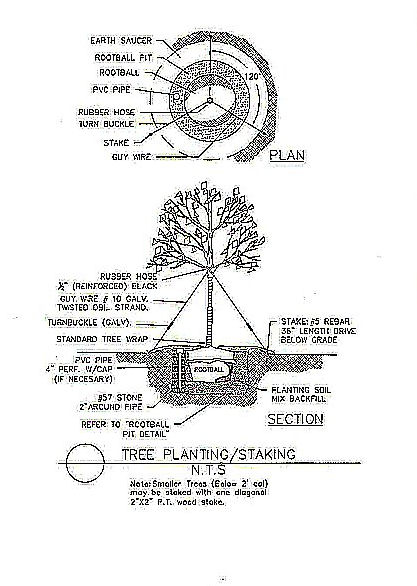
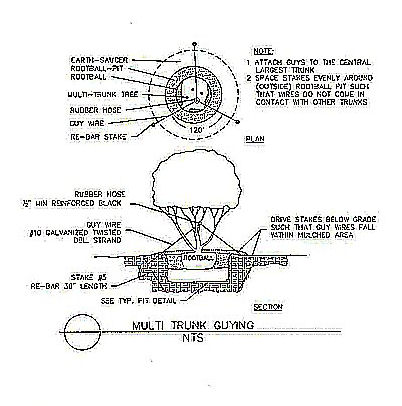
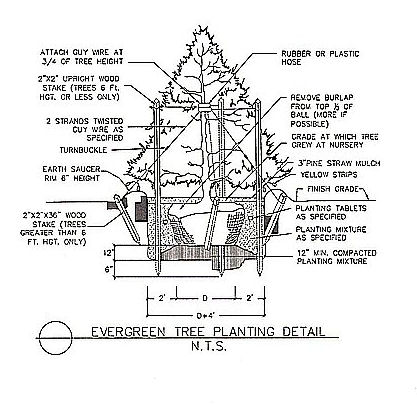
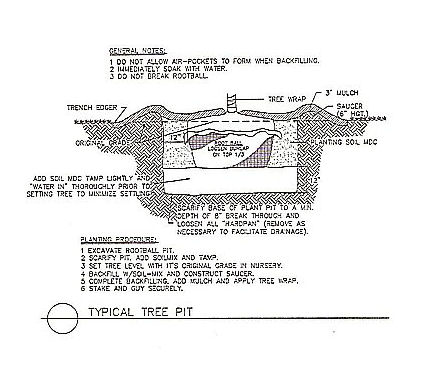
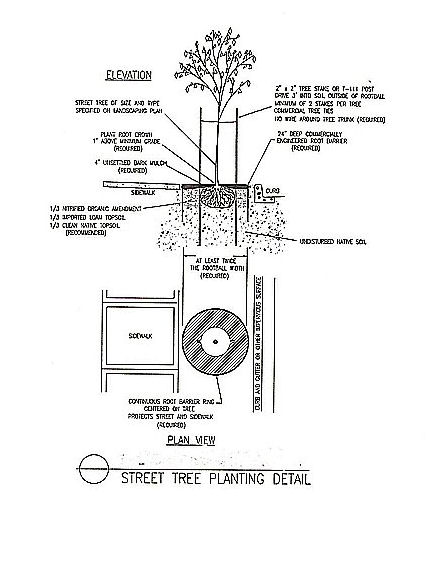
19.10-4 Planting of New Trees. If the required site density factor cannot be accomplished with existing trees, replacement trees shall be planted as required by this ordinance. Using the guidelines provided in section 9.3.3 below, the precise locations may be at the discretion of the arborist. Trees selected for planting must be free from injury, pests, disease, nutritional disorders or root defects, and must be of good vigor in order to assure a reasonable expectation of survivability.
19.10-5 Standards for transplanting shall be in keeping with those established in the International Society of Arboriculture publication, "Tree and Shrub Transplanting Manual" or similar publication. Use as a reference the American Association of Nurserymen publication "American Standard for Nursery Stock", (ANSI Z60, 1973) for plant material quality specifications. Also, reference the latest edition of the "Manual for Woody Landscape Plants:" by Michael Dirr, ISA Guidelines and ANSI Standards or other similar publications for information on site requirements for various tree species.
Guidelines:
1.
To replace those removed plant new trees in landscaped portions of parcel.
2.
Plant new trees on lands that currently lack trees (usually pasture or farmland).
3.
Plant new trees on portions of the project area set aside as tree save areas.
A plant material list shall be provided when new plant material are to be installed including:
1.
Common and botanical names of all proposed plants.
2.
Plant quantities.
3.
Size and condition of plants. (Example: two inch caliper, six feet height, balled and burlapped).
4.
Spacing.
19.10-6 Artificial Materials Prohibited. All artificial plants, trees, shrubs, grass or other vegetation shall be prohibited from fulfilling the requirements of this ordinance.
19.10-7 Minimum Density. In the event that the minimum tree density cannot be met on a parcel then there shall be determination made by the county arborist that density requirements are met when the developer or owner of the property demonstrates that everything possible has been done to accomplish site density requirements.
19.11 - Tree Preservation and Replacement Plan.
Three copies, either as separate or combined drawings, along with other permit drawings, are to be submitted as part of the plan approval and/or land disturbance permit process to the Troup County Office of Building and Inspections. These plans will be reviewed by the county arborist/landscape architect for compliance with the zoning and development ordinance of Troup County and this tree preservation ordinance in particular and either approved, denied, or returned for revisions. Any comments shall be made available to the designer for response or revision to the drawings. The plans shall then be re-submitted (along with previous red line comments), with the necessary changes, following the same procedure as if it were an original application. Issuance of a land disturbance permit is contingent upon approval of the tree preservation and replacement plan.
19.11-1 Prepared by a Professional. Tree preservation and replacement plans shall be prepared by a professional landscape architect, urban forester or ISA Certified Arborist, other state licensed professionals of similar design discipline may be authorized by the arborist to prepare tree preservation and replacement plans, provided they demonstrate, to the satisfaction of the arborist, competency and knowledge in the principles and practices of arboriculture as well as the demonstrated ability to prepare such plans in accordance with this ordinance. Continuous and excessive reviews and re-submittals may disqualify the designer from further acceptance by the arborist.
19.11-2 Tree preservation and replacement plans must include the following:
1.
Tree Inventories and Surveys. Compliance with the required site density factor shall be demonstrated on the tree protection and replacement plan. The density of 20 units per acre is based on the acreage of the overall site. All trees that are to be counted toward meeting density requirements must be inventoried or sampled based on the size of the property.
2.
Compliance. Tree inventories and surveys compliance with the required site density factor shall be demonstrated on the tree protection and replacement plan. All trees that are to be counted toward meeting density requirements must be inventoried or sampled based on the size of the property.
3.
Survey methods. The method used to inventory the trees must be indicated on the plans. Only trees with a DBH of five inches and larger are given tree density unit credits and should be sampled or inventoried. The method used to inventory the trees must be indicated on the plans. Only trees with a DBH of five inches and larger should be sampled or inventoried.
a.
Large Tract Survey. On tree save areas greater than three acres, all tree save areas must be surveyed using an approved scientific sampling method (e.g., basal area).
b.
Sampling Area. Timber cruising methods (50-foot by 50-foot sample areas or the prism method) of sampling is needed for large tracts. The larger the site the more sample areas should be taken.
4.
Sampling. Sampling should be done in areas to remain as undisturbed tree save areas, not areas intended for development. The contents of each sample area shall be inventoried. All sampling areas shall be accurately depicted on the tree protection and replacement plan and appropriately flagged to corresponding locations on the actual site. When using sample areas, the basal area units should be averaged and an existing density factor per acre determined. Using this tree density, the appropriate amount of tree save area should be preserved to meet the site density factor requirements. These calculations must be included on the tree plan.
5.
Sampling, Small Tracts. On tree save areas of three acres or less, all trees to be considered for density requirements must be individually inventoried. This tree inventory list and tree locations must be shown on the plan. The existing tree line and vegetation characteristics of the site shall be shown on the plans. Existing trees or stands of trees used in the density calculations must be indicated on the plan. The tree save areas should be clearly shown on the plans with their size in acres. Areas designated as tree save areas must be wooded.
6.
Exact Location of all Specimen and Heritage Trees. Special consideration shall be given to specimen and heritage trees on development sites. Specimen trees and heritage trees must be shown on the tree preservation and replacement plan with an indication whether they are to be retained or removed and reason for removal. Said trees must be flagged and numbered in the field with correlating numbers and exact location shown on the plan. Extra tree density credit will be given for saved specimen and heritage trees. If no design features accommodate their preservation, removed specimen trees require recompense plantings of comparable species. Refer to appendix A for specimen tree criteria and tree density unit values. Use the values in the replacement tree density chart (appendix C, table B) to determine the quantity and sizes of the needed recompense trees. Heritage trees that are shown for removal must show that the tree is diseased or dead before the county arborist will approve their removal. Heritage trees are unique to Troup County due to size, age or historic value and shall not be removed unless diseased, dead or dying.
7.
All Tree Save Areas Must be Delineated on the Tree Protection and Replacement Plan. Methods of tree protection shall be indicated for all Tree Save Areas and Specimen/heritage trees, including tree save fencing, erosion control, retaining walls, tree wells, tunneling for utilities, aeration systems, transplanting, signage, etc.
8.
Buffers. All buffers must be identified on the tree protection and replacement plan any portion of a zoning buffer lacking sufficient vegetation to provide effective visual screening must be supplemented with evergreen plantings. A detailed planting plan for these areas is required. Planted trees must be a minimum six feet tall.
9.
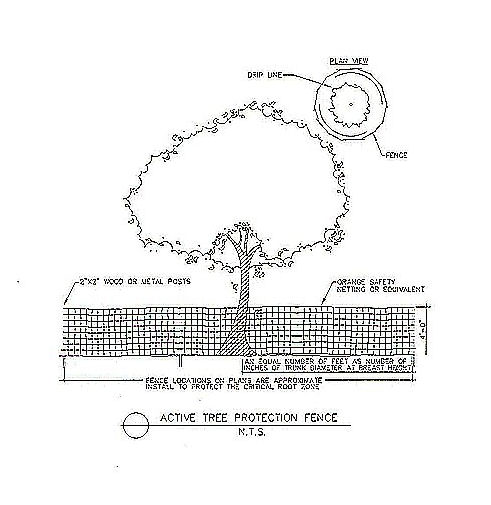
Indicate Limits of Disturbed Area. During construction, tree save areas, zoning buffers, stream buffers, open space and specimen/heritage trees must be properly protected from disturbance using high visibility orange tree save active fencing. These tree save areas and the active tree save fencing locations must appear on the clearing, grading, erosion control and tree protection plans.
10.
Utilities. Existing and proposed location of underground utilities or easements must be shown. Indicate staging areas for parking, material storage, concrete washout, debris burn and burial holes where these areas might negatively impact protected trees.
11.
Location and Schedule. The locations of all trees to be planted to meet site density factor requirements. All required landscaping such as street trees, parking lot trees and landscape strips should be shown graphically on the plans. In addition, a detailed planting schedule showing the type (common and botanical names), sizes and quantity of trees to be planted, and any special planting notes. Trees planted for specimen tree recompense and parking lot trees, are not included in overall tree density calculations. These are additional requirements.
12.
Tree Types. Tree preservation and replacement plans that consist of more than ten new trees shall incorporate at least three separate tree genera whereby no single tree genus accounts for more than 33 percent of all newly planted trees. A narrative explaining the actual planting dates is needed for larger sites. Remote and/or large replanting areas such as zoning buffers are best planted between November and April. Indicate clearly on the tree protection and replacement plan when planting will take place.
13.
Additional Information. Any additional information as required by the arborist on a case by case basis. After the submission of the plan, the arborist will perform a site inspection. The tree protection and replacement plan shall provide sufficient information and detail to clearly demonstrate that all applicable requirements and standards of this ordinance are or will be fully satisfied.
19.12 - Tree Preservation Standards During Construction.
In addition to proper utilization of tree protection devices (see section 19.12-1), the following measures are detrimental to the long term health and survivability of trees.
Prevention of the following:
1.
The improper use of machinery on the trees;
2.
The storage of materials in or around the trees;
3.
Altering the natural grade to expose the roots or to cover the tree's root system with more than four inches of soil;
4.
Causing the infection or infestation of the tree by pests, fungus or harmful bacteria;
5.
Pruning judged to be excessive by the arborist or not in accordance with the standard set forth by the International Society of Arboriculture (ISA);
6.
Paving with concrete, asphalt or other impervious surface within such proximity as to be harmful to the tree or its root system; and
7.
Application of an herbicide, including pre-emergent herbicides, defoliant, to any tree without first obtaining a permit;
8.
Soil compaction in the critical root zone from heavy equipment, vehicular; or excessive pedestrian traffic, or storage of equipment or materials;
9.
Root disturbance due to cuts, fills or trenching;
10.
Wounds to exposed roots, trunks or limbs;
11.
Other activities such as chemical storage, cement truck cleaning, fire, etc.
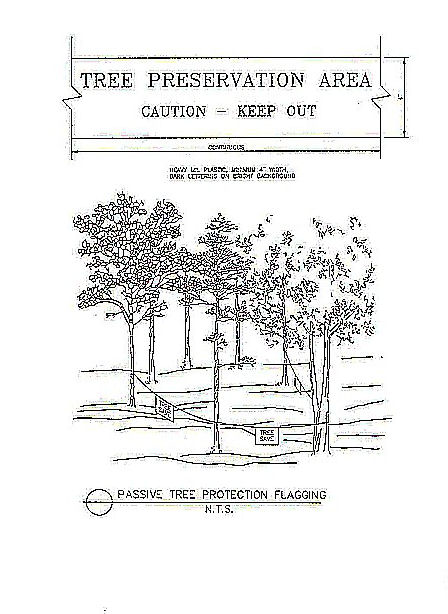
19.12-1 Location and Types of Tree Protection Devices. Tree protection devices are to be installed completely surrounding the critical root zone of all trees or group of trees to be preserved. Active protection (see section 19.12-2a) is required where tree save areas are located along the limits of disturbance. Passive protection (see section 19.12-2b) may be used in more remote tree save areas as determined by the arborist. Once tree save areas are established and approved, any changes are subject to review and written approval by the arborist.
19.12-2 Materials.
a.
Active Tree Protection shall consist of chain link, orange laminated plastic, wooden post, rail fencing or other equivalent restraining material.
b.
Passive Tree Protection shall consist of heavy (as determined by arborist) mill plastic flagging of a bright color or equivalent signage on a continuous, durable restraint sufficient to delineate the bounds of any tree protection or save areas. See appendix E.
19.12-3 Sequence of Installation and Removal. All tree protection devices shall be installed prior to any land disturbing activity. The arborist will inspect the installation of tree protection devices. It shall be the sole responsibility of the property owner and/or developer to ensure that all tree protection devices remain in functioning condition throughout all phases of development and shall not be removed until final landscaping is installed. In the event passive tree protection is not kept in functioning condition, active tree protection may be required throughout the project.
19.12-4 Encroachment. If encroachment into a tree save area occurs, that causes irreparable damage to the trees, the tree preservation and replacement plan shall be revised to compensate for the loss. Under no circumstances shall the developer be relieved of responsibility for compliance with the provisions of this ordinance, nor shall plan revision activities stop the county from instituting action for violation of this ordinance.
19.12-5 Other Specifications. Where clearing has been approved, trees shall be removed in a manner that does not physically impact the trees to be preserved. Felling trees into tree save areas or disturbing roots inside the tree save areas shall be treated as a violation and shall be punishable in accordance with this ordinance. All erosion and sedimentation control measures shall be installed so that sediment will not accumulate within the tree save area. All tree protection areas shall be designated as such with "tree protection area" signs posted visibly on all sides of the fenced-in area. These signs are intended to inform subcontractors of the tree protection process. Signs requesting subcontractor cooperation and compliance with the tree protection standards are recommended for site entrances.
19.13 - Tree Replacement Standards.
Species selected for replacement must be quality species, and must be ecologically compatible with the intended site. See appendix D for list of recommended species. Deviations from the recommended tree planting list are acceptable for use in meeting density requirements only with prior approval from the arborist.
19.13-1 Minimum Planting Area. In order to provide sufficient growing area for planted trees, the following minimum criteria must be observed unless otherwise approved by the arborist:
Overstory (Canopy) Trees: 450 square feet.
Understory Trees: 200 square feet.
Planting Strips: (refer to Article VIII of the Troup County Zoning Ordinance).
19.14 - Warranty or Maintenance Surety.
Upon final installation of new trees, shrubs or other landscape material planted to meet the requirements of this ordinance, and before acceptance by the county arborist, the owner shall either post a maintenance bond or letter of credit in an amount equal to 75 percent of the value of the new trees or landscape material and their installation, warranting the new trees, shrubs or landscape material for a period of no less than 15 months from approval of final plat or certificate of occupancy.
1.
Inspection. The arborist shall perform an inspection of the plantings and landscape materials required by this ordinance prior to the end of the 15-month warranty period. The owner shall be provided written notice of any replacements or restoration that must be made to maintain compliance with this ordinance or conditions of zoning, special use, or variance approval as pertains to trees and landscaping. Required landscape material found to be dead or near death shall be replaced prior to release of the warranty by the county. In no case shall replacement be delayed greater than 30 days from notification unless an additional performance bond is posted with the county.
2.
Performance Surety. In the event that new trees required to be planted as set forth herein, cannot be installed upon application for a certificate of occupancy or final plat approval as appropriate to the project, then at the discretion of the arborist, a performance bond or letter of credit in an amount equal to 130 percent of the value of the new trees or landscape material and their installation may be accepted in accordance with the performance bonding requirements and provisions of the county.
19.15 - Compliance upon Permit Completion or Expiration.
Properties where a permit is issued to conduct land disturbing activities that does not require the issuance of a certificate of occupancy or the approval of a final plat, shall comply with the tree density standard of this ordinance as follows:
19.15-1 Clearing, Clearing and Grubbing, or Grading Only Permits. A performance bond or letter of credit shall be posted with the county for the replacement units prior to the issuance of a land disturbance permit. The amount shall be equal to 130 percent of the value of the new trees or landscape material and their installation.
19.15-2 Continuing Maintenance. The owner, occupant, tenant, and respective agent of each, if any, shall be jointly and severally responsible for the perpetual maintenance and protection of buffers and landscape plantings required by this ordinance. The county arborist is hereby authorized to order diseased, infested, dying, dead or damaged landscaping required herein to be replaced. Replacement trees and landscaping shall be in accordance with the applicable provisions of this ordinance.
19.16 - Variances.
All petitions shall require a public hearing before the board of zoning appeals/planning commission and shall be subject to the provisions for variances as defined in Article XVIII of the Troup County Zoning Ordinance and the application requirements of the Troup County Office of Building and Inspections.
19.17 - Non-liability of County.
The contents of this ordinance shall not in any way be deemed to impose any liability upon Troup County, the board of commissioners or county employees nor shall it relieve the owner and occupant of any private property from the duty to keep trees upon private property or under his/her control in a safe condition as not to affect the health, safety and general welfare of the public.
APPENDIX A
SPECIMEN TREES
Some trees on a site warrant special consideration and encouragement for preservation. These trees are referred to as Specimen Trees.
The following criteria are used to identify Specimen Trees. Both the size and condition criteria must be met for a tree to qualify.
Size Criteria
Overstory Trees: 24 inches diameter DBH or larger.
Understory Trees: Ten inches diameter DBH or larger.
Condition Criteria
Life expectancy of greater than 15 years
Relatively sound and solid trunk with no extensive decay
No more than one major and several minor dead limbs
No major insect or pathological problem
As determined by county arborist
Type
Loblolly and slash pines do not qualify as specimen trees. In order to encourage the preservation of specimen trees and the incorporation of these trees into the design of projects, additional density credit will be given for specimen trees which are successfully saved by a design feature specifically designated for such purpose. Credit for any specimen tree thus saved would be four times the assigned unit value shown in appendix C—Table A. To qualify, these trees must be within or directly adjacent to the developable areas of the site. Specimen trees which lie inside areas already protected, such as buffers, wetlands or open space areas shall not receive extra density credit.
Considering every development site and situation will be different, specimen tree preservation cannot be expressed as a formula, but is a required design criteria. If the tree preservation plan submitted for a development site does not incorporate design features to preserve specimen trees, an alternate site design may be required. To ensure that preservation of specimen trees is afforded a high priority, the alternate design features may include revised building designs and locations, parking lot designs and locations and also infrastructure modifications.
While it is understood that all specimen trees cannot be preserved in a development, this program will be closely examined on every project prior to approval of any and all site plans. In this connection, the remaining specimen trees on site, which are allowed to be removed, will require recompense planting equaling two times their density unit value in appendix C—Table A. Specimen trees must be replaced by species with potentials for comparable size and quality. Specimen recompense trees must be a minimum four-inch caliper at the time of planting.
If a specimen tree is to be removed, a plan or written documentation indicating the reason for the removal must be submitted to the arborist.
In addition to the penalties addressed in section 4.1.1.2 of this ordinance, any specimen tree which is removed without the appropriate review and approval of the arborist must be replaced by trees with a total density of eight times the unit value of the tree removed. Size alone will determine whether a tree was of specimen quality if the tree is removed without approval and there is no evidence of its condition.
APPENDIX B
HERITAGE TREES
Troup County residents have long enjoyed an abundance and diversity of trees and forests. These have served as resources for shelter and products, shaded homes and streets, and immeasurably added to the aesthetic character of rural areas, towns and neighborhoods.
The Troup County Heritage Tree Register will recognize a noteworthy tree or trees or groves of trees and acknowledge the significance selected individual trees or stands have had to our communities. It is the intent of this ordinance that this process of identifying and publicly noting significant (heritage) trees and maintaining the register listings with accurate historical and current data should result in appropriate maintenance and adequate consideration being given to the status of trees as assets of particular vulnerability in changing areas.
Heritage trees are individual trees or groves of trees of any size or species that are specially designated as heritage because of their historical, commemorative, or horticultural significance. The list of designated heritage trees remains open for new designations and provides useful information to the planning and zoning staff regarding the importance of their actions while planning activities near heritage trees.
Troup County shall compile a list of heritage trees which may also include the oldest, tallest, largest, endangered and rarest native and exotic tree species growing in the county.
Anyone may nominate a heritage tree by contacting the planning and zoning office or county arborist. Upon nomination by any person and with the written consent of the property owner(s), the county may designate a tree or trees as a heritage tree. After county approval of a heritage tree designation, the county arborist shall notify the property owner(s) in writing.
No tree on private property can be designated without the consent of the current property owner.
Once designated by current owner as a heritage tree, this ordinance further states that it is unlawful for any person, without a prior written permit from the county arborist, to remove, destroy, cut, prune, break or injure any heritage tree. No heritage tree can be removed without the consent of the county arborist. If heritage tree becomes a hazard follow steps as defined in section 19.6. Requests for the removal of a heritage tree will be denied unless one of the following findings is made:
1.
There is a public benefit, or a public health, safety, or welfare benefit, to the injury or removal that outweighs the protection of the specific tree (public benefit means a public purpose, service, or use which affects residents as a community and not merely as particular individuals); or
2.
The present condition of the tree is such that it is not reasonably likely to survive; or
3.
There is an objective feature of the tree that makes the tree not suitable for protection; or
4.
There would be a substantial hardship to a private property owner in the enjoyment and use of real property if the injury or removal is not permitted; or
5.
To not permit the injury or removal would constitute a taking of the underlying real property tree removal requests with a discretionary action will be reviewed by the county.
Decisions on tree removal are subject to standard appeal.
APPENDIX C
SITE DENSITY REQUIREMENTS
The basic requirement of the tree preservation ordinance is that all applicable sites retain a minimum tree density as defined in section 8. The term "unit" is an expression of basal area (a standard forestry inventory measurement), and is not synonymous with "tree". A single tree equal to one tree unit is between 13 and 14 inches in diameter. This density requirement must be met regardless of if the site had sufficient tree density prior to development. For these sites, the density may be achieved by counting existing trees to be preserved, planting new trees, or some combination of the two as represented by the formula below.
SDF=EDF+RDF
SDF (Site Density Factor)—The minimum tree density to be met on a development site, expressed in units per acre.
EDF (Existing Density Factor)—The total number of trees density units measured or calculated based on tress that will remain as conserved on site.
RDF (Replacement Density Factor)—The density or total unit value of new trees to be planted on a site.
The site density factor (SDF) is calculated by multiplying the number of site acres by units per acre required.
Tree density calculations for a two and two-tenths acre example residential site would be as follows:
Two and two-tenths acres by 20 units per acre equal a SDF of 44 units.
The existing density factor (EDF) is calculated by converting the diameter of individual trees to density factor units using table A.
Therefore, with a site density factor requirement of 44 units, a tree save area totaling 44.6 density units satisfies the site density requirement. These trees will be protected in a tree save area.
TABLE A
Conversion of Existing Tree Diameters (DBH) to Density Factor Units
The unit value of an individual tree may be determined by using the formula: (Diameter) 2× .7854 ÷ 1449
Replacement density factor (RDF)—If enough trees do not exist onsite to meet the tree density requirements, replacement trees will be needed. Calculate the RDF by subtracting the EDF from the SDF.
For instance, if it was determined that the two and two-tenths acre sample site mentioned earlier had only enough existing trees to yield a 30-unit per acre EDF, then replacement trees totaling 14 density factor units would be required.
SDF (44) − EDF (30) = RDF (14)
The density factor unit value for each caliper size of replacement (new) trees is shown in table B. Replacement tree caliper is measured at a point on the trunk six inches from the base.
TABLE B: Conversion of Replacement Tree Caliper to Density Factor Units
The values in table B shall also be used to determine the quantity of replacement trees needed for any specimen tree recompense planting. This planting is additional to planting required for site density requirements.
Pasture Land Reduction
It is recognized that some properties, or portions of them, may be devoid of trees due to agriculture use. In these cases a reduction of minimum tree density is warranted for new developments. In areas that meet the description of pasture land, the required minimum tree density shall be one-half the amount shown on the site density requirements. Since most of the pasture land will be located in the agricultural or agricultural-residential zoning district then use the following numbers for example:
Wooded site SDF is calculated by multiplying the number of total site acres by 20.
EXAMPLE: a ten-acre site has a SDF of 10×20 = 200 units.
Pasture land SDF is calculated by multiplying the number of total site acres by ten.
EXAMPLE: a ten-acre site has a SDF of 10×10 = 100 units.
Mixture of wooded and pasture land SDF is calculated using each component's unit per acre requirement.
EXAMPLE: a ten-acre site has eight acres wooded and two acres pasture land a SDF of (8×20 = 160 units) + (2×10 = 20 units) for a total SDF of 180 units.
Easement Exclusion
Properties possessing natural gas, petroleum or electric power transmission easements, or major sanitary sewer main (greater than eight inches in diameter) or water main (greater than 16 inches in diameter) distribution easements, may exclude the land area contained in the easement from the total acreage of the property in fulfilling the site density factor provided that no improvements (e.g., parking lots, tennis courts, driveways, storm water detention facilities, etc.) are proposed within the easement. If any improvements are proposed within the easement, then the land area so utilized within the easement for improvements shall be included in the site density factor requirements.
Lake and Pond Exclusion
Properties with an existing lake or pond greater than one acre in size may exclude the land area contained in the lake or pond from the total acreage of the property in fulfilling the site density factor.
Partial Exclusion of Buffers from Tree Density Requirements
When designing a site, tree preservation shall not be limited to unusable, remote areas of the site. Tree preservation areas should be more evenly distributed around these sites. The intent is to preserve some natural characteristics of the site, such as quality existing vegetation, specimen and heritage trees for aesthetics and conservational purposes.
In an effort to preserve trees and other natural vegetation within a development, a certain amount of the required 50 percent of the required post-development tree density shall be met outside stream bank and zoning buffer areas. The tree requirement cannot be fully satisfied by trees in buffer areas. The area of a development outside buffer areas must separately meet at least 50 percent of the required per acre tree density, even if trees in buffer areas would compensate or more than compensate.
The 20-unit per acre overall tree density must be met with a minimum of ten-tree density units per acre outside buffers. To calculate this, simply subtract the buffer acreage from the overall site acreage and multiply by ten.
For this example: A 30-acre site which contains five acres of buffer areas. A 30-acre site minus five acres of buffers equals 25 acres outside of buffers. Twenty-five times ten units per acre results in a minimum of 250-tree density units to be met outside buffers. It is expected that a combination of tree save areas, preserved specimen and heritage trees and quality replanted trees will be used to meet this requirement within this developed area.
It is understood that many times open or sparsely vegetated zoning buffers will require supplemental or complete planting to meet visual screening requirements; therefore, trees planted for this purpose may count towards this ten unit per acre requirement.
If the development site does not include stream bank buffers or zoning buffers proper design and planning should be implemented to achieve the intent of this ordinance also.
Example:
30 acres × 20 units per acre = 600 units
600 units × 50 percent = 300 units minimum to be provided outside the buffer areas. A combination of trees save areas, preserved specimen and heritage trees and quality replanted trees will be used to meet this requirement within this developed area.
It is understood that many times open or sparsely vegetated zoning buffers will require supplemental or complete planting to meet visual screening requirements; therefore, trees planted for this purpose may count towards the SDF.
APPENDIX D
TABLE A-1
TABLE A-2
TABLE B-1
TABLE B-2