
Tuscaloosa City Zoning Code
ARTICLE II
DEFINITIONS AND RULES FOR MEASUREMENT
Sec. 25-18. - Meanings and intent.
All provisions, terms, phrases, and expressions contained in this ordinance shall be interpreted in accordance with the general purposes set forth in section 25-3, general purpose and intent, and the specific purpose statements set forth throughout the ordinance. When a specific section of the ordinance gives a different meaning than the general definition provided in this article, the specific section's meaning and application of the term shall control.
(Ord. No. 9572, § 2, 12-17-24)
Sec. 25-19. - Headings, illustrations, and text.
In the event of a conflict or inconsistency between the text of this ordinance and any heading, caption, figure, illustration, table, or map, the text shall control. Graphics and other illustrations are provided for informational purposes only and should not be relied upon as a complete and accurate description of all applicable regulations or requirements.
(Ord. No. 9572, § 2, 12-17-24)
Sec. 25-20. - Lists and examples.
Unless otherwise specifically indicated, lists of items or examples that use terms like "for example," "including," and "such as," or similar language are intended to provide examples and are not exhaustive lists of all possibilities.
(Ord. No. 9572, § 2, 12-17-24)
Sec. 25-21. - References to other regulations and publications.
Whenever reference is made to a resolution, ordinance, statute, regulation, or document, it shall mean a reference to the most recent edition of such regulation, resolution, ordinance, statute, regulation, or document, unless otherwise specifically stated.
(Ord. No. 9572, § 2, 12-17-24)
Sec. 25-22. - Delegation of authority.
Any act authorized by this ordinance to be carried out by the director of planning may be delegated by the director of planning to a professional-level city employee under the director of planning's authority or control.
(Ord. No. 9572, § 2, 12-17-24)
Sec. 25-23. - Public officials and agencies.
All public officials, bodies, and agencies to which references are made are those of the city, unless otherwise indicated.
(Ord. No. 9572, § 2, 12-17-24)
Sec. 25-24. - Mandatory and discretionary terms.
The words "shall," "must," and "will" are mandatory, establishing an obligation or duty to comply with the particular provision. The words "may" and "should" are permissive.
(Ord. No. 9572, § 2, 12-17-24)
Sec. 25-25. - Conjunctions.
Unless the context clearly suggests the contrary, conjunctions shall be interpreted as follows:
a.
"And" indicates that all connected items, conditions, provisions, or events apply; and
b.
"Or" indicates that one or more of the connected items, conditions, provisions, or events apply.
(Ord. No. 9572, § 2, 12-17-24)
Sec. 25-26. - Tenses and plurals.
Words used in the present tense include the future tense. Words used in the singular number include the plural number and the plural number includes the singular number, unless the context of the particular usage clearly indicates otherwise. Words referring to a specific gender may be extended to any other gender.
(Ord. No. 9572, § 2, 12-17-24)
Sec. 25-27. - Term not defined.
If a term used in this ordinance is not defined in this ordinance, the director of planning is authorized to interpret its meaning in accordance with section 25-46, interpretation. Such interpreted meaning shall be based upon the definitions used in accepted sources—including, but not limited to, A Planners Dictionary, A Glossary of Zoning, Development, and Planning Terms, A Survey of Zoning Definitions (all published by the American Planning Association), and Black's Law Dictionary, as well as general dictionaries such as Merriam-Webster, American Heritage, Webster's New World, and New Oxford American dictionaries.
(Ord. No. 9572, § 2, 12-17-24)
Sec. 25-28. - Building measurements.
a.
Building footprint. The area of a building measured at its outside walls at its exterior faces of the exterior walls, including covered porches or entryways that may not have walls, but not including uncovered porches, terraces, steps, or courtyards.
b.
Building height in feet. The vertical distance measured from the mean level of the finished grade abutting all sides of the building to the following points:
1.
For mansard roofs, to the deck line;
2.
For gable, gambrel, and hip roofs, to the mean height between eaves and ridges; and
3.
For flat roofs and all other types of roofs, to the highest point excluding chimneys, spires, elevator penthouses, parapets, and similar projections.
c.
Building height in stories. The height of each story in a building is measured from the top of the finished floor to the ceiling above. An attic is not considered a building story if fifty (50) per cent or more of the attic floor area has a clear height of less than seven and one-half (7½) feet, measured from the finished floor to the finished ceiling. A building level such as a basement or subterranean parking deck is not considered a building story if fifty (50) per cent or more of its perimeter wall area is surrounded by natural grade.
d.
Gross floor area. The sum of the horizontal areas of all the floors of a building, measured from the exterior faces of the exterior walls or center lines of walls separating two (2) buildings. Open balconies, rooftops, parking areas, basements and cellars not designed for occupancy, elevator shafts, and ventilation shafts are not included in gross floor area.
(Ord. No. 9572, § 2, 12-17-24)
Sec. 25-29. - Lot measurements.
a.
Buildable area. The area of the lot excluding areas within each lot line and the minimum setback lines.
b.
Ground coverage ratio. The percentage of the lot area covered by buildings, measured using the building footprint(s).
c.
Lake frontage width. The length of the portion of a lot bordering Lake Tuscaloosa along the acquisition line.
d.
Lot area. The area included within the rear, side, and front lot lines, not including existing or proposed right-of-way, whether dedicated or not dedicated to public use.
e.
Lot depth. The distance between the front and rear property lines measured along a line midway between the side property lines. For lots of irregular configuration, the director of planning shall determine the method of calculating lot depth.
f.
Lot width. The distance between the side lot lines (generally running perpendicular to a street) measured at the front setback line along a straight line or along the chord of the front setback line.
g.
Lot frontage. The length of the portion of a lot nearest a street. A lot adjacent to multiple streets is considered to have multiple frontages for purposes of determining the minimum front setbacks of a lot.
h.
Lot types. Lots are classified as follows:
1.
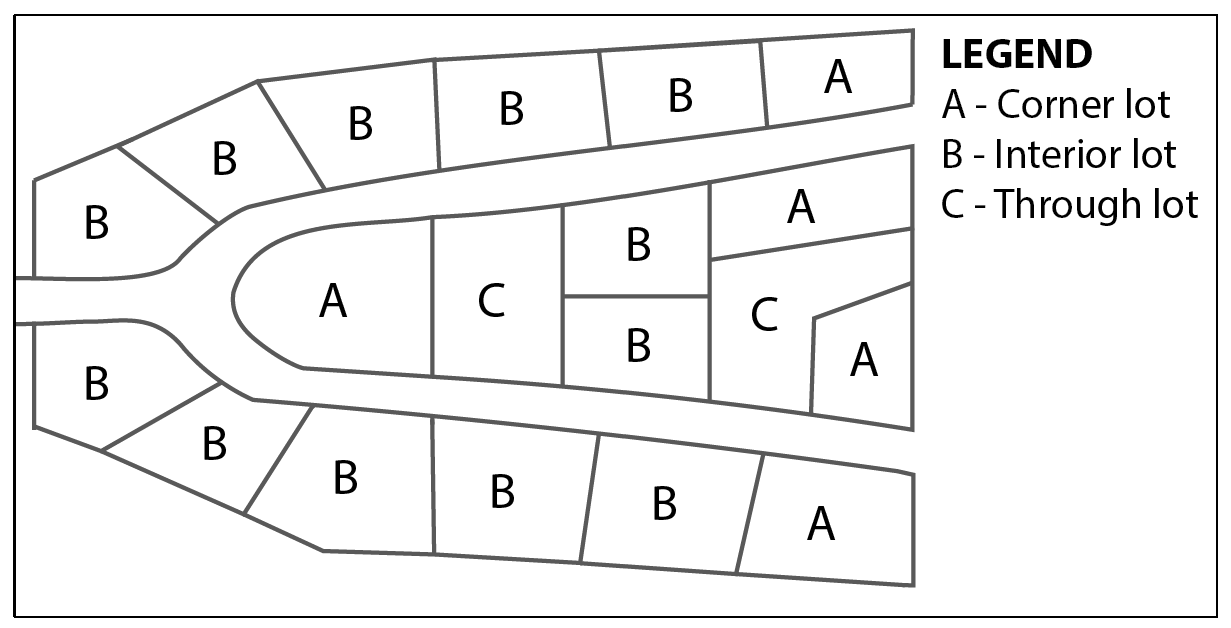
Corner lot. A lot located at the intersection of two (2) or more streets. A lot abutting on a curved street or streets shall be considered a corner lot if straight lines drawn from the foremost points of the side lot lines to the foremost points of the lot meet an interior angle of less than one hundred thirty-five (135) degrees (see figure II-1). A corner lot shall designate one primary street; all other streets abutting the lot shall be considered side streets. (Corner lots are marked "A" in figure II-2).
Figure II-1: Measurement of Angles Abutting Curved Street
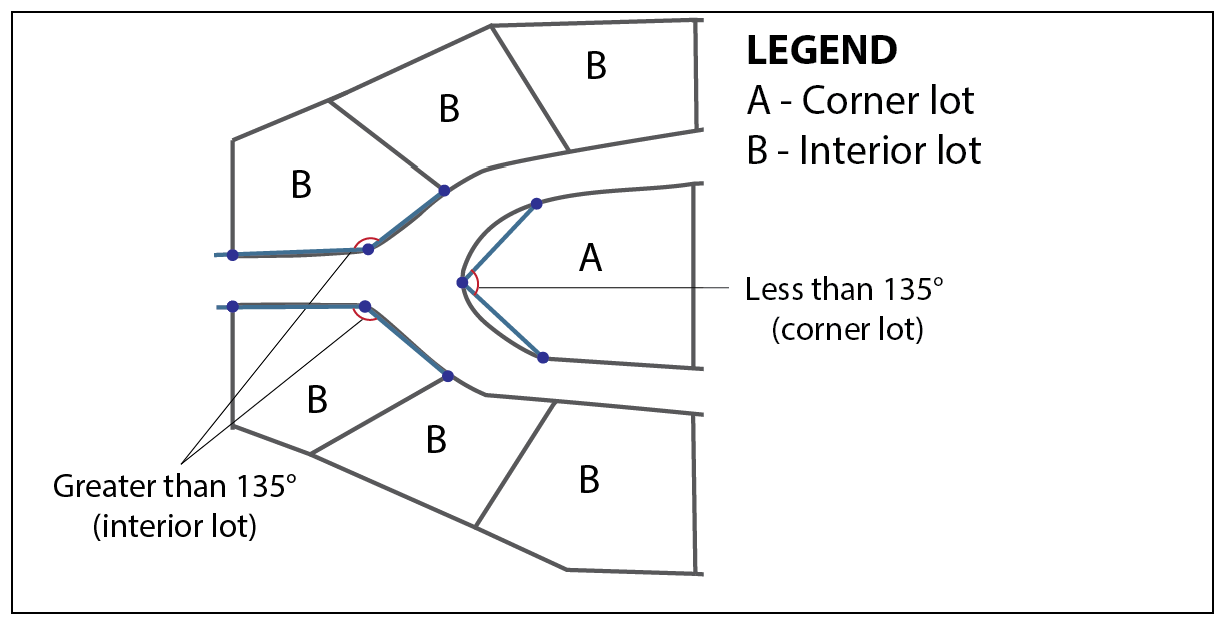
Figure II-2: Examples of Lot Types
2.
Interior lot. A lot other than a corner lot with only one frontage on a street. (Interior lots are marked "B" in figure II-2).
3.
Through lot. An interior lot with frontage on more than one street. (Through lots are marked "C" in figure II-2).
i.
Setback. A required distance, specified in the standards of a zoning district, between a lot line and the closest projection of a building or structure, extending along the entire length of the lot line. Where a minimum setback is specified, it shall be the required minimum distance which shall be unoccupied and unobstructed by any structure except as provided in section 25-30, allowable encroachments, or elsewhere in this ordinance. Where a maximum setback is specified, it shall be the maximum distance between the lot line and the closest projection of the principal building or structure. Setbacks are measured as follows:
1.
Primary and side street setbacks, and front setbacks. Measured from the edge of each right-of-way. Except as otherwise provided in this ordinance, on any lot with more than one street frontage, such as a corner lot (see definition of "corner lot" above), the minimum front setback from the side street right-of-way shall be equal to two-thirds (⅔) of the minimum front setback that applies in the zoning district in which the lot is located.
2.
Side interior setbacks. Measured from the side lot line.
3.
Rear setbacks. Measured from the rear lot line or, where there is an alley, from the edge of the right-of-way. In the case of through lots and corner lots, there may be no rear setback, but only front and side setbacks.
j.
Yard. An open space between the principal building or structure on a lot and the nearest lot line, unobstructed and unoccupied from the ground upward except as otherwise provided in this ordinance. There are three (3) types of yards:
1.
Front yard. A yard abutting a public street. Through lots and corner lots have front yards on all street frontages.
2.
Side yard. A yard abutting a side lot line.
3.
Rear yard. A yard abutting the rear lot line or, where there is an alley, from the edge of the right-of-way. Through lots and corner lots may have no rear yard, but only front and side yards.
k.
Lot line. A boundary dividing a lot from another lot or from a public or private right-of-way.
1.
Lot line, front. A lot line forming a boundary between the lot and the right-of-way of a street other than an alley.
2.
Lot line, side. A lot line that is not a front lot line and that intersects with a front lot line.
3.
Lot line, rear. A lot line that is not a front lot line or a side lot line.
(Ord. No. 9572, § 2, 12-17-24)
Sec. 25-30. - Allowable encroachments.
a.
General. Fixtures and features that are permitted to encroach into required minimum setbacks are listed in table II-1: allowable encroachments into yards.
Table II-1: Allowable Encroachments Into Yards
b.
Mechanical units. An air conditioning compressor or heat pump that was legally installed as of January 1, 2025 may be replaced with a new unit installed in the same location, even if the air conditioning compressor or heat pump is closer to the lot line than allowed by table II-1: allowable encroachments into yards, provided that the new air conditioning compressor or heat pump is no closer to the lot line than the prior unit.
(Ord. No. 9572, § 2, 12-17-24)
Sec. 25-31. - Definitions.
The following terms, when used in this ordinance, shall have the meaning ascribed to them below.
Abutting means having a common boundary line, such as two (2) contiguous parcels with a shared lot line.
Accessory use or structure means a structure or use which is subordinate to and serves a principal structure or principal use and is subordinate in extent, area or purpose to the principal structure or use served; and which is located on the same lot as the principal structure or use.
Acquisition line means the line which marks the limits of the city's ownership of Lake Tuscaloosa, including all land within the lake's fifty-year floodplain, at approximately the two-hundred-thirty-foot elevation line.
Adjacent means having an abutting boundary line or being separated only by a street, easement, stream, or other right-of-way, such as two (2) parcels separated by a public street.
Administrative adjustment means a uniform mechanism for the director of planning to approve minor adjustments from the dimensional or design standards of this ordinance to better accomplish the purposes of this ordinance. See section 25-44, administrative adjustment.
Aerodrome means an airfield meeting all standards of the Federal Aviation Administration that supports takeoff and landing of helicopters and airplanes that can operate on short take-off and landing fields. This includes heliports and ancillary facilities such as lounges and aircraft fueling.
Alley means a street or highway intended to provide access to the rear or side of lots or buildings in urban areas and not intended for the purpose of through vehicular traffic.
Animal shelter means an establishment that houses and cares for stray, homeless, abandoned, or neglected household and domestic animals and that is owned, operated, or maintained by a public body or an established humane society or other private or nonprofit organization.
Antenna means a device used to transmit or receive wireless communications signals, including parabolic antennas such as satellite dishes.
Approval letter for development in historic district buffer zone means a uniform mechanism to ensure that new construction in areas adjacent to historic districts are compatible with surrounding buildings and structures in the historic districts. See section 25-41, approval letter for development in historic districts buffer zone.
Artisanal production means small-scale fabrication, preparation, or production of arts, crafts, foods, and beverages by an artist, artisan, craftsperson, or cook, on the premises, by hand or with minimal automation. Examples include small-scale welding and sculpting or arts and crafts, small-scale 3D printing, firing of pottery or sculpture in kilns, and local, small-batch bakeries, candy shops, and cheese shops. Accessory uses include retail teaching of these skills to others in the course of fabrication, preparation, or production. This use does not include production of alcoholic beverages or an eating establishment.
Architectural review committee means the committee comprised of the zoning officer, fire marshal, chief building official, city engineer, director of environmental services, or their designees.
Assisted living facility means a facility that provides or offers to provide any combination of residence, health supervision, or personal care to three (3) or more unrelated individuals who are in need of assistance with activities of daily living such as bathing, dressing, ambulation, feeding, toileting, grooming, medication assistance, diet, and personal safety.
This use does not include individuals who provide residential and personal care services solely to persons to whom they are personally related. This exception is only for individuals, and does not apply to corporations, partnerships, limited partnerships, limited liability companies, or any other organized entity or business. This use also does not include facilities whose residents are under the care, oversight, or protection of another governmental agency if the government body, agency, or authority has a fiduciary relationship or some other legally recognized and enforceable relationship to the residents of the facility which carries an obligation to oversee the health, safety, and welfare of the residents, and licenses, certifies, or otherwise legally authorizes the facility to provide accommodations and care for the residents.
There are three (3) types of assisted living facilities: a family assisted living facility, a group assisted living facility, and a congregate assisted living facility. These facilities are licensed and regulated by sections 420-5-4 (assisted living facility) and 420-5-20 (specialty assisted living facility) of the Alabama Administrative Code.
Assisted living facility, family means an assisted living facility authorized to care for two (2) or three (3) adults, which was licensed prior to October 1, 2015, and maintains that license. No new family assisted living facility use may be commenced in the city.
Assisted living facility, group means an assisted living facility authorized to care for three (3) to sixteen (16) adults.
Assisted living facility, congregate means an assisted living facility authorized to care for seventeen (17) or more adults.
Authorized agent means someone who has the power to act on behalf of another person.
Automated teller machine (ATM) means a mechanized device operated by or on behalf of a bank or financial institution that allows customers to conduct automated banking or financial transactions. Where an ATM is provided at the site of a bank or financial institution for use by customers in motor vehicles, the ATM shall be considered a drive-through facility accessory use. At other locations, an ATM may be considered a separate accessory use to the principal use(s) of the location.
Automobile sales event means a temporary short-term event of no more than five (5) days duration at which automobiles are brought to a site, offered for sale, and removed from the site at the end of the event.
Automobile wash (car wash) means a facility where automobiles are washed by individuals or by machines.
Auxiliary security or utility structure means a structure that is accessory to a principal multifamily or nonresidential use and that is used for security purposes or that houses utility equipment.
Awning means a wall-mounted, cantilevered structure providing shade and cover from the weather for a sidewalk or other pedestrian way.
Balcony means an unenclosed platform that projects out of an upper floor of a building, typically with a railing or balustrade, that is designed for decorative purposes or for lounging, dining, and similar activities.
Banner means any sign made of lightweight fabric, cloth, canvas, plastic sheeting, nylon or any other flexible material, with no enclosing framework and which is not rigidly and permanently attached to a building or the ground through a permanent support structure.
Bar, club means an establishment where the primary use is the on-premises sale and consumption of beer, wine, or liquor/distilled spirits-based alcoholic beverages in accordance with the provisions of a lounge retail liquor license. This use requires an entertainment license for the purpose of live music, dancing, and similar activities. Food may be cooked and served and patrons may dine on premises, but such activities shall be incidental and subordinate to the primary use of alcoholic beverage service.
Bar, restaurant means an establishment with a fully equipped and operational kitchen on the licensed premises where food is cooked or prepared. Patrons may dine on or off the premises during typical mealtime hours. Alcoholic beverages may be served during mealtime hours, but such service shall be incidental and subordinate to the primary use of food service. This use requires a restaurant retail liquor license and an entertainment license for the purpose of live music, dancing, and similar activities. In making this determination, the director of planning may consider, but is not limited to, the following criteria:
(1)
Exclusions of patrons under the age of 21 years at any time;
(2)
Removal or rearrangement of table and seating facilities from the floor area;
(3)
The presence of a stage and/or dance floor;
(4)
Whether meals meeting Alabama Alcoholic Beverage Control Board standards and requirements are being served; and
(5)
If cover charges are being collected.
Bar, tavern means an establishment where the primary use is the on-premises sale and consumption of beer, wine, or liquor/distilled spirits-based alcoholic beverages in accordance with the provisions of a lounge retail liquor license. This use shall not possess an entertainment license. Food may be cooked and served and patrons may dine on premises, but such activities shall be incidental and subordinate to the primary use of alcoholic beverage service.
Barge terminal means a facility for the docking, loading, or unloading of ships, barges, or boats that primarily transport freight.
Bed and breakfast means an owner-occupied residence where rooms are rented to transient guests on an overnight basis and breakfast is served to these guests.
Bicycle parking facility means a facility used for the storage of bicycles, including bicycle racks, bicycle lockers, covered bicycle storage, or facilities that meet the standards for bicycle parking in article VI, division 2, off-street parking, bicycle parking, and loading standards.
Billboard means a sign with a message related to a business, profession, product, activity, service, or commodity that is offered, sold, or manufactured on property or premises other than that upon which the sign is located.
Bioswale means a vegetated surface designed to treat sheet flow from adjacent surfaces, including filtering strips that reduce the velocity of water runoff, filter out sediment and other pollutants, and allow for infiltration into soil.
Boat ramp means a structure, man-made or altered natural feature, or an included and stabilized surface extending into the water from the shore which facilitates the launching and landing of boats into a water body.
Brewery means any premises licensed by the city to engage in the manufacture of only malt or brewed alcoholic beverages as well as engaging in the receiving, storage, or warehousing only of malt or brewed beverages within the city for transshipment inside and outside the state.
Brewpub means any premises upon which malt or brewed alcoholic beverages are actively and continuously manufactured or brewed, in quantities no greater than ten thousand (10,000) barrels per year, for consumption on the premises where manufactured, or for sale to any designated wholesaler licensee for resale to retail licensees.
Broadcasting studio means a site used for commercial and public communications. Facilities shall be located entirely indoors except for transmission devices like antennas and broadcasting dishes, and related facilities. Examples include radio and television broadcasting and receiving stations and studios.
Building means a structure having a roof supported by columns or walls and intended for shelter, housing, or enclosure.
Building code means the building code adopted by the city in chapter 6, buildings, construction, and related activities, of this Code.
Building permit means a uniform mechanism for ensuring that the erection and maintenance of buildings, structures, and other facilities complies with chapter 6, buildings, construction, and related activities, of this Code.
Caliper means the diameter or thickness of a nursery-grown tree trunk, measured at six (6) inches above the top of the root mass.
Cannabis-based product means products derived from all parts and varieties of the plant Cannabis sativa intended for use and consumption or introduction to the human body, including but not limited to edible products, beverages, topical products, ointments, oils, tinctures, and products to be smoked or vaporized. These products are only those which are legal to sell and possess under state and federal law.
Carport or garage means an accessory building or portion of a principal building designed or used for the parking or temporary storage of motor vehicles of the occupants in the building to which such garage or carport is accessory. A carport has a roof and is not fully enclosed; a garage is fully enclosed.
Casino/gambling hall means an establishment in which one or more gaming tables, wagering devices or machines, or other games of chance are present and available for persons to wager money or other valuables on an uncertain outcome. Examples include, but are not limited to, card games such as poker and blackjack, roulette, slot machines, and video poker. The use includes a bingo hall.
Catering means an establishment in which food and meals are prepared on the premises for delivery to an off-site location for consumption.
Cemetery/graveyard means land used or dedicated to the burial of the dead, including columbaria, mausoleums, and necessary maintenance facilities, but not including a crematory.
Certificate of occupancy means a uniform mechanism for ensuring that buildings and structures and their premises erected, altered, moved, enlarged, or changed in occupancy, nature, or use are in compliance with chapter 6, buildings, construction, and related activities, of this Code, and this ordinance, prior to use or occupancy.
Channel letters means fabricated or formed three-dimensional letters, numbers, or symbols, typically used as signage and illuminated.
Check cashing means an establishment that provides short-term lending services, such as payday or title loans or lending on security of personal property (pawn shops), but that does not accept customers' deposits and does not meet the definition of a financial institution. this includes businesses licensed under the Alabama Deferred Presentment Services Act, Code of Ala. 1975, tit. 5, ch. 18A, or the Alabama Pawn Shop Act, Code of Ala. 1975, tit. 5, ch. 19A.
Chief building official means the Chief Building Official of Tuscaloosa, Alabama. Also referred to as director of building and inspections.
Cigar bar means an establishment in which cigars and cigar-related products may be sold, featuring an area devoted to the sampling and sales thereof of cigar or cigar related products. Alcohol may be sold and consumed on premises though such use shall be subordinate and accessory to the primary use of cigar sales.
City Code means the Code of Ordinances of the City of Tuscaloosa, Alabama.
City council means the City Council of Tuscaloosa, Alabama.
City engineer means the City Engineer of Tuscaloosa, Alabama.
Coffee house means an establishment where the primary use is the sale and consumption of non-alcoholic beverages, and where limited menu meals may also be sold. See determination guidelines for sale and consumption of alcoholic beverages.
College or university means an institute of higher education authorized by the state to award associates or higher degrees. Ancillary facilities may include administrative and faculty offices, classrooms, dining halls, meeting areas, dormitories, arenas, stadiums, recreation facilities, and similar features that serve students, teachers, and employees, and not the general population.
Commercial message, for purposes of the sign and billboard regulations in this ordinance, means any sign wording, logo, or other representation that, directly or indirectly, names, advertises, or calls attention to a business, product, service, or other commercial activity.
Comprehensive plan means the Framework Comprehensive Plan, adopted in 2021, as amended.
Composting facility means a facility where organic matter, such as plant trimmings and food waste, derived primarily from off-site sources, is made subject to decomposition processes to produce compost. Activities may include management, collection, transportation, staging, composting, curing, storage, marketing, or use of compost.
Composting, small-scale means an enclosed area that contains a compost tumbler or similar apparatus designed for the purpose of converting household kitchen and yard waste into fertilizer.
Community facility means a facility for displaying or preserving objects of interest or providing facilities for one or more of the arts or sciences, that is generally open to the public. Examples include libraries, museums, zoos, and art galleries.
Community garden means a public area used for the cultivation of fruits, flowers, vegetables, or ornamental plants by more than one person or family.
Conference or training center means a facility used for business or professional conferences, seminars, and training programs. This may include sales of food and drink intended for visitors attending programs at the facility, and may be incorporated into a hotel.
Construction means any man-made change to improved or unimproved real estate, including but not limited to buildings or other structures, streets, and other paving, utilities, filling, grading, excavation, mining, dredging, drilling operations, or pile driving.
Contractors office means an establishment in which a building or portion of a building is used by a building, heating, plumbing, electrical, or other development contractor both as an office and for the storage of a limited quantity of materials, supplies, and equipment inside the building. Outdoor storage is available only when permitted as an accessory use.
Convenience store means a small retail sales use that provides convenience goods and services such as food, newspapers, magazines, toiletries, and the like. Fuel sales are permitted only when this use is associated with a light vehicle fuel station use permitted in the zoning district. This use may be accessory to a principal use.
Cool roof means a roofing product with high solar reflectance (SR) and thermal emittance (TE) properties. These properties help reduce electricity used for air conditioning by lowering roof temperatures on hot, sunny days.
Correctional facility means a public or privately operated facility housing persons awaiting trial or persons serving a sentence after being found guilty of a criminal offense.
Crematory unit means a facility intended for use in the act of cremation.
Critical root zone means the area around a tree that is within its drip line.
Cul-de-sac means the circular turnaround at the end of a dead-end street.
Data center means a facility containing one or more large-scale computer systems used for data storage and processing for off-site users. Typical supporting equipment includes back-up batteries and power generators, cooling units, fire suppression systems, and enhanced security features.
Day care facility (accessory) means an accessory use where daily care is provided to children or adults during all or part of a twenty-four-hour day. This use includes day care homes and group day care homes, which are operated in a family home, and other facilities providing day care as an accessory use. This use also includes accessory night care facilities. This use does not include day care centers, which are a principal use.
Day care center means a facility which provides daily care for more than twelve (12) children or infirm adults during all or part of a twenty-four-hour day. This use includes pre-kindergarten, preschool, or nursery schools or other similar daytime programs, as well as night care facilities.
Day care home means a facility licensed by the Alabama Department of Human Resources that operates in a family home and provides care for no more than six (6) children during all or part of a twenty-four-hour day.
Day care home, group means a facility licensed by the Alabama Department of Human Resources that operates in a family home and provides care for at least seven (7) and no more than twelve (12) children during all or part of a twenty-four-hour day where there are at least two (2) adults present and supervising the activity.
Dead storage means the storage of items for safekeeping for an indefinite period of time and not for the purposes of wholesale, retail, industrial, or other similar activity.
Deck means a roofless outdoor space built as an above ground platform, freestanding or attached, projecting from the wall of a structure and supported by posts or pillars.
Determination guidelines for sale and consumption of alcoholic beverages means the standards to use when determining the floor area devoted primarily to the sale and consumption of alcoholic beverages. The factors to be evaluated include:
(1)
The existence of a kitchen and its makeup;
(2)
The layout and site plan of the establishment;
(3)
The location and size of the bar;
(4)
Whether the size, placement, and spacing of tables, stools, and booths indicate that the area is primarily devoted to the sales or consumption of alcohol;
(5)
Whether there is a wall or other separation in the establishment dividing an area primarily devoted to the sale and consumption of alcoholic beverages in the dining area; and
(6)
Whether or not full meals are served in the area.
Development means any human alteration to the state of land, including its soil, geology, or hydrology, for any residential, commercial, industrial, utility, or other use, such as, but not limited to, grubbing, or grading of land, and structural improvements (e.g. buildings, walls, fences, signs, and vehicular areas).
Development, new means development of a site that was previously unimproved, with no existing principal structures, or that has been or will be cleared of structures.
New development is distinguished from:
(1)
Existing development; and
(2)
The expansion or alteration of existing development, also known as redevelopment.
Development application means any application or request for development submitted in the form required by this zoning ordinance.
Diameter at breast height (DBH) means the diameter of a tree, measured four and one-half (4½) feet above ground level.
Director of codes and development services means the Director of Codes and Development Services of Tuscaloosa, Alabama or their designee.
Director of planning means the Director of Planning of Tuscaloosa, Alabama or their designee. Also referred to as the planning director or zoning officer.
Distillery means an establishment where spirituous liquors are manufactured for commercial purposes.
Dock means a structure built along the shore of or floating over a river, lake, canal, or other navigable body of water for use by boats for moorage and loading and unloading passengers and materials. In addition to this ordinance, docks are regulated by chapter 18, parks and recreation, of this Code.
Donation box means an accessory use with one or more closed containers or donation boxes designated for the collection of donated goods, such as clothing, books, shoes, or other non-perishable personal property, for resale or reuse by a charitable organization. This does not include on-site containers approved for the purpose of book returns or donations in conjunction with a public library or recycling containers provided by the city or a private contract hauler for household use.
Drip line means the perimeter of a tree's canopy.
Drive aisle means the surfaced area in a parking lot primarily intended for motor vehicles that provides ingress and egress to the site and access to parking spaces, loading areas, and other parts of a site.
Drive-through facility means a facility used to provide products or services to customers who remain in their vehicles, whether through a window or door in a building, a machine in a building or detached structure (e.g. ATM), or through a mechanical device (e.g. a pneumatic tube system). In addition to the pick-up window or door, drive-through service facilities also may include remote menu boards and ordering stations. Use types that commonly have drive-through service include banks, restaurants, and drugstores.
Driveway means a surfaced area that is designed and constructed to provide ingress and egress by motor vehicles to a single-family dwelling, townhouse, duplex, triplex, and quadplex and may also be used for vehicle storage.
Dwelling, duplex means a building which is not physically attached to any other principal structure and contains two (2) dwelling units, each of which is arranged, designed, used, or intended to be occupied by one family, and that is not a student-oriented dwelling.
Dwelling, live/work means a building or portion of a building combining a single dwelling unit with an integrated work space principally used by one or more of the dwelling unit's residents.
Dwelling, mobile home is defined in section 15-3 of this Code. A mobile home dwelling shall comply with the Uniform Standards Code for Manufactured Homes Act at Code of Ala. 1975, § 24-5-1 et seq.
Dwelling, multifamily means a building containing five (5) or more dwelling units, each of which is arranged, designed, used, or intended to be occupied by one family. This definition excludes uses that meet the definition of multifamily student dwelling, townhouse dwelling, U-single dwelling, U-rowhouse dwelling, U-duplex dwelling, U-triplex dwelling, or any group living uses.
Dwelling, multifamily student means a multifamily structure that meets the definition of a student-oriented dwelling.
Dwelling, quadplex means a building which is not physically attached to any other principal structure and contains four (4) dwelling units, each of which is arranged, designed, used, or intended to be occupied by one family, and that is not a student-oriented dwelling.
Dwelling, single-family detached means a building which is not physically attached to any other principal structure and contains one dwelling unit which is arranged, designed, used, or intended to be occupied by one family, and that is not a student-oriented dwelling.
Dwelling, student-oriented means a building, not owned or operated by a college or university, which contains bedrooms for students attending a college or university. The use typically contains bedrooms with private bathrooms, individually rented, and arranged around a common area with a kitchen shared by tenants renting the bedrooms, or bedrooms along a hall, which provides access to a common kitchen space. The listed defining characteristics are not exhaustive, nor does absence of one or more of the defining characteristics preclude a finding that the development is a student-oriented housing development. Other determining factors include, but are not limited to:
(1)
Interior layout of development.
(2)
Location of development and proximity to a college or university.
(3)
Company portfolio.
(4)
Marketing and branding of development.
(5)
Amenities provided in development (fitness facilities, study rooms, pools, assembly rooms, club houses, etc.).
(6)
Provided furnishings in units.
Dwelling, townhouse means a row of three (3) or more dwellings flush against each other at the sides and attached at the sides by party walls. In this use, each dwelling is on an individual lot, is at least two (2) stories in height, is arranged, designed, used, or intended to be used as a residence for one family, and is not a student-oriented dwelling.
Dwelling, triplex means a building which is not physically attached to any other principal structure and contains three dwelling units, each of which is arranged, designed, used, or intended to be occupied by one family, and that is not a student-oriented dwelling.
Dwelling, U-duplex means a student-oriented dwelling as defined at section 6-109(v) of this Code.
Dwelling, U-rowhouse means a student-oriented dwelling as defined at section 6-109(v) of this Code.
Dwelling, U-single means a student-oriented dwelling as defined at section 6-109(v) of this Code.
Dwelling, U-triplex means a student-oriented dwelling as defined at section 6-109(v) of this Code.
Entertainment means any activity utilizing amplified sound equipment and performed for the entertainment of patrons on the premises of any establishment. This includes, but is not limited to: karaoke, bands, comedy shows, D.J.s, and similar activities. This may also include the presence of a stage or dance floor. For any bar use, this activity is only permitted in accordance with an approved entertainment license.
Electric vehicle charging station means an electrical component assembly or cluster of component assemblies (battery charging station) designed and intended to transfer electric energy by conductive or inductive means from the electric grid or other off-board electrical source to a battery or other energy storage device within a vehicle that operates partially or exclusively on electric energy. The charging station may include a digital display for control of the charging station. There are three (3) types of electric vehicle charging stations:
(1)
A level 1 charging station is a slow-charging station that typically operates on a 15- or 20-amp breaker on a 120-volt alternating current (AC) circuit.
(2)
A level 2 charging station is a medium-speed charging station that typically operates on a 40- to 100-amp breaker on a 208- or 240-volt AC circuit.
(3)
A level 3 charging station is an industrial-grade charging station that operates on a high-voltage circuit to allow for fast charging.
Electric vehicle parking space means a parking space for use by motor vehicles that is served by an electric vehicle charging station.
Elevated structure means a podium-built structure having all or a portion of its ground floor unenclosed and used for nonresidential purposes, such as parking, and having one or more dwellings above the ground floor.
Extractive operations means the development or extraction of mineral deposits, including but not limited to limestone, coal, sand, rock, clay, dirt, gravel, and other materials, and quarry aggregate from their natural occurrences on affected land. This includes open pit mining and surface operations, strip mining, quarrying, dredging, and the disposal of refuse from those activities.
FAA means the Federal Aviation Administration.
Family means two (2) or more persons related by blood, marriage, or adoption, within the fourth degree of consanguinity (first cousins), together with foster children, with not more than one additional unrelated person, who are domiciled together as a single, domestic, housekeeping unit, or no more than three (3) unrelated persons domiciled together whose relationship is of a continuing, non-transient domestic character and who are cooking and living as a single, non-profit housekeeping unit, excluding any group of individuals whose domestic relationship is of a transitory or seasonal nature such as a fraternity, sorority, or informal group of students.
Farm and agricultural operations means the use of land for agricultural purposes, including farming, dairying, pasturage agriculture, horticulture, floriculture, viticulture, and animal/poultry husbandry and the necessary accessory uses for packing, treating, or storing the produce; provided, however, that the operation of any such accessory uses shall be secondary to that of normal agricultural activities. Ancillary uses may include incidental retail sales of the products raised or grown on the site.
FCC means the Federal Communications Commission.
Fenestration means the design, location, and presence of windows and doors in a building.
Financial institution means a federal or state-regulated facility that provides financial and banking services to individuals and businesses. Services typically include deposit banking and closely related functions such as making loans, investments, and fiduciary activities. This does not include a check cashing use.
Flag means a piece of material used as a symbol, decoration, or message that is attached on only one of its sides to a staff or pole.
Food storage and processing means a facility primarily used for the storage, sorting, treatment, or preparation of food products for sale or as inputs to further processing. This includes but is not limited to cold storage establishments, creamery operations, frozen food lockers, and meat, poultry, and seafood canning, curing, and by-product processing.
Fraternity or sorority house means a building used by a fraternity or sorority that is officially recognized by a college or university, that is used by the fraternity or sorority as a principal place of residence for some or all of its members.
Funeral home means an establishment for the preparation of the deceased for burial and the display of the deceased and rituals connected with, and conducted before, burial or cremation. this use does not include cremation units.
Gazebo means a freestanding roofed structure, typically open on the sides, that provides seating or an area for gathering.
Genus means a taxonomic category ranking of types of living creatures below a family and above a species and that generally consists of a group of species exhibiting similar characteristics.
Government facility means an office or other facility of a federal, state, county, or city government or agency. Examples include general offices, employment offices, public assistance offices, motor vehicle licensing and registration services, maintenance and repair centers, equipment, and outdoor storage yards, and administrative offices that support the police, fire, and emergency medical services uses included in the public safety use, but excluding the correctional facility use.
Green roof means a roof or portion of a roof that is covered with vegetation planted in a growing medium over a waterproofing membrane, and that may include additional layers, such as a root barrier, and drainage and irrigation systems.
Greenway means a linear open space designed for passive recreation purposes including walking or bicycling and that is normally kept in its natural state except for the pedestrian or bicycle trail.
Group home means any premises which provides shelter, food, personal assistance and/or supervision for not more than ten (10) unrelated individuals with developmental disabilities or mental illness including substance abuse disorders and which is a permitted use in certain zoning districts in accordance with this ordinance and Code of Ala. 1975, § 11-52-75.1. Two (2) additional persons who carry out duties in connection with the supervision or management of the group home may also reside on the premises.
Group housing, supportive means any premises which provides shelter, food, personal assistance and/or supervision for not more than ten (10) individuals who may or may not have developmental disabilities or mental illness, but who require medical supportive, or other protective supervision and whose joint residence does not meet the definition of another use in this ordinance. Two (2) additional persons who carry out duties in connection with the supervision or management of the residents may also reside on the premises. This use includes shelter and supportive housing for persons who experience domestic violence, neglect, harassment, or abuse. This does not include halfway houses or housing for individuals with substance abuse disorders.
Health department means the Department of Public Health of Tuscaloosa County, Alabama.
Hedge means a linear arrangement of shrubs, bushes, or other plants grown closely together to create a solid, continuous barrier.
Historic district. See section 20-15.26(f) of this Code.
Historic or architectural landmark means a structure, premises, or site listed in the National Register of Historic Places, the Historic American Buildings Survey, the Statewide Plan of Historic Preservation (revised) prepared by the Alabama Historical Commission, or the Alabama Register of Historic Landmarks.
Historic preservation commission means the City of Tuscaloosa Historic Preservation Commission established in chapter 20, article II, division 2, of this Code.
Home garden means an area for the cultivation of fruits, flowers, vegetables, or ornamental plants accessory to the principal use on the site primarily intended for personal use by the occupant of the site and not for sale or other form of commercial transaction with others.
Home occupation means a business or occupation conducted within a dwelling unit by a resident of the dwelling that is incidental and subordinate to the use of the dwelling for residential purposes.
Hospice means an establishment that provides a coordinated program of inpatient care and services including the coordination of nursing care, social services, medical supplies, physician's services, counseling, and bereavement services for patients' families to hospice patients and families, through a medically directed interdisciplinary team, under interdisciplinary plans of care established pursuant to Code of Ala. 1975, § 22-21-20 in order to meet the physical, psychological, social, spiritual, and other special needs that are experienced during the final stages of illness, dying, and bereavement and which is licensed by the Alabama Department of Public Health in accordance with Alabama Administrative Code section 420-5-17.
Hospital means an institution providing health services and medical or surgical care, primarily for temporary inpatients, to persons suffering from mental or physical illness, disease, injury, or disability. This often includes ambulance bays, emergency heliports, laboratories, outpatient facilities, central service facilities, staff offices, or training facilities.
Hotel means a building or group of buildings containing individual sleeping or living units accessed by interior hallways and that are used by transient guests for a typical contract term of less than thirty (30) days. A hotel may include common dining and drinking facilities, meeting rooms, recreational facilities, and/or gift shops, and similar amenities designed primarily for use by guests.
Ice vending machine means a freestanding outdoor device that produces ice and dispenses it to customers in exchange for payment.
Incidental, customary, remunerative activities means incidental gainful activities which are customarily carried on in the home by its bona fide residents, but not rising to the level of a home occupation. Incidental, customary, remunerative activities include but are not limited to activities such as babysitting, giving individual music lessons, the operation of a day care home, and similar activities as interpreted by the director of planning. If the director of planning later concludes that the activity goes beyond the bounds of an incidental, customary, remunerative activity, or in the event that any citizen objects to the operation of a day care home or group day care home, the activities shall be referred to the zoning board of adjustment for determination as to whether the use meets the standards of a home occupation.
Illuminance, horizontal means the intensity of artificial light falling on a horizontal surface, measured in footcandles.
Interpretation means a uniform mechanism for rendering a formal written interpretation of this ordinance. See section 25-46, interpretation.
Invasive species means any species that is not native to an ecosystem and that by its introduction into and continued growth in the ecosystem is likely to cause economic or environmental harm or harm to human, animal, or plant health through crowding out of native plants, destruction of animal habitats, and other methods.
Kennel means any establishment where dogs, cats, or other household pets are boarded, trained, cared for, and/or groomed commercially, exclusive of veterinary care. This use may include a dog park or dog day care services.
Land development permit. See chapter 21, article XII, of this Code.
Laundromat means an establishment providing washing, drying, or ironing machines for use on the premises by rental to the general public. This definition includes automatic, self-service, or hand laundries. This shall not include dry cleaning or processing with any solvents.
Laundry and dry-cleaning retail facility means an establishment where laundry or dry cleaning is dropped off or picked up by customers and processed on-site, and where laundering and dry-cleaning on the premises is limited to items which are brought directly to the premises by the retail customer.
Laundry and dry-cleaning plant means an establishment where laundry or dry cleaning is performed, often for commercial and institutional customers but also including the cleaning of garments dropped off by customers on site. This use does not include facilities where the public drops off or picks up dry cleaning or laundry that is cleaned off-site.
Light vehicle fuel station means an establishment at which motor vehicle fuels are dispensed, sold, or offered for sale at retail, and may offer minor repair services and inspections as incidental to the sale of fuel including but not limited to battery charging, tire repairs, and oil and fluid changes, but not including maintenance allowed in the light vehicle repair use. Ancillary facilities such as an automobile wash, convenience store, or the rental of moving equipment may be provided.
Light vehicle repair means any facility providing for the major or minor repair and maintenance, including but not limited to body work, painting, welding, tire repair or storage, of automobiles, motorcycles, trucks, vans, trailers, scooters, all-terrain vehicles, and similar vehicles under eight thousand five hundred (8,500) pounds gross vehicle weight.
Light vehicle sales or rental means an establishment that sells, leases, or rents automobiles or light duty vehicles under eight thousand five hundred (8,500) pounds gross vehicle weight with an enclosed, permanent building on site for the transaction of business. The principal use of the site shall be the marketing of new or used automobiles, whether by sale, lease, or rent.
Loading berth means a space designated for the temporary parking of commercial vehicles and used for the loading or unloading of goods or materials.
Lot means a parcel of land either vacant or occupied intended as a unit for the purpose, whether immediate or for the future, of transfer of ownership, or possession, or for the purpose of development.
Lot of record means a parcel of land that is part of a subdivision, the map of which has been recorded by the county office of probate or a parcel of land described by metes and bounds the description of which has been recorded by the county office of probate.
Low impact development (LID) means a set of approaches and practices intended to reduce runoff of water and pollutants from the site at which they are generated by means of infiltration, evapotranspiration, and reuse of runoff. LID techniques manage water and water pollutants at the source and thereby prevent or reduce the impact of development on rivers, streams, lakes, coastal waters, and ground water. Bioretention facilities, rain gardens, swales, green roofs, rain barrels, and permeable pavement are examples of LID techniques.
Manufacturing, heavy means an establishment engaged in manufacturing and production activities that may result in substantial off-site noise, odor, vibration, dust, or hazard. Examples include the manufacture or assembly of machinery, vehicles, and appliances; the smelting or reduction of ores; oil refining; stockyards, slaughterhouses, and rendering facilities; the manufacture of petroleum products, explosives, cement, lime, gypsum, plaster-of-paris, fertilizer, corrosive acid, insecticides, radioactive materials, and plastic and synthetic resins; lumber mills; pulp and paper mills; the manufacture, processing, and packing of food products; and electric power generation plants.
Manufacturing, light means an establishment primarily engaged in printing, production, processing, assembly, manufacturing, compounding, or preparation of goods or products for sale to the wholesale or retail markets or directly to consumers and which does not meet the definition of artisanal production or heavy manufacturing. This use is wholly confined within an enclosed building, does not include processing of hazardous gases and chemicals, and does not generate off-site noise, odor, vibration, dust, or hazard. Examples include assembly of pre-fabricated parts, manufacture of electric, electronic, or optical instruments or devices; manufacture and assembly of artificial limbs, dentures, hearing aids, and surgical instruments; printing plants; manufacture, processing, and packing of cosmetics and drugs; tire recapping; and manufacturing of components, jewelry, clothing, trimming decorations, and similar items.
Marina means an establishment for mooring, servicing, and storing recreational boats, as well as providing supplies, provisions, and fueling facilities. Ancillary facilities may include a restaurant or a boat and motor sales store. Boat building or facilities for the dry docking or repair of barges or watercraft exceeding two (2) tons in weight are not included.
Manufactured building (modular building) means a factory-fabricated transportable building consisting of units designed to be incorporated at a building site on a permanent foundation into a permanent structure, including, without limitation, residential, commercial, and industrial purposes, and which bears a seal of compliance with the regulations of the Alabama Manufactured Housing Commission. Manufactured buildings must be constructed to meet the requirements of the city's building code and construction regulations as well as any other design standards the city may adopt which apply to conventional construction. A manufactured building is distinct from a mobile home dwelling or manufactured home and may include structures such as sheds and tornado shelters.
Manufactured building sales means an establishment that sells manufactured buildings.
Manufactured home. See dwelling, mobile home.
Medical or dental clinic means a public or private facility that provides health services in one or more medical or dental specialty to the public. This includes physician offices, examining rooms, and equipment for the outpatient medical or dental care of the sick and injured.
Mobile food vending unit (food truck) means the use of a fully enclosed trailer, motorized vehicle, or cart designed to be portable and not permanently attached to the ground from which only prepared food or beverages are peddled, vended, sold, displayed, offered for sale, or given away. This use does not include the sale of alcoholic beverages.
Mobile home. See dwelling, mobile home.
Mobile home park means land that is designed, arranged, or used for the placement of mobile home dwellings, and provides streets, utilities, landscaping, sanitary facilities, and recreational facilities for the residents of the mobile home dwellings.
Mobile home sales means an establishment that engages in the sale or repair of mobile homes.
Motel means a building or group of buildings containing individual sleeping or living units with separate exterior entrances and that are used by transient guests for a typical contract term of less than thirty (30) days.
Moving equipment rental means an accessory use that engages in the rental of vehicles typically used for moving, such as small trucks and trailers, and which may also sell related goods such as boxes and packing supplies. This use does not include the rental of automobiles or other light vehicles such as sport utility vehicles which are included in the light vehicle sales or rental use.
Nit means a unit of measurement of brightness (luminance), which is the measure of the light emanating from an object with respect to its size and is the term used to quantify electronic sign brightness. The unit of measurement for luminance is nits, which is the total amount of light emitted from a sign divided by the surface area of the sign (candelas per square meter (cd/m 2 )).
Nonconforming lot of record means a lot of record the area or dimension of which was lawful at the time of its creation but which fails to conform to the lot area standards of the zoning district in which it is located.
Nonconforming sign means a sign which was lawful at the time of its installation but that does not comply with article VI, division 10, signs and billboards, or as otherwise specified by this ordinance.
Nonconforming site feature means a feature of parking, landscaping, or exterior lighting that was lawful at the time of its establishment and that does not comply with the standards of this ordinance.
Nonconforming structure means any structure that lawfully existed at the time of its construction; that does not comply with the current standards related to height, setbacks, design standards, or lot coverage of the zoning district in which it is located.
Nonconforming use means any use that lawfully existed at the time of its establishment that does not comply with the use standards of the zoning district in which it is located. If the land or structure is vacant or unused on January 1, 2025 or a subsequent date of an amendment that makes the use nonconforming, it shall be conclusively presumed that any use of the land or structure shall comply with the requirements of this ordinance.
Nonconformity means a nonconforming use, structure, lot of record, sign, or site feature.
Nursing home means an establishment that provides nursing care, housing, meals, and care to individuals who require such care due to illness, disease, injury, or physical or mental infirmity on a daily or more frequent basis. These establishments are licensed and regulated by section 420-5-10 of the Alabama Administrative Code.
Office means an establishment that provides executive, management, administrative, or professional services, but not involving the sale of merchandise except as incidental to a permitted use. Examples include government, real estate, insurance, property management, investment, employment, travel, advertising, law, architecture, design, journalism, engineering, accounting, call centers, medical, dental, and similar offices. Ancillary uses may include cafeterias, health facilities, game or activity areas, parking, or other amenities primarily for the use of employees in the firm or building. This use does not include a medical or dental clinic use.
Open space means land within or related to a development which is designated and intended for the common use or enjoyment of the residents of the development, including permeable and impermeable surfaces under roof or covered, but with at least two (2) open sides.
Original city survey means that part of the city included on the plat of McCalla's Street Center Survey of 1891, on file in the Office of Urban Development, roughly bounded by Martin Luther King Jr. Boulevard to the west, 4th Street to the north, Queen City Avenue to the east, and 15th Street to the south.
Outdoor seating (as accessory use) means the provision of on-site outdoor seating or entertainment areas as an accessory use. The accessory use also may include outdoor seating areas on public sidewalks in front of the establishment, including within the public right-of-way, only where allowed by this Code and following issuance of required city permits.
Outdoor storage means an area used for the keeping of any material or machinery.
Outdoor video display (as accessory use) means a screen on which an image is displayed either through projection or by a digital display. This accessory use is located outdoors, is incorporated into the initial design of a mixed-use or multifamily residential development, and may include speakers.
Package liquor store means a state-licensed establishment where the primary use is the retail sale of original package liquor and/or distilled spirits for off-premise consumption. Other alcoholic beverages may be sold for off-premise consumption as a secondary use.
Parapet means the portion of a wall that extends above the roof line.
Park means an outdoor area designed and used for public recreation, exercise, sports, education, rehabilitation, or similar activities, or a land area intended to enhance the enjoyment of natural features or natural beauty, specifically excluding commercially operated amusement parks. This includes greenways, open fields, arboreta, botanical gardens, sports fields, dog parks, skate parks, plazas, splash pads, playgrounds, and picnic areas.
Parking facility means an off-street area designed, used, required, or intended to be used for the parking or storage of motor vehicles, including driveways or access ways in and to such areas, but not including public streets and rights-of-way.
Parking lot means a designated off-street area used for the temporary parking of motor vehicles. A parking lot typically includes designated spaces for car storage, drive aisles to provide access to parking spaces and to access and egress a public or private street, interior landscaping, and perimeter landscaping buffers. A parking lot may also include spaces for the temporary parking of bicycles, scooters, and other mobility devices.
Party wall means a wall on a lot line between adjoining buildings which is used or adapted for joint service between the two (2) buildings, and is constructed as a fire wall in accordance with the city building code. Party walls are constructed without openings and create separate buildings.
Passenger station, rail, bus, or intermodal facility means a facility or location that receives and discharges passengers and at which facilities and equipment required for their operation are provided. Examples include terminals for bus, trolley, taxi, light rail, railroad, shuttle van, or other similar vehicular services. Ticket sales and baggage handling services may take place on site. Ancillary facilities such as a newsstand or convenience store may be provided.
Patio means a level, hard-surfaced area directly adjacent to a principal building at or within three (3) feet of the finished grade that is used for outdoor lounging, dining, and similar purposes. A patio may or may not have a roof.
Pedestrian way means a right-of-way such as sidewalks, side paths, walking trails, and multi-use trails designed for use by people walking on their own or with an assistive device.
Person. See section 1-2 of this Code.
Personal services means an establishment primarily engaged in providing services involving the care of a person or of the care or repair of personal goods or apparel. This use typically includes, but is not limited to, diaper service, day spas, beauty shops, barbershops, nail salons, blow dry bars, lash bars, massage services, shoe repair, appliance repair, personal copying/shipping services, bicycle and sports equipment repair, small appliance repair, and similar uses.
Pet grooming means a facility where animals are bathed, clipped, or combed for the purpose of enhancing their aesthetic value or health and for which a fee is charged. This use does not include the overnight boarding of animals.
Pharmacy means an establishment where drugs and medicine are prepared and dispensed. Drive-through services are permitted only where it is allowed as an accessory use.
Planned development means developments that are master planned and developed under unified control. Planned developments allow more flexible standards and procedures in order to achieve innovative site design, improved appearance, greater compatibility of uses, increased preservation of natural and scenic features, improved service by community facilities, better functioning of vehicular access and circulation, and otherwise higher-quality development than could be achieved through base zoning district regulations. See division 7, planned development districts.
Planning and zoning commission means the City of Tuscaloosa Planning and Zoning Commission established in chapter 20, article 1, division 1, of this Code.
Planning director. See director of planning.
Plant nursery/greenhouse means an establishment for the growth, display, and/or wholesale of plants, shrubs, trees, and materials used in indoor or outdoor planting, conducted within or without an enclosed building.
Porch means a raised structure attached to the front of a building, forming a covered entrance to a doorway.
Portable toilet means a freestanding, movable structure equipped with a watertight impervious receptacle that receives waste discharged through a hopper, seat, urinal or similar device, and where the structure or receptacle is taken off-site for disposal of the waste. This use is intended for temporary use and shall not be permanently connected to a sanitary sewer system with a standard connection.
Primary pedestrian entrance means a place of ingress and egress to a building that is used by the public or residents of the building and faces a sidewalk or pedestrian path and not a parking lot.
Primary use means the main use to which a premises is devoted and the purpose for which the premises exists.
Private club or lodge means an establishment of a private non-profit corporation incorporated in the state which provides social, physical, recreational, educational, agricultural, or benevolent services. This establishment often maintains dining facilities and includes meeting areas. Examples include union halls, social clubs, youth centers, and fraternal and veterans' organizations.
Private event space means a private establishment not open to the general public, primarily intended to accommodate private functions such as banquets, weddings, anniversaries, and other similar celebrations. The sale of alcoholic beverages is an incidental activity limited to on-premise consumption only during scheduled events. Private event spaces may host functions with guest lists and or tickets, but at no time may events be open to the public. Cover charges are expressly prohibited. Event venues shall only be open to attendees other than staff for one hour before and after hosted events. This use may also possess an entertainment license for the purpose of live music, dancing, and similar activities. Food may be cooked and served and patrons may dine on premises, but such activities shall be incidental and subordinate to the primary use of alcoholic beverage service.
Professional-level city employee means a person employed by the City of Tuscaloosa for wages or salary.
Property line. See definition of "lot line" in section 25-29, lot measurements.
Public safety facility means a private or public facility for the provision of local rapid response emergency services such as police, firefighting, and mobile medical emergency services, including areas for the storage and maintenance of emergency vehicles and equipment, housing and feeding of emergency personnel, and related activities.
Railroad facility means an area and related facilities connected with the movement, assembly, or disassembly of trains, including without limitation railroad track, sidings, operations and maintenance shacks, train sheds, and classification yards. This use does not include a railroad terminal.
Railroad terminal means an area designed and used for the storage, loading, and unloading of containers from railroads to facilitate transshipment with trucks.
Rain garden means a garden of native shrubs, perennials, and flowers planted in a small depression or lowered area, which is generally formed on a natural slope. A rain garden is planted so that rainwater from roofs, driveways, or other surfaces runs into it and soaks into the ground, thereby reducing flooding or other related problems.
Rainwater cistern or barrel means a catchment device to capture rainwater from a roof or other surface before it reaches the ground, which may be either above or below ground level.
Recreation, indoor means a facility that accommodates recreation activities where all activities take place within enclosed structures. Examples include bowling alleys; trampoline centers; movie theaters; fitness centers; performing arts centers; recreation centers; indoor swimming pools; indoor tennis, basketball, volleyball, and other hard-surfaced courts; and paintball/laser tag centers. This does not include an event space use.
Recreation, outdoor means a facility that accommodates recreation activities that take place outdoors. Examples include outdoor tracks, miniature golf, amusement parks, water slides, fitness center outdoor activities, tennis and other racquet courts, basketball and volleyball courts, go-kart tracks, and outdoor swimming pools. This does not include a park use.
Recreational vehicle (RV) means a vehicular unit primarily designed as temporary living quarters for recreational, camping, or travel use, which either has its own motive power or is mounted on or drawn by another vehicle. This includes travel trailers, camping trailers, truck campers, and motor homes.
Recreational vehicle (RV) park means a premises that is designed, arranged, or used for the temporary placement of recreational vehicles and includes permanent sanitary facilities adequate for the number of recreational vehicle spaces available.
Recyclables processing center means an establishment in which recyclables, such as newspapers, magazines, books, and other paper products; glass; metal cans; and other products, are recycled, reprocessed, and treated to return such products to a condition in which they may be used again in new products.
Recycling collection area means an outdoor area where recyclables are collected and temporarily stored, as an activity incidental to the principal use of the property.
Rehabilitation facility means a facility that provides medical treatment, counseling, rehabilitation, and twenty-four-hour on-site supervision for typically more than ten (10) persons with substance abuse, emotional disorders, physical disabilities, or other medical conditions, with the goal of enabling residents to live independently when treatment is completed.
Religious institution means a building or site containing a hall, auditorium, or other suitable room or rooms used for conducting religious or other services or meetings of the occupants. This includes a church, synagogue, temple, or mosque, along with accessory structures.
Repair means the restoration to a good or sound condition of materials, systems, or components of a structure that are worn, deteriorated, or broken using materials or components identical to or closely similar to existing materials or components.
Replacement means the substitution of an item, such as a site feature, with another item that is reasonably equivalent to the substituted item.
Research and development means a facility including research, synthesis, analysis, development and testing laboratories, including the fabrication, assembly, mixing and preparation of equipment and components incidental, convenient, or necessary to the conduct of those activities.
Restaurant, quick-service means an establishment where food is cooked or prepared, patrons dine on or off the premises, and where there is menu board-served drive-up, or walk-up window service or service to customers in their vehicles. Drive-through service may be allowed as an accessory use. See determination guidelines for sale and consumption of alcoholic beverages.
Restaurant, sit-down means an establishment with a fully equipped and operational kitchen on the licensed premises where food is cooked and patrons dine while seated within the building or outside on the premises and with no drive-through, drive-up, or walk-up window service. Alcoholic beverages may be served in accordance with the provisions of a restaurant retail liquor license only, but such service shall be incidental and subordinate to the primary use of food service. The operation of the attached bar shall generally not extend more than one hour beyond mealtime hours and must otherwise occur only while food sales are being conducted. The operations of an attached bar shall at all times be incidental and subordinate to the primary use of food service. This use shall not possess an entertainment license. An establishment with less than two thousand five hundred (2,500) square feet in gross floor area is sometimes known as a bistro.
Retail sales establishment means an establishment that does not meet another definition of a principal use in this ordinance that engages in the sale or short-term rental of goods and merchandise to the general public for personal or household consumption. Examples include newsstands, food stores, hardware stores, building supply stores, garden supply stores, furniture stores, florists, bakeries, department stores, auto parts stores (without vehicular service), grocery stores, equipment rental shops, wedding supply rental establishments, sports equipment stores, and bookstores. An establishment may include a pharmacy. Rental of heavy construction equipment including bulldozers, grading pans, power rollers, large backhoes, and asphalt spreaders is prohibited.
Retail sales, large means a retail sales establishment that is at least forty-five thousand (45,000) square feet in gross floor area.
Retail sales, medium means a retail sales establishment that is larger than seven thousand five hundred (7,500) square feet and smaller than forty-five thousand (45,000) square feet in gross floor area.
Retail sales, small means a retail sales establishment that is seven thousand five hundred (7,500) square feet or smaller in gross floor area.
Ride-hailing or taxi service means an establishment that supports for-hire vehicle services such as taxis or ride-hailing/ride-sharing services, including services authorized by chapter 23, article I, vehicles for hire and transportation network companies, of this Code. This may include office space to coordinate the dispatch of vehicles and operate the business, areas for vehicle storage, and related uses.
Ridgeline means a ground line located at the highest elevation of and running parallel to the long axis of the ridge.
Right-of-way means a piece of land in which there is public ownership or other interest, typically in a strip which has been acquired for or devoted to the use of a street, alley, greenway, or railroad.
Rope lighting means a lighting fixture with small light bulbs that are linked together and encased in a flexible material that can be strung along a surface or hung from a structure.
Runoff means the water from precipitation that flows over the ground.
Sale of motor vehicles on private property means the offering for sale of a motor vehicle through such means as a sign within the vehicle that is visible to passers-by.
Salvage or junkyard means an establishment involving the storage and/or sale of inoperable, disused, dismantled, or wrecked vehicles, equipment or machinery or the storage or processing of scrap metal, wastepaper, rags, wastes, construction wastes, industrial wastes or other scrap, salvage, waste, or junk materials.
School, private, K-12 means an institution operated by an entity other than the Tuscaloosa City Schools offering general, technical, or alternative instruction at the pre-school, elementary, middle, and/or secondary school levels. This includes parochial schools.
School, public, K-12 means an institution operated by the Tuscaloosa City Schools offering general, technical, or alternative instruction at the pre-school, elementary, middle, and/or secondary school levels.
Seawall means a structure installed along a waterfront that is intended to minimize erosion along a shoreline. Also known as a bulkhead or retaining wall.
Self-service storage means an establishment within a secure enclosure containing separate lockable storage spaces rented as individual units for the storage of a customer's goods or wares, boats, and RV storage. Ancillary facilities may include a single dwelling unit for a watchman or resident manager.
Sexually-oriented business means an establishment that engages in the retail sales or rental of books, magazines, films, devices, sex devices, adult toys, marital aids, or like products, or other photographic, written, or actual reproductions of equipment characterized by their emphasis on matters depicting, describing, used in connection with, or related to sexual activities. Sexually-oriented adult use also includes the viewing of films, movies, photographs, live performances, or the like that are characterized by their emphasis on matters depicting, describing, used in connection with, or related to sexual activities.
Shopping center means a development that consists of two (2) or more commercial units which may share common walls and ownership, constructed primarily for retailing purposes and sharing appurtenant facilities, such as driveways, off-street parking, and pedestrian walkways, and that is planned, developed, designed, and constructed as a single unified development.
Short-term rental means the transient use of any dwelling or any part of a dwelling for overnight occupancy.
Shrub means a self-supporting woody species of plants characterized by controlled persistent stems and branches springing from the base, usually maturing at less than twelve (12) feet in height.
Sign means any words, lettering, parts of letters, figures, numerals, phrases, sentences, emblems, devices, designs, trade names or marks, or combinations thereof, designed to inform, advertise, or attract attention including but not limited to images and pictures.
Sign, A-frame means a freestanding sign consisting of two boards hinged at the top hanging back-to-back and separate at the base, forming an "A" shape. Also known as a sandwich-board sign.
Sign, building/wall means a sign displayed upon or attached to any part of the exterior of a building, including walls, doors, parapets, and marquees. Canopy signs, awning signs, projecting signs, and signs suspended from buildings are considered types of building signs.
Sign, feather flag means a temporary fabric sign intended to be inserted directly into the ground or into a mounting device that sits on the ground, often with a feather-like shape. Other common names for feather flag signs include blade flags, sail flags, quill flags, and flutter flags.

Sign, freestanding means any sign supported by structures or supports that are placed on, or anchored in the ground, and that are independent from any building or other structure and not located within right-of-way (see article VI, division 10, section 25-179(b)(1)). The posts or other supporting structures shall be considered as part of the sign and shall be included in computing the sign display area.
Sign, logo means a sign containing a graphic image, with or without words, that represents an organization.
Sign, monument means a freestanding sign with a solid base in which the width of the sign at the base is equal to or greater than the width of the top of the sign.
Sign, painted window means a window sign where the message is drawn or painted directly on a window using paint or similar materials that affix to the window.
Sign, pole means a freestanding sign attached to one or more vertical posts, with the base of the actual sign at least forty-eight (48) inches above grade.
Sign, projecting means a sign which is attached to and projecting from a structure, building, or wall and is oriented perpendicular or nearly perpendicular to the building or wall façade to which it is attached.
Sign, temporary means any sign that is used only for a short, specifically limited time and that is not permanently mounted.
Sign, window means any sign or display that is placed inside or upon an exterior window of a commercial building and is legible from the exterior of the building.
Sign supporting structure means any structure or component to which sign copy is attached, such as a monopole, uprights, braces, guys, anchors, framework, base, foundation, stringers, walkways or catwalks, catwalk supports, lighting, display surfaces, face(s) of a sign panel, caps, cross beams, headers, skirting, ladders, lighting fixtures, electrical components (including any artificial means of heating and cooling electronic, digital, or video billboards and signs), electrical service meters, boxes, and conduit.
Sign permit means a uniform mechanism for ensuring that the erection and maintenance of signs complies with city regulations.
Sight triangle means the space between the heights of three and one-half (3½) and ten (10) feet above the street level within 20 feet of the intersection of the right-of-way lines of two (2) streets or two (2) railroads or of a street and a railroad property line, and within which no fence, sign, vegetation, or other obstruction to vision is allowed, except within the original city survey.
Slaughterhouse or stockyards means the keeping of livestock, poultry, pigs, or small animals for commercial purposes in lots, pens, ponds, sheds, or buildings where food is supplied primarily by means other than grazing, foraging, or other natural means, and/or a facility for the slaughtering and processing of domestic farm animals and the refining, packaging, and distribution of their byproducts.
Solar energy conversion system, large-scale means a facility consisting of solar panels, modules, and related equipment (e.g. heat exchanger, pipes, inverter, wiring, and storage) that collects solar energy and converts it into electricity or transfers it as heat to a carrier fluid for use in hot water heating or space heating and cooling. This use is generally designed to produce electricity to accommodate demands of a neighborhood or larger area and is typically mounted on the ground.
Solar energy conversion system, small-scale means equipment for the collection of solar energy or its conversion to electrical energy for use on the same property, or for incidental sale to a public utility, when that equipment is accessory to a principal use of the property. Components are typically mounted on the roof(s) of principal or accessory structures, but may be mounted on other parts of structures or on the ground.
Special development district means the DP, D, R, LC, and LMF zoning districts.
Special event means a temporary activity on private property that is planned or reasonably expected to attract a large number of people, that is not prohibited by this ordinance or this Code, and that is not listed as a separate temporary use in this ordinance. This use includes but is not limited to fundraising activities, circuses, amusements, outdoor concerts, festivals, street fairs, outdoor arts and crafts fairs, and other organized community events.
Special exception use means a use is designated as a special exception use in a zoning district where the use may or may not be appropriate, because of its characteristics and potential impacts based on the general development character and uses permitted by right in the district. Consequently, special individual consideration of the proposed location, design, and methods of operation, of the special exception use in accordance with the procedure and standards in this ordinance, is required before the use can be deemed appropriate in the district and compatible with its surrounding development.
Special exception use permit means a uniform mechanism to ensure that special exception uses are appropriate for the location and district where they are proposed. See section 25-39, special exception use permit.
Stoop means a small, raised platform that serves as an entrance to a building.
Stormwater. See section 21-151 of this Code.
Structure means, in general use, anything constructed or erected, the use of which requires more or less permanent location on the ground, below the ground, or which is attached to something having a more or less permanent location on the ground, or below the ground, and which extends at least thirty-six (36) inches above the ground.
Swimming pool means a self-contained body of water at least eighteen (18) inches deep and eight (8) feet in diameter or width and used for recreational purposes. It may be above or below ground level. As an accessory use, a swimming pool is accessory to a principal residential use. See also recreation, outdoor.
Tattoo establishment means an establishment that provides the placing of permanent designs, letters, symbols, or figures upon or under the skin with ink or any other substance by the use of needles or any other instrument. This includes a business that provides an opening in the body for the purpose of inserting jewelry or other decoration.
Theater or auditorium means an indoor facility for public assembly and group entertainment, often including amplified sound equipment and seating, intended for events such as plays, movies, and concerts.
Tiny house means a single-family dwelling unit containing no more than four hundred (400) square feet of gross floor area. A tiny house installed on an engineered permanent foundation and constructed in accordance with the building code, shall be considered to be, and shall be subject to the regulations that apply to, a single-family detached dwelling. A tiny house that is not installed on an engineered permanent foundation shall be considered to be, and shall be subject to the regulations that apply to, a mobile home dwelling.
Tobacco or vape shop means an establishment exclusively or primarily involved in the sale or distribution of tobacco, electronic cigarettes, vaping products, and/or related goods, but not including the sale or distribution of cannabis-based products.
Tourist overlay boundary means the area located south of the centerline of the Black Warrior River, west of the centerline of McFarland Boulevard East, the northern right-of-way line of 15th Street, east of the centerline of TY Rogers Jr. Avenue, thence northward from this point to the centerline of Nick's Kids Avenue, north of the centerline of Stillman Boulevard, east of the centerline of 29th Avenue, thence northward from this point to the centerline of the Black Warrior River, as indicated in the map below.
Trailer. See Code of Ala. 1975, § 32-1-1.1.
Transient means a person who occupies a dwelling for less than thirty (30) days.
Tree means a usually tall, woody plant, distinguished from a shrub by having comparatively greater height.
Tree, blighted means any tree that does not exhibit healthy characteristics and is determined to be hazardous as determined by a registered arborist.
Tree, canopy means a tree with a single trunk with a height greater than thirty-five (35) feet at maturity. See table VI-9: approved tree list.
Tree, dead means a tree that does not contain any live tissue, such as green leaves or live limbs.
Tree, deciduous means any tree which naturally loses its leaves in the fall.
Tree, private means a tree located on private property.
Tree, public means a tree located on city property or city, county, or state right-of-way.
Tree, replacement means a new tree planted on a site to meet minimum site density factor requirements (regardless of whether trees existed prior to any development).
Tree, street means a tree existing or to be planted adjacent to a street.
Tree, understory means a tree with a single or multiple trunks with height less than thirty-five (35) feet at maturity. See table VI-9: approved tree list.
Tri-vision technology means a display surface composed of three-sided rotating slats arranged side by side, either horizontally or vertically, that are rotated by an electromechanical process, capable of displaying a total of three (3) separate and distinct messages on a sign face, one message at a time.
Truck terminal means a building or area in which trucks, including tractor or trailer units are parked, stored, or serviced, including the transfer, loading, or unloading of goods. A terminal may include facilities for the temporary storage of loads prior to transshipment. This definition shall not include a waste transfer station.
Turf grass means grass grown for lawns, of a type that forms a dense even turf if mown and maintained.
Utility, major means a structure or facility that is a relatively major component of an infrastructure system providing community- or region-wide utility services. Examples of major utility facilities include potable water treatment plants, water towers, sewer or wastewater treatment plants, solid waste facilities, gas compressor stations, and electrical substations. This use does not include telecommunications facilities or towers.
Utility, minor means a structure or facility that by itself is a relatively minor component of an infrastructure system providing community- or region-wide utility services and that needs to be in or near the neighborhood or use type where the service is provided. Examples of minor utility facilities include water and sewage pipes and pump stations, stormwater pipes and retention/detention facilities, telephone lines and local exchanges, electric lines and transformers, gas transmission pipes and valves, and broadband lines.
Utility easement means a right in property acquired by a utility or governmental agency or private agency where utilities, including all types of pipelines, television cable, telephone, and electric cables, are placed and maintained. A utility easement can run above ground or underground, and can be located on or under private or public property, including public rights-of-way.
Vegetated means the use of vegetation to cover ground.
Vehicle and farm equipment sales and rental, heavy means an establishment that sells, leases, or rents vehicles with eight thousand five hundred (8,500) pounds or more of gross vehicle weight or farm equipment with an enclosed, permanent building on site for the transaction of business. The principal use of the site shall be the marketing of heavy vehicles or farm equipment whether by sale, lease or rent.
Vehicle fuel station, heavy means an establishment engaged primarily in the fueling, servicing, repair or parking of tractor trucks and similar heavy commercial vehicles, including the sale of accessories and equipment for those vehicles. This use may also include overnight accommodations, showers, and restaurant facilities primarily for the use of truck crews.
Vehicle fuel station, light means an establishment at which motor vehicle fuels are dispensed, sold, or offered for sale at retail, and may offer minor repair services and inspections as incidental to the sale of fuel including but not limited to battery charging, tire repairs, and oil and fluid changes, but not including maintenance allowed in the light vehicle repair use. Ancillary facilities such as an automobile wash, convenience store, or the rental of automobiles may be provided.
Vehicle repair, heavy means any facility providing for the major or minor repair and maintenance, of vehicles with eight thousand five hundred (8,500) pounds or more of gross vehicle weight or farm equipment.
Vehicle repair, light means any facility providing for the major or minor repair and maintenance, including but not limited to body work, painting, welding, or storage, of automobiles, motorcycles, trucks, vans, trailers, scooters, all-terrain vehicles, and similar vehicles under eight thousand five hundred (8,500) pounds gross vehicle weight.
Vehicle sales or rental, light means an establishment that sells, leases, or rents automobiles or light duty vehicles under eight thousand five hundred (8,500) pounds gross vehicle weight with an enclosed, permanent building on site for the transaction of business. The principal use of the site shall be the marketing of new or used automobiles, whether by sale, lease, or rent.
Vehicle-mounted or tent-sheltered retail means the sale of food or other items to the public from a trailer or a tent located on private property. This does not include vendors operating in public right-of-way under a franchise granted by the city, or vendors selling produce at the city's farmers' market.
Veterinary clinic means an establishment for the care and treatment of animals, including household pets and larger domesticated animals. A veterinary clinic may include the boarding of household pets and kennels as an accessory use.
Vocational school means an educational establishment that primarily teaches usable skills that prepares students for jobs in a trade or in industry, construction, or commerce.
Warehouse means a facility primarily used for the storage of products, supplies, and equipment.
Waste disposal means a facility for the temporary or permanent storage or disposal of solid waste, such as a landfill, incinerator, or waste transfer station, operated in accordance with all federal, state, and local laws and regulations.
Wholesale sales means an establishment primarily engaged in selling merchandise to retail, industrial, commercial, institutional, or professional business users or to other wholesalers, but not to the public at-large.
Wine bar means an establishment in which wine products may be tasted and sold, featuring an area devoted to the sampling and sales thereof of wine or beer produced on or off the premises. Food may be served, but such service shall be incidental and subordinate to the primary use.
Wireless telecommunications tower means a structure, such as a self-supporting lattice tower, a guyed tower, or a monopole, designed and constructed primarily for the purpose of supporting one or more antennas, which may include accessory facilities necessary for equipment storage and unmanned operations. This definition includes modifications of such structures that do not meet the definition of a wireless telecommunications tower minor modification.
Wireless telecommunications tower minor modification means any modification of an existing wireless telecommunications tower that:
(1)
Does not increase the height of the tower by more than ten (10) per cent of its current height or by more than one additional antenna array, provided the additional array is not separated by more than twenty (20) feet from an existing array;
(2)
Does not protrude from the edge of the tower by more than twenty (20) feet or the width of the tower at the height of the modification, whichever is greater; and
(3)
Does not defeat existing concealment elements of the tower.
Yard. See section 25-29, lot measurements.
Zoning board of adjustment means the City of Tuscaloosa Zoning Board of Adjustment.
Zoning district means an area delineated on the City of Tuscaloosa Zoning Map within which a prescribed set of use and development standards are applied to various types of development.
Zoning district, base means a zoning district within which a single set of uses, density and intensity, dimensional, and development standards are applied.
Zoning district, overlay means a zoning district superimposed over one or more underlying base zoning districts that establishes standards and requirements in addition to those required by the underlying base zoning district.
Zoning map means The City of Tuscaloosa Zoning Map, on which the boundaries of the various zoning districts are established which is an integral part of this zoning ordinance and incorporated herein by reference.
Zoning officer. See director of planning.
(Ord. No. 9572, § 2, 12-17-24)

