
Tustin City Zoning Code
PART 6
OFF-STREET PARKING
9260 - PURPOSE
The purpose and intent of this Chapter is to ensure that sufficient off-street parking facilities are provided for all uses and that parking facilities are properly designed and maintained.
(Ord. No. 1354, Sec. II, 11-4-08)
9261 - APPLICABILITY
Except as otherwise provided in this Section, every use, including a change or expansion of a use or structure shall have appropriately maintained off-street parking and loading areas in compliance with the provisions of this Section. A use shall not be established and structures shall not be occupied until improvements required by this Section are satisfactorily completed.
a
Section 9252: Cultural Resource District (CR) standards shall take precedence where applicable.
b
Standards established in an adopted Specific Plan, Planned Community, Development Agreement, or similar governing document, shall take precedence where applicable.
(Ord. No. 1354, Sec. II, 11-4-08)
9262 - GENERAL PARKING REGULATIONS
a
Minimum Parking Requirements:
1.
There shall be provided at the time of establishment of use and/or occupancy of any building or structure a minimum number of off-street parking and loading spaces as required in this Chapter for said use, building and/or structure with adequate provision for safe ingress and egress.
2.
Parking and loading spaces provided shall be designed in conformance with this Section.
3.
Parking and loading spaces may not be located within any front or side setback area, except as provided in this Code.
4.
Parking of vehicles on an unpaved surface is prohibited, except when approved by a Temporary Use Permit.
5.
Parked or stored vehicles, recreational vehicles (not within an established mobile home park), or other similar items shall not be used for temporary or permanent habitation or sleeping purposes.
(Ord. No. 1418, Sec. 2, 2-5-13)
b
Availability:
1.
Required off-street parking areas and access ways shall be made permanently accessible, available, marked and maintained for the purposes of temporary vehicle parking and access only. Required parking shall not be: (Ord. No. 1524, Sec. 43, 8-16-22)
a.
Rented, let, or used for storage of property, or used to park an inoperative or non-motorized vehicle, or otherwise be blocked in any manner that would impede access to or the use of any required parking space for the temporary parking of vehicles. A vehicle parked on private residential property belonging to or occupied by the owner of such vehicle for the purpose of temporarily displaying them for sale shall be exempt from this prohibition, provided such temporary display does not exceed ninety (90) days in any calendar year.
b.
Used for overnight parking except by residents or tenants with the authorization of the property owner.
2.
Required residential parking spaces shall be subject to the following:
a.
Residents shall not store or park any non-motorized vehicles in any parking space, driveway, or private street area except for the purpose of loading, unloading, making deliveries or emergency repairs.
b.
Garages shall be available for the parking of vehicles. Storage of personal items may occur in a garage only to the extent that such storage does not impede vehicle parking nor reduce the number or required minimum size of the required garage space.
3.
Required nonresidential parking spaces shall be permanently available for tenants, employees, customers and guests having lawful reason to be at the premises for which the parking is required. In the absence of prior approval from the Community Development Director, it is unlawful for any owner, lessee, tenant, or any persons having control of the operation of the premises to prevent, prohibit, or restrict authorized persons from using the required parking.
(Ord. No. 1418, Sec. 3, 2-5-13)
c
Maintenance.
1.
It shall be the duty of the property owner to maintain and repair required parking areas and associated improvements in accordance with this Code and any other conditions imposed at the time of approval.
2.
Parking spaces, driveways, maneuvering aisles, paving, light standards, walls, turnaround areas, landscaping and other improvements shall be maintained in a good condition and be free of debris, graffiti, and litter.
3.
A parking lot maintenance/restriping permit shall be required prior to commencing any maintenance activities in the parking lot involving reconfiguration or restripe, like for like, of an existing parking lot. (Ord. No. 1574, Sec. 13, 3-17-26)
(Ord. No. 1418, Sec. 4, 2-5-13)
(Ord. No. 1354, Sec. II, 11-4-08)
9263 - OFF-STREET PARKING REQUIRED
Each land use shall provide at least the minimum number of off-street parking spaces required by this Section, except where a greater number of spaces are required through a land use entitlement approval or where an exception has been granted in compliance with Section 9264 (Reduction of Off-Street Parking Requirements).
a
Expansion of Any Structure or Change In Use. When a structure is enlarged or increased in density capacity or intensity or when a change in use requires more off-street parking, additional parking spaces shall be provided for the proposed change in compliance with this Section.
(Ord. No. 1418, Sec. 5, 2-5-13)
b
Mixed-Use/Multi-Tenant Developments. Except as provided in Section 9264a, whenever two (2) or more uses identified in this Chapter exist within separate tenant spaces on the same site or within the same building:
1.
The number of parking spaces required of each separate tenant space shall be determined separately at the rates established in this chapter for each tenant use.
(Ord. No. 1418, Sec. 6, 2-5-13)
2.
Except as provided in Section 9263b3., parking for ancillary activities or uses within all zoning classifications shall be provided at the parking ratio required of the primary use.
3.
Within the PM and M zoning classifications, ancillary activities or uses within a single tenant space not exceeding ten (10) percent of the tenant's gross floor area shall be calculated at the parking ratio of the primary use. Parking required for activities or uses within a single tenant space that exceed ten (10) percent of the gross floor area of the tenant space shall be determined separately at the rates established in this Chapter for each use.
c
Uses not listed. Uses not specifically listed in Section 9263g (Table 1) shall provide parking as required in a written determination by the Community Development Director on the basis of the requirements for similar uses. The Community Development Director shall use the requirements of Section 9263g as a general guide in determining the minimum number of off-street parking spaces to be provided.
d
Gross Floor Area. Gross floor area shall be used as a basis for calculating the number of parking spaces required in this Section. Gross floor area shall be measured as the area bounded by the outer face of exterior walls including auxiliary common areas such as a hallway, lobby, and restroom.
e
Rounding of Quantities. When calculating the number of parking spaces required, any fractional space shall be rounded up to the next whole number.
f
Company-Owned Vehicles. The number of parking spaces required by this Section does not include spaces for company-owned vehicles. Parking spaces for company-owned vehicles shall be provided in addition to the number of parking spaces required for the primary use and may utilize tandem parking spaces.
(Ord. No. 1418, Sec. 7, 2-5-13)
g
Parking Requirements By Land Use. The minimum number of parking spaces to be provided for each use shall comply with Table 1.
TABLE 1: PARKING REQUIREMENTS BY LAND USE
(Ord. No. 1454, Sec. 6, 9-15-15; Ord. No. 1462, Sec. VI, 11-3-15; Ord. No. 1479, Sec. 10, 4-4-17; Ord. No. 1497, Sec. 4(Att. C), 7-3-18; Ord. No. 1517, Sec. IX, 12-7-21; Ord. No. 1524, Sec. 44, 8-16-22; Ord. No. 1526, Secs. 3, 4, 9-20-22; Ord. No. 1555, Sec. 2, 3-4-25)
h
Disabled/Handicapped Parking Requirements. Parking areas shall include parking spaces accessible to the disabled in the following manner:
1.
Number of spaces and design standards. Parking spaces for the disabled shall be provided in compliance with the accessible parking requirements contained in the California Building Code.
2.
Reservation of spaces required. Disabled accessible spaces required by this Section shall be reserved by the property owner/tenant for use by the disabled throughout the life of the approved land use.
3.
Upgrading of markings required. Standards for the marking, striping, and signing of disabled parking spaces, disabled accessible spaces within the City shall be in compliance with the State standards. Upgrading to the State standards shall be completed by affected property owners within sixty (60) days of their being notified in writing by the City of new State standards, or within a time period and in a manner prescribed by State law, whichever is earlier.
4.
Fulfilling of requirements. Disabled accessible parking spaces required by this Section shall count toward fulfilling off-street parking requirements.
i
Stacking Space. Number and location of stacking spaces for drive-through lanes shall be determined during project review. A stacking space shall have the same length as a standard parking space.
j
Uses not Listed in Section 9263 Table 1. The required number of parking spaces for uses not listed in Section 9263 Table 1 shall be the same as for a use specified which has similar traffic generating characteristics. The Community Development Director and City Engineer or their designee, shall determine what constitutes similar traffic generating characteristics.
(Ord. No. 1354, Sec. II, 11-4-08; Ord. No. 1373, Sec. II, 1-19-10; Ord. No. 1418, Sec. 8, 2-5-13; Ord. No. 1425, Sec. 2, 2-5-13)
9264 - REDUCTION OF OFF-STREET PARKING REQUIREMENTS
a
Joint Use of Parking Areas. With the approval of a Conditional Use Permit, parking facilities may be used jointly for nonresidential uses with different peak hours of operation. Requests for a minor Conditional Use Permit for shared parking shall meet all of the following requirements:
1.
A parking study prepared by a California licensed traffic engineer or civil engineer experienced in the preparation of such study shall be submitted by the applicant demonstrating that no substantial conflict will exist in the peak hours of parking demand for the uses for which joint use is proposed. The methodology to be used in preparing the study shall be that promulgated by the Institute of Transportation Engineers (ITE), the Urban Land Institute (ULI) or other industry-accepted methodology, as determined by the Community Development Director; (Ord. No. 1524, Sec. 45, 8-16-22)
2.
The number of parking spaces which may be credited against the requirements for the structures or uses involved shall not exceed the number of spaces reasonably anticipated to be available during different hours of operation;
3.
Parking spaces designated for joint use shall be located so that they will adequately serve the uses for which they are intended;
4.
A written and recorded agreement shall be drawn to the satisfaction of the City Attorney and Community Development Director and executed by all parties concerned assuring the continued availability of the number of parking spaces designated for joint use and availability of reciprocal access easements.
5.
Zoning Administrator approval of a minor Conditional Use Permit is required for parking areas serving structures totaling less than thirty thousand (30,000) square feet. Planning Commission approval of a Conditional Use Permit is required for all other parking areas with joint-use parking.
b
Historic Resource Residential Parking. When associated with a recognized historic resource, as identified in this Section, the number of required off-street parking spaces may be decreased by one (1) garage or parking space upon Zoning Administrator approval of a minor adjustment per Section 9299 (Zoning Administrator). Approval of a minor adjustment can be made when all the following circumstances are found to apply:
1.
The adjusted decrease is for parking that serves a residence that is currently listed or is qualified to be listed in the City's Historical Resources Survey.
2.
A minimum one-car garage is provided on-site.
3.
Providing a new garage space or access to a new garage could result in the significant alteration or demolition of any historic structure or resource listed or eligible to be listed in the City's Historical Resources Survey including historic garages that contribute to the listing of the structure or resource.
4.
New increases in square footage would not exceed one hundred fifty (150) percent of the square footage of the structure that legally existed as of the date of adoption of this Ordinance; and, the total gross floor area of the residence does not exceed two thousand (2,000) square feet, including any detached habitable space (e.g. guest house, etc.).
5.
The required number of parking spaces can be accommodated off-street outside of a fully enclosed garage within an existing legal driveway, tandem space, carport, etc.
6.
The adjusted decrease is granted as a means to preserve the integrity of the historic structure.
7.
That the design of the modification to the historic resource will be a positive contribution to the community.
8.
Reserved. (Repealed Ord. No. 1517, Sec. X, 12-7-21)
c
Reduction in parking due to American Disabilities Act (ADA) upgrade. When required solely as a need to upgrade existing parking facilities to comply with Title 24, Title III and California Code of Regulations (CCR), or other California Access Codes or requirements, the total number of required parking spaces may be reduced at the discretion of the Community Development Director. The property owner shall demonstrate that by bringing the site into conformity with State and Federal ADA, required nonaccessible parking spaces will be unavoidably lost and shall submit a parking lot site plan that clearly identifies the entire onsite parking area showing that the loss of required nonaccessible parking spaces is unavoidable by parking space redesign. The Community Development Director may require appropriate parking lot redesign options that maintain any portion of the number of required nonaccessible parking spaces.
d
Reduction of nonresidential or commercial parking requirements within the Downtown Commercial Core Specific Plan. All or a portion of the required number of commercial parking spaces may be satisfied by depositing with the City a Parking Exception Fee to be used for public parking accommodation within the area. The amount of the Parking Exception Fee shall be determined by Fee Resolution of the City Council. The Zoning Administrator shall make a determination that the proposed project requesting payment of the Parking Exception Fee meets the findings set forth in Section 9299(b)(4)(e). (Ord. No. 1536, Sec. 2, 4-16-24)
(Ord. No. 1354, Sec. II, 11-4-08)
9265 - TRANSPORTATION DEMAND MANAGEMENT (TDM)
Where applicable, trip reduction/TDM program plans shall be prepared for review and approval in compliance with the City's TDM Ordinance (Article 9, Chapter 9 of the Tustin City Code) or by the Air Quality Management District. Compliance and enforcement provisions of the City's TDM Ordinance shall apply.
(Ord. No. 1354, Sec. II, 11-4-08)
9266 - DEVELOPMENT STANDARDS FOR OFF-STREET PARKING
Off-street parking areas shall be provided in compliance with the following standards:
a
Access. Access to off-street parking areas shall be provided in the following manner:
1.
Parking areas shall provide adequate maneuvering room so that vehicles enter an abutting street or alley in a forward direction. Single-family residential and duplex residential uses shall be excluded from this requirement except when driveways take access from a designated major arterial highway;
2.
All parking spaces shall have a minimum seven-foot vertical clearance. The front three (3) feet of a parking space in an enclosed garage or carport in a residential zone, however, may have a vertical clearance of four (4) feet to allow for enclosed storage to be provided above a vehicle's hood (See Figure 1).
b
Location, Nonresidential. Off-street parking areas shall be located in the following manner:
1.
Parking spaces shall be permanently accessible.
2.
Required parking spaces shall be located on the same parcel or center as the activities or uses served, except that required parking spaces may be located within five hundred (500) feet of the parcel served if subject to a recorded covenant running with the land, subject to City Attorney approval, that shall be recorded against the affected parcel by the owner of the parking lot guaranteeing to the City that the required parking spaces will be maintained for the use or activity served.
(Ord. No. 1418, Sec. 9, 2-5-13)
c
Location, Residential. Parking in residential zoning districts shall comply with the following regulations:
1.
Vehicles shall not be parked between the street property line and the front or side of the residential unit except on a legal driveway, parking space, garage or carport approved by the City.
2.
Storage of a recreational vehicle is prohibited except when located outside of any required front, side, or rear yard setbacks, on a paved surface, and when fully screened from view from the public right-of-way and adjoining properties by a wall or fence to a minimum height of six (6) feet and landscaping in a manner approved by the Community Development Director.
(Ord. No. 1418, Sec. 10, 2-5-13)
3.
Recreational vehicles may be temporarily parked on driveways in front of residences for not more than forty-eight (48) hours within any seven (7) consecutive day period of time for the purpose of loading and unloading only.
4.
In multifamily residential developments, parking shall only be permitted in designated parking spaces approved by the City.
5.
Fabric, plastic or other temporary shade structures designed or utilized for sheltering vehicles or parking purposes are prohibited.
6.
No commercial or commercially licensed vehicle shall be stored on any residentially zoned or used property. No commercial or commercially licensed vehicle with a gross vehicle weight of over twelve thousand (12,000) pounds is allowed to be parked on any residentially zoned or used property or on any private residential street.
7.
A vehicle shall not be parked across or otherwise block any private or public sidewalk.
d
Parking Space Design and Dimensions:
1.
Minimum parking dimensions shall be as indicated in Table 2 and as illustrated by Figures 4, 5 and 6.
TABLE 2 MINIMUM PARKING STALL AND LOT DIMENSIONS
One-Way Traffic and Single Loaded Aisles in Parking Lot
One-Way Traffic and Double Loaded Aisles in Parking Lot
(Ord. No. 1524, Sec. 46, 8-16-22)
Two-Way Traffic and Double Loaded Aisles in Parking Lot
2.
General design requirements.
a.
Aisle width for internal circulation. The minimum aisle width for two-way traffic with no parking spaces is twenty (20) feet and a minimum of twelve (12) feet for one-way traffic with no parking spaces.
b.
Parallel parking spaces. Parallel parking spaces shall have a minimum width of nine (9) feet and a minimum length of twenty-two (22) feet as shown in Figure 8.
c.
Drainage. Off-street parking/loading areas shall be designed and constructed to ensure that surface water will not drain over sidewalks or adjacent parcels. Surface water shall be directed to landscape areas or bio-filtration planters and shall not be directed onto adjacent paved areas. Parking area design must comply with the City of Tustin Water Quality Ordinance and all Federal, State, and Regional Water Quality Control Board rules and regulations.
d.
Compact parking spaces. Compact car spaces may be provided as follows:
1.
Compact car parking spaces may be provided in addition to and not in lieu of required parking.
2.
Each compact space shall be clearly marked as a compact space in letters not less than twelve (12) inches high and seven (7) inches wide, reading 'Compact' or as otherwise allowed by code.
3.
Compact parking spaces shall be located along the perimeter of parking areas, away from any entrance to buildings and uses.
e.
Wheel stops/curbing. Wheel stops or concrete curbing at least six (6) inches high and six (6) inches wide shall be provided for parking spaces located adjacent to walkways, fences, walls, property lines, landscaped areas and structures.
f.
Overhang. Parking stalls and wheel stops may be designed to allow a vehicle to overhang into landscaped or hardscaped areas a maximum of two (2) feet. A vehicle overhang shall not encroach into any required walkway, drive aisle or other required path of travel, including ADA path of travel. (Ord. No. 1524, Sec. 47, 8-16-22)
g.
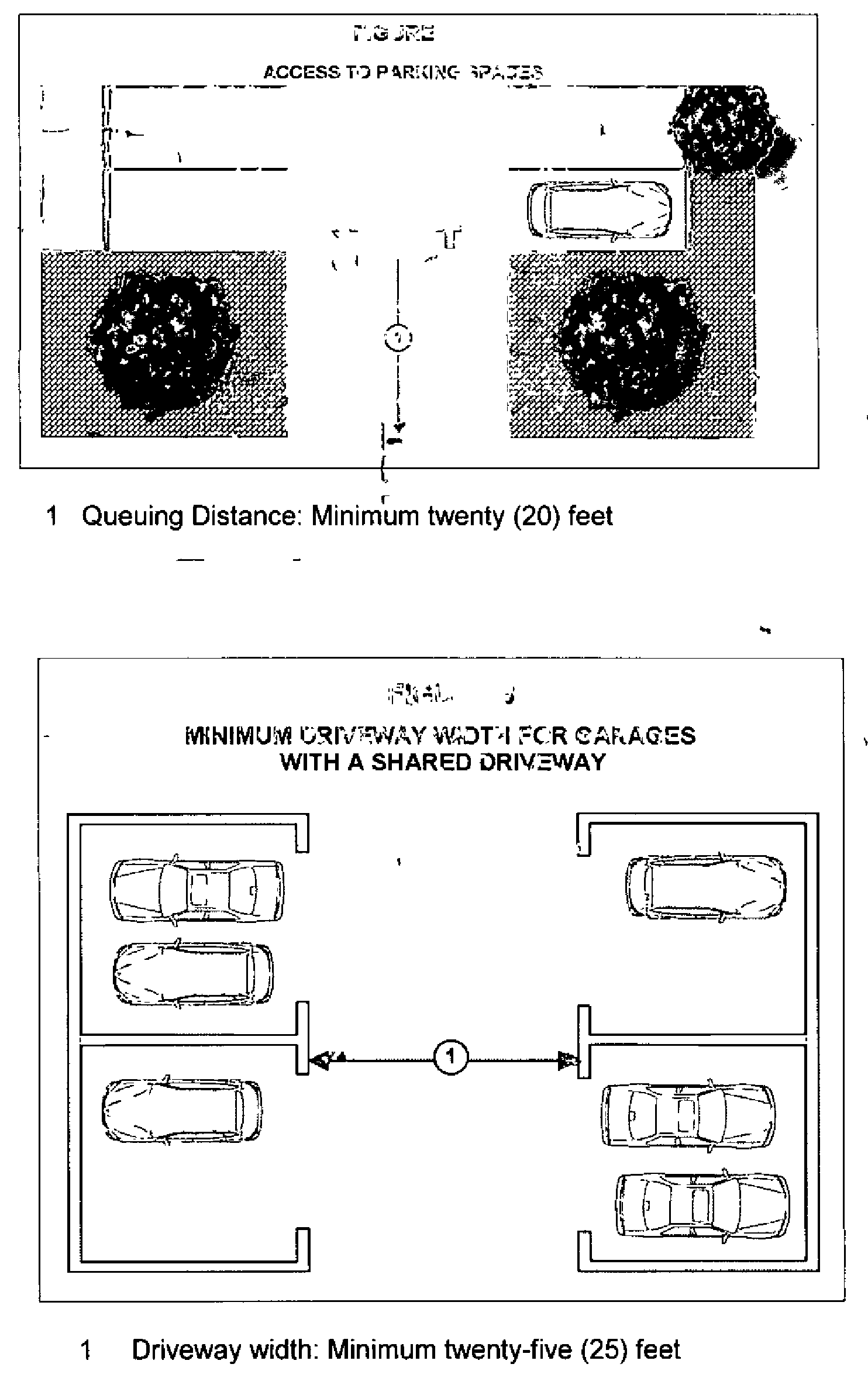
Queuing distance. Parking lot entries accessed from a public or private street shall access driveways that are not intersected by a parking aisle, parking space, or another access driveway for a minimum twenty (20) feet from the property line, to provide a queuing area for vehicles entering and exiting the parking area. See Figure 7 (Access to Parking Spaces).
h.
Physical barrier. Parking spaces located adjacent to a physical barrier (i.e., wall, fence) shall be eleven (11) feet wide to allow for opening of vehicle doors.
i.
Dead-end drive aisle. Drives aisle with a dead-end configuration shall have a three-foot additional back-up space.
(Ord. No. 1418, Sec. 11, 2-5-13)
e
Landscaping.
1.
A minimum of five (5) percent of the interior parking lot area shall be permanently landscaped. The area of the parking lot shall be computed by adding areas used for access drives, aisles, stalls, and maneuvering. Required setback or buffer areas between the parking lot and property lines shall not be counted towards satisfying the parking lot landscape requirement.
2.
Perimeter parking lot landscaping shall be minimum five (5) feet wide. The minimum perimeter parking lot landscaping along street frontages shall be minimum ten (10) feet wide for parking lots abutting any major arterial highway. Additional landscape criteria are specified within individual zoning designation standards, where applicable.
3.
Perimeter parking lot landscaping shall be designed and maintained to screen cars from view from the street to a height of thirty (30) inches to forty-two (42) inches. Screening materials may include a combination of plant materials, earth berms, solid masonry walls, raised planters, or other screening devices which meet the intent of this requirement. Trees shall be provided in these locations at a rate of one (1) for every twenty (20) lineal feet of landscaped area. Plant materials, signs, or structures within a traffic safety sight area of a driveway shall not exceed twenty-four (24) inches in height.
4.
Areas within the parking lot that are not used for parking or other approved uses shall be landscaped.
5.
At least one (1) 24-inch box tree for every six (6) parking spaces shall be included in the development of the landscape program for the site. Trees must be dispersed throughout the parking lot and shall be planted in locations that do not conflict with vehicle or pedestrian movement and access.
6.
A permanent and automatic irrigation system shall be installed and maintained in all landscaped areas to ensure proper maintenance of plant materials.
7.
A six-foot eight-inch-high decorative masonry wall shall be provided along the property line where a parking area, driveway, or vehicle turning area on a non-residentially zoned parcel abuts a residentially zoned parcel. Within a required front yard, the wall shall not exceed three (3) feet in height subject to visual clearance requirements at driveways. The Community Development Director may waive or modify this requirement to protect the visual clearance of adjacent residences or where screening is not necessary due to existing grade differentials or other reasons deemed acceptable by the Community Development Director.
(Ord. No. 1418, Secs. 12, 13, 2-5-13)
f
Lighting. Parking facilities shall provide lighting in compliance with the requirements of the Tustin City Code and other applicable requirements.
(Ord. No. 1418, Sec. 14, 2-5-13)
g
Design for Carports and Garages.
1.
Carports/covered parking shall have a solid roof structure that completely covers a carport parking stall. The provision of lockable storage space within the carport is optional and, if provided, shall be designed and maintained so as not to obstruct vehicle access to the required parking space (see Figure 1). Carports shall be screened from public view by a solid wall.
2.
Garages shall be completely enclosed on all sides, have a solid roof and a lockable door.
h
Residential Guest Parking. Off-street guest parking in residential zoning districts shall be designated and restricted, with appropriate signs/pavement markings, for the exclusive use of the guests.
i
Shopping Cart Storage. Shopping cart storage areas shall not be located within required parking spaces.
j
Striping and Identification.
1.
Parking spaces, aisles, approach lanes, and maneuvering areas shall be clearly marked with directional arrows and lines to ensure the safe and efficient flow of vehicles. If double stripes are used, parking space widths shall be measured from the center of the double stripes. The Community Development Director may require the installation of traffic signs in addition to directional arrows to ensure the safe and efficient flow of vehicles in a parking facility.
2.
Parking spaces for the disabled and compact spaces shall be striped and signed in compliance with applicable State standards and as contained in this Chapter.
3.
Parking spaces provided for motorcycle use only shall have bollards installed and be appropriately spaced to prevent automobile usage of the motorcycle area. Motorcycle spaces shall be marked so that they can be clearly identified for motorcycle use only.
k
Tandem Parking. Except as otherwise permitted in this Chapter, tandem parking shall be prohibited.
l
Valet Parking. Valet parking may be allowed subject to the approval of a Conditional Use Permit and that adequate drop-off area is provided. Tandem parking in conjunction with valet parking may be allowed subject to plan approval through a Conditional Use Permit.
m
Interpretations. The parking lot design standards may be interpreted by the Community Development Director for conditions not already specified in this Section.
n
Parking lots built prior to the adoption of this ordinance may be maintained and repaired; however any reconfiguration of parking area shall comply to the extent possible, with the provisions contained in this Part. Any deviations from the standards shall be approved by the Community Development Department.
(Ord. No. 1418, Sec. 15, 2-5-13)
(Ord. No. 1354, Sec. II, 11-4-08; Ord. No. 1555, Sec. 3, 3-4-25)
9267 - DRIVEWAYS AND SITE ACCESS
a
Driveways For Residential Uses.
1.
The driveway width within the front yard setback shall be a minimum of twelve (12) feet and a maximum of twenty-four (24) feet; if the garage or carport is designed for three (3) or more vehicles, the driveway width within the front yard setback shall be a minimum of twelve (12) feet and a maximum of thirty (30) feet. For lots at the ends of cul-de-sacs with lot frontages of less than forty (40) feet, the parking and driveway areas within the front yard setback shall not exceed seventy-five (75) percent of the total front yard setback. The total width may be divided for properties with two (2) driveways.
2.
Circular driveways shall have a minimum outside radius of twenty-five (25) feet.
3.
Parking and driveway areas within the front yard setback which abut the parking or driveway area of an adjacent lot shall not be designed or installed in such a manner so as to create an unattractive, excessively paved area. Adjacent parking and driveway areas determined by the Director of Community Development to be unattractive or excessive shall be separated with a buffer consisting of landscaping, raised hardscaping, or combination of such materials installed in the area between the parking or driveway area and the adjacent side or rear property line.
4.
A driveway leading to a parking area for duplexes, condominiums, and dwelling units located on a flag lot may be located, in part, along the driveway of a contiguous lot and may, in part, be a common driveway which provides access to more than one (1) dwelling unit.
5.
Paved areas (e.g., parking of vehicles or providing pedestrian access to the residence) may be provided within the front yard setback of residential districts if the total paved area does not exceed fifty (50) percent of the total front yard setback area, the parking of vehicles does not obstruct ingress and egress to required parking, and all of the requirements of this Zoning Code can be met. For narrow lots, or lots at the ends of cul-de-sacs with lot frontages of less than forty (40) feet, or other similar irregular conditions, the percentage of parking and driveway areas within the front yard setback may be reduced through Design Review approval of the Director of Community Development.
6.
Garages shall have a minimum unobstructed back-up area of twenty-five feet, portions of which may include the public right-of-way, private driveway, private street, or alley and shall comply with the Planning Standard (Minimum Driveway Width for Garages with Shared Driveway) as approved by the Community Development Director. (Ord. No. 1524, Sec. 48, 8-16-22)
7.
Any deviation from the above standards may be considered on a case-by-case basis, subject to review and approval by the Community Development Director.
b
Driveways for Commercial and Industrial Districts. One-way driveways within the front yard area shall have a minimum width of fourteen (14) feet and a maximum width of twenty (20) feet. Two-way driveways within the front yard area shall have a minimum width of twenty-four (24) feet and a maximum width of thirty-five (35) feet.
c
Paved Areas. Paved areas may be improved with impervious materials including, but not limited to, concrete, bricks, slate or stone tiles, decorative stamped concrete, or any other permanent hardscape. No decomposed granite, gravel, or other loose materials shall be allowed.
1.
During the pendency of any Water Conservation Level declared pursuant to Chapter 10 of Article 4 of the City Code, unimproved and/or unpaved portions of the front yard setback area in residential districts or front yards in commercial or industrial districts shall be improved and maintained with appropriate landscaping that is free of weeds and overgrown plant material and/or synthetic turf maintained in accordance with the Synthetic Turf Standards and subject to the approval of the Community Development Director.
2.
At all times other than during the pendency of any Water Conservation Level, unimproved and/or unpaved portions of the front yard setback area in residential districts or front yards in commercial or industrial districts shall be improved and maintained with appropriate landscaping in a healthy and vigorous condition and/or synthetic turf maintained in accordance with the Synthetic Turf Standards and subject to the approval of the Community Development Director.
(Ord. No. 1457, Sec. 6, 6-2-15; Ord. No. 1477, Sec. 5, 3-21-17; Ord. No. 1516, Sec. 3, 12-7-21)
(Ord. No. 1354, Sec. II, 11-4-08; Ord. No. 1398, Secs. 3—5, 8-6-11)
9268 - OFF-STREET LOADING SPACE REQUIREMENTS
a
Number of Loading Spaces Required. Off-street loading spaces shall be provided as identified in Table 4, below:
1.
The number of loading spaces required is based on the total gross floor area of the entire center. Requirements for uses not specifically listed shall be determined by the Community Development Director based upon the requirements for comparable uses and upon the particular characteristics of the proposed use.
2.
Dual use of loading spaces for purposes of vehicle parking shall be allowed during hours approved by the property owner or their designee. Loading spaces may count towards the number of required parking spaces for the associated use. Dedicated loading spaces may not be used as dual use parking spaces.
(Ord. No. 1418, Sec. 16, 2-5-13)
b
Standards For Off-Street Loading Areas. Off-street loading areas shall be provided as follows:
1.
Dimensions. The acceptable dimensions of the required loading spaces shall be determined and approved through the Design Review process.
2.
Lighting. Loading areas shall have lighting in compliance with city requirements.
3.
Loading Doors and Gates. Loading bays and roll-up doors shall be painted to be compatible with the color of the exterior structure wall(s) and be located on the rear of the structure away from public view. Loading bays and doors may be located on the side of a structure, away from a street frontage, where the Community Development Director determines that the bays, doors, and related tracks can be adequately screened from view from adjacent streets.
4.
Loading Ramps. Plans for loading ramps and/or truck wells shall be accompanied by a profile drawing showing the ramp, ramp transitions, well, and overhead clearances when required by the Community Development Director.
5.
Location. Loading spaces shall be located and designed to:
a.
Ensure that the loading facility is screened from adjacent streets as much as possible;
b.
Ensure that loading and unloading takes place on-site and in no case within adjacent public rights-of-way or other traffic areas on-site;
c.
Ensure that vehicular maneuvers occur on-site; and
d.
Avoid adverse noise impacts upon neighboring residential properties.
6.
Screening. Loading areas abutting residentially zoned parcels shall be screened when required by the Community Development Director.
7.
Striping. Loading areas shall be striped and/or have signage indicating the loading spaces. Dual use loading spaces shall have appropriate striping and/or signage indicating hours approved for vehicle parking. The striping and/or signage shall be permanently maintained by the property owner/tenant in a clear and visible manner at all times.
(Ord. No. 1418, Sec. 17, 2-5-13)
c
Figures.
1
The figures and notes in this Section delineate and illustrate the requirements in this Chapter:
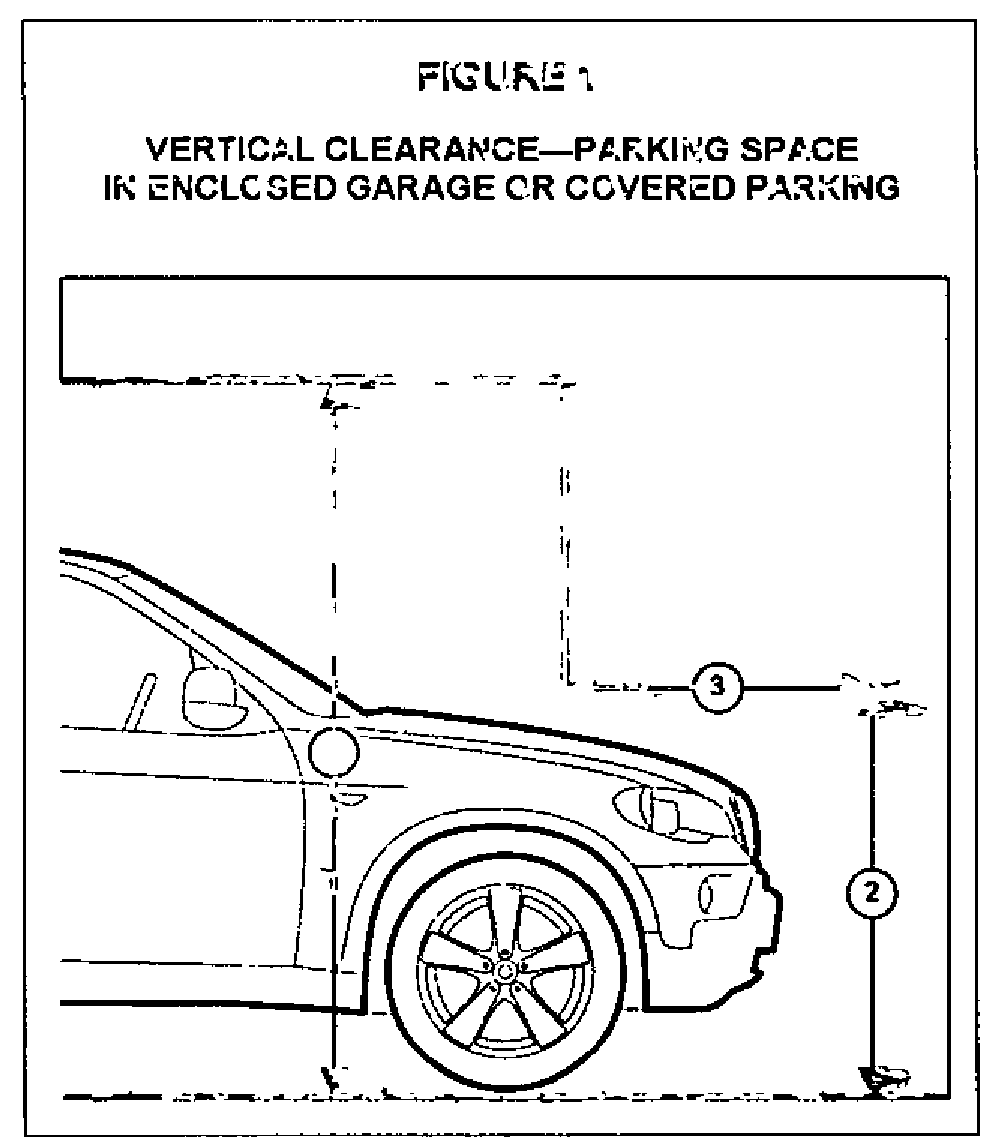
Figure 1. Vertical Clearance: Parking space in enclosed garage or covered parking.
1
Minimum vertical clearance height: Seven (7) feet
2
Minimum vertical clearance height at front of space: Four (4) feet
3
Maximum horizontal distance allowed for Note 2 above: Three (3) feet
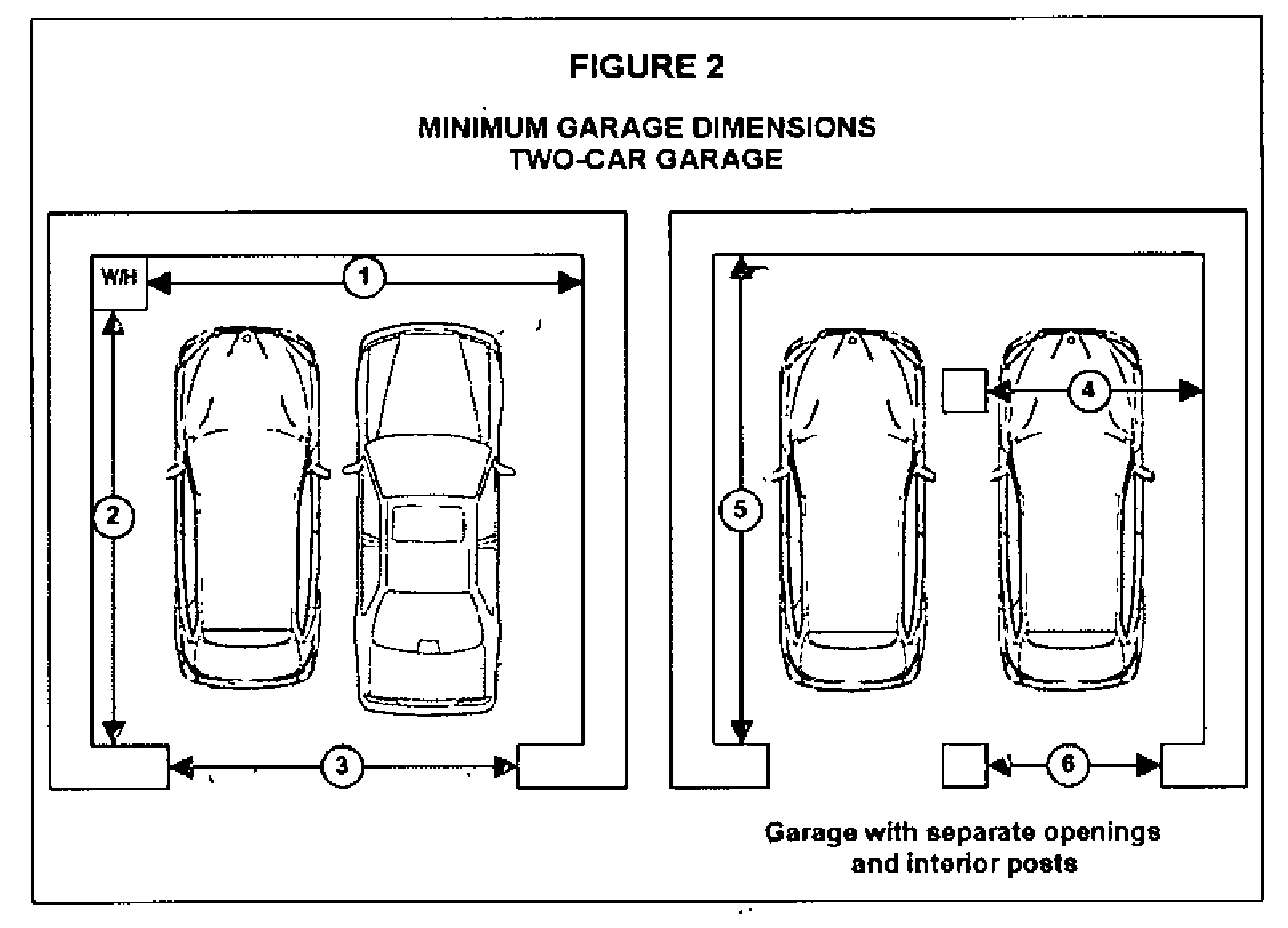
Figure 2. Minimum Garage Dimensions
A
Two-car Garage
1.
Interior width: Twenty (20) feet
2.
Interior length: Twenty (20) feet
3.
Door opening: Sixteen (16) feet
B.
One-car garage or garage with separate openings and interior posts
4.
Interior width for one car space: Ten (10) feet
5.
Interior length for one car space: Twenty (20) feet
6.
Door opening: Eight (8) feet
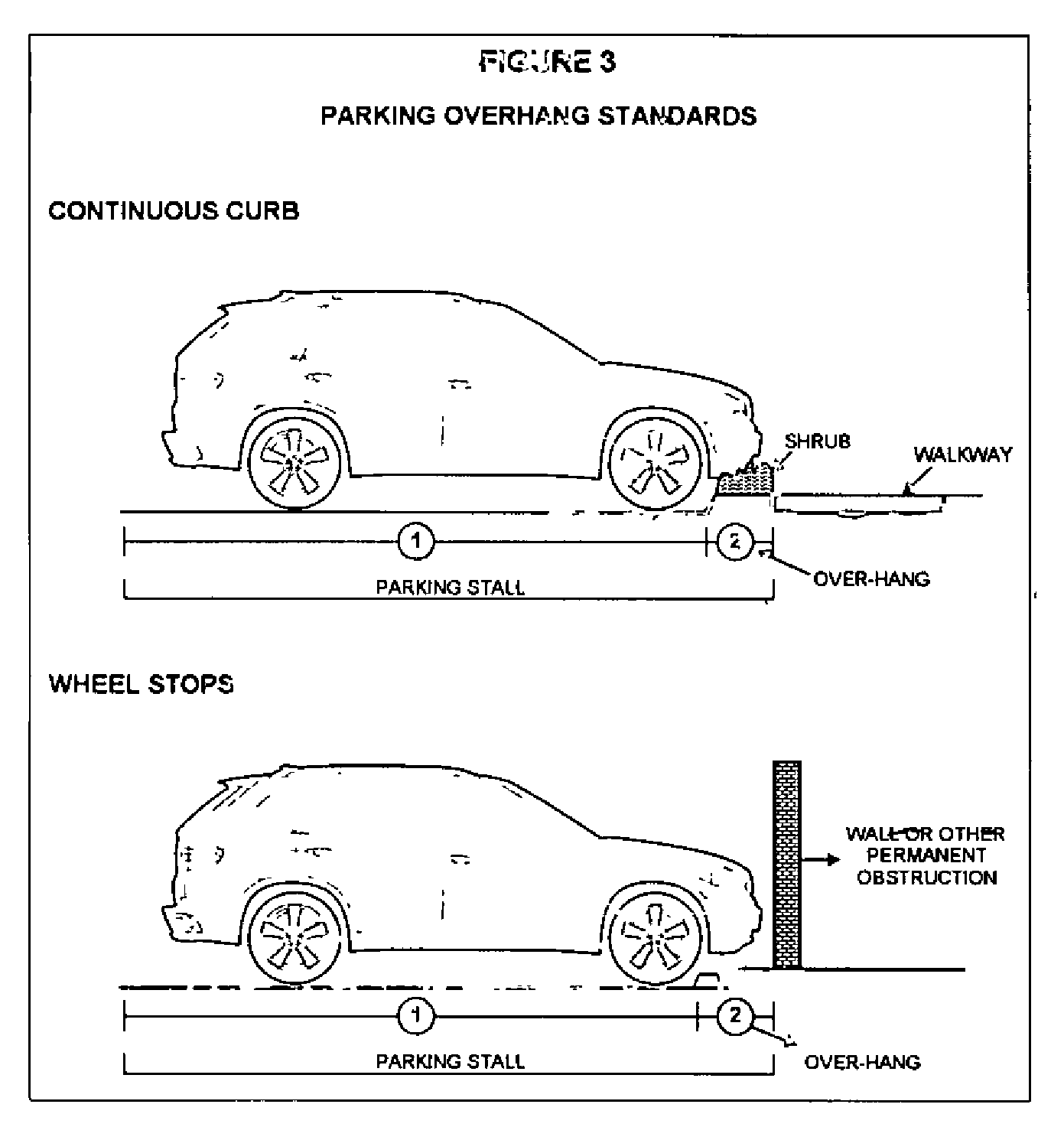
Figure 3. Parking Overhang Standards
1.
Parking length: Seventeen (17) feet minimum
2.
Overhang length: Two (2) feet maximum
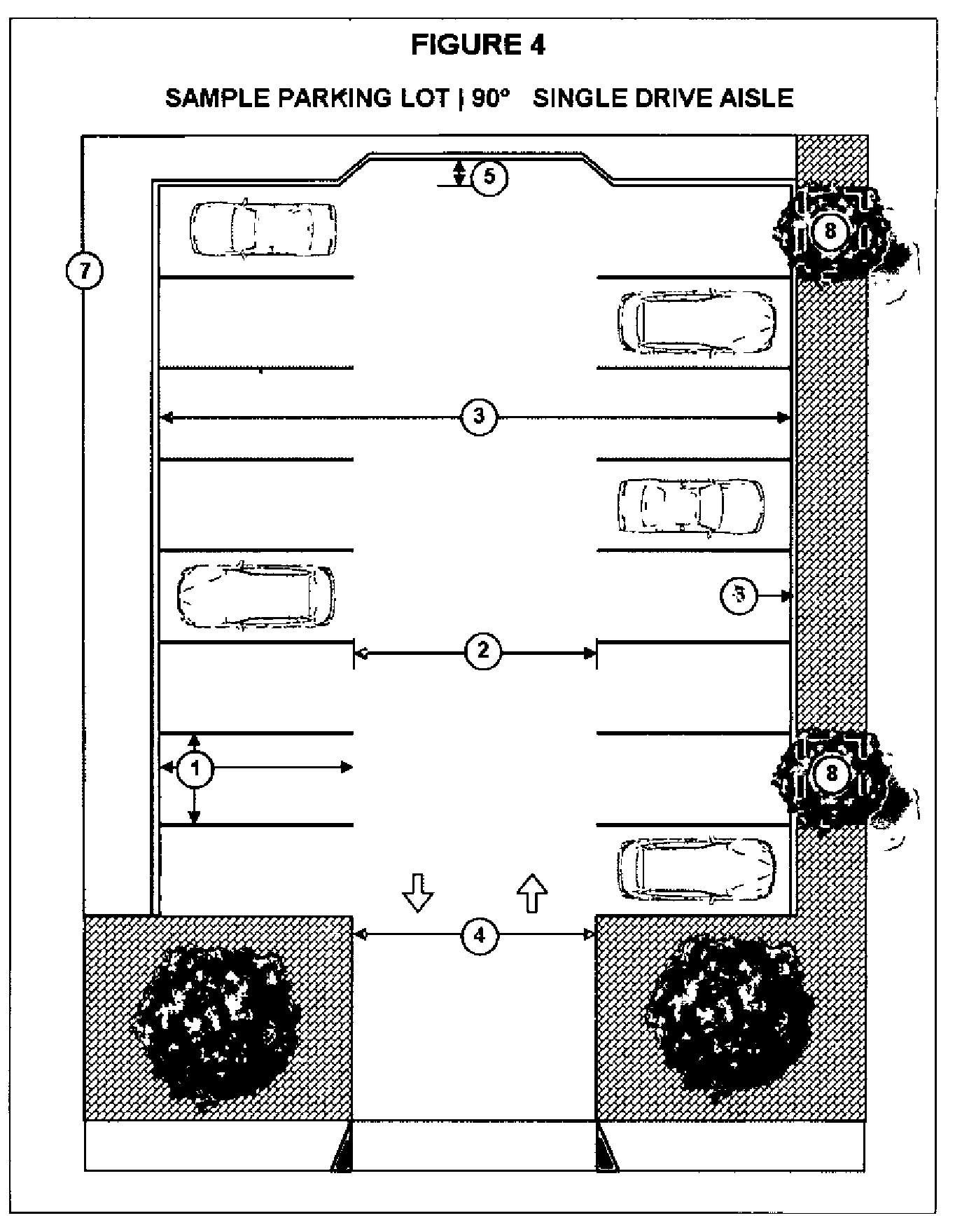
Figure 4. 90-degree—Single Drive Aisle
1.
Stall dimensions: Nine (9) feet by nineteen (19) feet
2.
Drive aisles: Twenty-four (24) feet
3.
Parking Bay (inside curbs): Sixty-two (62) feet minimum
4.
Driveway in front yard area: Twenty-four (24) feet to thirty-five (35) feet
5.
Drive aisle back-up space: Three (3) feet
6.
Concrete curb: Six (6) inches high by six (6) inches wide
7.
Perimeter Wall: Six (6) feet eight (8) inches when adjacent to residential property or use
8.
Tree wells: One (1) tree per every six (6) stalls
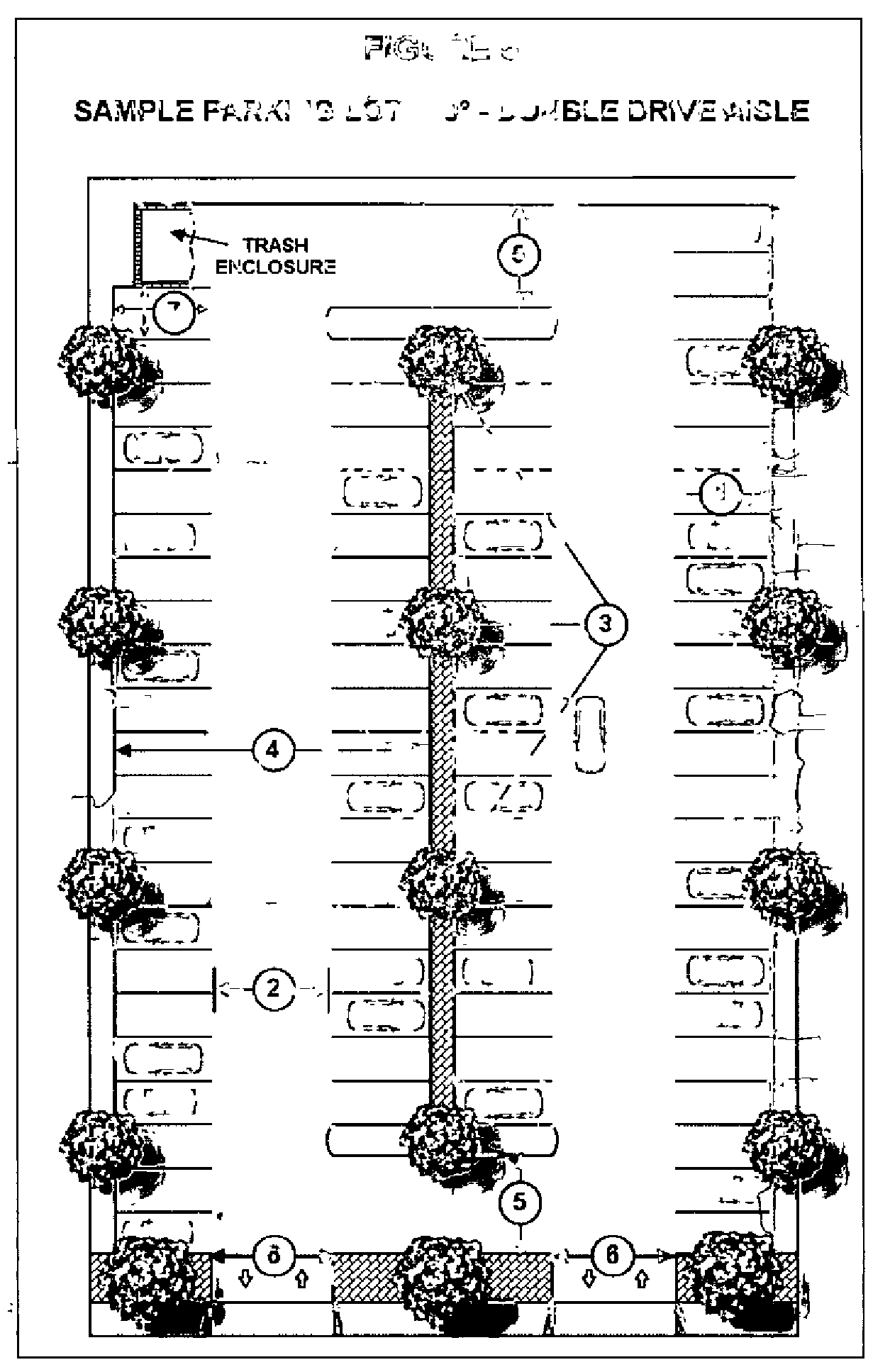
Figure 5. 90-Degree—Double Drive Aisle
1.
Stall Dimensions: Nine (9) feet by nineteen (19) feet
2.
Drive aisles: Twenty-four (24) feet
3.
Tree wells: One (1) tree per every six (6) stalls
4.
Parking bay: Sixty-two (62) feet
5.
Interior circulation: Twenty (20) feet
6.
Driveway in front yard area: Twenty-four (24) feet to thirty-five (35) feet
7.
Stalls adjacent to physical obstruction: Eleven (11) feet by nineteen (19) feet
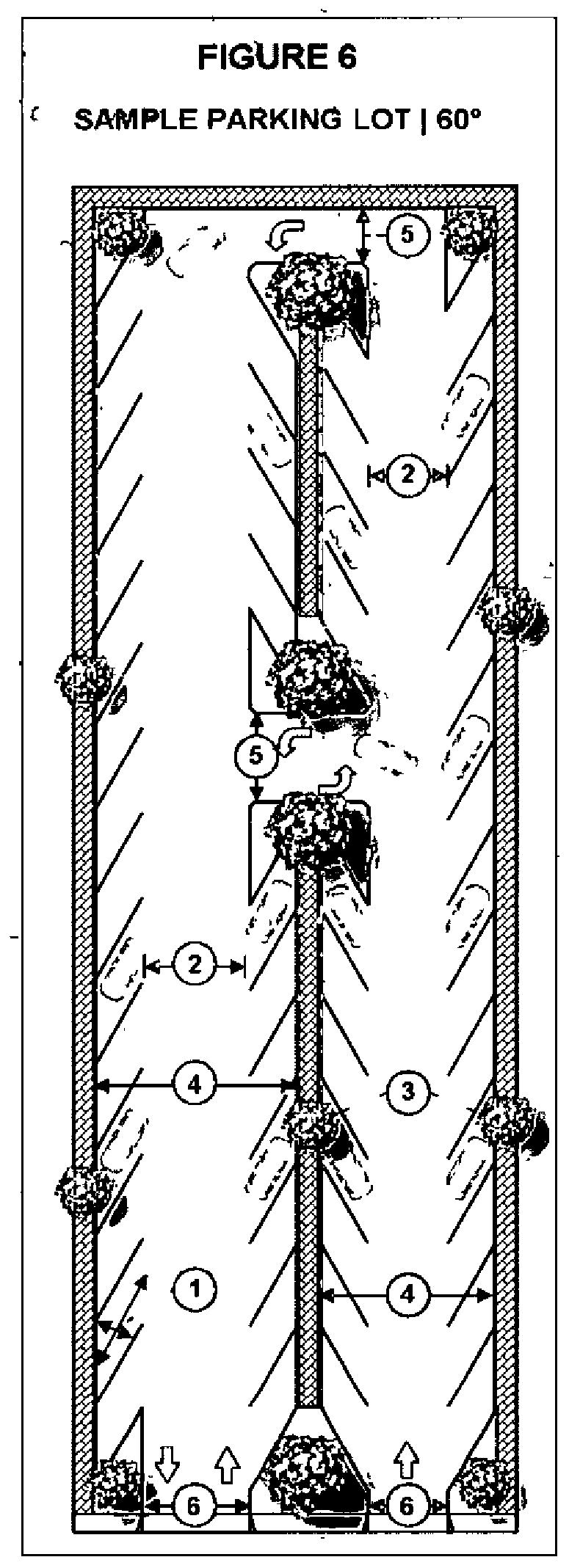
Figure 6. 60-Degree
1.
Stall Dimensions: Nine (9) feet by twenty-one (21) feet
2.
Drive aisle width:
One-way - Eighteen (18) feet
Two-way - Twenty-four (24) feet
3.
Tree wells: Every sixth (6th) stall, twenty (20) feet; two-way - twenty-four (24) feet
4.
Parking bay depth:
One-way - Sixty (60) feet
Two-way - Sixty-six (66) feet
5.
Interior Circulation:
One-way - Twelve (12) feet
Two-way - Twenty (20) feet
6.
Driveway in front yard area: One-way - Fourteen (14) feet to thirty-five (35) feet
(Ord. No. 1418, Sec. 18, 2-5-13)
(Ord. No. 1354, Sec. II, 11-4-08)
9269 - DEFINITIONS
The following terms as used in this chapter shall have the respective meanings as set forth except when the context clearly indicates otherwise:
"Carport." An attached or detached unenclosed structure with a solid roof designed to shelter motor vehicles.
"Carwash - Automated Self Serve." A car wash facility that is fully automated in which patrons remain in their vehicles during the service then drive away after the service and does not involve carwash personnel.
"Carwash - Full Serve." A car wash facility that provides full car wash services in which patrons wait for their vehicles in a waiting area while car wash personnel vacuum, wash, dry and detail the vehicles.
"Carwash - Self Serve." A car wash facility in which wash bays are provided and patrons wash the vehicles themselves.
"Company-Owned Vehicles." Passenger delivery and/or other special purpose vehicles owned and operated by business establishments located at a site.
"Covered Space." A parking space located within any approved parking structure constructed with a solid roof that is designed and used primarily for the sheltering of vehicles.
"Driveway." A paved area of a lot located between the public right-of-way and the garage, carport, or required parking space designed and intended as an access way between a private or public road and the garage, carport, or required parking space.
"Floor Area, Gross." The sum of the horizontal areas of each floor of a building, measured from the exterior faces of the exterior walls or from the centerline of walls separating two (2) buildings, but not including underground parking, uncovered steps or exterior balconies.
"Garage." A detached, accessory building or a portion of a main building on the same lot as a dwelling, used primarily for the housing of vehicles of the occupant of the dwelling, having a roof, and enclosed on at least three (3) sides, with the fourth side being a lockable door.
"Parking Space." Accessible and usable paved area on a building site located off-street and designed for the parking of vehicles.
"Recreational Vehicle." A motorized or nonmotorized vehicle that is intended for human habitation, recreational use, camping and travel use including, but not limited to, a motor home, travel trailer truck camper trailer (with or without motive power), all-terrain vehicles, and boats.
"Retail Center (Small)." A commercial property that includes a range of tenants with less than 30,000 square feet of gross floor area.
"Retail Center (Large)." A commercial property that includes a range of tenants with 30,000 square feet or more of gross floor area.
"Seat." Furniture or furnishings designed and used for sitting; eighteen (18) inches of continuous bench or bleacher seating shall equal one (1) seat.
"Stacking Space." A space that a vehicle can occupy for the purpose of queuing in order to access a drive-through service.
"Tandem Parking." Any off-street parking space designed in such a manner that a vehicle properly parked in such space may by design, have its ingress to or egress from such space blocked by a vehicle properly parked in a contiguous parking space.
(Ord. No. 1354, Sec. II, 11-4-08; Ord. No. 1418, Sec. 19, 2-5-13; Ord. No. 1524, Sec. 49, 8-16-22)

