
Tustin City Zoning Code
PART 9
ADMINISTRATION
9290 - ZONING PERMITS
Zoning Permit shall be issued in conjunction with and as a part of building permits, only after the Community Development Director has given written approval that any proposed use or the erection, construction, reconstruction, alteration or conversion is in conformance with the regulations for the district in which it is to be located.
No building permit shall be issued until the zoning permit portion thereof has been completed by the Community Development Director. (Ord. No. 157, Sec. 7.1)
(Ord. No. 1429, Sec. II.65, 5-21-13)
9291 - CONDITIONAL USE PERMITS
a
General
Conditional Use Permits may be issued as provided in this Section for any of the uses or purposes for which such permits are required or permitted by the terms of this Chapter upon conditions designated by the Zoning Administrator or the Planning Commission. The Zoning Administrator or the Planning Commission may impose such conditions as it deems necessary to secure the purposes of this Chapter and may require tangible guarantees or evidence that such conditions are being or will be complied with. Applications for Conditional Use Permits may be considered after holding public hearings thereon, as required by law. Notice of such hearings shall be given to the persons designated and in the manner prescribed in Section 9296b. (Ord. No. 157, Sec. 7.2)
b
Application
Application for Conditional Use Permits shall be made in writing by the owners of the property, lessee, purchaser in escrow, or optionee, with the consent of the owners, or plaintiff in an action for eminent domain for acquisition of said property, on a form prescribed by the Planning Commission. The application shall be accompanied by a fee as set forth by City Council Resolution and plans showing the details of the proposed use to be made of the land or building. (Ord. No. 451, Sec. 10)
c
Decision of the Zoning Administrator or the Planning Commission
Upon receipt of the application for Conditional Use Permit, the Zoning Administrator or Planning Commission shall determine whether or not the establishment, maintenance or operation of the use applied for will, under the circumstances of the particular case, be detrimental to the health, safety, morals, comfort and general welfare of the persons residing or working in the neighborhood of such proposed use, or whether it will be injurious or detrimental to property and improvements in the neighborhood or the general welfare of the City. If the Zoning Administrator or Planning Commission finds that the aforementioned conditions will not result from the particular use applied for, it shall grant the Conditional Use Permit. The granting of a Conditional Use Permit applied for by the plaintiff in an action in eminent domain to acquire the property shall be conditioned upon ultimate vesting of title of the property to the plaintiff. (Ord. No. 157, Sec. 7.22; Ord. No. 1536, Sec. 19, 4-16-24)
d\
Substanital Conformity
If an applicant proposes a use similar to an existing conditional use permit, the Community Development Director shall determine whether the proposed use substantially conforms to the approved use specified in the existing conditional use permit. (Ord. No. 1536, Sec. 19, 4-16-24)
(Ord. No. 1429, Sec. II.66, 5-21-13)
9292 - VARIANCES
a
Basis for Granting
Applications for variances from the strict application of the terms of this Chapter may be made and variances granted when the following circumstances are found to apply:
(1)
That any variance granted shall be subject to such conditions as will assure that the adjustment thereby authorized shall not constitute a grant of special privilege inconsistent with the limitations upon other properties in the vicinity and district in which the subject property is situated.
(2)
That because of special circumstances applicable to subject property, including size, shape, topography, location or surroundings, the strict application of the Zoning Ordinance is found to deprive subject property of privileges enjoyed by other properties in the vicinity and under identical zone classification. (Ord. No. 157, Sec. 7.3)
b
Use Variances Not Allowed
The use of lands or buildings not in conformity with the regulations or prohibited in the specified district in which such lands or buildings are located may not be allowed by the granting of a variance from the strict application of the terms of this Chapter. (Ord. No. 157, Sec. 7.31; Ord. No. 1429, Sec. II.67, 5-21-13)
c
Application
Application for variance shall be made in writing by a property owner, lessee, purchaser in escrow, or optionee with the consent of the owners, or plaintiff in an action for eminent domain for acquisition of said property, on a form prescribed by the Planning Commission. They shall be accompanied by a fee in an amount determined by Fee Resolution of the City Council, a plan of the details of the variance requested, and evidence showing (1) that the granting of the variance will not be contrary to the intent of this Chapter or to the public safety, health and welfare, and (2) that due to special conditions or exceptional characteristics of the property, or its location, the strict application of this Chapter would result in practical difficulties and unnecessary hardship. (Ord. No. 451, Sec. 10; Ord. No. 1524, Sec. 60, 8-16-22)
d
Hearing
Upon receipt of an application for variance and deeming the application complete, the Planning Commission shall set a date for a public hearing on said application; said hearing shall be held within forty-five (45) days after the application is deemed complete. Notice of such hearing shall be given as set forth in Section 9196b. (Ord. No. 157, Sec. 7.33; Ord. No. 1524, Sec. 61, 8-16-22)
e
Decision of the Planning Commission
After the conclusion of the public hearing or continuations thereof the Planning Commission shall grant or deny a permit to modify the application of the restrictions established by this chapter. The Commission, if the applicant for the variance consents thereto, may change or modify the extent of the variance requested but only if such change or modification constitutes a more restrictive variance than that requested by the applicant. The granting of a variance applied for by the plaintiff in an action in eminent domain to acquire the property shall be conditioned upon ultimate vesting of title of the property to the plaintiff.
(Ord. No. 157, Sec. 7.34)
9293 - PERMITS
a
Effective Date of a Permit
No Conditional Use Permit or permit granting a variance shall have any force or effect until the applicant thereof actually receives such permit designating the conditions of its issue thereon and signed by the Secretary of the Planning Commission, Zoning Administrator or the City Council. No permit shall be issued by the City until the time for filing an appeal from decisions of the Planning Commission or Zoning Administrator as provided in Section 9294 hereof has expired, or, in the event of such appeal, after the final determination thereof by the City Council.
b
Length of Permits
Any Conditional Use Permit or variance granted in accordance with the terms of this chapter shall be null and void if not used within one (1) year from the date of the approval thereof or within any longer period of time if so designated by the Zoning Administrator, Planning Commission or the City Council.
c
Revocation of Permits
Any Conditional Use Permit or variance granted in accordance with the terms of this chapter may be revoked by the City Council in the manner hereinafter set forth if any of the conditions or terms of such permits are violated or if the following findings are made:
(1)
In connection with Conditional Use Permits: The continuance of the use would be detrimental to the health, safety, morals, comfort and general welfare of the persons residing or working in the neighborhood of such use, or would be injurious or detrimental to property and improvements in the neighborhood or to the general welfare of the City.
(2)
In connection with variances: Continued relief from the strict application of the terms of this chapter would be contrary to the public interest, safety, health and welfare.
d
Hearing for Revocation of Permits
Before the City Council considers revocation of any permit, the Planning Commission shall hold a hearing thereon after giving written notice thereof to the permittee at least ten (10) days in advance of such hearing. Within five (5) days thereafter, the Commission shall transmit a report of its findings and its recommendations on the revocation to the City Council.
e
Subsequent Applications
For a period of one (1) year following the approval, denial or revocation of a discretionary land use permit, no application for the same or substantially similar discretionary permit for the same site shall be filed.
f
Modification of Conditions of Approval
No request for modifications of any condition of approval relating to any fee, exaction or dedication of real property imposed on any land use permit or approval shall be accepted after the final decision on the land use permit or approval unless accompanied by a significant change in the size or intensity of the proposed project.
(Ord. No. 1429, Sec. II.68, 5-21-13)
Prior History—Ord. No. 157, Secs. 7.5, 7.6; Ord. No. 446, Sec. 2, 3-6-95; Ord. No. 1146, Sec. 2, 3-6-95
9294 - APPEALS
a
Appeal of Decisions of the Director of Community Development or Zoning Administrator
Any decision of the Director of Community Development or the Zoning Administrator may be appealed to the Planning Commission by any person. All appeals shall be filed with the City Clerk during normal business hours within ten (10) calendar days of the date of the decision and be accompanied by a deposit or fee as required by City Council resolution or ordinance. All appeals shall be made in writing and shall specify the decision appealed from, the specific action or relief sought by the appellant in the appeal, and reasons why the action taken by the Director of Community Development or the Zoning Administrator should be modified or reversed. Timely filing of a written appeal shall automatically stay all actions and put in abeyance all approvals or permits which may have been granted; and neither the applicant nor any enforcing agency may rely upon the decision, approval, or denial or other action appealed from, until the appeal has been resolved. A public hearing date shall be set within sixty (60) calendar days of filing of the appeal for Planning Commission consideration of the matter. The hearing shall be de novo and the Planning Commission may approve, approve with conditions, or disapprove the matter in accordance with this Code or remand the matter to the Director of Community Development or the Zoning Administrator for further proceedings in accordance with directions of the Planning Commission.
b
Appeal of Planning Commission
Any decision of the Planning Commission may be appealed to the City Council by any person. All appeals shall be filed with the City Clerk during normal business hours within ten (10) calendar days of the date of the decision and accompanied by a deposit or fee as required by City Council resolution or ordinance. All appeals shall be made in writing and shall specify the decision appealed from, the specific action or relief sought by the appellant in the appeal, and the reasons why the action taken by the Planning Commission should be modified or reversed. Timely filing of a written appeal shall automatically stay all actions and put in abeyance all approvals or permits which may have been granted; and neither the applicant nor any enforcing agency may rely upon the decision, approval, or denial or other action appealed from, until the appeal has been resolved. A public hearing date shall be set within sixty (60) calendar days of filing of the appeal for City Council consideration of the matter. The hearing shall be de novo and the City Council shall approve, approve with conditions, or disapprove the matter in accordance with this Code or remand the matter to the Planning Commission for further proceedings in accordance with directions of the City Council. A decision of the City Council on such appeal shall be final.
c
Request for Hearing by a Member of the City Council
In lieu of the provisions of subsection b of this Section, any decision of the Planning Commission may be set for public hearing at the request of a member of the City Council. A Request for Hearing shall be filed with the City Clerk during normal business hours within the (10) calendar days of the date of the decision. The Request for Hearing shall be made in writing and shall specify the affected decision and the reason for the Request for a Hearing. Timely filing of a Request for Hearing shall automatically stay all actions and put in abeyance all approvals or permits which may have been granted; and neither the applicant nor any enforcing agency may rely upon the decision, approval, or denial or other action appealed from, until the hearing has been conducted and the City Council takes action on the matter. The City Clerk shall set a public hearing date within sixty (60) calendar days of filing the Request for Hearing. The hearing shall be de novo and the City Council may approve, approve with conditions, or disapprove the matter in accordance with this Code or remand the matter to the Planning Commission for further proceedings in accordance with directions of the City Council. A decision of the City Council at the conclusion of hearing pursuant to this subsection shall be final.
(Ord. No. 157, Secs. 8.1, 8.3; Ord. No. 201; Ord. No. 451, Sec. 10; Ord. No. 874, Sec. 2, 11-1-82; Ord. No.1366, Sec. 20, 11-17-09)
9295 - AMENDMENTS
a
Definition
Except as otherwise provided in this section, any amendment to this chapter may be initiated and adopted as other ordinances are amended or adopted. (Ord. No. 157, Sec. 9.1)
b
Types
Any amendment to this chapter which changes any property from one district to another district, or imposed any regulation upon property not theretofore imposed, or removes or modified any such regulation, shall be initiated and adopted as hereinafter set forth in this Section. (Ord. No. 157, Sec. 9.2)
c
Filing Procedure
Any amendment of the nature specified in Section 9295b hereof may be initiated by (1) the filing with the Planning Commission of a resolution of intention of the City Council; (2) passage of a resolution of intention by the Planning Commission, or (3) filing with the Planning Commission of a petition of one or more record owners of property which is the subject of the proposed amendment or their authorized agents. A petition for amendment shall be on a form designated therefor by the Planning Commission and shall be accompanied by a fee in an amount determined by Fee Resolution of the City Council. (Ord. No. 451, Sec. 10; Ord. No. 1524, Sec. 62, 8-16-22)
d
Public Hearing
Upon receipt of a petition or resolution of intention of amendment, the Planning Commission shall set a date for a public hearing thereon, but not later than forty-five (45) days after the receipt of said petition or resolution. (Ord. No. 157, Sec. 9.4)
e
Notices
If the proposed amendment consists of a change in the boundaries of any district, the Planning Commission shall give notice of the time and place of such hearing, and the purpose thereof, in the manner designated in Section 9296b of this Chapter. If the proposed amendment is a matter of general or city-wide scope, notice thereof shall be given as provided in Section 9296c. (Ord. No. 156, Sec. 9.5)
f
Action of Planning Commission
After the close of the public hearing or continuations thereof, the Planning Commission shall make a report of its findings and its recommendation with respect to the proposed amendment. The Commission report shall include a list of persons who testified at the hearing, a summary of the facts adduced at the hearing, the findings of the Commission, and copies of any maps or other data and/or documentary evidence submitted in connection with the proposed amendment. Copy of such report and recommendation shall be transmitted to the City Council within ninety (90) days after the first notice of hearing thereon; provided however, that such time may be extended with the consent of the City Council or the petitioner for such amendment. In the event the Planning Commission fails to report to the City Council within the aforesaid ninety (90) days or within the agreed extension of time, the amendment shall be deemed approved by the Planning Commission. The recommendations of the Planning Commission on proposed amendments shall be adopted by a majority of the voting members of said Planning Commission. (Ord. No. 157, Sec. 9.6)
g
Action of City Council
Upon receipt of the recommendation of the Planning Commission or expiration of the aforesaid ninety (90) days or agreed upon extended period, the City Council shall hold a public hearing thereon, giving notice thereof as provided in Section 9296. After the conclusion of such hearing the City Council may within one (1) year adopt the proposed amendment or any part thereof set forth in the petition or resolution of intention in such form as the Council deems desirable. (Ord. No. 157, Sec. 9.7)
9296 - NOTICES OF HEARING
a
Public Hearing
Whenever this Chapter prescribes that a public hearing shall be held on the discretionary application such as, but not limited to, variance or amendments to this Chapter, notice thereof shall be given as provided in this Section. (Ord. No. 157, Sec. 10.1)
b
Notice of Hearing
Notices of the public hearings on applications for Conditional Use Permit, variance, appeals and amendments to this Chapter changing the boundaries of any district shall be given by the body conducting such hearings in the manner prescribed by Sections 65090 or 65091 and 65854 of the Government Code of the State of California. (Ord. No. 157, Sec. 10.3)
c
Notice of Hearing: Special Hearings
Notices of public hearings on matters other than as specified in Subsection "b" hereof shall be given by the body conducting such hearing by publication in a newspaper of general circulation in the City of Tustin, at least ten (10) days before the hearing. (Ord. No. 157, Sec. 10.3)
d
Notice of Hearing: Failure to Post Notices
Failure to mail or post notices as specified in Subsection "b" hereof shall not invalidate any proceedings. (Ord. No. 157, Sec. 10.4)
e
Notice of Hearing: Filing of Affidavit
Upon completion of the posting or mailing of the notices provided for in Subsection "b" and publication of notices as provided in Subsections "b" and "c" hereof, the City Clerk, if the hearing is held by the Planning Commission, or if the hearing is held by the City Council shall cause an affidavit of such mailing or publication to be filed in the permanent records of the particular proceedings to which such notices pertain. (Ord. No. 157, Sec. 10.5)
(Ord. No. 1429, Sec. II.69, 5-21-13)
9297 - DEFINITIONS
"Accessory Dwelling Unit" or "ADU" means an Attached or a Detached residential dwelling unit that provides complete independent living facilities for one (1) or more persons and is located on a lot with a proposed or existing primary residence. It shall include permanent provisions for living, sleeping, eating, cooking, and sanitation on the same parcel as the single-family or multi-family dwelling is or will be situated. An ADU includes an "Efficiency Unit" and "Manufactured Home" as defined by the Health and Safety Code. (Ord. No. 1479, Sec. 13, 4-4-17; Ord. No. 1517, Sec. XII, 12-7-21)
"Administrative Office" means an office for the rendering of service or general administration, but excluding retail sales. (Ord. No. 157, Sec. 11.1)
"ADU, Attached" or "Attached ADU" means an ADU, other than a Converted ADU, that is physically attached to a primary dwelling. (Ord. No. 1517, Sec. XII, 12-7-21)
"ADU, Converted" or "Converted ADU" means an ADU that is constructed within all or a portion of the permitted existing interior space of an accessory structure or within a portion of the permitted existing interior space of a dwelling, including bedrooms, attached or detached garages, storage areas, or similar uses. A Converted ADU also includes an ADU that is constructed in the same location and to the same dimensions as a permitted existing structure or portion of a permitted existing structure. (Ord. No. 1517, Sec. XII, 12-7-21; Ord. No. 1535, Sec. 6, 6-6-23)
"ADU, Junior", "Junior Accessory Dwelling Unit" or "JADU" means a unit that is no more than 500 square feet in size and contained entirely within the walls of a proposed or existing single-family residence, including attached garages. A JADU may include separate sanitation facilities or may share sanitation facilities with the single-family residence. (Ord. No. 1517, Sec. XII, 12-7-21)
"ADU, Statewide Exemption" or "Statewide Exemption ADU" means an ADU up to 800 square feet, 16 feet in height, and with four-foot side and rear setbacks. (Ord. No. 1535, Sec. 6, 6-6-23)
"ADU Detached" or "Detached ADU" means an ADU, other than a Converted ADU, that is physically separated from, but located on the same lot as, a primary dwelling structure. (Ord. No. 1517, Sec. XII, 12-7-21)
"Adult Bookstore" shall mean an establishment having as a substantial or significant portion of its stock in trade, material which is distinguished or characterized by its emphasis on matter depicting, describing, or related to specified sexual activity or specified anatomical areas, or an establishment with a segment or section thereof devoted to the sale or display of such material. (Ord. No. 819, Sec. 1, 2-19-80)
"Adult Business" shall mean any business which is conducted exclusively for the patronage of adults, and as to which minors are specifically excluded from patronage thereat, either by law or by the operators of such business. "Adult Business" shall also mean and include adult bookstores, adult theaters, topless dancing, stripping, figure modeling studios, adult motels or hotels, but shall not include those uses or activities the regulation of which are preempted by state law. (Ord. No. 819, Sec. 1, 2-19-80; Ord. No. 1462, Sec. VII, 11-3-15)
"Adult Hotel/Motel" shall mean a hotel or motel which provides, through closed circuit television, or other media, material which is distinguished or characterized by the emphasis on matter depicting or describing or related to specified sexual activities or specified anatomical areas. (Ord. No. 819, Sec. 1, 2-19-80)
"Adult Park" means any mobile home or travel trailer park the spaces of which are rented or leased only to persons having no children under the age of fifteen (15). (Ord. No. 329, Sec. 2)
"Adult Theater" shall mean a theater which presents live entertainment or motion pictures or videotaped presentations or slide photographs, which are distinguished or characterized by their emphasis on matter depicting, describing, or related to specified sexual activity or specified anatomical areas. (Ord. No. 819, Sec. 1, 2-19-80)
"Advertisement" means any announcement, whether in a magazine, newspaper, handbill, notice, display, billboard, poster, email, internet website, platform or application, any form of television or radio broadcast or any other form of communication, whose primary purpose is to propose a transaction. (Ord. No. 1574, Sec. 16, 3-17-26)
"Alcoholic Beverage Sales Establishment" means any establishment where an alcoholic beverage is sold, including, but not limited to, liquor stores, bars, lounges, restaurants, markets, mini-marts, gas stations, drive-in dairies, bakeries and florists. (Ord. No. 920, Sec. 6, 11-19-84)
"Alley" means a public or private way less than thirty (30) feet in width which affords a secondary means of access to abutting property. (Ord. No. 157, Sec. 11.2)
"Alteration means any exterior change or modification requiring a building permit of any Designated Cultural Resource or of any property located within a Cultural Resource District. (Ord. No. 1001, Sec. 3, 6-20-88)
"Apartment" means any building or portion thereof which is designed and built for occupancy of three (3) or more families. (Ord. No. 157. Sec. 11.3)
"Beverage" means beer and other malt beverages, carbonated mineral and soda waters, and similar carbonated soft drinks in liquid form which are intended for human consumption. (Ord. No. 993, Sec. 1, 9-8-87)
"Beverage container" means the individual, separate bottle, can, jar, carton, or other receptacle, however denominated, in which a beverage is sold, and which is constructed of metal, glass, or plastic, or other material, or any combination of these materials. "Beverage container" does not include cups or other similar open or loosely sealed receptacles. (Ord. No. 993, Sec. 1, 9-9-87)
"Block" means all property fronting upon one side of a street between intersecting and intercepting streets, or between a street and a railroad right-of-way, waterway, dead end street or city boundary. An intercepting street shall determine only the boundary of the block on the side of a street which it intercepts. (Ord. No. 157, Sec. 11.5)
"Boarding House" means a dwelling other than a hotel or motel, where lodging and/or meals for three (3) or more persons is provided for compensation. (Ord. No. 157, Sec. 11.6; Ord. No. 1225, Sec. IV, 1-17-00)
"Building" means any structure having a roof supported by columns or by walls and designed for the shelter or housing of any person, animal or chattel. (Ord. No. 157, Sec. 11.7)
"Building, Accessory" means a subordinate structure or building including shelters, pools, or garages, the use of which is incidental to that of the main building on the same lot and/or building site. (Ord. No. 157, Sec. 11.8; Ord. No. 1524, Sec. 64, 8-16-22)
"Building, Main" means a building in which is conducted the principal use of the lot and/or building site on which it is situated. (Ord. No. 156, Sec. 11.9)
"Building Setback Line" means a line established to denote the minimum distance a building may be constructed from a property line or right-of-way line. (Ord. No. 353, Sec. 4)
"Building Site" means a lot or parcel of land, in single or joint ownership, and occupied or to be occupied by a main building and accessory buildings, or by a dwelling group and its accessory building, together with such open spaces as are required by the terms of this Chapter and having its principal frontage on a street, road, highway or waterway. (Ord. No. 157. Sec. 11.10)
"Business, Retail" means any establishment where the retail sale of any article, substance, or commodity, but not including the sale of lumber or other building materials, or the sale of used or secondhand goods or materials of any kind. (Ord. No. 157, Sec. 11.11)
"Business, Wholesale" means the wholesale handling of any article, substance or commodity, but not including the handling of lumber or other building materials or the open storage or sale of any material or commodity, and not including the processing or manufacture of any product or substance. (Ord. No. 157, Sec. 11.12)
"Cannabis Business" means any person, association, business, facility, use, establishment, location, delivery service, cooperative, collective, or provider, whether fixed or mobile, that possesses, cultivates, processes, distributes, makes available or otherwise facilitates the distribution of cannabis (in any form or incorporated into any other product), whether for recreational or medicinal use, to any person, including, but not limited to, a qualified patient, a person with an identification card, or a primary caregiver as those terms are defined in California Health and Safety Code Sections 11362.5 and 11362.7 et seq., as may be amended from time to time.
"Cannabis Business" shall not include the following:
(1)
An individual aged twenty-one (21) years or older who:
(a)
Possesses, processes, transports, purchases, obtains or gives away to adults aged twenty-one (21) years or older without compensation whatsoever, recreational marijuana; or
(b)
Possesses, plants, cultivates, harvests, dries, or purchases six (6) or fewer living marijuana plants or who possesses the marijuana produced by those plants, provided that such activity is conducted within the person's "private residence", as that phrase is defined by California Health and Safety Code Section 11362.2(b)(5), or upon the grounds of that private residence, provided that such activities are conducted within a fully enclosed, locked space, and are not visible by normal unaided vision from a public place.
(2)
A business entity licensed pursuant to, and acting in compliance with, California Business and Professions Code Section 26000 et seq. and California Code of Regulations Sections 15400 et seq., which engages in the retail sale by delivery of medicinal cannabis to medicinal cannabis patients to a location within the City, provided that the following conditions are met:
(a)
The method of delivery is in full compliance with the provisions of California Business and Professions Code Section 26090 et seq. and California Code of Regulations Sections 15400 et seq. (as may be amended from time to time);
(b)
The delivery is made to a building on a residential property with an existing physical address. For purposes of this section, a "residential property" is limited to the following: any dwelling unit, including single-family, multi-family, and accessory dwelling units, apartment, condominium, duplex, hotel, motel, mobile home, rest home, or townhouse or townhome as those terms are defined by this Section 9297;
(c)
The delivery is not made to any of the following, regardless of whether the location is a "residential property" as described in subsection (b) of this section:
1.
Any address located on publicly owned land or any address on land or in a building leased by any public agency, as that phrase is defined by California Government Code Section 6500; or
2.
Any school providing instruction in kindergarten or any grades 1 through 12, day care center, or youth center, whether such institution or entity is public or private.
3.
Any public or private park. For purposes of this section, "public or private park" shall mean any park operated by the City or any park situated on privately owned property within the City that is generally open for public use and shall include all sidewalks or other public rights-of-way which are located immediately adjacent to any public or private park. A park shall be deemed generally open for public use if it is open to any person(s) other than the owner of the privately owned property upon which the park is situated, including, but not limited to, tenants, guests, or customers.
(d)
The delivery must originate from an entity licensed pursuant to, and acting in compliance with, California Business and Professions Code Section 26000 et seq. which is not located within the City of Tustin.
For purposes of this section the terms "medicinal cannabis" and "medicinal cannabis patients" shall have the same meanings as those terms are defined in California Business and Professions Code Section 26321(b). (Ord. No. 1540, Sec. 7, 3-5-24)
"Carport" means a permanent, roofed structure, used for automobile shelter and automobile storage. (Ord. No. 1555, Sec. 4, 3-4-25)
"Certificate of Appropriateness" means an approved certificate issued for the construction, demolition, alteration, removal, or relocation of any publicly or privately owned Designated Cultural Resource, or any structure, natural feature, or site within a Cultural Resource District. (Ord. No. 1001, Sec. 3, 6-20-88)
"Combining District" means any district in which the general district regulations are combined with those special districts defined in Section 9213 for the purpose of adding additional special regulations. (Ord. No. 157, Sec. 11.13)
"Committee" means the Historic Resource Committee. (Ord. No. 1001, Sec. 3, 6-20-88; Ord. No. 1301, Sec. VII, 9-19-05)
"Community Development Director" means the Director of the Community Development Department or designee. (Ord. No. 1301, Sec. VIII, 9-19-05)
"Condominium Project" shall have the same meaning as stated in California Civil Code Section 4125 as that section may be amended from time to time. (Ord. No. 1535, Sec. 6, 6-6-23)
"Consumer" means every person who, for his or her use or consumption, purchases a beverage in a beverage container from a dealer. "Consumer" includes, but is not limited to, a lodging, eating, or drinking establishment, and soft drink vending machines. (Ord. No. 993, Sec. 1, 9-8-87)
"Convenience Store" means any establishment under fifteen thousand (15,000) square feet in size where food, beverage, magazine and auto related items, or any combination thereof, are sold for off-site use and/or consumption. (Ord. No. 981, Sec. 11, 5-4-87)
"Convenience Zone" means the area within a ½ mile radius of a "Supermarket", defined as meeting the following definitions based on CAL. PRC. CODE § 14526.5:
- Identified in the Progressive Grocer Marketing Guidebook.
- Gross annual sales of $2 million or more.
- A "full-line" store that sells a line of dry groceries, canned goods, or non-food items and perishable items.
(Ord. No. 1429, Sec. II.70, 5-21-13)
"Cultural Resource District" means any area containing improvements which have a special character, historical interest or aesthetic value or which represent one (1) or more architectural periods or styles typical to the history of the City, and which improvements constitute a distinct section of the City that has been designated a Cultural Resource District pursuant to Section 9252 of the Zoning Code. (Ord. No. 1001, Sec. 3, 6-20-88)
"Day Care Center" - pursuant to California Health and Safety Code defined as any child day care facility other than a family day care home, and includes infant centers, preschools, extended day care facilities, and school age child care centers. (Ord. No. 1367, Sec. II, 4-6-10)
"Delicatessen" means a small market or deli selling ready-to-eat foods, including, but not limited to, cold cooked meats, sandwiches, and salads. (Ord. No. 1429, Sec. II.70, 5-21-13)
"Demolition" means to tear down or demolish. (Ord. No. 1001, Sec. 3, 6-20-88)
"Designated Cultural Resource" means improvements, buildings, structure, signs, features, sites, places, areas or other objects of scientific, aesthetic, educational, cultural, architectural, or historical significance to the residents of the City that has been designated a Cultural Resource by the City Council. (Ord. No. 1001, Sec. 3, 6-20-88)
"Designated Site (Cultural Resource Site)" means a parcel or part thereof on which a cultural resource is situated, and which has been designated a cultural resource site by the City Council. (Ord. No. 1001, Sec. 3, 6-20-88)
"District" means a portion of the City within which certain uses of land and buildings are permitted or prohibited and within which certain yards and other open spaces are required and certain height limits are established for buildings, all as set forth and specified in this Chapter. (Ord. No. 157, Sec. 11.14)
"Driveway" means a paved area of a lot located between the public right-of-way and the garage, carport, or required parking space designed and intended as an access way between a private or public road and the garage, carport, or required parking space. (Ord. No. 1240, Sec. 2, 8-6-01)
"Dwelling" means a building or portion thereof designed for residential use. (Ord. No. 157, Sec. 11.15; Ord. No. 1225, Sec. IV, 1-17-00; Ord. No. 1429, Sec. II.70, 5-21-13)
"Dwelling, Single-Family" means a building designed for, or used to house not more than one (1) family, including all necessary employees of such family. (Ord. No. 157, Sec. 11. 16)
"Dwelling, Two-Family" or "Duplex" means a building containing not more than two (2) kitchens, designed and/or used to house not more than two (2) families, living independently of each other, including all necessary employees of each such family. (Ord. No. 157, Sec. 11.17)
"Dwelling, Multiple" means a building, or portion thereof, used and designed as a residence for three (3) or more families living independently of each other and doing their own cooking in said building, including apartment houses, apartment hotels and flats, but not including motels, boardinghouses, and hotels. (Ord. No. 157, Sec. 11.18)
"Dwelling Groups" means a group of two (2) or more detached one-family, two-family, or multiple dwellings occupying a parcel of land in one (1) ownership and having any yard or court in common, but not including automobile courts. (Ord. No. 175, Sec. 9)
"Exterior Architectural Feature" means the architectural elements embodying style, design, general arrangement and components of all of the outer surfaces of an improvement, including, but not limited to, the kind, color and texture of the building materials and the type and style of all windows, doors, lights, signs and other fixtures appurtenant to such improvement. (Ord. No. 1001, Sec. 3, 6-20-88)
"Family" means an individual or two (2) or more persons living together as a single housekeeping unit in a dwelling unit. (Ord. No. 157, Sec. 11. 20; Ord. No. 1225, Sec. IV, 1-17-00)
"Family Park" means any mobile home or travel trailer park, the spaces of which are rented or leased without restriction upon the ages of the children or occupants. (Ord. No. 329, Sec. 2)
"Fence" means any structural device forming a physical barrier by means of hedge, wood, mesh, metal, chain, brick, stake, plastic or other similar materials. (Ord. No. 157, Sec. 11.21)
"Figure Modeling Studio" shall mean any establishment in which models pose while exposing specified anatomical areas. (Ord. No. 819, Sec. 1, 2-19-80)
"Frontage" or "Fronting" means the portion of a parcel which abuts a street right-of-way. (Ord. No. 1429, Sec. II.70, 5-21-13)
"Garage, Private" means a detached, accessory building, or a portion of a main building on the same lot as a dwelling, used primarily for the housing of vehicles of the occupant of the dwelling, having a roof, and enclosed on at least three (3) sides, with the fourth side being a lockable door, with not less than ten feet by twenty feet (10' × 20') clear and unobstructed inside dimensions, and which shall be permanently maintained as a parking accommodation. (Ord. No. 733, Sec. 7)
"General Office" means an office for the conduct of any of the following uses or uses determined by the Community Development Director and/or the Planning Commission to be similar: accountants, advertising agency, contractors and building consultants, drafting, economic consultant, escrow, insurance, public utility office (not including corporate yards), real estate offices. (Ord. No. 1367, Sec. II, 4-6-10)
"Guesthouse" means detached living quarters of a permanent type of construction and without kitchens or cooking facilities and where no compensation in any form is received or paid. (Ord. No. 157, Sec. 11.23)
"Guest Quarters" means an attached or detached building or room that provides living quarters for guests and (a) contains no kitchen or cooking facilities; (b) is clearly subordinate and incidental to the principal residence on the same building site; and (c) is not rented or leased, whether compensation is direct or indirect. (Ord. No. 1429, Sec. II.70, 5-21-13)
"Height of Building" means the vertical distance from the average level of the highest and lowest point of that portion of the lot covered by the building to the topmost point of the roof. (Ord. No. 157, Sec. 11.25)
"Historic Context Statement" means an in depth narrative account of the city's development history as reflected by its built environment as described in the City's Historic Resources Survey. (Ord. No. 1524, Sec. 63, 8-16-22)
"Historic Resources Survey" means the citywide historical resources survey update report and any subsequent updates. (Ord. No. 1524, Sec. 63, 8-16-22)
"Home Occupation" means an occupation carried on wholly within a dwelling by an occupant of the dwelling, as a secondary use. (Ord. No. 330, Sec. 2B; Ord. No. 1429, Sec. II.70, 5-21-13)
"Hosting Platform" means any person, corporation or entity of any kind who participates in the short-term rental business by advertising or collecting or receiving a fee, directly or indirectly through an agent or intermediary, for conducting short-term rental activity in the City of any nature. (Ord. No. 1574, Sec. 17, 3-17-26)
"Hotel"—See Motel. (Ord. No. 157, Sec. 11.26)
"Improvement" means any building, structure, parking facility, fence, gate, wall, landscaping requiring a building permit constituting a physical betterment of real property, or any part of such betterment. (Ord. No. 1001, Sec. 3, 6-20-88)
Instructional Studios" means an establishment that offers services with the purpose of teaching and practicing a particular skill or subject. These studios involve one-on-one or small group instruction, covering a range of subjects including, but not limited to, sports and recreation (such as cheerleading, gymnastics, and martial arts) and fine arts (such as music, dance, drama, photography, ceramics, painting, and sculpture). (Ord. No. 1536, Sec. 20, 4-16-24)
"Junk Yard" means more than one hundred (100) square feet of the area of any lot used for the storage of junk, including scrap metals, salvage or other scrap materials, or for the dismantling or "wrecking" of automobiles or other vehicles or machinery, whether for sale or storage. (Ord. No. 157, Sec. 11.27)
"Kennel" means any lot or premises on which more than three (3) dogs, cats or similar small animals, more than three (3) months of age are kept, boarded, or trained, whether in special buildings or not. (Ord. No. 352, Sec. 1)
"Large Family Day Care Home" pursuant to California Health and Safety Code definition. (Ord. No. 911, Sec. 7, 5-21-84; Ord. No. 1367, Sec. II, 4-6-10; Ord. No. 1524, Sec. 63, 8-16-22)
"Legal Nonconforming" shall mean a use or structure, whenever established, that was lawfully established and continuously used or occupied under previous regulations, standards, and/or requirements but that does not meet existing zoning codes, regulations, and/or standards. (Ord. No. 1397, Sec. 8, 11-15-11)
"Lot"—See Building Site. (Ord. No. 157, Sec. 11.28)
"Lot Coverage" or "Building Site Coverage" the percentage of the building site area that is covered by the area within the perimeter of all structures located on the building site area. Covered area shall include all areas under roof, but not include roof overhangs, open trellis and covered porches, Swimming pools and spas are not considered in calculating structural site coverage. (Ord. No. 1429, Sec. II.70, 5-21-13)
"Lot Front" means the narrowest dimension of a lot fronting on a street. (Ord. No. 157, Sec. 11.29)
"Lot Line" means a line separating the frontage from a street; the side from a street or adjoining property; the rear from an alley or street, or adjoining property. (Ord. No. 157, Sec. 11.31)
"Lot, Through" means a lot having frontage on two (2) parallel or approximately parallel streets. (Ord. No. 157, Sec. 11.32)
"Lot Side" means any lot boundary not a front or rear lot line. (Ord. No. 157, Sec. 11.30)
"Lot Types" means types of lots that include the following (See Figure 5-3), Lot Types:
1.
Corner lot. A lot located at the intersection of two or more streets where they intersect at an interior angle of not more than 135 degrees. If the intersection angle is more than 135 degrees, the lot is considered an interior lot.
2.
Double-frontage lot. A "through" lot with frontage on two generally parallel streets.
3.
Flag lot. A lot having access to a public street by means of private right-of-way strip that must be owned in fee.
4.
Interior lot. A lot abutting only one street.
5.
Reverse corner lot. A corner lot in which the corner lot line is substantially a continuation of the front property line of the first lot to its rear.
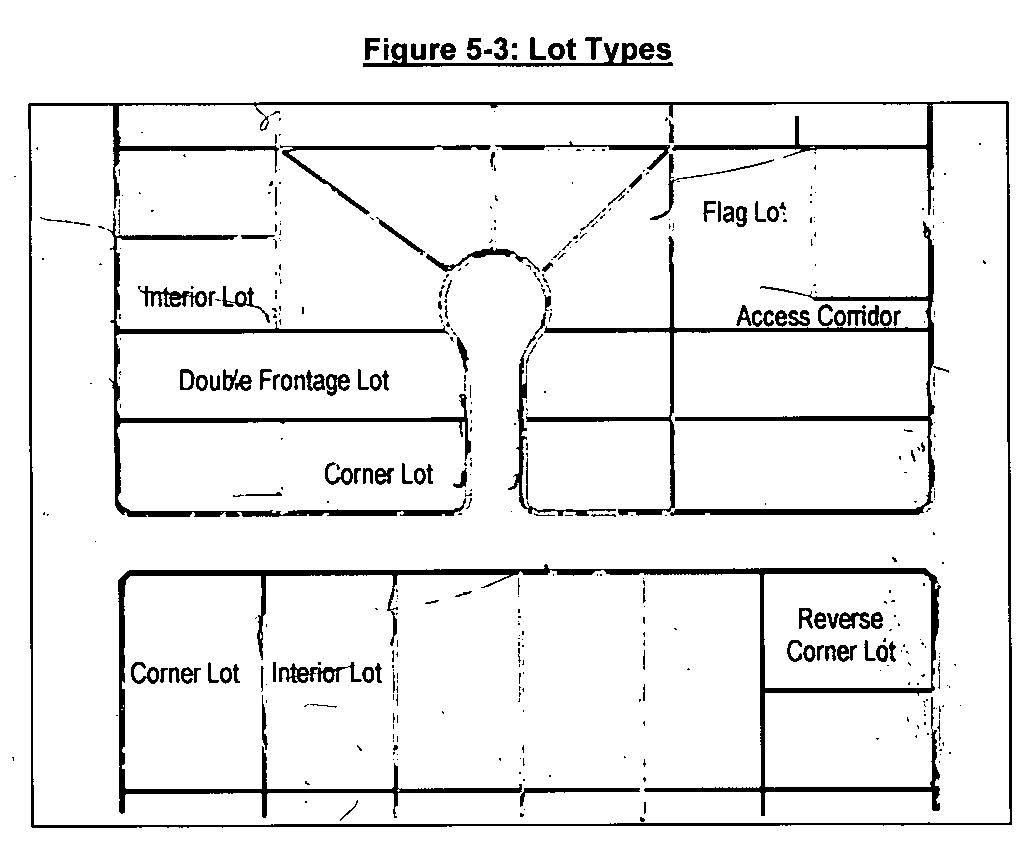
(Ord. No. 1429, Sec. II.70, 5-21-13)
"Material" relative to adult businesses shall mean and include, but not be limited to, accessories, books, magazines, photographs, prints, drawings, paintings, motion pictures, videotapes, and pamphlets, or any combination thereof. (Ord. No. 819, Sec. 1, 2-19-80)
"Massage Establishment" shall be defined as set forth in Section 3662 of the Tustin City Code. (Ord. No. 1367, Sec. II, 4-6-10; Ord. No. 1380, Sec. VI, 6-15-10; Ord. No. 1462, Sec. VIII, 11-3-15)
"Micro-winery" means an establishment that, includes beverage production of wine and may include a tasting facility and sale of wine produced by the owner of the establishment. The establishment shall not include the sale of alcoholic beverages for on-site consumption with the exception of sampling the product within the tasting facility. Wineries shall provide ancillary food service in combination with its primary use. (Ord. No. 1429, Sec. II.70, 5-21-13)
"Mobile Home" means a vehicle, other than a motor vehicle, designed for human habitation, for carrying persons and property on its own structure, for being drawn by a motor vehicle. (Ord. No. 329, Sec. 2)
"Mobile Home Park" means any area or tract of land where one (1) or more mobile home lots are rented or leased or held out for rent or lease to accommodate mobile homes used for human habitation. The rental paid for any such mobile home shall be deemed to include rental for the lot it occupies. (Ord. No. 329, Sec. 2)
"Mobile Recycling Unit" means an automobile, truck, trailer or van, licensed by the Department of Motor Vehicles, which is used for the collection of recyclable materials. A Mobile Recycling Center also means the bins, boxes or containers transported by trucks, vans, or trailers, and used for the collection of recyclable materials. (Ord. No. 993, Sec. 1, 9-8-87)
"Motel" or "Hotel" means a single building or group of detached buildings, containing guest rooms or apartments, with automobile storage space provided on the site for such rooms or apartments provided in connection therewith, which group is designed and used primarily for the accommodation of transient automobile travelers. (Ord. No. 157, Sec. 11.4)
"Multiple Family Dwelling" for the purposes of ADU development, a structure with two (2) or more attached dwellings on a single lot is considered a multi-family dwelling structure. Multiple detached single-unit dwellings on the same lot are not considered multi-family dwellings. (Ord. No. 1517, Sec. XII, 12-7-21)
"Nonconforming Use" means a use that does not conform to the regulations for the district in which it is situated. (Ord. No. 157, Sec. 11.33)
"Official Plan Line" means a line established to denote the ultimate right-of-way of a street. (Ord. No. 353, Sec. 5)
"Parking Space" means accessible and usable space on a building site, at least nine feet by twenty feet (9' × 20') for open parking and ten feet by twenty feet (10' × 20') clear and unobstructed inside dimensions for covered parking, located off the street and for the parking of automobiles. Not less than two (2) parking spaces per dwelling unit shall be provided and permanently maintained as parking accommodation, one of which must be covered. Parking not otherwise required to be in a garage or carport must be located on a paved area on the same lot or parcel of land or contiguous thereto. (Ord. No. 733, Sec. 8)
"Paved Area" means an area of any required yard which is constructed with impervious materials which either results in an increase in the amount of storm water run-off into public storm drainage facilities or hinders natural percolation of storm water on the subject property. (Ord. No. 1240, Sec. 2, 8-6-01)
"Person" includes any individual, city, county, or city and county; partnerships, corporations, cooperatives, association, trust or any other legal entities, including the Federal Government. (Ord. No. 157, Sec. 11.35)
"Places of Worship" means a structure or portion of a structure that is used for the gathering of people for the purpose of performing acts of religious study, honor or devotion. (Ord. No. 1429, Sec. II.70, 5-21-13)
"Portable Vending Device" means any stand, enclosure, booth, kiosk, instrument or mechanism intended to be temporarily used to display, distribute or sell food, beverage, product to the public. (Ord. No. 1123, Sec. 2, 6-6-94)
"Processor" means any person, including a scrap dealer, certified by the State Department of Conservation who purchases empty aluminum beverage containers, nonaluminum metal beverage containers, glass beverage containers, plastic beverage containers, or any other beverage containers, including any one (1) or more of those beverage containers, which have a redemption value established pursuant to this division, from recycling center in this state for recycling or, if the container is not recyclable, not for recycling, and who cancels, or who certifies to the department in a form prescribed by the Department of Conservation of, the redemption value and redemption bonus of these empty beverage containers by processing empty beverage containers, in any manner which the department may prescribe. However, the department shall not take any action regulating scrap dealers or recycling centers who are processors or recycling centers unless authorized by and pursuant to the goals of this division. (Ord. No. 993, Sec. 1, 9-8-87)
"Professional, instructional, motivational and/or seminar schools" means an educational institution or establishment that provides practical training and instruction for specific careers or trades, within fields such as healthcare, technology, or skilled trades. (Ord. No. 1536, Sec. 20, 4-16-24)
"Professional Office" means an office for the conduct of any of the following uses or uses determined by the Community Development Director and/or the Planning Commission to be similar: architect, attorney, chiropractor, dentist, designer, doctor, draftsman, engineer, land planner, ophthalmologist or optometrist, podiatrist, surveyor, physician, surgeon, or any others licensed by the State of California to practice the healing arts, including clinics for out-patients only. (Ord. No. 157, Sec. 11.36; Ord. No. 1367, Sec. II, 4-6-10)
"Public Transit" for the purposes of ADU development, means a location, including, but not limited to, a bus stop or train station, where the public may access buses, trains, subways, and other forms of transportation that charge set fares, run on fixed routes, and are available to the public. (Ord. No. 1478, Sec. 13, 4-4-17; Ord. No. 1517, Sec. XII, 12-7-21)
"Pushcart" means any wagon, cart, or similar wheeled container, which is not a "vehicle", as defined in the Vehicle Code of the State of California, from which food, beverage, or product is displayed, distributed or offered for sale to the public. (Ord. No. 1123, Sec. 2, 6-6-94)
"Pushcart or Portable Vending Device Operator" means any person, firm, partnership, association, corporation, stockholder, including, but not limited to, owners, operators, lessors and lessees, who operate a pushcart or portable vending device for the purpose of vending food, beverage, or product therefrom. (Ord. No. 1123, Sec. 2, 6-6-94)
"Pushcart or Portable Vending Device Owner" means any person as defined herein owning or controlling one (1) or more pushcarts and who:
(1)
Conducts or permits or causes the operation of such pushcart(s) or portable vending device(s) for vending food, beverage or product;
(2)
Owns, operates, controls, manages, or leases such pushcart(s) or portable vending device(s); or
(3)
Contracts with persons to vend food, beverage or product from such pushcart(s) or portable vending device(s). (Ord. No. 1123, Sec. 2, 6-6-94)
"Recyclable Material" is reusable material, including but not limited to metals, glass, plastic and paper, which are intended for reuse, remanufacture, or reconstitution for the purpose of using the altered form. Recyclable material does not include refuse or hazardous materials. Recyclable material may include used motor oil collected and transported in accordance with Sections 25250.11 and 25143.2(b)(4) of the California Health and Safety Code and Orange County Fire and Health Departments. (Ord. No. 993, Sec. 1, 9-8-87)
"Recycle," "Recycled," "Recycling" or "Recyclable" means the reuse or refilling of empty beverage containers or the process of sorting, cleansing, treating, and reconstituting empty postfilled beverage containers for the purpose of using the altered form. "Recycle," "recycled," "recycling" "recyclable," does not include merely sorting, shredding, stripping, compressing, storing, landfilling with, or disposing of an empty beverage container. (Ord. No. 993, Sec. 1, 9-8-87)
"Recycling Center" is a center for the collection of recyclable materials. (See Section 9271bb for recycling center regulations and classifications). (Ord. No. 1429, Sec. II.70, 5-21-13)
"Recycling Facility" is a center for the collection of recyclable materials. A recycling facility does not include storage containers or processing activity located on the premises of a residential, commercial, or manufacturing use and used solely for the recycling of material generated by that residential property, business or manufacturer. Recycling facilities include the following:
A "Certified Recycling Facility" means a recycling facility certified by the California Department of Conservation as meeting the requirements of the California Beverage Container Recycling and Litter Reduction Act of 1986.
A "Collection Facility" is a center for the acceptance, by donation, redemption, or purchase, of recyclable materials from the public. Such a facility does not use power-driven processing equipment except as indicated in Section 4 Criteria and Standards. Collection Facilities may include the following:
1.
Reverse Vending Machines which occupy an area of not more than fifty (50) square feet.
2.
Bulk reverse vending machines occupying no more than five hundred (500) square feet.
3.
Large collection facilities which occupy a permanent building or store front. (Ord. No. 993, Sec. 1, 9-8-87)
"Redemption" and "Redeem" means the return to a recycling center of an empty beverage container for a refund of at least the redemption value and any applicable redemption bonus.
"Residential Zoning District" shall mean all zones within the City of Tustin that support or include residential uses, whether as a permitted use or conditionally permitted use. (Ord. No. 1574, Sec. 18, 3-17-26)
"Responsible Party" means any person(s) or entity(ies) that hold(s) legal and/or equitable title to the real property and/or dwelling unit, including any property owner, lessee or tenant, or any agent or representative thereof, who causes or permits any violation of this Code. To cause or permit includes failure to correct or cause correction after receiving notice from the City of the violation. (Ord. No. 1574, Sec. 19, 3-17-26)
"Rest Home" means any premises licensed under Section 2300 of the Welfare and Institutions Code of the State of California. (Ord. No. 157, Sec. 11.37)
"Rooming House"—See Boarding House. (Ord. No. 157, Sec. 11.38)
"Sanitarium" means a health station or retreat or other place where patients are housed, and where treatment is given, but excluding mental institutions or institutions for treatment of persons addicted to the use of drugs. (Ord. No. 157, Sec. 11.39)
"Service Station" means a use which provides for the servicing of motor vehicles and operations incidental thereto, limited to the retail sale of petroleum products and automotive accessories; automobile washing by hand; waxing and polishing of automobiles; tire changing and repairing (excluding recapping); battery service, charging and replacement, not including repair and rebuilding; radiator cleaning and flushing, excluding steam cleaning and repair; installation of accessories; also including the following operations if conducted within a building; lubrication of motor vehicles; brake servicing limited to servicing and replacement of brake cylinders and brake shoes; wheel balancing; the testing, adjustment, and replacement of carburetors, coils, condensers, distributor caps, fan belts, filters, generators, points, rotors, spark plugs, voltage regulators, water and fuel pumps, water hoses and wiring. (Ord. No. 157, Sec. 11.40; Ord. No. 1429, Sec. II.70, 5-21-13)
"Setback Lines" means a line established by this Chapter to govern the placement of buildings or structures with respect to lot lines, streets or alleys. (Ord. No. 157, Sec. 11.41)
"Short-Term Rental" means a rental or other occupancy of a dwelling unit or part of a dwelling unit to visitors where lodging is furnished for a period of thirty (30) consecutive calendar days or less. (Ord. No. 1574, Sec. 20, 3-17-26)
"Side and Front of Corner Lots" means the narrowest frontage of a corner lot facing the street is the front, and the longest frontage facing the intersecting street is the side, irrespective of the direction in which the dwelling faces. (Ord. No. 157, Sec. 11.42)
"Signs" means any advertising display or structure. (Ord. No. 157, Sec. 11.43)
"Small Animal Hospital or Clinic" means a place where small animals, such as dogs, cats, birds, and the like, are given medical or surgical treatment. (Ord. No. 352, Sec. 2)
"Small Family Day Care Home" pursuant to California Health and Safety Code definition and the applicable development standards in TCC Section 9271aa. (Ord. No. 1367, Sec. II, 4-6-10)
"Special Event" means any commercial, civic, patriotic, religious, cultural, community or political event taking place on a specific date or dates or other such occurrence as determined by the Director of Community Development. (Ord. No. 1123, Sec. 2, 6-6-94)
"Specialty Store" means a market or retail store other than convenience stores with fewer than 3,500 square feet in gross floor area with limited hours of operation, located in a retail center with more than three (3) retail tenants, that offers a combination of unique foods and beverages not commonly found in convenience or food markets or other retail stores for off-site use or consumption and where alcoholic beverage sales are incidental with no more than fifteen (15) square feet of the retail floor devoted to display of non-refrigerated alcoholic beverage sales for off-site consumption and no sales of refrigerated alcoholic beverages. (Ord. No. 1237, Sec. 2, 6-4-01)
"Specified Anatomical Areas" shall mean:
(1)
Less than completely and opaquely covered:
(a)
Human genitals, pubic regions;
(b)
Buttock; and
(c)
Female breast below a point immediately above the top of the areola; and
(2)
Human male genitals in a discernibly turgid state, even if completely and opaquely covered. (Ord. No. 819, Sec. 1, 2-19-80)
"Specified Sexual Activities" shall mean:
(1)
Human genitals in a state of sexual stimulation or arousal; and/or
(2)
Acts of human masturbation, sexual stimulation or arousal; and/or
(3)
Fondling or other erotic touching of human genitals, pubic region, buttock, or female breast. (Ord. No. 819, Sec. 1, 2-19-80)
"Statewide Exemption ADU" for purposes of ADU development means an ADU of up to 800 square feet, sixteen (16) feet in height, and with four (4) feet side and rear yard setbacks in compliance with all other local development standards. A Statewide Exception ADU shall not be precluded due to lot coverage, floor area ratio, open space, or minimum lot size requirements. (Ord. No. 1517, Sec. XII, 12-7-21)
"Street" means a public thoroughfare accepted by the City of Tustin, which affords principal means of access to abutting property, including avenue, place, way, drive, lane, boulevard, highway, road and any other thoroughfare except an alley as defined herein. (Ord. No. 157, Sec. 11.44)
"Street Line" means the boundary between a street right-of-way and property. (Ord. No. 157, Sec. 11.45)
"Structure" means anything constructed or erected, the use of which requires location on or in the ground, or attachment to something having location on the ground, excluding in-ground and above-ground swimming pools, driveways, flatwork for paved, uncovered patios or surface parking spaces. (Ord. No. 157, Sec. 11.46; Ord. No. 1524, Sec. 65, 8-16-22)
"Structural Alterations" means any change in the supporting members of a structure, such as bearing walls, columns, beams or girders. (Ord. No. 157, Sec. 11.47)
"Supermarket" means a full-line, self-service retail store with gross annual sales of two million dollars ($2,000,000.00) or more, and which sells a line of dry grocery, canned foods, or nonfood items and some perishable items. (Ord. No. 993, Sec. 1, 9-8-87)
"Townhouse" or "Townhome" means a single-family dwelling unit constructed in a group of three or more attached units in which each unit extends from the foundation to roof and with a yard or public way on not less than two sides. (Ord. No. 1535, Sec. 6, 6-6-23)
"Travel Trailer" means a vehicle, other than a motor vehicle, which is designed or used for human habitation, and for travel or recreational purposes, which does not at any time exceed eight (8) feet in width and forty (40) feet in length and which may be moved upon a public highway without a special permit or chauffeur's license, or both, without violating any provision of the Vehicle Code. (Ord. No. 329, Sec. 2)
"Travel Trailer Park" means any area or tract of land or a separate designated section within a mobile home park where one (1) or more lots are rented or leased or held out for rent or lease to owners or users of travel trailers or camp cars used for travel or recreational purposes. (Ord. No. 329, Sec. 2)
"Unit" means any building designed or used for the shelter or housing of one (1) or more persons, and shall include apartments. (Ord. No. 790, Sec. 4, 2-20-79)
"Use" means the purpose for which land or a building is designed, arranged, or intended or for which either land or building is or may be occupied or maintained. (Ord. No. 157, Sec. 11.49)
"Use, Accessory" means a use incidental or subordinate to, and devoted exclusively to the main use of a lot or a building located on the same lot. (Ord. No. 157, Sec. 11.50)
"Vend" or "Vending" means offering food, beverage, or product of any kind for outdoor sale on any publicly or privately owned sidewalk, drive aisle, street, alley, or unenclosed place open to the public, including the movement or standing of a pushcart or portable vending device for the purpose of searching for, obtaining or soliciting retail sales of products. (Ord. No. 1123, Sec. 2, 6-6-94)
"Vending Machines":
A "Reverse Vending Machine" is an automated mechanical device which accepts at least one (1) or more types of empty beverage containers including, but not limited to, aluminum cans, glass and plastic bottles, and issues a cash refund or a redeemable credit slip with a value not less than the container's redemption value as determined by the State. A Reverse Vending Machine may sort and process containers mechanically provided that the entire process is enclosed within the machine. (In order to accept and temporarily store all three (3) container types in a proportion commensurate with their relative redemption rates, and to meet the requirements of certification as a recycling facility, multiple grouping of Reverse Vending Machines may be necessary.)
A "Bulk Reverse Vending Machine" is a Reverse Vending Machine that is larger than fifty (50) square feet; is designed to accept more than one (1) container at a time; and will pay by weight instead of by container. (Ord. No. 993, Sec. 1, 9-8-87)
"Yard" means an open space other than a court on the same lot with a building, which open space is unoccupied and unobstructed from the ground upward, except as otherwise permitted in Section 9271. (Ord. No. 157, Sec. 11.51)
"Yard, Front" means a yard extending across the full width of the lot, the depth of which is measured from the front line of the lot to the nearest line of the building; provided, however, that if any Official Plan Line has been established for the street upon which the lot faces, the front yard measurement shall be taken from such Official Plan Line to the nearest line of the building. (Ord. No. 353, Sec. 2)
"Yard, Rear" means a yard extending across the full width of the lot and measured between the rear line of the lot and the nearest line of the main building. (Ord. No. 157, Sec. 11.53)
"Yard, Side" means a yard between the side line of the lot and the nearest line of the building and extending from the front yard to the rear yard. (Ord. No. 353, Sec. 3)
9298 - INTERPRETATION AND ENFORCEMENT
a
Continuity of Law
Except as specifically provided herein, this chapter shall not be interpreted to repeal, abrogate, annul or in any way affect any existing provision of any law or ordinance or regulations or permits previously adopted or issued relating to the erection, construction, moving, alteration or enlargement of any building or improvement; provided however, in any instances where this chapter imposes greater restrictions upon the erection, construction, establishment, moving, alteration or improvement of buildings or the use of any building or structure that is imposed or required by an existing law, ordinance or regulation, the provisions of this chapter shall control. (Ord. No. 157, Sec. 12.1)
b
Criteria for Use Determination
Whenever the Director of Community Development, Planning Commission or City Council is called upon to determine, in cases of ambiguity, whether or not the use of any land or structure in any district is similar in character to the particular uses or plans allowed in the district, the Director of Community Development, Planning Commission or the City Council shall consider the following factors as criteria for their determination, as applicable:
(1)
Effect upon the public health, safety and general welfare of the neighborhood involved and the City at large.
(2)
Effect upon traffic conditions.
(3)
Effect upon the orderly development of the area in question and the City at large, in regard to the general planning of the whole community.
(4)
All other pertinent facts. (Ord. No. 175, Sec. 10; Ord. No. 1366, Sec. 21, 11-17-90)
c
Interpretation
If any ambiguity arises concerning the appropriate provisions of the chapter, the Director of Community Development shall make an interpretation or the Planning Commission shall ascertain all pertinent facts and make an interpretation based on its findings and thereafter such interpretation shall govern.
d
Responsibility of Enforcement
It shall be the duty of the Community Development Director or designee to enforce the provisions of this chapter pertaining to the use of land or buildings in the erection, construction, reconstruction, moving, alteration, or addition to any buildings or structures. Any permit or license of any type issued by any department or officer of the City of Tustin issued in conflict with the provisions of this chapter is hereby declared to be null and void. (Ord. No. 175, Sec. 11; Ord. No. 1366, Sec. 22, 11-17-09; Ord. No. 1536, Sec. 21, 4-16-24)
e
Procedures
Any building or structure erected, constructed, altered, enlarged, converted, moved or maintained contrary to the provisions of this chapter and any use of land or buildings operated or maintained contrary to the provisions of this chapter are hereby declared to be public nuisances. The City Council may commence the necessary action or proceedings for the abatement, removal and enjoining thereof in the manner prescribed by law in the courts which may have jurisdiction to grant such relief as will accomplish such abatement and restraint. The remedies provided for in this section shall be in addition to any other remedy or remedies or penalties provided in this chapter or any other law or ordinance. (Ord. No. 157, Sec. 13.2)
f
Appeals
Any person may appeal any decision of the Director of Community Development in accordance with Section 9294 of this Code. (Ord. No. 157, Sec. 13.3; Ord. No. 1366, Sec. 23, 11-17-09)
g
Consistency With All Laws
Notwithstanding any provision of this Code to the contrary, any use, entitlement, authorization, license, or permit allowed or issued under this Code, including without limitation any accessory or ancillary use, shall be consistent with applicable state and federal law. Any use or activity that is illegal under local, state, or federal law shall be deemed a prohibited use in all districts within the City. (Ord. No. 1322, Sec. 2, 12-4-06)
(Ord. No. 1429, Sec. II.71, 5-21-13)
9299 - ZONING ADMINISTRATOR
a
Office Created
An Office of the Zoning Administrator is hereby created pursuant to Section 65900 et seq., of the California Government Code.
b
Duties
The Community Development Director, or his/her designee, acting as the Zoning Administrator, shall have dual responsibility with that of the Planning Commission to hear and decide in accordance with Council policy and provisions of this chapter, and has the authority to approve, conditionally approve or deny the following requests when such requests constitute a reasonable use of property not permissible under a strict literal interpretation of the regulations. The Zoning Administrator reserves the right to forward any matter listed below to the Planning Commission for consideration and action. Requests for minor adjustments Zoning Administrator variances in excess of the limitations prescribed in this subsection, or those development standards not specifically listed in this subsection, shall be subject to the approval of a variance by the Planning Commission. Requests for conditional use permits or other specified development applications not specifically listed in this subsection shall be subject to the approval of a conditional use permit or other discretionary review by the Planning Commission or other reviewing body as applicable.
(1)
Minor adjustments:
(a)
A decrease of not more than five (5) percent of the required building site area.
(b)
A decrease of not more than ten (10) percent of a required building or landscaping setback.
(c)
An increase of not more than twenty (20) percent in the maximum permitted height of a fence solid hedge or wall, subject to city approved structural design.
(d)
An increase of not more than ten (10) percent of the permitted projection of steps, stairways, landings, eaves, cornices, canopies, overhangs, masonry chimneys, raised porches and fireplaces into any required building setback.
(e)
An increase of not more than ten (10) percent in the maximum permitted building height.
(f)
A decrease in the number of required off-street parking spaces for nonresidential land uses up to a maximum of ten (10) percent.
(g)
A decrease of not more than ten (10) percent in the permitted distances between detached accessory structures and main structures.
(h)
An increase of not more than ten (10) percent in the maximum permitted driveway area within the front yard setback for residential districts or the front yard for commercial and industrial districts. (Ord. No. 1240, Sec. 2, 8-6-01; Ord. No. 1354, Sec. II, 11-4-08)
(i)
A decrease in the number of required off-street parking spaces for residential land uses by a maximum of one (1) parking space. (Ord. No. 1354, Sec. II, 11-4-08; Ord. No. 1479, Sec. 14, 4-4-17; Ord. No. 1517, Sec. XIV, 12-7-21)
(j)
Repealed. (Ord. No. 1574, Sec. 21, 3-17-26)
(2)
Variances when required by the City Code:
(a)
A decrease of not more than ten (10) percent of an individual required building site area.
(b)
An increase of not more than twenty (20) percent of the permitted projection of steps, stairways, landings, eaves, cornices, canopies, overhangs, masonry chimneys, raised porches and fireplaces into any required building setback.
(c)
A decrease in the number of required off-street parking spaces for nonresidential land uses up to a maximum of twenty (20) percent.
(d)
A decrease of not more than twenty (20) percent in the required setbacks for buildings, landscaping, swimming pools, spas and equipment.
(e)
An increase of not more than twenty (20) percent of the maximum sign area allowed, per zoning regulations.
(3)
Conditional Use Permits when required by the City Code:
(a)
Wireless Communication Facilities. (Ord. No. 1536, Sec. 22, 4-16-24)
(b)
Bulk Reverse vending machines.
(c)
Business operations (including storage) conducted within view from public right-of-way.
(d)
Large recycling locations.
(e)
On-premises dry cleaning.
(f)
Minor CUPs for existing development where there would be no change of primary use, there would be no expansion of floor area, and the request would not alter the original intent of the project or site.
(g)
Alcoholic beverage sales establishments. (Ord. No. 1493, Sec. 6, 9-4-18)
(h)
Secondhand sales when pawning is not included.
(i)
Development or construction of new buildings in the Commercial General (CG) or Industrial (M) Districts where more than fifty (50) percent of the total area, or any portion of the ground floor, is designated for use by professional or general offices.
(j)
Accessory buildings used as guest quarters.
(k)
Wall signs to include murals or graphics that are painted or made of other material deemed appropriate by the Zoning Administrator and which do not promote a product or business, but rather depicts a scene or image. (Ord. No. 1524, Sec. 66, 8-16-22; Ord. No. 1556, Sec. 2, 2-18-25)
(l)
Roof signs on buildings listed within the City's Historic Resources Survey. (Ord. No. 1317, Sec. II, 9-18-06; Ord. No. 1497, Sec. 4(Att. C), 7-3-18; Ord. No. 1524, Sec. 66, 8-16-22)
(m)
A master sign plan requesting deviations from standards contained in this chapter provided that the project is a center and a single development project of at least thirty thousand (30,000) building square feet or one (1) acre in project size. (Ord. No. 1524, Sec. 67, 8-16-22)
(4)
Specified development applications:
(a)
Reserved. (Ord. No. 1556, Sec. 3, 2-18-25)
(b)
Time extensions of not more than twelve (12) months from the original expiration date for minor adjustments, conditional use permits, variances, design reviews, subdivisions and other development applications, subject to the same noticing requirements that were given at the time the project was originally approved.
(c)
Except where design review is required by the planning commission pursuant to an adopted specific plan, (a) design review applications within redevelopment project areas; (b) minor design reviews within redevelopment project areas which include modifications to existing structures and/or existing facade or site modifications which constitute a change in three (3) or less major design elements which do not result in a completed facade upgrade, (c) single-family homes not part of a subdivision, (d) residential room additions and (e) new or modified accessory structures associated with existing development.
(d)
Amendment to conditions of approval established by Planning Commission or City Council. Condition amendments that are determined by the Community Development Director to be minor in nature and will not alter the original intent of the project or site. Examples would include changes to exterior materials, colors, elevations, landscaping, walls/fences and hours of operation.
(e)
Reduction of nonresidential or commercial parking requirements within the Downtown Commercial Core Specific Plan. All or a portion of the required number of commercial parking spaces may be satisfied by depositing with the City a Parking Exception Fee to be used for public parking accommodation within the area. The amount of the Parking Exception Fee shall be determined by Fee Resolution of the City Council. The Zoning Administrator shall make a determination that the proposed project requesting payment of the Parking Exception Fee meets the following findings:
1.
The proposed project is an infill project located within the Downtown Commercial Core Specific Plan.
2.
The proposed project is considered to be relatively small.
3.
The proposed project has incorporated building or site design enhancements that make it an outstanding addition to the Downtown Commercial Core Specific Plan.
4.
The proposed project is aesthetically superior to one that provides all required parking on site.
5.
The project applicant shall agree to pay an annual fee for each commercial parking space not provided on site.
(Ord. No. 1429, Sec. II.72, 5-21-13; Ord. No. 1536, Sec. 3, 4-16-24; Ord. No. 1556, Sec. 4, 2-18-25)
c
Application Process
(1)
Submittal requirements. Applications for minor adjustments, conditional use permits or other specified development applications that would be subject to action by the Zoning Administrator shall be filed with the Community Development Department pursuant to the department's current application procedures and fee schedule. Applications should be accompanied with a written description as to how the applicable positive findings for the project type applied for identified in subsection (3) below can be justified. A single application may include more than one (1) request applicable to the same project. Applications subject to action by the Zoning Administrator shall be processed and approved, conditionally approved or denied within the time limits established by state law for actions of development projects.
(2)
Public Hearing and Noticing Requirements.
(a)
For applications other than Alcoholic beverage sales establishments, upon determination that an application is complete, the Community Development Department shall schedule the matter for consideration by the Zoning Administrator. If a public hearing is required for the type of application considered, notice of such public hearing shall be given pursuant to Government Code Section 65091. Minor adjustments shall be considered by the Zoning Administrator without a public hearing.
(b)
For Alcoholic beverage sales establishments, upon determination that an application is complete, the Community Development Department shall provide a notice of the Zoning Administrator's pending decision to approve or deny the application, pursuant to Government Code Section 65091. If no request for a hearing is received by the Community Development Department within ten (10) days of the date of the notice, the application may be approved by the Zoning Administrator without a public hearing. If the Zoning Administrator intends to deny the request, or a request for a hearing is received within ten (10) days of the date of the notice, then the Community Development Department shall schedule the matter for a public hearing before the Zoning Administrator. Pursuant to Section 9299b, the Zoning Administrator may forward an application for alcoholic beverage sales to the Planning Commission for consideration and action.
(c)
Additional noticing time as specified in Government Code Section 65091 may be required to comply with noticing requirements of the California Environmental Quality Act. In the event of a conflict between required noticing times, the longer time shall be given. (Ord. No. 1556, Sec. 5, 2-18-25)
(3)
Required Findings
(a)
Minor adjustments shall be granted only when such adjustments are found to be in conformance with the General Plan and when, because of special circumstances applicable to the property, including size, shape, topography, or surroundings, the strict application of the Zoning Ordinance is found to deprive the subject property of privileges enjoyed by other properties in the vicinity and under identical zone classification. Any minor adjustment granted shall be subject to such conditions as will assure that the adjustment thereby authorized shall not constitute a grant of special privilege inconsistent with the limitations upon other properties in the vicinity and district in which the subject property is situated.
(1)
Minor adjustment to reduce the required amount of nonresidential parking shall be granted only when, in addition to the findings in Section 9299c(3)(a) above, the following findings can also be made:
(a)
The intent of the parking regulations is preserved;
(b)
The parking provided will be sufficient to serve the use intended and potential future uses of the same site; and
(c)
The adjusted decrease in the number of parking spaces shall not be detrimental to the public health, safety or general welfare or materially injurious to properties located in the general vicinity.
(2)
Minor adjustment to reduce the required amount of residential parking shall be granted only when, in addition to the findings in Section 9299c(3)(a) above, the findings in Section 9264b, can also be made. (Ord. No. 1354, Sec. II, 11-4-08)
(b)
Variances may be granted only when such variances are found to be in conformance with the General Plan and when because of special circumstances applicable to the property, including size, shape, topography, or surroundings, the strict application of the Zoning Code is found to deprive the property of privileges enjoyed by other properties in the vicinity and under identified zone classification.
(c)
Conditional use permits shall be granted only when such conditional use permits are found to be in conformance with the General Plan and when the establishment, maintenance, or operation of the use applied for will not, under the circumstances of the particular use, be detrimental to the health, safety, morals, comfort and general welfare of the persons residing or working in the neighborhood of such proposed use, or injurious or detrimental to property and improvements in the neighborhood or the general welfare of the city.
(d)
Design review applications may be approved only if such applications are found to be in conformance with the General Plan and if the location, size, architectural features and general appearance of the proposed development will not impair the orderly and harmonious development of the area, the present or future development therein, the occupancy thereof, or the community as a whole. In making such findings, the following items shall be considered:
(1)
Height, bulk and area of buildings
(2)
Setbacks and site planning
(3)
Exterior materials and colors
(4)
Type and pitch of roofs
(5)
Size and spacing of windows, doors and other openings
(6)
Towers, chimneys, roof structures, flagpoles, radio and television antennas
(7)
Landscaping, parking area design and traffic circulation
(8)
Location, height and standards of exterior illumination
(9)
Location and appearance of equipment located outside of an enclosed structure
(10)
Location and method of refuse storage
(11)
Physical relationship of proposed structures in the neighborhood
(12)
Appearance and design relationship of proposed structures to existing structures and possible future structures in the neighborhood and public thoroughfares
(13)
Proposed signing
(14)
Development guidelines and criteria as adopted by the City Council
(e)
All other specified development applications that are subject to action by the Zoning Administrator shall be granted only when such applications are found to be in conformance with the General Plan. (Ord. No. 1524, Sec. 68, 8-16-22)
(4)
Zoning Administrator Action. After consideration of the application, and after making the appropriate findings as required above, the Zoning Administrator shall take action to approve, approve with conditions or deny the application. The decision of the Zoning Administrator shall be final unless appealed pursuant to subsection d below. The Zoning Administrator shall provide notice to the applicant within two (2) business days following the action. (Ord. No. 1366, Sec. 24, 11-17-09)
d
Appeals
Any person may appeal any decision of the Zoning Administrator in accordance with Section 9294 of this Code. (Ord. No. 1366, Sec. 25, 11-17-09)
e
Repealed (Ord. No. 1366, Sec. 26, 11-17-09)
f
Repealed (Ord. No. 1366, Sec. 27, 11-17-09)
(Ord. No. 552; Ord. No. 1116, Sec. 1, 5-16-94; Ord. No. 1157, Sec. 1, 12-4-95)

