
Union Gap City Zoning Code
CHAPTER 17
06 - OFF-STREET PARKING AND LOADING
17.06.010 - Purpose.
The following parking standards are intended to assure adequate off-street parking, reduce on-street parking, increase traffic safety, maintain smooth traffic flow, and reduce the visual impact of parking lots.
(Ord. 2274 § 1 (part), 2000)
17.06.020 - Off-street parking and loading spaces required.
No off-street parking or loading spaces shall be placed, constructed, located, relocated, or modified after adoption of this title without first receiving a development permit from the building official. All vehicle storage, off-street parking, and loading spaces which are not themselves a principal use are accessory uses and shall be subject to the same procedures and review requirements as the principal use. All off-street parking and vehicle storage shall be provided in conformance with the provisions of this chapter.
(Ord. 2274 § 1 (part), 2000)
17.06.030 - General provisions.
A.
The off-street parking and loading facilities required by this section shall be established prior to any change in the use of land or structures and/or prior to the occupancy of any new or enlarged structure.
B.
Required off-street parking spaces shall provide vehicle parking only for residents, customers, patrons, and employees and shall not be used for the storage of vehicles or materials, the parking of vehicles used in conducting the business, or for the sale, repair or servicing of any vehicle.
C.
Any area once designated for required off-street parking shall not be used for any other purpose unless and until equal facilities are provided elsewhere and a site plan has been approved to reflect the change, or the primary use of the property is changed to a use requiring less off-street parking.
D.
The required front yard in the R-3 and R-4 districts shall not be used for off-street parking for five or more cars unless the three foot strip nearest the front property line is landscaped and a two foot high concrete, masonry, or decorative block wall, or wood fence, or a solid landscaping screen is provided. (For corner lots see Section 17.05.040, Vision clearance at intersections.)
E.
These provisions shall not apply to lots within the "downtown development district" as defined in Section 17.02.020 when required off-street parking is calculated to be less than ten (10) parking stalls in accordance with Table 17.06.040. Section 17.06.130, off-street loading space, shall apply regardless.
(Ord. 2274 § 1 (part), 2000)
(Ord. No. 2873, § 2, 3-23-15)
17.06.040 - Off-street parking standards.
Table of Required Off-Street Parking. The parking standards in Table 17.06.040, Table of Off-Street Parking Standards, are established as the parking standards for the uses indicated. These parking requirements are based on gross floor area. Gross floor area means the total square footage of all floors in a structure as measured from the interior surface of each exterior wall of the structure and including halls, lobbies, enclosed porches and fully enclosed recreation areas and balconies, but excluding stairways, elevator shafts, attic space, mechanical rooms, restrooms, uncovered steps and fire escapes, private garages, carports, and off-street parking and loading spaces. Storage areas are included in gross floor area. However, the required off-street parking for storage areas shall be calculated at the rate of one space per five hundred square feet rather than the specific parking standard established in Table 17.06.040, except, when the parking standard for the principal use would require fewer parking spaces (i.e., one space per six hundred square feet). All required off-street parking shall be subject to the procedures of this title and the standards of this section.
B.
Uses Not Specified. Off-street parking requirements for the reviewing official shall determine uses not specifically listed in Table 17.06.040 based upon the requirement for similar uses.
(Ord. 2274 § 1 (part), 2000)
TABLE 17.06.040
OFF-STREET PARKING STANDARDS
17.06.050 - Computation of required spaces.
The following rules shall apply in the determination of the number of required off-street parking spaces:
Fraction. If the calculation of the number of off-street parking spaces results in a fraction, such number shall be changed to the next higher whole number.
Mixed Uses. When different uses occupy a single structure or lot, the total required parking spaces shall be the sum of the requirements of the individual uses.
Shared Uses. Owners of two or more uses, structures, or parcels of land within three hundred feet of each other may share the same parking or loading area when the hours of operation do not overlap. The owners of two or more uses, structures, or parcels within three hundred feet of each other may also share facilities concurrently; however, the total parking requirements shall be the sum of the requirements for each individual use. Whenever shared parking is allowed under this section, the parking lot shall be signed to reasonably notify the public of the availability of use, and spaces shall not be assigned, allocated or reserved between uses. (Also see Section 17.06.060.)
A parking agreement approved by the administrative official shall be filed with the county auditor whenever two or more uses propose to share off-street parking facilities.
Tandem Parking. Parking spaces in tandem, having a single means of ingress and egress, shall not be counted as two off-street parking spaces for the purpose of fulfilling the requirements of this chapter; except that, each tandem space for single-family and two-family (duplex) dwellings for each individual dwelling unit shall be counted as one required parking space.
(Ord. 2274 § 1 (part), 2000)
17.06.060 - Location of required spaces.
Off-street parking facilities shall be located according to the following:
For single-family and two-family dwellings, parking facilities shall be located on the same lot or building site as the buildings they serve.
For hospitals, convalescent, nursing or rest homes, parking facilities shall be located not more than one hundred fifty feet from the buildings they are required to serve.
For uses other than those specified above, parking facilities shall not be located over three hundred feet from the buildings they serve.
A group of five or more parking spaces shall be served by a driveway located so that no vehicular backing or maneuvering movement will occur within a public right-of-way other than an alley.
No parking lot or driveway serving a nonresidential use in a commercial or industrial district shall be located in a residential zoning district.
(Ord. 2274 § 1 (part), 2000)
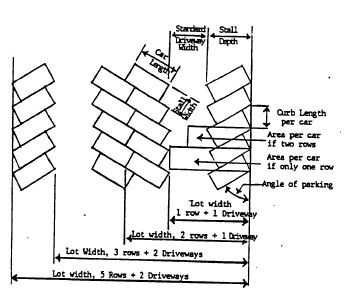
17.06.070 - Schedule of minimum parking dimensions.
Driveways and parking stalls shall conform to Table 17.06.070, which is adopted as the schedule of minimum parking dimensions.
(Ord. 2274 § 1 (part), 2000)
TABLE 17.06.070
PARKING LOT DIMENSIONS
(ALL DIMENSIONS ARE BASED ON A BASIC 9′ × 19′ STALL)
17.06.080 - Site plan required.
Prior to construction the reviewing official shall approve a site plan for every new or enlarged off-street parking lot or motor vehicle sales area. The site plan shall comply with the provisions for general or detailed site plans in Chapter 17.11 and shall also show the proposed development, locations, size, shape and design of the parking spaces, curb cuts, lighting, landscaping, irrigation and other features of the proposed parking lot. The site plan shall be filed under the provisions of Section 17.11.030.
(Ord. 2274 § 1 (part), 2000)
17.06.090 - Required landscaping of parking areas.
A.
The standard for landscaping of parking and vehicle storage lots with five or more spaces shall be five percent of the total parking area. This may be included to satisfy the lot coverage (impermeable surface) requirements of Table 17.05.020.
B.
The planting area standard shall be twenty-four square feet in area with the exception of raised planter boxes around buildings.
C.
A standard of one tree from an approved list shall be planted for every fifteen single-row parking stalls or every thirty double-row parking stalls within the parking lot.
D.
Landscaping shall consist of combinations of trees, shrubs, and groundcover with careful consideration to eventual size and spread, susceptibility to disease and pests, durability, and adaptability to existing soil and climatic conditions.
Every parking area that abuts property in any residential district shall be separated from such property by a solid wall, view-obscuring fence, or compact evergreen hedge at least six feet in height. The screening shall be provided and maintained along the property line of such lot except in the required front yard.
(Ord. 2274 § 1 (part), 2000)
17.06.100 - Lighting.
Lighting shall be provided to illuminate any off-street parking or loading space used at night. When provided, lighting shall be directed to reflect away from adjacent properties.
(Ord. 2274 § 1 (part), 2000)
17.06.110 - Construction and maintenance.
All off-street parking and vehicle storage and motor vehicle sales lots having a capacity of three or more vehicles, shall be constructed in the following manner:
A.
Surfacing. Paved with two inch thick asphaltic surfacing on an aggregate base, or an equivalent surfacing acceptable to the reviewing official, sufficient to eliminate dust or mud.
B.
Grading and Drainage. Graded and drained so all surface water is disposed of on-site. Grading and drainage facilities shall be designed according to accepted engineering standards.
C.
Border Barricades. Any parking, vehicle storage or motor vehicle sales area abutting the street property line shall provide a concrete curb or timber barrier at least six inches in height and located at least two feet from the street property line. The curb or barrier shall be securely anchored. No curb or barrier shall be required across any driveway or entrance to the parking area, or if the parking lot is separated from the street by a fence or hedge.
D.
Markings. All parking spaces (except motor vehicle sales areas) shall be marked by durable painted lines at least four inches wide and extending the length of the stall or by curbs or other means approved by the reviewing official to indicate individual parking stalls. Signs or markers located on the parking lot surface shall be used as necessary to ensure safe and efficient use of the parking lot.
The owner or lessee of a required parking area shall maintain the paved surface, drainage facilities, landscaping and irrigation facilities in conformance with the standards of this chapter and the approved site plan.
(Ord. 2274 § 1 (part), 2000)
17.06.120 - Time of completion.
All parking required by this title shall be installed prior to occupancy or commencement of use. Where compliance with this requirement is not possible, the reviewing official may grant an appropriate delay under the provisions of Section 17.11.070(D).
(Ord. 2274 § 1 (part), 2000)
17.06.130 - Off-street loading space required.
Off-street loading and unloading spaces shall be required for any use requiring frequent loading or unloading from trucks or other large vehicles.
A.
Loading Space Size. The required loading space shall be of adequate size to accommodate the maximum number and size of vehicles simultaneously loading or unloading at the structure. Each off-street loading space shall have the minimum dimensions of twelve feet in width and twenty-five feet in length. On-site maneuvering space of not less than fifty-two feet in length shall be provided adjacent to the loading dock. This maneuvering space shall not include any area designated for off-street parking.
B.
Loading Space Location. Required off-street loading and related maneuvering space shall be located only on or abutting the property served. No part of any vehicle using the loading space shall project into the right-of-way of any public or private road.
(Ord. 2274 § 1 (part), 2000)
17.06.140 - Nonconforming parking.
Any use which, on the effective date of this section or any amendments hereto, is nonconforming in terms of required off-street parking facilities may continue in the same manner as if they were conforming. However, the number of existing off-street parking spaces shall not be reduced.
When an existing structure with nonconforming parking is expanded, or a nonconforming use is changed to another nonconforming use and additional parking is required, the additional parking spaces shall be provided in accordance with the provisions of this chapter. However, the number of additional spaces shall be computed only to the extent of the enlargement, regardless of whether or not the number of previously existing spaces satisfies the requirements of this chapter.
When the use of an existing lot or structure with nonconforming parking is changed to another use listed in Table 17.04.030, the nonconformity shall cease and the new use shall provide all the required off-street parking in accordance with the provisions of this chapter.
(Ord. 2274 § 1 (part), 2000)

