
Universal City City Zoning Code
ARTICLE XI
- ARCHITECTURAL DESIGN REQUIREMENTS
Sec. 4-5-105. - Intent.
In order to ensure an interest in design and provide building articulation to the façade of a building, a variety of building techniques are required. It is the intent of these design criteria to ensure that the front and sides, and in certain instances the rear, of non-residential and multi-family structures have a variety of offsets, relief, and insets to provide a more aesthetic façade appearance.
(Ord. No. 559-K-2021, § 1, 7-6-21)
Sec. 4-5-106. - Applicability.
(1)
Applicability. The provisions of this section are deemed to be minimum standards and shall be applicable to the following:
(a)
All new buildings within the corporate limits of the City, except public schools and public water and wastewater facilities; and
(b)
Building expansions that cumulatively increase the gross floor area more than twenty-five (25) percent of the original building area, except public schools.
(Ord. No. 559-K-2021, § 1, 7-6-21)
Sec. 4-5-107. - Building Design Requirements.
(1)
Applicability. This section shall apply to the exterior of buildings with an industrial, commercial, office, public and multi-family use.
(2)
Exterior Building Materials. All buildings must comply with the regulations established via the most current International Code, as adopted by the City.
(3)
Glazing. All buildings must comply with the regulations established via the most current International Code, as adopted by the City.
(4)
Articulation and Architectural Features. All buildings must comply with the regulations established via the most current International Code, as adopted by the City.
(a)
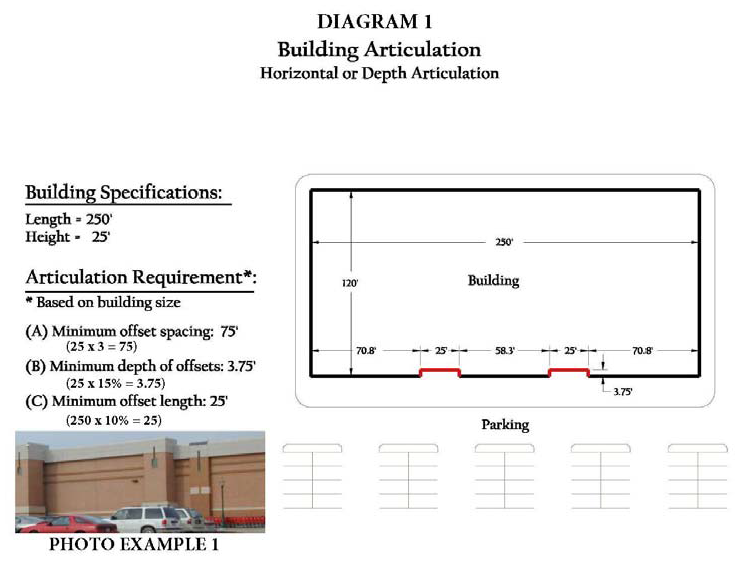
Horizontal articulations or offsets are required on any façade that is adjacent to or facing a public/private street, public park or residentially-zoned district in accordance with the following:
a.
No building façade shall extend for a distance greater than three (3) times its average height without a perpendicular offset.
b.
The depth of the articulation or offset shall be a minimum of fifteen (15) percent of the average building height, not including parapets. Articulations or offsets can be of varying depth as long as the minimum depth is met.
c.
The length of the new plane created by the articulation or offset shall be a minimum of ten (10) percent of the total length of the entire facade.
(b)
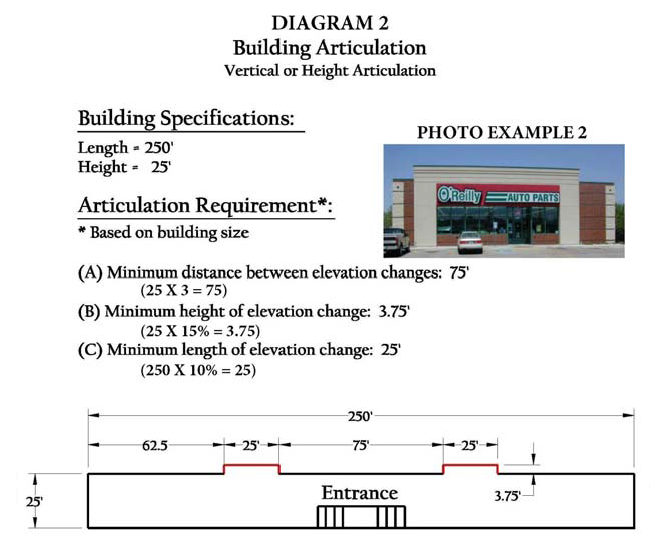
Vertical articulations or elevation changes are required on any façade that is adjacent to or facing a public/private street, public park or residentially-zoned district in accordance with the following:
a.
No façade shall extend horizontally for a distance greater than three (3) times its average height without a change in horizontal elevation.
b.
The height of the articulation or elevation change shall be a minimum of fifteen (15) percent of the average building height. Articulations or elevation changes can be of varying heights as long as the minimum standard is met and the maximum allowable building height is not exceeded.
c.
The length of the new plane created by the articulation or elevation change shall continue to extend laterally for a distance equal to at least ten (10) percent of the total length of the entire facade.
d.
Vertical articulations or elevation changes should be designed to screen rooftop equipment. Note parapets shall not be included in calculating the average building height.
(c)
For calculation purposes, the façade shall be considered the total distance/width of that side of the building.
(d)
Building Height: see Appendix B—Definitions.
(Ord. No. 559-K-2021, § 1, 7-6-21)
Sec. 4-5-108. - Additional Design Requirements.
(1)
Building Elements. Any building façade adjacent to or facing a public/private street, public park or residentially-zoned district shall incorporate at least four (4) of the following external building elements:
a.
Decorative lighting features.
b.
Awnings.
c.
Alcoves.
d.
Decorative windows.
e.
Recessed entries.
f.
Ornamental cornices.
g.
Pillar posts.
h.
Other architectural elements that contribute to the human scale of a building.
(2)
Facades. All facades or sides of a building shall be designed with architectural style consistent with the front façade. Rear façade articulation requirements shall be determined by the Director of Development Services or designee.
(3)
Roof Types.
(a)
Any roof using shingles shall use dimensional shingles (shingles that have a shadow at the top exposure to give added depth and definition.
(b)
Red tile roofs are not considered shingles for the purpose of this section.
(4)
Roof Treatments.
(a)
Façade articulations, including parapets, shall provide for vertical and horizontal screening of air conditioning units and all mechanical equipment located on rooftops. The minimum height of the screening shall be equal to the height of the tallest rooftop equipment.
(b)
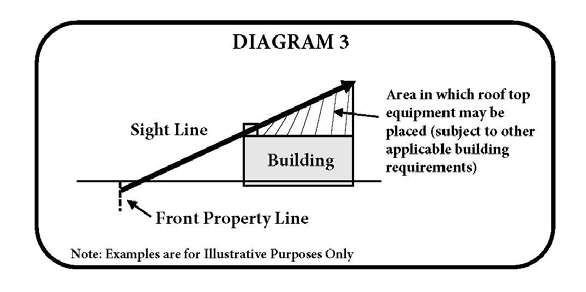
If a sight line drawing is provided with the site plan showing that all roof top equipment will not be visible from the public right-of-way or adjacent property, then a parapet wall or other façade articulation shall not be required. See Diagram 3.
(5)
Entryways and Pedestrian Routes.
(a)
Single-use or multi-tenant buildings over sixty thousand (60,000) square feet in size must provide clearly defined, highly visible customer entrances that include an outdoor patio area, at least two hundred (200) square feet in area, that incorporates the following:
a.
Benches or other seating components.
b.
Decorative landscape planters or wing walls that incorporate landscaped areas.
c.
Structural or vegetative shading.
d.
Clearly defined pedestrian routes between parking areas and buildings.
(Ord. No. 559-K-2021, § 1, 7-6-21)
Sec. 4-5-109. - Application Procedures.
The design requirements of this section shall be shown on a site plan that is part of a building permit application. Façade elevation drawings shall also be required and submitted as part of the building permit application.
(Ord. No. 559-K-2021, § 1, 7-6-21)
Sec. 4-5-110. - Appeal Procedures.
(a)
Enforcement of this section may be appealed to the City Council.
(b)
Appeal Procedures. All buildings must comply with the regulations established via the most current International Code, as adopted by the City.
a.
All appeal actions for a site plan and/or façade elevation drawings denied by the Director of Development Services or designee shall be submitted to and reviewed by the City Council upon written request of the applicant to the Director of Development Services.
b.
A written appeal shall include a site plan, façade elevation drawings, and landscape plan, as applicable.
c.
The appeal shall be scheduled for consideration on the regular agenda of the City Council within thirty (30) days after a complete appeal application is received.
d.
The Council shall consider the application and shall either approve with or without conditions or disapprove the application.
(Ord. No. 559-K-2021, § 1, 7-6-21)

