
Universal City City Zoning Code
APPENDIX A
OFF-STREET PARKING, LOADING AND DRIVEWAY REQUIREMENTS
1. - Off-Street Parking and Loading
1.1
General.
1.1.1
Applicability.
1.1.1.1
New Development. The off-street parking and loading standards of this section apply to any new building constructed and to any new use established.
1.1.1.2
Expansions and Alterations. The off-street parking and loading standards of this section apply when an existing structure or use is expanded or enlarged. Additional off-street parking and loading spaces will be required to serve the entire building or use. The number of off-street parking and loading spaces provided for the entire use (preexisting + expansion) shall equal at least one hundred (100) percent of the minimum requirement established in the Off-Street Parking Requirements table, in Section 1.2.1.
1.1.2
No Reduction Below Requirement. Existing parking and loading spaces may not be reduced below the requirements established in this section. Any change in use that increases applicable off-street parking or loading requirements will be deemed a violation of this chapter unless parking and loading spaces are provided in accordance with the provisions of this section.
1.2
Off-Street Parking Requirements.
1.2.1
Off-Street Parking Requirements Table. The following table lists minimum off-street parking requirements by use. In instances in which the listed use differs from the uses of Table 1 of the Zoning Ordinance, the Zoning Administrator shall determine the appropriate classification for this table.
Table A.1: Off-Street Parking Requirements
Note:
1 1-car enclosed parking space shall be a minimum of two hundred (220) sq. ft. and two-car enclosed parking spaces shall be a minimum of four hundred (440) sq. ft.
1.2.2
Off-Street Parking Requirements Exceptions. Single-family residences shall be permitted to convert their garage space or spaces into living space as long as: (i) a valid building permit is issued by the City for the garage conversion; (ii) a permitted residential carport, in accordance with section 3—Carports of this appendix, is installed on the driveway and is either adjacent to or attached to the existing house structure after issuance of a building permit for said carport; and (iii) the installed carport does not encroach the right-of-way (i.e. sidewalk or City parkway) - note the Development Services Director or designee has the right to review and deny the installation of a carport that would create a visibility issue yet still allow the garage conversion.
Property owners of single-family homes that have an existing converted garage as of the date of this ordinance are exempted from the requirement of obtaining a retro building permit and installing a carport; however, the same property owners are not precluded from installing a permitted residential carport.
Unless otherwise permitted by this section, conformance to the Accessory Structure Standards, per Sections 4-5-62 and 4-5-63 (i.e. height, setback and maximum lot cover requirements) apply to this Section.
Parking of a current registered motor vehicle, recreational vehicle, boat (watercraft) and/or utility trailer, per the City's Code of Ordinances, underneath a permitted carport is allowed; however, areas underneath a carport shall not be used as outside storage of personal household items, which shall mean any item other than a two, three or four-wheeled motor vehicle or self-propelled item, such as a bicycle or tricycle, or an approved garbage receptacle.
1.3
Alternative Parking Plan and Shared Parking.
1.3.1
Alternative Parking Plan. An alternative parking plan may be approved by the Zoning Administrator for specific developments that are deemed to require a different amount of parking than the standards shown in the Off-Street Parking Requirements table. The Zoning Administrator shall establish conditions necessary to insure the adequacy of future on-site parking when approving an alternate parking plan. Any alternative standard shall meet the criteria below.
A.
The use of the building is specific and occupied by a single user.
B.
The applicant provides a detailed breakdown of his or her parking requirements indicating employee counts, shift distribution and visitor or customer needs.
C.
The applicant provides a site plan showing how additional parking to meet standard requirements would be provided if the use changed or parking needs increase.
1.3.2
Shared Parking. Required parking for one (1) use may satisfy the requirements for another use if the nonresidential uses have different peak hour parking needs and the following:
A.
The following documentation shall be submitted to the City as part of the development review process if requesting shared parking:
i.
The names and addresses of the uses and the owners or tenants that are sharing the parking;
ii.
The location and number of parking spaces that are being shared;
iii.
An analysis showing that the peak parking demands for the different uses occur at different times and that the parking area will supply at least the minimum number of required spaces for each use during its respective peak parking time;
iv.
A legal instrument such as an easement that guarantees access to the joint parking for all uses;
v.
A shared parking agreement executed by all the users and the owner of the property proposed to be used for parking; and
vi.
The agreement shall be notarized and recorded, with a provision that the consent of the City must be obtained for termination of the agreement.
B.
In the event of the termination of an existing shared parking agreement, a new shared parking agreement shall be executed within sixty (60) days prior to termination. If a new shared parking agreement is not executed, then documentation shall be submitted to the Zoning Administrator supporting that the uses on all affected properties meet their respective parking requirements. This process of amending a shared parking agreement applies to all existing parking agreements impacted by sale, change of use, or expansions on any affected property.
1.3.3
Alternative Agreements. In limited cases, off-site parking agreements, reciprocal access, and parking agreements may be approved by the Zoning Administrator.
1.4
Rules for Computing Requirements. The following rules apply when computing off-street parking and loading requirements.
1.4.1
Multiple Uses. Lots containing more than one (1) use shall provide parking and loading in an amount equal to the total of the requirements for all uses.
1.4.2
Fractions. When measurements of the number of required spaces result in a fractional number, any fraction of one-half (½) or less will be rounded down to the next lower whole number and any fraction of more than one-half (½) will be rounded up to the next higher whole number.
1.4.3
Area Measurements. Unless otherwise expressly stated, all square-footage-based parking and loading standards shall be computed on the basis of gross floor area, which for purposes of computing off-street parking requirements, shall mean the gross floor area of the building measured from the exterior faces of the exterior walls or from the centerline of walls separating two (2) buildings and shall include the following areas:
A.
The area of each floor of the structure.
B.
All attic space used for active commercial space.
1.4.4
Occupancy-Based Standards. For the purpose of computing parking requirements based on employees, residents or occupants, calculations shall be based on the largest number of persons working on any single shift, the maximum enrollment or the maximum fire-rated capacity, whichever is applicable and whichever results in the greater number of spaces.
1.4.5
Unlisted Uses. Upon receiving a development application for a use not specifically listed in the Off-Street Parking Requirements Table, the Zoning Administrator shall apply the off-street parking standard specified for the listed use that is deemed most similar to the proposed use or require a parking study in accordance with an Alternative Parking Plan, as described in Section 1.3, above.
1.5
Location of Required Parking. Except where an alternative parking plan has been approved by the Zoning Administrator, all required off-street parking spaces shall be located on the same lot as the principal use.
1.6
Parking Space and Parking Lot Design.
1.6.1
Parking Space Dimensions. Required off-street parking spaces shall have minimum dimensions of nine (9) feet in width by eighteen (18) feet in length.
1.6.2
Aisle Widths. Drive aisle widths adjoining off-street parking spaces shall comply with the following standards:
Table A.2: Minimum Width for Specified Parking
(in feet)
Note: Two-way aisles shall always require a minimum width of twenty-six (26) feet.
1.6.3
Markings.
A.
Each required off-street parking space and off-street parking area shall be identified by surface markings at least four (4) inches in width. Markings shall be visible at all times. Such markings shall be arranged to provide for orderly and safe loading, unloading, parking and storage of vehicles.
B.
One-way and two-way accesses into required parking facilities shall be identified by directional arrows.
1.6.4
Surfacing and Maintenance. All off-street parking areas, drive aisles, internal roadways, and loading areas for all uses shall be paved and kept in a dust-free condition at all times.
1.6.5
Access and Circulation.
A.
Required parking spaces shall not have direct access to a street or highway. Access to required parking spaces shall be provided by on-site driveways. Off-street parking spaces shall be accessible without backing into or otherwise reentering a public right-of-way.
B.
Site Plans for retail developments greater than a cumulative fifty thousand (50,000) gross square feet shall designate a primary vehicle circulation route entering and exiting the development.
i.
Landscape median islands or end islands shall be immediately adjacent to the primary vehicle circulation route for the entire length of the route (excluding pedestrian access and the face of primary buildings).
ii.
So as not to cause overflow stacking onto rights-of-way and primary circulation routes, parking is not permitted along primary vehicle circulation routes. So as not to cause internal circulation conflicts, parking is not permitted adjacent to the entire elevation of a building which includes the primary pedestrian access.
1.6.6
Tandem Parking. Tandem parking in the Multifamily or Senior Districts shall be permitted only when it is located in front of a garage, which is attached to a dwelling unit and the tandem space is assigned only to the dwelling unit to which the garage is attached.
1.7
Use of Required Parking Spaces.
A.
Required off-street parking areas shall be used solely for the parking of licensed motor vehicles in operating condition. Required spaces may not be used for storage of trash dumpsters, the display of goods for sale or lease, for motor vehicle repair or service work of any kind, storage of vehicles, boats, motor homes, campers, mobile homes, or building materials, or for display or storage of vehicles for lease, sale or rent.
B.
Recreational vehicles shall not be stored on any lot or street other than a residential lot of the owner or a site specifically designed and approved by the Zoning Administrator to accommodate them.
1.8
Vehicle Stacking Areas.
1.8.1
Minimum Number of Stacking Spaces. Off-street stacking spaces shall be provided as indicated in the following table:
Table A.3: Minimum Off-Street Stacking Spaces
1.9
Design and Layout. Required stacking spaces are subject to the following design and layout standards.
A.
Size. Stacking spaces shall be a minimum of ten (10) feet by twenty (20) feet in size.
B.
Location. Stacking spaces may not impede on- or off-site traffic movements or movements into or out of off-street parking spaces.
1.10
Parking and Storage of Large Vehicles and Equipment. Outdoor storage or overnight outdoor parking of tractor-trailers, semi-trucks, semi-trailers, or other similar vehicles, shall not be permitted in any residential district or in the C-1, C-2, C-3 or C-5 zoning districts, but shall be allowed in the C-4 General Commercial District. This prohibition shall not apply to pick-up trucks, or personal recreational equipment. Construction equipment shall not be stored on lots in residential or commercial districts except during the period of permitted construction.
1.11
Off-Street Loading.
1.11.1
No Use of Public Right-of-Way. At no time shall goods be loaded or unloaded from the right-of-way of a collector or arterial street. No part of any vehicle shall be allowed to extend into the right-of-way of a collector or arterial street while being loaded or unloaded.
1.11.2
Site Plan Required. Plans for location, design and layout of all loading spaces shall be indicated on required site plans. Loading space size shall be based on need and in accordance with standard engineering requirements as determined by the Zoning Administrator.
(Ord. No. 581, 1-22-07; Ord. No. 581-C-2008, § I, 4-15-08; Ord. No. 581-D-2010, § I, 11-3-10; Ord. No. 581-F-2013, § II, 4-16-13; Ord. No. 581-O-2019, § I, 12-17-19; Ord. No. 559-J-2021, §§ 1, 2, 7-6-21)
2. - Driveways
2.1
Width of Driveways. Driveways shall be constructed in accordance with the following table:
Width of Access
Notes:
1
Residential side entry garages shall have a minimum of twenty (20) feet set back from the property line.
2
Circular drives shall be a maximum of two (2) sixteen-foot curb cuts with a minimum of twenty-eight (28) feet between each cut.
(Ord. No. 581, 1-22-07; Ord. No. 581-C-2008, § I, 4-15-08)
3. - Carports.
3.1
Carport Building Requirements. A permitted residential carport shall: (i) require a building permit; (ii) comply with the regulations established via the most current International Code, as adopted by the City; (iii) be located not more than two feet (2') from the furthest edge of the house if not attached to the house; and (iv) not exceed twelve feet (12') in height, as defined in the Zoning Code.
3.2
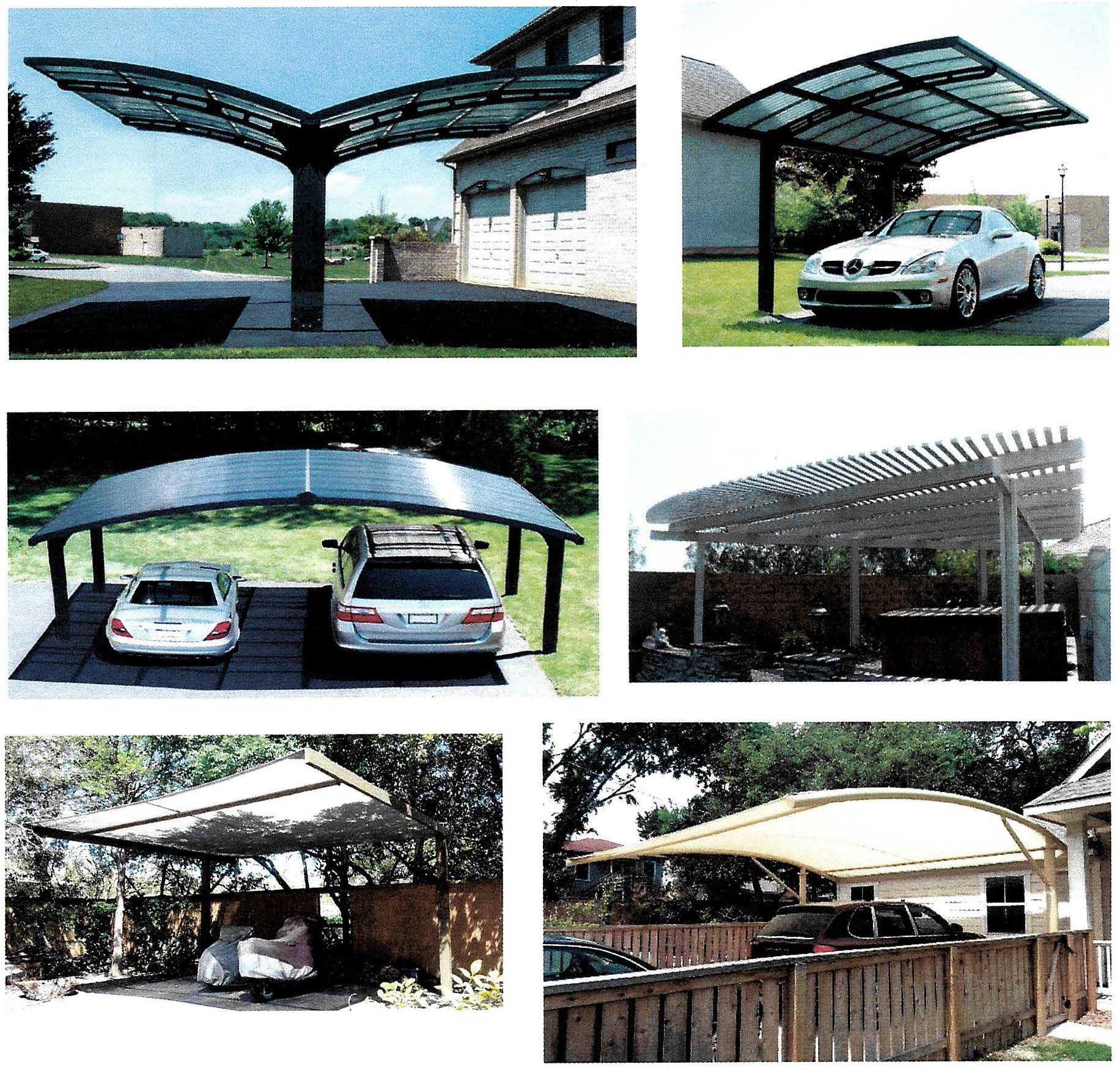
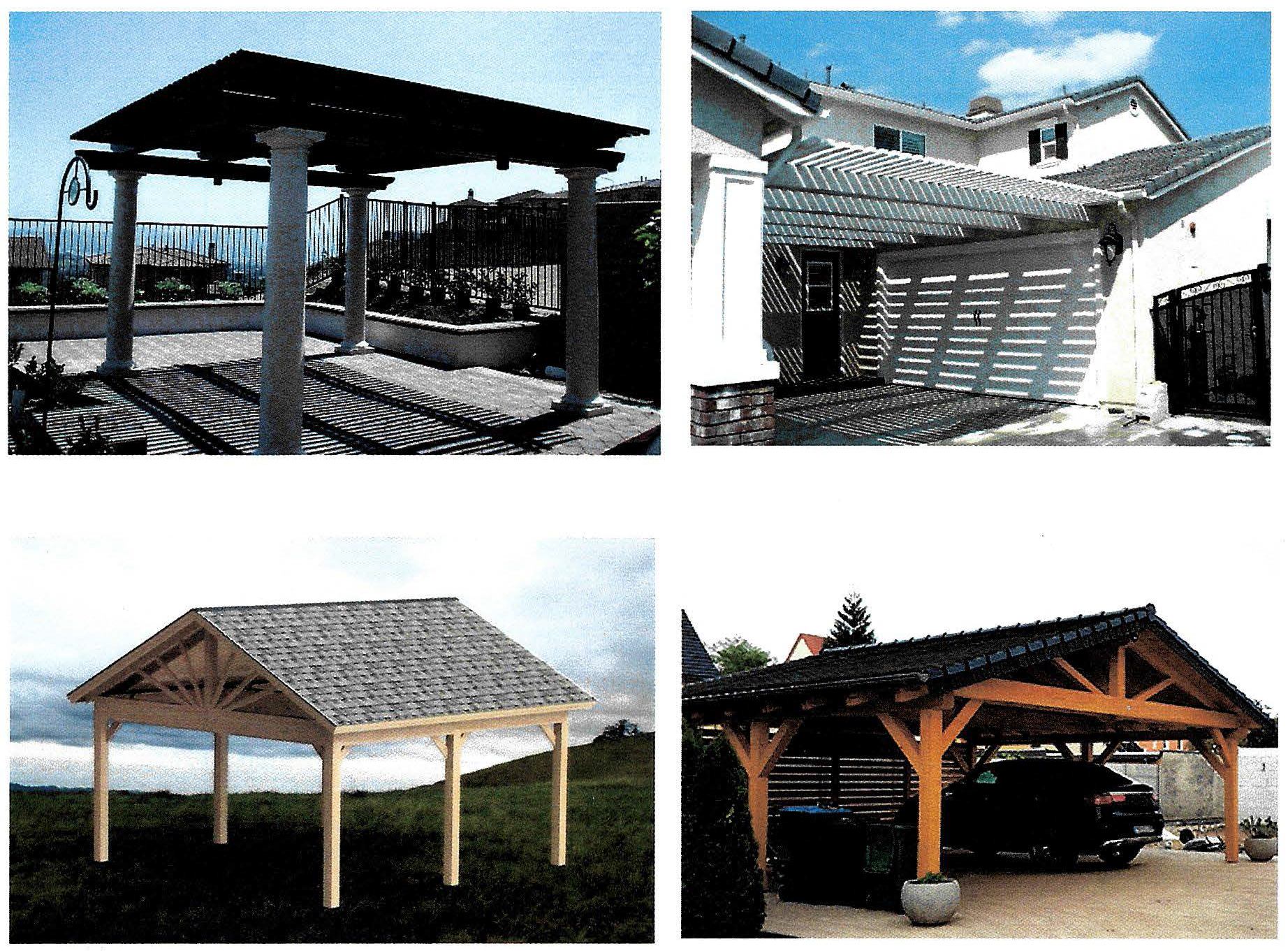
Carport Design Requirements. A permitted residential carport shall: (i) complement the color and character of the house; and (ii) provide design articulation consistent with the examples shown in Figure A—Carport Design Styles. Carports shall not be plain, bare, unadorned, conventional or simple in style. Instead, carports meeting the design articulation standards can be either classical/traditional or modern, but shall have distinguishing materials and architectural elements producing a stylistic design, form and structure, including, but not limited to, unique slopes and/or curves.
FIGURE A—CARPORT DESIGN STYLES
3.3
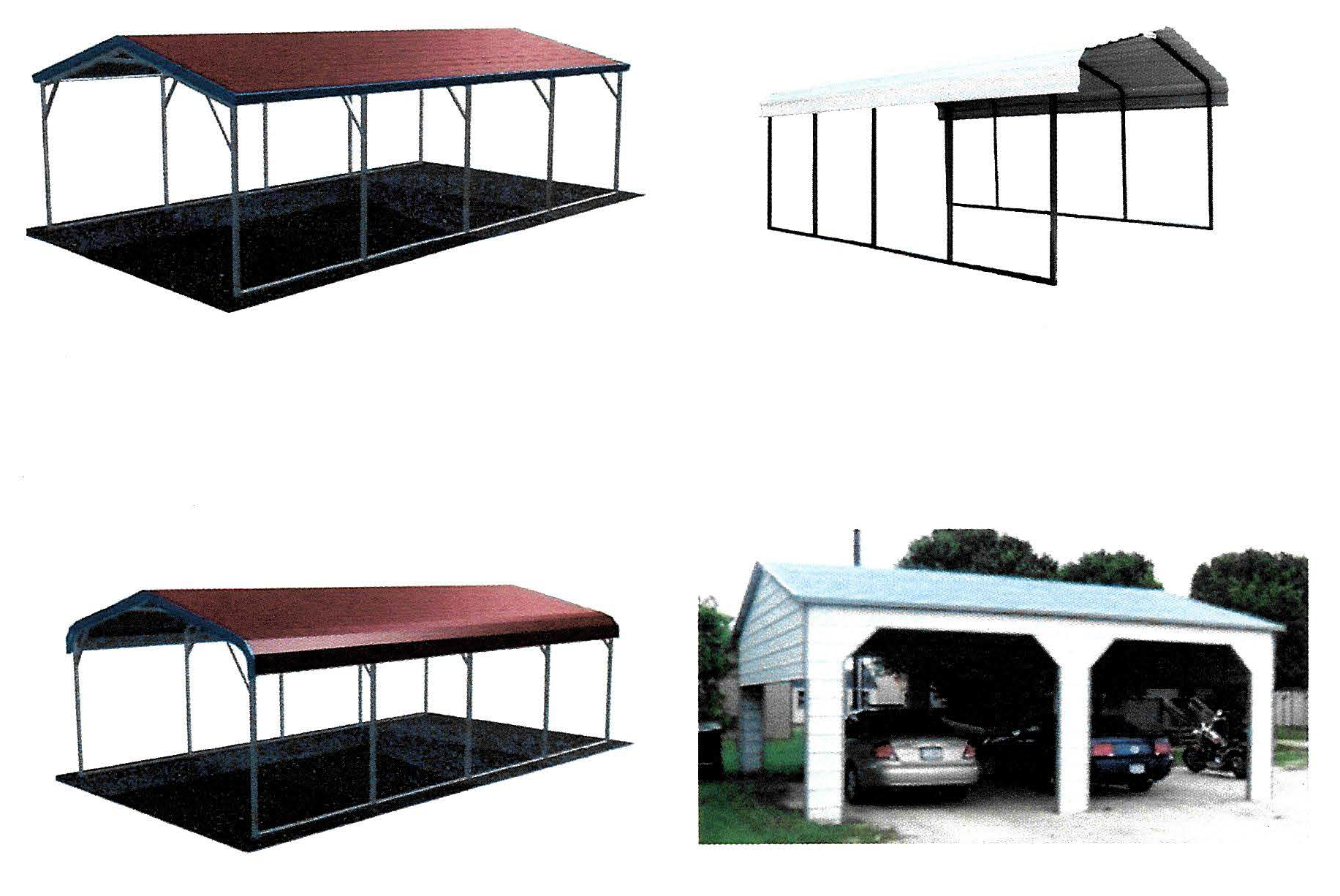
Carport Designs Not Permitted. Carports lacking design articulation shall not be allowed. Examples of carports lacking design articulation are shown in Figure B—Carport Designs Not Permitted.
FIGURE B—CARPORT DESIGNS NOT PERMITTED
3.4
Carport Appeal Procedure. Enforcement of this section may be appealed to the Board of Adjustment.
(Ord. No. 559-J-2021, § 3, 7-6-21)

