
Universal City City Zoning Code
ARTICLE VII
- FENCE, LANDSCAPING, BUFFERING AND ARCHITECTURAL DESIGN STANDARDS
Sec. 4-5-70. - Intent and applicability.
Intent. The intent of this section is to provide reasonable regulations forfence installation while allowing property owners the ability to install a fencefor aesthetic, screening, separating or security purposes, and at the sametime taking into consideration the health, safety, morals and general welfareof the citizens and business owners of the City.
Applicability. The provisions of this section are deemed to be minimumstandards and shall be applicable to all new and replacement fences andthe maintenance of said fences within the corporate limits of the City,except as otherwise exempted.
(Ord. No. 581-Y-2023, § 1, 10-17-23)
Sec. 4-5-71. - Fence requirements.
(1)
Definitions.
Minor Maintenance. The following shall be considered "Minor" fence maintenance:
(a)
Power washing, painting, staining.
(b)
Repairing or replacing fewer than seventeen (17) pickets (1—16), lattice, rail runner, trim, post caps, kickboards, gates and gate components, including hinges and handles.
Major Maintenance. The following shall be considered "Major" fence maintenance:
(a)
Repairing or replacing more than one (1) post anchored in the ground.
(b)
Repairing or replacing seventeen (17) or more pickets.
(c)
Repair or maintenance that alters the fence-to-ground clearance allowing for stormwater runoff.
(d)
In-kind replacement of an existing fence; that is, the replacement fence will be in the same location as the previous fence and will be the same height, made of the same material, and provide the same fence-to-ground clearance.
Public Viewshed. A public viewshed shall be defined as an area that is visible from one or more public viewing points, such as from a public right-of-way (e.g., roadway, drive aisle, parking lot), alley, pedestrian or multi-purpose path, or a public or private park (e.g., City or HOA-owned and/or -maintained)
(2)
Permits and Inspections.
(a)
A permit, associated fee as identified in Chapter 1-4 Finance, and related inspection(s) shall be required for the following:
1.
A new fence where one did not exist before
2.
Modification to an existing fence not covered in 'Minor' or 'Major' fence maintenance definitions
(b)
A permit, associated fee as identified in Chapter 1-4 Finance, and related inspection(s) shall be required for 'Major' fence maintenance
(c)
A permit, fee and inspection(s) shall not be required for 'Minor' fence maintenance
(3)
The erection of a fence is not mandatory, with the following exceptions in which it is required:
(a)
As required to enclose a swimming pool area;
(b)
As required to enclose a day care center play area;
(c)
As required for any nonresidential property, whether a permitted or conditional use, where it abuts residential property. In such a case, only a privacy fence shall be allowed unless otherwise specified and agreed upon in a Planned Unit Development (PUD) or the Redevelopment District Overlay (RO);
(d)
As required for churches, schools, Multifamily Residential (R5), Manufactured Housing (MH1) and Mobile Home Parks (MH2), whether a permitted or conditional use, where it abuts residential property located in R1, R2, R3, R4, and R-OT. In such a case, only a privacy fence shall be allowed unless otherwise specified and agreed upon in a Planned Unit Development (PUD) or the Redevelopment District Overlay (RO);
(e)
As required by other applicable sections of this chapter.
(4)
Fences that are constructed shall comply with the following regulations:
(a)
Fence Location.
1.
Fences may be built on or along property lines in all districts. Fences may be installed within a residential district on the property line at a corner lot adjacent to a public street, provided there is no visual impairment of motorists and pedestrians, provided there is a visual triangle clearance of a minimum of thirty (30) feet, and provided there is no interference with utility and/or drainage easements.
2.
Fences may be built across other areas of private property, provided that the fence is in no case taller than six (6) feet in total height, except in accordance with Section 4-5-71(2)(c). Fence height shall be measured from natural grade. However, fences located on a retaining wall (not a decorative wall) shall be reviewed by the Zoning Administrator with regard to height determination. Fence lines shall be securely joined and/or affixed to abutting or intersecting fence lines. At no time shall fences be constructed so as to provide a gap or spacing between abutting, adjacent or perpendicular fence lines; that is, no back-to-back fences are allowed.
3.
Fences cannot cross onto any public or private property and may not block access to any fire hydrant or utility meter.
(b)
Maintenance.
1.
The owner or person in control of any property adjacent to any intersection where a traffic control device is erected shall not permit any vegetation, fences or other structures to obstruct any such intersection.
2.
Any vegetation, fence or other structure in excess of twenty-four (24) inches above the roadway within the visibility triangle is hereby declared to be a public nuisance and a traffic hazard. In the event the developer, owner, tenant, lessee or agent fails to remove or remedy the condition within ten (10) days after notice has been served by the Code Enforcement Officer or other duly appointed officer of the city, the city may do as necessary to remove or remedy the condition or cause same to be done, may issue a citation for violation of said offense and may charge the expense incurred in removing the violation to the developer, owner, agent or lessee of the subject lot or parcel.
3.
The owner or person in control of the property must maintain the integrity of the fence and the space between the fence and property line.
(c)
Fence Height.
1.
Fences constructed in the front yard must be three (3) feet or shorter and decorative/ornamental; however, fences in the front yard may be increased by one (1) foot if the fence is at least fifty percent (50%) transparent and decorative/ornamental.
2.
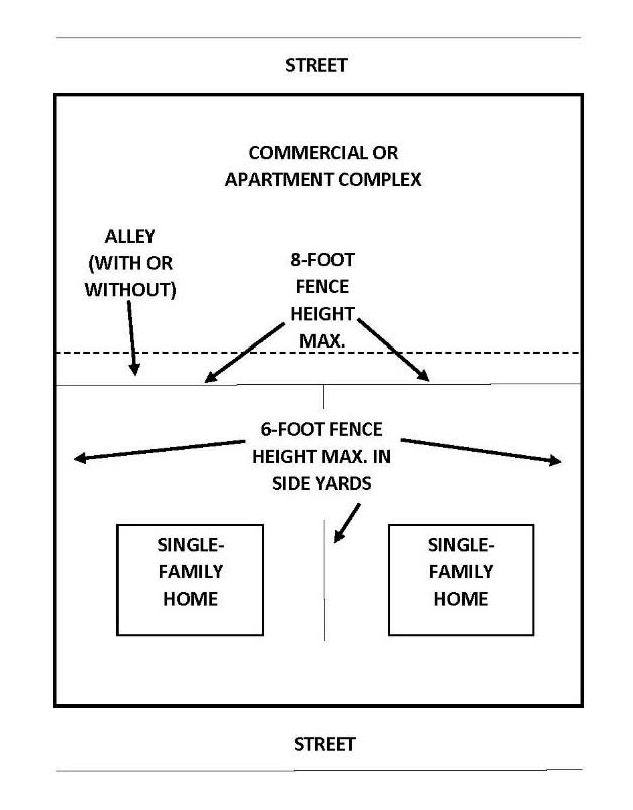
Fences in all other yards shall not exceed six (6) feet in total height, except as provided for in Section 4-5-71(2)(c)3 and Section 4-5- 71(2)(c)4. Fence height shall be measured from natural grade. Fence lines shall be securely joined and/or affixed to abutting or intersecting fence lines. At no time shall fences be constructed so as to provide a gap or spacing between abutting, adjacent or perpendicular fence lines; that is, no back-to-back fences are allowed.
3.
Fences in the C4-General Commercial and C5-Highway Commercial Districts shall not exceed eight (8) feet in total height with fence posts not to exceed nine (9) feet in total height.
4.
Fences in residential districts abutting a commercial district or multi- family residential district with more than eight (8) attached dwelling units shall be allowed to be installed on the property line abutting the commercial or multi-family residential district at a height not to exceed eight (8) feet. This shall also apply when an alley is situated between the residential property and commercial or multi-family property.
(d)
Building Materials.
1.
Fences must be built of wood, metal, chain link, bricks, or masonry.
2.
Only two (2) or less materials may be used to construct a fence.
3.
Wood fences should be rot resistant.
4.
The use of barbed wire, electrically charged wire, chain link with slats, razor wire or other sharp-edged surfaces on fences within residential zoning districts is hereby prohibited. The above items located on fences in commercial districts shall not be included the total height measurement.
5.
The finished side of a fence shall face away from the lot on which it is located. However, when two adjacent properties share a fence, then the finished side shall be oriented as determined by the two property owners. The finished side of a fence shall mean the smooth side, not the side exposing the fence posts and rails. This provision shall not be required when a fence backs up to an alley, utility right-of-way, easement or drainage area that is not within the public viewshed.
6.
All fence posts and rails shall be placed on the inside of the fence.
(e)
Electrified Fences.
1.
Electrified fences may be used in residentially-zoned neighborhoods to control small animals, such as dogs and cats.
2.
Only those commercially sold electrical control devices that state for use to control dogs and/or cats may be installed. If the property has a residential fence, then installation of the electrified fence shall be as a secondary fence within a residential fence on the property. The electrical conductor shall be mounted on individual stakes at least twenty-four (24) inches inside the main residential fence on the property.
3.
An electrified fence shall be located on the residential property only and shall not be located in the right-of-way, including the area between the sidewalk and street curb. An electrified fence located in an easement shall be allowed but at the property owner's risk; that is, should the City or easement holder perform work in the easement that damages the electrified fence, then the property owner shall be responsible for the cost to repair or replace the electrified fence.
4.
A permit to install the electrified fence is not required.
(Ord. No. 581, § 7.1, 1-22-07; Ord. No. 581-F-2013, § I(7.1.1., 7.1.3), 4-16-13; Ord. No. 581-J-2014, § I(§ 7.1.1), 7-15-14; Ord. No. 581-Q-2020, § 1, 8-4-20; Ord. No. 581-Y-2023, § 2, 10-17-23)
Sec. 4-5-72. - Landscaping.
Reserved.
(Ord. No. 581, § 7.2, 1-22-07)
Sec. 4-5-73. - Buffering.
Reserved.
(Ord. No. 581, § 7.3, 1-22-07)
Sec. 4-5-74. - Architectural design standards.
Masonry Construction Required, Nonresidential Districts. New Construction in Nonresidential Use Districts intended for commercial construction shall be one hundred (100) percent masonry on all exterior walls fronting and directly adjacent to a public street; fifty (50) percent masonry on all exterior walls inside the property not fronting or directly adjacent to a public street; and one hundred (100) percent masonry on all exterior rear walls directly adjoining residential property zoned; or fifty (50) percent masonry on all exterior rear walls adjoining commercial property.
(Ord. No. 581, § 7.4, 1-22-07)

