
Vallejo City Zoning Code
PART V
SITE DEVELOPMENT STANDARDS
Chapter 16.501 through Chapter 16.509, inclusive, shall be known as the basic site development standards.
16.501.01 - Purpose and applicability.
A.
Purpose. The purpose of this part is to prescribe supplemental development and site regulations that apply to development in all zoning districts, except where specifically stated. These standards shall be used in conjunction with the standards for each zoning district established in Part II (16.200), Zoning Districts and Development Standards, to ensure that development:
1.
Is consistent with the general plan;
2.
Is compatible with existing and future development;
3.
Protects the use and enjoyment of neighboring properties.
B.
Applicability. The provisions of this part apply to all new development and uses, and to modifications to existing structures and uses in combination with the standards for each zoning district, except as specified in Chapter 16.105, Non-Conforming Uses. In case of any conflict, the standards specific to the zoning district will override these regulations. Where applicable, the requirements of Chapter 16.614 Architectural Heritage and Historic Preservation may also apply.
16.501.02 - Accessory buildings and structures.
Detached buildings and structures that are clearly incidental or subordinate to the main building on the same lot or an adjacent lot under the same ownership shall be permitted in all zoning districts subject to compliance with the zoning district regulations and the requirements of this chapter. Accessory buildings and structures include covered patios, dish antennas, garages, garden structures (sheds, gazebos, greenhouses, pergolas) guest quarters, play structures, and storage shelters. The following requirements apply to all accessory buildings and structures with the following exceptions:
A.
Separately regulated structures. Accessory structures subject to separate regulations.
1.
Accessory uses under Chapter 16.302, Accessory Uses;
2.
Accessory Dwelling Units and Junior Accessory Dwelling Units under Chapter 16.303, Accessory Dwelling Units;
3.
Solar installations under Chapter 16.338, Solar and Wind Energy Systems;
4.
Wireless telecommunications equipment and antennas under Chapter 16.341, Wireless Telecommunications.
B.
Temporary structures. Temporary structures subject to the requirements of Chapter 16.339, Temporary Uses and the following structures:
1.
A mobile unit or structure used as a caretaker's or manager's residence or as a residence during the construction of a new residential unit on the same parcel;
2.
A mobile unit or structure used for temporary storage by the primary user of the property.
C.
Requirements. Accessory buildings in mixed-use and non-residential zoning districts shall be subject to the same regulations as main buildings. The following requirements are applicable to accessory buildings and structures in any residential zoning district:
1.
A detached accessory building may only be constructed on a lot with a legally permitted main building. The accessory building shall be related to the main building on the same lot or located on an adjacent lot under the same ownership.
2.
An accessory building may be constructed prior to a permitted main building and used for not more than one year in connection with the construction of the main building, provided that a building permit is obtained for the entire project, including the accessory building, prior to the start of any construction.
3.
Except for accessory dwelling units established in compliance with Chapter 16.303, Accessory Dwelling Units, accessory buildings may not contain kitchens or full baths. An accessory building that is not an approved accessory dwelling unit may contain a sink and a toilet but not a shower or tub enclosure. Unenclosed showers that are outside are permitted.
4.
Accessory buildings up to fourteen feet in height are permitted subject to the following requirements:
a.
Accessory buildings shall be located on the rear half of the parcel and shall not extend into the required minimum side yard setback except as authorized pursuant to (b) and (c) below.
b.
Accessory buildings no more than fourteen feet in height shall be located at least five feet from the rear parcel line, unless they are more than fifty feet from the front property where they can be at least three feet from the rear parcel line.
c.
On a reversed corner parcel, accessory buildings shall not be located closer to the street side parcel line of such corner parcel than the principal structure.
d.
Any accessory building on a through lot shall not project into any front setback and shall not be located in any required side setback.
e.
Accessory buildings in the RR Zoning District, such as barns and stables, may exceed the height limit, subject to director approval.
16.501.03 - Development on lots divided by district boundaries.
Where a lot is divided by a zoning district boundary, unless a zoning map amendment and a general plan amendment, if applicable are processed such that regulations applicable to one zoning district are applied to all areas of the lot or parcel, the regulations applicable to each district shall be applied to the area within the district, and no use, other than parking serving a principal use on the site, can be located in a zoning district in which it is not a permitted or conditionally permitted use.
A.
Access. All access to parking serving a use shall be from a street abutting that portion of the lot where the use is allowed. Pedestrian or vehicular access from a street to a non-residential use cannot traverse an residential zoning district in which the non-residential use is not permitted or conditionally permitted.
B.
Exceptions. If more than sixty percent of a lot is located in one zoning district, modifications to the provisions of this chapter may be granted through approval of an exception by the director or the planning commission. See Chapter 16.608, Exceptions.
16.501.04 - Development on substandard lots.
Any lot or parcel of land that was legally created through a recorded deed may be used as a building site even when consisting of less area, width, or depth than that required by the regulations for the zoning district in which it is located. However, no substandard lot can be further reduced in area, width, or depth, unless such reduction is required as part of a public improvement.
16.501.05 - Height exceptions.
The standards of this chapter apply to all new development and to all existing structures. The structures listed in Table 16.501-A below may exceed the maximum permitted building height for the zoning district in which they are located, subject to the limitations stated in the table and further provided that no portion of a structure in excess of the building height limit may be used for sleeping quarters or advertising. Projections not listed in the table and projections in excess of those listed may be allowed by the granting of an exception permit under Chapter 16.608, Exceptions.
16.501.06 - Outdoor storage.
Open storage of goods, materials, machines, equipment, and vehicles or parts outside of a building for more than seventy-two hours shall conform to the standards of this chapter. The regulations of this chapter do not apply to processing equipment, tanks, or other equipment fixed to the ground, to temporary storage of construction materials reasonably required for construction work on the premises pursuant to a valid building permit, and to agricultural/farming equipment used for agriculture or farming on the property.
A.
Permitted Locations. Open storage is permitted at the locations listed in Table 16.501-B as follows:
B.
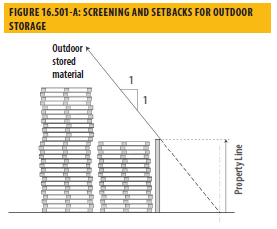
Screening and Setbacks. Storage areas visible from public streets that are not separated from the street by intervening buildings shall be screened in compliance with the following:
1.
Screening Walls. Screening walls and fences shall be tall enough to sufficiently screen stored material. Fences and walls shall not exceed the maximum allowable fence heights unless allowed pursuant to approval of an Exception Permit under Chapter 16.608, Exceptions.
2.
Setback. A setback shall be provided for outdoor stored material at the ratio of 1:1 from all property lines equal to the total height of stored material above required screen wall.
16.501.07 - Projections into required yards.
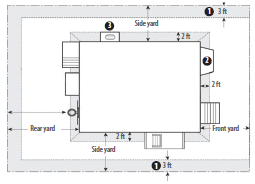
Building projections may extend into required yards, according to the standards of Table 16.501-C, Allowed Building Projections into Yards. The "Limitations" column states any dimensional, area, or other limitations that apply to such structures when they project into required yards.
TABLE 16.501-C: ALLOWED BUILDING PROJECTIONS INTO YARDS
 | |||||
|---|---|---|---|---|---|
| FIG.# | PROJECTION | FRONT OR STREET SIDE YARD (FT.) | INTERIOR SIDE YARD (FT.) | REAR YARD (FT.) | LIMITATIONS |
| >① | All projections | Notwithstanding any other Chapter of this Part, no projection may extend closer than 3 feet to an interior lot line or into a public utility easement. | |||
| >② | Bay windows; balconies | 3 | 2 | 2/5 where rear yard is greater than 15 feet | Shall not occupy more than 1/3 of the length of the building wall on which they are located or 1/2 of the length of a single room. |
| >③ | Cornices, canopies, eaves, belt courses, and similar architectural features; chimneys | 2 | 2 | 2 | Shall not occupy more than 1/3 of the length of the building wall on which they are located. |
| Fire escapes required by law or public agency regulation | 4 | 4 | 4 | None | |
| Uncovered stairs, ramps, stoops, or landings that service above first floor of building | 3 | 2 | 3 | None | |
| Depressed ramps or stairways and supporting structures designed to permit access to parts of buildings that are below average ground level | 3.5 | 3.5 | 3.5 | None | |
| Basketball Rims and Backboards | No closer than 10 ft. to a front or street-side lot line or 5 ft. to an interior side or rear lot line. | ||||
| Decks, porches, and stairs | |||||
| Less than 18 inches above ground elevation | 6 | 2 | 8 | Shall be open on at least 3 sides. No closer than 7 ft. of a street-facing lot line or 3 ft. of an interior lot line. | |
| 18 inches or more above ground elevation | 3 | 2 | 3 | ||
| Ramps and similar structures that provide access for persons with disabilities | Reasonable accommodation will be made, consistent with the Americans with Disabilities Act; see Chapter 16.608, Exceptions. | ||||
A.
Architectural features such as cornices, canopies, eaves, greenhouse or windows, and chimneys may extend into required yards a distance of not more than two feet. Such encroachment may be allowed even when the side yard is substandard, provided that a minimum setback of three feet is maintained. However, where properties were originally approved and developed as zero lot lines, one story additions may extend up to the property line subject to compliance with the Building Code.
B.
Unenclosed porches, balconies and stairways may extend into required front yard setbacks not more than six feet, and into other required yards not more than two feet.
C.
Detached private garages and accessory structures may be permitted in those required yards which do not abut a street providing that the garages and structures:
1.
Are at least five feet from a main building or alley right-of-way;
2.
Are at least fifty feet from a front property line;
3.
Are at least three feet from any side or rear property line;
4.
Do not exceed ten feet in height at their highest point within the required yard; and
5.
Do not create a condition causing water to drain onto an adjacent site.
D.
When a private garage or an accessory structure is attached to the main structure, it shall comply in all respects with the requirements of this code applicable to the main structure.
E.
The main residential building may project into a required rear yard up to, but not within, ten feet of the rear lot line, provided that the maximum lot coverage and minimum required open space standards are met. This building projection shall not encroach into a required side yard, nor shall it be wider than fifty percent of the average lot width in the rear half of the lot.
16.501.08 - Solid waste, recycling, and organic waste storage.
This chapter establishes design and locational criteria for the construction of solid waste, solid waste, recycling, and organic waste container storage areas. Solid waste, recycling, and organic waste are collectively referred to as "solid waste and recycling."
A.
Purpose. This chapter establishes design and locational criteria for the construction of container storage areas for all solid waste, and recycling, organic waste, and garbage as defined in Vallejo Municipal Code Chapter 7.40."
B.
Applicability. These requirements shall apply to all residential, mixed-use and non-residential development in addition to all applicable requirements of the city's waste service, this code, and Chapter 16.332, Recycling Facilities. All solid waste, recyclable, and organic waste materials shall be stored and collected from the same outdoor location.
C.
General Requirements and Alternatives. All solid waste, recycling and organic waste materials must be placed in an appropriate receptacle. All dumpsters, carts, garbage cans, mobile trash bins, and receptacles must be maintained and stored in accordance with this chapter.
1.
All uses shall provide solid waste, recycling, and organic waste storage and staging areas that comply with the standards of this chapter. Solid waste, recycling, and organic waste rooms meeting the standards of subsection (C) shall be provided in conjunction with:
a.
Any new construction for which a building permit is required.
b.
Improvements affecting solid waste, recycling, and organic waste areas of publicly owned facilities.
c.
Alterations of which the sum total of all improvements within a twelve-month period either adds thirty percent or more to the existing floor area or the aggregate permit valuation, as determined by Consumer Price Index (CPI).
2.
Alternatives. Projects with ten or fewer residential units may have individual solid waste, recycling, and organic waste carts or containers for each unit, provided that there is a designated screened location for each individual container adjacent to the residential unit or within garage areas and provided that solid waste and recycling carts or containers for each unit are brought to the curbside for regular collection.
D.
Size. Enclosures must be sized to accommodate all dumpsters, and or solid waste, recycling and organic waste carts or containers picked up by the city or its franchise waste hauler(s).
E.
Location and Orientation. Enclosures shall meet the following requirements, unless the director determines that compliance is infeasible. An entitlement or building permit shall not be issued for a project until documentation of location approval is provided by the director.
1.
All solid waste, recycling, and organic waste storage areas shall be located:
a.
Outside of any required parking, driveway, landscape, utility easement, or setback area, unless there is no feasible alternative;
b.
A minimum of five feet from an adjacent parking space;
c.
At minimum of five feet from the property line of an abutting single-unit residential zoning district; and
d.
A minimum of ten feet from the public right-of-way line or access easement.
2.
Enclosures shall be maintained by the property owner or manager in a good, usable, clean and sanitary condition.
3.
All solid waste, recycling, and organic waste materials that are stored and collected from the same location outside shall be stored not more than ten feet from the property line closest to the solid waste collection point. If the collection area is more than twenty feet from the collection point, a staging area within ten feet of the collection point is necessary.
F.
Visibility.
1.
Solid waste, recycling, and organic waste enclosures must not be visible from a public right-of-way as required by Vallejo Municipal Code Section 7.54.030 (R).
2.
All outdoor storage of solid waste, recycling, and organic waste materials, and other items or material intended to be discarded or collected shall be screened from public view.
3.
On property where solid waste, recyclable, and organic waste materials are both stored and collected adjacent to an alley or other public right-of-way, the solid waste and recyclable materials shall be designed or approved by the director as follows:
a.
Screened from public view on at least three sides by a solid opaque impact-resistant wall not less than five feet or more than eight feet in height; and
b.
Screened on the fourth side by a solid opaque impact-resistant gate not less than five feet or more than eight feet in height, or of other such material or design.
c.
The gate securing the area shall be maintained in working order and shall remain closed except during such times as solid waste, recycling, and organic waste materials and other such items are being discarded, placed for collection, or collected.
G.
Consolidation and Distance for Buildings Served. Solid waste, recycling, and organic waste storage areas must be consolidated to minimize the number of collection sites and located to reasonably equalize the distance from the building spaces they serve. For multi-unit residential projects, at least one trash enclosure per twenty units is required, and the enclosure must be located one hundred feet or less from the residential units.
H.
Accessibility. Solid waste, recycling, and organic waste storage areas shall be accessible to provide trucks and equipment used by the contracted solid waste and recycling collector(s) have sufficient maneuvering areas and, if feasible, for collection equipment to avoid backing up.
I.
Materials, Construction, and Design.
1.
Minimum Height of Screening. Solid waste and recycling storage areas located outside or on the exterior of any building shall be screened with a solid enclosure at least six feet high and include a roof structure.
2.
Enclosure Material. Enclosure material shall be wood, solid masonry, or concrete tilt-up with decorated exterior-surface finish. The trash enclosure shall match and complement the color scheme and architecture of the building.
3.
Gate Material. Latching, view-obscuring gates shall be provided to screen trash enclosure openings.
4.
Access to Enclosure from Residential Projects. Each solid waste, recycling, and organic waste enclosure serving a residential project shall be designed to allow disposal to the appropriate receptacle without having to open the main enclosure gate.
5.
Enclosure Pad. Pads shall be a minimum of four-inch-thick concrete.
6.
Bumpers. Bumpers shall be two inches by six inches thick and made of concrete, steel, or other suitable material, and shall be anchored to the concrete pad.
7.
Protection for Enclosures. Concrete curbs or the equivalent shall protect enclosures from adjacent vehicle parking and travel ways.
8.
Clear Zone. The area in front of and surrounding all enclosure types shall be kept clear of obstructions, and shall be painted, striped, and marked "No Parking."
9.
Drainage. The floor of the enclosure shall have a drain that connects to the sanitary sewer system.
10.
Travelways and Area in Front of Enclosure. The travelways and area in front of the enclosure shall be designed to have an adequate engineered base meeting the city's Building Code for truck use and capable of supporting a maximum fully loaded gross vehicle weight of at least sixty-two thousand pounds. The minimum pavement engineering standard shall be one hundred pounds per square foot "live load" unless the applicant can present a report from a California-registered civil engineer justifying a different design load factor.
J.
Security. Solid waste, recycling, and organic waste rooms or outdoor enclosures shall be secured to prevent the theft of recyclable materials by unauthorized persons, while allowing authorized persons access for disposal of materials, and shall provide protection against adverse environmental conditions which may render the collected materials unmarketable.
K.
Solid Waste, Recycling, and Organic Waste Rooms. Solid waste, recycling and organic waste rooms and outdoor enclosures are subject to design review when applicable and shall comply with all the requirements of the zoning districts in which they are located as well as the following minimum design standards:
1.
Single-Unit and Duplex Residences. Single-unit residences and duplexes shall include a designated area to store solid waste, recycling, and organic materials screened from public view or a designated area in a garage or accessory structure.
2.
Residential Multiple-Unit Development. Developments consisting of three or more dwelling units shall include a solid waste and recycling room meeting the minimum dimensions stated in Table 16.501-D or shall provide an equivalent space within an outdoor enclosure that conforms to the same dimensions stated in the table. Outdoor enclosures shall have walls at least six feet in height and an opening at least eight feet wide.
3.
Nonresidential and Mixed-Use Development.
a.
Nonresidential and mixed-use developments shall include a solid waste, recycling, and organic waste room meeting the minimum dimensions stated in Table 16.501-E or shall provide an equivalent space available in a centralized area or an outdoor enclosure with the same width and length dimensions, and a minimum height of six feet, and an opening at least eight feet wide.
b.
Solid waste, recycling, and organic waste rooms or outdoor enclosures shall be at the same grade as and adjacent to an existing alley, if the site is adjacent to an alley.
c.
The three interior walls of solid waste, recycling, and organic waste indoor and outdoor enclosures shall include a two inch by sixteen-inch wall guard covering the length of all interior walls in existing properties, or a curb six inches in depth by eight inches tall for remodels and new construction.
d.
Buildings in which food products are prepared, processed or sold shall have a fully enclosed solid waste, recycling, and organic waste area with lighting, ventilation, and sanitary drains. Size and dimensions shall conform to the required design standards outlined in this chapter.
4.
Large Residential, Nonresidential and Mixed-Use Development. Any development, whether residential, nonresidential, or mixed-use with more than fifty residential units, or with more than forty thousand square feet of floor area shall be reviewed by the director of public works, who shall require the design and placement of a solid waste, recycling and organic waste room or outdoor enclosure consistent with the purpose of this chapter to provide adequate and accessible areas for the storage and collection of solid waste, recyclable, and organic waste materials.
5.
Subterranean Storage. Buildings or structures in which solid waste, recyclable, and organic waste materials are stored in otherwise locked and secured subterranean garages may have a designated fenced area for the storage of solid waste, recyclable, and organic waste materials in compliance with specifications as to location and materials established by the director.
L.
Modifications. The public works director, in consultation with the chief building official or director, shall have the authority to modify the requirements, as listed below, subject to the design standards of this chapter when, upon a written application for a modification, the city engineer, chief building official or director determines that the applicant has demonstrated that imposition of the design standards is technically infeasible or creates an unreasonable hardship. Such authority shall be limited to the following:
1.
Modify the dimensions of solid waste, recycling, and organic waste rooms or outdoor enclosures, provided that the frequency of solid waste, recycling, and organic waste collection is modified to adequately serve the uses on the site and protect the public health, safety and general welfare.
2.
Permit more than one room or outdoor enclosure, provided the aggregate area is in substantial compliance with the design standards of this chapter as determined by the director of public works, chief building official or director and provided that each room or outdoor enclosure furnishes convenient access for disposal and collection of both solid waste and recyclable materials.
a.
Solid waste, recycling, and organic waste containers located adjacent to alleys shall remain open to the alley.
b.
Solid waste, recycling, and organic waste enclosures in subterranean parking areas should have a door of equal size with doorstops attached or a follow-up door and provide adequate lighting, ventilation and sanitary drains.
c.
If the solid waste, recycling, and organic waste enclosure is located in a subterranean parking area or remote location, a city-approved staging area on private property at the alley or street level shall be provided.
16.501.09 - Swimming pools and hot tubs.
A.
Filtration Equipment. Swimming pool or spa filtration equipment and pumps shall not be located in the front or street side yard and cannot be closer than fifteen feet to the main building on an adjoining lot. All equipment shall be mounted and enclosed/screened so that its sound is in compliance with Chapter 16.502, Performance Standards.
B.
Pool Setbacks and Covers. The outside wall of the water-containing portion of any swimming pool or hot tub must be a minimum of fifteen feet from street side lot lines, five feet from all interior lot lines, five feet from the rear lot line, and five feet from the residence and any accessory dwelling unit on the site. Pools and hot tubs in a residentially zoned district for private use shall not be located within a front setback.
C.
Elevated Swimming Pools. All elevated swimming pools constructed on the ground may not be higher than four feet.
D.
Security and Screening. Swimming pools shall be walled or fenced to prevent access from the street or from adjacent properties. All fencing shall comply with the requirements of the Building Code regulations for swimming pools, spas, and hot tubs.
16.501.10 - Underground utilities.
For new developments, utilities including, but not limited to, all electrical, telephone, cable television, fiber-optic cable, gas, water, sewer, irrigation/recycled water, and similar distribution lines providing direct service to a project shall be installed underground within the site. This requirement may be waived by the director upon determining that underground installation is infeasible, or the electrical line is otherwise exempt from an under-grounding requirement.
16.501.11 - Visibility at intersections, driveways, and alleys.
A.
Purpose and Applicability. The purpose of this chapter is to limit the height of structures and landscaping in order to provide adequate sight distances for pedestrian and vehicle traffic at intersections and driveways. This chapter applies to all structures and landscaping located adjacent to street and alley intersections (public or private) street and driveways.
B.
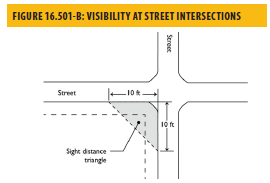
Street Intersections. Vegetation and structures, including signs, shall not exceed a height of three feet within the a triangular area called a "sight distance triangle" formed by the intersecting curb lines (or edge of pavement when no curbs exist) and a line joining points on these curb lines at a distance of ten feet along both lines from their intersection, unless there is a "transparency" feature, such as open railings or well-pruned climbing plants, allowing for sight visibility.
1.
Trees located within the sight distance triangle shall have a minimum clearance of thirteen feet between the lowest portion of the canopy and the street.
2.
The requirements of this section do not apply to unsignalized intersections of local streets, unless specifically required by the director.
C.
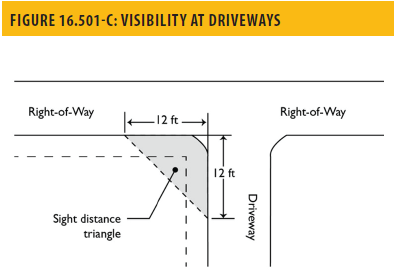
Driveways and Alleys. Visibility of a driveway crossing a street lot line shall not be blocked above a height of three feet within the sight distance triangular area formed by the intersecting curb lines (or edge of pavement when no curbs exist) and a line joining points on these curb lines at a distance of twelve feet along both lines from their intersection.
1.
Street trees pruned at least seven feet above the established grade of the curb so as not to obstruct clear view by motor vehicle drivers are permitted.
D.
Exempt Structures and Plantings. The regulations of this chapter do not apply to existing buildings; public utility poles; saplings or plant species of open growth habits not planted in the form of a hedge but planted and trimmed to leave at all times a clear and unobstructed cross view; official warning signs or signals; or places where the contour of the ground is such that there can be no cross visibility at the intersection.
16.502.01 - Purpose and applicability.
The regulations in this chapter are intended to implement the general plan and protect public health and safety by establishing performance standards to ensure that land uses, and development do not generate adverse impacts on surrounding neighborhoods and uses, or the community at large. The standards contained in this chapter apply to all zoning districts.
16.502.02 - General requirements.
A.
Land or buildings cannot be used or occupied in a manner creating any dangerous, injurious, or noxious conditions, chemical fires, explosive, or other hazards that could adversely affect the surrounding area. If necessary, the director will retain a professional expert or designated regulatory agency to assist in assessing possible impacts, and any cost incurred will be paid by the applicant or business owner.
B.
Prior to the issuance of a building permit, the director may require the applicant to submit such information as proposed machinery, processes, products, or environmental impacts as may be necessary to demonstrate the ability of the proposed uses to comply with applicable performance standards. Such required information may include reports by expert consultants. Whenever an environmental impact report has been submitted and determined to be adequate under state and city guidelines, no further information shall be required.
C.
In addition to the requirements of this chapter, uses shall operate in a manner that complies with other applicable standards of this code establishes to regulate objectional impacts of land uses including, but not limited to, Section 16.502.10, Noise; Chapter 16.506, Light and Glare.
16.502.03 - Construction management.
Construction activities shall be managed in compliance with the following requirements:
A.
Site Watering. During the construction of a project, all portions of the site shall be watered as necessary to reduce emissions of dust and other particulate matter, and all stockpiles shall be covered.
B.
Maintenance. Streets and sidewalks shall be made dirt free at the completion of construction.
C.
Noise. All construction and transport equipment shall be muffled in accordance with state and federal laws.
D.
Emissions. Construction and transport equipment shall be operated so as to minimize exhaust emissions. During construction, trucks and equipment should be running only when necessary.
E.
Hours of Operation. Grading and pile driving operations within ¼ mile of residential units shall be limited to between 8:00 am and 5:00 p.m. on weekdays to ensure compliance with the requirements for construction activity in Subsection 16.502.12.D.1., Maximum Noise Level for Temporary Construction Activity, or as otherwise restricted as part of an approval.
F.
Water Run-off. All water run-off from construction sites shall be controlled. During construction, trucks and equipment should be running only when necessary, and shall comply with Chapter 12.41 of the Vallejo Municipal Code.
16.502.04 - Fire hazards.
The storage, use, transportation or production of products which, either in the raw or finished state, constitute a flammable or explosive material shall be subject to approval of the fire department. Fire department personnel may, without prior notice, visit and observe operations on the site and any directives issued by said personnel shall be satisfied in a timely manner. Burning of waste materials in open fires or unapproved incinerators is prohibited.
16.502.05 - Liquid or solid waste.
The use, handling, storage and transportation of waste materials, including hazardous wastes, shall comply with the provisions of the California Hazardous Materials Regulations and any other applicable laws. Discharge at any point into a public or private sewage disposal system, stream, or the ground, of any material which could contaminate any water supply, or otherwise cause the emission of dangerous or offensive elements is prohibited. No exceptions are allowed unless in accordance with regulations, licenses or approvals of the various local and state agencies having jurisdiction over such activities.
16.502.06 - Heat, humidity, cold, and glare performance standards.
When located in any of the zoning districts specified below, all commercial and industrial uses shall be so operated as not to produce humidity, heat, cold, or glare which is readily detectable without instruments by the average person at the following points of determination:
16.502.07 - Odor, particulate matter, and air contaminants.
A.
No continuous, frequent or repetitive odors are permitted that exceed limits established by the San Francisco Bay Area Air Quality Management District, the California Air Resources Board or federal agencies. An odor detected no more than a total of fifteen minutes in any one day shall not be deemed to be continuous, frequent or repetitive for this regulation.
B.
No dust or particulate matter shall be emitted that exceeds limits established by the San Francisco Bay Area Air Quality Management District, the California Air Resources Board or federal agencies. Exhaust air ducts shall be located or directed away from abutting residentially zoned properties.
C.
When located in the zoning districts specified below, no commercial or industrial uses shall be so operated as to emit matter causing readily detectable odor by the average person at the following points of determination and in the following diluted states:
D.
Applicants for residential development and other sensitive land use projects including, but not limited to hospitals, nursing homes, and adult and child daycare facilities on sites within one thousand feet of a major source of toxic air contaminants such as industrial uses, freeways, and roadways with traffic volumes over ten thousand vehicles per day shall submit a health risk assessment (HRA) to the director with the application.
1.
The HRA shall be prepared in compliance with policies and procedures of the State Office of Environmental Health Hazard Assessment and the Bay Area Air Quality Management District and shall meet office of environmental health hazard assessment (OEHHA) guidelines for the analysis, including age sensitivity factors, breathing rates, and body weights appropriate for children age zero to sixteen years.
2.
If the HRA shows that the incremental cancer risk exceeds ten in one million PM2.5 concentrations exceed 0.3ug/m3, or the appropriate noncancer hazard index exceeds 1.0, the applicant will be required to identify and demonstrate that mitigation measures are capable of reducing potential cancer and non-cancer risks to an acceptable level (i.e., below ten in one million or a hazard index of 1.0), including appropriate enforcement mechanisms.
3.
Measures to reduce risk may include but are not limited to:
a.
Locating air intakes away from high volume roadways and/or truck loading zones.
b.
Ensuring that building heating, ventilation, and air conditioning systems include appropriately sized maximum efficiency rating (MERV) filters
4.
Measures identified in the HRA shall be included in the environmental document and/or incorporated into the site development plan as a component of the proposed project. The air intake design and MERV filter requirements shall be noted and/or reflected on all building plans submitted to the city for review and verification by the director and the city building official.
16.502.08 - Vibration.
No use shall be operated in a manner that produces vibrations discernible without instruments at any point on the property line of the lot on which the use is located.
16.502.09 - Noise.
A.
Purpose. The purpose of these regulations is to implement the general plan policies on noise exposure and land use compatibility policies. More specifically, the purpose of the noise standards is to:
1.
Establish the principles and context for the application of noise limits, standards for noise exposure and land use compatibility, and requirements for reasonable noise attenuation measures;
2.
Protect noise sensitive uses from excessive noise exposure from other uses;
3.
Establish regulations for maximum noise limits and procedures for enforcing them
4.
Prevent any land use from generating sound that exceeds specific maximum levels based on the type uses and the type of noise.
B.
Exemptions. The following facilities and uses are exempt from these regulations:
1.
Emergencies. The emission of sound for the purpose of alerting persons to the existence of an emergency, the performance of emergency work, or the operation of emergency equipment including, but not limited to, generators.
2.
Warning Devices. Warning devices necessary for the protection of the public safety, such as police, fire, and ambulance sirens.
3.
Special Events. Occasional outdoor gatherings, public dances, shows, and sporting and entertainment events, provided that such events are conducted pursuant to a permit or license issued by the city.
4.
Religious Institutions and Other Similar Organizations. Unamplified bells, chimes, or other similar devices used by religious institutions and other houses of religious worship.
5.
Time signals. Signals produced by places of employment or worship and school recess signals providing no one sound exceeds five seconds in duration and no one series of sounds exceeds twenty-four seconds in duration.
6.
Municipal Solid Waste Collection. Collection of solid waste, vegetative waste, and recyclable materials by the city or under contract with the city.
7.
Public Works Construction Projects, Maintenance, and Repair. Street, utility, and similar construction projects undertaken by or under contract to or direction of the city, or the state of California or a public utility regulated by the California Public Utilities Commission, as well as maintenance and repair operations conducted by such parties, including street sweeping, debris and litter removal, removal of downed wires, restoring electrical service, repairing traffic signals, unplugging sewers, vacuuming catch basins, repairing of damaged poles, removal of abandoned vehicles, repairing of water hydrants and mains, gas lines, oil lines, sewers, storm drains, roads, and sidewalks.
8.
Transportation equipment. Sounds from transportation equipment such as trucks and buses used primarily in the movement of goods and people to and from given premises and in connection with temporary construction or demolition work.
9.
Utility Facilities. Facilities including without limitation sixty-cycle electric power transformers and related equipment, sewer lift stations, municipal wells, and pumping stations.
C.
General Requirements.
1.
No person shall make, or cause to suffer, or permit to be made upon any public property, public right-of-way or private property, any excessive noise, annoying noise, amplified sound or vibrations that are physically annoying to reasonable persons of normal sensitivity or that are so harsh or so prolonged or unnatural or unusual in their use, time or place as to cause or contribute to the unnecessary and unreasonable discomfort of any persons of normal sensitivity located at the lot line of the property from which these noises emanate or that interfere with the peace and comfort of residents or their guests, or the operators or customers in places of business in the vicinity, or that may detrimentally or adversely affect such residences or places of business.
2.
Noise standards. Table 16.502-C classifies uses and facilities and establishes exterior and interior noise standards applicable to all uses and facilities in each classification that is not exempt from these requirements pursuant to Subsection B. The requirements impose limits on regularly occurring noise for the specified time periods, averaged over an hour, and do not apply to incidental, infrequent, or unexpected noise, which are subject to Vallejo Municipal Code Chapter 7.84, Regulations of Noise Disturbances. The prohibitions contained in Municipal Code Chapter 7.84, apply to all land uses and activities in the city, and, in the case of a conflict, the more restrictive provisions apply.
3.
The standard limits in Table 16.502-D shall be adjusted by five decibels for any noise that contains a steady, pure tone such as a whine, screech or hum, or an impulsive sound such as hammering or riveting, or contains music or speech, as described in the following table.
D.
Additional Regulations. In addition to the following restrictions, hours may be modified with condition imposed by any conditional use permit or variance. The most restrictive hours shall apply.
1.
Construction hours. Construction, demolition, and related loading/unloading activities that may generate noise exceeding levels in Table 16.502.E shall be limited to hours between 7:00 a.m. and 7:00 p.m. in residential zoning districts and in any mixed-use district.
2.
Noise measurement. In determining whether any noise exceeds the maximum exterior noise limits set forth in this chapter, measurements shall be taken at the property line of the property from which the noise emanates, except that for noise emanating from property in a IG Zoning District, measurement shall be taken at boundary of the zoning district in which the property is located. Residential noise levels.
a.
Interior. No person shall operate or cause to be operated within a dwelling unit, any source of sound that causes the sound level when measured inside a neighboring receiving dwelling unit to exceed the allowable noise level, for any period of time.
b.
Exterior. The exterior noise limits for any source of noise within any residential zone shall be reduced by ten dBA between 10:00 p.m. and 7:00 a.m. The exterior noise limits for any source of noise in any zone other than a residential zone shall be reduced between 10:00 p.m. and 7:00 a.m. so that when the noise measured at the property line of a "noise-sensitive use" does not exceed fifty dBA. The interior noise level for steady state continuous noise from exterior sources in any residential bedroom with windows open between 10:00 p.m. and 7:00 a.m. shall not exceed thirty dBA.
c.
Mitigation required. New single-unit residential projects shall be located and designed so the noise levels in private use areas does not exceed sixty Ldn. For new multiple-unit residential projects a standard of sixty-five Ldn shall apply to outdoor areas excluding balconies.
d.
Noise from sources not under local jurisdiction such as freeways and aircraft shall be exempt.
e.
Developers of mixed-use projects that include residential development shall notify all potential residents that they may be exposed to noise from adjacent and nearby commercial, retail, entertainment, and circulation activity.
E.
Noise level measurement. The following provisions establish a means for measuring noise levels. Where these provisions conflict with other requirements of the Vallejo Municipal Code, the following shall remain applicable for purposes of the Zoning Code:
1.
Setting of Meter. Any sound or noise level measurement made pursuant to the provisions of this title shall be measured with a sound level meter using an A-weighting and "slow" response pursuant to applicable manufacturer's instructions, except that for sounds of a duration of two seconds or less, the "fast" response shall be used and the average level during the occurrence of the sound reported.
2.
Calibration of Meter. The sound level meter shall be approximately calibrated and adjusted as necessary by means of an acoustical calibrator of the coupler-type to assure meter accuracy within the tolerances set forth in American National Standards ANSI-SI.4-1971.
3.
Location of Microphone. All measurements shall be taken at any lot line of a lot within the applicable zoning district. The measuring microphone shall not be less than four feet above the ground, at least four feet distant from walls or other large reflecting surfaces and shall be protected from the effects of wind noises by the use of appropriate wind screens. In cases when the microphone shall be located within ten feet of walls or similar large reflecting surfaces, the actual measured distances and orientation of sources, microphone and reflecting surfaces shall be noted and recorded. In no case shall a noise measurement be taken within five feet of the noise source.
4.
Measured Sound Levels. The measurement of sound level limits shall be the average sound level for a period of one hour.
F.
Compliance. The director may require the applicant for a building permit, prior to the issuance of such permit, to submit such information with respect to proposed machinery, processes, products, or environmental impacts as may be necessary to demonstrate the ability of the proposed uses to comply with the requirements of this chapter.
1.
Acoustic studies that include assessment of noise levels and recommend mitigation measures shall be required for projects that are likely to be exposed to noise levels exceeding the standards in this chapter based on project location and surrounding uses.
2.
The California Land Use Compatibility standards for community noise environments published by the Governor's Office of Planning and Research shall be used as a basis for review of any new residential, commercial and mixed-use development.
3.
Whenever an environmental impact report has been submitted and determined to be adequate under state and city guidelines, no further information shall be required.
16.503.01 - Purpose and applicability.
These regulations are established to make Vallejo a more attractive and healthful place to live, work, visit, and do business by reducing traffic congestion, demand for parking and associated air pollution noise, fuel consumption. More specifically, the provisions of this chapter are intended to:
A.
Implement state requirements requiring cities to address greenhouse gas emissions contributing to climate change and general plan policies to decrease dependence on single-occupant vehicles by requiring development to incorporate measures to reduce Vehicle Miles Traveled (VMT);
B.
Improve the mobility and general efficiency of circulation and transportation systems by increasing reliance on public transit, ridesharing, walking, car-sharing, cycling and focusing development in areas close to transit and employment;
C.
Reduce traffic impacts within the community and region, vehicular air pollutant emissions, energy usage, and ambient noise levels through a reduction in the number of per capita vehicle miles traveled and management of traffic congestion;
D.
Inform residents, workers, employers and other business owners about travel options and the impacts of travel choices;
E.
Coordinate transportation system management, TDM, and transportation facility development strategies citywide, with other cities in the region and through regional agencies; and,
F.
Support local and regional efforts to relieve traffic congestion in and around the city.
G.
The requirements of this chapter apply to:
1.
New multi-unit development of ten units or more;
2.
New non-residential development of ten thousand square feet or more; and
3.
Employers with fifty or more employees at a single worksite within the city except for employers subject to Bay Area Air Quality Management District (BAAQMD) Regulation 13, Rule 1, Trip Reduction Requirements for Large Employers.
16.503.02 - Requirements.
A.
All projects subject to the requirements of this chapter shall incorporate measures to reduce to the extent feasible single-occupant vehicle trip generation rates fifteen percent below the standard rates as established in the most recent edition of the Institute of Transportation Engineers (ITE) Trip Generation Manual by promoting walking, cycling, public transit, and ridesharing/vanpooling, and/or discouraging single-occupant vehicle travel, ensure that the average VMT by residents or workers in the development, or students or workers in schools, is less than the average citywide VMT.
B.
Residential developments that obtain GreenTRIP Certification from TransForm, or other equivalent certification, prior to issuance of a certificate of occupancy, shall be deemed to have met this performance requirement.
C.
Vehicle Trip Reduction measures. all projects subject to the requirements of this chapter that do not have GreenTRIP or equivalent certification shall implement two or more of the following measures to achieve the required VMT reduction:
1.
Passenger Loading Zoning districts. Passenger loading zoning districts for carpool and vanpool drop-off located near the main building entrance.
2.
Direct Route to Transit. A well-lighted path or sidewalk utilizing the most direct route to the nearest transit or shuttle stop from the building.
3.
Pedestrian Connections. Safe, convenient pedestrian connections provided from the project to surrounding public streets and, if applicable, trails.
4.
Bicycle Connections. If a site is abutting a bicycle path, lane or route, provision of a bicycle connection close to an entrance to the building on the site.
5.
Land Dedication for Transit/Bus Shelter. Where appropriate, land dedicated for transit or a bus shelter provided based on the proximity to a transit route.
6.
Long-Term Bicycle Parking. Covered and secure long-term bicycle parking located within seventy-five feet of a main entrance. Long-term bicycle parking shall be in at least one of the following facilities:
a.
An enclosed bicycle locker;
b.
A fenced, covered, locked or guarded bicycle storage area; or
c.
A rack or stand inside a building that is within view of an attendant or security guard or visible from employee work areas.
7.
Short-Term Bicycle Parking. Secure short-term bicycle parking located within fifty feet of a main entrance to the building.
8.
Free Preferential Carpool and Vanpool Parking. Ten percent of vehicle spaces reserved for carpools or vanpools, with a minimum of one space required. The preferential parking spaces shall be provided free of charge.
9.
Showers/Clothes Lockers. Shower and clothes locker facilities free of charge.
10.
Transportation Management Association (TMA). Participation in or requirement for tenant to participate in a local or citywide TMA or a similar organization approved by the director of the department of public works, that provides ongoing administration of and support for non-auto and shared mobility commute incentives, facilities, and services.
11.
Paid Parking at Prevalent Market Rates. Parking provided at a cost equal to the prevalent market rate, as determined by the city based on a survey of paid parking in the city and adjacent communities.
12.
Alternative Commute Subsidies/Parking Cash Out. Provide employees with a subsidy, determined by the applicant and subject to review by the traffic engineer, if they use transit or commute by other alternative modes.
13.
Carpool and Vanpool Ride-Matching Services. Matching of potential carpoolers and vanpoolers by administering a carpool/vanpool matching program or participating actively in such a program administered by a local or citywide TMA, the city, or other public agency.
14.
Guaranteed Ride Home. Guaranteed rides home in emergency situations for carpool, vanpool and transit riders. Rides shall be provided either by a transportation service provider (taxi, rental car, or services provided by transportation network/ride sharing companies) or an informal policy using company vehicles with designated employee drivers.
15.
Shuttle Program. Provision of a shuttle program or participation in an existing shuttle program approved by the traffic engineer and subject to any fees for the existing program.
16.
Information Boards/Kiosks. Display of the following information in a prominent location, maintained by a designated TDM contact: transit routes and schedules; carpooling and vanpooling information; bicycle lanes, routes and paths and facility information; and alternative commute subsidy information.
17.
Promotional Programs. Promotion and organization of events for the following programs: new tenant and employee orientation packets on transportation alternatives; flyers, posters, brochures, and emails on commute alternatives; Spare the Air (June through October); Rideshare Week (October); and trip planning assistance routes and maps.
18.
Compressed Work Week. Allow employees or require tenants to allow employees to adjust their work schedule in order to complete the basic work requirement of five eight-hour workdays by adjusting their schedule to reduce the number of days per week employees are expected or required to be on-site, thereby reducing the number of vehicle trips to the worksite.
19.
Flextime. Provide or require tenants to provide employees with staggered work hours involving a shift in the set work hours of all employees at the workplace or flexible work hours involving individually determined work hours, such that a substantial share of employees regularly arrive at and depart from the worksite before or after the a.m. and p.m. peak periods for vehicle travel.
20.
On-Site Amenities. One or more of the following amenities provided on site: day care, cafeteria, limited food service establishment, dry cleaners, exercise facilities, convenience retail, post office, or on-site transit pass sales.
21.
Telecommuting. Provide or require tenants to provide opportunities and the ability for employees to work off site.
22.
Other Measures. Additional measures not listed in this article, such as childcare facilities or an in-lieu TDM fee established by the city council to provide funding for multi-modal access facilities and services, and/or transportation and parking demand management programs.
16.503.03 - Procedures.
All projects subject to the requirements of this chapter shall submit a trip reduction plan in conjunction with the development review or use permit application. These plans shall demonstrate that, upon implementation, they will achieve the performance requirement and shall include the following:
A.
Checklist. A completed checklist of the trip reduction measures chosen by the applicant pursuant to Subsection 16.503.02.C, Vehicle Trip Reduction Measures.
B.
Trip Generation. Estimated daily trip generation for the proposed use based on the ITE trip generation rates and the reductions anticipated with implementation of the measures proposed. The traffic engineer, a citywide TMA, or a consulting traffic engineer retained by the city at applicants' expense shall maintain guidelines and checklists for evaluation of trip reduction potential of proposed measures and make these available to applicants.
C.
Implementation Plan. A description of how the performance requirements will be achieved and maintained over the life of the project.
D.
Project-Designated TDM Contact. Designation of an employee or resident as the official contact for the TDM program. The city shall be provided with a current name and phone number of the project-designated TDM contact who administers carpool and vanpool ride-matching services and promotional programs, updates information on the information boards/kiosks, and is the official contact for the administration of the programs.
E.
Site Plan. A site plan that designates TDM design elements including, as applicable, the location and layout/design of:
1.
External: preferential parking areas, paid parking areas, bicycle connections, bicycle parking, location of on-site amenities, passenger loading areas, land dedicated for transit facilities and bus shelters, direct route to transit, and pedestrian connections.
2.
Internal: showers/lockers, information boards/kiosks, ATM, dry cleaners, day care, convenience retail, post office, cafeteria, limited food service establishment, exercise facilities, and on-site transit pass sales.
F.
Approval Required. Prior to approval of a project subject to the requirements of this chapter, the director or the planning commission, whichever has review authority, shall make both of the following findings:
1.
The proposed trip reduction measures are feasible and appropriate for the project, considering the proposed use or mix of uses and the project's location, size, and hours of operation; and
2.
The proposed vehicle trip reductions will ensure that the performance targets of this chapter will be achieved and maintained.
G.
Monitoring and Reporting. A report, documenting the TDM activities undertaken and their results or an affidavit confirming that the requirements of this chapter have been met, shall be submitted to the director by the designated TDM contact. If the TDM measures consist of solely measures that would be performed once, this report shall be submitted at the completion of the implementation of those measures.
1.
For measures that are ongoing commitments, this report shall be submitted annually. If the annual report shows compliance for three consecutive years, no further annual reports are required.
2.
A five-year review may be required by the director or citywide TMA to evaluate the overall effectiveness of all of the TDM activities and may suggest new or modified activities or substitute activities to meet the program's objectives, per the director's or TMA's review and approval.
3.
The director may impose reasonable changes to assure the program's objectives will be met. All employers shall, upon the city's request, provide the city with information about the number of employees who work at worksites located within the city.
H.
Modifications and Revisions.
1.
Minor Modifications. The director may approve minor modifications to an approved TDM plan that are consistent with the original findings and conditions approved by the review authority and would result in the same target minimum alternative mode use.
2.
Revised Plans. A proposed change in an approved project subject to the requirements of this article that would result in a ten percent increase in the number of average daily vehicle trips shall be accompanied by a statement of what modifications or additions to the approved TDM plan will be made to ensure the same target alternative mode use. The director may conditionally approve such a change, subject to annual monitoring to confirm that the program's objectives are being met.
16.504.01 - Purpose and applicability.
The purpose of these provisions is to establish standards for landscaping that will:
A.
Improve the livability and visual character of the city,
B.
Help to protect the natural environment by reducing pavement, increasing permeable surfaces, and improving air quality, provide shade, reduce heat and heat island effect, and control erosion,
C.
Increase compatibility between residential and abutting commercial and industrial land uses, screen and buffer incompatible land uses,
D.
Improve the overall aesthetic quality of neighborhoods and commercial corridors,
E.
Enhance pedestrian and vehicular traffic and safety,
F.
Establish consistent standards for landscaping for new development as well as to provide a means for upgrading existing landscaping when property improvements are proposed.
G.
The provisions of this chapter apply to all land uses as follows:
1.
New development. Projects proposing new nonresidential and residential development shall provide landscaping in compliance with the requirements of this chapter except for new single-unit homes on existing lots as stated in Subsection 4 below.
2.
Existing development. Any application for approval of any permit for physical alterations and additions to a building or site in an existing development shall comply with the applicable landscaping and irrigation requirements of this chapter as determined by the Review Authority. Alterations that only require zoning compliance review, pursuant to Chapter 16.603, Zoning Compliance Review are not required to meet the requirement of this chapter unless the review authority determines that existing landscaping required as a condition of planning approval is not being maintained.
3.
New occupancy, tenant improvements, and changes in use. New tenant improvements, and renovations of existing commercial and other non-residential properties may include conditions of approval requiring compliance with specific landscaping and irrigation requirements of this chapter if existing landscaping is not being maintained.
4.
Single-unit dwellings. Projects involving new construction of only one single-unit dwelling or an addition to an existing single-unit dwelling with more than five thousand square feet of landscape area will be required to submit landscape and irrigation plans and meet other applicable standards of this chapter. All street-facing yards of such properties shall also be landscaped in compliance with this chapter.
5.
Alternatives to requirements. Modifications to the standards of this chapter may be approved by the appropriate review authority to accommodate alternatives to required landscape materials or methods, where it is first determined that the proposed alternative will be equally effective in achieving the intent of this chapter.
16.504.02 - Landscape location requirements.
Landscaping shall be provided in the following locations:
A.
Setbacks. All setback and open space areas proposed to meet the requirements of this code and which are visible from public streets and easements for utilities and drainage courses except:
1.
Utility and drainage easements occupied by structures or paving;
2.
Required setbacks that are screened from public view;
3.
An area proposed to be retained in its natural state where the review authority has determined additional landscaping is not necessary;
4.
Parking lots;
5.
Other situations when the director or planning commission determines that landscaping is not necessary to achieve the purposes of this chapter.
B.
Unused areas. Any areas of a project site that are not proposed or occupied by a specific use, including pad sites in office parks, retail centers, or industrial sites intended for future development, shall be landscaped unless the director determines that landscaping is not necessary.
16.504.03 - Landscape standards.
Landscaping shall be designed to integrate all elements of the project (e.g., buildings, parking lots, and streets) to achieve their aesthetic objectives, create desirable micro-climates, and minimize water and energy demand with plant materials selected for low water demand and drought tolerance.
A.
Landscape Principles. Landscaping plans shall be developed in accordance with the following principles:
1.
Landscaping shall be in scale with buildings on the site and surrounding development. Plantings shall be selected and located to avoid conflicts with views, lighting, infrastructure, utilities, and signage.
2.
Landscaping shall be designed to provide a safe and attractive pedestrian environment in high activity areas in the downtown, along neighborhood and community corridors and in the waterfront areas.
3.
Artwork and other streetscape elements shall be incorporated into the landscape design to improve the appearance and appeal of the community.
4.
Drought-Tolerant/Native Species. Landscape design and construction shall emphasize drought-tolerant and/or native species whenever possible.
5.
Group Plantings. Tree and shrub plantings should be grouped together in order to create a strong unified character.
6.
Inorganic Groundcover or Bark. When inorganic groundcover or bark is used, it shall be in combination with live plants and shall be limited to an accent feature such as an accent plant, art, furniture, or water feature, or mulch. Trees shall be installed in conformity with this chapter.
7.
Maturity. Landscaping should be sized so that it has a mature appearance and fills in its location on the plan within six years of planting.
8.
Landscaped Building Edges. An attractive landscape edge should be established at the base of buildings. Avoid paved edges at the base of structures as much as possible.
9.
Size of Plant Materials. The sizes of plant materials selected shall be limited to those which have the best chance of survival for a minimum of three years. The use of specimen trees is encouraged in certain situations when the survival of that tree can be assured.
10.
Wall Plantings. Walls six feet or higher shall be planted with vines and shrubs to provide shadow and patterns, and to discourage graffiti. Trellises are encouraged.
11.
Walkways. A system of walkways independent of driveways shall provide safe pedestrian access from public rights-of-way to every dwelling unit and to all commonly used open spaces. Walkways shall have a minimum width of four feet.
B.
Water-efficient landscape requirements. Applicable landscape and irrigation plans shall comply with the requirements and guidelines for water efficient landscape in Section 16.504.09, Water-Efficient Landscape Requirements.
C.
Energy conservation and sustainable design. Plans shall locate landscape elements in a manner that maximizes energy conservation such as using large trees to provide daytime shading for buildings to reduce the amount of energy needed for air conditioning.
1.
Landscape plans shall be designed to take account of natural drainage patterns and reduce pervious surfaces to minimize runoff.
2.
Landscaped planters shall have a minimum interior width of five feet or more measured from the inside of any bordering curb or wall.
3.
Hardscape areas shall only be used as necessary to provide pedestrian circulation through required landscape areas.
D.
Minimum Landscaping Required. A minimum area of each site shall be landscaped in compliance with Table 16.504-A: Landscape Requirements, in addition to any parking lot landscaping that this chapter requires.
E.
General requirements.
1.
Plant materials.
a.
Trees.
i.
All trees shall be a minimum size of twenty-four-inch box except for trees in hillside areas, which may be a mix of sizes with a minimum size of fifteen-gallon containers.
ii.
Root barriers shall be provided for trees in planters less than ten feet in width or located within five feet of a permanent structure.
b.
Shrubs. All shrubs shall be a minimum size of five-gallon containers; and
c.
Groundcover. Ground cover shall be live plant materials, except that bark chips, pebbles, stone, gravel, and similar materials may be allowed up to fifteen percent of the total required landscape area.
i.
Non-turf areas (e.g., shrub beds) shall be top dressed with bark chips, mulch, or approved alternative.
ii.
Live plant materials used as groundcover shall provide one hundred percent coverage within two years.
d.
Turf.
i.
No more than twenty-five percent of the total landscaped area shall be planted with turf;
ii.
No planting areas less than eight feet in width or on any slope more than fifteen percent shall be planted with turf; and
iii.
A level buffer zone of eighteen inches shall be provided between turf areas on berms and any hardscape such as streets, walkways, or similar features.
e.
Drought tolerant canopies, deciduous vines, and trellises shall be incorporated to shade south and westward facing walls.
2.
Native species and natural areas shall be protected and preserved where possible.
a.
Landscape materials within a required traffic safety visibility area shall meet the requirements of Section 16.501.11, Visibility at Intersections, Alleys, and Driveways.
3.
Front yard landscaping, residential lots.
a.
No more than fifty percent of the front yard setback shall be covered by nonporous surfaces, such as concrete, brick or asphalt, for driveways and walkways.
b.
Of the remaining portion of front setback, no more than thirty percent shall be covered by decorative nonliving materials such as sand, stone, gravel, wood or water. Landscaping of front yard setbacks shall be completed within six months of occupancy.
F.
Street trees. At least one street tree of a species and size specified in this chapter or as approved by the review authority shall be planted at a minimum interval of fifty feet in residential districts and thirty feet in non-residential zoning districts. Trees shall be at least five feet in height when planted.
G.
Soil testing and preparation.
1.
A soil test for horticultural suitability shall be required at the time of landscape installation in each landscaped area.
2.
Soil shall be prepared and/or amended to be suitable for the plant materials to be installed.
H.
Irrigation System Requirements. All landscaped areas shall include an automatic irrigation system, designed and installed in compliance with this chapter.
I.
Root barriers shall be provided for trees in planters less than ten feet in width or located within five feet of a permanent structure.
16.504.04 - Landscaping and screening of parking areas.
Landscaping of parking areas shall be provided and maintained according to the following requirements as well as the standards except for single-unit dwellings and duplexes.
A.
Landscape Area Required. A minimum of ten percent of the interior of any parking lot area shall be landscaped. This is in addition to and separate from the fifty percent shade tree requirement.
B.
Minimum Planter Dimension. No landscape planter that is to be counted toward the required landscape area shall be smaller than twenty-five square feet in area, or four feet in any horizontal dimension, excluding curbing.
C.
Layout. Landscaped areas shall be well-distributed throughout the parking lot area. Parking lot landscaping may be provided in any combination of:
1.
Landscaped planting strips at least four feet wide between rows of parking stalls;
2.
Landscaped planting strips between parking areas and adjacent buildings or internal pedestrian walkways;
3.
Landscaped islands located between parking stalls or at the ends of rows of parking stalls; and,
4.
On-site landscaping at the parking lot perimeter.
D.
Required Landscaped Islands and Buffers.
1.
Landscaped islands. A landscaped island that is at least four feet wide and nine feet long (the length of a parking stall) and containing at least one fifteen-gallon-size tree shall be provided at each end of each interior row of parking stalls and between every eight consecutive parking stalls.
2.
Landscaped Buffer for Open Parking Adjacent to Right-of-Way. A landscaped area at least four feet wide excluding the curb shall be provided between any surface parking area and any property line adjacent to a public street, unless a different dimension is specified in the base district standards applicable to a site.
3.
Landscaped Buffer for Open Parking Abutting Interior Lot Line. A landscaped area at least four feet wide excluding the curb shall be provided between any surface parking area and any adjacent lot for the length of the parking area.
4.
Landscaped Buffer for Parking Garages. A parking garage that does not incorporate ground-floor nonresidential or residential use or is not otherwise screened or concealed at street frontages on the ground level, shall provide a landscaped area at least ten feet wide between the parking garage and the adjacent sidewall or public street.
E.
Parking Garage Rooftop Planting. Uncovered parking on the top level of a parking structure shall have rooftop planters with a minimum dimension of thirty-six inches around the entire perimeter of the top floor.
F.
Trees.
1.
Number Required. One for every eight parking spaces.
2.
Distribution. Trees shall be distributed relatively evenly throughout the parking area.
3.
Species. Shade tree species shall be selected from a list maintained by the department of public works. The tree species shall vary.
4.
Size. All trees shall be a minimum fifteen-gallon size with a one-inch diameter at forty-eight inches above natural grade.
5.
Minimum Planter Size. Any planting area for a tree shall have a minimum interior horizontal dimension of five feet. Additional space may be required for some tree species.
6.
Perimeter Landscaping. All surface parking areas shall be screened from the street and adjoining properties, and the open areas between the property line and the street right-of-way shall be landscaped as follows, unless otherwise approved by the director based on the growth characteristics and maintenance practices for the proposed plant materials:
a.
Adjacent to Streets.
i.
Parking, except for single unit or duplex residential units, shall not be located within the required setback areas and the setback areas shall be landscaped;
ii.
Landscaping shall be designed and maintained to screen cars from view from the street pursuant to (I) and in accordance with the setback requirements;
iii.
Shade trees shall be provided at a minimum rate of one tree for every thirty linear feet of landscaped area.
7.
Adjacent to Side or Rear Property Lines. Parking areas for non-residential uses shall provide a perimeter landscaped strip at least five feet wide (inside dimension) where the parking area adjoins a side or rear property line. The requirement for a landscape strip may be satisfied by a setback or buffer area that is otherwise required to be five feet or greater. Trees shall be provided at the rate of one for each thirty linear feet of landscaped area.
8.
Adjacent to Structures. Parking areas located adjacent to nonresidential structures shall provide a minimum five-foot-wide landscape strip (inside dimension) adjacent to the structure or walkways, exclusive of building entries or areas immediately adjacent to the wall of the structure that serves as pedestrian access.
9.
Adjacent to Residential uses. Parking areas for nonresidential uses adjoining residential uses shall provide a five-foot-wide landscape buffer between the parking area and the common property line bordering the residential use to buffer glare, light, or nuisance noise. Pedestrian access shall be provided, as appropriate. Trees shall be provided at a rate of one for each thirty linear feet of landscaped area.
G.
Protection of Vegetation.
1.
Clearance from Vehicles. All required landscaped areas shall be designed so that plant materials, at maturity, are protected from vehicle damage by providing a minimum two-foot clearance of low-growing plants where a vehicle overhang is permitted, or by wheel stops set a minimum of two feet from the back of the curb.
2.
Planters. All required parking lot landscaping shall be within planters bounded by a concrete curb at least six inches wide and six inches high. Curbs separating landscaped areas from parking areas shall be designed to allow stormwater runoff to pass through.
H.
Visibility and Clearance. Landscaping in planters at the end of parking aisles shall not obstruct driver's vision of vehicular and pedestrian cross-traffic. Mature trees shall have a foliage clearance maintained at thirteen feet from the surface of the parking area to the lowest portion of the canopy. Other plant materials located in the interior of a parking lot shall not exceed thirty inches in height. The provisions of Section 16.501.11, Visibility at Intersections, Driveways, and Alleys, the requirements of Section 16.501.11 shall apply.
I.
Screening. Parking areas shall be screened from view from public streets and adjacent lots in a more restrictive district, according to the following standards.
1.
Height. Screening of parking lots from adjacent public streets shall be four feet in height. Screening of parking lots along interior lot lines that abut residential zoning districts shall be six feet in height, except within the required front setback of the applicable zoning district, where screening shall be three feet in height.
2.
Materials. Screening may consist of one or any combination of the methods listed below.
a.
Walls. Low-profile walls consisting of brick, stone, stucco, or other quality durable material approved by the director and including a decorative cap or top finish as well as edge detail at wall ends. Plain concrete blocks are not allowed as a screening wall material unless capped and finished with stucco or other material approved by the director.
b.
Fences. An open fence of wrought iron or similar material combined with plant materials to form an opaque screen. Use of chain-link or vinyl fencing for screening purposes is prohibited.
c.
Planting. Plant materials consisting of compact evergreen plants that form an opaque screen. Such plant materials shall achieve a minimum height of two feet within eighteen months after initial installation.
d.
Berms. Berms planted with grass, ground cover, or other low-growing plant materials.
16.504.05 - Special regulations applicable to landscaping along designated scenic highways.
In reviewing landscape plans, the minimum landscaping requirements of this chapter may be:
A.
Uses which by their nature will detract from the scenic qualities of a particular designated route should be screened as much as practicable.
B.
Landscaping should not obstruct significant views and shall be compatible with the natural landscaping of the site.
16.504.06 - Streetscape landscaping along major arterials or corridors.
A.
New or existing development: Landscaping and irrigation systems on private developments along major arterials or corridors shall be installed as follows, unless reduced by the director.
1.
For projects where the building is set-back from the street: New and existing development shall incorporate a minimum of eight-foot wide landscape strip along the length of the parcel in compliance with the applicable city street standard identified by the city engineer.
2.
Landscaping shall be a combination of ground cover, year round shrubs and at least one street tree per every thirty feet of linear feet.
3.
Existing development shall remove unused driveways, remove and replace deteriorated bollards, lighting and site equipment.
4.
Streetscape Planting. Streetscape planting shall occur on properties along all freeways and major arterials or corridors in order to define and separate development projects. This landscaping shall be compatible with screening requirements set forth in Chapter 16.505, Fencing, Walls and Screening.
16.504.07 - Tree protection.
A.
Preserving Trees During Construction. The following measures are required to protect trees during construction in addition to any that may be recommended by an arborist hired by the applicant and imposed as a condition of approval:
1.
Tree Inventory. Identify trees to be preserved on a tree inventory plan with type of tree and condition prior to construction, or permit submittal or as part of entitlements, whichever is first.
2.
Existing Trees. Existing mature trees shall be preserved in non-residential zoning districts if they are over twenty-four inches in diameter measured feet six inches above natural grade. However, trees meeting the above criteria may be removed on a limited basis with the permission of the director upon submittal of an arborist's report which determines that the tree is in poor health and not likely to survive; if the trees constitute a high fire hazard or a threat to persons, structures, or property; or, if they impede public works projects. Trees to be removed shall be shown on the landscaping and irrigation plan and detailed on a tree inventory chart. The arborist's report shall provide guidance on the following requirements:
a.
Construct fencing around the drip line of each tree or group of trees to be retained;
b.
No fill, grading, or construction shall be permitted within the drip line of any tree (or within six feet of the trunk, whichever is greater) designated for preservation except as may be recommended by an arborist or forester.
c.
Trenching shall be prohibited within the tree drip line, and any required utility line within the tree drip line shall be installed by boring or drilling through the soil. Where necessary for access in the vicinity of trees designated for preservation, paving within the drip line shall use porous materials such as gravel, loose boulders, cobbles, wood chips, or bark mulch.
d.
As an option, establish an incentive program in the construction contract to encourage workers, particularly bulldozer drivers, to maximize caution when working near trees (such as a fine for each damaged tree or subtract the fine from a bonus to be divided among all construction workers at the end of the project).
e.
Alternate methods to the standards above that are recommended by the arborist may be implemented.
B.
Removal of Trees. The director may approve the removal of trees based on a determination that there is no feasible alternative design for developing the site and based on report and recommendation by a qualified arborist submitted by the applicant including information as to whether:
1.
The tree is in poor health and cannot be saved;
2.
The tree is a public nuisance, causing damage to public utilities or streets and sidewalks that cannot be mitigated by some other means (such as root barriers etc.);
3.
The tree is in danger of falling and cannot be saved by some other means (such as pruning);
4.
The tree is damaging existing private improvements on the lot (e.g., building foundation, wall, patio, deck, roof, retaining wall, etc.);
5.
The tree species has been identified as fire prone including Blue gum eucalyptus (Eucalyptus globulus), Monterey pines (Pinus radiata), Juniper (Cupressaceous) Tree of Heaven (Ailanthus altissima), Black acacia (Acacia melanoxylon), and bamboo and is located within one hundred feet of structures; or
6.
The tree species is known to develop weaknesses that affect its health or the safety of people and property (e.g., short-lived, weak-wooded and subject to limb breakage, shallow-rooted and subject to toppling).
C.
Replacement of Significant Trees Required. Trees shall be replaced at a ratio of at least three new trees for every tree removed except for the fire-prone species identified above. The minimum size of a replacement tree shall be fifteen gallons. Exception to this requirement may be approved by the director when site conditions warrant. Replacement trees shall be planted in the following order of priority:
1.
On the project site;
2.
On any adjacent property subject to approval of the owner; or
3.
In the public right-of-way adjacent to the property subject to approval of the director of public works.
16.504.08 - Maintenance requirements.
A.
Maintenance Required. All landscaping shall be permanently maintained in a healthy and thriving condition at all times, in compliance with the approved landscape plan. Irrigation systems and their components shall be maintained in a fully functional manner consistent with the original approved design or upgraded to reflect current best practices for water efficiency. Regular maintenance shall include:
1.
Adjusting, checking, and repairing irrigation equipment; resetting automatic controllers; aerating and de-thatching turf areas; adding/replenishing fertilizer, mulch, soil amendments; insect control; the replacement of dead or diseased plants; pruning; watering; and weeding all landscaped areas;
2.
The trimming of vegetation as necessary to maintain the effective functioning of solar energy facilities and passive solar design features installed both on site and on adjacent properties; and
3.
The trimming of vegetation as necessary to keep pedestrian and bicycle paths clear.
B.
Litter shall be removed from all landscaped areas in a timely fashion;
C.
Turf areas shall be mowed on a regular basis and be kept green. Accumulation of leaves, twigs, bark, and other similar materials shall be removed on a regular basis. Planting areas shall be kept free of weeds at all times.
D.
Landscaping maintenance shall include:
1.
Pruning, cultivating, weeding, fertilizing, replacement of plants, and watering on a regular basis;
2.
Pruning or removal of overgrown vegetation, cultivated or uncultivated, that may harbor rats, vermin or other nuisances, or otherwise be detrimental to neighboring properties; and
3.
The removal of dead, decayed, diseased, or hazardous trees, weeds and debris that create an unsightly appearance and may be dangerous to public safety and welfare or detrimental to neighboring properties or property values. Compliance shall be by removal, replacement, or maintenance.
4.
Landscaping (trees, shrubs, ground cover, turf, etc.) which, due to accident, damage, disease, lack of maintenance, or other cause, fails to show a healthy appearance and growth, shall be replaced. Replacement plants shall conform to all standards that govern the original planting installation, approved landscaping plan, or as approved by the director.
16.504.09 - Water-efficient landscape requirements.
A.
Purpose and Applicability: The purpose of these provisions is to maintain consistency with Section 2 of Article X of the California Constitution which specifies that the right to use water is limited to the amount reasonably required for the beneficial use to be served and the right does not and shall not extend to waste or unreasonable method of use. These provisions:
1.
Promote the values and benefits of landscaping practices that integrate and go beyond the conservation and efficient use of water;
2.
Establish a structure for planning, designing, installing, maintaining and managing water efficient landscapes in new construction and rehabilitated projects by encouraging the use of a watershed approach that requires cross-sector collaboration of industry, government and property owners to achieve the many benefits possible;
3.
Establish provisions for water management practices and water waste prevention for existing landscapes;
4.
Use water efficiently without waste by setting a maximum applied water allowance as an upper limit for water use and reduce water use to the lowest practical amount;
5.
Promote the benefits of consistent landscape ordinances with neighboring local and regional agencies;
6.
Encourage use of economic incentives that promote the efficient use of water, such as implementing a tiered-rate structure; and
7.
Encourage cooperation between the city and local agencies to implement and enforce these regulations.
B.
Landscapes that are planned, designed, installed, managed and maintained with the watershed-based approach can improve California's environmental conditions and provide benefits and realize sustainability goals. Such landscapes will make the urban environment resilient in the face of climatic extremes. Consistent with the legislative findings and purpose of the regulations, conditions in the urban setting will be improved by:
1.
Creating conditions to support life in the soil by reducing compaction, incorporating organic matter that increases water retention, and promoting productive plant growth that leads to more carbon storage, oxygen production, shade, habitat and aesthetic benefits
2.
Minimizing energy use by reducing irrigation water requirements, reducing reliance on petroleum-based fertilizers and pesticides, and planting climate appropriate shade trees in urban areas.
3.
Conserving water by capturing and reusing rainwater and graywater wherever possible and selecting climate appropriate plants that need minimal supplemental water after establishment.
4.
Protecting air and water quality by reducing power equipment use and landfill disposal trips, electing recycled and locally sourced materials, and using compost, mulch and efficient irrigation equipment to prevent erosion.
5.
Protecting existing habitat and creating new habitat by choosing local native plants, climate adapted non-natives and avoiding invasive plants. Utilizing integrated pest management with least toxic methods as the first course of action.
C.
Applicability. As required by Executive Order No. B-29-15, these regulations shall apply to all of the following landscape projects:
1.
New development. New construction projects with an aggregate landscape area equal to or greater than five hundred square feet requiring a building or landscape permit, plan check or design review;
2.
Rehabilitated landscapes. Rehabilitated landscape projects with an aggregated landscape area equal to or greater than two thousand five hundred requiring a building or landscape permit, plan check, or design review;
3.
Existing landscapes. Existing landscapes limited to Section 16.504.13, Water-Efficient Landscape Reporting; and
4.
Cemeteries. Recognizing the special landscape management needs of cemeteries, the requirements for new and rehabilitated cemeteries shall be determined by the director, as appropriate.
5.
Any project with an aggregate landscape area of two thousand five hundred square feet or less may comply with the performance requirements of in these regulations or conform to the prescriptive measures contained in Appendix D of the Water Efficient Landscape Ordinance maintained in the planning division office.
6.
For projects using treated or untreated graywater or rainwater captured on site, any lot or parcel within the project that has less than two thousand five hundred square feet of landscape and meets the lot or parcel's landscape water requirement (estimated total water use) entirely with treated or untreated graywater or through stored rainwater captured on site is subject only to Appendix D Section (5) of the Water Efficient Landscape Ordinance maintained in the planning division office.
D.
These regulations do not apply to:
1.
Registered local, State or federal historical sites;
2.
Ecological restoration projects that do not require a permanent irrigation system;
3.
Mined-land reclamation projects that do not require a permanent irrigation system; or
4.
Existing plant collections, as part of botanical gardens and arboretums open to the public.
E.
Landscape Review Permit And Procedures: Landscape review applications for a project subject to Section 16.504.09, Water Efficient Landscape Requirements and based on Subsection C, applicability, shall not be approved until plans and written material showing how the landscaping requirements are to be met have been reviewed and approved.
1.
General Requirements. Prior to construction, the city shall:
a.
Provide the project applicant with these regulations and procedures for permits, plan checks, or design reviews including the Appendices;
b.
Review the landscape documentation package submitted by the project applicant;
c.
Approve or deny the landscape documentation package;
d.
Approve the plan check or design review for the project applicant; and
e.
Upon approval of the landscape documentation package, submit a copy of the water efficient landscape worksheet to the water division.
2.
Plan preparation. Landscape plans shall be prepared by a licensed landscape architect or other person qualified by education and experience to prepare landscape plans.
3.
Plan content. The degree of specificity of landscape plans and written material shall relate to the type of permit or request for approval being sought. All plans shall:
a.
Include all of the information and materials listed on a handout for landscape and irrigation plans available from the city; and
b.
Meet the intent of this chapter by exhibiting a generalized design layout which adequately demonstrates the desired landscaping program in terms of location of proposed landscaping and hardscape, a generalized plant palette with the location, size, and name of proposed plants and trees (both common and botanical), fencing location and materials, and any additional information as required by the director; and.
c.
Provide a clear understanding of the character, massing, and site compatibility of the landscaping program; and
d.
Conform to all water-efficient landscape requirements.
4.
Changes to approved plans. Changes to approved landscaping or irrigation plans shall not be made without prior written approval of the director.
5.
Compliance with required plans. The construction/installation of landscape and irrigation improvements shall be accomplished in compliance with the approved plans as a prerequisite to any final approval/clearance of the use or development to which it relates.
F.
Plan Application Requirements
1.
Submittal of landscape documentation package. Prior to construction, the project applicant shall submit a landscape documentation package to the city that includes the following elements:
a.
Project information:
i.
Date;
ii.
Project applicant;
iii.
Project address [if available, parcel and/or lot number(s)];
iv.
Total landscape area (square feet);
v.
Project type (e.g., new, rehabilitated, public, private, cemetery, homeowner-installed);
vi.
Water supply type (e.g., potable, recycled, well) and identify the water division if the applicant is not served by a private well;
vii.
Checklist of all documents in landscape documentation package;
viii.
Project contacts to include contact information for the project applicant and property owner;
ix.
Applicant signature and date with statement, "I agree to comply with the requirements of the water efficient landscape ordinance and submit a complete Landscape Documentation Package".
b.
Water-efficient landscape worksheet.
i.
Hydrozone information table;
ii.
Water budget calculations: Maximum applied water allowance (MAWA) and Estimated total water use (ETWU).
c.
Soil management report.
d.
Landscape design plan.
e.
Irrigation design plan.
f.
Grading design plan.
2.
Applicant Requirements. Upon approval of the landscape documentation package by the planning division, the project applicant shall:
a.
Receive approval of the plan check or design review and record the date of the permit in the certificate of completion;
b.
Submit a copy of the approved landscape documentation package along with the record drawings, and any other information to the property owner or his/her designee; and
c.
Submit a copy of the water efficient landscape worksheet to the water division.
G.
Specific Requirements For Landscape Documentation Package
1.
Water efficient landscape worksheet.
a.
A project applicant shall complete the Water Efficient Landscape Worksheet in Appendix B which contains information on the plant factor, irrigation method, irrigation efficiency, and area associated with each hydrozone. Calculations are then made to show that the evapotranspiration adjustment factor (ETAF) for the landscape project does not exceed a factor of 0.55 for residential areas and 0.45 for non-residential areas, exclusive of special landscape areas.
i.
The ETAF for a landscape project is based on the plant factors and irrigation methods selected.
ii.
The maximum applied water allowance is calculated based on the maximum ETAF allowed (0.55 for residential areas and 0.45 for non-residential areas) and expressed as annual gallons required.
iii.
The estimated total water use (ETWU) is calculated based on the plants used and irrigation method selected for the landscape design. ETWU must be below the MAWA.
iv.
In calculating the maximum applied water allowance and estimated total water use, a project applicant shall use the ETo values from the Reference Evapotranspiration Table in Appendix A. For Vallejo, use data from other cities in Solano County.
b.
Water budget calculations shall adhere to the following requirements:
i.
The plant factor used shall be from WUCOLS or from horticultural researchers with academic institutions or professional associations as approved by the California Department of Water Resources (DWR). The plant factor ranges from 0 to 0.1 for very low water using plants, 0.1 to 0.3 for low water use plants, from 0.4 to 0.6 for moderate water use plants, and from 0.7 to 1.0 for high water use plants.
ii.
All water features shall be included in the high-water use hydrozone and temporarily irrigated areas shall be included in the low water use hydrozone.
iii.
All special landscape areas shall be identified, and their water use calculated as shown in Appendix B. ETAF for new and existing (non-rehabilitated) special landscape areas shall not exceed 1.0.
iv.
ETAF for special landscape areas shall not exceed 1.0.
c.
Maximum applied water allowance. The maximum applied water allowance shall be calculated using the equation:
• MAWA = (ETo) (0.62) [(0.7 x LA) + (0.3 x SLA)] Where:
• MAWA = Maximum Applied Water Allowance (gallons per year)
• ETo = Reference Evapotranspiration (inches per year)
• 0.62 = Conversion Factor (to gallons)
• 0.7 = ET Adjustment Factor (ETAF)
• LA = Landscape Area including SLA (square feet)
• 0.3 = Additional Water Allowance for SLA
• SLA = Special Landscape Area (square feet)
Examples of how to use this calculation are provided in Appendix A.l of the Water Efficient Landscape Ordinance maintained in the planning division office.
d.
Estimated Total Water Use. The estimated total water use shall be calculated using the equation below. The sum of the estimated total water use calculated for all hydrozones shall not exceed MAWA.
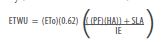
Where:
• ETWU = Estimated Total Water Use per year (gallons)
• Eto = Reference Evapotranspiration (inches)
• PF = Plant Factor from WUCOLS (see Part VII General Terms )
• HA = Hydrozone Area [high, medium, and low water use areas] (square feet)
• SLA = Special Landscape Area (square feet)
• 0.62 = Conversion Factor
• IE = Irrigation Efficiency (minimum 0.71)
Examples of how to use this calculation are provided in Appendix A.l of the Water Efficient Landscape Ordinance maintained in the planning division office.
2.
Soil Management Report. In order to reduce runoff and encourage healthy plant growth, a soil management report shall be completed by the project applicant, or his/her designee, as follows:
a.
Submit soil samples to a laboratory for analysis and recommendations. Soil sampling shall be conducted in accordance with laboratory protocol, including protocols regarding adequate sampling depth for the intended plants.
b.
The soil analysis shall include:
i.
Soil texture;
ii.
Infiltration rate determined by laboratory test or soil texture infiltration rate table;
iii.
pH;
iv.
Total soluble salts;
v.
Sodium;
vi.
Percent organic matter; and
vii.
Recommendations.
c.
In projects with multiple landscape installations (i.e. production home developments) a soil sampling rate of one in seven lots or approximately fifteen percent will satisfy this requirement. Large landscape projects shall sample at a rate equivalent to one in seven lots.
3.
Landscape Design Plan. To ensure efficient use of water, a landscape plan shall be carefully designed and planned for the intended function of the project. A landscape design plan meeting the following design criteria shall be submitted as part of the landscape documentation package.
a.
Plant material. Any plant not within a "required landscaped area," may be selected for the landscape, providing the estimated total water use in the landscape area does not exceed the maximum applied water allowance. Plants to be located within a required landscaped area must be of a drought tolerant variety. Methods to achieve water efficiency shall include one or more of the following:
i.
Protection and preservation of native species and natural vegetation;
ii.
Selection of water-conserving plant, tree and turf species, especially local native plants;
iii.
Selection of plants based on local climate suitability, disease and pest resistance;
iv.
Selection of street trees based on city of Vallejo approved street tree list and size at maturity as appropriate for the planting area;
v.
Selection of plants from local and regional landscape program plant lists.
vi.
Selection of plants from local Modification Plan Guidelines.
b.
Each hydrozone shall have plant materials with similar water use, with the exception of hydrozones with plants of mixed water use, as specified in Section 16.504.11, Irrigation Standards.
c.
Plants shall be selected and planted appropriately based upon their adaptability to the climatic, geologic, and topographical conditions of the project site. Methods to achieve water efficiency shall include one or more of the following:
i.
Use the Sunset Western Climate Zone System which takes into account temperature, humidity, elevation, terrain, latitude, and varying degrees of continental and marine influence on local climate;
ii.
Recognize the horticultural attributes of plants (i.e., mature plant size, invasive surface roots) to minimize damage to property or infrastructure (e.g., buildings, sidewalks, power lines); and
iii.
Consider the solar orientation for plant placement to maximize summer shade and winter solar gain.
iv.
Turf is not allowed on slopes greater than twenty-five percent where the toe of the slope is adjacent to an impermeable hardscape and where twenty-five percent one foot of vertical elevation change for every four feet of horizontal length (rise divided by run x 100 = slope percent).
d.
Recognize the horticultural attributes of plants (i.e., mature plant size, invasive surface roots) to minimize damage to property or infrastructure [e.g. buildings, sidewalks, power lines]; allow for adequate soil volume for healthy root growth and
e.
High water use plants, characterized by a plant factor of 0.7 to 1.0, are prohibited in street medians.
f.
A landscape design plan for projects in fire-prone areas shall address fire safety and prevention. A defensible space or zone around a building or structure is required per Public Resources Code Section 4291(a) and (b). Avoid fire-prone plant materials and highly flammable mulches. Refer to the local fuel modification plan guidelines.
g.
The use of invasive plant species such as those listed by the California Invasive Plant Council shall not be permitted.
h.
The architectural guidelines of a common interest development, which include community apartment projects, condominiums, planned developments, and stock cooperatives, shall not prohibit or include conditions that have the effect of prohibiting the use of low-water use plants as a group.
i.
Water features.
i.
Recirculating water systems shall be used for water features.
ii.
Where available, recycled water shall be used as a source for decorative water features.
iii.
Surface area of a water feature shall be included in the high-water use hydrozone area of the water budget calculation.
iv.
Pool and spa covers are highly recommended.
4.
Landscape Plan Requirements. The landscape design plan, at a minimum, shall:
a.
Delineate and label each hydrozone by number, letter, or other method;
b.
Identify each hydrozone as low, moderate, high water, or mixed water use. Temporarily irrigated areas of the landscape shall be included in the low water use hydrozone for the water budget calculation;
c.
Identify recreational areas;
d.
Identify areas permanently and solely dedicated to edible plants;
e.
Identify areas irrigated with recycled water;
f.
Identify type of mulch and application depth;
g.
Identify soil amendments, type, and quantity;
h.
Identify type and surface area of water features;
i.
Identify hardscapes (pervious and non-pervious);
j.
Identify location, and installation details, and twenty-four-hour retention or infiltration capacity of any applicable stormwater best management practices that encourage on-site retention and infiltration of stormwater. Project applicants shall refer to the public works department or regional water quality control board for information on any applicable stormwater technical requirements.
k.
Identify any applicable rain harvesting or catchment technologies and their twenty-four-hour retention or infiltration capacity;
l.
Identify any applicable graywater discharge piping, system components and area(s) of distribution;
m.
Contain the following statement: "I have complied with the criteria of the ordinance and applied them for the efficient use of water in the landscape design plan"; and
n.
Bear the signature of a licensed landscape architect, licensed landscape contractor, or any other person authorized to design a landscape. (See Sections 5500.1, 5615, 5641, 5641.1, 5641.2, 5641.3, 5641.4, 5641.5, 5641.6, 6701, 7027.5 of the Business and Professions Code, Section 832.27 of Title 6 of the California Code of Regulations, and Section 6721 of the Food and Agriculture Code.)
5.
Irrigation Design Plan. This chapter applies to landscaped areas requiring permanent irrigation, not areas that require temporary irrigation solely for the plant establishment period. For the efficient use of water, an irrigation system shall meet the planning division and/or public works recommended standards and all the requirements listed in this chapter as well as manufacturers' recommendations. The irrigation system and its related components shall be planned and designed to allow for proper installation, management, and maintenance. An irrigation design plan meeting the following design criteria shall be submitted as part of the landscape documentation package.
a.
System. Landscape water meters, defined as either a dedicated water service meter or private submeter, shall be installed for all non-residential irrigated landscapes of one thousand square feet but not more than five thousand square feet (the level at which Water Code 535 applies) and residential irrigated landscapes of five thousand square feet or greater. A landscape water meter may be either:
i.
A .....customer service meter dedicated to landscape use provided by the water division; or
ii.
A privately-owned meter or submeter.
b.
Automatic irrigation controllers utilizing either evapotranspiration or soil moisture sensor data utilizing non-volatile memory shall be required for irrigation scheduling in all irrigation systems.
c.
If the water pressure is below or exceeds the recommended pressure of the specified irrigation devices, the installation of a pressure regulating device is required to ensure that the dynamic pressure at each emission device is within the manufacturer's recommended pressure range for optimal performance.
d.
Sensors (rain, freeze, wind, etc.), either integral or auxiliary, that suspend or alter irrigation operation during unfavorable weather conditions shall be required on all irrigation systems, as appropriate for local climatic conditions. Irrigation should be avoided during windy or freezing weather, or during rain.
e.
Manual shut-off valves (such as a gate valve, ball valve, or butterfly valve) shall be required, as close as possible to the point of connection of the water supply, to minimize water loss in case of an emergency (such as a main line break) or routine repair.
f.
Backflow prevention devices shall be required to protect the water supply from contamination by the irrigation system. A project applicant shall refer to Chapter 11.38 of the Vallejo Municipal Code for additional backflow prevention requirements.
g.
Flow sensors that detect high flow conditions created by system damage or malfunction are required for all on non-residential landscapes and residential landscapes of five thousand square feet or larger.
h.
Master shut-off valves are required on all projects except landscapes that make use of technologies that allow for the individual control of sprinklers that are individually pressurized in a system equipped with low pressure shut down features.
i.
The irrigation system shall be designed to prevent runoff, low head drainage, overspray, or other similar conditions where irrigation water flows onto non-targeted areas, such as adjacent property, non-irrigated areas, hardscapes, roadways, or structures.
j.
Relevant information from the soil management plan, such as soil type and infiltration rate, shall be utilized when designing irrigation systems.
k.
The design of the irrigation system shall conform to the hydrozones of the landscape design plan.
l.
The irrigation system must be designed and installed to meet, at a minimum, the irrigation efficiency criteria as described in Section 16.504.09, Water-Efficient Landscape Requirements regarding the maximum applied water allowance.
m.
All irrigation emission devices must meet the requirements set in the American National Standards Institute (ANSI) standard, American Society of Agricultural and Biological Engineers'/International Code Council's (ASABE/ICC) 802-2014" Landscape Irrigation Sprinkler and Emitter Standard. All sprinkler heads installed in the landscape must document a distribution uniformity low quarter of 0.65 or higher using the protocol defined in ASABE/ICC 802-2014.
n.
It is highly recommended that the project applicant inquire with the water division about peak water operating demands (on the water supply system) or water restrictions that may impact the effectiveness of the irrigation system.
o.
In mulched planting areas, the use of low volume irrigation is required to maximize water infiltration into the root zone.
p.
Sprinkler heads and other emission devices shall have matched precipitation rates, unless otherwise directed by the manufacturer's recommendations.
q.
Head to head coverage is recommended. However, sprinkler spacing shall be designed to achieve the highest possible distribution uniformity using the manufacturer's recommendations.
r.
Swing joints or other riser-protection components are required on all risers subject to damage that are adjacent to hardscapes or in high traffic areas of turfgrass.
s.
Check valves or anti-drain valves are required on all sprinkler heads where low point drainage could occur.
t.
Areas less than ten feet in width in any direction shall be irrigated with subsurface irrigation or other means that produces no runoff or overspray.
u.
Overhead irrigation shall not be permitted within twenty-four inches of any non-permeable surface. Allowable irrigation within the setback from non-permeable surfaces may include drip, drip line, or other low flow non-spray technology. The setback area may be planted or unplanted. The surfacing of the setback may be mulch, gravel, or other porous material. These restrictions may be modified if:
i.
The landscape area is adjacent to permeable surfacing and no runoff occurs; or
ii.
The adjacent non-permeable surfaces are designed and constructed to drain entirely to landscaping; or
iii.
The irrigation designer specifies an alternative design or technology, as part of the landscape documentation package and clearly demonstrates strict adherence to irrigation system design criteria in Subsection 16.504.09.8.b. Prevention of overspray and runoff must be confirmed during the irrigation audit
iv.
Slopes greater than twenty-five percent shall not be irrigated with an irrigation system with an application rate exceeding 0.75 inches per hour. This restriction may be modified if the landscape designer specifies an alternative design or technology, as part of the landscape documentation package, and clearly demonstrates no runoff or erosion will occur. Prevention of runoff and erosion must be confirmed during the irrigation audit.
6.
Hydrozone.
a.
Each valve shall irrigate a hydrozone with similar site, slope, sun exposure, soil conditions, and plant materials with similar water use.
b.
Sprinkler heads and other emission devices shall be selected based on what is appropriate for the plant type within that hydrozone.
c.
Where feasible, trees shall be placed on separate valves from shrubs, groundcovers, and turf to facilitate the appropriate irrigation of trees. The mature size and extent of the root zone shall be considered when designing irrigation for the tree.
d.
Individual hydrozones that mix plants of moderate and low water use, or moderate and high water use, may be allowed if:
i.
Plant factor calculation is based on the proportions of the respective plant water uses and their plant factor; or
ii.
The plant factor of the higher water using plant is used for calculations.
iii.
Individual hydrozones that mix high and low water use plants shall not be permitted.
iv.
On the landscape design plan and irrigation design plan, hydrozone areas shall be designated by number, letter, or other designation. On the irrigation design plan, designate the areas irrigated by each valve, and assign a number to each valve. Use this valve number in the Hydrozone Information Table (see Appendix B, Section A of the Water Efficient Landscape Ordinance maintained in the Planning Division Office). This table can also assist with the irrigation audit and programming the controller.
7.
Irrigation Plan Requirements. The irrigation design plan, at a minimum, shall contain:
a.
Location and size of separate water meters for landscape;
b.
Location, type and size of all components of the irrigation system, including controllers, main and lateral lines, valves, sprinkler heads, moisture sensing devices, rain switches, quick couplers, pressure regulators, and backflow prevention devices;
c.
Static water pressure at the point of connection to the public water supply;
d.
Flow rate (gallons per minute), application rate (inches per hour), and design operating pressure (pressure per square inch) for each station;
e.
Recycled water irrigation systems;
f.
The following statement: "I have complied with the criteria of the ordinance and applied them accordingly for the efficient use of water in the irrigation design plan"; and
g.
The signature of a licensed landscape architect, certified irrigation designer, licensed landscape contractor, or any other person authorized to design an irrigation system. (See Sections 5500.1, 5615, 5641, 5641.1, 5641.2, 5641.3, 5641.4, 5641.5, 5641.6, 6701, 7027.5 of the Business and Professions Code, Section 832.27 of Title 16 of the California Code of Regulations, and Section 6721 of the Food and Agricultural Code.)
8.
Grading design plan. For the efficient use of water, grading of a project site shall be designed to minimize soil erosion, runoff, and water waste. A grading plan shall be submitted as part of the landscape documentation package. A comprehensive grading plan prepared by a civil engineer for other permits satisfies this requirement.
a.
The project applicant shall submit a landscape grading plan that indicates finished configurations and elevations of the landscape area including:
i.
Height of graded slopes;
ii.
Drainage patterns;
iii.
Pad elevations;
iv.
Finish grade; and
v.
Stormwater retention improvements, if applicable.
b.
To prevent excessive erosion and runoff, it is highly recommended that project applicants:
i.
Grade so that all irrigation and normal rainfall remains within property lines and does not drain on to non-permeable hardscapes;
ii.
Avoid disruption of natural drainage patterns and undisturbed soil; and
iii.
Avoid soil compaction in landscape areas.
c.
The grading design plan shall contain the following statement: "I have complied with the criteria of the ordinance and applied them accordingly for the efficient use of water in the grading design plan" and shall bear the signature of a licensed professional as authorized by law.
9.
Certificate of Completion. The certificate of completion shall include the following elements as shown in the sample certificate in Appendix C:
a.
Project information sheet that contains:
i.
Date;
ii.
Project name;
iii.
Project applicant name, telephone, and mailing address;
iv.
Project address and location; and
v.
Property owner name, telephone, and mailing address;
b.
Certification by either the signer of the landscape design plan, the signer of the irrigation design plan, or the licensed landscape contractor that the landscape project has been installed per the approved landscape documentation package:
i.
Where there have been significant changes made in the field during construction, these "as-built" or record drawings shall be included with the certification;
ii.
A diagram of the irrigation plan showing hydrozones shall be kept with the irrigation controller for subsequent management purposes.
c.
Irrigation scheduling parameters used to set the controller (see Section 16.504.11 Irrigation Standards);
d.
Landscape and irrigation maintenance schedule:
i.
A regular maintenance schedule shall include, but not be limited to, routine inspection; auditing, adjustment and repair of the irrigation system and its components; aerating and dethatching turf areas; topdressing with compost, replenishing mulch; fertilizing; pruning; weeding in all landscape areas, and removing obstructions to emission devices. Operation of the irrigation system outside the normal watering window is allowed for auditing and system maintenance;
ii.
Repair of all irrigation equipment shall be done with the originally installed components or their equivalents or with components with greater efficiency.
iii.
Project applicants are encouraged to implement established landscape industry sustainable best practices for all landscape maintenance activities.
e.
Irrigation audit report prepared by a certified landscape irrigation auditor is required for all existing landscapes installed before January 1, 2016 and more than one acre in size.
i.
Landscapes that have a water meter may be subject to water division review including, but not limited to, irrigation water use analyses, irrigation surveys, and irrigation audits to evaluate water use and provide recommendations as necessary to reduce landscape water use to a level that does not exceed the maximum applied water allowance for existing landscapes. The maximum applied water allowance for existing landscapes shall be calculated as: MAWA = (0.8) (ETo)(LA)(0.62).
ii.
Landscapes that do not have a meter may be subject to water division review including, but not limited to, irrigation surveys and irrigation audits to evaluate water use and provide recommendations as necessary in order to prevent water waste.
f.
Soil analysis report, if not submitted with landscape documentation package, and documentation verifying implementation of soil report recommendations.
g.
The project applicant shall:
i.
Submit the signed certificate of completion to the planning division for review;
ii.
Ensure that copies of the approved certificate of completion are submitted to the water division and property owner or their designee.
h.
Prior to building permit issuance, the director shall:
i.
Receive the signed certificate of completion from the project applicant;
ii.
Approve or deny the certificate of completion. If the certificate of completion is denied, the planning division shall provide information to the project applicant regarding reapplication, appeal, or other assistance.
16.504.10 - Soil preparation, mulch, and amendments.
A.
Prior to the planting of any materials, compacted soils shall be transformed to a friable condition. On engineered slopes, only amended planting holes need meet this requirement.
B.
Soil amendments shall be incorporated according to recommendations of the soil report and what is appropriate for the plants selected.
C.
For landscape installations, compost at a rate of a minimum of four cubic yards per one thousand square feet of permeable area shall be incorporated to a depth of six inches into the soil. Soils with greater than six percent organic matter in the top six inches of soil are exempt from adding compost and tilling.
D.
A minimum three-inch layer of mulch shall be applied on all exposed soil surfaces of planting areas except in turf areas, creeping or rooting groundcovers, or direct seeding applications where mulch is contraindicated. To provide habitat for beneficial insects and other wildlife, up to five percent of the landscape area may be left without mulch. Designated insect habitat must be included in the landscape design plan as such.
E.
Stabilizing mulching products shall be used on slopes that meet current engineering standards.
F.
The mulching portion of the seed/mulch slurry in hydro-seeded applications shall meet the mulching requirement.
G.
Organic mulch materials made from recycled or post-consumer shall take precedence over inorganic materials or virgin forest products unless the recycled post-consumer organic products are not locally available. Organic mulches are not required where prohibited by local fuel modification plan guidelines or other applicable local ordinances.
16.504.11 - Irrigation standards.
A.
For the efficient use of water, all irrigation schedules shall be developed, managed, and evaluated to utilize the minimum amount of water required to maintain plant health. Irrigation schedules shall meet the following criteria:
1.
Irrigation scheduling shall be regulated by automatic irrigation controllers.
2.
Overhead irrigation shall be scheduled between 8:00 p.m. and 10:00 a.m. unless weather conditions prevent it. If allowable hours of irrigation differ from the water division, the stricter of the two shall apply. Operation of the irrigation system outside the normal watering window is allowed for auditing and system maintenance.
3.
For implementation of the irrigation schedule, particular attention must be paid to irrigation run times, emission device, flow rate, and current reference evapotranspiration, so that applied water meets the estimated total water use. Total annual applied water shall be less than or equal to maximum applied water allowance (MAWA). Actual irrigation schedules shall be regulated by automatic irrigation controllers using current reference evapotranspiration data (e.g., CIMIS) or soil moisture sensor data.
4.
Parameters used to set the automatic controller shall be developed and submitted for each of the following:
a.
The plant establishment period;
b.
The established landscape; and
c.
Temporarily irrigated areas.
B.
Each irrigation schedule shall consider for each station all of the following that apply:
1.
Irrigation interval (days between irrigation);
2.
Irrigation run times (hours or minutes per irrigation event to avoid runoff);
3.
Number of cycle starts required for each irrigation event to avoid runoff;
4.
Amount of applied water scheduled to be applied on a monthly basis;
5.
Application rate setting;
6.
Root depth setting;
7.
Plant type setting;
8.
Soil type;
9.
Slope factor setting;
10.
Shade factor setting; and
11.
Irrigation uniformity or efficiency setting.
C.
Irrigation audit, irrigation survey, and irrigation water use analysis.
1.
All landscape irrigation audits shall be conducted by a city designated irrigation auditor or a third-party certified landscape irrigation auditor. Landscape audits shall not be conducted by the person who designed the landscape or installed the landscape.
2.
In large projects or projects with multiple landscape installation (i.e. production home developments) an auditing rate of one in seven lots or approximately fifteen percent will satisfy this requirement.
3.
For new construction and rehabilitated landscape projects installed after January 1, 2016, as applicable, the project applicant shall submit an irrigation audit report with the certificate of completion to the planning division that may include, but is not limited to: inspection, system tune-up, system test with distribution uniformity, reporting overspray or run off that causes overland flow, and preparation of an irrigation schedule; including configuring irrigation controllers with application rate, soil types, plant factors, slope, exposure and any other factors necessary for accurate programming;
D.
Irrigation efficiency. For the purpose of determining estimated total water use, average irrigation efficiency is assumed to be 0.75 for overhead spray devices and 0.81 for drip system devices.
E.
Recycled water.
1.
The installation of recycled water irrigation systems shall allow for the current and future use of recycled water.
2.
All recycled water irrigation systems shall be designed and operated in accordance with all applicable local and state laws.
3.
Landscapes using recycled water are considered special landscape areas. The ET adjustment factor for new and existing (non-rehabilitated) special landscape areas shall not exceed 1.0.
F.
Graywater systems. Graywater systems promote the efficient use of water and are encouraged to assist in on-site landscape irrigation. All graywater systems shall conform to the California Plumbing Code (Title 24, Part 5, Chapter 16) and any applicable local ordinance standards.
G.
Stormwater management and rainwater retention. Stormwater management practices minimize runoff and increase infiltration which recharges groundwater and improves water quality. Implementing stormwater best management practices into the landscape and grading design plans to minimize runoff and to increase on-site rainwater retention and infiltration are encouraged.
1.
Project applicants shall be referred to the public works department for information on any applicable stormwater technical requirements.
2.
All planted landscape areas are required to have friable soil to maximize water retention and infiltration.
3.
It is strongly recommended that landscape areas be designed for capture and infiltration capacity that is sufficient to prevent runoff from impervious surfaces (i.e. roof and paved areas) from either: (1) the one inch twenty-four-hour rain event or (2) the eighty-five percentile, twenty-four-hour rain event, and/or additional capacity as required by any applicable local, regional, state or federal regulation.
4.
It is recommended that stormwater projects incorporate any of the following elements to improve on-site stormwater and dry weather runoff capture and use:
a.
Grade impervious surfaces, such as driveways, during construction to drain to vegetated areas.
b.
Minimize the area of impervious surfaces such as paved areas, roof and concrete driveways.
c.
Incorporate pervious or porous surfaces (e.g., permeable pavers or blocks, pervious or porous concrete, etc.) that minimize runoff.
d.
Direct runoff from paved surfaces and roof areas into planting beds or landscaped areas to maximize site water capture and reuse.
e.
Incorporate rain gardens, cisterns, and other rain harvesting or catchment systems.
f.
Incorporate infiltration beds, swales, basins and drywells to capture stormwater and dry weather runoff and increase percolation into the soil.
g.
Consider constructed wetlands and retention ponds that retain water, equalize excess flow, and filter pollutants.
16.504.12 - Public education.
A.
Publications. Education is a critical component to promote the efficient use of water in landscapes. The use of appropriate principles of design, installation, management and maintenance that save water is encouraged in the community. The water division shall provide information to owners of permitted renovations and new, single-unit residential homes regarding the design, installation, management, and maintenance of water efficient landscapes based on a water budget.
B.
Model Homes. All model homes that are landscaped shall use signs and written information to demonstrate the principles of water efficient landscapes described in this chapter. Signs shall be used to identify the model as an example of a water efficient landscape featuring elements such as hydrozones, irrigation equipment, and others that contribute to the overall water efficient theme. Signage shall include information about the site water use as designed per this chapter; specify who designed and installed the water efficient landscape; and demonstrate low water use approaches to landscaping such as using native plants, graywater systems, and rainwater catchment systems.
16.504.13 - Water-efficient landscape reporting.
A.
The planning division shall prepare and annual report on implementation and enforcement no later than January 31st of each year. Reports shall be submitted to the department of water resources.
B.
The report shall address the following:
1.
State whether the city is adopting a single-agency ordinance or a regional agency alliance ordinance and the date of adoption or anticipated date adoption.
2.
Define the reporting period. The reporting period shall commence on December 3, 2015 and end on December 28, 2015. In subsequent years, the reporting will be for the calendar year.
3.
State if using a locally modified water efficient landscape ordinance (WELO) or the Model WELO. If using a locally modified WELO, how is it different than MWELO, and are there any exemptions specified?
4.
State the entity responsible for implementing the regulations of this chapter.
5.
State number and types of projects subject to the regulations during the specified reporting period.
6.
State the total area (in square feet or acres) subject to the regulations over the reporting period, if available.
7.
Provide the number of new housing starts, new commercial projects, and landscape retrofits during the reporting period.
8.
Describe the procedure for review of projects subject to the regulations of this chapter.
9.
Describe actions taken to verify compliance. Is a plan check performed; if so, by what entity? Is a site inspection performed; if so, by what entity? Is a post-installation audit required; if so, by whom?
10.
Describe enforcement measures.
11.
Explain challenges to implementing and enforcing the regulations of this chapter.
12.
Describe educational and other needs to properly apply the regulations of this chapter.
16.505.01 - Purpose and applicability.
The purpose of these provisions is to prescribe standards for fences and walls within the city for the conservation and protection of property, buffering between uses of varying intensity, the assurance of safety and security, the enhancement of privacy, the control of dust, the abatement or attenuation of noise, and the improvement of the visual environment, and including the provision of a neat appearance to improve neighborhood character.
16.505.02 - General regulations.
A.
Permits Required. Fences and walls that comply with the requirements of this chapter are permitted. All other fences and walls require zoning compliance review, pursuant to Chapter 16.603, Zoning Compliance Review, approval by the director. Any fence over seven feet in height requires a building permit in addition to an exception permit in accordance with Chapter 16.608, Exceptions in areas where the fence height exceeds the limit for the zoning district or use.
B.
Maintenance. Fencing and walls shall be continuously maintained with no sign of rust or disrepair. Graffiti shall be removed within forty-eight hours.
C.
Fencing and Wall Location.
1.
Fence and Wall Location on a Lot. Fences may be erected, placed or maintained along or adjacent to a lot line or within a yard on the private property. A fence located on a lot line shall be considered as being within the yard adjacent to that lot line. The fence owner shall be responsible for properly locating all lot lines before construction of any fence
2.
Fence and Wall Encroachment onto Public Property. No portion of any fence or wall including gate doors, structure, foundation, or footings, shall encroach upon or project into any public right-of-way or other public property without the fence owner first obtaining an encroachment permit from the public works department.
3.
Prohibited Fence and Wall Locations. No person shall place, construct, maintain, or cause to be placed any fence or wall that may endanger the public safety, including but not limited to the following:
a.
Fire Hydrant Access. No fence shall obstruct free access to any fire hydrant.
b.
Sight Distance Triangle. Fencing shall meet the requirements of Section 16.501.11 Visibility At Intersections, Driveways, And Alleys, to avoid interference with visibility at intersections and driveways.
4.
Review by Traffic Engineer Required. To avoid traffic hazards and protect the safety of pedestrians, fences, walls, and other screening shall be subject to review by the traffic engineer for the following locations:
a.
Within ten feet of the point of intersection of a vehicular accessway or driveway and a street or sidewalk;
b.
Within twenty feet of the point of intersection of two or more vehicular accessways including driveways, alleys, or streets.
c.
Measurements shall be made from the face of the curb or, if there is no curb, from the edge of the pavement.
D.
Permitted Screening Types. Screening that complies with the requirements of this chapter may consist of one or more of the following types:
1.
Walls. Walls shall be constructed of concrete, stone, brick, tile or similar type of solid masonry material a minimum of four inches thick.
2.
Berms. A berm shall be constructed of earthen materials and shall be landscaped in compliance with the requirements of this Chapter 16.504, Landscaping.
3.
Planting. Plant materials, when used as a screen, shall consist of compact evergreen plants, and shall be planted in accordance with the requirements of this chapter planted in a minimum three-foot-wide planting strip. They shall be of a kind, or used in such a manner, provide screening having a height which meets the requirements set forth in compliance with and a minimum height of two feet and width of two feet within twelve months after initial installation. The director may require installation of walls, berms or solid fence, if, after twelve months after installation, the plant materials have not formed an opaque screen or if, at any time, the plant materials are not maintained so as to create the desired screen.
E.
Permitted Materials.
1.
Fences. Fences shall be constructed of wood, metal, masonry or other permanent materials designed for permanent fencing.
a.
Non-residential uses. For non-residential uses in residential zoning districts, a wall or fence eight feet in height is required along any rear or side property line that separates the non-residential use from adjacent residential uses. No chain-link (nonmetallic finish) fence may be installed along the rear property line and any side property line not abutting a public right-of-way subject to review and approval by the director. Razor wire or barbed wire fences that cannot be seen from street review are allowed.
b.
Where allowed, chain link fences shall be vinyl clad or vinyl coated.
2.
Hazardous and Prohibited Materials. Except in the RR Zoning District, fences shall not incorporate electrically charged wire, barbed wire and razor wire, chain link (except as permitted by this chapter), unfinished plywood or similar unfinished materials, woven wire mesh ("chicken wire"), welded wire mesh, woven wire ("hog wire") rope, cable, railroad ties, landscape timbers, utility poles or any other similar materials or materials not specifically manufactured for permanent fencing. The use of plywood or other composite panels or materials is not allowed unless the director determines that the material is appropriate to maintain or enhance the architectural design of a building or development.
F.
Posts and Supporting Members. All fence posts and related supporting members of the fence shall be erected so that the finished side or sides of the fence shall be facing the adjacent lot or public right-of-way.
G.
Painting and Staining. All wood fences shall be painted or stained to resist corrosion.
H.
Gates. Gates that are routinely locked shall be equipped with a doorbell device capable of notifying the occupants within the a building or a telephone number that can be used to notify the occupants.
I.
Entry features. Entry features over front yard gates (e.g., open latticed arbors and trellises), not exceeding eight feet in height, three feet in depth or five feet in width are allowed when located within the required front yard but outside the sight distance triangle.
J.
Fences Facing Alleys. When a rear yard fence abuts an alley, the alley facing side of a solid fence shall be clearly labeled with the house address number.
16.505.03 - Fencing and screening requirements in mixed-use and non-residential zoning districts.
Screening that complies with the requirements of this chapter shall be installed at the following locations in mixed-use and non-residential zoning districts:
A.
Commercial, Industrial, Agricultural and Public and Semi-Public Use Types. Screening shall be provided along all boundaries other than streets, where the building site abuts residential uses.
B.
Automotive and Equipment Use Types. Screening shall be provided on building sites with automotive and equipment use types, regardless of zoning, along all off-street parking and zoning district boundaries, other than streets.
C.
Storage and Loading Areas. Storage or loading areas shall be screened wherever such facilities are adjacent to a residential zoning district or when storage and loading areas are visible from a public street and along the perimeter of open off-street parking adjacent to residential zoning districts.
D.
Nonresidential and Multi-Unit Residential Uses in or Adjacent to Residential Zoning Districts. On building sites with nonresidential or multi-unit residential- uses located in or adjacent to residential zoning districts along all property lines abutting single family residences. For the purpose of this section, nonresidential use shall not include home-based businesses.
16.505.04 - Height standards for fences and walls.
A.
Maximum height in Residential Zoning Districts. The height of fences in residential zoning districts shall be limited by location as specified below in Table 16.505-A.
B.
Exceptions to Residential Fence Height Regulations. The director may grant an exception to the fence height requirements imposed by this chapter, in accordance with chapter 16.608, exceptions if the director makes all of the following findings:
1.
The proposed fence will not create or exacerbate a public safety hazard;
2.
The design, materials, scale and color of the proposed fence are compatible and harmonious with the subject site, site improvements and other properties within the immediate vicinity.
3.
The fencing type, including any gate is open and permits direct vision through at least eighty percent of any one square foot segment of vertical fence surface area. Measured surface area does not include major posts, pilasters, or other structures which provide lateral strength.
C.
Maximum Height in Mixed-Use and Non-Residential zoning districts.
1.
Mixed-Use, Commercial, Office and Medical Zoning Districts. Required screening, except for plant material, shall not be more than six feet in height.
2.
Industrial Zoning Districts. Required screening, except for plant materials, shall not be more than eight feet in height.
3.
Automotive and Equipment Type Uses. Fences, walls and other screening on any building site with an automotive and equipment use type, except sales/rental - light equipment, required screening shall not be more than eight feet in height. Fences, walls and other screening on any building site with an automotive and equipment sales/rental - light use shall not be more than six feet in height.
4.
Parking Facilities. Notwithstanding the provisions of an applicable zoning district, screening around an unenclosed off-street parking facility shall not be more than six feet in height.
5.
Courtyard. Fences, walls and other screening installed to create a courtyard without a roof shall be a maximum of five feet in height and be set back a minimum of ten feet from the front property line.
a.
Building characteristics including the dimensions, color and architectural design;
b.
Compatibility of the architectural and design features of the proposed courtyard with the features of the adjoining, as well as neighboring buildings; and
c.
Landscaping, including the effort to minimize removal of existing vegetation and to match replacements with vegetation of the site.
6.
All Other Building Sites. Fences, walls, and other screening on building sites not subject to the regulations of subsections A through C shall be subject to the following height limits:
a.
Within Required Front Yard. Except as provided in Section 16.104.15, Measuring Height of Fences and Walls, the maximum height of fences and walls located within any required front yard shall be three feet unless the traffic engineer, as part of zoning compliance review, pursuant to Chapter 16.603 Zoning Compliance Review, determines that a four-foot fence would not create a visibility hazard. The maximum height of a fence or wall beyond the required front yard is six feet.
b.
Within Required Side Yard for Corner Lot. Except as provided in Section 16.104.15, Measuring Height of Fences and Walls, the maximum height of a fence, wall, or screening located within ten feet of a side property line, adjoining a public street shall be three feet unless the traffic engineer determines that a four-foot fence would not create a visibility hazard as provided through a zoning compliance review. A fence may be six feet in height when located further than eleven feet from the side property line adjoining a public street.
i.
The director in consultation with the traffic engineer may reduce the fence setback to three feet from the back of the sidewalk where the side yard is three feet below street grade.
ii.
An encroachment permit shall be obtained prior to erecting a fence or wall between the curb or sidewalk and the property line.
c.
Within Required Side and Rear Yard for Interior Lots. The maximum height shall not be more than six feet. A one-foot extension up to seven feet is allowed with a decorative finish such as lattice on the top one-foot.
D.
Other Requirements.
1.
Open fences that do not obstruct a view may be six feet in height.
2.
For designated city landmarks and properties that are located within a designated heritage or historic district:
a.
The maximum height for fences within the front setback area and/or the street side yard setback area shall be three feet six inches.
b.
Requests for an Exception. In accordance with Chapter 16.608, Exceptions, the permission to exceed the height limits of this chapter shall be subject to review and approval by the secretary of the architectural heritage and landmarks commission or his/her designee.
16.505.05 - Measurement of height of fences, walls and screening.
A.
The height of fences, walls and other screening shall be measured above the actual adjoining level of finished grade as defined in Section 16.104.15, Measuring Height of Fences and Walls, except that where there is a difference in elevation on opposite sides of such fence, wall or other screening, the height shall be measured from the highest elevation within a three-foot radius on either side of the fence or other screening.
B.
Notwithstanding these requirements, where the finished elevation of the property is lower at the boundary line, or within five feet inside the boundary line, than an abutting property elevation, such change in elevation may be used in lieu of, or in combination with, additional screening to satisfy a screening requirement.
C.
Where screening is required along a public or private street and the roadway elevation is higher than the property in question, the director may permit screens higher than permitted by the applicable height limit based on review of a chapter submitted by an applicant demonstrating difference in elevation when:
1.
Proposed fence height is in compliance with higher grade elevation;
2.
Proposed fence is located on private property; and
3.
No other fence is proposed along the adjacent property.
16.505.06 - Fencing on retaining walls.
The height of fences constructed on or attached to retaining walls shall not exceed six feet measured vertically from the highest finished grade within a three-foot radius of the base of the wall to the highest point of the fence or wall directly above as shown in Section 16.104.15, Measuring Height of Fences or Walls.
16.505.07 - Measurement of location of fencing and walls.
A.
Mixed-use and Non-Residential Zoning Districts. Fencing and walls shall be installed on the property line except when adjacent to a public street; in which case the fencing and wall shall be installed behind required landscaping.
B.
Residential Zoning Districts. When the back of the sidewalk is not the property line, the director may allow the setback to be measured from the inside of the sidewalk. If there is no sidewalk, the zdirector, subject to the concurrence of the director of public works, may allow the setback to be measured from the future location of the sidewalk. Further, if a fence or wall is to be located in the public right-of-way, an encroachment permit from the public works department will be required.
16.505.08 - Temporary fencing.
Temporary fencing may be used to provide security for approved "special events," for construction sites, for vacant structures, and for vacant land, which cannot otherwise be secured, subject to approval of a temporary use permit pursuant to Chapter 16.339, Temporary Uses. The fencing shall consist of chain link fencing or other materials approved by director and shall be limited to a height of eight feet. The use of temporary fencing around occupied and permanent structures is prohibited.
A.
Special Events. The fencing around approved "special events" shall be removed at the conclusion of the event.
B.
Construction Sites. The fencing for construction sites shall not be installed until a building permit or grading permit has been issued and shall be removed prior to final inspection. In the event that the building permits expire before the construction is completed, the director may issue an temporary use permit pursuant to Chapter 16.339, Temporary Uses, to allow the fencing to remain for a longer period of time.
C.
Vacant Land and Vacant Structures. The use of temporary fencing around vacant land or vacant structures shall be subject to the terms and conditions specified in a temporary use permit authorizing this fencing. Any temporary fence that remains on a site for more than six months shall comply with fence regulations of this chapter.
16.505.09 - Types of landscape screening.
A.
The three basic types of vegetative screens that are required as follows:
1.
Opaque Screen. A screen that is opaque from the ground to a maximum height of at least six feet, with intermittent visual obstruction (trees or large plants) from the opaque portion to. An opaque screen may be composed of a densely planted vegetation. Compliance of planted vegetative screens will be based on the average mature height and density of foliage of the subject species, or field observation of existing vegetation. The opaque portion of the screen must be opaque in all seasons of the year. At maturity, the portion of intermittent visual obstructions should not contain any completely unobstructed openings more than five feet wide.
2.
Semi-Opaque Screen. A screen that is opaque from the ground to a height of three feet, with intermittent visual obstruction (trees or large plants) from above the opaque portion to a height of at least six feet. The semi-opaque screen is intended to partially block visual contact between uses and to create a strong impression of the separation of spaces. The semi-opaque screen may be composed of a landscaped earth berm or planted vegetation. Compliance of planted vegetative screens will be based on the average mature height and density of foliage of the subject species, or field observation of existing vegetation. At maturity, the portion of intermittent visual obstructions should not contain any completely unobstructed openings more than ten feet wide.
3.
Broken Screen. A screen composed of intermittent visual obstructions from the ground to a height of at least six feet. The broken screen is intended to create the impression of a separation of spaces without necessarily eliminating visual contact between the spaces. It may be composed of a landscaped earth berm, planted vegetation or existing vegetation. Compliance of planted vegetative screens or natural vegetation will be judged on the basis of the average mature height and density of foliage of the subject species, or field observation of existing vegetation. The screen may contain deciduous plants.
B.
Separation of zoning districts. Where the side or rear yard of a use in a mixed-use, commercial or industrial zoning district abuts a residential zoning district, those side or rear yards shall be screened from uses in that residential zoning district with an opaque screen.
C.
Separation of Non-Conforming Uses. Whenever a residential lot is occupied by a non-conforming commercial or industrial use, the side and rear yards shall be screened with an opaque screen.
16.505.10 - Screening of equipment.
These requirements apply to new development, new land uses, additions and expansions of fifty percent or more in floor area, replacement equipment that is added to serve existing buildings, condominium conversions, and new equipment. They do not apply to existing equipment that serves existing buildings. The director may waive or modify screening requirements for upgrades to existing mechanical equipment.
A.
General Requirements. All exterior mechanical equipment, whether on a roof, on the side of a structure, or located on the ground, shall be screened from public view. Exterior mechanical equipment to be screened includes, without limitation, heating, ventilation, air conditioning, refrigeration equipment, plumbing lines, ductwork, transformers, smoke exhaust fans, water meters, backflow preventers, service entry section, back-up and emergency generators, and similar utility devices.
1.
Screening shall be architecturally integrated into the main structure with regard to materials, color, shape, and size to appear as an integral part of the building or structure.
2.
Equipment shall be screened on all sides, and screening materials shall be opaque.
3.
When screening with plants, evergreen types of vegetation shall be planted and maintained. Plant material sizes and types shall be selected and installed so that, at the time of building occupancy, such plants effectively screen their respective equipment.
4.
The use of wood expanded metal lath, and chain link for the purpose of screening is prohibited.
B.
Requirements for Specific Types of Mechanical Equipment. The following additional screening standards apply to the specified types of mechanical equipment:
1.
Roof-Mounted Equipment.
a.
Whenever feasible, roof-mounted equipment screening shall be constructed as an encompassing monolithic unit or a series of architecturally similar screening units on large roofs, rather than as several individual screens (i.e., multiple equipment screens, or "hats," surrounding individual elements will not be permitted).
The height of the screening element shall equal or exceed the height of the structure's tallest installed equipment.
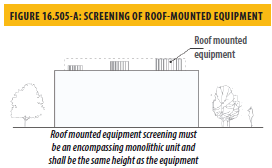
2.
Ground-Mounted Equipment. Ground-mounted equipment that faces a street shall be screened to a height of twelve inches above the equipment, unless such screening conflicts with utility access, in which case reasonable accommodation shall be allowed.
a.
Acceptable screening devices consist of decorative walls and/or berms (3:1 maximum slope) with supplemental landscaping materials, including trees, shrubs, and groundcovers.
b.
For screen walls that are three feet high or lower, vegetative materials may be substituted for fifty percent of the screening device.
c.
This requirement does not apply to incidental equipment such as generators and air conditioners. However, electrical substations, water tanks, sewer pump stations, and similar utilities are required to be screened and secured with a wall one foot above the equipment (not to exceed fencing and wall height limits without an exception). If the wall is greater than twenty-five feet in length, then the wall shall include breaks and design features including varying materials, wall caps, and landscaping.
3.
Exterior Wall Equipment. Wall-mounted equipment, including, without limitation, electrical meters, electrical distribution cabinets, service entry sections, and valves and cabinets that face a street or public parking and are not recessed and/or separated from the street by intervening building(s) or walls or gates, shall be screened. Screening devices shall incorporate elements of the building design (e.g., shape, color, texture and material). For screen walls that are three feet in height or lower, vegetative materials may be substituted for fifty percent of the screening device. This requirement does not apply to fire-related elements.
C.
Exceptions in Industrial Zoning Districts. Due to its size, some outdoor equipment that is ancillary to operations in the IL and IG Zoning Districts may not be fully screened from view. In these cases, operators of such equipment shall only be required to provide screening that is consistent with provisions of this chapter to the extent feasible.
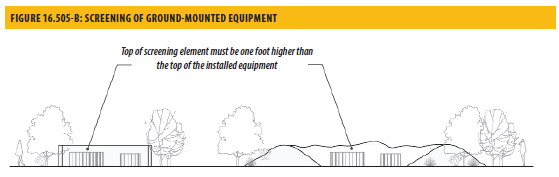
16.506.01 - Purpose and applicability.
The purpose of this chapter is to control outdoor lighting in order to maintain adequate visibility and safety, conserve energy, and protect against direct glare and excessive lighting.
The standards of this chapter apply to all new development and to exterior alterations and additions to existing development that involve replacement of light fixtures or systems. The total outdoor light output shall not exceed that allowed on the site for individual lighting zoning districts, except as provided in the Section 16.506.02, Exemptions, below.
A.
Lighting by Zoning Districts. The maximum outdoor light output level for a site shall not exceed the lighting level allowed for the zoning district in which the site is located as follows:
1.
Areas of high ambient lighting levels. These areas include the DMX, CC, RC, IL, and IG, and Zoning Districts.
2.
Areas of medium ambient lighting levels. These areas include the RMD, RHD, NMX, NC, WC, WMX, O, M, PS Zoning Districts.
3.
Areas of low ambient lighting levels. These areas include the RR, RLD, PROS, and RCN Zoning Districts.
B.
Classes of Lighting.
1.
Class 1 Lighting. All outdoor lighting used for, but not limited to, outdoor sales or eating areas, assembly or repair areas, advertising and other signs, recreational facilities and other similar applications where color rendition is important to preserve the effectiveness of the activity. Designation of lighting as Class 1 requires a finding by the director of the essential nature of color rendition for the application. Recognized Class 1 uses are: outdoor eating and retail food or beverage service areas; outdoor maintenance areas; display lots; assembly areas such as concert or theater amphitheaters.
2.
Class 2 Lighting. All outdoor lighting used for, but not limited to, illumination for walkways, roadways, equipment yards, parking lots and outdoor security where general illumination for safety or security of the grounds is the primary concern.
3.
Class 3 Lighting. Any outdoor lighting used for decorative effects including, but not limited to, architectural illumination, flag and monument lighting, and illumination of trees, bushes, etc.
16.506.02 - Exemptions.
A.
General Exemptions. The following lighting is exempt from the provisions of this chapter.
1.
Emergency Lighting. Temporary emergency lighting needed by police, fire, and other emergency services.
2.
Holiday Lights. Holiday lighting from October 30th to February 1st, provided that no individual lamp exceeds ten watts and seventy lumens. Flashing holiday lights are prohibited on commercial properties.
3.
Nonconformance. All other outdoor light fixtures lawfully installed prior to and operable on the effective date of this chapter are exempt from all requirements of this chapter. There shall be no change in use or lamp type, or any replacement (except for same-type and same-output lamp replacement) or structural alteration made, without conforming to all applicable requirements of this chapter. Further, if the property is abandoned, or if there is a change in use of the property, the provisions of this chapter will apply when the abandonment ceases or the new use commences.
B.
Other Exemptions.
1.
Swimming Pool and Fountain Lighting. Underwater lighting used for the illumination of swimming pools and fountains is exempt from the lamp type and shielding standards, though it shall conform to all other provisions of the Zoning Code.
2.
Solar-powered Lighting. Solar-powered lights of five watts or less per fixture used in residential landscaping applications and to illuminate walkways are exempt from applicable lamp type and shielding standards and are excluded from the total lumen calculations for the site.
3.
Temporary Exemptions. Any individual may submit a written request to the director for a temporary exemption from the requirements of this chapter. If approved, such exemption will be valid for up to thirty days and is renewable at the discretion of the director. The request for a temporary exemption shall describe:
a.
Specific exemptions requested;
b.
Type and use of exterior light involved;
c.
Duration of time for requested exemption;
d.
Type of lamp and calculated lumens;
e.
Total wattage of lamp or lamps;
f.
Proposed location of exterior light;
g.
Previous temporary exemptions, if any; and
h.
Physical size of exterior light and type of shielding provided.
16.506.03 - Prohibitions.
The following are prohibited:
A.
Searchlights. The operation of searchlights for advertising purposes.
B.
Laser Source Light. The use of laser source light or any similar high intensity light for outdoor advertising or entertainment, when projected above the horizontal, is prohibited.
C.
Advertising Sign or Landscape Illumination. The unshielded outdoor illumination of any outdoor advertising sign or landscaping. However, low voltage accent landscape lighting is allowed.
D.
Mercury Vapor. The installation of new mercury vapor fixtures. Existing mercury vapor fixtures shall be removed and replaced with compliant lighting fixtures wherever substantial alterations and additions are undertaken, exclusive of ordinary maintenance and repair.
E.
Other Light Types. Blinking, flashing, revolving, flickering, changing intensity of illumination, and changing color lights. This prohibition does not apply to holiday lights or digital displays that are regulated by Chapter 16.509, Signs.
16.506.04 - General requirements.
A.
All outdoor lighting on private property includes light fixtures attached to buildings, structures, poles, or self-supporting structures. Exterior lighting may be found on parking lots, walkways, building entrances, outdoor sales areas, landscaping, recreational fields, and building faces.
B.
Lighting shall be designed, located, and installed to be directed downward or toward structures, be shielded or fully shielded, and shall be well-maintained in order to prevent glare, light trespass (unwanted light on adjacent lots and public rights-of-way), and light pollution to the maximum extent feasible. No permanently installed lighting shall blink, flash, or be of unusually high intensity or brightness, as determined by the director.
C.
Maximum Height. Outdoor light standards shall not exceed the following maximum heights:
1.
Residential Zoning Districts: seventeen feet
2.
Non-Residential Zoning Districts (excluding Industrial Zoning Districts: twenty feet
3.
Industrial Zoning Districts: twenty-five feet
4.
Non-Residential within twenty feet of a residential zoning district or use: seventeen feet.
D.
Timing. All outdoor lighting in non-residential zoning districts shall be turned off during daylight hours and during any hours when the building is not in use and the lighting is not required for security. Time clocks or photo-sensor systems may be required as a condition of approval of a discretionary permit.
E.
Energy Efficiency. Outdoor lighting shall use energy-efficient fixtures/lamps. Examples of energy efficient fixtures/lamps include high pressure sodium, hard-wired compact florescent, or other lighting technology that is of equal or greater energy efficiency.
F.
For safety and security, during business hours, all areas having frequent vehicular and pedestrian traffic shall be equipped with a lighting device providing a minimum one-foot candle of light at ground level during the hours of darkness.
G.
Design of Fixtures. Fixtures shall be appropriate to the style and scale of the architecture and be shielded as required by Paragraph (I) below. The top of the fixture shall not exceed the height of the parapet or roof or eave of roof.
H.
Entrances in Multi-Unit Residential Development. All entrances to multi-unit residential buildings containing more than four units shall be lighted with low intensity fixtures to ensure the safety of persons and the security of the building.
I.
Shielding. Lighting fixtures shall be shielded or recessed to reduce light bleed to adjoining properties, by:
1.
Ensuring that the light source (e.g., bulb, etc.) is not visible from off the site; and
2.
Confining glare and reflections within the boundaries of the site to the maximum extent feasible.
3.
Each light fixture shall be directed downward and away from adjoining properties and public rights-of-way, so that no on-site light fixture directly illuminates an area off the site.
4.
Lighting on private property shall not produce an illumination level greater than one foot-candle on any property within a residential zoning district except on the site of the light source.
5.
All nonexempt outdoor lighting fixtures shall be shielded to meet standards in Table 16.50-A.
J.
Total Outdoor Light Output Standards. Total non-exempt outdoor light output shall not exceed the limits in Table 16.506-B. Lighting used for external illumination of signs is counted, while lighting used for internal illumination of signs is not counted.
1.
Outdoor light fixtures installed on poles (such as parking lot luminaries) and light fixtures installed on the sides of buildings or other structures, when not shielded from above by the structure itself are to be included in the total outdoor light output by simply adding the initial lumen outputs of the lamps.
2.
Outdoor light fixtures installed under canopies, buildings (including parking garage decks), overhangs or roof eaves where all parts of the lamp or luminaire are located at least five feet but less than ten feet from the nearest edge of the canopy or overhang are to be included in the total outdoor light output as though they produced only one-quarter (0.25) of the lamp's rated initial lumen output.
3.
Outdoor light fixtures installed under canopies, buildings (including parking garage decks), overhangs, or roof eaves where all parts of the lamp or luminaire are located at least ten feet but less than thirty feet from the nearest edge of the canopy or overhang are to be included in the total outdoor light output as though they produced only one-tenth (0.10) of the lamp's rated initial lumen output.
4.
Outdoor light fixtures installed under canopies, buildings (including parking garage decks), overhangs, or roof eaves where all parts of the lamp or luminaire are located thirty or more feet from the nearest edge of the canopy or overhang are not to be included in the total outdoor light output.
K.
Maintenance. Fixtures and lighting shall be maintained in good working order and in a manner that serves the original design intent.
1.
Burnt out and broken light bulbs shall be replaced.
2.
Lighting fixtures shall be periodically cleaned and refinished or repainted so as to be free of graffiti and rust, with surfaces free of chipping and peeling.
16.506.05 - Supplemental requirements.
A.
Outdoor Recreational Facilities. Light fixtures in outdoor recreational facilities such as ball fields, and other outdoor nighttime facilities may exceed the illumination standards and height limits applicable to the zoning district in which the facility is located subject to the following:
1.
Zoning Compliance Review Required. All lighting for outdoor recreations facilities shall require a zoning compliance review, subject to Chapter 16.603, Zoning Compliance Review to ensure compliance with the requirements of this chapter.
2.
Exception to Lumen Limits. Lighting for outdoor athletic fields, courts or tracks shall be considered Class 1 (Color Rendition) and shall be exempt from the lumens per acre limits of Section 16.506.04, General Requirements.
3.
Shielding. Fully shielded lighting is required for all fields, unless another type of luminaire will not cause light trespass in adjacent residential neighborhoods.
4.
Illuminance. All lighting installations shall be designed to achieve no greater than the minimal illuminance levels for the activity as recommended by the Illuminating Engineering Society of North America (IESNA), with adjustments allowed, as appropriate, for the level of play, the most light-demanding sport in a multi-sport venue, and the maximum number of attendees.
5.
Off-Site Spill. The installation shall also limit off-site spill (off the site containing the sports facility) to the maximum extent possible consistent with the illumination constraints of the design.
6.
Certification. Every such lighting system design and installation shall be certified by a registered engineer as conforming to all applicable restrictions of this chapter.
B.
Exterior Display/Sales Areas. Lighting levels on exterior display/sales areas shall be adequate to facilitate the activities taking place in such locations and cannot be used to attract attention to the business.
1.
Display Lots. Lighting for display lots shall be considered Class 1 (Color Rendition) and shall be exempt from the lumens per acre limits of Section 16.506.04, General Requirements.
2.
Shielding. All display lot lighting shall utilize fully shielded luminaries that are installed in a fashion that maintains the fully shielded characteristics.
3.
Illuminance. The display lot shall be designed to achieve no greater than the minimal illuminance levels for the activity as recommended by the Illuminating Engineering Society of North America (IESNA).
4.
Off-Site Spill. The display lot shall limit off-site spill (off the parcel containing the display lot) to a maximum of five lux (0.5 fc) at any location on any non-residential property as measurable from any orientation of the measuring device. No off-site spill is allowed on any residential property.
5.
Curfew. Display lot lighting exceeding the lumens per acre cap shall be turned off or within thirty minutes after closing of the business. Lighting in the display lot after this time shall be considered Class 2 lighting and shall conform to all restrictions of this chapter applicable for this Class, including the lumens per acre caps.
16.507.01 - Purpose and applicability.
The purpose of this chapter is to implement general plan policies and comply with applicable state requirements to protect public safety by identifying natural hazards and reducing their risk. More specifically, these regulations are intended to address the risks posed by wildfires, flooding, geotechnical hazards and seismic events, and projected sea level rise by:
A.
Maintaining up-to-date information identifying areas with high risk from wildfires, floods, earthquakes, and inundation from sea-level rise;
B.
Requiring development in areas at risk from natural hazards to consider the impacts of their proposal and incorporate measures that will reduce threats to public safety;
C.
Referring proposed plans and projects in risk areas to state and local environmental management agencies for review and comment.
16.507.02 - Wildfire hazards.
The following requirements apply to all development in areas that General Plan Map NBE-4 identifies as moderate or high wildfire risk areas:
A.
Applications for development in moderate or high wildfire risk areas shall be submitted to the fire prevention department for review and recommendation of mitigation measures including specification of building and roof materials, firebreaks, fire resistant landscape materials, access roads to open as, internal fire protection systems and adequate water supply.
B.
All areas within one hundred feet of combustible structures in the moderate and high wildfire risk areas shall be kept clear of flammable vegetation.
16.507.03 - Flood hazards.
All development proposed in areas identified by the Federal Insurance Administration's "Flood Insurance Study for the city of Vallejo" shall comply with the following requirements:
A.
The director shall refer applications to the Vallejo Flood and Wastewater District (VFWW) for review and comment and require applicants to revise projects as necessary in response to VFWW recommendations;
B.
Applicants proposing development, grading, and land modification activities that may adversely affect the local drainage system or create erosion may be required to submit engineering reports, subject to peer review at the applicants expense, recommending measures that should be incorporated to mitigate such impacts;
C.
New and modified structures in the one hundred-year floodplain are required to comply with the city's flood management regulations including elevating building pads above flooding levels and other flood-proofing measures.
D.
The construction of permanent structures in designated floodways is prohibited.
E.
Development in areas identified as vulnerable to a projected fifty-five-inch sea level rise by 2100 in General Plan Map NBE-6 or the city's adopted climate action plan, whichever is more restrictive is subject to environmental review for the purpose of assessing potential impacts of inundation and identifying measures to mitigate such effects.
16.507.04 - Geotechnical hazards.
All development proposed in areas the city has designated as geotechnical hazard risk zoning districts B, C, and D on the Geotechnical Land Use Capability Map, Plate 2, Seismic Safety Element shall comply with the requirements of this chapter.
A.
Use Restrictions. The use of land within areas identified as geotechnical hazard risk zones shall comply with the requirements of Table 16.507-A.
1.
Geologic Report Required. All applications to develop land for uses identified as being permitted but subject to geotechnical hazards shall include a soil and geologic report prepared by a registered soil engineer and registered geologist certified in engineering geology to assess geologic hazards, subject to a peer review at the applicant's expense.
a.
The soils and geologic report shall be directed to determining the presence or absence of an active known fault on the development site and to determining appropriate structural design recommendations. Sub-surface exploration may be required if a lack of distinguishable fault features in the vicinity prevents the geologist from determining by a site examination, review of available aerial photographs, or by other means that the fault trace does or does not underlie or exist within fifty feet of any structures proposed for the development site.
b.
A more detailed and extensive investigation and report by the geologist may be required (as evidence to the absence of a known active fault trace) for applications proposing development of Group A, E, I, H, and R-1 occupancies, and B occupancies as set forth in the Uniform Building Code) over one story in height.
c.
The geologic report may be waived, with the approval of the state geologist, if the city determines that no active known fault exists on the development site or, in the case of applications for development containing a maximum of two dwelling units, that sufficient information regarding the site is available from previous reports filed concerning the same development area.
2.
Review of Geologic Report. If the geologic report indicates that the proposed use is not subject to geotechnical hazards, the use may not be denied based on geologic findings, but subject to any special conditions, noted in the report. These conditions shall be attached to the application and be applicable to the proposed use. If the geologic report indicates that geotechnical problems may exist for the proposed use, the applicant shall be required to obtain a major use permit as prescribed in Chapter 16.606, Minor and Major Use Permits; except that when identified problems are so severe, the proposed use may be prohibited.
3.
Construction Limitations. As per the provisions of the Alquist-Priolo Act, no building or structure to be used for human occupancy may be constructed over or within fifty feet of the trace of a known active fault. For the purpose of these regulations, a building or structure to be used for human occupancy is one that is regularly, habitually, or primarily occupied by humans. Buildings and structures shall be designed to resist the earthquake forces prescribed by the Uniform Building Code and to incorporate the design recommendations contained in the soils and geologic report required.
B.
Independent Evaluation Requirement. In addition to the requirements of this section, the city shall require an independent evaluation of any of the soils and geologic reports submitted by the applicant for certain uses to be located in risk zone D as described in this section. The city may establish a fee to cover the costs of the required evaluation.
16.507.05 - Exceptions.
The provisions of this chapter shall not apply to:
A.
Buildings and structures not intended to be used for human occupancy;
B.
Alterations or repairs to an existing structure provided that the aggregated value of the work performed does not adversely affect the structural integrity of the existing structure as required by the Building Code;
C.
A single-unit wood frame dwelling not exceeding two stories in height, which is built or located as part of a development of less than four such dwellings;
D.
Mobile homes as part of a mobile home park; and
E.
Decorative walls, fences, and minor work of a similar nature.
16.508.01 - Purpose and applicability.
The purposes of the off-street parking and loading regulations are to:
A.
Establish standards for off-street parking and loading facilities that will ensure efficiency, and to meet the urban design objectives of the general plan;
B.
Ensure that off-street parking and loading facilities are provided for new uses, major alterations and additions to existing uses proportional to the need for such parking created by each use to support growth and change of new uses;
C.
Offer flexible means of minimizing the amount of land area and impervious surfaces devoted to parking of automobiles by allowing reductions in the number of required parking spaces in transit accessible areas, areas with a diverse mix of land uses with off-setting periods of peak parking demand, for shared parking facilities, and for other situations expected to have lower vehicle parking demand;
D.
Address the needs of pedestrians by promoting parking lot designs that offer safe, attractive, well-shaded, and direct pedestrian routes.
E.
Support bicycling and address the circulation, access, and security needs of people traveling by bicycle;
F.
Recognize and incentivize development with flexible means of parking through trip reduction strategies;
G.
Establish standards for off-street parking and loading facilities that will ensure efficiency, meet urban design objectives of the general plan; Protect the public safety, reduce urban runoff and heat island effects, and, where appropriate, insulate surrounding land uses from adverse impacts;
H.
In mixed-use and multi-family projects, require parking facilities to be designed to:
1.
Minimize the visibility of parking from streets and dwellings and give prominence to private open space and outdoor living areas within projects;
2.
Minimize and conceal negative aspects (e.g., large areas of paving, long expansive walls, and visibility of ventilation grilles and garage doors); and
3.
Facilitate easy access between parking lots and individual dwelling units and non-residential spaces. Unless otherwise specified, the parking and loading requirements in this chapter shall apply to the following:
I.
New Development. New buildings and new conditionally permitted uses in existing buildings.
J.
Reconstruction, Expansion and Change in Use of Existing Buildings.
1.
Changes in use, expansions of a use, or expansions of floor area that create an increase of more than three required parking spaces or more than ten percent of required spaces, whichever is greater. Increases in floor area or the area occupied by a use that has a greater requirement for parking shall be cumulative.
2.
Existing parking shall be maintained, and additional parking shall be required only for an addition, enlargement, or change in use and not for the entire building or site. If the number of existing parking spaces is greater than the requirements for such use, the number of spaces in excess of the prescribed minimum may be counted toward meeting the parking requirements for the addition, enlargement, or change in use.
3.
When additional parking is required for a change of use shall provide the difference between the required parking ratio for the existing use and the proposed use.
4.
A change in occupancy is not considered a change in use unless the new occupant is in a different use classification (use type) than the former occupant.
K.
Alterations that Increase the Number of Dwelling Units. The creation of additional dwelling units through the alteration of an existing building or construction of an additional structure or structures requires the provision of off-street parking to serve the new dwelling units in compliance with the provisions of this chapter. This requirement does not apply when enough on-site parking exists to provide the number of spaces required for the existing and new dwelling units in compliance with all applicable requirements. Parking for accessory dwelling units shall be subject to the requirements of Chapter 16.303, Accessory Dwelling Units.
L.
Construction Timing. On-site parking facilities required by this chapter shall be constructed or installed prior to the issuance of a certificate of occupancy or business license for the uses that they serve.
M.
Damage or Destruction. When a use that has been involuntarily damaged or destroyed is re-established, off-street parking and loading facilities shall also be re-established or continued in operation in an amount equal to the number maintained at the time of such damage or destruction. It is not necessary, however, to restore or maintain parking or loading facilities in excess of those required by this chapter.
N.
Exceptions.
1.
Neighborhood Retail. Commercial retail uses in multi-tenant buildings having a gross floor area of two thousand-five hundred square feet or less are exempt from the off-street parking and loading requirements of this chapter.
2.
Small Nonresidential Lots. One and two-story nonresidential projects on existing lots that are five thousand square feet or less are exempt from the off-street parking and loading requirements of this chapter.
3.
Downtown and Waterfront Mixed-use Zoning Districts. Ground floor non-residential uses in mixed-use buildings occupying less than five thousand square feet are exempt from the off-street parking and loading requirements of this chapter.
4.
Alternative Access and Parking Plans. If an alternative parking and loading plan is approved pursuant to Section 16.508.14, Alternative Compliance with Parking Requirements, the off-street parking requirements shall be subject to the provisions of that plan.
16.508.02 - General regulations and standards.
A.
No Reduction in Off-Street Parking and Loading Spaces. Off-street parking and loading spaces established as of the effective date of this code shall not be reduced in number during the life of such building or land use which would be required for a new building or use of a similar type under the requirements of this code. All such off-street parking and loading spaces shall remain permanently available and accessible for the parking or loading of vehicles by occupants of the property, except that any surplus spaces may be rented out to non-occupants, or otherwise made publicly accessible with the provision that such spaces shall be vacated on thirty days' notice if they become needed by occupants of the property.
B.
Separate Parking and Loading Spaces. No area may be used and counted as both a required parking space and a required loading space. However, maneuvering aisles and driveways may serve both required parking spaces and loading spaces if they meet the requirements specified in this chapter for both parking and loading facilities.
C.
Future Parking Spaces. A development may bank up to ten percent of required parking spaces by demonstrating availability of on-site development area for such parking and designating future parking including:
1.
Site plan identifying location and number of banked parking spaces;
2.
Measures that will be used to ensure that the banked spaces remain available to meet future needs;
3.
Other provisions the director or the planning commission determines necessary to reserve the banked spaces to meet the development's future need for parking.
4.
The director may require the developer or an authorized representative to submit information on changes in the use of banked spaces in connection with changes in occupancy of the development.
D.
Non-conforming Parking. Existing land uses with off-street parking and loading facilities that do not conform to the requirements of this chapter may be enlarged or expanded, provided that additional parking and loading facilities are added so that the enlarged or expanded portion of the building conforms to the requirements of this chapter.
1.
No existing use or structure shall be deemed to be non-conforming solely because of the lack of off-street parking or loading facilities required by this chapter, provided the facilities being used for off-street parking and loading as of the date of adoption of this chapter shall not be reduced in number to less than that required by this chapter, and the intensity of the proposed use does not increase.
2.
Intensity shall mean an increase by more than fifty percent in building square footage or number of employees.
16.508.03 - Calculation of parking requirements.
A.
Requirements Based on Use. The minimum number of parking spaces required, and the maximum number of parking spaces allowed where specified by this code, shall be in accordance with Table 16.508-B. References to spaces per square foot shall be calculated as provided for in Chapter 16.104, Rules for Measurement, on gross floor area unless otherwise specified, and shall include allocations of shared restroom, halls and lobby area, but shall exclude area for vertical circulation, stairs or elevators.
B.
When Use is Undetermined. In cases where the use is undetermined or not identified, the director shall assign the land use or activity to a classification that is substantially similar in character, and the number of parking and loading spaces required. In order to make this determination, the director may require the submission of survey data from an applicant or collected at an applicant's expense.
C.
Multiple Uses. Whenever a single lot contains more than one use, the overall parking requirements shall be the sum of the requirements for each use calculated separately. The director may permit a reduction in the overall required parking if several different uses will share a joint or common parking facility and the director determines that such uses will have varying time periods of peak demand for the parking based on a parking study prepared by an independent transportation planning or engineering firm and based on the latest edition of the urban land institute's shared parking methodology, a comparable shared parking model, and/or local data sources.
D.
Calculations. All area-based estimated peak period parking demands shall be computed based on gross floor area, excluding parking and loading areas. When the requirement is based on number of seats, every twenty-four inches of pews, benches, or similar facilities shall be counted as one seat. When the requirement is based on the number of students, the number of spaces shall be based on the total occupant load of the structure regardless of the number of students in attendance.
E.
Primary and Accessory Uses. For wholesaling, storage and distribution uses (including but not limited to breweries, distilleries and wineries) which have ancillary activities such as eating and retail areas, the parking requirement shall be based on the maximum peak use parking demand of either the primary or accessory use. If the peak period of the primary and accessory uses coincides, the parking requirement shall be based on combined demand, or as approved by the director.
F.
Parking for Disabled Persons. Parking spaces intended for the exclusive use of disabled person permitted vehicles and provision of access for disabled persons shall be provided as required by the California Building Code, Division 11, Site Accessibility. Such spaces shall be counted towards the parking requirements of this chapter.
16.508.04 - Minimum parking requirements.
Except as otherwise provided in this chapter, no less than the minimum number of parking spaces, as specified in this section, shall be provided for each use or site. The minimum number of parking spaces required shall be as follows:
A.
Downtown Mixed-Use Zoning District. Buildings and building additions constructed prior to adoption of the Downtown Specific Plan (September 2005) are exempt from the requirements of this chapter. All other construction and uses in the downtown shall provide parking in compliance with Table 16.508-A: Parking Requirements in Downtown Specific Plan Districts.
B.
Waterfront Mixed-Use Zoning District. Parking shall be provided in compliance with Table 16.508-B unless otherwise provided in the waterfront planned development master plan.
C.
All Other Zoning Districts. Parking shall be provided parking by the minimum provision of the parking requirements noted in Table 16.508-B unless a reduction is approved pursuant to Section 16.508.14, Alternative Compliance with Parking Requirements. Additional parking standards may be required based on land use.
D.
Parking Spaces Below the Minimum or Above the Maximum. Parking spaces less than the required minimum may be provided upon the granting of a minor use permit, pursuant to Chapter 16.606, Minor and Major Use Permits. To grant a minor use permit to provide less than the minimum number of parking spaces required by this chapter, including elimination of all parking spaces, the following findings shall be made in addition to the findings otherwise required for such permit:
a.
That adequate measures will be put in place to reduce parking demand, such as transportation demand strategies including but not limited to promoting use of public transit, bicycling, and walking, and allowing modified working hours and telecommuting; and,
b.
That the reduction or elimination of the required parking spaces will not substantially reduce the availability of on-street parking for the occupants of nearby commercial and/or residential buildings.
16.508.05 - Parking credit.
A.
Reuse of Historically Significant Structures. Projects that convert a historically significant structure designated by the city council that has a legal non-conforming parking deficiency to a different use shall receive a credit equal to the number of required automobile parking spaces unmet by the previous use.
B.
Motorcycle Parking. There shall be a credit of one automobile parking space for every four motorcycle parking spaces provided, not to exceed five percent of the total number of automobile parking spaces required. Motorcycle parking spaces shall be no less than four feet wide by eight feet long with an aisle width of no less than ten feet and shall be clearly marked.
16.508.06 - Shared parking.
Shared Parking, shall be permitted in all non-residential zoning districts subject to approval of a minor use permit and compliance with the following requirements:
A.
Calculation of Parking Requirement for Shared Parking. Within a shared parking environment, peak period parking demand shall be calculated by estimating the parking demand for all uses at the combined peak period of demand for the site. The estimated parking demand for each use shall be calculated for each hour of a twenty-four-hour period, based on the percent of peak demand for each hour. The hourly demand for all uses shall be totaled for each hour, and the greatest resulting hourly demand shall be the required number of parking spaces. This required number may be reduced or increased.
B.
Maximum Reduction Allowed. The maximum allowable reduction in the number of spaces to be provided shall not exceed twenty-five percent of the sum of the number required for each use served and not reduce the total number of spaces to less than one space for every five hundred square feet of floor area in a commercial mixed-use development.
C.
Procedures.
1.
An application for shared parking shall include data substantiating a request for reduced parking requirements. The data shall include substantial evidence of the demand and usage of the parking facility for all uses utilizing the parking facility.
2.
An application for shared parking shall describe the limits of any area subject to reduced parking requirements and the reduction applicable to each use.
3.
The data shall be submitted to staff for review, along with a recorded agreement between the property owners. The hourly demand for each use shall be based on the most recent edition of Parking Generation published by the Institute of Transportation Engineers or comparable source.
4.
An applicant may propose to convert an existing parking facility constructed as accessory parking be converted for shared use:
a.
The applicant shall submit to the director, when requested, a parking inventory and occupancy study of off-street parking and on-street parking in the vicinity of the project, conducted by an independent transportation planning and/or engineering consultant, demonstrating that a certain share of the existing parking spaces on the owner's property are infrequently utilized.
b.
Based on this study, the director may authorize the property owner to dedicate the underutilized portion of the owner's off-street parking to other, non-accessory uses, including leasing such spaces to other individuals, or to other property owners or developers of projects within a one-quarter half mile walking radius distance of the facility to provide some or all of their required off-street parking obligations.
5.
The director, or planning commission on appeal, may approve a minor use permit, as provide in Chapter 16.606, Minor and Major Use Permit for shared parking, in whole or in part, with or without conditions, only when all the following findings are made in an affirmative manner:
a.
That the operation of the requested shared parking permit at the location proposed and within the time period specified will not adversely impact the primary use of the parking facility for its intended on-site users, or otherwise endanger the public health, safety, or general welfare;
b.
That the parking spaces needed for the primary on-site uses will be available during the hours needed for their use;
c.
That the minor use permit for shared parking sets forth the maximum number of shared parking spaces that are being approved for use by off-site users that will be available during peak and off-peak parking demand periods so as to ensure that a sufficient number of spaces will be provided to meet the greater parking demand of the anticipated users; and
d.
The off-site shared parking will not use property required to accommodate parking for a proposed new development on that property.
6.
The director may impose additional requirements, restrictions or agreements deemed necessary to ensure that parking spaces needed for the primary on-site uses will be available during the hours needed for their use.
7.
The director shall prepare a written decision which shall contain the findings of fact upon which such decision is based and all required conditions, if approved. The decision shall be mailed to the applicant and to property owners and residents of property in compliance with the requirements of Section 16.602.08, Noticing. Copies of the decision shall also be provided to the planning commission.
D.
Monitoring. The permit holder shall grant city staff access to the parking facility for the purpose of verifying parking availability prior to issuing the permit as well as to allow random monitoring after the permit is issued. The applicant shall submit an annual report to the director that includes a copy of current lease agreements for the parking facility that is shared and shall submit data substantiating an ongoing request for reduced parking requirements.
16.508.07 - Standards for off-street parking areas.
The standards in this chapter apply to all off-street parking areas except those used exclusively for tandem or valet parking. All required parking spaces and associated maneuvering aisles, driveways, and other related features shall be designed and arranged to provide motor vehicles with adequate ingress to and egress from all required parking spaces, and to provide pedestrians with adequate access to parked vehicles.
A.
Location of Parking. All vehicles are prohibited from parking on any unpaved area or on any unapproved parking pad. Required parking spaces shall be located on the same lot as the use to be served, except as provided for by approved off-site parking (C.1, below).
B.
Residential Parking.
1.
Garages/Carports/Uncovered Residential Parking. Required off-street parking located in the front half of a lot or within twenty-five feet of the side street on a corner lot shall be covered with carport, garage or roofed structure except as allowed below:
a.
One uncovered parking space may be provided in the required front yard on a paved pad for an accessory dwelling unit; and
b.
Uncovered off-street parking may be in the rear half of the lot when more than twenty-five feet from a side street.
2.
Bus and Large Truck Parking Prohibited in Residential Zoning Districts. No commercial or industrial bus, motor truck, trailer coach, or truck tractor and has a manufacturer's rated capacity in excess of three-quarter ton shall be parked in any residential zoning district at any time, except on a public street, alley or parkway as permitted by Title 8, Vehicles and Traffic, of the Vallejo Municipal Code.
3.
Parking in Residential Driveway of Recreational Vehicles. Operable recreational vehicles that are currently registered with the state department of motor vehicles, including campers, boats, trailers, etc. may only be parked on a residential driveway in compliance with the requirements of Section 16.508.11 Recreational Vehicle Parking.
C.
Nonresidential parking.
1.
Off-street parking spaces for nonresidential uses shall be located on the same site or within a distance not to exceed one-half mile from the nearest lot line of the subject property. The applicant shall be required to provide evidence and deed restrict the off-site parking for the duration of the use
2.
Surface parking shall be paved and set back from local streets at least ten feet and from collector and arterials fifteen feet. Setbacks may be reduced to five feet when combined with an approved landscaped area.
D.
Surface Parking Lots. Surface parking lots are subject to the following restrictions and standards. The area of a surface parking lot shall include all features within the lot's outer edges, including all parking spaces, maneuvering aisles, access driveways, and perimeter and interior landscaping, walkways, and other features.
1.
Large Parking Lots. If on-site parking for more than seventy-five spaces is needed, such parking facilities shall be designed to have landscaping or design features so as not to be highly visible from public rights-of-way, or be provided within buildings or parking structures or in separate lots that are each less than two acres in size, or shall be otherwise covered by a structure that serves a non-parking function, such as solar panels, recreational facilities, roof deck, or green roof.
2.
Pedestrian Walkways. Parking lots containing fifty or more spaces shall have walkways separated from motor vehicle maneuvering aisles and driveways connecting the principal building or buildings served by the lot to the farthest point of the lot from the main pedestrian entrance of such building or buildings.
a.
Materials and Width. Walkways shall provide a minimum of four feet of unobstructed width and be hard surfaced with materials and colors delineating from principal parking lot.
b.
Identification. Walkways shall be clearly differentiated from driveways, parking aisles, and parking and loading spaces using elevation changes, or curb separation, or different paving material, or similar method or a combination thereof.
c.
Separation. Where a Walkway is parallel and adjacent to an auto travel lane, it shall be raised and separated from the travel lane by a raised curb at least six inches high, bollards, or another physical barrier.
3.
Landscaping. Parking lots shall be landscaped in compliance with the requirements of Section 16.504.04, Landscaping and Screening of Parking Areas.
E.
Parking Layout and Dimensions. The layout and dimensions of off-street parking facilities shall be as set forth in Figure 16.508-A and Table 16.508-C, as further provided below.
1.
Regulatory and Calculated Dimensions. Stall width, stall length, and aisle width, as shown in Table 16.508-C, are regulatory. Other dimensions shown in Table 16.508-C are calculated from these required dimensions and are provided for reference.
2.
Stall Width and Length. The required minimum stall width and length for various parking angles is set forth in Table 16.508-C. Compact spaces with an eight-foot width and sixteen-foot length are permitted for up to 25 percent of the required spaces.
a.
Width. For parking angles of more than thirty degrees the required minimum stall width is eight feet six inches. For parking angles of thirty degrees or less, the required minimum stall width is eight feet.
b.
Length. For all parking angles other than parallel parking, the required minimum stall length is eighteen feet. For parallel parking, the required minimum stall length is twenty feet.
3.
Two-Way Modules. Table 16.508-C provides the dimensions for parking modules with one-way traffic. For parking modules with two-way traffic, add the difference in width between a two-way aisle and a one-way aisle. For example, for a two-way module with a parking angle of forty-five-degrees, add eight feet, which is the difference between a two-way aisle (twenty feet) and a one-way aisle (twelve feet).
4.
Overhang. Parking stall lengths, except for parallel spaces, may be reduced by two feet where the parking stall is designed to abut a landscaped area a minimum of five feet wide, such that the front of the vehicle can overhang the landscaped area.
5.
Spaces Abutting Walls or Posts. For each side of a parking space abutting a wall or post, an additional foot of width shall be required. As an alternative the space shall be restricted to parking for compact cars if the maximum number of compact spaces does not exceed the maximum of twenty-five percent allowed by Subsection (E.2).
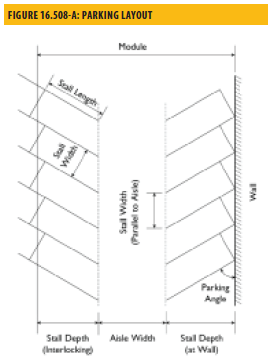
G.
Driveways and Access.
1.
Driveway Width.
a.
Parking facilities containing fewer than fifteen required parking spaces shall have only a single driveway of no less than nine feet and no more than ten feet in width.
b.
Parking facilities containing fifteen or more required parking spaces may have one lane driveways of no less than nine feet and no more than ten feet in width, and two-lane driveways of no less than eighteen feet and no more than twenty feet in width.
2.
Vehicle Flow.
a.
All parking areas shall be designed so that a vehicle leaving the parking area will enter the public right-of-way traveling in a forward direction, except for those serving four or fewer residential units.
b.
Parking areas shall be designed so that a vehicle will not have to enter a public right-of-way to move from one location to another within the parking area.
H.
Surface Materials. All outdoor parking spaces, driveways, and maneuvering areas shall be designed, built and permanently maintained to avoid dust, mud and standing water and to maximize permeability, where feasible and appropriate. These surfaces may include traditional asphalt and concrete as well as pervious pavements, sand-set pavers, and supported turf systems. A combination of surfaces may be used; for example, two track driveways of concrete strips with pervious areas between the strips and on the edges.
1.
Cross-grades. Cross-grades shall be designed for slower stormwater flow and to direct stormwater toward landscaping, bio-retention areas, or other water collection/treatment areas.
2.
Landscaping Alternative. Up to two feet of the front of a parking space may be landscaped with ground cover plants instead of paving.
3.
Permeable Paving. Permeable paving, sand-set pavers, supported turf systems, and vegetation shall be used in all overflow parking areas and installed in accordance with manufacturer recommended specifications.
4.
Turf Grids/Grassy Pavers. Turf grids/grassy pavers shall be installed in areas of low traffic or infrequent use, wherever feasible.
5.
Striping and Marking. In all parking facilities with four or more spaces, each parking space shall be clearly striped with paint or similar distinguishable material, except that the director may approve alternate means of marking spaces.
6.
Perimeter Curbing. A six-inch wide and six-inch high concrete curb shall be provided along the outer edge of the parking facility pavement, except where the pavement abuts a fence or wall. Curbs separating landscaped areas from parking areas shall be designed to allow stormwater runoff to pass through.
I.
Separation from On-Site Buildings. Parking areas shall be separated from the front and side exterior walls of on-site buildings by walkways a minimum of four feet in width. Commercial buildings with twenty-five thousand square feet or more of gross floor area shall be separated from on-site parking on all sides by a walkway a minimum of five feet in width, as well as a planter area at least three feet in width. These requirements do not apply to parking areas containing five or fewer spaces.
J.
Heat Island Reduction. A heat island is the increase in ambient temperature that occurs over large paved areas compared to natural landscape. In order to reduce ambient surface temperatures in parking areas, at least fifty percent of the areas not landscaped shall be shaded, of light-colored materials with a solar reflectance index of at least twenty-nine, or a combination of shading and light-colored materials and trees.
1.
Shade may be provided by canopies, shade structures, trees, or other equivalent mechanism. If shade is provided by trees, the amount of required shading is to be reached within fifteen years. To the extent maximizing the shading effect causes the trees to be placed in different locations than would otherwise be required, the placement required by this chapter controls.
2.
Trees shall be selected from a list maintained by the city's public works department.
K.
Vertical Clearance. All covered parking shall have a minimum vertical clearance of seven feet six inches except for spaces in parking lifts; the minimum vertical clearance for disabled parking shall be as required by the Building Code.
L.
Slope. The maximum slope of parking facilities shall be as set forth below, unless the director approves a greater slope based upon the advice of a California-registered civil engineer or other qualified professional.
1.
Parking Spaces. All parking spaces and abutting access aisles shall have a maximum slope of five percent measured in any direction.
2.
Driveways and Ramps. The maximum slope of any driveway or ramp shall be twenty percent. If the slope of such driveway or ramp exceeds ten percent, transitions shall be provided at each end not less than eight feet in length and having a slope equal to one-half the driveway or ramp slope.
M.
Tandem Parking. Required parking may be arranged as tandem spaces; provided, that pairs of spaces in tandem are assigned to the same residential unit or to employees of the same nonresidential establishment, or that a full-time parking attendant supervises the parking arrangements during periods of peak demand for the uses served. The required stall width, stall length, and aisle width shall apply to tandem spaces, except that the stall length shall be doubled for each pair of tandem spaces.
N.
Parking Lifts. Required parking may be provided in parking lifts; provided, that if it is necessary to remove one vehicle from the lift to access another vehicle, the parking shall be subject to the provisions applicable to tandem parking. Parking lifts allowing each vehicle to be independently accessed have no such restrictions. The dimensional standards for ninety-degree parking shall apply to parking lifts, including the requirement for an aisle width of twenty-four feet. Exterior parking lifts shall be screened from public view.
(Ord. No. 1879 N.C.(2d), § 3(Exh. A), 3-11-2025)
16.508.08 - Parking area lighting.
Except for those facilities serving four or fewer residential units, all open parking areas shall be provided with exterior lighting complies with the requirements of Chapter 16.506, Light and Glare and meets the following minimums:
A.
The lighting system shall provide not less than one foot-candle and not more than five foot-candles overall average illumination with a minimum of one-fourth foot-candles on the parking surface.
B.
All lighting shall be on a time clock or photo-sensor system to be turned off during daylight hours and during any hours when the parking area is not in use. This requirement does not apply to security lighting.
C.
All parking area lighting shall meet applicable energy efficiency requirements of Title 12, Buildings and Construction, of the Vallejo Municipal Code.
D.
All lighting shall be designed to confine direct rays to the premises. No light fixture shall emit any direct light above a horizontal plane through the fixture. No spillover beyond the lot line shall be permitted, except onto public thoroughfares.
16.508.09 - Electric vehicle charging stations.
In parking facilities containing twenty or more spaces serving multi-unit residential, mixed-use, commercial and hotels and motels, at least three percent of parking spaces shall be electric vehicle (EV) charging stations. Such spaces may be counted towards the parking requirements of this Zoning Code.
A.
Size. Electric vehicle charging stations shall be the same size as other spaces, and electric vehicle charging equipment shall not reduce the size of the space.
B.
Signage. Each electrical vehicle charging station shall be clearly marked with a sign reading "Electrical Vehicle Charging Station" and the associated California Vehicle Code restrictions, and only a vehicle that is connected for electric charging shall be allowed to park in the stalls or spaces so designated.
C.
Equipment. Electrical vehicle charging stations shall be equipped with electrical outlets, and may also be equipped with card readers, controls, connector devices and other equipment, as necessary for public use.
16.508.10 - Stack-up spaces for drive-in and drive-through facilities.
A.
The number of stack-up spaces required of drive-in establishments is as follows:
1.
Drive-up bank teller windows or deposit boxes: five spaces;
2.
Drive-in car wash where driver remains in vehicle as it goes through washing machines: two spaces;
3.
Drive-in car wash where vehicle is taken by attendant: six spaces;
4.
Drive-up windows for restaurants and banks, eight spaces per service window; and
5.
All other drive-in establishments: two spaces.
6.
Whenever the director, in reviewing site development plans, determines that under the circumstances of any specific case the required number would be insufficient, the planning commission shall determine the number of spaces to be required.
B.
Stack-up spaces shall be twenty-two feet in length.
C.
Where tandem service windows are proposed, the director may require a minimum of two spaces between windows and the balance upstream of the nearest window to the approach point.
D.
The director also may require a two-lane mono-direction access driveway to be provided into and away from service windows.
E.
A stack-up space is measured from the service area or the order area if an outdoor order area precedes the service area. The service area is where the first point of service occurs, such as a menu board.
16.508.11 - Recreational vehicle parking.
A.
Recreational Vehicle Parking in Residential Zoning Districts.
1.
No recreational vehicle, boat or trailer that exceeds 2.5 tons in dry weight, thirty-six feet in length or fourteen feet in height, not including rooftop equipment, shall be parked, stored or loaded in a residential zoning district.
2.
Permitted recreational vehicles may be parked, stored, or loaded on a residential property in a driveway, exterior or interior side yard, or rear yard in compliance with the following requirements:
a.
For the purpose of loading or unloading, not to exceed seventy-two hours;
b.
For the purpose of accommodating visitors who are traveling in the vehicle, not to exceed one week within any consecutive six-month period;
c.
Within the exterior or interior side yard behind a legally constructed opaque fence not less than six feet tall. At the option of the property owner or occupant of the property, lattice not exceeding one foot in height may be affixed to the top of the fence; or
d.
In the rear yard behind a legally constructed opaque fence not less than six feet tall. At the option of the owner or occupant of the property, lattice not exceeding one foot in height may be affixed to the top of the fence;
e.
No more than two recreational vehicles, including boats and other recreational equipment registered to the owner or occupant of the property, may be stored on a parcel of real property, unless otherwise permitted by this Zoning Code.
3.
Recreational vehicles shall not be used as additional living space except as temporary living quarters during construction subject to the approval of a temporary use permit pursuant to Chapter 16.339, Temporary Uses.
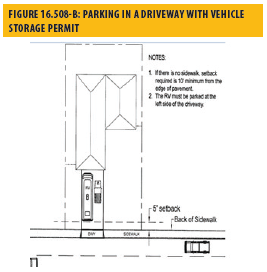
B.
Maintenance Standards for Recreational Vehicles Visible from Public View.
1.
Recreational vehicles visible from public view shall be maintained in proper condition. Recreational vehicles stored or maintained in one or more of the following conditions shall be deemed in violation of the Zoning Code:
a.
Recreational vehicles with damaged or broken windows or doors; damaged or torn screens or shades.
b.
Recreational vehicles that are covered with tarps or other covers, which are deteriorating or torn.
c.
Recreational vehicles with damaged or broken parts, including but not limited to tow bars, mirrors, light shields, bumpers, tanks, ladders, soft top cover for pop ups, luggage compartment doors, air handling units, and luggage racks.
d.
Recreational vehicles with peeling, blistering, rusting, or otherwise deteriorating exterior surfaces.
e.
Recreational vehicles with open awnings, open slide-outs, and open pop-ups.
C.
For sight distance purposes, in the driveway, a recreational vehicle shall be parked on the left side (facing the property) at a minimum distance of five feet from the back of the sidewalk, or if there is no sidewalk, no closer than ten feet from the edge of the pavement. (See Figure 16.508-C)
D.
On the parking pad adjacent to the driveway, a recreational vehicle may not be parked closer than ten feet from the back of the sidewalk or, if there is no sidewalk, fifteen feet from the edge of the pavement. The director may make exceptions to these sight distance standards if he/she determines sight distance requirements are met. (See Figure 16.508-C.)
E.
In no case shall the parking of a recreational vehicle in the driveway block the use of the driveway or access to the garage or carport by other vehicles.
F.
Installation of new secondary driveways or parking pads shall be grass-crete, turf-block, a ribbon driveway, or other similar treatment, and shall not be a standard slab driveway.
G.
Failure of the owner or occupant of the residential property to abide by the maintenance standards set forth in subsection B. of this chapter shall be subject to nuisance abatement procedures.
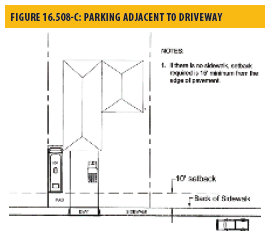
16.508.12 - Bicycle parking.
A.
General Requirements. Short-term publicly accessible bicycle parking for visitors, and long-term secured bicycle parking for building occupants shall be required for multi-unit and non-residential development as shown in Table 16.508-D.
B.
Location.
1.
Long-Term Bicycle Parking Spaces. Long-Term spaces shall be located with direct access for bicycles without requiring use of stairs. The design shall provide safe and convenient access to and from bicycle parking facilities. In residential buildings, long-term space shall not be provided within dwelling units, on balconies, or in required outdoor living area.
2.
Short-Term Bicycle Parking Spaces. Short-Term spaces shall be located, as feasible, near all main pedestrian entries to the use to which they are accessory.
3.
Other location requirements.
a.
Direct access from the bicycle parking to the public right-of-way shall be provided by means of access ramps, if necessary, and pedestrian access from the bicycle parking area to the building entrance shall also be provided.
b.
Where bicycle parking is not directly visible and obvious from the right-of-way, signs shall be provided, except that directions to long-term bicycle parking may be posted or distributed by the building management, as appropriate.
c.
Bicycle parking shall be separated from automobile parking by a sufficient distance to prevent damage from moving automobiles or their loading and unloading. The director may require a barrier or curb between bicycle and automobile parking areas on constrained sites.
d.
Bicycle parking may be provided inside a building provided it is easily accessible from a building entrance and a bicyclist does not have to use stairs to reach it.
e.
The placement of bicycle parking, bicycle rack elements and bicycle lockers shall not interfere with pedestrian circulation.
C.
Design and Installation.
1.
A bicycle parking space shall be in a paved, level, drained, lighted area with access to a right-of-way without the use of stairs, and shall consist of either:
a.
One side of a securely fixed rack element that supports the bicycle upright by its frame, prevents the bicycle from tipping over, and allows the frame and at least one wheel to be locked to the rack element with one lock; or
b.
For Long-Term parking only, a bicycle locker constructed of theft-resistant material with a lockable door which opens to the full width and height of the locker. Bicycle lockers shall be weather-proof if exposed to the elements; or
c.
For Long-Term bicycle parking only, wall-mounted racks or wall- or ceiling-mounted hooks so that bicycles may be hung vertically.
2.
Bicycle rack elements shall be fixed, securely anchored to the ground or to a structure by means that resist tampering or removal. Bicycle locker edges shall be secured with no exposed fittings or connectors. The director may specify preferred installation methods, such as, but not limited to, embedded mounting in poured-in-place concrete, recessed bolt heads or grouted-in anchoring.
3.
The design of bicycle parking areas located outside of a building shall comply with applicable standards of approved design guidelines.
D.
Removal of Abandoned Bicycles. Property owners shall remove abandoned bicycles from short-term and long-term parking associated with their property on a quarterly basis after posting a notice of removal warning on such bicycles for one month. This requirement shall not preclude provision of seasonal bicycle storage.
16.508.13 - Loading spaces.
A.
Number of Spaces Required.
1.
None Required. No off-street loading spaces are required for uses for which the estimated parking demand is "none." In addition, no off-street loading spaces are required for single unit or duplex dwellings.
2.
Requirement "To Be Determined." The off-street loading requirement for uses for which the estimated parking demand is "To be determined" ("TBD") shall be determined in the same manner the estimated parking demand is determined.
3.
All Other Uses. The off-street loading requirement for all uses shall be as set forth in Table 16.508-E.
B.
Size of Spaces. The size of each type of loading space shall be as follows:
1.
Small. Small loading spaces shall have a width of no less than ten feet, a length of no less than twenty-five feet, and a vertical clearance of no less than eight feet.
2.
Medium. Medium loading spaces shall have a width of no less than twelve feet, a length of no less than thirty-five feet, and a vertical clearance of no less than fourteen feet.
3.
Large. Large loading spaces shall have a width of no less than twelve feet, a length of no less than forty-five feet, and a vertical clearance of no less than fifteen feet.
C.
Modifications. In approving a project, the director or planning commission may modify the number and size of loading spaces required based on the use or project design.
D.
Maneuvering Areas. All off-street loading spaces shall be designed and located to provide enough off-street maneuvering area to accommodate vehicles using the loading spaces. Maneuvering areas shall be designed to accommodate the largest vehicle intended to use the loading spaces and shall not be encumbered by parking stalls or physical obstructions.
E.
Surface and Maintenance. Loading spaces and the maneuvering areas and driveways serving them shall be paved and maintained with concrete, asphalt, or similar material of sufficient thickness and consistency to support anticipated traffic volumes and weights; properly graded for drainage; and maintained in good condition free of weeds, dust, trash, and debris.
F.
Location. Loading spaces shall be located on the same lot as the use that requires the spaces unless loading spaces may be provided in a common loading area serving multiple adjacent uses and located on an adjacent lot within three hundred feet of the lot on that requires the loading spaces subject to approval of a minor use permit under Chapter 16.606, Minor and Major Use Permits, or development review approval pursuant to Chapter 16.605, Development Review. Off-site loading shall only be approved based on the following findings in addition to the findings otherwise required:
1.
That the common loading area results in a more efficient design than individual loading areas serving each use separately;
2.
That the total number of loading spaces provided in the common loading area is no less than the number of loading spaces that would be required if the uses served were in a single facility; and
3.
That the common loading area will always be in place during operation of the principal uses to be served by the loading spaces.
G.
Access to Tenant Spaces Served by Loading Spaces. Buildings served by loading spaces shall be designed such that there is a direct interior path of travel between the loading spaces and each tenant space served by the loading spaces of enough width and height to accommodate all material to be loaded and unloaded.
H.
Availability and Utilization of Loading Spaces. All loading spaces shall be made readily available to pick-up and delivery vehicles during all hours when pick-ups and deliveries are allowed. Owners of property containing such loading spaces shall be responsible for advising drivers of pick-up and delivery vehicles of the location and hours of such loading spaces, shall require drivers to use such loading spaces, and shall not allow pick-up and delivery vehicles to be loaded in the public right-of-way.
I.
Loading Spaces on an Alley. Each thirty feet of otherwise not used frontage on an improved city alley may be considered a loading space for the adjacent use.
J.
Landscaping and Screening. All loading spaces and the maneuvering areas and driveways serving them shall be landscaped and/or screened as required by this Zoning Code.
K.
Lighting. All exterior loading spaces and the maneuvering areas and driveways serving them shall be provided with lighting that meets the minimum standards established for parking areas.
16.508.14 - Alternative compliance with parking requirements.
A.
Alternative Parking and Loading Plan. Where an applicant can demonstrate to the satisfaction of the director or planning commission that variations in the standards or dimensions otherwise required by this Zoning Code are warranted for uses with unique needs, such as schools, or in order to achieve environmental design and green building objectives, including but not limited to achieving certification under the LEEDB™ Green Building Rating System or equivalent, an alternative parking area design and loading plan may be allowed with approval of a minor use permit. To grant such a use permit, the director or planning commission shall make the following findings in addition to the findings otherwise required:
1.
That the applicant has convincingly demonstrated that the alternative plan is a superior solution and the requested modifications in the design standards of this chapter are warranted; and
2.
That the alternative parking arrangement will be in place at all times during operation of the principal uses to be served by the parking.
B.
Modification and Reduction of Parking Requirements. The director or the planning commission may waive or reduce the requirement for off-street parking in NMX, DMX, and WMX Districts based on the following findings:
1.
The parking requirement modification will meet the purposes of the district related to improvement and support for mixed-use development, alternative transportation, pedestrian improvements and activity, or similar policies; and
2.
The use is located one-half mile or less from a transit corridor; or
3.
The use is located one-quarter of a mile or less from a publicly accessible parking facility, the use of which is not limited to a specific business or activity during the use's peak parking demand; or
4.
A parking survey conducted under procedures set forth by the planning department finds that within five hundred feet or less of the use, on non-residential streets, at least two times the number of spaces requested for reduction are available through on-street parking spaces for at least two of the four hours of the use's peak parking demand; or
5.
The proposed development includes at least twenty percent affordable housing units and at least fifty percent of the ground floor is occupied by any of the following neighborhood-serving uses: food and beverage retail sales, food service establishments, and/or personal/household service(s). These uses include, but are not limited to: dry cleaning and laundry agents, drug stores, food products stores, household items repair shops, and/or laundromats; or
6.
There are other factors, such as alternative TDM strategies or trip-reduction programs in place, that will reduce the parking demand generated by the use.
C.
On-Street Parking Credits in Other Districts. Consistently available on-street parking may be counted towards all or a portion of the parking spaces required of each land use and activity proposed in a development application on a one to one basis.
1.
To qualify for on-street parking credits, the project applicant shall fund completion of an on-street parking inventory and occupancy study, or refer to such a study completed by another project applicant within the preceding two years that provides evidence of the number of on-street parking spaces that are vacant or unoccupied during the hour of combined peak demand for the uses proposed on site, on each block face within two blocks of the project site address.
2.
For any one project, a maximum of fifty percent of the total on-street parking supply on the block faces located within a one block walk of the project site, including curbside parking on the project frontage(s), may be counted towards satisfaction of the project's minimum parking requirement.
D.
Off-Site Parking. Required off-street parking spaces for vehicles, motorcycles, and bicycles, may be located on a remote and separate lot from the lot on which the principal use is located, subject to the following standards:
1.
Zoning District. Newly constructed off-site parking may not be located in a zoning district in which the principal use served by the parking is prohibited. Off-site parking may be provided within an existing off-street parking facility in any zoning district, provided that a parking study is conducted and approved by the director establishing the number of parking spaces in the existing facility that are typically unoccupied even during periods of peak parking demand for the uses to which the parking is accessory.
2.
Distance. Unless a shuttle service is provided, the off-site parking shall be located within one thousand five hundred feet walking distance of the principal use served.
E.
Valet Parking. Valet parking may be permitted as a means of satisfying all or a portion of the off-street parking requirement. Valet parking may be used to accommodate more parking spaces on the site of the principal use served by the parking than could be accommodated in conformance with the design standards of this chapter. It may also be used to provide off-site parking. No valet parking shall cause interference with the public use of rights-of-way or imperil public safety.
16.509.01 - Purpose and applicability.
The regulations established by this chapter are intended to appropriately limit the placement, type, size, and number of signs allowed within the city, and to require the proper maintenance of signs. The regulations are intended to implement general plan policies to preserve and enhance the community's aesthetic quality by protecting it from excessive and inappropriate signage that creates visual clutter and has an adverse impact on overall visual appearance of a city affecting economic value. The purpose of these regulations is to balance these objectives with the needs of the city's residents, businesses, institutions, and visitors for adequate identification, communication, and advertising by:
A.
Encouraging communications to identify businesses in a fair and equitable manner and promote and maintain economically viable commercial enterprises for the benefit of Vallejo's community;
B.
Applying basic principles of good design and sensitivity to community appearance to signage to avoid the creation of nuisances and privacy violations that will degrade the value of surrounding properties;
C.
Promote signage that aids orientation and safely attracts and directs residents and visitors to various destinations;
D.
Reducing hazards to motorists and pedestrians resulting from excessive, confusing, and distracting signs by ensuring that signs are designed, constructed, installed, and maintained in compliance with minimum standards necessary to provide adequate visibility and avoid the creation of hazards or unreasonable distractions for pedestrians or drivers;
E.
Preventing the unregulated and uncontrolled construction, erection, and maintenance of signage in the city; and,
F.
Ensuring that the constitutionally guaranteed right of free speech is protected.
G.
Signs Regulated. The requirements of this chapter shall apply to all signs in all zoning districts, except on a site for which a specific plan or planned development districts have established separate sign regulations.
H.
Applicability to Sign Content. The provisions of this chapter do not regulate the message content of signs (sign copy), regardless of whether the message content is commercial or noncommercial.
I.
Permission of Property Owner. No sign shall be placed on public or private property without first obtaining permission from the property owner.
J.
Maintenance—Continuing. Each sign in the city shall be maintained in good structural condition at all times. All painted signs shall be kept neatly painted, including all metal parts and supports. The code enforcement officer shall inspect and have the authority to order the painting, repair, alteration, or removal of signs that become dilapidated or are abandoned, or which constitute a hazard to the public safety.
K.
Sign Permit and Building Permits Required. A building permit is required for any sign that exceeds six feet in height or requires an electrical connection.
L.
Design Guidelines. Any adopted design guidelines are applicable to this chapter.
16.509.02 Sign permit requirements.
No sign shall be installed, constructed, or altered unless a sign permit and, where applicable, a sign program approval is first obtained in compliance with this chapter, or the sign is allowed without sign permit approval (see section below). A building permit may also be required. After approval of a sign permit and/or sign program, each sign installed and maintained on the subject site shall comply with the permit and program.
A.
Sign Permit Application. An application for a sign permit shall be prepared, filed and processed, in compliance with Chapter 16.603, Zoning Compliance Review. The application shall include required application fees, architectural elevations and plans of all proposed signs drawn to scale, with all dimensions noted, and include illustrations of copy, colors, materials, and samples of the proposed colors and materials may be required. The plans submitted shall also show the location of each sign on buildings and the site. Off-site signs shall also require an encroachment permit from the public works department.
B.
Sign Permit Review Authority. The director shall review all sign permit applications, except within a historic district, where sign permit review may be by the secretary of the architectural heritage and landmarks commission, B in compliance with Chapter 16.614, Architectural Heritage and Historic Preservation, at the determination of the Director. The review authority may require conditions of approval as are reasonably necessary to achieve the purposes of this chapter.
C.
Sign Programs. A sign program shall be required for any multiple occupancy commercial office building or business park, retail, industrial or medical complex where the individual tenant spaces are not the location or adjacent to the location of the proposed individual tenant signs. A sign program may also be proposed to provide identity and directional signage for a city recognized neighborhood or district.
1.
A sign program shall be approved by the director, or elevated to the appropriate review authority, at the discretion of the director.
2.
The purpose of the sign program shall be to establish signing for all tenants and users of a complex, neighborhood or district as described above. An approved sign program shall prescribe the standards for all signs within the complex, building, neighborhood or district.
3.
A sign program shall comply with all provisions of this chapter and is not intended to provide special or additional signing. The sign program shall prescribe the standards of size, number, location and types of signing permitted.
D.
Findings for Approval. The approval of a sign permit or sign program shall require that the review authority first make all the following findings:
1.
The proposed signs do not exceed the standards of this chapter and are of the minimum size and height necessary to enable motorists and pedestrians to readily identify the facility or site from a sufficient distance to safely and conveniently access the facility or site;
2.
The size, location, and design of the signs are visually complementary and compatible with the scale and architectural style of the primary structures on the site, any prominent natural features on the site, and structures and prominent natural features on adjacent properties on the same street; and
3.
The proposed signs are in substantial conformance with the design criteria in the any adopted city design guidelines.
E.
Approval Period, Expiration, And Time Extension of Sign Permits. A sign permit approval shall expire twelve months from its date of issuance, unless a later expiration date is stated in conditions at the time of approval. Sign permits may be extended as provided for in Section 16.602.12, Expiration and Extension.
16.509.03 - Signs and sign changes permitted without sign permit.
The following types of signs and sign changes are permitted without a sign permit, provided that they comply with adopted city design guidelines and any required building permit is obtained.
A.
Commemorative Plaques. Signs commemorating an historical building name register and/or erection date, when cut into or affixed to a permanent surface and not exceeding four square feet per building.
B.
Construction Signs. One sign per construction site announcing a construction project, architect, builder/developer, engineer, etc., and not exceeding thirty-two square feet.
C.
Credit Cards, Trading Stamps, Association Membership. Up to six signs per business identifying credit cards, trading stamps, or association membership not exceeding one square foot per sign.
D.
Directional Signs and Notices on The Site. Signs showing the location of public facilities such as restrooms, and underground utilities.
E.
Garage Sale Signs. Up to one sign located at the residence where the garage sale sign is being conducted and not exceeding four square feet.
F.
Governmental Signs. Signs installed or authorized by the city, or a federal or state governmental agency within a public right-of-way; and any sign, posting, notice, or similar sign placed by, allowed by or required by a governmental agency in carrying out its responsibility to protect public health, safety, and general welfare, installed on city owned property.
G.
Interior Signs. Signs located inside a building that are not visible through the building's exterior windows or entrance, walls or doors, or in any mall, court, stadium or enclosed lobby, when such signing is only visible to those in the interior.
H.
Non-Profit Organization Signs. Signs and notices containing the identification of nonprofit service clubs, religious organizations, charitable organizations or associations and containing information relating to their meetings, fund raising, other nonprofit activities and not exceeding twelve square feet and occurring no more than four times within a twelve-month period.
I.
Nonstructural Modifications, and Maintenance. The following maintenance or modifications to signs:
1.
Minor modifications to sign copy on conforming signs, or changes to the face or copy of conforming changeable copy signs;
2.
Nonstructural modifications of the face or copy of an existing conforming sign installed in compliance with a sign program, provided that the modifications are consistent with the sign program approved in compliance with this chapter;
3.
The normal maintenance of conforming signs.
I.
Official Flags. Up to three flags per site identifying national, state, or local governments, or nationally recognized religious, fraternal, or public service agencies are allowed without a sign permit, provided that the length of the flag shall not exceed one-quarter the height of the flagpole. The maximum allowed height of a flagpole in a residential zoning district shall be fourteen feet; the maximum height of a flagpole in a non-residential zoning district shall be thirty feet. No flag shall be located within the public right-of-way unless placed, allowed or required by a governmental agency.
J.
On-Site Signs Required for City Public Hearing Notification. On-site signs for public hearing notification before a city agency.
K.
Private Directional Signs. Directional or informational signs not exceeding five square feet in area, bearing no advertising message, and located wholly on the site to which the sign pertains are permitted when such signs do not impede vehicular and/or pedestrian visibility in any way.
L.
Real Estate for Sale or Lease Signs. One real estate for sale or lease sign is allowed on any lot or parcel for each side with street exposure with the following provisions:
1.
Each sign is entirely within the property to which it applies;
2.
No sign is illuminated;
3.
No sign on a lot zoned for single-unit residential use shall exceed six square feet in area or six feet in height;
4.
A sign on a lot zoned for multiple-unit, mixed-use, or non-residential use that is twenty thousand square feet or less shall be permitted a maximum of twelve square feet for each permitted freestanding or wall sign;
5.
A sign on a lot zoned for multiple-unit, mixed-use or non-residential use that is larger than twenty thousand square feet shall be allowed up to twenty-four square feet for each permitted freestanding or wall sign;
6.
A freestanding sign on a non-single-unit residential lot shall not exceed nine feet in height;
7.
A wall sign on a lot zoned for multiple-unit, mixed-use or non-residential use shall not exceed twenty feet in height.
M.
Seasonal Decorations—Private Property. Seasonal and/or holiday decorations and displays such as those related to Thanksgiving or the 4th of July, not including advertising signs disguised as seasonal decorations.
N.
Signs Required by Law. Signs displayed by private individuals, when required by law or regulations of any governmental agency.
O.
Street Number, Address, and/or Name. Two signs for each building not exceeding one square foot each in RR or RLD zoning districts and three square feet each in all other zoning districts.
P.
Temporary Signs Within Commercial Zoning Districts. Temporary signs are allowed within commercial zoning districts without a sign permit for a maximum of sixty days after the opening of a new business, provided that the area of the temporary signs shall not exceed fifty percent of the total sign area allowed on the site by Section 16.509.04, General Requirements for All Signs.
Q.
Temporary Signs for City Activities. Signs and notices containing the identification of charitable activities, seasonal programs, special events, and/or city affiliated not-for-profit service clubs containing information relating to their meetings, fund raising, other nonprofit activities or seasonal programs offered.
16.509.04 - General requirements for all signs.
A.
Sign Area Measurement. The measurement of sign area to determine compliance with the sign area limitations of this chapter shall occur as follows.
1.
The surface area of a sign shall be calculated by enclosing the extreme limits of all framing, writing, logo, representation, emblem, or other display within a single continuous perimeter composed of squares or rectangles with no more than eight lines. See Figure 16.509-A.
2.
Supporting framework or bracing that is clearly incidental to the display itself shall not be computed as sign area.
3.
The area of a double-faced (back-to-back) sign shall be calculated as a single sign face if the distance between each sign face does not exceed eighteen inches and the two faces are parallel with each other.
4.
Where a sign consists of one or more three-dimensional objects (i.e., balls, cubes, clusters of objects, sculpture or statue-like trademarks), the sign area shall be measured as their maximum projection upon a vertical plane. See Figure 16.509-C.
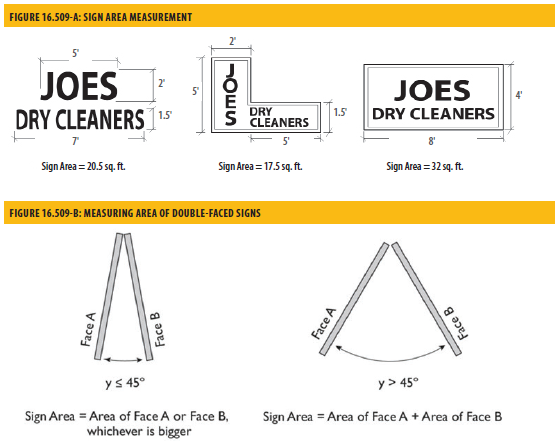
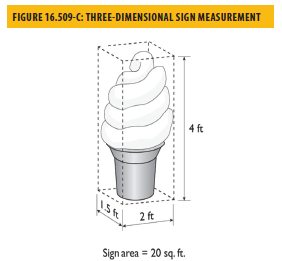
5.
The area of any time and/or temperature device incorporated into a sign shall not be included in the calculation of total sign area.
B.
Freestanding Sign Height Measurement. The height of a freestanding sign shall be measured as the vertical distance from the lowest point of the base of the sign structure, to the highest point of the structure, where the lowest point of the base of the structure does not include fill, planters, or other material artificially placed to allow increased sign height. See Figure 16.509-D.
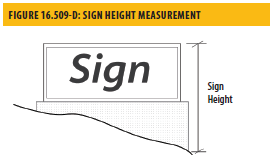
C.
Sign Location Requirements.
1.
All signs shall be located on the same site as the subject of the sign, except as otherwise allowed by this chapter. A sign may project over an adjacent public right-of-way only when authorized by an encroachment permit as well as a sign permit.
2.
No sign shall be located within the public right-of-way, except as otherwise allowed by this chapter.
3.
The location of all signs shall be evaluated to ensure:
a.
That the setback is appropriate for the height and area of a freestanding or projecting sign;
b.
That flush or projecting signs relate to the architectural design of the building. Signs that cover windows, or that spill over natural boundaries and/or cover architectural features shall be discouraged;
c.
That signs do not unreasonably block the sight lines of existing signs on adjacent properties; and
d.
Pedestrian and vehicular safety.
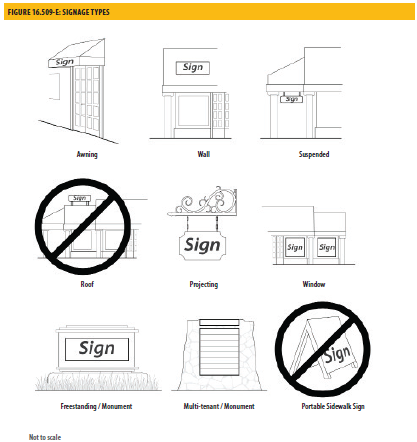
16.509.05 - Zoning district sign standards.
Each sign shall comply with the sign type, area, height, and other restrictions provided by this chapter, except as otherwise expressly provided in Section 16.509.03, Signs and Sign Changes Permitted Without Sign Permit or Section 16.509.06, Standards for Special Category Signs.
A.
Residential Signs in Residential Zoning Districts. Each sign in a residential zoning district established by Chapter 16.102, Establishment of Zoning Districts, shall comply with the following requirements.
B.
Sign Standards in Mixed-Use, Commercial, and Industrial Districts. Each sign in non-residential or, as allowed, in residential zoning districts established by Chapter 16.102, Establishment of Zoning Districts, shall comply with the requirements in Table 16.509-B, in addition to the provisions of Section 16.509.06, Standards for Special Category Signs, as applicable.
16.509.06 - Standards for special category signs.
Proposed signs shall comply with the following standards where applicable, in addition to the sign area, height, and other requirements set forth in the city design guidelines and all other applicable provisions of this chapter.
A.
New-Car Auto Dealerships Identification Signs. The following requirements apply to new-car auto dealership identification signs:
1.
Identification signing. Two attached wall signs, and/or one freestanding sign are permitted for new-car automobile dealers are permitted. The maximum total sign area for identification signs shall not exceed two hundred square feet. Used automobile dealers are subject to the same sign criteria as traditional retailers.
2.
Incidental window signing. Incidental window signing at auto sales agencies may be permitted up to twenty-five percent of window area. Window signing on vehicles for sale is permitted, provided that the signing does not exceed two square feet and is stationary. A sign permit is not required for incidental window signing.
3.
Temporary banners. Temporary banners, special events displays, and similar signage shall comply with Sections 16.509.04 and/or 16.509.07.
4.
Dealership in the district. A dealership located in a zoning district shall comply with the design guidelines of that zone. (See also the zoning district requirements for signing.)
B.
Cannabis Retail Sales.
1.
Sign area. The aggregate sign area for all permanent signs on a building or site housing a retail cannabis business shall meet the following requirements:
a.
Maximum of one square foot of sign area per linear foot of principal building frontage adjacent to a public right-of-way, except that a building with twenty-five feet or less of street frontage shall be allowed a minimum of twenty-five square feet of total sign area. A business with secondary street frontage for a secondary elevation may be permitted an additional one-half square foot of sign area per linear foot of building frontage on the secondary street frontage;
b.
Maximum of one hundred fifty square feet for principal elevation and, in no event, for secondary elevation; and
c.
Maximum of two hundred fifty square feet of total sign area for all signs on any building.
2.
Combination Signs. A maximum of any two of the following sign types shall be permitted:
a.
Freestanding;
b.
Wall sign;
c.
Projecting sign;
d.
Canopy sign.
3.
Freestanding Signs. One monument sign is permitted not to exceed five feet in height and thirty square feet in area. The monument sign shall be landscaped around the entire base with a minimum width of four feet from the sign base or a proportional amount. The base of the sign shall be designed with materials, styles and colors to match the architectural design of the building. The sign area is limited to the face of the sign.
4.
Projecting Signs. One projecting sign may be permitted provided the sign does not project more than four feet from the building, nor two feet into the city right-of-way, nor project over the roof line, provided such sign meets all of the following requirements:
a.
Minimum clearance under the sign shall be ten feet;
b.
Maximum sign area shall be nine square feet;
c.
Minimum distance between any two projecting signs shall be twenty-five feet; and
d.
Sign shall be mounted at a right angle to the building.
5.
Canopy Signs.
a.
On-canopy. One on-canopy sign may be permitted in lieu of a wall sign. The on-canopy sign shall not exceed twenty-five square feet.
b.
Under-canopy. One under-canopy sign may be permitted with a minimum clearance of at least eight feet from the grade or sidewalk to the bottom of the sign. The sign shall not extend beyond the edge of the canopy and shall not exceed six square feet with a maximum width or height of three feet.
C.
Cannabis Cultivation, Distribution, Manufacturing and Testing Laboratory.
1.
Sign Area. The aggregate sign area for all permanent signs on a building or site housing a cannabis cultivation, cannabis distribution, cannabis manufacturing, and/or cannabis testing laboratory business shall meet the following requirements:
a.
Maximum of one square foot per foot of principal building frontage adjacent to a public right-of-way, except that a building with twenty-five feet or less of street frontage shall be allowed a minimum of twenty-five square feet of total sign area; and
b.
Maximum of fifty square feet per building.
2.
Combination Signs. Signage shall be limited to one wall sign and/or monument sign.
3.
Wall Signs. Wall signs shall be mounted on the principal building frontage adjacent to the public right-of-way and shall be pin mounted or individually mounted channel letters.
4.
Freestanding signs. One monument sign may be permitted not to exceed five feet in height and twenty-five square feet in area. The monument sign shall be landscaped around with base with a minimum width of four feet.
D.
Child Day Care Facilities Identification. Each facility is permitted two nameplate or identification signs, not to exceed twelve square feet each.
E.
Historic District Signs. Signs located within a historic district designated by the council shall comply with the historic guidelines pertaining to that district, and all other development criteria associated with modifications to historic structures. The appropriate application for processing signs in historic districts is the sign application. A certificate of appropriateness is not required; however, individual sign permits may be referred to the architectural heritage and historic preservation commission for review and decision at the discretion of the director.
F.
Professional Office Building Directory Signs. Directory signing in addition to the allowable signs permitted in Section 16.509.05, Zoning District Sign Standards, may be approved by the director, provided that the signage does not exceed twenty square feet.
G.
Public Directional Signs. Public directional signs may be permitted for wineries, hospitals, clinics, museums and/or similar uses which are unique tourist or community serving destinations for which the director determines there is an extraordinary need because the public has difficulty locating or there is a public benefit provided by the use.
1.
The signs shall be off-site, located in the public right-of-way, identify only the type of use, and not include advertising or commercial identification.
2.
The signs shall not exceed a maximum of one sign of three square feet in area, two in number, and eight feet in height.
3.
The signs require sign permits and shall be installed and maintained by the city after approvals are obtained.
4.
The appropriate size, location and number of these signs shall be determined by the director in consultation the public works department.
5.
The directional signs may be referred to the design review board at the discretion of the director.
H.
Public Service Signs. Signs that provide a public service, such as civic center, performing arts center, special civic event holiday, and time and temperature, public transit schedules, etc., when not promoting any product advertising message or business identification, may be allowed in addition to the signs permitted under Section 16.509.05, Zoning District Sign Standards.
I.
School Signs (Public or Private). Identification and directory signs may be permitted provided that all signage is located on site and does not exceed a maximum combined area of one hundred square feet.
J.
Service Stations (Permanent Signage). Notwithstanding the signs permitted under Section 16.509.05, Zoning District Sign Standards, the following signs are permitted for service stations:
1.
Three identification signs, one of which may be freestanding, and the others attached to the building or canopy below the eave line, not exceeding one hundred square feet in combined area;
2.
The director may approve additional signs, in excess of the three identification signs, describing hours of operations, self-serve, and related accessories (such as car wash, propane, etc.) provided that all signs do not collectively exceed the one hundred square foot allowance;
3.
Two price signs in compliance with State of California requirements for wording and size, as well as individual brand labels on each pump limited to a maximum dimension of five inches, may be permitted in addition to the one hundred square foot allowance.
K.
Decorations and Events—Public Property. Seasonal decorations and banners, decorations, and identification signs, containing not more than the name, logo, name or logo of sponsor (less than twenty percent of sign area), and date of an event may be displayed on public property at a height of greater than eight feet, if the event has been approved or recognized by resolution of the council or their delegate. The proposed signage and decorations shall be reviewed and approved by the director as to their design and placement on public property.
1.
"Event" as used in this chapter means a major civic activity, which may be city-sponsored, and which involves expressly invited community-wide participation, such as the downtown farmer's market.
2.
Decorations and signs may be placed up to thirty days before an event and shall be removed within five working days after the conclusion of an event.
3.
Temporary signs shall be allowed, during and within the boundaries of the event, which identify activities, features, services, facilities, goods, and food or beverages available at locations included within the event, whether or not on public property.
L.
Shopping Centers, Businesses, or Industrial Parks. A shopping center, business or industrial park may be identified by a common sign, provided that only one sign shall be located on each specific street frontage which provides access to the center, or at an intersection of two streets with access to the center. A shopping center sign should identify the entire center and shall not be named for individual tenants or major users.
M.
Subdivision Signs—Permanent Identification Signs. Permanent identification signage attached to a permanent structure designed for the purpose of subdivision identification and located at the subdivision entry on private property, not exceeding a height of nine feet, nor two signs per entrance may be permitted.
N.
Subdivision Signs—Temporary Identification and Sales Signs. Temporary signage shall only be permitted during the time period of subdivision sales subject to approval of a temporary use permit pursuant to Chapter 16.339, Temporary Uses. Signage shall not remain for more than nine months but the permit may be renewed at the end of nine months subject to approval by the director.
1.
Temporary on-site signs, each not exceeding thirty-two square feet in area and one in number per entrance to a subdivision, during the time of sales of subdivision lots. No sign shall exceed a maximum height of nine feet.
2.
Additional on-site model home signs may be permitted, provided that the signs do not exceed two square feet and a total of six signs. Other signs located on the subdivision site not exceeding two square feet each, or banners not exceeding thirty-two square feet, or similar displays are permitted provided that they are located entirely within the subdivision and are not visible from any street except those within or bordering the subdivision.
3.
Temporary off-site directional signs for a residential subdivision may be permitted subject to approval of a temporary use permit providing they meet the following criteria.
a.
A maximum of two signs, each not exceeding sixteen square feet in area (no dimension of which shall be longer than eight feet) and six feet in height, located entirely on private property with the property owner's permission and outside of the sight distance triangle or the vision clearance needed for safe access to and from any driveways or other roadways in the vicinity. No more than two signs shall be located on any parcel.
b.
It is the desire of the city that directional signs for subdivisions be located jointly in aggregate sign structures. To that end, in addition to the signs that may be permitted under Subsection (3)(a), above, a total of three aggregate subdivision sign structures, each not exceeding twenty-four square feet in total area nor six feet in height may be permitted.
i.
An aggregate sign structure shall contain space for at least four subdivision sign panels. Each sign panel shall be no larger than one foot by four feet. Only one sign panel for a particular subdivision shall be allowed in an aggregate sign structure.
ii.
An aggregate sign structure shall be located entirely on private property, with the property owner's permission, and outside of the sight distance triangle or the vision clearance needed for safe access to and from any driveways or other roadways in the vicinity.
iii.
An aggregate sign structure shall not be located on the same parcel that contains a sign permitted under Subsection (3)(a) or within five hundred feet of a Subsection (3)(a) sign, and only one aggregate sign structure may be located on a single parcel.
4.
Flags displayed in conjunction with subdivision sales may be permitted in addition to temporary signage providing such flags do not exceed five in number, six square feet in area each, and are not displayed above twenty-four feet in height.
O.
Temporary Signs. Signs that are temporary, incidental, and used for the purpose of conveying information concerning goods, services, or facilities available on the premises shall be permitted in addition to permanent signs allowed under this chapter subject to the following requirements:
1.
Temporary signage shall be permitted to be displayed on site for a total of fourteen consecutive days unless otherwise specified.
2.
Temporary signage including pennants, flags and other attention-getting devices may be permitted for no longer than sixty days immediately following the initial opening of a business on a particular site.
3.
Informational signs pertaining to events or activities occurring on the premises such as holidays, special sales and promotions. The signage shall only be permitted on four occasions throughout a calendar year, thirty-two square feet each in total sign area and not more than two in number;
a.
Temporary window signage, limited to a maximum of twenty-five percent of each window surface;
b.
Temporary service station signs, such as merchandise display, promotions, and signs located on gasoline pumps;
c.
Temporary signs pertaining to events or activities conducted by a community, public service, educational, or religious assembly use subject to compliance with the standards for the zoning district in which the use is located.
4.
Window Signs. The following standards apply to window signs in all zoning districts where allowed by Section 16.509.05, Zoning District Sign Standards.
5.
Maximum sign area. Permanent window signs shall not occupy more than twenty percent of the total window area.
6.
Permanent window signs.
a.
Signs shall be allowed only on windows located on the ground level and second story of a building frontage.
b.
Signage shall consist of individual letters, logos, or symbols applied to the glass surface; however, neon signs with transparent backgrounds may be hung inside the window glass line.
7.
Temporary window signs. Temporary window signs may be allowed provided that the signs:
a.
Are displayed inside a window for a maximum of ten days;
b.
Shall only be located within the ground-floor windows of the structure.
16.509.07 - Prohibited signs.
The following signs are not permitted within the city:
A.
Abandoned Signs. No person shall maintain or permit to be maintained on any property owned or controlled by him or her, any sign which has been abandoned. Any such sign shall promptly be removed by the owner or persons controlling the premises. Any sign which is located on property which becomes vacant and unoccupied for a period of twelve months or more, or any sign which was erected for any occupant or business unrelated to the present occupant or their business, or any sign which pertains to a time, event, or purpose which no longer applies, shall be presumed to have been abandoned, except that permanent signs applicable to a business temporarily suspended by reason of a change of ownership or management of such business shall not be considered abandoned unless the property remains vacant for a period of twelve months.
B.
Signs on Public Property. The tacking, posting, painting, marking, writing, gluing, taping or otherwise affixing of signs, including, but not limited to, posters, flyers and handbills, to or on any tree, pole, post, or any other structure, whether publicly or privately owned, which is located on public property or within the public right-of-way, without the prior written authorization of the governmental entity owning or in control thereof, is a public nuisance and is prohibited.
1.
Signs posted in violation of this section are subject to immediate removal.
2.
Violation of this section shall be prosecuted as an infraction.
3.
Any person who owns an interest in or is an officer, partner or member of any business or association or venture, including performing arts groups, whether for profit or not for profit, which is advertised in a sign covered by this section or any person who tacks, posts, erects or otherwise affixes or procures the doing of same of a sign covered by this section shall be strictly liable for such violations.
4.
The posting of each sign shall constitute a separate violation.
C.
Moving, Flashing, Electronic/Digital and Windblown Signs. No moving, rotating, flashing, or changing of color intensity or signs with electronic/digitally created content (i.e., electronic reader board signs), and no windblown signs, such as posters, pennants, streamers, or strings of light bulbs, balloons, or other inflated objects are permitted. The only exceptions to these requirements are time and temperature devices and signs installed by a governmental agency in carrying out its responsibility to protect public health, safety and general welfare.
D.
Freeway Oriented Signs. Signs primarily oriented toward freeways and highways are prohibited unless approved through a sign program. Signs shall be oriented toward local streets and businesses entrances.
E.
Portable Signs. An "A" frame sign or other sign attached to a device used to allow the sign to be rolled or moved around is prohibited. Included in this category are signs larger than three square feet affixed to a vehicle intended for the purpose of business identification, directional to a business, or advertisement of a business.
F.
Roof Signs. No sign shall be installed upon, against or directly above a roof or on top of or above the parapet of a building with the following exceptions:
1.
The director or the planning commission may approve a roof sign subject to review and approval pursuant to the requirements of Chapter 16.605, Development Review, based on a determination that the sign is an architectural element designed in conjunction with the building architecture;
2.
The director may approve a roof sign subject to approval of a certificate of appropriateness pursuant to the requirements of Chapter 16.614, Architectural Heritage and Historic Preservation.
G.
Cabinet Signs. Internally illuminated cabinet signs that have two-dimensional plastic faces with the entire background illuminated are prohibited. Cabinet signs which incorporate three-dimensional textured faces, routed faced push-through copy and/or opaque (plastic/metal/wood) backgrounds are appropriate.
H.
Pole Mounted Signs. A freestanding sign mounted to a visible structural support structure is prohibited.
I.
Temporary Portable Signs. Temporary portable signs are prohibited except as allowed by Subsection 16.509.06.P, Subdivision Signs—Temporary Identification and Sales Signs.
J.
Sight distance triangle. Placement of any sign within a sight distance triangle is prohibited.
K.
Other Signs. Signs that are obscene, illegal, hazardous to traffic, imitative of official government signs (i.e., Stop, Danger, Caution, etc.) or obstructive to public visibility, so as to create a hazard to the public are prohibited.
L.
Off-Site Signs - Billboards.
1.
Application for Digital/Electronic Signs. The owner of multiple legal conforming and/or legal non-conforming signs located in the city may submit an application to the planning division for a major use permit. In addition to the required findings under Chapter 16.606 Minor and Major Use Permits, a major use permit will require execution of an agreement between the applicant and the city to remove at least four existing legal conforming and/or legal non-conforming off-site sign structures regardless of the number of existing sign faces on the structures, in exchange for approval to construct one new off-site digital/electronic sign structure with a maximum of two sign faces.
2.
The maximum number of digital/electronic signs along Interstate 80 shall be three. No digital or electronic signs shall be allowed along Interstate 780, Highway 29 and the north side of Highway 37.
3.
Application for Non-Digital/Electronic Signs. The owner of multiple legal conforming and/or legal non-conforming off-site signs located in the city may submit an application to the planning division for a major use permit. In addition to the required findings under Chapter 16.606 Minor and Major Use Permits, approval of a major use permit will require execution of an agreement to remove at least four existing legal conforming and/or legal non-conforming off-site sign structures regardless of the number of existing sign faces on the structures, located anywhere in the city, in exchange for approval to construct one new off-site sign structure with two sign faces.
4.
The following considerations shall serve as general guidelines, in order of importance in identifying candidate billboards for removal:
a.
Visible to freeways and highways;
b.
Along major thoroughfares leading into the downtown specific plan area;
c.
Along major thoroughfares leading into commercial districts;
d.
Streets where billboards are heavily concentrated and contribute to existing visual clutter.
5.
Candidate billboards must be legal conforming or legal non-conforming billboards. Illegal billboards shall not be candidates for removal agreements. The director shall have the authority to determine which signs are suitable for removal by choosing from a list of signs provided by the owner.
6.
Major Use Permit Application Materials. Application material shall include the following:
a.
A copy of a site plan showing the location of the existing off-site sign structures proposed for removal and the location of the one proposed new off-site sign structure. The site plan shall identify existing structures including billboard structures within one thousand feet of the proposed sign parcel location and residential uses and/or zoned districts within one thousand feet of the proposed sign parcel location;
b.
A color drawing or photo simulation of the proposed sign structure and sign face;
c.
A photometric study;
d.
An agreement to be recorded between the owner(s) of the property(ies) from which the existing off-site signs are proposed to be removed and the applicant, expressing the concurrence of said property owner(s) to the removal;
e.
The name, address, and contact information for the owner of the off-site signs proposed for removal and the name, address, and contact information for the owner of the new off-site sign;
f.
An inventory of all existing billboards owned by the applicant within the city of Vallejo and an agreement that all existing billboard structures and signage will be brought up to good physical condition prior to building permit issuance (i.e. apparent aging, paint condition, sign peeling, graffiti, etc.); and
g.
An agreement between the owner(s) of the property where the new sign structure is proposed to be located and the applicant, expressing the concurrence of said property owner to the construction of the new sign structure.
7.
New Off-Site Sign Standards. Any new off-site sign and sign structure proposed shall meet all requirements of this chapter. In addition, all new or replaced off-site signs shall:
a.
Not exceed thirty feet in height, nor exceed forty feet in height when located within one hundred feet of the right-of-way of a freeway or state highway;
b.
Have in a conspicuous location the name of the billboard company and i.d. tag;
c.
Have a minimum digital billboard display (DBB) duration which complies with the following formula: Sight distance to the DBB (ft)/Speed limit (ft/sec)= Minimum display duration (MDD) (sec); the Minimum display duration shall have an additional safety factor of 1.5, (1.5) when it is determined by the city traffic engineer that the proposed DBB location presents additional safety hazards due to, but not limited to, line of sight, height and placement of the sign, topography, existing landscaping and structures;
d.
Not have intensity or lighting of a moving or changing sign which changes or appears to change;
e.
Not have color which changes or appears to change more than once every message;
f.
Have lighting that is adjusted after sunset to avoid distracting drivers or residents;
g.
Not have transition from one message or picture to another that dissolves, fades, overlaps and that is not instant;
h.
Have one single continuous panel per face;
i.
Meet Federal Highway Administration and Caltrans regulations and standards including the Outdoor Advertising Act;
j.
Be located on a site a minimum of one hundred feet from any residentially zoned district and a sign face a minimum of one hundred fifty feet from any residence;
k.
Have digital billboard luminance levels between sunset and sunrise and daytime inclement weather, i.e. fog, heavy overcast conditions, etc., shall not exceed one hundred sixty Nits (cd/m2). All such signs shall be equipped with a sensor, dimmer control and photo cell that constantly monitors ambient light conditions and adjusts sign brightness according to established luminance levels. If the sensor cannot detect daylight fog and adjust luminance levels accordingly, the luminance shall automatically be reduced to one hundred sixty Nits or the sign turned off until inclement weather conditions have ceased.
l.
Prior to sign operation, the following luminance test standards shall be conducted by a photometric engineer or lighting expert:
m.
Luminance measurements shall be made directly in front of the sign;
n.
Measurements shall be taken both during the day and evening;
o.
A luminance meter aperture of one degree or less shall be used;
p.
The viewing distance shall be fifty feet to ensure uniformity of the display;
q.
The sign display shall be a blank white screen for the measurement;
r.
Be located on a site a minimum of two hundred fifty feet from existing billboards located on the opposite side of a freeway, two thousand linear feet from existing billboards located on the same side of a freeway, beyond the line of sight of another digital billboard, and shall not be on the opposite side of the freeway from another sign where the sign face is oriented in the same direction within line of sight;
s.
Be prohibited from "Sequencing of Messages" - Using two or more successive screens to convey a message that will not finish on one screen shall be prohibited;
t.
Not have messages being displayed which contain symbols or characters resembling standard traffic control devices, such as, but not limited to, traffic signals, stop signs, etc.;
u.
Not include interactive "personalized" billboards, i.e., those that permit, support, or encourage personalized communication with the driver in real-time.
8.
In the event there is a conflict between the above standards and any standard proposed or required by any federal or state entity, including the Federal Highway Administration, the standards of the federal or state entity shall govern and all existing or approved digital billboards/electronic signs shall be made to conform to these modified standards.
9.
All off-site signs and sign structures designated for removal as part of a relocation shall be completely removed prior to final building inspection of a new sign or sign structure.
16.509.08 - Non-conforming signs.
A.
General. Except as provided in Subsection (D), any existing sign that was lawfully erected and maintained prior to the original adoption of this Zoning Code, and which is in conflict with the provisions of this chapter, shall be deemed non-conforming, and may be maintained only in compliance with the provisions of this chapter; provided, however, that during the period it is allowed to be maintained, the sign shall not be changed, modified, altered or relocated. Any change, alteration, modification, or relocation shall render the sign unlawful and the sign shall thereupon either be brought into compliance with the requirements of this chapter or be removed. Any non-conforming sign that is abandoned for more than six months shall be removed and comply with this chapter.
B.
Signs Made Non-conforming by Reason of Annexation. Any lawfully erected and lawfully maintained sign which becomes non-conforming by reason of the annexation to the city of the property upon which the sign is located, or by the amendment of this chapter shall be subject to the provisions of this chapter.
C.
Removal of a Non-conforming Sign. A non-conforming sign shall either be made to comply with the provisions of this chapter and the Vallejo Municipal Code or shall be removed within the applicable time period set forth in this chapter. In the event that they are not, the director shall order the sign removed by the property owner and/or by any person known to have control over or ownership of the sign. It shall thereafter be unlawful for the person to maintain the sign or permit the sign to be maintained on the property.
D.
Manner of Removal of Non-conforming Signs. Unless some other mode of removal is approved in writing by the director, the removal of an unlawful, non-conforming sign shall be accomplished as follows.
1.
Painted signs. A sign painted on a building, wall, or fence shall be removed by the removal of the paint constituting the sign or by permanently painting over it in such a way that the sign shall not thereafter be visible.
2.
Other signs. A sign other than a painted sign shall be removed by physically removing the sign, including its dependent structures and supports; or in compliance with an issued sign permit, by modification, alteration or replacement thereof in compliance with the provisions of this chapter and the Vallejo Municipal Code.
E.
Modification of Non-conforming Signs. The structure, advertising display matter, lettering or accessories of a non-conforming sign shall not be altered, modified, changed, reconstructed or moved without bringing the sign in all respects into compliance with this chapter, provided, however, that nothing herein shall prohibit the normal maintenance or repair of any non-conforming sign.
16.509.09 - Violations.
A.
Unlawful Signs. Any sign placed in public view for which no sign permit has been issued, and that is not otherwise exempted from sign permit requirements by this Zoning Code, is unlawful. No person shall install, place, or maintain an unlawful sign and no person shall allow, or permit the installation, placement, or maintenance of an unlawful sign on property owned by the person. The director shall enforce the provisions of this chapter.
B.
Removal of Unlawful, Temporary or Portable Signs.
1.
The director may remove or cause the removal of a temporary or portable sign that is constructed, placed, or maintained on publicly owned property in violation of this chapter or other provisions of the Vallejo Municipal Code.
2.
The director may remove or cause the removal of a temporary or portable sign which is constructed, placed, or maintained on privately owned property in violation of this chapter or other provisions of the Vallejo Municipal Code after obtaining a warrant for removal.
3.
A sign removed by the director in compliance with Subsection (B)(1) or (B)(2) shall be stored for a period of twenty days from the date written notice of such storage is given. If not claimed within that time period, the sign may be destroyed. Prior to the release of any stored sign, the owner shall pay a fee of $50.00, or other amount as the council, by resolution, may authorize, to the city to defray a portion of the expenses of removing, storing, and handling the unlawful sign.
4.
Notice of the storage of a sign to be given in compliance with Subsection (B)(3) may be given by first class mail or personal delivery to the apparent owner of the sign as ascertained from the sign itself or from other information that has been obtained by the director.
a.
The notice shall briefly describe the sign and what is on its face and shall state the sign has been stored by the city and that it will be released to the owner, upon satisfactory proof of ownership and the payment of the fee, during a stated twenty-day period.
b.
The notice shall state where the owner may obtain the release of the sign and contain such other information as the director deems necessary or helpful.
c.
Notice is deemed given on the date the notice, addressed to the apparent owner, with first class postage affixed thereto, is placed in a mail depository of the U.S. Postal Service or personally delivered to the owner or to the owner's office or home. If no apparent owner and/or no address of the apparent owner can be ascertained from the sign or other information obtained by the director, no notice need be given in compliance with this subsection, but the sign shall be stored for at least twenty days from the date it is placed in storage before it may be destroyed.

