
Vernon City Zoning Code
ARTICLE I
GENERAL PROVISIONS
[1.00.01 - Title.]
These regulations shall be known, referred to, and cited as "The Washington County, Florida, Land Development Code" or "Land Development Code" or "Code."
(Ord. No. 2023-16, § 1(Exh. A), 12-14-2023)
1.01.01 - Purpose of the Land Development Code.
It is the purpose of this code to combine the regulations of various aspects of land development and use of natural resources into a common system of administration and appeals in order to simplify the application process for the public; to conserve personnel resources of Local Government; affect a harmonious arrangement of structures, ways, and natural features; and protect the health, safety, and welfare of Washington County and its residents.
(Ord. No. 2023-16, § 1(Exh. A), 12-14-2023)
1.01.02 - State statutes in support of code.
The Board of County Commissioners and the governing bodies of Caryville, Ebro, Vernon and Wausau, in adopting and enforcing the code, derives its power and authority from F.S. § 163.3202, (the Local Government Comprehensive Planning and Land Development Regulation Act), and the general powers in F.S. chs. 125 and 166, and other statutes conferring power upon counties and municipalities to conserve natural resources, manage the environment and regulate development in order to further the health, order, comfort and convenience of residents and visitors.
(Ord. No. 2023-16, § 1(Exh. A), 12-14-2023)
1.02.01 - Objectives.
This Land Development Code shall be interpreted and administered to carry out these objectives:
A.
To establish a procedure for deciding whether a land development activity should occur where and as proposed, which procedure:
1.
Makes mapped information about resources and constraints at that location available to applicants and decision makers;
2.
Makes performance criteria available as a means of evaluating such proposals;
3.
Allows citizen participation in such decisions; yet
4.
Furthers the predictability of the outcome of such decisions, for the benefit of public and private interests which rely on the predictability of such decisions.
B.
Contribute to the carrying out of the Comprehensive Plan of Washington County (including the municipalities of Caryville, Ebro, Vernon, and Wausau);
C.
Secure safety from flood water, mud slides, hurricanes, blowing dust, geologic hazards, fire, building collapse, vehicular traffic, noise, odors, pollutants, and other dangers to health;
D.
Protect the public from exposure to unsafe or unpalatable domestic water supplies, and from risks and annoyance from inadequate liquid waste disposal systems;
E.
Protect the County's varied and complex environment;
F.
Prevent overcrowding of land or intensity of use which is high in relation to land capacity considering soils, slope, ground and surface water resources, plant life, air shed and other limitations;
G.
Protect as educational and recreational resources of the County the natural and built features of the outdoor environment including archaeological sites; communities of historic, anthropological, or architectural interest; historic areas; landmarks; unique natural landforms; water resources; wetlands; and plant or animal communities;
H.
Create a variety of distinct residential and nonresidential places in the County; thereby enhancing choices available to persons in their roles as residents, workers, shoppers, and visitors;
I.
Encourage land use and land development according to the accepted professional practices of environmental protection, land use planning, architecture, landscape architecture, and urban and civic design;
J.
Encourage spontaneity and innovation in land use arrangements and building design on the part of public and private landowners and developers within the County;
K
Minimize dependence on fossil fuels and other exhaustible resources in the provisions of light and climate control in and around buildings and structures;
L.
Realize a pattern of locations of dwelling units, jobs, and other trip origins and destinations to encourage pedestrian and bicycle travel, to minimize vehicular trips and trip lengths, and to facilitate the operation of public and quasi-public transportation systems;
M.
Facilitate the adequate provision of utilities, roads, schools, parks, and other public requirements;
N.
Protect public investment in lands, roads, parkways, trails, schools, and other buildings by controlling the appearance and intensity of activities on private lands nearby;
O.
Economize public investments in County infrastructure by controlling location, intensity and staging of development;
P.
Control and abate the unsightly use of land and buildings;
Q.
Enhance and protect the visual and functional aspects of the County's natural and built features;
R.
Encourage owners and occupants of residential and nonresidential settlements, subdistricts, centers and locales to decide on their common preferences regarding signs, placing of utility lines, building form and style, materials and color, vegetation, location and treatment of parking areas and similar components of visual character so that these can be incorporated into the Land Development Code and thereby create and protect the individuality and uniqueness of different places and life styles in the County;
S.
To prevent the uncertainty and expense in the allocation of water resources and public facilities which results when the sales of lots in land subdivisions greatly exceeds the rate at which buyers of lots occupy residences on such lots;
T.
To ensure by means of occupancy and use permits that changes in the use of enclosed and outdoor space occur only according to the requirements and procedures of this Code;
U.
To provide for the amortization and compulsory retirement of certain classes of nonconforming structures and uses of land;
V.
To provide development which enhances the economy of Washington County and increases the employment and earnings opportunities of residents;
W.
To carry out the purposes of this Land Development Code; and such other purposes which are set out in the various Statutes cited in Section 1.01.02 of this Land Development Code;
X.
To implement the requirements of F.S. § 163.3202; and
Y.
Pursuant to F.S. § 286.0115, the Board of County Commissioners has established a disclosure process for ex parte communications to follow related to pending quasi-judicial matters.
(Ord. No. 2023-16, § 1(Exh. A), 12-14-2023; Ord. No. 2026-01, § 1(Exh. A), 1-15-2026)
[1.03.01 - Materials incorporated by reference.]
The following materials have been adopted by reference throughout this Code:
A.
Washington County (including the municipalities of Caryville, Ebro, Vernon, and Wausau) Comprehensive Plan;
B.
Florida Department of Transportation (FDOT) Generalized LOS Tables;
C.
ITE Trip Generation Rates;
D.
National Wetlands Reconnaissance Survey;
E.
The Secretary of the Interior's Standards for Rehabilitation and Guidelines for Rehabilitating Old Buildings;
F.
FDOT Design Manual and Greenbook;
G.
Florida Division of Forestry Silviculture Best Management Practices Manual;
H.
Florida Division of Forestry Management Guidelines for Forested Wetlands in Florida;
I.
ITE: Traffic Access and Impact Studies for Site Development—A Recommended Practice;
J.
Florida Division of Historical Resources Master Site File;
K
FDOT Standard Specifications for Road and Bridge Construction;
L.
National Electrical Code;
M.
National Arborist Association Standards; and
N.
Florida Building Code.
(Ord. No. 2023-16, § 1(Exh. A), 12-14-2023)
1.04.01 - Sources of regulation.
A.
Comprehensive Plan. A presumption is made that a development is consistent with the Washington County Comprehensive Plan if it meets the requirements of this Code.
Where there is a conflict between the provision of this Code and the Comprehensive Plan, the latter shall prevail, and the Land Development Code be amended to be in conformance with the Comprehensive Plan.
B.
Performance Criteria. The impact of a proposal can be tested against performance criteria and other standards set out in this Code. Some such criteria and standards are of a qualitative nature calling for expert and discretional interpretation and application.
C.
Precedent of Past Development Decisions. Records shall be kept of past development decisions in Washington County at the Planning Department to assist officials in making decisions which are consistent with precedent. However, a change to this Code which alters the premise of the regulation as it relates to a past precedent shall not prevent the application of the regulation as opposed to the past precedent.
(Ord. No. 2023-16, § 1(Exh. A), 12-14-2023)
1.04.02 - Principles for interpreting various media of regulation.
These rules should be applied in the interpretation of various sources of regulation:
A.
In the interpretation and application of this Code all provisions shall be liberally construed in favor of the Goals, Objectives, and Policies of the Washington County Comprehensive Plan.
B.
Comprehensive Plan graphic and policy statements, mapped controls, performance criteria and other regulations are guides to case by case decision-making over development permit applications. The adoption of such mapped controls, performance criteria and other regulations does not confer rights on landowners to any use of building or structure indicated by such regulations and does not confer rights to a development permit or permits.
(Ord. No. 2023-16, § 1(Exh. A), 12-14-2023)
1.05.01 - Permit required.
The activities in Section 1.05.02 may be conducted within the jurisdiction of this Code only after the receipt of a development permit for the subject activity.
(Ord. No. 2023-16, § 1(Exh. A), 12-14-2023)
1.05.02 - Regulated activities enumerated.
The following activities are regulated:
A.
The erection, construction, reconstruction, alteration or major repair of a building or structure of a value exceeding the monetary value as required by the Building Code.
B.
Change of use of land or buildings for residential, business, industrial, recreation, agricultural, mining, and other rural and urban purposes.
C.
The subdividing or resubdividing of a lot, tract, or parcel of land into three (3) or more parcels through the land use certificate process for the purpose (whether immediate or future) of sale, lease, rental, conveyance of title, or any use (including burial rights). The subdividing or resubdividing into two (2) or more parcels all of which are over four and one-half (4.5) acres in size, and where the roadway or street servicing the subdivided parcels meets the standards of this Code (including paving) at the time of the subdivision or resubdivision of the land shall not be considered a subdivision.
All divisions or resubdivisions of land which are not required to plat in accordance with Article [VI] of this code, shall comply with the Development Plan submittal and review requirements presented in Article X of this Code. Regarding the splitting of a lot of less than four and one-half (4.5) acres into two (2) lots, or other splits of a parcel into less than three (3) lots, after the original split, no additional splits of either the parent or newly created parcel may occur without approval through the platting process. Each individual lot shall meet the size requirement for the Land Use and Future Land Use in which they are located and shall follow the regulations for the splitting of a lot under the term Lot of Record in Section 1.11.02 of this Code, Definitions.
D.
The placing of a mobile home for human occupancy on a lot or parcel containing a dwelling or other building; the offering for sale or lease of a mobile home space or spaces (whether by gift or by exchange of currency or other items of value); the construction of a mobile home park; the occupancy of a mobile home for which no development permit had been granted prior to the time of such occupancy shall be prohibited.
E.
Establishing a water source for sale such as a well or intake, to supply domestic water; extending a water distribution system which serves two (2) or more dwelling units or places of employment; or for the purpose of the commercial bottling and sale of the water.
F.
Constructing a liquid waste collection, disposal, or treatment system to be used to support a building or group of buildings.
G.
Grading, earthmoving, mining, rem oval of sand and gravel, and the clearing of topsoil, grasses, shrubs, plant materials, and trees in large quantities as part of a land development or commercial mining venture.
H.
The significant alteration of an area having unique historical, archaeological, scenic, geological, plant or animal resources.
I.
The occupancy or use of a building or parcel of land for a substantially different activity than previously, such as a change from residential to non-residential purposes, or a change from one (1) type of nonresidential use to another.
J.
The commencing of an activity that will emit vibration, smoke or particulate matter, odor, toxic or noxious matter, radiation, glare, electromagnetic interference, or other emission at a level that will be of concern to other users or owners of land, watercourse, air, building or public ways and facilities.
K.
Outdoor storage of vehicles, farm implements, boats, and other large objects, in a location visible from a public road, and other than as a customary accessory use to a farm, ranch or dwelling.
L.
Erection or display of a commercial sign or outdoor advertising device.
M.
Opening of a vehicular drive between a public street or road, and private property.
N.
Construction or paving of an off-street parking lot for vehicles, except as a customary use to a farm, ranch, or single-family residence (for the latter, a Building Permit will be required, with review as to Land Use standards).
O.
The erection, alteration, or removal of any exterior material of a building or structure subject to public view from any public street, way, or place, after such building has been designated a historic site or structure in this Code or the Washington County Comprehensive Plan.
P.
The application for and acceptance of any road or street for County maintenance.
Q.
The opening of a privately maintained roadway onto a public street or roadway.
(Ord. No. 2023-16, § 1(Exh. A), 12-14-2023)
1.05.03 - Extent of activities authorized by a development permit.
A.
A development permit shall specify the activity or activities among those listed in the definition of this permit type in Section 1.11.00.b of this Code which such permit authorizes.
B.
Activities or construction allowed by a particular development permit is limited by:
1.
The terms of this Code;
2.
Any conditions, including time of expiration, attached to the permit; and
3.
The plans and written statements of intent submitted by the applicant of the permit.
(Ord. No. 2023-16, § 1(Exh. A), 12-14-2023)
[1.06.01 - Repeal of other regulations.]
This Code is intended to replace all previous land development regulations of Washington County (unincorporated areas) and the municipalities of Caryville, Ebro, Vernon, and Wausau.
(Ord. No. 2023-16, § 1(Exh. A), 12-14-2023)
[1.07.01 - Abrogation.]
The Land Development Code is not intended to repeal, abrogate, or interfere with any existing easements, covenants, or deed restrictions duly recorded in the Public Records of Washington County.
(Ord. No. 2023-16, § 1(Exh. A), 12-14-2023)
[1.08.01 - Vested rights.]
Nothing in this Code shall limit or modify the rights of any person to complete any development that has been:
(1)
Authorized prior to the adoption of the Washington County Comprehensive Plan and this Code;
(2)
Approved as a Development of Regional Impact; or
(3)
Has been issued a final local development order, prior to the adoption of the Washington County Comprehensive Plan and this Code, and such development has commenced and continues in good faith.
For the purpose of this provision, a final order issuing a building permit shall be deemed a "local development order." Such approval shall be deemed final on the date an order of approval is entered by the Washington County Board of County Commissioners; the governing bodies of Caryville, Ebro, Vernon, or Wausau; or by the Washington County Planning Commission or the Washington County Planning Department if no appeal is taken to the Washington County Board of County Commissioners.
"Vesting," as used herein, includes the right to proceed and to complete the development in accord with the provisions set out in such development order.
A project for which a final local development order has been issued shall be deemed commenced upon the occurrence of any activity listed in F.S. § 380.04; provided however, that a development shall also be deemed commenced and continuing in good faith during:
(1)
The pendency of any appeal of the final development order or any building permit issued pursuant thereto;
(2)
The pendency of legal action under F.S. § 163.3215;
(3)
The County's post-judicial appeal reconsideration of a development order or building permit which had been previously vested; and/or
(4)
A period of one hundred eighty (180) days after the conclusion of any such appeal or other legal challenge to a final development order as defined above. Nothing in this Code shall limit or modify the equitable rights of any person.
(Ord. No. 2023-16, § 1(Exh. A), 12-14-2023)
[1.09.01 - Severability.]
If any section, subsection, paragraph, sentence, clause, or phrase of this Code is for any reason held by any court of competent jurisdiction to be unconstitutional or otherwise invalid, the validity of the remaining portions of this Code shall continue in full force and effect.
(Ord. No. 2023-16, § 1(Exh. A), 12-14-2023)
[1.10.01 - Effective date.]
These regulations are passed, approved, and adopted by the Board of County Commissioners of Washington County and the City/Town Councils of Caryville, Ebro, Vernon, and Wausau, to be effective December 14, 2023. These regulations are authorized by and drawn in accordance with the enactments of the Legislature of the State of Florida, as further described in Section 1.01.02 of these regulations.
(Ord. No. 2023-16, § 1(Exh. A), 12-14-2023)
[1.11.01 - Acronyms and definitions.]
A.
Acronyms Used. The following acronyms shall have the following meaning in the context of the Land Development Code:
ACS: American Community Survey
AICUZ: Air Institution Compatibility Use Zone
AMI: Area Medium Income
BEBR: Bureau of Economic and Business Research
CEMP: Comprehensive Emergency Management Plan (County)
CLOMR: Conditional Letter of Map Revision
CRA: Community Redevelopment Agency
CRS: Community Rating System
DCF: Department of Children and Families
DO: Development Order
DOR: Department of Revenue (Florida)
DU/Ac: Dwelling units per acre
EAR: Evaluation and Appraisal Report
ECRC: Emerald Coast Regional Council (formerly known as West Florida Regional Planning Council, or WFRPC)
EPA: Environmental Protection Agency (U.S.)
FAA: Federal Aviation Administration
FAC: Florida Administrative Code
FAR: Floor Area Ratio
FBC: Florida Building Code
FDEP: Florida Department of Environmental Protection (may also appear as DEP)
FDOH: Florida Department of Health
FDOC: Florida Department of Corrections
FDOT: Florida Department of Transportation
FEMA: Federal Emergency Management Administration
FIRM: Flood Insurance Rate Map
FIS: Flood Insurance Study
DEO: (Florida) Department of Economic Opportunity (may also appear as FDEO)
LDC: Land Development Code (County)
IMS: Local Mitigation Strategy (County)
LOMA: Letter of Map Amendment
LOMR: Letter of Map Revision
LOMR-F: Letter of Map Revision Based on Fill
MSBU: Municipal Services Benefit Unit
NFIP: Nation Flood Insurance Program (U.S.)
NRCS: National Resources Conservation Service (U.S.) (formerly known the Soil Conservation Service)
NWFWMD: Northwest Florida Water Management District
PSPA: Primary Spring Protection Area
PUD: Planned Unit Development
RAO: Rural Areas of Opportunity (State program)
SFHA: Special Flood Hazard Area
SSPA: Secondary Spring Protection Area
USDA: U.S. Department of Agriculture
VMT Vehicle Miles Traveled
B.
Definitions. The following terms, phrases, words, and their derivation shall have the meaning given herein throughout the Land Development Code when not inconsistent with the context. Words used in the present tense include future; words in the plural number include the singular number, and words in the singular number shall include the plural number. The words "shall" and "will" are mandatory and the word "may" is permissible. When a word is used in this Land Development Code (LDC) but not defined within this section, its definition shall be based on the most context-correct definition from a dictionary of wide-spread use or a definition from a source within the land use and development industry, other government, professional association, the Florida Statutes (F.S.) or Florida Administrative Code (F.AC) (etc.). See Appendix A - Floodplain Management Ordinance, for additional definitions related to floodplain management.
Abut. To physically touch or border upon, or to share a common property line.
Abutting Property. Any property that is immediate or contiguous to a lot line of a property, or immediately across any road or right-of-way from said property.
Accessory Use. A use of land or structure or portion thereof customarily incidental and subordinate to the principal use of the land or structure and located on the same parcel with the principal use.
Access Easement. An easement providing for ingress and egress from a roadway to a non-adjacent, landlocked parcel(s) of land. Enjoyment of cross access shall be shared by the property owner(s), their heirs, successors, designees, or successors in title to all or part of the parcel, and to their guests, invitees and any government agencies needing access to the property for their public function.
Access Point. A location where a road right-of-way intersects with a curb cut or other opening providing access to an entrance road drive aisle or parking lot of a developed property.
Access Road. Minor streets which are parallel to arterial streets and highways, and which provide safer access to abutting properties, increasing traffic efficiency on the arterial street/highway, and provide protection from through traffic. Also referred to as a Marginal Access Street.
Active Outdoor Recreation. Recreation facilities focused on outdoor active recreational activities such as playgrounds, ball fields, athletic fields, outdoor ball courts, golf and golf courses, stables, swimming pools, and water related or water dependent uses, such as boat ramps, fishing docks and piers, and similar outdoor recreational uses whether public or private.
Adult Bathhouse. A sauna which excludes minors by reason of age, or which provides a steam bath or heat bathing room used for the purpose of bathing, relaxation, or weight reduction, with service distinguished or characterized by an emphasis on sexual activities or specified anatomical areas defined under nudity herein.
Adult Bookstore. Any business from which minors are excluded and in which the retail sale of books, magazines, newspapers, movies, devices, slides or other photographic or written reproductions of a sexual or pornographic nature is conducted as the principal use of the business; or an adjunct to some other business activity, but which constitutes the primary or major attraction to the premises.
Adult Congregate Living Facility (ACLF). A type of residential care facility for the infirm or disabled, defined in F.S. § 400.401.
Adult Entertainment Business. Any business of the following nature: adult bookstores, adult bathhouses, adult cabarets, adult hotel/motel, adult massage parlors, adult merchandise store, adult modeling studio, adult movie theater, adult entertainment nightclubs, adult movie theaters, adult media/video stores, and sexual encounter centers. Included in this definition are any other businesses that offers its patrons services or entertainment characterized by an emphasis on matter depicting, describing, or related to sexual activities or specified anatomic areas covered under the definition of nudity herein, but not including those uses or activities, the regulation of which is preempted by the State of Florida.
Adult Entertainment Nightclub. A nightclub, restaurant, or similar establishment that regularly features live performances that are characterized by the exposure of anatomical areas defined under the term nudity in Section 38-33 of this Code of Ordinances; by the performance of sexual activities; or the display of sexual media presentations. Per Section 2.02.04.B.1, 2 of this Code, adult nightclubs are prohibited from the sale of alcoholic beverages.
Adult Hotel/Motel. A hotel or motel or similar business establishment offering public accommodations for any form of consideration that provides patrons with closed-circuit television transmissions, films, motion pictures, video cassettes, slides, or other photographic reproductions characterized by the emphasis upon the depiction or description of sexual activities or specified anatomical areas under the definition of nudity herein; or rents, leases, or lets any room for less than a six-hour period, or does the same more than twice in a twenty-four-hour period.
Adult Massage Parlor. A business similar to a massage establishment as defined herein, which may or may not be run by a massage therapist licensed by the Florida Department of Health and/or Florida Department of Business and Professional Regulation; which has practices which would classify it under the definition on an adult entertainment business herein or under the term sexual misconduct in the practice of massage therapy under F.S. § 480.0485.
Adult Merchandise Business. A business specializing in the sale of paraphernalia, devices, or equipment distinguished or established by an emphasis on depicting or describing specific sexual conduct or used in connection with sexual conduct.
Adult Modeling Studio. An establishment where the primary business is the provision to customers of figure models who are so provided with the intent of providing sexual stimulation or sexual gratification to such customers or display anatomical areas contained with the definition of nudity herein while being observed, painted, painted upon, sketched, drawn, sculpted, photographed, or otherwise depicted by such customers.
Adult Movie Theater. An establishment where, for any form of consideration, films, motion pictures, video cassettes, slides, or similar photographic reproductions are shown, and in which a substantial portion of the total presentation time is devoted to the showing of material characterized by an emphasis on the depiction or description of sexual activities or anatomical parts included with the definition of nudity herein.
Adult Sexual Encounter Establishment. An establishment, other than a hotel, motel, or similar establishment offering public accommodations, which, for any form of consideration, provides a place where two (2) or more persons may congregate, associate, or consort in connection with sexual activities or the exposure of anatomical areas included herein under the definition of nudity. This definition does not include an establishment where a medical practitioner, psychologist, psychiatrist, or similar professional person licensed by the State of Florida to engage in sexual therapy.
Adult Video/Media Business. A business that's primary income comes from the sale of renting of video tapes, DVDs, or other material involving sexual acts or prominent display of anatomical areas covered under the definition of nudity herein.
Adversely Affected Person. Any person who is suffering or will suffer an adverse impact to an interest protected or furthered in the Washington County Comprehensive Plan (including residents of the municipalities of Caryville, Ebro, Vernon, and Wausau), including any effect impacting the residents' health, safety, or welfare. The alleged adverse effect may be shared in common with other members of the community at large but must exceed in degree the general interest in the community shared by all persons.
Agriculture. The use of land as a bona fide agricultural use by the State of Florida, including farming, silviculture, viticulture, fish culture, animal and poultry husbandry, silvicultural activities, and agritourism.
Agricultural Activity. Any farm operation, including, but not limited to, the collection, storage, processing, and distribution of a farm production, on land classified as agricultural land pursuant F.S. § 193.461, if such activity is regulated through implemented best management practices, interim measures, or regulations adopted as rules under Chapter 120 by the Department of Environmental Protection, the Department of Agriculture and Consumer Services, or a water management district as part of a statewide or regional program; or if such activity is expressly regulated by the United States Department of Agriculture, the United States Army Corps of Engineers, or the United States Environmental Protection Agency. Agricultural activities typically include farming and forestry operation affecting land or waters such as site preparation, clearing, fencing, contouring, soil preparation, plowing, planting, harvesting, construction of access roads, extraction of stumps and submerged logs, placement of bridges and culverts, or activities designed to educate the general public about agriculture.
Agritourism. Any agricultural activity consistent with a bona-fide farm, livestock operation, or ranch in a working forest which allows members of the general public, for recreational, entertainment, or educational purposes, to view or enjoy activities including farming, ranching, historical, cultural, civic, ceremonial, training and exhibition, or harvest-your-own activities and attractions, per F.S. § 570.86(1). Agritourism does not include the construction of new or additional structures or facilities intended primarily to house, shelter, transport, or otherwise accommodate members of the general public. An activity is an agritourism activity regardless of whether the participant paid to participate in the activity.
Airport and Airfield. A development used for aircraft (including helicopters) landing or operations. Includes docking sites for seaplanes. Airports may include control towers, facilities for vehicle repairs, terminal areas for guests, hanger, and other ancillary buildings and uses.
Alley. Any public or private right-of-way primarily designed to serve as secondary access to the side or rear of those properties whose principal frontage is on a street and having a right-of-way width of thirty (30) feet or less. Alleys may handle either one- or two-way traffic.
Alteration of a Watercourse. A dam, impoundment, channel relocation, change in channel alignment, or change in cross-sectional area of the channel or channel capacity, or any other modification which may alter, impede, retard, or change the direction and/or velocity of the riverine flow of water during conditions of the base flood. (See also Appendix A, Floodplain Management Ordinance.)
Animal Kennel. Any structure or premises in which animals are kept, boarded, bred, or trained for commercial gain. These include facilities labeled as animal day cares, where pets are boarded for periods as short as either a portion of or for a full day.
Arterial Street. A street which has been or may be designed or designated for the movement of large volumes of traffic between distant points. May also be referred to as a Primary Street, as it was referred to in the previous Land Development Code.
Assisted Living Facility. A facility licensed and regulated by the Florida Agency for Healthcare Administration which provides primarily non-medical care to individuals in need of personal assistance for daily living, including the provision of meals and activities.
Attainable Housing. Attainable housing" is within the financial reach of individuals earning the Area Median Income, allowing them to allocate no more than thirty (30) percent of their income towards housing expenses. This category encompasses a range of housing options, such as single-family homes, condos, and apartments. Additionally, "Attainable Housing" Aso refers to the ability of median and low-income individuals to access affordable housing without any barriers or limitations. (Numerous obstacles can impede the advancement of individuals or groups, including, but not limited to, restricted availability of critical paperwork, denial of financial assistance, discriminatory treatment towards specific individuals or families, and intervention in the acquisition procedures.)
Automobile Service Establishment. Any building, structure, improvements, or land used for the repair and/or maintenance of automobiles, motorcycles, or similar vehicles. Automobile Paint Shops and Automobile Body Shops are not included in this definition, as they are considered more intensive uses.
Automobile Service Station. A building or lot where gasoline, oil and grease are supplied and dispensed to the motor vehicle trade, and/or where battery, tire and other similar repair services are rendered. Except for the repair aspect, similar to a convenience store or gas station.
Automobile Wrecking/Salvage Yard. Any lot upon which inoperative motor vehicles are located, which motor vehicles are not actively under repair.
Availability. Means that at a minimum the infrastructure facilities and services will be provided in accordance with the standards set forth in F.S. § 163.3177.10(c), the Infrastructure Element of the Comprehensive Plan, and Article III Concurrency of this LDC.
Barn Banquet Facility. A barn-like structure constructed on an Agriculture/Silviculture land use property of ten (10) or more acres and used outside of the provisions of agritourism under the Florida Statutes, as a for profit banquet/event facility for events such as weddings, birthday, anniversaries, etc., and is accessory and subordinate to the use of the property for bona fide agricultural purposes.
Bed and Breakfast. A transient lodging establishment in a single-family home occupied by the owner and providing overnight lodging in individual rooms with breakfast provided for a profit.
Big Box Retailer. A singular retail or wholesale establishment that occupies seventy-five thousand (75,000) square feet of space or more, requires a high building to parking ratio, and draws traffic from a regional sales market.
Billboards. Signs which are used for outdoor advertising directed at activities, services, and goods available off-premises or as a display for any non-advertising message which is not prohibited by Section 7.04.02 of this Code.
Bona Fide Agriculture. Per F.S. §§ 193.461.3(b)1.a—f, the term "bona fide agricultural means good faith commercial agricultural use of the land, as determined by factors such as length of time used for agricultural uses; whether agricultural use has been continuous; purchase price of land; parcel size as adequate for agricultural use; proper care of land by accepted agricultural purposes; leases and conditions, terms, and length of agreement; other factors deemed." Bona fide agriculture activities also include parcels of property that are used primarily for agricultural purposes and that are classified as agricultural by the Washington County Property Appraiser's office, based on the criteria of F.S. § 193.461. Bona fide agriculture also includes those parcels of property of at least ten (10) acres in size that have received a formal agricultural classification of lands designation by the Washington County Property Appraiser and approved by the State of Florida, which allows tax exempt status from ad valorem taxes (property taxes) for bona fide agriculture activities, operations, and uses.
Bottle Club. A bottle club is a business where people meet for entertainment, where alcohol is not offered for sale or service, but patrons bring their own alcoholic beverage purchased off the premises.
Buffer. A strip of land, including any specified type and amount of planting which may be required to protect one (1) type of land use activity from another, or minimize or eliminate conflicts between them, or to protect natural or historic resources.
Building. Any structure designed or built for the support, enclosure, shelter or protection of persons, animals, chattels, or property of any kind, but not to include, mobile homes as hereinafter defined. Structures not meeting these standards are not considered buildings.
Building Area. The total ground area, taken on a horizontal plane at the mean grade level, of each building and accessory building, but not including uncovered entrance platforms, terraces, and steps.
Building Height. The vertical distance measured from the established mean grade at the front building line to the highest point of the roof, including the chimney(s).
Building Line. The innermost edge away from the property line of any required yard or setback.
Building Setback. The required distance separation between the front side, or rear lot line(s) and a building(s), required to be free of vertical improvements.
CBD Shop. A commercial business where fifty (50) percent or more of it merchandise or sales involve products containing cannabidiol (CBD). Such products are manufactured with CBD, a single compound from the cannabis plant which does not cause the high of the delta-9-tetrahydrocannabinol (THC) in cannabis.
Cemetery. A place dedicated to and used or intended to be used for the permanent interment of human or animal remains. Funeral homes, crematoriums, and associated related uses are also permitted on site.
Certificate of Concurrency. A written statement that a development project has satisfied concurrency and that a specified amount of facility capacity is reserved for a specified amount of time.
Champion Tree. A tree, other than of the pine species, that has been identified by the Florida Division of Forestry as being the largest of that species in the State of Florida, or by American Forests as being the largest of that species in the United States.
Child Care Center. An establishment which provides care for children unrelated to the operator and which receives payment, fees, or grants for any of the children receiving care wherever operated, and whether or not operated for profit. The term "Child Care Center" shall include day nursery, daycare service, and daycare agency. This definition does not include family day care homes, which is defined elsewhere in this section.
Class "A" Residential Subdivisions. Shall provide for central or common water and/or sewer systems and all streets shall be constructed to the standards set forth in this ordinance, including paving. Lots in a Class "A" Subdivision shall have an area of no less than four thousand three hundred fifty-six (4,356) square feet and a minimum street frontage of sixty (60) feet, except for lots which abut waterfront and interior lots on extreme curves or cul-de-sacs. Lots which abut waterfront shall have a minimum lot width of seventy-five (75) feet along the ordinary high-water mark, and a minimum street frontage of forty (40) feet. Lots on extreme curves or cul-de-sacs shall have a minimum street frontage of forty (40) feet.
Class "B" Residential Subdivisions. Shall have minimum lot sizes of one-half (½) acre and all streets shall be constructed to the standards set forth in this LDC, including paving.
Collector Street. A street designed or designated so as to connect a number of local streets with an arterial street.
Combustible or Otherwise Hazardous Products. Means acetylene gas, acid, asbestos, ammonia, bleaching power, chlorine, gypsum, or other explosives or fireworks, paint, shellac, turpentine, or varnish.
Commercial Use. Having to do with commerce and the generation of a profit as a primary purpose, uses which are predominately connected with the sale, rental, or distribution of products or services.
Commercial, General. See Section 2.02.02.B.2.
Commercial, Neighborhood. See Section 2.02.02.B.1.
Community Residential Home. Per F.S. § 419.001(1)(a) and (f), a dwelling licensed to serve clients of the Department of Children and Families (DCF), which provides a living environment for seven (7) to fourteen (14) unrelated residents who operate as the functional equivalent of a family, including such supervision and care by supportive staff as maybe necessary to meet the physical, emotional, and social needs of the residents. Homes of six (6) or fewer residents otherwise meeting the definition of a community residential home shall be an allowed single-family unit and are allowed by right as a non-commercial use in any residential district.
Concurrency. Means that the necessary public services and facilities to maintain the adopted level of service (LOS) standards are available when the impacts of development occur.
Concurrency Management System. The. procedures and/or process that Washington. County uses to assure that development orders and permits are not issued, unless the necessary facilities and services needed to maintain the adopted LOS are available concurrent with the impacts of development.
Concurrency Review. The process to determine if there is adequate available capacity to accommodate the impacts of development at or above the adopted LOS.
Condominium. A multi-unit residential or commercial building with individually owned units with each owner sharing joint ownership of common areas outside their unit.
Construction signs. Means temporary, non-illuminated signs which denote one (1) or more of the following: owner, architect, financial institution, general contractor, subcontractors, or any statement pertaining to a building or project under construction and are located on the construction site.
Convenience Store. A small retail establishment offering for sale a limited line of groceries, household items, automotive products, and may sell freshly prepared food.
Convenience Store/Gas Station. A small retail establishment meeting the definition of a convenience store, but also selling gasoline.
Corner Lots. A lot having at least two (2) adjacent sides that abut for their full length upon streets. On corner lots, the shorter of the two (2) lot lines shall be considered the front lot line for setback purposes. For combined lots, the individual lots are to be examined, not the combined frontage, in determining the front lot line.
Corner Lot Lines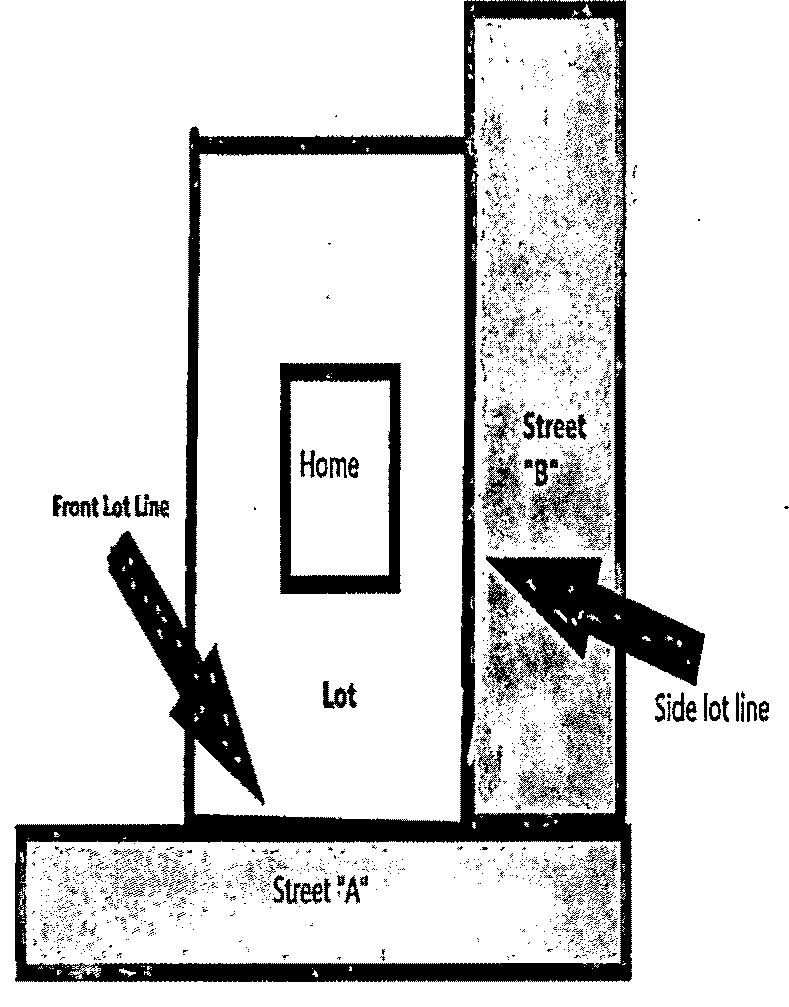
County Engineer. A person currently licensed and registered to practice engineering in the State of Florida and retained by Washington County to oversee the appropriate appropriation of this Code. The County Engineer may be employed directly by the County or be retained on a consulting basis.
County Planner. A duly authorized representative of the County Planning Department. This person may also be known as the Development Administrator or Senior Planner under the current organization of the Washington County Planning Department.
Crematorium. A location containing properly installed, certified apparatus intended for the use in the cremation of deceased persons or animals.
Critical Protection Zone. For trees being preserved during development, this is that area surrounding a tree within a circle having a radius of one (1) foot for each diameter at breast height (DBH) of the protected tree, within which area no development or other activity which might threaten the survival of the protected tree are permitted.
Cross Access Easement. An easement for mutual and reciprocal vehicular passage for ingress and egress between two (2) or more parcels, the benefit of which shall be shared by the property owners, their heirs, successors, designees, successors in title, and to their tenants, agents, employees, customers, guests, and invitees.
Cul-de-Sac. A minor street having only an open-end providing access to another street, with a circular area at the closed end for turning around.
Dead End Street. A minor street having only one (1) open end and providing access to another street.
Density or Gross Density. The total number of dwelling units divided by the total site area. This is measured in dwelling units per acre, with only one (1) single-family residence and an accessory dwelling unit being allowed per parcel or lot.
Derivative Products. Means products derived from marijuana, including, but not limited to marijuana oil, or consumable products, such as, but not limited to, food, teas, tinctures, aerosols, oils, or ointments.
Development. The carrying out of any building activity or mining operation, the making of any material change in the use or appearance of any structure or land, or the dividing of land into three (3) or more lots, parcels, tracts, tiers, blocks, sites, or units, or any other division of land; and includes establishment of new streets and alleys, additions, and resubdivisions; and, when appropriate to the context, relates to the process of subdividing or to the lands subdivided. (See also Appendix A, Floodplain Management Ordinance.)
Development Administrator. Tire officials designated by the local governing body of Washington County for the administration and enforcement of this Code. At the writing of this Code, this term is synonymous with the Senior Planner.
Development Agreement. A local government development agreement, as defined in F.S. §§ 163.3220 through 163.3243.
Development Order (DO). Any order granting, denying, or granting with conditions an application for a building permit, subdivision approval, land use change, certification, special exception, variance, site plan, or any other official action of the local government having the effect of permitting the development of land.
Development Permit. For the purposes of this Code a development permit is that official County document which authorizes the commencement of construction or land alteration without need for further application and approval. Development permits include: all types of construction permits; grading and clearing permits; septic tank permits; tree removal permits; sign permits; and flood protection permits.
Diameter at Breast Height (DBH). "Breast Height" is defined to be fifty-four (54) inches above the surface of the ground at the base of the plant or tree. In the case of a tree with multiple main stems, the diameter shall be the sum of the diameters of the stems.
Dispensing Organization. An organization authorized by the State of Florida to cultivate, process, transport and dispense medical marijuana.
Double Frontage Lot. Alot having two (2) non-adjoining property lines abutting streets.
Drive-In Restaurant. An establishment where food is served to persons in vehicles for consumption on- or off-premises.
Driveway. A vehicular point of access between one (1) or more parcel(s) of property and a roadway or street.
Duplex. A single building containing two (2) attached dwelling units under common ownership.
Dwelling Unit (Residential). A single housing unit providing complete, independent living facilities for one (1) housekeeping unit, including permanent provisions for living, sleeping, eating, cooking and sanitation.
Educational Facilities used for Agricultural Education. Public Educational facilities and auxiliary facilities constructed by a board for agricultural education, for Future Farmers of America or 4-H activities, or the storage of any animal or equipment therein, is preempted by the state and a local governmental entity may not enact or enforce an ordinance or regulation related to public educational facilities and auxiliary facilities (F.S. § 1013.373).
Ex Parte Communication. Communication between one (1) party in a legal case and the judge (or other decision-maker) without the knowledge or presence of the other party. These communications are generally prohibited in legal proceedings to ensure fairness and impartiality, as they may create an unfair advantage for the communicating party.
Extended Rental. Any residence rented out for a term of six (6) months or more.
EV Charging Station. The area in the immediate vicinity of electric vehicle supply equipment and includes the electric vehicle supply equipment, supporting equipment, and associated parking spaces. The regulation of electric vehicle charging stations is preempted to the state and a local governmental entity may not enact or enforce an ordinance or regulation related to electric vehicle charging stations (F.S. § 366.94).
Farm Product. Any plants and plant products (as defined in F.S. § 581.011), regardless of whether such plants and plant products are edible or nonedible or any animal useful to humans and includes, but is not limited to, any product derived therefrom (F.S. § 163.3162(2)(c)).
Fast Food Restaurant. An eating establishment with higher turnover that may feature counter service or selection of items from a counter, and which may or may not offer drive-thru service.
Family. In defining a family for single-family housing, a family is any number of people living together as a housekeeping unit.
Family Day Care Home. Per F.S. § 402.313.8, an occupied residence in which childcare is regularly provided for children from at least two (2) unrelated families and which receives a payment, fee, or grant for any of the children receiving care, whether or not operated for profit. Household children under thirteen (13) years of age, when on the premises of the family day care home or on a field trip with children enrolled in childcare shall be included in the overall capacity of the licensed home. A family day care home shall be allowed to provide for one (1) of the following groups of children, which shall include household children under thirteen (13) years of age: a maximum of four (4) children from birth to twelve (12) months of age; a maximum of three (3) children from birth to twelve (12) months of age, and other children, for a maximum total of six (6) children; a maximum of six (6) pre-school children if all are older than twelve (12) months of age; or a maximum of ten (10) children if no more than five (5) are pre-school age and, of those five (5), no more than two (2) are under twelve (12) months of age. Family day care homes shall be permitted by right in all residential districts.
Fill. Any material deposited for the purpose of raising the level of the natural land surface.
Final Development Order. A preliminary subdivision plat approval; a cluster subdivision approval; a final subdivision plat approval; planned unit development (PUD) final approval; final site plan approval; a building permit; or a Development Order entered pursuant to F.S. § 163.3220, or any other Development Order which approves the development of land for a particular use or uses at a specified intensity of use and which follows commencement of construction or physical development activity on the land for which the Development Order is issued.
Finding. A conclusion based upon analysis of the best available data and information.
First Magnitude Spring. A spring which discharges at least sixty-four million, six hundred thousand (64,600,000) gallons per day or one hundred (100) cubic feet per second of water.
Flea Market. An open-air market primarily for the sale of inexpensive or secondhand goods.
Floodplains. Areas inundated during a 100-year flood event or identified by the National Flood Insurance Program as an "A" Zone or "V" Zone on Flood Insurance Rate Maps. (See also Appendix A, Floodplain Management Ordinance.)
Flood or flooding. A general and temporary condition of partial or complete inundation of normally dry land from: [Also defined in FBC,B, Section 1612.2.]
(1)
The overflow of inland or tidal waters.
(2)
The unusual and rapid accumulation or runoff of surface waters from any source.
(See also Appendix A, Floodplain Management Ordinance.)
Floor Area. Total floor area of all stories including halls, stairways, elevator shafts, and other related uses, measured to outside faces of exterior walls of a building exclusive of vent shafts, courts, carports, garages, breeze ways and patio.
Floor Area Ratio (FAR). The ratio of the square footage of a building(s) floor area(s) to the square footage of the development site.
Floor Area Ratio (FAR)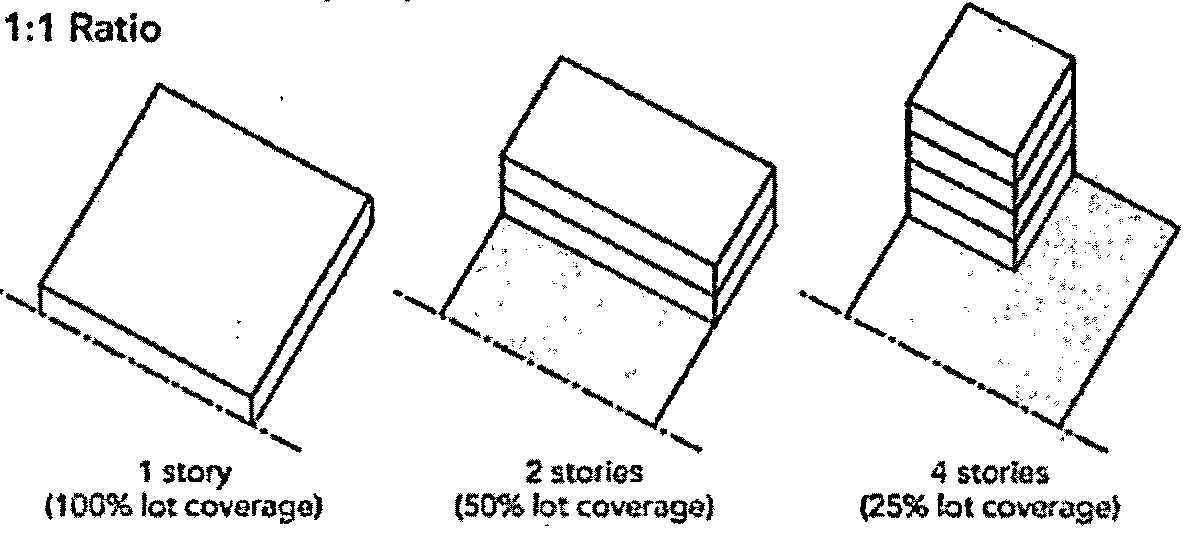
Foster Care Facility. Home for children which is licensed by the Florida Department of Children and Families. Also known as a foster home.
Full-Service Restaurant. A restaurant where table service is provided, and where customer dining times are longer than fast food restaurants.
Funeral Home. A business providing services for the family and friends of deceased persons. Services rendered included viewings; memorial and funeral services; embalming; cremations; storage of casket and urns prior to services; the preparation of bodies for viewing; administrative work for family/friends in preparation for services; parking for service attendees and business customers; and parking of hearses. May also be known as funeral chapels for locations where only the public ceremonies take place.
Future Land Use. The designation applied to a parcel of Land on the Future Land Use Map to indicate the intended use and development density for a particular area. "Future Land Use" as used in the Comprehensive Plan is equivalent to "Land Use" as used in the LDC.
Garage (also Yard or Rummage) Sale. An informal indoor or outdoor sale of used personal or household items held on an irregularly scheduled basis on the seller's premises. This is synonymous with the term Estate Sale, which differs in that the items sold belong to a deceased person and are performed by a company administering estate sales for a fee.
Gas Station. See convenience store/gas station.
Gated Subdivision. A subdivision with privately maintained roads with security gates, either guarded or unguarded, which prohibits access from a public road without a guard's or resident's approval. All streets in a gated subdivision shall be paved and approved as to County construction standards.
A Homeowners Association which creates and enforces covenants regarding, at a minimum, maintenance of roads, infrastructure, and common areas shall be created. Emergency services personnel must be provided a form of easy, uniform access to all gated subdivisions. Gated subdivisions were formerly called private subdivisions, which is a synonym.
Golf. An active outdoor recreational activity played upon a golf course of usually nine (9) or eighteen (18) holes and as further described in other provisions of this Code.
Golf Course. A parcel, or parcels, of property designated and constructed for playing the game of Golf, which is an active outdoor recreational activity as further defined in other provisions of this Code.
A Golf Course usually consists of the holes of play and surrounding land, which may include the following amenities and ancillary facilities:
(a)
Structures situated throughout the Golf Course for shelter, maintenance, storage and service facilities, food and drink, bathroom facilities, and other similar structures and improvements usually found on a Golf Course;
(b)
Pro shop for registering players; the sale and rental of golf equipment; sale of golf clothing, accessories, and other products useful for a shop on a Golf Course;
(c)
Clubhouse providing additional areas for consumption of food and beverages; locker rooms; and space for meetings, events, and entertainment;
(d)
If golf carts are allowed on the Golf Course, a golf cart storage and maintenance facility;
(e)
Any other structure or improvement, such as putting greens and driving ranges, which may be found on, and are part of, a Golf Course; and
(f)
Mobile food and beverage vendors.
Government Uses and Structures. Any land, building or use that is owned and operated by the City, County, State or Federal government, and over which such government or quasi-governmental entity exercises direct and complete control.
Gross Floor Area. The sum of the gross horizontal areas of a floor or floor(s) of a single or multiple story building being measured from the outward face of interior walls, excluding exterior stairwells; uncovered porches or patios; interior parking spaces; . loading space for motor vehicles; or any space where the floor-to-ceiling height is less than six (6) feet. This is the floor area used in calculating floor area ratio (FAR).
Hazardous Wastes. These are materials classified by the Department of Environmental Protection (DEP) as a waste hazardous to residents, animals, and/or the environment. These may include, but are not limited to, substances defined by the U.S. Environmental Protection Agency (EPA) in the 1976 Resource Recovery and Reclamation Act, as amended, as being: ignitable, corrosive, toxic, or reactive; fatal to humans in low doses or dangerous to animals based on the absence of human data; or listed in Appendix 8 of the Resource Recovery and Reclamation Act as being toxic and potentially harmful to the environment.
Heavy Equipment. Per F.S. § 559.955.2(b)2, this means commercial, industrial,, or agricultural vehicles, equipment, or machinery. This includes, but is not limited to, semi-trailers, tractors, construction equipment, earth-moving equipment, cement mixers, and any other similar equipment or machinery classified as commercial by the manufacturer.
Hemp. Means the plant cannabis sativa L and any part of the plant, including the seed thereof and all derivatives, extracts, cannabinoids, isomers, acids, salts, and salts of isomers, whether growing or not, with a delta-9-tetrahydrocannabinol (THC) concentration of not more than three-tenths (0.3) percent of a dry weight basis.
Hemp Shop. Means a retail business where more than fifty (50) percent of its inventory or sales is from hemp products or related products; including hemp extracts meeting the standards of F.S. § 581.217(7)(a)—(c).
Heritage Tree. A tree, other than of the pine species, which has a diameter of at least thirty (30) inches or more DBH using accepted forestry standards.
Historic Tree. A tree, other than a pine variety tree, which has been designated by the Board of County Commissioners as one of notable historical interest and/or value to the County because of its location or historical association with the County. Notice of intent to declare a tree a historic tree shall be provided to the owner of the property containing the tree, with designation being made at a Board of County Commissioners meeting.
Home Occupation. Per F.S. § 559.955, a business that operates from a home and is subordinate to the dwelling unit for residential purposes; requires no external modifications that detract from the residential appearance of the dwelling unit and that are visible from the street; and uses no equipment or process that creates noise, vibration, heat, smoke, dust, glare, fumes, or odors that are plainly detectable from the street or neighboring properties.
Housing for Legally Verified Agricultural Workers. The totality of development, supporting authorized housing, including buildings, mobile homes, barracks, dormitories used as living quarters, parking areas, common areas such as athletic fields playgrounds, storage structures, and other related structures. Housing for legally verified agricultural workers is preempted by the state and a local governmental entity may not enact or enforce an ordinance or regulation related to housing for legally verified agricultural workers (F.S. § 163.3162).
Immediate Family. The father, mother, brother, sister, son, daughter, grandchild, spouse, niece, nephew, or mother or father-in-law of a person deed land with or without valuable consideration. This term shall be utilized for the immediate family exception process, which implements the family homestead exemption described under F.S. § 163.3179.
Impervious Surface. A surface that has been compacted or covered with a layer of material so that it is highly resistant to infiltration (percolation) by water. Such Surfaces include, but are not limited to, semi-impervious surfaces such as compacted clay, as well as most conventionally surfaced roofs, sidewalks, parking lots, and other similar structures. Pavers may or may not be considered impervious, based on their manufacturing or installation.
Improvement. Any human-made immovable item which becomes a part of, is placed upon, or is affixed to land.
Institutional. Uses which provide a social, educational, or religious purpose. These are generally not-for-profit, but in some instances may be for-profit. Examples include hospitals, schools, churches, or charitable/fraternal organizations.
Intersecting Streets. Means the intersection of public street right-of-way and shall also mean a private street or driveway and its intersection with a public or private street.
Invasive Plant Species. An invasive plant species is an introduced plant or tree which negatively alters its new habitats and bioregions, causing ecological, environmental, and/or economic damage. The terms exotic or non-native plants are synonymous.
Junk. Discarded materials, trash, or things of poor quality (items of low quality or of very little value). Broken, old, scrap, or abandoned metal, building materials equipment, glass, appliances, furniture, beds and bedding, rags, rubber, or motor vehicles, and parts thereof. Commercial junk or scrap yards must have privacy fencing and vegetative buffering around the perimeter of the property and be located within the proper land use category.
Karst Features. A topography formed from the dissolution of soluble rock such as limestone, dolomite, and gypsum.
Land Surveyor. A person duly registered to practice land surveying in the State of Florida.
Land Use. The designation applied to a parcel of land on the Land Use Map which prescribes the uses, intensities, and other development characteristics of that piece of land. "Land Use" as used in the IBC is equivalent to "Future Land Use" as used in the Comprehensive Plan.
Laydown Yard. A laydown yard, also known as a laydown area, is a designated space on a parcel of property, or in a manufacturing or industrial setting where materials, equipment, and tools are temporarily stored prior to use. These areas serve as staging areas, facilitating efficient material handling and organization during projects. Laydown yards may be operated temporarily for a limited period of time or may be used for storage on a permanent basis. Approval of temporary laydown yards may be allowable through the Special Exception review and approval process. Privacy fencing and vegetative buffering are required at the perimeter of the property for these uses.
Local Governing Body. The Board of County Commissioners, the Town Councils of the Towns of Caryville, Ebro, or Wausau, or the City Council of Vernon.
Local Street. A street of limited continuity used primarily for access to nearby properties and local needs of the neighborhood. Also known as a minor street under the former Comprehensive Plan, which shall be a synonymous term.
Lodging. Buildings or facilities for housing persons for short or extended terms, usually for compensation paid to the owner of the facility.
Lot. A designated parcel, tract, or area of land established by plat, subdivision, or as otherwise allowed by law.
Lot of Record. A parcel of land or a lot within an approved subdivision or within an unrecorded subdivision, which was platted on or prior to October 1, 1991. Following the adoption date of this updated Land Development Code, (December 14, 2023), these shall include platted lots, or lot splits approved through the Land Use Certificate process, with a survey recorded in the Official Records of Washington County.
Low Impact Development. Systems and practices that use natural system and landscape design techniques to retain stormwater on site and prevent stormwater runoff. According to the U.S. Environmental Protection Agency. Low Impact Development (LID) refers to systems and practices that use or mimic natural processes that result in the infiltration, evapotranspiration, or use of storm water in order to protect water quality and associated aquatic habitat.
Major Development Plan. Means a subdivision or site plan meeting the following criteria: a major subdivision as defined herein; any multi-family development of ten (10) or more dwelling units; any non-residential use on a single pre-subdivided parcel containing ten thousand (10,000) or more square feet of non-residential building space; any addition to an existing non-residential use where size of the addition is ten thousand (10,000) square feet or more in building area; or any development that should be more thoroughly reviewed due to its location or potential for impacts on public facilities, natural resources, and/or public safety; construction of any roadway in Washington County.
Major Subdivision. Means any subdivision not classified as a minor subdivision, including, but not limited to, a subdivision of ten (10) or more lots, or any size subdivision requiring any new streets to be dedicated to the County, or the extension of governmental facilities, or the creation of public improvements.
Manufactured Housing. Means a mobile home fabricated on or after June 15, 1976, in an off-site manufacturing facility for installation or assembly at the building site, with each section bearing a seal certifying that it is built in compliance with federal Manufactured Home Construction and Safety Standard Act. Per Florida Statutes, manufactured homes shall be allowed in all residential land use properties. Manufactured housing installation shall follow any applicable standards of the Florida Building Code. (See also Appendix A, Floodplain Management Ordinance.)
Manufacturing, Heavy. Manufacturing creating asphalt or asphalt products, cement, lime, plaster-of-Paris, coaltar or its derivatives, creosote or creosote treatment, clay/time products, emery cloth, sandpaper, glue, linoleum, matches, rubber, or plastic products.
Marijuana. Has the same meaning given to it by F.S. § 381.986(1).
Marina. A place for docking boats and/or providing services to boats and the occupants thereof, including minor servicing and repair of boats while in the water, the sale of fuel and supplies, and the sale of pre-packaged food not prepared on the site. Restaurants on-site offering sit-down dining and/or bars and entertainment shall be approved by special exception.
Massage Establishment. Any building, room, place, or establishment other than a regular licensed and established hospital or dispensary where non-medical or non-surgical manipulative exercises or devices are practiced upon the human body manually or otherwise by a massage therapist licensed by the Florida Department of Health and/or Florida Department of Business and Professional Regulation. Massage establishments are differentiated from massage parlors by the lack of activities that would fall under the definition of an adult entertainment business or sexual misconduct by the massage therapist as discussed under F.S. § 480.0485.
Medical Marijuana Cultivation Facility. Means any area or facility used for cultivation of marijuana as authorized by the State.
Medical Marijuana Dispensing Facility. Means the retail sales component of a dispensing organization or medical marijuana treatment center authorized by the State to dispense marijuana, but does not include the cultivation, processing, or distribution facilities of the medical marijuana treatment center.
Medical Marijuana Processing Facility. Any area or facility that acquires, cultivates, possesses, processes (including development of related products such as food, tinctures, aerosols, oils, or ointments), transfers, transports, sells, distributes, dispenses, or administers marijuana, products containing marijuana, related supplies, or educating materials to qualifying patients or their caregivers, and is registered by the State.
Minor Development Plan. Means a subdivision or site plan meeting the following criteria; a minor subdivision as defined herein; a multi-family residential development of less than ten (10) units not involving platting; any non-residential use on a pre-subdivided parcel containing less than ten thousand (10,000) square feet of non-residential floor space; or any addition to an existing non-residential use where the size of the addition is less than ten thousand (10,000) square feet.
Minor Replat. The subdivision or resubdivision of a single lot or parcel of land into two (2) or more lots or parcels, solely for the purpose of increasing the area of two (2) or more adjacent lots or parcels of land or to modify or change the dimensions of only the adjacent lots or parcels, where there are no roadway, drainage, or other required improvements, and where the resultant lots comply with the standards of the Code.
Minor Subdivision. Any subdivision of ten (10) or less lots fronting on an existing street/roadway, not involving any new publicly dedicated street or road, the extension of government facilities or the creation of any public improvement, and not adversely affecting the remainder of the parcel or adjoining property, and not in conflict with any provision of this Code or the Comprehensive Plan. Minor subdivisions shall be limited to a maximum of ten (10) lots within a one-year period, as well as ten (10) in the aggregate.
Mobile Food Dispensing Vehicle. Any vehicle that is a public food establishment and that is self-propelled or otherwise movable from place to place and includes self-contained utilities, including, but not limited to, gas, water, electricity, or liquid waste disposal.
Mobile Food Vendor. A business operating out of a mobile food dispensing vehicles selling food and drinks prepared therein. The licensing and regulation of mobile food vendors is through the Florida Department of Agriculture and Consumer Services, with local governments preempted from licensing and prohibiting mobile food vendors by the State of Florida.
Mobile Home. A dwelling unit provided with an undercarriage axle(s) and wheels, which can be utilized as a permanent residence, and which is eight (8) feet or more in width, and over thirty-five (35) feet in length. This definition excludes recreational vehicles. For the purposes of this Code, a mobile home shall be considered a single-family dwelling or residence.
Mobile Home Park. Any parcel of land or portion thereof which is used or offered for use as a location for one (1) or more mobile homes.
Mobile Home Space. A plot of ground within a Mobile Home Park designated for the accommodation of one (1) mobile home or travel trailer.
Multi-Family Dwelling. Any residential structure containing two (2) or more separate dwelling units.
Native Plant Species. Plants which occur naturally in Florida's eco-system without introduction from another geographic area. These are as identified by the University of Florida's Institute of Food and Agricultural Sciences (IFAS) Extension Services.
Nonconforming Building. A building or structure which was built before the Washington County Code or met the requirements of the Washington County Code at the time it was built, but which no longer meets code requirements. Previously known as non-conforming development.
Nonconforming Development. Development that does not conform to the use regulations in Article II and/or the development design and improvement standards in Article V.
Nonconforming Lot. Any lot which was lawfully recorded within Washington County prior to the effective date of this Code (2023) or thereafter, which at the time met the lot size requirements of this Code, but does not meet those of the present Code.
Nonconforming Signs. Signs which do not conform to the development design and improvement standards outlined in Article VII.
Nonconforming Use. Any use of land which was lawfully maintained within Washington County prior to the effective date of the Code (2023) or thereafter, which at the time it was constructed met the requirements of the Code, but no longer meets these requirements.
Nudity. The state of being insufficiently clothed in any manner so that any of the following body parts are not fully covered within a fully opaque covering: the male or female genitals; the male or female pubic area; any portion of the female breast below the top of the areola, or the buttocks. Attire which is insufficient to comply with this clothing requirement includes, but is not limited to, G-strings, T-backs, dental floss, and thongs.
Nursing Home. A home licensed by the Florida Agency for Health Care Administration providing care for three (3) or more persons who are aged, chronically, or incurably ill who are fed and provided basic life-sustaining treatment for profit.
Office. The Washington County Planning Department.
Onsite Sewage Disposal System (Septic Tank). Aseptic tank or similar installation on an individual lot which utilizes an aerobic bacteriological process or equally satisfactory process for the treatment of sewage and provides for the proper and safe disposal of the affluent, subject to the approval of the Florida Department of Environmental Protection, Washington County office.
Open Space (Development). That portion of a total development site which is open, unoccupied, or unobstructed by any structure, except for recreation purposes. Open space shall not be deemed to include driveways, parking lots, roadway, open/impervious space within individual lots of a residential subdivision or portion of a mixed-use development or other surfaces designed or intended for vehicular travel.
However, the buffer area, landscape islands, or other pervious areas of parking lots may be counted towards the open space requirement.
Open Space (Clustering, Agriculture/Silviculture). Open space as required under Section 2.06.05 of this Code, to be left in its original pre-platted state. This area includes agricultural, silvicultural, conservation, or passive recreation areas. It shall not include the open/impervious spaces of the individual residential lots.
Ordinary High-Water Line (Non-Tidal). Aline determined by examining the bed and banks of a water body and ascertaining where the presence and activity of the water has marked upon the bed a character distinct from that of the banks with respect to vegetation, or the nature of the soil itself. In the case of disputes over the location of the high-water mark, the Planning Commission or Board of County Commissioners may request the subdivider or developer to furnish data and/or studies establishing the location of such boundary.
Outdoor Storage. The storage, handling, or display of general merchandise, and other warehouse products related to the business or commercial activities on a particular merchandise temporarily or on a permanent basis as part of their operations. Outdoor storage include on-site outdoor storage, or storage within partially enclosed structures, or storage within enclosed structures.
Outdoor Storage—Mini-Warehouses and Self-Storage Facilities. The renting or leasing of space for the self-storage of boats or other recreational vehicles, etc., for a fee, and allowing clients to store and retrieve their property at will. Storage may be located outside within an existing storage facility property and its boundaries. Privacy fence is required at the perimeter for these facilities if outdoor storage is allowed on site.
Overlay District. A district which overlays the future land use and/or land use classifications of an area and which adds additional protections or requirements for the district.
Owner. A person who, or entity which, alone, jointly, severally with others, or in a representative capacity (including without limitation, an authorized agent, attorney, executor, personal representative, or trustee) has legal or equitable title to any property in question, or a tenant, if the tenancy is chargeable under his/her lease for the maintenance of the property.
Package Treatment Plant. Small systems for the collection, treatment, and disposal of sewage, with treatment capacity of up to one million (1,000,000) gallons per day. Such systems are manufactured off-site and delivered to the site for installation.
Parcel. A unit of land within legally established property lines as defined by deed or other instrument of transfer which established ownership interest in the property. A parcel is not deemed to be divided into two (2) parcels merely by the fact that it is situated in two (2) different sections, has two (2) different property appraiser numbers assigned, or is traversed by an easement.
A parcel is deemed to be divided into two (2) parcels when it is traversed by a Federal, State, or County roadway or right-of-way. The portion of a parcel which is partially submerged in Waters of the State of Florida shall be subject to all regulations, including ownership and rights, regarding submerged lands under the Florida Statutes and Florida Administrative Code.
Parcel Size (Calculation of). For the purpose of this Code, parcel size shall be based on the land area located, above the ordinary high-water mark of all surface water bodies.
Park (Public/Private). Use of a parcel, whether publicly or privately owned, for active and passive recreation, including, but not limited to sports facilities, restrooms, ancillary buildings, and parking. Parks are generally, but not always, smaller than outdoor recreation areas.
Park Trailer. A transportable unit which has a body not exceeding fourteen (14) feet and which is built on a single chassis and is designed to provide temporary or seasonal living quarters when connected to utilities necessary for operation of installed features and appliances (F.S. § 320.01) (See also Appendix A, Floodplain Management Ordinance.)
Passive Outdoor Recreation. Recreation facilities usually larger than a park focused on non-motorized passive recreation, focusing on nature, and requiring minimal alteration of the existing topography or ecosystem. Examples of such passive recreation include, but are not limited to, hiking, bicycling, kayaking, picnicking, and bird watching.
Pedestrian Crosswalk. A right-of-way dedicated to the public for pedestrian use, and which is designed to provide access to adjacent roads, lots, or public use areas.
Permitted. Use of this term denotes that the land use in question is allowable under this Code, provided it meets all other regulations.
Planned Unit Development (PUD). A type or form of development which is intended to encourage innovative site design, and which is characterized by a unified site design for residential units, clustering of buildings, provision of open space, and a mix of building types and land uses.
Plat. A map or drawing depicting the division of land into lots, blocks, parcels, and containing a legal description of such lands. May include the terms "Replat", "amended plat", or "revised plat."
Potable Water. Water that is intended for drinking, culinary, or other domestic purposes, subject to compliance with County, State, or Federal drinking water standards.
Principal Building. This building in which the principal use of the lot on which it is situated is conducted.
Private Street. A paved or unpaved street which provides access to parcels of land constructed by a private party, and which has not been dedicated to and accepted by Washington County for maintenance. All private roads constructed after the adoption date of this Comprehensive Plan shall be paved and constructed to any applicable County Road design standards.
Prohibited Use. Ause which is not listed as an allowed use or by special exception for a land use or is textually listed as being prohibited.
Protected Tree. A protected tree is any historic, specimen, champion, or heritage tree, excluding pine trees, with a DBH of thirty (30) inches or more.
Public Education Facility. A building used for educational purposes, either owned or regulated by the Washington County School Board.
Public/Semi-Public. Facilities, sites, and buildings utilized by government and quasi-governmental agencies in providing services to the residents of Washington County.
Rear Lot Une. Tire lot line running parallel to the front lot line at the opposite end of said lot. The rear setback to a building is measured from this line.
Rear Setback. The required minimum distance between a building and the rear lot line, as measured from the closest point the building to the property line.
Recreational Equipment Rental. A business used in renting equipment to be used by the public in enjoying recreational opportunities. Examples of such rented equipment include, but are not limited to, kayaks, canoes, tubes, and bicycles.
Recreational Rental. Lots, parcels, or tracts of land, that are proposed for development with buildings or lodging facilities generally provided for short-term or extended rental to guests or groups and provided in conjunction with recreational uses such as the use of parks, hiking trails, golf, or other similar outdoor activities or sports. Recreational Rental does not include Recreational Vehicle Parks as otherwise defined in these regulations.
Recreational Vehicle. A vehicle used for temporary living quarters by individuals and families during recreational, camping or travel use, which either has its own motive power or is mounted on or drawn by another vehicle. This category, in this article, is assumed to include also travel trailers, camping trailers, truck campers, motor homes, private motor coach, conversion vans, park trailers, fifth wheels, and all similar vehicles as described by F.S. § 320.01. As temporary living quarters, recreational vehicles are not allowed for permanent habitation on properties with a residential land use. (See also Appendix A, Floodplain Management Ordinance.)
Recreational Vehicle Park. A development for the accommodation of tourists-or vacationers on a short-term basis, providing rental spaces for each individual trailers, campers, motor homes, tents etc., and recreation and service facilities for the use of tenants. For the purpose of this ordinance, the terms campground, RV resort, travel trailer park, travel resort, travel park, or any variation of these terms shall be considered synonymous with this term. Each Recreational Vehicle Park containing six (6) or more recreational vehicle spaces shall contain a recreation area of not less than five (5) percent of the total park area or a minimum of one-half (½) acre, whichever is greater. Recreational vehicle parks shall have a one thousand two hundred-square foot minimum lot size for recreational vehicle spaces and a five hundred-square foot minimum lot size for tent camp sites. Since a Recreational Vehicle Park is under one (1) ownership, dedication of public facilities within the development shall not be required to the County and/or municipality. Additionally, RV parks in common ownership are not required formal subdivision review and platting. However, RV parks that offer spaces for sale are required to complete the subdivision review and approval process. For this reason, the owner(s) shall be responsible for recording a dedication of such common facilities with the Washington County Clerk of Court, with such dedication running with the land.
Recreational Vehicle Sales/Repair. A commercial business for the sale and repair of recreational vehicles as defined herein.
Residential Dock or Pier. A dock or pier constructed on an occupied residential lot, and which is accessory to the principal residential use, and provides non-commercial recreational access, access for passive recreation or fishing, or the mooring of private boats.
Residential Rental. The leasing of a home, apartment, condominium unit, or similar residential structure. The regulation of rentals of less six (6) months, or short-term rentals, shall be per the most current state of Florida requirements (Florida Statutes).
Reverse Frontage Lot. A double frontage lot fronting on both a local street and an arterial or collector street, with access permitted only to the local street. Rear access to the arterial or collector street shall be prohibited by means of a non-access reservation strip or easement along the collector or arterial roadway.
Restaurant. A building or structure, or portion thereof, in which food is prepared and served for consumption.
Sewer (Public or Community). An approved sewage disposal system which provides a collection network, a disposal system, and a central sewage treatment facility for a single development, community, or region.
Shade Tree. A self-supporting woody plant normally growing to a mature height of fifteen (15) feet or more and spread of fifteen (15) feet or more. Palm trees and pine trees species shall not be considered as shade trees.
Short-Term Rental. Any residence rented out by the day, week, month, or any other time duration for a term of six (6) months or less in a calendar year.
Shrub. A woody plant with multiple stems capable of growing to a height of no more than fifteen (15) feet.
Side Lot line. The lot lines running perpendicular to and between the front and rear lots lines. When a lot has roadways parallel to both the front and side lot lines, the longer of the front or side lot line shall be designated the side lot line for setback purposes.
Side Yard Setback. The minimum required distance between a side lot line and a building, measured at the closest point of the building to the side lot line.
Sign. Any illuminated or non-illuminated identification, description, illustration, or device which is visible from any public space or is located on private property and exposed to the public and draws attention to a product, service, pace, activity, person, institution, business, or cause. This shall include any emblem, painting, banner, pennant, placard, or temporary sign designed to advertise, identify, or convey information, with the exception of window displays and national flags. For purposes of removal, signs shall include all structural materials.
Single-Family Dwelling. A structure containing one (1) dwelling unit, and not attached to any other dwelling unit, excluding an attached accessory dwelling unit, by any means. Only one (1) single-family dwelling and a subordinate accessory dwelling unit are permitted per lot or parcel.
Small Cell Deployment. A small antenna system attached to low-level poles such as street signs or light poles meant to strengthen weak wireless communication in a compact area.
Solar Farm. A use of land containing solar panels, ancillary equipment and buildings uses for the collection, storage, and transmission of power resulting from the solar energy received from the panels, said property being owned by a non-profit or for-profit public or private company.
Special Exception. A use that would not be appropriate generally throughout a particular district, but which, if controlled as to number, area, location, design, or relationship to the community, would not adversely affect the general health, safety, comfort, good order, appearance, convenience, and the general welfare.
Specimen Tree. A tree, other than of the pine species, that has been officially designated by the Board of County Commissioners to be of high value because of its type, size, age, or other relevant criteria. A public hearing with notice to the property owner of the property containing the tree shall be held for such designation.
Spray field (Wastewater). Means an agricultural or otherwise vegetated field which is irrigated with wastewater or treated sewage. May include storage lagoons utilized solely for the storage of wastewater before spraying, but not other wastewater facilities.
State Industrial Hemp Program. A program pursuant to F.S. § 581.217 and Rule 5B-57.014 F.AC. administered by the Florida Department of Agriculture and Consumer Services to oversee the development of the State hemp program to regulate the cultivation of hemp in the State, which is a potentially invasive plant species and is a threat to the plant life of the State if not properly controlled. Hemp cultivated pursuant to this rule is considered an agricultural commodity.
Structure. The building as well any other things constructed or erected on the ground, attached to something having location on the ground, or requiring construction or erection on the ground. This shall include modular and mobile homes.
Subdivision. The division of land into three (3) or more lots, parcels, tracts, tiers, blocks, sites, units, or any other division of land; and includes establishment of new streets and alleys, additions, and resubdivisions; and when appropriate to the context, relates to the process of subdividing or to the lands or area subdivided. As a plan, it is an engineered plan laying out a parcel of raw land into lots, blocks, street, and public areas.
Surface Waters. Any natural or manmade body of water above ground where water accumulates through rainfall, runoff, or that are created from springs, including bays, branches, creeks, estuaries, inlets, lakes, oceans, ponds, reservoirs, rivers, spring runs, and spring watersheds. Tire U.S. Environmental Protection Agency (EPA) also includes navigable waterways as typical in the definition of surface waters. Wetlands are also considered surface waters as there are permanent and seasonal wetlands that may store water. And although the Choctawhatchee River, Econfina Creek, Holmes Creek, and Pine Log Creek are considered surface waters, these are protected, major managed areas of local, regional, and state significance. Buffer requirements and development setbacks, for surface-water systems are required to protect native vegetation and natural resources (See Article TV-Resource Protection).
Telecommunications Tower. A freestanding tower, guyed tower, monopole, and similar structures greater than fifteen (15) feet in height designed for the sole purpose of supporting one (1) or more antennas.
Temporary Event. An event of a temporary nature which is open to the general public. Examples include fairs, carnivals, festivals, circuses, revivals, sporting events, or similar public, charitable, educational, or religious events.
Temporary Sales. Sale on a temporary basis from a permanent or roadside structure(s) for items such as Christmas trees, fireworks, pumpkins, etc.
Tobacco Shop. A retailer business where fifty (50) percent or more of its merchandise or sales involve tobacco products. Tobacco Product means (unless specifically noted elsewhere) any product subject to Subchapter IX (21 U.S. C. § 387 et seq. Subchapter IX) of the Federal Food, Drug, and Cosmetic Act. (See 21 U.S.C. § 387.a(b) (products subject to Sub chapter IX); 21 C.F.R. §§ 1100.1—1100.3 (tobacco products subject to Subchapter IX.) Products subject to Subchapter IX include, but are not limited to, cigarettes, cigarette tobacco, roll-your-own tobacco, smokeless tobacco, cigars, pipe tobacco, water pipe tobacco, and Electronic Cigarette Products. Products that are not subject to Subchapter IX include accessories of Tobacco Products, such as, but not limited to, ashtrays, spittoons, and conventional matches and lighters that solely provide an external heat source to initiate but not maintain combustion of a Tobacco Product. Vaping shops and smoke shops are terms synonymous with tobacco shops.
Tree. A woody, self-supporting plant which at planting is a minimum of eight (8) feet in height with a minimum of three (3) inches diameter at breast height (DBH).
Understory Tree. A woody, self-supporting plant which is used in conjunction with shade trees but is lower and height and less wide than a shade tree.
Unpaved road. A road not covered with a firm, level surface of asphalt, concrete, etc. New unpaved roadways are prohibited.
Variance (to IDC standards). A petition for a variance to the standards of the LDC due to the unique physical surroundings, shape, topographical conditions, or other physical or environmental conditions that are unique to the property involved. Said variance shall be approved by the Board of County Commissioners when requested with Major Development Review Applications and shall be approved by the Planning Commission when requested with Minor Development Review Applications for developments located within the unincorporated county.
Use. Use activity/activities which are carried out on a piece of land.
Veterinary Hospital. An establishment where animals or pets are given medical or surgical treatment and the boarding of animals is limited to short-term care incidental to the hospital use. The formerly defined term of Animal Hospital synonymous, as is veterinary office.
Watercourse. A river, creek, stream, channel, or other topographic feature in, on, through, or over which water flows at least periodically. (See also Appendix A, Floodplain Management Ordinance.)
Wireless Communication Tower. A tower or antenna with equipment designed to allow wireless communications, including cables, wires, lines, wave guides, antennas, and ground equipment in direct support of such transmission or reception. Wireless communication facilities do not include amateur radio antennas. This term is synonymous with the terms telecommunication tower or cell tower.
(Ord. No. 2023-16, § 1(Exh. A), 12-14-2023; Ord. No. 2026-01, § 1(Exh. A), 1-15-2026)

