
Vernon City Zoning Code
ARTICLE V
DEVELOPMENT DESIGN AND IMPROVEMENT STANDARDS1
Code of Ordinances reference—Streets, sidewalks and public places, Ch. 58.
5.03.00 - WASTEWATER SYSTEMS AND SEPTIC TANKS[2]
Code of Ordinances reference—Sewerage and septic tanks, § 70-31 et seq.
5.00.01 - Purpose.
The purpose of this Article is to provide development design and improvement standards applicable to all development activity within Washington County.
(Ord. No. 2023-16, § 1(Exh. A), 12-14-2023)
5.00.02 - Responsibility for improvements.
All improvements required by this Article shall be designed, installed, and paid for by the Developer.
(Ord. No. 2023-16, § 1(Exh. A), 12-14-2023)
5.00.03 - Principles of development design.
The provisions of this Article are intended to ensure functional, safe, and attractive development. Development design shall first take into account the protection of natural resources as prescribed in Article IV of this Code. All development shall be designed to avoid unnecessary impervious surface cover; to provide adequate access to lots and sites; and to avoid adverse effects of shadow, glare, noise, odor, traffic, drainage, and utilities on surrounding properties.
(Ord. No. 2023-16, § 1(Exh. A), 12-14-2023)
5.01.01 - Residential.
A.
General Principles. These principles shall be followed in the planning of residential areas, in choice of building types, and in the arrangement of buildings on the land:
1.
Residential Layout. Residential areas shall be laid out according to proven as well as innovative practices of architecture and landscape architecture, as portrayed in current professional books and periodicals. Objectives shall include removing dwellings from vehicular noise, privacy, making a variety of housing types and arrangements available to all County residents, while developing in a way that protects the environment.
2.
Ground Level Access. Each dwelling unit shall have direct access to a private outdoor living space at ground level.
3.
Open Space. Sponsors of housing developments are required to include common facilities, enclosed space, and open space for use of all the residents of the community. See Article VI, "Subdivisions," of this Code for mandatory recreational open space dedication provisions. Also see Section 2.06.05 of Article II of this Code for minimum open space provisions for all development.
4.
Resource Protection Setbacks. See Article IV of this Code for additional resource protection setbacks.
5.
Accessory Structures. All accessory structures shall meet the setback requirements established in Table 2.02.06, Land Development Code.
6.
Density Requirements. Densities exceeding two (2) units per acre shall be required to have central sewage or water if available. However, if central water or sewer is not readily available, the County may approve an alternative through the development review process that will be in compliance with the Department of Environmental Protection and other permitting agencies. If an alternate is approved, the density of up to four (4) units per acre may be achieved.
7.
Letter of Availability. A "Letter of Availability" from the private or municipal utility service will certify not only that the capacity is present, but that property pressure, extension of service lines, and cost will not be a prohibitive factor in the provision of central wastewater treatment and central water to the proposed development site. Upon execution of a formal agreement between the developer and the municipality utility service agreeing to pay for the necessary infrastructure expansion, the developer may continue the appropriate development process with the County Planning Department.
8.
[Traffic study required.] All development generating more than one hundred (100) PM Peak Hour trips as calculated in the Institute of Traffic Engineers shall be required to submit a traffic study, meeting the standards outlined under Article III of this LDC.
(Ord. No. 2023-16, § 1(Exh. A), 12-14-2023)
5.01.02 - Nonresidential.
A.
General Principles. These principles shall be followed in the planning of nonresidential development and in the arrangement of buildings on the land:
1.
Nonresidential Layout. These areas shall be laid out according to proven as well as innovative practices of architecture and landscape architecture as portrayed in current professional books and periodicals. Objectives shall include protecting adjacent residential areas from noise, air pollution, glare, and visual nuisance, and providing outdoor and indoor spaces for staff and visitors which are safe and convenient.
2.
Common Facilities. Sponsors of nonresidential development are required to include common facilities such as drives, parking lots, sources of water, liquid waste treatment, for use by staff and visitors of adjacent and nearby places of employment.
3.
Open Space. All nonresidential development must comply with the minimum open space standards presented in Section 2.06.05 of this Code.
4.
Setbacks. See Sections 2.02.06 and 2.02.07 for building and structure setbacks. See Article IV of this Code for additional resource protection setbacks.
5.
Letter of Availability. A "letter availability" from the private or municipal utility service will certify not only that the capacity is present, but that proper pressure, extension of service lines, and cost will not be a prohibitive factor in the provision of central wastewater treatment and central water to the proposed development site. Upon execution of a formal agreement between the developer and the municipality utility service agreeing to pay for the necessary infrastructure expansion, the developer may continue the appropriate development process with the County Planning Department
6.
School Siting.
a.
The site must contain at least the minimum usable acreage required by F.S. § 235.19 and 6A-2 FAC (2008) adopting or reflecting any standard(s) the Washington County School Board.
b.
Newly constructed schools shall comply with all design and improvement standards only to the extent the provisions do not conflict with State requirements for educational facilities or those specified in the approved Interlocal Agreement for school planning.
(Ord. No. 2023-16, § 1(Exh. A), 12-14-2023)
[5.02.001 - Established.]
This section establishes minimum requirements applicable to the development transportation system, including access management, street design, parking and loading, and bicycle and pedestrian access. The standards in this Section are intended to minimize the traffic impacts of development, to assure that all developments adequately and safely provide for the storage and movement of vehicles consistent with good engineering and development design practices.
Washington County and all municipalities, with the exception of Chipley, shall adopt the Department of Transportation Peak PM/Hour trips as the measure of Level of Service for all county/municipality roads. As such, each municipality agrees to accept the levels of services that are established by the County in order to maximize the efficient use and safety of roadway facilities among the County and other members of the Regional Transportation Planning Organization This will effectively coordinate capital improvements planning with land use decisions to meet the requirement that adequate roadway facilities be available concurrent with the impacts of development.
(Ord. No. 2023-16, § 1(Exh. A), 12-14-2023)
5.02.01 - Access management.
A.
Generally. In order to maximize roadway level of service, this Section shall set standards for the number of access points, the separation between access points, frontage on service roads and common driveways, alternative designs and access to residential lots. All proposed development shall meet the following standards for vehicular access and circulation.
B.
Access to Designated "Limited Access Streets" From Residential, Commercial, and Mixed-Use Development. Access points from all residential, commercial, and mixed-use development, excluding single-family residential, shall be based on the speed of the roadway intersecting with the ramp or traffic light from the limited access roadway. The following table shows the standards for Washington County and the municipalities:
Table 5.02.01.A - Development Access Point Separation from Fronting Street Intersection with Limited Access Streets
Source: Driveway Information Guide, FDOT, 2008
Where a subdivision abuts or contains an existing or proposed arterial street or collector street (as specified in Washington County's Comprehensive Plan), the Board of County Commissioners may require access roads be provided, with the rear of homes facing the access road and landscaping provided in a non-access easement area along the rear property line, deep lots with rear service alleys, or such other treatment as may be necessary for adequate protection of residential properties and to afford separation of through and local traffic.
C.
Number of Access Points onto Arterial or Collector Roads by Development Type and Size.
1.
The following number of access points shall be allowed to arterial and collector roadways based on the type and size of development:
Table 5.02.01.B - Number of Driveways onto Arterial or Collector Roadways by Development Type and Size
D.
Separation Of Access Points. The distance between access points shall be measured from the centerline of the proposed driveway or roadway to the centerline of the nearest adjacent roadway or driveway.
E.
Frontage On Service Roads and Common Driveway.
1.
Projects proposed on roadways designated as arterial may be required by the Planning Commission to include frontage or service roads in the project design and shall take access from the frontage or service road rather than from the arterial or collector. Frontage road design shall conform to FDOT standards. This access requirement may be met through the use of interconnecting parking lots which abut the arterial or major collector. The maximum number of parking lots that may be so interconnected, however is three (3), unless the parking lots are specifically designed with through lanes intended for the movement of traffic in a manner that does not interfere with the parking and ingress/egress functions of the parking lots.
2.
Adjacent uses are encouraged and maybe required by the County to share a common driveway and/or appropriate access easements between or among the property owners.
F.
Alternative Designs. Where natural features, parcel size or dimensions, or spacing of existing driveways and roadways cause, the foregoing access requirements to be physically infeasible, alternate designs may be approved by the Board of County Commissioners.
G.
Access To Residential Lots. All lots and parcels intended for residential use shall have access from either a residential subdivision street or private paved (new) or unpaved road (existing) meeting the standards of this Code.
1.
Access to nonresidential uses shall not be through an area designed, approved, or developed solely for residential use.
2.
All lots in proposed residential subdivisions shall have frontage on and access from an existing street meeting the requirements of this Code.
3.
In areas where all parcels of land are four and one-half (4.5) acres in size or larger, the parcels may take access from a private paved road.
4.
Access to all lots in a proposed residential subdivision shall be by way of a residential access or residential sub-collector (not a collector or arterial) street, except for cases where such access is not feasible due to the original size and/or configuration of the parcel to be subdivided.
5.
Subdivisions which are accessed from unpaved roads shall be limited to Minor Subdivisions of ten (10) lots or less.
6.
All parcels, including nonresidential parcels, which do not have road frontage must have a deeded access easement surveyed and recorded with the Washington County Clerk of Courts Office. Deeded access easements are required in order to receive an address and other public services. Unless this requirement is waived by the Development administrator or her/his designee, all deeded accesses easements shall be thirty (30) feet in width, but in no case shall such an easement be less than twenty (20) feet in width.
H.
Private Road Access Disclosure. All lots in proposed private residential subdivisions in addition to meeting the disclosure requirements contained in Section 6.01.07(H) of this Code shall also place a disclosure within each deed or other instrument transferring ownership in the property which indicates that the roads providing access to the parcel are not maintained by Washington County. This disclosure statement shall also be placed within all deeds or other legal instruments transferring ownership of property where the roadways providing access to the property are not dedicated to Washington County for maintenance.
I.
Driveways. Shared driveways shall not be installed without governing body approval. Driveways and access to County roads shall be limited in the following manner by the County, municipalities, and FDOT to ensure traffic carrying capacity and safety:
1.
Functional classification shall be the basis for determining the number of access points allowed.
2.
Issuance of driveway permits shall be limited to the number of driveways required to make safe and reasonable access using the subdivision or development process.
3.
Driveways located at the intersection of two (2) roadways shall be assigned the lower classification.
4.
Driveway permits shall be required for any access point to any state roadway, and no building permit shall be issued without the issuance of the necessary permit from the Florida Department of Transportation to the developer or builder.
5.
Driveway permits are required for any access point to any county or municipality roadway; therefore, it is the policy of the County that no building permit shall be issued without the issuance of the necessary perm it or waiver from the Washington County Public Works Department or the functionally equivalent municipality department.
6.
All future developments shall be required to include the installation of at least one (1) driveway to access each lot (parcel) as identified in the plans or plat for the development unless authorized shared driveways. These driveways shall meet County standards and shall be at the cost of the developer.
7.
When platting new subdivisions, driveways shall be considered part of the new infrastructure and are subject to the same construction and installation standards as other required infrastructure (paving, drainage, holding ponds, etc.). The developer and property owner shall be required to construct and maintain driveways in a manner that ensures that emergency first responders can readily access the residence or other structures located on the property.
8.
When platting subdivisions, the County will allow the use of shared driveways as a viable way of providing access to more than one (1) lot where circumstances and practicality allow for this (normally only on a FDOT roadway).
9.
Use of an orderly and uniform street numbering system to provide for the efficient delivery of mail, packages, goods delivery, emergency medical services, and utility services shall be required on all residential lots within the County. Only the 9-1-1 Coordinator shall assign street names and street numbers to new or existing structures or driveways.
10.
It shall be the policy of the County that no development orders or building permits will be issued without being issued a 9-1-1 address.
11.
It shall be the responsibility of each property owner to permanently and properly display the 9-1-1 address assigned to property within the immediate vicinity of the driveway that provides ingress/egress to that portion of the property where any residential structures or other development where emergency medical services or utility company services are required.
(Ord. No. 2023-16, § 1(Exh. A), 12-14-2023)
5.02.02 - Street design standards.
A.
General Design Standards.
1.
The layout of streets in any subdivision shall conform to the County Comprehensive Plan as well as existing streets and thoroughfares.
2.
All streets in a new development shall be designed and constructed pursuant to the standards herein. This includes paving. Streets which the County has agreed to accept shall be dedicated to Washington County upon completion, inspection, and acceptance by Washington County.
3.
The street system of the proposed development shall, to the extent practicable; conform to the natural topography of the site, preserving existing hydrological and vegetative patterns, and minimizing erosion potential, runoff, and the need for site alteration. Particular effort should be directed toward securing the flattest possible grade near intersections.
4.
Streets shall be laid out to avoid environmentally sensitive areas as defined in Article IV of this Code.
5.
Private streets may be allowed within developments that will remain under common ownership, provided they are designed and constructed pursuant to the standards contained in this Section and all other provisions of this Code. Upkeep shall be addressed in the subdivision's covenants.
6.
The street layout in all new development shall be coordinated with and interconnected to the street system of the surrounding area.
7.
Streets in proposed subdivisions shall be connected to rights-of-way in adjacent areas to allow for proper inter-neighborhood traffic flow. If adjacent lands are unplatted, stub-outs in the new development shall be provided for future connection to the adjacent unplatted land.
8.
Residential streets shall be arranged to encourage the smooth flow of traffic on a dispersed network. A gridded interconnected street network within subdivisions is encouraged to provide alternative routes and to disburse through traffic.
9.
Streets shall intersect as nearly as possible at right angles and in no case shall be less than seventy-five (75) degrees.
10.
New intersections along one (1) side on an existing street shall, unless found to be functionally unfeasible, coincide with existing intersections. Where an offset (jog) is unavoidable at an intersection, the distance between unaligned centerlines of the intersecting streets shall be no less than one hundred twenty-five (125) feet.
11.
Dead end streets shall not exceed one thousand (1,000) feet in length.
12.
The minimum radius of the roadway of turning circles at the end of the cul-de-sac or dead-end street shall be fifty (50) feet, and the minimum radius of the right-of-way shall be sixty (60) feet.
13.
Alleys shall be provided along the rear of all lots to be used for business purposes.
14.
Pre-existing private graded roads shall be constructed in accordance with the standards presented in Section 5.02.02(B) and in Section 5.02.03 of this Code.
B.
Right-of-Way and Pavement Widths. The following minimum right-of-way and pavement widths are required for each of the following street classification types:
C.
Grading Widths. All preexisting unpaved roads shall be graded to a width equal to the required pavement width without curb and glitters for the road/street types noted above.
D.
Curbing Requirement.
1.
Curbing shall be required for all paved streets for the purposes of drainage, safety, and delineation and protection of pavement edge along noted above streets in the following cases:
a.
Where the surface drainage plan requires curbing to channel stormwater.
2.
All curbing shall conform to the construction standards contained in this Section or as permitted by the Development Administrator.
E.
Shoulders. Shoulders, where required, shall measure at least four (4) feet in width and shall be required on each side of streets and shall be located within the right-of-way. Shoulders shall consist of stabilized turf or other material permitted by the Development Administrator. Shoulders and/or drainage swales are required as follows:
1.
Shoulders are required on residential streets and existing private unpaved roads only where necessary for stormwater management or road stabilization.
2.
All residential collector streets shall provide two (2) four-foot-wide shoulders. Shoulders should be grass surfaced except in circumstances where grass cannot be expected to survive. In no case shall the shoulders be paved unless necessary to accommodate pedestrian or bicycle traffic.
3.
Where shoulders are required by the Florida Department of Transportation (FDOT).
4.
Collector streets where curbing is not required.
5.
Arterial streets where curbing is not required.
6.
Where daily traffic volumes are greater than two thousand (2,000) a five-foot shoulder on each side of the road shall be installed to safely accommodate bicycles.
F.
Acceleration, Deceleration, and Turning Lanes.
1.
Deceleration or turning lanes may be required by the County along existing and proposed streets as determined by a Traffic Impact Study required by Article IV of this Code or where the County can justify the need.
2.
Deceleration lanes shall be designed to the following standards:
a.
The lane width shall be the same as the required width of the roadway moving lanes.
b.
The lane shall provide the full required lane width for its full length. It shall not be tapered.
c.
The minimum lane length shall be as follows:
G.
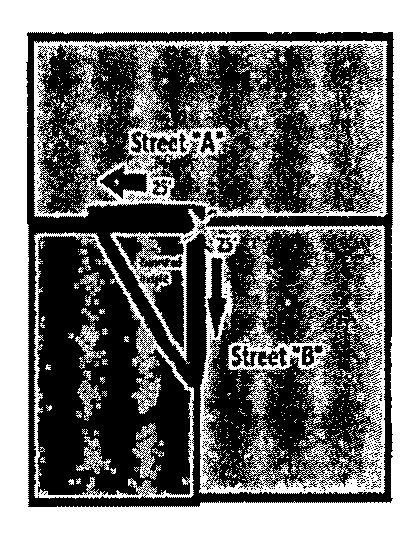
Clear Visibility Triangle. It shall be unlawful to construct, erect, place, grow, maintain, or allow to be constructed, erected, placed, grown, or maintained, any building structure, fence, wall, sign, canopy, vegetation, or obstruction of any kind within the clear visibility triangle on any property which is located at the corner-of intersecting streets or driveways, as described below:
1.
Nothing shall be erected, placed, parked, planted, or allowed to grow in such a manner as to materially impede vision between a height of two (2) feet and ten (10) feet above the grade, measured at the centerline of the intersection.
2.
The horizontal area formed by a triangle, the apex of which is the point of intersection of the street right-of-way lines, the legs of which extend twenty-five (25) feet along said street right-of-way lines and the hypotenuse of which connects the ends of the legs; and
3.
When the street right-of-way line adjacent to the major road is ten (10) feet or less from the face of the curb, edge of pavement or edge of the driving surface the horizontal area formed by a triangle, the apex of which is the point of the intersection of the lines formed by the projection of either the face of the curb, edge of pavement, or the edge of the driving surface, the legs of which extend ten (10) feet along the minor road, and the hypotenuse of which connects the ends of the legs; or
4.
In the event of balanced traffic volume or equally controlled right-of-way (i.e., no major/minor roadway condition) or as determined by the Development Administrator or his/her designee, based upon sound engineering practices, the additional ten-foot by one-hundred-foot triangle as defined in this Section shall apply to all approaches. See Figures 5.02.02.A, B, and C.
H.
Street Names and Signalization. Street names and markers shall be installed according to the specifications of the Development Administrator or his/her designee. No names shall closely approximate nor sound like any existing street names, and all street names shall be in accordance with Washington County Ordinance 89-5.
In order to ensure that all street names are established in accordance with County Ordinance 89-5 and the goals and objectives of the 9-1-1 system, prior to filing any subdivision plat or the filing of any application to connect a roadway (public or private) to the County system of roadways, the developer shall consult with the Development Administrator. During these consultations, the developer may submit a list of preferred street names for consideration by the Development Administrator or his/her designee.
The developer shall deposit with Washington County sufficient funds to provide all necessary roadway signs and traffic signalization as may be required by the County, based upon County or State traffic standards. At least two (2) street name signs shall be placed at each four-way street intersection, and one (1) at each "T" intersection. Signs shall be installed under light standards and free of visual obstruction. The design of street name signs shall be consistent, of a style appropriate to the community, and of a uniform size and color.
(Ord. No. 2023-16, § 1(Exh. A), 12-14-2023)
5.02.03 - Road and street construction and improvement standards.
A.
Clearing and Grubbing. Clearing and grubbing shall be done in accordance with applicable portions of Florida DOT Standard Specifications for Road and Bridge Construction, as amended.
B.
Excavation and Embankment. Excavation and embankment shall be done in accordance with applicable portions of Florida DOT Standard Specifications for Road and Bridge Construction, as amended.
C.
Roadway Base and Subgrade. The roadway base shall be constructed of lime rock, sand clay, sand asphalt, hot mix, soil cement, or shall be shell stabilized with a minimum thickness of six (6) inches, in accordance with the FDOT Standard Specifications for Road and Bridge Construction and the following requirements:
1.
Subgrade shall extend a minimum of eight (8) inches beyond the edge of pavement.
2.
All tests for subgrade and base shall be submitted to the County Engineer prior to paving. No paving will be allowed until the County Engineer has approved the tests results.
3.
Testing.
a.
Subgrade-conduct one (1) LBR per five hundred (500) CY of imported material. Conduct at least one (1) LBR on in-situ soils. Conduct compaction tests at a rate of one (1) test per one hundred (100) linear foot of roadway. Roadways with significant grade changes should have compaction testing conducted at a rate of one (1) test per one hundred (100) linear foot per lift.
b.
Base-conduct compaction tests at a rate of one (1) test per linear foot of road.
D.
Surface Course. Surface courses for flexible pavements shall be an asphaltic-concrete surface with a minimum thickness of one and one-half (½) inches.
Uris asphaltic-concrete surface shall be approved by the County Engineer or his/her designee. Testing of the surface course of compliance with specifications will be carried out by the County Engineer or his/her authorized representative. Test cores will be taken no more than three hundred (300) apart and staggered to the left, right, and on the centerline.
E.
Standards for Private Unpaved roads. Private roads shall be constructed to the same standards as public roads. Dirt or similar roads shall no longer be permitted.
F.
Required Inspection. Inspection of the following phases of street construction must be conducted by the County Engineer, or his/her designee in addition to the testing procedures noted above:
1.
Curb and Concrete Work
2.
Stabilized Subgrade
3.
Roadway Base
4.
Surface Course
5.
Drainage System
G.
[Notification responsibility.] It is the developer's responsibility to notify the Development Administrator, or his/her designee, twenty-four (24) hours before any of the above noted phases of construction are to be ready for inspection. The developer shall pay for the cost of all testing provided by the County Engineer or his/her designee.
(Ord. No. 2023-16, § 1(Exh. A), 12-14-2023)
5.02.04 - Off-street parking.
A.
Generally.
1.
Applicability. Off-street parking facilities shall be provided for all development within Washington County pursuant to the requirements of this Code. The facilities shall be maintained as long as the use exists that the facilities were designed to serve.
2.
Computation.
a.
When determination of the number of off-street spaces required by this Code results in a fractional space, the fraction of one-half (½) or less may be disregarded, and a fraction in excess of one-half (½) shall be counted as one (1) parking space.
b.
In stadiums, sports arenas, churches, and other places of assembly in which those in attendance occupy benches, pews, or other similar seating facilities, and/or which contains an open assembly area, the occupancy shall be based on the maximum occupancy rating given the building by the Fire Marshal.
c.
Gross floor area shall be the sum of the gross horizontal area of all floors of a building measured from the exterior faces of the exterior walls.
B.
Parking Study. A parking study, when required by this Code, shall include, but not be limited to:
1.
Estimates of parking requirements based on recommendations in studies such as those from ULI, ITE, or the Traffic Institute, and based on data collected from uses or combinations of uses which are the same or comparable to the proposed use. Comparability shall be determined by density, scale, bulk, area, type of activity, and location. Tire study shall document the source of data used to develop recommendations.
2.
An analysis of the extent to which a transportation system management program and/or use of alternative forms of transportation lessen the parking requirement.
C.
Number Of Parking Spaces Required.
1.
Requirements in Table. Table 5.02.04-A below specifies the required minimum number of off-street automobile and bicycle parking spaces, the percentage of automobile spaces that must be allotted for compact vehicles, and, in the notes, any special requirements that may apply.
2.
Uses Not Specifically Listed in Table. The number of parking spaces required for uses not specifically listed in the table shall be determined by the Planning Commission. The Planning Commission shall consider requirements for similar uses and appropriate traffic engineering and planning data and shall establish a minimum number of parking spaces based upon the principles of this Code.
3.
When Parking Study Required. For several uses listed in Table 5.02.04-A the parking requirement is to be determined by the Planning Commission. These uses have a large variability in parking demand, making it impossible to specify a single parking requirement. A developer proposing to develop or expand one (1) of these uses must submit four (4) copies of a parking study, as described at Section 5.02.04.A.3. of this Part, to the Planning Department that provides justification for the requirement proposed. The Planning Commission will review this study along with any traffic engineering and planning data that are appropriate to the establishment of a parking requirement for the use proposed.
4.
Treatment of Mixed Uses. Where a combination of uses is developed, parking shall be provided for each of the uses as prescribed by the Table, unless a reduction is granted pursuant to Section 5.02.04.B.9. of this Part.
5.
Tandem Parking Spaces. The term "tandem parking space" used in the Table means a parking space that abuts a second parking space in such a manner that vehicular access to the second space can be made only through the abutting (tandem) space.
_____
TABLE 5.02.04 - MINIMUM OFF-STREET PARKING STANDARDS
D.
Special Parking Spaces.
1.
Any parking area to be used by the general public shall provide suitable, marked parking spaces for handicapped persons. The number, design, and location of these spaces shall be consistent with the requirements of F.S. §§ 316.1955 and 316.1956, or succeeding provisions. No parking space required for the handicapped shall be counted as a parking space in determining compliance with Section 5.02.04 of this Part, but optional spaces for the handicapped shall be counted. All spaces for the handicapped shall be paved.
2.
A portion of the parking spaces required by this Code may be designated as exclusively for motorcycle parking if the following conditions are met:
a.
The Development Administrator recommends that the spaces be so designated, based upon projected demand for them and lessened demand for automobile spaces.
b.
The Planning Commission approves the recommendation, and the designated spaces are shown on the final development plan.
c.
The designated spaces are suitably marked and striped.
d.
The designation does not reduce the overall area devoted to parking so that if the motorcycle spaces are converted to automobile spaces the minimum requirements for automobile spaces will be met. The approval may later be withdrawn, and the spaces returned to car spaces, if the Development Administrator finds that the purposes of this Code would be better served thereby, based upon actual demand for motorcycle and automobile parking.
3.
The following applies to bicycle parking:
a.
Bicycle parking facilities shall adhere to the following:
(1)
Be designed to allow each bicycle to be supported by its frame.
(2)
Be designed to allow the frame and wheels of each bicycle to be secured against theft.
(3)
Be designed to avoid damage to the bicycles.
(4)
Be anchored to resist removal and solidly constructed to resist damage by rust, corrosion, and vandalism.
(5)
Accommodate a range of bicycle shapes and sizes and to facilitate easy locking without interfering with adjacent bicycles.
(6)
Be located to prevent damage to bicycles by cars.
(7)
Be consistent with the surroundings in color and design and be incorporated whenever possible into building or street furniture design.
(8)
Be located in convenient, highly visible, active, well-lighted areas.
(9)
Be located so as not to interfere with pedestrian movements.
(10)
Be located as near the principal entrance of the building as practicable.
(11)
Provide safe access from the spaces to the right-of-way or bicycle lane.
(12)
Be protected from elements by placing under covered area when practicable.
4.
Parking spaces that are for charging electric vehicles shall adhere to the following:
a.
Be signed to allow for electric vehicle parking only while actively charging.
b.
Be located in a convenient area within one hundred fifty (150) feet of business entrance.
c.
Be required at automobile fueling stations with more than sixteen (16) pumps that are within one (1) mile of Interstate 10 interchanges.
E.
Parking Deferral.
1.
To avoid requiring more parking spaces than actually needed to serve a development, the Planning Commission may defer the provision of some portion of the off-street parking spaces required by this Code if the conditions and requirements of this section are satisfied.
2.
As a condition precedent to obtaining a partial deferral by the Planning Commission, the developer must show any one (1) or more of the following:
a.
A parking study as described in Section 5.02.04(A)3 of this Part indicates that there is not a present need for the deferred parking.
b.
Public transportation satisfies transportation demands for a portion of the users of the facility that corresponds to the amount of parking sought to be deferred.
c.
The developer has established or will establish an alternative means of access to the use that will justify deferring the number of parking spaces sought to be deferred. Alternative programs that may be considered by the Planning Commission include, but are not limited to:
(1)
Private and public car pools and van pools.
(2)
Charging for parking.
(3)
Subscription bus services.
(4)
Flexible work-hour scheduling.
(5)
Capital improvement for transit services.
(6)
Ride sharing.
(7)
Establishment of a transportation coordinator position to implement car pool, van pool, and transit programs.
d.
The percentage of parking spaces sought to be deferred corresponds to the percentage of residents, employees, and customers who regularly walk, use bicycles and other non-motorized forms of transportation, or use mass transportation to come to the facility.
e.
Transportation System Management.
f.
Transportation Demand Management.
3.
If the developer satisfies one (1) or more of the criteria in the preceding Section 5.02.04(B)8.b, the Planning Commission may approve a deferred parking plan submitted by the developer. The number of parking spaces deferred shall correspond to the estimated number of parking spaces that will not be needed because of the condition or conditions established.
4.
A deferred parking plan:
a.
Shall be designed to contain sufficient space to meet the full parking requirements of this Code, shall illustrate the layout for the full number of parking spaces, and shall designate which are to be deferred.
b.
Shall not assign deferred spaces to areas required for landscaping, buffer zones, setbacks, or areas that would otherwise be unsuitable for parking spaces because of the physical characteristics of the land or other requirements of this Code.
c.
Shall include a landscaping plan for the deferred parking area.
d.
Shall include a written agreement with Washington County that, one (1) year from the date of issuance of the certificate of occupancy, the deferred spaces will be converted to parking spaces that conform to this Code at the developer's expense should the Planning Commission determine from experience that the additional parking spaces are needed.
e.
Shall include a written agreement that the developer will cover the expense of a traffic study to be undertaken by the Development Administrator or other designated employee of the County, or a consulting engineer to determine the advisability of providing the full parking requirement.
5.
When authorized by the Planning Commission upon a preliminary finding that the parking is inadequate, but not sooner than one (1) year after the date of issuance of the certificate of occupancy for the development, the County shall undertake a study, to determine the need of providing the full parking requirement to satisfy the proven demand for parking.
6.
Based upon the study and the recommendations of the Consulting Engineer and/or the Development Administrator, the Planning Commission shall determine if the deferred spaces shall be converted to operable parking spaces by the developer or retained as deferred parking area.
7.
The developer may at any time request that the Planning Commission approve a revised development plan to allow converting the deferred spaces to operable parking spaces.
F.
Reduction For Mixed or Joint Use of Parking Spaces. The Planning Commission shall authorize a reduction in the total number of required parking spaces for two (2) or more uses jointly providing off-street parking when their respective hours of need of maximum parking do not normally overlap. Reduction of parking requirements because of joint use shall be approved if the following conditions are met:
1.
The developer submits sufficient data to demonstrate that hours of maximum demand for parking at the respective uses do not normally overlap.
2.
The developer submits a legal agreement approved by the County Attorney guaranteeing the joint use of the off-street parking spaces as long as the uses requiring parking are in existence or until the required parking is provided elsewhere in accordance with the provisions of this Code.
G.
Reduction For Low Percentage of Leasable Space. The requirements of Section 5.02.03(A) of this Part assume an average percentage of gross leasable building to total gross building area (approximately eighty-five (85) percent). If a use has a much lower percentage of leasable space because of cafeterias, athletic facilities, or covered patios; multiple stairways and elevator shafts; atriums; conversion of historic residential structures to commercial use; or for other reasons; the Planning Commission may reduce the parking requirements if the following conditions are met:
1.
The developer submits a detailed floor plan describing how all of the floor area in the building will be used.
2.
The developer agrees in writing that the usage of the square footage identified as not leasable shall remain as identified, unless and until additional parking is provided to conform fully with this Code.
H.
Historic Preservation Exemption. The preservation of any property that has been placed on the local register of historic places, is listed as a historic and/or archaeological use in the Comprehensive Plan, or that is located in a historic district and contributes to the historic character of the district, shall be grounds for a grant, by the Planning Commission, of a reduction in, or complete exemption from, the parking requirements in Section 5.02.04.A of this Part. The reduction or exemption needed to allow a viable use of the historic structure shall be granted unless a severe parking shortage or severe traffic congestion will result. Also see Article IV of the Code for Historical and Archaeological Sites.
I.
Increase in Requirements. The number of required parking spaces may be increased or decreased by the Planning Commission if a parking study demonstrates that the proposed use would have a parking demand below or in excess of the requirements in Table 5.02.04-A of this Part. The Planning Commission may require the developer to provide a parking study, as described in Section 5.02.04(A)3 of this Part, when the Development Administrator or his/her designee (i.e., the County's Consulting Engineer) presents preliminary data indicating that an increase or decrease in the number of parking spaces maybe warranted.
(Ord. No. 2023-16, § 1(Exh. A), 12-14-2023)
5.02.05 - Off-street loading.
A
Generally. Spaces to accommodate off-street loading or business vehicles shall be provided as required below.
B.
Spaces Required.
1.
Schools, hospitals, nursing homes and other similar institutional uses and m id- and high-rise residential uses shall provide one (1) loading space for the first one hundred thousand (100,000) square feet of gross floor area or fraction thereof, and one (1) space for each additional one hundred thousand (100,000) square feet or fraction thereof.
2.
Auditoriums, gymnasiums, stadiums, theaters, convention centers and other, buildings for public assembly shall provide one (1) space for the first twenty thousand (20,000) square feet of gross floor area or fraction thereof, and one (1) space for each additional one hundred thousand (100,000) square feet.
3.
Offices and financial institutions shall provide one (1) space for the first seventy-five thousand (75,000) square feet of gross floor area or fraction thereof, and one (1) space for each additional twenty-five thousand (25,000) square feet.
4.
Retail commercial, service, road service and commercial entertainment uses, individually or when combined as a shopping center shall provide one (1) space for the first ten thousand (10,000) square feet of gross floor area, and one (1) space for each additional twenty thousand (20,000) square feet.
5.
Industrial uses shall provide one (1) space for every ten thousand (10,000) square feet of gross floor area.
C.
Adjustments to Requirements. The Planning Commission may, upon the recommendation of the Development Administrator, require that a study be done to determine the actual number of loading spaces needed for a proposed use. The Development Administrator shall recommend the need for a study when it appears that the characteristics of the proposed use require a greater or lesser number of loading spaces than that required or proposed.
(Ord. No. 2023-16, § 1(Exh. A), 12-14-2023)
5.02.06 - Alteration of conforming development.
A
Decreased Demand for Parking or Loading. The number of off-street parking or loading spaces may be reduced if the Development Administrator or Planning Commission finds that a diminution in floor area, seating capacity, changes in use, or other factor controlling the number of parking or loading spaces would permit the site to remain in conformity with this Code after the reduction.
B.
Increased Demand for Parking or Loading. The number of off-street parking or loading spaces must be increased to meet the requirements of this Code if the Development Administrator or Planning Commission finds that an increase in floor area, seating capacity, changes in use, or other factor controlling the number of parking or loading spaces required by this Code causes the site not to conform with this Code.
(Ord. No. 2023-16, § 1(Exh. A), 12-14-2023)
5.02.07 - Design standards for off-street parking and loading areas.
A.
Location.
1.
Except as provided herein, all required off-street parking spaces and the use they are intended to serve shall be located on the same parcel.
2.
The Planning Commission may approve off-site parking facilities as part of the parking required by this Code if:
a.
The location of the off-site parking spaces will adequately serve the use for which it is intended. Tire following factors shall be considered:
(1)
Proximity of the off-site spaces to the use that they will serve.
(2)
Ease of pedestrian access to the off-site parking spaces.
(3)
Whether or not off-site parking spaces are compatible with the use intended to be served, e.g., off-site parking is not ordinarily compatible with high turnover uses such as retail.
b.
The location of the off-site parking spaces will not create unreasonable:
(1)
Hazards to pedestrians.
(2)
Hazards to vehicular traffic.
(3)
Traffic congestion.
(4)
Interference with access to other parking spaces in the vicinity.
(5)
Detriment to any nearby use.
c.
The developer supplies a written agreement, approved in form by the County Attorney, assuring the continued availability of the off-site parking facilities for the use they are intended to serve.
3.
All parking spaces required by this Code for residential uses should be located no further than the following distances from the units they serve:
Resident parking: Two hundred (200) feet.
Visitor parking: Two hundred fifty (250) feet.
Distances shall be measured from a dwelling unit's entry to the parking space. Where a stairway or elevator provides access to dwelling units, the stairway or elevator shall be considered to be the entrance to the dwelling unit. For purposes of measuring these distances, each required parking space shall be assigned to a specific unit on the development plan, whether or not the developer will actually assign spaces for the exclusive use of the specific unit.
B.
Size.
1.
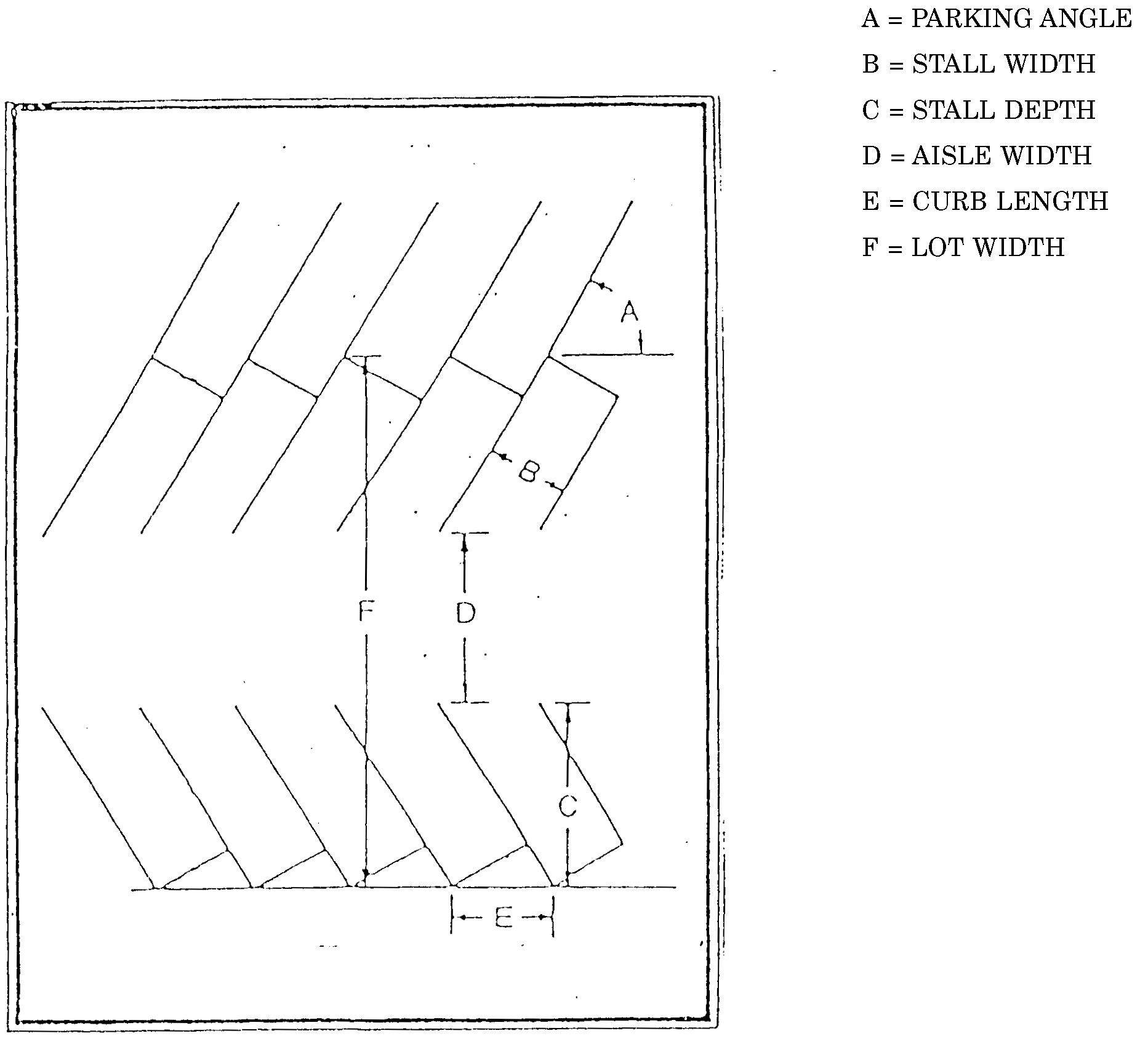
Standard and compact parking spaces shall be sized according to Table 5.02.07-A and as shown by the accompanying illustration.
2.
Parallel parking spaces shall be a minimum of eight (8) feet wide and twenty-two (22) feet long. If a parallel space abuts no more than one (1) other parallel space, and adequate access room is available, then the length may be reduced to twenty (20) feet.
3.
Tandem parking spaces must be a minimum of nine (9) feet wide and twenty (20) feet long.
4.
A standard motorcycle parking space shall be four and one-quarter (4¼) feet wide and nine and one-quarter (9¼) feet long.
5.
Spaces for handicapped parking shall be the size specified in F.S. § 316.1955.
6.
The standard off-street loading space shall be ten (10) feet wide, twenty-five (25) feet long, provide vertical clearance of fifteen (15) feet, and provide adequate area for maneuvering, ingress, and egress. The length of one or more of the loading spaces may be increased up to fifty-five (55) feet if full-length tractor-trailers must be accommodated. Developers may install spaces that are larger than the standard, but the number of spaces shall not be reduced on that account.
7.
The Planning Commission may modify these requirements where necessary to promote a substantial public interest relating to environmental protection, heritage conservation, aesthetics, tree protection, or drainage.
C.
Layout.
1.
Pedestrian and bicycle circulation facilities, roadways, driveways, and off-street parking and loading areas shall be designed to be safe and convenient.
2.
Parking and loading areas, aisles, pedestrian walks, landscaping, and open space shall be designed as integral parts of an overall development plan and shall be properly related to existing and proposed buildings.
3.
Buildings, parking and loading areas, landscaping and open spaces shall be designed so that pedestrians moving from parking areas to buildings and between buildings are not unreasonably exposed to vehicular traffic.
4.
Landscaped, paved, and gradually inclined or flat pedestrian walks shall be provided along the lines of the most intense use, particularly from building entrances to streets, parking areas, and adjacent buildings. Pedestrian walks should be designed to discourage incursions into landscaped areas except at designated crossings, however, the use of shaded or landscaped walkways that sequester pedestrians from traffic between parking or the street to the building entrance is encouraged.
5.
Each off-street parking space shall open directly onto an aisle or driveway that, except for single-family and two-family residences, is not a public street.
6.
Aisles and driveways shall not be used for parking vehicles, except that the driveway of a single-family or two-family residence shall be counted as a parking space for the dwelling unit, or as a number of parking spaces as determined by the Development Administrator or designee based on the size and accessibility of the driveway.
7.
The design shall be based on a definite and logical system of drive lanes to serve the parking and loading spaces. A physical separation or barrier, such as vertical curbs, may be required to separate parking spaces from travel lanes.
8.
Parking spaces for all uses, except single-family and two-family residences, shall be designed to permit entry and exit without moving any other motor vehicle.
9.
No parking space shall be located so as to block access by emergency vehicles.
10.
Compact car spaces should be located no more and no less conveniently than full size car spaces and shall be grouped in identifiable clusters.
D.
Parking Lot Surfaces.
1.
All required parking shall be improved with one (1) of the alternative parking surfaces, listed below. The type of surface allowed is dependent upon the type of land use and/or the total Gross Floor Area (GFA) of the buildings on the site.
a.
Asphalt.
b.
Concrete.
c.
Milled asphalt.
d.
Gravel.
e.
Grass (overflow beyond required parking).
2.
Commercial buildings with five thousand (5,000) square feet or less of GFA for the total site shall use anyone (1) of the surfaces listed in paragraph 1.
3.
Commercial buildings with more than five thousand (5,000) square feet of GFA for the total site shall use one (1) of the following surfaces:
a.
Asphalt.
b.
Concrete.
c.
Grass (overflow only beyond required parking)
4.
Minor residential developments of less than ten (10) dwellings, shall use anyone (1) of the parking surfaces listed in paragraph 1.
5.
Major residential developments of ten (10) or more dwellings, shall use one (1) of the following parking surfaces:
a.
Asphalt.
b.
Milled asphalt.
c.
Concrete.
6.
Places of worship are allowed up to fifty (50) percent of the total required parking to be a grass surface. All surplus parking at a place of worship maybe on a grass surface.
7.
Low Impact Development applications for parking areas shall be included to address stormwater runoff to the maximum extent feasible. Said applications may include, but not limited to;
a.
Swales.
b.
Rain gardens.
c.
Depressed center medians that accept water.
d.
Permeable pavement.
Where gravel, shell, or similar materials are used, the application and/or property owner shall be responsible for maintaining said material at proper depth and compaction functional for parking. They shall also be responsible from removing any such materials which go onto adjoining properties and/or into stormwater and drainage areas.
(Ord. No. 2023-16, § 1(Exh. A), 12-14-2023)
5.02.08 - Bicycle and pedestrian access.
A.
When required.
1.
All Planned Unit Developments (PUD's) shall provide sidewalks adjacent to all roadways. Sidewalks shall also be provided where feasible and appropriate along all roadways in or near residential areas. Location of sidewalks shall be consistent with planned roadway improvements.
2.
All major subdivision projects abutting collector or arterial roadways shall provide sidewalks adjacent to the collector or arterial roadway.
3.
Sidewalks shall be provided on both sides of all paved residential streets where the average lot width at the street is sixty (60) feet or less.
4.
Sidewalks shall be provided on one (1) side of all paved residential streets where the average lot width at the street is greater than sixty (60) feet but less than one hundred fifty (150) feet.
5.
Where a proposed development includes improvements or new construction of collector or arterial facilities, facility designs shall include provision for sidewalks or bikeways within the right-of-way.
6.
Residential projects adjacent to or in the immediate vicinity of an activity center comprised of commercial, office, service, or recreation activities maybe required by the Planning Commission to provide pedestrian and bicycle access from the development to the activity center.
7.
Pedestrian-ways or crosswalks, not less than ten (10) feet wide with a sidewalk meeting the requirements of this Code, may be required by the Development Administrator or Planning Commission to be placed in the center of blocks more than eight hundred (800) feet long when deemed necessary to provide circulation or access to residential centers and schools, employment and retail commercial areas, transportation, recreation, and other public facilities.
8.
Sidewalks shall be provided on all newly constructed roadways where feasible and appropriate along all roadways in or near residential areas which, lead to 1) schools; 2) commercial centers; and 3) employment centers, and on all newly paved roads within any residential subdivision, and where the need for such facilities have been identified by the Planning Department.
B.
Design and Construction Standards. Design and construction of sidewalks, bikeways, or other footpaths shall conform to the requirements of the most recent edition of the FDOT Design Manual or Florida Greenbook, as well as provisions for access by physically handicapped persons.
(Ord. No. 2023-16, § 1(Exh. A), 12-14-2023)
Code of Ordinances reference—Traffic and vehicles, Ch. 66.
5.03.01 - Generally.
Mandatory requirements of the State of Florida Department of Environmental Protection for installation, inspection, operation, and maintenance of on-site wastewater treatment systems shall be met in addition to the requirements contained in this Section and in Article III of this Code and Washington County Ordinance Nos. 88-2 and 85-7 as amended.
A building permit is not issued by the Building Department until the Florida Department of Environmental Protection approves a permit for placement of a septic tank on the proposed development site. If the proposed development is to be connected to an urban wastewater treatment facility, a letter of availability for the connection to the central sewer service must be submitted during the permit application process. The private electrical companies providing service in the County coordinate to ensure implementation of this ordinance by not providing connection to electrical service unless final building permit approval has been received.
(Ord. No. 2023-16, § 1(Exh. A), 12-14-2023)
5.03.02 - Existing wastewater systems and septic tanks.
Existing septic tank and package treatment plants may remain in service until central service is available except as necessary to comply with F.AC. Ch. 10D-6, with regard to the compulsory hookup with a central wastewater system. Except as may otherwise be provided by law, such hookups shall be commenced and completed within six (6) months of availability.
Package treatment plants are essentially small treatment systems, which have a collection network, treatment plant, and disposal system. Package plants may be designed to provide any level of treatment, but plants providing secondary treatment are most commonly used. Package plants are available in a range of capacities up to one million (1,000,000) gallons per day. They serve isolated development and are usually partially or completely preassembled by the manufacturer prior to shipment to the site of use. New construction of package wastewater plants must meet the relevant standards established by the State of Florida and the Federal government and must connect to central wastewater treatment facilities within five (5) years of central wastewater facilities becoming available. In Washington County, new package plants shall be permitted only when the developer of such temporary package treatment plant enters into a legally binding agreement wherein the developer or a homeowners' association assumes responsibility for the proper maintenance and operation of the plant, agreeing to construct, provide services, and maintain the facility according to FDEP rules and standards.
(Ord. No. 2023-16, § 1(Exh. A), 12-14-2023)
5.03.03 - Siting and installation requirement and limitations.
A.
For areas not characterized by severely rated soils, use of septic tank systems for new development shall be limited to areas where central service or package plants are not available in accordance with FDEP septic tank rules, and shall only be permitted subsequent to the receipt of all applicable FDEP permits.
B.
Use of package treatment plants shall be limited to areas where central sewer systems are not available, and septic tanks are prohibited due to severely rated soils, land uses proposing generation or processing of hazardous waste or high density or intensity use (based upon FDEP rules). The installation of such facilities shall only be permitted by the County subject to the receipt of all applicable FDEP permits.
C.
For areas characterized by severely rated soils, the County may require that alternative types of septic tanks, including anaerobic systems and alternative drain fields, be required for development proposing densities of greater than one-half (.50) dwelling unit per acre (unless central facilities are required by the Florida Department of Environmental Protection).
D.
Septic tanks which are proposed for nonresidential use shall not exceed the sewage flow limitations of the FDEP.
E.
Placement of new wastewater treatment facilities and tanks shall be evaluated forts adverse impacts on aquifer recharge and discharge areas, and their vulnerability to contamination shall be assessed before any development is permitted.
F.
No package treatment plants or onsite sewage disposal systems can be installed where central sewer service exists or within the one-hundred-year floodplain, in conservation lands, or within five hundred (500) feet of potable water well.
(Ord. No. 2023-16, § 1(Exh. A), 12-14-2023)
5.03.04 - Central sewer and water installation.
Densities exceeding two (2) dwelling units per acre, if available, shall be required to have central sewage or water.
(Ord. No. 2023-16, § 1(Exh. A), 12-14-2023)
5.03.05 - Level of service standards.
The County adopts the average daily flow in the Infrastructure Element of the Comprehensive Plan as the level of service standards for central potable water facilities serving unincorporated and incorporated areas of the County. For proposed subdivision design, the design rate shall be three hundred fifty (350) gallons per dwelling unit per day.
(Ord. No. 2023-16, § 1(Exh. A), 12-14-2023)
5.04.01 - Standards.
The location, design, and operation of each water well or distribution systems for human consumption shall meet the requirements of the Florida Department of Environmental Protection and Washington County.
(Ord. No. 2023-16, § 1(Exh. A), 12-14-2023)
5.04.02 - Permits renewed.
A permit for a well or water system serving two (2) or more dwelling units, or serving a firm having more than five (5) employees, is in effect for a period of one (1) year. A permit shall be renewed by a contractor licensed to test water and inspect wells and water systems. Such wells or water systems shall, at a minimum, comply with the applicable requirements of all applicable regulations of the FDEP.
(Ord. No. 2023-16, § 1(Exh. A), 12-14-2023)
[5.05.01 - Water conservation.]
A.
Development projects for which a central water system is being developed, shall utilize a reclaimed water system where available, or where service extension is feasible for uses not requiring potable water. The lowest acceptable water quality shall be utilized for the purpose intended.
B.
All new construction and all remodeling activities shall utilize fixtures conforming to the following schedule of maximum water usage, consistent with the Florida Building Code:
Also, see Section 4.08.00 of this Code entitled Water Conservation.
(Ord. No. 2023-16, § 1(Exh. A), 12-14-2023)
[5.06.01 - Stormwater management/drainage improvement.]
A.
Generally. A complete drainage plan shall be submitted by the developer and be approved by the County Engineer. These plans shall show sufficient documentation including elevations and topographic information to demonstrate the capability of the drainage system to collect, control, and dispose of storm runoff. The plan shall include erosion control measures and calculations of water flow velocities in unpaved areas. The drainage system will include all catch basins, manholes, inlets, headwalls, bridges, pipes, settling basins, holding ponds, swales, green belted open space, etc., deemed necessary by the County Engineer. The drainage system shall be based upon the facilities necessary to control and/or dispose runoff in accordance with the performance standards contained in Section 5.06.00 of Article V of this Code and restated below. Rainfall data shall be obtained from the Florida Department of Transportation rainfall curves. The developer's engineer shall certify that the stormwater system has been designed in accordance with the applicable sections of the Washington County Land Development Code.
B.
Performance Standards. All development must be designed, constructed, and maintained to meet the following performance standards:
1.
While development activity is underway and after it is completed, the characteristics of stormwater runoff shall approximate the discharge rate of stormwater runoff that occurred under the site's natural unimproved or existing state (and value in closed basins).
2.
The proposed development and development activity shall not violate the water quality standards as set forth in F.AC chapters 17-3 and 17-25.
3.
Silviculture and agricultural uses shall be required to use best management practices pursuant to Silviculture: Best Management Practices Manual (State of Florida, Division of Forestry, June 1989) as may be revised, and to prevent drainage and pollution problems.
4.
Stormwater management/drainage facilities shall, where feasible, utilize Low Impact Development techniques and shall be installed by the developer which have been designed in accordance with good engineering principals to adequately provide for proper and necessary drainage of all surface water. The design shall include all drainage facilities within the limits of said development, plus all off-site facilities necessary to fully and finally dispose of all runoff such that the following level of service standards (LOS) are maintained for the applicable development types:
a.
Tire engineer for the development shall provide modeling to demonstrate that the stormwater facilities attenuate the twenty-five-year pre/post for the critical storm up to the twenty-four-hour event for all open projects within Washington County. The stormwater pond design shall demonstrate that the weir or combination of weir and berms will not be compromised during the one-hundred-year storm event.
b.
The engineer for the development design shall provide modeling to demonstrate that the stormwater facilities attenuate the one-hundred-year pre/post for the critical storm up to twenty-four-hour event for all closed basin projects within Washington County.
c.
The engineer shall provide a design with modeling to accommodate off-site runoff through the development by routing it around the developed site or accepting it in the stormwater facilities for discharge that will not cause impacts to the downstream properties.
d.
Best management practices (in accordance with the Division of Forestry's Silviculture Best Management Practices) will be complied with to control agricultural runoff, erosion, and sedimentation from agriculture and silviculture lands and unpaved roads. These implementing mechanisms include, but are not necessarily limited to:
i.
Water turnouts and broad-based dips being used to direct runoff and sediment from dirt road surfaces into the surrounding woods and away from surface waters.
ii.
Water bars being utilized to perform the same function for skid trails and fire breaks.
iii.
Structural solutions such as properly controlled vegetated swales, detention and retention ponds, etc., are being utilized when necessary.
iv.
Dirt roads being closed and stabilized with vegetation when they are no longer in use.
v.
Dirt roads, skid trails, and fire trails being avoided in environmentally sensitive areas such as wetlands.
LOS A indicates that there is no significant street flooding.
LOS B indicates that there is no major residential yard flooding.
6.
Low Impact Development (LID) techniques shall be applied, where feasible and practical, as a primary way to address stormwater run-off. Secondarily, artificial lakes, recharge wells, swells, or other means to allow absorption of stormwater shall be utilized otherwise.
Installation of culverts at the developer's expense will be required where alteration of wetlands is necessary in order to allow reasonable use of property. Installation will only occur after being approved by the County Engineer.
(Ord. No. 2023-16, § 1(Exh. A), 12-14-2023)
[5.07.01 - Soil erosion.]
A.
Performance Standards.
1.
Off-site migration of soil particles during and after all construction activities, and which originate from dirt roads, shall be eliminated.
2.
National Resources Conservation Service (NRCS) and U.S. Forestry Service Best Management Practices shall be followed during agricultural and silvicultural activities. Such practices shall reduce erosion and sedimentation of soils into wetlands and water bodies.
3.
Erosion and sedimentation controls, including staked hay bales, shall be used during construction.
4.
The developer shall be required to utilize USDA-NRCS standards and specifications in the design for grading, site development, landscaping involving earth moving, sediment control, vegetation establishment and other measures involved with the development plan to reduce on- and off-site erosion and sediment damage caused by the development. The developer shall also be required to authorize periodic on-site inspection of sediment control measures by the Development Administrator and his/her authorized agents, as it is deemed necessary. Deviation from the approved plan will not be made without authorization from the Development Administrator.
(Ord. No. 2023-16, § 1(Exh. A), 12-14-2023)
[5.08.01 - Easements.]
A.
Utility easements along rear and/or side lot lines ten (10) feet or greater in width shall be provided as needed.
B.
Where a subdivision is traversed by a water course, drainage way, channel, or stream, there shall be provided as needed a stormwater or drainage easement conforming substantially with the lines of such watercourse, but not less than twenty (20) feet in width and such further width as will be adequate for the purpose of protecting and utilizing such features.
C.
Where indicated in the Comprehensive Plan, and in such other areas as the BOCC and developers may agree, pedestrian and service easements shall be provided. Such pedestrian and service easements may include, or be included in, easements required under A or B above.
D.
Where utilities are placed in easements, no fences, or structures of a permanent nature shall be located on or within such easement without the approval of all utilities having right to said easement. In the event of approval of such occupation, the utility shall have the right to remove such improvement without approval and/or compensation being made to the property owner.
(Ord. No. 2023-16, § 1(Exh. A), 12-14-2023)
[5.09.01 - Wildfire mitigation plan.]
A wildfire mitigation plan will be submitted for all proposed developments of twenty (20) or more acres, based on minimum Division of Forestry Standards.
(Ord. No. 2023-16, § 1(Exh. A), 12-14-2023)

