Villa Park City Zoning Code
ARTICLE 23
22.- ACCESSORY DWELLING UNITS5
Editor's note— Ord. No. 2023-629, § 3, adopted June 27, 2023, repealed the former Article 23-22, §§ 23-22.1—23-22.4, and enacted a new Article 23-22 as set out herein. The former Article 23-22 pertained to similar subject matter and derived from Ord. No. 95-430 and Ord. No. 2005-514; and Ord. No. 2018-608, § 4, adopted May 22, 2018.
Sec. 23-22.1.- Purpose and Intent.
In accordance with California Government Code §§ 65852.1, 65852.2, and 65852.22, the City intends for this article to provide for the creation of accessory dwelling units on properties zoned for residential and mixed use. The purpose of this article is to provide for additional housing opportunities for development of low- and moderate-income housing for the community in keeping with the Housing Element of the Villa Park General Plan and State law.
(Ord. #2023-629, § 3)
Sec. 23-22.2. - General Provisions.
a.
The following definitions shall apply to this Article:
1.
"Accessory dwelling unit" means an attached or a detached residential dwelling unit that provides complete independent living facilities for one (1) or more persons and is located on a lot with a proposed or existing primary residence. It shall include permanent provisions for living, sleeping, eating, cooking, and sanitation on the same parcel as the single-family or multifamily dwelling is or will be situated. An accessory dwelling unit also includes the following:
(a)
An efficiency unit, as defined in Section 17958.1 of the Health and Safety Code.
(b)
A manufactured home, as defined in Section 18007 of the Health and Safety Code.
2.
"Accessory structure" means a structure that is accessory and incidental to a dwelling located on the same lot.
3.
"Junior accessory dwelling unit" means a unit that is at least one hundred fifty (150) square feet and no more than five hundred (500) square feet in size and contained entirely within a single-family residence. A junior accessory dwelling unit may include separate sanitation facilities or may share sanitation facilities with the existing structure.
4.
"Living area" means the interior habitable area of a dwelling unit, including basements and attics but does not include a garage or any accessory structure.
5.
"Passageway" means a pathway that is unobstructed clear to the sky and extends from a street to one (1) entrance of the accessory dwelling unit.
6.
"Proposed dwelling" means a dwelling that is the subject of a permit application and that meets the requirements for permitting.
7.
"Public transit" means a location, including, but not limited to, a bus stop or train station, where the public may access buses, trains, subways, and other forms of transportation that charge set fares, run on fixed routes.
8.
"Tandem parking" means that one (1) or more automobiles are parked on a driveway or in any other location on a lot, lined up behind one another.
b.
An accessory dwelling unit that conforms to the requirements of this Article shall not be considered to exceed the allowable density for the lot upon which such unit is proposed to be established and shall be deemed a residential use that is consistent with the existing general plan and zoning designations for the lot.
c.
In accordance with State law, this Article shall not be considered in the application of any local ordinance, policy, or program to limit residential growth.
(Ord. #2023-629, § 3)
Sec. 23-22.3. - Ministerial Review.
Applications for accessory dwelling units that are consistent with the provisions of this Article will be considered as ministerial actions requiring the issuance of a building permit. The Planning Department shall approve or disapprove an application for an accessory dwelling unit permit within sixty (60) days after receiving the complete application except when the accessory dwelling unit is proposed in conjunction with a proposed new single-family dwelling unit, in which case the Planning Department may delay acting on the accessory dwelling unit until the single-family dwelling is approved. If the applicant requests a delay, the sixty-day time period shall be tolled for the period of the delay. A building permit shall only be issued upon finding that the plan for the accessory dwelling unit complies with all requirements of this Article.
(Ord. #2023-629, § 3)
Sec. 23-22.4. - Applicability.
The applicant for an accessory dwelling unit shall be the owner of the primary dwelling of the lot on which the accessory dwelling unit is proposed to be established, or his/her/their authorized agent. Additionally, the lot on which the accessory dwelling unit is proposed to be established shall:
a.
Be located in a zoning district allowing for residential dwelling units.
b.
Contain, or propose to establish, one (1) residential dwelling unit, which is the primary dwelling, and which conforms to all applicable zoning regulations for the zoning district in which the lot is located except as modified herein. However, per State law, between January 1, 2020 and January 1, 2025, the City shall not require the correction of nonconforming zoning issues as a condition for approval of a permit application for the creation of an accessory dwelling unit or a junior accessory dwelling unit.
c.
Have no more than one (1) accessory dwelling unit and one (1) junior accessory dwelling unit located on it at any time.
(Ord. #2023-629, § 3)
Sec. 23-22.5. - Standards and Criteria for Accessory Dwelling Units within Existing Structures.
a.
The following standards and criteria shall apply to all accessory dwelling units to be located within the proposed or existing space of a single-family dwelling, or within existing accessory structures, including garages, storage areas, or similar uses:
1.
The accessory dwelling unit is located within the proposed space of a new single-family dwelling or existing space of a single-family dwelling or accessory structure and may include an expansion of not more than one hundred fifty (150) square feet beyond the physical dimensions as of the existing structure to accommodate ingress and egress only;
2.
Maintains independent exterior access from the proposed or existing single-family dwelling;
3.
Maintains sufficient side and rear setbacks for fire and safety as determined by the Building Official. No setback shall be required for an existing living area or accessory structure or a structure constructed in the same location and to the same dimensions as an existing structure that is converted to an accessory dwelling unit or to a portion of an accessory dwelling unit.
(Ord. #2023-629, § 3)
Sec. 23-22.6. - Standards and Criteria for Accessory Dwelling Units.
The following standards and criteria shall apply to all proposed accessory dwelling units. Notwithstanding these requirements, all residential lots shall be permitted to develop at least one (1) attached or detached accessory dwelling unit.
a)
Location on Lot. An accessory dwelling unit may be permanently attached or detached from the primary dwelling.
b)
Height, Setback, and Building Separation. Unless otherwise specified in this Article, an accessory dwelling unit, including conversion of existing space within a primary dwelling, shall comply with the height, setback, and building separation standards of the applicable zoning district in which the lot is located.
c)
Size Limitations and Lot Coverage.
1.
Accessory dwelling units shall not exceed the following size restrictions:
(a)
For properties under one (1) acre in size, one thousand two hundred (1,200) square feet for detached accessory dwelling units. One thousand two hundred (1,200) square feet for attached accessory dwelling units, or fifty (50) percent of the primary unit, whichever is less.
(b)
For properties one (1) acre and larger in size, one thousand five hundred (1,500) square feet for detached accessory dwelling units. One thousand five hundred (1,500) square feet for attached accessory dwelling units, or fifty (50) percent of the primary unit, whichever is less.
(c)
Five hundred (500) square feet for junior accessory dwelling units.
(d)
Attached ADUs shall be subject to relevant zoning height restrictions. Detached one (1) story ADUs shall be no taller than sixteen (16) feet in height, however ADUs within one-half (½) mile walking distance of a major transit stop or high-quality transit corridor may be permitted to a height of eighteen (18) feet, including ADUs with a roof pitch matching the existing or proposed primary dwelling unit.
(e)
Two (2) story detached ADUs shall be permitted to a maximum roof height of thirty (30) feet.
(f)
Roof overhangs for detached ADUs may project up to thirty (30) inches into any required setback area.
2.
Accessory dwelling units shall be a minimum of one hundred fifty (150) square feet.
3.
ADUs eight hundred (800) square feet and smaller shall not count towards lot coverage or FAR requirements. ADUs exceeding eight hundred (800) square feet in size shall count towards lot coverage and FAR requirements for their applicable zone.
d.
Parking. One (1) parking space shall be required for attached and single story detached accessory dwelling units. Existing parking may count toward this requirement, and the parking space may be provided as tandem parking on a driveway. One (1) additional parking space shall be required for detached two-story accessory dwelling units. Notwithstanding this parking requirement, the City shall not impose parking standards for an accessory dwelling unit in any of the following instances:
1.
The accessory dwelling unit is located within one-half (½) mile walking distance of public transit.
2.
The accessory dwelling unit is part of the proposed or existing primary residence or an accessory structure.
3.
When on-street parking permits are required but not offered to the occupant of the accessory dwelling unit.
4.
When there is a car share vehicle located within one (1) block of the accessory dwelling unit.
Additionally, when a garage, carport, or covered parking structure is demolished in conjunction with the construction of an accessory dwelling unit, no off-street replacement parking spaces shall be required.
e.
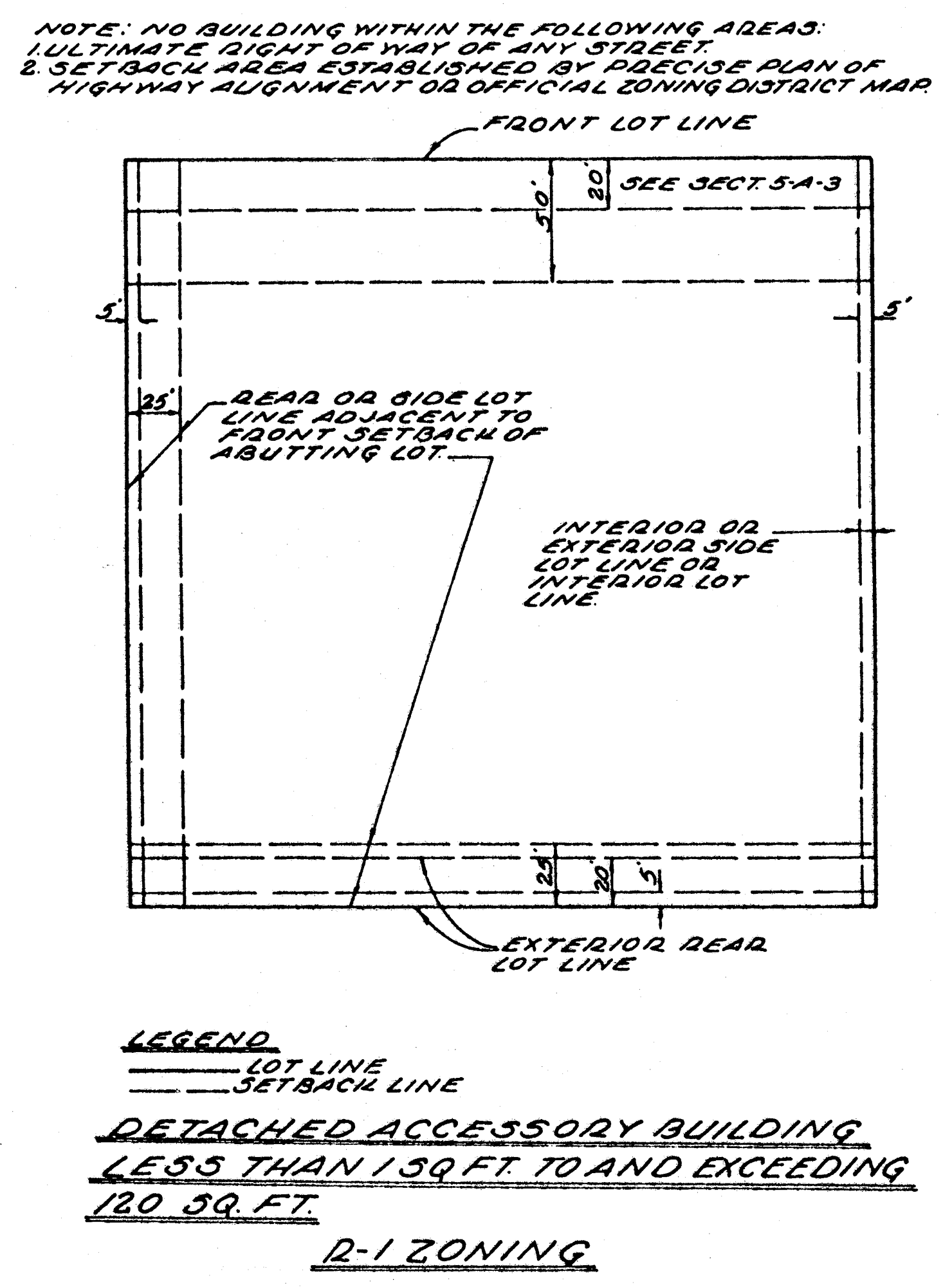
Setbacks. All attached accessory dwelling units shall maintain the front yard setback for the applicable zoning district in which the lot is located. Attached ADUs and single story detached ADUs shall maintain a minimum four-foot setback on the side and rear yards for an accessory dwelling unit not converted from an existing structure or a new structure constructed in the same location and to the same dimensions as an existing structure. Two story detached accessory dwelling units shall maintain a ten-foot side and rear yard setback. All detached ADUs shall maintain fifty-foot front yard setbacks, however the front yard setback shall not unduly constrain the creation of ADUs. The Planning Department shall determine if a front yard setback is unduly constraining the creation of an ADU.
f.
Same owner-occupancy requirements shall not be required as provided by California Government Code Section 65852.2.
g.
Rental Term. No portion of a property containing an accessory dwelling unit may be rented for a term of less than thirty (30) days.
h.
Mobile Homes/Recreational Vehicles. Neither the primary dwelling nor the proposed accessory dwelling unit shall be a mobile home or recreational vehicle, unless as otherwise specified herein.
i.
Exterior Design. The design of the accessory dwelling unit, including, but not limited to, building form, materials, exterior finishes, color scheme, and landscaping shall be substantially similar to the primary dwelling.
j.
Unless otherwise specified by this Article or State law, accessory dwelling units shall comply with all provisions of the underlying zoning district and all regulations required for the primary single-family dwelling unit, including but not limited to all applicable building and construction requirements. Accessory dwelling units shall not be required to provide fire sprinklers if they are not required for the primary residence.
k.
An address shall be obtained for all new ADUs separate from the main dwelling, with the exception of junior ADUs.
l.
Sale of ADUs. The City of Villa Park does not allow the separate sale of ADUs under AB 1033.
(Ord. #2023-629, § 3; Ord. #2023-630, § 2)
Sec. 23-22.7. - Standards and Criteria for Junior Accessory Dwelling Units.
The following requirements shall apply to junior accessory dwelling units:
a.
Only one (1) junior accessory dwelling unit may be constructed per residential lot zoned for single-family residences with a single-family residence built, or proposed to be built, on the lot.
b.
Same owner-occupancy shall not be required in the single-family residence in which the junior accessory dwelling unit will be permitted.
c.
A junior accessory dwelling unit may only be permitted to be constructed within the walls of a proposed or existing residence.
d.
A junior accessory dwelling unit shall include a separate entrance from the main entrance to the proposed or existing residence.
e.
A junior accessory dwelling unit shall include an efficiency kitchen, which shall include all of the following:
1.
A cooking facility with appliances.
2.
A food preparation counter and storage cabinets that are of reasonable size in relation to the size of the junior accessory dwelling unit.
f.
No additional parking is required for a junior accessory dwelling unit.
g.
The following are perpetual requirements that run with the land, and a restrictive covenant establishing the following requirements shall be recorded, with proof of recordation presented to the Planning Department, prior to issuance of a final building permit for the junior accessory dwelling unit:
1.
A prohibition on the sale of the junior accessory dwelling unit separate from the sale of the single-family residence, including a statement that the deed restriction may be enforced against future owners.
2.
A restriction on the size and attributes of the junior accessory dwelling unit that conforms with this Article.
(Ord. #2023-629, § 3; Ord. #2023-630, § 2)
Sec. 23-22.8. - Fees.
a.
Accessory dwelling units shall not be considered to be a new residential use for the purposes of calculating connection fees or capacity charges for utilities unless the accessory dwelling unit was constructed with a new single family dwelling.
b.
The City shall not impose any impact fee upon the development of an accessory dwelling unit that is less than seven hundred fifty (750) square feet in size. Any impact fees charged for an accessory dwelling unit of seven hundred fifty (750) square feet or more shall be charged proportionately in relation to the square footage of the primary dwelling unit.
c.
The Planning Department shall waive all planning processing and building plan check fees for an accessory dwelling unit or junior accessory dwelling unit in any of the following situations:
1.
The applicant voluntarily records a perpetual restrictive covenant running with the land that establishes that the owner of the property on which the accessory dwelling unit and/or junior accessory dwelling unit is located shall reside in one (1) of the dwelling units on the property as the principal residence as long as the condition of the accessory dwelling unit and/or junior accessory dwelling unit remains on the property. This covenant shall be recorded, with proof of recordation presented to the Planning Department, prior to issuance of a final building permit for the accessory dwelling unit.
2.
When an existing garage or carport is converted to an accessory dwelling unit and/or junior accessory dwelling unit and the applicant voluntarily provides replacement parking spaces for at least two (2) on-site covered parking spaces for the primary residence in conformance with Article 23-15.
(Ord. #2023-629, § 3)