
Villa Park City Zoning Code
ARTICLE 23
6.- E-4 SINGLE-FAMILY RESIDENTIAL ESTATE AND R-1 SINGLE-FAMILY RESIDENTIAL ZONE REGULATIONS
Sec. 23-6.1.- Purpose and Intent.
The E-4 Zone is established to provide for the development of medium-low density single-family residential neighborhoods in which open spaces and deep setbacks predominate. The R-1 Zone is established to provide for the development of medium-density single-family residential neighborhoods. Only those additional uses are permitted that are complementary to, and can exist in harmony with, a residential neighborhood.
Sec. 23-6.2. - Principal Uses Permitted.
Any of the following principal uses:
a.
Single-family dwellings (one (1) per building site);
b.
Parks and playgrounds, public and private (noncommercial);
c.
Riding and hiking trails;
d.
Horticulture of all types (noncommercial); and
e.
Emergency shelters.
(Ord. #2012-567, § 2; Ord. #2016-604, § 4)
Sec. 23-6.3. - Principal Uses Permitted Subject to a Conditional Use as Provided in Article 23-19.
Any of the following principal uses:
a.
Communication equipment buildings;
b.
Community television receiving and distribution systems;
c.
Educational institutions;
d.
Public utility and public service substations, reservoirs, pumping plants and similar installations not including public utility offices;
e.
Fire, paramedic and police stations;
f.
Microwave radio and television relay transmitters;
g.
Natural gas booster stations;
h.
Private water pumping stations;
i.
Noncommercial kennels;
j.
Public libraries;
k.
Sewage lift stations;
l.
Recreational courts in compliance with the regulations provided in Article 23-17;
m.
Wholesale nurseries and related uses;
n.
Accessory buildings and structures necessary and customarily incidental to a principal use permitted in residential zones in compliance with the regulations provided in section 23-6.10.
(Ord. #98-451, § 1; Ord. #99-466, § 1; Ord. #2012-567, § 3)
Sec. 23-6.4. - Temporary Uses Permitted in Compliance with the Regulations Provided in Article 23-6 or Article 23-11.
a.
Model homes, model home sales complex, temporary real estate offices, and signs within subdivisions;
b.
Mobile home residence during construction;
c.
Continued use of an existing building during construction of a new building on the same building site;
d.
Real estate signs;
e.
Christmas tree sales facilities;
f.
Fireworks sales facilities;
g.
Animal husbandry or agricultural educational projects.
Sec. 23-6.5. - Accessory Uses Permitted.
Any of the following customary uses and structures:
a.
Detached private garages and carports, in compliance with the regulations provided in section 23-6.10.
b.
Swimming pools and spas, in compliance with the regulations provided in section 23-6.12.
c.
Fences and walls, in compliance with the regulations provided in sections 23-25.5 and 23-6.13.
d.
Home occupations in compliance with the regulations provided in Article 23-14.
e.
Antennae and towers in compliance with the regulations provided in section 23-6.8.
f.
Exterior lighting in compliance with the regulations provided in Article 23-17.
g.
Detached accessory buildings in compliance with the regulations provided in section 23-6.10.
h.
Signs in compliance with the regulations provided in Article 23-16.
i.
Accessory uses, buildings and structures necessary and customarily incidental to a principal use permitted in residential zones in compliance with the regulations provided in section 23-6.10.
j.
Accessory dwelling units in compliance with Article 23-22.
k.
Temporary stands for the sale of horticultural products grown or produced on the premises where sold upon the following conditions:
1.
The stand shall not be in place for a period of more than one hundred and twenty (120) days in any one calendar year.
2.
The floor area of the stand shall not exceed one hundred (100) square feet.
3.
The stand shall be exclusively of wood frame type construction.
4.
The owner shall remove such stand at his expense when it is not in use.
5.
No stand shall be less than twenty (20) feet from the right-of-way line of any street or highway.
l.
Fallout shelters may be located on any portion of the building site, provided that:
1.
The shelter is constructed in accordance with plans approved by the Building Official, and as such used only during an actual or imminent enemy attack by nuclear device, or during a practice test of same authorized and conducted by the proper public authorities; and
2.
If the shelter is located in the front one-half of the lot, it shall be entirely under the unmounded ground surface, except for such openings as required by the approved plans; and
3.
No shelter shall be constructed within the ultimate right-of-way of any highway shown on the Master Plan of Arterial Highways.
m.
Any other accessory use or structure permitted by and in compliance with the regulations provided in subsection 23-6.10.
(Ord. No. 95-431, § 2; Ord. #2018-608, § 2; Ord. #2023-629, § 2)
Sec. 23-6.6. - Accessory Uses Permitted Subject to a Conditional Use Permit as Provided in Article 23-19.
Any other accessory use or structure not expressly permitted in subsection 23-6.5 may be permitted subject to a conditional use permit as provided in Article 23-19.
Sec. 23-6.7. - Property Development Standards: Residential Zones.
The following property development standards shall apply to all land and buildings other than accessory buildings, permitted in their respective residential zones. Each building site shall have a minimum twenty (20) foot wide vehicular access to a street with the exception of panhandle flag lot sites which shall have minimum twenty (20) foot wide vehicular access to a street.
In computing the depth of a rear setback from any building where such setback opens on an alley, private street or public park, one-half of the width of such alley, street or park may be deemed to be a portion of the rear setback, except that under this provision, no rear setback shall be less than fifteen (15) feet.
(Ord. #88-375; Ord. #91-395, § 1; Ord. No. 2000-473, § 1; Ord. #2002-482, § 3; Ord. #2004-503, § 1; Ord. #2013-580, § 2; Ord. #2017-606, § 2; Ord. #2019-614, § 2; Ord. #2019-615, §§ 2, 3)
Sec. 23-6.8. - Performance/Standards: Residential Zones.
a.
Pets in Residential Zones. In all residential zones, the keeping of pets of a type readily classifiable as being customarily incidental to a permitted principal residential use is permitted when no commercial activity is involved in compliance with this section.
b.
Temporary Animal Husbandry or Agricultural Educational Project. A temporary agricultural or animal husbandry activity or project conducted primarily for educational purposes or school credits shall be permitted in any residential zone, as well as those areas designated for residential, and use within a PC-Planned Community Zone, subject to the following conditions:
1.
The issuance of a use permit approved by the Zoning Administrator as provided in Article 23-19.
2.
Said use permit shall not be granted for a period of time exceeding two (2) years from the date of final determination of the application.
3.
The fee for the use permit shall be as provided by ordinance or resolution of the City Council.
c.
Equine Animals. The keeping of equine animals for recreational purposes only is hereby permitted provided no equine shall be permitted on a building site containing less than ten thousand (10,000) square feet of land area. The number of equine kept for noncommercial purposes is established as follows:
Lot square footage relates to that which is owned or leased contiguous land in the aggregate. The maximum number of adult equine for any one (1) building site shall be six (6). The offspring of such animals shall be considered adults when eight (8) months old.
d.
Wild and Exotic Animals. The keeping of wild, exotic or nondomestic animals shall be prohibited in all R Zones.
e.
Antennae and Towers in R Zones. In all R Zones, antennae and support masts and/or towers may be installed, erected and maintained subject to the following regulations:
1.
An antenna supported by a mast, the combined height of which when extended to its maximum height does not exceed twenty (20) feet above the highest part of the roof of the main buildings, provided that the antenna length, width, and height are not greater than fifteen (15) feet by ten (10) feet by five (5) feet, or
2.
An antenna with a single vertical radiating element attached to a mast, the combined height of which extended to its maximum height is less than twenty-five (25) feet above the highest point of the roof of the main building with each ground plane radial not exceeding ten (10) feet in length located at the base of the vertical radiating element.
3.
The location of any antenna and mast or tower on the property shall be restricted so that if the antenna and mast or tower were to fall down when extended to its maximum extension, it would fall completely within the property of the antenna owner and could not possibly fall on any other property not owned by the antenna owner or on any overhead power line.
f.
Lighting. Lighting in all R Zones designed or maintained primarily for security or safety may be operated twenty-four (24) hours a day provided that the lighting is designed, constructed, mounted and maintained so that the direct rays of the light are directed to the interior of the lot and do not extend beyond the property lines of the lot and that the individual bulbs used for such security lighting shall not exceed sixty (60) watts.
g.
Satellite Receiving Antennas and Small Diameter Satellite Receiving Antennas.
1.
Purposes. Consistent with federal mandates specified in 47 C.F.R. 25.104, these regulations are designed to provide local regulation of satellite receiving antennas and small diameter satellite receiving antennas in order to protect the health, safety, and welfare of the people of the City by regulating the size, height, location, and amount of screening placed around satellite receiving antennas. These standards foster the City's safety and aesthetic interests without imposing unreasonable limitations on, or preventing the reception of, satellite-delivered radio and television signals, or imposing excessive costs on applicants seeking to install satellite receiving antennas or small diameter satellite receiving antennas.
2. Findings:
(a) The City Council of the City of Villa Park finds and declares that local regulation of satellite receiving antennas is necessary for the following reasons:
(i) Villa Park is a premier residential community. The aesthetic beauty of the residential areas in the City contributes to high property values and has helped to establish the City as a desirable community in which to live. Failure to maintain the aesthetic beauty of the community would lessen the desirability of the community and result in lower property values. The land use policies in the general plan and zoning ordinances of the City of Villa Park seek to enhance the aesthetic quality of the City's residential neighborhoods. These policies are to be implemented, in part, through the ordinances which, to the maximum extent permitted by law, regulate or restrict the placement of satellite receiving antennas and other visually obtrusive objects.
(ii) Satellite receiving antennas differ from other antennas in that their size, shape, weight and overall bulk tend to more dramatically disrupt the visual environment than other telecommunications equipment because: (1) they significantly impact the views of the surrounding community; (2) they create the impression of a reduction in open space; and (3) their appearance is inconsistent with the character and aesthetics of the residential neighborhoods in the City.
(iii) Satellite receiving antennas present a safety hazard to the community if placed in an improper location. Satellite receiving antennas placed at an elevated location are susceptible to strong winds and may be blown loose and cause injuries. Satellite receiving antennas, if improperly located, could reduce views from public streets and alleys or cause significant glare from reflected sunlight and create significant risks to motorists and pedestrians. Satellite receiving antennas, if located to be easily accessible and visible to children, may act as an attractive nuisance and tempt children to pay with sensitive electronic equipment.
(b) The City Council of the City of Villa Park finds and declares that local regulation of small diameter satellite receiving antennas is necessary for the following reasons:
(i) In addition to their unsightly appearance, small diameter satellite receiving antennas present a health and safety hazard to the community if placed in an improper location. Small diameter satellite receiving antennas placed at an elevated location are susceptible to strong winds and may be blown into public streets. Small diameter satellite receiving antennas, if improperly located, could reduce views of public streets and alleys or cause significant glare from reflected sunlight and create substantial risks to motorists and pedestrians. Small diameter satellite receiving antennas, if located to be easily accessible and visible to children, may act as an attractive nuisance.
3. Required Criteria and Performance Standards for Satellite Receiving Antennas. The following regulations shall apply to the establishment, installation, and operation of satellite receiving antennas in all R zones:
(a) No portion of a satellite receiving antenna or supporting structure shall be located in any front yard, street side yard, or extend beyond the property line. No satellite receiving antenna shall be located in any required setback area. A satellite receiving antenna shall be located in the rear one-half of the building site. However, if the rear of the building site borders a public street or park, the satellite receiving antenna shall be located in the middle one-third of the lot as measured from the front property line to the rear property line. Guy wires shall not be anchored within any front yard area but may be attached to a building on the property upon which the satellite receiving antenna is to be located.
(b) All satellite dish antennas, including support structures, and wiring shall be completely screened from the view of adjacent properties or from public/private roadways through the use of walls, fences and/or landscape materials.
(c) A satellite receiving antenna and supporting structures shall be located and designed to minimize the visual impact to surrounding properties and public streets. A satellite receiving antenna and supporting structures shall not be painted in reflective or bright colors, or in color(s) with high contrast to the surrounding area, and shall be treated so as not to reflect glare from sunlight.
(d) A satellite receiving antenna shall be adequately grounded for protection against a direct strike of lightning.
(e) No more than one satellite receiving antenna shall be permitted on a building site.
(f) No advertising material shall be allowed on any satellite receiving antenna.
(g) The maximum satellite receiving antenna diameter permitted shall be ten (10) feet.
(h) The maximum height of a satellite receiving antenna shall be fifteen (15) feet as measured from the highest point of the circumference or extension of the satellite receiving antenna to grade level.
(i) No satellite receiving antenna shall be mounted on the roof, top, or side of any building. All satellite receiving antennas shall be placed at ground level. "Ground level" shall mean that the bottom of the receiving antenna shall be no more than twelve (12) inches off the ground.
(j) All satellite receiving antennas shall be permanently mounted and no antennas may be installed on a portable or movable structure.
4. Required Criteria and Performance Standards for Small Diameter Satellite Receiving Antennas. Notwithstanding any provisions in this section to the contrary, small diameter satellite receiving antennas may be installed and operated in the additional following locations in all R zones if the following criteria and performance standards are met:
(a) Small diameter satellite receiving antennas may be roof-mounted. All roof-mounted small diameter satellite receiving antennas shall be mounted on the rear one-half of the building site or the rear one-half of the building that is farthest from the front property line. However, if the rear of a building site borders a public street or park, the small diameter satellite receiving antenna shall be located in the middle one-third of the lot as measured from the front property line to the rear property line. If mounted on a sloping roof, the small diameter satellite receiving antenna must be mounted on the side of the roof which faces the rear of the property, on the lower two-thirds of the roof plane to which it is attached, and below the roof ridge or peak. Roof-mounted small diameter satellite receiving antennas shall not exceed the height limit for the zone.
(b) Small diameter satellite receiving antennas may be mounted on the side of a structure. The antenna must face the rear or side yard and not intrude into any setback area.
Except as set forth in this section, all provisions in section 23-6.8, subsection 3., applicable to satellite receiving antennas shall apply to small diameter satellite receiving antennas.
5. Permits.
(a) Satellite receiving antennas or small diameter satellite receiving antennas are permitted in all R zones if the applicant obtains a building permit from the Building Official and the structure's design is pursuant to the Uniform Building Code. Satellite receiving antennas and small diameter satellite receiving antennas that do not conform to the development standards in section 23-6.8, subsections 3. or 4., respectively, require the applicant to additionally obtain a conditional use permit subject to the requirements of Villa Park Municipal Code section 23-19.
(b) Any person requesting a conditional use permit for the placement of a satellite receiving antenna or small diameter satellite receiving antenna shall submit an application in accordance with the requirements of section 23-19.5, and shall supplement the required application with the following:
(i) Detailed plans showing the proposed location of the antenna in relation to the main buildings or structures on the property, the property lines, the property setback lines, and the adjoining properties' buildings or structures;
(ii) A statement of the reasons why strict conformance with the development standards specified in section 23-6.8, subsection 3. or 4. will: (1) unreasonably limit, or prevent, reception of satellite signals; or (2) result in excessive expense in light of the cost of purchase and installation of the satellite receiving antenna or small diameter satellite receiving antenna.
(c) The City shall approve a conditional use permit for any satellite receiving antenna or small diameter satellite receiving antenna if strict compliance with the development standards in section 23-6.8, subsection 3. or 4., either: (1) will result in unreasonable limitations on, or prevent, reception of satellite delivered signals; or (2) the cost of strict compliance with the development standards would be excessive.
(d) In the event the applicant demonstrates that strict compliance would unreasonably restrict or prevent reception of signals, or result in excessive costs, the City shall issue the permit subject to any conditions necessary or appropriate to minimize the impact of the installation of the antenna, provided the conditions do not unreasonably prevent or limit reception of signals or result in excessive costs.
6. Nonconforming Satellite Receiving Antennas. Satellite receiving antennas and small diameter satellite receiving antennas in existence as of the effective date of this section shall be considered legal and nonconforming. Nonconforming satellite receiving antennas and small diameter satellite receiving antennas may be modified, relocated, or replaced only if they are brought into compliance with the provisions of this section, unless the modification, relocation, or replacement is necessary to permit reasonable use of the antenna and, in such an event, a conditional use permit is obtained prior to any such modification, relocation, or replacement. Any satellite receiving antenna or small diameter satellite receiving antenna erected in violation of any prior law, ordinance or regulation in effect at the time it was erected is a public nuisance subject to abatement under the procedures set forth in the Villa Park Municipal Code section 6-1.
7. Separability. If any section, subsection, sentence, clause, or phrase of this section is for any reason held to be invalid or unconstitutional by a decision of a court of competent jurisdiction, such decision shall not affect the validity of the remainder of the section.
h. Landscaping. Except for driveways, paved walkways and parking areas, all of the required front and street-side setback areas shall be landscaped. In single-family residential zones, driveways, paved walkways and parking areas shall not cover more than fifty (50) percent of the required front or street-side setback areas. Any pervious or semi-pervious surface which is part of or within a driveway or parking area shall not be considered to be landscaping. All required landscaping shall be permanently maintained in a neat and orderly condition. Residential properties and lots must provide landscaping with the following minimum standards:
1.
Front yards shall be landscaped with softscape in conjunction with hardscape material, which includes lawn (grass or turf), and a combination of shrubs, trees, ground cover, plant materials, and mulch recognized within the American Standards for Nursery Stock, published by the American Association of Nurserymen.
(a)
Natural lawn and turf may be substituted with a durable synthetic turf or artificial grass. Said grass and turf shall be installed in a professional manner that allows water to permeate and pass through the turf so as not to cause runoff onto adjacent properties or the public right-of-way, or cause flooding or pooling of water. Synthetic turf or artificial grass shall be maintained in a condition that resembles its natural counterpart.
(b)
Hardscape shall refer to the permanent, man-made features of a landscape design made of stone, rock, pavers, or like material. Hardscape areas that do not permeate water, such as cement, or similar material, shall not be credited toward the fifty (50) percent landscape requirement.
2.
Vacant as well as owner and renter occupied properties must be kept to these performance standards. Conditions must be weed-free, and free of dirt mounds, building materials, grass clippings, or other "fill" material.
3.
Rear yards must be maintained free of weeds and overgrown plants and shrubs that may constitute a fire hazard, as determined by the Fire Marshal or any assigned designee. Installation of softscape, hardscape, or xeriscape is recommended for rear yards, but not required.
i.
Garage Doors. Generally, street-facing garage doors occupy a major portion of a residence's ground floor façade and can have a significant impact on the overall appearance of the structure, as well as the streetscape in a neighborhood. In order to minimize the visual impacts of the garage doors, care should be taken in selecting a design and style that is well-integrated into the architectural motif of the residence.
Garage doors that are eight (8) feet, one (1) inch in height or more, are subject to a conditional use permit, pursuant to the provisions of Article 23-19, and the following minimum design guidelines:
1.
Should visually relate to the overall architectural design of the residence.
2.
Should be from the same paint color palette used for the residence.
3.
Articulation and ornamentation is encouraged to provide visual interest for the residence and to the streetscape. This can be accomplished with color accents and architectural features and treatments, including, but not limited to pediments, moldings, overhangs and recessing of the doors.
4.
Sectional, paneled garage doors are strongly encouraged.
(Ord. #85-343, § 2; Ord. #86-349, § 1; Ord. #91-394, § 3; Ord. #95-427, § 1; Ord. #96-439, § 2; Ord. #2002-482, §§ 4, 5; Ord. #2010-551, § 2; Ord. #2019-614, § 3)
Sec. 23-6.9. - Signs: R Zones.
No sign or outdoor advertising structure shall be permitted in any R Zone except as provided in subsections 23-11.1 and 23-16.5.
Sec. 23-6.10. - Accessory Uses: R Zones.
a.
Detached Private Garage, Carport and Accessory Building; Height. A detached private garage, carport or accessory building shall not exceed one (1) story or a maximum of fifteen (15) feet in height.
b.
Detached Private Garages, Carports and Accessory Buildings; Construction and Placement. The construction or placement of detached private garages, carports and accessory buildings on any building site used for residential purposes in E-4 and R-1 Zones shall conform to the regulations set forth below and in Schedule I, except as otherwise specified in this Chapter.
1.
Detached private garages, carports and accessory buildings may be constructed or placed in any portion of a building site in an E-4 or R-1 Zone except within the following areas:
(a)
Within the ultimate right-of-way, as defined, shown as existing on the Master Plan of Arterial Highways or within the ultimate right-of-way, as defined, or any local or private street;
(b)
Within the setback area established by the provisions of this Chapter or by the designation of a building line on a precise plan of highway alignment or an official zoning map.
2.
Application for Conditional Use Permit. A conditional use permit is required for any accessory building or structure in excess of fifteen (15) feet in height, necessary and customary or incidental to a principal use permitted in residential zones and not otherwise exempt by law, and shall be filed in accordance with the provisions of Article 23-19 of Chapter XXIII.
3.
Administrative Approval. Any accessory building or structure fifteen (15) feet in height or less, necessary and customary or incidental to a principal use permitted in residential zones and not otherwise exempt by law, or covered by other provisions of this Chapter, may be approved by the City Manager after site plan review for conformity with the provisions of this Chapter.
4.
Attachment to Primary Structure. If any detached private garage, carport or accessory building is subsequently sought to be attached to a primary structure, it must either conform to all regulations for the primary structure or approval must first be obtained by a conditional use permit, in accordance with Article 23-19 of Chapter XXIII.
(See Schedule I.)
(Ord. #99-459, § 1; Ord. #99-466, § 2; Ord. #2013-580, § 2)
Schedule I. Detached Private Garages, Carports and Accessory Buildings;
Distances From Certain Lot Line
*In no event shall a detached accessory building be placed within a front yard, or side or rear yard abutting a street, easement or front yard of an adjoining lot when the yard does not have a screening fence or landscape screening to conceal it from view.
(See Samples in Appendix)
(Ord. #2004-498, § 1; Ord. #2004-501, § 1)
Sec. 23-6.11. - Reserved.
Editor's note— Ord. #2024-632, §1, adopted Aug. 27, 2024, repealed § 23-6.11, which pertained to walls and fences: R Zones and derived from Ord. #86-353, § 1; Ord. #96-438, § 1; Ord. #2003-494, § 1; and Ord. #2009-545, § 1.
Sec. 23-6.12. - Swimming Pools.
Swimming pools may be located on any portion of a building site except within those areas where fences and walls are limited to a maximum height of three and one-half (3½) feet as specified in the zone regulations or in subsection 23-25.5 or within three (3) feet of any property line or ultimate right-of-way line.
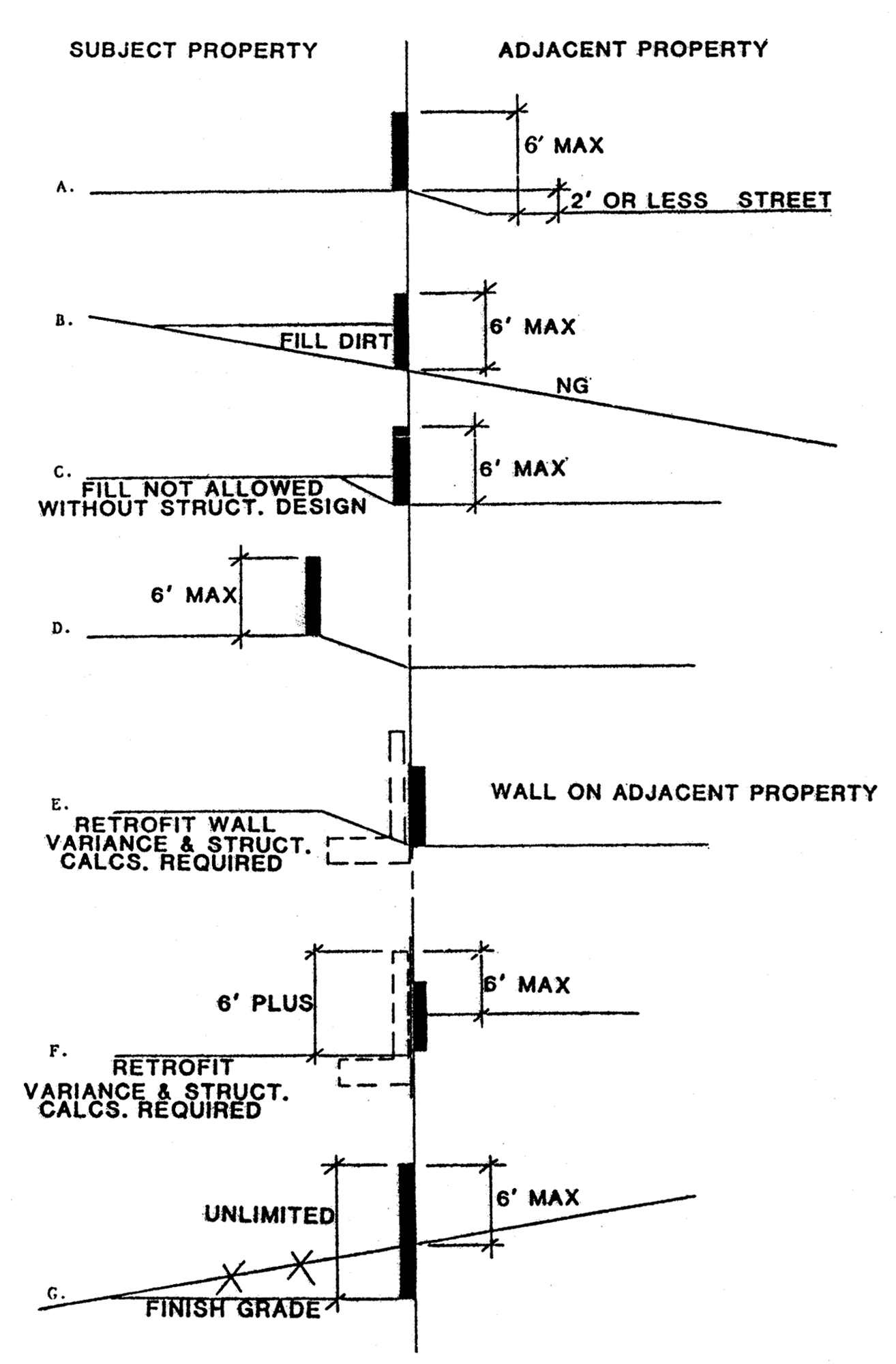
Subject and Adjacent Property with Wall on Adjacent Property
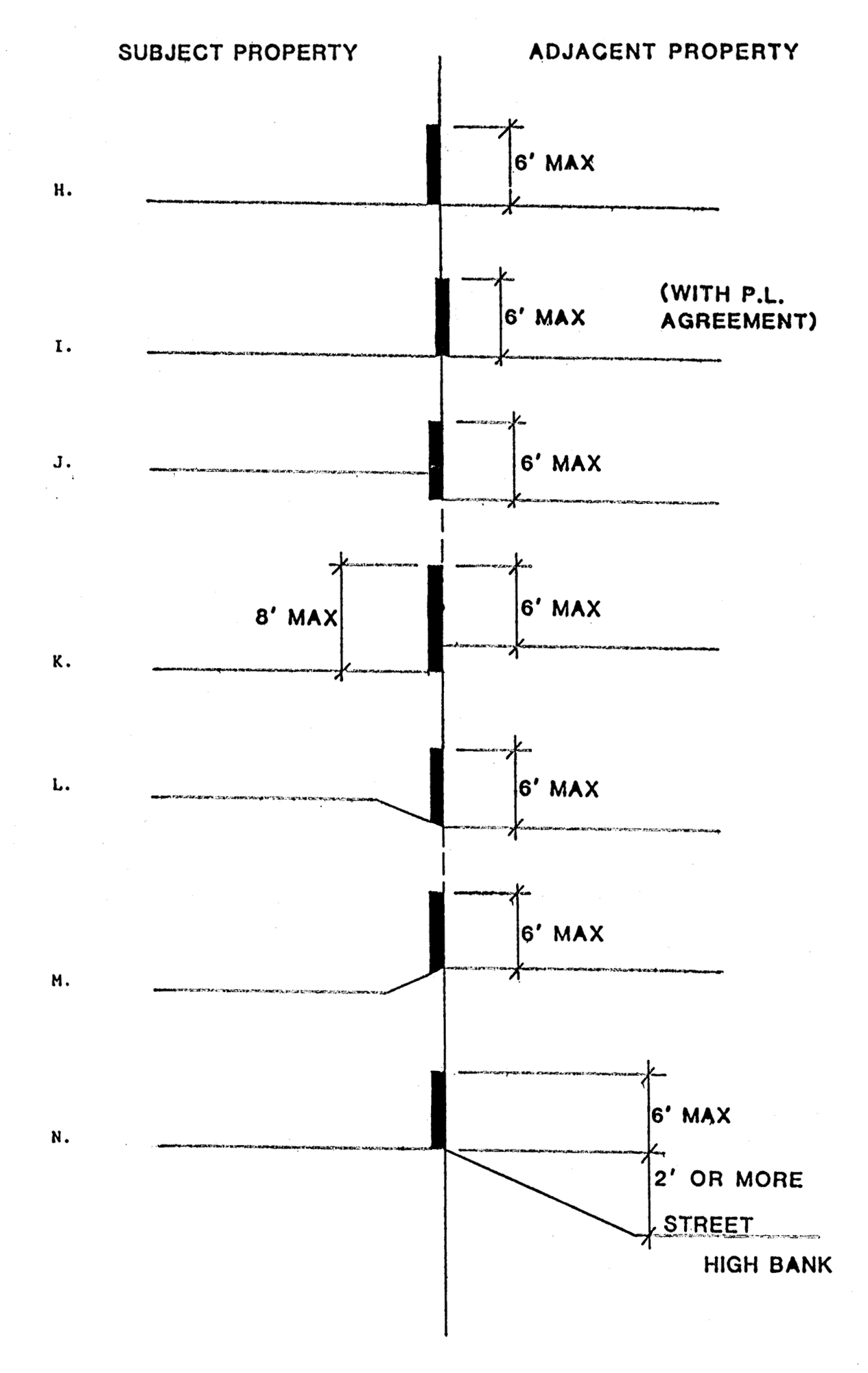
Subject and Adjacent Property with P.L. Agreement
Sec. 23-6.13. - Swimming Pool Enclosures.
a.
Enclosure Required. Every person in possession of land within the City, either as owner, purchaser under contract, lessee, tenant, licensee, or otherwise, upon which is situated a swimming pool or other out-of-doors body of water designed, constructed and used for swimming, dipping or immersion by men, women, or children, having a depth in excess of eighteen (18) inches, shall maintain in good condition an enclosure or fence of any material or design, except as hereinafter provided substantially constructed, not lower than five (5) feet in height above the surface of the ground measured vertically from the outside grade and completely surrounding such a pool or body of water.
b.
No opening between vertical members of a wood, metal picket, stake or other fence shall exceed five (5) inches between members. No opening between horizontal members of a wood, metal or other fence shall exceed two (2) inches between members. If a fence combining vertical and horizontal members meets either the vertical or horizontal requirements of this subsection, it shall be deemed to meet the requirements of this subsection.
EXCEPTION: Chain link and masonry type fences are excepted from the provisions of this subsection.
c.
All enclosures and gates shall extend to within two (2) inches of firm soil or within four (4) inches of pavement.
d.
Gates, Doors and Latches. All gates or doors opening through a swimming pool enclosure shall be equipped with a self-closing and self-latching device designed to keep such door or gate securely closed at all times when not in actual use. The unlocking or unlatching device shall be located not less than five (5) feet above grade or steps at the gate or door measured vertically outside the enclosed area. This shall include any passage door or gate opening from an accessory building, such as a garage.
EXCEPTIONS:
1.
The unlocking or unlatching device may be located on the inside of the enclosure at less than the required five (5) feet in height, when not openable from the outside of the enclosure.
2.
Self-closing and self-latching devices shall not be required on doors leading from a dwelling unit into the pool area.
3.
Double gates installed across vehicular accessways shall be self-closing and shall be equipped with a latching device which may be manually operated. Such gates shall be securely closed at all times when not in actual use.
e.
Approval. Plaster inspection or approval to fill the pool with water shall be withheld by the Building Official until there has been compliance with all fencing and other requirements of this subsection.
f.
Fence Maintenance. Any pool enclosed by a fence which does not meet the requirements of this subsection shall be drained immediately and shall not be refilled until such time as the enclosure fence is brought into compliance with all provisions of this Code.
g.
Modification. Following written requires by the owner, the Building Official may modify or eliminate the foregoing requirements where, in the judgment of the Building Official, local conditions afford protection equivalent to that outlined in this subsection. The Building Official may require that evidence or proof in the form of affidavits or otherwise be submitted to substantiate or justify such requests and may apply reasonable conditions to insure ultimate compliance with this Code in the event of a change of conditions.
Sec. 23-6.14. - Building Site Requirements.
No building permit or certificate of use and occupancy shall be issued for a building or use of land until the Building Official has verified by official records that the parcel of land upon which such building or use of land is to be established is a building site.
a.
Any parcel of land that was established as a building site either by subdivision, division of land, deed of conveyance, contract of sale, or in any other legal manner; and which met all of the applicable requirements of all of the City and County ordinances in effect at the time of recordation in the office of the County Recorder shall be considered a building site.
b.
The creation of any building site shall conform to the following requirements:
1.
The building site shall be of sufficient size to meet the minimum area requirements for the zoning district in which it is located.
2.
Except as otherwise provided, those easements whose primary purpose is to provide vehicular or pedestrian access to other property shall not be included in calculating the width or area of the building site, and when a building site is divided by such an easement only the resultant portions which meet the applicable zone regulations shall be used as building sites.
3.
That portion of a panhandle or flag building site that is used for access purposes and is under forty (40) feet in width shall not be used in calculating the area of the building site.
4.
The building site shall have continuous abutment upon a street, road, highway or waterway of not less than twenty (20) feet and right of vehicular access for a continuous width of not less than twenty (20) feet upon a street or alley having a right-of-way width of not less than twenty (20) feet.
Sec. 23-6.15. - Establishing Zone-Symbols for Building Site Requirements.
In any zone the minimum required building site area or width may be different from that set forth in the regulations of the zone if so specified on the zoning map. Such specifications shall be shown in the following manner:
a.
A number preceding and connected by a hyphen with the zone symbol shall designate the minimum required building site width in feet.
Example: 100-E4
b.
A number following and connected by a hyphen with the zone symbol shall designate the minimum required building site area. Where the number is greater than one hundred (100), it shall indicate the net area in square feet; where the number is less than one hundred (100) it shall indicate the net area in net acres.
Example: E4-20,000
Sec. 23-6.16. - Building Site Reduced by Acquisition for Public Use.
a.
If a portion of building site containing no structures is acquired for public use by condemnation, dedication, purchase or any other means, the status of the remainder of the building site shall be determined as follows:
1.
If such remainder has eighty (80) percent or more of the required area and width, such remainder shall constitute a building site.
2.
If such remainder has less than eighty (80) percent but not less than fifty (50) percent of the required area or width, or both, but otherwise meets all of the requirements for a building site, the public agency concerned may file an application for a variance, whether or not the acquisition has been completed, to establish if such remainder shall constitute a building site.
3.
A property owner may apply for a variance at any time to establish the status of such remainder.
b.
If a portion of a building site improved with structures is acquired for public use by condemnation, dedication, purchase or any other means, the status of the remainder of the building site shall be determined as follows:
1.
If such remainder has eighty (80) percent or more of the required area and width, such remainder shall constitute a building site.
2.
If such remainder has less than eighty (80) percent but not less than fifty (50) percent of the required area or width, or both, but otherwise meets all of the requirements for a building site, the public agency concerned may file an application for a variance, whether or not the acquisition has been completed, to establish if such remainder shall constitute a building site.
3.
If such remainder has yards or distances between buildings which have eighty (80) percent or more of the depth or width, or both, required for each of such spaces, they shall constitute the required spaces.
4.
If such remainder has yards or distances between buildings which have less than eighty (80) percent but not less than sixty (60) percent of depth or width, or both, required for each of such spaces, the public agency concerned may file an application for a variance, whether or not the acquisition has been completed, to establish if such spaces shall constitute the required spaces.
Furthermore, the public agency concerned may file an application for a variance, whether or not the acquisition has been completed, to establish yards or distances, between buildings associated with structures to be relocated, consisting of less than eighty (80) percent but in no event less than sixty (60) percent of the depth or width, or both, required for such space.
5.
A property owner may apply for a variance at any time to establish the status of such remainders.
c.
Any conflict with the requirements of the zoning regulations other than those inherent in preceding paragraphs a. and b., caused by acquisition for public use by condemnation, dedication, purchase or any other means, shall be subject to approval by the Zoning Administrator as provided for in Article 23-20.
Sec. 23-6.17. - Determination of Building Site Width.
In any residential zone when a minimum building site width is required, such required width shall be determined by measuring the distance between the sidelines of the building site along a line parallel to a straight line joining the foremost points of the side property lines, and twenty (20) feet, at the closest point, from the ultimate street right-of-way line. However, in the case of a panhandle building site or a building site not abutting a street or alley and gaining access by an easement, the width of the building site shall be determined by measuring the distance across the building site along a straight line in any direction.
In any zone other than a residential zone, when a minimum building site width is required such required width shall be determined by measuring the distance between the points of intersection of the side property lines with the ultimate front street right-of-way.
Sec. 23-6.18. - Building Line Regulations for Main Buildings and Structures.
Main buildings and structures may be constructed or placed on any portion of a building site except within the following areas:
a.
Within the ultimate right-of-way, as defined, shown as existing on the Master Plan of Arterial Highways or within the ultimate right-of-way, as defined, of any local or private street;
b.
Within the setback area established by the designation of a building line on a precise plan of highway alignment or an official zoning map;
c.
Within the setback area designated by the applicable zoning regulations, unless otherwise specified.
Sec. 23-6.19. - Building Line Designation.
The building line shall be as designated on the official zoning map. If no such line is specified, the building line shall be at the designated distance from the ultimate right-of-way line, as defined, or the property line; as designated by the applicable zone regulations.
Sec. 23-6.20. - Exceptions to Building Lines Cited in Zone Property Development Standards.
The building line may be located closer to the property line or the ultimate street right-of-way line than the setback distance required by the Zone Development Standards, when otherwise specified by, and in compliance with, the regulations provided in subsections 23-6.21 and 23-6.22.
Sec. 23-6.21. - Building Line on Panhandle Building Site.
In the case of a panhandle building site, the building lines shall be set back a minimum of ten (10) feet from any property line, except as otherwise specified in this section.
Sec. 23-6.22. - Building Line on Shallow Building Site.
When a building site has an average depth of one hundred (100) feet or less but more than seventy-five (75) feet, any required front and rear building line setbacks need not be more than twenty (20%) percent of such average depth; and when a building site has an average depth of seventy-five (75) feet or less, any required front and rear building line setbacks need not be more than fifteen (15%) percent of such average depth, but in no event shall any required front or rear building line setback be less than five (5) feet.
Sec. 23-6.23. - Building Line on Narrow Building Site.
When a building site has an average width of less than fifty (50) feet, any required building line setback from the interior side property lines need not be more than ten (10%) percent of such average width but in no event less than three (3) feet.
Sec. 23-6.24. - Balconies, Decks, Porches, Terraces, Exterior Steps and Exterior Stairways.
Balconies, decks, porches, terraces, exterior steps in excess of thirty (30) inches in height, and exterior stairways, unroofed and unenclosed, may project not more than three (3) feet into any required side setback area or the distance required between buildings on the same building site and not more than five (5) feet into a required front or rear setback area, but in no event shall such balconies, decks, porches, terraces, exterior steps, or exterior stairways be closer than two (2) feet to any side property line or three (3) feet to any front or rear property line of a building site, when projecting into any required setback area.
Sec. 23-6.25. - Eaves, Cornices, Canopies and Cantilevered Roofs.
For main structures, eaves, cornices, canopies or cantilevered roofs may project a maximum of forty (40%) percent into any required side setback and twenty-five (25%) percent into any required front or rear setback, and forty (40%) percent into the space required between buildings on the same building site, but in no event shall such eaves, cornices, canopies, or cantilevered roofs be closer than two (2) feet to any front, side, or rear line of the building site when projecting into a required setback area.
For accessory structures, eaves, cornices, canopies or cantilevered roofs may project a maximum of thirty (30") inches into any required setback area. Accessory structures shall include, but not be limited to, detached private garages, carports, pool houses, sheds, and other similar accessory buildings.
(Ord. #2002-482, § 6)
Sec. 23-6.26. - Chimneys, Fireplaces, Wing Walls and Other Minor Architectural Features.
Masonry chimneys, fireplaces, wing walls and other minor architectural features, may project into any required front, side or rear setback area a maximum of two (2) feet.
Sec. 23-6.27. - Additional Story.
Where the average slope of a lot on the downhill side of a street is greater than one foot fall in four (4) feet of horizontal distance from the established street elevation at the front property line, an additional story will be permitted on the downhill side of any permitted main building which is on the downhill side of the street upon which the building site fronts.
Sec. 23-6.28. - Minor Structures and Mechanical Equipment.
Minor Structures and Mechanical Equipment such as trash enclosures, storage sheds or playhouses less than one hundred twenty (120) square feet, doghouses, play equipment, fountains, enclosed water heaters, barbecues, garden walls, air conditioners, pool filters, vents and other similar structures and mechanical equipment greater than six (6) inches in height shall not be located in any required setback in a residential area except as provided below:
a.
Minor structures and equipment less than six (6) inches in height, as measured from adjacent finished grade, may be located in any required front, side or rear setback;
b.
Minor structures and mechanical equipment exceeding six (6) inches in height, as measured from adjacent finished grade, may be permitted within any interior side or rear setback area by the Planning Director, through a site plan review application; provided, that no significant adverse impacts will result and provided that:
1.
Noise levels from mechanical equipment do not exceed fifty (50) dBA as measured from the closest property line;
2.
No part of any minor structure or mechanical equipment, exceeds six (6) feet in height as measured from adjacent finished grade;
3.
If located within a rear setback area that abuts a public or private street, the minor structure or mechanical equipment is not visible from the public or private street;
4.
No part of any mechanical equipment, including but not limited to pool/spa equipment and air conditioning/heating equipment, extends within three (3) feet of the property line; and
5.
No part of any minor structure extends within three (3) feet of the property line. However, minor structures (not mechanical equipment) may be allowed to abut the side or rear property line; provided, that the minor structure:
(a)
Is placed adjacent to an existing solid wall;
(b)
Does not exceed the maximum height of the adjacent solid wall, up to a maximum of six (6) feet;
(c)
Is less than one hundred twenty (120) square feet in size; and
(d)
Is located a minimum of three (3) feet from an adjacent structure.
(Ord. #2002-482, § 7)
Sec. 23-6.29. - Standards for Solar Energy Systems; Approval Process.
a.
Purpose.
1.
The purpose of this section is to create an expedited, streamlined permitting process for small residential rooftop solar energy systems, in accordance with California Civil Code Section 714 and California Government Code Section 65850.5.
2.
It is also the purpose of this section to promote and encourage the use of solar energy systems and to limit obstacles to their use, in accordance with the standards adopted by the City pursuant to this section and State law, while allowing the City to protect the public health and safety.
3.
It is hereby declared that in any instance where the provisions of this section conflict with any applicable State law or regulation, such State law or regulation shall govern.
b.
Definitions. The following definitions shall govern the meaning of words and phrases used herein:
1.
"Checklist of Requirements for Small Residential Rooftop Solar Energy Systems" or "Checklist" means the rules, regulations, guidelines, and checklist adopted by resolution of the City Council that sets forth implementing and additional requirements for small residential rooftop solar energy systems consistent with Section 65850.5 of the Government Code.
2.
"Director" means the director of the City's planning department, or successor City official or department responsible for the implementation of this section, as may be identified from time to time, in the Checklist of Requirements for Small Residential Rooftop Solar Energy Systems.
3.
"Electronic Submittal" means the utilization of one or more of the following:
a.
E-mail,
b.
The internet,
c.
Facsimile.
4.
"Small Residential Rooftop Solar Energy System" means all of the following:
a.
A solar energy system that is no larger than ten (10) kilowatts alternating current nameplate rating or thirty (30) kilowatts thermal.
b.
A solar energy system that conforms to all applicable state fire, structural, electrical, and other building codes as adopted or amended by the City and paragraph (iii) of subdivision (c) of Section 714 of the Civil Code, as such section or subdivision may be amended, renumbered, or re-designated from time to time.
c.
A solar energy system that is installed on a single or duplex family dwelling.
d.
A solar panel or module array that does not exceed the maximum legal building height.
5.
"Solar Energy System" has the same meaning set forth in paragraphs (1) and (2) of subdivision (a) of Section 801.5 of the Civil Code, as such section or subdivision may be amended, renumbered, or re-designated from time to time.
6.
"Specific, Adverse Impact" means a significant, quantifiable, direct, unavoidable impact, based on objective, identified, and written public health or safety standards, policies, or conditions as they existed on the date the application was deemed complete.
c.
Applicability. This section applies to the permitting of all small residential rooftop solar energy systems, as defined herein, in the City. Small residential rooftop solar energy systems legally established or permitted prior to the effective date of this section are not subject to the requirements stated herein, unless physical modifications or alterations are undertaken that materially change the size, type, or components of a small rooftop energy system in such a way as to require new permitting. Routine operation and maintenance or like-kind replacements shall not require a permit.
d.
Development Standards. In addition to the Checklist of Requirements for Small Residential Rooftop Solar Energy Systems, the following standards shall apply to each small residential rooftop solar energy system:
1.
Solar energy systems shall meet applicable health and safety standards and requirements imposed by state and local permitting authorities, consistent with Section 65850.5 of the Government Code.
2.
Solar energy systems for producing electricity shall meet all applicable safety and performance standards established by the California Electrical Code, the Institute of Electrical and Electronics Engineers, and accredited testing laboratories such as Underwriters Laboratories and, where applicable, rules of the Public Utilities Commission regarding safety and reliability.
3.
The City Manager may from time to time revise the Checklist of Requirements for Small Residential Rooftop Solar Energy Systems as long as any revisions are consistent with the most recently adopted resolution of the City Council adopting the Checklist, and are consistent with Section 65850.5 of the Government Code.
4.
The Checklist of Requirements for Small Residential Rooftop Solar Energy Systems shall be made available to the public during regular business hours at the Office of the City Clerk and by posting the Checklist on the City's web site.
d.
Application; Documents and Requirements. All documents required for the submission of an expedited solar energy system application shall be made available on the City's website. The applicant may submit the permit application and associated documentation to the City's planning department in person or by electronic submittal, together with any required permit processing and inspection fees. For electronic submittal, the City shall accept an electronic signature on all forms, applications, and other documentation in lieu of a wet signature by an applicant to the extent permitted by law and to the extent such electronic submittal complies with the requirements set forth in this section and the Checklist of Requirements for Small Residential Rooftop Solar Energy Systems.
e.
Review. Review of the application to install a solar energy system shall be limited to an expedited administrative, nondiscretionary review by the planning department of whether the application meets all health and safety requirements of local, state, and federal law. The requirements of local law shall be limited to those standards and regulations necessary to ensure that the solar energy system will not have a specific, adverse impact upon the public health or safety. If the Planning Director makes a finding based on substantial evidence, that a solar energy system could have a specific, adverse impact upon the public health and safety, the City may require the applicant to apply for a conditional use permit or other applicable license or permit.
f.
Approval Requirements.
1.
An application that satisfies the requirements of this section and the Checklist of Requirements for Small Residential Rooftop Solar Energy Systems shall be deemed complete upon confirmation by the Planning Director that the application and supporting documents are complete and meet the requirements of this section and the Checklist. Upon the Director's determination that an application is complete, the City's planning department shall approve the application and, in conjunction with the Building Department, issue all required permits or authorizations. Upon receipt of an incomplete application, the director shall issue a written correction notice detailing all deficiencies in the application and any additional information required to be eligible for expedited permit issuance.
2.
If the City denies an application for a use permit to install a solar energy system, the City shall make written findings based upon substantial evidence in the record that the proposed installation would have a specific, adverse impact upon the public health or safety, and there is no feasible method to satisfactorily mitigate or avoid the specific, adverse impact. The findings shall include the basis for the rejection of potential feasible alternatives of preventing the adverse impact.
3.
The decision of the Planning Director pursuant to paragraphs (1) and (2) above may be appealed to the City Council of this Code. As set by City Council resolution, a fee shall be paid and an application for appeal shall be made within ten (10) calendar days of the determination by the Planning Director.
g.
Inspections. For a small residential rooftop solar energy system eligible for expedited review, only one (1) inspection shall be required, which shall be done in a timely manner and may include a consolidated inspection, except that a separate fire safety inspection may be performed if the City does not have an agreement with a local fire authority to conduct a fire safety inspection on behalf of the fire authority. If a small residential rooftop solar energy system fails inspection, a subsequent inspection is authorized, however the subsequent inspection need not conform to the requirements of this section.
h.
Approval by Association Not Required. The City shall not condition approval for any solar energy system permit on the approval of a solar energy system by an association, as that term is defined in Section 4080 of the Civil Code.
(Ord. #2015-594, Exh. A)

