
Villa Park City Zoning Code
ARTICLE 23
25.- WALL AND FENCE REQUIREMENTS6
Editor's note— Ord. #2024-632, §2, adopted Aug. 27, 2024, amended Art. 23-25 in its entirety to read as herein set out. Former Art. 23-25, §§ 23-25.1—23-25.7, pertained to general fence requirements, and derived from Ord. #2009-538, § 1; Ord. #2009-545, § 1.
Sec. 23-25.1.- Intent.
The intent and purpose of the Wall and Fence Requirements Article is to ensure safe sight lines and to minimize the potential negative visual impact or hazards of tall or unsightly fences, walls and/or retaining walls.
(Ord. #2024-632, §2)
Sec. 23-25.2. - Permit Required.
Prior to commencing construction a wall or fence, plans shall be submitted and approved by the Planning, Engineering, and Building Departments, if necessary. Any new wall and fence over three (3) feet in height shall require review through the site plan review process. All construction of walls and fences must meet applicable requirements of the Villa Park Municipal Code.
(Ord. #2024-632, §2)
Sec. 23-25.3. - Exceptions.
The provisions of this article may not apply to:
a.
Temporary construction fences.
b.
Fences utilized to surround or enclose public utility installations, public schools, or other public buildings used for city or city-sponsored utility purposes. However, public schools are strongly encouraged to meet the approved materials requirements as outlined in subsection 23-25.4 a. below.
c.
Existing nonconforming walls and fences that are damaged or in need of repair/replacement. A wall or fence may be located in the exact location with the same material and height as the previous wall or fence so long as no more than fifty (50) percent of the wall or fence is replaced, the proposed wall or fence receives approval from the necessary City Department(s), and obtains all necessary permits.
(Ord. #2024-632, §2)
Sec. 23-25.4. - Materials.
a.
The following is a list of approved materials:
1.
Masonry materials, such as brick, textured or split faced block, stucco, tile (as a veneer), or similar materials (manufactured stone, slate, stamped concrete, etc.).
2.
Stone or rock.
3.
Wrought-iron and associated pillars (so long as they meet the required materials as listed).
4.
Wood or wood alternatives specifically manufactured as a fencing material.
5.
Vinyl specifically manufactured as fencing material.
6.
Glass, including glass block or tempered glass panels manufactured as a fencing material.
7.
Ironcraft wire fencing and similar materials as deemed appropriate by the Planning Department.
b.
While the following materials are prohibited in the front yard area or adjacent to the public right-of-way, they are permitted along the interior and rear yard areas not adjacent to a public right-of-way:
1.
Chain link.
2.
Plywood.
3.
Smooth-faced block or concrete walls unless veneered with any of the approved building materials as listed in subsection a. above.
4.
Fiberglass.
5.
Any materials not specifically identified in subsection a. above.
c.
The following materials are prohibited in all zones:
1.
Barbed wire, including concertina or razor wire.
2.
Electric fences; except where needed within the interior of a property for the keeping of large animals (where permitted).
d.
Design of Walls and Fences. Walls and fences shall be designed and constructed in a manner that incorporates offsets, varied textures, openings, recesses, and design accents to avoid long and unarticulated segments. The use of plant material and/or wall vines is acceptable if properly irrigated and maintained. All wall vines shall be maintained by the property owner.
(Ord. #2024-632, §2)
Sec. 23-25.5. - Clear View Requirements.
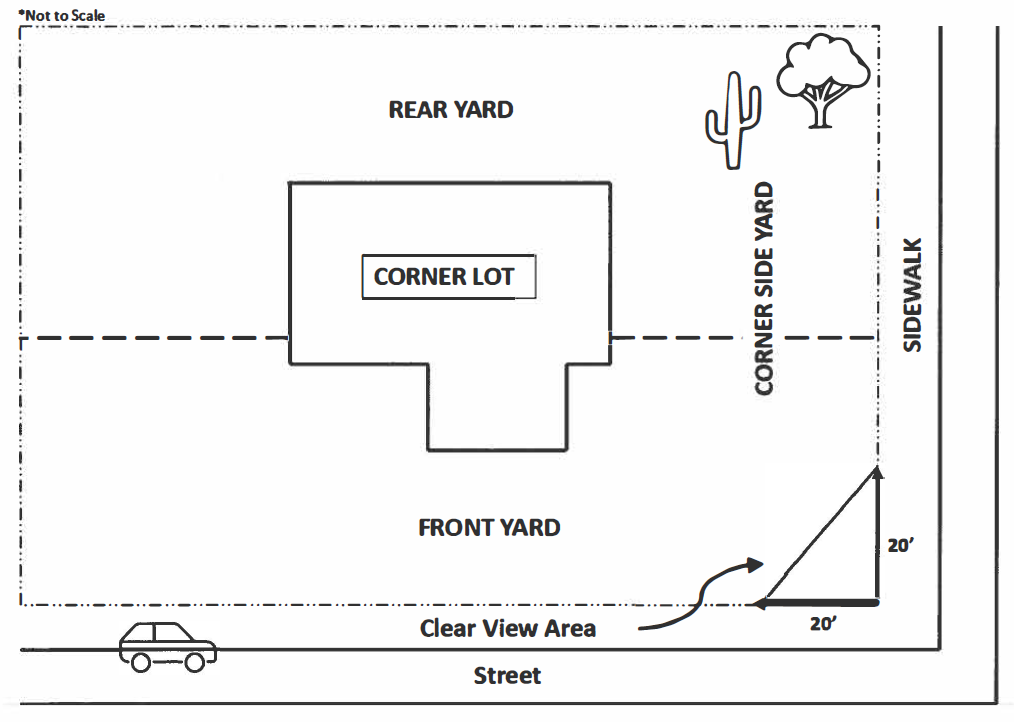
Clear view fencing requirements are intended to ensure safe sight line distances for both pedestrian and vehicular traffic in areas where such obstacles exist (i.e. fences, trees, landscaping). The following clear view requirements apply to all zones within the City:
a.
The maximum height of any wall or fence shall be three and one-half (3½) feet within twenty (20) feet of the point of intersection of two ultimate street right-of-way lines (see clear view illustration).
b.
Shrubs and hedges functioning like walls and fences shall be permitted within the clear view zone without height restrictions, however, shrubs and hedges functioning like a wall or fence may require review by a City Engineer to mitigate line of site issues (See Clear View Illustration: Exhibit A). Shrubs and hedges shall be properly maintained and irrigated by the property owner.
Clear View Illustration (Exhibit A):
(Ord. #2024-632, §2)
Sec. 23-25.6. - Fencing Height Restrictions in Residential Zones.
a.
The maximum height shall be three and one-half (3½) feet within any required front setback area, to a depth of twenty (20) feet as measured from the front property line; and six (6) feet within any required rear or side setback area beyond the front yard area. However, this regulation shall not apply to that portion of a building site where vehicular access rights have been dedicated to a public agency, or where a higher fence is required by law.
b.
Properties fronting Taft Avenue, Santiago Boulevard between Cannon Street, Meats Avenue and Lemon Street, Center Drive between Lincoln Street to Serrano Avenue, and Villa Park Road shall be permitted walls and fences of up to six (6) feet in height within the front setback area, to a depth of twenty (20) feet as measured from the front property line, unless located within a portion of the clear view zone (See Clear View Illustration: Exhibit A).
c.
Rear and side yard walls and fences adjacent to Cannon Street, Wanda Road from Santiago Boulevard to Villa Park Road, Villa Park Road, Meats Avenue, Collins Avenue, and Santiago Boulevard, from Wanda Road to Meats Avenue, shall be permitted to a maximum of eight (8) feet in height. Wall modifications must be reviewed by the City Engineer and will be required to provide for appropriate sight distances at any access points.
d.
The maximum height of any wall or fence constructed on a sloped or terraced elevation shall measure a minimum as required by law and a maximum of six (6) feet from the high side elevation and shall be unlimited on the low side elevation.
e.
Any wall or fence constructed within five (5) feet of any ultimate street right-of-way shall be limited to a maximum of six (6) feet as measured from street side, unless otherwise exempted by this section.
f.
The maximum height of any retaining wall shall be ten (10) feet in height, as measured from the lowest adjacent finished grade.
g.
Exceptions and modifications may be permitted subject to the approval of a variance. In addition to the findings made in the process of review and approval of such variance, the following findings shall also be made:
1.
The height and location of the retaining wall, wall, or fence as proposed will not result in or create a traffic hazard.
2.
The location, size, design and other characteristics of the wall or fence will not create conditions or situations that may be objectionable or detrimental to the Zone in which it is located.
h.
Shrubs and hedges functioning like walls and fences shall be permitted within the 20-foot front yard setback without height restrictions, however, shrubs and hedges functioning like a wall or fence may require review by a City Engineer to mitigate line of site issues. Shrubs and hedges shall be properly maintained and irrigated by the property owner.
i.
Lighting fixtures up to two (2) feet in height shall be permitted atop walls and fences within the front 20-foot setback area. Lighting fixtures shall not be permitted atop rear and side yard property line walls and fences, unless approved by a variance. Lighting fixtures shall be reviewed by city staff to ensure light pollution will not negatively impact neighbors. Approval of lighting fixtures within any 20-foot corner clear view area is subject to review by the Planning and Engineering Departments to mitigate line of site concerns for vehicular traffic.
j.
All driveway and vehicular gates shall maintain a 16-foot front setback from the flow line and shall not open towards the street. If a property fronts a sidewalk or pedestrian trail, the minimum front setback shall be twenty (20) feet from the flow line. If deemed necessary, a City Engineer will review new driveway gates for safety concerns prior to permit issuance.
k.
The height of any wall or fence shall be measured from the highest adjacent finished grade to the top of said wall or fence. The measurement shall be taken within two (2) feet of the base of the wall or fence.
(Ord. #2024-632, §2)
Sec. 23-25.7. - Fencing Height Restrictions in Nonresidential Zones.
In nonresidential zones, walls and fences shall be approved as part of the required site plan review process. If existing nonconforming fences are damaged or in need of repair, the wall or fence may be located at the exact location, with the same height as the previous wall or fence so long as the wall or fence is constructed using construction materials as approved in this section. The following standards shall also apply:
a.
Fences adjacent to a residential zone shall comply with the height restrictions found in subsection 23-25.6 e.
b.
In the CN Zone, the AC "Architectural Supervision" regulations and procedures found in Article 23-9 shall apply.
(Ord. #2024-632, §2)

