
Virginia Beach City Zoning Code
ARTICLE 2
- GENERAL REQUIREMENTS AND PROCEDURES APPLICABLE TO ALL DISTRICTS
B.- SIGN REGULATIONS[2]
Editor's note— Ord. No. 3442, adopted April 19, 2016, amended division B in its entirety to read as herein set out. Former division B, §§ 210—218, pertained to similar provisions. See Code Comparative Table for complete derivation.
Sec. 200.- Lots.
(a)
Density, lot coverage, floor area ratio and lot area. For purposes of determining allowable dwelling unit or lodging unit density, lot coverage, floor area ratio and minimum lot area requirements, the following shall be included:
(1)
Public and private utility easements, so long as the total width of the easement is twenty (20) feet or less;
(2)
Easements for ingress and egress in favor of others;
(3)
Special flood hazard areas;
(4)
Manmade drainage areas and the easements over them constructed primarily for storage and retention of stormwater runoff on the lot and conveyance from the lot except that only the first ten (10) feet of such areas closest to their boundary shall count toward minimum lot size requirements.
(b)
The following shall not be included in determining the allowable dwelling unit or lodging unit density, lot coverage, floor area ratio and minimum lot area requirements:
(1)
The floodway portion of any floodplain;
(2)
Any body of water except as mentioned above;
(3)
Any manmade drainage areas such as borrow pits and the easements over them constructed primarily for purposes other than storage and retention of stormwater;
(4)
Wetlands; and
(5)
Any part of a public or private utility easement whose total width is more than twenty (20) feet.
(c)
Floodplains subject to special restrictions pursuant to section 4.10 of the Floodplain Ordinance (Appendix K) shall not be included in determining minimum lot area requirements.
(d)
Lot width.
(1)
Lots abutting rights-of-way that are straight or where the radius of curvature is ninety (90) feet or more shall meet the following standards:
(i)
The width of the lot shall be determined by measuring across the rear of the required front yard. Each lot shall be configured so that a straight line drawn across the rear of the required front yard is equal to or greater in length than the minimum lot width for the district in which the lot is located.
(ii)
A straight line drawn between the points of intersection of the side lot lines with the right-of-way line shall constitute the street line frontage of the lot. Each lot shall be configured so that the width of this frontage is at least equal in length to eighty (80) percent of the required minimum lot width.
(2)
Lots abutting rights-of-way when the radius of curvature is less than ninety (90) feet or on the turning circle of culs-de-sac shall meet the following standards:
(i)
The width of such a lot shall be determined by the following method. First, a straight line is drawn between the two (2) points where the side lot lines intersect the right-of-way line; second, a straight line is drawn from the center of curvature through the midpoint of the first line into the lot; third, a straight line is drawn perpendicular to the second line and a distance back from the right-of-way line equal to the required front yard in the applicable district. The length of this third line between the side lot lines is the width of the lot. Each lot shall be configured so that the width meets the minimum requirement for the district in which it is located. The drawing below illustrates the necessary relationships.
(ii)
In no case shall the length of the first line, which shall be deemed the street line frontage, be less than fifteen (15) feet.
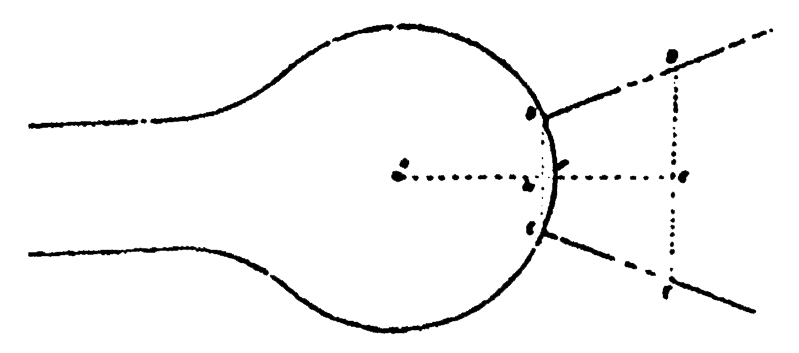
Cul-de-sac
(3)
With regard to the measurement of any line for the purpose of determining compliance with minimum standards, no portion of any line that crosses a part of the lot not counting toward meeting minimum area requirements shall count toward meeting minimum width requirements.
(4)
Notwithstanding the above, on a corner lot or through lot, the lot width shall be measured with regard to the narrowest part of the lot by which legal access is available to the abutting street or streets.
(e)
Lots of unusual depth. When an existing lot is of sufficient area to permit the creation by subdivision of more than one (1) building lot in residential districts, one (1) additional building lot may be permitted through resubdivision of the lot, provided that the lot can be resubdivided in accordance with applicable zoning requirements and subdivision regulations, and that a fifteen-foot easement of right-of-way meeting the requirements of subdivision regulations is provided and duly recorded in the Clerk's Office of the Circuit Court of the City of Virginia Beach. Such arrangements shall be permissible only where no public expenditures for streets or extensions of utilities are involved, and where the following special conditions are satisfied:
(1)
That a portion of the lot to be resubdivided be adjacent to a public street.
(2)
That for reasons of unusual shape, dimensional restrictions, topography or area limitations, a normal street dedication of fifty (50) feet cannot be made.
(3)
That the lot to be resubdivided shall exist as an isolated example and that it not reoccur in a repetitive manner in the area or subdivision.
(f)
Lot location. Except as herein provided, every building hereafter erected or moved shall be on a lot adjacent to a public street and all structures shall be so located on lots as to provide safe and convenient access for servicing, fire protection, or required off-street parking.
(g)
Erection of structures on lot. Except as herein provided, or as provided in the Oceanfront Resort District Form-Based Code, there shall be no more than one (1) single-family detached dwelling, semidetached dwelling or duplex erected on a lot; provided, however, that one (1) single-family detached dwelling and one (1) ancillary single-family detached dwelling shall be allowed on lots within the R-5D(OB) Residential Duplex District or any Apartment or Resort Tourist District within the Old Beach Overlay District, in accordance with the provisions of section 1903, and two (2) single-family dwellings shall be allowed on lots within the R-5R(NE) North End Overlay District on which duplexes are allowed as a principal use, in accordance with the provisions of section 506. Except where a greater setback or buffer is required, the setback for any such dwelling from a permanent body of water shall be no less than five (5) feet, as measured from the mean high water mark of tidal bodies of water and from the normal water level of nontidal bodies of water, in any zoning district.
(Ord. No. 1787, 6-13-88; Ord. No. 2007, 11-6-90; Ord. No. 2662, 10-23-01; Ord. No. 2910, 12-20-05; Ord. No. 2996, 8-14-07; Ord. No. 3247, 7-10-12; Ord. No. 3310, 11-26-13; Ord. No. 3431, 11-17-15)
Sec. 201. - Yards.
(a)
General. All required yards shall be unobstructed by any structure or other improvement which exceeds sixteen (16) inches in height as measured from ground elevation; provided, however, the following improvements may be located in a yard:
(1)
In-ground swimming pools, jacuzzis, hot tubs or similar structures may extend to within five (5) feet of any side or rear property line, provided however, that no in-ground swimming pool, jacuzzis, hot tubs or similar structures shall extend into any required yard adjacent to a street, except that swimming pools, jacuzzis, hot tubs or similar structures may be located no closer than twenty (20) feet to any property line to the rear of any principal structure on a through lot.
(2)
Notwithstanding any contrary provision of this appendix, in-ground swimming pools, jacuzzis, hot tubs or similar structures located on property in the R-5R Residential Resort District and R-7.5 Residential District adjacent to the public beach of the Atlantic Ocean shall be set back no less than five (5) feet from the property line adjacent to the beach. For purposes of this section, "beach" shall include any bulkheaded area and filled area behind the bulkhead contiguous to, and any unimproved public right-of-way within, the sandy beach. Unless waived by the Director of Public Works or their designee, any such in-ground swimming pool, jacuzzis, hot tubs or similar structure located within twenty-five (25) feet of the publicly owned seawall shall require Section 408 permission from the United States Army Corps of Engineers (USCOE).
The following improvements may be located in a yard without regard to height unless regulated by other sections of this ordinance:
(3)
Fences, walls, poles, wires and customary yard accessories;
(4)
Roof overhangs or eaves which do not extend more than four (4) feet into the yard;
(5)
Residential heating and cooling equipment, generators and pool equipment which do not extend more than five (5) feet into the yard and which are no closer than five (5) feet to the nearest lot line provided that generators and pool equipment shall be screened by a solid fence or landscaping if they are located within ten (10) feet of the lot line;
(6)
Chimneys which do not extend more than twenty-four (24) inches into the yard and which are no closer than five (5) feet to the nearest lot line;
(7)
Covered, unenclosed front porches on single-family or duplex structures constructed prior to the effective date of this ordinance may extend into a required front yard, provided, however, that:
a.
Except as allowed in subsection (6.1), such porches shall have a maximum depth of six (6) feet, as measured from the exterior wall of the main structure to the exterior edge of the porch foundation and a maximum width of twelve (12) feet; and
b.
in no case shall the setback from the nearest lot line to the exterior wall of the porch foundation be less than five (5) feet;
(8)
In the R-7.5, R-10 and R-15 Residential Zoning Districts, the minimum front yard setback for covered, unenclosed front porches having a maximum depth greater than six (6) feet or a maximum width greater than twelve (12) feet shall be twenty (20) feet;
(9)
Handicapped ramps, to the extent necessary to perform their proper function;
(10)
Uncovered piers no more than four (4) feet in width may extend into required side or rear yards if necessary to access navigable water, provided that no structures, except for uncovered boat lifts, shall be permitted on any portion of the pier;
(11)
Encroachments into required setbacks allowed by, and subject to, the provisions of a zoning district listed in section 102(a)(13);
(12)
Existing nonconforming residential structures located in a Special Flood Hazard Area, as defined in Section 1.3 of the Floodplain Ordinance, which are raised for flood protection, may extend into required yards, provided that the structure remains within the same footprint as the original structure; and
(13)
Public stormwater facilities and structures accessory thereto may be located in a yard, in accordance with section 206(e).
In addition, certain other structures, uses or accessories may be prohibited in certain yards as set forth in the applicable district regulations.
(b)
Relationship to ultimate right-of-way. An exception to the requirements above, where transportation plans have been approved and adopted by the city council, all yard requirements shall be measured from the ultimate right-of-way line established on said transportation plan or the street frontage line, whichever is the greater distance from the established centerline of the transportation plan.
(c)
Whenever the side or rear yard of a lot abuts a public right-of-way not more than twenty (20) feet in width, the side or rear yard adjacent to such public right-of-way shall comply with the side or rear yard requirement which would apply to that lot if it did not abut a public right-of-way.
(d)
Requirements relating to garages and carports in yards. No portion of any garage or carport shall occupy any required front, side or rear yard.
(e)
Requirements for fences and walls. Except as may be provided by the regulations of the Oceanfront Resort District Form-Based Code, the following requirements shall apply to fences and walls:
(1)
Fences and walls shall not exceed a height of eight (8) feet. Walls and fences may project into or enclose any part of any yard; provided, however, that any fence that projects into or encloses a required front yard shall not exceed a height of four (4) feet, and that any fence or wall which projects into or encloses a side yard adjacent to a street shall not exceed four (4) feet in height when located within ten (10) feet of the right-of-way except in the case of a through lot when a required front yard setback is clearly and physically the rear of the dwelling, an eight-foot fence will be allowed No fence or wall may be erected closer than five (5) feet to any right-of-way line, and where it is ten (10) feet or closer to any right-of-way line, Category I landscaping shall be installed between it and the right-of-way line.
(1a)
Fences constructed of materials generally recognized on an industry-wide basis as maintenance-free, such as vinyl and aluminum, may be located on a right-of-way line, provided that (i) Category I landscaping shall be installed immediately inside the entire length of any such fence; (ii) the height of any such fence shall not exceed the limits set forth in subsection (e)(1) above; and (iii) any such fence shall be no greater than fifty (50) percent opaque.
(1b)
Fences or walls six feet or less in height, located on corner lots, may be erected in the required side yard setback, provided that no such fence or wall shall be closer than ten (10) feet to any right-of-way line. In addition, fences or walls six feet or less in height, located on corner lots, may be erected in the required side yard setback, substantially parallel to the right-of-way line located adjacent to the side yard, in line with the closest corner of any nonconforming dwelling. The closest corner of the nonconforming dwelling shall not include fireplaces, bay windows or similar amenities. No such fence or wall may be erected closer than five (5) feet to any right-of-way line, and where it is ten (10) feet or closer to any right-of-way line, Category I landscaping shall be installed between it and the right-of-way line.
(1c)
Adjacent to a city, state or federal road project sound-wall directly adjacent to and substantially parallel to a right-of-way, fences or walls located within thirty (30) feet of the right-of-way adjacent to the sound-wall may be placed up to the right-of-way line directly behind the sound-wall provided that (i) such fences or walls shall not exceed eight (8) feet in height, (ii) such fences or walls shall not be installed within the right-of-way unless all necessary permits and approvals are obtained from the department of public works, and (iii) no such fence or wall exceeding four (4) feet in height shall be permitted within the front yard setback in front of the wall closest to the dwelling.
(2)
Barbed wire and electrified fences are prohibited in all residential and apartment districts or within fifteen (15) feet thereof. Chain link fences shall be permitted, provided that Category I landscaping shall be installed between the entire length of any such fence and the public right-of-way.
(3)
Fences shall be prohibited along that portion of a parking area of one (1) or more parking spaces which is adjacent to a street, unless required by other sections of this ordinance or a conditional use permit; except this shall not pertain to a decorative fence (excluding wire woven fence) with at least seventy-five (75) percent unobstructed light penetration which meets all applicable height limits for fences.
(4)
All required fences and walls shall be erected and maintained in accordance with the standards and specifications set forth in the Virginia Beach Landscaping, Screening and Buffering Specifications and Standards.
(5)
All fences and walls, or portions thereof, which are located within thirty (30) feet of, and are substantially parallel to, any public right-of-way shall comply with the standards pertaining to fences and walls set forth in the Virginia Beach Landscaping, Screening and Buffering Specifications and Standards. Any such fence or wall located on a through lot shall also have a gate through which ingress and egress is provided.
(6)
No nonconforming fence or wall located within thirty (30) feet of, and substantially parallel to, any public right-of-way shall be enlarged, extended, relocated, reconstructed, or replaced, except that minor repairs consisting only of fence boards, not to exceed ten (10) percent of the total length of the nonconforming portion of the fence, may be replaced within a two-year period, unless such fence or wall is brought into conformity with the provisions of this section. As used herein, the term "nonconforming fence or wall" shall mean any fence or wall which was lawfully constructed prior to the adoption of this section and which fails to conform to any of the requirements of this section. These provisions shall apply notwithstanding that the replacement, reconstruction or relocation of a fence or wall, or portion thereof, is made necessary or otherwise occasioned by reason of condemnation or involuntary destruction or deterioration of, or damage to, such fence or wall or portion thereof.
(7)
The provisions of this subsection shall not apply to fences or walls used principally for agricultural or horticultural purposes.
(8)
A permit shall be required for the construction, reconstruction, replacement or relocation of any fence or wall located within thirty (30) feet of a public right-of-way, except fences or walls used principally for agricultural or horticultural purposes in an AG Agricultural Zoning District. Such fencing shall have the finished side of the fence facing the right-of-way. Any such fence or wall located upon more than one (1) lot shall require a separate permit for each such lot, except lots under common ownership.
(8a)
The fee for permits required by this section shall be fifty dollars ($50.00).
(f)
Vision clearance at intersections. Visibility triangles, within which nothing shall be erected, placed, or parked, planted or allowed to grow in such a manner as to impede vision between a height of two and one-half (2½) and eight (8) feet above the centerlines of intersecting trafficways shall be provided as follows:
(1)
Street intersections. A visibility triangle shall be required at all street intersections including at least the area within the first twenty (20) feet along the intersecting rights-of-way (projected if rounded) and a line connecting the ends of such twenty-foot lines. Where sidewalks have been provided within the right-of-way line, vision clearance measurements shall be taken from the curb line, rather than the right-of-way line.
(2)
Intersections of driveways with streets. No wall, fence or other structure shall exceed a height of thirty (30) inches above the finished elevation of a driveway within a visibility triangle created by measuring ten (10) feet in from the intersection of a driveway boundary and property lines away from the driveway with the ends of the two (2) ten-foot lines connected in a straight line to form the visibility triangle. The thirty-inch height for any portion within the triangle shall be computed from the elevation of the driveway which is perpendicular to that portion of wall or structure within the triangle.
(Ord. No. 2039, 3-5-91; Ord. No. 2254, 1-25-94; Ord. No. 2268, 6-14-94; Ord. No. 2433, 12-17-96; Ord. No. 2929, 3-14-06; Ord. No. 3079, 5-12-09; Ord. No. 3103, 10-27-09; Ord. No. 3108, 11-10-09; Ord. No. 3118, 3-9-10; Ord. No. 3210, 12-6-11; Ord. No. 3247, 7-10-12; Ord. No. 3324, 1-14-14; Ord. No. 3328, 2-25-14; Ord. No. 3475, 12-13-16; Ord. No. 3519, 9-19-17; Ord. No. 3579, 2-5-19; Ord. No. 3694, 5-3-22; Ord. No. 3773, 5-21-24; Ord. No. 3802, 4-15-25)
Sec. 202. - Height regulations.
(a)
Except as otherwise provided in the Oceanfront Resort District Form-Based Code, whenever height limits for buildings and other structures are established, no portion of any building or other structure shall extend above such height limits, except residential chimneys, communication towers, broadcasting towers, radio or television antennas, spires, flagpoles, water tanks, roof-mounted wind energy conversion systems or monuments otherwise approved for erection; provided, however, that smokestacks may also extend beyond such limits, if they do not exceed in height the distance to the nearest lot line; and further provided that one tower for purposes of an amateur radio station operation, which may contain multiple antennas, may extend beyond said height limits but shall not exceed ninety (90) feet in height above ground elevation. Single-family dwellings, multi-family dwellings and duplexes that are raised or constructed to comply with the requirements of Appendix K, Floodplain Ordinance, may exceed the height requirements for the Zoning District in which they are located by the freeboard height required in the applicable floodplain district.
(b)
No artificial structure or tree or other natural growth which on the basis of its height would constitute an obstruction to air navigation pursuant to Part 77, Subpart C, of the Federal Aviation Administration Regulations, 14 C.F.R. §§ 77.21 et seq. or any successor regulation, or which would cause an adjustment to an airfield's established straight-in, circling, alternate, takeoff and safety minima, or which would adversely affect radio reception or radar coverage for any airfield or FAA facility shall be allowed in any district.
(c)
Any person proposing to construct or alter any building or structure for which a notice or supplemental notice must be given to the Federal Aviation Administration (F.A.A.) pursuant to the provisions of Title 14, Part 77, Subpart B of the Code of Federal Regulations, or any successor regulation, shall be required to provide a copy of such notice as part of the application for site plan approval. In the event that no such notice or supplemental notice is required, the applicant for site plan approval shall certify that no notice or supplemental notice is required by the applicable regulations.
(Ord. No. 2294, 8-23-94; Ord. No. 2781, 8-26-03; Ord. No. 3102, 9-8-09; Ord. No. 3247, 7-10-12; Ord. No. 3310, 11-26-13; Ord. No. 3741, 6-6-23)
Sec. 203. - Off-street parking requirements.
(a)
The following specified uses shall comply with the off-street parking requirements designated therefor:
(1)
Animal hospitals, business studios, eleemosynary and philanthropic institutions, veterinary establishments, commercial kennels, animal pounds and shelters, wholesaling and distribution operations, laboratories other than medical, passenger transportation terminals and broadcasting studios: One space per four hundred (400) square feet of floor area;
(2)
Assembly uses, except religious uses: One space per one hundred (100) square feet of floor area or at least one space per five (5) fixed seats, whichever is greater;
(3)
Banks, credit unions, savings and loans: One space per two hundred seventy (270) square feet of floor area;
(4)
Botanical and zoological gardens: One space per ten thousand (10,000) square feet of lot area;
(5)
Bowling alleys: Three (3) spaces per alley;
(6)
Child care centers and child care education centers: One space per three hundred (300) square feet of floor area;
(7)
College or university: As specified by the Conditional Use Permit;
(8)
Commercial recreation facility—Indoor: One space per two hundred (200) square feet of floor area;
(8.1)
Commercial recreation facility—Outdoor: As specified by the Conditional Use Permit;
(9)
Country inns: One space per room provided for lodging transients;
(9.1)
Craft breweries, craft distilleries, and craft wineries: One space per one hundred (100) square feet of area open to the public for drinking, eating and congregating, and one space per employee on the maximum working shift;
(10)
Drive-in eating and drinking establishments: One space per fifty (50) square feet of floor area;
(11)
Dwellings, single-family, semidetached, duplex and attached: Two (2) spaces per dwelling unit;
(12)
Dwellings, multifamily: Two (2) spaces per dwelling unit for the first fifty (50) units located on a zoning lot and one and three-quarters (1¾) spaces per dwelling unit for all units in excess of fifty (50) units;
(13)
Reserved;
(14)
Eating and drinking establishments accessory to a hotel: One space for each three hundred (300) square feet of floor area in dining area;
(15)
Fraternity or sorority house, student dormitory: One space per two (2) lodging units or one space per three (3) occupants, whichever is greater;
(16)
Furniture or appliance stores, machinery equipment, automotive and boat sales and service: One space per nine hundred (900) square feet of floor area;
(17)
Golf courses: Five (5) spaces per hole in the main course;
(18)
Greenhouses and plant nurseries: One space per one thousand (1,000) square feet of selling area;
(19)
Hospitals: Two and one-half (2.5) spaces per patient bed;
(20)
Lodging units: One space per lodging unit;
(20.1)
Medical offices: One space per two hundred seventy (270) square feet of floor area;
(21)
Meeting rooms and convention hall facilities accessory to a hotel: One space per twenty (20) seating capacity;
(22)
Museums and art galleries: Ten (10) spaces and one additional space for each three hundred (300) square feet of floor area or fraction thereof in excess of one thousand (1,000) square feet;
(23)
Nurses homes and similar housing for institutional employees: One space per four (4) occupants;
(24)
Offices: One space per three hundred thirty (330) square feet of floor area, except for call centers which are allowed one space per one hundred and fifty (150) square feet of floor area;
(25)
Personal service establishments: One space per two hundred fifty (250) square feet of floor area;
(26)
Reserved.
(27)
Private clubs and lodges, social centers, athletic clubs: One space per one hundred (100) square feet of floor area;
(28)
Public buildings and funeral homes: One space per five hundred (500) square feet of floor area;
(28.1)
Religious uses: One space per five (5) seats or bench seating space in the main auditorium;
(29)
Retail establishments, including beverage manufacturing shops and open-air markets: One space per two hundred fifty (250) square feet of floor area;
(30)
Restaurants other than drive-in eating and drinking establishments: One space per one hundred (100) square feet of floor area, and one space per one hundred (100) square feet of additional area encompassed by decks, patios and other areas in which seating is provided and food or beverages are consumed;
(31)
Sanitariums: One space per four (4) patient beds;
(32)
Service or repair establishments, motion picture studios, utility installations, manufacturing, industrial, processing, packaging, fabricating, research or testing labs, warehouse establishments, printing, publishing, and plumbing and heating establishments: One space per employee on maximum working shift;
(33)
Shopping centers containing at least one (1) acre or more than four (4) tenants: One space per two hundred fifty (250) square feet of floor area, provided that in shopping centers where restaurants with seating for fifty (50) or more patrons comprise fifty percent (50%) or more of the total floor area, parking shall be one (1) space per one hundred (100) square feet of floor area;
(34)
Vocational, technical, industrial and trade schools: One space per two (2) seats of designated classroom space or as specified by the Conditional Use Permit;
(35)
Uses permitted pursuant to a conditional use permit shall comply with the off-street parking requirement specified in the conditional use permit; provided, however, that if no such requirement is specified therein, the applicable requirement shall be as set forth in this section.
(b)
General standards. The following requirements shall apply to all off-street parking spaces:
(1)
Any off-street parking space shall have minimum dimensions of nine (9) feet by eighteen (18) feet, unless permitted under section 203 (3) below, except that in parking garages and parking structures, minimum dimensions shall be eight (8) feet, nine (9) inches by eighteen (18) feet and minimum dimensions for all parallel parking spaces shall be nine (9) feet by twenty-two (22) feet. Where the width of a parking space abuts a street frontage landscaping strip or interior landscaped areas, the length of the parking space may be reduced by one and one-half (1.5) feet;
(2)
In any parking structure or parking garage with greater than twenty five (25) spaces, the Planning Director may allow a maximum of ten percent (10%) of the total number of spaces within a parking garage or structure to be compact car spaces if he finds that (i) the unusual shape, size, configuration or other building condition of the parking structure or parking garage precludes the efficient layout of parking spaces meeting the dimensional requirements of this section, thus resulting in residual space within such parking structure or parking garage; and (ii) the use of compact car spaces would not substantially reduce the overall safety, ease of ingress and egress, or efficiency of the layout of parking spaces;
(3)
Within a parking lot not serving a use in the apartment or residential districts and larger than twenty-five (25) spaces, a maximum of thirty percent (30%) of the spaces provided may be designated for compact cars, provided that (i) the minimum dimensions shall be eight (8) by seventeen (17) feet for regular compact car spaces or eight (8) by twenty (20) feet for parallel compact car spaces and (ii) all such compact car spaces shall be clearly marked with the wording "Compact Cars Only."
(4)
Each space shall be unobstructed, have access to a street and be so arranged that any automobile may be moved without moving another, except in the case of parking for one- and two-family dwellings and in the case of parking for employees on the premises. In parking garages and parking structures, structural encroachments into a maximum of thirty (30) percent of the spaces may protrude into the front portion of a parking space not more than one (1) foot as measured perpendicularly to the drive aisle;
(4.1)
Within a parking lot, parking garage, or parking structure not serving a use in the apartment or residential districts, one (1) space per every thirty (30) spaces shall be designated motorcycle spaces to accommodate motorcycles, motor scooters, or other licensed vehicles, with dimensions of four (4) by eight (8) feet and shall be clearly marked as motorcycle spaces;
(5)
Parking surfaces shall be constructed of concrete, asphalt or other suitable material approved by the Planning Director. Where parking areas are illuminated, all sources of illumination shall be so shielded as to prevent any direct reflection toward adjacent premises where the zoning allows residential, apartment, or hotel use;
(6)
Parking areas for three (3) or more automobiles shall have individual spaces marked, except in the case of parking for one- and two-family detached dwellings, and spaces shall be so arranged that no maneuvering directly incidental to entering or leaving a parking space shall be on any public street, alley, or walkway; and
(7)
Minimum aisle width required for parking areas shall be according to the following table:
In addition, in any parking garage or parking structure a drive aisle adjacent to a parking space which is less than nine (9) feet by eighteen (18) feet shall be at least twenty-three (23) feet in width. Aisle width shall not exceed twenty-four (24) feet unless required for emergency access or off-street loading per section 204. Only areas necessary for parking and safe vehicular maneuvering shall be impervious;
(8)
In the business, apartment and office districts the number of off-street parking spaces shall not exceed the required number by more than fifty percent (50%). Fractions shall be rounded up to the closest whole number. Such maximum parking requirements shall not apply to uses in the business, apartment or office districts whose off-street parking requirements are allocated within a parking structure;
(9)
The Planning Director may authorize additional parking spaces above the maximum for uses in the business, apartment and office districts, provided that all of the following conditions are met:
(i)
Justification submitted by the applicant for the number of parking spaces proposed based upon estimates of parking demands in accordance with the Institute of Transportation Engineers parking data or other industry specific data or operation specific data. The justification shall document the source of data used to develop the number of parking spaces proposed;
(ii)
The applicant demonstrates that no other parking alternatives exist including, but not limited to: shared parking opportunities with neighboring properties or businesses, public transit within one quarter (¼) of a mile, carpooling, public structured parking within one thousand (1,000) feet, staggered work shifts/hours of operation and telecommuting opportunities; and
(iii)
Parking spaces above the maximum shall be constructed with a permeable paving system, as described in the City of Virginia Beach Landscaping Guide as revised, or stormwater runoff from those parking spaces above the maximum or the equivalent runoff from an equal area of impervious cover elsewhere on the site shall drain directly to a stormwater management facility that provides a reduction in runoff for the site. Stormwater runoff as described above shall be equal to the volume produced by one (1) inch of rain on the impervious area.
Applications must be reviewed and approved or denied within five (5) working days of the submittal of a complete request. Any completed request not approved or denied within five (5) working days shall be deemed approved.
(10)
Parking, including for bicycles, may be shared among two (2) or more uses that typically experience peak parking demands at different times and are located on the same parcel or on separate parcels at a distance no greater than five hundred (500) feet.
(i)
For two (2) or more uses on the same parcel, or zoning lot, the total number of minimum required spaces may be reduced by the use of shared parking. To qualify for shared parking, a current parking study shall be submitted to the zoning administrator, who shall determine the final shared parking ratio. A shared parking agreement shall be continually maintained on the parcel or zoning lot in a form approved by the city attorney and a signed copy shall be maintained with the zoning administrator;
(ii)
For two (2) or more uses on separate parcels within five hundred (500) feet of the main pedestrian entry to a building, the total number of required spaces may be reduced by the use of shared parking. To qualify for shared parking, a current parking study shall be submitted to the zoning administrator, who shall determine the final shared parking ratio under the following conditions:
(a)
A shared parking agreement shall be continually maintained on the parcels in a form approved by the city attorney and a signed copy shall be maintained with the zoning administrator, which shall maintain the designated number of parking spaces; and
(b)
Pedestrian access shall be provided from the off-site parking to the user, and shall be designated on the submitted site plan, subject to the approval of the zoning administrator; and
(c)
Shared parking on both sites will not be detrimental to the sites or surrounding properties; and
(d)
No parking required by a use may be used as off-site parking for another use, unless approved by the zoning administrator in accordance with this section.
(11)
The minimum required parking may be reduced upon the submittal of a parking study to the zoning administrator that indicates a substantial number of patrons of the use are pedestrian or arrive by means of public transportation or by bicycle. The zoning administrator shall determine the final parking ratio or reduction in the minimum required parking.
(12)
All development in the apartment, office or business districts requiring twenty five (25) or more parking spaces shall have a minimum of five (5) bicycle spaces within two hundred (200) yards of the building, in a visible area. Each additional fifty (50) parking spaces above the first twenty-five (25) shall require one (1) additional bicycle space.
(13)
Bicycle spaces shall be required as follows in all districts for the following uses:
(14)
For parking lots with three hundred (300) spaces or more, at least fifty (50) percent of the required bicycle spaces shall be indoors or covered in accordance with the City of Virginia Beach Landscaping Guide, with the exception of parks and ball fields.
(c)
Parking for accessory uses. Unless otherwise specified in the district regulations, accessory uses shall conform to the parking requirements applicable to such uses, which requirements shall be in addition to any parking required of the principal use.
(d)
Reserved. [Effective July 1, 2011]
(e)
Requirements for Access by Disabled Persons. Off-street parking for handicapped persons shall meet the standards established by the Americans With Disabilities Act.
(f)
Residential parking requirements. Any area within a garage or within an enclosed or covered space may be counted toward meeting off-street parking requirements except where specifically prohibited in the applicable district regulations.
(g)
Parking requirements in the B-4C Central Business Mixed Use District. Within the B-4C Central Business Mixed Use District, there shall be provided for nonresidential uses, except hotels and uses accessory to hotels, no fewer than three (3) spaces per one thousand (1,000) square feet of gross floor area, and for residential uses no fewer than one and seven-tenths (1.7) spaces per dwelling unit. Parking requirements for hotels and uses accessory to hotels shall be as specified in subsection (a).
(h)
Same; shared parking. Notwithstanding anything in this ordinance to the contrary, required off-street parking for any use located on property within the B-4C Central Business Mixed Use District may be made available for use by the general public as well as by the customers or patrons of such use; provided, however, that no parking space shall be used to satisfy the parking requirement of more than one (1) establishment. The required number and dimensions of parking spaces shall be as specified in this section.
(i)
Required parking in the B-4C Central Business Mixed Use District. Parking requirements for uses within the B-4C Central Business Mixed Use District may be satisfied by any one, or a combination of, the following:
(1)
On-site parking;
(2)
Off-site parking facilities, as set forth in section 901 of this ordinance; or
(3)
Public parking, if the Planning Director determines (i) that there is at least a sufficient number of public parking spaces located within the same development phase of the District as the proposed use to meet public parking demands; (ii) that for uses in the B-4C Central Business Mixed Use District, such public parking spaces are not used to satisfy the parking requirements of any other use, and (iii) that the use of such public parking spaces to satisfy the parking requirements of the proposed use, either wholly or partially, is warranted in light of the following considerations:
A.
The extent to which the proposed use advances the goals and objectives of the B-4C Central Business Mixed Use District, as stated in section 900 of the City Zoning Ordinance;
B.
The extent to which the proposed use conforms to the Mixed Use Development Guidelines; and
C.
The amount of the projected tax revenue to be generated by the proposed use and improvements.
(j)
Any regulation pertaining to vehicular parking in a zoning district listed in section 102(a)(13) that conflicts with a provision of this section shall be deemed to control to the extent of such conflict.
For purposes of this section, the term "parking requirements" shall mean the number of off-street vehicular parking spaces required by this section.
(Ord. No. 1976, 6-11-90; Ord. No. 2098, 8-27-91; Ord. No. 2100, 9-3-91; Ord. No. 2268, 6-14-94; Ord. No. 2315, 4-11-95; Ord. No. 2357, 11-28-95; Ord. No. 2420, 9-10-96; Ord. No. 2481, 4-14-98; Ord. No. 2482, 4-14-98; Ord. No. 2614, 10-10-00; Ord. No. 2616, 1-23-00; Ord. No. 2697, 5-14-02; Ord. No. 2725, 10-29-02; Ord. No. 2843, 10-12-04; Ord. No. 3000, 9-25-07; Ord. No. 3061, 12-2-08; Ord. No. 3109, 11-10-09; Ord. No. 3166, 4-26-11; Ord. No. 3174, 5-10-11; Ord. No. 3247, 7-10-12; Ord. No. 3259, 8-28-12; Ord. No. 3303, 8-27-13; Ord. No. 3328, 2-25-14; Ord. No. 3453, 6-7-16; Ord. No. 3506, 6-20-17; Ord. No. 3524, 12-5-17)
Sec. 204. - Off-street loading requirements.
(a)
Except as otherwise provided in the regulations of any form-based district, the off-street loading requirements herein specified shall apply to all zoning lots exceeding five thousand (5,000) square feet in area for the class or kind of uses indicated. In addition, in connection with planned development zoning and conditional use permits involving such classes or kinds of uses, special requirements may be imposed.
(b)
Moreover, if any building existing on the effective date of these provisions is subsequently altered to increase floor area by fifty (50) percent or more, or converted from any other use to the uses listed in column 1 of the chart below, off-street loading spaces shall be provided as indicated.
(c)
Where a building is used for more than one (1) use, and floor area for each use is below the minimum requiring a loading space, the aggregate floor area of the several uses shall be used in determining the number of loading spaces required, provided that such calculations shall be based on the use category requiring the greatest number of loading spaces.
(d)
No loading space required under the provisions of this ordinance shall be in any street or alley, but shall be provided within the building or on the lot. No less than half of the required number of off-street loading spaces, but in all cases at least one (1) space, shall have a vertical clearance of at least fourteen (14) feet, and the balance of required spaces shall have a vertical clearance of at least ten (10) feet. Each loading space shall have minimum horizontal dimensions of twelve (12) by thirty-five (35) feet. Each space shall be unobstructed and shall be so arranged that any using vehicle may be moved without moving another. Adequate maneuvering areas and access to a street shall be provided and shall have a vertical clearance of at least fourteen (14) feet. All spaces shall be provided and maintained with an all weather surface. Where loading areas are illuminated, all sources of illumination shall be so shielded as to prevent any direct reflection toward adjacent premises where the zoning allows residential, apartment or hotel use. In addition, loading spaces for three (3) or more vehicles shall have individual spaces marked, and except within the B-3A Pembroke Central Business Core District, spaces shall be so arranged that no maneuvering directly incidental to entering or leaving a loading space shall be on any public street, alley or walkway.
(e)
Notwithstanding any other provision of this section, the following number of loading spaces shall be required for uses located within the B-3A Pembroke Central Business District:
(Ord. No. 2856, 12-7-04; Ord. No. 3247, 7-10-12; Ord. No. 3453, 6-7-16)
Sec. 205. - Reserved.
Editor's note— Ord. No. 3174, adopted May 10, 2011 and effective July 1, 2011, repealed § 205, which pertained to major recreational equipment and derived from Ord. No. 1839, 3-27-89; Ord. No. 3004, 11-13-07.
Sec. 206. - Public and private pump stations, water tanks and other unmanned utility facilities.
Individual district requirements for minimum lot area, lot width and yard spacing requirements notwithstanding, the following requirements for public and private pump stations, water tanks, and other unmanned utility facilities shall apply in all districts where they are permitted:
(a)
Minimum lot area. The minimum lot area shall be one thousand six hundred (1,600) square feet.
(b)
Minimum lot width. The minimum lot width shall be forty (40) feet measured at the building location; provided, however, that when a facility covered by this section is not located adjacent to a public street, a right-of-way or easement for ingress of minimum width of fifteen (15) feet shall be provided.
(c)
Setbacks. The minimum front yard setback shall be ten (10) feet. The minimum side and rear yard setbacks shall be five (5) feet; provided, however, that in the case of a corner lot, the setback from all right-of-way lines shall be ten (10) feet.
(d)
Each lot for which these reduced requirements apply shall be restricted to the uses described in this section, and this restriction shall be noted on any plat or other document describing such lot.
(e)
Any public stormwater facilities, structures, or accessory components, which are part of a system of interdependent sites and whose location is inherently dependent on proximity to waterways or other codependent stormwater facilities, shall be exempt from the provisions of subsections (a), (b) and (c) above.
(Ord. No. 3773, 5-21-24)
Sec. 207. - Building-mounted antennas, small wireless facilities and temporary communication towers.
(a)
The following provisions shall apply to building-mounted antennas in all districts in which they are permitted:
(1)
Antennas shall be as visually unobtrusive as is reasonably practicable;
(2)
No antenna shall be located upon any building or structure less than thirty (30) feet in height;
(3)
No antenna shall extend to a height greater than twenty-two (22) feet above the highest point of the building or structure to which it is affixed;
(4)
No antenna shall be erected unless a professional engineer licensed in the Commonwealth of Virginia certifies to the building official that the proposed antenna, or array of antennas, complies with all applicable Federal Communications Commission regulations, including, without limitation, regulations pertaining to the emission of radio frequency radiation;
(5)
Buildings or other structures housing electronic equipment or other equipment or materials used in connection with the operation of an antenna shall meet all application setback and landscaping requirements; and
(6)
Building-mounted antennas shall not be permitted on single-family dwellings or duplexes in any district or on any property containing such a use.
(b)
The following provisions shall apply to small wireless facilities placed on an existing structure, other than those located on public rights-of-way or other public property or in the interior of a building, in all districts in which they are permitted:
(1)
Application requirements. Applications for small wireless facilities may encompass multiple sites up to thirty-five (35) on a single application, provided that all such sites are located within a single, discrete area of the city. Applications shall include: (i) a plan showing the proposed location by Geographic Parcel Identification Number (GPIN) of each small wireless facility, and a diagram or other suitable representation of the proposed location of each such facility on a building or structure, showing the dimensions of each facility, its height from ground level and the type of building or structure on which each such facility is to be affixed; (ii) photographs or accurate renderings, including correct colors and exact dimensions, of each type of proposed small wireless facility; (iii) a statement signed by a professional engineer licensed in the Commonwealth of Virginia the proposed facilities comply with all applicable Federal Communications Commission regulations, including, without limitation, regulations pertaining to the emission of radio frequency radiation; and (iv) such additional information as the planning director may reasonably require in order to determine whether the requirements of this section are met.
(2)
Such facilities should attempt to be substantially concealed from view by means of painting or tinting to match the surface of the building or other structure to which they are affixed or by other suitable method, such as by flush-mounting or integration into the design elements of the building or structure.
(3)
Reserved.
(4)
Electrical power and battery backup cabinets shall, to the extent practicable, be roof-mounted or otherwise located so as to not be visible from a public street or, where not practicable, such equipment should be appropriately screened by landscaping or other means minimizing visibility from a public street.
(5)
Minimum height of antennas, if affixed to a building or other vertical structure shall be ten (10) feet.
(6)
Any small wireless facility that is not in use for a period of one (1) year shall be removed within ninety (90) days after notification by the planning director. If not so removed, the city may contract for its removal and charge the cost thereof to the owner of the small wireless facility.
(c)
Special provisions for temporary communication towers. Temporary communication towers meeting the requirements of this subsection shall be allowed as principal uses where so provided by the regulations of the district in which they are located:
(1)
Maximum height shall be one hundred (100) feet;
(2)
Maximum duration shall be the longer of (i) five (5) days; (ii) where used in conjunction with an event permitted pursuant to City Code section 4-1 (special events permits), forty-eight (48) hours prior to and after such event; or (iii) in cases of declared emergencies resulting in the disablement of existing telecommunications facilities, the duration of the emergency;
(3)
Minimum setback from any residential district or use, as measured to the nearest lot line of such district or use, shall be two (2) times the height of the tower or one hundred fifty (150) feet, whichever is greater;
(4)
No grading or removal of vegetation shall be permitted;
(5)
Noise from generators shall not exceed sixty-five A-weighted decibels (65 dBA) at a distance of twenty (20) feet from the noise source;
(6)
No signage or lighting other than as may be required by law shall be allowed;
(7)
A certification that the tower is capable of supporting the total anticipated capacity of the tower, including all appurtenances, and a certification that all equipment intended to be affixed to the proposed tower comply with all applicable regulations promulgated by the Federal Communications Commission pertaining to the emission of radio frequency radiation shall be required prior to deployment of the tower. Such certifications shall be under seal from a professional engineer licensed in Virginia; and
(8)
No temporary communication tower shall be allowed east of Pacific Avenue from 4 th Street to 42 nd Street.
(Ord. No. 2425, 10-29-96; Ord. No. 3403, 4-21-15; Ord. No. 3514, 7-11-17; Ord. No. 3660, 5-18-21)
Sec. 208. - Portable storage containers.
Portable storage containers located outside of an enclosed building or structure shall be allowed only as specified in this section and subject to the following regulations:
(a)
General requirements. The following requirements shall apply to portable storage containers in all districts:
(1)
Except in the I-2 Industrial District, or as allowed by conditional use permit in a district in which bulk storage is allowed as a conditional use, or as specifically otherwise provided in subdivision (1) of subsection (d), no more than one (1) portable storage container having a storage capacity greater than three hundred fifty (350) cubic feet, or no more than three (3) portable storage containers, each having a storage capacity no greater than three hundred fifty (350) cubic feet, shall be allowed on a zoning lot. No portable storage container shall have dimensions greater than sixteen (16) feet in length, eight (8) feet in width or eight and one-half (8½) feet in height;
(2)
No more than one (1) sign having a maximum area of six (6) square feet per sign may be displayed on any portable storage container;
(3)
Except as provided in subdivision (2) of subsection (b), no portable storage container shall be located (i) closer than five (5) feet to any side or rear lot line, or (ii) on any portion of a lot except behind the nearest portion of the principal building adjacent to a public street. On lots where there is no principal structure, portable storage containers shall comply with the front yard setback requirements of the zoning district; and
(4)
All portable storage containers in use on a lot shall be in a condition free from rust, peeling paint and other visible forms of deterioration.
(b)
Residential, Apartment and RT-3 and RT-4 Resort Tourist Districts. In Residential and Apartment Districts and on lots in the RT-3 and RT-4 Resort Tourist Districts on which the principal use is residential in nature, portable storage containers shall be allowed in accordance with the provisions of subsection (a) for a period not exceeding a total of sixteen (16) days in any consecutive six-month period, except that:
(1)
Portable storage containers shall be allowed during construction, reconstruction, alteration or renovation of the principal structure and for an additional period of twenty-four (24) hours before and after such activity, but not to exceed a total of thirty (30) days in any six-month period. In addition, such containers shall be allowed in accordance with the provisions of subdivision (1) of subsection (d) in conjunction with the construction of multiple-family dwellings; and
(2)
If by reason of site conditions portable storage containers cannot be located in conformity with the provisions of subdivision (3) of subsection (a), such containers may be located on a driveway, so long as a portion of the driveway equivalent to two (2) required parking spaces is unobstructed and no such container is located closer than ten (10) feet to the paved portion of any street. If, however, site conditions prevent such containers from being located in conformity with the provisions of this subdivision, such containers may be located on any portion of a driveway.
On lots in the RT-3 and RT-4 Resort Tourist Districts on which the principal use is commercial in nature, portable storage containers shall be allowed in accordance with the provisions of subsection (d).
(c)
Agricultural Districts. On lots in Agricultural Districts on which the principal use is a bona fide agricultural activity, there shall be no restrictions upon the use of portable storage containers in connection with such agricultural activity, and no permit shall be required. On lots where the principal use is other than agricultural, or where portable storage containers are used for purposes other than in connection with bona fide agricultural activity, the requirements of subsection (b) shall apply.
(d)
Hotel, Office, and RT-1 Resort Tourist Districts; Strategic Growth Areas. In the Hotel, Office and RT-1 Resort Tourist Districts and districts listed in section 102(a)(13), portable storage containers shall be allowed as follows:
(1)
When used in connection with bona fide construction activity on the site and for an additional period of twenty-four (24) hours before and after such activity, portable storage containers shall be allowed without limitation as to the number of portable storage containers; and
(2)
Portable storage containers shall be allowed for a period not exceeding sixteen (16) days when used in connection with the moving or relocation of a commercial establishment located, or to be located, on the site.
(e)
Business and Industrial Districts. In Business and I-1 Industrial Districts, portable storage containers shall be allowed as provided in subsection (d), and in addition thereto, such containers may be allowed pursuant to a conditional use permit for bulk storage where provided by district regulations. In the I-2 Industrial District, portable storage containers shall be allowed in accordance with the provisions of this ordinance pertaining to bulk storage yards.
(f)
Permits. Except as provided in subsection (c), portable storage containers in all districts shall be allowed only upon issuance of a permit by the zoning administrator. Permits shall be displayed on the outside of the container in such manner as to be plainly visible from the nearest street. The fee for permits shall be fifteen dollars ($15.00) per zoning lot on which one (1) or more containers are located, except that there shall be no fee if such containers are to be located on a site for no longer than seventy-two (72) hours.
(g)
Violations; penalties. Any person who violates any of the provisions of this section shall be assessed a civil penalty in the amount of one hundred dollars ($100.00) for the initial violation and two hundred fifty dollars ($250.00) for each additional violation. The assessment of a civil penalty shall not preclude the institution of a civil action by the zoning administrator pursuant to section 103(a) of this ordinance, but no such violation shall be prosecuted as a criminal misdemeanor. Each day during which the violation is found to have existed shall constitute a separate offense; provided, however, that specified violations arising from the same operative set of facts shall not be charged more frequently than once in any ten-day period, and a series of specified violations arising from the same operative set of facts shall not result in civil penalties which exceed a total of five thousand dollars ($5,000.00). The procedure in cases of violations shall be as specified in section 217(b) of this ordinance.
(h)
Special event permits. In conjunction with a special event, portable storage containers shall be allowed in any zoning district with a valid special event permit. Such portable storage containers shall comply with all requirements of the special event permit. Only the signage allowed in accordance with subsection (a)(2) of this section shall be permitted.
(Ord. No. 2864, 2-8-05; Ord. No. 3247, 7-10-12; Ord. No. 3328, 2-25-14; Ord. No. 3388, 1-6-15)
Sec. 208.1. - Roll off containers.
(a)
General regulations. In residential districts, roll off containers and roll off dump containers shall be permitted only as specified and subject to the following regulations:
(1)
One (1) roll off container shall be allowed for a period not exceeding a total of thirty (30) days in any consecutive six-month period, except that:
(i)
Roll off containers shall be allowed during permitted construction, reconstruction, alteration or renovation for the duration of the active building permit and for an additional period of twenty-four (24) hours before and after.
(2)
All roll off containers must comply with Chapter 31, Solid Waste in the City Code.
(b)
Violations; penalties. Any person who violates any of the provisions of this section shall be assessed a civil penalty in the amount of one hundred dollars ($100.00) for the initial violation and two hundred fifty dollars ($250.00) for each additional violation. The assessment of a civil penalty shall not preclude the institution of a civil action by the zoning administrator pursuant to section 103(a) of this ordinance, but no such violation shall be prosecuted as a criminal misdemeanor. Each day during which the violation is found to have existed shall constitute a separate offense; provided, however, that specified violations arising from the same operative set of facts shall not be charged more frequently than once in any ten-day period, and a series of specified violations arising from the same operative set of facts shall not result in civil penalties which exceed a total of five thousand dollars ($5,000.00). The procedure in cases of violations shall be as specified in section 104(b) of this ordinance.
(Ord. No. 3843, 4-21-26)
Sec. 209. - Wind energy conversion systems.
(a)
Purpose. The purpose of this section is to promote the use of renewable energy sources by allowing wind energy conversion systems in appropriate locations while minimizing visual, safety and environmental impacts and promoting the safe, effective and efficient use of such systems.
(b)
Application requirements.
(1)
Conditional use permit applications. In addition to the information required by section 221, applications for a conditional use permit for a wind energy conversion system shall include the following items:
a.
A site plan or plan drawn to scale, showing the location, height and design of the proposed system, including any accessory buildings or other appurtenances, adjacent land uses, and any other applicable information required by the planning director;
b.
A certification from a professional engineer licensed in the Commonwealth of Virginia that the proposed system complies with all applicable regulations and requirements of the Virginia Uniform Statewide Building Code and Federal Aviation Administration;
c.
A certification from a professional engineer licensed in the Commonwealth of Virginia that the structure upon which the proposed wind energy conversion system is to be mounted will have the structural integrity to carry the weight and wind loads of the wind energy conversion system and have minimal vibration impacts on the structure; and
d.
Elevation drawings, computer-generated photographic simulations, or such other documentation as the planning director may require that depict how the proposed wind energy conversion system, including accessory buildings, will appear as constructed on the proposed site; provided, however, that this requirement shall not apply if the proposed wind energy system is allowed as a principal use.
(2)
Building permit/site development plan applications. In addition to information otherwise required by ordinance, applications for building permits or site development plans shall include the information specified in subdivisions a., b. and c.
(c)
Lot area, setback, height, etc. requirements. Wind energy conversion systems shall be subject to the following requirements:
(1)
Lot area. Minimum lot area requirements for wind energy conversion systems shall be as follows:
a.
For freestanding wind energy conversion systems outside of residential districts, forty thousand (40,000) square feet plus an additional twenty thousand (20,000) square feet for each such system in excess of one (1);
b.
For roof-mounted wind energy conversion systems, the minimum lot area specified in the district regulations; and
c.
For wind energy conversion systems allowed as a conditional use, the city council may approve an application in which the subject property fails to meet the specified minimum lot area requirements upon a finding that the proposed system is of such size or in such location, or that the conditions attached to the conditional use permit are sufficiently restrictive, that the deficiency in lot area will not result in any adverse effects upon surrounding properties. The planning director shall include in his report to the planning commission the specific factors, if any, that would support the granting of a conditional use permit on lots that fail to meet the minimum lot area requirements of this section.
(2)
Setbacks.
a.
No tower in any freestanding wind energy conversion system shall be located closer to any property line or public right-of-way than a distance equal to one hundred ten (110) percent of the height of the tower or the setback specified in the applicable district regulations, whichever is greater, or closer to any residential structure or overhead utility transmission line than a distance equal to one hundred ten (110) percent of the height of the tower.
b.
No support structure of a freestanding wind energy conversion system, including guy wires, shall be located in any required front yard or any required side yard adjacent to a street.
(3)
Height.
a.
Unless otherwise specified in this section or the conditional use permit, wind energy conversion systems shall be subject to the height regulations of the zoning district in which they are located; provided, that in no event shall the height of any such system exceed that recommended by the manufacturer.
b.
The height of a freestanding wind energy conversion system shall be measured as the distance from ground level to the highest point on the tower, including the vertical length of any extensions such as rotor blades. The height of a roof-mounted wind energy conversion system shall be measured as the distance from the point at which the base of the system is attached to the building or the lowest point of any component of the wind energy conversion system, whichever is lower, to the highest point on the wind energy conversion system, including the vertical length of any extensions such as rotor blades.
c.
Notwithstanding any contrary height limitation specified in the district regulations, roof-mounted wind energy conversion systems may project a maximum of eight (8) feet above the roofline of the structure on which they are located unless a greater height is allowed by the conditional use permit.
d.
The minimum rotor clearance of freestanding wind energy conversion systems shall be twenty-five (25) feet above ground level for systems incorporating horizontal-axis turbines and ten (10) feet for systems incorporating vertical-axis turbines.
(4)
Signage. No signage, other than safety and warning signs, shall be allowed.
(5)
Tower construction. All freestanding towers shall be of monopole construction, without guy wires or visible anchors, unless allowed by the conditional use permit.
(6)
Noise. The highest level of noise generated by the system, as measured at any adjoining property line, shall not exceed an A-weighted decibel level of 55 dB(A).
(7)
Illumination. No portion of a system shall be illuminated unless required by the Federal Aviation Administration.
(8)
Siting. Systems shall be sited in a manner to minimize shadowing and flickering effects on any adjacent property.
(9)
Electrical connections. All electrical controls, control wiring and power lines shall be located underground or otherwise hidden from view.
(10)
Braking. All systems shall be equipped with a redundant braking system that engages at wind speeds in accordance with the manufacturer's specifications so as to minimize the potential for wind damage to the system or its supporting structure.
(11)
[Appearance.] Unless otherwise required by the Federal Aviation Administration or other governmental authority or allowed by the conditional use permit, all portions of a wind energy conversion system shall be of a nonreflective white, black, galvanized steel, aluminum or other matte-finish color designed to blend with the surrounding environment; provided, however, that blades may be painted black to facilitate deicing. Where more than one system is located on a lot, all such systems shall be of a uniform appearance.
(d)
Inspections. All wind energy conversion systems, including all associated equipment, shall be inspected every two (2) years to ensure compliance with this section and the conditional use permit. The report of such inspection shall be provided to the planning director.
(e)
Discontinuance. Any wind energy conversion system that is not in use for a period of one (1) year shall be removed within ninety (90) days after notification by the planning director.
(Ord. No. 3102, 9-8-09)
Sec. 209.1. - Farm wineries, farm breweries and farm distilleries.
(a)
Alcoholic beverage control board (ABC) license required. No farm winery, farm brewery or farm distillery shall be operated unless it is properly licensed by the Virginia Alcoholic Beverage Control Board pursuant to the applicable provisions of the Virginia Alcoholic Beverage Control Act.
(b)
Lot area. The minimum lot area for farm wineries, farm breweries and farm distilleries shall be two (2) acres, the entirety of which shall be in the AG-1 or AG-2 agricultural district. No farm winery, farm brewery or farm distillery shall be located on any lot that is subject to a conditional use permit allowing alternative residential development pursuant to section 405.
(c)
Allowed activities at farm wineries. The following activities are permitted at farm wineries, provided that such activities are not inconsistent with an establishment's ABC license:
(1)
The production and harvesting of fruit and other agricultural products and the manufacturing of wine;
(2)
The on-premises sale, tasting, or consumption of wine or beer during regular business hours within the normal course of business of the farm winery;
(3)
The direct sale and shipment of wine by common carrier to consumers in accordance with applicable provisions of the Virginia Alcoholic Beverage Control Act and regulations of the Virginia Alcoholic Beverage Control Board;
(4)
The sale and shipment of wine to the Virginia Alcoholic Beverage Control Board, licensed wholesalers, and out-of-state purchasers in accordance with applicable provisions of the Virginia Alcoholic Beverage Control Act, regulations of the Alcoholic Beverage Control Board, and federal law;
(5)
The storage, warehousing, and wholesaling of wine in accordance with the Virginia Alcoholic Beverage Control Act, regulations of the Virginia Alcoholic Beverage Control Board, and federal law; and
(6)
The sale of wine-related items that are incidental to the sale of wine.
(d)
Allowed activities at farm breweries. The following activities are permitted at farm breweries, provided that such activities are not inconsistent with an establishment's ABC license:
(1)
The on-premises sale, tasting, or consumption of beer during regular business hours within the normal course of business of such licensed brewery;
(2)
The direct sale and shipment of beer in accordance with applicable provisions of the Virginia Alcoholic Beverage Control Act and regulations of the Alcoholic Beverage Control Board;
(3)
The sale and shipment of beer to licensed wholesalers and out-of-state purchasers in accordance with applicable provisions of the Virginia Alcoholic Beverage Control Act, regulations of the Alcoholic Beverage Control Board, and federal law;
(4)
The storage and warehousing of beer in accordance with applicable provisions of the Virginia Alcoholic Beverage Control Act, regulations of the Alcoholic Beverage Control Board, and federal law; and
(5)
The sale of beer-related items that are incidental to the sale of beer.
(e)
Allowed activities at farm distilleries. The following activities are permitted at farm distilleries, provided that such activities are not inconsistent with an establishment's ABC license:
(1)
The production and harvesting of agricultural products and the manufacturing of alcoholic beverages other than wine or beer;
(2)
The on-premises sale, tasting, or consumption of alcoholic beverages other than wine or beer during regular business hours in accordance with a contract between a distillery and the Alcoholic Beverage Control Board pursuant to the provisions of Code of Virginia, § 4.1-119(D);
(3)
The sale and shipment of alcoholic beverages other than wine or beer to licensed wholesalers and out-of-state purchasers in accordance with applicable provisions of the Alcoholic Beverage Control Act, regulations of the Alcoholic Beverage Control Board, and federal law;
(4)
The storage and warehousing of alcoholic beverages other than wine or beer in accordance with applicable provisions of the Alcoholic Beverage Control Act, regulations of the Alcoholic Beverage Control Board, and federal law; and
(5)
The sale of items related to alcoholic beverages other than wine or beer that are incidental to the sale of such alcoholic beverages.
(f)
Special events. Special events shall be permitted up to six (6) times per year. For purposes of this section, a special event is an event conducted at a farm winery, farm brewery or farm distillery on a single day for which attendance is allowed only by invitation or reservation and whose participants do not exceed fifty (50) people. Special events include, but are not limited to, meetings, conferences, banquets, dinners and other events held for the purpose of marketing wine or beer or at which consideration is received by the farm winery or its agents. Special events do not include private personal gatherings held by the owner of a licensed farm winery, farm brewery or farm distillery who resides at the farm winery, farm brewery or farm distillery or on property adjacent thereto that is owned or controlled by such owner at which gatherings spirits, wine or beer is not sold or marketed and for which no consideration is received by the farm winery, farm brewery or farm distillery or its agents.
The city council may, by conditional use permit, authorize the number of special events per year to exceed six (6) or the number of allowed participants to exceed fifty (50), or both.
(g)
No kitchen permitted by the health department as a commercial kitchen shall be allowed in conjunction with a farm winery, farm brewery or farm distillery. Such kitchens may be used by licensed caterers for the handling, warming and distribution of food, but not for cooking food, to be served at such special events or festival.
(h)
Outdoor amplified music shall be prohibited.
(Ord. No. 3115, 2-9-10; Ord. No. 3366, 8-19-14; Ord. No. 3423, 7-7-15)
Sec. 209.2. - Temporary family health care structures.
(a)
For purposes of this section:
(1)
"Caregiver" means an adult who provides care for a mentally or physically impaired person. A caregiver shall be either related by blood, marriage, or adoption to or the legally appointed guardian of the mentally or physically impaired person for whom he is caring.
(2)
"Mentally or physically impaired person" means a person who is a resident of Virginia and who requires assistance with two (2) or more activities of daily living, as defined in Code of Virginia § 63.2-2200, as certified in a writing provided by a physician licensed by the Commonwealth.
(3)
"Temporary family health care structure" means a transportable residential structure, providing an environment facilitating a caregiver's provision of care for a mentally or physically impaired person, that (i) is primarily assembled at a location other than its site of installation, (ii) is limited to one occupant who shall be the mentally or physically impaired person or, in the case of a married couple, two occupants, one of whom is a mentally or physically impaired person, and the other requires assistance with one or more activities of daily living, as certified in writing by a physician licensed in the Commonwealth, (iii) has no more than three hundred (300) gross square feet, and (iv) complies with applicable provisions of the Industrialized Building Safety Law (Code of Virginia §§ 36-70 through 36-85.1) and the Uniform Statewide Building Code (Code of Virginia §§ 36-97 through 36-119.1).
(b)
Temporary family health care structures shall be allowed in the R-40 through R-5S Residential Zoning Districts as permitted accessory uses to single-family dwellings. Temporary family health care structures shall be only (i) for use by a caregiver in providing care for a mentally or physically impaired person and (ii) on property owned or occupied by the caregiver as his or her residence.
(c)
Such structures shall comply with all setback requirements that apply to the primary structure and with any maximum floor area ratio limitations that may apply to the primary structure. Only one (1) family health care structure shall be allowed on a lot or parcel of land. Placement of temporary family health care structures on a permanent foundation shall not be required.
(d)
A permit to install a temporary family health care structure shall be obtained from the department of planning. The applicant shall provide sufficient proof of compliance with this section, initially and annually thereafter for as long as the temporary family health care structure remains on the property. Such evidence may involve the inspection by the city of the temporary family health care structure at reasonable times convenient to the caregiver, not limited to any annual compliance confirmation.
(e)
Any temporary family health care structure installed pursuant to this section shall connect to any water, sewer, and electric utilities that are serving the primary residence on the property and shall comply with all applicable requirements of the Virginia Department of Health.
(f)
No signage advertising or otherwise promoting the existence of the structure shall be permitted either on the exterior of the temporary family health care structure or elsewhere on the property.
(g)
Any temporary family health care structure installed pursuant to this section shall be removed no later than sixty (60) days after the temporary family health care structure was last occupied by a mentally or physically impaired person receiving services provided for in this section.
(h)
The zoning administrator may, on behalf of the city council's, revoke the permit granted pursuant to this section if the permit holder violates any provision of this section. The zoning administrator is vested with all necessary authority on behalf of the city council to ensure compliance with this section.
(Ord. No. 3147, 7-13-10; Ord. No. 3297, 7-2-13)
Sec. 209.3. - Live-work units.
(a)
Objectives. The objectives of this section are to:
(1)
Encourage, in areas of the city in which mixed-use development is allowed, the creation of units that contain both living and working spaces;
(2)
Ensure compatibility between live-work developments and surrounding land uses and avoid negative impacts both to occupants of live-work units and those of neighboring properties; and
(3)
Encourage the establishment of small and startup businesses by allowing such businesses to be operated from within the same unit in which the owners, operators or employees of such business live.
(b)
Where allowed. Live-work units shall be permitted in the following district:
(1)
The OR Oceanfront Resort District, in accordance with Section 5.2 of the Oceanfront Resort District Form-Based Code.
(c)
Performance and development standards. Except as otherwise provided by the regulations of the zoning district in which they are located, live-work units shall be subject to the following requirements:
(1)
Commercial activity performed within a live-work unit shall be limited to those uses permitted by the regulations of the district in which such unit is located. Live-work units shall be subject to the provisions of Article 18 (Special Regulations in Air Installations Compatible Use Zones);
(2)
At least one (1) resident of the live-work unit shall be engaged in the commercial activity performed within such unit and, if required by section 18-5 of the City Code or any successor ordinance, shall have a valid business license for such activity or be a bona fide full-time employee of an individual or entity having such a license;
(3)
Living and work spaces in a live-work unit shall not be sold, rented or subleased separately;
(4)
A maximum of five (5) employees who are not residents of a live-work unit may occupy the working space within such unit at any one time;
(5)
No more than fifty (50) per cent and no less than twenty (20) per cent of the floor area a live-work unit shall consist of work space. For purposes of this section, "work space" shall mean the area within a live-work unit that is used primarily or exclusively for the performance of commercial activity, including any retail sales;
(6)
Work space shall be located exclusively on the lower floor of any live-work unit having two or more levels, including lofts;
(7)
Live-work units shall have a minimum floor area of one thousand (1,000) square feet of floor area and a maximum floor area of three thousand (3,000) square feet; and
(8)
Parking requirements shall be in accordance with the regulations of the district in which a live-work unit is located; provided, however, that in any district in which parking requirements are determined exclusively by a parking study, the parking requirement for live-work units shall be two (2) spaces per unit.
(d)
Building Code standards. Live-work units shall be subject to all applicable regulations of the Virginia Uniform Statewide Building Code (USBC), including the regulations of other building codes incorporated by reference into the USBC.
(Ord. No. 3416, 5-19-15)
Sec. 209.4. - Wine-tasting rooms.
In addition to general requirements, wine-tasting rooms shall be subject to the following provisions:
(a)
A valid license issued by the Virginia Alcoholic Beverage Control Board shall be held by the establishment at all times, and the conditions of any such license shall be adhered to by the operator of the establishment at all times;
(b)
Only wine, non-alcoholic beverages and food other than meals, such as appetizers, tapas, snacks and similar types of food may be served. For purposes of this section, "meals" shall mean an assortment of foods commonly ordered in bona fide, full-service restaurants as principal meals of the day;
(c)
Wine and non-alcoholic beverages may be sold at retail for on-premises consumption and for off-premises;
(d)
There shall be no sale or consumption of wine on the premises between midnight and ten o'clock (10:00) a.m.; and
(e)
Live music shall be performed only inside the establishment and doors and windows shall remain closed during such performances, except during the actual ingress and egress of patrons and employees.
(Ord. No. 3412, 5-19-15)
Sec. 209.6. - Home sharing.
To the extent permitted by state law, each dwelling offered as a home share must maintain registration with the Commissioner of Revenue's office and pay all applicable taxes.
(Ord. No. 3578, 1-15-19)
Sec. 209.7. - Dwelling unit—Exchange visitor program participant housing.
(a)
Each dwelling unit providing housing to exchange visitor program participants pursuant to the terms of this section shall be subject to annual review and authorization by the zoning division of the Department of Planning and such authorization shall be valid for a period of one year.
(b)
No dwelling unit shall house more than eight (8) exchange visitor program participants;
(c)
Each dwelling unit shall only house exchange visitor program participants in accordance with the room size, number and housing requirements of the Virginia Uniform Statewide Building Code, Part 3, Maintenance; and
(d)
Each dwelling housing exchange visitor program participants shall provide to the zoning division of the Department of Planning the following information:
(1)
Name and contact information, including emergency phone number, of the property owner; and
(2)
A floor plan labeling bedrooms with dimensions and the maximum number of exchange visitor program participants intended for occupancy in compliance with the Virginia Uniform Statewide Building Code, Part 3, Maintenance.
(Ord. No. 3613, 2-11-20)
Sec. 209.8. - Permanent cosmetic tattooing.
Permanent cosmetic tattooing may be conducted as an accessory use to a personal service establishment that operates as a full-service beauty salon offering a wide range of services typical to such salons. Permanent cosmetic tattooing shall be conducted in compliance with the provisions of chapter 23 of the City Code.
(Ord. No. 3772, 5-21-24)
Sec. 210.- Purpose and intent; findings.
(a)
Purpose and intent. The purpose and intent of this part B of Article 2 is to regulate the size, number, color, illumination, movement, materials, location, height, condition and other physical characteristics, but not the content, of signs, thus promoting the protection of property values, the character of the various neighborhoods within the city, the creation and maintenance of a convenient, attractive and harmonious community and the safety and welfare of pedestrians and wheeled traffic, in a manner consistent with the constitutional guarantee of free speech. These regulations attempt to achieve the proper balance among the commercial needs of businesses, the needs of residents and visitors to be able to locate a business and find a desired product, the rights of persons to exercise their First Amendment rights and the need to create and preserve a visual environment that is conducive to the public health, safety and welfare.
(b)
Findings. The city council finds that:
(1)
Signs have a strong visual impact on the character and quality of a community. They are an integral part of the cityscape and, as such, can enhance or detract from the city's image and character. As a prominent part of the cityscape, they can attract or repel the viewer, affect the safety of pedestrian and vehicular traffic. Their suitability or appropriateness helps to define the way in which a community is perceived;
(2)
The appearance of a community is an important factor in its economic well-being, as aesthetic considerations influence economic value. Communities in which signage is orderly and attractive and adequately serves the needs of businesses are generally perceived as orderly and attractive;
(3)
The primary function of a commercial sign is to provide identification for a business. By helping consumers recognize that they have arrived at their intended destination or by triggering an impulse to make a purchase, signs help facilitate consumer transactions that allow businesses to be successful. Successful businesses make for vital local economies and a stable tax base; and
(4)
As the United States Supreme Court has noted, signs "take up space and may obstruct views, distract motorists, displace alternative uses for land, and pose other problems that legitimately call for regulation." It is therefore important that the city regulate signage in a manner that minimizes the adverse impacts of signage while at the same time allowing signs to perform their primary functions.
(Ord. No. 3442, 4-19-16)
Sec. 210.01. - General regulations.
(a)
The regulations set forth in this part shall apply to signs in all zoning districts, including zoning districts listed in section 102(a)(13).
(b)
Any permitted sign may display any lawful noncommercial message in lieu of any other message; provided, however, that any such sign shall conform to all applicable requirements pertaining to such sign, including, but not limited to, size, height, duration, location, movement, materials and illumination.
(c)
For purposes of determining the number of signs on a lot or zoning lot, one (1) sign shall be considered to be a display or device containing elements organized, related, and composed to form a single unit. Double-faced signs shall be considered a single sign, provided that the faces are parallel or are not separated by an angle greater than fifteen (15) degrees and are part of the same structure.
(d)
The area of a sign shall be deemed to include the entire surface area within a parallelogram, triangle, circle, semicircle or other regular geometric figure, including all of the elements of the matter displayed, and other information, including changeable copy and graphic displays, but not including blank masking, frames or structural elements outside the sign surface and bearing no advertising matter or other message. The area of each face of a double-faced sign shall be included in determining the area of such sign.
(e)
Except for marquee signs on buildings occupied by theaters, cinemas, performing arts facilities or similar venues, or as may be allowed by section 218 (major entertainment venues), no sign shall consist of or contain more than two (2) faces.
(f)
Where the regulations of a zoning district prescribe signage allowances or permitted sign types within the district, such signage shall be deemed to be in addition to signage allowed by the provisions of section 211 and signage allowed on public property by applicable provisions of Chapter 3 or Chapter 33.
(g)
Where an individual establishment not on a separate lot directly adjoining a street is located in a shopping center within a district in which sign area allowances are determined by the linear distance of street frontage or lot line adjoining a street but not constituting frontage, the sign area allowances of such establishment shall be calculated on the basis of its occupancy frontage, which shall be treated for such purposes as if it were street frontage.
(Ord. No. 3442, 4-19-16)
Sec. 210.1. - Sign permits.
Except as otherwise provided, no sign shall be erected, constructed, replaced, repaired, repainted or otherwise displayed, unless a permit authorizing the same has been issued by the zoning administrator. Fees for such permits shall be as set forth in section 8-31 of the City Code. Applications for sign permits shall be made to the zoning administrator, who may require such plans, diagrams and other information as may be necessary to determine whether a proposed sign complies with the provisions of this ordinance, the Virginia Uniform Statewide Building Code and any other applicable ordinance or regulation.
The zoning administrator shall approve or deny an application within thirty (30) days of its submittal; provided, however, that if the application or accompanying information is insufficient to allow a determination of compliance, he shall notify the applicant and shall, in such case, approve or deny an application within thirty (30) days of the date of submittal of all required information. Any application meeting the requirements of this ordinance and other applicable provisions shall be approved, and any application not meeting all applicable requirements shall be denied with a statement of reasons for such denial.
(Ord. No. 3442, 4-19-16)
Sec. 210.2. - Definitions.
The following definitions shall apply to all regulations pertaining to signs in this ordinance, including regulations governing signs in zoning districts listed in section 102(a)(13):
Awning sign. A sign painted, sewn or otherwise affixed to the surface of an awning. For purposes of this definition, an awning is a sheet of canvas or other material stretched on a frame affixed to and projecting from a building or structure and used to keep the sun or rain off of a storefront, window, doorway or deck.
Banner sign. A sign consisting of cloth displaying a message.
Building crown sign. A wall sign mounted at least three-fourths (¾) of the distance from ground level to the top of a building no less than thirty-two (32) feet in height.
Building frontage means the exterior length of that portion of a building occupied exclusively by a single establishment.
Cabinet sign or box sign. A sign that has one or more plastic, acrylic, or similar material panels that may or may not be internally illuminated. The sign panels may be either flat or shaped (pan face) and are attached to a metal frame (cabinet).
Canopy sign. A sign permanently affixed to a building canopy. For purposes of this definition, a canopy is a rigid structure projecting from a building or structure and used to keep the sun or rain off of a storefront, window, doorway or deck.
Changeable copy. Informational content, such as removable lettering, that can be readily altered by manual means. Changeable copy does not include electronic displays.
Channel lettering. A component of a sign consisting of letters and symbols constructed and assembled as individual pieces, whether such pieces are individually mounted or grouped together.
Electronic displays. A component of a sign containing light emitting diodes (LEDs), fiber optics, light bulbs, plasma display screens or other illumination devices, or a series of vertical or horizontal slats or cylinders that are capable of being rotated at intervals, that are used to change the messages, intensity of light or colors displayed by such sign. The term shall not include signs on which lights or other illumination devices display only the temperature or time of day in alternating cycles of not less than five (5) seconds.
Freestanding sign. A sign supported by structures or supports that are independent of any building or other structure.
Hanging sign. A sign that hangs from a soffit or other architectural feature of a building or permanent structure or from a bracket affixed to a building wall.
Information board sign. A sign mounted within a display cabinet located in close proximity to the entrance to a building.
Major tenant. A single establishment that occupies the space in a building with a building wall height of at least thirty-five (35) feet and with at least one (1) continuous wall containing at least eighty (80) feet of building frontage.
Marquee sign. Any sign attached to or hung from a marquee. For the purpose of this article, a marquee is a covered structure projecting from and supported by the building with independent roof and drainage provisions and which is erected over a doorway or doorways.
Monument sign. A freestanding sign supported primarily by internal structural framework or integrated into landscaping or other solid structural features other than support poles, the base of which is at least seventy-five (75) percent of the total width of the sign. Monument signs have the following additional characteristics:
(a)
The width of the base does not exceed twice the height of the total sign structure and does not extend more than one (1) foot beyond either outside edge of the face of the sign;
(b)
The height of the base is between eighteen (18) inches and four (4) feet; and
(c)
The maximum height of the sign, as measured from ground level, does not exceed eight (8) feet.
Neon sign. An illuminated sign containing a glass tube or tubes filled with neon, other noble gases or phosphors, bent to form letters, symbols or other shapes.
Occupancy frontage. The exterior length of that portion of a building occupied by a retail, office or other nonresidential use having at least one (1) exterior public entrance.
Outdoor advertising sign. A sign and sign structure existing prior to February 9, 1987 providing displays or display space for general advertising. Such signs, commonly referred to as "billboards," are generally designed so that the copy or poster on the sign can be changed frequently and the advertising space is for lease.
Projecting or blade sign. A sign that projects from and is supported by a wall or parapet of a building with the display surface of the sign in a plane perpendicular to the wall surface to which it is affixed.
Sandwich board or A-frame sign. A two-sided portable sign, hinged or attached at the top of the sign panels.
Sign. Any structure, display, device or other object or thing, visible from any public street or right-of-way, any area open to use by the general public, or any navigable body of water, including, but not limited to, any word, letter, series of words or letters, painting, mural, logo, insignia, emblem, service mark or other graphic or pictorial representation, that: (i) identifies or advertises, or directs or attracts attention to, any product, merchandise, service, business or establishment, (ii) suggests the identity or nature of any business or establishment, (iii) invites or proposes a commercial transaction, or (iv) communicates a message of a noncommercial nature. The term does not include architectural elements incorporated into the style or function of a building, numerals signifying a property address, dates of erection, monumental citations, commemorative tablets and the like when carved into stone, concrete or similar material or made of bronze, aluminum or other permanent type construction and made an integral part of the structure.
Table umbrella sign. A sign that is part of the fabric, or affixed to the pole, of a table umbrella.
Temporary sign. A sign constructed of cloth, canvas, vinyl, paper, plywood, fabric, or other lightweight material designed to be displayed and removed within a limited period of time and neither permanently installed in the ground nor permanently affixed to a building or structure permanently installed in the ground.
Traffic direction sign. A sign, whether temporary or permanent, oriented primarily so as to be visible to vehicles entering the premises on which such sign is located.
Wall sign. A sign attached to or painted on the wall of a building or structure in a plane parallel or approximately parallel to the plane of said wall.
Window sign. A sign posted, painted, placed, or affixed in or on a window exposed to public view. An interior sign that faces a window exposed to public view and that is located within three (3) feet of the window shall be considered a window sign.
(Ord. No. 3442, 4-19-16; Ord. No. 3464, 10-18-16; Ord. No. 3665, 6-15-21)
Sec. 211. - Signs permitted in all districts.
The following types of signs are exempted from all of the provisions of this ordinance, except for illumination, construction, and safety regulations and the following standards:
(a)
Reserved.
(b)
Temporary signs.
(1)
Temporary signs at the site of any public, charitable, educational, religious or other noncommercial event or function, located entirely upon the property on which such event or function is held. Such signs shall be (i) set back no less than seven (7) feet from the property line; (ii) no greater than thirty-two (32) square feet in area; (iii) allowed no more than thirty (30) days prior to the event or function and (iv) removed within seven (7) days after the conclusion of the event or function. Such signs may be illuminated in accordance with the restrictions set forth in section 213 hereof. If building-mounted, such signs shall be flat wall signs and shall not project above the roofline of the building to which they are affixed. If freestanding, the height of any such sign shall be no more than twelve (12) feet above ground level.
(2)
Temporary signs of a commercial nature at the site of any business establishment holding a grand opening or other special event or promotion, subject to the limitations set forth in subdivision (1) hereof. Such signs shall not be displayed more than three (3) times per year at any business establishment, or for any period in excess of seven (7) days.
(3)
Temporary signs displayed upon balloons, subject to the requirements of subdivision (2) hereof, provided, however, that balloons displaying such signs may, if affixed to the roof of a building or structure, project no more than thirty (30) feet above the roofline or, if affixed to the ground, have a height not exceeding thirty (30) feet from ground level. Such signs shall not exceed seventy-five (75) square feet in surface area.
(4)
Temporary signs erected by civic leagues or property owners' associations that are holding or have scheduled a meeting or event, provided that such signs shall be located on property owned by the civic league or property owners' association holding the meeting or event. Such signs shall be no greater than thirty-two (32) square feet in area. No more than one (1) such sign shall be permitted at each entrance to the neighborhood or subdivision represented by the civic league or property owners' association. Such signs shall be in place for no more than fourteen (14) days before the meeting or event or three (3) days after the meeting or event has been held. Such signs may be illuminated in accordance with the restrictions set forth in section 213.
(5)
Temporary signs other than those allowed by the provisions of subdivisions (1) through (4), subject to the following provisions:
a.
Within a Preservation, Agricultural, Residential, Apartment, or Historic and Cultural District, or a noncommercial area of a PD-H1 or PD-H2 Planned Development District, a total of sixteen (16) square feet of temporary signage shall be allowed on a lot. Within all other districts, a total of thirty-two (32) square feet of temporary signage shall be allowed on a lot. No such sign shall be higher than eight (8) feet above grade directly below such sign.
(c)
Reserved.
(d)
Private traffic direction signs not exceeding four (4) square feet in area. One (1) such sign shall be permitted at each entrance or exit and at drive-through lanes.
(e)
Reserved.
(f)
Reserved.
(g)
Construction signs. One (1) sign not exceeding thirty-two (32) square feet in area on each roadway frontage adjoining an active construction site during the time construction at such site or is actively under way. Such signs shall set back no less than ten (10) feet from any property line.
(h)
Reserved.
(i)
Reserved.
(j)
Signs for public schools or private schools having curriculums similar to public schools: The following signs shall be permitted for public schools and private schools having curriculums similar to public schools:
(1)
Wall signs. A maximum of two (2) wall signs for each building wall facing a public street, as prescribed below:
a.
One (1) square foot of wall signage for every two (2) linear feet of each building wall facing a public street, not to exceed one hundred (100) square feet for each such wall, provided that signage on any building wall located five hundred (500) feet or more from a public street shall not exceed two hundred fifty (250) square feet.
(2)
Freestanding monument signs, as prescribed below:
a.
For schools located on lots less than fifteen (15) acres in area, one (1) freestanding monument sign with a maximum of two (2) faces of forty (40) square feet per face.
b.
For schools located on lots fifteen (15) acres or more in area, a maximum of one (1) freestanding monument sign no greater than forty (40) feet per face in area per abutting street, located at the principal vehicular entrance from each street.
c.
No freestanding monument sign shall be installed within fifty (50) feet of a residential use.
(k)
Reserved.
(l)
Construction fence signs. Signs on temporary protective fencing erected around a site at which demolition or construction is being carried on shall be allowed, subject to the following requirements:
(1)
Signs consisting of banners, wraps or similar material shall be securely affixed to the fence on which they are located, and any portions of a sign that become partially detached shall be promptly re-affixed to the fence; and
(2)
Signs and the fencing to which they are affixed shall be maintained in good condition at all times and graffiti or other forms of defacement shall be removed or repaired promptly.
(m)
Signs for city-owned parks and recreation centers. The following signs shall be permitted for city-owned parks and recreation centers:
(1)
Wall Signs. City-owned parks and recreation centers may have a maximum of two (2) wall signs for each building wall facing a public street, as prescribed below:
a.
One (1) square foot of wall signage for every two (2) linear feet of each building wall facing a public street. Said signage shall not exceed a maximum of one hundred (100) square feet for each such wall.
b.
Any building wall located five hundred (500) feet or more from a public street shall not exceed a maximum of two hundred and fifty (250) square feet of signage for each such wall.
(2)
Freestanding Signs. City-owned parks and recreation centers may have freestanding monument signs as prescribed below:
a.
Any city-owned park or recreation center located on a lot with an area less than fifteen (15) acres shall be permitted one (1) freestanding monument sign with a maximum of two (2) faces of forty (40) square feet per face.
b.
Any city-owned park or recreation center located on a lot with an area of fifteen (15) acres or more in size shall be permitted one (1) freestanding monument sign per street, located at the principal vehicular entrance of each street. In no case, shall there be more than one (1) freestanding monument sign on each street. Each sign shall not exceed a maximum of two (2) faces of forty (40) square feet per face.
c.
No freestanding monument sign shall be installed within fifty (50) feet of a residential use.
(Ord. No. 3442, 4-19-16)
Sec. 212. - Prohibited signs.
Except as otherwise provided, the following signs are prohibited:
(a)
Signs that imitate an official traffic sign or signal or contain the words "stop," "go slow," "caution," "danger," "warning," or words of similar import, except as provided in section 211(d).
(b)
Signs that, by reason of their size, location, movement, content, coloring, or manner of illumination, are likely to be confused with or construed as a traffic-control device, or that obscure any traffic or street sign or signal or obstruct the view in any direction at a street intersection.
(c)
Signs on any public property in any zoning district, except as otherwise expressly allowed.
(d)
Reserved.
(e)
Signs that contain or consist of pennants, ribbons, streamers, spinners, strings of light bulbs, or other similar moving devices. Such devices, when not part of any sign, are also prohibited when intended to attract attention to the establishment on which they are located.
(f)
Signs posted on or otherwise affixed to utility poles, trees, or fences, or in an unauthorized manner to walls or other signs.
(g)
Signs advertising activities that are illegal.
(h)
Reserved.
(i)
All portable or nonstructural signs, except as temporary signs as may be expressly allowed. For purposes of this ordinance, a sign shall be considered as portable or nonstructural if it has no permanently mounted, self-supporting structure or is not an integral part of a building to which it is accessory.
(j)
Reserved.
(k)
Except as otherwise provided, signs projecting above the roofline or to a height greater than three-fourths (¾) of the vertical distance between the eaveline and ridgeline of the roof of the building or structure on which they are located; provided, however, that signs mounted on parapet walls may extend to a height equal to, but no greater than, the height of the parapet wall.
(l)
Reserved.
(m)
Electronic display signs, except as expressly allowed by the city council in conjunction with major entertainment venues or as otherwise provided in this ordinance.
(n)
Any sign that emits sound, smoke, vapor, particles, or odors.
(o)
Any sign larger in any respect than allowed in the zoning district in which the sign is located.
(Ord. No. 3442, 4-19-16; Ord. No. 3665, 6-15-21)
Sec. 213. - Illumination.
(a)
The light from any illuminated sign shall be so shaded, shielded or directed that the light intensity or brightness shall not adversely affect surrounding or facing premises nor adversely affect safe vision of operators of vehicles moving on public or private roads, highways, or parking areas. Light shall not shine or reflect in an offensive manner on or into residential structures, including motels.
(b)
No exposed reflective type bulbs or incandescent lamps shall be used on the exterior surface of any sign in such a manner that will cause offensive glare on adjacent property or create a traffic hazard.
(c)
No sign shall contain or consist of blinking, flashing or intermittent lights or similar illuminating devices, whether or not such devices constitute a public safety or traffic hazard.
(Ord. No. 3442, 4-19-16)
Sec. 214. - Sign height, setback and landscaping.
(a)
No freestanding sign shall exceed twelve (12) feet in height from ground level at the base of such sign.
(b)
No freestanding sign shall be set back less than seven (7) feet from any existing public right-of-way; provided, however, that a freestanding sign having a height of eight (8) feet or less may be set back five (5) feet from any such right-of-way. The minimum sign setback from interstate roadways and expressways designated by the city council shall be one hundred (100) feet.
(c)
A minimum of seventy-five (75) square feet of planted area shall be provided around any freestanding sign, in accordance with the following requirements:
(1)
Planting materials shall include a combination of grass, ground cover and low shrubs not exceeding a height of three (3) feet at maturity or design elements used in conjunction with the sign, not exceeding the three (3) foot height limit;
(2)
All plant materials shall be placed in a defined planting area, which shall be a minimum of six (6) feet in width and shall be maintained so as not to obstruct the view of the sign face on either side;
(3)
All plant materials shall be subject to the approval of the planning director or his designee in accordance with established industry standards;
(4)
Landscaping shall be compatible with parking lot plantings in order to help achieve the goal of a unified project design; and
(5)
Landscaping shall be included as a credit in the calculation of any required parking lot landscaping as specified in Section 5A of the Site Plan Ordinance (Parking Lot and Foundation Landscaping).
(d)
Freestanding signs, including replacements of sign faces, shall display the street number of the property upon which the sign is located. Such display shall consist of numerals no larger than twelve (12) inches and no less than six (6) inches in height and shall be located within, but not extended above, the top portion of the face of the sign, unless impractical. The portion of the sign displaying the street number shall not be deemed a part of the sign for purposes of measuring the surface area of such
(Ord. No. 3442, 4-19-16)
Sec. 215. - Nonconforming signs.
(a)
Notwithstanding the provisions of section 105(f) of this ordinance, no nonconforming sign shall be structurally altered, enlarged, moved or replaced, whether voluntarily or by reason of involuntary damage to or destruction of such sign, unless such sign is brought into compliance with the provisions of this ordinance or is specifically allowed by City Council in accordance with the provisions of section 105. Except as provided in section 216, no nonconforming sign shall be repaired at a cost in excess of fifty (50) percent of its original cost unless such sign is caused to comply with the provisions of this ordinance. Any nonconforming sign in an unsafe condition shall be removed.
(b)
Any nonconforming sign that has been abandoned for a period of two years or longer shall be removed by the owner of the property on which the sign is located, after notification by the zoning administrator. If, following such two-year period, the zoning administrator has made a reasonable attempt to notify the property owner, the city through its own agents or employees may enter the property upon which the sign is located and removed any such sign wherever the owner has refused to do so. The cost of such removal shall be chargeable to the owner of the property. Nothing herein shall prevent the city from applying to a court of competent jurisdiction for an order requiring the removal of such abandoned nonconforming sign by the owner by means of injunction or other appropriated remedy. For purposes of this section, a sign shall be deemed to be abandoned if the business for which the sign was erected has not been in operation for a period of at least two (2) years.
(c)
Notwithstanding the provisions of subsection (a), City Council may vary the requirements of this ordinance pertaining to the allowed number of signs, total sign area, individual sign area, number of freestanding signs and height of freestanding signs in cases in which the owner of a sign or other proper party desires to repair, replace, relocate or structurally alter an existing nonconforming sign or combination of signs and such repair, replacement, relocation or structural alteration is not required, or has not been made necessary, by reason of damage, destruction, deterioration, disrepair or noncompliance with applicable building code standards or any of the provisions of this ordinance.
(d)
Nothing in this section shall be construed to limit or otherwise impair the right of any proper party to apply to the board of zoning appeals for a variance from any of the sign regulations set forth in this ordinance.
(e)
The repair of nonconforming outdoor advertising signs visible from the main traveled way of any interstate highway, federal-aid primary highway, as that system existed on June 1, 1991, or national highway system highway shall be governed by the provisions of Code of Virginia, § 33.2-1219, the regulations promulgated thereunder or any successor statute or regulation. No building permit authorizing the repair of any such outdoor advertising sign shall be issued unless the owner of the outdoor advertising sign provides to the building codes administrator a letter from the commonwealth transportation commissioner approving the proposed repairs. In the event the building codes administrator determines that the cost of the proposed repairs exceeds fifty (50) percent of the replacement cost of the outdoor advertising sign, he shall, within thirty (30) days of the filing of the building permit application, submit an objection to the determination of the commissioner, together with documentation supporting such objection. A copy of such objection and documentation shall be provided to the outdoor advertising sign owner. The determination of the commissioner upon reconsideration shall be binding.
(Ord. No. 3442, 4-19-16; Ord. No. 3665, 6-15-21)
Sec. 216. - Outdoor advertising structures, billboards, signboards and poster panels.
(a)
All outdoor advertising signs shall comply with the dimensional regulations and setbacks of this ordinance that are applicable for freestanding signs in the zoning district in which the sign is located, with the addition of the requirements listed below.
(b)
No outdoor advertising sign shall be located within five hundred (500) feet of an interchange, or intersection at grade, on any highway, interstate or city council designated expressway (measured along the highway, interstate or expressway to the nearest point of the beginning or ending of pavement widening at the exit from or entrance to the main traveled way). On all other streets, no billboard shall be located within two hundred (200) feet of any right-of-way of any underpass, overpass, bridge or tunnel or a plaza serving such facility.
(c)
No outdoor advertising sign shall be located within: (i) fifty (50) feet of any property line; (ii) six hundred sixty (660) feet of the right-of-way line of any interstate or expressway designated by city council; (iii) twenty-five (25) feet of the right-of-way of any other street; or (iv) two hundred (200) feet of any residential or apartment zoning district. No billboard shall be located upon any lot having a street frontage of less than two hundred (200) feet and an area of less than ten thousand (10,000) square feet.
(Ord. No. 3442, 4-19-16; Ord. No. 3665, 6-15-21)
Sec. 217. - Electronic displays by automobile service stations.
Any parcel operated as an automobile service station and is engaged in the sale of motor vehicle fuel shall be permitted electronic display on the allowable freestanding signage, subject to the following requirements:
(a)
Such signs shall be allowed only pursuant to a conditional use permit authorizing an automobile service station at which motor vehicle fuels are offered for sale or at establishments for which a conditional use permit allowing such fuel sales has previously been granted and remains in effect.
(b)
Such signs shall conform to the following requirements:
(1)
No more than one such sign shall be permitted on any zoning lot;
(2)
Such signs shall be monument-style, as defined in section 210.2, and no such sign, including the base, shall exceed a height of eight (8) feet;
(3)
No such sign shall have more than three (3) separate panels capable of displaying information electronically. The total area of the portion of that sign that is capable of electronic displays shall not exceed twelve (12) square feet in area;
(4)
The pixel pitch of the electronic display portion of such signs shall be nineteen (19) millimeters or smaller;
(5)
Electronic displays shall not be changed more often than two (2) times in any twenty-four (24) hour period, and scrolling, flashing, blinking or any other type of intermittent movement or illumination of elements of the electronic display shall be prohibited. Change sequences shall be accomplished by means of instantaneous re-pixelization;
(6)
Electronic displays shall consist of no more than two (2) colors;
(7)
Audio speakers on, or electronically connected to, such signs shall not be permitted;
(8)
Such signs shall not exceed a maximum illumination of five thousand (5,000) candelas per square meter from sunrise to sunset or five hundred (500) candelas per square meter between sunset and sunrise, as measured from the sign face at maximum brightness, and shall be equipped with a working dimmer control device capable of automatically reducing the illumination to the required sunset-to-sunrise level. Prior to the issuance of a sign permit, the applicant shall provide written certification from the sign manufacturer that the light intensity has been factory pre-set not to exceed the maximum intensity level; and
(9)
The electrical service lines providing power to such signs shall be underground.
(Ord. No. 3442, 4-19-16; Ord. No. 3665, 6-15-21)
Sec. 218. - Major entertainment venue and major retail signs.
Signage for major entertainment venues and major retail venues, other than signage otherwise allowed, shall be allowed only with the approval of the City Council and shall be subject to the following requirements:
(a)
An application for such signage shall be submitted to the Planning Director by the property owner, contract purchaser with the written consent of the property owner, or the duly authorized agent for the property owner. Applications shall include a fee in the amount of eight hundred dollars ($800.00), and the required plan as described in subsection (b), along with any other information required by the Planning Director. Applications shall be heard by the Planning Commission and the City Council in accordance with the procedures prescribed in subsections (d) and (e) of section 221 of the City Zoning Ordinance.
(b)
The sign plan shall show, in the form and manner specified by the Planning Director, the type, location, setback, size, dimensions and height of all signs, and any other characteristics of or information pertaining to such signage deemed necessary by the Planning Director in order to adequately evaluate the proposed sign plan according to the criteria set forth in subsection (d). Individual banners intended to display special or recurring events or activities shall not be required to be approved separately, but it shall be sufficient that the sign plan show the number, size and location of banners generally.
(c)
Where a sign plan for a major entertainment venue includes electronic display signage, the following additional information shall be provided:
(1)
The pixel pitch of the proposed electronic display signs;
(2)
Whether such signs will display static or animated text or images, and the dwell time for each display;
(3)
The maximum and minimum illumination level in candelas per square meter, and the times during which such illumination levels will be used; and
(4)
In no case shall any electronic display sign contain, or be connected to, audio speakers, and all electrical service lines providing power to such signs shall be underground.
(5)
Major retail venues shall not be permitted to have electronic display signage.
(d)
The City Council shall consider the following criteria in acting upon an application:
(1)
The extent to which the proposed signage is consistent with applicable sign regulations and Sign Design Guidelines, if any, of the district;
(2)
The extent to which the proposed signage is consistent with the recommendations of the Comprehensive Plan;
(3)
The extent to which the scale, color, materials, shape, illumination and landscaping of the proposed signage, considered as a whole, is compatible with surrounding properties;
(4)
The impact of the proposed signage on traffic safety, taking into consideration the degree to which view obstructions are created or improved, avoidance of confusion with or obstruction of traffic control signs and devices, and other safety-related factors; and
(5)
The degree to which the proposed signage is integrated into a unified development concept, considering the building design, other signs, landscaping, traffic circulation, and other development features of the property.
(Ord. No. 3442, 4-19-16; Ord. No. 3528, 1-9-18; Ord. No. 3665, 6-15-21)
Sec. 220.- Purpose.
The purpose of this section is to recognize certain uses which, by their nature, can have an undue impact upon or be incompatible with other uses of land within a given zoning district. These uses as described may be allowed to be located within given designated districts under the controls, limitations and regulations of a conditional use permit. It shall be the duty of the city council under the provisions of this article to evaluate the impact and the compatibility of each such use, and to stipulate such conditions and restrictions including those specifically contained herein as will assure the use being compatible with the neighborhood in which it is located, both in terms of existing land uses and conditions and in terms of development proposed or permitted by right in the area; or where that cannot be accomplished, to deny the use as not being in accordance with the adopted comprehensive plan or as being incompatible with the surrounding neighborhood.
Sec. 221. - Procedural requirements and general standards for conditional uses.
(a)
Application for conditional use permit. Any property owner, developer, optionee, prospective occupant, lessee, governmental official, department, board or bureau may file with the planning director an application for a conditional use permit, provided that the conditional use sought is permitted in the particular district; and provided further that in the case of other than the owner, the application is acknowledged by the owner of the property. The application shall be accompanied by a plan showing the actual dimensions and shape of the lot, the exact sizes and locations on the lot of existing buildings, if any, the general location of proposed buildings, if any, and the existing and proposed uses of structures and open areas; and by such additional information relating to topography, access, and surrounding land uses.
(b)
Fees. The application shall be accompanied by the following fees to cover the costs of processing the application. One thousand ninety dollars ($1,090.00) for all applications except applications submitted by a nonprofit organization or for a home occupation under section 234 of this ordinance. The fee for such applications shall be three hundred sixty dollars ($360.00). An application to reconsider existing conditions shall be accompanied by a fee of six hundred sixty dollars ($660.00), except that applications submitted by a nonprofit organization or for a home occupation under section 234 of this ordinance, which shall be accompanied by a fee of three hundred sixty dollars ($360.00). Such fees shall include all costs of notifications and advertising.
(c)
Action by the planning director. The planning director shall study the application and shall confer with pertinent city agencies to determine whether the proposed conditional use conforms to the general purpose and intent of the comprehensive plan, any applicable regulations that have been adopted, and the requirements of this ordinance. Upon completion of such review, if the director shall determine that any proposal in the application does not meet the requirements of this ordinance, he shall reject the application and return it forthwith, with its accompanying fee, to the applicant. If the application does meet the requirements of this ordinance, the director shall transmit all the findings and recommendations of the city agencies to the planning commission. However, nothing herein shall prohibit the director from accepting a conditional use permit application if failure to meet the applicable requirements is due solely to area or dimensional insufficiency of the lot upon which it is proposed. Any appeal from the decision of the planning director may be made directly to the city manager.
(d)
Action by the planning commission. After receiving the report of the director, with all pertinent related material, the planning commission shall give notice of and hold a public hearing in accordance with applicable provisions of Virginia Code Section 15.2-2204; provided, however, that written notice as prescribed therein shall be given at least fifteen (15) days prior to the hearing. The cost of the public notices required by Virginia Code Section 15.2-2204 shall be charged to the applicant. Within forty-five (45) days after the hearing, the commission shall submit its recommendations to the city council through the planning director; provided, however, that upon mutual agreement between the commission and the applicant, such time may be extended.
(e)
Action by the city council. After receiving the recommendations of the city agencies and the planning commission, the city council shall hold a public hearing and act upon the proposed conditional use, granting the application in whole or in part, with or without modifications, or denying it. In addition to the general or specific requirements set forth in this ordinance concerning the proposed use, which shall be considered minimum requirements with respect to the permit, additional requirements, conditions and safeguards may be added by the city council as required for the protection of public interest in the specific case. In any case where the area or dimensions of the subject site or existing structures on the site fails to meet the minimums established by this ordinance, the city council shall not approve such application unless it finds that conditions attached to its approval satisfactorily offset the negative effects inherent in the area or dimensional deficiency.
(f)
Rehearing the conditional use permit. If the city council finds that there is public benefit to be gained by modifying a conditional use permit under consideration, and that significant public inconvenience would not result from consideration within one (1) year of the modified request, it may allow withdrawal of an application for a conditional use permit during public hearing; however, if the conditional use permit is denied by the city council, substantially the same application shall not be filed within one (1) year of denial.
(g)
Term of conditional use permit. Unless otherwise provided when a conditional use permit is issued, the applicant must show and bear evidence in good faith of his intention to proceed with the construction and use of the land. All time limits pertaining to commencement of construction and duration of the conditional use permit shall be in accordance with the applicable provisions of the Virginia Code. Once the conditional use permit is activated by commencement of construction or use, then the general and specific conditions attached to the conditional use permit shall constitute additional zoning regulations and requirements for the site which to the extent of any conflict shall supersede the zoning district regulation.
(h)
Revocation of conditional use permit. If the provisions of this ordinance or the requirements of the conditional use permit are not met, the city council may revoke the conditional use permit after notice and hearing as provided by Virginia Code Section 15.2-2204; provided, however, that written notice as prescribed therein shall be given at least fifteen (15) days prior to the hearing.
(i)
Compliance with requirements. No conditional use permit shall be issued except upon a finding by the city council that the proposed use conforms to the requirements set forth in this ordinance and that the proposed conditional use, together with the conditions attached, will be compatible with the neighborhood in which it is to be located, both in terms of existing land uses and conditions and in terms of proposed land uses and uses permitted by right in the area. Among matters to be considered in this connection are traffic flow and control; access to and circulation within the property; off-street parking and loading; refuse and service areas; utilities; screening and buffering; signs, yards and other open spaces; height, bulk and location of structures; location of proposed open space uses; hours and manner of operation; and noise, light, dust, odor, fumes and vibrations.
The city council may, for good cause shown and upon a finding that there will be no significant detrimental effects on surrounding properties, allow reasonable deviations from the following requirements otherwise applicable to the proposed development:
(1)
Required setbacks;
(2)
Required landscaping;
(3)
Height restrictions, except as provided in section 202(b);
(4)
Minimum lot area requirements; and
(5)
Required lot coverage.
(j)
Conformity with adopted plans. The proposed conditional use shall be in accord with the purposes of the comprehensive plan and all the zoning regulations and other applicable regulations.
(k)
Administrative renewal of use permits. All use permits unless otherwise provided in specific instances by the city council, which are subject to time limitations may be reviewed and extended for like periods of time, after a determination by the director of planning that the continuation of the use permit would not be detrimental to the public health, safety, and welfare and that to continue the activity under the use permit would not cause public inconvenience, annoyance, disturbance or have an undue impact on the community or be incompatible with other uses of land in the particular zoning district. Among the matters to be considered in this connection, based in part upon a physical site review, are traffic flow and control; access to and circulation within the property; off-street parking and loading; refuse and service areas; utilities; screening and buffering; signs, yards and other open spaces; height, bulk and location of structures; location of proposed open space uses; hours and manner of operation; and noise, light, dust, odor, fumes and vibrations.
Any person aggrieved by the decision of the director of planning may, upon his request within thirty (30) days of the decision, with respect to the issue of approval or conditions attached to approval, have the matter reviewed by the planning commission and the city council after following the procedure set forth in section 221(a) of the zoning ordinance. This shall not be construed to limit the rights of any aggrieved person under section 221(h) of this ordinance.
(Ord. No. 1840, 3-27-89; Ord. No. 1871, 5-15-89; Ord. No. 1968, 6-11-90; Ord. No. 2152, 6-23-92; Ord. No. 2714, 7-9-02; Ord. No. 2741, 4-22-03; Ord. No. 2758, 5-13-03; Ord. No. 3194, 8-9-11; Ord. No. 3275, 5-14-13, eff. 7-1-13; Ord. No. 3395, 3-3-15; Ord. No. 3554, 5-15-18, eff. 7-1-18)
Sec. 221.1. - Reserved.
Editor's note— Ord. No. 2905, adopted Dec. 20, 2005, repealed former § 221.1 of the zoning ordinance, which pertained to specific standards for certain conditional uses located within airport noise and aircraft accident potential zones and derived from Ord. No. 2293, adopted Aug. 23, 1994; and Ord. No. 2507, adopted Sept. 22, 1998.
Sec. 222. - Specific standards for certain conditional uses.
In addition to the general standards listed above, the following conditional uses shall comply with the respective specific standards set forth.
Sec. 223. - Animal hospitals, pounds, shelters, commercial and residential kennels.
Except where animals are kept in soundproof, air-conditioned buildings, no structure or area occupied by such animals, whether in animal hospitals, pounds, shelters, commercial or residential kennels, shall be within one hundred (100) feet of the property line of any adjacent lot. At least one (1) off-street parking space per four hundred (400) square feet of floor area shall be provided. However, in residential kennels, this off-street parking requirement shall not apply but shall be as specified in the conditional use permit.
Sec. 223.1. - Automobile museums.
In addition to general requirements, automobile museums shall be subject to the following provisions:
(a)
No automobiles, except for vintage or classic automobiles manufactured prior to 1971, exotic or limited-production automobiles, or automobiles having a special cultural or historical significance and generally regarded as collector's items shall be exhibited, displayed, offered for sale or stored on the property.
(b)
All automobiles that are exhibited, displayed or offered for sale shall be of exhibition quality and appearance;
(c)
No automobiles shall be exhibited, displayed or stored except within a fully-enclosed building; provided, that a maximum of three (3) automobiles may be parked outside of a building for up to seventy-two (72) hours for purposes of preparing such automobiles to be displayed as a museum exhibit or delivered to a purchaser, and provided further, that if allowed by the conditional use permit, special shows of automobiles meeting the requirements of subsections (a) and (b) may be held outdoors for periods of a maximum of five (5) days and no more frequently than once every thirty (30) days.
(d)
No automobile shall be offered for sale unless it has been displayed as a museum exhibit or at a special show for at least three (3) days.
(e)
No repairs or other work on automobiles, except for refurbishing and restoring of automobiles meeting the requirements of subsection (a), detailing in preparation for exhibition, and final preparation and assembly for delivery to a person purchasing an automobile, shall be permitted. All such work shall be performed indoors, except as allowed in subsection (c).
(f)
The city council may attach such other and further reasonable conditions of the conditional use permit as it may deem necessary to ensure that the sale of automobiles is conducted in such manner as to be ancillary to the use of the property as a museum.
(Ord. No. 3050, 9-9-08)
Sec. 224. - Automobile repair garages.
In addition to general requirements, the following special requirements and limitations shall apply to automobile repair garages in districts in which they are generally permitted:
(a)
Fencing. The automobile repair garage shall be completely enclosed, except for necessary openings for ingress and egress, by a fence not less than six (6) feet in height, except where prohibited by section 201(e)(1), and Category VI landscaping.
(b)
Lighting. All outdoor lights shall be shielded to direct light and glare onto the premises, said lighting and glare shall be deflected, shaded, and focused away from all adjoining property. Any outdoor lighting fixtures shall not be erected any higher than fourteen (14) feet.
(c)
Storage and work areas. All storage of parts and repair work are to be conducted within the automobile repair garage structure. There shall be no outside storage of parts or outside of parts or outside repair permitted.
Sec. 225. - Automobile service stations.
In addition to general requirements, the following special requirements and limitations shall apply to automobile service stations in districts in which they are generally permitted:
(a)
Minimum lot and yard requirements. The minimum lot size shall be twenty thousand (20,000) square feet with a minimum lot width of one hundred fifty (150) feet. When operated in conjunction with a grocery store or carry-out food store, restaurants or similar eating places, or similar uses, the minimum lot size shall be thirty thousand (30,000) square feet. When operated in conjunction with a car wash and a grocery store or carry-out food store, restaurants or similar eating places, or similar uses, the minimum lot size shall be forty thousand (40,000) square feet. No gasoline service islands shall be located closer than fifteen (15) feet to any adjoining right-of-way nor closer than fifty-five (55) feet to any other building on the lot.
However, no automobile service station shall be operated in conjunction with a grocery store or carry-out food store, restaurant or similar eating places, or similar uses, unless such use is conducted in a freestanding building with two (2) public restrooms provided, and provided that gasoline pumps are protected from traffic circulation by walls, posts, or other similar barriers.
(b)
Offstreet parking. Two (2) off-street parking spaces shall be provided for each service bay plus three (3) additional spaces for employee parking. The following uses shall comply with the off-street parking requirements designated below:
(1)
Grocery stores and carry-out food stores: At least one (1) space per two hundred (200) square feet of floor area.
(2)
Restaurants or similar eating places and accessory uses other than drive-in eating and drinking establishments: At least one (1) space per seventy-five (75) square feet of floor area.
(c)
Fencing and screening. Category VI screening shall be erected along all property lines separating the site from any residential, apartment or office district except where required front yards adjoin required front yards of another district. A solid fence or masonry wall five (5) feet in height shall be erected to enclose any trash area or outside storage yard which would otherwise be visible from any such districts or from any public street.
(d)
The rental of nonmotorized utility cargo trailers is permissible in connection with automobile service stations provided that not more than eight (8) such trailers shall be permitted outdoors on the lot at any one time. Parking areas for utility trailers permitted as above shall be located in portions of the lot where off-street parking is generally permitted; provided however, that no such parking area for utility trailers shall occupy portions of the lot set aside for required off-street parking, or any other area designed for use by cars awaiting servicing. Under no circumstances shall any such parking be located in any way which interferes with normal traffic flow onto, within, or from the lot, or which creates dangerous impediments to traffic visibility. No such parking shall be permitted closer to any street than the setback line established for principal structures. Space for such parking shall be marked by clearly visible boundaries, and no such unit shall be parked outdoors other than within such boundaries except when being served.
Sec. 225.01. - Bars or nightclubs.
(a)
Requirements. In addition to general requirements, bars or nightclubs shall be subject to the following requirements, which shall be deemed to be conditions of the conditional use permit:
(1)
Category VI landscaping shall be installed along any lot line adjoining a residential or apartment district without an intervening street, alley or body of water greater than fifty (50) feet in width. The fencing element of such landscaping shall not be less than six (6) feet nor more than eight (8) feet in height and shall be free from graffiti. Landscaping and fencing shall be maintained in good condition at all times;
(2)
The operation of such establishments shall not disturb the tranquility of residential areas or other areas in close proximity or otherwise interfere with the reasonable use and enjoyment of neighboring property by reason of excessive noise, traffic, overflow parking and litter. Noise from any establishment located within five hundred (500) feet of any residential or apartment district or use or hotel shall not be audible from outside the building in which such establishment is located or, where such establishments are located in a freestanding building, from any location not on the same lot, except when exits are opened to allow patrons, employees or other persons to exit;
(3)
Operators of such establishments shall not allow loitering or congregations of individuals in the parking lot or other exterior portions of the premises, except for areas in which the consumption of alcoholic beverages is specifically permitted by the terms of the establishment's alcoholic beverage control license, and shall keep all entrance and exit doors closed at all times of operation, except when patrons, employees or other persons are actually entering or exiting the establishment;
(4)
Such establishments shall be required to implement any other reasonable measures the city council deems necessary or appropriate to minimize noise or other potential adverse effects upon neighboring areas; and
(5)
No increase in the combined area of the dance floor and any other standing space shall be allowed without the approval of the city council if, after such increase, the combined area of the dance floor and other standing space exceeds fifteen (15) percent of the total floor area of the establishment.
(b)
Violations. A violation of any of the aforesaid requirements shall be grounds for revocation of the conditional use permit in accordance with the provisions of section 221(h); provided, however, that where a bar or nightclub has not previously been found to be in violation of the conditional use permit, the zoning administrator shall give notice of the violation to the property owner or operator of the establishment alleged to be in violation of the conditional use permit and allow a reasonable time for the violation to be corrected or remedied prior to the institution of proceedings to revoke the conditional use permit under section 221(h). Any finding by the zoning administrator that a bar or nightclub is in violation of the conditional use permit may be appealed to the board of zoning appeals in accordance with section 106.
(c)
Accessory uses. Bars or nightclubs shall not be allowed as an accessory use in any zoning district.
(d)
Expansions, etc. Notwithstanding any other provision of this ordinance, no conditional use permit or resolution pursuant to section 105(d) shall be required for the enlargement, extension, reconstruction or structural alteration of a bar or nightclub lawfully in existence as of [date of adoption of amendments], provided that:
(1)
It has not previously been found to be in violation of the conditional use permit authorizing it, if any;
(2)
The net occupant load of the bar or nightclub is not increased as a result of the enlargement, extension, reconstruction or structural alteration;
(3)
The bar or nightclub has not been expanded or extended since the date of adoption of this section; and
(4)
Except with respect to structural alterations or reconstructions not resulting in an increase in occupant load, such bar or nightclub is not located within an accident potential zone (APZ).
It shall be a condition of any enlargement, extension, reconstruction or structural alteration pursuant to this section that the bar or nightclub shall thereafter be subject to the standards and conditions set forth in subsection (a) hereof. Any enlargement, extension, reconstruction or structural alteration of a bar or nightclub not meeting the criteria set forth herein may be allowed by the city council in accordance with section 105(d) or by conditional use permit, as the case may be. In the event any such standard or condition is found by the city council to have been violated, it may revoke the permission to enlarge, extend, reconstruct or structurally alter the establishment. Any enlargement, extension, reconstruction or structural alteration of a bar or nightclub not meeting the criteria set forth herein may be allowed by the city council in accordance with section 105(d) or by conditional use permit, as the case may be.
(Ord. No. 3328, 2-25-14)
Sec. 225.02. - Battery storage facilities/energy storage facilities.
(a)
Application. Each application for a conditional use permit for a battery storage facility shall include the following general information:
(1)
Decommissioning plan. As part of the project application, the applicant shall submit a decommissioning plan, which shall include the following:
a.
The anticipated life of the project;
b.
Contact information for the party responsible for site decommissioning;
c.
Timeline for, and written description of, decommissioning procedures which shall include, but not limited to, removal of any above and below ground tanks, cables, fencing, debris, buildings, structures or equipment, to include foundations and pads, related to the facility and restoration land and related disturbed areas to a natural condition or other approved state. At time of approval, the city council may approve and condition a request by an applicant to have certain items intended to be utilized to serve a permitted use on the site to remain, provided site plan approval is obtained;
d.
"Natural condition" shall be taken to mean the stabilization of soil to a depth of three (3) feet and restoration of site vegetation and topography to its pre-existing condition, provided that the exact method and final site restoration plan shall be subject to site plan review giving, among other things, consideration to impacts upon future site use, environmental and adjacent property impacts. The director of planning or their designee may approve a request by the landowner for alternatives to site restoration to allow roads, pads or other items which will serve a future permitted site use to remain. Where applicable, if the director of planning or their designee determines that a restoration plan significantly deviates from the description and conditions approved by the city council such plan shall require amendment of the conditions by city council.
(2)
Project description. A narrative identifying the applicant, owner, and operator, and describing the proposed battery storage facility, including an overview of the project, its location, and maintenance plan for the project; approximate rated capacity of the battery storage facility; a description of ancillary facilities, if applicable; and analysis of the beneficial and adverse impacts of the proposed project on natural and historic resource, prime agricultural soils, or forest lands.
(3)
Site plan. The site plan shall conform to the preparation and submittal requirements of the city site plan review process, including supplemental plans and submissions, and shall include the following information:
a.
Existing and proposed buildings and structures, including preliminary location(s) of all proposed equipment;
b.
Existing and proposed access roads, drives, turnout locations, and parking;
c.
Location of any substations, electrical cabling, ancillary equipment, buildings, and structures (including those within any applicable setbacks);
d.
Appropriate access and water supply as required by the Fire Chief of the City of Virginia Beach;
e.
An emergency action plan as required by the Fire Chief of the City of Virginia Beach; and
f.
Fencing or other methods of ensuring public safety.
(b)
Special requirements.
(1)
Installation and maintenance of any electrical storage system (ESS) shall comply with all applicable provisions of the Virginia Building Codes and the Virginia Statewide Fire Prevention Codes.
(2)
When the owner or other responsible party decommissions a battery storage facility, they shall handle and dispose of the equipment and other project components in conformance with federal, state, and local requirements.
(3)
At such time that a battery storage facility is scheduled to be abandoned, the owner or operator shall notify the city manager or his/her designee.
(4)
Within three hundred sixty-five (365) days of the date of abandonment, the owner or operator shall complete the physical removal of the battery storage facility. This period may be extended at the request of the owner or operator, upon approval of the city council.
(5)
A one-hundred-foot setback for buildings and battery cabinet containers shall be required along all lot lines.
(6)
Category VI landscape screening shall be required within the setback. No other uses or structures shall be permitted in the setback.
(c)
Factors relating to approval. Before issuing any conditional use permit for a battery storage facility, the city council shall give due consideration to the following factors; among others:
(1)
The visual impact of the project, in conjunction with landscaping and screening plans;
(2)
Impacts to protected environmental features; and
(3)
An onsite fire monitoring system or fire watch prevention plan as required by the fire chief of the City of Virginia Beach.
(d)
Bonding requirements. The city council may require a bond or letter of credit in an amount and with surety satisfactory to the department of planning, securing to the city compliance with the conditions and limitations set forth in the conditional use permit.
(Ord. No. 3702, 7-12-22)
Sec. 225.1. - Bed and breakfast inns.
In addition to general requirements, bed and breakfast inns shall be subject to the following requirements, which shall be deemed to be conditions of the conditional use permit:
(1)
No more than thirteen (13) lodging units may be provided, and no such units shall have direct ingress or egress to the outside of the building. Living quarters for the owner or manager of the inn shall be provided in addition to lodging units. The operator, or his designated representative who is responsible for the premises, shall be available on the premises while it is open for use. Such owner or manager shall be on site and available on a twenty-four-hour basis.
(2)
Antiques may be sold at retail as an accessory use if expressly permitted by the conditional use permit, provided, that such sales are conducted from within the same building in which the lodging units are located and that no more than twenty (20) percent of the total floor area of the building shall be used in the conduct of such sales.
(3)
Food and beverages will be served if expressly permitted by the conditional use permit, and in no event shall seating capacity exceed forty (40) persons, including lodging guests. Breakfast shall be provided to guests.
(4)
Notwithstanding any contrary provision of this ordinance, signage shall be limited to one (1) sign not exceeding nine (9) square feet per face.
(5)
At least one (1) vehicular parking space per lodging unit shall be provided on the site. Additional parking capacity may be required by the city council if food service capacity exceeds the number of lodging units. Parking shall be provided in accordance with the conditions of the conditional use permit.
(6)
The following plans shall be submitted with the application for conditional use permit:
a.
A floor plan delineating, at a minimum, the total floor area of the building, the number and dimensions of lodging units, the location and dimensions of areas to be used for food service and antique sales, if applicable, and the location of all entrances and exits; and
b.
A plan delineating the location, dimensions, colors, materials and illumination of proposed signage; and
c.
A parking plan showing the location, capacity and design of areas to be used for vehicular parking.
(7)
The bed and breakfast inn shall be operated only in a primary residential structure and in any accessory structure specified in the conditional use permit. The primary structure shall be historically, architecturally or culturally significant because (1) it is associated with events that have made a contribution to the broad patterns of our history or (2) is associated with the lives of persons or groups important to our past, or (3) embodies the distinctive characteristics of a type, period, design or method of construction, represents the work of a recognized master, or possess high artistic values.
(8)
Maximum length of stay for a transient paying guest shall be fourteen (14) consecutive days in any thirty-day period of time.
(9)
Receptions and other such functions, for compensation, shall be permitted only as specified in the conditional use permit.
(10)
A minimum of one (1) bathroom, to include a bathtub or shower, shall be provided on each floor of the structure to be occupied by guests; however, city council may require additional bathrooms as a condition of approval of the use permit.
(Ord. No. 2782, 8-26-03; Ord. No. 3080, 5-12-09; Ord. No. 3442, 4-19-16)
Sec. 226. - Bicycle and moped rental establishments.
(a)
Where a conditional use permit is issued for the operation of a bicycle or moped rental establishment, not more than forty (40) bicycles or mopeds per zoning lot shall be permitted. A barrier shall be provided consisting of a canvas screen with grommets laced with suitable line secured to rust-resistant pipe and stanchion, anchored to a weighted base, or properly secured in ground. Such screen will be thirty-six (36) inches in height and capable of delineating the limits of the property for the duration of the use permit. It shall have an access opening not more than five (5) feet wide on either side of the enclosure not facing the ocean. Only one (1) nonilluminating sign in connection with the establishment may be allowed; provided, however, that the surface shall not exceed four (4) square feet, and further be a permanent part of the portion of canvas screen which is oriented towards the beach.
(b)
Bicycle and moped rental establishments located in the OR Oceanfront Resort District shall also be subject to the requirements of Section 5.3.5 of the Oceanfront Resort District Form-Based Code.
(Ord. No. 3247, 7-10-12)
Sec. 227. - Borrow pits.
(a)
Application. Each application for a use permit for a borrow pit shall include the following information in addition to the general information required by this ordinance:
(1)
A boundary survey of the subject property, together with the proposed location of the limits of excavation;
(2)
The means of vehicular access to the proposed excavation;
(3)
The number of cubic yards to be excavated;
(4)
The areas proposed for the storage of overburden and other spoil during the process of excavating;
(5)
The proposed date on which excavating will commence, the proposed date on which the excavation will be completed and the proposed date that all required restoration measures are to be completed;
(6)
The location of all haul roads leading to public streets and highways within the area, as well as the on-site haul road, the point at which the haul road intersects the public right-of-way, the nearest street intersections in all directions leaving the excavation site, and all existing and proposed entrances on both sides of the public street within five hundred (500) feet of the proposed entrance;
(7)
A detailed description of the on-site haul road and the entrance to the public right-of-way, including width, radii, composition of surface material and length of improved surface;
(8)
A description or plan of all proposed improvements to mitigate the traffic impacts associated with the hauling operation including, but not limited to, turn lanes, signalization, striping and other traffic control measures;
(9)
A statement listing the public streets to be used as haul routes to access an arterial or major street or highway;
(10)
A plan showing the proposed use of the property once excavation has been completed, including the location of proposed lots, streets, structures, and other features;
(11)
A plan for filling of the borrow pit, if this is intended, once excavation has been completed. No filling of the borrow pit will be allowed unless plans for the filling have been approved by city council as a part of or as an amendment to the use permit application, and until the director of planning has issued a fill permit for such activity.
(b)
Special requirements.
(1)
Undrained pockets and stagnant pools resulting from surface drainage shall be sprayed in accordance with requirements of the state board of health to eliminate breeding places for mosquitoes and other insects.
(2)
Off-street parking areas adequate for all employees' vehicles and trucks shall be provided.
(3)
The edge of the area to be excavated shall be located at least one hundred (100) feet from all exterior property lines. The setback area shall not be used for any purpose during the period of excavation, including overburden and spoil storage, except the setback area may be used for access roads. Exterior limits of all work shall be monumented with iron markers no less than five (5) feet above surface of the earth.
(4)
Access roads. Access roads to any excavation where hauling is being conducted shall be maintained in a dust-free manner. All access roads shall be constructed so as to intersect as nearly as possible at right angles with public streets and highways and no access road shall intersect any public road at any angle of less than sixty (60) degrees.
(5)
Operating hours. Operating hours of excavation shall be restricted to between 7:00 a.m. and 7:00 p.m. or such lesser hours of operation as the city council may deem appropriate. No Sunday operations shall be permitted.
(6)
Construction of buildings. All buildings used for the production and processing of excavated material shall be constructed and maintained as required by the building code of the city.
(7)
Roadside landscape. Existing trees and ground cover along public street frontage shall be preserved and maintained and replaced during the period of excavation if the appropriate city authorities deem it necessary.
(8)
Excavation permits. No excavation on the site shall commence until all permits required by chapter 30 of the City Code have been received from the department of planning and all requirements of chapter 30 of the City Code have been met.
(c)
Factors relating to approval. Before issuing any use permit for the excavation or fill of a borrow pit, the city council shall give due consideration to the following factors:
(1)
Effect of the proposal upon groundwater supply and drainage in the area;
(2)
Effect of the proposal upon the city streets of the area, including, but not limited to, the factor of traffic safety;
(3)
Impact from noise, dust, odor or other nuisance, upon surrounding properties;
(4)
Effect of the proposal as a potential health or safety hazard.
(d)
Bonding requirements. The city council may require a bond or letter of credit in an amount and with surety satisfactory to the department of planning, securing to the city compliance with the conditions and limitations set forth in the use permit. No excavation on the site shall commence until such bond, if required, has been filed and accepted by the director of planning.
(Ord. No. 2145, 6-23-92; Ord. No. 2362, 1-9-96; Ord. No. 2414, 8-13-96)
Sec. 228. - Bulk storage, auto storage and contractor storage yards.
In addition to general requirements, the following special requirements and limitations shall apply to bulk storage, auto storage and contractor storage yards in districts in which they are generally permitted:
(a)
Fencing. The storage yard shall be completely enclosed, except for necessary openings for ingress and egress, by a fence not less than six (6) feet in height, except where prohibited by section 201(e)(1), and Category VI landscaping.
(b)
Lighting. All outdoor lights shall be shielded to direct light and glare onto the premises, said lighting and glare shall be deflected, shaded, and focused away from all adjoining property. Any outdoor lighting fixtures shall not be erected any higher than fourteen (14) feet.
Sec. 228.1. - Car wash facilities.
In addition to general requirements, the following special requirements and limitations shall apply to car wash facilities in districts in which they are generally permitted:
(a)
No water produced by activities at the facility lot shall be permitted to fall upon or drain across public streets or sidewalks or adjacent properties; and
(b)
A minimum of three (3) off-street parking spaces for automobiles shall be provided for each car wash space within the facility, unless otherwise provided in the conditional use permit.
(Ord. No. 3328, 2-25-14)
Sec. 229. - Cemeteries, columbariums, crematories, mausoleums.
With respect to cemeteries, columbariums, crematories and mausoleums, certificates of approval shall be required from the state department of health as to conformity with its regulations, and, in cases where bodies are to be interred, from the health department, indicating that there is no danger of contamination of water supply.
Sec. 230. - Craft breweries, craft distilleries and craft wineries.
(a)
In addition to general requirements, craft breweries shall be subject to the following provisions:
(1)
A valid license issued by the Virginia Alcoholic Beverage Control Board shall be held by the establishment at all times, and the conditions of any such license shall be incorporated by reference into any conditional use permit authorizing a craft brewery;
(2)
Beer or other fermented malt beverages, non-alcoholic beverages, and food may be served;
(2.5)
Unless expressly allowed by the conditional use permit, there shall be no food preparation;
(3)
Beer or other fermented malt beverages may be sold for on-premises consumption and for off-premises consumption at retail or wholesale;
(4)
Unless expressly allowed by the conditional use permit, there shall be no sale or consumption of alcoholic beverages on the premises between midnight and 10:00 a.m.;
(5)
Live music shall be performed only inside the establishment and doors and windows shall remain closed during such performances, except during the actual ingress and egress of patrons and employees;
(6)
The city council may impose such reasonable conditions as it deems necessary to avoid or mitigate adverse impacts upon other property; and
(7)
Off-street parking shall be calculated in accordance with the requirements of section 203.
(b)
In addition to general requirements, craft distilleries shall be subject to the following provisions:
(1)
A valid license issued by the Virginia Alcoholic Beverage Control Board shall be held by the establishment at all times, and the conditions of any such license shall be incorporated by reference into any conditional use permit authorizing a craft distillery;
(2)
Only spirits and non-alcoholic beverages may be served unless otherwise permitted under applicable state alcoholic beverage control laws and regulations for private events;
(2.5)
Unless expressly allowed by the conditional use permit, there shall be no food preparation;
(3)
Spirits may be sold for on-premises consumption or off-premises consumption at retail or wholesale;
(4)
Unless expressly allowed by the conditional use permit, there shall be no sale or consumption of alcoholic beverages on the premises between midnight and 10:00 a.m.;
(5)
Live music shall be performed only inside the establishment and doors and windows shall remain closed during such performances, except during the actual ingress and egress of patrons and employees;
(6)
The city council may impose such reasonable conditions as it deems necessary to avoid or mitigate adverse impacts upon other property; and
(7)
Off-street parking shall be calculated in accordance with the requirements of section 203.
(c)
In addition to general requirements, craft wineries shall be subject to the following provisions:
(1)
A valid license issued by the Virginia Alcoholic Beverage Control Board shall be held by the establishment at all times, and the conditions of any such license shall be incorporated by reference into any conditional use permit authorizing a craft winery;
(2)
Only wine produced by the operator of the facility, on-site or off-site, non-alcoholic beverages, and meals prepared in the facility may be served. For the purpose of this section, "meals" shall mean an assortment of foods commonly ordered in a bona-fide, full-service restaurants as principal meals of the day;
(3)
Wine may be sold at retail/wholesale for on-site and off-site consumption;
(4)
Unless expressly allowed by the conditional use permit, there shall be no sale or consumption of wine on the premise between midnight and 10:00 a.m.;
(5)
Live music shall be performed only inside the establishment and doors and windows shall remain closed during such performances, except during the actual ingress and egress of patron and employees, unless specified in the conditional use permit;
(6)
The city council may impose such reasonable conditions as it deems necessary to avoid or mitigate adverse impacts upon other properties; and
(7)
Off-street parking shall be calculated in accordance with the requirements of section 203.
(Ord. No. 3378, 10-7-14; Ord. No. 3397, 3-17-15; Ord. No. 3476, 12-13-16; Ord. No. 2506, 6-20-17)
Sec. 231. - Collection depots for recyclable materials.
Where a conditional use permit is issued for a collection depot for recyclable materials, all materials to be recycled shall be stored within a fully enclosed building. Operation of the collection depot shall be restricted to the collection or redemption of recyclable materials. Collected materials may be packaged for shipment and temporarily stored until transported to a separate processing facility. Operation of the collection depot shall not include the on-site processing of recyclable materials.
Sec. 232. - Communication towers; communication towers affixed to electric transmission line structures; small cell facilities.
(a)
Purpose; applicability.
(1)
The purpose of this section is to (1) facilitate the provision of wireless communications services to the citizens and businesses of the city; (2) minimize the risk of physical damage and other potential adverse impacts of communications towers; (3) require, where commercially reasonable, the joint use of communications towers by providers of wireless telecommunications services so as to avoid unnecessary proliferation of communication towers and related facilities; and (4) allow the use of public property under circumstances in which such use (i) minimizes the potential adverse visual and other impacts of communication towers and their appurtenances; (ii) does not adversely affect the operation of public facilities such as public safety communications facilities and water tanks for their primary purpose; and (iii) conforms to applicable requirements pertaining to the use of public property for purposes of communication tower siting.
(2)
Notwithstanding the provisions of Section 105(d) of this ordinance, any co-location of antenna arrays or other modifications to a communication tower or base station that substantially changes, whether individually or cumulatively, the physical dimensions of such tower or base station, shall require a new or modified conditional use permit. For purpose of this section, the standards set forth in Title 47, Part 1, Subpart CC of the Code of Federal Regulations (47 C.F.R. § 1.40001 et seq.), or any successor regulation, shall be determinative of whether a co-location or other modification substantially changes the physical dimensions of a communication tower or base station.
(b)
Definitions as used in this article, unless the context requires a different meaning:
Administrative review-eligible project means a project that provides for:
(1)
The installation or construction of a new structure that is not more than fifty (50) feet above ground level, provided that the structure with attached wireless facilities is (i) not more than ten (10) feet above the tallest existing utility pole located within five hundred (500) feet of the new structure within the same public right-of-way or within the existing line of utility poles; (ii) not located within the boundaries of a local, state, or federal historic districts; (iii) not located inside the jurisdictional boundaries of a locality having expended a total amount equal to or greater than thirty-five (35) percent of its general fund operating revenue, as shown in the most recent comprehensive annual financial report, on undergrounding projects since 1980; and (iv) designed to support small cell facilities; or
(2)
The co-location on any existing structure of a wireless facility that is not a small cell facility.
New structure means a wireless support structure that has not been installed or constructed, or approved for installation or construction, at the time a wireless services provider or wireless infrastructure provider applies to a locality for any required zoning approval.
Standard process project means any project other than an administrative review-eligible project.
(c)
Administrative review-eligible.
(1)
Administrative review-eligible projects shall be administratively reviewed according to this section.
(2)
A fee of three hundred fifty dollars ($350.00) is established for administrative review and a fee of one thousand fifty dollars ($1,050.00) is established for standard process review.
(d)
The processing of any application submitted under administrative review or any zoning approval required for a standard process project shall be subject to the following:
(1)
Within ten (10) business days after receiving an incomplete application, the city shall notify the applicant that the application is incomplete. The notice shall specify any additional information required to complete the application. The notice shall be sent by electronic mail to the applicant's email address provided in the application. If the locality fails to provide such notice within such ten-day period, the application shall be deemed complete.
(2)
Except as provided in subdivision (3), a locality shall approve or disapprove a complete application:
a.
For a new structure within one hundred fifty (150) days of receipt of the completed application; or
b.
For the co-location of any wireless facility that is not a small cell facility within ninety (90) days of receipt of the completed application.
(3)
Any period specified in subdivision (2) for the city to approve or disapprove an application may be extended by mutual agreement between the applicant and the city.
(e)
No response. A complete application for a project shall be deemed approved if the city fails to approve or disapprove the application within the applicable period specified in subdivision (d) administrative review or any agreed extension.
(f)
Disapproval. If a locality disapproves an application submitted under (d) administrative review or for any zoning approval required for a standard process project:
(1)
The city shall provide the applicant with a written statement of the reasons for such disapproval; and
(2)
If the locality is aware of any modifications to the project as described in the application that if made would permit the city to approve the proposed project, the city shall identify them in the written statement provided under subsection (1). The city's subsequent disapproval of an application for a project that incorporates the modifications identified in such a statement may be used by the applicant as evidence that the locality's subsequent disapproval was arbitrary or capricious in any appeal of the city's action.
(g)
Discrimination. A locality's actions on disapproval of an application submitted under administrative review or for any zoning approval required for a standard process project shall:
(1)
Not unreasonably discriminate between the application and other wireless services providers, wireless infrastructure providers, providers of telecommunications services, another providers of functionally equivalent services; and
(2)
Be supported by substantial record evidence contained in a written record publicly released within thirty (30) days following the disapproval.
(h)
Appeal. An applicant adversely affected by the disapproval of an application submitted under administrative review or for any zoning approval required for a standard process project may file an appeal pursuant to law within thirty (30) days following delivery to the applicant or notice to the applicant of the record described in section (g).
(i)
Preapplication conference. Prior to submitting an application for an administrative review or standard process review, the applicant shall meet with the director of planning or his designee in order to discuss the application.
(j)
Application requirements. Applications shall include the following items:
(1)
A site plan or plan drawn to scale, showing the location and design of the proposed tower, including any accessory buildings or other appurtenances, vehicular parking areas, access points, landscaped areas, adjacent land uses, and any other information required by the planning director;
(2)
A landscaping plan showing the type, size, number and location of plant materials, including existing trees or other plant materials to be used;
(3)
A report from a professional engineer licensed in Virginia, under seal, detailing the height, design and total anticipated capacity of the proposed tower, including the number and type of antennas that can be accommodated, and any other information deemed necessary by the Building Code Administrator to determine whether such tower conforms to the requirements of the Virginia Uniform Statewide Building Code. Such report shall also include a certification from the engineer that the tower is capable of supporting the total anticipated capacity of the tower, including all appurtenances;
(4)
A certification from a professional engineer licensed in Virginia, under seal, that all antennas or antenna arrays intended to be affixed to the proposed tower comply with all applicable regulations promulgated by the Federal Communications Commission pertaining to the emission of radio frequency radiation;
(5)
Verifiable information satisfactory to the planning director of the lack of available space or structural capacity for the applicant's wireless telecommunications equipment on (i) existing towers, buildings or other structures, (ii) sites on which existing towers are located, or (iii) sites on which the proposed tower would be less visible from or located a greater distance from residential or apartment districts than the proposed location. Information submitted to demonstrate such findings shall include, but not be limited to:
a.
The absence of existing towers or other structures meeting the height, structural strength or other technical needs of the applicant within the appropriate geographic area;
b.
Engineering analyses demonstrating that the applicant's proposed equipment would cause interference with the equipment on an existing tower of other structure, or the equipment on an existing tower or other structure would cause interference with the applicant's proposed equipment; or
c.
Evidence that the rents, fees or other contractual provisions required to co-locate the applicant's antenna equipment on an existing communications tower, or to construct a communications tower on property to be purchased or leased, would be commercially unreasonable in light of the location of the proposed facilities;
(6)
Where the proposed communication tower or antenna is to be located within one (1) mile of an existing or planned public safety communications facility, an intermodulation study submitted by a professional engineer licensed in Virginia, under seal. Such study shall:
a.
Include the frequencies used by the city or other public entity for public safety purposes at any site within one (1) mile of the proposed facility;
b.
Analyze 2nd, 3rd, 5th and 7th order intermodulation calculations using the maximum number of signals for each order; and
c.
Include the frequencies used for each intermodulation order calculation, the name of the channel used and the bandwidth of each channel;
(7)
A geographical map, with sufficient markings and detail, illustrating that the proposed communications equipment will not be located within a two-hundred-foot buffer of the microwave path between any existing public safety communications sites; and
(8)
Where the proposed wireless communication equipment is to be located on a water tank or within the secure area of any water tank site, a security plan showing the times at which access to the proposed equipment will be allowed, the identities of the persons with authorized access to such facilities and such other information as the director of public utilities may require; provided, however, if such security plan is incorporated in a lease between the city and the applicant, this requirement shall be waived.
(k)
Locational and design requirements. In determining whether to grant or deny an application under administrative review or standard process for a communication tower or other wireless telecommunications equipment, the city council or Planning Department staff shall give primary consideration to the following factors:
(1)
Whether the proposed height of any wireless support structure, wireless facility, or wireless support structure with attached wireless facilities exceeds fifty (50) feet above ground level, provided that the locality follows a local ordinance or regulation that does not unreasonably discriminate between the applicant and other wireless services providers, wireless infrastructure providers of telecommunications services, and other providers of functionally equivalent services; or
(2)
Whether the applicant proposes to locate a new structure, or to co-locate a wireless facility, in an area where all cable and public utility facilities are required to be placed underground by a date certain or encouraged to be undergrounded as part of a transportation improvement project or rezoning proceeding as set forth in objectives contained in a comprehensive plan, if:
a.
The undergrounding requirement or comprehensive plan objective existed at least three (3) months prior to the submission of the application;
b.
The city allows the co-location of wireless facilities on existing utility poles, government-owned structures with the government's consent, existing wireless support structures, or a building within that area;
c.
The city allows the replacement of existing utility poles and wireless support structures with poles or support structures of the same size or smaller within that area; and
d.
The disapproval of the application does not unreasonably discriminate between the applicant and other wireless services providers, wireless infrastructure providers, providers of telecommunications services, and other providers of functionally equivalent services.
(3)
Nothing in this article shall prohibit an applicant from voluntarily submitting, and the locality from accepting, any conditions that otherwise address potential visual or aesthetic effects resulting from the placement of a new structure or facility.
(4)
Nothing in the article shall prohibit a locality from disapproving an application submitted under a standard process project on the basis of the availability of existing wireless support structures within a reasonable distance that could be used for co-location at reasonable terms and conditions without imposing technical limitations on the applicant.
(l)
Construction requirements. All communication towers shall comply with or exceed all applicable requirements of the Virginia Uniform Statewide Building Code, including all model codes incorporated therein. In addition, all such towers shall be non-illuminated and painted such color or colors as to minimize visibility, unless otherwise required by Federal Aviation Administration, Federal Communications Commission or other applicable laws or regulations.
(m)
No zoning approval required. The city shall not require zoning approval for (i) routine maintenance or (ii) the replacement of wireless facilities or wireless support structures within a six-foot perimeter with wireless facility or wireless support structures that are substantially similar or the same size or smaller. However, the city may require a permit to work within the right-of-way for that activities described in clause (i) or (ii), if applicable.
(n)
Reporting. That any publicly-owned or privately-owned wireless service provider operating within the Commonwealth or serving residents of the Commonwealth shall, by January 1, 2019, and annually thereafter until January 1, 2025, provide to the Department of Planning and Community Development a report detailing by county, city, and town enhanced service capacity in previously served areas and expansion of service in previously unserved geographic areas that are provided access to wireless services. Notwithstanding any other provision of law, the Department shall maintain the confidentiality of company-specific data but may publicly release aggregate data.
(o)
Landscaping and screening requirements. Landscaping and screening shall conform to the following standards:
(1)
Existing trees on the lot or within the leased area or other area within the control of the applicant shall be preserved to the maximum extent practicable;
(2)
To the extent permitted by applicable setback requirements, towers shall be located on a site so as to maximize the effectiveness of trees as screening.
(p)
Setback requirements. The following setback requirements shall apply to communication towers other than those affixed to electrical transmission line structures:
(1)
Minimum side and rear yard setbacks, as measured from the base of the communication tower, excluding its appurtenances, shall be fifty (50) feet in residential, apartment, mixed-use and agricultural districts and twenty-five (25) feet in all other districts. The minimum setback from any street, as measured from the base of the tower, shall be fifty (50) feet.
(2)
Minimum setbacks of equipment buildings shall be as specified in the zoning district regulations.
(q)
Public safety communications facilities; water tanks. In light of the special security and public safety concerns applicable to sites occupied by city facilities such as public safety communications facilities and water tanks, the following additional requirements shall apply:
(1)
Public safety communications facilities. No private wireless telecommunications facilities shall be allowed: (i) on sites with public safety communications facilities or within the secure compounds of such sites; (ii) in any location at which the director or communication and information technology determines, based upon an intermodulation study required by subdivision (7) of subsection (c), that the operation of the proposed wireless telecommunications facilities would present a substantial possibility of causing interference with one (1) or more public safety communications facilities and cannot be satisfactorily mitigated; or (iii) in any location within a two-hundred-foot buffer of the microwave path of any existing or future public safety communications microwave facility.
(2)
Water tanks. No private wireless telecommunications facilities shall be allowed on any city water tank or within the secure area of any water tank site unless there is a demonstrable public need for wireless telecommunications services in the area to be served by such facilities and there is no reasonable alternative site available. In such cases, the applicant shall be required, as a condition of the conditional use permit, to comply at all times with a security plan approved by the city council.
(r)
Other requirements. The following additional regulations shall apply to all communication towers:
(1)
No signage shall be permitted on any communication tower;
(2)
All communication towers and their appurtenances shall comply with applicable regulations of the Federal Communications Commission and Federal Aviation Administration. Where regulations and requirements of this section conflict with those of the Federal Communications Commission or the Federal Aviation Administration, the federal requirement shall govern;
(3)
All communication towers shall be subject to periodic reinspection by the building code administrator. If any additions, changes or modifications are to be made to the structural characteristics of the tower, the building code administrator shall have the authority to require proof, through the submission of engineering and structural data, that the addition, change or modification conforms to structural wind load and all other requirements of the Uniform Statewide Building Code; and
(4)
Any communication tower or wireless telecommunications equipment that are not in use for a period of one (1) year shall be removed within ninety (90) days after notification by the planning director. If not so removed, the city may contract for their removal and charge the cost thereof to the owner of the communication tower or wireless telecommunications equipment.
(s)
Special provisions for communication towers affixed to electric transmission line structures and building-mounted antennas.
(1)
Communication towers affixed to electric transmission line structures and building-mounted antennas shall be allowed as principal uses where so permitted in the district regulations, provided that the following requirements are met:
a.
Communication towers and building-mounted antennas shall be made of materials or painted in such manner as to match, to the maximum extent practicable, the color of the structure upon which they are affixed or mounted;
b.
Communication towers shall not project above the top of the structure to which they are affixed by more than twenty (20) percent of the height of the structure;
c.
The owner of the communication tower or his agent submits to the planning director a list containing the name and last known address of the owner of all abutting lots, as shown on the current real estate tax assessment books or current real estate tax assessment records. The planning director shall thereafter notify such property owners of the filing of the site plan or building permit application seeking approval of the communication tower. No such site plan or building permit shall be approved for a period of seven (7) days from the mailing of the notices; and
d.
Building-mounted antennas shall conform to the requirements of section 207.
(Ord. No. 3046, 8-26-08; Ord. No. 3403, 4-21-15; Ord. No. 3514, 7-11-17; Ord. No. 3574, 12-11-18; Ord. No. 3659, 5-11-21; Ord. No. 3660, 5-18-21)
Sec. 233. - Drive-in theatres.
(a)
Minimum area of a drive-in theatre site shall be ten (10) acres.
(b)
Relation to major streets, entrances and exits. The site shall be adjacent to a major street, and entrances and exits shall be from the major street; provided, however, that where adjacent minor streets can be used for access to the major street, this arrangement may be permitted, except in residential districts.
(c)
Waiting areas. Off-street parking or storage lanes for waiting patrons shall be available to accommodate not less than thirty (30) percent of the vehicular capacity of the theatre; provided that, if at least four (4) entrance lanes, each with a ticket dispenser, are provided, then the amount may be reduced to ten (10) percent of the vehicular capacity.
Sec. 233.01. - Reserved.
Editor's note— Ord. No. 3328, adopted February 25, 2014, repealed § 233.01, which pertained to multiple family dwelling units in the B-3A Pembroke Central Business Core District. See Code Comparative Table for complete derivation.
Sec. 233.02. - Drugstores with drive-through facilities in the B-4K Historic Kempsville Area Mixed Use District.
Drugstores with drive-through facilities located in the B-4K District shall be subject to the following requirements:
(a)
Drive-through facilities shall be located on the same parcel as the structure within which the principal use for the drive-through is located;
(b)
Drive-through facilities shall be located on the rear side of the building, facing the interior of the block or within the ground floor of a parking structure, such that the facility is not visible from a public right-of-way;
(c)
Drive-through facilities shall not utilize exterior speakers that are audible at the property line;
(d)
Drive-through facilities shall not operate before 10:00 a.m. or after 10:00 p.m.;
(e)
Drive-through facilities shall be restricted to one lane with direct service from the drive-through window;
(f)
There shall be no signs for the drive-through facility on the building or site, with the exception of directional signs not visible from a public right-of-way. Such signs shall not be internally illuminated; and
(g)
An overhead canopy for the drive-through facility shall be allowed, except that such canopy shall not project more than four (4) feet from the wall of the building above the drive-through window and shall not exceed the width of the drive-through window by more than one (1) foot on each side. In no case, however, shall a drive-through facility have an overhead canopy that extends to cover the total length of a drive-through lane.
(Ord. No. 3343, 4-22-14)
Sec. 233.1. - Eating and drinking establishments with drive-through windows.
(a)
Drive-through facilities shall be located on the same parcel as the structure within which the principal use for the drive-through is located;
(b)
Drive-through facility lanes shall not be located between the building and the right-of-way unless screened with a Category I landscape buffer in addition to all landscaping required by the City Zoning and Site Plan Ordinances;
(c)
Drive-through facilities shall not utilize exterior speakers that are audible at the property line adjacent to residential property;
(d)
Drive-through facilities shall not operate from 12:00 midnight - 5:00 a.m.;
(e)
Drive-through facilities shall be restricted to one lane;
(f)
There shall be no signs for the drive-through facility on the building or site, with the exception of directional signs not visible from a public right-of-way. Such signs shall not be internally illuminated;
(g)
An overhead canopy for the drive-through facility shall be allowed, except that such canopy shall not project more than four (4) feet from the wall of the building above the drive-through window and shall not exceed the width of the drive-through window by more than one (1) foot on each side. In no case, however, shall a drive-through facility have an overhead canopy that extends to cover the total length of the drive-through lane; and
(h)
The architectural design shall conform to the purpose and intent of the Historic Kempsville Area Master Plan.
(Ord. No. 3610, 1-21-20)
Sec. 233.1.1. - Environmental education centers.
Environmental education centers operated by a nongovernmental entity shall be allowed only as a conditional use in the P-1 Preservation District and, in addition to general requirements, shall be subject to the following provisions:
(a)
Environmental education centers may include offices of the entity operating the center and of other nonprofit entities having similar purposes, classrooms, shelters, outdoor exhibits, noncommercial piers, kayak/canoe launches and storage facilities and similar uses consistent with the purpose of the center.
(b)
On-site parking shall be required in accordance with the conditional use permit authorizing the center; provided that, unless otherwise specified in the conditional use permit, all stormwater from parking and other impervious surfaces on the site shall be captured and reused or retained on site or treated by low impact development (LID) techniques such as the use of permeable paving systems, bioretention, rain gardens, vegetated roofs, vegetated swales or similar means of controlling pollution from stormwater runoff.
(Ord. No. 3154, 11-9-10)
Sec. 233.2. - Firewood preparation facility.
(a)
Location criteria. Such uses shall be located where noise, traffic and other effects of the operation will not adversely affect nearby residences.
(b)
Site characteristics. In considering approval of each application, the city council shall take into account the scale of the proposed operation to be sure it is appropriate for the site under consideration and to assure that there is adequate provision for safe vehicular ingress, egress, storage and maneuvering.
(Ord. No. 2120, 3-24-92)
Sec. 233.3. - Reserved.
Editor's note— Ord. No. 3259, adopted August 28, 2012, repealed § 233.3, which pertained to flea markets and derived from Ord. No. 2315, 4-11-95.
Sec. 233.15. - Fiber-optics transmission facilities.
In addition to general requirements, fiber-optics transmission facilities shall be subject to the following requirements, which shall be deemed to be conditions of the conditional use permit:
(a)
All equipment shall be located within a fully-enclosed building;
(b)
Minimum lot area shall be twenty thousand (20,000) square feet;
(c)
All lighting shall be directed toward the interior of the site and shall be designed so as to shield adjacent properties from light and glare; and
(d)
Where adjacent to a residential or apartment district without an intervening street, alley or body of water greater than twenty-five (25) feet in width, a minimum fifteen-foot setback shall be required along all lot lines adjoining such residential or apartment district, and Category IV landscape screening shall be required unless otherwise specified in the conditional use permit. No building or structure or vehicular parking surface shall be located within such setback.
(Ord. No. 2505, 9-8-98; Ord. No. 3467, 11-15-16)
Sec. 234. - Home occupations.
In districts where they are generally permitted, an occupation may be conducted in a dwelling unit, provided that:
(a)
Not more than twenty (20) percent of the floor area of the dwelling unit and accessory structures shall be used in the conduct of the activity. Provided, however, this limitation shall not have application to family day-care homes.
(b)
No traffic, including traffic by commercial delivery vehicles, shall be generated by such activity in greater volumes than would normally be expected in the neighborhood, and any need for parking generated by the conduct of such activity shall be met off the street and other than in a required front yard.
(c)
No sign shall be permitted. However, as an exception, the city council, upon a finding that a sign would not be detrimental to the surrounding neighborhood, may as a condition of the use permit allow up to one (1) sign, not to be illuminated or to exceed one (1) square foot in area, mounted flat against the wall of the residence.
(d)
No use shall create noise, dust, vibration, smell, smoke, glare, electrical interference, fire hazard, or any other hazard or nuisance to any greater or more frequent extent than would normally be expected in the neighborhood under normal circumstances wherein no home occupation exists.
(e)
The following uses are specifically excluded: Convalescent or nursing homes, tourist homes, massage parlors, radio or television repair shops, auto repair shops, or similar establishments.
(Ord. No. 2111, 1-14-92; Ord. No. 3442, 4-19-16)
Sec. 235. - Housing for seniors and disabled persons.
Housing for seniors and disabled persons shall be subject to the following provisions:
(a)
Fire standards. The fire chief of the City of Virginia Beach shall review each application and make appropriate recommendations for fire protection requirements which may be more stringent than those specified by the Uniform Statewide Building Code. These recommendations may be made conditions of the conditional use permit by city council.
(b)
Development guidelines. Projects should conform to the Senior Housing Facility Development Guidelines set forth in Appendix 2 of the Report on Senior Housing, Multi-family Issues, dated April 10, 1998, which Appendix is hereby incorporated by reference in this ordinance. The density of the project shall be determined by the city council upon consideration of the extent to which such project conforms to the Development Guidelines and the adequacy of facilities and services to meet the proposed needs of the project.
(c)
Parking requirements. There shall be one (1) parking space provided for each independent living dwelling unit. For assisted living dwelling units, there shall be one (1) parking space provided for every two (2) residents. For nursing facilities, there shall be one (1) space for every three (3) patient beds. However, this requirement may be modified by the city council when it is found that special conditions warrant such a modification.
(d)
Occupancy criteria. Independent and assisted living facilities shall contain dwelling units for occupancy only by (1) families who have at least one family member who is sixty-two (62) years of age or older; (2) single persons sixty-two (62) years of age or older; or (3) disabled or ill persons or their family members as care givers. For purposes of this section, a person is deemed "disabled" if he or she is found by a licensed physician to be unable to engage in any substantial gainful activity by reason of any medically determinable physical or mental impairment or deformity which can be expected to result in death or to last for the duration of such person's life.
(e)
Sign requirements. Signs shall be permitted in accordance with the regulations of the district in which the use is located; provided, however, that in residential districts, housing for seniors and disabled persons shall be allowed one monument (1) sign located at an entrance not to exceed twenty-four (24) square feet per face or such other signage as may be specified in the conditional use permit. No such sign shall have more than two (2) faces.
(Ord. No. 2268, 6-14-94; Ord. No. 2495, 6-22-98; Ord. No. 3469, 12-6-16)
Sec. 236. - Marinas, commercial, noncommercial and community boat docks.
(a)
Location and site requirements. Commercial marinas, noncommercial marinas and community boat docks shall be so located as to be accessible from major roads without creating traffic congestion on minor streets through residential, apartment or hotel districts.
(b)
Parking requirements. 0.50 off-street parking space per boat slip shall be required, provided that where wheel launching ramps adjoin the parking area, the parking spaces all have a minimum dimension of twelve (12) feet by forty (40) feet. Where appropriate and conditions warrant, city council may modify the number of required parking spaces.
(c)
Rentals of personal watercraft shall not be deemed to be an accessory use and shall not be allowed except by conditional use permit.
(d)
The following shall apply to noncommercial and community boat docks only:
(1)
A security and maintenance plan is required at time of application. This plan shall address ownership of the facility, individuals or group responsible for maintenance, the methods proposed for limiting access to owners, members or their guests to all docks, piers, launching ramps and parking areas and methods proposed for limiting hours of operation if required by subparagraph (2) below.
(2)
Launching ramps, clubhouses, and parking areas on land which are to be open for use between the hours of 10:00 p.m. and 7:00 a.m. shall be at least three hundred (300) feet from the nearest lot line of any lot on which a residence is permissible. If any such areas or functions are not open between the hours indicated, the distance may be reduced to one hundred fifty (150) feet or if parking areas are enclosed by a solid masonry wall at least six (6) feet in height, the distance may be reduced to one hundred fifty (150) feet.
(3)
Rentals of personal watercraft shall not be permitted.
(e)
Passenger vessels permitted by United States Coast Guard regulations to carry more than one hundred forty-nine (149) passengers and used for commercial purposes shall not be deemed to be accessory uses and shall not be allowed in any zoning district except by conditional use permit. No such conditional use permit shall be granted unless the city council finds that:
(1)
The use is compatible with surrounding land uses;
(2)
The proposal will protect sensitive environmental features;
(3)
The nature and scale of related land uses likely to develop near the marina as a result of the vessel's mooring will not negatively impact existing residential uses;
(4)
Existing public infrastructure will not be unduly burdened; and
(5)
The economic impact upon the surrounding community and the city will be positive.
(f)
In addition to the information requirecd by section 221(a), an application for a conditional use permit for a passenger vessel permitted by United States Coast Guard regulations to carry more than one hundred forty-nine (149) passengers and used for commercial purposes shall contain the following materials:
(1)
A traffic impact study, including projected traffic generation, general traffic circulation, tour bus and taxi management, employee and visitor parking, pedestrian circulation, service and loading areas, and projected traffic impacts upon adjacent neighborhoods and land uses;
(2)
A plan identifying all sensitive environmental features and measures to be used to protect such features;
(3)
A detailed description of the proposed operation, including capacity, hours of operation, size and layout of the vessel, support facilities to be operated on shore, and security measures to be implemented; and
(4)
A plan showing all proposed signage and physical improvements to the marina at which such vessel is moored, including landscaping.
(Ord. No. 2097, 8-27-91; Ord. No. 2513, 10-27-98; Ord. No. 2552, 7-6-99; Ord. No. 3166, 4-26-11)
Sec. 237. - Mini-warehouses.
In addition to general requirements, the following special requirements and limitations shall apply to mini-warehouses in all districts, excluding the B-4C district, in which they are generally permitted:
(a)
Lighting. All outdoor lights shall be shielded to direct light and glare onto the mini-warehouse premises; said lighting and glare shall be deflected, shaded, and focused away from all adjoining property. Any outdoor lighting fixtures shall not be erected any higher than fourteen (14) feet.
(b)
Fencing. The mini-warehouse facility shall be completely enclosed, except for necessary openings for ingress and egress, by a fence or wall not less than six (6) feet in height, except where prohibited by section 201(e)(1) of this appendix, and Category VI landscaping.
(c)
Form. Mini-warehouses in B-4C shall be a multi-story fully enclosed mixed-use building.
(1)
Such building shall include two (2) or more uses within the building. Applicable uses include retail sales, services, office; institutional, recreational, and industrial, and those uses permitted by the applicable zoning district in which the mini-warehouse is located. The storage facility shall be counted as one of the uses.
(2)
No storage units shall be located on the ground floor; however, a maximum of thirty (30) percent of the ground floor area may be used as storage related office and/or retail space.
(Ord. No. 3761, 12-12-23)
Sec. 238. - Mobile homes.
(I)
Mobile home parks shall be subject to the following conditions:
(a)
Minimum allowances. In districts where allowable, minimum area for a mobile home park shall be twenty-five (25) acres. Streets, other than alleys and service entrances used for general vehicular entrances, and exits shall be sixty (60) feet; for portions containing lots for buildings generally open to occupants, minimum front yard dimension shall be two hundred (200) feet. Minimum number of lots completed and ready for occupancy before first rentals are permitted shall be one hundred (100).
(b)
Tract. The mobile home park shall comprise a single tract except where divided by public streets or alleys or where the total tract includes separate parcels for necessary utility plants, maintenance or storage facilities with appropriate access to the park. All lands involved shall be so dimensioned and related as to facilitate efficient design and management. Density shall not exceed seven (7) units per gross acre. Any mobile home park located in a floodplain shall also be subject to the provisions of the Floodplain Ordinance (Appendix K) of the City of Virginia Beach. For purposes of floodplain management, the terms "mobile home," "mobile home park" and "mobile home subdivision" shall have the same definitions as the terms "manufactured home" and "manufactured home park or subdivision," respectively, as set forth in the Floodplain Ordinance (Appendix K) of the City of Virginia Beach.
(c)
Permitted principal uses and structures are as follows:
(1)
One-family detached mobile homes;
(2)
Parks, playgrounds, community centers, and noncommercial recreational facilities, such as gold courses, shuffleboard courts, swimming pools, tennis courts, marinas, gamerooms, libraries, and the like;
(3)
Structures and uses required for operation of a public utility, performance of a government function, or performance of any function necessary for the construction, operation or maintenance of the mobile home park.
(d)
Permitted accessory uses and structures. Uses and structures which are customarily accessory and clearly incidental and subordinate to permitted principal uses and structures, including approved storage facilities.
(e)
Permissible uses and structures. In addition to principal and accessory uses and structures permitted by right, as indicated above, facilities planned for development as part of the district and serving needs not otherwise served in the general area may be permitted by city council as part of the MH-Park provided:
(1)
That such facilities include only service, commercial and office uses intended primarily to serve the needs of persons in the MH-Park;
(2)
Are of a nature permitted in the B-1 Neighborhood Business District and conform to the requirements of that district for such uses;
(3)
Are designed and located to protect the character of the district and surrounding residential districts; and
(4)
Shall occupy in total not more than five (5) percent of the land area of the district.
(f)
No sales lots for mobile homes or other moveable dwellings or component modulars shall be permitted in any such district.
(g)
Off-street parking requirements. At least two (2) off-street parking spaces shall be provided for each dwelling unit. Such spaces need not be located on lots occupied by such dwelling units, but at least one such space shall be reserved for and shall be located within one hundred (100) feet of the entrance of the dwelling unit by normal pedestrian routes.
(h)
Recreational facilities. Not less than ten (10) percent of the total area of any mobile home park established under these regulations shall be devoted to common recreational areas and facilities, such as playgrounds, swimming pools and community buildings. Where only one recreational area is provided, it shall be in a central location conveniently accessible to all dwellings. In larger parks, decentralized facilities may be provided. No central recreation area shall be credited toward meeting these requirements unless it contains at least thirty thousand (30,000) square feet. Recreational areas shall be so located, designed and provided as to minimize traffic hazards to users and adverse effects on surrounding residential uses.
(II)
Shelter for farm employees shall be subject to the following conditions:
(a)
They shall be located on land otherwise used for agricultural purposes.
(b)
They shall not exceed ten (10) per farming business, even if all parcels of land involved in such business are not contiguous.
(c)
They shall be allowed only with farming business involving at least one hundred (100) contiguous acres under the same ownership.
(d)
They shall be removed from the land at such time as the farming business ceases to comply with the conditions set forth herein.
(e)
No such unit, excluding the first unit, shall be located closer than five hundred (500) feet from a public street.
(f)
There shall be at least twenty (20) feet distance between each unit.
(g)
Quarterly inspections shall be conducted by appropriate city inspections agencies pertaining to minimum housing, health, zoning and fire. Each unit shall be on an individual site of at least one acre in area and at least one hundred fifty (150) feet in width. Determination of dimensions shall be in accordance with section 200 of this ordinance.
(h)
The property owner shall submit an affidavit to the department of planning within the first ten (10) days of each calendar year assuring that the residents of each shelter for farm employees on his property are bona fide farm employees and their families.
(Ord. No. 2210, 4-13-93; Ord. No. 2375, 3-26-96; Ord. No. 3310, 11-26-13)
Sec. 239. - Motor vehicle sales and rentals.
In addition to general requirements, the following special requirements and limitations shall apply to motor vehicle sales and rentals in districts in which they are generally permitted:
(a)
The minimum lot size shall be twenty thousand (20,000) square feet.
(b)
No motor vehicle shall be displayed for sale or rental within the first five (5) feet of any front yard or side yard abutting the right-of-way line of a street to be measured from the property line to any displayed motor vehicle on the premises.
(c)
All lighting shall be directed toward the interior of the site and away from adjoining properties.
(d)
Where such establishment abuts a residential or apartment zoning district, there shall be a six-foot solid privacy fence, or other suitable buffering as required as a condition of the use permit, installed along the property line.
Sec. 239.01. - Reserved.
Editor's note— Ord. No. 2597, adopted June 27, 2000, repealed § 239.01, which pertained to outdoor cafes in the B-3A Pembroke Central Business Core District and derived from Ord. No. 2356, adopted Nov. 28, 1995.
Sec. 239.02. - Mulch processing facilities.
In addition to the general standards set forth in section 220, the following requirements shall apply to mulch processing facilities:
(a)
Minimum lot area shall be five (5) acres;
(b)
No machinery shall be operated between 7:00 p.m. and 7:00 a.m.;
(c)
No such facility shall be located where noise and other potential adverse impacts may affect nearby residential properties;
(d)
There shall be no retail sales of processed mulch to the general public; and
(e)
Such facilities may be operated only in conjunction with an active farming operation on the site.
(Ord. No. 2883, 6-14-05)
Editor's note— Ord. No. 2597, adopted June 27, 2000, repealed § 239.02 of the zoning ordinance, which pertained to outdoor plazas in the B-3A Pembroke Central Business Core District and derived from Ord. No. 2356, adopted Nov. 28, 1995. Ord. No. 2883, adopted June 14, 2005, added new provisions to the zoning ordinance as § 239.02.
Sec. 239.03. - Open-air markets.
(a)
Applications for conditional use permits shall include, in addition to the information required by section 221 of this ordinance, the following information:
(1)
A plan depicting the layout of the site, including dimensions, of the sales area, accessways, parking areas and location of trash receptacles;
(2)
Specific days and hours of operation requested; and
(3)
The means, such as stalls, tables or other structures, by which merchandise is to be displayed.
(b)
In addition to any other standards or requirements of this ordinance, open-air markets shall be subject to the following requirements, which shall be deemed to be conditions of the conditional use permit:
(1)
Vehicular parking shall be provided on-site and shall comply with the provisions of section 203 of this ordinance;
(2)
There shall be no less than one (1) trash receptacle per one thousand (1,000) feet of sales area, all trash receptacles shall be emptied regularly so as not to overflow, and litter and debris shall be not be allowed to accumulate;
(3)
Merchandise, stalls or other materials shall not be stored outdoors while the use is not open for business;
(4)
Operation shall be restricted to the time between 9:00 a.m and 5:00 p.m., unless otherwise specified in the conditional use permit; and
(5)
The operation shall not disturb the tranquility of residential areas or other areas in close proximity or otherwise interfere with the reasonable use and enjoyment of neighboring property by reason of excessive noise, traffic or overflow parking.
(c)
The city council may impose any other condition it deems necessary or appropriate to minimize noise or other potential adverse effects upon neighboring areas.
(Ord. No. 3259, 8-28-12)
Sec. 239.05. - Parking structures and parking garages.
(a)
In addition to the general standards set forth in section 220, the city council shall consider the extent to which the following standards have been met in deciding applications for conditional use permits:
(1)
Access to the parking structure is designed so as not to disrupt or obstruct the flow of traffic on adjacent public streets;
(2)
The parking structure provides adequate ingress and egress to all parking spaces, ample clearance, and safe pedestrian access;
(3)
Safety features such as glass-backed elevators, interior scanning systems and alarm systems have been incorporated to ensure the well being of pedestrians and vehicles; and
(4)
The architecture, building materials, signage and landscaping are of high quality and conform to the design standards for parking structures set forth in the Comprehensive Plan or, in zoning districts listed in section 102(a)(13), to the design guidelines applicable in such district.
(b)
In addition to the information required by section 221(a), an application for a conditional use permit shall include the following:
(1)
A site plan showing access, parking spaces, traffic control, lighting, drive aisles, elevators, stairwells, pedestrian access features, interior clearance and landscaping;
(2)
Building elevations or renderings showing architectural styling, building materials and colors and signage; and
(3)
A narrative describing safety features to be employed.
(c)
Except as provided in section 1501(a)(1)(iv) or in the regulations of any zoning district listed in section 102(a)(13), in districts in which they are conditional uses, parking structures and parking garages shall not be allowed as accessory uses.
(d)
Parking structures and parking garages located in any zoning district listed in section 102(a)(13) shall be subject to the applicable provisions of such district in addition to the provisions of this section.
(Ord. No. 2570, 1-4-2000; Ord. No. 3172, 5-10-11; Ord. No. 3247, 7-10-12; Ord. No. 3328, 2-25-14; Ord. No. 3844, 4-21-26)
Sec. 239.1. - Private sewage treatment facilities.
(a)
An application for a conditional use permit for a private sewage treatment facility shall be accompanied by an engineering study, which shall include a bioassay of the receiving waters and a wasteload allocation. Such study shall be reviewed by appropriate departments of the city to determine whether the effluent discharged from the proposed facility will degrade the ambient water quality of the receiving stream or other waterbody or have an adverse effect upon groundwater. Only those applications in which the engineering study demonstrates that the ambient water quality of the receiving stream or other waterbody will not be degraded, and that the groundwater will not be adversely affected, by the effluent discharged by the proposed facility shall be transmitted to the planning commission by the planning director. All other applications shall be returned to the applicant by the planning director.
(b)
Private sewage treatment facilities shall be permitted only as conditional uses in the AG-1 and AG-2 Agricultural Districts and in residential districts. No such facility shall be permitted in any district as an accessory use or in a resource protection area.
(c)
No such facility shall be permitted on any site for which public sewer systems are reasonably available. The public utilities director shall determine whether public sewer systems are reasonably available.
(d)
The following requirements and restrictions shall be conditions of all conditional use permits granted by the city council pursuant to this section, whether or not expressly stated:
(1)
In the event a public sewer system operated by the City of Virginia Beach or the Hampton Roads Sanitation District becomes reasonably available to a site served by a private sewage treatment facility, the facility shall, within such time as may be prescribed in the conditional use permit, be decommissioned and its sewage conveyance system connected to the public system. The cost of decommissioning and connection to the public sewer system shall be borne by the owner or operator of the facility and shall be bonded or otherwise secured by appropriate surety prior to the issuance of a building permit;
(2)
Such facilities shall be configured so as to facilitate connection to the public sewer system;
(3)
Such facilities shall be subject to inspection by the city at all reasonable times and upon reasonable notice;
(4)
The operator of the facility shall take samples of influent and effluent from the facility on a daily basis and shall analyze, or contract with a laboratory to analyze, such parameters as may be deemed necessary by the director of planning. Analyses shall be submitted to the director monthly.
At a minimum, such parameters shall, unless waived by the director, include the following:
(i)
Biochemical oxygen demand (BOD);
(ii)
Total suspended solids (TSS);
(iii)
Fecal coliform;
(iv)
Total residual chlorine, if chlorine is used;
(v)
Ammonia (as elemental nitrogen);
(vi)
Oil and grease;
(vii)
Discharge flow;
(viii)
Dissolved hydrogen (pH);
(ix)
Temperature;
(x)
Total organic carbon (TOC);
(5)
In the event any discharge parameter set forth in the facility's Virginia Pollutant Discharge Elimination System (VPDES) permit is exceeded, the operator shall immediately notify the planning director. The director may, in such cases, require submissions of effluent analyses more frequently than once per month;
(6)
There shall be an annual fee paid by the owner or operator of the plant in such amount as will defray the cost of inspection and monitoring by the city;
(7)
Operators shall be certified in accordance with the rules and regulations of the state board for certification of operators of wastewater works.
(e)
An existing single-family or duplex septic system that experiences a complete system failure shall be exempt from the provisions of this section, and shall not be required to obtain a conditional use permit for an alternative discharging sewage system. However, for this exemption to apply, public sanitary sewer must not be readily available and all available in-ground sewage treatment systems must not be able to function on the site. The alternative discharging sewer treatment system shall be approved by the department of health and shall comply with all department of health requirements and regulations.
(f)
The provisions of this section shall be deemed to be severable.
(Ord. No. 2002, 9-18-90; Ord. No. 2152, 6-23-92; Ord. No. 2670, 10-23-01)
Sec. 240. - Recreational campgrounds.
Recreational campgrounds shall be subject to the following conditions:
(a)
Physical character of site. Condition of soil, groundwater level, drainage and topography shall not create hazards to the property or the health or safety of the occupants. The site shall not be exposed to objectionable smoke, noise, odors, or other adverse influences, and no portion subject to unpredictable and/or sudden flooding, subsidence or erosion shall be used for any purpose which would expose persons or property to hazards. Recreational campgrounds located within floodplains shall also be subject to the provisions of Floodplain Ordinance (Appendix K) of the City of Virginia Beach.
(b)
Location and access. No recreational campground shall be created in any location unless it is served by roads so located and improved as to assure safe access during periods of operation.
(c)
Permitted principal uses and structures are as follows:
(1)
Uses of transportable recreational housing, other than for permanent occupancy as dwelling units, except as specified in subsection (d), provided that storage of unoccupied units not in a condition for safe occupancy and sale of units shall be prohibited. It shall be the responsibility of the recreational campground operator to enforce the provisions of this subdivision.
(2)
Structures and uses required for the operation, maintenance and management of the recreational campground.
(d)
Permitted accessory uses and structures. Includes uses and structures customarily accessory and clearly incidental and subordinate to permitted uses and structures, including permanent mobile homes with a maximum of one mobile home per one hundred fifty (150) recreational campground spaces, not to exceed five (5) mobile homes, for the specific purpose of occupancy of employees operating and maintaining the recreational campground. Private sewage treatment facilities shall not be permitted except by conditional use permit.
(e)
Permissible uses and structures. In addition to principal and accessory uses and structures permitted by right, facilities planned for development as part of the district and promoting the comfort, convenience or enjoyment of campers within the district may be permitted by the governing body subject to limitations and requirements stated below in particular, and to such additional conditions and safeguards as may be established by the governing body as appropriate to the circumstances of the particular district and its relation to surrounding property. Such facilities include the following:
(1)
Recreational campground convenience establishments. Establishments for the sale or rental of supplies or for provision of services, for satisfaction of daily or frequent needs of campers, within the district may be permitted. Such establishments include those providing groceries, ice, sundries, bait, fishing equipment, self-service laundry equipment and the like but not sale of gasoline to automobiles. Such establishments shall be designed to serve only the needs of campers within the campground, but shall not, including their parking areas, occupy more than two (2) percent of the area of the campground and shall not be so located as to attract patronage from outside the grounds, nor to have adverse effects on surrounding land uses.
(2)
Marinas, launching ramps. Marinas, launching ramps and the like may be permitted when appropriate to the character and location of the campground, provided that such installations shall not provide facilities for long-term storage of boats other than those rented in connection with the campground operation, or for major repair or overhaul of boats. Requirements and restrictions applied in particular cases may include limitations on hours and manner of operation, requirements for appropriate parking space for boat trailers, and the like.
(f)
Minimum dimensional requirements:
(1)
Minimum area for creation of a recreational campground shall be twenty-five (25) acres. At the opening of any recreational campground for occupancy by units, all required facilities and improvements shall have been completed, and the minimum number of spaces available and ready for occupancy shall be fifty (50). Maximum density in recreational campgrounds shall not exceed twelve (12) spaces per acre. Signs shall be as allowed in the district where the use is first permitted as a conditional use.
(2)
Recreation area. Not less than eight (8) percent of the area of the recreational campground shall be devoted to recreation area. Such recreation area may include space for common walkways and related landscaping in block interiors provided that such common open space is at least twenty (20) feet in width, as passive recreation space, but shall include at least half of the total required recreational area in facilities for active recreation, such as swimming pools or beaches, ballfields, shuffleboard courts, play lots for small children and the like, of a nature so designed to serve the type of campers anticipated and so located as to be readily available from all spaces and free from traffic hazards.
(Ord. No. 2002, 9-18-90; Ord. No. 2210, 4-13-93; Ord. No. 2375, 3-26-96; Ord. No. 3310, 11-26-13)
Sec. 240.1. - Religious uses.
In addition to general requirements, the following special requirements and limitations shall apply to religious uses in districts in which they are generally permitted:
(a)
Minimum lot area. The minimum lot area shall be three (3) acres.
(b)
Off-street parking. At least one space per five (5) seats or bench seating spaces in the main auditorium; provided, however, that the requirement for any church located in a shopping center shall be as specified in the conditional use permit allowing such church.
(c)
Signs shall be permitted in accordance with the regulations of the district in which the use is located; provided, however, that in residential districts, religious uses shall be allowed one (1) sign per entrance not to exceed twenty-four (24) square feet per face or such other signage as may be specified in the conditional use permit. No such sign shall have more than two (2) faces.
(Ord. No. 3328, 2-25-14)
Sec. 241. - Recreational resort community.
In addition to general requirements, a recreational resort community shall be subject to the following requirements, which shall be deemed to be conditions of the conditional use permit:
(a)
Minimum lot area. The minimum lot area of a recreational resort community shall be ten (10) acres.
(b)
Density. Density shall not exceed seven (7) units per acre.
(c)
Parking requirements. A minimum of one (1) parking space shall be provided for every unit. The use of permeable pavers and a provision for guest parking is encouraged.
(d)
Recreational facilities. Not less than ten (10) percent of the developable acreage of any recreational resort community shall be devoted to common recreational areas and facilities, such as playgrounds, swimming pools and community buildings. Recreational areas shall be so located, designed and provided as to minimize traffic hazards to users and adverse effects on surrounding residential uses and environmental features.
(e)
Signage. One (1) two-sided free standing monument style sign having a maximum of twenty-four (24) square feet per side is permitted per entrance. No such sign shall be closer than one hundred (100) feet to another such sign. In addition, any common building may be identified with one (1) sign having a maximum of twenty (20) square feet.
(f)
Sewer system. The community shall be connected to the public sewer system.
(g)
Applications. Applications for conditional use permits for a recreational resort community shall include, in addition to the information required by section 221 of this ordinance, the following:
(1)
A site plan showing the community layout, including where applicable: number of units, parking spaces, recreational amenities, open space, pedestrian walkways and trails, boat slips/lifts and any accessory structures; and
(2)
Architectural elevations and description of housing unit types that will be allowed, including minimum and maximum size permitted per type, maximum building height, foundation types, building materials and colors; and
(3)
Description of any nonresidential uses that are proposed, including a description of recreational amenities, storage areas or maintenance facilities; and
(4)
Description of how water will be provided; and
(5)
Description of any green development features such as permeable pavers, native plant landscaping, reduced street lengths and pavement width, bio-retention islands, shared parking, vegetated swales in lieu of curb and gutter or other features of development intended to enhance environmental quality; and
(6)
Designate any natural vegetation or other natural features on the site that will be preserved. Provide a general landscape plan and a tree preservation plan; and
(7)
For gated communities, describe how access will be provided for emergency vehicles.
(Ord. No. 3390, 1-6-15)
Sec. 241.1. - Single room occupancy facility.
(a)
In determining whether to grant a conditional use permit for a single room occupancy facility, the city council shall consider, in addition to the compatibility of the proposed facility with nearby residential and commercial areas and other general criteria:
(1)
The proximity of the proposed facility to mass transit lines and to retail, medical, recreational and other uses necessary to support the residents of the facility;
(2)
The proposed layout of the site, including open space and landscaping;
(3)
The architectural design of the proposed facility; and
(4)
The management plan required by subsection (b) below.
(b)
Single room occupancy facilities shall be subject to the following standards:
(1)
Density. The maximum number of single room occupancy units in the facility shall be established by the city council in the conditional use permit, irrespective of the maximum dwelling unit density permitted in the zoning district in which the facility is located.
(2)
Parking. There shall be one (1) parking space for each single room occupancy unit, provided that the city council may allow a lesser number if it finds that special conditions warrant such a reduction.
(3)
Facility management. A single room occupancy facility shall provide on-site management, including a manager who shall reside in a unit within the facility. A management plan for the facility shall be provided as part of the conditional use permit application. Such plan shall address the management and operation of the facility, rental procedures, safety and security of residents and building maintenance.
(4)
[Bathroom facilities.] Full or partial kitchen and bathroom facilities may be included in each unit or may be shared among units.
(Ord. No. 2972, 2-27-07)
Sec. 241.2. - Short-term rental.
Short-term rentals shall be subject to the following conditions unless specifically modified by action of the city council in granting a conditional use permit or creating a short-term rental overlay district:
(1)
Any property utilized as a short-term rental shall provide adequate off-street parking for its guests. A minimum of one parking space per bedroom is required. If such parking cannot be provided on-site, the owner must submit a parking plan indicating how the parking requirement will be met. Such plan shall be reviewed and approved by the zoning administrator. Stacking of vehicles shall be allowed and no on-street parking shall be part of the plan. For grandfathered short-term rental properties, no additional parking spaces shall be required if the parking available on the property meets the parking requirements that were applicable to the residential dwelling at the time of its initial construction, provided that all grandfathered properties must have at least one off-street parking space. A parking plan detailing how at least one off-street parking space will be accommodated must be provided and approved by the zoning administrator;
(2)
No events with more than fifty (50) people present, shall be held absent a special events permit. Events with more than fifty (50) people are limited to no more than three (3) events in a calendar year. No more than one hundred (100) people shall be present at any event held on the property;
(3)
The owner or operator must provide the name and telephone number of a responsible person, who may be the owner, operator or an agent of the owner or operator, who is available to be contacted and to address conditions occurring at the short-term rental within thirty (30) minutes. Physical response to the site of the short-term rental is not required;
(4)
No signage, except architectural signs naming the structure or other signs as permitted by section 211, shall be permitted on-site, except that each short-term rental shall have one (1), four-square-foot sign, posted on the building, or other permanent structure or location approved by the zoning administrator, that identifies the property as a short-term rental and provides the telephone number for the Short-term Rental Hotline in text large enough to be read from the public street. The sign required by this section shall include the owner or property manager's contact information;
(5)
To the extent permitted by state law, each short-term rental must maintain registration with the commissioner of revenue's office and pay all applicable taxes;
(6)
There shall be posted in a conspicuous place within the dwelling a summary provided by the zoning administrator of City Code sections 23-69 through 23-71 (noise), 31-26, 31-27 and 31-28 (solid waste collection), 12-5 (fires on the beach), 12-43.2 (fireworks), and a copy of any approved parking plan;
(7)
All refuse shall be placed in automated refuse receptacles, where provided, and comply with the requirements of City Code sections 31-26, 31-27 and 31-28;
(8)
A short-term rental shall have no more than two (2) rental contracts during any consecutive seven-day period;
(9)
The owner or operator shall provide proof of liability insurance applicable to the rental activity at registration and renewal of at least one million dollars ($1,000,000.00) underwritten by insurers acceptable to the city;
(10)
There shall be no outdoor amplified sound after 10:00 p.m. or before 10:00 a.m.;
(11)
The maximum number of persons on the property after 11:00 p.m. and before 7:00 a.m. ("overnight lodgers") shall be three (3) individuals per bedroom;
(12)
Any short-term rental that has registered and paid transient occupancy taxes to the commissioner of the revenue prior to July 1, 2018 shall be considered grandfathered and shall not be required to obtain a conditional use permit, but must meet the conditions of this section. Any expansion of the footprint of the dwelling housing the short-term rental that expands the overall square footage by more than twenty-five (25) percent or one thousand (1,000) square feet, whichever is less, shall have its grandfathered status revoked and must immediately come into compliance with the zoning ordinance to continue such use. Grandfathered status shall run with the land. However, any grandfathered short-term rental that continuously remains vacant, or not used as a short-term rental, for a period of two (2) years or more, starting from the date of adoption of this ordinance, shall lose its "grandfathered" designation;
(12.1)
Any short-term rental that received a conditional use permit between November 1, 2019 and September 7, 2021 and that is located within a zoning district where short-term rentals are not a permitted or conditional use, shall be considered grandfathered and shall be permitted to continue subject to the conditions of subsections 241.2(1) through (15) and (17) as modified by the terms of the conditional use permit;
(13)
The property owner or their representative shall provide to the city planning department permission for zoning inspectors to inspect the short-term rental property at any time or times during the permitting process. Such inspection shall include: 1) at least one fire extinguisher has been installed inside the unit, in plain sight, and where it is located, 2) all smoke alarms and carbon monoxide detectors are installed in accordance with the building code in affect at the time of construction and interconnected. Units constructed prior to interconnection requirements must have a minimum of one (1) smoke alarm installed on every floor of the structure and in the areas adjacent to all sleeping rooms and when activated, be audible in all sleeping rooms, 3) all smoke alarms and carbon monoxide detectors have been inspected within the last twelve (12) months, and are in good working order, and 4) a document showing the required parking approved by the zoning administrator posted in the unit;
A property inspection is required when an operator first applies for a short-term rental permit and a subsequent inspection shall occur every five years. In years when an inspection is not required, the property owner or their representative shall submit an attestation to the department of planning and community development confirming that the short-term rental is in compliance with the requirements set forth in this section. If the planning department has good cause to believe that a safety violation exists on the property, it shall conduct an inspection prior to renewing the permit;
Properties may be inspected annually for compliance with the requirements above by certified short-term rental management companies or certified home inspectors. The compliance inspection shall be documented on a form prescribed by the planning department and shall be provided during the permit process;
(14)
Accessory structures shall not be used or occupied as short-term rentals;
(15)
In addition to other remedies available for violations of the city zoning ordinance, upon the occurrence of a violation of the provisions of this section; a violation of any local, state or federal law or regulation; a violation of a condition imposed in a conditional use permit; or if the conditions for grandfathered status are no longer satisfied, the city council may revoke the conditional use permit or grandfathered status of a property after notice and hearing as provided in Code of Virginia § 15.2-2204; provided, however, that written notice as prescribed therein shall be given at least fifteen (15) days prior to the hearing;
(16)
All conditional use permits issued for short-term rentals shall expire five (5) years from the date of adoption. The renewal process of the conditional use permit will be administrative and performed by the planning department; however, the planning department shall notify the city council in writing prior to the renewal of any conditional use permit for a STR, where the STR has been the subject of neighborhood complaints, violations of its conditions or violations of any building, housing, zoning, fire or other similar codes; and
(17)
A structural safety inspection report shall be provided to the city every three (3) years indicating all exterior stairways, decks, porches and balconies with a finished height more than thirty (30) inches above ground level have been inspected by either a licensed design professional, or a licensed and insured Class A, B, or C contractor qualified to perform such inspection, and are safe for use. The report must confirm the structure has been built to the applicable residential building code standards and are free of observable damage that would render the structure unsafe for use. However, said report shall not be required for an initial period of five (5) years for new construction inspected at the time of completion by the city's permits and inspections division.
(Ord. No. 3578, 1-15-19; Ord. No. 3674, 9-7-21; Ord. No. 3816, 8-12-25)
Sec. 242. - Storage or processing of salvage, scrap or junk.
Facilities for the storage or processing of salvage, scrap or junk shall be subject to the following conditions: A solid fence or wall not less than five (5) nor more than six (6) feet in height and Category VI landscaping. Category VII landscaping may also be required as appropriate to enclose storage areas from view by street or neighboring property.
Sec. 242.1. - Tattoo parlors and body piercing establishments.
Tattoo parlors and body piercing establishments shall be permitted only as conditional uses in the B-2 Community Business District, and, tattoo parlors and body piercing establishments shall be subject to the requirements pertaining to tattoo parlors and body piercing establishments set forth in Chapter 23 of the City Code, which requirements shall be deemed to be conditions of the conditional use permit.
(Code 2627, 4-24-01; Ord. No. 3435, 1-5-16; Ord. No. 3670, 8-17-21)
Sec. 242.2. - Truck and trailer rentals.
In addition to general requirements, the following special requirements and limitations shall apply to truck and trailer rentals:
(a)
The minimum lot size shall be twenty thousand (20,000) square feet.
(b)
Trucks and trailers for rental shall be displayed in an area designated on a site plan submitted with the application for a conditional use permit, no more than three (3) trucks or trailers for rent shall be displayed and no truck or trailer shall be displayed within the first ten (10) feet of any front or side yard abutting the right-of-way line of a street to be measured from the property line to any displayed truck or trailer on the premises.
(c)
All lighting shall be directed toward the interior of the site and away from adjoining properties.
(d)
Trucks or trailers for rental which are not being displayed as provided for in (b) above shall be located within a building or in a designated area located behind the nearest portion of a building adjacent to a public street. The designated area shall be screened, except for necessary openings for ingress and egress, from any public right-of-way or adjoining residential or apartment zoning district within one hundred (100) feet of the designated area by a fence not less than six (6) feet in height and Category VI landscaping.
(Ord. No. 2660, 8-28-01)
Sec. 242.3. - Home-based wildlife rehabilitation facility.
Home-based wildlife rehabilitation facilities shall meet the following standards:
(a)
Each operator shall ensure that each animal is provided with:
(1)
Adequate food and water;
(2)
Adequate shelter that is clean and of the proper type and size for the particular type of animal and its age, size, species, and weight;
(3)
Adequate exercise;
(4)
Adequate lighting; and
(5)
Veterinary care as necessary to prevent suffering or disease transmission.
(b)
Each operator shall hold a valid category I or category II A or B wildlife rehabilitation permit from the Virginia Department of Game and Inland Fisheries, and a migratory bird wildlife rehabilitation permit issued by the United States Fish and Wildlife Service if the operator rehabilitates migratory birds.
(c)
Only species for which an operator holds current state and, if applicable, federal permits shall be kept in such a facility for more than twenty-four (24) hours. All animals not authorized to be kept pursuant to such permits shall be transported to an appropriate wildlife rehabilitation center or a permitted home-based wildlife rehabilitation facility within twenty-four (24) hours of receipt of such animal.
(d)
No operator shall keep a greater number of animals at any one time than those for which the operator maintains adequate caging as required by the applicable state or federal permit or permits held by the operator.
(e)
No animal shall be kept at any such facility for a period in excess of one hundred and eighty (180) days.
(f)
All animals shall be kept or maintained in such manner that a nuisance is not generated by insects, excessive odor, dust, noise, or other conditions deemed by the zoning administrator to be detrimental to the community health, safety and welfare.
(g)
Removal of dead animals shall be conducted in accordance with the provisions of section 5-14 of the Code of the City of Virginia Beach. The home-based rehabilitator shall be the owner of the wildlife they are rehabilitating for the purposes of City Code section 5-14.
(h)
Removal of all waste, including medical waste, shall be conducted daily in accordance with the provisions of section 31-7 of the Code of the City of Virginia Beach.
(i)
All structures, buildings, or cages used for the shelter of animals shall comply with the dimensional requirements of the zoning district in which the facility is located, provided that cages or other wildlife confinement areas shall not occupy more than a total of twenty (20) percent of the lot on which the facility is located. Structures in which animals are confined shall not exceed eight (8) feet in height.
(j)
There shall be no signs pertaining to the use on the property other than one (1) non-illuminated sign, not to exceed one (1) square foot in area, that may provide identification of the facility, notice to the public of any potential hazards related to the operation of the facility, and notice to the public of basic instructions for delivery of sick, injured, orphaned, or displaced wildlife.
(Ord. No. 2976, 4-24-07)
Sec. 242.4. - Wildlife rehabilitation center.
Wildlife rehabilitation centers shall be subject to the following provisions:
(a)
Each operator shall ensure that each animal is provided with:
(1)
Adequate food and water;
(2)
Adequate shelter that is clean and of the proper type and size for the particular type of animal and its age, size, species, and weight;
(3)
Adequate exercise;
(4)
Adequate lighting; and
(5)
Veterinary care as necessary to prevent suffering or disease transmission.
(b)
Each operator shall hold a valid Category III Wildlife Rehabilitation permit from the Virginia Department of Game and Inland Fisheries, and a migratory bird wildlife rehabilitation permit issued by the United States Fish and Wildlife Service if the operator rehabilitates migratory birds.
(c)
No operator shall keep a greater number of animals at any one time than those for which the operator maintains adequate caging as required by the applicable state or federal permit or permits held by the operator.
(d)
All animals shall be kept or maintained in such manner that a nuisance is not generated by insects, excessive odor, dust, noise, or other conditions deemed by the zoning administrator to be detrimental to the community health, safety and welfare.
(e)
Removal of dead animals shall be conducted in accordance with the provisions of section 5-14 of the Code of the City of Virginia Beach. The operator of the rehabilitation facility shall be the owner of the wildlife they are rehabilitating for the purposes of City Code section 5-14.
(f)
Removal of all waste, including medical waste, shall be conducted daily in accordance with the provisions of section 31-7 of the Code of the City of Virginia Beach.
(g)
All structures, buildings, or cages used for the shelter of animals shall comply with the dimensional requirements of the zoning district in which the facility is located.
(h)
Vehicular parking requirements shall be as specified in the conditional use permit.
(i)
Signage shall conform to the regulations of the district in which the facility is located or to the conditions of its conditional use permit if different.
(j)
The operator may provide educational outreach services at the facility if permitted by its conditional use permit.
(k)
The operator may exhibit at the facility wildlife that has been determined to be rehabilitated yet permanently disabled such that the wildlife can no longer be released to the wild, provided that such activity is allowed by an exhibition permit issued by the Virginia Department of Game and Inland Fisheries or the United States Fish and Wildlife Service that limits the number and type of wildlife permitted.
(Ord. No. 2976, 4-24-07)
Sec. 242.5. - Wind energy conversion systems.
In addition to general requirements, wind energy conversion systems shall be subject to the provisions of section 209.
(Ord. No. 3102, 9-8-09)
Sec. 243.- Findings of fact; intent.
(a)
The city council finds that:
(1)
While retail establishments, whether in the form of single establishments or shopping centers, are critical to the continued economic vitality of the city and to the well-being of its citizens, they can also have significant aesthetic, economic, traffic-related and other impacts upon the community;
(2)
Because the viability of retail establishments depends in large part upon high visibility from public streets and location in busy areas of the city, their building and site design has an especially significant impact upon the character and attractiveness of the city in general and its streetscapes in particular;
(3)
The protection and enhancement of the positive aesthetic qualities of the city, including its commercially developed areas, has a direct and substantial bearing upon its continued economic vitality, especially in light of the city's reliance upon the economic benefits provided by its tourism industry; and
(4)
As noted by the Virginia General Assembly, the visual environment confronted by individuals in their daily routines has a profound effect on personal attitudes and productive capacities.
(b)
It is the intent of the city council in adopting this part to promote retail development which utilizes high-quality design and building features in such manner as to enhance the functional, as well as aesthetic, attributes thereof, and thereby to protect and enhance the continued positive economic development of the city, its businesses and its citizens.
(Ord. No. 2607, 8-22-2000)
Sec. 244. - Applicability; rules of construction; modifications.
(a)
The provisions of this part shall apply to the construction of new retail establishments, including conversions of other uses to retail use, and to additions or expansions of existing retail establishments where the gross square footage of floor area thereof is increased by fifty (50) percent or more; provided, however, that the provisions of this part shall not apply to establishments located within a zoning district listed in section 102(a)(13).
(b)
Except as provided in subsection (a), the requirements of this part shall be in addition to all other applicable ordinances, regulations and requirements, and to the extent that any provision of this part conflicts with any other ordinance, regulation or requirement, the provision of this part shall control; provided, however, that in the event the conditions of a conditional use permit conflict with any of the provisions hereof, such conditions shall control.
(c)
The use of the word "shall" denotes a mandatory requirement. The use of the word "should" denotes a voluntary provision; provided, however, that when any proposed retail establishment or shopping center requires the approval of the city council, whether by rezoning, conditional zoning or conditional use permit, the city council shall, in determining whether or not to grant such approval, consider the extent to which the proposed retail establishment or shopping center conforms to the voluntary provisions of this part; and provided further, that high-quality design elements not addressed by the provisions of this part shall be encouraged.
(d)
The planning director is hereby authorized to allow modifications of the requirements of this part where such modifications:
(1)
Are demonstrably necessary by reason of the unusual shape, size, configuration or other site conditions of the property on which a retail establishment or shopping center is sought to be located; and
(2)
Do not substantially reduce the overall quality of the proposed development.
(e)
Nothing in this section shall impair the right of any proper party to apply to the board of zoning appeals for a variance from any of the provisions of this part.
(Ord. No. 2607, 8-22-2000; Ord. No. 3247, 7-10-12; Ord. No. 3328, 2-25-14)
Sec. 245. - Building design.
The following building design features shall apply to retail establishments and shopping centers which are subject to the provisions of this part:
(a)
Facades and exterior walls:
(1)
Building facades visible from a public street and greater than one hundred fifty (150) feet in length, measured horizontally, should incorporate wall plane projections or recesses having a depth of at least three (3) feet;
(2)
Building fronts and sides of buildings oriented toward a public street should incorporate features such as arcades, display windows, entry areas, false windows, awnings and similar features adding visual interest;
(3)
Facades not facing public streets should incorporate a repeating pattern that includes changes in color, texture and material, each of which should be integral parts of the building and not superficially-applied trim, graphics, or paint. At least one of the foregoing elements should repeat horizontally. In addition, the structural or architectural bay pattern of the building should be expressed on the exterior through the use of reveals, projecting ribs or offsets at a minimum depth of twelve (12) inches;
(4)
Facades not visible from a public street or from a private internal street or way used by the public should be painted a coordinating color to complement the front and side facades; and
(5)
In areas of the city characterized by urban-type development, such as the Pembroke Town Center and Oceanfront Resort Area, developers are encouraged to reduce the footprint of large retail establishments through the use of multiple levels.
(b)
Roofs:
(1)
Variations in roof lines should be accomplished through the use of overhanging eaves, parapets, pop outs, entrance features or height variations. The front of the building should incorporate at least one three-dimensional feature.
(2)
Flat roofs and all rooftop equipment such as heating, ventilation, and air conditioning (HVAC) units shall be concealed from typical street level view by the use of parapets or other means. Parapets should feature three-dimensional cornice treatment, rather than two-dimensional superficial treatment.
(c)
Materials and colors:
(1)
Exterior building materials for all portions of a building should be of high quality and should exceed the level of quality required by the Virginia Uniform Statewide Building Code. Predominant exterior building materials should include any combination of brick, wood, stone, or tinted and textured concrete masonry.
(2)
Smooth-faced concrete block, tilt-up concrete panels, or pre-fabricated steel panels should be used as exterior building materials only if such materials have been incorporated into the overall design of the building and reflect an overall appearance of high quality.
(3)
Facade colors for all portions of the building should be of low reflectance and of neutral or earth tone, rather than primary, colors. Building trim and accent areas should feature brighter colors, including primary colors. In the RT-1 and RT-3 Resort Tourist Districts, the use of pastel colors on trim and accent areas is also encouraged.
(d)
Entryways. Except in the RT-1 and RT-3 Resort Tourist Districts, entryway design elements and variations shall provide orientation to building. Buildings shall have clearly defined, highly visible customer entrances, which should incorporate two (2) or more of the following features:
(1)
Canopies or porticos;
(2)
Overhangs;
(3)
Recesses or projections;
(4)
Arcades;
(5)
Raised corniced parapets over entranceways;
(6)
Peaked roof forms;
(7)
Arches;
(8)
Outdoor patios;
(9)
Display windows;
(10)
Architectural details such as tile work or moldings integrated into the building structure and design; or
(11)
Integral landscaped areas or places for sitting.
(e)
Outdoor display areas, vending machines and ground level mechanical equipment:
(1)
All outdoor display areas, including garden centers and any seasonal sales, shall be enclosed on all sides with high-quality fencing. Chain-link fences are strongly discouraged. All outdoor display areas shall be designated on the site plan and shall not extend into parking areas.
(2)
Vending machines shall not be visible from a public street. If vending machines are present, building facades should include an area screened from public streets but visible to security personnel.
(3)
Mechanical or HVAC equipment shall not be installed at ground level along any portion of a building facing a public or internal street unless such location is necessitated by the nature and design of the building it serves. Such equipment shall be screened by a solid fence or wall and native plants, such as wax myrtle or leyland cypress, having good screening characteristics. Shrubs shall be at least three (3) feet high, and trees shall be at least six (6) feet high, at planting. Plants shall be spaced as directed by the city's landscaping, screening and buffering specifications and standards, be maintained at all times in good condition and shall not be trimmed to a height lower than the mechanical equipment they screen.
(f)
Lighting:
(1)
Outdoor lighting fixtures should be coordinated as to style, material and color. Neutral and earth tone colors of lighting fixtures are encouraged. Lighting throughout the site should overlap, creating an even level of illumination throughout the parking area. The use of pedestrian level lighting should be used along pedestrian walkways.
(Ord. No. 2607, 8-22-2000; Ord. No. 3247, 7-10-12)
Sec. 246. - Site design.
The following site design characteristics shall apply to retail establishments and shopping centers which are subject to the provisions of this part:
(a)
Shopping center site layout:
(1)
Buildings on shopping center outparcels shall be located so as to encourage pedestrian traffic and highlight architectural details of the buildings. No parking shall be permitted on outparcel sites between such buildings and public streets; provided, however, that on outparcels at the intersection of two (2) streets, the area between such buildings and one of the streets may have one row of parking if a berm meeting the requirements of subdivision (a)(2) is provided.
(2)
Subject to the provisions of subdivision (b)(1), in shopping centers exceeding five (5) acres in size, there shall be no buildings, parking surfaces or other above-ground improvements, except as specified herein, within thirty (30) feet of a public street. The area within such setback shall contain a heavily-landscaped berm having a minimum height of three (3) feet measured from the level of the abutting public street. The planning director may allow a reduction in setback to no less than ten (10) feet, provided that heavy landscaping and other features, such as brick walls, are located so as to reduce the visual impact of the parking lot from the abutting public street.
(b)
Parking:
(1)
Except as provided in subdivision (a)(1), vehicular parking areas should be distributed around at least three (3) sides of retail buildings in order to reduce the overall scale of the paved parking surface.
(2)
Vehicular circulation systems providing access to parking areas shall be designed to reduce the potential for vehicular conflicts to a minimum. Adequate stacking for vehicles shall be provided at the access points from parking areas.
(3)
The use of alternative porous pavement finishes is encouraged.
(4)
In order to encourage the provision of site amenities, in any retail establishment or shopping center containing at least eighty thousand (80,000) square feet of retail space, parking may be reduced to one space for every two hundred fifty (250) square feet if pedestrian walkways meeting the requirements of subdivision (5) are provided through the parking area.
(5)
For any retail establishment or shopping center containing at least eighty thousand (80,000) square feet of retail space, pedestrian walkways shall provide access from the parking area to the primary building in such manner that pedestrians using walkways will be required to traverse the vehicular parking aisle to the minimum extent possible. Such walkways shall be located so that no customer entrance is farther than one hundred (100) feet from the nearest walkway. Walkways shall be landscaped and be readily distinguishable from driving aisles where they traverse such aisles through the use of durable, low-maintenance surface materials such as pavers, bricks, scored concrete or similar architectural treatments.
(c)
Building entrances. Where possible, multiple entrances to buildings should be utilized in order to reduce the walking distance from cars and to facilitate pedestrian and bicycle access from public streets and sidewalks.
(d)
Pedestrian access:
(1)
Sidewalks shall be located along public rights-of-way in accordance with the Public Works Design Standards Manual.
(2)
Connecting internal pedestrian walkways, no less than five (5) feet in width, shall be provided from the public sidewalk or right-of-way to the principal customer entrance of all anchor tenant buildings on the site. Outparcels shall be connected to each other, to the main shopping center and to the public sidewalk system by pedestrian walkways. In addition, walkways shall connect focal points of pedestrian activity such as, but not limited to, transit stops, street crossings, building and store entry points, and parking areas. The walkways should feature adjoining landscaped areas that include trees, shrubs, benches, flower beds, ground cover or similar materials to enhance the appearance of the walkway areas. Such landscaping shall be credited toward the parking lot landscaping requirements of section 5A of the Site Plan Ordinance. Clear sight lines allowing for good natural surveillance and adequate lighting shall be incorporated. Landscaping along the walkways shall be maintained at no more than three (3) feet in height or limbed up to at least seven (7) feet in order to avoid visibility obstructions.
(3)
Entrances shall include weather protection features such as awnings or arcades having a width at least double that of the doorways over which they are located.
(4)
All internal pedestrian walkways shall be distinguished from driving surfaces through the use of durable, low-maintenance surface materials such as pavers, bricks, scored concrete or other architectural treatments to enhance pedestrian safety and comfort.
(5)
Provision of bicycle racks is encouraged. Bicycle racks shall be in a well-lighted area and placed in a location visible from the entrance and parking area.
(e)
Central features and community spaces:
(1)
Shopping centers and retail establishments should offer attractive and inviting pedestrian scale features, spaces and amenities. If served by mass transit, transit stops and dropoff/pickup points shall be integrated into the site so as to provide a high degree of convenience and efficiency. Pedestrian ways should be anchored by special design features such as towers, arcades, porticos, pedestrian light fixtures, planter walls or other architectural elements that define circulation ways and outdoor spaces.
(2)
Retail establishments containing one hundred thousand (100,000) square feet or more of gross square footage and shopping centers containing five (5) acres or more of land area shall provide at least two (2) of the following features:
(A)
Patio/seating area;
(B)
Pedestrian plaza with benches;
(C)
Window shopping walkway;
(D)
Outdoor playground area;
(E)
Kiosk area;
(F)
Water feature or stormwater management facility with amenities such as fountains, benches, walking trails, pedestrian furniture or lighting;
(G)
Clock tower;
(H)
Outdoor sculpture; or
(I)
Any other focal feature or amenity which, in the judgment of the planning director, provides an equivalent benefit.
All such features and community spaces shall connect to internal or public walkways and, if present, to the bikeway network, and shall be constructed of materials of at least equal quality to that of the principal materials of the building and landscape.
(Ord. No. 2607, 8-22-2000; Ord. No. 3620, 6-16-20)
Sec. 247. - Landscaping and buffering.
The following provisions shall be in addition to all other city landscaping provisions:
(a)
Any loading dock within view of a residential, office or apartment zoning district or a public street shall be screened by a landscaped berm or a solid wall with landscaping on the outside.
(b)
Sites with existing trees and vegetation along street frontages should, where desirable, retain such features and integrate them into the landscape plan for the site.
(c)
To the greatest extent possible, no less than twenty-five (25) percent of trees shall be evergreen species.
(d)
To the greatest extent possible, planting pits shall be backfilled with thirty-six (36) inches of topsoil to provide the most conducive growing environment for new landscape planting.
(e)
To the greatest extent possible, landscape islands shall be designed so that shrubs or trees are not located on the edges of the island.
(Ord. No. 2607, 8-22-2000)
Sec. 248. - Stormwater management facilities.
(a)
On-site stormwater management ponds in a prominent location should be attractively-landscaped amenities. Wetlands benching, fountains, and the incorporation of walking trails and pedestrian benches around the perimeter of the ponds are encouraged. Lighting of such areas for purposes of enhancing safety is also encouraged.
(b)
The use of chain link fencing to enclose stormwater management ponds is strongly discouraged.
(c)
Where feasible, stormwater management systems shall utilize existing regional stormwater management facilities.
(Ord. No. 2607, 8-22-2000)
Sec. 249. - Signage.
(a)
The style, size, color, and material of all signs on a shopping center should be coordinated to include signs for any outparcel development, on-site directional signs, and signs to be located on buildings. Colors and materials should be similar to those used on the primary building or buildings. Signs should be primarily of neutral or earth-tone colors, and primary colors should be limited to accents.
(b)
Notwithstanding any other contrary regulation, a minimum of seventy-five (75) square feet of shrubbery, flower beds, trees or other plants, consisting of at least fifty (50) percent evergreens, shall be required at the base of freestanding signs identifying shopping centers.
(c)
As an alternative to the signs allowed pursuant to the applicable zoning district regulations, buildings having facades greater than two hundred (200) feet in length may have one identification sign no larger than one square foot in size for every linear foot of facade, to a maximum of three hundred (300) square feet, on the facade of the building having the greatest length, provided that no more than three (3) other directional or informational signs are placed on the building. Directional or informational signs shall not exceed one and one-half (1½) feet in height and shall be limited in combined area to ten (10) percent of the area of the building facade sign.
(Ord. No. 2607, 8-22-2000)
Sec. 250.- Legislative intent.
The purpose of this ordinance is to establish comprehensive regulations for outdoor lighting throughout the City of Virginia Beach that will:
(a)
Provide for and control outdoor lighting that is necessary for night-time safety, utility, security, productivity, enjoyment and commerce;
(b)
Protect pedestrians and drivers from glare of non-vehicular light sources;
(c)
Protect neighbors, the environment and the night sky from nuisance glare and light trespass from improperly selected, placed, aimed, applied, maintained or shielded light sources;
(d)
Help protect the natural environment from the adverse effects of night lighting from gas or electric sources; and
(e)
Promote energy efficient lighting design and operation.
(Ord. No. 3710, 9-20-22)
Sec. 251. - Definitions.
The following terms shall be defined as set forth herein:
(a)
"Floodlight" is a large, powerful light used to illuminate a field or the exterior of a building.
(b)
"Footcandle" is a unit of light density incident on a plane (assumed to be horizontal unless otherwise specified), and measurable with an illuminance meter, a.k.a. light meter.
(c)
"Full cutoff" is an attribute of a luminaire from which no light is emitted at or above a horizontal plane drawn through the lowest light-emitting portion of the luminaire and no more than ten (10) percent of the lamp's intensity is emitted at or above an angle ten (10) degrees below that horizontal plane, at all lateral angles around the luminaire. A full-cutoff luminaire, by definition, also is "fully shielded."
(d)
"Fully shielded" is an attribute of a luminaire from which no light is emitted at or above a horizontal plane drawn through the lowest light-emitting portion of the luminaire.
(e)
"Glare" is excessive brightness in the field of view that is sufficiently greater than that to which the eyes are adapted, causing annoyance or loss in visual performance and visibility, so as to jeopardize health, safety, or welfare.
(f)
"Illuminance" is the quantity of incident light, measured in footcandles.
(g)
"Light trespass" is light emitted by a luminaire or lighting installation, which is cast beyond the boundaries of the property on which the lighting installation is sited.
(h)
"Lumen" as used in the context of this ordinance, is the light-output rating of a lamp (light bulb).
(i)
"Luminaire" is a complete lighting fixture assembly consisting of ballast, lamp(s), lamp holder, electrical components, light directing devices and lens or diffuser.
(j)
"Searchlight" is an outdoor electric light with a concentrated beam that can be turned in a required direction.
(Ord. No. 3710, 9-20-22)
Sec. 252. - General lighting requirements.
(a)
Conformance with all applicable codes. All outdoor lighting fixtures shall be installed and maintained in conformance with the provisions of this ordinance, and in conjunction with any applicable requirements from the National Fire Protection Association (NFPA), Energy Codes and Statewide Building Code.
(b)
Applicability. Except for the exemptions described below, light fixtures installed after the effective date of this ordinance (September 20, 2022) shall comply with the requirements of this ordinance. This includes, but is not limited to, new lighting, replacement lighting, lighting for safety and security purposes, and any other lighting whether attached to structures, poles, the ground, or any other location. This article does not apply to properties governed by the requirements of the Oceanfront Resort District Form Based Code in regard to lighting. Lighting fixtures installed prior to the effective date of this ordinance (September 20, 2022) may come into compliance with this article or continue to comply with Section 203(b)(5) which states:
Parking surfaces shall be constructed of concrete, asphalt or other suitable material approved by the planning director. Where parking areas are illuminated, all sources of illumination shall be so shielded as to prevent any direct reflection toward adjacent premises where the zoning allows residential, apartment or hotel use.
The following are exempt from the provisions of this section so long as they are not deemed to be a hazard to public health, safety and welfare:
(1)
Lighting for public art, monuments, and statuary, when directed toward the public art, monument, or statuary;
(2)
FAA-mandated lighting associated with a utility tower or airport;
(3)
Lights required for Air Navigation Safety by the FAA;
(4)
Lighting as part of a bona fide agricultural activity;
(5)
Lighting solely for signage (lighting for signs is regulated by the Sign Ordinance);
(6)
Temporary lighting for special events and construction sites - provided such lighting is discontinued upon the completion of the special event or construction activity;
(7)
Underwater lighting in swimming pools, fountains, and other water features;
(8)
Temporary seasonal lighting;
(9)
Lighting only used under emergency conditions - provided such lighting is discontinued upon abatement of the emergency situation;
(10)
Lighting located within the public right-of-way or on city owned property when approved by city council or public works;
(11)
Lighting approved by the Planning Director as recommended by the Virginia Beach Police Department;
(12)
Lighting specified or approved with a specific city council action; and
(13)
Lighting exempt under federal, commonwealth or city laws or regulations.
(c)
Prohibited lighting. The following exterior lighting is prohibited:
(1)
Light fixtures that imitate any official highway or traffic control light or sign;
(2)
Light fixtures in the direct line of site with any traffic control light or sign;
(3)
Light fixtures impairing the vision of vehicles traveling on any public right-of-way;
(4)
Privately owned light fixtures located in the public right-of-way, without an encroachment agreement approved by city council;
(5)
Searchlights, and other high-intensity narrow-beam fixtures, except when used by the Federal, Commonwealth, or city authorities; and
(6)
Light types of limited spectral emission, such as low-pressure sodium or mercury vapor lights. Light sources shall be color-correct types such as halogen, LED or metal halide.
(d)
Outdoor lighting requirements. Outdoor site lighting must primarily be used to provide safety, while secondarily accenting key architectural elements and to emphasize landscape features. All lighting fixtures designed or placed to illuminate any portion of a site must meet the following requirements:
(1)
In order to direct light downward and minimize the amount of light spill into the night sky and onto adjacent properties, all lighting fixtures shall be full cutoff fixtures to eliminate glare. The light source must be concealed and must not be visible from any street right-of-way or adjacent properties.
a.
Floodlights are not required to be full cutoff fixtures on properties on which the primary use is a one or two family dwelling.
(2)
Unless otherwise required by federal or state requirements, exempted by this ordinance, or approved by city council, all exterior lighting shall be designed and located so that the maximum illumination levels shall not exceed:
i.
0.5 foot-candle at any property line adjacent to a residential, preservation, or agricultural use;
ii.
1.0 foot-candle at any property line adjacent to multi-family or civic use;
iii.
5.0 foot-candles at any property line, including adjacent to commercial use, mixed use, or a city right-of-way.
(3)
Light fixture height.
i.
Lighting poles for commercial parking areas located within twenty (20) feet of a single-family residential property line shall be limited to landscape bollard style lighting with full cut-offs and shall be no taller than four (4) feet in height;
ii.
Lighting fixtures located within fifty (50) feet of a residential or apartment district may not exceed fourteen (14) feet in height;
iii.
The maximum height for any parking lot light poles and lighting fixtures for any site adjacent to a residential or apartment use shall not exceed twenty (20) feet in height between fifty (50) and one hundred (100) feet of the property line, unless otherwise specified by city council;
iv.
In no case shall lighting fixtures exceed thirty (30) feet in height in parking areas;
v.
In no case shall lighting fixtures be less than nine (9) feet or more than fifteen (15) feet in height above the sidewalk in pedestrian areas.
(Ord. No. 3710, 9-20-22)
Sec. 253. - Lighting design standards for specific uses and site features.
In addition to complying with all applicable standards in section 252, general lighting requirements, the uses and site features identified in this section shall comply with the standards established for that type of use or site feature.
(a)
Sports and performance areas shall be equipped with an existing glare control package (e.g., louvers, shields, or similar devices) and focused so that the beams are directed and fall within the primary playing, seating, or performance area.
(b)
Wall pack lights on the exterior of the building shall be fully shielded and shall be aimed at least forty-five (45) degrees from the horizontal.
(c)
Landscape lighting shall be forward throw fixtures, which direct light toward the interior of the site.
(d)
Lighting for piers shall be full cut off fixtures unless required by state or federal navigation requirements.
(Ord. No. 3710, 9-20-22)
Sec. 254. - Lighting system documentation requirements.
(a)
To ensure compliance with the standards of this section, a lighting plan demonstrating how the exterior lighting will comply with the standards of this ordinance shall be included as part of any of the following:
(1)
Site plans which propose lighting as part of the development for all uses other than one and two family development unless waived by the planning director;
(2)
Discretionary applications, when requested by staff due to potential impacts on neighboring properties.
(b)
Alternatives to the requirements in sections 252 and 253 may be approved by the director of planning when the intent of the ordinance is met through an alternative design.
(c)
A lighting plan prepared by a registered engineer, surveyor or other persons duly licensed by the Commonwealth of Virginia to practice as such shall be submitted and include:
(1)
Photometric plans with point-by-point, calculated lighting levels shown in foot-candles;
(2)
An information sheet including calculations measured at grade in a 10' x 10' grid covering the entirety of the lighted area with ten (10) feet spacing between points, and ten (10) feet beyond the property line with ten (10) feet spacing between points; and
(3)
The type and style shall be provided for all proposed lighting fixtures. Additional information, to include manufacturing specifications for the lighting fixtures, may be required upon request.
(Ord. No. 3710, 9-20-22)
Sec. 260.- Permissibility generally.
No uses or structures shall be prohibited in any zoning district, nor any zoning regulations applicable thereto altered in any way, solely on the basis of their form of ownership as a condominium.
Sec. 261. - Density.
In any zoning district, where density of single-family or duplex development is determined by minimum lot size, the maximum allowable density for such a condominium development shall be the same as if the property were to be subdivided.
Sec. 262. - Minimum spacing between structures.
In any condominium development consisting of single-family, duplex or attached dwellings, the minimum spacing between principal structures or parts thereof shall be equal to twice the distance of the required side yard in the applicable zoning district. However, if between any two (2) principal structures or parts thereof there is a facility for common vehicular ingress, egress, or storage, then the minimum spacing between those principal structures or parts thereof shall be increased by an additional fifty (50) feet.
Sec. 270.- Purpose and intent.
The purpose of this section is to set forth standards for landscaping and screening materials, and the provision for buffer areas between incompatible uses to minimize the harmful impacts of noise, dust, odors, artificial light intrusion, and other objectionable impacts created as a result of incompatible abutting uses; to promote a harmonious interface between differing land uses, with the intent of protecting and preserving the best visual appearance, character and economic value of neighboring properties; to set forth guidelines for various categories of landscape screening and buffer areas in conjunction with established yard setbacks to soften the transition for one use of lesser intensity to that of another of higher intensity; and more importantly, to promote efficient land development through effective site planning with attention to landscape screening and buffering, in an effort to preserve and promote the health, safety, and general welfare of the public within the city.
Sec. 271. - Applicability.
This ordinance provides within the district regulations a requirement describing certain landscaping standards to apply where districts abut various other districts, as specified. Where the ordinance specifies a certain landscaping standard, that ordinance shall be met by installation and maintenance of plant and other material in accordance with the Virginia Beach Landscape, Screening and Buffering Specifications and Standards.
Sec. 272. - Categories of landscape screening types.
(a)
For purposes of this section, there shall be eight (8) categories of screening to be employed as specified in district regulations to satisfy the screening and buffering requirements of proposed uses of higher intensity to those existing of lower intensity.
(b)
Existing screening materials. When a lot is to be developed such that screening is required and where that lot abuts an existing hedge, wall or other durable landscape barrier on an abutting property, the existing structure or hedge may be used to satisfy the screening requirements of this section, provided that the existing structure meets the minimum standards set forth herein and protection against vehicular encroachment is provided. However, the burden to provide the necessary screening remains with the use to be screened and is a continuing obligation which runs with the land so long as the original relationship exists.
Sec. 273. - Provisions of acceptable alternatives.
Amy person who may be required to install screening in conjunction with land development and who believes that by virtue of special consideration of site design, topography, unique relationships to other properties or existing natural vegetation, the application of the specific standards are ineffective in fulfilling the requirements of this section, may submit to the planning director a specific plan for development showing how the purposes of this section may be met by measures other than those listed above. The planning director, after consulting with appropriate city officials, may approve modifications to established standards so long as the effect and intent of the established standards are achieved.
(Ord. No. 2152, 6-23-92)
Sec. 274. - Maintenance responsibilities.
The owner and tenant, if any, of any property where screening is required shall be jointly and severally responsible for the maintenance of all screening materials so as to present a healthy, neat and orderly appearance and be kept free from litter and debris. Shrubs or trees planted as a part of any required screening which subsequently dies shall be replaced in accordance with the minimum standards of this section. All screening and landscape areas shall be protected from encroachment by motor vehicles or pedestrians which could damage vegetation or reduce the effectiveness of the screening.
Sec. 280.- Purpose.
(a)
The purpose of this Part H is to establish interim regulations to allow the development of high-quality, urban-style development in the city's strategic growth areas (SGAs) pending the adoption of zoning regulations that provide specific direction regarding the form of development in each such SGA.
(Ord. No. 3384, 12-2-14)
Sec. 281. - Findings.
The city council finds that:
(a)
In the 2003 Comprehensive Plan, the city established strategic growth areas, as areas designed to absorb most of the city's future growth, both residential and non-residential. SGAs were planned to contain uses that are more intensive than in most other areas of the city but are integrated into compact, yet compatible mixes of uses, including office, retail, service, hotel and, where appropriate, residential, uses.
The 2003 Plan also set forth five common planning principles applicable to all SGAs:
(1)
Efficient use of land resources;
(2)
Full use of urban services;
(3)
Compatible mix of uses;
(4)
A range of transportation opportunities; and
(5)
Detailed human-scale design.
(b)
The 2009 Comprehensive Plan retained the same strategy and guiding principles as are set forth hereinabove. That strategy has been refined and expanded by means of separate implementation plans that were specific to each of the city's SGAs and were adopted only after an extensive public outreach program was employed in each instance. The plans for all of those SGAs retain the five (5) basic planning principles set forth in subsection (a). In addition, the 2009 Plan noted that the city has identified SGAs as:
(1)
Providing opportunities for continued physical and economic growth;
(2)
Helping to prevent urban sprawl;
(3)
Protecting our established residential neighborhoods and rural areas from incompatible development due to growth pressures;
(4)
Maximizing infrastructure efficiency; and
(5)
Creating unique and exciting urban destinations.
(c)
Traditional suburban-style development typically lacks significant connectivity to mass transit systems and bicycle or pedestrian-oriented features, instead depending almost exclusively upon automobile traffic. Such dependence upon the automobile results in large expanses of asphalt or other impervious parking surfaces that are rarely, if ever, fully utilized, and has significant undesirable effects, including, among others:
(1)
Inefficient use of land;
(2)
Greater adverse environmental impacts, notwithstanding compliance with applicable regulations, than vertically-oriented, mixed-use development;
(3)
Incompatibility, both functional and architectural, with adjacent communities;
(4)
Increased traffic congestion; and
(5)
A lack of uniqueness and "sense of place" differentiating Virginia Beach from other cities.
(d)
While the city's vision for the SGAs is well-developed in the Comprehensive Plan and in the implementation plans for the SGAs, not all of the strategic growth areas contain updated development standards implementing the city council's vision. Among the development standards that contribute to the achievement of the urban form contemplated by the Comprehensive Plan are lesser setbacks from streets, as such setbacks activate the street frontage by locating building facades close to the street, thereby providing a walkable, pedestrian-oriented streetscape. However, the setback regulations currently applicable to the various zoning districts located within the remaining SGAs generally require large street setbacks, and as a result, have the effect of preventing by-right development that is consistent with the goals and objectives of the SGAs.
(e)
In light of the foregoing considerations, it is necessary, advisable, and in the public interest for the city council to adopt optional setback regulations in order to encourage and promote development that conforms to and advances the city's vision for the SGAs. Such regulations should remain in effect until such time as individual codes and other zoning tools that are specific to each of the SGAs and responsive to the city council's vision can be developed and adopted by the city council after having received the benefit of extensive public comment.
(Ord. No. 3384, 12-2-14)
Sec. 282. - Applicability.
The provisions of this Part H shall apply to property in Apartment, Hotel, Office, Business and Industrial Districts located within a strategic growth area.
(Ord. No. 3384, 12-2-14)
Sec. 283. - Optional by-right minimum front and front side setbacks.
(a)
Notwithstanding any contrary provision of the regulations of the zoning district in which it is located, property that is subject to the provisions of section 282 may optionally be developed in accordance with the provisions of this section. Permitted principal, conditional and accessory uses shall be as allowed by the regulations of the zoning district in which the property is located.
(b)
The table below shows minimum setback requirements for front and side yards adjacent to a street, as measured from the lot line adjoining the street; provided, however, that where a lot line adjoins a street having a lesser width than the right-of-way shown in Table 1 of the Major Street Network Ultimate Rights-of-Way (2010), which is incorporated into the Comprehensive Plan as an adopted by reference document, the setback shall be measured from the ultimate right-of-way shown therein.
NOTE: A (Arterial Street Type); O (Other Street Type)
(c)
The following conditions shall apply to any development in which front or side street setbacks have been reduced pursuant to this section:
(1)
Prohibited features. No parking, drive aisles other than those associated with drop-off areas, mechanical equipment or service areas shall be placed between the building and the street;
(2)
Blank walls. Exterior walls on any building façade facing a street shall have a substantial material change, such as windows, doors, columns, pilasters or other articulation greater than twelve (12) inches in depth, at least every thirty (30) feet in both a vertical and horizontal direction and on both ground and upper story street-facing facades;
(3)
Transparency. The combined area of windows and doors on a ground story street-facing façade, as measured between two (2) and eight (8) feet above the adjacent sidewalk or, if none, ground level at the building façade, shall for all building types other than multifamily, be no less than thirty (30) percent of the area of the building façade, and for upper stories, no less than fifteen (15) percent. Multifamily buildings shall have a minimum transparency of no less than fifteen (15) percent on all stories. When there is no floor above, upper-story transparency shall be measured from the top of the finished floor to the top of the wall plate on upper-story street-facing facades; and
(4)
Building façades facing a street shall substantially conform to applicable design guidelines contained in Chapter 7 of the Comprehensive Plan.
(5)
In lieu of any of the requirements of subdivisions (1) through (4), optional forms of development, such as courtyards, outdoor cafés, water features or, for upper stories, balconies and galleries, that significantly contribute to a walkable, active, pedestrian-oriented environment, may be utilized.
(Ord. No. 3384, 12-2-14; Ord. No. 3844, 4-21-26)

