
Waco City Zoning Code
ARTICLE III
SITE DEVELOPMENT PLANS
DIVISION 3. - REQUIREMENTS AND STANDARDS FOR SITE DEVELOPMENT[8]
Cross reference— Mobile home, manufactured housing, recreational vehicle parks, ch. 15; subdivisions, App. B.
Sec. 28-171. - Development plan review.
Development plan review is intended to promote a standard of development in the city which will contribute to the long-term maintenance of economic vitality, protection of public and private investment in land and structures, and a desirable working and living environment for residents of the city. Development plan review for compliance with site development standards is required for those uses which, because of type or intensity of use, location within major transportation corridors, or density of development, have a potential impact on adjacent uses, public facilities or environmental conditions.
(Ord. No. 1986-49, § 1(8.701), 9-16-86)
Sec. 28-172. - When required.
Any person who applies for a permit for site work, a permit for the construction or substantial alteration of a parking lot, a building permit or a certificate of occupancy for a building shall include a development plan which meets the requirements of this article, unless the building official waives the development plan requirement based on the criteria set out in section 28-171. Single-family dwellings shall be exempt from the requirements in this section.
(Ord. No. 1986-49, § 1(8.702), 9-16-86; Ord. No. 1987-58, § 2, 10-27-87; Ord. No. 1998-82, § 1, 5-4-99)
Sec. 28-173. - Contents of development plan.
(a)
The development plan shall include maps and drawings, sufficiently dimensioned to illustrate the following:
(1)
Existing and proposed locations and arrangements of uses on the site, and on abutting sites within 50 feet and any other information necessary to describe or identify the proposed development; and
(2)
Existing and proposed site improvements; building elevations for buildings on the site; off-site improvements, utilities, facilities and drainage systems; location of all aboveground and belowground accessory structures; street features; and trees. Building elevations shall indicate the general height, bulk, scale and architectural character of buildings; and
(3)
Existing and proposed topography, watercourses, grading, landscaping, exterior lighting, traffic control devices, screening, irrigation facilities and erosion-control measures; and
(4)
When access to a public water or sanitary sewer line is available at the site, details of proposed connections if the waterline is greater than one inch or if the sewer line is greater than four inches; and
(5)
Existing and proposed parking, loading and traffic and pedestrian circulation features on the site; and
(6)
Where applicable, the location of the 100-year floodplain and the escarpment area; and
(7)
The approximate site and location of proposed signs, if known.
(b)
Two sets of the development plans shall also contain floor plans. The third set of development plans shall contain one complete set of detailed construction plans for review by the building official to determine compliance with the relevant building codes.
(c)
If a developer makes application to the zoning board of adjustment for a variance or any other relief or decision, the application to such board shall include a development plan as required by section 28-172.
(d)
Where an applicant wishes to obtain preliminary site plan approval prior to application for a building permit or certificate of occupancy, the submittal may exclude the requirements of subsection (b) of this section; however, this requirement must be met prior to final approval of development plans and the issuing of a building permit or certificate of occupancy. Preliminary plan approval shall be considered binding if final plans are in complete conformity.
(e)
Where an applicant is only applying for a site work permit, the development plan shall include maps and drawings, sufficiently dimensioned to illustrate the existing and proposed topography and erosion-control measures, the general location of existing watercourses, existing trees of eight inches or greater in caliper (as measured six inches from the base), and native vegetation (as referenced in section 28-217). The drawing shall also indicate any trees or native vegetation to be removed.
(f)
Where an applicant is only for a permit for the construction or substantial alteration of a parking lot, the development plan shall include maps and drawings, sufficiently dimensioned to illustrate the items listed in subsection (e) above and the existing and proposed parking, loading and traffic and pedestrian circulation features on the site, and the existing and proposed lighting and screening, where required by ordinance. Substantial alteration shall be defined as increasing the number of parking spaces and/or paved area by more than ten percent, removal of existing landscaping or reconstruction of the parking lot surface. It shall not include routine maintenance such as seal coating, asphalt overlaying, and/or restriping.
(Ord. No. 1986-49, § 1(8.703), 9-16-86; Ord. No. 1987-58, § 3, 10-27-87; Ord. No. 1998-82, § 1, 5-4-99; Ord. No. 2017-981, § 1, 11-7-17)
Sec. 28-191. - Review of development plans.
The building official shall distribute the development plan to the city departments. The city departments shall review the development plan to determine whether it complies with the development plan review standards contained in section 28-211 et seq. If a city department finds that the development plan does not comply with one or more of these standards, it may recommend an amendment to the development plan that complies with these standards.
(Ord. No. 1986-49, § 1(8.706), 9-16-86)
Sec. 28-192. - Appeal of development plan amendments.
An applicant may appeal a development plan amendment to the board of adjustment upon completion of the staff development plan review process. The appeal shall be initiated by giving written notice to the planning department, stating that the development plan amendment is based on an improper interpretation or application of the development plan on the next regularly schedule agenda of the board of adjustment, assuming that a minimum of three days are allowed for posting notice. The board shall act on the development plan amendment at that meeting.
(Ord. No. 1986-49, § 1(8.707), 9-16-86; Ord. No. 1987-58, § 4, 10-27-87)
Sec. 28-193. - Board decision on appeal.
The board of adjustment shall approve a development plan amendment if it finds that the development plan standards were properly interpreted or applied. The board shall disapprove or modify a development plan amendment if it finds that the development plan standards were improperly interpreted or applied. The board shall adopt its findings in writing.
(Ord. No. 1986-49, § 1(8.708), 9-16-86; Ord. No. 1987-58, § 5, 10-27-87)
Sec. 28-194. - Approval of development plans.
The building official shall approve a development plan if:
(1)
No amendments have been made by the city departments; or
(2)
Amendments have been made by the city departments but have been disapproved by the board of adjustment on appeal; or
(3)
Amendments have not been appealed or have been approved by the board of adjustment on appeal, and the applicant has revised the development plan to comply with the amendments; or
(4)
The amendments have been appealed to and modified by the board of adjustment, and the applicant has revised the development plan to comply with the modified amendments.
(Ord. No. 1986-49, § 1(8.709), 9-16-86; Ord. No. 1987-58, § 6, 5-12-87)
Sec. 28-211. - Generally.
(a)
Significant features of a site, such as mature or native tree cover, topographic variations with ridges, slopes and ravines, water features, and geologic and soil characteristics provide potential assets for development of high quality. Changes in such natural features may also have an impact on adjacent properties or an even wider area. Protection of the significant natural features of a site should, therefore, be considered at each stage of the development process.
(b)
The relationship of the proposed development to existing and potential adjacent uses should also be considered. Proposed development should be designed and oriented to avoid intrusive or adverse impacts on adjacent existing uses with mitigating measures, where necessary. Proposed development should also be coordinated with future development in the vicinity where necessary to ensure that adequate public facilities and desirable relationships between adjoining uses can be provided.
(Ord. No. 1986-49, § 1(8.704), 9-16-86)
Sec. 28-212. - Grading and drainage.
(a)
The existing basic topographic pattern on a site including the overall rise or fall and direction of slope shall be maintained except where modification is necessary to improve a buildable area, or where the modification will contribute to a specific aesthetic enhancement.
(b)
Retaining walls and other structural elements, if required, shall be designed by a registered professional engineer.
(c)
Direction and volume of stormwater drainage on the site shall be designed to minimize adverse effects on surrounding property and avoid ponding on the site and adjacent properties, except as provided for in designated stormwater control facilities. The grading and drainage plans shall clearly show the effect of proposed changes on direction and flow of drainage in the vicinity of the site.
(d)
The plans for grading and stormwater drainage shall comply with the city stormwater management regulations.
(Ord. No. 1986-49, § 1(8.705(a)), 9-16-86; Ord. No. 2013-485, § 1, 8-20-13)
Sec. 28-213. - Erosion and sedimentation control.
(a)
All grading, excavation or other construction activity involving the moving or removal of earth shall require that appropriate measures be taken during construction to prevent excessive erosion of soil on the site which may result in deposit of sediment in roadways, streams and drainage channels, sewers and adjacent property.
(b)
The following procedures shall be followed as required during construction to prevent excessive erosion and sedimentation:
(1)
Temporary vegetation or, where appropriate, mulching or other cover shall be used to protect exposed areas from erosion during development.
(2)
Sediment basins, debris basins, desilting basins or silt traps shall be installed and maintained to remove sediment from runoff waters from land undergoing development.
(3)
Provisions shall be made on-site to effectively detain and release at a controlled rate the increased runoff caused by soil and surface alterations during development.
(c)
Proposed erosion and sedimentation control measures shall be identified on all grading and drainage plans.
(Ord. No. 1986-49, § 1(8.705(b)), 9-16-86; Ord. No. 1987-25, § 15, 5-12-87)
Sec. 28-214. - Public improvements.
(a)
Where connection to the public water and sanitary sewer systems requires off-site improvements, such improvements shall be designed by a registered professional engineer. Plans and specifications for all off-site improvements submitted with the development plan shall be accompanied by the required bond.
(b)
Where more than two buildings are connected to a sanitary sewer line, a manhole shall be required to such connection.
(c)
All public improvements including streets, utilities and drainage shall be designed in accordance with the Engineering Construction Standards of the engineering department of the city.
(Ord. No. 1986-49, § 1(8.705(c)), 9-16-86)
Sec. 28-215. - Parking, loading and site access.
Design of all parking, loading and site access facilities (including streets, sidewalks and driveways) shall comply with the Parking and Access Design Standards and Policies for Site Development of the city, and with the following additional standards:
(1)
Every parking lot and driveway shall be graded for proper drainage and provided with an all-weather surface as approved by the city engineer, maintained at all times in such manner as to prevent the release of dust, and shall be kept free of dust, trash and debris. Driveways, except where designed for one-way traffic flow within a parking lot, shall not be less than 16 feet in width or more than 36 feet in width. The driveway system shall allow for unobstructed emergency access at least 16 feet in width as close as possible to each structure, and shall be clearly marked to prohibit parking or other obstruction of such emergency access.
(2)
A required off-street loading space shall be at least 12 feet in width and at least 45 feet in length exclusive of access drives, aisles, ramps, maneuvering space, columns, and work areas, and shall have a vertical clearance of not less than 15 feet. Where a use is not required to have a loading space, provisions shall be made for incidental deliveries and refuse pickup which shall not interfere with on-site or off-site traffic movements.
(3)
Each required off-street loading space shall be designed with appropriate means of vehicular access to a street or drive in a manner which will least interfere with traffic movements, and no area allocated to any off-street loading spaces shall be used to satisfy the space requirements for any off-street parking facilities.
(4)
All open-street loading spaces, access drives, aisles, and maneuvering space shall be improved with a compacted base and a permanent wearing surface as approved by the city engineer.
(5)
If applicable, compliance with the Code, chapter 22, article III and appendix B, section 5.207.
(Ord. No. 1986-49, § 1(8.705(d)), 9-16-86; Ord. No. 2008-606, § 5, 11-4-08)
Sec. 28-216. - Site coverage and open space.
(a)
In all O districts, except for residential uses in O districts, the maximum coverage of the site by buildings and paved areas shall not exceed 85 percent of the total lot area. When the use is residential in O districts, the maximum coverage of the sites by buildings and paved areas shall not exceed 75 percent of the total lot area.
(b)
In all C and M districts, except the C-4 district, the maximum coverage of the site by buildings and paved area shall not exceed 90 percent of the total lot area.
(c)
In all R districts, the maximum coverage of the site by buildings and paved areas shall not exceed 75 percent of the total lot area.
(d)
Areas of the lot covered by structures or paved area used solely for recreational purposes may be included as usable open space and not counted as part of the site coverage.
(Ord. No. 1986-49, § 1(8.705(e)), 9-16-86; Ord. No. 1998-82, § 1, 5-4-99)
Sec. 28-217. - Preservation of vegetation.
Existing mature vegetation (trees of six inches or greater in caliper) or native vegetation (including live oak, spanish oak, cedar elm, shin oak, bald cypress, post oak, or black walnut and small native trees such as Texas madrone, black cherry, Texas mountain laurel, evergreen sumac, Mexican buckeye, flameleaf sumac or Texas persimmon) shall be preserved through:
(1)
Avoidance of clear-cutting outside necessary construction area.
(2)
Retention of existing vegetation in required yard areas, open space, screening areas, and boundary parking lot landscaping.
(Ord. No. 1986-49, § 1(8.705(f)), 9-16-86)
Sec. 28-218. - Landscaping.
(a)
Definition. Landscaping shall consist of plant material, including, but not limited to, grass, trees, shrubs, flowers, vines and other groundcover, native plant materials, planters, brick, stone, natural forms, water forms, aggregate or other landscape features, but not including the use of smooth concrete or asphalt; provided, however, that the use of brick, stone, aggregate or other inorganic materials shall not predominate over the use of organic plant material. Varieties of landscape material used shall be consistent with those listed in the Right-of-Way Improvement Plan for the city.
(b)
Open space. All open space on the site shall be permanently landscaped. All cuts and fills shall be restored with appropriate vegetation.
(c)
Boundary landscaping. In all R-2 through R-3, O, C, and M districts, boundary landscaping shall be provided along the abutting public rights-of-way (except an alley). Such landscaping shall consist of a combination of groundcover and deciduous and evergreen shrubs. One tree shall be required for every 50 feet of frontage or fraction thereof. Trees do not have to be placed at 50-foot intervals, but may be grouped to achieve the desired effect. Trees shall be a minimum of 5 feet in height and 3 inches in caliper (as measured 6 inches from the base). Two trees of 1.5 inch caliper or one multi-trunk tree, no trunk of which shall be less than 1.5 inch in caliper, may be substituted. Trees shall be placed so as not to obstruct sight distances or vehicular or pedestrian circulation. A proportionate increase in the required 25 percent shrub coverage may be substituted for a decrease in the number of trees. Landscaping must include a combination of grass and/or groundcover and shrubs and must be visible from the public right-of-way. At least 25 percent of the landscaped area must consist of shrubs. Shrub shall be defined as a woody ornamental plant with several permanent stems instead of a single trunk. The minimum shrub size shall be five gallon as defined by the American Nursery Association. Boundary landscaping shall be appropriate to the character of the site and the landscaped areas shall be a size to allow proper maintenance. Parkway may be counted in meeting the minimum landscape requirements except where documented plans propose an action that will involve the eventual utilization of the parkway for such purposes as widening of a street, placement of a sidewalk or installation of storm drainage. Landscaping within the parkway shall be executed in such a manner as to provide for pedestrian passage. The boundary landscaping requirements of this section do not apply to property used for single-family residences.
(d)
Interior parking lot landscaping. For any off-street parking lot containing over 25 spaces, or for any combination of parking areas on a single lot providing more than 25 spaces, landscaping shall be required in the ratio of ten square feet of landscaped area for every 400 square feet of area occupied by such parking facilities. The required landscaping under this subsection (d) shall be interior landscaping. Interior landscaping shall be defined as any landscaping not located along the outer boundaries of the parking lot. Interior landscaping shall be spaced in such a way as to break up large expanses of paving thereby softening the overall appearance of the parking lot. One tree will be required for every 25 spaces. Trees may be grouped as long as they achieve the objective of softening the overall appearance of the parking lot. Trees shall be a minimum of 5 feet in height and 3 inches per caliper as measured 6 inches from the base. Two trees of one and a 1.5 inch caliper or one multi-trunk tree, no trunk which shall be less than 1.5 inch in caliper, may be substituted. Increased landscaped area may be substituted for trees by increasing the landscaped area proportionate to the decrease in the number of required trees.
Landscaping must include a combination of grass and/or groundcover and shrubs and must be visible from the public right-of-way. At least 25 percent of the landscaped area must consist of shrubs. Shrub shall be defined as a woody ornamental plant with several permanent stems instead of a single trunk. The minimum shrub size shall be five gallon as defined by the American Nursery Association. The substitution of landscaping for up to 20 percent of required parking will may be approved by staff during the plan review process if it can be demonstrated by the applicant that parking will be adequate to serve the demand for a site either on site or through an approved shared parking arrangement. Factors to be considered include, but are not limited to, the anticipated availability and use of mass transit; complementary hours of operation; the degree to which the site and structure is customized for the proposed use; the general availability of parking in the surrounding area; and/or the necessity to conserve significant vegetation.
Industrial developments in M-2 and M-3 districts that are over one hundred (100) acres in size, may substitute a 20 percent increase in the boundary landscaping for the required interior parking landscaping for the site under consideration.
(e)
Maintenance of landscaping. All landscaping required in this section shall be maintained in a neat and healthy condition, and such maintenance shall be an ongoing obligation of the owner of the property. Plant material that dies shall be replaced by the property owner with living plant material that complies with the approved landscape plan within a period of 120 days.
(f)
Stormwater management facilities. Except in M-2 and M-3 districts, retention ponds or similar stormwater management facilities will not be counted in meeting landscaping requirements in this section unless landscaped and located in an area that is visible from a public right-of-way.
(g)
Expansions of existing sites. The expansion of an existing development by 30 percent or more of the original structures shall initiate the landscaping requirements specified in this section. Such developments may substitute a 20 percent increase in the boundary landscaping for the required interior parking landscaping for the site under consideration.
(h)
Completion of landscaping requirements. All required landscaping must be in place prior to the issuance of a certificate of occupancy by the building official. In the event weather conditions are not suitable for planting, with the approval of the planning director and prior to the issuance of a certificate of occupancy, an irrevocable letter of credit or bond for the benefit of the City of Waco shall be provided to cover the cost of the planting. Planting may be deferred for a period up to six months after the issuance of a certificate of occupancy.
(Ord. No. 1986-49, § 1(8.705(g)), 9-16-86; Ord. No. 1998-82, § 1, 5-4-99; Ord. No. 2000-85, § 2, 12-14-00)
Sec. 28-219. - Screening.
(a)
Screening is required along all lot lines:
(1)
In an R-3 district abutting a lot located in an R-1 or R-2 district.
(2)
In an O, C or M district abutting an R district.
(b)
Such screening shall consist of:
(1)
A solid wood fence or masonry wall at least six feet in height, with the finished side facing out from the lot on which such fence or wall is located.
(2)
An all-season landscape screen four feet in width densely planted with a combination of deciduous and evergreen trees and shrubs which have an initial height of three feet and will attain a height of six feet within 36 months after installation.
(Ord. No. 1986-49, § 1(8.705(h)), 9-16-86; Ord. No. 1987-25, § 15, 5-12-87)
Sec. 28-220. - Signage.
Signs shall be located in accordance with the requirements of article VIII.
(Ord. No. 1986-49, § 1(8.705), 9-16-86)
Sec. 28-221. - Building setback and orientation.
In addition to the yard requirements applicable for the district in which a structure is located:
(1)
All buildings shall comply with the setback requirements of the building code.
(2)
Where more than one principal building is located on a lot, the distance between any residential building and any other buildings on the lot shall be not less than ten feet; provided that such distance shall be increased by one foot for each two feet or fraction thereof by which each building exceeds 25 feet in height.
(Ord. No. 1986-49, § 1(8.705(j)), 9-16-86; Ord. No. 2008-037, § 2, 1-8-08)
Sec. 28-222. - Lighting.
(a)
Street lighting shall be provided in accordance with the city street lighting policy.
(b)
Where hazards exist which can be minimized or eliminated by lighting, or where use extends into hours of darkness, the lighting of parking areas, walks and drives may be required in such manner and during such hours as may be deemed necessary in the interest of public safety and security. Such lighting may be attached to a building or freestanding fixture. Freestanding fixtures should be kept to the minimum height needed to provide adequate lighting. The height and design of the fixture should be such as to minimize their effect on adjoining properties. Both freestanding and attached fixtures and exposed accessories should be harmonious with building design. No fixed spacing of on-site lighting shall be required; provided, that illumination is even through parking areas and along walks and drives.
(Ord. No. 1986-49, § 1(8.705(k)), 9-16-86)
Sec. 28-223. - Residential design standards.
The intent of this division is to promote compatible design of residential development in context to the relationship of scale and architectural elements to surrounding neighborhoods, buildings and structures and provide standards that limit the effects of repetition and uniformity by requiring substantive variation and diversity in front elevations within a certain lot pattern.
(Ord. No. 2021-556, § 1, 8-17-21)
Editor's note— Ord. No. 2021-556, § 1, adopted Aug. 17, 2021, repealed § 28-223 and reenacted a new § 28-223 to read as set out herein. Former § 28-223 pertained to building elevations and materials, and derived from Ord. No. 1986-49, § 1(8.705(l)), adopted Sept. 16, 1986.
Sec. 28-223.01. - Application of regulations.
Sections 28-223.02—28.223.06 apply to all new construction single-family detached dwellings, single-family attached dwellings, and two-family dwellings in residential zoning districts within city limits of Waco. The regulations only apply to single-family attached dwellings and two-family dwellings if existing single-family detached dwelling are located within the same block-face.
(Ord. No. 2021-556, § 1, 8-17-21)
Sec. 28-223.02. - Building scale and relationship.
(a)
Each building shall be within 20 percent of the average height and width of buildings located in the same block-face. The height requirement shall not apply for block-faces that have a mix of single and two story buildings.
(b)
The roof pitch of each building shall be within 20 percent of the average roof pitch of buildings located in the same block-face.
(c)
This section only applies to block-faces that are at least 75 percent built out.
(d)
For the purposes of determining compliance of this section, fractions will be rounded to the nearest whole number.
(Ord. No. 2021-556, § 1, 8-17-21)
Sec. 28-223.03. - Building architectural features.
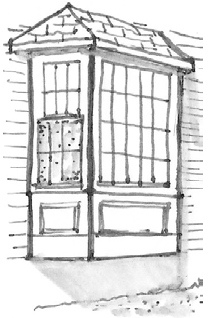
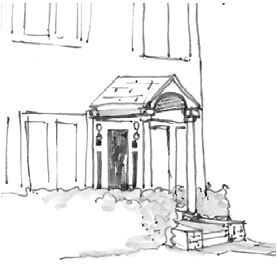
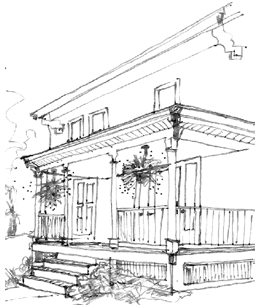
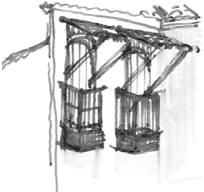
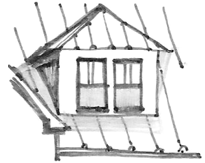
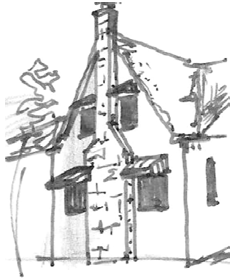
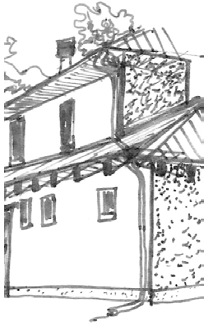
The front building facade shall have a minimum of a two foot by ten foot offset every 30 feet of facade and a combination of one of the following architectural features for every 30 feet to break up the monotony of the facade:
(1)
Projecting Bay or box windows, cantilevered, rather than supported by a permanent foundation (not to exceed 25 percent of the facade length).
(2)
Stoops (at least 25 percent of the facade length).
(3)
Porches (covered and unenclosed).
(4)
Balconies.

(5)
Structural window awnings or canopies.
(6)
Roof dormers.
(7)
Chimneys (minimum depth of one foot and not to exceed 25 percent of the facade).
(8)
A second-story roof overhang (at least 25 percent of the facade length).
(Ord. No. 2021-556, § 1, 8-17-21)
Sec. 28-223.04. - Location of parking.
(a)
Required parking for buildings with no garages shall be located in the side or rear yard of the building.
(1)
Legally platted lots with a width of 50 feet or below as of the effective date of this section that have no access to an improved alley are exempt from this requirement subject to the parking areas including the driveway does not constitute more than 50 percent of the front yard.
(b)
Required parking for buildings with garages shall meet the following standards:
(1)
Front load garages shall not comprise more than 50 percent of the front facade of the building. The measurement of the width of the garage door only shall be used to determine compliance with this section.
a.
Legally platted lots with a width under 50 feet are exempt from this requirement subject to the facade containing at least two architectural features consistent with the requirements in section 28-223.03.
b.
Two story buildings that have a front load garage on the first story and living space on the second story are exempt from this requirement subject to the facade containing at least two architectural features consistent with the requirements in section 28-223.03.
(2)
Side load garages shall have architectural features consistent with the requirements in section 28-223.03.
(3)
Front load garages shall not protrude more than ten feet from front facade of the building.
(Ord. No. 2021-556, § 1, 8-17-21)
Sec. 28-223.05. - Front facade variation.
The front facade for any new construction of applicable detached single-family dwelling, single-family attached dwelling, and two-family dwellings within a six lot pattern must be sufficiently differentiated from each other and from any another dwelling unit that is two lots removed on either side of the subject property on the same side of the street, as generally depicted below and otherwise set forth herein.
Figure 1.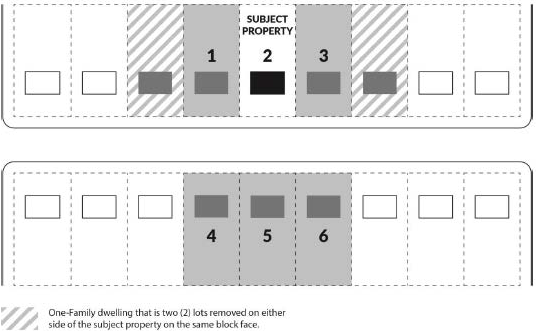
Figure 2.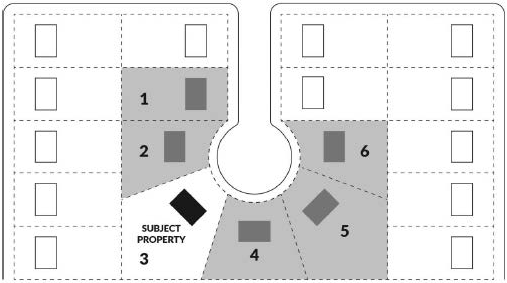
For a dwelling unit to be deemed sufficiently differentiated, i.e., different facade elevation, three of the following elements must be met:
(1)
Change in roofline that is at least 50 percent of the width of the front elevation;
(2)
Change in roof pitch of at least two units of change as measured by a roof's vertical rise over its horizontal span (e.g., 6/12 pitch to 8/12 pitch);
(3)
Inclusion or exclusion of a front porch or front entry structure or change in height of a front porch roof of at least four feet. A porch must be a minimum of four feet in depth to create a functional space;
(4)
Difference in number of dormers;
(5)
Change in number of front facing garage bay doors;
(6)
Garages recessed or projected by a minimum increment of four feet;
(7)
Change in exterior materials covering 50 percent or more of the wall coverage on the front facade (excluding openings);
(8)
Addition of a bay window that projects a minimum of one foot from the front wall, as measured from the ground up; or
(9)
Difference in number of windows, provided there is at least two feet of separation between windows when two or more windows are present.
(10)
Addition of landscaping that includes a minimum of two trees in the front yard and a landscaping bed that is at least 25 percent of the width of the front house elevation. The landscaping bed must be a minimum depth of three feet and include a border or edging with plant coverage of at least 50 percent of the bed area. A landscape plan must be submitted for review at time of building permit to qualify for this element.
This section only applies to new subdivisions or block-faces that are less than 25 percent built out.
Figure 3.
Depictions correspond to the numbering under section 28-223.05
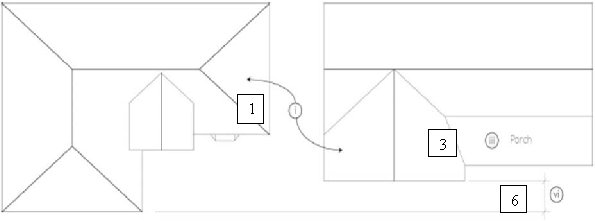
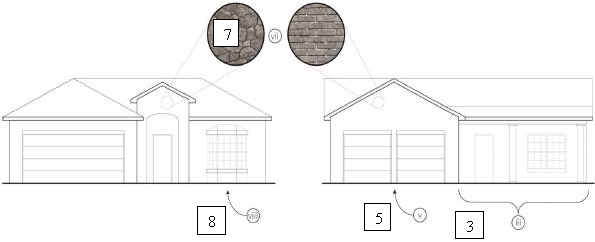
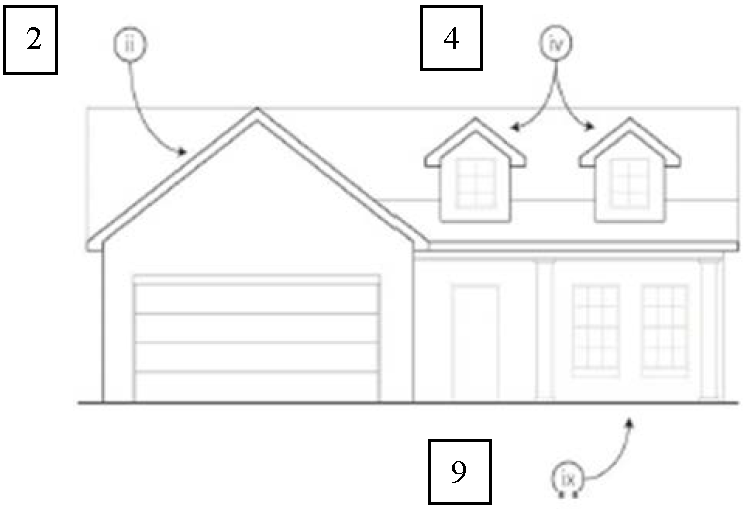
(Ord. No. 2021-556, § 1, 8-17-21)
Sec. 28-224. - Refuse and trash removal.
For all uses, except where individual trash collection is to be provided for each townhouse, two-family or single-family dwelling unit, refuse or trash collection areas shall be provided at the rear of each structure, or positioned in or near the common parking lot or a driveway. Each such area shall be completely screened from view on three sides, with solid fencing of either wood or masonry construction, to a height of seven feet and shall include concrete pad. Each such refuse area shall be provided with closed and covered trash containers.
(Ord. No. 1986-49, § 1(8.705(m)), 9-16-86)
Sec. 28-225. - Drive-through queuing.
(a)
Purpose. A drive-through shall provide adequate space for on-site activities of motor vehicles to maneuver, circulate, and queue, without impeding vehicular and pedestrian traffic on public right-of-way.
(b)
Application. This section applies to a new drive-through development, an addition of a drive-through to an existing development without a drive-through, and a relocation of an existing drive-through.
(c)
Design and layout.
(1)
A queuing lane must not interfere with:
a.
The functioning of an on-site parking facility, which includes parking spaces, a parking lot aisle, and/or a loading area;
b.
On-site circulation; and/or
c.
The site's driveway access.
(2)
The required minimum dimensions of a queuing space are ten feet wide and 20 feet long.
(3)
A queuing lane must be identified through means such as signs, pavement markings, pavement design, and landscaping.
(d)
Minimum number of queuing spaces. The following minimum numbers of queuing spaces are required.
(Ord. No. 2017-346, § 2, 3-7-17)
Sec. 28-226. - Design standards for repurposed shipping containers.
The intent of this section is to promote compatible design of repurposed shipping containers in context to the relationship of scale, materials and architectural elements to surrounding neighborhoods, buildings and structures:
(1)
Building scale and relationship.
a.
Each building or structure built with repurposed shipping containers, or with any part of a repurposed shipping container, shall be within 20 percent of the average height and within 20 percent of the average width of buildings and structures located in the same block-face; and
b.
In a residential zoning district, each building or structure built with repurposed shipping containers, or with any part of a repurposed shipping container, shall be within 20 percent of the average depth of buildings and structures located in the same block-face.
c.
In a block-face located in residential zoning that contains no building or structures, the minimum width of a building or structure built with repurposed shipping containers, or with any part of a repurposed shipping container located in a residential zoning district, shall be a minimum width of 20 feet and a minimum depth of 40 feet.
(2)
Building materials.
a.
In a residential zoning district, the exteriors of each building or structure built with a repurposed shipping container, or with any part of a repurposed shipping container shall consist of 100 percent of the following building materials:
i.
Masonry;
ii.
Glass;
iii.
Wood; and/or
iv.
Siding.
b.
Building materials shall be consistent with building materials for other buildings located in the same block-face.
(3)
Architectural elements of each building or structure built with repurposed shipping containers, or with any part of a repurposed shipping container:
a.
The pitch of roof lines shall be within 20 percent of the average pitch of the roof lines of buildings located in the same block-face.
b.
The foundation shall be consistent with the type of foundation of other buildings located in the same block-face. Pier and beam or raised foundations shall be screened with landscaping or covered with a compatible building material.
c.
A porch shall be installed where 50 percent or more of buildings located in a block-face contain a porch.
(Ord. No. 2019-293, § 2, 4-30-19)

