
Waco City Zoning Code
ARTICLE V
- SUPPLEMENTARY DISTRICT REGULATIONS
DIVISION 4. - SEXUALLY ORIENTED BUSINESSES[13]
Cross reference— Licensing and regulation of sexually oriented businesses, ch. 20.
DIVISION 5. - RESERVED[14]
Editor's note— Ord. No. 2017-703, § 1, adopted August 1, 2017, repealed division 5, §§ 28-960—28-964, which pertained to bed and breakfast and temporary residential rental unit establishments, and derived from Ord. No. 2010-693, § 1, adopted December 7, 2010. Formerly, division 5 pertained to bed and breakfast establishments, and derived from Ord. No. 1997-2, § 2, adopted February 4, 1997, and Ord. No. 2003-0034, § 1, adopted January 7, 2003.
DIVISION 7. - RESERVED[15]
Editor's note— Ord. No. 2013-483, § 1, adopted August 20, 2013, repealed the former division 7, §§ 28-970.2 and 28-970.3 in its entirety, which pertained to community gardens, and derived from Ord. No. 1998-53, § 2, adopted February 2, 1999, and Ord. No. 2005-437, § 2, adopted August 2, 2005. For current provision pertaining to community gardens, the user's attention is directed to chapter 13, article XII.
Sec. 28-881. - Mobile homes restricted.
Mobile homes are prohibited in the city as of July 7, 1992. This prohibition does not apply to a mobile home previously legally permitted and used as a residential dwelling within the city. A permit for the replacement of a previously legally permitted mobile home is permitted if the replacement is a HUD-Code manufactured home. HUD-Code manufactured homes are permitted for use and occupancy as a residential dwelling in a HUD-Code manufactured home subdivision and HUD-Code manufactured home park. Anything less than the length and/or width defining a HUD-Code manufactured home shall not be allowed.
(Ord. No. 1986-49, § 1(3.203), 9-16-86; Ord. No. 1987-3, § 3, 2-17-87; Ord. No. 1989-30, § 4, 7-18-89; Ord. No. 1992-25, § 3, 7-7-92; Ord. No. 1992-35, § 3, 10-6-92)
Sec. 28-882. - On-premises sale of alcoholic beverages.
Alcoholic beverages may be sold for on-premises consumption as provided for in this chapter. Provided, the sale of alcoholic beverages may only occur in a building located at least 100 feet from the lot line of the nearest lot zoned R-1 or R-2. This restriction does not apply to a restaurant as defined in this chapter, to an establishment selling alcoholic beverages for on-premises consumption under a permit or license issued by the state for a private club, or to an establishment selling beer for on-premises consumption under a permit or license issued by the state for a public golf course.
(Ord. No. 1990-13, § 10(3.204), 4-17-90; Ord. No. 1996-3, § 2, 2-20-96)
Sec. 28-901. - Minimum requirements.
All uses established and all structures erected hereafter shall be located on a lot which conforms to the minimum lot area and width required for the district in which the use or structure is located. However, where a tract of land has been partitioned or divided into a separate tract either through recorded deeds prior to the effective date of the ordinance from which this section was derived or a recorded subdivision and such tract does not conform to the minimum lot width or area requirements of this chapter, such tract may be used for any use permitted in the zoning district, provided that all other requirements are met and that a recorded subdivision is filed for the tract. Such tract may be used separately or in combination with one or more other lots which did not conform to the lot width or area requirements of this chapter on the effective date of the ordinance from which this section was derived.
(Ord. No. 1986-49, § 1(3.301), 9-16-86; Ord. No. 1987-3, § 4, 2-17-87; Ord. No. 2003-0522, § 1, 9-2-03)
Sec. 28-902. - Number of structures per lot.
(a)
In an R-E, R-1 or R-2 district, not more than one principal residential structure shall be located on a zoning lot.
(b)
In any zoning district, not more than one principal small lot single-family dwelling may be located on a zoning lot.
(c)
No lot containing a structure or use shall hereafter be divided in order to secure one or more additional lots for establishment of a principal use thereon, unless each lot, including also the lot containing the structure or use resulting from such division, shall have the minimum lot area and lot width required in this division for the district in which the lots are located.
(Ord. No. 1986-49, § 1(3.302, 3.303), 9-16-86; Ord. No. 1987-3, § 5, 2-17-87; Ord. No. 2008-037, § 3, 1-8-08; Ord. No. 2016-174, § 1, 3-1-16)
Sec. 28-903. - Height.
The height of any use or structure hereafter erected, established, altered, converted or relocated shall not exceed the maximum permitted height for the district in which such use or structure is located, except that:
(1)
Public buildings, churches, temples, hospitals, institutions and schools may have a maximum height of 70 feet if all required yards for such buildings are increased by at least one additional foot for each two feet by which the building exceeds the maximum height for the district in which it is located.
(2)
Chimneys, church steeples, cooling towers, elevator bulkheads, fire towers, monuments, stacks, stage towers or scenery lofts, tanks, water towers, ornamental towers, spires, electric and telephone lines and poles, grain elevators or necessary mechanical appurtenances are exempt from height regulations.
(3)
Storage buildings are exempt from the limitations on number of stories, but shall not exceed the maximum permitted height in number of feet for the district in which such building is located.
(4)
Office buildings and hotels located in C-1, C-2, C-3, and C-5 districts may have a maximum height of five stories or 75 feet if all required yards for such buildings are increased by at least one additional foot for each two feet by which the building exceeds the maximum height for the district in which it is located.
(Ord. No. 1986-49, § 1(3.401), 9-16-86; Ord. No. 1997-30, § 1(v), 7-1-97; Ord. No. 2006-269, § 2, 5-2-06)
Sec. 28-904. - Yards and required open space.
(a)
Except as otherwise provided in this section, all uses and structures hereafter erected, established, altered, converted or relocated shall conform with the yard and open space requirements of the district in which the use or structure is located.
(b)
Yards and other open spaces as required by this chapter shall be located on the same lot or parcel as the principal structure or use.
(c)
No required yards or open space for any use or structure shall be used to satisfy yard or open space requirements for any other structure or use.
(d)
No yards allocated to a structure or use shall be subsequently reduced or further reduced below the yard requirements of this chapter, except a yard adjoining a street may be reduced in depth if and to the extent the right-of-way width of such a street adjoining such yard is subsequently increased.
(e)
On lots fronting on two nonintersecting streets, a front yard must be provided on both streets.
(f)
On corner lots in the R and O districts, there shall be a yard along the side street side of such tract at least 15 feet, except that, in the case of a lot of record which is less than 75 feet in width, only 20 percent of the width of the lot need be provided for such side yard; and further provided, that in any district, where the rear yard of a corner lot abuts the side yard of an adjacent lot, such corner lot shall provide a side yard along the side street side of such tract which is equal in width to the depth required for the front yard of such adjacent lot (whichever is greater).
(g)
Notwithstanding the yard requirements of this section, the buildable width of a corner lot of record in an R or O district shall not be reduced to less than 30 feet for principal structures or 22 feet for accessory structures.
(h)
Where a block frontage is divided among districts with different front yard requirements, the requirement having the greatest depth shall apply to the entire frontage.
(i)
Where more than one principal building is located on a lot, the required yards shall be maintained around the group of principal buildings.
(j)
Where, on the effective date of the ordinance from which this chapter is derived, 40 percent or more of a block frontage was occupied by two or more buildings, then the required yard is established in the following manner:
(1)
Where the building farthest from the street provides a front yard not more than ten feet deeper than the building closest to the street, then the required front yard for the frontage is and remains an average of the then-existing front yards.
(2)
Where subsection (1) of this subsection is not the case and the lot is within 100 feet of a building on each side, then the required front yard is a line drawn from the closest front corners of these two adjacent buildings.
(3)
Where neither subsection (1) nor (2) of this subsection is the case and the lot is within 100 feet of an existing building on one side only, then the required front yard is the same as the front yard of the existing building.
(k)
Where a lot is used for a permitted use without a structure, the required yards shall be provided and maintained as if the use were conducted within a structure.
(l)
Single-family residential structure exception to platting and yard requirements. This exception applies to a property owner who wishes to obtain a building permit for the construction of a new single-family residence, or for the addition to an existing single-family residence structure, or for the construction of or addition to an accessory structure associated with such residences, where the structure crosses a property line. The platting requirements and zoning setback requirements for sideyards adjacent to property lines being crossed by such structures shall not be applicable if the following criteria exist:
(1)
The lots involved are part of a subdivision that was officially approved and recorded by the city;
(2)
The site is comprised of a maximum of three lots with at least one of those lots being substandard in size; and
(3)
The lots involved are located in an R-E, R-1A, R-1B, R-1C, R-2, R-3A, R-3B, R-3C, R-3D, R-3E, O-1, O-2, or O-3 district.
(m)
Where a lot abuts the rear yard of an adjacent lot, the rear yard requirements of the zoning district in which the adjacent lot is located shall apply to the area that abuts the rear yard.
(n)
In an O-2 or C-2 district, permitted public buildings, churches, hospitals, universities and colleges, schools, office buildings, multi-family dwellings, townhouse dwellings, single-family attached dwellings and retail uses in a mixed-use office or in a multi-family dwelling building may locate in the required front or side corner setback provided that:
(1)
The building is located within the limits of the area depicted in the Imagine Waco, A Plan for Greater Downtown;
(2)
The building must comprise more than 50 percent frontage of the block face; or the building must exceed a 1:1 ratio to the total frontage of structures currently existing along the same block face;
(3)
The front or side yard of the building is not adjacent to the front or side yard of a conforming single-family dwelling;
(4)
All off-street surface parking must be located behind the building away from the street frontage; and
(5)
The area between the building and the street including the building facade must include major urban design elements and be orientated towards the street frontage. Urban design elements may include but is not limited to:
a.
Dominant architectural features of the building, doors and windows oriented towards the street frontage;
b.
Sidewalks built on all street frontages that include such features as extra width, street trees, street lighting and street furniture;
c.
On-street parking;
d.
Bike parking facilities; or
e.
Landscaping.
(Ord. No. 1986-49, § 1(3.501—3.511), 9-16-86; Ord. No. 1987-3, § 28, 2-17-87; Ord. No. 2002-0267, § 1, 5-7-02; Ord. No. 2005-725, § 2, 12-13-05; Ord. No. 2012-029, § 1, 1-3-12)
Sec. 28-905. - Sight distance zones.
The following obstructions are permitted in any required yard except within a sight distance zone as defined by the city traffic code:
(1)
Awnings and canopies attached to a principal building and projecting not more than three feet from the side of the building, and located at least eight feet above adjoining walkways and driveways.
(2)
Flagpoles, fountains, sculptures, plant boxes and other similar ornamental objects.
(3)
Air-conditioning window units, but not projecting more than 18 inches.
(4)
Architectural entrance structures on a lot not less than one acre in area or at entrance roadways into subdivisions or planned unit developments containing 50 or more lots.
(5)
Bay windows, projecting not more than three feet, but not within five feet of a side lot line.
(6)
Chimneys, attached, projecting not more than 24 inches from the principal structure.
(7)
Eaves or gutters projecting 18 inches or less.
(8)
Trees, shrubs and hedges.
(9)
Flowers and landscaping.
(10)
Open entrances, stoops, porches, when not covered, may project not more than ten feet from a principal building, but not more than 18 inches above grade.
(11)
Ornamental light standards.
(12)
Signs and nameplates as regulated by article VIII of this chapter.
(13)
Sills, belt courses, cornices and ornamental features of a principal building, projecting not more than 12 inches.
(14)
Steps, four feet or less above grade, which are necessary for access to a permitted building or for access to a lot from a street or public way.
(15)
In side or rear yards only, stairs are permitted.
(16)
Reserved.
(17)
In a required rear yard, a permanent swimming pool, spa or hot tub, provided such structure is at least ten feet from the rear property line.
(18)
Fences in accordance with the provisions of section 28-926.
(Ord. No. 1986-49, § 1(3.512), 9-16-86; Ord. No. 1987-3, § 6, 2-17-87; Ord. No. 1988-45, §§ 6, 7, 10-18-88; Ord. No. 1988-73, § 1, 1-3-89; Ord. No. 2000-65, § 1, 11-7-00)
Sec. 28-906. - Permitted obstructions.
Except on corner lots as provided in section 28-904, in any required side or rear yard, the following additional obstructions are permitted, subject to the same restrictions as to sight distance zone as defined by the city traffic code:
(1)
Central air-conditioning units, heat pumps, rain water collection equipment and storage and solar collecting equipment, but not more than four feet from the principal structure, and provided the unit is properly screened.
(2)
Balconies, but not projecting more than 3 ½ feet.
(3)
Existing garages that are non-conforming as to the yard requirements may be replaced within their existing footprint on the property.
(4)
Carports, including overhang; provided such carports are:
a.
Not closer than two feet to a side or rear lot line;
b.
Not closer than five feet to any principal dwelling or dwelling unit on an adjacent lot; and
c.
If entered from an alley, not closer than ten feet from the rear lot line.
(5)
Open off-street parking spaces and loading spaces.
(6)
Arbors, trellises, playground and laundry-drying equipment.
(7)
Detached garages, non-commercial workshops, sheds and storage buildings for garden equipment and household items accessory to a principal dwelling or dwelling units, and structures customarily incidental to the pursuit of agriculture, provided they are more than five feet from a principal structure but not closer than three feet to any lot line.
(8)
Satellite dishes.
(9)
Guest quarters (not including a kitchen) and pool houses/game rooms provided such structures do not intrude more than 15 feet into the required rear yard, maintain the required five-foot side yard, and are more than ten feet from a principal dwelling or dwelling unit, and provided the open space requirements of section 28-216 can still be met.
(10)
Wind power generating facilities subject to height requirements of the zoning district in which it is located and the noise levels required in chapter 16, article VII of this Code.
(Ord. No. 1986-49, § 1(3.513), 9-16-86; Ord. No. 1987-3, § 29, 2-17-87; Ord. No. 1988-45, § 5, 10-18-88; Ord. No. 2002-0488, § 1, 8-20-02; Ord. No. 2005-223, § 2, 4-5-05; Ord. No. 2005-724, § 2, 12-13-05; Ord. No. 2008-699, § 2, 12-16-08; Ord. No. 2009-416, § 2, 8-4-09)
Sec. 28-907. - Off-street parking.
Except within a sight distance zone, as defined by the city traffic code, off-street parking spaces, open to the sky, are permitted in required yards, only as allowed under section 28-1019(d).
(Ord. No. 1986-49, § 1(3.514), 9-16-86)
Sec. 28-926. - Conditions for permission.
(a)
Accessory structures and uses permitted in the various districts shall:
(1)
Be incidental to the principal use and shall not be established on any lot prior to the establishment of the principal use.
(2)
Not be erected or maintained in required yards, courts or other open areas except those that are permitted as obstructions in yards, in accordance with sections 28-905, 28-906 and 28-907.
(3)
Not cover more than 30 percent of the area of the rear yard.
(4)
Not be used for dwelling or business purposes.
(b)
Enclosed outside storage shall be screened and behind the principal use or main building and not be more than 12 feet in height.
(c)
Outside displays shall:
(1)
Not reduce the number of parking spaces available so that the parking requirements of section 28-1021 are not met.
(2)
Not exceed ten percent of the lot or tract of land.
(3)
Not be placed in the required front and rear setbacks or any landscaped areas.
(Ord. No. 1986-49, § 1(3.601), 9-16-86; Ord. No. 2005-437, § 2, 8-2-05)
Sec. 28-927. - Temporary buildings.
Temporary buildings and enclosed outside storage for construction purposes may be erected and maintained for a period not to exceed the time of such construction but must be removed within 30 days after construction ends.
(Ord. No. 1986-49, § 1(3.602), 9-16-86; Ord. No. 2005-437, § 2, 8-2-05)
Sec. 28-928. - Home occupations.
Home occupations are permitted in residential districts, provided that:
(1)
The occupation shall be conducted as a secondary use to the residential dwelling and in a manner in which none of its activities are visible from a street.
(2)
The home occupation may not at any time be operated by a total number of the employees or patrons in excess of the occupancy limit as permitted by the International Residential Code for a residential dwelling unit as adopted in section 6-26, article II, chapter 6 of the code of ordinances.
(3)
No alteration of any kind shall be made to the principal building which changes its residential character as a dwelling unit.
(4)
No open storage shall be allowed.
(5)
No sign shall be permitted on the premises except a nonilluminated name plate no larger than one square foot in area. With regard to a registered family home as defined herein, the limitation on the size of a sign shall only apply to a registered family home in an R-1 or R-2 district. In other districts the size of an on-premises sign at a registered family home shall be governed by article VIII of this chapter.
(6)
There shall be no commodity sold or services rendered that require delivery or shipment of merchandise, goods or equipment by other than passenger motor vehicles, three-quarter-ton step-up van or similar sized trucks.
(7)
There shall be no perceptible noise that is in excess of the maximum permissible sound levels permitted for a residential property in section 16-202 of article VII, chapter 16 of the code of ordinances.
(8)
The home occupation shall be conducted in such a manner that it does not generate on-street parking or a substantial increase in traffic through the area. For the purposes of this section a substantial increase in traffic shall mean a 50% increase in the daily trips generated for a residential home of 9.57 as estimated by the Institute of Transportation Engineers (ITE).
(9)
The owner shall comply with all building, plumbing, electrical, and all other codes of the city.
(10)
The occupation shall be operated in accordance with all state laws and, if a state permit is required, such permit shall be obtained prior to beginning operation.
(Ord. No. 1986-49, § 1(3.603), 9-16-86; Ord. No. 1987-24, § 11, 12-21-87; Ord. No. 1988-45, §§ 8, 9, 10-18-88; Ord. No. 1988-73, § 2, 1-3-89; Ord. No. 1990-61, § 5, 12-18-90; Ord. No. 1998-5, § 1, 2-3-98; Ord. No. 2005-437, § 2, 8-2-05; Ord. No. 2025-594, § 2, 8-19-25)
Sec. 28-929. - Fences.
(a)
Fence shall mean any barrier, wall, or structure that is at least four feet in height erected or maintained for enclosing, screening, restricting access to, or providing decoration to any lot, parcel, building, or structure.
(b)
Requirements for residential fences.
(1)
Front yard. Fences shall not exceed four feet in height in any front yard of a lot zoned or developed for residential use, except as follows:
a.
Front yard fences may be constructed up to a maximum height of six feet provided that they are constructed with a combination of no more than four feet in height as a solid fence, and with the remainder of the fence height being no more than 50 percent solid (opaque), as measured perpendicular to the fence for each fence section as demonstrated in Figure 1.
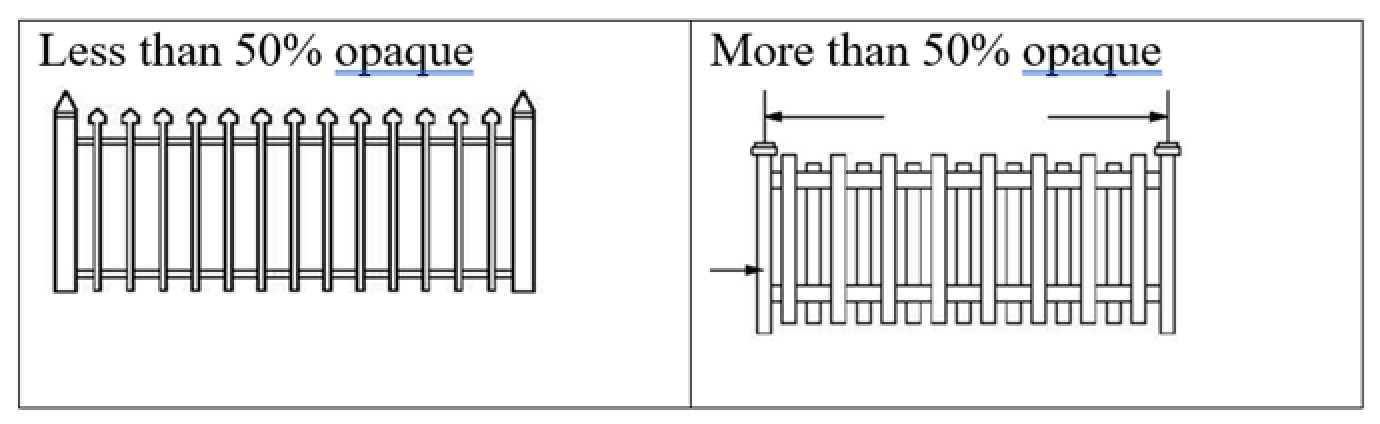
Figure 1
(2)
Rear and side yard. Fences shall not exceed six feet in height in any rear or side yard, located on any part of a lot zoned or developed for residential use, except as follows:
a.
Rear and side yard fences may be constructed up to a maximum height of eight feet subject to the following criteria:
i.
The fence is located adjacent to an alley.
ii.
The fence is on a lot adjacent to a commercially zoned or commercially developed property.
b.
If the fence is placed at a point where the adjacent grade is higher than the foundation of the main structure, fence height will be measured at the grade adjacent to the fence. If the fence is placed at a point where the adjacent grade is below the foundation of the main structure, fence height will be measured from the finished floor elevation of the main structure as shown in Figure 2.
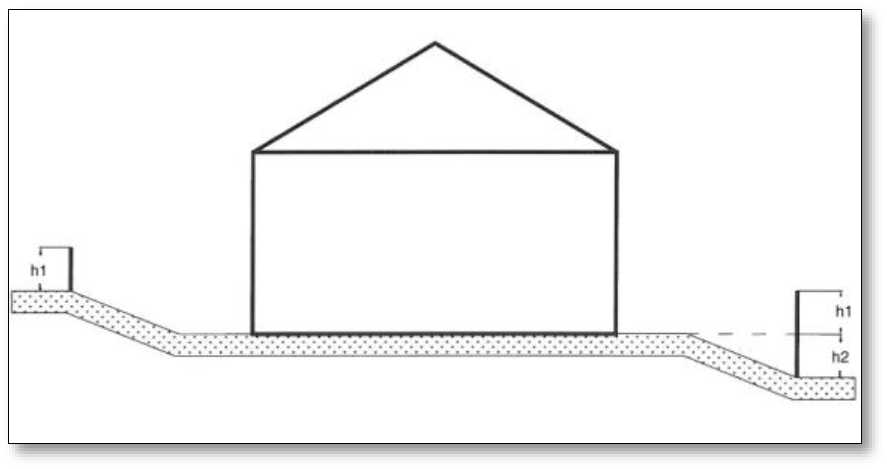
Figure 2
c.
Requirements for non-residential fences. Commercial fences shall not exceed eight feet in height on any part of a lot zoned for commercial or industrial use.
d.
Requirements for all fences:
1.
Encroachment. No fence, brace, or any post of such fence shall be constructed upon or caused to protrude over the property line of the property. It shall be the responsibility of the property owner to determine the boundaries of the property.
2.
Easements.
a)
Drainage easements. Fences shall not be placed within drainage easements without prior written authorization from the city of Waco Public Works Department.
b)
Public utility easements. Fences placed within a public utility easement shall be placed there at no risk or obligation to the public or the City of Waco. The City of Waco shall have no responsibility to repair or replace such improvements if they are damaged or destroyed in the utilization of the easement in accordance with the recording document.
c)
Private utility easements. It is the responsibility of the property owner to contact any private utility to determine the requirements for placing a fence within the private utility easement.
d)
Access easements. Fences shall not be placed within a recorded access easement that would prevent full use of the easement in accordance with the recording document.
3.
Maintenance responsibility. All fences shall be maintained by the owner of the property, or person in charge of the property, to comply with the requirements of this section, and shall be maintained structurally sound and in good repair according to the applicable section of the currently adopted International Property Maintenance Code.
4.
Fence height. Fence height shall be measured from the adjacent grade to the highest point of the fence. If the fence is placed on a concrete curb, not exceeding six inches in height, for structural support, the supporting curb shall not be calculated into the fence height.
5.
All fences shall meet the sight obstruction requirements of the City of Waco Traffic Code.
e.
Fences not meeting any of the requirements of this ordinance will require variance approval from the zoning board of adjustment.
(Ord. No. 1986-49, § 1(3.604), 9-16-86; Ord. No. 2025-071, § 2, 1-21-25)
Cross reference— Barbed wire fences, § 22-31.
Sec. 28-930. - Garage or yard sales.
(a)
Garage or yard sales will be permitted in the R-1 district through R-3 district and in other districts where primary use of property is residential.
(b)
Garage or yard sales are permitted under the following conditions:
(1)
Garage and yard sales must be conducted by the owner or tenant of the property where the sale is conducted.
(2)
Garage and yard sales by neighborhood and homeowners associations, and tax exempt organizations, may be held on property other than that owned by the association or organization.
(3)
Garage sales by neighborhood or homeowners associations may be at one or multiple locations within the boundaries of the neighborhood or homeowners association.
(4)
Only tangible personal property may be sold at the garage or yard sale.
(5)
No property acquired solely for the purpose of resale shall be sold at a garage or yard sale.
(6)
A garage or yard sale may not be conducted by persons who habitually engage or holds themselves out as engaging in the business of selling tangible personal property unless they collect and report sales tax on the items sold in the manner prescribed by state law.
(7)
There shall not be more than two garage or yard sales by the same property owner or tenant at the same location during any calendar year.
(8)
All sales shall be confined to the premises.
(9)
The duration of any garage or yard sale shall not exceed three consecutive calendar days.
(Ord. No. 1986-49, § 1(3.701, 3.702), 9-16-86; Ord. No. 1999-27, § 1, 1-4-00; Ord. No. 2022-535, § 2, 8-2-22)
Sec. 28-931. - Estate sales.
(a)
For the purposes of this section and section 28-932, an "estate sale" is the sale of all or substantially all of a person's tangible personal property due a person's death, mental or physical incapacity.
(b)
Estate sales will be permitted in the R-1 district through R-3 district and in other districts where primary use of the property is residential.
(c)
Estate sales are permitted under the following conditions:
(1)
Only tangible personal property may be sold at the estate sale.
(2)
No property acquired solely for the purpose of resale shall be sold at an estate sale.
(3)
An estate sale may not be conducted by persons who habitually engage or holds themselves out as engaging in the business of selling tangible personal property unless they collect and report sales tax on the items sold in the manner prescribed by state law.
(4)
There shall not be more than one estate sale by the same property owner or tenant at the same location during any 12-month period.
(5)
All sales shall be confined to the house and garage of the premises.
(6)
The duration of any estate sale shall not exceed three consecutive calendar days.
(Ord. No. 1999-27, § 2, 1-4-00; Ord. No. 2022-991, § 2, 12-20-22)
Sec. 28-932. - Signs for garage, yard, and estate sales.
Two signs not exceeding two square feet may be located on property where a garage, yard, or estate sale is taking place, or one sign may be located on the property and one sign may located on a property where permission has been granted by the property owner. Such signs are prohibited at all other locations.
(Ord. No. 1999-27, § 4, 1-4-00)
Sec. 28-946. - Location restricted.
A person commits an offense if he causes or permits the establishment of a sexually oriented business, as those terms are defined in section 20-2, and such is located within:
(1)
Six hundred feet of any lot used for residential purposes, be it for single-family, duplex, multifamily or HUD-Code manufactured home park or HUD-Code manufactured home subdivision, or within 600 feet of an R zoning district;
(2)
Six hundred feet of any premises of a public or private, elementary or secondary school, institution of higher learning, church, park or public playground;
(3)
Six hundred feet of any other sexually oriented business; or
(4)
Any R, O, C-1 or M district.
(Ord. No. 1986-49, § 1(3.901), 9-16-86; Ord. No. 1987-8, § 2, 3-3-87; Ord. No. 1992-35, § 4, 10-6-92; Ord. No. 2014-294, § 2, 6-3-14)
Sec. 28-947. - Measurement of distances.
All distances shall be measured in a straight line, without regard to intervening structures, from the closest exterior structural wall of the sexually oriented business to the closest exterior wall of another sexually oriented business or to the closest property line of a public or private, elementary or secondary school, institution of higher learning, church, park, public playground, residential use or R zoning district. These measurements shall be made only to properties or structures within the city.
(Ord. No. 1986-49, § 1(3.902), 9-16-86; Ord. No. 1987-8, § 2, 3-3-87)
Sec. 28-948. - Effect of change in surrounding uses.
A sexually oriented business lawfully operating as a conforming use is not rendered a nonconforming use by the subsequent location of a public or private, elementary or secondary school, institution of higher learning, church, park, public playground, residential use of R zoning district within 600 feet of such sexually oriented business. The preceding sentence does not apply to a sexually oriented business for which a license to operate, as required by chapter 20, has been finally denied or revoked by the city, but the preceding sentence does apply to a business which is sold and a new license for the new owner obtained without any time period occurring during which a valid license for the business was not in existence.
(Ord. No. 1986-49, § 1(3.903), 9-16-86; Ord. No. 1987-8, § 2, 3-3-87; Ord. No. 2014-294, § 3, 6-3-14)
Secs. 28-949, 28-950. - Reserved.
Editor's note— Ord. No. 2014-294, §§ 4, 5, adopted June 3, 2014, repealed the former sections 28-949 and 28-950 in their entirety, which pertained to nonconforming uses and amortization plan for discontinuance, respectively, and derived from Ord. No. 1986-49, § 1(3.904, 3.905), adopted September 16, 1986; Ord. No. 1987-8, § 2, adopted March 3, 1987, and Ord. No. 1992-7, § 1, adopted February 4, 1992.
Sec. 28-951. - Defense to prosecution.
It is a defense to prosecution under section 28-946 that each item of descriptive, printed, film or video material offered for sale or rental, taken as a whole, contains serious literary, artistic, political or scientific value.
(Ord. No. 1986-49, § 1(3.906), 9-16-86; Ord. No. 1987-8, § 2, 3-3-87)
Sec. 28-965. - Purpose.
The regulation of the wireless communication system is intended to provide for the appropriate location and development of wireless communication towers and antennas to serve the residents and businesses; minimize the visual impacts of towers through careful design, siting and screening; avoid potential damage to adjacent properties through engineering and careful siting of structures; and maximize use of any new or existing towers to reduce the number of towers needed. The intent of this section is to:
(1)
Discourage the location of towers in residential areas and minimize the total number of towers throughout the city.
(2)
Encourage the shared use of new and existing towers, and the use of existing alternate structures.
(3)
Require users to locate and engineer towers and design sites in a way that minimizes the adverse visual impact and ensures the public safety.
(Ord. No. 1997-30, § 2, 7-1-97; Ord. No. 2001-48, § 1, 4-3-01)
Sec. 28-966. - Siting requirements.
Unless otherwise indicated, wireless communication system structures and equipment shall meet the setback requirements of the district in which they are located. Each new structure will provide adequate space for co-location of at least four antenna arrays if greater than 120 feet in height or two antenna arrays if 120 feet or less in height.
Antenna support structures, not including alternate independent support structures, shall be at least 100 feet from all R districts or the calculated collapse distance plus 25 feet, whichever is greater. Measurements shall be from the base of the antenna support structure to the nearest zoning district boundary.
Antenna support structures, not including alternate independent support structures, shall not be located in the Lake Brazos Corridor District as designated by article IV, division 23 of this chapter.
Alternate independent support structures are allowed in any zoning district provided they meet the following conditions:
(1)
The total height of the antenna, shall not exceed a maximum height of 15 feet above the structure on which it is located.
(2)
The total height of the antenna, shall not exceed a maximum height of the zoning district by more than 15 feet, except when located on an existing antenna structure.
(3)
A minimum of 15 feet is maintained from the ground to the lowest element of the antenna.
(4)
Antennas must be identical in color or closely compatible with the color of the supporting structure.
(5)
Single-family and two-family residential structures may not be utilized as alternate independent support structures.
(Ord. No. 1997-30, § 2, 7-1-97; Ord. No. 2001-48, § 1, 4-3-01)
Sec. 28-967. - Structural requirements.
The antenna support structure, not including alternate independent support structures, shall be constructed to support a minimum of two antenna arrays if 120 feet in height or less and shall support four antenna arrays if greater than 120 feet.
A building permit from the building inspections department shall be required for the installation of any antenna, including alternate independent support structures, for the wireless communication system. The permit shall be issued only when there is full compliance with this section and the applicable provisions of the Building Code of the City of Waco. Applications for a building permit and/or a special permit shall be accompanied by the following:
(1)
Construction drawings, sealed by a structural or civil engineer registered by the State of Texas, showing the proposed method of installation. Complete details shall be provided for any alternate independent support structure showing all fixtures and couplings and the precise point of attachment.
(2)
The manufacturer's recommended installations, if any.
(3)
A diagram to scale, sealed by a surveyor or engineer registered by the state, showing the location of the antenna, property and setback lines, easements, power lines, and all structures.
(4)
Proof that any proposed tower complies with regulations administered by the Federal Aviation Administration.
(5)
Sealed certification by a structural or civil engineer registered by the state that the proposed installation of any tower complies with standards for towers that are published by the Electronic Industries Association (ANSI-EIA 222). Sealed certification shall also be provided by a structural or civil engineer registered by the state that any alternate independent support structure is suitable to accept the attachment of the antenna.
(6)
Construction drawings, sealed by a structural or civil engineer registered by the State of Texas, shall visually indicate the engineered fall zone of the tower.
Upon installation of any tower, a structural or civil engineer registered by the state shall provide sealed certification that the installation is in compliance with standards published by the Electronics Industries Association (ANSI-EIA 222). Sealed certification shall also be provided for any alternate independent support structure that the installation/attachment is suitable.
(Ord. No. 1997-30, § 2, 7-1-97; Ord. No. 2001-48, § 1, 4-3-01)
Sec. 28-968. - Application requirements.
The applicant of a new antenna support structure shall provide the following documentation to the planning department for review prior to the issuance of a building permit and/or approval of a special permit:
(1)
Site plan. Each applicant must submit a scaled site plan and a scaled elevation view and other supporting drawings, calculations, and other documentation, signed and sealed by a surveyor or engineer registered by the state. The site plan shall show the location and dimensions of all improvements and shall include information concerning topography, radio frequency coverage, tower height requirements, setbacks, driveways, parking, fencing, landscaping, adjacent uses and other information necessary to assess compliance with this chapter.
(2)
Inventory of existing antenna facilities. Each applicant must submit an inventory of its existing antenna facilities within the city and the city's E.T.J., including specific information about the location, height and type of each tower.
(3)
Availability of suitable existing towers or other alternate independent support structures. No new tower shall be permitted unless the applicant demonstrates that no existing tower or alternate structure can accommodate the applicants proposed antenna. Evidence submitted must consist of the following:
a.
No existing alternate independent support structures are located within the geographic area required to meet the applicant's engineering requirements.
b.
Existing alternate independent support structures are not of sufficient height to meet applicant's engineering requirements.
c.
Alternate independent support structures do not have sufficient structural strength to support applicant's proposed antenna and related equipment and cannot be reinforced.
d.
The applicant's proposed antenna would cause electromagnetic interference with the antenna on the existing towers or structures, or the antenna on the existing towers or structures would cause interference with the applicant's proposed antenna.
e.
The fees or costs required to share an existing tower or structure or to adapt an existing tower or structure for sharing are unreasonable. Costs below new tower development are presumed reasonable.
f.
Property owners or owners of existing towers or structures are unwilling to accommodate the applicant's needs after a period of 30 days.
g.
The applicant demonstrates that there are other limiting factors that render existing alternate independent support structures unsuitable.
(4)
Grid plan. Applicants shall provide a grid plan of the service area for existing and future structures for a period of not less than five years.
(Ord. No. 1997-30, § 2, 7-1-97; Ord. No. 2001-48, § 1, 4-3-01)
Sec. 28-969. - Aesthetics.
Antenna structures, not including alternate independent support structures, shall be enclosed by a decorative iron fence surrounded by a screening hedge which will achieve a height of at least six feet at maturity or an opaque fence or wall of at least eight feet in height. No more than two feet of the bottom of the fence, wall, or hedge may be left open to allow for an unobstructed view of the site for security purposes. The area inside the screening shall be maintained and free from clutter, weeds and debris. Antenna structures located in the O or C districts must include landscaping along the perimeter of the site as defined by section 28-218 of this chapter.
Towers shall either maintain a galvanized steel finish or, subject to any applicable standards of the FAA, be painted a neutral color so as to reduce visual obtrusiveness. At a tower site, the design of the buildings and related structures shall, to the extent possible, use materials, colors, textures, screening, and landscaping that will blend the tower facilities to the natural setting and built environment.
(Ord. No. 1997-30, § 2, 7-1-97; Ord. No. 2001-48, § 1, 4-3-01)
Sec. 28-970. - Radio antennas (noncommercial).
Radio antennas, limited to those used by the federal licensed amateur radio operators, and unlicensed citizen band radio operators, and located in the R or O Districts, shall require a building permit and special permit if the antennas exceed the maximum height allowed by the zoning district or exceed 90 feet where no maximum height is provided. An application for special permit shall contain a development plan as required by section 28-124 of this chapter.
(Ord. No. 1997-30, § 2, 7-1-97; Ord. No. 2001-48, § 1, 4-3-01)
Sec. 28-970.1. - Non-use/abandonment.
No less than 30 days prior to the date that a wireless service provider plans to abandon or discontinue operation of a facility, the provider must notify the building official of the City of Waco by certified U.S. mail of the proposed date of abandonment or discontinuation of operation. In the event that a permitted provider fails to give notice, the facility shall be considered abandoned upon the city's discovery of discontinuation of operation. Upon such abandonment, the provider shall have six months or an additional period of time determined in the reasonable discretion of the building official of the City of Waco within which to:
(1)
Reactivate the use of the facility or transfer the facility to another provider who makes actual use of the facility; or
(2)
If the tower, antenna, foundation, and facility are not removed within the six-month time period or additional period of time allowed by the city, the city may remove such tower, antenna, foundation, and related facility at the provider's expense. If there are two or more providers co-locating on a facility, this provision shall not become effective until all providers cease using the facility.
(3)
At the earlier of six months from the date of abandonment without reactivating or upon completion of dismantling and removal, city approval for the facility shall automatically expire.
(Ord. No. 2001-48, § 1, 4-3-01)
Editor's note—
Ord. No. 2001-48, § 1, adopted April 3, 2001, amended § 28-970.1 in its entirety to
read as herein set out. Formerly, § 28-970.1 pertained to abandonment and derived
from Ord. No. 1997-30, § 2, adopted July 1, 1997.
Prior to the adoption of Ord. No. 2001-48, Section 2 of Ord. No. 1997-30, adopted
July 1, 1997, added § 28-971. Inasmuch as provisions already exist under § 28-971
of this Code, § 28-971 of Ord. No. 1997-30 has been redesignated as 28-970.1 at the
editor's discretion.
Sec. 28-970.1.1. - Temporary wireless communication facilities.
Wireless communication facilities may be permitted as a temporary use with review by the building official or his or her designate in order to facilitate continuity in wireless communications service during repair or maintenance of existing wireless communication facilities, during a special event, or prior to the completion of construction of new wireless communication facilities. Temporary wireless communication facilities shall operate for not more than 60 days within a one-year period commencing when transmission from the facility begins except if an applicant requests a longer period and the city council determines that the longer period is necessary due to circumstances for which the applicant is not responsible or which is not within the applicant's control, including, but not limited to strikes, boycotts, labor disputes, or act of God. The wireless communications facility shall be removed within seven days after the facility is no longer needed for telecommunications purposes. Such temporary wireless communication facilities shall not be located within 100 feet of residential areas and shall not extend more than 100 feet above the ground.
(Ord. No. 2001-48, § 1, 4-3-01)
Sec. 28-970.1.2. - Wireless communication facility signage and database.
All wireless communication facilities shall display and maintain a facility number in a location approved by the building official or his or her designee. The following information shall be maintained in a database for each wireless communication facility:
(1)
Wireless communication facility owner. The owner must notify the department of inspection services within 30 days of a change in ownership of such facility. In addition, all existing towers and/or antennas must be registered with inspection services within 180 days of passage of the ordinance from which this section derives.
(2)
Carrier inventory. An inventory of all carriers actively transmitting from the wireless communication facility. Wireless carriers shall notify inspection services within 30 days of beginning or ending transmission from such wireless communication facility.
(Ord. No. 2001-48, § 1, 4-3-01)
Sec. 28-970.4. - Reasonable accommodation for persons with disabilities.
A person may file an application with the commission for a reasonable accommodation variance to the provisions of this chapter if a variance is needed to provide a reasonable accommodation to a person with a disability. Notice and hearings shall be in the same manner as specifically provided for zone change or special permit requests as set forth in divisions 6 and 7 of article II, of this chapter. In making a determination as to whether a requested accommodation is reasonable, the city council will consider, among other things, whether the accommodation:
(1)
Will fundamentally alter the nature of this chapter;
(2)
Will undermine the legitimate purposes and effects of this chapter; or
(3)
Will impose undue financial and administrative burdens on the city.
(Ord. No. 2004-0332, § 1, 6-15-04)
Sec. 28-970.5.1. - Purpose.
Accessory dwelling units are intended to provide an opportunity for alternative housing options in single-family residential neighborhoods while preserving the character of these neighborhoods. This is intended to make neighborhoods more resilient against changing market conditions, allow more efficient use of existing infrastructure, provide alternative housing options, and a means for property owners to realize additional income while residents remain in place.
(Ord. No. 2023-969, § 1, 11-7-23)
Sec. 28-970.5.2. - Definitions.
Accessory dwelling unit means a separate additional living unit, providing separate complete independent living facilities for one or more persons, including permanent provisions for living, sleeping, eating, cooking, and sanitation, attached or detached from a primary dwelling unit, on a legally platted single-family lot.
Owner occupancy means a property owner, as reflected in title records, who makes his or her legal residence at the site, as evidenced by voter registration, vehicle registration, or similar means.
(Ord. No. 2023-969, § 1, 11-7-23)
Sec. 28-970.5.3. - Design and development standards.
All accessory dwelling units must conform to the following standards:
(1)
Number of accessory dwelling units per lot. Only one accessory dwelling unit shall be allowed per lot.
(2)
Number of bedrooms of accessory dwelling units. Only one bedroom permitted per accessory dwelling unit.
(3)
Existing development on the lot. A detached single-family primary dwelling unit must exist on the lot or will be constructed in conjunction with the accessory dwelling unit. Accessory dwelling units are not permitted with any other type of housing units.
(4)
Setbacks for detached accessory dwelling units. Detached accessory dwelling units shall have a minimum rear yard setback of ten feet; side yard setback of five feet; and front yard setback the same as the primary dwelling unit. A detached accessory dwelling unit must have at least a ten-foot separation from the primary dwelling unit. Existing structures that are adapted or renovated are exempt from the setback requirements.
(5)
Setbacks for attached accessory dwelling units. Attached accessory dwelling units shall meet the same minimum setbacks required by the zoning district of the primary dwelling unit.
(6)
Accessory dwelling unit size. The maximum floor area of the accessory dwelling unit shall not exceed 500 square feet or 30 percent of the size of the floor area of the primary dwelling unit whichever is greater. The floor area calculation of the primary dwelling unit excludes garages. Existing structures that are adapted or renovated are exempt from the accessory dwelling unit size requirements.
(7)
Height. The maximum height of an accessory dwelling unit shall not exceed the height of the primary dwelling unit.
(8)
Occupancy. In single-family residence districts, the property owner shall sign an affidavit before a notary public, to be recorded with the McLennan County Clerk's Office, affirming that the owner occupies either the primary dwelling unit or the accessory dwelling unit. It shall be unlawful in a single-family residence district to lease both the primary dwelling unit and the accessory dwelling unit.
(9)
Parking. Off-street parking shall be provided at a minimum of one space for accessory dwelling unit in addition to the two spaces required for the primary dwelling unit. In addition, the following requirements shall apply:
a.
Parking access for the accessory dwelling unit shall be the same as the primary dwelling unit's parking access.
b.
Where a lot abuts a public alley, vehicular access for the accessory dwelling unit may be provided from the alley at the rear of the lot.
(10)
Site coverage and open space. The maximum coverage of the lot by buildings and paved areas shall not exceed 75 percent of the total lot.
(11)
Building elevations and materials. Exterior design of accessory dwelling units shall be compatible with the primary dwelling unit and have complementary wall materials, window types, door and window trims, roofing material, and roof pitch.
(12)
Utility connection. An accessory dwelling unit must be connected to the city water and wastewater services of the primary dwelling unit and may not have separate services.
(13)
Other code requirements. The accessory dwelling unit must meet all other applicable city codes before occupancy.
(Ord. No. 2023-969, § 1, 11-7-23)
Sec. 28-970.6.1. - Occupancy of a dwelling unit.
Occupancy of a dwelling unit is limited to:
(1)
One occupant per sleeping room with a minimum floor area of 70 square feet; and
(2)
One additional occupant for each additional 50 square feet of floor area in the same sleeping room.
(3)
Occupancy is also subject to:
a.
International Residential Code and International Fire Code for a residential dwelling unit as adopted in section 6-26, article II, chapter 6 of the code of ordinances.
b.
Occupancy standards adopted by the Department of State Health Services; or
c.
Local, state, or federal affordable housing program guidelines.
(Ord. No. 2025-595, § 2, 8-19-25)

