
Waleska City Zoning Code
ARTICLE VII
DISTRICT USES AND REGULATIONS
Sec. 28-154.- Purpose.
(a)
Estate residential district (R-80). The purpose of this district is to permit residential development in those areas that are expected to become more nearly urban in character. The areas involved are generally in transition from agricultural to residential development and are considered appropriate for low density residential development.
(b)
Single-family residential districts (R-40, R-30). The purpose of these residential districts is to enable residential development of a low density urban character. The regulations are designed to permit and encourage residential development in areas where urbanization is taking place.
(c)
Office/institutional district (OI). The purpose of this district is to provide a location for office, institutional, medical, and educational development. Limited related retail business and service activities may be permitted but not involved with storage and processing.
(d)
Neighborhood commercial district (NC). The purpose of this district is to provide for limited retail activities, commercial sales, personal services, and professional offices to serve the general need of a residential neighborhood. Development of commercial uses is regulated for compatibility with the surrounding residential areas. Districts are located to create commercial centers or clusters and to discourage commercial strip development.
(e)
General commercial—Limited use district (GC-LU). The purpose of this district is to provide sufficient space in appropriate locations for a wide variety of commercial sales and service activities which generally serve a wide area. The permitted uses are generally located along the major thoroughfares. Activities with limited storage may be permitted. Districts are located to create centers or concentrations of commercial activities and to discourage commercial strip development.
Table 28-154. Minimum District Development Standard
Existing two-lane arterial and collector roads required a 65-foot setback limit (See section 28-103(2)).
Existing four-lane interstate and arterial roads require a 50-foot setback limit (See section 28-103(2)).
Sec. 28-155. - Development requirements.
The requirements regarding lot size, building size, and building placement on the lot for each zone district shall be met as indicated in section 28-156, application of standards, Table 28-154. minimum district development standards and additional requirements listed in section 28-157.
Table 28-155. Permitted Uses
Note: X = permitted use
(Ord.of 4-2-2012(3); Ord. of 7-17-2017, § 1(Exh. A); Ord. of 5-31-2022, § 1)
Sec. 28-156. - Lot requirements.
(a)
Lots of record. Any lot of record which is legal at the time of the adoption or amendment to the ordinance from which this chapter is derived, that has an area or width that is less than required by this chapter, may be used, subject to the following exceptions and modifications:
(1)
Individual lot not meeting minimum lot size requirements. Except as set forth in subsection (a) of this section, in any zoning district in which one-family dwellings are permitted, any lot of record existing at the time of adoption or amendment to the ordinance from which this chapter is derived which has an area, width, or depth less than that required by this chapter may be used as a building site for a one-family dwelling.
(2)
In the case of such a lot, when it is not possible to provide the required side yards and at the same time build a minimum width one-family dwelling, the zoning board of appeals is hereby authorized to grant a variance reducing the side yard requirements for such lot the minimum amount necessary for a reasonable dwelling, but in no case shall each of the side yards be less than five feet in width.
(b)
Lot area. No lot shall be reduced in size so that lot width or depth, size of yards, lot area per family or any other requirement of this chapter is not maintained. This limitation shall not apply:
(1)
When a portion of a lot is acquired for a public purpose.
(2)
To dormitories, fraternities, sororities and other similar living quarters which are accessory to a permitted use and which have no cooking facilities in individual rooms or apartments.
(3)
To rental units in a hotel, motel, motor lodge, tourist home or to rooms in a roominghouse or boardinghouse.
(c)
Corner lots. The minimum yard requirements for corner lots with multiple road frontage shall not be less than the minimum front yard requirements for such lots as specified for each district. Such yards shall be classified as required front yards.
(d)
Through lots. On lots having frontage on two streets, but not located on a corner, the minimum front yard shall be provided on each street in accordance with the provisions of this chapter.
(e)
Double frontage corner lot. On lots having frontage on more than two streets, the minimum front yard shall be provided in accordance with the regulations set forth in this chapter on at least two of the street frontages. The minimum front yard on the other frontage or frontages may be reduced along the other streets in accordance with the provisions of subsection (c) of this section.
(f)
Density. No building or structure shall hereafter be erected, constructed, reconstructed or altered to:
(1)
House a greater number of families per acre or occupy a smaller lot area per family than are herein required.
(2)
Have narrower or smaller front, rear or side yards than are herein required.
(g)
Yards and other spaces.
(1)
No part of a yard or the off-street parking or loading spaces that are required in connection with any building or use for the purpose of complying with the regulations of this chapter shall be included as part of the yard or off-street parking or loading spaces required for another building, except as specifically provided herein.
(2)
Whenever a lot abuts upon a public alley, one-half of the alley width may be considered as a portion of the required yard.
(3)
Where these regulations refer to side streets, the zoning administrator shall be guided by the pattern of development in the vicinity of the lot in question in determining which of two streets is the side street.
(4)
Every part of a required yard (except rear yards) shall be open to the sky, except as authorized by this article, and excepting ordinary projections of sills, belt courses, window air conditioning units, chimneys, cornices and ornamental features which may project to a distance not to exceed 24 inches into a required yard.
(h)
Front yards.
(1)
Where an official line has been established for the future widening or opening of a street or major thoroughfare upon which a lot abuts, the depth of a front or side yard shall be measured from such official line to the nearest line of the building.
(2)
Platforms or paved terraces, not covered by a roof or canopy and which do not extend above the level of the first floor of the building, may extend or project into the front or side yard not more than six feet. Unenclosed porches shall be considered part of the main structure.
(3)
Within the same block and zoning district, when 25 percent or more of the existing buildings which are located within 200 feet of each side of a lot have less than the minimum required setback, the setback of such lot should not exceed the average of the existing setbacks.
(i)
Side yards.
(1)
For the purpose of the side yard regulations, a group of business or commercial building separated by common or party walls shall be considered as one building occupying one lot.
(2)
The minimum width of side yards for schools, libraries, churches, community houses and other public and semipublic buildings in residential districts shall be 25 feet, except where a side yard is adjacent to a business or commercial district, in which case the width of that yard shall be required in Table 28-154 for the district in which the building is located.
(j)
Rear yards. Open or lattice-enclosed fire escapes, outside stairways, balconies opening up on fire towers and the ordinary projections of chimneys and flues, may project into the required rear yard for a distance of not more than five feet, but only where the same are so placed as not to obstruct light and ventilation.
Sec. 28-157. - District development; permitted uses.
(a)
Office/institutional (OI). Distributive functions such as loading, unloading, storage, packaging, and unpackaging shall be limited to ten percent of the total building area and five percent of the total lot area.
(b)
Neighborhood commercial (NC). No outdoor storage is permitted.
Sec. 28-158. - Site plans.
(a)
Site plan requirements; exceptions. The features provided for in this section shall be included in site plan requirements for all developments within all zoning districts, except for R-80, R-40, and R-30.
(b)
Site development plan. The site development plan shall be submitted at the time of construction plan submittal; if not submitted, the land disturbance permit shall not be permitted to proceed. Prior to issuance of the LDP, a site development plan shall be submitted addressing all issues described in subsection (b)(1) through (15) of this section. All plans shall be submitted for approval by noon on Friday, and a plan review will take place during the work day with city officials and the developer the following Friday. Any changes requested by the city shall be reviewed on or before the second Friday before the original submission.
(1)
Location map. A general location map at a scale of one inch equals 500 feet indicating existing zoning on the site, adjoining roads and the adjacent areas are required.
(2)
Survey boundaries. Surveyed boundaries of the entire tract and their relationship to adjoining properties, public rights-of-way, and easements.
(3)
Building locations. Location of all proposed buildings, their shape, size, and setback in appropriate scale.
(4)
Right-of-way. Location and right-of-way of streets, roads, alleys, railroads, public crosswalks, with lengths and widths, road names, or designations.
(5)
Buffers. Proposed buffers and landscaping.
(6)
Topography. Existing topographic conditions with contour intervals of five feet or less; areas that have slopes greater than 15 percent shall be identified.
(7)
Floodplain. Location of streams, lakes, swamps, and if applicable, the boundary and elevation of the 100-year floodplain as determined by the past history of flooding or the best available data.
(8)
Drainage. Size and location of all drainage mechanisms and the applicable drainage area within the tract or within the right-of-way of streets or roads adjacent to the tract; grades and invert elevations of sewers shall be shown; all elevations shall refer to mean sea level datum where public water and/or public sewers are to be installed. Layouts of all utility and drainage easements.
(9)
Soil erosion plan. A soil erosion plan showing the mitigation techniques that will be employed during construction.
(10)
Common open spaces. Location of parks or common open spaces, tree areas to be retained or added and other open spaces. Designation of all land to be reserved or dedicated for public use or used as recreation areas.
(11)
Recreation facilities. Proposed bikeways, jogging trails, pedestrian ways, or other recreational facilities if provided within the residential district.
(12)
Sketches. Representative architectural sketches or renderings of typical proposed structures, signs, landscaping, screening, and/or fencing.
(13)
Off-street parking and loading. Show the access point to the public street system, off-street parking and loading plan.
(14)
Development report. A report setting forth the proposed development schedule, indicating the sequence of development of the various sections thereof, and the approximate time period required for completion of each phase.
(15)
Technical data. Statistical or technical data as necessary to accurately describe the proposed development including, but not limited to, the following shall be included in the development report:
a.
Total land area.
b.
Amount of land to be used for recreational or open space purpose.
c.
Total number of dwelling units and gross density by type of land use.
d.
Amount of space to be occupied by streets and parking areas.
e.
Amount of any submerged land within the project boundary.
f.
The total ground coverage and floor area of all buildings.
g.
A breakdown of the number of kinds of proposed buildings, including squared footage, and the number and range of lot sizes and proposed setback and yard dimensions for typical lots and/or building types.
h.
Deed record names of adjoining property owners or subdivisions.
(c)
Plan format. Plan format refers to section 28-495, pertaining to site plan format.
(d)
General site development and design regulations for commercial districts.
(1)
Purpose and intent. Careful attention to attractive and citizen-friendly community design is in the economic interests of the city, its citizens, and business owners. Attractive and integrated community design features tend to improve the city's image, raise overall property values, attract new businesses, and improve the quality of life. Investment in design features tends to result in a positive return on investment for property owners, private industry, and government. For example, the money spent on landscaped roadway medians, sidewalks, and street trees is likely to be amply returned in the form of increased tax revenue resulting from the overall increase in property values that accompanies attractive and desirable urban and suburban areas.
a.
Much of the existing commercial development, particularly development along the city's principal highways, is in need of aesthetic and functional enhancement. Existing conditions that are inconsistent with the objectives of quality community design include: chainlink fencing enclosures of autos and trailers without adequate screening; various building materials and/or equipment stored in front yards in view of the traveling public; continuous, uncurbed, highway access; old, dilapidated, and/or unattractive awnings and facade treatments; excessive signage in the form of fluttering ribbons, portable signs, sandwich signs, and welcome flags; a lack of front yard landscaping; storage/maintenance bay doors and loading areas facing the highway; dumpsters placed in front/side yards in unobstructed view from highways; and a general lack of interparcel access (i.e., connections between adjacent developments).
b.
It is the intent of the city to require new commercial developments, install appropriate improvements and comply with general design regulations intended to improve aesthetic appearance and function. It is also the intent of the city to require substantial progress toward compliance with these improvement requirements and general design regulations in cases where existing businesses are expanded.
c.
These design regulations are intended to merge traffic engineering, civil engineering, urban design, landscape architecture, and land use planning principles into a set of regulations for commercial developments and properties. The regulations are the minimum necessary to: preserve the carrying capacity of major arteries; reduce the number of vehicular turning movements to and from the major artery, thereby reducing the potential for automobile and pedestrian traffic accidents; encourage and promote the most suitable uses of land; ensure the adequate grading and draining of developments; promote an environment which reduces the visual clutter and other distracting characteristics resulting from various aspects typical of urban and suburban commercial strip development; prohibit the needless, wasteful and purposeless aesthetic degradation of the county's highway and major street corridors; and promote a more healthy environment.
(2)
Applicability. This subsection (d) of this section shall apply to all properties located within commercial (GC-LU, NC, and OI) zoning districts. New development shall be required to conform to these regulations. A substantial improvement of an existing development shall be required to conform to these regulations or, in cases where physically impossible, make substantial progress toward meeting the regulations contained within this chapter. The term "substantial improvement" shall be defined as increasing the floorspace dedicated to commercial/industrial operations by more than 50 percent, the addition of a new or increase of an open storage area by more than 30 percent of the existing area.
(3)
Site requirements. The following requirements are applicable to the development of all commercial and industrial sites or properties:
a.
Utilities. All utilities, including but not limited to electric and telephone lines, serving uses on site should be installed underground where appropriate and permissible.
b.
Grading and site development. Buildings and parking lots shall be appropriately drained so as to prevent damage to abutting properties or public streets. Grading plans for new development shall be submitted to the county engineer for review and approval, and all grading activities shall comply with approved plans. Stormwater management plans shall be submitted to the county engineer for review and approval. All disturbed or graded ground areas of a building site not used for buildings or open storage areas shall be appropriately stabilized and grassed or covered with plants or landscaping materials.
c.
Screening of outside storage yards. All areas devoted to the outside storage of vehicles, merchandise, and/or equipment not intended for display for public rent, lease, or sale shall be screened from view from the right-of-way of the highway or major street along the entire property frontage, except in areas where access crossings have been approved. Screening may be accomplished by a vegetative buffer either planted or undisturbed or a combination of both, by a building that meets architectural standards of this chapter, by use of landscape material, either planted or existing, by an earthen berm, by a 70 percent opaque, wooden fence or wall, or combination of these screening methods. The use of low-lying landscaping that does not screen the display areas from view from the public right-of-way shall not be deemed to comply with this requirement.
d.
Outdoor lighting. All outdoor lighting installed shall be of such height, location and intensity so that direct illumination of the right-of-way of the highway or major street is avoided. The installation of shields or hoods on such lighting facilities may be required to comply with this standard. All lighting shall comply with article XXII.
e.
Landscaping. Every building site and commercial use area shall be landscaped. A minimum ten-foot-wide landscape strip shall be installed and maintained along the entire property fronting the highway or major street, except in cases where access areas are approved. A minimum six-foot-wide landscape strip shall be required along all side and rear lot or lease lines, except in cases where shared driveways or access areas are approved. The area surrounding the road entrances to the site or area, the front landscape strip, required parking lot landscaping, and all other required landscape and/or open spaces, shall be designed, installed, and maintained according to plans prepared by a professional landscape architect, architect, surveyor, engineer, or land planner submitted to and approved by the city. Landscaping shall be completed prior to issuance of a certificate of occupancy, unless appropriate provisions are made to guarantee the installation of landscaping after such certificate is issued, such as approval by the county of a bond for landscaping.
f.
Location of parking areas. Parking areas shall be set back at least ten feet from public rights-of-way. Parking areas are encouraged but not required to be located in side and rear yards where such parking areas can be partially or wholly screened by buildings from the public right-of-way. The ten-foot strip between the public road and the edge of the parking area shall be landscaped with evergreen vegetation capable of reaching a height of three feet and/or able to withstand pruning to a height of three feet. The purpose of the vegetation is to reduce the visual impact of the parked vehicles by screening from public view the parking area.
g.
Open display of vehicles, equipment, and merchandise. In commercial zoning districts where permitted, the outside storage or display of vehicles, equipment, and merchandise to be rented, leased, or sold shall be visible along no more than 50 percent of the frontage of the property abutting the highway or major street, excluding approved driveway entrances and exits. Screening may be accomplished by:
1.
A natural and/or planted vegetative buffer;
2.
A building that meets architectural standards of this chapter;
3.
Use of landscape material, either planted or existing;
4.
An earthen berm;
5.
A 70 percent opaque, solid wooden fence or wall, or combination of these screening methods.
The use of low-lying landscaping that does not screen the display areas from view from the public right-of-way shall not be deemed to comply with this requirement.
h.
Plans. Site development as-built drawings, containing a boundary survey, location, elevation, height, and square footage of buildings, parking areas, utilities, walls, and stormwater facilities, pertinent site development data, and any other requirements of the planning director or county engineer shall be submitted to and approved by the department prior to the issuance of a certificate of occupancy or completion.
i.
Commercial building requirements. The following requirements are applicable to all commercial buildings:
1.
Screening of dumpsters. All garbage dumpsters and other similar areas devoted to the storage of waste materials shall be screened on three sides of said dumpster or area with a minimum six-foot-high solid wooden fence, or a wall constructed of materials substantially similar in appearance to the building on site that complies with the architectural requirements of these regulations. In addition, said dumpster areas shall be gated on the fourth side, and the gate shall be architecturally finished.
2.
Building materials. Building exteriors not screened (50 percent opaque) from view from the right-of-way shall have an architectural treatment of brick, stone, split face blocks, painted/stained wood, architectural metal, vinyl, stucco, or imitations of the same or other architectural treatments approved by the planning director. Prohibited building materials are:
(i)
*Industrial or agricultural metal sheeting.
(ii)
*Standard painted or unpainted concrete block.
(iii)
Any awnings shall be maintained in good order, and any dilapidated awnings or canopies shall be removed.
*These finishes are allowed on the side or rear of buildings if a minimum of 50 percent opaque from thoroughfare row.
3.
Building and utility appurtenances. All water towers, cooling towers, storage tanks, and other structures or equipment incidental to the primary use of a building or site shall be architecturally compatible with the principal building or effectively screened from view from the public rights-of-way. All rooftop mechanical equipment shall be screened from the view from the public right-of-way and adjacent streets by material compatible with the building architecture, by the use of a parapet wall, or by specially designed rooftop penthouse enclosures. Ground-mounted equipment such as power transformers and air-conditioning units shall be screened from view from public rights-of-way by fencing or landscaping, or painted to match the primary building.
4.
Signage. All freestanding signs in commercial districts shall be of monument style, have a base of masonry construction, or if the sign consists of columns instead of a base, said columns shall be constructed of materials to match or compliment the principal structure or structures located on the site. All such signs shall be considered freestanding for purposes of allowable sign area and height requirements according to article X of this chapter and shall be constructed in compliance with same.
5.
Rooflines on commercial buildings.
(i)
All buildings in commercial building districts shall have a pitched roof with a minimum pitch of 4.5 inches vertical elevation per one foot of horizontal distance, except as provided herein.
(ii)
Commercial buildings without a pitched roof shall have a detailed parapet and cornice in keeping with the overall architectural style of the building.
(iii)
Exposed roofing (defined as having a pitch greater than 1:12) shall be finished in architectural metal or synthetic panels, or dimensional shingles.
6.
Buildingarrangement and architectural consistency. When commercial buildings are developed as a planned center, all buildings located within the center shall be constructed such that the architectural styles, building materials and roof materials are similar. Additionally, color schemes for the outside of the buildings should be similar such that the center or park presents a consistent style of architecture and architectural treatments.
j.
Access requirements. The following development requirements are applicable to all commercial sites or properties:
1.
Curb cuts and access specifications.
(i)
All entrances or exits of any street or driveway, public or private, from or to any state highway shall be approved by the state department of transportation and the county engineer, prior to the construction of such entrances or exits and prior to the issuance of any development permit for any improvement to be served by such entrances or exits.
(ii)
No curb cut or access driveway shall be permitted to be located closer than 100 feet to the nearest existing or proposed right-of-way of an intersecting roadway or closer than 40 feet to a side property line, unless the adjacent property owner is in agreement with the encroachment of the driveway and approval is obtained from the county engineer. Curb cuts or access driveways shall be no narrower than 24 feet from back of curb to back of curb. Strict adherence to these requirements may not be practical in all instances as determined by the county engineer. The county engineer may limit the maximum width of a curb cut and/or the number of curb cuts to a parcel as necessary when it is deemed to be of benefit to the safety and welfare of the public.
(iii)
In cases of a substantial improvement of an existing development on a site that does not meet these curb cut and access specifications, the applicant may be required by the county engineer to prepare an access plan as part of plans for the substantial improvement that either meets these requirements or moves substantially toward compliance with these regulations. Approval by the state department of transportation and the county engineer shall be required, as applicable.
(iv)
Additional rights-of-way shall be dedicated to the public as required by the most current functional classification of county roads as designated by the county engineer, and as reasonable at the discretion of the county engineer. Roadway entrances and improvements, including necessary deceleration lanes and right/left turn lanes, shall be designed, installed, and maintained as approved by the state department of transportation, as applicable, or the county engineer, in accordance with state or county requirements, as applicable and as may be amended from time to time.
(v)
The following factors may be considered during the review and approval of a specific location of an entrance:
i.
The location of existing or planned median breaks;
ii.
Separation requirements between the entrance and major intersections;
iii.
Separation requirements between other entrances;
iv.
The need to provide shared access with other sites;
v.
The need to align with previously approved or constructed access points on the opposite side of the street; and
vi.
The minimum number of entrances needed to move traffic onto and off the site safely and efficiently.
2.
Interparcel connections. New commercial development containing, or that is intended to contain, more than one building or use on site shall provide connections so that automobile trips between and among such buildings or uses can be accomplished without using the adjacent highways or major streets. Joint or shared drives are encouraged. Where possible and practical, new developments and substantial improvements to existing developments shall provide for pedestrian and automobile access connections between adjacent properties under different ownership when the uses of the properties are of such compatibility that patrons may frequent both buildings or uses in the same vehicle trip.
3.
Location of loading and unloading areas. All areas and facilities devoted to the loading and unloading of goods and merchandise shall be located to the side or rear of the building and lot. Loading and unloading areas shall not front the right-of-way of the adjacent highway or major street. Overhead doors for loading bays shall not face the adjacent highway or major street. In cases where this regulation is not practical for new development or in cases where an existing building to be substantially improved does not meet the requirements in this section, the property shall be screened from view from the adjacent highway or major street along the entire property frontage, except in cases where access areas are approved. Buildings that are permitted to have overhead doors facing the public right-of-way shall incorporate design features so that the aesthetic impact of the overhead doors is softened through architectural detailing, or staggering with recesses and projections or additional landscape buffers.
(4)
Commercial architectural standards.
a.
Facades. Major commercial buildings (over 5,000 square-foot footprint) must have primarily naturally-colored brick or natural stone facades, with stucco, cast stone and hardi-plank used only as accent materials. Smaller commercial buildings may use hardi-plank or stucco as the primary facade material, if they are built in a residential architectural style compatible with such materials. This requirement applies to all sides of buildings, except where one or more sides are 80 percent visually from view from any point off the property. Buildings of exceptional architectural value, as determined by the planning director, may use other materials consistent and compatible with exceptional-quality design.
b.
Rooflines. All commercial rooflines must include detailed cornices, and/or detailed parapets.
c.
Parking lots adjoin public roads. Where parking lots adjoin public roads, they must have low (two to three feet) shrubbery and/or a landscaped berm to partially shield the parked cars from view.
d.
Inter- and intra-parcel access. Except where determined by county or city staff to be impractical, commercial parking areas must provide inter-parcel access to adjacent commercial properties. Parcels over five acres with access on two or more public roads must provide intra-parcel streets to connect between their entrances on different roads. These connecting streets cannot just be lanes in a parking area; they must be separated from parking areas by curbs.
e.
Freestanding outdoor lighting. Freestanding outdoor lighting shall consist of decorative poles and fixtures not more than 30 feet tall.
f.
Parcels developed without annexing. Parcels inside the city's growth boundary that are developed or redeveloped without annexing shall substantially conform to the city's streetscapes requirements and guidelines.
(5)
Location of large retail stores.
a.
To promote public safety, mitigate, and accommodate traffic congestion, individual retail stores with building areas greater than 80,000 square feet must be located as follows:
1.
With at least one primary access point on a multi-lane road.
2.
At least one-half mile away from schools.
b.
For the purpose, the following definitions and clarifications shall apply:
Multi-lane road means a public road with at least four through-lanes, excluding turning and acceleration/deceleration lanes, with a length of at least one mile from the store's point of public road access and/or leading to other multi-lane roads combining for at least one mile in length.
School means a public school serving any or all of grades kindergarten through 12. Distance from a school shall be measured as the shortest straight line from any point on a school property to the closest point of the actual store building.
Single individual store means the building areas of adjacent stores shall be aggregated and considered a single individual store if they are under common management and/or have common customer check-out processes.
Sec. 28-159. - Permitted uses.
No principal building, structure, or land use shall be permitted except in the zoning districts indicated and for the purposes permitted in the Table 28-155, permitted use. Each use is mutually exclusive and does not encompass other uses listed in the table. A principal use listed in that table in any district denoted by the letter "X" is permitted by right if additional requirements have been met as provided in section 28-160, additional requirements, other requirements of state law, this chapter, and all other applicable regulations. A use denoted by the letter "S" is an allowed use. A principal building, structure, or use not indicated in any district by an "X" shall not be permitted in that district.
Sec. 28-160. - Additional requirements.
The following are additional requirements for the indicated use:
(1)
Animal care facilities such as veterinary clinic, animal hospitals, kennels, catteries, pet shops, and dog grooming shops. All structures shall be located and activities conducted at least 200 feet from any property zoned or used for residential purposes. Such structures shall be sound-proofed to avoid creating a nuisance to adjoining landowners. Animals shall not be maintained in outside areas. The maintaining of a kennel occurs when the number of dogs or cats being boarded or housed at any structure exceeds eight over the age of eight months.
(2)
Farmers' markets. Any structure for such sales shall be located no closer than 35 feet to any property line.
(3)
Farm equipment sales. Outdoor storage shall be at least 50 feet from the street right-of-way line.
(4)
Commercial greenhouses or plant nurseries. No structure shall be located closer than 100 feet to any adjoining residential property.
(5)
Horticulture, which includes the growing of fruits, trees, nuts, vegetables, and plants. No structure used in such processing shall be located closer than 100 feet to any property line.
(6)
Livestock and poultry (personal pleasure). The raising and keeping of livestock (personal pleasure) shall be allowed on tracts of two acres or more, limited to one animal per acre. The keeping and maintaining of livestock shall be for noncommercial purposes. Livestock shall be kept within appropriate fencing. Barns or accessory structures associated with said livestock shall be set back at least 200 feet from any property line.
(7)
Agricultural produce stands. Permitted for products grown on-site.
(8)
Temporary or portable sawmills.
a.
Except in district GC-LU, such mill shall only be permitted on a lot containing not less than five acres.
b.
A temporary use permit is required for a period not to exceed six months.
c.
Such mill may only process timber removed from the property on which it is located.
d.
No machine operation is located closer than 200 feet to any property line. If the adjoining district is zoned for residential use, such use shall be set back no less than 500 feet to a residential structure on adjoining property.
e.
Noise-emitting operations are prohibited before dawn and after dusk, on Sundays and national and state holidays.
(9)
Noncommercial raising and keeping of wild animals. The owner or custodian of such wild animals must have received an appropriate permit and must meet all the requirements of the state; and further provided no animal quarters are located closer than 200 feet to any property line. The definition of kennel shall apply to wild animals housed or maintained outside.
(10)
Automobile repair and body shops. Such use shall not be permitted within 300 feet of any property used for a school, park, playground, or hospital. Any services shall be conducted in a wholly enclosed building.
(11)
Automobile, truck, vehicle sales, service and repair. All vehicles shall be setback at least ten feet from the street right-of-way.
(12)
Boat sales. All vehicles shall be set back at least 30 feet from the future street right-of-way line.
(13)
Building material sales.
a.
Such uses shall not be located within a required front yard.
b.
Outdoor lumberyards or storage areas shall be screened with a six-foot-high fence.
(14)
Laboratory research facilities.
a.
The gross floor area shall not exceed 20,000 square feet.
b.
Such facilities are not objectionable by reason of emission of noise, vibration, smoke, dust, gas, fumes, odors, radiation, and create fire or explosion hazards.
c.
There shall be no outdoor storage of goods.
(15)
Dry cleaning establishments, including dry cleaning pick-up and delivery stations. The total floor area shall not exceed 2,500 square feet.
(16)
Business offices. Permitted in district GC-LU as a principal use.
(17)
Standards for telecommunication towers and antennas.
a.
Applicability.
1.
Public property. Towers or antennas located on property owned, leased or otherwise controlled by the city or county shall be exempt from the requirements of this section, provided a license or lease authorizing such tower or antenna has been approved by the city or county.
2.
Amateur radio; receive-only antennas. This subsection (17) shall not govern any tower, or the installation of any antenna, that is under 70 feet in height and is owned and operated by a federally licensed amateur radio operator or is exclusively for receive-only antennas.
3.
Preexisting towers and antennas. Any tower or antenna for which a permit has been properly issued prior to the effective date of the ordinance from which this regulation is derived shall not be required to meet the requirements of this regulation, other than the requirements of subsection (25)b5, 6 of this section. Any such towers or antennas shall be referred to in this regulation as preexisting towers or preexisting antennas.
b.
General guidelines and requirements.
1.
Purpose and goals. The purpose of this regulation is to establish general guidelines for the siting of towers and antennas. The goals of this regulation are to:
(i)
Encourage the location of towers in nonresidential areas and minimize the total number of towers throughout the community;
(ii)
Encourage strongly the joint use of new and existing tower sites;
(iii)
Encourage users of towers and antennas to locate them, to the extent possible, in areas where the adverse impact on the community is minimal;
(iv)
Encourage users of towers and antennas to configure them in a way that minimizes the adverse visual impact of the towers and antennas; and
(v)
Enhance the ability of the providers of telecommunications services to provide such services to the community quickly, effectively and efficiently.
2.
Principal or accessory use. Towers and antennas may be considered either principal or accessory uses. A different existing use or an existing structure on the same lot shall not preclude the installation of an antenna or tower on such lot. For purposes of determining whether the installation of a tower or antenna complies with district development regulations, including but not limited to setback requirements, lot coverage requirements, and other such requirements, the dimensions of the entire parcel of land shall control, even though the tower or antenna may be located on leased parcels within said parcel of land. Towers that are constructed, and antennas that are installed, in accordance with the provisions of this section shall not be deemed to constitute the expansion of a nonconforming use or structure.
3.
Inventory of existing sites. Each applicant for an antenna or tower shall provide to the planning and zoning department an inventory of its existing towers that are either within the city or within one-quarter mile of the border thereof, including specific information about the location, height, and design of each tower. The planning and zoning department may share such information with other applicants applying for approval under this section or other organizations seeking to locate antennas within the county, provided, however that the planning and zoning department is not, by sharing such information, in any way representing or warranting that such site areas are available or suitable.
4.
Aesthetics; lighting. The guidelines set forth in this subsection shall govern the location of all towers, and the installation of all antennas governed by this section; provided, however, that the city council may waive these requirements if it determines that the goals of this section are better served thereby.
(i)
Towers shall either maintain a galvanized steel finish or, subject to any applicable standards of the FAA, be painted a neutral color, so as to reduce visual obtrusiveness.
(ii)
At a tower site, the design of the buildings and related structures shall, to the extent possible, use materials, colors, textures, screening, and landscaping that will blend the tower facilities to the natural setting and built environment.
(iii)
If an antenna is installed on a structure other than a tower, the antenna and supporting electrical and mechanical equipment must be of a neutral color that is identical to, or closely compatible with, the color of the supporting structure so as to make the antenna and related equipment as visually unobtrusive as possible.
(iv)
Towers shall not be artificially lighted, unless required by the FAA or other applicable authority. If lighting is required, the city council may review the available lighting alternatives and approve the design that would cause the least disturbance to the surrounding views.
5.
Federal requirements. All towers must meet or exceed current standards and regulations of the FAA, the FCC, and any other agency of the federal government with the authority to regulate towers and antennas. If such standards and regulations are changed, then the owners of the antennas and towers governed by this section shall bring such antennas and towers into compliance with such revised standards and regulations within six months of the effective date of such standards and regulations unless a more stringent compliance schedule is mandated by the controlling federal agency. Failure to bring towers and antennas into compliance with such revised standards and regulations shall constitute grounds for the removal of the antenna or tower at the owners' expense. Any such removal by the city council shall be in the manner provided in O.C.G.A. §§ 41-2-8 through 41-2-17.
6.
Building codes; safety standards. To ensure the structural integrity of towers, the owner of a tower shall ensure that it is maintained in compliance with standards contained in applicable local building codes and the applicable standards for towers that are published by the Electronic Industries Association, as amended from time to time. If, upon inspection, the city council concludes that a tower fails to comply with such codes and standards and constitutes a danger to persons or property, then upon notice being provided to the owner of the tower, the owner shall have 30 days to bring such tower into compliance with such standards. If the owner fails to bring such tower into compliance within said 30 days, the city council may remove such tower at the owner's expense. Any such removal by the city council shall be in the manner provided in O.C.G.A. §§ 41-2-8 through 41-2-17.
c.
Permitted uses.
1.
General. The uses listed in this section c. are deemed to be permitted uses. Nevertheless, all such uses shall comply with subsection (25)b4 through 6 of this section.
2.
Specific permitted uses. The following uses are specifically permitted:
(i)
Locating a tower or antenna, including the placement of additional buildings or other supporting equipment used in connection with said tower or antenna; in CC, NC, HC, O1, OD, HI, and LI zoning districts; provided, however, that such tower or antenna shall be setback from any property line a distance equal to the height of the tower or antenna.
(ii)
Locating a tower or antenna, including the placement of additional buildings or other supporting equipment used in connection with said tower or antenna; in AG, R-80, R40, R-30, R-20, R-15, RM-10, and RM-16 zoning districts; provided, however, that all such towers or antennas shall be alternative tower structures and all towers and antennas shall be set back from any property line a distance equal to the height of the tower or antenna.
(iii)
Installing an antenna on an existing structure other than a tower (such as a building, light pole, water tower or other freestanding nonresidential structure) that is 50 feet in height or greater, so long as said additional antenna adds no more than 20 feet to the height of said existing structure.
(iv)
Installing an antenna on any tower of existing height, so long as the addition of said antenna adds no more than 20 feet to the height of said existing tower; provided, however, that such a specific use shall not include the placement of additional buildings or other supporting equipment used in connection with said antenna.
3.
Availability of suitable existing towers or other structures. No new tower shall be permitted unless the applicant demonstrates to the reasonable satisfaction of the city council that no existing tower or structure can accommodate the applicant's proposed antenna. Evidence submitted by a certified engineer to demonstrate that no existing tower or structure can accommodate the applicant's proposed antenna shall consist of the following:
(i)
No existing towers or structures are located within the geographic area required to meet the applicant's engineering requirements.
(ii)
Existing towers or structures are not of sufficient height to meet the applicant's engineering requirements.
(iii)
Existing towers or structures do not have sufficient structural strength to support the applicant's proposed antenna and related equipment.
(iv)
The applicant's proposed antenna would cause electromagnetic interference with the antenna on the existing towers or structures, or the antenna on the existing towers or structures would cause interference with the applicant's proposed antenna.
(v)
The fees, costs or contractual provisions required by the owner in order to share an existing tower or structure for sharing are in excess of the cost of new tower development.
(vi)
The applicant demonstrates that there are other limiting factors that render existing towers and structures unsuitable.
4.
Setbacks and separation. The following setbacks and separation requirements shall apply to all towers and antennas for which local government approval is required; provided, however, that the city council may reduce the standard setbacks and separation requirements if the goals of this section would be better served thereby.
(i)
Towers must be set back a distance equal to the height of the tower from any on-site property line.
(ii)
Towers, guy wires and accessory facilities must satisfy the minimum zoning district setback requirements.
(iii)
In zoning districts other than industrial or commercial zoning districts, towers over 90 feet in height shall not be located within one-quarter of a mile from any existing tower that is over 90 feet in height.
5.
Security fencing. Towers shall be enclosed by security fencing not less than six feet in height and shall also be equipped with an appropriate anti-climbing device.
6.
Landscaping. The following requirements shall govern the landscaping surrounding towers; provided, however, that the city council may waive such requirements if the goals of this section would be better served thereby.
(i)
Tower facilities shall be landscaped with a buffer of plant materials that provides a solid visual screen from adjacent residential property. The standard buffer shall consist of a landscaped strip at least five feet wide outside the perimeter of the compound.
(ii)
In locations where the visual impact of the tower would be minimal, the landscaping requirements may be reduced or waived.
(iii)
Existing mature tree growth and natural land forms on the site shall be preserved to the maximum extent possible. In some cases, such as towers sited on large, wooded lots, natural growth around the property perimeter may be sufficient buffer.
d.
Removal of abandoned towers or antennas. Any tower or antenna that is not operated for a continuous period of 12 months shall be considered abandoned, and the owner of such tower or antenna shall remove same within 90 days of receipt of notice from the city council notifying the owner of such abandonment. If such antenna or tower is not removed within said 90 days, the city council may, in the manner provided in O.C.G.A. §§ 41-2-8 through 41-2-17, remove such antenna or tower at the owner's expense. If there are two or more users of a single tower, then this provision shall not become effective until all users cease using the tower.
(18)
General merchandise repair.
a.
Such service shall be conducted in a wholly enclosed building.
b.
The minimum lot size shall be one acre.
c.
No outdoor storage of materials, equipment or items being repaired is permitted.
d.
The parking area shall have a minimum setback of 50 feet from any adjoining property line.
e.
Such repair service shall not generate any noise, odors, or fumes which can be detected beyond the walls of the building in which housed.
(19)
Towing service with storage areas.
a.
The towing storage areas shall not exceed 3,000 square feet within a GC-LU district.
b.
The towing storage area shall be enclosed with a solid fence not projecting into the required front yard, not less than eight feet high and in no case less than such height as will effectively screen all storage and operations from view.
c.
The yard shall not be located on any interstate highway, arterial, or major collector street.
d.
Sales of auto parts shall not be permitted on the site.
(20)
Development of a cemetery, mausoleum, including a mortuary or funeral home.
a.
Such development may front only on a collector or major street or state highway, and the entrance and exits to it shall be only from the street on which it fronts.
b.
Such development shall be bordered by a ten-foot-wide buffer strip along all of its exterior property lines not bordering the frontage street and not extending into the required front yard.
c.
The minimum lot size for a mortuary or funeral home is two acres. The minimum lot size for a cemetery or mausoleum is ten acres.
(21)
Churches and other places of religious worship. When located in a residential district:
a.
They must be located on a street with 250 feet of road frontage.
b.
The buildings are located not less than 50 feet from any street and not less than 30 feet from any side or rear property line.
c.
If adjacent to residential zoned property, a buffer of at least 50 feet wide shall be provided along the property lines adjacent to said zoning; provided, however, that this buffer may be reduced to no less than 20 feet in width adjacent to districts OI, NC and GC-LU.
d.
Parking is not provided in the front yard setback.
e.
Regardless of zoning classification, all buildings and related appurtenances shall comply with the provisions of section 28-158.
(22)
Community or neighborhood centers including subdivision clubhouses with or without swimming and tennis facilities. Permitted in districts NC, GC-LU, and all residential districts.
a.
Site plans must be approved by the planning and zoning staff to ensure compliance with all applicable laws and provisions of this chapter. The facility should be designed to include a detailed landscape plan that provides adequate screening of the facility which creates a visual and sound buffer for adjacent properties. The landscape plan shall be drawn to scale and shall include plant identification by common name. The facility shall be designed to accommodate no more than those residing within two adjoining residential developments except in those cases where a variance is obtained as in other cases.
b.
Buildings and structures established in connection with such use shall be set back not less than 75 feet from any property line except:
1.
Upon the granting of a variance by the zoning board of appeals upon a finding that there is no objection from owners of property within 100 feet of the building or structure and that health and safety considerations do not necessitate the full setback, the setback may be reduced to 50 feet from any exterior property line of the subdivision within which the use is located. Additionally, a detailed landscape plan must be submitted to and approved by the planning and zoning staff.
2.
Parking spaces shall be paved and striped. No parking shall be allowed within a front-yard setback.
c.
Swimming pools must comply with all applicable ordinances and must have necessary approvals from the health department and county building inspections department.
d.
Outdoor activity shall cease by 11:00 p.m.
e.
Lighting shall be established in such a way that values or quiet use and enjoyment of adjacent properties are not adversely affected, and that roadways and safe use thereof are not adversely affected. No direct light shall be cast upon adjacent properties or roadways. If lighting is to be established, the use of environmental or cut-off type fixtures only are permissible. If lighting is to be established in a recreation area adjacent to an existing or proposed public road, a lighting plan must be submitted and approved by Cherokee DOT to ensure no light is cast upon the roadway, and no adverse impact will be created as a result of the lighting.
f.
Parking spaces.
1.
A minimum of 20 on-site parking spaces shall be provided for amenities which include a swim facility or swim/tennis with up to four courts. Additional spaces at the minimum of four spaces per court shall be provided for each court over four in number. A minimum of ten spaces for every two courts shall be provided for amenities which include tennis courts only;
2.
In addition to the requirement above, a minimum of five spaces for each 50 residents, or prorated portion thereof, over 100 shall be provided; and
3.
Parking spaces shall be paved and striped according to Cherokee County Standard Parking Specifications, as it now exists or may hereafter be amended.
(23)
Hospital or similar institutions. Such use shall be located on a site of not less than five acres, and shall be set back from all required yard lines at least two feet for each foot of building height. Property lines adjoining property with existing residential uses, except for the entryway, shall be buffered with a solid screen eight feet high or natural buffer which creates a solid screen eight feet high.
(24)
Public utilities such as electric transformer stations, gas regulator stations, and telephone exchanges.
a.
Such uses are essential for service to the area in which located.
b.
Any building or structure, except an enclosing fence, shall be setback not less than 20 feet from any property line and shall meet all applicable yard requirements in excess thereof.
c.
Such uses shall be enclosed by a locked security fence not less than eight feet in height.
d.
The required front yard and other open space on the premises outside the fenced area shall be grassed, landscaped, and maintained in an appropriate manner.
e.
The storage of vehicles and equipment on the premises shall be prohibited.
f.
A site and development plan shall be approved by the zoning administrator to ensure compatibility of facilities with the neighborhood in which they are to be located.
g.
Property lines adjoining residential areas, except for the entryway, shall be buffered with a solid screen eight feet high or a natural buffer which creates a solid screen eight feet high.
h.
In residentially zoned districts, the minimum lot size for public utilities shall be five acres and the setback from all lines except the main access property line shall be 200 feet for structures and for electrical lines running through the property.
(25)
Development of a private or parochial school.
a.
Such development shall have a minimum of five acres in area.
b.
Such development shall have frontage on a public street of at least 100 feet.
c.
Such development shall be permitted only on a lot which has access to an arterial, major or minor collector street.
d.
A kindergarten and day care center shall be allowed to be operated in conjunction with and as an integral part of an elementary school, which shall include no less than grades one through six only.
(26)
Golf courses and clubhouses in residential districts.
a.
The golf course shall be a full nine-hole or more course.
b.
Any building or structure established in connection with such use shall be set back no less than 100 feet from any property line except where such property line is a street line. In such case, the front yard set back established for the district shall apply, when a property line is on a natural waterway, a property line setback shall not be required.
c.
Lighting shall be established in such a way that adjacent properties and roadways are not adversely affected, and that no direct light is cast upon adjacent properties and roadways.
d.
Loud speakers are not used.
(27)
Outdoor recreational facilities such as a golf or baseball driving range, miniature golf course, swimming pool, tennis courts and related commercial activities.
a.
A golf course shall be a full nine-hole or more course.
b.
Any building or structure established in connection with such use shall be set back no less than 100 feet from any property line except where such property line is a street line fronting property not used for residential purposes. In such case, the front yard setback established for the district shall apply.
c.
No outdoor recreational facility or activity shall be conducted within 200 feet of an existing residence.
d.
No lighting shall shine directly upon nearby residential properties. Ballpark type lighting, that is, high on a structure and projecting, is prohibited.
e.
Loudspeakers are prohibited.
f.
Roadways and adjacent property are protected from golf balls, baseballs, and similar objects leaving the property.
g.
On property lines adjoining residential uses, the facility shall be enclosed by a wall or fence and buffer area ten feet in depth to screen adjacent property.
(28)
Swimming pool for public or commercial use. Such use is permitted as part of the principal use in a community center, neighborhood center, school, health club, park, recreation center, or other recreational facilities upon approval by the planning commission of site plan which shall address and meet impact on traffic, safety, including fencing, and surrounding property values. Swimming pools must have necessary approvals from the health department to indicate compliance with applicable health department swimming pool regulations.
(29)
Group homes.
a.
The home is approved and licensed by the state of department of human resources or any agency through which it acts.
b.
The number of individuals to live in the home does not exceed two people per bedroom, or plans are to be submitted and considered as to how individuals are to be housed.
c.
The outward appearance is that of a single-family home.
d.
Off-street parking of group homes within a single-family residential district shall conform with the parking regulations as provided in article XI of this chapter.
e.
A maximum of six ambulatory residents and necessary staff may reside in a group home.
(30)
Tree preservation. To establish protective regulation for trees in order to better control problems of flooding, soil erosion and conservation, air pollution and noise, as well as for aesthetics, particularly to address that period of time after site preparation is begun and building actually takes place, the planning commission may include recommendations for conditions in rezoning cases, and the planning commission and zoning administrator may impose requirements for site plans which come before them.
(31)
Manufactured homes. No manufactured home constructed prior to the effective date of the June 15, 1976, HUD Code is permitted in any zoning district. Manufactured homes constructed in compliance with the HUD Code (June 15, 1976) and subsequent applicable codes, are allowed on minimum five-acre tracts in district R-80, subject to compliance with the following standards:
a.
The home has a length not to exceed three times its width measured at the most narrow point, and has a minimum floor area of 900 square feet.
b.
The pitch of the home's roof has a minimum vertical rise of 2.3 feet for every 12 feet of horizontal run, and the roof is finished with a type of shingle that is commonly used in standard residential construction.
c.
The exterior siding will consist of wood, vinyl, hardboard or stucco brick comparable in composition, appearance and durability to the exterior siding in use in standard residential construction. Such homes shall not be allowed to utilize metal siding.
d.
A manufactured home must be placed and anchored on permanent foundation, either slab or pier, which meets the requirements of the Standard Building Code until such time as the building code is supplanted by state law or regulations pertaining to placement and anchoring of manufactured housing. Thereafter, state law shall control. In addition, the masonry curtain wall, unpierced except for the required ventilation and access, must be installed so that it encloses the area under the manufactured home to ground level.
e.
Landscaping must consist of at least seed and straw.
f.
Utility meters for the manufactured home are to be mounted to the structure rather than on a utility pole.
g.
A manufactured home must have at each door, steps and landing, as per section 1113, stairway construction, chapter XI of the state building code.
h.
All of the above requirements must be met prior to the issuance of a certificate of occupancy, and plans submitted to the zoning administrator verifying the above standards.
i.
Manufactured housing is not allowed in any zoning district except for district R-80, except temporarily according to the terms of this chapter.
j.
Manufactured homes established legally prior to the effective date of the city's original zoning ordinance may continue as a legal nonconforming use. Such legal manufactured homes may be upgraded, but not expanded, where HUD Code standards are complied with. Such legal manufactured homes may be continued where destroyed by natural causes if replaced within one year after being destroyed.
k.
Business and commercial enterprises located in the NC and GC-LU districts may place a manufactured building upon the premises for office use for a period up to 12 months where in the process of construction of the permanent building. An extension of additional limited periods, not to exceed a total of 12 months, may be permitted upon approval by the mayor and council.
l.
A manufactured home may be temporarily placed upon an individual lot when the applicant can show extreme hardship resulting from loss of use of a home or building due to fire, flood, or other damage making it unfit or unsafe for use or occupancy; resulting from extensive remodeling of a home or business making it unsuitable for use or occupancy; or resulting from a health or health-related problem of a family relative which warrants proximity of that relative for monitoring purposes. Both the lack of space within the applicant's home to accommodate the family relative and the health or health-related problem must be evidenced and certified to the zoning administrator and then submitted to the mayor and council for approval. Hardship applications based upon health considerations must be accompanied by an affidavit from a physician stating the health problems necessitating monitoring. The affidavit from the doctor stating the health problem shall contain the sworn statement of such physician that:
1.
The family relative for whom the temporary use of a manufactured or mobile home is requested requires 24-hour nursing care involving the physical presence of a monitor, nurse, or attendant or the presence of such monitor, nurse, or attendant within voice communication of the attended relative; or
2.
The health or health-related condition or disability of the family relative has existed for six or more months before the date of the application for the temporary use permit; or in the professional medical opinion of the physician completing the affidavit, the condition of disability is likely or continue for six or more months.
No temporary use permit shall be issued in connection with the health-related condition or disability of a family relative if such relative possesses and uses a valid motor vehicle operator's permit. Any other application based upon hardship, other than health or a health-related condition or disability of a family relative must be supported by affidavits as to the facts alleged, which affidavits are submitted to the zoning administrator at the time of application for a temporary use permit.
In cases of hardship, where a temporary use permit is granted by the mayor and council, such use is limited to a period not to exceed six months without specific written approval of the mayor and council, who may require new evidence of the conditions upon which hardship was based. Prior to the issuance of a temporary use permit based upon hardship, the applicant must execute a statement that he or she acknowledges and agrees that the permit is valid only so long as the conditions of the permit are met, that upon the termination of any of the conditions, the applicant shall cause the removal of the mobile or manufactured home at his own expense and that failure to do so grants to the city the right to remove the same from the premises at the expense of the applicant, manufactured home owner, and/or the owner of the real estate.
m.
In all residential zoning districts, a manufactured home may be placed on a site temporarily for six months for residential purposes while a site-built home is constructed. Only one six-month extension shall be allowed. The applicant/property owner shall sign an acknowledgement letter authorizing the city to stop the provision of utilities to the manufactured home at the end of the approved time limit for this temporary placement of a manufactured home.
(32)
Ham radio operator broadcast towers. Poles, master towers and antennas used in operation of amateur radios licensed by the Federal Communication Commission shall be governed by the following requirements:
a.
Amateur radio service antenna structures, not withstanding any other section of this chapter, may be erected to such heights appropriate to accommodate communications; provided:
1.
No such structure shall be placed less than one-half its height from the nearest property line;
2.
All such structures are painted neutral colors to minimize visual intrusion; and
3.
All such structures are equipped with suitable anti-climbing devices.
All antenna structures must comply with FCC and FAA regulations.
b.
Antennas shall meet all manufacturer's specifications. The mast or tower shall be of noncombustible and noncorrosive hardware. Hardware such as brackets, turnbuckles, clips, and similar type equipment, subject to rust or corrosion, shall be protected with a zinc or cadmium coating by either galvanizing or a sheradizing process after forming. These finishes are selected to guard against corrosion and to protect the elements against electrolytic action due to the use of adjoining dissimilar metals.
c.
Every antenna must be adequately grounded.
d.
Guy wires, support anchor structures and a maximum of one wire antenna are permitted within the front yard in all zoning districts. All guy wires and support anchor structures within a front yard must be located on the side property line. Guy wires and wire antennas within a front yard may be anchored to a tree located on the property instead of a support anchor structure located on the side property line. No antenna towers are permitted in the front yards of any zoning districts.
e.
Guy wires support anchor structures and wire antennas may be located within the required setbacks in all zoning districts.
f.
The following graphic is a visual example of these requirements:
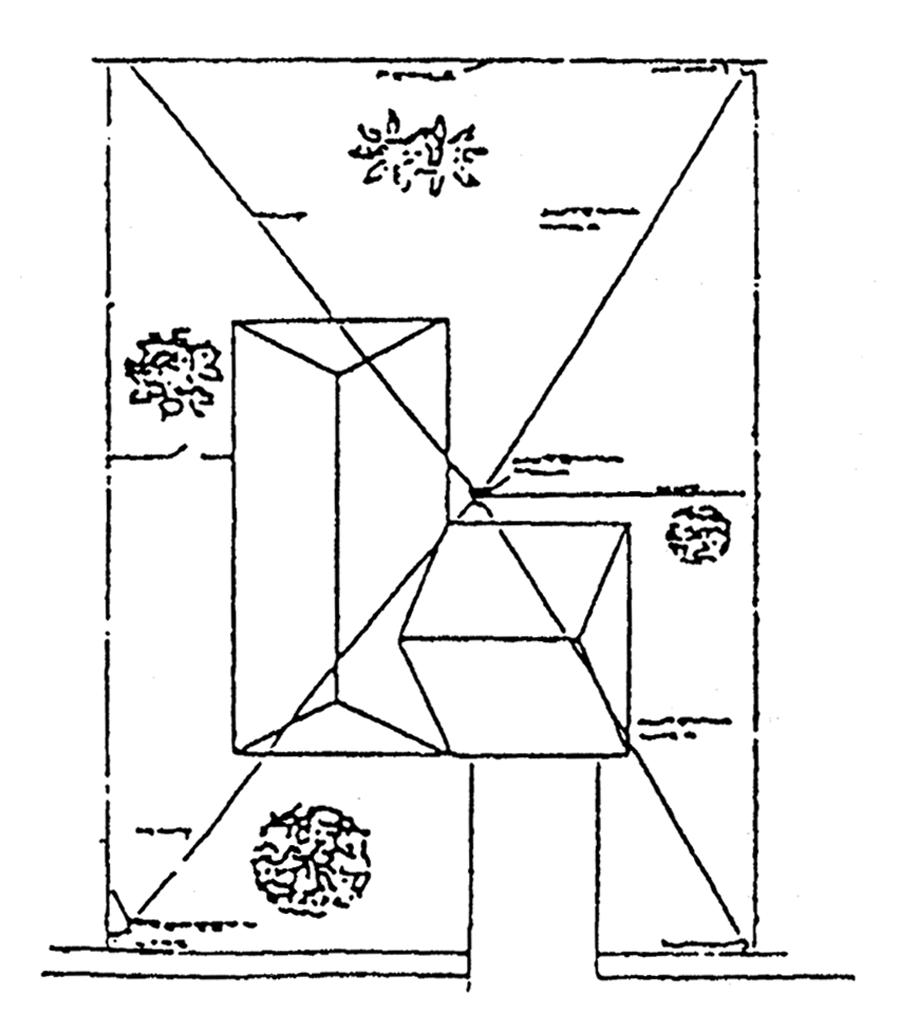
(33)
Hotels/motels/motor lodges. The following minimum standards shall apply to hotels/suite hotels/motels/motor lodges (new commercial facilities only): Any hotel/suite hotel/motel/motor lodge in which more than 35 percent of the units include kitchenettes or kitchen facilities (for purposes of this subsection the term "kitchenette" or "kitchen facility" is defined as a kitchen sink, a stove/cook top, microwave, and/or a refrigerator), the following shall apply:
a.
Minimum acreage is two acres.
b.
All rooms shall be accessed through a main or central lobby.
c.
No rooms shall access to the exterior of the building unless required by fire/safety regulations.
d.
Architectural style/design to be approved per Cherokee County Development Regulations and Commercial Architectural Standards.
e.
Continental style dining for the guests of the facility only is allowed within or near the main or central lobby without additional parking.
f.
At a minimum, provisions for weekly cleaning for each suite must be provided.
g.
Each suite must be protected with a smoke detector and sprinkler system approved by the fire marshal.
h.
Each suite shall be required to include an automatic power shut-off timer for each stove/cook top unit or other type burner.
i.
There shall be no outside storage allowed or longterm parking of heavy equipment, or parking of construction or related equipment.
j.
No facility under this section is to be converted or used primarily as an apartment or condominium.
(44)
Bed and breakfast inns.
i.
Definition. A use that takes place within a structure that was primarily used as a single-family dwelling, consisting of renting from one to six dwelling rooms on a daily basis to tourists, vacationers, and business travelers, where only breakfast meals are served and provided for those guests only. The facility must be operated by the owner.
ii.
Location. Bed and breakfast inns should be located in areas with aesthetic value and/or historical significance.
iii.
Applicable zoning districts. Bed and breakfast inns shall be permitted in OI and NC zoning districts.
iv.
Parking requirements. All parking (including handicap parking) shall be onsite, and it shall be provided in the side and/or rear of the property. The total number of parking spaces shall be based on the formula of one parking space per guest room, and one parking space for each employee. Parking areas shall be set back a minimum of ten feet and screened from adjacent properties.
v.
Length of stay for guests. No guest may stay at the facility for more than 14 days within any 30-day period. There shall be no cooking facilities within the guest rooms. Furthermore, the facility shall not be used for receptions, parties, or public gatherings except as permitted pursuant to variance.
(Ord. of 7-17-2017, §§ 2a.—d.)
Sec. 28-161. - Prohibited uses.
The following uses are prohibited in all districts:
(1)
Uses other than those which are permitted pursuant to this chapter.
(2)
No more than one dwelling unit in residential zoned districts, except where specifically provided or except as permitted pursuant to variance.
(3)
Uses by the city or for governmental purposes on behalf of the city are not prohibited in any zoned district.
(4)
Commercial recreation activities involving noise-emitting motors or engines greater than 60 decibels.
(5)
Live or other entertainment in businesses selling alcoholic beverages.
(6)
Firing ranges.
(7)
Billboards.

