
Walled Lake City Zoning Code
ARTICLE 2
00.- DEFINITIONS
Sec. 51-2.01.- Construction of language.
The following rules of construction apply to the text of this chapter:
(1)
The particular shall control the general.
(2)
In the case of any difference of meaning or implication between the text of this chapter and any caption or illustration, the text shall control.
(3)
The term "shall" is always mandatory and not discretionary. The term "may" is permissive and discretionary.
(4)
Words used in the present tense shall include the future; and words used in the singular number shall include the plural, and the plural the singular, unless the context clearly indicates the contrary.
(5)
A "building" or structure includes any part thereof.
(6)
The term "used for" includes the terms "arranged for," "designed for," "intended for," "maintained for," or "occupied for."
(7)
The term "person" includes an individual, a corporation, a partnership, an incorporated association, or any other similar entity.
(8)
Unless the context clearly indicates the contrary, where a regulation involves two or more items, conditions, provisions, or events connected by the conjunction "and," "or," "either . . . or," the conjunction shall be interpreted as follows:
a.
The term "and" indicates that all the connected items, conditions, provisions, or events shall apply.
b.
The term "or" indicates that the connected items, conditions, or provisions, or events may apply singly or in any combination.
c.
The term "either . . . or" indicates that the connected items, conditions, provisions or events shall apply singly but not in combination.
(9)
Terms not defined in this article or in any other part of this chapter shall have the meaning customarily assigned to them.
(10)
Where certain uses are required to be separated from another use by a specific distance, the required distance shall be measured as the shortest distance between the principal building unit that is occupied by the regulated use to the nearest property line of the protected use, unless some other method of measurement is expressly provided by the ordinance regulating the specific uses.
(Code 1994, § 2.01; Ord. No. C-313-14, § 1, 2-4-2014)
Sec. 51-2.02. - Definitions.
The following words, terms and phrases, when used in this chapter, shall have the meanings ascribed to them in this section, except where the context clearly indicates a different meaning:
Accessory building or structure means a building or structure, or portion thereof, supplementary or subordinate to a principal building or structure on the same lot, that is occupied by or devoted exclusively to an accessory use.
Accessory use means a use which is clearly incidental to, customarily found in connection with, and (except in the case of accessory off-street parking spaces) located on the same zoning lot as the principal use to which it is related.
Adult regulated uses.
Adult book store means an establishment having as a substantial or significant portion of its stock in trade, books, magazines, and other periodicals and/or photographs, drawings, slides, films, video tapes, recording tapes, and novelty items which are distinguished or characterized by their emphasis on matter depicting, describing or relating to "specified sexual activities" or "specified anatomical areas" (as defined below), or an establishment with a segment or section devoted to the sale or display of such material. Such establishment or the segment or section devoted to the sale or display of such material in an establishment is customarily not open to the public generally, but only to one or more classes of the public, excluding any minor by reason of age.
Adult mini motion picture theatre or live stage performing theatre means the use of property commercially for displaying materials a significant portion of which include matter depicting, describing or presenting specified sexual activities for observation by patrons.
Adult motion picture theatre or live stage performing theatre means an enclosed building with a capacity of 50 or more persons used commercially for presenting material distinguished or characterized by an emphasis on matter depicting, describing or relating to "specified sexual activities" or "specified anatomical areas" (as defined below), for observation by patrons therein. Such establishment is customarily not open to the public generally, but only to one or more classes of the public, excluding any minor by reason of age.
Amusement gallery/arcade means any business which provided on its premises four or more machines which upon the insertion of a coin or slug may be operated for use as a game, contest, or amusement of any description, not including musical devices.
Cabaret means an establishment which features any of the following means topless dancers and/or bottomless dancers, go-go dancers, strippers, male and/or female impersonators or similar entertainers or topless and/or bottomless waitresses or employees.
Halfway house means a facility established by the state department of corrections in connection with a jail, prison, or other correctional institution or facility as a residence for three or more persons committed to the jail, prison, or correctional institution prior to full release from supervision including any period of parole.
Massage parlor means any building, room, place or establishment other than a regularly licensed hospital or dispensary where nonmedical and nonsurgical manipulative exercises are practiced on the human body for other than cosmetic or beautifying purposes with or without the use of mechanical or bathing devices by anyone not a physician or surgeon or similarly licensed by the state.
Modeling studio means an establishment which furnishes facilities to the public for the taking of photographs of males and/or females with specified anatomical areas, as defined below, exposed or makes such models available for any other purposes.
Significant portion, as used in the definitions of adult regulated uses, means and includes either or both of the following:
a.
Any one or more portions of the display having a duration in excess of five minutes; and/or
b.
The aggregate of portions of the display having a duration equal to ten percent or more of the single display as a whole.
Specified anatomical areas means:
a.
Less than completely and opaquely covered:
1.
Human genitals, pubic region;
2.
Buttock;
3.
Female breast below a point immediately above the top of areola; and
b.
Human male genitals in a discernibly turgid state, even if completely and opaquely covered.
Specified sexual activities means the explicit display of one or more of the following:
a.
Human genitals in a state of sexual stimulation or arousal.
b.
Acts of human masturbation, sexual intercourse or sodomy.
c.
Fondling or other erotic touching of human genitals, pubic region, buttock or female breast.
Alley means a public or legally established private thoroughfare, other than a street, affording a secondary means of vehicular access to abutting property and not intended for general traffic circulation.
Alterations means any change, addition or modification in construction or type of occupancy; any change in the structural members of a building, such as walls or partitions, columns, beams or girders; or any change which may be referred to herein as "altered" or "reconstructed."
Anchor or anchoring means to temporarily secure occupied watercraft or vessels by rope, chain or other collapsible attachment to any weighted object less than eighteen inches in height temporarily placed on the surface of bottomland to facilitate active use of occupied watercraft or vessels.
Apartments means the dwelling units in a multiple-family dwelling as defined herein:
(1)
Efficiency apartment means a dwelling unit of or less than 350 square feet of floor area consisting of not more than one room in addition to kitchen and necessary sanitary facilities.
(2)
One bedroom unit means a dwelling unit containing a minimum floor area of at least 600 square feet consisting of not more than three rooms, including one bedroom in addition to kitchen and necessary sanitary facilities.
(3)
Two bedroom unit means a dwelling unit containing a minimum floor area of at least 800 square feet, consisting of not more than four rooms, including two bedrooms, in addition to kitchen and necessary sanitary facilities.
(4)
Three or more bedroom units means a dwelling unit wherein for each room in addition or the four rooms permitted in a two bedroom unit, there shall be provided an additional area of 200 square feet to the minimum floor area of 800 square feet in addition to the kitchen and necessary sanitary facilities.
Automobile means, unless specifically indicated otherwise, any vehicle including by way of example cars, trucks, vans, motorcycles, recreational vehicles and the like. see definition of motor vehicle.
Automobile repair means major or minor repair of automobiles defined as follows:
(1)
Minor repair means engine tune-ups and servicing of brakes, air-conditioning, exhaust systems; lubrication, wheel alignment or balancing; or similar servicing or repairs that do not normally require any significant disassembly or storing the automobiles on the premises overnight.
(2)
Major repair means engine and transmission rebuilding and general repairs, rebuilding or reconditioning; collision service such as body, frame or fender straightening or repair; steam cleaning, undercoating and rust proofing; and similar servicing, rebuilding or repairs that normally do require significant disassembly or storing the automobiles on the premises overnight.
Automobile repair garage means a building or premises where automobile repair may be carried out in a completely enclosed building.
Automobile service station means a facility or premises primarily for retail sale of fuels or oils for automobiles, or boats and which may include as a secondary activity retail sale of lubricants, tires, batteries, and similar accessories.
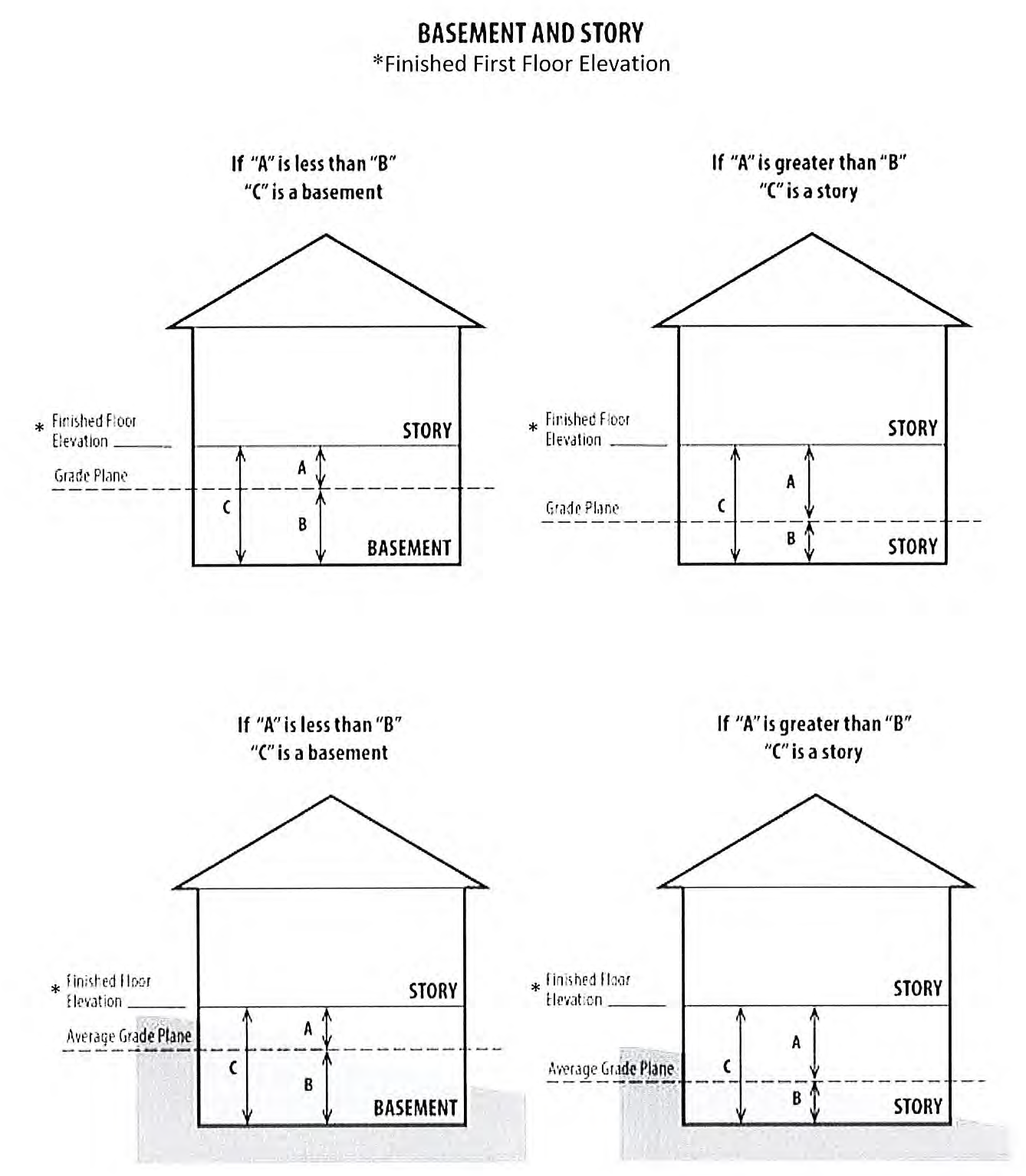
Basement means that portion of a building which is partly or wholly below grade but so located that the vertical distance from the average grade to the floor is greater than the vertical distance from the average grade to the ceiling. A basement shall not be counted as a story, and shall not be used for dwelling units, offices, retail sales or manufacturing, but may be used for storage, heating and utility facilities, etc. (See basement and story illustration.)
Bedroom means a room designed or used in whole or in part for sleeping purposes.
Bed and breakfast establishment means a single-family dwelling owned and occupied by a person renting out not more than three rooms for compensation to persons who do not stay for more than seven consecutive days. Breakfast is required to be served to guests at no extra cost.
Block means a block shall be that property abutting on one side of a street and lying between the two nearest intersecting streets or alleys and extending back to another street or alley or to the city boundary.
Boardinghouse means a building, other than a hotel, where for compensation and/or prearrangement for periods exceeding ten days, lodging and meals are provided for three or more persons or together with one dwelling unit for occupancy by management. (The terms "boardinghouse," "roominghouse" and "lodginghouse" are used synonymously in this chapter.)
Board means the zoning board of appeals.
Body piercing means the perforation of human tissue other than an ear for a nonmedical purpose.
Bottomland means the land area of an inland lake or stream that lies below the ordinary high-water mark and that may or may not be covered by water.
Branding means a permanent mark made on human tissue by burning with a hot iron or other instrument.
Buildable area means the space remaining on a lot after compliance with the minimum required setbacks of this chapter.
Building means any structure or portion thereof including a mobile home or mobile structure, or a pre-manufactured or pre-cut structure above or below ground, temporary or permanent, having one or more floors or any structure, temporary or permanent, with a roof and designed or intended primarily for the shelter, support, or enclosure of persons, animals, or property of any kind. Regardless of attachment to the ground, a building shall include, tents, awnings, vehicles, containers, trailers, or other enclosures used for the purposes of a building.
Building, accessory, means a subordinate, detached building, the use of which is customarily incidental to the permitted principal use of the principal buildings on the same lot.
Building height means the vertical distance from the grade plane (based upon existing grade) to the highest point of the flat roof or mansard roof and to the average height between eaves and ridge for a gable, hip and gambrel roof; and 75 percent of the height of an A frame.
Building inspector means the person designated within the building and community development department to enforce certain provisions of this chapter. The building inspector, as referred to in this chapter, may also be the director of the building and community development department, or the code official charged with the administration and enforcement of the city's building code.
Building, main or principal, means a building or, where the context so indicates, a group of buildings in which is conducted the main or principal use of the lot on which building or group of buildings is located.
Bureau means the municipal/ordinance violations bureau established by city Code of Ordinances, chapter 1.
Car wash means a permanent commercial facility where motor vehicles are washed by hand, by mechanical devices, or by both, excluding temporary car washes organized for civic or charitable purposes.
Certificate of use and occupancy means the certificate issued by the code official which permits the use of a building in accordance with the approved plans and specifications and which certifies compliance with the provisions of law for the use and occupancy of the building in its several parts together with any special stipulations or conditions of the building permit.
City means the City of Walled Lake, Michigan.
Clinic means a place for the care, diagnosis and treatment of sick or injured persons, and those in need of medical or minor surgical attention. A clinic may incorporate customary laboratories and pharmacies incidental or necessary to its operation or to the service of its patients, but may not include facilities for in-patient care or major surgery.
Club means a nonprofit organization of persons for special purposes or for the promulgation of sports, arts, science, literature, politics or similar activities.
Co-op (cooperative) means a multiple dwelling owned by a corporation which leases its units to stockholders on a proprietary lease arrangement.
Coin-operated amusement device means an instrument, machine or contrivance which may be operated or set in motion upon the insertion of a coin, token or similar object, or activated and/or paid for by any other means, and which provides games, entertainment or amusement.
Commission means the planning commission of the city.
Condominium means a plan or project as established and approved in conformance with the Michigan Condominium Act, Act 59 of the Public Acts of 1978, as amended.
Convalescent or nursing home means a structure with sleeping rooms, where persons are housed or lodged and are furnished with meals and nursing care, and where limited medical care may be available.
Council means the city council, the duly elected legislative body of the city.
Court means a yard, other than a required open space, on the same lot with a building or group of buildings, and which is bounded on two or more sides by such building or buildings.
Day care center, childcare center. See Nursery school.
Deck means a platform, commonly constructed of wood, which is typically attached to a house, and which is typically used for outdoor leisure activities.
District means and is synonymous with the term "zone" or "zoning district," a portion of the city within which, on a uniform basis, certain uses of land and buildings are permitted and within which certain regulations and requirements apply under the provisions of this chapter.
Dock includes any permanent, temporary or seasonal structure located wholly or partially in, or extending over, the water, with a horizontal surface or platform at, above or below the surface of the water. Docks located on a single-family residential waterfront lot only, shall constitute an accessory use and structure if used in a manner customarily incidental to a permitted principal use of a single-family residential waterfront lot.
Drive-in establishment means a business establishment or portion thereof, so developed that its retail or service character includes a driveway approach or parking spaces for motor vehicles so as to serve motor vehicles or serve patrons while in the motor vehicle (e.g., car wash, gasoline service stations, restaurants, cleaners, retail stores, banks, theaters, etc.).
Drive-through restaurant means an establishment that serves patrons in a vehicle via a driveway approach. Such establishment may also serve patrons within a building.
Dumpster means a container used for the temporary storage of rubbish, pending collection, having a capacity of at least one cubic yard.
Dwelling means any building containing sleeping, kitchen, and bathroom facilities designed for and lawfully occupied by one family for living, cooking and sleeping purposes. In no case shall an accessory use or structure, travel trailer, motor home, automobile, tent or other portable building not defined as a recreational vehicle be considered a lawful dwelling unless specifically approved and permitted as such as provided by applicable codes and ordinances. In the case of a permitted mixed use or occupancy where a building is lawfully occupied in part as a dwelling unit, the entirety of the part used, occupied or maintained as a residence or for any residential use or purpose shall be deemed a dwelling unit for the purposes of this chapter.
(1)
Dwelling, accessory apartment: A dwelling unit that is accessory to and typically contained within a conventional single-family dwelling, and which is occupied by persons related to the occupant of the principal residence by blood, marriage or legal adoption, or domestic servants or gratuitous guests. An accessory apartment commonly has its own sleeping, kitchen and bath facilities or areas and usually a separate entrance. May also be referred to as an in-law apartment or granny flat.
(2)
Dwelling, manufactured: A building or portion of a building designed and constructed for long-term use as a dwelling which is secured permanently to a foundation on land also owned by the same owner of the manufactured dwelling and not located in a mobile home park. The manufactured dwelling shall also be characterized by one or all of the following:
a.
The structure is produced and substantially assembled in a factory off the premises upon which it is intended to be located.
b.
The structure is designed to be transported once to a property in a nearly complete form, where it is permanently connected to utilities.
c.
The structure is designed to be used as either an independent building or as a module to be combined with other elements to form a complete building on the site.
(3)
Dwelling, mobile home: A structure, transportable in one or more sections, which is built upon a chassis and designed to be used as a dwelling with or without permanent foundation, when connected to the required utilities, and includes the plumbing, heating, air-conditioning and electrical systems contained in the structure as defined and regulated in the Mobile Home Commission Act, PA 96 of 1987, as amended. Recreational vehicles as described and regulated in this section shall not be considered mobile home dwellings for the purpose of this chapter.
(4)
Dwelling, multiple-family: A building or portion thereof designed for and containing three or more dwelling units. Examples of multiple-family dwellings units include those commonly known as apartments, which are defined as follows:
a.
Apartment: An attached dwelling unit with party walls, contained in a building with other dwelling units which are commonly reached off of a common stair, landing or walkway. Apartments are typically rented by the occupants. Apartment buildings often may have a central heating system and other central utility connections. Apartments typically do not have their own yard space. Apartments are also commonly known as garden apartments or flats.
b.
Efficiency unit or studio apartment: A type of multiple-family or apartment unit consisting of one principal room, plus bathroom and kitchen facilities, hallways, closets, and/or a dining alcove located directly off the principal room.
(5)
Dwelling, one-family or single-family: An independent, detached principal building designed for and used or held ready for use by one family only. The entirety of a principal building used or occupied in whole or in part as a dwelling and located in a single-family zoning district shall constitute a single, indivisible dwelling unit.
(6)
Dwelling, single-family attached or townhouse: A single-family dwelling connected to other single-family dwellings with party walls that internally separate the dwellings from one another, designed as part of a series of three or more dwellings, each with their own front and rear door which opens to the outdoors, its own basement, no internal access between the dwelling units and typically, with its own utility connections and front and rear yards. Townhouses are sometimes known as row houses.
(7)
Dwelling, site built: A dwelling unit which is substantially built, constructed, assembled, and finished on the premises which are intended to serve as its final location. Site built dwelling units shall include dwelling units constructed of pre-cut materials and panelized wall, roof and floor section when such sections require substantial assembly and finishing on the premises which are intended to serve as its final location.
(8)
Dwelling, two-family or duplex: An independent, detached building containing two internally separated dwelling units with no internal access between the dwelling units. Also known as a duplex dwelling.
(9)
Dwelling unit: One or more rooms, including all connected living, storage, bathroom and kitchen facilities and enclosed areas within the same building, designed as a self-contained unit for occupancy by one family for living, cooking and sleeping purposes. The entirety of a principal building used or occupied in whole or in part as a dwelling and located in a single-family zoning district shall constitute a single, indivisible dwelling unit any alterations or modifications to the contrary notwithstanding.
Erected means built, constructed, altered, reconstructed, moved upon, or any physical operations on the premises which are required for construction. Excavation, fill, drainage, painting, plastering, sewers and the like shall be considered a part of erection.
Essential services means those services as outlined below, which are designed and constructed to directly serve local users within the geographic boundaries of the city. Such essential services include the erection, construction, alteration or maintenance by public utilities or municipal departments of underground, surface, or overhead gas, electrical, steam, fuel or water transmission or distribution systems, collection, communications, supply or disposal systems, including towers, poles, wires, mains, drains, sewers, pipes, conduits, cables, fire alarm and police call boxes, traffic signals, hydrants, and similar equipment and accessories in connection therewith, which are necessary for the furnishing of adequate service by such utilities or municipal departments for the public health, safety and general welfare, but not including storage yards or sales offices or commercial buildings or activities.
Family means:
(1)
An individual or group of two or more persons related by blood, marriage or adoption, together with foster children or servants of the principal occupants, with not more than one additional unrelated person, who are domiciled together as a single, domestic, housekeeping unit in a dwelling unit; or
(2)
A collective number of individuals domiciled together in one dwelling unit whose relationship is of a continuous, non-transient, domestic character and who are cooking and living as a single, nonprofit housekeeping unit. This definition shall not include any society, club, fraternity, sorority, association, lodge, coterie, organization or group of students or other individuals whose domestic relationship is of a transitory or seasonal nature or for an anticipated limited duration of a school term or terms of other similar determinable period.
Family day care home means a private home in which one but less than seven minor children are received for care and supervision for periods of less than 24 hours a day, attended by other than a parent or legal guardian, except children related to an adult member of the family by blood, marriage, or adoption. Family day care home includes a home that gives care to an unrelated minor child for more than four weeks during a calendar year.
Fence means an unroofed manmade structure exceeding 12 inches in height that is designed as a barrier. It may be made of wood, metal or other material. It may be ornamental or intended for or capable of enclosing a piece of land, preventing ingress and egress, dividing, bounding or simply marking a line.
Filling means the depositing or dumping of any matter onto or into the ground, except common household gardening and ground care.
Floor area means area measured to the exterior face of exterior walls and to the center line of interior partitions.
Floor area, usable nonresidential, means (for the purpose of computing parking) that area used for or intended to be used for the sale of merchandise or services or for use to serve patrons, clients or customers. Such floor area which is used or intended to be substantially devoted to the storage or processing of merchandise, or for utilities shall be excluded from the computation of floor area, usable nonresidential. Measurement of usable nonresidential floor area shall be measured using one of the following methods:
(1)
The sum of the gross horizontal areas of the several floors of the building, measured from the interior faces of the exterior walls; or
(2)
80 percent of the total floor area.
For the purposes of computing parking for those uses not enclosed within a building, the area used for the sale of merchandise, display of merchandise, and/or area used to serve patrons or client shall be measured to determine necessary parking spaces.
Floor area, usable residential, means the sum of the horizontal area of the first story measured to the exterior walls; plus similarly measured, that area of all other stories having more than 84 inches of head room which may be made useable for human habitation; but excluding the floor area of basements, unfinished attics, attached or un-attached garages, breezeways, enclosed and unenclosed porches, and accessory buildings. (See "Floor area terminology" illustration)
Floor, ground, means that portion of a building which is partly below grade but so located that the vertical distance from the average grade to the ceiling is greater than the vertical distance from the average grade to the floor. A ground floor shall be counted as a story.
Foster care family home means a private residence with the approved capacity to receive not more than six adults who shall be provided foster care for five or more days per week and for two or more consecutive weeks. The adult foster care home licensee shall be a member of the household and an occupant of the residence. Halfway houses sponsored by the state department of correcting are not considered licensed foster care facilities. (Section 3, subsection 5, Act 218, Public Acts of 1979.)
Large group home means an adult foster care facility with the approved capacity to receive at least 13 but not more than 20 adults who shall be provided foster care. Beginning four years after the effective date of Act 218, Public Acts of 1979 (approved January 16, 1980), an adult foster care large group home which is licensed by the department of health to provide foster care in each respective category may receive only those adults in the category whose primary need for services is based upon not more than one of the following categories:
a.
Aged condition;
b.
Mental illness, developmental disability, or physical handicap, or a combination of mental illness, developmental disability, or physical handicap.
Small group home means an adult foster care facility with the approved capacity of not more than 12 adults who shall be provided foster care.
Garage, community, means an accessory building for the storage of noncommercial vehicles, with no public shop or service facilities in connection therewith.
Garage, private, means an accessory building having not more than 720 square feet in area to be used for the storage of noncommercial vehicles, provided that not more than one commercial vehicle of less than three-quarter tons capacity may be stored in said private garage and there shall be no services or commodities offered to the public in connection therewith. (See Building, accessory.)
Garage, public parking, means a structure available to the public for the parking and storage of motor vehicles, including such accessory uses as the sale at retail of gasoline (stored only in underground tanks) or motor oil and the washing, polishing and lubrication of motor vehicles, all within the structure.
Garage, repair. See Automobile repair garage.
Gasoline service station. See Automobile service station.
Grade means a reference plane representing the ground level adjoining a building or structure.
Grade, existing, means the elevation or surface of the ground or pavement as it exists prior to disturbance. This includes both the natural grade, where no manmade disturbances have impacted a building site, as well as the existing grade as established by existing buildings, structures and/or pavement.
Grade, finished, means the final elevation of the ground surface after development.
Grade plane means a reference plane representing the average of the existing grades or ground level adjoining the building at exterior walls. Where the finished ground level slopes away from the exterior walls, the reference plane shall be established by the lowest points within the area between the building and the lot line or, where the lot line is more than six feet from the building, between the building and a point six feet from the building.
Greenbelt means a strip of land of specified width and location reserved for the planting of shrubs and/or trees to serve as an obscuring screen or buffer strip, and as further defined in this chapter.
Group day care home means a private home in which more than six but not more than 12 minor children are given care and supervision for periods of less than 24 hours a day unattended by a parent or legal guardian, except children related to an adult member of the family by blood, marriage, or adoption. Group day care home includes a home that gives care to an unrelated minor child for more than four weeks during a calendar year.
Hazardous uses means all uses which involve the storage, sale, manufacture, or processing of materials which are dangerous and combustible and are likely to burn immediately, and from which either poisonous fumes or explosions are to be anticipated in the event of fire. These uses include all high hazard uses listed in the city's adopted building code.
Home occupation means an occupation conducted within a dwelling unit and carried on by the inhabitants thereof, not involving employees other than members of the immediate family residing on the premises, which use is clearly incidental and secondary to the use of the dwelling for dwelling purposes, does not change the character thereof, and which does not endanger the health, safety, and welfare of any other persons residing in that area by reason of noise, noxious odors, unsanitary or unsightly conditions, fire hazards and the like, involved in or resulting from such occupation, profession or hobby. Any such home occupation shall also comply with the following minimum requirements:
(1)
That such occupation is incidental to the residential use to the extent that not more than 20 percent of the useable floor area of the principal building shall be occupied.
(2)
That no article or service is sold or offered for sale on the premises except such as is produced by such occupation.
(3)
No home occupation shall be conducted in any accessory building.
(4)
Such occupation shall not require internal or external alterations or construction features, equipment, machinery, outdoor storage, or signs not customarily in residential areas.
(5)
No home occupations shall generate other than normal residential traffic either in amount or type.
(6)
No equipment or process shall be used in such home occupation which creates noise, vibration, glare, fumes, odors, or electrical interference detectable to the normal senses off the lot, if the occupation is conducted in a single-family residence, or outside the dwelling unit if conducted in other than a single-family residence. In the case of electrical interference, no equipment or process shall be used which creates visual or audible interference in any radio or television receivers off the premises, or causes fluctuations in line voltage off the premises.
(7)
No home occupation shall cause an increase in the use of any one or more utilities (water, sewer, electricity, trash removal, etc.) such that the combined total use for the dwelling unit and home occupation exceeds by more than ten percent the average for the residence itself, measured over the previous 12-month period.
(8)
That there be no sign of any nature advertising said occupation.
(9)
Parking needs generated by a home occupation shall be provided for in an off-street parking area, located other than in a required front yard.
Hospital means an institution providing health services, primarily for in-patients, plus medical and surgical care for the sick or injured, including such related facilities as laboratories, out-patient departments, central service facilities and staff offices.
Hotel or motel or motor lodge means a series of dwelling units located in one or more buildings and designed primarily for overnight lodging by transients. Each unit typically has a bedroom, bathroom, closet space, and a separate entrance. Hotels typically offer a greater variety services than motels, such as restaurants, meeting rooms, valet services, recreation facilities, and so forth. Motels which provide dwelling units with kitchen facilities which are commonly occupied for extended periods of time, rather than being used primarily for overnight lodging by transients, shall be considered "multiple-family dwellings."
Junk means, in addition to including garbage and rubbish, unlicensed motor vehicles, machinery, appliances, product, merchandise with parts missing, or scrap metals, or other scrap materials that are damaged, deteriorated or are in a condition which renders them incapable of performing the function for which they were intended.
Junk yard means an open area of more than 200 square feet, including an automobile wrecking yard, used for the purchase, sale, exchange, disassembly, storage processing, baling or packaging of junk, including, but not limited to, scrap metals, unusable machinery or motor vehicles, tires, bottles, and paper, and not including uses established entirely within enclosed buildings.
Kennel means any lot or premises on which more than two dogs or cats, six months or older, are permanently or temporarily kept, or are boarded or kept for the purpose of breeding or selling.
Laboratory means an establishment devoted to scientific, industrial or business research and experimental studies including testing and analyzing, but not including quantity manufacturing except the making of prototypes, models and test models.
Landscaping means the treatment of the ground surface with live materials, such as, but not limited to, grass, sod, ground cover, trees, shrubs, vines and other growing horticultural material. In addition, the combination or design may include other decorative surfacing such as wood chips, crushed stone, boulders, or mulch materials not to exceed 20 percent of the total for any landscape area. Structural features such as fountains, pools, statues, and benches shall also be considered a part of landscaping but such objects alone shall not meet the requirements of landscaping. In addition, artificial plant materials shall not be counted as required landscape areas.
Loading space means an off-street facility or space on the same lot with a building or group of buildings, for temporary parking of a commercial or industrial vehicle while loading and unloading merchandise or materials.
Lodginghouse. See Boardinghouse.
Lot (or zoning lot or parcel) means for the purposes of enforcing this chapter, a lot is defined as a piece of land under single ownership and control that is at least sufficient in size to meet the minimum requirements for use, coverage, area, setbacks, and open space as required herein. A lot shall have frontage on a dedicated roadway or, if permitted by the regulations set forth herein, on a private road. A lot may consist of:
(1)
A single lot of record;
(2)
A portion of a lot of record;
(3)
A combination of complete lots of record, or portion thereof; or
(4)
A piece of land described by metes and bounds.
Lot area means the total horizontal area within the lot lines of a lot. For lots fronting or adjacent to private streets, lot area shall mean that area within lot lines and not including any portion of said private street.
Lot, corner, means a lot where the interior angle of two adjacent sides at the intersection of two streets is less than 135 degrees. A lot abutting upon a curved street or streets shall be considered a corner lot for the purposes of this chapter if the arc is of less radius than 150 feet and the tangents to the curve, at the two points where the lot lines meet the curve or the straight street line extended, form an interior angle of less than 135 degrees.
Lot coverage means that part or percent of the lot occupied by all buildings.
Lot depth means the horizontal distance between the front and rear lot lines measured along the median between the side lot lines.
Lot, double frontage, means any interior lot having frontages on two more or less parallel streets, as distinguished from a corner lot, or any lot with frontages on two sides of the same street. In the case of a row of double frontage lots, all sides of said lots adjacent to streets shall be considered frontage, and front yards shall be provided as required.
Lot, interior, means any lot other than a corner lot.
Lot lines means the lines bounding a lot as defined herein:
Front lot line means in the case of as interior lot, that line separating the lot from the street. In the case of a through lot, the line separating the lot from that street which is designated in an application for a building permit, or in any manner as the front street. In the case of a corner lot, the lines, separating the lot both from that street which is designated as the front street in an application for a building permit and from the side street are front lot lines. In the case of a lot which extends between a street and a canal or lake, any street line separating the lot from the street shall be designated as a front lot line, and the line separating the lot from the water shall be designated as the "water line".
Front yard means an open space extending the full width of the lot, the minimum depth of which is the horizontal distance between the front lot line and the front setback line and extending to the front exterior of a principal permitted building. Except as expressly provided by this chapter, the lot area between a front lot line and required front setback line shall be unbuildable above grade.
Front yard, double, means an open space on: 1) corner lots (as defined in this chapter) extending the full width of the lot on both sides facing the intersecting streets, or; 2) a double frontage lot with frontage on two sides of the same street. Unless specifically noted otherwise in this chapter, both open spaces facing each side of a street shall be considered front yards for the purposes of determining required setbacks.
Rear (back) yard means an open space extending the full width of the lot, the minimum depth of which is the horizontal distance between the rear lot line or established zoning district line and the required rear setback line and extending to the rear exterior of the principal building. On corner lots there shall be only one rear yard, which shall be opposite from the front street as designated on the plat, site plan review application, or request for building permit. In the case of a waterfront lot bounded entirely and contiguously between a lake and a street, there shall be no rear yard. Except as expressly provided by this chapter, the lot area between a rear lot line and required rear setback line shall be unbuildable above grade.
Rear lot line means that lot line, other than a water line, opposite the front lot line. In the case of a lot pointed at the rear, the rear lot line shall be an imaginary line parallel to the front lot line, not less than ten feet long lying farthest from the front lot line and extending the full width of the lot. In the case of a waterfront lot bounded entirely and contiguously between a lake and a street, there shall be no rear lot line. In the case of a waterfront lot not entirely and contiguously bounded between a lake and a street, the rear lot line means that lot line, other than a water line, opposite the front lot line located on the opposite side of the street from the water line.
Side lot line means any lot line other than the front lot line or rear lot line. A side lot line separating a lot from another lot or lots is an interior side lot line. A lot line separating a lot from a side street is a front lot line.
Side yard means an open space extending from the front yard to the rear yard, the minimum width of which is the horizontal distance from the nearest point of the side lot line to the required side setback line and extending to the side exterior of a principal permitted building. Except as expressly provided by this chapter, the lot area between a side lot line and required side setback line shall be unbuildable above grade.
Water line means in the case of a lot abutting a lake or canal, the water line shall be the same as the ordinary high-water mark, as defined in the city's wetland ordinance.
Waterfront yard means an open space extending the full width of the lot, the minimum depth of which is the horizontal distance between the water line and the required waterfront setback line and extending to the lake side exterior of a principal permitted building located on the same side of the street as the water line. Except as expressly provided by this chapter, the lot area between the water line and required waterfront setback line shall be unbuildable above grade. In the event of a conflict between a required waterfront yard and any other required yard, the waterfront yard shall be controlling.
Lot of record means a parcel of land, the dimensions of which are shown on a recorded plat on file with the county register of deeds, or any parcel recorded with the county register of deeds, which has been separated, which exists as described, at the time of the effective date of this chapter. A lot of record must front a public street which is dedicated for access as a public street.
Lot, waterfront, means a lot adjoining a lake.
Lot width means the length of a straight line measured between the two points where the building line or setback line intersects the side lot lines.
Major thoroughfare means an arterial street which is designated as a major thoroughfare on the zoning map for the city.
Manufactured building means a building with the following features or characteristics:
(1)
Mass produced in a factory;
(2)
Designed and constructed for transportation to a site for installation and use when connected to required utilities;
(3)
Either an independent, individual building or a module for combination with other elements to form a building on the site.
Marijuana or marihuana means that term as defined in section 7106 of the public health code, Public Act No. 368 of 1978, MCL 333.7106.
Marijuanaor marihuana facility means a marijuana or marihuana facility as defined and provided by the Medical Marijuana Facilities Licensing Act, MCL 333.27101 et seq. as amended (Act) and includes the following:
(1)
Grower facilities. The term "grower" means a facility licensed under the Act and article XI of chapter 18 of the city Code of Ordinances that is a commercial entity located in this state that cultivates, dries, trims, or cures and packages marijuana for sale to a processor or provisioning center.
(2)
Provisioning centers. The term "provisioning center" means a facility licensed under the Act and article XI of chapter 18 of the city Code of Ordinances that is a commercial entity located in this state that purchases marijuana from a grower or processor and sells, supplies, or provides marijuana to registered qualifying patients, directly or through the patients' registered primary caregivers. Provisioning center includes any commercial property where marijuana is sold at retail to registered qualifying patients or registered primary caregivers. A noncommercial location used by a primary caregiver to only assist a qualifying patient connected to the caregiver through the state's medical marijuana registration process in accordance with the Michigan Medical Marijuana Act is not a provisioning center.
(3)
Processor facilities. The term "processor" means a facility licensed under the Act and article XI of chapter 18 of the city Code of Ordinances that is a commercial entity located in this state that purchases marijuana from a grower and that extracts resin from the marijuana or creates a marijuana-infused product for sale and transfer in packaged form to a provisioning center.
(4)
Secure transporters. The term "secure transporter" means a facility licensed under the Act and article XI of chapter 18 of the city Code of Ordinances that is a commercial entity located in this state that stores marijuana and transports marijuana between marijuana facilities for a fee.
(5)
Safety compliance facilities. The term "safety compliance facility" means a facility licensed under the Act and article XI of chapter 18 of the city Code of Ordinances that is a commercial entity that receives marijuana from a marijuana facility or registered primary caregiver, tests it for contaminants and for tetrahydrocannabinol and other cannabinoids, returns the test results, and may return the marijuana to the marijuana facility.
Marijuana facility operating license means a license authorizing the operation of a marijuana facility as follows:
(1)
State operating license or, unless the context requires a different meaning, the term "state license" means a license that is issued under the Act that allows the licensee to operate as one of the following, specified in the license:
a.
A grower.
b.
A processor.
c.
A secure transporter.
d.
A provisioning center.
e.
A safety compliance facility.
The term "state licensee" means a person holding a valid state operating license.
(2)
City operating license or, unless the context requires a different meaning, the term "city license" means a license that is issued under this article that allows the licensee to operate as one of the following, specified in the license:
a.
A grower.
b.
A processor.
c.
A secure transporter.
d.
A provisioning center.
e.
A safety compliance facility.
The term "city licensee" means a person holding a valid city operating license.
Marginal access road means a service roadway parallel to a feeder road; which provides access to abutting properties and protection from through traffic.
Marquee means a roof-like structure of a permanent nature projecting from the wall of a building.
Master plan means the comprehensive plan, including graphic and written proposals indicating the general location for streets, parks, schools, public buildings and all physical development of the municipality, and includes any unit or part of such plan, and any amendment to such plan or parts thereof. Such plan or part thereof may or may not be adopted by the planning commission and/or city council.
Mezzanine means an intermediate or fractional story between the floor and ceiling of a main story occupying not more than one-third of the floor area of such main story.
Mobile home park means a parcel or tract of land under the control of a person upon which three or more mobile homes are located on a continual, non-recreational basis and which is offered to the public for that purpose regardless of whether a charge is made there for, together with any building, structure, enclosure, street, equipment, or facility used or intended for use incident to the occupancy of a mobile home and which is not intended for use as temporary trailer park.
Moor or mooring means attaching or securing an unoccupied watercraft or vessel to any dock or mooring structure, or other structure or equipment that is either attached to or placed upon bottomland or within waters of the city but shall not include anchoring.
Mooring structure means any freestanding post, pole, piling, board, limb or other structure driven, placed, attached, dug or buried into or upon bottomland to secure or moor any watercraft or vessel, but shall not include a dock or anchor. Mooring Structures located on a single-family residential waterfront lot only, shall constitute an accessory use and structure if used in a manner customarily incidental to a permitted principal use of a single-family residential waterfront lot.
Motel. See Hotel.
Motor vehicle means the same as that term is defined in the Michigan Vehicle Code, Act 300 of 1949, as amended, and every vehicle which is self-propelled and every vehicle which is propelled by electric power obtained from over-head trolley wires, but not operated upon rails.
Municipal civil infraction means a violation of a provision of this zoning ordinance for which the remedy and/or penalty is prescribed to be a civil fine or other sanction other than a criminal penalty. A municipal civil infraction is not a lesser-included offense of a criminal offense or of an ordinance violation that is not a civil infraction.
Municipal civil infraction citation means a written complaint or notice prepared by an authorized official directing a person to appear in court regarding the occurrence or existence of a municipal civil infraction violation by that person.
Municipal civil infraction determination means a determination that a defendant is responsible for a municipal civil infraction by one of the following:
(1)
An admission of responsibility of the municipal civil infraction.
(2)
An admission of responsibility for the municipal civil infraction, with explanation.
(3)
A preponderance of the evidence at an informal hearing or formal hearing.
(4)
A default judgment for failing to appear at a scheduled appearance.
Municipal civil infraction notice means a written notice prepared by an authorized official, directing a person to appear at the municipal ordinance violations bureau for the purpose of paying a civil fine and/or costs for a violation which is prescribed to be a municipal civil infraction.
Nonconforming building (nonconforming structure) means a building or structure (or portion thereof) lawfully existing at the time of adoption of this chapter or a subsequent amendment thereto, that does not conform to the provisions of this chapter relative to height, bulk, area, placement or yards for the zoning district in which it is located.
Nonconforming use means a use of a building or structure or of a parcel or tract of land, lawfully existing at the time of adoption of this chapter or a subsequent amendment thereto, that does not conform to the regulations of this chapter for the zoning district in which it is situated.
Nonconforming use and building means a use and a building lawfully existing at the time of adoption of this chapter or a subsequent amendment there to which do not conform to the use and height, bulk, placement or yard provisions for the zoning district in which situated.
Nuisances in residential districts means accessory uses, such as animal enclosures, dog runs, central air-conditioning units, heat pumps and other mechanical equipment that typically produce noise, odors, or other nuisances, shall be located to the rear of the principal dwelling except that upon a showing of practical difficulty, mechanical units may be located in a side yard provided the mechanical unit is screened on the front and side by natural vegetative screening or enclosed by a wood or masonry fence not exceeding the height of the mechanical unit.
Nuisance per se means any violation of this zoning ordinance, including any uses of land, and dwellings, buildings, or structures, including tents, trailer coaches and mobile homes, used, erected, altered, raised, or converted in violation of this zoning ordinance.
Nursery, plant material, means a space, building or structure, or combination thereof, for the storage of live trees, shrubs, or plants offered for sale on the premises including products used for gardening or landscaping. The definition of nursery within the meaning of this chapter does not include any space, building or structure used for the sale of fruits, vegetables or Christmas trees.
Nursery school or day care center means a public or private school, kindergarten or childcare facility wherein day care or day care and education is provided for children under the age of 14. Family day care homes shall not be considered nursery schools.
Occupancy, change of, means a discontinuance of an existing use and the substitution therefore of a use of a different kind or class, or the expansion of a use.
Occupied means used in any way at the time in question.
Off-street parking lot means a facility other than for single- or two-family dwellings providing parking vehicular parking spaces along with adequate drives and aisles, for maneuvering, so as to provide access for entrance and exit for the parking of more than three vehicles.
Off-street loading space means a facility or space which permits the standing, loading or unloading of trucks and other vehicles other than on or directly from a public right-of-way.
Open-front store means a business establishment so developed that service to the patron may be extended beyond the walls of the structure, not requiring the patron to enter the structure. The term "open-front store" shall not include automobile service stations or used car lots.
Ordinary high water mark means ordinary high-water mark as defined in the Inland Lakes and Streams Act, MCL 324.80101 et seq. as amended.
Outdoor display area means a designated outdoor area on the site used for the outdoor display of goods offered for sale in the principal business.
Outdoor seating means the provision of tables and chairs in an area designated for outdoor seating adjacent to the principal building on the site to allow for the consumption of food and beverage products served at the principal location.
Parking space means a permanently paved area of land adequate to carry out the off-street parking regulations of this chapter, and an area for each motor vehicle of not less than nine feet wide by 20 feet long exclusive of drives, aisles and entrances giving access thereto, and fully accessible for the parking of permitted vehicles, except for a handicapped parking space which shall be not less than 12 feet wide by 20 feet long.
Pet means a domesticated dog, cat, canary, parakeet, parrot, duck, gerbil, hamster, guinea pig, turtle, fish, or rabbit kept as a pet.
Planning commission means the city planning commission of the city created by ordinance in accordance with Act 285, Public Acts of 1931, as amended, being the agency designated to prepare a zoning ordinance and to recommend amendments to same ordinance, in accordance with authority of Act 207, Public Acts of 1921, as amended, throughout this chapter shall be known as the planning commission, or the commission.
Point of observation means the determination of the percentage of openness to the free passage of air and light in fences, privacy screens and walls shall be made from a specific point of observation. The point of observation shall be a point ten feet away from the structure; perpendicular to the vertical surface plane of the structure and as viewed from a height above grade which is equal to 50 percent of the structure's height.
Property lines means the lines bounding a lot, the lot lines.
Public utility means any person, firm or corporation, municipal department or board, duly authorized to furnish and furnishing under federal, state or municipal regulations to the public: gas, steam, electricity, sewage disposal, water, transportation and communications such as telephone, cable television, and mobile phone towers.
Quick oil changeor lubrication center means a commercial use intended to provide oil-change and lubrication services for automobiles while the customer waits, including no automobile repair except the lubrication services and no overnight storage of automobiles, but including the sale of oil, lubrication and related products to service customers.
Recovery home means a dwelling shared as their principal residence by up to 12 handicapped persons (as defined by the Federal Fair Housing Act, as amended) who are in need of a supportive living arrangement to help them recuperate from the effects of drug or alcohol addiction, who reside together as a single housekeeping unit, in which staff persons shall provide supervision, counseling, treatment, or therapy for the residents therein.
Recreation land means any public or privately-owned lot or land that is utilized for recreation activities such as, but not limited to, camping, swimming, picnicking, hiking, nature trails, boating, and fishing.
Recreational equipment means travel trailers, pick-up campers or coaches, motorized dwellings, tent-trailers, boats and boat trailers, snowmobiles, horse trailers, dune buggies and other similar equipment.
Registered primary caregiver means a primary caregiver who has been issued a current registry identification card under the Michigan Medical Marijuana Act, MCL 333.26421 et seq. as amended.
Registered qualifying patient means a qualifying patient who has been issued a current registry identification card under the Michigan medical marijuana act or a visiting qualifying patient as that term is defined in section 3 of the Michigan Medical Marijuana Act, MCL 333.26423.
Registry identification card means that term as defined in section 3 of the Michigan Medical Marijuana Act, MCL 333.26423.
Repeat offense means a determination of responsibility for second or any subsequent zoning ordinance violation of the same zoning ordinance provision committed by the same person within any three-year period, unless some other period is specifically provided with regard to a specific zoning ordinance provision.
Responsible or responsibility for a violation means a determination entered by a court or magistrate that a person is in violation of a provision of this zoning ordinance prescribed to be a municipal civil infraction.
Restaurant.
Dining room means a structure which is maintained, operated and advertised or held out to the public as a place where food and beverage are served, and consumed, primarily within the structure. Such food and beverage are served primarily in non-disposable (reusable by the restaurant) containers.
Drive-in restaurant means any establishment where food, frozen dessert, and/or beverages are served to customers while seated in their motor vehicles upon the premises. It shall also include any establishment where the customers may serve themselves and are permitted to consume food and beverages in a motor vehicle parked on the premises or at other facilities which are provided for the use of the patron for the purpose of consumption and which are located outside of the building or structures.
Fast food restaurant means a structure which is maintained, operated, and advertised or held out to the public as a place where food, beverage, and/or desserts are served to customers from a serving counter in disposable (not reusable by restaurant) containers and wrappers. Such food, beverage, and/or desserts may be consumed: inside the building; outside, at facilities provided; or "carried out" for consumption off the premises.
Carryout restaurant means a structure which is maintained, operated and/or advertised or held out to the public as a place where food, beverage, and/or desserts are served in disposable containers or wrappers from a serving counter for consumption primarily off the premises.
Bar/lounge means a structure or part of a structure designed, maintained, and operated primarily for the dispensing of alcoholic beverages. The selling of food and/or snacks may also be permitted. If the bar/lounge area is part of a larger dining facility, it shall be defined as that part of the structure so designated and/or operated.
Riparian zone means the bottomland immediately adjacent to a waterfront lot defined by the extension of riparian side lot lines to the center of the adjoining waters of the city and shall be included in the zoning lot for a waterfront lot.
Roadside stand means a temporary or existing permanent structure containing not more than 200 square feet of enclosed floor area and operated for the purpose of selling agricultural, dairy, or poultry products.
Roominghouse. See boardinghouse.
Rooming unit means a room or group of rooms, forming a single habitable unit used for living and sleeping, but not containing kitchen or eating facilities.
Satellite dish antenna means an accessory use which incorporates a solid, open mesh, or bar configured surface, which is typically in the shape of a shallow dish or cone, and which is in excess of 36 inches but not greater than ten feet in diameter at its widest dimension. Such devices are designed to receive radio or electromagnetic signals from orbitally based satellites. Because of their weight, mass, and restriction to the free passage of light and air, such uses require specific regulatory guidelines.
Seasonal mooring or seasonally moored means mooring watercraft upon waters of the city or upon any riparian zone or lot within the city for three or more consecutive days.
Setback line, required, means a line marking the setback distance from the street or lot lines, which establishes minimum required front, side or rear open space of area.
Sign. See section 51-20.03.
Site plan means a plan showing all salient features of a proposed development, as required under section 51-21.28, so that it may be evaluated in order to determine whether it meets the provisions of this chapter.
Special landuse means a use permitted subject to special approval by the planning commission as set forth in section 51-21.29 and other applicable sections of this chapter.
Stable, private, means a stable for the keeping of horses for the noncommercial use of the residents of the principal premises.
Stable, public, means a stable other than a private stable.
Story means that portion of a building included between the upper surface of any floor, and the upper surface of any floor above; or any portion of a building between the topmost floor and the roof having a usable floor area of at least 50 percent of the usable floor area of the floor immediately below it. A top floor area under a sloping roof with less than 50 percent of the usable floor area is a half story. The first story shall be considered the lowest story of a building as determined by the illustration below:
Street means a public or private right-of-way accepted and certified for maintenance by a public agency, which affords the primary means of access to abutting property.
Structure means any constructed or erected material, the use of which requires location on the ground or attachment to something having location on the ground, including, but not limited to, buildings, towers, sheds, decks, fences, privacy screens, walls, antennae, and signs, but excepting walks, drives, pavements, and similar access or circulation facilities.
Street line (right-of-way line) means the dividing line between the street and a lot.
Tattoo means an indelible mark made upon the body of another individual by the insertion of a pigment under the skin or an indelible design made upon the body of another by production of scars other than by branding.
Tattoo parlor means an establishment which provides external body modification through the application of a tattoo, body-piercing, or branding.
Temporary use, temporary building means a use or building permitted to exist during limited periods of construction of a main building or use, or for temporary special events, sales or activities, as permitted by the planning commission.
Tourist home means a dwelling in which overnight accommodations are provided or offered for transient guests for compensation, without provision for meals.
Toxic/hazardous waste means waste or a combination of waste and other discarded material including solid, liquid, semisolid, or contained gaseous material which because of its quality; concentration; or physical, chemical, or infectious characteristics may cause or significantly contribute to an increase in mortality or increase in serious irreversible illness or serious incapacitating, but reversible illness, or pose a substantial present or potential hazard to human health or the environment if improperly treated, stored, transported, disposed of, or otherwise managed.
Trailer coach. See Recreation equipment.
Truck storage means an area used for the temporary storage of private trucks or trucks for hire.
Truck terminal means a structure to which goods, except raw or unprocessed agricultural products, natural minerals, or other resources, are delivered for immediate distribution or to be amalgamated for delivery in larger units to other points, or for distribution or amalgamation involving transfer to other modes of transportation.
Use, accessory, means a use which is clearly incidental to, customarily found in connection with and, unless otherwise specified, located on the same lot as the principle use to which it is related.
Use, change of, means a change from, conversion to, or replacement of the principal use of land and/or building. The addition of another principal use to a lot or building shall also constitute a change of use. A change in the specific primary function of a lot or building shall constitute a change of use.
Use, principal, means a main use to which the premises are devoted and the main purpose for which the premises exist.
Variance means a modification of the literal provisions of this chapter granted by the zoning board of appeals in situations or under circumstances where permitted by law.
Veterinary clinic means a place where animals or pets are given medical or surgical treatment with use as a kennel limited to short-time boarding which is incidental to the medical use.
Violation means shall mean any act which is prohibited or made or declared to be unlawful, or an offense under this zoning ordinance, including affirmative acts as well as omissions and/or failure to act where the act is required by this zoning ordinance.
Wall means any unroofed manmade structure which has a foundation and also has an exterior vertical surface of brick or stone, and no more than 25 percent of the vertical surface of which is open to the free passage of air and light.
Waters of the city means any navigable lake, stream, river or other waters of the state located within the city.
Waterfront yard means an open space extending the full width of the lot, the depth of which is the minimum horizontal distance between the water line and the required waterfront setback line, unoccupied from the ground up except as hereinafter specified.
Wireless communication means use of the radio frequency spectrum for the purpose of transmitting or receiving radio signals. Structures used in wireless communication may include, but are not limited to, radio and television towers, telephone devices and exchanges, microwave relay towers, telephone transmission equipment buildings and commercial mobile radio service facilities. Not included within this definition are citizen band radio facilities, short-wave facilities, ham and amateur radio facilities, television reception antennas, satellite dishes and governmental facilities that are subject to state and federal law or regulations that preempt municipal regulatory authority. Wireless communication shall not be included under the definition of "essential services."
Abandoned or unused means an antenna, equipment, facility or system that has not been used for a period of 90 consecutive days, or 90 days after new technology is available which permits the operation of the system without the necessity of a wireless communication structure. Removal of antennas or other equipment from the structure or cessation of reception or transmission of radio signals shall be considered non-use.
Collocate/co-location means to place or install wireless communications equipment on an existing wireless communications support structure, on the facade or rooftop of an existing building, on an existing electrical transmission tower, or in an existing equipment compound, including the modification, replacement and removal of existing wireless communications equipment.
Coverage area map means a map that identifies the location, height, ownership and capacity details of all existing and known proposed wireless communication antennas and facilities within Walled Lake and all areas within one-half mile of Walled Lake's boundaries. Capacity details shall include the number of antennas and/or antenna arrays the support structure can accommodate along with details related to any existing co-locations, and any modifications that would be needed to the proposed equipment or service area to allow the provider to co-locate on an existing support structure.
Disturb means a physical act that will disrupt the environmental conditions of a wetland, woodland, or environmental feature as it exists prior to the physical act.
Eligible facility means an existing facility that is eligible for a permitted co-location.
Equipment compound means an area near, adjacent to, or within the base of a wireless communications support structure and within which wireless communications equipment is located, including the building or enclosure housing the equipment.
Existing means facilities that were constructed prior to the request for co-location, and in compliance with a previous zoning approval and building permit.
Safe fall zone means a radius of land around a support structure that shall be kept clear of occupied buildings.
Site means either:
a.
The area within the current boundaries of a lease area, including any access or utility easements; or
b.
The current area approved on the site plan for the wireless communications facilities, including any access or utility easements.
Tolled means that the time period for a review or approval shall be suspended.
Wireless communication equipment means the set of equipment and network components used in the provision of wireless communications services, including, but not limited to, antennas, transmitters, receivers, base stations, equipment shelters, cabinets, emergency generators, power supply cables, and coaxial and fiber optic cables, but excluding wireless communications support structures.
Wireless communication facility means the wireless communications equipment, wireless communications support structure, and/or an equipment compound.
Wireless communication master plan means a map of the city that shows one provider's existing and planned cell sites within the city's boundaries, any existing and/or planned cell sites that would serve the city but are not located within the city, and identification of the geographical area each cell site would serve at the provider's full development. The master plan also includes a written description of the type of consumer services and products that will be offered and of each type of technology along with its radio frequencies that the provider anticipates using over the next five years.
Wireless communication support structure means a structure that is designed/used to support, or is capable of supporting wireless communications equipment, including, but not limited to,: a monopole, self-supporting lattice tower, guyed tower, water tower, utility pole, or other structure or building.
Yard means the open spaces on the same lot with a main building, unoccupied and unobstructed from the ground upward except as otherwise provided in this chapter, and as defined herein: (See yard lot illustration)
Front yard means an open space extending the full width of the lot, the depth of which is the minimum horizontal distance between the front lot line and the front setback line.
Front yard, double, means an open space on corner lots (as defined in this chapter) extending the full width of the lot on both sides facing the intersecting streets. Unless specifically noted otherwise in this chapter, both open spaces facing each street shall be considered front yards for the purposes of determining required setbacks.
Side yard means an open space extending from the front yard to the rear yard, the width of which is the horizontal distance from the nearest point of the side lot line to the side setback line.
Rear (back) yard means an open space extending the full width of the lot, the depth of which is the minimum horizontal distance between the rear lot line or established zoning district line and nearest line of the principal building. On corner lots there shall be only one rear yard, which shall be opposite from the front street as designated on the plat, site plan review application, or request for a building permit.
(Code 1994, § 2.02; Ord. No. C-261-06, § 3, 3-7-2006; Ord. No. C-267-07, § 3, 1-3-2007; Ord. No. C-276-09, § 1, 4-7-2009; Ord. No. C-287-10, § 3, 1-18-2011; Ord. No. C-321-15, § 2, 6-2-2015; Ord. No. C-333-17, § 2, 7-18-2017; Ord. No. C-334-17, § 2, 1-16-2018; Ord. No. C-338-18, § 2, 6-19-2018; Ord. No. C-354-20, §§ 2, 3, 1-19-2021; Ord. No. C-361-22, § 2, 6-23-2022)

