
Waupaca City Zoning Code
17.900
DEFINITIONS
17.901 - GENERAL.
(1)
For the purpose of this Chapter, certain words or phrases shall have meanings that either vary somewhat from their customary dictionary meanings or are intended to be interpreted to have a specific meaning.
(2)
Words used in the present tense in this Chapter include the future.
(3)
The word "person" includes a firm, association, partnership, trust, company or corporation as well as an individual.
(4)
The word "shall" is mandatory, the word "should" is advisory, and the word "may" is permissive.
(5)
Any words not defined in this Section shall be presumed to have their customary dictionary definitions.
17.902 - WORDS DEFINED.(Am. Ord. #04-21; #15-21; #17-25(2025))
(1)
Abandoned Sign. A sign which no longer identifies or advertises a bona fide business, lessor, service, owner, product, or activity and/or for which no legal owner can be found.
(2)
Accessory Dwelling Unit. A second dwelling unit contained within a single-family dwelling or within a detached building located on the same lot as a single-family dwelling. An accessory dwelling unit shall include permanent provisions for living, sleeping, eating, cooking, and sanitation on the same parcel as the single-family dwelling is situated.
(3)
Accessory Use or Structure. A use or detached structure subordinate to the principal use of a structure or land, and located on the same lot or parcel serving a purpose incidental to the principal use or the Principal Structure. Accessory Structures include detached garages and accessory dwelling units.
(4)
Adjacent (also, Adjoining). Located on land parcels that touch each other, or on land parcels that are separated only by a river, stream, or transportation or utility right-of-way.
(5)
Adult-Oriented Establishment. One or a combination of more than one of the following types of businesses: adult bookstore, adult motion picture theater, adult mini- motion picture theater, adult personal service business, adult novelty business.
(a)
Adult bookstore. An establishment having as a principal activity the sale or rental of books, magazines, newspapers, video tapes, video discs and motion picture films which are characterized by their emphasis on portrayals of human genitals and pubic regions or acts of human masturbation, sexual intercourse or sodomy.
(b)
Adult motion picture theater. An enclosed building having as a principal activity displaying motion pictures characterized by their emphasis on portrayals of human genitals and pubic regions or acts of human masturbation, sexual intercourse or sodomy for observation by patrons therein.
(c)
Adult mini-motion picture theater. An enclosed building having as a principal activity the presentation of material characterized by emphasis of portrayals of human genitals and pubic regions or actions of human masturbation, sexual intercourse or sodomy for observation by patrons therein individual viewing booths.
(d)
Adult novelty business. A business which has as a principal activity the sale of devices of simulated human genitals or devices designed for sexual stimulation.
(e)
Adult personal service business. A business having as a principal activity a person, while nude or partially nude, providing personal services for another person on an individual basis in a closed room. It includes, but is not limited to, the following activities and services: massage parlors, exotic rubs, modeling studios, body painting studios, wrestling studios, individual theatrical performances. It does not include activities performed by persons pursuant to, and in accordance with, licenses issued to such persons by the State of Wisconsin.
(f)
Partially nude. Having any or all of the following bodily parts exposed: buttocks, genitals, pubic area, or female breasts.
(g)
Principal activity. A use accounting for more than 20 percent of a business's stock in trade, display space, floor space or movie display time per month.
(6)
Agricultural Structure. An accessory structure located on land devoted primarily to agricultural use, and which is used exclusively in connection with the operation of a commercial farm. Agricultural structures may include, but are not limited to, agricultural outbuildings such as barns, silos, greenhouses, livestock enclosures, and other similar buildings used for the storage of farm equipment, feed, or agricultural products, or for the keeping of livestock. The structure must be used consistent with Wis. Stat. § 91.01(2).
(7)
Airport Definitions.
(a)
Airport. Any area of land which is used or intended for the landing and takeoff of aircraft, and any appurtenant areas which are used or intended for use for airport buildings or other airport facilities or rights-of-way, including taxiways, aircraft storage and tie down areas, hangars and other related building and open spaces.
(b)
Airport Hazard. Any structure or object of natural growth which obstructs the air space required for the flight of aircraft in landing or taking off at an airport or is otherwise hazardous to such landing or taking off.
(c)
Nonconforming Use. Any structure or tree which does not conform to a regulation prescribed in this section or an amendment thereto, as of the effective date of such regulation.
(d)
Structure. Any object constructed or installed by a person.
(e)
Trees. Does not include shrubs, bushes or plants which do not grow to a height of more than 20 feet.
(f)
Runway. A level portion of an airport having a surface specifically developed and maintained for the landing and takeoff of aircraft.
(8)
Alley. A street or thoroughfare less than 21 feet wide and affording only secondary access to abutting property.
(9)
Animal Equivalency Factors. The following animal equivalents shall be used in calculating the maximum number of allowable animal units:
(10)
Animal Unit. A unit of measure used to determine the total number of single animal types or combination of animal types permissible on a given lot or parcel of land.
(11)
Animated Sign. Any sign which uses movement, reflection or change of lighting to depict action or to create a special effect or scene.
(12)
ANSI. Refers to the American National Standards Institute.
(13)
Appeal. A process initiated by an aggrieved person to review a decision made pursuant to this chapter, or an alleged failure to act as required by this chapter.
(14)
Applicant. A person that submits an application as required by this chapter.
(15)
Artisan Shops. A place where handmade craft items or works of art are made on a small-scale and offered for retail sale. Examples of such items include paintings, textiles, photography, sculptures, pottery, leather products, handmade paper, jewelry, hand-blown glass, small wooden items, candles, soaps, and lotions.
(16)
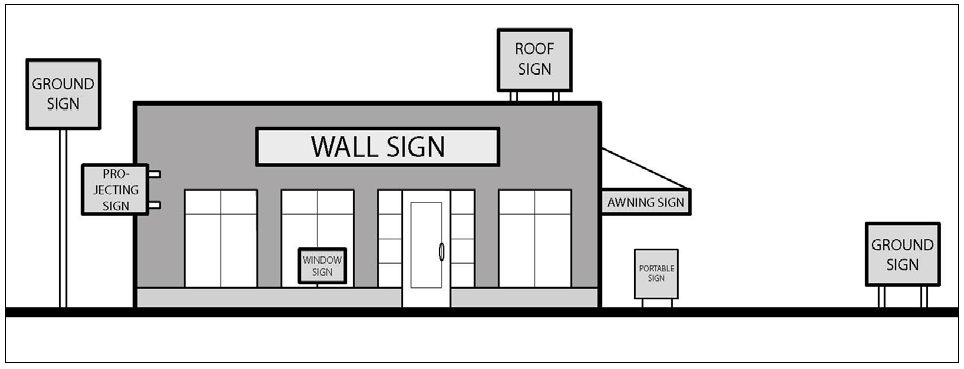
Awning. A roof-like shelter carried by a supporting frame or arms attached to a building and so arranged that the shelter and frame may be folded or rolled up to the face of the building to which it is attached or have the appearance of being able to be folded or rolled up.
(17)
Awning Sign. A sign that is mounted or painted on, or attached to an awning, canopy, or marquee.
(18)
Banner. A sign made of fabric or any nonrigid material with no enclosing framework.
(19)
Basement. That portion of any structure located partly below the average adjoining lot grade. If a basement is occupied for living purposes it shall be counted as a story for purposes of height measurement. (See Sign Type Illustration)
(20)
Battery Charging Station. An electrical component assembly or cluster of component assemblies designed specifically to charge batteries within electric vehicles.
(21)
Battery Electric Vehicle. Means any vehicle that operates exclusively on electrical energy from an off-board source (generally, the electric grid) that is stored in the vehicle's batteries, and produces zero tailpipe emissions or pollution when stationary or operating.
(22)
Bed and Breakfast. Any place of lodging that provides 8 or fewer rooms for rent to no more than a total of 20 tourists or other transients for more than 10 nights in a 12-month period, is the owner's personal residence, is occupied by the owner at the time of rental, and in which the only meal served to guests is breakfast, as defined in Wisconsin Adm. Code § ATCP 73.
(23)
Bees. Honey bees or mason bees raised for honey or pollination.
(24)
Berm. A raised bank of soil and rock, topped by native plants, shrubs, and or trees most often constructed so as to provide a visually appealing barrier between incompatible adjoining land uses.
(25)
Boarding House. A building other than a hotel where meals, or lodging and meals, are furnished for compensation for 3 or more persons not members of a family.
(26)
Boutique Winery. An establishment operating under Chapter 125.53, Wis. Stats., that manufactures, bottles, and stores wine on premises and which produces less than 100,000 gallons per year. Locally issued licenses/permits may allow wine sales directly to consumers, on premises tasting of wine, and may impose additional restrictions. Excludes homemade wine, defined under Chapter 125.06(3), Wis. Stats.
(27)
Brewery. A use which manufactures, bottles, and packages a total of more than 10,000 barrels or 310,000 U.S. gallons of fermented malt beverages per calendar year on premises including storage and distribution of fermented malt beverages that have been manufactured on the premises.
(28)
Brewpub. See Microbrewery.
(29)
Bufferyard (also, Buffer Strip). A linear strip of undeveloped land, along with landscaping or a fence, that is located between 2 different uses or zoning districts that have potentially incompatible characteristics. Buffer yards are intended to create separation between the incompatible land uses and eliminate or lessen the impacts (e.g., noise, dust, glare of lights, outdoor activities) of the most intrusive land use on the other.
(30)
Building. Any structure used, designed or intended for the protection, shelter, enclosure or support of persons, animals or property. When a building is divided into separate parts by unpierced walls extending from the ground up, each part shall be deemed a separate building.
(31)
Building, Height. The vertical distance from the average curb level in front of the lot or the finished grade at the building line, whichever is higher, to the highest point of the coping of a flat roof, to the deck line of a mansard roof, or to the average height of the highest gable of a gambrel, hip or pitch roof.
(32)
Building, Main. See Principal Structure.
(33)
Business Incubator. A mechanism used to encourage and support young companies until they become viable comprised of a multi-tenant space, building, or facility dedicated for providing technical, financial, managerial, technological, legal, and other support or assistance to start-up and/or growing businesses.
(34)
Canopy. A covering of canvas, vinyl, or similar such material rigidly supported by a metal frame attached to a building, and suspended over an entrance solely for shelter or protection, or a covering of canvas or other combustible material temporarily installed for shelter for a door or walk, and carried by a frame supported by the ground.
(35)
Canopy Sign. See, Awning Sign.
(36)
Certificate of Appropriateness. The certificate issued by the Historic Preservation Commission approving alteration, rehabilitation, construction, reconstruction or demolition of an historic structure, historic site or any improvement in an historic district which would include relocation of an historic structure to another location on or off its existing site.
(37)
Changeable Copy Sign, Automatic. A sign on which the copy changes automatically on a lamp bank or through mechanical means, e.g., electrical or electronic time and temperature units.
(38)
Changeable Copy Sign, Manual. A sign on which copy is changed manually in the field, e.g., reader boards with changeable letters.
(39)
Charging levels. The standardized indicators of electrical force, or voltage, at which an electric vehicle's battery is recharged. The terms 1, 2, and 3 are the most common charging levels, and include the following specifications:
(a)
Level-1: Voltage from 0 through 120; considered slow charging.
(b)
Level-2: Voltage from 120 through 240; considered medium charging.
(c)
Level-3: Voltage greater than 240; considered fast or rapid charging.
(40)
Clinic. An establishment where patients are not lodged overnight, but are admitted for examination and treatment by a group of physicians or dentists practicing medicine together.
(41)
Club. Buildings and facilities owned or operated by a corporation, association, person or persons for a social, education or recreational purpose, but not primarily to render a service which is customarily carried on as a business.
(42)
Commercial Animal Boarding. Any land use which provides short-term and/or long-term boarding for dogs and/or cats as the primary use of the property. Examples include commercial kennels and pet 'day care' facilities. Outdoor exercise yards, fields, training areas, etc. associated with such land uses are considered accessory to such land uses and do not require separate consideration.
(43)
Commercial Communications. Communications used by government and military entities for emergency purposes, licensed amateur radio service, and non-emergency communications used by agricultural, business, government, and military entities including aviation radar, commercial mobile radio service, fixed wireless service, global positioning, line-of-sight, microwave, personal communications service, weather radar, and wireless internet service.
(44)
Community Living Arrangement. The following facilities licensed or operated, or permitted under the authority of Wisconsin State Statutes: child welfare agencies under Chapter 48.60, Wis. Stats., group foster homes for children under Chapter 48.02(7)(m), Wis. Stats., and community-based residential facilities under Chapter 50.01, Wis. Stats.; but does not include day care centers, nursing homes, general hospitals, special hospitals, prisons and jails. The establishment of a community living arrangement shall be in conformance with Chapters 46.03(22), 59.97(15), 62.23(7)(i) and 62.23(7)(a), Wis. Stats., and amendments thereto.
(45)
Conditional Use Permit. A permit issued by the Plan Commission and Common Council authorizing establishment of a conditional use consistent with the provisions of this chapter.
(46)
Craft-Distillery. A use which manufactures, bottles and packages a total of not more than 100,000 proof gallons of intoxicating liquor under the name of "whiskey", "brandy", "gin", "rum", "spirits", "cordials", or any other name per calendar year on the premises including storage and distribution of intoxicating liquor that has been manufactured on the premises.
(47)
Daycare Center, Group. Any facility operated for the purpose of providing care, protection, and guidance to children and/or adults during only part of a 24-hour day. This term includes nursery schools, preschools, day care centers for individuals, and other similar uses but excludes public and private educational facilities or any facility offering care to individuals for a full 24-hour period.
(48)
Deck. An above ground, unroofed platform extending from a building and intended for outdoor living.
(49)
Decommissioning. The removal of all of the following:
(a)
The above ground portion of a wind energy system, including wind turbines and related facilities, except for access roads if removal has been waived by the property owner.
(b)
All below ground facilities, except the following:
1.
Underground collector circuit facilities.
2.
Those portions of concrete structures 4 feet or more below grade.
(50)
Development. Any man-made change to improved or unimproved real estate, including, but not limited to, the construction of buildings, structures or accessory structures; the construction of additions or substantial alterations to buildings, structures or accessory structures; the placement of buildings or structures; ditching, lagooning, dredging, filling, grading, paving, excavation or drilling operations; and the deposition or extraction of earthen materials.
(51)
Distillery. A use which manufactures, bottles and packages a total of more than 100,000 proof gallons of intoxicating liquor under the name of "whiskey", "brandy", "gin", "rum", "spirits", "cordials" or any other name per calendar year on the premises including storage and distribution of intoxicating liquor that has been manufactured on the premises.
(52)
Door Sign. A sign that is applied or attached to the exterior of a door.
(53)
Driveway. A private route of ingress and egress from any public right-of-way, which provides access to one residential dwelling/unit, commercial building, or property.
(54)
Dwelling. A building or portion thereof designed or used exclusively for residential occupancy, but not including automobile trailers, hotels, motels or boarding and lodging houses.
(55)
Dwelling Unit. A room or suite of rooms used as a single-family dwelling including bath and culinary accommodations.
(56)
Dwelling, Multi-Family. A building or portion thereof designed for and occupied by more than 2 families, including, but not necessarily limited to, triplexes, quadplexes, apartment houses, and the like.
(57)
Dwelling, Single-Family. An attached or detached structure designed for or occupied exclusively by one family.
(58)
Dwelling, Single-Family Attached. A building containing not more than one dwelling unit attached at the side or sides in a series or group of 3 or more buildings each containing not more than one dwelling unit. Each building shall be separated from the adjoining building or buildings by a party wall or walls extending from footings through roofs.
(59)
Dwelling, Single-Family Detached. A dwelling consisting of one dwelling unit designed for, converted to, and/or occupied by one family and not attached to another dwelling unit.
(60)
Dwelling, Two-Family. A detached or semi-detached building designed for and occupied exclusively by two families.
(61)
Easement. A non-possessory legal interest a person has in the property of another for a specific use. An easement may apply to the entire property or a portion thereof and may be perpetual or temporary, expiring after a period of time or after a certain event occurs. A utility easement, for example, would allow any person with a right to use the easement to install and maintain utilities across, over, or under the subject land. A road easement would likewise allow the installation and maintenance of a driveway or roadway along with ancillary utilities.
(62)
Electric vehicle. Any vehicle that is licensed and registered for operation on public and private highways, roads, and streets; either partially or exclusively, on electrical energy from the grid, or an off-board source (generally, the electric grid, that is stored on-board via a battery for motive purpose. Electric vehicle includes:
(a)
A battery electric vehicle.
(b)
A plug-in hybrid electric vehicle.
(63)
Electric vehicle charging station. A public or private parking space that is served by battery charging station equipment that has as its primary purpose the transfer of electric energy (by conductive or inductive means) to a battery or other energy storage device in an electric vehicle.
(64)
Electric vehicle charging station-private restricted use. An electric vehicle charging station that is:
(a)
Privately owned and restricted access (e.g., single-family home, executive parking, designated employee parking); or,
(b)
Publicly owned and restricted (e.g., fleet parking with no access to the general public).
(65)
Electric vehicle charging station-public use. Means an electric vehicle charging station that is:
(a)
Publicly owned and publicly available (e.g., Park & Ride parking, public library parking lot, on-street parking); or,
(b)
Privately owned and available to visitors of the use (e.g., shopping center parking).
(66)
Electric Vehicle Infrastructure. Means conduit/wiring, structures, machinery, and equipment necessary and integral to support an electric vehicle, including battery charging stations and rapid charging stations.
(67)
Electric Vehicle Parking Space. Means any marked parking space that identifies the use to be exclusively for the parking of an electric vehicle.
(68)
Electrical Sign. A sign or sign structure in which electrical wiring, connections, or fixtures are used.
(69)
Essential Services. Services provided by public and private utilities necessary for the exercise of the principal use or service of the principal structure. These services include underground, surface, or overhead gas, electrical, steam, water, sanitary sewerage, stormwater drainage, and communication systems and accessories thereto, such as poles, towers, wires, mains, drains, vaults, culverts, laterals, sewers, pipes, catch basins, water storage tanks, conduits, cables, fire alarm boxes, police call boxes, traffic signals, pumps, lift stations, and hydrants, but not including buildings.
(70)
Existing Use. Any lawful permitted or conditional use in existence at the time of the adoption of the most recent amendment to the Zoning Ordinance.
(71)
Façade. The entire front or any other face of a building, including the parapet.
(72)
Family. One or more persons related by blood, adoption or marriage, or not more than 2 unrelated persons living and cooking together as a single housekeeping unit.
(73)
Family Shelter. A facility that exclusively shelters a family whose members are biologically related, or an individual unit within a homeless shelter that serves the same purpose.
(74)
Fence. An accessory structure providing enclosure or serving as a barrier, such as wooden posts, wire, iron, brick, stone or other manufactured material or combination of materials erected to enclose, screen or separate areas. Structures designed to enclose recreational facilities, such as tennis courts or backstops, shall not be considered fences.
(75)
Fence, Open. A structure of rails, planks, stakes, strung wire, or similar material erected as an enclosure, barrier, or boundary. Open fences are those with more than 50% of their surface area open for free passage of light and air. Examples of such fences include barbed wire, chain link, picket, rail fences, and others as identified in this chapter.
(76)
Fence, Ornamental. A fence intended to decorate, accent, or frame a feature of the landscape. Ornamental fences are often used to identify a lot corner or lot line; or frame a driveway, walkway, or planting bed. Ornamental fences are those with more than 80% of their surface area open for free passage of light and air. Ornamental fences are often of the rail, or wrought iron type and others as identified in this chapter.
(77)
Fence, Security. A fence intended to guard property against unauthorized entry, and to protect stored goods and products from theft and other unauthorized handling. Security fences usually exceed 6 feet in height, are often made of wrought iron or woven wire, and may incorporate additional security features such as barbed wire or as otherwise identified in this.
(78)
Fence, Solid. A structure of boards, rails, planks, stakes, slats, or similar material erected as an enclosure, barrier, or boundary. Solid fences are those with 50% or less of their surface area open for free passage of light and air. Examples of such fences are stockade, board-on-board, board and batten, basket weave, and louvered fences or as otherwise identified in this chapter.
(79)
Festoon. A string of balloons, ribbons, tinsel, small flags, or pinwheels.
(80)
Flag. Any fabric, banner or bunting containing distinctive colors, patterns or symbols, used as a symbol of a business, corporation, government, political subdivision or other entity.
(81)
Flashing Sign. A sign which contains an intermittent or sequential flashing light source used primarily to attract attention. Does not include changeable copy signs, animated signs, or signs which, through reflection or other means, create an illusion of flashing or intermittent light.
(82)
Floor Area. The square feet of floor space within the outside line of walls and includes the total of all space on all floors of a building. It does not include porches, garages or space in a basement or cellar when said basement or cellar space is used for storage or incidental uses.
(83)
Freestanding Sign (also, Ground Sign). Any sign supported by structures or supports that are placed on, or anchored in, the ground that are independent from any building or other structure.
(84)
Frontage. All the property abutting on one side of a street between 2 intersecting streets, or all of the property abutting on one side of a street between an intersecting street and the dead end of a street.
(85)
Garage, Private. A structure primarily intended and used for the enclosed storage or shelter of the private motor vehicles of the residents upon the premises. Carports are considered garages.
(86)
Garage, Public or Commercial. Any building or portion thereof, not accessory to a residential building or structure, used for equipping, servicing, repairing, leasing, public parking of motor vehicles, snowmobiles or other recreational vehicles for hire.
(87)
Garage, Storage. A building or portion thereof, other than a private garage, used exclusively for parking or temporary storage of self-propelled vehicles.
(88)
Geothermal Energy System. A sealed, watertight loop of pipe buried outside of a building foundation, intended to re-circulate a liquid solution through a heat exchanger. This includes but is not limited to: vertical closed loop, horizontal closed loop and body of water closed loop systems.
(89)
Geothermal Energy System, Horizontal. A geothermal energy system constructed to contain horizontal piping and the installation and grouting of the horizontal piping when such piping does not exceed 20 feet in depth.
(90)
Geothermal Energy System, Vertical. A geothermal energy system constructed to contain vertical piping and the installation and grouting of the vertical piping exceeding 20 feet in depth.
(91)
Ground-Mounted Solar Energy System. A solar energy system not attached to another structure and is ground mounted.
(92)
Ground Sign (also, Freestanding Sign). Any sign supported by structures or supports that are placed on, or anchored in, the ground that are independent from any building or other structure.
(93)
Hanging Sign. A sign that is suspended from the underside of a surface and is supported by such surface.
(94)
Hazard. A condition, whether manmade or natural, that presents a tangible danger to the public health, safety, and general welfare.
(95)
Hazardous Material (also Hazardous Substance). A material regulated by the Emergency Planning and Community Right-to-Know Act of 1986, 42 USC 1101-11050, as may be amended.
(96)
Historic District. An area designated by the Common Council, on recommendation of the Historic Preservation Commission, that contains 2 or more historic improvements or sites.
(97)
Historic Site. Any parcel of land of historic significance due to a substantial value in tracing the history or prehistory of man, or upon which an historic event has occurred and which has been designated as an historic site under this section or an improvement parcel, or part thereof, on which is situated an historic structure and any abutting improvement parcel, or part thereof, used as and constituting part of the premises on which the historic structure is situated.
(98)
Historic Structure. Any improvement which has a special character or special historic interest or value as part of the development, heritage or cultural characteristics of the City, State, or Nation and which has been designated as an historic structure pursuant to the provisions of this section.
(99)
Home Occupation. Any gainful occupation or activity which is clearly incidental and secondary to the use of the premises for dwelling purposes, and which is carried on wholly within a main building or accessory building by a member of the family residing on the premises.
(100)
Hotel. A building in which lodging, or boarding and lodging, are provided and offered to the public for compensation, and in which ingress and egress to and from all rooms are made through an inside lobby or office supervised by a person in charge at all times. As such, it is open to the public in contradistinction to a boarding house, lodging house or an apartment, which are herein separately defined.
(101)
Homeless Person. An individual who, or family which, lacks a fixed, regular and/or adequate nighttime residence.
(102)
Homeless Shelter. A temporary place of lodging for homeless individuals or homeless families.
(103)
Illegal Sign. A sign which does not meet the requirements of this chapter and is erected after the effective date of this chapter.
(104)
Illuminated Sign. A sign with an artificial light source incorporated internally or externally for the purpose of illuminating the sign.
(105)
Impervious Surface. Any artificial or natural surface which does not allow the entrance or passage of water or sediment into the ground surface. These areas seal the ground surface from infiltration of water into the subsurface and prevent recharge of the ground water and increase the amount of stormwater runoff. Runoff from impervious surfaces tends to increase the potential for flooding, and carries sediment and pollutants that are detrimental to the quality of surface waters. New developments typically increase the amount of impervious surface. It is important to manage and minimize the amount of impervious surface in new and existing developments to help protect the surface waters and help recharge natural ground water. Impervious surfaces include, but are not limited to buildings and roof areas, structures, concrete or asphalt surfaces, gravel or traffic bond surfaces, decks with no spaces in between the decking, and bricks or pavers with no spacing between, which are placed on traffic bond.
(106)
Improvement. Any building, structure, place, work of art or other object constituting a physical betterment of real property or any part of such betterment, including streets, alleys, sidewalks, curbs, lighting fixtures, signs, and the like.
(107)
Incidental Sign. A sign, emblem or decal affixed to a door or window informing the public of goods, facilities or services available on the premises, e.g., credit card sign or sign indicating hours of business. Incidental signs shall include signs placed on items for sale.
(108)
Indoor Sales or Service. Indoor sales and service land uses include all land uses which conduct or display sales or rental merchandise or equipment, or non-personal or non-professional services, entirely within an enclosed building. This includes self-service facilities such as coin-operated laundromats. Depending on the zoning district, such land uses may or may not display products outside of an enclosed building.
(109)
Integral Sign. A sign that is embedded, extruded, or carved into the material of a building façade. A sign made of bronze, brushed stainless steel, or aluminum, or similar materials attached to the building façade.
(110)
Interior Sign. A sign located within the interior of any building or structure which is not visible from the public right-of-way. This does not, however, exempt such signs from the structural, electrical or material specifications of this chapter.
(111)
In-Vehicle Sales or Service. In-vehicle sales and service land uses include all land uses which perform sales and/or services to persons in vehicles, or to vehicles which may or may not be occupied at the time of such activity (except vehicle repair and maintenance services). Such land uses often have traffic volumes which exhibit their highest levels concurrent with peak traffic flows on adjacent roads. Examples of such land uses include drive-in, drive-up, and drive-through facilities, vehicular fuel stations, all forms of car washes. If performed in conjunction with a principal land use (for example, a convenience store, restaurant or bank), in-vehicle sales and service land uses shall be considered an accessory use.
(112)
Junk Yard. Any premises on which there is an accumulation of scrap metal, paper, rags, glass, lumber or other materials stored for salvage unless such accumulation shall be stored in a completely enclosed building.
(113)
Laundromat. An establishment providing home-type washing, drying or ironing machines for use on the premises by the general public.
(114)
Livestock. Bovine animals, equine animals, goats, poultry, sheep, swine, farm-raised deer, farm-raised game birds, camelids, ratites, and farm-raised fish.
(115)
Loading Area. A completely off-street space or berth on the same lot as the principal use it serves for the loading or unloading of freight carriers, having adequate ingress and egress to a public street or alley.
(116)
Lodging House. A building other than a hotel where lodging only is provided for compensation for not more than 3 persons not members of the family.
(117)
Lot. A tract of land, designated by metes and bounds, land survey, minor land division or plat, and recorded in the office of the county register of deeds.
(118)
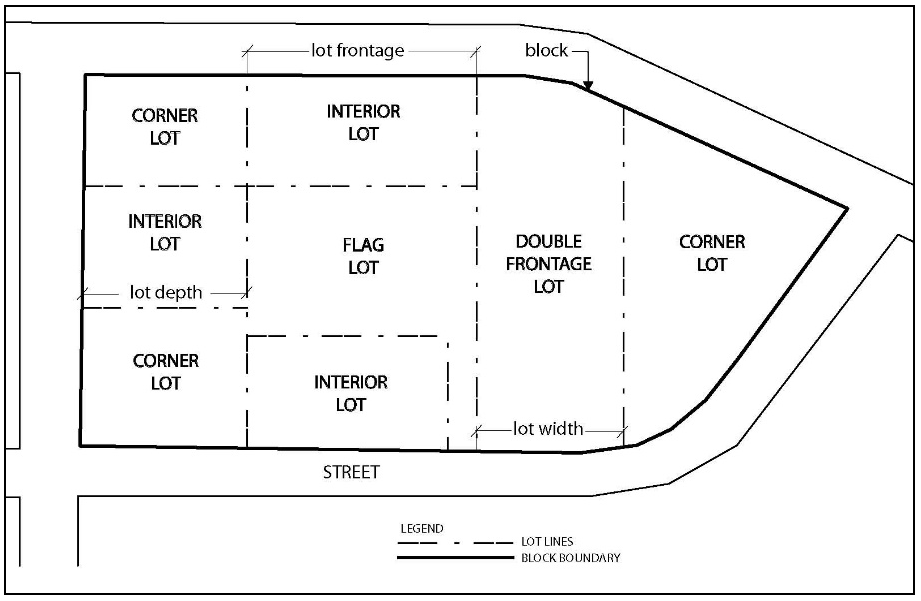
Lot, Corner. A lot abutting on 2 or more streets at their intersection, provided that the interior angle of such intersection is less than 135 degrees. (See Lot Type Illustration.)
(119)
Lot, Depth of. The mean horizontal distance between the front and rear lot lines. (See Lot Type Illustration.)
(120)
Lot, Flag. A lot containing a narrow strip or panhandle of land providing access from the public street to the remainder of the lot. (See Lot Type Illustration.)
(121)
Lot, Interior. A lot other than a corner lot. (See Lot Type Illustration.)
(122)
Lot, Substandard (also Lot, Nonconforming). A lot of record which lawfully existed prior to this chapter, which would not conform to the applicable regulations if the lot were to be created under the current provisions of this chapter.
(123)
Lot, Through (also, Double Frontage). A lot having a pair of opposite lot lines along, and access to, 2 more or less parallel public streets, and which is not a corner lot. On a through lot, both street lines shall be deemed front lot lines. (See Lot Type Illustration.)
(124)
Lot Lines. The lines bounding a lot. (See Lot Type Illustration.)
(125)
Lot Type Illustration (see image at right).
(126)
Lot. Width. The width of a parcel of land measured at the setback line. (See Lot Type Illustration.)
(127)
Main Level. The floor or story of a building at or nearest ground level abutting the street for which the primary mailing address is associated.
(128)
Manufactured Home. A residential dwelling for one family as is defined in Chapter 101.91(2), Wis. Stats., fabricated in an off-site facility for installation or assembly at the building site, bearing a HUD label or insignia certifying that it is built in compliance with the Federal Manufactured Housing Construction Standards under 42 U.S.C. Sections 5401 to 5426, and built after June 14, 1976. A manufactured home shall be considered a single-family dwelling for the purposes of this chapter only where it meets said regulations.
(129)
Manufacturing. The mechanical or chemical transformation of materials or substances into new products, including the assembly of component parts, the manufacturing of products, and the blending of materials, such as lubricating oils, plastics, resins, or liquors.
(130)
Marquee. An overhanging flat or sloping pitched roof-like protection of rigid construction supported from a building without posts and used for the outside protection of a door, window, or other opening.
(131)
Mass Shelter. A type of homeless shelter that shelters multiple people of the same gender who are unrelated. In a women's shelter, this could also include a single mother with children. Mass shelters are supervised at all hours that the residents are present.
(132)
Maximum Blade Tip Height. The nominal hub height plus the nominal blade length of a wind turbine, as listed in the wind turbine specifications provided by the wind turbine manufacturer. If not listed in the wind turbine specifications, "maximum blade tip height" means the actual hub height plus the blade length.
(133)
Microbrewery (also, Brewpub). A use which manufactures, bottles and packages a total of not more than 10,000 barrels or 310,000 U.S. gallons of fermented malt beverages per calendar year and may or may not operate restaurant on the premises including storage and distribution of fermented malt beverages that have been manufactured on the premises.
(134)
Mobile Home. A transportable factory built structure as is defined in Chapter 101.91(2k), Wis. Stats., designed for long-term occupancy by one family and built prior to June 15, 1976, the effective date of the Federal Manufactured Housing Construction and Safety Standards Act. A mobile home is not considered to be a type of single-family dwelling for the purposes of this chapter.
(135)
Mobile Home Park. A parcel of land or subdivision used for the placement of two or more mobile homes and/or manufactured homes. Manufactured home developments and subdivisions shall not be included under this land use category where all manufactured homes meet the regulations of built in compliance with the Federal Manufactured Housing Construction Standards under 42 U.S.C. §5401 to 5426, and built after June 14, 1976.
(136)
Motel. A series of attached, semi-attached, or detached sleeping units for the accommodation of transient guests.
(137)
Multi-Tenant Sign. A type of ground sign which identifies and advertises businesses, entities, or tenants located within a multi-tenant building, complex, development, or subdivision.
(138)
Mural. See, Wall Signs.
(139)
Nameplate Capacity. The nominal generating capacity of a wind energy system, as listed in the wind turbine specifications provided by the wind turbine manufacturer.
(140)
Nonconforming Building or Structure. Any building or structure which:
(a)
Does not comply with all of the regulations of this chapter or any amendment hereto governing bulk for the zoning district in which such building is located; or,
(b)
Is designed or intended for a nonconforming use.
(141)
Nonconforming Use. Any principal use of land, buildings, or structures which does not comply with all the regulations of this chapter or of any amendment hereto governing use for the zoning district in which such use is located.
(142)
Non-electric Vehicle. Any motor vehicle that does not meet the definition of electric vehicle.
(143)
Nonparticipating Property. Real property that is not a participating property.
(144)
Nonparticipating Residence. A residence located on nonparticipating property.
(145)
Nursing, Rest, or Convalescent Home. An extended or intermediate care facility licensed or approved to provide full-time convalescent or chronic care to individuals who by reason or advanced age, chronic illness, or infirmity, are unable to care for themselves.
(146)
Off-Premises Sign. A sign that directs attention to a business, commodity, service, or entertainment conducted, sold, or offered at a location other than the premises on which the sign is located
(147)
Office. A room or suite of rooms used for conducting the affairs of a business, profession, service industry, or government.
(148)
Open Space. The areas of a lot which contain permeable surfaces and shall remain unbuilt and shall not be used for parking, storage, access drives, or display. The use of gravel or pavers shall not be considered permeable surface for the calculation of open space. Open space represents many different landscaping elements, including greens, quadrangles, lawns, hedgerows, gardens, pathways/walkways, groves, wooded areas, fields, and natural areas.
(149)
Ordinary High Water Mark. The point on the bank or shore up to which the presence and action of the surface water is so continuous as to leave a distinctive mark such as by erosion, destruction or prevention of terrestrial vegetation, predominance of aquatic vegetation, or other easily recognized characteristic.
(150)
Ordinary Maintenance and Repairs. Ordinary and routine actions necessary to continue or restore the safe and healthy use of a structure which has been damaged or has deteriorated through natural aging and wear and which does not result in a substantial structural improvement or a significant increase in value. Such actions may include, but are not limited to, painting and staining, and the repair of the following; exterior windows, skylights, doors, vents, siding, insulation, shutters, gutters, flooring, shingles, roofing materials, walls or the foundation, and internal improvements within the structural envelope without doing a structural alteration.
(151)
Owner (Wind Energy System).
(a)
A person with a direct ownership interest in a wind energy system, regardless of whether the person was involved in acquiring the necessary rights, permits and approvals or otherwise planning for the construction and operation of a wind energy system.
(b)
At the time a wind energy system is being developed, a person who is acting as a wind energy system developer by acquiring the necessary rights, permits and approvals for or by planning for the construction and operation of a wind energy system, regardless of whether the person will own or operate the wind energy system.
(152)
Parapet. The extension of a false front or wall above a roof line.
(153)
Parking Lot. Any public or private land area designated and used for parking motor vehicles. A parking lot may be at ground level and not be subject to the setback and other yard requirements of a structure; or may be located within a structure which must meet the yard requirements of a specified Zoning District.
(154)
Parking Space. An area permanently reserved and maintained for the parking of one motor vehicle which meets the dimensional standards of this chapter.
(155)
Participating Property. A turbine host property.
(156)
Participating Residence. A residence located on participating property.
(157)
Parties in Interest. Includes all abutting property owners, all property owners within 200 feet, and all property owners of opposite frontages.
(158)
Person. An individual, corporation, partnership, limited liability company (LLC), trust, estate or other legal entity.
(159)
Personal Communications. Includes wireless telecommunications, personal communications service, radio, television, wireless internet service, and other systems used for personal use purposes.
(160)
Personal Services. The performance of any work or labor and shall also include acting as an independent contractor or providing any consulting advice or assistance, or otherwise acting as an agent pursuant to a contractual relationship.
(161)
Pervious Surface. Any artificial or natural surface which allows the entrance or passage of water or sediment into the ground surface via the porous nature of the material itself. The void areas and the infiltration rates of these materials allow rainwater and surface water to penetrate deep into the soil areas allowing the natural recharge of groundwater.
(162)
Photovoltaic Cell. A semiconductor device that converts solar energy into electricity.
(163)
Plug-in Hybrid Electric Vehicle. An electric vehicle that:
(a)
Contains an internal combustion engine and also allows power to be delivered to drive wheels by an electric motor.
(b)
Charges its battery primarily by connecting to the grid or other off-board electrical source (generally, the electric grid).
(c)
May additionally be able to sustain battery charge using an on-board internal-combustion-driven generator.
(d)
Has the ability to travel powered by electricity
(164)
Portable Sign. Any sign without a permanent foundation or otherwise permanently attached to a fixed location, which can be carried, towed, hauled, or driven and is primarily designed to be moved rather than limited to a fixed location regardless of modifications that limit its movability. (See Sign Type Illustration)
(165)
Premises. Any lot or parcel of land owned by any person, firm or corporation, public or private, improved with building, whether occupied or unoccupied.
(166)
Principal Structure. The primary structure on a parcel of land where the Principal Use occurs.
(167)
Private Property Sign. A sign erected to inform of public of private property boundaries and any prohibitions associated with such property, not to exceed 1.5 square feet in area per sign.
(168)
Professional Office. The office of a doctor, practitioner, dentist, minister, architect, landscape architect, professional engineer, lawyer, author, musician or other recognized profession. When established in a residential district, a professional office shall be incidental to the residential use, not more than 25 percent of the floor area of only one story of a dwelling unit shall be occupied by such office and only one unlighted name plate, not exceeding one square foot in area, containing the name and profession of the occupant of the premises shall be exhibited.
(169)
Professional Services. Those services within the scope of the practice of architecture, professional engineering, landscape architecture, or registered surveying and mapping, as defined by the laws of the state, or those performed by any architect, professional engineer, landscape architect, registered surveyor, or similar such profession in connection with his or her professional employment or practice.
(170)
Projecting Sign. A sign that is wholly or partly dependent upon a building for support and which projects more than 12 inches from such building. (See Sign Type Illustration)
(171)
Proof. The ethyl alcohol content of a liquid at 60 degrees Fahrenheit, stated as twice the percentage of ethyl alcohol by volume.
(172)
Proof Gallon. A gallon of liquid at 60 degrees Fahrenheit which contains 50 percent by volume of ethyl alcohol having a specific gravity of 0.7939 at 60 degrees Fahrenheit referred to water at 60 degrees Fahrenheit as unity, or the alcoholic equivalent thereof.
(173)
Public Facilities. Any facility, including, but not limited to, buildings, property, recreation areas, and roads, which are owned, leased, or otherwise operated, or funded by a governmental body or public entity.
(174)
Real Estate Sign. A sign advertising the sale, rental, or lease of the premises on which the sign is located.
(175)
Redevelopment. Any substantive change to a developed site, its structures, or its uses.
(176)
Residence (specific to Wind Energy System). An occupied primary or secondary personal residence including a manufactured home as defined in Chapter 101.91(2), Wis. Stats., a hospital, community-based residential facility, residential care apartment complex or similar facility, or a nursing home. Residence includes a temporarily unoccupied primary or secondary personal residence. Residence does not include any of the following:
(a)
A recreational vehicle as defined in Chapter 340.01(48r), Wis. Stats., notwithstanding the length of the vehicle.
(b)
A camping trailer as defined in Chapter 340.01 (6m), Wis. Stats.
(c)
A permanently abandoned personal residence.
(177)
Right-of-Way. A strip of land dedicated or acquired for public use.
(178)
Roadside Stand. A structure not permanently fixed to the ground that is readily removable in its entirety, covered or uncovered and wholly enclosed, and used solely for the sale of farm products produced on the premises. No such roadside stand shall be more than 300 square feet in ground area, and there shall be not more than one roadside stand on any one premises.
(179)
Roof Sign. A sign that is mounted on the roof of a building or which is wholly dependent upon a building for support and which projects above a point of a building with a flat roof, the eave line of a building with a gambrel, or hip roof, or the deck line of a building with a mansard roof. (See Sign Type Illustration)
(180)
Screen. A feature, such as a wall, fence, hedge, berm, or similar feature used to shield or obscure elements of a development from adjacent sites.
(181)
Self-Service Storage Units (also, Mini Warehouses). Real property containing leased spaces that a lessee is entitled to use for the storage of personal property on a self-service basis pursuant to a rental agreement and that is not rented or provided to the lessee in conjunction with property for residential use by the lessee. A "mini-warehouse" does not include warehouses licensed and regulated under Chapter 99, Wis. Stats.
(182)
Setback. The minimum horizontal distance between a property line and a line parallel thereto through the nearest point of the Principal Structure. Covered porches, whether enclosed or unenclosed, and attached garages shall be considered as part of the Principal Structure and shall not project into the required setback. Where the street line is an arc, the setback shall be measured from the arc.
(183)
Shadow Flicker. A pattern of moving shadows cast on a residence or an occupied community building caused by sunlight shining through moving wind turbine blades resulting in alternating changes in light intensity.
(184)
Shorelands. Those lands lying within 1,000 feet from a lake or pond of flowage, and 300 feet from a river or stream or to the landward side of the floodplain, from the ordinary high water mark of navigable waters, whichever distance is greater. Shorelands shall not include those lands adjacent to farm drainage ditches where such lands are not adjacent to a navigable stream or river, those parts of such drainage ditches adjacent to such lands were non-navigable streams before ditching or had no previous stream history, and such lands are maintained in nonstructural agricultural use.
(185)
Short-term Rental. A residential dwelling that is offered for rent for a fee and for fewer than 29 consecutive days.
(186)
Sign (also, Signage). A name, identification, description, display or illustration, which is affixed to, painted or represented directly or indirectly upon a building or other outdoor surface which directs attention to or is designed or intended to direct attention to the sign face or to an object, product, place, activity, person, institution, organization, or business. Signs located completely within an enclosed building and not exposed to view from a street or road are not considered signs. Each display surface of a sign or sign face is considered a sign. Neither official court or public notices, nor the flag of the nation or State shall be considered a sign under this chapter.
(187)
Sign Area. The space enclosed within the extreme edges of the sign for each sign face, not including the supporting structure; or, where attached directly to a building wall or surface, the space within the outline enclosing all the characters of the words, numbers or design.
(188)
Sign Contractor. Any person, partnership or corporation engaged in whole or in part in the erection or maintenance of signs, excluding the business which the sign advertises.
(189)
Sign Copy. The wording and/or symbols on a sign surface in either permanent or removable letter form.
(190)
Sign Face. The entire display surface area of a sign upon, against, or through which copy is displayed.
(191)
Sign Height. The vertical distance measured from the highest point of the sign to the surface grade beneath the sign.
(192)
Sign Structure. Any device or material, which supports, has supported or is capable of supporting a sign in a stationary position, including decorative covers.
(193)
Sign Type Illustration:
(194)
Site Plan. A drawing of a subject property that shows existing and proposed conditions and other features required by this chapter.
(195)
Skeleton Sign. A sign composed of letters, characters, or symbols applied to a background which is not a structural part of the sign.
(196)
Small Wind Energy System. A wind energy system that has a total installed nameplate capacity of 300 kilowatts or less and that consists of individual wind turbines that have an installed nameplate capacity of not more than 100 kilowatts.
(197)
Solar Collector. A device, structure or part of a device or structure a substantial purpose of which is to transform solar energy into thermal, mechanical, chemical or electrical energy.
(198)
Solar Glare. The effect produced by light reflecting from a solar panel with an intensity sufficient to cause annoyance, discomfort, or loss in visual performance and visibility.
(199)
Solar Panel. A group of photovoltaic cells are assembled on a panel. Panels are assembled on-site into solar arrays.
(200)
Solid Sign. Any sign other than a skeleton sign.
(201)
Stormwater. Water, and the materials it carries, that results from a rainfall event or melting snow or ice.
(202)
Stormwater Management Facility. A natural or manmade feature that collects, conveys, channels, holds, inhibits, or diverts the movement of stormwater.
(203)
Story. That portion of a building included between the surface of a floor and the surface of the floor next above it or, if there be no floor above it, then the space between the floor and the ceiling next above it. A basement or cellar having ½ or more of its height above grade shall be deemed a story for the purpose of height regulation.
(204)
Story, Half. A space under a sloping roof which has the line of intersection of roof decking and wall face not more than three feet above the top floor level, and in which space not more than ⅔ of the floor area is finished off for use. A half-story containing independent apartment or living quarters shall be counted as a full story.
(205)
Street. All property dedicated or intended for public or private street purposes or subject to public easements therefore and which is 21 feet or more in width.
(206)
Street Line. A dividing line between a lot, tract, or parcel of land and a contiguous street.
(207)
Structure. Anything constructed or erected, the use of which requires a fixed location on the ground, or attached to something having a fixed location on the ground.
(208)
Structural Alteration. Any change in the supporting members of a building, any substantial change in the roof structure or in the exterior walls, or any change that would increase the floor space, area or height of a building.
(209)
Tasting Room. A facility or portion of a facility supporting a rural craft brewery, distillery, or winery where the public may sample and purchase products produced by the facility and which has ancillary related retail sales. Retail sales shall be limited only to on-site production and merchandise directly related to the facility. Tasting rooms may include food sales.
(210)
Temporary Building or Structure. A structure without any foundation or footings and that is removed when the designated time period has ceased, or which is built of such materials and in such a way that it would commonly be expected to have a relatively short useful life, or is built for a purpose that would commonly be expected to be relatively short-term and not to be habitable.
(211)
Temporary Sign. A sign which may be displayed for a limited period of time.
(212)
Trailer. Any structure which is or may be mounted upon wheels for moving about and is propelled by its own or drawn by other motive power, and which is used as a dwelling or as an accessory building or structure in the conduct of a business trade or occupation, or is used for hauling purposes.
(213)
Transitory Accessory Structure. An intermediate accessory structure (not temporary but not permanent) that includes structures such as: pergolas (not including decks); trellises; fences and walls; towers; personal energy systems; children's playhouses, play apparatus, swing sets, sand boxes, and the like; raised bed gardens; dog enclosures; swimming or wading pools with a maximum wall height of 24 inches that will be stored seasonally; and other structures deemed to be substantially the same by the Plan Commission or the Zoning Administrator. (Am. Ord. #06-22)
(214)
Turbine Host Property. Real property on which at least one wind turbine is located.
(215)
Unnecessary Hardship. That circumstance where special conditions, which are not self-created, affect a particular property and make strict conformity with the restrictions governing dimensional standards unnecessarily burdensome or unreasonable in light of the purpose of this chapter.
(216)
Use. The use of property is the purpose or activity for which the land or building thereon is occupied or maintained.
(217)
Use, Accessory. A use on the same lot with, and of a nature customarily subordinate to, the principal use or structure, and serving the occupants of the principal use or structure.
(218)
Use, Conditional. A use allowed under a Conditional Use Permit, special exception, or other special zoning permission, but not including a variance, which, because of its unique or varying characteristics, cannot be properly classified as a permitted use in a particular district.
(219)
Use, Incidental. A use that is affiliated with but subordinate to a principal use of land or structure.
(220)
Use, Permitted. A permitted use is a use which may be lawfully established in a particular district or districts, provided it conforms with all requirements and regulations of the district in which such use is located.
(221)
Use, Principal. The main use of land or building as distinguished from a subordinate or accessory use.
(222)
Variance. An authorization granted by the Zoning Board of Appeals to construct, alter, or use a building, structure, or property in a manner that deviates from the dimensional standards of this chapter. A variance may not permit the use of a property that is otherwise prohibited by the chapter or allow flood land construction that is not protected to the flood protection elevation.
(223)
Vision Clearance. An unoccupied triangular space at the street corner of a corner lot which is bounded by the street lines and a setback line connecting points specified by measurement from the corner on each street line.
(224)
Wall Sign. A sign, mural, or similar display fastened to or painted on the wall of a building or structure in such a manner that the wall becomes the supporting structure for, or forms the background surface of, the sign, mural, or similar display. (See Sign Type Illustration)
(225)
Wall Sign, Historic. A Wall Sign located on its original building or structure and predating 1970.
(226)
Wind Energy System. A system as defined in Chapter 66.0403(1)(m), Wis. Stats., used to convert wind energy to electrical energy.
(227)
Wind Energy System Emergency. A condition or situation at a wind energy system that presents a significant threat of physical danger to human life or a significant threat to property or a natural event that causes damage to wind energy system facilities.
(228)
Wind Energy System Facility. Any component of a wind energy system, such as a wind turbine, collector circuit, access road, electric system interconnection facility or operation and maintenance facility.
(229)
Wind Energy System Lease. A written agreement between a landowner and the owner that establishes the terms and conditions associated with the placement, construction or operation of a wind turbine or other wind energy system facility on a landowner's property.
(230)
Wind Tower. The monopole, freestanding, or guyed structure that supports a wind turbine generator.
(231)
Window Sign. A sign that is applied or attached to the exterior or interior of a window or located in such manner within the building that it can readily be seen from the exterior of the building through a window. (See Sign Type Illustration)
(232)
Winery. An establishment operating under Chapter 125.53, Wis. Stats., that manufactures, bottles, and stores wine on premises and which produces at least 100,000 gallons per year. Locally issued licenses/permits may allow wine sales directly to consumers, on premises tasting of wine, and may impose additional restrictions.
(233)
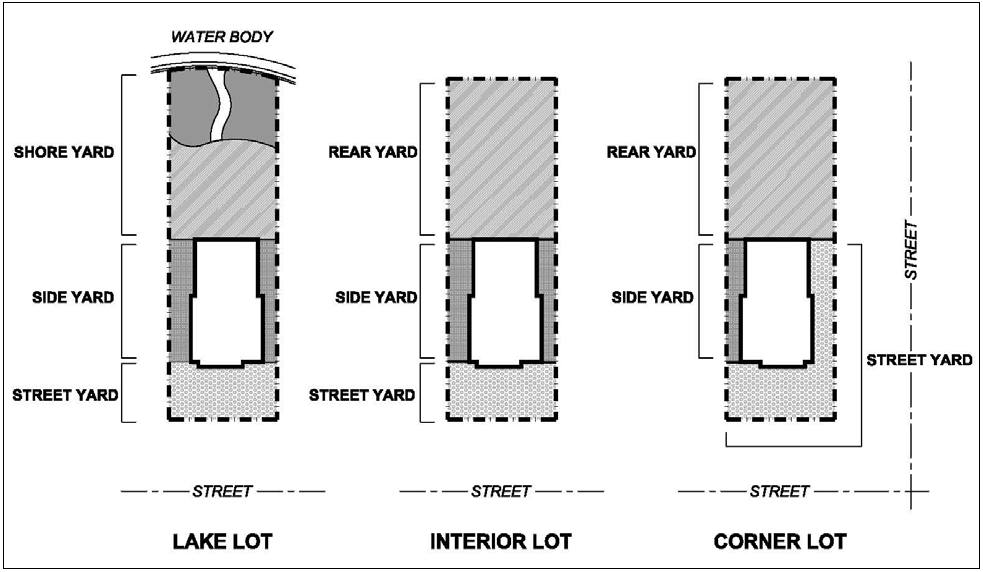
Yard. An open space on the same lot with a structure, unoccupied and unobstructed from the ground upward except for vegetation. The street and rear yards extend the full width of the lot.
(234)
Yard, Primary Street. A yard associated with the primary mailing address or fire number for the Principal Structure extending across the full width of the lot, the depth of which shall be the minimum horizontal distance between the existing or proposed street or highway line and a line parallel thereto through the nearest point of the Principal Structure. (See Yard Type Illustration).
(235)
Yard, Rear. A yard extending across the full width of the lot, the depth of which shall be the minimum horizontal distance between the rear lot line and a line parallel thereto through the nearest point of the Principal Structure. This yard shall be opposite the Primary Street Yard on a corner lot. (See Yard Type Illustration).
(236)
Yard, Secondary Street. A yard that abuts an existing or proposed street or highway not otherwise defined as a Primary Street Yard extending across the full width of the lot, the depth of which shall be the minimum horizontal distance between the existing or proposed street or highway line and a line parallel thereto through the nearest point of the Principal Structure. (See Yard Type Illustration).
(237)
Yard, Shore. A yard extending across the full width of the lot, the depth of which shall be the minimum horizontal distance between a navigable body of water and a line parallel thereto through the nearest point of the Principal Structure. (See Yard Type Illustration).
(238)
Yard, Side. A yard extending from the Street Yard to the Rear Yard or Shore Yard of the lot, the width of which shall be the minimum horizontal distance between the side lot line and a line parallel thereto through the nearest point of the Principal Structure. (See Yard Type Illustration).
(239)
Yard, Street. A yard extending across the full width of the lot, the depth of which shall be the minimum horizontal distance between the existing or proposed street or highway line and a line parallel thereto through the nearest point of the Principal Structure. Corner lots shall have 2 such yards. The Primary Street Yard on a double frontage lot or corner lot shall be that associated with the mailing address or fire number, as applicable. (See Yard Type Illustration).
(240)
Yard Type Illustration. See image below.
(241)
Zoning District, Base. A part or parts of the City for which the uniform regulations of this chapter govern the use and location of land and buildings.
(242)
Zoning District, Overlay. A zoning district that is super-imposed on one or more base zoning districts and imposes additional restrictions or additional development options on the underlying districts.
(243)
A permit issued by the Zoning Administrator to certify that the use of lands, structures, air and waters subject to this chapter are or shall be used in accordance with the provisions of said chapter. Zoning permits include, but are not necessarily limited to: sign permits, site plan permits, and temporary structure/use permits. A Conditional Use Permit is not considered a zoning permit for the purposes of this chapter.

