
Wayland City Zoning Code
ARTICLE I
- IN GENERAL
Sec. 20-1.- Enactment and authority.
The city council adopted Ordinance No. 123, the Wayland Zoning Code, being chapter 20 of the Wayland City Code, under the authority of the Michigan City and Village Zoning Act, being Public Act No. 207 of 1921 (MCL 125.581 et seq.), as amended. The Michigan City and Village Zoning Act has been repealed and replaced by the new Michigan Zoning Enabling Act, being Act No. 110 of the Public Acts of Michigan of 2006 (MCL 125.3101 et seq.). The city council hereby amends chapter 20 of the city Code to conform it to and under the authority of the new Michigan Zoning Enabling Act.
(Ord. No. 123, § 1.0, 6-5-89; Ord. No. 211, § 1, 2-5-07)
Sec. 20-2. - Short title.
This chapter shall be commonly known as the City of Wayland Zoning Ordinance.
(Ord. No. 123, § 1.1, 6-5-89)
Sec. 20-3. - Purpose.
The city zoning ordinance is hereby established in accordance with the needs of the city. The text, map and schedules contained herein shall constitute this ordinance. The ordinance is expressly adopted for the following purposes:
(1)
To protect and promote the public health, safety, and general welfare of the city.
(2)
To control and guide the orderly growth and development of the city in accordance with its comprehensive planning program, and to implement the growth and development goals and policies contained therein, some of which are enumerated as follows:
a.
To encourage a wide range of housing opportunities in an orderly manner in the city from single-family to multiple-family and congregate housing for the elderly;
b.
To ensure that the residential housing environment of the city is safe, healthful and free of visual blight;
c.
To preserve the character and value of certain historic areas and structures;
d.
To preserve and enhance the appearance and viability of the central business district; and
e.
To ensure the orderly development and operation of industrial uses.
(3)
To guard against community impacts which can adversely affect those positive qualities that make up the distinctive character of the city, and which can adversely affect its social and economic climate.
(4)
To promote and protect the value of land and buildings which are appropriate to the various districts established by this chapter.
(5)
To prevent conflicts between the use of land and buildings.
(Ord. No. 123, § 1.2, 6-5-89)
Sec. 20-4. - Usage.
For the purpose of this chapter, certain numbers, abbreviations, terms, and words used herein shall be used, interpreted and defined as set forth in this section.
(1)
Unless the context clearly indicates to the contrary, words used in the present tense include the future tense; words used in the singular number include the plural; and words used in the plural number include the singular; the word "herein" means this chapter; the word "regulation" means the regulations of this chapter; and the words "this chapter" shall mean the chapter, text, tables and maps included herein, as enacted or subsequently amended.
(2)
A person includes a corporation, a partnership, and an unincorporated association of persons such as a club; "shall" is always mandatory; a "lot" includes a plot or parcel, a "building" includes a structure; a "building" or "structure" includes any part thereof; "used" or "occupied" as applied to any land or building shall be construed to include the words "intended, arranged or designed to be used or occupied."
(3)
The city is the City of Wayland in the County of Allegan, State of Michigan; and city council, board of appeals, and planning commission are respectively the city council, board of appeals, and planning commission of the City of Wayland.
(Ord. No. 123, § 2, 6-5-89)
Sec. 20-5. - Definitions.
The following words, terms and phrases, when used in this chapter, shall have the meanings ascribed to them in this section, except where the context clearly indicates a different meaning:
Abandoned sign means any sign and/or its supporting sign structure which remains without a message or whose display surface remains blank for a period of one (1) year or more, or any sign which pertains to time, event or purpose which no longer applies, shall be deemed to have been abandoned. Signs applicable to a business temporarily suspended because of a change in ownership or management of such business hall not be deemed abandoned unless the property remains vacant for a period of one (1) year or more. Any sign remaining after demolition of a principal structure, shall be deemed to be abandoned. Signs which are present because of being legally established nonconforming signs or signs which have required a conditional use permit or a variance shall also be subject to the to the definition of abandoned sign.
Accessory building means a detached subordinate building or structure on the same premises with a main building, occupied or devoted to an accessory use which is appropriate, supplemental and customarily related to that use at the main building or premises. Where an accessory building is attached to a main building in a substantial manner by a wall or roof, such accessory building shall be considered part of the main building, including a carport, covered porch or other roofed structure.
Accessory dwelling unit (ADU) means a second, smaller dwelling unit located on the same lot as a single-family dwelling.
Accessory dwelling unit attached means an accessory dwelling unit developed within a detached single-family dwelling on any of its floors or all or part of an addition constructed for the purpose of serving as an ADU.
Accessory dwelling unit detached means an accessory dwelling unit developed within or attached to a legally conforming detached accessory structure over two hundred (200) square feet in area.
Accessory use means a use subordinate and customarily incidental to the main use on a lot.
Alley means a strip of land over which there is a right-of-way, public or private, on which generally no dwelling or land uses front, serving as a rear entrance to one (1) or more properties.
Alteration means any change, addition, or modification in construction of type of occupancy; and any change in the roof or supporting members of the building or structure, such as bearing walls, partitions, columns, beams, girders, or any change which may be referred to herein as "altered" or "reconstructed."
Animal means dog, cat, bird, reptile, mammal, fish or any other dumb creature.
Automobile or trailer sales area means an area used for the display, sale or rental of new and used motor vehicles, boats or trailers (including mobile homes) in operable condition and where no repair work is done.
Automobile repair—major means any activity involving the general repair, rebuilding or reconditioning of motor vehicles, engines, or trailers; collision services, such as body, frame, or fender straightening and repair, overall painting and vehicle rustproofing.
Automobile repair—minor means any activity involving minor repairs to motor vehicles and the incidental replacement of parts of such vehicles. A place where either gasoline or any other fuel or lubricating oil or grease for operating motor vehicles is offered for sale to the public and applied directly into motor vehicles, including sale of accessories, greasing, oiling and minor automotive repair on the premises.
Automobile wash establishment means a building, or portion thereof, the primary purpose of which is that of washing motor vehicles.
Awning means a roof-like cover, often of fabric, plastic, metal or glass designed and intended for protection from the weather or as a decorative embellishment, and which projects from a wall or roof of a structure primarily over a window, walk, or the like. Any part of an awning, which also projects over a door, shall be counted as an awning.
Balloon sign means a sign consisting of a bag made of lightweight material supported by helium, hot, or pressurized air, which is greater than twenty-four (24) inches in diameter.
Banner means a sign containing a commercial message produced on lightweight flexible fabric, such as canvas, cloth, paper or similar material that is mounted to a pole or a building at one (1) or more edges, and which is more or less subject to movement by the wind. National, state, municipal, corporate or educational institution flags are not to be considered banners.
Basement or cellar means a portion of a building having more than one-half of its height below grade.
Beacon means any stationary or revolving light which flashes, projects or directs one (1) or more beams of single or multiple colored light, in any manner which intended or not, attracts or diverts attention.
Bed and breakfast facility means a building, other than a hotel, where lodgings and light breakfasts for persons, other than the family, are regularly served for compensation.
Bluff means the top of a steep bank rising from the ordinary high water mark on a lot or parcel.
Board of zoning appeals means the city board of zoning appeals, the members of which have been duly appointed by the city council and which is authorized as a body to interpret, hear appeals, and grant variances only in accordance with the provisions of this chapter.
Building means an edifice, framed or constructed and designed to stand more or less permanently and covering a space of land, for use as a dwelling, store, storehouse, factory, sign, shelter or for some other useful purpose. Building in this sense includes a wall, fence, monument, board fence or similar structure, trailer, tent, or vehicle used as a dwelling.
Building, existing means any building actually constructed or the construction of which is started previous to the effective date of this chapter; provided, that the construction of any such building continues uninterruptedly and is completed within six (6) months from such date. Any building damaged by fire, collapse, or decay to the extent of its full assessed value as of record at the time of damage shall not be considered an existing building.
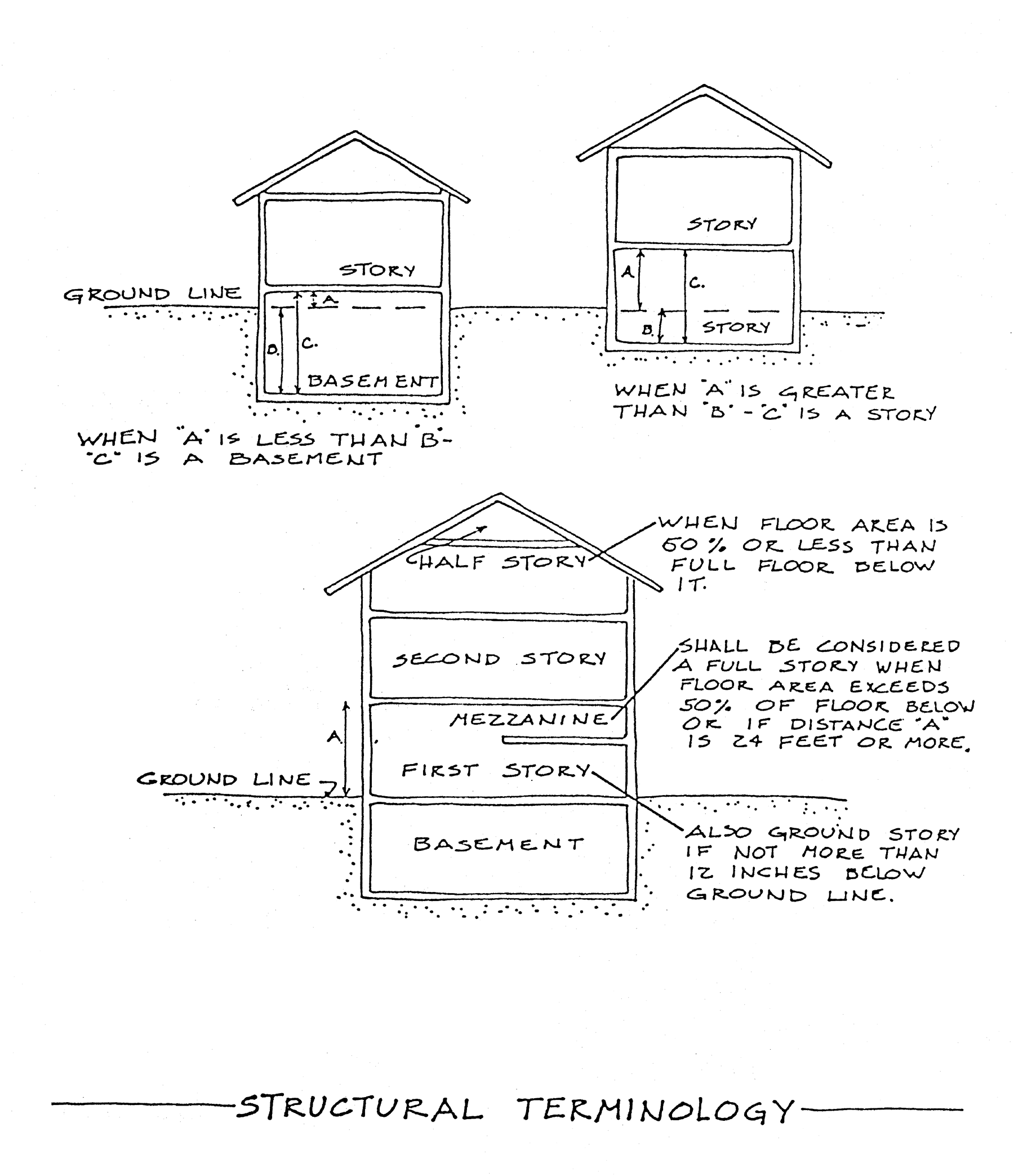
Structural Terminology
Building height means the vertical distance from the average elevation of the street curb paralleling the front, or if on a street corner, the front and side, of the building, to the highest point of the roof surface if the roof is flat; to the deck line, if the roof is of the mansard type; or to the average height between the eaves and the ridge if the roof is gable, hip or gambrel type.
Building inspector means the officer charged with the administration and enforcement of the building code, or his duly authorized representative.
Building line means a line parallel to the front lot line, and which marks the location of the building.
Building permit means a permit signifying compliance with the provisions of this chapter as to use, activity, bulk and density, and with the requirements of all other development codes and ordinances currently in effect in the city.
Building sign means any sign attached or supported by any building.
Billboard or poster panel means any structure or portion thereof, including temporary or mobile conveyances, on which lettered, figures or pictorial matter is displayed for advertising purposes, which is not related to a principal use on the premises or to the nature of business or manufacturing conducted thereon, or any such structure or portion thereof, the area of which, devoted to advertising purposes, exceeds one hundred (100) square feet. This definition shall not be held to include any board, sign or surface used to display any official notices issued by any court or public office, or posted by a pubic officer in the performance of a public duty; nor shall it be held to include a real estate sign advertising for sale or rent the property upon which it stands.
Cabinet sign means any wall sign that is not of channel or individually mounted letter construction.
Canopy means any covered structure made of cloth or other material with frames attached to a building which projects beyond the building wall and is carried by a frame supported by the ground or sidewalk below it.
Changeable copy sign means a sign or portion thereof with characters, letters, or illustrations that can be changed or rearranged without altering the face or the surface of the sign. Changeable copy signs do not include signs upon which characters, letters or illustrations change or rearrange only once in a 24-hour period.
Child-care center or day-care center means a facility, other than a private residence, receiving 1 or more preschool or school-age children for care for periods of less, than 24 hours a day, and where the parents or guardians are not immediately available to the child. Child-care center or day care center includes a facility that provides care for not less than two (2) consecutive weeks, regardless of the number of hours of care per day. The facility is generally described as a child care center, day center, day nursery, nursery school, parent cooperative pre school, play group, before- or after-school program, or drop-in center. Child care center or day care center does not include:
(1)
A Sunday school, a vacation bible school, or a religious instructional class that is conducted by a religious organization where children are attending for not more three (3) hours per day for an indefinite period or for attending for not more than eight (8) hours per day for a period not to exceed four (4) weeks during a 12-month period.
(2)
A facility operated by a religious organization where children are cared for not more than three (3) hours while persons responsible for the children are attending religious services.
(3)
A program that is primarily supervised, school-age-child-focused training in a specific subject, including, but not limited to, dancing, drama, music, or religion. This exclusion applies only to the time a child is involved in supervised, school-age-child-focused training.
(4)
A program that is primarily an incident of group athletic or social activities for school-age children sponsored by or under the supervision of an organized club or hobby group, including, but not limited to, youth clubs, scouting, and school-age recreational or supplementary education programs. This exclusion applies only to the time the school-age child is engaged in the group athletic or social activities and if the school-age child can come and go at will.
Church means a building used principally for religious worship, but the word "church" shall not include or mean an undertaker's chapel or funeral building.
Clinic means a building or group of buildings where human patients are admitted, but not lodged overnight for examination and treatment by more than one (1) professional, such as a physician, dentist or the like.
Co-location. The location by two (2) or more wireless communication providers of wireless communication facilities on a common structure, tower, or building, with the view toward reducing the overall number of structures required to support wireless communication antennas within the community.
Commercial vehicle means any motor vehicle other than a motorcycle or passenger automobile designed or used primarily for transportation of persons or property.
Condominium means the manner in which real property is owned. It is a combination of ownership in fee simple of the interior space of a townhouse or apartment plus an undivided ownership, in common with other purchasers, of the common elements in the structure, including the land and its appurtenances.
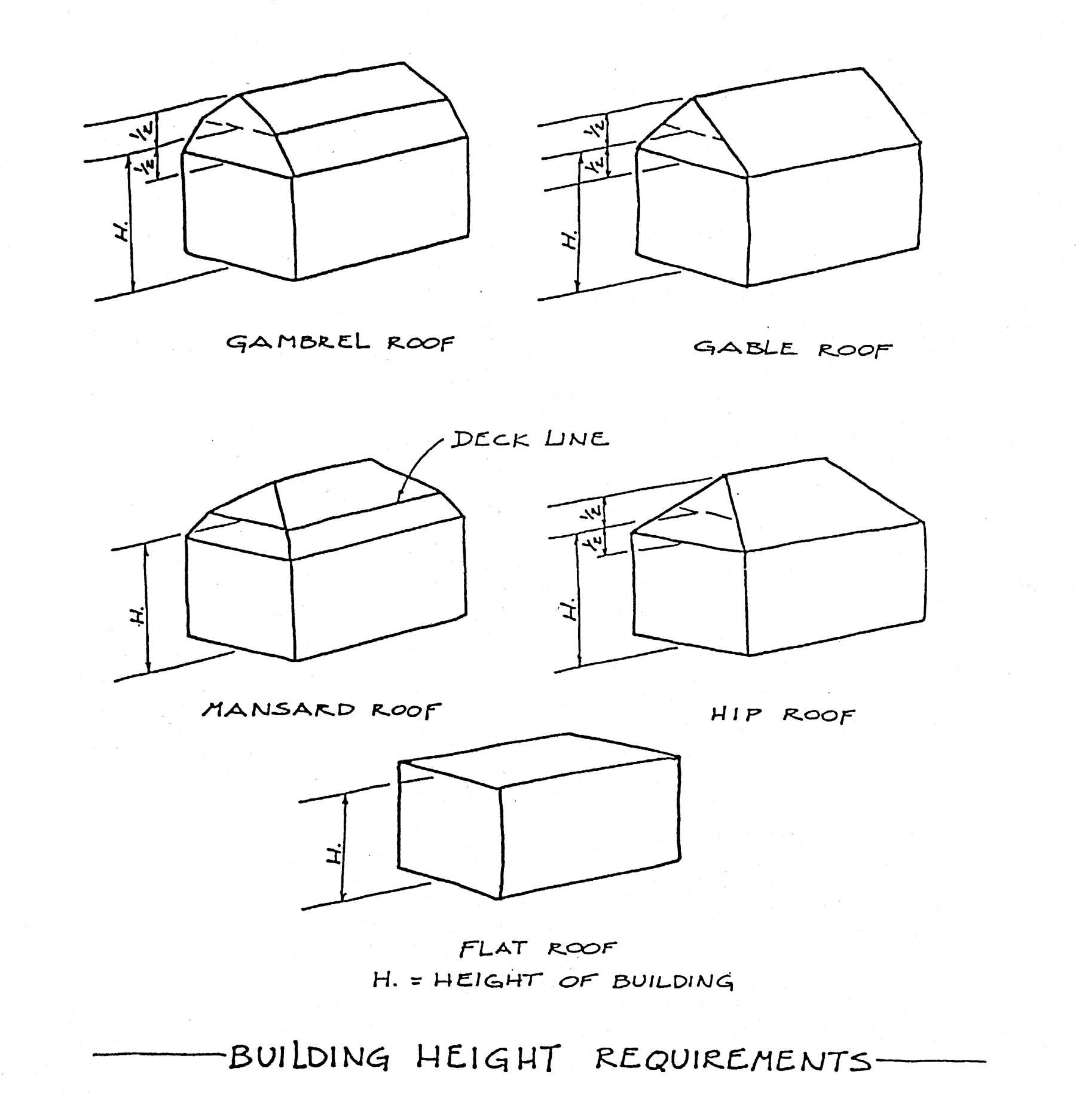
Building Height Requirements
Construction means the building, erection, alteration, repair, renovation (or demolition or removal) of any building, structure or structural foundation; or the physical excavation, filling and grading of any lot other than normal maintenance shall constitute construction.
Convalescent or nursing home means a home for the care of children or the aged or infirm, or a place of rest for those suffering bodily disorders wherein seven (7) or more persons are cared for. Such home shall conform and qualify for license under state law.
Curb level (grade) means the mean level of the established curb in front of the building. Where no curb has been established the city engineer shall establish such curb level for the purpose of these regulations.
Day care home, family means a private home in which one (1) or fewer than seven (7) minor children are received for care and supervision for periods of less than twenty-four (24) hours a day, unattended by a parent or legal guardian, except children related to an adult member of the family by blood, marriage, or adoption. Family day care home includes a home in which care is given to an unrelated minor child for more than four (4) weeks during a calendar year.
Day-care home, group. A private home in which more than six (6) but not more than twelve (12) minor children are given care and supervision for periods of less than twenty-four (24) hours a day unattended by a parent or legal guardian, except children related to an adult number of the family by blood, marriage or adoption. Group day care home includes a home in which are is given to an unrelated minor child for more than four (4) weeks during a calendar year.
Destruction or prevention of woody terrestrial (upland) vegetation; predominance of aquatic vegetation; or other easily recognized characteristic. Immediately below the high water mark is the streambed, which is also referred to as the active channel. Delineation of the ordinary high water mark entails the identification of indicators on the stream bank and the transition line between, aquatic vegetation (such as sedges and cattails) and terrestrial vegetation (perennial grasses and woody shrubs) or the scour line on exposed earth on the bank (from constant erosion) and terrestrial vegetation. In any area where the ordinary high water mark cannot be found, the top of the lowest stream bank on either side of stream shall substitute. In braided channels, the ordinary high water mark or line of mean high water shall be measured so as to include the entire stream feature. (See riparian areas protection zone figure.)
Development means any man made change to improved or unimproved real estate for any purpose, including but not limited to construction of buildings or other structures, mining, dredging, filling, paving or excavation.
Directional sign means incidental on premise sign, the sole purpose of which is to guide pedestrians or vehicular traffic.
Driveway, commercial means a driveway serving a commercial or industrial establishment, governmental or educational institution, hospital, church, multi-family residential building, mobile home park, and all other facilities not included in the definitions for residential driveway.
Driveway, residential means a driveway serving a private single family or two (2) family dwelling.
Dwelling means as follows:
(1)
A house or building, or portion thereof, which is occupied wholly as the home, residence, or sleeping place by one (1) or more human beings, either permanently or transiently, but in no case shall a trailer coach, automobile chassis, tent, or portable building be considered as a dwelling.
(2)
In case of mixed occupancy where a building is occupied in part as a dwelling, the part so occupied shall be deemed a dwelling for the purpose of this chapter and shall comply with the provisions hereof relative to dwellings. Garage space, whether in an attached or detached garage, shall not be deemed as part of a dwelling for area requirements.
a.
Dwelling, multiple means a building used for and as a residence for three (3) or more families living independently of each other and each having their own cooking facilities therein, including apartment houses, townhouses, and apartment hotels, but not including homes.
b.
Dwelling, one-family means a detached building occupied by one (1) family and so designed and arranged as to provide living, cooking, and kitchen accommodations for one (1) family only. Also known as a single-family dwelling.
c.
Dwelling, two-family means a detached two-family dwelling that is occupied by two (2) families, each provided with separate facilities for each family for living accommodations. Also known as a duplex dwelling.
d.
Dwelling unit means any building or portion thereof having cooking facilities, which is occupied wholly as the home, residence, or sleeping place of one (1) family, either permanently or transiently, but in no case shall a travel trailer, motor home, automobile chassis, tent, or other portable building be considered a dwelling in single-family, two-family, or multiple-family residential areas. In cases of mixed occupancy where a building is occupied in part as a dwelling unit, the part so occupied shall be deemed a dwelling unit for the purpose of this chapter and shall comply with the provisions thereof relative to dwellings.
e.
Efficiency unit means a dwelling unit consisting of one (1) room, exclusive of bathroom, kitchen, hallway, closets, or dining alcove directly off the principal room providing not less than three hundred and fifty (350) square feet of floor area.
Earth change means an artificial change in the natural cover or topography of land, including cut and fill activities, which may result in or contribute to soil erosion or sedimentation of the waters of the state.
Erected means and includes built, constructed, reconstructed, moved upon; and erecting includes any physical operations required for the building on the premises where the building is being constructed, reconstructed, or moved. Excavating, filling, draining, and the like, shall be considered a part of erecting.
Essential services means and includes all publicly or privately owned utilities, such as electrical, gas, water, sewer, and communication generation, storage, distribution, collection, supply and disposal systems; municipal police, fire, and road maintenance services; the erection, maintenance, alteration and removal of the foregoing; and all personal property and fixtures including poles, wires, pipes and other accessories reasonably necessary for the furnishing of adequate service by such utility or municipal department.
Family means one (1) or more persons occupying a dwelling unit as a single nonprofit housekeeping unit. More than six (6) persons (exclusive of domestic servants), who are not related by blood, marriage or adoption, shall not be considered to constitute a family.
(1)
An individual or group of two (2) or more persons related by blood, marriage or adoption, including those related as foster children and servants, together with not more than one (1) additional unrelated person, who are domiciled together as a single, domestic, nonprofit housekeeping unit in a dwelling unit; or
(2)
A collective number of individuals domiciled together in one (1) dwelling unit whose relationship is of a continuing nontransient domestic character and who are cooking and living as a single, nonprofit housekeeping unit. This definition shall not include any society, club, fraternity, sorority, association, lodge, organization, or group of students or other individuals whose domestic relationship is of a transitory or seasonal nature or for an anticipated limited duration of a school term or terms or other similar determinable period.
Filtered view means the maintenance or establishment of woody vegetation of sufficient density to screen development from the river, to provide for bank stabilization and erosion control, to serve as an aid to infiltration of surface runoff and to provide cover to shade the water in a manner which still allows a partial view to the water feature.
First story means the lowest story of a building the ceiling of which is more than seven (7) feet above the average surface elevation of the ground, or sidewalk adjacent to its exterior walls.
Flag means any fabric or similar lightweight material attached at one end of the material, usually to a staff or pole, so as to allow movement of the material by atmospheric changes and which contains distinctive colors, patterns, symbols, emblems, insignia, or other symbolic devices.
Flashing sign means a directly or indirectly illuminated sign which exhibits changing light or color effect by any means, so as to provide intermittent illumination which includes the illusion of intermittent flashing light by means of animation. Also any mode of lighting which resembles zooming, twinkling or sparkling.
Forestry professional means a person certified by the Society of American Foresters and/or licensed by the State of Michigan whom by reason of his or her knowledge of the natural sciences, mathematics and principles of forestry, acquired by education and practical experience is qualified to engage in the practice of forestry.
Freestanding sign means any sign which has supporting framework that is placed on, or anchored in, the ground and which is independent from any building or other structure.
Frontage means the total length along which a parcel of land fronts on a street, measured along the line where the property abuts the street right-of-way.
Garage, automotive commercial means any premises available to the public and used solely for the storage of automobile or motor-driven vehicles, for remuneration, hire, or sale, where any such vehicles or engines may also be serviced for operation, or repaired, rebuilt or reconstructed.
Garage, private means a building or other structure designed for the housing of automobiles and having capacity for not more than three (3) automobiles.
Garage, public means any building or premises, other than a gasoline filling station, used for the housing or care of more than three (3) automobiles, or where any such automobiles are equipped for operation, repaired or kept for remuneration, hire, or sale.
Gasoline filling station means a space, structure, building or part of a building, used for the retail sale, service or supply of motor vehicle fuels, lubricants, air, water, batteries, tires, other accessories, motor vehicle washing or lubricating; or customary facilities for the installation of such commodities in or on such motor vehicles, including special facilities for the painting, repair or similar servicing thereof.
Grade means grade shall be construed to be the final ground elevation after construction. Earth mounding for landscaping and screening is not part of the final grade for sign height computation.
Greenbelt means a planting strip or buffer strip, at least ten (10) feet in width, which shall consist of deciduous or evergreen trees or a mixture of both, spaced not more than thirty (30) feet apart and at least one (1) row of dense shrubs spaced not more than five (5) feet apart and which grow approximately five (5) feet wide and five (5) feet or more in height after one (1) full growing season, which shall be planted and maintained in a healthy, growing condition by the property owner.
Ground sign means a freestanding sign mounted on the ground surface or mounted on a base and extending not more than six (6) feet above the ground.
Hazardous materials mean any materials that have been declared to be hazardous to any agency of the state or of the United States, including but not limited to toxic materials and metal hydroxides.
Height of sign means the height of the sign shall be computed as the vertical distance measured from the base of the sign at grade to the top of the highest attached component of the sign.
Home occupation means any occupation or profession carried on by one (1) or more members of a family, residing on the premises; provided, that no commodity is sold upon the premises; provided, further, that no person is employed other than a member of the immediate family residing on the premises; provided, further, that no mechanical equipment is installed except such as is normally used for purely domestic or household purposes; provided, further, that not over twenty-five (25) percent of the total actual floor area of any story is used for home occupation or professional purposes.
Identifying sign means a sign which is limited to the name, address and number of a building, institution, or person and to activities carried on in the building or institution, or the occupancy of the person.
Illuminated sign means any sign which contains an element designed to emanate artificial light internally or externally.
In-law suite means a private area within and related to the use of a home as a single-family dwelling, not permitted to be used as a separate dwelling space nor rented, contracted, occupied, or leased as such. For the purposes of this chapter, an in-law suite is not considered to be an accessory dwelling unit and is regulated separately herein.
Incidental sign means a small sign, emblem, or decal whose purpose is secondary to the use of the lot or is explanatory in nature. Such signs as defined herein may include identifying signs, nameplate signs, directional signs, for sale signs, garage sale sings, small political signs and similar small temporary signs.
Institutional sign means a sign upon which is displayed only the name and/or address of a religious institution, government building, school, library, community center, eleemosynary organization or similar institution which occupies the lost, and announcements concerning its services or activities.
Institutional uses mean churches, schools, hospitals, and other similar public or semi-public uses. This excludes nursing homes, convalescent homes, adult foster care facilities.
Interior sign means a sign, which is located within the interior of any building, or within an enclosed lobby or court of any building, and a sign for and located within the inner or outer body, court or entrance of an theater.
Junkyard means any land area including buildings thereon used primarily for the outdoor collecting, storage and abandonment of wastepaper, rags, scrap metal or discarded materials which are for sale; or which is used for the outdoor collecting, dismantling, storage or salvaging of machinery or vehicles not in running condition for the sale of parts thereof.
Laboratory means a place devoted to experimental, routine study or basic study such as testing and analytical operations, and in which manufacturing of product or products, except prototypes for testing market, is not performed.
Land use plan, official means the plan so designated by the planning commission and incorporated into and made a part of this chapter.
Legally established nonconforming sign means any sign and its support structure lawfully erected prior to the effective date of this ordinance, which fails to conform to the requirements of this ordinance. A sign which was erected in accordance with a variance, granted prior to the adoption of this ordinance and which does not comply with this ordinance shall be deemed to be a legal nonconforming sign. A sign which was unlawfully erected, shall be deemed to be an illegal sign.
Loading berth means an off-street space on the same lot with a building or group of buildings, for temporary parking for a commercial vehicle while loading or unloading merchandise or materials. Off-street loading space is not to be included as off-street parking space in computation of required off-street parking. A loading space is five hundred twenty-eight (528) square feet in area.
Lodginghouse means a building or part thereof, other than a hotel, including so-called tourist homes, where lodgings are provided for hire, more or less transiently, and with or without provision for meals.
Lot means a plat, plot or parcel of land occupied, or designed to be occupied by one (1) building, and the accessory buildings or uses customarily incidental to it, including such open spaces as are arranged and designed to be used in connection with such buildings. A lot may or may not be the land shown on a duly recorded plat. If more than one (1) lot of record is held in common ownership and such lots are contiguous, undeveloped and substandard in size to the minimum lot size in the zoning district, they shall, for the purpose of this chapter, be held as one (1) lot or as many lots as shall leave no lot substandard.
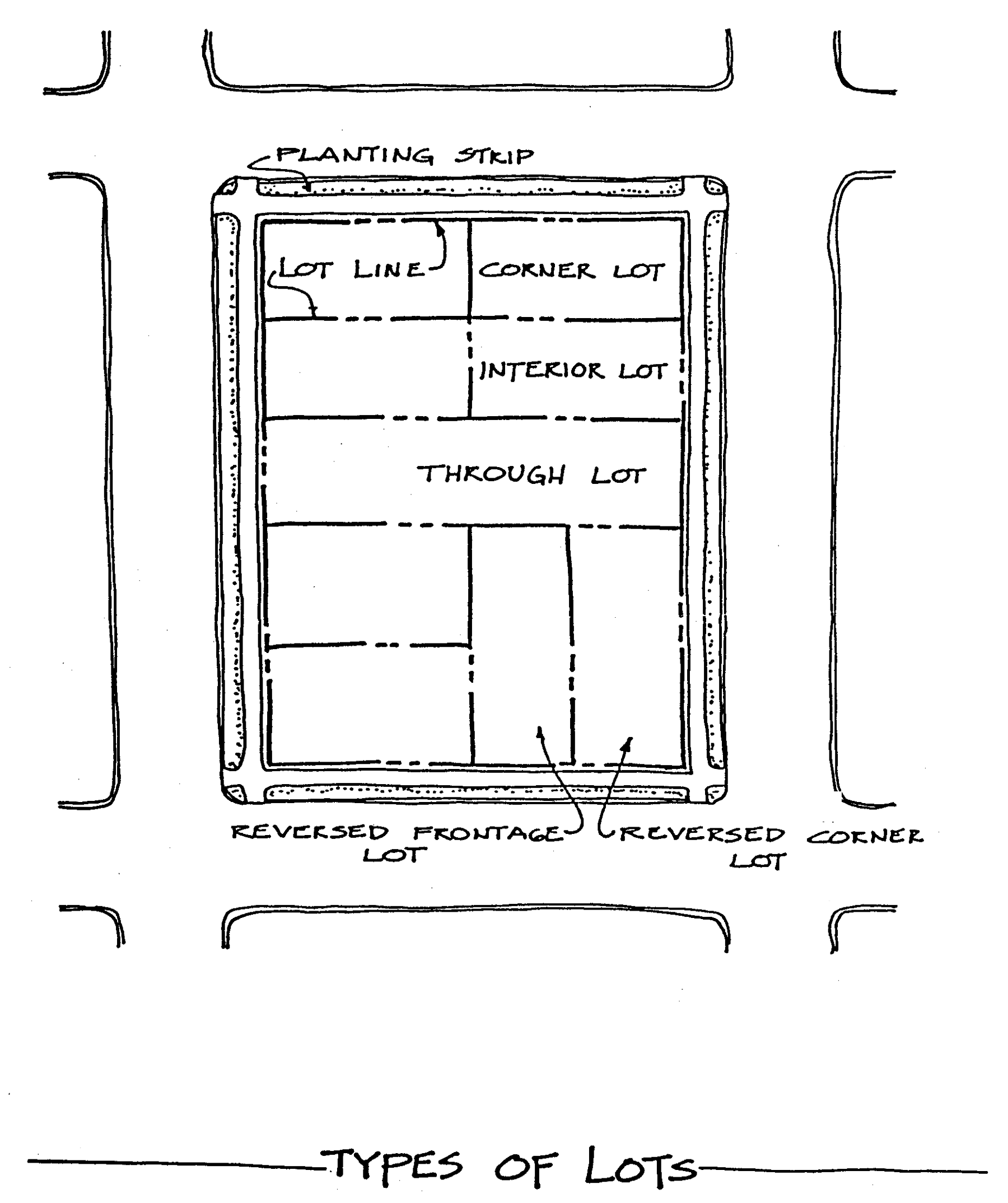
Types of Lots
Lot area means the area of a lot bounded by lot lines.
Lot, corner means a lot whose lot lines form an interior angle of less than one hundred thirty-five (135) degrees at the intersection of two (2) street lines. A lot abutting on a curved street or streets shall be deemed a corner lot if the tangents to the curve at the points of intersection of the side lot lines with the street lines intersect at an interior angle of less than one hundred thirty-five (135) degrees.
Lot coverage means the amount of a lot, stated in terms of percentage, that is covered by all roofed buildings and/or structures located thereon. This shall be deemed to include all buildings, porches, arbors, breezeways, patio roofs, and the like, whether open box-type and/or lathe roofs, or fully roofed, but shall not be deemed to include fences, walls, or hedges used as fences, or swimming pools.
Lot line means a boundary line of a lot.
Lot line, front means the exterior line or right-of-way of a road on which a lot fronts or abuts.
Lot line, rear means any lot line, other than a front lot line, which is parallel or nearly parallel to the front lot line.
Lot line, side means any lot line not a front or rear lot line.
Lot of record means a lot which actually exists in a subdivision plat as shown on the records of the county register of deeds, or a lot or parcel described by metes and bounds, the description of which has been so recorded.
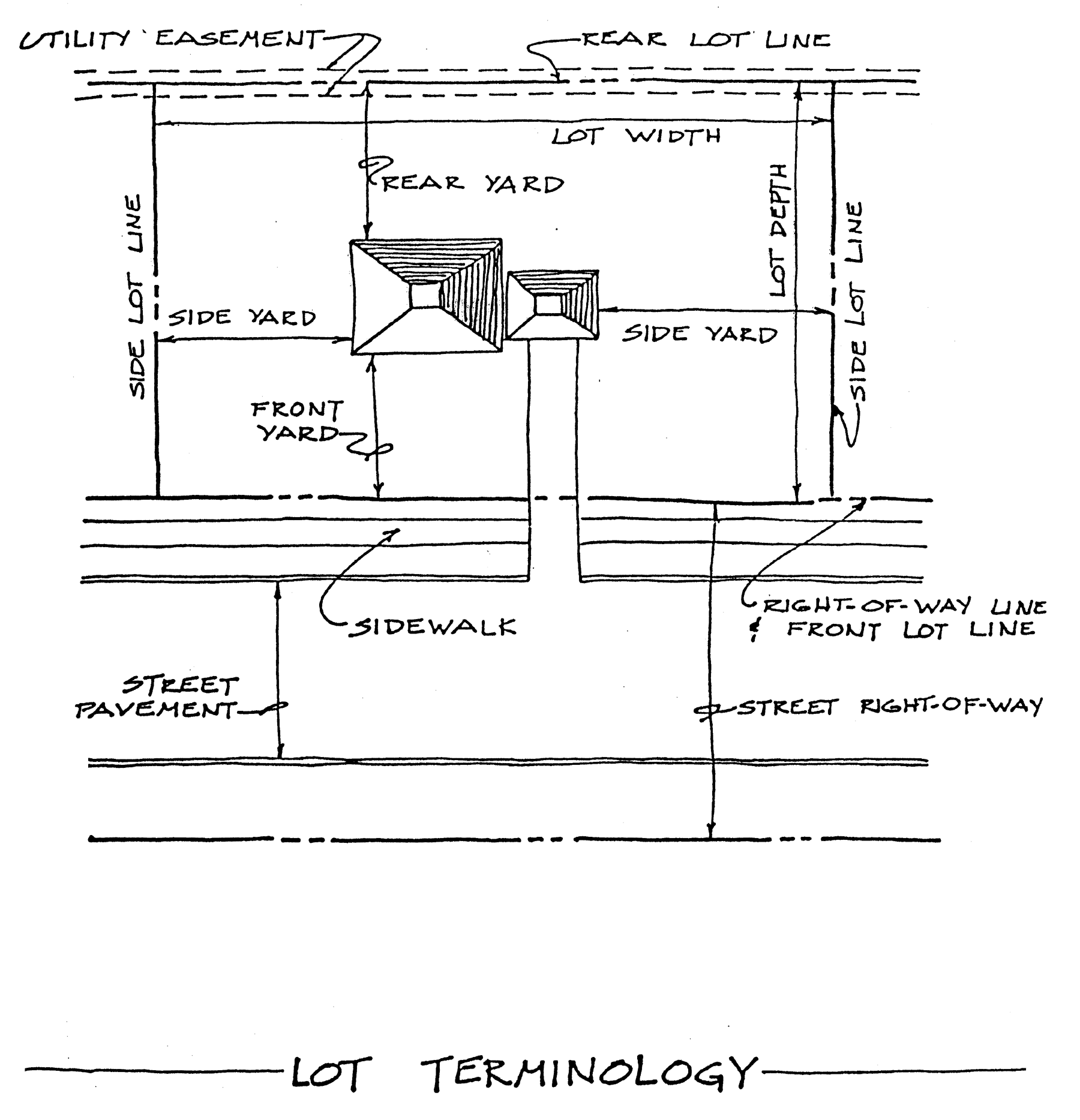
Lot Terminology
Lot width means the average distance between side lot lines measured at the building line, on a line parallel to the street, and measured at right angles to the side lot lines.
Marquee means a covered projection attached to the face of a building which is supported entirely by the building and projects more than two (2) feet beyond the building wall.
Marquee sign means any building sign painted, mounted, constructed or attached in ay manner, on a marquee.
Mobile home means a structure transportable in one (1) or more sections which is built on a chassis and designed to be used with or without a permanent foundation, when connected to the required utilities, and includes the plumbing, heating, air-conditioning, and electrical systems contained in the structure. Mobile home does not include a recreational vehicle (Act No. 419 of the Public Acts of Michigan of 1976 (MCL 125.1101 et seq.), as amended.) All mobile homes must conform to the U.S. Department of Housing and Urban Development's code for mobile homes. Mobile home includes a double-wide unit.
Mobile home park means a parcel or tract of land, under the control of a person upon which three (3) or more mobile homes are located on a continual nonrecreational basis, and which is offered to the public for that purpose regardless of whether a charge is made therefor, together with any building, structure, enclosure, street, equipment, or facility used or intended or used incidental to the occupancy of a mobile home, and which is not intended for use as recreation vehicle trailer park. (Act No. 419 of the Public Acts of Michigan of 1976 (MCL 125.1101 et seq.), as amended.)
Modular means a structure which meets the requirements of the B.O.C.A. building and construction code, and which is transported in one (1) or more sections on a removable chassis, and is designed to be used on a permanent foundation, when connected to the required utilities, such as plumbing, heating, and electrical systems. Pursuant to B.O.C.A. the characteristics of a modular structure are:
(1)
A pitched roof of heavy truss construction able to support a dead-weight of at least forty (40) pounds, and having roof shingling of five-inch exposure;
(2)
A heavy deck flooring of wood on two (2) by eight (8) floor joists;
(3)
A drain ventilation size of three (3) inches in diameter extending twelve (12) inches above the roof; and
(4)
Establishment on a poured wall or cement block and mortar foundation.
Monument sign: See ground sign.
Motel or motor hotel means a building or a series of attached, semidetached, or detached rental units providing long-term or transient lodging with motor vehicle parking in an area contiguous to the building. No kitchen or cooking facilities are to be provided without the approval by the city council with the exception of units for use of the manager and/or caretaker.
Nonconforming lot of record (substandard lot) means a lot lawfully existing at the effective date of this chapter, or affecting amendment, and which fails to meet the minimum area requirements of the zoning district in which it is located.
Nonconforming structure means a structure, or portion thereof, lawfully existing at the effective date of this chapter, or affecting amendment, and which fails to meet the minimum yard setback requirements of the zoning district in which it is located.
Nonconforming use means a use lawfully existing in a building or on land at the effective date of this chapter, or affecting amendment, and which fails to conform to the use regulations of the zoning district in which it is located.
Nuisance means and embraces public nuisance as known at common law or in equity jurisprudence; and whatever is dangerous to human life or detrimental to health; and any dwelling or building which is overcrowded with occupants or is not provided with adequate ingress or egress to or from the same, or is not sufficiently supported, ventilated, provided with sewerage, drained, cleaned or lighted in reference to its intended or actual use; and whatever renders the air or human food or drink unwholesome, are also severally, in contemplation of this chapter, nuisances and all such nuisances are hereby declared illegal.
Off-premise sign means a sign, which directs the attention of the public to a business, activity conducted, or product sold or offered at a location not on the same lot where such sign is located. For purposes of this sign ordinance, easements and other appurtenances shall be considered to be outside such lot and any sign located or proposed to be located in an easement or other appurtenance shall be considered an off-premise sign.
On-premise sign means a sign related to and incidental to a lawful use of the lot on which it is located.
Open air business means and includes the following:
(1)
Retail sales of trees, shrubbery, plants, flowers, seeds, topsoil, humus, fertilizer, trellises, lawn furniture, playground equipment, and other home garden supplies and equipment.
(2)
Retail sale of fruits and vegetables.
(3)
Tennis courts, archery courts, shuffleboard, horseshoe courts, miniature golf, golf driving range, children's amusement park and/or similar recreation uses.
(4)
Bicycle, utility truck or trailer, motor vehicles, boats or home equipment sales; rental or repair services.
(5)
Outdoor display and sales of garages, swimming pools, motor homes, mobile homes, snowmobiles, farm implements, and similar products.
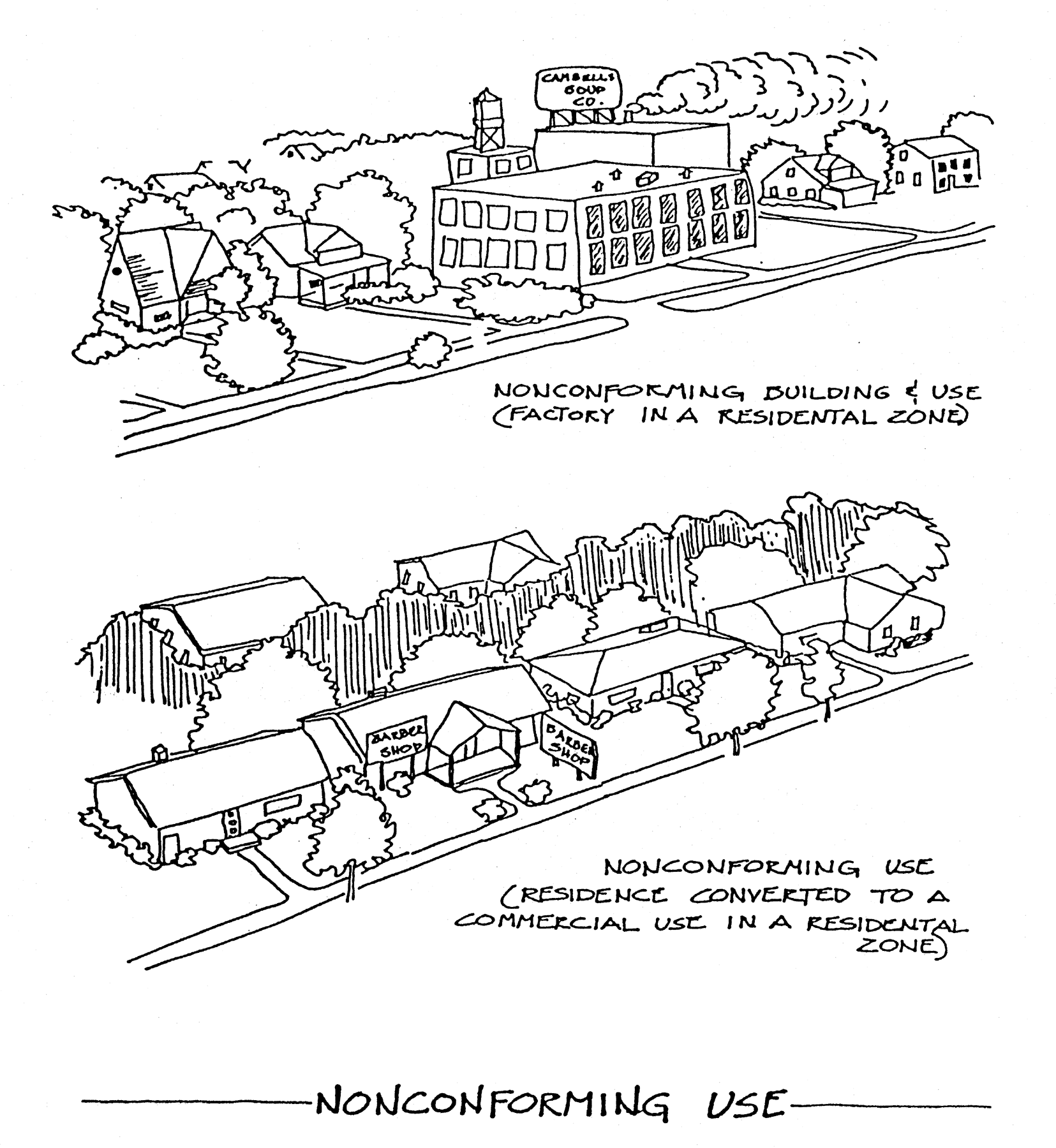
Nonconforming Use
Ordinary high water mark means the line on a stream bank up to which the presence and action of surface water is so continuous as to leave a distinct line marked by erosion;
Outdoor menu board means an outdoor sign often associated with restaurants, which gives a detailed list of items such as food, drink or services that are available at the business establishment.
Pennant means a sign produced on lightweight flexible fabric such as canvas, cloth or similar material that is mounted to a pole or a building at one (1) or more edges and which is more or less subject to movement by the wind. A pennant is distinguished from a banner in that a pennant is intended primarily for decorative purposes.
Planning commission means the city planning commission and shall have all powers granted under authority of Act No. 285 of the Public Acts of Michigan of 1931 (MCL 125.31 et seq.), as amended, and of any other act.
Political sign means a sign whose message relates to: the election of a person to a public office, or to a political party, or to a public issue which shall be voted on at an election called by a public body, or to an opinion.
Portable sign means any sign which is manifestly designed to be transported, including by trailer or on its own wheels, even though the wheels of such sign may be remove and the remaining chassis or support is converted to another sign or attached temporarily or permanently to the ground since this characteristic is based on the design of such a sign.
Porte cochere means a roofed structure or roof-like cover, extending from the entrance of a building and which provides shelter over a doorway
Projecting sign means a sign which is supported by a building wall, and which has its copy area oriented perpendicular to the building wall supporting it; and any sign attached to a building wall that and extends more than fifteen (15) inches from the face of the building wall.
Public utility. Except for wireless communication facilities, any person, firm, corporation, municipal department or council duly authorized to furnish and furnishing under state or municipal regulations to the public; electricity, gas, steam, communications, telephonic, transportation or water.
Pylon sign: See pylon sign.
Real estate sign means a temporary sign placed upon a lot for the purpose of advertising to the public the sale or lease of said lot.
Real estate development sign means a sign designed to promote the sale or lease of numerous lots, homes or building spaces in a real estate development that is under construction
Recreational vehicles mean vehicles primarily designed or used as temporary living quarters for recreational, camping, or travel purposes, including a vehicle having its own motor power or a vehicle mounted on or drawn by another vehicle. (Act No. 419 of the Public Acts of Michigan of 1976 (MCL 125.1101 et seq.), as amended.)
Recreation vehicle or equipment means a vehicle or equipment intended for temporary or periodic use for recreational or leisure pursuits. Such vehicles include boats, personal water craft, airplanes, special purpose automobiles, floats, rafts, snowmobiles, snowmobile trailers, camping or travel trailers, motor homes, detachable slide-in truck campers, chassis-mount campers adaptable to light trucks, and other equipment or vehicles of a similar nature.
Repairs mean the rebuilding or renewal of a part of an existing building for the purpose of maintaining its original type and classification.
Research and development facility means any facility that is involved in the inquiry, examination, investigation or experimentation aimed at the discovery and/or interpretation of facts, revision of accepted theories or laws in the light of new facts, or practical application of such new or revised theories of laws and the development thereof. Development may include a limited number of test units of a given product resulting from such research and shall include limited production while a product is being test-marketed which is the interim step between full research and development and ultimate full-scale production.
Restaurant means as follows:
(1)
Drive-in restaurant is any establishment whose principal business is the sale of foods, frozen desserts, or beverages to the customer in a ready-to-consume state, and whose design, method of operation, or any portion of whose business includes one (1) or both of the following characteristics:
a.
Foods, frozen desserts, or beverages are served directly to the customer in motor vehicles either by a carhop or by other means which eliminates the need for the customer to exit the motor vehicles.
b.
The consumption of foods, frozen desserts, or beverages within a motor vehicle parked upon the premises, or at other facilities on the premises outside the restaurant building, is allowed, encouraged, or permitted.
(2)
Fast-food restaurant is any establishment whose principal business is the sale of foods, frozen desserts, or beverages to the customer in a ready-to-consume state for consumption either within the restaurant building or for carryout with consumption off the premises, and whose design or principal method of operation includes both the following characteristics:
a.
Foods, frozen desserts, or beverages are usually served in edible containers, or in paper, plastic, or other disposable containers.
b.
The consumption of foods, frozen desserts, or beverages within a motor vehicle parked upon the premises, is posted as being prohibited and such prohibition is strictly enforced by the restauranteur.
(3)
Carryout restaurant is any establishment whose principal business is the sale of foods, frozen desserts, or beverages to the customer in a ready-to-consume state, and whose design or method of operation includes both of the following characteristics:
a.
Foods, frozen desserts, or beverages are usually served in edible containers, or in paper, plastic, or other disposable containers.
b.
The consumption of foods, frozen desserts, or beverages within the restaurant building, within a motor vehicle parked upon the premises, or at other facilities on the premises outside the restaurant building, is posted as being prohibited and such prohibition is strictly enforced by the restauranteur.
(4)
Standard restaurant is any establishment whose principal business is the sale of foods, frozen desserts, or beverages to the customer in a ready-to-consume state, and whose design or principal method of operation includes one (1) or both of the following characteristics:
a.
Customers, normally provided with an individual menu, are served their foods, frozen desserts, or beverages by a restaurant employee at the same table or counter at which such items are consumed.
b.
A cafeteria-type operation where foods, frozen desserts, or beverages generally are consumed within the restaurant building.
(5)
Bar/lounge/tavern is a structure or port of a structure designed, maintained, and operated primarily for the dispensing of alcoholic beverages. The selling of food and snacks may also be permitted. If the bar/lounge/tavern is part of a larger dining facility, it shall be defined as that part of the structure so designated and/or operated.
Road or street, arterial means East and West Superior Streets, North and South Main Streets, and Reno Drive.
Road or street, secondary means any street not classified as an arterial street.
Road or street, private means a private right-of-way reserved for the use of the occupants of the abutting structures. Such private street shall not be accepted by the city for maintenance in any form and shall have a minimum thirty-foot paved width.
Road or street, public means a public right-of-way of sixty-six (66) feet or more in width which has been dedicated for the purposes of providing access to abutting private lots of land including the space for pavement and sidewalks.
Roof sign means a sign which is erected upon the roof of a building.
Rotating sign means a sing or portion of a sign, which turns about on an axis or gives the appearance or optical effect of rotating.
Sandwich board/A-frame sign means a portable sign composed of two panels hinged at the top. From a side elevation, resembles an "A." Such signs are typically placed on a sidewalk immediately in front of the business or hung from a persons shoulders.
Setback means the minimum horizontal distance between the front line of a building, excluding steps and enclosed porches, and the street line.
Shed means a lightly constructed one- or two-story building for temporary use during the erection of a permanent building; or a light one-story structure attached to, or auxiliary to another building and intended for storage only.
Shimmering signs means a sign which reflects an oscillating sometimes distorted visual image.
Shopping center means a retail commercial establishment or a group of retail establishments which is planned, developed, owned and managed as a unit, with off-street parking provided on the property and related in its location, size and type of shops to the trade area.
Sign means any letter, word or symbol, poster, picture, statuary, reading matter or representation in the nature of advertisement, announcement, message or visual communication, whether painted, posted, printed, affixed or constructed, including all associated brackets, braces, supports, wires and structures, which is displayed for informational or communicative purposes.
Sign face means the surface of the sign upon, against, or through which the message of the sign is exhibited.
Sign structure means any structure including the supports, uprights, bracing and framework which supports or is capable of supporting any sign.
Solar panel means a solar photovoltaic (PV) panel or covering, or solar hot air or water panel collector device, which relies upon solar radiation as an energy source for the generation of electricity or transfer of stored heat.
Special event sign means a sign for events such as grand openings, vehicle shows, art and craft shows, benefits, fund-raisers, festivals and other limited term events.
Special use permit means a permit for a use that would not be appropriate generally or without restriction throughout the zoning district; but which, if controlled as to the number, area, location or relation to the city, would not adversely affect the public health, safety, order, comfort, convenience, appearance, prosperity, and general welfare. Such uses shall be permitted when the specific review criteria provided in this chapter for them are met.
State licensed residential facility. A structure constructed for residential purposes that is licensed by the state under the adult foster care facility licensing act, 1979 PA 218, MCL 400.701—400.737, or the child care organizations act, 1973 PA 116, MCL 722.111—722.128, and provides residential services for 6 or fewer persons under 24-hour supervision or care. Except as otherwise provided in section 206(2) of the Michigan Zoning Enabling Act, being MCL 125.3206(2), a state licensed residential facility is considered a residential use of property and is not subject to a permit or procedure different from those required for other dwellings of similar density in the same zone.
Stream bank means the portion of the stream channel cross section that restricts the lateral movement of water at normal bank-full levels often exhibiting a distinct break in slope from the stream bottom.
Street sign means a sign extending beyond the boundaries of the lot on which it is located unless attached parallel to the face of a building and not extending more than fifteen (15) inches from the face of such building.
Stringer means a line of string, rope, cording, or an equivalent to which is attached a number of pennants.
Structural change or alteration means any change in the supporting members of a building, such as bearing walls, columns, beams, or girders, or any substantial change in the roof.
Suspended sign means any building sign that is suspended from the underside of a horizontal plane surface and is connected to this surface.
Swimming pool means any structure or container, either above or below grade, located either in part or wholly outside a permanently enclosed and roofed building, designed to hold water to a depth of greater than twelve (12) inches when filled to capacity, intended for immersion of the human body, whether for swimming or wading or both.
Temporary building or use means a structure or use permitted by the building inspector to exist during periods of construction of the main use or for special events, not to exceed six (6) months. Two (2) extension periods of six (6) months each are allowed.
Temporary sign means a sign constructed of light, temporary material, with or without a structural frame intended to be used for a limited time for display, demonstration or announcement.
Trailer sign means a sign with a copy area supported on a mobile chassis, other than a motor vehicle.
Townhouses means a row of three (3) or more attached one-family dwellings, not more than two and one-half (2½) stories in height and for which there is a rear and front entrance to each dwelling. Townhouse shall not be used as a synonym for the term "condominium" which refers to how property or space is owned rather than for a particular housing style.
Travel trailer means a portable unit built on a chassis, designed to be pulled behind a motor vehicle and used as a temporary dwelling for travel and recreational purposes. It includes rigid travel trailers, folding camping trailers, fifth wheel camping trailers and other similar units not requiring special highway movement permits. Travel trailers do not include manufactured homes.
Utility trailer, light means a portable unit built on a chassis, fully enclosed or otherwise that is designed to be towed behind a motor vehicle and used to transport cargo and material of a personal or commercial nature, excluding tandem axel trailers over twenty-four (24) feet in length (excluding tongue length), semi-tractor trailers and "low boy" single or tandem axel trailers designed to carry construction equipment.
Variance means a varying or relaxation of the standards of the zoning chapter by the board of zoning appeals; and where such variances will not be contrary to the public interest; and where, owing to conditions peculiar to the property and not the result of the actions of the applicant, a literal enforcement of the chapter would result in practical difficulty.
Vehicle sign means a sign located on or attached to a vehicle, which is primarily located or used to serve as a sign rather than as transportation. This includes, but is not limited to, automobiles, trucks, boats or airplanes and semi-trailer either attached or detached from a truck tractor.
Wall sign means any building sign attached parallel to, but within two fifteen (15) inches of a wall, painted on the wall surface, of, or erected and confined within the limits of an outside wall of any building or structure, which is supported by such wall or building, and which displays only one (1) sign surface.
Wetlands means land characterized by the presence of water at a frequency and duration sufficient to support, and that under normal circumstances does support, wetland vegetation or aquatic life, and is commonly referred to as a bog, swamp, or marsh.
Window sign means any building sign, pictures, symbol, or combination thereof, designed to communicate information about an activity, business, commodity, event, sale, or service, that is place inside a window or upon the window panes or glass and is visible from the exterior of the window.
Wireless communications facilities (or WCF) means all structures and accessory facilities relating to the use of the radio frequency spectrum for the purpose of transmitting or receiving radio signals. This may include, but shall not be limited to, radio towers, television towers, telephone devices and exchanges, microwave relay facilities, telephone transmission equipment building and private and commercial mobile radio service facilities. Not included within this definition are: citizen band radio facilities; short wave receiving facilities; radio and television broadcast reception facilities; federally licensed amateur (ham) radio facilities; satellite dishes; and governmental facilities which are subject to state or federal law or regulations which preempt municipal regulatory authority.
Wireless communications facilities, attached means wireless communication facilities that are affixed to existing structures, such as existing buildings, towers, water tanks, utility poles, and the like. A newly proposed wireless communication support structure shall not be included within this definition.
Wireless communication support structures means structures erected or modified to support wireless communication antennas. Support structures within this definition include, but shall not be limited to, mono-poles, lattice towers, light poles, wood poles and guyed towers, or other structures which appear to be something other than a mere support structure.
Yard means an open space, unoccupied and unobstructed from the ground upwards, except as otherwise provided herein, and on the same lot with a building. The measurement of a yard shall be the minimum horizontal distance between the lot line and the building or structure.
(1)
A required yard is that portion of any lot on which the erection of a main building is prohibited.
(2)
A front yard is a yard on the same lot with a building between the front line of the building and the front lot line and extending from one (1) side lot line to the other side lot line.
(3)
A rear yard is a yard on the same lot with a building between the rear line of the building and the rear lot line and extending from one (1) side lot line to the other side lot line.
(4)
A side yard is a yard on the same lot with a building between the side lot line and the nearest side line of the building and extending from the rear yard to the front yard.
(Ord. No. 123, § 2.0, 6-5-89; Ord. No. 178, § 1, 6-4-01; Ord. No. 193, art. IV, 7-7-03; Ord. No. 205, § 2, 5-15-06; Ord. No. 209, § 27, 1-2-07; Ord. No. 211, § 2, 2-5-07; Ord. No. 225, § 1, 2-1-10; Ord. No. 277, art. I, 3-18-24)
Cross reference— Definitions and rules of construction generally, § 1-2.
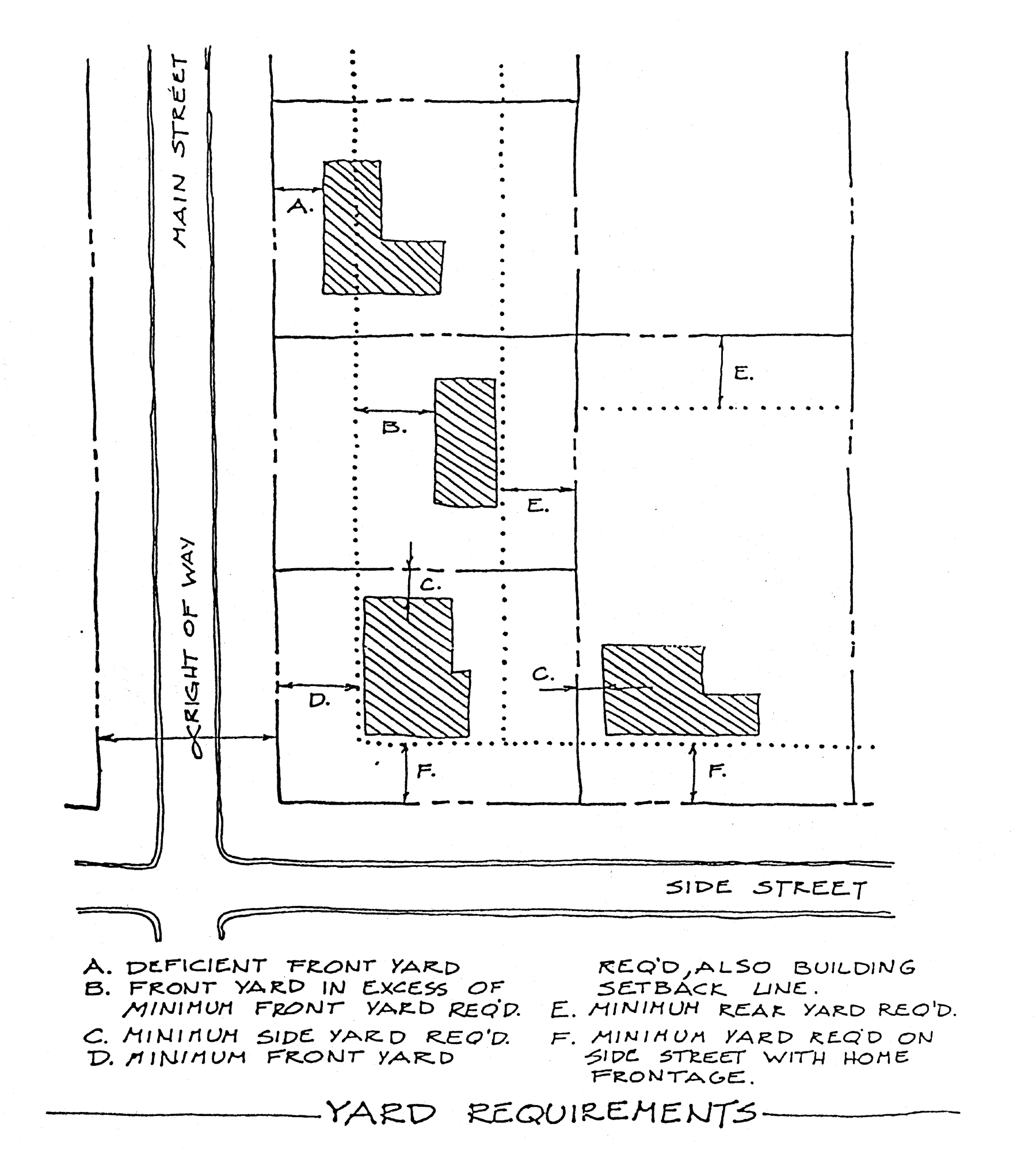
Yard Requirements

