
Wellington City Zoning Code
ARTICLE 9
VEHICULAR TRAFFIC PERFORMANCE STANDARDS
Sec. 9.1.1. - Purpose and intent.
A.
The purpose and intent of this article is to ensure development proposals sufficiently analyze potential impacts on Wellington's roadways and intersections to maintain the adopted vehicular Level of Service (LOS) to ensure public health, safety and welfare.
B.
The purpose and intent of this article is to implement the goals, objectives, policies and standards of the Comprehensive Plan Traffic Performance Standards. This article will supplement the County-wide Traffic Performance Standards, administered by Palm Beach County, for roadways and intersections within their jurisdiction.
C.
Nothing in this article shall preclude the council, or other decision-making bodies, from considering vehicular traffic, roadway or project conditions not specifically required by this article or that are peculiar to the location, size, configuration, use or relationship of the project or the area of the project from imposing conditions necessary to serve the public interest.
Sec. 9.2.1. - General.
This article shall apply to all development orders or any other official action of Wellington having the effect of permitting the development of land, unless otherwise exempt in accordance with this article. Vehicular traffic performance standards are hereby established for all of Wellington's roadways and intersections identified on Figure 1 - Traffic Analysis Roadways Map and Figure 2 - Wellington's Functional Road Classifications Map.
Figure 1 - Traffic Analysis Roadways Map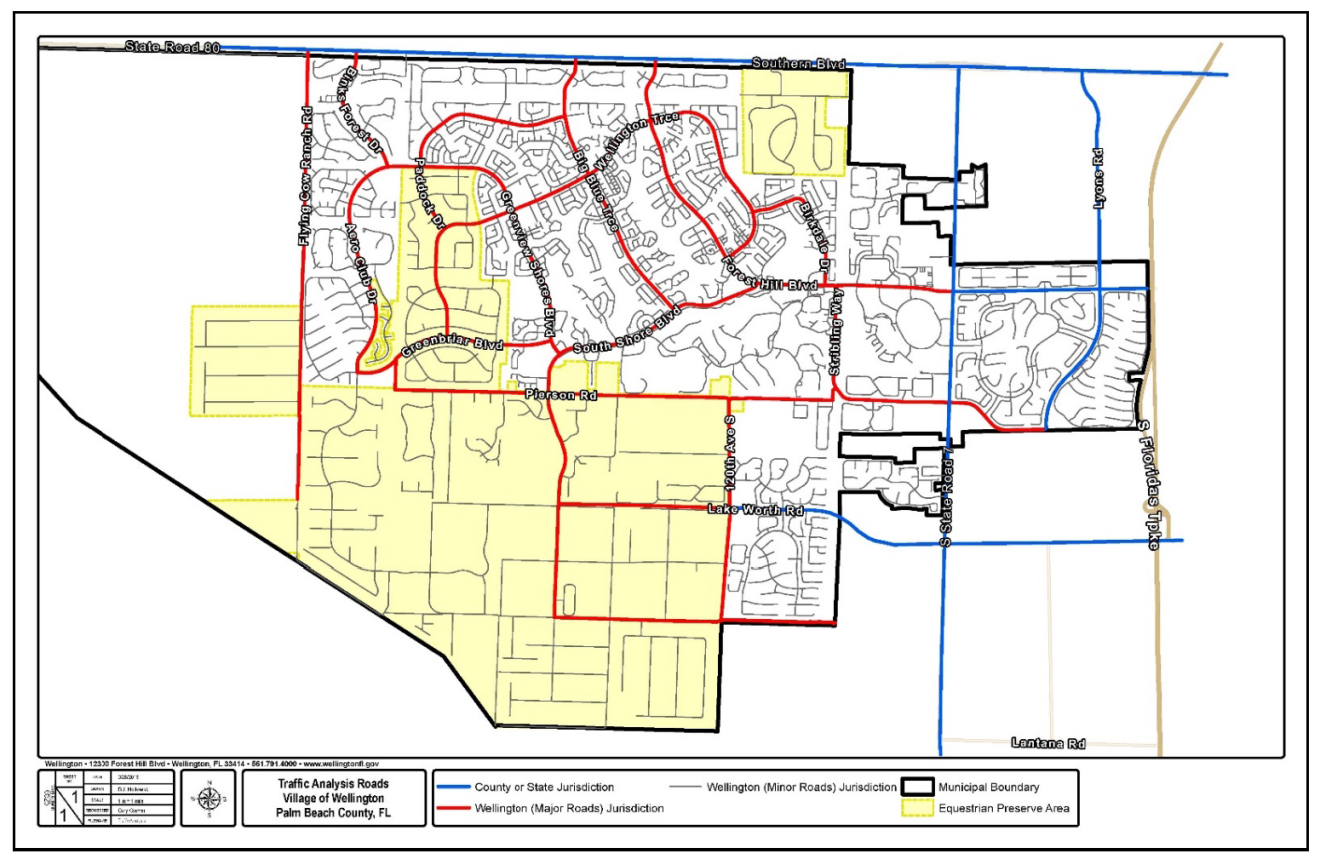
Figure 2 - Wellington's Functional Road Classifications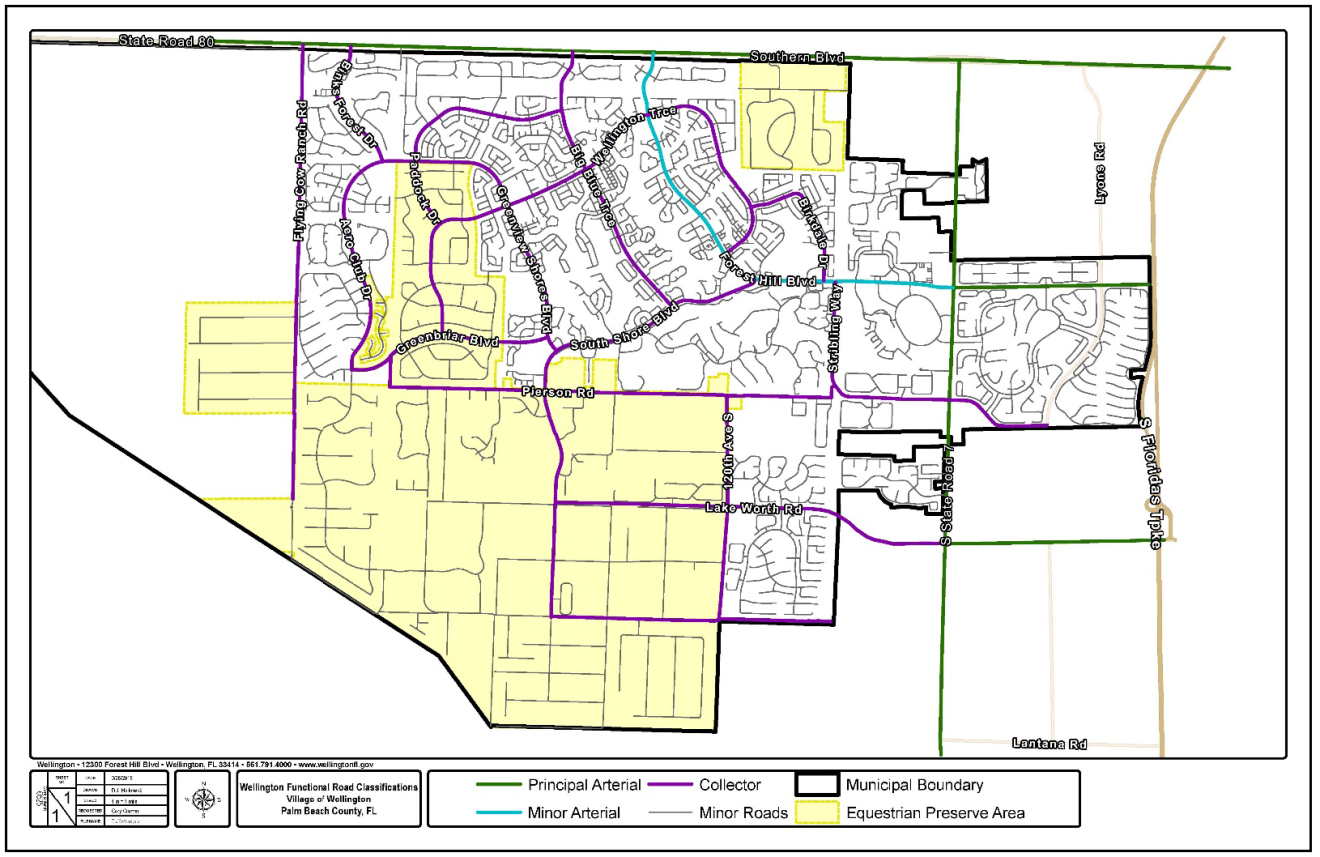
Sec. 9.2.2. - Exemptions.
A.
This article shall not apply to Wellington-initiated changes to the future land use map, or official zoning map to conform to the Comprehensive Plan, that does not authorize development.
B.
This article shall not apply to Wellington sponsored or co-sponsored special/community events. For the purposes of the article, a special event is an activity or use that is public or quasi-public in nature and occurs once in a fiscal year, not to exceed three weeks. This includes Fourth of July activities, parades, races and festivals. Events that require a special use, equestrian use or seasonal permit may be subject to the traffic impact study requirements of this article as determined by the Wellington Engineer and/or Planning, Zoning and Building Director.
C.
The standards of this article shall not apply to previously approved development orders that were approved prior to the adoption of Wellington and Palm Beach County Traffic Performance Standards.
D.
Amendments to previously approved development orders that result in a reduced or equivalent net peak hour directional Trips on any link or major intersections shall not be subject to the standards of this article. It is the burden of the applicant to provide justification of the reduction or equivalency to the Wellington Engineer, or designee, for review and determination. Additionally, the generation rates and pass-by rates of the development order shall be updated to current generation and pass-by rates, if applicable, and shall be used to calculate net peak hour directional trips.
E.
This article shall not apply or impair rights established pursuant to Florida law to the extent any project or portion thereof is exempt against the requirements of this article.
F.
Exceptions to the LOS standards of this article do not exempt the requirement to provide a traffic impact study with a development order/amendment application.
Sec. 9.2.3. - Vested project traffic determination.
This section establishes the method for determining vested project traffic that may apply when seeking to amend a previously approved development order or when applying for a development order on property that has an existing development and/or use. The burden shall be on the applicant to demonstrate the eligibility and the amount of the vesting for the proposed project. The Wellington Engineer, or designee, shall issue a determination letter subject to the provisions of this section.
A.
Project traffic credits shall be calculated by applying current trip generation rates and pass-by rates to the land use or uses previously approved by a development order. The vesting shall be adjusted as necessary to account for changes in traffic distribution resulting from modifications to the previously approved development order. The vesting shall be reduced as applicable based on any subsequent reduction of square footage or number of units built pursuant to a master plan or site plan amendment and in accordance with any subsequent amendment to applicable Wellington rules, policies or Land Development Regulations.
B.
Any application for a development order on property on which there is an existing use shall receive a vested project traffic determination subject to the provisions of this section. The vesting shall be calculated by applying current trip generation rates and pass-by rates generated by the most recent use at the time of application. The vesting shall be adjusted as necessary to account for changes in traffic distribution as a result of the proposed project. A proposed project shall not be eligible for an existing use vesting determination if the structure or land on the property has been discontinued or abandoned for more than three years prior to the time of application.
C.
A project shall be eligible for a 100 percent vested project traffic determination if:
1.
The previously captured non-residential project has received a certificate of occupancy (CO) for interior tenant improvements for at least 80 percent of the gross leasable area for more than five years; or
2.
The previously captured residential project has received building permits for 80 percent of the units as set forth in the master plan or site plan as applicable.
D.
A redevelopment project located within the urban service boundary shall not be subject to the standards of Chapter 3 of this article for up to 110 percent of the traffic generation of the previously existing development. The vesting shall be calculated by applying current trip generation rates and pass-by rates generated by the most recent use at the time of application. The vesting shall be adjusted as necessary to account for changes in traffic distribution as a result of the proposed project. A proposed project shall not be eligible for an existing use vesting determination if the use has been discontinued or abandoned for more than three years prior to the time of application.
Sec. 9.3.1. - General.
A.
A traffic impact study, or sufficient documentation to establish a project is not subject to this article, shall be required as part of any development order application, except as set forth in Section 9.3.1.D. It shall address the requirements and standards of this article using maps whenever practicable and shall state all assumptions and sources of information. A development order shall not be certified or recommended for approval if the issuance of the development order does not comply with this article.
B.
A request for a time extension of a previously-approved development order shall be required to submit a new traffic impact study that illustrates that the project meets the standards in effect at the time the extension is requested or provide documentation sufficient to establish that the project meets the standards or is not subject to the standards of this article at the time the extension is requested.
C.
The Wellington Engineer, or designee, shall review the information submitted and determine whether the proposed project complies with this article. The Wellington Engineer shall coordinate with the planning, zoning and building director whether the development order meets the other concurrency requirements of the plan. Comments and/or conditions of approval shall be provided to the development review manager.
D.
A traffic impact study is not required for residential or non-residential projects generating fewer than 20 gross peak hour trips, based on adopted trip generation rates. The net peak hour directional trips shall be distributed over the Wellington roadway system by the Wellington Engineer, in accordance with generally accepted traffic engineering principles.
Sec. 9.3.2. - Submittal requirement.
The traffic impact study shall be prepared, signed and sealed by a qualified professional Florida Registered Engineer, practicing traffic engineering, and the analysis must demonstrate compliance with this article. At a minimum, the following criteria shall be addressed:
A.
The applicant shall use the adopted LOS for all Wellington roadways and intersections identified on the Traffic Analysis Roadways Map (Figure 1).
B.
Identification of all significantly impacted Wellington roadways and intersections by the proposed project.
C.
Projected buildout period shall be set forth in the traffic impact study and shall be subject to review and approval by the Wellington Engineer, or designee, based on the following criteria:
1.
The size, type and location of the proposed project;
2.
Customary buildout periods for projects of similar size, type and location; and
3.
Any other factors or conditions relevant to the specific project, including special market conditions and schedules of assured construction.
4.
For enforcement purposes, the buildout period of the project shall be deemed complete if any of the following is true:
i.
In the case of a non-residential project, final certificates of occupancy have been issued for interior tenant improvements for 80 percent of the gross leasable area; or
ii.
In the case of residential projects, the issuance of building permits for 80 percent of the total project units as set forth in the master plan or site plan as applicable.
D.
The study shall analyze peak hour traffic, both weekday a.m. and p.m. peak hours, unless traffic characteristics dictate only one of the peak hours be analyzed. The Wellington Engineer may require analysis of other peak hours. The total peak hours analyzed shall not exceed three hours in number and are as follows:
1.
Afternoon peak hours between 4:00 and 7:00 p.m. during the peak season shall be studied in all cases. Generally, the morning peak hours between 6:00 and 9:00 a.m. during the peak season shall be studied unless higher volumes are observed outside of this time period, then other peak hours shall be used.
2.
Alternative peak hours shall be used for projects with significant impacts on hours and days other than the weekday peak hours described above, as determined by the Wellington Engineer.
3.
Each a.m. and p.m. peak hour shall be the highest sum of the volume on the approaches to an intersection and shall be the highest sum of four continuous 15-minute periods.
E.
Off-peak to peak season factors shall be established by the Wellington Engineer, based upon the best available data and generally accepted traffic engineering principles. Other factors, based on accepted traffic engineering principles, shall be used to update data where newer data in not available.
F.
In addition to link and intersection standards, studies for all peak hour(s) turning movements, including pass-by trips, shall be shown and analyzed for all points where the project's traffic meets the project accessed links and other roads where traffic control or geometric changes may be needed, as determined by the Wellington Engineer. Recommendations shall be made for signalization, turn lanes, and/or other site related improvements.
G.
The Total Traffic Volumes at the Project Buildout Year as follows:
1.
Existing Peak Season Peak Hour Traffic, two-way and directional, may be counted by Palm Beach County and/or Wellington during the peak season. If the traffic counts collected by the County and/or Wellington are more than 30 months old, prior to the submittal of the traffic impact study, the applicant shall conduct counts in accordance with accepted traffic engineering principles and as follows:
a.
Peak hour counts shall be made during any continuous weekdays between 6:00 a.m. and 9:00 a.m. and 4:00 p.m. and 7:00 p.m. and on other hours and days for the peak hour of the generator. There shall be no counts on Fridays and legal holidays for the weekday analysis, unless otherwise authorized or required by the Wellington Engineer.
b.
Where peak season traffic counts are not readily available, the counts that are unavailable may be generated using factors established by the Wellington Engineer for various areas of the county based on the best available data.
c.
All data is subject to review and acceptance by the Wellington Engineer.
2.
Traffic generated by the project shall be computed in the following manner:
a.
For project trip generation, the rates or equations published in the latest edition of the Institute of Transportation Engineers (ITE) Trip Generation shall be used. Alternative rates shall be approved by the Wellington Engineer based on acceptable standards to provide a more accurate means to evaluate the rates of generation or if documentation is supplied by the applicant which affirmatively demonstrates more accurate generation rates.
b.
The county and/or Wellington Engineer may publish and update, from time to time, trip generation rates for local conditions. If applicable, these rates shall be used instead of the ITE rates.
c.
Actual traffic counts that establish a generation rate at three similar developments, and located in similar areas, as the one proposed may be approved for use by the Wellington Engineer in accordance with accepted traffic engineering principles. These counts shall be made for the peak hour weekdays and/or weekends as necessary (excluding legal holidays) for each site and averaged, in accordance with Section 9.3.2.e of this article.
d.
It is acknowledged some trips generated by mixed use projects do not exit the project or enter the Wellington roadway system. Unless approved by the Wellington Engineer, any credit against the trip generation of a proposed project shall not exceed ten percent of the gross trip generation of the project, not including internalization between service station and convenience store uses. Additionally, credit for any internal individual land use within the proposed project shall not exceed ten percent of the gross trip generation for the land use, except as provided herein. Internalization between service station and convenience store uses is established at 32 percent of the gross trip generation of the convenience store use.
e.
It is acknowledged some trips generated by a proposed non-residential project are from existing traffic passing the proposed project and are not newly generated trips. Credit against the trip generation of the proposed project may be taken for these trips up to the percentage shown in the County's Impact Fee Ordinance or the ITE manual, when approved by the Wellington Engineer. The traffic impact study must detail:
i.
All traffic generated from the project;
ii.
The number of pass-by trips subtracted from the traffic generated by the project during the buildout period of the project.
iii.
Uses other than those listed in County's Impact Fee Ordinance, and any percentage credit proposed, must be justified based upon the peculiar characteristics and location of the proposed project and accepted by the Wellington Engineer.
iv.
Factors which should be considered in determining a different pass-by rate include type and size of land use, location with respect to service population, location with respect to competing uses, location with respect to the surrounding Wellington roadway system and the existing and projected traffic volumes. In no case shall the number of pass-by trips exceed 24 percent of existing traffic plus background traffic on the link, unless demonstrated and approved by the Wellington Engineer.
3.
Traffic volumes will likely change during the buildout period of the proposed project. The traffic study must account for this change based on background traffic. The projection of background traffic shall generally be based upon the information set forth in the County's TPS Database, Historic Traffic Growth Rate Tables and requirements of this article. The change in traffic shall illustrate how it relates to applicable phasing.
4.
The projection of background traffic during the buildout period of the proposed project shall be subject to review and approval by the Wellington Engineer using the following criteria:
a.
General information required:
i.
Historical growth shown in tables prepared by the county traffic division and/or Wellington Engineer;
ii.
Characteristics of growth in the area;
iii.
Extent of existing, approved, and anticipated development in the area;
iv.
Types and size of development in the area;
v.
Traffic circulation in the area;
vi.
Committed project impacts; and
vii.
New and assured road construction.
b.
The historical growth rate tables, prepared by the county traffic division and/or Wellington Engineer, are based on historical daily traffic volumes but shall be applied on a peak season, peak hour directional basis. The effect of committed projects shall be considered in projecting the increase or decrease in traffic volumes to ensure no double counting or omission of background traffic. Special circumstances, such as opening of a parallel road or a high traffic generation that may distort the growth trend, shall be taken into account. For projects with a buildout time of five years or more, an area wide growth rate, using a number of locations in the tables, may be appropriate. No growth rate less than zero percent may be used without approval of the Wellington Engineer.
c.
Using the county's TPS database:
i.
All traffic from the unbuilt portion of projects, that has received a concurrency reservation prior to the county engineer's approval of the proposed project's traffic study, and that adds significant trips to any link within the area surrounding the proposed project's during the buildout period, shall be specifically accounted for in projecting traffic.
ii.
For Wellington intersections, the TPS database shall specifically account for all project traffic volumes if at least one approach to the intersection has a project traffic volume greater than, or equal to, one percent of the adopted LOS D. No double counting of trips shall occur.
iii.
A comparison of the traffic projection using historic growth to the traffic projections using the county's TPS database, plus a nominal growth rate per year, shall be completed.
iv.
If errors and/or omissions are found in the TPS database, the traffic impact study shall account for the errors and/or omissions in the analysis and include the corrections necessary. Notification, by the engineer preparing the traffic impact study, the county engineer or Wellington Engineer to any other party, shall be required 30 days prior of the initial submission of the study so that that corrections can be included in the database prior to submission of the traffic impact study.
5.
The traffic impact study may reflect a phasing schedule for the proposed development project. The schedule shall reflect the time at which each phase will place traffic impacts on roadways and/or intersections. Conditions will be imposed on the development order, or an agreement shall be entered into, that ensures permits are restricted in accordance with the phasing schedule. The phasing shall include:
a.
Project traffic generation figures and assignments for each proposed phase.
b.
If the proposed phasing includes assured construction, sufficient information regarding the proposed construction shall be required to ensure realistic construction commencement and completion timing that reflects the impacts placed on roadways and/or intersections.
c.
For any assured construction that is to be completed by the applicant, the applicant must provide a written agreement with the traffic impact study. The agreement must be executed by all parties prior to or concurrent with the issuance of the development order and the development order must have a condition of approval that provides the completion date of the assured construction and posting of the performance security.
Sec. 9.4.1. - General.
A.
The project buildout test relates to the buildout period of the project and requires the project demonstrate no significant traffic is added which would cause the total traffic to exceed the adopted LOS at the end of the buildout period.
B.
The applicant may make link or intersections improvements, in accordance with published Wellington, Palm Beach County or Florida Department of Transportation Design and Traffic Engineering Standards in order to satisfy Part One and Two of the Project Buildout Test.
Sec. 9.4.2. - Project buildout test.
No development order shall be approved unless it can be shown to satisfy the requirement of Parts One and Two of the Project Buildout Test as outlined below:
A.
Part One: Intersections - This part requires analysis of Wellington intersections where a project's traffic is significant on a link for purposes of this Part One Analysis. Wellington intersections also include intersections of a Wellington roadway and a non-Wellington roadway or other point of access where (1) the intersection is signalized or where projected traffic volumes warrant a signal; and (2) the minor approach is projected to carry at least 200 two-way peak hour trips; and (3) the minor approach represents 20 percent or more of the intersection critical sum volume.
1.
The following Wellington intersections shall be analyzed:
a.
Wellington intersections, in each direction, nearest to the point at which the project's traffic enters each project accessed link and where the project traffic entering/exiting the intersection from/to the project accessed link is significant. The intersections analyzed shall not exceed two intersections per project accessed link.
b.
For a project on Southern Boulevard, the single point urban interchange(s) on Southern Blvd. where it is the nearest Intersection to the point at which the project's traffic enters the project accessed link and where the project traffic entering and exiting the intersection is significant. For purposes of determining significance of the traffic entering and exiting the intersection, the traffic entering and exiting the ramps shall be considered against the combined LOS D capacity of the ramps, which shall be 4,200 vehicles per hour.
c.
All Wellington intersections where the project traffic comprises ten percent or more of the total traffic on at least one approach.
d.
All Wellington intersections where links are operating at 80 percent or greater of LOS D and where the project has a significant impact on any approach.
2.
For signalized intersections, the intersection analysis shall be conducted using the most recent version of the HCM Operational Analysis.
a.
The HCM Operational Analysis shall comply with the default input values published by the county engineer, no more frequently than twice per year. Revisions to the input values may be made, subject to approval by the county engineer, to reflect actual or projected field conditions where substantial differences from the published values can be demonstrated.
b.
For intersections outside the Equestrian Overlay Zoning District (EOZD): if the intersection average total delay is at or below the thresholds identified in Table 9.4.2-A (LOS D Intersection Thresholds) the project passes Part One of the Project Buildout Test and continues with the Part Two—Link Analysis. If the intersection average total delay exceeds the thresholds identified in Table 9.4.2-A the project fails Part One.
c.
For intersections within the EOZD: if the intersection average total delay is at or below the thresholds identified in Table 9.4.2-B (LOS E Intersection Thresholds) the project passes Part One of the Project Buildout Test and continues with the Part Two—Link Analysis. If the intersection average total delay exceeds the thresholds identified in Table 9.4.2-B the project fails Part One.
3.
For unsignalized Wellington Intersections, the intersections shall be analyzed using the most recent version of the HCM Unsignalized Intersection Analysis and all minor movements of Rank 2 or higher shall operate at LOS E or better. In addition, a signal warrant analysis with Total Traffic for the intersection may be required by the Wellington Engineer.
a.
If a minor movement is not projected to operate at LOS E or better, the applicant may make intersection improvements in accordance with applicable Wellington, Palm Beach County or FDOT Design Standards to satisfy the LOS standard. If these improvements require signalization of the intersection, and/or if signalization is expected to be warranted at any time up to 24 months after the project's final certificate of occupancy, the project may also be required to fund signalization. Signalization improvements shall not be included in the calculations to determine the proportionate share obligation and must be completed by the applicant in accordance with the development order. If with these improvements all minor movements of Rank 2 or higher will operate at LOS E or better the project passes Part One.
b.
If no geometric intersection improvements are determined to be feasible by the Wellington Engineer, the applicant shall agree to fund signalization of the intersection if warranted at any time up to 24 months after the project's final certificate of occupancy and the proposed signal meets access management standards. If the applicant is not willing to agree to fund signalization of the intersection the project fails Part One.
4.
Where a CRALLS (Constrained Roadway at a Lower Level of Service) volume has been adopted by Palm Beach County for one (1) or more of the links, which constitute the legs of the intersection, the allowable service volume for the intersection shall be calculated as follows:
Allowable CRALLS intersection volume = [sum of CRALLS link volume(s) or link LOS D volumes (for those links without CRALLS), whichever is applicable, for all legs of intersection/(sum of link LOS D volume(s) for all legs of intersection)] × 1400.
B.
Part Two: Links - This part requires analysis of Wellington roadways where a project's traffic is significant. The total traffic in the peak hour on the link shall be compared to applicable thresholds in Table 9.4.2-C (LOS D Link Service Volumes) or 9.4.2-D (LOS E Link Service Volumes) for Link Service Volumes and Peak Hour Directional Volume thresholds. The applicable facility class for each link shall be determined on the basis of the posted speed limit and/or number of traffic signals per mile, anticipated by the Wellington Engineer, to be in place by the buildout time frame of the proposed project. For all links where the total traffic peak hour directional volumes exceed the applicable thresholds, the Wellington intersections on each end of the link shall be analyzed. If the link is on Southern Boulevard, the at-grade intersection created by an Urban Interchange, it shall not be considered the intersection at the end of the link since the intersection is actually not on Southern Boulevard. The project shall include the next intersection with Southern Boulevard for analysis and compliance.
1.
The project shall pass Part Two for links outside the EOZD if the total traffic peak hour directional volume on the link is less than the applicable thresholds in Table 9.4.2-C (LOS D Link Service Volumes)
2.
The project shall pass Part Two for links within the EOZD if the total traffic peak hour directional volume on the link is less than the applicable thresholds in Table 9.4.2-D (LOS E Link Service Volumes)
3.
For links where the total traffic peak hour directional volumes exceed the applicable threshold, the buildout period is five years or less and the intersections at the end of the failing link are less than or equal to the Delay Thresholds as applicable in Table 9.4.2-A (LOS D Intersection Thresholds) or Table 9.4.2-B (LOS E Intersection Thresholds), then an optional analysis, providing more detailed analysis be shall be completed to demonstrate compliance with Part Two.
4.
For links where the total traffic peak hour directional volumes exceed the applicable threshold and where the buildout period is greater than five years or the intersections at the end of the failing link are greater than the delay thresholds as applicable in Table 9.4.2-A (LOS D Intersection Thresholds) or Table 9.4.2-B (LOS E Intersection Thresholds) then the project fails Part Two.
5.
Optional analysis the HCM Arterial Analysis Operational methodology shall be conducted for links outside the EOZD if the project can demonstrate the total traffic peak hour directional volumes do not result in an average speed on the segment that is lower than the speed thresholds for LOS D, as defined in Table 9.4.2-E (LOS D Speed Thresholds).
a.
If the speed is equal to or higher than the LOS D speed threshold, then the project shall pass Part Two.
b.
If the speed is lower than the LOS D speed threshold, then the project fails Part Two.
c.
For the links within the EOZD, the project shall demonstrate the total traffic peak hour directional volumes do not result in an average speed on the segment that is lower than the speed thresholds in Table 9.4.2-F (LOS E Speed Thresholds).
i.
If the speed is equal to or higher than the LOS E speed threshold, then the project shall pass Part Two.
ii.
If the speed is lower than the LOS E speed threshold, then the project fails Part Two.
C.
Level of service standards
1.
The LOS D Standard Service Volumes for Average Daily Traffic (ADT) and Peak Season, Peak Hour Directional for Links are set forth in Table 9.4.2-C (LOS D Link Service Volumes). The LOS D thresholds relative to intersections are set forth in Table 9.4.2-A (LOS D Intersection Thresholds). The LOS D thresholds associated with the HCM Arterial Analysis in terms of speed is provided in Table 9.4.2-E (LOS D Speed Thresholds).
2.
The LOS E Standard Service Volumes for Average Daily Traffic (ADT) and Peak Season, Peak Hour Directional for the Equestrian Overlay Zone for Links are set forth in Table 9.4.2-D (LOS E Link Service Volumes), The LOS E thresholds relative to intersections are set forth in Table 9.4.2-B (LOS E Intersection Thresholds). The LOS E thresholds associated with the HCM Arterial Analysis in terms of speed are provided in Table 9.4.2-F (LOS E Speed Thresholds). The LOS E Standard is to be utilized within the EOZD.
D.
Project significance: A project must address all Wellington roadways links, as identified on the Traffic Analysis Roadways Map—Figure 1, on which the net peak directional trips are greater than one percent of the LOS D of the link affected on a peak hour directional basis. If no links are significantly impacted, an analysis shall be completed for the first directly accessed link.
E.
If a project is approved or phased based on assured construction, building permits shall be granted for the portion of the project or phase approved based on the assured construction no sooner than the award of the contract by a governmental agency for construction of the improvement or commencement of construction subject to the following:
1.
If intersection improvements are required to meet the project buildout test, and there is a scheduled road construction project which would incorporate all, or a portion, of such intersection improvements, then the Wellington Engineer, in his/her sole and exclusive discretion, may require payment for the cost of such intersection improvement, provided all other requirements of the TPS have been satisfied. Upon receipt of the payment, building permits shall be granted for the portion project phased to such intersection improvements. The payment shall be based on a certified engineering estimate accepted by the Wellington Engineer.
2.
If the assured construction is in the county's five-year road program or the adopted FDOT Work Program, and was relied upon for the issuance of the development order, then deleted from these programs, building permits for development that was phased based on the assured construction shall be issued at the end of the fiscal year in which the construction was to commence. For the purposes of this paragraph, deleted shall mean the elimination of the construction project, the material reduction to the scope of construction work or funding, and/or the postponement of the construction project for more than two years beyond the construction was originally programmed.
3.
Three-year grace period: A project may receive a building permit if the required roadway improvements are in the first three years of the county's five-year road program and the project is a facility that is wholly owned and operated by the state, local government, or public school.
Sec. 9.5.1. - General.
A.
Wellington's Proportionate Share Program is hereby established, in accordance with F.S. ch. 163, to provide a method to mitigate impacts of development on transportation facilities by cooperative efforts of the public and private sector.
B.
The proportionate share program shall apply to all projects which fail to meet the TPS standards of this article for roadways and intersections. The proportionate share program does not apply to projects exempt from this article, as identified in Section 9.2.2.
C.
If the lack of capacity to satisfy transportation concurrency exists, the applicant shall have the opportunity to satisfy transportation concurrency through the proportionate share program as follows:
1.
An applicant may choose to satisfy the transportation concurrency requirements of Wellington by making a proportionate share contribution pursuant to the following:
a.
The proposed development is consistent with the Comprehensive Plan and Land Development Regulations.
b.
The roadway improvement necessary to maintain the adopted LOS is feasible within the ultimate right-of-way planned for the subject facility.
2.
Any improvement project proposed to meet the developer's proportionate share obligation must meet Wellington's design standards for locally maintained roadways and intersections.
Sec. 9.5.2. - Submittal process.
A.
Eligible applicants shall submit a request to utilize the proportionate share program with the traffic impact study submitted as part of a development application.
B.
When a submittal is deemed sufficient, complete and approved, a proposed proportionate share obligation, along with a binding agreement will be prepared by Wellington.
C.
All proportionate share agreement shall be approved by council in order to be effective.
Sec. 9.5.3. - Determining proportionate share obligation.
A.
Proportionate share mitigation for concurrency impacts may include, without limitation, separately or collectively, private funds, contributions of land, construction and/or contribution of facilities.
B.
A project eligible for participation under proportionate share program shall not be required to pay more that the determined proportionate share. The fair market value of the proportionate share mitigation for the impacted facilities shall not differ, regardless of the method of mitigation.
C.
Signalization of an intersection shall not be eligible for the proportionate share program and shall be completed in accordance with the development order.
D.
The methodology used to calculate the proportionate share obligation for a project shall be as follows:
•
The number of trips from the proposed development expected to reach roadways during peak hours from the complete buildout of a stage or phase being approved, divided by the change in the peak hour directional maximum service volume of roadways and/or intersections resulting from construction of an improvement necessary to maintain or achieve the adopted LOS, multiplied by the construction cost at the time of developer payment of the improvement necessary to maintain or achieve the adopted LOS, or as follows:
E.
If Wellington has accepted an improvement proposed by the applicant, the values of the improvement shall be based on a certified cost estimate prepared by a register engineer and provided by the applicant. The Wellington Engineer shall review and approve the certified cost estimate.
F.
If Wellington has accepted right-of-way dedication for the proportionate share payment, the credit for dedication of the right-of-way shall be valued on the date of the dedication at 120 percent of the most recent assessed value by the property appraiser or, at the option of the applicant and with no cost to Wellington, by fair market value established by an independent appraisal approved by Wellington. This appraisal shall assume roadway segments that triggered the deficiency per TPS and must not be site-related. The applicant shall supply a drawing, legal description of the land and a certificate of title or title search of the land. If the estimated value of the right-of-way dedication, proposed by the applicant, based on an appraisal approved by Wellington is more than the Wellington estimated total proportionate share obligation for the development, Wellington will give the applicant additional road impact fee credit for the difference. Prior to purchase, acquisition or acceptance of donations of real estate intended to be used for the proportionate fair share, public or private partners shall contact the FDOT for information about compliance with federal laws and regulations.
Sec. 9.5.4. - Impact fee credits for proportionate share mitigation.
A.
Proportionate share contributions shall be applied as credit against road impact fees.
B.
Impact fee credits for the proportionate share contribution will be determined when the road impact fee obligation is calculated for the proposed development. Impact fees owned by the applicant will be reduced per the proportionate share agreement as they become due. Once the credit has been exhausted, payment of road impact fees shall be required for each permit issued. The impact fee credit shall be established when the proportionate share contribution is received by Wellington.
C.
Road impact fee credits are not transferrable to another project. The impact fee credits are based on the determined proportionate share obligation required to mitigate the transportation impacts of a proposed project and shall be used for only that project.
Sec. 9.5.5. - Proportionate share agreements.
A.
Upon execution of a proportionate share agreement, the applicant shall receive a certification of concurrency approval. Should the applicant fail to apply for a land development permit within 12 months, the agreement shall be considered null and void and the applicant shall be required to reapply.
B.
In the event an agreement requires the applicant to build one or more road improvements, all required improvements must be commenced prior to issuance of the phased building permit and assured by a binding agreement, accompanied by a performance security sufficient to ensure the completion of all required improvements. It is the intent of this section that all required improvements be completed before the issuance of any phased certificates of occupancy.
C.
Dedication of necessary right-of-way for facility improvements, pursuant to a proportionate share agreement, must be completed prior to issuance of the phased building permit.
D.
Any requested change to a development project subsequent to a development order may be subject to additional proportionate share contributions to the extent the change would generate additional traffic that requires mitigation.
E.
Wellington may enter into proportionate share agreements for selected corridor improvements to facilitate collaboration among multiple applicants on improvements to a shared transportation facility.

