
Wellington City Zoning Code
ARTICLE 6
ZONING DISTRICTS
CHAPTER 5. - PLANNED DEVELOPMENT DISTRICT REGULATIONS
The following provisions are applicable to all Planned Development Districts (PDD) and previously approved PDD, new or amended within Wellington.
CHAPTER 6. - DEVELOPMENT AND REDEVELOPMENT INCENTIVES
(Reserved)
CHAPTER 8. - EQUESTRIAN OVERLAY ZONING DISTRICT (EOZD)
This section shall apply to all land located within the EPA, as identified in the Comprehensive Plan and on the future land use map. The Equestrian Overlay Zoning District (EOZD), Palm Beach Little Ranches Overlay Zoning District (LROZD) and Rustic Ranches Overlay Zoning District (RROZD) correspond with the boundaries on the official zoning map.
(Ord. No. 2021-12, § 1(Exh. A), 9-13-2021)
Sec. 6.1.1. - Purpose and intent.
The purpose of this section is to establish zoning districts and regulations to ensure that development is compatible with surrounding uses, served by adequate public facilities, sensitive to natural resources, and consistent with the Comprehensive Plan. All development and uses within each district shall comply with LDR and specific zoning district regulations.
(Ord. No. 2021-12, § 1(Exh. A), 9-13-2021)
Sec. 6.1.2. - Zoning districts.
To implement the Comprehensive Plan, the following zoning districts are hereby established and defined as Wellington's Zoning Districts:
A.
Residential Single-Family (RS): The purpose and intent of the RS district is to accommodate single-family dwelling units. The RS district is consistent with the Residential B and C Future Land Use Map designations of the Land Use Element of the Comprehensive Plan and not located within the Equestrian Preserve Area (EPA).
B.
Residential Medium Density (RM): The purpose and intent of the RM district is intended primarily for the development of multiple-family dwelling units at moderate densities. The RM district is consistent with the Residential D, E, and F Future Land Use Map designations of the Land Use Element of the Comprehensive Plan.
C.
Residential High Density (RH): The purpose and intent of the RH district is intended primarily for the development of multiple-family dwelling units at a high density. The RH district is consistent with the Residential G and H Future Land Use Map designations of the Land Use Element of the Comprehensive Plan.
D.
Residential Equestrian (ER): The ER district is established to protect and enhance the equestrian lifestyle and quality of life of residents in areas designated as equestrian residential, to protect watersheds and water supplies, and scenic areas, conservation and wildlife areas, and to permit a variety of uses that require non-urban locations but do not operate to the detriment of adjoining lands devoted to equestrian and residential purposes. The ER district is consistent with the Residential A and B Future Land Use Map designation in the Land Use Element of the Comprehensive Plan that are located within the EPA.
E.
Community Commercial (CC): The CC district is established for commercial, office, and medical office uses. The CC district is consistent with the Community Commercial Future Land Use Map designations of the Land Use Element of the Comprehensive Plan.
F.
FLEX: The purpose and intent of the FLEX district is to permit a wide range of light industrial and commercial uses including light manufacturing, processing, fabrication, or storage of products in addition to construction storage yards. The FLEX district is consistent with the Flex Future Land Use designation of the Comprehensive Plan.
G.
Community Facilities (CF): The CF district is established for public and institutional facilities and uses including schools, government offices, assembly, utility services, and other infrastructure-related facilities. The CF district is consistent with all land use categories and in particular Community Facilities and Park Future Land Use Map designations of the Land Use Element of the Comprehensive Plan.
H.
Planned Unit Development (PUD): The PUD district is established to offer a residential development alternative that provides greater flexibility and encourages more design creativity than may be available under conventional development approaches. The intent of the PUD is to promote the design of largely and primarily residential neighborhoods, that incorporates commercial, recreational, civic, and institutional uses that support the neighborhoods. It also provides for preservation of natural features and scenic areas and promotes creation of a continuous non-vehicular circulation system. The PUD is consistent will all Residential, Commercial, and Regional Commercial/LSMU Future Land Use Map designations of the Land Use Element of the Comprehensive Plan. When the PUD is located in the EPA, consistency with the Comprehensive Plan includes Residential A, B, and C Future Land Use Map designations, along with the Equestrian Commercial Recreation Future Land Use Map designation and is referred to as an "Equestrian Development" (ED).
I.
Multiple Use Planned Development (MUPD): The MUPD is established to promote the design of mixed-use developments of land that includes a mix of residential, commercial, and office land uses and to provide for the efficient use of land by the integration of multiple uses within a single development. The MUPD is consistent with the Mixed Use, Regional Commercial/LSMU, and Commercial Future Land Use Map designations of the Land Use Element of the Comprehensive Plan. All properties previously designated as Mixed Use Planned Developments (MXPD) on the Official Zoning Map are hereby considered MUPD. This change will not give entitlements to MUPD projects that do not currently apply and it will not take away entitlements from MXPD properties.
J.
Medical Center Planned Development (MCPD): The purpose and intent of the Medical Center Planned Development (MCPD) Zoning District is to provide for the orderly planned development of major health care facilities consisting of a hospital with clinics, medical offices, extended care facilities, and other ancillary or medical care support facilities. The MCPD district provides appropriate architectural design standards and locations for large-scale developments that ensure capacity of the campus facilities meets the future evolution of healthcare services for the community and the region. The MCPD provides for flexibility of certain property development regulations, placement and clustering of buildings and provision for site design. The MCPD is consistent with the Commercial Future Land Use Map designation of the Land Use Element of the Comprehensive Plan.
K.
Equestrian Commercial Recreation (ECR): The purpose and intent of the Equestrian Commercial Recreation district it to provide regulations for those properties that contain equestrian commercial arenas/venues and/or limited non-residential equestrian services that support the equestrian community. This district is located within the Equestrian Overlay Zoning District and is compatible with the Equestrian Commercial Recreation Future Land Use Map designation of the Land Use Element of the Comprehensive Plan.
(Ord. No. 2021-12, § 1(Exh. A), 9-13-2021)
Sec. 6.1.3. - Overlay zoning districts.
In addition to the zoning districts in Section 6.1.2, the following overlay zoning districts are established which provide development and property standards for the specific districts which are in addition to the underlying zoning district:
A.
Equestrian Overlay Zoning District (EOZD): The EOZD is established to protect and enhance the EPA of Wellington, as created by the Comprehensive Plan; to preserve, maintain and enhance the equestrian community, equestrian lifestyle, and development patterns which are consistent with the overall character of the equestrian community; and to identify and encourage types of land uses that are supportive of the equestrian character. The EOZD is consistent with the Residential A, Residential B, Residential C, and Equestrian Commercial Recreation Future Land Use Map designations of the Land Use Element of the Comprehensive Plan.
B.
Little Ranches Overlay Zoning District (LROZD): The LROZD is established to implement the community vision and values established in the Wellington Charter and the Equestrian Element of Wellington's Comprehensive Plan to preserve the equestrian character and lifestyle of the Palm Beach Little Ranches community and maintain the existing residential and equestrian development patterns in the neighborhood. The LROZD is consistent with the Residential B Future Land Use Map designation of the Land Use Element of the Comprehensive Plan.
C.
Rustic Ranches Overlay Zoning District (RROZD): The RROZD is established to that implement the community vision and values established in the Wellington Charter and the Equestrian Element of Wellington's Comprehensive Plan to preserve the equestrian character and lifestyle of the Rustic Ranches community and to maintain the existing residential and equestrian development patterns in the neighborhood. The RROZD is consistent with the Residential B Future Land Use Map designation of the Land Use Element of the Comprehensive Plan.
(Ord. No. 2021-12, § 1(Exh. A), 9-13-2021)
Sec. 6.1.4. - Official zoning map.
A.
The location and boundaries of the districts established in this article shall be set forth on the Official Zoning Map of Wellington and the official zoning map is incorporated by reference into this article. A copy of the official zoning map is available for inspection by the general public during regular business hours in the offices of the PZB department.
B.
All amendments to the official zoning map are approved by the Wellington Council. The PZB director shall ensure the official zoning map reflects approved amendments within seven business days from the effective date.
C.
Drafting and clerical errors or omissions may be corrected at any time, but no such corrections shall have the effect of amending the official zoning map.
(Ord. No. 2021-12, § 1(Exh. A), 9-13-2021)
Sec. 6.2.1. - General.
A.
Uses permitted by right, as a special use, or conditional use shall be determined as listed in the use regulation schedule (Table 6.2-1). All uses included in the use regulation schedule shall be limited to the districts in which they appear as permitted, special use, or conditional use on the table. Any use not reflected for any particular district shall be prohibited in the district.
B.
Uses listed are those uses that are compatible and functional within a given zoning district. In the event that any particular proposed use is not shown anywhere in the use regulation schedule, the PZB director shall determine what listed use is most similar to the use not specifically listed in the use regulation schedule and that use shall be classified as such in accordance with the interpretation and appeals criteria in the LDR.
C.
Uses, densities, and intensities for all Planned Development Districts (PDD) shall be regulated by the approved/valid master plan for the project. Any conflicts that may arise between the LDR and the approved master plan shall comply with the most restrictive requirements.
D.
The corresponding numbers listed to the right of the use type within Table 6.2-1 shall identify additional use-specific regulations that are provided in the supplementary use standards of this article.
*Uses, densities and intensities are determined by the underlying land use designation.
(Ord. No. 2020-11, § 1(Exh. A), 8-25-2020; Ord. No. 2021-12, § 1(Exh. A), 9-13-2021; Ord. No. 2023-06, § 1(Exh. A), 3-14-2023; Ord. No. 2023-13, § 1(Exh. A), 2-13-2024, eff. 3-1-2024)
Sec. 6.2.2. - Supplementary standards for principal uses.
This section contains supplementary standards for specific uses. In the case of conflict with district or other regulations of the LDR, the more restrictive requirement shall apply.
A.
Residential uses:
1.
Congregate living facilities (CLF):
a.
Shall be in compliance with the minimum essential facilities regulations contained in the Florida Building Code as determined by the Florida Agency for Health Care Administration (AHCA) and/or Department of Children and Families (DCF) through licensing and inspections.
b.
Shall follow the regulations below:
c.
Accessory uses to CLF:
i.
All facilities may have non-residential uses customarily incidental to a CLF, such as a common dining room, a central kitchen, a nursing station, a medical examining room, a chapel, a library, and offices necessary to manage the CLF, and those accessory uses that are incidental to a residential dwelling unit.
ii.
In addition, Type 3 facilities may have a limited amount of commercial uses incidental and accessory to the facility such as retail and congregate living personal service uses designed to exclusively serve the residents of the facility, such as a barber or beauty shop, small convenience retail sales and banking services. No more than ten percent of the gross floor area of the facility shall be dedicated to such commercial uses.
d.
Parking: All CLF types shall comply with the parking requirements of Article 7.
e.
In addition to above, Type 2B facilities shall follow the following standards:
i.
The facility shall have one designated single occupancy room available for residents requiring short-term additional care.
ii.
The facility shall be in compliance with the following minimum square footage standards:
f.
In addition to above, Type 3 facilities shall comply with the following standards:
i.
Within a Planned Development, the maximum occupancy for the facility shall be included in the Development Order. The gross area of a pod dedicated to a congregate living facility in a Planned Development shall be deducted from the gross area of the planned development for the purpose of calculating the maximum density of conventional residential development.
ii.
Conversion to conventional dwelling units:
1.
Prior to conversion to conventional dwelling units, a structure designed to accommodate a CLF shall, if necessary, be structurally modified to comply with the standards of the LDR.
2.
No development orders for a site plan/final subdivision plan for a CLF shall be approved until a declaration of restrictions in a form approved by Wellington Attorney has been recorded to run with the land records maintained by the Clerk of the Circuit Court for Palm Beach County. This declaration of restrictions shall expressly provide that: (1) the conversion of the premises to conventional dwelling units is prohibited except in compliance with this section; and (2) if permitted, conversion will not result in an increase in the number of "quarters" and residents permitted on the site unless the converted development has obtained a development order for a Planned Development District. If that development order has not been granted, the converted development will have to comply with the density permitted in the district; and (3) the total number of permitted residents may be determined by referring to the approved master or site development plan on file with the planning and zoning division.
2.
Multi-family:
a.
Multi-family shall include attached dwelling units such as duplexes, quads, townhouses, condominiums, and apartments.
b.
Accessory commercial uses contained within a multi-family structure shall be permitted provided that the use is limited to a total floor area not to exceed ten percent of the gross residential floor area contained therein, exclusive of vehicular parking and service areas, and limited to such uses as restaurants, delicatessens, and such personal services as beauty shops, barber shops, drug stores and professional offices. This provision is for 100 units or more and utilizing 20 square feet per unit with a maximum of 20,000 square feet per each project or development as indicated on the site or subdivision plan. The accessory use must meet parking requirements subject to Article 7. This provision does not apply to mixed-use projects as the mix of uses may exceed this provision and the PDD criteria shall apply to mixed-use projects.
3.
Security/caretaker quarters:
a.
Applicant shall obtain a special use permit from the planning and zoning division.
b.
No more than one security or caretaker quarters shall be developed upon the same lot or project governed by the same site plan.
c.
The security or caretaker quarters use shall be for the exclusive use of and shall be occupied only by a guard, custodian, caretaker, manager, or employee of the owner of the principal use, or member of the owner's family. Such persons, excluding family members, shall be actively engaged in providing security, custodial, or managerial services on the premises.
d.
A security or caretaker quarters shall not be permitted in association with a temporary use.
e.
Mobile homes and recreational vehicles are not permitted to be used as security/caretaker's quarters.
f.
A security or caretaker quarters shall continue only so long as the principal use that it is meant to serve remains active. Upon termination of the principal use, the right to have the security or caretaker shall end, and the occupancy of the quarters shall immediately be discontinued. Once discontinued, such quarters shall not be re-established except in conformity with this section and by obtaining a new special use permit.
4.
Single family: The use of a mobile home or a recreational vehicle as a single-family residence is prohibited, except as provided in the EOZD.
5.
Vacation rentals:
a.
As used in this section, the following definitions apply:
i.
Third-party platform entity means any person, service, business, company, marketplace, or other entity that, for a fee or other consideration, provides property owners and responsible parties a platform or means to offer vacation rentals to transient occupants, whether though through the internet or other means.
ii.
Responsible party means the owner of the property and any person or entity authorized by the property owner to represent, manage, operate, or obtain all necessary licensing for a vacation rental and who will be responsible for ensuring compliance with all regulations related to vacation rentals as listed in the application for a vacation rental special use permit.
iii.
Transient occupant means any person who rents or occupies any dwelling unit or part thereof for less than 30 days or one calendar month, whichever is less, and any guest or invitee of such person.
iv.
Vacation rental, also called a short-term rental, means any dwelling unit or residence, including, but not limited to, any single family or any unit or group of units in a condominium, cooperative, or apartment building, that is rented in whole or in part, to a transient occupant, which is advertised or held out to the public as a place that may be rented to a transient occupant, excluding a hotel, motel, or bed and breakfast as defined or referenced in the LDR, more than three times in a calendar year for periods of less than 30 days or one calendar month, whichever is less.
b.
Vacation rental property owners, managers, agents, and assigns, shall comply with all requirements of the Code of Ordinances (CO) and the LDR, along with the following standards for the operation of a vacation rental:
i.
Duties of the vacation rental representative or responsible party. The responsible party shall be available to respond 24 hours per day, seven days per week to any issue related to the vacation rental. The responsible party shall respond within one hour of contact regarding an issue and be on-site within two hours if required.
ii.
Maximum overnight occupancy. Maximum overnight occupancy for vacation rentals shall be limited to two persons per bedroom, excluding children under the age of three, for overnight use. At all other times, the maximum occupancy for vacation rentals shall not exceed the maximum overnight occupancy of the rental, plus four, excluding children under the age of three. For the purpose of this section "overnight" means 11:00 p.m. until 6:00 a.m. the following day.
iii.
Vacation rental parking standards. Overnight parking for vacation rentals shall be limited to, not including vehicles fully parked in garages, one vehicle per bedroom, with a maximum of four vehicles. Vacation rentals with more than four bedrooms and on a parcel that is one acre in size or greater may park one additional vehicle for each bedroom greater than four. Notwithstanding the maximums above, the maximum overnight parking is further limited to the number of vehicles that can be properly parked on a driveway, parking apron, or designated hard-surfaced parking area. Vehicle parking not in a garage, on a driveway/parking apron, or in a designated parking area is prohibited. At all times, all automobiles shall be parked in an approved off-street parking space or driveway on the property. The parking of automobiles on a swale, lawn, landscape area, within the public right-of-way, or sidewalk is prohibited.
iv.
Required occupant search. The responsible party for all vacation rental properties is required to conduct a nationwide search to confirm that the prospective transient occupant(s) is/are not a registered sexual offender or sexual predator as a result of a conviction of a sexual offense. If the third-party platform entity used by the responsible party conducts the search, the responsible party may rely upon that search to satisfy this requirement. The department of justice offers a free search for all states on the National Sex Offender Public Website. If requested by Wellington, the responsible party shall provide proof of search(es). Proof of searches shall be maintained by the responsible party for a minimum of 180 days. At booking, occupants must be informed, in the listing, that all adult occupants must register with the third-party platform entity for the purpose of allowing said entities to do background checks and screenings. If the responsible party books direct, they must perform a background check of all adult occupants to ensure that the occupants do not have a felony criminal record and do not appear on the Megan's Law list, as maintained by the Florida Department of Law Enforcement. If the third-party platform entity does not register all adult occupants, said registration will be incumbent on the responsible party. Within 24 hours of check-in, the responsible party must visit the property and check that all of the IDs of adult occupants staying at the property match the occupant record of the booking.
v.
Sexual offenders and predators prohibited. If a vacation rental property is located within 2,500 feet of a school, child care facility, park, or playground, it is a violation of Wellington's CO to allow any person to establish a temporary, permanent, or transient residence with the knowledge that such person is a registered sexual offender or registered sexual predator in any jurisdiction.
vi.
Prohibited use of property for unlawful use. The responsible party and all transient occupants shall abide by all applicable state and local public nuisance regulations, including but not limited to, regulations that prohibit any place or premise from being used as the site for the unlawful sale or delivery of controlled substances, prostitution, human trafficking, youth and street gang activity, gambling, illegal sale or consumption of alcoholic beverages, or lewd or lascivious behavior.
vii.
Pet standards. If the responsible party permits transient occupants to have pets at the vacation rental, such pets shall, at all times, be secured within the property lines or on a leash, but shall not be tethered. Continual nuisance barking by pets is prohibited.
viii.
Swimming pools. All swimming pools on-site must have in place at least one pool safety feature listed in F.S. § 515.27.
ix.
Compliance with laws. The responsible party must comply with all applicable local, state, and federal regulations, including but not limited to, applicable laws pertaining to anti-discrimination, disability, and fair housing.
x.
Required posting at vacation rental. To provide a safety benefit for the neighborhood, and maximize compliance with rules and standards by the occupants, the owner of the vacation rental shall post a notice, as provided by the Village of Wellington, of Wellington's applicable ordinances in a location on the property that is clearly visible to the occupants.
xi.
Unit rental standard. The vacation rental shall be rented as a whole unit to a transient occupant or transient occupant party, however, an individual sleeping room may be offered for rent if the unit is the primary residence of the property owner and the property owner is on-site.
xii.
Required up-to-date contact information. The responsible party shall provide Wellington with valid, up-to-date contact information for both the property owner and all property managers, or anyone who has been granted operational authority over the property.
xiii.
Human trafficking certification. The responsible party shall take proper training, and receive certification in human trafficking prevention. The responsible party must be able to show proof of certification upon request.
xiv.
Use of vacation rental. The vacation rental is intended for use and occupancy of the property by the registered guests and is limited by the maximum occupancy as provided in the special use permit. No parties or events that exceed the maximum permitted occupancy are permitted at a vacation rental.
c.
Vacation rental special use permit requirements. No property owner, responsible party, or third-party platform entity shall offer a vacation rental, or allow any person to rent or occupy any property as a vacation rental, without first obtaining a special use permit from Wellington and then obtaining a business tax receipt (BTR) from Wellington and Palm Beach County. Any property owner operating a vacation rental without a special use permit shall be subject to a penalty. A written notice shall be issued to the property providing 15 business days to apply for the special use permit. If the property owner has not applied as required by the notice, a penalty of $300.00 will be added to the application fee. The property owner will also be subject to an additional penalty of $100.00 for every 30 days or a portion thereof after the initial 15-day period until the application is submitted and determined to be sufficient. A special use permit shall be required for each unit subject to the requirements of the vacation rental supplemental regulations. The special use permit is not transferable. A special use permit application for a vacation rental shall be required for all vacation rentals. The special use permit is not required to be renewed. The property owner and responsible party shall both be listed on the special use permit and BTR application. All documentation required by the Florida Department of Business and Professional Regulation shall be provided with the special use permit and BTR application. Additionally, the applicant must submit the vacation rental affidavit for the special use permit, which shall contain the following:
i.
Address of the vacation rental;
ii.
Name, address, phone number, and email of the property owner;
iii.
Name, address, phone number, and email of the responsible party;
iv.
Name of the third-party/platform entity or entities on which the vacation rental is, or will be, listed;
v.
Statement that the responsible party is, or will be, remitting all applicable county business tax and tourist taxes as required by the county and state. If the third-party/platform entity will be remitting all such taxes associated with the vacation rental on behalf of the responsible party, then the applicant must disclose this as part of the affidavit;
vi.
Statement that the responsible party is the designated agent of the property owner and has authority to offer the property as a vacation rental, and that the property owner consents to responsible party accepting civil citations on behalf of the property owner;
vii.
Statement providing the number of rooms and occupancy of the dwelling unit that will be used for a vacation rental;
viii.
Statement acknowledging that the vacation rental must possess:
a)
A license with the Department of Business and Professional Regulation (DBPR), and registration with the Florida Department of Revenue, or successor agency, for the purposes of collecting and remitting applicable state taxes and that all such state taxes have been, or will be paid in full. If taxes are not paid by a third-party platform entity, in bulk, or individually, for the responsible party, said party must pay such taxes, maintain records for such payments and make them available for inspection, if requested; and
b)
A Palm Beach County Business Tax Receipt (BTR) and a Palm Beach County Tax Collector's Office Tourism Development Tax (TDT) account, and proof that all such licensure and taxes are paid in full.
ix.
Statement acknowledging that the property is, and will at all times during which it is used as a vacation rental, be in compliance with the vacation rental standards set forth in this section, along with all other applicable CO and LDR regulations, such as noise, vehicle parking, and garbage;
x.
Statement acknowledging the consent from any governing homeowners association, condominium association, or property owner's association with the BTR application;
xi.
Statement acknowledging that sexual offenders and sexual predators are prohibited at the vacation rental; and
xii.
Statement that all safety measures and features for swimming pools are, and will be at all times, maintained in compliance with the vacation rental regulations.
d.
Permit information maintenance. The property owner, responsible party, and third-party/platform entity information shall be maintained regularly. When there are changes, notification must be submitted to Wellington's Planning Department and Business Tax Official within 15 calendar days of the changes. All documentation must be readily available for inspection by Wellington at any time. A new special use permit shall be required for any change in ownership or modification to the vacation rental that increases the gross square footage, increases the number of bedrooms, maximum occupancy, or number or location of parking, or any other material modification that would increase the intensity of the use.
e.
Offenses/violations, suspension, revocation, and appeals:
i.
Offenses/violations:
a)
Non-compliance with any provision of the supplemental standards for vacation rentals shall constitute a violation of this article by the property owner and may be enforced as provided by law.
b)
Upon a finding of a violation of the supplemental standards for a vacation rental by the special magistrate, each day a violation exists shall constitute a separate and distinct violation, except that violations regarding maximum occupancy shall constitute a single violation for a rental period.
c)
A violation of any provision of the supplemental standards for a vacation rental shall constitute a Class III civil infraction by the property owner. Violations may be enforced by a code compliance officer or a law enforcement officer in accordance with Chapter 2 of Wellington's CO and LDR, or as otherwise provided by law. Further, Wellington finds that violations of this article present a serious threat to the public health, safety, and welfare of its residents, or are irreparable and irreversible. Accordingly, a code compliance officer or law enforcement officer is authorized to issue a citation pursuant to this section without issuing a written warning/notice, as provided in section 2-45 of the Wellington CO. Service by certified mail to the property owner shall constitute valid service of a civil citation pursuant to Wellington's CO section 2-45.
ii.
Suspension: In addition to the fines and other penalties described herein, or provided by law, the special magistrate may enter an order for suspension upon the finding of violation(s) in accordance with the following:
a)
Upon a second violation and/or two citations [paid or adjudicated] within a six-month period—Up to a period of 30 calendar days.
b)
Upon a third finding of violation and/or three citations [paid or adjudicated] within a six-month period—Up to a period of 180 days.
c)
Upon a fourth finding of violation and/or four citations [paid or adjudicated] within a six-month period—Up to a period of 365 days.
d)
A suspension shall begin immediately following notice of suspension, commencing either at the end of the current lease period or within 30 calendar days, whichever date commences earlier.
iii.
Revocation/denial:
a)
The special use permit may be revoked by the special magistrate upon the fifth finding of violation by the special magistrate and/or citation [paid or adjudicated], as described in the above sections, within a six-month period. The revocation by the special magistrate may be for up to two years.
b)
For a single offense involving a felony or misdemeanor charge, if the action occurred on the subject property, and resulted in injury to an occupant or visitor to the property or involved underage drinking, drugs, or prostitution charge(s), the planning director may temporarily suspend a vacation rental special use permit or withhold issuance of the permit until such time as the special magistrate conducts a hearing, at the earliest opportunity, and may revoke or deny the permit. If a vacation rental special use permit is ordered revoked or denied by the special magistrate in this instance, the property owner may not reapply for a vacation rental special use permit for two years from the date of the special magistrate order.
c)
The revocation or denial shall be voided if the property changes ownership. The revocation may be reinstated if the property owner enters into an agreement with Wellington approved by the special magistrate that includes a written action plan outlining the specific measures the property owner will take to curtail or eliminate the re-occurrence of activities that prompted the revocation. This shall not apply to revocations for a felony charge.
iv.
No refund of permit fee. The property owner shall not be entitled to any refund of the permit fee for any portion of the unexpired term because of revocation or suspension of the vacation rental special use permit.
v.
Appeals: All appeals of suspensions, revocations, or denials of a vacation rental special use permit by the special magistrate shall be governed by F.S. § 162.11.
f.
Noise monitoring system requirement. If law enforcement has responded to three or more noise complaints at a vacation rental within a six-month period and confirmed the noise that formed the basis for the complaints was unreasonably loud as defined in the CO, the responsible party shall install and maintain a noise monitoring system that will alert the responsible party to any sound levels above the approved levels set by the Wellington Noise Standards. The responsible party shall be required to maintain records for the device for up to one year which may be inspected by Wellington upon request.
B.
General services and entertainment uses:
1.
Adult entertainment as defined in Article 3, including the related secondary definitions, shall be subject to the following:
a.
If the regulations and standards of the LDR related to adult entertainment are in conflict with any other lawfully enacted and adopted rules, regulations, ordinances or laws, the most restrictive shall apply.
b.
Any person convicted of violating the provisions of these regulations shall be subject to the general penalties in accordance with Section 1-12 of the Code of Ordinances.
c.
Findings and intent:
i.
Based on findings incorporated in the cases of City of Los Angeles v. Alameda Books, Inc., 535 U.S. 425 (2002); City of Renton v. Playtime Theatres, Inc., 475 U.S. 41 (1986); Young v. American Mini Theatres, 427 U.S. 50 (1976); Cornell Restaurant Ventures, LLC v. City of Oakland Park, 681 F. App'x 859 (11th Cir. 2017); Park Peek-A-Boo Lounge of Bradenton, Inc. v. Manatee County, Florida, 630 F.3d 1346 (11th Cir. 2011); Daytona Grand, Inc. v. City of Daytona Beach, Florida, 490 F.3d 860 (11th Cir. 2007); Peek-A-Boo Lounge of Bradenton, Inc. v. Manatee County, Florida, 337 F.3d 1251 (11th Cir. 2003); and David Vincent, Inc. v. Broward County, Florida, 200 F.3d 1325 (11th Cir. 2000); and in studies of other communities including, Indianapolis, Indiana (1984); Garden Grove, California (1991); New York Times Square (1994), and Centralia, Washington (2004), the Wellington Council finds that:
1.
Adult entertainment establishments are associated with a variety of adverse secondary effects including, but not limited to, personal and property crimes, prostitution, public safety risks, illicit drug use, elevated crime levels, negative impacts on property values, and neighborhood blight.
2.
Each of the foregoing negative secondary effects constitutes a harm to which Wellington has a substantial government interest in preventing and/or abating.
ii.
It is Wellington's intent to establish reasonable and uniform regulations for proper locations and separation criteria to prevent and/or reduce the adverse secondary effects of adult entertainment establishments within Wellington and promote the health, safety, and general welfare of the residents of Wellington. The provisions of this section have neither the purpose nor effect of imposing a limitation or restriction on the content of or reasonable access to any communicative materials, including adult material. Similarly, it is neither the purpose nor effect of this section to restrict or deny access by adults to adult material protected by the First Amendment, or to deny access by distributors or exhibitors of adult material to their intended market. Neither is it the purpose nor effect of this section to condone or legitimize the distribution of obscene material.
d.
Standards: The following are minimum standards that shall apply to adult entertainment establishments:
i.
Adult entertainment establishments within the Flex Zoning District (Industrial - commerce parks).
ii.
Separation requirements:
iii.
A landscape buffer shall be installed along any property line that abuts a residential project, in accordance with the buffer requirements of Article 7, prior to the issuance of a certificate of occupancy.
iv.
Outdoor low-intensity lighting that illuminates the entire parking and vehicular use area shall be provided. The lighting shall be installed on structures that do not exceed 15 feet in height from finished grade.
v.
If the operation is to exceed the normal hours of operation in the Code of Ordinances, the establishment shall be required to obtain a permit for extended hours of operation in accordance with Article 5 of the LDR.
vi.
There shall be no variance to the locational standards of these regulations.
2.
Bed and breakfast:
a.
The owner-operator shall reside on the premises fulltime and shall provide a written affidavit qualifying the owner-operator. The failure of the owner-operator to reside fulltime on the premises during operational hours of the bed and breakfast shall result in revocation of the development approval. All subsequent owners, purchasers, or successors in interest shall comply with the provisions of the LDR to continue to operate a bed and breakfast on the premises.
b.
The minimum lot size for an establishment shall be at least two acres with a maximum of eight bedrooms for paying guests. Any combination of lots to achieve the minimum lot size shall be accomplished by a replat of the affected properties.
c.
A bed and breakfast establishment shall be required to connect to public water and sewer systems where public water and sewer are available. Proposed private well and septic/drainfield systems will be reviewed by the Wellington Engineer or Utilities Director and PBC Health Department should public water and sewer not be available.
d.
Each bed and breakfast establishment shall have a separation requirement of 1,320 linear feet from another, measured from the closest property line of each establishment. Vehicular access for patrons shall not be more than 1,320 linear feet from a collector or roadway of higher classification.
e.
A bed and breakfast establishment shall not contain rental dwelling units.
f.
The proposed use of the property shall not adversely affect the immediate neighborhood or create noise, light, or traffic conditions detrimental to the neighboring residents.
g.
Meal service shall be limited to paying bed and breakfast guests only.
h.
One sign for the establishment may be installed to indicate the establishment name, address, and logo on a maximum four square feet sign area. Any proposed lighting for the signage shall be limited to up-lighting.
i.
The establishment must be located as part of and attached to the principal single-family residential dwelling on the property.
j.
Parking areas, including areas for horse trailers in the Equestrian Overlay Zoning District, may consist of paving, grass, gravel or other materials, subject to the Wellington Engineer's approval.
k.
Guests shall be limited to a length of stay that does not exceed 30 consecutive days.
3.
Car wash and auto detailing:
a.
The use of temporary shade structures is prohibited. All shade structures must be permanently installed and must meet minimum setbacks of the principal structure.
b.
The car wash facility shall utilize a water recycling system.
c.
All outdoor waiting areas shall be constructed permanently within a paved patio area and not located within any landscape areas or parking spaces.
d.
As a principal use:
i.
In the Flex district, a car wash or auto detailing use shall be permitted if limited to hand washing/waxing only.
e.
As an accessory use:
i.
An automatic car wash shall be considered an accessory use to an automotive service station use when it is located on the same lot and shall be governed by the use and property development regulations applicable to the service station use.
ii.
In the Flex district, a car wash or auto detailing use shall be permitted if limited to hand washing/waxing only and accessory to auto repair or auto body shops.
f.
Mobile detailers:
i.
Not permitted to park in any one location/project governed by a site plan for more than four hours per week.
4.
Catering: For all districts except the Flex district, all catering vehicles with signage shall be parked in the rear of the building not to be visible from the right-of-way when not in use.
5.
Day care, adult/children:
a.
The minimum lot area shall be at least 6,000 square feet.
b.
Minimum floor area for facilities are provided below or shall follow the amount as required by Palm Beach Health Department, whichever is greater:
c.
Outdoor activity areas:
i.
An outdoor activity area shall be provided on the same lot as the day care center. It shall not be located in the required front yard or adjacent to any outdoor storage area of any existing adjacent use. Stationary play structures shall be located a minimum of 25 feet from any residential property line and ten feet from any other property line.
ii.
A minimum of one, 12-foot tall native canopy tree shall be provided or preserved per 750 square feet of outdoor activity area provided. All trees shall be within the interior of the outdoor activity area. Installation of a permanent shade structure up to 75 percent of the required square footage of canopy shade may be installed and must meet the minimum setbacks of the principal structure.
iii.
A six feet high fence or wall shall surround the outdoor activity area.
iv.
Landscaping along the perimeter of the outdoor activity area shall include 14-foot tall native canopy trees placed 20 feet on center, and 24-inch high hedge or shrub material placed 24 inches on center. This required landscaping material shall be located on the exterior side of the fence.
v.
Minimum outdoor play area size requirements:
d.
Access, parking, and loading shall be provided in accordance with Article 7. Drop-off stalls shall be a minimum 12-feet wide by 20-feet in length.
e.
A five-foot wide walkway adjacent to the drop-off spaces and connecting to the day care entrance shall be provided.
f.
Child day care centers located in the Flex district shall be designed principally to serve employees of the commerce parks.
6.
Day care, family:
a.
Shall be permitted wherever a single-family residence is permitted.
b.
Maximum number of children shall be established by Florida Department of Children and Families and the Florida Statutes.
7.
Entertainment, outdoor:
a.
A minimum of 200 feet of frontage and primary access is required on an arterial or collector road.
b.
Safety fences shall be required around a recreation facility to protect the use of the adjacent property and public safety if deemed necessary.
c.
All athletic fields shall be setback a minimum of 50 feet and all other recreational areas or structures shall be setback a minimum of 100 feet from all property lines.
8.
Fitness center: Outdoor uses for training purposes shall be prohibited when adjacent to residential properties.
9.
Funeral home:
a.
A crematory facility must be approved through the State Department of Environmental Regulation.
b.
Disposal of wastewater from embalming operations shall be in accordance with the requirements of the PBCPHU or approval of disposal to public water or sewer shall be through the local utility.
10.
Gun club/gun range: An enclosed gun club shall have a 100-foot setback in addition to a 50-foot buffer from a residentially occupied or zoned property.
11.
Hotel:
a.
A hotel may have an accessory lounge not to exceed to 25 percent of the gross floor area of the hotel, exclusive of parking.
b.
Must be located on a minimum of two acres.
12.
Home-based business:
a.
The home-based business shall be clearly incidental and secondary to the residential use of the building and shall be confined to no more than 15 percent of the total floor area of the dwelling.
b.
A home-based business, with the exception of outside instructional services, shall be conducted within the principal dwelling, and shall not be conducted within any accessory building or structure or within any open porch or carport that is attached to and part of the principal structure.
c.
The home-based business shall not change the essential residential character of the dwelling unit in terms of exterior appearance and interior space.
d.
Employees of the home-based business must also reside in the residential dwelling. A maximum of two employees or independent contractors who do not reside at the residence may work at the home-based business. The business may have additional remote employees that do not work at the residence.
e.
No external evidence or sign shall advertise, display, or otherwise indicate the presence of the home-based business, nor shall the street address of the home-based business be advertised through signs, billboards, television, radio, newspapers, internet, or other media. Advertising on vehicles shall be limited to the minimum necessary to meet LDR requirements as mandated by PBC Contractors Certification Division or Florida Statutes.
f.
The home-based business may not conduct retail transaction at a structure other than the residential dwelling. However, incidental business uses and activities may be conducted at the residential property.
[g.]
Instructional services, which by their nature, must be conducted outside of the principal structure, such as swimming lessons, shall not be viewed from the rights-of-way.
h.
No equipment or materials used in the home-based business shall be stored or displayed outside of the dwelling unit, including in the driveway.
i.
Parking related to the activities of the home-based business may not be greater in volume than would normally be expected at a similar residence where no business is conducted. Vehicles and trailers used in connection with the business must be parked in legal parking spaces that are not located within a right-of-way, on or over a sidewalk, or on any unimproved surfaces at the residence.
j.
Commercial vehicles shall follow the commercial vehicle requirements in the Code of Ordinances.
13.
Kennel:
a.
May be operated in conjunction with a residence where permitted.
b.
The commercial care of snakes or birds may be permitted provided this use is explicitly requested during the approval process. Care of domestic animals is subject to the division of animal care and control. The keeping of wild or exotic animals is subject to the regulations of the Florida Game and Fresh Water Commission.
c.
The minimum lot size shall be one acre in the Flex Zoning District and two acres in all other applicable zoning districts.
d.
The minimum required frontage on a public road to be used for the primary point of access shall be 100 feet.
e.
Outdoor structures, runs, or play yards shall be located a minimum of 25 feet from any property line. In the Flex district, outdoor structures, runs, and play yards shall be located a minimum of ten feet from any property line.
f.
Outdoor runs shall be hard surfaced or grassed with drains provided every ten feet, and shall be connected to an approved sanitary facility. Outdoor runs shall provide a chain-link material on the walls and the top. If necessary to protect the general public, safety fences of up to a height of six feet shall be required on outdoor runs. If necessary to protect neighboring property, a landscape screen of at least 75 percent opacity shall be provided around the outdoor run.
g.
Outdoor play yards shall be screened from adjacent properties by a minimum six foot opaque fence or wall.
h.
Supervision of animals shall be provided at all times during use or area designated as a play yard on an approved site plan. Waste shall be immediately disposed of properly within the establishment. Alternative treatment of grassed area may be approved by the Wellington Engineer or Utilities Director and the required drains and connection to sanitary facilities may be waived.
14.
Lounge:
a.
Shall not be located within 250 feet of a residential district, nor within 750 feet of another lounge use, unless approved by Council as a conditional use. The separation shall be measured by drawing a straight line between the nearest point on the perimeter of the exterior wall or bay to the nearest point on the property line.
b.
Outdoor and open lounge areas shall be subject to additional site design requirements to protect neighboring residential districts in the adjacent properties.
15.
Nightclub means any commercial establishment open after 10:00 p.m. at which a cover charge, door charge, contribution requirement, or one time membership fee is paid at the door, or has a minimum drink requirement (excluding temporary events where a special use permit has been granted by Wellington), or:
a.
If none of the factors listed above exist and no special use permit has been approved by Wellington, then if any four of the following conditions exist, the establishment is a nightclub:
i.
There is a dance floor or other open area for use by patrons for dancing or viewing of live entertainment (permanently or which can be established by temporary removal or rearrangement of furniture).
ii.
The establishment is open to the public anytime between 12:00 a.m. and 8:00 a.m. on any day of the week.
iii.
The maximum capacity of the establishment as set by the fire officials through fire, building structure, and other relevant laws and ordinances is 150 or more persons. Voluntary reduction of capacity by the establishment shall not prevent the building or fire officials from determining a different and increased capacity.
iv.
Alcohol is sold, served, and/or consumed on the premises at any time.
v.
Advertisements for the establishment describe specific entertainment events or encouragements (e.g. "House Party Saturday Night"; "DJ Saturday Night"; "Live Music Tonight").
vi.
The establishment features a platform or musical staging area used in connection with performances or entertainment.
b.
Security: All nightclubs shall supply interior and exterior security personnel of a number equaling one security officer for every 150 occupants or portion thereof. Security officers employed or contracted by the owners/operators of the business must possess a class D license established pursuant to Florida Statutes § 493.6303. Alternatively, off duty law enforcement officers can be utilized to meet this requirement. A reduction in the number of required security personnel can be requested annually by any nightclub that has had less than four incidents which required a law enforcement response within the preceding calendar year and which are attributable to events held at the nightclub. Such reduction may be granted by the planning, zoning and building director (or designee) on an annual basis, with a recommendation of approval from the sheriff's department. Neither the sheriff's department, nor Wellington, shall be under any obligation or duty to any person hereunder by reason of this article. The sheriff and Wellington specifically disclaim liability for any damages that may be caused by failure to provide security.
c.
Patron age restriction: It shall be unlawful for persons under the age of 21 to patronize, visit, loiter, be admitted, or allowed access in any nightclub; except this restriction shall not apply to:
i.
Persons employed by or at the nightclub.
ii.
During periods when the establishment is not functioning as a nightclub, such as when such establishment is functioning as a restaurant.
iii.
Members of the military or armed services with proper military identification that reflects that they are currently on active duty.
d.
Any person who gains access to a nightclub by using fraudulent identification shall be in violation of this Ordinance.
e.
Nightclub establishments located at equestrian facilities within the EOZD may only be open for business during the days that equestrian competition events are being conducted on the property where they are located.
f.
Enforcement and penalties: Violations of this section shall be subject to enforcement as provided in Articles 5 and 14 of Wellington's LDR and Chapter 36 of the Wellington's Code of Ordinances, as well as additional penalties as provided by F.S. § 125.69(1).
g.
Applicability: The provisions of this article shall apply to all existing establishments and all new establishments meeting the definition of "nightclub." All establishments existing at the time of the adoption of this article are deemed to be legally conforming uses.
16.
Restaurant:
a.
This use (restaurant/food service establishment) may include the on-premise sale, service, and consumption of alcoholic beverages as an accessory and secondary use.
b.
Restaurants (food service establishments) may include accessory outdoor dining/seating area(s) and shall meet all following standards:
i.
All outdoor seating areas shall be illustrated on an approved site plan. Change of use/occupancy of a building/space to a restaurant use may require a site plan amendment as determined during the building permit zoning review. All outdoor seating that exceeds ten percent of the indoor seating capacity shall require a traffic statement as part of the site plan review.
ii.
The site plan and layout detail shall provide the number of seats/tables, dimensions, square footage, shade/weather covering (as proposed/required), walkway/accessible route, perimeter/separation barrier, ingress/egress etc.
iii.
Outdoor dining areas within 25 feet of vehicular use areas shall provide a continuous perimeter/separation barrier (may include wall, fence, raised landscape planters, etc.) with a minimum height of 36 inches. All restaurants with outdoor area(s) designated for dog-friendly dining shall provide perimeter/separation barrier.
iv.
Point of service outdoor dining area(s) 200 square feet or more, and/or seating for 20 or more, shall provide permanently installed shade/weather covering structure(s), not including umbrellas. The design and materials of the structure(s) shall be consistent with the associated building and overall development project.
v.
Dog-friendly dining within designated restaurant outdoor area(s) may be allowed with approval of a special use permit (SPU). Pursuant to § 509.233, Florida Statutes (as amended), this section is intended to protect the health, safety, and general welfare of the public, with a local exemption to the United States Food and Drug Administration Food Code (as amended), by allowing restaurant patrons to have their dogs within designated outdoor area(s) of the restaurant. In addition to the general standards above and the SPU requirements, restaurants with designated outdoor area(s) for patrons to have their dogs shall comply with the following regulations:
a.
Submittal for a SPU shall comply with § 509.233, Florida Statutes (as amended) requirements and include at minimum a diagram with dimensions, tables/seating, any equipment/other improvement, area(s) within the outdoor dining area(s) not available to patrons' dogs, and description of the designated outdoor area(s) and days/times that patrons' dogs are allowed within designated outdoor area(s).
b.
Pursuant to § 509.233(3)(c), Florida Statutes (as amended), all SPU issued for dog-friendly outdoor dining shall be subject to the following requirements:
1.
All public food service establishment employees shall wash their hands promptly after touching, petting, or otherwise handling dogs. Employees shall be prohibited from touching, petting, or otherwise handling dogs while serving food or beverages or handling tableware or before entering other parts of the public food service establishment.
2.
Patrons in a designated outdoor area shall be advised that they should wash their hands before eating. Waterless hand sanitizer shall be provided at all tables in the designated outdoor area.
3.
Employees and patrons shall be instructed that they shall not allow dogs to come into contact with serving dishes, utensils, tableware, linens, paper products, or any other items involved in food service operations.
4.
Patrons shall keep their dogs on a leash at all times and shall keep their dogs under reasonable control.
5.
Dogs shall not be allowed on chairs, tables, or other furnishings.
6.
All table and chair surfaces shall be cleaned and sanitized with an approved product between seating of patrons. Spilled food and drink shall be removed from the floor or ground between seating of patrons.
7.
Accidents involving dog waste shall be cleaned immediately and the area sanitized with an approved product. A kit with the appropriate materials for this purpose shall be kept near the designated outdoor area.
8.
A sign or signs reminding employees of the applicable rules shall be posted on premises in a manner and place as determined by the local permitting authority.
9.
A sign or signs reminding patrons of the applicable rules shall be posted on premises in a manner and place as determined by the local permitting authority.
10.
A sign or signs shall be posted in a manner and place as determined by the local permitting authority that places the public on notice that the designated outdoor area is available for the use of patrons and patrons' dogs.
11.
Dogs shall not be permitted to travel through indoor or non-designated outdoor portions of the public food service establishment, and ingress and egress to the designated outdoor portions of the public food service establishment must not require entrance into or passage through any indoor area of the food establishment.
c.
The applicant shall provide (with SPU submittal) the maximum number of patrons' dogs allowed within designated outdoor area(s), and shall post sign(s) at the designated outdoor area(s) ingress point(s) showing the maximum number of dogs allowed.
d.
All signs, as required above, shall be posted within the designated outdoor area(s) at the ingress point(s) and/or at tables as approved, or at alternative location(s) that is/are specifically requested and approved with the SPU.
e.
Dog waste station(s) shall be provided within 25 feet of the designated outdoor area(s). A minimum of one waste station shall be provided for dog-friendly outdoor dining area(s), with one additional waste station required for each 40 seats within the designated outdoor dining area(s) over 20 seats. The restaurant operator shall ensure waste station(s) are emptied, at a minimum, once daily or more frequently as necessary to eliminate odors, and waste is disposed per all health and environmental requirements. The handling of dog waste shall follow all health and environmental requirements and the restaurant's best management practices, as it relates to clean and sanitary condition and food safety, to protect the public health.
f.
A restaurant may include food/drink menu for the patrons' dogs. The restaurant shall only serve patrons' dogs food/drink in single-use disposable recyclable containers, and shall be handled separately from all dishes, utensils and any other items used for food service operations.
g.
SPU issued for dog-friendly dining within designated area(s) shall not be transferred to a subsequent owner(s) upon the sale of the restaurant, but shall expire automatically upon the sale. A new SPU shall be required for the new restaurant owner(s) if they wish to continue to accommodate patrons' dogs within designated outdoor area(s).
h.
Failure of a restaurant owner/operator to comply with the requirements of this section, an approved "Dog-friendly Outdoor Dining" SPU, or § 509.233, Florida Statutes (as amended), shall be a violation of the LDR.
c.
Restaurant owner/operator shall obtain all appropriate federal, state, and local permits/licenses prior to obtaining a Wellington Local Business Tax Receipt (BTR). The BTR shall be renewed annually by September 30. The owner/operator of restaurant with dog-friendly dining within designated area(s) shall provide the license number, as issued by the Division of Hotels and Restaurants of the State of Florida's Department of Business and Professional Regulations, for the subject restaurant on the SPU and BTR applications, and the license number will be on the SPU when issued by Wellington.
17.
Vehicle brokering:
a.
No vehicles shall be stored outside the establishment at any time.
b.
Business shall be conducted "by appointment only" and at no time open to the public.
c.
No external evidence or sign shall advertise, display, or otherwise indicate the nature of the business, nor shall the street address of the business be advertised through signs, billboards, television, radio, newspapers, internet, or other media.
d.
Vehicles may be shipped to the business location for detailing prior to shipping, delivery, or pick-up of the vehicle by appointment. Detailing must be conducted indoors.
18.
Veterinary clinic:
a.
In the EOZD, a veterinary clinic use shall be for livestock only and shall be located on a minimum of five acres.
b.
Veterinary clinics with outdoor runs or boarding facilities shall comply with the following standards:
i.
The minimum lot size shall be one acre.
ii.
No outdoor run or boarding structure shall be located within 25 feet of any property line.
iii.
Shall be hard surfaced or grassed with drains provided every ten feet, and shall be connected to an approved sanitary facility.
iv.
Shall provide a chain-link material on the walls and the top. If necessary to protect the general public, safety fences of up to a height of six feet may be required.
v.
A landscape screen of at least 75 percent opacity shall be provided around the outdoor run.
C.
Office/medical uses:
1.
Hospital:
a.
The minimum lot area shall be five acres.
b.
The minimum frontage for the lot shall be 300 feet and be located on an arterial roadway.
c.
The number of patient rooms for the hospital or medical center shall not exceed one patient room for each 1,000 square feet of lot area (43.56 patient rooms per acre).
d.
Accessory heliport or helipad is permitted provided the use is shown on the approved site plan.
e.
An incinerator use shall be set back a minimum of 500 feet from any property line abutting a residential use.
2.
Medical/dental office:
a.
Overnight lodging is prohibited except when in conjunction with sleep, or any overnight, testing.
b.
Includes facilities that are specifically for imaging, diagnostics, and phlebotomist.
3.
Nursing/convalescent facility:
a.
The minimum lot area shall be two acres and shall have frontage of a minimum of 100 feet and direct access on a collector or an arterial roadway.
b.
The number of patient rooms shall not exceed one for each 1,000 square feet of lot area (43.56 patient rooms per acre).
c.
Sleeping rooms shall be no less than 100 square feet for each patient single-occupancy or 170 square feet for a double-occupancy.
d.
One bathing facility shall be provided for every ten patients.
e.
At least ten square feet of total floor area per patient shall be devoted to a common area exclusive of halls, corridors, stairs, and elevator shafts, wherein a variety of recreational or therapeutic activities shall occur.
4.
Professional/general office: Within the Flex district, only offices accessory to another permitted use and or property management offices specifically for the industrial parks shall be permitted.
D.
Retail and trade uses:
1.
Gasoline sales:
a.
All accessory repair activities shall be conducted within an enclosed structure. No outside storage of disassembled vehicles, or parts thereof, shall be permitted on site.
b.
Accessory automatic/hand car wash:
i.
Hand car wash/detailing shall only be permitted when a permanent automatic car wash structure exists on the property.
ii.
The use of temporary shade structures is prohibited. All shade structures must be permanently installed and must meet minimum setbacks of the principal structure.
iii.
The automatic car wash facility shall utilize a water recycling system.
iv.
All outdoor waiting areas shall be constructed permanently within a paved patio area, and not located within any landscape areas or parking spaces.
2.
Mobile vendor:
a.
Shall not be located in any required parking spaces, rights-of-way, landscape buffers, driveway aisles, loading areas, or interfere with on-site circulation.
b.
Shall not be located in such a manner as to distract motor vehicle operators or promote, require or cause any vehicles to stop, stand, or park in violation of official traffic-control devices.
c.
Only one mobile vendor shall be permitted on a property.
d.
Must be removed from the site each night.
3.
Pharmacy:
a.
Retail pharmacy facilities, medical marijuana dispensing organizations/facilities, or medical marijuana treatment center dispensaries must have a minimum of 10,000 square feet of floor area.
b.
No more than one retail pharmacy facility, medical marijuana dispensing organization/facility, or medical marijuana treatment center dispensaries may be permitted to operate within any individual retail development. Pharmacy operations that function as an accessory service within grocery stores do not apply to this limitation.
c.
Retail pharmacy facilities, medical marijuana dispensing organizations/facilities, and medical marijuana treatment center dispensaries shall not be located closer than 1,000 feet from any public or private school.
d.
Retail pharmacy facilities, medical marijuana dispensing organizations/facilities, medical marijuana treatment center dispensaries located within larger retail developments with frontage on State Road 7/U.S. 441 or on individual sites with frontage on State Road 7/U.S. 441, pharmacy product distributorships, and pharmacy product compounding facilities not open to the public are exempt from the provisions of both a. and b. above.
4.
Vehicle sales and rental:
a.
The minimum lot area for vehicle sales and rentals is three acres.
b.
Vehicle rental shall be limited to 15 parking spaces and shall not be adjacent to residential lots.
c.
Motor vehicle dealerships may store vehicles outdoors on an improved parking surface without reference to parking stalls, backup distances, parking stall striping, or wheel stops for outdoor display only. Parking for vehicle storage, sales, or display shall not be counted toward meeting the number of required off-street parking spaces to be provided for customers and employees.
d.
Customer parking shall be physically separated from the motor vehicle sales, storage, and display space and shall be striped as required in Article 7.
e.
If a specialized vehicular use area is utilized for display of vehicles, there shall be a barrier separating it from customer parking. This barrier may be in the form of a landscape strip, curbing, removable bollards, or other suitable barrier approved by the PZB director.
f.
No vehicle shall be parked with its hood or trunk open. Motor vehicles on display shall not be elevated.
g.
If an accessory car wash facility is installed on-site, it shall use a water recycling system.
h.
Repair facilities and sales of parts may be provided as an accessory use. Repair facilities, paint shops, and body shops shall be located at least 100 feet from any residential district lot. Service bay doors shall not be oriented toward any adjacent property in a residential district, or oriented toward any adjacent public road. There shall be no outdoor repair of vehicles. Outside storage of disassembled vehicles, or parts thereof, shall be prohibited on-site.
i.
The development shall include an area on-site to unload vehicles from car carriers. This area shall be a minimum of 15-feet wide and 60-feet long, shall have sufficient maneuvering area adjacent to it, and shall be located out of the vehicular traffic circulation areas. The unloading area shall be located a minimum of 100 feet from any property in a residential district.
j.
No vehicles, other than for customer and employee parking, shall be stored or displayed on the site except those that are intended for sale and are in running, safe operating condition.
k.
No mobile home, recreational vehicle, or other vehicle shall be used as a sales office, storage space or for sleeping purposes. Sales offices and storage shall be contained in permanently constructed buildings.
E.
Industrial/manufacturing/distribution uses:
1.
Automotive paint/body shop: All body shop work shall be performed inside a building or garage area.
2.
Contractors storage yard:
a.
An accessory office shall be permitted.
b.
Outdoor activities and storage shall be completely screened from view from adjacent property and public roads. All storage shall be effectively screened from view by on-site walls, fences or buildings. Such screening shall be designed and installed to ensure that no part of a storage area can be seen from rights-of-way or adjacent lots. For a storage-yard contiguous to property in a residential district, an opaque fence/wall a minimum eight feet in height shall be placed along the inside border or the required landscape strip.
c.
In no case shall the height of materials, stored in outdoor areas exceed 20 feet or the height of the principal building on the lot, whichever is greater.
d.
All major repairs of vehicles or equipment shall be conducted inside. No manufacturing or processing shall occur on the site.
3.
Craftsman/contractor services: All work and storage of materials shall be conducted indoors.
4.
Office space: The maximum percentage of office space supporting the principal use shall be 25 percent of the gross floor area of the overall bay.
5.
Packing, distribution, and processing plant:
a.
Shall be located on a collector or higher classification road.
b.
The minimum lot size shall be two acres.
c.
There shall be no outdoor loud speaker system.
d.
All loading and unloading must be confined to the property and shall not encroach upon the setbacks.
e.
Only equipment directly related to products packed, distributed, or processed at the plant shall be stored on the property and the equipment shall be screened from adjacent property.
6.
Recycling plant:
a.
The minimum lot size for recycling plants in the Flex district shall be five acres. The minimum lot size for such facilities in Community Facilities district shall be ten acres and operate completely in enclosed buildings.
b.
Except for a freestanding office, no part of a recycling plant and its accessory ramps, on-site circulation system, or storage areas shall be located within 50 feet of any property line. No part of a recycling plant, its accessory ramps, on-site circulation system, or storage areas shall be within 150 feet of a school, park, church, library or residential lot. In no case shall the setback be less than the requirements of the district.
c.
All storage areas shall be effectively screened from view by on-site walls, fences, or buildings. Such screening shall be designed and installed to ensure that no part of a storage area can be seen from rights-of-way or adjacent lots. In no case shall the height of recyclable or recovered materials, or non-recyclable residue stored in outdoor areas exceed 20 feet or the height of the principal building on the lot, whichever is greater. For an outdoor recycling plant contiguous to property in a residential district, an opaque fence/wall a minimum of eight feet in height shall be placed along the inside border of the required landscape strip.
d.
Buffer strips shall be installed pursuant to Article 7 for facilities, except when adjacent to a residential districts, the landscape buffer strip shall be 50-feet wide.
e.
An access road that can be negotiated by loaded collection vehicles shall be provided to the entrance of the recycling plant. Access shall not be provided on a residential road. Access shall be restricted to specific entrances with gates which can be locked at all times and which carry official notice that only authorized persons are allowed on the site.
f.
Untreated surface water runoff shall not be permitted to discharge directly into lakes, streams, drainage canals or navigable waterways other than into or through approved on-site containment areas, as approved by the Wellington Engineer.
g.
All outdoor storage of recyclable materials shall be in leak-proof containers or located on a paved area that is designed to capture all potential runoff associated with the stored material. Runoff shall be handled in a manner that conforms to local, state, and federal regulations.
h.
In addition to the standard requirements of the LDR, applications for recycling plants shall include the following:
i.
Graphic illustration and narrative analysis of year round access routes to the site.
ii.
An explanation of the type of facility requested shall specify the type of materials to be handled and include a description of the proposed method of operation, including special waste handling procedures and limitations.
iii.
An estimate of the quantity of waste to be received, expressed in cubic yards, or tons, per day.
iv.
A statement specifying the hours of operation.
v.
A plan to address dust control during vehicular travel, in storage and processing areas, and contingency during high winds. Dust control measures may include, but are not limited to: additional setbacks, full or partial enclosure of chipper or grinder, screening/fencing, vacuuming or watering traffic areas, and watering or enclosing storage piles.
vi.
Verification that the applicant has obtained a permit from and posted a bond with the solid waste authority (SWA) before site plan approval. This SWA permit shall be approved consistent with the procedures for obtaining an amendment to the future land use map.
vii.
A recycling plant shall be located within ten miles of a full-service fire station or have and maintain on-site firefighting equipment acceptable to the Palm Beach County Fire Marshall.
7.
Repair and maintenance, large:
a.
All repair and maintenance activities shall be conducted within an enclosed structure or shall not be visible from rights-of-way or residential districts.
b.
All outdoor storage of disassembled vehicles, or parts thereof, shall be screened from view with a combination of fencing and vegetation that is six feet in height.
c.
No repair or maintenance activity shall be conducted within 100 feet of any property line adjacent to a residential district.
d.
No service bay door shall be oriented toward any adjacent residential district or any adjacent public road.
e.
No outdoor speaker or public address system that is audible off-site shall be permitted.
f.
Vehicles shall not be tested off-site on residential roads.
g.
Any accessory automatic car wash facility is subject to the car wash facility requirements of this article.
8.
Repair and maintenance, small:
a.
All repair activities shall be conducted within an enclosed structure in all districts, except in the Flex district.
b.
Within the Flex district, outdoor storage or outdoor repair activities shall be completely screened from view with a combination of fencing and vegetation that is six feet in height.
9.
Self-storage, indoor and/or outdoor:
a.
Self-service storage facilities shall be limited to the rental of storage bays and the pickup and deposit of goods or property in storage.
b.
Truck and trailer rental used for moving limited to a maximum of five vehicles per lot shall be permitted subject to site plan approval. Truck and trailer rental shall not be permitted in conjunction with self-storage within an MUPD.
c.
A maximum of 1,000 square feet of the rental office may be devoted to the rental and sale of retail items used for moving and storage including but not limited to: hand trucks, cartons, tape, and packing materials.
d.
Use of storage bays shall be limited to the storage of personal goods only. The use of storage bays to conduct any commercial or industrial activity is prohibited.
e.
Individual storage bays or private postal boxes within a self-service storage facility use shall not be considered premises for the purpose of assigning a legal address to obtain an occupational license or other governmental permit or license to do business nor as a legal address for residential purposes. Violation of this subsection shall cause revocation of any license or permit obtained to conduct such activity.
f.
The minimum lot size for a self-service storage facility shall be two acres.
g.
A security or caretaker quarters use may be established on the site of a self-storage facility pursuant to this section.
h.
Except as provided in this section, all property stored in the area devoted to a self-service storage facility use shall be entirely within enclosed buildings. Outdoor storage, including open or dry areas/units shall be prohibited with an MUPD. Open or dry storage of recreational vehicles of the type customarily maintained by persons for their personal use shall be permitted within a self-service storage facility use, provided that the following standards are met.
i.
The storage shall occur only within a designated area. The designated area shall be clearly delineated on the site plan.
ii.
The storage area shall not exceed 25 percent of the lot area unless approved by the Wellington Council. In no case shall the storage area exceed 50 percent of the lot area.
iii.
The storage area shall be entirely screened from view from adjacent residential areas and public roads by a building or by installation of a six-foot high wall meeting the requirements of Article 7.
iv.
Storage shall not occur within the area set aside for minimum building setbacks or within the require parking area for the indoor self-storage use.
v.
Pleasure boats stored on the site shall be placed and maintained upon wheeled trailers. No dry stacking of boats shall be permitted on site.
vi.
No vehicle maintenance, washing, or repairs shall be permitted in a self-storage facility.
i.
Outdoor lighting shall be the minimum necessary to discourage vandalism and theft. If a facility abuts a residential district or property, outdoor lighting fixtures shall be no more than 15 feet in height and properly shielded to prevent light overflow onto the residential property.
j.
No exterior loudspeakers or paging equipment shall be permitted on the site.
k.
Storage bay doors, including overhead doors and loading area, shall not face any abutting property located in a residential district/pod, nor shall they be visible from any public road within 300 feet of the bay doors.
l.
The exterior facades of all structures shall receive uniform architectural treatment, including stucco and painting of surfaces. The colors selected shall be on the color chart approved by the architectural review board.
m.
In addition to the general standards above, multi-access self-service storage facilities shall comply with the following regulations:
i.
Separation between buildings within the facility shall comply with the circulation standards in this subsection or be a minimum of ten feet.
ii.
The maximum size of a storage bay shall be 450 square feet.
iii.
Interior parking shall be provided in the form of aisle ways adjacent to the storage bays. These aisle ways shall be used both for circulation and temporary customer parking while using storage bays. The minimum width of these aisle ways shall be 21 feet if only one-way traffic is permitted, and 30 feet if two-way traffic is permitted.
n.
In addition to the general standards above, limited-access self-storage facilities shall comply with the following regulations:
i.
Each entry point used to access hallways leading to the storage bays shall accommodate a minimum of two loading berths and related maneuvering area. The loading areas shall not interfere with the primary circulation system on site.
ii.
Parking allocated to the storage bays shall be distributed among and conveniently located to the loading areas.
o.
Portable storage units shall mean any portable, above-ground containers including but not limited to, non-licensed trailers and other containers used for temporary storage of personal property, merchandise or materials. Portable storage units are intended only to be used for short-term storage.
i.
In residential zoning districts/pods, portable storage units shall be placed on either the driveway, approved parking areas, or within the buildable portion of the lot. In nonresidential zoning districts/pods, portable storage units shall only be allowed in conjunction with the issuance of a valid building permit and located so as not to create a hazard for either pedestrian or vehicular traffic. Portable storage units shall not be placed within any rights-of-way, on top of any easements, on any required parking areas or drive aisles, on landscape buffers, or any drainage areas.
ii.
Portable storage units shall be allowed to be placed at a location for a period of no more than seven calendar days if the unit is placed in the front or side corner of the property with a maximum of two such placements per year for that property.
iii.
In conjunction with a valid building permit, portable storage units may be located in the rear or side yards for the duration of a valid building permit, under the following conditions: the unit must meet setback requirements for accessory structures in the applicable zoning district, the unit is screened from view and the unit is properly secured via approved storm wind strips. When installed as part of a valid building permit, portable storage units shall be removed prior to the issuance of a certificate of occupancy.
iv.
Portable storage units shall be secured at all times whenever loading or unloading is occurring. No hazardous materials shall be stored in these units at any time.
p.
In addition to the general standards above, self-storage facilities within an MUPD shall comply with the following regulations:
i.
Shall not be located less than two miles from another self-storage facility within a MUPD zoning district within Wellington's municipal limits (determined by a straight line from the nearest edge of each facility).
ii.
Buildings shall have no exterior storage bay doors for individual storage bays/units. Internal storage bay doors shall not be visible from the exterior of the building. A maximum of two overhead doors and loading area used to access internal hallways leading to the storage bays shall be allowed for each self-storage facility building. Additional overhead doors and loading area may be allowed for each self-storage facility building with more than 100 bays if requested and approved as part of the conditional use approval.
iii.
Common area(s) shall be provided for the loading/ unloading into the building with access to the internal individual bays/units. The common loading/unloading area(s) shall be enclosed within the building or be completely screened from view with structures and landscaping. The common area(s) shall be in addition to any required parking spaces. Parking spaces allocated to the storage bays shall be distributed and conveniently located close to the entry point(s)
iv.
Additional landscaping shall be provided if the parking spaces provided for self-storage exceed the minimum parking spaces as required by Article 7. The additional landscaping (shade trees, shrubs and groundcover) required shall be per the area of excess parking spaces being provided. The applicant may contribution to the Wellington Tree Fund in-lieu of providing on-site additional landscaping. The amount of contribution shall be per a landscape architect certified cost estimate for the area of excess parking spaces.
v.
Business hours and access to bays by customers shall be limited to the hours between 6:00 a.m. and 9:00 p.m., except if different hours are requested and approved as part of the conditional use approval.
vi.
Building design shall incorporate four-sided architecture and:
a.
Shall have architectural treatments that includes: architectural features and patterns; vertical and horizontal breaks of the plane of the building; ornamental and structural architectural details; highly visible entryways; projections and recesses; changes in floor levels; canopies or porticos, integrated with the building massing style; and overhangs proportional in size to the mass of the building.
b.
Facades shall be designed to integrate with surrounding buildings and incorporate design elements to reduce the mass/scale of the self-storage building. Buildings three-stories (35 feet in height) or more shall be architecturally designed to appear as two-stories if adjacent to residential up to two-stories.
c.
Special paving, including stamped asphalt, shall be utilized for pedestrian crosswalks, and may be used for other areas as required during site plan approval.
vii.
Self-storages within a MUPD may exceed the 0.40 FAR for commercial land use designation, with a maximum reinvestment bonus up to 0.50 FAR, based on the following community benefits and associated bonus FAR. However, the overall FAR may not exceed 0.50. The village council shall approve all community benefits as a part of the conditional use approval.
10.
Towing service and storage:
a.
An accessory office shall be permitted.
b.
Outdoor activities and storage shall be completely screened from view from adjacent property and public roads. All storage shall be effectively screened from view by on-site walls, fences or buildings. Such screening shall be designed and installed to ensure that no part of a storage area can be seen from rights-of-way or adjacent lots. For a storage-yard contiguous to property in a residential district, an opaque fence/wall a minimum eight feet in height shall be placed along the inside border or the required landscape strip.
c.
In no case shall the height of materials, stored in outdoor areas exceed 20-feet or the height of the principal building on the lot, whichever is greater.
d.
All major repairs of vehicles or equipment shall be conducted inside and no manufacturing or processing shall occur on the site.
11.
Warehouse:
a.
Storage of stock-in-trade, equipment, or material best kept in a warehouse-like environment shall not be open to the general public.
b.
Retail sales shall be prohibited.
c.
All materials shall be stored entirely within an enclosed building.
d.
No manufacturing, assembly or processing shall take place on site.
e.
An office/warehouse combination is a construction office for special trade contractors, or a commercial wholesale trade establishment consisting of a mix of small scale, independent business offices each having a contiguous, accessory enclosed storage area which is internally accessible to the office.
f.
The minimum percentage of office space supporting the warehouse use shall be 25 percent of the gross floor area.
F.
Civic/institutional/recreational/assembly uses:
1.
Arena/auditorium/stadium:
a.
The minimum lot area required shall be no less than five acres.
b.
The minimum required frontage on a public road at the primary point of access shall be a minimum of 400 feet in length.
c.
All points of vehicular access shall be from an arterial road. The access points shall be located to minimize vehicular traffic to and through local roads in residential neighborhoods
d.
Safety fences up to a height of six feet shall be required, if determined appropriate, to protect the general health, safety, and welfare.
2.
Assembly:
a.
The use shall be located on a collector, or road of higher classification.
b.
Dumpster and trash receptacles shall be located a minimum of 100 feet from residential property and screened from view with a six foot in height solid wood fence and hedge combination unless part of a pre-existing commercial development.
c.
Within the Little Ranches Overlay Zoning District, an assembly use shall be limited to places of worship only.
3.
Golf course:
a.
A golf course may also include a clubhouse facility.
b.
The golf course must be fully functioning for the clubhouse to be in operation.
c.
The size of the clubhouse and the services it provides may vary with local conditions and intensity of use. The clubhouse facility must be indicated on the site plan during the approval process and must meet all concurrency standards, and standards of the LDR including parking and landscaping.
d.
Services the golf clubhouse may provide include various combinations of the following: locker rooms, shower rooms, dining room, snack bar, lounge, manager's office, pro shop (where golf merchandise may be purchased), caddy and golf cart storage room, and recreation room reserved for special activities of clubhouse members.
4.
Recreational vehicle park:
a.
The park shall be located within a property that contains a permanently approved equestrian venue consisting of at least 50 acres.
b.
The number of recreational vehicles permitted shall not exceed the underlying residential land use density and may be clustered within the site.
c.
The location of all permanent structures associated with the park and all recreational vehicles shall comply with the setbacks applicable to principal structures.
d.
The individual recreational vehicle spaces within the RV park shall provide electrical, potable water and sanitary sewer service that meet all applicable codes and other applicable standards.
e.
Additional landscaping and buffering may be required when any portion of the park abuts property assigned a residential designation by the future land use map or the official zoning map.
f.
Minimum area for a recreational vehicle space is 1,500 square feet, with a minimum width of 20 feet and a minimum depth of 40 feet.
g.
A minimum of one vehicle parking space per recreational vehicle space shall be provided. Additional uses within the park shall provide the amount of parking required by Article 7.
h.
Permitted accessory uses within a RV park include:
i.
Recreation amenities, restricted to use by park clientele, including pools, tennis and shuffleboard courts, recreation rooms, equestrian facilities, nature and walking trails, play grounds, tot lots, and similar facilities.
ii.
Gate houses or similar facilities designed to provide security to the park.
iii.
Maintenance facilities.
iv.
Administrative office space necessary for operation of the park.
v.
Commercial or retail use, restricted to use by park clientele, including convenience food and beverage items and recreational vehicle parts.
5.
School, secondary or primary:
a.
For primary schools, the proposed site shall have direct access to at least a minor collector road. Outdoor recreational facilities and similar support facilities shall be located and buffered on the proposed site to minimize impacts on the adjacent properties.
b.
For secondary schools, the proposed location shall have direct access to at least a major collector road. Stadiums, outdoor recreational facilities, and similar support facilities shall be located and buffered on the proposed site to minimize impacts on adjacent properties.
c.
Prior to approval of a building permit, a pedestrian access/bike path and cross-walk plan shall be submitted by the applicant showing access to the school site from surrounding neighborhoods. This system shall be integrated with existing or proposed pedestrian/bike path systems in the area, and shall be subject to the approval by the Wellington Engineer.
d.
Vehicular circulation shall be designed to provide an independent traffic flow for school employees, visitors, and deliveries from the bus loading area, and parent drop-off area, where applicable.
e.
Dumpster and trash receptacles shall be located a minimum of 100 feet from residential property and screened from view with a six foot solid wood fence and hedge combination unless part of a pre-existing commercial development.
f.
A six foot high security fence shall be installed around the entire perimeter of the outside activity area to limit access.
g.
Outside activity areas shall be located away from adjacent residential areas, whenever possible. Outside activity areas located adjacent to developed residential properties because of site design constraints shall provide a 50 foot buffer. This landscape buffer shall be supplemented with a six foot high hedge or hedge/berm combination and a double row of native canopy trees, spaced an equivalent of one tree per 20 linear feet of landscape buffer.
h.
Subject to site plan conditions, schools with 100 or fewer on-site students are a permitted use. Schools with 101 or more on-site students shall be considered a conditional use. All schools must demonstrate consistency with the existing site plan/conditions of approval if applicable.
i.
Existing public schools are considered conforming uses and shall not require conditional use approval to expand or modify their facilities.
6.
Wildlife sanctuary:
a.
Minimum lot size shall be five acres.
b.
Pens, cages, or structures associated with the animal care use shall be setback a minimum of 50 feet from any property line. Pens, cages, or structures containing dangerous animals or Class I animals as defined by the Florida Game and Fresh Water Fish Commission shall be setback 100 feet from any property and shall be screened from view.
c.
All pens, cages, and outdoor structures shall provide a chain-link material on the walls and the top. If necessary to protect the general public, safety fences of up to a height of 12-feet shall be required on outdoor runs.
d.
Housing of Class I animals shall be subject to a conditional use approval.
G.
Transportation/communications/infrastructure:
1.
Airplane landing strip:
a.
In the ER and PUD districts, only airplane landing strips and airplane hangars accessory to a bona fide agricultural use shall be permitted, unless previously approved by a development order.
b.
Accessory airplane landing strips shall comply with the minimum required dimensions listed in the FDOT Chapter 14-60, F.A.C.
c.
Airplane landing strips and hangars accessory to agricultural use shall be located on parcels containing a minimum of 20 acres.
d.
No structure or navigation aid shall be located within 50 feet of any property line. In addition, there shall be a 100-foot setback between the edge of the runway primary surface area as defined by the FDOT Chapter 14-60, F.A.C., and the property line, unless the landing strip facility is a major recreation facility located within a PUD or subdivision. In such cases, there shall be a 50-foot setback between the edge of the runway primary surface area and any residential structure.
e.
Any existing airplane landing strip use which was permitted pursuant to a valid development order shall be deemed a conforming use. Such uses are deemed to be lawfully existing uses and in conformity with these regulations and may be allowed to continue and to expand.
2.
Helipads:
a.
In the ER district, only helipads accessory to a bona fide agricultural operation is permitted.
b.
No person owning, piloting, or operating a helicopter shall land such aircraft, permit same to be landed, or permit such aircraft to takeoff in Wellington except at an approved helipad location, unless specifically exempt from the provisions contained in this LDR. No more than three takeoffs may take place on any single helipad within any 24-hour period.
c.
A helipad shall not be located within 2,640 feet of another helipad as measured from helipad to helipad.
d.
Use of helipads shall be accessory to a primary and specified use, such as an individual business, or incidental to a primary residential use.
e.
No takeoffs or landings may occur between the hours of 7:00 p.m. and 8:00 a.m.
f.
No auxiliary facilities such as fueling or maintenance shall be permitted.
g.
Helipads within the EOZD shall be located on parcels under single ownership containing a minimum of 60 acres and be located no less than 100 feet from the nearest property line.
h.
The landing site shall be paved and shall be marked with those symbols required and approved by the Federal Aviation Administration.
i.
The helipad area shall be screened and buffered to a height of three feet from adjoining non-commercial and non-industrial property.
j.
The ground around the perimeter of the helipad area shall be sodded or paved with a dust free surface for a sufficient distance to prevent the dissemination of dust and dirt during takeoff and landing.
k.
The provisions of this section shall not apply to helicopters:
i.
Operated by the United States or by any other governmental law enforcement agencies;
ii.
Used solely in conjunction with a construction project undertaken pursuant to the performance of a state contract;
iii.
Used by mosquito control or emergency services, not to include areas where permanent facilities are installed, such as hospital landing sites; or
iv.
Making 18 or fewer takeoffs and landings on the same property per year on a non-regular basis in the EOZD or on residential lots 60 acres or larger in size.
3.
Wireless communications facilities/towers (excluding facilities in the rights-of-way):
A.
The intent of this subsection is to:
1.
Minimize the impacts of wireless communications facilities on surrounding land uses by establishing standards for location, structural integrity, and compatibility;
2.
Avoid conflict with existing and future city and publicly owned utilities and other facilities;
3.
Avoid potential injury to persons and properties from tower failure and debris hazards through structural standards and setback requirements;
4.
Preserve the aesthetic, scenic and visual character of the area by encouraging the location, design and architectural treatment of wireless communications facilities to avoid the disruption of the natural and built environment and to ensure harmony and compatibility with surrounding land use patterns;
5.
Facilitate the provision of communications services to residents, businesses, and visitors;
6.
Provide a uniform and comprehensive framework for evaluating proposals for wireless communications facilities;
7.
Encourage builders and tenants of wireless communications facilities and antennas to locate them, to the extent possible, in areas where the adverse impact on the community is minimal;
8.
Encourage the location and collocation of wireless communications equipment on existing structures thereby minimizing new visual, aesthetic, and public safety impacts; minimizing effects upon the natural environment and wildlife; and reducing the need for additional antenna support structures;
9.
Accommodate the growing need and demand for communications services;
10.
Encourage coordination between suppliers and providers of wireless communications services;
11.
Establish predictable and balanced codes governing the construction and location of communications facilities, within the confines of permissible local regulations;
12.
Establish review procedures to ensure that applications for wireless and wireline communications facilities are reviewed and acted upon within a reasonable period of time and in accordance with F.S. §§ 365.172 and 337.401, if applicable;
13.
Respond to the policies embodied in the Telecommunications Act of 1996, if applicable, in such a manner as not to unreasonably discriminate between providers of functionally equivalent personal wireless services facilities or to prohibit or have the effect of prohibiting personal wireless services as those terms are defined in the Act; and
14.
Encourage the use of public lands, buildings, and structures as locations for wireless communications facilities demonstrating concealed or stealth technologies.
B.
Definitions. Terms used herein are defined in Article 3. Where not inconsistent with the context, words used in the present tense include the future tense, words in the plural number include the singular number, and words in the singular number include the plural number. The words "shall" and "will" are mandatory, and "may" is permissive. Words not otherwise defined in this subsection or in any permit that may be granted pursuant to this article shall be given the meaning set forth in the Communications Act of 1934, 47 U.S.C. § 151 et seq., as amended (collectively the "Communications Act"); and if not defined in the Communications Act, as defined by Florida Statutes; and, if not defined by Florida Statutes, shall be construed to mean the common and ordinary meaning.
C.
The general standards for all wireless communications facilities are:
1.
All wireless communications facilities shall require permits and be subject to these regulations, and all other applicable regulations except wireless communications facilities being constructed exclusively for use by Wellington public safety equipment.
2.
No commercial signs or advertising shall be allowed.
3.
No signals, lights, or illumination shall be permitted unless required by the Federal Aviation Administration (FAA) or other applicable authority. If lighting is required, the alternatives chosen shall be the least obtrusive to the surrounding community.
4.
All wireless communications facilities shall comply with the regulations of the FAA and the Federal Communications Commission (FCC).
5.
Owners of wireless communications facilities shall certify that all licenses and franchises required by law for the construction and operation of a facility have been obtained. An owner of a wireless communications facility shall notify Wellington in writing within 48 hours of any revocation or failure to renew such license or franchise.
6.
In the event the use of a wireless communications facility is discontinued, the owner and/or operator shall provide written notice to Wellington of its intent to discontinue use and the date when the use shall be discontinued.
7.
Wellington may require removal of any abandoned or unused wireless communications facility by the owner within 30 calendar days of confirming abandonment. A wireless communications facility shall be considered abandoned if use has been discontinued for 180 consecutive calendar days as determined by Wellington.
a.
Where a wireless communications facility is abandoned but not removed within the specified timeframe, Wellington may remove it and place a lien on the property following procedures for demolition of an unsafe structure.
b.
Where a wireless communications facility is utilized for other purposes, including but not limited to, lighting standards and power poles it shall not be considered abandoned if still being maintained in good condition.
c.
Where a wireless communications facility is removed by an owner, the owner shall restore the area to as good of a condition as prior to the placement of the facility, unless otherwise instructed by Wellington.
8.
Owners or operators of wireless communications facilities shall comply with current radio frequency emissions standards of the FCC, or other legal regulating body. Applicants shall furnish a statement from a qualified professional engineer certifying to the compliance with such standards for the proposed installation of wireless communications equipment, both individually and on a cumulative basis.
9.
Wireless communications facilities shall be maintained in good condition. Maintenance or construction shall be performed by licensed personnel. The owner/operator shall inspect the condition of wireless communications facilities at least annually and perform necessary maintenance. Inspection reports shall be provided if requested by Wellington. If review of the inspection reports and/or Wellington's inspections indicates a need for further maintenance, Wellington shall notify the owner/operator in writing as to what maintenance is required. Failure to complete noticed repairs or maintenance within 30 calendar days of notification may result in revocation of approval/permit and/or removal of wireless communications facilities. Any person aggrieved by an administrative decision may file an appeal pursuant to Article 5.
10.
No equipment or materials shall be stored or parked on the site of a wireless communications facility unless used in direct support or for repairs of a wireless communications facility.
11.
Wellington reserves the right upon reasonable notice to the owner/operator of a wireless communications facility to conduct inspections for the purpose of determining whether the wireless communications facility complies with the LDR, the Building Code, and construction standards provided by local, state, or federal law.
12.
Security and buffering.
a.
Wireless communications facilities shall be enclosed by an opaque fence or wall as described in this subsection to prevent public access and for buffering. Additional landscaping may be required around the perimeter of the fence or wall and around any or all anchors or supports if deemed necessary to buffer adjacent properties. Wellington may require landscaping in excess of the requirements of the LDR in order to enhance compatibility with adjacent residential and nonresidential land uses.
b.
If necessary for the operation of the facility, warning signs including "HIGH VOLTAGE - DANGER" and/or "NO TRESPASSING" signs, shall be permanently attached to the fence or wall and shall be spaced no more than 20 feet apart on each fence frontage as necessary. The letters for the warning signs shall be at least six inches in height. The signs may be combined into one sign. The warning signs shall be installed at least four and one-half feet above the finished grade of the wall/fence.
13.
Wellington has no obligation to accept an application for the use of Wellington property for wireless communications facilities, regardless if the site is listed as preliminary approved on Wellington's Wireless Communication Tower Map. If an application is accepted, a lease agreement acceptable to Wellington shall be executed as a prerequisite to approval. Wellington has no obligation to execute such a lease.
14.
Setback and separation distances for wireless communications facilities shall be measured from the base exterior of the proposed wireless communications facilities to the property lines, residential district property line, base of other wireless communications facilities, or as required in this section.
15.
All wireless communications facilities should be designed to minimize the adverse visual impact on the surrounding area. A monopole tower design, reduced height and shape/outline, and/or alternative tower designs should be considered to create the least adverse visual impact to the area. Wireless communications facilities structures or parts that do not require FAA painting/marking shall be of neutral color or material that will reduce visual obtrusiveness and blend with the surrounding environment, such as the finish/color blending with the natural skyline. The design of wireless communications facilities and related structures shall, to the maximum extent possible, use materials, colors, textures, screening, landscaping, and alternative structure design that will blend the structures with the natural setting of on-site structures, and with the surrounding areas and structures. The applicant shall provide photosims (photographic simulation) that reflects the installed structure in the proposed area, and plans illustrating the design and finishes of all proposed wireless communications facilities for review and approval by Wellington.
16.
The minimum height necessary (as verified by an independent radio frequency analysis) to provide the applicant's designed service to the area should be utilized for all proposed wireless communications facilities.
D.
Existing wireless communications facilities.
1.
Owners of existing wireless communications facilities shall comply with the procedures herein to replace or re-locate a wireless communications facility, co-locate an antenna on a wireless communications facility, or expand a wireless communications facility.
2.
Expansions in height or dimensions to an existing wireless communications facility, or the conversion of an existing wireless communications facility to another design, shall require Wellington Council approval if the site or structure does not comply with the current requirements, or be treated as a new wireless communications facility if the expansion exceeds the threshold for a substantial change per 47 CFR 1.40001(b)(7)(i). Expansions or modifications to existing wireless communications facilities that do not exceed the threshold for a substantial change shall utilize the special use permit process pursuant to Article 5.
3.
Owners of existing wireless communications facilities shall comply with applicable requirements of the wireless communications facilities section.
E.
Wireless communications facilities may be mounted on alternative structures including utility and street light poles, buildings, and rooftops, and meet the below standards.
1.
Pole-mounted wireless communications facilities within rights-of-way are regulated by Chapter 7 of the Wellington Code of Ordinances.
2.
Wireless communications facilities mounted on parking lot lights, or similar poles, or athletic field lights shall not exceed a height above an additional 40 percent of the height of the pole structure or ten feet, whichever is less, and shall be designed and mounted by the least visually obtrusive means including minimizing the dimensional width of antennae.
3.
The location, design, and screening of the associated equipment boxes shall be approved by the PZB director and Wellington Engineer.
4.
Generators associated with wireless communications facilities shall comply with the requirements of the Wellington Code of Ordinances.
5.
Wireless communications facilities shall only be permitted on non- residential buildings that are at least 24-feet in height. Wireless communications facilities may extend a maximum of ten feet above the highest point of a roof/parapet wall, except 20 feet may by approved by council if public safety needs warrant the additional height, collocation is unfeasible, natural and manmade environmental limitations warrant the additional height, and the location will serve the provider's system coverage service area as demonstrated by submitted evidence.
6.
If an equipment building associated with the wireless communications facility is located on the roof of the building, each equipment building shall not exceed ten feet in overall height and 500 square feet in area.
7.
Antennas and related equipment/buildings shall be located or screened so they are not visible from adjacent properties and rights-of-way to the greatest extent practicable. The antennas and equipment/building shall be consistent in colors and/or materials of the structure it is mounted to, as determined during permitting and/or inspection, to achieve maximum compatibility and minimum visibility. Wellington shall approve the concealment or camouflage design before a permit can be granted.
8.
Antenna dimensions.
a.
Omni-directional (whip) antennas, and their supports, shall not exceed 25 feet in height and 12 inches in diameter and shall be constructed of a material or color that matches the exterior of the building.
b.
Directional or panel antennas and their supports shall not exceed eight feet in height or two feet in width and shall be constructed of materials and coloration that achieves maximum compatibility and minimum visibility.
c.
Satellite and microwave dish antennas located in the Commercial, Open Space Recreation, Equestrian Commercial Recreation and the Community Facilities Future Land Use Map designations may not exceed ten feet in diameter.
F.
Wireless communications facilities.
1.
Preliminary approved sites:
a.
Wellington's Wireless Communication Tower Map is hereby adopted and as amended, with the locations of preliminary approved tower sites and all approved tower sites within the municipal boundaries. The Wireless Communication Tower Map may be administratively amended to add locations/properties if a tower lease agreement or conditional use is approved by the Wellington Council.
b.
Preliminary approved tower locations are Wellington or Acme owned properties (including properties that are leased or dedicated by easement), the Florida Power & Light (FP&L) major transmission line corridor, and other properties as illustrated on the adopted map. Towers proposed on a preliminary approved site on the Wireless Communication Tower Map may be allowed with the property owner/easement holder approval, and administrative site plan approval for the tower and support facilities if the below standards are met.
i.
Setback from all property lines and separated from residential property lines by 110 percent of the tower height. The PZB director may reduce the setback and separation requirement up to 50 percent of the tower height if the tower site property lines are not directly adjacent (within 50 ft.) to residential lots, if the proposed setback will not increase any visual impact from adjacent properties or public rights-of-way, or if designed with a breakpoint. The setback and separation requirements may be reduced by the village manager for communication facilities on Wellington/Acme-owned properties due to site constraints.
ii.
Separated a minimum of 500 feet from any other tower.
iii.
Shall be natural or architectural camouflaged concealment (trees, bell towers, stealth poles, shrouded antennas, and other concealment types) structures as approved by the PZB director, except towers within the Wellington Environmental Preserve (Section 24) and FP&L corridor may be a mono-pole design with externally attached wireless communication facilities as approved by the PZB director.
iv.
Public notification of the proposed tower shall be provided (by regular mail) to property owners within a 300 feet radius of the site prior to site plan approval.
v.
Other applicable standards as required by the PZB Director for the proposed site and tower.
2.
All sites:
a.
Minimum setback and location standards are indicated in Table 6.2.2.G-1 below for all sites, and preliminary approved sites as noted.
b.
Tower designs shall be certified by an engineer specializing in tower structures and licensed in Florida. The certification shall state that the design is structurally sound, and in conformance with the Building Code and other standards in this Article.
c.
Measurement of tower height shall include the tower structure, base pad and attached facilities measured from grade. Lightning rods are excluded from the height measurement. The height requirements may not apply if the applicant can show that Federal Communications Commission rules require operation at a specific height. The maximum tower height shall otherwise be as indicated in Table 6.2.2.G-1 above.
d.
Separated a minimum of 500 feet from any other tower.
e.
A wireless communications facility owner shall permit other wireless communications providers to co-locate facilities on a tower if space and structural capacity exists subject to mutually agreeable terms between the parties. Co-location requirements shall not apply to towers erected within the FP&L corridor easements that are designed to look like power transmission poles or structures. Towers over 100 feet and up to 140 feet in height shall accommodate three providers with an additional provider required for each additional 20 feet in height over 140 feet. The number of co-location providers may be reduced if reports are provided showing factors limiting the ability to co-locate on the tower, which may include insufficient tower height to meet coverage demands for the area with multiple providers, wireless facilities/equipment design and upgrades, and natural/manmade environmental limitations that will affect a provider's service area/signal.
f.
A landscape buffer shall be provided to minimize the view of the wireless communications facility and compound, internally to the site and from surrounding property. The buffer shall consist of a landscaped strip at least ten feet wide outside the perimeter of the compound. Landscaping shall include, but not be limited to, canopy trees with a minimum height of 14 feet and a hedge with a minimum height of 48 inches, three feet on center when installed and maintained at the fence/wall height. Existing mature growth, not including exotics and natural land forms, shall be preserved to the extent possible. All areas disturbed during construction shall be replanted. The above landscape requirements may be reduced for preliminary approved tower locations with alternative landscape requirement if required screening will still be met as approved by Wellington during the site plan and/or inspection approval process.
g.
A tower compound shall provide an opaque wall or fence, along with landscaping, to screen all equipment, mechanical facilities, etc. for all proposed providers based upon the capacity of the tower. The tower compound shall contain sufficient area to accommodate the equipment/mechanical facilities for all providers. The wall/fence height shall be a minimum of two feet above all objects within the compound to ensure sufficient screening. To ensure safety of the facilities and surrounding area, the PZB director or Wellington Engineer may require a concrete wall.
h.
An applicant seeking to construct a wireless communications facility greater than 60 feet in height shall submit a visual impact analysis with the use of photosims (photographic simulation) as determined by Wellington during the pre-application and/or review process per the wireless communications facility design, height, location within the site, and site location and acreage. The applicant shall utilize digital imaging to prepare a visual analysis in a manner acceptable to Wellington, and shall provide the following:
i.
The location of the proposed wireless communications facility illustrated on an aerial photograph at scale of not more than one inch equals 300 feet.
ii.
All zoning districts surrounding the property of the proposed site shall be indicated.
iii.
A line of site analysis that shall include the following information:
a.
Identification of all significant existing natural and manmade features adjacent to proposed tower site and identification of features that may provide buffering and screening for adjacent properties and public rights-of-way;
b.
Identification of at least three specific viewpoints within a 2,000-foot radius of the proposed location. The viewpoint locations shall be approved by the PZB director;
c.
Copies of all calculations and data used, and a description of the methodology used in the analysis for selecting the viewpoints;
d.
Graphic illustration of the visual impact of the proposed wireless communications facility, at a scale that does not exceed five degrees of horizontal distance from the identified points. The height at which the horizontal distance shall be measured from will depend on the finished floor or elevation of the viewpoints approved by the PZB director;
e.
Identification of screening and buffering materials within the wireless communications facility site's boundaries and under the applicant's control; and
f.
Any additional information that may be required by the PZB director to evaluate the impact of the proposed wireless communications facility.
G.
In addition to the requirements of conditional use, special use permit, and site plan applications, as required, the below shall be provided for specific types of wireless communications facilities.
1.
Tower/structure application shall contain the following:
a.
A scaled site plan indicating the location, type, and height of the proposed tower, site land uses and zoning, design elevations of the proposed tower, topography, and other information deemed by Wellington to be necessary to assess compliance.
b.
A certified statement from a qualified professional engineer that the construction and placement of the wireless communications facility will not unnecessarily interfere with public safety communications and the usual and customary transmission or reception of radio, and television, service enjoyed by adjacent residential and non-residential properties. The statement shall be prepared by a registered professional engineer identifying any interference that may result from the proposed construction and placement. Whenever Wellington encounters radio frequency interference with its public safety communications equipment, and it believes that such interference has been or is being caused by one or more wireless communications facilities, Wellington shall provide notification to all communications service providers operating in Wellington of possible interference with the public safety communications equipment, and upon such notifications, the owners shall use their best efforts to cooperate and coordinate with Wellington and among themselves to investigate and mitigate the interference, if any, utilizing the procedures set forth in the joint wireless industry-public safety "Enhanced Best Practices Guide," released by the FCC in Appendix D of FCC 04-168 (released August 6, 2004), including the "good engineering practices," as may be amended or revised by the FCC from time to time in any successor regulations. If any equipment owner fails to cooperate with Wellington in complying with the owner's obligations under this section or if the FCC makes a determination of radio frequency interference with the Wellington public safety communications equipment, the owner who failed to cooperate and/or the owner of the equipment which caused the interference shall be responsible, upon FCC determination of radio frequency interference, for reimbursing Wellington for all costs associated with ascertaining and resolving the interference, including but not limited to any engineering studies obtained by Wellington to determine the source of the interference. For the purposes of this subsection, failure to cooperate shall include failure to initiate any response or action as described in the "Best Practices Guide" within 24 hours of Wellington's notification.
c.
The applicant shall submit any technical information requested by Wellington or any independent consultant engaged by Wellington to review such applications.
d.
If co-location is not available the applicant shall submit an affidavit stating that the applicant made diligent efforts for permission to install or co-locate the facilities on all existing support structures located within the search ring (coverage area) for the proposed facility. The applicant shall establish in the application that they are unable to provide service at existing sites, including co-location nearby, no other suitable existing structure is available including utility poles, or that no reasonable alternative technology can accommodate the facility due to one or more of the following factors:
i.
Insufficient height to allow the facility to function reasonably in parity with similar facilities;
ii.
Insufficient structural strength to support the antenna and related equipment;
iii.
Insufficient space to allow the antenna to function effectively and reasonably in parity with similar equipment;
iv.
Resulting electromagnetic interference which cannot reasonably be corrected;
v.
Unavailability of a reasonable leasing agreement;
vi.
The resulting facility would create a greater visual impact than the proposed alternative or otherwise would be less in compliant with the intent and objectives of the LDR; or
vii.
Other limiting factors, at Wellington's discretion.
2.
Wireless communication facilities mounted on alternative structures including utility and street light poles, buildings, and rooftops shall meet the below standards.
a.
Shall require a special use permit approval, pursuant to Article 5.
b.
The application shall contain a scaled site plan indicating the location, type and height of the proposed facility, site land uses and zoning, design elevations of the pole or building structure showing how concealment design is incorporated, dimensioned profiles of antennas and mountings on the structure, topography, survey, landscape plans and other information deemed by Wellington to be necessary to assess compliance.
3.
The PZB director may waive the conditional use, special use permit and site plan application submittal requirements for the expansion or replacement of an existing facility if due to maintenance or industry upgrades provided such maintenance or upgrades do not increase the weight loading of the supporting structure. The requirement to submit an application may be waived, at the PZB director's discretion, if the proposed expansion or replacement is:
a.
No more than ten percent or 20 feet increase to the existing tower/facilities, if the increase does not exceed the supplementary regulations for wireless communications facilities/towers. This waiver provision shall be used only once during the life of a tower/facility, and any further increase in height will require a conditional use, special use permit, or site plan approval, as required above.
b.
Located within the same site as the existing tower/facility and in compliance with existing setbacks/separation. If the replacement will be relocated within the same site, all existing tower/facility shall be removed within 90 days of completion of the replacement.
H.
Temporary portable wireless communication tower (maximum 100 feet height) may be allowed during the conditional use approval and construction process, and/or expansion/replacement of an existing tower with a special use permit and building permit(s) approval for a site with a pending application or during construction/replacement work. The temporary tower shall be removed within 30 days of an application being denied/withdrawn or final inspection approval, or within one year of the special use permit approval. The special use permit may be extended up to six months at the PZB director's discretion. Temporary tower shall be located on-site to minimize on and off-site impact and in compliance with tower setback/separation requirements.
I.
Construction and maintenance of wireless communications facilities.
1.
Shall be constructed in accordance with the Florida Building Code, including obtaining all required building and engineering permits. It shall be unlawful for any person to erect, construct, enlarge, alter, move, or convert any wireless communications facilities in Wellington, or cause the same to be done, without first obtaining permits.
2.
Shall be kept in good condition and operational. The facilities shall be compliant with all local, state and federal regulations, present a neat appearance, and be maintained free of debris, stains, mold, discoloration, or deterioration.
3.
The repainting, changing of parts/equipment, and other normal maintenance of approved wireless communications facilities shall not require a permit, provided such maintenance is consistent with the approved plans and is not modified in any way consistent with this section and applicable codes.
4.
Any graffiti or other unauthorized inscribed materials shall be removed or covered in a manner consistent with the original exterior finish. Wellington may provide the tower owner and/or operator written notice to remove or cover graffiti within a specific period of time. In the event the graffiti has not been removed or painted within the specified timeframe, Wellington shall have the right to remove or paint over the graffiti, and in that event, the owner or operator of the facility shall bear all costs incurred.
5.
Failure to construct and/or maintain wireless communications facilities in accordance with the LDR shall be a violation of the LDR.
(Ord. No. 2020-11, § 2, 8-25-2020; Ord. No. 2021-12, § 1(Exh. A), 9-13-2021; Ord. No. 2022-30, § 1(Exh. A), 1-10-2023; Ord. No. 2023-06, § 1(Exh. A), 3-14-2023; Ord. No. 2023-10, § 1(Exh. A), 5-9-2023; Ord. No. 2023-13, § 2, 2-13-2024, eff. 3-1-2024; Ord. No. 2024-06, § 1(Exh. A), 9-3-2024; Ord. No. 2024-22, § 1(Exh. A), 12-10-2024)
Sec. 6.2.3. - Supplementary standards for accessory uses.
This section contains supplementary standards for specific accessory uses. In the case of a conflict with a district specific regulation or other regulations of the LDR, the more restrictive requirement shall apply.
A.
Accessory dwelling:
1.
Occupancy of accessory dwelling shall be limited to a household that includes at least one member who is physically disabled or elderly, or who meets the low-income standards specified in affordable housing as defined in Article 3.
2.
A maximum of one dwelling unit may be permitted as an accessory use to a principal single-family dwelling unit. The accessory dwelling may be attached to the principal dwelling unit or freestanding.
3.
The accessory dwelling shall not exceed 800 square feet gross floor area, except when located on a lot that is at least one acre in size, in which case, the dwelling shall not exceed 1,000 square feet gross floor area.
4.
No accessory dwelling shall contain more than one bedroom.
5.
The accessory dwellings shall be constructed of materials equivalent to either the principal dwelling unit or other permanent accessory structures on the lot, if such materials comply with all other applicable standards of the building code.
6.
The accessory dwelling shall be compatible in character and subordinate in size to the principal dwelling unit.
7.
The accessory dwelling shall comply with the minimum setbacks applicable to the principal single-family dwelling unit.
8.
The accessory dwelling shall remain accessory to, and under the same ownership as, the principal single-family dwelling unit and shall not be subdivided, sold as a condominium, or rented in any capacity.
B.
Airplane landing strip, accessory:
1.
Airplane landing strips and hangars accessory to agricultural use shall be located on parcels containing a minimum of 20 acres.
2.
No structure or navigation aid shall be located within 50 feet of any property line. In addition, there shall be a 100-foot setback between the edge of the runway's primary surface area and the property line, as defined by the FDOT, unless the landing strip facility is a major recreation facility located within a PUD or subdivision. In such cases, there shall be a 50-foot setback between the edge of the runway primary surface area and any residential structure.
3.
Requirement for a variance for a structure to exceed the height limit for the district in which the use is located shall be waived if the additional height is required by state or federal law.
4.
Where deemed necessary to protect the public, safety fences up to a height of six feet shall be required. Additionally, screening of at least 75 percent opacity shall be required if determined necessary to protect neighboring property from potential loss of use or diminishment of land value.
C.
Antennas—Amateur radio, television antennas, and satellite dish antennas:
1.
The purpose and intent of this section is to provide for the safe and effective installation and operation of amateur radio, citizens band radio, television antenna support structures, and the beam antennas installed on those support structures as well as satellite dish antennas. It is also the purpose and intent of this section to provide for a reasonable accommodation of amateur radio communications, in accordance with Parts 95 and 97 of Chapter 1 of Title 47 of the Code of Federal Regulations, while reflecting Wellington's legitimate interest of protecting and promoting the health, safety, welfare, neighborhood aesthetics, and morals of its citizens. The standards in this section are intended to place reasonable safety and aesthetic precautions on the installation and erection of such antennas and antenna support structures, and to represent the minimum practicable regulation necessary to protect and promote the health, safety, and welfare of the public. The regulations are not, however, intended to unduly restrict or preclude amateur radio communications.
2.
All amateur and citizens band radio and television transmission and receiving antennas, including satellite dish antennas but excluding satellite earth stations, shall be governed by the standards of this section.
3.
All antenna support structures and the beam antenna installed on those antenna support structures, shall be considered accessory uses, and shall comply with the provisions of this section, and Section 5-23 (airport zones and airspace height limitations) of the Palm Beach County Code of Laws and Ordinances.
4.
In addition to the requirements of this section, all antenna support structures and the beam antennas installed on those support structures, extending greater than 70 feet above grade level or 15 feet above building height, whichever is greater, shall be a conditional use.
5.
All antenna support structures and the beam antennas, installed on these support structures that do not extend greater than 70 feet above grade, shall be exempt from conditional use approval.
6.
All antenna support structures and the beam antennas installed on these support structures that have been constructed, installed, and are operational as of February 1, 1990, shall be considered legal, nonconforming uses.
7.
All legal nonconforming antenna support structures and the beam antennas installed on these support structures that extend greater than 70 feet above grade level or 15 feet above building height, whichever is greater, shall acquire written certification from the PZB director. Such registration shall reflect the height and location of the antenna support structure, the beam antennas installed on the support structure, the date of installation, and documentation of installation.
8.
All antenna support structures and the beam antennas installed on those support structures, including all elements or parts thereof, shall conform to the minimum yard setback standards of the district in which it is to be located. Satellite dish antennas shall not be permitted in front yards and shall meet all accessory structure setbacks.
9.
In addition to complying with the district setback standards, antenna support structures shall be located on the property a minimum distance equal to 50 percent of the height of the tower from above-ground utility power lines, other than applicants' service lines, a break point calculation certified by a professional engineer, or as evidenced by the manufacturers' specifications that demonstrate a clear fall radius. In addition, no antenna support structure shall be located in the front yard.
10.
In addition to complying with the district setback standards, beam array antennas shall be mounted to provide for removal at approach of hurricanes, if necessary, or provide for the lowering of such beam, and in no event shall the beam or any element thereof extend closer than then ten feet to an official right-of-way line and/or easement, or property under different ownership.
11.
All antenna support structures and peripheral anchors shall be located entirely within the boundaries of the property. If said supports and anchors are closer than five feet to property under different ownership and if such support or anchor extends greater than three feet above the ground, it shall be effectively screened against direct view from abutting properties and shall extend no greater than six feet above ground.
12.
No more than one antenna support structure that exceeds 40 feet in height shall be allowed on any lot.
D.
Composting facility:
1.
A composting facility use shall be located on a lot with a minimum area of five acres.
2.
Outdoor material storage piles shall be set back a minimum of 25 feet from any property line or 50 feet from any property line abutting a residential district or use.
3.
A composting facility shall be subject to all applicable regulations of the FDEP (including Chapter 17-701, F.A.C), the PBCPHU, and the solid waste authority.
4.
A composting facility use shall be designed and operated to restrict objectionable odor and dust from entering adjacent properties.
5.
An access road for collection vehicles shall be provided to the entrance of the facility. Acceptable access does not include local streets. Access shall be restricted to specific entrances with gates that can be locked and that carry official notice that only authorized persons are allowed on the site.
6.
On-site storage of unprocessed material shall be limited to 45 calendar days and pile height of storage material shall be limited to 15 feet. Storage areas shall be effectively screened from view. Such screening shall be designed to ensure that storage areas cannot be seen from rights-of-way or adjacent residential districts.
7.
The operation is subject to the compatibility buffer requirements of these LDR. The standards shall be waived for any portion of the required landscape buffer that is not visible from adjacent lots or rights-of-way.
8.
The applicant shall provide the following information:
a.
A site plan illustrating how the operation functions including circulation routes and their locations, square footage, height, and location of buildings and storage piles;
b.
A statement specifying the hours of operation;
c.
An explanation of the quantity of waste to be received expressed in cubic yards, or tons, per day; and
d.
The applicant shall provide a notarized letter of approval from the property owner verifying consent to use the property for composting.
9.
Composting accessory to a wholesale greenhouse or nursery is permitted subject to site plan/final subdivision plan review pursuant to Article 5 (site plan/final subdivision plan) and the following supplementary standards:
a.
The facility shall receive no more than 20 tons or 120 cubic yards of yard trash or chipping material per day. The yard trash is composed of vegetative matter resulting from landscape maintenance or landscape clearing operations and includes materials such as tree and shrub trimmings, grass clippings, palm fronds, trees, and tree stumps.
b.
A notarized letter of approval is provided from the property owner verifying consent to use the property for composting.
c.
A site plan shall be provided illustrating how the operation functions including circulation routes and their locations, square footage, height and location of buildings and storage piles.
d.
A composting facility use shall be designed and operated to restrict objectionable odor and dust from entering adjacent properties.
e.
On-site storage of unprocessed material shall be limited to 45 days and pile height of storage material shall be limited to 15 feet. Storage areas shall be effectively screened from view. Such screening shall be designed to ensure that storage areas cannot be seen from rights-of-way or adjacent residential districts. Outdoor material storage piles shall be set back a minimum of 25 feet from any property line or 50 feet from any property line abutting a residential district/pod.
E.
Drive-thru lanes:
1.
A drive thru lane may be incorporated into restaurants, personal services, and financial institution uses as a conditional use, approved by council, and shall follow design requirements as provided for within Article 7.
2.
If drive-thru window(s) and/or lane(s) are placed facing a public right-of-way, alternative design modifications shall be provided to the property to mitigate the visual impact of the drive-thru. Modifications may include one or more of the following: additional landscaping, landscape berms three feet or higher, fencing and/or any other alternative design approved by the PZB director or designee.
G.
Guest cottage:
1.
Occupancy of guest cottage shall be limited to non-paying occupants as follows:
a.
A non-paying guest, other than a dependent or an immediate family member, for a period not to exceed eight months per year.
b.
A dependent or an immediate family member may occupy the structure continuously with no time limitation. Immediate family member is restricted to great grandparents, grandparents, child, spouse, aunt, uncle, son or daughter-in-law, mother or father-in-law of the property owner. Dependent shall mean relying on another for support.
2.
A maximum of one guest cottage may be permitted as an accessory use to a principal single-family dwelling unit. The guest cottage may be attached to the principal dwelling unit or may be freestanding.
3.
There shall be no kitchen or cooking facilities contained within the guest cottage.
4.
The guest cottage shall be constructed of materials equivalent to the principal dwelling unit, if such materials comply with all other applicable standards of the building code.
5.
The guest cottage shall be compatible in character and subordinate in size to the principal dwelling unit. In determining the floor area of a guest cottage all area under a solid roof, whether the area is air-conditioned space or not, shall be included. The guest cottage shall not exceed 30 percent of the floor area of the principal structure.
6.
The guest cottage shall comply with the minimum yard setbacks applicable to the principal single-family dwelling unit.
7.
The guest cottage shall remain accessory to and under the same ownership as the principal single-family dwelling unit, and shall not be subdivided or sold as a condominium.
8.
Prior to utilizing a guest cottage, the owner shall file with the PZB department a form stating that the guest cottage is being occupied as follows:
a.
A non-paying guest for a period not to exceed eight months per year and any other information the department deems appropriate, or;
b.
A dependent or an immediate family member only may occupy the structure continuously with no time limitation. Immediate family member is restricted to great grandparents, grandparents, child, spouse, aunt, uncle, son or daughter in law, mother or father in law of the property owner. Dependent shall mean relying on another for support.
H.
Radio tower, accessory:
1.
A radio tower for non-commercial electronic communication purposes may be permitted as an accessory use to a permitted principal school or bona fide agricultural use.
2.
The radio tower shall not exceed 100 feet in height from the ground level.
3.
Setbacks measured from the base of the radio tower to the property line shall equal a distance of not less than 20 percent of the height of the tower. In addition, the radio tower shall be located in such a manner that it will not fall on any power line.
I.
Swimming pools and spas:
1.
Any swimming pool or spa or screen enclosure operated by a non-profit, social, or civic organization, or residential homeowner's association, or resident of a single-family dwelling shall be considered as an accessory use and shall exist in conjunction with the principal use regulations stated herein. The accessory use shall be located on the same lot of the principal use except if operated by a residential homeowner's association. If operated by a residential homeowner's association, then the accessory use shall be located within the development boundary, as applicable.
2.
Setbacks for swimming pools shall be measured to the water's edge:
3.
Spas shall meet the following setbacks:
a.
Front and side corner: 25 feet.
b.
Side interior and rear: 5 feet.
4.
Swimming pools or spas may be constructed with a three foot rear or side interior setback for single family or zero lot line dwelling units provided the entire rear or side interior property line is adjacent to open space a minimum of 50 feet in depth and all construction and earthwork is completed within the owner's lot.
5.
Setbacks for swimming pools or spas in planned developments may be reduced in accordance with the flexible regulations in the planned developments section of these LDR.
6.
Swimming pools or spas located at finished grade shall not be included in the building coverage calculation unless contained in a building or within a screen enclosure with a solid roof.
7.
Every swimming pool or spa shall be enclosed by an approved barrier in accordance with Florida Building Code, as amended from time to time.
8.
Pools or spas shall not encroach any utility, drainage, or lake maintenance easement.
9.
The construction of private swimming pools and spas for individual households within a common area is prohibited, unless the swimming pools and spas were legally constructed within a specified development pod prior to April 21,1995. If any of the existing dwelling units have existing swimming pools or spas in the common area of a development pod, the remaining dwelling units within the same development pod may construct a swimming pool or spa as shown on the final subdivision plan or final site plan. If the final subdivision plan or final site plan does not graphically depict the placement of swimming pools or spas in a common area, an application shall be made to the DM to amend the final subdivision plan or final site plan to depict the placement of the swimming pool or spa if:
a.
The applicant demonstrates that existing swimming pools and spas were legally permitted and constructed in common areas;
b.
The landowner or homeowners' association must be a joint applicant on the building permit application;
c.
The structure must comply with all setback requirements measured from the outer boundary of the common area or have a 15-foot separation between principal structures, whichever is greater;
d.
No private structures are proposed to be erected in a required perimeter landscape area;
e.
The entire development must continue to meet open space requirements;
f.
The homeowners' documents shall be amended to include provisions that allow private use of the common area upon association approval; and
g.
Structures will not be permitted in a common area that is designed as a water management tract.
(Ord. No. 2021-12, § 1(Exh. A), 9-13-2021)
Sec. 6.2.4. - Supplementary standards for temporary uses.
A.
Mobile home dwelling:
1.
In the PUD and EOZD districts, placement of a mobile home dwelling shall be permitted on a temporary basis during home construction.
2.
Sanitary sewage facilities shall be approved by all governmental agencies having appropriate jurisdiction. Permits and inspections for the installation must be obtained from the PZB department.
3.
A valid building permit for a single-family dwelling unit on the land shall have been approved by the building department.
4.
A special use permit, valid for one year, shall be obtained from the PZB department. Requests for time extensions beyond the initial one year approval must be made on forms prescribed by the PZB department. In no case shall the total time exceed a maximum of two years for the initial approval and subsequent extension.
5.
Execution of a notarized mobile home removal agreement and removal bond, in the amount of $5,000.00, shall be provided. The mobile home shall be removed within 30 calendar days after receipt of the certificate of occupancy or at the end of the maximum two-year period, whichever comes first.
6.
No additions shall be permitted to the mobile home except awnings, demountable screen panels, stairs, decks, and trellises.
B.
Mobile medical or professional units:
1.
Mobile medical facilities, or other self-contained facilities, that travel to several locations, are at the location for a period greater than 24 hours, and provide medical professional services are required to receive a special use permit from the PZB department that is renewed annually.
2.
The length of time and frequency of visits to the various locations must be specified within the special use permit. The unit shall be on each site no longer than 30 days from the date the permit is issued. Units shall visit the site no more than six times a year.
3.
A site plan for all locations indicating where the unit travels shall be part of the special use permit application.
C.
Temporary emergency structures:
1.
The PZB director may authorize, in any district, the issuance of a building permit for a temporary structure upon determination that a public emergency exists or an overwhelming public purpose is served by the temporary permit.
2.
The use shall be approved special use permit for a period of six months, with one three-month extension, or until the emergency is determined to have ceased. The Wellington Council may extend this period under extenuating circumstances at any regularly scheduled public hearing. Copies of all special use permits approved under this subsection shall be forwarded to the Wellington Attorney's Office and the Wellington Council.
D.
Temporary facilities during development activity: During development of planned developments, subdivisions, and multi-family projects requiring DM approval, temporary structures and facilities may be allowed in platted developments for the following uses and with the following conditions:
1.
Temporary construction trailer:
a.
Use of this facility shall be limited to storage and on-site office work with no overnight habitation and provided that the construction trailer remains on site only for the duration of the permitting and building of the primary structures.
b.
The construction trailer, attendant parking, and storage areas shall be located on site to not interfere with safe ingress and egress to developed areas under construction.
c.
The construction trailer shall be removed if construction ceases for more than six months unless it can be demonstrated that construction will proceed within 30 days.
d.
The construction trailer shall be removed no later than 30 days after the final certificate of occupancy is issued.
e.
Abandoned trailers shall not be permitted on the site.
f.
If building permits for the principal structures have expired, and no further permits have been issued for six months, the trailer shall be removed from the property immediately. Any trailers that have been abandoned under these provisions shall be considered an unsafe structure and shall be abated pursuant to Section 18-31 of Wellington's Code of Ordinances.
2.
Mobile home for real estate sales and management office use:
a.
The temporary mobile home shall be limited to on-site office work with no overnight habitation.
b.
The mobility of the vehicle shall be maintained.
c.
The temporary mobile home shall be subject to the conditions of approved site plan or subdivision plan that has been certified by the DM. The temporary facilities location shall be illustrated on a separate exhibit to the site/subdivision plan.
d.
The temporary mobile home shall be located on site to not interfere with safe ingress and egress to developed areas under construction.
e.
The temporary mobile home shall meet the minimum setbacks of the applicable zoning district.
f.
A minimum of six parking spaces, plus one for each employee on the shift of greatest number of staff shall be provided. The temporary parking associated with the temporary mobile home, with the exception of the handicap parking and access, may be provided on hard surface pavement, shell rock or mulch, if there is a compacted sub-grade. A minimum 24-inch hedge shall be planted around the perimeter of the parking lot.
g.
A special use permit shall be obtained and shall be valid for the period provided in the application based on the development projections. Requests for extensions of time beyond the initial approval shall be made on a form prescribed by the PZB department.
E.
Tents for non-retail use and seasonal sales:
1.
A tent may be used as a temporary structure for non-retail purposes accessory to the principal use subject to approval of a special use permit based on the standards of this subsection.
2.
The use of the tent and the proposed non-retail use or event shall be a one time occurrence on any given lot per year.
3.
The tent may be used for a maximum period of 90 days. An additional 30-day administrative extension may be approved subject to the PZB director's finding that the tent and use continue to meet all the applicable requirements of the LDR and the Building Code.
4.
All setback requirements of the underlying district shall apply.
5.
The tent shall be located on the lot so as to not interfere with on-site circulation and shall not be located in any required parking space.
6.
The primary access for the use shall be from an arterial road and shall not cause traffic to flow through nearby residential areas. Back-out parking directly onto a public road shall be prohibited.
7.
Lighting to illuminate the premises of any temporary tent structure for advertisement or direction shall be extinguished no later than 12:00 midnight.
8.
Sounds emanating from the temporary use shall not adversely affect surrounding residential districts.
9.
The structure shall be removed immediately upon the declaration of any weather emergency, including a "hurricane watch" or "hurricane warning."
F.
Tents accessory to residential use:
1.
Tents shall be erected for no more than 72 consecutive hours.
2.
Tents are not permitted in the front yard of a residential lot.
3.
Tents shall be setback a minimum of five feet from side and rear property lines.
4.
Tents shall be properly tied down according to manufacturers' specifications.
5.
Tents shall not be tied to any portion of a permanent building/structure.
6.
The installation and removal of these temporary screen rooms, party tents, and portable shade canopies is the responsibility of the property owner. The structure shall be removed immediately upon the declaration of any weather emergency, including a "hurricane watch" or "hurricane warning."
7.
Properties with tent(s) over 300 square feet in total size are required to have a special use permit.
G.
Temporary entertainment, outdoor:
1.
Applicant shall obtain a special use permit from the PZB department.
2.
All structures related to the temporary outdoor entertainment shall comply with the minimum setbacks of the district and shall be located at least 50-feet from rights-of-way and 200-feet from any property line adjacent to a residential district. Carnival rides shall be setback a minimum of 100-feet from any rights-of-way.
3.
The primary access shall be from an arterial or collector roadway and shall not cause traffic to flow through nearby residential areas. Back-out parking directly onto a public road shall be prohibited.
4.
Temporary commercial amusements shall not be permitted where the frontage of the subject property abuts a right-of-way under major construction, such as a road-widening project.
5.
If the applicant is found in violation of any provision of the LDR or the conditions of approval of the special use permit, the PZB director may deny future special use permits the applicant for a period of 18 months.
H.
Transient sales vehicles:
1.
Transient sales vehicles are permitted to travel to any business or residence.
2.
Parking is not permitted in any one location for more than two hours.
(Ord. No. 2021-12, § 1(Exh. A), 9-13-2021)
Sec. 6.3.1. - General.
The property development regulations of the LDR shall apply to all property in Wellington based on zoning district in which it is located. Such regulations include, but are not limited to, minimum lot size and dimensions, minimum and maximum density, floor area ratio (FAR), building coverage, and setbacks. Additional regulations may be required based on the proposed use and as approved for planned developments. The following general regulations and standards shall apply to properties village-wide, unless specifically indicated otherwise as part of a previously approved development order under regulations at the time of approval.
A.
General property development regulations are provided in Table 6.3-1:
B.
The following are property development regulations for zero lot line and townhomes:
C.
Lot dimensions and setbacks:
1.
For pie-shaped lots, the minimum lot frontage shall be measured at the midpoint between the front property line and the setback line. Any proposed reduction to the minimum frontage of a lot due to curving street or cul-de-sac may not exceed 40 percent of required frontage.
2.
Setbacks shall be measured from the property line to the base building line. When the property line and the center line of a road are the same line, the setback shall be measured from the right-of-way line or roadway easement line to the base building line. Figure 6.3-1 provides a graphic depiction for standard setbacks.
Figure 6.3-1 Setback Diagram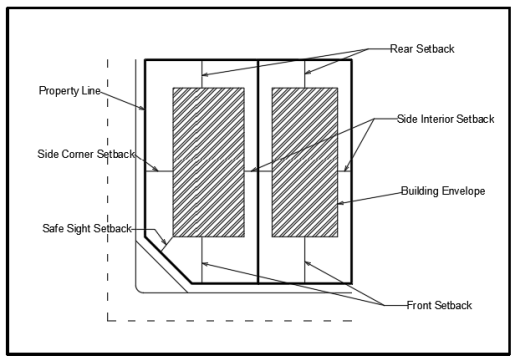
3.
Legal, non-conforming lots may use the setback reductions provisions in accordance with Article 1 of the LDR.
4.
Residential side interior and rear setbacks may be reduced by 30 percent for principal structures and 50 percent for accessory structures when 75 percent of the subject lot is adjacent to open space or water bodies greater than 50-feet wide.
5.
All accessory structures used as dwelling units, or those that exceed ten feet in height, shall meet the required setbacks for principal structures. All accessory uses that exceed 120 SF in area shall meet the accessory structure setback requirements. All other accessory structures less than ten feet in height and less than 120 SF in area shall maintain a five foot setback from the side and rear property lines, unless otherwise provided for in the LDR.
6.
If there is a conflict between a setback and any type of easement, the structure may not encroach the easement. No portion of any habitable structure or any structure that is not easily removable shall be permitted to encroach an easement.
7.
Any setback regulations provided in the principal and/or accessory use standards of this article, or provided on a valid development order, shall supersede the general setback regulations.
8.
Whenever a lot in a non-residential zoning district, or pod of a planned development, is contiguous to an alley, one-half of the alley width may be considered as a portion of the required rear yard, but in no case shall the rear yard be reduced to less than five feet.
9.
Setbacks from safe sight corners shall be a minimum of ten feet for residential properties and 25 feet for non-residential properties. The setback shall be measured perpendicular from the interior property line of the safe sight triangle. Common areas, entry features, and other non-residential structures of a residential planned development shall meet the non-residential safe sight setbacks.
D.
Density:
1.
Density shall be calculated by dividing the number of dwelling units on a lot by the lot area (in acres). When the result is other than a whole number it shall be rounded down to the nearest 100ths.
2.
Densities proposed to exceed the maximum permitted density of a zoning district shall meet at least one of the following conditions:
a.
A density bonus has been approved as part of the redevelopment incentive provided in the LDR; or
b.
The density of a residential pod in a PD may exceed the maximum density of the zoning district as long as the overall density of the PD does not exceed the permitted density of the district. Refer to the PDD section of this article for additional information on transferring units within a PD.
E.
FAR calculations shall be expressed as a decimal and both gross floor area and site area shall be expressed in square feet.
F.
Building coverage shall be expressed in square feet and shall include all awnings, overhangs, coverings, breezeways, etc.
G.
Building height:
1.
No building or structure or part thereof shall be erected or altered to a height exceeding 35 feet unless the use is specifically exempt within this section.
2.
No building, structure, or part thereof shall be erected or altered to a height exceeding 25 feet in districts with a future land use map designation of Conservation, Park, Equestrian Commercial Recreation, and Open Space Recreation.
3.
No building, structure, or part thereof shall be erected or altered to a height exceeding 56 feet in Planned Development districts with a future land use map designation of Residential E, F, G, and H.
4.
No building, structure, or part thereof shall be erected or altered to a height exceeding 72 feet in districts with a future land use map designation of Regional Commercial/Large Scale Multiple Use or for the following uses within the State Road 7 Corridor, which is the area located within one mile of State Road 7, from Southern Boulevard to Lake Worth Road:
a.
Colleges or universities;
b.
Employment centers which shall be defined as non-retail development that employ 100 or more people in predominantly technical or professional occupations;
c.
Government services;
d.
Hospital or medical centers;
e.
Hotel or motel;
f.
Medical or dental laboratories;
g.
Professional business offices;
h.
Light industrial and research park uses;
i.
Congregate living facilities; and
j.
Multi-family residential buildings.
5.
All buildings or structures in excess of 35 feet shall require Wellington Council approval and shall be subject to additional requirements as listed below:
a.
The building(s) shall provide one foot of additional setback beyond the minimum requirement for every one foot in height for all portions of the building or structure that exceeds 35 feet.
b.
The property shall not be located adjacent to single-family residential property. Non-collector roadways and canals are not considered separation.
c.
The property shall be a minimum of two acres in size.
d.
Residential E, F, G, and H land uses shall be located within a planned development and shall be within 500 linear feet of a collector road or road with a higher classification. These buildings may be eligible for an additional 15 percent height allowance, approved by Wellington Council, based on the following criteria:
i.
The area proposed to exceed the maximum building height shall be limited to mechanical equipment, architectural features and/or common use areas and shall not include living area, occupiable floor area, or dwelling units;
ii.
The area proposed to exceed the maximum building height shall be limited to 35 percent of the overall building footprint. A technical deviation for additional height for a portion of the building footprint greater than 35 percent shall be approved by council;
iii.
The area proposed to exceed the maximum building height shall be setback one and one-half feet beyond the minimum setback lines for every foot above the proposed building height; and
iv.
The site design must include at least three or more of the following design criteria:
(1)
A parking structure that results in reduced paved parking areas and additional open green space;
(2)
Provide on-site amenities such as outdoor recreation, benches, civic spaces, and/or focal points;
(3)
Incorporate eco-design such as car charging stations, green roofs, solar panels and/or bio swales;
(4)
Privately improved and maintained public amenities on or contiguous to the project such as replacing/widening sidewalks, adding or improving bus shelters/stops, public art, public open space, or pedestrian streetscape enhancements;
(5)
LEED based design or Florida Green Building design certification of silver or higher;
(6)
Architectural details that are unique and exceed the multi-family architectural design regulations of the LDR;
(7)
Landscape enhancements that exceed Article 7 of the LDR and the additional criteria as listed in this section;
(8)
Provide fee simple or for-sale units;
(9)
Providing housing with prices/rents available/accessible to households within 80 percent—140 percent of Wellington's median income;
6.
Pods or parcels with building heights in excess of 35 feet shall provide and maintain, additional palm/tree plantings, based upon a ratio of one tree per 20 linear feet within, and in addition to, the required landscape buffer, or fraction thereof.
7.
All buildings or structures exceeding 35 feet shall be required to meeting the landscape requirements as provided in Article 7 of the LDR and shall also provide the following:
a.
Twenty-five percent of the palms shall have a gray or brown wood height equal or greater than one-third the overall height of the buildings or structure. These palms shall be located within the foundation plantings of the structure.
b.
Twenty-five percent of the palms shall have a minimum gray or brown wood height in excess of 12 feet and be placed within the foundation plantings of the structure.
c.
Five percent of the palms shall have a minimum gray or brown wood height in excess of eight feet and can be placed anywhere within the project.
d.
All palm plantings under this section are credited 1:1 towards the tree planting standards requirements.
e.
Exception can be made for using "Phoenix" palms wherein this palm will receive credit for four palms if:
i.
The phoenix palm size (as measured by clear wood below the root remnants) is equal in height to the tallest measurement of the palms that it is replacing; and
ii.
The phoenix must be placed in the area of the project where the palms it is replacing is located.
f.
Any required palms approved to obtain a height bonus shall remain as a condition of the approval and must remain as long as the structure remains. Any and all palms that die, become diseased, or disfigured must be replaced in a reasonable time period and be the same size as the palm(s) they replaced.
8.
Exclusions from height limitations:
a.
Spires, ornamental belfries, towers, stage towers or scenery loft appurtenant to civic or cultural buildings, chimneys, mechanical equipment, mechanical equipment rooms and parapet walls used to screen mechanical equipment shall not be included in measuring the overall height of a building or structure if:
i.
They do not exceed 30 percent of the roof area in gross area; or
ii.
They do not exceed 25 percent of the proposed maximum building height.
b.
Water towers, public utilities, civic buildings, and publicly-owned facilities shall be exempt from height regulations in all zoning districts.
c.
Wireless communications towers and facilities, including accessory radio towers, amateur radio/TV antennas, and commercial communication towers and antennas may be erected subject to the supplementary standards of the LDR.
(Ord. No. 2021-12, § 1(Exh. A), 9-13-2021)
Sec. 6.3.2. - Exceptions to the property development regulations.
A.
Antiquated subdivisions: Any subdivision that was platted prior to the adoption of the LDR shall be considered vested and shall meet the minimum development regulations that were in place at the time of the plat recordation or in accordance with a valid development order. Any modifications proposed to the subdivision that would change the minimum property development regulations shall meet regulations of the current LDR.
B.
Table 6.3-2 provides improvements exceptions from structural setback requirements. No improvement shall be constructed or installed within an easement without consent from the easement holder and approval from the Wellington Engineer.
(Ord. No. 2021-12, § 1(Exh. A), 9-13-2021)
Sec. 6.4.1. - General standards.
A.
The following standards shall apply in all zoning districts village-wide:
1.
All structures or buildings shall be equipped with storm protection, pursuant to the Florida Building Code. This can be accomplished with impact windows or storm shutters, rollups or panels. If storm shutters, rollups or panels are used, the hardware that is permanently affixed to the structure shall match the body or trim color to mitigate appearance. Additionally, the portion that is not permanent shall not be put in place more than 72 hours before the storm event and must be removed within 72 hours after the storm. From June 1 to November 30 (hurricane season), if a property owner is absent, shutters are permitted to be in place for two periods of up to 15 days each.
2.
Awnings shall be consistent with the approved materials and color charts adopted by ARB. Awnings shall not extend more than three feet from the building. Awnings used in the rear or side yard in lieu of a covered patio shall meet the same setbacks as a covered patio and shall not be limited to the three-foot requirement.
3.
Docks may be constructed subject to the following criteria:
a.
Docks may extend up to three feet in to the water for canals, six feet in to lakes, both measured from the water's edge;
b.
Docks located on canals shall be cantilevered from the supports located on dry land, above the mean high water line, and no pilings or other supports shall be permitted in the water;
c.
The top of the horizontal dock surface shall be no higher than two feet above the mean high water level on any water body;
d.
Docks shall meet the side yard setbacks for principal structures;
e.
Docks may be constructed of wood or other material as approved by ARB; and
f.
Permits to construct a dock shall be conditioned upon the applicant obtaining all other necessary or applicable approvals from any other jurisdictional agency.
4.
Dumpsters shall be provided for garbage and trash removal when individual collection or indoor storage is not provided. All areas or receptacles for the storage and disposal of trash, debris, garbage, or vegetation, such as dumpsters and trash compactors, shall meet the following standards:
a.
Access to indoor or outdoor collection areas shall be incorporated into the site to minimize the turning and back-up movements of the removal vehicles.
b.
Dumpsters within or adjacent to residential property lines shall be setback a minimum of 50 feet.
c.
All dumpsters or receptacles shall be visually screened by a solid opaque enclosure that is consistent with the architectural character of the project or principal buildings. The open end of the enclosure shall have an obscure, opaque gate that shall remain closed except during pick-up or when discarding trash, debris, garbage, or vegetation. The enclosure shall be landscaped with shrubs or hedges on all sides not containing a gate for removal purposes. The landscaping shall be maintained to the same height as the enclosure.
5.
Fencing, walls, and hedges (including gates) shall be erected and maintained according to the following standards:
a.
Legally established fences, walls, and hedges existing as of April 10, 2007, that do not comply with the requirements of the LDR shall be considered legal, non-conforming improvement, except as provided in section 6.4.1.A.5.aa.v for major thoroughfares. Any repair or replacement of a fence, wall, or hedge shall comply with the regulations of the LDR if the linear length of the area of the fence, wall, or hedge to be repaired/replaced is greater than 30 percent of the whole. Additionally, proof shall be provided that the fence, wall, or hedge was legally established to maintain the non-conforming status. All illegal, non-conforming fences, walls, or hedges shall be considered a violation of the LDR for enforcement purposes.
b.
All fences, walls, or hedges that are erected by Wellington are exempt from the regulations of the LDR.
c.
A building permit shall be required prior to installation of a fence or wall. A removal/planting permit (VRP) for hedges is also required to be obtained as a part of the building permit for fences along a major thoroughfare.
d.
A building permit shall be required for repair to a fence or wall when the damage exceeds 20 percent, or more, of the length of the fence or wall section. A section shall be defined as that portion of the fence or wall located on a given property line. The replaced section of the fence or wall shall match the color and material of the existing fence or wall.
e.
Barbed wire is prohibited from use for any part of a fence, wall, or hedge, unless approved by Wellington Engineering Department for security or by virtue of federal or state law.
f.
Chain link or wire fences not located in the EPA shall be vinyl coated and require a hedge. If located in the EPA, chain link or wire fencing shall be vinyl coated or galvanized and shall meet the fence requirements located in the EOZD section of the LDR. Chain link fencing that is directly adjacent to a water body, lake, or canal shall not be required to install a hedge along the property line that abuts the water as long a portion of the property line adjacent to the water exceed 60 percent of the overall linear length of the property line. The use of privacy slats in a chain link fence are prohibited.
g.
A mesh privacy screen may be permitted on a chain link or aluminum rail fence to obtain privacy while the required hedge material is maturing. The mesh privacy screen shall be installed for the full length and height of the fence, kept in good repair with no holes, and shall be black, green, or brown to match the fence color. The mesh privacy screen shall be removed within 30 days of the required hedge achieving the height of the fence.
h.
All fences/walls adjacent to and visible from any roadway/street, unless specifically exempt, shall require a hedge in accordance with the standards of this section. Fencing/walls screened by existing landscaping will not require additional hedges if the hedging complies with the LDR as determined by Wellington.
i.
Fences, walls, and hedges in proximity to intersections, driveways, or access ways, public or private, shall comply with the safe sight triangle provisions of Article 6 in the LDR.
j.
Fences, walls, or hedges shall be measured from the average grade [lowest plus highest divided by two] of the property line on which the fence, wall, or hedge is located when the elevation at the property varies. Fences, walls, and hedges along major thoroughfares may be measured from the higher point of the average grade at the property line. For the purposes of this section, designated "major thoroughfares" shall be any roadway identified as collector or minor arterial roads on Figure 2 - Wellington's Functional Road Classifications in Article 9 of the LDR.
k.
The following maximum fence and wall heights shall apply:
l.
For properties abutting a major thoroughfare, except as limited by subsection m. below, the hedge adjacent to a major thoroughfare shall be maintained at minimum of six feet in height and a maximum of eight feet in height. When a hedge is associated with a fence or wall not along a major thoroughfare, the minimum hedge height shall be maintained at the same height as the fence or wall.
m.
Except as provided elsewhere in the LDR, fences, walls, and hedges shall not be located closer than five feet back from the front plane on either side of the principal structure, unless granted by the PZB director to accommodate existing mechanical equipment (i.e. air conditioning units, pool equipment, etc.), windows, or vegetation that cannot be relocated.
n.
Fences, walls, or hedges in residential districts or pods shall not be installed within the front building setback unless the proposed fence, wall, or hedge is installed and maintained at a maximum height of three feet. Properties that are one acre in size or more and are either located within the EPA or have a Future Land Use designation of residential A or B may install a fence, wall, or hedge with a maximum height of six feet within the front building setback.
o.
The fence may include a gate and an opening in the hedge to allow use of the gate.
p.
The gate shall be the same material as the fence.
q.
Hedges shall not encroach into public rights-of-way or over a public sidewalks. All hedges shall be maintained no closer than six inches from a right-of-way. Any hedge extending beyond the right-of-way shall be considered a violation of the LDR.
r.
The required hedge material for major thoroughfares is Cocoplum, Podocarpus, Green Arboricola, Clusia, or Simpson Stopper.
s.
All fences and walls shall be setback a minimum of three feet from the property line or from the right-of-way easement, where applicable, when adjacent to a sidewalk or a right-of-way to accommodate the required landscaping. Hedges shall be planted within the property line, a minimum of two feet from the property line or from the right-of-way easement, where applicable or additional setback as appropriate based upon commonly accepted professional landscaping practices for the specific hedge material. Hedges shall be planted so that at the maximum height can be properly maintained without encroaching the sidewalk or right-of-way in accordance with this section of the LDR.
t.
Hedge material shall be planted every two feet on center, a at a minimum height of 36 inches at the time of planting, or as otherwise appropriate based upon commonly accepted professional landscaping practices. The PZB director may waive the minimum size requirements if there is a scarcity of plant material due to hurricane, drought, or other natural disaster. Newly planted hedges have two years from the time of installation to grow to the required maintained hedge height.
u.
Irrigation shall be provided and maintained in working order for all vegetation along fences and walls. Irrigation shall be installed in a manner to guarantee the vegetation outside the fence or wall receive proper irrigation.
v.
An individual property owner may request a waiver from ARB to maintain a hedge above the maximum hedge height. The applicant shall provide justification that the increase in height will provide additional screening and buffering from adjacent incompatibilities, including but not limited to, commercial/industrial structures or uses, overhead power lines, lighting associated with athletic fields, security lighting associated with public or private facilities, or similar uses and activities. ARB approval shall not be required when an Alternative Landscape Plan (ALP) is approved as part of the site planning process and complies with the perimeter buffer requirements of the LDR.
w.
The following height exceptions shall apply when ornamental or decorative features are utilized:
i.
Ornamental decorative toppers and light fixtures not exceeding 18 inches above the maximum height limit may be permitted on pillars or supports for any fence or wall.
The height of portions of a hedge may exceed the maximum height limit to allow arches or other ornamental features associated with the location of an opening in a fence or wall for a gate, not to exceed three feet on each side of the opening.
x.
The finished side (no visible support/structural members) of all fences shall face the street or adjacent property. The ARB shall adopt a schedule of approved fence designs, materials and colors. ARB approval shall be required for any alternative design, including height, material, or color. For the purpose of these standards, metal, composite, or other material, excluding PVC/vinyl, fencing designed to look like wood fencing shall be considered wood fencing.
y.
The finished side of all walls shall face the street or adjacent property. Walls shall be masonry, concrete, or brick. All masonry and concrete walls shall have a smooth finished coating on both sides and be painted on the sides that face the street or adjacent property with a non-glossy finish, shall match the color of any existing adjacent wall within the subdivision, as approved by ARB. If there is no adjacent wall or the property is not of an overall subdivision, the non-glossy finish and color shall comply with the color chart approved by ARB.
z.
A gate opening exceeding four feet in width shall require approval from the Wellington Engineer. Several factors, including but not limited to the following, will be considered to obtain approval:
i.
The presence of a limited access easement or other limitation on crossing a property line established by an approved plat.
ii.
The location of the proposed gate in relation to a public or private roadway and traffic/pedestrian circulation patterns.
iii.
The presence of vegetation, irrigation, sidewalks, and other improvements.
iv.
Gate openings larger than six feet wide shall only be permitted when there is an approved access drive, equal to or greater than the width of the proposed gate opening, consisting of a stabilized surface from the adjacent roadway to the gate opening. The stabilized surface type must be concrete or paver blocks and must meet all applicable Florida Building Codes and Wellington Engineering Standards. Alternative stabilized surface types, such as asphalt, compacted base material, gravel, etc. may be approved by the Wellington Engineer, but must not conflict with the aesthetics of the surrounding neighborhood.
v.
If there is an existing sidewalk between the proposed gate opening and the adjacent roadway, the sidewalk must be replaced with a minimum of six-inch thick, 3,000 psi concrete, for the entire linear distance of the approved access drive, to handle anticipated traffic loading. For the purpose of this section, a driveway apron shall be defined as the area of the access drive between either the property line and the edge of roadway pavement or the limit of the roadway easement within the property and the edge of roadway pavement. The driveway apron must also consist of 6-inch thick, 3,000 psi concrete, to handle anticipated traffic loading.
aa.
In addition to the general standards, the following standards shall apply to fences, walls, and hedges along major thoroughfares:
i.
Excluding properties located within the Equestrian Preserve Area, major thoroughfare fencing shall comply with the standards listed below:
a)
The fence shall be a minimum of five feet in height and a maximum of six feet in height.
b)
The fence may consist of wood, PVC, vinyl coated chain link, or aluminum railing.
ii.
Hedges for major thoroughfare fences, excluding the EPA.
a)
A hedge that is consistent with the requirements of this section shall be planted between the fence and the property line.
b)
A hedge shall not be installed within an easement or right-of-way unless such installation is approved by the Wellington Engineer.
c)
All properties that abut a major thoroughfare, even without a fence or wall, shall install and maintain a hedge at a height between a minimum of six feet to a maximum of eight feet.
d)
A removal/planting permit (VRP) for hedges is also required to be obtained for hedges along a major thoroughfare. The VRP shall be required for any removal, replanting, or new hedges.
iii.
Within the EPA, major thoroughfare fencing shall comply with the following standard:
a)
Fences may be a three or four board wooden fence. If hedging is desired, it may be installed in front or behind the board wooden fence for aesthetic purposes.
b)
Fences shall be finished with natural, clear-coat, or be painted black, gray, or white.
c)
The fence shall be a minimum of four feet in height and a maximum of six feet in height.
d)
Hedges are not required for thoroughfare fences within the EPA.
v.
An existing alternative fencing design permitted by a previously issued development order or an approval granted by the ARB shall be considered conforming to the requirements of this section.
vi.
All legal non-conforming fence types along a major thoroughfare must be replaced by December 31, 2026, with an approved fence type.
vii.
All legal non-conforming hedges shall be replaced by December 31, 2026, with one of the five required hedge materials. This includes the installation of hedges on properties that do not have a fence and abut a major thoroughfare.
viii.
A property owner may request an administrative waiver to grant an existing legal non-conforming hedge (established before December 31, 2026) or other vegetation to remain. An administrative waiver may be granted with conditions if the following criteria are met:
1.
The hedge is acceptable hedge species or vegetation that will provide screening as required and is not an invasive species as determined by Wellington.
2.
The existing hedge or vegetation shall be in healthy condition (full and dense foliage, free of diseases, screens fence or wall from view) as determined by Wellington and consistent with the ANSI standard horticultural practices.
3.
The existing hedge or vegetation is setback at minimum two feet from the property line and is maintained no closer than six inches from a right-of-way.
bb.
Maintenance of fences, walls, and hedges shall comply with the following:
i.
Fences and walls shall be maintained in good order and repair.
ii.
Painted surfaces of fences, walls, and other surfaces associated with fences and/or walls shall not be faded and shall be free of discoloration, staining, or peeling.
iii.
Surfaces of a wall or fence shall be cleaned or repainted if either of the following occurs:
a)
When ten percent or more of the surface is stained or discolored; or
b)
When five percent or more of the paint is peeling off the surface.
iv.
Any broken, missing, deteriorated, dilapidated, or otherwise damaged portion of a fence, including boards, posts, slats, rails, stiles, structural members or elements, or fittings and any broken, chipped, missing, deteriorated, dilapidated, or otherwise damaged portion of a wall, including the foundation, the exterior, piers, arches, lintels, pilasters, columns, coping, or other structural elements or walls shall be replaced immediately.
v.
Fences and walls shall be maintained in an upright and vertical position, shall not be allowed to lean or to otherwise be out of plumb, and not have the hedge material support the fencing. Fence rails and posts shall be structurally sound and shall not be bent, twisted, warped, or otherwise misshaped.
vi.
Temporary supports during the construction of the fence or wall shall not encroach easements or rights-of-way and shall be utilized for no more than a period of 60 days.
vii.
Landscaping and hedges installed in front of or in association with a fence or wall shall be maintained in a healthy condition and trimmed in a neat and orderly condition consistent with standard landscape practices in accordance with the ANSI standard horticultural practices.
a)
Hedges that are determined to be more than 30 percent deteriorated, dead, or diseased must be replaced.
b)
Hedges with more 18 inches of visible trunk at the base must be replaced with an approved hedge material.
6.
Mechanical equipment for residential and non-residential structures shall be located at least five feet back from the front plane of the principal structure and shall be visually screened from the road. Equipment above ground may use hedging and fencing. Equipment located on a roof shall be screened with a parapet or enclosure that aesthetically blends the equipment with the building.
7.
Outdoor recreational areas that are accessory to residential or non-residential uses shall be setback a minimum of 50 feet from any property line abutting a residential district. Passive outdoor accessory recreational facilities shall be setback a minimum of 25 feet from any property line abutting a residential district. As part of the review process, the DM will determine if the recreational areas require screening for compatibility with the surrounding uses. This buffer may consist of a fence, wall, and/or hedge to ensure 75 percent opacity around active or passive recreational areas. Any swimming pool/spa operated as a commercial enterprise shall meet the above setbacks and shall be considered as a principal use subject to all other applicable development regulations.
8.
Outdoor storage, where permitted, shall be completely screened from view with a combination of fencing and vegetation at a minimum height of six feet. Outdoor storage as a principal use is only permitted in the Flex Zoning District and supplementary standards for principal uses of this article shall apply. Outdoor storage in all other zoning districts shall be accessory to the principal use and shall not be located within the setbacks for the lot/parcel.
9.
Solar panels are permitted on all buildings or structures. All piping and other equipment leading to and from the panels shall be completely concealed behind a parapet, inside a roof or wall, or painted to match the portion of the structure to which they are affixed. Tanks, pumps, and other associated mechanical equipment shall be visually screened from the road and adjacent properties.
10.
Chickee huts (for the purpose of the LDR) are those that do not contain electric or plumbing. They do require zoning review only through the building permit process. Chickee huts that are ten feet by ten feet, or 100 square feet or smaller shall maintain a five foot setback from the side and rear property line. If the chickee hut exceeds 100 square feet, then the accessory use setbacks shall apply.
11.
Tiki huts (for the purpose of the LDR) are those containing electric and/or plumbing work and shall meet the accessory structure setbacks and shall be required to obtain a building permit.
12.
Tennis courts shall be permitted subject to the following standards:
a.
Shall not be located in front of the principal structure. The court, including fencing, shall be at least five from the side and rear property lines;
b.
A ten foot high chain link fence is permitted. All wire mesh, rails, and stiles shall be vinyl-coated black, brown, or dark green;
c.
Tennis court lighting shall meet the lighting standards of Article 7 of the LDR; and
d.
Tennis courts, with or without fencing, shall be required to have a hedge, planted no more than 24 inches on center, a minimum of three gallons and 36 inches high at planting, on all sides. The hedge shall be maintained at a minimum of five feet in height and shall not be allowed to exceed the height of the fence.
13.
Utility meters and related conduits shall be located on the side or rear walls of all structures. Conduits shall be painted to match the wall or trim of the structure. All on-site utility services shall be installed underground in an accordance with the LDR and standards manuals.
14.
Windows shall not be installed with reflective glass and/or with reflective film. Non-reflective glass and film is permitted. All windows located on a front façade shall be uniform or consistent in type to create a unified architectural design.
(Ord. No. 2021-12, § 1(Exh. A), 9-13-2021; Ord. No. 2021-18, § 1(Exh. A), 10-26-2021; Ord. No. 2024-02, § 1(Exh. A), 7-16-2024)
Sec. 6.4.2. - Residential district/PUD specific development standards.
A.
The following development standards shall apply to all residential districts and residential pods of planned development districts:
1.
The minimum dwelling unit size shall be as determined by federal, state, or local building code/regulations.
2.
For single-family and two-family residential lots, impervious surfaces shall include buildings, driveways, walkways, patios, pool aprons, artificial turf system, and other approved structures/surfaces. The front yard, defined as all area from the front property line to the setback line of the structure, shall not exceed 50 percent of impervious surface area, and minimum 50 percent pervious surface area with landscaping and green space areas. A total of 75 percent of the rear and side yard is allowed to be an impervious surface for lot size less than 0.50-acre, which shall not exceed 6,000 square feet in impervious area. A total of 50 percent of the rear and side yard is allowed to be an impervious surface for lot size 0.50-acre or more, which shall not exceed 12,000 square feet in impervious area. Impervious surface area shall be setback a minimum of two feet from all property lines, except as provided in other sections.
3.
Above-ground pools are not permitted.
4.
Basketball hoops may be portable in nature or permanently installed on a residential lot. The following regulations shall apply:
a.
Backboards and hoops shall be mounted on a freestanding pole only and shall not be mounted on a wall or roof of a building;
b.
Backboards and hoops shall be located at least 15 feet from the front property line and three feet from the side property line;
c.
Backboards, and the poles on which it is mounted, shall not exceed 14-feet in height, measured from the grade level at the closest point to the front property line or roadway, whichever is closest to the front plane of the home;
d.
Backboards and poles shall not be painted or altered from the original manufacturer's finish or appearance; and
e.
Portable basketball hoops shall not be placed in/on the street or sidewalk. They shall not exceed the regulations of permanent basketball hoops and may be subject to other regulations as provided in the LDR or Code of Ordinances.
5.
All play equipment or play houses that exceed ten feet in height and 120 square feet shall match the colors and materials of the principal structure.
6.
Prefabricated sheds shall meet the following criteria:
a.
Shall be visually screened from adjacent properties;
b.
Shall be finished to match the principal structure or be a neutral color; and
c.
Shall not exceed 120 square feet in area or eight feet in height. Any prefabricated shed that exceeds this shall be considered an accessory structure and shall meet all accessory structure regulations.
d.
One shed shall be permitted on properties up to one acre in size. Two sheds shall be permitted on properties greater than one acre in size.
7.
Screen enclosures shall comply with the following standards:
a.
Screen enclosures may be roofed with a screened roof or solid roof. Property development regulations vary based on the type of roof covering.
b.
Setbacks shall be measured from the property line of the lot to the closest edge of the screen enclosure. Setbacks shall be as follows:
c.
Screen enclosures may be eligible for a zero foot rear setback reduction if the following is applicable:
i.
The entire rear or side interior property line is adjacent to open space (lake, natural preserve, or golf course) a minimum of 50 feet in depth;
ii.
All construction and earthwork is completed within the owner's lot;
iii.
All maintenance can be conducted from within the owner's lot; and
iv.
Roof eaves or structures shall not overhang the property line or encroach any utility, drainage, or lake maintenance easement.
d.
Solid roofed screen enclosures shall meet the minimum setbacks for the principal use on the lot.
e.
A minimum five-foot high opaque fence or wall shall be provided on the zero side of the zero lot line extending from the rear of the structure to the rear edge of the screen enclosure with screened roofs. When a screen enclosure has a solid roof, a minimum eight-foot high wall shall be provided on the zero lot line side that extends the distance of the solid roofs. The screen enclosure shall be attached to the fence or wall.
f.
Townhouses shall not have required interior side setbacks from individual property lines of interior units. The end units shall measure setbacks from the property line of development or pod. If the roof of the enclosure is solid, there shall be a minimum eight-foot high wall on the shared lot line, extending from the dwelling to the rear edge of the portion of the enclosure that is roofed. The wall shall be fire-rated in accordance with standard building codes. The screen enclosure may be attached to the masonry wall.
g.
Solid roof screen enclosures shall be included in the building coverage calculation.
h.
Screen enclosures shall be permitted to cover a maximum of 30 percent of the total lot area except for townhouses. Screen enclosures for townhouses may cover 100 percent of the total lot area provided minimum separations between groups are met.
i.
The height of the screen enclosure shall not exceed the highest point of the peak of the roof.
j.
Roof eaves or structures shall not overhang the rear property line or encroach any utility, drainage, or lake maintenance easement.
k.
The screen enclosure superstructure shall be black, bronze, white, or the color of the window frames of the structure; and
l.
All screening shall be the same color on all sides and shall be gray or charcoal.
B.
The following development standards shall apply to all multi-family, non-residential districts, and Planned Development Districts:
1.
All multi-family, non-residential developments, and planned developments shall provide for the following:
a.
Safe and effective pedestrian and vehicular access and circulation;
b.
Safe and effective on-site circulation, parking, and connectivity;
c.
Adequate road system within and adjacent to the project;
d.
Inter-connectivity between projects to capture internal traffic patterns and mitigate off-site traffic;
e.
Incorporate Crime Prevention Through Environmental Design (CPTED) principles into the project design;
f.
Create and maintain positive character and ambiance with enhanced streetscapes, appropriate massing of structures and consistent architectural design;
g.
Loading and service areas shall be visually screened from adjacent properties and roadways. Materials and design to accomplish this standard shall match the design of the project;
h.
Adequate fire/police vehicular access for safety protection.
2.
Non-residential free-standing buildings, utilized by a single tenant, shall not exceed 75,000 gross square feet in size.
3.
Pedestrian paths, walkways, cross walks, and sidewalks shall be provided from the buildings to the adjacent public pedestrian system. They shall also be provided for safe access to the parking areas. Compliance with Americans with Disabilities Act (ADA) guidelines shall be required. Walkways shall be a minimum width of five feet and shall be intermittently shaded. Such improvements, including but not limited to, markings, signage, raised walkway design, etc., may be required upon development review or in accordance with the standards manuals.
(Ord. No. 2021-12, § 1(Exh. A), 9-13-2021; Ord. No. 2022-02, § 1(Exh. A), 2-22-2022)
Sec. 6.4.3. - Architectural review and design.
A.
The architectural character and building design of uses shall conform to and be compatible with the general architectural character of the development, project, neighborhood, or surrounding uses.
B.
All exterior finishes, colors, and materials shall be consistent with the material schedule and color charts adopted by the ARB, or shall be approved as part of an overall design by the ARB during the review of elevations and design details. The ARB may approve alternative materials and design provided they find the proposed design is compatible with the approved materials and color schemes.
C.
All approved colors shall be considered a modification to the color chart and may be used village-wide. Permits to paint a structure are not required, but the color choice must match the approved color chart or the property owner may be found in violation of the LDR.
D.
All applications that require ARB consideration shall comply with the development review process of Article 5.
E.
The design criteria in this article shall apply to all buildings, residential and non-residential, village-wide.
F.
If there are any conflicts between the design regulations of this this article and any other regulations in the LDR, the more restrictive shall govern.
(Ord. No. 2021-12, § 1(Exh. A), 9-13-2021)
Sec. 6.4.4. - Design standards by district.
A.
The following are design standards for residential zoning districts:
1.
No two identical facades shall be placed next to, or across the street from, each other in residential zoning districts. Identical facades shall mean color, material, and design. If any of the elements differ, but have one identical element, this requirement shall not apply.
2.
Accessory structures or buildings, such as freestanding garages, cabanas, accessory dwellings, shall match the colors and materials of the principal structure. Any alternative design shall require ARB approval for aesthetic compatibility prior to alterations or construction.
3.
The cumulative square footage of all accessory structures on a parcel/lot shall not exceed 30 percent of the principal structure(s) gross floor area.
4.
All single-family residential structures, including zero lot lines, shall be reviewed by Zoning as part of the building permit. The following items shall be taken into consideration:
a.
Exterior materials and colors;
b.
Front, side, and rear elevations;
c.
Roof pitch and number of roof planes. Roof planes shall have a minimum of a three-foot offset to be considered a separate roof plane;
d.
No building permits shall be issued for initial construction of single-family residence, including zero lot line homes, unless it is demonstrated that the building has achieved the a minimum of 80 design criteria points provided in Table 6.4-1 Design Criteria for Single-family and Multi-family Structures (four units or less), or unless an alternative design has been approved by ARB;
e.
Pervious and impervious area of the lot; and
f.
Compliance with all other applicable bulk regulations of the LDR.
5.
All roofs shall meet the following standards:
a.
For all residential structures, 70 percent of under air footprint plus attached garage shall have a minimum 3:12 roof pitch;
b.
Flat roofed areas shall not be visible from the street, unless an alternative design has been approved by ARB; and
c.
Roof planes over entry features shall have a minimum of a three-foot offset to be considered a separate roof plane.
B.
The following are design standards for multi-family and non-residential zoning districts:
1.
All multi-family and commercial facades shall contain architectural details on all sides to avoid solid blank walls. The use of varied materials, stones, colors, and lighting is encouraged. Buildings within the Flex Zoning District, due to the industrial nature of buildings, are only required to provide architectural detailing on the front façade, along with any façade visible from a public or private roadway or adjacent residential properties. Blank wall areas shall not exceed ten feet in a vertical direction nor 20 feet in a horizontal direction on any primary façade or façade adjacent to a roadway.
2.
No building permit shall be issued for initial construction of duplex units, quads, or townhouses (4 units or less), unless it is demonstrated that the building has achieved the a minimum of 70 design criteria points as provided in Table 6.4-1 Design Criteria for Single-family and Multi-family Structures (4 units or less), or unless an alternative design has been approved by ARB.
3.
Windows shall be incorporated into the design on all facades facing a roadway and shall occupy, at a minimum, 40 percent of the elevation.
4.
Buildings shall be designed in a manner that is compatible with the character, mass, bulk, and scale of the surrounding area. When a new project is proposed that will have a height more than twice the height of the tallest building on an adjacent parcel, transitional massing elements shall be required to mitigate the change in height and elevation.
5.
Accessory buildings and structures shall conform to the design, materials, colors, and style of the principal structures.
6.
Outparcels that are part of an overall project shall contain architectural elements that match or are compatible with the overall project design.
7.
Projections and recesses on multi-family and non-residential building facades shall have a minimum depth of three feet with 25 percent of these having a varied length with a minimum differential of one foot.
8.
All multi-family, five units or more, and all non-residential building must obtain ARB approval prior to building permits, with the exception of barns and hangers, which shall match or have compatible elements to the single-family principal structure.
9.
All non-residential buildings shall provide a minimum of five of the following building design treatments:
a.
Canopies or portico, integrated with the building's massing and style;
b.
Overhangs, minimum of three feet;
c.
Arcades, minimum of eight feet wide;
d.
Sculptured artwork;
e.
Raised cornice or building banding with a minimum of two reliefs;
f.
Peaked roof forms;
g.
Arches;
h.
Display windows;
i.
Ornamental/structural architectural details;
j.
Clock/bell towers or other roof treatments;
k.
Projected and covered entry a minimum five feet deep;
l.
Additional roof articulation above the minimum standards; or
m.
Metal or tile roof as the dominant roof material.
10.
Building facades shall include a repeating pattern and shall include no less than three of the design elements listed below. At least one of these design elements shall repeat horizontally. All design elements shall repeat at intervals of no more than 50 feet, horizontally and a maximum of 15 feet vertically.
a.
Color change;
b.
Texture change;
c.
Material module change;
d.
Expression of architectural or structural bays, through a change in plane no less than 12-inches wide, such as a reveal, an offset, or a projecting rib;
e.
Architectural banding; or
f.
Building setbacks or projections, a minimum of three feet in width on upper level(s).
11.
Predominant exterior building materials shall include, but are not limited to:
a.
Stucco;
b.
Brick;
c.
Tinted, textured, other than smooth or ribbed, concrete masonry units; or
d.
Stone, excluding an ashlar or rubble construction look.
12.
Accent material on exterior building facades may include, but is not limited to, metal panels, stone, tile, smooth or rib-faced concrete block.
13.
At a minimum, two locations of the roof edge and/or parapet shall have a minimum three foot vertical change from the dominant roof condition. At least one such change shall be located on a primary facade adjacent to a collector or arterial rights-of-way. One additional roof change must be provided for every 25,000 square foot increment over 50,000 square feet of ground floor space. The following shall apply:
a.
Parapets shall be used to conceal roof top equipment and flat roofs;
b.
Where overhanging eaves are used, overhangs shall be no less than three feet beyond the supporting walls. Where overhangs are less than three feet they shall be provided with a band or cornice, a minimum of eight inches under the soffit at the wall;
c.
Fascia shall be a minimum of eight inches; and
d.
Tile or metal shall be the dominant roof material.
14.
The following roof types/materials are prohibited:
a.
Asphalt shingles, except laminated, 320 pound, 30-year architectural grade asphalt shingles or better;
b.
Mansard roofs and canopies without a minimum vertical distance of eight feet and at an angle not less than 25 degrees, and not greater than 70 degrees;
c.
Roofs utilizing less than or equal to a 2:12 pitch unless utilizing full parapet coverage; and
d.
Backlit awnings used as a mansard or canopy roof.
15.
All commercial buildings shall incorporate highly defined customer entrances. Additionally, site elements, including but not limited to, benches, decorative landscape planters, shading, and trash receptacles shall be required.
(Ord. No. 2021-12, § 1(Exh. A), 9-13-2021)
Sec. 6.5.1. - Purpose and intent.
The purpose and intent of the following regulations is to allow flexibility in the application zoning regulations for the development of land within a PDD that achieves distinctive, attractive communities, takes advantage of compact building design, and preserves open space and critical natural environments by allowing flexibility from zoning regulations. A PDD shall:
A.
Minimize adverse impacts on environmentally sensitive areas;
B.
Increase and promote public transit, bicycle routes and non-vehicular modes of transportation;
C.
Increase use of public and private amenities as part of Planned Developments (PD) design;
D.
Provide for efficient use of land, utilities, and infrastructure;
E.
Provide for effective circulation patterns, internal trip capture, integrated land uses, and enhanced open space and recreational areas;
F.
Ensure adequate storm water management; and
G.
Encourage distinctive design while achieving compatibility with the surrounding area.
(Ord. No. 2021-12, § 1(Exh. A), 9-13-2021)
Sec. 6.5.2. - General.
A.
Before any land is designated as a PDD on the official zoning map, it shall be approved by council as a zoning or rezoning application in accordance with Article 5 of the LDR.
B.
The following zoning districts are all considered PDD: Planned Unit Development (PUD), Medical Center Planned Development (MCPD), and Mixed Use Planned Development (MUPD).
C.
All PD shall require a master plan, including a Project Standards Manual (PSM), and site plan approval in accordance with Article 5 of the LDR. Approved PD or projects within a PDD shall be governed by the development order, master plan, PSM and site plan for the subject property.
D.
When a certain density is approved for a PD, any unbuilt units may be transferred to another pod that permits residential units as long as the total number of units for the overall project remains the same or decreases. The DM may approve a transfer up to 30 percent of the unit count that was approved by council. Any transfer in excess of 30 percent shall be approved by council as a master plan amendment.
E.
All PD that have a residential component shall be subject to land dedications, or payment in lieu of fees, for parks and recreation facilities, as well as civic facilities, in accordance with the following:
1.
The developer shall provide five acres of property for park and recreational facilities and one acre of civic facilities, each 1,000 of the population proposed for the project.
2.
The proposed population shall be calculated by using the current median household size for Wellington by the latest U.S. Census multiplied by the number of proposed dwelling units.
3.
Park and recreational facilities shall not include dry or wet detention, preserve/conservation areas, landscape buffers, or open space areas.
4.
Civic facilities may include such uses as fire stations, police stations, libraries, community centers, government offices, or public utilities.
5.
If it is determined that parks, recreational facilities, and civic facilities are not provided as part of the proposed project, in part or in full, the property owner/developer shall pay a fee equal to $50,000.00 per acre or the fair market value per acre, whichever is greater, for such park/recreational/civic land dedication.
6.
A ten percent credit for privately-owned recreational space within a proposed project may be applied to the park and recreational land dedication requirement. The use of the private recreational space shall, by recorded covenant, run with the land and cannot be eliminated without the consent of Wellington's Council. The property shall be operated and maintained by the property owner, successors, or assignees.
F.
Modifications to previously approved PDD shall comply with the procedures of Article 5 of the LDR.
G.
If a conflict exists between the provisions of this section and other regulations in the LDR, the provisions of this section shall control.
H.
The density for any residential PUD shall be determined by the underlying future land use map designation. The residential density for any MUPD shall be proposed as part of the development application and project standards. Both shall be calculated based on gross site acreage.
I.
Actual maximum density granted to a PDD is based on the project's illustration that it meets the performance goals and Comprehensive Plan objectives. Actual density granted by Wellington's Council to a PDD may be less than the maximum density indicated by the Comprehensive Plan.
(Ord. No. 2021-12, § 1(Exh. A), 9-13-2021)
Sec. 6.5.3. - Use regulations.
A.
All uses within a PDD shall comply with the use regulations table of Article 6, the Supplementary Standards of the LDR, and all other applicable sections of the LDR.
B.
All accessory uses shall not exceed 30 percent of the gross floor area of the principal use. An accessory use shall be located on the same lot as the principal use, except for off-site parking, as approved by a valid development order.
(Ord. No. 2021-12, § 1(Exh. A), 9-13-2021)
Sec. 6.5.4. - General design standards for planned development districts.
A.
The proposal shall provide a continuous, non-vehicular circulation system, and perimeter landscape areas to connect buildings and other land improvements.
B.
The proposal shall conveniently design and locate parking to encourage pedestrian circulation between land uses. Parking structures may be used and are encouraged to conserve open green space within the project.
C.
The proposal shall preserve existing trees and other natural features of the site to the greatest possible extent.
D.
The elements of the final site plan/final subdivision plan shall be organized based on the size and shape of the tract, the character of the adjoining property, and the type and size of the buildings, shall produce compatibility and functionality, mitigate noise and light impacts on adjacent sites, and illustrate an economical land use pattern.
E.
All proposed PD shall have a PSM, adopted by resolution, submitted with the master plan providing the proposed standards for the project. At a minimum, the PSM shall contain the following:
1.
Project description. Justification, theme, architectural style, general uses, and character of the project. The justification shall also include how the proposed PD exceeds the intent of the LDR with the proposed flexible regulations and how it complies with the Comprehensive Plan. The justification shall include methods of calculating the data, such as land use mixes, population projections, densities and intensities. This includes the raw data used for making population assumptions.
2.
Development regulations. Setbacks, lot size, building coverage, FAR, calculation of land uses, etc. This information shall be provided in graphic, written, and tabular form to illustrate the proposed densities and intensities of the project. The proposed property development regulations shall comply with all applicable fire separation and protection standards.
3.
Landscape standards. Buffers, perimeter landscaping, minimum landscape requirements for lots/parcels, street trees, common areas, cross sections, typical sections, parking lot landscaping, etc. Landscape standards shall exceed the Article 7 landscape standards of the LDR by a minimum of 30 percent of the general standard. The perimeter landscape areas shall be dedicated, by easement, for landscaping and buffering, including the installation and maintenance of any structures/features such as fences, walls, and berms.
4.
Signage regulations. Master sign plan, locations, types, sizes, etc.
5.
All proposed structures/buildings shall comply with the height limitations of the LDR.
6.
Recreation/civic report shall be included that identifies the acreages, dedications, or payment in lieu of fees, activities, and any other information that justifies the use(s).
7.
Circulation. Parking, access, vehicular circulations, non-vehicular circulation, connectivity to surrounding areas, lighting etc. Breaks are permitted in the perimeter buffers to allow for easy access for pedestrians and interconnectivity between sites. The construction of a circulation path within perimeter landscape areas is encouraged to promote non-vehicular circulation. A minimum width of ten feet shall be added to the minimum width of a perimeter landscape area to accommodate the path's construction. The circulation path shall have a stabilized subsurface and shall be mulched or paved. Proposed bike lanes shall be identified on the master plan and site plan.
8.
Easements. All easements shall be listed and dedications shall be identified in the PSM. This includes such easements for roadways, landscape, utilities (public and private), drainage, stormwater management, etc. Additionally, these easements shall be illustrated on the master plan, site plan, and plat.
9.
Conceptual graphics, such as site plans, sections, elevations, renderings, etc., shall be made part of the PSM to illustrate the functionality of the project design.
F.
Principal vehicular access points shall be designed to encourage smooth traffic flow and minimize hazards to vehicular or pedestrian traffic. Traffic controls and traffic medians shall be required where existing or anticipated heavy traffic flows indicate needed controls.
G.
Safe sight visibility triangles shall be maintained at all intersections.
H.
Land may be added to a PD, with council approval, if land is contiguous and the resulting PD meets the purpose and intent of a PDD.
I.
Arterial and collector roads, whether public or private, shall connect with similarly classified roads in adjacent developments. If no roads exist, the Wellington Engineer shall determine whether future connections are likely and desirable and shall have the authority to alter the design according to the criteria established in Article 8 of the LDR.
J.
Wellington's Council may condition a PD to provide certain improvements within the road rights-of-way or elsewhere within a PDD, in addition to the land development improvements required for the subdivision, or platting of land. These conditional improvements are intended to forward the goals and objectives of the Comprehensive Plan, such as assuring the public health, safety and welfare; facilitating non-vehicular circulation; open space connectivity; improving the neighborhood aesthetics; and other applicable Wellington programs. These conditional improvements may include, but are not limited to:
1.
Street lighting;
2.
Median landscaping;
3.
Street trees and minimum landscape standards;
4.
Bicycle lanes, multi-purpose paths, non-vehicular paths, and equestrian trails (if applicable);
5.
Water management tracts.
6.
Parking; and
7.
Open space areas and gathering places;
K.
All PD shall comply with the parking and loading criteria of Article 7.
L.
All PD shall comply with the land development elements, such as roadways and traffic, drainage, utilities, etc., found in Articles 7, 8 and 9 of the LDR.
M.
All PD shall comply with the requirements of the Natural Resource Protection Regulations and other applicable Wellington, County, State and Federal environmental regulations.
N.
All PDD shall be required to obtain architectural review board (ARB) approval prior to building permit. This may be requested in phases, based on the phasing of the project. Signage is also required to obtain ARB approval.
O.
All structures/buildings shall comply with, or exceed, the minimum architectural criteria for the respective use type of this article.
P.
All modifications to PD shall comply with Article 5 of the LDR.
Q.
Property owners association, or other type of association, shall be formed concurrent with the first recorded plat.
(Ord. No. 2021-12, § 1(Exh. A), 9-13-2021)
Sec. 6.5.5. - Planned Unit Development District (PUD).
A.
The purpose and intent of a PUD is to allow flexible regulations and development standards for projects that are primarily residential and may contain pods of civic, recreation, and limited non-residential and mixed uses. All uses shall be connected by a continuous circulation system.
B.
The project must demonstrate that proposed flexible regulations have a benefit and overall compatibility with the community, while protecting and furthering the health, safety, and welfare of the community.
C.
PUD's that exceed 75 acres in size or 300 dwelling units, shall provide at least two housing types. Housing types shall include, but are not limited to, single family, zero lot line, townhouse, multi-family, or congregate living facility.
D.
Recreation areas shall be provided at a minimum of 110 SF of area/person.
E.
The maximum percentage of civic pods to gross area of the PUD shall not exceed 65 percent.
F.
The land uses within the PUD shall be located and designed to be compatible with surrounding land uses both internal and external to the PUD.
G.
The resulting mix of land uses shall further the goals of the Comprehensive Plan to integrate and share facilities, thereby encouraging efficient use of land and infrastructure.
H.
Once a PUD has been fully executed, Wellington may at its discretion, convert the PUD to conventional zoning district(s) based upon the uses, density, and intensity of the respective pods. This will be done as a rezoning and will result in a modification to the official zoning map.
(Ord. No. 2021-12, § 1(Exh. A), 9-13-2021)
Sec. 6.5.6. - Multiple Use Planned Development (MUPD).
A.
For the purpose of the LDR, there shall be no distinction between MUPD and MXPD. Any property that is designated as MXPD on the official zoning map has been converted to MUPD with the adoption of the official zoning map in 2021. This does not change any entitlement that a property may have with a MXPD designation. This does not give entitlement to a MUPD that have not already been permitted under the LDR. Historically, residential uses were not listed as a permitted use in a MUPD. All MUPD that have been developed in Wellington contain residential uses. In an effort to rectify the standards that were adopted under Palm Beach County, these two designations will be known as MUPD.
B.
The purpose and intent of the MUPD is to promote the use of a PDD that has a unified design of mixed-uses within a single development. It provides flexibility to encourage distinctive design that results in the efficient use of land, parking, landscaping, open space, access, architectural compatibility, and adaptable space for future uses and sustainability. The intent is also to encourage development or redevelopment of sites that are sensitive to the surrounding uses, achieve the desired character of the community, and maximize the availability of public facilities to serve proposed developments. This designation shall foster infill development, deter urban sprawl, and lessen the need for additional vehicular trips through the internalization of trips within the community or within a neighborhood or project. The criteria established herein is to be used for development of sites designated as MUPD.
C.
The use types permitted in MUPD may include a mix of residential, commercial, office, civic and/or institutional, conservation and recreation.
1.
Residential shall include, but not be limited to, any combination of congregate living facility (Type 1, 2, and 3), loft/residence above a non-residential ground floor use, single-family, and multi-family.
2.
Commercial means a variety of uses, including but not limited to entertainment, hotel, personal services, restaurants, and retail.
3.
Office means a building or buildings used primarily for conducting the affairs or administration of professional businesses and services, organizations, limited light industrial,; or similar activity, including medical office, medical clinic, medical laboratory, and medical research and development.
4.
Other uses commonly found in an MUPD include, but are not limited to, biomedical/medical research, laboratories, manufacturing of products not involving raw or processed food or hazardous materials, research and development, colleges/universities, cultural facilities, government offices, assembly, and day care.
5.
Parks means land owned or operated by a governmental entity offering the general public an opportunity to participate in a variety of programmed/active, equestrian, passive, or similar recreational activities.
6.
Conservation shall mean land permanently dedicated for preservation of environmental, conservation, and natural resources, including public or private lands protecting such resources.
7.
Open space shall mean land permanently dedicated as common open space within a MUPD, including recreation areas, preservation areas, and water management tracts. For the purposes of this section, if open space is included as a specific use within a mixed-use project, the open space feature or features, including water management tracts, shall be fully integrated as an element of the overall project and shall be designed to enhance the pedestrian, recreational, and visual amenities within the entire MUPD.
D.
A MUPD with a total non-residential gross floor area exceeding 80,000 SF may reduce the parking calculation ratio rate to one space per 500 SF for the amount of gross non-residential floor area above 80,000 SF.
E.
A minimum of 20 percent of parking shall be located to the side or rear of a building.
F.
Entry boulevards with building placement along the boulevard and parking located behind the buildings is encouraged.
G.
Vertical integration of uses shall be part of the design criteria.
H.
The following development regulations regarding use types shall apply to all MUPD:
1.
Council shall approve with the project master plan the percentage allocation of each use type based on the project design and efficient use of land, with a maximum percentage allocation for a single use not to exceed 60 percent of the total MUPD acreage. In consideration of the percentage allocation of uses. Council shall consider the following factors:
i.
A market study provided by the applicant/developer, showing the current demand of the use proposed for the project. The project should include one or more uses that is needed in the area as determined by Wellington.
ii.
Furthers the intent of a mixed-use district and encourages development of mixed-use adjacent to other mixed-use developments, while providing enhanced inter-connectivity of both residential and non-residential uses within the project and with adjacent development(s), that is above any minimum required.
iii.
Provides community benefit(s), open to the public, within the project or off-site on Wellington property that is above any minimum required. Council approval is required for the community benefit(s) as part of the master plan consideration.
iv.
The project includes at least two facets of sustainable development, that are above any minimum required, such as a renewable energy source (solar/wind power); at least five percent of the required non-residential and residential common area on-site parking is dedicated to electric vehicle (EV) charging stations (Level 2 or Direct-current fast charger); green building design; utilization of recycled materials and/or eco-friendly materials for site and/or vertical construction; water conservation; waste reduction/recycling; etc.
I.
MUPD architectural style and design shall be:
1.
Designed with an overall unified architectural style approved as part of the overall master plan. Final architectural plan shall be subject to review by the architectural review board (ARB) as provided in this section of these LDR.
2.
Pedestrian-oriented, including arcades, overhead weather protection, etc., that connects all ground level activities and provides direct access to any outparcels, sidewalks or other pedestrian amenities including transit facilities, bicycle parking areas, etc.
3.
Designed with a central square, plaza, piazza, or similar focal point, with clearly defined pedestrian connections to all activities within the center.
4.
Designed to be a combination of one-, two-, and three-story structures, with pedestrian-oriented uses and services on the ground floor and a vertical integration of residential and non-residential uses on the above-ground floors.
5.
Designed with external sidewalks and walkways a minimum of ten feet in width, and shall be designed to encourage such uses as outdoor restaurant seating, pedestrian street furniture, and similar amenities.
(Ord. No. 2021-12, § 1(Exh. A), 9-13-2021; Ord. No. 2023-14, § 1(Exh. A), 12-5-2023)
Sec. 6.5.7. - Medical Center Planned Development (MCPD).
A.
The MCPD district shall be permitted only in conjunction with a hospital as a principal use. A MCPD district is required to be located at the intersection of two or more major arterial thoroughfares that traverse Wellington. The MCPD district shall be located not less than five miles from another MCPD district or hospital use measured from the distances of the two closest property lines.
B.
A MCPD shall be governed by a master plan approved by Wellington's Council that illustrates in a graphic, written, and tabular form, how the MCPD is designed and phased. The MCPD shall include flexible property development regulations, a transportation program, and internal street and pathway cross-sections.
C.
A continuous circulation system for pedestrian paths/sidewalks and bicycle paths/lanes shall connect all of the buildings within a MCPD. A MCPD shall provide pedestrian and bicycle accessory facilities for seating, bicycle parking, etc. to encourage on-site non-vehicular circulation.
D.
Accessory uses such as retail (including restaurants, cafes, coffee shops, sundry shops) and financial institutions shall not exceed a maximum of 500 square feet for each use if located within a building of a medical pod.
E.
Visitor parking shall be located the shortest walking distance to the primary public entrance of buildings. Designated parking areas shall be provided for all employees.
F.
The space shall be designed with landscaped areas with as places for informal gathering and seating areas. The design of open spaces shall incorporate at least three of the following:
1.
Architectural sculptures;
2.
Fountain structures;
3.
Tables and benches/seating areas with shade;
4.
Gazebos; or
5.
Fitness trails.
G.
A MCPD shall be required to submit a master sign plan as part of their ARB applications, in accordance with Articles 5 and 7 of the LDR.
(Ord. No. 2021-12, § 1(Exh. A), 9-13-2021)
Sec. 6.7.1. - Flex district.
A.
The Flex district shall provide an opportunity for advanced technology development and other research and development needs.
B.
For the purpose of this section, the existing projects are defined as "Commerce Park" and "Commerce Park East", located south of Pierson Road and west of Fairlane Farms Road. The approved master plan for each project shall govern all development and redevelopment of the project.
C.
All uses within the Flex district shall comply with the use regulations table of Article 6, the supplementary standards, and property development standards, and all other applicable sections of the LDR.
D.
Industrial developments constructed prior to the adoption of the Flex district with an approved master plan, shall be considered to be conforming to the applicable requirements of this section. Existing projects rezoned to a Flex designation shall comply, if needed, with the requirements of Article 1 of the LDR regarding non-conformities.
E.
The Flex district shall maintain a continuous circulation system for pedestrians, bicycles and vehicles.
F.
All properties within the Flex district that are not platted shall be required to plat prior to obtaining engineering and/or building permits for new construction or future expansion of existing structures.
Sec. 6.8.1. - Purpose and intent.
A.
Preserve, maintain, and enhance Wellington's EPA as identified in the Comprehensive Plan.
B.
Preserve, maintain, and enhance the equestrian area that is home to equestrian farms, competition venues, and the equestrian lifestyle in Wellington.
C.
Identify and encourage land uses and development patterns that are supportive of the equestrian character, industry, and lifestyle in the EPA.
(Ord. No. 2021-12, § 1(Exh. A), 9-13-2021)
Sec. 6.8.2. - Conflicts.
In the event of conflicts between this section and other requirements of the LDR, this section shall govern. Any lawfully and valid development order(s) approved for property in the EPA prior to the effective date of the LDR is subject to the time limitations of development orders under the LDR that was in effect at the time of approval. Any amendments to a development order submitted after of the effective date of this LDR shall follow the regulations and procedures within.
(Ord. No. 2021-12, § 1(Exh. A), 9-13-2021)
Sec. 6.8.3. - The EOZD subareas.
The following subareas are established and identified on Wellington's Official Zoning Map:
A.
Subarea A: Consists of Section 2, Township 44S, Range 41E and Section 35, Township 43S, Range 41E, including the area described as "Palm Beach Little Ranches" and "Palm Beach Little Ranches East" and a portion of the northeast corner of Section 3.
B.
Subarea B: Consists of those portions of the Wellington PUD located in Section 8 and 17, Township 44S, Range 41E, including developments known as Saddle Trail Park, Paddock Park No. 2 and Parcel "H", Greenview Shores No. 2 of Wellington PUD, according to the Plat thereof, as recorded in Plat Book 31, Pages 120—136, of the Public Records of Palm Beach County, Florida.
C.
Subarea C: Consists of Sections 19, 27, 28, 29, 30, 32, 33 and 34, Township 44S, Range 41E and Section 25, Township 44S, Range 40E, located south of Lake Worth Road and west of 120th Avenue, including all of Palm Beach Point and that portion of the Orange Point PUD located in section 34.
D.
Subarea D: Consists of portions of Sections 15, 20, 21 and 22, Township 44S, Range 41E, including the Wellington CountryPlace PUD and the Equestrian Club PUD.
E.
Subarea E: Consists of Section 13, Township 44S, Range 40E, commonly known as Rustic Ranches.
F.
Subarea F: Consists of portions of Section 18, Township 44S, Range 41E, commonly known as Winding Trails of The Landings at Wellington PUD.
(Ord. No. 2021-12, § 1(Exh. A), 9-13-2021)
Sec. 6.8.4. - Uses and property development regulations for the EOZD.
A.
All uses within the EPA shall comply with the use regulations table of Article 6, the principal and accessory use standards, supplementary standards of the EOZD, and all other applicable sections of the LDR or valid development order(s).
B.
The following development standards shall be the minimum requirements for all principal and accessory uses/structures within the EPA. These uses/structures are also subject to all applicable sections of the LDR, development review manual and standards manuals.
1.
Table 6.8-1 below provides the minimum property development standards for the all subareas of the EOZD.
a.
Building coverage shall include the ground floor area of a building or structure extended to any additional area measured from the outside edge of the roof.
b.
For determining minimum lot size compliance, a lot size with a fractional part of 0.9 or greater shall be rounded up to the next whole number.
c.
Subareas A, C, D, E, and F of the EOZD: Principal and accessory structures are limited in height to 35 feet in accordance with the method of calculating maximum building height as set forth in Article 6 of the LDR. Residential properties proposed to have architectural features (including but not limited to chimneys, cupolas, parapets, towers and turrets) as part of the principal or accessory structures may exceed the 35 foot height limitation provided the architectural feature meets all of the following standards:
i.
The lot must be five acres in size or greater;
ii.
The architectural feature does not include habitable room(s);
iii.
The architectural feature may exceed the roof line by 25 percent with a maximum building height of the feature not to exceed 50 feet;
iv.
The architectural feature does not exceed ten percent of the ground level floor area or roof area, whichever is less, of the principal/accessory structure; and
v.
The architectural feature shall be setback one additional foot for each additional foot of height above 35 feet.
d.
Subarea B of the EOZD: Principal and accessory structures shall maintain the maximum building height of 35 feet. Non-habitable architectural features proposed on lots five acres or greater shall be subject to the height limitations set forth in the regulations for Subarea A, C, D, and E above.
e.
Subarea F of the EOZD shall be limited to a maximum of two stories.
2.
Table 6.8-2 below provides the minimum setback requirements within the EPA by subarea, unless otherwise provided on an approved development order. All setbacks shall be measured from the property lines, or from the outside edge of rights-of-way or roadway easement lines in those subdivisions without dedicated or platted rights-of-way.
(Ord. No. 2021-12, § 1(Exh. A), 9-13-2021)
Sec. 6.8.5. - Bridle trails and easements.
Wellington may require dedication of bridle trail easements as part of a development order or building permit for a principal equestrian structure or use. This requirement shall not have the effect of reducing the density or intensity of development to which the property owner would be entitled or cause an increase to the required setbacks.
(Ord. No. 2021-12, § 1(Exh. A), 9-13-2021)
Sec. 6.8.6. - Equestrian services (ES) development standards.
Equestrian services, generally referred to as commercial uses, shall be limited to uses intended to serve the needs of the adjacent equestrian and agricultural communities within the EOZD, as determined by the size of the uses and types of goods and services offered.
A.
All commercial development in the EOZD shall be consistent with this section.
B.
The character, intensity, architectural style, massing, building materials and colors of materials of commercial development shall be consistent with the equestrian nature of the EPA.
C.
With the exception of commercial stables, barns and arenas, commercial development requires ARB approval for architecture, building, and structure materials and colors.
D.
Commercial sites shall integrate equestrian amenities into the design, including an equestrian circulation plan, as well as a plan to provide hitching posts, fences, corrals, and other features providing locations to hold and protect the horses of owners patronizing establishments.
E.
The gross floor area of any single commercial use shall not exceed 20,000 square feet.
F.
Hours of operation shall be limited to between 7:00 a.m. and 10:00 p.m., including deliveries and all types of operations, except when otherwise provided for specific uses in the LDR or if permitted by a development order approved by council.
G.
Parking lot light standards shall not exceed 15 feet in height and shall meet the outdoor lighting standards of the LDR.
H.
Outdoor display and storage of merchandise is prohibited; except as permitted in the accessory uses and structures section of the LDR, or approved with a special use permit for a temporary use.
I.
Commercial developments shall provide landscape buffers to integrate commercial uses with other uses present in the EOZD. At a minimum, buffers shall be type C landscape buffers as defined in the landscaping and buffering regulations of the LDR, and shall be provided along all perimeter property lines that are adjacent to other uses. The buffers shall include an opaque component a minimum of five feet in height, consisting of any combination of berm, wall or fencing, in addition to the landscape.
J.
Commercial sites shall meet other applicable standards of the LDR, including but not limited to, principal and accessory use standards; development regulations; and site development standards. In the event of a conflict between this section and another section of the LDR, this section shall govern.
(Ord. No. 2021-12, § 1(Exh. A), 9-13-2021)
Sec. 6.8.7. - Architectural and material requirements for other principal structures.
A.
On all lots within the EPA, principal structures including dwelling units, barns, stables and covered arenas shall be constructed in a manner resulting in consistent architectural style, color and materials.
B.
Re-roofing of multiple structures in the EPA must match within one year of the completion of the first structure. If the desire is not to have consistent architectural style, color and material, then ARB approval shall be required.
(Ord. No. 2021-12, § 1(Exh. A), 9-13-2021)
Sec. 6.8.8. - Equestrian developments.
Equestrian developments (ED) are those PUDs located in the EPA with a goal to provide an equestrian oriented master plan. An ED shall be designed for compatibility with the objectives of this section along with the use of flexible property development regulations and design standards. To the extent of any conflict with other provisions of the LDR, this section shall apply.
A.
An ED master plan application shall be considered in all EPA subareas and the submittal shall comply with master plan/amendments requirements as outlined in Article 5 of the LDR.
B.
An ED master plan shall comply with PDD regulations of the LDR.
C.
Single-family detached residential units are the only dwelling type permitted unless approved by a previous development order and has been deemed a valid and vested approval by the PZB Director.
D.
In addition to the PDD regulations, the following ED design standards shall apply:
1.
The master plan shall provide that common equestrian amenities shall serve as the internal focus of the development, which may include, but are not limited to, such common features as stables, rings, paddocks, horse exercise areas, internal bridle trails, connections to external bridle trails, other equestrian amenities, public spaces, and/or preserve areas for environmentally sensitive lands.
2.
The master plan shall provide that the installation of such common equestrian amenities is required prior to the issuance of a certificate of occupancy for any residential dwelling unit, accessory dwelling, or groom's quarters.
3.
Prior to the issuance of a final master plan certification by the development review manager (DM), a deed restriction, in a form acceptable to the Wellington Attorney, shall be executed and recorded to limit in perpetuity the use of common equestrian amenities to owners and residents or guests of owners within the ED.
4.
An ED is not eligible for development incentives as provided in Article 6 of the LDR.
(Ord. No. 2021-12, § 1(Exh. A), 9-13-2021)
Sec. 6.8.9. - Supplementary standards for principal and accessory equestrian uses.
The following equestrian use regulations shall apply to all uses and structures within the EPA.
A.
Agricultural retail/service:
1.
All storage areas shall be enclosed or completely screened from view. Tractor trailers used for the transport of bona fide agricultural products may be stored on the property. A maximum of five tractor trailers may be stored outside if they are completely screened from view from all public and private roads and adjacent properties.
2.
Service of small implements shall only be permitted in enclosed areas of an agricultural retail and service use that is completely screened from the roadway and adjacent properties. Repair activities shall occur only between the hours of 7:00 a.m. and 9:00 p.m.
B.
Aviculture:
1.
The maximum number of birds shall be restricted to 200.
2.
Pens, cages, or structures associated with the care of birds shall be setback a minimum of 50 feet from any property line.
C.
Barns and stables: For the purpose of the LDR, the terms barn and stable may be used interchangeably, and shall be subject to the following criteria:
1.
Groom's quarters shall not be considered a principal residential unit.
2.
Interior aisles open to the outside of the structure are not included when calculating square footage to determine FAR. They are included in the calculation to determine building coverage.
3.
Grand Prix Farms and Grand Prix Village South shall be exempt from Table 6.8-3 and shall be developed in accordance with the approved master plan.
4.
Subarea B shall be limited to four stalls per acre within all barns/stables.
5.
Subarea F shall be limited to four stalls per acre, with a maximum of ten stalls per lot, within the barns/stables. When no more than two adjacent lots are under common ownership and a unity of title/control is recorded, the number of stalls shall be limited to four stalls per acre, with a maximum of 20 stalls.
D.
Bona fide agriculture:
1.
Exotic animals (imported or normative animal species), game animal care for commercial breeding purposes or housing of Class I animals as defined by the Florida Game and Fresh Water Fish Commission shall be on a minimum lot size of five acres. Pens, cages or structures associated with care of these animals shall be setback a minimum of 50 feet of any property line.
2.
Housing of Class I and game animals shall be subject to all requirements of the Florida Game and Fresh Water Fish Commission and shall be subject to a conditional use approval.
E.
Compost bins and livestock waste storage areas shall meet setback requirements for accessory buildings and shall be screened from the street and adjacent properties by walls, fences or hedges at a minimum height of five feet, and shall comply with Code of Ordinances Section 30-153 Best management practices for livestock waste.
F.
Covered equestrian arenas:
1.
Covered arenas are prohibited in Subarea F (Winding Trails).
2.
Setbacks shall comply with Table 6.8-2 for principal structures.
3.
A roofed equestrian arena shall be constructed to be consistent with the architectural style, color and materials of the principal structures.
G.
Dressage walls:
1.
Shall not be located within easements;
2.
Shall only be permitted on lots that are a minimum of one acre in size;
3.
Shall not exceed ten feet in height and four feet in width;
4.
Shall comply with all requirements for safe sight-distance clear zones for rights-of-way;
5.
Shall match the architectural style, color and materials of the principal structures;
6.
Shall be located to avoid reflecting the glare of the sun or lighting from any adjacent light source onto public or private rights-of-way or adjacent property; and
7.
The exterior portion of a dressage wall visible from a public right-of-way shall be screened with hedges, shrubs, or other suitable plant materials. A landscape plan for screening shall be submitted with the building permit application and shall be installed prior to the issuance of the certification of completion. The plant materials shall be installed so that it will completely screen the dressage wall within two years of installation.
H.
Equestrian uses, seasonal: Seasonal uses shall be equestrian in nature and may require a seasonal permit in accordance with Article 5 of the LDR.
I.
Fences:
1.
Wire type fences including utility or hog wire fences, galvanized chain-link and vinyl-covered chain-link fences are permitted only if screened by either a hedge, located on the exterior side of the fence or by attaching the fence to a three or four-board fence. Hedge material shall be installed along any property line abutting a road to cover the fence within two years after planting. A wire fence shall not exceed six feet in height within setback areas.
2.
The use of barbed wire or razor wire is prohibited.
3.
Electrically charged fence or wall shall only be permitted in the EOZD on properties with a Residential ER or B Future Land Use designation.
4.
Fences on collector and arterial roads shall be natural, clear-coat, black, gray or white-painted three-rail or four-rail wooden fences.
5.
Lots in the EOZD shall be exempt from those provisions of Article 6 of the LDR that prohibit fences located in front setback areas.
6.
The Code of Ordinances Chapter 36, Article II, Section 36-22(c) fence and wall maintenance shall apply.
J.
Groom's quarters:
1.
A maximum of one groom's quarters, not to exceed 500 square feet in area, shall be permitted for each four stalls.
2.
Groom's quarters may contain individual cooking facilities and/or one common dining facility.
3.
Mobile homes or RVs shall not be permitted for use as groom's quarters.
K.
Horse trailer parking and storage:
1.
Horse trailers shall not be parked in roadways, swales, canals, rights-of-way, or designated easements.
2.
One unscreened horse trailer may be parked adjacent to a barn or stable on an individual lot provided the trailer is not parked between the front plane of the principal structure and the right-of-way.
3.
Additional horse trailers, up to a maximum of one trailer per acre, shall comply with the following:
a.
On lots less than five acres in size, the additional trailers shall be screened from view from adjacent roads and private properties in the manner provided in Section 62-9(b)(1) of the Code of Ordinances.
b.
Screened trailer parking areas shall meet the minimum setbacks for accessory structures listed in Table 6.6-1 Equestrian Preserve Area Minimum Setbacks.
4.
Temporary parking of horse trailers (i.e., trailers on site for daily instruction, shows, or other site-specific uses) shall be allowed, provided temporary parking is not overnight and trailers are not parked in rights-of-way or designated easements.
5.
Properties with a future land use map designation of equestrian commercial recreation and approved as a major equestrian venue are exempt from the provisions of this section except for screening.
L.
Livestock raising: Processing and slaughtering is strictly prohibited.
M.
Major equestrian venue:
1.
The minimum lot size shall be 25 acres, unless the sole use is as a major polo venue then the minimum lot size shall be 15 acres.
2.
The primary point of access shall be from 50th Street, Lake Worth Road, Pierson Road, 120th Street, or South Shore Blvd.
3.
A plan of operation shall be submitted with the conditional use application.
4.
Any incompatibility with surrounding uses shall be satisfactorily mitigated with the plans submitted with the conditional use application. Conditions may be imposed with the approval including, but not limited to, controlling objectionable odors, fencing, noise, inspections, reporting, monitoring, preservation areas, mitigation and/or limits of operation. Landscape hedges and/or screens with a minimum opacity shall be required with the approval if they are necessary to mitigate for compatibility.
N.
Minor equestrian venue:
1.
The minimum lot size shall be five acres.
2.
A plan of operation shall be submitted with the conditional use application.
3.
If an event is planned to exceed 75 combined participants and spectators a traffic study pursuant to Article 9 shall be provided with the conditional use request or with a request to modify an existing conditional use.
4.
No event shall be planned or operated to accommodate or produce more than 200 combined participants and spectators.
5.
Vendors are not permitted.
6.
Any incompatibility with surrounding uses shall be satisfactorily mitigated with the plans submitted with the conditional use application. Conditions may be imposed with the approval to include but not limited to controlling objectionable odors, fencing, noise, inspections, reporting, monitoring, preservation areas, mitigation and/or limits of operation. Landscape hedges and/or screens with a minimum opacity shall be required with the approval if they are necessary to mitigate for compatibility.
7.
The site shall be restored to original or better condition within 24 hours after any event including the removal of all temporary structures, temporary sanitary facilities, equipment, trash and debris.
O.
Nursery, wholesale or retail:
1.
A retail nursery shall comply with the following supplementary use standards:
i.
The use shall be located on a collector road or road with a higher classification.
ii.
The minimum lot size shall be one acre.
iii.
A buffer shall be provided along all property lines that are not screened by plant material. The buffer shall consist of one tree per 30 linear feet plus hedges 24 inches on center.
iv.
Setbacks shall be as follows:
1.
Structures and accessory activities shall be setback a minimum of 50 feet.
2.
Container plants shall be setback a minimum of 15 feet.
2.
An office may be permitted as an accessory use provided it is not a mobile home.
3.
No aerial application of any pesticides, fungicides, fertilizers or any other chemical shall be allowed. In the event that over spraying of pesticides, fungicides, fertilizers, herbicides or any other chemical is experienced, the petitioner shall provide an increased buffer to insure that no further over spraying will occur, or will cease to operate.
4.
A nursery use may be operated in conjunction with a residence if a residence is permitted in the district.
5.
Use of heavy equipment shall be limited to daylight hours.
6.
Nurseries over ten acres adjacent to a residential district shall be required to construct a compatibility buffer as required in Article 7.
P.
Recreational vehicles as temporary residences:
1.
The use of recreational vehicles as a temporary overnight residence on residential lots in the EZOD is allowed with an approved equestrian permit between the months of November and April in accordance with the following:
a.
Lots that are less than five acres are not eligible for temporary overnight RV usage.
b.
Lots five acres to nine and nine-tenths acres in size shall be permitted to have one RV for temporary overnight usage.
c.
Lots ten acres or greater shall be permitted to have two RVs for temporary overnight usage.
2.
The use of recreational vehicles as temporary residences shall be in conjunction with a permanent residence or stable type structure(s), shall comply with the building setbacks applicable to principal structures and shall be screened from view of adjacent roads and private properties.
3.
The individual recreational vehicle shall be provided electrical, potable water and sanitary collection or sewer service as indicated below:
a.
Electrical service connections shall comply with all manufacturer's specifications and the Florida Building Code, including Chapter 1 Amendments;
b.
Water service connections shall comply with all requirements of the Florida Building Code, including Chapter 1 Amendments, Wellington standards and those of other appropriate agencies including the Palm Beach County Health Department (PBCHD); and
c.
Connections to the wastewater treatment system or a septic system in compliance with the PBCHD regulations shall be provided.
Q.
Run-in shade structures:
1.
The purpose of the structure shall be to provide temporary shelter for horses and shall not include overnight boarding. Run-in shade structures shall not be considered a stall since there is no overnight boarding permitted.
2.
The structure shall not be completely enclosed and shall not have finished or impermeable floors.
3.
The structure shall be included in floor area ratio and building coverage calculations, and shall comply with accessory structure setbacks.
4.
The structure shall have the same roof materials and colors as principal structures, if they exist on the property.
5.
The structure may have water service, but no other utility service.
R.
Temporary stabling tents:
1.
An application for an equestrian permit pursuant to Article 5 Development Review Procedures is required for all temporary stabling tents.
2.
Temporary stabling tents are allowed on any lot in the EPA during construction of a permanent barn or stable for a continuous period, not to exceed 24 months, after a building permit has been issued. The PZB director may approve a one-time extension, not to exceed an additional consecutive 12 months, if construction has proceeded and is ongoing. The temporary tent must be removed within two weeks of issuance of certificate of occupancy, special use Permit expiration or building permit revocation, whichever occurs first.
3.
From November through April, temporary stabling tents are only allowed on the following lots:
a.
Lots in the EPA that are designated equestrian commercial recreation on the future land use map.
b.
Lots in EPA Subareas C and D that contain a permanent barn or that have an approved equestrian permit.
4.
Temporary stabling tents shall comply with the property development regulations of the EZOD for principal structure setbacks and lot coverage.
5.
If Wellington is in a natural disaster area as declared by the governor or the council, the prohibition of tents for recovery areas and time extensions may be temporarily suspended. A property owner must apply for an equestrian permit for any tent, and it shall be issued only after the building official determines there is substantial damage to a structure that warrants the use of a temporary stabling tent.
S.
Vehicle parking on public rights-of-way or designated easements within the EPA is prohibited.
(Ord. No. 2021-12, § 1(Exh. A), 9-13-2021; Ord. No. 2021-20, § 1, 9-28-2021)
Sec. 6.9.1. - Purpose and intent.
Palm Beach Little Ranches (PBLR) is an established residential neighborhood, with an equestrian character, located along the south side of Southern Boulevard about an equal distance between State Road 7 and Forest Hill Boulevard. This neighborhood consists of three residential areas, Palm Beach Little Ranches, Palm Beach Little Ranches East, and unplatted land, which total approximately 604 acres in size. The lot sizes average two acres but the subareas consists of lots up to ten acres in size.
The residents and property owners of PBLR have assisted in the development of this overlay zoning district to help preserve the unique character of their community. Therefore, the purpose and intent of the Palm Beach Little Ranches Overlay Zoning District (LROZD) is:
A.
To establish land development regulations that implement the community vision and values established in the Wellington Charter and the "Equestrian Element" of Wellington's Comprehensive Plan.
B.
To preserve the equestrian character and lifestyle of the Palm Beach Little Ranches community, and provide guidelines for the future.
C.
To preserve and maintain the existing residential and equestrian development patterns within this neighborhood.
(Ord. No. 2021-12, § 1(Exh. A), 9-13-2021)
Sec. 6.9.2. - Applicability and conflicts.
This chapter shall apply to all land located within the residential neighborhood known as Palm Beach Little Ranches, which is generally bounded on the north by the C-51 canal, on the east by the east Wellington limits, on the south by the C-28 canal, and on the west by the east plat line of Pinewood East of Wellington Plat.
In the event of any conflict between this chapter and other regulations in the LDR, this chapter shall govern. In the absence of any conflict, the regulations in the underlying zoning district and the LDR shall be applicable and supplement this section.
This chapter shall not affect the validity of any lawfully approved development order approved prior to August 27, 2002, if the development order remains in effect. Issuance of subsequent development orders shall be based on the minimum requirements of this chapter, provided however, that a complete application for development approval received prior to August 27, 2002, shall be reviewed using the criteria that existed on the date of the applications. This chapter shall apply to any request to modify any existing development order or permit for only the area directly affected by the proposed modification.
(Ord. No. 2021-12, § 1(Exh. A), 9-13-2021)
Sec. 6.9.3. - Uses and property development regulations for the LROZD.
A.
All uses within the LROZD shall comply with the use regulations table of Article 6, the principal and accessory use standards of Article 6, LROZD and EOZD, and all other applicable sections of the LDR.
B.
The minimum lot development standards are provided in Table 6.8-1.
C.
The minimum setbacks for principal and accessory structures are provided in Table 6.8-2.
(Ord. No. 2021-12, § 1(Exh. A), 9-13-2021)
Sec. 6.9.4. - Use of tents as temporary stalls.
As of June 1, 2003, temporary tents shall not be permitted in PBLR except as follows:
A.
Tents may be permitted, for a period not to exceed 24 months, during the period a building permit for a permanent barn or stable has been issued and construction is actively proceeding.
B.
Any tents shall be removed within one week of the receipt of certificate of occupancy or the revocation of a building permit.
(Ord. No. 2021-12, § 1(Exh. A), 9-13-2021)
Sec. 6.9.5. - Horse trailers.
A.
Parking of horse trailers shall be permitted, subject to the following limitations:
B.
Horse trailers may not be parked in roadway or canal rights-of-way or easements, or in a required setback area.
C.
When feasible, horse trailers shall be screened from adjacent public rights-of-way by landscaping or buildings.
(Ord. No. 2021-12, § 1(Exh. A), 9-13-2021)
Sec. 6.9.6. - Vegetation removal and tree protection.
Vegetation removal and tree protection shall be regulated by Article 7 of the LDR. However, the removal of dead, diseased or invasive, non-native trees shall not require a permit.
(Ord. No. 2021-12, § 1(Exh. A), 9-13-2021)
Sec. 6.9.7. - Supplementary regulations for LROZD.
A.
The general supplementary use regulations of Article 6, as noted on the use schedule, shall apply to all uses in the LROZD.
B.
The following supplementary use regulations shall apply specifically to the LROZD:
1.
For an agriculture use that includes aviculture, the maximum number of birds shall be restricted to 200.
2.
For family day care homes, exterior signage shall not be permitted.
3.
A livestock use shall not include pigs.
(Ord. No. 2021-12, § 1(Exh. A), 9-13-2021)
Sec. 6.10.1. - Purpose and intent.
Rustic Ranches is an established residential neighborhood with an equestrian character. It is located along the west side of Flying Cow Road, approximately one mile south of Southern Boulevard (State Road 80). The neighborhood is comprised of approximately 638.9 acres, consisting of mostly five acre lots.
The residents and property owners of Rustic Ranches have developed this overlay zoning district to help preserve the unique character of their community. Therefore, the purpose and intent of the Rustic Ranches Overlay Zoning District (RROZD) is:
A.
To establish land development regulations that implement the community vision and values established in the Wellington Charter and the "Equestrian Element" of Wellington's Comprehensive Plan.
B.
To preserve the equestrian character and lifestyle of the Rustic Ranches community, and collectively determine guidelines for the future.
C.
To preserve and maintain the existing mix of land use patterns within this neighborhood.
D.
To the extent practicable, to incorporate the provisions of the "Declaration of Restrictions" for the neighborhood known as Rustic Ranches into the neighborhood plan and the Rustic Ranches Overlay Zoning District.
E.
To make Rustic Ranches a part of the Equestrian Overlay Zoning District (EOZD).
(Ord. No. 2021-12, § 1(Exh. A), 9-13-2021)
Sec. 6.10.2. - Applicability and conflicts.
The regulations of this section shall apply to all land located within the residential neighborhood known as Rustic Ranches, which is generally located within and consists of Section 13, Township 44 South, Range 40 East, of Palm Beach County.
In the event of any conflict between the regulations of this chapter and the other regulations in the LDR, this chapter shall govern. In the absence of any conflict, the regulations in the underlying zoning district, the EOZD and the LDR shall be applicable and supplement the regulations in this chapter.
This chapter shall not affect the validity of any lawfully approved development order approved prior to October 1, 2005, if the development order remains in effect. Issuance of subsequent development orders shall be based on the minimum requirements of this chapter. This chapter shall apply to any request to modify any development order or permit only for the area directly affected by the proposed modification.
(Ord. No. 2021-12, § 1(Exh. A), 9-13-2021)
Sec. 6.10.3. - Uses and property development regulations for the RROZD.
A.
All uses within the RROZD shall comply with the use regulations table of Article 6, the principal and accessory use standards of Article 6, RROZD and EOZD, and all other applicable sections of the LDR.
B.
The minimum lot development standards are provided in Table 6.8-1.
C.
The minimum setbacks for principal and accessory structures are provided in Table 6.8-2.
(Ord. No. 2021-12, § 1(Exh. A), 9-13-2021)
Sec. 6.10.4. - Horse trailers.
The parking of tractors and trailers utilized solely for equestrian purposes within the RROZD shall be permitted, subject to the following limitations:
A.
One unscreened horse tractor and trailer may be parked adjacent to a barn or stable on an individual lot, provided that the horse tractor and trailer may not be parked between the front plane of the primary structure and the roadway easement or right-of-way.
B.
Additional horse trailers may be kept, provided that the additional trailers shall be completely screened from the view of adjacent roadways and private properties, and the screened parking area meets the accessory structure setbacks listed in Table B.
C.
Temporary parking of horse tractors and trailers on site for instructional, show, or other site-specific uses shall be allowed, provided that said temporary parking is not overnight, and trailers are not parked in rights-of-way or easements.
(Ord. No. 2021-12, § 1(Exh. A), 9-13-2021)
Sec. 6.10.5. - Semi-tractors and trailers.
A.
The parking of all commercially related semi-tractors and trailers is prohibited within the RROZD, excluding horse tractors and trailers as provided herein.
B.
The use of all commercially related semi-tractors and trailers, mobile homes, or similar structures or vehicles for storage is prohibited.
(Ord. No. 2021-12, § 1(Exh. A), 9-13-2021)
Sec. 6.10.6. - Recreational vehicles.
The use of recreational vehicles, travel trailers, campers or similar vehicles as a temporary residence is permitted, but shall not exceed two consecutive weeks during a calendar year. Water and wastewater connections are required and shall comply with Palm Beach County Health Department regulations.
(Ord. No. 2021-12, § 1(Exh. A), 9-13-2021)
Sec. 6.10.7. - Vegetation removal and tree protection.
Vegetation removal and tree protection shall be regulated by Article 7 of the LDR. However, the removal of dead, diseased or invasive, non-native trees shall not require a permit.
(Ord. No. 2021-12, § 1(Exh. A), 9-13-2021)

