
Wellington City Zoning Code
ARTICLE 7
SITE DEVELOPMENT STANDARDS
CHAPTER 8. - LANDSCAPE
The following landscape, buffer and maintenance standards shall apply to all property, unless specifically exempt in the LDR. Wellington promotes Florida-friendly landscape design and maintenance principles as defined in F.S. § 373.185. The DRM contains design principles and information that should be used in the development of landscape plans for all uses.
CHAPTER 9 - SIGN REGULATIONS[1]
Editor's note— Ord. No. 2022-13, § 1(Exh. A), adopted April 26, 2022, repealed the former Ch. 9, §§ 7.9.1—7.9.8, and enacted a new Ch. 9 as set out herein. The former Ch. 9 pertained to similar subject matter and derived from Ord. No. 2020-01, § 2(Exh. A), adopted Jan. 13, 2020.
Sec. 7.1.1. - Purpose and intent.
The purpose and intent of this article is to protect the health, safety and welfare of Wellington by implementation of the following:
A.
Provide minimum site development and maintenance standards for archaeological resources, excavation, driveways and access, off-street parking and loading, lighting, critical resources and tree protection, landscaping, signage and establish performance standards.
B.
Protect sites located in Wellington, deemed to have significant archaeological value (prehistoric, historic and cultural resources), or sites that were previously unidentified and found to be significant during construction, by a qualified archaeologist, by establishing procedures that will not substantially delay development.
C.
Provide regulations for excavation that mandates the following:
1.
Regulate land excavation practices which individually, or cumulatively, are destructive to natural resources;
2.
Deter negative immediate and long-term environmental and economic impacts due to land development practices;
3.
Preserve land values by ensuring any alteration of a parcel by excavation does not prevent meeting minimum Land Development Regulations (LDR) requirements for other uses;
4.
Encourage the incorporation of excavated sites into other beneficial uses by promoting economical, effective and timely site reclamation;
5.
Protect existing and future use of surrounding properties;
6.
Control impacts from the removal of excavated materials to locations off-site;
7.
Establish clear, reasonable and enforceable requirements for excavation activities; and
8.
Prevent excavation from becoming a public safety hazard or source of water resource degradation or pollution.
D.
Promote safe and efficient traffic movement while providing reasonable access to abutting land(s).
E.
Ensure efficient and safe off-street parking, loading, queuing, and circulation for all development and redevelopment.
F.
Provide standards for outdoor lighting that reduces the hazard and nuisance caused by the spillover of light and glare to drivers, pedestrians, adjacent land(s) and to promote safety for traffic and pedestrians, energy efficiency, compatibility, aesthetics and to limit urban sky glow.
G.
Implement policies of the Comprehensive Plan to protect trees, wetlands and other vegetation by prohibiting unnecessary removal or destruction, require invasive removal and replacement, identifying federal and state protected species, provide for mitigation options and protect public water wellfields by:
1.
Recognizing trees and vegetation serve a number of environmental, social, economic and aesthetic functions including providing psychological benefits by softening urban development, maintaining surface water filtration, conserving water, reducing pollution, reducing heat gain, reducing erosion, providing a wildlife habitat, providing transitions between incompatible development, increasing the value of land and maintaining Wellington's heritage; and
2.
Preventing land clearing practices for speculative development without a bona fide development plan to avoid the removal of native vegetation or wetlands that may have otherwise been preserved or relocated.
H.
Provide regulations for the installation, maintenance and protection of landscape and trees that will promote conservation of energy and water resources, protect Wellington's tree canopy, and maintain and improve the aesthetic quality of the community.
I.
Provide regulations for signage that will ensure compatibility within development projects and with the architectural theme of Wellington. Signage shall promote attractive and creative design, lessen hazardous conditions, minimize visual clutter and shall not impede the safe and free flow of vehicular and pedestrian traffic, while protecting free speech, through reasonable, consistent, and content-neutral regulations intended to meet statutory requirements.
J.
Provide performance standards to eliminate and regulate sources and occurrences of noise, vibration, smoke, dust or other particulate matter, toxic or noxious waste materials, odors, fire and explosive hazards or glare that interfere with the peaceful enjoyment of land or constitutes a nuisance to the public.
Sec. 7.1.2. - Applicability and effect of previously approved projects.
The regulations of this article shall be considered the minimum standards and shall apply to all development in Wellington, unless specifically exempt within, if a development order provides additional conditions of approval, or the development complies with Article 1 for previously approved development orders.
Sec. 7.1.3. - General enforcement.
All regulations set forth in this article shall be enforced in accordance with Article 1—Enforcement and as specifically set forth in each chapter of this article when specific enforcement regulations exist. If any section, clause, or portion of this article is declared by a court of competent jurisdiction to be invalid, such decision shall not affect the validity of this article as a whole, but shall allow other provisions to remain in full effect other than the part declared to be invalid.
Sec. 7.2.1. - Development subject to archaeological resource review.
All development shall be subject to archaeological review as follows:
A.
The owner of known archaeological site(s) must receive a certificate to dig (CD) prior to issuance of a development order.
B.
When one or more artifacts, human skeletal or fossilized remains, or non-human vertebrate fossils, which were previously undiscovered, are found on a site during development or activity disturbing the site, all development or activity shall cease and the following procedures shall apply:
1.
The area directly over the discovered findings shall be staked by the property owner, agent, contractor or party that discovered the potential findings;
2.
The entity that discovers the findings shall notify the property owner, PZB Department, and all interested parties within one business day of the find;
3.
Within ten business days of the findings, the PZB department shall request an inspection and evaluation of the site by a qualified archaeologist to determine whether the findings are valid and of archaeological significance. The archeologist shall evaluate the significance of the findings and notify the property owner and PZB director. The PZB director shall issue an order suspending construction and define the protected area based upon the archaeologist's assessment. Construction activities may continue outside of the defined protected area;
4.
Within 15 business days of suspension order issuance, the archaeologist shall send a written archaeological evaluation report (AER), to the property owner and PZB director. The property owner is responsible for the associated costs of the inspection and evaluation;
5.
If the AER deems the findings to be of significant archaeological value, then the property owner shall apply for a CD. If the AER deems the findings are not significant, then the suspension order shall be removed by the PZB director and construction shall re-commence.
C.
Human skeletal remains found shall be subject to F.S. § 872.05.
D.
Excavation of any archeological site shall be prohibited until the site has been examined and the preservation status has been determined.
Sec. 7.2.2. - Certificate to dig.
A.
Owners of sites requiring a CD shall make a written request to the PZB department for review by the PZAB.
B.
The criteria used for staff recommendations and PZAB decisions for the CD follow:
1.
The recommendations in the archaeological evaluation report;
2.
Comment received from the Florida Department of State Division of Historical Resources;
3.
Comment received from the county archaeologist or other qualified archaeologists; and
4.
Evidence presented at the hearing.
C.
The PZAB shall do one of the following:
1.
If the property is determined to have no significant, or insignificant, archaeological value, the PZAB shall issue the CD or lift the construction suspension order and the development may proceed; or
2.
If the property is determined to have significant archaeological value, the PZAB shall issue a CD with conditions deemed necessary to protect any part of the site found to be of significance, including possible conditions regarding site design and excavation. The PZAB may require the applicant to do one or more of the following:
a.
Preserve the archaeological site within proposed open space of the development.
b.
Redesign the development to accommodate preservation, in part or in full, of a site containing the significant archaeological resources.
c.
The property owner may voluntarily fund or seek funding for excavation of the resource if agreed to by Wellington.
3.
If the PZAB finds it is impossible to adequately preserve the significant archaeological resource and the proposed development plan would adversely affect any significant archaeological resources found on the site, the PZAB may delay issuance of a CD for up to eight calendar weeks from the meeting date until:
a.
Appropriate archaeological excavation may be conducted to properly extract and interpret the significant archaeological resources found on the site;
b.
Wellington may approach any recognized historic or archaeological preservation agency to seek alternate solutions; and/or
c.
A buyer may be found to purchase a site for either site preservation or in order to allow detailed excavation, analysis and interpretation of the site.
Sec. 7.3.1. - Fill/excavation permits.
A.
All fill/excavation activities within Wellington, unless specifically exempt in this article, shall comply with the LDR, as well as, federal, state, and local requirements, including but not limited to, National Pollutant Discharge Elimination System (NPDES), Army Corp of Engineers (ACOE), South Florida Water Management District (SFWMD), and Florida Department of Environmental Protection (FDEP). Where conflicts with applicable regulations occur, the more stringent regulations shall apply. A fill/excavation permit, issued by the Wellington Engineer, or designee, shall be required prior to commencement of any excavation activity. Excavation that requires dewatering is prohibited unless a permit by a federal, state or other jurisdictional agency is obtained.
B.
All requirements and conditions of a fill/excavation permits shall be satisfied prior to the issuance of a building permit.
C.
All fill/excavation criteria, including but not limited to, setbacks, sloping and grading, depth, water quality, hauling, odors, operations, and littoral zones shall comply with the Wellington Engineering Standards Manual.
D.
Recordation of restrictive covenants for littoral zones or dry surface water management areas shall be required on a form provided by the Wellington Engineer.
E.
The preservation, removal, replacement and mitigation of vegetation, trees or wetlands shall comply with preservation of critical resources and tree protection regulations of the LDR.
F.
In addition to the regulations of this section, all fill/excavation shall comply with the criteria and typical details, along with the submittal and processing requirements for fill/excavation permits provided in the Wellington Engineering Standards Manual.
Sec. 7.3.2. - Fill/excavation permit exemptions.
The following fill/excavation activities shall be exempt from this chapter of Article 7:
A.
Previously approved existing lakes that are:
1.
Regulated by a NPDES permit;
2.
Regulated by a FDEP industrial wastewater operations permit; or
3.
An excavated lake that functions as a stormwater management facility as approved by:
a.
A surface water permit issued through SFWMD; or
b.
A Wellington development order depicting the littoral areas and slopes of the lake, as long as the lake continues to meet the water quality standards of Chapter 62-302, F.A.C.
B.
Swimming pools, subject to Article 6 of LDR as accessory uses and structures;
C.
Small ponds and small water features with a maximum depth of four feet below the wet season water table level and not exceeding 500 square feet in surface area, in conjunction with a valid building permit;
D.
Excavation by Wellington or the Florida Department of Transportation (FDOT) in the ultimate right-of-way of a road that is under construction;
E.
Excavation for installation of utilities, including septic tanks;
F.
The repair, reconstruction and/or maintenance of existing man-made canals, channels, control structures, riprap, erosion controls and intake/discharge structures where spoil material is to be removed or deposited on a self-contained upland spoil site that will prevent the escape of the spoil material and drainage from the site into waters of the state. This work shall be limited to the minimum excavation necessary to restore the site/area to the design specifications provided that control devices are used at the dredge site that prevent turbidity and toxic or deleterious substances from discharging into adjacent waters.
G.
Mitigation projects permitted by SFWMD, FDEP or the Wellington Engineer pursuant to F.S. chs. 403 and 373, F.A.C. chs. 62-342 and 62-345 or the preservation of critical resources and tree protection section of Article 7 of the LDR.
H.
Agricultural ditches, for bona fide agricultural crop farm production, constructed to be less than six feet in depth below the wet season water table level and not connected to conveyance canals or water bodies.
Sec. 7.3.3. - Fill/excavation enforcement.
In accordance with the general enforcement regulations of Article 1 of the LDR, all fill/excavation activities shall comply with this section and the specific provisions below:
A.
Each of the following shall be considered separate violations:
1.
Altering or destroying any water management area by disturbing the approved depths, slopes, contours or cross-sections;
2.
Chemically or manually removing, damaging, destroying, cutting, or trimming any plants in a Littoral Zone except upon obtaining written approval from the Wellington Engineer;
3.
Dredging, excavating, or mining an area without obtaining all required approvals; or
4.
Causing a violation of the water quality standards provided for in Chapter 62-302, F.A.C.;
B.
Any fill/excavation activity that requires a permit and does not obtain a permit prior to commencement shall be penalized with a permit fee that is triple the cost of the permit.
C.
Damage to Littoral shelves or plants or any fill/excavation activities that occur without prior approval may result in an order to the restore the site to its original condition or in accordance with applicable conditions of approval.
Sec. 7.4.1. - Driveways.
Driveways shall be subject to the following standards:
A.
Lots located on local or residential access roads shall have a maximum of two driveways. If it is determined that a third driveway will not adversely impact the lot or adjacent properties, the Wellington Engineer may approve a third driveway in the following locations:
1.
On lots 1.75 acres or greater;
2.
On all corner lots located within the Aero Club Subdivision; or
3.
For all lots located within a subdivision that are greater than one acre and is to provide direct access to a permitted accessory detached structure such as a garage or hanger.
B.
Driveways on lots located on local or residential access roads shall maintain a minimum setback from the side interior lot line as follows:
1.
Single family or multi-family: Two feet.
2.
Zero lot line and townhouse: One foot.
C.
The total residential single-family and two-family driveways, walkways and patio impervious area in the front yard shall not exceed 50 percent of the required front yard setback.
D.
Driveway connections and separation (spacing) standards located on arterial or collector roads shall comply with the Wellington Engineering Standards Manual for road connections along arterial and collector roads.
E.
Driveway expansions shall match the existing driveway in material and color. A decorative border or design shall be permitted as long as all sections have a continuous pattern and do not divide or delineate one section of the driveway from another. Sidewalks shall not be altered, painted or stained. Swales shall not be altered unless an engineering permit is obtained approving the alteration or alternative design.
F.
Driveway connections to roads under Palm Beach County jurisdiction shall comply with applicable Wellington and/or County standards.
G.
Driveway connections to any road which is part of the State Highway System as defined in F.S. § 334.03, shall comply with FDOT road connections permit requirements pursuant to F.S. § 335.18-199.
Sec. 7.4.2. - Ingress/egress access ways for subdivisions and parking areas.
A.
Access ways shall be subject to the following minimum dimensions, unless dimensions or radius were previously approved on a development order prior to the codification of these requirements:
B.
Access ways shall be measured from the inner edge of curb to inner edge of curb and shall be unobstructed pavement meeting the minimum width requirements above, unless otherwise approved by the Wellington Engineer.
Sec. 7.4.3. - Double frontage lots.
Double frontage lots that are adjacent to an arterial or collector road shall be required to record a limited access easement along the property line that abuts such road. Primary access to these lots shall be provided from a local or residential access road only.
Sec. 7.4.4. - Exceptions.
The Wellington Engineer shall have the authority to grant a permit for driveways or access that differs from the standards of this section based on, but not limited to, lot size, location, configuration, proposed land use, current or anticipated traffic generation, driveways on contiguous land or on the opposite side of the road, median openings, and/or safe sight distance.
Sec. 7.5.1. - General.
A.
The required off-street parking and loading areas shall be provided for all new residential and/or non-residential development. For building additions or project enlargements, additional off-street parking and loading areas shall be required proportionate to the proposed expansion, unless otherwise provided for in the LDR.
B.
All surface parking and loading areas, grass or otherwise, shall be considered impervious paved surface for the purpose of determining drainage system flow capacity and stormwater management runoff treatment control requirements. Pervious/porous paved areas may be excluded if approved by the Wellington Engineer.
C.
The minimum number of off-street parking spaces shall comply with Table 7.5-1. In the event that a use is not provided for in the minimum parking standards table, or in another section of the LDR, the PZB Director, or designee, shall assign a use standard from the LDR that is most similar to the proposed use.
D.
Bicycle parking shall be provided for all non-residential development and recreational facilities in residential developments in accordance with the following criteria:
1.
Bicycle parking shall be located within 50 feet of the main entrance to the building or use. Alternative locations may be approved by the Development Review Manager (DM) if determined that bicycle parking is better served at a secondary entrance.
2.
One space per 2,000 square feet of GFA floor area.
3.
A minimum of two and a maximum of ten spaces shall be provided for a single use, excluding schools.
(Ord. No. 2023-06, § 1(Exh. A), 3-14-2023)
Sec. 7.5.2. - Off-street parking supplemental regulations.
A.
All off-street parking spaces shall be provided on the same property as the principal use, unless specifically provided for in the LDR and/or for fee simple residential developments with a common parking area.
B.
A parking demand analysis, generated by certified planner or professional traffic engineer, may be submitted by the applicant, for consideration by the DM, if there is evidence that the parking demand differs from the established parking calculations provided in the LDR. The submittal shall comply with the parking demand analysis requirements in the Development Review Manual (DRM). The parking demand analysis shall be considered as part of the related development application and are subject to conditions of approval by the decision-making body based on the type of applications in Article 5 of the LDR. Future parking reservations on-site shall be required, and must be illustrated on the site plan, if a parking reduction is granted.
C.
A shared parking study, which shall comply with the criteria in the DRM, may be submitted when reduced parking is requested based on developments that have different peak parking demands. A shared parking study shall be reviewed by the DM and the Wellington Engineer and the following shall apply:
1.
Shall be submitted with a development application;
2.
Approval shall be based on the trip generation characteristics of uses and the feasibility sharing spaces;
3.
Parking reservations are required and may be illustrated by identifying an area for the future reservation, parking garage, rooftop garage, off-site parking or by limiting the uses that will adhere to the parking regulations;
4.
Retention areas, detention areas, lakes, landscape buffers, preserves, conservation areas, and required open space requirements shall not be used to illustrate future parking reservation areas;
5.
If the shared parking spaces are off-site, then at least one sign shall be located on the off-site facility indicating the uses served, along with at least one sign on-site indicating the location of the additional off-site parking.
6.
An executed shared parking agreement between the owner(s) of record shall be submitted to the DM for review by the Wellington Attorney. Once reviewed and approved, the applicant shall record the agreement with Palm Beach County and proof of recordation shall be submitted to the DM; and
7.
In the event the PZB director or Wellington Engineer determine that the parking demand is not being met due to the shared parking reduction, the owner shall provide for additional parking to meet the requirement or shall have the option of submitting a parking demand analysis to illustrate the standard regulation does not apply.
D.
Required parking shall not be used for the following:
1.
Storage, sale or display of goods or materials;
2.
Sales, repair, or servicing of vehicles;
3.
Delivery vehicle parking;
4.
Temporary use or event without a special use permit, equestrian use, or seasonal permit; and
E.
Donation/collection bins may be located in off-street parking spaces that exceed the required parking calculation and shall require written approval from the PZB department in accordance with the requirements of Article 6.
F.
There shall be no charge, except in accordance with the valet parking standards of this section, to park in the required off-street parking spaces. Fees may be charged for the use of parking spaces that exceed the minimum required off-street parking standards or if approved as part of a special use, equestrian use, or seasonal permit.
G.
For any non-residential use that provides more than 50 spaces, a maximum of three required parking spaces may be reduced in size and redesigned to accommodate three motorcycle parking spaces. Motorcycle parking shall be identified with signage. The minimum motorcycle parking space dimensions shall be three feet wide by six feet in depth.
H.
Valet parking may be used to satisfy off-street parking standards. Valet parking shall not cause customers to park off-site and queuing area shall not back up into drive isles or ROW. Additionally, designated valet spaces shall not exceed 50 percent of the required off-street parking. Handicapped spaces shall not be used for valet purposes. Designated valet spaces may be located anywhere on site.
I.
Residential guest parking shall be located within 300 feet of the dwelling units they are intended to serve. All guest parking spaces shall be prominently identified with an above-grade sign or marking on the wheel-stop.
J.
For Planned Developments (PD) that are designed to have a mix of uses, incorporate pedestrian connectivity that exceeds the minimum standards of the LDR, and are design oriented towards interior roads with commercial services, on-street parking credits may be considered to meet the require off-street parking requirement provided the following:
1.
The parking is for public use and not designated for the exclusive use by any single use, building, or lot;
2.
The parking is located on the same side of the road and within 600 linear feet of the commercial use(s) they are intended to serve; and
3.
The parking is directly adjacent to the property requesting the credit and not utilized by another adjacent parcel for a credit purposes.
Sec. 7.5.3. - Off-street loading requirements and supplemental regulations.
A.
Off-street loading ratios and location:
1.
One space for every 15,000 square feet of gross floor area (GFA) up to 100,000 square feet;
2.
One space for every 50,000 square feet of GFA over 100,000 square feet; and
3.
Off-street loading spaces shall be distributed throughout the site and adjacent to the buildings they are intended to serve. All development applications, new or modifications, shall illustrate the location of off-street loading spaces.
B.
No motor vehicle repair work, except emergency repairs services, shall be permitted in any required off-street loading space or maneuvering area.
C.
A reduction in the number of require off-street loading spaces may be considered if:
1.
The operation is reduced in size or the nature/use of the operation changes resulting in a reduced need for loading spaces.
2.
A uses contains less than 10,000 square feet of GFA, the DM may waive or reduce the loading standards whenever the character of the use does not require the full provision of loading area.
D.
A reduction in the dimensions of require off-street loading spaces may be considered if the operation is such that the required dimensions exceed those necessary to regularly service the operation. Some typical uses that may qualify for this reduction include, but are not limited to, bowling alleys and other recreational establishments, financial institutions, funeral chapel and funeral homes, nursing homes, offices and personal service establishments. If a reduction is granted the following shall apply:
1.
The site plan shall illustrate where a loading space, meeting the minimum dimensions, could be placed in the future should the use or operation change.
2.
Minimum reduced space shall be at least 12 feet wide, 15 feet in length and have ten-foot vertical clearance.
Sec. 7.5.4. - Off-street parking and loading design and construction criteria.
A.
When calculating parking and loading requirements, the following shall apply:
1.
On lots containing more than one use:
a.
The total number of required off-street parking spaces shall be the sum of the required parking for each use separately, unless a shared parking plan is approved as part of a development order.
b.
The total number of required loading spaces, where the GFA for a single use is below the minimum threshold but the aggregate GFA is greater than the minimum, loading space(s) shall be provide for the building and the space(s) shall be located near the use that requires the most frequent use of the space(s).
2.
If a calculation results in a fractional number, the following shall apply:
a.
Parking: Any fraction of a space shall be rounded up to provide for a full parking space.
b.
Loading: Any fraction of one-half or more shall be rounded up to provide for an additional loading space.
B.
All required off-street parking and loading spaces shall be paved, unless otherwise approved by the Wellington Engineer and/or in accordance with another section of the LDR.
C.
The location and configuration of off-street parking and loading spaces shall not interfere with normal traffic flow or with the operation of queuing and back-up areas. Structures, drive aisles, parking spaces, driveways and open spaces shall be designed to provide logical and efficient pedestrian movement, without unnecessary conflicts with vehicular traffic, especially between buildings.
D.
Where off-street loading spaces are directly adjacent to, or integrated with, off-street parking, the DM may require installation of physical barriers such as curbing, fences, solid hedge, bollards or other means of separation between the loading spaces and vehicular/pedestrian traffic.
E.
Off-street parking and loading spaces are prohibited within landscape buffers.
F.
There shall be no off-street parking at the rear of a structure unless the parking is associated with an accessory structure on an alley, there is a secondary entrance to the structure, there is a parking structure, or a public pedestrian walkway or breezeway connects the parking to the front of the structure is proposed. The walkway or breezeway shall be a minimum of five feet wide, clearly marked, well-lit and unobstructed.
G.
The provisions for handicapped parking spaces, passenger loading and signage shall be governed by F.S. §§ 316.1955—316.1959 and F.S. ch. 553, Part II, as amended from time to time. All required signage shall include the language "$250.00 fine for violators". All handicapped parking spaces shall be paved and located closest to the handicapped accessible entrance to the principal building or associated use.
H.
All parking areas shall comply with the following standards:
1.
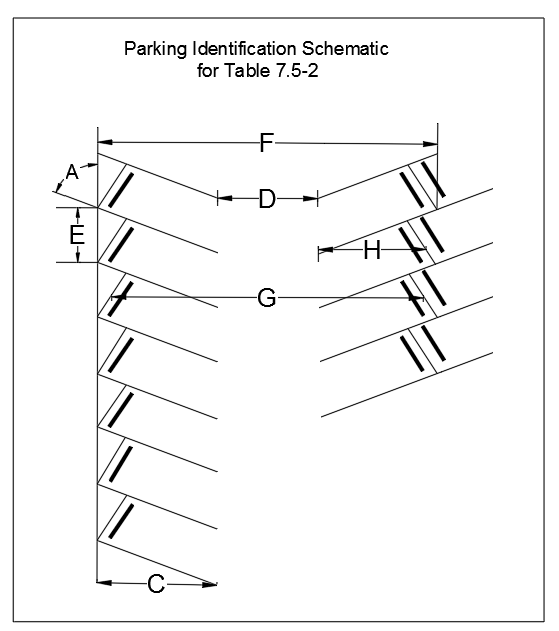
All off-street parking spaces shall be a minimum of nine and one-half feet wide and shall meet the criteria found in Table 7.5-2 below:
2.
Off-street parking spaces shall be located within 600 feet from the primary public entrance to the building or use they are intended to serve.
3.
A minimum queuing distance of 20 feet is required between property line and the first parking space.
4.
Parallel parking spaces shall be a minimum of 23 feet long and ten feet wide.
5.
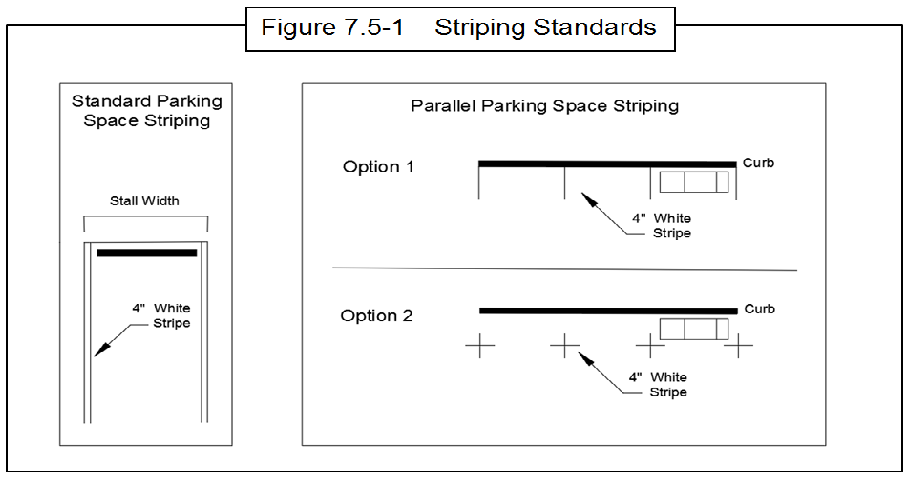
Where double striping is used between spaces, the width shall be measured from the centerline of one set of stripes to the centerline of the corresponding set of strips.
6.
Standard and parallel parking space striping shall be four inches wide and shall be as shown in Figure 7.5-1. Parking space stripes shall be painted white except for handicapped spaces which shall be painted blue.
7.
Required off-street loading spaces shall be subject to the following minimum dimensional standards in Table 7.5-3, unless a reduction to the minimum standards is approved:
8.
Parking areas shall be designed to provide for safe and convenient pedestrian pathways, bikeways, parking aisles and driveways.
9.
Paving, lighting, retention walls, sidewalks, fences, curbs and other amenities in parking areas shall be maintained in good appearance and in safe operating condition.
10.
Paved, landscaped or graded pedestrian walks shall be provided from building entrances to roads, parking areas and other adjacent buildings.
11.
Where off-street parking spaces are perpendicular and adjacent to a structure, a paved pedestrian walkway shall be provided between the front of the parking spaces and the structure's primary entrance. The walkway shall be a minimum clearance of five feet wide exclusive of vehicle overhang and shall be separated from the parking space by either concrete wheel stops or continuous curbing. Residential vehicular use areas are exempt from this standard.
12.
The drainage design shall be reviewed and approved by the Wellington Engineer before a permit may be issued.
13.
Unless otherwise provided in this section all parking areas and specialized vehicular use areas shall be improved either with:
a.
A minimum of a six inch shellrock or limerock base with a one inch hotplant mix asphaltic concrete surface;
b.
A base and surface material of equivalent durability, as certified by the developer's engineer; or
c.
An alternative surface approved by the Wellington Engineer. Responsibility for pavement failure occurring as a result of inadequate alternative base and surface material design shall fall on the certifying engineer.
14.
For uses and associated features approved by the Wellington Engineer, the developer may construct surface parking lots with shellrock or other similar material except for parking areas connected to a paved public road. When the parking area is adjacent to a paved public right-of-way, a paved driveway apron must be constructed extending a minimum of 24 feet wide and 60 feet long from the edge of the paved roadway in all directions. This shall also apply in the EOZD unless cattle grates are provided, then the apron may be reduced to 20 feet from the edge of the paved roadway.
15.
Wheel stops or continuous curbing shall be placed two and one-half feet back from walls, poles, structures, pedestrian walkways or landscaped areas. The area between any wheel stop and required landscaped strip may be landscaped to reduce the paved space area 15 to 16 feet in length, depending on the angle of parking provided.
16.
Lighting shall be arranged and designed so that no source of light is directed toward any adjoining or nearby land used classified for residential use. Parking lot lighting shall comply with the outdoor lighting standards of this article.
17.
Traffic control signs and other pavement markings shall be installed and maintained to comply with the Standards Manual on Uniform Traffic Control Devices.
18.
Stormwater runoff from vehicular use areas shall be controlled and treated in accordance with all applicable Wellington standards in effect at the time an application is submitted.
19.
Each parking space shall have appropriate access to a road or an alley. Previously approved dwelling units with no more than two parking spaces shall be allowed backward egress onto a local road. In all other cases, multiple parking spaces shall share a driveway with all maneuvering and access aisle area to be sufficient to permit vehicles to enter and leave the parking area or specialized area only in a forward motion.
I.
In addition to meeting the minimum off-street parking and loading standards of this section all drive-through establishments shall meet the queuing standards listed below:
1.
Queuing shall be provided for all drive-through establishments. Each queuing lane shall be clearly defined and designed to not conflict or interfere with other traffic using the site. Each queuing space shall be a minimum of ten feet wide by 20 feet deep;
2.
A minimum ten-foot wide by-pass lane shall be provided before or around the point of service. Subject to DM approval, a by-pass lane may not be required if the queuing lane is adjacent to a parking lot or lane which could function as a by-pass lane. The by-pass lane shall be clearly designated and distinct from the queuing area; and
3.
For each queuing lane, the minimum number of required queuing spaces, including the one the vehicle being serviced shall meet the criteria of Table 7.5-4. Unless otherwise indicated, queuing shall be measured from the front of the stopped vehicle located at the point of service to the rear of the queuing lane. One queuing space shall be provided after the point of service for all uses before conflicting with other circulation aisles.
J.
Parking Structure Standards:
1.
All public or private parking garages may be used to meet off-street parking standards for any use or combination of uses. All public or private parking structure shall comply with the standards for surface parking lots with regards to marking, signage and minimum number of spaces to be provided.
2.
When the parking facilities are combined with a multi-storied structure or on the roof of a building, a site plan shall be submitted for approval of interior traffic circulation, slope of ramp, ease of access and utilization of ramps, parking space and aisle dimensions, proper traffic control signage and pavement markings for safe and efficient vehicular and pedestrian operation, location of entrances and exits on public roads, sight distances at such entrances and exits and at corners of intersecting public roads and the effective screening of the cars located in or on the parking structures from adjoining lands and from public roads.
3.
The unobstructed distance between columns or walls measured at any point between the ends of the parking aisle shall be as specified in Table 7.5-5.
K.
Grass parking may be permitted if approved by the Wellington Engineer and shall comply with the following standards:
1.
The applicant shall submit, as part of the development order application, the following:
a.
Site plan showing the proposed grass parking area(s);
b.
Circulation plan and method of traffic control to direct flow of traffic;
c.
A written statement acknowledging the proposed grass parking area(s) shall not be used for more than three days/nights each week or on an irregular/part-time basis of no more than 45 days/nights within a period of four consecutive months within a 12-month period. This information shall contain the proposed hours and days of the expected use and expected average daily traffic and peak hour traffic counts as calculated by a professional engineer qualified to perform such studies;
d.
A conceptual drainage plan for the entire parking area; and
e.
A description of the current soil conditions and the engineered soil type of the area proposed to be used for the grass parking.
2.
Only parking spaces provided for temporary peak demands may be approved as grass parking. Paved parking shall be provided for the average daily traffic, including employees and visitors.
3.
Grass parking shall not be located in landscaped areas, surface water management areas or easements other than those dedicated for utility purposes.
4.
All access aisles within grassed parking areas shall either:
a.
Be paved and meet the same substructural and surface standards as paved asphaltic parking surfaces; or
b.
Be surfaced with paver block or other semi-pervious coverage approved by the Wellington Engineer.
5.
If at any time the Wellington Engineer determines that the grassed parking area does not meet the standards established in this section, the property owner shall be required to restore the grassed surface and/or require that paved parking be provided and the grass parking no long service the use.
6.
Grass parking area shall be maintained to ensure a viable and healthy grassed surface and present a neat appearance at all times.
Sec. 7.6.1. - General.
All exterior lighting shall be designed to minimize direct light spillage, sky glow and hazardous interference with vehicular traffic on adjacent rights-of-way and all adjacent properties. Lighting shall be the minimum necessary to discourage vandalism and theft. All light fixtures shall utilize a cutoff-type luminaire with less than 75 degree cutoff.
A.
All outdoor lighting, except for street lights, shall meet the following standards:
1.
All outdoor lights shall, to the greatest extent possible, confine emitted light to the property on which the light is located and shall not be directed upwards, unless when intending to accent a surface of a building façade, landscaping, artwork or for any other decorative purpose. Upward lighting shall be aimed at the intended surface and shielded from projecting into the sky.
2.
All light in excess of 800 lumens (equivalent to a 60 watt incandescent light bulb) shall be a "white light," unless approved by ARB. Single-family residential homes shall be exempt from the "white light" requirement for accent lighting less than 450 lumens (equivalent to a 40 watt incandescent light bulb).
3.
All lighting shall not create adverse spillover or glare on adjacent properties or rights-of-way.
4.
Permitted light fixture height:
a.
Residential lots over ten acres may have fixtures a maximum of 18 feet in height and a minimum of five feet from the property lines.
b.
Multi-family and non-residential properties may have fixtures a maximum of 25 feet in height within parking lot areas and 15 feet in height within non-vehicular pedestrian areas.
c.
Commercial equestrian arenas, sports arenas, amphitheaters, stadiums or public recreational areas may have fixtures a maximum of 90 feet in height within the confines of the activity areas, 30 feet in height within parking areas and 15 feet in height within non-vehicular pedestrian areas.
d.
Light fixtures attached to a building shall not be installed above the roofline.
e.
When abutting a residential district, outdoor fixtures shall be no more than 15 feet in height within ten feet of any property line.
5.
Flood, security, camera or similar lighting shall not be directed toward any residential lot or create a safety and/or traffic hazard. Security lighting shall be required for non-residential, multi-family residential and common areas of single-family developments utilizing principles of Crime Prevention Through Environmental design (CPTED) as found in the DRM. Security lighting provided from dusk to dawn or when a business is closed shall not exceed 50 percent of the required light levels.
6.
Exterior holiday lighting shall be permitted November 1 through January 31.
7.
Time restrictions shall be required for all external luminaries or luminaries visible from the exterior of a structure to reduce light pollution and conserve energy while providing for public safety per CPTED guidelines.
a.
The illumination of outdoor areas or luminaries visible from the exterior of a structure of all non-residential development which exceeds 800 lumens (equivalent to a 60 watt incandescent light bulb) shall be extinguished at 11:00 p.m., or by issuance of a special permit use up to one hour after use of the area or an approved special event.
b.
All Wellington public recreational facilities, areas, pedestrian paths or multi-purpose paths are exempt from time restrictions.
c.
Security lighting shall be allowed for building entrances and parking areas. All security lighting shall utilize the minimum illumination required to ensure public safety and include CPTED or other strategies as determined by the Wellington Engineer.
d.
Automatic timing devices (on Eastern Standard Time) with photo sensor or time clocks shall be required for all site lighting and parking areas.
B.
Street lighting shall be installed and maintained by the developer, property owners' association, its successor and/or assigns, as part of a developments' or subdivisions' infrastructure. Street lights along public rights-of-way shall be maintained by Wellington or designee, after completion by the developer and acceptance by Wellington's Engineer. Properties within the equestrian preserve area are exempted from the requirement to install street lights, except if required by the Wellington Engineer or Council as part of a development permit/approval. Street lights shall meet the following standards:
1.
Installation shall be outside of rights-of-way, road tracts, or any other areas designated for road purposes and conform to the standards of the utility company.
2.
Street lights shall be wired for underground service, except aerial service is permitted in the rural areas, equestrian preserve area and pursuant to the exceptions to underground installations standards in Article 8.
3.
A maximum height of 25 feet shall be required for street lights along all platted road rights-of-way with a width of 32 feet or greater. This height limitation is excluded for rights-of-way under Palm Beach County and Florida Department of Transportation (FDOT) jurisdiction.
4.
Lights shall be sized and spaced to provide a minimum sidewalk and pavement illumination of 0.4 foot-candles. The fixture shall be designed to direct light away from residences and onto the sidewalk and road.
5.
Street lighting for public and private rights-of-way shall be designed in accordance with Florida Power & Light (FPL), FDOT or Illuminating Engineering Society of North America (IESNA) recommended practices as determined by the Wellington Engineer to ensure public safety.
6.
Decorative lighting a maximum of 15 feet in height shall be installed for pedestrian pathways along public and private roads if required or approved by council or Wellington Engineer, as part of a development order approval.
C.
The following types of lights are prohibited:
1.
Blinking, flashing, moving, revolving, changing color or intensity and flickering lighting.
2.
Any upward-oriented lighting unless otherwise provided for in this section.
3.
Any unshielded light source in a luminaire with no light cutoff visible within the normal range of vision from any residential property.
4.
Any light which creates an observable glare that is hazardous within the normal range of vision to any public right-of-way.
5.
Any light which resembles an authorized traffic sign, signal, traffic control device or interferes with or confuses traffic as determined by the Wellington Engineer.
6.
Searchlights, beacons and laser-source lights except when associated with an event approved by a special permit or if required by state or federal law.
D.
All lighting fixtures and support structures design shall be compatible with the proposed architectural character of the development, the surrounding community and for street lighting the existing lights along surrounding roadways. The design shall enhance integral design element of the project and be consistent for the entire site, through style, material and color (dark colors such as black or bronze). The design, colors (light, fixture, structure) and material of outdoor lighting fixtures and structures shall require ARB approval for residential and non-residential developments prior to permitting.
E.
Expansions, renovations, maintenance and relocation of lighting fixtures and support structures shall be permitted to install lighting fixtures similar in height and design of the previously approved existing fixtures and structures for the development.
F.
Minor amendments within an existing development for lighting plans, including lighting fixtures, structures (pole and wall-mounted), location, height, colors (light, fixture, structure), materials and photometric plan shall be submitted with all permit applications for developments (except for single-family detached dwelling units) with external luminaries or luminaries visible from the exterior of a structure. The photometric plan shall be signed and sealed by an engineer registered to practice in Florida and shall not include time averaging or other alternative methods of measurement. Certification of compliance signed and sealed by an engineer registered to practice in Florida shall be required prior to the issuance of a certificate of occupancy.
G.
The mounting height of light fixtures shall be the vertical distance from grade elevation of the surface being illuminated to the highest point of the fixture.
H.
Lighting shall be designed to prevent direct glare, light spillage and hazardous interference with automotive and pedestrian traffic on adjacent roads and all adjacent properties. Spillover light shall not exceed three-tenths of one foot-candle when measured six feet above grade at the property line of the light source. The minimum and maximum illumination levels (foot-candle) shall not exceed the Palm Beach County Outdoor Lighting illumination levels for the specific use type and site element or the above spillover standard. The Illuminating Engineering Society of North America (IESNA) recommended practices illumination levels or other state or federal standards, or as determined by Wellington engineer, shall be used when levels are not provided for a use type or site element.
I.
Illumination levels shall be measured in foot-candles with a direct-reading portable light meter. The light meter shall be placed at six feet above ground level at the property line of the subject parcel. Comparable measurements shall be made after dark with the lights in question are on and then with the same lights off. The difference between the two readings shall be compared to the maximum permitted illumination in order to determine compliance with this section.
J.
All lighting shall meet the requirements of Florida Statutes and Florida Building Code. Lighting shall also be consistent with the applicable provisions of Palm Beach County Lighting and Security Code, IESNA recommended practices or other nationally recognized standards as determined by the Wellington Engineer to ensure public safety.
K.
All lighting shall be in working order and maintained in a manner that ensures safety, security and original aesthetic appearance at all times.
Sec. 7.7.1. - General.
Preservation of critical resources, tree protection, and performance standards shall apply to all property, unless specifically exempt from this chapter, and shall be achieved through the following:
A.
Wetlands and native vegetation:
1.
Limitations on the timing and extent of removal of vegetation from a site;
2.
Required compliance with state and federal wetland regulations; and
3.
Establishment of minimum criteria for wetlands.
B.
Tree protection:
1.
Incorporating existing trees into site design when possible;
2.
Establishing the Wellington Tree Fund;
3.
Prohibiting destructive clearing or grubbing to protect trees;
4.
Limiting the removal of trees before a site plan or building permit are issued;
5.
Requiring removal of invasive trees and vegetation;
6.
Requiring that a vegetation removal permit for all removal prior to commencement; and
7.
Mitigating vegetation removal with replacement regulations to ensure the protection of Wellington's tree canopy, protect specimen trees and enhance the aesthetic appeal of trees and the positive effect that trees have on property values.
C.
Providing performance standards that will ensure compliance with Palm Beach County Wellfield Protection, Listed Species (plant and/or animal) and Wellington's regulations related to noise, vibration, smoke, dust and other particulate matter as they related to air and water quality.
Sec. 7.7.2. - Wetlands.
A.
General regulations:
1.
When a development application is submitted to Wellington for subdivision, master plan or site plan approval, the application shall include an environmental site assessment which identifies wetland areas, which includes any native buffers, within or encroaching on the parcel.
2.
If the environmental site assessment verifies the existence of wetlands, the application shall include a written determination from the appropriate state and federal agencies such as the SFWMD, FDEP and the ACOE along with a determination the wetlands are jurisdictional or non-jurisdictional.
3.
No net loss of function from wetlands as defined by the state (F.S. ch. 373) and federal (40 CFR Part 232) government shall be permitted within Wellington, except as specifically provided in this section.
4.
If the environmental site assessment identifies jurisdictional wetlands, the applicant shall comply with all agency regulations for on-site/off-site mitigation and protection. A copy of the mitigation plan, approved by the applicable agency, shall be submitted to Wellington prior to any alteration of on-site wetlands or mitigation within the Wellington Boundary.
5.
If the wetlands are deemed to be non-jurisdictional, the following shall apply:
a.
Whenever possible, the wetland areas should form a contiguous tract with, or link to, nearby upland preserves or wetlands to create, or further enhance, a wildlife corridor;
b.
Wetlands are recommended to be at least one-half acre in size to maintain long-term viability and maximize wildlife utilization.
c.
All designated wetlands shall be protected by a minimum 25-foot wide transitional buffer, which must contain native plant materials and slope protection.
d.
Wetlands and associated buffers shall be designated on the site plan or plat and be protected by a Maintenance and Preserve Management Plan (MPMP) in accordance with this section.
e.
The wetland areas shall be maintained in its natural state, except that invasive non-native vegetation shall be removed prior to the issuance of a certification of occupancy/completion.
6.
Jurisdictional and non-jurisdictional Wetland areas shall be protected for the entire duration of construction by a minimum 25-foot wide protective setback/buffer and temporary perimeter fence. The following shall apply:
a.
Construction activities shall not commence until the PZB director has verified that the preserve area is properly fenced and marked using metal or wood stakes and flags;
b.
During construction, no earthwork, storage of materials, equipment or placement of structures (temporary or permanent) shall be within the protective setback area. The wetlands shall be protected from stormwater runoff from the adjacent property.
Sec. 7.7.3. - Listed species.
If the environmental site assessment reveals the presence, or probability, of listed species the following shall apply:
A.
The applicant shall submit written evidence to the PZ division of coordination with the applicable agencies concerning the listed species;
B.
The applicant shall take the actions determined to be appropriate by the regulating agency to preserve the listed species; and
C.
Relocation of listed species to an off-site preserve may be permitted providing that the regulating agency approves a relocation plan and the approved plan is submitted to the PZ division.
D.
Additional general information related to listed species is available in the DRM.
Sec. 7.7.4. - Maintenance and preservation management plans.
A.
Wetland preserve areas and/or areas that contain listed species shall coincide with conservation easements for their perpetual protection, consistent with F.S. § 704.06. The conservation easements shall be held by Wellington and shall be subject to the review and approval of the Wellington Attorney prior to issuance of a final development order. Perpetual protection and maintenance of the preserve area shall be assured through one of the following:
1.
Dedication of the preserve area to an appropriate Wellington, county, state or federal agency. The applicant shall provide written verification of this dedication, including a written statement from the public agency accepting the dedication prior to issuance of a final development order. The written verification shall also address the availability of adequate technical, including provisions for access, and financial resources for perpetual maintenance and protection of the preserve.
2.
Dedication of a preserve area to a homeowner's or property owner's association provided:
a.
The preserve area shall remain undivided. A covenant shall provide that such areas have been encumbered for the perpetual benefit of the public as well as members of the association and all future use shall be consistent with the MPMP.
b.
The covenants shall contain an obligation by members of the association to pay for and ensure implementation of proper care and maintenance of the preserve areas.
c.
The covenants are reviewed and approved by the Wellington Attorney prior to the issuance of the final development order.
B.
The only uses permitted in preserve areas are passive recreation, observation uses, and preserve maintenance. These uses may be further limited if listed species are present.
C.
Applicants for development approval or restoration plans for sites that contain wetlands or a listed species shall submit a MPMP for review and approval by the PZB director. MPMP submittal requirements are found in the DRM and the MPMP shall be incorporated into the development approval by reference.
D.
MPMP shall not be allowed without a development order amendment or approval by the PZB director.
Sec. 7.7.5. - Tree protection standards.
A.
By adoption of this article, Wellington has created the Wellington Tree Fund (TF) to ensure the future growth and sustainability of the tree canopy throughout the village. The TF will collect money from property owners that remove trees for a variety of reasons, including development, and either have physical site constraints or the desire to not provide on-site mitigation of the trees. The criteria to qualify for a payment in lieu of replacement are provided below in this section. The TF will be used to purchase and plant trees on Wellington owned property for the establishment and restoration of the village-wide tree canopy. Staff will review the established fees once every three years and proposed an increase to council when applicable.
B.
Specimen trees are an important natural resource of Wellington deserving protection. The incorporation of existing specimen trees into the project design is preferred to any mitigation option in this section. Specimen trees are defined in Article 3 and listed in Table 7.7-1.
C.
The removal of trees, specimen or non-specimen, shall comply with the following criteria, unless otherwise provided for in this article:
1.
Tree replacement criteria:
2.
No mitigation or replacement is required for single family lots, if the remaining quantity, types and sizes satisfies the minimum lot requirements of the LDR.
3.
On existing single-family lots, the PZB director, or designee, shall have the authority to reduce, partially or in full, the replacement requirement below the code minimum when justification is provided from the property owner, and agreed upon by the director, that physical site constraints, which may include other mature trees, would hinder the ability to plant the trees on-site. The property owner shall provide a payment in lieu of the replacement of $100.00 per tree to the TF. This request shall be made part of the vegetation removal permit application and upon approval the tree fund fees will be collected.
4.
On all other lots, up to 25 percent of mitigation tree credit can count towards the required landscape minimum if a payment in lieu of $600.00 per tree is made to the TF. The tree board may authorize a payment in lieu that exceed 25 percent of the required mitigation trees due to physical site constraints that would hinder the ability to plant the trees on-site. To calculate the maximum number of required trees that can be requested for payment in lieu of planting on site, the result is rounded down to the nearest whole number.
D.
Speculative clearing and grubbing of a site is prohibited.
E.
Mitigation trees shall be planted with a minimum two inch DBH, minimum ten feet in height and spaced a minimum of 20 feet on center.
F.
Tree relocation and replacement shall be done in accordance with standard forestry practices to promote tree establishment and survivability.
G.
Invasive species shall be removed from the site prior to issuance of a certificate of occupancy. Invasive species are also encouraged to be removed on existing sites when identified. They may not be counted toward the code minimum requirements for a site. The list of invasive species is provided in the DRM and is maintained by the Florida Exotic Pest Plant Council.
H.
To protect trees during construction, the following construction measures shall be implemented:
1.
No excess soil, additional fill, equipment, liquids, construction debris or equipment shall be placed within the drip line of any tree.
2.
No soil shall be removed from within the drip line of any tree.
3.
Protective barriers shall be installed and maintained beginning with the commencement of any land clearing or building operations and ending with the completion of the permitted clearing or building construction work on the site per the installation provisions found in the landscape standards of this article.
Sec. 7.7.6. - Vegetation removal permits.
A vegetation removal permit shall be required for the removal of all vegetation within Wellington, unless specifically exempt in the LDR. Vegetation shall include trees, palms, shrubs, hedges, groundcover and sod varieties.
A.
Vegetation removal permit requirements:
1.
The property owner shall submit a vegetation removal permit application to the planning and zoning division, including any additional information the PZB director deems necessary, for review. The vegetation removal permit shall be considered a Type A1 application and processed according to the criteria of Article 5. The submittal requirements are found in the DRM.
2.
A vegetation removal permit application that proposes to remove more than five trees shall include a tree survey as defined in Article 3 of the LDR. If the trees cannot be incorporated into the site plan design, the applicant shall also submit a modified tree survey indicating the location and proposed method of mitigation.
B.
A vegetation removal permit shall be issued if one or more of the following apply:
1.
Due to natural circumstances the vegetation is irreparably damaged, dead and/or is diseased.
2.
The vegetation is in danger of falling and/or located in danger proximity to an existing structure that may result in damage.
3.
The vegetation interferes with utility services or creates an unsafe visual clearance for pedestrian and vehicular traffic.
4.
The vegetation is located in the buildable area of the site, unreasonably restricts the permitted use and cannot be relocated on site due to viability, age, type or size.
5.
Justification has been provided with the permit showing removal of the tree is in the public interest.
C.
Vegetation removal permit issuance and expiration:
1.
A separate vegetation removal permit is not required if a development application is approved with a companion landscape plan, alternative landscape plan or planting plan and a tree survey was submitted as part of the application. The stamped plans will act as the approval to remove, mitigate and replace the vegetation.
2.
Any modification to a previously approved plan, that requires removal of approved vegetation, shall require a vegetation removal permit.
3.
Any land development permit or building permit application that requires removal of vegetation shall require a vegetation removal permit. The applications may be submitted concurrently for review by the respective agencies. A building permit may be issued prior to the satisfaction of the conditions of the vegetation removal permit, however a certificate of completion (CC) or occupancy (CO) may be withheld if the conditions of the vegetation removal permit are not completed at the time the CC or CO is requested.
4.
All vegetation removal permits shall expire 60 days after the date or issuance. The PZB director may administratively extend the removal permit for a maximum of 60 days. A request for extension of a permit must be made in writing to the PZ division prior to the expiration of the permit. Any work not completed within this period shall require submission of a new vegetation removal permit application and fees.
D.
The following are exempt from the requirement to obtain a vegetation removal permit:
1.
The minimum removal of vegetation, by a Florida licensed land surveyor, for the performance of their duties, provided the area cleared shall not exceed five feet in width and only require a hand tool to facility removal of vegetation. If survey lines greater than five feet in width are needed, then a vegetation removal permit from Wellington shall be required.
2.
The removal of vegetation by Wellington or Palm Beach County for environmental enhancement or restoration.
3.
The removal of vegetation during a period of officially declared emergency such as hurricane, flood or disaster. In this circumstance, the PZB director may waiver certain requirements related to tree protection.
4.
When the only vegetation proposed to be removed is located within the footprint of the proposed structure(s).
Sec. 7.7.7. - Enforcement and penalties.
In addition to the enforcement section of Article 1, critical resources and tree protection shall be enforced in accordance with the following:
A.
Critical resources:
1.
A minimum violation of this section shall be based on the unauthorized alteration or removal in increments (rounded up) of 1,500 square feet of wetlands and preserve areas, with each additional increment considered a separate violation to be added to an aggregated area.
2.
Each 1,500 square feet, or portion thereof, damaged or destroyed wetlands and preserve areas shall be restored to pre-damage conditions at the property owner's expense. The violator shall submit a restoration plan to the PZB director for review to restore the area(s) to pre-damaged conditions. Once the restoration plan is approved, the violator shall post a bond in an amount equivalent to the costs for implementing the restoration plan. If the extent of the damage is such that viable restoration on site is not possible then off-site mitigation shall be required at a multiplier of three times the land area to be restored. Payment in lieu of restoration of an existing preserve shall not be accepted.
3.
If a restoration plan is not submitted within 30 days following the notice of violation, Wellington may suspend issuance of any further permits for the property including suspension of building permits, inspections, occupational licenses and development orders.
4.
If after 60 days of the notice of violation a restoration plan has not been submitted Wellington may place a lien on the property in an amount equal to the sum of any accumulated and ongoing unpaid fines and the reasonable cost for repairing the damage. Once collected these funds may be used for the acquisition, restoration or enhancement of publicly-owned conservation parcels or preserve areas in Wellington.
5.
In addition to the critical resource enforcement standards, alterations that include the removal of trees shall be subject to the provisions of tree protection enforcement standards,
B.
Trees:
1.
Hazardous trees: If a tree or its limbs leans, encroaches or falls into an adjacent right-of-way, Wellington may deem the tree a public hazard and require its removal. Failure to remove such tree after Wellington provides notice that it is a public hazard is a violation of this section.
2.
The following shall be considered separate violations:
a.
The removal of a tree without a permit.
b.
Continued endangerment and neglect of each remaining tree(s).
c.
Each day a violation exists for such unlawful removal.
3.
If a tree removed without a vegetation removal permit is an invasive or a dead tree, the property owner will be advised in writing of the requirement to obtain a permit. Repeated unauthorized removal of invasive or dead trees may result in fines for each occurrence.
4.
For all other trees, a fine of up to $100.00 per day, per tree removed, may be imposed based on the violation findings and fine certification by the special magistrate. Wellington may suspend issuance of permits, inspections and occupational licenses while such violation is pending. Wellington may place a lien on the property in an amount equal to the sum of any unpaid fines and the reasonable costs for removing and installing the unlawfully removed.
Sec. 7.7.8. - Performance standards.
A.
Noise:
1.
Any emission of noise in excess of the noise standards in the Code of Ordinances shall be deemed a public nuisance. The code compliance division may investigate a violation of the noise standards complaints. If a violation is documented, the Wellington Attorney may file injunctive proceedings to abate the nuisance. These proceeding shall be cumulative and in addition to the penalties provided for in the LDR or Code of Ordinances.
2.
Any noise exemptions provided in the Code of Ordinances shall apply to the LDR.
B.
Vibration: In all non-industrial districts, no use shall be operated so that ground vibration is produced and noticeable without the use of vibration detections instruments at the property line on which the use is located.
C.
Smoke, emissions and particulate matter:
1.
All uses shall operate in full compliance with the air pollutions standards as provided by the State of Florida, Palm Beach County Public Health Unit (PBCPHU) and Wellington LDR and Code of Ordinances.
2.
In addition to any Wellington Code of Ordinances, all uses shall operate in compliance with the visible emission limiting standards as provide by the Florida Department of Environmental Protection (FDEP), Ringlemann Chart — Opacity not to exceed 20 percent. All measurements shall be taken at the point of emission. For the purpose of determining the density of smoke, FDEP regulations and Rule 62-296, F.A.C. shall apply.
3.
All uses shall operate to prevent the emission of dust or other solid particulate matter into the air which may cause danger to land and/or the health of persons or animals at, or beyond, the lot line of the premises on which the use is located.
D.
Odor: No use shall produce the emission of objectionable or offensive odors in such concentration that is readily perceptible at or beyond any point of the property line on which the use is located, in accordance with Rule 62-296, F.A.C.
E.
Toxic matter: No use shall discharge toxic matter or produce toxic matter in such concentrations that are detrimental to or endanger public health, safety, comfort, and/or welfare across the property lines on which the use is located.
F.
Radiation:
1.
Any operation involving radiation, i.e. the use of gamma rays, X-rays, alpha and beta particles, high speed electrons, neutrons, protons and other atomic or nuclear particles, shall be permitted only in accordance with the regulations of the Florida Department of Health, Office of Radiation Control and FDEP.
2.
No person shall operate or cause a source of electromagnetic radiation which does not comply with the regulations of the Federal Communications Commission (FCC) or result in abnormal performance degradation of electromagnetic receptor as determined by the principles and standards of the American Institute of Electrical Engineers, Institute of Radio Engineers and Electronic Industries Association.
3.
No use, activity or process shall be conducted which produces electromagnetic interference with normal radio, phone or television reception in any district.
Sec. 7.7.9. - Exemptions.
A.
General exemptions from this article are as follows:
1.
Any alteration in accordance with design specifications, under the direction of utility agencies, water control or management districts, where the activity has received all required construction and/or operating permits.
2.
Alterations or activities associated with government maintained parks, recreation areas, wildlife management areas, conservation areas, preserves and environmental enhancement projects.
3.
The lots of record or lots on a recorded legal subdivision plat that do not include a wetland or preserve for listed species.
4.
Undeveloped parcels, or portions of parcels, with an existing valid development order that do not include a wetland or preserve for listed species. This section shall apply to any request to modify a development order or permit for such parcels.
Sec. 7.8.1. - General landscape standards.
A.
All plants shall comply with, or exceed, the minimum standards for Florida Number 1 at installation in accordance with the State of Florida Department of Agriculture and Consumer Services most current edition of "Grades and Standards for Nursery Plants".
B.
All landscape is subject to the maintenance, pruning and replacement requirements of this section. The replacement of trees may also be eligible for the tree fund payment in lieu of option, in accordance with the tree protections standards of this article.
C.
Wellington has adopted a preferred species plant list which can be found in the DRM. Fifty percent of the required plantings shall be selected from this list.
D.
When more than six trees are required to be planted in order to meet the minimum landscape standards of this chapter, a variety of species shall be required. The number of species planted shall increase by one species for each ten trees. A minimum ten percent of all required vegetation shall be flowering trees and 20 percent shall be of a palm species.
E.
A minimum of 50 percent of the required trees on a lot/parcel shall be installed at a minimum size relating to the building roof height according to Table 7.8-1. The minimum planting area of a tree shall be 120 square feet (10 ft. × 12 ft.). The ground within the tree planting area shall receive appropriate landscape treatment including mulch and ground cover.
All other tree sizes shall be as follows:
1.
Flowering trees at time of installation shall have a minimum height of ten feet and a minimum crown spread of four feet.
2.
Palms used to fulfill code requirements shall have a minimum ten feet of CT and 14 feet in overall height, with a minimum trunk diameter of six inches at the time of installation.
3.
A minimum 18-foot GW palm can be substituted with groups of three staggered height palms between 12 and 16 feet CT.
4.
All measurements shall be from the top of the root ball.
F.
Palm clusters may be used to meet the minimum lot/parcel tree requirements; however, palms susceptible to lethal yellowing shall not be used to comply with this chapter.
1.
Palms with trunks less than six inches in caliper shall be specified in groups of no less than three to be considered a replacement for one tree. In the case of species of palms which characteristically grow in clumps, each clump of three or more trunks shall be considered to be one tree. Palm groupings and clumps must meet height requirements of this section.
2.
Accent or feature palms, include Royal Palms, Bismarck Palms, Coconut Palms, large Date Palms or other acceptable accent palm species, may be counted as one required shade tree. These palms shall not exceed a maximum of 25 percent of the total number of trees required.
G.
The following shall apply to hedges and shrubs at the time of installation:
1.
Hedge material shall be a minimum of 24 inches in height or 18 inches in height for native species. Required hedges shall form a continuous solid opaque visual screen of at least 36 inches in height within two years of planting. Additionally, 50 percent of the materials shall be composed of vertical landscape material at least 36 inches in height. The height of the plant material should not remain uniform and should be designed to meander within the buffer area.
2.
Shrubs shall be a minimum of 18 inches in height or 12 inches in height for native species. At least ten percent of all required shrubs shall be a flowering species. The number of species to be planted shall increase by one species for each 50 shrubs required. Shrubs shall be planted in masses to provide a continuous solid mass within two years of planting.
H.
Ground cover shall consist of turf grasses and/or low-growing vegetation. Ground cover shall be installed a minimum of six inches in height. The ground surface within required landscaped areas, or the preservation of existing or new vegetation, shall receive appropriate treatments such as, mulch or shrubs and shall present a finished appearance upon planting. Sand, gravel, shellrock or pavement alone are not considered appropriate landscape treatments. The following standards shall apply to the design of ground treatment:
1.
Live materials used as ground cover shall provide a minimum of 50 percent coverage immediately upon planting and 100 percent coverage within three months after planting.
2.
Mulched areas without associated plantings shall be limited to a maximum of ten percent of the pervious area of the lot. Mulched areas may be wood-based or non-wood based and shall comply with the following:
a.
Shall be installed and maintained at a minimum compacted depth of three inches at all times in all planted areas not containing ground covers. All mulch material shall be seed and weed free to prevent spouting and regrowth. Cypress mulch is discouraged as it promotes the unnecessary destruction of wetlands.
b.
Recycled rubber mulch products, pebbles or decorative rock may be used as a ground treatment or in areas designed to accommodate limited roof runoff and where drainage is a problem.
3.
Grass areas shall be planted with species suitable for permanent lawns in Wellington. Grass areas may be sodded, plugged, sprigged or seeded provided solid sod shall be used in swales, rights-of-way or other areas subject to erosion. Seeded, plugged or sprigged lawns must be sown for immediate effect and maintenance shall be provided until coverage is complete. The use of Bahia sod or other drought-tolerant ground cover is required on cleared undeveloped parcels.
4.
Ground cover is not required in wetland areas shown on approved site or landscape plans.
I.
A list of prohibited species is provided in the landscape manual found in the DRM. Each landscape plan, planting plan or ALP required or permitted shall include a program to eradicate and prevent the reestablishment of prohibited plant species.
J.
A list of controlled species is provided in the landscape manual found in the DRM. Controlled species shall not be planted except as provided in the manual.
K.
The limited use of artificial/synthetic turf, grass, sod, lawn, etc., is allowed per the following standards:
1.
The use of artificial turf is limited to the following uses:
a.
Residential properties: Allowed in the rear and side yard areas if not visible from the right-of-way. Rear and side yard areas where artificial turf is visible from the right-of-way shall be screened from view by continuous opaque fencing or hedge material with a minimum height of five feet. Artificial turf shall be prohibited in front yards, except for the limited use as a decorative grid design with maximum four-inch wide strip used in conjunction with approved pavement materials for patio, walkway and driveway as approved with a building permit for the improvement.
b.
Residential common areas: Allowed in areas designated as recreation or amenity areas on the approved site plan.
c.
Non-residential:
i.
Commercial: Allowed in areas that are not required to meet the minimum landscape requirements and shall be designated on the approved site plan. Artificial turf shall be prohibited in designated landscape buffers, areas adjacent to, or visible from, any rights-of-way, drainage and swale areas, lake/canal bank, or other areas within the site that are not required to meet the intent of the landscape requirements as determined during the site plan review process.
ii.
Recreational areas: Allowed for athletic/activity fields, as designated on an approved site plan. All athletic/activity fields shall be designed to meet the industry standards for the intended use.
2.
An engineering permit shall be required prior to installation. At minimum, the permit application submittal shall include plans and documentation, including material specifications, dimensions, cross section(s), and installation details, including subgrade, drainage, base/leveling layer and infill. Additional specifications details, documentation and/or calculations may be required at the sole discretion of the Wellington Engineer.
3.
Materials used for an artificial turf system shall meet, or exceed, the following minimum standards:
[a.
Reserved.]
b.
Wellington shall determine if the artificial turf replicates the appearance, texture, and natural green color of live organic/natural turf, grass, sod, lawn, etc. A minimum 8" × 10" sample of the surface material shall be submitted with the permit application.
c.
The backing material shall be made of non-latex materials, and shall be permeable with a minimum of four layers. The underlying material shall be designed and installed to meet the applicable permeability rate necessary to meet the minimum compensating storage volumetric requirements. Provide documentation that the underlying material permeability rate meets the compensating storage volumetric requirements.
d.
The allowed surface fibers for outdoor use are Polethylene (PE) and Polypropylene (PP).
e.
The artificial turf surface fibers/blade and backing shall be made of durable materials that guard against fading, discoloration, wear, cracking, drying, and pile height reduction. Topically applied UV treatments are prohibited. An acceptable UV inhibitor is one that is mixed into the artificial turf fiber/yarn resin during the manufacturing process. The artificial turf shall be manufactured in the United States and have a minimum 10-year United States based warranty.
f.
Minimum pile (turf blade) height shall be 1.5 inches and minimum face weight of 65 ounces per square yard. Recreation areas with specialized surfaces for athletic/active fields, putting greens, bocce ball courts, etc., are allowed with a reduced pile height if engineered for the specific use and designated on an approved site plan.
g.
Natural organic infill and underlying materials that minimize solar/heat absorption, toxic contaminants and/or other negative environmental and health impacts shall be used.
h.
The artificial turf system (including infill) shall meet all applicable federal and state ratings for human health safety, environment, fire retardant, and other applicable standards per American Society for Testing and Materials (ASTM) standards. The turf yarn and backing materials shall be recycled or reused under normal conditions. Artificial turf from athletic/activity fields shall not be reused for residential use.
i.
All lab tests results, documentation, and/or product approvals showing the materials meet these standards shall be submitted with the permit application.
4.
Artificial turf system shall be considered impervious surface area for the purposes of determining drainage system flow capacity and stormwater management runoff treatment control requirements per the approved site plan and/or engineering plan. Drainage plans and calculations shall be submitted with the permit application. Ponding and pooling of water shall be a violation of the LDR. Artificial turf systems on residential properties shall be setback a minimum of three feet from the property lines in the rear yard areas, and in the side yard areas if 15 feet or more setback/separation is provided between the side property line(s) and on-site building(s)/structure(s). Artificial turf systems shall not be located closer than five feet back from the front plane on either side of the principal structure(s). Artificial turf systems in the rear and side yard areas shall be restricted to the maximum allowed impervious area/surface. Alternative setbacks on non-residential properties may be required depending on use and location of the artificial turf during the site plan and/or permitting process.
5.
Artificial turf systems shall not be located in any easements, including but not limited to drainage, water, sewer, utilities, or lake/canal maintenance easements, except as approved at the sole discretion of the Wellington Engineer.
6.
Landscaping (trees, shrubs, groundcover, etc.) shall be required when installed in areas with underlying materials to mitigate the heat island effect and in areas with surrounding hardscape/pavement, including foundation areas, landscape islands, and divider medians. Existing shade trees or shade trees required to be installed in areas with hardscape/pavement during the site plan or permitting/inspection process shall be allowed to grow to their natural full canopy spread. The shade tree shall be a species that will provide a minimum 75 percent coverage of the designated artificial turf areas once the tree is mature.
7.
The installation and maintenance of artificial turf shall:
a.
Appear natural at all times. Any deviation from a natural look due to improper installation or lack of maintenance shall be a violation of the LDR.
b.
Be visually level, with the grain pointing/running in the same direction and no visible surface seams between panels. Edges and seams shall be anchored and appear natural and groomed.
c.
Include infill material that is brushed in to ensure the fibers/blades are upright, hold the turf in place, and provide a cushion. Infill may not be required if the artificial turf is engineered for recreation areas with specialized surface and approved by the Wellington Engineer.
d.
Be separated a minimum of six inches from landscape areas and include a solid barrier (edging strip) to protect the health and growth of living vegetation, prevent intrusion of weeds and living vegetation, and prevent radiant heat on living vegetation. The solid barrier and artificial turf materials shall be anchored along the edges into a subgrade/material prepared for holding the anchor.
e.
Be designed to ensure that the irrigation system heads/pipes are capped off and/or directed away from areas with artificial turf. It shall be a violation of the LDR to irrigate artificial turf on non-athletic/activity fields.
f.
Include a maintenance process to inspect, test, and replace the turf as it ages or deteriorates and/or color fades. Maintenance shall include, but is not limited to, routine cleaning, brushing, debris removal, repairing, and replacement. Artificial turf shall be free of weeds, dirt/mud, stains, tears, holes, impressions, and abrasions. Cleaning and disinfecting (eliminate odors) of affected areas shall be conducted regularly, and immediately when necessary. The use of water to clean artificial turf shall be limited to the spot cleaning of affected areas as necessary. Continued/preventative maintenance is required to ensure the artificial turf functions/drains as permitted, and holds the aesthetic and design of the use it was approved. Failure to maintain, repair and/or replace the artificial turf in accordance with the LDR shall be a violation of the LDR.
(Ord. No. 2022-02, § 1(Exh. A), 2-22-2022)
Sec. 7.8.2. - Supplemental landscape standards.
A.
Single family and two-unit attached residential lots:
1.
One tree, 20 shrubs and ten ground covers shall be planted, or preserved, for every 1,500 square feet of lot area, excluding wetland areas and/or areas with listed species.
2.
A minimum of 25 percent percent of the required number of trees and 75 percent of the shrubs shall be planted, or preserved, in front of the front plane of the home. For a lot less than 4,500 square feet, the tree requirement shall be one tree in front of the home. The minimum required for a lot more than 4,500 square feet, shall be two trees in front of the home.
3.
Credit for existing trees may be given in accordance with tree credit standards of this section. The maximum number of new, or preserved trees, required as a result of this calculation is capped at this calculation or a maximum of 30 trees, whichever is less.
4.
No more than 75 percent of the pervious area on a lot may be planted with turf grasses. The balance of the lot plantings shall be shrubs, groundcovers, mulched or undisturbed native plant communities.
B.
Non-residential and multiple family lots:
1.
One tree and three shrubs shall be planted, or preserved, for every 1,500 square feet of a non-residential lot, or fraction thereof, excluding wetland areas and areas with listed species. This standard does not include trees, shrubs or hedges required to be planted in perimeter buffers and vehicular areas. Additional plantings are needed to meet buffer and vehicular area requirements.
2.
Foundation plantings shall be provided along the front, side and rear facades of non-residential and multiple-family structures, except for vehicle access areas such as garage entrances, bay doors, and if in conflict with access to above ground utilities and/or fire safety equipment. The minimum depth of the required foundation planting shall be five feet for each building story or a maximum of 25 feet. The combined length of the required foundation planting shall be no less than 40 percent of the total length of the applicable side of the structure. All required foundation plantings shall be planted with a minimum of one tree or three palms for each 20 linear feet of building façade, along with a combination of mass plantings of shrubs, a minimum of two to three feet in height, or mass plantings of appropriate ground cover, a minimum of six inches up to two feet in height, and accent plants.
3.
No more than 40 percent of the pervious area on a non-residential lot may be planted with turf grasses. The balance of the lot plantings shall be shrubs, ground cover, mulched or undisturbed native plant communities.
C.
Signage and equipment screening:
1.
A minimum three foot wide planting area shall be required around the base of all proposed freestanding signs. One shrub for each ten square feet of the total size of the monument sign shall be installed within the three feet planting area at the base of the sign. Monument signs shall be surrounded by colorful ground cover on all sides, in addition to the required shrubs. Landscaping and trees which interfere with the visibility of signage may be located outside of the sign viewing zone, subject to approval from the PZB director.
2.
All ground-based mechanical, electrical, water equipment, pump houses, etc. shall be entirely screened from public view on three sides, utilizing opaque materials and/or landscaping. Screening material shall accommodate maintenance or inspection access with the use of appropriate panels and/or hinged gates. All dumpsters shall be placed on a concrete pad and be entirely screened on three sides with a masonry wall and shrubs planted along the foundation of the wall.
D.
Access ways and public entries to projects:
1.
Planned developments shall have an overall landscape plan that meets the intent of the LDR and includes access ways, entry feature landscaping, buffer plantings, etc. for approval as part of their development order.
2.
All projects, including planned developments, shall meet the following criteria as it related public access ways and landscape design:
a.
The access way zone extends from the paving edge of the entry drive (not radius) for a distance equal to half the adjacent right-of-way width (i.e. 80 foot right-of-way = 40 linear feet) and is required on both sides of the entry drive. The zone also includes entry medians where provided. A minimum zone length of 40 linear feet per side is required for rights-of-way of less than 80 feet wide.
b.
All access ways designed for public entry shall comply with the following minimum standards.
i.
The access way zone requires two shade trees and four small trees per 40 foot section of the zone; large shrubs specified at a five-foot height minimum may be substituted for the small tree requirement on a 2:1 basis.
ii.
Access way medians require three trees per 40 linear feet as well as shrubs or groundcovers to cover the entire zone.
iii.
The use of accent of feature palm species is encouraged. A minimum ten-foot planting bed, containing low shrubs and/or ground cover must also be provided in front of the tree or palm plantings, in the access way zone and extend a minimum of five feet beyond the tree or palm plantings.
iv.
Service drives used exclusively for service access are exempted from these regulations.
v.
Alternate design schemes which meet the intent of this section may be approved at the discretion of the DM.
E.
Street trees: Street trees shall be shade species as provided in the landscape criteria of the DRM and are required along public and private roads at the time of road construction or infill development. Street trees shall be planted by the developer or builder prior to the issuance of a certificate of occupancy and maintained by the property owner or property association.
1.
One shade tree shall be required for every 30 linear feet of road frontage. Smaller trees may be substituted under overhead utilities as prescribed by FPL's "Right Tree, Right Place" Guidelines.
2.
Street tree placement shall follow horizontal offset requirements of Florida Green Book for all non-FDOT roadways.
3.
Where underground utilities limit street tree placement in the right-of-way, street trees shall be placed in alternative locations near and along the street as shown on an alternative landscape plan.
4.
Where construction timing will delay street tree placement a surety bond may be obtained for portions or all of the required street trees.
F.
Easements: Landscaping may be permitted in easements only with the written permission of all easement holders. Easements may overlap a required landscape buffer by a maximum of five feet provided there remains a minimum five foot clear zone for the buffer. Concrete block walls with a continuous footer shall require a minimum of five foot unobstructed area for planting. The landscape buffer may be traversed by easements or access ways as necessary to comply with the standards of this section and other Wellington regulations. Easements shall be identified prior to preparation of the landscape plan and any proposed overlap approved by the Wellington Engineer and/or utilities director.
1.
Trees planted within any easement with overhead utilities shall comply with the latest edition of FPL's "Right Tree, Right Place" Guidelines and take into consideration the mature height and spread of the species beneath or adjacent to existing overhead utilities. Existing trees shall be maintained so the canopy does not encroach within five feet of the overhead utility.
2.
No trees, shrubs or palms shall be placed within five feet of a designated utility or drainage easement or within ten feet of an underground service line, measured from the nearest point of the line to the nearest point of the trunk at the time of planting, without approval of the Wellington Engineer and the easement holder.
3.
No landscaping shall be placed within lake maintenance easements.
4.
Bio-swales and bio-retention facilities shall not be located in perimeter landscape buffers.
5.
Off-street parking lot islands and medians that may overlap easements must be designed to accommodate the off-street parking landscape requirements of this section. Parking islands may require additional width in order to accommodate easements and the required number or location of trees.
G.
Berms: Landscaped berms may be used in lieu of barriers, such as fences or walls, only when installed in conjunction with plant materials and if compatible with adjacent properties. Landscaped berms may be used to elevate the plant material but shall not be placed in the visibility are of a clear sight triangle. All berms shall not exceed three-to-one (3:1) slope. In areas where existing vegetation has been preserved, berms shall not be installed under the tree drip lines unless the viability of preserved trees and vegetation can be demonstrated. Drainage run off from perimeter berms shall be contained within the buffer area.
H.
Clear sight triangle: Vegetation located adjacent to, and within clear sight triangles, shall be trimmed so limbs or foliage do not extend into the required visibility areas. All landscaping within clear sight triangles shall be planted and perpetually maintained by the property owner in accordance with this section. Trees located within clear sight triangles shall be installed with a minimum of eight feet of clear trunk. Clear sight triangles shall be provided on both sides of all intersections and driveways and shall be measured as follows:
1.
As required by FDOT Design Standards (current edition) Index 546 "Sight Distance at Intersections" as may be amended, the limits of clear sight diagram and the design speed of the intersecting road shall be placed on the landscape plan sheet to demonstrate compliance.
2.
Vegetation shall be maintained to provide unobstructed visibility at a level between 30 inches and eight feet above the crown of the adjacent roadway to avoid creating a traffic hazard.
a.
Visibility corners for a road with 100 feet or more of right-of-way shall be a minimum of 25 feet along the edge of pavement line from the intersection of a driveway with a major road as depicted in Image 1 below:
Image 1: Safe Triangle for ROW 100 Feet or More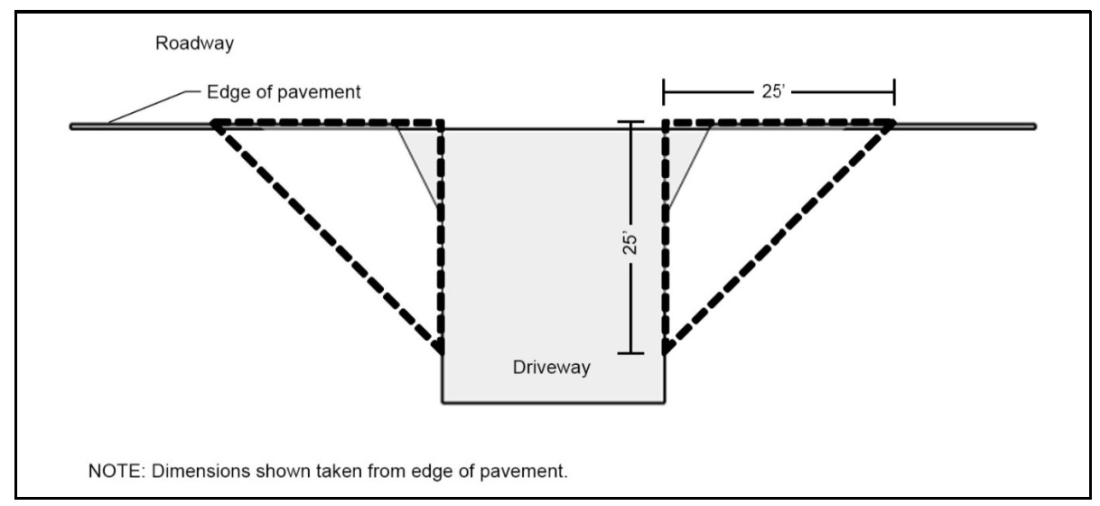
b.
Visibility corners for a road of less than 100 feet of right-of-way shall be a minimum of 20 feet along the edge of pavement line from the intersection of a driveway with a local road as depicted in Image 2 below:
Image 2: Safe Triangle for ROW Less Than 100 Feet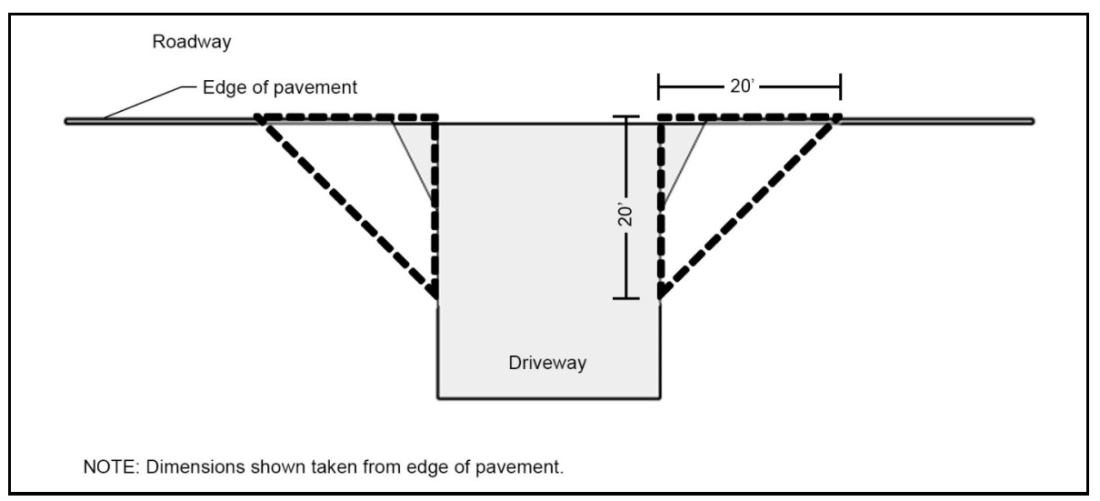
Sec. 7.8.3. - Tree credits.
A preserved native, upland or drought-tolerant trees meeting the standards specified in this chapter may be substituted for trees required by this Code or condition(s) of approval subject to the following:
A.
Credit may be granted for on-site preservation of existing trees when a landscape plan is accompanied by a tree removal and replacement tree survey with credit calculations based on this section.
B.
Existing trees to be preserved shall be credited according to the formula in Table 7.8-2.
C.
Tree credits shall not be permitted for trees that are:
1.
Required or protected by law or trees located in required preservation areas;
2.
Not properly protected from damage during the construction process as provided in this chapter;
3.
Classified as prohibited, fruit or controlled species;
4.
Dead, dying, diseased or infested with harmful insects; or
5.
Located within recreation tracts, golf courses or similar areas within planned developments.
Sec. 7.8.4. - Parking lot landscape requirements.
A.
General tree, shrub and hedge standards:
1.
A minimum of 75 percent of all trees required to be planted in the interior of vehicular use areas shall be shade trees. The remaining 25 percent may be understory trees or palms that mature to more than 25 feet in overall height.
2.
Palms may count as one required interior tree and shall not exceed a maximum of 25 percent of the required interior trees. Preserved native palms with a minimum of four feet of clear trunk located within the interior of a site may be counted as one required interior tree. Palms planted in the interior of vehicular use areas shall be an appropriate species which when mature will not interfere with required lighting or other land development regulations.
3.
Shade trees for vehicular use areas shall have a minimum height of 14 feet and a minimum crown spread of six feet at time of installation.
4.
The hedge and shrubs installation requirements for interior landscape shall comply with the general landscape standards of this chapter.
B.
Off-street parking:
1.
Each row of parking spaces shall be terminated by landscape islands. The terminal island shall not overlap perimeter or other required buffers and shall be a minimum of 12 feet in width, excluding required curbing, 15 feet in length and include at least 180 square feet of planting area and one tree.
2.
A minimum of one interior landscape island shall be provided for every ten parking spaces as shown in Image 3 below, or fraction thereof. Interior landscape islands shall be spaced a maximum of 120 feet apart and shall be a minimum of ten feet in width, excluding required curbing, 15 feet in length and include at least 150 feet square feet of planting area and one tree.
3.
Divider medians providing at least eight feet of landscaped width shall be installed between every other row of parking and between all parking and adjacent vehicular use areas. If a sidewalk is designed into the parking lot divider median a minimum five feet of landscaped area width is required. One shade tree shall be planted for each 30 linear feet, with a maximum spacing of 40 feet on center.
Image 3: Landscape Islands and Divider Medians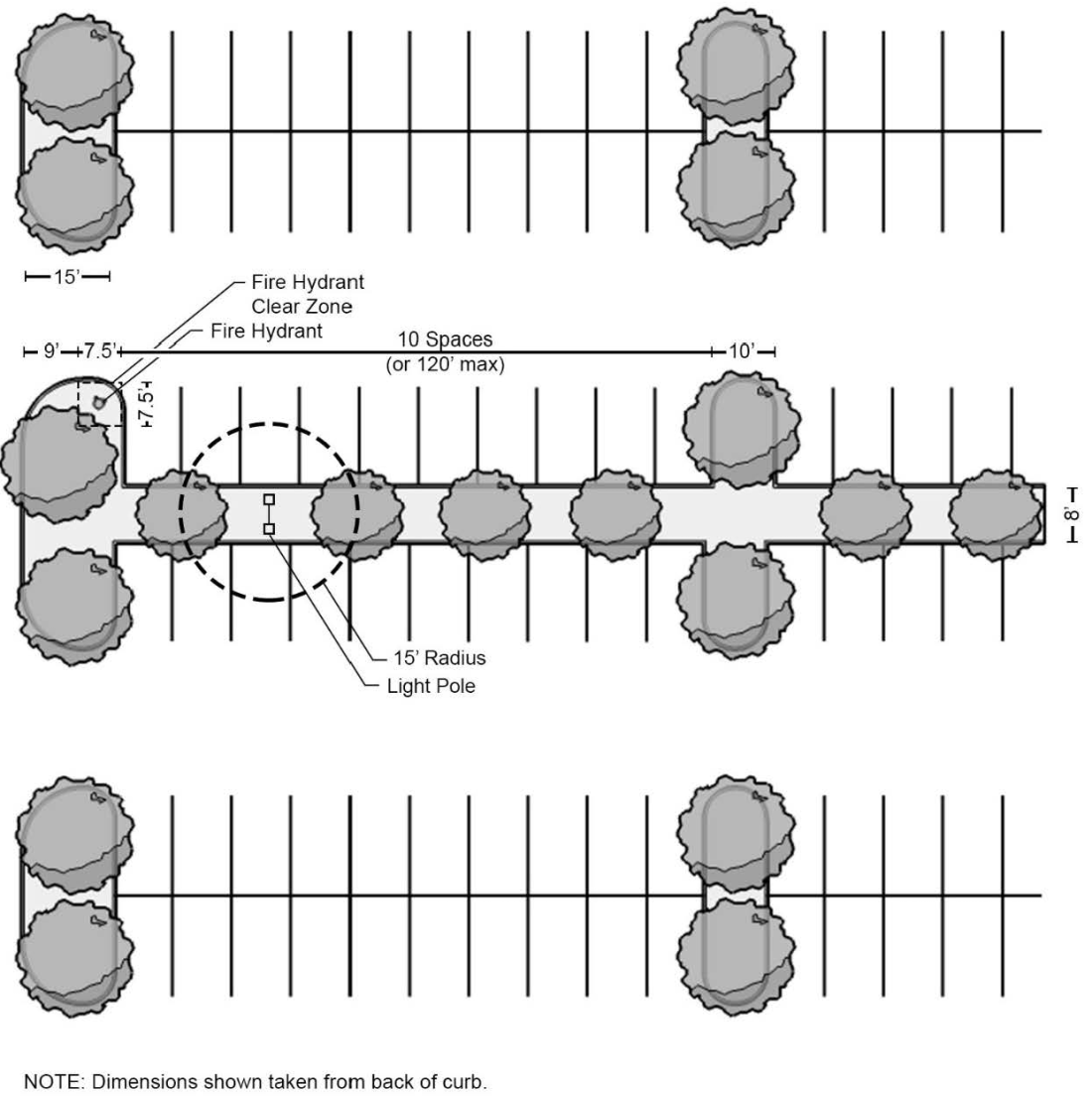
4.
All parking, loading, storage or outdoor display area(s) adjacent to rights-of-way shall be screened with a continuous hedge.
5.
Landscape protection measures such as curbing and wheel stops shall be shown on all paving, drainage, site and landscape plans. Low shrubs and ground covers must be maintained to allow for 24 inches of clearance from the outside face of curb adjacent to an off-street parking space or vehicle use area and 12 inches of clearance at maturity from the inside face of the curb. Plant material required per this section shall be protected from vehicular encroachment by the use of concrete wheel stops or continuous concrete curbing.
a.
Planting area width requirements shall be measured from the inside edge of the curb or wheel stop.
b.
All landscape area subject to vehicular encroachment shall be separated from vehicular use areas by six-inch, non-mountable, FDOT type "D" or FDOT type "F" concrete curbing except for divider medians with abutting parking spaces wheel stops or alternative landscape protection measures may approved by the DM.
c.
Wheel stops shall have a minimum height of six inches above the finished grade of the parking area. All wheel stops shall be properly anchored, continuously maintained in good condition and rest fully on the pavement to prevent rocking.
Sec. 7.8.5. - Landscape buffers.
Perimeter landscape buffers and rights-of-way (ROW) buffers, including road medians, shall comply with the standards of this section, unless otherwise provided for the LDR.
A.
The following subsection establishes three landscape buffer types and the application criteria for each type of buffer and use. The minimum height standards established for each buffer type shall be achieved within two years of installation. The minimum installation standards are provided in the general landscape standards of this chapter.
1.
Type A buffers shall be a minimum of ten feet wide and contain one shade tree per 30 linear feet of buffer, planted a maximum of 40 feet on center. A continuous hedge a minimum of 36 inches high and planted three feet on center shall also be required. For the purpose of this section, Type A buffers that are required to have a six foot high fence shall be indicated as a Type A/F buffer.
2.
Type B buffers shall be a minimum of 15 feet wide and contain one shade tree per 30 linear feet of buffer, planted a maximum of 40 feet of center. A continuous hedge a minimum of 36 inches high and ten shrubs per 30 linear feet, a minimum of 18 inches high, both planted three feet on center shall be required. For the purpose of this section, Type B buffers that are required to have six foot high masonry wall shall be indicated as a Type B/W buffer.
3.
Type C buffers shall be a minimum of 20 feet wide and contain one shade tree per 40 linear feet of buffer, planted a maximum of 40 feet on center. One flowering or small tree per 30 linear feet of buffer, planted a maximum of 40 feet on center shall be required. A continuous hedge a minimum of 36 inches high and ten shrubs per 30 linear feet, a minimum of 18 inches high, both planted three feet on center shall be required.
B.
Landscape buffer application:
1.
The required landscape buffer type shall be based on the proposed and adjacent land uses. For subject properties with multiple proposed uses, such as PDs, more than one buffer type may apply.
2.
Table 7.8-1, Landscape Buffer Application, provides the future land use map designation and corresponding buffer type requirements.
3.
When the adjacent property is a ROW, a Type C buffer shall be required.
C.
Landscape buffer standards:
1.
The area of easements or access ways that traverse the required perimeter or ROW buffer may be subtracted from the overall linear buffer area calculation.
2.
Palms or Slash Pines planted in buffers shall be installed in groups of three or more. Each group of palms shall be a minimum of 12, 14, and 16 foot clear trunk at installation. Each group of Slash Pines shall average ten feet in height and counted as one required shade tree.
3.
For new development or redevelopment, existing native vegetation may be used to meet landscape buffer requirements in total, or in part, upon approval by the PZB director if the following can be demonstrated:
a.
The effectiveness of the existing visual screening;
b.
The quality of the vegetation and ability to properly protect the vegetation during construction; and
c.
The probability of native materials surviving proposed relocation from another area on-site.
4.
All landscape buffers, where required, shall be installed for all non-residential developments prior to the issuance of the first certificate of occupancy.
5.
All landscape buffers, where required, shall be installed for all residential developments prior to the issuance of the first CO, unless phased installation is approved as part of a development order. For a phased development, the buffer shall be installed along the entire perimeter of each phase prior to the issuance of the first CO for the corresponding phase.
6.
Where properties are separated from adjacent properties or ROW by a canal, lake and/or passive open space, with a minimum width of 50 feet, the buffer width may be reduced by up to 25 percent. If the buffer includes a wall or fence the buffer shall maintain a minimum ten foot width. The quantities of plant material may be reduced proportionate to the reduction in buffer width.
7.
If a fence or wall is desired or required, the landscaping shall be located between the barrier and the adjacent property or ROW. Fences and walls that may conflict with pre-existing dedicated easements, shall require approval from the Wellington Engineer, utilities director and/or easement holder if the structure is not able to be shifted for relocated to not encroach the easement. Fences and walls shall comply with the clear sight triangle requirements of this chapter.
8.
All walls shall obtain approval from the architectural review board and shall be masonry construction unless an alternative material/type is approved by the board, and must meet all applicable Florida Building Code requirements. Both sides of the walls shall be given a finished architectural treatment and shall contain no openings except gates or access approved during site plan approval. Connectivity to adjacent properties is encouraged. Maintenance of both sides of the wall shall be the responsibility of the property owner.
9.
It is encouraged that double walls or fences between two properties be avoided. If an existing development has a wall or fence and a new development is required to have a wall or fence, the PZB director may waive the requirement for the wall or fence. The minimum width of the buffer and required landscape quality and quantities shall still apply.
10.
The PZB director may impose special standards to mitigate potential impacts or to ensure the intent of the landscape standards are meet for the following uses:
a.
Recreational and institutional uses within a residential subdivision;
b.
As part of PD with a proposed ALP;
c.
Property owned by Wellington; or
d.
Property owned by Palm Beach County School District.
D.
Rights-of-way buffers: In addition to the general landscape standards, general buffer requirements, and Type C buffer criteria, the following standards shall apply to all ROW buffers:
1.
Single-family detached homes in a residential subdivision shall not require a ROW buffer along internal roads.
2.
For non-residential developments, the required quantity of trees and palms may be clustered in ROW buffers to allow for sign visibility and to accommodate signage proposed in the buffer. Clustering of plant material is also allowed to feature a site design element or to accommodate utilities and easements if at least three of the following conditions are met:
a.
Clusters are spaced a maximum of 60 feet apart;
b.
Clusters consist of trees or palms of varied height with the smallest in the cluster meeting the minimum height requirements;
c.
The subject property has a minimum of 300 feet of frontage along a ROW; or
d.
The subject property includes site enhancements adjacent to the ROW such as plazas, public art, decorative architectural elements or pedestrian oriented amenities.
3.
Walls or fences shall comply with the supplementary standards of Article 6 pertaining to fences, walls, and hedges along a ROW.
4.
For developments with reduced setbacks of less than 20 feet, a reduction to the buffer width may be proposed and the required landscaping may be relocated to an alternative buffer that is part of the overall project. An ALP is required and shall comply with the submittal standards in the DRM.
5.
The developer of property(s) adjacent to roadways with medians shall provide median landscaping within ROW located in, or intersecting, the perimeter of a development, which shall be subject to the following:
a.
A landscape median permit shall be required from the engineering department. The required quantities and spacing of trees, palms and other vegetation shall be the same as indicated for ROW buffers, or based on an approved ALP.
b.
All plantings shall be done in accordance with an approved site plan/subdivision plan.
c.
Median landscaping shall be installed concurrent with the construction of the road or access way and shall be completed prior to the final release of the performance bonds for the road construction.
6.
All ROW, including median, landscape installation and maintenance shall be subject to all regulations and Maintenance of Traffic (MOT) requirements of Wellington's Engineering and Public Works Divisions, as well as, Palm Beach County and/or FDOT when applicable.
Sec. 7.8.6. - Landscape plan and alternative landscape plan requirements.
A.
All new development requiring the issuance of a building or paving permit shall require a landscape plan or alternative landscape plan (ALP) signed and sealed by a Florida registered landscape architect. For single-family, two-family or infill residential projects with four units or less a planting plot plan shall be acceptable and does not require a landscape architect's sealed signature. The landscape and alternative landscape plan submittal requirements are found in the landscape section of the DRM.
B.
An applicant may demonstrate the intent of this chapter can be more effectively met through site design flexibility by submitting an ALP. Requirements for plant material, heights, spacing and up to 50 percent of the required buffer widths may be varied with approval of an ALP. Buffer reductions for required fences or walls are excluded from ALP consideration. To qualify for approval, the ALP shall meet at least eight of the following design guidelines and principles:
1.
Demonstrates an innovative use of plant materials and design techniques in response to site characteristics;
2.
Preserves or incorporates existing native vegetation in excess of minimum standards;
3.
Uses a variety of plant material, including plants of color, plants of form and plants of texture;
4.
Incorporates naturalistic design principles, such as natural variations in topography, meandering or curvilinear buffer plantings and groupings of dominant plant materials including trees and large shrubs in a manner consistent with existing native vegetation;
5.
Integrates landscaping and pedestrian facilities in a manner compatible with the location in which the development is located;
6.
Use of shade trees in excess of the minimum standards in this chapter to create additional canopy;
7.
Illustrate that 50 percent of the required trees exceed minimum height requirements;
8.
Creates greater compatibility with abutting properties and is consistent with the design principles and guidelines of this chapter and the DRM;
9.
Provides a consistent aesthetic appearance from lot perimeters and adjacent roadways;
10.
Uses water-efficient irrigation systems and Florida Friendly landscaping principles at appropriate locations; and
11.
Incorporates the character of soil, slope, hydrology and vegetative communities unique to the site and is compatible with existing environmental features on adjacent properties.
Sec. 7.8.7. - Installation, maintenance, irrigation and replacement.
The following standards shall be considered the minimum required installation, maintenance, irrigation and replacement standards for all trees and landscape material.
A.
All landscaping shall be installed according to acceptable nursery practices and in a manner designed to encourage vigorous growth. Soil improvement measures may also be required to ensure long term healthy plant growth. A plant or tree's mature growth characteristics shall be considered before planting to prevent conflicts with views, lighting, infrastructure, utilities or signage.
1.
Required landscaping may be installed in phases, if designated on the approved site/subdivision plan. The number of trees required to be planted or preserved in a construction phase of a planned development shall be a proportion of the total number of trees required to be planted in the overall planned development. This proportion shall be determined by comparing the area of the phase to the area of the entire planned development as shown on the approved plan. Areas of vegetation required to be preserved shall be excluded from the calculation.
2.
During construction of any structure or other improvement, it shall be unlawful for any person to place materials, machinery or temporary soil deposits within the drip line of any tree. The builder shall install protective barriers around all trees to be preserved outside the canopy dripline as depicted in the landscape criteria found in the DRM. Trees designated for protection during construction and which do not survive shall be replaced by a tree of equal size or an equivalent number of trees based on trunk diameter. The minimum protection shall be two inch by four inch wood posts at 48 inches height with two inch by four inch cross rails. Alternative protection methods may be accepted at the discretion of the PZB director. A bond may be required and the amount of the bond shall be based upon the equivalent value of the tree(s) to be protected. Any bond required for a protected tree shall be four times the equivalent value for that tree.
3.
All installed trees and palms shall be properly guyed and staked at the time of planting and remain in that manner for one year after installation. The use of nails, wire, rope or any other method which damages the trees or palms is prohibited. All plants shall be installed so the top of the root ball remains even or slightly higher than the surrounding soil grade. Plant materials shall be fertilized immediately after planting with type and rate as specified on the landscape plan.
4.
Root barriers shall be required for the installation of trees near utility lines and public facilities such as right-of-way improvements, including sidewalks, using specifications indicated in the landscape criteria found in the DRM. The Wellington Engineer may also require root barriers for hedges to protect facilities. The Wellington Engineer may allow alternative root barrier types and sizes according to their location and application.
B.
The property owner shall be responsible for the following:
1.
All proposed removal of trees or palms shall require a vegetation removal permit.
2.
Regular maintenance of all landscaping to encourage a healthy, neat and orderly appearance. All landscaping shall be maintained free from disease, pests, weeds and litter. Maintenance shall include weeding, watering, fertilizing, pruning, mowing, edging, mulching or other maintenance as needed consistent with acceptable horticultural practices.
3.
Regular maintenance, repair or replacement of landscape barriers and maintenance of required landscape structures (i.e. walls or fences) in a structurally sound condition;
4.
Perpetual maintenance to prohibit the re-establishment of prohibited and invasive species within landscaped areas;
5.
All trees shall be allowed to grow to their natural mature height and a full canopy. Large and medium shade trees shall be required to reach a minimum 20 foot canopy spread prior to the initial pruning. In no case shall the canopy spread be reduced to less than 20 feet in width. Maintenance shall be limited to periodic pruning to correct structure, eliminate hazards and maintain healthy vegetation.
6.
Landscaped areas shall not be used for the storage or display of materials or sale of products or services.
7.
The owner shall be responsible for maintenance of landscaped areas in a manner consistent with the approved site plan or landscape plan and in accordance with this section. If a property owner requests changes and/or removal of more than 30 percent of the required parcel vegetation or more than ten percent of the required buffer vegetation, such as hedges, shrubs and ground cover then a proposed landscape plan, along with a vegetation removal permit, illustrating the replacement material shall be submitted for approval by the DM. If the property's original site plan or landscape plan is not available, the property owner must meet current code requirements.
8.
Landscaping and hedges shall be trimmed and maintained in a healthy, neat condition and shall not encroach into or over public properties, rights-of-way or easements.
9.
Installed landscape shall be fertilized by following best management practices, which include applying only slow-release products with reduced or no phosphorus, keeping fertilizer application off of hard surfaces, no fertilizer application within ten feet of any water body or before pending rainfall periods. Fertilizer shall be applied only between late spring and early fall using preferred iron-based products in lieu of nitrogen products.
C.
Pruning is permitted to allow for healthy tree growth, reduce potential hazards and enhance the aesthetic value of plant material. Trees which cause a conflict with views, signage or lighting shall not be pruned more than the maximum allowed as stated below. The PZB director may suspend the provisions of this section upon finding additional pruning is necessary for plant growth, safety or desired aesthetics.
1.
A maximum of 25 percent of tree canopy may be removed within a one year period provided the removal conforms to the standards of crown reduction, removal of dead or dying branches, crown thinning, crown raising, vista pruning and crown restoration pruning techniques. All pruning shall comply with the American National Standards Institute ANSI 300 (Tree, Shrub and other Woody Plant Maintenance) current edition as amended. The crown of a tree required by this chapter, or condition of approval, shall not be reduced below the minimum spread or height requirements or conditions of approval. A tree pruned in excess shall be replaced and shall meet the minimum requirements of section. The PZB director shall determine whether the excess pruning is a violation of this section and if fines shall be imposed.
2.
Shaping of a tree may be permitted if the tree is to be used as an accent or focal point or as part of an overall landscape design. A maintenance program shall be clearly outlined on the approved landscape plan to explain the care and upkeep of a shaped tree.
3.
All cuts shall be made close to the trunk or parent limb without cutting into the branch collar or leaving a protruding stub. Clean cuts shall be made at all times to minimize branch damage.
4.
Climbing spikes are prohibited for tree or palm pruning.
5.
Pruning tools shall be disinfected with diluted chlorine bleach or suitable solution during pruning to prevent transmission of diseases.
6.
Tree topping (hatracking) is prohibited and shall be defined as the cutting back of limbs to a point between branch collars or buds larger than one inch in diameter within the tree's crown. Branches may be pruned to an adjacent lateral branch at least 33 percent the diameter of the limb being removed.
7.
No tree shall be initially pruned before it has a minimum of 20 foot canopy spread unless for structural pruning to correct deficiencies or remove potential hazards.
8.
For palm pruning:
a.
No more than 33 percent of fronds shall be removed.
b.
No frond removal allowed above the horizon line (three o'clock to nine o'clock) except to remove dead or diseased fronds.
9.
The following trees and species are exempt from these pruning standards:
a.
Trees in conflict with Federal Aviation Administration and airport safety regulations;
b.
Trees which interfere with corner clips, utility lines or utility structures;
c.
Trees having insect or disease damage, crown dieback or decay greater than one-third of the tree canopy;
d.
Trees having suffered damage due to natural or accidental causes;
e.
Trees in botanical gardens or botanical research centers;
f.
Trees maintained by Wellington; or
g.
Ficus species.
D.
Landscaped areas shall be irrigated, as necessary, to maintain required plant materials in good and healthy condition. Irrigation systems shall comply with the following standards:
1.
Irrigation systems, and their control mechanisms, shall be continuously maintained in working order, without visible leaks and within full compliance with this section.
2.
Irrigation systems shall be maintained to avoid overspray onto adjacent paved surfaces.
3.
Landscape irrigation shall be restricted between the hours of 7:00 p.m. to 7:00 a.m. Any water restrictions issued by South Florida Water Management District due to extended drought conditions shall prevail unless Wellington imposes stricter standards. Failure to comply with the requirements of these restrictions will constitute a violation and may be enforced by Wellington.
4.
The following activities shall be exempted from the provision of this section.
a.
Landscape watering using a hand spray nozzle with a self-closing nozzle or by low volume irrigation system (dripline, drip emitters, bubblers, or similar).
b.
Landscape irrigation systems under repair and maintenance to observe zone coverage limited to ten minutes, per zone, per week.
c.
Landscape irrigation for purpose of applying of fungicides, insecticides, herbicides, pesticides and fertilizers as required by the manufacturer. This exemption applies only to licensed application operators and shall be limited to manufacturer's recommendations to be completed within 24 hours of the application. Application operators must be on premises if prescribed watering periods are beyond the hours allowed for irrigation.
d.
Irrigation of clay tennis courts, artificial turf or athletic fields limited to one hour, two times per day.
E.
Landscape trees planted or preserved to meet the minimum landscape tree requirements of this section may be later removed provided a vegetation removal permit is applied for and the requirements of tree protection are met.
Sec. 7.8.8. - Temporary suspension of landscape standards.
A.
The installation of landscaping required by this chapter may be temporarily suspended by the PZB director under the following circumstances:
1.
After a freeze or major hurricane when required landscape materials are not available;
2.
During a period of drought when the use of water is restricted by a governmental authority; or
3.
Prior to issuance of a building certificate of occupancy in response to extenuating circumstances beyond the control of the applicant.
B.
If the landscape standards of this chapter are suspended, the PZB director may enter into an agreement with the property owner to allow issuance of the permit or certificate of occupancy or certificate of completion only if the property owner provides adequate guarantee or surety the terms of this chapter will be met. The guarantee shall consist of a performance bond or other surety agreement approved by the Wellington Attorney in an amount equal to 110 percent of the direct costs of materials and labor and other costs incidental to the installation of the required landscaping completion agreement based on a cost estimate signed and sealed by the project's landscape architect. Performance bonds, or other guarantees, required pursuant to this chapter shall name Wellington as beneficiary and specify the time frame for the completion of the landscape standards.
C.
An application for a temporary suspension of landscape standards shall be accompanied by a landscape plan identifying the plantings which have been postponed, the proposed planting schedule and the costs of the suspended planting. Planting cost estimates shall be verified by the project's landscape architect and provided to Wellington along with the application request for temporary suspension.
Sec. 7.8.9. - Administration.
A.
All site/subdivision plans shall be reviewed by Wellington for conformance to landscaping and screening requirements prior to the issuance of a certificate of occupancy.
B.
Unless otherwise provided in this section, all development shall be inspected after installation of the required landscaping. Required landscaping shall be approved by the DM prior to issuance of a certificate of occupancy or certificate of compliance.
C.
In addition to the required field inspection, the property owner shall provide a letter of compliance, in a form approved by the PZB Department, prior to the issuance of a certificate of occupancy or certificate of completion. The letter shall be prepared and signed by a landscape architect licensed by the State of Florida, listing any changes or substitutions and demonstrate all of the provisions of this section have been met.
1.
The PZB department may conduct a follow-up field inspection to verify the letter of compliance.
2.
If no field verification is conducted by the PZB department within 30 calendar days the letter of compliance shall be deemed to have been accepted. Upon acceptance by the PZB department the letter of compliance shall be filed and maintained with the official records of the development.
D.
Landscaping shall be inspected periodically by Wellington to insure proper maintenance. The property owner shall be notified by Wellington, in writing, of any areas which are not being maintained as provided in this chapter and shall be granted 30 calendar days from the time of notification to restore the landscaping to a healthy condition.
E.
Tree and landscaping services within Wellington shall comply with the following:
1.
All tree and landscaping services shall register with the PZB department and obtain an occupational/business tax receipt before beginning work within the boundaries of Wellington.
2.
Vehicles used by a tree service, or arborist, operating within Wellington shall be clearly marked with the name of the tree service or arborist. Certified arborists shall display their business logo and registration number.
3.
A photocopy of the current occupational license/business tax receipt and registration shall be available for inspection at each job site.
4.
Persons engaged in business as a tree service in Wellington shall adhere to the American National Standards Institute A-300 standards for pruning, except for listed Ficus species or removal of prohibited trees.
5.
Persons engaged in business as a tree or landscaping service in Wellington shall remove all limbs and planting debris prior or upon leaving the work site.
Sec. 7.8.10. - Enforcement.
This chapter is subject to the enforcement provisions of Article 1, the tree protection enforcement standards and those below:
The following deficiencies shall be considered separate violations:
A.
Each tree or shrub which is not properly installed or properly maintained on site as required by this chapter;
B.
Each day in which landscaping is not properly installed or properly maintained on site as required by this chapter; and
C.
Each tree or palm removed without a permit.
Sec. 7.9.1. - Intent, scope, findings, substitution, and severability.
A.
Intent: The intent of this chapter is to create a comprehensive system of graphic controls on private property, through the promotion of quality business identification and indexing, to facilitate clear communication of signs, to reduce traffic and structural hazards, and to enhance the visual appearance of Wellington.
B.
Scope:
1.
The provisions of this chapter shall govern the number, size, location, and character of all signs that may be permitted under the terms of this chapter. No signs shall be permitted on a parcel except in accordance with the provisions of this chapter.
2.
This chapter is not intended to and does not apply to signs erected, maintained, or otherwise posted, owned, or leased by Wellington, Palm Beach County, the State of Florida, or the federal government, and does not regulate traffic control devices.
3.
In the event of any conflict between this chapter and any declaration of covenants, bylaws, or other restrictions applying to any property within Wellington, the language affording the more restrictive interpretation shall apply.
4.
Wellington specifically finds that these sign regulations are narrowly tailored to achieve the compelling and substantial governmental interests of traffic safety and aesthetics, and that there is no other way for Wellington to further these interests.
C.
Purpose:
1.
Florida Constitution. Article II, Section 7 of the Florida Constitution provides that "[i]t shall be the policy of the state to conserve and protect its natural resources and scenic beauty. …" A beautiful environment preserves and enhances the desirability of Wellington as a place to live and to do business. Implementing the Florida Constitution is a compelling governmental interest.
2.
Florida Statutes. Florida law requires cities to adopt comprehensive plans and implement them through land development regulations (also known as zoning regulations) and approval of development orders that are consistent with the comprehensive plan. See Part II of Chapter 163, Florida Statutes. Florida law specifically requires that Wellington adopt sign regulations. See § 163.3202(2)(f), Florida Statutes. Complying with state law is a compelling governmental interest.
3.
Wellington Charter, Comprehensive Plan, and Code of Ordinances. Wellington is a distinctive community with a wide range of land uses. Several goals, objectives, and policies of Wellington's comprehensive plan, as well as provisions of the Wellington's charter and code of ordinances, require Wellington to maintain its character and aesthetics and assure traffic safety through its land development regulations and actions, including through sign regulation, as follows:
a.
Wellington Charter, Section 2, legislative intent … C. It is intended that this charter and the incorporation of the Wellington area will serve to preserve and protect the distinctive characteristics of the individual communities within the boundaries of the Village of Wellington.
b.
Wellington Code of Ordinances, Chapter 22, traffic and vehicles, Section 22-5, authority to install traffic control devices and signals. The Wellington engineer is authorized to install, remove, or modify traffic control devices and signals to regulate vehicular, bicycle, and pedestrian traffic on the streets and public ways in Wellington that are determined to be necessary or desirable for safe traffic control. All installations of traffic control devices and signals by Wellington, pursuant to the authority of this chapter, shall comply with the manual and specifications of the state department of transportation.
c.
Comprehensive Plan:
i.
Land Use and Community Design (LU&CD) Element:
(1)
Goal LU&CD 2—Neighborhoods and Districts. Maintain a high quality of life through community design and appearance within the Wellington's neighborhoods and districts.
(2)
Objective LU&CD 2.1—Community Design and Appearance. Create vibrant, attractive streetscapes with appropriate materials and detailing, street trees and landscaping, streetlights, signage, furniture, and sidewalks to enhance the existing (or establish the) desired character of the neighborhood or district.
(3)
Policy LU&CD 2.1.1—Preserve and Project Neighborhood Characteristics. Establish regulations that are sensitive to the distinct characteristics of the individual communities that comprise Wellington, including but not limited to: drainage and storm water management, open space provision, on-site traffic circulation, vehicle parking, loading, setbacks, floor area, recreation requirements, density and intensity, building height, landscaping, signs and vegetation preservation.
(4)
Policy LU&CD 2.1.3—Maintain Aesthetics. Maintain the aesthetics of the community and distinct characteristics of neighborhoods and commercial centers through enforcement and administration of Wellington's Land Development Regulations including maintenance standards for all types of buildings and land uses, architectural design standards for all types of buildings, sign regulations, landscaping requirements, and vegetation preservation standards.
(5)
Policy LU&CD 2.2.1—Preserve and Protect Character. Preserve and protect the character of Wellington's diverse single-family neighborhoods by establishing a set of regulations and standards that maintain the existing development pattern such as lot sizes, setbacks, landscaping, and design.
(6)
Goal LU&CD 3—Protect Our Investment. Ensure that established land use patterns are protected and the distinctive characteristics of the individual communities are preserved, discourage urban sprawl, promote energy efficiency, maintain a high standard of aesthetics, respect environmental constraints, and provide services at the adopted levels of service.
ii.
Mobility (MB) Element:
(1)
Goal MB 1—Mobility System. Provide a safe and effective mobility system that is accessible to all users and meets the needs of Wellington residents while preserving neighborhoods, protecting natural resources, and promoting economic development.
(2)
Objective MB 1.1—Transportation System. Maintain a safe, convenient, and effective motorized and non-motorized transportation system consisting of arterial, collector and local streets and roads; sidewalks, bicycle lanes, and multiple-purpose pathways; and equestrian trails.
(3)
Objective MB 3.1—Maximize Wellington's Mobility System Investments. Maintain and enhance Wellington's mobility system to provide a safe, convenient, interconnected, and aesthetically pleasing multi-modal network throughout Wellington which utilizes the facilities and infrastructure to the fullest.
Implementing Wellington's Charter, Comprehensive Plan, and Code of Ordinances is a compelling governmental interest.
D.
Case law: In accordance with the U.S. Supreme Court's cases on sign regulation, the regulations in this chapter are not intended to regulate or censor speech based on its content or viewpoint, but rather to regulate the secondary effects of speech that may adversely affect Wellington's substantial and compelling governmental interests in preserving scenic beauty and community aesthetics, and in vehicular and pedestrian safety in conformance with the First Amendment. These cases and their holdings include, but are not limited to:
1.
Reed v. Town of Gilbert, 576 U.S. 155, 135 S. Ct. 2218, 192 L. Ed. 2d 236 (2015) on the topic of noncommercial temporary signs;
2.
Metromedia, Inc. v. City of San Diego, 453 U.S. 490 (1981) on the topic of commercial signs and off-premise signs;
3.
City of Ladue v. Gilleo, 512 U.S. 43 (1994) on the topic of political protest signs in residential areas;
4.
Linmark Assocs., Inc. v. Township of Willingboro, 431 U.S. 85 (1977) on the topic of real estate signs in residential areas;
5.
Burson v. Freeman, 504 U.S. 191 (1992) on the topic of election signs near polling places;
6.
Central Hudson Gas & Electric Corp. v. Public Service Commission, 447 U.S. 557 (1980) on the topic of commercial speech; and
7.
City Council v. Taxpayers for Vincent, 466 U.S. 789 (1984) on the topic of signs on public property.
E.
Impact of sign clutter: Excessive signage and sign clutter impair the legibility of the environment, and undermines the effectiveness of governmental signs, traffic control devices, and other required signs (such as address, incidental, and identification signs) that are essential to identifying locations for the delivery of emergency services and other compelling governmental purposes. The intent of these sign regulations is to enhance the visual environment of Wellington, ensure that Wellington residents, visitors, and emergency responders can safely navigate through Wellington to their intended destinations, and promote the continued well-being of Wellington. It is therefore the purpose of this chapter to promote aesthetics and the public health, safety, and general welfare, and assure the adequate provision of light and air within Wellington through reasonable, consistent, and nondiscriminatory standards for the posting, displaying, erection, use, and maintenance of signs and sign structures that are no more restrictive than necessary to achieve these governmental interests.
F.
Specific legislative intent: More specifically, the sign regulations are intended to:
1.
Encourage the effective use of signs as a means of communication in Wellington;
2.
Maintain and enhance the scenic beauty of the aesthetic environment and Wellington's ability to attract sources of economic development and growth;
3.
Ensure pedestrian and traffic safety;
4.
Minimize the possible adverse effect of signs on nearby public property, public rights-of-way, and private property;
5.
Foster the integration of signs with architectural and landscape designs;
6.
Lessen the visual clutter that may otherwise be caused by the proliferation, improper placement, illumination, animation, excessive sign height, and excessive sign area that compete for the attention of pedestrian and vehicular traffic and are not necessary to aid in wayfinding;
7.
Allow signs that are compatible with their surroundings and aid orientation, while precluding the placement of signs that contribute to sign clutter, or that conceal or obstruct adjacent land uses or signs;
8.
Encourage and allow signs that are appropriate to the zoning district in which they are located and consistent with the land uses, activities, and functions to which they pertain;
9.
Curtail the size and number of signs to the minimum reasonably necessary to identify the location and the nature of a land use, and to allow smooth navigation to these locations;
10.
Establish dimensional limits and placement criteria for signs that are legible and proportional to the size of the parcel and structure on which the sign is to be placed, or to which it pertains;
11.
Regulate signs so that they are effective in performing the function of identifying and safely directing pedestrian and vehicular traffic to a destination;
12.
Preclude signs from conflicting with the principal use of the parcel and adjoining parcels;
13.
Regulate signs in a manner so as to not interfere with, obstruct the vision of, or distract motorists, bicyclists, or pedestrians;
14.
Except to the extent expressly preempted by state or federal law, ensure that signs are constructed, installed, and maintained in a safe and satisfactory manner, and protect the public from unsafe signs;
15.
Preserve, conserve, protect, and enhance the aesthetic quality and scenic beauty of all zoning districts of Wellington;
16.
Allow traffic control devices consistent with national standards without regulation in this chapter because they promote highway safety by providing for the orderly movement of road users on streets and highways, and by notifying road users of regulations and providing nationally consistent warnings and guidance needed for the safe, uniform, and predictable operation of all modes of travel, while regulating private signs to ensure that their size, location, and other attributes do not impair the effectiveness of such traffic control devices;
17.
Protect property values by precluding, to the maximum extent possible, signs that create a nuisance to the occupancy or use of other properties as a result of their size, height, illumination, brightness, or movement;
18.
Protect property values by ensuring that the size, number, and appearance of signs are in harmony with buildings, neighborhoods, structures, and conforming signs in the area;
19.
Regulate the appearance and design of signs in a manner that promotes and enhances the beautification of Wellington and that complements the natural surroundings in recognition of Wellington's reliance on its natural surroundings and beautification efforts as a source of economic advantage as an attractive place to live and work;
20.
Classify and categorize signs by type and zoning district;
21.
Not regulate signs more than necessary to accomplish the compelling and important governmental objectives described herein;
22.
Enable the fair and consistent enforcement of these sign regulations;
23.
Permit, regulate, and encourage the use of signs with a scale, graphic character, and type of lighting compatible with buildings and uses in the area, so as to support and complement the goals, objectives, and policies set forth in Wellington's Comprehensive Plan;
24.
Establish regulations for the design, erection, and maintenance of signs for the purpose of ensuring equitable access to graphic communication, while maintaining a harmonious and aesthetically pleasing visual environment within Wellington, recognizing that signs form an integral part of architectural building and site design and require equal attention in their design, placement, and construction;
25.
Provide for the unique signage needs of multi-tenant properties through the uniform signage plans that assure a consistent and cohesive appearance and enhance legibility of sign messages through their common design;
26.
Provide an effective method to deter individuals and businesses from attaching unsightly and distracting signs to public structures within or adjacent to public rights-of-way; and
27.
Be considered the maximum standards allowed for signage, and regulate signs in a permissive manner so that any sign is not allowed unless expressly permitted and not expressly prohibited.
G.
Severability: If any provision of this chapter is found by a court of competent jurisdiction to be invalid, such finding must not affect the validity of the other provisions of this chapter that can be given effect without the invalid provision.
1.
Generally: If any part, section, subsection, paragraph, sentence, phrase, clause, term, or word of this chapter is declared unconstitutional by the valid judgment or decree of any court of competent jurisdiction, the declaration of such unconstitutionality shall not affect any other part, section, subsection, graph, subparagraph, sentence, phrase, clause, term, or word of this chapter. Should any section, paragraph, sentence, clause, phrase, or other part of this chapter or the adopting ordinance be declared by a court of competent jurisdiction to be invalid, such decision shall not affect the validity of this chapter or the adopting ordinance as a whole or any portion or part thereof, other than the part so declared to be invalid.
2.
Severability where less speech results: Without diminishing or limiting in any way the declaration of severability set forth in section (G), or elsewhere in this chapter or the adopting ordinance, if any part, section, subsection, paragraph, subparagraph, sentence, phrase, clause, term, or word of this chapter is declared unconstitutional by the valid judgment or decree of any court of competent jurisdiction, the declaration of such unconstitutionality shall not affect any other part, section, subsection, paragraph, subparagraph, sentence, phrase, clause, term, or word of this chapter or the adopting ordinance, even if such severability would result in a situation in which there would be less speech, whether by subjecting previously exempt signs to permitting or otherwise.
3.
Severability of provisions pertaining to prohibited signs: Without diminishing or limiting in any way the declaration of severability set forth in section (G), or elsewhere in this chapter or the adopting ordinance, if any part, section, subsection, paragraph, subparagraph, sentence, phrase, clause, term, or word of this chapter or the adopting ordinance or any other law is declared unconstitutional by the valid judgment or decree of any court of competent jurisdiction, the declaration of such unconstitutionality shall not affect any other part, section, subsection, paragraph, subparagraph, sentence, phrase, clause, term, or word of this chapter or the adopting ordinance that pertains to prohibited signs.
4.
Severability of prohibition on off-premise signs: If any part, section, subsection, paragraph, subparagraph, sentence, phrase, clause, term, or word of this chapter or any other code provisions or laws are declared invalid or unconstitutional by the valid judgment or decree of any court of competent jurisdiction, the declaration of such unconstitutionality shall not affect the prohibition of off-premise signs as contained herein.
H.
Substitution: Notwithstanding any provisions of this chapter to the contrary, to the extent that this chapter permits a sign containing commercial content, it shall permit a noncommercial sign to the same extent. The noncommercial message may occupy the entire sign area or any portion thereof, and may substitute for or be combined with the commercial message. The sign message may be changed from commercial to noncommercial, or from one noncommercial message to another, as frequently as desired by the sign's owner, provided that the sign is not prohibited and the sign continues to comply with all requirements of this chapter.
(Ord. No. 2022-13, § 1(Exh. A), 4-26-2022)
Sec. 7.9.2. - Definitions.
The following definitions, in addition to Article 3 definitions, abbreviations, and acronyms and the examples of signs provided in the DRM, define the sign types and shall be utilized to administer this chapter. If there is a conflict between the DRM and this chapter, this chapter shall govern.
Advertise or advertising: Any form of public announcement intended to aid directly or indirectly, in the sale, use, or promotion of a commercial product, commodity, service, activity, or entertainment.
A-frame sign: A movable temporary sign usually constructed to form an "A" or tent-like shape.
Animated sign: Any sign or part of a sign that flashes, scintillates, flickers, changes physical position, or light intensity or color by any movement or rotation or that gives the visual impression of such movement or rotation.
Auxiliary ground sign: A sign associated with vehicular and pedestrian turning points at properties with multiple nonresidential tenants or a sign associated with lanes of drive-thru facilities.
Auxiliary wall sign: A wall sign associated with drive-thru facilities or building entrances.
Banner sign: A temporary sign made of cloth, fabric, paper, non-rigid plastic, or similar type of material associated with a tenant space, which may be mounted on a pole or attached to a facade.
Canopy: A roof-like structure generally self-supporting that may be freestanding or attached to a principal structure, providing shade and weather protection, typically utilized in locations such as over drive-thru lanes, walkways, entrances, and gasoline pumps.
Canopy sign: A sign that is mounted or attached to a canopy, fabric awning, or marquee.
Changeable copy sign: A sign designed for displaying copy where the copy is manually changeable and affixed to or made a part of the sign.
Copy: Written or graphic material that is placed, displayed, or depicted or otherwise indicated on a sign.
Copy cat sign: Signs that resemble any official sign or markers and that because of design, location, position, shape, or color may be reasonably confused with or construed as traffic-control devices or regulatory signs.
Digital sign: A sign that utilizes an electronic display including but not limited to liquid crystal display or light emitting diodes (LCD or LED), plasma display, or projected images that can be changed automatically.
Double-faced sign: A sign with two faces that are typically parallel.
Emitting sign: Signs that emit audible sound, odor, or visible matter such as smoke or steam.
Entry feature sign: An architectural feature or element with signage that is typically located at the entrance to a development project but is not attached to a perimeter wall.
Entry wall sign: A sign attached to a wall near the entrance of a site as part of a continuous perimeter wall or fence.
Facade: The entire face of a building (front, side, and rear) including the parapet.
Flag: Piece of material, typically cloth on which is depicted a government agency, civic or institutional symbol, other symbols, graphics or lettering; not regulated as a sign.
Freestanding sign: Any sign erected and maintained on a freestanding frame, mast, or pole not attached to any building, and not including ground mounted signs.
Frontage, street: The portion of a building abutting or facing a public right-of-way.
Grade: The average finished ground level of a parcel on which a sign is located.
Hanging sign: A sign suspended from an exterior arcade, canopy, covered walkway, or similar building element.
Illegal sign: A sign installed without a permit, if required, or is prohibited.
Illuminated sign: A sign that is internally or externally illuminated by artificial means.
Incidental sign: A sign having a face consisting of one panel typically associated with lanes of a drive-thru or with an entrance.
Lot: The smallest division of land identified as a single unit of ownership for conveyance and legal development purposes, and delineated by a closed boundary that is inclusive of the horizontal area within lot lines as further defined in Article 3, Chapter 2 of these LDR.
Major equestrian venue: A site within the Equestrian Zoning Overlay District with an Equestrian Commercial Recreation land use designation which is approved as a commercial equestrian arena.
Major tenant: A tenant with indoor space of 10,000 square feet or more.
Master sign plan: Drawings and plans that illustrate the sign program for the overall development, including size, location, type, architectural design, dimensions, and other design standards including materials, color, and sign illumination.
Minor tenant: A tenant with indoor space of less than 10,000 square feet.
Mobile sign: Signs mounted on top or on the rear of a vehicle or bicycle or signs attached to or located on a trailer or other equipment towed by a vehicle or bicycle. Signs of a portable or mobile nature attached after-market, including signs mounted on top of or on the rear of a vehicle, and signs attached to or located on a trailer or other equipment towed by a vehicle. A mobile sign shall not be construed to include any sign mounted on a vehicle or trailer by the original manufacturer.
Monument sign: A freestanding permanent sign with a solid base located on or close to the ground typically incorporating materials that complement the architecture and landscaping of the principal structure on the site.
Multi-panel monument sign: A monument sign that contains multiple panels and areas for the display of graphics or lettering for multiple tenants.
Non-conforming sign: A sign or sign structure that by its design, height, type, sign area, location, use, structural support, or otherwise, does not conform to the requirements of this chapter after adoption.
Obstructing sign: A sign that obstructs the vision of pedestrians, cyclists, or motorists traveling on or entering public streets.
Off-premise sign: Any sign mounted on a building, wall, or freestanding structure advertising a commercial establishment, activity, product, service, or entertainment that is sold, produced, manufactured, available, or furnished at a place other than on the property on which said sign is located.
Parapet: A false front or wall extending above the roofline.
Pole banner sign: A banner sign mounted on a permanent utility/light pole.
Pole sign: A permanent sign mounted on a pole that is more than three feet in height.
Post and panel sign: A sign made of wood, metal, similar rigid materials, or durable weatherproof fabric attached to one or more ground mounted posts utilized as a panel to display copy.
Primary facade: The facade that has the principal entrance, often referred to as the principal facade or storefront.
Projecting sign: A sign attached to a building extending more than 24 inches beyond the building or wall face to which it is attached. Also referred to as a vertical blade sign.
Roof sign: A sign erected or visible over, above, across, or on the roofline or parapet of any building that is dependent on the roof, parapet, or mansard for support.
Sign: Any object, device, display, structure, name, identification, description, illustration, or part thereof that is affixed to, painted or represented directly or indirectly upon a building or other outdoor surface that directs attention to or is designed or intended to direct attention to the sign face or to an object, product, place, activity, person, institution, organization, or business. Signs located completely within an enclosed building, and at least three feet from an opening are not considered a sign. Each display surface of a sign or sign face is considered to be a sign.
Sign area: The entire face of a sign, including the surface and framing, trim, or molding, but not including the supporting structure.
Sign face: The entire display surface area of a sign upon, against or through which copy is placed.
Snipe sign: Any small sign, generally of a temporary nature, made of any material, when such sign is tacked, nailed, posted, pasted, glued or otherwise attached to trees, poles, stakes, fences, or other objects.
Storefront: The facade of a store or tenant space typically on the ground floor or street level.
Temporary sign: A sign that is not permanently affixed or installed, or is displayed for a limited period of time.
Unauthorized sign: Any sign erected on or attached to public or private property, real or personal, without the express permission of the owner of such property.
Wall: An exterior vertical structure encompassing the area between the grade and the eaves of a building that encloses the building or that is an enclosure for the perimeter of a property.
Wall sign: A sign fastened to the exterior wall of a building or structure in such a manner that the wall becomes the supporting structure for or forms the background surface of the sign and that does not project more than 18 inches from such building or structure.
Window area: The entire glass area of a window or door used for calculation of permitted sign area including any mullions or transoms within a window or door but excluding the supporting structures of such window or door.
Window sign: A sign placed inside, upon, or within three feet of a first-story window at or below 12 feet of the associated doorway grade level visible from the exterior of the window.
Yard sign: A small temporary sign placed upon or supported by the ground independent of another structure but is not an A-frame sign.
(Ord. No. 2022-13, § 1(Exh. A), 4-26-2022)
Sec. 7.9.3. - Prohibited signs.
A.
Signs are prohibited in all zoning districts unless constructed pursuant to valid building and sign permits when required under this chapter and authorized or mandated by this chapter.
B.
The signs listed below are prohibited:
1.
Off-premise signs
2.
Illegal signs
3.
Roof signs
4.
Animated signs
5.
Inflatable signs and balloons
6.
Emitting signs
7.
Human signs
8.
Painted signs and murals painted on a wall, side, or roof of a building
9.
Copycat and obstructing signs
10.
Unauthorized signs
11.
Mobile signs
12.
Pole signs
13.
Snipe signs
14.
Any other sign not specifically permitted by this chapter
C.
Private signs on public property and rights-of-way are unauthorized and subject to removal and disposal.
(Ord. No. 2022-13, § 1(Exh. A), 4-26-2022)
Sec. 7.9.4. - Legal non-conforming signs.
Signs or sign structures made non-conforming upon passage of these sign regulations or on passage of any amendment hereto shall be governed by the following regulations:
A.
Non-conforming signs: A sign existing within Wellington, upon the passage of these sign regulations or any amendment hereof which, because of its height, square foot area, location, design or other characteristic, does not conform to this chapter, is hereby declared to be a non-conforming sign, if it was approved with a permit prior to this chapter.
B.
Loss of legal non-conforming status: A legal non-conforming sign shall immediately lose its legal non-conforming designation if:
1.
The sign is altered in any way (except for the normal use of changeable copy signs and normal maintenance) which tends to or makes the sign less in compliance with the requirements of this chapter than it was before the alteration, including updating the technology used in a sign; or
2.
The sign is relocated to a position making it less in compliance with the requirements of this chapter; or
3.
The sign is replaced or abandoned.
In the event that the PZB director determines that any one of the events listed in this subsection has occurred, then the sign shall be immediately brought into compliance with this chapter by securing a new permit or by removal of the sign.
C.
Non-conforming sign maintenance and repair: Previously permitted non-conforming signs and sign structures shall not be enlarged, altered, or moved without the entire sign being brought into compliance with this chapter. The sign face that does not increase the degree of non-conformity on non-conforming signs may be replaced with valid building and sign permits, including lighting and electrical alterations.
D.
Damaged or destroyed non-conforming signs: If a non-conforming sign is damaged or destroyed by any means and cost to repair the sign is 50 percent or more than the cost to replace it, the sign shall be removed and any replacement shall comply with this chapter.
E.
Illegal signs: The status afforded signs under this section shall be applicable to any sign for which no building permit or sign permit was ever issued; such signs are deemed illegal signs.
F.
Off-premise sign removal: This section shall not be interpreted to require the removal of a billboard or other off-premise sign pursuant to F.S. § 70.20.
G.
Non-conforming sign maintenance: Nothing in this section shall relieve the owner or user of a non-conforming sign, or the owner of the property on which the non-conforming sign is located, from required compliance with the provisions of this chapter regarding safety, maintenance, and repair of signs.
(Ord. No. 2022-13, § 1(Exh. A), 4-26-2022)
Sec. 7.9.5. - Mandatory signs.
The following signs in this section are mandatory in every zoning district:
A.
[Address:] All residential and nonresidential structures shall post the building address in a location viewable, readable, and unobstructed from the adjacent public or private right-of-way. The size of residential address numbers shall not be less than four inches, or exceed six inches in height, or as otherwise approved based on the setback from or width of the right-of-way. The size of nonresidential address numbers shall not be less than eight inches or exceed 12 inches in height, or as otherwise approved by the master sign plan based upon the specific height of the building to which the numbers and letters are attached, or setback from or width of the right-of-way. In cases where the building is not located within view from the public street or right-of-way, the address identifier (numerals) must be located on the mailbox or other suitable device such that it is visible from the street or right-of-way.
B.
Required posting: Where a federal, state, or local law requires a property owner to post a sign on the owner's property to warn of a danger or to prohibit access to the property either generally or specifically, the owner must comply with the federal, state, or local law to exercise that authority by posting a sign on the property. If the federal, state, or local regulation describes the form and dimensions of the sign, the property owner must comply with those requirements; otherwise, when not defined, the sign shall be no larger than two square feet and located in a place on the property to provide access to the notice that is required to be made.
C.
Official notice: Official notices posted or displayed by or under the direction of any public or court officer in the performance of official or directed duties; provided, that all such signs must be removed by the property owner no more than ten days after their purpose has been accomplished or as otherwise required by law.
(Ord. No. 2022-13, § 1(Exh. A), 4-26-2022)
Sec. 7.9.6. - Temporary signs, commercial and noncommercial.
A.
Temporary signs, general standards:
1.
Temporary signs shall be constructed of durable, weatherproof material.
2.
A temporary sign shall not directly or indirectly create a traffic or fire hazard, interfere with the free and unobstructed use of streets, sidewalks, or building entrances, or obstruct clear vision at the intersection of any streets, drives, or public or private vehicular access ways or so that it may be confused with authorized traffic signs or devices.
3.
All signs shall be setback a minimum of five feet from the property line, unless otherwise specified in this section, and shall provide a minimum 18-inch clearance from rights-of-way, curbs, sidewalks, and landscaping, or a larger clearance if deemed necessary by the Wellington Engineer.
B.
Temporary signs, permit not required: Temporary signs authorized by this section do not require a sign permit.
1.
Temporary non-commercial signs, year-round: The following temporary signs are allowed at any time:
a.
A property owner may place a sign or signs totaling no more than four square feet on the property, compliant with the minimum setbacks, at any time.
b.
A property owner may place a sign no larger than 8.5 inches by 11 inches in one window visible from a public right-of-way on the property at any time.
2.
Additional temporary non-commercial sign before an election:
a.
One temporary noncommercial sign totaling no more than four square feet per 0.25 acre of land may be located on the owner's property for a period of 30 days prior to an election affecting the property on which the sign(s) is(are) located.
b.
Where the size of the property is smaller than 0.25 acres and has a lawfully existing principal building, one temporary noncommercial sign totaling no more than four square feet may be located on the owner's property for a period of 30 days prior to an election affecting the property on which the sign is located.
3.
Additional temporary signs when a property is being offered for sale or lease: One temporary sign, totaling no more than three square feet, may be located on a property:
a.
When that property is being offered for sale or lease through a licensed real estate agent; or
b.
If not offered for sale or lease through a licensed real estate agent, when the sign is owned by the property owner and that property is offered for sale by the owner; and
c.
For a period of 15 days following the date on which a contract of sale has been executed.
4.
Additional temporary sign when a property being offered for sale or lease is open to the public: One temporary sign, totaling no more than three square feet, may be located on the owner's property on the day prior to and on the day when a property owner is opening the property to the public.
5.
Maximum sign face per temporary sign: Unless otherwise specified in this chapter, the sign face of any temporary sign must not be larger than four square feet.
6.
Total temporary signs at any one time: A person exercising the right to place temporary signs on a property as described anywhere in this section B. must limit the total sign area on the property at any one time as follows:
a.
Per 0.25 acre: no more than eight square feet in total sign area, plus a window sign as set forth in Section B.1.b., or
b.
If the property is smaller than 0.25 acres and has a lawfully existing principal building: no more than eight square feet, plus a window sign as set forth in subsection B.1.b.
c.
The total sign area of all temporary signs shall not exceed a maximum of 32 square feet per property.
7.
Additional temporary non-commercial sign during winter: Notwithstanding section B.6, from November 1 to March 15 each year:
a.
A property owner may place one additional temporary non-commercial sign on the property. Refer to subsection 7.9.6.B.5 for maximum sign face.
b.
A property owner may also use lights that do not exceed 0.3 foot-candles above ambient light levels as measured at the property line between the hours of 8:00 a.m. and 10:00 p.m. to decorate the property even if the lights might be arranged to form text.
8.
A-frame sign, commercial:
a.
A maximum of one sign shall be permitted per ground floor tenant of a commercial building with an exterior entrance, which shall be removed nightly.
b.
Signs are to be located within 25 feet of the principal exterior entrance and shall not obstruct pedestrian walkways or be located within landscaping or vehicular circulation areas.
c.
Each sign shall not exceed four feet in height and have a maximum sign area of six square feet per side.
9.
Construction fence banner signs, commercial:
a.
Banners shall be securely fastened and flush against a temporary construction fence along street frontages and shall not be illuminated.
b.
The maximum area devoted to text shall be 12 square feet which may be repeated every 100 feet. Remaining area of the construction fence banner sign may be graphics or photographs.
c.
The maximum height of the banners shall be six feet or the height of the fence, whichever is smaller.
d.
Banners shall be removed when temporary construction fencing is removed or when there are no active permits for the site of the fencing.
10.
Post and panel sign, commercial and noncommercial:
a.
A maximum of one sign per street frontage per property with a maximum height of eight feet. The sign shall be oriented parallel with the street frontage to permit visibility of only one sign face.
b.
For residential properties one acre or less, a post and panel sign is not permitted. For commercial properties one acre or less or residential properties greater than one acre in size, a maximum cumulative sign area of 16 square feet is permitted. For commercial properties greater than one acre in size, a maximum cumulative sign area of 32 square feet is permitted.
c.
The sign shall be permitted:
i.
During times that the commercial property is being developed or marketed for sale or lease until the property is sold or leased; or
ii.
While there is an active building permit on the property until a certificate of occupancy/completion is issued; or
iii.
The first 30 days after an opening of a new business; or
iv.
For a period of 30 days prior to an election in accordance with the additional temporary non-commercial signs before an election regulations above.
11.
Medical center planned development banner, commercial:
a.
A maximum of one banner is permitted. The maximum length of the banner shall be 80 feet with a maximum sign area of 400 square feet.
b.
The banner shall be mounted flush against the primary building within a Medical Center Planned Development zoning district. The banner shall be placed above the upper story windows and on a parapet oriented towards an intersection of two arterial roads, a minimum of 50 feet from any right-of-way.
C.
Temporary signs, permit required: Signs authorized by this section require a sign permit for a temporary sign.
1.
Pole banner sign, commercial:
a.
A maximum of one banner may be permitted for each ground floor tenant of a commercial building and shall be mounted on a pole installed in the ground within 25 feet of the tenant's principal exterior entrance and shall not obstruct pedestrian walkways or be located within landscaping or vehicular circulation areas.
b.
Signs shall not exceed ten feet in height, 18 inches in width, and a maximum sign area of 15 square feet.
c.
Sign placement is limited to a maximum of 30 consecutive calendar days, three times per year.
2.
Building banner sign, commercial:
a.
A maximum of one banner per ground floor tenant of a commercial building with a maximum sign area of 32 square feet. Signs shall be securely fastened to the building facade and shall not extend above the roofline or parapet.
b.
Banner placement is limited in duration to no more than 14 days prior to and 14 days after the date of the event or activity to which they relate, or the first 30 days after an opening of a new business.
c.
When a temporary banner is associated with the manufacturing and installation of a permanent affixed sign, the banner shall be removed immediately once the permanent sign is installed.
(Ord. No. 2022-13, § 1(Exh. A), 4-26-2022)
Sec. 7.9.7. - Permanent signs, commercial—General standards.
A.
Maintenance: All signs shall be kept in good condition and operational. All signs shall be compliant with the building code, present a neat appearance, and be maintained free of debris, stains, mold, discoloration, or deterioration. The repainting, changing of parts, and maintenance of an approved sign shall not require a permit, provided such maintenance is consistent with an approved sign plan and this chapter.
B.
Hazard: A sign shall not directly or indirectly create a traffic or fire hazard, interfere with the free and unobstructed use of streets, sidewalks or building entrances or obstruct clear vision at the intersection of any streets, drives, or public or private vehicular access ways or so that it may be confused with authorized traffic signs or devices.
C.
Setback: All signs shall be setback a minimum of five feet from the property line, unless otherwise specified in this section, and shall provide a minimum 18-inch clearance from rights-of-way, curbs, sidewalks, and landscaping, or a larger clearance if deemed necessary by the Wellington Engineer.
D.
Separation: All signs not mounted to a building shall be separated from another sign by 200 feet.
E.
Lighting: Lighting of permanent signs shall be white, non-glaring, directed away from adjoining properties, and shall be designed to avoid affecting the vision of drivers on adjacent roadways.
E.
Screening: All mechanical and electrical elements of a sign shall be fully screened or concealed.
F.
Landscaping: All sign structures shall be landscaped to ensure that the base or foundation of the sign at the ground adjacent to the sign is properly screened. Landscaping shall be installed and maintained in a manner not to interfere with visibility of a sign.
G.
Sign height: Sign height shall be measured from the average grade of surrounding property. Grades raised solely to increase sign height shall not be used to determine allowable height. Grade elevations raised as part of landscaping, berms, and approved entry features may be utilized to determine height.
H.
Mounting:
1.
Wall signs shall not be mounted to extend more than 24 inches from the face of the building.
2.
Wall signs shall not be mounted to, or extend above or below, the edge of any wall or above the parapet.
3.
Monument and ground signs shall be on a foundation or footing.
I.
Computation of sign number and sign area:
1.
The surface area of a sign shall be the entire face of a sign, including any framing, trim, molding, or any feature extending beyond framing, trim, or molding, but not including the supporting structure. In the case of double-faced signs, if the two faces are parallel or constructed at an angle of 15 degrees or less, then the two faces shall be considered a single sign face. If the angle of a double-faced sign is greater than 15 degrees, each sign face shall be included for determining the total area.
2.
For the purpose of computing the number and area of signs, the frontages of lots shall be established by orientation of the main entrances of the buildings. If this method is not determinative, the PZB director shall determine frontages on the basis of traffic flow and access from adjacent streets.
3.
Sign area and height shall be measured from the highest point to the lowest point, including all elements of the sign. All spaces between each line of copy shall be included in the sign area and height. If signage includes a colored background, the background shall also be included in the area and height.
(Ord. No. 2022-13, § 1(Exh. A), 4-26-2022)
Sec. 7.9.8. - Permanent signs, commercial—Supplementary standards.
A.
Permanent wall signs. Permanent wall signs shall meet the standards below based on sign type:
1.
Entry wall sign:
a.
Developments shall be limited to one sign mounted on an entry wall located on each side of a vehicular access point per street frontage with a maximum sign area of 32 square feet per sign.
b.
Entry wall signs may extend 18 inches above the maximum allowed wall height.
c.
Monument sign(s) and an entry wall sign shall not be located at the same vehicular access point.
2.
Major and minor tenant wall signs—Primary facade:
a.
Each major tenant facade with an exterior public entrance and a primary facade length of 150 feet or greater is eligible for a wall sign up to 200 square feet in sign area on the primary facade.
b.
All other major/minor tenants, including free-standing single use business/tenant buildings, shall be permitted one sign per tenant primary facade with a maximum sign area of two square feet per linear foot of primary facade length not to exceed 150 square feet.
c.
Major tenant wall signs shall not exceed a height of 66 inches and minor tenant wall signs shall not exceed a height of 30 inches. The length of the wall signs shall not exceed 80 percent of the tenant facade length.
3.
Building identification wall signs:
a.
A multi-story building with multiple tenants may have one building identification wall sign above the primary entrance of the building a maximum of 48 inches in height, 50 percent of the building facade in length, and 150 square feet in sign area.
b.
A secondary building identification wall sign located on the rear or side shall not exceed 50 percent of the sign area and height of the associated wall sign on the principal facade. No more than two building identification wall signs shall be permitted per building with only one of these signs per building facade.
c.
A building identification wall sign shall not face a residential development immediately adjacent to the multi-story office building.
d.
A building identification wall sign shall not be for tenant sign copy. Ground floor tenants with exterior entrances may have a minor tenant wall sign as permitted by this chapter.
4.
Major and minor tenant secondary wall signs:
a.
Tenants may have up to two secondary wall signs located on the rear, end, and tower facades with only one sign on each facade. Secondary wall signs shall not exceed 50 percent of the sign area and height of the associated major/minor tenant wall sign on the principal facade. No more than three wall signs per tenant, including the principal wall sign, shall be permitted. These secondary wall signs shall not face a residential development immediately adjacent to the major/minor tenant site.
b.
An additional wall plate is permitted on or near the rear door of each business not to exceed three square feet.
5.
Auxiliary tenant wall sign: Tenants within commercial, flex, and community facilities land uses shall be limited to one tenant wall sign mounted on a facade located within 20 feet of the primary entrance with a maximum sign area of 12 square feet.
6.
Window sign:
a.
Within commercial, flex, and community facilities land uses, window signs shall be limited to a sign area of 50 percent of each window glass panel on the ground floor only, not including dividers or mullions, including glass doors, of which said signs are affixed or displayed. In addition, not more than 25 percent of the overall window area on each facade of the ground floor, including dividers and mullions, shall be covered with window signs. The sign area does not include address numbers or hours of operation displayed on a door or window.
b.
Window tint or single colored vinyl coverings with more than 50 percent opacity shall be considered a window sign and included in window sign area calculations. This requirement does not apply to fake windows as approved by ARB as part of the building design.
c.
Illuminated signage, including neon, may be displayed in windows limited to a total illuminated area of six square feet.
7.
Hanging sign:
a.
Within commercial, flex, and community facilities land uses, hanging signs shall be limited to one per storefront and up to two additional signs for a drive-thru lane(s).
b.
Signs shall be placed a minimum of eight feet above grade with a maximum sign area of eight square feet.
8.
Projecting sign:
a.
Within commercial, flex, and community facilities land uses, projecting signs shall be limited to one per tenant front facade with a maximum sign area of three square feet and be placed a minimum of eight feet above grade.
b.
Signs shall not project closer than three feet from a point straight beneath the sign to the curb and project no more than four feet from the structure.
9.
Awning/canopy sign:
a.
Within commercial, flex, and community facilities land uses, awning/canopy signs shall be limited to one per tenant front facade with a maximum sign area of eight square feet.
b.
The height of the copy shall not exceed six inches and be limited to a length of 50 percent of the awning or canopy length.
B.
Permanent freestanding signs:
1.
Entry feature sign:
a.
Entry feature signs shall be limited to one sign per property or project with a minimum of 1,000 linear feet of street frontage, be located near primary access points or intersections, be separated by a minimum of 200 feet from other freestanding monument type signs, and be setback ten feet from all property lines.
b.
An entry feature sign shall not exceed a height of 20 feet and a length of 30 feet, and have a maximum sign area of 75 square feet. Tenant panels are prohibited as part of this sign type.
c.
Monument signs and an entry feature sign shall not be located at the same vehicular access point.
2.
Monument sign:
a.
Monument signs shall be limited in number and location as follows:
i.
Two signs per residential subdivision entrance and properties within the Equestrian Overlay Zoning District, except for major equestrian venues.
ii.
One sign per street frontage with a vehicular access point for community facilities land uses and major equestrian venues.
iii.
One sign for each vehicular access point for all commercial and flex centers with multiple buildings and one additional free-standing monument sign may be allowed when the property/development has a single business within a free-standing building, provided the number of monument signs for the development available under this subsection shall not exceed three signs per frontage.
b.
The sign structure shall not exceed eight feet in height. The sign copy shall not exceed 36 inches in height and have a maximum sign area of 32 square feet.
c.
When changeable copy is incorporated into a monument sign at sites with gasoline sales and community facilities land uses, the following shall apply:
i.
The changeable copy area shall be limited to a maximum sign area of 20 square feet.
ii.
Maximum letter and numeral heights for pricing information within the changeable copy area shall be limited according to speeds on adjacent roads as follows:
iii.
Letters and numerals on such signs shall conform to changeable copy sign letter height table above and otherwise conform to all applicable laws.
d.
When a digital sign is incorporated into a monument sign at sites with gasoline sales and community facilities land uses, the following shall apply:
i.
The digital sign shall have automatic dimming capabilities to measure and adjust brightness relative to ambient light levels. Brightness shall not exceed 0.3 foot-candles above ambient light levels measured at a distance of 100 feet from the sign face at a height of six feet above grade at all times. Light levels shall be confirmed by the applicant and submitted to the planning and zoning division in writing prior to approval of the building permit.
ii.
The electronic display shall not flash, scroll, have intermittent light, or be animated. Changes of electronic display shall occur simultaneously on the entire electronic area of the sign face. The minimum duration of any electronic message displayed shall be ten seconds.
iii.
The electronic lettering or graphics displayed shall be either white or red and the display area shall have a black non-lighted background.
iv.
The maximum sign area of an electronic display shall not cause the sign area of the entire sign to exceed 32 square feet.
3.
Multi-panel monument sign:
a.
Within all commercial and flex land uses, the signs shall be limited to one per street frontage from which primary access occurs per development and be separated a minimum of 200 feet from any other monument sign.
b.
The sign structure shall not exceed eight feet in height and have a maximum sign area of 32 square feet comprising the primary project identification and secondary graphic areas.
c.
The sign must include a primary graphic area identifying the project or development identification. There may be up to a maximum of eight secondary graphic areas.
d.
The secondary graphic areas shall not be utilized by tenants with monument signs.
4.
Auxiliary ground sign:
a.
One Auxiliary ground sign per interior access point or entryway with a maximum sign area of 16 square feet shall be permitted.
b.
A maximum of one sign per lane for drive-thrus with a maximum sign area of 32 square feet. Signs at drive-thrus may be digital, changeable copy, or may have an inner rotating component, or some combination of such components. Digital auxiliary ground signs must comply with digital signs regulations, in subsection B.2.c. and 2.d. above.
c.
All signs shall not exceed a height of six feet.
5.
Incidental ground sign:
a.
A maximum of one sign per access drive or entryway within 100 feet of a drive-thru lane, access drive, and/or entryway is permitted.
b.
A maximum of one sign located near each entrance for residential and flex land uses is permitted.
c.
The sign structure shall not exceed four feet in height and have a maximum sign area of 12 square feet.
6.
Pole banner sign:
a.
Within all commercial, flex, and community facilities land uses, pole banner signs may be installed on permanent utility/light poles located no closer than 50 feet from a public right-of-way. A maximum of two pole banners signs can be mounted per pole.
b.
Banners shall not exceed a height of five feet, shall have a maximum sign area of 15 square feet, and shall be located on a pole a maximum of 35 feet in height.
(Ord. No. 2022-13, § 1(Exh. A), 4-26-2022)
Sec. 7.9.9. - Sign permit process.
A.
Required: Except as otherwise provided in this chapter, it shall be unlawful for any person to erect, construct, enlarge, post, alter, maintain, move, or convert any sign in Wellington, or cause the same to be done, without first obtaining a sign permit for each such sign as required by this chapter. These requirements shall not be construed to require any permit for the repainting, cleaning, and other normal maintenance or repair of a sign or sign structure for which a sign permit has previously been issued, so long as the sign or sign structure is not modified in any way. All signs shall be constructed in accordance with the building code, including obtaining all required building permits. No sign shall be approved for use unless it has been inspected and found to be in compliance with all the requirements of this section and applicable codes.
B.
Sign permit application: Application for a sign permit shall be made in electronic format upon forms provided by Wellington and shall state the following information:
1.
Name, address, and telephone number of the property owner. No person shall erect, construct or maintain any sign upon any property or building without the consent of the owner or person entitled to possession of the property or building if any, or their authorized representatives.
2.
Name, address, and telephone number of the contractor.
3.
Property address, property control number (PCN), and legal description of the building, structure, or lot to which or upon which the sign is to be installed or affixed.
4.
A drawing to scale showing the design, colors, and materials of the sign, including dimensions, sign size, sign copy/area, method of attachment, source of illumination, and showing the relationship to any building or structure to which it is, or is proposed to be installed or affixed, or to which it relates, signed and sealed by a professional architect or engineer registered in the State of Florida.
5.
A fully dimensioned survey or site plan, to scale, indicating the location of the sign relative to property lines, rights-of-way, streets, easements, sidewalks, and other buildings or structures, including any ground mounted signs, on the premises.
6.
If a monument sign, landscape plan showing the screening of the base or foundation of the sign.
7.
Cost estimate.
C.
Application procedure and review (original submittal): A sign permit application on a form provided by Wellington shall be electronically filed together with all documentation as provided for in this section. Upon the electronic submission of a complete sign permit application and all required documentation, Wellington shall have ten business days to review the application based on whether it complies with this chapter and all other code requirements, or an architectural review board (the "ARB") approved master sign plan if applicable and provide comments to the applicant through the electronic review portal.
D.
Application procedure and review (resubmittals): Upon resubmission of the sign permit application through the electronic review portal, Wellington shall have five business days to determine whether the applicant's revisions comply with this chapter and all other code requirements. If the revisions do not comply with this chapter, Wellington will again provide the applicant comments through the electronic review portal. This process shall continue until the applicant has submitted an application that meets all requirements. If the application meets all requirements of this chapter and other code requirements or an ARB approved master sign plan if applicable, the sign permit shall be issued within five business days of the last resubmission. If the application fails to meet the requirements of the code, the application will be denied within five business days of the last resubmission.
E.
Application fees: Sign permit application fees for signs shall be charged in accordance with the building division fee schedule and paid to Wellington for each sign for which a permit is required by this chapter. Application fees shall be paid at time of application and any such sign permit fees are required to be paid prior to a permit being issued.
(Ord. No. 2022-13, § 1(Exh. A), 4-26-2022)
Sec. 7.9.10. - Master plan/technical deviation process.
A.
Master sign plan: A master sign plan shall serve as the controlling document for review of all applications for sign approval within a designated development, including planned developments, conditional uses, or other developments with more than one building or parcel, including all outparcels. The purpose and intent of a master sign plan is to provide a master record of signs on a parcel, ensure compatible signage, and to create unification of signage within parcels, but not between parcels that are common to a planned commercial development out-parcels shall be treated separately. All master sign plans shall be approved by the ARB in accordance with Article 5 of the LDR and shall comply with the following:
1.
The master sign plan shall be approved prior to the issuance of a sign permit.
2.
The master sign plan shall indicate the type, location, size, dimensions, illumination, color, materials and architectural style, including the address requirements of the Florida Building Code and this chapter. The locations shall be illustrated on elevations and on a site plan.
3.
When applicable, landscape plans and details shall be part of the plan and shall comply with the landscape standards of the LDR.
4.
If a technical deviation is required, the request can be made part of the application for a master sign plan.
B.
Technical deviation: No sign shall be permitted to be erected contrary to the size, location, and appearance provisions of this chapter or the approved master sign plan unless a technical deviation is approved by the ARB in conformance with the following criteria:
1.
No technical deviation may be granted which has the effect of permitting any sign which is specifically prohibited by these regulations.
2.
The technical deviation must enhance the aesthetic result of the overall sign program or mitigate a unique feature of a user, structure, or location that warrants a technical deviation from the code as determined by the ARB.
3.
The technical deviation must not negatively impact another tenant or building shown on the master sign plan.
4.
The technical deviation must not cause any negative off-site impacts.
C.
Submittal: A master sign plan or request for a technical deviation shall be reviewed and approved by the ARB. All applications and supporting documentation as listed on the ARB application and in the DRM shall be submitted to the planning and zoning division via an electronic format. Once the application and supporting documentation is deemed sufficient pursuant to this section, the applicant shall upload the application into the electronic review portal. The complete application and payment shall be submitted a minimum of four weeks prior to the ARB meeting to be placed on an agenda. The DM shall review the application and create a staff report which shall include a recommendation. The staff report shall be provided to the applicant one week prior to the meeting. An authorized representative of the applicant must be in attendance at the ARB meeting. If a representative is not present, then the ARB has the right to postpone the agenda item to a future meeting date. Staff shall provide the applicant an ARB final order within five business days of the ARB hearing.
D.
Fees: Master sign plan and technical deviation requests shall be charged in accordance with the development application fee schedule and paid to Wellington at time of application submittal.
E.
Appeals: The ARB decision may be appealed to the planning, zoning and adjustment board (PZAB) within ten days after the date of receipt of the written notice of denial. A request for appeal shall be made in a letter to the PZB director. A hearing before the PZAB shall be scheduled no later than 60 calendar days following receipt of the written appeal, unless the PZB director and applicant mutually agree to an extension of this time period. The PZAB hearing shall be a de novo hearing. Staff shall provide the applicant a PZAB final order within five business days of the PZAB hearing. Once PZAB has issued a final order, the appellant may seek relief in the Palm Beach County Circuit Court, as provided by law.
(Ord. No. 2022-13, § 1(Exh. A), 4-26-2022)

