
West Bountiful City Zoning Code
17.44 Housing
In Certain Commercial Areas Overlay, HCCO
17.44.010 Purpose
The purpose of this chapter is to introduce residential uses within specified commercial areas, creating a greater mix of uses in locations that provide transportation options and access to needed services.
Adopted by Ord. 449-21 on 11/22/2021
17.44.020 Applicability
The Housing in Certain Commercial Areas Overlay (HCCO) shall be applied only to the C-H and C-G zones along 500 West, 400 North, and 500 South. Approval of the HCCO constitutes a rezone, which may be approved or denied in the City Council’s sole discretion. The HCCO includes the uses currently allowed in the underlying zone (C-H or C-G), plus residential uses as described in this chapter. All of the regulations of the underlying zone apply, subject to the more specific or restrictive requirements of this chapter.
Adopted by Ord. 449-21 on 11/22/2021
17.44.030 Development Agreement
All applicants receiving HCCO approval shall be required to enter into a development agreement with the City to assure that the development negotiated and defined during the rezone process and required by this chapter is reflected in the actual construction and maintenance of the project.
Adopted by Ord. 449-21 on 11/22/2021
17.44.040 Uses
In addition to the uses allowed in the underlying zone, townhome, multi-family residential, and mixed-use buildings shall be permitted in the HCCO pursuant to the requirements and procedures of this chapter.
Model homes or sales trailers shall be permitted in the HCCO, subject to Chapter 17.74.
Adopted by Ord. 449-21 on 11/22/2021
Amended by Ord. 465-23 on 2/8/2023
17.44.050 Site Design
The following regulations will be used by the city in reviewing proposals. Applicants must explain and justify any proposed deviations.
- Height and Setbacks
- All residential buildings in the HCCO shall be set back 30 feet from any residential zone. Residential buildings are recommended to not exceed 30 feet in height at the minimum setback line, except that townhomes may be up to 35 feet high at the setback line. For multi-family and mixed-use buildings, building height may be increased beyond the 30 foot setback to a maximum height of 60 feet, with an additional one foot setback required for every additional foot of increased height. Stairways, elevator access structures, or rooftop garden structures (such as shade structures) shall not be included in the maximum height calculation, as long as they do not exceed an additional 12 feet in height.
- Front yard setbacks shall be landscaped and shall be a minimum of 20 feet from a public right of way. Buildings taller than 50 feet should be set back one additional foot from the minimum setback for each two feet of additional height over 50 feet. Only 500 West, 500 South, and 400 North streets (and not I-15) should be considered public rights of way for purposes of the front yard setback and building orientation.
- Rear and side yard setbacks shall be a minimum of ten feet except next to a residential zone, in which case the requirements of Section 17.42.050.A.1 apply.
- All residential buildings in the HCCO shall be set back 30 feet from any residential zone. Residential buildings are recommended to not exceed 30 feet in height at the minimum setback line, except that townhomes may be up to 35 feet high at the setback line. For multi-family and mixed-use buildings, building height may be increased beyond the 30 foot setback to a maximum height of 60 feet, with an additional one foot setback required for every additional foot of increased height. Stairways, elevator access structures, or rooftop garden structures (such as shade structures) shall not be included in the maximum height calculation, as long as they do not exceed an additional 12 feet in height.
- Building Orientation. Buildings are recommended to face the adjacent public right of way. Buildings located behind other buildings or designed to face a driveway or drive aisle, may be oriented a different direction, except that they should not face a residential zone. New residential buildings are recommended to include a six foot walkway to connect to a sidewalk along 500 West, 400 North, 500 South, or 1100 West, as appropriate.
- Dumpsters. Dumpsters are recommended to be located to the side, to the rear, or in the interior of the building and should be enclosed on three sides with a six-foot masonry wall and the fourth side shall include a gate.
- Lighting. All lighting shall be directed downward and shielded to prevent light trespass beyond the property line. Lighting fixtures shall be dark sky compliant with a cutoff shield not allowing light to go upward. LED light fixtures are recommended. Parking lot lights are recommended to be no taller than 20 feet. The following locations, at a minimum, shall be lighted: building entrances, sidewalks to parking, parking areas, outdoor gathering plazas, and driveway entrances to the site.
- Landscaping. Notwithstanding Chapter 12.28, no less than ten percent (10%) of the total site area (including building, parking, and setbacks) shall be landscaped. The site landscape should include a minimum of 5 trees and 15 shrubs per acre. Trees should be a minimum of 1.5 inch caliper and shrubs a minimum of 5-gallon; two 1-gallon ornamental grasses or perennials equal one shrub for up to fifty percent (50%) of the shrub requirement. Turf area shall not exceed twenty percent (20%) of the total landscaped area.
Setbacks adjacent to a residential zone, as described in Section 17.42.050.A, shall be landscaped. Buffering of adjacent residential zones should include a six-foot masonry wall located on the property line (subject to the fencing and clear view requirements of Chapter 17.50) and medium to large trees planted every 30 feet. Such areas may also incorporate spaces for recreational activities; provided, that no swimming pool, court, playground, or other recreational facility should be located within 15 feet of a residential zone. A landscape and irrigation plan, stamped by a professional landscape architect, engineer, or certified irrigation designer, including plant locations/types, grading, and irrigation systems, shall be submitted for review and approval by City staff in accordance with Chapter 12.28. All landscaping shall be designed, irrigated, and maintained in accordance with Chapter 12.28. - Park Space Options and Requirements. Ten percent of the total site is recommended to be devoted to usable passive or active recreation space. This is in addition to the recommended landscape area, except that landscape areas that include usable recreation space should count toward the park space area. Usable recreation space includes squares, plazas, active recreation (courts and fields), community gardens, and patios. The availability to the public of such spaces will be negotiated in the development agreement.
Roof top gardens and leisure spaces are encouraged and may count toward up to 50% of the park space area. Where roof tops are proposed for use as garden and/or recreation space, parapet walls shall be at least four feet high; or secure, decorative fencing (not chain link) at least two feet in height shall be installed on top of the two foot parapet wall required under Section 17.42.060.A. A passive people-oriented plaza surrounding the primary building entrance of at least 2,500 square feet, with shade trees and seating for residents, is recommended to be included. The plaza should count toward the park space area. - Twenty-four hour on-site management is recommended for complexes containing more than 20 residential units. For projects with 20 or fewer units, on-site management is encouraged.
Adopted by Ord. 449-21 on 11/22/2021
Amended by Ord. 461-22 on 9/20/2022
17.44.060 Building Design
The following guidelines will be used by the city in reviewing proposals. Applicants must explain and justify any proposed deviations.
- Building Materials.
Exterior materials of a durable or resilient nature such as brick, stone, composite materials, or other materials of similar quality, hardiness, and low maintenance characteristics are recommended. New development should incorporate timeless common, locally found materials such as granite, stone, sandstone, and brick for at least 65% of the first floor façade of each building, excluding the windows. All stories above the first floor should incorporate the above specified materials for at least 50% of the façade. The planning commission may consider other materials for soffits, or as accents or unique architectural features. Twenty-five year guarantee architectural shingles or other longer-lasting materials is recommended for sloped roofs. Flat roofs should be encompassed by a parapet wall with a minimum height of two feet, where no recreational uses of the roof are anticipated. - Facade Treatments and Size.
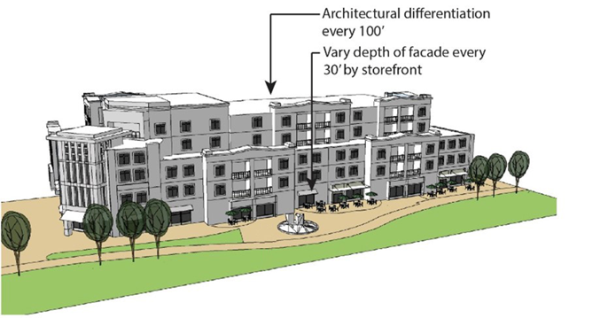
No single building should exceed 200 feet in length or width. No new building elevation should exceed 100 feet in length without at least a three-foot variation in the depth of the façade along the public right of way or any façade that faces the required plaza, and a two-foot variation on other facades. Residential unit balconies should not be interpreted to meet this requirement. Top floors should have architectural differentiation from the other floors of the building and roof lines shall vary every 50 feet, at a minimum. For first floor uses in a mixed-use building, the appearance of small shops or storefronts with variation in the first floor façade every 30 feet or less is recommended. - Building Types. Residential uses in the HCCO may be incorporated into one or more of the following building types.
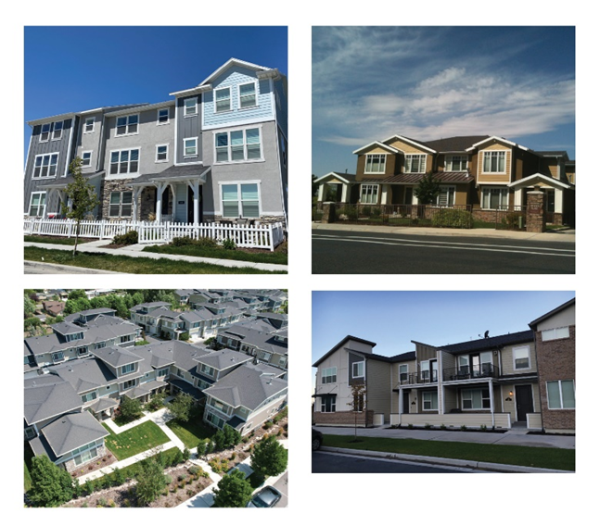
- Townhome - Horizontally attached units in a rowhouse configuration, usually divided into lots for ownership purposes. Townhomes may be located in a one- to three-story building consisting of three to eight attached dwelling units and may be arranged in groups of such buildings. This building type can include live/work units, which shall be specified in the development agreement. Private garages are recommended and should be located at the rear of the building, allowing the primary façade to front a public street or a greenspace/courtyard having a usable outdoor space that allows for active and passive recreation. Private garages should be wired for at least one 220-volt line for electrical vehicle charging. Common guest parking shall not include any driveway that accesses a garage.
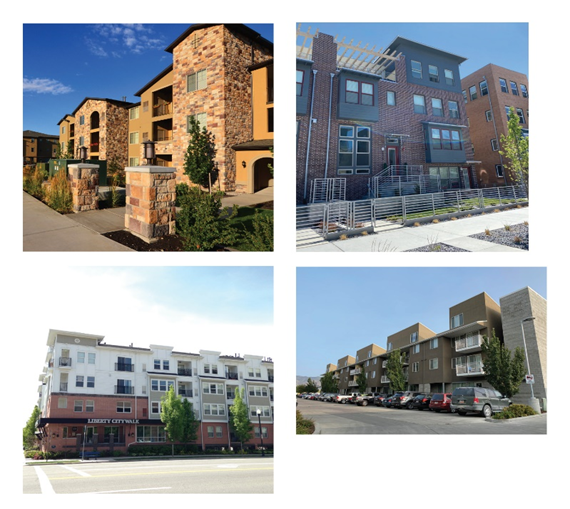
- Multi-family –A multi-story residential building arranged or designed with more than four dwelling units, which may be divided into condominium units or be a for rent product.
Multi-family examples
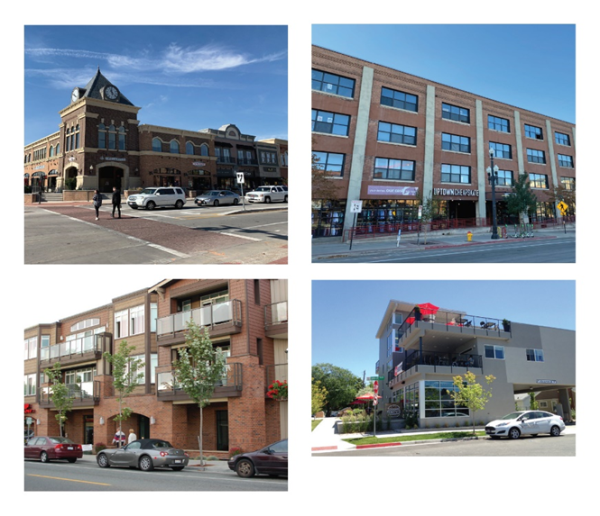
- Mixed Use – General retail, office, and residential uses vertically integrated in the same building that features consistent approaches to lighting, landscaping, signage, building design, and materials use. Intended for a mix of primarily residential use with retail or commercial office uses located on the first floor.
- Townhome - Horizontally attached units in a rowhouse configuration, usually divided into lots for ownership purposes. Townhomes may be located in a one- to three-story building consisting of three to eight attached dwelling units and may be arranged in groups of such buildings. This building type can include live/work units, which shall be specified in the development agreement. Private garages are recommended and should be located at the rear of the building, allowing the primary façade to front a public street or a greenspace/courtyard having a usable outdoor space that allows for active and passive recreation. Private garages should be wired for at least one 220-volt line for electrical vehicle charging. Common guest parking shall not include any driveway that accesses a garage.
- Windows. In mixed-use buildings, windows (including windows in doors) should cover a minimum of 50 percent of the front first story face. For all other building types and facades of a mixed-use building, windows (including windows in doors) should cover at least 25 percent of all facades.
- Balconies. For the residential portions of buildings, one balcony should be constructed with a minimum of sixty (60) square feet per unit. Terraces and ground level porches and patios of similar size could also be permitted and would count toward the balcony recommendation.
- Entrances. Entrances should be recessed or covered to provide shelter from inclement weather. Porte cocheres are also permitted.
- Parking Requirements.
- Location of Parking and Parking Garages. Parking for a multi-family residential or mixed-use building should be located underneath, within (as in podium-style parking), to the side, or to the rear of the building. An above or partially above grade parking garage within the interior of a building having more than 20 residential units, if located within 50 feet of a public right-of-way, should include commercial uses that wrap the street-facing façade. No visible podium parking is recommended fronting on 500 West, 400 North, 500 South or 1100 West unless such parking is wrapped with commercial uses on the street-facing facade. If an above grade or a partially above grade parking garage is incorporated into a building that is located more than 50 feet from a public street, any portions above ground should be designed to complement the building in a manner that the parking garage is not readily discernable as such or is surrounded with a five foot-wide intensive landscape treatment that includes trees and shrubs covering at least 75 percent of each parking garage façade.
- All projects of any building type shall provide the following minimum number of parking spaces:
Studio apartments – 1 space per unit;
One bedroom units – 1.5 spaces per unit;
Two or more bedroom units – 2 spaces per unit.
All projects should provide additional guest parking spaces equal to one guest parking space for every four units. Any parking calculations that result in less than a whole number shall be rounded up. - To further evaluate the above parking space requirements for a particular project, the city may require an independent parking study where parking demand calculations exceed 50 spaces, shared parking is being considered, or the proposed use may impact previously calculated parking demands for adjacent uses. Any such study will be managed by the city but paid for by the developer. The city may adjust the above parking recommendations consistent with the parking study’s conclusions to reflect such factors as shared parking and compatible uses. The Planning Commission shall make findings reflecting the study or discounting the study and may suggest modifications of the parking guidelines or simply leave the standards as-is. Parking stalls 9-feet by 20-feet are recommended but a parking study could also address compact car spaces in terms of size and as a percentage of the overall parking.
- Shared parking is encouraged based on a parking study but recommended only for up to 30 percent of the parking demand. The development agreement shall include the terms of shared parking for both the existing uses and proposed new HCCO development. The shared parking requirement is for a minimum of ten years and shall be renewed thereafter.
- Bike parking is encouraged for residential projects. Bike parking should be well lighted and secure, with a combination of indoor bike storage and exterior bike parking. Where a mixed-use building is proposed, a conveniently located permanently attached bike rack accommodating a minimum of four bikes per building is recommended for commercial patrons.
- Residential portions of parking garages and structures, including carports, are strongly encouraged to include 220-volt outlets and associated infrastructure/conduit for personal vehicle charging. The suggested standard is one outlet for every ten residential units; however, the number shall be determined as part of the development agreement.
Adopted by Ord. 449-21 on 11/22/2021
17.44.070 Signs
Signs in the HCCO shall be governed by Chapter 17.48, except all illuminated signs shall have downward directed and shielded lighting. Only monument signs and signs on the building are recommended.
Adopted by Ord. 449-21 on 11/22/2021
17.44.080 Application Process
- General Requirements. An application for the HCCO is considered a rezone application subject to the rezone process provided in this chapter. The application shall be accompanied by a draft development agreement. The application, development agreement template, and their associated requirements are available online and at the city offices.
- Pre-application Conference. The applicant is required to have a pre-application conference with a member of the planning department and city engineer to ascertain the appropriate scope of the project and any additional information or reports that may be required in connection with the application and development agreement. The applicant is also encouraged to meet with the building official and the fire marshal to be advised of how building and fire code requirements may affect the proposed development.
- Required Studies. A geotechnical study is required for any proposed building over one story. A traffic study is required for projects with 50 or more residential units.
- Fees. In addition to the initial rezone application fee for the HCCO, the applicant will pay for any studies required as part of the approval process. All such studies will be procured and managed by city staff. Any unused funds will be refunded to the applicant or transferred to be used as payment toward other application fees, at the request of the applicant. For all proposed rezones and associated development plans, a complete application is required before authorization to proceed to the Planning Commission.
- Visual Presentation. If not provided as part of the proposed project application, the applicant shall provide for the review of the Planning Commission and the City Council a visual presentation, preferably using computer graphics, depicting the buildings to be constructed and siting for the proposed development within the context of existing, surrounding development.
- Planning Commission Review of Initial Rezone Application; Preparation of Proposed Development Agreement:
- The initial application shall be referred to the Planning Commission for review and comment.
- The City shall mail notice of an initial public hearing to owners of property within 300 feet of the proposed project.
- The Planning Commission shall make a recommendation to the City Council of approval, approval with modifications/conditions, or denial. Such recommendation shall include any recommended changes/modifications to the draft development agreement.
- If approval is recommended, the planning department, with the assistance of the city attorney and the concurrence of the applicant, shall prepare a second draft of the development agreement.
- The initial application shall be referred to the Planning Commission for review and comment.
- City Council Review and Public Hearing:
- If city staff and the applicant cannot concur on the terms and conditions of a proposed development agreement, the applicant may prepare and submit their own proposed development agreement, addressing all the required information and any proposed changes contrary to the Planning Commission recommendation. Upon the submission of such agreement, and the submission of any other related project-specific plans requiring approval of the City Council, the application shall be scheduled and noticed for public hearing before the City Council. The City shall mail notice of the public hearing to owners of property within 300 feet of the proposed project.
- City Council Public Hearing: The initial application, additional reports/information, and planning commission recommendation, together with the proposed development agreement and the complete submission of all other related, project-specific information requiring approval of the City Council, shall constitute a final application for the potential rezone. If approved by the City council, the rezone application and development agreement shall authorize the applicant to proceed with an administrative site plan process. If a subdivision is required, such as for a condominium project or to define a new lot, an administrative subdivision process will follow the approvals by the City Council.
- If city staff and the applicant cannot concur on the terms and conditions of a proposed development agreement, the applicant may prepare and submit their own proposed development agreement, addressing all the required information and any proposed changes contrary to the Planning Commission recommendation. Upon the submission of such agreement, and the submission of any other related project-specific plans requiring approval of the City Council, the application shall be scheduled and noticed for public hearing before the City Council. The City shall mail notice of the public hearing to owners of property within 300 feet of the proposed project.
Adopted by Ord. 449-21 on 11/22/2021

