
West Bountiful City Zoning Code
17.14 Agricultural
Specialty District, A-S
17.14.010 Purpose
The purpose of the A-S agricultural specialty district is to promote and preserve in appropriate areas conditions favorable to agriculture and maintaining greenbelt open spaces. This district is intended to include activities normally and necessarily related to agricultural use, and to protect the district from the intrusion of uses harmful to the continuance of agricultural activity. It is intended to allow associated residential uses, the keeping of limited numbers of animals and fowl, and reduced requirements for public utilities.
Adopted by Ord. 429-20 on 7/27/2020
17.14.020 Permitted Uses
The following uses are permitted in the A-S agricultural specialty district:
- Agricultural;
- Single family dwelling;
- Farm Animals;
- Home Occupations (subject to Chapter 5.28);
- Accessory dwelling units (ADU), subject to Chapter 17.82;
- Non-commercial structures;
- Landscape Supply;
- Medical cannabis pharmacy, as defined in Chapter 17.62; and
- Cannabis production establishment, as defined in Chapter 17.62.
Adopted by Ord. 429-20 on 7/27/2020
Amended by Ord. 445-21 on 8/6/2021
Amended by Ord. 481-24 on 3/21/2024
17.14.030 Conditional Uses
The following uses are conditional in the A-S agricultural specialty district:
- Equestrian facilities, commercial stables;
- Public or quasi-public uses;
- Child day care or nursery (pursuant to Chapter 5.28 Home Occupations);
- Flag lots;
- Kennels (pursuant to Chapter 5.28 Home Occupations), and ;
- Restricted Lots (see definitions, Section 17.04.).
Adopted by Ord. 429-20 on 7/27/2020
Amended by Ord. 445-21 on 8/6/2021
17.14.040 Area And Frontage Regulations
The following area and frontage regulations apply in the A-S agricultural specialty district:
- The minimum residential lot size shall be one acre; this shall not apply to PUDs which shall be regulated by provisions of Chapter 17.68;
- The minimum lot width shall be eighty-five (85) feet;
- Any legally created lot at the time of adoption of this zoning code, which is below the requirements for lot area or lot width for the district in which it is located and on which a dwelling would be permitted if the lot met the area requirements of the zoning code, may be used for a single family dwelling if such a lot is located in the A-S, A-1, R-1-10, R-1-22) zoning district. The width of each of the side yards for such a dwelling may be reduced to a width which is not less than the same percentage of the lot width as the required side yard would be of the required lot width; provided that in no case shall the smaller of the two side yards be less than five (5) feet nor shall the total width of the two side yards be less than thirteen (13) feet.
Adopted by Ord. 429-20 on 7/27/2020
17.14.045 Every Dwelling To Be On A Lot; Exceptions
Every dwelling structure shall be located and maintained on a separate lot having no less than the minimum area, width, depth, and frontage required by the title for the district in which the dwelling structure is located, except that farm or ranch dwellings, group dwellings, condominiums and other multi structure dwellings, complexes under single ownership and management, which are permitted by this title and have approval by the planning commission, may occupy a single lot.
Adopted by Ord. 429-20 on 7/27/2020
17.14.050 Yard Regulations
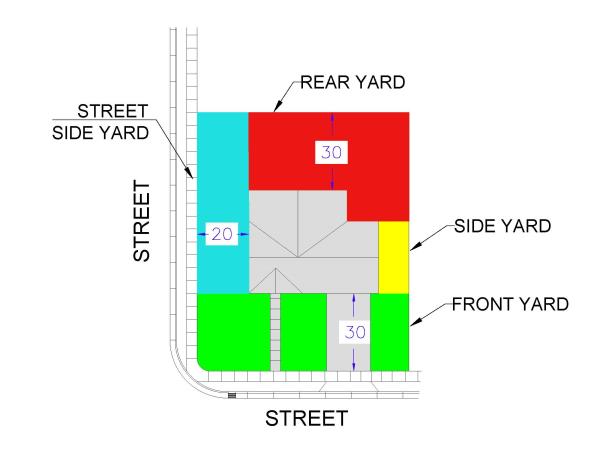
- Minimum Setbacks. (See diagram below)
- Front yard. The minimum front yard setback for all structures is thirty (30) feet, except as otherwise allowed in this Code.
- Side yard.
- Except as otherwise provided in this code, the minimum side yard setback for main structures, except non-commercial structures, is ten (10) feet for any one side with a combined total side setback of twenty-four (24) feet for both sides.
- Except as otherwise provided in this code, the minimum side yard setback for accessory structures and non-commercial structures is six (6) feet, or three (3) feet if the adjacent wall is built to fire code standards.
- Street side yard.
- On a corner lot, the minimum street side yard setback is twenty (20) feet.
- Not withstanding the foregoing, a structure may be constructed within the street side yard of a corner lot if the structure:
- Is situated behind the rear line of the main structure and no closer than three (3) feet from the street side lot line;
- Is two hundred (200) square feet or less;
- Has a maximum height of nine (9) feet measured from the lowest finished ground level to the highest part of the roof; and
- Complies with other requirements of this Code.
- Rear yard.
- The minimum rear yard setback for all main structures, except non-commercial structures, is thirty (30) feet.
- Except as otherwise provided in this code, the minimum rear yard setback for accessory structures and non-commercial structures, measured from the rear lot line, is six (6) feet, or three (3) feet if the adjacent wall is built to fire code standards.
- For purposes of subsections A.4.d and A.4.e. of this section:
- "Patio" means a pad or structure no more than twenty-four (24) inches above the lowest adjacent finished ground level that provides outdoor floor space and does not require a railing under applicable building codes.
- "Deck" means a structure higher than twenty-four inches above the lowest adjacent finished ground level that provides outdoor floor space and requires a railing under applicable building codes.
- A deck may encroach into the rear yard setback as long as it meets the following requirements:
- No portion of the deck is less than twenty-five (25) feet from the rear property line;
- The deck is no closer to a side lot line than the minimum required side yard or street side yard setback for the main structure;
- The deck does not encroach more than 200 square feet into the setback area;
- The floor of the deck is no higher than the highest finished floor of the main structure;
- The portion of the deck that extends into the rear yard setback is not covered; and
- The railing is no more than forty-eight (48) inches high and is less than twenty-five percent (25%) transparent.
- A patio roof may encroach into the rear yard setback as long as it meets the following requirements:
- The patio floor surface is no higher than the lowest finished floor elevation;
- No portion of the roof is less than twenty-five (25) feet from the rear property line;
- The roof is no closer to a side lot line than the minimum required side yard or street side yard setback for the main structure;
- The roof does not encroach more than two-hundred (200) square feet into the setback area;
- The highest point of the roof is no higher than the adjacent roof the the dwelling or eighteen (18) feet above the patio, whichever is lower;
- No wall, fence, or railing is required or constructed along any part of the patio; and
- The patio and roof meet all building code requirements.
 Distance between main structures and accessory buildings. The minimum distance between all main structures and accessory structures shall be eight (8) feet
- Building on recorded easements.
- No main structure shall be built on or over any recorded easement such as a public utility easement.
- No non-commercial structure or permanent accessory structure shall be built on or over any recorded easement such as a public utility easement unless (a) the property owner submits to the city written permission from the easement holder; and (b) the property owner executes a recordable document, in a form approved by the city attorney, indicating that notwithstanding any permission granted, the structure may be subject to the superior interest of the easement holder and may be required to be relocated at the property owner’s expense to accommodate such interest.
- Location: Any structure in an easement area shall be located pursuant to the setbacks or other applicable requirements of this title.
- No Expansion of Legal Rights: Nothing in this section is intended to expand or restrict the rights or obligations of any party to any recorded easement.
- Location: Any structure in an easement area shall be located pursuant to the setbacks or other applicable requirements of this title.
- No main structure shall be built on or over any recorded easement such as a public utility easement.
- Lot standards and street frontage. Except as otherwise provided in this title, every lot hereafter created or modified shall have such area, width and depth as is required by this title for the district in which such lot is located and shall have frontage upon a public street before a building permit may be issued.
- Yard space for one building only. No yard or open space on a property shall be considered as providing a yard or open space for a building on an adjacent property.
- Area of structure and accessory building. No accessory structure or group of structures in any residential district shall cover more than thirty-five percent (35%) of the rear yard or, on a corner lot, the combined rear yard and street side yard behind the main structure.
- Sales or lease of space. No space needed to meet the width, yard, area, coverage, parking or other requirements of this title for a lot or building may be sold or leased away from such lot or building.
- Other building and structure restrictions. No structure, including any structure exempt from a building permit, shall be allowed in any part of a required front, side, or street side yard setback, except that landscape enhancements, such as trellises and arbors, shall be allowed subject to other applicable regulations. Any such landscape enhancement in the front, side, or street side yard shall be limited to a gross area of ten (10) square feet or less, a width no greater than sixty (60) inches, and a height no greater than ninety-six (96) inches and shall be subject to applicable site triangle area restrictions.
Adopted by Ord. 429-20 on 7/27/2020
Amended by Ord. 451-22 on 4/8/2022
Amended by Ord. 507-25 on 10/7/2025
17.14.060 Height Regulations
- Maximum height of structures. No structure shall be erected to a height greater than thirty-five (35) feet as measured from the top back of curb, or crown of the road if there is no curb to the highest part of the roof, except as otherwise provided in this section. The elevation of the top back of curb or crown of the road shall be measured at a point on a line perpendicular to the front lot line that intersects the midpoint of the front lot line.
- The height of a main structure, except for non-commercial structures, may be increased to a maximum of forty (40) feet if the structure is set back as shown in the chart below.
Height Minimum Side Setbacks Combined Side Setbacks ≤35 ft 10 ft 24 ft ›35 ft ≤36 ft 11 ft 26 ft ›36 ft ≤37 ft 12 ft 28 ft ›37 ft ≤38 ft 13 ft 30 ft ›38 ft ≤39 ft 14 ft 32 ft ›39 ft ≤40 ft 15 ft 34 ft - The height of an accessory or non-commercial structure may be increased to a maximum of forty (40) feet if the structure is set back in the rear yard and side yards as shown in the chart below using both measurements. 1 Does not apply to street side yards, which have separate restrictions.
ACCESS0RY STRUCTURE Measurement 1 Measurement 2 Maximum Height (Roof Peak and/or Wall) Minimum Side/Rear Setback1 at Maximum Height of Roof Peak Minimum Side/Rear Setback1 a Maximum Height of Wall ≤20 ft 6 ft2 6 ft2 ›21 ft ≤35 ft 10 ft 10 ft ›35 ft ≤36 ft 11 ft 11 ft ›36 ft ≤37 ft 12 ft 12 ft ›37 ft ≤38 ft 13 ft 13 ft ›38 ft ≤39 ft 14 ft 14 ft ›39 ft ≤40 ft 15 ft 15 ft
2 Setback may be reduced to 3 ft. if adjacent wall is built to fire code standards
- The height of a main structure, except for non-commercial structures, may be increased to a maximum of forty (40) feet if the structure is set back as shown in the chart below.
- Additional height allowed. Public buildings and quasi-public buildings may be erected to a height greater than thirty-five (35) feet when approved as a conditional use by the planning commission.
- Lot-specific height allowance.
- Specific circumstances. The city engineer may approve additional height of up to four (4) feet for all structures on a lot under the following circumstances:
- Where the natural ground elevation at the front of the proposed structure is above the top back of curb (TBC), additional height less than or equal to the elevation difference may be added.
- Where the front setback for the proposed structure exceeds the minimum setback, additional height may be added based on a slope of 3.33%; that is, the additional height shall not exceed one foot of height for every thirty (30) feet of additional horizontal setback.
- Where the determined groundwater elevation is within two feet of the main floor elevation of the proposed structure, additional height may be added to achieve two feet of separation between the ground water surface elevation and the main floor elevation.
- Where the gravity sewer lateral service elevation for the proposed structure is shallow and requires cover for freeze protection, additional height may be added based on a slope of 2.00%; that is, the additional height shall not exceed one foot of height for every fifty (50) feet of horizontal distance between the sewer main and the foundation wall where the lateral enters the structure.
- Where a proposed foundation drain for the proposed structure is gravity draining to a shallow gravity storm drain elevation. Additional height may be added based on a slope of 1.00%; that is, the additional height shall not exceed one foot of height for every 100 feet of horizontal distance between the storm drain and the foundation wall.
- Where the natural ground elevation at the front of the proposed structure is above the top back of curb (TBC), additional height less than or equal to the elevation difference may be added.
- Good cause. Where there are unexpected existing site conditions other than as described in this section, and for good cause shown, the city engineer may approve additional height, but only to the extent necessary to mitigate such site conditions.
- Specific circumstances. The city engineer may approve additional height of up to four (4) feet for all structures on a lot under the following circumstances:
- Exceptions to height limitations. Penthouse or roof structures for the housing of elevators, stairways, tanks, ventilating fans or similar equipment required to operate and maintain the building; and fire or parapet walls, skylights, towers, steeples, flagpoles, chimneys, smokestacks, water tanks, wireless or television masts, theater lofts, silos or similar structures may be erected above the height limits herein prescribed, but no space above the height limit shall be allowed for the purpose of providing additional floor space, and such increased height is subject to all other ordinances and regulations of the city.
- Minimum height of dwellings. No dwelling shall be erected to a height less than one story above grade.
Amended by Ord. 441-21 on 5/4/2021
Amended by Ord. 451-22 on 4/8/2022
Amended by Ord. 473-23 on 7/18/2023
17.14.070 Density
The maximum net density allowed shall be one unit per acre.
Adopted by Ord. 429-20 on 7/27/2020
17.14.080 Farm Animal Regulations
- Farm animals may be kept on properties according to the following requirements:
- For each acre, a parcel, or adjacent properties, whether owned or leased, shall be eligible to contain or house farm animals rating one hundred (100) points or prorated for any part thereof.
- Large animals such as horses, ponies, donkeys, mules, llamas and cows require a minimum area of .40 acres: Forty (40) points each.
- Medium animals such as sheep and goats, and other animals of similar size: Twenty (20) points each.
- Small animals such as ducks, chickens, geese, rabbits and turkeys: Four (4) points each.
- Pigs, provided that pens are located at least two hundred (200) feet from neighboring dwellings: Forty (40) points each.
- Miniature or pygmy farm animals will have one-half the points of the normal sized species.
- Large animals such as horses, ponies, donkeys, mules, llamas and cows require a minimum area of .40 acres: Forty (40) points each.
- The points listed in Subsection A.1 above may be decreased for large, medium and small animals subject to approval of a conditional use permit by the planning commission pursuant to Chapter 17.60 of the West Bountiful Municipal Code and the provisions below.
- The minimum points allowed shall be twenty-five (25) for each large animal, ten (10) for each medium animal, and two (2) for each small animal.
- Neighbors adjoining the applicant’s property for which the conditional use permit is requested will be notified by city staff at least five (5) days prior to the public meeting. Such notification will include the name and address of the applicant, the specific reason for the application, and the date, time and location of the planning commission meeting at which the application will be discussed.
- The minimum points allowed shall be twenty-five (25) for each large animal, ten (10) for each medium animal, and two (2) for each small animal.
- Dependent offspring, up to nine (9) months of age, shall not be counted in determining the total number of animals on the parcel(s).
- Adopted dependent offspring, up to nine (9) months of age, shall not be counted in determining the total number of animals on the parcel(s), subject to approval of a conditional use permit as outlined in Subsection A.2. above. Such conditional use permit shall be valid for no longer than nine months, as determined by the planning commission.
- Honeybees, pursuant to the requirements of Title 4, Chapter 11 of the Utah Code.
- For each acre, a parcel, or adjacent properties, whether owned or leased, shall be eligible to contain or house farm animals rating one hundred (100) points or prorated for any part thereof.
- For multiple properties to be eligible for combined point calculation under Subsection A, the following criteria must be met:
- The properties shall be owned or leased by the same person or entity.
- All properties used for the combined point calculation must be contiguous.
- If one or more properties are leased:
- The lease must be in writing and signed by both parties.
- The leased property, in its totality, must be used in some meaningful way by lessee in the keeping of farm animals.
- The lease must be in writing and signed by both parties.
- The properties shall be owned or leased by the same person or entity.
- All animals, except bees, must be kept in an area enclosed by a fence or structure sufficient to prevent escape.
- Setbacks for all structures shall meet applicable zoning requirements for each parcel, as well as the following requirements, as applicable.
- No animal shelter, including pens, coops and beehives, may be located less than six (6) feet from any property line or dwelling.
- Barns, stables, corrals, or similar structures used to house medium and large animals may not be located less than seventy-five (75) feet from any neighboring dwelling.
- An apiary, housing colonies of bees, must be at least six (6) inches above the ground and, if located less than fifteen (15) feet from a property line, a solid six (6) foot vertical barrier running along or near the property line and extending at least four (4) feet beyond the apiary in each direction is required.
- To protect the health, safety and welfare of the animals and the public, animal waste, debris, noise, odor, and drainage shall be kept in accordance with usual and customary health standards associated with that type of animal.
- Failure to comply with any portion of this section shall invalidate any use specified in this section and shall subject the owner to penalties and/or fines as specified elsewhere in this title.
Adopted by Ord. 429-20 on 7/27/2020
17.14.090 Landscape Supply Regulations
- The outdoor storage regulations in Chapter 17.92, and specifically as applied to the C-H Zoning District, shall apply.
- Topsoil preparation, landscape rock preparation, or other processing activities must occur in an enclosed structure.
- Outdoor lighting on the site must be downlighting, with not light fixture at a height greater than 20 feet.
- Deliveries and exports of soil, gravel, and rocks must be covered loads.
- A SWPPS plan must be submitted at time of business license application.
- No processing or deliveries on the site shall be allowed before 7:00 am or after 10:00 pm.
Adopted by Ord. 448-21 on 10/8/2021

