
West Covina City Zoning Code
ARTICLE VI
- PERMIT PROCESSING PROCEDURES
DIVISION 8. - FILM PERMIT PURPOSE
This division establishes special regulations for filming within the City. Property in any zone, unless otherwise specified in filming guidelines pursuant to section 26-254(d), or provisions listed in section 26-61(c)(1)c., may be used as a location for filming, including without limitation filming of motion pictures, videotaping, or use of similar technology subject to approval of a film permit or major production permit pursuant to this article.
Sec. 26-182.- Application forms and materials.
The Community Development Director or their designee shall prepare and issue application forms and lists that specify the information that will be required from applicants for projects subject to the provisions of this chapter. The director shall require the submission of supporting materials as part of the application, including but not limited to statements, photographs, plans, drawings, renderings, models, material samples, contextual drawings, massing diagrams and/or models, site development history information, and other items necessary or relevant (e.g., easements, prior site zoning) to describe existing conditions and the proposed project and to determine the level of environmental review pursuant to the California Environmental Quality Act.
(Ord. No. 2519, § 5(Exh. A), 2-20-24)
Sec. 26-183. - Applications a part of permanent record.
Applications filed pursuant to this chapter shall be numbered consecutively in the order of their filing, and shall become a part of the permanent official records of the agency to which application is made, and there shall be attached thereto and permanently filed with copies of all notices and actions with certificates or affidavits of posting, mailing or publications pertaining thereto.
(Ord. No. 2519, § 5(Exh. A), 2-20-24)
Sec. 26-184. - Filing fees.
The City Council shall approve by resolution a municipal fee schedule that establishes fees for permits, appeals, amendments, informational materials, penalties, copying, and other such items. These fees may be amended by the City Council by legislation.
If, pursuant to the guidelines and procedures for evaluating environmental impacts of proposed projects, the Community Development Director or their designee declares that a proposed action is not categorically exempt from the provisions of the California Environmental Quality Act of 1970, the developer shall be required to pay the California Department of Fish and Wildlife and County recording fee established by a resolution of the City Council at the time the application to prepare or process required environmental impact documents is accepted.
(Ord. No. 2519, § 5(Exh. A), 2-20-24)
Sec. 26-185. - Multiple applications.
(a)
Multiple applications needed for the same project (e.g., a precise plan and zone change) must be filed and processed concurrently.
(b)
When multiple applications for one (1) project are filed concurrently and subject to different approval authorities, the highest approval authority shall act on all the applications. If the different approval authorities are the Planning Commission and the City Council, the Planning Commission shall make a recommendation on the applications to the City Council.
(Ord. No. 2519, § 5(Exh. A), 2-20-24)
Sec. 26-186. - Setting hearings.
(a)
All proposals for amending zone boundaries or classifications of property uses within such zones, General Plan amendments, conditional use permits, precise plans, amendments and rezones as are defined by this chapter, or the granting of variances (except minor modifications), as provided in this chapter, shall be set by the secretary of the Planning Commission for public hearing when such hearings are to be held before the Planning Commission, by the clerk of the City Council when such hearings are to be held by it.
(b)
All proposals requiring a hearing as provided in this article shall be considered by the Community Development Director or their designee in a public hearing when such hearings are to be held before. A hearing will only take place if a request for such hearing is made with the planning division within the ten (10) day public review period. If such a request is received, a notice shall be mailed in accordance with section 26-187. If no request for hearing is received within the stated time, the Community Development Director or their designee shall have the authority to approve, approve with conditions, or disapprove the proposal without benefit of a hearing. Conversely, the Community Development Director or their designee may elect to not rule on the proposal prior to noticing and transfer the matter directly to the Planning Commission, to be heard within thirty (30) days from the date this election by the Community Development Director or their designee is provided in writing to the applicant. All times as set out herein shall be calendar days unless otherwise indicated.
(Ord. No. 2519, § 5(Exh. A), 2-20-24)
Sec. 26-187. - Notices.
(a)
Notices of public hearing stating the type of application or nature of proposal, general description of property under consideration, and the time and place at which the public hearing is to be held shall be given in the following manner:
(1)
A reclassification of property from one zone to another, redesignation of a property from one General Plan land use designation to another, amendments to the Development Code, amendments to the General Plan text, or a development agreement shall require:
a.
Mailing Radius. A notice of public hearing shall be mailed to the applicant or his/her agent, the owner of the property and owners of all property within a radius of five hundred (500) feet from the property lines of the site under consideration, using for this purpose the name and address of such owners as shown upon the latest available assessment rolls of the county assessor. The notices shall be mailed at least twenty (20) days prior to the date of the public hearing. If the number of owners to whom the notices would be mailed is greater than one thousand (1,000), or is a City-wide project involving text amendments to the Development Code and/or General Plan, in lieu of a mailed notice, the hearing notice shall be posted at City Hall and published at least twenty (20) days prior to the date of the public hearing on the following locations:
1.
The City's website.
2.
Newspaper of general circulation. The advertisement shall be at least one-eighth (⅛) page.
b.
Agency notification. Notice of the hearing shall be mailed or delivered at least twenty (20) days prior to the hearing to each local agency expected to provide water, sewage, streets, roads, schools, or other essential facilities or services to the project, whose ability to provide those facilities and services may be significantly affected.
c.
Postings. If the project is applicant driven, at least thirty (30) days prior to the date of the hearing, a public notice shall be posted at the project site per section 26-187(b), and at two other public places where public meeting agendas are posted. City-wide applications and/or projects, and City initiated zone changes and/or General Plan land use designation changes are exempt from onsite posting requirements. City-wide applications involve Development Code and General Plan text amendments.
(2)
Entitlement applications for public utility facilities, including wireless telecommunications facilities, that require approval by the Planning Commission and/or City Council shall require:
a.
Onsite public postings. At least thirty (30) days prior to the date of the hearing, a public notice shall be posted at the project site per section 26-187(b), and at two (2) other public places where public meeting agendas are posted.
b.
Mailing radius. A notice of public hearing shall be mailed to the applicant or his/her agent, the owner of the property and owners of all property within a radius of one thousand (1,000) feet from the subject site's property lines, using for this purpose the name and address of such owners as shown upon the latest available assessment rolls of the county assessor. The notices shall be mailed at least ten (10) days prior to the date of the public hearing.
c.
City website. The notice shall be posted on the City's website at least ten (10) days prior to the date of the public hearing.
d.
Agency notification. Notice of the hearing shall be mailed or delivered at least ten (10) days prior to the hearing to each local agency expected to provide water, sewage, streets, roads, schools, or other essential facilities or services to the project, whose ability to provide those facilities and services may be significantly affected.
(3)
For administrative permits (if public notification and public hearing is required per use or by request):
a.
Mailing. A notice that describes the proposed project and indicates the length of the public review period (including the last date that a request for a public hearing may be given to the planning department) shall be mailed to owners of surrounding property as indicated below. The public review period shall extend for ten (10) days from the date that the initial notice was mailed. If a request for a hearing is received during the specified time, a notice shall be mailed a minimum of ten (10) days prior to the date of the hearing, indicating the date, time, and location of the scheduled public hearing.
1.
Notification rules.
(i)
Five-hundred-foot noticing radius: Notices shall be mailed to the property owners of the subject site and owners all properties within a radius of five hundred (500) feet from the property lines of the site under consideration unless otherwise provided for in the sections below.
(ii)
For secondary driveways, notices shall be mailed to the property owners and occupants of the subject site and to the two (2) properties on both sides of the subject site.
(iii)
For sign exception review, outdoor uses within the outdoor uses overlay zone, and canopy structures notices shall be mailed to the property owners and occupants of the subject site and all properties within a radius of one hundred (100) feet from the property lines of the site under consideration.
(iv)
For animal keeping approvals as described in section 26-111 shall require notices to be mailed to all property owners of the subject site and all property owners or occupants of properties within the overlay zone and any property owners or occupants of properties that are adjacent to the subject site and share a property line for improvements in the lower pad area (the portion of land at the rear of the properties that is at approximately the same elevation as the rear property line and is relatively level).
(v)
Public notification is not required for the following applications:
A.
Shopping cart containment review;
B.
Trash enclosure district review;
C.
Accessory uses;
D.
Incidental beer and wine service for a restaurant (bona fide eating place);
E.
Garage/storage shed height increase;
F.
Small Wireless facilities in the public right-of-way.
G.
Minor non-residential building facade changes and/or minor changes to the site plan/site layout.
H.
Minor multi-family residential building facade changes and/or minor changes to the site plan/site layout.
(4)
For non-public utility conditional use permits, precise plans requiring Planning Commission and/or City Council review, variances, or tentative tract maps requiring Planning Commission and/or City Council review, including amendments.
a.
Mailing radius. A notice of public hearing shall be mailed to the applicant or his/her agent, the owner of the property (including mineral rights owner for tentative tract maps) and owners of all property within a radius of five hundred (500) feet from the property lines of the site under consideration, using for this purpose the name and address of such owners as shown upon the latest available assessment rolls of the county assessor. The notices shall be mailed at least ten (10) days prior to the date of the public hearing. If the number of owners to whom the notices would be mailed is greater than 1,000, in lieu of a mailed notice, the hearing notice shall be posted at City Hall and published at least ten (10) days prior to the date of the public hearing on the following locations:
1.
The City's website.
2.
Newspaper of general circulation. The advertisement shall be at least one-eighth (⅛) page.
b.
Postings. Unless otherwise required by section 26-187(a)(4)c., at least ten (10) days prior to the public hearing, a printed notice shall be posted at the project site and at two (2) other public places where public meeting agendas are posted. The minimum size of the onsite notice shall be 11-inches by 17-inches written with heading text that is no smaller than 28-point Arial font in red and body text no smaller than 16-point Arial font in black. The required public hearing notice shall be placed/posted in an area readily visible and accessible by the public such as near/at the building entrance. The location of the posting shall be determined by the Community Development Director.
c.
On-site posting for large projects. The following projects require an on-site posting that meet the requirements of section 26-187(b):
1.
Commercial properties—New developments and where the addition of new square footage is equal to or exceeds ten thousand (10,000) square feet, or greater than fifty (50) percent of the existing building, which ever is less.
2.
Residential properties for developments with five (5) or more units requiring Planning Commission and/or City Council review.
3.
Freestanding wireless facilities—any new freestanding wireless towers proposed.
4.
Tentative tract maps requiring Planning Commission and/or City Council review.
d.
Public area posting. At least ten (10) days prior to the public hearing, the required public hearing notice shall be placed/posted at two (2) other public places where public meeting agendas are posted.
e.
Agency notification. Notice of the hearing shall be mailed or delivered at least ten (10) days prior to the hearing to each local agency expected to provide water, sewage, streets, roads, schools, or other essential facilities or services to the project, whose ability to provide those facilities and services may be significantly affected.
(b)
Onsite public hearing notice board installation standards.
(1)
The sign shall be installed within five (5) feet of the property line. If on a corner, the sign should be posted at an angle so long as the sign is five (5) feet from the property line of both streets.
Figure 6-1 On-site Notification Sign on Corner Property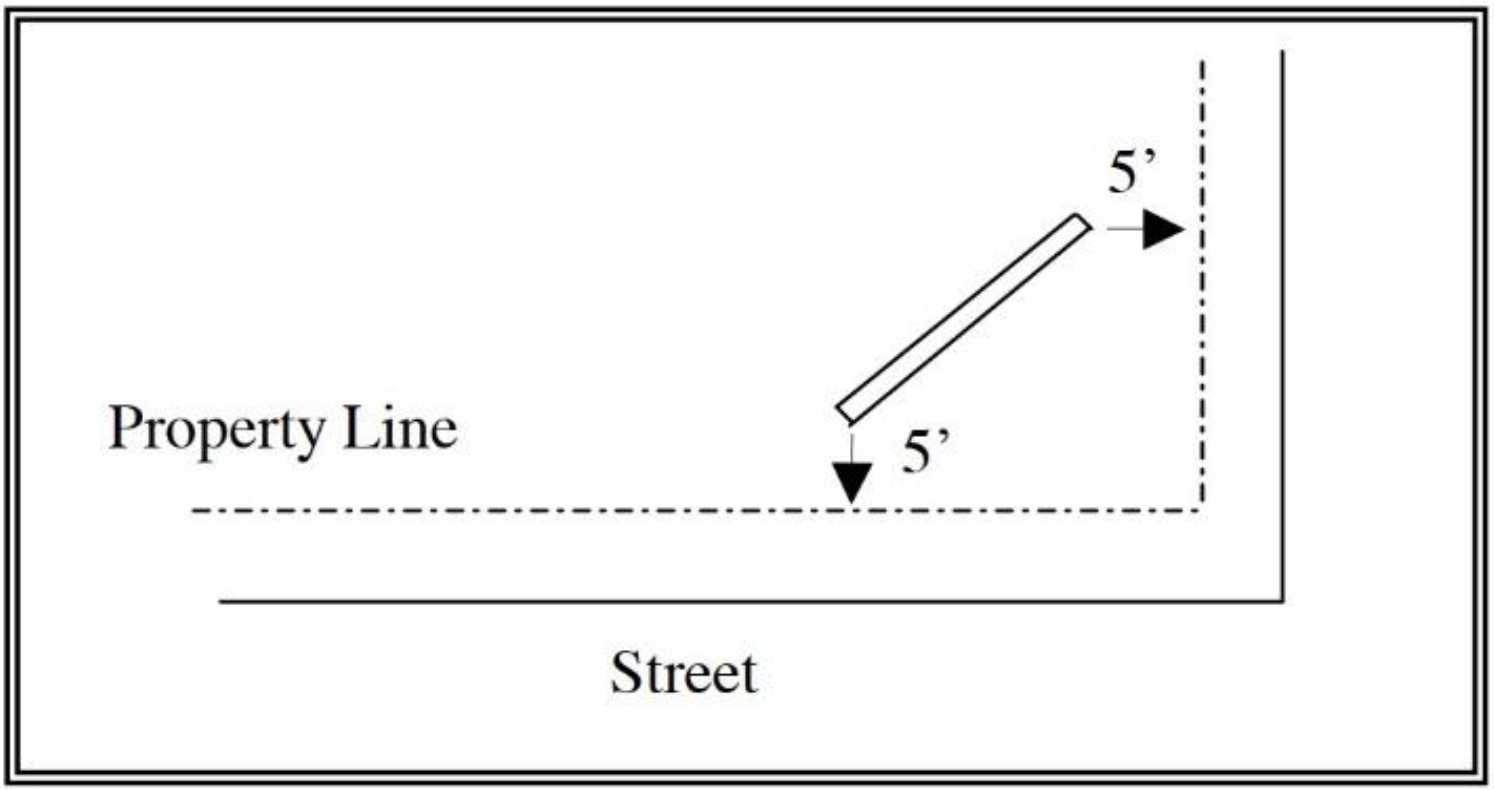
(2)
The sign shall be a minimum of three (3) feet in width by five (5) feet in height and may be double sided if installed perpendicular to the street. The sign shall be mounted on four-inch by four-inch posts. The bottom of the sign shall be at least two (2) feet, but no more than three (3) feet above the ground level. The required text and format are shown below. The "Public Hearing Notice" text shall be at least three and one-half (3.5) inches and the remaining text shall be at least one and one-quarter (1.25) inches in height.
(3)
The banner area at the top of the Notice shall be in red (with letters in white) and all other text shall be printed in red.
Figure 6-2 On-site Notification Sign Example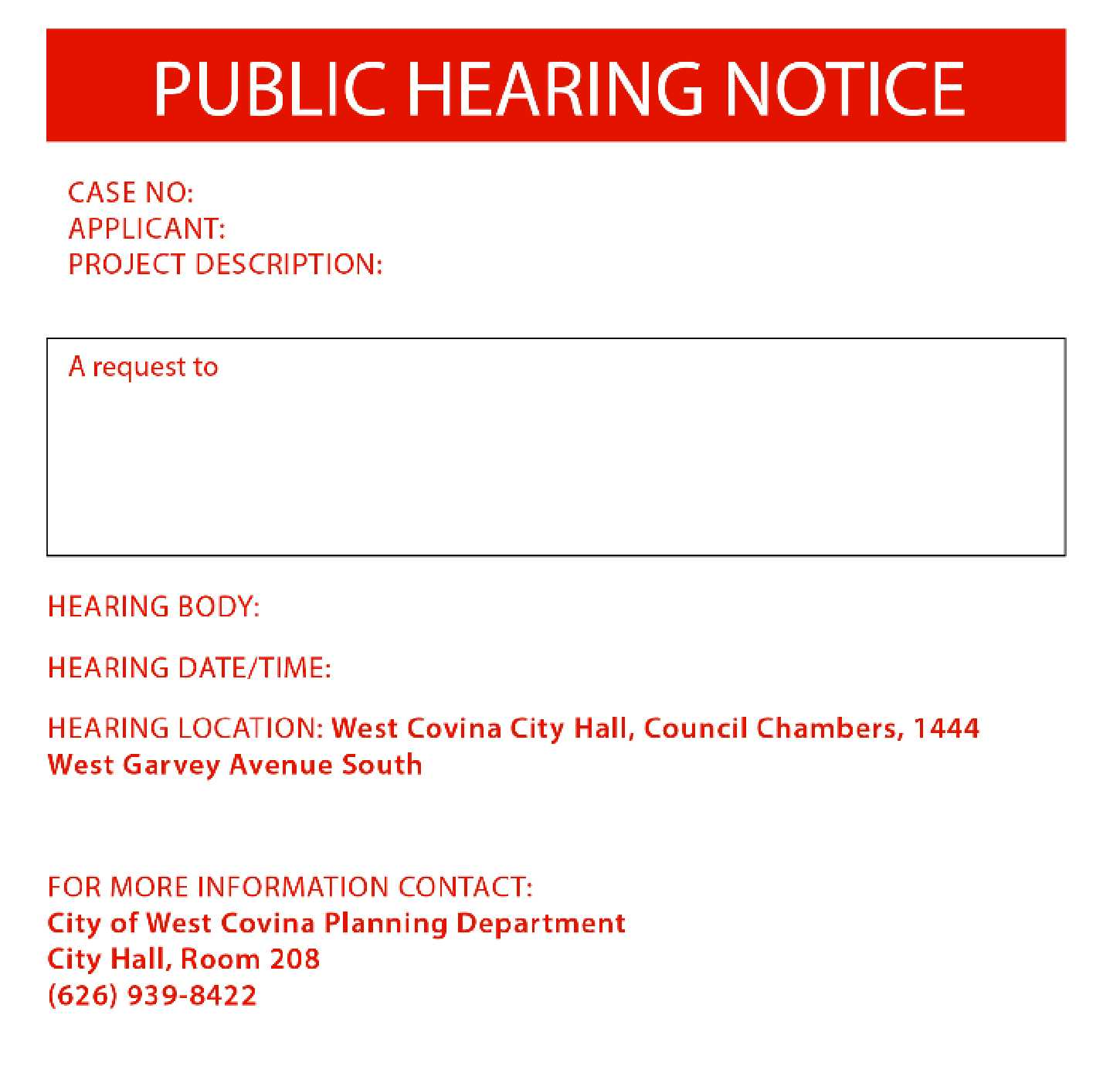
(4)
The sign must contain a general explanation of the proposed project, the applicant's identification and contact information as provided on the application submitted to the City, and contact information for the approval authority.
(c)
Whenever a hearing is held regarding a permit for a drive-through facility, or modification of an existing drive-through facility permit, the local agency shall incorporate, where necessary, notice procedures to the blind, aged, and disabled communities in order to facilitate their participation in any hearing on, or appeal of the denial of, a drive-through facility permit.
(Ord. No. 2519, § 5(Exh. A), 2-20-24; Ord. No. 2525, § 38, 3-18-25)
Sec. 26-188. - Establishment of public hearing rules for conduct.
Each hearing body may establish its own rules governing the conduct of public hearings.
(Ord. No. 2519, § 5(Exh. A), 2-20-24)
Sec. 26-189. - Hearings may be continued without recourse to public notice.
If, for any reason, testimony on any case set for public hearing cannot be completed on the day set for such hearing, the person presiding at such public hearing may, before adjournment or recess thereof, publicly announce the time and place to, and at which, said hearing will be continued, and no further notice shall be required.
(Ord. No. 2519, § 5(Exh. A), 2-20-24)
Sec. 26-190. - Permanent files shall include summary of testimony.
A summary of all pertinent testimony at the public hearing held in connection with an application filed pursuant to this chapter, and the names of persons testifying shall be recorded and made a part of the permanent files of the case, but a failure to observe requirements of this section shall not affect the validity of any action.
(Ord. No. 2519, § 5(Exh. A), 2-20-24)
Sec. 26-191. - Planning Commission decision and findings.
The Planning Commission, following the termination of the public hearing, shall:
(a)
Announce its decision to approve or deny the application by resolution which shall clearly state the facts and reasons for the decision rendered and any conditions or limitations imposed.
(b)
Within thirty (30) days after adoption of said resolution, whether the application is approved or denied, notify the applicant by mailing a copy of the resolution to the address on the application and to any other person who has filed a written request for such notification.
(c)
Keep all reports as permanent record in the files of the planning division.
(Ord. No. 2519, § 5(Exh. A), 2-20-24)
Sec. 26-192. - Effective date of Planning Commission decision.
(a)
All decisions of the Planning Commission except recommendations to the City Council (e.g. for General Plan amendments) shall become final and effective after the expiration of the appeal period as set forth in section 26-193, below.
(b)
Recommendations to the City Council shall be transmitted to the City Council who shall conduct a duly advertised public hearing on the matter.
(Ord. No. 2519, § 5(Exh. A), 2-20-24)
Sec. 26-193. - Appeal procedure.
(a)
Appeals may be submitted by anyone, must be in writing, must include specific reasons for the appeal, and must be accompanied by the fee set by City Council resolution.
(b)
Decisions of the Community Development Director or their designee or Planning Commission subcommittee for design may be appealed to the Planning Commission. The decision of the Planning Commission on the appeal is final, unless after written request is made to the City Council, the City Council approves the request for appeal to the City Council.
(c)
Decisions of the Planning Commission may be appealed to the City Council, except as provided in subsection (b).
(d)
A timely appeal suspends and sets aside the decision of the lower authority.
(1)
Appeals of the Community Development Director or their designee decisions must be submitted to the planning division no more than ten (10) calendar days after approval of a written decision, unless otherwise provided in this code.
(2)
Appeals of Planning Commission decisions and written requests for an appeal hearing by the City Council must be submitted to the City clerk no more than ten (10) calendar days after adoption of a resolution of approval or denial.
(3)
The appeal period commences on the day after approval of a written decision and ends at the close of the business day on the tenth calendar day, including the day of commencement. If the tenth day falls on a day that the City is closed to for business, the period is extended to until the close of the business day of the next day the City is open for business.
(e)
Once an appeal has been properly and timely filed and notice of the hearing has been mailed or published, the appeal may not be withdrawn without the consent of the body to which the appeal has been made.
(f)
The City Council or Planning Commission, as the case may be, shall conduct a public hearing on the appeal within sixty (60) days from the filing of the appeal or approval of a request for an appeal hearing or as otherwise specified by the City Council or Planning Commission, or agreed upon by the appealing party. Notice of the public hearing shall be given as provided in section 26-187.
(g)
When considering an appeal, the City Council or Planning Commission shall hear the appeal as a de novo hearing. The City Council or Planning Commission may approve, deny or modify the matter appealed.
(Ord. No. 2519, § 5(Exh. A), 2-20-24)
Sec. 26-194. - Referral back to Planning Commission.
(a)
The City Council may, because of making substantial changes, or because of a desire for additional information, or due to the submission of significant new material or evidence, refer the matter back to the Planning Commission for further study and report. At the time of referral, the City Council shall specify a time period within which the Planning Commission is required to report back to the City Council. If so referred, the Planning Commission secretary shall state to the City Council the date upon which said matter will appear on the Planning Commission agenda, whereupon said date shall immediately be publicly announced by the City Council.
(b)
The Planning Commission report to the City Council shall be considered in public hearing before the City Council after renotifying in exactly the same manner as the original appeal.
(Ord. No. 2519, § 5(Exh. A), 2-20-24)
Sec. 26-195. - Planning Commission failure to report.
Failure of the Planning Commission to report back to the City Council within the time period specified by the City Council shall be deemed an approval by the Planning Commission of City Council changes or actions.
(Ord. No. 2519, § 5(Exh. A), 2-20-24)
Sec. 26-196. - City Council call-up procedures.
Notwithstanding any appeal procedures or any other procedures provided by law, two (2) City Council members may, in writing, call for the review of the decisions of the Planning Commission within ten (10) days following the Planning Commission's meeting at which the decision was made.
If called-up for review by the City Council, the item will be heard de novo at a future City Council meeting within sixty (60) days of the initial call-up date, or a later date requested or agreed to by the applicant in writing. If the City Council does not vote, the decision of the Planning Commission shall be final. All provisions for notice and hearing applicable to the Planning Commission for that type of decision shall apply to the City Council in conducting its review; provided, however, that if an item is called-up by the City Council for a de novo hearing, the notices shall be given to owners of properties within a one thousand (1,000) foot radius of the subject property.
If an appeal from a decision has been properly filed, the matter shall be conducted as an appeal subject to all applicable requirements for such appeals, rather than a review subject to this section.
(Ord. No. 2519, § 5(Exh. A), 2-20-24; Ord. No. 2525, § 52, 3-18-25)
Sec. 26-197. - City Council decision and findings.
The City Council, following the termination of the public hearing shall:
(a)
Announce its decision to approve, modify or deny the application or appeal by resolution or ordinance which shall clearly state the facts and reasons for the decision rendered and any conditions or limitations imposed.
(b)
Within thirty (30) days after the City Council adopts the resolution or ordinance stating whether the application is approved or denied a copy of the resolution or ordinance shall be mailed to the applicant at the address shown on the application and to any other person who has filed a written request for such notification.
(Ord. No. 2519, § 5(Exh. A), 2-20-24)
Sec. 26-198. - Decision of the City Council.
(a)
Action by the City Council on an application or appeal shall be by majority vote of a quorum of the City Council and shall be final and conclusive. Any ordinance or resolution of the City Council shall require three (3) affirmative votes of the City Council.
(b)
If a City Council vote on an application result in a tie, or if the City Council does not take action on the application, such tie vote or lack of action shall constitute a denial of the application.
(c)
If a City Council vote on an appeal results in a tie, or if the City Council does not take action on the appeal, the decision of the Planning Commission shall stand.
(Ord. No. 2519, § 5(Exh. A), 2-20-24)
Sec. 26-199. - Refiling projects.
A denied project may not be resubmitted to the City for review and approval in substantially the same form for at least one (1) year from the date of denial.
Table 6-1 Authority for Land Use and Zoning Decisions
(Ord. No. 2519, § 5(Exh. A), 2-20-24)
Sec. 26-200.- Purpose.
(a)
The purpose of this division is to establish a formal procedure for individuals with disabilities and their representatives to request reasonable accommodation, as provided by the federal Fair Housing Act, the Americans with Disabilities Act, and California's Fair Employment and Housing Act (the "Acts").
(b)
Reasonable accommodation means providing a modification to the application of City rules, policies, practices, or services when such accommodations may be necessary to afford a person with a disability the equal opportunity to use and enjoy a dwelling.
(Ord. No. 2519, § 5(Exh. A), 2-20-24)
Sec. 26-201. - Applicability.
A request for reasonable accommodation allows an individual, his or her representative, or a developer or provider of housing, to seek relief from any City rule, policy, practice, or service, including but not limited to land use regulations and procedures found in chapter 26 (zoning) of this Code, that may be necessary to ensure equal access to housing for an individual with a disability.
(Ord. No. 2519, § 5(Exh. A), 2-20-24)
Sec. 26-202. - Procedures.
(a)
Requests for reasonable accommodation shall be in writing on an application provided by the planning department, or in another manner deemed acceptable to the Community Development Director or their designee.
(b)
If the project for which a request for reasonable accommodation is being made also requires some other approval, permit or entitlement under this chapter, the applicant shall file the request together with the application for such approval, permit or entitlement.
(c)
In addition to any other information that is required under this chapter, an applicant for reasonable accommodation shall provide the following information:
(1)
Applicant's name, address and telephone number;
(2)
Address of the property for which the request is being made;
(3)
The current actual use of the property;
(4)
The ordinance, resolution, Municipal Code section, policy, rule, or other City provision for which modification is requested;
(5)
A description of why the modification is reasonably necessary to make the specific housing available to the person(s), including information establishing that the applicant is disabled under applicable laws; and
(6)
Such other relevant and permissible information as may be requested by the director of planning and development or his or her designee.
(Ord. No. 2519, § 5(Exh. A), 2-20-24)
Sec. 26-203. - Review authority.
(a)
Community Development Director review. The Community Development Director or their designee shall, within twenty (20) days of the application deemed as complete, grant, grant with conditions, or deny an application/request for reasonable accommodation.
(b)
Other reviewing authority. If the application for reasonable accommodation is submitted for concurrent review with another application for approval, permit or entitlement under this chapter, the decision to grant, grant with modifications, or deny the application shall be made by the authority taking action on such other application. The decision to grant, grant with modification, or deny the request for reasonable accommodation shall be made in accordance with article VI, division 2.
(Ord. No. 2519, § 5(Exh. A), 2-20-24)
Sec. 26-204. - Criteria for consideration.
(a)
The following factors shall be considered in making a determination regarding the reasonableness of any request for reasonable accommodation under this division:
(1)
The need for the requested modification, including alternatives that may provide an equivalent level of benefit;
(2)
The physical attributes of and any proposed changes to the subject property and structures;
(3)
Whether the requested modification would impose an undue financial or administrative burden on the City;
(4)
Whether the requested modification would constitute a fundamental alteration of the City's General Plan, applicable Specific Plan, zoning or subdivision program;
(5)
Whether the requested modification would result in a concentration of uses otherwise not allowed in a residential neighborhood to the substantial detriment of the residential character of that neighborhood;
(6)
Whether the requested modification is being provided primarily to benefit one (1) or more persons with a disability;
(7)
Whether the requested modification is necessary for therapeutic benefit to the person(s) with a disability;
(8)
Whether the requested modification would result in a substantial increase in traffic or insufficient parking;
(9)
Whether the requested modification would significantly deprive any neighboring property owners of the use and enjoyment of their own properties;
(10)
Whether there are preferable and/or feasible alternatives to the requested accommodation that may provide an equivalent level of benefit;
(11)
Whether proposed changes to property or structures are compatible with surrounding development or create potential impact(s) on surrounding uses;
(12)
Whether the findings of section 26-205(b) exist; and
(13)
Any other factor that may have a bearing on the request.
(Ord. No. 2519, § 5(Exh. A), 2-20-24)
Sec. 26-205. - Decision and findings.
(a)
An application for reasonable accommodation may be granted, granted with modifications, granted with conditions, or denied. Any such decision shall be in writing supported with findings and conclusions addressing the criteria set forth in section 26-204.
(b)
A written decision granting an application for reasonable accommodation shall, in addition to the findings described in subsection (a) of this section, include the following findings:
(1)
That the dwelling, which is the subject of the request for reasonable accommodation, will be used by an individual with a disability protected under the Acts;
(2)
That the requested modification is necessary to make the dwelling available to an individual with a disability protected under the Acts;
(3)
That the requested modification would not impose an undue financial burden on the City;
(4)
That the requested accommodation would not require a fundamental alteration in the nature of the City's overall land use and zoning; and
(5)
That the accommodation will not result in a direct threat to the health and safety of other persons or physical damage to the property of others.
(Ord. No. 2519, § 5(Exh. A), 2-20-24)
Sec. 26-206. - Conditions of approval.
(a)
In granting a request for reasonable accommodation, the Community Development Director or their designee or other reviewing authority may impose conditions of approval deemed reasonable and necessary to ensure that the modifications will comply with the required findings found in section 26-205(b). Conditions of approval for reasonable accommodation request may, where appropriate, provide for any or all of the following:
(1)
Inspection of the affected premises by the City to verify compliance with this division and any conditions of approval;
(2)
Removal of the permitted improvements by the applicant where removal would not constitute an unreasonable financial burden, if the need for which the accommodation was granted no longer exists;
(3)
Time limits and/or expiration of the approval if the need for which the accommodation was granted no longer exists; and
(4)
Prior to the issuance of any permits pertaining to an approved reasonable accommodation, the Community Development Director or their designee may require the applicant to record a covenant in the county recorder's office acknowledging and agreeing to comply with terms and conditions established in the decision. The covenant shall be required only if the Community Development Director or their designee finds that a covenant is necessary to provide notice to future owners that a reasonable accommodation has been approved.
(Ord. No. 2519, § 5(Exh. A), 2-20-24)
Sec. 26-207. - Compliance with existing regulations.
In order to be eligible for consideration for a reasonable accommodation, the property must be in compliance with the then existing laws and regulations applicable to the property except that which is the subject of the reasonable accommodation request. If the non-compliance is through no fault of the applicant, the director may waive this requirement. However, such a waiver shall not preclude the City from requiring that the existing violations be corrected in accordance with the City Code and all applicable rules and regulations.
(Ord. No. 2519, § 5(Exh. A), 2-20-24)
Sec. 26-208. - Service of written decision and appeals.
(a)
The written decision described in section 26-205 shall be served on the applicant and shall give notice of the applicant's right to appeal and to request reasonable accommodation in the appeals process as set forth below.
(b)
Any decision on a request for reasonable accommodation may be appealed in the manner described in section 26-193.
(Ord. No. 2519, § 5(Exh. A), 2-20-24)
Sec. 26-209. - Duration of reasonable accommodation.
A grant of reasonable accommodation approved pursuant to this division may continue to be used and maintained by an individual with a disability for the duration of his or her occupancy. Within sixty (60) days of the termination of such occupancy, the subject modification shall be removed unless the Community Development Director or their designee has determined that the conditions for reasonable accommodation may remain as provided in section 26-203.
(Ord. No. 2519, § 5(Exh. A), 2-20-24)
Sec. 26-210.- When required.
(a)
A precise plan shall be approved or conditionally approved by the Community Development Director or Planning Commission, as set forth herein or in the sections applicable to the application at issue, before the issuance of any building permit for the new construction or expansion of an existing use in any zone as indicated in article II of this chapter. No person shall commence any use for which a conditional use permit is required or any use in any zone not permitted by right in either the R-A or R-1 zone, and no building permit shall be issued for any structure to be used for or in conjunction with any such use, until a precise plan covering the parcel or parcels to be used shall be approved and adopted as herein provided.
(b)
Notwithstanding any provision of the Uniform Building Code, no grading permit shall be issued for the grading or excavation of any land, until a precise plan, or other related actions covering the property proposed to be graded or excavated has been approved and adopted as herein provided. This subsection (b) shall not apply to the grading or excavation required in connection with:
(1)
The movement of less than fifty (50) cubic yards of earth, or
(2)
The grading of any parcel of property outside of the hillside overlay zone so as to improve the land for emergency drainage purposes.
(Ord. No. 2519, § 5(Exh. A), 2-20-24)
Sec. 26-211. - Contents.
The precise plan required by this division shall specify and include:
(a)
The location, size, height, and type of all structures including signs, architectural lighting, walls and fences.
(b)
The location, size and dimensions of all yards and setbacks and all spaces between structures.
(c)
The plan of the proposed parking area for the development to which the parking is accessory. The plan shall be drawn to an engineering scale of sufficient size to clearly indicate the proposed development including location, size, shape, design, curb cuts, lighting, drainage, paving, parking stalls, landscaping, and other features and appurtenances of the proposed parking lot.
(d)
The location, dimensions, and method of improvement of all property to be dedicated to the public or to public utilities.
(e)
Examples of proposed architectural treatment in the form of perspectives and elevations, lighting, and such other data as may be required by the Planning Commission or Community Development Director or their designee in evaluating the proposed development shall be required and become an integral part of such a submittal.
(f)
The general location, area and type of landscaping in multi-family zones, OPMU, NMU, SMU, or for any use specifically permitted in said zones, or for any use for which a conditional use permit is required.
(g)
General nature of the proposed use.
(Ord. No. 2519, § 5(Exh. A), 2-20-24)
Sec. 26-212. - Approval or rejection.
(a)
Any precise plan required by this division may be rejected, approved, modified, and approved, or approved subject to conditions. Any such precise plan of design after approval, may be amended, in the same manner as a precise plan of design is first approved hereunder.
(b)
For eligible SB35 projects and/or multi-family residential projects providing a minimum of twenty (20) percent of the total dwelling units reserved for lower income households subject to deed restriction, the Community Development Director shall approve or deny the ministerial precise plan based on the West Covina Multi-Family Objective Design Standards (2022) adopted by the City. Within thirty (30) days of such action, the Community Development Director shall prepare a report to the Planning Commission, providing a description of the project and the nature of the approval. Any such Precise Plan approved under SB35 shall be valid for a period of three (3) years, with one (1) additional extension of time in a one-year increment. The Community Development Director or their designee may approve a one-year extension if the project proponent provides documentation that there has been significant progress toward getting the development construction ready, such as, but not limited to, the filing of a building permit application.
(Ord. No. 2519, § 5(Exh. A), 2-20-24; Ord. No. 2525, § 39, 3-18-25)
Sec. 26-213. - Required findings for a precise plan.
(a)
The proposed development plans and the uses proposed are consistent with the General Plan and any applicable Specific Plan.
(b)
The proposed development is consistent with adopted development standards for the zone and complies with all other applicable provisions of the Municipal Code.
(c)
Granting the permit would not be detrimental to the public interest, health, safety, and welfare and would not unreasonably interfere with the use or enjoyment of property in the vicinity of the subject property.
(d)
The site is physically suitable for the type, density and intensity of the development being proposed, including vehicle access and circulation.
(e)
The architecture, site layout, location, shape, bulk and physical characteristics of the proposed development are compatible with the existing and future land uses, and do not interfere with orderly development in the vicinity.
(Ord. No. 2519, § 5(Exh. A), 2-20-24)
Sec. 26-214. - Approval subject to condition.
A precise plan of design may be approved subject to the granting of a change of zone, a conditional use permit, a variance or the approval of a final subdivision map, and the Planning Commission or City Council may require such a precise plan to be submitted prior to the granting or recommending of a zone change, variance or conditional use permit.
(Ord. No. 2519, § 5(Exh. A), 2-20-24)
Sec. 26-215. - Compliance required.
No person shall violate or fail to comply with any approved precise plan of design or any conditions or provisions thereof nor shall a building permit be issued for any structure which would violate or fail to comply with any approved precise plan of design for the parcel or parcels on which such structure is to be located. In the event any such permit is issued; it shall be null and void and have no further effect.
(Ord. No. 2519, § 5(Exh. A), 2-20-24)
Sec. 26-216. - Continuation of existing plans.
Any precise plan previously approved and in effect, shall remain in effect regardless of any changes to zoning regulations subsequently adopted unless the precise plans are made null and void or amended at the time of adoption.
(Ord. No. 2519, § 5(Exh. A), 2-20-24)
Sec. 26-217. - Distinction from other precise plans.
The precise plans of design referred to herein are not to be confused with or considered to be precise plans as referred to in the Government Code of the state.
(Ord. No. 2519, § 5(Exh. A), 2-20-24)
Sec. 26-218. - Street frontage requirements.
No building or other structure to be used for any business or commercial purpose shall hereafter be erected unless the frontage of the lot, or parcel of land upon which such building or structure is erected, abuts on one (1) side of a public street between two (2) intersecting streets and unless the front of such building or structure shall abut on and face such public street; provided, however, that, when practical difficulties or unnecessary hardships result through the strict and literal interpretation and enforcement of the provisions hereof, the Planning Commission or City Council may, upon the adoption of a precise plan of design for the development of a particular lot or parcel of land and upon such conditions as it may establish, expressly vary or waive the requirements of this section.
(Ord. No. 2519, § 5(Exh. A), 2-20-24)
Sec. 26-219. - Failure to act on a precise plan.
(a)
Failure to take any action on an approved precise plan within two (2) years of its effective date will cause such precise plan to expire without further action by the City unless granted an extension of time by the Community Development Director if no changes to the zoning code were made, or by action of the Planning Commission. In the event construction work is involved, such work must actually commence within the stated period and be diligently pursued, unless other entitlements must be sought prior to commencement of construction and the applicant is proceeding diligently to obtain such entitlements. If the Community Development Director or their designee should find that construction has ceased or no other action of substantial character has been taken after building permits are issued and/or related construction has commenced, the Community Development Director or their designee may give notice of intent to modify the precise plan, or to revoke the precise plan pursuant to the procedures set forth division 12 of this article.
(b)
Extension of time in one-year increments, up to a maximum of two (2) additional years, may be granted from the original date of expiration of the precise plan by the Community Development Director (unless the Planning Commission or City Council specifically requested to review any extension of time in the original conditions of approval) when extenuating circumstances can be clearly shown by the applicant. The request for same shall be submitted to the planning division in writing prior to the expiration date and shall clearly state the reasons why construction has not commenced or been continued. The Planning Commission may impose new conditions on the precise plan, based on changed circumstances, code amendments or oversights disclosed in review of the plan.
(Ord. No. 2519, § 5(Exh. A), 2-20-24)
Sec. 26-220. - Amendment to a precise plan.
(a)
For major revisions. The Planning Commission may grant an amendment to the approved precise plan only after all procedures as set forth for the original application are met except that the request for such amendment must be on the electronic application for a precise plan of design.
(b)
For minor revisions. The Community Development Director or their designee may approve minor revisions to an approved precise plan which do not adversely affect the public interest or the interest of owners of neighboring properties, substantially alter the plan, or affect any other condition of approval. The minor revisions may only be approved by a Minor Modification as set forth in division 7 of this article.
(Ord. No. 2519, § 5(Exh. A), 2-20-24)
Sec. 26-221.- Purpose.
The City recognizes that certain types of land use, due to the nature of the use, require special individual review. Such review is required to determine whether the proposed use, or the location of the use, is compatible with surrounding uses or can be made compatible through the imposition of development conditions. The conditional use permit is established to facilitate such review.
(Ord. No. 2519, § 5(Exh. A), 2-20-24)
Sec. 26-222. - Conditional use permits reviewed by Planning Commission.
(a)
Planning Commission may grant conditional use permits for projects located within all land-use zones.
(b)
A conditional use permit may be granted for uses that possess unique characteristics and which are impractical to include in a specific zone as a matter of right.
(c)
Notwithstanding any other provisions of this chapter, the Planning Commission, after application therefore and hearing, after notice in the manner provided in division 1 of this article, may authorize the conditional uses included herein if it finds the proposed location of any such uses will not be detrimental to adjacent property or to the public welfare; and that the uses are essential or desirable to the public convenience and welfare.
(Ord. No. 2519, § 5(Exh. A), 2-20-24)
Sec. 26-223. - Conditional use permits reviewed by the City Council.
(a)
The City Council may grant conditional use permits for projects located within the public right-of-way, or City owned properties.
(b)
A conditional use permit may be granted for public right-of-way uses that possess unique characteristics and which are impractical to allow as a matter of right.
(c)
Notwithstanding any other provisions of this chapter, the Community Development Director of their designee, after application therefor and hearing, after notice in the manner provided in division 1 of this article, may render a recommendation for City Council consideration.
(d)
The City Council, after notice in the manner provided in division 1 of this article, may consider the Community Development Director or their designee's recommendation and may authorize the public right-of-way conditional uses upon determining that the findings required by section 19-300 have been met.
(Ord. No. 2519, § 5(Exh. A), 2-20-24)
Sec. 26-224. - Required findings for conditional use permit.
(a)
Prior to the granting of a conditional use permit for projects located within all land-use zones it shall be found:
(1)
That the proposed use at the particular location is necessary or desirable to provide a service or facility which will contribute to the general well-being of the neighborhood or community.
(2)
That such use will not, under the circumstances of the particular case, be detrimental to the health, safety, peace or general welfare of persons residing or working in the vicinity or injurious to property or improvements in the vicinity.
(3)
That the site for the proposed use is adequate in size and is so shaped as to accommodate said use, as well as all yards, spaces, walls, fences, parking, loading, landscaping, and any other features necessary to adjust said use to the land and uses in the neighborhood and make it compatible therewith.
(4)
That the site abuts streets and highways adequate in width and improvements to carry traffic generations typical of the proposed use and that street patterns of such a nature exist as to guarantee that such generations will not be channeled through residential areas on local residential streets.
(5)
That the granting of such conditional use permit will not adversely affect the General Plan of the City, or any other adopted plan of the City.
(b)
Prior to the granting of a conditional use permit for projects located within the public right-of-way it shall be found that the findings required by section 19-300 have been met.
(Ord. No. 2519, § 5(Exh. A), 2-20-24)
Sec. 26-225. - Approval or rejection of conditional use permit.
Any application for a conditional use permit may be rejected, approved, modified and approved, or approved subject to conditions.
(Ord. No. 2519, § 5(Exh. A), 2-20-24)
Sec. 26-226. - Existing regulations.
As part of a conditional use permit approval, the Planning Commission may require development standards stricter than the regulations of this Code (e.g., less sign area, less building coverage, lower density, increased parking, increased fence or wall height, etc.) when such restrictions will alleviate potential impacts to surrounding properties or achieve greater aesthetic or functional integration and compatibility with neighboring developments.
(Ord. No. 2519, § 5(Exh. A), 2-20-24)
Sec. 26-227. - Amendment to a conditional use permit.
(a)
The Planning Commission may grant an amendment to a conditional use permit only after all procedures as set forth for an original application are met except that the request for such amendment may be in letter form in lieu of being placed on the official form of application for a conditional use permit.
(b)
The Community Development Director or their designee may approve a minor modification to a conditional use permit which does not adversely affect the public interest or the interest of owners of neighboring properties or substantially alter the plan for such use, and so long as said slight modification would not affect any other condition of approval. The minor modification may only be approved as set forth in division 7 of this article.
(Ord. No. 2519, § 5(Exh. A), 2-20-24)
Sec. 26-228. - Failure to take action on a conditional use permit.
(a)
Failure to take any action on a conditional use permit within two (2) years of its effective date (unless extended by action) will cause such conditional use permit to expire without further action by the City. In the event construction work is involved, such work must actually commence within the stated period and be diligently pursued, unless other entitlements must be sought prior to commencement of construction and the applicant is proceeding diligently to obtain such entitlements. If the Community Development Director or their designee should find that there has been no construction or other action of substantial character taken or if the applicant is not diligently proceeding, the Community Development Director or their designee may give notice of intent to modify the conditional use permit, or to revoke the conditional use permit pursuant to the procedures set forth in division 12 of this article.
(b)
Extension of time in one-year increments, up to a maximum of two (2) additional years, may be granted from the original date of expiration of the conditional use permit by the Community Development Director (unless the Planning Commission or City Council specifically requested to review any extension of time in the original conditions of approval) when extenuating circumstances can be clearly shown by the applicant. The request for same shall be submitted to the planning division in writing prior to the expiration date and shall clearly state the reasons why construction has not commenced or been continued. Extensions of time may only be granted if no amendments to the zoning code, zoning map, or General Plan are made that are applicable to the project. If the project was originally approved with a subdivision, the extension of time provisions within article VIII (subdivision regulations) shall apply.
(c)
In the event that the use for which a conditional use permit has been granted is discontinued for a period of six (6) months, the conditional use permit shall be reviewed by the Planning Commission at the property owner's written request via the submittal of the prescribed form, application materials, and corresponding fee. The Planning Commission may opt to move forward with the revocation procedures or impose additional conditions of approval.
(Ord. No. 2519, § 5(Exh. A), 2-20-24)
Sec. 26-229. - Revocation.
Revocation of conditional use permits shall be conducted in accordance with the procedures contained in division 12 of this article.
(Ord. No. 2519, § 5(Exh. A), 2-20-24)
Sec. 26-230. - Compliance required.
No person shall violate or fail to comply with any approved conditional use permit or any conditions or provisions thereof nor shall a building permit be issued for any structure which would violate or fail to comply with any approved conditional use permit for the parcel or parcels on which such structure is to be located. In the event any such permit is issued, it shall be null and void and have no further effect.
(Ord. No. 2519, § 5(Exh. A), 2-20-24)
Sec. 26-231.- Purpose.
The City recognizes that certain properties, due to their unique shape, size, location or other physical condition cannot be developed in strict conformance with the regulations of this title. The sole purpose of any variance shall be to prevent discrimination, and no variance shall be granted which would have the effect of granting a special privilege not shared by other property in the same vicinity and zone in which such property is situated. The variance procedure is established to provide guidelines and regulations for the granting of relief from certain provisions of this title. However, in no case may a variance be granted to permit a use otherwise not permitted in a zone district.
(Ord. No. 2519, § 5(Exh. A), 2-20-24)
Sec. 26-232. - Planning Commission may grant variance.
When practical difficulties, unnecessary hardships, or results inconsistent with the general purpose of this chapter result through the strict and literal interpretation and enforcement of the provisions hereof, the Planning Commission shall have authority, as an administrative act, subject to the provisions of this article, to grant, upon such conditions as it may determine, such variances from the provisions of this chapter as may be in harmony with its general purpose and intent, so that the spirit of this chapter shall be observed, public safety and welfare secured and substantial justice done.
(Ord. No. 2519, § 5(Exh. A), 2-20-24)
Sec. 26-233. - Required findings for variances.
Before any variance may be granted, it shall be found:
(a)
There are special circumstances (which may include, but are not limited to, size, shape, topography, location, or surroundings) applicable to the property which are not applicable to other property in the property's vicinity under identical zoning classification.
(b)
As a result of the special circumstances, the strict application of the Development Code deprives the property of meaningful privileges enjoyed by other property in the vicinity and under identical zoning classification.
(c)
Such variance is necessary to allow the property in question to have the same substantial property right possessed by other property in the same vicinity and zone.
(d)
The granting of such variance will not be materially detrimental to the public welfare or materially injurious to residents or owners of nearby properties.
(e)
That the granting of such variance shall be consistent with the adopted General Plan and any applicable specific plans.
(f)
The variance does not authorize a use or activity which is not otherwise expressly authorized by the zoning regulations governing the parcel of property.
(Ord. No. 2519, § 5(Exh. A), 2-20-24)
Sec. 26-234. - Initiation of variances.
Variances may be initiated by:
(a)
The verified application of one (1) or more owners of the subject property or by a purchaser or lessee thereof with consent of any such owner which application sets forth fully the grounds for and the facts deemed to justify the granting of the variance.
(b)
Action of the City Council.
(c)
Action of the Planning Commission.
(Ord. No. 2519, § 5(Exh. A), 2-20-24)
Sec. 26-235. - Approval or rejection of variances.
Any variance application under this division may be rejected, approved, modified, and approved, or approved subject to conditions by the Planning Commission.
(Ord. No. 2519, § 5(Exh. A), 2-20-24)
Sec. 26-236. - Failure to act on variance.
(a)
Variances approved in conjunction with cases which are dependent on the variance (precise plans, parcel or tract maps, conditional use permits, etc.) shall expire on the same expiration date as the case. Approval of a time extension for such cases shall constitute the approval of a time extension of the variance on which the case is dependent.
(b)
A variance not in conjunction with other cases shall expire without further action by the City if no action is taken on it within two (2) years from date of the resolution granting the variance. If construction work is involved, such work must be actually commenced within the stated period and be diligently pursued, unless other entitlements must be sought prior to commencement of construction and the applicant is proceeding diligently to obtain such entitlements. If the Community Development Director or their designee should find that construction has ceased or no other action of substantial character has been taken after building permits are issued and/or related construction has commenced, the Community Development Director or their designee may give notice of intent to modify the variance, or to revoke the variance pursuant to the procedures set forth division 12 of this article.
(c)
Extension of time up to a maximum of two (2) additional years may be granted from the original date of expiration of the variance by the Planning Commission or City Council when extenuating circumstances can be clearly shown by the applicant. The request for the extension shall be submitted to the Planning Commission in writing prior to the expiration date and shall clearly state the reasons why such variance has not been utilized.
(d)
In the event the use for which the variance has been granted is discontinued for a period of six (6) consecutive months, the variance approval shall become null and void.
(Ord. No. 2519, § 5(Exh. A), 2-20-24)
Sec. 26-237.- Purpose.
An administrative permit is intended to allow for specified activities and uses, as identified in the various zoning districts, whose effect on the surrounding area cannot be determined before being proposed for a particular location. Applications for administrative permits shall be reviewed for compatibility, configuration, design, location, and potential impacts of the proposed use, and suitability of the use to the site and surrounding area.
(Ord. No. 2519, § 5(Exh. A), 2-20-24)
Sec. 26-238. - Community Development Director or their designee may grant administrative permit.
(a)
For administrative permits that do not require public notification the administrative permit may be granted by the Community Development Director or designee at the receipt of a complete application as indicated by table 1 authority for land use and zoning decisions. For administrative permits that require public hearings the following process is required:
(1)
After an application is received and notification is provided in the manner stated in division 1 of this article, the Community Development Director or their designee shall be authorized to approve, approve with conditions, or disapprove an application for an administrative permit. If a request for a public hearing is received during the public review period, an administrative hearing before the Community Development Director or their designee shall be required. If no request for hearing is received within the specified time, the Community Development Director or their designee shall have the authority to take action on the application without benefit of a public hearing. The approval of all administrative permit shall be based on the findings as required by the code section pertaining to the requested use or the following:
a.
That the proposed use at the particular location is necessary or desirable to provide a service or facility which will contribute to the general wellbeing of the neighborhood or community;
b.
That such use will not, under the circumstances of the particular case, be detrimental to the health, safety, peace or general welfare of persons residing or working in the vicinity or injurious to property or improvements in the vicinity;
c.
That the site for the proposed use is adequate in size and is so shaped as to accommodate said use, as well as all yards, spaces, walls, fences, parking, loading, landscaping, and any other features necessary to adjust said use to the land and uses in the neighborhood and make it compatible therewith;
d.
That the site abuts streets and highways adequate in width and improvements to carry traffic generations typical of the proposed use and that street patterns of such a nature exist as to guarantee that such generations will not be channeled through residential areas on local residential streets;
e.
That the granting of such administrative permit will not adversely affect the General Plan of the City, or any other adopted plan of the City.
(b)
The Community Development Director or their designee may elect to not rule on a request for an administrative permit and transfer the matter directly to the Planning Commission, to be heard within thirty (30) days from the date this election by the Community Development Director or their designee is provided in writing to the applicant. In such event, notice of the public hearing shall be provided in accordance with the procedure for administrative permits as stated in section 26-187 of this article.
(Ord. No. 2519, § 5(Exh. A), 2-20-24)
Sec. 26-239. - Amendment to an administrative permit.
(a)
The Community Development Director or their designee may grant an amendment to an administrative permit after all procedures as set forth for an original application are met, except that the request for such amendment may be in letter form in-lieu of the required application form.
(b)
The Community Development Director or their designee may approve minor revisions to an administrative permit which do not adversely affect the public interest or the interest of owners of neighboring properties or substantially alter the plan for such use. The minor revisions may only be approved by a minor site plan review or minor modification as set forth in division 7 of this article.
(Ord. No. 2519, § 5(Exh. A), 2-20-24)
Sec. 26-240. - Failure to act on an administrative permit.
(a)
An administrative permit approved in conjunction with a development entitlement that is dependent thereon (such as a precise plan, parcel or tract map, conditional use permit, etc.) shall expire on the same expiration date as the development entitlement. Approval of a time extension for such development entitlement shall constitute the approval of a time extension for the administrative permit on which the development entitlement is dependent.
(b)
Failure to take any action on an administrative permit within one (1) year of its effective date (unless extended by action of the Community Development Director) will cause such administrative permit to expire without further action by the City. In the event construction work is involved, such work must actually commence within the stated period and be diligently pursued, unless other entitlements must be sought prior to commencement of construction and the applicant is proceeding diligently to obtain such entitlements. If the Community Development Director or their designee should find that construction has ceased or no other action of substantial character has been taken after building permits are issued and/or related construction has commenced, the Community Development Director or their designee may give notice of intent to modify the administrative permit, or to revoke the administrative permit pursuant to the procedures set forth division 12 of this article.
(c)
One (1) one-year extension of time may be granted from the original date of expiration of the administrative permit by the Community Development Director when extenuating circumstances can be clearly shown by the applicant. The request shall be submitted to the planning division in writing prior to the expiration date and shall clearly state the reasons why construction has not commenced or been continued. The Community Development Director may impose new conditions on the administrative permit, based on changed circumstances, code amendments or oversights disclosed in review of the plan.
(d)
In the event that the use for which an administrative permit has been granted is discontinued for a period of six (6) months, the administrative permit shall become null and void.
(Ord. No. 2519, § 5(Exh. A), 2-20-24)
Sec. 26-241. - Revocation.
Revocation of administrative permits shall be conducted in accordance with the procedures contained in division 12 of this article.
(Ord. No. 2519, § 5(Exh. A), 2-20-24)
Sec. 26-242. - Compliance required.
No person shall violate or fail to comply with any approved administrative permit or any conditions or provisions thereof nor shall a building permit be issued for any structure which would violate or fail to comply with any approved administrative permit for the parcel or parcels on which such structure is to be located. In the event any such permit is issued, it shall be null and void and have no further effect.
(Ord. No. 2519, § 5(Exh. A), 2-20-24)
Sec. 26-243. - Community Development Director or their designee may grant administrative review approval.
(a)
An administrative review is required for certain uses that possess unique characteristics and which should only be approved with the benefit of Community Development Director or their designee review.
(b)
After an application is received, the Community Development Director or their designee shall be authorized to approve, approve with conditions, or disapprove an application for an administrative review permit.
(c)
The Community Development Director or their designee may elect to not rule on a request for administrative review approval and transfer the matter directly to the Planning Commission, to be heard within thirty (30) days from the date this election by the Community Development Director or their designee is provided in writing to the applicant. In such event, notice of the public hearing shall be provided in accordance with the procedure for administrative permits as stated in section 26-187 of this article.
(d)
The decision of the Community Development, their designee or Planning Commission, as the case may be, shall be final unless appealed within ten (10) days as set out in section 26-193 of this chapter. If the tenth day falls on a day when City Hall is not open the appeal may be made on the next business day. The notice requirements for an appeal shall be as in section 26-187 of this chapter.
(Ord. No. 2519, § 5(Exh. A), 2-20-24)
Sec. 26-244. - Amendment to administrative review by Community Development Director or their designee.
(a)
The Community Development Director or their designee may grant an amendment to an administrative review approval after all procedures as set forth for an original application are met, except that the request for such amendment may be in letter form in lieu of the required application form.
(b)
The Community Development Director or their designee may approve in writing minor modifications to an administrative review approval when he or she determines that such modifications do not adversely affect the public interest or the interest of owners of neighboring properties or substantially alter the plan for such use.
(Ord. No. 2519, § 5(Exh. A), 2-20-24)
Sec. 26-245. - Failure to utilize administrative review approval by Community Development Director or their designee.
(a)
An administrative review approval approved in conjunction with a development entitlement that is dependent thereon (such as a precise plan, parcel or tract map, conditional use permit, etc.) shall expire on the same expiration date as the development entitlement. Approval of a time extension for such development entitlement shall constitute the approval of a time extension for the administrative review approval on which the development entitlement is dependent.
(b)
Failure to utilize an administrative review approval within one (1) year of its effective date (unless approved in conjunction with other development entitlements or extended by action of the Community Development Director or their designee) will automatically invalidate such administrative review approval.
(c)
Extensions of time up to a maximum of one (1) year may be granted from the date of expiration of the administrative review approval by the Community Development Director or their designee when extenuating circumstances can be clearly shown by the applicant. The request for the extension shall be submitted to the Community Development Director or their designee in writing prior to the expiration date and shall clearly state the reasons why the administrative review approval has not been utilized. In considering a request for an extension of time, the Community Development Directory or their designee may approve, modify, add conditions, or deny the request. The Community Development Director or their designee may act on an application to extend an administrative review approval without providing public notice thereof. The decision of the Community Development Director or their designee may be appealed to the Planning Commission in accordance with the procedures set forth in section 26-193 of this chapter.
(d)
In the event that the use for which an administrative review approval has been granted is discontinued for a period of six (6) months, the administrative approval shall become null and void.
(Ord. No. 2519, § 5(Exh. A), 2-20-24)
Sec. 26-246. - Revocation.
Revocation of administrative review approval shall be conducted in accordance with the procedures contained in division 12 of this article.
(Ord. No. 2519, § 5(Exh. A), 2-20-24)
Sec. 26-247. - Compliance required.
No person shall violate or fail to comply with any approved administrative review approval or any conditions or provisions thereof nor shall a building permit be issued for any structure which would violate or fail to comply with any approved administrative review approval for the parcel or parcels on which such structure is to be located. In the event any such permit is issued, it shall be null and void and have no further effect.
(Ord. No. 2519, § 5(Exh. A), 2-20-24)
Sec. 26-248.- Purpose.
A minor modification is required for minor revisions to approved projects or for minor deviations from height and setback regulations.
(Ord. No. 2519, § 5(Exh. A), 2-20-24)
Sec. 26-249. - Community Development Director or their designee may grant minor modification.
(a)
The Community Development Director or their designee shall be authorized to approve, approve with conditions, or disapprove an application for a minor modification, for the following minor revisions:
(1)
Deviation of up to twenty (20) percent of any regulation pertaining to heights and setbacks contained in this chapter. Deviations requested from height and setbacks shall be required to meet the findings in section 26-233.
(2)
Revisions that are insignificant site plan changes that do not significantly alter the number of parking spaces or amount of landscaping.
(3)
Structural revisions that do not alter the footprint of the building or change the size or shape of the building.
(4)
Color or material modifications that are similar or within a similar color palette to that approved.
(5)
The addition of fencing, mechanical equipment, or similar site plan modifications not reviewed as part of the case file.
(6)
Revisions due to maintenance issues such as replacement of exterior materials.
(7)
The collocation of antenna apparatus on existing wireless antenna structures.
(8)
Similar types of improvements as those listed above.
(b)
An application for revisions or modifications not listed in subsection (b) above shall require an amendment to the original discretionary application.
(Ord. No. 2519, § 5(Exh. A), 2-20-24)
Sec. 26-250. - Existing regulations.
As part of a minor modification approval, the Community Development Director or their designee may require development standards stricter than the minimum standards of this Code (e.g., less sign area, less building coverage, lower density, increased parking, increased fence or wall height, etc.) when such restrictions will mitigate potential impacts to surrounding properties or achieve greater aesthetic or functional integration and compatibility with neighboring developments.
(Ord. No. 2519, § 5(Exh. A), 2-20-24)
Sec. 26-251. - Failure to act on a minor modification.
(a)
Minor modifications approved in conjunction with cases which are dependent on the minor modification (precise plans, parcel or tract maps, conditional use permits, etc.) shall expire on the same expiration date as the case. Approval of a time extension for such cases shall constitute the approval of a time extension of the variance on which the case is dependent.
(b)
A minor modification not in conjunction with other cases shall expire without further action by the City if no action is taken on it within two (2) years from date of the resolution or approval granting the minor modification. If construction work is involved, such work must be actually commenced within the stated period and be diligently pursued, unless other entitlements must be sought prior to commencement of construction and the applicant is proceeding diligently to obtain such entitlements. If the Community Development Director or their designee should find that construction has ceased or no other action of substantial character has been taken after building permits are issued and/or related construction has commenced, the Community Development Director or their designee may give notice of intent to modify the minor modification, or to revoke the minor modification pursuant to the procedures set forth division 12 of this article.
(c)
Extensions of time up to a maximum of one (1) additional year may be granted from the date of expiration of an approved minor modification by the Community Development Director or their designee when extenuating circumstances can be clearly shown by the applicant. The request for the extension shall be submitted to the Community Development Director or their designee in writing prior to the expiration date and shall clearly state the reasons why the minor modification has not been acted upon. In considering a request for an extension of time, the Community Development Director or their designee may approve, modify, add conditions, or deny the request. The Community Development Director or their designee may not approve an extension if such approval would be in conflict with the General Plan or zoning code.
(Ord. No. 2519, § 5(Exh. A), 2-20-24)
Sec. 26-252. - Compliance required.
No person shall violate or fail to comply with any approved minor modification or any conditions or provisions thereof nor shall a building permit be issued for any structure which would violate or fail to comply with any approved minor modification for the parcel or parcels on which such structure is to be located. In the event any such permit is issued, it shall be null and void and have no further effect.
(Ord. No. 2519, § 5(Exh. A), 2-20-24)
Sec. 26-253.- General provisions.
(a)
Permit exemptions. The provisions of this section shall not apply to:
(1)
The filming or video taping of motion pictures solely for private use.
(2)
The filming or taping of motion pictures or still photography for use in a criminal investigation or civil, judicial, or administrative proceedings.
(3)
Filming, televising, or taping by reporters or cameramen in the employ of newspaper, news service, or similar entity engaged in journalism.
(4)
A motion picture, television or commercial photography studio operating at an established or fixed place of business in the City with an approved conditional use permit.
(b)
No permit fee shall be required for projects which qualify under section 501(c)(3) of the Internal Revenue Code, generally including student films. However, permits shall be required as in this division, and any necessary police, fire, or other City personnel shall be at the applicant's own expense.
(c)
Filming guidelines. The Planning Commission may adopt, by resolution, guidelines to be applied in granting permits and setting conditions under this section.
(d)
General filming conditions.
(1)
No gunfire, explosions, aircraft, sirens, public address systems, bull horns, or other noise-creating devices shall be used.
(2)
No film permits shall be issued for property upon which there are any outstanding uncorrected violations of chapters 7 (buildings and building regulations), 10 (fire prevention and protection) or 26 (zoning) of this Code, or of the California building or fire codes as adopted by the City.
(e)
Application requirements.
(1)
Payment of appropriate fees and deposits, as set by resolution of the City Council.
(2)
Completed application forms as prescribed by the Community Development Director or their designee.
(3)
Documentation of minimum liability insurance, and certificate of insurance identifying the City as additional insured for the purposes of filming, in the amount set by resolution of the City Council.
(4)
Prior written permission of the property owner on the appropriate City form, or equivalent written permission as acceptable to the Community Development Director or their designee.
(5)
A site plan showing crew and equipment areas, all parking locations, set locations and orientations (including lighting and camera locations), all drawn in sufficient detail for the City to evaluate the intensity of use and potential impacts.
(6)
A complete written description of all scenes to be shot under the permit.
(Ord. No. 2519, § 5(Exh. A), 2-20-24)
Sec. 26-254. - Ministerial film permit.
(a)
Applicability. A ministerial film permit may be approved by the Community Development Director or their designee without a hearing upon receipt of an application with proof of notification of all adjacent neighbors and all occupants of properties within the same street block as the filming location for the following filming activity:
(1)
In single- and multi-family residential zones, filming for up to five (5) days, not including any setup and dismantling, with a minimum of sixty (60) days in between each time period, on any one (1) property.
(2)
In all other zoning districts, filming of up to five (5) days, not including any setup and dismantling, with a minimum of sixty (60) days in between each time period, on any one (1) property or shopping center.
(3)
All filming, including any setup and dismantling, shall be done between the hours of 7:00 a.m. and 9:00 p.m. in residential zones, and between the hours of 6:00 a.m. and 11:00 p.m. in all other zoning districts. Film permit activities may extend outside these hours if the Community Development Director or their designee finds that there will be no adverse impacts to nearby residents or business owners.
(4)
Filming which involves no exceptions to the general filming conditions in section 26-254 (e) above.
(b)
Conditions. The Community Development Director or their designee may impose conditions on short-term film permits for protection of the public, including without limitation the following:
(1)
Written notification of affected and/or nearby property owners and tenants.
(2)
Attendance during setup, filming, and/or clean-up by uniformed police officers or firefighters, at the applicant's sole cost and expense.
(3)
Measures to mitigate the impact of proposed activities on affected residents and/or business owners.
(c)
Revocation. A film permit may be revoked in writing by the Community Development Director or their designee effective immediately for violation of the terms of the permit. Only the applicant may appeal the Community Development Director or their designee's decision, which appeal shall otherwise be per the provisions of section 26-226.
(Ord. No. 2519, § 5(Exh. A), 2-20-24)
Sec. 26-255. - Discretionary film permit.
(a)
Applicability. A discretionary film permit shall be required for all non-exempt filming that is not eligible for a ministerial film permit, including without limitation filming which would in any way exceed the "general conditions" listed in section 26-254 above, or when night or early-morning activities or any other aspect of the filming may, in the opinion of the Community Development Director or their designee, negatively affect nearby residents or business owners.
(b)
Procedures. Upon receipt of a complete application, the Community Development Director or their designee shall set a date and time for a public hearing. The applicant shall provide mailing labels for all properties designated by the Community Development Director or their designee. The hearing notice shall indicate that any interested person may request, in writing, that a hearing be held on the date set in advance by the Community Development Director or their designee; and that if no hearing is requested, the decision may, at the discretion of the Community Development Director or their designee, be made without a hearing. Public notices shall be placed in the United States mail at least ten (10) days prior to the public hearing. The Community Development Director or their designee may also elect at any time to defer the matter to the Planning Commission.
(c)
Findings. The following findings must be made for approval of a major production permit:
(1)
The proposed filming will be located and conducted in a manner consistent with the General Plan, municipal code, and the provisions of this article; and
(2)
Approval of the application will not be materially detrimental to property or improvements in the surrounding area or to the public health, safety, or general welfare.
(3)
Actions have been and will be taken by the applicant to minimize the impact of the proposed activities on any others in the vicinity.
(d)
Effective date and duration. A major production permit shall be effective for the dates specified by the permit, not to exceed ninety (90) days. However, if filming ceases for a period of more than seven (7) days or is delayed in beginning for more than seven (7) days, a permit may be extended by the Community Development Director or their designee up to three (3) times without notice and hearings, for a time equal to any such cessation in filming, subject to making the findings required for approval of the permit. Otherwise, the permit shall lapse if not used within the approved time.
(e)
Change in conditions. The Community Development Director or their designee may require changes in the terms or conditions of a major production permit at any time while it is in effect, if needed to ensure that the filming may continue to operate consistent with the required findings.
(f)
Revocation and appeal. A major production permit may be revoked by the Community Development Director or their designee effective immediately for violation of any conditions of the permit. Appeals shall be as per section 26-256.
(Ord. No. 2519, § 5(Exh. A), 2-20-24)
Sec. 26-256.- Process.
(a)
A second unit review is the procedure used by the City to verify that a proposed accessory dwelling unit, junior accessory dwelling unit, and urban dwelling unit pursuant to article IV division 2 of this chapter and complies with the applicable development standards.
(b)
The Community Development Director or their designee shall issue a second unit review approval letter after determining that the request complies with all zoning code provisions applicable to the project. The approval letter shall be considered the same as a zoning clearance.
(c)
The Community Development Director or their designee shall provide the applicant an incomplete/correction letter if the application is incomplete or if corrections are needed in order for the application and plans to comply with zoning code standards.
(d)
Building permits shall not be issued without a second unit review approval letter.
(e)
The planning division must approve or deem the application to create an accessory dwelling unit, junior accessory dwelling unit, or urban dwelling unit incomplete within sixty (60) days from the date that the planning division received a completed application. If the planning division has not approved or denied the completed application within sixty (60) days, the application is deemed approved unless either:
(1)
The applicant requests a delay, in which the 60-day time period is tolled for the period of the requested delay, or
(2)
When an application to create an accessory dwelling unit or junior accessory dwelling unit is submitted with a permit application to create a new single-family or multi-family dwelling on the lot, the City may delay acting on the application for the accessory dwelling unit or junior accessory dwelling unit until the City acts on the permit application to create a new single-family or multi-family dwelling, but the application to create the accessory dwelling unit or junior accessory dwelling unit will be considered ministerially without discretionary review or a hearing.
(f)
Denial of application. If the application to create an accessory dwelling unit, junior accessory dwelling unit, or urban dwelling unit is denied or deemed incomplete, the City must provide the applicant with comments that include, among other things, a list of all defective or deficient items and a description of how the application may be remedied by the applicant. A notice of the denial or incomplete application and corresponding comments must be provided to the applicant within the 60-day time period established by this section.
(Ord. No. 2519, § 5(Exh. A), 2-20-24)
Sec. 26-257.- Purpose.
The purpose of this division is to provide protection for the trees of this City that are of historic, aesthetic or environmental importance. This section seeks to preserve the cultural and historic heritage that the City's trees represent; to maintain the scenic beauty of the City; and, by the conservation of energy, the abatement of soil and slope erosion, and the enhancement of air quality, to improve the environment of the City. These purposes will be accomplished by:
(a)
Identifying significant trees and heritage trees and establishing procedures to encourage their preservation;
(b)
Including consideration of existing trees and their protection in the review and implementation of development proposals;
(c)
Requiring permits for the removal of significant trees, heritage trees, and trees on public property except in emergencies; and
(d)
Requiring replacement planting when significant trees, heritage trees, and trees on public property are removed.
(Ord. No. 2519, § 5(Exh. A), 2-20-24)
Sec. 26-258. - Definitions.
As used in this division:
Arborist shall mean a person who is a California Certified Arborist; a person accredited by the International Society of Arboriculture in California.
Caliper shall mean the maximum diameter of the trunk of a tree measured at four-and-one-half (4.5) feet above the natural grade. In the case of multi-trunked trees, "caliper" shall mean the sum of the calipers of each individual trunk measured at four-and-one-half (4.5) above grade.
Development activity means the work done pursuant to a development proposal approved by the City.
Development application is any application for a construction permit, precise plan of design, conditional use permit, variance, tentative subdivision map or a similar approval for the development of property.
Dripline shall mean an imaginary line on the ground, at the furthest extension of the canopy around the circumference of the tree. Typically, the dripline is not a perfect circle.
Heritage tree shall mean any tree(s) identified as such by Planning Commission resolution upon the commission finding that the tree or group of trees:
(1)
Is of historical value because of its association with a place, building, natural feature, or an event of local, regional, or national historic significance;
(2)
Is identified on any historic or cultural resources survey as a significant feature of a landmark, historic site, or historic district;
(3)
Is representative of a significant period of the City's development; or
(4)
Is designated for protection or conservation in a Specific Plan, conditional use permit, precise plan of design, tract or parcel map or similar development approval.
Heritage tree shall also mean any native Southern California black walnut tree species (Juglans californica).
(1)
This definition shall not affect those Southern California black walnut trees located on R-1 and R-A lots created by any subdivision approved and recorded prior to the effective date of the ordinance enacting this subsection or any parking lot where the City approved the planting of Southern California black walnut trees as part of an approved landscape plan.
(2)
Any Southern California black walnut tree located on those O-S (Open Space) lots created under the density transfer standards outlined in section 26-59, shall further be protected under the guidelines contained in this section.
Multi-trunked tree shall mean a tree with a division of its trunk at less than four-and-one-half (4.5) feet above natural grade.
Permit means a tree removal and/or relocation permit and pruning of any tree in the Oak family.
Protection shall mean the safeguarding of trees through proper maintenance, pruning, treatment, fertilizing, feeding, and any other necessary means (standards of California Certified Arborists).
Public tree means any tree planted in or upon any street, park, parkway or public place in the City.
Removal means the uprooting, cutting, or severing of the main trunk of the tree or any act which causes, or may be reasonably expected to cause a tree to die or to be seriously damaged. These acts include, but are not limited to, damaging the root system by machinery, storage of materials within the dripline, soil compaction within the dripline, substantially changing the grade around the root system or trunk, excessive pruning, paving with concrete, asphalt, or other inadequate irrigation; or by attachment of signs or artificial material piercing the bark of the tree by means of nails, spikes or other piercing objects.
Significant tree is a tree located on private and/or public property that meets one (1) or more of the following requirements:
(1)
is located in the front yard of a lot or parcel and has a caliper of one (1) foot or more;
(2)
is located in the street-side yard of a corner lot and has a caliper of one (1) foot or more;
(3)
is located anywhere on a lot, has a caliper of six (6) inches, or more, and is one of the following species:
(Ord. No. 2519, § 5(Exh. A), 2-20-24)
Sec. 26-259. - Permit required.
(a)
No person, firm or corporation shall remove, relocate, or destroy any significant tree on private or public property within City limits (including an applicant for a building permit) without first obtaining a tree permit from the Community Development Director or their designee. Any significant tree located in or on public property requires a tree permit approval from the Public Services Department.
(b)
No person, firm or corporation shall remove, relocate, or destroy any heritage tree on private or public property within City limits (including an applicant for a building permit) without first obtaining a tree permit from the Planning Commission and/or the Public Services Department. The required mailing labels for the five-hundred-foot (500) property owner notification shall be supplied by the applicant.
(c)
No person shall prune or trim more than twenty (20) percent of live foliage or limbs from any oak tree as defined in this article, or cause the same to be done, unless tree permit is first obtained from the planning division (on private property, or from the public services department (public property). Pursuant to chapter 24 of this Code no unauthorized person shall remove, destroy, prune, or trim any portion of any tree located in or on public property. In addition, any tree with a caliper of one (1) foot or larger located on public property requires a tree permit approval from the public services department.
(d)
No tree permit shall be issued for the removal of any heritage tree or significant tree on any lot associated with a development application, unless all discretionary approvals have been obtained from the City.
(e)
No tree permit shall be issued to remove any Oak (Quercus) which is greater than three (3) feet in caliper if the purpose of the removal is to change the landscape design or for a driveway approach.
(Ord. No. 2519, § 5(Exh. A), 2-20-24)
Sec. 26-260. - Exceptions to permit requirements.
No permit shall be required for:
(a)
Emergency or routine trimming or pruning of trees located on private or public property to protect or maintain overhead public utility lines, existing subsurface water, sewer or utility lines.
(b)
Emergency removal of damaged parts of a tree which has sustained an injured trunk, broken limbs, or uprooting as a result of storm damage or other natural disaster or catastrophe, which create a hazard to life or property.
(c)
When a written determination has been made by the public services department and/or City arborist, after visual inspection and scientific evaluation, that the tree is so diseased or damaged that it is no longer viable or is a threat to other protected plant species.
(d)
Trees planted, grown, and/or held for sale by licensed nurseries and/or tree farms or the removal or transplanting of such trees pursuant to the operation of a license nursery and/or tree farms.
(e)
Trees within existing or proposed public rights-of-way where their removal or relocation is necessary to obtain adequate line-of-sight distances as required by the City Engineer or poses a threat to public health, safety, and welfare.
(f)
Trees which, in the estimation of the City Engineer, will cause damage to existing public improvements.
(Ord. No. 2519, § 5(Exh. A), 2-20-24)
Sec. 26-261. - Application and fees.
An application for a tree permit shall be filed with the planning division (located on private property) and/or public services (located on public property). The application shall be on the forms prescribed by the City and shall be accompanied by the fee established by City Council.
(Ord. No. 2519, § 5(Exh. A), 2-20-24)
Sec. 26-262. - Permit procedure.
(a)
Private property. Where an application for a tree permit is filed on private property the following procedure is hereby established:
(1)
Upon receipt of the application, the Community Development Director or their designee shall investigate the site and evaluate the request. The decision to issue or deny the permit and any conditions of the permit shall be based on the following criteria:
a.
The condition of the tree(s) with respect to disease, damage, danger of collapse of all or any portion of the tree(s), proximity to an existing or proposed primary structure, and interference with utility services, age or remaining life span and whether or not the tree acts as a host for a plant which is parasitic to other species of trees which are in danger of being infested.
b.
Where, upon taking into consideration the size, shape, topography and existing trees upon the lot, the denial of the permit would create an unreasonable hardship on the property owner (i.e., prohibit the construction of a primary structure or deny a property right possessed by other property in the same vicinity and zone).
c.
The number, species, size, and location of existing trees in the area and the effect of the requested action in terms of providing shade, protection from wind, air-pollution reduction, historic value and scenic beauty upon the health, safety, aesthetics, and general welfare of the area or neighborhood.
d.
The topography of the lot or parcel and the effect of the requested action on erosion, soil retention, water retention, and diversion or increased flow of surface water.
e.
Whether or not such tree(s) is required to be preserved by any precise plan or other approved plans on record.
(2)
Subsequent to investigation:
a.
Significant trees: The Community Development Director or their designee may approve, conditionally approve, or deny the tree permit.
b.
Heritage trees: The Planning Commission may approve, conditionally approve, or deny the removal application (in case of pruning, the Community Development Director or their designee may approve, conditionally approve, or deny the application).
(3)
Any conditions deemed necessary to implement this regulation, include, but are not limited to:
a.
Replacement of the removed or cut down tree(s) with a tree(s) of comparable species, size, and condition as determined by the Community Development Director or their designee in the case of significant trees and the Planning Commission in the case of heritage trees.
b.
The relocating of the tree(s) on-site or off-site provided that the owner or applicant submit a report from an arborist describing the relocation method and shall provide the City with a five (5) year survival guarantee. Should the tree(s) not survive the survival period, replacement shall occur in accordance with section 26-263.
c.
Payment of the proper restitution value of the tree(s), or donation of a boxed tree(s) to the City or other public agency to be used elsewhere in the community should a suitable replacement location of the tree(s) not be possible on-site or off-site.
(4)
Associated with a development application. Where an application for a tree permit is associated with a development application that requires a public hearing, the following procedure is hereby established:
a.
Upon receipt of the application, the Community Development Director or their designee or designee shall investigate the site and evaluate the application on the basis of the following criteria:
1.
The condition of the tree(s) with respect to disease, damage, danger of collapse of all or any portion of the tree(s), proximity to an existing or proposed primary structure, and interference with utility services, age, or remaining life span and whether or not the tree acts as a host for a plant which is parasitic to other species of trees which are in danger of being infested.
2.
The number, species, size, and location of existing trees in the area and the effect of the requested action in terms of providing shade, protection from wind, air-pollution reduction, historic value and scenic beauty upon the health, safety, aesthetics, and general welfare of the area or neighborhood.
3.
Whether or not the removal of the tree(s) is necessary to construct required improvements within the public street right-of-way or within a flood-control or utility right-of-way.
4.
Whether or not the tree(s) could be preserved by pruning and proper maintenance or relocation rather than removal.
5.
The necessity to remove the tree(s) in order to construct improvements which would allow economic enjoyment of the property.
6.
Whether or not such tree(s) constitutes a significant natural resource of the City, or is designated as a heritage tree.
(5)
The Community Development Director or their designee, or designee, shall complete the site investigation and make a report to the Planning Commission. The Planning Commission shall review the tree permit and said report at the same time as the development application, and shall conduct a public hearing when required. Said permit shall be considered concurrently with the development application.
(6)
Permit notification. The public hearing notification required by section 26-187 shall include a description of the tree permit request.
(7)
The Planning Commission shall approve, conditionally approve, or deny the application to remove or relocate any significant tree(s) or any heritage tree(s). The Planning Commission may impose conditions deemed necessary, including, but not limited to:
a.
Replacement of the removed tree(s) with a tree(s) of comparable species, size and condition as determined by the Planning Commission.
b.
The relocating of the tree(s) on-site or off-site provided that the owner or applicant shall retain an arborist who shall submit a report to the Community Development Director or their designee which describes the relocation method, whether location is favorable to the survival of the tree and shall provide the City with a five (5) year survival guarantee. Said arborist shall supervise all pruning and relocation procedures. Should the tree(s) not survive the survival period, replacement shall occur in accordance with section 26-263. A bond shall be posted with the City to ensure conformance with this regulation.
(b)
Public property trees. The provisions outlined in chapter 24, article II of this Code shall be observed except in the case when significant trees, heritage trees, or any tree with a caliper of one (1) foot or larger located on public property, is affected. In these cases, a tree permit application is necessary and the following additional procedures are hereby established:
(1)
Significant trees. A tree permit for any significant tree is subject to the public services department. The decision to issue or deny the permit is subject to the criterium and condition outlined in section 26-262(a)(1).
(2)
City trees. A tree permit for any public tree which has a caliper of one (1) foot or more, is subject to approval from public services department. The decision to issue or deny the permit is subject to the criterium outlined in section 26-262(a)(1) and conditions deemed necessary as per section 26-262(a)(2).
(3)
Heritage trees. A tree permit, and mailing labels for the five hundred foot (500) radius property-owner notification requirement, for any heritage tree is subject to the approval by the City Council. The decision to issue or deny the permit is subject to the criterium outlined in section 26-262(a)(1) and any conditions deemed necessary as per section 26-262(a)(2).
(c)
Appeal procedure. Appeals may be filed per the requirements of section 26-193 of this chapter.
(d)
Approval period. Tree-removal permits shall be effective following the appeal period and shall be valid for a period of ninety (90) days, subject to extension. Where the tree permit is associated with a development application, the tree permit shall expire on the same expiration date as the said development application.
(Ord. No. 2519, § 5(Exh. A), 2-20-24)
Sec. 26-263. - Protection of trees during development activity.
The following protective measures shall be exercised by all individuals, developers, and contractors working near preserved trees. All construction shall preserve and protect the health of trees to remain, relocated trees, and new trees planted to replace those removed in accordance with the following:
(a)
No grading, construction, or construction-related activities shall occur within the dripline of a significant tree or a heritage tree. Construction-related activities include, but are not limited to, the storage of materials, grade changes, or attachment of wires to or around tree trunks, stems or limbs.
(b)
Significant trees and heritage trees shall be shielded from damage during construction with an appropriate construction barrier, such as chain link and steel stake fence enclosing the entire dripline area. All exposed roots shall be inside the fence or barrier. The fence or barrier shall have a minimum height of six (6) feet measured from the grade. In all cases where a fence or barrier is to be used around a protected tree, the fence or barrier shall be installed prior to commencement of any development activity on the site and shall remain in place throughout all phases of construction. Fences may not be removed without obtaining written authorization from the Community Development Director or their designee.
(c)
No structure or impervious paving shall be located within the dripline or within a six (6) foot radius of the trunk perimeter, whichever is greater, of any significant tree or heritage tree, unless approved as part of a tree permit. A tree with a caliper of thirty (30) inches or more shall require additional space as determined by the Community Development Director or their designee, Public Services Department, or City arborist.
(d)
Branches that could be injured by vehicles or that interfere with the development activity may be pruned to the satisfaction of the Community Development Director or their designee, public services department, or City arborist.
(e)
No compaction of the soil within the dripline of any tree shall be undertaken, unless approved as part of a tree permit.
(f)
No construction, including structures and walls, that disrupts the root system shall be permitted, unless approved as part of a tree permit. As a guideline, no cutting of roots should occur within a distance equal to three and one-half (3½) times the trunk diameter, as measured at ground level. Actual setback may vary to meet the needs of individual tree species as determined by the Community Development Director or their designee, public services department, or City arborist. Where some root removal is necessary, the tree crown may require thinning to prevent wind damage.
(g)
The required landscape and irrigation plan shall be tailored per the needs of retained trees, as specified by a tree arborist. Trees of the oak family must be on a separate irrigation timer, or as specified by a tree arborist.
(h)
The Community Development Director or their designee may impose additional measures determined necessary to preserve and protect the health of trees to remain, relocated trees, and new trees planted to replace those removed.
(Ord. No. 2519, § 5(Exh. A), 2-20-24)
Sec. 26-264. - Penalties.
(a)
Violation of any section of this division shall constitute a misdemeanor, punishable by a fine of not more than one thousand dollars ($1,000.00) or by imprisonment not to exceed six (6) months, or both such fine and imprisonment. Each tree removed in violation of this division shall constitute a separate offense.
(b)
Violators may also be required to replace the tree(s) with a tree(s) of comparable size, type and condition as determined by the Community Development Director or their designee and in appropriate cases, the public works director.
(c)
In addition to the penalties imposed by subsections, (a) and (b) above, any person who destroys, removes or damages a significant tree or a heritage tree without a permit in circumstances in which a permit application has been denied, or would have been denied, shall be liable to the City for a civil penalty in an amount equal to the tree's full restitution value.
(d)
A building permit shall be deemed invalid or held by an official notice to stop work until either subsection (a) and/or (b) is effected.
(Ord. No. 2519, § 5(Exh. A), 2-20-24)
Sec. 26-265.- To be in accordance with City standards.
Environmental assessment guidelines and procedures for the evaluation of the environmental impact of proposed public or private projects shall be established by a resolution of the City Council.
(Ord. No. 2519, § 5(Exh. A), 2-20-24)
Sec. 26-266.- Applicability.
The provisions of division 12 shall apply to the revocation of conditional use permits, administrative permits, variances, or minor modifications. Revocation shall include amendment or modification of a permit which may result from a revocation proceeding.
(Ord. No. 2519, § 5(Exh. A), 2-20-24)
Sec. 26-267. - Revocation hearing body.
(a)
The Planning Commission shall hear revocation proceedings for all permits and approvals issued by the Community Development Director or their designee.
(b)
The Planning Commission shall hear revocation proceedings for all permits and approvals issued by the Planning Commission, either in its initial hearing capacity, or on appeal to the Planning Commission.
(c)
The City Council shall hear revocation proceedings for all permits and approvals issued by the City Council, either in its initial hearing capacity, or on appeal to the City Council.
(Ord. No. 2519, § 5(Exh. A), 2-20-24)
Sec. 26-268. - Grounds for revocation.
The hearing body may revoke, amend or suspend a conditional use permit, administrative permits, variances, or minor modifications ("permit") upon finding that:
(a)
The use is detrimental to the public health, safety or welfare or is a nuisance; or
(b)
The permit was obtained by fraud; or
(c)
The use has not been exercised prior to the expiration date of the permit; or
(d)
The use has ceased or been suspended for a period of six (6) months or more; or
(e)
The conditions of approval have not been complied with; or
(f)
The required findings for the permit have been violated; or
(g)
The use is not being operated in the manner or for the purpose contemplated by the approval of the permit.
(h)
The development entitlement dependent thereon has been revoked or suspended.
(i)
The use is being operated in violation of any federal, state or local law which results in detriment to the public health, safety or welfare.
(Ord. No. 2519, § 5(Exh. A), 2-20-24)
Sec. 26-269. - Initiation of revocation processing.
Revocation proceedings may be initiated by a majority vote of a quorum of the City Council or the Planning Commission or by the Community Development Director or their designee.
(Ord. No. 2519, § 5(Exh. A), 2-20-24)
Sec. 26-270. - Notice of hearing.
(a)
Notice of a revocation hearing for a conditional use permit or variance shall be given as follows:
(1)
Notice of the hearing shall be mailed or delivered at least ten (10) days prior to the hearing to each local agency expected to provide water, sewage, streets, roads, schools, or other essential facilities or services to the project, whose ability to provide those facilities and services may be significantly affected.
(2)
A notice of public hearing shall be mailed to the permittee or his/her agent, the owner of the property and owners of all property within a radius of five hundred (500) feet of the exterior boundaries of the property under consideration, using for this purpose the name and address of such owners as shown upon the latest available assessment rolls of the county assessor. A one thousand (1,000) feet notification radius is required for revocation of public utility entitlements. The notices shall be mailed at least ten (10) days prior to the date of the public hearing.
(3)
A public hearing notice shall be posted on the City's website at least ten (10) days prior to the public hearing.
(4)
A public hearing notice shall be published in a newspaper of general circulation at least ten (10) days prior to the public hearing. The advertisement shall be at least one-eighth (⅛) page.
(5)
The cost of noticing shall be paid by the City.
(6)
In addition to the repaired notification above, a public notice shall be posted on site of the subject property.
(c)
Notice of a revocation hearing for an administrative review shall be given as follows:
(1)
A notice of public hearing shall be mailed to the permittee or his/her agent, the owner of the property and owners of all property within a radius of five hundred (500) feet of the exterior boundaries of the property under consideration, using for this purpose the name and address of such owners as shown upon the latest available assessment rolls of the county assessor. The notices shall be mailed at least ten (10) days prior to the date of the public hearing.
(2)
The cost of noticing shall be paid by the City.
(d)
Notice of a revocation hearing for an administrative permit shall be given as follows:
(1)
Notices shall be mailed to the permittee, property owners of the subject site, and all owners of properties within a radius of five hundred (500) feet of the exterior boundaries of the subject site. The notices shall be mailed at least ten (10) days prior to the date of the public hearing.
(2)
The cost of noticing shall be paid by the City.
(Ord. No. 2519, § 5(Exh. A), 2-20-24; Ord. No. 2525, § 40, 3-18-25)
Sec. 26-271. - Contents of hearing notice.
The notice of revocation hearing shall be in writing and shall contain at least the following information:
(a)
The street address and general description of the property or premises for which the permit has been issued. A map may be included.
(b)
The name of the permit holder.
(c)
A description of the type of permit and a general description of the activities approved by the permit.
(d)
A statement that the hearing will consider revocation of the permit, or in the alternative alteration or modification of the permit and/or the conditions of the permit.
(e)
The date, time, and location of the hearing.
(f)
The grounds for the revocation of the permit.
(g)
A statement that the permittee may represent himself/herself/themselves, or be represented by legal counsel or any other person of his/her choice.
(h)
A statement that the permittee may present evidence, testimony, and witnesses in defense of the revocation of the permit.
(Ord. No. 2519, § 5(Exh. A), 2-20-24)
Sec. 26-272. - Conduct of the hearing.
(a)
Revocation hearings shall be noticed public hearings open to public participation.
(b)
The hearing body shall act as an independent arbiter in the conduct of the hearing, procedures, presentation of evidence, review of evidence and issuing a decision. The chairperson/mayor shall make determinations on procedure, witnesses, and evidence. The chairperson/mayor may be assisted by a member of the City Attorney's office or other counsel who has not participated in the preparation or presentation of the cause for revocation of the permit.
(c)
The City staff, City Attorney or other City representative shall first present the evidence for the cause for revocation. After the City presentation is complete, the permittee may present evidence in opposition to revocation. After the City representative and the permittee have completed their presentations, members of the public may speak for or against the revocation. The order and timing of presentations may be altered by the hearing body in the interests of an orderly, timely and fair hearing or for the reasonable convenience of the witnesses or parties. The hearing board may continue the hearing from time-to-time without further public notice.
(d)
Formal rules of evidence need not be followed. All witnesses shall be sworn or unsworn at the discretion of the hearing body.
(e)
Cross-examination of witnesses is not required unless, in the discretion of the hearing body, cross-examination is necessary to provide a fair hearing and due process of law. Cross-examination of members of the public who speak shall not be allowed unless the hearing body determines that cross-examination is necessary to avoid a prejudicial denial of due process.
(f)
Documents should be identified and labeled in an orderly fashion when submitted to the hearing board.
(g)
The hearing board shall tape record the oral proceedings before the hearing board. The tape recordings shall be maintained for thirty (30) days after the time for any appeal has expired. If a timely appeal is not filed, the tape recordings may be destroyed.
(h)
All documents, testimony, and other evidence presented to and accepted by the hearing board shall constitute the administrative record upon which the hearing board shall make its decision. The administrative record shall include evidence submitted to the hearing board but not accepted by the hearing board.
(i)
The representatives of the cause for revocation shall be allowed to present final argument to the hearing board followed by final argument by the representative for the permittee. Rebuttal argument or re-rebuttal argument shall only be allowed at the discretion of the hearing board.
(Ord. No. 2519, § 5(Exh. A), 2-20-24)
Sec. 26-273. - Decision of the hearing board.
(a)
At the conclusion of the hearing, or at any time thereafter, the hearing board shall deliberate the merits of the cause for revocation. Deliberations of the hearing board shall be conducted at a meeting open to the public, but need not be conducted at a noticed public hearing. Deliberations shall be solely among the hearing board members unless the hearing board invites other persons to participate.
(b)
The hearing board may revoke the permit, amend, alter, or modify the permit or impose new or additional conditions, all as reasonably related to mitigation or elimination of the grounds asserted for the revocation.
(c)
The decision of the hearing board shall be in writing, supported by findings, and approved by the hearing board within thirty (30) days of the close of the hearing, or at the next regular meeting of the hearing board immediately following such thirty (30) day period.
(d)
Upon approval of the decision by the hearing board, the decision shall be sent to the permittee by mail, fax or email.
(Ord. No. 2519, § 5(Exh. A), 2-20-24)
Sec. 26-274. - Appeal of hearing board decision.
(a)
Appeals from decisions of the Planning Commission sitting as the revocation hearing board may be submitted to the City clerk by any interested party within ten (10) days of approval of the written decision of the hearing board. If the tenth day falls on a day when City Hall is not open the appeal may be made on the next business day. Decisions of the City Council sitting as the revocation hearing board are not appealable.
(b)
The appeal must be in writing, must include specific reasons for the appeal, and must be accompanied by the fee set by City Council resolution for such appeal. Such an appeal suspends and sets aside the decision of the lower authority.
(c)
Within five (5) working days of the receipt of the appeal the City clerk shall estimate the cost of preparation of the administrative record and send written notice to the appealing party that they must deposit one-half (½) of the estimated cost of preparation of the administrative record with the City clerk within ten (10) calendar days of the mailing date of the notice. Failure of the appealing party to timely deposit such one-half (½) of the estimated cost shall be a waiver and termination of the appeal.
(d)
The cost of preparation of the administrative record shall include costs of preparation and duplication of all documentary and tangible evidence and the transcription of the oral portion of the hearing. The transcription of the oral portion of the hearing shall be performed by an independent professional transcription service chosen by the City clerk.
(e)
Upon the completion of the preparation of the administrative record, including the transcription of the oral proceedings, the City clerk shall determine the actual costs of preparing the administrative record. Upon such determination of costs the City clerk shall send written notification of the actual costs of the preparation of the administrative record to the appealing party. The notice shall advise the appealing party that it must pay one- half (½) of the actual costs of preparation of the administrative record within ten (10) calendar days of sending of the notification, and that if such payment is not timely received by the City clerk, the appeal will be deemed waived and terminated. If the deposit of the estimated cost of preparation of the administrative record meets or exceeds the actual cost, payment will be deemed to have been timely made, and any overage will be refunded to the appealing party.
(f)
Upon receipt of the required payment from the appealing party the City clerk shall send written notice of the time and place of the review of the appeal by the City Council to the appealing party and the City's representative. The appeal shall be heard by the City Council within forty (40) calendar days of the payment of the required fees, or such additional minimal time as needed to meet the schedule of available City Council meetings. The notice shall contain:
(1)
The time and location of the City Council meeting at which the appeal will be reviewed.
(2)
The name of the appealing party and the name of the permittee.
(3)
The address of the property, if any is involved in the appeal.
(4)
A statement that the appealing party may present written or oral argument to the City Council based on the administrative record. Written arguments must be filed with the City clerk and received by the other parties to the appeal at least fifteen (15) calendar days prior to the date of the City Council meeting. Written rebuttal arguments by any party to the appeal must be filed with the City clerk and delivered to all other parties to the appeal at least seven (7) calendar days prior to the date of the City Council meeting. Oral argument and rebuttal argument may be presented at the City Council meeting.
(g)
The City Council shall determine the appeal based on their review of the administrative record. The review shall occur at a regularly noticed City Council meeting and shall not require a noticed public hearing. The appealing party shall be given the opportunity to present written or oral arguments to the City Council. The City's representative shall be given the opportunity to present written or oral rebuttal argument to the City Council.
(h)
If the appealing party is not the permittee or there is more than one (1) appealing party, the following rules shall apply:
(1)
The appealing party, the permittee and the City shall be referred to as "parties to the appeal."
(2)
Each party to the appeal shall pay their proportionate share of the cost of preparation of the administrative record. If the appealing party does not timely pay their proportionate share of such costs, the appeal shall be waived and terminated. If any other party to the appeal does not timely pay their share of such costs, the non-paying party shall not be entitled to participate in the appeal process, but shall remain liable to the City for their share of the costs of preparation of the administrative record.
(3)
All notices shall be sent to all parties to the appeal.
(4)
Arguments may be presented by the appealing party, and rebuttal arguments may be presented by any other parties to the appeal. All written arguments and rebuttal arguments shall be delivered to all other parties to the appeal.
(Ord. No. 2519, § 5(Exh. A), 2-20-24)
Sec. 26-275. - Decision of the City Council on appeal.
(a)
At the conclusion of the meeting, or at any time thereafter, the City Council shall deliberate the merits of the cause for the appeal. Deliberations of the City Council shall be conducted at a meeting open to the public, but need not be conducted at a noticed public hearing. Deliberations shall be solely among the City Council members, unless the City Council invites other persons to participate.
(b)
The City Council may revoke the permit, amend, alter, or modify the permit or impose new or additional conditions, all as reasonably related to mitigation or elimination of the grounds asserted for the revocation.
(c)
The decision of the City Council shall be in writing, supported by findings, and approved by the City Council within thirty (30) days of the close of the meeting, or at the next regular meeting of the City Council immediately following such thirty (30) day period.
(d)
Upon approval of the decision by the City Council, the decision shall be sent to the permittee by mail, fax or email.
(Ord. No. 2519, § 5(Exh. A), 2-20-24)
Sec. 26-276. - Termination of proceedings.
(a)
The Community Development Director or their designee may recommend to the hearing body termination of the revocation proceedings anytime during the hearing process or the appeal process if the Community Development Director or their designee determines that:
(1)
The grounds for the revocation have been satisfactorily corrected by the permittee.
(2)
The permittee has voluntarily ceased the use for which the permit was issued.
(3)
The permittee has ceased the activity which was the grounds for the revocation and provided a written relinquishment of the permit to the Community Development Director or their designee.
(4)
The permittee has reached a written settlement agreement with the City which will protect public health, safety, and welfare.
(5)
There exists other good cause for termination of the revocation proceedings.
(b)
After due consideration of the recommendation of the Community Development Director or their designee, the hearing body may approve the termination of the revocation proceedings by a majority vote of a quorum of the hearing body.
(c)
The hearing body may, on its own initiative, and for good cause, terminate any revocation proceedings by a majority vote of a quorum of the hearing body.
(Ord. No. 2519, § 5(Exh. A), 2-20-24)
Sec. 26-277.- Purpose.
(a)
The purpose of design review of single-family residences is to ensure quality development, promote orderly development of the City, conserve property values, preserve the architectural character of an area, and to promote harmonious design that is complimentary to adjacent properties.
(Ord. No. 2519, § 5(Exh. A), 2-20-24)
Sec. 26-278. - Subcommittee created.
(a)
A subcommittee of the Planning Commission shall be established consisting of two (2) members of the Planning Commission to be appointed by the chair of the Planning Commission. An alternate subcommittee member shall be appointed by the chair to serve in the event that one (1) of the two (2) members is absent.
(Ord. No. 2519, § 5(Exh. A), 2-20-24)
Sec. 26-279. - Meetings.
(a)
The subcommittee shall meet regularly in open meeting at a time to be determined by the subcommittee.
(Ord. No. 2519, § 5(Exh. A), 2-20-24)
Sec. 26-280. - Review required.
(a)
No building permit shall be issued for the following types of improvements to single-family residences prior to subcommittee review:
(1)
New construction of single-family residences.
(2)
Structural additions or modifications on the front elevation of a residence.
(3)
New second-story additions to one-story residences.
(4)
New second-story additions to two-story houses.
(5)
New balconies.
(6)
Any modifications that is readily visible from a public right-of-way.
(Ord. No. 2519, § 5(Exh. A), 2-20-24)
Sec. 26-281. - Review authority.
(a)
The subcommittee may approve, conditionally approve, forward the project to the Planning Commission, or disapprove applications.
(Ord. No. 2519, § 5(Exh. A), 2-20-24)
Sec. 26-282. - Basis for approval.
(a)
The subcommittee shall consider the following criteria:
(1)
New development, or alterations of existing development should utilize building materials, color schemes, roof style, and architecture that is visually harmonious with the subject property and surrounding neighborhood.
(2)
Vertical and horizontal articulation of building facades should be used to avoid long, uninterrupted exterior walls on residences. All structures should have relief to create an interesting blend and enhance the architecture.
(3)
Roof lines should be reasonably compatible with the design and scale of surrounding structures. Vertical and horizontal roof articulation is encouraged to avoid long monotonous, flat sections of roof.
(4)
The scale and mass of the building should relate to surrounding structures. The height and bulk of the building should be in scale with buildings on surrounding sites and should not visually dominate their sites or call undue attention to themselves.
(5)
The buildings should include a variety of materials and colors. Materials shall be consistently applied and should be chosen to be harmonious with surrounding structures. Piecemeal embellishments and inconsistent materials and architecture should be avoided.
(Ord. No. 2519, § 5(Exh. A), 2-20-24)
Sec. 26-283. - Notice of action.
(a)
The planning director shall notify the applicant of the decision of the subcommittee within ten (10) days of the decision. The notification shall be in writing and state the reasons for approval, conditional approval, denial or transfer to the Planning Commission.
(Ord. No. 2519, § 5(Exh. A), 2-20-24)
Sec. 26-284. - Appeal.
(a)
Any decision by the subcommittee may be appealed by the applicant to the Planning Commission. A written appeal shall be filed with the planning director within ten (10) days after a written decision is mailed to the applicant.
(Ord. No. 2519, § 5(Exh. A), 2-20-24)
Sec. 26-285. - Expiration.
(a)
Building permits to construct improvements approved by the subcommittee shall be issued within one (1) year of the date of approval or the approval will automatically expire.
(Ord. No. 2519, § 5(Exh. A), 2-20-24)

