
West Melbourne City Zoning Code
ARTICLE III
- DISTRICTS
DIVISION 20. - RESERVED[3]
Editor's note— Ord. No. 2024-03, § 2(Exh. B), adopted June 4, 2024, repealed Division 20, §§ 98-819—98-828, entitled IB integrated business district and derived from Ord. No. 2011-13, § 1(Exh. A), June 21, 2011; Ord. No. 2020-01, § 3, June 16, 2020; Ord. No. 2020-03, § 3, July 7, 2020. For a more complete derivation of this article, see the Code Comparative Table. The user's attention is directed to Chapter 99, §§ 99-27 et seq. for similar provisions.
DIVISION 22. - RESERVED[4]
Editor's note— Ord. No. 2024-03, § 2(Exh. B), adopted June 4, 2024, repealed Division 20, §§ 98-840-98-848, entitled gateway interchange district and derived from Ord. No. 2016-10, § 1(Exh. A), September 20, 2016; Ord. No. 2018-16, § 2(Exh. A), November 20, 2018; Ord. No. 2020-03, § 3, July 7, 2020; Ord. No. 2021-08, § 2(Exh. A), March 2, 2021. For a more complete derivation of this article, see the Code Comparative Table. The user's attention is directed to Chapter 99, §§ 99-18 et seq. for similar provisions.
Sec. 98-66.- Official zoning map.
(a)
The city is divided into zones or districts, as shown on the official zoning map which, together with all explanatory matter thereon, is adopted by reference and declared to be a part of this chapter.
(b)
The official zoning map shall be identified by the signature of the mayor attested by the city clerk, and bearing the seal of the city under the following words: "This is to certify that this is the Official Zoning Map referred to in Article III of Ordinance No. 45 of the City of West Melbourne, Florida", section 98-66, together with the date of the adoption of this chapter.
(c)
If, in accordance with the sections of this chapter and other applicable law, changes are made in district boundaries or other matter portrayed on the official zoning map, such changes shall be made on the official zoning map promptly after the amendment has been approved by the city council, together with an entry on the official zoning map.
(Ord. No. 45, art. III, § 1, 8-4-1970)
Sec. 98-67. - Replacement of official zoning map.
If the official zoning map becomes damaged, destroyed, lost, or difficult to interpret because of the nature or number of changes and additions, the city council may by resolution adopt a new official zoning map, which shall supersede the prior official zoning map. The new official zoning map shall be identified by the signature of the mayor, attested by the city clerk and bearing the seal of the city under the following words: "This is to certify that this Official Zoning Map supersedes and replaces the Official Zoning Map adopted (date of adoption of map being replaced) as part of Ordinance No _____ of the City of West Melbourne, Florida". Unless the prior official zoning map has been lost or has been totally destroyed, the prior map or any significant parts thereof remaining shall be preserved, together with all available records pertaining to its adoption or amendment.
(Ord. No. 45, art. III, § 2, 8-4-1970)
Sec. 98-68. - Rules of interpretation of district boundaries.
Where uncertainty exists as to the boundaries of districts as shown on the official zoning map, the following rules shall apply:
(1)
Boundaries indicated as approximately following the centerlines of streets, highways or alleys shall be construed to follow such centerlines.
(2)
Boundaries indicated as approximately following platted lot lines shall be construed as following such lot lines.
(3)
Boundaries indicated as approximately following city limits shall be construed as following city limits.
(4)
Boundaries indicated as following railroad lines shall be construed to be midway between the main tracks.
(5)
Boundaries indicated as approximately following the centerlines of streams, rivers, canals, lakes or other bodies of water shall be construed to follow such centerlines.
(6)
Boundaries indicated as parallel to or extensions of features indicated in subsections (1) through (5) of this section shall be so construed. Distances not specifically indicated on the official zoning map shall be determined by the scale of the map.
(7)
When the actual location of physical features varies from those shown on the official zoning map or in other circumstances not covered by subsections (1) through (6) of this section, the board of adjustment shall interpret the district boundaries.
(8)
Where a district boundary divides a lot which was in single ownership on the effective date of the ordinance from which this chapter derives, the board of adjustment may permit, as a conditional use, the extension of the regulations for either portion of the lot not to exceed 50 feet beyond the district line into the remaining portion of the lot.
(Ord. No. 45, art. III, § 3, 8-4-1970; Ord. No. 2009-15, § 26, 1-20-2009)
Sec. 98-69. - Application of district regulations.
The regulations set by this chapter within each district shall be minimum regulations and shall apply uniformly to each class or kind of structure or land, except as provided in this division.
(Ord. No. 45, art. IV, 8-4-1970)
Sec. 98-70. - Conformity to Code regulations generally.
No building, structure, or land shall be used or occupied, and no building or structure or part thereof shall be erected, constructed, reconstructed, moved or structurally altered unless in conformity with all of the regulations required in this Code.
(Ord. No. 45, art. IV, § 1, 8-4-1970)
Sec. 98-71. - Specific compliance.
No building or other structure shall be erected or altered to:
(1)
Exceed the height;
(2)
Accommodate or house a greater number of families;
(3)
Occupy a greater percentage of lot area;
(4)
Have narrower or smaller rear yards, front yards, side yards, or other open spaces;
than required in this chapter or in any other manner contrary to this chapter.
(Ord. No. 45, art. IV, § 2, 8-4-1970)
Sec. 98-72. - Separate yards, open spaces and loading spaces.
No part of a yard or other open space or off-street parking or loading space required in connection with any building for the purpose of complying with this chapter shall be included as part of a yard, open space or loading space similarly required for any other site.
(Ord. No. 45, art. IV, § 3, 8-4-1970)
Sec. 98-73. - Reduction of yards or lots.
No yard or lot existing on the effective date of the ordinance from which this chapter derives shall be reduced in dimension or area below the minimum requirements set forth in this chapter. Yards or lots created after the effective date of the ordinance from which this chapter derives shall meet the minimum requirements established by this chapter.
(Ord. No. 45, art. IV, § 4, 8-4-1970)
Sec. 98-74. - Minimum requirements.
Within each zoning district, the regulations set by this chapter shall be minimum regulations and shall apply uniformly to each class or kind of structure, land or water.
(Ord. No. 45, art. IV, § 5, 8-4-1970)
Sec. 98-75. - Location of structures.
Every building or structure erected shall be located on a lot. Every building erected or structurally altered shall be on a lot adjacent to a public street or with access to a public street.
(Ord. No. 45, art. IV, § 6, 8-4-1970)
Sec. 98-76. - Classification of annexed property.
The zoning classifications of all property which may be annexed to the city shall be determined by the city council after review by the planning and zoning board at the time of annexation in accordance with section 66-228.
(Ord. No. 45, art. IV, § 7, 8-4-1970)
Sec. 98-111.- Intent.
The R-1AAA single-family residential district is intended to apply to an area of estate density single-family residential development. Large lot sizes and other restrictions are intended to promote and protect high quality residential development.
(Ord. No. 45, art. VI, § 1, 8-4-1970; Ord. No. 94-9, § 1, 3-1-1994; Ord. No. 96-16, § 1, 6-4-1996)
Sec. 98-112. - Principal uses and structures.
The principal uses and structures in the R-1AAA single-family residential district are single-family dwellings.
(Ord. No. 45, art. VI, § 1(a), 8-4-1970; Ord. No. 94-9, § 1, 3-1-1994; Ord. No. 96-16, § 1, 6-4-1996)
Sec. 98-113. - Accessory uses and structures.
The accessory uses and structures in the R-1AAA single-family residential district are as follows:
(1)
Noncommercial nurseries and greenhouses.
(2)
Customary accessory uses of a residential nature, clearly incidental and subordinate to the principal use, including garages, carports and the like, in keeping with the residential character of the district.
(3)
Home occupations subject to division 4 of article V of this chapter.
(Ord. No. 45, art. VI, § 1(b), 8-4-1970; Ord. No. 94-9, § 1, 3-1-1994; Ord. No. 96-16, § 1, 6-4-1996)
Sec. 98-114. - Conditional uses.
The conditional uses in the R-1AAA single-family residential district are as follows:
(1)
Public parks and recreational buildings.
(2)
Golf courses.
(3)
Sewer lift stations.
(Ord. No. 45, art. VI, § 1(c), 8-4-1970; Ord. No. 94-9, § 1, 3-1-1994; Ord. No. 96-16, § 1, 6-4-1996; Ord. No. 2009-15, § 27, 1-20-2009)
Note— Ord. No. 2009-15, § 27, adopted Jan. 20, 2009, renamed former section 98-114, special exceptions, as set out herein.
Sec. 98-115. - Prohibited uses and structures.
The prohibited uses and structures in the R-1AAA single-family residential district are all uses not specifically or provisionally permitted in this division.
Sec. 98-116. - Density.
For any permitted use within the R-1AAA single-family residential district, the density shall not exceed five dwelling units per acre.
(Ord. No. 45, art. VI, § 1(d), 8-4-1970; Ord. No. 94-9, § 1, 3-1-1994; Ord. No. 96-16, § 1, 6-4-1996)
Sec. 98-117. - Lot and structure requirements.
The lot and structure requirements in the R-1AAA single-family residential district are as follows:
(1)
Minimum lot area: 12,000 square feet.
(2)
Minimum lot width: 100 feet.
(3)
Minimum lot depth: 100 feet.
(4)
Maximum building coverage: 40 percent.
(5)
Minimum living area: 1,500 square feet.
(6)
Maximum height: 35 feet.
(7)
Minimum yard requirements:
a.
Front: 25 feet.
b.
Side, interior: Ten feet.
c.
Side, corner: 25 feet.
d.
Rear: 25 feet; 20 feet when abutting an alley.
(Ord. No. 45, art. VI, § 1(e), 8-4-1970; Ord. No. 94-9, § 1, 3-1-1994; Ord. No. 96-16, § 1, 6-4-1996; Ord. No. 2008-33, § 1, 7-1-2008)
Sec. 98-151.- Intent.
The R-1AA single-family residential district is intended to apply to an area of low density, single-family residential development. Lot sizes and other restrictions are intended to protect and promote high quality residential development.
(Ord. No. 45, art. VI, § 2, 8-4-1970; Ord. No. 94-9, § 2, 3-1-1994; Ord. No. 96-16, § 2, 6-4-1996)
Sec. 98-152. - Principal uses and structures.
The principal uses and structures in the R-1AA single-family residential district are single-family dwellings.
(Ord. No. 45, art. VI, § 2(a), 8-4-1970; Ord. No. 94-9, § 2, 3-1-1994; Ord. No. 96-16, § 2, 6-4-1996)
Sec. 98-153. - Accessory uses and structures.
The accessory uses and structures in the R-1AA single-family residential district are the same as for the R-1AAA district.
(Ord. No. 45, art. VI, § 2(b), 8-4-1970; Ord. No. 94-9, § 2, 3-1-1994; Ord. No. 96-16, § 2, 6-4-1996)
Sec. 98-154. - Conditional uses.
The conditional uses in the R-1AA single-family residential district are the same as for the R-1AAA district.
(Ord. No. 45, art. VI, § 2(c), 8-4-1970; Ord. No. 94-9, § 2, 3-1-1994; Ord. No. 96-16, § 2, 6-4-1996; Ord. No. 2009-15, § 28, 1-20-2009)
Note— Ord. No. 2009-15, § 28, adopted Jan. 20, 2009, renamed former section 98-154, special exceptions, as set out herein.
Sec. 98-155. - Prohibited uses and structures.
The prohibited uses and structures in the R-1AA single-family residential district are the same as for the R-1AAA district.
(Ord. No. 45, art. VI, § 2(d), 8-4-1970; Ord. No. 94-9, § 2, 3-1-1994; Ord. No. 96-16, § 2, 6-4-1996)
Sec. 98-156. - Density.
For any permitted use within the R-1AA single-family residential district, the density shall not exceed five dwelling units per acre.
Sec. 98-157. - Lot and structure requirements.
The lot and structure requirements in the R-1AA single-family residential district are as follows:
(1)
Minimum lot area: 10,000 square feet.
(2)
Minimum lot width: 85 feet.
(3)
Minimum lot depth: 100 feet.
(4)
Maximum building coverage: 40 percent.
(5)
Minimum living area: 1,250 square feet.
(6)
Maximum height: 35 feet.
(7)
Minimum yard requirements:
a.
Front: 25 feet.
b.
Side, interior: Ten feet.
c.
Side, corner: 25 feet.
d.
Rear: 25 feet; 20 feet when abutting an alley.
(Ord. No. 45, art. VI, § 2(e), 8-4-1970; Ord. No. 94-9, § 2, 3-1-1994; Ord. No. 96-16, § 2, 6-4-1996; Ord. No. 2008-33, § 1, 7-1-2008)
Sec. 98-191.- Intent.
The R-1A single-family residential district is intended to apply to an area of low density, single-family residential development. Lot sizes and other restrictions are intended to promote high quality residential development.
(Ord. No. 45, art. VI, § 3, 8-4-1970; Ord. No. 75-4, § 2(a), 1-14-1975; Ord. No. 94-9, § 3, 3-1-1994)
Sec. 98-192. - Principal uses and structures.
The principal uses and structures in the R-1A single-family residential district are single-family dwellings.
(Ord. No. 45, art. VI, § 3(a), 8-4-1970; Ord. No. 75-4, § 2(a), 1-14-1975; Ord. No. 94-9, § 3, 3-1-1994)
Sec. 98-193. - Accessory uses and structures.
The accessory uses and structures in the R-1A single-family residential district are the same as for the R-1AAA district.
(Ord. No. 45, art. VI, § 3(b), 8-4-1970; Ord. No. 75-4, § 2(a), 1-14-1975; Ord. No. 94-9, § 3, 3-1-1994)
Sec. 98-194. - Conditional uses.
The conditional uses in the R-1A single-family residential district are the same as for the R-1AAA district.
(Ord. No. 45, art. VI, § 3(c), 8-4-1970; Ord. No. 75-4, § 2(a), 1-14-1975; Ord. No. 94-9, § 3, 3-1-1994; Ord. No. 2009-15, § 29, 1-20-2009)
Note— Ord. No. 2009-15, § 29, adopted Jan. 20, 2009, renamed former section 98-194, special exceptions, as set out herein.
Sec. 98-195. - Prohibited uses and structures.
The prohibited uses and structures in the R-1A single-family residential district are the same as for the R-1AAA district.
(Ord. No. 45, art. VI, § 3(d), 8-4-1970; Ord. No. 75-4, § 2(a), 1-14-1975; Ord. No. 94-9, § 3, 3-1-1994)
Sec. 98-196. - Lot and structure requirements.
The lot and structure requirements in the R-1A single-family residential district are as follows:
(1)
Minimum lot area: 7,500 square feet.
(2)
Minimum lot width: 75 feet.
(3)
Minimum lot depth: 100 feet.
(4)
Maximum building coverage: 40 percent.
(5)
Minimum living area: 900 square feet.
(6)
Maximum height: 35 feet.
(7)
Minimum yard requirements:
a.
Front: 25 feet.
b.
Side, interior: 7½ feet.
c.
Side, corner: 25 feet.
d.
Rear: 25 feet; 20 feet when abutting an alley.
(Ord. No. 45, art. VI, § 3(e), 8-4-1970; Ord. No. 75-4, § 2(a), 1-14-1975; Ord. No. 94-9, § 3, 3-1-1994; Ord. No. 2008-33, § 1, 7-1-2008)
Sec. 98-197. - Density.
For any permitted use within the R-1A single-family residential district, the density shall not exceed five dwelling units per acre.
Sec. 98-231.- Intent.
The R-1B single-family residential district allows an alternative for low density subdivision design having a reduced lot width and flexibility while maintaining the integrity of the single-family detached concept.
(Ord. No. 45, art. VI, § 18, 8-4-1970; Ord. No. 95-8, § 1, 3-21-1995)
Sec. 98-232. - Principal uses and structures.
The principal uses and structures in the R-1B single-family residential district are single-family dwellings.
(Ord. No. 45, art. VI, § 18(a), 8-4-1970; Ord. No. 95-8, § 1, 3-21-1995)
Sec. 98-233. - Accessory uses and structures.
The accessory uses and structures in the R-1B single-family residential district are the same as for the R-1AAA district.
(Ord. No. 45, art. VI, § 18(b), 8-4-1970; Ord. No. 95-8, § 1, 3-21-1995)
Sec. 98-234. - Conditional uses.
The conditional uses in the R-1B single-family residential district are the same as for the R-1AAA district.
(Ord. No. 45, art. VI, § 18(c), 8-4-1970; Ord. No. 95-8, § 1, 3-21-1995; Ord. No. 2009-15, § 30, 1-20-2009)
Note— Ord. No. 2009-15, § 30, adopted Jan. 20, 2009, renamed former section 98-234, special exceptions, as set out herein.
Sec. 98-235. - Prohibited uses and structures.
The prohibited uses and structures in the R-1B single-family residential district are the same as for the R-1AAA district.
(Ord. No. 45, art. VI, § 18(d), 8-4-1970; Ord. No. 95-8, § 1, 3-21-1995)
Sec. 98-236. - Density.
For any permitted use within the R-1B single-family residential district, the density shall not exceed five dwelling units per acre.
Sec. 98-237. - Lot and structure requirements.
The lot and structure requirements in the R-1B single-family residential district are as follows:
(1)
Minimum lot area: 5,500 square feet.
(2)
Minimum lot width: 50 feet.
(3)
Minimum lot depth: 110 feet.
(4)
Maximum building coverage: 50 percent.
(5)
Maximum height: 35 feet.
(6)
Minimum living area: 900 square feet.
(7)
Minimum yard requirements:
a.
Front: 25 feet.
b.
Rear: 25 feet along the perimeter of the development; or 20 feet for lots 6,000 square feet or less, internal to the development or adjacent to I-95 with demonstration that the permitted impervious lot coverage for the subdivision's stormwater system is not exceeded.
c.
Side, corner: 25 feet.
d.
Side, interior: Five feet.
(Ord. No. 45, art. VI, § 18(e), 8-4-1970; Ord. No. 95-8, § 1, 3-21-1995; Ord. No. 2001-24, § 1, 10-2-2001; Ord. No. 2008-33, § 1, 7-1-2008; Ord. No. 2010-32, § 2, 12-7-2010)
Sec. 98-238. - Limitation on the applicability of sections 98-231 through 98-237; savings clause and exemptions.
(a)
Effective July 5, 2005, the R-1B single-family residential zoning district provided for in sections 98-231 through 98-237 shall be limited only to:
(1)
A development of lots on any vacant land located in the corporate limits of the City of West Melbourne that is zoned R-1B and has a land use designation of low density residential, single-family dwellings as designated in the City of West Melbourne Comprehensive Land Use Plan prior to the effective date of this section [July 5, 2005].
(2)
Any application submitted for a preliminary plat for the development of lots in a subdivision pursuant to sections 98-231 through 98-237 prior to the effective date of this section, as long as the preliminary plat was properly filed, submitted and received by the city in accordance with chapter 86 of the city's land development regulations.
(3)
Any preliminary plat approved by the city council allowing for the development of lots in a subdivision pursuant to sections 98-231 through 98-237 prior to the effective date of this section.
(4)
Any development and to any home in a development that was developed and/or constructed in accordance with sections 98-231 through 98-237 prior to the effective date of this section.
(b)
Any property that does not meet the criteria set forth in subsection (a) of this section shall not be assigned the R-1B zoning category.
(c)
Savings clause. The following subdivisions shall not be subject to the nonconforming provisions of article 2, chapter 98, of the city's land development regulations:
Saddlebrooke
Stratford Pointe Phase I
Stratford Pointe Phase II
Stratford Pointe Phase III
Stratford Pointe Phase IV
Brookshire
Westbrooke Phase I
Westbrooke Phase IV
Westbrooke Phase V
Westbrooke Phase VI
Westbrooke Phase VII
Oak Grove Phase I
Oak Grove Phase II
Oak Grove Phase III
Hammock Lakes East Phase I
Hammock Lakes East Phase II
Sheridan Lakes Phase 1
Sheridan Lakes Phase 2
Fairmont
Eastwood One @ Heritage Oaks
West Melbourne Landings
Lynwood
Crystal Lakes West
The Villages II
The Villages III
The Villages V
Any development and property falling within the exceptions in this subsection shall continue to be governed by sections 98-231 through 98-237.
(d)
Nothing in this section shall be construed to affect, amend, change or modify any binding development agreement or plat which provides for the development of property.
(Ord. No. 2005-21, § 1, 7-5-2005)
Sec. 98-271.- Intent.
The R-2 one-, two- and multiple-family dwelling districts are intended to apply to an area of medium density residential development with a variety of housing types. Lot sizes and other restrictions are intended to promote and protect medium density residential development, maintaining an adequate amount of open space around structures.
(Ord. No. 45, art. VI, § 4, 8-4-1970; Ord. No. 75-4, § 2(b), 1-14-1975; Ord. No. 78-10, § 1(1), 4-18-1978; Ord. No. 80-29, § 1, 1-6-1981; Ord. No. 81-22, § 2, 11-5-1981; Ord. No. 94-9, § 4, 3-1-1994; Ord. No. 94-13, §§ 1, 2, 8-2-1994; Ord. No. 96-16, §§ 3, 4, 6-4-1996)
Sec. 98-272. - Principal uses and structures.
The principal uses and structures in the R-2 one-, two- and multiple-family dwelling district are as follows:
(1)
Single-family dwellings, including townhouses.
(2)
Two-family dwellings.
(3)
Multiple-family dwellings.
(Ord. No. 45, art. VI, § 4(a), 8-4-1970; Ord. No. 75-4, § 2(b), 1-14-1975; Ord. No. 78-10, § 1(1), 4-18-1978; Ord. No. 80-29, § 1, 1-6-1981; Ord. No. 81-22, § 2, 11-5-1981; Ord. No. 94-9, § 4, 3-1-1994; Ord. No. 94-13, §§ 1, 2, 8-2-1994; Ord. No. 96-16, §§ 3, 4, 6-4-1996; Ord. No. 2009-33, § 2, 5-19-2009)
Sec. 98-273. - Accessory uses and structures.
The accessory uses and structures in the R-2 one-, two- and multiple-family dwelling district are as follows:
(1)
Noncommercial nurseries and greenhouses.
(2)
Customary accessory uses of a residential nature, clearly incidental and subordinate to the principal use, including garages and carports in keeping with the residential character of the district.
(3)
Parking lots and facilities in conjunction with one or more principal uses, provided that an opaque screen or fence or a landscape area conforming to chapter 94 be provided wherever such facilities abut a residential use.
(4)
Home occupations located within a detached single-family home and subject to division 4 of article V of this chapter.
(Ord. No. 45, art. VI, § 4(b), 8-4-1970; Ord. No. 75-4, § 2(b), 1-14-1975; Ord. No. 78-10, § 1(1), 4-18-1978; Ord. No. 80-29, § 1, 1-6-1981; Ord. No. 81-22, § 2, 11-5-1981; Ord. No. 94-9, § 4, 3-1-1994; Ord. No. 94-13, §§ 1, 2, 8-2-1994; Ord. No. 96-16, §§ 3, 4, 6-4-1996; Ord. No. 98-1, § 4, 10-21-1997)
Sec. 98-274. - Conditional uses.
The conditional uses in the R-2 one-, two- and multiple-family dwelling district are as follows:
(1)
Public parks and recreational structures and facilities.
(2)
Golf courses.
(3)
Sewer lift stations.
(4)
Public and private clubs and lodges not involved in the conduct of commercial activities.
(Ord. No. 45, art. VI, § 4(c), 8-4-1970; Ord. No. 75-4, § 2(b), 1-14-1975; Ord. No. 78-10, § 1(1), 4-18-1978; Ord. No. 80-29, § 1, 1-6-1981; Ord. No. 81-22, § 2, 11-5-1981; Ord. No. 94-9, § 4, 3-1-1994; Ord. No. 94-13, §§ 1, 2, 8-2-1994; Ord. No. 96-16, §§ 3, 4, 6-4-1996; Ord. No. 2009-15, § 31, 1-20-2009)
Note— Ord. No. 2009-15, § 31, adopted Jan. 20, 2009, renamed former section 98-274, special exceptions, as set out herein.
Sec. 98-275. - Prohibited uses and structures.
The prohibited uses and structures in the R-2 one-, two- and multiple-family dwelling district are as follows:
(1)
Retail, personal service and other commercial establishments not in conformance with sections 98-272 through 98-274.
(2)
All uses not specifically or provisionally permitted in this division.
(3)
Any use not keeping with the residential character or professional character of the district.
(Ord. No. 45, art. VI, § 4(d), 8-4-1970; Ord. No. 75-4, § 2(b), 1-14-1975; Ord. No. 78-10, § 1(1), 4-18-1978; Ord. No. 80-29, § 1, 1-6-1981; Ord. No. 81-22, § 2, 11-5-1981; Ord. No. 94-9, § 4, 3-1-1994; Ord. No. 94-13, §§ 1, 2, 8-2-1994; Ord. No. 96-16, §§ 3, 4, 6-4-1996)
Sec. 98-276. - Density.
For any permitted use within the R-2 one-, two- and multiple-family dwelling districts, the density shall not exceed ten dwelling units per acre or that allowed by the comprehensive plan future land use designation or policies further restricting density. For townhouse projects that are part of a larger development project, density shall be calculated utilizing the larger development project land area, provided the overall density does not exceed that allowed by this zoning district or the comprehensive plan future land use designation or its policies further restricting density.
(Ord. No. 45, art. VI, § 4(e), 8-4-1970; Ord. No. 75-4, § 2(b), 1-14-1975; Ord. No. 78-10, § 1(1), 4-18-1978; Ord. No. 80-29, § 1, 1-6-1981; Ord. No. 81-22, § 2, 11-5-1981; Ord. No. 94-9, § 4, 3-1-1994; Ord. No. 94-13, §§ 1, 2, 8-2-1994; Ord. No. 96-16, §§ 3, 4, 6-4-1996; Ord. No. 2009-33, § 2, 5-19-2009)
Sec. 98-277. - Lot and structure requirements.
The lot and structure requirements in the R-2 one-, two- and multiple-family dwelling district are as follows:
(1)
Minimum lot area:
a.
For one-family structures: 5,500 square feet.
b.
For two-family structures: 8,250 square feet.
c.
For multiple-family structures: 8,800 square feet.
d.
For townhouse structures: 3,000 square feet.
(2)
Minimum lot width:
a.
For one-family structures: 50 feet.
b.
For two-family structures: 75 feet.
c.
For multiple-family structures: 80 feet.
d.
For townhouse structures: 24 feet or 18 feet if the additional criteria listed in section 98-283 are met.
(3)
Minimum lot depth: 110 feet.
(4)
Maximum building coverage: 45 percent, except townhouses which can have 50 percent building coverage.
(5)
Minimum living or floor area:
a.
For one- and two-family structures: 750 square feet per dwelling unit.
b.
For multiple-family structures:
1.
Efficiency apartment: 450 square feet.
2.
One-bedroom apartment: 550 square feet.
3.
Two-bedroom apartment: 650 square feet.
4.
Three-bedroom apartment: 800 square feet.
5.
More than three-bedroom apartment: 800 square feet, plus 100 square feet for each additional bedroom.
c.
For townhouses: 900 square feet.
(6)
Maximum height: 40 feet, unless the properties are located within a specific distance from the interchanges of I-95 as described in subsections (8) and (9) below.
(7)
Minimum yard requirements:
a.
For one- and two-family structures:
1.
Front: 25 feet.
2.
Side, interior: Five feet for one-family structures; 7½ feet for two-family structures.
3.
Side, corner: 25 feet.
4.
Rear: 25 feet along the perimeter of the development; 20 feet when abutting an alley; or 20 feet for lots 6,000 square feet or less, internal to the development with demonstration that the permitted impervious lot coverage for the subdivision's stormwater system is not exceeded.
b.
For multiple-family structures that do not exceed 40 feet in height:
1.
Front: 30 feet.
2.
Side, interior: 15 feet, or ten percent of the width of the lot up to a total setback of 20 feet, whichever is greater.
3.
Side, corner: 25 feet.
4.
Rear: 25 feet along the perimeter of the development; 20 feet when abutting an alley; or 20 feet for tracts that are internal to the development with demonstration that the permitted impervious lot coverage for the subdivision's storm water system is not exceeded.
c.
For townhouse structures:
1.
Front: 25 feet.
2.
Side, interior: 0 feet.
3.
Side, corner: 25 feet; or if the property is adjacent to an undeveloped common area tract or dedicated easement that is at least 15 feet in width, the side corner setback is 0 feet.
4.
Rear: 20 feet.
(8)
If the property is located within the one-mile I-95 interchange radius of I-95 and Palm Bay Road or within the half-mile radius of I-95 and New Haven Avenue, and meets the following criteria, then the maximum building height may be 60 feet:
a.
The minimum land area for the project site shall be five acres, or if included as part of a larger development project the overall site shall equal five acres.
b.
Architecture. Architectural renderings shall be submitted along with the multifamily construction drawings to assist in identifying a unified architectural theme throughout the site. Exterior building facades, roof materials and signage shall use similar building materials and display a consistent use of these elements in the overall design. The architectural design shall incorporate the following design features that break up the expanses of wall and roof areas and distinguish an entrance area:
1.
Roofline accessories: Cornice molding, parapets, fake dormers and similar features shall be used to vary the building height by at least ten feet for at least 15 percent of the roofline.
2.
Building massing relief features: Columns, facade engravings/etchings, recessing and protruding wall planes, overhangs, lighting or other similar features on any wall plane that exceeds 100 feet in length.
3.
Special pavement treatment at the entrance: Brick, stone, etched or painted surfaces or other contrasting natural looking materials.
4.
Site amenities: Benches, bicycle racks, tables, gazebos, and other exterior site amenities shall be indicated on the conceptual site plan.
(9)
Minimum yard requirements for structures exceeding 40 feet in height:
a.
Front: 30 feet, plus three feet additional for every five feet or portion thereof of building height over 40 feet or ten percent of the width of the lot up to a total setback of 20 feet, whichever is greater.
b.
Side, interior: 15 feet, plus three feet additional for every five feet or portion thereof of building height over 40 feet.
c.
Side, corner: 25 feet, plus three feet additional for every five feet or portion thereof of building height over 40 feet.
d.
Rear: 25 feet; 20 feet when abutting an alley; or 20 feet for tracts that are internal to the development with demonstration that the permitted impervious lot coverage for the subdivision's storm water system is not exceeded; plus three feet additional for every five feet or portion thereof of building height over 40 feet.
(Ord. No. 45, art. VI, § 4(f), 8-4-1970; Ord. No. 75-4, § 2(b), 1-14-1975; Ord. No. 78-10, § 1(1), 4-18-1978; Ord. No. 80-29, § 1, 1-6-1981; Ord. No. 81-22, § 2, 11-5-1981; Ord. No. 94-9, § 4, 3-1-1994; Ord. No. 94-13, §§ 1, 2, 8-2-1994; Ord. No. 96-16, §§ 3, 4, 6-4-1996; Ord. No. 2008-33, § 1, 7-1-2008; Ord. No. 2009-33, § 2, 5-19-2009; Ord. No. 2009-68, § 2, 12-15-2009; Ord. No. 2010-32, § 3, 12-7-2010; Ord. No. 2016-20, § 1, 11-22-2016)
Sec. 98-278. - Site plan review and approval.
Site plans for all construction in the R-2 one-, two- and multiple-family dwelling district shall be submitted to and approved by the city in accordance with article X of chapter 66, except for those developments for which plat approval is otherwise required by applicable ordinances and laws, such as single-family subdivisions and townhouses, which shall conform with the subdivision code.
(Ord. No. 45, art. VI, § 4(i), 8-4-1970; Ord. No. 75-4, § 2(b), 1-14-1975; Ord. No. 78-10, § 1(1), 4-18-1978; Ord. No. 80-29, § 1, 1-6-1981; Ord. No. 81-22, § 2, 11-5-1981; Ord. No. 94-9, § 4, 3-1-1994; Ord. No. 94-13, §§ 1, 2, 8-2-1994; Ord. No. 96-16, §§ 3, 4, 6-4-1996; Ord. No. 98-1, § 4, 10-21-1997; Ord. No. 2009-33, § 2, 5-19-2009)
Sec. 98-279. - Setbacks.
In addition to the yard requirements set forth in section 98-277, the following setbacks shall be required for any structure on any size lot in the R-2 one-, two- and multiple-family dwelling districts when subdivision of land in accordance with chapter 86 is not required:
(1)
Setbacks for individual buildings from any public or private rights-of-way and from any public or private parking area shall be as follows:
a.
From rights-of-way: 20 feet.
b.
From parking areas: 15 feet.
(Ord. No. 45, art. VI, § 4(j), 8-4-1970; Ord. No. 75-4, § 2(b), 1-14-1975; Ord. No. 78-10, § 1(1), 4-18-1978; Ord. No. 80-29, § 1, 1-6-1981; Ord. No. 81-22, § 2, 11-5-1981; Ord. No. 94-9, § 4, 3-1-1994; Ord. No. 94-13, §§ 1, 2, 8-2-1994; Ord. No. 96-16, §§ 3, 4, 6-4-1996; Ord. No. 98-1, § 4, 10-21-1997)
Sec. 98-280. - Recreation land and recreation fees.
In the R-2 one-, two- and multiple-family dwelling district, recreational areas and/or fees in lieu of recreational areas shall be required to be dedicated or paid in accordance with chapter 86.
(Ord. No. 45, art. VI, § 4(k), 8-4-1970; Ord. No. 75-4, § 2(b), 1-14-1975; Ord. No. 78-10, § 1(1), 4-18-1978; Ord. No. 80-29, § 1, 1-6-1981; Ord. No. 81-22, § 2, 11-5-1981; Ord. No. 94-9, § 4, 3-1-1994; Ord. No. 94-13, §§ 1, 2, 8-2-1994; Ord. No. 96-16, §§ 3, 4, 6-4-1996; Ord. No. 98-1, § 4, 10-21-1997)
Sec. 98-281. - Interpretation of criteria as minimum requirements.
The criteria as set forth by this division for the R-2 one-, two- and multiple-family dwelling district shall be deemed the minimum necessary for compliance. The planning and zoning board or city council shall reserve the right to determine, at the time of site plan approval, such additional requirements as may be necessary to ensure the safety, health and general welfare of the residents.
(Ord. No. 45, art. VI, § 4(l), 8-4-1970; Ord. No. 75-4, § 2(b), 1-14-1975; Ord. No. 78-10, § 1(1), 4-18-1978; Ord. No. 80-29, § 1, 1-6-1981; Ord. No. 81-22, § 2, 11-5-1981; Ord. No. 94-9, § 4, 3-1-1994; Ord. No. 94-13, §§ 1, 2, 8-2-1994; Ord. No. 96-16, §§ 3, 4, 6-4-1996; Ord. No. 2021-17, § 14, 7-20-2021)
Sec. 98-282. - Other townhouse provisions.
In addition to the requirements listed in division 6, townhouses shall also meet the following requirements:
(1)
The minimum land area for the separate townhouse project site shall be five acres, or if included as part of a larger development project the overall site shall equal five acres.
(2)
Townhouse pool enclosures shall meet the same front and side yard requirements as the principal structure and shall be no closer than five feet from the rear lot line.
(3)
Individual townhouse swimming pools shall be no closer than seven and one-half feet from the rear lot line, and no closer than five feet to any other structure.
(4)
The overall townhouse project or the overall larger development project shall have a minimum landscape easement or tract of ten feet in width provided along the perimeter boundary of the project site. This requirement shall apply to townhouses adjoining other properties that are not included in the larger development project, and the perimeter buffer shall exclude public or private rights-of-way and private ingress and egress. Sidewalks and walkways can be included in the landscape easement or tract.
(5)
Townhouse projects shall be developed in accordance with the provisions of chapter 86, Subdivisions.
(Ord. No. 2009-33, § 2, 5-19-2009)
Sec. 98-283. - Development bonus for townhouse project enhancements.
Townhouse structures will be allowed to be on lots that measure 18 feet in width instead of the minimum lot width of 24 feet if the following criteria are met:
(1)
Environmental buildings and project layout. The applicant commits to using green building standards, which means using Energy Star and Water Star fixtures and equipment, as well as exceeding the minimum insulation standards required by the State of Florida. A copy of the building materials and mechanisms used to achieve these environmental priorities will be submitted simultaneously with the multifamily conceptual site plan.
(2)
Architecture. Architectural renderings shall be submitted along with the multifamily construction drawings to assist in identifying a unified architectural theme throughout the site. Exterior building facades, roof materials and signage shall use similar building materials and display a consistent use of these elements in the overall design. The architectural design shall incorporate the following design features that break up the expanses of wall and roof areas and distinguish an entrance area:
a.
Roofline accessories: Cornice molding, parapets, fake dormers and similar features.
b.
Balconies: For second story windows, at least one balcony shall be provided per unit facing the front yard.
c.
Building massing relief features: Columns, facade engravings/etchings, recessing and protruding wall planes, overhangs, lighting or other similar features.
d.
Special pavement treatment at the entrance: Brick, stone, etched or painted surfaces or other contrasting natural looking materials.
(Ord. No. 2009-68, § 3, 12-15-2009)
Sec. 98-316.- Intent.
The R-3 multiple-family dwelling district is intended to apply to those areas classified so as to include, but not be limited to, higher density residential developments of large apartment houses, group development projects, planned unit developments, and other multifamily projects. Lot, height and other building restrictions are intended to accommodate an intense degree of development, maintaining an adequate amount of open space for residential uses, some nonresidential uses compatible with the character of the district or as accessory uses to serve high density residential uses.
(Ord. No. 45, art. VI, § 5, 8-4-1970; Ord. No. 75-4, § 2(d), 1-14-1975; Ord. No. 78-10, § 1(2), 4-18-1978; Ord. No. 80-18, § 1, 6-3-1980; Ord. No. 81-22, § 3, 11-5-1981; Ord. No. 94-9, § 5, 3-1-1994; Ord. No. 96-16, §§ 5, 6, 6-4-1996)
Sec. 98-317. - Principal uses and structures.
The principal uses and structures in the R-3 multiple-family dwelling district are as follows:
(1)
Single-family dwellings, including townhouses.
(2)
Two-family dwellings.
(3)
Multiple-family dwellings.
(4)
Planned unit developments.
(Ord. No. 45, art. VI, § 5(a), 8-4-1970; Ord. No. 75-4, § 2(d), 1-14-1975; Ord. No. 78-10, § 1(2), 4-18-1978; Ord. No. 80-18, § 1, 6-3-1980; Ord. No. 81-22, § 3, 11-5-1981; Ord. No. 94-9, § 5, 3-1-1994; Ord. No. 96-16, §§ 5, 6, 6-4-1996; Ord. No. 98-1, § 5, 10-21-1997; Ord. No. 2009-33, § 2, 5-19-2009; Ord. No. 2011-06, § 1, 2-15-2011)
Sec. 98-318. - Accessory uses and structures.
The accessory uses and structures in the R-3 multiple-family dwelling district are as follows:
(1)
Noncommercial nurseries and greenhouses.
(2)
Customary accessory uses of a residential nature, clearly incidental and subordinate to the principal use, including garages and carports in keeping with the residential character of the district.
(3)
Parking lots and facilities in conjunction with one or more principal uses, provided that an opaque screen or fence or a landscape area conforming to chapter 94 be provided wherever such facilities abut a residential use.
(4)
Limited retail and service establishments when operated within a single complex of 40 or more residential units, including the following:
a.
Drugstores and sundry stores.
b.
Confectionery shops and coffeeshops.
c.
Newsstands.
d.
Personal services, such as barbershops and beauty shops.
e.
Delicatessens.
f.
Eating and drinking establishments.
g.
Laundry and similar uses.
No commercial display from such limited retail and service establishments shall be visible from outside a principal building. Such accessory use shall not exceed two percent of the gross floor area of a principal use.
(5)
Home occupations located within a detached single-family home and subject to division 4 of article V of this chapter.
(Ord. No. 45, art. VI, § 5(b), 8-4-1970; Ord. No. 75-4, § 2(d), 1-14-1975; Ord. No. 78-10, § 1(2), 4-18-1978; Ord. No. 80-18, § 1, 6-3-1980; Ord. No. 81-22, § 3, 11-5-1981; Ord. No. 94-9, § 5, 3-1-1994; Ord. No. 96-16, §§ 5, 6, 6-4-1996; Ord. No. 98-1, § 5, 10-21-1997)
Sec. 98-319. - Conditional uses.
The conditional uses in the R-3 multiple-family dwelling district are as follows:
(1)
Public parks and recreational structures and facilities.
(2)
Golf courses.
(3)
Sewer lift stations.
(4)
Public and private clubs and lodges not involved in the conduct of commercial activities.
(5)
Professional and general office buildings.
(6)
Principal structures or structures otherwise permissible by conditional use that exceed 40 feet in height.
(Ord. No. 45, art. VI, § 5(c), 8-4-1970; Ord. No. 75-4, § 2(d), 1-14-1975; Ord. No. 78-10, § 1(2), 4-18-1978; Ord. No. 80-18, § 1, 6-3-1980; Ord. No. 81-22, § 3, 11-5-1981; Ord. No. 94-9, § 5, 3-1-1994; Ord. No. 96-16, §§ 5, 6, 6-4-1996; Ord. No. 2009-15, § 32, 1-20-2009)
Note— Ord. No. 2009-15, § 32, adopted Jan. 20, 2009, renamed former section 98-319, special exceptions, as set out herein.
Sec. 98-320. - Prohibited uses and structures.
The prohibited uses and structures in the R-3 multiple-family dwelling district are as follows:
(1)
Retail, personal service and other commercial establishments not in conformance with sections 98-317 through 98-319.
(2)
All uses not specifically or provisionally permitted in this division.
(3)
Any use not keeping with the residential character or professional character of the district.
(Ord. No. 45, art. VI, § 5(d), 8-4-1970; Ord. No. 75-4, § 2(d), 1-14-1975; Ord. No. 78-10, § 1(2), 4-18-1978; Ord. No. 80-18, § 1, 6-3-1980; Ord. No. 81-22, § 3, 11-5-1981; Ord. No. 94-9, § 5, 3-1-1994; Ord. No. 96-16, §§ 5, 6, 6-4-1996)
Sec. 98-321. - Density.
For any permitted use within the R-3 multiple-family dwelling district, the density shall not exceed 15 dwelling units per acre, or that allowed by the comprehensive plan future land use designation or policies further restricting density. For townhouse projects that are part of a larger development project, density shall be calculated utilizing the larger development project land area, provided the overall density does not exceed that allowed by this zoning district or the comprehensive plan future land use designation or its policies further restricting density.
(Ord. No. 45, art. VI, § 5(e), 8-4-1970; Ord. No. 75-4, § 2(d), 1-14-1975; Ord. No. 78-10, § 1(2), 4-18-1978; Ord. No. 80-18, § 1, 6-3-1980; Ord. No. 81-22, § 3, 11-5-1981; Ord. No. 94-9, § 5, 3-1-1994; Ord. No. 96-16, §§ 5, 6, 6-4-1996; Ord. No. 2009-33, § 2, 5-19-2009)
Sec. 98-322. - Lot and structure requirements.
The lot and structure requirements in the R-3 multiple-family dwelling district are as follows:
(1)
Minimum lot area: 12,000 square feet for single-family, two-family, multiple-family; 3,000 square feet for townhouses.
(2)
Minimum lot width: 100 feet for single-family, two-family, multiple-family; 24 feet for townhouses.
(3)
Minimum lot depth: 100 feet.
(4)
Maximum building coverage: 45 percent, except townhouses which can have 50 percent building coverage.
(5)
Minimum living or floor area:
a.
Efficiency apartment: 450 square feet.
b.
One-bedroom apartment: 550 square feet.
c.
Two-bedroom apartment: 650 square feet.
d.
Three-bedroom apartment: 800 square feet.
e.
More than three-bedroom apartment: 800 square feet, plus 100 square feet for each additional bedroom.
f.
Townhouses: 900 square feet.
(6)
Maximum height: 40 feet, unless the properties are located within a specific distance from the interchanges of I-95 as described in subsection (7) below.
(7)
If the property is located within the one-mile I-95 interchange radius of I-95 and Palm Bay Road or within the half-mile radius of I-95 and New Haven Avenue, and meets the following criteria, then the maximum building height may be 60 feet:
a.
The minimum land area for the project site shall be five acres, or if included as part of a larger development project the overall site shall equal five acres.
b.
Architecture. Architectural renderings shall be submitted along with the multifamily construction drawings to assist in identifying a unified architectural theme throughout the site. Exterior building facades, roof materials and signage shall use similar building materials and display a consistent use of these elements in the overall design. The architectural design shall incorporate the following design features that break up the expanses of wall and roof areas and distinguish an entrance area:
1.
Roofline accessories: Cornice molding, parapets, fake dormers and similar features shall be used to vary the building height by at least ten feet for at least 15 percent of the roofline.
2.
Building massing relief features: Columns, facade engravings/etchings, recessing and protruding wall planes, overhangs, lighting or other similar features on any wall plane that exceeds 100 feet in length.
3.
Special pavement treatment at the entrance: Brick, stone, etched or painted surfaces or other contrasting natural looking materials.
4.
Site amenities. Benches, bicycle racks, tables, gazebos, and other exterior site amenities shall be indicated on the conceptual site plan.
(8)
Minimum yard requirements for structures not exceeding 40 feet in height:
a.
Front: 30 feet.
b.
Side, interior: 15 feet.
c.
Side, corner: 25 feet.
d.
Rear: 25 feet; 20 feet when abutting an alley.
(9)
Minimum yard requirements for structures exceeding 40 feet in height:
a.
Front: 30 feet, plus three feet additional for every five feet or portion thereof of building height over 40 feet.
b.
Side, interior: 15 feet, plus three feet additional for every five feet or portion thereof of building height over 40 feet.
c.
Side, corner: 25 feet, plus three feet additional for every five feet or portion thereof of building height over 40 feet.
d.
Rear: 25 feet; 20 feet when abutting an alley; plus three feet additional for every five feet or portion thereof of building height over 40 feet.
(10)
Minimum yard requirements for townhouses:
a.
Front: 25 feet.
b.
Side, interior: 0 feet.
c.
Side, corner: 25 feet; or if the property is adjacent to an undeveloped common area tract or dedicated easement that is at least 15 feet in width, the side corner setback is 0 feet.
d.
Rear: 20 feet.
(Ord. No. 45, art. VI, § 5(f), 8-4-1970; Ord. No. 75-4, § 2(d), 1-14-1975; Ord. No. 78-10, § 1(2), 4-18-1978; Ord. No. 80-18, § 1, 6-3-1980; Ord. No. 81-22, § 3, 11-5-1981; Ord. No. 94-9, § 5, 3-1-1994; Ord. No. 96-16, §§ 5, 6, 6-4-1996; Ord. No. 2008-33, § 1, 7-1-2008; Ord. No. 2009-15, § 33, 1-20-2009; Ord. No. 2009-33, § 2, 5-19-2009; Ord. No. 2009-68, § 4, 12-15-2009; Ord. No. 2010-32, § 4, 12-7-2010; Ord. No. 2016-20, § 1, 11-22-2016)
Sec. 98-323. - Site plan review and approval.
Site plans for all construction in the R-3 multiple-family dwelling district shall be submitted to and approved by the city in accordance with article X of chapter 66, except for those developments for which plat approval is otherwise required by applicable ordinances and laws, such as single-family subdivisions and townhouses, which shall conform with the subdivision code.
(Ord. No. 45, art. VI, § 5(i), 8-4-1970; Ord. No. 75-4, § 2(d), 1-14-1975; Ord. No. 78-10, § 1(2), 4-18-1978; Ord. No. 80-18, § 1, 6-3-1980; Ord. No. 81-22, § 3, 11-5-1981; Ord. No. 94-9, § 5, 3-1-1994; Ord. No. 96-16, §§ 5, 6, 6-4-1996; Ord. No. 98-1, § 5, 10-21-1997; Ord. No. 2009-33, § 2, 5-19-2009)
Sec. 98-324. - Setbacks.
In addition to the yard requirements set forth in section 98-322, the following setbacks shall be required for any structure on any size lot in the R-3 multiple-family dwelling district when subdivision of land in accordance with chapter 86 is not required:
(1)
Setbacks for individual buildings from any public or private right-of-way and from any public or private parking area shall be as follows:
a.
From rights-of-way: 20 feet.
b.
From parking areas: 15 feet.
(Ord. No. 45, art. VI, § 5(j), 8-4-1970; Ord. No. 75-4, § 2(d), 1-14-1975; Ord. No. 78-10, § 1(2), 4-18-1978; Ord. No. 80-18, § 1, 6-3-1980; Ord. No. 81-22, § 3, 11-5-1981; Ord. No. 94-9, § 5, 3-1-1994; Ord. No. 96-16, §§ 5, 6, 6-4-1996; Ord. No. 98-1, § 5, 10-21-1997)
Sec. 98-325. - Recreation land and recreation fees.
In the R-3 multiple-family dwelling district, recreational areas and/or fees in lieu of recreational areas shall be required to be dedicated or paid in accordance with chapter 86.
(Ord. No. 45, art. VI, § 5(k), 8-4-1970; Ord. No. 75-4, § 2(d), 1-14-1975; Ord. No. 78-10, § 1(2), 4-18-1978; Ord. No. 80-18, § 1, 6-3-1980; Ord. No. 81-22, § 3, 11-5-1981; Ord. No. 94-9, § 5, 3-1-1994; Ord. No. 96-16, §§ 5, 6, 6-4-1996; Ord. No. 98-1, § 5, 10-21-1997)
Sec. 98-326. - Interpretation of criteria as minimum requirements.
The criteria as set forth by this division for the R-3 multiple-family dwelling district shall be deemed the minimum necessary for compliance. The planning and zoning board or city council shall reserve the right to determine, at the time of site plan approval, such additional requirements as may be necessary to ensure the safety, health and general welfare of the residents.
(Ord. No. 45, art. VI, § 5(l), 8-4-1970; Ord. No. 75-4, § 2(d), 1-14-1975; Ord. No. 78-10, § 1(2), 4-18-1978; Ord. No. 80-18, § 1, 6-3-1980; Ord. No. 81-22, § 3, 11-5-1981; Ord. No. 94-9, § 5, 3-1-1994; Ord. No. 96-16, §§ 5, 6, 6-4-1996; Ord. No. 2021-17, § 15, 7-20-2021)
Sec. 98-328. - Development bonus for townhouse project enhancements.
Townhouse structures will be allowed to be on lots that measure 18 feet in width instead of the minimum lot width of 24 feet if the following criteria are met:
(1)
Environmental buildings and project layout. The applicant commits to using green building standards, which means using Energy Star and Water Star fixtures and equipment, as well as exceeding the minimum insulation standards required by the State of Florida. A copy of the building materials and mechanisms used to achieve these environmental priorities will be submitted simultaneously with the multifamily conceptual site plan.
(2)
Architecture. Architectural renderings shall be submitted along with the multifamily construction drawings to assist in identifying a unified architectural theme throughout the site. Exterior building facades, roof materials and signage shall use similar building materials and display a consistent use of these elements in the overall design. The architectural design shall incorporate the following design features that break up the expanses of wall and roof areas and distinguish an entrance area:
a.
Roofline accessories: Cornice molding, parapets, fake dormers and similar features.
b.
Balconies: For second story windows, at least one balcony shall be provided per unit facing the front yard.
c.
Building massing relief features: Columns, facade engravings/etchings, recessing and protruding wall planes, overhangs, lighting or other similar features.
d.
Special pavement treatment at the entrance: Brick, stone, etched or painted surfaces or other contrasting natural looking materials.
(Ord. No. 2009-68, § 5, 12-15-2009)
Sec. 98-361.- Intent.
The C-P commercial parkway district is intended to apply to areas located adjacent to a main highway approach to the city. The types of uses permitted and restrictions are intended to serve the needs of the motorist and provide an amenable impression of the city. Large lot sizes and other restrictions are intended to minimize frequent ingress and egress to the highway from abutting uses, thereby allowing the thoroughfare to serve its primary function of carrying an uninterrupted flow of traffic.
(Ord. No. 45, art. VI, § 6, 8-4-1970; Ord. No. 2009-27, § 1, 4-21-2009; Ord. No. 2013-22, § 1(exh. A), 6-4-2013)
Sec. 98-362. - Principal uses and structures.
In the C-P commercial parkway district the following uses and structures are permitted for any use or group of uses that are developed, either separately or as a unit with certain site improvements shared in common and developed on a site of three acres or less:
(1)
Retail stores, sales rooms and display rooms, including places in which goods are produced and sold at retail on the premises.
(2)
Personal service establishments such as barbershops and beauty shops, laundry and dry cleaning pickup stations, tailor shops and similar uses.
(3)
Professional offices, studios, clinics, general offices, business schools and similar uses.
(4)
Hotels and motels.
(5)
Restaurants which are either:
a.
Licensed by the state to sell alcoholic beverages and which hold such a license bearing the designation "SRX" as defined by the division of alcoholic beverages and tobacco of the state department of business and professional regulation; or
b.
Licensed by the state for the sale of beer and wine for consumption only on the premises of such restaurant and which:
1.
Provide a minimum of 25 seats for the serving of meals.
2.
Receive more than 51 percent of the gross revenues of such restaurant from the sale of food.
3.
Maintain a kitchen for the preparation of all items of food on the regular menu at all times when beer or wine are available for sale.
4.
Offer for sale all items of food on the regular menu at all times when beer and wine are available for sale.
5.
Maintain a regular menu offering for sale bona fide meals including salad, entree and dessert at all times when beer and wine are available for sale.
(6)
Reserved.
(7)
Commercial recreation such as theaters, driving ranges, bowling alleys and similar uses except drive-in theaters.
(8)
Research, design and development activities and accessory laboratories, where:
a.
The use does not involve:
1.
Operation of heavy machinery or equipment;
2.
Creation of noise, fumes, dirt, or dust; or
3.
Damage to or interference with other properties.
b.
All work is done within the building.
c.
No product is manufactured except purely incidental results of such research, design and development of activities for the purpose of these activities only and not for sale.
(9)
Plant nurseries and greenhouses, provided that no outside display of merchandise shall be contained within 20 feet of the existing roadway.
(10)
Retail stores using outside display areas, provided the following are met:
a.
The area of outside display shall not exceed in size one-third the enclosed area of the principal structure.
b.
The outside display area shall be treated with a hard material suitable for pedestrian traffic.
c.
The outside display area may be open along the front of the lot but shall be effectively screened rendering the sides opaque in order to avoid any deleterious effect on adjacent properties.
d.
The outside display area shall be considered the same as the floor area for the purpose of calculating off-street parking requirements and yard and lot coverage.
(11)
Public and private clubs and lodges, including golf courses and club and similar activities.
(12)
New and used motor vehicle, major recreational equipment and mobile home sales or rentals with accessory uses, subject to the following restrictions:
a.
All outside areas where merchandise is displayed shall be paved.
b.
All servicing and repair facilities except gasoline pumps shall be located in an enclosed structure.
c.
There shall be no storage of junked or wrecked automobiles other than temporary storage for those awaiting repair. Such temporary storage shall be in an enclosed area, and the vehicles shall not be visible from outside the property.
d.
Ingress and egress points shall not be placed so as to interfere with the movement of pedestrian traffic on public sidewalks.
(13)
Telephone switching stations, electrical substations, and similar operational equipment used by public utilities. Where such a use is housed in a new structure specifically constructed for such use, the following shall apply:
a.
Setbacks other than required elsewhere in this district:
1.
Front: Ten feet from the property line.
2.
Rear: Ten feet from the property line.
3.
Side, interior: None, except where the use borders a single-family residential district, in which case the setback shall be ten feet.
4.
Side, corner: Ten feet from the property line.
b.
Landscaping: The site shall be sodded, and a continuous hedge of ligustrum, viburnum or eleagnus, a minimum of five feet in height upon planting, shall be provided around the entire perimeter of the site. An automated sprinkler system shall be installed to provide adequate irrigation for all plant materials on the site.
c.
Minimum lot size: 1,200 square feet; minimum lot width; 30 feet; minimum lot depth; 40 feet.
d.
Maximum building size: 200 square feet.
(Ord. No. 45, art. VI, § 6(a), 8-4-1970; Ord. No. 75-4, § 2(e), (f), 1-14-1975; Ord. No. 85-3, § 2, 11-8-1984; Ord. No. 85-62, § 1, 10-15-1985; Ord. No. 87-12, § 1, 3-3-1987; Ord. No. 2008-48, § 1, 9-2-2008; Ord. No. 2009-09, § 1, 12-16-2009; Ord. No. 2009-27, § 1, 4-21-2009; Ord. No. 2009-68, § 6, 12-15-2009; Ord. No. 2013-22, § 1(exh. A), 6-4-2013; Ord. No. 2021-12, § 2, 5-4-2021)
Sec. 98-363. - Accessory uses and structures.
The accessory uses and structures in the C-P commercial parkway district are the customary accessory uses of one or more of the principal uses clearly subordinate to the principal use, in keeping with the highway approach character of the district. Mobile catering kitchens (food trucks) are allowed with restaurants and other commissaries according to the accessory use requirements in article III, division 8 of chapter 98 (zoning code).
(Ord. No. 45, art. VI, § 6(b), 8-4-1970; Ord. No. 2009-27, § 1, 4-21-2009; Ord. No. 2013-22, § 1(exh. A), 6-4-2013; Ord. No. 2020-01, § 4, 6-16-2020)
Sec. 98-364. - Conditional uses.
The conditional uses in the C-P commercial parkway district are as follows:
(1)
Veterinary hospitals and clinics, providing that the following conditions are met:
a.
All areas used for boarding or temporary housing of animals shall be completely enclosed unless appropriate safeguards are constructed to control objectionable odors and/or noise, as determined by the board of adjustment.
b.
Any area used for boarding or temporary housing of animals shall be buffered from all adjacent properties by a visual and aural screen, meeting the specifications of division 5 of article V of this chapter, and any other conditions required by the board of adjustment.
(2)
Drive-in theaters, providing that the following conditions are met:
a.
Points of ingress and egress to the site shall be spaced at least 400 feet apart.
b.
A visual screen, meeting the specifications of division 5 of article V of this chapter shall be provided to enclose the sides and rear of the parking areas.
c.
The movie screen shall not be visible from any public street.
d.
Adequate provisions shall be made for ingress stoppage lanes so as not to interfere with traffic or abutting streets.
(3)
Planned commercial development on a parcel three acres or more, subject to the provisions set forth in division 2 of article IV of this chapter.
(4)
Permitted uses or uses permissible by conditional uses exceeding 25 dwelling units per net residential acre.
(5)
Travel trailer campgrounds.
(6)
Radio and television broadcasting, telephone, cellular and other types of communication facilities as defined and provided for in division 10 of article V of this chapter.
(7)
Dry cleaning, laundry and dyeing establishments employing completely sealed and enclosed systems, providing the following are met:
a.
Services shall be limited to services on the premises for individual consumers and customers and shall exclude commercial bulk dry cleaning and laundry services.
b.
Use of materials and solvents shall be limited to those which do not require special fire prevention regulation as defined in the National Fire Prevention Association (NFPA) Code Book, sections 4101 and 4102.
c.
The applicant shall file with the city documents certifying what chemicals and quantities of water, if any, will be discharged into the city sewer system.
(8)
Churches or places of worship within shopping centers, providing the following conditions are met:
a.
Each church or place of worship shall provide information to the board of adjustment addressing the following to ensure church operation does not conflict with existing permitted uses by reducing available parking below city requirements or adversely impacting the permitted uses:
1.
Hours of operation.
2.
Distance between the church and any existing business licensed to serve or sell alcoholic beverages.
3.
Number of seats for the facility and unit size in square feet.
b.
No vehicle in excess of 10,000 pounds gross weight may be stored on-site, except during passenger drop-off or pick-up.
(9)
New and used motor vehicle, major recreational equipment and mobile home sales or rentals with accessory uses, subject to the following:
a.
All outside areas where merchandise is displayed shall be paved.
b.
All servicing and repair facilities except gasoline pumps shall be located in an enclosed structure.
c.
There shall be no storage of junked or wrecked automobiles other than temporary storage for those awaiting repair. Such temporary storage shall be in an enclosed area, and the vehicles shall not be visible from outside the property.
d.
Ingress and egress points shall not be placed so as to interfere with the movement of pedestrian traffic on public sidewalks.
(10)
Service stations, subject to the following:
a.
Location: Property shall have street frontage on an arterial or collector street as defined in the comprehensive plan, however no more than two service stations shall be located per intersection.
b.
Setbacks: Canopies, service islands which contain gasoline pumps and other equipment, vents and tanks shall also follow setback requirements for this district.
c.
Prohibited:
1.
Outdoor display of merchandise that are not appropriately shielded from public streets.
2.
Striping, neon and illuminated panels.
3.
Exposed standard concrete block canopy and supports without architectural finish.
4.
Lights mounted on the fascia or top of the canopy.
5.
The rental of motorbikes and moving or travel trailers.
d.
Architecture:
1.
Overall design.
i.
The design elements of the building, canopy and service islands shall be architecturally compatible (color, materials, massing, detailing and overall architectural design).
ii.
The overall design of the facility shall be aesthetically compatible with surrounding properties.
iii.
All amenities such as lighting fixtures, trash cans and other features shall be compatible with the design of the building.
2.
Principle building.
i.
Unless used as part of an overall architectural design, flat roofs shall be prohibited.
ii.
Storefront windows shall be broken into individual windows or groupings of windows by the use of columns or wall material. The intent is to prohibit the appearance of one large window spanning the entire length of the building.
3.
Canopy.
i.
Canopy supports are encouraged to be at least 25 percent clad in brick, masonry, wood or other similar material that is compatible with the architecture of the building, however, staff recognizes metal supports are appropriate with certain architectural styles.
ii.
Cladding of the supports must be proportioned to the height and scale of the canopy.
iii.
All downspouts shall be integrated into the canopy structure.
iv.
Canopy fascias shall be finished to match the building material and color.
v.
Fascias shall extend 12 inches below light fixture lenses to block the direct view of the light sources from the property line.
e.
Site layout:
1.
Loading/unloading zones shall be located in such a manner on the site in order to completely separate those zones from customer parking areas and access lanes and aisles thereto.
2.
Stacking lanes shall be located away from public streets and driveways so that queued vehicles do not block the flow of traffic on-site.
3.
Car wash or service bay openings shall be oriented away from public view and shall be accessed from the side or rear of the lot, where possible.
f.
A visual screen meeting the specifications of division 5 of article V of this chapter may be required along the rear and along the length of the sides of the site.
(Ord. No. 45, art. VI, § 6(c), 8-4-1970; Ord. No. 75-4, § 2(h), 1-14-1975; Ord. No. 85-12, § 1, 2-5-1985; Ord. No. 89-15, § 1, 5-1-1989; Ord. No. 95-20, § 1, 9-5-1995; Ord. No. 2009-15, § 34, 1-20-2009; Ord. No. 2009-22, § 1, 3-17-2009; Ord. No. 2009-27, § 1, 4-21-2009; Ord. No. 2010-12, § 2, 6-1-2010; Ord. No. 2013-22, § 1(exh. A), 6-4-2013)
Note— Ord. No. 2009-15, § 34, adopted Jan. 20, 2009, renamed former section 98-364, special exceptions, as set out herein.
Sec. 98-365. - Prohibited uses and structures.
The prohibited uses and structures in the C-P commercial parkway district are as follows:
(1)
Residential uses,
(2)
Outdoor sales and/or display areas except as provided in this division and division 9 of article V of this chapter.
(3)
Manufacturing activities, transportation terminals, storage warehousing, and other activities of a similar nature.
(4)
All uses not specifically or provisionally permitted in this division.
(5)
Any use not in keeping with the highway approach character of the district.
(6)
Nightclubs.
(Ord. No. 45, art. VI, § 6(d), 8-4-1970; Ord. No. 89-15, § 2, 5-1-1989; Ord. No. 2009-27, § 1, 4-21-2009; Ord. No. 2013-22, § 1(Exh. A), 6-4-2013; Ord. No. 2023-13, § 2(Exh. A), 9-6-2023)
Sec. 98-366. - Lot and structure requirements.
The lot and structure requirements in the C-P commercial parkway district are as follows:
(1)
Minimum lot area: 22,500 square feet.
(2)
Minimum lot width: 125 feet.
(3)
Minimum lot depth: 125 feet.
(4)
Maximum building coverage: 25 percent.
(5)
Minimum floor area: 300 square feet.
(6)
Maximum height: 40 feet.
(7)
Minimum yard requirements for properties two acres or more:
a.
Front: 50 feet.
b.
Side, interior: 25 feet.
c.
Side, corner: 40 feet.
d.
Rear: 30 feet.
(8)
Minimum yard requirements for properties less than two acres:
a.
Front: 25 feet.
b.
Side, interior: 7½ feet.
c.
Side, corner: 20 feet.
d.
Rear: 15 feet.
(9)
Minimum hotel room area: 260 square feet (minimum)/300 square feet (average).
(Ord. No. 45, art. VI, § 6(e), 8-4-1970; Ord. No. 2007-31, § 5, 9-4-2007; Ord. No. 2009-27, § 1, 4-21-2009; Ord. No. 2009-68, § 6, 12-15-2009; Ord. No. 2011-08, § 1, 2-15-2011; Ord. No. 2013-22, § 1(exh. A), 6-4-2013; Ord. No. 2018-14, § 2, 10-2-2018)
Sec. 98-401.- Intent.
The C-1A professional offices and services district is intended to apply to areas adjacent to major streets which are suitable for offices, but are unsuited for commercial, institutional or industrial development because of their proximity to residential areas. The uses permitted and other restrictions set forth are intended to provide for the development of offices, and personal service establishments separately from intensely developed commercial and industrial facilities.
(Ord. No. 45, art. VI, § 16, 8-4-1970; Ord. No. 83-9, § 1, 4-5-1983; Ord. No. 84-7, § 1, 12-20-1983; Ord. No. 85-1, § 1, 2-5-1985; Ord. No. 85-3, § 8, 11-8-1984; Ord. No. 88-18, § 3, 7-19-1988; Ord. No. 91-2, § 1, 10-23-1990; Ord. No. 2011-06, § 2, 2-15-2011)
Sec. 98-402. - Principal uses and structures.
The principal uses and structures in the C-1A professional offices and services district are as follows:
(1)
Offices including legal, engineering, real estate, business, insurance, technical and management consulting professions.
(2)
Medical and dental offices.
(3)
Studios including photograph, art, drama, music, dance, yoga, pilates, martial arts and physical fitness instruction.
(4)
Business services, including secretarial, drafting and duplicating.
(5)
Personal service establishments including spas, cosmetologists and tailors.
(6)
Bookstores and stationery stores and office supply retail stores.
(7)
Financial institutions.
(8)
Telephone switching stations, electrical substations and similar operational equipment used by public utilities. Where such a use is housed in a new structure specifically constructed for such use, the following shall apply:
a.
Setbacks other than required elsewhere in this district shall be as follows:
1.
Front: Ten feet from the property line.
2.
Rear: Ten feet from the property line.
3.
Side, interior: None, except where the use borders a single-family residential district, in which case the setback shall be ten feet.
4.
Side, corner: Ten feet from the property line.
b.
Landscaping: The site shall be sodded and a continuous hedge of ligustrum, viburnum or eleagnus, a minimum of five feet in height upon planting, shall be provided around the entire perimeter of the site. An automated sprinkler system shall be installed to provide adequate irrigation for all plant materials on the site.
c.
Minimum lot size: 1,200 square feet; minimum lot width: 30 feet; minimum lot depth: 40 feet.
d.
Maximum building size: 200 square feet.
(Ord. No. 45, art. VI, § 16(a), 8-4-1970; Ord. No. 83-9, § 1, 4-5-1983; Ord. No. 84-7, § 1, 12-20-1983; Ord. No. 85-1, § 1, 2-5-1985; Ord. No. 85-3, § 8, 11-8-1984; Ord. No. 88-18, § 3, 7-19-1988; Ord. No. 91-2, § 1, 10-23-1990; Ord. No. 2011-06, § 3, 2-15-2011; Ord. No. 2015-13, § 1, 7-21-2015)
Sec. 98-403. - Accessory uses and structures.
The accessory uses and structures in the C-1A professional offices and services district are as follows:
(1)
Customary accessory uses of one or more of the principal uses, clearly incidental and subordinate to the principal use and in keeping with the professional office character of the district.
(2)
One single-family residence per lot, which residence shall be located in the same structure as the principal use.
(Ord. No. 45, art. VI, § 16(b), 8-4-1970; Ord. No. 83-9, § 1, 4-5-1983; Ord. No. 84-7, § 1, 12-20-1983; Ord. No. 85-1, § 1, 2-5-1985; Ord. No. 85-3, § 8, 11-8-1984; Ord. No. 88-18, § 3, 7-19-1988; Ord. No. 91-2, § 1, 10-23-1990; Ord. No. 2011-06, § 4, 2-15-2011)
Sec. 98-404. - Conditional uses.
The conditional uses in the C-1A professional offices and services district are as follows:
(1)
Restaurants not licensed by the state to sell alcoholic beverages.
(2)
Drug and confectionery stores, coffee bars and similar activities intended primarily to serve the permitted uses in the district.
(3)
Restaurants licensed by the state to sell alcoholic beverages and which hold such a license bearing the designation "SRX" as defined by the division of alcoholic beverages and tobacco of the state department of business and professional regulation.
(4)
Sewer lift stations.
(5)
Commercial parking for theaters, offices and shopping centers located on adjoining commercial property in the C-1, C-2 and C-P zoning classifications. Such commercial parking shall be subject to the following:
a.
A landscaped area at least 20 feet in width shall be located between any paved parking area and the boundary of the parcel on which such parking is located, and the landscaping in such area shall comply with all requirements of chapter 94 pertaining to landscaping and the requirements of subsection (5)c. of this section.
b.
A masonry wall at least six feet in height shall be installed on the boundary between such parking and any adjacent or adjoining land area in a residential zoning classification.
c.
Within the 20-foot strip required by subsection (5)a. of this section, the following landscaping shall be installed:
1.
A minimum of one hardwood, deciduous tree shall be planted within each 15 lineal feet or fraction thereof with a minimum height of seven feet upon planting.
2.
A continuous durable, cold-hardy hedge shall be planted with a minimum height of two feet, six inches upon planting.
3.
Upon the interior side of all masonry walls required under subsection (5)b. of this section, cold-hardy, self-clinging vines a minimum of 12 inches in height upon planting and a maximum of 24 inches apart shall be planted next to the wall.
4.
The developer of this parking area shall install within all landscaped areas required by this section an automated irrigation system servicing all plant material and utilizing nonpotable water or the reuse of treated sanitary sewer effluent.
d.
In addition to the perimeter landscaping requirements cited under subsection (5)c. of this section, the interior off-street parking shall be landscaped as follows:
1.
At least 20 square feet of interior landscaping for each parking space shall be provided, including those parking spaces abutting the perimeter landscaped areas. The perimeter landscaped areas shall not be utilized in calculating the landscaping requirements of interior parking spaces.
2.
Other vehicle use areas such as aisles, driveways or roadways require the installation of five square feet of interior landscaping for each 200 square feet of pavement surface area. Landscaping required per interior parking space cannot be utilized towards the requirements of this subsection.
3.
Each separate landscaped area shall have a minimum area of 100 square feet.
4.
The developer shall irrigate all landscaped areas required by this subsection with an automated sprinkler system servicing all plant material and utilizing nonpotable water or the reuse of treated sanitary sewer effluent.
5.
All planting areas except those abutting the perimeter of the parking lot shall be raised and curbed.
e.
No more than 35 percent of the perimeter landscaped area required in this subsection shall be used as a drainage retention area, and any drainage retention area shall be no wider than the width of the perimeter landscaped area less ten feet.
All landscape and irrigation requirements of this section shall be shown on the site plan submitted for approval of the conditional use.
(6)
Fraternal lodge.
(Ord. No. 45, art. VI, § 16(c), 8-4-1970; Ord. No. 83-9, § 1, 4-5-1983; Ord. No. 84-7, § 1, 12-20-1983; Ord. No. 85-1, § 1, 2-5-1985; Ord. No. 85-3, § 8, 11-8-1984; Ord. No. 88-18, § 3, 7-19-1988; Ord. No. 91-2, § 1, 10-23-1990; Ord. No. 2000-1, § 1, 11-2-1999; Ord. No. 2009-15, § 35, 1-20-2009)
Note— Ord. No. 2009-15, § 35, adopted Jan. 20, 2009, renamed former section 98-404, special exceptions, as set out herein.
Sec. 98-405. - Prohibited uses and structures.
The prohibited uses and structures in the C-1A professional offices and services district are as follows:
(1)
Retail stores and other commercial activities except as specifically permitted in this division.
(2)
Outdoor sales, storage and/or display areas.
(3)
Tattoo parlors and body piercing establishments.
(4)
Manufacturing activities, transportation terminals, storage, warehousing and other activities of a similar nature.
(5)
Exposed standard metal buildings without architectural finish.
(6)
Commercial radio and television broadcasting transmitters, towers and antennas.
(7)
All uses not specifically or provisionally permitted in this division.
(8)
Any use not in keeping with the professional office character of the district.
(Ord. No. 45, art. VI, § 16(d), 8-4-1970; Ord. No. 83-9, § 1, 4-5-1983; Ord. No. 84-7, § 1, 12-20-1983; Ord. No. 85-1, § 1, 2-5-1985; Ord. No. 85-3, § 8, 11-8-1984; Ord. No. 88-18, § 3, 7-19-1988; Ord. No. 91-2, § 1, 10-23-1990; Ord. No. 2011-06, § 5, 2-15-2011)
Sec. 98-406. - Lot and structure requirements.
The lot and structure requirements in the C-1A professional offices and services district are as follows:
(1)
Minimum lot area: 8,000 feet.
(2)
Minimum lot width: 80 feet.
(3)
Minimum lot depth: 100 feet.
(4)
Maximum building coverage: 50 percent.
(5)
Minimum floor area: 1,500 square feet.
(6)
Maximum height: 40 feet.
(Ord. No. 45, art. VI, § 16(e), 8-4-1970; Ord. No. 83-9, § 1, 4-5-1983; Ord. No. 84-7, § 1, 12-20-1983; Ord. No. 85-1, § 1, 2-5-1985; Ord. No. 85-3, § 8, 11-8-1984; Ord. No. 88-18, § 3, 7-19-1988; Ord. No. 91-2, § 1, 10-23-1990; Ord. No. 2008-33, § 1, 7-1-2008)
Sec. 98-407. - Minimum yard requirements.
The minimum yard requirements in the C-1A professional offices and services district are as follows:
(1)
Side, interior: Ten feet, except that the setback shall be 20 feet when abutting property zoned for residential use.
(2)
Side, corner: 20 feet.
(3)
Front: 25 feet.
(4)
Rear: 20 feet.
(Ord. No. 45, art. VI, § 16(f), 8-4-1970; Ord. No. 83-9, § 1, 4-5-1983; Ord. No. 84-7, § 1, 12-20-1983; Ord. No. 85-1, § 1, 2-5-1985; Ord. No. 85-3, § 8, 11-8-1984; Ord. No. 88-18, § 3, 7-19-1988; Ord. No. 91-2, § 1, 10-23-1990)
Sec. 98-408. - Special provision for single-family residences which are nonconforming structures or uses.
Notwithstanding article II of this chapter, an existing single-family residence which is either a nonconforming structure or a nonconforming use in the C-1A professional offices and services district may be expanded, improved or reconstructed if:
(1)
A plot plan for expansion or reconstruction of such a structure is submitted to and approved by the city.
(2)
The plot plan shows that the proposed expansion, improvement or reconstruction meets the landscaping and paving requirements of single-family residential zoning districts.
(3)
The plot plan shows that lot and structure requirements and minimum yard requirements meet those set forth in the C-1A zoning district.
(4)
The proposed expansion, improvement, or reconstruction otherwise complies with all other requirements applicable to new construction or development within the city.
(Ord. No. 45, art. VI, § 16(g), 8-4-1970; Ord. No. 83-9, § 1, 4-5-1983; Ord. No. 84-7, § 1, 12-20-1983; Ord. No. 85-1, § 1, 2-5-1985; Ord. No. 85-3, § 8, 11-8-1984; Ord. No. 88-18, § 3, 7-19-1988; Ord. No. 91-2, § 1, 10-23-1990)
Sec. 98-441.- Intent.
The C-1 low density commercial district is intended to apply to an area adjacent to major arterial streets and convenient to major residential areas. The types of uses permitted are intended to serve the consumer needs of nearby residential neighborhoods as well as the commercial needs of the motorist. Lot sizes and other restrictions are intended to reduce conflicts with adjacent residential uses and to minimize the interruption of traffic along thoroughfares.
(Ord. No. 45, art. VI, § 7, 8-4-1970)
Sec. 98-442. - Principal uses and structures.
In the C-1 low density commercial district, the following uses and structures are permitted for any use or group of uses that is developed, either separately or if developed as a unit with certain site improvements shared in common, is developed on a site of three acres or less:
(1)
Retail stores, sales and display rooms, except automotive and similar uses, including places in which goods are produced and sold at retail upon the premises.
(2)
Personal service establishments such as beauty shops and barbershops, laundry and dry cleaning pickup stations, tailor shops and similar uses.
(3)
Professional offices, studios, clinics, laboratories, general offices, business schools and similar uses.
(4)
Hotels, motels and guest cottages.
(5)
Eating and drinking establishments.
(6)
Vocational and trade schools not involving operations of an industrial nature.
(7)
Banks and financial institutions.
(8)
Public and private parking lots and garages.
(9)
Telephone switching stations, electrical substations, and similar operational equipment used by public utilities. Where such a use is housed in a new structure specifically constructed for such use, the following shall apply:
a.
Setbacks other than required elsewhere in this district:
1.
Front: Ten feet from the property line.
2.
Rear: Ten feet from the property line.
3.
Side, interior: None, except where the use borders a single-family residential district, in which case the setback shall be ten feet.
4.
Side, corner: Ten feet from the property line.
b.
Landscaping: The site shall be sodded, and a continuous hedge of ligustrum, viburnum or eleagnus, a minimum of five feet in height upon planting, shall be provided around the entire perimeter of the site. An automated sprinkler system shall be installed to provide adequate irrigation for all plant materials on the site.
c.
Minimum lot size: 1,200 feet; minimum lot width: 30 feet; minimum lot depth: 40 feet.
d.
Maximum building size: 200 square feet.
(Ord. No. 45, art. VI, § 7(a), 8-4-1970; Ord. No. 75-4, § 2(i), 1-14-1975; Ord. No. 85-3, § 3, 11-8-1984; Ord. No. 2009-68, § 7, 12-15-2009)
Sec. 98-443. - Accessory uses and structures.
The accessory uses and structures in the C-1 low density commercial district are customary accessory uses of one or more of the principal uses clearly incidental and subordinate to the principal uses, in keeping with the low density commercial character of the district. Mobile catering kitchens (food trucks) are allowed with restaurants and other commissaries according to the accessory use requirements in article III, division 10 of chapter 98 (zoning code).
(Ord. No. 45, art. VI, § 7(b), 8-4-1970; Ord. No. 2020-01, § 4, 6-16-2020)
Sec. 98-444. - Conditional uses.
The conditional uses in the C-1 low density commercial district are as follows:
(1)
Commercial recreation structures such as theaters, driving ranges, bowling alleys and similar uses.
(2)
Planned commercial development on a parcel three acres or more, subject to the provisions set forth in division 2 of article IV of this chapter.
(3)
Radio and television broadcasting, telephone, cellular and other types of communication facilities as defined and provided for in division 10 of article V of this chapter.
(4)
Dry cleaning, laundry and dyeing establishments employing completely sealed and enclosed systems, providing the following are met:
a.
Services shall be limited to services on the premises for individual consumers and customers and shall exclude commercial bulk dry cleaning and laundry services.
b.
Use of materials and solvents shall be limited to those which do not require special fire prevention regulation as defined in the National Fire Prevention Association (NFPA) Code Book, sections 4101 and 4102.
c.
The applicant shall file with the city documents certifying what chemicals and quantities of water, if any, will be discharged into the city sewer system.
(5)
Service stations, subject to the following:
a.
Location:
1.
Property shall have street frontage on an arterial or collector street as defined in the comprehensive plan.
2.
The property shall be located at a street intersection of collectors or higher classified roadways, however no more than two service stations shall be located per intersection.
3.
The property shall not be adjacent to R-1AAA, R-1AA, R-1A, R-1B, TR-1, TR-2, and TRC-1 single-family zoned properties.
b.
Setbacks (other than required elsewhere in this district):
1.
Fuel pumps and other service island equipment: 20 feet from the property line.
2.
Building or other structure:
i.
15 feet from each side (side corner setback still applies).
ii.
25 feet from the rear, when adjacent to a residential property.
iii.
100 feet separation distance from any outside wall of the service station and any outside wall of adjacent residential buildings of multifamily, nonconforming residential uses or any residential use.
c.
Prohibited:
1.
Outdoor display of merchandise that are not appropriately shielded from public streets.
2.
Striping, neon and illuminated panels.
3.
Exposed standard concrete block canopy and supports without architectural finish.
4.
Lights mounted on the fascia or top of the canopy.
5.
The rental of motorbikes and moving or travel trailers.
6.
Outdoor, overhead speakers.
7.
On-pump speakers with an output greater than 70 decibels.
d.
Architecture:
1.
Overall design.
i.
The design elements of the building, canopy and service islands shall be architecturally compatible (color, materials, massing, detailing and overall architectural design).
ii.
The overall design of the facility shall be aesthetically compatible with surrounding properties.
iii.
All amenities such as lighting fixtures, trash cans and other features shall be compatible with the design of the building.
2.
Principle building.
i.
Unless used as part of an overall architectural design, flat roofs shall be prohibited.
ii.
Storefront windows shall be broken into individual windows or groupings of windows by the use of columns or wall material. The intent is to prohibit the appearance of one large window spanning the entire length of the building.
3.
Canopy.
i.
Canopy supports are encouraged to be at least 25 percent clad in brick, masonry, wood or other similar material that is compatible with the architecture of the building, however, staff recognizes metal supports are appropriate with certain architectural styles.
ii.
Cladding of the supports must be proportioned to the height and scale of the canopy.
iii.
All downspouts shall be integrated into the canopy structure.
iv.
Canopy fascias shall be finished to match the building material and color.
v.
Fascias shall extend 12 inches below light fixture lenses to block the direct view of the light sources from the property line.
e.
Site layout:
1.
Loading/unloading zones shall be located in such a manner on the site in order to completely separate those zones from customer parking areas and access lanes and aisles thereto.
2.
Stacking lanes shall be located away from public streets and driveways so that queued vehicles do not block the flow of traffic on-site.
3.
Car wash or service bay openings shall be oriented away from public view and shall be accessed from the side or rear of the lot.
4.
No more than two points of ingress/egress.
f.
Adjacent property protection:
1.
A solid opaque visual and noise barrier meeting the specifications of division 5 of article V of this chapter, will be required along adjacent residential properties and may be required adjacent to other uses. A vegetative buffer shall not be acceptable. Examples of acceptable materials that reduce noise are stucco/foam, concrete block or poured concrete fence.
2.
Exterior lighting adjacent to residential property or in the rear yard shall only be placed on the exterior building wall (no pole-mounted lights) and shall be shielded downward to avoid light entering other properties.
g.
Safety and security: Service stations shall be free of all obstructions of view from the adjacent street to the main store windows giving a clear and unobstructed view of the cashier's station including obstructions of window signs, landscaping and gasoline service islands.
(6)
Churches or places of worship within shopping centers, providing the following conditions are met:
a.
Each church or place of worship shall provide information to the board of adjustment addressing the following to ensure church operation does not conflict with existing permitted uses by reducing available parking below city requirements or adversely impacting the permitted uses:
1.
Hours of operation.
2.
Distance between the church and any existing business licensed to serve or sell alcoholic beverages.
3.
Number of seats for the facility and unit size in square feet.
b.
No vehicle in excess of 10,000 pounds gross weight may be stored on-site, except during passenger drop-off and pick-up.
(Ord. No. 45, art. VI, § 7(c), 8-4-1970; Ord. No. 75-4, § 2(k), (l), 1-14-1975; Ord. No. 85-12, § 2, 2-5-1985; Ord. No. 89-15, § 1, 5-1-1989; Ord. No. 95-20, § 2, 9-5-1995; Ord. No. 2009-15, § 36, 1-20-2009; Ord. No. 2009-22, § 2, 3-17-2009; Ord. No. 2009-32, § 1, 5-19-2009; Ord. No. 2010-12, § 2, 6-1-2010)
Note— Ord. No. 2009-15, § 36, adopted Jan. 20, 2009, renamed former section 98-444, special exceptions, as set out herein.
Sec. 98-445. - Prohibited uses and structures.
The prohibited uses and structures in the C-1 low density commercial district are as follows:
(1)
Residential uses, except those which are strictly accessory in nature to the permitted use and conform to the requirements set out for the R-2 district.
(2)
Outdoor sales and/or display areas except as provided in division 9 of article V of this chapter.
(3)
Manufacturing activities, transportation terminals, storage warehousing and other activities of a similar nature.
(4)
All uses not specifically or provisionally permitted in this division.
(5)
Any use not in keeping with the intended uses of the district.
(Ord. No. 45, art. VI, § 7(d), 8-4-1970; Ord. No. 89-15, § 3, 5-1-1989; Ord. No. 2009-32, § 1, 5-19-2009)
Sec. 98-446. - Lot and structure requirements.
The lot and structure requirements in the C-1 low density commercial district are as follows:
(1)
Minimum lot area: 4,000 square feet.
(2)
Minimum lot width: 40 feet.
(3)
Minimum lot depth: 100 feet.
(4)
Maximum building coverage: 40 percent.
(5)
Minimum floor area: 300 square feet.
(6)
Maximum height: 40 feet.
(7)
Maximum yard requirements:
a.
Front: 20 feet.
b.
Side, interior: 7½ feet.
c.
Side, corner: 20 feet.
d.
Rear: 15 feet; ten feet when abutting an alley.
(8)
Minimum hotel room area: 260 square feet (minimum)/300 square feet (average).
(Ord. No. 45, art. VI, § 7(e), 8-4-1970; Ord. No. 2008-33, § 1, 7-1-2008; Ord. No. 2009-68, § 7, 12-15-2009; Ord. No. 2018-14, § 3, 10-2-2018)
Sec. 98-481.- Intent.
The C-2 general commercial district is intended to apply to an area intended to be developed and preserved as a major commercial center serving the commercial needs of the community and the region. The types of uses and other restrictions are intended to promote adequate protection from conflicts with adjacent residential and other noncommercial uses and to minimize the interruption of traffic along adjacent thoroughfares.
(Ord. No. 45, art. VI, § 8, 8-4-1970)
Sec. 98-482. - Principal uses and structures.
In the C-2 general commercial district, the same uses and structures as for the C-1 district are permitted, in addition to the following uses and structures, provided any uses or groups of uses that are developed, either separately or as a unit with certain site improvements shared in common, are developed on a site of three acres or less:
(1)
Wholesaling establishments.
(2)
Any other retail sales outlet of products sold directly to the consumer.
(3)
Dry cleaning establishments using noninflammable solvents and cleaning fluids as determined by the code enforcement officer.
(4)
Business service establishments.
(5)
Repair service establishments such as household appliances, radio and television and similar uses and automobile repair establishments including body and upholstering or painting, subject to subsection (6) of this section.
(6)
New and used motor vehicles, major recreational equipment and mobile home sales or rentals with accessory services, subject to the following restrictions:
a.
All outside areas where merchandise is displayed shall be paved.
b.
All servicing and repair facilities except gasoline pumps shall be located in an enclosed structure.
c.
There shall be no storage of junked or wrecked motor vehicles other than temporary storage for those awaiting repair. Such temporary storage shall be in an enclosed area and the vehicles shall not be visible from outside the property.
d.
Ingress and egress points shall not be placed so as to interfere with the movement of pedestrian traffic on public sidewalks.
(7)
Telephone switching stations, electrical substations and similar operational equipment used by public utilities. Where such a use is housed in a new structure specifically constructed for such use, the following shall apply:
a.
Setbacks other than required elsewhere in this district:
1.
Front: Ten feet from the property line.
2.
Rear: Ten feet from the property line.
3.
Side, interior: None, except where the use borders a single-family residential district, in which case the setback shall be ten feet.
4.
Side, corner: Ten feet from the property line.
b.
Landscaping: The site shall be sodded, and a continuous hedge of ligustrum, viburnum or eleagnus, a minimum of five feet in height upon planting, shall be provided around the entire perimeter of the site. An automated sprinkler system shall be installed to provide adequate irrigation for all plant materials on the site.
c.
Minimum lot size: 1,200 square feet; minimum lot width: 30 feet; minimum lot depth: 40 feet.
d.
Maximum building area size: 200 square feet.
(Ord. No. 45, art. VI, § 8(a), 8-4-1970; Ord. No. 85-3, § 4, 11-8-1984)
Sec. 98-483. - Accessory uses and structures.
The accessory uses and structures in the C-2 general commercial district are customary accessory uses of one or more of the principal uses, clearly incidental and subordinate to the principal use, in keeping with the intense commercial character of the district. Mobile catering kitchens (food trucks) are allowed with restaurants and commissaries according to the accessory use requirements in article III, division 11 of chapter 98 (zoning code).
(Ord. No. 45, art. VI, § 8(b), 8-4-1970; Ord. No. 2020-01, § 4, 6-16-2020)
Sec. 98-484. - Conditional uses.
The conditional uses in the C-2 general commercial district are as follows:
(1)
Telephone switching and relay stations, provided that a site plan for such stations is submitted pursuant to article X of chapter 66 and is approved by the board of adjustment.
(2)
Manufacturing and assembly of electronic and optical instrumentation, provided that:
a.
All work is done within the building or structure; and
b.
The use does not involve:
1.
Operation of heavy machinery or equipment;
2.
Creation of noise, dirt or fumes; or
3.
Damage to or interference with the normal use of adjoining property.
(3)
Service stations, subject to the following:
a.
Minimum lot size: 10,000 square feet.
b.
Minimum floor area: 300 square feet, exclusive of the interior servicing area.
c.
Height: Two stories; 25 feet.
d.
Setbacks other than required elsewhere in this district:
1.
Gasoline pumps and other service islands equipment: 20 feet from the property line.
2.
Building or other structure: 15 feet from each side.
e.
Tank storage: Underground storage is required for all receptacles for combustible materials in excess of 200 gallons.
f.
A visual screen meeting the specifications of division 5 of article V of this chapter may be required along the rear and along the length of the sides of the site.
(4)
Planned commercial development on a parcel three acres or more, subject to division 2 of article IV of this chapter.
(5)
Commercial recreation structures such as theaters, driving ranges, bowling alleys and similar uses, except drive-in theaters.
(6)
Radio and television broadcasting, telephone, cellular and other types of communication facilities as defined and provided for in division 10 of article V of this chapter.
(7)
Veterinary hospitals and clinics, providing that the following conditions are met:
a.
All areas used for boarding or temporary housing of animals shall be completely enclosed within the principal structure. For the purpose of this conditional use, attached carports, sheds, garages or any other structure with one or more walls or a part of wall being a part of the principal structure and structurally dependent, totally or in part, on the principal structure shall not comprise part of the principal structure.
b.
A visual screen, consisting of a wall or wooden stockade-type fence, a minimum of five feet in height, shall be installed on all side and rear property lines.
c.
A landscape strip at least ten feet in width shall be installed on all property lines. One hardwood, deciduous tree, a minimum of ten feet in height upon planting, shall be installed within this landscape strip. One tree shall be planted every 40 linear feet or fraction thereof. A continuous hedge, of the type specified within the recommended plant list in chapter 94, shall be planted within this ten-foot landscape strip a minimum height upon planting of two feet, six inches and a distance apart not to exceed two feet, six inches upon planting.
(8)
Churches or places of worship within shopping centers, providing the following conditions are met:
a.
Each church or place of worship shall provide information to the board of adjustment addressing the following to ensure church operation does not conflict with existing permitted uses by reducing available parking below city requirements or adversely impacting the permitted uses:
1.
Hours of operation.
2.
Distance between the church and any existing business licensed to serve or sell alcoholic beverages.
3.
Number of seats for the facility and unit size in square feet.
b.
No vehicle in excess of 10,000 pounds gross weight may be stored on-site, except during passenger drop-off or pick-up.
(Ord. No. 45, art. VI, § 8(c), 8-4-1970; Ord. No. 75-4, § 2(n), 1-14-1975; Ord. No. 84-12, § 1, 3-20-1984; Ord. No. 86-21, § 1, 5-27-1986; Ord. No. 95-20, § 3, 9-5-1995; Ord. No. 98-1, § 6, 10-21-1997; Ord. No. 2009-15, § 37, 1-20-2009; Ord. No. 2009-22, § 3, 3-17-2009; Ord. No. 2010-12, § 2, 6-1-2010)
Note— Ord. No. 2009-15, § 37, adopted Jan. 20, 2009, renamed former section 98-484, special exceptions, as set out herein.
Sec. 98-485. - Prohibited uses and structures.
The prohibited uses and structures in the C-2 general commercial district are as follows:
(1)
Manufacturing activities, transportation terminals, storage, warehousing and other activities of a similar nature.
(2)
All uses not specifically or provisionally permitted in this division.
(3)
Any use not in keeping with the intense commercial character of the district.
(4)
Residential uses except those which are strictly accessory in nature to the permitted use and which conform to the requirements set out for the R-2 district.
(5)
Outdoor sales and/or display areas except as provided in this division and division 9 of article V of this chapter.
(Ord. No. 45, art. VI, § 8(d), 8-4-1970)
Sec. 98-486. - Lot and structure requirements.
The lot and structure requirements in the C-2 general commercial district are as follows:
(1)
Minimum lot area: 4,000 square feet.
(2)
Minimum lot width: 40 feet.
(3)
Minimum lot depth: 100 feet.
(4)
Maximum building coverage: 40 percent.
(5)
Minimum floor area: 100 sq. feet, exclusive of interior servicing area.
(6)
Maximum height: 40 feet.
(7)
Minimum yard requirements:
a.
Front: 20 feet.
b.
Side, interior: None, except where the use borders a district requiring setbacks, such shall also apply in this district, along the abutting property line.
c.
Side, corner: None, except where the use borders a district requiring setbacks, such shall also apply in this district along the abutting property line.
d.
Rear: 20 feet; 15 feet when abutting an alley.
(Ord. No. 45, art. VI, § 8(e), 8-4-1970; Ord. No. 2000-3, § 1, 12-7-1999; Ord. No. 2008-33, § 1, 7-1-2008)
Sec. 98-521.- Intent.
The M-1 light industrial and warehousing district is intended to apply to an area located in close proximity to transportation facilities and which can serve manufacturing, warehousing, distribution, wholesaling and other industrial functions of the city and the region. Restrictions in this division are intended to minimize adverse influences of the industrial activities on nearby nonindustrial areas.
(Ord. No. 45, art. VI, § 9, 8-4-1970; Ord. No. 85-3, § 5, 11-8-1984; Ord. No. 92-12, §§ 1, 2, 7-7-1992; Ord. No. 95-20, § 4, 9-5-1995)
Sec. 98-522. - Principal uses and structures.
In the M-1 light industrial and warehousing district, the following uses and structures are permitted, provided any use or group of uses that is developed, either separately or if developed as a unit with certain site improvements shared in common, is developed on a site of five acres or less:
(1)
Warehousing and wholesaling in enclosed structures, including refrigerated storage.
(2)
Service and repair establishments, dry cleaning and laundry plants, business services, printing plants, welding shops, taxidermists and similar uses.
(3)
Light manufacturing, processing and assembly, such as precision manufacturing, electrical machinery, instrumentation, bottling plants, dairy products plants, bakeries, fruit packing and similar uses.
(4)
Building materials supply and storage; contractors' storage yards except scrap materials. Outside storage areas shall be effectively walled on all sides to avoid any deleterious effect on adjacent property.
(5)
Automotive, major recreational equipment and mobile home sales, storage and repair establishments, such as body shops, dry docking facilities, tire recapping, paint shops, upholstery shops and the like.
(6)
Freight handling facilities; transportation terminals.
(7)
Vocational and trade schools, including those of an industrial nature.
(8)
Veterinary hospitals and clinics.
(9)
Telephone switching stations, electrical, substations and similar operational equipment used by public utilities. Where such a use is housed in a new structure specifically constructed for such use, the following shall apply:
a.
Setbacks other than required elsewhere in this district:
1.
Front: Ten feet from the property line.
2.
Rear: Ten feet from the property line.
3.
Side, interior: None, except where the use borders a single-family residential district, in which case the setback shall be ten feet.
4.
Side, corner: Ten feet from the property line.
b.
Landscaping: The site shall be sodded, and a continuous hedge of ligustrum, viburnum or eleagnus, a minimum of five feet in height upon planting, shall be provided around the entire perimeter of the site. An automated sprinkler system shall be installed to provide adequate irrigation for all plant materials on the site.
c.
Minimum lot size: 1,200 feet; minimum lot width: 30 feet; minimum lot depth: 40 feet.
d.
Maximum building size: 200 square feet.
(10)
Restaurants; provided, however, that the sale of alcoholic beverages in restaurants in this zoning district shall be limited to beer and wine, as those terms are defined in F.S. chs. 563 and 564, for consumption on the premises only and, further, provided that all restaurants shall meet the applicable parking requirements of article II of chapter 74.
(11)
Recycling centers for the drop off, handling, storage and shipment of recyclable materials that are of the type which are recycled in the city's curbside recycling program. Such recycling centers shall comply with the following:
a.
All processing of recyclable materials shall take place within the interior of any recycling center building.
b.
All material recovery facilities, commonly known as MRF, are specifically prohibited and shall not be considered a permitted use in the M-1 zoning district.
(12)
Recovery or treatment centers, subject to the following:
a.
The center may offer out-patient treatment only, no overnight stays.
b.
The center must be at least 1,000 feet from the nearest residence.
c.
Parking shall be provided at a rate of one space per 300 square feet of gross floor area.
(13)
Indoor recreation and training centers for individual and team sports activities.
(14)
Emergency feeding establishments as defined in chapter 62 of the land development regulations, subject to the following:
a.
All structures and buildings shall be set back a minimum of 500 feet from any abutting residential zoning district or residential use.
b.
No congregate feeding agency establishment shall be located less than one-half mile in proximity to the proposed facility.
c.
The food preparation, service or distribution facilities shall be licensed or approved by the Brevard County Consumer Health Services.
d.
The facility will implement adequate security and supervision measures to address the needs of the facility's clients as well as residents of adjacent lands and their property. Prior to approval of the conditional use, the owner/developer of the facility shall provide to the city a security plan in form and substance acceptable to the city addressing the needs of the facility's clients, including, but not limited to, a statement describing special supervision to be provided for clients, as well as protection to be provided to persons in the surrounding community.
(Ord. No. 45, art. VI, § 9(a), 8-4-1970; Ord. No. 85-3, § 5, 11-8-1984; Ord. No. 92-12, §§ 1, 2, 7-7-1992; Ord. No. 95-20, § 4, 9-5-1995; Ord. No. 98-1, § 7, 10-21-1997; Ord. No. 2008-54, § 1, 10-21-2008)
Sec. 98-523. - Accessory uses and structures.
The accessory uses and structures in the M-1 light industrial and warehousing district are as follows:
(1)
Retail sales of products manufactured, processed or stored upon the premises.
(2)
Not more than one dwelling unit for occupancy by owners or employees of the principal use.
(3)
Customary accessory uses of one or more of the principal uses, clearly incidental and subordinate to the principal use in keeping with the industrial character of the district.
(4)
Outside storage areas of recycling centers, which shall be screened with a concrete block wall on all sides to avoid any deleterious effect on adjacent property. The minimum height of any such wall enclosure shall be six feet, and the maximum height shall be eight feet.
(5)
Mobile catering kitchens (food trucks) are allowed with restaurants and other commissaries according to the accessory use requirements in article V, division 12 of chapter 98 (zoning code).
(Ord. No. 45, art. VI, § 9(b), 8-4-1970; Ord. No. 85-3, § 5, 11-8-1984; Ord. No. 92-12, §§ 1, 2, 7-7-1992; Ord. No. 95-20, § 4, 9-5-1995; Ord. No. 2020-01, § 4, 6-16-2020)
Sec. 98-524. - Conditional uses.
The conditional uses in the M-1 light industrial and warehousing district are as follows:
(1)
Planned industrial development on a minimum sized parcel of five acres, subject to the conditional uses permissible by the board of adjustment for planned development as provided in division 3 of article IV of this chapter; any industrial use in such planned development which meets the standards established in performance standards.
(2)
Radio and television broadcasting, telephone, cellular and other types of communication facilities as defined and provided for in division 10 of article V of this chapter.
(3)
Clinical laboratories, medical donor centers, blood banks and plasma centers, subject to the following:
a.
All storage of equipment, samples and products must be stored inside, unless awaiting retrieval.
b.
Retrieval areas must be located in the rear of the building, accessible by vans, and not adjacent to a public right-of-way.
c.
This use must be at least 200 feet from the nearest residence.
(Ord. No. 45, art. VI, § 9(c), 8-4-1970; Ord. No. 85-3, § 5, 11-8-1984; Ord. No. 92-12, §§ 1, 2, 7-7-1992; Ord. No. 95-20, § 4, 9-5-1995; Ord. No. 2008-54, § 2, 10-21-2008; Ord. No. 2009-15, § 38, 1-20-2009; Ord. No. 2009-16, § 13, 2-3-2009)
Note— Ord. No. 2009-15, § 38, adopted Jan. 20, 2009, renamed former section 98-524, special exceptions, as set out herein.
Sec. 98-525. - Prohibited uses and structures.
The prohibited uses and structures in the M-1 light industrial and warehousing district are as follows:
(1)
Residential uses, except as provided under section 98-523 pertaining to accessory uses.
(2)
Motels, hotels, boardinghouses and lodging houses.
(3)
Automobile wrecking yards, junkyards, scrap and salvage yards for secondhand building materials.
(4)
Churches, private clubs and lodges, public and private schools.
(5)
Retail and other commercial establishments except as specifically permitted.
(6)
All uses not specifically or provisionally permitted in this division, except as provided for under division 3 of article IV of this chapter, and uses not in keeping with the industrial character of the district.
(Ord. No. 45, art. VI, § 9(d), 8-4-1970; Ord. No. 85-3, § 5, 11-8-1984; Ord. No. 92-12, §§ 1, 2, 7-7-1992; Ord. No. 95-20, § 4, 9-5-1995; Ord. No. 2008-54, § 3, 10-21-2008)
Sec. 98-526. - Lot and structure requirements.
The lot and structure requirements in the M-1 light industrial and warehousing district are as follows:
(1)
Minimum lot area: 4,000 square feet.
(2)
Minimum lot width: 40 feet.
(3)
Minimum lot depth: 100 feet.
(4)
Maximum building coverage: 50 percent.
(5)
Minimum floor area: 300 square feet.
(6)
Maximum height: 40 feet.
(7)
Minimum yard requirements:
a.
Front: 20 feet.
b.
Side, interior: None; except where the use borders a district requiring setbacks, the setbacks shall also apply in this district, along the abutting property line.
c.
Side, corner: None; except where the use borders a district requiring setbacks, the setbacks shall also apply in this district, along the abutting property line.
d.
Rear: 20 feet; 15 feet when abutting an alley.
e.
For those properties with no side yard setback, landscaping that would have been planted in the ten-foot perimeter landscape buffer where the building is located shall be transferred to another location on the same property.
(Ord. No. 45, art. VI, § 9(e), 8-4-1970; Ord. No. 85-3, § 5, 11-8-1984; Ord. No. 92-12, §§ 1, 2, 7-7-1992; Ord. No. 95-20, § 4, 9-5-1995; Ord. No. 2008-33, § 1, 7-1-2008; Ord. No. 2008-54, § 4, 10-21-2008)
Sec. 98-561.- Intent.
The M-2 general industrial district is intended to apply to an area located in close proximity to transportation facilities and which can serve general manufacturing, storage, distribution and other general industrial functions of the city, state and region. Restrictions in this division are intended to minimize adverse influences of the industrial activities on nearby nonindustrial areas.
(Ord. No. 45, art. VI, § 10, 8-4-1970)
Sec. 98-562. - Principal uses and structures.
In the M-2 general industrial district, the uses and structures in the M-1 district are permitted and, in addition, the following uses and structures are permitted, provided any use or group of uses that is developed, either separately or if as a unit with certain site improvements shared in common, is developed on a site of five acres or less:
(1)
Agricultural activities.
(2)
General manufacturing, assembly and processing, such as heavy equipment plants, aircraft manufacture, food processing and canneries, iron foundries and steel fabrication, block and concrete plants, furniture factories, toy factories and similar uses.
(3)
Telephone switching stations, electrical substations, and similar operational equipment used by public utilities. Where such a use is housed in a new structure specifically constructed for such use, the following shall apply:
a.
Setbacks other than required elsewhere in this district:
1.
Front: Ten feet from the property line.
2.
Rear: Ten feet from the property line.
3.
Side, interior: None; except where the use borders a single-family residential district, in which case the setback shall be ten feet.
4.
Side, corner: Ten feet from the property line.
b.
Landscaping: The site shall be sodded, and a continuous hedge of ligustrum, viburnum or eleagnus, a minimum of five feet in height upon planting, shall be provided around the entire perimeter of the site. An automated sprinkler system shall be installed to provide adequate irrigation for all plant materials on the site.
c.
Minimum lot size: 1,200 square feet; minimum lot width: 30 feet; minimum lot depth: 40 feet.
d.
Maximum building size: 200 square feet.
(Ord. No. 45, art. VI, § 10(a), 8-4-1970; Ord. No. 85-3, § 6, 11-8-1984)
Sec. 98-563. - Accessory uses and structures.
The accessory uses and structures in the M-2 general industrial district are the same as in the M-1 district.
(Ord. No. 45, art. VI, § 10(b), 8-4-1970)
Sec. 98-564. - Conditional uses.
The conditional uses in the M-2 general industrial district are the same as in the M-1 district and, in addition, the storage of liquefied petroleum products, providing that all such uses comply with standards set out in the National Fire Prevention Association's pamphlet #58.
(Ord. No. 45, art. VI, § 10(c), 8-4-1970; Ord. No. 95-20, § 5, 9-5-1995; Ord. No. 2009-15, § 39, 1-20-2009)
Note— Ord. No. 2009-15, § 39, adopted Jan. 20, 2009, renamed former section 98-564, special exceptions, as set out herein.
Sec. 98-565. - Prohibited uses and structures.
The prohibited uses and structures in the M-2 general industrial district are the same as in the M-1 district.
(Ord. No. 45, art. VI, § 10(d), 8-4-1970)
Sec. 98-566. - Lot and structure requirements.
The lot and structure requirements in the M-2 general industrial district are as follows:
(1)
Minimum lot area: 4,000 square feet.
(2)
Minimum lot width: 40 feet.
(3)
Minimum lot depth: 100 feet.
(4)
Maximum building coverage: 50 percent.
(5)
Minimum floor area: 300 square feet.
(6)
Maximum height: 40 feet.
(7)
Minimum yard requirements:
a.
Front: 20 feet.
b.
Side, interior: None; except where the use borders a district requiring setbacks, the setbacks shall also apply in this district, along the abutting property line.
c.
Side, corner: None; except where the use borders a district requiring setbacks, the setbacks shall also apply in this district, along the abutting property line.
d.
Rear: 20 feet; 15 feet when abutting an alley.
(Ord. No. 45, art. VI, § 10(e), 8-4-1970; Ord. No. 95-20, § 5, 9-5-1995; Ord. No. 2008-33, § 1, 7-1-2008)
Sec. 98-601.- Intent.
The R-A residential agricultural district is intended to apply to a sparsely developed area capable of supporting single-family residences at very low densities in conjunction with agricultural, conservation and related activities. Large lot sizes are required to maintain the low density and open space character, prevent unsanitary conditions, and keep the various principal uses in the area at a level of compatible land use intensity.
(Ord. No. 45, art. VI, § 11, 8-4-1970; Ord. No. 90-24, § 1, 5-1-1990; Ord. No. 94-1, § 1, 10-19-1993; Ord. No. 95-20, § 6, 9-5-1995)
Sec. 98-602. - Principal uses and structures.
The principal uses and structures in the R-A residential agricultural district are as follows:
(1)
Single-family dwellings.
(2)
General agricultural activities such as farming, grove agriculture, truck and flower gardening, commercial nurseries and greenhouses, dairying and similar activities.
(3)
Keeping or raising for sale of horses, ponies, cows, provided that the total of such animals shall not exceed one to each one-half acre of area in the lot.
(4)
Keeping or raising for sale of small domestic animals except commercial dog kennels, birds except commercial poultry or fish.
(5)
Clubs and lodges, including golf and country clubs and similar activities.
(6)
Telephone switching stations and similar operational equipment used by public utilities. Such a use shall be housed in a structure specifically constructed for such use, and the following requirements as shown on a submitted site plan shall apply:
a.
Setbacks other than required elsewhere in this district:
1.
Front: 20 feet from the property line.
2.
Rear: 15 feet from the property line.
3.
Side, interior: Ten feet.
4.
Side, corner: 20 feet from the property line.
b.
Landscaping: The site shall be sodded, and a continuous hedge of ligustrum, viburnum or eleagnus, a minimum of five feet in height upon planting, shall be provided around the entire perimeter of the site. Additionally, one hardwood tree shall be planted every 30 linear feet around the perimeter. An automated sprinkler system shall be installed to provide adequate irrigation for all plant materials on the site.
c.
Minimum lot size: 2200 square feet; minimum lot width: 40 feet; minimum lot depth: 55 feet.
d.
Maximum building size: 400 square feet.
e.
The location of any structure shall not conflict with any planned future roadways designated on the future traffic circulation map of the city's comprehensive plan.
f.
Any new structure shall be architecturally compatible with surrounding structures existing at the time of application for the building permit for the utility facility contemplated in this subsection.
(Ord. No. 45, art. VI, § 11(a), 8-4-1970; Ord. No. 90-24, § 1, 5-1-1990; Ord. No. 94-1, § 1, 10-19-1993; Ord. No. 95-20, § 6, 9-5-1995)
Sec. 98-603. - Accessory uses and structures.
The accessory uses and structures in the R-A residential agricultural district are as follows:
(1)
Home occupations.
(2)
Customary accessory uses of a noncommercial nature clearly incidental and subordinate to one or more of the principal uses.
(Ord. No. 45, art. VI, § 11(b), 8-4-1970; Ord. No. 90-24, § 1, 5-1-1990; Ord. No. 94-1, § 1, 10-19-1993; Ord. No. 95-20, § 6, 9-5-1995)
Sec. 98-604. - Conditional uses.
The conditional uses in the R-A residential agricultural district are as follows:
(1)
Sale of products grown or raised on the same lot, providing that the following conditions are met:
a.
No structure for the sale of such products shall contain a floor area greater than 200 square feet.
b.
All parking spaces, loading spaces, and drives shall be located off the street.
c.
The area for the display of farm products for sale shall not exceed 200 square feet, exclusive of the area for the permitted structure.
(2)
Recreation and amusement facilities, exhibitions, outdoor shows and all such operations, avocations or businesses operating in tents or temporary buildings or structures, providing that the following conditions are met:
a.
Such use is not in operation for a period exceeding 30 days.
b.
Adequate sanitary facilities are provided for the anticipated number of people to be served, as determined by an on-site inspection by the code enforcement officer.
c.
All enclosures, displays, structures, tents, equipment, and other facilities which will house or be visited by people shall be erected and maintained at all times in a safe, sanitary and sightly condition, as determined by an on-site inspection by the code enforcement officer.
d.
All facilities included in such temporary use shall meet the requirements of "performance standards".
(3)
Travel trailer campgrounds.
(4)
Radio and television broadcasting, telephone, cellular, and other types of communication facilities as defined and provided for in division 10 of article V of this chapter.
(5)
A public school site of 20 acres or more, provided a site plan is submitted concurrent with the request in accordance with the following:
a.
The site plan shall show the building layout and the relation of the buildings to:
1.
Each other and to major entrances into and off the site.
2.
Internal circulation ways.
3.
Parking and service ways.
4.
Areas reserved for landscaping areas and natural vegetation.
5.
Off-site improvements.
b.
The site plan and supporting data shall show proposed standards for development, including plans for provisions of utilities (water, sanitary sewer, and drainage facilities); extension or construction of public streets and sidewalks; and plans for protection of abutting properties.
c.
The board of adjustment shall determine whether the proposed site is adequate as it relates to environmental concerns; health, safety and welfare; off-site impact; effects on adjacent property; and effects on traffic.
d.
Division 2, article VI of chapter 66 shall be applicable only to the extent that such division is not inconsistent with the requirements of F.S. ch. 235.
(Ord. No. 45, art. VI, § 11(c), 8-4-1970; Ord. No. 90-24, § 1, 5-1-1990; Ord. No. 94-1, § 1, 10-19-1993; Ord. No. 95-20, § 6, 9-5-1995; Ord. No. 98-1, § 8, 10-21-1997; Ord. No. 2009-15, § 40, 1-20-2009; Ord. No. 2009-16, § 13, 2-3-2009)
Note— Ord. No. 2009-15, § 40, adopted Jan. 20, 2009, renamed former section 98-604, special exceptions, as set out herein.
Sec. 98-605. - Prohibited uses and structures.
The prohibited uses and structures in the R-A residential agricultural district are as follows:
(1)
All uses not specifically or provisionally permitted in this division.
(2)
All uses not in keeping with the agricultural and/or residential character of this district.
(Ord. No. 45, art. VI, § 11(d), 8-4-1970; Ord. No. 90-24, § 1, 5-1-1990; Ord. No. 94-1, § 1, 10-19-1993; Ord. No. 95-20, § 6, 9-5-1995)
Sec. 98-606. - Lot and structure requirements.
The lot and structure requirements in the R-A residential agricultural district are as follows:
(1)
Minimum lot area: one acre.
(2)
Minimum lot width: 150 feet.
(3)
Minimum lot depth: 200 feet.
(4)
Maximum lot coverage: 25 percent.
(5)
Minimum living area: 900 square feet.
(6)
Maximum height: 35 feet.
(7)
Minimum yard requirements:
a.
Front: 50 feet.
b.
Side, interior: 20 feet.
c.
Side, corner: 30 feet.
d.
Rear: 30 feet; 25 feet when abutting an alley.
(Ord. No. 45, art. VI, § 11(e), 8-4-1970; Ord. No. 90-24, § 1, 5-1-1990; Ord. No. 94-1, § 1, 10-19-1993; Ord. No. 95-20, § 6, 9-5-1995)
Sec. 98-641.- Intent.
The P-1 institutional district is intended to apply to an area which can serve the needs of the community for public and semipublic facilities of an educational, health or cultural nature. Since the site and building requirements for such uses vary with the size and type of use, a review and approval of the plans is specified and the zoning itself is predicated upon the approval of the site plan.
(Ord. No. 45, art. VI, § 12, 8-4-1970; Ord. No. 83-18, § 1, 4-19-1983; Ord. No. 84-12, §§ 2, 3, 3-20-1984; Ord. No. 85-3, § 7, 11-8-1984; Ord. No. 91-12, §§ 1, 2, 4-4-1991; Ord. No. 94-6, § 1, 12-21-1993)
Sec. 98-642. - Principal uses and structures.
The principal uses and structures in the P-1 institutional district are as follows:
(1)
Public and semipublic buildings and activities, such as city hall, public safety buildings, auditoriums, government offices, public utility service facilities and uses of a similar nature.
(2)
Public elementary, junior, middle, and high schools and learning centers.
(3)
Health institutions, including hospitals, clinics, nursing and convalescent homes, homes for the elderly, children's homes and adult congregate living facilities.
(4)
Cultural institutions, including but not limited to, churches, museums, libraries, cemeteries, community centers, art galleries and botanical gardens, subject to the following:
a.
Churches without private schools or recreation buildings can be on any size lot that meets the minimum dimensional criteria in section 98-648.
b.
Churches with private schools or recreation buildings must meet the following criteria:
1.
The minimum lot size shall be five acres.
2.
The site shall be located on a collector or higher classified roadway.
3.
Access shall be planned to prohibit traffic from entering any local street.
c.
Churches existing on or before October 21, 2008, and which were made nonconforming by amendments to the city's Land Development Regulations on or after that date, shall be treated as permitted uses in the district and shall be exempt from the restrictions set forth in chapter 98, article II for nonconforming uses.
d.
Museums and botanical gardens must be located along a collector or higher classified roadway.
(5)
Recreation uses, including, but not limited to, public open spaces, parks, playgrounds, golf courses, driving ranges, clubs, lodges and marinas.
(6)
Any other public or semipublic use which is in keeping with the principal uses of the district and which does not create conflicts or undue hardships on surrounding areas. This does not include emergency feeding establishments, but does allow offices of semi-public organizations (nonprofits) including emergency feeding agencies.
(7)
Telephone switching stations, electrical substations and similar operational equipment used by public utilities. Where such a use is housed in a new structure specifically constructed for such use, the following shall apply:
a.
Setbacks other than required elsewhere in this district:
1.
Front: Ten feet from the property line.
2.
Rear: Ten feet from the property line.
3.
Side, interior: None, except where the use borders a single-family residential district, in which case the setback shall be ten feet.
4.
Side, corner: Ten feet from the property line.
b.
Landscaping: The site shall be sodded, and a continuous hedge of ligustrum, viburnum or eleagnus, a minimum of five feet in height upon planting, shall be provided around the entire perimeter of the site. An automated sprinkler system shall be installed to provide adequate irrigation for all plant materials on the site.
c.
Minimum lot size: 1,200 square feet; minimum lot width: 30 feet; minimum lot depth: 40 feet.
d.
Maximum building size: 200 square feet.
(Ord. No. 45, art. VI, § 12(a), 8-4-1970; Ord. No. 83-18, § 1, 4-19-1983; Ord. No. 84-12, §§ 2, 3, 3-20-1984; Ord. No. 85-3, § 7, 11-8-1984; Ord. No. 91-12, §§ 1, 2, 4-4-1991; Ord. No. 94-6, § 1, 12-21-1993; Ord. No. 2008-55, § 1, 10-21-2008)
Sec. 98-643. - Accessory uses and structures.
The accessory uses and structures in the P-1 institutional district are as follows:
(1)
Single-family residences, dormitories, lodging houses, sorority and fraternity houses where such uses are clearly incidental or accessory to a permitted use.
(2)
Recreation buildings, stadiums, gymnasiums and student centers.
(3)
Cafeterias, restaurants or similar eating establishments providing the use is an accessory to a permitted use and is located on the same site as a permitted use or within the same building as a permitted accessory use and is primarily for the residents or employees of the district. Mobile catering kitchens (food trucks) are allowed with restaurants and commissaries according to the accessory use requirements in article III, division 15 of chapter 98 (zoning code).
(4)
The sale of such items as books and optical, medical, surgical, school and scientific supplies; directly related to the educational, health or cultural activities of the permitted use, provided that the sale of such goods and services is for the convenience of the students, employees and clients of the institution and not primarily for the general public.
(5)
Parking garages, structures and parking areas.
(6)
Child care facilities.
(7)
Any other accessory use of one or more of the principal uses clearly incidental and subordinate to the principal use, and in keeping with the public character of the district.
(8)
Treatment and recovery centers associated with an allowed medical hospital.
(9)
Crematoriums as an accessory use to a funeral home or cemetery, subject to the following:
a.
Activities shall be within an enclosed building constructed so as to prevent the emission of smoke and odors from the structure.
b.
Shall maintain a 100-foot setback from all property lines abutting residentially zoned properties.
(Ord. No. 45, art. VI, § 12(b), 8-4-1970; Ord. No. 83-18, § 1, 4-19-1983; Ord. No. 84-12, §§ 2, 3, 3-20-1984; Ord. No. 85-3, § 7, 11-8-1984; Ord. No. 91-12, §§ 1, 2, 4-4-1991; Ord. No. 94-6, § 1, 12-21-1993; Ord. No. 2008-55, § 2, 10-21-2008; Ord. No. 2020-01, § 4 , 6-16-2020)
Sec. 98-644. - Conditional uses.
The conditional uses in the P-1 institutional district area as follows:
(1)
Airports, heliports and accessory uses, including terminal facilities, hangars, eating and drinking establishments, limited retail establishments and motels developed as an integral part of the airport complex, subject to the following:
a.
Prohibited uses. The following types of new land uses shall be prohibited within the runway clear zone (as defined by 14 C.F.R. part 151.9(b)):
1.
Educational facilities per F.S. § 333.03(3).
2.
Hospitals, medical; inpatient treatment facilities, nursing and/or convalescent home facilities.
3.
Places of religious assembly.
4.
Land uses which involve emission of light or smoke or attraction of birds that interfere with normal airport operations.
5.
Control burns for public safety and natural area management may be authorized by the city as long as they do not interfere with normal airport operations.
b.
Allowable uses. Any use that is not prohibited within the runway clear zone as determined above, is allowable within such zone, subject to compliance with applicable Federal Aviation Regulation, Part 77 Criteria and Airport Noise Zone, land use and zoning district regulations.
(2)
Emergency feeding establishments as defined in chapter 62 of the Land Development Regulations, subject to the following:
a.
All structures and buildings shall be set back a minimum of 500 feet from any abutting residential zoning district or property line of a residential use.
b.
No congregate feeding agency establishment shall be located less than one-half mile in proximity to the proposed facility.
c.
The food preparation, service or distribution facilities shall be licensed or approved by the Brevard County Consumer Health Services.
d.
The facility will implement adequate security and supervision measures to address the needs of the facility's clients as well as residents of adjacent lands and their property. Prior to approval of the conditional use, the owner/developer of the facility shall provide to the city a security plan in form and substance acceptable to the city addressing the needs of the facility's clients, including, but not limited to, a statement describing special supervision to be provided for clients, as well as protection to be provided to persons in the surrounding community.
(3)
Funeral homes, cemeteries, mausoleums, subject to the following:
a.
Crematorium allowed as an accessory use.
b.
Cemeteries must contain the minimum land area identified in F.S. § 497.263.
c.
A cemetery or mausoleum must front on a road with a minimum width of 60 feet of right-of-way. The location must have proper elevation and drainage as approved by the county health department. Mausoleums shall be set back a minimum of 100 feet from all property lines.
(4)
Private schools, subject to the following:
a.
All structures, buildings, playgrounds and outdoor recreational areas shall be set back a minimum of 50 feet from any abutting residential zoning district or residential use.
b.
Required to have frontage and all access from a collector or higher roadway, unless city council approves access from a lower roadway classification which is within one-half mile from a collector or higher roadway.
c.
Parking shall be located behind the setback line.
d.
General design criteria.
1.
Exterior lighting shall be compatible with the surrounding neighborhood.
2.
The applicant must clearly demonstrate the use will be compatible with the neighborhood, particularly with regard to traffic circulation, parking and appearance.
e.
Landscaping. The following landscaping regulation in addition to those required by chapter 94, article II of these regulations shall be required to be met:
1.
City council may impose additional landscaping and buffering to further screen and buffer activity from abutting residential areas.
f.
Access/circulation/parking.
1.
Entrance to the site should be minimized and places in such a way as to maximize safety and efficient traffic circulation, and minimize the impact on any surrounding residential neighborhoods.
2.
Such facility shall provide a passenger drop off zone adjacent to the facility provided clear ingress and egress from parking and other areas.
3.
All student drop off/pick-up areas and their associated stacking areas shall be required to be totally on-site.
(5)
Higher education facilities including, but not limited to, junior colleges, community colleges, colleges and universities, subject to the following:
a.
Required to have frontage on a collector or higher roadway classification.
b.
Should be located in close proximity to industrial areas.
(6)
Radio and television broadcasting, telephone, cellular and other types of communication facilities, subject to the following:
a.
All antenna structures 100 feet in height or greater shall be designed with a breakpoint to collapse entirely on the parent property.
b.
Antenna structures built at ground level shall have an anti-climb device a minimum of six feet in height.
(Ord. No. 2008-55, § 3, 10-21-2008)
Sec. 98-645. - Prohibited uses and structures.
The prohibited uses and structures in the P-1 institutional district are as follows:
(1)
Mental institutions.
(2)
Treatment and recovery centers.
(3)
Corrections facilities.
(4)
All uses not specifically or provisionally provided for herein.
(Ord. No. 45, art. VI, § 12(c), 8-4-1970; Ord. No. 83-18, § 1, 4-19-1983; Ord. No. 84-12, §§ 2, 3, 3-20-1984; Ord. No. 85-3, § 7, 11-8-1984; Ord. No. 91-12, §§ 1, 2, 4-4-1991; Ord. No. 94-6, § 1, 12-21-1993; Ord. No. 2008-55, § 4, 10-21-2008)
Sec. 98-646. - General requirements.
All plans for uses constructed within the P-1 institutional district shall be reviewed by the city planning and engineering department and the police and fire departments, with plans and written comments being forwarded to the planning and zoning board for action. The planning and zoning board and planning and engineering departments will ascertain that proposed lot sizes, lot coverage, building heights, yard requirements, off-street parking provisions and other provisions are adequate to meet the requirements of this chapter and, further, that such uses are harmonious to the adjacent uses and to the area.
(Ord. No. 45, art. VI, § 12(d), 8-4-1970; Ord. No. 83-18, § 1, 4-19-1983; Ord. No. 84-12, §§ 2, 3, 3-20-1984; Ord. No. 85-3, § 7, 11-8-1984; Ord. No. 91-12, §§ 1, 2, 4-4-1991; Ord. No. 94-6, § 1, 12-21-1993; Ord. No. 2008-55, § 5, 10-21-2008; Ord. No. 2009-16, § 13, 2-3-2009)
Sec. 98-647. - Site plans.
As part of the supplementary data required to complete an application for a public hearing for a P-1 institutional district, a site plan, meeting all requirements of article X of chapter 66 shall be submitted, and if the application is approved, the development shall be built substantially in accordance with such plan. If the building official deems that there is a proposed substantial change from that which is shown on the approval application, the developer shall be required to return to the planning and zoning board to receive approval for such change as an amendment to the approved site plan. If construction is not begun within 18 months after the site plan has been approved or if a change to any other use within this district is requested, the approval shall lapse and terminate and site plan approval must be reobtained or the planning and zoning board shall instigate proceedings to rezone the property to its original category or a more appropriate one. The 18 month period shall commence on the date of approval by the planning and zoning board of the initial zoning of the property in question to the P-1 classification.
As part of the supplementary data required to complete and application for a public hearing for a church, a conceptual site plan shall be submitted. If the application is approved, the applicant will then be required to submit a site plan to staff that meets all the requirements of article X of chapter 66. A conceptual site plan expires 18 months from the date it was approved. The development as depicted on the site plan shall be built substantially in accordance with such plan. A conceptual site plan for a church must include the following:
(1)
General notes.
(2)
Existing conditions survey.
(3)
North arrow and scale.
(4)
Vicinity map.
(5)
Legal description for the property.
(6)
Owner's names, addresses and telephone numbers.
(7)
Zoning for the subject property and adjacent properties.
(8)
Site boundary depicted as a solid, bold line.
(9)
Existing and proposed easements and rights-of-way.
(10)
Pedestrian and vehicular ingress and egress.
(11)
Internal circulation.
(12)
Areas to be landscaped and the buffer yard dimensions.
(13)
Proposed phasing of construction.
(14)
All areas proposed for dedication or conservation.
(15)
Existing and proposed median cuts and driveway locations within 250 feet of the property.
(16)
Land use table with:
a.
Maximum floor area of all buildings;
b.
Maximum building height;
c.
Minimum building setbacks;
d.
Number of lots and tracts and the area in acres and square feet;
e.
Gross area of the property;
f.
Total dwelling units (if applicable);
g.
Percent of site covered by structures;
h.
Percent of site covered by paved surfaces;
i.
Percent of site covered by total impervious area;
j.
Percent of site remaining pervious.
(17)
Total number of parking spaces required by off-street parking regulations and the number of parking spaces being provided on the site.
(18)
Any other information deemed necessary by the city manager, city engineer, planning director or building official.
If the planning director deems that there is a proposed substantial change from that which is shown on the approval application, the developer shall be required to return to the planning and zoning board in order to receive approval for such change as an amendment to the approved site plan. If construction is not begun within 18 months after the site plan has been approved or if a change to any other use within this district is requested, the approval shall lapse and terminate and site plan approval must be reobtained or the planning and zoning board shall instigate proceedings to rezone the property to its original category or a more appropriate one. The 18-month period shall commence on the date of approval by the planning and zoning board of the initial zoning of the property in question to the P-1 classification.
(Ord. No. 45, art. VI, § 12(e), 8-4-1970; Ord. No. 83-18, § 1, 4-19-1983; Ord. No. 84-12, §§ 2, 3, 3-20-1984; Ord. No. 85-3, § 7, 11-8-1984; Ord. No. 91-12, §§ 1, 2, 4-4-1991; Ord. No. 94-6, § 1, 12-21-1993; Ord. No. 98-1, § 9, 10-21-1997; Ord. No. 2008-55, § 6, 10-21-2008; Ord. No. 2009-16, § 13, 2-3-2009)
Sec. 98-648. - Minimum dimensional requirements.
The minimum dimensional requirements in the P-1 institutional district are as follows:
(1)
Minimum lot area: 20,000 square feet.
(2)
Minimum lot width: 100 feet.
(3)
Minimum lot depth: 150 feet.
(4)
Perimeter yard requirements: There shall be a minimum setback of at least 25 feet for all uses in this district, and when a use abuts property zoned for single-family residential use there shall be a minimum setback of 35 feet.
(5)
Arterial and collector street requirements: There shall be a minimum 50-foot setback when a building fronts on a major or minor arterial or collector street.
(6)
Interior setbacks: These shall meet the requirements necessary for adequate police and fire protection.
(7)
Parking requirements: The planning and engineering department and the planning and zoning board will ascertain that off-street parking standards are met on the submitted site plan according to article II of chapter 74.
(8)
Maximum height: 40 feet.
(9)
When a P-1 district abuts a residential district, an adequate buffer shall be shown on the site plan along with specifications of such buffer.
(Ord. No. 45, art. VI, § 12(f), 8-4-1970; Ord. No. 83-18, § 1, 4-19-1983; Ord. No. 84-12, §§ 2, 3, 3-20-1984; Ord. No. 85-3, § 7, 11-8-1984; Ord. No. 91-12, §§ 1, 2, 4-4-1991; Ord. No. 94-6, § 1, 12-21-1993; Ord. No. 98-1, § 9, 10-21-1997; Ord. No. 2008-55, § 7, 10-21-2008)
Sec. 98-649. - Density.
The density in the P-1 institutional district shall be in accordance with the following:
(1)
The density shall not exceed 15 dwelling units per acre for the following:
a.
Apartments, condominiums and other facilities in which a person normally resides in a dwelling unit of more than one room, exclusive of bathrooms.
b.
Any facility in which any of the dwelling units includes an individual kitchen area. For the purpose of this subsection, a kitchen area shall be defined as an area within any unit which is set aside for the purpose of preparing meals and which contains those items commonly associated with meal preparation.
(2)
The density requirement as provided for in this section shall not apply to nursing homes, hospitals, and other facilities in which a person normally resides or is confined to a single room and which contain only common kitchen and dining areas.
(3)
Those facilities described in subsections (1) and (2) of this section may be combined on the same parcel, provided that:
a.
Density requirements set forth in subsection (1) of this section are not exceeded.
b.
All zoning and site plan requirements, including required parking, can be accomplished on the parcel for the total number of facilities being combined.
(Ord. No. 45, art. VI, § 12(g), 8-4-1970; Ord. No. 83-18, § 1, 4-19-1983; Ord. No. 84-12, §§ 2, 3, 3-20-1984; Ord. No. 85-3, § 7, 11-8-1984; Ord. No. 91-12, §§ 1, 2, 4-4-1991; Ord. No. 94-6, § 1, 12-21-1993; Ord. No. 2008-55, § 8, 10-21-2008)
Sec. 98-681.- Intent.
The intent of the TR-1 planned residential development for mobile home parks is to provide for mobile home parks developed in such a manner as to make efficient, economical and aesthetically pleasing use of the land, so restricted that the mobile home parks will be continually maintained by the owner. When such is provided for in a carefully drawn site plan, the planning and zoning board may permit, or if the proposed planned residential development is for a subdivision, the city council or planning and zoning board, depending on the size of the subdivision such development providing the conditions of this division are met.
(Ord. No. 45, art. VI, § 13, 8-4-1970; Ord. No. 2009-16, § 13, 2-3-2009)
Sec. 98-682. - Site and building regulations.
The site and building regulations in the TR-1 planned residential development for mobile home parks are as follows:
(1)
Minimum mobile home standards. Each mobile home used for human habitation shall have minimum facilities consisting of the following:
a.
Inside running water and an installed kitchen sink.
b.
Inside bathing facilities which shall consist of an installed tub or shower.
c.
An installed flush toilet.
d.
Installed electric lighting facilities.
e.
Screening, which shall be provided to effectively cover all outside openings such as windows and doors, with a fine mesh such as is ordinarily used in dwellings to prevent the entrance of flies, mosquitoes and similar pests.
f.
An enclosed body or shell, which shall be in good repair, to effectively protect the occupants from the elements.
g.
Skirting. All mobile homes shall have suitable skirting between the base of the trailer and the ground. This skirting shall be made of either block, wood, lattice work or woodwork. Openings shall not be more than two inches square.
(2)
Transient or travel trailers shall not be permitted unless such trailers meet the minimum standards in subsection (1) of this section. Such trailer shall not occupy any space for more than 60 consecutive days.
(3)
Size of development site. The minimum size of the site to be developed for a mobile home park shall be ten acres.
(4)
Required recreation area. A minimum of 15 percent of gross land area shall be set aside and developed for recreational parks.
(5)
Minimum size of individual mobile home space.
a.
Mobile home parks shall provide a minimum of 7,000 square feet per space.
b.
The minimum space width shall be 70 feet, with a minimum depth of 80 feet.
(6)
Minimum yard requirements of individual mobile home space.
a.
Front yard: 20 feet.
b.
Side yard: eight feet.
c.
Rear yard: eight feet.
(7)
Site perimeter yard requirements. The following perimeter yard setbacks are required except where such perimeter yard abuts an adjacent mobile home development:
a.
An additional yard setback of ten feet, exclusive of the individual site requirement, is required for all perimeter yards except those abutting a public street and/or where a perimeter roadway exists. Such yard setbacks shall be maintained as specified in subsection (7)c of this section.
b.
An additional yard setback of 15 feet measured from the public street right-of-way line is required for all perimeter yards abutting a public street except where a perimeter roadway exists. Such yard setbacks shall be maintained as specified in subsection (7)c of this section.
c.
All perimeter yard setbacks shall be attractively landscaped and neatly maintained and shall otherwise be unoccupied except for utility facilities, signs, entrance ornamentation and/or landscaping devices. Landscaping shall constitute an effective opaque screen for the protection of the inhabitants of the mobile home park and may include but shall not be limited to decorative fencing and/or decorative trees and shrubs.
(8)
Utilities and services. Each mobile home shall be independently served by separate electric power, gas, and other utility services wherever such utilities and services are provided, and no mobile home shall be in any way dependent upon such services or utility lines located within another mobile home or mobile home site, except as may be installed in public easements. All mobile home parks must be connected to public water and sewer lines. All electrical, telephone lines, and other utility lines in a mobile home park shall be placed underground. Proper and adequate access for firefighting purposes and access to services areas to provide garbage and waste collection and for other necessary services shall be provided.
(9)
Street right-of-way widths and improvements.
a.
Right-of-way widths of public streets serving a mobile home park shall conform to all applicable minimum standards of chapter 82.
b.
Dedication of streets inside mobile home parks is not required; however, street construction shall meet standards of chapter 82.
(10)
Tiedowns. The area of the mobile home stand shall be improved to provide an adequate foundation for the placement and tiedown of the mobile home, thereby securing the superstructure against uplift, sliding, rotation and overturning.
a.
The mobile home stand shall not heave, shift or settle unevenly under the weight of the mobile home due to frost action, inadequate drainage, vibration or other forces acting on the superstructure.
b.
The mobile home stand shall be provided with anchors and tiedowns such as cast-in-place concrete deadmen, eyelets imbedded in concrete foundations or runways, screw augers, arrowhead anchors, or other devices securing the stability of the mobile home.
c.
Anchors and tiedowns shall be placed at least at each corner of the mobile home stand, and each shall have a minimum tensile strength of 2,800 pounds.
(Ord. No. 45, art. VI, § 13(a), 8-4-1970; Ord. No. 75-4, § 2(r), (s), 1-14-1975; Ord. No. 75-12, §§ 3, 4, 5-29-1975; Ord. No. 98-1, § 10, 10-21-1997)
Sec. 98-683. - Expansion of existing mobile home parks.
In the TR-1 planned residential development for mobile home parks, whenever the owner of a mobile home park proposes expansion, plans for such expansion shall be submitted and approved in the same manner as plans for new mobile home parks. Mobile home park expansion plans shall comply with new park requirements unless such compliance is found to be impracticable by the planning and zoning board, in which case minor variations of new park standards may be approved by the board of adjustment. Improvement of substandard conditions in existing parks may be required as a precedent to expansion of such parks.
(Ord. No. 45, art. VI, § 13(b), 8-4-1970)
Sec. 98-684. - Ownership.
In the TR-1 planned residential development for mobile home parks, the site proposed shall be in one ownership and shall at all times remain in one ownership. If any portion of a site approved and certified by the city council for a mobile home park is sold so as to create more than one ownership of the site and thereby affect the improvements and protective devices that this chapter provides, the previous certification shall be revoked and the property shall then comply with the provisions that also apply to the R-1A district classification.
(Ord. No. 45, art. VI, § 13(c), 8-4-1970)
Sec. 98-685. - Site plan.
In the TR-1 planned residential development for mobile home parks that are not proposed to be subdivided, concurrent with the request as provided in this division, a scaled and dimensioned site plan of the development shall be submitted, in accordance with article X of chapter 66, and typical tentative floor plans of permanent facilities shall be submitted. In addition to the requirements in article X of chapter 66, the site plan shall show but shall not be limited to the following:
(1)
Proposed standards for development, including restrictions of the use of the property, density standards and yard and restrictive covenants;
(2)
Location of buildings in relation to property and lot lines;
(3)
Location of off-street parking spaces and bays, internal circulation ways, ingress and egress points for the site;
(4)
Public and semipublic open spaces, community facilities and landscaped areas, walls, patio and service areas including garbage disposal areas, driveways, walkways, as well as provision for maintenance of all common areas;
(5)
Exceptions or variations to the requirements of this chapter requested, if any;
(6)
Plans for the provision of utilities, including water, sewer and drainage facilities;
(7)
Plans for protection of abutting properties; and
(8)
Such other plans and tabulations and other data that the planning and zoning board may require.
(Ord. No. 45, art. VI, § 13(d), 8-4-1970; Ord. No. 98-1, § 10, 10-21-1997; Ord. No. 2009-16, § 13, 2-3-2009)
Sec. 98-686. - Assurance of improvements.
For the TR-1 planned residential development for mobile home parks, a statement defining the manner in which the city is to be assured that all improvements and protective devices are to be installed and maintained shall accompany the request for a planned mobile home development. The city council may require the posting of a performance bond not to exceed 110 percent of the cost of providing the following:
(1)
The public services customarily supplied by the city to fill respective needs for stormwater and sanitary sewage disposal, water supply and so forth.
(2)
The public improvements necessary to ensure proper ingress and egress for the site.
(Ord. No. 45, art. VI, § 13(e), 8-4-1970)
Sec. 98-687. - Certificate of compliance.
Subsequent to the compliance of the conditions in this division, the approving board shall certify that such planned development is in accordance with the requirements and intent of this chapter, site plan codes or subdivision codes as applicable, and the customary procedure for obtaining a building permit shall take effect.
(Ord. No. 45, art. VI, § 13(e), 8-4-1970; Ord. No. 2009-16, § 13, 2-3-2009)
Sec. 98-721.- Intent.
The TRC-1 single-family mobile home cooperative district classification encompasses lands devoted to single-family mobile home development of high density, together with such public buildings, schools, churches, public recreation facilities and accessory uses as may be necessary or as are normally compatible with residential surroundings. The higher density or compacted lot size is permitted where there are cooperative agreements to ensure upkeep and maintenance of the overall development. Provisions satisfactory to the city council shall be made to ensure that the overall development shall be perpetually maintained in a satisfactory manner, without expense to the city. Approval is to be predicated on the site plan of development. If the project is to be developed in phases, the area and location of common open space that will be provided at each stage must be designated. Provision for all common open space and the construction of cultural and recreational facilities which are shown on the site plan shall proceed at an equivalent or greater rate than the rate of lot sales.
(Ord. No. 45, art. VI, § 14, 8-4-1970)
Sec. 98-722. - Permitted uses.
The permitted uses in the TRC-1 single-family mobile home cooperative district are as follows:
(1)
The parking, storage or residential uses of single-family mobile homes.
(2)
Schools and churches.
(3)
Public recreation facilities.
(4)
Travel trailers, campers and boats placed off-site in common storage areas and maintained.
(Ord. No. 45, art. VI, § 14(a), 8-4-1970)
Sec. 98-723. - Accessory uses and structures.
The accessory uses and structures in the TRC-1 single-family mobile home cooperative district are cabanas or screened porches, so long as the cabana or porch is attached to the mobile home. Such accessory buildings shall have no sanitary plumbing or kitchen facilities and shall be limited to a total of 50 percent of the total square footage of the mobile home unit. Other accessory uses shall not exceed a total of 500 square feet.
(Ord. No. 45, art. VI, § 14(b), 8-4-1970)
Sec. 98-724. - Conditional uses.
The conditional uses in the TRC-1 single-family mobile home cooperative district are sewer plants, lift stations, water plants and power substations, all with approved landscaping.
(Ord. No. 45, art. VI, § 14(c), 8-4-1970; Ord. No. 2009-15, § 41, 1-20-2009)
Note— Ord. No. 2009-15, § 41, adopted Jan. 20, 2009, renamed former section 98-724, special exceptions, as set out herein.
Sec. 98-725. - Minimum lot size.
The minimum lot size in the TRC-1 single-family mobile home cooperative district is an area of not less than 7,000 square feet and having a width of not less than 50 feet and a depth of not less than 80 feet.
(Ord. No. 45, art. VI, § 14(d), 8-4-1970; Ord. No. 75-4, § 2(v), 1-14-1975)
Sec. 98-726. - Setbacks.
In the TRC-1 single-family mobile home cooperative district, principal structures shall be set back not less than ten feet from the front lot line. The side setbacks shall be at least 15 feet for one side and seven and one-half feet for the other remaining sideline, except on a corner lot the exterior side setback shall be no less than 15 feet. Rear setbacks shall be not less than seven and one-half feet from the rear lot line. Accessory buildings shall be located to the rear of the principal structure. Swimming pools and screen enclosures thereof shall be set back not less than five feet from the side and rear lot lines.
(Ord. No. 45, art. VI, § 14(e), 8-4-1970; Ord. No. 75-4, § 2(w), 1-14-1975; Ord. No. 2008-51, § 1, 10-21-2008)
Sec. 98-727. - Minimum floor area.
The minimum floor area in the TRC-1 single-family mobile home cooperative district is 500 square feet.
(Ord. No. 45, art. VI, § 14(f), 8-4-1970)
Sec. 98-728. - Maximum height of structures.
The maximum height of structures in the TRC-1 single-family mobile home cooperative district is as follows:
(1)
For residential and all accessory uses, 25 feet.
(2)
For all other permitted uses, 35 feet.
(Ord. No. 45, art. VI, § 14(g), 8-4-1970)
Sec. 98-729. - Off-street parking.
Off-street parking in the TRC-1 single-family mobile home cooperative district shall be one space per unit located on site, or one space per unit located off-site in a common parking facility within 200 feet of the mobile home that it is intended to serve. For any structure erected within this zone, see the parking requirements for the specific use under the appropriate zone.
(Ord. No. 45, art. VI, § 14(h), 8-4-1970)
Sec. 98-730. - Sidewalks/bicycle paths.
Sidewalks/bicycle paths in the TRC-1 single-family mobile home cooperative district shall be provided on both sides of all major arterial, minor arterial, collector, and residential streets and shall be built in accordance with the specifications and standards set forth in chapter 82.
(Ord. No. 45, art. VI, § 14(i), 8-4-1970; Ord. No. 98-1, § 11, 10-21-1997)
Sec. 98-731. - Fencing.
Fencing requirements are not applicable for the TRC-1 single-family mobile home cooperative district.
(Ord. No. 45, art. VI, § 14(k), 8-4-1970)
Sec. 98-732. - Open space requirements.
In the TRC-1 single-family mobile home cooperative district a minimum of 500 square feet of usable common open space per unit shall be provided. The location, shape, size and character of the common open space must be suitable for the residential uses to be served and must be used for amenity and recreational purposes. The uses authorized for the open space must be appropriate to the scale and character of the development, considering its size, neighborhoods, density, expected population, topography, and the number and type of dwellings to be provided. Open space must be permanently available and accessible to the residents of the mobile home cooperative. When computing the amount of open space, areas included in setbacks, easements, utility and street rights-of-way, parking, canals, golf courses, natural and artificial lakes and ponds and service areas shall not be included.
(Ord. No. 45, art. VI, § 14(l), 8-4-1970)
Sec. 98-733. - Site plans.
As part of the supplementary data required to complete an application for a public hearing for a TRC-1 single-family mobile home cooperative district development, a reproducible, scaled and dimensioned plot or site plan of the development shall be submitted as part of such application. If the application is approved, the mobile home cooperative shall be built substantially in accordance with such a plan. If the building official deems that there is a substantial change from that which is shown on the original application, the developer shall be required to return to the planning and zoning board to receive approval for such changes as an amendment to the original site plan. The plot or site plan shall include but not be limited to the location of all lots; parking facilities; service areas, including garbage disposal areas; landscaping; walls; public streets; all common facilities, open space and walkways; and utilities showing the utilities underground where such is required. In addition, lot areas, open space, and density shall be included as data on such plans. Adequate access for firefighting and emergency purposes and access to service areas shall be provided. Information concerning abutting land areas, such as land use, zoning, existing structures, and existing streets, shall also be included. Site plan approval is limited to 18 months, but may be extended for an additional year by the planning and zoning board, for demonstrated progress. If construction is not substantially underway within 18 months after the approval of the site plan, the site plan may be voided by the planning and zoning board which at that time may initiate a rezoning of the property to an appropriate classification. A construction schedule showing beginning and completion dates for major structures shall be provided. A completion bond may be required by the planning and zoning board. The property shall be platted in accordance with chapter 86.
(Ord. No. 45, art. VI, § 14(m), 8-4-1970; Ord. No. 2009-16, § 13, 2-3-2009)
Sec. 98-734. - Mixture of uses.
In the TRC-1 single-family mobile home cooperative district, if there is a mixture of land uses, i.e., commercial, common recreational, industrial, public, etc., the general location and concept of these uses shall be made a part of the site plan requirement. Detail regarding building orientation, ingress, egress, buffer areas, parking and service areas, landscaping, etc., shall be presented to the planning and zoning board for its approval at the time of the issuance of the building permit.
(Ord. No. 45, art. VI, § 14(n), 8-4-1970)
Sec. 98-766.- Intent.
The TR-2 single-family mobile home residential district, coming under chapter 86, is intended to apply to an area of low density single-family mobile homes. Lot sizes and other restrictions are intended to promote a high quality residential development.
(Ord. No. 45, art. VI, § 15, 8-4-1970; Ord. No. 53, § 1, 11-23-1971)
Sec. 98-767. - Permitted uses.
The permitted uses in the TR-2 single-family mobile home residential district are as follows:
(1)
Residential use of single-family mobile homes.
(2)
Schools and churches.
(3)
Public recreational facilities.
(Ord. No. 45, art. VI, § 15(a), 8-4-1970; Ord. No. 53, § 1, 11-23-1971)
Sec. 98-768. - Accessory uses and structures.
The accessory uses and structures in the TR-2 single-family mobile home residential district are cabanas or screened porches, so long as the cabanas or screened porches are attached to the mobile homes. Such accessory buildings shall have no sanitary plumbing or kitchen facilities and shall be limited to a total not exceeding 50 percent of the total square footage of the mobile home unit. Other accessory uses shall not exceed a total of 500 square feet.
(Ord. No. 45, art. VI, § 15(b), 8-4-1970; Ord. No. 53, § 1, 11-23-1971)
Sec. 98-769. - Minimum lot size.
The minimum lot size in the TR-2 single-family mobile home residential district shall be an area of not less than 7,500 square feet and having a depth of not less than 75 feet.
(Ord. No. 45, art. VI, § 15(d), 8-4-1970; Ord. No. 53, § 1, 11-23-1971)
Sec. 98-770. - Setbacks.
In the TR-2 single-family mobile home residential district, principal structures shall be set back not less than 25 feet from the front lot line. The side setbacks shall be at least seven and one-half feet for one side and seven and one-half feet for the other remaining sideline, except on a corner lot the exterior side setback shall be no less than seven and one-half feet. The rear setback shall be not less than 20 feet from the rear lot line. Accessory buildings shall be located to the rear of the principal structures thereof, but in no case less than seven and one-half feet from the rear and side lot lines. Swimming pools and screened enclosures thereof shall be set back not less than five feet from the side and rear lot lines.
(Ord. No. 45, art. VI, § 15(e), 8-4-1970; Ord. No. 53, § 1, 11-23-1971)
Sec. 98-771. - Minimum floor area.
The minimum floor area in the TR-2 single-family mobile home residential district shall be 500 square feet.
(Ord. No. 45, art. VI, § 15(f), 8-4-1970; Ord. No. 53, § 1, 11-23-1971)
Sec. 98-772. - Maximum height of structures.
The maximum height of structures in the TR-2 single-family mobile home residential district is as follows:
(1)
For residential and all accessory uses, 25 feet.
(2)
For all other permitted uses, 35 feet.
(Ord. No. 45, art. VI, § 15(g), 8-4-1970; Ord. No. 53, § 1, 11-23-1971)
Sec. 98-773. - Sidewalks.
Sidewalks in the TR-2 single-family mobile home residential district Shall be provided on both sides of all major arterial, minor arterial, collector, and residential streets and shall be built in accordance with the specifications and standards set forth in chapter 82.
(Ord. No. 45, art. VI, § 15(h), 8-4-1970; Ord. No. 53, § 1, 11-23-1971; Ord. No. 98-1, § 12, 10-21-1997)
Sec. 98-774. - Site plans.
In the TR-2 single-family mobile home residential district, as part of the supplementary data required to complete an application for a public hearing for a mobile home subdivision development, a reproducible, scaled and dimensioned plot or site plan of the development, or subdivision plat if a subdivision is proposed, shall be submitted as part of such application. If the application is approved, the mobile home development shall be built substantially in accordance with such a plan. If city staff deems that there is a substantial change from that which is shown on the original application, the developer shall be required to return to the planning and zoning board in order to receive approval for such changes as an amendment to the original site plan or subdivision plat which may require city council review depending on the impact of the development as defined in section 66-157. The plot or site plan shall include but not be limited to the location of all lots, service areas, public streets, walkways, and utilities showing the utilities underground where such is required. Adequate access for firefighting and emergency purposes and access to service areas shall be provided, such that there are at least two access points, not adjacent to each other for developments with more than 50 units. Information concerning abutting land areas, such as land use, zoning, existing structures and existing streets, shall also be included. Site plan approval is limited to 18 months, but may be extended for an additional year by the planning and zoning board. If construction is not substantially underway within 18 months after the approval of the site plan, the site plan may be voided by the planning and zoning board which at that time may initiate a rezoning of the property to an appropriate classification. A completion bond may be required by the planning and zoning board. The property shall be platted in accordance with chapter 86, if a site plan is not proposed.
(Ord. No. 45, art. VI, § 15(j), 8-4-1970; Ord. No. 53, § 1, 11-23-1971; Ord. No. 2009-16, § 13, 2-3-2009)
Sec. 98-806.- Definitions.
The following words, terms and phrases, when used in this division, shall have the meanings ascribed to them in this section, except where the context clearly indicates a different meaning:
Recreational vehicle means and includes travel trailers, camping trailers, truck campers, motor homes, van conversions and park trailers as defined in F.S. § 320.01.
(Ord. No. 45, art. VI, § 17(l), 8-4-1970; Ord. No. 89-31, § 1, 10-3-1989; Ord. No. 90-17, § 1, 2-20-1990; Ord. No. 95-20, § 7, 9-5-1995)
Cross reference— Definitions generally, § 1-2.
Sec. 98-807. - Intent.
The RV-P planned development for recreational vehicle parks district encompasses recreational vehicle parks developed in such a manner as to make efficient and aesthetically pleasing use of the land, and restricted so that the recreational vehicle park will be continually maintained by the owner. Parcels for this zoning classification shall meet the requirements of this division.
(Ord. No. 45, art. VI, § 17, 8-4-1970; Ord. No. 89-31, § 1, 10-3-1989; Ord. No. 90-17, § 1, 2-20-1990; Ord. No. 95-20, § 7, 9-5-1995)
Sec. 98-808. - Principal uses and structures.
The principal uses and structures in the RV-P planned development for recreational vehicle parks district are the parking, storage or residential uses of recreational vehicles on designated sites.
(Ord. No. 45, art. VI, § 17(a), 8-4-1970; Ord. No. 89-31, § 1, 10-3-1989; Ord. No. 90-17, § 1, 2-20-1990; Ord. No. 95-20, § 7, 9-5-1995)
Sec. 98-809. - Accessory uses.
(a)
The accessory uses in the RV-P planned development for recreational vehicle parks district are as follows:
(1)
Bottled gas sales.
(2)
Grocery store and other personal service facilities, including medical facilities.
(3)
Laundry facilities.
(4)
Recreational facilities.
(5)
Park office.
(6)
Manager's residence.
(7)
Television antennas or receivers.
(8)
Public utility equipment.
(9)
Recreational vehicle sales.
(b)
All accessory uses other than recreational facilities shall be permitted only as a convenience to owners and guests in the recreational vehicle park served by such uses.
(Ord. No. 45, art. VI, § 17(b), 8-4-1970; Ord. No. 89-31, § 1, 10-3-1989; Ord. No. 90-17, § 1, 2-20-1990; Ord. No. 95-20, § 7, 9-5-1995)
Sec. 98-810. - Conditional uses.
The conditional uses in the RV-P planned development for recreational vehicle parks district are radio and television broadcasting, telephone, cellular and other types of communication facilities as defined and provided for in division 10 of article V of this chapter.
(Ord. No. 45, art. VI, § 17(c), 8-4-1970; Ord. No. 89-31, § 1, 10-3-1989; Ord. No. 90-17, § 1, 2-20-1990; Ord. No. 95-20, § 7, 9-5-1995; Ord. No. 2009-15, § 42, 1-20-2009)
Note— Ord. No. 2009-15, § 42, adopted Jan. 20, 2009, renamed former section 98-810, special exceptions, as set out herein.
Sec. 98-811. - Minimum development size.
In the RV-P planned development for recreational vehicle parks district, the minimum size of a parcel of land to be developed for a recreational vehicle park shall be 50 acres.
(Ord. No. 45, art. VI, § 17(d), 8-4-1970; Ord. No. 89-31, § 1, 10-3-1989; Ord. No. 90-17, § 1, 2-20-1990; Ord. No. 95-20, § 7, 9-5-1995)
Sec. 98-812. - Individual recreational vehicle site design standards.
The individual recreational vehicle site design standards in the RV-P planned development for recreational vehicle parks district are as follows:
(1)
Recreational vehicle site. All sites shall have a minimum area of 1,750 square feet, a minimum width of 35 feet, and a minimum length of 50 feet and shall have a paved surface for parking and storage of the recreational vehicle.
(2)
Parking. Each individual site shall have at least one paved off-street parking space of a minimum of ten feet by 20 feet, and the remainder of the site shall be well-drained, sodded and landscaped, with a minimum of one tree per lot. Parking for all other uses shall meet the specifications set forth in article II of chapter 74.
(3)
Setback requirements. No part of a recreational vehicle, appurtenances, or structures placed on a recreational vehicle site shall be closer than five feet to the rear site line, closer than four feet to any side site line, closer than ten feet to any street, and also may not be located within an easement. City-owned sewer and water shall not be located within side setbacks totaling less than ten feet.
(4)
Appurtenances. Appurtenances, such as screened or enclosed porches, may be erected on a recreational vehicle site as long as such appurtenances do not violate the setback requirements.
(5)
Utility buildings. Utility buildings shall not exceed a maximum of 100 square feet in area. The maximum height of a utility building shall be ten feet.
(Ord. No. 45, art. VI, § 17(e), 8-4-1970; Ord. No. 89-31, § 1, 10-3-1989; Ord. No. 90-17, § 1, 2-20-1990; Ord. No. 95-20, § 7, 9-5-1995; Ord. No. 98-1, § 13, 10-21-1997)
Sec. 98-813. - Design standards for recreational vehicle park.
The design standards for a recreational vehicle park in the RV-P planned development for recreational vehicle parks district are as follows:
(1)
Density. Density shall be a maximum of eight recreational vehicle sites per gross acre of land.
(2)
Park access. Access to the park shall be from a paved dedicated public street meeting the applicable design specifications of the governing jurisdiction; access points shall be designed to provide for safe ingress and egress.
(3)
Street construction design. All streets within the park shall comply with the standards set forth in chapter 82.
(4)
Buffer strips. There shall be a suitably landscaped and maintained vegetative buffer of not less than 25 feet along all property boundaries. This area may be used to meet any drainage retention requirements and may also be used for active recreation, provided such active recreation does not deter from the required landscaped buffer.
(5)
Recreational areas. A minimum of 15 percent of the total land area of the recreational vehicle park shall be devoted to one or more common use areas for recreational activity. This recreational area shall be exclusive of recreational vehicle sites, street and drainage rights-of-way, and storage areas. No more than one-third of the required open space/recreation area shall be obtained via lakes or stormwater storage. Such stormwater storage or lakes must be accessible to all residents via open areas and must be constructed to encourage recreational uses such as boating, fishing and the like. Provision for all common open space and the construction schedule for the recreational facilities shall be shown on the site plan.
(Ord. No. 45, art. VI, § 17(f), 8-4-1970; Ord. No. 89-31, § 1, 10-3-1989; Ord. No. 90-17, § 1, 2-20-1990; Ord. No. 95-20, § 7, 9-5-1995; Ord. No. 98-1, § 13, 10-21-1997)
Sec. 98-814. - Provision of services.
In the RV-P planned development for recreational vehicle parks district, provision of all services such as water, sewer, electricity, garbage collection, police and fire protection shall be according to this Code. City-owned sewer and water lines must be located within a minimum ten-foot utility easement when located within side yards.
(Ord. No. 45, art. VI, § 17(g), 8-4-1970; Ord. No. 89-31, § 1, 10-3-1989; Ord. No. 90-17, § 1, 2-20-1990; Ord. No. 95-20, § 7, 9-5-1995)
Sec. 98-815. - Site plans.
As part of the data required to complete an application for a public hearing for an RV-P planned development for recreational vehicle parks district, a site plan, meeting all requirements of article X of chapter 66 shall be submitted. If the application is approved, the development shall be built substantially in accordance with such plan. If the building official deems that there is a proposed substantial change from that which is shown on the original application, the developer shall be required to return to the planning and zoning board in order to receive approval for such change as an amendment to the approved site plan. If construction is not begun within 18 months after the site plan has been approved or if a change to any other use within this district is requested, the approval shall lapse and terminate and site plan approval must be reobtained or the planning and zoning board shall instigate proceedings to rezone the property to its original category or a more appropriate one. The 18-month period shall commence on the date of approval by the planning and zoning board of the initial zoning of the property in question to the RV-P classification.
(Ord. No. 45, art. VI, § 17(h), 8-4-1970; Ord. No. 89-31, § 1, 10-3-1989; Ord. No. 90-17, § 1, 2-20-1990; Ord. No. 95-20, § 7, 9-5-1995; Ord. No. 98-1, § 13, 10-21-1997; Ord. No. 2009-16, § 13, 2-3-2009)
Sec. 98-816. - Ownership.
(a)
In the RV-P planned development for recreational vehicle parks district, a recreational vehicle park may be developed under a single ownership, condominium ownership according to state statutes governing such ownership, or a fee simple ownership where lots are sold to individuals.
(b)
The applicant for RV-P zoning shall declare at the time of zoning which method of ownership will be utilized. If the method is to be fee simple ownership, the applicant shall present a preliminary plat with the required site plan, which such preliminary plat shall conform to the applicable regulations set forth in chapter 86. The application review fee shall be that required for either a site plan submittal or a preliminary plat submittal, whichever is greater. In no case shall two fees be required.
(Ord. No. 45, art. VI, § 17(i), 8-4-1970; Ord. No. 89-31, § 1, 10-3-1989; Ord. No. 90-17, § 1, 2-20-1990; Ord. No. 95-20, § 7, 9-5-1995; Ord. No. 98-1, § 13, 10-21-1997)
Sec. 98-817. - Prohibited uses.
The prohibited uses in the RV-P planned development for recreational vehicle parks district are as follows:
(1)
Accessory structures, except for screened or enclosed porches and carports.
(2)
Home occupations.
(3)
Any use not in keeping with the intent of this district.
(Ord. No. 45, art. VI, § 17(j), 8-4-1970; Ord. No. 89-31, § 1, 10-3-1989; Ord. No. 90-17, § 1, 2-20-1990; Ord. No. 95-20, § 7, 9-5-1995)
Sec. 98-818. - Maintenance responsibilities.
In the RV-P planned development for recreational vehicle parks district, the city shall require the developer to form a corporation, which corporation shall be responsible for the maintenance of all common areas, including private streets, drainage facilities and recreational areas. The city shall require the developer to provide proof of the existence of such corporation and the corporation's legal responsibility for such maintenance at the time of site plan and preliminary plat submittal. The corporation responsible for maintenance shall be named on the site plan or preliminary plat.
(Ord. No. 45, art. VI, § 17(k), 8-4-1970; Ord. No. 89-31, § 1, 10-3-1989; Ord. No. 90-17, § 1, 2-20-1990; Ord. No. 95-20, § 7, 9-5-1995)
Sec. 98-830.- Intent.
The purpose of the community redevelopment area zoning districts is to create consistent commercial zoning for two of the corridors in the CRA, Commercial New Haven (C-NH) and Commercial Wickham Road (C-W) districts. This zoning code consolidation furthers the policies of the future land use element of the "Horizon 2030 Comprehensive Plan" related to the community redevelopment area for parcels within the New Haven Avenue and Wickham Road corridors. The intent of the two districts is to provide opportunities for infill and redevelopment, including the establishment of mixed use developments, in a manner that is cohesive across multiple adjacent parcels, aesthetically pleasing, sensitive to adjacent residential development, and accessible by both pedestrian and vehicular traffic.
In order to ensure appropriate development in these areas, the C-NH and C-W district aims to accomplish the following objectives:
•
Provide flexibility for the development of a variety of building types and a mix of limited residential, retail, offices, civic, institutional, and recreation uses;
•
Orient development in a cohesive urban pattern around two major transportation corridors, encouraging the development of regional activity centers with a mix of active and supportive uses;
•
Encourage a complete streets system that not only serves motorists but also serves the needs of the pedestrian, the bicycle, the automobile, and other modes of transportation; and
•
Encourage the application of green building principles and practices as stated in the comprehensive plan.
(Ord. No. 2017-12, § 2(Exh. A), 9-5-2017)
Sec. 98-831. - Use table.
The following table specifies if uses are permitted by right (P), permitted as an accessory use only (A), or if they require conditional use approval (C) in the C-NH district. Uses not specifically listed are prohibited in the district. The number next to the letter provides the listed number describing criteria in section 99-12. The listing of all mixed use development allowed and criteria in these Zoning districts is specified in chapter 99.
(Ord. No. 2017-12, § 2(Exh. A), 9-5-2017; Ord. No. 2018-04, § 2(Exh. A), 3-20-2018; Ord. No. 2018-12, § 2(Exh. A), 8-21-2018; Ord. No. 2020-01, § 4, 6-16-2020; Ord. No. 2023-07, § 3(Exh. A), 4-18-2023; Ord. No. 2024-03, § 2(Exh. B), 6-4-2024)
Sec. 98-832. - Criteria for uses in Table 1.
(Development standards not specified here are located in other chapters of the city's land development regulations.)
(1)
Artisan beverage establishment:
a.
Noise. Any music or entertainment shall be for indoor background purposes and not paid entertainment (defined as nightclub in the definitions code) and not as a feature of a special event.
b.
Odors. No offensive odors or odors evidencing the presence of a brewery, distillery, or winery/meadery shall be emitted beyond the walls of the building occupied by said use.
c.
Outdoor seating. No outside seating for establishments with less than one acre of area if within 125 feet to residential units. Outdoor seating shall be limited to 50 percent of the allowed seating in the tasting room, brewpub, or restaurant, and shall be limited to 11:00 p.m. at night.
d.
Outdoor storage. No open exterior storage of materials used in the manufacturing process. All storage shall be in enclosed structures.
e.
Parking. Quantity of parking needed shall be required based on the occupancy limit of the tasting rooms and brewpubs using the city's requirements for restaurants, and for the production area per the city's requirements for manufacturing uses.
f.
Production area size and height. The alcohol production area cannot exceed 5,000 square feet of gross floor area, and if the use is within 125 feet of existing residential uses, the production building cannot exceed 25 feet in height, although the refrigerators and other unoccupied structures can be up to 40 feet in height.
g.
Production process. All aspects of processing the artisan beverage is allowed if conducted inside an occupiable building (including storage of grain and the milling of grain).
h.
Residential separation. The use shall be a minimum of 75 linear feet from any residential structure to the closest wall of the commercial building.
i.
Separation to other uses. The use shall comply with the city's separation distances from churches, schools and parks as stated in the alcohol code.
j.
Service. Service and delivery trucks for the purposes of loading and unloading materials shall be restricted to between the hours of 8:00 a.m. to 8:00 p.m. Monday through Saturday and between 11:00 a.m. to 7:00 p.m. on Sundays and national holidays.
k.
Service access. Service and access doors must either face the street or a non-residential use.
l.
Utility connection. The use must be connected to both public water and sewer.
(2)
Vehicle repair, minor:
a.
Vehicles awaiting repair must meet the ten-foot setback from the property lines adjacent to road rights-of-way.
b.
Vehicles awaiting repair shall be on an approved surface as determined by the city engineer. Said layout and paving details shall be submitted in a site plan.
c.
Bay doors or vehicle entrances or exits shall not face any school, or single-family homes without meeting the 100-foot separation measured from building wall to building wall, and shall be fenced with solid walls along the property lines as measured from the closest building elevation.
d.
Ingress and egress points shall not be placed so as to interfere with the movement of pedestrian traffic on public sidewalks.
e.
Paint booths, spray painting or any other type of vehicle painting is not allowed.
f.
Trailers and/or temporary modular buildings shall be permitted as a work area.
g.
Any automotive sound shop or alarm shop shall be wholly conducted within a fully enclosed building. No portion of the building shall be within 100 feet of any residence as measured from the automotive repair facility to the exterior of the residence in a straight line.
(3)
Vehicle repair, major:
a.
The lot containing the automotive repair use shall be 100 feet from any school, or lot with a single-family residence.
b.
Vehicles awaiting repair must meet the ten-foot setback from the property lines adjacent to road rights-of-way.
c.
Vehicles awaiting repair shall be on an approved surface as determined by the city engineer. Said layout and paving details shall be submitted in a site plan.
d.
Bay doors or vehicle entrances or exits shall not face any school, or single-family homes, and shall be fenced with solid walls along the property lines as measured from the closest building elevation.
e.
Automotive hoists of any type or size, shall be located and operated only inside a building enclosed on at least three sides.
f.
There shall be no storage of junked or wrecked motor vehicles other than temporary storage for those awaiting repair. Such temporary storage shall be in an enclosed area and the vehicle shall not be visible from outside the property.
g.
Ingress and egress points shall not be placed so as to interfere with the movement of pedestrian traffic on public sidewalks.
h.
All loading, including those of vehicles, shall occur on-site.
i.
Trailers and/or temporary modular buildings shall be permitted as a work area.
(4)
Automobile and recreational equipment sales:
a.
Vehicles for sale must meet the ten-foot setback from the property lines adjacent to road rights-of-way.
b.
Vehicles for sale must be on an approved surface as determined by the city engineer. Said layout and paving details shall be submitted in a site plan.
c.
At least two parking spaces shall be provided.
d.
A separation distance of 500 feet between other vehicle sale businesses.
e.
All outside areas where merchandise is displayed shall be paved.
f.
Ingress and egress points shall not be placed so as to interfere with the movement of pedestrian traffic on public sidewalks.
(5)
Churches, not in shopping centers:
a.
Churches without private schools or recreation buildings can be on any size lot that meets the minimum dimensional criteria in section 98-648.
b.
Churches with private schools or recreation buildings must meet the following criteria:
1.
The minimum lot size shall be five acres.
2.
The site shall be located on a collector or higher classified roadway.
3.
Access shall be planned to prohibit traffic from entering any local street.
c.
Churches existing on or before October 21, 2008, and which were made nonconforming by amendments to the city's land development regulations on or after that date, shall be treated as permitted uses in the district and shall be exempt from the restrictions set forth in chapter 98, article II for nonconforming uses.
(6)
Drinking and eating establishments:
a.
Must serve food as advertised on a menu on every table.
b.
Existing bars without food established as of 2017 are considered legal uses that can continue.
c.
Eating and drinking establishments include restaurants, however, food can be prepared elsewhere and delivered to patrons.
d.
Mobile food vehicles (which are prohibited by code) cannot park on the site to provide the "food" portion of the eating and drinking establishment.
e.
Coin-operated or automatic vending machines dispensing food cannot be used to satisfy the requirement for food as advertised on a menu.
(7)
Drive-through facilities including restaurants and financial institutions shall meet the following requirements:
a.
Stacking lanes for the order windows shall be at least ten feet × 44 feet in size to accommodate a minimum of two vehicles per lane.
b.
Driveways shall not be located closer than 25 feet from any abutting residential zoning district or residential use.
(8)
Drive-in theaters:
a.
Points of ingress and egress to the site shall be spaced at least 400 feet apart.
b.
A visual screen, meeting the specifications of division 5 of article V of this chapter shall be provided to enclose the sides and rear of the parking areas.
c.
The movie screen shall not be visible from any public street.
d.
Adequate provisions shall be made for ingress stoppage lanes so as not to interfere with traffic on abutting streets.
(9)
Dry cleaning, laundry and dyeing establishments must employ completely sealed and enclosed systems, and must meet the following:
a.
Services shall be limited to services on the premises for individual consumers and customers and shall exclude commercial bulk dry cleaning and laundry services.
b.
Use of materials and solvents shall be limited to those which do not require special fire prevention regulation as defined in the National Fire Prevention Association (NFPA) Code Book, sections 4101 and 4102.
c.
The applicant shall file with the city documents certifying what chemicals and quantities of water, if any, will be discharged into the city sewer system.
(10)
Emergency feeding establishments (defined in chapter 63 of the land development regulations):
a.
All structures and buildings shall be set back a minimum of 500 feet from any abutting residential zoning district or residential use.
b.
No congregate feeding agency establishment shall be located less than one-half mile in proximity to the proposed facility.
c.
The food preparation, service or distribution facilities shall be licensed or approved by the Brevard County Consumer Health Services.
d.
The facility will implement adequate security and supervision measures to address the needs of the facility's clients as well as residents of adjacent lands and their property. Prior to approval of the conditional use, the owner/developer of the facility shall provide to the city a security plan in form and substance acceptable to the city addressing the needs of the facility's clients, including, but not limited to, a statement describing special supervision to be provided for clients, as well as protection to be provided to persons in the surrounding community.
(11)
Laboratories: Clinical laboratories, and dental laboratories, shall be subject to the following:
a.
All storage of equipment, samples and products must be stored inside, unless awaiting retrieval.
b.
Retrieval areas must be located in the rear of the building, accessible by vans, and not adjacent to a public right-of-way.
c.
This use must be at least 200 feet from the nearest residence.
(12)
Mini-storage:
a.
Sites must be five acres or larger and cannot consist of conversion of shopping centers (as described in the definitions code), nor at intersections of collectors or major roads with a higher classification.
b.
Business tax receipts not to be issued to tenants.
c.
No units shall face existing neighboring residential units.
d.
Units that face roads shall be inside a building and shall not be visible from the road.
e.
Hours of operation shall be limited to 6:00 a.m. to 9:00 p.m.
f.
Any outdoor areas for vehicular storage shall be completely enclosed by an eight-foot tall solid wall or fence providing 100 percent opacity. Chain link fencing cannot be used to meet this requirement.
(13)
Mobile catering kitchen (food trucks)—Permanent accessory use.
a.
Permits required.
i.
State permit required. A mobile catering kitchen must hold a mobile food vehicle license for a mobile food dispensing vehicle (mobile unit), issued by the Florida Department of Business and Professional Regulation, Division of Hotels and Restaurants.
ii.
City permit required. A mobile catering kitchen certificate issued by the planning department is required. A mobile catering kitchen certificate allows for a principal business to utilize one mobile unit as a mobile catering kitchen at a time; however, more than one mobile unit may be approved as part of the application and permit process to allow for rotating mobile units to serve the customers of the principal business. Division 12 of article v in chapter 98 contains the criteria for the mobile catering kitchens.
b.
Location. A mobile catering kitchen shall only be permitted as an accessory use to a licensed principal business (restaurant, bar, commercial kitchen) with a current business tax receipt on the same property.
c.
A mobile catering kitchen shall be setback at least ten feet from all property lines and shall not obstruct pedestrians, handicapped access, vision of motor vehicle operators or create other traffic hazards.
d.
A mobile catering kitchen shall maintain a 500-foot distance from all schools, public or private.
e.
A mobile catering kitchen shall maintain a 20-foot distance to all driveway intersections on private property and at least 30 feet to all public road intersections.
f.
Operations.
i.
ADA compliance. All businesses are required to make themselves accessible to people with disabilities under the Americans with Disabilities Act (ADA).
ii.
Mobile catering kitchen size. The size of food trucks shall be limited to 18.5 feet long, ten and one-half feet tall and eight feet wide.
iii.
Sidewalks and right-of-way. Food trucks are not allowed to dispense products on a public sidewalk or in the right-of-way nor to set up tables and chairs on a public sidewalk or right-of-way.
iv.
Agreement. The mobile catering kitchen must maintain a written agreement with each property owner that contains the principal business granting permission to vend at the location and to provide access to toilet facilities for the food service employees.
v.
Noise. Amplified noise associated with the mobile catering kitchen is prohibited.
g.
Health and safety.
i.
Licenses. The food truck shall prominently display their licenses from the Florida Department of Business and Professional Regulation, Division of Hotels and Restaurants.
ii.
Sanitation. Mobile catering kitchens shall be equipped with a suitable trash container readily accessible to the public, in which the vendor's customers may deposit any litter, trash or waste related to the vendor's business. The area shall be neat and orderly at all times and garbage or trash shall be removed each day in an area within a 50-foot radius to the vendor.
iii.
Grease disposal. All food trucks shall have a written agreement, with a state licensed facility, for the proper disposal of grease and wastewater available upon request by the city. Under no circumstances may the grease be released into the city's sanitary sewer system.
iv.
Restrooms. All mobile food trucks shall have a written agreement, with a state licensed facility which confirms that employees and customers have access to a flushable permanent restroom within 150 feet of the vehicle during the hours of operation.
(14)
Outdoor sales and/or display areas are prohibited, except as provided in this division and article V, division 9 of this chapter.
(15)
Parking lots as principal use: Parking lots (stand-alone) for commercial, office, institutional or recreation uses located on adjoining property zoned C-NH or C-W shall be subject to the following:
a.
A landscaped area at least 20 feet in width shall be located between any paved parking area and the boundary of the parcel on which such parking is located, and the landscaping in such area shall comply with all requirements of chapter 71 and the following:
b.
A minimum of one hardwood, deciduous tree shall be planted within each 15 lineal feet or fraction thereof with a minimum height of seven feet upon planting.
c.
A continuous durable, cold-hardy hedge shall be planted with a minimum height of two feet, six inches upon planting.
d.
Upon the interior side of all masonry walls required under of this section, cold-hardy, self-clinging vines a minimum of 12 inches in height upon planting and a maximum of 24 inches apart shall be planted next to the wall.
e.
An automated irrigation system shall be installed to service all plant material utilizing nonpotable water or the reuse of treated sanitary sewer effluent.
e.
In addition to the perimeter landscaping requirements cited under subsection (15)a. of this section, the interior off-street parking shall be landscaped as required in chapter 71.
f.
No more than 35 percent of the perimeter landscaped area required in this subsection shall be used as a drainage retention area, and any drainage retention area shall be no wider than the width of the perimeter landscaped area less ten feet.
g.
All landscape and irrigation requirements of this section shall be shown on the site plan submitted for approval of the conditional use.
(16)
Radio and television broadcasting, telephone, cellular and other types of communication facilities - see article V, division 10 of this chapter.
(17)
Recreation stadiums/arenas, indoors:
a.
Allowed if occupancy less than 1,000 persons.
b.
Any proposed recreation larger than this not allowed in the C-NH, and C-W districts.
(18)
Reserved.
(19)
Restaurants which are either:
a.
Licensed by the state to sell alcoholic beverages and which hold such a license bearing the designation "SRX" as defined by the division of alcoholic beverages and tobacco of the state department of business and professional regulation; or
b.
Licensed by the state for the sale of beer and wine for consumption only on the premises of such restaurant and which:
1.
Provide a minimum of 25 seats for the serving of meals.
2.
Receive more than 51 percent of the gross revenues of such restaurant from the sale of food.
3.
Maintain a kitchen for the preparation of all items of food on the regular menu at all times when beer or wine are available for sale.
4.
Offer for sale all items of food on the regular menu at all times when beer and wine are available for sale.
5.
Maintain a regular menu offering for sale bona fide meals including salad, entree and dessert at all times when beer and wine are available for sale.
(20)
Schools, vocational and trade:
a.
Primary use must be scheduled courses for a particular skill or trade.
b.
Career counseling, resume writing, job coaching and other services to help clients achieve employment goals are acceptable as an accessory use.
c.
The school shall only operate from 7:00 a.m. to 9:00 p.m. on a daily basis.
d.
Noise shall be contained within the building(s).
(21)
Substations, facilities/sites: Telephone switching stations, electrical substations and similar operational equipment sites used by public utilities housed in a new structure specifically constructed for such use shall meet the following:
a.
Substation setbacks other than required elsewhere in this district shall be as follows:
1.
Front: Ten feet from the property line.
2.
Rear: Ten feet from the property line.
3.
Side, interior: None, except where the use borders a single-family residential district, in which case the setback shall be ten feet.
4.
Side, corner: Ten feet from the property line.
b.
Substation landscaping: The site shall be sodded and a continuous hedge of ligustrum, viburnum or eleagnus, a minimum of five feet in height upon planting, shall be provided around the entire perimeter of the site. An automated sprinkler system shall be installed to provide adequate irrigation for all plant materials on the site.
c.
Minimum lot size: 1,200 square feet; minimum lot width: 30 feet; minimum lot depth: 40 feet.
d.
Maximum building size: 200 square feet.
(22)
Service stations, gas stations:
a.
Location:
1.
Property shall have street frontage on an arterial or collector street as defined in the comprehensive plan.
2.
The property shall be located at a street intersection of collectors or higher classified roadways; however, no more than two service stations shall be located at a single intersection.
3.
The property shall not be adjacent to R-1AAA, R-1AA, R-1A, R-1B, TR-1, TR-2, and TRC-1 single-family zoned properties.
b.
Setbacks (other than required elsewhere in this district):
1.
Fuel pumps and other service island equipment: 20 feet from the property line.
2.
Building or other structure:
i.
15 feet from each side (side corner setback still applies).
ii.
25 feet from the rear, when adjacent to a residential property.
iii.
100 feet separation distance from any outside wall of the service station and any outside wall of adjacent residential buildings of multifamily, nonconforming residential uses or any residential use.
c.
Prohibited:
1.
Outdoor display of merchandise that are not appropriately shielded from public streets.
2.
Exposed standard concrete block canopy and supports without architectural finish.
3.
Lights mounted on the fascia or top of the canopy.
4.
The rental of motorbikes and moving or travel trailers.
5.
Outdoor, overhead speakers with an output greater than 70 decibels (a sound study shall be submitted to demonstrate compliance at the time of certificate of occupancy).
6.
On-pump speakers with an output greater than 70 decibels (a sound study shall be submitted to demonstrate compliance at the time of certificate of occupancy).
7.
More than 10,000 square feet of convenience store and 20 pumps (40 fueling stations).
d.
Architecture:
1.
Overall design.
i.
The design elements of the building, canopy and service islands shall be architecturally compatible (color, materials, massing, detailing and overall architectural design).
ii.
The overall design of the facility shall be aesthetically compatible with surrounding properties.
iii.
All amenities such as lighting fixtures, trash cans and other features shall be compatible with the design of the building.
2.
Principal building.
i.
Unless used as part of an overall architectural design, flat roofs shall be prohibited.
ii.
Storefront windows shall be broken into individual windows or groupings of windows by the use of columns or wall material. The intent is to prohibit the appearance of one large window spanning the entire length of the building.
iii.
Maximum height of 25 feet.
3.
Canopy.
i.
Canopy supports shall contain at least 25 percent of the columns clad in brick, masonry, wood or other similar material that is compatible with the architecture of the building. Metal supports are appropriate with only certain architectural styles.
ii.
Cladding of the supports must be proportioned to the height and scale of the canopy.
iii.
All downspouts shall be integrated into the canopy structure.
iv.
Canopy fascias shall be finished to match the building material and color.
v.
Under-canopy light fixture lenses shall be recessed a minimum of 12 inches below light fixture lenses to block the direct view of the light sources from the property line.
e.
Site layout:
1.
Stacking lanes shall be located away from public streets and driveways so that queued vehicles do not block the flow of traffic on-site.
2.
Car wash or service bay openings shall be oriented away from public view and shall be accessed from the side or rear of the lot.
3.
No more than two points of ingress/egress to the site shall be allowed.
f.
Adjacent property protection:
1.
A solid opaque visual and noise barrier meeting the specifications of division 5 of article V of this chapter, will be required along adjacent residential properties and may be required adjacent to other uses. A vegetative buffer shall not be acceptable. Examples of acceptable materials that reduce noise are stucco/foam, concrete block or poured concrete fence.
2.
Exterior lighting adjacent to residential property shall only be placed on the exterior building wall (no pole-mounted lights) and shall be shielded downward to avoid light entering other properties.
g.
Safety and security: Service stations shall be free of all obstructions of view from the adjacent street to the main store windows giving a clear and unobstructed view of the cashier's station including obstructions of window signs, landscaping and gasoline service islands.
h.
Tank storage: Underground storage is required for all receptacles for combustible materials in excess of 200 gallons.
(See 1 and 2) Vehicle repair.
1.
All servicing and repair facilities shall be located in an enclosed structure.
2.
There shall be no storage of junked or wrecked motor vehicles other than temporary storage for those awaiting repair. Such temporary storage shall be in an enclosed area and the vehicles shall not be visible from outside the property.
(23)
Veterinary hospitals and clinics:
a.
All areas used for boarding or temporary housing of animals shall be completely enclosed within the principal structure, except that open areas may be allowed provided appropriate safeguards are constructed to control objectionable odors and/or noise, as determined by the board of adjustment. For the purpose of this conditional use, animals cannot be contained in attached carports, sheds, garages or any other structure with one or more walls or a part of wall being a part of the principal structure.
b.
A visual screen, consisting of a wall or wooden stockade-type fence, a minimum of five feet in height, shall be installed on all side and rear property lines.
c.
Any area used for boarding or temporary housing of animals shall be buffered from all adjacent properties by a visual and aural screen, meeting the specifications of division 5 of article V of this chapter, and any other conditions required by the board of adjustment.
(Ord. No. 2017-12, § 2(Exh. A), 9-5-2017; Ord. No. 2018-04, § 2(Exh. A), 3-20-2018; Ord. No. 2020-1, § 4, 6-16-2020; Ord. No. 2023-07, § 4(Exh. A), 4-18-2023; Ord. No. 2024-03, § 2(Exh. B), 6-4-2024)
Sec. 98-833. - Lot and structure dimensions.
The following table summarizes the lot and structure requirements in both the C-NH and C-W zoning districts. The intent of these dimensions is to shape the physical and functional character of the areas along both corridors:
* Only applicable if building heights greater than 50 feet is desired or if primary building coverage of 60% is desired, which requires compliance with bonus point system for the additional height and coverage (see section 98-834 and Figure 1).
Building setbacks and maximum front yard setback:
(1)
The placement of a building on a site is critical to creating a vital and coherent public realm. The intent of the building setback standards is to shape the public realm, and strengthen the physical and functional character of the area.
(2)
The road centerline to building setbacks along New Haven shall not be applicable (section 98-1001 is not applicable). All other building setbacks shall be measured from the property line.
| Figure 1: Front Maximum Building Examples | |
|---|---|
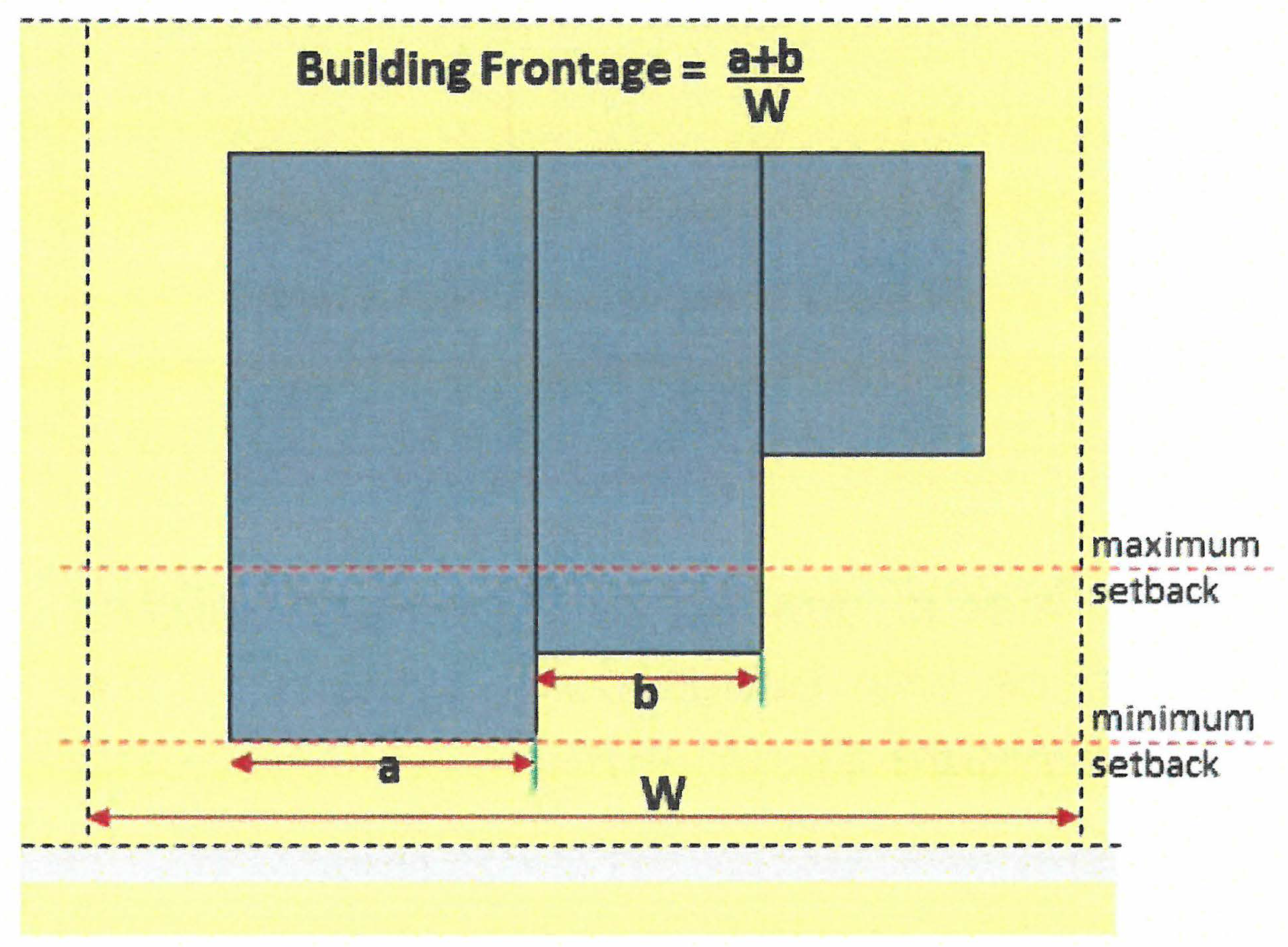 | 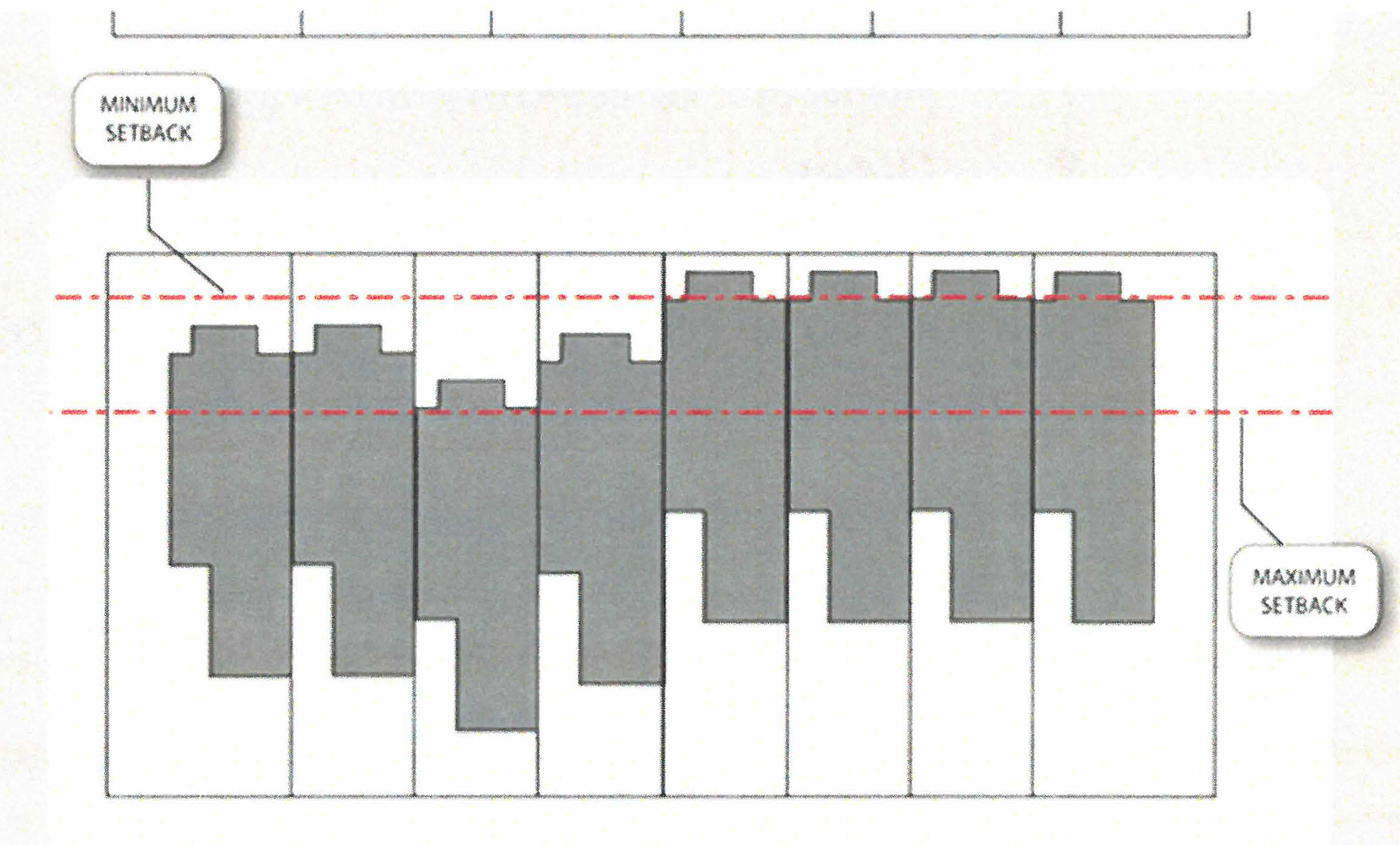 |
Building height of accessory elements. In addition to the exceptions for accessory exterior elements to exceed height limits listed in section 98-1006, the following height exceptions shall be allowed for these accessory features:
(1)
Roof structures that are a structural part of the roof, can vary in height up to a maximum of 15 feet above eave line (see Figure 2).
Figure 2: Building Height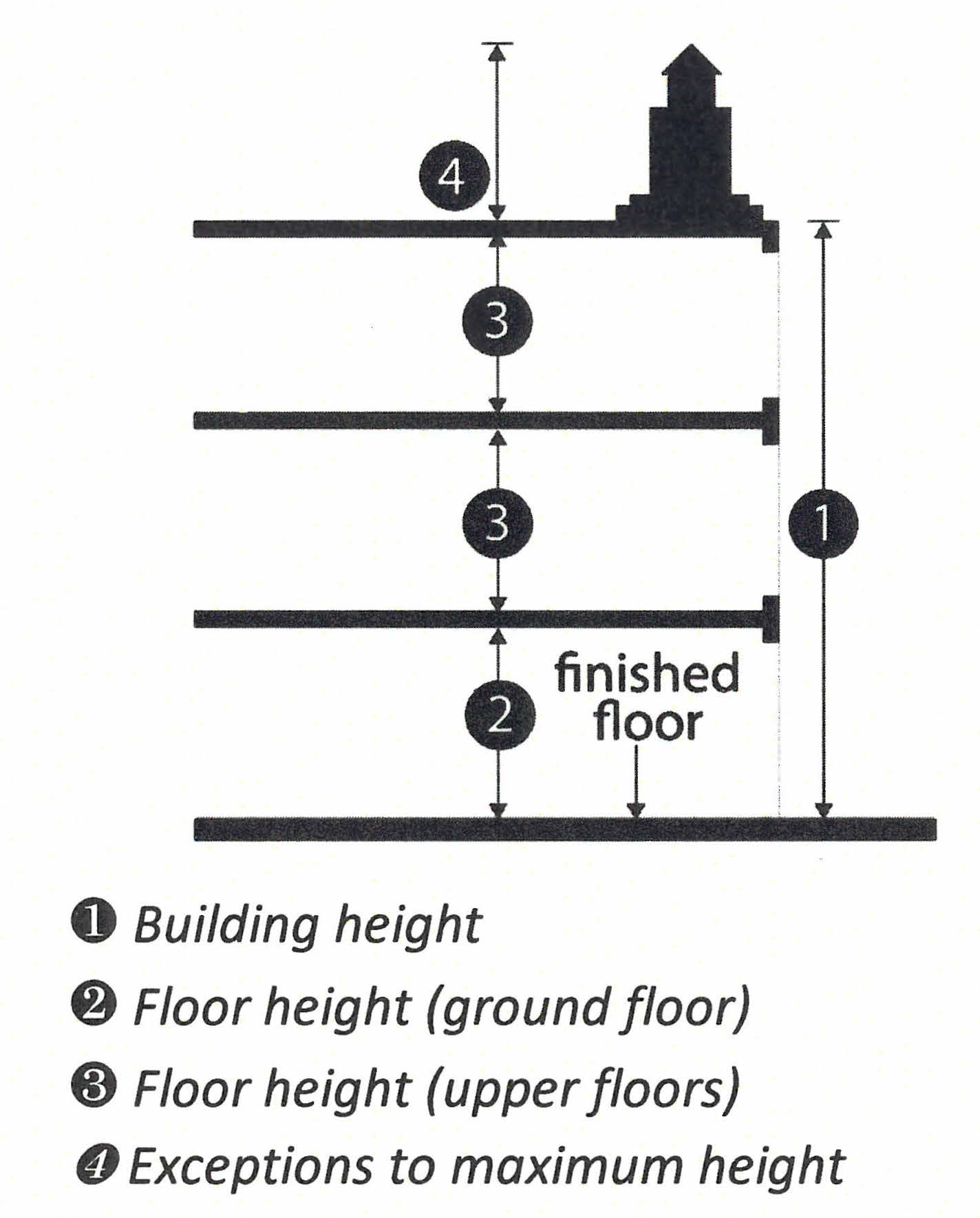
(2)
Stair, elevator or mechanical enclosures can be up to 15 feet above the maximum height and shall not exceed 20 percent of the roof area.
(Ord. No. 2017-12, § 2(Exh. A), 9-5-2017)
Sec. 98-834. - Bonuses for increased building height and increased building coverage.
The bonus program is established by the city to encourage the location of higher intensity and height and more urban development throughout the two districts. The descriptions below describe regulatory bonuses.
The following criteria must be met to add 20 feet of building height and another 20 percent of building coverage:
(1)
The development is at an intersection of at least arterial and collector roads along New Haven or Wickham Road and as far as 1,000 feet in either direction from the center of the intersection.
(2)
The development is not in an airport hazard area (see definitions) in which height and use compatibility are regulated by the Florida Statutes.
(3)
Buildings contain 30 percent of wall space facing roads covered with glass or vinyl windows. Windows and glass doors shall be glazed in clear glass/vinyl with 80 percent minimum transmittance. The use of reflective glass and reflective film is prohibited on the ground floor of all buildings.
(4)
Location of parking facilities. In order to be eligible for additional height and building coverage described in section 98-79 surface parking lots shall:
a.
Be located in the rear of the lot, behind the building (except as mentioned in item (5)a. below along the side of the building), except for two bays of parking which may be located in front of the building.
b.
Be screened along a public street by a street wall as illustrated in Figure 3.
| Figure 3: Street Wall | |
|---|---|
Recommended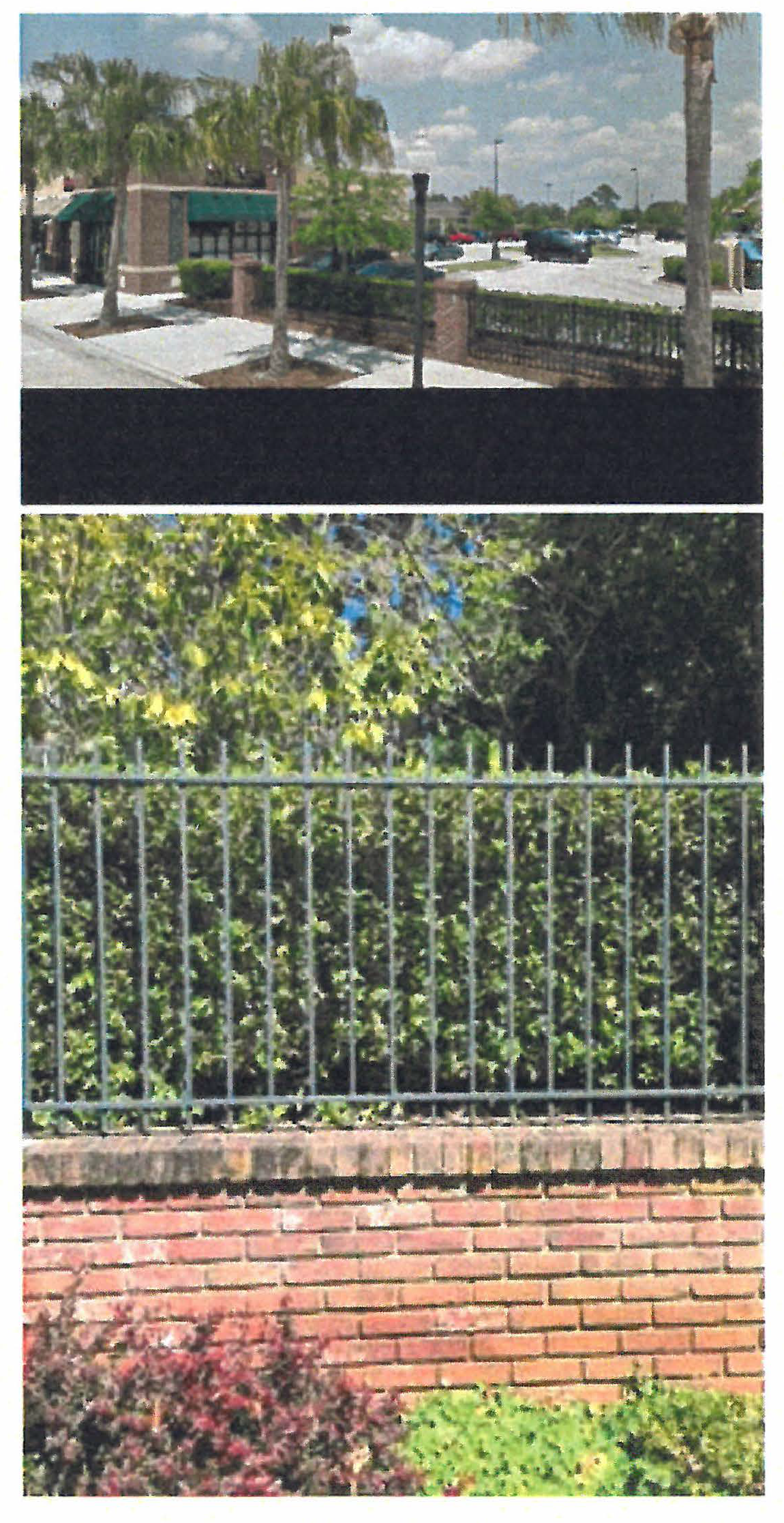 | Permissible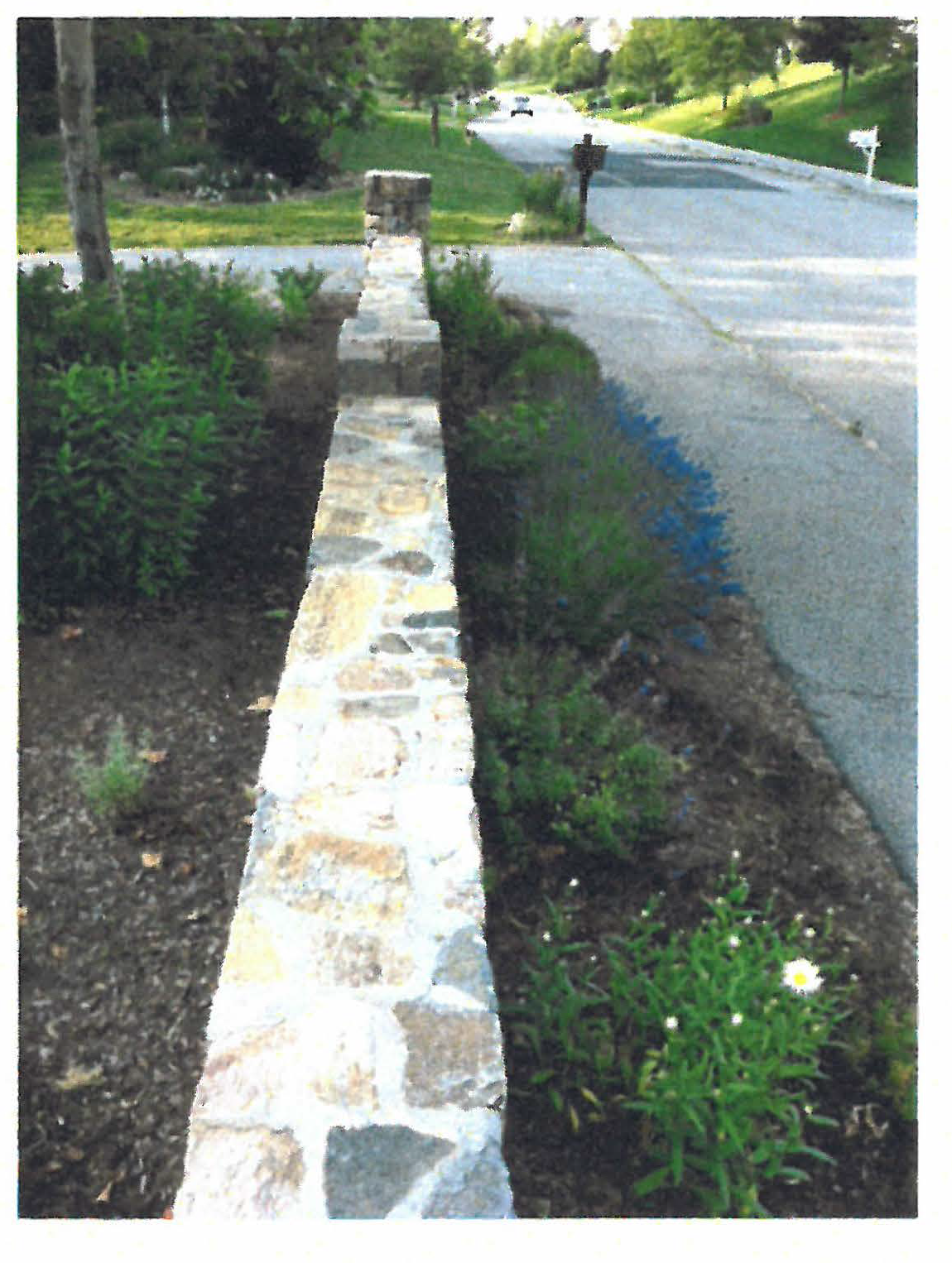 |
(5)
Parking facilities that are built in conformance with these criteria shall grant the developer building height increases of 20 feet:
a.
Placing parking to the side of the building is permitted only if the building frontage requirements are met. In such cases, vehicular areas along the street shall be shielded from street view by a street wall (see Figure 3).
b.
Surface and parking structures (garages) shall be accessed from a secondary street, from an adjacent property (shared use agreement necessary), or across a county or city canal to another part of the property (see Figure 4).
Figure 4: Shared Parking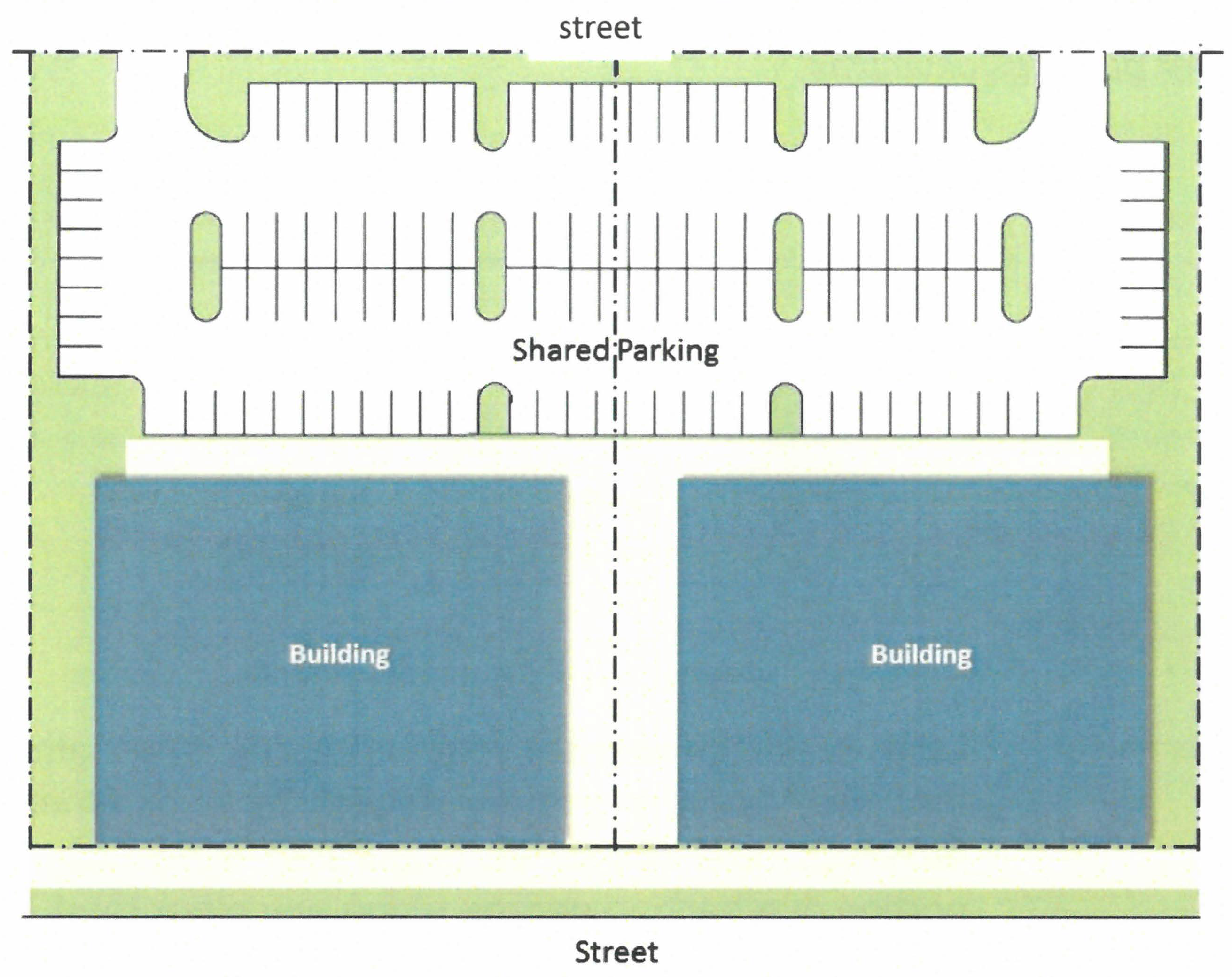
c.
If parking garages are built, these parking structures (garages) located along New Haven Avenue and Wickham Road streets shall not face directly the street, but shall instead be placed behind a primary use building (liner building), which may be attached or detached from the parking structure (see Figure 5). The liner building shall have a minimum height of two stories and a minimum depth of 30 feet along the entire length of the parking structure.
Parking garages do not count towards the calculation of maximum building coverage.
| Figure 5: Parking Garages and Liner Buildings Examples | |
|---|---|
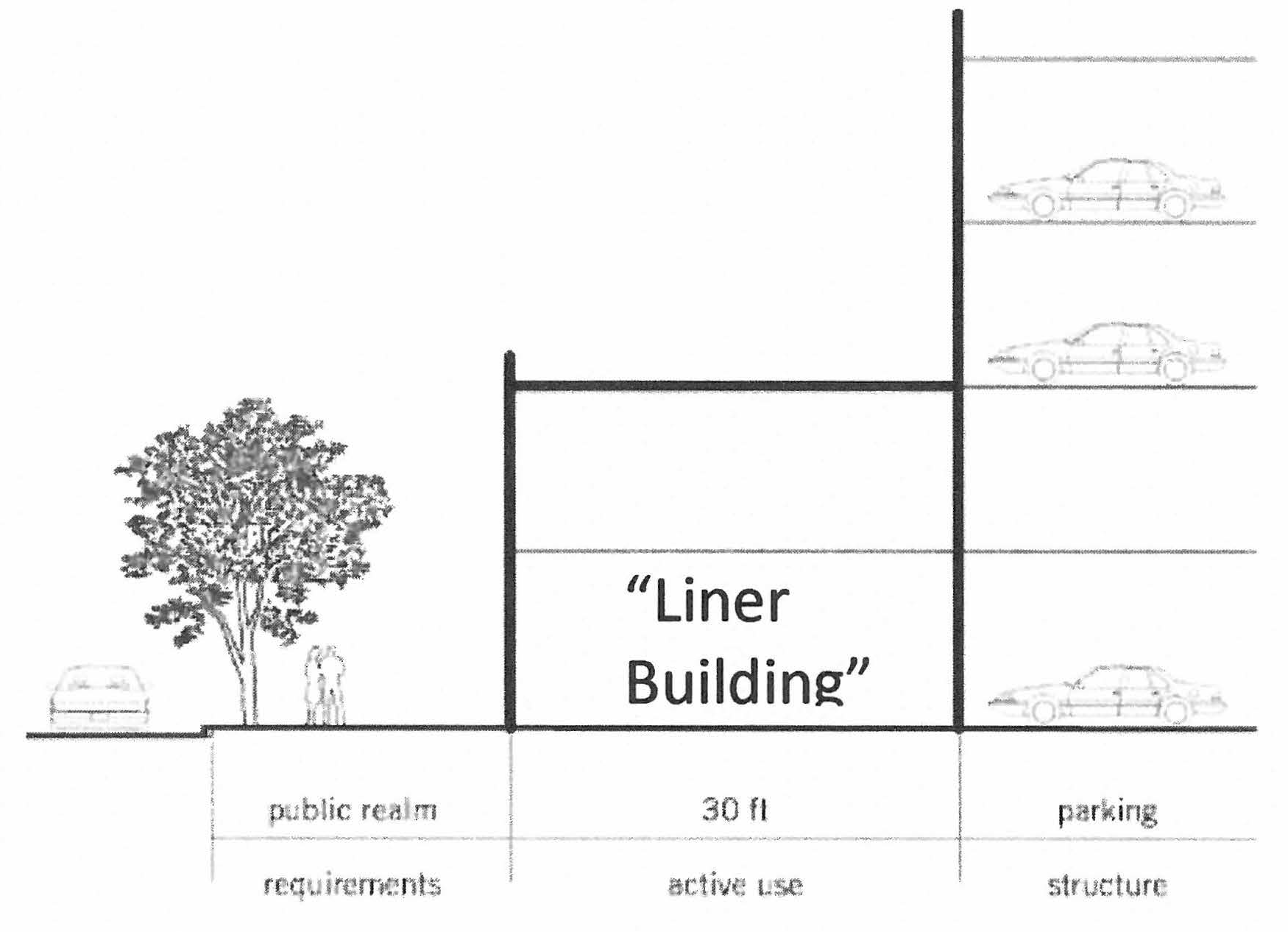 | 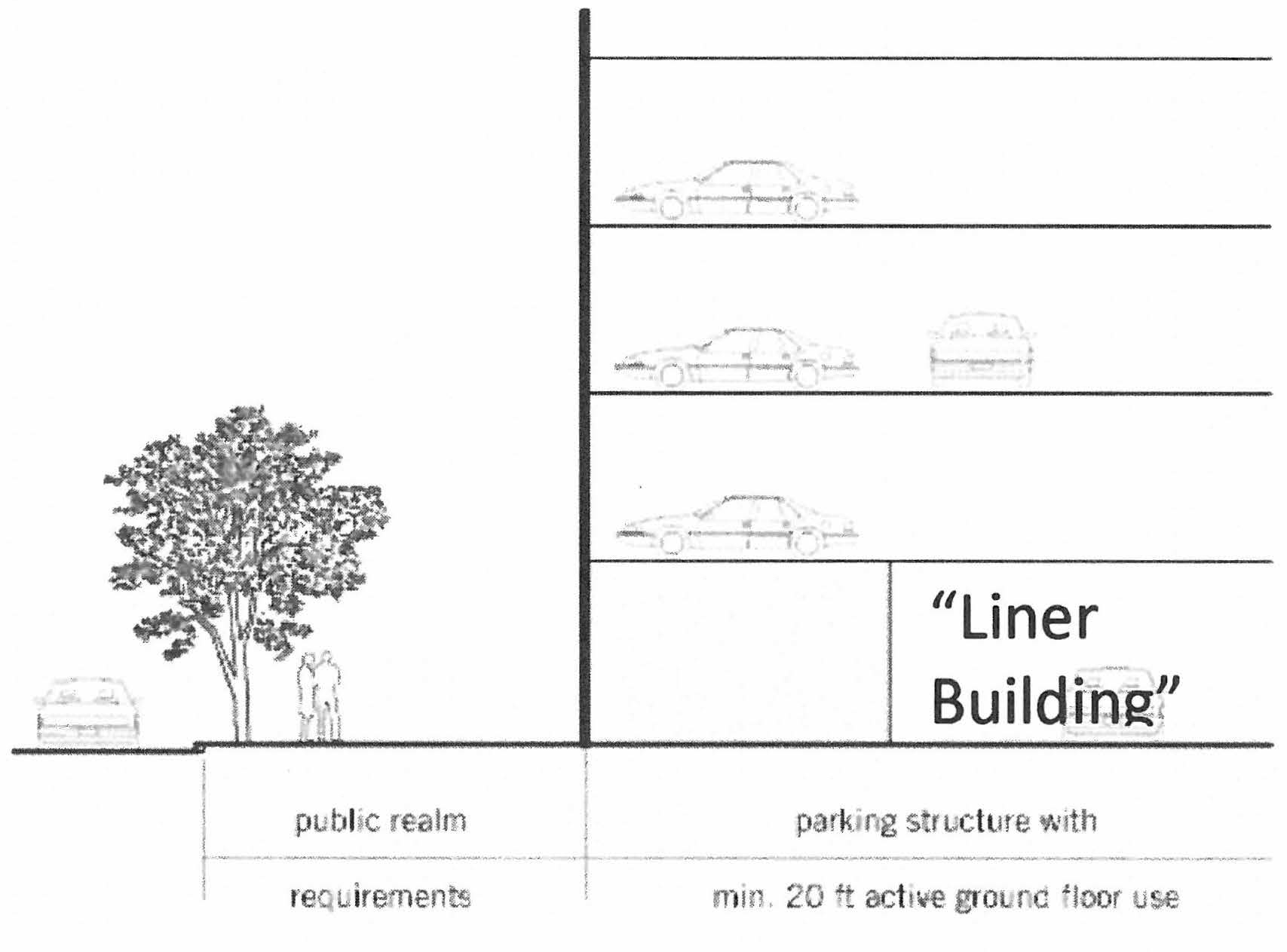 |
(6)
Liner buildings are not required along other streets that may provide primary access to a commercial business or a residence (Figure 5). However, any portion of a parking garage along any other road, that is not concealed behind a building shall be screened to conceal all internal elements such as plumbing pipes, fans, ducts and lighting. Ramping should be internalized wherever possible. Exposed spandrels (posts connecting floors) shall be prohibited, and these shall be sheathed in an architectural material.
(7)
The placement of buildings at the rear of a site (beyond the maximum front yard setback allowed) is permitted as long as one or more buildings (unmanned buildings do not count) are placed along the front of the site meeting the maximum front yard setback and building frontage requirements of this division. Access drives must be incorporated into the site layout to create connectivity to other sites and streets, when feasible. The main access drive shall be centered on the anchor building (if allowed by driveway permits) and shall be lined with buildings or sidewalks and landscaping.
(8)
Building facades. In addition to the requirements in section 98-81, when additional building height and building coverage are desired, the following shall apply:
a.
Architectural treatments on the façade, such as cornices or expression lines, shall be continued around the sides of the building.
b.
All building facades, including those not facing a street, shall use the same color scheme.
(9)
Public open space. The development shall include public open space at least one-fifth of acre or larger with benches, tables or other resting amenities.
(Ord. No. 2017-12, § 2(Exh. A), 9-5-2017)
Sec. 98-835. - Building articulation.
(a)
The parts that make up a building façade are key elements for defining the public realm. When properties are redeveloped or when new buildings are constructed according to this criteria, adjacent property values increase within the community redevelopment area a better work environment is provided for those employed in the numerous businesses. The façade standards in this subsection are not intended to dictate one type of style but do serve as guidelines. Parking structures shall also meet façade articulation standards applicable to the district.
(b)
Facades facing a public right-of-way shall not exceed 50 horizontal feet without including at least two of the following elements (see Figure 6):
(1)
A window or door. The use of painted panels to simulate a window is prohibited on the ground floor of all buildings.
(2)
Awning, canopy or marquee.
(3)
An offset, column, reveal, void, projecting rib, band, cornice, or similar element with a minimum depth of six inches.
(4)
Arcade, gallery or stoop that is under a roof, canopy, awning or other structure.
(5)
Complementary changes in materials or texture.
Figure 6: Facade Articulation Examples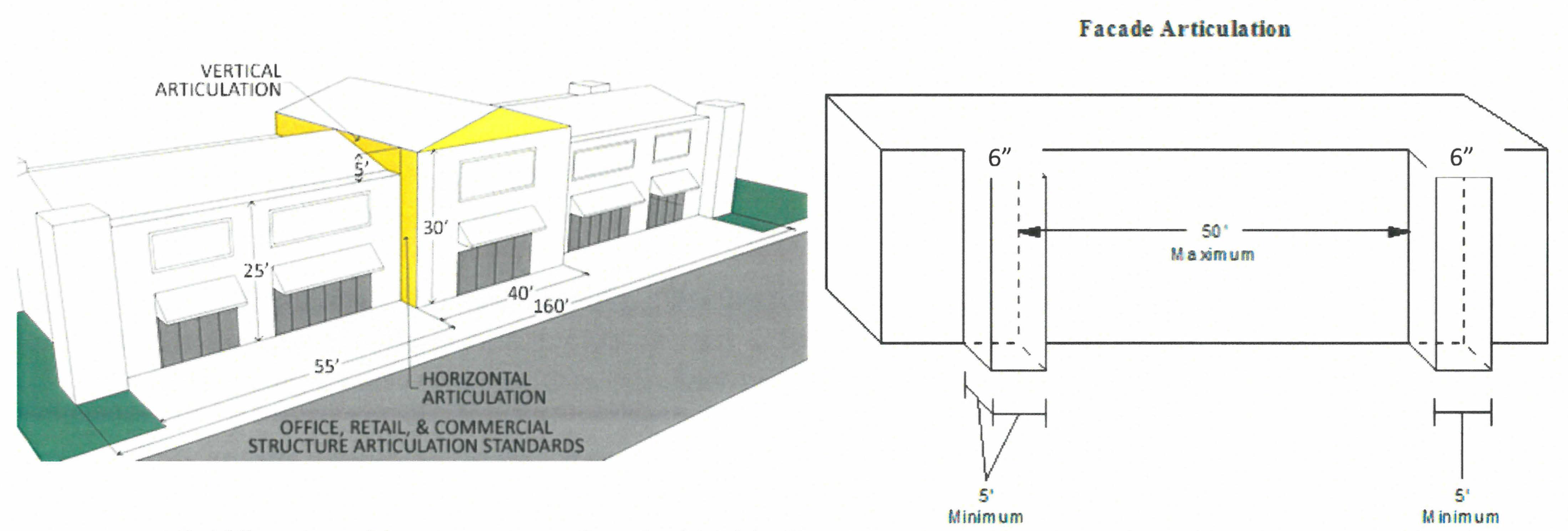
(c)
Building entrances.
(1)
The main entrance of all buildings shall be oriented toward the public right-of-way. Entrances shall be operable, clearly-defined and highly-visible. In order to emphasize entrances they shall be accented by a change in materials around the door, recessed into the façade (alcove), or accented by an overhang, awning, canopy or similar feature.
(2)
Where parking areas are located behind the building, a secondary pedestrian entrance may be provided from the parking area directly into the building.
(d)
Building color.
(1)
A minimum combination of two and a maximum of three colors shall be allowed per building.
(2)
Black and neon paint as the predominant exterior color is prohibited.
(e)
Roof design.
(1)
Buildings with flat roofs shall have a cornice treatment or a parapet. The cornice shall be at least 18 inches in height. Parapet shall be a minimum of two feet in height.
(2)
Sloping roofs shall not exceed the height of the supporting walls.
(3)
Air condition units and other equipment shall be shielded from view with lattice, parapets, or other treatments.
(Ord. No. 2017-12, § 2(Exh. A), 9-5-2017)
Sec. 98-836. - City public right-of-way improvements.
If a developer seeks to reduce the required ten-foot wide landscape buffer along their front property line, on city roadways (New Haven Avenue and Wickham Road are not city roads), the developer shall be responsible for providing a landscape zone (landscaping strip between the sidewalk and the travel lane) or as follows:
(1)
Public sidewalk. The sidewalk shall be upgraded to meet city standards as stated in the City of West Melbourne Engineering Standards Manual.
(2)
Landscape zone (between the travel lane/on-street parking and the public sidewalk). The landscape zone shall be at least five feet wide. Installation of landscaping within the right-of-way are the responsibility of the applicant in conjunction with the development of a site. Sod, shrubs, ground cover and/or accent plants and street trees shall be planted within the landscape zone and the developer shall enter into a maintenance agreement with the city. Street trees planted within a landscape zone of less than eight feet in width must be trees which are categorized as "small trees" in the city's "Manual of Acceptable Plantings".
(3)
Street walls. Street walls, also known as knee walls are short walls that shall meet the following standards:
a.
In the absence of a building façade along any part of a building frontage line, a street wall shall be built co-planar with the façade. Breaks are permitted in the street wall to provide pedestrian access to the site and for the purpose of tree protection. Street walls shall have openings no larger than necessary to allow automobile and pedestrian access.
b.
Street walls are the only types of fences/walls allowed facing streets and alleys.
c.
Street walls shall be a minimum of two feet in height and shall not exceed a five-foot maximum. However, the portion of the wall above three feet shall be no more than 50 percent solid.
d.
Street walls shall be constructed of wrought iron, brick, masonry, stone or other decorative materials and shall match or compliment the finishes on the building. Chain link fences shall be prohibited.
e.
If landscaping is provided on either side of the wall, the landscaping strip shall be a minimum of two feet wide.
Along New Haven Avenue and Wickham Road, the developer shall comply with FDOT and Brevard County requirements for improvements on their property along the right-of-way.
(Ord. No. 2017-12, § 2(Exh. A), 9-5-2017)
Sec. 98-837. - Residential to commercial development compatibility.
Within the C-NH and C-W zoning districts, the compatibility buffers described in chapter 98, article V, division 5, (fences, walls, hedges) continue to apply to proposed non-residential development abutting a residential zoning district, and only along the property line shared by the two uses.
(1)
No buffers shall be required between any other uses, unless specifically required as part of a conditional use permit approval.
(2)
The minimum required side and rear setback for non-residential and residential zoned buildings shall be the same as the setback required on the adjacent residential lot or as determined by the required buffer per section 71-120 and article V, division 5 of this Code, whichever is greater.
(3)
In addition, proposed non-residential buildings abutting residential zoning district(s) shall provide an additional building setback of ten feet for each floor above two stories for that portion of the building facing the residential area. Developers may elect to apply the setback just to those floors above the second/third story (step back approach, Option A), to the entire façade (Option B) or a combination of the two (Option C). See Figure 7. The additional setback/step-back for multi-story buildings may render some sites ineligible for the maximum permitted height in that district.
Figure 7: Setbacks Abutting Residential Zoning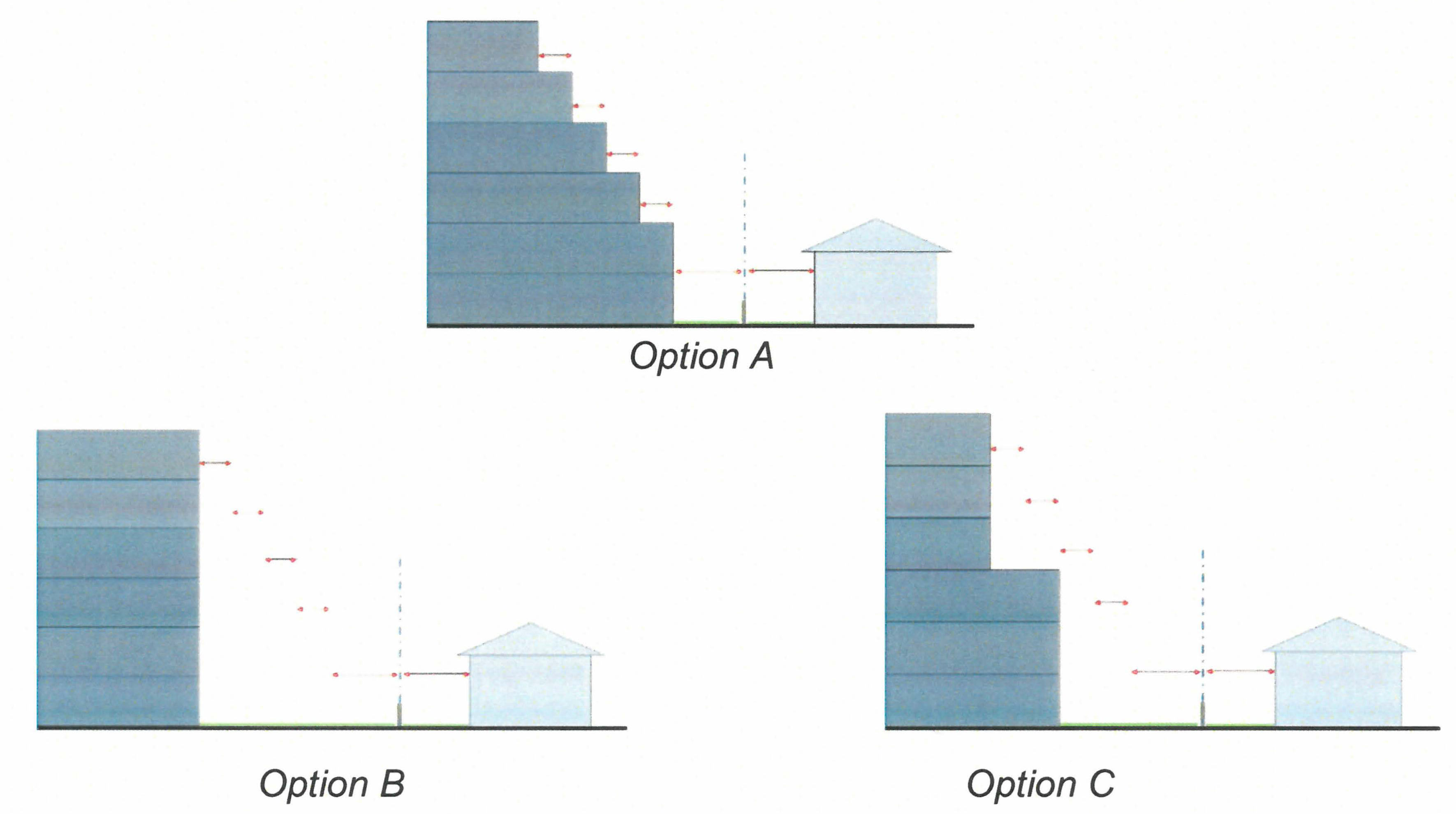
(4)
Proposed multi-story non-residential and multifamily buildings across a street from a single-family zoning district shall also comply with the additional setback requirements of subsection (3) above. The setback area, however, can count the street width as part of the setback dimension.
Within 300 feet of any property which is in a residential zoning district or shown for residential use on the future land use map of the comprehensive plan, all activity and uses, except storage of equipment and parking, shall be conducted within completely enclosed buildings.
(Ord. No. 2017-12, § 2(Exh. A), 9-5-2017)

