
West Melbourne City Zoning Code
ARTICLE V
- SUPPLEMENTARY DISTRICT REGULATIONS
DIVISION 7. - CONSTRUCTION AND SECURITY MOBILE STRUCTURES AND TEMPORARY SALES TRAILERS OR MODULAR UNITS[7]
Editor's note— Ord. No. 2001-21, § 2, adopted Aug. 7, 2001, amended the title of division 7 to read as herein set out. Formerly said division was entitled "Construction or security mobile structures." See the Code Comparative Table.
DIVISION 8. - ADULT ENTERTAINMENT ESTABLISHMENTS[8]
Cross reference— Adult entertainment establishments generally, § 6-86 et seq.
DIVISION 10. - COMMUNICATIONS FACILITIES[9]
Editor's note— Ord. No. 2011-14, § 1, adopted June 21, 2011, amended div. 10 in its entirety to read as herein set out. Former div. 10, §§ 98-1316—98-1324, pertained to similar subject matter and derived from: Ord. No. 45, art. X, §§ 22(a)—(i), adopted Aug. 4, 1970; Ord. No. 95-20, § 8, adopted Sept. 5, 1995; Ord. No. 96-13, §§ 1, 2, adopted Apr. 2, 1996; Ord. No. 98-1, § 18, adopted Oct. 21, 1997; Ord. No. 99-12, §§ 3—6, adopted Aug. 3, 1999; and Ord. No. 2009-15, § 55, adopted Jan. 20, 2009.
DIVISION 12. - MOBILE CATERING KITCHEN (FOOD TRUCK)[10]
Editor's note— Sec. 5 of Ord. No. 2020-01, adopted June 16, 2020, enacted provisions to be designated as §§ 98-1401—98-1408. In order to allow for future legislation, said provisions have been redesignated as §§ 98-1431—98-1438. Original section numbers have been maintained in the history notes following each section.
Sec. 98-1001.- Building setback lines.
(a)
For the purpose of promoting health, safety and general welfare of the community and to lessen congestion in the streets; to secure safety from fire, panic, storm, hurricane or other causes; to provide adequate light and air; to prevent the overcrowding of land; to avoid undue concentration of population; to provide adequate facilities for transportation, parking, water and sewerage; and to conserve the value of buildings and encourage the most appropriate use of land, all properties within the city limits which abut the following roads shall maintain these minimum building setback lines as measured from the centerline of the existing right-of-way:
(b)
In determining the setback requirements for any building proposed to be erected, the setback requirements in subsection (a) of this section shall be construed as a minimum setback, and if a greater setback is required under any of the zoning districts such greater setback requirement shall be enforced.
(Ord. No. 45, art. X, § 1, 8-4-1970; Ord. No. 56, §§ 1—3, 5-9-1972; Ord. No. 75-4, § 5, 1-14-1975)
Sec. 98-1002. - Erection of more than one principal structure on lot.
In any zoning district, more than one structure housing a permitted or permissible principal use may be erected on a single lot, provided that yard and other requirements of this chapter shall be met for each structure as though it were on an individual lot.
(Ord. No. 45, art. X, § 2, 8-4-1970)
Sec. 98-1003. - Yard encroachments.
Every part of every required yard shall be open and unobstructed from the ground to the sky except as follows or as otherwise permitted in this chapter:
(1)
Sills or belt courses may project not over 18 inches into a required yard.
(2)
Movable awnings may project not over four feet into a required yard, provided that where the yard is less than ten feet in width the projection shall not exceed one-half the width of the yard.
(3)
Chimneys, fireplaces or pilasters may project not over three feet into a required yard.
(4)
Fire escapes, stairways and balconies which are unroofed and unenclosed may project not over five feet into a required rear yard or not over three feet into a required side yard in any residential district. Balconies required as a feature of a decreased townhouse lot width may project not over three feet into the front yard of the R-2 and R-3 zoning districts.
(5)
Overhangs, hoods, canopies or marquees may project not over three feet into a required yard.
(6)
Fences, walls and hedges shall be permitted in required yards subject to the provisions established in this chapter.
(7)
In the C-P, C-1, C-2, C-1A, M-1 and M-2 districts, required off-street parking space may be located within any setback area, except that no parking space, drive or backout area shall be permitted within ten feet of any lot line and provided that the requirements of chapter 94 and section 98-1116 are satisfied.
(8)
Other than as listed above in subsection (7) of this section, or in the front yard of townhouses, no required setback area shall be used for any parking space, drive or backout area.
(9)
Open, unenclosed porches, platforms, or paved terraces not covered by a roof or a canopy and which do not extend above the level of the first floor of the building may extend or project into the required yard area not more than six feet.
(10)
On all single-family residential lots, screen porches may extend into the rear yard to within 15 feet of the rear lot line. However, any portion of the screen porch that projects into the required yard is subject to the following requirements and limitations:
a.
All walls of the screen porch must be screen walls supported by a screen frame, except for the wall shared with the principal structure.
b.
The screen walls may not be enclosed in any manner other than kickplates on the lower portion of the screen walls not to exceed 32 inches in height.
c.
The screen porch may be covered by a hard roof, provided that such roof is a flat pan aluminum cover, insulated aluminum-clad foam roof, or similar roof system as approved by the building official.
d.
The screen porch shall meet the same side yard requirements as the principal structure.
e.
The screen porch may not extend above the first floor of the principal structure.
(Ord. No. 45, art. X, § 3, 8-4-1970; Ord. No. 83-12, §§ 1—3, 4-5-1983; Ord. No. 98-1, §§ 16, 19, 10-21-1997; Ord. No. 2009-33, § 3, 5-19-2009; Ord. No. 2009-68, § 8, 12-15-2009; Ord. No. 2022-04, § 2, 4-5-2022)
Sec. 98-1004. - Air conditioning units in residential districts.
In all residential zoning districts, the exterior or mechanical part of any air conditioning or heating unit, other than a window unit, shall be subject to side yard requirements except if such unit faces a street or an alley and is located 15 feet or more from an adjoining property.
(Ord. No. 45, art. X, § 5, 8-4-1970)
Sec. 98-1005. - Vision clearance at corners, curb cuts and railroad crossings.
Notwithstanding any other part of this chapter or any permit granted or any variance granted by the board of adjustment, no type of structure, vehicle, tree, planting, vegetation, sign or fence or any type of obstacle or any portion thereof shall be placed or retained in such manner that would create a traffic hazard or would obstruct the vision clearance at corners, curb cuts or railroad crossings in any zoning district. In order to achieve the required vision clearance at corners, certain sections of the code may provide for a "sight visibility triangle," which consists of the triangular area adjacent to the intersection of any street, established by measuring a prescribed distance from the point of intersection of two streets along the right-of-way of each of the intersecting streets and connecting the ends of each measured distance as depicted in figure 1 at the end of this section.
Figure 1: Sight Visibility Triangle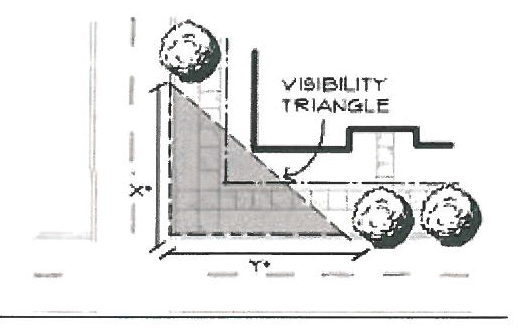
(Ord. No. 45, art. X, § 6, 8-4-1970; Ord. No. 2020-09, § 2(exh. A), 10-20-2020)
Sec. 98-1006. - Exceptions to height limitations.
The height limitations contained in article IV of this chapter do not apply to spires, belfries, cupolas, antennas, water tanks, ventilators, chimneys or other appurtenances usually required to be placed above the roof level and not intended for human occupancy.
(Ord. No. 45, art. X, § 7, 8-4-1970)
Sec. 98-1007. - Access for buildings.
Every building erected or moved shall be on a lot adjacent to a public street or with access to an approved private street, and shall have all safe and convenient access for servicing, fire protection and required off-street parking. All lots upon which structures are built shall have a minimum width of 25 feet facing a public right-of-way or an approved private right-of-way.
(Ord. No. 45, art. X, § 8, 8-4-1970)
Sec. 98-1008. - Parking, storage or use of major recreational equipment.
(a)
No major recreational equipment shall be parked or stored on any part of a lot in a residential district, except under the following conditions:
(1)
Such equipment may be parked or stored in a carport or an enclosed building.
(2)
Such equipment may be parked or stored to the rear of the front building line on an improved parcel or lot.
(3)
Such equipment may be parked on any part of a lot for a period not to exceed 24 hours during loading and unloading.
(b)
No such equipment shall be used for living, sleeping, or housekeeping purposes when parked on a parcel or lot in a residential district. Such equipment and the area on which it is parked shall be maintained in a clean and neat condition. Such equipment shall, at all times, be in operable and usable condition and shall have in force a current and valid vehicle or boat registration.
(Ord. No. 45, art. X, § 9, 8-4-1970; Ord. No. 83-38, § 1, 11-29-1983)
Sec. 98-1009. - Minimum width of courts.
The minimum width of a court shall be 30 feet for one-story buildings, 40 feet for two-story buildings, 50 feet for three-story buildings, and 60 feet for four-story buildings. For every five feet of height over 40 feet, the width of such a court shall be increased by two feet, provided that open unenclosed porches may project into a required court not more than 25 percent of the width of such court. Where a roadway is provided in the court, the width allowed for such roadway shall be in addition to that required by this section.
(Ord. No. 45, art. X, § 10, 8-4-1970)
Sec. 98-1010. - Water areas.
All areas within the city which are under water and not shown as included within any zoning district shall be subject to all the requirements of the district which immediately adjoins or abuts the water area. If the water area adjoins two or more districts, the boundaries of each district shall be construed to extend into the water area in a straight line as projected until they intersect a projected line from other district boundaries.
(Ord. No. 45, art. X, § 11, 8-4-1970)
Sec. 98-1036.- Time of construction; certificate of occupancy.
Accessory structures shall be constructed simultaneously with or following the construction of the principal structure and shall not be used until after the certificate of occupancy has been issued by the city for the principal structure on the same parcel.
(Ord. No. 45, art. X, § 4(a), 8-4-1970; Ord. No. 77-1, § 1(1), (2), 3-15-1977; Ord. No. 85-3, § 1, 11-8-1984; Ord. No. 88-15, § 1, 7-7-1988; Ord. No. 93-17, § 1, 7-20-1993)
Sec. 98-1037. - Erection in easement.
No accessory structure, including a swimming pool and pool decking, shall be erected in any easement. No variance shall be applicable to this section.
(Ord. No. 45, art. X, § 4(b), 8-4-1970; Ord. No. 77-1, § 1(1), (2), 3-15-1977; Ord. No. 85-3, § 1, 11-8-1984; Ord. No. 88-15, § 1, 7-7-1988; Ord. No. 93-17, § 1, 7-20-1993)
Sec. 98-1038. - Tents.
No tent shall be used as an accessory structure, unless otherwise allowed by this Code.
(Ord. No. 45, art. X, § 4(c), 8-4-1970; Ord. No. 77-1, § 1(1), (2), 3-15-1977; Ord. No. 85-3, § 1, 11-8-1984; Ord. No. 88-15, § 1, 7-7-1988; Ord. No. 93-17, § 1, 7-20-1993)
Sec. 98-1039. - Living quarters.
No accessory structure containing living quarters shall be allowed on any lot in any residential zoning district.
(Ord. No. 45, art. X, § 4(d), 8-4-1970; Ord. No. 77-1, § 1(1), (2), 3-15-1977; Ord. No. 85-3, § 1, 11-8-1984; Ord. No. 88-15, § 1, 7-7-1988; Ord. No. 93-17, § 1, 7-20-1993)
Sec. 98-1040. - Erection in front or side yard.
No accessory structure shall be erected in any required front or side yard.
(Ord. No. 45, art. X, § 4(e), 8-4-1970; Ord. No. 77-1, § 1(1), (2), 3-15-1977; Ord. No. 85-3, § 1, 11-8-1984; Ord. No. 88-15, § 1, 7-7-1988; Ord. No. 93-17, § 1, 7-20-1993)
Sec. 98-1041. - Location in rear yard; side setback compliance.
No accessory structure shall be located within 15 feet of the rear lot line of the parcel on which such accessory structure is located, with the side setback complying with that set forth for principal structures in the applicable zoning classification.
(Ord. No. 45, art. X, § 4(f), 8-4-1970; Ord. No. 77-1, § 1(1), (2), 3-15-1977; Ord. No. 85-3, § 1, 11-8-1984; Ord. No. 88-15, § 1, 7-7-1988; Ord. No. 93-17, § 1, 7-20-1993)
Sec. 98-1042. - Side setback on corner lot.
The side setback of all accessory structures on corner lots shall comply with the side setback requirements for principal structures of the zoning classification in which such structure is located.
(Ord. No. 45, art. X, § 4(g), 8-4-1970; Ord. No. 77-1, § 1(1), (2), 3-15-1977; Ord. No. 85-3, § 1, 11-8-1984; Ord. No. 88-15, § 1, 7-7-1988; Ord. No. 93-17, § 1, 7-20-1993)
Sec. 98-1043. - Floor area.
The total floor area of accessory structures shall not exceed the floor area of the principal structure.
(Ord. No. 45, art. X, § 4(h), 8-4-1970; Ord. No. 77-1, § 1(1), (2), 3-15-1977; Ord. No. 85-3, § 1, 11-8-1984; Ord. No. 88-15, § 1, 7-7-1988; Ord. No. 93-17, § 1, 7-20-1993)
Sec. 98-1044. - Height.
The height of an accessory structure shall not exceed 50 percent of the maximum height allowed in the zoning classification or the height of the principal structure, whichever is greater.
(Ord. No. 45, art. X, § 4(i), 8-4-1970; Ord. No. 77-1, § 1(1), (2), 3-15-1977; Ord. No. 85-3, § 1, 11-8-1984; Ord. No. 88-15, § 1, 7-7-1988; Ord. No. 93-17, § 1, 7-20-1993)
Sec. 98-1045. - Utility buildings.
Utility buildings (accessory structures having less than 150 square feet of floor area) shall comply with the following:
(1)
No utility building shall be erected in any front yard.
(2)
No utility building shall be erected within five feet of any rear property line.
(3)
The height of a utility building shall not exceed 12 feet from the finished grade.
(4)
The maximum number of utility buildings allowed on any lot shall be one.
(Ord. No. 45, art. X, § 4(j), 8-4-1970; Ord. No. 77-1, § 1(1), (2), 3-15-1977; Ord. No. 85-3, § 1, 11-8-1984; Ord. No. 88-15, § 1, 7-7-1988; Ord. No. 93-17, § 1, 7-20-1993)
Sec. 98-1046. - Swimming pools.
(a)
The water's edge of a swimming pool shall not be closer than ten feet to a rear lot line and not closer than five feet to any other structure. The water's edge for swimming pools built on individual townhouse lots shall not be closer than 7½ feet to a rear lot line and not closer than five feet to any other structure.
(b)
A swimming pool shall be enclosed by an enclosure of a permanent nature meeting the minimum requirements of the swimming pool code as adopted by the city.
(Ord. No. 45, art. X, § 4(k), 8-4-1970; Ord. No. 77-1, § 1(1), (2), 3-15-1977; Ord. No. 85-3, § 1, 11-8-1984; Ord. No. 88-15, § 1, 7-7-1988; Ord. No. 93-17, § 1, 7-20-1993; Ord. No. 2009-33, § 3, 5-19-2009)
Sec. 98-1047. - Screen enclosures.
(a)
For the purpose of this section, screen enclosures shall be defined as accessory structures having a minimum of three screen walls and a screen roof.
(b)
Screen enclosures for one- and two-family dwellings shall not be closer than seven and one-half feet to a rear lot line. Screen enclosures for multiple-family dwellings shall not be closer than ten feet to any lot line, provided such enclosures are located to the rear of the principal structure. Screen enclosures for townhouses shall not be closer than five feet to a rear lot line.
(c)
Under no circumstances shall a permitted screen enclosure be converted into another type of room having alternative walls and/or a hard, covered roof unless the conversion is within the required setbacks of the principal structure.
(d)
For screen porches with hard roofs on single-family residential lots, see section 98-1003(10).
(Ord. No. 45, art. X, § 4(l), 8-4-1970; Ord. No. 77-1, § 1(1), (2), 3-15-1977; Ord. No. 85-3, § 1, 11-8-1984; Ord. No. 88-15, § 1, 7-7-1988; Ord. No. 93-17, § 1, 7-20-1993; Ord. No. 2009-33, § 3, 5-19-2009; Ord. No. 2022-04, § 3, 4-5-2022)
Sec. 98-1048. - Reserved.
Editor's note— Sec. 4 of Ord. No. 2022-04, adopted April 5, 2022, deleted § 98-1048, which pertained to calculation of floor area for compliance with lot coverage requirements in residential districts, and derived from Ord. No. 45, adopted August 4, 1970; Ord. No. 77-1, adopted March 15, 1977; Ord. No. 85-3, adopted November 8, 1984; Ord. No. 88-15, adopted July 7, 1988; and Ord. No. 93-17, adopted July 20, 1993.
Sec. 98-1049. - Underground structures for telephone utilities.
Underground structures for telephone utilities located in the C-P, C-1, C-2, M-1, M-2, P-1 and C-1A zoning districts may be located within a required setback area, provided that no part of any such structure shall be located within any municipal right-of-way or easement and, further provided, that no part of any such structure shall extend above ground more than 30 inches or exceed 54 square inches in area.
(Ord. No. 45, art. X, § 4(n), 8-4-1970; Ord. No. 77-1, § 1(1), (2), 3-15-1977; Ord. No. 85-3, § 1, 11-8-1984; Ord. No. 88-15, § 1, 7-7-1988; Ord. No. 93-17, § 1, 7-20-1993)
Sec. 98-1050. - Keeping of cattle, horses and goats.
The keeping of cattle, horses and goats shall be allowed within any zoning district, provided that:
(1)
For the keeping of only one horse, the lot area is at least 2.5 acres in size and meets the criteria specified in subsections (3) and (5) below.
(2)
For the keeping of multiple horses, or cattle and goats, the lot area is at least five acres in size, with at least two acres of vacant land.
(3)
Animal use areas are fenced, not accessible to the public, and the fence around the animal use area may not be affixed to a principal structure.
(4)
The total of such animals shall not exceed one for the first acre of lot area and two for each additional acre of lot area.
(5)
Stalls, barns or structures for housing such animals shall not be permitted closer than 200 feet to any residence not on the subject property and shall meet the setback requirements for principal structures.
Nothing in this section shall apply to the R-A residential agricultural zoning classification.
(Ord. No. 45, art. X, § 13, 8-4-1970; Ord. No. 82-14, § 2, 5-18-1982; Ord. No. 2010-32, § 5, 12-7-2010)
Sec. 98-1051. - Buildings required.
All businesses shall provide at least the minimum size building required for the zoning district in which the business is to be located. The building shall contain plumbing facilities adequate to serve the needs of the business.
(Ord. No. 45, art. X, § 14, 8-4-1970)
Sec. 98-1081.- Permitted as accessory uses.
A home occupation shall be an accessory use in certain zoning districts subject to this division.
(Ord. No. 45, art. IX, § 1, 8-4-1970; Ord. No. 96-16, § 7, 6-4-1996)
Sec. 98-1082. - Conditions.
(a)
Home occupations shall be limited to office, professional and business uses able to be conducted within the home.
(b)
No person other than members of the family residing on the premises shall be engaged in such occupations.
(c)
There shall be no display of goods visible from any street.
(d)
A nonilluminated nameplate, not exceeding two square feet in area, may be displayed providing the nameplate is affixed flat against the exterior surface at a position not more than two feet distant from the main entrance to the residence.
(e)
There shall be no consumer walk-in or drive-in business conducted on the premises.
(f)
There shall be no deliveries of business-related products for storage or sale to the premises other than required for normal business operation.
(g)
Home occupations shall be clearly accessory to the residential use and shall not occupy an area greater then 25 percent of the first floor area of the residence, exclusive of the area of any open porch or attached garage or similar space not suited or intended for occupancy as living quarters.
(h)
No accessory building shall be used for the conduct of any permitted home occupation or for the storage of any materials or products used in conjunction with such home occupation. All permitted home occupations shall be conducted within the main residence of the proprietor.
(i)
No motor power other than electric motors shall be used in conjunction with such home occupation. The total horsepower of such motors shall not exceed three-horsepower or one-horsepower for any single motor.
(j)
No equipment or process shall be used in such home occupation which creates noise, vibration, glare, fumes, odors or electrical interference detectable to the normal senses outside the residence. In the case of electrical interference, no equipment or process shall be used which creates visual or audible interference in any radio or television receiver or which causes fluctuations in line voltage off the premises.
(k)
Occupations which generate greater volumes of traffic than would normally be expected in a residential neighborhood, including but not limited to, barbershops, beauty shops, public dining or tearoom facilities, antique or gift shops, fortunetelling or clairvoyance, repair shops, are prohibited.
(l)
No chemicals used in the conduct of or in connection with a home occupation, including but not limited to insecticides, lawn spray chemicals, fertilizers, and swimming pool chemicals, shall be stored on the premises used for such home occupation.
(Ord. No. 45, art. IX, § 1(a), 8-4-1970; Ord. No. 96-16, § 7, 6-4-1996)
Sec. 98-1083. - Tax receipt application and issuance.
(a)
A person desiring to conduct a home occupation shall first apply to the city for a business tax receipt. Such application shall be on a form provided by the city and shall include, but not be limited to the following information:
(1)
The name of the applicant.
(2)
The location of the residence wherein the home occupation, if approved, will be conducted.
(3)
The total floor area of the first floor of the residence.
(4)
The area of the room to be utilized in the conduct of the home occupation.
(5)
A sketch showing the floor plan and the area thereof to be utilized for the conduct of the home occupation.
(6)
The nature of the home occupation sought to be approved.
(b)
Upon compliance with the procedures in subsection (a) of this section, the city shall conduct an inspection of the premises where the home occupation is proposed. If any violation of this Code is found, such violation must be corrected prior to approval of the application by the inspector. If no violation is found, the inspector shall approve the application, and the city shall issue a business tax receipt in accordance with article IV of chapter 50.
(Ord. No. 45, art. IX, § 1(b), 8-4-1970; Ord. No. 96-16, § 7, 6-4-1996; Ord. No. 2010-10, § 16, 11-16-2010)
Sec. 98-1084. - License fee.
A home business tax receipt application shall be assessed an application fee as established by article IV of chapter 50. The home business tax receipt shall be classified in accordance with article IV of chapter 50 and assessed the prescribed fee.
(Ord. No. 45, art. IX, § 1(c), 8-4-1970; Ord. No. 96-16, § 7, 6-4-1996; Ord. No. 2010-10, § 17, 11-16-2010)
Sec. 98-1085. - Appeal of denial.
The denial of a home occupation may be appealed to the board of adjustment as provided for in this Code.
(Ord. No. 45, art. IX, § 1(d), 8-4-1970; Ord. No. 96-16, § 7, 6-4-1996)
Sec. 98-1116.- Masonry walls and other buffers.
As provided in section 98-1120, a solid face masonry or alternative landscaped buffer shall be constructed along the property line between property being developed in a commercial, institutional or industrial zoning district and adjacent or abutting properties zoned for residential use.
(Ord. No. 45, art. X, § 12, 8-4-1970; Ord. No. 83-13, § 1, 4-5-1983; Ord. No. 88-18, § 2, 7-19-1988)
Sec. 98-1117. - Permitted in residential districts.
Notwithstanding other sections of this chapter, fences, walls and hedges may be permitted in any required yard or along the edge of any yard except where such fence, wall or hedge constitutes a hazard to vehicular traffic, obstructs vision clearance, or obstructs access to public utility boxes, meters, manholes, or other such ground-level or above-ground infrastructure, provided that no fence, wall or hedge along the sides or front edge of any front yard shall exceed four feet in height. There shall be six-foot height restrictions to the rear of the front yard. Section 98-1005 is also applicable to this section. The property owner shall be required to obtain a building permit before such fence or wall is erected.
(Ord. No. 45, art. X, § 17, 8-4-1970; Ord. No. 53, § 1, 11-23-1971; Ord. No. 2020-09, § 2(Exh. A), 10-20-2020)
Sec. 98-1118. - Height restrictions in residential zones.
Fences, walls and hedges located, erected, constructed, reconstructed or altered on any property located in a residential zoning district shall comply with the following height requirements:
(1)
Except as provided in subsection (5) of this section, any portion of any such fence, wall or hedge located between the front building face on such property and the front lot line shall be not more than four feet in height. See figure 1 at the end of this section.
(2)
Any portion of such fence, wall or hedge located behind the front building face shall be not more than six feet in height, except as restricted by subsections (3), (4), and (5) of this section. See figure 1 at the end of this section.
(3)
For any corner lot of which the rear lot line abuts the side lot line of another lot, that portion of such fence, wall or hedge located within ten feet of the side right-of-way shall be not more than four feet in height. That portion of such fence, wall or hedge set back ten feet or more from the side right-of-way shall be not more than six feet in height. See figure 2 at the end of this section.
(4)
For any corner lot of which the rear lot line abuts a right-of-way, no fence, wall or hedge may be located within the sight visibility triangle established by measuring ten feet from the point of intersection of the rear right-of-way and the side right-of way along the right-of-way of each of the intersecting streets and connecting the ends of each measured distance. See figure 3 at the end of this section.
(5)
For any unimproved lot or any lot not containing a structure, the requirements of subsections (1), (2), (3), and (4) of this section shall be applied to required front and corner building lines in the same manner as if a structure had been constructed in accordance with such required yard area or setbacks as specified within the zoning district requirements.
(6)
Any lot or parcel of two and one-half acres or more and containing at least one dwelling unit shall be permitted a perimeter fence, wall or hedge of not more than six feet in height. Such fence, wall or hedge shall be constructed in a manner that provides adequate visibility at the intersection of any public or private driveway and the street providing access to such lot or parcel and at any abutting street intersection.
Figure 1: Interior Lot Fence Height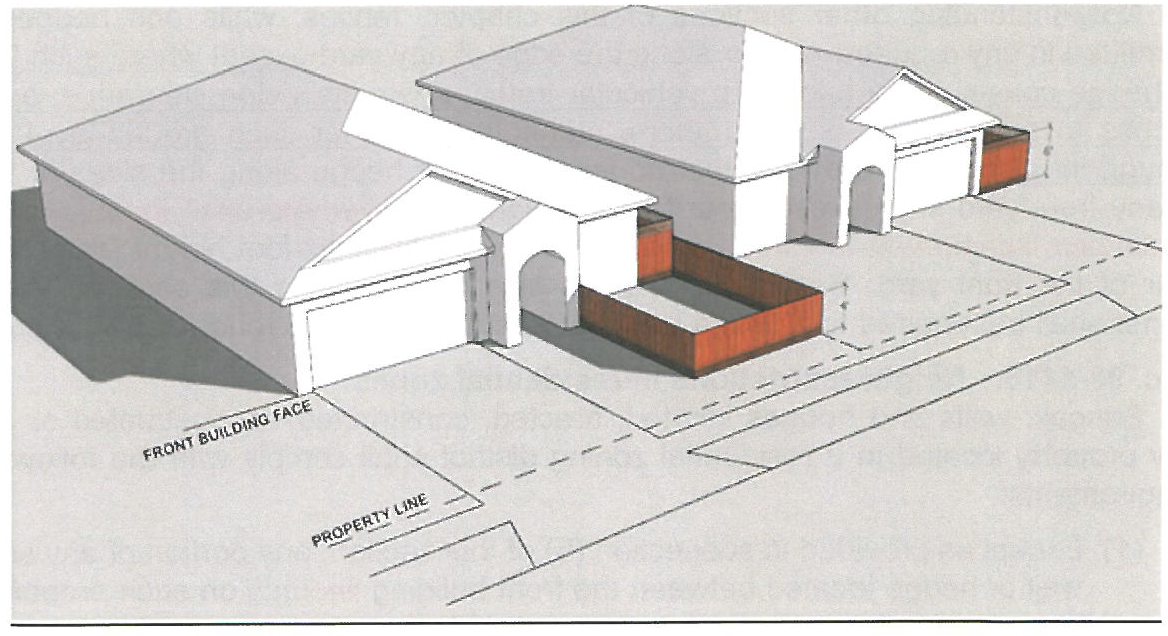
Figure 2: Corner Lot Fence Height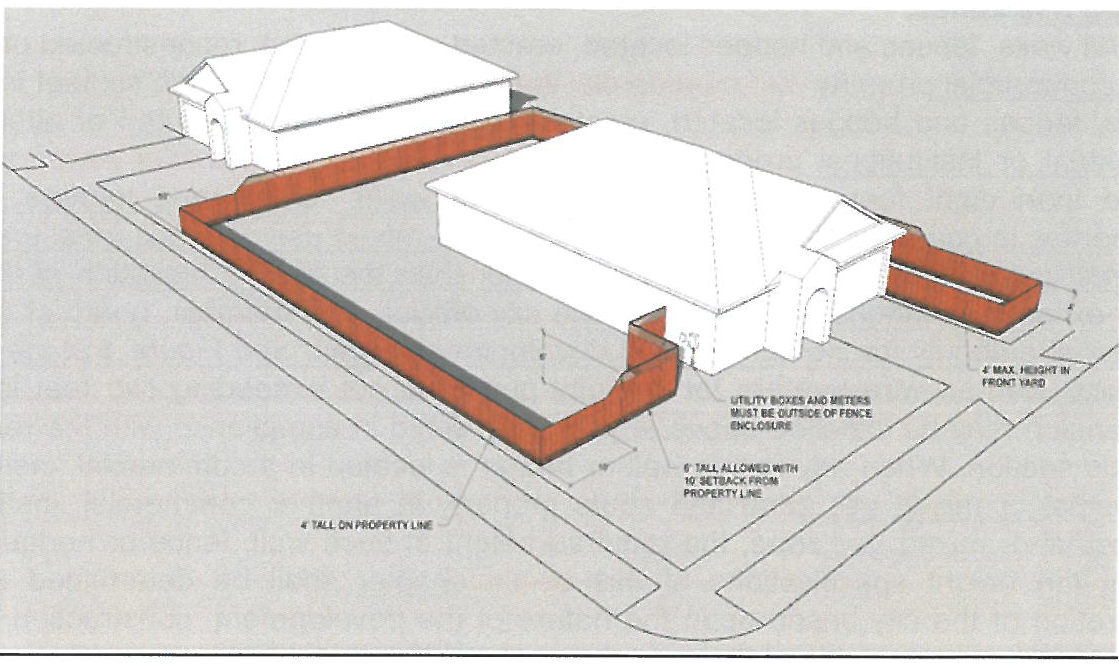
Figure 3: Corner Lot Abutting Right-of-Way on Rear Property Line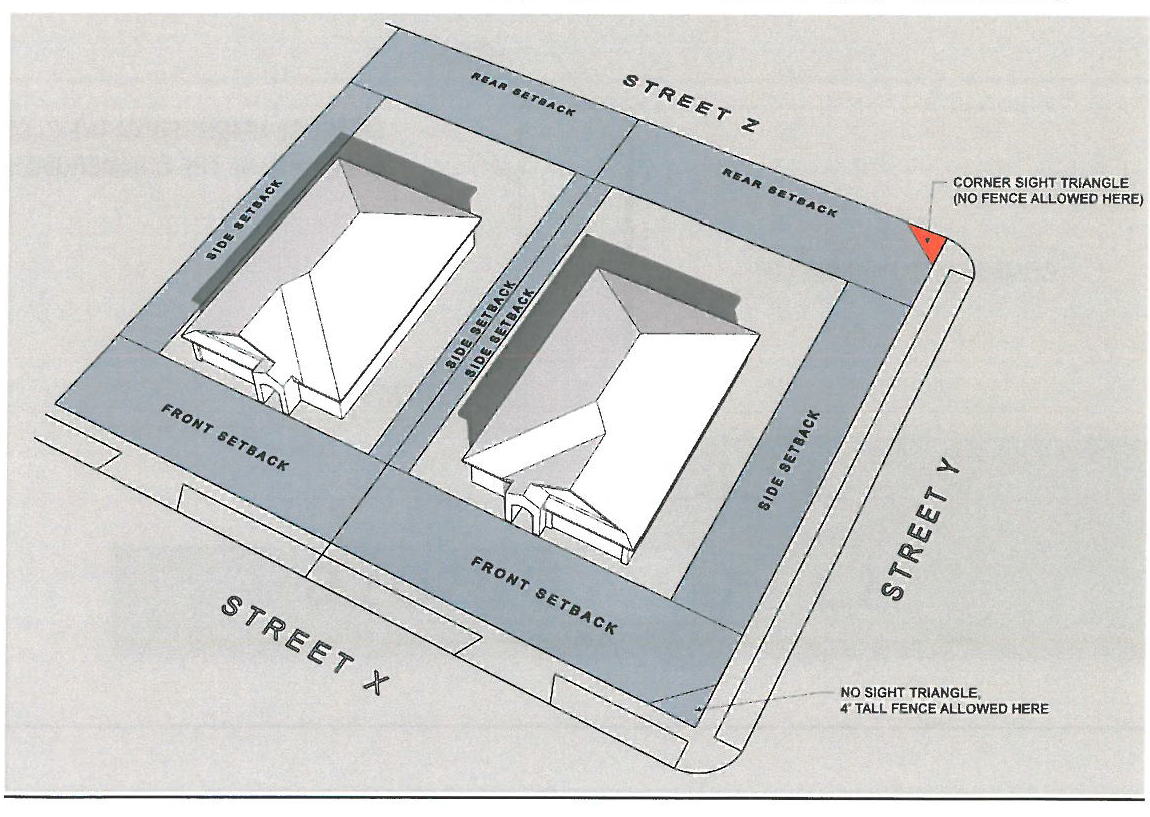
(Code 1980, § 4-93; Ord. No. 86-14, § 1, 2-4-1986; Ord. No. 92-13, § 2, 7-7-1992; Ord. No. 2020-09, § 2(exh. A), 10-20-2020)
Sec. 98-1119. - Height restrictions in commercial, institutional, industrial and mixed-use zones.
All walls, fences and hedges located, erected, constructed, reconstructed or altered on any commercial property shall be no more than six feet in height. All walls, fences and hedges located, erected, constructed, reconstructed or altered on any industrial or institutional property shall be no more than eight feet in height. The height of walls, fences and hedges located on properties in commercial, industrial, institutional or mixed-use zones is measured from the nearest paved elevation on the property rather than the ground elevation at the property line, except as authorized in writing by the city official, staff member, board or council with approval authority for the subject land development permit. See figure 1 at the end of this section. Barbed wire barriers for security purposes not exceeding two feet in a vertical dimension may be installed above any fence erected in compliance with the requirements of this section. When any fence, wall or hedge is located in a commercial, institutional, industrial or mixed use zone and abuts property in another commercial, institutional, industrial or mixed-use zone, the required height of such wall, fence or hedge needed to meet the height specifications of this chapter shall be determined in the sole discretion of the city based upon the nature of the development, construction and use of the property on each side of the common property line in question.
Figure 1: Fence Height Measurement in Commercial, Industrial, Institutional and Mixed-Use
Zones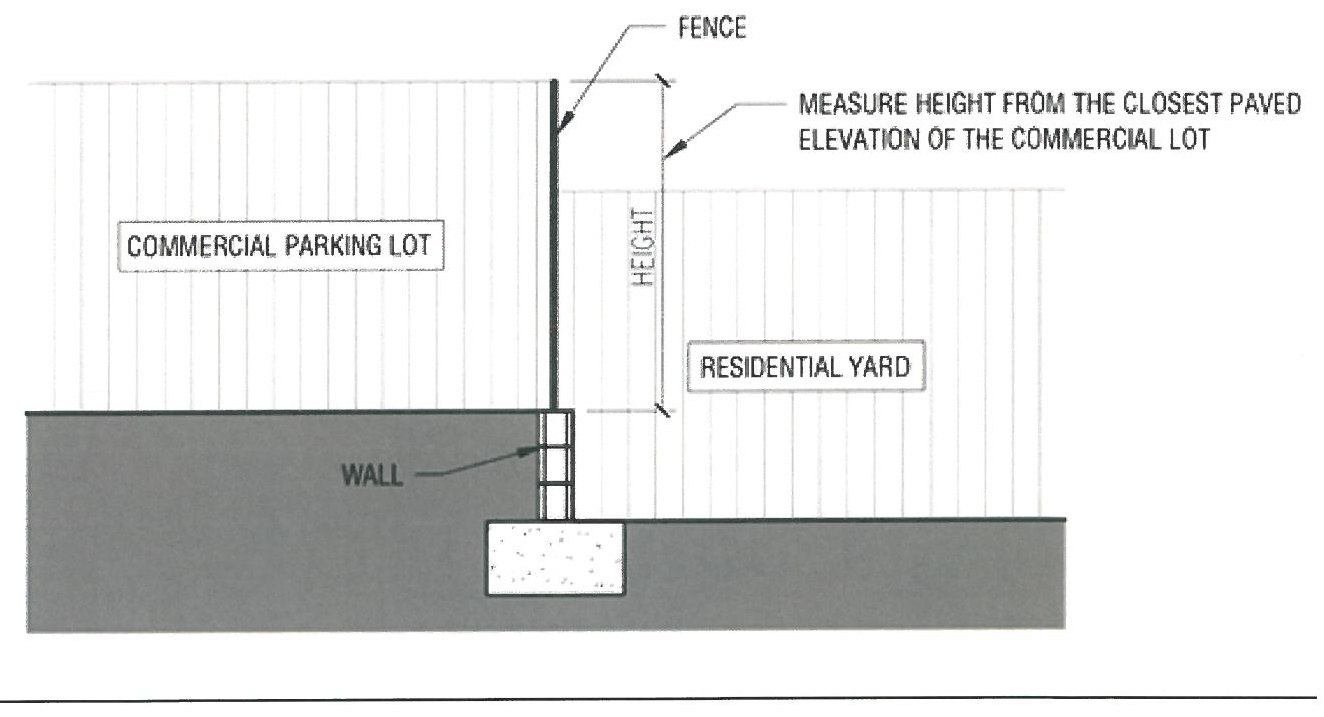
(Code 1980, § 4-94; Ord. No. 86-14, § 1, 2-4-1986; Ord. No. 97-18, § 1, 8-5-1997; Ord. No. 2020-09, § 2(exh. A), 10-20-2020)
Sec. 98-1120. - Walls separating residential zoning districts from development in commercial, institutional and industrial zoning districts; alternative landscape buffers.
(a)
Whenever any development, construction or reconstruction is proposed on any parcel of land in a commercial, institutional or industrial zoning district and such parcel abuts or adjoins a residential zoning district, the owner or other person proposing such development, construction or reconstruction in the commercial, institutional or industrial zoning district shall construct or cause to be constructed at his expense a wall no less than six feet in height and no more than eight feet in height along the full length of the property line between such parcel and the adjoining residential zoning district. The specific height of such wall within the height limits shall be determined in the sole discretion of the city based upon the nature of the development, construction and use proposed for the property abutting the residential zoning district. Such wall shall be required in all cases unless an alternative landscaped area or buffer is approved by the city as provided in subsection (b) of this section. Plans for such walls shall be included as part of the site plan for such development, construction or reconstruction, and the completion of the construction of such walls shall occur prior to the time of the first required city inspection for such development, construction or reconstruction. If such wall is constructed of concrete or masonry block, the joints of the wall shall be tooled.
(b)
In the sole discretion of the city, a suitable landscaped area or buffer may be used in lieu of the wall required in subsection (a) of this section. In determining the criteria and dimensions to be met by such landscaped buffer, the city shall consider all factors unique to the site in question which relate to buffering and visual screening for the protection and benefit of the residential property in question. The requirements applicable to such landscaped buffer may include but shall not be limited to the type of vegetation employed, the need for replacement of vegetation if its death or destruction occurs, and the need for irrigation to protect the vegetation. In making any determination of whether a landscaped buffer may be substituted for a wall, the city shall also consider the future land use identified in the city's comprehensive plan for all properties in question. Any such landscaped buffer proposed as an alternative to a wall shall be shown on the site plan for the proposed development, construction or reconstruction on the commercial, institutional or industrial property for which the buffer is required.
(Code 1980, § 4-95; Ord. No. 86-14, § 1, 2-4-1986; Ord. No. 88-18, § 1, 7-19-1988; Ord. No. 97-18, § 1, 8-5-1997)
Sec. 98-1121. - Required screening of certain business premises.
(a)
Definitions. The following words, terms and phrases, when used in this section, shall have the meanings ascribed to them in this subsection, except where the context clearly indicates a different meaning:
Abut or abutting property refers to a lot or parcel sharing a common boundary with lot or parcel in question, or a lot or parcel immediately across a public or private right-of-way or street from the lot or parcel in question.
Opaque fence or wall means a fence or wall designed so that objects or items to be screened within the fenced or walled enclosure are not visible on a line of sight through the fence or wall from the outside of such enclosure. A chainlink fence shall be deemed to be opaque if two or more layers of screening slats are installed across the length and height of such fence at opposing angles.
(b)
Required screening. Except as otherwise specifically provided in this section, that portion of a business premises of any business located in a commercial or industrial zoning district actually used for any of the following commercial activities shall be surrounded and completely enclosed with an opaque fence or wall no less than six feet in height:
(1)
Storage of any vehicles exhibiting external body damage or otherwise in a state of external disassembly.
(2)
Storage of more than five vehicles awaiting repairs other than repairs of external body damage and storage of more than five vehicles after completion of repairs, both of which requirements shall apply when any part of the parcel used for such storage abuts property zoned for residential use or property actually used as a residence.
(3)
Storage of construction equipment or excavation equipment of any kind other than automobiles and trucks when any part of the parcel used for such storage abuts property zoned for residential use or property actually used as a residence.
(4)
Storage of building or construction materials.
(5)
Any portion of a business premises outside of any enclosed building or structure actually used for a welding business, automotive or truck repair business or automotive or truck body repair business. For purposes of this subsection, a carport or similar roofed or covered area meeting applicable building and construction codes shall be considered to be an enclosed structure if the sides and rear of such structure are enclosed with an opaque fence or wall meeting the requirements of this section.
(6)
Dealers in or storage of abandoned property or salvaged materials of any kind; provided, however, that the opaque fence or wall required by this section shall be no less than eight feet in height for such businesses.
(c)
Time for compliance. All new businesses conducting the activities listed in subsection (b) of this section shall comply with the requirements of subsection (b) of this section prior to the issuance of a business tax receipt or renewal thereof.
(Code 1980, § 4-96; Ord. No. 86-14, § 1, 2-4-1986; Ord. No. 89-4, § 1, 12-20-1988; Ord. No. 2010-10, § 18, 11-16-2010)
Sec. 98-1122. - Maintenance of walls and fences.
All walls and fences in the city shall be maintained in good repair and in a structurally sound condition. All fences shall be continuous in alignment.
(Code 1980, § 4-97; Ord. No. 86-14, § 1, 2-4-1986)
Sec. 98-1123. - Location on public easements, utility easements and public rights-of-way.
(a)
No wall shall be constructed on any public easement, utility easement or public right-of-way, except as provided in section 78-14.
(b)
No fence shall be constructed on any public right-of-way.
(c)
No fence may be constructed on a public easement or a utility easement unless the person making application for the permit for such fence agrees, in writing, at the time of application for the permit, that the applicant and his successors in interest will bear the expense of removal and replacement of such fence if access to the public easement or the utility easement in question is required.
(Code 1980, § 4-98)
Cross reference— Fences, walls and screening of premises, §§ 18-106, 18-107.
Sec. 98-1216.- Limits on use.
Upon the issuance of a permit therefor and for a period not to exceed one year, trailers, modular units or mobile homes may be used as construction offices and/or offices for security personnel on any parcel of land during construction of permanent improvements thereon. Such trailers, modular units or mobile homes may not be utilized as sales offices or temporary model homes.
(Ord. No. 45, art. X, § 18, 8-4-1970; Ord. No. 79-2, § 1, 3-6-1979; Ord. No. 2001-21, § 2, 8-7-2001)
Sec. 98-1217. - Criteria for issuance of permit.
A permit for the temporary installation of a temporary trailer or mobile home for the purposes described in section 98-1216 shall be issued by the city upon receipt of an application therefor from the owner of the land, giving the following information:
(1)
The legal description and location of the land upon which the trailer or mobile home is proposed to be located.
(2)
The location and layout of proposed sewer and water service to such trailer or mobile home.
(3)
The reason a construction or security trailer or mobile home is required to be located on the parcel in question.
(4)
The proposed expiration date of the requested permit.
(Ord. No. 45, art. X, § 18, 8-4-1970; Ord. No. 79-2, § 1, 3-6-1979)
Sec. 98-1218. - Permit application fee.
An application fee of $50.00 shall accompany the application for the permit required by this division.
(Ord. No. 45, art. X, § 18, 8-4-1970; Ord. No. 79-2, § 1, 3-6-1979)
Sec. 98-1219. - Securing of other permits.
No permit for a construction or security trailer or mobile home shall be issued until the applicant has secured all necessary permits from all applicable government agencies for the construction of the permanent improvements upon the parcel of land in question.
(Ord. No. 45, art. X, § 18, 8-4-1970; Ord. No. 79-2, § 1, 3-6-1979)
Sec. 98-1220. - Expiration of permit.
All permits for construction or security trailers or mobile homes shall expire at the time the governing construction permits for the permanent improvements expire or terminate or upon the date stated in the application for the temporary permit, whichever shall earlier occur.
(Ord. No. 45, art. X, § 18, 8-4-1970; Ord. No. 79-2, § 1, 3-6-1979)
Sec. 98-1221. - Temporary trailers or modular units in residential subdivisions utilized as temporary sales offices.
Upon the recording of a final plat of a proposed subdivision, one temporary sales trailer or sales modular unit may be placed on a lot within the subdivision. The temporary sales trailer or modular unit must conform to all setback requirements of the zoning classification and shall be subject to the following conditions:
(1)
The application for a permit shall be accompanied by a drawing showing where the temporary sales trailer or modular unit will be placed and a permit fee of $50.00.
(2)
The drawing shall include the description of the sanitary sewer and potable water service available to the trailer or modular unit.
(3)
The permit for use of a temporary sales trailer or modular unit shall be effective for a period of nine months from the date of issuance or the completion of the first residential unit within the subdivision, whichever occurs first.
(4)
The temporary sales trailer or modular unit shall be properly licensed by the applicable state agency as a commercial trailer or modular unit.
(5)
The grounds for the temporary sales trailer or modular unit shall be landscaped with adequate ground cover to control dust and erosion. The temporary sales trailer shall meet all hurricane tie-down requirements and shall be properly skirted and the wheels shall remain affixed at all times.
(6)
For the temporary sales trailer or modular unit the owner or developer of the subdivision shall provide adequate off-street parking spaces within the subdivision. Said off-street parking shall be of a pervious nature. When the temporary sales trailer or modular unit is removed the parking area shall be restored and sodded.
(7)
No temporary sales trailer or modular unit shall serve as living quarters at any time.
(8)
The placement of the temporary sales trailer or modular unit shall conform to all applicable ADA and Florida Accessability [Accessibility] Code requirements.
(9)
The placement of the temporary sales trailer or modular unit shall conform to all other applicable codes of the city.
(10)
Upon completion of the first residential unit within the subdivision, no additional temporary sales trailer or modular unit permits will be permitted within the subdivision.
(Ord. No. 2001-21, § 1, 8-7-2001)
Sec. 98-1246.- Definitions.
Where applicable, words or phrases used in this division shall be defined according to section 6-1.
(Ord. No. 45, art. X, § 20(a), 8-4-1970; Ord. No. 88-19, § 1, 8-2-1988; Ord. No. 99-08, § 3, 4-6-1999)
Cross reference— Definitions generally, § 1-2.
Sec. 98-1247. - Prohibited locations.
Notwithstanding any other section of this chapter, no person shall cause or permit the establishment of a sexually oriented business or an adult entertainment establishment within 500 feet of another such establishment; within 500 feet of any preexisting religious institution, school, public park or area zoned for residential use; or in any area of the city not described in section 98-1248. This section shall also apply to adult entertainment establishments, religious institutions, public parks and areas zoned for residential use that lie outside the city.
(Ord. No. 45, art. X, § 20(b), 8-4-1970; Ord. No. 88-19, § 1, 8-2-1988; Ord. No. 99-08, § 3, 4-6-1999)
Sec. 98-1248. - Permissible locations.
Notwithstanding any other section of this chapter, except section 98-1247, adult entertainment establishments shall constitute a permissible use in the following areas of the city:
Area 1: An area within the city bounded on the east by a line parallel to and 250 feet west of the westerly right-of-way line of Wickham Road; on the south by a line parallel to and 135 feet north of the northerly right-of-way line of Ellis Road; on the west by a line parallel to and 3,100 feet west of the westerly right-of-way line of Wickham Road; and on the north by a line parallel to and 125 feet south of the northerly city limits.
Area 2: An area within the city bounded on the east by a line parallel to and 250 feet west of the westerly right-of-way line of Wickham Road; on the south by a line parallel to and 1,000 feet south of the southerly right-of-way line of Ellis Road; on the west by a line parallel to and 3,100 feet west of the westerly right-of-way line of Wickham Road; and on the north by a line parallel to and 135 feet south of the southerly right-of-way line of Ellis Road.
(Ord. No. 45, art. X, § 20(c), 8-4-1970; Ord. No. 88-19, § 1, 8-2-1988)
Sec. 98-1249. - Measurement of distance.
(a)
The distance between any two adult entertainment establishments shall be measured in a straight line, without regard to intervening structures, from the closest exterior structural wall of each such establishment.
(b)
The distance between any adult entertainment establishment and any religious institution, public park or school shall be measured in a straight line, without regard to intervening structures, from the closest exterior structural wall of the adult entertainment establishment to the closest property line of the religious institution, public park or school.
(c)
The distance between any adult entertainment and an area zoned for residential use shall be measured in a straight line, without regard to intervening structures, from the closest exterior structural wall of the adult entertainment establishment to the nearest boundary of the area zoned for residential use.
(Ord. No. 45, art. X, § 20(d), 8-4-1970; Ord. No. 88-19, § 1, 8-2-1988)
Sec. 98-1250. - Amortization of nonconforming uses.
(a)
Any establishment or business which; (i) satisfies the definition of the term "adult entertainment establishment" set forth in section 6-1; (ii) is in operation on March 9, 1999; and (iii) is not located in the areas described in section 98-1247, as the areas in which such establishments are a permitted use shall be permitted to continue in operation in its present location as a nonconforming adult entertainment establishment for the limited purpose of complying with the location requirements of this division. Other adult entertainment establishments which do not comply with this section or chapter 6 shall not be permitted at any location in the city.
(b)
Any nonconforming adult entertainment establishment shall be deemed to be abandoned if it discontinues its operations at its nonconforming location for 30 consecutive days or more, regardless of the reason for the discontinuance of operations. Upon such abandonment, the use of the land at the location of such nonconforming adult entertainment establishment shall thereafter conform to all requirements of the City's Land Development Regulations and this chapter.
(c)
Any nonconforming adult entertainment establishment which has the right to continue in operation pursuant to subsection (a) of this section and which has not been abandoned prior to October 1, 2000, shall cease operations and shall have its nonconforming status terminated on October 1, 2000; provided, however, that a nonconforming adult entertainment establishment may continue in operation after that date if the city council grants a permit for such continued operation for a limited time under subsection (d) of this section.
(d)
The city council may permit any nonconforming adult entertainment establishment to continue in operation for a definite and limited period after October 1, 2000, if:
(1)
Such establishment has a lease for its business premises which extends beyond October 1, 2000. In such event, the extended period of operation for such nonconforming establishment may continue for the term of the lease which is in effect on March 9, 1999, and any extensions thereof agreed to between the establishment and the owner of the leased premises, provided that no such extended period of operation shall continue after October 1, 2015. During such extended period of operation, the floor area of the adult entertainment establishment shall not be enlarged, and the establishment shall comply with all requirements of chapter 6 and all requirements of this division other than location.
(2)
Such establishment is located in a building owned by the owners of the establishment, the city council determines that financial expenditures have been made by the owner of such establishment prior to March 9, 1999, which relate directly to the operation of such establishment, and the owner has not received substantially all of the economic benefit of such expenditures. In such event, the extended period of operation for such nonconforming adult entertainment establishment shall terminate on the date the city council finds that the owner will recover substantially all of such financial expenditures or on March 9, 2002, whichever is earlier. For purposes of this subsection, the term "financial expenditures" shall mean the capital outlay made by the applicant to establish the adult entertainment establishment, exclusive of the value of the building and exclusive of improvements not related to the adult entertainment aspect of the business of the establishment. In making any determination under this subsection, the city council shall consider the amount of the owner's financial expenditure prior to March 9, 1999, the portion of such expenditure from which economic benefit has been realized as of the date of the owner's application for extension of operation, the life expectancy of the adult entertainment establishment, the gross revenues of the establishment for the previous three-year period, and the financial statements for the establishment for the previous three-year period. Failure of the owner to supply any relevant financial information shall be grounds for the city council to deny such owner's application for extension.
(e)
The requirements of this section shall supersede all of the provisions of sections 98-34, 98-35 and 98-36.
(Ord. No. 45, art. X, § 20(e), 8-4-1970; Ord. No. 88-19, § 1, 8-2-1988; Ord. No. 99-08, § 3, 4-6-1999)
Sec. 98-1251. - Variances.
(a)
The city council may grant a variance to the distance requirements of section 98-1247 if it finds that:
(1)
The proposed use will not be contrary to the public interest or injurious to nearby properties, and the spirit and intent of this chapter will be observed;
(2)
All applicable sections of this chapter and chapter 6 pertaining to the adult entertainment code will be observed; and
(3)
The proposed use will not be contrary to any adopted neighborhood redevelopment plan or land use plan or any downtown redevelopment program.
(b)
An application for such variance shall, in addition to the requirements of this section, be subject to all of the requirements and procedures for variances set forth in article VI of chapter 66.
(Ord. No. 45, art. X, § 20(f), 8-4-1970; Ord. No. 88-19, § 1, 8-2-1988)
Sec. 98-1281.- Permitted as temporary accessory use in C-P, C-1 and C-2 zoning districts.
(a)
Outdoor retail sales of goods, exclusive of alcoholic beverages, shall be deemed to be an allowable temporary accessory use in the C-P, C-1 and C-2 zoning districts only after an outdoor retail sales permit for each sales event has been obtained from the city.
(b)
The requirements of this division shall be applicable to such outdoor retail sales.
(Ord. No. 45, art. X, § 21, 8-4-1970; Ord. No. 2009-69, § 1, 2-2-2010)
Sec. 98-1282. - Permits required.
(a)
Except as otherwise provided in this division, it shall be unlawful for any person to display, sell, offer for sale or in any way invite someone to purchase any merchandise located outdoors without first obtaining an outdoor retail sales permit.
(b)
A permit for each separate sales event shall be required. In the absence of such a sales permit, such sales shall be prohibited.
(c)
No tent or other structure may be used in connection with an outdoor retail sales event without first obtaining an additional tent permit. An inspection of the fully erected tent shall be required prior to occupancy of the tent or the placing of sale merchandise within the tent. The holder of a tent permit shall have a maximum of seven days before and after the effective dates of the outdoor retail sales permit to install and remove the tent. Section 98-1036 shall not apply to tents permitted as described in this subsection.
(d)
An additional electrical permit shall be required for the use of any electrical equipment incident to an outdoor retail sales event, including lighting.
(Ord. No. 45, art. X, § 21(a), 8-4-1970; Ord. No. 2009-69, § 2, 2-2-2010)
Sec. 98-1283. - Conditions for issuance of permit.
An outdoor retail sales permit shall be issued by the city upon receipt of an application for such a permit on a form prescribed by the city and upon payment of a permit fee as may be from time to time established by resolution of the city council. The applicant shall meet or comply with the following:
(1)
The applicant shall operate a retail sales business currently licensed by the city and shall be actually engaged in such a business.
(2)
The outdoor retail sale which is the subject of the permit shall be conducted on the same property or within the same shopping center as the licensed business making the application. The outdoor retail sale shall be clearly incidental and subordinate to the normal business of the applicant.
(3)
If the premises for which the outdoor retail sale permit is sought is occupied by more than one business entity or is a shopping center, the application shall be accompanied by the written consent of the property owner or manager.
(4)
A permit for an outdoor retail sale may be issued for any one business location for not more than once quarterly, no more than four times per year for a maximum of 40 consecutive calendar days per event and 75 days per year.
(5)
The outdoor retail sale shall be restricted to the area depicted on the application and approved by the building official. A safety barrier shall be installed around the designated outdoor retail sale area to protect pedestrian traffic and vehicle traffic.
(6)
The outdoor retail sale for which the permit is issued shall be located within designated parking areas on the site of the sale and shall not occupy more than 25 percent of the total parking area of the site. The area occupied by the outdoor retail sale shall not obstruct any fire lanes, fire hydrants, handicap parking spaces, pedestrian sidewalks or driveways to or from any adjacent street.
(7)
The outdoor retail sale shall not be placed to obstruct the front entrance of the building, nor shall a tent be in the parking spaces immediately adjacent to the front door or parallel to the front door.
(8)
If foodstuffs are offered for outdoor retail sale, the applicant shall comply with all applicable health regulations.
(Ord. No. 45, art. X, § 21(b), 8-4-1970; Ord. No. 2009-69, § 3, 2-2-2010)
Sec. 98-1284. - Revocation of permit.
The building official shall be authorized and empowered to revoke any outdoor retail sale permit for failure of the permittee to comply with any of the sections of this division or any condition prescribed by the permit.
(Ord. No. 45, art. X, § 21(c), 8-4-1970; Ord. No. 2009-69, § 4, 2-2-2010)
Sec. 98-1285. - Assignability of permit.
A permit issued in accordance with this division shall not be assignable or transferable by the permittee.
(Ord. No. 45, art. X, § 21(d), 8-4-1970)
Sec. 98-1286. - Administration of permit.
The building official shall have the responsibility to issue permits and collect fees in accordance with this division.
(Ord. No. 45, art. X, § 21(e), 8-4-1970)
Sec. 98-1316.- Definitions.
The following words, terms and phrases, when used in this division, shall have the meanings ascribed to them in this section, except where the context clearly indicates a different meaning:
Communication facilities means any facility containing towers, antennas, and any accompanying equipment) to receive, relay, or transmit communication signals.
Monopole means a single self-supporting tower which contains no guy wires and no more than one support column, including spun-cast concrete poles, concrete poles, steel poles and similar poles.
Stealth means any antenna or tower which is designed to blend into the surrounding environment or to be less visually obtrusive. Examples of a stealth antenna or tower include architectural screening for roof-mounted antennas, antennas integrated into architectural elements, antennas that are flush-mounted on monopoles, and towers designed to appear like light poles, power poles, and flag poles or other utility features. Towers shall not be permitted to imitate trees or other natural features.
Tower means any self-supporting structure or any structure supported by guy wires and/or more than one support column. The tower may include antennas, relay structures, dishes, observation decks and other accompanying equipment used for electronic communication.
(Ord. No. 2011-14, § 1, 6-21-2011)
Cross reference— Definitions generally, § 1-2.
Sec. 98-1317. - Applicability and exceptions.
(a)
Applicability: These provisions shall apply throughout the City of West Melbourne and no communication facility shall be permitted except in compliance with these provisions, or as provided in this division 10.
(b)
Exceptions: The following facilities are exempt from the communications facilities codes:
(1)
Any tower or antenna that is owned and operated by a federally licensed amateur radio operator or is used exclusively for "receive only" antennas.
(2)
Communication facilities owned by state or federal agencies.
(3)
Temporary communication facilities which comply with all applicable FCC regulations.
(4)
Any antenna which is not attached to a communication tower or building which is accessory to any commercial, industrial, institutional, multifamily, or public utility structure provided that:
a.
The antenna does not exceed 20 feet above the highest point of the structure or the height limitation for the district, whichever is greater, but not more than 60 feet in zoning district without height limitations. This shall include ground-mounted satellite dish antennas which shall be regulated as accessory structures;
b.
The antenna complies with all applicable FCC and FAA regulations; and
c.
The antenna complies with applicable building codes.
(Ord. No. 2011-14, § 1, 6-21-2011)
Sec. 98-1318. - Maximum structure size.
Any structure, as defined in chapter 62, located at ground level containing equipment for antennas or tower, shall not exceed 800 square feet in area or 12 feet in height.
(Ord. No. 2011-14, § 1, 6-21-2011)
Sec. 98-1319. - Maximum height.
(a)
No tower or accompanying equipment shall exceed 200 feet in height, as measured to the top of the facility. This requirement is not applicable to structures as described in section 98-1318.
(b)
Method of determining tower height: Measurement of tower height shall be from grade elevation of the base pad to the top of the communication facilities.
(c)
Towers shall comply with applicable state and federal regulations.
(Ord. No. 2011-14, § 1, 6-21-2011)
Sec. 98-1320. - Setbacks and separation distances.
(a)
Setback: The minimum setback for towers except as specified in subsection (c) below, shall be a distance from all site boundaries equal to the height of the tower as measured form the base of such tower.
(b)
Setback for all other communication facilities: Any structure at the communications facility shall meet the yard requirements set forth in the applicable zoning district or shall be ten feet from any site boundary, whichever is greater.
(c)
Residential separation distances: Towers shall be located no closer than 500 feet from property located in the R-1AAA, R-1AA, R-1A, R-1B, R-2, R-3, TR-1 and TRC-1 zoning districts. The minimum distances shall be as measured from the base of the monopole or tower.
(d)
Communication facility separation: In no case shall a tower be allowed closer than 2,000 feet from another communication facility, existing or permitted at the time of the application for approval of such tower; unless the facility is a government owned facility or required by a government contractor with a defense contract.
(Ord. No. 2011-14, § 1, 6-21-2011)
Sec. 98-1321. - Site plan and public hearing requirements.
(a)
Conditional use permit. A site plan shall be submitted as an exhibit to the conditional use permit required for communication facilities. The site plan shall be submitted in accordance with article X of chapter 66.
(b)
Balloon test. As a part of the request for a conditional use public hearing process to allow the board to evaluate the aesthetic impact with respect to height and proximity of tower to its surroundings, a balloon shall be placed on the subject site with the following specifications:
(1)
A balloon shall be flown for a minimum of two days continuously at least three days prior to the first public hearing.
(2)
Balloon diameter shall be no less than four feet.
(3)
Balloon color shall be red, orange, yellow, or another vibrant color.
(4)
Balloon must be anchored to the ground.
(5)
The height of the balloon shall be the same as the total height of the tower and accompanying equipment.
(Ord. No. 2011-14, § 1, 6-21-2011)
Sec. 98-1322. - Exterior finish.
(a)
Towers adjacent to nonresidential properties: Towers not requiring FAA marking or painting shall have an exterior finish of either a galvanized appearance or noncontrasting blue or gray appearance.
(b)
Towers abutting residential properties: Towers adjacent to residential properties shall have a stealth appearance.
(Ord. No. 2011-14, § 1, 6-21-2011)
Sec. 98-1323. - Illumination.
Towers shall not be artificially illuminated except as required by the Federal Aviation Administration (FAA). At the time of construction of a tower or its antenna, in cases where there are residential uses located within a distance that is 300 percent of the height of the tower, dual mode lighting shall be requested from the FAA.
(Ord. No. 2011-14, § 1, 6-21-2011)
Sec. 98-1324. - Security fences.
A security fence a minimum of six feet in height shall be required around the perimeter of the communication facility. All fences shall be in compliance with division 5 of this article.
(Ord. No. 2011-14, § 1, 6-21-2011)
Sec. 98-1325. - Landscaping.
In addition to landscaping requirements set forth in chapter 94, a continuous hedge shall be required on the exterior side of the perimeter fencing of the communication facility. The hedge shall be a minimum of three feet in height at the time of planting and shall be capable of growing to a minimum of six feet in height. Trees a minimum of ten feet in height and two feet in caliper shall be planted every 40 lineal feet around the perimeter which abuts a property line, or the required trees can be placed in clusters if this provides better screening and avoids gates. All landscaping material shall be as set forth in chapter 94. All landscaped areas shall be irrigated in accordance with the requirements of chapter 94.
(Ord. No. 2011-14, § 1, 6-21-2011)
Sec. 98-1326. - Signs.
Safety and instructional signage shall be the only types of signage allowed for communication facilities.
(Ord. No. 2011-14, § 1, 6-21-2011)
Sec. 98-1327. - Vehicle use areas.
Unpaved vehicle use areas may be allowed at the sole discretion of the city manager or his designee for those communication facilities which will be unmanned. The vehicle use area for unmanned facilities shall be designed and constructed in accordance with requirements set forth by the city engineer. In all other instances, paved vehicle use areas shall be required for communication facilities.
(Ord. No. 2011-14, § 1, 6-21-2011)
Sec. 98-1328. - Distance requirements from certain streets rights-of-way.
Location; distances. Towers shall not be located closer than 500 feet from the following street rights-of-way:
(1)
Dairy Road;
(2)
Hibiscus Boulevard;
(3)
Hollywood Boulevard;
(4)
John Rodes Boulevard;
(5)
Minton Road;
(6)
Palm Bay Road;
(7)
Wickham Road;
(8)
Sheridan Road;
(9)
New Haven Avenue (U.S. 192); and
(10)
Henry Avenue.
(Ord. No. 2011-14, § 1, 6-21-2011)
Sec. 98-1329. - Co-location requirements.
(a)
Co-location. No new tower shall be approved for placement in the city unless it is designed for and capable of supporting two additional communication antennas that are comparable in weight, size and surface area to the first communication antennas shown on the engineering drawing which accompanies the application for such tower or monopole.
(b)
Availability of existing communication towers. No new communication tower shall be permitted unless the applicant demonstrates to the reasonable satisfaction of the city that no existing communication tower or monopole can accommodate the proposed antenna. Supporting documentation may consist of any of the following:
(1)
No existing communication facility is located within the geographic area required to meet the applicant's engineering requirements.
(2)
Existing communication facilities are not sufficient height to meet the applicant's engineering requirements.
(3)
Existing communication facilities do not have structural strength to support the applicant's proposed antenna and related equipment.
(4)
The applicant's proposed antennas would cause electromagnetic interference with the antenna on the existing communication facility or the antenna on the existing communication facility would cause interference with the applicant's proposed antenna.
(5)
The fees, costs or contractual provisions required by the owner in order to share an existing communication facility or to adapt an existing communication facility or to adapt an existing communication facility for sharing are unreasonable. Costs exceeding new communication facility development are presumed to be unreasonable.
(6)
The applicant demonstrates that there are other limiting factors that render existing communication facilities unsuitable.
(Ord. No. 2011-14, § 1, 6-21-2011)
Sec. 98-1330. - Abandonment.
In the event that the use of any communication tower has been discontinued for a period of 180 consecutive days, the tower shall be deemed to be abandoned. Abandonment shall be determined by the verification of the building official from the tower operator/owner regarding the inactivity of the tower. Failure to reactivate the tower within 90 days after notice from the code enforcement division of the city provides the city the right to impose a lien for the cost of removal and contract to remove the tower.
(Ord. No. 2011-14, § 1, 6-21-2011)
Sec. 98-1400.- Prohibition of medical marijuana treatment center dispensing facilities.
(a)
Prohibition. Medical marijuana treatment center dispensing facilities are prohibited and shall not be located within the boundaries of the city. The city shall not accept, process or approve any request or application for a development order, building permit or other approval associated with a proposed medical marijuana treatment center dispensing facility.
(b)
Interpretation/intent. This section and the terms used herein shall be interpreted in accordance with F.S. § 381.986, and Chapter 64-4 of the Florida Administrative Code. The intent of this section is to ban medical marijuana treatment center dispensing facilities from being located within the boundaries of the city as authorized by F.S. § 381.986(11)(b)1.
(Ord. No. 2017-15, § 3, 10-17-2017)
Sec. 98-1431.- Mobile catering kitchen (food truck).
Mobile catering kitchens (also known as food trucks) shall be allowed as accessory uses in those zoning districts that allow restaurants, eating and drinking establishments and commercial kitchens. An operational certificate and any applicable building permits to operate are required for the vehicle, whether stationary or not. The following sections provide the regulations for this accessory use when the food truck is permanently located on a site. The definition of a mobile catering kitchen is provided in section 63-8, zoning definitions. Permanency is described as more than 40 consecutive days, or 75 calendar days in a year.
(Ord. No. 2020-01, § 5(98-1401), 6-16-2020)
Sec. 98-1432. - Pilot program.
The city shall enact a one-year trial period, with an option to extend, to allow a test program of mobile catering kitchens within these zoning codes and enforcement of requirements. "Operational certificates" shall only be issued for one year from enactment of this code.
(Ord. No. 2020-01, § 5(98-1402), 6-16-2020)
Sec. 98-1433. - Permits required.
(a)
Except as otherwise provided in this division, it shall be unlawful for any person to display, sell, offer for sale or in any way invite someone to purchase any food products located outdoors in a permanent capacity without first obtaining a mobile catering kitchen certificate from the city.
(b)
Additional electrical, or plumbing permits shall be required for the use of any electrical equipment incident to the mobile catering kitchen or permanent connection to plumbing.
(Ord. No. 2020-01, § 5(98-1403), 6-16-2020)
Sec. 98-1434. - Conditions of operational certificate issuance.
Food trucks shall not create or become a nuisance, or increase traffic congestion or delay, or constitute a hazard to traffic, life or property or an obstruction to adequate access to fire, police or sanitation vehicles. In order for a mobile catering kitchen to obtain an operational certificate, the following codes shall be met.
(a)
General. All businesses are required to make themselves accessible to people with disabilities under the Americans with Disabilities Act (ADA). Mobile catering kitchens shall provide written consent from the property owner allowing the accessory use on their property.
(b)
Fee. Two hundred dollars per year, per truck.
(c)
Operations.
(1)
Size. No food truck shall exceed a length of 18.5 feet or a width of ten feet, and shall not occupy required parking but can be used in excess parking areas of a business.
(2)
Seating. Outdoor seating arrangements shall be adjacent to the food truck in a maximum 200 square foot area (a standard parking space). Exceptions shall be considered on a case by case basis if an alternative location provides enhanced safety or accessibility. Outdoor seating is not allowed in a road right-of-way and is not allowed to be affixed to trees or traffic signs.
Umbrellas and other shading materials used shall be fire retardant or manufactured of fire-resistant material.
(3)
Audible advertisements. No audible advertisements shall emit from the mobile catering kitchen.
(4)
Power. Electrical power supplied to mobile catering kitchens may be provided by a portable generator with a maximum noise output rating not to exceed 70 decibels as confirmed by the manufacturer's specifications for that model of generator. The generator shall be capable of operating the refrigerator at 41 degrees or below, and a freezer at zero degrees or below.
(5)
Water and sewer. A plumbing permit is required if a water service or sanitary sewer connection is made.
(d)
Health and safety.
(1)
Sanitation. Mobile catering kitchens shall be equipped with a suitable trash container readily accessible to the public, in which the vendor's customers may deposit any litter, trash or waste related to the vendor's business. The area shall be neat and orderly at all times and garbage or trash shall be removed each day in an area within a 50-foot radius to the vendor.
(2)
Grease disposal. All food trucks shall have a written agreement, with a state licensed facility, for the proper disposal of grease and wastewater available upon request by the city. Under no circumstances may the grease be released into the city's sanitary sewer system.
(3)
Restrooms. All mobile food trucks shall have a written agreement, with a state licensed facility which confirms that employees and customers have access to a flushable permanent restroom within 150 feet of the vehicle during the hours of operation.
(Ord. No. 2020-01, § 5(98-1404), 6-16-2020)
Sec. 98-1435. - On site placement.
A mobile catering kitchen shall only be permitted as an accessory use to those restaurants, eating and dining establishments, cafeterias, and commissaries on the same property as such other permitted food establishments. The food prepared in a mobile catering kitchen shall be vended in accordance with the requirements in this code.
(Ord. No. 2020-01, § 5(98-1405), 6-16-2020)
Sec. 98-1436. - Setbacks and separation distances.
(a)
A mobile catering kitchen shall be setback at least ten feet from all property lines and shall not obstruct pedestrians, handicapped access, vision of motor vehicle operators or create other traffic hazards.
(b)
A mobile catering kitchen shall maintain a 500-foot distance from all schools, public or private.
(c)
A mobile catering kitchen shall maintain a 20-foot distance to all driveway intersections on private property and at least 30 feet to all public road intersections.
(Ord. No. 2020-01, § 5(98-1406), 6-16-2020)
Sec. 98-1437. - Prohibited uses.
(a)
There shall be no display, advertising, or detached signs (other than the sign affixed to the food truck) and the single "sandwich" board allowed per each business as provided in the sign code.
(b)
There shall be no merchandise sales or display, other than inside the food truck.
(c)
There shall be no storage of an unused mobile unit; therefore, any permitting mobile catering kitchen shall not remain, parked, stored or inoperable on the principal business property without being utilized as an accessory kitchen.
(d)
Mobile catering kitchens shall not operate on vacant property.
(e)
The sale of alcoholic beverages is prohibited.
(Ord. No. 2020-01, § 5(98-1407), 6-16-2020)
Sec. 98-1438. - Exemptions.
(a)
Special events sponsored by the City of West Melbourne shall be exempt from obtaining an operational certificate, however, the requirements in section 98-1434 are applicable.
(b)
Special events approved by the City of West Melbourne shall be exempt from obtaining an operational certificate, however, the requirements in section 98-1434 are applicable.
(Ord. No. 2020-01, § 5(98-1408), 6-16-2020)
Sec. 98-1151. - Temporary relocation housing.
In the event a housing emergency is declared by the Governor of Florida following a natural disaster, and subject to the conditions contained in this section, temporary structures such as mobile homes, travel trailers, and recreational vehicles may be used as temporary relocation housing by individuals who have been displaced from their primary residence located within West Melbourne due to damage from the disaster and said placement must be on the same property as their damaged residence.
The use of mobile homes, recreational vehicles, or travel trailers as temporary relocation housing in zoning districts where such use is prohibited prior to the declaration of the housing emergency shall cease either upon the repair or reconstruction of the individual's residence or the city declares an end to the housing emergency, whichever comes first.
(a)
Temporary relocation housing shall comply with the following standards:
(1)
Disaster declaration. The proposed location shall be within a disaster area with specifically defined boundaries and under specific conditions as determined by a federal "Disaster Declaration" where public or individual assistance is made available, or as determined by the city manager.
(2)
Time period. Temporary accommodations for the displaced as permitted by this section shall not be installed for more than 36 months from the date of the declaration or determination, except as authorized by city council.
(3)
Housing removal. Temporary housing units shall be removed from the site within 30 calendar days after completion of the rehabilitation work which may include, but not be limited to, issuance of a certificate of occupancy, certificate of completion, or final inspection if this occurs prior to the 24-month expiration period.
(4)
Zoning. Temporary relocation housing can be placed in any of the following zoning districts:
(5)
Permits. Temporary housing units are subject to additional agency approvals which may include, but not be limited to, water supply, wastewater disposal, solid waste management and disposal, building permits, stormwater permits, or other utility requirements through the applicable regulatory office. Additional code requirements which may include, but not be limited to, the latest editions of the Florida Building Code and the National Fire Protection Association fire code shall be adhered to.
(6)
Flood requirements. Temporary housing units shall comply with the minimum National Flood Insurance Program standards as set forth in the code of Federal Regulations, Title 44 Part 60 or Article 9: Flood Damage Prevention.
(7)
Occupancy. No resident shall occupy a temporary dwelling unit prior to inspection of the electrical and plumbing connections to the unit and approval by the city's building official or designee.
(8)
Temporary relocation housing on individual lots. A maximum of one travel trailer/ recreational vehicle or mobile home will be allowed on an existing home site for a current West Melbourne resident providing these criteria are met:
•
The travel trailer/recreational vehicle or mobile home must be properly connected to the city's sanitary sewer system in accordance with codes in effect at the time.
•
Electrical service must be available on site and shall be properly connected to the temporary relocation housing. Generators for temporary relocation housing's electrical service is prohibited.
•
Water and/or sewer connection to previously unserved locations will require permits and the payment of applicable connection fees.
•
Only licensed mobile home installation contractors will be allowed to apply for a permit and perform any work related to the connection of plumbing, electrical, and mechanical service systems to the temporary relocation housing.
(9)
Individual home setbacks. Each housing unit shall have a minimum setback of five feet from any street right-of-way or property line.
(10)
Setbacks for multiple housing communities. For temporary housing units in a community or group setting, the following shall apply:
•
All units shall be set back a minimum of 20 feet from the perimeter of the site.
•
A sketch plan showing the general location and estimated number of units, parking, access points and traffic circulation, and provision for utilities including power, water supply, wastewater disposal, stormwater management and solid waste management shall be submitted to the building department.
(b)
The building official may enforce additional requirements beyond that which is contained in this code to ensure health, safety, and welfare to the residents of West Melbourne based upon the latest edition of both the Florida Building Code and the National Fire Protection Association's fire code.
(Ord. No. 2020-03, § 4, 7-7-2020; Ord. No. 2023-14, § 2(Exh. A), 9-6-2023)
Sec. 98-1176. - Scope.
Travel trailer campgrounds permitted as conditional uses in some zoning districts shall meet the requirements of this subdivision.
(Ord. No. 45, art. X, § 15, 8-4-1970; Ord. No. 2009-15, § 51, 1-20-2009)
Sec. 98-1177. - Minimum campground size.
In travel trailer campgrounds the minimum campground size shall be ten acres.
(Ord. No. 45, art. X, § 15(a), 8-4-1970)
Sec. 98-1178. - Minimum campground width.
In travel trailer campgrounds the minimum campground width shall be 300 feet.
(Ord. No. 45, art. X, § 15(b), 8-4-1970)
Sec. 98-1179. - Minimum setback of campsite from property line.
In travel trailer campgrounds the minimum setback of any campsite from the property line shall be 25 feet.
(Ord. No. 45, art. X, § 15(c), 8-4-1970)
Sec. 98-1180. - Maximum number of campsites per acre.
In travel trailer campgrounds the maximum number of campsites per acre shall be ten.
(Ord. No. 45, art. X, § 15(d), 8-4-1970)
Sec. 98-1181. - Occupancy time limits.
In travel trailer campgrounds there shall be no permanent occupancy other than the campground manager. No other occupancy shall be longer than 60 days. Occupancy by the campground manager may be in a building or mobile home meeting standards as set forth in the TR-1 district.
(Ord. No. 45, art. X, § 15(e), 8-4-1970)
Sec. 98-1182. - Parks.
In travel trailer campgrounds a minimum of 15 percent of the gross land area, exclusive of required yard areas, shall be set aside and developed for parks. The area shall be so dimensioned as to provide useable areas.
(Ord. No. 45, art. X, § 15(f), 8-4-1970; Ord. No. 75-12, § 5, 5-29-1975)
Sec. 98-1183. - Landscaping and occupancy of yard setbacks.
All yard setbacks in travel trailer campgrounds shall be landscaped and shall be unoccupied except for utility facilities, signs, entrances, ornamentations and/or landscaping devices.
(Ord. No. 45, art. X, § 15(g), 8-4-1970)
Sec. 98-1184. - Traffic.
In travel trailer campgrounds traffic movement, ingress and egress shall be developed and controlled so as to provide safety in pedestrian and vehicle movement.
(Ord. No. 45, art. X, § 15(h), 8-4-1970)
Sec. 98-1185. - Design standards.
The design of the travel trailer campground shall make adequate provision for firefighting, waste collection, drainage, water and sewer facilities.
(Ord. No. 45, art. X, § 15(i), 8-4-1970)
Sec. 98-1186. - Site ownership.
The site proposed for a travel trailer campground shall be in one ownership or, if in several ownerships, the request for conditional use shall be filed by all owners of the properties included in the plan.
(Ord. No. 45, art. X, § 15(j), 8-4-1970; Ord. No. 2009-15, § 52, 1-20-2009)
Sec. 98-1187. - Granting of conditional use.
Subsequent to the compliance of the conditions in sections 98-1177 through 98-1186, the customary procedure for granting of conditional uses by the board of adjustment and for obtaining a building permit shall take effect.
(Ord. No. 45, art. X, § 15(k), 8-4-1970; Ord. No. 2009-15, § 53, 1-20-2009)
Note— Ord. No. 2009-15, § 53, adopted Jan. 20, 2009, renamed former section 98-1187, granting of special exception, as set out herein.
Sec. 98-1188. - Commercial activity.
Limited commercial activity may be permitted in travel trailer campgrounds by the board of adjustment when such is accessory to the campground use and is clearly intended to be a service to the campers using the facility. In no case shall any commercial activity be identified by any advertising or signs visible from off the premises, and sales shall not be made to the general public.
(Ord. No. 45, art. X, § 15(l), 8-4-1970)
Sec. 98-1189. - Site plan.
Concurrent with the request for a conditional use as provided in this subdivision, a scaled and dimensioned site plan of the travel trailer campground development shall be submitted in accordance with article X of chapter 66. In addition to the requirements in article X of chapter 66, the site plan shall show, but shall not be limited to the following:
(1)
Proposed standards for development, including restrictions of the use of the property, density standards and yard restrictive covenants;
(2)
Location of buildings and campsites in relation to property and lot lines;
(3)
Location of off-street parking spaces and bays, internal circulation ways, ingress and egress points for the site;
(4)
Public and semipublic open spaces, community facilities and landscaped areas, walls, service areas including garbage disposal areas, driveways and walkways;
(5)
Plans for the provision of utilities, including water, sewer and drainage facilities;
(6)
Plans for protection of abutting properties; and
(7)
Such other plans and tabulations and other data that the board of adjustment may require.
(Ord. No. 45, art. X, § 15(m), 8-4-1970; Ord. No. 98-1, § 17, 10-21-1997; Ord. No. 2009-15, § 54, 1-20-2009)

