
West Park City Zoning Code
ARTICLE V
- DISTRICT REGULATIONS
Sec. 42-196. - Scope.
The provisions of this division apply to residential zoning districts.
Sec. 42-197. - General provisions.
(a)
Easements. No permanent structure except a wood or chainlink fence shall encroach upon or into any easement of record. No structure or use shall encroach upon or obstruct access through any easement specifically granted for ingress or egress purposes.
(b)
Yard encroachments. All required yards shall be open and unobstructed from ground to sky except as follows or as otherwise permitted in this section for zero lot line developments: sills or belt courses, cornices, buttresses, ornamental features, chimneys, flues, eaves, awnings and air conditioning units may not project over 36 inches into a required yard.
(c)
Accessory structures.
(1)
On a plot containing a one-family detached or two-family dwelling, side and rear yards not abutting a street may be reduced to five feet for accessory uses and buildings.
(2)
Accessory buildings may not exceed one story on any plot containing a one-family detached dwelling.
(3)
Accessory buildings shall not exceed half the height of any principal building on plots containing two-family or multiple-family dwellings. On any plot containing grouped dwellings of varying heights, accessory buildings shall not exceed half the height of the lowest building on the plot.
(4)
One-story accessory buildings shall be at least ten feet from any other accessory building and from any principal building on the same plot. The distance between any principal and accessory buildings on the same plot, where the accessory building is higher than one story, shall be half the height of the highest principal building.
(5)
The aggregate floor area of all accessory buildings shall not exceed five percent of the plot area.
(6)
No accessory building shall contain more than 50 percent of the floor area of the principal building.
(7)
No more than one primary building and one accessory building shall be permitted in residential zoning districts.
(d)
Swimming pools and spas. All residential swimming pools and spas shall be constructed in conformity with the following requirements:
(1)
All swimming pools and spas shall be completely enclosed by either an open-mesh screen enclosure or a fence or wall a minimum five feet in height above the ground, measured from the outside of the fence. Fences or walls shall be of such design and material as will prevent unauthorized access to the pool area. All screen doors and fence gates must be equipped with self-closing, self-latching mechanisms.
(2)
For purposes of this subsection, the minimum setback from a plot line shall be measured beginning three feet from the outermost edge of the waterline of the swimming pool or spa for fenced pools and spas, and from the exterior of the screen enclosure for screen enclosed swimming pools and spas.
(e)
Storage on residential property.
(1)
Residentially zoned land shall not be used for the storage of building materials or construction equipment except during active construction on the plot where the materials or equipment are located, and provided that a valid permit is in effect for the construction project, and the materials and equipment stored on the plot are necessary for the permitted construction project.
(2)
The open air storage of any item is prohibited in residential zoning districts with the exception of usable lawn, garden or pool furniture or equipment, barbecues, toys, bicycles or trash cans being used by the residents of the dwelling on the plot where such items are stored.
(f)
Commercial vehicles. It shall be unlawful to park or store any commercial vehicle or equipment on public or private property in all residential zoning districts, except for the following:
(1)
One commercial vehicle weighing 5,000 pounds or less may be parked or stored in a carport or garage, or in a side or rear yard, if completely hidden from the view of all adjacent properties.
(2)
Nothing shall prohibit the temporary parking of any commercial vehicle or equipment while its owner or operator is performing lawful and authorized public or private work as follows:
a.
Tradesmen performing service or construction work or making deliveries of merchandise or household items;
b.
Public utility service work or emergency vehicles, including law enforcement vehicles.
(g)
Recreational vehicles and boats. In all residential zoning districts, currently licensed recreational vehicles and boats may be parked or stored on plots containing a dwelling, subject to the following:
(1)
Parking or storage of recreational vehicles or boats shall be limited to vehicles or boats owned by the occupants of the property or their guests.
(2)
Maintenance of recreational vehicles or boats shall not be permitted in a residential zoning district with the exception of cleaning or replacement of tires, batteries, spark plugs or other minor repairs which do not involve the exchange of engine parts or paint or body work.
(3)
At no time while parked or stored in a residential zoning district shall sewer or electrical service connections be attached to a recreational vehicle or boat, except that electrical service connections may be attached for a maximum of 48 hours prior to and in preparation for departure from the property.
(4)
All boats, except canoes and boats less than 12 feet in length, must be on a currently licensed boat trailer.
(5)
On a plot containing a one- or two-family dwelling:
a.
Not more than one boat and one recreational vehicle may be parked or stored outside of a carport or fully enclosed building.
b.
No recreational vehicle or boat shall be parked or stored in a location which causes the recreational vehicle or boat to encroach onto a street or in any location which visually obstructs vehicle egress from contiguous properties.
(6)
On a plot containing three or more dwelling units:
a.
One recreational vehicle and one boat per dwelling unit may be parked or stored on the plot outside of a carport or fully enclosed building, if an area specifically designated for such use is provided.
b.
No part of any required off-street parking facility or required landscape area may be used for parking or storage of recreational vehicles or boats.
(h)
Repair and maintenance of vehicles.
(1)
Mechanical repairs to private passenger vehicles belonging to occupants of a dwelling shall be permitted inside a residential garage.
(2)
Only minor repairs limited to tire, battery, sparkplug or oil replacement may be performed in a carport or in the open air.
(3)
No storage of parts or equipment shall be permitted at any time outside of a garage.
(4)
Auto body work and painting shall be prohibited in any residential area.
(5)
Any repair or maintenance of vehicles conducted pursuant to this section shall conform to all other provisions of this Code of Ordinances.
(i)
Boathouses, boat slips and boat lifts. The following regulations shall apply to boathouses, boat slips and boat lifts in residential districts:
(1)
No boathouse or boat lift shall exceed a height of 15 feet.
(2)
No boathouse shall be built less than five feet from the established bulkhead or waterway line or less than ten feet from any side plot line.
(3)
No boathouse shall exceed 20 feet in width and 40 feet in depth.
(4)
No boathouse, boat slip or boat lift shall be constructed or altered to be less than ten feet from any side plot line.
(5)
No boathouse, boat slip or boat lift may extend more than 33 percent of the width of the waterway or 25 feet into the waterway, whichever is less, as measured from the recorded property line along the waterway.
(6)
Nighttime reflectors shall be affixed to any boathouse or boat lift extending more than five feet into any waterway.
(j)
Docks and moorings. Docks and moorings for pleasure boats, yachts and other noncommercial watercraft shall be permitted in residential zoning districts on any waterway or water area as an accessory use to a permitted residential occupancy of a plot, subject to the following:
(1)
No dock shall project more than five feet into any waterway beyond the property line along the waterway or the established bulkhead line. No dock shall extend closer than ten feet to the plot line of any other residentially zoned property.
(2)
Mooring pilings shall be permitted, provided they do not project into any waterway more than 33 percent of the width of the waterway, or 25 feet, whichever is less, as measured from the recorded property line. No mooring piling shall be situated closer than ten feet to any lot line of contiguous property.
(3)
Nighttime reflectors shall be affixed to any mooring piling extending more than five feet into any waterway.
(4)
Vessels docked at or moored to private docks or by mooring pilings shall not extend into a waterway more than 33 percent of the width of the waterway measured from the recorded property line.
(5)
No vessel of any kind shall dock at, moor to, or tie up to a private seawall, dock or mooring piling or be beached upon private property without the permission of the owner or legal occupant of the residence immediately adjacent to the private seawall, dock, mooring piling, or beach. Nothing, however, shall prohibit vessels or persons in distress from mooring to, tying up to, or beaching on private property, in an emergency situation, for a maximum of 72 hours from the time the vessel is initially moored, docked, tied up to, or beached on the private property. At the end of the 72-hour period, the owner or occupant of such private property may request the city to initiate the appropriate procedures to remove the vessel.
(6)
The owner of the property or person in charge of or occupying a vessel shall at all times keep the docks, seawalls and premises adjacent to such vessel in a neat and orderly manner and free from litter, repair parts, machinery, equipment and debris of any kind.
(7)
No vessel shall be docked, moored or anchored adjacent to residential property in such a manner that it extends across the property line of contiguous property.
(k)
Household pets. Livestock such as horses, cattle, sheep, goats, hogs, pigs and poultry shall not be permitted as pets.
(l)
Grouped housing. Where two or more separate buildings for dwelling purposes are erected on the same plot, minimum front, side and rear yards shall be provided around the perimeter of the plot as required by this chapter. The distance between such buildings shall be at least half the height of the higher of the two buildings, but not less than ten feet.
(m)
Minimum space and basic facility requirements for dwelling units. No person shall occupy or allow occupancy of any dwelling unit which does not comply with the following minimum standards:
(1)
Requirements for space.
a.
Each dwelling unit shall have a minimum gross floor area of not less than 150 square feet for the first occupant and not less than 120 square feet for each additional occupant, of which:
1.
40 square feet shall be bedroom area;
2.
30 square feet shall be dining area; and
3.
50 square feet shall be living area.
b.
Every room in a dwelling unit shall have a gross floor area of not less than 70 square feet and, when occupied by more than one occupant, shall have a gross floor area of at least 50 square feet for each occupant. Every room shall have a minimum width of eight feet.
c.
Every dwelling unit shall have a minimum of 12 square feet of floor area of closet space for the first bedroom and six square feet of floor area for closet space for each additional bedroom. Kitchen closet space shall not be considered as meeting this requirement. All clothes closets must have a shelf and rod.
(2)
Basic sanitary facility requirements.
a.
Each dwelling unit shall have not less than:
1.
One flush water closet;
2.
One lavatory basin; and
3.
One bathtub or shower;
for each six persons or fraction thereof, residing in the dwelling unit.
b.
Urinals shall not be substituted for water closets.
c.
All toilet and bath facilities shall be accessible from the interior of the dwelling unit.
(n)
Temporary sales offices.
(1)
A temporary sales office may be erected and used on the plot of a residential development during construction of the dwelling units in the project. The sales office shall be removed:
a.
Upon completion of the phase of the project utilizing the sales office; or
b.
Three years from the date of issuance of the development order for building permit for the first dwelling unit;
whichever occurs first.
(2)
In no case shall any temporary sales office be permitted to remain on the plot of the residential development if the development order or any permit for construction of the dwelling units in the project becomes invalid for more than a 30-day time period.
(3)
Any permit application for a temporary sales office shall be accompanied by a copy of an approved plat or site plan specifically delineating the boundaries of the phase of the project the sales office is to serve.
(4)
Only one sales office shall be permitted to serve the area delineated in the project area.
(o)
Nuisances.
(1)
Nothing shall be allowed on or in any structure, land, or water body in any district that shall in any way be offensive or obnoxious by reason of the emission of odors, gases, dust, smoke, vibration or noise (including the crowing of cocks, barking of dogs, or any noises or odors emanating from any animal, fish or fowl). Nor shall anything be constructed or maintained that would in any way constitute an eyesore to adjacent property owners or residents or to the community.
(2)
Repair or maintenance of vehicles or vessels shall not be permitted unless such repair or maintenance is minor in nature and does not involve engine or parts repair or exchange other than tires, batteries, sparkplugs or oil, and does not involve exterior or interior alterations.
(p)
Nonconforming zoning categories.
(1)
The following zoning categories are no longer permitted within the city: RD-10, R-1P, RSO, and R-2P. These zoning categories and uses will be subject to the uses and plot characteristics of the following comparable conforming zoning categories:
(q)
Tents. No tent shall be erected, used or maintained for living quarters except for camping or recreational activities.
(Ord. No. 2007-02, exh. A, § 96, 2-21-2007)
Sec. 42-198. - Purpose of districts.
The provisions of these districts are intended to provide a variety of residences and complimentary uses which conform to the density requirements, policies, and objectives of the city land use plan.
(Ord. No. 2007-02, exh. A, § 97, 2-21-2007)
Sec. 42-199. - Residential districts designated; setbacks.
This section shall constitute the residential zoning districts for the purposes of this chapter. The setbacks for same are as follows:
(Ord. No. 2007-02, exh. A, § 98, 2-21-2007; Ord. No. 2010-06, § 2, 5-19-2010)
Sec. 42-200. - Permitted uses.
This section shall constitute permitted uses in residential zoning districts for the purposes of this chapter.
(Ord. No. 2007-02, exh. A, § 100, 2-21-2007; Ord. No. 2010-06, § 5-19-2010)
Sec. 42-201. - Uses prohibited.
Any use not expressly permitted by this Code of Ordinances is prohibited.
(Ord. No. 2007-02, exh. A, § 101, 2-21-2007)
Sec. 42-202. - Permitted accessory uses for hotels, motels and community residential facilities.
(a)
Hotels, motels and community residential facilities having 50 or more units may have restaurants, nightclubs, dining rooms or bars. Such uses shall be located within the principal building although outside seating may be provided in conjunction with a restaurant, dining room or bar.
(b)
Hotels, motels and community residential facilities having 100 or more units may provide retail stores, personal service shops and convention facilities for guests or residents. Such uses shall be located within the principal building and shall only be accessed through the main lobby of the facility.
(c)
The aggregate gross floor area of all permitted accessory uses shall not exceed 30 percent of the gross floor area of the principal building on the plot.
(Ord. No. 2007-02, exh. A, § 102, 2-21-2007)
Sec. 42-228. - Designated.
The provisions of this division apply to commercial districts. The following shall constitute commercial zoning districts for the purposes of this chapter:
(1)
B-1 Limited Commercial Business District.
(2)
B-2 General Commercial Business District.
(3)
B-3 Intense Commercial Business District.
(4)
C-1 Commercial Warehouse District.
(5)
OP Office Park District.
(6)
TOC Transit Oriented Corridor.
(7)
M-1 Limited Manufacturing and Industrial District.
(8)
M-2 General Manufacturing and Industrial District.
(9)
I-1 Institutional and Educational District.
(10)
CF Community Facilities District.
(11)
S-2 Open Space and Public Recreation District.
(Ord. No. 2007-02, exh. A, § 103, 2-21-2007)
Sec. 42-229. - Purpose of districts.
(a)
The B-1 Limited Commercial Business District is intended to meet the personal service needs of the local neighborhood. Such districts are primarily located on a local collector road, contiguous to residentially zoned properties, rather than a major thoroughfare.
(b)
The B-2 General Commercial Business District is intended to meet the shopping and service needs of several residential neighborhoods or a substantial residential area. B-2 districts are primarily located on a major thoroughfare or arterial catering to vehicular traffic.
(c)
The B-3 Intense Commercial Business District is intended primarily to accommodate establishments and services catering to the business and industrial community and for services not used by residents on a regular basis. Such districts are not appropriate for locations which are contiguous to residential properties. Due to the size of permissible items which may be sold or maintained, display and storage are permitted outside.
(d)
The C-1 Commercial Warehouse District is intended for certain repair and maintenance services, wholesale, storage and warehouse uses, and sales or rental of large or heavy machinery and equipment. Such districts serve a regional clientele or nearby industrial areas and do not cater to residential areas or pedestrian traffic.
(e)
The OP Office Park District is intended to encourage the location of planned office complexes and corporate headquarters in a campus-like atmosphere with substantial buildings and ample open space, including limited services for employees such as shopping and food service establishments.
(f)
The M-1 Limited Manufacturing and Industrial District is intended for the manufacture of small articles and products not involving the use of any materials, processes or machinery which would pose a potential environmental or safety hazard for nearby commercial business districts or residential areas. M-1 districts are intended to act as a buffer between commercial business districts and heavier manufacturing and industrial districts or to provide for planned industrial parks located in close proximity to residential areas. All activities relating to permitted uses and the storage of products, equipment and materials is limited to location inside a building.
(g)
The M-2 General Manufacturing and Industrial District is intended to meet the general industrial and manufacturing needs of the city, providing for uses which may require open air storage of equipment, materials and products. M-2 districts are not intended for locations in close proximity to residential areas, and are not intended to directly abut commercial business districts.
(h)
The I-1 Institutional and Educational District is intended to accommodate land uses providing governmentally owned or operated services and facilities, public or private educational and cultural facilities, health-related facilities and certain not-for-profit organizational services to meet the needs of a particular neighborhood.
(i)
The CF Community Facilities District is intended to accommodate land uses providing governmentally owned or operated services and facilities, public or private health-related facilities, cemeteries, educational and cultural facilities, and certain not-for-profit organizational services of a regional nature rather than to meet the needs of a particular neighborhood.
(j)
The S-2 Open Space and Public Recreation District is intended to preserve areas designated or used for active or passive outdoor recreation for the public and to preserve open space.
(Ord. No. 2007-02, exh. A, § 104, 2-21-2007)
Sec. 42-230. - General provisions.
(a)
Display of products for sale. In B-1, B-2 B-3, C-1, CF, I-1, S-2 and OP districts, all products displayed for sale shall be located within a building, except that produce, plants and lawn and garden equipment may be displayed and stored outside in an area designated on an approved site plan, provided the display and storage is located at least 50 feet from any residentially zoned plot and is not within any required landscape buffer. Such outside display areas shall be enclosed with a fence at least six feet in height. At least one side of the display and storage area shall be contiguous to the principal building to which it is accessory. Stocking of the produce or plants or pickup by customers shall be done internally or through a single gate at the designated off-street loading area.
(b)
Display of products for sale. In M-1 and M-2 districts, all products displayed for sale shall be located within a building. Outside display and storage areas shall be permitted, provided such areas are designated on the approved site plan and provided that at least one side of the display and storage area shall be contiguous to the principal building to which it is accessory. Stocking or loading of products, materials or equipment shall be done internally on the premises or through a single gate at a designated off-street loading area.
(c)
Permanent buildings required for certain uses. In the S-2 zoning district, except for boating, botanical gardens, bridle paths, foot or bicycle paths, essential services, nature trails, water areas and wireless communication facilities, all plots occupied by permitted uses shall provide a permanent building at least 150 square feet in floor area, containing an office and sanitary facilities.
(d)
Storage yards. Unless otherwise specified in this chapter, any permitted open air storage area in an industrial district, which is visible from a residentially zoned plot, shall be screened from view from such residential plot by an opaque or translucent wall at least six feet in height. Open air storage areas shall be delineated on an approved site plan.
(e)
Use of premises without buildings. Except for vehicle, equipment or bulk material storage yards, all permitted uses shall be conducted from a building on the plot, which building shall be a minimum of 150 square feet in area and which shall contain permanent sanitary facilities.
(f)
Building design. A relatively wide variety of architectural design and materials shall be permitted. Buildings may be of architectural concrete, stucco, glass, or precast concrete. No metal buildings without an improved covering, such as stucco, shall be permitted with frontage on State Road 7, Countyline Road, Hallandale Beach Boulevard or Pembroke Road.
(g)
Lot coverage, height and setback regulations for nonresidential districts.
(h)
Height restrictions within 100 feet of residential zone. No building or structure located within 100 feet of any plot zoned for residential shall be constructed to a height exceeding 35 feet.
(i)
Pain management clinics, as defined, in section 42-34, shall be subject to the following supplemental regulations:
(1)
Parking. See section 42-62 for off-street parking requirements. An applicant may be required to demonstrate that on-site traffic flow and parking will be sufficient to accommodate parking demands generated by the pain management clinic based on a current traffic and parking study prepared by a certified professional, if requested by the city.
(2)
Hours of operation. A pain management clinic shall be limited to the hours of operation between 8:00 a.m. and 6:00 p.m., Monday through Saturday.
(3)
Pain management clinics are prohibited from having any outdoor seating areas, queues, or customer waiting areas. All activities of the pain management clinic, including sale, display, preparation, and storage, shall be conducted entirely within a completely enclosed building.
(4)
Separation requirements. The following distancing requirements shall apply to pain management clinics and retail pharmacies, as these uses are defined in Section 4 of the Code.
a.
No drug store or retail pharmacy shall be permitted to locate within the same shopping center or within a 1,000-foot radius of any pain management clinic.
b.
No pain management clinic shall be permitted to locate within the same shopping center or within a 1,000-foot radius of any drug store or retail pharmacy.
c.
No pain management clinic shall be permitted to locate within a one-thousand-foot radius of another pain management clinic.
d.
No pain management clinic shall be permitted to be located within one thousand feet of a place of worship, child care center, educational center or school. The applicant shall furnish a certified survey to the city prior to the issuance of a certificate of use for the business. Said survey shall be prepared by a registered land surveyor in the state of Florida, indicating the distance in linear feet between the proposed pain management clinic and another pain management clinic, and any place of worship, child care center, educational center or school, measured from the nearest point of one facility to the nearest point of the other facility in a straight line.
(5)
Certificate of use. A certificate of use, in accordance with section 15, shall be obtained from the city administrator or designee prior to the establishment of any pain management clinic.
a.
The application for a certificate of use for a pain management clinic shall disclose, in detail, the owners and operators of the facility, and shall be updated by the owner/operator annually at the time of renewal of the business tax receipt for the business, or at any time that there is a change of owner or the physician of record pursuant to F.S. § 458.3265 or 459.0137, as amended.
b.
The applicant shall provide to the city proof of registration with the Florida Department of Health, pursuant to F.S. § 458.3265 or 459.0137, as amended, and the professional license number of the medical director including the Drug Enforcement Agency (DEA) number prior to the issuance of a certificate of use for the business. If the registration of a pain management clinic is revoked or suspended by the Florida Department of Health, the city's certificate of use shall be revoked automatically.
c.
The application for a certificate of use shall include an affidavit by the medical director attesting to the fact that no employee of the business, nor any independent contractor or volunteer having regular contact with customers of the business has been convicted of or who has pled guilty or nolo contender at any time to an offense constituting a felony in this state or in any other state involving the prescribing, dispensing, supplying, selling or possession of any controlled substance prior to the adoption date of this section and that the business shall not employ any such persons thereafter.
d.
The pain management clinic shall be fully owned by a physician or a group of physicians each of whom are Florida licensed physicians in good standing; or must be licensed clinic under F.S. Ch. 400, Pt. X as, amended from time to time.
e.
A list of all persons associated with the management or operation of the pain management clinic whether paid or unpaid, part time or fulltime, contract labor or independent contractor and shall include the following information:
(i)
Name and title;
(ii)
Current home address, telephone numbers and date of birth;
(iii)
Current Florida driver's license or picture identification;
(iv)
All drug-related criminal convictions.
This list shall be required to be updated and reported to the city monthly and within ten days of any new person becoming associated with the pain management clinic.
f.
Pain management clinics shall post the required certificate of use in a conspicuous location at or near the entrance to the facility so that it may be easily read at any time.
g.
If at any time the city determines that a pain management clinic is operating in any manner that is inconsistent with, or contrary to, the provisions of this chapter or any other applicable code or statute, the city may revoke the certificate of use.
h.
The pain management clinic is prohibited from having an on-site prescription drug dispensary for controlled substances listed in of the F.S. § 893.03, Schedule II, III, or IV.
i.
Within 30 days of the removal of a pain management clinic from a building, site or parcel of land for any reason, the property owner shall be responsible for removing all signs, symbols, or vehicles identifying the premises as a pain management clinic.
j.
The pain management clinic shall be in compliance with all federal, state, county and municipal laws and ordinances, as amended from time to time.
(6)
Inspection. All pain management clinics shall allow representatives of the City of West Park to enter and inspect their places of business during business hours or at any time the business is occupied for the purpose of verifying compliance with the permit requirements of this section and with the Code of Ordinances of the City of West Park. No person who operates a pain management clinic shall refuse to permit a lawful inspection of the premises by a representative of the City of West Park during business hours or at any time the business is occupied.
(Ord. No. 2007-02, exh. A, § 105, 2-21-2007; Ord. No. 2009-04, § 2, 4-15-2009; Ord. No. 2012-01, § 3, 2-1-2012)
Sec. 42-231. - Permitted uses.
Permitted principal uses in all business districts shall be limited to those uses specified in the master business list. Any use not specifically listed herein, but which is commercial in nature, shall be determined by the city administrator or designee to be permitted in the zoning district specifying the most similar use thereto. Refer to article II of this chapter, this division and division 2 of this article, for use restrictions.
(Ord. No. 2007-02, Exh. A, § 106, 2-21-2007; Ord. No. 2007-05, § 3, 5-1-2007; Ord. No. 2007-11, § 7, 8-1-2007; Ord. No. 2009-05, § 4, 6-17-2009; Ord. No. 2012-06, § 3, 6-20-2012; Ord. No. 2018-10, § 3, 9-19-2018; Ord. No. 2019-04, § 2(Exh. A), 8-21-2019; Ord. No. 2019-10, § 3, 1-15-20)
Sec. 42-232. - Prohibited uses.
(a)
Any use which is not specifically listed, or which by inference is not listed, shall be prohibited.
(b)
Except for new/used vehicle sales, rental or leasing establishments and pawn shops legally operating, as of October 1, 2019, as reflected in the city's certificate of use/business tax receipt records at the location where they were operating and in their then-existing configuration, previously existing locations, new/used vehicle sales, rental or leasing establishments and pawn shops shall be prohibited. If the use at any of the previously existing locations is changed at any time or discontinued for a period of six months or more, the use of new/used vehicle sales, rental or leasing establishments and pawn shops shall then be prohibited.
(Ord. No. 2007-02, exh. A, § 107, 2-21-2007; Ord. No. 2019-10, § 4, 1-15-2020; Ord. No. 2023-04, § 2, 1-14-2024; Ord. No. 2024-01, § 2, 5-1-2024)
Sec. 42-233. - Medical marijuana treatment centers and dispensaries distance separation requirements.
A medical marijuana treatment center shall:
a.
Not be located within 1,000 feet of another medical marijuana treatment center;
b.
Not be located within 500 feet of the real property that comprises an elementary, middle, or secondary school;
c.
Be in conformity with the provisions of this section, however, the subsequent establishment of a use listed in section 42-231 above within 500 feet of an existing medical marijuana treatment center shall not cause a violation of this subsection. Whenever a special land use for a medical marijuana treatment center has been lawfully approved and thereafter an elementary, middle, or secondary school is established within a distance otherwise prohibited by law, the establishment of such use shall not be cause for the revocation of the special land use approval; and
d.
Conform to the above separation requirements, and such distances shall be measured by the pedestrian travel from any point of ingress or egress to the medical marijuana treatment center to any point of ingress or egress to the uses identified in section 42-231.
(Ord. No. 2018-10, § 4, 9-19-2018)
Sec. 42-234. - Revocation.
(1)
Revocation of permitted or special exception use approval.
a.
If the medical marijuana treatment center or medical marijuana dispensary is not used in accordance with the approval granted under this section and section 42-231, "Permitted Uses," such permitted or special exception use is subject to revocation. The city's code compliance officers are vested with authority to initiate enforcement proceedings of the various provisions of the city's ordinances and any other applicable state laws and regulations for ensuring that every medical marijuana treatment center or medical marijuana dispensary maintains continued compliance. Revocation of the permitted or special exception use shall be effected as follows:
(2)
Upon learning that a property is not being used in conformance with Florida law, the city's land development code, or the conditions of special exception use or the permitted use, the city manager, or his/her designee, shall notify the owner of the medical marijuana treatment center or medical marijuana dispensary, and property owner, when applicable, of such noncompliance. Upon receiving such notice, the owner, and the property owner when applicable, shall have 30 days in which to comply with Florida law, the city's land development code or conditions of the permitted or special exception use.
(3)
If after 30 days, the owner and the property owner, when applicable, fail to comply, all violations shall be heard by the city's special magistrate pursuant to the city's code enforcement procedures.
(4)
A finding of guilt on any such violation of the Florida law, the city's land development code or the conditions of the permitted or special exception use, shall operate as an automatic revocation of the approval previous granted to the owner of a medical marijuana treatment center or medical marijuana dispensary.
(5)
Appeals sought from the special magistrate's finding(s) shall be handled exclusively by judicial review in the Seventeenth Judicial Circuit Court of Florida and shall be filed within 30 days from the date of the filing of the special magistrate's final written order with the city clerk or his/her designee. During the pendency of the appeal process, operations of the medical marijuana treatment center or medical marijuana dispensary must cease.
(6)
Revocation of the permitted or special exception use for a medical marijuana treatment center or medical marijuana dispensary shall bar any reapplication for a special land use for a medical marijuana treatment Center or medical marijuana dispensary by the same applicant or owner on the same premises for a period of one year from the date of revocation (when final). Except that a reapplication may not be barred when the applicant or owner makes a showing, through competent substantial evidence, that there has been an intervening change in the circumstances material to the decision regarding the former reason(s) for revocation.
(Ord. No. 2018-10, § 4, 9-19-2018)
Sec. 42-235. - Public consumption of marijuana or medical marijuana.
1.
Nothing in this section shall be deemed to permit the public consumption of any form of marijuana or medical marijuana. Further, it shall be unlawful for any person to smoke, ingest or consume marijuana, medical marijuana, cannabis, or low-THC cannabis as defined in Florida Statutes, in any form in any public building, on any public right-of-way, or in any public space within the city.
(Ord. No. 2018-10, § 4, 9-19-2018)
Sec. 42-236. - Queuing of vehicles and drive-thru or take-out services.
1.
No queuing of vehicles. The medical marijuana treatment center or medical marijuana dispensary shall ensure that there is no queuing of vehicles in the rights-of-way. The medical marijuana treatment center or medical marijuana dispensary shall take all necessary and immediate steps to ensure compliance.
2.
No drive-thru service or take-out. No medical marijuana treatment center shall have a drive-thru, drive-in, curbside pickup, take-out window or the like. All dispensing, payment for and receipt of products shall occur inside the building.
(Ord. No. 2018-10, § 4, 9-19-2018)
Sec. 42-237. - Display of outdoor products, wares, merchandise, or paraphernalia.
1.
Display. There shall be no outdoor display of any products, wares, merchandise, or paraphernalia. The medical marijuana treatment center's or medical marijuana dispensary's site plan shall clearly show that medical marijuana and paraphernalia, including related products or facsimile of products, are not visible from the rights-of-way. No medical marijuana or product of any kind shall be visible from any window or exterior glass door.
2.
Signage. A medical marijuana treatment center or medical marijuana dispensary shall post in a plainly visible location, at each entrance to the medical marijuana treatment center or medical marijuana dispensary the following language:
"ONLY INDIVIDUALS WITH LEGALLY RECOGNIZED MARIJUANA OR CANNABIS QUALIFYING PATIENT OR LEGAL REPRESENTATIVE IDENTIFICATION CARDS OR A QUALIFYING PATIENT'S LEGAL GUARDIAN MAY OBTAIN MEDICAL MARIJUANA FROM A MEDICAL MARIJUANA TREATMENT CENTER OR MEDICAL MARIJUANA DISPENSARY."
3.
The required text shall be in letters one-half inch in height in black and bold font.
4.
All signage must comply with "Article IX - Signs", of the city's land development code.
(Ord. No. 2018-10, § 4, 9-19-2018)
Sec. 42-238. - Security of medical marijuana treatment center or medical marijuana dispensary.
1.
To ensure the safety and security of premises where the cultivation, processing, storing, or dispensing of marijuana occurs, and to maintain adequate controls against the diversion, theft, and loss of marijuana or marijuana delivery devices, a medical marijuana treatment center shall:
a.
Maintain a fully operational security alarm system that secures all entry points and perimeter windows and is equipped with motion detectors; pressure switches; and duress, panic, and hold-up alarms; and
b.
Maintain a video surveillance system that records continuously 24 hours a day and meets the following criteria:
(I)
Cameras are fixed in a place that allows for the clear identification of persons and activities in controlled areas of the premises. Controlled areas include grow rooms, processing rooms, storage rooms, disposal rooms or areas, and point-of-sale rooms.
(II)
Cameras are fixed in entrances and exits to the premises, which shall record from both indoor and outdoor, or ingress and egress, vantage points.
(III)
Recorded images must clearly and accurately display the time and date.
(IV)
Retain video surveillance recordings for at least 45 days or longer upon the request of a law enforcement agency.
2.
Ensure that the medical marijuana treatment center's outdoor premises have sufficient lighting from dusk until dawn.
3.
Ensure that the indoor premises where dispensing occurs includes a waiting area with sufficient space and seating to accommodate qualified patients and caregivers and at least one private consultation area that is isolated from the waiting area and area where dispensing occurs. A medical marijuana treatment center may not display products or dispense marijuana or marijuana delivery devices in the waiting area.
4.
Not dispense from its premises marijuana or a marijuana delivery device between the hours of 9 p.m. and 7 a.m., but may perform all other operations and deliver marijuana to qualified patients 24 hours a day.
5.
Store marijuana in a secured, locked room or a vault.
6.
On-site armed security personnel at all times
7.
Require each employee or contractor to wear a photo identification badge at all times while on the premises.
8.
Require each visitor to wear a visitor pass at all times while on the premises.
9.
Implement an alcohol and drug-free workplace policy.
10.
Commencing upon the first delivery of inventory to the medical marijuana treatment center or medical marijuana dispensary, every applicant, owner, and employee who is aware of any security breaches, security equipment malfunction or failure, theft, suspected theft, or loss of medical marijuana or medical marijuana-based products which occurs at the medical marijuana treatment center or medical marijuana dispensary shall, as soon as reasonably practicable, but not more than 24 hours after learning of the breach, report same to the city police chief or designee and any other entity that requires reporting of the theft, diversion, or loss of marijuana.
(Ord. No. 2018-10, § 4, 9-19-2018)
Sec. 42-239. - Prohibited activities of medical marijuana treatment center or medical marijuana dispensary.
Every medical marijuana treatment center or medical marijuana dispensary shall incorporate safety measures to protect its property, employees and invitees during and after the medical marijuana treatment center's business hours which measures, at a minimum, shall always include security personnel as approved and verifiable, as deemed appropriate by the city's police chief or his/her designee. The applicant shall submit, at the time of application for the site plan of permitted or special exception use, a security plan demonstrating compliance with F.S. § 381.986, as amended from time to time, and all other applicable statutes and State administrative rules.
(a)
In addition to proving compliance with all State requirements, the security plan shall, at a minimum, provide the following:
(1)
Fully operational lighting and alarms reasonably designed to ensure the safety of persons and to protect the premises from theft, both on the premises and in surrounding rights-of-way, including:
(2)
A silent security alarm that notifies the Broward Sheriff's Department that a crime is taking place; and
(3)
A vault drop safe or cash management device that provides minimum access to the cash receipts; and
(4)
Traffic management and loitering controls.
(5)
Cash and inventory controls for all stages of operation on the premises, and during transitions and on-site deliveries.
(6)
A medical marijuana treatment center or medical marijuana dispensary shall not engage in any activity other than those activities specifically defined herein as a legally authorized part of the use.
(7)
Outside cultivation prohibited. Outside cultivation of medical marijuana shall be prohibited. Areas of cultivation shall only be within a closed structure or greenhouse.
(8)
Gas products. Gas products (including, without limitation, C02, butane, propane, and natural gas), or generators shall not be used within a closed structure or greenhouse used for the cultivation or storage of medical marijuana.
(Ord. No. 2018-10, § 4, 9-19-2018)
Sec. 42-240. - Hours of operation and delivery services.
A medical marijuana treatment center or medical marijuana dispensary shall only be allowed to operate between the hours of 7:00 a.m. and 9:00 p.m. on weekdays, and 7:00 a.m. and 6:00 p.m. on Saturdays and Sundays. All deliveries to the medical marijuana treatment center or medical marijuana dispensary shall be made during regular operating hours while on-site security personnel are present.
(Ord. No. 2018-10, § 4, 9-19-2018)
Sec. 42-258. - Planned development districts.
The following shall constitute planned development districts for the purposes of this chapter:
(Ord. No. 2007-02, exh. A, § 108, 2-21-2007)
Sec. 42-259. - Purpose of districts.
(a)
The Planned Unit Development District (PUD) is intended to apply to planned developments.
(b)
The Planned Development District (PDD) is intended to encourage the implementation of innovative land planning and site design which create enhanced living and working environments while concurrently discouraging urban sprawl through the enforcement of the concurrency management and levels of service standards specified within chapter 20, the land development code. The PDD shall provide for density or intensity bonus incentives which promote compact urban areas.
(Ord. No. 2007-02, exh. A, § 109, 2-21-2007)
Sec. 42-260. - Conformance to master development plan.
(a)
After rezoning to a planned development (PDD) district or planned unit development (PUD) district, no plat approval, final site plan approval or building permits shall be issued by the city and no development shall commence unless in conformity with the approved master development plan, unless a change or deviation is approved by the city.
(b)
No zoning or building permit shall be issued for any phase of a residential PDD which was approved on the basis of a master development plan which was subsequently platted as a boundary or perimeter plat, until a final site plan and development order for that particular phase reflecting the following is approved and issued:
(1)
All dedicated and private streets;
(2)
All proposed lots, parcels or tracts, including dimensions, lot, tract or parcel numbers and type of structures and uses;
(3)
Common open space and recreational areas;
(4)
Maximum plot coverage per lot, tract or parcel;
(5)
Minimum setbacks from individual lot, tract or parcel boundaries;
(6)
Minimum separation between any two buildings on the same lot, tract or parcel;
(7)
Maximum height of any proposed structure;
(8)
Minimum habitable floor area;
(9)
Maximum density;
(10)
All easements;
(11)
Amount of off-street parking spaces;
(12)
Landscaping;
(13)
Common open space areas and methods of administration;
(14)
Master sign plan.
(c)
All development shall be in conformity with the final site development plan.
(d)
No zoning or building permit for any nonresidential PDD shall be issued for any phase which was approved based upon a master development plan which was subsequently platted as a boundary or perimeter plat until a final site plan is approved and a development order issued. In addition to meeting the requirements of chapter 20, the land development code and applicable sections of this chapter relating to off-street parking, loading, lighting and landscaping, the final site plan shall include the following:
(1)
All dedicated and private streets;
(2)
All easements;
(3)
Minimum building setbacks;
(4)
Range of permitted uses;
(5)
Common open space and methods of administration.
(e)
The master development plan shall set forth the criteria for determining minor and major changes and deviations.
(f)
The approval of a master development plan shall not relieve an applicant from the requirement to comply with applicable provisions of chapter 20, the land development code, regarding final site plan approval.
(g)
Subsequent to the approval of the master development plan and any subsequent plat and final site plan, all development within a PDD or PUD shall be controlled by the final site plan.
(Ord. No. 2007-02, exh. A, § 110, 2-21-2007)
Sec. 42-261. - Common open space.
(a)
All common open space shall be preserved for its intended purpose as expressed in the master development plan. The developer shall choose one or a combination of the following three methods of administering common open space:
(1)
Dedication to the city of the common open space. This method is subject to formal acceptance by the city in its sole discretion.
(2)
Conveyance to one or more associations, nonprofit corporations or other appropriate entities, provided all persons and entities owning property within the planned development are members of one or more of the associations, nonprofit corporations or other entities, so that the common open space will be used as specified on the master development plan and all common open space will be properly maintained.
(3)
Retention of ownership, control and maintenance of all common open space by the developer.
(b)
If the developer elects to administer common open space through one or more associations, nonprofit corporations or other entities, said organizations shall conform to the following requirements:
(1)
The common open spaces shall be created prior to the sale of any property within any phase of the PDD or PUD.
(2)
Membership shall be mandatory for all property owners within the planned development.
(3)
The developer or said organizations shall:
a.
Manage all common open space and recreational and cultural facilities that are not dedicated to the public; and
b.
Provide for the maintenance, administration and operation of said land and any other land within the planned development not publicly or privately owned.
(c)
All privately owned open space shall conform to the intended use of and remain as expressed in the master development plan through the inclusion of appropriate covenants in all conveyance of land within the PDD or PUD. The covenants shall run with the land and be for the benefit of present and future property owners.
(d)
All common open space and public recreational and cultural facilities shall be specifically included in a development schedule to be included in the master development plan and be completed by the developer in accordance with such schedule.
(Ord. No. 2007-02, exh. A, § 111, 2-21-2007)
Sec. 42-262. - General land use regulations.
(a)
Minimum size. All planned developments shall provide for a minimum of three acres of contiguous land.
(b)
Minimum lot area, distance between structures, frontage, setbacks and height regulations.
(1)
No minimum lot size shall be required within a planned development, except as specified by the master development plan.
(2)
No minimum distance between structures shall be required within a planned development, except as specified by the master development plan.
(3)
Each dwelling unit or other permitted use shall have access to a public street either directly or indirectly via an approach, private road, or other area dedicated to the public or private use or common easement guaranteeing access. The city shall be allowed access on privately owned roads, easements and common open space to ensure the police and fire protection of the area, to meet emergency needs, to conduct city services, and to generally ensure the health and safety of the residents of the planned development.
(4)
There are no required setbacks or yards except as specified by the master development plan, together with the following: There shall be a setback or yard not less than 25 feet in depth abutting all public road rights-of-way.
(5)
No maximum height limitations shall apply in a PDD or PUD except as specified in the master development plan.
(c)
Landscaping. Landscaping shall meet all requirements of this chapter.
(d)
Signs. Signs within a PDD or PUD shall comply with the appropriate sections of this chapter according to the types of uses permitted by the master development plan.
(e)
Density. The density and intensity of land uses permitted within a PDD or PUD shall conform to the future land use element of the city comprehensive plan.
(f)
Off-street parking, loading and lighting. The amount and configuration of off-street parking, loading areas and lighting within a PDD or PUD shall comply with this chapter.
(Ord. No. 2007-02, exh. A, § 112, 2-21-2007)
Sec. 42-288. - Scope.
The provisions of this division apply to the Transit Oriented Corridor (TOC).
Sec. 42-289. - Definitions.
The following words, terms and phrases, when used in this division, shall have the meanings ascribed to them in this section, except where the context clearly indicates a different meaning:
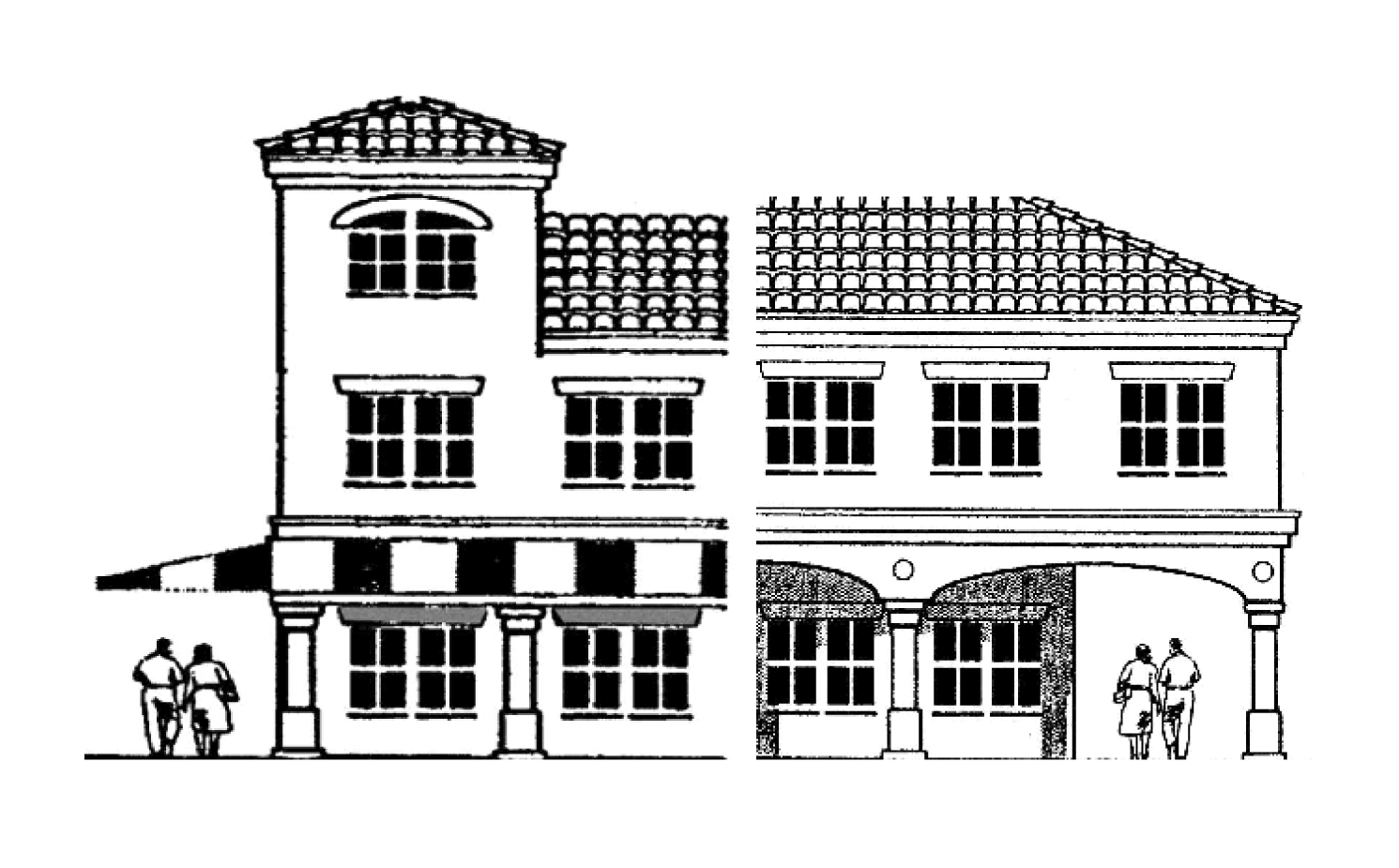
Arcade means a series of arches supported on columns along the primary building facades, creating cover for pedestrians.
Awning means a roof-like cover of canvas extending over a window, doorway or deck, providing protection from the elements.
Balcony means an elevated platform projecting from the wall of a building and enclosed by a railing or parapet.
Colonnade means the same as arcade, but not necessarily having arches.
Entry means the portion of a building that provides public access, preferably with notable form for easy identification.
Facade means the front of a building or any of its sides facing a public way or space, especially one distinguished by its architectural treatment.
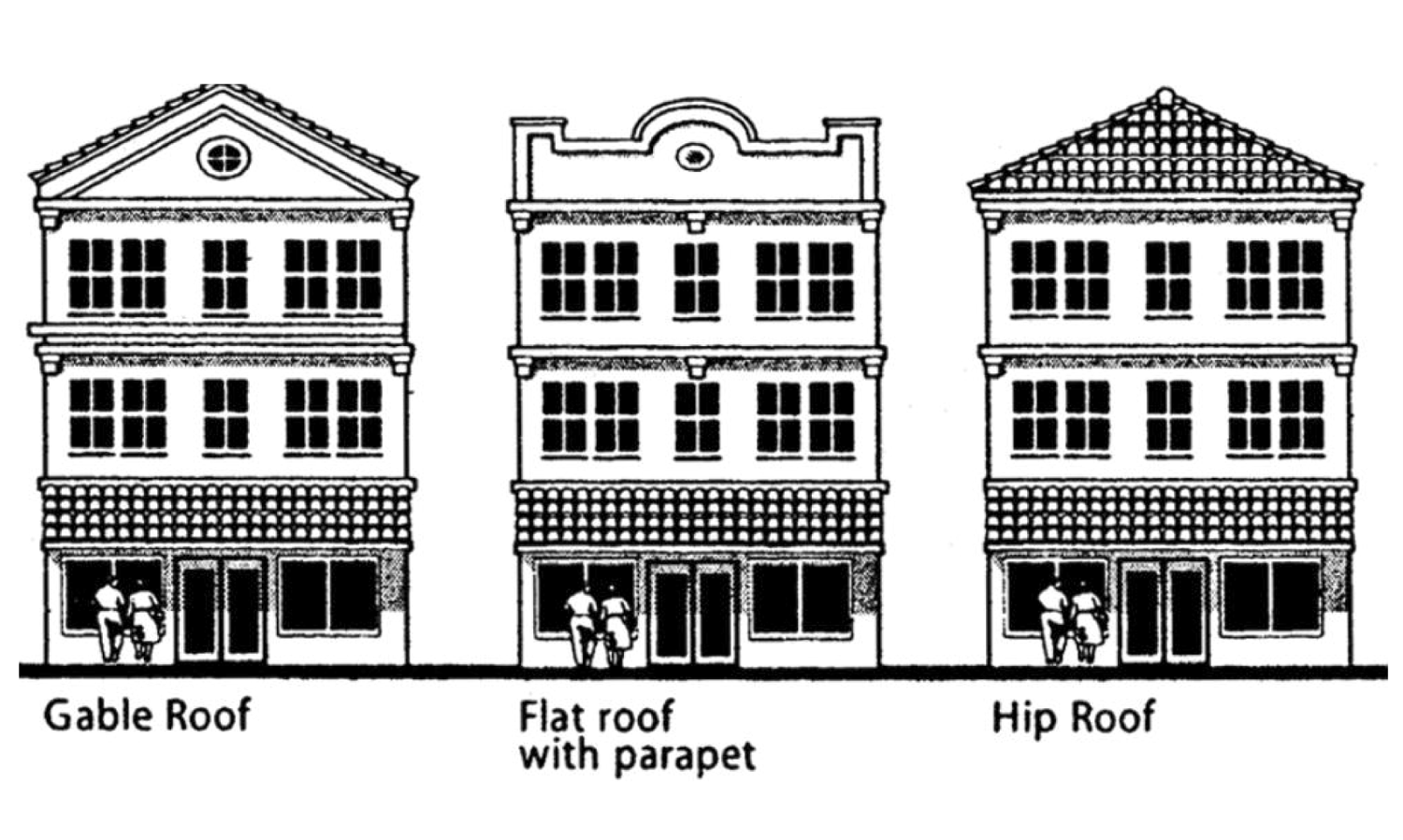
Flat roof means a slightly pitched roof that is hidden by parapets on the front and sides, and possibly the on back of the building.
Gable roof means a roof sloping downward in two parts, so as to form a gable at both ends.
Hip roof means a roof having sloping ends and sides at an inclined projecting angle.
Parapet means a low protective wall that rises above the edge of a flat or gable roof, often unimportant part of the facade.
Primary frontage means the main facade of a building which faces State Road 7, Hallandale Beach Boulevard, or Pembroke Road. If the development does not abut one of these rights-of-way, the roadway with the largest width shall be the primary frontage. The city administrator or designee will determine the primary frontage on rights-of-way with the same width.
Redevelop means to demolish existing buildings or to increase overall floor area existing on a property; or both, irrespective of whether a change occurs in land use.
Residential, single-family within the TOC means a plot of land with one housing unit either constructed or to be constructed on the plot. Within the TOC district, this use shall only be allowed on plots that were zoned R-18, R-1C, R-2, or RSO prior to the adoption of Ordinance 2019-04.
(Ord. No. 2007-05, exh. A, § 3, 5-1-2007; Ord. No. 2019-04, § 3(Exh. B), 8-21-2019)
Sec. 42-290. - Intent.
The Transit-Oriented Corridor District is established to include a rich mix of residential, retail, restaurant, service, and small employment uses within a pedestrian village format. The purpose of this district is to promote redevelopment along State Road 7 (SR7), Hallandale Beach Boulevard and Pembroke Road, along with previously-zoned residential, commercial and industrial districts adjacent to these corridors with a quality mixed-use environment. Land consuming uses, such as large lot housing and large retail outlets are excluded from this district. The TOC district is gridded on developable and redevelopment parcels generally found within one-quarter of mile of the SR7 Hallandale Beach Boulevard and Pembroke Road. Nothing in these regulations shall preclude application for expansion of the TOC beyond those areas, when site-specific development plans demonstrate efficient resident access. The district is intended to serve a residential population of sufficient size to constitute an origin and destination for purposes of rapid transit service along SR7, with enhanced transit service along Hallandale Beach Boulevard, and Pembroke Road.
The TOC contains four different districts ranging from TOC-1 which provides for uses consistent with adjacent residential districts to TOC which allows for more uses and larger structures primarily along SR7. Specific information for each TOC District is identified below:
TOC: This district consists of the TOC areas which were adopted into the City's Land Development Code in 2007 and includes additional parcels in proximity to SR7. This district has the largest number of permitted uses and allows for mixed-use developments up to 65 feet in height.
TOC - 3: This district is located along Hallandale Beach Boulevard and Pembroke Road at the main entry points into the city's neighborhoods. This district has proposed uses that are suited to more pedestrian-related uses utilized by the surrounding community. The maximum height of structures in this district in 35 feet.
TOC - 2: This district includes properties along Hallandale Beach Boulevard and Pembroke Road and includes most of the uses allowed in TOC-3, as well as many of the uses in the TOC district. The TOC-2 district has a maximum height of 35 feet.
TOC - 1: This district is located between the other TOC districts (TOC, TOC-3 and TOC-2) and the city's residential districts. The type of uses permitted in this district are based on compatibility with the existing community. The TOC-1 district has a maximum height of 25 feet.
(Ord. No. 2007-05, Exh. A, § 3, 5-1-2007; Ord. No. 2019-04, § 3(Exh. B), 8-21-2019)
Sec. 42-291. - Modifications.
All new construction shall conform to the design provisions of this division. The city administrator or designee may approve minor variations to the provisions of this division, provided similar materials, configurations, and/or techniques are used that fulfill the intent of this division. Major variation to the requirements due to unique building use requirements may be approved by the city commission, provided the overall pedestrian nature of the street is maintained in accordance with all other standards. All variations shall be noted on the final approved plan.
(Ord. No. 2007-05, exh. A, § 3, 5-1-2007)
Sec. 42-292. - Design guideline principles.
(a)
The transit-oriented corridor along SR7, Hallandale Beach Boulevard and Pembroke Road shall include amenities to serve the residents, visitors and employees within the development that encourage a pedestrian-friendly, transit-oriented environment, such as benches, street furniture, shade structures and landscaping, light fixtures, trash receptacles and bicycle parking. This may also include other amenities within public places, such as plazas that include fountains, sculptures and green space.
(b)
Streets will include pedestrian and transit amenities such as street trees, bus shelters and information kiosks to serve the residents and employees within. Properties adjacent to transit amenities and, where appropriate, throughout the corridor, shall provide these features.
(c)
The scale, organization and style of architectural components will contribute to a sense of place for this urban village. At the street, buildings will be proportioned for pedestrian orientation. Buildings will front the street with minimal setbacks, creating continuity of streetscape interest through continuous storefronts and direct visual connections to building entries. Architecture will also be used to create attractive landmarks and gateways to the development.
(d)
Parking will primarily be in structures or located in the rear of the properties, with additional curbside parking on the side streets, where feasible, with the approval of the city administrator or designee. Parking garages will be well integrated into the streetscape. Bus shelters and limited surface parking will encourage the transit environment and support transit usage. Furthermore, the buildings, rather than the parking, will front the street. This will also encourage residents, employees and visitors to utilize transit.
(e)
Developments directly abutting existing residential districts and uses require a landscape buffer to provide a visual screen between the existing residential community. This requirement can only be waived by the city manager or designee if the primary frontage faces residential and the design criteria of the proposed development is consistent with requirements set forth in this division.
(Ord. No. 2007-05, exh. A, § 3, 5-1-2007; Ord. No. 2019-04, § 3(Exh. B), 8-21-2019)
Sec. 42-293. - Prohibited uses and structures.
Any use or structure not specifically, provisionally or by reasonable implication permitted in this chapter is prohibited.
(Ord. No. 2007-05, exh. A, § 3, 5-1-2007)
Sec. 42-320. - Purpose.
(a)
In order to create a built environment that is compact and within a pedestrian scale, the standards in this subdivision are provided. Blocks of buildings are encouraged with the mass located towards the street and the sides and rear spaces for courtyards and public spaces to increase the amount of open space opportunities throughout the corridor. Setbacks are minimal in order to promote a compact urban setting. The setbacks are landscape buffers, which include shade trees for the transit amenities.
(b)
Building heights are a critical factor in creating a livable, walkable community. The heights of buildings affect how pedestrians will relate to an area and contribute to its character. Along with height, the building frontage provides interest to a corridor. The buildings shall be placed at the front of the property in order to create a visual edge. This will encourage either structured parking internally or parking in the rear.
(Ord. No. 2007-05, exh. A, § 3, 5-1-2007; Ord. No. 2019-04, § 3(Exh. B), 8-21-2019)
Sec. 42-321. - Public plazas, courtyards and open spaces.
(a)
Public plazas, courtyards or open spaces may be provided in lieu of setbacks, which may be reduced to zero feet along the rear and side yards, if not adjacent to a residentially-zoned district, subject to the approval of the city administrator or designee and shall meet the criteria listed in subsection (b) of this section. The landscaped courtyards, open spaces or plazas shall provide equal square footage to the setbacks.
(b)
In addition to setback reductions, public plazas, courtyards or open spaces, may be used to meet pervious area requirements, if a permeable surface, such as pavers, is utilized in the construction. Pavers or other permeable surfaces used in the public plazas, courtyards or open spaces may be used towards a maximum of ten percent of the pervious area requirement. To qualify for this benefit, the following criteria must be met:
(1)
The minimum size of a public plaza, courtyard or open space area shall be at least 1,000 square feet.
(2)
All public plazas, courtyards or open space areas shall be accessible directly from an adjoining public sidewalk. Driveways or vehicular accessways may not be counted as providing access.
(3)
All public plazas, courtyards or open space areas shall be accessible to the public at all times.
(4)
All public plazas, courtyards or open space areas shall provide a minimum of one linear foot of seating for each 30 square feet of public plaza. Moveable seating shall not exceed 50 percent of the total required. Steps shall not count towards the seating requirements.
(5)
All public plazas, courtyards or open space areas shall provide a minimum of one tree per 300 square feet (or part thereof) of the area.
(6)
All public plazas shall provide bicycle parking facilities.
(c)
In addition to the mandatory amenities required in subsection (b) of this section, all public plazas shall provide at least one of the following amenities:
(1)
Artwork, such as sculpture. Artwork shall be subject to approval by the city commission.
(2)
Fountains and pools. An ornamental fountain or reflecting pool occupying an area not less than 300 square feet.
(3)
Play equipment.
(Ord. No. 2007-05, exh. A, § 3, 5-1-2007; Ord. No. 2019-04, § 3(Exh. B), 8-21-2019)
Sec. 42-322. - Lighting.
(a)
Lighting shall meet and not exceed the recommended levels set by the Illuminating Engineering Society (IES). No light shall be emitted above the horizontal (90 degrees). Flags, statues and other items requiring uplighting shall employ a narrow cone of light to minimize spill and glare. All sign and building lighting shall be ornamental in nature and subject to the approval of the city administrator or designee.
(b)
All lighting throughout the district, including street, sign, pedestrian, parking lot and building lighting shall be of a consistent, decorative, ornamental style, pursuant to the approval of the city administrator or designee.
(c)
Site lighting shall be required to be a minimum of 15 feet from shade trees and 7.5 feet from small trees and palms.
(Ord. No. 2007-05, Exh. A, § 3, 5-1-2007)
Sec. 42-323. - Transit amenities.
Properties adjacent to transit stops shall provide features for these amenities including shelters or shade structures, benches and receptacles. These amenities shall be pursuant to the approval of the city administrator or designee and Broward County Transit.
(Ord. No. 2007-05, Exh. A, § 3, 5-1-2007; Ord. No. 2019-04, § 3(Exh. B), 8-21-2019)
Sec. 42-324. - Building character.
(a)
The required building characteristics are as follows:
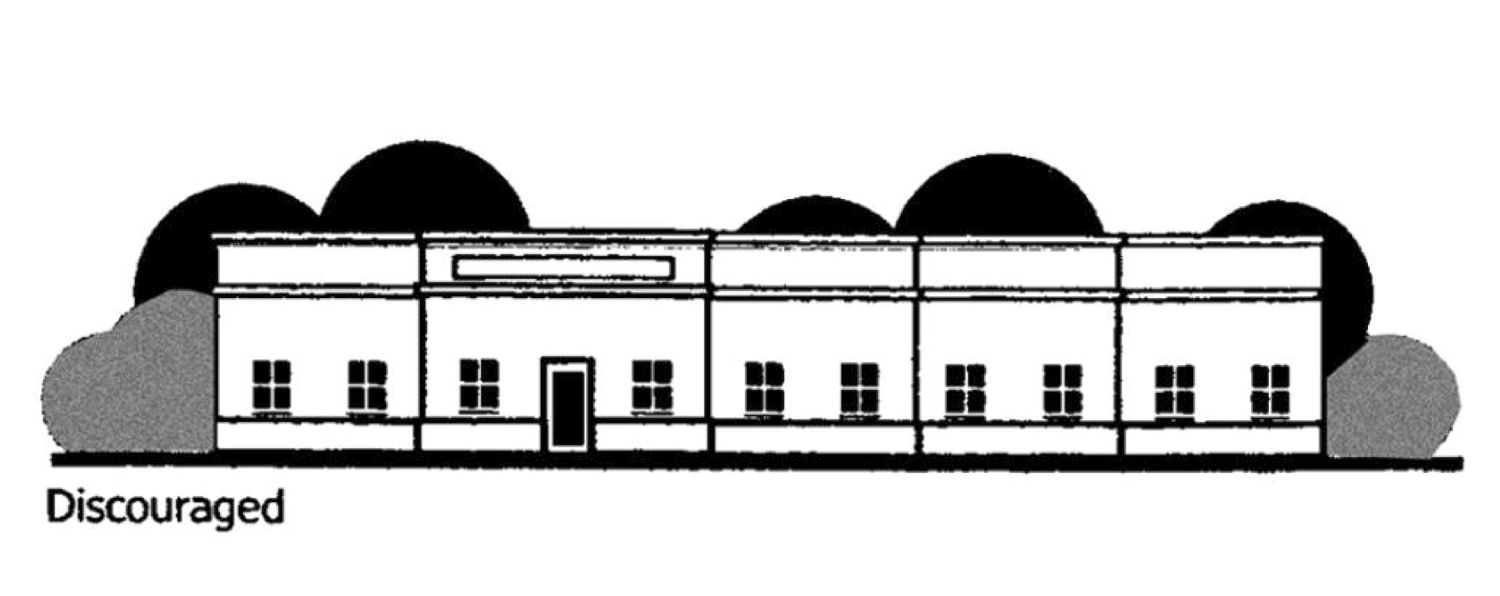
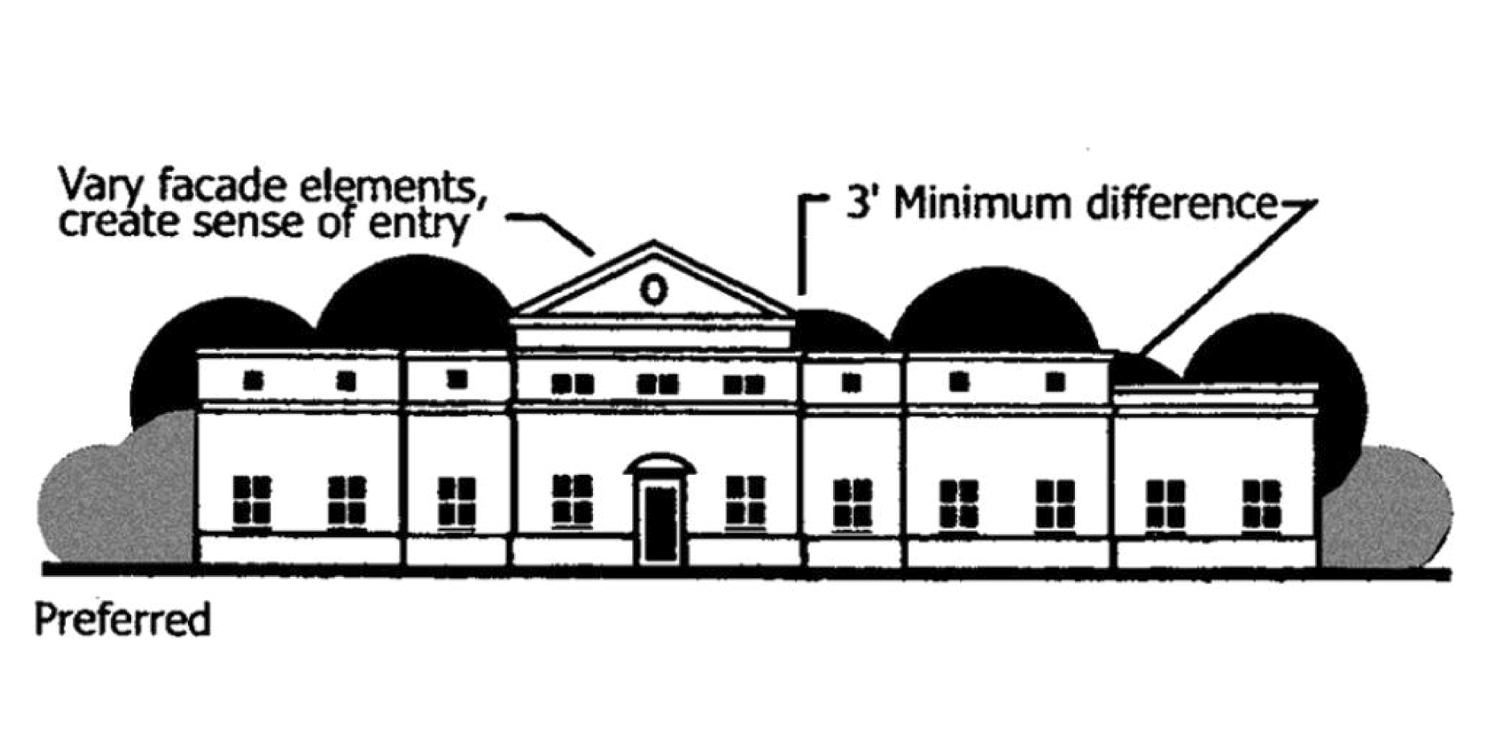
One-Story Building
One-Story Building with Relief in Elevation
(b)
Building massing, architectural details, entry details or changes in materials shall be used to highlight the location of building entries. A single, dominant building mass shall be avoided. Stepping the building will reduce the apparent scale of the building, providing variety and limiting the massing.
Multistory Buildings
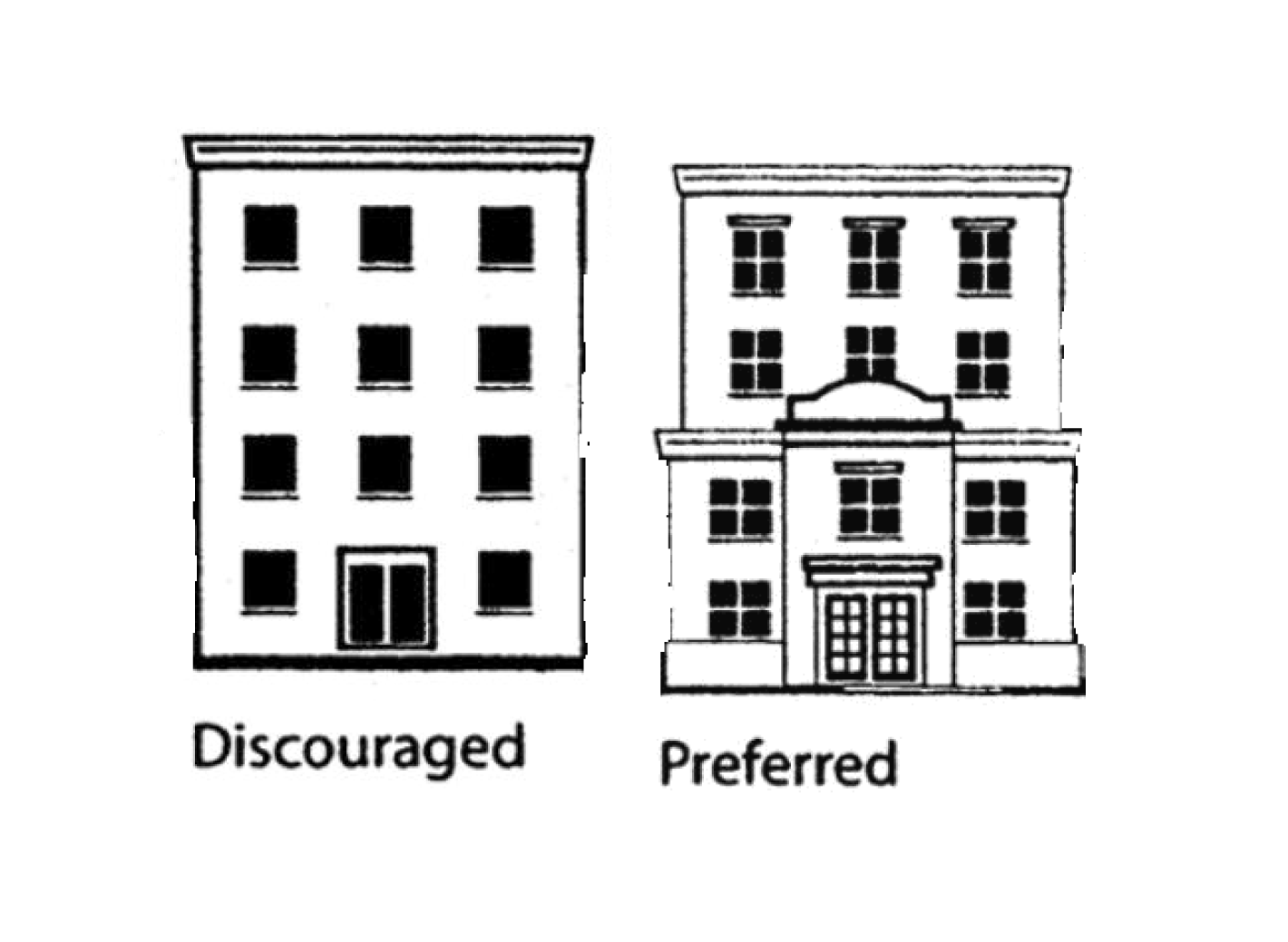
(Ord. No. 2007-05, exh. A, § 3, 5-1-2007; Ord. No. 2019-04, § 3(Exh. B), 8-21-2019)
Sec. 42-325. - Signage.
(a)
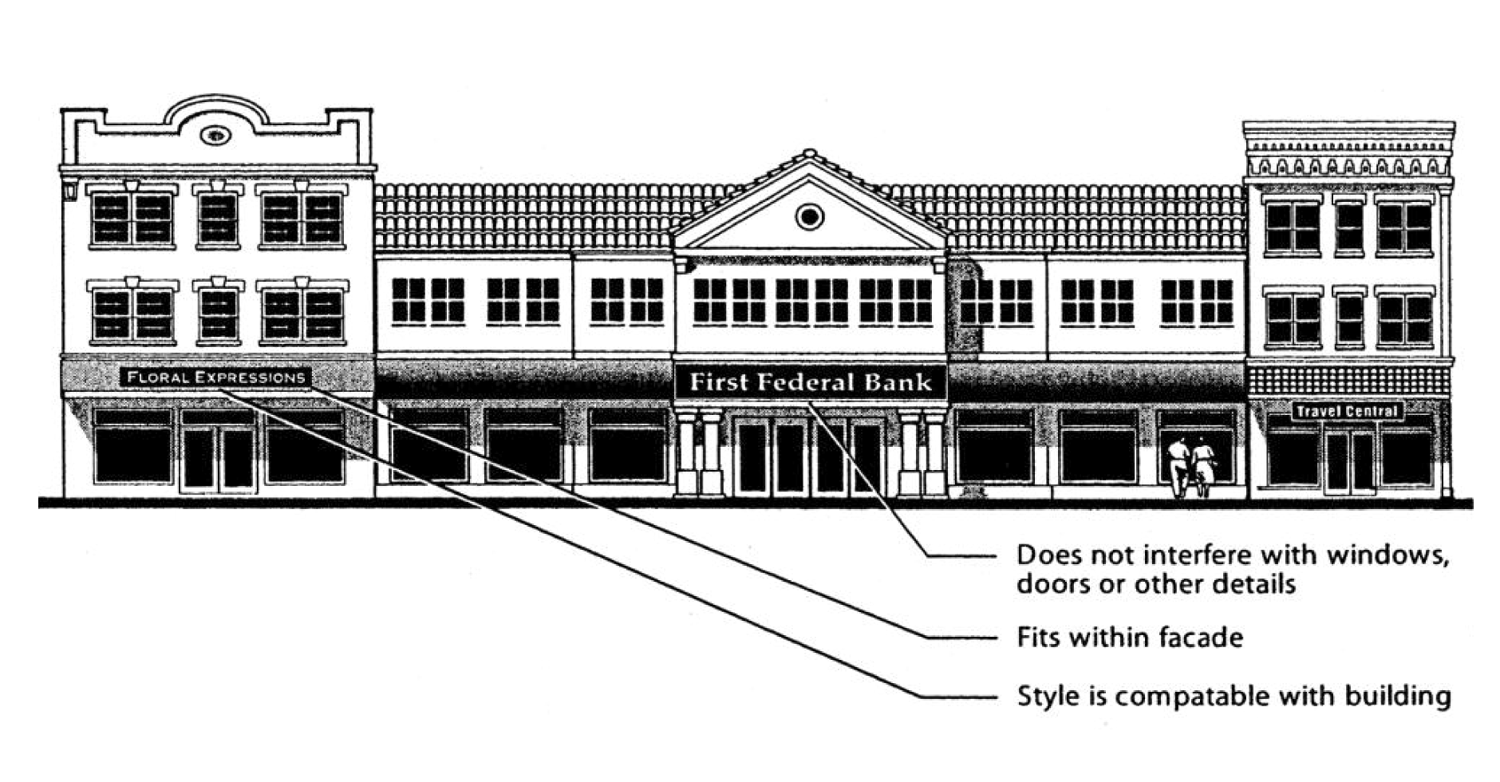
Signage for individual retail storefronts should be oriented towards the pedestrian. Small scale hanging and projecting signs that complement the building design are encouraged. These signs should not be larger than three square feet in area with a maximum letter height of six inches. The bottom of such signs shall have a minimum clearance of seven feet six inches above the sidewalk. Illuminated signs facing residentially-zoned property are discouraged.
(b)
Signs should be constructed of high quality and durable materials. Plastic panels are prohibited.
(c)
Painted signs shall not be permitted.
(d)
Awning signs should be limited to the valance drop. Lettering should not exceed eight inches in height nor exceed three square feet in area.
(e)
Rooftop signs are not permitted. Signs should not extend above the parapet and should have sufficient clearance from eave/overhang lines.
(f)
Multiple storefronts within a larger building should have signage similar in scale, proportion and placement and should reflect the overall design of the building.
(g)
Window signage should be limited to ten percent of the window or storefront area.
(h)
All other signage types shall comply with regulations outlined in this chapter.
(Ord. No. 2007-05, exh. A, § 3, 5-1-2007; Ord. No. 2019-04, § 3(Exh. B), 8-21-2019)
Sec. 42-326. - Covered walkways.
Buildings along SR7 Hallandale Beach Boulevard and Pembroke Road are encouraged to provide covered walkways, arcades, awnings or colonnades along the side of the building facing the corridor. A walkway shall not impede safe pedestrian movement along the sidewalk and shall be constructed within the property line of the owner, not within the property of the state department of transportation. Covered walkways, arcades, awnings or colonnades shall conform to the following:
(1)
All covered walkways shall provide a width of six feet.
(2)
All covered walkways shall be lighted to illumination levels equal to those on surrounding sidewalks. Downlighting shall be utilized. Backlighting is prohibited.
(3)
Awnings shall be fabric or metal. Plastic awnings shall be prohibited.
(4)
All covered walkways, arcades, awnings or colonnades shall be consistent on multiple storefronts within a larger building.
(5)
All covered walkways and/or awnings shall be located outside or not extend into the landscape buffers.
(Ord. No. 2007-05, exh. A, § 3, 5-1-2007; Ord. No. 2019-04, § 3(Exh. B), 8-21-2019)
Sec. 42-327. - Service areas and mechanical equipment.
(a)
Service bays, mechanical equipment and delivery areas, to the greatest extent possible, shall be fully enclosed, screened or located within the interior of the building. These areas shall not be visible from streets or properties with adjacent residential or hotel uses.
(b)
Central air conditioning is required.
(c)
It is preferred that all exterior equipment be placed on the roof and shall be architecturally screened. If not architecturally screened, then landscape screening to the height of the element shall be required.
(Ord. No. 2007-05, exh. A, § 3, 5-1-2007)
Sec. 42-328. - Roofs.
Roofs shall be gable, hip and flat with a parapet or a combination of these types.
(Ord. No. 2007-05, exh. A, § 3, 5-1-2007)
Sec. 42-329. - Exterior materials and color palette.
(1)
Painting of the exterior walls of new buildings or any painting involving the exterior walls of an existing roofed structure shall require a paint registration application.
(2)
All paint colors used for exterior walls of a new or an existing building within the transit oriented corridor (TOC) shall be from the city's adopted color palette. In addition, property owners performing rehabilitation to 50 percent or more of any building or structure within the TOC shall be required to repaint the exterior of the building or structure using the adopted color palette for the TOC.
(3)
At least two colors from the approved transit oriented corridor (TOC) color palette must appear on each frontage. Similar colors may be approved by the city administrator or designee.
(4)
Stucco shall be the primary approved wall surface material.
(5)
Accent materials and colors may be used. The use of tile, wood, brick and finished concrete shall be used as design accents only.
(6)
Registration applications. The registration application shall be submitted to the city administrator or designee prior to commencement. In addition to other requirements that may be imposed by the city administrator, the application shall include the following:
(a)
The name of the owner;
(b)
The address of the property;
(c)
Paint brand code and color name;
(d)
Contractor, if applicable;
(e)
Photographs of the property; and
(f)
An administrative fee approved by the city commission.
(7)
The applicant may appeal the decision of the city administrator or his designee. An appeal shall be heard at the next available city commission meeting.
(Ord. No. 2012-02, § 3, 3-21-2012)
Sec. 42-360. - Maximum square footage, units or rooms.
The following are maximum limits allowed for items enumerated:
(1)
Office/flex space: 575,000 square feet.
(2)
Commercial: 1,247,800 square feet.
(3)
Hotel rooms: 200.
(4)
Residential 2,323 units consisting of:
a.
Mid-rise units: 955.
b.
Garden apartments: 570.
c.
Townhouses: 303.
d.
Single-family units: 495.
(5)
Institutional: 34,800 square feet.
(6)
Industrial: 384,781 square feet. (Only allowed in areas zoned M-1, M-2 or C-1 prior to adoption of Ordinance 2019-04.
(Ord. No. 2007-05, exh. A, § 3, 5-1-2007; Ord. No. 2019-04, § 3(Exh. B), 8-21-2019)
Sec. 42-361. - Maximum density.
The maximum density shall be as follows:
(1)
Residential: 50 units per acre in TOC, 25 units per acre in TOC-3 and TOC-2, 16 units per acre in TOC-1.
(2)
Hotel: 100 rooms per acre.
(Ord. No. 2007-05, exh. A, § 3, 5-1-2007; Ord. No. 2019-04, § 3(Exh. B), 8-21-2019)
Sec. 42-362. - Minimum unit size.
The minimum residential unit size shall be 500 square feet with a unit average of 750 square feet.
(Ord. No. 2007-05, exh. A, § 3, 5-1-2007)
Sec. 42-363. - Parking requirements.
(a)
Parking requirements shall be as follows:
(1)
Residential.
a.
Minimum: One parking space per unit, for multi-family units; For single-family, duplex, triplex, or townhome development minimum parking is two spaces per unit.
b.
Maximum: 1.5 parking spaces per unit, plus one guest space per 15 units for multi-family units.
(2)
Hotel.
a.
Minimum: One space per room up to ten rooms; if more than ten rooms, then 0.25 spaces per room;
b.
Maximum:
1.
Up to 15 rooms, then one space per room;
2.
If more than 15 rooms and less than or equal to 40 rooms, then 0.50 spaces per room;
3.
If more than 40 rooms, then 0.25 spaces per room.
(3)
Nonresidential. Three parking spaces per 1,000 square feet and no less than one parking space per 500 square feet.
(b)
Further reduction in the number of required parking spaces may be permitted by the city after a finding that the development will be adequately served by users of public transportation.
(Ord. No. 2007-05, exh. A, § 3, 5-1-2007; Ord. No. 2019-04, § 3(Exh. B), 8-21-2019)
Sec. 42-364. - Parking facilities.
(a)
Where feasible, ingress and egress shall be from side streets or alleys.
(b)
Surface parking lots must be to the rear of buildings. Surface lots are prohibited in front of businesses.
(c)
Parking structures are strongly encouraged and shall have well-designed pedestrian walkways and connections to the sidewalk system.
(d)
If parking structure is located on the ground floor and has street frontage, ground level retail is required. Parking structures shall be designed to be compatible with adjacent buildings and architecture.
(e)
Shared parking is strongly encouraged. Cross access easements or similar mechanisms shall be used to provide joint access between the parking areas of adjacent properties.
(Ord. No. 2007-05, exh. A, § 3, 5-1-2007)
Sec. 42-365. - Landscape standards.
(a)
Landscaping of surface parking lots, vehicular use areas, landscape buffers and open areas shall be required according to the standards set forth in this subsection. Any items not mentioned in the following standards shall comply with other provisions in this chapter:
(1)
Ten-foot wide perimeter landscape area.
(2)
Four-foot high ornamental fencing may be provided around parking lots and vehicular use areas; six feet high ornamental fencing may be provided around all secured areas. Fencing shall be located ten feet from the sidewalk and against the adjacent side property lines.
(3)
Chainlink fencing is prohibited.
(b)
Parking lots shall be developed as "parking gardens" with shade trees planted in islands and circulation flanked by planted areas according to the following standards:
(1)
Perimeter screening area shall not be applicable toward internal planting area requirements.
(2)
50 percent of the paved surface of the parking lot, excluding pervious areas, shall be shaded within five years.
(3)
Use of porous or permeable paving materials for overflow parking and other low-use areas is encouraged, but cannot be utilized as pervious area.
(c)
Landscape requirements for parking structures without liner use are as follows:
(1)
Trees, shrubs and ground covers shall be planted in all required setback areas allowable.
(2)
Uncovered parking on the top level of a parking structure shall require rooftop planters around the entire perimeter of the top floor.
(d)
All landscape and irrigation system designs shall be consistent with the principles of the Florida Friendly Lawns and Landscapes established by the Florida Department of Environmental Protection. The solar orientation of a property and its relationship to other properties should be considered to minimize undesirable microclimatic exposure, principally heat islands.
(e)
Developments shall provide efficient irrigation systems to include:
(1)
Irrigation systems shall be designed and constructed in accordance with the Florida Building Code and operated and maintained according to the Florida Green Industries Best Management Practices for Water Resources in Florida or the Florida Yards and Neighborhoods Program.
(2)
The irrigation system shall be designed to correlate to the organization of plants into zones as described under the plant selection in subsection (b) of this section.
(3)
Yard waste management, fertilizer management, pesticide management, landscape and irrigation maintenance shall be in accordance with the recommendations in the Florida Green Industries Best Management Practices for Water Resources in Florida.
(Ord. No. 2007-05, exh. A, § 3, 5-1-2007)
Sec. 42-366. - Abutting residential district.
Any portion of the zoning district that abuts a residential zoning district, the following condition shall apply:
(1)
Any portion of a structure within 25 feet of the residential zoning district shall be limited to 25 feet in height.
(2)
A ten-foot landscape buffer shall be constructed along the common boundary and shall be increased for 25 feet along a right-of-way or adjacent to any residentially-zoned district or existing single family use.
(Ord. No. 2007-05, exh. A, § 3, 5-1-2007; Ord. No. 2019-04, § 3(Exh. B), 8-21-2019)

