
Westlake City Zoning Code
ARTICLE IV
DISTRICT DEVELOPMENT STANDARDS
Sec. 102-121.- Generally.
(a)
Nonconformity. In the event that the town takes an act or action which transforms a previously conforming structure for purposes of front, side and rear yard setback requirements into a nonconforming structure for the purposes of front, side and rear yard setbacks, then such structure shall be deemed to be in conformance with the required setback prescribed in this chapter.
(b)
Open space.
(1)
Applicability. This subsection applies to all development in the town.
(2)
Purpose. The town is planned to be a rural and recreationally oriented community with opportunities for both residents and workers, and it is intended to tie into a regional framework of open space trails and corridors. Open space corridors link all major areas of the town using primarily floodplain areas and drainage areas. Because of the importance of open space and recreational amenities to commercial and residential vitality of the town, all projects must contribute to the open space system as established in the town's Comprehensive Plan, Open Space Plan and Thoroughfare Plan.
(3)
Requirement. All projects in the town must reserve, dedicate and/or develop public open space consistent with the Open Space Plan, subdivision standards and development agreements.
(c)
Building articulation.
(1)
Applicability. All nonresidential buildings in the town must meet the building articulation standards in this section unless otherwise approved by the board of aldermen.
(2)
Purpose. The purpose of these articulation standards is to discourage large blank building facades.
(3)
Requirements. Facades shall meet the following minimum standards for articulation:
a.
Horizontal articulation: No building wall shall extend for a distance equal to two times the wall's height without having an offset of 15 percent of the wall's height, and that new plane shall extend for a distance equal to at least 25 percent of the maximum length of the first plane.
b.
Vertical articulation: No horizontal wall shall extend for a distance greater than two times the height of the wall without changing height by a minimum of 15 percent of the wall's height.
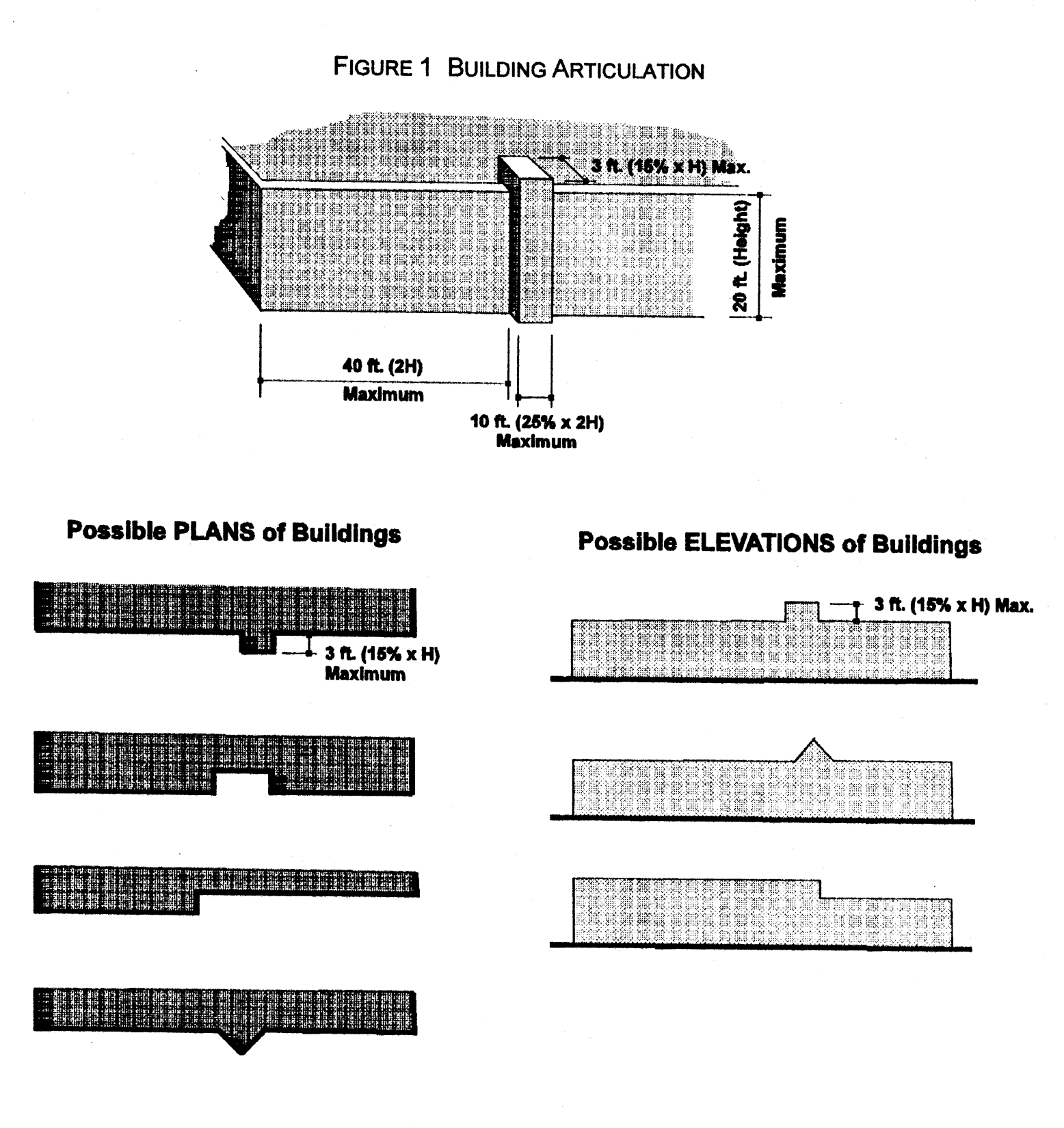
Building Articulation
(d)
Concept plans and site plans.
(1)
Concept plans. Approval of a concept plan shall be required in connection with any request for zoning unless that zoning request is at the initiation of the town. All subsequent site plans shall be in conformity with the approved concept plan. See section 102-313, required concept plans.
(2)
Site plans. Site plans are required for all developments except individual single-family lots and shall be accompanied by a proposed development schedule. No development may occur, or building permit be approved on a site which does not conform to the approved site plan. See section 102-314, required site plans.
(e)
Lots with multiple frontages. Where lots have multiple frontage on one or more streets, the required front yard shall be provided on each street.
(f)
Calculation of density. Calculation of the allowable density shall be based on the gross site area including road right-of-way, floodplain, open space and park areas. Notwithstanding the calculation, other provisions of the UDC may limit the actual density allowed on any given site.
(g)
Sight distance easements at street and driveway intersections. Refer to the sight distance easement provisions in the town's Engineering Standards.
(h)
Fences. All fences within the town shall conform to the following standards:
(1)
Fences may be built to a maximum seven feet in height. However:
a.
No solid fencing greater than 3.5 feet in height may be placed within ten feet of a right-of-way line for a roadway or open space corridor;
b.
No solid fencing greater than 3.5 feet in height may be built in front of a building setback line;
c.
No chainlink fences shall be allowed unless completely screened from adjacent public areas and properties by either structures or by solid landscape screening;
d.
No solid wood fencing shall be allowed; and
e.
Fences which are greater than 25 percent solid masonry shall be considered solid fencing.
(2)
Split rail, steel pipe and wrought iron fences are encouraged.
(3)
Precast solid fencing shall require special approval by the board of aldermen.
(4)
Barbed wire fences. Barbed wire fences may be used without restrictions when in conjunction with agricultural and related activities; provided, however, no barbed wire fence shall be located on any platted property zoned for single-family use.
(UDC 1994, art. V, § 1)
Sec. 102-122. - Residential districts.
(a)
Exterior wall building materials.
(1)
All buildings of 100 square feet or more and over nine feet tall shall have exterior walls constructed of masonry construction. Exterior walls for all buildings of 100 square feet or more and over nine feet tall shall be constructed of at least 80 percent standard masonry construction, excluding windows and doors, unless such wall is on a porch, patio, courtyard, or breezeway, in which event, the wall may be of nonmasonry construction.
(2)
Buildings less than 100 square feet and under nine feet in height may be constructed with nonmasonry materials, or may be all metal with a baked-on pre-painted surface.
(3)
Exceptions to these requirements, including buildings for farm animals, may be permitted on a case by case basis by the board upon submission and approval of elevational drawings of the subject structure, and material samples.
(4)
Barns used for agricultural or farm animal purposes on sites of ten acres or more are excluded from this masonry requirement.
(b)
Accessory building setback. Accessory buildings on residential lots shall meet all front and side yard requirements for primary structures. However when the accessory building is located behind the rear facade of the primary structure, then it may meet the following setback:
(1)
If the accessory building is 200 square feet or less in area and eight feet or less in height, then it may be set back a minimum of three feet from the property line.
(2)
If the accessory structure is greater than 200 square feet in area or eight feet in height, then it must be set back one foot from the property line for each one foot in height up to the minimum setback for a primary structure.
(3)
Notwithstanding the above, any garage or carport must be setback a minimum of ten feet from a laneway right-of-way.
(UDC 1994, art. V, § 2)
Sec. 102-122.1. - Residential airpark district.
(a)
In the residential airpark (RA) district, the following buildings and uses are permitted as hereinafter specifically provided:
(b)
The buildings and uses are subject to the general provisions and exceptions set forth in this code:
(1)
All principal uses in the residential airpark district are residential. No accessory buildings shall be permitted on lots that do not have homes built and maintained to standards established in section 102-33, R-1 district, unless otherwise provided in this section 102-122.
(2)
The residential airpark district is limited to one residence per lot. A hangar or storage facility shall not be allowed for residential use.
(3)
All aircraft must be stored in a hangar capable of permanently securing and storing the aircraft, except aircraft may be temporarily tied down outside for a period not to exceed 30 days.
(4)
Building structures and setbacks.
a.
Accessory use buildings may not exceed the square footage of the principal residential use and may under no circumstances exceed 3,000 square feet or 18 feet in height. Each lot may have not more than one accessory building over 200 square feet.
b.
Exterior wall building materials.
1.
All homes shall be constructed of at least 80 percent standard masonry construction, excluding windows and doors, unless such wall is on a porch, patio, courtyard, or breezeway, in which event, the wall may be of non-masonry construction.
2.
Accessory use buildings may be constructed with non-masonry materials, or may be all metal with a baked-on pre-painted surface consistent with the color scheme of the principal uses of the RA district as determined by the building official.
c.
Building setbacks.
1.
Residential setback. All setbacks for residential uses in the residential airpark district shall be subject to r-1 residential use setbacks as described section 102-124, Figure 2, Westlake Development District Standards Chart.
2.
Accessory building setback. Accessory buildings on residential lots shall meet all front and side yard requirements for primary structures. However when the accessory building is located behind the rear facade of the primary structure, then it may meet the following setback:
(a)
If the accessory building is 200 square feet or less in area and eight feet or less in height, then it may be set back a minimum of three feet from the property line.
(b)
If the accessory structure is greater than 200 square feet in area or eight feet in height, then it must be set back one foot from the property line for each one foot in height up to the minimum setback for a primary structure.
(c)
Notwithstanding the above, any accessory structure garage, airplane hangar or storage building must be setback a minimum of twenty feet from any right-of-way or private access easement (taxiway).
(5)
Customary and usual aviation-related activities, including but not limited to takeoffs and landings; construction and maintenance of airport facilities; and other activities incidental to the normal operation of an airport.
(6)
Greenways, including but not limited to bicycle and pedestrian paths.
(7)
Transportation facilities and improvements.
(8)
Streets that function as taxiways are allowed in the RA district and may include gates with designs approved by the fire marshal at the limit of the taxiways.
(Ord. No. 519, § 5, 4-23-2007)
Sec. 102-122.2. - Notices and restrictions required for development within the residential airpark (RA) district.
(a)
[Avigation easement; purpose.] An avigation easement is a property right that allows an airport to use the airspace above property that is located within the general vicinity of the flight path of an airport's runway. The purpose of an avigation easement is to allow aircraft to fly at low levels through a given airspace in order to take-off from or land on one or more of an airport's runways.
(b)
[Avigation easement; dedication.] When any property within a residential airpark (RA) district is subdivided or platted, the property owner shall dedicate an avigation easement to the Town of Westlake over and across that property. The easement shall hold the town, public and airfield, harmless from any damages caused by noise, fumes, dust, fuel, fuel particles, or other effects that may be caused by the operation of aircraft taking off, landing, or operating on or near the airfield, not including the physical impact of aircraft or parts there of.
(c)
Notification of buyers. No person shall sell, nor offer for sale, any property within the RA district unless the prospective buyer has been notified of the fact that the property is within the RA district. When property ownership is transferred, the property deed shall be amended to note that the property is within the RA district.
(d)
Agree to noise abatement. No person shall sell, nor offer for sale, any property within the RA district unless the prospective buyer agrees to follow Aircraft Owners and Pilots Association (AOPA) standard noise abatement procedures, or the most recent noise abatement procedures established at the airport.
(e)
CC&Rs. The applicant for a subdivision or design review in the RA district shall provide a copy of the CC&Rs in conformance to the requirements listed above.
(Ord. No. 519, § 5, 4-23-2007)
Sec. 102-123. - Commercial districts.
(a)
Building separation. Where a multifamily building or buildings are erected so as to create enclosed inner courts, the faces of all opposite walls in such courts shall be a minimum distance of 40 feet apart, and no balcony or canopy shall extend into such minimum court area.
(b)
Exterior wall building materials. All buildings shall have exterior walls constructed of stone, brick, glass block, tile, cast metal, cast stone, or a combination of those materials. Exceptions to this requirement may be permitted on a case by case basis by the board upon submission and approval of elevation drawings of the subject structure, and material samples. This may include the approval of concrete or plaster/stucco where it is deemed important as a design feature and where it will be applied under the highest standards for quality and durability.
(UDC 1994, art. V, § 3)
Sec. 102-124. - District development standards.
(a)
District development standards chart.
(1)
The district development chart in Figure 2 sets out standards for density, minimum building area, building height, minimum setbacks from property lines, required landscaping, requirement for site plan approval, and requirement for submission of a development schedule.
(2)
Front yard setbacks are required in all instances where a property line abuts a street right-of-way.
(3)
The chart shall establish the minimum requirements for these elements except as otherwise provided in this article.
FIGURE 2
WESTLAKE DISTRICT DEVELOPMENT STANDARDS CHART
* Lot width shall be measured at the minimum setback distance for the district.
** PD requirements subject to PD Ordinance.
*** As approved by Town Council.
(b)
Maximum building height.
(1)
All districts. The height limit for all structures shall be as established in the districts governing the property on which the structures are located. However, the maximum height may be increased up to 700 feet above mean sea level by the town council as part of site plan approval, unless otherwise limited by a planned development district.
(2)
Building height and setback for commercial districts.
a.
Roadway slope. In addition to the building setback line, no building in a commercial district may exceed the height of a line drawn from the nearest roadway right-of-way line at a 2:1 slope directly into the subject commercial property, as shown in Figure 3 (e.g., a 100-foot high building must be set back 200 feet from the right-of-way line).
b.
Residential slope. In addition to the building setback line, no building in a commercial district may exceed the height of a line drawn from a residential property line in a residential district, at a 5:1 slope directly into the subject commercial property as shown in Figure 3 (e.g., a 100-foot building must be set back 500 feet from the residential property line).
c.
Changes in grade. Notwithstanding the slopes noted in subsections (b)(2)a. and b. of this section, if the slope of the ground rises or falls from the point of origin of the slope line, the actual building height may be greater or lesser by the difference in grade.
d.
Exceptions. The following features may be constructed 12 feet higher than the maximum height requirement of the zoning district in which the structure is located:
1.
Chimneys, church spires, elevator shafts, and similar appendages not intended as places of occupancy or storage.
2.
Flag poles and similar devices.
3.
Heating and air conditioning equipment, solar collectors and similar equipment, fixtures, and devices.
4.
Provided that they are: (i) not more than one-third of the total roof area; and (ii) set back from the edge of the roof a minimum distance of two feet for every foot by which such features extend above the roof surface of the building to which they are attached.
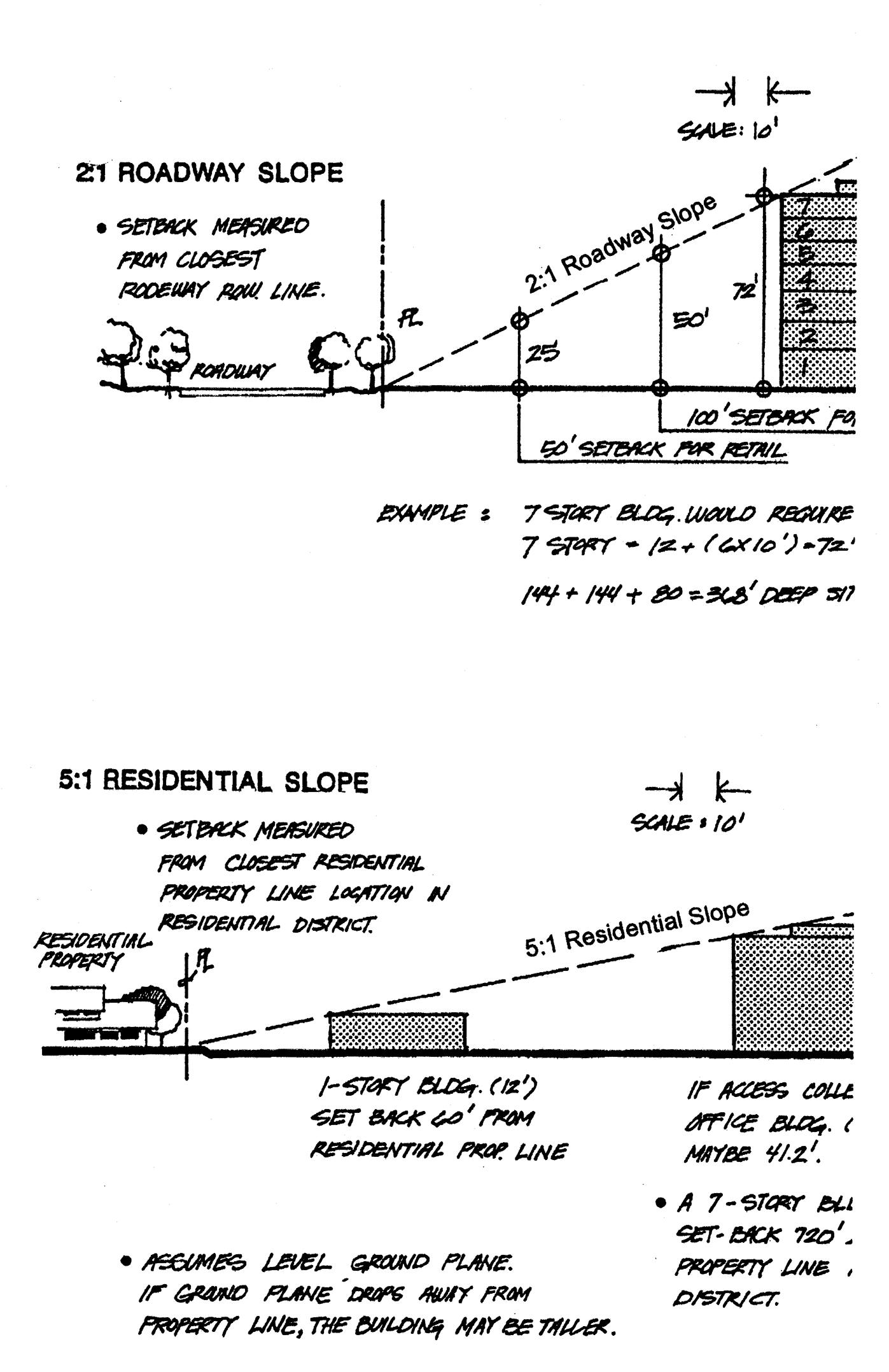
ROADWAY SLOPE AND RESIDENTIAL SLOPE SETBACKS
(c)
Screening of mechanical equipment. Mechanical equipment on the ground or roof shall be screened from view of adjacent properties and all public areas.
(UDC 1994, art. V, § 4; Ord. No. 426, § 5, 9-23-2002; Ord. No. 519, § 6, 4-23-2007; Ord. No. 677, § 2, 2-27-2012)

