
Westlake City Zoning Code
ARTICLE V
- PARKING AND LOADING2
Cross reference— Traffic and vehicles, ch.90.
Sec. 102-151.- Purpose.
(a)
Parking. The purpose of this article is to regulate the number of required off-street vehicular parking spaces so as to:
(1)
Provide for the needs of occupants, customers, visitors or others involved in the use or occupancy of any building, structural improvement or place of assembly;
(2)
Eliminate undue use of the street system for parking purposes;
(3)
Promote and protect the public health, safety, comfort, convenience and general welfare; and
(4)
Grant and define the administrative powers and duties necessary to enforce this article.
(b)
Loading. It is also the purpose of this article to require allocation of sufficient off-street/on-site loading facilities by businesses and industry to ensure that the loading and unloading of vehicles will not interfere with traffic flow or block roadways or fire lanes.
(UDC 1994, art. VI, § 1)
Sec. 102-152. - Applicability.
(a)
Construction or creation of use. Any building, improvement, or use of land approved or erected shall include the necessary off-street parking spaces, and require off-street/on-site loading facilities subject to the standards established in this article.
(b)
Change of use. Whenever any building, improvement, or use of land is proposed to be changed to a new use, the provision of off-street parking and loading shall be required for the new use in accordance with this article.
(c)
Expansion of an existing use. If any building, improvement, or use of land is expanded, the provisions for parking and loading shall be provided for the portion of land use and/or building that has been added.
(d)
Renovation or redevelopment. Notwithstanding subsection 102-152(b) of this section, if any building, improvement, or use of land is repaired, renovated, altered, expanded or redeveloped, and the cost of such changes exceed 50 percent of the fair market value of the building improvement prior to the subject improvements, the parking and loading facilities set forth in this article shall be made conforming.
(UDC 1994, art. VI, § 2)
Sec. 102-153. - General provisions.
(a)
Calculation of spaces.
(1)
Fractional number of spaces. In determining the required number of parking spaces, fractional spaces shall be counted to the nearest whole space. Parking spaces located in buildings used for repair garages or auto laundries shall not be counted as meeting the required minimum parking.
(2)
Parking structures excluded. Floor area of structures devoted to off-street parking of vehicles shall be excluded in computing the floor area for off-street parking requirements.
(3)
Requirements for uses not listed. The off-street parking requirements for a use not specifically listed in the parking requirement schedule in Figure 3, shall be the same as required for a use of a similar nature.
(b)
Paving materials. All required parking and loading areas, public and private drives, and fire lanes shall be constructed of concrete, but may have a surface treatment of brick, stone or other similar material. However:
(1)
Asphalt may only be used in temporary parking areas approved in accordance with the provisions as set forth in subsection 102-153(f); and
(2)
Cast interlocking concrete, brick, or stone pavers installed on a prepared base may be used in parking areas and on public and private drives where approved by the town manager or designee.
(c)
Location of parking and loading spaces. The required off-street parking and loading spaces shall be located on the same lot as the building or use served; except, off-street parking may also be located as follows:
(1)
Parking may be located off-site.
a.
When an increase in the number of off-street parking spaces is required by a change or enlargement of use, or where off-street parking spaces are provided collectively or used jointly by two or more buildings or establishments, the required off-street parking spaces may be located at a distance not to exceed 400 feet from the building being served; provided, however, that a written agreement thereto is properly executed and filed as provided in subsection (c)(3) of this section.
b.
The distance from the land use requiring parking to the off-site parking site shall be measured along the shortest legal pedestrian path between one site and the other.
c.
All off-site parking must first be approved by the board of aldermen.
_____
(2)
Joint use of parking. Parking adjustments may be allowed according to the following percentages by time of day:
FIGURE 1 PARKING ADJUSTMENT
PERCENTAGES BY TIME OF DAY
FIGURE 2 JOINT USE PARKING
EXAMPLE:
_____
(3)
Off-site parking agreement.
a.
When the required off-street parking spaces are not located on the same lot with the building or use served or when the required off-street parking spaces are provided collectively or used jointly by two or more establishments, a written agreement which ensures the retention of such spaces for this purpose, and for a period of not less than two years, shall be drawn and executed by the parties concerned, approved as to form by the town attorney, and filed with the application for a building permit or certificate of occupancy if a change in use is involved.
b.
If the off-site parking is terminated for any reason, then alternative parking meeting the standards of this article shall be acquired, or the property shall lose its certificate of occupancy.
(4)
Parking in front yards of residential and agriculture. No required off-street parking space shall be located in the required front yard in any residential or agricultural district.
(5)
Parking in front yards of nonresidential. In any nonresidential district, the required off-street parking space may be located in the required front yard.
(d)
Lighting of parking and loading areas.
(1)
Spillover lighting. All lighting facilities shall be so arranged as to reflect the illumination away from any adjacent property. Such lighting facilities shall provide illumination within parking areas not to exceed a maintained average of one footcandle at ground level, and shall distribute not more than two-tenths of one footcandle of light upon any adjacent residential property.
(2)
Lighting as a nuisance or safety hazard. All lighting facilities shall be placed, masked or otherwise arranged such that illumination or glare shall not intrude on residential property or create a hazard to motorists on any street, alley or other public way.
(e)
Pay parking lots. No charge may be made for at-grade visitor parking spaces.
(f)
Temporary parking areas. All temporary parking areas shall require submittal of a site plan in accordance with the provisions found in section 102-314 of this Code. Temporary parking area site plans shall be subject to review and approval by the town planner.
(1)
No permit for temporary parking areas shall be issued prior to the review and approval of a required site plan.
(2)
No permit for temporary parking areas shall be issued for more than one year and may only be extended for two consecutive years without approval from the town council.
(3)
Any landscaped or vegetated area disturbed by temporary parking areas shall be restored to a landscape or vegetated state at the expiration of the permit to the satisfaction of the town planner.
(4)
Temporary parking lots may be paved in asphalt or other materials permitted in subsection 102-153(b).
(5)
The design, installation, and use of temporary parking areas shall comply with applicable fire, engineering, erosion, grading, and other related environmental quality and life safety regulations.
(6)
A tree protection and survey plan in accordance with all applicable provisions set forth in section 98-49 shall be submitted with the required site plan and other related documents to demonstrate the protection and preservation of all trees near the temporary parking area. Notwithstanding the provisions in section 98-49, all tree protection and survey plans shall comply with all other applicable provisions of this Code.
(UDC 1994, art. VI, § 3; Ord. No. 1011, §§ 2, 3, 10-21-2024)
Sec. 102-154. - Residential parking.
For lots less than five acres the following provisions shall apply:
(1)
Storage of vehicles. On lots less than five acres, trailers, motor homes, trucks, travel trailers, camper cabins, motorcycles, boats, farm machinery, or similar equipment, shall not be parked or stored on any residential or agricultural lot or the adjacent street except when in conformance with one of the following provisions:
a.
Such equipment shall be wholly contained in an enclosed garage or carport; or
b.
Such equipment shall be screened from view of public rights-of-way and adjoining properties. Equipment taller than eight feet above grade shall respect the building setback lines. If located on a lot which is less than two acres, it shall be parked on an approved driveway.
(2)
Loading and unloading. Notwithstanding other requirements of this section, such equipment may be parked anywhere on a residential, agricultural or commercial premises not to exceed 72 continuous hours for the purpose of loading and unloading only.
(3)
Living or sleeping. No such equipment shall be used for living, sleeping or housekeeping purposes when parked or stored on any lot for more than ten consecutive days.
(UDC 1994, art. VI, § 4; Ord. No. 491, § 2, 12-12-2005; Ord. No. 512, § 18, 4-23-2007)
Sec. 102-155. - Off-street parking requirements.
(a)
Generally. The Parking Requirement Schedule in Figure 3 establishes parking requirements for all zoning districts.
(b)
Conventions used in parking requirement schedule.
(1)
Square feet. The abbreviation "s.f." means gross square feet of building, unless otherwise noted.
(2)
Site area parking requirements. The parking requirement for a use of site area is based on the net site area exclusive of parking and buildings.
(3)
Land uses. Because land uses are listed under "Permitted Uses" in the accompanying schedule does not mean that all such uses are permitted within the town. Please refer to article III of this chapter for permissible uses.
(c)
Off-street parking standards.
(1)
Head-in parking. An off-street parking space shall not be located on a public street or alley. Head-in parking adjacent to a public street wherein the maneuvering of the vehicle in parking or leaving a parking space is done directly onto a public street, shall not be allowed in nonresidential zoning districts nor shall it be allowed in conjunction with multifamily residential land uses.
(2)
Parking spaces and aisle surfaces. All parking spaces, aisles and maneuvering areas shall have an all-weather surface, whether enclosed or unenclosed, and shall be connected by an all-weather surfaced driveway to a street or alley.
(3)
Parking spaces and aisle dimensions. All parking spaces and aisle dimensions shall conform to Figure 5 Off-Street Parking Standard Diagram unless specifically approved by the town engineer.
(4)
Site access for vehicles. Access to a lot or tract shall conform to the driveway design standards in the town's Engineering Standards. A driveway conforming to town driveway design standards shall be constructed for each approved access point. A permit must be obtained from the town to construct a driveway within the town.
FIGURE 3 PARKING REQUIREMENT SCHEDULE
(UDC 1994, art. VI, § 5.1—5.3; Ord. No. 512, § 18, 4-23-2007)
Sec. 102-156. - Disabled parking.
In each parking facility, a portion of the total number of parking spaces shall be specifically designated as disabled accessible parking spaces and reserved for vehicles licensed by the state for use by persons with disabilities. The following parking and passenger loading standards shall apply to any new construction within the town:
(1)
Spaces required.
FIGURE 4 DISABLED PARKING SPACE REQUIREMENT
(2)
Construction standards. Parking spaces and facilities intended for use by persons with disabilities shall be designed and constructed in accordance with the standards established by state law, town ordinances and the Americans with Disabilities Act of 1990 (ADA).
(3)
Size of spaces. Accessible parking spaces shall be at least 108 inches wide and shall be served by a pedestrian maneuvering access aisle at least 60 inches wide. The access aisle shall be part of an accessible route to the building or facility entrance. Two accessible parking spaces may share a common access aisle. Accessible parking spaces and access aisles shall be level with surface slopes not exceeding two percent in any direction.
(4)
Van accessible spaces. One in every eight accessible spaces, but not less than one, shall be served by an access aisle not less than 108 inches wide and provide a minimum vertical clearance of 98 inches at the parking space and along at least one vehicle access route to such parking space from site entrance and exit. All such spaces shall be designated "Van Accessible" and may be grouped on one level of a parking structure.
(5)
Sign disabled accessible spaces. Accessible spaces shall be designated as reserved by a sign showing a symbol of accessibility. Such signs shall be located so they cannot be obscured by a vehicle parked in the space.
(6)
Accessible routes to the building or facility. At least one accessible route within the boundary of a site shall be provided from public transportation stops (if available), accessible parking and accessible passenger loading zones, and public streets or sidewalks to the accessible building entrance. The accessible route shall, to the maximum extent feasible, coincide with the route for the general public.
(7)
Accessible routes on site. At least one accessible route shall connect accessible buildings, facilities, elements and spaces that are on the same site.
(8)
Accessible route design standards. An accessible route shall have a minimum clear width of 36 inches and provide adequate space for a wheelchair turnaround. If an accessible route has less than 60 inches clear width, then passing spaces of at least 60 inches by 60 inches shall be located at reasonable intervals, not to exceed 200 feet. A "T" intersection of two corridors or walks is an acceptable passing place.
FIGURE 5 OFF-STREET PARKING STANDARD DIAGRAM
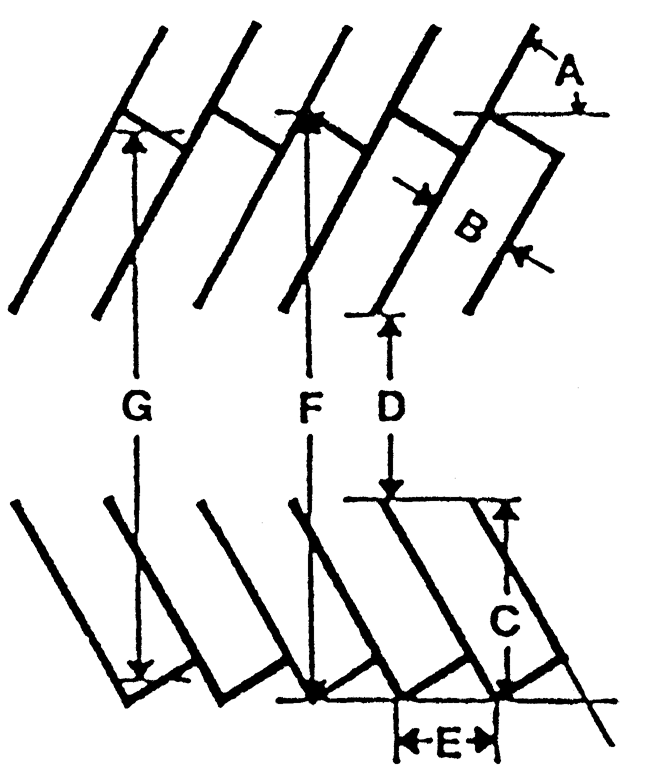
Off-Street Parking Standard Diagram
A. Stall angle
B. Stall width
C. Vehicle projection for 19′ stall length
D. Aisle width
E. Curb length per car
F. Wall to wall width for double aisle
G. Overlap center to overlap center width for double aisle
(UDC 1994, art. VI, § 5.4)
Sec. 102-157. - Off-street loading requirements.
(a)
Applicability. All nonresidential structures which contain a gross floor area of 10,000 square feet or more shall provide and maintain off-street loading facilities on the same lot. Such off-street loading facilities shall be located adjacent to a public way or private service drive, in accordance with the following requirements:
(1)
Unless an alternative is supported by design standards and approved as part of the detailed site plan, no area allocated to loading and unloading facilities may be used to satisfy the area requirements for off-street parking, nor shall any portion of any off-street parking area be used to satisfy the area requirements for loading and unloading facilities.
(2)
Any loading dock or loading area must provide a maneuvering area located entirely on private property, and shall not utilize any public right-of-way, and shall not block any drive, aisle or fire lane.
(3)
Loading docks that are within 400 feet of a residential district shall be equipped with noise attenuation devices and screened from view of adjacent residential lots.
(b)
Lighting of loading areas. All lighting facilities shall be so arranged as to reflect the illumination away from any adjacent property. Such lighting facilities shall provide illumination within loading areas not to exceed one footcandle at ground level, and shall distribute not more than two-tenths of one footcandle of light upon any adjacent property. All lighting facilities shall be placed, masked or otherwise arranged such that illumination or glare shall not intrude on residential property or create a hazard to motorists on any street alley or other public way.
(c)
Dumpster trash receptacles. All driveways to trash receptacles shall be designed to accommodate the weight of a 56,000 gross vehicular weight (G.V.W.) sanitation truck. Lifting aprons shall be provided in front of each trash receptacle location to accommodate the front wheels of the sanitation truck. Access to the trash receptacle and lift apron shall be in a straight in manner, or other manner as approved by the town manager or his designee. Trash receptacles shall not be located beneath any overhead utility line.
(d)
Size. Loading spaces shall be a minimum of 12 feet in width, 65 feet in length, and 14 feet in height except as required in subsection (e) of this section.
(e)
Off-street loading requirements. Any use that receives or distributes material, supplies or merchandise by motor vehicle shall provide off-street loading space in accordance with the following requirements:
(1)
Retail, commercial and industrial uses.
FIGURE 6 COMMERCIAL OFF-STREET LOADING REQUIREMENTS
(2)
Auditoriums, exhibitions halls, hotels, restaurants and sports arenas.
FIGURE 7 RESTAURANTS AND PUBLIC FACILITIES LOADING REQUIREMENTS
(UDC 1994, art. VI, § 6; Ord. No. 512, § 18, 4-23-2007)

