
Westminster City Zoning Code
CHAPTER 7
- SITE DEVELOPMENT STANDARDS
11-7-1. - Applicability.
Any official development plan or final plat for the development of any property within any zoning district other than planned unit development shall be in substantial compliance with the standards set forth in this chapter. For planned unit developments, these standards shall be used as guidelines and may, at the option of the City, be required. These standards are in addition to all other standards, guidelines, policies and City Code requirements otherwise applicable to land use and development within the City. In the case of a conflict between these standards and another standard, guideline, policy or requirement, the more restrictive standard, guideline, policy or requirement shall apply.
(2534)
11-7-2. - Lot and Block Standards.
(A)
The lengths, widths, and shapes of blocks shall be determined with due regard to:
(1)
Topography.
(2)
Convenient and safe access and circulation, including access and circulation for emergency and service vehicles.
(3)
Applicable regulations regarding lot sizes and dimensions.
(4)
Provision of adequate building sites suitable to the special needs of the type of use contemplated.
(5)
Availability, location, and capacity of utility service and utility system design and capacity.
(B)
The width, depth, shape, and orientation of lots shall be designed for the type of use contemplated. As a minimum, all lots shall conform to the following standards:
(1)
No lots shall be platted in areas subject to flooding except in conformance with this Code.
(2)
All lots shall front on a public street or highway or private street with easements guaranteeing public access.
(3)
Depth and width of lots shall be adequate to provide the necessary private service and parking facilities required by the type of use and development contemplated.
(4)
Lots shall be designed to provide positive drainage away from all buildings, and individual lot drainage shall be coordinated with the general storm drainage pattern for the area.
(5)
Corner lots shall generally be adequate in size to compensate for two street frontages and to satisfy vehicular sight triangle standards.
(6)
Wherever possible, side lot lines shall be at right angles to the street line or at right angles to the tangent to the curve of the street line.
(7)
Subdivision lots and streets shall be oriented in a manner to ensure location of structures and landscaping in the most energy efficient manner.
(8)
Residential lots shall not front on or obtain direct access from an arterial street. When driveway access from an arterial street is necessary for several adjoining lots, such lots shall be served by a combined access drive, which shall be platted as a permanent access easement.
(9)
When a subdivision abuts or contains an existing or proposed freeway, expressway, or arterial street, a frontage road or a visual screen planting easement may be required as necessary to restrict access.
(10)
No structure shall be constructed nor shall any building permit be issued for a structure on any platted land except where such structure is to be constructed upon a separately designated lot. Lot lines established by plat shall not be altered by conveyance of a part of such lots, nor shall only a part of any lot be joined with a part of another lot for conveyance or construction, unless and until written application and a revised plat has been submitted and approved, upon a finding that the general purpose and purport of this section shall not be weakened by such change.
(2534 3774)
11-7-3. - Fence and Vehicular Sight Triangle Standards.
Fences and vehicular sight triangles shall be in accordance with the City of Westminster Standards and Specifications for the Design and Construction of Public Improvements, Chapter 6, Roadway Section 6.18.00 Sight Distances and 6.18.02 Sight Distance Triangle.
(2534)
11-7-4. - Off-Street Parking Standards.
(A)
Duty to Provide and Maintain Off-Street Parking:
(1)
The council hereby finds, determines and declares that it serves the interest of the public to:
(a)
Lessen congestion upon the public streets of the City;
(b)
Provide adequate off-street parking that balances parking demand with the need for multiple modes of travel;
(c)
Recognize the parking efficiencies gained through mixed-use development and development proximate to rail and bus transit and their impact on parking demand;
(d)
Encourage adequate parking for land uses in Westminster without creating excess vacant parking; and
(e)
Promote bicycle use by providing safe and convenient bicycle parking through minimum requirements for bicycle parking facility type and amount.
The regulations stated herein are in furtherance of these purposes by requiring the owners and operators of land, structures and uses to provide parking on their own premises and off the public streets for their employees, customers, tenants, clients, patients and other visitors. Nothing in these regulations shall be deemed to deprive such owners or operators of the right to maintain control over all such land devoted to off-street parking space or to make whatever charges to persons making use thereof as they may deem appropriate.
(2)
For land, structures or uses actually used, occupied or operated on or before the respective effective dates of this section, there shall be provided such off-street parking space as was required for such land, structures or uses by any previous ordinance, or development plan approval, except that, if any previous ordinance or approval required more off-street parking for land, structures or uses than is required under this section, then there need be provided only such off-street parking as is required in this section. If such land, structures or uses are enlarged, extended, or changed, there shall be provided for the increment only at least the amount of off-street parking space that would be required hereunder if the increment were a separate land, structure or use established or placed into operation after the effective date of this section.
(3)
For all uses established or placed into operation after the effective date of this section, there shall be provided at least the amount of off-street parking hereinafter set forth.
(4)
Bicycle parking facilities shall be provided for any new building constructed, any new use established, any addition or enlargement of an existing building or use, for any change in the occupancy of any building, or change of use conducted. The number of bicycle parking spaces shall comply with the provisions in Subsection (E)(2) of this section. The design and maintenance of bicycle storage facilities shall conform to the standards in Subsection (E)(1) of this section.
(5)
Handicapped parking facilities shall be provided for any new building constructed, any new use established, any addition or enlargement of an existing building or use, for any change in the occupancy of any building, or for change of the use conducted. The number of handicapped parking spaces shall comply with the provisions in Subsection (D)(2) of this section. The design and maintenance of handicapped parking spaces shall conform to the standards set forth in Subsection (D)(1) of this section.
(6)
These off-street parking regulations shall apply to all development in Westminster, including those areas included in the Westminster Urban Renewal Plan, as well as other locations with adopted specific area plans. If different requirements for off-street parking are contained in any adopted specific area plan, those requirements will supersede those described in this section. If off-street parking requirements are not included in a specific area plan, the regulations in this section shall control.
(7)
The zoning for the property on which the required parking facilities are to be provided must be the same as for the building served.
(8)
Separate off-street parking space shall be provided for each use; or the parking space required of two or more uses located on the same zone lot may be combined and used jointly; provided, however,
(a)
Where off-street parking space is combined and used jointly by two or more uses having different standards for determining the amount of off-street parking space required, the parking space shall be adequate in area to provide the sum total of off-street parking space requirement of all such uses.
(b)
Where off-street parking space is combined and used jointly by two or more uses having the same standard for determining the amount of off-street parking space required, all of such uses, for the purpose of this section, shall be considered a single unit, and the gross floor area of all such uses in all structures on the same zone lot, or the number of employees of all such uses in all structures on the same zone lot as fixed by the applicable standard, shall be taken as a single total for the purposes of determining the amount of off-street parking space required.
(c)
Where it can be demonstrated, by an applicable parking study, that combining the parking areas of two or more uses will reduce the need for parking spaces, the planning manager may authorize a shared parking agreement, thus reducing the total number of spaces required. In no event shall the said reduction be more than 20 percent of the total that will otherwise be required.
(9)
Deferred parking.
(a)
To avoid requiring more parking spaces than are actually needed to serve a development, the Planning Manager may defer the provision of a portion of the required parking, if a deferred parking area is created in the official development plan. Said deferred parking area shall be landscaped, but shall not be included in the total landscaped area for the purpose of calculating landscaping requirements. The deferred area shall be designed so that, if parking is constructed at a future time in the area, it will meet all of the provisions of the commercial design guidelines and landscape regulations.
(b)
The developer shall enter into a written agreement with the City committing to the construction of paved parking in the deferred area at such time as the Planning Manager determines, at his/her discretion, that additional parking is required. The Planning Manager shall notify the property owner in writing that additional parking is required, after which the owner shall complete the improvements within six months of notification.
(B)
Off-Street Vehicle Parking:
(1)
Off-Street Parking Required: There shall be required, in connection with the development or construction of specified buildings or uses, the minimum off-street parking spaces listed in sub-subsection (2) below. The concept of shared parking for a number of different uses may be included in the parking requirements of any preliminary development plan or official development plan. If uncertainties arise as to the classification of a building or use, the City Manager or his designee shall assign a reasonable classification.
(2)
Minimum Off-Street Vehicle Parking Spaces:
(a)
Residential.
(i)
Single-Family Detached: Four spaces per unit, with two spaces enclosed in a garage and two spaces in driveway, except that parking for neo-traditional developments may be reduced by the Planning Manager on a case-by-case basis, upon a finding that less parking is needed based upon the design of the development.
(ii)
Single-Family Attached: Two spaces per efficiency, one-bedroom, two-bedroom, and three-bedroom unit; three spaces per four- or more bedroom unit; and one space per three units for guest parking.
(iii)
Multiple Family: One space per efficiency and one bedroom unit; one and a half spaces per two or more bedroom units, plus one space per five units for guest parking.
(iv)
Mobile Homes: Two spaces per unit, plus one space per unit for guest parking to be located within the mobile home park, and not more than 200 feet from unit it is serving.
(v)
Senior Housing:
a)
Independent living: One space per unit, plus one space per five units for guest parking.
b)
Congregate care: Three-fourths of one space per one unit.
c)
Assisted living: One space per three patient beds.
d)
Skilled care: One space per three patient beds.
(b)
Commercial.
(i)
Retail:
a)
Entertainment:
1.
Dance/night club: One space per three patron seats, plus one space per 75 square feet of the gross floor area that does not contain patron seats.
2.
Theaters: One space per three seats.
b)
Hotels:
1.
All types: One and two-tenths spaces per unit.
c)
Stand-alone restaurant/bar:
1.
One space per 100 square feet gross floor area.
d)
Service and sales:
1.
All types: One space per 300 square feet of gross floor area. Shopping centers containing mixed uses (including but not limited to retail, general office, medical/dental office, and non-stand- alone restaurants) shall calculate parking at the rate of one space per 300 square feet.
e)
Private recreation facilities:
1.
Fitness centers: One space per 100 square feet of gross floor area.
2.
Driving ranges: One space per tee box.
3.
Miniature golf: Two and one-half spaces per hole.
4.
Golf course: Five spaces per hole.
5.
Bowling alleys: One space per 200 square feet of gross floor area.
6.
Arcades/pool hall: One space per 180 square feet of gross floor area.
(c)
Office.
(i)
General office. One space per 300 square feet of gross floor area. The planning manager may require more parking for mixed use flex-space and/or multiple tenant office buildings, upon a finding that the types or mix of uses requires more parking.
(ii)
Medical/dental office. One space per 300 square feet of gross floor area.
(iii)
Office/warehouse. Shall be the sum total of one space per 300 square feet of gross floor area for office portion plus one space per 500 square feet of gross floor area for warehouse portion. NOTE: A minimum area equal to 60 percent of the gross floor area of office space shall be used to calculate the parking requirement.
(d)
Wholesale Industrial.
(i)
All types. One space per 1,000 square feet of gross floor area.
(e)
Institutional.
(i)
General care.
a)
Child care: One space per classroom, plus one space per five persons rated capacity with proper drop-off facility.
b)
Group home: One space per patient bed.
c)
Hospital: One and one-quarter space per patient bed.
(ii)
Educational.
a)
Pre-school: One space per classroom plus one space per five persons rated capacity with proper drop-off facility.
b)
Elementary/junior high school: One and three-quarter space per class room.
c)
High schools: One and one-half spaces per classroom plus one quarter of one space per student.
d)
College/universities: One and one-half spaces per classroom, plus one quarter of one space per student.
(iii)
Places of public assembly.
a)
Churches: One space per three persons rated seating capacity, plus two spaces per classroom.
b)
Funeral homes: One space per three persons rated seating capacity.
c)
Lodges: One space per three persons rated seating capacity.
d)
Community center/auditorium: One space per three persons rated seating capacity.
(C)
Construction and Maintenance Standards:
(1)
Each off-street parking space being at an angle of 90 degrees to the drive aisle shall not be less than nine feet wide, 19 feet long, and any cover shall be at least seven feet high. Angled parking spaces shall be per the typical parking layout standards. (See Figure 1 below.) Each space shall be surfaced with asphalt or other permanent material; shall be properly graded and drained; and shall be provided with surfaced vehicular access to an improved public right-of-way.
Parking Lot Standards (Figure 1)
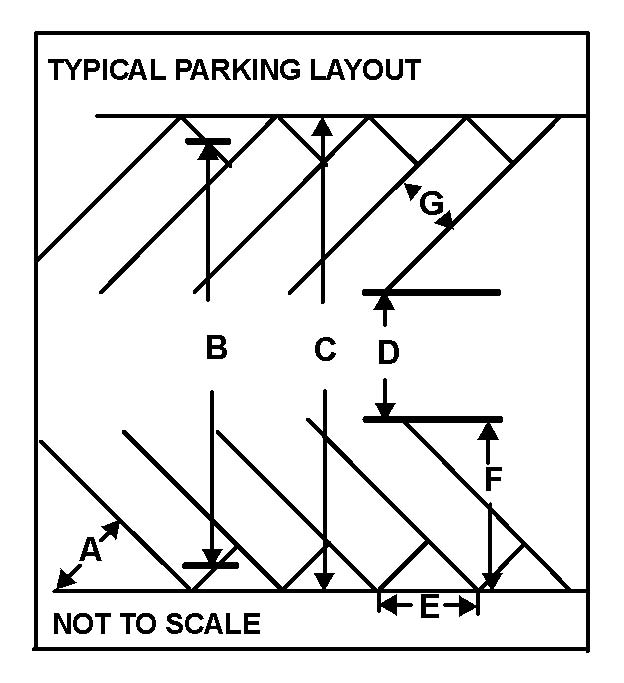
Figure 1
(2)
Each off-street parking space shall conform with the City standard specifications for design and construction.
(3)
All required off-street parking spaces and access drives shall be improved with asphalt pavement or an equivalent surface installed in conformance with the "Westminster Standard Specifications for the Construction of Public Works Projects." This requirement shall not apply to City open space properties and parks.
(4)
All off-street parking areas shall be maintained in good condition, free of weeds, dust, trash and debris, and major surfacing defects.
(5)
No parking area shall be used for the storage, sale, repair, dismantling or servicing of any vehicles, equipment, materials, or supplies.
(6)
All off-street parking spaces (excluding single and/or duplex units) shall be outlined by white or yellow stripes not less than four inches wide, painted on the surface area or an alternative judged equally effective by the City Manager or his designee. All non-parking spaces, such as loading zones, emergency lanes or spaces in front of doorways/entrances, shall be clearly delineated.
(7)
All parking areas shall be provided with ingress and egress to an improved public right-of-way so located as to promote safety and minimize traffic congestion; shall be provided with necessary internal circulation drives and aisles; and layout of parking spaces consistent with the "Westminster Standard Specifications for the Construction of Public Works Projects." Prior to the issuance of a building permit, the layout of the required parking area (excluding single and duplex units) shall be approved by the City Manager or his designee.
(8)
All access drives and required parking spaces (excluding single and duplex units) facing and abutting a building, wall, fence, property line or walkway shall be provided with installed curb and gutter. Such devices shall be constructed and installed in conformance with the "Westminster Standard Specifications for the Construction of Public Works Projects."
(9)
Parking areas (excluding single and duplex units) shall be screened, so as to prevent disturbance to adjacent residential development due to the maneuvering of vehicles entering and leaving the parking area. Screening design and materials shall be in conformance with the "Westminster Standard Specifications for the Construction of Public Works Projects" prior to issuance of a building permit.
(10)
Parking areas (excluding single and duplex units) shall be provided with night lighting for security and safety and adequate visibility for maneuvering to emphasize entrances and exits and hazards. Lighting structures and their location shall conform to the "Westminster Standard Specifications for the Construction of Public Works Projects" and shall be designed so as not to unreasonably disturb occupants of adjacent residential structures.
(11)
All parking areas shall be designed in conformance with the City of Westminster Landscape Regulations and Commercial Standards.
(12)
Parking spaces may be designed with a two-foot overhang over landscaped areas and walks, provided that the minimum widths of the affected landscape or walk is increased by two feet.
(13)
For parking spaces located within a parking structure, the Planning Manager may reduce the dimensions of the parking spaces from the Code requirement, provided that an acceptable parking study has been submitted to the City. In no event may a parking space be less than eight feet wide.
(D)
Handicapped Parking Spaces: Handicapped parking spaces shall be in an amount required by current federal regulations.
(E)
Bicycle Parking:
(1)
Bicycle Parking Standards.
(a)
Bicycle parking facilities shall include provisions for storage and locking of bicycles, either in lockers or secure racks or equivalent installation in which the bicycle frame and at least one wheel may be locked by the user.
(b)
The ground surface surrounding and underneath the bicycle storage facility shall be surfaced in a manner that prevents mud or dust.
(c)
Bicycle spaces shall consist of racks or lockers anchored so that they cannot be easily removed. Racks shall be designed that at least one wheel and the frame of a bicycle can be locked securely to it with a heavy chain, cable, or padlock. Lockers shall be so designed to minimize the possibility of an unauthorized person removing a bicycle.
(d)
Fixed objects that are intended to serve as bicycle racks, but not obviously intended for such purposes, shall be labeled as available for bicycles.
(e)
Bicycle lockers should be harmonious with their environment, both in color and design as approved by the City. Parking device designs should be incorporated wherever possible into building design or street furniture. There should be sufficient space between devices so that the use of one does not interfere with the other bicycles or devices. The parking device selected should allow maximum flexibility in grouping and placement.
(f)
The City shall have the authority to review and approve bicycle parking devices for design with respect to safety and convenience.
(g)
Parking for bicycles shall be provided on the same lot, tract or parcel as the use served.
(h)
Bicycle parking areas shall be lighted and located as near to the building or facility entrance as possible, without interfering with pedestrian traffic.
(2)
Amount of Off-Street Bicycle Parking Spaces Required. The minimum number of bicycle parking spaces shall be required as follows for all zones, except PUD; however, during the development review process, City staff may determine that a greater number of spaces than those listed below are necessary. For PUD zones, the following list shall be used as a guideline:
(a)
Multiple family dwellings: One quarter bicycle parking space for each dwelling unit.
(b)
Nonresidential uses: One bicycle parking space per each 20 required automobile parking spaces, with no less than two spaces per premise, with the following exceptions:
(i)
Private or commercial indoor recreation facility: One bicycle parking space for each 12 person capacity.
(ii)
Community facilities including public parks, libraries, recreation or activity centers: One bicycle parking space per 12 person capacity.
(iii)
Drive-in theatres, auto service stations, automobile repair and service: None.
(iv)
Mortuaries: None.
(2534 2678 3084 3531 3774)
11-7-5. - Provisions for the Requirement of Landscaping.
(A)
All properties within the City are required to provide landscaping according to the City landscape regulations and the Westminster Municipal Code.
(B)
Specific regulations pertaining to the landscaping of property, as well as the long-term maintenance of landscaping is required according to the City landscape regulations and the Westminster Municipal Code.
(C)
Enforcement pertaining to landscaping shall be as provided by Section 1-8-1, W.M.C.
(D)
The property owner, owners or owners association is responsible for the installation and maintenance of landscaping on their property, property held in joint or multiple ownership and adjacent public right-of-way, unless determined otherwise by the City.
(E)
The property owner, owners, or owners association shall be responsible for the maintenance of landscaping required by and shown on any official development plan(s) and site plan(s) accompanying official development plan waivers.
(F)
The owner is required to check with the City to determine the proximity of the development to the City's reclaimed water system. Projects within 300 feet of the system may be required to tie into the system.
(2534 3133)
11-7-6. - Common Area Standards.
(A)
In residential building groups, the City Council may require that open space and recreational areas for common use be dedicated to the City, or to a recreational district approved by the City Council, or that it be retained in private ownership.
(B)
For private streets and parking areas, as well as open space and recreational land to be retained in private ownership, the applicant shall show a definite, financially-feasible means of maintaining these facilities and lands for the future.
(C)
It shall be unlawful for any person to fail to maintain any private street or parking in common area under his ownership and control in compliance with all of the following standards:
(1)
Said areas shall not be used for sale, repair, dismantling or servicing of vehicles.
(2)
Said areas shall be maintained in good condition, free of weeds, dust, trash, and debris.
(3)
Said areas shall be provided with entrances and exits to public rights-of-way so as to minimize congestion.
(4)
The traveled portions of such area shall be kept free of snow and ice and other dangerous material.
(5)
All trees, hedges, shrubbery, plants, flowers, and other growing things adjacent to public or private sidewalks shall be maintained so that no part of them shall extend over any part of a street in a manner or height that is hazardous or blocks use of sidewalks.
(6)
Paved portions of such areas shall be maintained in good condition, free of all holes or other defects.
(7)
Such privately owned areas shall not be used in any manner that will constitute a violation of any section of the Municipal Code of the City. In the event that the provisions of the preceding sections hereof are violated, the City Manager may serve, either personally or by mail, written notice upon the owner, occupant, or any person having the care and control of said privately held area, to comply with the provisions of this chapter. Said notice shall be substantially the form set out in Section 8-4-4, W.M.C. If the person upon whom said notice is served fails, neglects, or refuses to correct the violation within five days of receipt of said notice, the City Manager may cause the necessary work to be performed and the actual cost of such work, plus five percent for inspection and other additional costs in connection therewith, shall be certified by the Finance Director to the County Treasurer of the county of jurisdiction, and such sum shall become a first and prior lien upon the property on which such work was performed, as provided by Title I, Chapter 31 of this Code.
(D)
In residential building groups abutting business or industrial districts, fences, walls, or screen plantings shall be provided to shield the residences from illumination, noise, dust, or other harmful external effects of the business or industrial district.
(E)
All open spaces and buildings must be reasonably accessible for emergency vehicles.
(F)
In residential buildings, walls containing window exposures or entrances shall be oriented to ensure adequate light and air exposure, shall be located to minimize exposure to through traffic ways, and to preserve privacy between adjacent buildings.
(2534)
11-7-7. - Reserved.
(Repealed by Ordinance 3659.)
11-7-8. - Mobile Home Parks.
(A)
Definitions: The following words, terms and phrases, when used in this chapter, shall have the following meaning, unless the context clearly indicates otherwise:
Access road shall mean that area privately owned and maintained and set aside within a mobile home park for an interior road system, providing principal means of ingress to individual mobile home spaces and egress to street.
Independent mobile home shall mean a mobile home that has a toilet and a bathtub or shower.
Inspector shall mean the building inspector of the City of Westminster or his authorized representative.
Mobile home Mobile home shall be defined as set forth in Section 11-2-1(A), W.M.C.
Mobile home park shall mean a parcel of land not less than 15 acres under single ownership that has been planned and approved for the placement of mobile homes, occupied for dwelling or sleeping purposes, for transient and nontransient use, sometimes termed a trailer camp.
Mobile home space shall mean a plot of ground within a mobile home park designated for the accommodation of one mobile home.
Patio shall mean a paved area adjacent to the mobile home parking space and accessible from the main entrance to the parked mobile home.
Permanent addition shall mean any structural extension from any portion of a mobile home, not including temporary canvas awning and skirting.
Permit shall mean a written permit issued by the City Building Inspector to construct or alter the mobile home park under these rules and regulations.
Street or highway shall mean a public thoroughfare that affords principal means of access to abutting property.
(B)
Permits: No person shall alter, install or remove any structural improvement in any mobile home park without first securing a building permit from the Inspector authorizing such alterations, installation or removal.
(C)
Application: An application for a permit authorizing any structural alteration, installation or removal in a mobile home park shall set forth the following information, including a plat thereof.
(1)
The location, area and dimensions of the tract of land to be occupied by the park.
(2)
The number, location and size of all mobile home spaces.
(3)
The location and width of roadways and walkways.
(4)
The location of service buildings, recreation facilities and any other proposed structures.
(5)
Topography of the proposed park at two-foot contour intervals.
(6)
Fencing, landscaping and screen planting.
(7)
Lighting of roadways, driveways and pedestrian walks.
(8)
The location, size and type of water and sewer and gas lines; and traps, vents and risers for water and sewer and gas.
(9)
The location, plans and specifications for any permanent structure to use as an owner's or caretaker's residence.
(10)
Plans and specifications of all buildings and other improvements constructed or to be constructed within the mobile home park.
(D)
Inspection of Mobile Parks: The inspector shall make periodic inspections of all mobile home parks located within the City and shall enforce compliance with the provisions of this chapter.
(1)
Authority. The inspector shall have the authority to make inspections of mobile home parks at reasonable times for the purpose of determining whether this chapter is being complied with and shall have authority to inspect the register of occupants required herein.
(2)
Access. It shall be unlawful for any person to refuse access to a mobile home park to the inspector for the purpose of inspection.
(E)
Location, Space and General Layout: The mobile home park shall be located on a well-drained site and shall be so located that its drainage will not endanger any water supply. All such mobile home parks shall be in areas free from swamps or other potential breeding places for insects or rodents.
(1)
Area. The area of the mobile home park shall be no less than 15 acres and large enough to accommodate:
(a)
The designated number of mobile home spaces;
(b)
Necessary streets and roadways;
(c)
Parking areas for motor vehicles; and
(d)
Service areas.
(2)
Mobile Home Space. Each mobile home shall be at least 35 feet wide and shall abut on a driveway or other clear area with unobstructed access to a public street. Such spaces shall be clearly defined, and mobile homes shall be parked in such spaces so that no mobile home will be less than five feet from the side and rear boundaries of the mobile home space, and no mobile home shall be less than ten feet from the exterior boundary of the mobile home park.
No mobile home shall be parked less than 25 feet from any front property line abutting a street or highway or walkway. Areas between mobile home spaces and public right-of-way not used for roadway purposes shall be grassed and/or landscaped and kept free from weeds, rubbish or trash. No mobile home shall be allowed to remain in a mobile home park, except on a mobile home space as set forth herein is available.
(3)
Access Roads. Access roads must be graded for drainage, surfaced with concrete or asphaltic concrete, and maintained in good condition, free of weeds, dust, trash, debris and show, all to be done in accordance with City requirements.
Each access road shall be continuous and shall connect with other circulation roads. Minimum width for access roads shall be 36 feet. Curves on all access roads shall have a minimum inside radius of not less than 20 feet. All such roads shall be kept clear of all obstructions to allow movement of vehicles at any time.
(4)
Off-Street Parking. Areas not less than ten feet by 25 feet shall be provided for the parking of motor vehicles, in addition to each required mobile home space to accommodate at least the number of vehicles equal to the number of mobile home spaces provided. Such parking spaces may be located within the mobile home space to be served, but in no case shall be more than 200 feet from the mobile home space to be served. Such parking areas shall be surfaced as required for access roads.
(5)
Service Facilities. Every mobile home space shall be provided with a covered vault or building constructed according to City Building Code with a minimum of 192 cubic feet of volume for the storage of personal belongings. This requirement may be met by a building providing a like amount of space for each mobile home space.
(6)
Not more than ten mobile home spaces shall be provided for each gross acre within the mobile home park.
(7)
Recreation Facilities. Space shall be provided for recreational facilities in an amount not less than 700 square feet for each mobile home space.
(F)
Locations and Construction of Service Buildings: Service buildings shall:
(1)
Be located 15 feet or more from any mobile home space.
(2)
Be of fire resistant construction in conformity with all codes and ordinances of the City.
(G)
Water Supply: The water supply for the mobile home park shall be a system that is owned and operated by a local government authority or a public utility company franchised in the City. The water system shall be connected by pipes to all service buildings and all mobile home spaces. Individual water service connections that are provided for direct use by mobile homes shall be so constructed that they will not be damaged by the parking of such mobile homes. Such connections for mobile home spaces shall be provided with individual valves below frost depth, not less than 18 inches and with valve boxes to grade.
(H)
Sewage Disposal:
(1)
All plumbing in the mobile home park shall comply with the plumbing laws and health regulations of the City of Westminster, of the Counties of Adams or Jefferson, and of the State of Colorado.
(2)
Sewage disposal shall be provided by a local government authority or a franchised public utility company.
(3)
All Facilities Connected. A system for sanitary sewage shall be provided in all mobile home parks and all wastes and sewer lines discharging from buildings and mobile homes shall be connected thereto.
(4)
Connection. Each mobile home space shall be provided with at least a three-inch sewer connection, trapped below frost line, with the inlet of the line to be not less than one inch above the surface of the ground. The sewer connection shall be provided with suitable fittings, so that a watertight connection and proper vent can be made between the mobile home drain and the sewer connection. Such mobile home connections shall be so constructed that they can be closed airtight when not linked to a mobile home, and shall be trapped in such a manner as to maintain them in an odor free condition.
(I)
Refuse Disposal:
(1)
System Required. The storage, collection and disposal of refuse in the park shall be so managed as to avoid health hazards, rodent harborage, insect breeding areas, accident hazards or air pollution.
(2)
Containers. Refuse shall be stored in fly-tight, rodent-proof containers, which shall be located within the mobile home park. Such containers shall be provided in sufficient number and capacity to prevent any refuse from overflowing. Garbage shall be deposited in separate watertight containers with tight-fitting lids. All receptacles shall be designated as to type of use.
Holders shall be provided for all refuse and garbage containers. Such container holders shall be so designed as to prevent containers from being tipped, to minimize spillage and container deterioration, and to facilitate cleaning around them. No dish or waste water of any kind shall be thrown or discharged upon the ground of any mobile home park.
(3)
Incinerators. Incinerators for use by individual mobile homes and located on the individual mobile home sites are prohibited. At least one incinerator for the purpose of burning combustible trash shall be provided by the mobile home park operator, unless such refuse is collected regularly and no burning is allowed. Such incinerators must be constructed of a size to provide a minimum of one-half cubic foot per mobile home, up to and including ten mobile homes and one cubic foot per mobile home space in excess of ten spaces. The incinerators shall be constructed of a fire-resistant material, grated not less than 12 inches above the ground, provided with a clean-out space beneath the grate, equipped with an access door and with a vent stack extending at least 12 feet above the ground, capped with a spark arrester of three-fourths inch mesh, or less. Incinerators shall be fired only when attended by some person specifically authorized by the owner or operator of the mobile home park.
(J)
Electricity:
(1)
Installation to Each Space. An electrical outlet supplying 240 volts 100 amperes of service shall be provided for each mobile home space. The installation shall comply with all state and local electrical codes and ordinances. Such electrical outlets shall be weatherproof. No power line shall be permitted to lie on the ground or to be suspended less than 18 feet above the ground.
(2)
Area Lights. Street and yard lights shall be provided in such number and intensity as to ensure safe movement of vehicles and pedestrians at night. A light shall be located at each outside entrance of the service buildings, which shall be kept lighted during the hours of darkness.
(K)
Fuel: Natural gas or electricity shall be made available for cooking and heating purposes in all mobile homes within the court. All gas and electrical installations shall be made in accordance with applicable City and state codes.
(L)
Fire Protection:
(1)
Littering Prohibited. Mobile home areas shall be kept free of litter, rubbish and other flammable materials.
(2)
Fire Extinguishers. Hand fire extinguishers of a type approved by the chief of the Westminster Fire Department shall be maintained in effective working order and located in convenient places in the ratio of one to each eight units or mobile home spaces.
(M)
Alterations and Additions; Restrictions of Animal and Pets; Signs:
(1)
Conformity. No alterations or additions shall be made to or within any mobile home park, unless in conformity to this chapter. No permanent additions of any kind, not including temporary canvas awning and skirting, shall be built onto, or become a part of, any mobile home.
(2)
Wheels Not to be Removed. The wheels of the mobile home shall not be removed, except temporarily when necessary for repairs. Jacks or stabilizers may be placed under the frame of the mobile home to prevent movement on the springs while the mobile home is parked and occupied.
(3)
Owner to Control Pets. No owner or person in charge of a dog, cat or other pet animal shall permit it to run at large, or to commit any nuisance within the limits of any mobile home park.
(4)
Signs. Each mobile home park shall provide a sign at each entrance thereto, to include the name of the park and the street address in letters of a minimum of six inches in height. Each mobile home space shall be numbered uniformly with reflectorized numbers of a minimum height of four inches.
(N)
Management:
(1)
The owner or operator of any mobile home park shall arrange for the management and supervision of such mobile home park, so as to enforce or cause compliance with the provisions of these rules and regulations.
(2)
The owner, operator, or attendant of every mobile home park shall assume full responsibility for maintaining in good repair and condition all facilities of the mobile home park as required herein.
(3)
In every mobile home park there shall be a designated office building in which shall be located the office of the person in charge of said park. A copy of all required City and state licenses and permits and of this chapter shall be posted therein, and the park register shall at all times be kept in said office.
(4)
It shall be the duty of the attendant or person in charge, together with the owner or operator to:
(a)
Keep at all times a register of all guests (which shall be open at all times to inspection by state, county and federal officers and officers of the City) showing for all tenants:
(i)
Dates of entrance and departure.
(ii)
License numbers of all mobile homes and towing vehicles or automobiles.
(iii)
States issuing such licenses.
(b)
Maintain the park in a clean, orderly and sanitary condition at all times.
(c)
See that the provisions of this chapter are complied with and enforced and report promptly to the proper authorities any violations of law that may come to his attention.
(d)
Report to local health authorities all cases known to the owner to be infected with any communicable disease.
(e)
Pay promptly to the city all license fees required by the City ordinances or any other laws.
(f)
Prohibit the use of any mobile home by a greater number of occupants than that which it is designed to accommodate.
(O)
General:
(1)
No mobile home shall be parked or permitted to stand upon any public street or alley in the city for longer than a 24-hour period. If so parked, it shall be parallel with the curb and shall not extend outward into the street a distance in excess of ten feet six inches measured at right angles with the curb.
(2)
No mobile home shall be maintained upon any private or public property in the City when the same is used for living purposes, unless the property is registered as a mobile home park and is located within an eligible zone district, nor shall any mobile home be stored in any required front or side yard as defined by the zoning ordinance of the City.
(2534; Ord. No. 4274, § 4, 11-18-2024)

