
Williams City Zoning Code
CHAPTER 17
01 - PURPOSE AND APPLICATION
Sections:
17.01.010 - Purpose and application of the Zoning Code.
17.01.010.1 Generally. This chapter divides the city into zoning districts, and sets out which uses of land are permitted by right, conditionally permitted, and prohibited in each zoning district. It also provides limitations, separation, and special bulk standards for certain uses.
17.01.010.2 Zoning districts. Section 17.01.020, "Zoning districts established", establishes the districts that set the character and type of development for each of the zoned areas of the city. The zoning district boundaries are shown on the official zoning map.
17.01.010.3 Official zoning map.
A.
Generally. Zoning districts are shown upon the map entitled "Official Zoning Map of the City of Williams" (referred to hereinafter as "zoning map") which is attached hereto and made part of this Zoning Code. At least two copies of the zoning map are on file and available for inspection during regular business hours at the city planning department ("department").
B.
Force and effect. The zoning map and all notations, references, and other information shown on it are a part of this Code and have the same force as the text of the ordinance.
C.
Status of official zoning map. The zoning map that is on file at the department shall control in the event of a conflict between the map that is on file and any other reproduction of said map.
D.
Effective date. This Code may be adopted before the zoning map. In such case, this Code will not become effective until the zoning map is adopted.
E.
Interpreting the official zoning map. Where the zoning map appears to be unclear regarding district boundaries, the director shall make a determination using the following criteria:
1.
Where zoning district boundary lines appear to follow existing rights-of-way, property lines, watercourses, or similar features, the zoning boundary shall be construed to follow the centerline of the feature.
2.
Where the boundaries are indicated as approximately following property, street or alley lines, such lines shall be construed to be the boundaries.
3.
In unsubdivided property and where a district boundary divides a lot, the location of the boundary, unless the same is indicated by dimensions, shall be determined by use of the scale appearing on the zoning map.
4.
A symbol indicating the classification of property on the zoning map shall in each instance apply to the whole of the area within the district boundaries.
5.
Where a public street, alley or parcel of land is officially vacated or abandoned, the regulations applicable to abutting property apply equally to the vacated or abandoned street or alley.
F.
Conflicts resolved. In the event of a conflict between the district boundaries on the official zoning map and the zoning for property provided by a duly enacted rezoning ordinance adopted before the effective date, the zoning map shall control.
17.01.010.4 Apparently undesignated land. It is the intent of the city council that all land other than streets and highways within the city be zoned. Any land that is not assigned a zoning district on the official zoning map is zoned agricultural/rural (AR). Street and highway rights-of-way shall remain undesignated.
17.01.010.5 Prezoning. Any unincorporated property within the sphere of influence may be prezoned for the purpose of determining the zoning that will apply to such property in the event of subsequent annexation to the city. The initiation of such prezoning and its procedures shall be the same as rezoning for properties within the city limits. Upon the effective date of annexation of a parcel of land that has been prezoned, the prezoning designation shall become the official zoning designation for the property and reflected as such on the official zoning map.
17.01.010.6 Zoning upon annexation. The city council may apply a zoning district to property upon annexation. Land that is not zoned otherwise during the annexation process is zoned agricultural/rural (AR) upon annexation until rezoned to another district.
17.01.010.7 Permitted, limited, conditional, temporary and prohibited uses. Section 17.01.030, "Permitted, limited, conditional, temporary, and prohibited uses", establishes the uses that are permitted and prohibited in each zoning district.
1.
Permitted uses. Permitted uses are those that achieve the purpose of the base zoning district and are allowed by right, subject to various standards of Title 17.
2.
Limited uses. Limited uses are similar to permitted uses in that they are permitted by right, but due to unique characteristics, are subject to particular requirements or standards that differ from or exceed those required of permitted uses in the same zoning district. These uses, for example, may be subject to use limitations, separation, and special bulk standards that mitigate potentially negative impacts on city infrastructure or on other uses. These standards are set out in Section 17.01.040, Standards for limited and conditional uses.
3.
Conditional uses. Conditional uses are subject to limitations, separation, and special bulk standards that mitigate potentially negative impacts on city infrastructure or on other uses. See Table 17.01.040.2, Limited and Conditional Use Standards. Other standards may also apply if they are determined to be necessary to mitigate potentially negative impacts. All standards that apply to conditional uses will be conditions of approval of the conditional use permit. See Subsection 17.05.260.1, Conditional use approvals.
4.
Temporary uses. Temporary uses are subject to limitations that mitigate potentially negative impacts on city emergency services and on the quality of life of the city's residents. These standards are set out in Table 17.01.040.2, Limited and Conditional Use Standards.
5.
Prohibited uses. Any use not allowed as a permitted, limited, or conditional use or otherwise determined to be prohibited in Section 17.01.030 of Title 17, unless the use is determined to be substantially similar to a permitted, limited, or conditional use in the same zoning district based on a determination made by the director in accordance with Section 17.01.030.8 (Unlisted uses) of this chapter.
(Ord. No. 244-21, § 1, 7-21-2021)
17.01.020 - Zoning districts established.
17.01.020.1 Zoning district table. The City of Williams is divided into the eleven zoning districts that are established by Table 17.01.020.1, Williams Zoning Districts. The creation of these districts is consistent with the land use and community character designations used in the Williams General Plan.
17.01.020.2 Neighborhood conservation district and subdistricts.
A.
Generally. The neighborhood conservation (NC) district is divided into six subdistricts, as set out in Table 17.01.020.2, Neighborhood Conservation Subdistricts.
B.
All lots are conforming. All NC zoned lots that existed as of the effective date of this zoning ordinance are conforming, regardless of their lot area or lot width. The lot area and lot width standards within each subdistrict, shown in Table 17.01.020.2, Neighborhood Conservation Subdistricts, only apply to subdivisions or consolidation of NC zoned lots that occur after the effective date.
C.
All lawfully constructed single-family homes are conforming. All existing single-family homes on NC zoned lots that were constructed in compliance with development regulations that existed at the time of construction are conforming. However, this section does not make the following buildings conforming:
1.
Buildings that were constructed without required permits; and
2.
Buildings that were constructed in violation of permit requirements.
D.
Alternative development standards. Alternative development standards may be used in lieu of compliance with the subdistrict's numerical setback standards in the NC district. See Subsection 17.02.090.8 Special standards for neighborhood conservation district.
E.
All lots that lawfully existed on the effective date of this Zoning Code are "conforming" with respect to lot width and lot area if they are located in the NC district. The lot width and lot area requirements of Table 17.01.020.2, Neighborhood Conservation Subdistricts, apply only to the subdivision or combination of existing lots or parcels within the NC district after the effective date. See example 17.01.020.2, Application of lot width and area requirements in the NC61-6 district. This example uses the requirements of the NC61-6 subdistrict for illustrative purposed only. All of the other NC subdistricts are applied in the same way.
F.
Neighborhood conservation districts are not subject to the standards of Section 17.02.080, Residential district development standards, but are subject to the general residential standards of Section 17.01.050, Supplemental residential standards, except where specifically exempted within that section.
G.
Manufactured homes are allowed where single-family houses are allowed and subject to the same development standards as single-family houses.
(Ord. No. 244-21, § 1, 7-21-2021)
17.01.030 - Permitted; limited; conditional; and temporary uses.
17.01.030.1 Generally. Subsection 17.01.030.4, Residential and institutional uses, through Subsection 17.01.030.6, Industrial, agricultural, communications, and transportation, contain tables that set out which uses are permitted, limited, conditional and prohibited in each zoning district. Subsection 17.01.030.7, Temporary uses, sets out the same information for temporary uses.
17.01.030.2 Table format. The tables in this section list uses in rows, organized by category. Zoning districts are arranged in columns. Where rows and columns intersect, a letter indicates if the use is permitted, limited, conditional or prohibited in the district.
17.01.030.3 Symbols. All the tables in this section use the following symbols:
A.
"P" means that the use is "Permitted", subject to the objective standards that apply to all permitted uses. The use is approved by the director.
B.
"L" means that the use is a "Limited Use" which is permitted as of right and ministerially approved by the director, subject to:
1.
The standards for permitted uses that are set out in this Zoning Ordinance; and
2.
The applicable limited use standards for the specified use.
C.
"C" means that the use is allowed as a "Conditional Use", which is approved by the planning and zoning commission subject to:
1.
Standards for permitted uses that are set out in this Zoning Ordinance;
2.
The applicable limited use standards for the specified use;
3.
The conditional use standards of section TBD conditional use procedures, which apply to all conditional uses.
D.
"-" means that the use is "Prohibited" in the specified zoning district.
E.
"+", used in conjunction with other letters enumerated in this subsection, means that the use is subject to more than one set of standards (e.g., "L+D" means that limited use standards and design standards apply).
17.01.030.4 Residential and institutional uses.
A.
Table 17.01.030.4, Residential and Institutional Uses, sets out which residential and institutional uses are allowed in each zoning district:
B.
Reserved.
C.
Residential care facilities.
1.
Small residential care facilities. A small residential care facility is permitted in the same district as a single-family or multifamily use, provided that:
a.
It meets all of the regulations of this Zoning Code that apply to the type of housing that is proposed for the care facility; and
b.
It is duly licensed by the State of California.
2.
Large residential care facilities. A large residential care facilities are a conditional use in the same districts as a single-family or multifamily use, provided that:
a.
Requires written approval from the Director in accordance with Section 17.01.010.7.
b.
It meets all regulations of this Zoning Code that apply to the type of housing that is proposed for the care facility; and
c.
The facility is duly licensed by the State of California.
D.
Supportive housing and transitional housing. Supportive housing and transitional housing is permitted in the same district as a single-family or multifamily use, provided that:
1.
It meets all regulations of this Zoning Code that apply to the type of housing that is proposed for the facility; and
2.
The facility is duly licensed by the State of California.
E.
Multiplex and multifamily housing.
1.
Affordable housing as defined in California Government Code Sections 65903, 65913, 65943 and 65950 shall be processed in accordance with Section 17.01.050.13. This provision shall remain in effect for the terms prescribed by the Government Code.
2.
Multiplex and multifamily housing is a limited use in the R-U HD district, provided that it is a minimum of sixteen dwelling units per acre.
3.
Multiplex and multifamily housing that is less than sixteen dwelling unit per acre is a conditional use, and shall not be established unless a conditional use permit has been granted by the city.
4.
Housing other than multifamily housing is not permitted in the R-U HD district, unless a conditional use permit has been issued. Such developments are limited to the following types:
a.
Mixed-housing cluster; or
b.
Traditional neighborhood development.
F.
Manufactured Homes: Manufactured homes are allowed where single-family houses are allowed and subject to the same development standards as single-family houses in accordance with state law.
G.
Accessory and Junior Accessory Dwelling Units: Accessory and junior accessory dwelling units are allowed subject to the provisions of California Government Code Section 65852.150, et seq., and subject to Section 17.01.050.12.
H.
Employee Housing: Employee housing, as described in California Health and Safety Code Section 17008, shall be subject to the provision of Health and Safety Code sections 17021.5 and 17021.6.
I.
Farmworker Housing: Farmworker housing accommodating a maximum of 36 beds in group quarters or up to 12 individual units designed for use by a single-family or household, and recognized as employee housing and allowed by right in the Agriculture & Open Space Zone in accordance with Health & Safety Code § 17021.5 and § 17021.6.
J.
Foster Care: Foster care housing that provides 24-hour care for 6 or fewer children which is owned, leased or rented and is the residence of the foster parent or parents, including their family, in whose care the foster children have been placed.
K.
Emergency Shelter and Low Barrier Navigation Centers: Emergency shelters and low barrier navigation centers, which consist of housing for homeless, which is required to be allowed by right in certain zones within the City by state law.
17.01.030.5 Commercial, recreation and amusement uses. Table 17.01.030.5, Commercial, Recreation, and Amusement Uses, sets out which commercial, recreation and amusement uses are allowed in each zoning district:
17.01.030.6 Industrial, agricultural, communications and transportation. Table 17.01.030.6, Industrial, Agricultural, Communications, and Transportation sets out which industrial, agricultural, communications and transportation are allowed in each zoning district:
17.01.030.7 Temporary uses. Table 17.01.030.7, Temporary Uses, sets out which temporary uses are allowed in each zoning district:
17.01.030.8 Unlisted uses.
A.
If a proposed use is not listed in this section, and the director has made a determination that the use is either a subcategory of a permitted, limited, or conditional use, or a use that is functionally similar to a permitted, limited, or conditional use, the director will authorize a proposed use. If the director determines that a proposed use is not a subcategory of, or functionally similar to, a permitted, limited, or conditional use, then the use is a prohibited use. The director may refer a proposed use to the planning commission for determination.
B.
The following uses are specifically prohibited in the City of Williams:
1.
Mobile homes that were constructed more than ten years from the date of proposed installation.
2.
Recreational vehicles used as dwellings. Utilization of a camper, camp trailer, tent trailer, motorhome of similar type vehicle, parked either on a public street or private property, for living or sleeping purposes for more than seven consecutive days shall be prohibited except in a lawfully operated mobile home park, travel trailer park, or campground.
3.
Cannabis cultivation regulated.
(a)
Outdoor cultivation. A person may not plant, cultivate, harvest, dry, or process cannabis plants outdoors in any zoning district of the City, except as provided for in Section 17.01.030.20 Commercial Cannabis Activity Overlay Zone - Outdoor Cultivation. No use permit, building permit, variance, or any other permit or entitlement, whether administrative or discretionary, shall be approved or issued for any such use or activity.
(b)
Indoor cultivation.
(i)
A person may not plant, cultivate, harvest, dry, or process cannabis plants indoors in any zoning district of the City, except as provided for in Section 17.01.030.10 Commercial Cannabis Activity Overlay Zone and in a private residence or inside an accessory structure to a private residence located upon the grounds of a private residence. No use permit, building permit, variance, or any other permit or entitlement, whether administrative or discretionary, shall be approved or issued for any such use or activity.
(ii)
A person may not plant, cultivate, harvest, dry, or process more than six cannabis plants for his or her personal use inside a private residence or inside an accessory structure to a private residence located upon the grounds of a private residence. The plants themselves, and any cannabis produced by the plants in excess of 28.5 grams must be kept in a locked space, and must not be visible by normal unaided vision from a public place.
(iii)
Not more than six living plants may be planted, cultivated, harvested, dried, or processed within a single private residence, or upon the grounds of that private residence, at one time.
17.01.030.8.5 Overlay districts.
A.
This chapter regulates new and existing structures and land uses in the overlay zoning districts established by Section 17.01.020.01 (Zoning Districts). The provisions of this chapter provide guidance for development in addition to the standards and regulations of the base zoning districts, where important site, environmental, safety, compatibility, or design issues require particular attention in project planning.
B.
Mapping of overlay districts. The applicability of any overlay zoning district to a specific site is shown by the overlay zoning map symbol established by Section 17.01.020.01 (Zoning Districts), being appended as a suffix to the symbol for the primary zoning district on the zoning map (for example, IN-H for Industrial with Highway Overlay).
C.
Allowed land uses, permit requirements, development standards. Except as may be otherwise provided by this chapter for a specific overlay district:
1.
Any land use allowed in the applicable base zoning district may be allowed within an overlay district, subject to any additional requirements of the overlay district;
2.
Development and new land uses within an overlay district shall obtain the land use permits required by the base zoning district; and
3.
Development and new land uses within an overlay district shall comply with all applicable development standards of the base zoning district.
4.
Any requirements or standards established by an adopted specific plan, policy plan, or a special standards overlay district, shall supersede the standards of the applicable zoning district and the provisions of this chapter.
D.
Conflicting provisions. The provisions of this chapter apply to proposed land uses and development in addition to all other applicable requirements of this Zoning Code. In the event of any perceived conflict between the provisions of this chapter and any other provision of this Zoning Code, the most restrictive shall control.
17.01.030.8.7 Highway zoning.
A.
In addition to the general purposes of this article and the purposes of the base district, the specific purpose of the Highway (H) overlay district is to allow for the establishment of businesses located along Highway I-5 and Highway 20 to have greater design and use flexibility in combination with other zoning districts as referenced in Section 17.11.080 of this chapter and Commercial code regulations in Section 17.01.040.4 of this chapter.
B.
The provisions of this chapter shall apply to certain specific areas designated "H" on the official zoning map of the city, and shall be combined with the applicable underlying base district.
17.01.030.9 Adult-oriented business zoning. The adult-oriented overlay zone that was established by Ord. 134-04 section 4(part), 2004, to govern the location of adult-oriented businesses in order to avoid adverse secondary effects that may result from the operation of such businesses, as set forth in more detail in the ordinance that adopted the overlay zone and associated ordinance provisions, remains in full force and effect. See Chapter 5.17 for definitions and restrictions.
17.01.030.10 Commercial Cannabis Activity Overlay Zone.
A.
Purpose. This section provides standards for commercial cannabis activity and uses within the Commercial Cannabis Overlay Zone as shown in Figure A. Commercial cannabis activity and uses shall include:
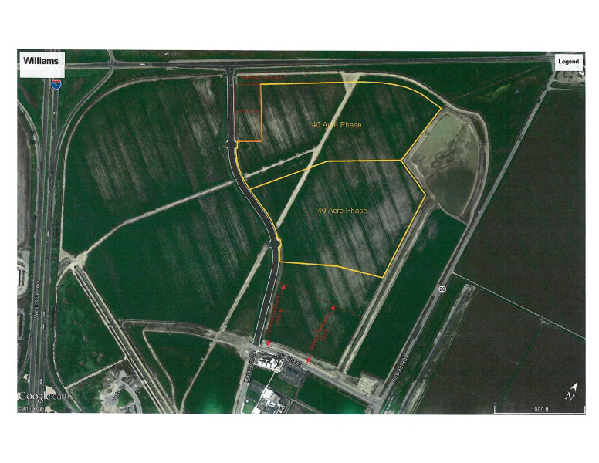
Figure A. Commercial Cannabis Activity Overlay Zone
B.
Approval of Master CUPs. Prior to initiating any commercial cannabis activity, the legal representative of the person(s) wishing to conduct the activity shall obtain and maintain a validly issued master conditional use permit ("Master CUP"). The city administrator or his designee may approve Master CUPs for discrete phases of development. For purposes of this section, "phase" shall mean proposed development for which the city has received a complete application(s) for all of the following: a Master CUP, site plan and design review.
C.
Development agreement required. No Master CUP shall take effect until an approved development agreement has been recorded against the affected property.
D.
Other approvals. Nothing herein shall be construed to relieve a commercial cannabis operator from the requirement to obtain a regulatory permit pursuant to Chapter 5.18 of this Code, and/or any other administrative approval or permit necessary to implement the intent of this section, the Master CUP or the development agreement.
E.
Resolution of conflicts. To the extent the provisions of this Section 17.01.030.10 conflict with other provisions in the Zoning Ordinance (Title 17), these provisions shall control.
F.
Development standards. Commercial cannabis activity and uses shall comply with the following standards:
1.
All commercial cannabis activity and uses shall be located within the boundaries of the Commercial Cannabis Activity Overlay Zone as depicted in figure A.
2.
Lot, yard, and height standards. The lot, yard, and height standards set forth in Table 17.02.100.1 of the Zoning Ordinance shall be discretionary in the Commercial Cannabis Activity Overlay Zone, and subject to the approval of the city council.
3.
Parking. Minimum parking standards for the Commercial Cannabis Activity Overlay Zone shall be one space per seven hundred fifty square feet of floor area.
4.
All loading/unloading areas shall be conducted within an enclosed and secure building area.
5.
Odor control devices and techniques shall be incorporated to ensure that cannabis odors are not detectable from the property boundary and public right-of-way. In multi-tenant buildings cannabis odors shall not be detectable from the building exterior, or from exterior and/or interior common areas such as walkways, hallways, breezeways, foyers, lobby areas, or any other areas available for use by common tenants or the visiting public, or within any other unit located inside the same building as the commercial cannabis business. Odor control systems shall include, but are not limited to, ventilation and exhaust system that provide sufficient odor absorbing to meet the above requirements.
6.
Cultivation uses shall prepare a water recycling management plan that demonstrates that irrigation water is recycled to the maximum extent feasible using best management practices. A separate water meter shall be installed for irrigation uses.
7.
Open space. Minimum open space requirement for the Commercial Cannabis Activity Overlay Zone shall be 12 percent.
8.
Low water use landscaping such as dry river beds, rock gardens, synthetic turf areas, and parking shade structures is encouraged in development design.
9.
Within the Commercial Cannabis Activity Overlay Zone development landscaping is discouraged to prevent biological, environmental, and pest related contamination of facilities.
10.
All cultivation uses shall be within an enclosed building. Cultivation uses are prohibited outdoors and within greenhouses.
11.
Cultivation uses may use mixed-light buildings when issued a local license consistent with state licensing that allows for mixed-light buildings when no light is visible through the roof and windows of grow areas from dusk to dawn.
G.
Signs. No exterior signage shall be allowed for commercial cannabis activity and uses except as follows: Commercial cannabis activity and uses shall be limited to one building-mounted sign not to exceed ten square feet that identifies the business name only. No off-site signs shall be permitted. Signs shall not be illuminated nor shall they contain logos, graphics, or list products or services offered. In addition, all signage shall conform to Chapter 17.11, Signs.
17.01.030.20 Commercial Cannabis Activity Overlay Zone - Outdoor Cultivation.
A.
Purpose. This section provides standards for Commercial Cannabis Activity and Uses within the Commercial Cannabis Overlay Zone - Outdoor Cultivation as shown in Figure A.
Commercial Cannabis Activity and Uses shall include:
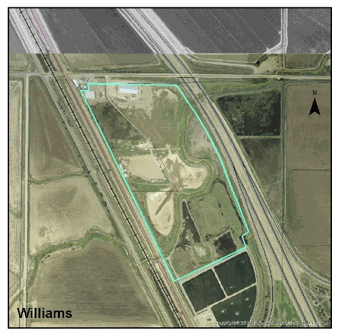
Figure A. Commercial Cannabis Activity Overlay Zone
- Outdoor Cultivation.
B.
Approval of Master CUPs. Prior to initiating any commercial cannabis activity, the legal representative of the person(s) wishing to conduct the activity shall obtain and maintain a validly issued master conditional use permit ("Master CUP"). The city administrator or his designee may approve Master CUPs for discrete phases of development. For purposes of this section, "phase" shall mean proposed development for which the city has received a complete application(s) for all of the following; a Master CUP, site plan, and design review.
C.
Development agreement required. No Master CUP shall take effect until an approved development agreement has been recorded against the affected property.
D.
Other approvals. Nothing herein shall be construed to relieve a commercial cannabis operator from the requirement to obtain a regulatory permit pursuant to Chapter 5.18 of this Code, and/or any other administrative approval or permit necessary to implement the intent of this section, the Master CUP or the development agreement.
E.
Resolution of conflicts. To the extent the provisions of section 17.01.030.20 conflict with other provisions in the Zoning Ordinance (Title 17), these provisions shall control.
F.
Development Standards. Commercial Cannabis Activity Overlay Zone - Outdoor Cultivation Uses shall comply with the following standards:
1.
All commercial cannabis activity and uses shall be located within the boundaries of the Commercial Cannabis Activity Overlay Zone - Outdoor Cultivation as depicted in figure A.
2.
All loading/unloading areas shall be conducted within an enclosed and secure building area.
3.
Odor control devices and techniques shall be incorporated to ensure that cannabis odors are not detectable from the property boundary and public right-of-way. Odor control systems shall include, but are not limited to, ventilation and exhaust system that provide sufficient odor absorbing to meet the above requirements.
4.
Cultivation uses shall prepare a Water Recycling Management Plan that demonstrates that irrigation water is recycled to the maximum extent feasible using best management practices.
5.
At the discretion of the city, all cannabis grown in Williams is subject to the requirement that it be in a location fully enclosed by an aesthetically pleasing, opaque fence at least six feet in height, adequately secured by a locked gate to prevent unauthorized entry. Said fence shall not violate any other ordinance, code section or provision of law regarding height and location restrictions and shall not be constructed or covered with plastic or cloth except shade cloth may be used on the inside of the fence.
E.
Signs. No exterior signage shall be allowed for commercial cannabis activity and uses except as follows: Commercial cannabis activity and uses shall be limited to one building mounted sign not to exceed ten square feet that identifies the business name only. No offsite signs shall be permitted. Signs shall not be illuminated nor shall they contain logos, graphics, or list products or services offered. In addition, all signage shall conform to chapter 17.11 Signs.
(Ord. No. 244-21, § 1, 7-21-2021; Ord. No. 255-23, § 1, 1-17-2024; Ord. No. 262-24, § 1(Exh. A), 10-16-2024; Ord. No. 269-25, § 1(Exh. A), 4-16-2025; Ord. No. 275-25, § 1(Exh. A), 12-10-2025)
17.01.040 - Standards for limited and conditional uses.
17.01.040.1 Generally. The standards of Table 17.01.040.2, Limited and Conditional Use Standards, apply to uses that are specified in Tables 17.01.030.4, Residential and Institutional Uses, through Table 17.01.030.7, Temporary Uses, as "L" or "C."
17.01.040.2 Limited and conditional use standards. The columns in Tables 17.01.040.2, Residential Limited and Conditional Use Standards through Table 17.01.040.10, Temporary Limited and Conditional Use Standards, establish the standards that apply to each of the limited and conditional uses. They are organized as follows:
A.
Table headings.
1.
Use category. The first column lists the use to which the standards specified in the same row apply.
2.
District. The second column lists the district to which the standards specified in the same row apply.
3.
Land area. The third column specifies the maximum or minimum area of the lot or parcel proposed for development upon which the use is proposed to be located.
4.
Time limitations/compliance deadlines/age of structure. The fourth column specifies the maximum daily hours the use may operate, or the maximum number of days a use may operate in any given period. It identifies a deadline for compliance with standards. It sets a maximum age a structure may be.
5.
Floor area. The fifth column specifies the maximum gross square footage that may be devoted to a use within a building plot.
6.
Maximum building height. The sixth column specifies the maximum height of a proposed structure. These regulations are further restrictions of the district height regulations of Section 17.02.090, Residential lot, yard, and height standards and Subsection 17.02.100.1, Nonresidential lot, yard and height standards.
7.
Required access. The seventh column specifies the road or roadway type from which the use must take access or restricts access to certain road classifications.
8.
Other use limitations. The eighth column, other use limitations, specifies additional use restrictions.
B.
A dash "-" in a table cell means that the requirement of the column does not apply to the use indicated in the row.
C.
A number of uses are limited uses only in the business park district but are either permitted by right or prohibited in other districts. These uses are not included in the tables in this section. The restrictions for these uses are provided in subsection 17.01.040.11, Use standards for limited uses in the business park district.
17.01.040.3 Residential and institutional limited and conditional use standards. Table 17.01.040.3 Residential and Institutional Limited and Conditional Use Standards, sets out limitations and requirements for residential limited and conditional uses.
17.01.040.4 Commercial limited and conditional use standards.
A.
Table 17.01.040.4, Commercial Limited and Conditional Use Standards, sets out limitations and requirements for commercial limited and conditional uses:
B.
All restaurants with drive-through facilities shall comply with the following standards:
1.
Entries and/or exits to drive-through facilities shall be a minimum of one hundred feet from any intersection, or from another drive-through facility on the same side of the street, except within a shopping center. Shorter distances from road intersections may be approved if the public works director determines that public safety and/or the efficiency of traffic circulation are not being compromised.
2.
Drive-through stacking lanes shall be a minimum one hundred feet from any lot zoned for residential use.
3.
Sound attenuation walls, landscaping or other mitigation measures may be required by the director as necessary to mitigate drive-through speaker and traffic noise on nearby residential uses.
4.
Drive-through aisles shall have a minimum twelve-foot width on curves and a minimum eleven-foot width on straight sections.
5.
Drive-aisles shall provide a minimum of one hundred and fifteen feet behind the menu board.
6.
No drive-through aisles shall exit directly into a public right-of-way.
7.
Aisles shall be integrated with the on-site circulation and shall merge with the driveway.
8.
Drive-aisles shall be separated from landscaping areas by a six-inch high, poured in place, concrete curb or other suitable protective device meeting director approval.
9.
Landscaping shall screen drive-through aisles from the public right-of-way and shall be used to minimize the visual impacts of reader board signs and directional signs.
C.
All mini-storage warehouses shall comply with the following standards:
1.
Mini-storage warehouses shall not be used for automotive repair, practice facilities for musical bands, living quarters for human habitation or the keeping of animal life (except the caretaker's/manager's residence), storage of hazardous materials, wood, metal or other working shops, for business or for hobby, office and other business activities (except the office for the facility and storage of personal belongings).
2.
Storage units shall not have separate sewer, water or electrical services except for needed lighting purposes.
3.
The facility, including the caretakers/managers residence, the storage units and the office shall be designed using roof and building materials and colors compatible with adjacent developments.
4.
Setback the outdoor storage of materials a minimum of twenty feet from the property lines adjacent to residential land uses.
5.
Storage building over one story shall be setback a minimum of thirty feet from the property lines.
6.
To ensure security when personal storage facilities are adjacent to residential land uses the chief of police may require security measures, such as controlled access, alarms or video cameras.
7.
All wall-mounted lights shall be located on the building below the roof line of the storage facility and shall be directed downward. Freestanding lighting shall not exceed sixteen feet in height, and shall be setback a minimum of fifty feet from the property line adjacent to the residential land uses.
8.
Buildings shall be screened from public view by construction of a minimum six-foot high masonry screen wall.
9.
Storage facilities that face the public street shall be screened with a minimum ten-foot-wide landscape planter with shrubs (minimum five-gallon size) and evergreen trees (minimum fifteen-gallon size placed a minimum twenty feet on center) along the property line facing the street. Screening walls may be incorporated into this landscape buffer to create offsets and visual interest.
10.
Any roll-up doors that may be visible to the public from surrounding streets, shall be screened with a solid masonry wall.
D.
Mobile food truck.
A.
Purpose. The purpose of these regulations is to promote the health, safety, comfort, convenience, prosperity and general welfare by requiring that new and existing mobile food vendors provide the community and customers with a minimum level of cleanliness, quality and security.
B.
Permit Required. Mobile food vendors shall be required to obtain an administrative permit and pay all associated fees as provided in this chapter. The permit application shall include the authorization of each property owner where the mobile food vendor intends to vend. The owners of any mobile food truck shall be deemed responsible for ensuring that any operator obtains all necessary licenses and permits required for the service of food and beverages, including all required permits from the County Environmental Health Division. The mobile vending vehicle must be in compliance with applicable motor vehicle laws, and the operator must have the appropriate license classification for operating such vehicle.
C.
Location Requirements.
1.
Mobile food trucks shall be allowed in accordance with Table 17.01.040.4 during hours of operation. In accordance with Colusa County Environmental Health regulations, all mobile food trucks are required to register at their commissary every twenty-four hours at the very least.
2.
Mobile food trucks must be located at least one hundred feet from the main entrance to any eating establishment or similar food service business, one hundred feet from any outdoor dining. In the event that one or more of the forementioned uses locates within the minimum separation requirement subsequent to food truck location being approved, nothing shall prohibit the property owner from continuing to operate at the approved location until the food truck permit has expired.
3.
In accordance with section 114315(a) of the California Retail Food Code: A food facility shall be operated within two hundred feet travel distance of an approved and readily available toilet and handwashing facility, or as otherwise approved by the enforcement agency, to ensure that restroom facilities are available to facility employees whenever the mobile food facility is stopped to conduct business for more than a one-hour period.
4.
Mobile food trucks must be located at least five feet from the edge of any driveway or public sidewalk, utility boxes and vaults, handicapped ramp, building entrance, exit or emergency access/exit way, or emergency call box and must not be located within any area of the lot that impedes, endangers, or interferes with pedestrian or vehicular traffic. Food trucks must be located at a minimum distance of fifteen feet in all directions of a fire hydrant.
5.
The mobile food vendor shall not operate in parking spaces required to meet minimum parking requirements for any other business.
6.
Mobile food trucks shall not require use of more than twenty-five percent of existing parking spaces.
7.
The mobile food vendor shall not block any driveways or aisles for vehicular circulation.
8.
Mobile food vendors shall not stop, stand, or park in any location that obstructs visibility of an intersection or of traffic entering or exiting an intersection.
9.
Mobile food trucks must be located at least two hundred feet from any property zoned for residential unless permission is given for a special event, or the properties are separated by a cement barrier or sound wall.
10.
The mobile food vendor shall be visible from the street.
11.
All mobile food trucks must be moved offsite for overnight storage and maintenance.
D.
Use Standards.
1.
The mobile food truck shall be licensed in accordance with the rules and regulations of any local, county, state and federal agency having jurisdiction over the mobile food truck or products sold therein.
2.
The mobile food vendor shall display a current business tax certificate and health department permit in plain view at all times on the exterior of the vending station. In addition, the mobile food vendor shall have a letter of permission from the owner of the subject property available at all times.
3.
The mobile food truck vendor or their designee must be present at all times while operating, except in cases of an emergency.
4.
All mobile food truck operations shall comply with the requirements set forth in chapter 17 section 17.03.150.1 Noise.
5.
Mobile food truck operations shall comply with the California Retail Food Code (Health and Safety Code sections 114294-114327).
6.
The owner or vendor of a mobile food truck shall not sell merchandise or prepare, sell or serve food on any public street, sidewalk, or other public right-of-way. Operations must be self-contained in the vehicle. Outside tables, seating, or shade canopies may not be placed in the public right-of-way.
7.
Alcoholic Beverage. No sales or service of alcohol shall be allowed by mobile food trucks.
8.
The city shall provide a trash receptacle for public use for a fee to the mobile food truck owner. The trash receptacle must be placed on the exterior of and within ten feet of the mobile food truck. The owner or vendor of the mobile food truck shall keep all areas within two hundred feet of the mobile food truck clean and free from litter, garbage, and debris. Failure to pay shall be grounds for permit revocation or nonrenewal.
9.
An additional service fee will be charged to all mobile food trucks beyond the regular business license fee for staff hours to verify that all standards and requirements have been met.
E.
Hours of operation. Mobile food trucks may operate at any time between the hours of 7:00 a.m. and 9:00 p.m. Mobile food trucks may operate during the principal use's hours of operation, only if the mobile food truck is not occupying required parking for the principal use. If the mobile food truck is occupying required parking for the principal use, its operations must be during the principal use's non-hours of operation and shall be restricted to the hours of 7:00 a.m. and 9:00 p.m.
F.
Prohibited.
1.
Mobile food trucks shall not be allowed within residential zones except with prior city approval with an events permit.
2.
Open flame cooking shall be prohibited.
3.
No freestanding signage or audio amplification is allowed.
4.
City trash receptacles may not be used to dispose of trash or waste.
5.
No sales or service of alcohol shall be allowed by mobile food trucks.
6.
The owner or operator of a mobile food truck shall not connect the mobile food truck to a source of electricity, water or sewer where the mobile food truck is operated.
7.
Grease and liquid waste may not be disposed in tree pits, storm drains, the sanitary sewer system or public streets. All food trucks operating within the city must possess an industrial waste permit.
G.
Decision, Transmittal, Appeal. Planning Directors decision, transmittal of decision and appeal procedures shall be consistent with the regulations contained in section 17.07.330.3
H.
Revocation. The Planning Director may revoke or modify any mobile food truck approval on any one or more of the following grounds:
1.
That the mobile food truck approval was obtained by fraud or misrepresentation.
2.
That the mobile food truck approval granted is being, or within the recent past has been, exercised contrary to the terms or conditions of such approval or in violation of any statute, ordinance, law or regulation; or
3.
That the mobile food truck approval is/are being, or within the recent past have/has been, maintained so as to be detrimental to the public health or safety or as to constitute a nuisance.
17.01.040.5 Recreation, fitness and amusement limited and conditional use standards. Table 17.01.040.5 Recreation, Fitness and Amusement Limited and Conditional Use Standards, sets out limitations and requirements for recreation, fitness and amusement limited and conditional uses:
17.01.040.6 Industrial limited and conditional use standards. Table 17.01.040.6 Industrial Limited and Conditional Use Standards, sets out limitations and requirements for industrial limited and conditional uses:
17.01.040.7 Agricultural limited and conditional use standards. Table 17.01.040.7, Agricultural Limited and Conditional Use Standards, sets out limitations and requirements for agricultural limited and conditional uses:
17.01.040.8 Transportation and storage limited and conditional use standards. Table 17.01.040.8, Transportation and Storage Limited and Conditional Use Standards, sets out limitations and requirements for transportation and storage limited and conditional uses:
17.01.040.9 Wireless telecommunications limited and conditional use standards. Table 17.01.040.9, Wireless Telecommunications Limited and Conditional Use Standards, sets out limitations and requirements for wireless telecommunication limited and conditional uses:
17.01.040.10 Temporary limited and conditional use standards.
A.
Table 17.01.040.10, Temporary Limited and Conditional Use Standards, sets out limitations and requirements for temporary limited and conditional uses:
B.
Temporary coverings for parking lots and parking spaces that are visible from the street are prohibited.
17.01.040.11 Use standards for limited uses in the business park district. The combined gross square footage of the limited uses in the business park district shall not exceed twenty-five percent of the existing total combined gross square footage of building area in the business park area.
(Ord. No. 244-21, § 1, 7-21-2021; Ord. No. 255-23, § 1, 1-17-2024; Ord. No. 262-24, § 1(Exh. A), 10-16-2024; Ord. No. 263-24, § 1(Exh. A), 9-18-2024; Ord. No. 267-25, § 1(Exh. A), 4-16-2025; Ord. No. 271-25, § 1, 9-17-2025)
17.01.050 - Supplemental residential standards.
17.01.050.1 Exceptions to yard requirements. Generally. Table 17.01.050.1, Permitted Projections into Required Setbacks, sets out projections that may be located within required setback areas (between the required setback lines and the lot lines).
A.
Interpretation of Table 17.01.050.1, Permitted Projections into Required Setbacks. If a measurement is indicated for "from setback line toward lot line" and "from lot line toward lot interior," then the maximum encroachment is the larger distance from the lot line to the encroachment. In no case will an obstruction of a required sight triangle or sight distance be permitted.
B.
Encroachments onto other abutting properties or easements. No projection other than vegetation shall cross into separately owned property, unless a recorded document provides for access to and maintenance of the improvement. No projection other than vegetation shall cross into a utility easement, unless such encroachment has been authorized by the utility provider.
C.
Right-of-way encroachments. Encroachment into the public right-of-way is generally not allowed, but may be permitted if authorized under Title 12 of the City of Williams Code of Ordinances.
D.
Accessory and junior accessory dwellings. Accessory dwelling units shall either be 1) attached to, or located within, the proposed or existing primary dwelling, including attached garages, storage areas or similar uses, or 2) an accessory structure or detached from the proposed or existing primary dwelling and located on the same lot as the proposed or existing primary dwelling. Accessory dwelling units shall satisfy the following required building setback standards:
1.
No setback shall be required for the following:
i.
An existing living area that is converted to a unit or to a portion of an accessory dwelling unit; or
ii.
An accessory structure that is converted to a unit or to a portion of a unit; or
iii.
A structure constructed in the same location and to the same dimensions as an existing structure that is converted to a unit or to a portion of an accessory dwelling unit.
2.
A setback of four feet from the side and rear lot lines shall be required for a unit that is not converted from an existing structure or a new structure constructed in the same location and to the same dimensions as an existing structure.
17.01.050.2 Accessory uses.
A.
Home occupations. Home occupations shall not be established unless the director has found that the use complies with all of the standards of this section.
1.
Generally. Home occupation accessory uses shall be permitted as accessory uses in all residential units.
2.
Maximum floor area. Home occupations shall not exceed more than ten percent of the gross floor area of the principal unit.
3.
Common ownership. Home occupations shall be managed and owned by a person residing in the dwelling unit.
4.
Employees. Home occupations shall not employ on-site any person other than a member of the immediate family living in the structure.
5.
Access. No entrance shall be specifically dedicated for the home occupation.
6.
Building character. No alteration shall be made to the building that changes the residential character or appearance of the dwelling to accommodate the home occupation.
7.
Outdoor storage. Outdoor storage is prohibited.
8.
Outdoor display of merchandise. No commercial display of materials, merchandise, goods or equipment shall be visible from the exterior of the dwelling unit.
9.
Signage. No signage relating to the home occupation is permitted.
10.
Deliveries. The home occupation shall not require the delivery or shipment of materials, merchandise, goods or equipment by other than passenger motor vehicles, one-ton, step-up vans, or similar sized trucks.
11.
Commercial vehicles. The home occupation shall not involve vehicles or trailers parked on the premises in a place that is visible from adjoining property or public rights-of-way, which identifies by sign, logo or emblem the occupation, business or activity.
12.
Nuisance. The home occupation shall not create or cause any perceptible noise, odor, smoke, electrical interference, or vibrations that constitute a public or private nuisance to neighboring properties.
13.
Risk. The home occupation shall not be more dangerous to life, personal safety or property than any other activity ordinarily carried on with respect to a dwelling unit used solely for residential purposes.
14.
Parking. The home occupation shall be conducted so that it does not create parking or traffic congestion or otherwise unreasonably interfere with the peace and enjoyment of surrounding homes as places of residence.
15.
Other permits. The home occupation shall be operated in accordance with all applicable laws and, if a state permit is required, such permit shall be obtained prior to beginning operation.
16.
Prohibited home occupations. The following uses are prohibited as home occupations:
a.
Barber, beauty, and other personal service shop;
b.
Animal care facility, such as hospitals, stables or kennels;
c.
Dance studio or school;
d.
Repair shop for large appliances and vehicles;
e.
Rooming/boarding house;
f.
Commercial day care facility; and
g.
Sale of ammunition and weapons (unless specifically approved by the chief of police).
B.
Residential care.
a.
City regulatory authority for family day care homes: In accordance with the California Health and Safety Code, the City cannot deny an application for a large family day care home, but can apply standards of conditions of approval to address concentrations of these types of uses within a neighborhood, traffic control and parking and noise control. Also, in accordance with State law, the City may not impose fees or home occupation permits for small or large family day care home applications or business licenses.
b.
Adult day care facilities serving six or fewer clients on site at one time and small family day care homes for eight or fewer children are considered residential uses for the purposes of zoning regulation. They may be established in all zones where dwellings are allowed.
c.
Adult day care facilities serving seven to 12 clients on site at one time and large family day care homes for children may be established in any zone where dwellings are allowed, subject to limited use provisions of Section 17,01.030.3-B and subject to compliance with certain standards listed below. In accordance with the California Health and Safety Code, these uses are allowed by right after the Director reviews the operations to be in compliance with the following standards:
i.
Complies with all applicable provisions of the Fire Code regarding health and safety.
ii.
Has been issued a day care license from the State of California, Department of Social Services.
iii.
There the large residential child day care operation is adjacent to housing in a residential zone, outdoor play and activities shall be prohibited prior to 9:00 a.m.
iv.
Residential adult and child day care operations shall comply with the City's off-street parking requirements in accordance with Section 17.02.090.3.
C.
Small wind energy conversion systems. Small wind energy conversion systems (wind turbines) that are designed to generate one hundred kW or less are permitted as an accessory use to residential uses pursuant to the following standards:
1.
Maximum height: One hundred twenty feet to the top of the rotor blade at its highest point.
2.
Minimum height of rotors on horizontal axis turbine: Thirty feet.
3.
Minimum setbacks: Equal to the height of the tower measured from all:
a.
Property lines; and
b.
Overhead utility lines (except those connecting to the principal building).
4.
Access: Shall be limited by:
a.
A six-foot high fence around the base of the tower;
b.
Limiting tower climbing apparatus to not lower than twelve feet above the ground; or
c.
A design that does not include climbing apparatus because the turbine is lowered for service.
5.
Noise: Noise levels from the generator shall not exceed forty dBA at the property line.
6.
Adjacent property protection: Generators shall not produce detrimental electromagnetic interference on adjacent properties.
7.
Conformance with community: Wind turbines shall be painted a nonreflective, nonobtrusive color that conforms to the environment and architecture of the community.
8.
No advertisement: Small wind energy conversion systems shall not be used for displaying any advertising except for reasonable identification of the manufacturer or operator of the wind turbine.
9.
Warning signs: Appropriate warning signage (e.g., electrical hazards) shall be placed on wind turbine towers, electrical equipment, and small wind energy conversion systems.
D.
Animals.
1.
Household pets. Animals commonly considered as household pets may be kept incidental to the use of residential property, subject to any limitations contained in this Code and provided the animals are kept in a humane and non-nuisance-producing manner and in conformance with the provisions of Title 6 of the City of Williams Code of Ordinances.
2.
Number of dogs per parcel. No parcel may house more than three dogs over the age of four months at a time.
3.
Swine, horses, cattle, sheep and goats. The keeping of swine, horses, cattle, sheep, goats, or similar animals is permitted as an accessory use in the R-E and AR district subject to the following setbacks for the structures that house them:
a.
Twenty-five feet from all property lines; and
b.
Five hundred feet from all public rights-of-way.
17.01.050.3 Accessory buildings and structures (not applicable to accessory or junior accessory dwellings).
A.
Timing of construction. No accessory building or structure shall be constructed unless the principal building is constructed or under construction simultaneously with the accessory building.
B.
Attached accessory buildings. Accessory buildings that are structurally attached to a principal building shall conform to all standards that are applicable to the principal building. Buildings that share an open breezeway at a maximum width of six feet are not attached under this section (Maximum number of accessory buildings).
C.
Maximum number. No more than two accessory buildings shall be constructed on a lot unless the lot is a minimum of five acres.
D.
Detached accessory buildings or structures, except small sheds.
1.
Height: One story or seventeen feet, whichever is lower.
2.
Footprint: Accessory buildings are counted toward the calculation of building coverage. In addition, no detached accessory building or buildings shall cover an area that is larger than that covered by the principal building, nor cover more than twenty-five percent of the required rear yard or six hundred square feet, whichever is less, except that:
a.
In the R-E district, no detached accessory building or buildings shall cover an area that is larger than the smaller of: Fifty percent of the footprint of the principal building; or one thousand eight hundred square feet. In the AR district, accessory buildings and structures are permitted as needed to support agricultural uses.
3.
Setbacks:
a.
Front: Generally: Behind principal building. Carports or garages: Behind front building line.
b.
Street side: Equal to the required front setback for the zoning district.
c.
Interior side: Three feet from the lot line.
d.
Rear: Generally: Three feet. Garage with door facing alley: Twenty feet.
e.
Building separation: Six feet.
4.
Configuration of detached carports and garages: Detached carports and garages that serve attached single-family dwellings or multifamily dwellings shall not be located closer than twenty feet to a building setback line on an adjacent lot that is not used for attached single-family dwellings or multifamily dwellings of the same type.
5.
Easements: Accessory structures shall not be located within access or utility easements unless the easement expressly allows the encroachment. A copy of the easement shall be provided to the planning and building department prior to the issuance of permits or clearances for such structures.
E.
Small sheds. Sheds that are less than eight feet in height to the peak of the roof and less than one hundred square feet in floor area may be located anywhere in a rear yard, provided that they are not:
a.
Located closer than two feet to a side or rear lot line;
b.
Connected to utilities;
c.
On a permanent foundation; nor
d.
Attached to another structure.
F.
Residential occupancy.
17.01.050.4 Fences and walls.
A.
Height. No fence shall exceed the following heights:
1.
Interior side and rear yards: Six feet.
2.
Street side yards: Four feet.
3.
Area between front building line and street: Three feet.
4.
In side or rear yard abutting an arterial or collector: Ten feet
5.
If required by the planning commission on a tentative map: Ten feet.
B.
Setbacks. Fences and walls shall be set back a minimum of:
1.
Sidewalks: Six inches.
2.
Streets: Generally: Five feet.
3.
Intersection of street lot lines: Twenty feet.
4.
Alleys: Generally: Three feet. Intersection of alley lot lines: Twenty feet.
5.
Orientation: The finished side of all fences shall face out toward adjacent public rights-of-way.
6.
Materials: Materials shall be durable, and of a character commonly used in residential applications, including: Weather-resistant wood species, split rail, painted wood, brick, stone, and ornamental wrought iron or powder-coated aluminum.
a.
Chain link fences are not permitted.
b.
Scrap lumber, plywood, tree branches, tree trunks, sheet metal, plastic, or fiberglass sheets are prohibited.
c.
Barbed wire, spikes, nails, or other sharp point or instrument on top or sides of such fence are permitted in the A-R district only.
d.
Electrified fences are permitted in the A-R district only.
e.
Welded wire, agricultural fencing, and chicken wire fences are permitted in the A-R district only.
f.
Slats may not be installed on chain link fences.
C.
Fence required. Fences meeting the maximum allowable height shall be installed along the parcel perimeter's side and rear property lines of any parcel developed with more than two dwelling units. No fence is required along the street side yard or adjacent to permanent open space.
D.
Sound barrier walls required.
1.
Minimum height. When a new residential development is proposed that will abut an arterial or highway, a sound barrier wall at a minimum of eight feet shall be installed.
2.
Noise mitigation.
a.
The application for a plat, or if no plat is required, for a site plan, shall be accompanied by a description of the specifications for the sound barrier wall, indicating the projected reduction of traffic noise from the arterial or highway that will be received on the residential properties.
b.
The sound barrier shall be effective in reducing noise levels to those that are specified in the noise element of the City of Williams General Plan for residential areas adjacent to arterials and highways.
3.
Location. The sound barrier wall shall be located in a common space, private easement, city, or state right-of-way. Where such a wall is to project into the right-of-way, the wall shall not be installed until the City of Williams has issued an encroachment permit pursuant to Chapter 12.14 of the City of Williams Code of Ordinances. If the wall is to be located within a State of California right-of-way, it shall not be installed until the appropriate State of California agency (Caltrans or the current replacement agency) has duly approved the encroachment.
4.
Design. The sound barrier wall shall be subject to design review and shall be consistent with the design review manual.
17.01.050.5 Decks, patios and porches.
A.
Decks. No deck shall have a surface that is higher than the level of the second floor. Decks that are less than four feet in height to the top of the deck may occupy a maximum of sixty percent of the rear yard.
B.
Patios. Patios may occupy a maximum of sixty percent of the rear yard. Any application for a patio that is more than seven hundred fifty square feet in area shall include a drainage plan for approval by the city engineer.
C.
Enclosed porches. Enclosed porches are subject to the same requirements as the building to which they are attached.
17.01.050.6 Swimming pools and spas.
A.
Timing of construction. No residential swimming pool or spa shall be constructed unless:
1.
The principal building is constructed or under construction simultaneously with the accessory building; or
2.
The structure is an amenity that is provided for the development as a whole, and the development phasing plan allows its construction before the construction of dwelling units.
B.
Setbacks.
1.
Front: Behind the principal building.
2.
Side: Same as side setback requirements for principal buildings.
3.
Rear: The greater of: Six feet, measured from the outside wall of the pool. Any utility easement at the rear property line. Building: Six feet between pool wall and any building.
C.
Uniform Building Code. In the event that this section is less restrictive than the City of Williams Uniform Building Code, the Uniform Building Code shall apply.
17.01.050.7 Direct television antennae, wireless cable, satellite dishes.
A.
The following are permitted if they are attached to a building or mounted on a mast that extends not more than twelve feet above the peak of the roof:
1.
DTV antennae;
2.
Wireless cable; and
3.
Satellite dishes that are one meter or less in diameter.
B.
All cabling must be run internally or blend in with the outside walls, and securely attached.
C.
Satellite dishes that are more than one meter in diameter are permitted if:
1.
They are located on the ground in the rear yard and not visible from ground-level views from public rights-of-way or abutting properties; or
2.
If the dish cannot be located in the rear yard, it is located on the ground within the permitted building envelope on the side of the building and the dish or antenna is fully screened from view from public rights-of-way with:
a.
A masonry wall; or
b.
An evergreen hedge or shrub and understory trees.
D.
Amateur radio antennae are permitted at a maximum height of fifteen feet above the height permitted for the principal structure.
17.01.050.8 Inoperable vehicles. Inoperable vehicles shall be stored within an enclosed structure or at locations permitted pursuant to this Zoning Ordinance. Doors to the structure shall remain closed while the vehicle is in a stored state. Inoperable vehicles shall not be parked on any public right-of-way.
17.01.050.9 Photovoltaic arrays as residential accessory use.
A.
Generally. Photovoltaic arrays are permitted as an accessory use to residential uses.
B.
Location on buildings. Photovoltaic arrays may be roof-mounted in all residential uses.
C.
Location on-site. Other installations shall conform to the following standards:
1.
The installation shall be in a location and configuration that prevents glare that interferes with the use and enjoyment of adjacent property.
2.
If the highest point on the panels is more than six feet above grade, the panels shall be set back as if they were detached accessory buildings. See Subsection 17.01.050.3, Accessory buildings and structures.
17.01.050.10 Solid waste collection and recycling access.
A.
Single-family solid waste collection. Single-family and two-family dwellings on individual lots are not required to provide separated trash/recycling containment facilities. These uses shall provide sufficient area either within the garage or outside for accommodating a trash can and recycle container provided they are screened from public view and not located within the front yard except that containers may be placed in front yard areas during collection days in accordance with Section 8.08.170 of the Municipal Code.
B.
Exceptions. Unless otherwise specified, or otherwise required by this Zoning Code, the director may allow variations to these standards due to physical constraints to the property such as topography, lot configuration or design limitations; provided that public safety and convenience concerns have been met.
C.
New development projects solid waste collection. All new development projects that are residential other than single-family or two-family dwellings shall provide the following containers for solid waste:
1.
Four to twenty-seven dwellings: Sufficient size to contain two, seven-yard bins.
2.
Twenty-eight to fifty-three dwellings: Sufficient size to contain four, seven-yard bins.
3.
Fifty-four + dwellings: Sufficient size to contain six, seven-yard bins and each successive increase of twenty-seven units in increments of two more seven-yard bins.
D.
Design and location criteria. Trash/recycling containment facilities shall be designed and located consistent with the city's design review manual.
E.
Maintenance. Recycling and trash enclosures shall be maintained in a clean condition and recyclable materials and refuse shall not be allowed to accumulate such that a public health or visual nuisance is created. Enclosure(s) shall be periodically cleaned to prevent the occurrence of rodent and insect infestation or odor.
17.01.050.11 Cargo containers. Cargo containers shall meet the restrictions and standards of the following:
A.
Temporary construction. Cargo containers may be permitted as temporary installations in connection with construction performed under a building permit (or similar situation approved by the director) not to exceed six months or until construction has been completed, whichever is less. Extensions beyond six months may be approved by the director.
B.
Temporary storage for industrial uses. Cargo containers may be permitted as temporary storage for industrial uses, and shall:
1.
Be visually screened from residential areas if located within one hundred feet of the residential zone;
2.
Not be stacked;
3.
Not occupy any required parking spaces, landscaped area or pedestrian access;
4.
Be painted a uniform color approved by the director;
5.
Not incorporate any signs or advertising;
6.
Be maintained free of graffiti; and
7.
Not be used for any human occupancy.
C.
Cargo containers not associated with construction. Any other installation of cargo containers shall be considered permanent structures, shall only be permitted in the industrial districts and shall be subject to all zoning requirements and design review, including installation on a permanent foundation. Cargo containers as permanent installations shall:
1.
Be visually screened from residential areas if located within one hundred feet of the residential zone;
2.
Not be stacked;
3.
Not occupy any required parking spaces, landscaped area or pedestrian access;
4.
Be painted a uniform color on the project site approved by the director;
5.
Not be used for automotive repair, practice facilities for musical bands, living quarters for human habitation or the keeping of animal life, storage of hazardous materials, wood, metal or other working shops, for business or for hobby, office and other business activities (except the office for the facility and storage of personal belongings); and
6.
Not have separate sewer, water or electrical services except for needed lighting purposes.
17.01.050.12 Accessory Dwelling Units.
A.
Purpose. The purpose of this section is to allow and regulate accessory dwelling units (ADUs) and junior accessory dwelling units (JADUs) in compliance with Chapter 13 of Division 1 of Title 7 of the California Government Code.
B.
Effect of conforming. An ADU or JADU that conforms to the standards in this section will not be:
1.
Deemed to be inconsistent with the city's general plan and zoning designation for the lot on which the ADU or JADU is located.
2.
Deemed to exceed the allowable density for the lot on which the ADU or JADU is located.
3.
Considered in the application of any local ordinance, policy, or program to limit residential growth.
4.
Required to correct a nonconforming zoning condition, as defined in subsection (C)(8) below. This does not prevent the city from enforcing compliance with applicable building standards in accordance with Health and Safety Code section 17980.12.
C.
Definitions. As used in this section, terms are defined as follows:
1.
"Accessory dwelling unit" or "ADU" means an attached or a detached residential dwelling unit that provides complete independent living facilities for one or more persons and is located on a lot with a proposed or existing primary residence. An accessory dwelling unit also includes the following:
a.
An efficiency unit, as defined by section 17958.1 of the California Health and Safety Code; and
b.
A manufactured home, as defined by section 18007 of the California Health and Safety Code.
2.
"Accessory structure" means a structure that is accessory and incidental to a dwelling located on the same lot.
3.
"Complete independent living facilities" means permanent provisions for living, sleeping, eating, cooking, and sanitation on the same parcel as the single-family or multifamily dwelling is or will be situated.
4.
"Efficiency kitchen" means a kitchen that includes all of the following:
a.
A cooking facility with appliances.
b.
A food preparation counter and storage cabinets that are of a reasonable size in relation to the size of the JADU.
5.
"Junior accessory dwelling unit" or "JADU" means a residential unit that satisfies all of the following:
a.
It is no more than five hundred square feet in size.
b.
It is contained entirely within an existing or proposed single-family structure. An enclosed use within the residence, such as an attached garage, is considered to be a part of and contained within the single-family structure.
c.
It includes its own separate sanitation facilities or shares sanitation facilities with the existing or proposed single-family structure.
d.
If the unit does not include its own separate bathroom, then it contains an interior entrance to the main living area of the existing or proposed single-family structure in addition to an exterior entrance that is separate from the main entrance to the primary dwelling.
e.
It includes an efficiency kitchen, as defined in subsection (C)(4) above.
6.
"Livable space" means a space in a dwelling intended for human habitation, including living, sleeping, eating, cooking, or sanitation.
7.
"Living area" means the interior habitable area of a dwelling unit, including basements and attics, but does not include a garage or any accessory structure.
8.
"Nonconforming zoning condition" means a physical improvement on a property that does not conform with current zoning standards.
9.
"Passageway" means a pathway that is unobstructed clear to the sky and extends from a street to one entrance of the ADU or JADU.
10.
"Proposed dwelling" means a dwelling that is the subject of a permit application and that meets the requirements for permitting.
11.
"Public transit" means a location, including, but not limited to, a bus stop or train station, where the public may access buses, trains, subways, and other forms of transportation that charge set fares, run on fixed routes, and are available to the public.
12.
"Tandem parking" means that two or more automobiles are parked on a driveway or in any other location on a lot, lined up behind one another.
D.
Approvals. The following approvals apply to ADUs and JADUs under this section:
1.
Building-permit only. If an ADU or JADU complies with each of the general requirements in subsection (e) below, it is allowed with only a building permit in the following scenarios:
a.
Converted on single-family lot: One ADU as described in this subsection (D)(1)(a) and one JADU on a lot with a proposed or existing single-family dwelling on it, where the ADU or JADU:
i.
Is either: Within the space of a proposed single-family dwelling; within the existing space of an existing single-family dwelling; or (in the case of an ADU only) within the existing space of an accessory structure, plus up to one hundred fifty additional square feet if the expansion is limited to accommodating ingress and egress; and
ii.
Has exterior access that is independent of that for the single-family dwelling; and
iii.
Has side and rear setbacks sufficient for fire and safety, as dictated by applicable building and fire codes.
iv.
The JADU complies with the requirements of Government Code sections 66333 through 66339.
b.
Limited detached on single-family lot: One detached, new-construction ADU on a lot with a proposed or existing single-family dwelling (in addition to any JADU that might otherwise be established on the lot under subsection (D)(1)(a) above), if the detached ADU satisfies each of the following limitations:
i.
The side- and rear-yard setbacks are at least four feet;
ii.
The total floor area is eight hundred square feet or smaller;
iii.
The peak height above grade does not exceed the applicable height limit in subsection (E)(2) below.
c.
Converted on multifamily lot: One or more ADUs within portions of existing multifamily dwelling structures that are not used as livable space, including but not limited to storage rooms, boiler rooms, passageways, attics, basements, or garages, if each converted ADU complies with state building standards for dwellings. Under this subsection (D)(1)(c), at least one converted ADU is allowed within an existing multifamily dwelling, up to a quantity equal to twenty-five percent of the existing multifamily dwelling units.
d.
Limited detached on multifamily lot: No more than two detached ADUs on a lot with a proposed multifamily dwelling, or up to eight detached ADUs on a lot with an existing multifamily dwelling, if each detached ADU satisfies all of the following:
i.
The side- and rear-yard setbacks are at least four feet. If the existing multifamily dwelling has a rear or side yard setback of less than four feet, the city will not require any modification to the multifamily dwelling as a condition of approving the ADU.
ii.
The peak height above grade does not exceed the applicable height limit provided in subsection (E)(2) below.
iii.
If the lot has an existing multifamily dwelling, the quantity of detached ADUs does not exceed the number of primary dwelling units on the lot.
2.
ADU permit.
a.
Except as allowed under subsection (D)(1) above, no ADU may be created without a building permit and an ADU permit in compliance with the standards set forth in subsections (E) and (F) below.
b.
The city may charge a fee to reimburse it for costs incurred in processing ADU permits, including the costs of adopting or amending the city's ADU ordinance. The ADU-permit processing fee is determined by the city planner and approved by the city council by resolution.
3.
Process and timing.
a.
An ADU permit is considered and approved ministerially, without discretionary review or a hearing.
b.
The city must approve or deny an application to create an ADU or JADU within sixty days from the date that the city receives a completed application. If the city has not approved or denied the completed application within sixty days, the application is deemed approved unless either:
i.
The applicant requests a delay, in which case the sixty-day time period is tolled for the period of the requested delay, or
ii.
When an application to create an ADU or JADU is submitted with a permit application to create a new single-family or multifamily dwelling on the lot, the city may delay acting on the permit application for the ADU or JADU until the city acts on the permit application to create the new single-family or multifamily dwelling, but the application to create the ADU or JADU will still be considered ministerially without discretionary review or a hearing.
c.
If the city denies an application to create an ADU or JADU, the city must provide the applicant with comments that include, among other things, a list of all the defective or deficient items and a description of how the application may be remedied by the applicant. Notice of the denial and corresponding comments must be provided to the applicant within the sixty-day time period established by subsection (D)(3)(b) above.
d.
A demolition permit for a detached garage that is to be replaced with an ADU is reviewed with the application for the ADU and issued at the same time.
E.
General ADU and JADU requirements. The following requirements apply to all ADUs and JADUs that are approved under subsections (D)(1) or (D)(2) above:
1.
Zoning.
a.
An ADU subject only to a building permit under subsection (D)(1) above may be created on a lot in a residential or mixed-use zone.
b.
An ADU subject to an ADU permit under subsection (D)(2) above may be created on a lot that is zoned to allow single-family dwelling residential use or multifamily dwelling residential use.
c.
In accordance with Government Code section 66333(a), a JADU may only be created on a lot zoned for single-family residences.
2.
Height.
a.
Except as otherwise provided by subsections (E)(2)(b) and (E)(2)(c) below, a detached ADU created on a lot with an existing or proposed single-family or multifamily dwelling unit may not exceed sixteen feet in height.
b.
A detached ADU may be up to eighteen feet in height if it is created on a lot with an existing or proposed single-family or multifamily dwelling unit that is located within one-half mile walking distance of a major transit stop or high quality transit corridor, as those terms are defined in Section 21155 of the Public Resources Code, and the ADU may be up to two additional feet in height (for a maximum of twenty feet) if necessary to accommodate a roof pitch on the ADU that is aligned with the roof pitch of the primary dwelling unit.
c.
A detached ADU created on a lot with an existing or proposed multifamily dwelling that has more than one story above grade may not exceed eighteen feet in height.
d.
An ADU that is attached to the primary dwelling may not exceed twenty-five feet in height or the height limitation imposed by the underlying zone that applies to the primary dwelling, whichever is lower. Notwithstanding the foregoing, ADUs subject to this subsection (E)(2)(d) may not exceed two stories.
e.
For purposes of this subsection (E)(2), height is measured from existing legal grade or the level of the lowest floor, whichever is lower, to the peak of the structure.
3.
Fire sprinklers.
a.
Fire sprinklers are required in an ADU if sprinklers are required in the primary residence.
b.
The construction of an ADU does not trigger a requirement for fire sprinklers to be installed in the existing primary dwelling.
4.
Rental term. No ADU or JADU may be rented for a term that is shorter than thirty days. This prohibition applies regardless of when the ADU or JADU was created.
5.
No separate conveyance. An ADU or JADU may be rented, but, except as otherwise provided in Government Code section 66341, no ADU or JADU may be sold or otherwise conveyed separately from the lot and the primary dwelling (in the case of a single-family lot) or from the lot and all of the dwellings (in the case of a multifamily lot).
6.
Septic system. If the ADU or JADU will connect to an onsite wastewater-treatment system, the owner must include with the application a percolation test completed within the last five years or, if the percolation test has been recertified, within the last ten years.
7.
Owner occupancy.
a.
ADUs created under this section on or after January 1, 2020 are not subject to an owner-occupancy requirement.
b.
As required by state law, all JADUs are subject to an owner-occupancy requirement. A natural person with legal or equitable title to the property must reside on the property, in either the primary dwelling or JADU, as the person's legal domicile and permanent residence. However, the owner-occupancy requirement in this subsection (E)(7)(b) does not apply if the property is entirely owned by another governmental agency, land trust, or housing organization.
8.
Deed restriction. Prior to issuance of a certificate of occupancy for an ADU or JADU, a deed restriction must be recorded against the title of the property in the county recorder's office and a copy filed with the city planner. The deed restriction must run with the land and bind all future owners. The form of the deed restriction will be provided by the city and must provide that:
a.
Except as otherwise provided in Government Code section 66341, the ADU or JADU may not be sold separately from the primary dwelling.
b.
The ADU or JADU is restricted to the approved size and to other attributes allowed by this section.
c.
The deed restriction runs with the land and may be enforced against future property owners.
d.
The deed restriction may be removed if the owner eliminates the ADU or JADU, as evidenced by, for example, removal of the kitchen facilities. To remove the deed restriction, an owner may make a written request of the city planner, providing evidence that the ADU or JADU has in fact been eliminated. The city planner may then determine whether the evidence supports the claim that the ADU or JADU has been eliminated. Appeal may be taken from the city planner's determination consistent with other provisions of this Code. If the ADU or JADU is not entirely physically removed, but is only eliminated by virtue of having a necessary component of an ADU or JADU removed, the remaining structure and improvements must otherwise comply with applicable provisions of this Code.
e.
The deed restriction is enforceable by the city planner or his or her designee for the benefit of the city. Failure of the property owner to comply with the deed restriction may result in legal action against the property owner, and the city is authorized to obtain any remedy available to it at law or equity, including, but not limited to, obtaining an injunction enjoining the use of the ADU or JADU in violation of the recorded restrictions or abatement of the illegal unit.
9.
Rent reporting. In order to facilitate the city's obligation to identify adequate sites for housing in accordance with Government Code Sections 65583.1 and 66330, the following requirements must be satisfied:
a.
With the building permit application, the applicant must provide the city with an estimate of the projected annualized rent that will be charged for the ADU or JADU.
b.
Within ninety days after each January 1 following issuance of the building permit, the owner must report the actual rent charged for the ADU or JADU during the prior year. If the city does not receive the report within the ninety-day period, the owner is in violation of this Code, and the city may send the owner a notice of violation and allow the owner another thirty days to submit the report. If the owner fails to submit the report within the thirty-day period, the city may enforce this provision in accordance with applicable law.
10.
Building and safety.
a.
Must comply with building code. Subject to subsection (E)(10)(b) below, all ADUs and JADUs must comply with all local building code requirements.
b.
No change of occupancy. Construction of an ADU does not constitute a Group R occupancy change under the local building code, as described in Section 310 of the California Building Code, unless the building official or code enforcement officer makes a written finding based on substantial evidence in the record that the construction of the ADU could have a specific, adverse impact on public health and safety. Nothing in this subsection (E)(10)(b) prevents the city from changing the occupancy code of a space that was uninhabitable space or that was only permitted for nonresidential use and was subsequently converted for residential use in accordance with this section.
F.
Specific ADU requirements. The following requirements apply only to ADUs that require an ADU permit under subsection (D)(2) above.
1.
Maximum size.
a.
The maximum size of a detached or attached ADU subject to this subsection (F) is eight hundred fifty square feet for a studio or one-bedroom unit and one thousand square feet for a unit with two or more bedrooms.
b.
An attached ADU that is created on a lot with an existing primary dwelling is further limited to fifty percent of the floor area of the existing primary dwelling.
c.
Application of other development standards in this subsection (F), such as FAR or lot coverage, might further limit the size of the ADU, but no application of the percent-based size limit in subsection (F)(1)(b) above or of an FAR, front setback, lot coverage limit, or open-space requirement may require the ADU to be less than eight hundred square feet.
2.
Setbacks.
a.
ADUs that are subject to this subsection (F) must conform to four-foot side and rear setbacks. ADUs that are subject to this subsection (F) must conform to fifteen-foot front setbacks, subject to subsection (F)(1)(c) above.
b.
No setback is required for an ADU that is subject to this subsection (F) if the ADU is constructed in the same location and to the same dimensions as an existing structure.
3.
Lot coverage. No ADU subject to this subsection (F) may cause the total lot coverage of the lot to exceed forty percent, subject to subsection (F)(1)(c) above.
4.
Minimum open space. No ADU subject to this subsection (F) may cause the total percentage of open space of the lot to fall below sixty percent, subject to subsection (F)(1)(c) above.
5.
Passageway. No passageway, as defined by subsection (C)(9) above, is required for an ADU.
6.
Parking.
a.
Generally. One off-street parking space is required for each ADU.
b.
Exceptions. No parking under subsection (F)(6)(a) is required in the following situations:
i.
The ADU is located within one-half mile walking distance of public transit, as defined in subsection (C)(11) above.
ii.
The ADU is located within an architecturally and historically significant historic district.
iii.
The ADU is part of the proposed or existing primary residence or an accessory structure under subsection (D)(1)(a) above.
iv.
When on-street parking permits are required but not offered to the occupant of the ADU.
v.
When there is an established car share vehicle stop located within one block of the ADU.
vi.
When the permit application to create an ADU is submitted with an application to create a new single-family or new multifamily dwelling on the same lot, provided that the ADU or the lot satisfies any other criteria listed in subsections (F)(6)(b)(i) through (v) above.
c.
No replacement. When a garage, carport, covered parking structure, or uncovered parking space is demolished in conjunction with the construction of an ADU or converted to an ADU, those off-street parking spaces are not required to be replaced.
7.
Architectural requirements.
a.
The materials and colors of the exterior walls, roof, and windows and doors must be the same as those of the primary dwelling.
b.
The roof slope must match that of the dominant roof slope of the primary dwelling. The dominant roof slope is the slope shared by the largest portion of the roof.
c.
The exterior lighting must be limited to down-lights or as otherwise required by the building or fire code.
d.
The ADU must have an independent exterior entrance, apart from that of the primary dwelling.
e.
The interior horizontal dimensions of an ADU must be at least ten feet wide in every direction, with a minimum interior wall height of seven feet.
f.
No window or door of the ADU may have a direct line of sight to an adjoining residential property. Each window and door must either be located where there is no direct line of sight or screened using fencing, landscaping, or privacy glass to prevent a direct line of sight.
g.
All windows and doors in an ADU less than thirty feet from a property line that is not a public right-of-way line must either be (for windows) clerestory with the bottom of the glass at least six feet above the finished floor, or (for windows and for doors) utilize frosted or obscure glass.
8.
Historical protections. An ADU that is on or within six hundred feet of real property that is listed in the California Register of Historic Resources must be located so as to not be visible from any public right-of-way.
9.
Allowed stories. No ADU subject to this subsection (f) may have more than one story, except that an ADU that is attached to the primary dwelling may have the stories allowed under subparagraph (E)(2)(d) of this section.
G.
Fees. The following requirements apply to all ADUs that are approved under subsections (D)(1) or (D)(2) above.
1.
Impact fees.
a.
No impact fee is required for an ADU that is less than seven hundred fifty square feet in size. For purposes of this subsection (G)(1), "impact fee" means a "fee" under the Mitigation Fee Act (Gov. Code § 66000(b)) and a fee under the Quimby Act (Gov. Code § 66477). "Impact fee" here does not include any connection fee or capacity charge for water or sewer service.
b.
Any impact fee that is required for an ADU that is seven hundred fifty square feet or larger in size must be charged proportionately in relation to the square footage of the primary dwelling unit. (E.g., the floor area of the ADU, divided by the floor area of the primary dwelling, times the typical fee amount charged for a new dwelling.)
2.
Utility fees.
a.
If an ADU is constructed with a new single-family home, a separate utility connection directly between the ADU and the utility and payment of the normal connection fee and capacity charge for a new dwelling are required.
b.
Except as described in subsection (G)(2)(a), converted ADUs on a single-family lot that are created under subsection (D)(1)(a) above are not required to have a new or separate utility connection directly between the ADU and the utility. Nor is a connection fee or capacity charge required.
c.
Except as described in subsection (G)(2)(a), all ADUs that are not covered by subsection (G)(2)(b) require a new, separate utility connection directly between the ADU and the utility for any utility that is provided by the city. All utilities that are not provided by the city are subject to the connection and fee requirements of the utility provider.
i.
The connection is subject to a connection fee or capacity charge that is proportionate to the burden created by the ADU based on either the floor area or the number of drainage-fixture units (DFU) values, as defined by the Uniform Plumbing Code, upon the water or sewer system.
ii.
The portion of the fee or charge that is charged by the city may not exceed the reasonable cost of providing this service.
H.
Nonconforming zoning code conditions, building code violations, and unpermitted structures.
1.
Generally. The city will not deny an ADU or JADU application due to a nonconforming zoning condition, building code violation, or unpermitted structure on the lot that does not present a threat to the public health and safety and that is not affected by the construction of the ADU or JADU.
2.
Unpermitted ADUs and JADUs constructed before 2020.
a.
Permit to legalize. As required by state law, the city may not deny a permit to legalize an existing but unpermitted ADU or JADU that was constructed before January 1, 2020, if denial is based on either of the following grounds:
i.
The ADU or JADU violates applicable building standards, or
ii.
The ADU or JADU does not comply with state ADU or JADU law or this ADU ordinance (section 17.01.050.12).
b.
Exceptions:
i.
Notwithstanding subsection (A)(2)(a) above, the city may deny a permit to legalize an existing but unpermitted ADU or JADU that was constructed before January 1, 2020, if the city makes a finding that correcting a violation is necessary to comply with the standards specified in California Health and Safety Code section 17920.3.
ii.
Subsection (A)(2)(a) above does not apply to a building that is deemed to be substandard in accordance with California Health and Safety Code section 17920.3.
17.01.050.13 Housing developments. Housing developments are subject to compliance with California Government Code Sections 65940 to 65950 regarding the review process for residential developments. The city's design review procedure outlines the requirements for the ministerial review and approval of housing development (Section 17.05.270).
A.
If the project constitutes an affordable housing development, it shall be subject to ministerial review and not be subject to discretionary review, including environmental review. Otherwise, the project shall be processed in accordance with the Housing Accountability Act of 2019 as amended, California Government Code Section 65940 (until the Act's expiration).
B.
If the project is considered a "Streamline Housing Development" project, it shall be subject to the submittal of a complete application as required by California Government Code Section 65913.4. Also, the project shall be consistent with the city's Design Review Manual limited only to objective design standards and guidelines for residential development as applicable, in accordance with California Government Code Section 66300(b)(1)C) any design standards for housing development shall be limited to objective criteria that involves no personal or subjective judgment (see Section 17.01.050.14).
C.
The planning director shall maintain a required checklist of information for submittal for a complete application In accordance with California Government Code Section 65940, this list shall be limited to only those items noted by law as being required.
D.
In accordance with California Government Code Section 65905.5 the city may not conduct more than five public hearings on a housing development project if the project complies with objective general plan and zoning standards in effect at the time the application is deemed complete. Public hearings include workshops and reviews by the planning commission and/or city council. They don't include legislative hearings to address general or specific plan or zoning amendments that may be needed to accommodate the project.
17.01.050.15 No net loss of lower income housing units. In accordance with California Government Code (§ 65915(c)(3)) the city shall require replacement housing units on sites identified in the site inventory referenced in the General Plan Housing Element when any new development (residential, mixed-use or non-residential) occurs on a site that has been occupied by or restricted for the use of lower-income households any time during the previous five years (generally as a condition of project approval for development approval). This requirement shall apply to non-vacant sites and vacant sites with previous residential uses that have been vacated or demolished.
17.01.050.16 Priority residential infill development. The city shall allow priority residential infill development to occur in compliance with the city's Priority Residential Infill Development Program that is established by separate resolution of the city council. Variations to all development standards and requirements provided in this Zoning Code may be allowed.
(Ord. No. 244-21, § 1, 7-21-2021; Ord. No. 265-24, § 3(Exh. A), 1-15-2025)
17.01.060 - Supplemental nonresidential standards.
17.01.060.1 Exceptions to yard standards.
A.
Generally. Table 17.01.060.1, Permitted Projections into Required Yards, sets out projections that may be located within required yards (between the setback lines and the lot lines). Measurements in the table are taken from the setback line (A); from the lot line (B); or into the right-of-way (C). If a measurement is indicated for "(A) Into Yard" and "(B) From Lot Line," then the measurement that results in the larger setback from the lot line controls. If a measurement is indicated for "(A) Into Yard" and "(C) Into Right-of-Way," then the measurement that allows the smallest encroachment into the right-of-way controls.
B.
Right-of-way encroachment permit required. If a structure or portion thereof is permitted to project into the right-of-way in this section, then a right-of-way encroachment permit as provided in Chapter 12.14, Encroachments, of the City of Williams Code of Ordinances, shall be required prior to installation of the projection.
17.01.060.2 Fences and walls.
A.
Height. No fence shall exceed the following heights:
1.
Interior side and rear yards: Six feet.
2.
Street side yards: Four feet.
3.
Area between front building line and street: Three feet.
4.
In side or rear yard abutting an arterial or collector, or if required by the planning commission as a condition of approval of a tentative map: Ten feet.
B.
Setbacks.
1.
Sidewalks: Six inches.
2.
Streets: Generally: Five feet.
3.
Intersection of street lot lines: Twenty feet.
4.
Alleys: Generally: Three feet.
5.
Intersection of alley lot lines: Twenty feet.
6.
Orientation: The finished side of all fences shall face out toward adjacent public rights-of-way.
7.
Materials: Materials shall be used consistent with the city's design review manual.
a.
Chain link fences are permitted only in interior side yards and rear yards that are not also street yards.
b.
Scrap lumber, plywood, tree branches, tree trunks, sheet metal, plastic, or fiberglass sheets are prohibited.
c.
Barbed wire, spikes, nails, or other sharp point or instrument on top or sides of such fence are permitted in the A-R, BP; and IN districts only.
d.
Electrified fences are permitted in the A-R, BP, and IN districts only.
e.
Barbed wire fences are permitted in the A-R, BP, and IN districts only.
f.
Welded wire, agricultural fencing, and chicken wire fences are permitted in the AR district only.
g.
Vinyl-coated slats are permitted on chain link fences if they are not located in the front, side street, or rear yards that are not also street yards.
h.
Wooden slats are prohibited on chain link fences.
C.
Fence required. Fences shall be installed at a minimum of six feet and a maximum of eight feet, that obscure the view of the operations and storage areas for the following uses:
1.
Auto dismantling operations;
2.
Auto wrecking yards;
3.
Scrap metal yards;
4.
Waste resource and waste recycling operations;
5.
Salvage yards, storage yards;
6.
Lumber yards;
7.
Equipment storage yards;
8.
Building material supply yards; and
9.
Uses with similar outside storage.
D.
Operations and storage within fenced areas. All materials and equipment including trucks, trailers and storage containers, used or stored by the uses must be stored within the fenced area of the property. Such materials and equipment shall not be stored, maintained or used so as to be above the height of the sight-obscuring fence except as follows:
1.
Mechanical equipment such as cranes, loaders and crushers, may be of such a height as to be visible beyond the limits of the property; and
2.
Except for equipment designed to move under its own power, all mechanical equipment with a height exceeding that of the sight-obscuring fence shall be located a minimum distance of forty feet from any exterior property line; and
3.
Except for lumber yards and building material supply yards, all of the uses specified in this section and not conforming with the provisions of this section shall have one year subsequent to the effective date of this section to comply. In the case of the annexation of the city of properties with uses not conforming to the provisions of this section, the uses shall have one year from the effective date of the annexation to comply.
E.
Design review. In accordance with Subsection 17.05.250.3, Design review, new fence installations shall be subject to design review approval if a building permit is required or new fencing construction is part of another project that requires a building permit.
17.01.060.3 Accessory buildings or structures (not applicable to accessory or junior accessory dwellings).
A.
Attached accessory buildings or structures. Accessory buildings or structures that are structurally attached to a principal building shall conform to all standards that are applicable to main buildings.
B.
Storage and utility sheds. Storage buildings are permitted as accessory structures on nonresidential sites if the director finds that:
1.
The cumulative floor area of storage and utility buildings does not exceed twenty-five percent of the primary structure.
2.
They are located only behind principal buildings, and at least one hundred fifty feet from street rights-of-way.
3.
They are completely screened from view from adjacent properties and public rights-of-way by hedges, buildings or perimeter walls.
4.
Converted semi-trailers, manufactured homes, modular shipping containers, dumpsters, or similar structures or equipment shall not be used for storage in the C-S, C, or C-D district. These are permitted in the IN and BP districts subject to all regulations of storage sheds.
5.
If they are larger than two hundred square feet, they are located within the building envelope.
6.
If they are two hundred square feet or less, they are situated behind the principal building and set back at least ten feet from all side and rear property lines.
C.
Gasoline dispensing islands and service station canopies in the C-D district or on sites with frontage along the downtown fringe streets.
1.
Gasoline dispensing islands and service station canopies shall be permitted as accessory structures for light automobile service uses on sites zoned C-D or on sites with frontage along the downtown fringe streets if the director finds that:
a.
Canopies use a similar architectural style, materials, and roofing as the principal building.
b.
Canopies are not used as an extension of signage beyond that which is allowed in the City of Williams sign regulations.
c.
The colors of the corporate logo (except white or black) are not painted on the canopy or trim outside of the area allowed for signage.
d.
The trim of the canopy is not internally or externally illuminated.
e.
Gasoline dispensing islands and service station canopies are set back fifteen feet from front lot or corner side yard lot lines.
D.
Car washes in the C-D district or on sites with frontage along the downtown fringe streets. Car washes are permitted as accessory structures for light automobile service uses if the director finds that:
1.
The car wash, except for an area for manually drying and polishing vehicles, is located entirely within a building;
2.
Access to the car wash is provided by doors that open on demand by customers or employees;
3.
The car wash building is designed with a similar architectural style, materials, and roofing as the principal building; and
4.
Outside areas for manually drying and polishing cars have sufficient capacity and do not interfere with on-site circulation.
E.
Other detached accessory buildings or structures (not applicable to accessory or junior accessory dwellings).
1.
Footprint. In the C-S, C, and C-D districts, no detached accessory building or buildings on a nonresidential lot shall cover an area that is larger than twenty-five percent of the footprint of the principal building.
2.
Exemption for certain districts. In the IN, BP and AR districts, accessory buildings are not subject to a specific maximum footprint. However:
a.
If they are larger than two hundred square feet, they shall be located within the building envelope; or
b.
If they are two hundred square feet or less, they shall be situated behind the principal building and set back at least ten feet from all side and rear property lines.
3.
Location and setbacks. No detached accessory building shall be located in a required front yard.
4.
Easements. Accessory structures shall not be located in easement areas on a property unless express written permission has been granted by all easement grantees. A copy of such written permission shall be submitted to the city prior to the issuance of permits for such structures.
5.
Building separation. No detached accessory building or structure shall be located closer than six feet to any other building.
6.
Height. No detached accessory building shall have more than one story, nor exceed seventeen feet in height, unless located within the building envelope and permitted as an accessory to business or manufacturing uses.
17.01.060.4 Solid waste collection and recycling access.
A.
New development projects solid waste collection. Solid waste and recycling containment is an important design aspect of a project. Separated trash/recycling enclosures are typical installations for commercial, industrial, office and institutional development projects. These standards apply to new projects and changes or modifications to existing improvements involving commercial, industrial, office and institutional development projects.
B.
Source reduction/recycling plan required. All new development, new occupancies requiring city approval, or physical expansions of buildings or uses where such development or use exceeds ten thousand square feet shall submit a source reduction/recycling plan for review and approval by the city. The plan shall incorporate provisions for recycling white paper, computer paper, glass, cans, cardboard, polystyrene, paper products, and other recoverable materials. The plan shall be implemented during operation of the facility.
C.
Exceptions. Unless otherwise specified, or otherwise required by this Zoning Code, the director may allow variations to these standards due to physical constraints to the property such as topography, lot configuration or design limitations; provided that public safety and convenience concerns have been met.
D.
All collection areas. All sites described in this subsection shall provide solid waste and recycling enclosures in a number and size so as to adequately contain the refuse generated by the development. Such design is based on anticipated demands for the particular development. The applicant shall consult the city's contract waste management company to determine expected solid waste/recycling generation characteristics. If no particular use is anticipated then trash and recycling provisions shall be over estimated. Restaurants sites shall provide additional space to allow adequate storage for grease containment and additional glass and aluminum material storage. Some storage areas may be provided within the building for storage of recyclable paper. A sufficient area shall be provided to enclose solid waste and recycling facilities.
E.
Design and location criteria. Trash/recycling containment facilities shall be designed and located consistent with the city's design review manual.
F.
Maintenance. Recycling and trash enclosures shall be maintained in a clean condition and recyclable materials and refuse shall not be allowed to accumulate such that a public health or visual nuisance is created. Enclosure(s) shall be periodically cleaned to prevent the occurrence of rodent and insect infestation or odor.
17.01.060.5 Photovoltaic arrays as nonresidential accessory use.
A.
Generally. Photovoltaic arrays are permitted as an accessory use to nonresidential uses.
B.
Location on buildings. Photovoltaic arrays may be roof-mounted on all nonresidential uses.
C.
Location on-site. Other installations shall conform to the following standards:
1.
The installation shall be in a location and configuration that prevents glare that interferes with the use and enjoyment of adjacent property.
2.
If the highest point on the panels is more than six feet above grade, the panels shall be set back as if they were detached accessory buildings. See Subsection 17.01.060.3, Accessory buildings and structures.
(Ord. No. 244-21, § 1, 7-21-2021)

