
Williams City Zoning Code
CHAPTER 17
02 - DISTRICT INTENSITY, BULK STANDARDS, BONUSES AND DESIGN
Sections:
17.02.070 - Purpose and application of chapter.
17.02.070.1 Purpose of chapter.
A.
Generally. The purpose of this chapter is to establish the general standards for the intensity and character of development that is allowed within each zoning district. May not be applicable to accessory or junior accessory dwellings (refer to Section 17.01.050.12) or priority residential infill development (refer to Section 17.01.050.12)
B.
Standards applicable to parcels proposed for development. This chapter establishes general regulations for the character of entire parcels proposed for development through the use of limitations on density (and, in some cases, intensity); minimum requirements for open space or landscaped surface area; a minimum area requirement for the parcel proposed for development; minimum requirements for the provision of utilities; the minimum required mix of housing types; and the averaging of lot sizes.
C.
Standards applicable to individual lots. The character of development of individual lots is regulated by minimum requirements for building height, lot dimensions, setbacks, building coverage, and open space or landscaped surface ratios. This chapter also provides standards for the design and location of accessory uses and structures, and for common incidental uses of residential and nonresidential lots (e.g., parking of commercial vehicles).
D.
Design of residential and nonresidential developments. Design standards have been established to address new development, alterations to existing development and signs.
1.
The City of Williams recognizes its unique characteristics, such as spectacular natural vistas, historic ambiance, agricultural heritage and natural dynamic natural features which attract a significant number of visitors to the city and which enhance the quality of life of permanent residents.
2.
The appearance of buildings, structures, and the land, as visible from public streets, places and ways, has a material and substantial relationship to property values and the taxability of property in the city.
3.
To protect the economic welfare of the community, it is the policy of the city to protect, maintain and enhance the social and economic values created by past and present investments in the community by requiring all future development to respect these traditions and require that all buildings and structures placed on the land respect the natural land forms, and become a compatible part of the total community environment, both in the local neighborhood and the city as a whole.
17.02.070.2 Application of chapter.
A.
Generally. This subsection describes how the subsequent sections of this chapter are applied.
B.
Residential district development standards. Section 17.02.080, Residential district development standards, provides the standards for density and open space for residential uses within each residential district.
C.
Residential lot, yard and height standards. Section 17.02.090, Residential lot, yard and height standards, are applied to the development of individual lots in a new subdivision.
D.
Nonresidential scale and parking regulations. Section 17.02.100, Nonresidential scale and parking regulations, provide standards for nonresidential site development and regulations for the exterior envelope of buildings. They apply to the development of buildings on the parcel or its individual lots.
E.
Housing bonus. Section 17.02.110, Housing bonus, provides incentives for the development of affordable housing and for green development. It applies to all residential developments.
F.
Landscaping and buffering. Section 17.02.120, Landscaping and buffering, provides standards for the provision of landscaping and buffering for all districts.
G.
Design standards.
1.
Subsection 17.02.090.9, Design of residential structures and Subsection 17.02.100.12, Design of nonresidential structures, apply to:
a.
All structures and physical improvements;
b.
Signs;
c.
Repainting of buildings in the downtown and lots with frontage on the downtown fringe streets.
2.
Exceptions shall include:
a.
Individual-built single-family;
b.
Two-family dwellings; and
c.
Small residential development on individual lots.
3.
The exception for the individual single-family and two-family dwellings, shall not apply:
a.
When design review is required as a condition of a subdivision, use permit or other discretionary entitlement; or
b.
When a developer proposes to construct three or more units.
4.
The director may require minor or incidental design review where necessary to meet the intent of the design review.
(Ord. No. 244-21, § 1, 7-21-2021)
17.02.080 - Residential district development standards.
17.02.080.1 Residential development area and density standards. The columns in Table 17.02.080.1, Residential Development Area and Density Standards, establish the open space, density, utility, and minimum parcel areas that apply to each of the residential development types. They are applied as follows:
A.
The first column, "District and Development Type", reflects the zoning districts and the residential development types that are permitted in the district.
B.
The second column, "Min. OSR", reflects the minimum open space ratio. Open space is required only for development that contains five or more dwelling units. OSR is calculated as set out in Subsection 17.06300.3, Open space ratio.
C.
The third column, "Gross Density", contains the maximum gross density. This is generally expressed in dwelling units per acre. Gross density is calculated as set out in Subsection 17.06.300.4, Density.
D.
The fourth column, "Required Utilities", indicates if public water and sewer utilities are required or if private systems are permitted. The requirement for public utilities, either from the city or from an approved utility provider, is indicated by "public," whereas "private" indicates that on-site potable water and individual sewer systems are permitted. On sites where private systems are permitted, public systems may also be used.
E.
The fifth column, "Min. Area of Parcel Proposed for Development", indicates the minimum area of the parcel proposed for development that is required for the development of the specified use.
F.
These standards may not be applicable to accessory or junior accessory dwellings (refer to Section 17.01.050.12) or priority residential infill development (refer to Section 17.01.050.16).
G.
The Planning Commission may waive certain requirements noted in Tables 17.02.080.1 and 17.02.080.2 if the project is consistent with the General Plan and the Commission is able to find that the project has been designed to meet the intent of the standards.
17.02.080.2 Mix of housing types in planned residential (mixed housing) developments.
A.
Housing type mix requirements. Table 17.02.080.2, Housing Type Mix Requirements, sets out the mix of housing types that is required for planned residential developments. When calculating the percentage of each housing type in a proposed development, normal rounding is used:
B.
Phasing. When a development is to be phased, the maximum residential development capacity of the entire site shall be used for calculating the required mix. When a parcel is to be subdivided and developed as multiple phases over time, the city may impose a mix based on the original property size to ensure an adequate mix of housing types.
17.02.080.3 Residential lot averaging and distribution of averaged lots.
A.
Applicability. Lot averaging shall be applied:
1.
To a housing type when there are more than forty units of the housing type in a planned residential development (mixed housing).
2.
To any single-family detached and single-family detached cluster development that contains more than forty dwelling units:
3.
Lot area groups for each housing type are provided in the tables in Section 17.02.090, Residential lot, yard and height standards.
4.
Where lot averaging is not required, but the tables in Section 17.02.090, Residential lot, yard and height standards, indicate three lot area groups, the average lot area group shall be used to establish minimum lot area and minimum lot depth for the housing type.
B.
Identifying lots in each group. Lots within each size group are identified by lot width. Small lots shall meet the minimum lot width for small lots, and their lot width may be up to (but not including) the lot width of the average lot category. Average lots shall meet the minimum lot width for average lots, and their lot width may be up to (but not including) the lot width of the large lot category. Large lots must meet the minimum lot width for large lots, and their width is not limited.
C.
Calculating the required number of lots of each lot area group. The tables in Section 17.02.090, Residential lot, yard, and height standards, provide for variable lot sizes, the column titled "percent in width type," indicates the minimum proportion of each lot area group that must be provided. The minimum number of small and average lots shall be rounded up to the nearest whole number. If the minimum proportions for small and average lots are met, the remainder of the lots may be large lots.
D.
Distribution of averaged lots. Lots in the three lot area groups shall be distributed such that small lots, average lots, and large lots are mixed on each block or cul-de-sac spread through the development. Concentrating lots of a single lot area group in separate areas of a development is not permitted.
E.
The Planning Commission may waive certain requirements noted in Tables 17.02.090.1A, 17.02.090.1B, 17.02.090.1C, 17.02.090.2, 17.02.090.3, 17.02.090.4 and 17.02.090.5 if the project is consistent with the General Plan and the Commission is able to find that the project has been designed to meet the intent of the standards.
(Ord. No. 244-21, § 1, 7-21-2021)
17.02.090 - Residential lot, yard and height standards.
17.02.090.1 Single-family detached and single-family detached cluster standards.
A.
Applicability. This section applies to the creation or alteration of lots in all single-family residential developments.
1.
The setback requirements of this section apply to new construction and the alteration of single-family structures on all lots.
2.
If an existing single-family structure in the NC district meets the setback provisions of Table 17.02.090.1A, Single-Family Detached Lot and Building Standards, Small Subdivisions, the setback restricts additions made to the structure after the effective date of this Zoning Code unless the proposed addition meets the provisions of Subsection 17.02.090.8, Special standards for neighborhood conservation district.
3.
Subsection B., below, applies to:
a.
All lot splits, lot combinations, and resubdivision of lots in the NC61-6, NC80-6, NC80-7, NC87-6, and NC1-1 districts; and
b.
All single-family development in small subdivisions (of forty or fewer lots) in the R-S or R-U districts.
4.
Subsection C., below, applies to all single-family development in large subdivisions (that include more than forty single-family lots) in the R-S or R-U districts.
5.
Subsection D., below, applies to all single-family construction in the R-E and AR districts, regardless of whether lots are developed in a single subdivision or on a lot-by-lot basis.
B.
Lot standards for small subdivisions. Lot and building standards for single-family detached units are set out in Table 17.02.090.1A, Single-Family Detached Lot and Building Standards; Small Subdivisions:
C.
Lot standards for large subdivisions. The lot and building standards for single-family detached units in large subdivisions in the R-S and R-U districts are set out in Table 17.02.090.1B, Single-Family Lot and Building Standards; Large Subdivisions. The table requires three classifications of lot area (lot area groups) and width in order to ensure variety within the neighborhood:
D.
Lot standards for construction in the R-E and AR districts. Lot and building standards for single-family detached units are set out in Table 17.02.090.1C, Single-Family Detached Lot and Building Standards; R-E and AR districts:
E.
Lot standards for lot or parcel revisions for residential use in NC, R-S, R-E, or R-U districts. Whenever a new lot configuration is proposed for single-family use that will increase the size of an existing lot or parcel in an area that has been either platted or constructed as residential in the NC, R-S, or R-E districts, the new lot(s) may not exceed twenty-five percent of the average of the lots on the same block face.
17.02.090.2 Patio house standards. Lot and building standards for patio house detached units are set out in Table 17.02.090.2, Patio House Lot and Building Standards:
17.02.090.3 Townhouse standards.
A.
Lot and building standards for townhouse units are set out in Table 17.02.090.3, Weak-Link Townhouse and Townhouse Lot and Building Standards.
B.
Lot standards for lot or parcel revisions for residential use in NC, R-S, R-E, and R-U. Whenever a new lot configuration is proposed for townhouse use that will increase the size of an existing lot or parcel in an area that has been either platted or constructed as residential in the NC, R-S, R-E, or R-U districts, the new lot(s) may not exceed twenty-five percent of the average of the lots on the same block face.
17.02.090.4 Duplex standards.
A.
Lot and building standards for duplex units are set out in Table 17.02.090.4 Duplex Lot and Building Standards:
B.
Lot standards for lot or parcel revisions for residential use in NC, R-S, R-E, and R-U districts. Whenever a new lot configuration is proposed for duplex use that will increase the size of an existing lot or parcel in an area that has been either platted or constructed as residential in the NC, R-S, R-E, or R-U districts, the new lot(s) may not exceed twenty-five percent of the average of the lots on the same block face.
17.02.090.5 Cottage cluster/cohousing standards.
A.
Lot and building standards for cottage cluster units are set out in Table 17.02.090.5, Cottage Home Lot and Building Standards:
B.
Lot standards for lot or parcel revisions for residential use in NC, R-S, R-E, and R-U districts. Whenever a new lot configuration is proposed for cottage cluster or cohousing use that will increase the size of an existing lot or parcel in an area that has been either platted or constructed as residential in the NC, R-S, R-E, or R-U, districts, the new lot(s) may not exceed ten percent of the average of the lots on the same block face.
17.02.090.6 Multi-housing standards. Lot and building standards for multiplex and multifamily housing buildings are set out in Table 17.02.090.6, Multiplex and Multifamily Lot and Building Standards:
17.02.090.7 Special standards for neighborhood conservation district.
A.
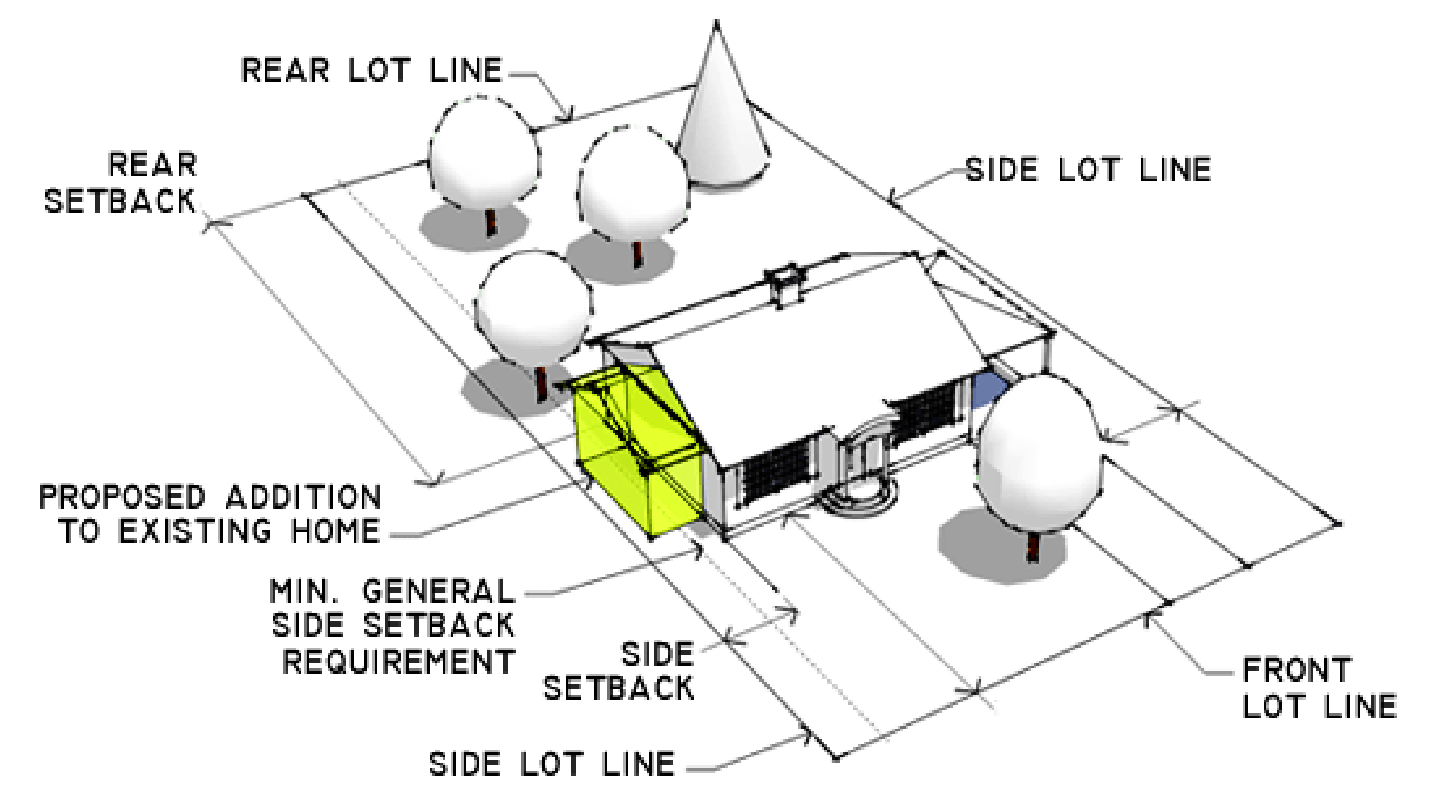
Generally. This section provides an alternative set of standards for development, redevelopment, and expansion of existing buildings (as indicated below) within the NC subdistricts when the new construction would encroach into the setbacks that are established by Table 17.02.090.1B, Single-Family Detached Lot and Building Standards; Small Subdivisions. See Figure 17.02.090.7, Single-Family Detached Lot Standards. May not be applicable to accessory or junior accessory dwellings (refer to Section 17.01.050.12) or priority residential infill development (refer to Section 17.01.050.16)
Figure 17.02.090.7
Single-Family Detached Lot Standards
The proposed addition (shown below) extends past the minimum general side setback line established in Table 17.02.090.1 A, Single-Family Detached Lot and Building Standards; Small Subdivisions. The alternative setback standards of this section will apply instead of the minimum general standards if all conditions of this section are met.
B.
Alternative building setback standards; all setbacks. Alternative setbacks shall be applied only if it is demonstrated that the standards of the applicable subsection of this section are met, and the proposed construction:
1.
Does not interfere with planned expansion of right-of-way, and if right-of-way expansion is planned, the application is evaluated as if the right-of-way has been expanded;
2.
Does not result in interference with a utility easement;
3.
Does not cause more or faster drainage onto abutting properties or rights-of-way than the condition that existed before the proposed construction;
4.
Does not result in a nonconformity with respect to the building code on either the applicant's lot or the abutting property;
5.
Is built to building code standards that would allow construction of the abutting lot to be built to the same standard along the same setback line;
6.
Does not interfere with emergency access to the rear of the house;
7.
Conforms to building coverage limitations of Table 17.02.090.1B, Single-family Detached Lot and Building Standards, Small Subdivisions; and
8.
Does not reduce the area provided for parking to fewer than two paved off-street parking spaces (one or both may be in a garage or carport).
C.
Alternative building setback standards; front setbacks.
1.
New development; redevelopment; and building expansion. For new development, redevelopment, or building expansion, front setbacks may be reduced from the standards set out in Table 17.02.090.1B, Single-family Detached Lot and Building Standards, Small Subdivisions, if it is demonstrated that the proposed new front building setback:
a.
Is equal to not more than ten percent less than the average actual setback of the other homes on the same side of the same block; and/or
b.
For an attached or detached garage, is equal to the average actual front setback to an attached or detached garage with comparable garage door orientation with respect to the street on the same side of the same block. In no case shall the garage be set back less than twenty-one feet if it loads from the sideyard.
2.
Building expansion only. For building expansions only, front setbacks may be reduced from the standards set out in Table 17.02.090.1B, Single-family Detached Lot and Building Standards, Small Subdivisions, if compliance with any of the following options is demonstrated:
a.
Option #1. The reduction is ten percent or less of the required front setback, and the encroachment will not reduce the depth of a driveway to less than twenty-one feet in length to the edge of the sidewalk or ditch or street pavement, whichever edge is closest to the building;
b.
Option #2. The reduction is more than ten percent of the required front setback, but less than twenty-five percent of the required front setback, and:
i.
No garage doors that face the street are located in the reduced setback area;
ii.
The improvement is not more than twenty feet in height;
iii.
If the encroachment is more than ten feet wide (measured parallel to the front building line), then it is screened from view from the public right-of-way by a canopy tree or evergreen tree; and
iv.
The encroachment is not more than thirty feet wide or fifty percent of the lot width, whichever is smaller.
c.
Option #3. The existing building encroaches upon the setback set out in Table 17.02.090.1B, Single-family Detached Lot and Building Standards, Small Subdivisions, on the effective date, and:
i.
The proposed construction will not reduce the depth of a driveway to less than twenty-one feet in length to the edge of the sidewalk or ditch or street pavement, whichever is closest to the building;
ii.
The proposed construction will be set back not less than ninety percent of the setback to the existing building.
D.
Alternative building setback standards; interior side setbacks.
1.
New development; redevelopment; and building expansion. For new development, redevelopment, or building expansion, interior side setbacks may be reduced from the standards set out in Table 17.02.090.1B Single-family Detached Lot and Building Standards, Small Subdivisions, if it is demonstrated that the proposed side building setback is equal to not more than the average actual side building setback of the other homes on the same side of the same block.
2.
Building expansion only. For building expansion only, interior side setbacks may be reduced from the standards set out in Table 17.02.090.1B, Single-family Detached Lot and Building Standards, Small Subdivisions, up to forty percent if it is demonstrated that the proposed construction meets all of the following standards:
a.
Limit of encroachment.
i.
If the lot that abuts the proposed building expansion is used for residential purposes, then:
(a)
The building expansion shall be screened from view from the public street by at least one tree per story of the building expansion, unless it projects into the required side setback less than one foot further towards the lot line than the existing building;
(b)
Building expansions shall be twelve feet in height or less;
(c)
Building expansions shall be set back at least forty-two inches from the side lot line.
ii.
If the lot that abuts the proposed building expansion is used for nonresidential purposes or permanent open space that is at least twenty feet in width, then the building expansion shall be set back at least forty-two inches from the side lot line.
b.
Horizontal dimension. The building expansion, combined with the existing building, does not create a horizontal dimension of more than fifty feet without an offset in the building wall of at least three feet.
c.
Windows. The building expansion shall not include a window that is located directly across from another window on a residential building that is closer than twenty feet away, unless:
i.
The window is on the first floor and an opaque fence is installed between the two buildings to a height of six feet; or
ii.
The window is not operational and is made of glass block or frosted glass, or other opaque material approved by the director.
E.
Alternative building setback standards; rear setbacks.
1.
Rear setbacks may be reduced on any lot in the NC district if it is demonstrated that the proposed rear building setback is equal to not more than ten percent less than the average actual setback of the other homes on the same side of the same block.
2.
Rear setbacks may be reduced on lots with rear lot lines that abut permanent open space, and through lots with fences or walls that screen rear yards from major roadways, according to the following standards:
a.
For one-story construction, or portions of construction, the rear setback may be reduced by up to fifty percent if it is demonstrated that the proposed construction is located behind an opaque fence or garden wall that is at least five feet in height, and one evergreen or canopy tree is planted in the rear yard for each twelve feet of width of the encroaching portion of the proposed construction.
b.
For two-story construction, or portions of construction, the rear setback may be reduced up to thirty percent if it is demonstrated that the standards of Subsection E.2.a., above, are met.
17.02.090.8 Required parking and loading for residential uses.
A.
Required number of spaces. The parking requirements for residential uses are set out in Table 17.02.090.8, Required Parking and Loading for Residential Uses:
B.
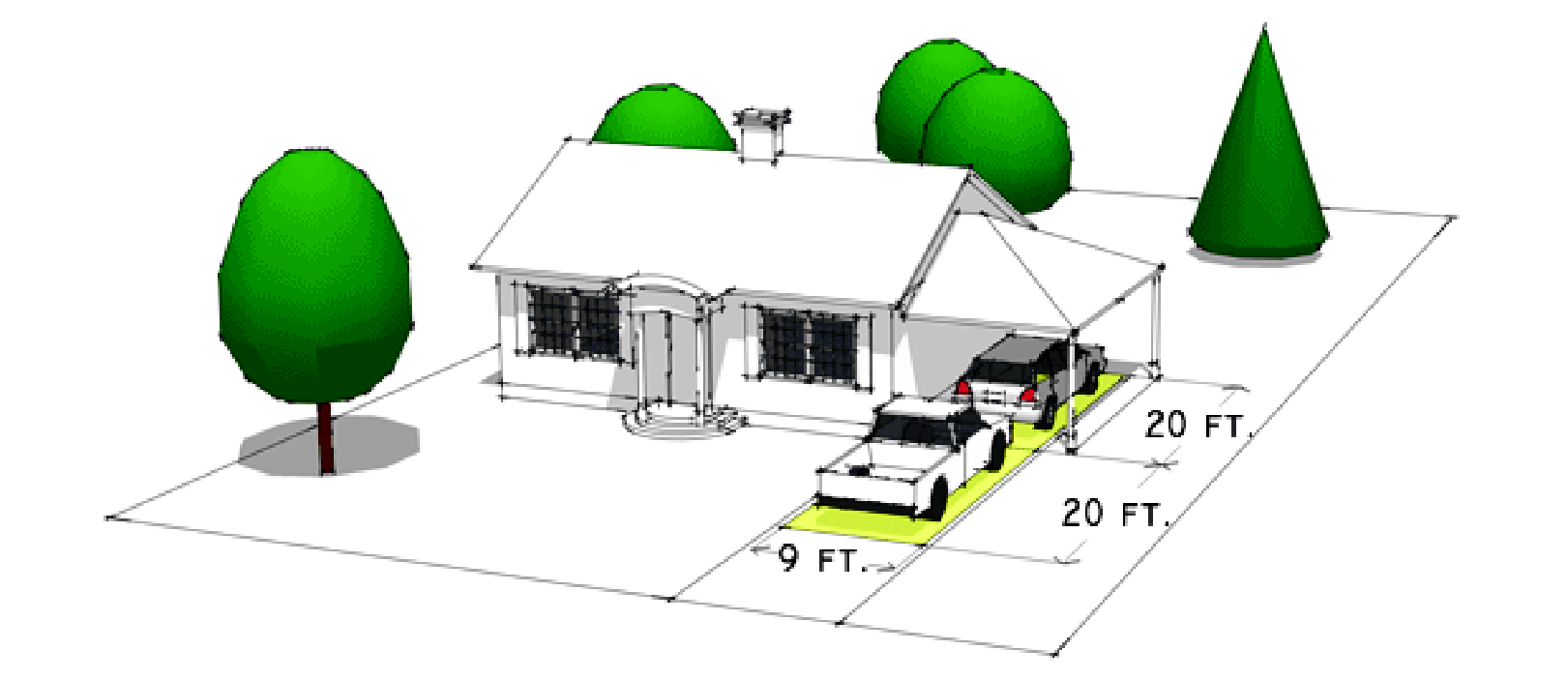
Parking space design for non-multi-unit residential uses. Parking spaces for single-family attached and detached residential uses, for live-work units, and for manufactured homes outside of a manufactured home park or subdivision that are located in private garages, carports, or individual driveways are not required to be marked. An area on a private residential lot is considered a parking space if:
1.
The area is at least nine feet by eighteen feet in dimension;
2.
The area does not encroach upon a public sidewalk;
3.
The area is hard-surfaced; and
4.
The area is accessible from the street. See Figure 17.02.090.8, Private Residential Parking Spaces.
C.
Residential care.
1.
Day care facilities with seven to twelve adults or nine to fourteen children, one on-site parking space is required, in addition to parking required for the residence, except when the Director finds that adequate on-street parking exists for dropping off and picking up clients.
2.
Day care centers with more than twelve adults or more than fourteen children must provide two spaces per facility and one space for each twelve day care clients (based on the facility's license), rounded to the nearest whole number, in addition to any spaces required for the residential use.
Figure 17.02.090.8
Private Residential Parking Spaces
D.
Single-family and duplex parking.
1.
No more than one required off-street parking space may be located in the front or street side yard.
2.
No more than one driveway per street frontage may be extended from the edge of the public street to the property except where the total width of the street frontage is eighty feet or greater, or where a circular driveway is utilized.
3.
The width of paved surfacing for parking in the required front yard area shall be limited to a maximum of fifty percent of the width of the front yard and no more than twenty feet, whichever is greater.
E.
Parking area design of multi-unit residential parking. Parking spaces for multifamily, multiplex, senior independent living centers, and emergency shelters shall meet the requirements specified in the city's design review manual.
F.
Covered parking.
1.
A minimum of one of the required parking spaces for a single-family home shall be covered.
2.
The cover shall be architecturally integrated into the main structure.
17.02.090.9 Design of residential developments.
A.
R-U HD district design review requirements.
1.
Site development and architectural features. Site development and architectural features of projects shall comply with the following:
a.
Site development features. The following site layout and development features should be adhered to:
i.
Parking shall be provided behind buildings, in the rear of the site or accessed from alleys or screened from view of the public street.
ii.
Front setback hardscape in the form of walkways, driveways or other hardcover pavement shall not exceed twenty-five percent.
iii.
Buildings should be oriented to form interior courtyards and common spaces.
b.
Architectural features. Building architecture shall respect the neighborhood design character of the surrounding setting and incorporate key character defining elements, such as roof pitch, window types and style, siding, trim elements, similar color palette, etc. The following architectural features shall be included for buildings that front the street:
i.
Balconies;
ii.
Porches;
iii.
Pitched roofs;
iv.
Overhanging roofs with gabled ends;
v.
Building entries with covered porches;
vi.
Dormers; and
vii.
Change in wall plane (pop outs, projections etc.) for buildings that exceed twenty-four feet in length.
2.
Design review guidelines consistency. Project design, such as landscaping, lighting, site lay out, signage, trash enclosure, architecture, use of building materials and colors, shall be consistent with the city's design review manual.
B.
Other residential uses. Other residential uses subject to design review, as determined in this Zoning Code or in the design review manual, shall comply with the design review manual.
(Ord. No. 244-21, § 1, 7-21-2021)
17.02.100 - Nonresidential scale and parking regulations.
17.02.100.1 Nonresidential lot, yard and height standards.
A.
In general. Table 17.02.100.1, Nonresidential Lot, Yard and Height Standards, sets out nonresidential lot, setback and height standards for each district and development type:
B.
Special yard restrictions in the C-S district. The following standards apply in the C-S district:
1.
No driveway aisles shall be installed between the front or side street wall of the building(s) and the front or side street property lines, except that driveways to interior parking areas may traverse through the area, which is otherwise reserved for landscaping.
2.
Parking areas shall be located at least ten feet farther from the front or side street property line than the actual front or side street wall of the building(s).
17.01.100.2 Nonresidential open space and building scale. Table 17.02.100.2, Nonresidential Open Space and Building Scale, sets out nonresidential minimum open space and maximum building size standards for each district and development type:
17.02.100.3 Parking and loading regulations.
A.
Applicability.
1.
All new development shall provide the minimum number of parking as listed in Subsections 17.02.100.45, Required parking and loading for institutional uses, through Subsection 17.02.100.10, Required parking and loading for special uses, and shall comply with all other provisions of this subsection.
2.
Expansions to existing development and changes in use of existing buildings that require additional parking shall provide parking to the extent of the new demand created by the expansion or change in use.
3.
Changes in use of existing buildings, where the new use would require less parking spaces than the previous use, shall not be required to provide additional parking spaces.
4.
Reuse of existing buildings and lease spaces within the downtown parking standards overlay district are permitted without requiring additional parking.
5.
Buildings that are less than five thousand square feet in area are exempt from loading space requirements.
B.
Timing of compliance. No certificate of occupancy shall be issued unless and until off-street vehicular parking is provided in accordance with the applicable subsection.
C.
Uses not listed. The director shall determine the parking requirements for uses that are not listed based on:
1.
The uses in this applicable subsection that are most similar to the proposed uses; or
2.
Parking studies of similar uses that are provided by the applicant and certified by a qualified professional engineer and as approved by the director.
3.
The director may forward the decision to assign parking requirements to the planning commission.
D.
Design of standard parking lots. Except as otherwise provided in this chapter, off-street parking shall be designed and improved in accordance with the city's off-street parking development standards incorporated into the city's design review manual, as approved by the city council.
E.
Use of required parking and loading by another building or use. No part of an off-street parking area or off-street loading area required for any building or use for the purpose of complying with the provisions of this chapter shall be included as part of an off-street parking area or off-street loading area similarly required for another building unless the type of structure indicates, in the opinion of the planning commission, that the periods of usage of such buildings or uses will not be simultaneous with each other.
F.
Free and clear parking access and maintenance.
1.
All parking spaces and access aisles shall be free and clear of equipment, refuse, storage items, or anything which inhibits access and parking of vehicles at all times.
2.
All parking spaces and access aisles shall be maintained in good repair in accordance with the city's off-street parking development standards and any other conditions imposed at the time of approval.
17.02.100.4 Shared, off-site, and other vehicle parking.
A.
Off-site parking. Required parking may be located off-site if all of the following conditions are met:
1.
The off-site parking lot is located not more than six hundred feet from the main building or structure it serves;
2.
The planning commission has issued a conditional use permit and found that the provision of required off-street parking on the same parcel with the main building is impossible or impractical due to site conditions, or that utilization of parking spaces on another parcel will accomplish a desirable design objective, and that an acceptable alternative is available.
3.
To ensure perpetuation of the off-street parking requirement, the owner(s) of the same lot(s) with the main building(s), and the owner(s) of the parking space on the separate parcel(s) shall execute a declaration of restrictions and covenants covering said lot(s) and parking spaces. Pursuant to California Government Code Section 65870, this declaration of restrictions and covenants shall be made on forms prescribed by the director, setting aside the required parking space(s) for parking only upon approval by the city council.
4.
This section shall be implemented following the city council's adoption of an ordinance pursuant to California Government Code Section 65870.
B.
Use of required parking and loading by another building or use. No part of an off-street parking area or off-street loading area required for any building or use for the purpose of complying with the provisions of this chapter shall be included as part of an off-street parking area or off-street loading area similarly required for another building unless the type of structure indicates, in the opinion of the planning commission and city council, that the periods of usage of such buildings or uses will not be simultaneous with each other.
C.
Motorcycle parking. Motorcycle spaces shall be designed consistent with the city's off-street parking development standards.
17.02.100.5 Required parking and loading for institutional uses. The parking requirements for institutional uses are set out in Table 17.02.100.5, Required Parking and Loading for Institutional Uses:
17.02.100.6 Required parking and loading for commercial uses. The parking requirements for commercial uses are set out in 17.02.100.6, Required Parking and Loading for Commercial Uses:
17.02.100.7 Required parking and loading for recreation and amusement uses. The parking requirements for recreation and amusement uses are set out in Table 17.02.100.7, Required Parking and Loading for Recreation and Amusement Uses:
17.02.100.8 Required parking and loading for industrial uses. The parking requirements for industrial uses are set out in Table 17.02.100.8, Required Parking and Loading for Industrial Uses:
17.02.100.9 Required parking and loading for agricultural uses. The parking requirements for agricultural uses are set out in Table 17.02.100.9, Required Parking and Loading for Agricultural Uses:
17.02.100.10 Required parking and loading for special uses. The parking requirements for special uses are set out in Table 17.02.100.10, Required Parking and Loading for Special Uses:
17.02.100.11 Nonresidential standards for sidewalk display, outdoor sales and outdoor storage.
A.
In general. In addition to any standards for outdoor activity within a specific zoning district, outdoor sales, display, and storage in the C-S, C, and C-D district shall comply with the standards of this subsection.
B.
Sidewalk display. Sidewalk display of items for sale or lease is permitted between the wall of an existing building to a distance extending eight feet from the wall. Such items shall not block access to windows, entrances, or exits and shall not impair the ability of pedestrians to use the building or any adjacent sidewalk, including adequate clearance to meet all state and federal requirements for handicap access. Stacked items shall not exceed a height of four feet. Overall height of the display area shall not exceed a height of eight feet, except that individual display items may extend to twelve feet.
C.
Outdoor sales. Outdoor sales of items for sale or lease of items that are subordinate and incidental to the primary use of the principal use of a building residing in the adjacent permanent structure, are permitted subject to the following conditions:
1.
The use is operated by the business occupying the principal structure;
2.
The sales area does not exceed ten percent of the site area;
3.
The sales area does not block access to windows, entrances, or exits and does not impair the ability of pedestrians to use the building or any adjacent sidewalk;
4.
The sales area does not block driveways, parking and loading areas;
5.
The overall height of the sales area does not exceed a height of eight feet, except that individual display items may extend to twelve feet;
6.
The sales area shall not be located within the setbacks that are required of structures in the subject zoning district; and
7.
The sales area is enclosed by a screen that meets the following standards:
a.
Minimum height of six feet plus an additional foot above the height of the stored items;
b.
The screen shall be of opaque materials such as a wood board fence or masonry wall. Chain link fences or chain link fences with materials inserted for opacity shall not qualify as screening; and
c.
Includes a minimum planted strip adjacent and outside of the screen that is made of live shrubs at a minimum height of three feet.
D.
Outdoor storage. Outdoor storage shall meet the standards of Subsection C., above.
17.02.100.12 Design of nonresidential developments.
A.
C-D district and downtown fringe design review requirements. The following standards apply in the C-D district and on all lots with frontage along the downtown fringe streets:
1.
Painting of buildings. Any painting or repainting of an exterior facade of buildings or the trim of a building, is not permitted unless:
a.
The paint complies with the pre-approved color palette that is included in the city's design review manual and the applicant receives approval from the director in accordance with the city's design review procedures; or
b.
The applicant has received approval from the design review committee and/or planning commission as applicable for a color different from the pre-approved palette in accordance with the city's design review procedures.
2.
Design review manual consistency. All facade changes, site changes, new construction, and reconstruction shall be consistent with the city's design review manual.
B.
Other nonresidential development. Other residential uses subject to design review shall comply with the city's design manual.
(Ord. No. 244-21, § 1, 7-21-2021)
17.02.110 - Housing bonuses.
17.02.110.1 Purpose of chapter.
A.
Generally.
1.
The City of Williams desires to encourage better development design and buildings that are more sustainable in terms of energy consumption and carbon footprint. This section provides bonuses for development that achieve one or more of these community objectives. The bonuses are available as matter of right to developers that meet the standards of this section.
2.
The City of Williams desires to support the development of affordable housing. The city uses the bonus provisions set by the State of California as a guide to encourage residential development that provides a percentage of its products for sale and for rent at affordable levels.
B.
Green bonus. The bonus provisions set out in Subsection 17.02.110.2, Residential and nonresidential green bonus, are intended to provide incentives for the development of sites and buildings with low impact development techniques, green building materials and techniques, and renewable energy systems.
C.
Housing bonus. The bonus provisions set out in Subsection 17.02.110.3, Residential density bonus, are intended to provide incentives for development of residential uses where a portion of the products for sale or rent provide needed housing for the residents of the City of Williams.
17.02.110.2 Residential and nonresidential green building bonus.
A.
Purpose. The City of Williams encourages the development of high-performance "green" buildings, which use less energy, water and natural resources; create less waste; and are healthier and more comfortable for the occupants. Bonuses are available to applicants who construct under the standards of this section.
B.
Application.
1.
Residential uses. Bonuses are available for residential and the residential portions of mixed use projects that demonstrate a commitment to development and redevelopment strategies referenced in this section. These bonuses increase the development potential of a parcel by increasing the density.
2.
Nonresidential uses. Bonuses are available for nonresidential uses and the nonresidential portions of mixed use projects that demonstrate a commitment to green development and redevelopment strategies. These bonuses increase the development potential of a parcel proposed for development by reducing open space and parking requirements.
C.
Green residential building bonus. If the project demonstrates that at a minimum five of the development and redevelopment strategies and five of the building strategies of Appendix C., Green Building Bonuses, will be employed during construction of the project, the permitted density of residential development may be increased by up to ten percent.
D.
Green nonresidential building bonuses.
1.
Open space offset. Buildings with green roofs shall be entitled to an offset of open space for the area of the green roof, up to fifteen percent of the area of open space required by Subsection 17.02.100.2, Nonresidential open space and building scale.
2.
Parking. If the project demonstrates that at a minimum five of the development and redevelopment strategies and five of the building strategies of Appendix C., Green Building Bonuses, will be employed during construction of the project, the minimum number of parking spaces required may be reduced by up to ten percent.
E.
Assignment of bonuses.
1.
Concurrent with the application for site plan or plat review, the applicant shall provide a written document that lists and describes the strategies to be employed on the site and in the buildings.
2.
Strategies eligible for bonuses are listed in Appendix C., Green Building Strategies. This appendix may be amended by the director to bring the list up to date with new technologies or approaches.
3.
The bonus will be granted by the planning commission upon approval of a subdivision plat. Where platting or replatting is not required, or the property was platted prior to the bonus, the bonus will be granted by the director upon approval of a site plan.
4.
Building permits for the development will be issued only upon demonstrated compliance with the written document.
17.02.110.3 Residential density bonus.
A.
Generally. The City of Williams encourages the development of residential development that offers a percentage of its units at an affordable level. A density bonus is available to applicants who meet certain criteria as set by the California Government Code, Sections 65915—65918, as they may be amended from time to time, or the current equivalent.
B.
Density bonus. The permitted density of development may be increased by a sliding percentage if the applicant demonstrates compliance with this section. These percentages are provided as Appendix A., and reflect the density percentage increase set by the California Government Code, Sections 65915—65918, as they may be amended from time to time, or the current equivalent. Appendix A., may be amended by the director to reflect changes in the California Government Code. Any other changes shall require city council approval.
C.
Affordable housing requirements. The residential density bonus is available to applicants who demonstrate commitment to offer affordable housing for a portion of the residential units in their proposed residential or mixed use developments, as follows:
1.
Concurrent with the application for site plan or plat review, the applicant shall submit:
a.
A written letter of intent that indicates its commitment to offer a percentage of the dwelling units affordable to the public in the proposed development as follows:
i.
A minimum of five percent of the total units made available to very low income households, as defined by most recent version of the applicable sections of the California Government Code; or
ii.
A minimum of ten percent of the total units made available to lower income households, as defined by most recent version of the applicable sections of the California Civil Code; or
iii.
A minimum of ten percent of the total units made available to moderate income households, as defined by most recent version of the applicable sections of the California Civil Code; or
iv.
A development that restricts residency to older persons, as defined by most recent version of the applicable sections of the California Civil Code.
v.
Any additional qualifying project allowable under Government Code Section 65915 as amended from time to time.
2.
Plans shall indicate the location of the units that will be made available to households of very low, lower, or moderate income households.
3.
The density bonus will be granted by the planning commission upon approval of the plat. Where platting is not required, the bonus will be granted by the director upon approval of the site plan.
4.
Building permits for the development will be issued only upon demonstrated compliance with the approved plans.
D.
Senior independent living centers. Senior independent living facilities will be permitted an additional twenty-five percent of density as the maximum density permitted for the development type in each corresponding zoning district where the use is permitted.
(Ord. No. 244-21, § 1, 7-21-2021)
17.02.120 - Landscaping and buffering.
17.02.120.1 Purpose. The City of Williams recognizes that landscaping and tree protection protects the area's natural heritage, conserves water, moderates the heat island effect, reduces radiated heat due to increased shading, and reduces runoff. In bufferyards, landscaping mitigates conflicts between uses and minimizes the effects on the surrounding environment due to noise, dust, debris, artificial light intrusions, and other impacts of an adjoining or nearby use. The purpose of this section is to:
A.
Provide the detailed landscaping standards for all development, including landscaping for street trees, buildings, residential lots, open spaces, parking lots and bufferyards;
B.
Provide standards for installation and maintenance;
C.
Promote the values and benefits of landscapes while recognizing the need to invest water and other resources as efficiently as possible;
D.
Establish a structure for planning, designing, installing, maintaining and managing water efficient landscapes in new construction and rehabilitated projects;
E.
Establish provisions for water management practices and water waste prevention for existing landscapes; and
F.
Design, establish and maintain landscaping and irrigation in accordance with the California Water Conservation in Landscaping Act, Government Code Section 65591, as it may be amended from time to time.
17.02.120.2 Application.
A.
Generally. This section requires two general types of landscaping: development landscaping and bufferyards, as follows:
1.
Development landscaping. Development landscaping is the landscaping that is required regardless of the location of the proposed development with respect to other development. May not be applicable to accessory or junior accessory dwellings (refer to Section 17.01.050.12) or priority residential infill development (refer to Section 17.01.050.16). There are four types of development landscaping: Lot and building landscaping; open space landscaping; parking lot landscaping; and street trees.
2.
Bufferyard landscaping. Bufferyards are required based on the zoning, development type, or right-of-way type that abuts proposed development. Bufferyards may be required along district boundaries, along street and railroad rights-of-way, and along the boundaries of parking lots. Generally, bufferyards must be provided as required in this section. However, other sections of this Zoning Code may require additional buffering.
B.
Applicability of standards. Except as provided in Subsection C., the standards of this subsection apply to all new development, redevelopment, or substantial improvements to existing sites or buildings. May not be applicable to accessory or junior accessory dwellings (refer to Section 17.01.050.12) or priority residential infill development (refer to Section 17.01.050.16). All landscaping and irrigation systems shall be designed in accordance with this chapter. With the exception of Subsection C., all new development projects, redevelopment projects, and replacement of landscaping shall:
1.
Comply with water efficient landscape standards as provided under the California Water Conservation in Landscaping Act, Government Code Section 65591, as it may be amended from time to time;
2.
Comply with Subsection 17.02.120.11, Water efficiency landscape standards; and
3.
Be consistent with the design review manual.
C.
Exceptions. The following are exceptions to the standards of this section:
1.
Individual lots of record that are used for existing single-family or two-family dwellings unless a specific requirement is set out in this Subsection 17.02.090.7, Special standards for neighborhood conservation district.
2.
Modifications to nonresidential buildings where the modification does not expand the use by more than ten percent or three thousand square feet, whichever is less.
D.
Calculations. No area of a parcel proposed for development shall be counted more than once for the purposes of applying landscaping requirements.
E.
Water efficient landscape standards.
1.
The provisions of Subsection 17.02.120.11, Water efficiency landscape standards, apply to the following landscape projects:
a.
New construction and rehabilitated landscapes for institutional, commercial and multifamily development projects with a landscape area equal to or greater than two thousand five hundred square feet which are otherwise subject to a building permit or development review.
b.
Developer-installed, single-family residential landscapes and common areas of a project with a landscape area equal to or greater than two thousand five hundred square feet which are otherwise subject to a building permit or development review. Where model homes are included, the developer shall install at least two model homes with landscapes that comply with the requirements of this chapter and include signs and printed materials explaining design strategies and plant materials for water conservation.
c.
New construction landscapes which are homeowner-provided and/or homeowner-hired in single-family residential projects with a total project landscape area equal to or greater than five thousand square feet requiring a building permit or development review.
d.
Homeowners associations and common interest developments' architectural guidelines (i.e., CC&Rs) shall not prohibit or include conditions that have the effect of prohibiting the use of low water-using plants as a group. Further, the guidelines shall not prohibit the removal of turf, nor restrict or prohibit the reduction of turf in lieu of more water-efficient alternatives (Civil Code Section 1353.8).
2.
The standards of Subsection 17.02.120.11, Water efficiency landscape standards do not apply to:
a.
Registered local, state or federal historical sites;
b.
Ecological restoration projects that do not require a permanent irrigation system; or
c.
Plant collections, as part of botanical gardens and arboretums open to the public.
17.02.120.3 Lot and building landscaping.
A.
Lot landscaping that is consistent with the design review manual is required on lots within new residential subdivisions and on vacant single-family lots within developed subdivisions upon application for a building permit. This section does not apply to lots with existing single-family homes.
B.
Building landscaping or hardscaping that complies with the design review manual is required around nonresidential, mixed use, and multifamily buildings, except in the C-D district.
17.02.120.4 Open space landscaping.
A.
Generally. Open space landscaping shall be installed on designated open space tracts. Open space tracts include all areas that are set aside pursuant to the required open space ratio, or otherwise designated as commonly owned open space even if not required by this Zoning Code.
B.
Exceptions.
1.
General exceptions. The area to which open space landscaping requirements applies does not include any open spaces that are in the following categories:
a.
Areas that are not dedicated as open space tracts or under common ownership by a property owners' association.
b.
Areas within required bufferyards, even if commonly owned, that meet the requirements of Subsection 17.02.120.7, Bufferyards.
c.
Areas used as, and that are located within fifteen feet of, ball fields, playing courts, and similar play areas (including bleachers or seating areas for spectators), which are designed to be free of trees and landscaping. However, where the perimeter of such an active recreation area is within thirty feet of one or more residential lots, the perimeter shall be planted with a Type C Bufferyard. See Subsection 17.02.120.7, Bufferyards.
d.
Parking areas for recreation facilities in the open space that meet the requirements of Subsection 17.02.120.5, Parking lot landscaping.
e.
Waterbodies and wet detention basins.
f.
Wooded areas that are designated as open space tracts. For the purposes of identification, the boundaries of the wooded areas follow the exterior canopy line.
2.
Limited exceptions. The area within wetlands dedicated as open space is not required to be landscaped. However, invasive exotic species (if present) shall be removed and replaced with native wetland species unless the city finds that the cost of removal and replacement is unreasonably excessive in relation to the cost of the proposed development. Landscaping installed near wetlands shall be composed of species that are tolerant of a high water table.
C.
Planting requirements. Plant and tree installation shall be conducted consistent with the city's design review manual.
17.02.120.5 Parking lot landscaping.
A.
Generally. Parking lot landscaping is required within and around parking lots that contain more than five parking spaces and shall be designed consistent with the city's design review manual.
B.
Clearance for trees. There shall be a minimum of four feet open ground clearance around all trees to allow proper tree adaptability.
C.
Exemptions. Farmsteads, farmworker housing, single-family dwellings, two-family dwellings, and emergency shelters are not required to provide parking lot landscaping.
17.02.120.6 Street trees.
A.
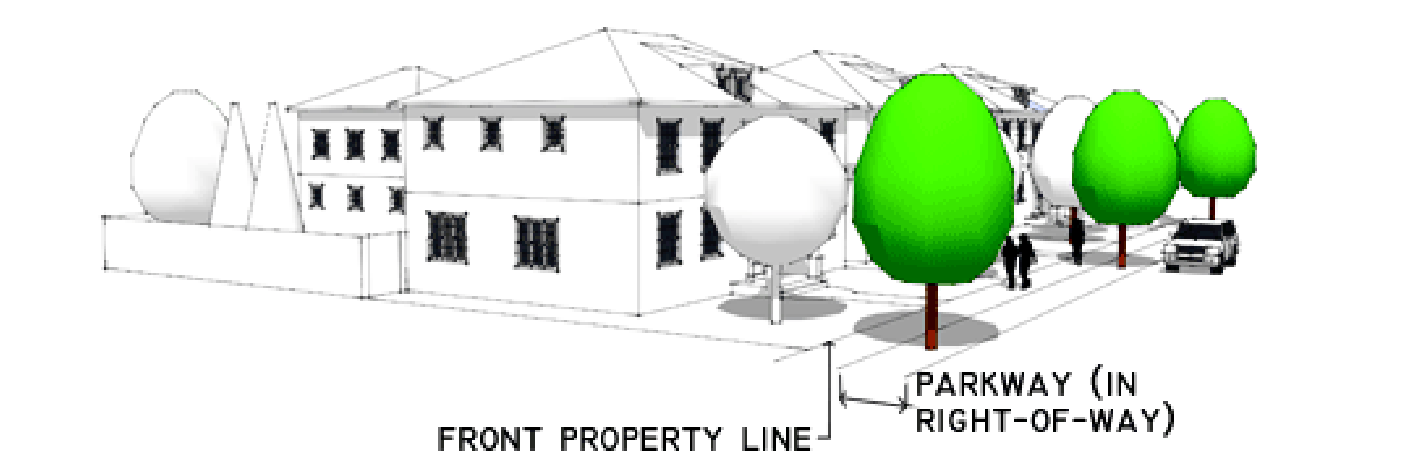
Generally. Street trees are trees that are planted within the street right-of-way, either in green strips between private property and the traveled portion of a roadway, tree grates in sidewalks, or medians. Street trees are required along both sides of all new streets in all zoning districts other than the C-D district:
Figure 17.02.120.6
Street Trees
Street trees are shown in shading
B.
Types and species of street trees.
1.
All street trees shall be canopy trees that are suitable for installation in the space within the right-of-way or within a tree grate, as applicable. Refer to the city's design review manual for recommended street tree selections.
2.
Understory trees may be substituted for canopy trees, provided that:
a.
One and six-tenths understory trees are provided for each canopy tree that would otherwise be required, and spacing between trees is proportionately reduced; and
b.
The understory trees are used in areas where buildings are close to the roadway, such that the installation of canopy trees would create a likely conflict between the street trees and the nearby buildings.
3.
The trees planted in a landscaped median shall be of a different species from those planted in the rights-of-way. If the parkways are planted with canopy trees, then medians may be planted with understory trees instead of canopy trees.
C.
Location.
1.
No street trees shall be planted under or within five lateral feet of any underground water line, sewer line, transmission line or other utility.
2.
If street trees are to be located within a utility easement, the applicant shall notify the easement holder, who shall have authority to approve the location of the trees.
D.
Spacing.
1.
Minimum spacing. No trees may be planted closer than twenty-five feet together, except that special plantings may be clustered if the cluster does not negatively affect the continuing health of the clustered trees, and the cluster is approved in the landscape plan of the plat or land development.
2.
Maximum spacing. Street trees shall be spaced not more than sixty feet on center for trees with large canopies (e.g., live oaks), or forty feet on center for trees with smaller canopies. If the parkway or median is more than sixteen feet in width and does not contain open ditch drainage, then canopy trees shall be installed in two rows, with trees staggered, each row spaced not more than sixty feet on-center.
E.
Maintenance. Street trees required by this Zoning Code shall be maintained by a developer, lot owner, tenant, property owners' association or other entity having a legal interest in the ownership of the subdivision or lots in the subdivision. The entity that is in charge of the maintenance shall be indicated on the landscape plan, and documentation (e.g., covenants, conditions, and restrictions) shall be provided to the city that shows the legal obligation of the entity to perform the maintenance.
F.
Replacement. If the city or a utility provider must remove street trees to access utilities for repair or maintenance, then the developer or property owners' association, if the project is built out, shall pay the cost of removal and shall replace the trees within thirty days of the completion of the work unless the city public works director determines that replacement would put utilities at material risk.
17.02.120.7 Bufferyards.
A.
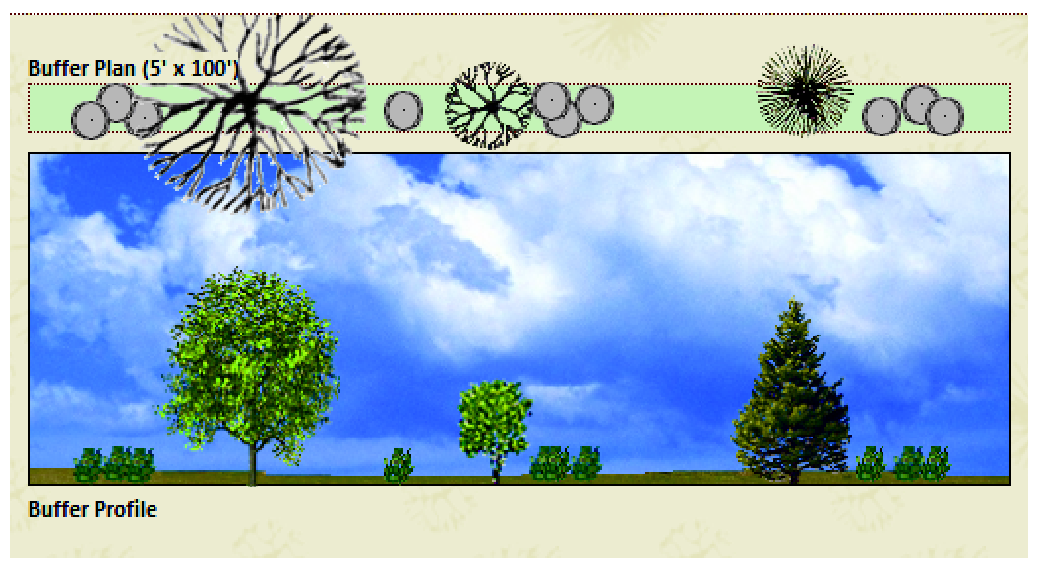
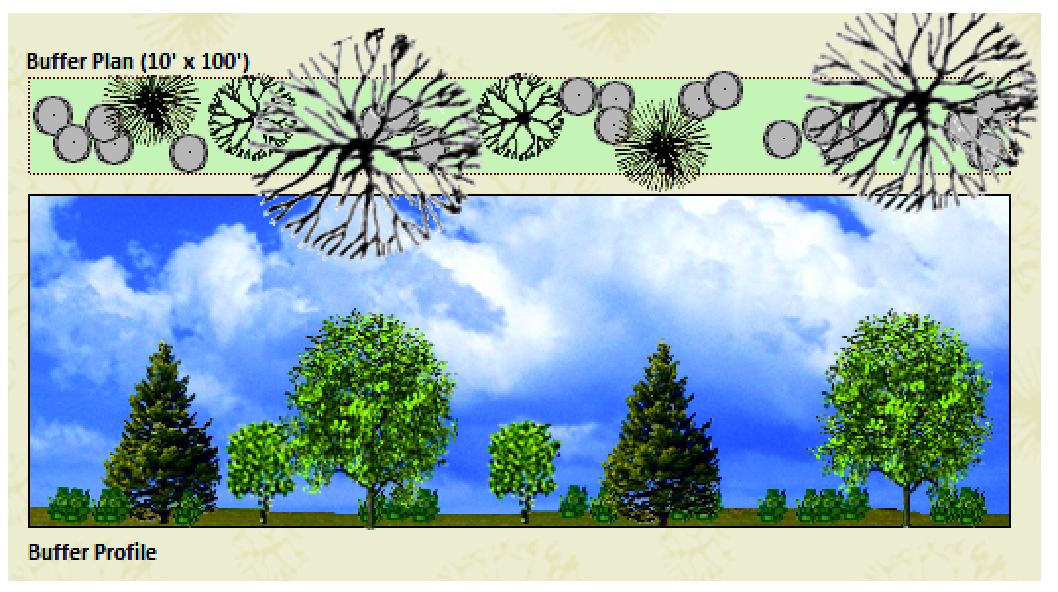
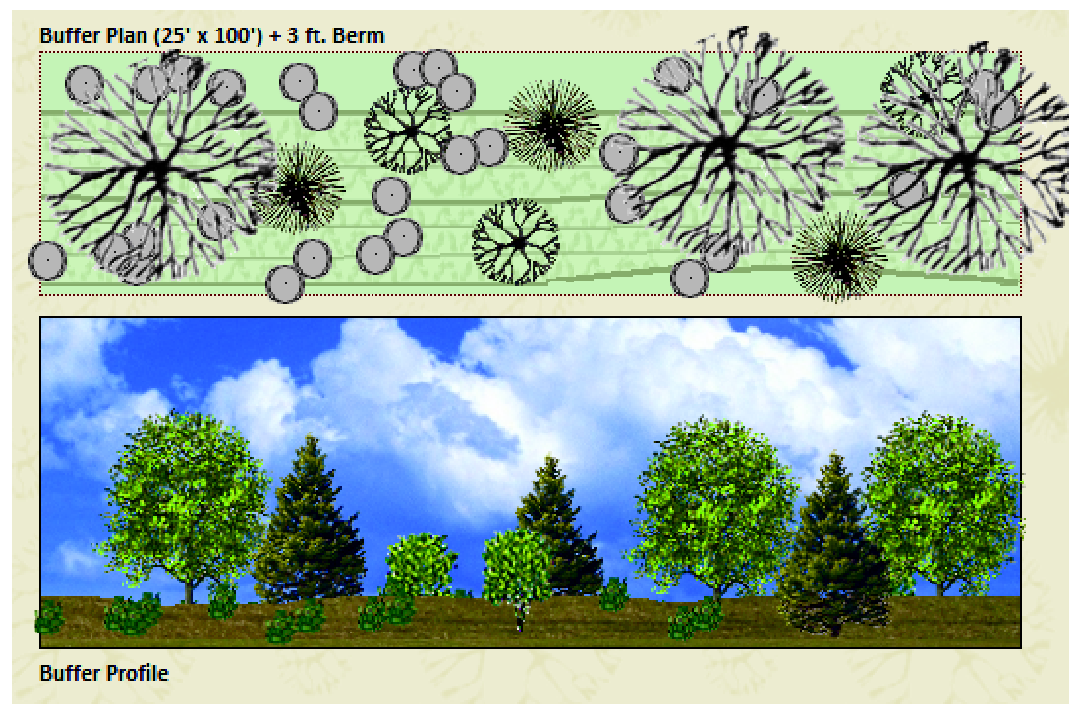
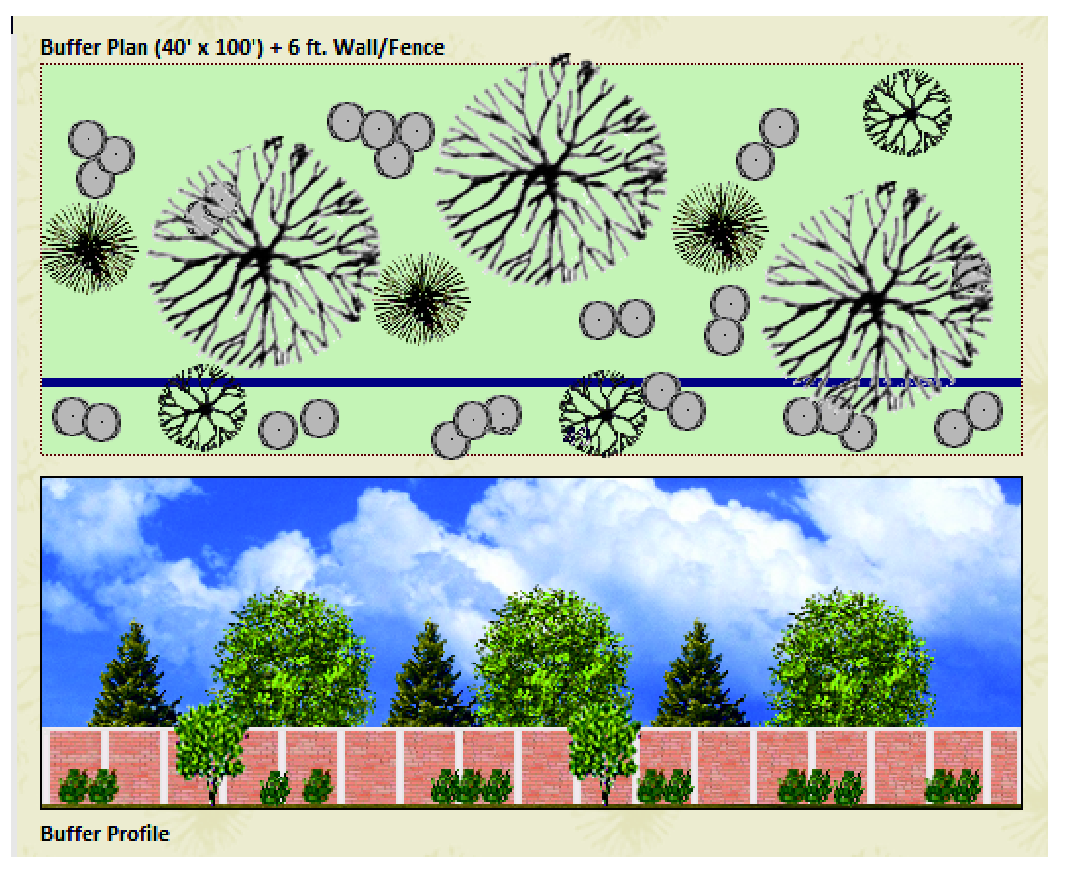
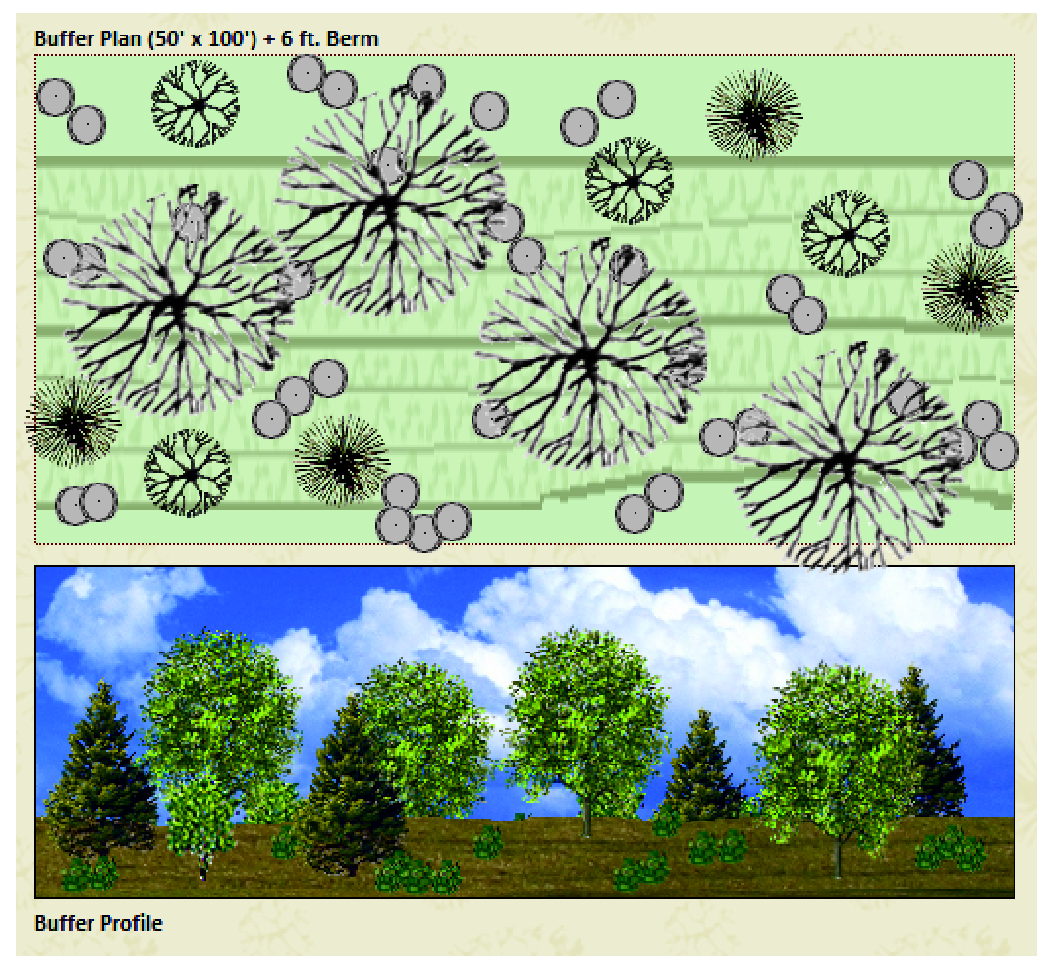
Bufferyards are classified from less opaque ("Class A") to more opaque ("Class E"). The width and composition of bufferyards shall be as set out in Table 17.02.120.7A Bufferyard Classifications. Example plans and profiles for each bufferyard type are illustrated in Figure 17.02.120.7, Bufferyard Examples.
B.
Reduction of width. The width of a bufferyard may be reduced if the requirements of this subsection would result in an area of bufferyards that occupies more than twenty percent of the parcel proposed for development, the bufferyard width may be reduced to a width that results in a maximum bufferyard area of no more than twenty percent of the development.
C.
Minimum width. No part of a required bufferyard shall be reduced to a width of less than three feet.
D.
Bufferyard standards. Table 17.02.120.7B District Boundary Bufferyard Standards, sets out the classification of bufferyard that is required between zoning districts that are not separated by a public street. The table is a matrix in which all districts are shown. Rows show the zoning of the parcel proposed for development, and columns show the zoning of the adjoining land. Two letters are shown for each condition (for example, A and C). The bufferyard required for the proposed use is listed first. The letter listed second is the buffer that is required on the adjoining property. A "-" means that no bufferyard is required.
Figure 17.02.120.7
Bufferyard Examples
Type A. Width: 5 feet
Type B. Width: 10 feet
Type C. Width: 25 feet with berm
Type D. Width: 40 feet with wall
Type E. Width: 50 feet with berm
E.
Existing adjacent development without bufferyards. Where the adjoining property is already developed and does not have the required bufferyard, the proposed development shall provide a bufferyard of the next most opaque classification than the more opaque of the two bufferyards required (e.g., if the requirement is C/A, and the adjoining property is already developed and does not have a bufferyard, then the developer must install a Type D bufferyard).
F.
Buffering existing residential development. The city may require an increase in the level of opacity of a bufferyard (e.g., from Type A to Type B) between new residential development and existing residential development, if:
1.
The lot widths of the new development are less than eighty percent of the lot widths of the nearest lots of the existing development;
2.
The building height of the new development is more than eight feet taller than the building height of the existing development; or
3.
The housing types that are located on the lots that abut existing development are different from the housing types of the existing development (e.g., new townhome lots abutting existing single-family detached lots).
G.
Existing trees, fences and walls. Existing trees, fences and walls may be counted towards bufferyard requirements, provided that the trees are in good health and are not invasive species, and the fences or walls are in good repair.
H.
Existing landscaping credit. Credit shall be given for existing trees according to the standards of Subsection 17.02.120.8 Canopy tree preservation credit.
I.
Bufferyards for roads and railroads. The bufferyard standards in Table 17.02.120.7C Bufferyard requirements for roads and railroads, address the type of bufferyard that is required along minor or major arterial, minor or major collector, local streets or railroads.
17.02.120.8 Tree preservation.
A.
Generally. Credit may be given for the preservation of existing trees and shrubs, as provided in this subsection.
B.
Condition of existing landscaping. Existing landscaping is eligible for credit only if:
1.
It is healthy and in good structural condition; and
2.
Except with respect to street trees (which have no limitation on location except pursuant to Subsection C.2.b., below), it is located:
a.
Within the area where the credit will be applied; or
b.
Within fifteen feet of such area and situated such that it will contribute to the purpose of the landscape area to which it is credited.
C.
Location of existing landscaping.
1.
Generally. Generally, credit is only available for plants that are located on the parcel proposed for development.
2.
Street trees.
a.
Existing street trees may be credited against street tree requirements.
b.
The city may also approve the preservation of existing canopy that extends over the street as an alternative to the street tree requirement.
D.
Calculation of canopy tree preservation credit. For the purposes of the planting requirements of this chapter, credit shall be given for preserved canopy trees as set out in Table 17.02.120.8 Canopy Tree Preservation Credit:
E.
Calculation of other landscaping credit. Existing healthy landscaping shall be credited against planting requirements on a one to one basis in the same category of plant material.
F.
Tree replacement. Any tree that is required by a development approval shall be replaced with a tree that has a comparable canopy at maturity, except that replacement is optional if:
1.
A new landscape plan is approved that does not require their replacement; or
2.
The tree was installed on a single-family detached or duplex lot and then removed by a subsequent owner.
G.
Tree protection during construction. All trees that are approved for credit shall be protected during construction as follows:
1.
All protected trees shall be barricaded during construction to prevent damage to the trees and their roots by construction equipment at a radius of at least to their driplines.
2.
The construction tree guard shall be not less than four feet high. All building material, dirt, or other debris shall be kept outside the construction tree guard.
3.
No person shall change natural drainage, excavate any ditches, tunnels, trenches, or lay any drive within the dripline of any protected tree without first obtaining written permission from the director.
17.02.120.9 New and existing landscaping and water efficient landscape standards.
A.
Landscaping after the effective date. Landscaping that is installed in order to meet the requirements of this Zoning Code shall meet the requirements of the California State Mandated Water Efficient Landscape Regulations; the applicable standards of this chapter, including Section 17.02.120.11, Water efficiency landscape standards; shall be consistent with the city's design review manual; and shall comply with additional requirements prior to issuance of the certificate of occupancy as follows:
1.
Substitutions. Trees may be substituted for shrubs, perennials, or ornamental grasses in areas where there is sufficient room for the healthy growth and stability of the tree. Substitution of trees for shrubs, perennials, or ornamental grasses shall be at a rate of one understory or evergreen tree equals four shrubs, perennials, or ornamental grasses.
2.
Groundcover. Ground surfaces shall be mulched, sodded, or planted with a permitted groundcover.
3.
Landscaping planting list. Trees, shrubs and groundcovers shall be chosen from the planting list in the city's design review manual.
4.
Size and quality requirements.
a.
All plant materials shall be in healthy condition, and grown in a separate container or balled and burlapped in accordance with the most current edition of the American Standard for Nursery Stock;
b.
Canopy trees shall be at least two and one-half inches caliper;
c.
Street trees that are planted in parkways shall be at least two inches caliper;
d.
Understory trees shall be at least one and one-half inches caliper;
e.
Evergreens shall be six feet tall at the time of planting;
f.
Shrubs shall be of sufficient container size to reach the heights required by this Zoning Code within two years of installation; and
g.
Trees shall be properly staked.
5.
Irrigation required. All landscaping installed pursuant to this section shall be irrigated, with the following exceptions:
a.
Areas of a site with existing, well-established stands of trees are not required to be included in the irrigation system;
b.
Individual single-family lots; and
c.
Any other exceptions provided under this section regarding water efficient landscaping.
6.
Slopes. Turf is not permitted on slopes greater than twenty-five percent where the toe of the slope is adjacent to an impermeable hardscape.
7.
Invasive species. Invasive plant species shall not be installed.
B.
Landscaping installed pursuant to this Zoning Code. Landscaping that is installed in order to meet the requirements of this section shall meet the following requirements while the site is occupied:
1.
Maintenance.
a.
All plantings shall be maintained in healthy condition.
b.
Landscaping that has attained the required height to achieve required screening or buffering shall be maintained at a minimum at the required height.
c.
Street trees required by this Zoning Code shall be maintained by a developer, lot owner, tenant, property owners' association or other entity having a legal interest in the ownership of the subdivision or lots in the subdivision. The entity that is in charge of the maintenance shall be indicated on the landscape plan, and documentation (e.g., covenants, conditions, and restrictions) shall be provided to the city that shows the legal obligation of the entity to perform the maintenance.
d.
Trees located in common areas shall be maintained pursuant to Section 17.03.140.3, Maintenance of open space.
2.
Replacement.
a.
If the city or a utility provider must remove trees to access utilities for repair or maintenance, then the developer or property owners' association shall pay the cost of removal and shall replace the trees within thirty days of the completion of the work unless the city public works director determines that replacement would put utilities at material risk.
b.
Landscape plantings that are in deteriorated condition, as determined by director, shall be replaced within thirty days of removal.
C.
Landscaping installed pursuant to previous codes. Alterations to landscaping that is legally nonconforming shall only occur pursuant to, and in compliance with, a landscape plan and all associated studies and plans as required in this Zoning Code.
17.02.120.10 Irrigation systems. An irrigation system that is required or proposed after the effective date of Ordinance No. 194-12 shall comply with the following standards:
A.
Compliance with approved plans. Installation of the irrigation system shall be in compliance with the approved plans and specifications as identified by the manufacturer.
B.
Water budget calculations. Water budget calculations shall meet the standards of Section 17.02.120.11, Water efficiency landscape standards.
17.02.120.11 Water efficiency landscape standards.
A.
Landscaping/hardscape.
1.
Hydrozones.
a.
Each hydrozone shall have plant materials with similar water use, with the exception of hydrozones with plants of mixed water use, as specified in Subsection A.1.b. below.
b.
Individual hydrozones that mix high and low water use plants shall not be permitted, however, individual hydrozones that mix plants of moderate and low water use, or moderate and high water use, may be allowed if:
i.
Plant factor calculation is based on the proportions of the respective plant water uses and their plant factor; or
ii.
The plant factor of the higher water using plant is used for calculations.
2.
Water features.
a.
Recirculating water systems shall be used for water features.
b.
Where available, recycled water shall be used as a source for decorative water features.
c.
Surface area of a water feature shall be included in the high water use hydrozone area of the water budget calculation.
3.
Mulch and amendments.
a.
A minimum two-inch layer of mulch shall be applied on all exposed soil surfaces of planting areas except in turf areas, creeping or rooting groundcovers, or direct seeding applications where mulch is contraindicated.
b.
Stabilizing mulching products shall be used on slopes.
c.
The mulching portion of the seed/mulch slurry in hydro-seeded applications shall meet the mulching requirement.
d.
Soil amendments shall be incorporated according to recommendations of the soil report.
B.
Irrigation systems.
1.
General standards.
a.
The plant factor used shall be from WUCOLS.
b.
The plant factor shall range:
i.
From 0 to 0.3 for low water use plants;
ii.
From 0.4 to 0.6 for moderate water use plants; and
iii.
From 0.7 to 1.0 for high water use plants.
c.
All water features shall be included in the high water use hydrozone.
d.
Temporarily irrigated areas shall be included in the low water use hydrozone.
e.
All special landscape areas shall be identified and their water use calculated.
f.
ETAF for special landscape areas shall not exceed 1.0.
2.
System design. All systems shall be designed to comply with the following:
a.
Include automatic irrigation controllers utilizing either evapotranspiration or soil moisture sensor data for scheduling;
b.
Be calibrated so that the dynamic pressure at each emission device is within the manufacturer's recommended pressure range for optimal performance;
c.
Include pressure-regulating devices such as inline pressure regulators, booster pumps, or other devices if the static pressure is above or below the required dynamic pressure of the irrigation system;
d.
Static water pressure, dynamic or operating pressure and flow reading of the water supply will be measured at the point of connection;
e.
Include sensors (rain, freeze, wind, etc.), either integral or auxiliary, that suspend or alter irrigation operation during unfavorable weather conditions, as appropriate for local climatic conditions;
f.
Include manual shut-off valves (such as a gate valve, ball valve, or butterfly valve);
g.
Include backflow prevention devices that meet City of Williams backflow prevention requirements, as specified in the city's plumbing code;
h.
Prevent runoff, low head drainage, overspray, or other similar conditions where irrigation water flows onto nontargeted areas, such as adjacent property, nonirrigated areas, hardscapes, roadways or structures;
i.
Meet, at a minimum, the irrigation efficiency criteria as described in this section regarding the maximum applied water allowance;
j.
Mulched planting areas use low volume irrigation;
k.
Sprinkler heads and other emission devices have matched precipitation rates, unless otherwise directed by the manufacturer's recommendations;
l.
Sprinkler spacing achieves the highest possible distribution uniformity using the manufacturer's recommendations;
m.
Swing joints or other riser-protection components are located on all risers subject to damage that are adjacent to high traffic areas;
n.
Check valves or anti-drain valves are provided;
o.
Narrow or irregularly shaped areas, including turf, less than eight feet in width in any direction are irrigated with subsurface irrigation or low volume irrigation system;
p.
Overhead irrigation is not located within twenty-four inches of any nonpermeable surface. Allowable irrigation within the setback from nonpermeable surfaces may include drip, drip line, or other low flow nonspray technology. The setback area may be planted or unplanted. The surfacing of the setback may be mulch, gravel, or other porous material. These restrictions may be modified if:
i.
The landscape area is adjacent to permeable surfacing and no runoff occurs;
ii.
The adjacent non-permeable surfaces are designed and constructed to drain entirely to landscaping; or
iii.
The irrigation designer specifies an alternative design or technology.
q.
Slopes greater than twenty-five percent are not to be irrigated with an irrigation system with a precipitation rate exceeding 0.75 inches per hour. This restriction may be modified if the landscape designer specifies an alternative design or technology, and clearly demonstrates no runoff or erosion will occur.
r.
Hydrozones.
i.
Each valve shall irrigate a hydrozone with similar site, slope, sun exposure, soil conditions, and plant materials with similar water use;
ii.
Sprinkler heads and other emission devices shall be selected based on what is appropriate for the plant type within that hydrozone; and
iii.
Trees shall be placed on separate valves from shrubs, groundcovers and turf.
C.
Evapotranspiration. The values as shown in Table 17.02.120.11, Evapotranspiration, shall be used to calculate evapotranspiration.
(Ord. No. 244-21, § 1, 7-21-2021)

