
Williams City Zoning Code
CHAPTER 17
06 - MEASUREMENTS, CALCULATIONS, WORD USAGE AND DEFINITIONS
Sections:
17.06.290 - Measurements.
17.06.290.1 Open space. The following qualify as open space for the purposes of this Zoning Code:
A.
Outdoor recreation areas. All forms of outdoor recreation areas count as open space, including passive areas and nature reserves, ball fields, tennis courts, swimming pools and golf courses.
B.
Stormwater facilities. Open air stormwater facilities count as open space. These facilities may be permitted in floodplains even though they are protected from being part of the developed portion of the site.
C.
Bufferyards. The required bufferyards count as open space.
D.
Required landscape areas. Required landscape areas, such as parking lot landscaping areas, count as open space. However, landscaping of private lots in residential subdivisions is not counted as open space.
E.
Agriculture. Agriculture counts as open space in cluster, planned, or conservation cluster development options when it is part of the development plan.
F.
Resource protection areas. All areas that are protected natural resource count as open space.
17.06.290.2 Width.
A.
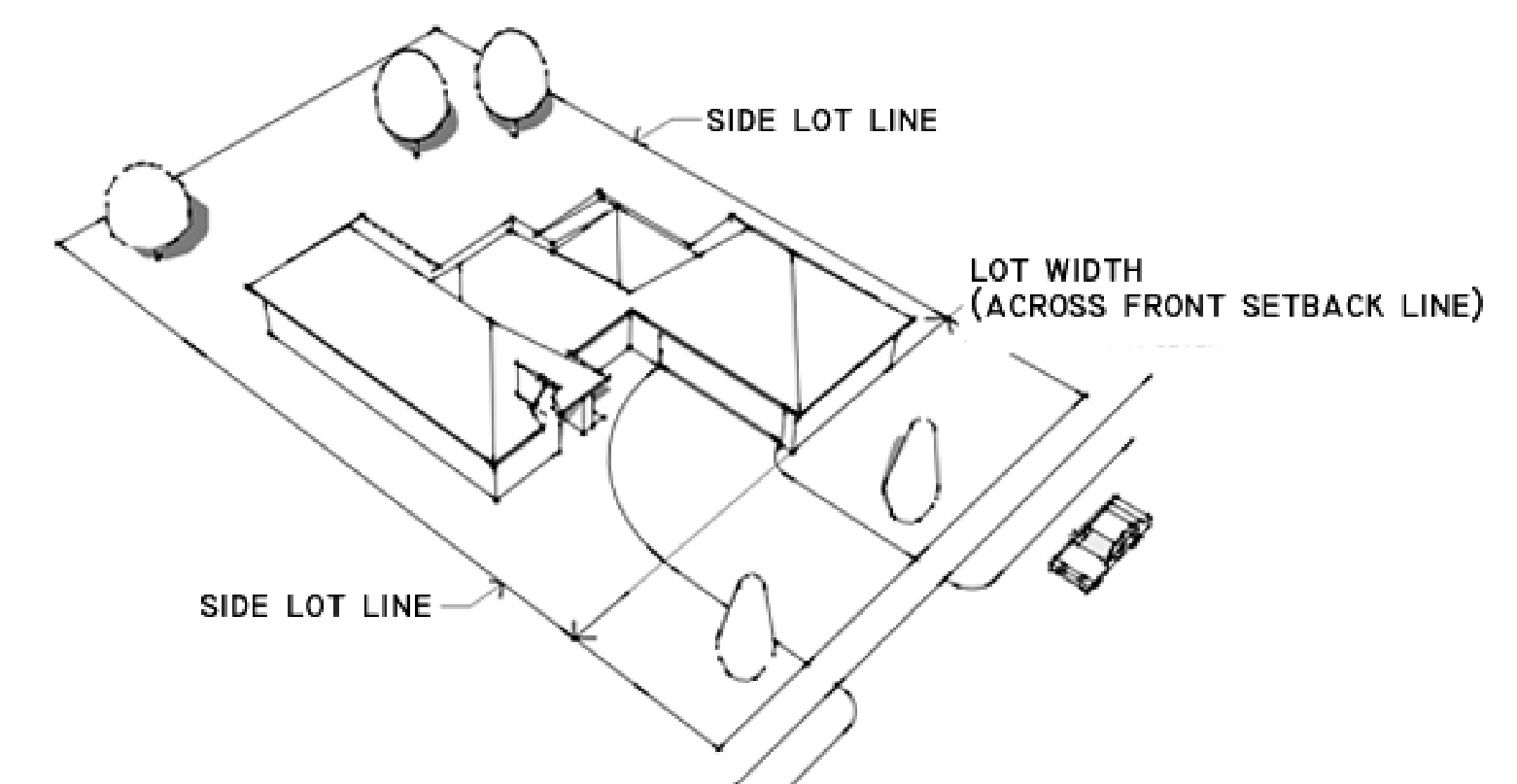
Generally. Lot width is the distance from one side lot line to the opposite side lot line at the front setback line. See Figure 17.06.290.2A, Measurement of Lot Width; Standard Lots:
Figure 17.06.290.2A
Measurement of Lot Width; Standard Lots
B.
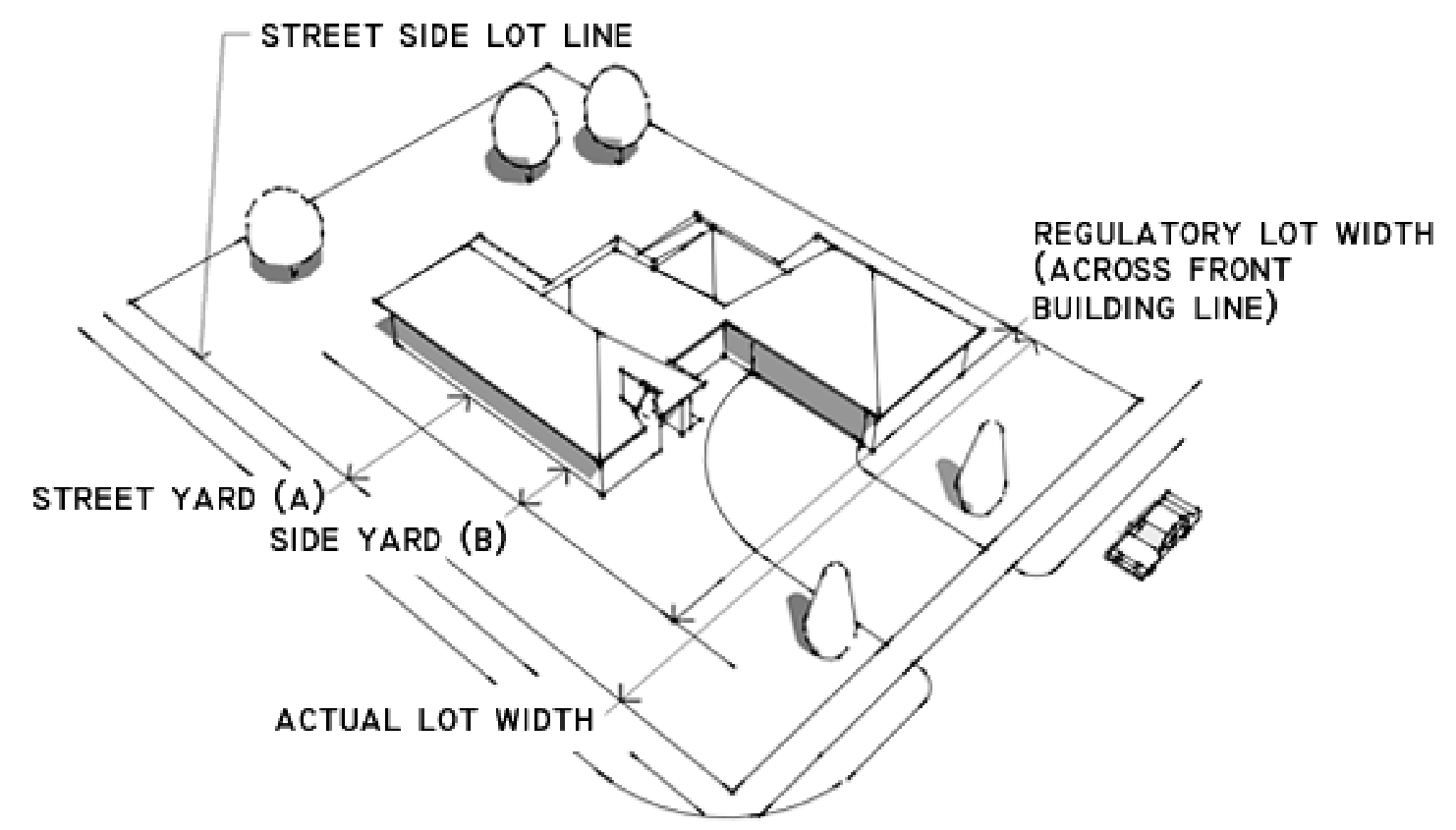
Corner lots. Lot width (for regulatory purposes) is the distance from the interior side lot line to the side street lot line, measured at the front building line, minus the difference between the street yard setback and the side yard setback. See Figure 17.06.290.2B Measurement of Lot Width; Corner Lots:
Figure 17.06.290.2B
Measurement of Lot Width; Corner Lots
C.
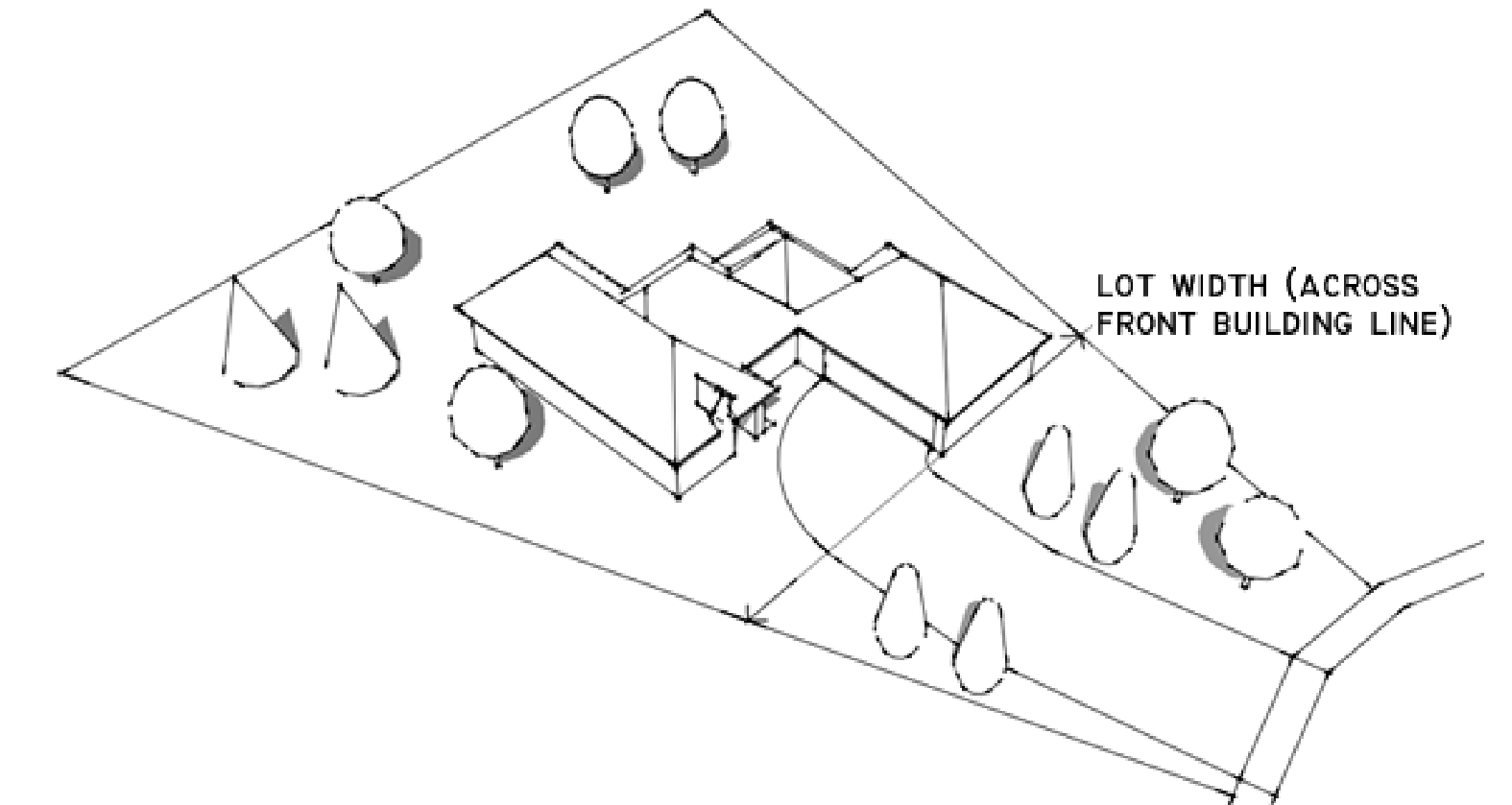
Irregular lots. Lot width is the distance from one side lot line to the opposite side lot line along the tangent of the curve representing the front building line. See Figure 17.06.290.2C Measurement of Lot Width; Irregular Lots. Generally, the front building line is the front setback line. However, if an alternative front building line has been established on the plat of a subdivision that is more distant than the front setback line from the front property line, then the lot width is measured at the alternative front building line.
Figure 17.06.290.2C
Measurement of Lot Width; Irregular Lots
17.06.290.3 Setbacks.
A.
Generally. Setbacks are measured from lot lines towards the center of the lot, as follows:
1.
Front setbacks are measured from the front lot line. The front lot line is the lot line that abuts the right-of-way from which the lot takes its address.
2.
Rear setbacks are measured from the rear lot line. The rear lot line is the lot line that is opposite from the front lot line.
3.
Side setbacks are measured from side lot lines. Side lot lines are lot lines that intersect with front lot lines.
B.
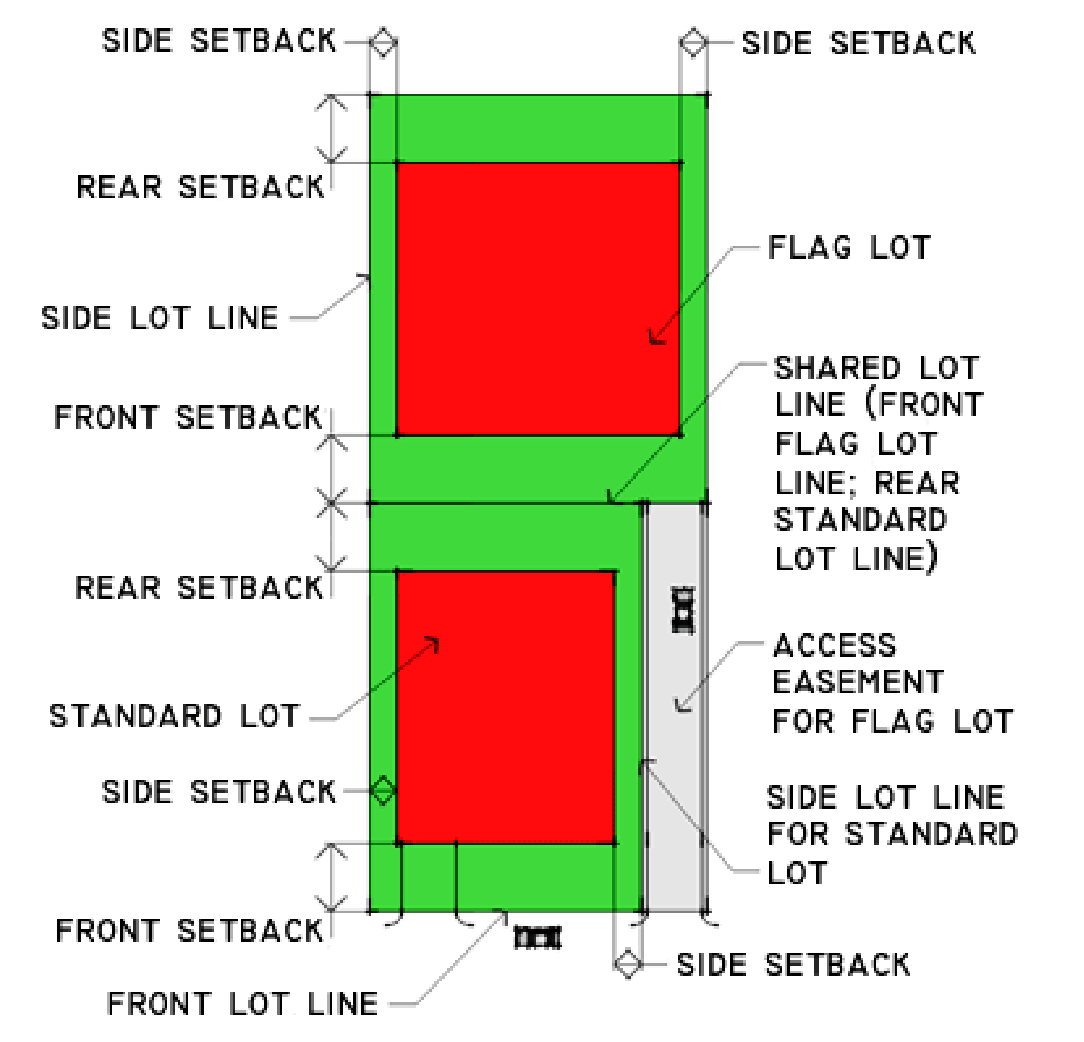
Flag lots. On flag lots, setbacks are measured as provided in subsection A., above, except that the front setback line is measured from the "shared lot line." See Figure 17.06.290.3, Setback Measurement:
Figure 17.06.290.3
Setback Measurement
17.06.290.4 Height.
A.
Buildings. Building height is calculated by measuring the vertical distance from the average finished grade along the front building line to:
1.
The highest peak or ridge line of the roof for pitched roof styles; or
2.
The top of the parapet for flat roof styles.
B.
Other structures. Structure height is calculated by measuring the vertical distance from the average finished grade around the base of the structure to the highest point on the structure. This measurement applies to:
1.
Structures without roofs (e.g., fences); and
2.
Amateur radio antennae, whether mounted on a roof, the ground, or another structure.
C.
Specialized structures and building appurtenances.
1.
Specialized structures and building appurtenances are not counted in the calculation of building height, provided that:
a.
They project not more than:
i.
Fifteen feet above the highest point on the building for buildings that are thirty-five feet in height or higher; or
ii.
Seven feet above the highest point on the building for buildings that are less than two stories in height.
b.
They occupy not more than ten percent of the total roof area of the building; and
c.
They are not used for human habitation, commercial, or industrial purposes, except as incidental to the operation of the building.
D.
Smokestacks and grain elevators. Smokestacks and grain elevators shall be permitted to a height of ninety feet in the AR, BP, and IN districts. In other districts, they are subject to Subsection C., above.
17.06.290.5 Floor area. Floor area is measured as the horizontal area of all habitable building floors in square feet, measured from the outside face of all exterior walls. No deduction shall apply for horizontal areas void of actual floor space (for example, elevator shafts and stairwells) unless specified in the applicable section as an exemption.
17.06.290.6 Separation of adult-oriented businesses. The required separation distances of Subsection 17.01.030.9, Adult-oriented business zoning, shall be made using a straight line, without regard to intervening structures or objects, from the nearest property line of the parcel on which the adult-oriented business is proposed to be located to the nearest property line upon which is located the church, other religious institution, public park, school or library that is the subject of measurement. The distance between an existing adult-oriented business shall be measured in a straight line between the principal front doors of each business without regard to intervening structures or objects.
17.06.290.7 Noise levels. Noise levels shall be measured:
A.
By a sound level meter, set to A-weighted decibels;
B.
On the property that is receiving the noise, which is the site intended to be protected under the regulations of this Zoning Code; and
C.
Outside of a building and on a line located ten feet inside the property of the premises receiving the noise, and at a height of six feet above that ten-foot line. If there is a building located within the ten-foot area, the measurement shall be taken outside of the building from a line abutting the exterior wall.
(Ord. No. 244-21, § 1, 7-21-2021)
17.06.300 - Calculations.
17.06.300.1 Base site area.
A.
Generally. Base site area is used to calculate gross density. See Subsection 17.06.300.4, Density.
B.
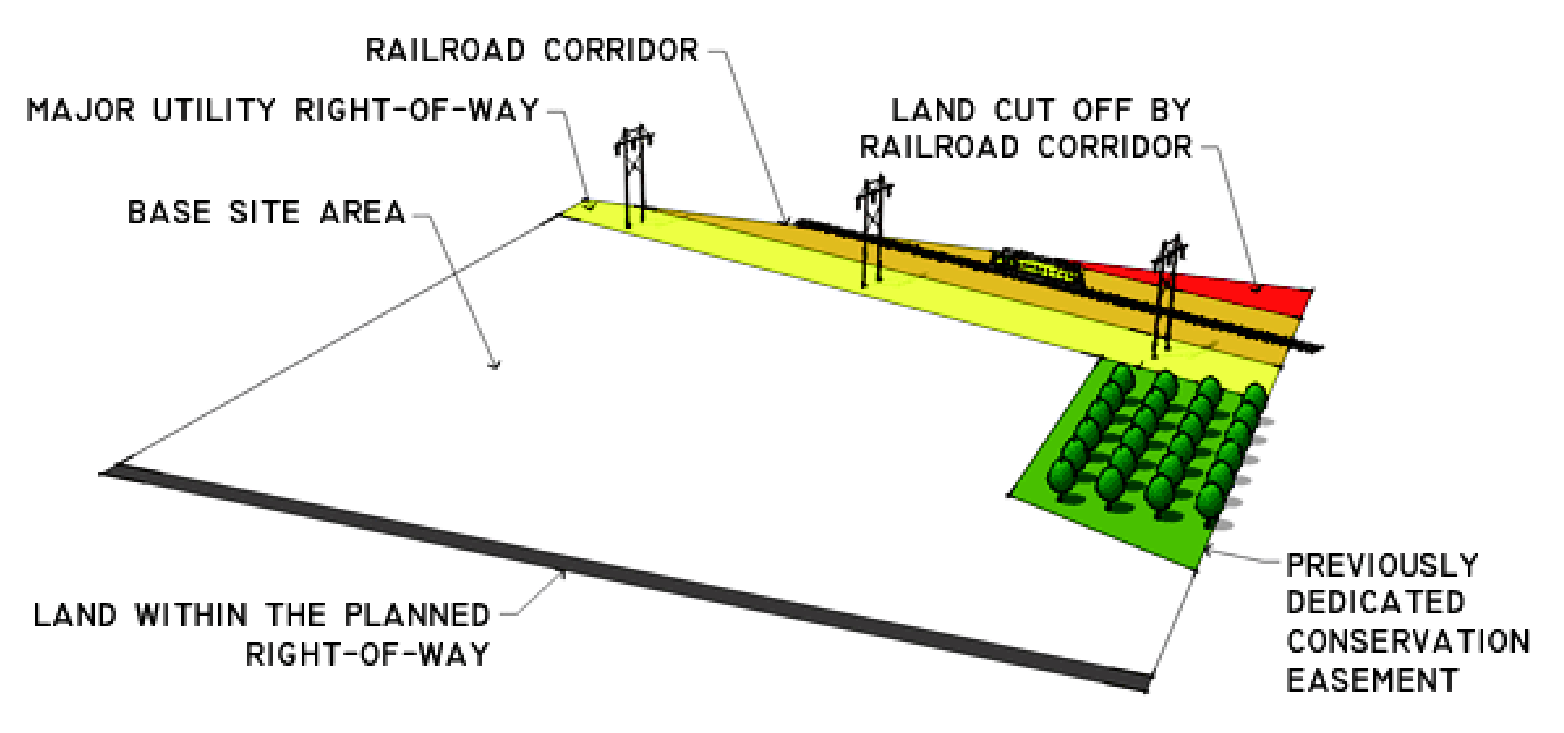
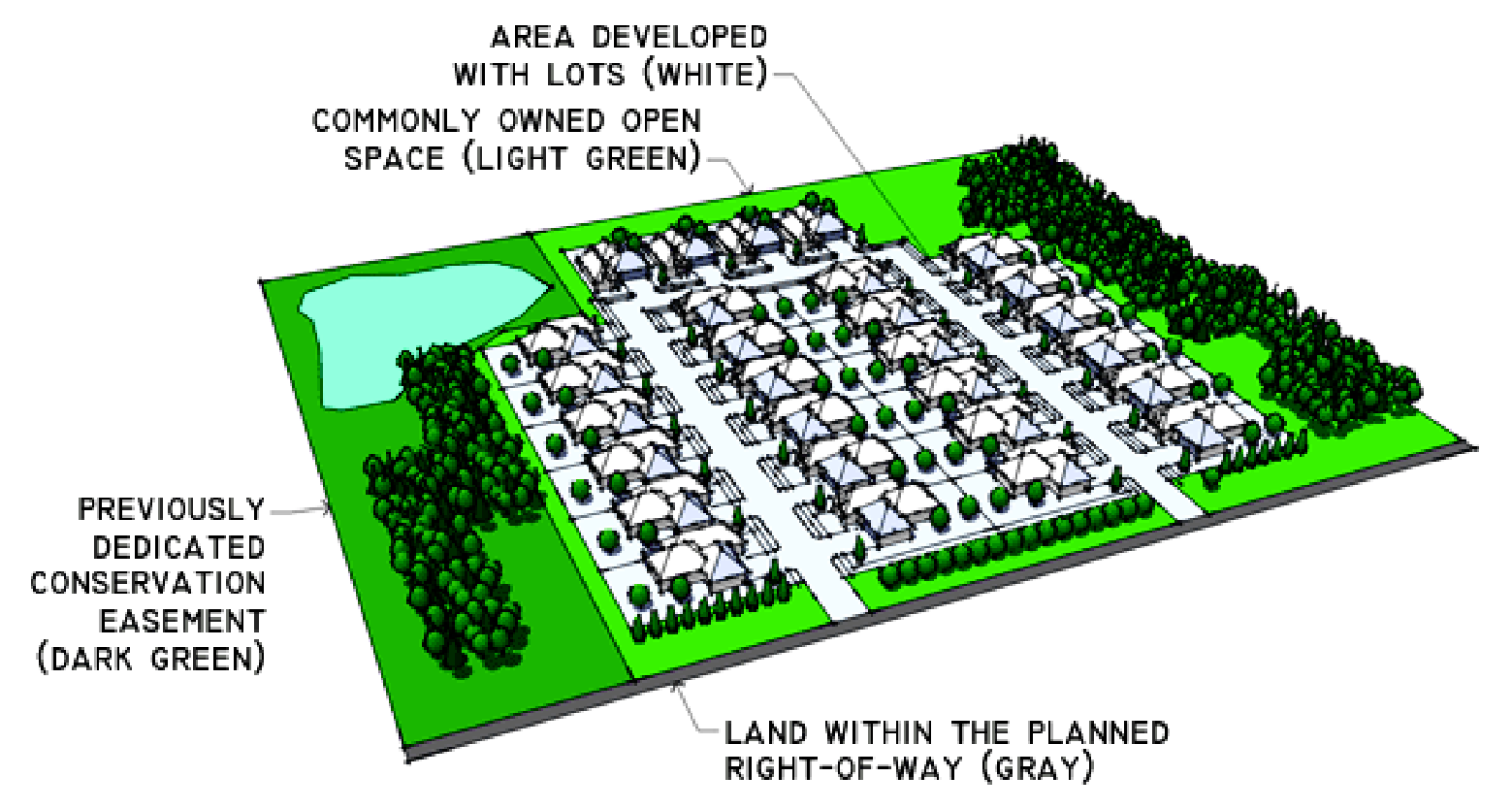
Calculation. Base site area equals the total area of the parcel proposed for development (gross site area), minus the sum of the areas of the following:
1.
Land within the planned right-of-way of existing streets or streets that are on the adopted thoroughfare plan of the City of Williams.
2.
Land that is within major utility rights-of-way that are wider than fifty feet.
3.
Land that is cut off from development by railroads, limited access highways, waterbodies, or wetlands and is not proposed for development.
4.
Land that has previously been set aside as protected open space (e.g., subject to a conservation easement, plat restriction, or condition of development approval.). See Figure 17.06.300.1, Illustrative Calculation of Base Site Area:
Figure 17.06.300.1
Illustrative Calculation of Base Site Area
17.06.300.2 Net buildable area.
A.
Generally. Net buildable area is used to identify the area of a parcel where development will occur and that is not in the protected open space.
B.
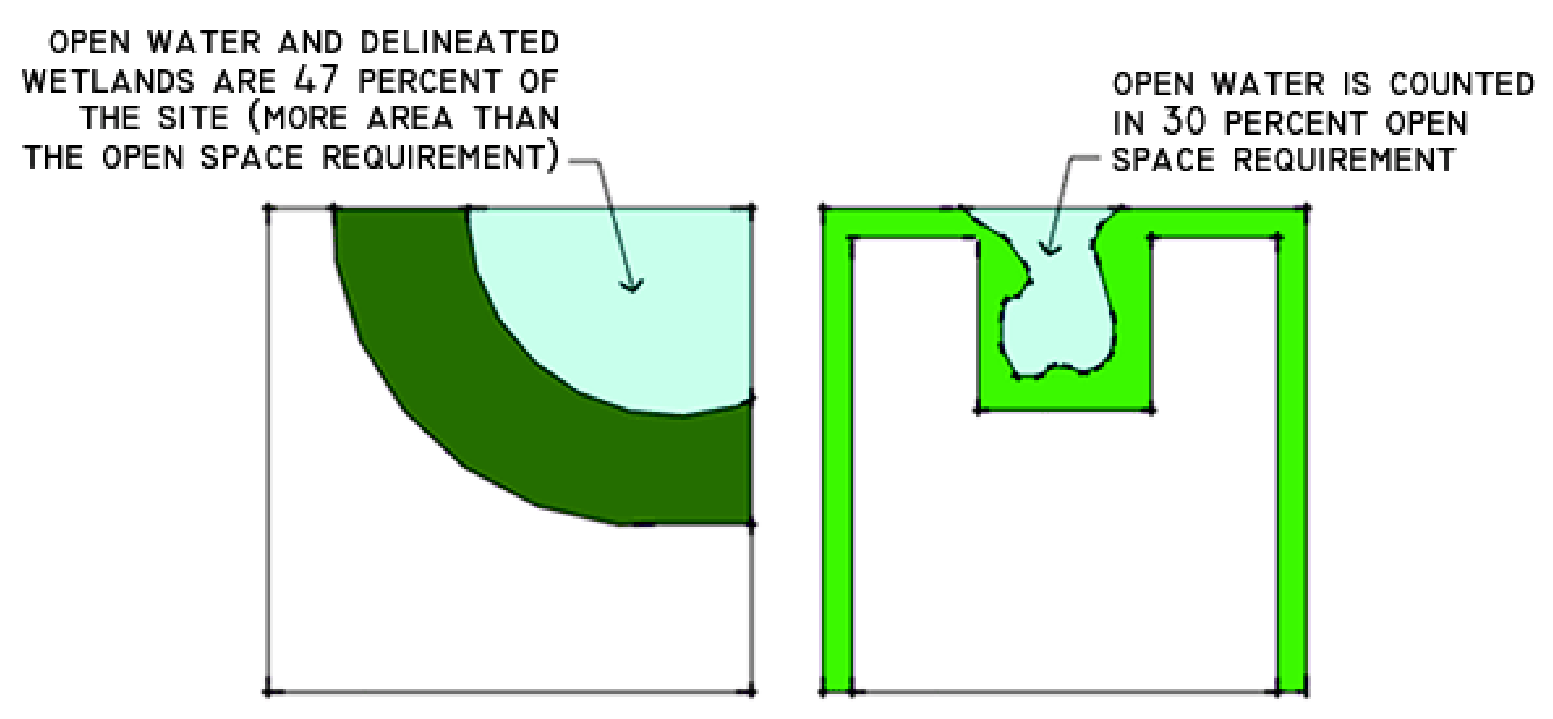
Calculation. Net buildable area is equal to the lesser of:
1.
Base site area (calculated as provided in Subsection 17.06.300.1, Base site area) minus areas of open water (streams are measured to the ordinary mean high water mark) and delineated wetlands that were not already subtracted from the area of the parcel proposed for development to calculate the base site area (e.g., wetlands or open water areas that are within previously dedicated conservation easements, or cut off from development by a limited access highway, are not subtracted more than once); or
2.
The total area of the parcel proposed for development minus the area of open space required for the development type in Subsection 17.06.300.1, Residential area and density and parcel standards. See Figure 17.06.300.2, Illustrative Calculation of Net Buildable Area:
Figure 17.06.300.2
Illustrative Calculation of Net Buildable Area
Using a thirty percent open space ratio for illustrative purposes, the net buildable area for the illustration on the left is calculated as base site area minus areas of open water and delineated wetlands; and the net buildable area for the right-hand illustration on the right is calculated as the total area of the parcel proposed for development minus the area of required open space.
17.06.300.3 Open space ratio.
A.
Generally. OSR refers to open space, which is a measure of "green" space and areas of open water on a parcel proposed for development.
B.
Calculation of requirement. This subsection sets out how to calculate how much commonly-owned open space is required in a residential development.
1.
The amount of commonly-owned open space that is required in a residential development is calculated as the required OSR (see Table 17.02.080.1, Residential Area and Density Standards) times the total area of the parcel proposed for development.
2.
The amount of open space that is required in a nonresidential development is calculated as the required OSR (see Table 17.02.100.2, Nonresidential Open Space and Building Scale) times the total area of the parcel proposed for development.
3.
The required OSR is a minimum requirement. An increased OSR may result if the sum of the areas required for compliance with bufferyard requirements, natural resource protection requirements, stormwater management requirements, parking lot landscaping requirements, recreation requirements, and state or federal environmental laws is greater than the open space that would be required by application of the minimum OSR.
C.
Calculation of compliance. This subsection sets out how to calculate the OSR of a proposed development, in order to determine whether it complies with the requirements of this Zoning Code.
1.
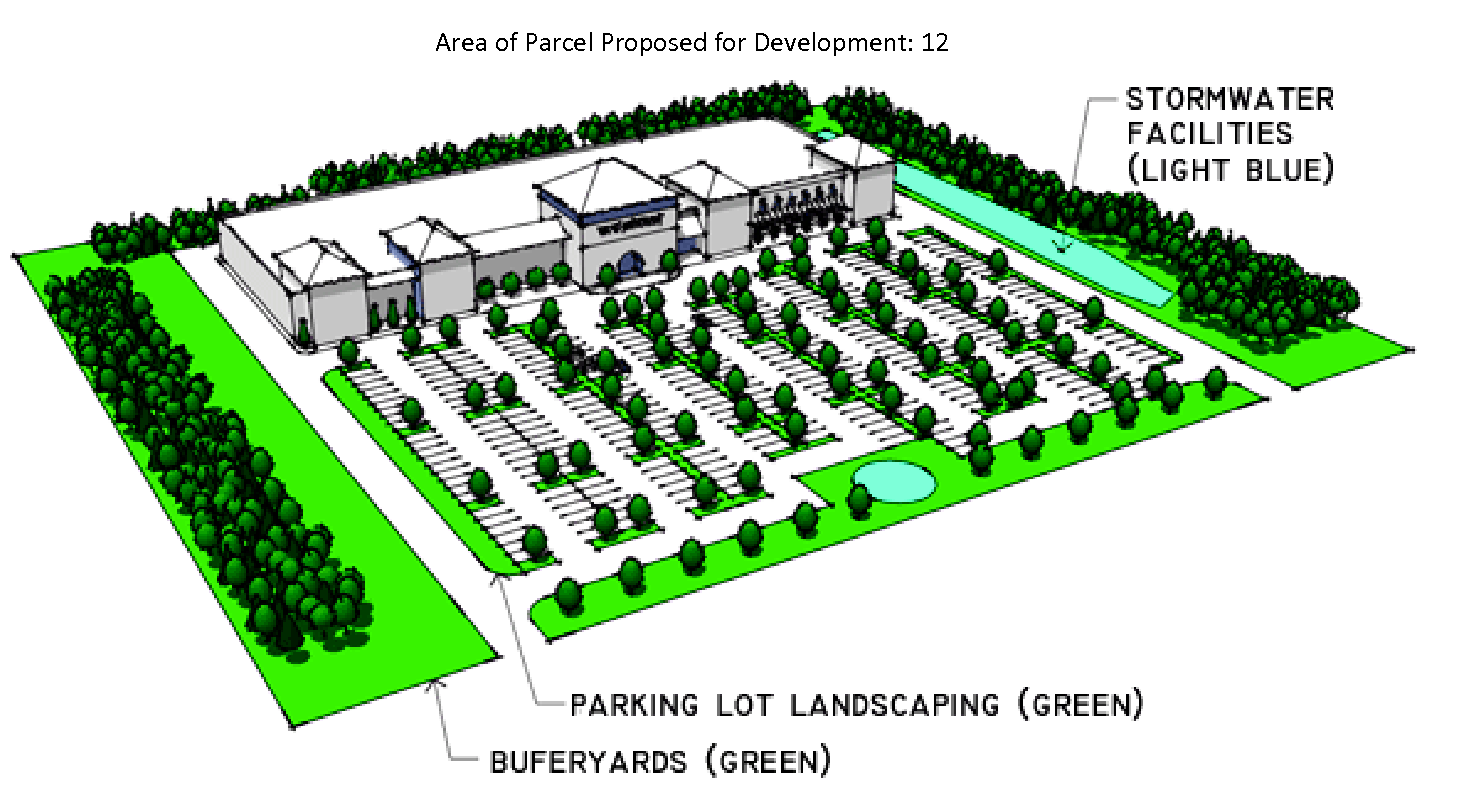
The OSR of a parcel proposed for development is calculated by dividing the total amount of commonly-owned open space on the parcel by the total area of the parcel. See Figures 17.06.290.3A, Illustrative Measurement of Residential Open Space Ratio and 17.06.290.3B, Illustrative Measurement of Nonresidential Open Space Ratio.
2.
Open spaces that qualify for the calculation of OSR include all areas of commonly-owned open space that are larger than three hundred twenty contiguous square feet in area, including but not limited to:
a.
Bufferyards (whether required by this Code or not);
b.
Areas of protected natural resources;
c.
Stormwater management systems (except enclosed systems);
d.
Passive recreation areas; and
e.
Parking lot landscaping.
3.
Open spaces that do not qualify for the calculation of OSR include any areas on private, buildable lots and any commonly-owned open space that is less than three hundred twenty contiguous square feet.
Figure 17.06.300.3A
Illustrative Measurement of Residential Open Space Ratio
EXAMPLE: 6 acres of Common Open Space divided by 12 acre Area of Parcel Proposed for Development equals 50% OSR
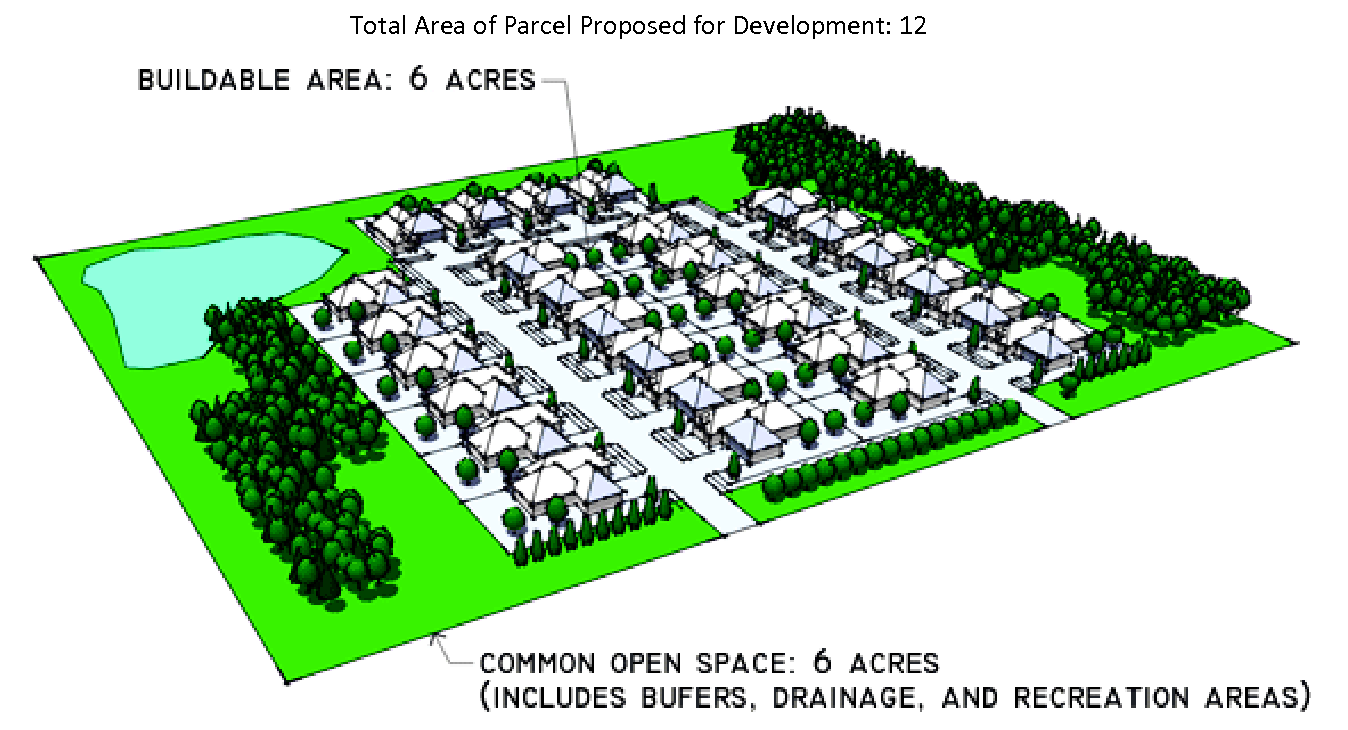
Figure 17.06.300.3B
Illustrative Measurement of Nonresidential Open Space Ratio
EXAMPLE: 5 acres of Bufferyards, Parking Lot Landscaping, and Drainage Facilities divided by 12 acre Area of Parcel Proposed for Development equals 41.7% LSR
17.06.300.4 Density. Density is the number of dwelling units per acre of base site area (see Subsection 17.06.300.1, Base site area). Accessory dwelling units are not counted in the total number of dwelling units when calculating density if they conform to the provisions of California Government Code Section 65852.150 et seq. An example calculation is provided in Figure 17.06.300.4, Illustrative Density Calculations:
Figure 17.06.300.4
Illustrative Density Calculations
EXAMPLE: 28 Homes are planned for an 11-acre parcel.
GROSS DENSITY The parcel proposed for development is 11 acres. 2.5 acres (including forest and open water) were previously dedicated as a conservation easement, and 0.2 acres within planned right-of-way of abutting street. There are no areas within major utility corridors or cut off from development. Therefore, the Base Site Area is 11 - 2.5 - 0.2, or 8.3 acres. 28 homes divided by 8.3 acres equals a gross density of approximately 3.38 units per acre.
17.06.300.5 Lot area. Lot area is the area within the lot lines. See Figure 17.06.300.5, Illustrative Lot Area Calculation:
|
Figure 17.06.300.5
Illustrative Lot Area Calculation | |
|---|---|
|
EXAMPLE The example at right is a rectangular lot.
80 feet Wide TIMES 125 feet Deep EQUALS 10,000 square feet Lot Area | 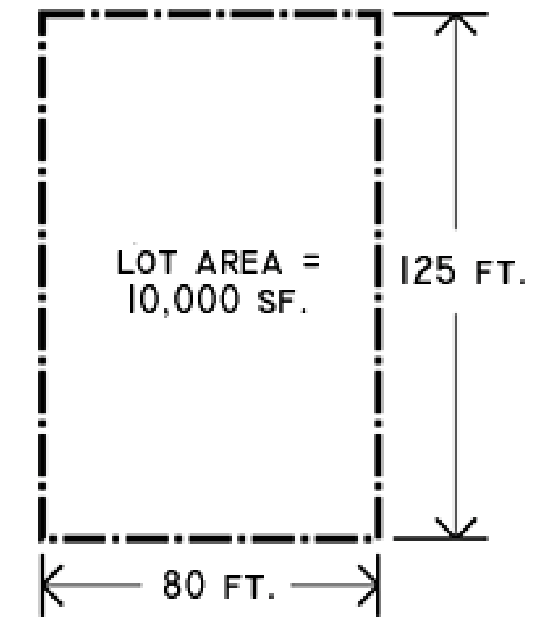 |
17.06.300.6 Building coverage.
A.
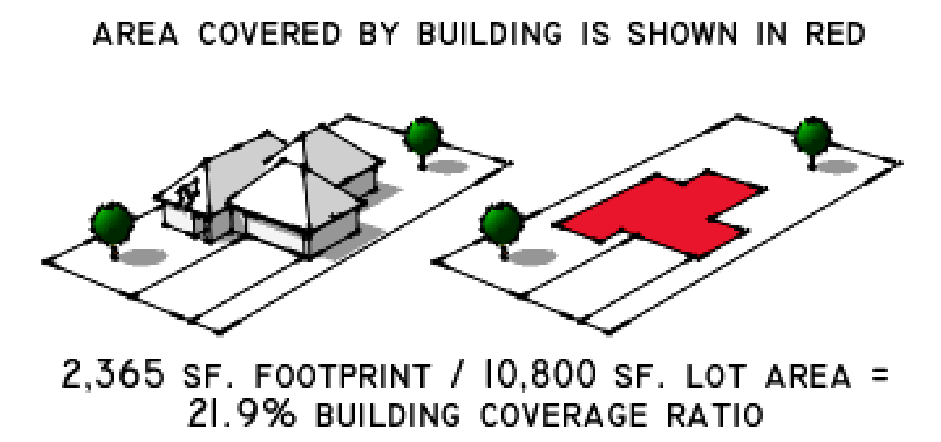
Building coverage. Building coverage is the total of areas taken on a horizontal plane at the main grade level of the principal building and all accessory buildings, exclusive of uncovered porches, terraces and steps. All dimensions are measured between the exterior faces of walls.
B.
Building coverage ratio. Building coverage ratio is building coverage divided by lot area. See Figure 17.06.300.6, Building Coverage Ratio Illustration:
Figure 17.06.300.6
Building Coverage Ratio Illustration
17.06.300.7 Maximum applied water allowance. The maximum applied water allowance for existing landscapes shall be calculated as: MAWA = (0.8)(ETo)(LA)(0.62).
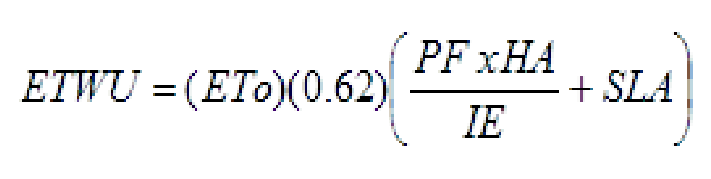
17.06.300.8 Estimated total water use. The estimated total water use shall be calculated using the equation below:
(Ord. No. 244-21, § 1, 7-21-2021)
17.06.310 - Word usage; abbreviations; and acronyms.
17.06.310.1 Word usage.
A.
Generally. The rules of this section shall be observed and applied when interpreting this Zoning Code, except when the context clearly requires otherwise.
B.
Word usage. Words shall be interpreted as follows:
1.
Unless the context clearly indicates otherwise, words used or defined in one tense or form shall include other tenses or forms.
2.
Unless the context clearly indicates otherwise, words in the singular number shall include the plural number, and words in the plural number shall include the singular number.
3.
The masculine gender shall include the feminine. The feminine gender shall include the masculine.
4.
The words "shall" and "will" are mandatory.
5.
The words "may" and "should" are permissive.
6.
The word "person" includes individuals, partnerships, firms, corporations, associations, trusts, and any other similar entities or combination of individuals.
C.
Statutory and United States Code References.
1.
References to the California Statutes or United States Code shall be interpreted to mean the most current version of the referenced section at the time the reference is applied. If a referenced section is repealed and replaced by another section of the California Revised Statutes or United States Code with comparable subject matter, the replacement section shall control. If a referenced section is repealed and not replaced, the repealed section shall control if it is within the home rule powers of the city to effectuate such result, or the application shall be held for up to twelve weeks for the city to revise this Zoning Code to resolve the reference and establish an appropriate policy.
2.
Where referenced sections authorize the promulgation of administrative rules, references to the California Statutes or United States Code shall be interpreted to include the phrases "and rules promulgated thereunder."
17.06.310.2 Abbreviations and acronyms. Table 17.06.310.2, Meaning of Acronyms and Abbreviations, sets out the meaning of the acronyms and abbreviations used in this Zoning Code:
(Ord. No. 244-21, § 1, 7-21-2021)
17.06.320 - Definitions.
Access, primary means the driveway connection to a roadway or access easement that has the highest volume of vehicular use. Typically these driveways are the largest of all other access driveways to a site, and may have increased traffic control such as a longer stacking area on-site, and/or dividers such as curbs or medians. Access, primary means the driveway connection to a roadway or access easement that has the highest volume of vehicular use. Typically these driveways are the largest of all other access driveways to a site, and may have increased traffic control such as a longer stacking area on-site, and/or dividers such as curbs or medians.
Accessory use or accessory structure means a use of land, structure, or building, or portion thereof, that is commonly associated with, incidental, and subordinate to a principal use, and located on the same lot or parcel with such principal use.
Accessory dwelling unit means an attached or a detached residential dwelling unit that provides complete independent living facilities for one or more persons and is located on the same lot as the proposed or existing primary residence. It shall include permanent provisions for living, sleeping, eating, cooking, and sanitation. An accessory dwelling unit also includes an efficiency unit, as defined in Section 17958.1 of the Health and Safety Code, and a manufactured home, as defined in Section 18007 of the Health and Safety Code.
Affordable housing development means development project that results in adding residential dwellings or mixed use projects consisting of at least 2/3rds of the square footage of the buildings devoted to residential uses which are restricted to lower income families as defined in California Health and Safety Codes Section 50106. Affordable housing development may also include supportive and transitional housing (also see "Housing development").
Agrarian club facility means a facility devoted to the operation of an agricultural or rural related organization. The term includes, but is not limited to horse riding fields; Head, Heart, Hands and Heart (4-H) grounds, polo fields, and rodeo grounds.
Agricultural support/rural services means uses that support agricultural uses, including:
1.
Farm supply services and feed stores;
2.
Farm equipment dealers; and
3.
Grain storage.
Agriculture, crops means the growing, cultivating, and harvesting of plants, including vegetables, grains, seeds, nut and fruit trees, etc. The term includes tree orchards.
Airport means aircraft take-off and landing fields and flight training schools; or airstrips for personal aircraft for the private use of an individual.
Alcoholic beverage sales, offsite consumption means a business whose floor space is primarily devoted to the retail sale of beer, wine, or other alcoholic beverages for off-premises consumption and which requires a license under state regulations.
Alcoholic beverage sales, onsite consumption means a business whose floor space is primarily devoted to the sale of beer, wine, or other alcoholic beverages for on-premises consumption and which requires a license under state regulations.
Alley means a public way or lane less than twenty-five feet in width which affords a secondary means of access to abutting property.
Animal boarding facility means any premises where any combination of dogs, cats or other household pets, totaling four or more animals, six months of age or older, are kept, boarded or bred for the intention of profit.
Antenna means any tower, mast or "satellite dish" used to transmit or receive radio, television, microwave, or other telecommunication or data communication for personal or commercial purposes and is considered a structure.
Antique means any object of fine art or household furniture or appliances which was produced more than one hundred years ago.
Antique store means a store or shop that primarily sells objects of art, household furniture, or appliances, all of which are over one hundred years old.
Applied water means the portion of water supplied by the irrigation system to the landscape.
Arcade-fun center means any business which has on its premises six or more amusement devices.
Asphalt or concrete plant means a concrete or asphalt batch plant that is assembled on a site for the construction of a particular improvement.
Attached facilities means an antenna that is attached to an existing building or structure such as utility poles, signs, water towers, rooftops, towers with any accompanying pole or device, which anchor the Antenna to the existing building or structure along with associated connection cables and an equipment shelter that may be located either inside or outside the existing building or structure.
Attached housing means dwelling units that are attached to each other on at least one side, possibly divided from one another by firewalls or other physical partitions.
Assisted living facility means a residential facility that makes available to three or more adults room and board and at least the following services: Personal services; protective oversight; social care due to impaired capacity to live independently; and regular supervision that is available on a twenty-four-hour basis, but not to the extent that regular twenty-four-hour medical or nursing care is required. This phrase does not include any facility licensed in this state as a residential care facility.
Automatic irrigation controller means an automatic timing device used to remotely control valves that operate an irrigation system. Automatic irrigation controllers schedule irrigation events using either evapotranspiration (weather-based) or soil moisture data.
Automobile service, light means services for passenger vehicles to include oil changes, lube jobs, vehicle inspection services, brake replacement, and tire stores. The term does not include more involved automobile repair such as body shops, engine repair, transmission repair, etc.
Backflow prevention device means a safety device used to prevent pollution or contamination of the water supply due to the reverse flow of water from the irrigation system.
Bed and breakfast inn means a place of lodging that:
A.
Provides five or fewer rooms for short-term rental;
B.
Is the owner's personal residence; and
C.
Is occupied by the owner at the time of room rental.
Block means an area of land that is surrounded on all sides by streets or other transportation rights-of-way or by physical barriers such as water bodies or public open spaces. Blocks are normally, but not necessarily, divided into lots.
Bufferyard means a strip of land between two parcels that contains vegetation that provides adequate, year-round visual screening as well as protection from glare and particles that would otherwise potentially negatively impact an adjoining use.
Build-to line means a required distance from the front or side street property line on which the front or side street facing wall must be located.
Building envelope means the area on a lot that is bounded by setback lines, on which development of a principal building is permitted.
Building line, front means the line along the front wall of a building and extending to the side property lines.
Building official means the person that has been authorized by the City Manager to interpret and enforce the latest approved Building Codes for the City of Williams.
Building plot means a parcel or group of parcels dedicated to a definable development, such as a shopping center, a townhome cluster, a medical campus, etc. For developments that occur after the effective date, the building plot will be determined by the City Planner or designee at the time a building permit is issued, or in the case of a multiple phases or lot development, at the time the first building permit is issued. On existing sites, the building plot will be determined by the City Planner or designee at the time such determination becomes necessary.
Building park area means an area defined by the outer perimeter of all contiguous acreage that is zoned B-P.
Building, urban style means a structure where the main entrance and fifty percent or more of the front wall of the building is located on the front property line or within ten feet of it. Front door access to multi-family units is internal and not open to the elements. The term applies to apartment buildings, brownstones, and townhomes. The term does not include a grouping of buildings with the same or similar footprint that are an apartment complex.
Caliper means a method of measuring the diameter of a tree trunk. The measurement is taken six inches above the ground up to and including four-inch caliper size. If the caliper at six inches above the ground exceeds four inches, the caliper is measured at twelve inches above the ground. The measurement is taken according to the methodology set out in the most current edition of the American Standard for Nursery Stock, published by the American Nursery and Landscape Association.
Candela means a unit of luminous intensity.
Canopy trees means tree whose leaves would occupy the upper level of a forest in a natural ecological situation. These trees are also called shade trees or large trees, and typically reach heights of fifty to one hundred feet at maturity.
Cargo container means a container that was originally designed as an intermodal freight container that could be transported by ships, trains, cargo planes, and trucks.
Check valve means a valve located under a sprinkler head, or other location in the irrigation system, to hold water in the system to prevent drainage from sprinkler heads when the sprinkler is off.
Child care, commercial means a facility, by whatever name known, that is commercially run and maintained for the whole or part of a day for the care of children who are eighteen years of age or younger whether the facility is operated with or without compensation for such care and with or without stated educational purposes. The phrase "child care center" includes, but is not limited to facilities commonly known as:
A.
Day care centers;
B.
School-age child care centers;
C.
Before and after school programs;
D.
Nursery schools;
E.
Kindergartens;
F.
Preschools;
G.
Day camps;
H.
Summer camps;
I.
Centers for developmentally disabled children;
J.
Facilities that give twenty-four-hour care for children;
The term does not include any facility licensed as a family child care home nor a foster care home.
Cohousing means a group of seven to seventy residential units (cottages, single-family detached, lot lines, or duplex types) that are organized according to a site plan that encourages interaction among residents, and which includes a common house and other common facilities (e.g., open space, playground equipment, gardens, etc.). The residential units typically face each other across a pedestrian street or courtyard, with cars parked on the periphery. The common house typically includes a common kitchen, dining area, sitting area, children's playroom and laundry, and also may contain a workshop, library, exercise room, crafts room and/or one or two guest rooms. Transitional or supportive housing that complies with State of California program requirements, and that meets the City of Williams' cohousing standards, is also included in this term.
Collectible means any object, art, furniture, appliance or other article of personal property which is not an antique, but which was produced more than thirty years ago and whose current market value is greater than when it was produced. Examples of items which may be considered collectibles include, but are not limited to, certain rugs, dolls, coins, gems, medals, stamps, baseball cards and jukeboxes.
Collectible store means a store or shop whose inventory is substantially comprised of collectibles.
College/university/vo-tech means a community college, college, university, vocational/ technical school, trade school, language school, business school, training center, beauty school, culinary school, and comparable advanced or continuing education facilities. The phrase does not include music schools, fitness centers, sports instruction, swimming instruction, or martial arts instruction.
Commercial amusement, indoor means uses that provide commercial amusement indoors (except sexually oriented businesses), including, but not limited to:
A.
Bowling alleys and pool rooms;
B.
Indoor sports arenas
C.
Movie theaters and live theaters;
D.
Indoor skating rinks (ice or roller); and
E.
Video arcades.
Commercial amusement, outdoor means uses that provide commercial amusement outdoors (except sexually oriented businesses), including, but not limited to:
A.
Outdoor arenas or stadiums (including, but not limited to, amphitheaters, sports stadiums, concert facilities, rodeos, and racing facilities);
B.
Amusement parks or theme parks;
C.
Fairgrounds;
D.
Miniature golf establishments;
E.
Golf driving ranges;
F.
Water slides; and
G.
Batting cages.
Commercial retail means commercial and retail uses that do not include regular outside storage or sales. This phrase includes uses that are comparable to the following:
A.
Furniture and home furnishings stores;
B.
Electronics and appliance stores;
C.
Paint and wallpaper stores;
D.
Hardware stores;
E.
Food and beverage stores;
F.
Health and personal care stores;
G.
Clothing and clothing accessory stores;
H.
Sporting goods, hobby, book, and music stores;
I.
General merchandise stores; and
J.
Miscellaneous store retailers.
Commercial stables means the stabling, training, feeding of horses, or the provision of riding facilities for the use of anyone other than the resident of the property. Equestrian trails that are constructed as part of the common open space of a subdivision and intended for the exclusive use of residents of the subdivision are not commercial stables.
Commercial vehicle means:
A.
Any motor vehicle, trailer, or semi-trailer that:
1.
Is designed or used to carry freight, other vehicles, equipment, passengers for a fee, or merchandise in the furtherance of any business enterprise; and
2.
Has a gross weight of more than ten thousand pounds;
B.
Any step van or truck that is designed for commercial moving or parcel delivery services;
C.
Any truck that is used for retail sales (e.g., ice cream, lunches);
D.
Any vehicle with more than four wheels that is used for business purposes;
E.
Any trailer that is used to haul machinery, supplies, or equipment for business purposes (horse trailers, boat trailers, motorcycle trailers, RV trailers, and car trailers put to personal use are not included in the definition);
F.
Any trailer that is used for commercial hauling (e.g., waste, junk, or lawn clippings), or commercial moving services;
G.
Any tracked vehicle used for construction or excavation; and
H.
Any vehicle which has permanently mounted outside brackets or holders for ladders, tools, pipes, or other similar equipment, unless such vehicle is used for on-call emergency services contracted by the City or other governmental entity.
Commercial warehousing/logistics means indoor warehousing, distribution, or logistics facilities; retail distribution centers; order fulfillment centers; and moving and storage services (including full-service moving and storage and indoor storage of shipping containers). The phrase does not include self-storage; warehousing and distribution that are accessory to a light industrial or heavy industrial facility, and parcel service drop-off locations that are not accessory to a parcel service processing facility.
Common area means an area of land that is not located within a privately owned lot or on a publicly owned parcel, in which the property owners in the subdivision share an ownership interest. The term includes, but is not limited to, detention ponds serving more than one lot, landscaped areas, open space that is not dedicated to the public, and pedestrian trails that are not dedicated to the public.
Community care facility means any facility, place or building which is maintained and operated to provide nonmedical residential care, day care or homefinding agency services for children, adults, or children and adults, including, but not limited to, the physically handicapped, mentally impaired or incompetent persons, and includes the following:
A.
Residential facility, which means any family home, group care facility, or similar facility determined by the planning commission for twenty-four-hour nonmedical care of persons in need of personal services, supervision, or assistance essential for sustaining the activities of daily living or for the protection of the individual.
B.
Day care center, which means any facility which provides nonmedical care to persons in need of personal services, supervision, or assistance essential for sustaining the activities of daily living or for the protection of the individual on less than a twenty-four-hour basis.
C.
Foster family home, which means any residential facility providing twenty-four-hour care for six or fewer foster children which is owned, leased or rented and is the residence of the foster parent or parents, including their family, in whose care the foster children have been placed. Such placement may be by a public or private child placement agency or by a court order, or by voluntary placement by a parent, parents or guardian.
Conforming means that a use, structure, or site complied with all applicable development regulations at the time the use was established, the building permit for the structure was issued, or the site work was begun.
Construction yard, temporary means an area used temporarily to stage construction of a site or infrastructure and may include storage of materials, manufactured construction offices, and associated activities only for the duration of the construction project.
Cottage home cluster development means small single-family detached residences, with first floor areas of less than one thousand square feet, which are closely spaced in a cluster around a green space, and that are arranged to provide common open spaces, sized according to minimum open space ratios that are established by this Zoning Code. Transitional or supportive housing that complies with State of California program requirements, and that meets the City of Williams' cottage home housing standards, is also included in this term.
Cottage home housing means small single-family detached residences, with first floor areas of less than one thousand square feet, which are closely spaced around a green area. Transitional or supportive housing that complies with State of California program requirements, and that meets the City of Williams' cottage home housing standards, is also included in this term.
Figure 17.06.320 A
Cottage Homes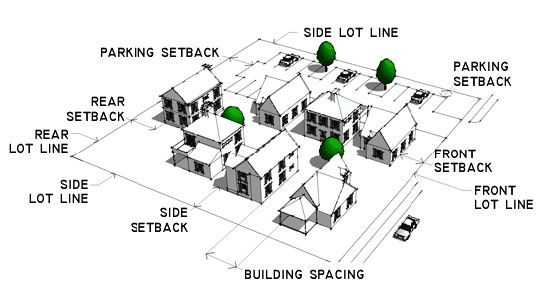
Cut-off luminaire means an outdoor lighting fixture, or luminaire, with shields, reflectors, or refractor panels which direct and cut off the light at an angle that is less than ninety degrees, in order to ensure that the light from the fixture illuminates an area of ground or wall plane without spilling over onto adjacent property or exposing a light source to view from adjacent property or rights-of-way. See Figure, Illustrative Cut-off Luminaire.
Day-care center, family and adult day-care home:
A.
Day-care center means a land use to which children are taken for care and/or educational experience, other than that of a public or private school, while parents or legal guardians are unavailable to watch the children for periods of less than eighteen hours with no land-use limit on the number of children within the facility unless otherwise specified in the facility's permit.
B.
Small family day-care home means a day-care center in the home of the person operating the facility, and providing care for no more than eight children, including children who are members of the provider's family. (Health & Safety Code § 1597.44)
C.
Large family day-care home means a day-care center in the home of the person operating the facility, and providing care for no more than fourteen children, including children who are members of the provider's family. (Health & Safety Code § 1597.46)
D.
Day health care center means a land use to which adults, generally those over the age of sixty, are taken for care or activities while the children or guardians of the adults are unavailable to watch or care for the adult. (Health & Safety Code § 1570.7)
Deck means an exterior floor supported on at least two opposing sides by an adjacent structure, and/or posts, piers or other independent supports.
Density means the total number of dwelling units permitted per acre of land. Accessory dwelling units are not counted in the total number of dwelling units when calculating density. For the purpose of applying maximum density provisions in the General Plan and this Zoning Ordinance, density is calculated in terms of a round number. If the calculated density number results in a fractional number, it shall be rounded to the next highest whole number if the fraction is one-half or more; otherwise it shall be rounded down to the next lowest whole number. Accessory and junior accessory dwellings shall not be considered part of this density calculation if it conforms to the provisions of California Government Code Section 65852.150 et seq.
Density bonus means a density increase over the otherwise maximum permitted density for residential dwelling units as specified by the zoning district.
Design review manual means a set of standards and guidelines adopted by the city council and periodically updated that provides design direction of the city's expectations regarding the aesthetics and functionality of new development, alterations to existing development, and sign proposals in the city.
Developer means any person, firm, partnership, joint venture, limited liability company, association, or corporation who participates as owner, promoter, developer, or agent in the planning, or development of a subdivision or development.
Development means any activity that occurs on a piece of property, other than a special event. The term includes any moving of dirt, fill, cut, placement of products or construction materials (other than for the purposes of staging on an adjacent parcel), the placement of a movable structure (other than a sales or construction office), and the diversion or redirection of drainage.
Development project means project for which a city building permit is required, and which project is a commercial, industrial or institutional building or structure, a residential building having five or more dwelling units and where solid waste is collected and loaded, or any residential subdivision or project where solid waste is collected and loaded in a location serving five or more dwelling units. The term does not include any application for a building permit for the alteration, enlargement, repair, improvement, conversion or renovation of an existing building or structure which does not add fifty percent or more to the existing floor area of the building or structure.
Director means the Planning Director for the City of Williams, or the person given the authority to interpret and enforce the Zoning Code by the City Administrator.
Discretionary means review and/or action, by the City which requires the exercise of judgment or deliberation that may include approval, conditional approval, or disapproval of an activity or project. Discretionary is distinguished from ministerial review whereby the Director or other decision making body merely has to determine whether there has been conformity with applicable statutes, ordinances, or regulations that would be considered non-discretionary or ministerial.
Disposal means facilities for the disposal of non-nuclear waste or fill, or the composting of organic wastes. The term includes landfill and composting facility.
District means the zoning classification with associated use and bulk regulations that apply to all parcels within the zoning classification.
Downtown fringe street lots means lots with frontage on Fifth Street, Sixth Street, Seventh Street, Eighth Street, E Street, and F Street that are zoned C-S.
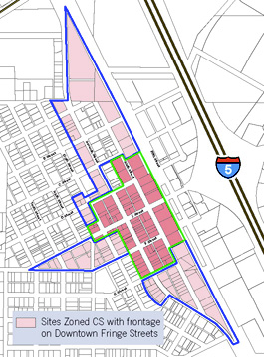
Figure 17.06.320 C
Downtown Fringe Street Lots
Drip irrigation means any non-spray low volume irrigation system utilizing emission devices with a flow rate measured in gallons per hour. Low volume irrigation systems are specifically designed to apply small volumes of water slowly at or near the root zone of plants
Drive-thru facility means a place where vehicles line up for service at designated spots and where customers are served without leaving their vehicles (except for gasoline service stations).
Driveway means a permanently surfaced area providing direct access for vehicles between a street and a permitted off-street parking or loading area and extending to a maximum width equal to the curb cut approved by the Public Works Director.
Duplex, over-under means a single-family attached unit type that includes two units that are separated by a floor that is not penetrated for the purpose of interior access between the two units. Transitional or supportive housing that complies with State of California program requirements, and that meets the City of Williams' duplex housing standards, is also included in this term.
Duplex, side-by-side, means a single-family attached unit type that includes two units that are attached along a common wall that is not penetrated for the purpose of interior access between the two units. Transitional or supportive housing that complies with State of California program requirements, and that meets the City of Williams' duplex housing standards, is also included in this term.
Duplex unit means a single-family attached unit type that includes two units that are attached along a common wall or separated by a floor that is not penetrated for the purpose of interior access between the two units. The standard duplex has side-by-side units with a common wall (the units may be divided into separate lots along the common lot line for individual fee-simple ownership). The units in the over-under duplex are located on different floors (the units may be accessed via separate outside entrances or through a common foyer area). Transitional or supportive housing that complies with State of California program requirements, and that meets the City of Williams' duplex housing standards, is also included in this term.
Dwelling unit means a habitable room or group of internally connected or more habitable rooms, designed to be occupied by one family, with facilities for living, sleeping, cooking, eating and sanitation. that has permanent sleeping, cooking, eating and sanitation facilities which constitute on independent housekeeping unit, occupied by or intended for one household on a long-term basis.
Ecological restoration project means a project where the site is intentionally altered to establish a defined, indigenous, historic ecosystem.
Effective date means the date that Ordinance No. 244-21 became effective.
Effective precipitation means the portion of total precipitation which becomes available for plant growth.
Electrical substation means a subsidiary station of an electricity generation, transmission, and distribution system where voltage is transformed.
Elevation, building means the principal vertical planes of the building. Buildings typically have four elevations: a front elevation (or front façade), two side elevations, and a rear elevation.
Emergency shelter means housing with minimal supportive services for homeless persons that is limited to occupancy of six months or less consistent with California Health and Safety Code Section 50801(e).
Employee housing means housing for employees as described in California Health and Safety Code Section 17008 and shall be subject to the provision of Health and Safety Code sections 17021.5 and 17021.6.
Encroachment means:
A.
A building or structure, or part thereof, that is located:
1.
Between a lot line and the nearest required setback line for the building or structure; or
2.
In an easement which does not allow for the building or structure; or
B.
A part of a building or structure that crosses a lot line:
1.
Into another lot under separate ownership; or
2.
Onto a right-of-way.
Established landscape means the point at which plants in the landscape have developed significant root growth into the soil. Typically, most plants are established after one or two years of growth.
Establishment period means the first year after installing the plant in the landscape or the first two years if irrigation will be terminated after establishment. Typically, most plants are established after one or two years of growth
Estimated total water use (ETWU) means the total water used for the landscape.
Evapotranspiration adjustment factor (ETAF) means a factor of 0.7, that, when applied to reference evapotranspiration, adjusts for plant factors and irrigation efficiency, two major influences upon the amount of water that needs to be applied to the landscape. A combined plant mix with a site-wide average of 0.5 is the basis of the plant factor portion of this calculation. For purposes of the ETAF, the average irrigation efficiency is 0.71. Therefore, the ET adjustment factor is (0.7)=(0.5/0.71). ETAF for a special landscape area shall not exceed 1.0. ETAF for existing nonrehabilitated landscapes is 0.8.
Evapotranspiration rate (ETo) means the quantity of water evaporated from adjacent soil and other surfaces and transpired by plants during a specified time.
Event facility or banquet hall means a facility that may temporarily hold a large number of persons that attend a special use such as a conference, ceremony, exhibit, etc. Meals may or may not be served or made available in such facilities.
Extraction means uses that involve extraction of minerals and fossil fuels from the ground, including surface and subsurface mining and quarrying facility.
Facade means an elevation of a building that provides the principal expression of the building to a street.
Factory built housing means a residential building, dwelling unit or an individual dwelling room or combination of rooms thereof or building component, assembly or system manufactured in such a manner that all concealed parts or processes of manufacture cannot be inspected before installation at the building site without disassembly, damage or destruction of the part, including units designed for use as part of an institution for resident or patient care, that is either wholly manufactured or is in substantial part manufactured at an offsite location to be wholly or partially assembled onsite in accordance with building standards published in the California Building Standards Code and other regulations adopted pursuant to California Health and Safety Code Section 19990. Factory-built housing does not include a mobile home, a recreational vehicle or a commercial modular.
Family means one or more persons occupying a dwelling and living together as a single housekeeping unit in which each resident has access to all parts of the dwelling and there is a sharing of household activities, expenses, experiences and responsibilities.
Farmer's market means a designated area where, on designated days and times, growers of farm produce and producers of value-added food products may sell directly to the public from open or semi-open facilities in accordance with these regulations.
Farm product, warehousing, processing, and storage means the work involved to turn agricultural products into sellable goods, and the housing of such goods.
Farm stand means a temporary or permanent structure or vehicle used for the sale of agricultural produce in-season, at least fifty percent of which is grown by the seller or farmers within twenty-five miles of the City limits. Farm stand operators are not itinerant vendor sales.
Farmstead means a commercial farm, all of its buildings, and the surrounding fields, operating as a unit.
Farmworker housing means housing used by farmworkers as described in California Health and Safety Code Sections 17021.5 and 17021.6.
Final map means a subdivision map supported by complete engineering data, prepared in accordance with the conditions of an approved tentative map, and in acceptable form for processing and filing for record, as provided in Title 16 of the City of Williams Code of Ordinances.
Fire chief means the Fire Chief for the City of Williams, or designee.
Flow rate means the rate at which water flows through pipes, valves and emission devices, measured in gallons per minute, gallons per hour, or cubic feet per second.
Footcandle means a unit of measure for illuminance, and is equal to one lumen per square foot.
Fortune telling means a service providing consultation which is derived from a variety of methods, such as palm and tarot card reading and astrology.
Foster care means a residence of a family or person that gives temporary day to day care to a child under the age of eighteen years who is not related to the head of such home, except in the case of relative care. The term includes any foster care home receiving a child for regular twenty-four-hour care and any home receiving a child from any state-operated institution for child care or from any child placement agency.
Foster family home means any residential facility providing twenty-four-hour care for six or fewer children which is owned, leased or rented and is the residence of the foster parent or parents, including their family, in whose care the foster children have been placed.
Front building line means a horizontal line across the portion of the primary facade of a building that is closest to the street.
General plan means broad planning guidelines for future development goals in the City that provides policy statements to achieve those development goals established in accordance with California Government Code Section 65302.
Garage sale means the temporary use of a dwelling unit or residential property to display tangible personal property for sale to the public, where the property that is offered for sale was obtained for the personal use of a resident of the premises. Garage sales are also commonly known as estate sales, yard sales, basement sales, attic sales, and rummage sales.
Green roofs means a roof of a building that is partially or completely covered with vegetation and soil, or a growing medium, planted over a waterproofing membrane with associated watering and drainage systems. Container gardens on roofs, where plants are maintained in pots, are not generally considered to be green roofs
Health care facility means any facility, place or building which is organized, maintained and operated for the diagnosis, care, prevention and treatment of human illness, physical or mental, including after convalescence and rehabilitation and including care during and after pregnancy or for any one or more of these purposes, for one or more person, to which the persons are admitted for a twenty-four-hour stay or longer. "Health care facility" shall include general acute care hospital, acute psychiatric hospital, skilled nursing facility, intermediate care facility, intermediate care facility/developmentally disabled habilitative, special hospital or intermediate care facility/developmentally disabled.
Hardscape means any durable material (pervious and non-pervious).
Heavy industry means:
A.
Primary processing or manufacturing or repair operations not specifically defined elsewhere in this section, which involve:
1.
An outside storage area that is larger than the area of the first floor of buildings on the same lot;
2.
A material risk of environmental contamination, explosion, or fire;
3.
Perceptible ground vibration;
4.
Perceptive noise or dust;
5.
Emission of objectionable odors; or
6.
More than twelve trips by semi trailer trucks per day; or
B.
Processing of minerals (except precious and semi-precious stone cutting for jewelry or precision instruments such as lasers or watches), ores, or fossil fuels; or
C.
Industries that are required to undergo new source review under the Federal Clean Air Act, or are subject to construction or operation permits pursuant to Title V of the Federal Clean Air Act.
D.
For illustrative purposes, heavy industrial uses include, but are not limited to:
1.
Coal cleaning plants with thermal dryers; coke oven batteries; carbon black plants (furnace process); petroleum refineries; petroleum storage and transfer units (except retail gasoline stations); and bulk fuel dealers;
2.
Facilities used in the primary or secondary production of metals (e.g., primary zinc, copper, or lead smelters; primary aluminum ore reduction plants; iron and steel mills; sintering plants; secondary metal production plants; and blacksmith shops);
3.
Portland cement plants;
4.
Sawmills and pulp mills;
5.
Incinerators with the capacity to charge more than two hundred fifty tons of refuse per day;
6.
Lime plants; phosphate rock processing plants; sulfur recovery plants; and hydrofluoric, sulfuric, or nitric acid plants;
7.
Fossil fuel combustion (boilers or electricity generation) totaling more than two hundred fifty million BTUs per hour of heat input;
8.
Fabrication of building materials such as countertops, drywall, and cut stone;
9.
Fabrication of vehicles, manufacturing equipment, durable goods, or pre-fabricated homes or home components;
10.
Auto or marine body, paint, or upholstery shops;
11.
Drycleaner processing plants that use PERC or comparable petrochemical solvents;
12.
Meat or seafood processing plants;
13.
Manufacture of glass products (e.g., window panes, bottles and jars), except hand-blown products;
14.
Manufacture of plastic products (except assembly of parts that are manufactured elsewhere);
15.
Plasma arc welding, cutting, gouging, surfacing, or spraying; gas welding (but not brazing); arc welding with equipment that is rated at more than two hundred amps; TIG welding; and other heavy welding procedures (e.g., for structural steel, automotive body, or heavy equipment manufacture or repair);
16.
Hot mix asphalt plants;
17.
Regional wastewater utilities;
18.
Fossil fuel power plants, waste-to-energy plants, and biomass plants that produce more than one hundred megawatts of electricity;
19.
Fossil fuel power plants.
Heavy retail, home center means retail and/or service activities that have seasonal outside service or outside storage areas, and / or larger than average enclosed floor areas devoted to commercial use, as listed below:
A.
Home centers that display and sell principally furniture, floor coverings, pianos and organs, and large appliances;
B.
Lumber and other building materials that does not cover more than twenty-four percent of the sales area;
C.
Lawn, garden equipment, and related supplies stores, where the merchandise is within an enclosure;
D.
Warehouse clubs and super stores;
E.
Recreational equipment rental where the equipment is stored within an enclosure;
Heavy retail, lumberyard and equipment means retail and/or service activities that have primarily outside service or outside storage areas, or partially enclosed structures, as listed below:
A.
Permanent retail operations that are located outside of enclosed buildings, except nurseries;
B.
Lumber and other building materials;
C.
Lawn, garden equipment, and related supplies stores, where the merchandise is displayed outdoors;
D.
Recreational equipment rental where the equipment is stored outdoors;
E.
Heavy truck or recreational vehicle leasing or sales;
F.
Manufactured home sales; and
G.
Industrial or construction equipment leasing or sales.
Helistop means an area used for the take-off and landing of private helicopters for the purpose of picking up and discharging of passengers or cargo. The use of the helistop is restricted to specific users or purposes (e.g., tenants of a corporate park; a hospital trauma center; etc.), and the term does not include facilities for general helicopter aviation use.
Hospitals/walk-in clinics/birthing center/surgical facility means hospitals, walk-in clinics, birthing centers, and medical laboratories, including general medical and surgical hospitals and specialty hospitals. The term "hospitals" does not mean alcoholism or drug rehabilitation facilities, nor does it mean primarily medical offices where patients are generally seen by appointment (although the offices may be integrated into the primary use).
Home occupation means any accessory use conducted within a dwelling, accessory building or private recreation area (such as a pool or tennis court or yard area), and carried on by the inhabitants thereof, which use is clearly incidental and secondary to the use of the dwelling for residential purposes and does not change the character thereof or adversely affect the uses permitted in the residential zone of which it is a part.
Homeowner-provided landscaping means any landscaping either installed by a private individual for a single-family residence or installed by a licensed contractor hired by a homeowner. A homeowner, for purposes of this ordinance, is a person who occupies the dwelling he or she owns. The term does not include speculative homes.
Housing development means any development project that results in adding residential dwellings or mixed use projects consisting of at least 2/3rds of the square footage of the buildings devoted to residential uses. Housing development shall also include supportive and transitional housing (also see "Affordable housing development").
Housing element means broad planning guidelines for future housing goals in the City that provides policy statements to achieve those development goals as part of the General Plan that have been established in accordance with California Government Code Section 65583.
Hydrozone means a portion of the landscaped area having plants with similar water needs. A hydrozone may be irrigated or non-irrigated.
Illuminance means the amount of light falling on a surface and is measured in footcandles.
In home childcare means a State licensed family day care home serving children where care, protection and supervision are regularly provided in the caregiver's own home for periods of less than twenty-four hours per day, while the parents or guardians are away. The permitted number of children shall include children under the age of ten years who reside at the home.
Impound yard means a place where cars towed by law enforcement are locked up.
Infiltration rate means the rate of water entry into the soil expressed as a depth of water per unit of time (e.g., inches per hour).
Invasive plant species means species of plants not historically found in California that spread outside cultivated areas and can damage environmental or economic resources. Invasive species may be regulated by county agricultural agencies as noxious species.
Irrigation audit means an in-depth evaluation of the performance of an irrigation system conducted by a Certified Landscape Irrigation Auditor.
Irrigation efficiency (ie) means the measurement of the amount of water beneficially used divided by the amount of water applied. Irrigation efficiency is derived from measurements and estimates of irrigation system characteristics and management practices. The minimum average irrigation efficiency for purposes of this ordinance is 0.71.
Junior accessory dwelling unit or JADU means a residential unit that is no more than 500 square feet in size, is contained entirely within an existing or proposed single-family structure, includes its own separate living facilities as defined in accordance with Government Code Section 65852.22, as amended from time to time.
Kitchen means any area within any structure including one or more of the following facilities that are capable of being used for the preparation or cooking of food: oven/microwave oven, stove, hotplate, refrigerator exceeding six cubic feet, dishwasher, garbage disposal, sink having a drain outlet larger than 1.05 inches in diameter and cabinets, counter space or other areas for storing food.
Lamp means a source of light, commonly referred to as a bulb.
Landscape area means all the planting areas, turf areas, and water features in a landscape design plan subject to the Maximum Applied Water Allowance calculation. The landscape area does not include footprints of buildings or structures, sidewalks, driveways, parking lots, decks, patios, gravel or stone walks, other pervious or non-pervious hardscapes, and other non-irrigated areas designated for non-development (e.g., open spaces and existing native vegetation).
Landscape project means total area of landscape in a project as defined in "landscape area" for the purposes of this Zoning Code.
Light industry means uses that involve research and development, assembly, compounding, packaging, testing, or treatment of products from previously prepared materials, with limited outside storage and limited external impacts or risks; or wholesale uses; or rental or sale of large items that are stored outside. For illustrative purposes, light industry uses include:
A.
Assembly, testing, or refurbishing of products, instruments, electronics, office and computing machines, and fixtures from pre-manufactured components;
B.
Offices of general contractors, specialty subcontractors, or tradesmen which include:
1.
Bay door access to indoor storage of tools, parts, and materials;
2.
Parking of commercial vehicles; or
3.
Outdoor storage areas that are smaller than the area of the first floor of the building that are used for storage of materials or vehicles that are less than twelve feet in height.
C.
Communications facilities, except wireless telecommunications facilities;
D.
Data centers, server farms, telephone exchange buildings, and telecom hotels;
E.
Food production and packaging other than meat and seafood processing and restaurants;
F.
Furniture making or refinishing;
G.
Manufacture of textiles or apparel;
H.
Screen printing of apparel;
I.
Printing and publishing, except copy centers (which are commercial and personal services), and except printing presses that require a Stationary Source permit or Title V permit for air emissions (which are heavy industry);
J.
Research and development, scientific testing, and product testing;
K.
Disassembly of consumer electronics and / or appliances into component parts, where all operations and storage are within an enclosed building;
L.
Manufacture or compounding of pharmaceutical products, dietary supplements, health and beauty products, and herbal products; and
M.
Packaging of products.
Live work means a townhome that includes square footage in an area that is internally separated from the residential area that is devoted to occupational endeavors.
Living area means the interior habitable area of a dwelling unit, including basements and attics, but does not include a garage or any accessory structure.
Living space means the improved interior 'habitable' area within a dwelling unit utilized for living, sleeping, eating, cooking, bathing, washing and sanitation purposes.
Local street means a local street as defined in the City of Williams Circulation Element. The term does not include an alley.
Lot means a parcel of land under one ownership used or capable of being used under the regulations of this title, and including both the building site and all required yards and other open spaces and frontage as defined in this chapter.
Lot, corner means a lot located at the junction of two or more intersecting streets with a boundary line thereof, bordering on each of such streets. The side bearing the property address shall constitute the front of the lot.
Lot of record means a lot as it is specifically drawn on a legally recorded subdivision plat.
Lot size group means a grouping of lots into small, average, and large lots by the proposed lot size.
Lot width means the average distance between side lot lines.
Low barrier navigation center means a housing shelter focused on "Housing First, low-barrier, service-enrichment for the purpose of moving people into permanent housing. In accordance with California Government Code Sections 65660 through 65668, this housing shelter use provides temporary living facilities while case managers connect individuals experiencing homelessness to income, public benefits, health services, shelters and housing.
Low volume irrigation means the application of irrigation water at low pressure through a system of tubing or lateral lines and low-volume emitters such as drip, drip lines, and bubblers. Low volume irrigation systems are specifically designed to apply small volumes of water slowly at or near the root zone of plants.
Lumen means a unit of luminous flux.
Luminaire means an entire lighting unit, including one or more lamp, reflector, refractor, diffuser, baffle, lense, and other devices to distribute the light, and parts that position and protect the lamp and connect the lighting unit to the power supply.
Major road means Freeways, Highways, Major and Minor Arterials, and Major Collectors, as identified in the City of Williams Circulation Element. The term does not include Minor Collector or Local Streets as identified in the Circulation Element.
Manufactured home means a structure constructed on or after June 15, 1976, is transportable in one or more sections, is eight body feet or more in width or 40 body feet or more in length, in the traveling mode or when erected on site, is 320 or more square feet, is built on a permanent chassis and designed to be used as a dwelling unit when connected to the required utilities and includes the plumbing, heating, air conditioning and electrical systems contained therein and which is placed on a permanent perimeter foundation. "Manufactured home" also includes any structure that meets all the requirements of this paragraph for which the manufacturer voluntarily files a certification and complies with the standards established under the National Manufactured Housing Construction and Safety Act of 1974 (42 U.S.C., Sec. 5401 and following). If not placed on a permanent foundation the manufactured home is defined as a mobile home as set forth in Section 17.02.365.
Maximum applied water allowance (MAWA) means the upper limit of annual applied water for the established landscaped area. It is based upon the area's reference evapotranspiration, the ET Adjustment Factor, and the size of the landscape area.
Medical marijuana dispensary means any facility or location where medical marijuana is made available to and/or distributed by or to three or more persons who are primary caregivers, qualified patients, or persons with an identification card, in strict accordance with California Health and Safety Code Section 11362.5 et seq.
Mined-land reclamation project means any surface mining operation with a reclamation plan approved in accordance with the Surface Mining and Reclamation Act of 1975.
Ministerial means an action taken by the City involving little or no personal judgment. Under the Zoning Ordinance, these actions might involve reviewing fixed (objective) standards involving no subjective judgement in deciding whether or how a project or activity should be carried out, such as reviewing a proposed development to comply with building height or building setback requirements of the City's regulations.
Mini-storage warehouse means a building or buildings used for storage which is divided into sub-spaces intended to be rented individually.
Minor collector means a minor collector as defined in the City of Williams Circulation Element.
Minor project means a change to a building or site where the Director has determined it to be aesthetically insignificant, or minor or incidental, and therefore not subject to design review.
Mixed housing cluster means a residential development that consists of a variety of lot sizes and more than one housing type.
Mixed use means development in which a combination of residential and commercial uses (e.g., residential-over-retail), or several classifications of commercial uses (e.g., office and retail), are located on the same parcel proposed for development.
Mobile home means a manufactured structure that was constructed prior to June 15, 1976, is transportable in one or more sections, is eight body feet or more in width or 40 body feet or more in length, in the traveling mode or when erected on site, is 320 or more square feet, is built on a permanent chassis and designed to be used as a dwelling with or without a foundation when connected to required utilities and includes plumbing, heating, air conditioning and electrical systems contained therein as set forth in Health and Safety Code Section 18008. Mobile home includes any structure that meets all the requirements of this paragraph and is either certified under the National Mobile Home Construction and Safety Act of 1974 (42 U.S.C. Section 85401 and following) or complies with state standards for mobile homes in effect at the time of construction. Mobile home does not include any automobile, trailer, camp trailer, camper, house car, motor vehicle, recreational vehicle or other vehicle defined in the California Vehicle Code, a commercial coach or a manufactured home as defined by state law.
Mobile home park means an area of land where two or more mobile home spaces are used, rented, leased or held out for use, rent or lease, to accommodate mobile homes for human habitation. For purposes of this Chapter, "mobile home park" shall not include a mobile home subdivision, stock cooperative or any park where there is any combination of common ownership of the entire park or individual mobile home spaces. This shall not include recreational vehicle parks or portions of parks that include recreational vehicle spaces.
Model homes / on-site real estate offices means a dwelling unit that is temporarily used as a model to display the layout and finishes of other dwelling units that are or will be available for sale within a subdivision or condominium development. Sales Office means: a dwelling unit within a subdivision; a dwelling unit within a condominium; or a modular unit that is temporarily used as a sales office for a subdivision or condominium.
Mulch means any organic material such as leaves, bark, straw, compost, or inorganic mineral materials such as rocks, gravel, and decomposed granite left loose and applied to the soil surface for the beneficial purposes of reducing evaporation, suppressing weeds, moderating soil temperature, and preventing soil erosion.
Multifamily means a building that includes three or more dwelling units, which are not designed as townhomes or multiplex buildings. Multifamily also means two or more residential units that are located on the upper floors of a mixed-use building. Transitional or supportive housing, that complies with State of California program requirements, and that meets the City of Williams' multifamily housing standards, is also included in this term.
Multiplex means a residential building that is constructed to look like a large single-family detached residence. Transitional or supportive housing that complies with State of California program requirements, and that meets the City of Williams' multiplex housing standards, is also included in this term.
Nadir means the direction pointing down from the lowest light emitting part of the Luminaire.
New construction means structures for which the start of construction commenced on or after the effective date.
Nonconforming building or use means a building or use which is lawfully existing at the time that provisions of this title create a situation in which the building or use is in conformity with any of such provisions.
Non-discretionary. See ministerial,
Nursery or greenhouse, wholesale or retail means an enterprise that conducts the retail and / or wholesale sale of plants grown on the premises. The terms also include, as an accessory use, the sale of a limited selection of items (e.g., soil, planters, pruners, mulch, lawn or patio furniture, garden accessories, etc., but not power equipment) that are directly related to the care and maintenance of landscapes.
Nursing home means a residential facility that is maintained primarily for the care and treatment of inpatients under the direction of a physician. The patients in such a facility require supportive, therapeutic, or compensating services and the availability of a licensed nurse for observation or treatment on a twenty-four-hour basis. Nursing care may include but is not limited to terminal care; extensive assistance or therapy in the activities of daily living; continual direction, supervision, or therapy; extensive assistance or therapy for loss of mobility; nursing assessment and services which involve assessment of the total needs of the patient, planning of patient care, and observing, monitoring, and recording the patient's response to treatment; and monitoring, observing, and evaluating the drug regimen. "Nursing home" includes intermediate nursing facilities for the mentally retarded or developmentally disabled.
Off-street parking development standards means a set of standards that have been duly adopted by the City Council, and that regulate the design and layout of parking lots, including the parking stalls, access aisles, landscaped areas, buffer yard locations, and other areas associated with the parking lot.
Official zoning map means the duly adopted zoning map for the City of Williams.
Operating pressure means the pressure at which the parts of an irrigation system are designed by the manufacturer to operate.
Outdoor recreation means public or private parks, neighborhood swimming pools, neighborhood ball fields, tennis courts, and other such uses providing recreational opportunities for the community at a neighborhood scale.
Overhead sprinkler irrigation system means a system that delivers water through the air (e.g., spray heads and rotors.
Overnight accommodations means places that offer overnight accommodations for short-term rental in increments of not less than 20 hours, including hotels and motels. This term also includes hotels that offer convention facilities or meeting rooms. This term does not include a bed & breakfast inn.
Overspray means the irrigation water which is delivered beyond the target area.
Passageway means a pathway that is unobstructed clear to the sky and extends from a street to one entrance of a separate building.
Parking lot means an area of land, a yard or other open space on a lot used for or designed for use by standing motor vehicles.
Parking space means land or space privately owned, covered or uncovered, laid out for, surfaced and used or designed to be used by a standing motor vehicle.
Patio means a hardscaped ground level area, usually (but not necessarily) paved with concrete or decorative pavers, that adjoins a home and is designed for use as an area for outdoor lounging, dining, or other comparable leisure activities.
Patio house means a home that is built on or near the side property line to allow an increased side yard on the opposite side of the home. A patio house is a detached, single-family unit typically situated on a reduced-size lot that orients outdoor activity within rear or side yard patio areas for better use of the site for outdoor living space. Transitional or supportive housing, that complies with State of California program requirements, and that meets the City of Williams' patio house standards, is also included in this term.
Figure 17.06.320 D
Patio House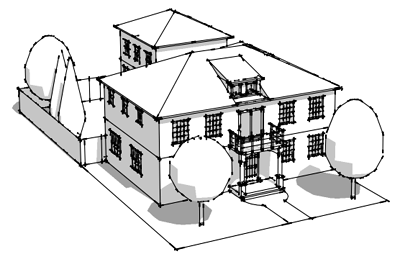
Pawn shop or pawnbroker means a business that offers secured loans to individuals, where personal property is physically held as collateral at the place of business. Property that has not purchased back by the borrower within the specified time-frame is then made available for retail sale at the place of business.
Planning commission means the Planning and Zoning Commission as established and defined under Chapter 2.24 of the City of Williams Code of Ordinances.
Plant factor means a factor that, when multiplied by ETo, estimates the amount of water needed by plants. For purposes of this ordinance, the plant factor range for low water use plants is 0 to 0.3, the plant factor range for moderate water use plants is 0.4 to 0.6, and the plant factor range for high water use plants is 0.7 to 1.0. Plant factors cited in this ordinance are derived from the Department of Water Resources 2000 publication "Water Use Classification of Landscape Species".
Person means any individual, partnership, corporation, joint stock association, trustee, receiver, assignee, or personal representative thereof. It also includes any city or state or any subdivision thereof to the extent that the City has jurisdiction over their activities that are within the scope of this Zoning Code.
Personal services means a use that provides non-medical services that are generally used on a recurring basis, and generally require one-to-one interaction between the proprietor or employee and the customer in order to provide the service. Examples of personal services include beauty and barber shops and tailoring. The phrase does not include "professional services, instruction, or counseling."
Police chief means the Police Chief for the City of Williams, or designee.
Porch, enclosed means a covered entrance to a building or structure which is enclosed by walls or windows. Porches generally project out from the main wall of the building, and may have a separate roof or a roof that is integrated with the building to which it is attached. This definition includes porches that are enclosed by solid walls that are at least 30 inches in height, used in conjunction with or instead of balustrades or railings.
Porch, open means a covered entrance to a building or structure which is not enclosed by walls or windows, but may have columns that support the porch roof and railing. Porches generally project out from the main wall of the building, and may have a separate roof or a roof that is integrated with the building to which it is attached.
Precipitation rate means the rate of application of water measured in inches per hour.
Primary dwelling unit means an existing single-family residential structure that conforms with all zoning regulations in effect
Private club means organizations or associations of persons for some common purpose, such as a fraternal, social, educational or recreational purpose, but not including clubs organized primarily for-profit or to render a service which is customarily carried on as a business. Examples of private clubs include (but are not limited to) 4-H Clubs, veterans organizations, Boy Scout and Girl Scout facilities, Elks Lodges, YMCA, YWCA, private community clubhouses, golf clubhouses, and fraternities and sororities that do not include residential facilities. The phrase "private club" does not include organizations with a principal purpose of serving alcoholic beverages to its members or others.
Priority residential infill development program means a program established by resolution of the City Council that identifies particular properties within the City that receive priority development review processing and may vary from typical design and development standards of the Zoning Code.
Professional office, general means uses in which professional, outpatient medical, or financial services are provided. The term includes:
A.
Accounting, auditing and bookkeeping;
B.
Advertising and graphic design;
C.
Architectural, engineering, and surveying services;
D.
Attorneys and court reporters;
E.
Banks, mortgage companies; and financial services;
F.
Call centers;
G.
Computer programming;
H.
Corporate headquarters;
I.
Counseling services;
J.
Data processing and word processing services;
K.
Detective agencies;
L.
Government offices;
M.
Insurance;
N.
Interior design;
O.
Medical, dental, and chiropractic offices;
P.
Real estate sales;
Q.
Research and development that does not include on-site manufacturing;
R.
Retail catalog, internet, and telephone order processing, but not warehousing; and
S.
Virtual office services.
Professional services means services that principally involve communication between the proprietor or employee and the client, and which may involve services to more than one client at a time by a single proprietor or employee, including music instruction, yoga instruction, dance instruction, martial arts instruction, marriage counseling, and financial planning. The phrase does not include "personal services."
Protective care means housing where the residents are assigned to the facility and are under the protective care of the county, state, or federal government. This use includes: jails or prisons; work release; psychiatric hospitals; and comparable facilities.
Public transit means a location, including, but not limited to, a bus stop or train station, where the public may access buses, trains, subways, and other forms of transportation that charge set fares, run on fixed routes, and are available to the public.
Rain sensor means a component which automatically suspends an irrigation event when it rains.
Recreational area means an area dedicated to active play such as parks, sports fields, and golf courses where turf provides a playing surface.
Recreation, indoor means uses that provide recreation opportunities indoors for the public (open to the community) or residents of a subdivision or development, which are not commercial in nature. Specifically excluded from the definition are health and exercise clubs and commercial amusement uses. This phrase includes:
A.
Community recreation centers;
B.
Gymnasiums;
C.
Indoor swimming pools; or
D.
Tennis, racquetball, or handball courts.
Reasonable accommodation means provision of disabled persons flexibility in the application of land use and zoning regulations and procedures or even waiving certain requirements, when necessary to eliminate barriers to housing opportunities. It may include adjustments to standards such as yard area modifications for ramps, handrails or other such accessibility improvements; hardscape additions, such as widened driveways, parking area or walkways; building additions for accessibility; tree removal; or reduced off-street parking where the disability clearly limits the number of people operating vehicles. Reasonable accommodation does not include an accommodation which would (1) impose an undue financial or administrative burden on the city or (2) require a fundamental alteration in the nature of the city's land use and zoning program.
Recreation, outdoor means uses that provide recreation opportunities outdoors for the public (open to the community) or residents of a subdivision or development, which are not commercial in nature (except for golf courses or skate parks, which may be commercial in nature). The phrase "recreation, outdoor" includes public areas for active or passive recreational activities including, but not limited to:
A.
Jogging, cycling, tot-lots, playing fields, playgrounds, outdoor swimming pools, and tennis courts;
B.
Golf courses (regardless of ownership or membership);
C.
Skate parks, manned or unmanned;
D.
Arboretums, wildlife sanctuaries, forests, and other natural areas which may be used for walking or hiking; or
E.
Other passive recreation-oriented parks, including picnic areas, and garden plots.
Recreational vehicle means a motorhome, travel trailer, park trailer, truck camper or camping trailer, with or without motor power, designed for human habitation for recreational or emergency occupancy, with an area of less than four hundred eighty square feet and consistent with California Health and Safety Code Section 1810. Recreational vehicle shall also include trailered boats.
Recycling drop off collection facility means a facility or land use, regardless of name or title, at which recoverable resources, such as newspapers, magazines, glass, metal, plastic materials, tires, grass and leaves, and similar items, except hazardous waste and medical waste are collected, cleaned, sorted, stored, flattened, shredded, dismantled, crushed, bundled, or separated by size, grade, quality, or type, and compacted, baled, or packaged for shipment or delivery for the eventual manufacture of new products.
Redevelopment means any of the following:
A.
The complete demolition of a principal building, followed by the construction of a new building which occupies a different footprint than the original principal building; or
B.
The destruction of a principal building to an extent that is equal to or greater than fifty percent of its assessed value, followed by reconstruction and repurposing of the building for a type of use for which the original building was not designed; or
C.
Expansion of a principal building by more than fifty percent of its floor area.
Rehabilitated landscape means any relandscaping project that requires a building permit or design review where the modified landscape area is equal to or greater than two thousand five hundred square feet.
Residential care facility, large means any state licensed family home, group care facility or similar facility family home, group care facility, or similar facility providing twenty-four-hour non-medical care for more than six persons in need of personal services, supervision or assistance essential for sustaining the activities of daily living or for the protection of the individual. The term includes, but is not limited to, foster care homes.
Residential care facility, small means any state licensed family home, group care facility or similar facility family home, group care facility, or similar facility providing twenty-four-hour non-medical care for up to six persons in need of personal services, supervision or assistance essential for sustaining the activities of daily living or for the protection of the individual. The term includes, but is not limited to, foster care homes.
Restaurant, drive-in or drive-through means a restaurant located either within a retail center, or situated on its own freestanding pad, which:
A.
Contains a drive-in or drive-through facility;
B.
Primarily serves food that is prepared and packaged within five minutes; and
C.
Customarily serves food in disposable containers.
Restaurant, no drive-in or drive-through means an establishment that serves prepared meals to customers for consumption on-site or off-site, but does not include drive-in or drive-through facilities (but may include designated parking spaces for "curbside pickup" of food ordered in advance if the curbside pickup is a clearly subordinate function to the restaurant's operations), and includes:
A.
Full-service restaurants;
B.
Limited-service eating facilities; and
C.
Special food services.
Salvage yard means any site, or portion of a site, that is used to store used equipment and/or construction materials for the purpose of future reuse or resale. If a salvage yard is located on the same site as another established use, the salvage yard area shall be considered a separate freestanding primary use, even if it serves all or a portion of the other established use.
Sanitarium means a hospital or institution for the treatment of chronic diseases or for medically supervised recuperation.
Secondary dwelling unit refers to accessory and junior accessory dwelling unit.
Secondhand goods means any goods, objects, clothes, furniture, art, appliances, or wares that have been previously purchased and/or used and which are not antiques.
Secondhand store means a store or shop that primarily sells goods, objects, clothes, furniture, art, appliances or wares that have been previously purchased and/or used and which are not antiques.
Self storage means an establishment that offers for rental, lease, or ownership of individual bays that are intended for the storage, warehousing, or safe-keeping of goods or possessions, regardless of the duration of such storage, warehousing, or safe-keeping.
Setback, alternative means a flexible distance regulation that may be applied instead of the general setback if the alternative setback would result in a structure that is compatible with the development pattern in the immediate neighborhood.
Setback, general means a minimum distance that is required from a lot line to a building, structure, or sign, as the context requires.
Senior Independent Living Center (SILC) means a multiple residential structure(s) that provide housing for occupants who are fifty-five years or older. In the case of double occupancy of a unit, only one resident is required to be at least fifty-five years of age. Such a center shall consist of, but not be limited to, individual units, community dining centers, and common recreation areas. The facilities are physically accessible to elderly citizens. The individual units may be in the form of multiplexes, cottages, townhouses, patio homes, or single-family homes. Generally, senior independent living centers will provide two meals per day, provide transportation for residents, and offer indoor and outdoor recreational areas.
Sidewalk means any public walkway, right-of-way, easement, or fee ownership used or available for pedestrian circulation and/or access.
Sidewalk dining means the use of a portion of a sidewalk for outdoor consumption of food and beverages.
Sign-related definitions:
A.
Sign means any sign, identification, display, illustration, device or visual representation designed and used for the purpose of communicating a message, advertising, and/or identifying or attracting attention to a premises, product, service, person, activity, business or event, and shall include all of its structure and component parts. "Sign" shall not include any flag of the United States of America or State of California, or any display of merchandise outside of a business.
B.
Sign area means the entire area in square feet of a sign within a single continuous perimeter composed of squares, rectangles, circles or other shapes which enclose the extreme limits of the sign, including all background or structural material that is utilized in the expression of the message. The sign area of a multifaced sign shall be the sum of the face areas, except where the sides are parallel, back to back and separated by no more than eighteen inches, in which case it shall be determined by the larger of the faces.
C.
Abandoned sign means a sign that no longer applies to the business, property or site due to the closing of a business, lack of a business license, change in the business name, or for any other reason rendering the sign not applicable to the parcel involved, or any sign that is not maintained in a safe and good condition, including the replacement of defective parts, painting, repainting and cleaning.
D.
Attached sign means any sign attached to, made a part of, or included on any building surface (also known as a wall sign).
E.
Billboard means an off-premises sign, primarily, but not exclusively used for a commercial purpose, and designed for changing copy.
F.
Communal tenant sign means a pole sign advertising three or more businesses.
G.
Directional sign means a sign that contains instructions or directions for locating a business, service or use.
H.
Exterior illuminated sign means a sign illuminated from any light source outside the sign that is intended to illuminate the sign, and does not include illumination from background street lights, parking area lights, and other exterior lights.
I.
Freestanding sign means an appurtenant sign that has its own support structure placed on or in the ground and is not attached to a building.
J.
Height of sign means the height of a sign measured by the vertical distance from the average grade of the adjacent ground level within five feet of the base of the sign to the uppermost top of the sign. If a sign is located on a building or structure, the height of the sign shall be measured from the ground level on which the building or structure is located.
K.
Identification sign means a sign that identifies a residential area, shopping center or shopping district, industrial area or industrial district, or other residential, commercial or industrial site or area containing a minimum of two acres with an integrated site and design plan creating a single unified development with one or more uses.
L.
Interior illuminated sign means a sign illuminated from a light source that is contained within the sign.
M.
Linear frontage means the linear distance in feet that any parcel fronts on any city street, and shall not include alley frontage or Interstate 5 frontage.
N.
Off-premises sign means a sign which advertises or directs attention to a business, product, place, activity, service or event sold, offered or provided upon a parcel in the City of Williams other than the parcel where the sign is located or to which it is attached.
O.
On-premises sign means a sign which advertises or directs attention to a business, product, place, activity, service or event sold, offered or provided upon a parcel in the City of Williams where the sign is located or to which it is attached.
P.
Multiple business center means a group of businesses that functions as an integral unit on a single parcel, or on contiguous parcels under the same management, and that utilizes common off-street parking and access (e.g., shopping center).
Q.
Pole sign means a freestanding sign which is supported by itself, one or more uprights, poles, or braces in or upon the ground or by a structure other than a building.
R.
Political sign means a sign which is used for the express purpose of identifying a candidate for elected office, political party, campaign issue, ballot measure or proposition, or other related political matter concerning any national, state or local election. Sandwich Sign and/or Portable Freestanding Sign.
S.
Sandwich sign and/or portable freestanding sign means a sign that is designed to be movable and is not structurally attached to the ground, a building, a structure, or any other sign. Such sign may or may not be in the configuration of an A.
T.
Temporary sign means any sign, pendant, banner, streamer, flag, poster, balloon or other display intended to identify or advertise an event, occurrence or matter of temporary nature, limited duration and/or present interest only.
Single-family attached housing means a residence housing a maximum of one family that may have a firewall dividing it from an adjacent similar unit, where under the regulations of this Zoning Code no yard is required to separate the units. Transitional or supportive housing that complies with State of California program requirements, and that meets the City of Williams' single-family attached housing standards, is also included in this term.
Single-family attached cluster means a development of single-family attached dwelling units that are arranged to provide common open spaces, sized according to minimum open space ratios that are established by this Zoning Code. Transitional or supportive housing that complies with State of California program requirements, and that meets the City of Williams' single-family cluster housing standards, is also included in this term.
Single-family detached housing means a residence housing a maximum of one family located on an individual lot with a yard on each side of the unit. Transitional or supportive housing that complies with State of California program requirements, and that meets the City of Williams' single-family detached housing standards, is also included in this term.
Single-family detached cluster means a development of single-family detached dwelling units that are arranged to provide common open spaces, sized according to minimum open space ratios that are established by this Zoning Ordinance. Transitional or supportive housing that complies with State of California program requirements, and that meets the City of Williams' single-family cluster housing standards, is also included in this term.
Single room occupancy shall mean a structure with a small residential room or more rooms designed to provide living facilities for one person, often with cooking facilities and with private or shared bathroom facilities. These structures are also defined in the California Government Code, including but not limited to Section 65580 et seq., and the requirements of the California Health and Safety Code Section 17000 et seq.
Special landscape area (SLA) means an area of the landscape dedicated solely to edible plants, areas irrigated with recycled water, water features using recycled water and areas dedicated to active play such as parks, sports fields, golf courses, and where turf provides a playing surface.
Specialized structures and building appurtenances means:
A.
Roof structures for the housing of elevators, stairways, tanks, or similar equipment required to operate and maintain the building;
B.
Architectural towers, steeples, flagpoles, ventilating fans, chimneys, smokestacks (except as provided in subsection D., below);
C.
Skylights, photovoltaic (solar-electric) panels, and solar water heaters; and
D.
Satellite dishes and antennae that are regulated in this Zoning Code.
Specialty use means a commercial use that includes, but is not limited to:
A.
Tattoo parlors;
B.
Shops where smoking tobacco and other products is permitted, such as a cigar shop or hookah bar;
C.
Shops that principally sell paraphernalia associated with the use of illicit drugs, such as water pipes, roach clips, glass pipes, pipe screens, vaporizers, rolling papers, rolling machines, scales or balances, blacklight-responsive posters, incense, cigarette lighters, whipped-cream chargers and taps, and products claimed to give false negative results for drugs on urinalysis tests;
D.
Secondhand stores;
E.
Retail stores that stock some sexually related goods but not at the volume where they are classified as a sexually oriented business;
F.
Movie rental stores and theaters that offer some sexually explicit movies but not at the volume where they are classified as sexually oriented businesses;
G.
Pawn shops;
H.
Bail bonds;
I.
Fortune telling; and
J.
Payday loans and check cashing stores.
Sphere of influence means the area outside of and adjacent to the Williams City Limits, where authority has been granted to the City by the State of California for potential future annexation areas.
Station, as it relates to irrigation, means an area served by one valve or by a set of valves that operate simultaneously.
Storage yard means any site, or portion of a site, that is used for to store new equipment and/or construction materials for the purpose of future use or sale. If a storage yard is located on the same site as another established use, the storage yard area shall be considered a separate freestanding primary use, even if it serves all or a portion of the other established use.
Streamline housing means a housing development project that meets the qualifications of Government Code Section 65913.4 and therefore is eligible for a ministerial and streamlined approval process (refer to Section17.01.050.13).
Street means a public or permanent private way twenty-five feet or more in width which affords a primary means of access to property.
Structure means anything constructed or erected upon the ground or attached to a structure having location on the ground.
Subdistrict means a subcategory of a main zoning classification, where the use regulations are uniform throughout the subcategories but the bulk regulations will differ by subcategory.
Supportive housing means housing with no limit on length of stay, that is occupied by the target population, and that is linked to an onsite or off-site service that assists the supportive housing resident in retaining the housing, improving his or her health status, and maximizing his or her ability to live and, when possible, work in the community.
Swing joint means an irrigation component that provides a flexible, leak-free connection between the emission device and lateral pipeline to allow movement in any direction and to prevent equipment damage.
Tandem parking means that two or more automobiles are parked on a driveway or in any other location on a lot, lined up behind one another.
Townhouses, weak link and standard means attached units where the units are lined up in a row with units sharing side walls. The weak-link townhouse has both a one- and two-story portion of each unit and is therefore wider than the standard townhouse.
Figure 17.06.320 E
Weak-Link Townhouses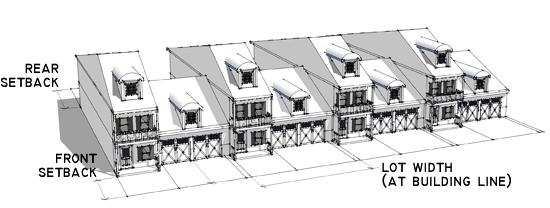
Traditional neighborhood development means development that consists of a variety of residential lot sizes and more than one housing type, along with neighborhood supportive nonresidential development, designed so that its internal streets tend to give equal or greater dignity to the pedestrian compared to the automobile.
Transitional housing means buildings configured as rental housing developments, but operated under program requirements that require the termination of assistance and recirculation of the assisted unit to another eligible program recipient at a predetermined future point in time that shall be no less than six months from the beginning of the assistance.
Trucking means storage; warehousing and distribution that are part of the operation of a light industrial or heavy industrial facility, and parcel service drop-off locations that are part of the operation of a parcel service processing facility. Trucking also means trucking facilities for the service and storage of trucks and large equipment, excluding salvage materials.
Turf means a ground cover surface of mowed grass. Annual bluegrass, Kentucky bluegrass, Perennial ryegrass, Red fescue, and Tall fescue are cool-season grasses. Bermuda grass, Kikuyu grass, Seashore Paspalum, St. Augustine grass, Zoysia grass, and Buffalo grass are warm-season grasses.
Understory trees means a tree whose leaves would occupy the intermediate level of a forest in a natural ecological situation, generally not exceeding 20 to 30 feet at maturity. These trees are also called small or ornamental trees.
Use means the activity for which land or buildings are designed, occupied or maintained.
Vacation rental means a residential dwelling unit or other living area within a dwelling unit that is provided for compensation for fewer than thirty consecutive days.
Valet parking means a parking service whereby attendees deliver vehicles to a managed location.
Veterinarian, large animal means an animal hospital or clinic that provides services for horses and other livestock.
Veterinarian, small animal means veterinary clinics and hospitals that provide care for small domestic animals such as dogs, cats, and birds. The term does not include large animal and livestock veterinarians.
Waste transfer station means the use of land or a facility, regardless of name or title, to unload waste of any kind or type from vehicles, and, with or without intermediate processing such as compaction, sorting, or shredding, subsequently re-load the waste onto other vehicles for delivery to another transfer site, storage site, or disposal site. The phrase "waste transfer station" includes a facility for drop-off of recyclable materials (e.g., waste paper, motor oil, scrap metal, polystyrene foam, porcelain, batteries, electronic components, textiles, plastics, discarded shoes, cardboard, and other discarded household materials), where the materials are sorted, temporarily stored, and then shipped in bulk to other locations for processing. The phrase "waste transfer station" does not include a wastewater treatment facility.
Water feature means a design element where open water performs an aesthetic or recreational function. Water features include ponds, lakes, waterfalls, fountains, artificial streams, spas, and swimming pools (where water is artificially supplied). The surface area of water features is included in the high water use hydrozone of the landscape area. Constructed wetlands used for on-site wastewater treatment or stormwater best management practices that are not irrigated and used solely for water treatment or stormwater retention are not water features.
Water use classification of landscape species (WUCOLS) means the document thus entitled and published by the University of California Cooperative Extension, the Department of Water Resources, and the Bureau of Reclamation, 2000.
Watering window means the time of day irrigation is permitted.
Wholesale means an establishment or place of business primarily engaged in selling and / or distributing merchandise to retailers; to industrial, commercial, institutional, or professional business users, or to other wholesalers; or acting as agents or brokers and buying merchandise to such individuals or companies. The use is not considered a general commercial use.
Wireless telecommunication facilities, attached facilities means an antenna that is fully supported by an existing structure, light pole, flag pole, or other object. The term does not include amateur radio operators' antennae that are less that fifty feet from the ground to its highest point.
Wireless telecommunication facilities, non-stealth facilities means a tower or pole that holds antennae. The term does not include amateur radio operators' antennae that are less that fifty feet from the ground to its highest point.
Wireless telecommunication facilities, stealth facilities means a tower that has been designed to blend in with its environment. The term does not include monopoles unless their design has been altered to blend in with its environment. The term does not include amateur radio operators' antennae that are less that fifty feet from the ground to its highest point.
Yard means land unoccupied or unobstructed, except for such encroachments as may be permitted by this title, surrounding a building site.
Yard, front means a yard extending across the full width of the lot measured between the street line (or the lot line connected to a street by legal access) and the nearest line of the main building or enclosed or covered porch. For purposes of determining yard setbacks only, the front yard of a corner lot is the yard adjacent to the shortest street frontage, or may be the side of the lot which contains the street address where the front door is located, as determined by the Director.
Yard, rear means a yard extending between the side yards of the lot and measured between the rear line of the lot and the rear line of the main building or enclosed or covered porch nearest the rear line of the lot.
Yard, side means a yard on either side of the lot extending from the front yard to the rear lot line, the width of each yard being measured between the side line of the lot, and the nearest part of the main building or enclosed porch.
Zone district, zoning district, or district means an area of the City delineated on the official zoning map, designated by name or abbreviation as provided in the regulations of this Zoning Code.
(Ord. No. 244-21, § 1, 7-21-2021)

