
Wilmington City Zoning Code
TITLE ELEVEN
SITE DEVELOPMENT PROVISIONS14
Editor's note—Ord. No. O-18-68, §§ 2, 3(Exh. A), adopted Dec. 20, 2018, repealed the former Tit. Eleven, Chs. 1161—1169, and enacted a new Tit. Eleven as set out herein. The former Tit. Eleven pertained to additional requirements and derived from Ord. No. 1003, 7-25-63; Ord. No. 1389, 1-4-73; Ord. No. 1928, 6-19-80; Ord. No. 3783, 8-7-97; Ord. No. 3809, 10-16-97; Ord. No. 3994, 12-29-99; Ord. No. 4781, 8-21-08; Ord. No. 4811, 12-4-08; Ord. No. 5022, 4-19-12; Ord. No. 5037, 7-5-12; Ord. No. 5066, 11-15-12; Ord. No. O-16-54, 8-4-16.
Sec. 1165.01. - Purpose.
(a)
The purpose of this chapter is to protect and promote the public health, safety, general welfare, and beautification of Wilmington by establishing minimum standards for the design, installation, and maintenance of landscaping along public thoroughfares, within buffer areas, between uses, on the interior of a site, within parking lots, and adjacent to buildings. Landscaping is viewed as a critical element contributing to aesthetics, development quality, environmental integrity, stability of property values, and the overall character of the City.
(b)
The landscape standards of this chapter are considered the minimum necessary to achieve the intent. In several instances, the standards are intentionally flexible to encourage creative design and to reflect unique conditions and accommodate the specific circumstances of a site. Applicants are encouraged to provide additional landscaping to improve the function, appearance, and value of their property.
(c)
It is the specific intent of this chapter to require the installation and maintenance of buffering between residential uses of land and non-residential land uses; to require the installation and maintenance of landscaping around the perimeter of and within off-street parking facilities and other vehicular use areas outside of public right-of-way, and to require the planting of street trees in an effort to foster community wide reforestation.
(d)
It is not intended by this chapter that a business should screen its sign from public view, but incorporate and accentuate the sign through the use of landscaping. Any business which normally displays its product outdoors (e.g. automobile dealerships, lumber yards, produce stands, garden centers, etc.) should enhance its product through the use of landscaping.
(Ord. No. O-18-68, § 3(Exh. A), 12-20-18)
Sec. 1165.02. - Compliance and maintenance.
(a)
Wherever any property is affected by these landscape requirements, the property owner or developer shall prepare and submit a landscape plan to the Zoning Administrator in a form and number as established by the Building Department.
(b)
Where landscaping is required, no building permit shall be issued until the required landscaping portion of the site plan or zoning permit application has been submitted and approved.
(c)
All required landscaping and buffering shall be installed prior to the issuance of a zoning certificate of occupancy. If weather conditions necessitate a delay in installation of landscaping, a zoning certificate of occupancy may be issued only if collateral is filed with the City in an amount designated by the Building Department, along with a schedule of completion, and a development agreement. The amount of the collateral will reflect 125 percent of the estimated cost of purchasing and installing the landscaping.
(d)
Initial maintenance of all landscaping is the responsibility of the builder/developer, but may be assumed by the owner/occupant on the date of occupancy. If so, a written agreement between the builder/developer and owner/occupant shall be made, and a copy filed with the City. The agreement shall delineate the responsibility for continuous maintenance and the replacement of all unhealthy or dead plant material during first two years of occupancy.
(Ord. No. O-18-68, § 3(Exh. A), 12-20-18)
Sec. 1165.03. - Applicability.
(a)
New developments. For all new property developments, the provisions of this chapter shall apply to the entire site involved.
(b)
Substantial expansions of existing developments. The provisions of this chapter shall apply to the entire site when substantial expansion of an existing development occurs in one or more of the following manners:
(1)
Substantial expansion of existing structures, which shall be defined based on the criteria established in the table below:
(2)
Substantial expansion of an existing parking area, defined as an expansion which exceeds 25 percent of the square footage of the existing parking area. For the purpose of this chapter, parking areas shall include parking spaces, parking aisles, access drives, and loading areas.
(c)
Minor expansions of existing developments. When neither (b)(1) nor (2) applies for an existing development, the provisions of this chapter shall only apply to the affected area(s) of the site.
(Ord. No. O-18-68, § 3(Exh. A), 12-20-18)
Sec. 1165.04. - General standards.
(a)
Effectiveness. At the time of installation, landscaping, screening and buffering elements shall be immediately effective in meeting the objectives of this chapter, and shall maintain that effectiveness as the plant materials mature.
(b)
General location. Landscaping shall be installed in locations such that, when mature, it does not obscure traffic signs or light nor obstruct access to fire hydrants nor interfere with adequate motorist sight distance or overhead utility lines.
(c)
Existing landscape materials. Unless otherwise noted, existing landscape material in healthy condition can be used to satisfy the requirements of this chapter in whole or in part provided that the existing landscape material meets the minimum standards of this chapter. The Zoning Administrator shall determine satisfaction of this requirement.
(d)
Easements. Required landscaping shall not be installed within any underground or overhead utility, drainage, or gas easement without the consent of the easement holder.
(e)
Landscaping materials. Existing vegetation shall be preserved as much as possible in accordance with acceptable nursery industry standards. The following items are suitable for landscaping materials used individually or in combination with each other, subject to the requirements of this Zoning Code and the review and approval by the Zoning Administrator.
(1)
Walls and fences. In addition to any other requirements for walls and fences established in this Zoning Code, walls and fences used to fulfill the buffering/landscaping/screening requirements of this chapter shall be subject to the following:
a.
Walls and fences are limited to four feet high in the front yard or as the Planning Commission requires.
b.
When walls or fences are used to fulfill screening requirements, a detailed drawing shall be shown on the plan.
c.
When materials are not otherwise specified, walls and fences shall be constructed of weather-proof and non-corroding materials such as pressure treated or painted lumber, redwood, cedar, vinyl, aluminum, brick veneer, or galvanized metal. Under no circumstances shall a wall be constructed of unfinished concrete or cinder block.
d.
Chain link fences shall not be allowed to satisfy the buffering and screening requirements of this chapter.
e.
Walls and fences shall be designed to orient the best or most attractive side away from the subject lot, or be equally attractive on both sides.
(2)
Plants.
a.
All plant materials shall be installed and maintained according to accepted nursery industry procedures. The owner of the property shall be responsible for the continued property maintenance of all landscaping materials and shall keep them in a proper, neat, and orderly appearance free from refuse and debris at all times.
b.
Plants shall be non-invasive and should be selected based on insect and disease resistance and long life expectancy.
c.
Unhealthy and dead plants shall be replaced within one year, or by the next planting season, whichever comes first. The determination of whether a plant is unhealthy shall be at the discretion of the Zoning Administrator or a recognized landscape professional.
(3)
Species diversity.
a.
When fewer than 40 trees are required on a site, at least two different species shall be utilized, in roughly equal proportions. For deciduous trees, no more than 12 trees of any one variety shall be used.
b.
When 40 or more trees are required on a site, at least three different species shall be utilized, in roughly equal proportions. For deciduous trees, no more than 12 trees of any one variety shall be used.
c.
Required shrubs shall utilize the same species diversity requirements.
(4)
Earth mounds.
a.
Earth mounds shall conform to the grading requirements of the Clinton County Soil and Water Conservation District and shall be designed to not be an impediment for drainage.
b.
The slope of any berm or earth mound shall not exceed a 3:1 ratio.
c.
Landscaping plant materials may be installed on berms and earth mounds and shall be arranged in an irregular pattern to accentuate the physical variation and to achieve a natural appearance.
d.
Berms and earth mounds shall be located and designed to minimize the disturbance of existing trees located on, or adjacent to, the site.
e.
Adequate ground cover shall be used and maintained to prevent erosion of the earth mound.
f.
No mound wastewater treatment system or other similar on-site wastewater treatment system shall count toward the buffering requirement.
(5)
Ground cover. Grass or ground cover shall be planted on all portions of required buffer yards and landscaped areas not occupied by other landscaped material.
(Ord. No. O-18-68, § 3(Exh. A), 12-20-18)
Sec. 1165.05. - Perimeter buffer requirements.
(a)
Applicability.
(1)
When applicable. The table in Section 1165.05.3 sets forth the minimum perimeter buffers required for a new or expanded use based upon adjacent land uses. The table is applicable to all uses listed, except as provided in subsection (2) below.
(2)
Exceptions.
a.
No perimeter buffer is required to abut public right-of-way, except as required for major subdivisions in Section 1165.06 (Thoroughfare buffer yard requirements).
b.
Driveways and parking areas are prohibited within the required perimeter buffer area, except for cross-access purposes.
c.
Development within the Downtown Core (DC), Downtown Transition (DT), and Traditional Neighborhood (TN) districts shall be exempt from the provisions of Section 1165.05 (Perimeter Buffer Yard Requirements).
d.
The Planning Commission may determine during site plan review that one or more of the following will serve as a sufficient substitute for the required perimeter buffer:
1.
An increased setback of all structures, parking areas, and all other impervious surface areas, to no less than 100 feet from the property lines of adjacent uses requiring a buffer; or
2.
A solid wood or masonry fence at least six feet in height along the full length of all property lines of adjacent uses requiring a buffer, and supplemented with a minimum of six deciduous trees and five shrubs per 100 lineal feet of buffer area; or
3.
An existing naturally wooded/vegetated area of sufficient size, width, and density on the development property that will effectively serve as a buffer.
(b)
Buffer types.
(1)
Buffer Type A.
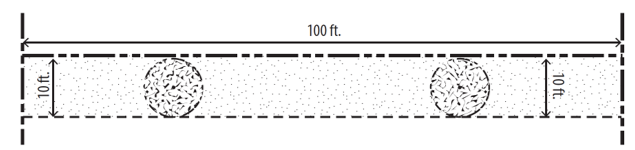
Buffer Type A, as shown above and abbreviated as an "A" in Section 1165.05.3 (Schedule of Required Buffers), consists of:
a.
A ten foot wide buffer area.
b.
One deciduous or evergreen tree per every 40 lineal feet.
c.
No minimum screen height, unless required by the Planning Commission.
(2)
Buffer Type B.
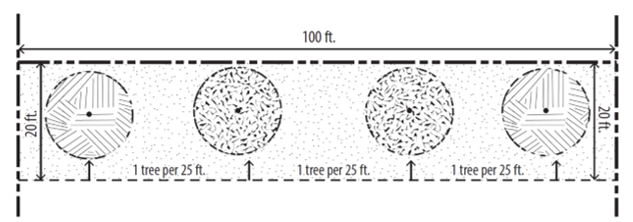
Buffer Type B, as shown above and abbreviated as a "B" in Section 1165.05.3 (Schedule of Required Buffers), consists of:
a.
A 20 foot wide buffer area.
b.
One tree per 25 lineal feet with a minimum of 40 percent evergreen trees.
c.
A minimum screen height of six feet.
(3)
Buffer Type C.
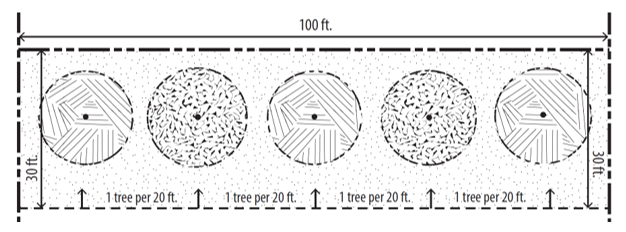
Buffer Type C, as shown above and abbreviated as a "C" in Section 1165.05.3 (Schedule of Required Buffers), consists of:
a.
A 30 foot wide buffer area.
b.
One tree per 20 lineal feet with a minimum of 50 percent evergreen trees.
c.
A minimum screen height of eight feet.
(4)
Buffer Type D.
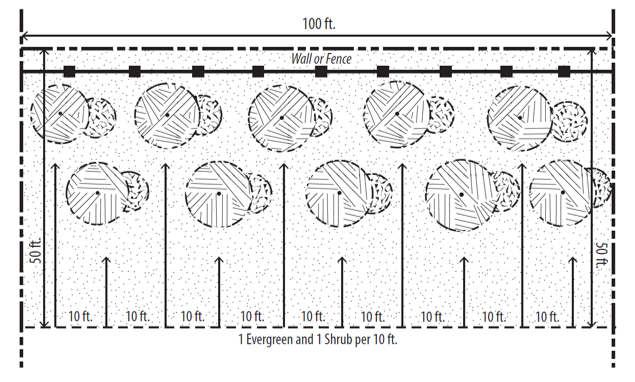
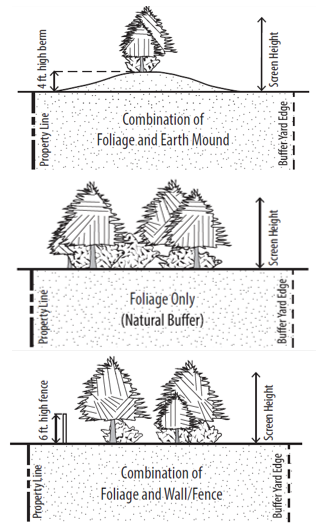
Buffer Type D, as shown above and abbreviated as a "D" in Section 1165.05.3 (Schedule of Required Buffers), consists of:
a.
A 50 foot wide buffer area.
b.
One evergreen and one shrub per ten lineal feet along the residential side of the wall or fence. At the time of planting, evergreens shall be a minimum height of five feet.
c.
Landscaping and/or screening elements collectively consisting of trees, shrubs, fencing/walls, or berms, to a minimum screen height of ten feet and installed to 100 percent opacity. Cross-section examples of different combinations of natural and man-made features to achieve the screen height and 100 percent opacity requirements are shown at left.
(c)
Schedule of required buffers. The table below sets forth the minimum required perimeter buffers required for a new or expanded use based upon adjacent land uses. Where an abutting property falls under more than one of the abutting land use categories listed, the most stringent perimeter buffer requirements shall be applied.
* Industrial use activities in this category must be fully enclosed within a structure.
(Ord. No. O-18-68, § 3(Exh. A), 12-20-18)
Sec. 1165.06. - Thoroughfare buffer requirements.
(a)
Applicability. The requirements of this section shall apply to major residential subdivisions proposed within the Rural Residential (RR) District or Suburban Neighborhood (SN) District, including those proposed as a Planned Unit Development (PUD) Overlay where requirements may be modified per the PUD process.
(b)
Requirements. A thoroughfare buffer is required along a subdivision boundary that abuts a major thoroughfare, as may be determined by the City Engineer and/or classified by official plans of the City (e.g. thoroughfare plan), and shall utilize one of the following design options:
(1)
Option 1. Buffer width less than 100 feet:
a.
A landscaped berm seven feet high located outside the road right-of-way and also outside of utilities easements unless approved, or;
b.
Seven trees and seven shrubs per every 100 feet of road frontage.
(2)
Option 2. Buffer width equal to or greater than 100 feet and less than 300 feet:
a.
A landscaped berm four feet high located outside of the road right-of-way and also outside of utilities easements unless approved, or;
b.
Five trees and five shrubs per every 100 feet of road frontage.
(3)
Option 3. Sufficient existing vegetation effectively screens and maintains rural character. The buffer shall be maintained in its natural state.
(c)
Additional standards. The following additional standards shall apply to thoroughfare buffers required in Section 1165.06.2 (Requirements):
(1)
The minimum height of a deciduous or evergreen tree at the time of planting shall not be less than six feet in height. Required trees shall be arranged to provide the maximum screening effect.
(2)
Height of a required berm shall be measured from the elevation of the paved roadway.
(3)
Existing vegetation may be used to satisfy the buffer requirements as determined by the Planning Commission. To qualify, trees shall be two inches or greater in caliper.
(4)
The buffer area shall be owned and maintained in one of the following manners:
a.
Owned by a homeowners' association and maintained by such association; or
b.
Owned by a private lot owner with an easement placed upon the buffer area to allow for maintenance by a homeowners' association or similar organization.
(Ord. No. O-18-68, § 3(Exh. A), 12-20-18)
Sec. 1165.07. - Landscaping in vehicular use areas.
(a)
Applicability. Parking and/or loading areas that are more than 50 spaces or over 10,000 square feet of area are subject to the requirements of this section.
(b)
Interior landscaping requirements.
(1)
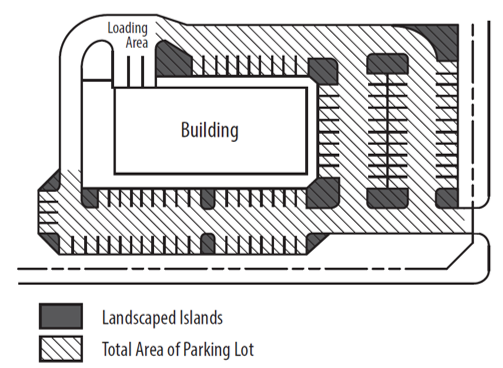
Minimum area. Ten percent of the total parking area shall contain islands for landscaping. The calculation of the total parking area shall be based on the image shown below.
(2)
Island dimensions/area. Islands shall be a minimum of eight feet in width and have a minimum area of 144 square feet.
(3)
Distribution. Islands shall be designed and distributed with the following standards:
a.
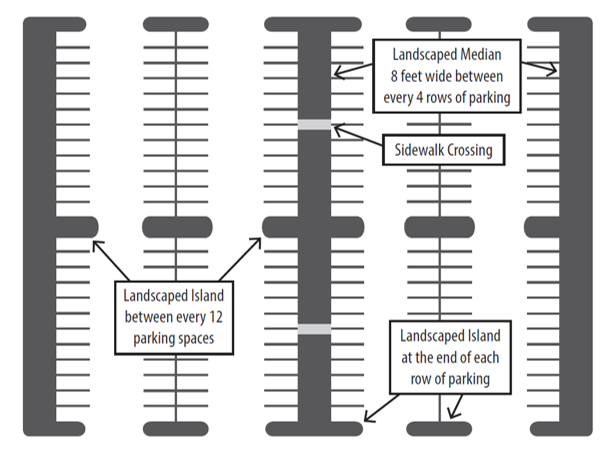
Islands shall be required at the end of each parking row. See the image below.
b.
A maximum of 12 parking spaces in a row can occur before a landscaped island is required. See the image below.
c.
A continuous island is required every four rows and must include a pedestrian sidewalk crossing every 60 feet to allow for safe automobile and pedestrian circulation. See the image below.
(4)
Trees and shrub specifications. The following standards shall apply to islands within parking areas:
a.
All trees shall have, at minimum, a one and three-fourths inch diameter, as measured six inches above the ground, at the time of planting.
b.
There shall be a four foot minimum distance to all tree centerlines from the edge of the parking area.
c.
For single-loaded parking rows, end islands and middle islands must contain at least one tree and five shrubs.
d.
For double-loaded parking rows, end islands and middle islands must contain at least two trees and four shrubs.
e.
For continuous islands, one tree and five shrubs per every 40 lineal feet is required.
f.
Trees shall retain visibility near the ground and provide for a clear sight distance.
g.
Shrubs shall not exceed more than three feet in height or be placed in a location that could cause a traffic or visual hazard.
(c)
Perimeter landscaping requirements.
(1)
Perimeter adjacent to property line.
a.
The provisions of this subsection (1) shall only apply to properties located within the Downtown Core (DC), Downtown Transition (DT), and Traditional Neighborhood (TN) districts. Perimeter landscaping in all other districts, irrespective to the presence of surface parking, is subject to the standards of Section 1165.05 (Perimeter Buffer Requirements).
b.
Vehicular use areas shall maintain a minimum perimeter planting strip along adjacent private property lines with an average width of eight feet unless the vehicular use area is adjacent to or a continuation of a vehicular use area on an adjacent property.
c.
Along adjacent properties the minimum planting strip width may be reduced to five feet through the provision of an ornamental metal fence or masonry wall constructed in accordance with the following:
1.
The wall or fence shall have a minimum height of three feet and a maximum height of six feet;
2.
A masonry wall shall have a minimum opacity of 75 percent of the entire wall surface along any single lot line;
3.
The wall or fence shall be supplemented with 24 inch high evergreen shrubs planted between the fence/wall and the property line a maximum of four feet on center.
(2)
Perimeter adjacent to right-of-way.
a.
The provisions of this subsection (2) shall apply to all zoning districts.
b.
For vehicular use areas located in the front and side yards, there shall be a perimeter adjacent to public rights-of-way, consisting of grass/ground cover and required landscaping, with a minimum width of ten feet as measured from the outer edge of the vehicular use area to the right-of-way.
c.
Within the perimeter area there shall be a planting strip containing a continuous hedge composed of shrubs with a minimum planting height of 18 inches and a maximum on-center spacing of four feet. Up to 50 percent of the shrubs may be deciduous.
d.
In addition to the required shrubs, the planting strip shall include canopy trees that shall be provided at a rate of three trees per 100 lineal feet of the perimeter of the vehicular use area. Clustering or grouping of these trees is permitted.
e.
Understory or ornamental trees may be used in areas where the presence of overhead utilities prevents the use of canopy trees.
f.
Trees may be planted in front of, behind, or within the hedge, as long as a continuous hedge is maintained.
(Ord. No. O-18-68, § 3(Exh. A), 12-20-18)
Sec. 1165.08. - Overall site landscaping.
(a)
Applicability. Site landscaping, for the purpose of this section, shall include all landscaping on a site except for landscaping required in Section 1165.07 (Landscaping in vehicular use areas). The standards of this section shall apply to all development within the City, except for sites within the DC district.
(b)
Purpose. Site landscaping material is intended to soften the visual impact of building foundations and provide for even dispersal of trees across a development site.
(c)
Required plantings. Site landscaping shall be supplied in the amounts identified in the table below:
(d)
Standards.
(1)
Placement. Required shrubs shall be placed around the building perimeter, a minimum of three feet from the building, with emphasis placed on building foundations visible from public right-of-way. Where there is limited space, shrubs may be placed closer to the building to fulfill the requirement. A minimum of one canopy tree shall be planted within the front yard.
(2)
Species. At least 33 percent of the required shrubs shall be of an evergreen variety. Evergreen trees may be required instead of a canopy tree by the Planning Commission on sites where increased buffering is necessary due to impacts on adjacent uses.
(Ord. No. O-18-68, § 3(Exh. A), 12-20-18; Ord. No. O-22-36, § 6, 8-18-22)
Sec. 1165.09. - Screening requirements.
(a)
Applicability. The following areas and items shall be screened in accordance with this section:
(1)
Large waste receptacles (dumpsters) and refuse collection points (including cardboard recycling containers), also subject to the provisions of Section 1143.04(r) (Outdoor trash container enclosure).
(2)
Drop-off boxes for use by the public which meet the criteria specified in Section 1143.04(k)(1)c.
(3)
Loading and service areas, including any areas where tractor-trailers will be stored.
(4)
Outdoor storage areas (including storage tanks), also subject to the provisions of Section 1143.04(q) (Outdoor sales, display, and storage).
(5)
Mechanical equipment and utility meters, including those attached to the roof or wall of a building.
(b)
Standards.
(1)
All screening shall be approved during site plan review, or if not required, during zoning permit review.
(2)
All items to be screened shall be shielded from view from public right-of-way and adjoining properties.
(3)
All items to be screened shall be provided with a visual screen consisting of fences, walls, mounds or plant materials or a combination thereof. The screening shall be at least one foot higher than the item to be screened but not less than six feet in height, but shall not exceed ten feet in height, and shall extend along at least three sides of the service area. Screening shall be 100 percent opaque.
(4)
For dumpsters, a gate shall be required on the fourth side where access is provided to the dumpster. The gates shall be opaque enough to shield from view the interior of the service area.
(5)
Wherever screening material is placed around any large waste receptacle (dumpster) or waste collection unit which is emptied and removed mechanically on a regular basis, a curb or bollards to contain the placement of the container shall be provided within the screening material. The curbing or bollards shall be at least one foot from the material and shall be designed to prevent possible damage to the screening when the container is moved or emptied.
(6)
All plant materials used for required screens around dumpsters and service areas shall be of an evergreen variety.
(7)
If an adjacent building provides screening on one side of the service area, only two sides need to be screened, mounted, or walled, with a gate required in front of the service area. The gate shall be opaque enough to shield from view the interior of the service area.
(8)
Roof mounted mechanical equipment shall be screened by parapet walls or other screening device with height not lower than six inches below the height of mechanical equipment. All electrical boxes, conduits, and similar items which are attached to a building façade shall be painted the same color as the building.
(9)
Earth mounds, fences, walls, and all other materials and devices used for required screens shall comply with the requirements of Section 1165.04(e) (Landscaping materials).
(Ord. No. O-18-68, § 3(Exh. A), 12-20-18)
Sec. 1167.01. - Purpose.
The purpose of this chapter is to regulate outdoor lighting in order to reduce or prevent light pollution and to minimize lighting impacts on surrounding properties. This means to the extent reasonably possible the reduction or prevention of glare and light trespass, the conservation of energy, and promotion of safety and security.
(Ord. No. O-18-68, § 3(Exh. A), 12-20-18)
Sec. 1167.02. - Applicability.
The regulations of this chapter shall apply to all lighting that illuminates the exterior of a building, structure, open space, parking/loading area or other features of a lot, for all uses except single-family and two-family dwellings. Unless expressly exempted, all exterior lighting intended for permanent installation and operation shall not be erected, constructed, expanded, materially altered, relocated, or reconstructed unless in compliance with the provisions of this chapter.
(Ord. No. O-18-68, § 3(Exh. A), 12-20-18)
Sec. 1167.03. - Exemptions.
Lighting required by federal or state law, as well as lighting required in public right-of-way (e.g. street lights), shall be exempt from the provisions of this chapter.
(Ord. No. O-18-68, § 3(Exh. A), 12-20-18)
Sec. 1167.04. - Nuisances and hazards.
(a)
Public nuisances. A use or activity shall not create a nuisance to surrounding properties or a viewing danger to the safety of motorists or pedestrians. The criteria for finding illumination to be a public nuisance may be one of the following:
(1)
Light trespass or glare that deprives an owner or occupant of usual and reasonable use and enjoyment of their property;
(2)
A high frequency and/or duration of periods when light trespass or glare interrupts or interferes with usual and reasonable use and enjoyment of a property; and
(3)
Light trespass or glare that causes visual discomfort or impairment of visual performance in a manner that deprives any person from the usual and reasonable enjoyment of the public streets and properties.
(b)
Public hazards. The City may require the modification, removal, or limited operation of existing lighting fixtures found to be a public hazard. Criteria for finding illumination to be a public hazard are as follows:
(1)
Light tress or glare which is so intense or contrasts excessively with surrounding illumination that it causes visual impairment or distracts from or impairs the safe operation of a vehicle.
(2)
Light trespass or glare that impairs a person's visual performance or ability to avoid obstacles in their path.
(Ord. No. O-18-68, § 3(Exh. A), 12-20-18)
Sec. 1167.05. - Lighting standards.
(a)
Exterior lighting. All exterior lighting shall meet the following standards:
(1)
Maximum lighting height.
a.
Except for outdoor recreation fields or performance areas, stand-alone outdoor lighting fixtures shall not exceed 20 feet in height whether mounted on poles or walls or by other means.
b.
Wherever possible, illumination of outdoor seating areas, building entrances, and walkways shall be accompanied by use of ground-mounted fixtures not more than four feet in height.
c.
Lighting fixtures attaching to buildings, structures, or walls shall not extend above the top of the building, structure, or wall.
(2)
Shielding.
a.
Exterior. Light fixtures in excess of 60 watts or 100 lumens shall use full cut-off lenses or hoods to prevent glare or spillover from the project site onto adjacent lands and streets.
b.
Canopies. No light source in a canopy structure shall extend downward further than the lowest edge of the canopy ceiling.
c.
Awnings. Awnings or canopies used for building accents over doors, windows, etc., shall not be internally illuminated (i.e. from underneath or behind the awning).
(3)
Maximum light levels. All outdoor lighting shall be designed and located so that the maximum illumination measured in foot-candles at a property line shall not exceed the standards in the table below.
(4)
Direction of lighting.
a.
No light source shall be directed outward toward property boundaries or adjacent right-of-way.
b.
Low intensity architectural lighting may be used to illuminate individual structures or landscaping materials provided the maximum illumination values comply with the standards in Section 1167.05.1 (Maximum light levels).
(5)
Distance from property line. All exterior lighting fixtures shall be located a minimum of ten feet from a property line or five feet from a right-of-way line.
(6)
Hue. Lighting sources shall be color-neutral types such as halogen or metal halide. Light types of limited spectral emission including, but not limited to low-pressure sodium or mercury vapor lights, are prohibited.
(b)
Wall-mounted lighting. Wall-mounted lights shall be fully shielded luminaries (such as shoebox or can style fixtures) to prevent the light source from being visible from any adjacent residential property or public street right-of-way. Nothing in this section shall prevent use of sconces or other decorative lighting fixtures provided that the source of illumination is not visible from adjacent lands used or zoned for residential purposes, and provided that maximum illumination values comply with Section 1167.05.3 (Maximum light levels).
(c)
Floodlights and spotlights.
(1)
Floodlights and spotlights shall be selected, located, aimed, and shielded so direct illumination is focused exclusively on a portion of the building façade or other intended site feature and away from adjoining lands or right-of-way. On-site lighting may be used to accent architectural elements but shall not be used to illuminate entire facades of a building.
(2)
Such lighting shall be installed in a fixture that is shielded so that no portion of the light bulb extends below the bottom edge or above the top edge of the shield, and the main beam from the light source is not visible from adjacent lands or the adjacent right-of-way.
(d)
Wall pack lights. Wall packs on buildings may be used at entrances to a building to light unsafe areas. They are not intended to draw attention to the building or provide general building or site lighting. Wall packs on the exterior of the building shall be fully shielded (true cut-off type bulb or light source not visible from off-site) to direct the light vertically downward and be of low wattage (preferably 100 watts or lower). Wall pack lights shall be buffered and/or shielded from shining directly onto adjacent residential uses.
(e)
Illumination of outdoor recreation fields and performance areas. Lighting of outdoor recreational fields and performance areas shall comply with the following standards:
(1)
Glare control package. All lighting fixtures shall be equipped with a glare control package (e.g., louvers, shields, or similar devices), and the fixtures shall be aimed so that their beams are directed and fall within the primary playing or performance area; and
(2)
Hours of operation. The hours of operation for the lighting system shall be on a timer with hours as approved by the Planning Commission.
(f)
Sign lighting. Lighting fixtures illuminating signs shall comply with the standards of this chapter, and such fixtures shall be aimed and shielded so that direct illumination is focused exclusively on the sign face.
(g)
Non-conforming outdoor lighting. The non-conforming use of lighting may continue until the luminaire is replaced.
(Ord. No. O-18-68, § 3(Exh. A), 12-20-18)
Sec. 1169.01. - Applicability.
This chapter establishes standards and requirements for the amount, use, function, ownership, dedication, and maintenance of open space areas for major subdivisions per the requirements of the Wilmington Subdivision Regulations, and for developments utilizing the Planned Unit Development (PUD) process pursuant to Section 1135.10 herein. PUDs within the Downtown Core (DC) District shall be exempt from the requirements of this section.
(Ord. No. O-18-68, § 3(Exh. A), 12-20-18)
Sec. 1169.02. - Required open space.
The following open space percentages shall be the minimum required for major subdivisions and developments utilizing the PUD process:
* Planned Unit Developments (PUD): City Council may increase the Required Open Space in a PUD, as provided in Section 1169.08(a) (Increasing the required open space in a PUD).
* Multiple Uses: Percentages of required open space shall be cumulative for proposed uses in the PUD. For example, a PUD which proposes single-family residential, multi-family residential, and non-residential components would require 30 percent of the site be set aside as open space.
(Ord. No. O-18-68, § 3(Exh. A), 12-20-18)
Sec. 1169.03. - Open space types and dedication methods.
The following table shall guide the applicant to determining the required percentages of Open Space Types within the Required Open Space determined per Section 1169.02, as well as acceptable dedication methods for each Open Space Type.
* May be Reduced or Waived: During review of a Concept PUD Plan (Standard Review) or Preliminary PUD Plan (Expedited Review), the developer/applicant may request City Council to grant a reduction of the Required Open Space, exclusive of the Natural Resource Protection Area, by up to 100 percent by offering to make a payment in-lieu of dedicating the open space within the proposed development (see Section 1169.08(b)). The minimum 25% Active Open Space requirement may also be waived or reduced by City Council (see Section 1169.05(c)).
(Ord. No. O-18-68, § 3(Exh. A), 12-20-18)
Sec. 1169.04. - Environmental open space.
(a)
Natural resource protection area. The following types of land shall be required to be preserved in a natural state as part of the Natural Resource Protection Area and shall count toward the Required Open Space established by Section 1169.02:
(1)
Stream corridor setback areas (both sides) as established below based on the drainage area of the stream. The drainage area shall be determined by the Clinton County Soil and Water Conservation District and the setbacks shall be measured from the centerline of the stream.
a.
Fifty feet for streams with a drainage area of up to 320 acres.
b.
Seventy five feet for streams with a drainage area between 320 acres and 20 square miles.
c.
One hundred feet for streams with a drainage area between 20 square miles and 300 square miles.
d.
Three hundred feet for streams and rivers with a drainage area over 300 square miles.
(2)
Floodways and the 100-Year Floodplain as determined by the Federal Emergency Relief Administration (FEMA).
(3)
Wetlands as determined by the U.S. Fish and Wildlife Service (USFWS).
(b)
Conservation area. The following types of land are encouraged, but not required, to be preserved in a natural state as part of a conservation area and shall count toward the required open space:
(1)
Mature woodlands and existing vegetation;
(2)
Intermittent streams;
(3)
Areas with steep slopes, generally greater than 25 percent, or other unique natural and/or geologic features;
(4)
Natural water bodies; and
(5)
Agricultural areas, of at least ten contiguous acres.
(c)
Environmental open space on private residential lots. This subsection provides the rules by which environmental open space is permitted to occur on a private residential lot.
(1)
Legal instrument required. Environmental open space on private residential lots shall be protected in perpetuity through means of a conservation easement or a set of covenants and restrictions, which shall conform to the requirements of Section 1169.07 (Dedication).
(2)
Open space use and maintenance. Environmental open space provided on a private residential lot is to be maintained by the lot owner as perpetual open space for protection and preservation of natural features, inclusive of topography, vegetation, and water resources. Use and maintenance of the area by the lot owner is subject to the following provisions and restrictions:
a.
No grading, clearing, excavation or development, including but not limited to: septic systems, wells, dwellings, storage buildings, fencing, driveways, patios and other paved areas, pools, tile fields, and other structures or improvements of any kind, is allowed, except for agricultural use purposes;
b.
Trimming of trees and shrubs to prevent overgrowth is allowed, but the total clearing of existing vegetation is prohibited unless that which is removed is otherwise replaced or supplemented to the same or greater degree of vegetation by non-invasive plant species;
c.
Eradication of invasive species of plant vegetation, inclusive of noxious weeds, is allowed (for purposes herein the definition of noxious weeds shall be the same as the definition in Ohio Revised Code Section 5579.04);
d.
Replacement of existing vegetation is allowed with wild flowers, perennial beds, evergreen trees, shrubs and/or ground cover or other comparable vegetation not considered a noxious weed or invasive species; and
e.
Removal of dead or fallen trees is allowed, including removal of diseased trees or any found infested with insects determined by applicable State or Federal authorities as too threatening and detrimental to remain.
(Ord. No. O-18-68, § 3(Exh. A), 12-20-18)
Sec. 1169.05. - Common open space.
(a)
Planning of common open space. The location of common open space should be planned as much as possible as a contiguous area located for the maximum benefit of the residents of the development, and should be located in areas with the least impact on natural amenities and resources. These areas should also be of a usable size and shape for the intended purpose with a minimum width of 20 feet in any one dimension.
(b)
Active open space.
(1)
A minimum of 25 percent of the required open space shall be active open space. The minimum amount must be reserved even if the natural resource protection area exceeds 75 percent of the required open space area, in which case the overall open space would be greater than the required open space percentage.
(2)
Active open space shall be improved for active park and recreational uses or facilities, which may include but is not limited to the following features:
a.
Benches or other seating areas;
b.
Pedestrian-scaled lighting;
c.
Gazebos or other decorative structures;
d.
Fountains or other water features;
e.
Play structures for children;
f.
Gardens or seasonal planting areas;
g.
Swimming pools;
h.
Athletic fields or courts;
i.
Golf courses;
j.
Recreational trails; and
k.
Clubhouses.
(c)
Request for reduction of active open space. City Council has the authority to reduce or waive the active open space requirement. For a PUD development, any waiver/reduction request must be made as part of an application for concept PUD plan approval (under the standard process) or the application for preliminary PUD plan approval (under the expedited process). Criteria to be considered by City Council for approval of an active open space reduction/waiver shall include, but are not limited to, the following:
(1)
There are no substantial physical barriers or impediments to future residents of the proposed development accessing neighborhood parks, community parks, and other public recreational facilities. For instance, existing parks are determined to be within a half-mile radius from the proposed development, or within an area where children can safely walk and ride their bicycles to and from an active park space.
(2)
The proposed development's topography or soils are not well suited for the development of an active park space.
(3)
Locating an active park space would generate adverse impacts to surrounding sites.
(4)
The reduction or elimination of active park space would contribute to the rural theme or nature of the development and/or surrounding environment and neighborhood.
(5)
Based on past usage patterns for area parks, there is no need for an additional active park space at the proposed location.
(d)
Passive open space.
(1)
Any remaining acreage necessary to satisfy the Required Open Space per Section 1169.02 shall be reserved as passive open space, which may include but is not limited to the following features:
a.
Areas that connect the tract to neighboring open space;
b.
Buffer areas around Natural Resource Protection or Conservation Areas;
c.
Planting strips;
d.
Street medians/islands;
e.
Open mowed or landscaped areas; and
f.
Stormwater management devices.
(2)
Stormwater management devices such as retention/detention basins, no matter whether being counted toward required open space or not, shall not be allowed on private residential lots; for residential developments, such devices shall be dedicated on a separate lot in accordance with Section 1169.07.
(e)
Unqualified areas for common open space. The following areas shall not count toward the common open space:
(1)
Public and private roads, and associated rights-of-way;
(2)
Public or private parking areas, access ways, and driveways related to any residential use; and
(3)
Private yards, including front, rear, and side yards within private residential lots.
(Ord. No. O-18-68, § 3(Exh. A), 12-20-18)
Sec. 1169.06. - Ownership and maintenance.
(a)
Ownership. The required open space areas shall be owned by either:
(1)
A public entity or agency, such as the City of Wilmington, Clinton County, or the State of Ohio, subject to acceptance by the appropriate legislative body;
(2)
An individual or group of individuals;
(3)
A non-profit organization;
(4)
A homeowners' association or similar association, where the open space is held jointly or in common by the owners of the building lots; or
(5)
Any combination of the entities mentioned above.
(b)
Maintenance.
(1)
Open space on private residential lots. When a certain percentage of environmental open space is dedicated on a private residential lot, it shall be the responsibility of the owner of the lot to maintain the areas which make up said percentage of the environmental open space in accordance with Section 1169.04(c) (Environmental open space on private residential lots), unless the land in question falls under a conservation easement which is held by a homeowners' association or similar association for maintenance purposes.
(2)
Open space on separate parcels. For all other cases where environmental open space and/or common open space is dedicated on a separate parcel or combination of parcels, and is not owned and maintained by a public entity or non-profit organization, a homeowners' association or similar association shall be responsible for maintenance of the open space in accordance with the following provisions:
a.
All homeowners' association agreements shall be submitted to the Zoning Administrator as part of the development plan and maintained as part of the City's records. No set of proposed covenants, articles of incorporation, or bylaws of a homeowners' association shall permit the abrogation of any duties set forth in this section.
b.
All homeowners' associations shall guarantee the maintenance of all required open space not dedicated on private residential lots within the boundaries of the development through the deed restrictions or covenants.
c.
When a homeowners' association is established, membership in the association shall be mandatory for all purchasers of lots in the development.
d.
The homeowners' association shall be responsible for maintenance, control, and insurance of all required open space not dedicated on private residential lots.
(Ord. No. O-18-68, § 3(Exh. A), 12-20-18)
Sec. 1169.07. - Dedication.
(a)
Legal instrument for permanent protection.
(1)
Open space shall be restricted from further subdivision or development through one or more of the following means:
a.
A duly executed and recorded conservation easement, shown on the record plat, which shall conform to the requirements of Section 1169.07(b) (Conservation easements) below; or
b.
A set of covenants and restrictions along with an area shown on the record plat or shown and described through means of a separate legal instrument, designating the land in question as permanent open space.
(2)
Open space and corresponding conservation easements/covenants shall be dedicated on either a separate parcel or combination of parcels, and/or on a private residential lot or lots in accordance with Section 1169.04(c) (Environmental open space on private residential lots), excepting common open space which shall only be recorded on a separate parcel or combination of parcels.
(b)
Conservation easements.
(1)
If an applicant chooses to record a conservation easement to satisfy the open space requirements of this chapter, any recorded conservation easement shall:
a.
Run with the land, regardless of ownership;
b.
Provide for protection of the land in perpetuity;
c.
Establish as the grantee the City, a City-approved land trust, or other qualified organization approved by the City, subject to acceptance by the appropriate legislative body. If the easement is to be located on a private residential lot, the grantee may be a homeowners' association.
d.
Be solely for the purpose of ensuring the land remains undeveloped;
e.
Not imply, in any way, the right of public access or any other right or duty not expressly established by the terms of the easement.
(2)
While the City, City-approved land trust, homeowners' association, or other qualified organization may hold the conservation easement, the property itself shall still be owned by the property owner, which may be the developer/applicant or other owner.
(3)
The conservation easement shall include information on how the property will be maintained in accordance with the easement agreements.
(Ord. No. O-18-68, § 3(Exh. A), 12-20-18)
Sec. 1169.08. - Open space adjustments.
(a)
Increasing the required open space in a PUD. City Council may increase the Required Open Space percentage in a PUD, if an area covered by significant natural resources or land exceeds the area covered by the Required Open Space percentage of the site, in which case the additional resource area(s) in question should be preserved as either a Natural Resource Protection Area or a Conservation Area.
(b)
Payment in-lieu request for open space in a PUD.
(1)
During the legislative stage of the PUD process (Concept PUD Plan for Standard Review; Preliminary PUD Plan for Expedited Review), the developer/applicant may request City Council grant a reduction of the Required Open Space, exclusive of the Natural Resource Protection Area, by up to 100 percent by offering to make a payment in-lieu of dedicating the open space within the proposed development.
(2)
City Council may consider such proposal for a payment in-lieu of dedication provided that the developer/applicant can prove the following:
a.
The developer/applicant identifies a site (such as an existing park or open space area) that will either be expanded (additional acreage) or improved with the funds from the payment in-lieu of dedicating open space.
b.
Said site shall provide a direct benefit and be within close proximity to the residents of the proposed subdivision or development that the developer/applicant is proposing to develop.
c.
The site which is to be expanded or improved with the funds from the payment in-lieu of dedication of open space shall be accessible to the residents of the proposed development with no restrictions that are not applicable to other users. No resident of the proposed development shall be required to pay a fee to use the site.
d.
The developer/applicant shall provide an agreement stating that the owner of the site that is proposed to be expanded or improved is capable of and agreeable to receiving the payment for additional acreage or improvements. Said agreement shall provide proof that the receiving party has ownership of the site, has the capability to maintain and manage the site and any additions thereto, has the financial resources to maintain and manage the site and any additions thereto, and the ability to preserve the site indefinitely.
e.
The developer/applicant shall provide evidence that the funds collected can be used within a reasonable period of time. Funds shall not be held for an indefinite period of time.
(3)
The payment in-lieu of dedicated open space shall be calculated by multiplying the deducted open space acreage by the fair market value. Fair market value shall equal the average value per acre of all land involved in the proposed subdivision or development in its raw, undeveloped state, at the time of the request. A state certified appraiser approved by City Council shall make a determination of fair market value. The developer/applicant shall pay the fee for the appraiser.
(4)
City Council shall make a determination as to whether they will accept the payment in-lieu of dedication of open space or will require the dedication of open space within the proposed development. City Council is under no obligation to accept a payment in-lieu of dedication of open space.
(Ord. No. O-18-68, § 3(Exh. A), 12-20-18)
Sec. 1171.01. - Purpose.
(a)
The purpose of this chapter is to:
(1)
Prevent and alleviate the congestion of public streets;
(2)
Increase and protect the capacity of the roadway system;
(3)
Promote greater safety of passage between highway and land;
(4)
Minimize the detrimental effects of vehicular use areas on adjacent properties; and
(5)
Promote the health, safety, and public welfare by establishing minimum requirements for off-street parking and loading areas as well as provisions for access control.
(Ord. No. O-18-68, § 3(Exh. A), 12-20-18)
Sec. 1171.02. - Applicability.
(a)
New uses. The parking, loading, and access control requirements of this chapter shall apply to a site plan review or zoning permit application for the construction of a new building or use in any district.
(b)
Expanded uses.
(1)
Whenever a building or use created prior to the effective date of this Zoning Code is changed or enlarged in floor area, number of units, seating capacity, or otherwise that will create a need for an increase in the number of parking spaces, the additional parking spaces shall be provided on the basis of the new demand created by the enlargement or change.
(2)
If the proposed expansion or enlargement will increase the floor area, number of dwelling units, seating capacity, or other area to an extent larger than 20 percent of the building or use prior to the effective date of this Zoning Code, then the entire site must come into compliance with the requirements of this chapter.
(3)
In cases where small expansions or enlargements occur over a period of time after the effective date of this Zoning Code, the site shall come into full compliance with the requirements of this chapter once the total expansion or enlargement of the floor area, number of dwelling units, seating capacity or other area exceeds 20 percent of the original size at the time this Zoning Code became effective.
(c)
Change of use. No change of use shall be authorized unless the new use meets the minimum number of parking spaces required by this chapter.
(d)
Existing uses. The parking, loading, and access control requirements of this chapter shall not apply to buildings and uses legally in existence on the effective date of this Zoning Code unless modified in the manner stated in Sections 1171.02(a) (New uses) and 1171.02(b) (Expanded uses) above. Furthermore, any parking or loading facilities now serving such existing buildings or uses shall not be reduced below the requirements established in this chapter in the future.
(e)
Maintenance. The duty to provide and maintain all such parking and loading areas shall be the joint responsibility of the owner, operator, and lessee of the use for which the vehicular areas are required.
(Ord. No. O-18-68, § 3(Exh. A), 12-20-18)
Sec. 1171.03. - General provisions.
(a)
Parking plan required.
(1)
Plans for all parking facilities, including parking garages, shall be submitted to the Zoning Administrator for review and a determination of compliance with the provisions of this Zoning Code and other pertinent ordinances of the City.
(2)
A separate parking plan is not required if the parking plan is being submitted as part of a site plan, in accordance with Section 1135.05 (Site plan review).
(b)
Use of off-street parking spaces.
(1)
Sales, storage, repair prohibited. Any approved off-street parking area shall be used for parking only. Any other use of such space, including, but not limited to, outdoor sales, outdoor storage, repair work or servicing of any kind, other than in an emergency, shall be deemed to constitute a separate commercial use.
(2)
Placement of vehicles offered "for sale" or "for trade". No person or owner of any vehicle or watercraft shall allow such vehicle to be placed or parked on any public property in the City zoning jurisdiction, including street rights-of-way, or on any private property zoned for office, commercial, industrial, or service type uses for the purpose of advertising a vehicle "for sale." The provisions of this subsection do not apply to properly licensed motor vehicle dealerships and car lots.
(Ord. No. O-18-68, § 3(Exh. A), 12-20-18)
Sec. 1171.04. - Off-street parking requirements.
(a)
Required number of parking spaces.
(1)
Parking spaces required. The table in Section 1171.04(c) (Schedule of required parking by use) defines the number of parking spaces required for each use within the City of Wilmington.
(2)
Single-family and two-family residential uses in all districts. For single-family and two-family dwellings, the number required by Section 1171.04(c) (Schedule of required parking by use) shall be interpreted as a minimum requirement. Additional parking spaces above the minimum may be provided.
(3)
All Other Uses in the Downtown Core (DC).
a.
There is no minimum off-street parking requirement for uses other than single-family and two-family residential in the Downtown Core (DC) district. In place of such a requirement, a sum of money shall be contributed to the Central Business District Public Parking Fund. The amount of the contribution shall be calculated by multiplying the required number of spaces per Section 1171.04(c) (Schedule of required parking by use), including all fractional requirements, as heretofore providing times a unit cost of each parking space as specified by separate ordinance of City Council. All funds contributed to the Central Business District Parking Fund shall be used for the purpose of providing public parking facilities in the Central Business District.
b.
Applicants proposing actual off-street parking on-site must submit an application for a variance and the applicant shall provide the BZA with a parking demand study that illustrates the need for additional parking. In these cases, the number of parking spaces allowed by the BZA shall reduce the amount of money, space for space, to be contributed to the Central Business District Public Parking Fund pursuant to subsection a. above, to an amount no less than zero dollars being owed by the applicant.
(4)
All other uses in all other districts.
a.
For all uses other than single-family and two-family residential in zoning districts other than the Downtown Core (DC), the number of parking spaces required in Section 1171.04(c) (Schedule of required parking by use) may be modified according to the following provisions without requiring a variance:
1.
An applicant may provide a number of spaces equal to the number of spaces required by Section 1171.04(c) (Schedule of required parking by use);
2.
An applicant may provide up to 20 percent fewer than the number of spaces required by Section 1171.04(c) (Schedule of required parking by use); or
3.
An applicant may provide up to ten percent more than the number of spaces required by Section 1171.04(c) (Schedule of required parking by use).
b.
Applicants may propose fewer parking spaces than provided in Section 1171.04(a)(4)a.2. through the use of shared parking pursuant to Section 1171.04(d) (Shared Parking), shadow parking pursuant to Section 1171.06(e) (Shadow Parking), or may submit an application for a variance in which case the applicant shall provide the BZA with a parking demand study that illustrates the need for the decrease in parking provided.
c.
Applicants may propose more spaces than allowed in Section 1171.04(a)(4)a.3. but must submit an application for a variance and the applicant shall provide the BZA with a parking demand study that illustrates the need for the increase in parking provided. Additional landscaping requirements may be imposed as a condition by the BZA to alleviate the effect of increased parking.
(b)
Rules for computation of required number of parking spaces.
(1)
Location of parking spaces.
a.
Parking spaces shall be located on the same lot as the principal use they serve unless the spaces meet the requirements of Section 1171.04(d) (Shared parking) and/or Section 1171.04(e) (Off-site parking).
b.
On-street parking spaces may be counted toward off-street parking space requirements in the DC (Downtown Core) District provided the on-street parking spaces are located within 300 feet of the lot. In all other zoning districts, on-street parking spaces shall not be counted toward off-street parking space requirements.
c.
Parking in front and side lawns prohibited. Parking spaces shall not be located on any lawn, grass or landscaped area in the front or side yards of a principal structure. Off-site parking spaces designated as shadow parking per Section 1171.04(f) are exempt from this section.
(2)
Driveway spaces. Entrances, exits, or driveways shall not be computed as part of the required area for off-street parking spaces, except in the case of single-family and two-family dwellings where driveways may be used in calculating the amount of off-street parking.
(3)
Fractions. When a measurement of the number of required spaces results in a fractional number, any fraction of ½ or less shall be rounded down to the next whole number and any fraction of more than ½ shall be rounded up to the next higher whole number.
(4)
Multiple uses. Unless otherwise noted or approved, off-street parking areas serving more than one use shall provide parking in an amount equal to the combined total of the requirements for each use.
(5)
Area measurements.
a.
Unless otherwise specifically noted, all square footage-based parking standards shall be computed on the basis of gross floor area of all floors in a nonresidential building.
b.
Up to 25 percent of the gross floor area may be excluded from the above calculation if the area is used for storage, loading, unloading, or for mechanical equipment.
(6)
Occupancy- or capacity-based standards.
a.
For the purpose of computing parking requirements based on employees, students, residents, or occupants, calculations shall be based on the largest number of persons working on single shift, the maximum enrollment, or the maximum fire-rated capacity, whichever is applicable, and whichever results in a greater number of parking spaces.
b.
In hospitals, bassinets shall not be counted as beds.
c.
In the base of benches, pews and similar seating accommodations, each 18 inches thereof shall be counted as one seat for the purpose of determining the parking requirements.
(7)
Unlisted uses.
a.
Upon receiving an application for a use not specifically listed in the parking schedule below, the Zoning Administrator shall apply the parking standard specified for the listed use that is deemed most similar to the proposed use in regards to use, size, and intensity of use.
b.
If the Zoning Administrator determines that there is no listed use similar to the proposed use, intensity, or size, he or she may refer to the estimates of parking demand based on recommendations of the Institute of Traffic Engineers (ITE).
(8)
Schedule of required parking by use.
(d)
Shared parking. Shared parking is encouraged and permitted if the multiple uses that the shared parking will benefit can cooperatively establish and operate the facilities. When two or more uses share a parking facility, and when demonstrated by a signed affidavit that the hours of their demand for parking do not overlap, or only partially overlap, then the parking requirements may be reduced by the Zoning Administrator if the parking area complies with the following standards:
(1)
Shared parking shall not be permitted on a vacant lot in a residential zoning district unless otherwise permitted by the Planning Commission as part of a site plan approval.
(2)
In the event that a shared parking area is not under the same ownership as the principal use served, a written parking agreement shall be required.
(3)
No shared parking space shall be located more than 500 feet from the primary entrance of the use served, measured along the shortest legal, practical walking route. This route may include crossing a right-of-way provided it uses a legal crosswalk.
(4)
The applicant shall have the burden of proof for reduction of the total number of parking spaces and shall document and submit information substantiating their request. Shared parking may be approved in accordance with the following:
a.
The minimum number of shared parking spaces shall be as calculated in accordance with subsection (E), unless additional evidence has been submitted by the parties operating the shared parking facility that a sufficient number of spaces are provided to meet the highest demand of the participating uses, documenting the nature of uses and the times when the individual uses will operate so as to demonstrate the lack of potential conflict between them.
b.
The Planning Commission shall review and approve all shared or off-site parking facility plans, and may place such conditions upon such plans as it deems necessary to ensure that adequate off-street parking spaces will be provided for all involved uses. Any violations of these conditions will nullify the approved shared parking facilities plan and shall be deemed a violation of this Zoning Code.
c.
Any change in use of the activities served by a shared parking facility will be deemed an amendment to the shared parking facility plan and will require review and approval by the Planning Commission.
d.
All shared parking plans and agreements shall be recorded in the office of the Clinton County Recorder and a copy of the recorded document shall be provided to the Zoning Administrator prior to any zoning permit being issued.
(5)
Minimum Shared Parking Calculation. The minimum number of shared parking spaces is determined by the following process:
a.
Determine the parking spaces typically required for each use based on the standards of Section 1171.04(c) (Schedule of required parking by use).
b.
Multiply the spaces determined in paragraph (1) for each use by the Parking Occupancy Rates from the table in subsection (6), using the appropriate use category.
c.
Add the number of parking spaces determined in paragraph (2) together, for each time period of the Parking Occupancy Rates table.
d.
The greatest number of the aggregate gross minimum number of parking spaces for each period shall be used.
(6)
Parking occupancy rates table.
* Industrial: Industrial uses with continuous shifts shall be calculated at 100% occupancy rates for all time categories.
(7)
Shared parking example. The following is an example of how a shared parking space calculation would be completed:
Office: 8,000 square feet
Restaurant: 5,000 square feet
a.
One parking space per 100 square feet of restaurant and one parking space per 350 square feet for office, per the standards of Section 1171.04(c) (Schedule of required parking by use).
b.
The restaurant needs 50 (5,000/100) spaces, and the office needs 23 (8,000/350) spaces. The normal required parking is 73 spaces before shared parking calculation.
c.
The normal parking requirements are multiplied by corresponding Parking Occupancy Rates, as shown in the table below.
d.
Largest aggregate total is the minimum shared parking calculation. In this example, the required parking is reduced from 73 spaces to 52 spaces, saving a total of 21 spaces.
(e)
Off-site parking.
(1)
All or a portion of the required off-street parking spaces, as determined per Section 1171.04(c) (Schedule of required parking by use), may be located on an adjacent or nearby property, so long as no parking space is located more than 500 feet from the primary entrance of the use served, measured along the shortest legal, practical walking route. This route may include crossing a right-of-way provided it uses a legal crosswalk. This minimum distance may be waived by the Planning Commission.
(2)
Off-site parking shall not be used to satisfy the off-street parking requirements for single-family dwellings, two-family dwellings, and hospitals. Required parking spaces reserved for persons with disabilities shall not be located in an off-site parking facility, unless waived by the Planning Commission if proper safety measures and compliance with ADA requirements can be demonstrated.
(3)
In the event that an off-site parking area is not under the same ownership as the principal use served, a written agreement shall be required. An off-site parking agreement shall include evidence of deed restrictions or other recorded covenants that ensure that the spaces will be properly maintained during the life of the development. All off-site parking agreements shall be recorded in the office of the Clinton County Recorder and a copy of the recorded document shall be provided to the Zoning Administrator prior to any zoning permit being issued.
(f)
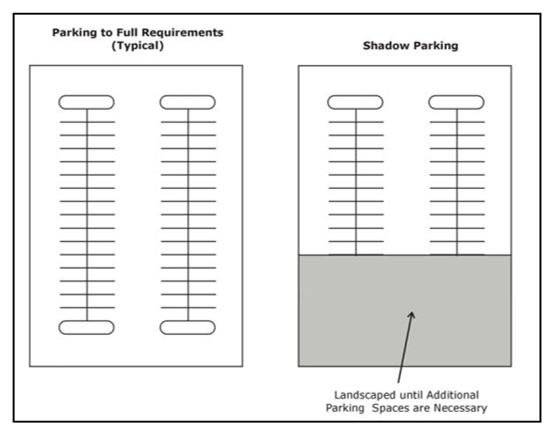
Shadow parking. Up to 30 percent of the required off-street parking spaces, as determined per Section 1171.04(c) (Schedule of Required Parking by Use), may remain landscaped and unpaved, or paved with pervious pavers, provided that the parking and unpaved areas are authorized in accordance with Section 1171.04(a)(4) and comply with the following standards:
(1)
The parking plan submitted with the Zoning Permit or Site Plan Review application shall denote the location and layout of that portion of the parking area that currently is no longer deemed required. The plan shall indicate that the "shadow" parking spaces will be constructed according to this Zoning Code in event that the Zoning Administrator or Building Department makes a finding, at any time, that all or any portion of this parking is necessary.
(2)
At no time shall any portion of the required parking area that is so designated for future construction be used for the construction of any structure or paved surface with the exception that pervious pavers may be used to provide temporary parking provided that the pavers allow for grass and other vegetation to grow through the material.
(3)
At no time shall any portion of the required parking or loading area that is so designated for future construction as provided herein be counted as open space or other non-paved areas required by other provisions of this Zoning Code.
(4)
The owner shall initiate construction of the approved "future" parking area, as identified on the approved parking and loading plan, within three months of the receipt of a certified letter or a letter through normal postal service (in the event that the certified letter is not accepted) sent to the owner of record from the Building Department, identifying that such parking is determined to be necessary.
(Ord. No. O-18-68, § 3(Exh. A), 12-20-18; Ord. No. O-22-36, § 7, 8-18-22)
Sec. 1171.05. - Vehicle stacking requirements.
Where drive-through facilities are permitted as part of a use, vehicle stacking spaces shall be provided according to the following provisions:
(1)
Required number of stacking spaces. The number of required stacking spaces shall be provided as established in the table and illustration below.
* Full Service Car Wash: The 20 spaces required prior to the entrance of the tunnel may be spread across multiple stacking lanes. The 12 stacking spaces shall be required outside of the exit of the wash tunnel to provide areas for the drying of cars, vacuuming, or other ancillary services.
* Fuel or Gasoline Pump Island: Pump spaces can count toward the stacking requirement.
* Other: Any other use shall be required to document proof that the provided number and location of stacking spaces are adequate to meet the purpose of this section.
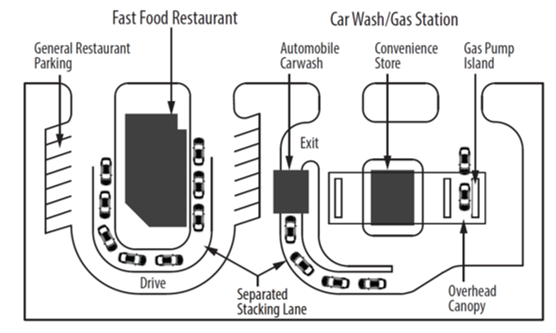
(2)
Design and layout.
a.
Stacking spaces shall be a minimum of ten feet by 20 feet in size.
b.
Stacking spaces may not impede on- or off-site traffic movements or movements in or out of off street parking spaces.
c.
Stacking spaces shall be separated from other internal driveways by surface markings or raised medians.
d.
These stacking spaces requirements shall be in addition to the off-street parking space requirements.
e.
When adjacent to a residential zoning district, or any lot used for residential purposes, stacking spaces shall be required to be located on sides of the lot opposite the adjacent residential use.
(Ord. No. O-18-68, § 3(Exh. A), 12-20-18)
Sec. 1171.06. - Off-street loading requirements.
(a)
General requirements. Each building, structure, or use shall be designed to provide and shall provide for off-street loading in the minimum amounts specified in this section. Loading spaces shall not conflict or overlay with the area used for parking spaces or parking aisles.
(b)
Required number of off-street loading spaces. The minimum number of loading spaces provided for various uses shall be as follows:
(c)
Dimension of loading spaces. Loading spaces shall be at least 12 feet in width and 25 feet in length with a vertical clearance of at least 14 feet in height.
(d)
Location of loading spaces.
(1)
Loading spaces shall not be provided in the front yard or on any building façade facing or visible from a public street, except where the Planning Commission determines such a location is necessary due to the location or placement of the building, existing street patterns, or other factors.
(2)
No loading space shall be closer than 100 feet to any residential use or district, unless wholly within a completely enclosed building or unless enclosed on all sides by a wall or uniformly painted solid board fence not less than six feet in height.
(3)
In all other cases, loading spaces shall be set back a minimum of ten feet from all property lines.
(4)
No loading space shall be in a designated fire lane.
(e)
Access.
(1)
Loading spaces shall be designed and arranged to provide access to a street or alley in a manner that will create the least possible interference with traffic movement and parking lot circulation. The Zoning Administrator shall approve access to and from loading spaces.
(2)
No part of any truck or van that is being loaded or unloaded may extend into the right-of-way of a public thoroughfare.
(3)
Loading spaces shall be designed with sufficient apron area to accommodate truck-turning movements and to prevent backing of trucks onto any street right-of-way.
(f)
Screening. All operations, materials, and vehicles within any loading space that are visible from a public street or from any residential use shall be screened in accordance with Section 1165.09 (Screening requirements).
(Ord. No. O-18-68, § 3(Exh. A), 12-20-18)
Sec. 1171.07. - Design standards for vehicular use areas.
The following standards shall apply to the design and construction of off-street parking, loading, and stacking spaces and areas unless otherwise noted.
(1)
Dimensions.
a.
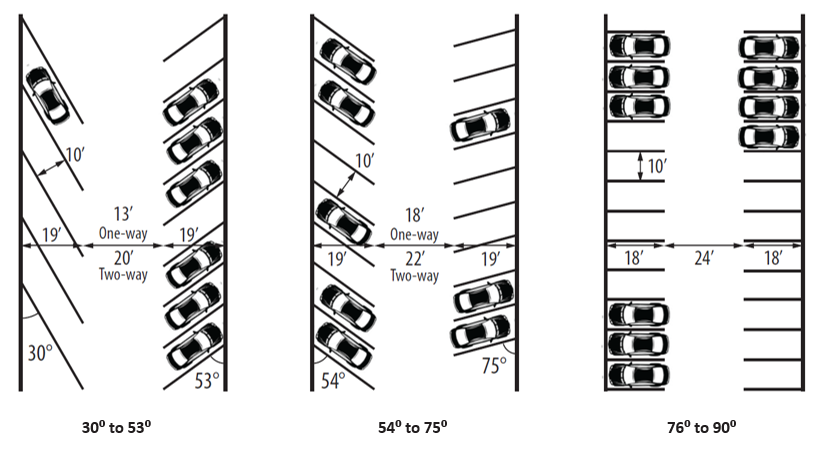
The minimum size of a parking space may be altered based on aisle width and angle of parking. Parking stalls and aisle width shall conform to the minimum standards set forth in the table below and the illustration provided.
b.
Parking areas may include compact car parking spaces provided that the parking spaces shall be a minimum of eight feet in width and 14 feet in length. Such parking for compact cars shall not be included in the calculations for required parking.
(2)
Surface material. All off-street parking areas and driveways shall be surfaced with asphalt concrete, or Portland Cement concrete so as to provide a durable and dustless surface, with the following exceptions:
a.
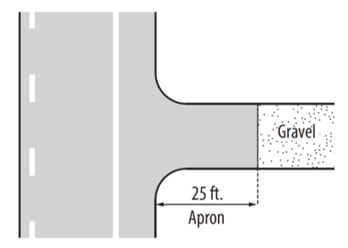
Driveways for residential properties located in the RR (Rural Residential) District, which are also not part of a platted residential subdivision, may be surfaced with gravel or of a similar porous material; however, an apron must be provided as shown below.
b.
Within the RR (Rural Residential) District, parking areas of ten spaces or fewer may be surfaced with gravel or of a similar porous material, if such characteristic contributes to the rural nature of the area or business, subject to approval by the Planning Commission; however all accessways within 25 feet of the right-of-way must be paved.
c.
Pavers or porous pavement systems that allow for stormwater drainage to pass through or grass to grow through them may be permitted as part of a permitted shadow parking area as described in Section 1171.04(e) (Shadow parking).
d.
Other hard surfaced materials may be approved by the Planning Commission provided the commission finds that such surface allows clear identification of spaces, directional flow, access points, and the like; and provided further that the surface is not of gravel or other such material which would accumulate in the City's storm drainage facilities.
(3)
Pavement markings.
a.
Designated parking spaces, drive aisles, and pavement markings shall be marked on the surface of paved parking areas with paint or permanent marking materials and maintained in a clearly visible condition.
b.
Where driveways intersect the public right-of-way, the paint lines dividing vehicle paths and other pavement markings shall be in accordance with the State of Ohio Uniform Traffic Control Manual.
(4)
Curbs and wheel stops.
a.
For all non-residential and multi-family development, continuous curbs are required on the outside of all vehicular use areas and landscaped islands, subject to the following standards:
1.
Curbing shall be made of concrete, stone, or other similar material and shall have a minimum height of six inches and a minimum width of six inches.
2.
Curbing shall be located a minimum of two feet from any structures, buildings, walls, or plant material (excluding ground cover) to prevent a vehicle from hitting any structure or driving through landscaped areas at the edge of a parking area.
3.
Curbing requirements may be waived by the Planning Commission if parking islands and/or areas beyond the parking lot can adequately accommodate storm water runoff through an alternate method such as the use of rain gardens with interrupted curbs. Wheel stops (see illustration below) shall be provided for parking spaces where no curb is present.
b.
If wheel stops are to be used in the parking area, each wheel stop shall be a singular block of reinforced concrete, or similar material typical for such purpose (see illustration below). Wheel stops are to be securely attached to the ground and may be used only at the end of parking stalls. Wheel stops may be attached no less than two feet from the rear edge of the parking space.
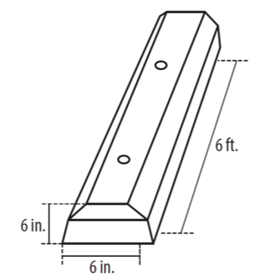
(5)
Drainage. All parking and loading areas shall provide for proper drainage of surface water to prevent the drainage of such water onto adjacent properties or walkways.
(6)
Parking requirements for the disabled. Applicants shall provide parking spaces for the physically disabled as required by the Ohio Building Code and shall include all necessary marking, striping, and signage.
(7)
Fire Code. All parking and loading plans shall conform to all requirements set forth in the Fire Code as adopted by the City of Wilmington and as approved by the Wilmington Fire Department.
(8)
Interior landscaping. Vehicular use areas shall be landscaped in accordance with the provisions of Section 1165.07 (Landscaping in vehicular use areas).
(9)
Walkway connections to public sidewalks.
a.
Where a sidewalk exists in a public right-of-way adjacent to the site, or is required to be constructed as part of the development approval, a pedestrian connection shall be constructed from the building to the sidewalk.
b.
Stand alone pedestrian connections shall be constructed of concrete or hard surface pavers.
c.
The pedestrian connection shall have a minimum width of four feet.
(10)
Access standards.
a.
Ingress and egress to a public right-of-way. All required off-street parking or loading spaces shall be connected with a deeded public right-of-way by means of aisles or access driveways designed in accordance with the requirements of this section. Shared ingress and egress is strongly encouraged for multi-family and non-residential uses whenever possible and may be required if deemed necessary by the City Engineer or other appropriate authority. To the maximum extent feasible, provisions for primary access along secondary streets shall be provided to minimize traffic congestion on primary arterial streets.
b.
Setback requirements.
1.
All driveways shall be located at least two feet from side or rear property lines for all single-family and two-family residential properties and ten feet for all other land uses, excepting cases where a shared driveway with an associated access easement straddles two or more properties served by the driveway. Development within the DC (Downtown Core) District shall also be exempt from these requirements.
2.
Off-street parking spaces shall not be located along entry driveways within 30 feet of the right-of-way (see illustration below). Development in the DC (Downtown Core) and DT (Downtown Transition) shall be exempt from the requirement. In DC and DT districts, off-street parking setback along drive access from the public right-of-way shall be determined by the Director of Public Service, city engineer, or designee.
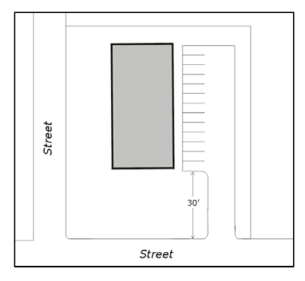
3.
Off-street parking spaces shall be set back a minimum of ten feet from any side or rear lot line, unless the lot abuts a residential zoning district or recorded residential subdivision, in which case the off-street parking shall be set back a minimum of 50 feet from the property line. In DC (Downtown Core) and DT (Downtown Transition) districts, side or rear lot line off-street parking space setback requirements shall be determined by the Planning Commission as part of the site plan review process.
c.
Maneuverability. Except for single-family and two-family dwellings, all parking areas shall be so designed to ensure that all maneuvering into and out of each parking space shall take place entirely within property lines of lots, garages, and/or storage areas, and spaces shall not be designed in a manner which allows or requires vehicles to back into the public right-of-way to leave a parking space.
d.
Driveway width. The width of a driveway (ingress/egress) for a multi-family or non-residential use, at the street right-of-way line, shall have a minimum width of 24 feet and maximum width of 36 feet, unless otherwise permitted by the City Engineer or other appropriate authority. Curb definitions shall be maintained, prohibiting continuous access along the frontage of a site.
e.
Access spacing. No entrance to or exit from a parking area of five vehicles or more shall be closer than 100 feet to the right-of-way line of intersecting public streets or signalized intersection. Development in the DC (Downtown Core) and DT (Downtown Transition) Districts shall be exempt from this requirement.
(11)
Proper maintenance. The owner of property used for parking and/or loading shall maintain such area in good condition, without holes and free of all dust, trash, and other debris.
(Ord. No. O-18-68, § 3(Exh. A), 12-20-18; Ord. No. O-22-36, § 8, 8-18-22)
Sec. 1173.01. - Purpose.
The purpose of this chapter is to protect the general health, safety, morals and welfare of the community by providing an instrument for protecting the physical appearance of the community and for encouraging high quality, effective outdoor graphics for the purposes of navigation, information and identification. Specifically, it is the intent of this chapter to provide businesses in the municipality with equitable sign standards in accordance with fair competition and aesthetic standards acceptable to the community, to provide the public with a safe and effective means of locating businesses, services and points of interest within the municipality, and to provide for safe vehicular and pedestrian traffic movement. This chapter is based on the premise that signs are as much subject to control as noise, odors, debris and other similar characteristics of land use, that is not regulated, can become a nuisance to adjacent properties or the community in general, or depreciate the value of other properties within the community.
(Ord. No. O-18-68, § 3(Exh. A), 12-20-18)
Sec. 1173.02. - Applicability.
The regulations set forth in this chapter shall apply to all permanent and temporary signs in all zoning districts, except signs located entirely within buildings or other structures which are also not visible from the public right-of-way or from property other than the property on which the sign is located. It shall hereafter be unlawful for any person to erect, place, or maintain a sign in the City except in accordance with the provisions of this chapter.
(Ord. No. O-18-68, § 3(Exh. A), 12-20-18)
Sec. 1173.03. - General provisions.
(a)
Zoning permit required.
(1)
Unless otherwise provided in this chapter, all signs shall require a zoning permit. Exceptions to the permit requirement are as follows:
a.
No zoning permit is required for the maintenance of a sign or for a change of copy, either manually or electronically, on changeable copy signs.
b.
A zoning permit, but no fee, is required for the changing of a sign face other than a change of copy on a changeable copy sign.
(2)
The relocation of a sign from one area of a lot to another location on the same lot shall still require a zoning permit.
(3)
The alteration or enlargement of any sign shall require a zoning permit.
(4)
Submission of a zoning permit application shall be in accordance with Section 1135.04 (Zoning permit application). The Zoning Administrator may require additional information as part of the application, including the position of sign in relation to nearby buildings, structures, and property lines, as well as plans illustrating dimensions and materials, methods of construction, attachment, and/or placement.
(5)
Signs proposed in conjunction with a development requiring review of a site plan shall also be reviewed in accordance with Section 1135.05 (Site plan review).
(b)
Compliance with other codes and regulations.
(1)
All wirings, fittings, and materials used in the construction, connection and operation of electrically illuminated signs shall be in accordance with the provisions of the local electrical code in effect.
(2)
No sign of any type or classification shall be installed, erected, or attached to a structure in any form, shape, or manner that is in violation of Wilmington's or Ohio's building or fire codes.
(c)
Public safety provisions.
(1)
No sign shall be erected or maintained at any location where by reason of its position, working, illumination, shape, symbol, color, form or character it may obstruct, impair, obscure, interfere with the view of, or may be confused with any authorized traffic sign, signal or device, or interfere with, mislead, confuse, or disrupt traffic safety or flow.
(2)
When a sign becomes dangerous for any reason, the Zoning Administrator and/or Building Department shall have the power and the authority to remove or cause to have removed such sign when the owner or agent has failed to correct the situation within the time specified by the department to repair or make such sign safe. The owner or agent of such sign shall bear the full costs of such removal and shall be billed accordingly. If the Zoning Administrator and/or Building Department determines that such sign is of possible immediate danger to persons or vehicles, which may be passing nearby, he/she and/or the department shall place or cause to have placed, signs or barriers indicating such danger.
(d)
Signs as traffic hazards.
(1)
No sign shall be erected at or near any intersection of any streets, or any railway and any street, in a manner as to obstruct free and clear vision, or at any location where, by reason of position, shape, or color, it may interfere with, obstruct the view of, or be confused with any authorized traffic sign, signal, or device, or which otherwise misleads or confuses traffic.
(2)
Light sources for illuminated signs shall not be of brightness as to constitute a hazard to pedestrian or vehicular traffic. Any exterior illumination of signs shall be accomplished by a concealed source, so as not to interfere with the vision of persons on the adjacent roadways or adjacent properties. The light shall be focused on externally lighted signs to light only the sign.
(3)
No rotating beam, beacon, or flashing illumination resembling an emergency light shall be used in connection with any sign display.
(e)
Specific to public features, objects, and right-of-way.
(1)
It shall be unlawful and a violation of this Zoning Code for any person to fasten, place, paint, or attach in any way, any sign, handbill, poster, advertisement, or notice of any kind or cause the same to be done in or upon any curbstone, lamp post, telecommunication pole, electric light or power pole, hydrant, bridge, culvert, public drinking fountain, public trash container, courtesy bench, rest station building, tree, or in or upon any portion of any public sidewalk, street or sign, except as specifically permitted within this Zoning Code.
(2)
No person may, for the purpose of increasing or enhancing the visibility of any sign, damage, trim, destroy, or remove any trees, shrubs, or other vegetation within any right-of-way (unless express written authorization is obtained from the agency having jurisdiction over the right-of-way) or any area where landscaping is required by this Zoning Code.
(f)
Specific to temporary signs. Unless otherwise stated in this chapter, a temporary sign may be either on-premise or off-premise, provided the sign conforms to the standards and provisions applicable to the signage type and zoning district.
(Ord. No. O-18-68, § 3(Exh. A), 12-20-18)
Sec. 1173.04. - Computations.
(a)
Sign dimensions.
(1)
Sign area.
a.
The sign area shall be computed by means of the smallest, single geometric shape (i.e., square, rectangle, circle, or triangle) that encompasses the extreme limits of the writing, representation, emblem, or other display elements, together with the sign face area. The sign face area is defined as any material or color that is an integral part of the background of the display or used to differentiate the sign from the structure against which it is placed; this does not include any supporting framework, bracing, decorative fence or wall, or any other feature which otherwise meets all applicable zoning regulations and is clearly incidental to the display itself.
b.
The sign area for a sign with more than one face (multi-faced signs) shall be computed by adding together the area of all sign visible from any single-point.
c.
When two identical sign faces are placed back to back, so that both faces cannot be viewed from any one point at the same time, and when such sign faces are part of the same sign structure and not more than two feet apart, the sign area shall be computed by the measurement of one of the faces.
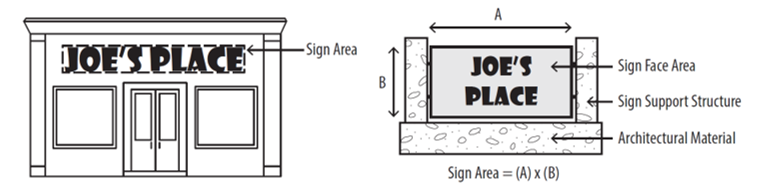
(2)
Sign height.
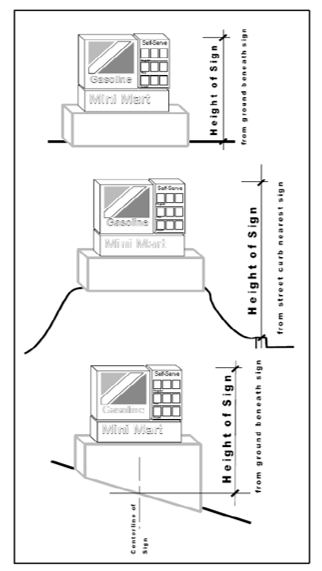
a.
The height of a ground sign shall be determined by measuring the vertical distance between the top part of a sign or its structure, whichever is highest, to the elevation of the ground directly beneath the sign. If the sign is placed on sloped terrain, the height shall be measured from the ground elevation at the centerline of the sign.
b.
In cases where signs are to be located on man-made berms or other similar ground foundations, the elevation of the street curb nearest to the location of the sign shall be utilized for determining sign height. In the case of a private or public street without curbing, the edge of pavement nearest to the sign location shall be utilized to determine sign height.
(3)
Sign setback. Unless otherwise specified, the setback of all signs shall be measured from the existing right-of-way and adjoining property lines to the nearest point of the sign. Additional setback distance may be required by the City Engineer or appropriate authority if widening or other public improvements are planned in the near future for a specific location along the frontage of a public road or street.
(b)
Building units. In many cases, the number of signs allowed for multi-tenant buildings is based on the number of building units. For purposes of this chapter, a "building unit" shall be defined as a portion of a building that is owned or leased by a single occupant for a business purpose and has a public entrance. For instance, a single commercial building that is entirely owned or leased by a single occupant would constitute one building unit; whereas a mixed-use building with four commercial tenant spaces having public entrances would constitute four building units. "Building frontage" for a building unit shall be the most primary side/wall of the building, measured from the centerlines of the party walls defining such building unit.
(Ord. No. O-18-68, § 3(Exh. A), 12-20-18)
Sec. 1173.05. - Exempt signs.
(a)
Type 1 exemptions. Signs which fall under a "Type 1" exemption are completely exempt from the provisions of this chapter and thus shall not be observed or considered in any way toward the standards of this chapter, and shall not require a zoning permit to install:
(1)
Government signs. Government signs are defined as those erected and maintained pursuant to a government's function, ordinances, or regulation. Government signs include, but are not limited to, signs required or installed by the City, the County, a public entity, a public transit entity, a state or federal statute, or by order of a court of competent jurisdiction.
(2)
Numeric address signs. Each building, building unit, lot, or property shall have a sign providing the numeric address for identification purposes to assist in fire and safety protection. Such signs shall not exceed two square feet in area.
(3)
Official flags. Flags bearing the insignia of any local, state, or federal government or agency, including the American flag, are exempt.
(b)
Type 2 exemptions. Signs which fall under the "Type 2" exemption shall not be considered in applying limitations on the number of signs permitted on a single frontage, wall, property, or lot (as expressed in Sections 4.508.1, 4.509.1, and 4.510.1), but such signs shall be subject to the lighting, installation, height, setback, maintenance and other standards set forth in this chapter:
(1)
Commemorative plaques. Commemorative plaques placed by recognized historical agencies are exempt under this section.
(2)
Portable temporary signs. Portable temporary signs (e.g. yard signs) no larger than two square feet in area and no more than four feet in height are exempt under this section, except as provided in Section 1173.09(c)(3)c. for temporary portable signs in the public right-of-way.
(Ord. No. O-18-68, § 3(Exh. A), 12-20-18)
Sec. 1173.06. - Prohibited signs.
(a)
List of prohibited signs.
(1)
Permanent off-premise signs.
(2)
Signs or portions of signs that revolve, whirl, spin, or otherwise make use of motion to attract attention.
(3)
Signs attached to, painted on, or placed on a motor vehicle, trailer, or other licensed or unlicensed vehicle or conveyance which is located in such a manner to serve exclusively as a permanent, temporary, or portable sign.
(4)
Signs which blink or flash to attract attention, including flashing neon.
(5)
Signs attached to or supported by a tree, utility pole, trash receptacle, bench, vending machine, or public shelter.
(6)
Signs which contain words, images, or graphic illustrations of an obscene nature.
(7)
Signs with audio message delivery.
(8)
Signs that emit any flames, smoke, fumes, vapor, or any similar substance.
(9)
Signs located in public right-of-way, except government signs and authorized portable signs.
(10)
Signs made of cardboard, cardstock, or other similar paper products.
(11)
Signs which obstruct windows, doors, fire escapes, balconies, stairways, ladders, vents, or other means of building ingress/egress.
(12)
Snipe signs, roof signs, and graffiti.
(13)
Any signage types which are otherwise prohibited in certain zoning districts pursuant to Section 1173.08 (Signs in Business Districts), Section 1173.09 (Signs in Mixed-Use Districts), or Section 1173.10 (Signs in Residential Districts).
(b)
Examples of prohibited signs.
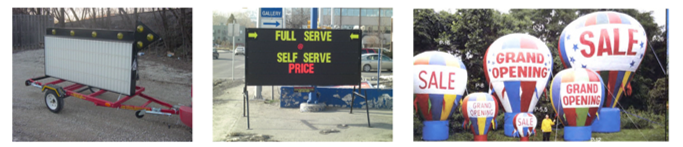
(Ord. No. O-18-68, § 3(Exh. A), 12-20-18)
Sec. 1173.07. - Signage types.
(a)
Signage type illustration. The illustration below displays various signage types addressed in subsequent sections. This illustration serves as a guide for the Zoning Administrator to determine specific signage types, and is not meant to exclude other variations of the signage types shown. Definitions of each signage type may also be found in Title Thirteen, Chapter 1179 (Definitions).
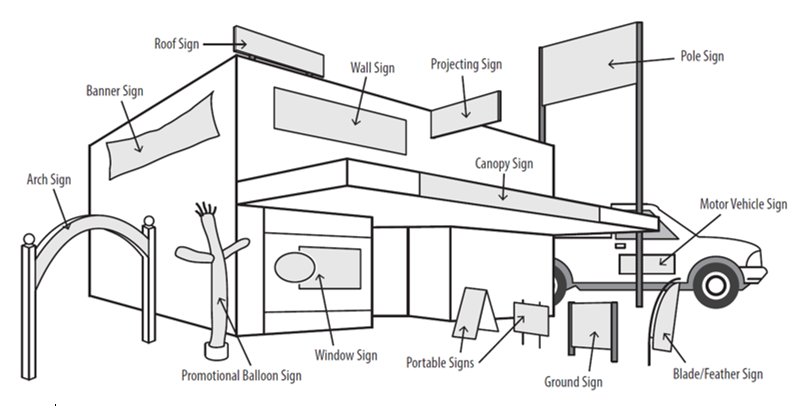
(b)
Signage examples.




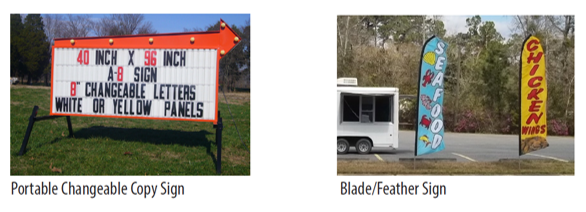
(c)
Signage types not specified. Signage types not specified in this chapter shall require the Zoning Administrator to make a determination as to whether such signage type shall be allowed as a permitted sign or otherwise prohibited, based on being similar or not to one or more signage types specified elsewhere in this chapter. The Zoning Administrator may convene the Board of Zoning Appeals to make the same determination if he or she believes the sign is not easily categorized with any of the signage types specified elsewhere in this chapter.
(Ord. No. O-18-68, § 3(Exh. A), 12-20-18)
Sec. 1173.08. - Signs in Business Districts.
(a)
Number of signs permitted. The provisions of Section 1173.08 shall apply to all zoning districts identified as Business Districts in Section 1151.01(a)(List of districts and overlays). The table below shall control the maximum number of certain signage types allowed, along with applicable standards specific to each type:
(b)
Additional limitations. A single property may only have one of the permanent signage types marked with an asterisk (*) in Section 1173.08(a) (Number of signs permitted); a combination of two or more of these signage types on the same property is prohibited.
(c)
Permanent sign provisions.
(1)
Arch signs. Permanent arch signs shall comply with the following standards:
a.
Minimum setback from right-of-way and adjoining property lines is ten feet.
b.
Maximum height for signage, including any structural elements, is 25 feet.
c.
Maximum area of the sign face is two feet multiplied by the width of the span of the arch.
d.
Minimum clearance is 14 feet, four inches.
e.
The maximum width of the signage and any structural elements shall equal the width of the passageway or paved roadway that passes underneath the sign, plus five feet, with at least two and a half feet on both sides.
f.
Maximum number of poles (structural supports) is two; one on either side of the driveway/roadway.
g.
Changeable copy arch signs are prohibited.
(2)
Canopy signs. The sign area of canopy signs shall not exceed 20 square feet, a clearance of eight feet shall be provided between the sidewalk and the sign, and such signs shall not extend above the roof line.
(3)
Flag signs. Flag signs are permitted provided they are attached to the side of a building, projecting outward in a diagonal fashion. The highest point of the flag shall be no taller than the highest eave of the building on which the flag is attached.
(4)
Gateway signs. Permanent gateway signs shall comply with the following standards:
a.
Gateway signs shall maintain clear zones for pedestrians and motorists and comply with the following:
1.
Maintain a setback of ten feet from adjoining property lines and public right-of-way line(s);
2.
Ten feet from the edge of any driveway; and
3.
Five feet from any sidewalk or paved path.
b.
Maximum sign height is ten feet.
c.
Maximum sign area is 60 square feet.
d.
Proof of an established mechanism to ensure the ongoing maintenance of the entire entrance structure and associated landscaping shall be submitted to the Zoning Administrator as part of the zoning permit application for a gateway sign.
(5)
Ground signs. Permanent ground signs shall comply with the following standards:
a.
Signs shall be made of solid materials of a permanent nature known and used in the sign construction industry and shall include, but are not limited to: brick, stone, EIFS, polished or honed finish metals, decorative pre-cast concrete wood, architectural masonry, steel and/or metal, and glass.
b.
Ground signs shall maintain clear zones for pedestrians and motorists and comply with the following:
1.
Maintain a setback of ten feet from adjoining property lines and public right-of-way line(s);
2.
Ten feet from the edge of any driveway; and
3.
Five feet from any sidewalk or paved path.
c.
Maximum sign height is six feet.
d.
Maximum sign area is 32 square feet. For lots with multiple street frontages, the maximum sign area is cumulative and shall not be increased, but the owner may apply the maximum sign area to multiple signs with a maximum of one sign per street frontage.
e.
Changeable copy signs are permitted in accordance with the standards in Section 1173.11 (Changeable copy signs). Electronic LED display signs are permitted.
(6)
Pole signs. A permanent pole sign (also commonly called a pylon sign) shall be supported by one or more uprights, poles, or braces placed in or upon the ground surface and not attached to any building; such sign shall conform to the following:
a.
The maximum sign area shall be 150 square feet.
b.
The set back shall be a minimum of ten feet from any adjoining property line or right-of-way line(s).
c.
The sign height shall be no less than eight feet and no more than 20 feet from grade.
d.
Changeable copy signs are permitted in accordance with the standards in Section 1173.11 (Changeable copy signs). Electronic LED display signs are permitted.
(7)
Projecting signs. Permanent projecting signs shall comply with the following standards:
a.
The sign must be attached to a principal building.
b.
The sign area shall not exceed nine square feet.
c.
Signs shall be installed to achieve a minimum vertical clearance of eight feet from the bottom of the sign to the finished grade.
d.
Projecting signs are prohibited over a vehicular access way.
(8)
Wall signs. A wall sign shall be permitted with an area not to exceed one square foot in area for each one linear foot of building frontage to a maximum size of 150 square feet.
(9)
Window signs. No more than 25 percent of the window surface shall be covered by signage, inclusive of any temporary window signs which may be on display.
(d)
Temporary sign provisions.
(1)
Banner signs. Banner signs are permitted provided the sign is no larger than 20 square feet, is not located on a single-family or two-family residential property, and is attached to the wall of a building. A zoning permit for this temporary sign type shall be valid up to 60 calendar days, and no more than two such permits for the same sign may be applied for within one calendar year.
(2)
Blade/feather signs. Temporary blade/feather signs shall comply with the following standards:
a.
The sign must be placed at least ten feet away from the existing right-of-way line and adjoining properties.
b.
Maximum sign height is 12 feet.
c.
Maximum sign area is 20 square feet.
d.
Blade/feather signs must be on the premises of the business or activity they serve.
e.
A zoning permit for this temporary sign type shall be valid up to 60 calendar days, and no more than two such permits for the same sign may be applied for within one year.
(3)
Ground signs. Temporary ground signs shall comply with the following standards:
a.
No temporary ground sign may be erected on a single-family or two-family residential property.
b.
Ground signs shall maintain clear zones for pedestrians and motorists and comply with the following:
1.
Maintain a setback of ten feet from adjoining property lines and public right-of-way line(s);
2.
Ten feet from the edge of any driveway; and
3.
Five feet from any sidewalk or paved path.
c.
Maximum sign height is six feet.
d.
Maximum sign area is 36 square feet.
e.
Changeable copy signs are prohibited.
f.
A zoning permit for this temporary sign type shall be valid up to 60 calendar days, and no more than two temporary sign permits for the same sign may be applied for within one year. Once a temporary ground sign has been permitted for 120 days, in order for the sign to remain it must be brought forward for a permanent ground sign permit and meet the standards required of a permanent ground sign.
(4)
Portable signs. Temporary portable signs, such as A-Frame signs, sandwich boards, or other portable sign types which are not affixed to the ground or which can be easily removed from the ground by hand without the use of tools, are permitted in accordance with the following provisions:
a.
Maximum sign height is six feet.
b.
Maximum sign area is 12 square feet.
c.
Changeable copy signs are prohibited.
d.
Portable signs shall not be located on any sidewalk within the public right-of-way.
e.
A zoning permit for this temporary sign type shall be valid up to 60 calendar days, and no more than two temporary sign permits for the same sign may be applied for within one year.
f.
Temporary portable signs which are no larger than two square feet and also no more than four feet in height are exempt from maximum number requirements pursuant to Section 1173.05(b) (Type 2 Exemptions).
(5)
Window signs. No more than 25 percent of the window surface shall be covered by signage, inclusive of any permanent window signs which may be on display. Temporary window signs do not require a zoning permit; however any window sign that has been on display for longer than 60 days shall be considered a permanent window sign and is required to obtain a zoning permit.
(Ord. No. O-18-68, § 3(Exh. A), 12-20-18)
Sec. 1173.09. - Signs in Mixed-Use Districts
(a)
Number of signs permitted. The provisions of Section 1173.09 shall apply to all zoning districts identified as Mixed-Use Districts in Section 1151.01(a) (List of districts and overlays). The table below shall control the maximum number of certain signage types allowed, along with applicable standards specific to each type:
(b)
Permanent sign provisions.
(1)
Arch signs. Permanent arch signs shall comply with the following standards:
a.
Minimum setback from right-of-way and adjoining property lines is ten feet.
b.
Maximum height for signage, including any structural elements, is 25 feet.
c.
Maximum area of the sign face is two feet multiplied by the width of the span of the arch.
d.
Minimum clearance is 14 feet, four inches.
e.
The maximum width of the signage and any structural elements shall equal the width of the passageway or paved roadway that passes underneath the sign, plus five feet, with at least two and a half feet on both sides.
f.
Maximum number of poles (structural supports) is two; one on either side of the driveway/roadway.
g.
Changeable copy arch signs are prohibited.
(2)
Canopy signs. The sign area of canopy signs shall not exceed 20 square feet, a clearance of eight feet shall be provided between the sidewalk and the sign, and such signs shall not extend above the roof line.
(3)
Flag signs. Flag signs are permitted provided they are attached to the side of a building, projecting outward in a diagonal fashion. The highest point of the flag shall be no taller than the highest eave of the building on which the flag is attached.
(4)
Ground signs. Permanent ground signs shall comply with the following standards:
a.
Signs shall be made of solid materials of a permanent nature known and used in the sign construction industry and shall include, but are not limited to: brick, stone, EIFS, polished or honed finish metals, decorative pre-cast concrete wood, architectural masonry, steel and/or metal, and glass.
b.
Ground signs shall maintain clear zones for pedestrians and motorists and comply with the following:
1.
Maintain a setback of ten feet from adjoining property lines and public right-of-way line(s);
2.
Ten feet from the edge of any driveway; and
3.
Five feet from any sidewalk or paved path.
c.
Maximum sign height is six feet.
d.
Maximum sign area is 32 square feet. For lots with multiple street frontages, the maximum sign area is cumulative and shall not be increased, but the owner may apply the maximum sign area to multiple signs with a maximum of one sign per street frontage.
e.
Changeable copy signs are permitted in accordance with the standards in Section 1173.11 (Changeable copy signs).
(5)
Projecting signs. Permanent projecting signs shall comply with the following standards:
a.
The sign must be attached to a principal building.
b.
The sign area shall not exceed nine square feet.
c.
Signs shall be installed to achieve a minimum vertical clearance of eight feet from the bottom of the sign to the finished grade.
d.
Projecting signs are prohibited over a vehicular access way.
(6)
Wall signs. A wall sign shall be permitted with an area not to exceed one square foot in area for each one linear foot of building frontage to a maximum size of 150 square feet.
(7)
Window signs. No more than 25 percent of the window surface shall be covered by signage, inclusive of any temporary window signs which may be on display.
(c)
Temporary sign provisions.
(1)
Banner signs. Banner signs are permitted provided the sign is no larger than 20 square feet, is not located on a single-family or two-family residential property, and is attached to the wall of a building. A zoning permit for this temporary sign type shall be valid up to 60 calendar days, and no more than two such permits for the same sign may be applied for within one calendar year.
(2)
Ground signs. Temporary ground signs shall comply with the following standards:
a.
No temporary ground sign may be erected on a single-family or two-family residential property.
b.
Ground signs shall maintain clear zones for pedestrians and motorists and comply with the following:
1.
Maintain a setback of ten feet from adjoining property lines and public right-of-way line(s);
2.
Ten feet from the edge of any driveway; and
3.
Five feet from any sidewalk or paved path.
c.
Maximum sign height is six feet.
d.
Maximum sign area is 36 square feet.
e.
Changeable copy signs are prohibited.
f.
A zoning permit for this temporary sign type shall be valid up to 60 calendar days, and no more than two temporary sign permits for the same sign may be applied for within one year. Once a temporary ground sign has been permitted for 120 days, in order for the sign to remain it must be brought forward for a permanent ground sign permit and meet the standards required of a permanent ground sign.
(3)
Portable signs. Temporary portable signs, such as A-Frame signs, sandwich boards, or other portable sign types which are not affixed to the ground or which can be easily removed from the ground by hand without the use of tools, are permitted in accordance with the following provisions:
a.
Maximum sign height is three feet.
b.
Maximum sign area is six square feet.
c.
When a portable sign is located on a sidewalk in the public right-of-way, the following additional standards shall apply:
1.
By filing the zoning permit application for the temporary sign, the applicant agrees to indemnify the City and hold the City harmless from any claims of injury, loss or damage arising from the use or maintenance of the sign.
2.
No sign permitted on any public sidewalk shall hinder or block ingress and/or egress to any public or private entryway to any property or structure. Further, no sign on a public sidewalk shall impede or hinder pedestrian travel on public sidewalks nor shall any such sign impede or hinder ingress or egress to vehicles parked at curbside, nor shall any such sign impede access from the street or sidewalk to any parking meter.
3.
Signs shall be temporary in nature and must be removed from the sidewalk at the close of business each day.
4.
All signs shall be placed in front of the business in which the sign advertises. Off-site signage is prohibited.
5.
Such signs shall be temporary in nature and must be removed from the sidewalk at the close of business each day.
6.
Such signs shall not be counted toward the exemption provided under Section 1173.05(b) (Type 2 Exemptions).
d.
A zoning permit for this temporary sign type shall be valid for the remainder of the calendar year. Applicants must reapply for the sign to continue to remain the following year.
e.
Temporary portable signs which are no larger than two square feet and also no more than four feet in height are exempt from maximum number requirements pursuant to Section 1173.05(b) (Type 2 Exemptions), except as provided in subsection c. for signs in the public right-of-way.
(4)
Window signs. No more than 25 percent of the window surface shall be covered by signage, inclusive of any permanent window signs which may be on display. Temporary window signs do not require a zoning permit; however any window sign that has been on display for longer than 60 days shall be considered a permanent window sign and is required to obtain a zoning permit.
(Ord. No. O-18-68, § 3(Exh. A), 12-20-18; Ord. No. O-22-36, § 9, 8-18-22)
Sec. 1173.10. - Signs in Residential Districts.
(a)
Number of signs permitted. The provisions of Section 1173.10 shall apply to all zoning districts identified as Residential Districts in Section 1151.01(a) (List of Districts and Overlays). The table below shall control the maximum number of certain signage types allowed, along with applicable standards specific to each type:
(b)
Permanent sign provisions.
(1)
Arch signs. Permanent arch signs shall comply with the following standards:
a.
Minimum setback from right-of-way and adjoining property lines is ten feet.
b.
Maximum height for signage, including any structural elements, is 25 feet.
c.
Maximum area of the sign face is two feet multiplied by the width of the span of the arch.
d.
Minimum clearance is 14 feet, four inches.
e.
The maximum width of the signage and any structural elements shall equal the width of passageway or paved driveway that passes underneath the sign, plus five feet, with at least two and a half feet on both sides.
f.
Maximum number of poles (structural supports) is two - one on either side of the passageway/driveway/roadway.
g.
Changeable copy signs are prohibited.
h.
Illumination of the arch sign is prohibited.
(2)
Gateway signs.
a.
Gateway signs shall maintain clear zones for pedestrians and motorists and comply with the following:
1.
Maintain a setback of ten feet from adjoining property lines and public right-of-way line(s);
2.
Ten feet from the edge of any driveway; and
3.
Five feet from any sidewalk or paved path.
b.
Maximum sign height is ten feet.
c.
Maximum sign area is 36 square feet.
d.
Changeable copy signs are prohibited.
e.
Only concealed external light illumination shall be permitted; internal illumination including channel lettering is prohibited.
f.
Proof of an established mechanism to ensure the ongoing maintenance of the entire entrance structure and associated landscaping shall be submitted to the Zoning Administrator as part of the zoning permit application for a gateway sign.
(3)
Ground signs. Permanent ground signs shall comply with the following standards:
a.
No permanent ground sign may be erected on a single-family or two-family residential property, except as provided in Section 1143.04(m) (Home occupations).
b.
Signs shall be made of solid materials of a permanent nature known and used in the sign construction industry and shall include, but are not limited to: brick, stone, EIFS, polished or honed finish metals, decorative pre-cast concrete, wood, architectural masonry, steel and/or metal, and glass.
c.
Ground signs shall maintain clear zones for pedestrians and motorists and comply with the following:
1.
Maintain a setback of ten feet from adjoining property lines and public right-of-way line(s);
2.
Ten feet from the edge of any driveway; and
3.
Five feet from any sidewalk or paved path.
d.
Maximum sign height is six feet.
e.
Maximum sign area is 24 square feet.
f.
Changeable copy signs are permitted in accordance with the standards in Section 1173.11 (Changeable Copy Signs).
g.
Only concealed external light illumination shall be permitted. All other forms of internal illumination shall be prohibited.
(4)
Projecting signs. Permanent projecting signs shall comply with the following standards:
a.
The sign must be attached to a principal building.
b.
The sign area shall not exceed nine square feet.
c.
Signs shall be installed to achieve a minimum vertical clearance of eight feet from the bottom of the sign to the finished grade.
d.
Projecting signs are prohibited over a vehicular access way.
(5)
Wall signs. A wall sign shall be permitted with an area not to exceed one square foot in area for each one linear foot of building frontage to a maximum size of 150 square feet.
(c)
Temporary sign provisions.
(1)
Ground signs. Temporary ground signs shall comply with the following standards:
a.
No temporary ground sign may be erected on a single-family or two-family residential property.
b.
Ground signs shall maintain clear zones for pedestrians and motorists and comply with the following:
1.
Maintain a setback of ten feet from adjoining property lines and public right-of-way line(s);
2.
Ten feet from the edge of any driveway; and
3.
Five feet from any sidewalk or paved path.
c.
Maximum sign height is six feet.
d.
Maximum sign area is 24 square feet.
e.
Changeable copy signs are prohibited.
f.
A zoning permit for this temporary sign type shall be valid up to 60 calendar days, and no more than two such permits for the same sign may be applied for within one year. Once a temporary ground sign has been permitted for 120 days, in order for the sign to remain it must be brought forward for a permanent ground sign permit and meet the standards required of a permanent ground sign.
(2)
Portable signs. Temporary portable signs, such as A-Frame signs, sandwich boards, or other portable sign types which are not affixed to the ground or can be easily removed from the ground by hand without the use of tools, are permitted in accordance with the following provisions:
a.
Maximum sign height is six feet.
b.
Maximum sign area is 12 square feet.
c.
Changeable copy signs are prohibited.
d.
Portable signs shall not be located on any sidewalk within the public right-of-way.
e.
A zoning permit for this temporary sign type shall be valid up to 60 calendar days, and no more than two temporary sign permits for the same sign may be applied for within one year.
f.
Temporary portable signs which are no larger than two square feet and also no more than four feet in height are exempt from maximum number requirements pursuant to Section 1173.05(b) (Type 2 Exemptions).
(Ord. No. O-18-68, § 3(Exh. A), 12-20-18; Ord. No. O-22-36, § 10, 8-18-22)
Sec. 1173.11. - Changeable copy signs.
(a)
General standards.
(1)
A changeable copy sign shall only be permitted as part of a permanent on-premise sign.
(2)
A changeable copy sign shall be limited to Ground Signs and Pole Signs.
(3)
The sign copy or display message shall be limited to alphanumeric text only.
(4)
The sign face of a changeable copy sign shall not exceed 50 percent of the total sign area or 20 square feet, whichever is less.
(5)
Changeable copy signs which comprise an electronic sign copy or display message shall utilize an LED display and be subject to the standards of Section 1173.11(a) (LED display standards) below.
(b)
LED display standards.
(1)
The sign copy or display message shall not change or alternate more than once every 60 minutes, with exception to time and temperature displays.
(2)
The sign copy or display message shall remain static and motionless for the duration of the display time.
(3)
The sign copy or display message shall not contain animation, scrolling or running letters or text, flashing lights, or intermittent, alternating message changes.
(4)
The luminosity of the LED display shall be dimmed between dusk and dawn so that the sign shall emit no more than 0.2 foot-candles at all property lines.
(5)
A face change to a legal non-conforming sign, as determined under Section 1173.13 (Non-Conforming Signs), which involves the conversion of an existing manual changeable copy sign to an electronic sign copy or display message shall meet all standards of Section 1173.11 and in no case shall the electronic sign copy or display message exceed the area of the original changeable sign copy.
(Ord. No. O-18-68, § 3(Exh. A), 12-20-18)
Sec. 1173.12. - Murals.
(a)
Regulation as wall signs.
(1)
A mural is defined as a hand-produced work of visual art which is tiled or painted by hand directly upon, or affixed directly to an exterior wall of a building.
(2)
For purposes of regulation, a mural shall be considered a type of wall sign and thus is permitted only in accordance with the standards and provisions of this chapter applicable to wall signs.
(b)
Special size flexibility in the Downtown Core District. In recognizing the importance of murals in establishing a sense of place and contributing to the character and overall quality of life in the City of Wilmington, murals within the DC (Downtown Core) District may be exempted from the normal maximum sign area provisions for wall signs, and are instead subject to a maximum sign area of 4,000 square feet. Such murals shall also be subject to the provisions of the Commercial Historic (H-1) Overlay District, as applicable.
(Ord. No. O-18-68, § 3(Exh. A), 12-20-18)
Sec. 1173.13. - Vehicular use area signs.
(a)
Regulation as ground signs. In Business and Mixed-Use Districts, additional permanent ground signs may be permitted for vehicular use areas in accordance with the provisions of this section.
(b)
Standards. For off-street parking areas of 25 spaces or more, one additional ground sign per 25 spaces shall be permitted and shall meet all standards for permanent ground signs applicable to the district in which the sign is located, unless otherwise provided in the additional standards below:
(1)
Signs shall be located within five feet from the edge of the parking area pavement.
(2)
Signs shall not exceed five feet in overall height.
(3)
Signs shall not exceed six square feet in sign area.
(4)
Changeable copy signs, including LED displays, as well as all forms of illumination except for concealed external light illumination, are prohibited.
(Ord. No. O-18-68, § 3(Exh. A), 12-20-18)
Sec. 1173.14. - Non-conforming signs.
(a)
Determination of legal non-conformity. Existing signs that do not conform to the specific provisions of this Zoning Code may be eligible for the designation of a "legal non-conforming sign" and allowed to continue provided that they are not in violation of either of the following:
(1)
The Zoning Administrator and/or Building Department determines that such signs are properly maintained and do not in any way endanger the public or constitute a nuisance and/or;
(2)
Except as provided in Section 1173.14.2 (Transitional Rules for Temporary Signs), the sign was previously covered by a valid permit or variance, or complies with all applicable laws on the effective date of this Zoning Code.
(b)
Transitional rules for temporary signs. All temporary signs, including portable signs, must comply with the new regulations of this chapter. Existing temporary signs shall not qualify for non-conforming or grandfathering provisions in Section 1173.14.1 (Determination of Legal Non-Conformity); a zoning permit must be secured within 90 days of the effective date of this Zoning Code. Failure to secure a zoning permit for an existing temporary sign after the 90 day period shall render the sign illegal.
(c)
Loss of legal non-conforming status. A legal non-conforming sign loses the legal non-conforming designation and shall be brought into compliance with the requirements of this chapter or be removed if:
(1)
The sign is relocated.
(2)
The sign structure is replaced.
(3)
The structure or size of the sign is altered in any way except toward compliance with this Zoning Code. This does not refer to general maintenance, a change of copy on changeable copy signs, or face changes.
(4)
The sign is part of an establishment that discontinues its operation for a period of six months.
(5)
The sign is damaged to an extent greater than 50 percent of the estimated replacement value.
(d)
Maintenance and repair of non-conforming signs. The legal non-conforming sign is subject to all requirements of this chapter regarding safety, maintenance, and repair. However, if the sign suffers damage to an extent greater than 50 percent of the estimated replacement value, such sign shall be replaced and/or reconstructed in compliance with this Zoning Code.
(Ord. No. O-18-68, § 3(Exh. A), 12-20-18)

