
Wilton Manors City Zoning Code
ARTICLE 10
- DEFINITIONS
Sec. 010-010.- Abbreviations.
Sec. 010-020. - General rules of construction.
The following general rules of construction shall apply to the ULDRs:
(A)
The singular number includes the plural and the plural the singular, unless the context clearly indicates the contrary.
(B)
Words used in the present tense include the past and future tenses, and the future the present.
(C)
The words "shall" and "must" are mandatory, and the words "should" and "may" are permissive.
(D)
The word "building" or "structure" includes any part thereof, and the word "building" includes the word "structure".
(E)
The word "lot" includes the words "plot" or "parcel" or "tract".
(F)
The words "used" or "occupied" include the words "intended", "designed" or "arranged" to be used or occupied.
(G)
Computation of time. The time within which an act is to be performed and completed shall be computed by excluding the first and including the last day; if the last day is a Saturday, Sunday or legal holiday recognized by the City, that day shall be excluded.
(H)
Gender. Words importing the masculine gender shall be construed to include the feminine and neuter.
(I)
Year. The word "year" shall mean a calendar year, unless otherwise indicated.
(J)
Day. The word "day" shall mean a calendar day, unless otherwise indicated.
(K)
In case of any difference of meaning or implication between the text of the ULDR and any caption, illustration or table, the text shall control.
(L)
Words and terms not defined herein shall be interpreted in accord with their legal meaning and where no legal meaning is available, the term shall be interpreted in accord with the meaning contained in the most recent edition of Webster's Unabridged Dictionary using the customary meaning of the word given the context of the provision containing the word.
Sec. 010-030. - Terms defined.
For the purpose of, these regulations, certain terms and words are hereby defined.
Access aisle: An element of off-street vehicular use areas providing paved accessibility from the accessway to off-street parking or loading spaces or other vehicular use areas.
Accessory building or structure: A detached building or structure that is subordinate in area and height to the principal building, the use of which is incidental to the main building or use and which is located on the same lot with such main building or use.
Accessory use: A subordinate use which is incidental to and customary in connection with the main building or use and which is located on the same lot with such main building or use.
Accessway: An element of off-street vehicular use areas comprising the paved area providing the entrance to or exit from the street right-of-way at the property line, leading to the access aisle.
Acreage, gross: The total number of acres within an area, including acreage used or proposed for streets, lakes, canals and other waterways—other than the Middle River and other proposed land uses. For purposes of determining gross density, gross acreage shall include one-half of streets and waterways abutting the perimeter of an area.
Acreage, net: The area within the property boundaries of a lot, parcel or tract of land, not including any portion thereof that is used, dedicated, or required to be used or dedicated for streets, alleyways, waterways, canals, ponds or lakes not wholly contained within the lot, or similar dedicated areas by whatever name identified or known, including canal and lake maintenance easements, but not including drainage or utility easements less than twenty-five (25) feet in width and which do not constitute a waterway or part thereof.
Adjoining: touching or bounding at a point or line, or separated only by a street, alley or other right-of-way.
Assisted living facility: A home for the aged or other residential facility, whether operated for profit or not, which undertakes through its ownership or management to provide housing, meals, and one or more personal services for a period exceeding twenty-four (24) hours to one or more adults who are not relatives of the owner or administrator, and do not function as a single housekeeping unit.
Adult entertainment establishment: "Adult entertainment establishments" shall mean all uses regulated by Article 7, as well as adult arcades, adult motels, adult dancing establishments, massage services and establishments, tanning salons, lingerie studios or bathhouses, or other similar establishment or enterprise, which presents adult material distinguished or characterized by an emphasis on matter depicting, describing or relating to "specified sexual activities" or "specified anatomical areas," as defined in Article 7, for use on the premises, observation, purchase, rental, or lease by establishment patrons.
Aggregate area or width: The sum of two (2) or more designated areas or widths to be measured, limited or determined under these regulations.
Alcoholic beverage: As defined by F.S. § 561.01(4), as may be amended from time to time.
Alley: A public or private thoroughfare which affords only a secondary means of access to abutting property and which is not otherwise designated as a street.
Amusement enterprise: Any indoor establishment that is operated for the amusement or recreation of the public, to include any coin or token-controlled amusement device of any description, pool tables, video games, pinball machines and the like.
Apartment: See "Dwelling, multiple family."
Assembly, place of: A place, or portion thereof, intended or used for people to gather for events, activities or programs, including, but not limited to, arenas, auditoriums, theaters, lecture halls, house of worship, meeting rooms, recreation buildings, and convention centers. Places of assembly are generally characterized by open areas or areas with fixed seating intended or used for gathering.
Auction house: A structure, enclosure or lands where new or used goods or tangible items are sold through means of a request or invitation for bids, exclusive of retail and wholesale sales.
Automobile: A motor vehicle designed, marketed and/or commonly used by the general public for personal transportation including a car, pickup truck, sports utility vehicle, or minivan. Mobile homes, trailers and recreational vehicles are not automobiles for purposes of these regulations.
Automobile dealership: A sales franchise or unit of an automobile manufacturer selling new automobiles. Used automobile and light truck sales may comprise an accessory use to the sale of new vehicles.
Automotive repair, major: Repair rebuilding or reconditioning of engines or drive train, motor vehicles or trailers; collision service including body, frame or fender straightening or repair; painting or paint shop.
Automotive repair, minor: Routine maintenance services, upholstering, replacement of parts and motor service to passenger cars and trucks not exceeding one and one-half (1.5) tons capacity, but not including any operation listed under "automobile repair, major" or any other operation similar thereto.
Automobile sales, used: Any property used for the display or sale of automobiles which have been, or are advertised as having been, previously leased or owned, except for the display of a used automobile displayed for sale or sold on the automobile owner's residential property, incidental to the use of residential dwelling. Used automobile sales shall also mean one or more transactions involving the sale of three (3) or more used automobiles during any twelve (12) month period, including those displayed for sale or sold on the automobile owner's residential property.
Awning: Temporary canvas or other material covering extending from and attached to the facade of a building, without ground supports, primarily used for protection from the sun.
Bar shall mean an establishment devoted primarily to selling or dispensing and drinking alcoholic beverages, or any place where a sign is displayed indicating that alcoholic beverages are obtainable for consumption on the premises. The terms "bar" and "lounge" shall have the same meaning.
Bed and breakfast dwelling: An owner-occupied and operated detached dwelling unit that offers sleeping accommodations without individual food preparation facilities, and at least one meal per day prepared within a centralized kitchen for transient guests, for a nightly fee, and which does not utilize outside services or employees, except for those customarily found in single-family residential neighborhoods such as housekeeping and landscape maintenance. Bed and breakfasts accept reservations directly on the premises and advertise themselves as a bed and breakfast.
Boarding or rooming house: An establishment providing transient lodging that is not considered a hotel or bed and breakfast dwelling.
Brewery shall mean a duly-licensed brewery with an annual beer production of between fifteen thousand (15,000) and six million (6,000,000) barrels. A brewery may include a taproom as an accessory use.
Brewpub shall mean an establishment where food, beer, and malt beverages are duly-licensed to be made on the premises where fifty (50) percent or more of the beer produced on site is sold and/or consumed on site.
Buildable width: The width of the lot left to be built upon after the required side yards are provided.
Building: Any structure having a roof supported by columns or walls for the shelter or enclosure of persons or property. The term building is also inclusive of the term structure.
Building code: The Florida Building Code, inclusive of Broward County amendments, as may be amended from time to time.
Bulkhead line: An official line therefore established by the City of Wilton Manors and appropriately recorded—Includes canal line.
Bus station: A building or premises where commercial motor vehicles pickup and discharge fare-paying passengers, or where commercial motor vehicles designed or used for passenger transport are housed or parked on a transient basis in connection therewith.
Cabana: An accessory building used as a bathhouse or a shelter in connection with a swimming pool or beach.
Cabaret: A restaurant or bar that provides live entertainment on the premises.
Call center: A building or portion thereof where telemarketing is conducted, or where customer service or correspondence is provided via telephone by operators whose primary job is to make or answer such calls.
Canopy: A detachable, roof-like cover, supported from the ground, or deck or floor of a building, and from the walls of a building, for protection from sun or weather.
Carport: A canopy, roof-like structure, or shed, open on two (2) or more sides and attached to the main building for the purpose of providing shelter for one or more motor vehicles.
Catering establishment: An establishment that prepares and supplies food to be consumed off premises at a different location, but not from the vehicle in which the food is transported.
Check cashing stores: Any business other than the United States Postal Service which provides check cashing, currency exchange, or money transmitting or remittance services, or issues or redeems money orders, travelers' checks, and other similar instruments.
City: The City of Wilton Manors, Florida.
City Attorney: The City Attorney of the City of Wilton Manors, Florida, or designee.
City Clerk: The City Clerk of the City of Wilton Manors, Florida, or designee.
City Commission: The City Commission of the City of Wilton Manors, Florida.
City Engineer: The City Engineer of the City of Wilton Manors, Florida, or designee.
City Manager: The City Manager of the City of Wilton Manors, Florida, or designee.
Clinic, medical clinic: A facility which does not provide for overnight accommodations, wherein professional services concerning personal health of humans are administered by, including but not limited to, medical doctors, chiropractors, osteopaths, podiatrists, optometrists, dentists, dental hygienists, counselors, therapists, clinical social workers, psychologists, psychiatrists, naturopaths, physical therapists or any other such profession which may lawfully be practiced in the State of Florida. The term clinic/medical clinic shall also include, but shall not be limited to, any type of infusion or intravenous therapy, alcohol or chemical dependency treatment centers licensed pursuant to F.S. Chapter 397, mental health treatment centers licensed pursuant to F.S. Chapter 394, urgent care centers, inpatient testing service centers, eating disorder treatment centers, physical rehabilitation centers licensed pursuant to F.S. § 400.062, Pain management clinics, hospitals, nursing homes and assisted living facilities are excluded from this definition.
A clinic, medical clinic that allows overnight accommodations shall be treated as a hospital for purposes of determining permissible zoning districts.
Club, private: Buildings and facilities or premises used or operated by an organization or association for some common purpose, such as, but not limited to, a fraternal, social, educational or recreational purpose, but not including clubs organized primarily for profit or to render a service which is customarily carried on as a business and organizations and associations which may be incorporated under the laws of Florida as nonprofit organizations.
Commercial vehicle: Any vehicle designed, maintained or used for business purposes, for profit or for hire, or for institutional purposes, or having painted or affixed thereto a sign identifying a business or institution, or a product or service of a business or institution.
Committee: The Development Review Committee of the City of Wilton Manors.
Community center: A building used as a place of meeting or assembly, recreation or social activity, predominantly by neighborhood and civic groups, and residents of planned developments, not operated for profit, and in which neither meals nor alcoholic beverages are normally dispensed or consumed.
Comprehensive plan: The Comprehensive Plan of Wilton Manors, Florida, adopted pursuant to F.S. Chapter 163, Part II, as may be amended from time to time.
Conditional use: A use that would not be appropriate generally or without restriction throughout a particular zoning district, but would, if controlled as to number, area, location, or relation to the neighborhood, be appropriate.
Construction, commencement of: The first placement of permanent evidence of a structure on a site pursuant to a duly issued building permit, such as the pouring of slabs or footings. Permanent construction does not include the installation of streets, walkways or other infrastructure, nor does it include excavation or erection of temporary forms.
Convenience store: A retail establishment, generally five thousand (5,000) square feet or smaller, that sells a variety of convenience goods, such as prepackaged snack and food items, tobacco, periodicals, beverages, household goods, automobile accessories, hardware, pharmaceutical items, prepared foods, and other popular, non-specialty items that consumers generally use or consume frequently, or require on short notice, and which stocks smaller varieties of any type of good than would ordinary general purpose stores or specialty stores such as grocery stores, home supply stores, pharmacies, and hardware stores. May also offer convenience services such as limited banking services. Convenience stores are often associated with another use, such as motor fuel pumps or fast-food restaurants.
Court: An open space which may or may not have direct street access and around which is arranged a single building or a group of related buildings, provided such buildings do not enclose more than seventy-five (75) percent of the perimeter of the open space.
Day care center: A nonresidential facility that provides supervision and care of persons for periods of less than twenty-four (24) hours a day.
Density: The number of dwelling units per acre.
Density, gross: The number of dwelling units existing or proposed within a parcel, divided by the gross acreage. All references to density in these regulations shall be gross density unless otherwise specified.
Density, net: The number of dwelling units existing or proposed within a parcel, divided by the net acreage.
Department: The Community Services Department of the City of Wilton Manors.
Developer: A person responsible for the planning, subsequent land improvement and/or development of a parcel of land.
Development: The carrying out of any building activity or mining operation, the making of any material change in the use or appearance of any structure or land, or the dividing of land into three (3) or more parcels. The following activities or uses shall be taken for the purposes of the ULDR to involve "development":
(A)
A reconstruction, alteration of, or material change in the extent or appearance of a structure on land.
(B)
A change in the intensity of use of land, such as an increase in the number of dwelling units in a structure or on land or an increase in the number of businesses, manufacturing establishments, or offices.
(C)
Alteration of a shore or bank of a seacoast, river, stream, lake, pond, or canal, including any "coastal construction" as defined in F.S. § 161.021, as may be amended from time to time.
(D)
Commencement of drilling, except to obtain soil samples, mining, or excavation on a parcel of land.
(E)
Demolition of a structure.
(F)
Clearing of land as an adjunct of construction.
(G)
Deposit of refuse, solid or liquid waste, or fill on a parcel of land.
The following operations or uses shall not be taken for the purpose of the ULDR to involve "development" as defined hereunder:
(A)
Work by a highway or road agency or railroad company for the maintenance of a road or railroad tract, if the work is carried out on land within the boundaries of the right-of-way.
(B)
Work by any utility and other persons engaged in the distribution or transmission of gas or water, for the purpose of inspecting, repairing, renewing, or constructing on established rights-of-way any sewers, mains, pipes, cables, utility tunnels, power lines, towers, poles, tracks, or the like. This provision conveys no property interest and does not eliminate any applicable notice requirement to affected landowners.
(C)
Work for the maintenance, renewal, or alteration of any structure, if the work affects only the interior or the color of the structure or the decoration of the exterior of the structure.
(D)
The use of any structure or land devoted to dwelling uses for any purposes customarily incidental to enjoyment of the dwelling.
(E)
A change in the ownership or form of ownership of any parcel or structure.
(F)
The creation or termination of rights of access, riparian rights, easements, covenants concerning development of land, or other rights in land.
"Development" includes all other development customarily associated with it unless otherwise specified. When appropriate to the context, "development" refers to the act of development or to the result of the development. Reference to any specific operation is not intended to mean that the operation or activity when part of other operations or activities is not development. Reference to particular operations is not intended to limit generality to this definition. (This definition is based upon F.S. § 380.04, as may be amended.)
Development approval, development order or development permit: Any building permit, conditional use approval, subdivision approval, change of land use district boundary, Comprehensive Plan text amendment, certificate of compliance, or any other official action by any official, commission, or board of the City having the effect of permitting development.
Development review committee: The Development Review Committee of the City of Wilton Manors, Florida, as provided by Article 130, Division 3.
Director: The Director of the Community Services Department, or designee, of the City of Wilton Manors.
Driveway: The paved area leading from the edge of a street pavement to the accessway at the property line.
Dwelling: A building or portion thereof, designed or used exclusively for residential occupancy by one or more persons, but not including travel trailers, mobile homes, hotels, motels, motor lodges, and rooming or boarding houses.
Dwelling, duplex: The whole of a building that is divided into two (2) dwelling units.
Dwelling, multi-family: A residential building containing three (3) or more dwelling units.
Dwelling, single-family: A freestanding dwelling unit, designed for and occupied by one family only, with all rooms and areas within the building accessible from within, and with direct access to the dwelling only from the outside of the building.
Dwelling, townhouse: A building divided vertically into three (3) or more attached dwelling units such that the individual dwelling units are side by side, where each dwelling unit is designed for occupancy by one family, and has its own, independent entrance at grade level.
Dwelling unit: A room or group of rooms, intended to be occupied as separate quarters by one or more individuals living as a single housekeeping unit, containing independent and direct access from the outside of the building or through a common hall, independent and complete kitchen facilities for the exclusive use of the all the occupants of the dwelling unit, and independent, sleeping, and sanitary facilities. Travel trailers, mobile homes, hotels, motels, rooming or boarding houses are not included in this definition.
Exhibition hall: A building or portion thereof occupied by a museum or gallery, such as an art gallery.
Family: One or more persons related by blood, marriage or adoption, occupying a dwelling and living as a single housekeeping unit as distinguished from a group occupying a boarding or rooming house, hotel or motel.
A number of persons, but not exceeding four (4), living as a single housekeeping unit, though not related by blood, marriage or adoption, shall be deemed to constitute a family.
A legal custodian of an individual who has not attained the age of eighteen (18), and the individual, shall also constitute status as a related family member.
Family day care home: An occupied residence in which child care is regularly provided for children unrelated to the residents of the premises by a resident of the premises, which receives a payment, fee, or grant for any of the children receiving care, whether or not operated for profit, and may be regulated by F.S. § 402.313, as may be amended from time to time, and may be registered or licensed with the Department of Children and Family Services in compliance with State Law. Not included in this definition are private residences used for an informal cooperative arrangement among neighbors or relatives, or the occasional care of children with or without compensation.
Floor area ratio: The gross floor area of the building or buildings on any lot divided by the net area of the lot.
Food preparation facility: A room where food is prepared, but which does not contain all of the equipment necessary to qualify as a kitchen, as defined herein.
General service and repair shop: An establishment that services and repairs household and business items commonly delivered to the establishment by a consumer, such as appliances, personal computers, fax machines, small business machines, furniture, knives and other implements requiring sharpening or grinding, cameras, shoes, jewelry, watches and musical instruments, but excluding automotive repair, and items repaired as an accessory use to tool and equipment sales and rental establishments.
Grade, existing: The elevation of land prior to any excavation, filling or other disturbance in preparation for development. The term shall refer to the average elevation of an entire property unless the Director determines that the context of the term's use applies to a particular location upon a property.
Grade, finished: The final level of the ground after filling or excavation, if any, pursuant to approved development plans, unless otherwise specified. The term grade shall always mean finished grade if the term is not specified as either existing or finished.
(1)
For purposes of determining the height of fences, walls and hedges, grade shall be determined by taking the average elevation of land within twenty-five (25) feet on both sides of the wall, fence or hedge if the ground elevation in the area of the proposed fence, wall or hedge is irregular due to berming, mounding or natural variation in topography.
(2)
For all other buildings and structures other than signs, which are addressed in Section 145-100, grade means the lowest habitable first floor elevation permitted by the regulations of all local, county, state and federal government agencies having jurisdiction over the subject property.
Gross floor area: The sum of all enclosed floor area under roof, measured to the exterior of the exterior wall. In determining net floor area for required parking calculations, the following are excluded: basements, uninhabited attics, garages, carports, screen-enclosed areas, terraces, balconies, colonnades, porches, decks, patios, water tank and cooling tower areas, elevator shafts, mechanical equipment areas, walkways, steps, stairwells, and accessory storage areas. Such areas can be subtracted from gross floor area to determine required parking.
Gymnasium: A place or building designed and equipped for the conduct of sports, exercise, physical fitness, leisure time activities or other customary and usual recreational activities, operated for profit or not-for-profit.
Height, building or structure: The vertical distance from finished grade to the highest point of the roof for flat roofs; to the deck line of mansard roofs; to the average height between eaves and the ridge for gable, hip and gambrel roofs; to the average height between the high and low points for a utility shed roof; and from finished grade to the highest point of any non-roofed structure, unless otherwise provided within the ULDR for specific types of structures.
Home occupation: Any occupation within a dwelling and clearly incidental and accessory thereto, carried on by persons residing permanently and continuously in the dwelling.
Homeowners association: An incorporated, non-profit organization charged with the maintenance of common facilities and amenities within a residential development through which each property owner within the development is automatically a member and each parcel of property under separate ownership is automatically subject to a charge for a proportionate share of the expense of the organization's activity, such as maintaining open space and other commonly owned facilities such as drainage areas, irrigation systems and landscape buffers. This definition may also be applied to nonresidential developments where land has been subdivided and each property owner must to belong to a similar organization that is responsible for maintaining common facilities.
House of worship or place of worship: A building or structure owned and/or used by a religious organization for worship, religious training, or education. A house of worship may also include accessory schools and day care centers.
Hotel: A building or group of buildings containing individual rooms or suites of rooms, each having a private bathroom, for the purpose of providing overnight, transient lodging accommodations to the general public for compensation with or without meals, which has common facilities for reservations, cleaning services and on-site management, and may provide additional services such as restaurants, meeting rooms, spas, entertainment and recreational facilities. There is no distinction made in these regulations between a hotel and motel. This definition specifically excludes bed and breakfasts.
Houseboat: A watercraft used or designed for use as a dwelling, office or business enterprise.
Housekeeping unit: A non-transient individual or group of persons occupying a dwelling unit with common access to, and use of, all living and eating areas, and all facilities for the preparation and storage of food within the dwelling unit.
Kennel: Any place or premises where more than four (4) dogs over six (6) months of age are kept, or where domestic animals not owned by the owner or occupant of the premises are boarded for compensation.
Kitchen: A room designed or used for the cooking and preparation of food that contains, as minimum equipment, a range or oven, sink and refrigerator.
Laundromat: A retail establishment that provides washing and drying of clothing and linens which are brought to, and taken away from, the establishment by the customer.
Loading space: Space logically and conveniently located for bulk pickups and deliveries. Required off-street loading space is not to be included as off-street parking space in computation of required off-street parking space.
Local Planning Agency: The Local Planning Agency of the City of Wilton Manors, Florida, created pursuant to F.S. Chapter 163, Part II, and charged with the duties set forth in Article 130, Division 1.
Lot: A contiguous unit of land under identical ownership throughout established and described by subdivision plat or deed of record, or as otherwise permitted by law, but that is undivided by any public right-of-way or private street, and including a combination of individually recorded lots to create one unified development site that will not be further divided. Any reference to a platted lot is to the lot as created by the plat or replat, regardless of ownership or further subdivision.
Lot area: The total horizontal area within the lot lines of the lot.
Lot, corner: A lot abutting upon two (2) or more streets at their intersection.
Lot coverage: The percentage of the gross area of a lot covered by roofed area.
Lot depth: The mean horizontal distance between the front and rear lot lines.
Lot frontage: The distance for which the front lot line and the street line are coincident.
Lot, interior: A lot, other than a corner lot.
Lot, key: An interior lot having its side lot lines coincident on one or both sides with the rear lot lines of adjacent lots.
Lot line: The boundary line of a lot. On waterfront lots the established bulkhead line or, where the bulkhead line has not been established, the mean high water line shall be construed to be a lot line.
Lot of record, legal: Any lot validly recorded by deed or plat which, at the time of its recording, complied with all applicable zoning and subdivision laws, ordinances and regulations.
Lot, through (double frontage): Any lot having frontages on two (2) parallel or approximately parallel streets.
Lot width, required: The horizontal distance between the side lot lines measured at the required front setback line and parallel to the front street line.
Lounge: See "Bar."
Marijuana: Has the meaning given cannabis in F.S. § 893.02(3), as amended and, in addition, "Low-THC cannabis" as defined in F.S> § 381.986(1)(b), as amended shall also be included in the meaning of the term "marijuana."
Marina: A place for docking boats or providing services to boats and the occupants thereof, including minor servicing and repair to boats while in the water, sale of fuel and supplies, and provision of lodging, food, beverages and entertainment as accessory uses. A yacht club shall be considered as a marina, but a hotel, motel or similar use, where docking of boats and provision of services thereto, is incidental to other activities shall not be considered a marina, nor shall boat docks accessory to a multiple dwelling where no boat-related services are rendered.
Medical marijuana treatment center (MMTC): Any facility licensed by the Florida Department of Health that acquires, cultivates, possesses, processes (including but not limited to development of related products such as food, tinctures, aerosols, oils, or ointments), transfers, transports, sells, distributes, dispenses, stores, or administers marijuana, products containing marijuana, related supplies, or educational materials, as authorized by state law to qualifying patients or their caregivers.
Microbrewery shall mean an establishment where beer and malt beverages are duly-licensed to be made on the premises and then sold or distributed, and which produces less than fifteen thousand (15,000) barrels (four hundred sixty-five thousand (465,000) U.S. gallons) of beer per year.
Micro-distillery shall mean a duly-licensed establishment primarily engaged in on-site distillation of spirits in quantities not to exceed seventy-five thousand (75,000) gallons per year. The distillery operation processes the ingredients to make spirits by mashing, cooking, and fermenting. The micro-distillery operation does not include the production of any other alcoholic beverage.
Microwinery shall mean a facility that uses grapes from outside sources instead of its own vineyard to produce wine in quantities not to exceed two thousand (2,000) barrels per year, and includes either a restaurant, bar or tasting room as an accessory use. For the purposes of this Code, micro-wineries shall constitute a microbrewery.
Mixed use: A single building containing more than one type of land use or a single development of more than one building and use, where the different types of land uses are in proximity, planned as a unified complementary whole, and functionally integrated to the use of shared vehicular and pedestrian access and parking areas.
Mobile home: A detached dwelling constructed prior to June 15, 1976, with the following characteristics:
(A)
Designed or used for long-term occupancy, and containing sleeping accommodations, a flush toilet, a tub or shower bath, and kitchen facilities, with plumbing and electrical connections provided for attachment to outside systems;
(B)
Designed for transportation after fabrication on streets or highways on its own wheels; and
(C)
Ready for occupancy except for minor and incidental unpacking and assembly operations, temporary or permanent foundations, connection to utilities, and the like.
(D)
Premanufactured dwellings transported to building sites and constructed after June 15, 1976, are considered to be "manufactured homes" and are not distinguished from single-family dwellings within these regulations.
A travel trailer is not to be considered as a mobile home. (See: "Trailer, Travel.")
Motel, motor court or motor lodge: A building in which lodging or boarding and lodging are provided and offered to the public for compensation. As such, it is open to the public in contradistinction to a boarding or lodging house, or a multiple dwelling; same as a hotel, except that the buildings are usually designed to serve persons traveling by automobile, ingress and egress to rooms need not be through a lobby or office, and parking usually is adjacent to the rooms. Dining rooms and bar or taprooms may be operated as an accessory use to a motel, motor court or motor lodge.
Motor fuel pump: A device or mechanism used for the dispensing of refined motor fuel products into an approved receptacle for retail sale or in connection with the operation of a permitted on-site commercial, industrial or government use.
Nightclub: The term nightclub shall pertain to and include restaurants, dining rooms, bars or other similar establishments where music is played at or above normal conversation sound level such that the music is primary entertainment and not merely background music for ambiance, or where floor shows or other forms of lawful entertainment are provided for guests.
Nonconforming building or structure: A building or structure or portion thereof, other than a sign, lawfully existing at the effective date of these regulations, or any amendment thereto, which does not comply with the provisions of these regulations, other than use regulations.
Nonconforming lot: A legal lot of record prior to the adoption or amendment of these regulations, but that fails by reason of such adoption or amendment to conform to the present requirements for minimum lot area and/or dimensional requirements.
Nonconforming use: A use of land that was lawful prior to the adoption or any subsequent requirements for off-street parking spaces set forth in Article 135, Off-Street Parking, not in a street or alley, that is permanently reserved for the temporary storage of one automobile and connected with a street or alley by an all-weather surfaced driveway which affords ingress and egress for an automobile without requiring another automobile to be moved, except where vehicle stacking or alternative parking and driveway surfaces are specifically permitted by the ULDR. A private garage and associated driveway accessory to a dwelling unit shall each count towards off-street parking spaces, regardless of the need to move one or more automobiles in order to afford ingress and egress for another automobile, provided they meet the minimum dimensional requirements for a parking space set forth in Article 135, Off-Street Parking.
Pawnshops: The location at which a pawnbroker conducts business. Pawnbroker means any person who is engaged in the business of making pawns as defined in F.S. Chapter 539, as may be amended, who makes a public display containing the term "pawn," "pawnbroker," or "pawnshop" or any derivative thereof; or who publicly displays a sign or symbol historically identified with pawns.
Person: An individual, corporation, governmental agency, business trust, estate, trust, partnership, association, two (2) or more persons having a joint or common interest, or any other legal entity.
Personal service establishment: A business activity primarily engaged in providing individual services involving the care of a person or their apparel, eyewear, jewelry and other items worn on one's person, including beauty salons, tailors, shoe repair, licensed massage therapy, personal training (fitness) studios, and other similar uses. Astrologists and other fortune telling activities, medical services, and mortuaries and related businesses shall not be considered personal service establishments.
Pervious area: Land surface that presents an opportunity for precipitation to infiltrate directly into the ground.
Pharmacy: includes a community pharmacy, an institutional pharmacy, a nuclear pharmacy, a special pharmacy, and an internet pharmacy, as defined in F.S. § 465.003, as amended.
Plat: A map or delineated representation of the subdivision of lands, being a complete exact representation of the subdivision and containing other information in compliance with all applicable sections of the Broward County Land Development Code and these regulations, and may include the term "replat," "amended plat" or "revised plat." Approved plats will be submitted for recording in the plat books of the public records of Broward County, Florida.
Porch: A roofed space attached to the outside of an outer wall of a building, one or two (2) stories in height, open on one or more sides, which may have railings, screen or glass enclosure. An open or unenclosed porch is one without railing, glass, canvas, screen, or similar materials on the open sides.
Private club: A business establishment providing food, liquor, entertainment or recreational opportunities on a members and guest-only basis.
Public utility or service facility: Buildings, structures and facilities relating to the furnishing of utility services to the general public, such as electric, gas, communications, water, sewer, drainage, and public transit to the public, including generating and switching stations, poles, lines, pipes, pumping stations, repeaters, antennas, transmitters and receivers, valves, weirs, and stormwater retention areas.
Regional transportation network: Andrews Avenue, Oakland Park Boulevard, N.W. 9 th Avenue, Dixie Highway north of N.E. 26 th Street, Wilton Drive, N.E. 26 th Street east of Dixie Highway, and N.E. 6 th Avenue.
Regulations: The terms "regulations" and "these regulations" refer to the City of Wilton Manors Unified Land Development Regulations (ULDRs) unless otherwise specifically indicated within the ULDRs.
Restaurant, drive-in: A club or auto service restaurant where space is provided or allowance made for automobiles to congregate for the purpose of serving the occupants with food and refreshments.
Restaurant: An establishment where food is prepared and served for pay.
Right-of-way line: The line separating a public right-of-way or private ingress/egress easement of a street from abutting property. All references to a right-of-way line shall mean the ultimate planned right-of-way line according to the Broward County Trafficways Plan and any City right-of-way plan adopted by the City Commission.
School, trade or vocational: A secondary or higher education facility primarily teaching usable skills that prepare students for jobs in a trade, and meeting the state requirements as a vocational facility.
Service station: Any building, structure or land used for the retail sale of motor vehicle fuels, oils and accessories, and the servicing or repairing of minor and major parts and accessories, but not including major repair work such as body and fender repair or spray painting.
Setback: A setback is the minimum horizontal distance between a building or structure and boundary lines of the lot on which situated except that setbacks shall be measured from right-of-way lines where right-of-way lines and lot boundary lines do not coincide.
Site plan: A drawing illustrating a proposed development and prepared in accordance with the specifications set forth in Article 85 of these regulations.
Story: That portion of a building, other than a basement or mezzanine, with a clearance of at least seven and one-half (7.5) feet, included between the surface of any floor and the surface of the next floor above it or, if there is no floor above it, then the space between such floor and the next ceiling above it.
Street: A public or private thoroughfare that affords the principal means of access to abutting property. A private street shall provide for access pursuant to an ingress and egress easement that is approved by the City Commission and recorded in the Public Records of Broward County, Florida.
Street line: The public or private right-of-way line of a street.
Structural alterations: Any change, except for repair or replacement, in the supporting members of a building or structure, such as bearing walls, columns, floor or roof joists, beams or girders, and any change in the dimensions or configuration of exterior walls or the roof.
Structure: Anything constructed or erected, the use of which requires permanent location on the ground or attached to something having a permanent location on the ground. Among other things, structures include, walls, fences, signs, and screen enclosures. Buildings are structures, but for purposes of these regulations, the term structure shall refer to structures that are not considered to be buildings.
Taproom: a room that is ancillary to the production of beer at a brewery, microbrewery, microwinery, and brewpub where the public can purchase and/or consume alcoholic beverages as licensed and regulated by the State of Florida Department of Business and Professional Regulation, Division of Alcoholic Beverages and Tobacco.
Tasting room: a room that is ancillary to the production of spirits where the public can purchase and/or consume the beer, wine or spirits produced by the microbrewery, microwinery, brewpub, brewery, or micro-distillery on site as licensed and regulated by the State of Florida Department of Business and Professional Regulation, Division of Alcoholic Beverages and Tobacco.
Townhouse: See "Dwelling, townhouse."
Transient: An individual or group in transient occupancy. Transient occupancy is when it is the intention of the parties that the occupancy will be temporary.
Travel trailer: A temporary dwelling unit designed to be transported over streets and highways and for accommodating a family for temporary occupancy while traveling or temporarily living in a location, but not as a permanent dwelling unit, and is not a mobile home.
Use: Any purpose for which buildings or other structures or land may be arranged, designed, intended, maintained, or occupied; or any occupation, business, activity, or operation carried on or intended to be carried on in a building or other structure or on land.
ULDRs: Unified Land Development Regulations.
Utility shed: A detached subordinate accessory building or structure used for storage, and which may also include a greenhouse.
Variance: A variance is a relaxation of certain regulations contained in these regulations where such variance will not be contrary to the public interest and where, owing to conditions peculiar to the property and not the result of the actions of the applicant, a literal enforcement of the regulations would result in unnecessary and undue hardship. As used in these regulations, a variance may be authorized only for height, area, size of structure, size of yards and open spaces, and off-street parking and loading requirements, unless otherwise provided within these regulations. Establishment or expansion of a use otherwise prohibited shall not be allowed by variance, nor shall a variance be granted because of the presence of nonconformities in the zoning district or uses in an adjoining zoning district.
Vehicular use area (VUA): An area used for parking, loading and vehicular access for any property not occupied by a single-family residence.
Waterway: Any body of water, natural or artificial.
Wholesale: An establishment for the sale of goods or services in relatively large quantities and lower price, as compared with retail stores primarily selling to the walk-in public, especially selling to retailers or a trade for resale to consumers. Wholesale clubs, which are business that sell goods or items in bulk or large quantity at costs generally below market price to members of the public and/or businesses, and which may require a membership, are not included in this definition.
Yard: An open area, other than a court, on the same lot with a building unoccupied and unobstructed from the ground upward, except as otherwise provided in these regulations. Typical yards are described as follows:
(A)
A yard that abuts a street is a front yard. Lots with frontage on three (3) streets have three (3) front yards facing the streets and a rear yard.
(B)
A lot surrounded by streets has all front yards.
(C)
Interior lots with frontage on a single street have a front yard facing the street, a rear yard parallel to the front yard, and two (2) side yards horizontal to the front yard.
(D)
Corner lots with frontage on two (2) streets have two (2) front yards facing the streets, a rear yard, and a side yard.
(E)
Through lots with frontage on two (2) streets have two (2) front yards facing the streets and two (2) side yards.
(F)
Lots abutting waterways have a rear yard abutting the waterway.
(G)
The following graphic identifies typical yards:
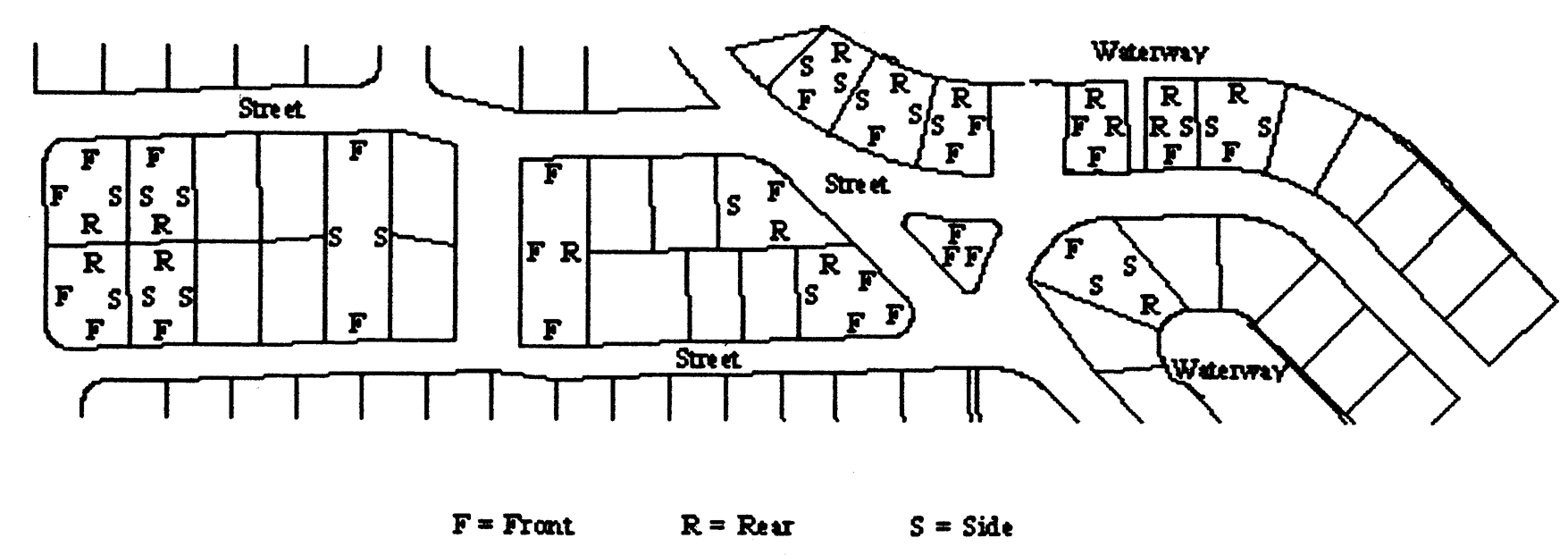
Yard Illustration
Yard, front: A yard across the full width of the lot extending from the front line of the building to the front right-of-way line of the lot.
Yard, rear: A yard extending the full width of the lot between the main building and the rear lot line.
Yard, required: A minimum open area requirement, other than a court, on the same lot with a building, unoccupied and unobstructed from the ground upward, except as otherwise provided in these regulations. The depth of any required yard that abuts an existing or proposed street, for which additional right-of-way will be required pursuant to the Broward County Trafficways Plan, Comprehensive Plan, or other officially adopted plan, shall be measured from the ultimate right-of-way line of the street, provided that the area in between the existing and ultimate right-of-way lines shall also be considered part of the required yard.
Yard, side: A yard between the building and the adjacent side of the lot, and extending from the front yard to the rear yard thereof.
(Ord. No. 848, 10-14-03; Ord. No. 871, § 2, 5-10-05; Ord. No. 911, § 2, 11-14-06; Ord. No. 925, § 2, 7-24-2007; Ord. No. 2014-007, § 8, 12-9-14; Ord. No. 2016-010, § 2, 9-13-16; Ord. No. 2017-010, § 2, 2-13-18; Ord. No. 2018-001, § 2, 2-13-18; Ord. No. 2020-009, § 2, 9-22-20)

